
Beaumont City Zoning Code
CHAPTER 17
19 - DOWNTOWN ZONE DISTRICTS
17.19.010 - Purpose and authority.
The purpose of this Chapter 17.19 is to accomplish the following:
•
To implement the Downtown Area Plan of the City of Beaumont General Plan and the Land Use Policy Map;
•
To identify and describe the land use designations delineated on the City of Beaumont Official Zoning Map;
•
To indicate the development standards for each of the Zone Districts; and
•
To identify the range of uses permitted within each Zone District.
(Ord. No. 1128, § 2(Exh. B), 12-1-2020)
17.19.020 - Establishment of zone districts.
For the purpose of providing a uniform basis for this Zoning Ordinance, the following zone classifications may be applied to those parcels located within the City of Beaumont Downtown boundaries:
Downtown Mixed Use Zone (DMU Zone)
Beaumont Mixed Use Zone (BMU Zone)
Sixth Street Mixed Use Zone (SSMU Zone)
Sixth Street Mixed Use - Residential Zone (SSMU-R Zone)
Local Commercial Zone (LC Zone)
Downtown Residential Multifamily Zone (DMF Zone)
Other zone classifications that apply to Downtown, which are governed by Chapter 17.03, are as follows:
Residential, Single Family Zone (R-SF Zone)
Residential, Traditional Neighborhood Zone (R-TN Zone)
Public Facilities Zone (P-F Zone)
(Ord. No. 1128, § 2(Exh. B), 12-1-2020)
17.19.030 - Zoning map.
The location and boundaries of the various zones within Downtown are delineated on the zoning map of the City of Beaumont. Figure 17.19-1 illustrates the zone districts for Downtown. All property within the Downtown, public and private, is assigned a specific Zone designation and its location and extent is noted on the official zoning map. The use of all property must be in accordance with the Zoning designations delineated on the zoning map and pursuant to the provisions of this Zoning Code.
A.
Use of Zoning Map and Classifications. The requirements that are applicable to each Zone classification is specifically set forth in subsequent articles of this ordinance.
B.
Uncertainty in Cartography. Where uncertainty exists as to the boundaries of any zone, the following rules shall apply:
1.
Cartography. Where boundaries are indicated as approximately following street lines, alley lines, or lot lines, such lines shall be construed to be such boundaries.
2.
Easements and Rights-of-Way. Dedicated streets, alleys, freeways, or railroad rights-of-way shall be deemed to be unclassified.
3.
Vacated or Abandoned Property. If any public street, alley or other right-of-way is vacated or abandoned, the land formerly in such street, alley or right-of-way shall be included within the Zoning of the adjoining property on each side.
4.
Amendments to the Official Zoning Map. Changes in boundaries of Zones shall be made by ordinance (as described in Section 17.02). All amendments to the zoning map shall be noted on the Map with the date of the amendment and references to the amending ordinance.
Figure 17.19-1. Downtown Zones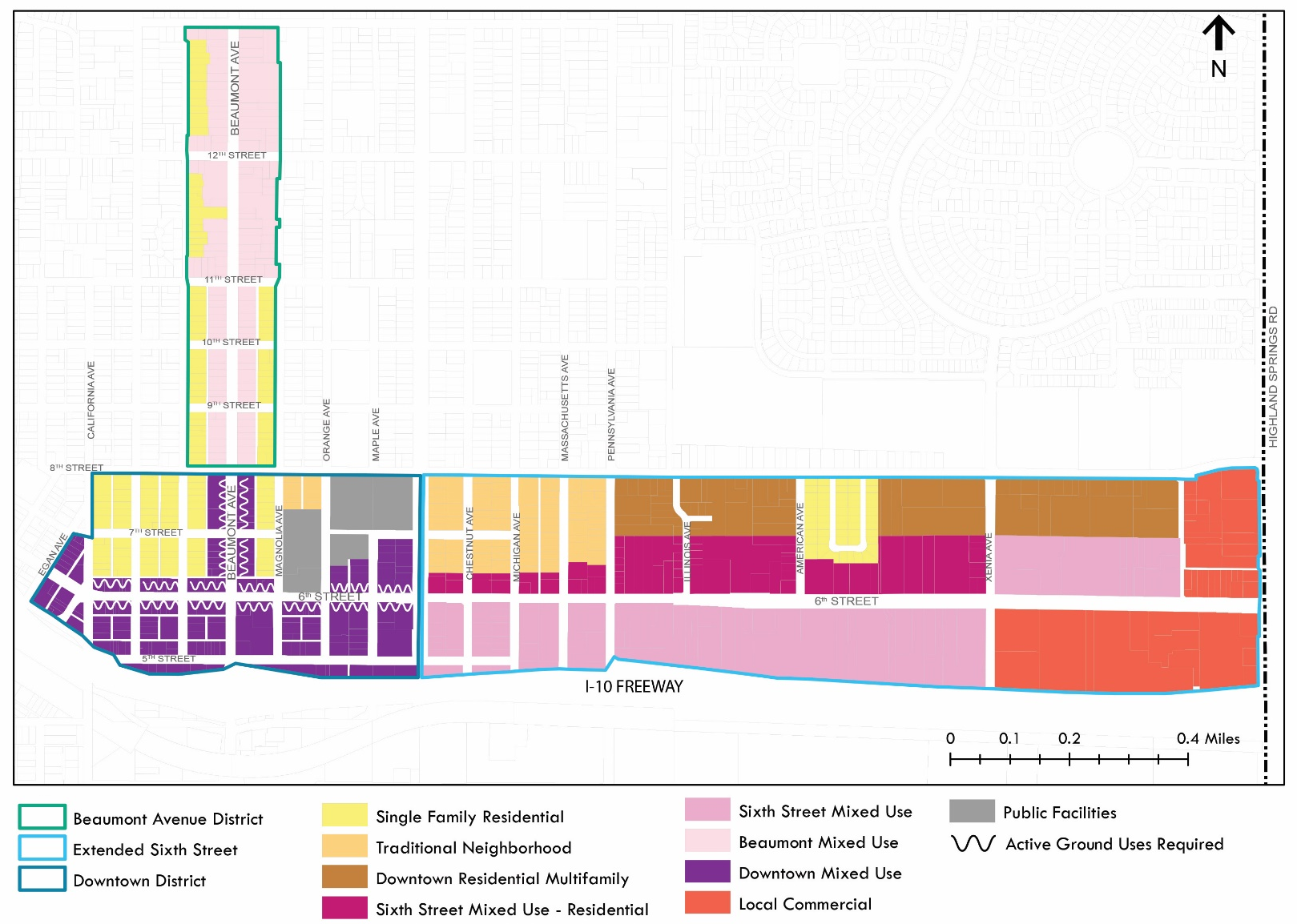
(Ord. No. 1128, § 2(Exh. B), 12-1-2020)
17.19.040 - Downtown Mixed Use Zone (DMU Zone).
The Downtown Mixed Use (DMU) Zone is intended to provide for a rich and diverse mixture of office, retail, commercial, civic, entertainment, and cultural activities in a lively, thriving, high-quality pedestrian environment which incorporates mixed use development. Active and retail uses are required along the Sixth Street (between California and Palm Avenues) and Beaumont Avenue (between 5th and 8th Street) street frontages to create a walkable, pedestrian-oriented and vibrant environment. This Zone is also intended to allow for residential uses on the upper floors (residential uses are not permitted on the first floor along Sixth Street and Beaumont Avenue to ensure that the Downtown character is maintained).
A.
Downtown Mixed Use Zone, Permitted Uses. The uses permitted under this Zone District are identified in Table 17.19-1 of this Section.
B.
Downtown Mixed Use Zone, Conditional Uses. The uses conditionally permitted under this Zone District are identified in Table 17.19-1 of this Section. Such uses require the approval of a conditional use permit.
C.
Downtown Mixed Use Zone, Development Standards. The following Standards shall apply to the Downtown Mixed Use Zone (DMU Zone):
1.
Lot Area and Dimensions. No minimum requirement.
2.
Setbacks and Yards. The following setback requirements are applicable to the Downtown Mixed Use Zone (DMU Zone):
a.
Front Yard Setback, Commercial Uses. None required.
b.
Front Yard Setback, Residential Uses. Maximum five feet. All portions not used for access must be landscaped.
c.
Front Yard Setback, Above Ground Parking. Minimum 40 feet. The setback for above ground parking may be waived by the Community Development Director upon making the following findings:
i.
The site is small and/or constrained such that underground parking or surface parking located more than 40 feet from the street is not feasible; and
ii.
The parking area located within 40 feet of the street is landscaped along the street with a hedge, trellis, and/or landscaping consistent with Chapter 17.06.
d.
Rear Yard Setbacks. No rear yard setback is required, except when adjacent to single family residential use. The rear yard setback is 20 feet when adjacent to single family residential use.
e.
Side Yard Setbacks. No side yard setback is required, except when adjacent to single family residential use. The side yard setback is 15 feet when adjacent to single family residential use.
f.
Freeway Setbacks for Residential Uses. Residential uses shall have a minimum setback of 500 feet from Interstate 10 or any highway.
3.
Density. The maximum density shall be 15 units per acre.
4.
Floor Area Requirements. The maximum permitted floor area ratio is 0.35. The floor area ratio standard applies to non-residential uses only.
5.
Building Height. In the Downtown Mixed Use Zone (DMU Zone), the maximum height of any building shall not exceed 3 stories or 45 feet.
6.
Step back from Adjacent Residential. New development when sited next to single-family uses shall step back upper floors (third and higher) an additional 15 feet to maintain solar access and privacy for adjacent single family residential uses. See Figure 17.19-2.
Figure 17.19-2. Step Back from Adjacent Residential Uses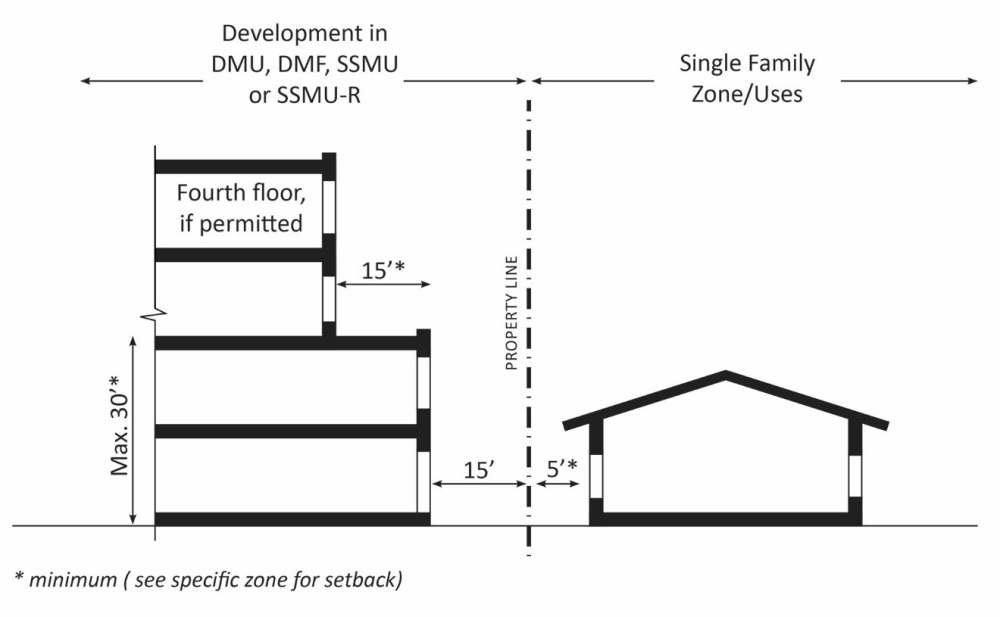
D.
Downtown Mixed Use Zone, Off street Parking. Automobile storage space shall be provided as indicated in Chapter 17.05.
E.
Downtown Mixed Use, Landscaping. The provisions of Chapter 17.06 of this ordinance shall apply, except where they conflict with standards allowed in this Zone (e.g., no front yard setback).
F.
Downtown Mixed Use Zone, Signs. The provisions of Chapter 17.07 of this ordinance shall apply.
G.
Street Trees. A minimum of one tree shall be located along every 40 feet of street frontage. Street trees shall comply with applicable standards in Section 17.06.110 (Street trees).
H.
Adjacency to Interstate 10. The following standards apply to development that are within 500 feet of Interstate 10 as measured from its right-of-way:
1.
Locate occupied open space areas (play areas, courtyards, patios, balconies, etc.) as far from the freeway as possible when the size of the site permits.
2.
Prioritize the location of non-habitable uses, such as parking structures and building areas not calculated in floor area, nearest the freeway.
3.
Screen the project site with substantial vegetation and/or a wall barrier.
4.
Provide special noise mitigation for residential uses in this zoning district that are within 500 feet of Interstate 10.
I.
Supplemental Standards for Multiple-Family, Residential Mixed-Use, and Attached Single-Family Development. The standards of Section 17.03.065.I, Supplemental Standards apply to all multiple-family, residential mixed-use, and attached single family development within the DMU, SSMU, and SSMU-R Zones.
J.
Supplemental Standards, All Development. The standards below apply to all development in the DMU, zones.
1.
Wall Plane Modulation.
a.
All non-residential street-facing façades must have at least one horizontal or vertical projection or recess at least two feet in width and depth, for every 50 horizontal feet of wall.
Figure 17.19-3. Wall Plane Modulation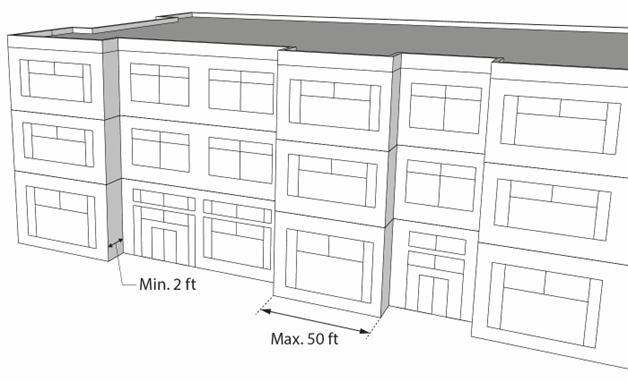
b.
Horizontal articulation must include a differentiated base, a roof cornice line or parapet, and an eave, awning, overhang, transom feature, belt course, or other architectural element that frames the middle section of the building.
c.
Buildings or portions of buildings over two stories must include articulation for the top story of the building. This may be accomplished through two or more of the following:
i.
Change in color;
ii.
Change in material;
iii.
Cornice/belt course at the bottom of the uppermost floor; and
iv.
Change in roof pitch, such as a gable, or an upper-story step-back.
Figure 17.19-4. Building Façade Visible from Public Street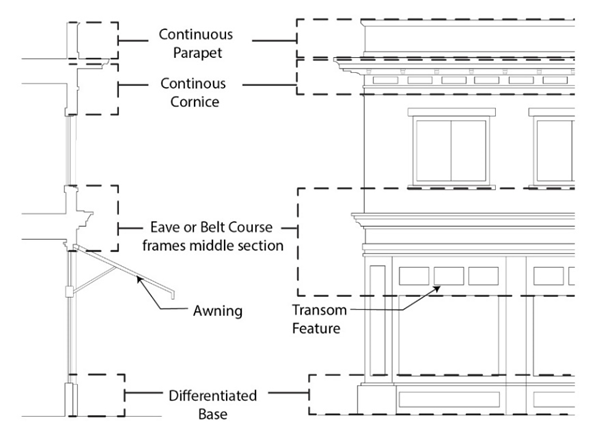
2.
Ground Floor Height.
a.
Non-residential ground level floor-to-ceiling height must be a minimum 11 feet.
b.
Non-residential ground floor height may not differ from the height of any adjacent non-residential use by more than two feet or as approved by the Community Development Director.
3.
Building Transparency/Required Openings. Exterior walls facing and within 20 feet of a front or street side property line shall include windows, doors, or other openings for at least 50 percent of the building wall area located between two and one-half and seven feet above the level of the sidewalk. Such walls may run in a continuous plane for no more than 30 feet without an opening.
a.
Design of openings. Openings fulfilling this requirement shall have transparent glazing and provide views into display areas, sales areas, work areas, lobbies, or similar active spaces, or into window displays that are at least three feet deep.
b.
Exceptions. The following are exempt from this requirement:
i.
Residential uses; and
ii.
Multi-level garages.
c.
Reductions. This requirement may be reduced to 40 percent if street-facing building walls exhibit architectural relief (articulated building base, columns/piers, transom) and are enhanced with landscaping at the pedestrian level.
d.
Reductions by Director. This requirement may be further reduced or waived if the Community Development Director finds that the proposed use has unique operational characteristics with which providing the required transparency and openings is incompatible.
Figure 17.19-5. Building Transparency/Required Openings Exhibit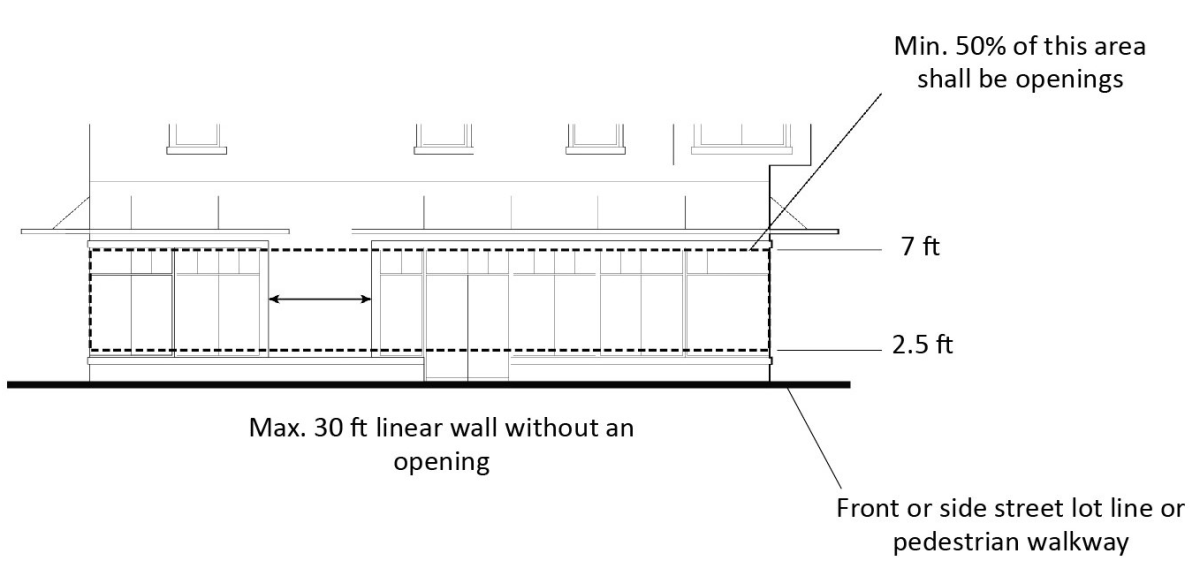
e.
Enhancement on Blank Walls. Blank walls that exceed eight horizontal feet at the ground level must include one or more of the following:
i.
A pattern of insets;
ii.
A building base of at least 2.5 feet in height and a cornice or other architectural features at the top of the ground level;
iii.
Landscaping that, at maturity, obscures a minimum 50 percent of the wall area; or
iv.
Landscaped metal trellises or lattices over a minimum 50 percent of the wall area.
4.
Building Orientation. Building frontages shall be generally parallel to streets and pedestrian walkways.
5.
Building Entrances.
a.
Orientation. The primary building entrance shall face a public sidewalk. Buildings located in the interior of a site shall have the primary entrance facing a pedestrian walkway that is connected to a public sidewalk.
b.
Separation of Residential and Non-Residential Entrances. Entrances to residential units, either shared or common, must be a minimum 30 horizontal feet from commercial entrances. Live/work units are excluded from this standard.
6.
Corner Design. Building design at intersections must exhibit signature architectural features at the corner. Features may include but are not limited to tower elements, wrap-around bay windows, or rounded or chamfered corners elements, or decorative parapets.
7.
360-Degree Design. All buildings must be designed with "360-degree design" where each exterior wall is designed equivalent to the primary facade in the extent of building articulation, level of detail, and quality of exterior materials, and consistent with the color scheme of the primary facade. Details include but are not limited to window and door trim, window and door recesses, cornices, belt courses, columns/piers, posts/beams, brackets, columns/arches, and roof forms.
8.
Additions/remodels. Notwithstanding the design standards of this Chapter, additions to and remodels of existing buildings, including porches, balconies and decks, must match the architectural design and detail of the existing building.
9.
Pedestrian Access and Circulation. On-site pedestrian circulation and access shall be provided consistent with the following standards:
a.
Internal Connections. A system of pedestrian walkways shall connect all buildings on a site to each other, to on-site automobile and bicycle parking areas, and to any on-site open space areas or pedestrian amenities.
b.
Paving. Paving within required setback areas must be distinct from the adjacent public sidewalk in color, design, or texture.
c.
To Circulation Network. Regular connections between on-site walkways and the public sidewalk and other planned or existing pedestrian routes or trails shall be provided. An on-site walkway shall connect the primary building entry or entries to a public sidewalk on each street frontage.
d.
To Neighbors. Direct and convenient access shall be provided to adjoining residential and commercial areas to the maximum extent feasible while still providing for safety and security.
e.
To Transit. Safe and convenient pedestrian connections shall be provided from transit stops to building entrances.
f.
Pedestrian Walkway Design.
i.
Walkways shall be a minimum of six feet wide, shall be hard-surfaced, and paved with permeable materials. Walkway widths may be reduced to three feet wide for small lot development (Section 17.11.030.D).
ii.
Where a required walkway crosses a driveway, parking area, or loading area, it must be clearly identified using a raised crosswalk, a different paving material, or a similar method.
iii.
Where a required walkway is parallel and adjacent to an auto travel lane, it shall be raised or separated from the auto travel lane by a raised curb at least four inches high, bollards, or another physical barrier.
10.
Public Open Space Requirement. Developments with 50,000 square feet or more of non-residential floor area on sites of five acres or larger shall provide open space consistent with the following:
a.
Forty square feet of open space shall be provided for every 1,000 square feet of nonresidential floor area for the first 100,000 square feet of non-residential floor area, plus 20 square feet of open space for every 1,000 square feet of non-residential floor area over 100,000 square feet.
b.
Such open space shall be visible and accessible from a public street, or from on-site areas normally frequented by customers and shall be accessible during business hours. Areas within required setbacks may count towards the open space requirement.
c.
Such open space shall have a minimum dimension of 40 feet.
d.
Amenities shall be included that enhance the comfort, aesthetics, or usability of the space, including trees, landscaping, shade structures, seating (e.g., fixed seating, planter ledges, etc.), lighting, drinking fountains, public art, or performance areas.
e.
The surface of the open space shall allow for convenient outdoor activity, recreation, and/or gathering. Such surface may be plant or hardscape material, or a combination thereof.
11.
Parking Design.
a.
Surface Parking Area Design. Surface parking areas must be separated from on-site buildings by a minimum distance of five feet that is either paved or landscaped.
b.
Garages. Garage doors must be recessed a minimum of six inches from the face of the garage.
c.
Tandem Parking. Tandem parking may be permitted to satisfy the off-street parking requirement in accordance with the following.
i.
No more than two vehicles may be placed one behind the other.
ii.
Both spaces must be assigned to a single dwelling unit or to employees of the same non-residential establishment.
iii.
The tandem parking bay must be a minimum 40 feet by 10 feet in dimension.
iv.
Tandem parking to meet required parking for multi-unit development must be located within an enclosed structure and the number of tandem parking spaces may not exceed 50 percent of the total number of spaces.
v.
Tandem parking may not be used to satisfy the parking requirement for guest parking.
d.
Driveway Width. Driveways to shared garages may not exceed 35 feet in width.
e.
Parking Visibility. Visible structured parking must be screened from view from the right-of-way by landscaping or decorative screening, or a combination of architectural features and landscaping or living walls.
f.
Curb Cut Frequency.
i.
A maximum of one curb cut for driveway access may be permitted per street frontage per development project site, unless additional curb cuts are approved by the Community Development Director, Public Works Director and Public Safety or the Development Review Committee.
ii.
On corner lots, curb cuts must be located on the street frontage with the least pedestrian activity whenever feasible.
12.
Bicycle Parking.
a.
Short-term Bicycle Parking. Short-term secure bicycle parking must be provided to serve shoppers, customers, messengers, guests, and other visitors to a site who generally stay for a period of four hours or less.
i.
Spaces Required. For the following uses, the required number of short-term secure bicycle parking spaces is ten percent of the parking spaces required in Chapter 17.05, Off-Street Parking and Loading Standards, in no case fewer than four secure bicycle parking spaces provided per use.
(a)
Multi-family dwellings;
(b)
All public uses; and
(c)
All commercial uses, except automobile/vehicle sales and services.
ii.
Location.
(a)
Short-term secure bicycle parking must be located outside of pedestrian walkways, and within 100 feet of the main entrance to the building it serves.
(b)
Short-term secure bicycle parking must be located outside of the public right-of-way except as allowed through an encroachment permit.
(c)
Where the secure bicycle parking area is not visible from the main entrance of the buildings, signs located at the main entrance of the building must identify the location of bicycle parking.
iii.
Anchoring and Security. For each short-term bicycle parking space required, a stationary, securely-anchored bicycle rack must be provided to which a bicycle frame and one wheel (two points of contact) can be secured with a high-security U-shaped shackle lock if both wheels are left on the bicycle. One such bicycle rack may serve multiple bicycle parking spaces.
iv.
Size and Accessibility. Each short-term bicycle parking space must be a minimum of two feet in width and six feet in length and must be accessible without moving other bicycles. Two feet of clearance must be provided between bicycle parking spaces and adjacent walls, poles, landscaping, street furniture, drive aisles, and pedestrian walkways. Five feet of clearance must be provided from vehicle parking spaces.
b.
Long-Term Bicycle Parking. Long-term bicycle parking must be provided to serve employees, students, residents, commuters, and others who generally stay at a site for four hours or longer.
i.
Spaces Required.
(a)
A minimum of one long-term secured bicycle parking space must be provided for every four dwelling units or portion thereof.
(b)
Any establishment with six or more full-time equivalent employees must provide long-term bicycle parking designated on a site plan at a minimum ratio of one bicycle parking space per 10 required vehicle parking spaces. Parking areas with fewer than six spaces are encouraged but not required to provide long-term bicycle parking.
ii.
Location. Long-term bicycle parking must be located on the same lot as the use it serves and near a building entrance. In parking structures, long-term bicycle parking must be located near an entrance to the facility. Where the bicycle parking area is not visible from the entrance of the building, signs located at the entrance or in an entry lobby of the building must identify the location of bicycle parking.
iii.
Anchoring and Security. Long-term bicycle parking must be located in an enclosed bicycle locker or other secure areas approved by the Community Development Director.
iv.
Size and Accessibility. Each long-term bicycle parking space must be a minimum of two feet in width and six feet in length and must be accessible without moving other bicycles. Two feet of clearance must be provided between bicycle parking spaces and adjacent walls, poles, landscaping, street furniture, drive aisles, and pedestrian walkways. Five feet of clearance must be provided from vehicle parking spaces.
(Ord. No. 1128, § 2(Exh. B), 12-1-2020; Ord. No. 1150, § 4(Exh. A), 10-4-2022; Ord. No. 1164, § 2(Exh. A), 10-3-2023)
17.19.050 - Beaumont Mixed Use Zone (BMU Zone).
The Beaumont Mixed Use Zone is intended to facilitate Beaumont Avenue corridor's transition to a mixed-use district with a mix of professional office, limited commercial uses and residential uses that are compatible with the abutting single-family residences to the east and west. Development is intended to be less intense than the DMU zoning district in keeping with the scale of surrounding development.
A.
Beaumont Mixed Use Zone, Permitted Uses. The uses permitted under this Zone District are identified in Table 17.19-1 of this Section.
B.
Beaumont Mixed Use Zone, Conditional Uses. The uses conditionally permitted under this Zone District are identified in Table 17.19-1 of this Section. Such uses require the approval of a conditional use permit.
C.
Beaumont Mixed Use Zone, Development Standards. The following standards shall apply to the Beaumont Mixed Use Zone (BMU Zone):
1.
Lot Area and Dimensions. No minimum lot size required.
2.
Setbacks and Yards. The following setback requirements are applicable to the Beaumont Mixed Use Zone (BMU Zone):
a.
Front Yard Setbacks. The minimum front yard setback is 5 feet and the maximum front yard setback is 20 feet. In no event shall a residence be situated in such a manner as to result in a distance of less than 20 feet between the back of a sidewalk and the face of a garage door.
b.
Rear Yard Setbacks. The minimum rear yard setback is 10 feet, except when adjacent to a single family residential use. The rear yard setback is 20 feet when adjacent to single family residential use.
c.
Side Yard Setbacks. The minimum side yard setback is 5 feet, except when adjacent to single family residential use. The side yard setback is 15 feet when adjacent to single family residential use.
3.
Density. The maximum density shall be 10 units per acre.
4.
Floor Area Requirements. The maximum permitted floor area ratio is 0.35. The floor area ratio standard applies to non-residential uses only.
5.
Building Height. In the Beaumont Mixed Use Zone (BMU Zone), the maximum height of any building shall not exceed 2 stories or 35 feet.
D.
Beaumont Mixed Use Zone, Off street Parking. Automobile storage space shall be provided as indicated in Chapter 17.05.
E.
Beaumont Mixed Use, Landscaping. The provisions of Chapter 17.06 of this ordinance shall apply, except where they conflict with standards allowed in this Zone.
F.
Beaumont Mixed Use Zone, Signs. The provisions of Chapter 17.07 of this ordinance shall apply.
G.
Street Trees. A minimum of one tree shall be located along every 40 feet of street frontage. Street trees shall comply with applicable standards in Section 17.06.110 (Street trees).
(Ord. No. 1128, § 2(Exh. B), 12-1-2020; Ord. No. 1150, § 4(Exh. A), 10-4-2022)
17.19.060 - Sixth Street Mixed Use Zone (SSMU Zone).
The Sixth Street Mixed Use Zone is intended to provide for commercial and multifamily residential uses along Sixth Street, east of Palm Avenue either as stand alone or in a mixed use setting. The permitted uses and development standards are intended to be conducive to a compact, mixed use, and walkable environment and supportive of the Downtown retail environment west of Palm Avenue.
A.
Sixth Street Mixed Use Zone, Permitted Uses. The uses permitted under this Zone District are identified in Table 17.19-1 of this Section.
B.
Sixth Street Mixed Use Zone, Conditional Uses. The uses conditionally permitted under this Zone District are identified in Table 17.19-1 of this Section. Such uses require the approval of a conditional use permit.
C.
Sixth Street Mixed Use Zone, Development Standards. The following Standards shall apply to the Sixth Street Mixed Use Zone (SSMU Zone):
1.
Lot Area and Dimensions. Lot sizes for the Sixth Street Mixed Use Zone (SSMU Zone) shall not be less than 10,000 square feet with a minimum average lot depth of 100 feet and a minimum average lot width of 80 feet.
2.
Setbacks and Yards. The following setback requirements are applicable to the Sixth Street Mixed Use Zone (SSMU Zone):
a.
Front Yard Setbacks. Minimum five feet. Maximum 10 feet. All portions not used for access must be landscaped.
b.
Front Yard Setback, Above Ground Parking. Minimum 40 feet. The setback for above ground parking may be waived by the Community Development Director upon making the following findings:
i.
The site is small and/or constrained such that underground parking or surface parking located more than 40 feet from the street is not feasible; and
ii.
The parking area located within 40 feet of the street is landscaped along the street with a hedge, trellis, and/or landscaping consistent with Chapter 17.06.
c.
Rear Yard Setbacks. The minimum rear yard setback is 10 feet, except when adjacent to a single family residential use. The rear yard setback is 20 feet when adjacent to single family residential use.
d.
Side Yard Setbacks. The minimum side yard setback is 5 feet, except when adjacent to single family residential use. The side yard setback is 15 feet when adjacent to single family residential use.
e.
Freeway Setbacks for Residential Uses. Residential uses shall have a minimum setback of 500 feet from Interstate 10.
3.
Density. The maximum density shall be 22 units per acre.
4.
Floor Area Requirements. The maximum permitted floor area ratio is 0.5. The floor area ratio standard applies to non-residential uses only.
5.
Building Height. In the Sixth Street Mixed Use Zone (SSMU Zone), the maximum height of any building shall not exceed 4 stories or 60 feet, except as noted below.
6.
Step back from Adjacent Residential. New development when sited next to single-family uses shall step back upper floors (third and higher) an additional 15 feet to maintain solar access and privacy for adjacent single family residential uses. See Figure 17.19-2.
D.
Sixth Street Mixed Use Zone, Off street Parking. Automobile storage space shall be provided as indicated in Chapter 17.05.
E.
Sixth Street Mixed Use, Landscaping. The provisions of Chapter 17.06 of this ordinance shall apply, except where they conflict with standards allowed in this Zone (e.g., no front yard setback).
F.
Sixth Street Mixed Use Zone, Signs. The provisions of Chapter 17.07 of this ordinance shall apply.
G.
Street Trees. A minimum of one tree shall be located along every 40 feet of street frontage. Street trees shall comply with applicable standards in Section 17.06.110 (Street trees).
H.
Adjacency to Interstate 10. The following standards apply to development that are within 500 feet of Interstate 10 as measured from its right-of-way:
1.
Locate occupied open space areas (play areas, courtyards, patios, balconies, etc.) as far from the freeway as possible when the size of the site permits.
2.
Prioritize the location of non-habitable uses, such as parking structures and building areas not calculated in floor area, nearest the freeway.
3.
Screen the project site with substantial vegetation and/or a wall barrier.
4.
Provide special noise mitigation for residential uses in this zoning district that are within 500 feet of Interstate 10.
I.
Supplemental Standards. Additional standards listed in Section 17.19.040.I and Section 17.19.040.J apply in the SSMU Zone.
(Ord. No. 1128, § 2(Exh. B), 12-1-2020; Ord. No. 1150, § 4(Exh. A), 10-4-2022; Ord. No. 1164, § 2(Exh. A), 10-3-2023)
17.19.070 - Sixth Street Mixed Use—Residential Zone (SSMU-R Zone).
The Sixth Street Mixed Use—Residential Zone (SSMU-R Zone) is intended to provide for multifamily residential and commercial uses along the north side of Sixth Street, east of Palm Avenue. Multifamily residential uses are required, either as stand alone or in a mixed use setting. The permitted uses and development standards are intended to be conducive to a compact, mixed use, and walkable environment and supportive of the Downtown retail environment west of Palm Avenue.
A.
Sixth Street Mixed Use—Residential Zone, Permitted Uses. The uses permitted under this Zone District are identified in Table 17.19-1 of this Section.
B.
Sixth Street Use—Residential Zone, Conditional Uses. The uses conditionally permitted under this Zone District are identified in Table 17.19-1 of this Section. Such uses require the approval of a conditional use permit.
C.
Sixth Street Mixed Use—Residential Zone, Development Standards. The following standards shall apply to the Sixth Street Mixed Use—Residential Zone (SSMU-R Zone):
1.
Lot Area and Dimensions. Lot sizes for the Sixth Street Mixed Use—Residential Zone (SSMU-R Zone) shall not be less than 10,000 square feet with a minimum average lot depth of 100 feet and a minimum average lot width of 80 feet.
2.
Setbacks and Yards. The following setback requirements are applicable to the Sixth Street Mixed Use—Residential Zone (SSMU-R Zone):
a.
Front Yard Setbacks. Minimum five feet. Maximum 10 feet. All portions not used for access must be landscaped.
b.
Front Yard Setback, Above Ground Parking. Minimum 40 feet. The setback for above ground parking may be waived by the Community Development Director upon making the following findings:
i.
The site is small and/or constrained such that underground parking or surface parking located more than 40 feet from the street is not feasible; and
ii.
The parking area located within 40 feet of the street is landscaped along the street with a hedge, trellis, and/or landscaping consistent with Chapter 17.06.
c.
Side Yard Setbacks. The minimum side yard setback is 5 feet, except when adjacent to single family residential use. The side yard setback is 15 feet when adjacent to single family residential use.
3.
Density. The maximum density shall be 22 units per acre.
4.
Floor Area Requirements. The maximum permitted floor area ratio is 0.5. The floor area ratio standard applies to non-residential uses only.
5.
Building Height. In the Sixth Street Mixed Use—Residential Zone (SSMU-R Zone), the maximum height of any building shall not exceed 4 stories or 60 feet.
6.
Step back from Adjacent Residential. New development when sited next to single-family uses shall step back upper floors (third and higher) an additional 15 feet to maintain solar access and privacy for adjacent single family residential uses. See Figure 17.19-2.
D.
Sixth Street Mixed Use—Residential Zone, Off street Parking. Automobile storage space shall be provided as indicated in Chapter 17.05.
E.
Sixth Street Mixed Use—Residential Zone, Landscaping. The provisions of Chapter 17.06 of this ordinance shall apply, except where they conflict with standards allowed in this Zone (e.g., no front yard setback).
F.
Sixth Street Mixed Use—Residential Zone, Signs. The provisions of Chapter 17.07 of this ordinance shall apply.
G.
Street Trees. A minimum of one tree shall be located along every 40 feet of street frontage. Street trees shall comply with applicable standards in Section 17.06.110 (Street trees).
H.
Supplemental Standards. Additional standards listed in Section 17.19.040.I and Section 17.19.040.J apply in the SSMU-R Zone.
(Ord. No. 1128, § 2(Exh. B), 12-1-2020; Ord. No. 1150, § 4(Exh. A), 10-4-2022; Ord. No. 1164, § 2(Exh. A), 10-3-2023)
17.19.080 - Downtown Residential Multifamily Zone (DMF Zone).
The Downtown Residential Multifamily Zone (DMF Zone) is intended to encourage walkable, transit ready residential development in the proximity to Downtown, and to facilitate further development of this land use type. This includes higher density housing that includes condominiums, townhomes, duplexes, patio apartments, senior housing and supporting ancillary facilities.
A.
Downtown Residential Multifamily Zone, Permitted Uses. The uses permitted under this Zone District are identified in Table 17.19-1 of this Section.
B.
Downtown Residential Multifamily Zone, Conditional Uses. The uses conditionally permitted under this Zone District are identified in Table 17.19-1 of this Section. Such uses require the approval of a conditional use permit.
C.
Downtown Residential Multifamily Zone, Development Standards. The following standards shall apply to the Downtown Residential Multifamily Zone (DMF Zone):
1.
Lot Area and Dimensions. Lot sizes for the Downtown Residential Multifamily Zone (DMF Zone) shall not be less than 6,000 square feet with an average lot width of 60 feet and a minimum average lot depth of 100 feet. Smaller lots may be allowed consistent with 17.11.030.D (Small Lot Development).
2.
Setbacks and Yards. The following setback requirements are applicable to the Downtown Residential Multifamily Zone (DMF Zone):
a.
Front Yard Setbacks.
1.
The minimum front yard setback is 10 feet.
2.
The maximum front yard setback is 20 feet. The maximum setback requirement may be waived if the Director finds:
a.
Common plazas, courtyards, or outdoor amenity areas are located between the street and the building(s);
b.
The building(s) incorporates an entrance design that creates a welcoming entry feature facing the street; or
c.
A larger area is required to preserve existing mature trees or natural features.
b.
Rear Yard Setbacks. The minimum rear yard setback is 15 feet, except a minimum rear yard setback of 20 feet is required when adjacent to a single family residential use.
c.
Side Yard Setbacks.
1.
The minimum interior side yard setback is five feet, except corner lots shall have a minimum street side yard setback of 10 feet. The minimum interior side yard setback is increased to 15 feet if adjacent to a single family residential use and to 20 feet for a three-story building.
2.
The maximum street side yard setback is 20 feet. The maximum setback requirement may be waived if the Director makes the findings listed in subparagraph 17.19.080.C.2.a.2.
3.
Building Placement Requirements.
a.
Building façade(s) shall extend a minimum of 65 percent of the street frontage for the area between the minimum and maximum front yard setbacks. For example, if a lot is 100 feet wide, 65 linear feet of the lot parallel to the street must be occupied by a building(s) that adheres to the maximum setback requirement.
b.
In the area between the minimum and maximum street side yard setback, 50 percent of the linear distance parallel to the street shall be occupied by a building façade(s).
Figure 17.19-4. Building Placement Requirements, DMF Zone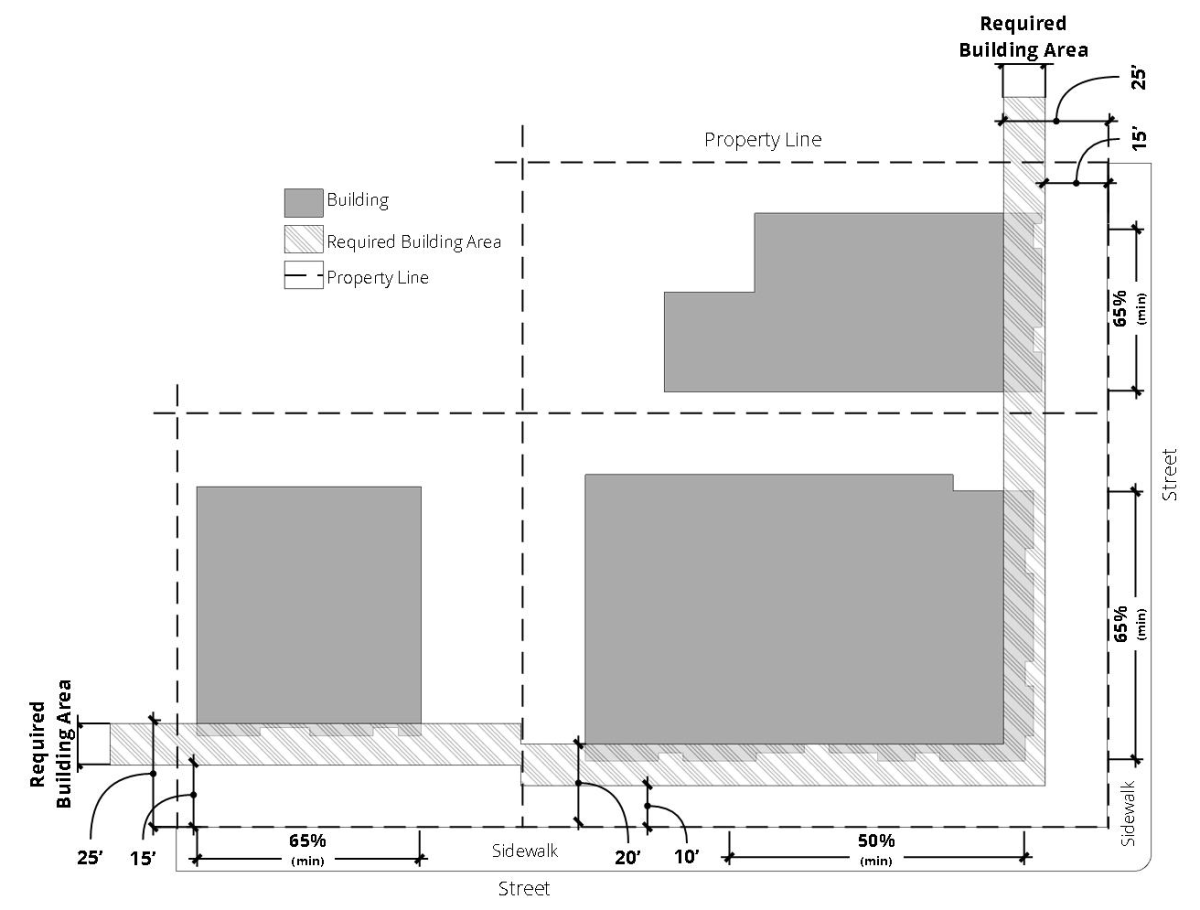
4.
Density. The density shall not exceed 22 units per acre.
5.
Useable Yard Area (Open Space) Requirements. The following minimum useable open space standards are applicable to development within the Downtown Residential Multifamily Zone (DMF Zone):
a.
For multifamily developments of fewer than 20 units, each unit shall have a minimum of 100 square feet of usable open space.
b.
For multifamily developments of 20 or more units, each unit shall have a minimum of 200 square feet of usable open space.
c.
The definition of useable open space and the method of computation is provided in Chapter 17.14 (see "Open Space, Useable").
6.
Building Height. In the Downtown Residential Multifamily Zone (DMF Zone), the maximum height of any building shall not exceed 35 feet.
7.
Step back from Adjacent Residential. New development when sited next to single-family uses shall step back upper floors (third and higher) an additional 15 feet to maintain solar access and privacy for adjacent single family residential uses. See Figure 17.19-2.
D.
Downtown Residential Multifamily Zone, Off street Parking.
1.
Parking shall not be located in the front setback unless the Director makes the following findings:
a.
Buildings comply with the maximum front setback requirement;
b.
The parking area located within the front setback is landscaped along the street with a hedge, trellis, and/or landscaping consistent with Chapter 17.06; and
c.
Requirements in Chapter 17.05 are complied with.
2.
Automobile storage space shall be provided as indicated in Chapter 17.05.
E.
Downtown Residential Multifamily Zone, Landscaping. The provisions of Chapter 17.06 of this ordinance shall apply.
F.
Downtown Residential Multifamily Zone, Signs. The provisions of Chapter 17.07 of this ordinance shall apply.
G.
Street Trees. A minimum of one tree shall be located along every 40 feet of street frontage. Street trees shall comply with applicable standards in Section 17.06.110 (Street trees).
H.
Supplemental Multiple Family Development Standards. Additional standards listed in Section 17.03.065.I apply to multiple family developments, multiple family residential components of mixed-use developments, and attached single unit developments, in the DMF Zone.
(Ord. No. 1128, § 2(Exh. B), 12-1-2020; Ord. No. 1150, § 4(Exh. A), 10-4-2022)
17.19.090 - Local Commercial Zone (LC Zone).
The Local Commercial Zone (LC Zone) is intended to permit development that provides for a range of commercial service and retail land uses that are in proximity to residential neighborhoods consistent with the General Plan.
A.
Local Commercial Zone, Permitted Uses. The uses permitted under this Zone District are identified in Table 17.19-1 of this Section.
B.
Local Commercial Zone, Conditional Uses. The uses conditionally permitted under this Zone District are identified in Table 17.19-1 of this Section. Such uses require the approval of a conditional use permit.
C.
Local Commercial Zone, Development Standards. The following standards shall apply to the Local Commercial Zone (LC Zone):
1.
Lot Area and Dimension. Lots sizes for the Local Commercial Zone (LC Zone) shall not be less than 10,000 square feet with a minimum average lot depth of 100 feet and a minimum average lot width of 100 feet.
2.
Setbacks and Yards. The following setback requirements are applicable to the Local Commercial Zone (LC Zone):
a.
Front Yard Setbacks. The minimum front yard setback is 5 feet.
b.
Rear Yard Setbacks. No rear yard setback is required, except when adjacent to single family residential use. The rear yard setback is 20 feet when adjacent to single family residential use.
c.
Side Yard Setbacks. No side yard setback is required, except when adjacent to single family residential use. The side yard setback is 15 feet when adjacent to single family residential use.
3.
Lot Area Requirements. The area occupied by all structures shall not exceed 50 percent of the lot area and the maximum permitted floor area ratio is 0.7.
4.
Building Height. In the Local Commercial Zone (LC Zone), the maximum height of any building shall not exceed 60 feet.
D.
Local Commercial Zone, Off street Parking. Automobile storage space shall be provided as indicated in Chapter 17.05.
E.
Local Commercial Zone, Landscaping. The provisions of Chapter 17.06 of this ordinance shall apply.
F.
Local Commercial Zone, Signs. The provisions of Chapter 17.07 of this ordinance shall apply.
G.
Supplemental Standards.
1.
Limitations on Location of Parking. Above ground parking shall not be located within 40 feet of a street facing property line unless the Director makes the following findings:
a.
The site is small and/or constrained such that underground parking or surface parking located more than 40 feet from the street is not feasible; or
b.
The design incorporates habitable space built close to the public sidewalk; and
c.
The parking area located within 40 feet of the street is landscaped along the street with a hedge, trellis, and/or landscaping consistent with Chapter 17.06.
2.
Building Transparency/Required Openings. Exterior walls facing and within 20 feet of a front or street side property line shall include windows, doors, or other openings for at least 50 percent of the building wall area located between two and one-half and seven feet above the level of the sidewalk. Such walls may run in a continuous plane for no more than 30 feet without an opening. (Figure 17.19-3).
a.
Design of openings. Openings fulfilling this requirement shall have transparent glazing and provide views into display areas, sales areas, work areas, lobbies, or similar active spaces, or into window displays that are at least three feet deep.
b.
Exceptions for parking garages. Multi-level garages are exempt from this requirement.
c.
Reductions. This requirement may be reduced or waived if the Director makes the following findings:
1.
The proposed use has unique operational characteristics with which providing the required transparency and openings is incompatible; and
2.
Street-facing building walls will exhibit architectural relief and detail and will be enhanced with landscaping to create visual interest at the pedestrian level.
3.
Building Orientation. Building frontages shall be generally parallel to streets and pedestrian walkways.
4.
Building Entrances. The primary building entrance shall face a public sidewalk. Buildings located in the interior of a site shall have the primary entrance face a pedestrian walkway that is connected to a public sidewalk.
5.
Wall Plane Modulation. All street-facing façades shall have at least one horizontal or vertical projection or recess at least two feet in depth, for every 50 horizontal feet of wall.
6.
Pedestrian Access. On-site pedestrian circulation and access shall be provided consistent with the following standards.
a.
Internal connections. A system of pedestrian walkways shall connect all buildings on a site to each other, to on-site automobile and bicycle parking areas, and to any on-site open space areas or pedestrian amenities.
b.
To circulation network. Regular connections between on-site walkways and the public sidewalk and other planned or existing pedestrian routes or trails shall be provided. An on-site walkway shall connect the primary building entry or entries to a public sidewalk on each street frontage.
c.
To neighbors. Direct and convenient access shall be provided to adjoining residential and commercial areas to the maximum extent feasible while still providing for safety and security.
d.
To transit. Safe and convenient pedestrian connections shall be provided from transit stops to building entrances.
e.
Pedestrian walkway design.
1.
Walkways shall be a minimum of six feet wide, shall be hard-surfaced, and paved with permeable materials.
2.
Where a required walkway crosses a driveway, parking area, or loading area, it must be clearly identified using a raised crosswalk, a different paving material, or a similar method.
3.
Where a required walkway is parallel and adjacent to an auto travel lane, it shall be raised or separated from the auto travel lane by a raised curb at least four inches high, bollards, or another physical barrier.
7.
Public Open Space Requirement. Developments with 50,000 square feet or more of non-residential floor area on sites of two acres or larger shall provide open space consistent with the following:
a.
Forty square feet of open space shall be provided for every 1,000 square feet of nonresidential floor area for the first 100,000 square feet of non-residential floor area, plus 20 square feet of open space for every 1,000 square feet of non-residential floor area over 100,000 square feet.
b.
Such open space shall be visible and accessible from a public street, or from on-site areas normally frequented by customers and shall be accessible during business hours. Areas within required setbacks may count towards the open space requirement.
c.
Such open space shall have a minimum dimension of 40 feet.
d.
Amenities shall be included that enhance the comfort, aesthetics, or usability of the space, including trees, landscaping, shade structures, seating (e.g., fixed seating, planter ledges, etc.), lighting, drinking fountains, public art, or performance areas.
e.
The surface of the open space shall allow for convenient outdoor activity, recreation, and/or gathering. Such surface may be plant or hardscape material, or a combination thereof.
(Ord. No. 1128, § 2(Exh. B), 12-1-2020)
17.19.120 - Permitted uses for Downtown Base Zone Districts.
The permitted uses for the Base Zone Districts (identified in Section 17.19.040 through 17.19.090) are listed in Table 17.19-1.
N = Not Permitted
P = Permitted
C = Conditionally Permitted
A = Permitted as an Accessory Use
Footnotes:
1 Use is allowed only on upper floor locations on parcels fronting 6th Street and Beaumont Avenue. Limited lobby or entry areas are allowed on the ground floor.
2 Use is not allowed on parcels fronting 6th Street and Beaumont Avenue unless approved by the Planning Commission through the Conditional Use Permit process.
3 Use is limited to 2,500 square feet unless approved by the Planning Commission through the Conditional Use Permit process.
4 These uses shall not be located on any parcel which is located within 1,000 feet of any school providing instruction in 12th grade or below, day care center, or youth center.
5 New liquor stores shall not be located within 1,000 feet of another liquor store.
6 Must comply with step back standards (Figure 17.19-2) and setbacks per zone if adjacent to single family residential use. Performance standards per Chapter 17.04 apply.
7 Use is limited to 5,000 square feet unless approved by the Planning Commission through the Conditional Use Permit process.
8 Use is limited to 10,000 square feet unless approved by the Planning Commission through the Conditional Use Permit process.
9 CUP required if proposed use is larger than 10,000 square feet.
10 A Live/work unit is only permitted in the primary structure.
11 New fast-food restaurants should not be located within 1,000 feet of another fast food restaurant.
12 Temporary Use Permit required.
(Ord. No. 1128, § 2(Exh. B), 12-1-2020; Ord. No. 1141, § 5(Exh. A), 10-5-2021; Ord. No. 1150, § 4(Exh. A), 10-4-2022; Ord. No. 1151, § 4(Exh. A), 11-15-2022)

