
Bentonville City Zoning Code
ARTICLE 601
USE REGULATIONS
Uses permitted or subject to a Conditional Use Permit in any district under this Ordinance shall be subject to the requirements of the district provisions as supplemented or modified by this Article.
Sec 601.01 Accessory Structures
- Applicability. The regulations in this section apply in all zoning districts to all accessory structures as defined in Article 201.
- Size. The total square footage of an individual accessory structure may not exceed 50% of the total square footage of the primary structure on the lot. Except, that accessory structures on lots greater than two acres in size are exempt from this size requirement.
- Lot coverage. The cumulative lot coverage of all buildings and structures on the lot shall not exceed the maximum lot coverage allowed by the zoning district in which it is located.
- Setbacks.
- Standards. The table below establishes the minimum setback standards for accessory structures.
Front setback As required by zoning district in which it is located and shall not extend beyond the front building line of the primary structure on the lot. In no instance shall the accessory structure be located in front of the primary structure on the lot. Side setback if building footprint is less than or equal to 720 sq. ft. 7' Side setback if building footprint is greater than 720 sq. ft. Side setback as required by zoning district in which it is located. Rear setback if building footprint is less than or equal to 720 sq. ft. 7' Rear setback if building footprint is greater than 720 sq. ft. Rear setback as required by zoning district in which it is located. - Corner lots. In the case of a corner lot, accessory structure shall not project beyond the building line of the primary structure or existing primary structure on the adjacent lot.
- Accessory garage setback. An accessory garage that accesses from a rear alley and the garage door faces the alley shall have a minimum setback of 20’ between the alley right-of-way and the garage door.
- Distance from primary structure. Any accessory structure in excess of 200 square feet shall be located a minimum of 12' from the primary structure.
- Exception. Any accessory non-residential structure less than 200 square feet and not attached to a permanent foundation, shall have a minimum side and rear yard setback of (7') and shall meet the front setback as required by the zoning district.
- Standards. The table below establishes the minimum setback standards for accessory structures.
- Height. Accessory structures shall not exceed the maximum height as allowed by the zoning district in which it is located and shall not exceed the height of the primary structure on the lot.
- Architectural design. In residential districts, the façade of accessory structures larger than 200 sq. ft. shall have a similar architecture to that of the primary structure. In commercial districts, the accessory structure shall meet the design standards for large-scale developments.
- Easements. No permanent accessory structure over 200 square feet shall be located in an easement. Accessory structures under 200 square feet and not attached to a permanent foundation may be located in an easement as long as it can easily be moved out of the easement if necessary.
(Code 1994; Ord. No. 2003-101, § 1, 6-10-2003; Ord. No. 2012-58, § 4, 7-24-2012; Ord. No. 2018-62, § 8, 3-27-2018)
Amended by Ord. 2019-160 on 10/22/2019
Amended by Ord. 2020-38 on 2/11/2020
Amended by Ord. Ord. No. 2020-225 on 11/24/2020
Adopted by Ord. 2022-175 on 9/13/2022
Sec 601.02 Accessory Dwelling Units (ADUs)
- Applicability. The regulations in this section shall apply in all zoning districts to all accessory dwelling units, as defined in Article 201.
- Occupancy.
- A1, RE, R1, DN-1 Districts—Owner-occupied. Either the primary or accessory dwelling unit shall be owner-occupied. "Owner-occupied" shall mean a property owner who makes his or her legal residence at the site as evidenced by voter registration, vehicle registration, or similar means, and at no time receives rent or other payment for use of the owner-occupied unit.
- C2, I1 and I2 districts—Caretaker only. ADU's in the C2, I1 or I2 districts shall be used solely for a watchman, caretaker or custodian of the facility or use on the same site. The caretaker unit shall not be separately rented, let, or leased to other than the caretaker. The caretaker shall be employed, whether compensation is direct or indirect, principally on the lot for purposes of care and protection of persons, plants, animals, equipment or other facilities on-site.
- ADUs per lot. Only one ADU shall be allowed per lot, whether attached or detached.
- Architectural design. The addition of an ADU shall be allowed only if the appearance and character of the lot and neighborhood are maintained. The design of the ADU shall be consistent with the design of the primary structure and shall maintain the style, appearance and character of the main building, and shall use matching materials, colors, window style, and comparable roof appearance.
- Entrances and stairs. Only one entrance to the ADU may be visible from the front street. For the purpose of this regulation, the front street shall be defined as the street on which the primary structure is addressed. Exterior stairways shall not be constructed on the front of the primary structure.
- Parking. No additional parking spaces are required. A maximum of one additional off-street parking space may be provided for the ADU and shall be paved.
- Compliance with applicable codes. The ADU shall comply with all standards for health and life safety codes, building codes, as well as zoning codes as adopted by the City, except as provided in this chapter.
- Sewer and water connections. The ADU shall be served by the existing primary structure’s sewer and water connections and water meter. The water meter size shall not be increased for the purpose of serving the ADU.
- Subdivision. The accessory dwelling unit, or the land on which the ADU is located, shall not be subdivided or otherwise segregated in ownership from the primary structure or the land on which the primary structure is located.
- Detached ADUs. In addition to the regulations of this section, all detached accessory dwelling units are considered accessory structures and shall comply with the regulations set forth in Art. 601.01 Accessory Structures.
(Ord. No. 2010-72, § 2, 11-23-2010)
Amended by Ord. 2019-160 on 10/22/2019
Adopted by Ord. 2022-175 on 9/13/2022
Sec 601.03 Animals
Animals and fowls, where allowed in a zoning district, shall be kept only in accordance with Bentonville Municipal Code, Chapter 6 Animals and other applicable City Ordinances and Codes.
(Code 1994; Ord. No. 2003-101, § 1, 6-10-2003)
Amended by Ord. 2023-80 on 3/28/2023
Sec 601.04 Apiculture (beekeeping)
Beekeeping shall be allowed in permitted districts subject to the following regulations:
- Number permitted. It shall be unlawful to keep more than the following number of colonies on any tract within the city, based upon the size or configuration of the lot on which the apiary is situated.
- One quarter acre or less lot size—One colony.
- More than one-quarter acre, but less than one-half acre, lot size—Two colonies.
- More than one-half acre, but less than one acre, lot size—Three colonies.
- One acre or larger lot size—Four colonies.
- Regardless of lot size, where all hives are situated at least 200 feet in any direction from all property lines of the lot on which the apiary is situated, there shall be no limit to the number of colonies.
- Regardless of lot size, so long as all property other than the lot upon which the hives are situated, that is within a radius of at least 200 feet from any hive, remains undeveloped property, there shall be no limit to the number of colonies.
- Registration required. All honeybee colonies shall be registered with the Arkansas State Plant Board and maintain an active certificate of inspection from such Board.
- Africanized honeybees prohibited. Africanized honeybees shall not be permitted.
- Fencing of flyways. In each instance in which any colony is situated within 25 feet of a public or private property line of the tract upon which the apiary is situated, as measured from the nearest point on the hive to the property line, the beekeeper shall establish and maintain a flyway barrier at least 6 feet in height consisting of a solid wall, fence, dense vegetation or combination thereof that is parallel to the property line and extends 10 feet beyond the colony in each direction so that all bees are forced to fly at an elevation of at least 6 feet above ground level over the property lines in the vicinity of the apiary.
- Water. Each beekeeper shall ensure that a convenient source of water is available to the bees at all times during the year so that the bees will not congregate at swimming pools, pet watering bowls, bird baths or other water sources where they may cause human, bird or domestic pet contact.
(Ord. No. 2009-50, § 2, 5-26-2009)
Sec 601.05 Bed And Breakfast
All applications for a conditional use permit for bed and breakfasts shall comply with the following requirements.
- A bed and breakfast shall be considered to be a single-family residential structure and shall not be treated as a hotel. A bed and breakfast shall not operate as a restaurant.
- A bed and breakfast shall be owner-occupied, with owner living on site, either in primary or secondary dwelling. Two (2) outside employees are permitted to operate the business.
- A bed and breakfast shall conform to all federal, state, and local laws and regulations concerning health, safety, licensing, nondiscrimination, or any other applicable law or regulations.
- A bed and breakfast shall have a working smoke detector in every sleeping room and a fire extinguisher in proper working order on every floor. No significant or substantial landscaping or structures shall be removed to provide the required parking. Prior to occupancy as a Bed and Breakfast, inspections shall be made by a Building Inspector and the Fire Inspector.
- A site plan of the property and a building floor plan shall be submitted with the application for special use permit showing entryways, guest rooms location, exits, location of smoke detectors, fire extinguishers, etc.
- One (1) nonilluminated sign, no larger than eight (8) square feet per side, and four (4) feet in height is permitted for each bed and breakfast facility.
- A maximum of five bedrooms may be available for rental for a maximum of five consecutive nights to any one guest and breakfast may only be served to registered guests. The price of breakfast shall be part of the rental fee.
- There shall be no individual cooking facilities.
- Off-street parking requirements shall be two (2) spaces per dwelling plus one for each guest room available for rental.
- The facilities shall not be rented for receptions, parties, weddings or similar activities unless potential negative impacts, including, but not limited to, traffic, parking and noise, have been addressed and the activity is specifically permitted in the use permit. Prior to any functions located at the Bed and Breakfast, the Planning Department shall be contacted. At this time the proposed activity will be evaluated, and if allowed, a temporary permit will be issued for that particular event with a set time period (not to exceed 2 days). A maximum of 4 temporary permits will be issued per year.
- Bed and breakfast facilities shall also be subject to any other conditions set by the Planning Department and/or Planning Commission.
- The Planning Commission may revoke any special use permit granted under this section for violation of any condition of the permit or if the facility shall become a nuisance to the community in which it is located.
(Ord. No. 98-58, § 1, 6-23-1998; Ord. No. 2003-101, § 1, 6-10-2003; Ord. No. 2012-58, § 4, 7-24-2012)
Sec 601.06 Car Wash
Car wash establishments shall provide paved parking space on the lot for not less than five (5) automobiles plus stacking space for no less than 10 vehicles. Where any such use is located on a zoning lot abutting an R district and where any part shall be built along such line, any entrance to such establishment or exit therefrom shall be by way of a major street. (Ord. No. 2003-101, § 1, 06-10-2003; Ord. 2005-56, § 2, 04-26-2009)
Sec 601.07 Child Care
- Registered Child Care Family Home (Five (5) children or less): A registered child care family home shall meet the provisions of Section 601.12, Home Occupations, Subsection (a), Type A, and shall also meet the following provisions:
- A registered child care family home shall not care for more than five (5) children at any given time, including the caregiver's own preschool aged children.
- The dwelling shall meet all City, County and State Health Department requirements as to safety, design, facilities, equipment, and other features and the center shall be operated in a manner that will not adversely affect other properties and uses in the area.
- The registered child care family home shall be located in a single-family dwelling, which is the caregiver's own residence, and shall be operated in a manner that will not change the character of the residence.
- The licensee must obtain the written consent of the property owner when the residential child care is operated in a single family dwelling that is leased or rented.
- The dwelling shall be located on a lot having not less than four thousand (4,000) square feet of area.
- There shall be at least thirty-five (35) square feet of usable indoor space for each child in the home. This area shall not include the kitchen(s), bathroom(s), hallway(s) or closet(s).
- The outdoor play area shall be enclosed with an opaque fence not less than six (6) feet in height, provide at least seventy-five (75) square feet of area per child present on the playground at any time, and shall provide an outside exit.
- The area shall be well drained.
- For residences with frontage on or access from a four (4) lane street, at least one (1) paved area designed with on-site parking and maneuvering shall be provided. This allows vehicles to drop off/pick up children and exit the site without backing out onto the street. The location s and design of the paved area shall be approved by the Planning Department and Engineering Department staff.
- Licensed Child Care Family Home (6 to 16 children). A licensed child care family home, shall meet the provisions of Section 601.12, Home Occupations, Subsection B, Type B; shall meet all of the provisions of a registered child care family home and the additional following provisions:
- A licensed child care family home shall not care for more than sixteen (16) children including the caregiver's own preschool aged children home, or the number of children by the state's licensing board, whichever is fewer.
- A licensed child care family home shall provide verification of a Fire Department inspection at the time of application submittal for a conditional use permit.
- Licensed Child Care Center. Commercial child care, day care centers, pre-schools, kindergartens, and nurseries shall be operated from structures that are commercial in nature or operated within a religious facility. They shall be limited by the requirements of the State of Arkansas in licensing such a facility, and shall otherwise comply with all area regulations established for the district in which such facility is located.
(Ord. No. 2003-101, § 1, 6-10-2003; Ord. No. 2006-177, §§ 5—8; Ord. No. 2010-5, § 1, 1-12-2010)
Amended by Ord. Ord. No. 2021-233 on 11/9/2021
Sec 601.08 Commercial Recreation Facility, Outdoor
Automobile, go-kart, miniature auto, racing or driving tracks shall be located not less than fifteen hundred (1,500) feet from any residential district unless enclosed by a solid fence or wall at least six (6) feet high, but in no case shall a track be located less than one thousand (1,000) feet from a residential district.
(Ord. No. 2003-101, § 1, 6-10-2003)
Sec 601.09 Repealed
Repealed by Ord. 2023-215 on 9/12/2023
Sec 601.10 Community Center
In an R district, a community center shall meet the same requirements as set forth for Religious Facilities in Section 601.19.
(Code 1994; Ord. No. 2003-101, § 1, 6-10-2003)
Sec 601.11 Hobby Chickens
Hobby chickens allowed in permitted districts shall meet the following regulations:
- Number permitted. No more than four (4) hens shall be allowed for each single-family dwelling. No birds shall be allowed in multi-family complexes.
- Roosters prohibited. No roosters shall be allowed.
- Slaughter. There shall be no outside slaughtering of birds.
- Placement of enclosures. All hen enclosures shall be placed at least 25 feet from neighboring dwellings and located in a rear or side yard.
- Condition of enclosures. All enclosures must be kept in a neat and sanitary condition at all times and must be cleaned on a regular basis so as to prevent offensive odor.
- Food containers. All food used for chickens shall be kept in a suitable container with a tight-fitting cover so as to be inaccessible to rodents.
- Applicability. These regulations are not intended to apply to indoor birds kept as pets, such as, but not limited to, parrots or parakeets, nor the lawful transportation of fowl through the corporate limits of the city. Neither shall they apply to poultry kept in areas of the City which are zoned A-1.
(Ord. No. 2009-50, § 2)
Sec 601.12 Home Occupations
Home occupations as defined herein, are divided into two classes, Type A and Type B, and may be permitted in accordance with the following provisions.
- Type A. Type A home occupations are only those occupations that meet all of the requirements listed below. Type A home occupations are approved administratively by city staff.
- The home occupation is located completely within the principal dwelling unit.
- The home occupation is solely operated by the owner(s) and occupant(s) of the dwelling. No non-resident persons are employed.
- The home occupation is not primarily a retail sales operation. (Incidental sales, i.e. shampoo, cosmetics, are permitted.)
- The home occupation does not occupy more than 25 percent of the gross habitable ground floor area of the principal dwelling unit.
- The home occupation does not display merchandise or have outside storage of equipment or materials.
- The home occupation does not alter the external appearance of the principal dwelling unit.
- The home occupation does not create noise, vibration, glare, fumes, electromagnetic interference, odors, or air pollution outside the principal dwelling unit.
- The home occupation has no more than one non-illuminated business identification sign mounted flush to the dwelling unit and not more than two square feet in area.
- The home occupation does not involve the storage of hazardous materials, other than substances of a type and quantity customarily associated with a home or hobby.
- The home occupation will not cause more than one customer vehicle to be parking in the vicinity of the principal dwelling unit at a time.
- The home occupation does not involve the external or visible manufacturing of goods on site.
- If the occupant is not the property owner, the home occupation is allowed by the property owner.
- Type B. Type B home occupations are those occupations that do not meet one or more of the requirements of a Type A home occupation and/or by their nature, have characteristics that may not be suitable for a residential structure or area. Type B home occupations must be approved by the Planning Commission through the conditional use procedure. However, Type B home occupations must meet the following requirements to be considered for a conditional use permit.
- Traffic generated by the proposed use must not negatively impact the safety, ambiance and characteristics of the residential neighborhood.
- The home occupation does not create noise, vibration, glare, fumes, electromagnetic interference, odors, or air pollution outside a structure.
- The home occupation is not primarily a retail sales operation (Incidental sales, i.e. shampoo, cosmetics, are permitted.
- The home occupation does not involve the storage of hazardous materials, other than substances of a type and quantity customarily associated with a home or hobby.
- The home occupation is solely operated by the owner(s) and occupant(s) of the dwelling. No non-resident persons are employed.
- Examples of Home Occupations.
- Activities conducted principally by telephone, computer, facsimile or mail.
- Studios where handicrafts or objects of art are produced.
- Dressmaking or apparel alterations.
- Barber or beauty shop (one chair).
- Independent consultant such as Marty Kay, Pampered Chef, Arbonne, Southern Living at Home, etc.
- Residential child care:
One (1) to five (5) children - Type A
Six (6) to sixteen (16) children - Type B
- Prohibited Home Occupations.
- Bed and breakfast.
- Eating and drinking establishments.
- Kennels.
- Commercial sales or leasing of vehicles.
- Rest home.
- Clinic, doctor or dentist office.
- Any use that requires a building code upgrade (i.e. from residential standards to commercial standards) to accommodate the home occupation.
- Any use that required employees who are not the sole owner(s) or occupant(s) of the dwelling.
- Residential child care which cares for more than sixteen (16) children at any given time, including those under the age of then that reside in the home.
- Hobbies. Hobbies conducted solely within the confines of a structure with no external impacts whatsoever, are not considered home occupations, even if occasional items are sold on the premises or transported away from the premises for sale.
(Code 1994; Ord. No. 2003-101, § 1, 6-10-2003; Ord. No. 2006-177, § 7, 11-14-2006; Ord. No. 2018-62, § 8, 3-27-2018)
Sec 601.13 Outdoor Music Venue
- Conditional use permit required. No person or business shall operate a music venue within the city limits without a valid conditional use permit, except on those properties for which such use were established prior to adoption of these regulations.
- Applicability. An outdoor music venue conditional use permit may only be granted within those zoning districts identified as allowing outdoor music venues with a conditional use permit, subject to the provisions of this section.
- Application requirements. As part of the conditional use permit application, the applicant shall provide the following information:
- A noise impact assessment completed by a professional acoustical engineering consultant prior to sound attenuation measures and after installation of sound attenuation measures.
- Details of sound attenuation measures proposed to ensure that the outdoor music venue does not create a noise nuisance to surrounding properties.
- Review criteria. The planning commission may approve an outdoor music venue only if the planning commission first finds that:
- The proposed venue is consistent with the Community Plan and the Land Development Code.
- The nature, scale and operating characteristics of the venue are compatible with existing and future land use in the vicinity;
- The noise impact assessment indicates decibel levels will not exceed the maximum decibel limits for the zoning district as set forth in the noise regulations; and,
- When implemented, the management plan sufficiently assures ongoing compliance with hours of operation, security, noise control, parking management and all other conditions that may be attached to the conditional use permit.
Adopted by Ord. 2020-38 on 2/11/2020
Sec 601.14 Mini-Warehouse Storage
On commercially zoned lands, not more than ten percent (10%) of such structure or structures may be leased to a single lessee, unless specific permission is first obtained from the Board of Adjustment. Furthermore, the active utilization of any storage space or cubicle within a mini-warehouse storage area for a retail or wholesale business operation on such site is expressly prohibited.
(Code 1994; Ord. No. 2003-101, § 1, 6-10-2003)
Sec 601.15 Nonresidential Uses In Or Abutting R Districts
The following requirements apply to all charitable, cultural, education, recreation, health, institutional, religious, social and similar nonresidential facilities where permitted in or abutting an R District. Separation of structures or areas for uses listed below from the nearest other property in an R District shall be as follows:
| Type of Structure or Element of the Facility | Minimum Building Separation |
| Outdoor Facility or Use | |
| Eating or picnic area | 100 ft. |
| Entrance driveway and parking | 50 ft. |
| Outdoor lighted area | 200 ft. |
| Outdoor passive recreation area | 10 ft. |
| Outdoor spectator facilities | 200 ft. |
| Outdoor sports area without spectator facilities | 200 ft. |
| Tool or equipment storage | 100 ft. |
| Refuse storage or incinerator | 200 ft. |
| Indoor Facilities or Use | |
| Air-conditioning tower or compressor unit | 50 ft. |
| Auditorium, ballroom, dining room or meeting room having a floor area of more than 1,200 square feet; game court, game room, gymnasium, locker or shower, spectator facilities, swimming pool, theater or similar indoor facility: | |
| If fully air-conditioned: If not fully air-conditioned: | 100 ft. 200 ft. |
| Building of a general hospital or convalescent home | 100 ft. |
| Building of a hospital, sanitarium or convalescent home for alcoholic, mental, nervous, narcotic or contagious patients | 200 ft. |
| All other indoor facilities: If fully air-conditioned: If not fully air-conditioned: | 50 ft. 100 ft. |
All uses may be reduced to a separation of no less than 50' if Type A Screening, as described in Section 1400.16 of the Subdivision Code, is provided for the property line abutting the residentially zoned property.
(Code 1994; Ord. No. 2003-101, § 1, 6-10-2003; Ord. No. 2009-89, § 1, 9-9-2009)
Sec 601.16 Outdoor And Mobile Food Vendors
- Purpose and intent. The regulations contained herein are not intended to prohibit or hamper speech that is protected by the First Amendment of the United States Constitution, but merely to regulate specific activities that are commercial in nature. It is the intent of these regulations:
- To serve and protect the health, safety and welfare of the general public;
- To establish a uniform set of rules and regulations that are fair and equitable;
- To provide economic development opportunities to small entrepreneurs in the City; and,
- To promote stable vendors who will enrich the city's ambiance and be assets to public security.
- Permit required.
- Applicability. It shall be unlawful for any person to engage in the business of outdoor vending or mobile food vending unless he/she has first obtained a vending permit from the Community Development Department, except as exempted in C. Exemptions below. All permits shall be issued according to the regulations herein.
- Application. Applicants may request a Vending Permit for either (1) outdoor vending at a fixed location or (2) mobile food vending. The application for a vending permit shall contain all information relevant and necessary to determine whether a particular permit may be issued, including, but not limited to:
- The applicant's full name, current address, telephone number and proof of identity, together with a full-face photograph of the applicant, not less than two inches square nor more than three inches square.
- A brief description of the nature, character and quality of goods, wares or merchandise to be offered for sale.
- Site plan showing proposed location and distances in compliance with the location requirements in Subsection (d)(3).
- Detailed scaled drawing, or photo, of the conveyance showing dimensions and location of any proposed signs.
- Written consent of the property owner, if applicable.
- Proof of notification of adjacent property owner (i.e. certified mail receipt or letter from the owner), if outdoor vendor is adjacent to a residential district.
- If the applicant is engaged in the sale of food or beverages, a copy of the Benton County Health Department Inspection certificate shall be provided.
- If the applicant is employed by another, the name and address of the person, firm, association, organization, company or corporation of employment.
- If a motor vehicle is to be used, the motor vehicle make, year, model and license number.
- Proof of registration to pay A&P tax.
- In addition to the information listed above, mobile food vendors shall also provide:
- Proof of current driver's license for all drivers.
- An Arkansas State Police Background Check conducted bi-annually.
- Driver's license history report that shall be submitted annually.
- Fee. The applicant shall pay the fee as adopted from time to time by City Council.
- Inspection. The applicant must schedule and pass an inspection with the Bentonville Fire Department before the permit will be issued and operation of the outdoor or mobile food vendor can begin.
- Issuance of Permit.
- The applicant shall be notified in writing by the Community Development Director or his/her designee of the City's decision to issue or deny the vending permit not later than thirty (30) days after the applicant has filed a completed application with the Planning Department.
- Each permit shall show the name and address of the vendor, the type of permit issued, the kind of goods to be sold, the amount of the permit, the date of issuance, the permit number, an identifying description of any motor vehicle or conveyance used by the vendor plus, where applicable, the motor vehicle registration number and a photograph of the vendor not less than two inches square nor more than three inches square. Each permit shall also show the expiration date of the permit.
- All permits issued under this section shall be both non-assignable and non-transferable.
- Display of permit. Any permit issued by the Community Development Director or his/her designee shall be carried with the vendor whenever he/she is engaged in vending. Certificate of Health Inspection from the Benton County Health Department shall also be properly and conspicuously displayed at all times during the operation of the vending business.
- Expiration and renewal.
- Permanent permit. All permanent vending permits expire annually at midnight on December 31st. A vending permit may be renewed, provided an application for renewal and permit fees are received by the City no later than the expiration date of the current permit. Any application received after that date shall be processed as a new application. The Community Development Director or his/her designee shall review each application for renewal, and upon determining that the applicant is in full compliance with the provision of these regulations, shall issue a new permit.
- Temporary permit. All temporary permits issued shall be valid only for the time period established on the permit.
- Notification of name or address change. All vendors shall assure that the current and correct name, residence address and mailing address are on file with the Planning Department. Whenever either the name or address provided by a permitted vendor on an application for a vending permit changes, the vendor shall notify the Community Development Director in writing within 60 days of such change and provide the same with the name change or address change.
- Exemptions.
- Exempt activities. The provisions of the ordinance do not apply to:
- Goods, wares, or merchandise temporarily deposited on the sidewalk in the ordinary course of delivery, shipment, or transfer.
- The placing and maintenance of unattended stands or sales devices for the sale, display or offering for sale of newspapers, magazines, periodicals and paperbound books.
- The distribution of free samples of goods, wares and merchandise by any individual from his person.
- Sidewalk sales lasting no longer than three (3) consecutive days, so long as at least 4' of sidewalk remains clear for pedestrian access. No more than three sidewalk sales per business shall be permitted per calendar year.
- Temporary sales to benefit non-profit organizations and conducted on private property. Such sales shall be conducted no longer than five consecutive days.
- Merchants participating in outdoor markets or special events organized or administered by the City of Bentonville or Downtown Bentonville, Inc. Such merchants shall be approved by the organizing or administering agency.
- Children's lemonade stands.
- Claims of exemption. Any person claiming to be legally exempt from the regulations set forth herein, or from the payment of a permit fee, shall cite to the Community Development Director or his/her designee the statute or other legal authority under which exemption is claimed and shall present proof of qualification of such exemption.
- Exempt activities. The provisions of the ordinance do not apply to:
- Outdoor vending. The following requirements shall apply to outdoor vending at fixed locations:
- Private property.
- Single Vendor.
- Zoning Districts. Outdoor vendors shall be permitted on developed private property only in commercial, DC, or industrial zoning districts. Outdoor vendors are prohibited in residential zoning districts.
- Number of Vendors. Only one (1) outdoor vendor shall be permitted per lot. However, if more than one vendor is proposed for a single lot, it shall be considered an outdoor vendor park and shall meet the requirements for Outdoor Vendor Park below.
- Permission required. Outdoor vendors shall first obtain written permission from the property owner prior to submitting for an application.
- Size restrictions. The area occupied by a vendor shall not exceed 900 square feet and shall be located on hard surface paving.
- Outdoor vendor park.
- Zoning districts. Outdoor vendor parks shall be permitted on private property as a conditional use in commercial, DC, Downtown Core and industrial zoning districts. Outdoor vendors parks are prohibited in residential zoning districts.
- Review criteria. The Planning Commission shall review the application based on the specific circumstances of the proposed vendor park including the location of the park, the size of the lot where the park is located, the types of surrounding land uses and the proximity to the park, parking, and any other potential impacts on public health, safety and welfare. The Planning Commission shall determine the number of outdoor vendors permitted within the outdoor vendor park.
- Requirements. The property owner proposing an outdoor vendor park may be required to make any of the following necessary improvements to the property in order to meet the city development codes and be approved for this semi-permanent use:
- Make any improvements necessary to the site to meet the requirements of Article 1400, Landscaping, Screening and Buffering of the Subdivision Code.
- Make any improvements necessary to the site to meet the requirements of Article 501, Parking and Loading of the Zoning Code. This may include paving, striping and the construction or designation of handicapped parking spaces.
- Make any necessary improvements to provide permanent utility connections for each outdoor vending unit in the outdoor vendor court. This shall include permanent water, sanitary sewer and electricity connections.
- Make any improvements necessary to ensure safe pedestrian and vehicular access to the site. This may include sidewalk and curb-cut improvements.
- Individual outdoor vendor units operating in an outdoor vendor park shall obtain an outdoor vendor permit and shall meet all of the applicable requirements.
- Single Vendor.
- Public property/right-of-way. Outdoor vending on public right-of-way and public property shall only be permitted in special outdoor vendor districts as identified herein, in public parks only as authorized by the Parks and Recreation Director, or otherwise established by City Council.
- Town Square Outdoor Vendor District.
- District boundaries. A special outdoor vendor district is created for an area around the Bentonville Town Square, between NE/NW 3 rd St. to the north and SE/SW 3rd St. to the south, and NW/SW A St. to the west and NE/SE B St. to the east.
- Locations. Vending locations within the Town Square Outdoor Vendor District shall be approved by the Planning Department based on the location restrictions in section D.3 below. A vendor shall be permitted no more than one vending permit in this district. Vendors with a valid permit for a specific location shall be permitted to continue at that location for so long as the permit under this section is continuously issued and does not expire or is not revoked pursuant to this section.
- Vending stand. Outdoor vendors in the Town Square Outdoor Vendor District shall be limited to hand carts, push carts or peddle carts with a dimension that shall not exceed 8 feet in length, 4 feet in width, and 6 feet in height, (exclusive of canopies or umbrellas). Vending stands shall be located on hard surface paving.
- Special events. Outdoor vendor permits issued are invalid during special events coordinated by Downtown Bentonville, Inc. Downtown Bentonville, Inc. may provide written permission for the outdoor vendor to continue to conduct business during the special event, but may request the vendor to relocate or adjust operations to within a close reasonable proximity of the assigned location to accommodate any logistical or technical necessity. A copy of such letter shall be provided to the Planning Department.
- Town Square Outdoor Vendor District.
- Location restrictions. No outdoor vendor shall be permitted to operate in the following areas:
- Within 10 feet of any street intersection or pedestrian crosswalk.
- Within 10 feet of any driveway, loading zone or bus stop.
- In any area within 15 feet of a building entrance.
- On the median strip of a divided roadway unless the strip is intended for use as a pedestrian mall or plaza.
- In the Town Square Outdoor Vendor District, against display windows of a fixed location business, unless written permission is given by the business owner.
- Any area within 100 feet of a hospital, college, university, elementary school, middle school or high school.
- Within 10 feet of any fire hydrant or fire escape.
- Within 10 feet of any parking space or access ramp designated for persons with disabilities.
- In a public parking space or public parking lot.
- Within 25 feet of any bus stop sign.
- Within 50 feet of driveway to police or fire station.
- Within 50 feet of principal public entrance to food service business not owned by vendor.
- Any area that obstructs pedestrian traffic. Must provide four (4) feet clear passageway for pedestrians at all times.
- Vacant or undeveloped property.
- Any location other than the assigned location as expressly described on the permit.
- City public park property, unless authorized by the Parks and Recreation Director.
- On grass.
- Hours of operation. Outdoor vendors shall be allowed to engage in the business of vending only between the hours of 7:00 a.m. and 10:00 p.m.
- Mobility. The conveyance used by the outdoor vendor shall be mobile, able to be moved freely or easily, and may not be a permanent structure.
- Private property.
- Mobile food vending. The following requirements apply to mobile food vendors:
- Equipment Requirements. All mobile food vendor conveyances shall have the following features:
- Convex mirror mounted on the front of the vehicle such that the driver in his normal seating position can see the area in front of the truck obscured by the hood.
- "SLOW CHILDREN CROSSING" sign printed in six-inch black letters on yellow background on both the front and back of the vehicle.
- Passenger side mirror.
- Business name, address and phone number printed in 2" letters on each side of the vehicle.
- Trash receptacle.
- "Slow" signal arm that can be extended horizontally from the left side of the truck. This arm shall be yellow with six-inch black lettering and two alternating flashing amber lights three to five inches in diameter. The bottom of the signal arm shall be approximately 42" above the roadway or street.
- The vehicle shall be lawfully parked or stopped before vending can take place.
- General Requirements.
- "Slow" signal arm shall be deployed when vehicle is stopped for vending purposes.
- The vehicle shall not be stopped for vending purposes when no customers are present.
- Vending shall take place from the right side of the vehicle.
- Vending shall not occur with a customer standing within the roadway.
- Vending shall only include prepackaged products.
- Vehicles shall not be operated in reverse to accommodate a customer.
- Location restrictions.
- Mobile food vending shall only take place on streets where on-street parking is allowed.
- No vending shall be permitted within 500 feet of a school while school is in session and one hour before and after school is in session.
- Hours of operation. Mobile food vendors shall be allowed to engage in the business of vending only between 10:00 a.m. and 30 minutes before sunset.
- Equipment Requirements. All mobile food vendor conveyances shall have the following features:
- Littering and trash removal.
- Vendors shall keep the sidewalks, roadways and other spaces adjacent to their vending sites or locations clean and free of paper, peelings and refuse of any kind generated from the operation of their business. All trash or debris accumulating within 25 feet of any vending stand shall be collected by the vendor and deposited in a trash container.
- Persons engaged in food vending shall provide a receptacle for litter that shall be maintained and emptied regularly and marked as being for litter.
- Prohibited conduct. No person authorized to engage in the business of vending under these regulations shall do any of the following:
- Unduly obstruct pedestrian or motor vehicle traffic flow, except for up to 20 minutes to load and unload vending conveyance and/or vending merchandise.
- Obstruct traffic signals or regulatory signs.
- Stop, stand or park any motor vehicle or any other conveyance upon any street for the purpose of selling during the hours when parking, stopping and standing have been prohibited by signs or curb markings.
- Leave any conveyance unattended at any time or store, park, or leave such conveyance in a public way overnight.
- Use any conveyance that when fully loaded with merchandise cannot be easily moved and maintained under control by the permittee, his employee or an attendant.
- Sound any device that produces a loud and raucous noise or operate any loudspeaker, public address system, radio, sound amplifier, or similar device to attract public attention. However, mobile food vendors are permitted to play non-vocal music within the regulations of the City of Bentonville noise ordinance, but shall not do so within 500 feet of hospitals, schools or churches.
- Conduct his/her business in such a way as would restrict or interfere with the ingress or egress of the abutting property owner or tenant, create a nuisance, increase traffic congestion or delay, constitute a hazard to traffic, life or property, or obstruct adequate access to emergency and sanitation vehicles.
- Use, install or display any signage that is not in compliance with Article 801 of the Zoning Code or lighting that is not in compliance with Section 1100.11, Outdoor Lighting of the Subdivision Code.
- Altering vehicle to allow for additional signage.
- No vending conveyance or other item related to the operation of a vending business shall be located on any city sidewalk or other public way during non-vending hours. Nor shall any mobile food vehicle be parked, stored or left overnight other than in a lawful parking place.
- Run hoses, cords or other apparatus across a pedestrian pathway.
- Suspension and revocation of permit.
- Conditions for Suspension/Revocation. In addition to the penalties punishable as set forth in Bentonville Municipal Code Section 1.32.01, any permit issued under these regulations may be suspended or revoked for any of the following reasons:
- Fraud, misrepresentation or knowingly false statement contained in the application for the permit.
- Fraud, misrepresentation or knowingly false statement in the course of carrying on the business of vending.
- Conducting the business of vending in any manner contrary to the conditions of the permit.
- Conducting the business of vending in such a manner as to create a public nuisance, cause a breach of the peace, constitute a danger to the public health, safety, welfare or morals, or interfere with the rights of abutting property owners; or
- Cancellation of health department authorization for a food or beverage vending unit due to uncorrected health or sanitation violations.
- Notification of suspension or revocation. The Community Development Director or his/her designee shall provide written notice of the suspension or revocation in a brief statement setting forth the complaint, the grounds for suspension or revocation, and notifying the vendor of his right to appeal. Such notice shall be mailed to the address shown on the permit holder's application by certified mail, return receipt requested.
- Forfeiture of fee. If the City revokes a vending permit, the fee already paid for the permit shall be forfeited. A person whose permit has been revoked under this Section may not apply for a new permit for a period of one (1) year from the date that the revocation took effect.
- Conditions for Suspension/Revocation. In addition to the penalties punishable as set forth in Bentonville Municipal Code Section 1.32.01, any permit issued under these regulations may be suspended or revoked for any of the following reasons:
(Ord. No. 2005-128, § 2; Ord. No. 2007-129, § 3, 11-13-2007; Ord. No. 2009-77, § 1, 8-11-2009; Ord. No. 2010-71, § 4, 11-23-2010; Ord. No. 2012-58, § 4, 7-24-2012; Ord. No. 2013-75, § 2, 8-27-2013; Ord. No. 2018-62, § 8, 3-27-2018)
Amended by Ord. Ord. No. 2021-233 on 11/9/2021
Amended by Ord. 2023-114 on 5/9/2023
Sec 601.17 Recreational Vehicle Park
- Site restrictions.
- Location. An RV park shall not be allowed within 200 feet of a residential district.
- Site conditions. Conditions of soil, groundwater level, drainage and topography shall not create hazards to the property or the health or safety of the occupants. The site shall not be exposed to objectionable smoke, noise, odors, or other adverse influences, and no portion subject to unpredictable and/or sudden subsidence, or erosion shall be used for any purpose which would expose persons or property to hazards.
- Soil and ground cover. Exposed ground surfaces in all parts of the recreational vehicle park shall be paved, or covered with stone screenings, or other solid materials, or protected with vegetation that is capable of preventing soil erosion and eliminating objectionable dust.
- Drainage requirements. Surface drainage plans for the entire tract shall be reviewed by the city engineer which shall determine whether the proposed plan is compatible with the surrounding existing drainage pattern and the city drainage plan, prior to issuance of site plan approval and of building permits. No permit shall be approved in such instances where the city engineer finds the plan to be incompatible with surrounding areas.
- Density. Park density shall be no more than fifteen (15) campsites per acre.
- Campsites and campsite spacing. Recreational vehicles shall be separated from each other and from other structures by at least ten (10) feet. Any attached awnings, carports, or individual storage facilities shall, for purposes of this separation requirement, be considered to be part of the recreational vehicle. Each site shall contain a stabilized, level vehicular parking pad of gravel, paving, or other suitable material. No part of a recreational vehicle or other unit placed on a recreational vehicle site shall be closer than five (5) feet to a site line.
- Vehicle Circulation and Parking.
- RV park roads shall be designed for the safe and convenient movement of vehicles.
- Where feasible, it is desirable that there be constructed a circular one-way road.
- Each traffic and/or parking lane shall be a minimum of ten (10) feet wide, thus the minimum width for a one-way road with parking on one side would be twenty (20) feet.
- Curves and turning radii shall be constructed to safely handle vehicles eight and one-half (8.5) feet wide and up to forty (40) feet long.
- There shall be at least three (3) off-street parking spaces designated in the RV park for each two (2) RV sites.
- All vehicle circulation or parking areas shall be paved with a minimum of two (2) inches of asphalt on seven and one-half (7.5) inches of compacted SB-2 gravel.
- Entrances and exits.
- All RV parks shall be provided with safe and convenient vehicular access from an improved public street. It shall be the responsibility of the applicant to provide the necessary access in all cases where there is no existing improved street or road connecting the RV park site with an improved existing public street or highway.
- Any street improvement existing beyond the boundary of the RV park shall be improved in accordance with the standards of the City of Bentonville street regulations.
- All entrances and exits on state highways shall be approved by the Arkansas Highway and Transportation Department. All entrances and exists on all other roads shall be approved by the Bentonville Street Department.
- All parks with more than twenty-five (25) sites shall have two (2) or more entrances/exits. All parks with more than one hundred (100) sites shall have three (3) or more entrances/exits.
- Accessory uses. Management headquarters, recreational facilities, toilets, dumping stations, showers, coin-operated laundry facilities, and other uses and structures customarily incidental to operation of a RV park and campground are permitted as accessory uses to the park. In addition, stores, and other convenience establishments shall be permitted as accessory uses, subject to the following restrictions:
- Coverage. Such establishments and the parking area primarily related to their operations shall not occupy more than five (5) per cent of the gross area of the park.
- Use. Such establishments shall be restricted in their use to occupants of the park.
- Appearance. Such establishments shall present no visible evidence from any street outside the park of their commercial character, which would attract customers other than occupants of the park.
- Setback. The structures housing such facilities shall not be located closer than one hundred (100) feet to any public street and shall not be directly accessible from any public street, but shall be accessible only from a street within the park.
- Recreation facilities. A minimum of eight (8) percent of the gross site area for the RV park shall be set aside and developed as common use areas for open or enclosed recreation facilities.
- Setbacks.
- Minimum park front setback. Twenty-five (25) feet, except when the RV park fronts on a state highway then the minimum shall be fifty (50) feet.
- Minimum park side setback. When abutting a dedicated public right-of-way, the side setback shall be twenty-five (25) feet on the side street; when abutting any other zone district, the side setback shall be fifteen (15) feet along the interior lot line.
- Minimum park rear setback. Fifteen (15) feet, except when the rear yard abuts a dedicated public right-of-way. If the rear yard abuts a dedicated public right-of-way, the minimum shall be twenty-five (25) feet.
- Screening. Where needed to enhance aesthetics or to ensure public safety, the RV park shall be enclosed by a fence, wall, landscape screening, or other designs approved by the community development director which will complement the landscape and assure compatibility with the adjacent environment.
- Electrical, water supply, and sewage disposal. All construction and utility systems shall comply with all applicable city and state codes and standards, and be inspected by the appropriate inspectors.
- Length of stay. Spaces shall be rented by the day, week, or month and occupants of such space shall remain in the same RV park not more than three (3) months in any one (1) year period. No recreational vehicle shall be used as a permanent place of abode, dwelling or business or for indefinite periods of time. Continuous occupancy extending beyond three (3) months in any twelve (12) month period shall be presumed to be permanent occupancy. Any action toward removal of wheels of a RV except for temporary purposes of repair is hereby prohibited.
- Development application and site plan requirements. Every application for the construction, operation, maintenance, and occupancy for an RV park shall be accompanied with plans and specifications, fully setting out the RV spaces, the position of each RV parking space, the driveway giving access thereto, and a plan of landscaping. Before any permit is issued for an RV park or any increment thereof, the plans and specifications shall first be approved by the Bentonville City Planning Commission.
(Ord. No. 2003-101, § 1, 6-10-2003)
Sec 601.18 Residential In Commercial District; Existing
A single-family detached dwelling existing legally within a district at the time commercial zoning is adopted or the district is rezoned to commercial may continue and be maintained as a single-family residential use, may have its use expanded through re-modeling or additions to the residence or through additions of or re-modeling or additions to accessory buildings, may be replaced if unintentionally destroyed, and may have accessory buildings replaced if removed or destroyed. All such changes shall meet the same accessory use permitted, height regulations, area regulations, and lot coverage as are required in the R-1 Single-Family Residential District.
(Code 1994; Ord. No. 2003-101, § 1, 6-10-2003)
Sec 601.19 Religious Facilities
A church, synagogue or temple, including Sunday school facilities shall be subject to the following conditions. All existing churches are exempted from requirement in Subsection (a) below.
- Vehicular access. When located in an R district or on a zoned lot contiguous to an R district, such facility shall have its principal vehicular entrance and exit on a major street or on another thoroughfare within one hundred fifty (150) feet of its intersection with a major street.
- Site plan. The site plan must be approved by the Planning Commission.
(Ord. No. 2003-101, § 1, 6-10-2003)
Sec 601.20 Salvage Yard
Exterior storage and processing areas within one hundred (100) feet of any major street or any residential, commercial or industrial district shall be screened by a solid wall or fence at least eight (8) feet high so located as to prevent visibility from any major street or any residential, commercial or industrial district. Such fence shall not be used for advertising signs. Such fence may contain an identification sign not to exceed ten (10) square feet. Existing uses of this type shall have two (2) years to comply with this regulation. After this period, they shall be deemed in violation.
(Ord. No. 2003-101, § 1; Ord. No. 2006-24, § 5)
Sec 601.21 Sewage Treatment Plant
Sewage treatment plants or sludge drying beds are conditional uses in designated zones. Before this conditional use may be granted, a single, specific, legal, responsible entity must be assigned the specific responsibility for upkeep and maintenance of the facility. This responsibility must be a condition for the use to be allowed.
Any sewage treatment plant or sludge drying bed must be approved by the Arkansas Department of Health, the Arkansas Department of Pollution Control and Ecology, and the Bentonville Corporation prior to approval of the conditional use.
(Ord. No. 2003-101, § 1, 6-10-2003)
Sec 601.22 Sexually Oriented Business
Sexually oriented businesses shall not be allowed in any zoning district except C-2 where they may be allowed as conditional use subject to the following:
- Separation requirement. No sexually oriented business may be operated within 660 feet, measured in a straight line, without regard to intervening structures or objects from the nearest property line of the sexually oriented business to the nearest property line of the following:
- A church;
- A public or private elementary, middle school, secondary or post-secondary school, pre-school or child care facility;
- A boundary of a residential district (R-E, R-1, R-2, R-3, R-MH, R-ZL, and R-O);
- A public park, family recreation center as defined in A.C.A. Section 5-27-226, bowling alley, or skating rink;
- A hospital;
- Properties listed on the National Register of Historical Places or local historic districts as identified by the Arkansas Historic Preservation Program;
- Any single-family or multiple-family residential use;
- Another sexually oriented businesses;
- Building premises, place or establishment that sells or dispenses any alcoholic beverage, which means but is not limited to distilled spirits wine or beer.
- Penalties.
- Any person operating or causing to be operated any sexually oriented business in violation of any part of this ordinance, upon conviction, is punishable by a fine not to exceed five hundred dollars ($500.00);
- If the violation is, in its nature, continuous in respect to time, the penalty for allowing the continuance thereof is a fine not to exceed two hundred fifty dollars ($250.00) for each day that the same is unlawfully continued.
- A person who operates or causes to be operated a sexually oriented business in violation of this ordinance will be subject to a suit for injunction as well as prosecution for criminal violations.
- Subsequent location of certain other uses. A lawfully operating sexually oriented business shall not be rendered illegal by the subsequent location of a church, a public or private school, a pre-school, a child care facility, a public park, a family recreation center, a bowling alley, a skating rink, residential zoning, a residential use, or an establishment selling or dispensing alcohol.
(Ord. No. 98-83, §§ 1, 3, 4, 10-13-1998; Ord. No. 2003-101, § 1, 6-10-2003)
Sec 601.23 Sidewalk Cafes In Public Right-Of-Way
- Open air. Sidewalk cafes may not be enclosed by walls or permanent structures. Sidewalk cafes must be open to the air, except that an awning or canopy, conforming to requirements established in the zoning code, may be constructed over the sidewalk café. In order to provide sufficient pedestrian clearance, umbrellas shall have 7 feet of free and clear space from the sidewalk surface to the lower edge of the umbrella.
- Furnishings. All furnishings and fixtures shall be of a temporary nature, capable of being brought in at closing time, and shall be brought in and stored when nonoperational for a period of 48 hours or more.
- Sidewalk clearance. For sidewalk cafes using City right-of-way for operation, there shall be a minimum of five (5) feet or 50% of the total sidewalk width, whichever is greater, for clear passageway between the sidewalk cafe tables, chairs and barriers and street trees, bike racks, lamp posts, sign posts, and any other fixtures or obstructions. The Community Development Director may require more than five (5) feet if necessary to protect the public safety. The Community Development Director may reduce this requirement where unusual circumstances exist and where public safety would not be jeopardized.
- Maintenance. Property shall be kept clean and free of refuse. Trash containers shall be provided on site.
- Hours of operation. All sidewalk cafes can operate during the hours of operation of the business establishment or up to 1:00 A.M., whichever is earlier.
(Ord. No. 2009-50, § 2; Ord. No. 2012-58, § 4, 7-24-2012)
Sec 601.24 Solar Energy Systems
- Interpretation.
- Single system. There shall be no limit to the number of modules and arrays installed on each property that comprise a solar energy system. The number of solar panels and supporting equipment shall be considered as one system.
- Ground-mounted systems. Ground-mounted solar energy systems shall not be categorized as accessory buildings.
- Location. Solar energy systems are prohibited in front yards and shall not be located past the front wall of the principle building.
- Height.
- Roof-mounted systems. Roof-mounted systems installed on a building or structure with a sloped roof surface shall not project vertically above the peak of the roof to which it is attached, or project vertically more than five (5) feet above a flat roof installation. In no instance shall any part of the system extend beyond the edge of the roof.
- Ground-mounted systems. The height of ground-mounted solar energy systems and systems included on accessory buildings shall not exceed 12 feet in height.
- Pole-mounted systems. The height of a pole mounted system shall not exceed that of the allowable height in the zoning district in which it is located.
- Setbacks.
- Roof-mounted systems. Roof-mounted systems shall meet the building setbacks for the zoning district in which it is located.
- Ground-mounted systems. Ground-mounted systems and systems attached to accessory buildings shall be not less than five (5) feet from any side or rear property line.
- Pole-mounted systems. Pole-mounted systems shall be set back from the nearest property line a distance no less than 1.1 times its total height, unless appropriate easements are secured from adjacent property owners. No portion of the solar energy systems, including the solar panels, may extend closer than 5 feet from any property line.
- Industrial operations. Solar energy industrial operations are prohibited as a principle use. These are systems whose main purpose is to generate energy for sale back into the energy grid system, rather than being consumed on site.
- Utility connection. If the proposed solar energy system is to be connected to the electricity power grid through net metering, the owner must receive written approval from the electric utility service provider that serves the proposed site. Copies of the written approval shall be submitted with the building permit application.
(Ord. No. 2009-50, § 2)
Sec 601.25 Temporary Uses And Structures
- Purpose. To establish regulations that:
- Reasonably allow for land use and structures on a temporary basis that are not appropriate on a long-term/permanent basis;
- Provide for the health, safety and welfare of surrounding properties and the community;
- Provide predictable outcomes for applicants; and
- Promote economic development.
- Short-term temporary uses or structures.
- Applicability. The regulations for short-term temporary uses or structures shall apply to temporary uses and/or temporary structures that do not exceed three (3) consecutive days no more than two times per calendar year per location; except outdoor vendors otherwise regulated in this chapter.
- Regulations. Short-term temporary uses and/or structures shall be allowed without obtaining a conditional use permit, however, shall comply with the following:
- Site access. The site shall have access drives so located as to minimize traffic hazards.
- Nuisance control. The property owner shall take adequate measures to prevent odor, dust, noise, lights, trash, debris, and traffic from becoming a nuisance to uses on adjacent properties.
- Fire code. All temporary structures shall meet City of Bentonville Fire Code, as approved by the Fire Marshal.
- Long-term temporary uses or structures.
- Applicability. The regulations for long-term temporary uses and/or structures shall apply to temporary uses and/or structures that do not meet the applicability or otherwise meet the regulations for short-term temporary uses or structures. Such temporary uses and structures include manufactured homes as temporary classrooms and shipping containers used for storage purposes.
- Regulations. Long-term temporary uses and/or structures shall be allowed only with an approved conditional use permit and shall comply with the following and any additional conditions established by the Planning Commission as part of approval of the conditional use permit.
- Zoning districts allowed. Long-term temporary uses and/or structures shall be allowed only in a non-residential zoning district and shall have no facilities located nearer to a residential district than 200 feet, unless otherwise approved by planning commission.
- Site access. The site shall have access drives so located as to minimize traffic hazards.
- Nuisance control. The applicant shall show, and provide as part of the conditional use permit application, that adequate measures will be taken to prevent odor, dust, noise, lights, trash, debris, and traffic from becoming a nuisance to uses on other adjacent properties.
- Fire code. All temporary structures shall meet City of Bentonville Fire Code, as approved by the Fire Marshal.
- Time period. Planning Commission shall determine the time period of approval based on the request in the conditional use permit application, the nature of the use or structure, and nearby uses.
- Setbacks. Long-term temporary structures shall meet the setbacks of the zoning district in which it is located and in no instance placed in front of the primary structure.
(Ord. No. 2003-101, § 1, 6-10-2003; Ord. No. 2006-24, § 4; Ord. No. 2012-58, § 4, 7-24-2012; Ord. No. 2018-62, § 9, 3-27-2018)
Amended by Ord. 2019-160 on 10/22/2019
Amended by Ord. 2020-38 on 2/11/2020
Adopted by Ord. 2022-175 on 9/13/2022
Sec 601.26 Wind Energy System (WES), Small
No WES shall be constructed, erected, installed, or located, unless approval has been obtained pursuant to these regulations by the building inspector.
- Wind generation data. The owner shall provide a minimum of six (6) months of data supporting the proposed location as a quality wind generation site.
- Materials. Wind turbines shall be painted a non-reflective, non-obtrusive color such as the manufacturer's default color option or a color that conforms to the environment and architecture of the community. Small wind energy towers shall maintain galvanized steel, brushed aluminum or white finish, unless FAA standards require otherwise.
- Lighting. Small wind energy systems shall not be artificially lighted, except to the extent required by the FAA or other applicable authority.
- Advertising. Small wind energy systems shall not be used for displaying any advertising except for reasonable identification of the manufacturer or operator of the wind turbine.
- Wiring. Electrical controls and control wiring and power-lines shall be wireless or underground except where small wind energy system wiring is brought together for connection to the transmission or distribution network, adjacent to that network.
- Height. The tower height of a small wind energy system shall not exceed a height of 50 feet on a parcel of between ½ acre and one acre, unless otherwise approved by Planning Commission. But, in no instance shall a small wind energy system exceed 90'. For property sizes of one acre or more, there is no limitation on maximum total height except as imposed by FAA regulations. In those zoned areas that have maximum height limits, The height of the small wind energy system tower shall not exceed the height recommended by the manufacturer or distributor of the system.
- Setbacks.
- Property lines. Each small wind energy system shall be set back from the nearest property line a distance no less than 1.1 times its total height, unless appropriate easements are secured from adjacent property owners. No portion of small wind energy systems, including guy wire anchors, may extend closer than 5 feet from any property line.
- Structures. At the time of installation, each small wind energy system shall be set back from the nearest non-participating building structure (i.e., buildings on neighboring land) a distance no less than one and a half (1.5) times its total height.
- Public and Private Roads. Each small wind energy system shall be set back from the nearest public road or neighboring private right-of-ways (e.g., shared driveway, neighboring driveway) a distance no less than 1.1 times its total height, determined at the nearest boundary of the underlying right-of-way for such public road.
- Communication and electrical lines. Each small wind energy system shall be set back from the nearest above-ground public electric power line or telephone line a distance no less than 1.1 times its total height, determined from the existing power line or telephone line.
- Noise. Audible sound due to small wind energy system operations shall not exceed fifty-five (55) dBA for any period of time, when measured at the property line of any property containing an occupied building on the date of approval of any small wind energy system conditional use permit. The level, however, may be exceeded during short-term events such as utility outages and/or severe windstorms.
- Shadow Flicker. Small wind energy systems shall be sited in a manner that does not result in significant shadow flicker impacts. Significant shadow flicker is defined as more than 30 hours per year on abutting occupied buildings. The applicant has the burden of proving that the shadow flicker will not have significant adverse impact on neighboring or adjacent uses. Potential shadow flicker will be addressed either through siting or mitigation measures, such as landscaping and existing foliage.
- Minimum ground clearance. The blade tip of any wind turbine shall, at its lowest point, have ground clearance of no less than fifteen (15) feet, as measured at the lowest point of the arc of the blades.
- Covenants. A copy of neighborhood or subdivision covenants or restrictions, if applicable, shall be provided at the time of application for a conditional use permit.
- Code compliance. The small wind energy system shall comply with all applicable sections of the most recently adopted International Building Code.
- Utility Connection. If the proposed small wind energy system is to be connected to the electricity power grid through net metering, the owner must receive written approval from the electric utility service provider that serves the proposed site. Copies of the written approval shall be submitted with the building permit application.
- Safety.
- Climbing. The tower shall be designed and installed so as not to provide step bolts or a ladder readily accessible to the public for a minimum height of 12 feet above the ground.
- Doors. All access doors to wind turbine towers and electrical equipment shall be lockable and locked when unattended.
- Signage. Appropriate warning signage (e.g., electrical hazards) shall be placed on wind turbine towers, electrical equipment, and small wind energy systems.
- Abandonment or defective systems. Any small wind energy system found to be unsafe by the building official shall be repaired by the landowner to meet federal, state and local safety standards or removed within 15 days. If any small wind energy system is not operational for a period of 12 consecutive months or more, the City will request by registered mail and provide 45 days such response for the landowner to provide corrective action. In such a response, the landowner shall set forth reasons for the operational difficulty and provide a reasonable timetable for corrective action. If the City deems the timetable for corrective action as unreasonable, they must notify the landowner and such landowner shall remove the turbine at their own expense within 120 days of receipt of notice from the City. The City shall have the authority to pursue legal action if necessary.
(Ord. No. 2009-50, § 2)
Sec 601.27 Wireless Communication Facilities (WCF)
- General provisions.
- Applicability. Except as otherwise provided in Subsection (a)(2) below (Towers and Antenna's Excluded from Regulation) no WCF may be constructed, erected, moved enlarged, or substantially altered except in accordance with the provisions of this article. Mere repainting of a WCF shall not, in and of itself, be considered a substantial alteration.
- Towers and antenna's excluded from regulation. Communications towers and antenna's not exceeding fifty (50) feet in height and that are customarily associated with residential uses (not of the commercial nature). Such towers and antenna's include (I) "Receive only" antenna's and (II) towers and antenna's used for private use such as ham radio operation.
- Special use permit required.
- Prior to obtaining a building permit for the erection or construction of a WCF a Special Use Permit must be obtained (in accordance with the requirements of Subsection (c)) from the Planning Commission, except for instances where a building permit can be issued with administrative approval as outlined in Subsection (b) (Administrative Approvals).
- WCF not approved as provided in Subsection (a)(3)a above or exempted under the provisions referenced in Subsection (a)(2) may be constructed, erected, moved, enlarged, illuminated or substantially altered only in accordance with a Special Use Permit issued by the Planning Commission.
- Administrative approval. If Plans submitted for an Administrative Approval (as outlined in Subsection (b)) include sufficient detail that the permit-issuing authority can determine whether the proposed WCF complies with the provisions of this chapter, then issuance of the requested Administrative Approval shall constitute approval of the proposed WCF.
- Administrative approvals—Minor wireless telecommunication facilities. The Planning Director, following an administrative review without requiring the issuance of a Special Use Permit, may approve the following uses.
- Installation of an antenna on an existing structure other than a tower (such as a building, sign, light pole, electric transmission tower and similarly scaled public utilities/facilities, water tower, or other free-standing non-residential structure), provided that the addition of the antenna does not add more than twenty (20) feet to the height of the existing structure.
- Installation of an antenna on an existing tower of any height, and the placement of additional buildings or other supporting equipment used in connection with such additional antenna, so long as the proposed additions would add no more than twenty (20) feet to the height of the existing tower and would cause no more than twenty-five percent (25%) increase in the square footage occupied by the Communication Facility. The addition or modification, to the extent possible, should be designed to minimize visibility.
- Special Use Permits—Major Telecommunication Facilities.
- Applicability. The following provisions shall govern the issuance of Special Use Permits:
- If an antenna may not be approved administratively, pursuant to Subsection (b) of this section, then a Special Use Permit shall be required before placement of such antennas and accessory structures in all permitted zoning districts allowed.
- In granting a Special Use Permit, the Planning Commission may impose conditions to the extent necessary to minimize any adverse effect of properties nearby the proposed tower location.
- Any information submitted to the Planning Commission that relates to engineering matters shall be certified by an engineer licensed or registered by the State of Arkansas who is familiar with the design and erection of towers prior to submission.
- Application. The applicant requesting a Special Use Permit at the time of submittal shall submit the following information. All submitted supporting documentation must be signed and sealed by the appropriate licensed professionals.
- A scale site plan containing information showing the property boundaries, existing land use, surrounding land uses and zoning, access road(s) location and surface material, existing and proposed structures and topography. The proposed structures must contain information regarding any tower guy wire anchors and other apparatus needed for support. Must also indicate proposed landscaping, fencing, parking areas, location of any signage and specifications on proposed lighting of the facility.
- A written report is to be submitted including information describing the tower height and design, a cross section of the structure, engineering specifications detailing construction of the tower, base and guy wire anchorage. Information describing the proposed painting and lighting schemes, the tower's capacity, including the number and type of antennas that it can accommodate.
- A statement, in writing, stating the availability, or unavailability of space on other facilities within City of Bentonville, to include reasons why co-location is not obtainable as set forth in Subsection (c)(4) Review of Other Options).
- Review criteria. The following factors will be considered in granting a Special Use permit in addition to the factors listed above and factors set out in the ordinance to determine whether to grant a Special Use Permit. The Planning Commission may waive or reduce the burden upon the applicant for one or more of the following criteria if it is determined that the goals of this ordinance would still be served thereby.
- Height of the proposed tower;
- Proximity of the tower to residential structures and residential district boundaries;
- Nature of uses on adjacent and nearby properties;
- Surrounding topography;
- Surrounding tree coverage and foliage;
- Design of the tower, with particular attention paid to design characteristics that have the effect of reducing or eliminating visual obtrusiveness;
- Availability of suitable existing towers and other structures as discussed in Subsection (c)(4), Review of other options.
- Review of other options. No new tower shall be constructed unless the applicant demonstrates to the reasonable satisfaction of the permit issuing authority that other existing towers or structures do not provide a more suitable and/or feasible location for the applicant's proposed antenna. Evidence submitted may consist of a written statement (in affidavit form) citing one or more the following conditions:
- No tower or suitable structures exists within the geographic area, which meets the applicant's engineering requirements.
- Existing towers or suitable structures are not of sufficient height to meet the applicant's engineering requirements.
- Existing towers or suitable structures do no have sufficient structural strength to support applicant's proposed antenna and related equipment.
- The fees, cost, and/or contractual provisions required by the owner of an existing suitable site for co-location of the applicant's antenna is unreasonable.
- Other significant limiting factors make existing towers or structures unsuitable for co-location of the proposed antenna.
- Applicability. The following provisions shall govern the issuance of Special Use Permits:
- General Guidelines.
- Antennas and towers may serve either principal or accessory uses. A different or existing use or an existing structure on the same lot shall not prohibit the installation of an antenna or tower on such lot. For purposes of determining whether the installation of a tower or antenna complies with applicable development regulations, including, but not limited to, setback requirements, lot coverage requirements, and other such requirements, the dimensions of the entire lot shall control, even though the antennas or towers may be located on leased parcels within such lots. Towers that are constructed and antennas that are installed in accordance with the provisions of this ordinance shall not be deemed to constitute the expansion of a non-conforming use or structure.
- All towers must meet or exceed the then current Federal standards and regulations of the FAA, the FCC, and any other agency of the federal or state government with the authority to regulate towers and antennas and the construction and specifications thereof. If such standards and regulations are changed, then the tower and antenna owners governed by this ordinance shall bring such towers and antennas into compliance with such revised standards and regulations within six (6) months of the effective date of such standards and regulations, unless a more stringent compliance schedule is mandated by the controlling federal or state agency. Failure to timely bring towers and antennas into compliance with such revised standards and regulations shall constitute grounds for removal of the tower or antennas at the owners' expense and/or grounds to terminate or not renew owner's Special Use Permit.
- Each applicant agrees to cooperate with the City and other applicants hereafter by designing towers such that other users may co-locate upon that same tower. Specifically, any tower constructed shall, unless otherwise permitted by the Planning Commission have at least three (3) times the capacity of its initial use in order that secondary users might lease the balance of the tower. No tower shall be permitted with capacity for only one (1) user. Applicants must offer to lease space in good faith and at a fair market rate. Any tower owner operating under a Special Use Permit who does no offer to lease out extra space at a fair market rate may be subject to either revocation or non-renewal of that Special Use Permit. Each applicant shall notify the Planning Director in writing of the name and address of any and all co-users of a tower or antenna.
- To ensure the structural integrity of towers, the owner of a tower shall construct and maintain the tower in compliance with standards contained in applicable local building codes and the applicable then current standards for towers that are published by the Electronic Industries Association, as amended from time to time. To this end, prior to the initial issuance or the renewal of any permit the tower shall be certified by a professional engineer licensed and/or registered by the State of Arkansas and knowledgeable in the design and/or registered by the State of Arkansas and knowledgeable in the design and/or analysis of towers as being safe and meeting all applicable codes and standards. If upon inspection, the building inspector concludes that a tower fails to comply with such codes and standards and constitutes a danger to persons or property, then upon written notice being provided to the owner of the tower, the owner shall have thirty (30) days to bring such tower into compliance with such standards. If the owner fails to bring such Tower into compliance within thirty (30) days, the Governing Authority may terminate that owner's Special Use Permit, cause that owner's Permit to not be renewed, and/or cause the removal of such tower (at the owner's expense).
- Every tower shall be inspected a minimum of every twenty-four (24) months at the owner's expense, by a structural engineer registered and/or licensed in and by the State of Arkansas who is regularly involved in the maintenance, inspection, and/or erection of communication towers. At a minimum, this inspection shall be conducted in accordance with the tower inspection checklist provided in the Electronics Industries Association ("EIA") Standard 222, "Structural Standards for Steele Antenna Towers and Antenna Support Structures", as such standard may from time to time be amended. A copy of such inspection record shall be provided to the Director of Community Development.
- Through the use of security fencing, towers shall be enclosed by reasonably acceptable security fencing not less than six (6) feet in height and shall also be equipped with an appropriate anti-climbing device and with applicable outward facing signs indicating "No Trespassing", "High Voltage" or other pertinent information, unless decided that the goals of this ordinance would be better served by waiving this provision in a particular instance. Barbed wire fencing or razor wire shall be prohibited.
- Accessory equipment, either mobile or immobile not used in direct support of a communication facility shall not be stored or parked on the communication facility, unless repairs to the tower are then currently in progress.
- Setbacks and separation. The following requirements shall govern the setbacks applied to the location of towers and antennas within allowable zoning districts.
- Towers must be setback from the property line a distance equal to half the overall height of the tower constructed, or minimum setback for the zoning classification, whichever is greater.
- Guy wires and other support devices shall maintain a minimum setback of twenty (20) feet from any property line.
- When towers or antennas are within 250 feet of a residential district, the setback must equal the height of the tower or antenna or equal the setback applied to any other structure within the zoning district, whichever is greater.
- Accessory facilities must satisfy the minimum zoning district setback requirements.
- Tower and antenna height limitations. Towers are permitted to a maximum height of ninety (90) feet for a single use, one hundred twenty (120) feet for two users, and one hundred fifty (150) feet in height for three or more users. For the purposes of co-location, the applicant must submit information from a licensed professional engineer certifying the capacity of the tower for additional providers and a letter of intent from the applicant indicating their intent to share space. A lightning rod, not to exceed ten (10) feet shall not be included within the height limitations.
- Abandoned antennas or towers. Any tower no longer in use for its original communications purpose or any tower for which a Special-use Permit has been, for any reason, terminated or not renewed shall be considered abandoned. The owner of the tower shall provide the Governing Authority with a copy of any notice given to the FCC relating to its intent to cease operations.
- The telecommunication facility and all accessory structures shall be dismantled and removed at the owner's expense within ninety (90) days of the date of cessation of operations. Failure to timely remove these facilities shall constitute a nuisance under this code subjecting the owner and/or users to a fine not exceeding $500.00. Each day of delinquency shall constitute a new violation. Upon removal, the tower owners shall re-vegetate the telecommunication facility site to blend with the existing surrounding vegetation at their expense.
- In the case of multiple antenna operators sharing use of a single tower, the provisions of this section regarding removal of abandoned towers shall not become effective until all users have ceased communications operations provided all other provisions of this section are fully complied with.
- All obligations imposed by this ordinance shall be the obligation of the applicant(s) and, if applicable, the lessee of the property upon which the tower and/or antenna(s) are located. Prior to co-location of a site, the original applications shall sign an agreement where co-locators accept full site maintenance in the event that the original applicant abandons the site. In the event that any tower or antenna is not properly and timely removed as required hereunder, then the City of Bentonville may proceed to remove the abandoned tower and/or antenna(s) and the communication facility, in general, and thereafter recover the costs of removal, together with the costs of enforcement of this ordinance (including reasonable attorney's fees), from the applicant(s).
- Notification of Change of Ownership/Operator. Upon assignment or transfer of a Special Use Permit or any of the rights thereunder to a new wireless telecommunication operator, the owner or operator shall provide written notice within thirty (30) days to the Community Development Director.
- Appeals and variances. Procedures for appeals and variances can be found in the appeal section of the Zoning Ordinance.
(Ord. No. 99-11, §§ 4, 5, 7—10, 13—15, 1-12-1999; Ord. No. 2010-4, §§ 1, 2, 1-12-2010)
Amended by Ord. Ord. No. 2021-233 on 11/9/2021
Sec 601.28 Open Display Developments
- Landscaping. Yards without buildings or merchandise shall be landscaped with grass or shrubs and shall be maintained in an orderly manner.
- Traffic surfaces. All traffic ways and driveways used for entry and exit shall be paved with a sealed surface and maintained in such a manner that dust shall not be produced.
- Assembly. A completely enclosed building shall be provided for service and assembly of vehicle and equipment. Such activity shall be considered an incidental part of the retail operation.
- Outside storage. No material or article stored or offered for sale shall be stored or displayed outside area buildings unless it is screened by a permanent screen such as a fence or wall. This is to ensure that such display cannot be seen from an adjoining lot. Screening and display criteria shall include:
- Minimum height of screening fence or wall shall be six (6) feet.
- Automobile, truck, tractor, mobile home, boat or motorcycle sales area shall not be required to screen fully assembled merchandise, ready for sale.
- No permanent open display shall be permitted on sidewalks, designated landscape area or public rights-of-way.
- Storage space for automobile service stations when storing rental trucks or trailers must not exceed four thousand (4,000) square feet and must be paved and screening requirements met.
(Ord. No. 2012-58, § 4, 7-24-2012)
Sec 601.29 Alcohol Sales
- General provisions.
- Applicability. The definitions, terms and provisions of A.C.A. Title 3 (A.C.A. § 3-1-101 et seq.) relating to beer, wine and liquors are hereby adopted and made a part of this article. Applicants for and holders of permits and other persons shall conform to the regulations set forth in A.C.A. Title 3 (A.C.A. § 3-1-101 et seq.) and to the provisions of this article. Violations of the state laws adopted by this section shall subject the offender, upon conviction, to the penalties prescribed by state law.
- Permit required. It shall be unlawful for any person to engage in the business of manufacturing, transporting, storing, handling, receiving, distributing, selling, or dispensing, either at wholesale or retail, any controlled beverage, within the City of Bentonville without the appropriate permit issued by the Division of Alcoholic Beverage Control of the State of Arkansas.
- Exception. The provisions of this article shall not apply to the home manufacture of wines or beer for personal use by residents of the City of Bentonville and not for sale or distribution outside of the home.
- Establishment types.
- Wholesale manufacture and/or distribution. The wholesale manufacture and/or distribution of intoxicating liquors to include alcoholic beverages of every kind and type shall be allowed by right in the zoning districts as set forth in the Table of Uses in Article 401 Zoning Regulations, subject to the following additional provision:
- Any business that manufactures and/or distributes intoxicating liquors to include alcoholic beverages of every kind and type, that is located within 500 feet of any city owned and maintained park or trail, measured from the nearest point of the park or trail to the nearest point of the building to be permitted, shall not be entitled to so operate unless it first obtains a Conditional Use Permit.
- Microbrewery—Restaurant. A microbrewery-restaurant as defined by the Division of Alcoholic Beverage Control of the State of Arkansas, shall be allowed in the zoning districts as set forth in the Table of Uses in Article 401 Zoning Regulations.
- Packaged Retail Sales.
- Beer and Light Wine—Districts Permitted. The packaged retail sales of beer and/or light wine of every kind and type for consumption off the premises shall be allowed in the zoning districts as set forth in the Table of Uses in Article 401 Zoning Regulations, subject to the conditional use provisions as outlined below in Subsection (c). Conditions for Use.
- Beer, Wine and Spirits—Districts Permitted. The packaged retail sales of intoxicating liquors to include alcoholic beverages of every kind and type for consumption off the premises shall be allowed in the zoning districts as set forth in the Table of Uses in Article 401 Zoning Regulations, subject to the conditional use provisions as outlined below in Subsection (c). Conditions for Use.
- Wholesale manufacture and/or distribution. The wholesale manufacture and/or distribution of intoxicating liquors to include alcoholic beverages of every kind and type shall be allowed by right in the zoning districts as set forth in the Table of Uses in Article 401 Zoning Regulations, subject to the following additional provision:
- Conditions for use.
- Any business that sells at retail, beer and/or light wine of every kind and type and/or packaged intoxicating liquors to include alcoholic beverages of every kind and type for consumption off the premises that is located within 500 feet of any city owned and maintained park or trail, measured from the nearest point of the park or trail to the nearest point of the building to be permitted, shall not be entitled to so operate unless it first obtains a Conditional Use Permit.
- Drive-up windows are prohibited.
- It shall be unlawful to sell, offer for sale, or give away, at wholesale or retail for consumption off the premises, beer and/or light wine of every kind and type and/or packaged intoxicating liquors to include alcoholic beverages of every kind and type Monday through Saturday before the hour of 7:00 a.m. and after the hour of 10:00 p.m. and Sunday before the hour of 10:00 a.m. and after the hour of midnight.
(Ord. No. 2013-7, 1-22-2013; Ord. No. 2018-62, § 8, 3-27-2018)
Amended by Ord. 2020-38 on 2/11/2020
Amended by Ord. 2023-81 on 3/28/2023
Sec 601.30 Medical Marijuana Cultivation Facilities
As set forth in § 8 of Amendment 98 of the Arkansas Constitution, a medical marijuana cultivation facility may not be located within three thousand feet (3,000') of a public or private school, church, or daycare center, existing before the date of the cultivation facility application.
(Ord. No. 2017-151, § 5, 9-12-2017)
Sec 601.31 Medical Marijuana Dispensaries
As set forth in § 8 of Amendment 98 of the Arkansas Constitution, a medical marijuana dispensary may not be located within one thousand five hundred feet (1,500') of a public or private school, church, or daycare center, existing before the date of the dispensary application.
(Ord. No. 2017-151, § 5, 9-12-2017)
Sec 601.32 Group Homes
- Conditional use permit required. No person or business shall operate a group home within the city limits without a valid conditional use permit, except in zoning districts where the use is allowed by right.
- Neighborhood impacts. Separation, spacing, and procedural requirements for group homes will be determined by the Planning Commission so as not to adversely impact the surrounding properties in the neighborhood. For this Section, a “neighborhood” shall be defined as an area incorporating all properties lying within 1,500 feet of the site, unless the Commission determines that a different area is more appropriate, for which the permit is requested.
- Review criteria. The planning commission shall consider during its review of a group home the following, but not limited to:
- Spacing of existing similar facilities.
- Existing zoning and land use patterns.
- The maximum number of individuals proposed to be served, the number of employees proposed, and the type of services, being proposed.
- The need and provision for readily accessible public or quasi-public transportation.
- Access to needed support services such as social services agencies, employment agencies, and medical service providers.
- Availability of adequate on-site parking.
- There shall be a presumption that a conditional use permit for a group home of five (5) or six (6) handicapped persons will be granted if all ordinance requirements are met except that individuals whose tenancy would constitute a direct threat to the health or safety of other individuals or whose tenancy would result in substantial physical damage to the property of others shall not be allowed in such a home.
- Fire Marshal approval. The fire marshal must approve the use of any structure proposed as a group home.
- State requirements. Group Homes shall be operated within any and all applicable licensing and procedural, and health requirements established by the State of Arkansas and Benton County.
Sec 601.33 Parklet
(a) Applicability. Public and reserved parklets are allowed in certain zoning districts by right, as identified in the Table of Uses in Article 401 of the Zoning Code, and require establishments to enter into an Encroachment Agreement with the city and shall comply with the regulations of this section.
(b) Eligibility. To be eligible to enter into an encroachment agreement to use a public parking space for a public or reserved parklet, the establishment must meet all of the following criteria:
(1) The establishment is located in the Downtown Study Area as shown on the city’s GIS map.
(2) The establishment is located in a zoning district where parklets are allowed by right.
(3) The establishment is adjacent to a public street with public on-street parking;
(c) Submittal Requirements.
(1) Application. Establishments that meet the eligibility requirements may submit an application for an Encroachment Agreement to the planning department in accordance with current planning department policies and procedures. The application shall indicate if the establishment is using their designated encroached premises for a public or reserved parklet.
(2) Letter of Support. Applicants must submit letters of support, in a format provided by the city, from adjacent property owners indicating that the use of the encroached premises will not negatively impact use of their property.
(3) Design. The application shall include a site plan showing the location and design of the parklet and shall identify the location of all public utilities including associated rights-of-way/easements.
(d) Encroachment Agreement. The Encroachment Agreement shall include the following:
(1) Encroached premises. The Encroachment Agreement shall designate parking spaces adjacent to the establishment, hereinafter referred to as the “encroached premises,” with a map outlining the designated parking spaces for the placement of tables, chairs and other items. The establishment agrees to use only the designed encroached premises and maintain a minimum of 5’ of clear passageway for pedestrians between the building and the parklet.
(2) Utility access. The establishment shall agree that the parklet will not inhibit access to, maintenance or operation of any public utility. If the parklet is located over a utility main or any appurtenances, the establishment shall remove the parklet to accommodate any work on utilities.
(3) Signage. The establishment shall agree that the parklet will not be used for advertising for the establishment. Signage shall not be attached to, on or located in the parklet.
(4) Indemnification. Establishment shall agree to include a release and indemnification provision releasing and indemnifying the City of Bentonville from personal injury and property damage liability resulting from the use of the encroached premises;
(5) Condition of encroached premises. Establishment shall agree to inspect and report to the Street Department in a timely manner any defects in the encroached premises. The establishment owner shall be responsible for the cleanliness, maintenance, and upkeep of their encroached premises.
(6) Insurance. Establishment shall agree that, at its sole expense, shall maintain comprehensive general liability insurance, protecting against all claims for personal injury, death or property damage occurring upon, in or about the encroached premises resulting from the use or occupancy thereof, with a minimum of $1,000,000 (one million dollars) in coverage and limits acceptable to the city for the entire term of the Encroachment Agreement insurance rated and any extension thereof. The city must be named in this policy as an additional insured entity. Further, if the establishment serves alcohol, then the establishment must have liquor liability insurance with a minimum of $1,000,000 (one million dollars). The city must also be named in this policy as an additional insured entity. The establishment shall include copies of all policies of insurance with evidence of the payment of the premiums thereon with his, her or its application. The establishment shall deliver to the city at least ten (10) days prior to the expiration of such policy, evidence that it has been renewed. All policies of insurance carried hereunder shall provide that they cannot be canceled without giving at least ten days prior written notice to the city and shall be written by insurance companies licensed by the State of Arkansas and reasonably satisfactory to the city. Any insurance carried by an establishment on his, her or its own property or for his, her or its own benefit in connection with this section shall contain a clause waiving any claim by the insurance company for subrogation against the city.
(7) Smoking. The establishment shall agree to designate that the encroached premises will be non-smoking, due to the premises being an extension of the establishment.
(8) Alcohol. The establishment shall agree that alcoholic beverages may only be served or consumed in the encroached premises if the establishment is in compliance with their ABC liquor state and local licenses as approved by the state Department of Alcoholic Beverage Control or otherwise allowed by law.
(9) Hours of Operation. The establishment shall agree to operate the encroached premises during the establishment’s hours of operation 7:00 a.m. and all operations in the encroached premises must cease and be vacated by the close of operation hours or up to 1:00 a.m., whichever occurs first is earlier. Outside of the establishment’s hours of operation, the parklet shall be available for public use.
(10) Agreement terms. The Encroachment Agreement agreement shall expire one (1) year from the date of fully executed agreement. Applicants may request to renew annually and pay the annual encroachment fee.
(11) Conditions of parklet. The establishment shall agree to maintain all elements of the parklet in good condition. Elements experiencing routine wear and tear shall be repaired or placed.
(12) Inspections. The establishment shall agree to periodic inspections by city staff for compliance with all regulations.
(13) Minimum Design Standards. The establishment shall agree to comply with the minimum design standards set forth in Subsection (e) Minimum design standards below.
(14) Building and Fire Codes. The establishment shall agree to comply with all Building and Fire Safety Codes.
(e) Minimum Design Standards. Establishment shall agree that the encroached premises, at the sole expense of the establishment, must be effectively blocked off and visibly marked in order to ensure safety of patrons from vehicles in the area. If table, chairs or other seating is being provided, the encroached premises shall meet the following minimum requirements. Additional elements may be allowed in the encroached premises if the design meets the guidelines of parklet design as established by National Association of City Transportation Officials (NACTO).
(1) Size.
a. Length. The maximum length of a parklet is limited to the length of the responsible establishment’s frontage. If an establishment wishes to exceed this requirement, they must include a letter of support from adjacent establishment owners. This letter of support must expressly grant permission to occupy the parking spaces in front of their establishment.
b. Width. The maximum width of a parklet is the area between the curb and travel lane of the parking space it replaces.
(2) Location.
a. Separation from travel lane. A parklet may not intrude into travel lanes. Parklet elements should provide a minimum 1-foot buffer between the travel lane and the parklet.
b. Separation from intersections. To allow for clear visibility at intersections, a parklet may not be located within 20-feet of an intersection, measured from the right-of-way of the intersection to the edge of the parklet.
c. Separation from adjacent parking stalls. Parklets must be buffered a minimum of 4-feet on each end from adjacent parking stalls. Wheel stops are required to clearly delineate the buffer zone.
d. Separation from street infrastructure. Parklets shall not block critical curbside or street infrastructure. These include, but are not limited to: fire apparatus, utility meters or manholes, and handicap-accessible parking spaces.
e. Sight visibility. Parklets may not interfere with the sightlines of traffic nor pedestrians. Parklets shall conform to AASHTO’s sight visibility requirements.
(3) Design Requirements.
a. Temporary design. Parklets should be temporary in nature. The parklet must be designed to be removable and should be constructed with a wood frame, steel frame, or pedestal support systems, or other method as approved by the Planning Director. are encouraged.
b. Parklet delineation. To clearly delineate between the parklet and the travel way, a parklet must have a continuous barrier along the travel lane. The barrier may be composed of railings, barricades, planters, and/or a seat wall. The barrier may be a maximum of 42 inches in height. Parklets should incorporate seating and plantings in their design.
c. Materials. Materials shall be high quality, weather-resistant materials that fit within the context of downtown. The surface of the parklet should be slip and weather resistant to ensure safety and accessibility.
d. ADA Compliance. Parklets must meet the requirements of the Americans with Disabilities Act. The seating area must accommodate a 60-inch turning circle for a wheelchair and the entrance to the parklet must be a minimum of 60-inches in width. The parklet must be designed to be flush with the adjacent curb. A steel transition plate should be used to ensure a flush transition.
e. Open Air. Parklets may not be enclosed by walls or permanent structures. Parklets must be open to the air, except that an awning, canopy, or umbrella, may be placed or constructed over the parklet. In order to provide sufficient pedestrian clearance, awnings, canopies and umbrellas shall have 7 feet of free and clear space from the road surface to the lower edge of the umbrella, awning or canopy.
f. Drainage. The design of the parklet should not inhibit the adequate drainage of stormwater.
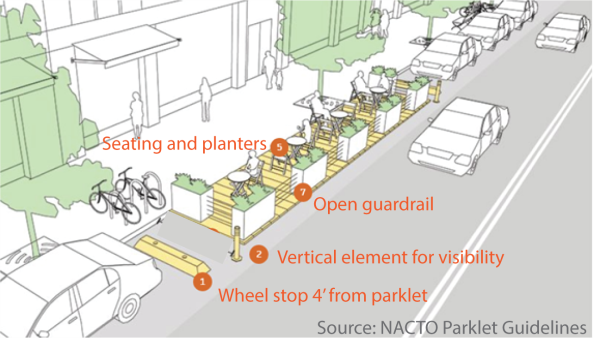
(f) Revocation. An Encroachment Agreement may be revoked by the city upon a finding by the Planning Director that the establishment has violated any terms of the agreement; or that the encroachment causes a health/safety risk; or that a city ordinance or state or federal law has been violated; or the establishment or an employee of the establishment has been convicted of serving alcohol to a minor; the parklet is not being adequately maintained or or that the city has initiated an infrastructure improvement project in the area of the encroached premises. The establishment may appeal this revocation to the City Council within 14 days of the notice of revocation.
Adopted by Ord. 2021-122 Semi-permanent Parklets on 6/8/2021
Sec 601.34 Unattended Donation Boxes
No person or other legal entity shall cause or permit the installation or placement of a donation box upon any property within the city, whether public or private, except in accordance with this section.
- Purpose and Intent. The purpose of this section is to regulate the placement of unattended donation boxes within the city. These procedures and requirements are enacted to:
- Promote the community's health, safety, and welfare by regulating unattended donation boxes for clothing or other salvageable personal property within the city;
- Ensure that unattended donation boxes do not pose a hazard to pedestrian and vehicular traffic;
- Ensure that material is not allowed to accumulate outside of the unattended donation boxes where it can be scattered by adverse weather conditions, animal contacts and human activities; and
- Establish criteria that avoid attracting vermin, unsightliness, and a public health hazard.
- Promote the community's health, safety, and welfare by regulating unattended donation boxes for clothing or other salvageable personal property within the city;
- Applicability. The requirements of this section shall apply to all donation boxes regardless of whether said boxes were placed prior to the effective date of these regulations. No previously placed donation boxes shall be granted any inherent legal or nonconforming status. All existing donation boxes shall be removed or brought into compliance with these regulations within 30 days of the effective date of these regulations.
- Exemptions. These regulations do not apply to recycling bins operated by the city or a waste management company or donation boxes contained wholly within an enclosed building.
- Requirements. Donation boxes are allowed as an accessory use in all zoning districts within the city only upon compliance with the following:
- 501(c)(3) required.
- All proceeds are dedicated to the use of an entity which is qualified by the Internal Revenue Service as a 501(c)(3) charitable institution, or is a governmental entity.
- The donation box is located upon the premises of an entity which is qualified by the Internal Revenue Service as a 501(c)(3) charitable institution, or is a governmental entity.
- All proceeds are dedicated to the use of an entity which is qualified by the Internal Revenue Service as a 501(c)(3) charitable institution, or is a governmental entity.
- Number. A maximum of two (2) donation boxes may be located on any parcel.
- Dimensions. The donation box shall be no more than six (6) feet high, with a ground footprint of not more than twenty five (25) square feet.
- Setbacks.
- Front: As required by the zoning district.
- Side & Rear: The donation box shall be located at least 7’ from the side and rear property lines.
- Buildings: The donation box shall be located at least 10' from any building.
- Residential Structures: The donation box shall be located at least 200’ from any residential structure.
- Surface. The donation box shall be placed upon a concrete or asphalt surface.
- Visibility. The donation box shall be located so as not to interfere with any sight triangles or block the view of any business signage.
- Parking spaces and circulation. No unattended donation box shall be placed on or within any parking space required under Appendix A Zoning, Article 501 Parking and Loading or in any way that interferes with on-site circulation.
- Signage. The total signage on each donation box shall not exceed two square feet. No advertising shall be allowed on the donation box. The donation box must include a message stating “All donated items must fit completely inside the donation box.” An additional sign shall include the contact information: the name, address, e-mail and phone number of both the property owner/manager and operator. It too shall not exceed two square feet.
- Locked. Unattended donation boxes shall be locked or otherwise secured.
- Maintenance.
- Unattended donation boxes shall be serviced and emptied as needed, or within 24 hours of a request by the director or his or her designee.
- Unattended donation boxes shall be maintained in good condition and appearance with no structural damage or defects, holes, or visible rust, and shall be free of graffiti.
- The area surrounding the unattended donation boxes shall be free of any junk, garbage, trash, debris or other refuse material.
- 501(c)(3) required.
Adopted by Ord. 2021-234 Donation Box Regulations on 11/9/2021
Sec 601.35 Cottage Courts
- Applicability. The regulations in this section shall apply to all dwelling units and developments that meet the definition of Dwelling, Cottage Court in Article 201 of the Zoning Code.
- Maximum Number of Cottage Court Units per lot. The maximum number of cottage court units permitted on a single lot is 12, subject to the land area per dwelling requirements of Article 401 of the Zoning Code.
- Exceptions. Developments located in the R-3 and R-4 districts are exempt from the maximum number of cottage court units per lot requirement but must meet all other requirements of this Section.
- Setback Standards. The table below establishes the minimum setback and unit separation standards for Cottage Courts.
Standard Requirement Front Setback 10 foot minimum and 20 foot maximum Side Setback 7 feet Rear Setback 7 feet Minimum distance between units 7 feet - Height and Roofs. Cottage Court units shall be a maximum of two- and one-half stories in height.
- Open Space.
- Minimum Common Open Space/Unit. Cottage Court developments shall provide a minimum of 500 square feet of common, usable open space per unit. The open space shall be adjacent to a public street or public trail.
- No dimension of a common open space area used to satisfy the minimum square footage requirement shall be less than 10 feet.
- Required common open space shall be divided into no more than two (2) separate areas per cluster of dwelling units.
- Common open space shall be improved for passive or active recreational use, garden/food production, social gathering spaces or landscaped areas. Examples may include but are not limited to courtyards, orchards, landscaped picnic areas, plazas or gardens. A detailed site plan of the common open space depicting the design and amenities of the space shall be reviewed with the development plan for approval.
- Amenities such as permanent or movable seating, landscaping, trails and paths, barbeque or eating facilities, covered shelters or water features shall be included within the common open space. Low Impact Development stormwater management facilities may be placed within the common open space when they are integrated with the amenities listed above.
- Private Open Space.
- Minimum Area. Each cottage court unit may be provided with a private open space of a minimum of 250 square feet with no dimension less than 10 feet. Private open space, when desired, shall be contiguous to each cottage court unit and is intended for the private use of the individual resident.
- Fencing. Private open spaces shall have a maximum fence height of 6-feet. Private open space fences located between the cottage court unit and public streets, public trails, or the common open space, however, shall have a maximum height of 4-feet.
- Minimum Common Open Space/Unit. Cottage Court developments shall provide a minimum of 500 square feet of common, usable open space per unit. The open space shall be adjacent to a public street or public trail.
- Pedestrian Connectivity.
- All buildings and common spaces shall be served by a pedestrian circulation system that connects to an existing or planned public sidewalk or trail system.
- Parking.
- Minimum Spaces Required. Cottage Court Developments shall provide parking proportionate to the square footage of cottage court dwelling units established below:
- Dwelling units 1,250 square feet or less shall provide one parking space per unit.
- Dwelling units greater than 1,250 square feet shall provide 1.5 spaces per unit.
- Location. Parking shall be located inside a structure detached from cottage court units or outside a structure subject to the following:
- The parking is screened from direct street view by one or more street facades, by garage doors, or by a fence and landscaping.
- Parking between structures is only allowed when it is located toward the rear of the principal structure and is served by an alley or private, shared driveway.
- Parking may not be located in the front yard.
- Parking may be located between any structure and the rear lot line of the lot or between any structure and a side lot line, which is not a street side lot line.
- Designated on-street parking spaces may be counted towards the minimum parking requirements of this section.
- Minimum Spaces Required. Cottage Court Developments shall provide parking proportionate to the square footage of cottage court dwelling units established below:
- Bicycle Parking.
- Minimum Spaces Required. Cottage Courts shall provide a minimum of one bicycle parking space per dwelling unit.
- Design. The design and siting of bicycle parking spaces shall be consistent with the recommendations of Essentials of Bike Parking, published by the Association of Pedestrian and Bicycle Professionals.
- Design Requirements.
- Materials and design. Front, side, and rear building facades visible from any public street or trail, or the common open space, shall incorporate attractive design materials and massing elements that create visual interest and a character consistent with surrounding development. Such design and massing elements could include porches or stoops, dormers, varied roof lines planar modulation or varied façade materials.
- Unit Orientation. All cottage court units must abut the shared, common open space(s). Cottage Court units adjacent to a public street or trail may orient their primary façade towards either the public street/trail or the common open space. In this case, both the façade that fronts the public street and the façade that fronts the open space must incorporate design and character elements consistent with this Article. Units that are not adjacent to the public street/trail, must orient towards the common open space.
- Porches. Cottage Court Units should incorporate usable, front porches that orient towards either the public street or common open space, depending on unit location.
- Functional character elements. Where appropriate, character elements shall be fully functional. Dormers shall be constructed to allow for occupiable space, and porches shall be a minimum depth of 6' to allow for regular use.
- Exterior materials. Exterior façade materials and details should be consistent with the character of the surrounding context.
- Approval Process.
- Cottage Court Developments may be approved through the administrative Large Scale Development process.
- Cottage Court Units shall be subject to all building and fire safety permitting requirements
Adopted by Ord. 2024-58 on 4/9/2024

