
Bentonville City Zoning Code
ARTICLE 801
SIGN ORDINANCE - PRIVATE PROPERTY
Sec 801.01 Title
This Article shall be known as the Sign Ordinance - Private Property of the City of Bentonville, Arkansas.
(Ord. No. 2016-117, § 2, 8-23-2016)
Sec 801.02 Authority
This Article is adopted under the authority conferred on the City of Bentonville by the General Assembly of the State of Arkansas by A.C.A. § 14-56-402 through § 14-56-426.
(Ord. No. 2016-117, § 2, 8-23-2016)
Sec 801.03 Applicability
This Article regulates permanent and temporary signs, as defined herein, which are located within the corporate limits of the City of Bentonville and over which the City has land use regulatory authority, but not on City-owned land and rights-of-ways. Signs on City-owned land and rights-of ways are subject to Article 802, Signs on City Property and Public Right-of-Way.
(Ord. No. 2016-117, § 2, 8-23-2016)
Sec 801.04 Intent
By the regulations, rules and policies adopted in this Article, the City intends to regulate signs, as defined herein, in a manner that balances the right of free speech by sign display against the competing public and governmental interests in community aesthetics, safety, preventing sign clutter and visual pollution, and other negative effects associated with excessive and/or inappropriate signage.
(Ord. No. 2016-117, § 2, 8-23-2016)
Sec 801.05 Purpose
This Article provides standards for the erection and maintenance of signs. All signs shall be erected and maintained in accordance with this Article, as applicable. The general purpose of these standards is to promote, preserve, and protect the health, safety, general welfare, convenience, and enjoyment of the public, to preserve and protect the aesthetic quality of Bentonville, and to achieve the following:
- Safety. To promote the safety of persons and property by providing that signs:
- Do not create a hazard due to collapse, fire, collision, decay, abandonment, or other safety considerations;
- Do not obstruct firefighting, police, and private security surveillance;
- Do not create traffic hazards by confusing or distracting motorists;
- Do not impair the driver's ability to see pedestrians, obstacles, or other vehicles, or to read traffic signs and signals;
- Do not cause hazardous or unsafe driving conditions for motorists due to their lighting; and,
- Do not otherwise interfere with or detract from the safety of persons or property.
- Communications efficiency. To promote the efficient transfer of information in sign messages by providing that:
- Customers and other persons may identify and locate a business, establishment or service;
- No person or group is arbitrarily denied the use of the sight lines from the public right-of-way for communication purposes; and,
- The messages in signs may otherwise be communicated efficiently.
- Landscape quality and preservation. To protect the public welfare and to enhance the appearance and economy of the city, by providing that signs:
- Do not unreasonably interfere with scenic views;
- Do not create a nuisance to persons using the public rights-of-way;
- Do not constitute a nuisance to occupancy of adjacent property by their brightness, light glare and reflection, size, height, or movement;
- Are not detrimental to land or property values;
- Do not overwhelm people by the number of messages presented, and do not interfere with the exercise of freedom of choice to observe or ignore said messages, according to the observer's purpose;
- Do not negatively affect the city's tourism industry;
- Do not create or worsen visual clutter or visual blight;
- Do contribute to the special character of particular areas or districts within the city, helping the observer to understand the city and be oriented within it;
- Do not cover or blanket any prominent view of a structure or façade of historical or architectural significance;
- Do not obstruct views of users of adjacent buildings to side yards, front yards or to open space;
- Are compatible with building heights of the existing neighborhood and do not impose a foreign or inharmonious element to an existing skyline;
- Do otherwise protect and preserve a quality landscape in the city; and
- Do otherwise enhance the appearance and economy of the city.
(Ord. No. 2003-101, § 1, 6-10-2003; Ord. No. 2004-202, § 1, 10-12-2004; Ord. No. 2008-8, § 1, 1-22-2008; Ord. No. 2016-117, § 2, 8-23-2016)
Sec 801.06 Enforcement
The Community and Economic Development Director, herein after referred to as Director, and his or her designee, is authorized and directed to administer and enforce this Article. Code Enforcement Officers may remove or relocate signs regulated by Section 801.13, Signs Allowed without a Sign Permit if such signs are placed improperly thereby causing vehicle or pedestrian safety issues, ADA accessibility issues or other similar critical issues.
(Ord. No. 2003-101, § 1, 6-10-2003; Ord. No. 2004-202, § 1, 10-12-2004; Ord. No. 2008-8, § 1, 1-22-2008; Ord. No. 2016-117, § 2, 8-23-2016)
Sec 801.07 Interpretations
- Administrative interpretations. Interpretations of this Article are to be made by the Director in consultation with the Staff Attorney. All interpretations of this Article are to be exercised in light of the message neutrality and message substitution policies provided in Section 801.11, Basic Policies. Where a particular type of sign is proposed, and the type is neither expressly allowed nor prohibited by this Article, or whenever a sign does not qualify as a "structure" as defined in the Building Code, as adopted by the City, then the Director, as applicable, shall approve, conditionally approve or disapprove the application based on the most similar sign type, using physical and structural similarity, that is expressly regulated by this Article.
- Appeal of interpretation. All administrative interpretations of sign regulations may be appealed to the Board of Adjustment. Where necessary, the Board may consider not only the current or intended uses of a sign but also its past use, in light of the purposes of this Article and applicable legal principles. It shall be the obligation of the sign owner or permit applicant to furnish records concerning the past use, if requested by the Board.
- Text vs. tables. In the event of inconsistency between text and tables, text shall prevail.
(Ord. No. 2003-101, § 1, 6-10-2003; Ord. No. 2004-202, § 1, 10-12-2004; Ord. No. 2008-8, § 1, 1-22-2008; Ord. No. 2016-117, § 2, 8-23-2016)
Sec 801.08 Responsibility For Compliance
The responsibility for compliance with this Article rests jointly and severally upon the sign owner, the permit holder, all parties holding the present right of possession and control of the property whereon a sign is located, mounted or installed, and the legal owner of the lot or parcel, even if the sign was mounted, installed, erected or displayed without the consent or knowledge of the owner and/or other parties holding the legal right to immediate possession and control.
(Ord. No. 2003-101, § 1, 6-10-2003; Ord. No. 2004-202, § 1, 10-12-2004; Ord. No. 2008-8, § 1, 1-22-2008; Ord. No. 2016-117, § 2, 8-23-2016)
Sec 801.09 Common Signage Plan
- Applicability. Prior to issuance of any sign permit in a development containing more than one building, business, or establishment, a common signage plan for the development shall be filed with the Building Inspections Department and approved by the Director. In the case of any conflict between an approved signage plan and the zoning ordinance, the approved signage plan shall govern.
- Common signage plan proposal. The applicant shall submit a proposed common signage plan that includes drawings, sketches, photographs, and/or written narrative to demonstrate:
- Location of signs on buildings and/or property.
- Materials, including construction materials and proposed lighting, if any.
- Size of all signs, either dimensioned or expressed in square feet at the identified locations.
- Standardized visual theme including graphic design elements (i.e. fonts) and color schemes.
- Multiple signs. Where more than one sign is located on a property, or where more than one building, establishment, or business is located in a single development project, such as a shopping center, the common signage plan will demonstrate that these elements create graphical design consistency and uniformity among signs within the project. The requirements of a common signage plan shall apply to all buildings, businesses, and establishments within a related project, even if the properties have been subdivided.
- Criteria for review and approval. The Director shall use the purpose of the Article, 801.5, Purpose, as criteria to review and approve a common signage plan.
- Amendments. An addition to or a major alteration of the physical size or layout of the property, structure or signage requires the submittal of a new common signage plan consistent with this section. The Director has the authority to determine if the alteration is significant enough to warrant a new common signage plan. The Director shall use the purpose of the Article, Section 801.05, Purpose, as criteria to determine if a new common signage plan is warranted.
- Minor alterations to sign location. Minor alterations in sign locations resulting from unexpected conditions on site may be approved by the Director. The Director shall use the purpose of the Article, Section 801.05, Purpose, as criteria to review and approve minor alterations in sign locations.
(Ord. No. 2003-101, § 1, 6-10-2003; Ord. No. 2004-202, § 1, 10-12-2004; Ord. No. 2008-8, § 1, 1-22-2008; Ord. No. 2016-117, § 2, 8-23-2016)
Sec 801.10 Sign Permits
- Sign permit required. Signs subject to Section 801.14, Signs Allowed with a Temporary Sign Permit and Section 801.15, Signs Allowed with a Sign Permit may be installed, mounted, placed on public display, modified, or replaced with a new sign face only pursuant to an approved permit.
- Application for a sign permit. The Building Inspections Department shall provide the Sign Permit Application Form. Complete applications that include all of the items listed below shall be submitted by the applicant to the Building Inspections Department. The process for such permits consists of the following:
- Sign permit application. Complete, sign and submit the Sign Permit Application. Such application shall include:
- Sign Location. Address of sign location, establishment name, length of street frontage in linear feet;
- Applicant Information. Name, establishment name, address, phone, and email address;
- Sign Information. Sign type, dimensions, installed height, sign area, wall area, double-sided or single-sided, lighting source, and valuation. Dates of display shall be provided for temporary signs.
- Application fee. The applicant shall pay the application fee as adopted from time to time by City Council. If the initial application is rejected, the application fee does not have to be paid again if the proposal is for the same sign in essentially the same area.
- Supporting documents. The following supporting documents shall be submitted along with the Sign Permit Application and Application Fee.
- Scaled Drawing. A scaled drawing of the sign showing the design and including dimensions of the sign height, area, design, content, and dimensions of the sign and the design and dimensions of any measures used to support the sign or used to affix the sign to a wall, window or the ground.
- Scaled Site Plan. A scaled site plan showing the location of the sign on the property or building and showing street right-of-way and property lines. For wall signs, provide dimension of walls.
- Materials List. A list of materials used to construct the sign, including all supporting materials.
- Landscape Plan. Only for permanent freestanding signs, provide a landscape plan consistent with the requirements of this Article.
- Sign permit application. Complete, sign and submit the Sign Permit Application. Such application shall include:
- Review and approval. After a review of the application by the Director shows that the sign meets zoning, electrical, and ICC Building Code, the Building Inspection Department shall issue a permit to erect or install the approved sign. If the application cannot be approved as originally submitted, the notice of decision shall specify the points of deficiency with citations to relevant laws, rules, policies and guidelines. If a corrected or amended application is submitted within 60 days of the mailing or delivery of the notice of decision, then a new filing fee shall not be required for the amended or corrected application.
- Inspection. The applicant shall request an inspection after installation of permanent signs.
- Expiration of permit. The sign permit shall be null and void if sign installation is not completed within six (6) months or the signs are not in conformance with the approved application. The Director may grant one thirty (30) day extension to the sign permit.
- Successors. Valid sign permits attach to and travel with the land.
- Revocation of permit possible. The Director may revoke a sign permit if a sign is found to be in violation of this Article or the terms and conditions of the permit. A sign permit may be revoked upon a showing that the permit was issued in error; in such case, the permittee may apply for a new permit that satisfies all requirements. In the event that the initial permit error resulted from a misstatement of material fact made by the applicant, then the applicant shall pay the fee for the new permit. If one or more signs are found to be in violation of the terms of the permit, or other applicable laws, rules, policies or guidelines, then the Director shall give written notice to the sign permittee and the landowner of permit revocation based on deficiency or violation. Such notice is deemed given when personally delivered or on the date stamp of mailing plus three work days, whichever is earlier. Upon receiving such notice, the sign owner and the property owner are required to bring the sign into compliance within 60 days. The compliance deadline may be extended by the Director upon a showing of impossibility or unusual hardship; such extension may not exceed 90 days.
- Minor alterations to sign location. Minor alterations in sign locations resulting from unexpected conditions on site may be approved by the Director. The Director shall use the purpose of the Article, Section 801.05, Purpose, as criteria to review and approve minor alterations in sign locations.
(Ord. No. 2003-101, § 1, 6-10-2003; Ord. No. 2004-202, § 1, 10-12-2004; Ord. No. 2008-8, § 1, 1-22-2008; Ord. No. 2016-117, § 2, 8-23-2016; Ord. No. 2017-197, § 2, 11-28-2017)
Sec 801.11 Basic Policies
- Message neutrality policy. It is the policy of the City to regulate signs in a manner that does not favor commercial speech over noncommercial speech and does not regulate protected noncommercial speech by message content.
- Message substitution policy. The purpose of this provision is to prevent any favoring of commercial speech over non-commercial speech, or favoring of any particular protected noncommercial message over any other protected noncommercial message.
- A constitutionally protected noncommercial message may be substituted, in whole or in part, for any allowed commercial message or any other protected noncommercial message, provided that the sign structure or mounting device is legal.
- Any substitution shall require the private property owner's consent.
- The message substitution policy does not:
- Create a right to increase the total amount of sign display area on a site or parcel;
- Create a right to substitute an off-site commercial message in place of an onsite commercial message or in place of a noncommercial message;
- Affect the requirement that a sign structure or mounting device must be properly permitted;
- Authorize changing the physical method of image presentation (such as digital or neon) display without a permit; or
- Authorize a physical change to the sign structure without compliance with applicable building codes, safety codes, and neutrally applicable rules for sign size, height, orientation, setback, separation or illumination.
- Artwork policy. It is the policy of the City that works of art which do not identify a commercial business, establishment, product or service and which are not thematically linked to a commercial business, establishment, product or service, will not be considered a sign regulated by this Article.
- Onsite-offsite distinction. Within this Article, the distinction between onsite signs and offsite signs applies only to commercial messages. It does not apply to noncommercial messages.
(Ord. No. 2016-117, § 2, 8-23-2016)
Sec 801.12 General Regulations
- Measurement.
- Street frontage. Street frontages shall be considered separately for each street the lot fronts, measured by duly recorded property lines.
- Sign area. Sign area shall be calculated for the area of one side of the sign when the sign has two or more equal sign faces, of which only one is visible at a time from a particular view point. However, when a given sign displays more than one copy face to the public, then the area shall be the maximum cumulative total of all faces visible to a viewer at a particular view point.
- Measurable area. Measurable area of the sign face is the area within the outer boundaries of standard geometrical shapes, primarily squares, rectangles, and circles, containing and defined by the extreme reaches of information or graphic parts of the sign face. In the case of statuary or three dimensional signs, area shall be measured by a photograph or scale accurate drawing of the sign, and then computing the two dimensions of the sign photo.
- Maximum height. Height is measured from the point at which the sign and supports are attached to the ground (original grade), measured to the highest point on the top of the sign, including extensions, riders, streamers, etc.
- Design and construction.
- Code compliance. All signs shall comply with applicable provisions of the ICC Building Code and the National Electrical Code, the requirements of this Article, and the other applicable laws, rules regulations and policies.
- Materials. Signs shall be constructed of permanent materials and permanently affixed to the ground or building except for:
- Temporary signs meeting the regulations elsewhere in this Article.
- Window signs.
- Sight distance requirements. No building, structure, sign or part thereof shall be located so as to create an obstruction in the area to be kept clear of all sight obstructions, as set forth in Chapter 15, Subdivision Code, Article 1100.01, General Provisions, unless otherwise approved by the City Engineer.
- Maintenance. All signs, to include permanent and temporary signs and signs that do and do not require a permit, shall be maintained in good condition, kept free of cracked or peeling paint, missing or damaged sign panels or supports, and weeds, grass or vegetation which obscures the view of the sign message. Sign landscaping shall be maintained so as not to interrupt the view of the sign.
- Obstructions. No sign shall block or impede entrances or exits to buildings to include windows, doors, and fire escapes.
- Illumination.
- Source. Signs may be illuminated from within or from an external source, but such illumination shall be in a manner which avoids glare or reflection which in any way interferes with traffic safety.
- Internal illumination. Internally illuminated signs in all districts shall have an opaque background and translucent copy.
- External illumination. External illumination shall be selected, located, aimed and shielded so that direct illumination is focused solely on the sign face, away from adjoining properties and the public street right-of-way.
- Strung lights. Signs shall not be illuminated by a string of lights placed around the sign.
- Temporary signs. Temporary signs, whether allowed with or without a temporary sign permit, shall not be artificially illuminated.
- Changeable copy signs. Manual changeable copy signs and electronic message centers (EMC's) shall be allowed subject to the following:
- Maximum area. No more than 50% of the measureable area of a sign shall be devoted to changeable copy except for signs for land uses characterized by public assembly and periodically changing programs, such as theaters (live or film), convention centers, concert facilities, religious facilities, etc., which may devote up to 80% of a measureable area to changeable copy.
- Animation. Messages, images and slides shall be static. In no instance shall changeable copy signs produce fluctuating illumination or animation as prohibited in Section 801.16(c), Fluctuating Illumination.
- Copy rotation. Each message, image or slide shall be displayed for at least five (5) seconds before alternating to the next message without violating Section 801.16(c), Fluctuating Illumination. Messages shall be permitted to scroll from one direction onto the message board so long as the message remains on the message board for at least five (5) seconds before scrolling off.
- EMC illumination. The illumination of electronic message centers or digital displays must meet the requirements below:
- Measurement criteria. The illuminance of an EMC or digital display shall be measured with an illuminance meter set to measure footcandles accurate to at least two decimals. Illuminance shall be measured with the EMC off and again with the EMC displaying a white image for a full color capable EMC or a solid message for a single color EMC. All measurements shall be taken perpendicular to the face of the EMC at the distance determined by the total square footage of the EMC in the table below.
Sign Area and Measurement Distance Sign Area Measure Distance Sign Area Measure Distance Sign Area Measure Distance 10 32 70 84 150 122 15 39 75 87 160 126 20 45 80 89 170 130 25 50 85 92 180 134 30 55 90 95 190 138 35 59 95 97 200 141 40 63 100 100 220 148 45 67 110 105 240 155 50 71 120 110 260 161 55 74 130 114 280 167 60 77 140 118 300 173 65 81 150 122 For signs with an area in square feet other than those specifically listed in the table, the measurement distance may be calculated with the following formula: Measurement Dimensions =vArea ofvAreaof Sign (sq. Ft.) x 100
- EMC illumination limits. The difference between the off and solid-message measurements using the EMC measurement criteria above shall not exceed 0.3 footcandles above ambient light. Documentation shall be provided at time of permit issuance certifying the EMC will not exceed this limit.
- Dimming capabilities. EMC's and digital displays shall be equipped with a sensor or other device that automatically determines the ambient illumination and programmed to automatically dim according to ambient light conditions, or that can be adjusted to comply with the 0.3 footcandle measurements. Upon the City's request, EMC devices shall be turned off during times of energy shortage or civil emergency.
- Measurement criteria. The illuminance of an EMC or digital display shall be measured with an illuminance meter set to measure footcandles accurate to at least two decimals. Illuminance shall be measured with the EMC off and again with the EMC displaying a white image for a full color capable EMC or a solid message for a single color EMC. All measurements shall be taken perpendicular to the face of the EMC at the distance determined by the total square footage of the EMC in the table below.
- Nonconforming signs. Signs that were lawful at the time of their construction or placement but are not in conformance with current regulations shall be allowed to be maintained as nonconforming signs until such time that the sign meets any of the following conditions. At such time, the sign shall be removed or brought into compliance with this article. lf only the sign face is being replaced, the nonconforming sign structure may remain.
- Fifty percent of the size of the sign and/or sign structure is damaged or in a state of disrepair;
- The sign is proposed for replacement or major alteration, which includes, but is not limited to, increasing the sign size or height, replacing the sign cabinet, changing or adding lighting, or any other alteration determined to be major as determined by the director;
- The primary structure on the site on which the sign is located is:
- Damaged by fifty percent (50%) or more of the structure's gross square footage;
- Proposed for major alteration, renovation, replacement; or
- Is or is proposed to be demolished;
- Development on the site on which the sign is located requires large scale development approval, including both administrative and planning commission approvals; ; however, such nonconforming signs shall be allowed to remain on the property, subject to large scale development approval, under the following circumstances and conditions:
- The nonconforming sign remains in its current location on the site and is not:
- Otherwise proposed for alteration, renovation, or replacement;
- Damaged by fifty percent (50%) or more of the structures gross square footage; or
- Is proposed to be demolished;
- The development for which the large scale development approval is sought is part of the continuous operation of the same business previously operating on the site;
- The overall addition in gross square footage from the large scale development is limited to no more than twenty-five percent (25%) of the gross square footage of the primary structure at the time the large scale development plan is submitted; and
- Any demolition of the existing primary structure on the site does not result in the loss of more than ten percent (10%) of the existing gross square footage within the primary structure at the time the large scale development plan is submitted.
- The nonconforming sign remains in its current location on the site and is not:
- Banners. All banners allowed in this Article shall be attached to a permanent sign or building. If no permanent sign or building is available, the Director may approve another method of installation that creates a frame around the banner.
(Ord. No. 2003-101, § 1, 6-10-2003; Ord. No. 2004-202, § 1, 10-12-2004; Ord. No. 2006-24, §§ 8—13, 2-14-2006; Ord. No. 2007-39, § 1, 4-10-2007; Ord. No. 2008-8, § 1, 1-22-2008; Ord. No. 2016-117, § 2, 8-23-2016; Ord. No. 2017-197, § 3, 11-28-2017; Ord. No. 2018-62, § 11, 3-27-2018)
Amended by Ord. Ord. No. 2022-51 on 2/22/2022
Sec 801.13 Signs Allowed Without A Sign Permit
- Sign types allowed. The following signs may be installed, mounted and displayed in all zoning districts without a sign permit, subject to the rules and conditions applicable to each sign type and located in such a manner that meets the intent and purpose of this Article.
- Handheld signs. Handheld signs are allowed to display any protected noncommercial message but may not be used for general advertising for hire.
- Incidental or directional signs. Incidental three (3) square foot signs are allowed to display any protected noncommercial message but may not be used for general advertising for hire.
- Interior signs. Non-legible interior signs are allowed.
- Temporary signs.
- Residential uses. Each legal dwelling unit may have a total display area (cumulative of all temporary signs on the lot) of 24 square feet at all times. Such signage may be used to display any protected noncommercial message but may not be used for general advertising for hire.
- Nonresidential uses. Each non-residential establishment may have a total display area (cumulative of all temporary signs on the lot) of 36 square feet at all times. Such signage may be used to display any protected noncommercial message but may not be used for general advertising for hire.
- Temporary uses. Any temporary use that meet the requirements of a “short-term temporary use” as regulated in Sec. 601.25 may have a total display area (cumulative of all temporary signs on the lot) of 36 square feet and may use air-activated signs, otherwise prohibited in this article.
- Window and door signs. Window and door signs are allowed subject to a maximum area that does not exceed 40% of the window or door area.
- Outdoor vendor signs. Signs for outdoor vendors shall be considered part of the approved outdoor vendor permit and shall comply with the following:
- Attached signs: Signs may be attached to the vending conveyance. The cumulative total of all signs attached to the conveyance shall not exceed 15% of the surface area of the conveyance.
- Detached signs: Outdoor vendors are allowed one sandwich sign not to exceed 6 square feet in size and 4 feet in height within the allowed outdoor vending space.
- Additional signs. In addition to any other allowed sign, the following signs may be installed, mounted and displayed without a sign permit when the current condition of the property meets any of the conditions below, subject to the corresponding rules and conditions. Maximum area is measured per sign face. Maximum height applies to freestanding signs only.
Property Condition Land Use Max. No. Max. Area (sf) Max Height (ft.) Res. Nonres. Property Under Construction ● 1/street frontage of the lot 16 6 ● 1/street frontage of the lot or development 32 12 Subdivision Under Construction ● ● 1/street frontage of the neighborhood or subdivision 32 12 Property for Sale or Lease ● 1 freestanding/street frontage and 1 wall/dwelling unit 8 6 ● 1 freestanding/street frontage and 1 wall/lease space 32 8 - Conformance with other regulations. All signs allowed without a permit shall conform to the clearance and encroachment regulations for suspended signs, projecting signs or freestanding signs depending on the method of installation and support.
(Ord. No. 2003-101, § 1, 6-10-2003; Ord. No. 2004-202, § 1, 10-12-2004; Ord. No. 2006-24, § 7, 2-14-2006; Ord. No. 2008-8, § 1, 1-22-2008; Ord. No. 2016-117, § 2, 8-23-2016)
Amended by Ord. 2019-160 on 10/22/2019
Amended by Ord. Ord. No. 2021-233 on 11/9/2021
Sec 801.14 Signs Allowed With A Temporary Sign Permit
The following temporary signs, as defined in this Article, may be installed, mounted, or placed on public display in all nonresidential districts only pursuant to a duly authorized and issued temporary sign permit, subject to the size, height and location regulations specified in this section. Erection of the following signs without a temporary sign permit is a violation of this Section.
- Sign types allowed. The following sign types are allowed as a temporary sign on nonresidential property: banners, wall signs, commercial mascots, yard signs, and projected images.
- Maximum area. Thirty-two square feet, cumulative of all temporary signs on a lot, exclusive of noncommercial speech.
- Display period. The temporary sign shall be displayed for not more than 15 consecutive calendar days.
- Maximum number allowed per year. Each establishment may be issued only four (4) permits for a temporary sign within each calendar year.
- Conformance with other regulations. The temporary sign shall conform to the clearance and encroachment regulations for suspended signs, projecting signs or freestanding signs depending on the method of installation and support.
(Ord. No. 2003-101, § 1, 6-10-2003; Ord. No. 2004-202, § 1, 10-12-2004; Ord. No. 2006-24, § 12, 2-14-2006; Ord. No. 2008-8, § 1, 1-22-2008; Ord. No. 2016-117, § 2, 8-23-2016)
Sec 801.15 Signs Allowed With A Sign Permit
The following signs may be installed, mounted, or placed on public display only pursuant to a duly authorized and issued sign permit, subject to the height, area and location regulations specified in this Section. A common signage plan is required in accordance with SEC. 801.09 Common Signage Plan. Erection of the following signs without a permit is a violation of this Section.
- Height and area regulations.
Sign Type ZONING Use No. Allowed Max.
HeightMax. Area
(per sign face)A1,RE,
R1, R2,
R3, R4
RC-2,
RC-3,
PRD, DN1, DN2RO C1 C2 C3 DC,
DE,
DN3, DN4I1
&
I2PUD Free-standing ● Subdivision & Multifamily 2/street entrance 6 ft. 32 sq. ft. ● ● ● ● Non-residential 1/street frontage 6 ft. 32 sq. ft. ● ● ● Single tenant 1/street frontage 8 ft. 60 sq. ft. ● ● ● Multiple tenant 1/street frontage 12 ft. 100 sq. ft. Wall ● ● Residential 1/building 1 ft. above roof peak 4 sq. ft.,
non-illuminated● ● ● ● ● ● ● Non-residential No maximum number; however, the total area cumulative of all sign faces cannot exceed 15% of the wall area for the building, or suite if applicable. 1 ft. above roof peak 15% of wall area* (includes awning, canopy, window, door, projecting and roof signs)
25 sq. ft. min. allowedAwning ● ● ● ● ● ● All 1/awning face 1 ft. above highest roof peak 32 sq. ft.* must be included as part of the maximum area allowed for wall signs. Projecting ● ● ● ● ● ● All 1/wall OR 1/wall of each suite No Max. 32 sq. ft.* must be included as part of the maximum area allowed for wall signs. Roof ● ● Buildings 3 or more stories 1/building Max. height allowed in the district 32 sq. ft.* must be included as part of the maximum area allowed for wall signs. Canopy ● ● ● ● ● ● All 1/canopy face No Max. 12 sq. ft. Suspended ● ● ● ● ● ● All 1/suite No Max. 4 sq. ft. Marquee ● ● All 1/building 8 ft. 100 sq. ft. - Canopy signs. Signs on or attached to freestanding canopy structures shall be placed flat against the surface of the structure to which it is attached and shall not extend beyond the edges of structure to which it is attached.
- Freestanding signs—Nonresidential districts. Freestanding signs allowed in non-residential districts are subject to the following regulations:
- Monument style. Freestanding signs shall be designed to meet the definition of a monument sign, with the exception of signs adjacent to I-49 as regulated in this Section. No air space shall be visible within or between any portion of the sign display area and sign structure. Edges of sign shall extend in a manner that is along a continuous plane, so the upper portion does not extend beyond the base, unless otherwise approved by the Director and his/her designee.
- Setback. Freestanding signs shall meet the setback requirements in the table below. Freestanding signs may be placed within the required buffer area or within other landscaped areas required in Article 1400, Landscaping, Screening and Buffering of the Subdivision Code.
Condition Min. setback from property line Sign area of 32 sq. ft. or less 5 ft. Sign area more than 32 sq. ft. 10 ft. Sign adjacent to residential property 25 ft. - Landscaping. All nonresidential freestanding signs require:
- A defined landscaped area at the base of the sign.
- The required landscaped area shall be parallel to the faces of the sign.
- The required landscaped area shall be at least 50 square feet in area.
- For signs with multiple faces, the landscaped area shall be allocated so that a portion of the required landscaping is located in front of each sign face.
- If the size of the site imposes practical difficulties on the placement of the plant materials, the Community Development Department may make adjustments in these regulations.
- The required landscaped area shall contain materials such as, but not limited to lawn grass or herbaceous groundcovers such as juniper or liriope, etc., perennials, shrubs, and ornamental trees covering at least 50% of the defined landscaped area at maturity.
- Paving and artificial plant materials shall not be included in fulfilling this requirement.
- A plan of the landscaped area with the name, quantity, and spacing of plant materials shall be included as a part of the sign permit application.
- Additional signs.
- Street frontage over 300 feet. One (1) additional sign may be allowed by the Director for a street frontage that exceeds 300 feet. If two signs are placed on a single street frontage, no individual sign shall exceed 80 square feet in area and there shall be a minimum of 150 linear feet between the signs.
- Considerations for approval of additional signs. In making a determination to approve additional signs, the Director shall consider the following standards:
- Each sign meets all other regulations for freestanding signs;
- The signs comply with other applicable provisions of this Article, including its purpose; and
- The width of the street, the traffic volume, and the traffic speed warrant the proposed signage.
- Adjacent to I-49. When the property on which the sign is located is within 500 feet of Interstate 49 between Exit 85 (southbound entrance ramp) and Exit 86 (southbound exit ramp) and the use caters to travelers (i.e. hotels, restaurants, gas stations, etc.), freestanding pole signs are allowed up to 70 feet in height and up to 100 square feet in sign area.
- Materials. The sign display area shall be completely enclosed with materials that match the façade of the principal use or similar quality, color and texture as the primary masonry materials used in the exterior finish of the primary structure on site.
- Freestanding signs—Residential districts. Freestanding signs allowed in residential districts are subject to the following regulations:
- Monument style. Freestanding signs shall be designed to meet the definition of a monument sign. No air space shall be visible within or between any portion of the sign display area and sign structure.
- Subject. No commercial message shall be placed on subdivision or multifamily identification signs.
- Permanent feature. Identification signs may be incorporated into a permanent landscape feature such as a wall, fence, or masonry column, subject to maximum area requirements.
- Marquee, projecting and suspended signs. Marquee, projecting and suspended signs are subject to the following regulations:
- Extending above wall. The sign may not extend above the top of the wall to which it is attached, except that a sign 18 inches or less in width and perpendicular to such wall may extend up to a maximum of two (2) feet beyond the top of the wall.
- Clearance. The sign shall maintain a vertical clearance over a public right-of-way, sidewalk or front yard of at least eight (8) feet.
- Setback. The sign may not extend into a required front yard more than six (6) feet and no closer than two (2) feet, measured in horizontal distance, from back of curb of any street.
- Wall signs—Nonresidential districts. Wall signs are subject to the following regulations:
- Extending beyond building. The sign shall not extend more than 12 inches beyond the building, except in the case of a sign on the lower slope of a roof or a canopy roof, where the sign may extend the distance required to make the sign vertical.
- Extending beyond wall. The sign may not extend beyond the edges of the wall to which it is attached, except when the sign is contiguous on two (2) adjacent walls of the same building, the connecting portion may extend to but not beyond the face of the adjoining portion.
- Calculating sign area. The total sign area for wall signs shall be the sum of all signs on the wall including signs on the wall surface, signs affixed to the wall parallel and in the same plane as the wall, signs on awnings or canopies, window signs, door signs, projecting signs, signs on the lower slopes of roofs or canopy roofs, and signs on parapets above roofs.
(Ord. No. 2003-101, § 1, 6-10-2003; Ord. No. 2004-63, § 5, 3-23-2004; Ord. No. 2004-202, § 1, 10-12-2004; Ord. No. 2006-24, §§ 8—11, 2-14-2006; Ord. No. 2008-8, § 1, 1-22-2008; Ord. No. 2009-111, § 5, 11-10-2009; Ord. No. 2011-55, §§ 3—8, 06-14-2011; Ord. No. 2016-117, § 2, 08-23-2016; Ord. No. 2017-197, §§ 4, 5, 11-28-2017)
Amended by Ord. 2019-160 on 10/22/2019
Amended by Ord. 2020-38 on 2/11/2020
Amended by Ord. Ord. No. 2021-233 on 11/9/2021
Amended by Ord. 2022-175 on 9/13/2022
Sec 801.16 Prohibited Signs
The following signs shall be prohibited, and may neither be erected nor maintained, unless otherwise specifically allowed within this Article.
- Generally prohibited. The following signs and methods of drawing attention, as defined in this Article, are prohibited:
- Air-activated graphics, except as allowed for special events in Sec. 801.13(4) Temporary signs;
- Pole signs;
- Rotating or revolving signs;
- Commercial handheld signs;
- Portable message center signs;
- Off-site commercial message signs.
- Signs in public right-of-way. No sign, including supports, frames, and embellishments, shall be located within a public right-of-way and/or attached, affixed, or painted on any utility pole, light standard, utility box or pedestal, tree, rock, or other natural object located within the public right-of-way or on public property, except as specifically allowed in this Article and Article 802, Signs on City Property and Public Right-of-Way.
- Fluctuating illumination. Signs, or any means of advertising, with the illusion of movement by means of a preprogrammed repetitious sequential switching of action in which illuminated elements of the sign are turned off or on to visually simulate the impression of motion characteristic of chasing, running, blinking, oscillating, twinkling, scintillating, or expanding and contracting light patterns. Illumination of attraction devices or signs that fluctuates in light intensity shall be prohibited. Signs that operate or employ any motion picture projection in conjunction with any advertisements shall be prohibited. Changeable copy shall be permitted so long as it is in compliance with Section 801.12.G.
- Obsolete signs. Obsolete signs or signs which have broken supports or are overgrown with vegetation.
- Billboards. Billboards are prohibited with the exception of the following:
- Billboards that existed on or before February 27, 2001 in the City of Bentonville;
- Billboards that are located along federal aid primary highways or interstate highways for which sign compensation is regulated by state and federal law;
- Billboards that were erected and are allowed and maintained in compliance with state regulations and this ordinance; and
- Billboards specifically permitted within this Article.
- Mobile billboards. Mobile billboards which are parked on or otherwise utilizing a public right-of-way, public property or on private property so as to be intended to be viewed from a vehicular right-of-way for the basic purpose of providing general advertising for hire and not used for normal business operations. This regulation is not to be construed to include those signs that identify a firm or its principal products on a vehicle or such advertising devices as may be attached to and within the normal unaltered lines of the vehicle of a licensed transit carrier, when and during that period of time said vehicle is regularly and customarily used to traverse the public highways during the normal course of business. See Section 601.9 for regulations regarding commercial vehicles in residential zones.
- Others not exempt. All other signs which are not expressly exempt from regulation and/or expressly allowed under this Article.
(Ord. No. 2003-101, § 1, 6-10-2003; Ord. No. 2004-202, § 1, 10-12-2004; Ord. No. 2008-8, § 1, 1-22-2008; Ord. No. 2010-71, § 4, 11-23-2010; Ord. No. 2011-55, § 9, 6-14-2011; Ord. No. 2016-117, § 2, 8-23-2016)
Amended by Ord. 2019-160 on 10/22/2019
Sec 801.17 Digital Billboards
Digital billboards (smartboards) shall be permitted subject to acquiring a conditional use permit as set forth in Section 301.4 Conditional Uses and meeting the following regulations.
- Replacement ratio. Digital billboards shall only be permitted to replace existing legally nonconforming billboards by removing two and a half (2½) square feet of display area of existing legal nonconforming billboards for every one (1) square foot of digital billboard display area. The existing billboards shall be removed prior to installation of the new digital billboard.
Only billboards legally existing prior to June 22, 2010 shall be allowed to count toward the removal ratio. Any billboard outside of the city limits and built after June 22, 2010 then annexed into the city shall not be permitted to count toward the removal ratio. - Priority for removal. The Planning Commission shall retain the right to approve, through the conditional use process, which billboards will be allowed to be removed to meet the removal ratio, using the following priority rankings:
- Nonconforming billboards located on Walton Boulevard.
- Double-deckers within the Bentonville city limits.
- Nonconforming billboards located on the same roadway as the proposed digital billboard.
- Location.
- Signs per lot. Only one (1) digital billboard structure shall be allowed per lot. Double sided signs shall be allowed.
- Zoning. Digital billboards shall only be allowed in A-1, C-1, C-2, I-1 and I-2 districts.
- Setback. Digital billboards shall be placed behind the front, side and rear setback of the district.
- Dimensions.
- Maximum height. Digital billboards shall not exceed 30 feet in height when adjacent to arterials and shall not exceed 45 feet in height when adjacent to I-49. Digital billboard height is measured from the street grade that the sign is oriented toward.
- Maximum sign area. Digital billboards shall not exceed 300 square feet in sign area when adjacent to arterials and shall not exceed 480 square feet when adjacent to I-49. The size of the replacement digital billboard may not exceed the size of the smallest existing billboard removed.
- Display.
- Static messages. Such displays shall contain static messages only, and shall not have movement, or the appearance or optical illusion of movement, during the static display period, of any part of the sign structure, design, or pictorial segment of the sign, including the movement or appearance of movement of any illumination or the flashing, scintillating or the varying of light intensity during the static display period.
- Dwell time and transition time. Messages on digital billboards shall be displayed for a minimum dwell time of eight (8) seconds and maximum transition time between messages shall not exceed one (1) second.
- Lighting.
- Illumination limits. Digital billboards shall not operate at brightness levels of more than 0.3 foot candles above ambient light, in accordance with the illumination requirements of changeable copy signs in Section 801.12(g)(4). Documentation shall be provided to the City at time of permit issuance certifying the digital billboard has been set to be incapable of exceeding 0.3 foot candles above ambient light.
- Dimming capabilities. Digital displays shall be equipped with a senor or other device that automatically determines the ambient illumination and programmed to automatically dim according to ambient light conditions, or that can be adjusted to comply with the 0.3 footcandle measurement.
- Separation requirements.
- Distance from residential. Digital billboards shall be prohibited within 250 feet of a residentially zoned property.
- Distance from intersection. Digital billboards shall be prohibited within 150 feet of an intersection with a traffic signal, measured from the centerline of the intersection.
- Distance from other billboards. Digital billboards shall be located to meet the following minimum spacing requirements from other digital billboards and billboards.
Existing Digital Billboard Existing Legal Nonconforming Billboard New Digital Billboard/Same Side of Street 2,500 ft. 1,000 ft. New Digital Billboard/Opposite Side of Street 1,000 ft. 500 ft.
- Landscaping. All digital billboards shall be landscaped in accordance with Section 801.15(c)(3), Freestanding Signs—Nonresidential District, Sign Landscaping and meet the following requirement: Trees and shrubs shall be selected such that the mature height of the selected species is tall enough to reach the base of the sign face. For monument style boards, low lying shrubs may be used in place of tree requirements at a ratio of 1:1.
- Malfunction default. Each digital billboard shall have a default mechanism built in to either turn the display off or show "full black" on the display in the event of a malfunction.
- Display technology. The technology currently being deployed for digital billboards is LED (light emitting diode), but there may be alternate, preferred and superior technology available in the future. Any other technology that operates under the illumination limits in Subsection (f)(1) above shall not require an ordinance change for approval.
- Tree cutting. Vegetation cutting in the public rights-of-way for the purpose of clearing views for billboards shall be done in accordance with Arkansas Department of Transportation (ArDOT) rules and regulations.
- Maintenance. The maintenance, repair, cleaning and replacements of parts of the digital component shall be expressly allowed regardless of the conformity of the structure or site. This also applies should the sign and/or digital components become damaged.
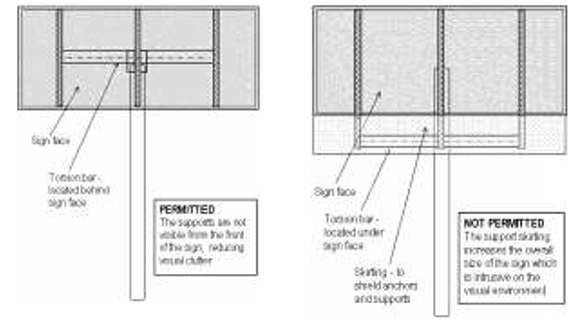
- Sign support. Digital billboards shall be independent of support from any building and shall be structurally erected as a freestanding pole sign only, unless proposed support is approved by Planning Commission. Horizontal sign anchoring, such as torsion bars, shall be located behind the sign face(s). No skirting of support arms shall be permitted. Pole and sign frame shall be rust free and free of peeling paint.
(Ord. No. 2010-43, § 4, 6-22-2010; Ord. No. 2011-47, §§ 1, 2, 3, 5, 5-10-2011; Ord. No. 2016-117, § 2, 8-23-2016)
Sec 801.18 Definitions
For the purpose of this Article, certain terms and words are to be used and interpreted as defined hereinafter. Where any words are not defined, the standard dictionary definition shall apply.
Applicant means any person, firm, group, organization or corporation applying for permits or other approvals required by this Article.
Awning means an overhead protective structure that is attached to and/or projects from a wall or roof structure of the building that is constructed to allow pedestrians and/or vehicles to pass under or as a decorative embellishment. This definition does not include freestanding canopies.
Awning sign means a sign on or attached to an awning.
Artwork means all forms of original creations of visual art that does not identify a commercial business, establishment, product or service and is not thematically linked to a commercial business, establishment, product or service.
A-Frame sign ( a.k.a., Sandwich Board Sign or Sidewalk Sign) means a freestanding sign that is ordinarily in the shape of an "A" or some variation thereof, which is readily moveable and is not permanently, attached to the ground or any structure.
Air-activated graphic means a sign, all or any part of, which is designed to be moved by action of wind or forced air so as to make the sign appear to be animated or otherwise have motion, including pennants, balloons, propeller discs, blade signs, banners not securely attached to a structure, or other objects.
Banner means a temporary sign constructed of a lightweight material, such as cloth, canvas, fabric, flexible plastic, or similar lightweight non-rigid material that can be mounted to a structure with cord, rope, cable, or a similar method or that may be enclosed in a frame supported by stakes in the ground.
Billboard means a permanent sign structure in a fixed location which meets any one or more of the following criteria:
- It is used for the display of off-site commercial messages;
- The message display area, or any part thereof, is made available to message sponsors other than the owner(s) or operator(s) of the sign, typically for a fee or other consideration, i.e., it is general advertising for hire;
- The sign is a principal or secondary use of the land, rather than appurtenant or accessory to some other principal use of the land.
Blade sign (a.k.a. feather sign, quill sign, teardrop sign, and flag sign) means a sign that is constructed of cloth, canvas, plastic fabric or similar lightweight, non-rigid material and that is supported by a single vertical pole, mounted into the ground or on a portable structure.
Building means any structure intended for shelter, housing or enclosure of persons, animals, goods or equipment that includes walls and a roof. When separated by dividing walls without openings, each portion of such structure so separated, shall be deemed a separate structure.
Canopy means a permanent freestanding overhead protective structure that is constructed to allow pedestrians and vehicles to pass under, which is supported by columns extending to the ground. This definition does not include an awning.
Canopy sign means a sign on or attached to a canopy.
Changeable copy sign means a sign displaying a message that is changed by means of moveable letters, slats, lights, light emitting diodes, or moveable background material, or the functional equivalent of any of them. Electronic and manual changeable copy signs are included within this definition.
City means the City of Bentonville, Arkansas.
Commercial mascot ( a.k.a. living signs) means a person or animal attired or decorated with commercial insignia, images, costumes, masks or symbols, and/or holding signs displaying commercial messages, when a principal purpose is to draw attention to or advertise a commercial enterprise. This definition includes "sign twirlers," "sign clowns," "sign spinners," "sign twirlers" and "human" signs. Such person may or may not be holding a sign.
Commercial message means a message that proposes a commercial transaction or pertains primarily to the economic and commercial interests of the message sponsor and/or the sign audience.
Commission means the Bentonville Planning Commission.
Common signage plan means a plan for all signs associated with a development project. If the project consists of several buildings, businesses or establishments that are related in a single development, the signage plan shall include all signs within the development including out parcels. The signage plan elements shall include: colors, dominant lettering style, location, materials, and size.
Digital billboard or smartboard means a type of billboard utilizing digital display technology, capable of changing the static message or copy on the sign electronically that may be internally or externally illuminated.
Digital display means an electronic display method utilizing LED (light emitting diode), LCD (liquid crystal display), plasma display, projected images, or any functionally equivalent technology, and which is capable of automated, remote or computer control to change the image, either in a "slide show" manner (series of still images), or full motion animation, or any combination of them.
Director means the City of Bentonville Director of Community and Economic Development or designee.
Door sign means a sign which is attached to, painted on or etched onto or into a door. A sign in a window which is part of a door is considered a door sign.
Electronic message center ( a.k.a. changeable electronic variable message sign (CEVMS), digital signs, dynamic signs) means a sign on which alphabetic, pictographic, or symbolic informational content and can be changed or altered on a fixed surface composed of electronically illuminated, mechanically driven or computer-generated changeable segments, or digital display. This definition does not include "digital billboards", which is separately defined.
Establishment means any legal use of land, other than long-term residential, which involves the use of structures subject to the Building Code. By way of example and not limitation, this definition includes businesses, factories, farms, schools, hospitals, hotels and motels, offices and libraries, but does not include single-family homes, mobile homes, residential apartments, residential care facilities, or residential condominiums. Multi-unit housing developments are considered establishments during the time of construction; individual units are not within the meaning of establishment once a certificate of occupancy has been issued or once a full-time residency begins.
Freestanding sign means a sign which is principally supported on the ground by one or more uprights, braces, poles, pylons or other similar structural components. This category includes both monument signs and pole signs.
General advertising, also known as general advertising for hire, means the enterprise of advertising or promoting other businesses or causes using methods of advertising, in contrast to self-promotion or on-site advertising.
Handheld sign means a sign displaying a message that is held by a natural person, not including insignia on apparel or aspects of personal appearance.
Illuminated sign means a sign whose message is made readable by internal or external lights or light emitting diodes (or functionally equivalent technology), typically (but not necessarily) during hours of darkness.
Incidental sign means an onsite sign giving information or direction for the convenience and necessity of the public such as "entrance", "exit", "no admittance", "telephone", " parking", etc.
Install or installation includes, but is not limited to, the act by which a sign is constructed or placed on land or a structure, or the act of attaching, painting, printing, producing, or reproducing, or using any other method or process by which a visual message is presented or placed upon a surface.
Interior or non-legible signs are signs that are located within private property boundaries and are not readable from the public right-of-way.
Legible means readable for persons of ordinary visual acuity.
Lot means a parcel of land, legally defined in a recorded deed or a recorded plat, fronting on a public dedicated right-of-way or other approved private drive.
Manual changeable copy sign means signs on which alphabetic, pictographic, or symbolic informational content can be changed or altered by manual means only.
Marquee sign means a permanent sign commonly used by land uses characterized by human assembly periodically changing programs such as theaters (live or film), schools, convention centers, concert facilities, religious facilities, etc., extending from part of the wall of a building, but not supported by the ground, constructed of a durable material and designed to have changeable copy, either manually or electronically.
Mobile billboard means a sign on a wheeled conveyance (whether motorized or not) or water craft, including those which carry, convey, pull or transport any sign used for general advertising for hire. The term does not include vehicles and vessels that display identification information concerning the usual business or regular work of the vehicle/vessel owner (not including general advertising for hire).
Monument sign means a low-profile, permanent, freestanding sign supported by a solid structural base, or other solid structural feature other than support poles.
Multiple tenant sign means a sign intended to provide identification to a multiple tenant commercial development of more than 25,000 square feet of gross building area.
Noncommercial message or speech means a constitutionally protected message that addresses topics of public concern or controversy such as, by way of example and not limitation, politics, religion, philosophy, science, art or social commentary. This definition shall be construed in light of relevant court decisions.
Obsolete sign means a sign relating to or identifying a business, establishment or activity which has not been conducted on the premises for six (6) months or more, or to a transpired election or event, or to a political party or non-profit organization that no longer exists; in addition, the structure for a sign that is not allowed under this ordinance if such structure cannot be legally used or does not comply with the height, size, or other physical requirements of the ordinance, or a sign which has missing or broken panels, broken or damaged supports or frame, or otherwise displays inadequate maintenance, dilapidation, obsolescence or abandonment.
Offsite commercial message means a message that advertises commercial products, accommodations, services or activities not provided in or on the property or premises upon which it is located. The on-site/off-site distinction does not apply to non-commercial messages.
Onsite or on premises commercial message means a message that advertises the commercial business, establishment, accommodation, services or activities provided on the premises on which the sign is located, or is expected to be provided in the near future. In the case of developments subject to a common signage plan, all establishments subject to the plan are considered on-site whenever located within any location subject to the plan. All establishments within a shopping center are on-site as to any sign(s) also located within that shopping center. The onsite/offsite distinction does not apply to non-commercial messages.
Parcels (or property) or similar references or descriptions means parcels defined or delineated by assessor parcel numbers maintained by the County tax assessor or as defined in the Definitions section of the Subdivision Code.
Pennant means a banner with three sides, or swallow-tail form, or a triangular or irregular piece of fabric or other material, whether or not containing a message of any kind, commonly attached in strings or strings or supported on small poles intended to flap in the wind.
Permanent sign means a sign that is solidly attached to a building, structure, or the ground by means of mounting brackets, bolts, welds, or other combination of attachment methods, thereby rendering the sign non-moveable or difficult to reposition without the use of machinery, cutting devices, or mechanical devices.
Pole sign means a permanently mounted, freestanding sign which is supported above the ground by one or more uprights, braces, poles, or other similar structural components.
Portable message center sign means a sign not permanently affixed to the ground, building or other structure, which may be moved from place to place, including, but not limited to, signs designed to be transported by means of wheel; A-frame or T-frame signs; menu and sandwich board signs. Such signs may include changeable copy. Projected image sign means a sign which involves an image projected on the face of a wall, structure, sidewalk, or other surface, from a distant electronic devise, such that the image does not originate from the plane of the wall, structure, or other surface.
Projecting sign means any sign which projects beyond a building face and uses a wall or vertical element of a building as its main source of support. The term includes a double-faced sign that is installed more or less perpendicular to the face of a building so as to allow a message to be viewable from either side. The term does not include signs that are installed along the face of a building and that are completely attached to the face of a building.
Roof-mounted sign means a sign attached to any portion of the highest roof or fascia of a building.
Safety codes means the Building, Electrical, Plumbing, Grading and similar codes which ensure safe construction, to the extent they have been officially adopted by the City.
Shopping center means a group of commercial buildings.
Sign means any words, lettering, parts of letters, figures, numerals, phrases, sentences, emblems, devices, designs, pictures, trade names or trademarks by which anything is made known such as are used to designate an individual, an establishment, a commodity, a firm, an association, a corporation, a profession, a business, a service, or a product, which are visible from any public street or right-of-way and designed to attract attention. "For Sale" and "For Rent" signs shall be deemed signs within the meaning of this definition. Includes any cloth, card, paper, metal, painted, glass, wooden, plastic, plaster, stone sign or other sign, device or structure of any character whatsoever including billboards and statuary, placed for outdoor advertising purposes on the ground or any tree, wall, bush, rock, post, fence, building or structure. The term "placed" shall include erecting, constructing, posting, painting, tacking, nailing, gluing, sticking, carving or otherwise fastening, affixing, or making visible in any manner whatsoever. The area of an advertising structure other than a sign shall be determined as the area of the largest cross-section of such structure. Neither directional, warning or other signs posted by public officials in the course of their public duties, nor merchandise or materials being offered for sale shall be construed as advertising signs for the purpose of this Article. Artwork that does not identify a commercial business, establishment, product or service and is not thematically linked to a commercial business, establishment, product or service, is not considered a sign under this definition.
Sign face means the area of a sign on which copy may be placed.
Sign height means the vertical distance from normal grade to the highest point of the sign. Any berming or filling or excavating solely for the purpose of locating the sign, shall be computed as part of the sign height.
Sign structure means the entire composition of the sign, including the sign face, framing, trim, molding and supporting structure.
Single tenant sign means a sign intended to provide identification to a building with a single tenant only.
Suspended sign means a sign which is attached to the underside of a horizontal plane or arm and is supported by the horizontal plane.
T-Frame sign means a freestanding sign which is ordinarily in the shape of an upside down "T" or some variation thereof, which is readily moveable and is not permanently attached to the ground or any structure.
Temporary sign means any sign which is intended for temporary use or which is not permanently mounted and intended for a designated period in time.
Wall means one of the sides of a room or building connecting floor and ceiling or foundation and roof.
Wall sign means any sign, other than a projecting sign, or a temporary banner sign, which is permanently attached to or painted on any wall of any building and projects from the plane of the wall less than twelve (12) inches. This definition shall not include freestanding walls or fences. A sign attached to the lower slope of a mansard roof shall be considered a wall sign for purposes of this Article, notwithstanding the fact that certain portions of such a sign may project more than twelve (12) inches. A "wall" shall include any permanent architectural extension of a wall, including parapets, even if such extension projects beyond or above the enclosed portions of the building.
Window sign means any sign, temporary or permanent, which is attached to, painted on or etched into a window or which is displayed within twelve (12) inches of the window and is legible from outside the window.
(Ord. No. 2003-101, § 1, 6-10-2003; Ord. No. 2008-8, § 3, 1-22-2008; Ord. No. 2009-50, § 1, 5-26-2009; Ord. No. 2010-43, §§ 1, 2, 6-22-2010; Ord. No. 2011-55, §§ 1, 2, 6-14-2011; Ord. No. 2016-117, § 2, 8-23-2016; Ord. No. 2017-197, § 6, 11-28-2017)
Sec 801.19 Severability
If any section, subsection, subdivision, paragraph, sentence, clause, or phrase in this chapter or any part thereof is for any reason held to be unconstitutional or invalid or ineffective by any court of competent jurisdiction, such decision shall not affect the validity or effectiveness of the remaining portions of this chapter or any part thereof. The City Council declares that it would have passed each section, subsection, subdivision, paragraph, sentence, clause, or phrase thereof irrespective of the fact that any one or more subsections, subdivisions, paragraphs, sentences, clauses, or phrases be declared unconstitutional, invalid, or ineffective.
(Ord. No. 2016-117, § 2, 8-23-2016)

