
Berlin Charter Township
City Zoning Code
City Zoning Code
ARTICLE II
DEFINITIONS
Sec. 18-21.- Rules of construction.
The following rules of construction shall apply:
(a)
The particular shall control the general.
(b)
The word "person" includes an individual, a corporation, a partnership, an incorporated association, or any similar entity.
(c)
The phrase "used for" includes "arranged for," "designed for," "intended for," "maintained for," or "occupied for."
(d)
A "building" or "structure" includes any part thereof.
(e)
Unless the context clearly indicates to the contrary, where a regulation involves two (2) or more items, conditions, provisions, or events connected by the conjunction "and," "or," "either...or," the conjunction shall be interpreted as follows:
(1)
"And" indicates that all the connected items, conditions, provisions, or events shall apply.
(2)
"Or" indicates the connected items, conditions, provisions, or events may apply singly or in any combination.
(3)
"Either...or" indicates that the connected items, conditions, provisions, or events shall apply singly, but not in combination.
(f)
Words used in the present tense shall include the future tense; and words used in the singular number shall include the plural, and the plural the singular, unless the context clearly indicates the contrary.
(g)
The word "shall" is always mandatory and not discretionary. The word "may" is permissive.
(h)
Illustrations, diagrams, and schedules herein shall have the same force and effect as written text.
(i)
Terms not herein defined shall have the meaning customarily assigned to them.
(j)
Days mean calendar days unless otherwise stated.
(k)
A reference to a public official of the township is to that person who performs the function referred to and may include a designee of the public official.
(Ord. No. 01-20, § 18.21, 2-10-20)
Sec. 18-22. - General definitions.
For the purpose of this chapter, certain words and terms are defined as follows:
Abut. To touch, to lie immediately next to, to share a common wall or lot line.
Access. A way or means of approach to provide vehicle or pedestrian entrance to a property.
Accessory dwelling unit. An accessory habitable living unit added to, created within, or detached from a single-family dwelling that provides basic requirements for living, sleeping, eating, cooking, and sanitation.
Accessory use, building or structure. A use, building, or structure, whether attached or detached, which is clearly incidental to, customarily found in connection with, devoted exclusively to, subordinate to, and located on the same lot as the principal use to which it is related.
Adjoining. Touching or contiguous, as distinguished from lying near or adjacent.
Adult day care facilities.
(1)
Adult day care family home. A private home in which six (6) or fewer adults eighteen (18) years of age or older, receive care for periods of less than twenty-four (24) hours per day. It includes facilities for adults who are aged, mentally ill, developmentally disabled, or physically handicapped that require supervision on an on-going basis. An adult day care home does not include alcohol or substance abuse rehabilitation centers, residential centers for persons released from or assigned to a correctional facility, or any other facilities which do not meet the definition of adult day care facility.
(2)
Adult group day care home. A private home in which more than six (6) but not more than twelve (12) adults eighteen (18) years or older, receive care for periods of less than twenty-four (24) hours per day. It includes facilities for adults who are aged, mentally ill, developmentally disabled, or physically handicapped that require supervision on an on-going basis. An adult day care home does not include alcohol or substance abuse rehabilitation centers, residential centers for persons released from or assigned to a correctional facility, or any other facilities which do not meet the definition of adult day care home.
(3)
Adult day care center. A facility, other than a private residence, receiving one (1) or more persons, eighteen (18) years of age or older, for care for periods of less than twenty-four (24) hours per day. It includes facilities for adults who are aged, mentally ill, developmentally disabled, or physically handicapped that require supervision on an on-going basis. An adult day care center does not include alcohol or substance abuse rehabilitation centers, residential centers for persons released from or assigned to a correctional facility, or any other facilities which do not meet the definition of adult day care center.
Adult foster care facility. A state licensed establishment that provides foster care to adults. It includes facilities and foster care homes for adults who are aged, mentally ill, developmentally disabled, or physically handicapped who require supervision on an on-going basis but who do not require continuous nursing care. An adult foster care facility does not include convalescent or nursing homes, homes for the aged, hospitals, alcohol or substance abuse rehabilitation centers, residential centers for persons released from or assigned to a correctional facility, or any other facilities which have been exempted from the definition of adult foster care facility by the Adult Foster Care Facility Licensing Act, MCL 400.701 et seq.; MSA 16.610(61), et seq., as amended. The following additional definitions shall apply in the application of this chapter:
(1)
Adult foster care family home. A private residence with the approved capacity to receive six (6) or fewer adults to be provided supervision, personal care, and protection in addition to room and board, twenty-four (24) hours a day, five (5) or more days per week and for two (2) or more consecutive weeks. The adult foster care family home licensee must be a member of the household and an occupant of the residence.
(2)
Adult foster care small group home. A private residence with the approved capacity to receive twelve (12) or fewer adults who are provided supervision, personal care, and protection in addition to room and board, for twenty-four (24) hours per day, five (5) or more days a week, and for two (2) or more consecutive weeks.
(3)
Adult foster care large group home. A facility with approved capacity to receive at least thirteen (13) but not more than twenty (20) adults to be provided supervision, personal care and protection in addition to room and board, twenty-four (24) hours per day, five (5) or more days per week, and for two (2) or more consecutive weeks.
(4)
Adult foster care congregate facility. An adult foster care facility with the approved capacity to receive more than twenty (20) adult to be provided with foster care.
Adult use business. Includes all of the following:
(1)
Adult arcade means any place to which the public is permitted or invited wherein coin-operated or slug-operated or electronically, electrically or mechanically controlled still or motion picture machines, projectors, or other image-producing devices are maintained to show images to five (5) or fewer persons per machine at any one (1) time, and where the images so displayed are distinguished or characterized by the depicting or describing or specified sexual activities or specified anatomical areas.
(2)
Adult bookstore or adult video store means a commercial establishment that, as one (1) of its principal business purposes, offers for sale or rental for any form of consideration any one (1) or more of the following:
a.
Books, magazines, periodicals or other printed matter or photographs, films, motion pictures, video cassettes or video reproductions, slides, or other visual representations or media which depict or describe specified sexual activities or specified anatomical areas; or
b.
Instruments, devices, or paraphernalia that are designed for use in connection with specified sexual activities.
A commercial establishment may have other principal business purposes that do not involve the offering for sale or rental of the material identified in paragraphs a. and b., above, and still be categorized as an adult bookstore or adult video store. The sale of such material shall be deemed to constitute a principal business purpose of an establishment if it comprises thirty-five percent (35%) or more of sales volume or occupies thirty-five percent (35%) or more of the floor area or visible inventory within the establishment.
(3)
Adult cabaret means a nightclub, bar restaurant, or similar commercial establishment that regularly features:
a.
Persons, (including dancers, strippers, male or female impersonators or similar entertainers, performers, or wait staff), who appear in a state of nudity;
b.
Live performances that are characterized by the exposure of specified anatomical areas or by specified sexual activities;
c.
Films, motion pictures, video cassettes, slides, other photographic reproductions or visual media that are characterized by the depiction or description of specified sexual activities or specified anatomical areas; or
d.
Persons who engage in lewd, lascivious or erotic dancing or performances that are intended for the sexual interests or titillation of an audience or customers.
(4)
Adult entertainment business means adult bookstores, adult cabarets, adult novelty businesses, adult motion picture theaters, adult personal service businesses, and restricted adult businesses. See also sexually oriented business.
(5)
Adult motel means a hotel, motel or similar commercial establishment that:
a.
Offers accommodation to the public for any form of consideration and provides patrons with closed-circuit television transmissions, films, motion pictures, video cassettes, slides, other photographic reproductions or visual media that are characterized by the depiction or description of specified sexual activities or specified anatomical areas and has a sign visible from the public right-of-way that advertises the availability of any of the above;
b.
Offers a sleeping room for rent for a period of time that is less than twelve (12) hours; or
c.
Allows a tenant or occupant of a sleeping room to sub-rent the room for a period of time that is less than twelve (12) hours.
(6)
Adult motion picture theater means a commercial establishment which for any form of consideration, regularly and primarily shows films, motion pictures, video cassettes, slides, other photographic reproductions or visual media that are characterized by the depiction or description of specified sexual activities or specified anatomical areas.
(7)
Adult novelty business means an establishment which offers for sale devices which simulate human genitals or devices designed for sexual stimulation.
(8)
Adult personal services business means an establishment having a person or persons, while nude or while displaying specific anatomical areas, providing personal services for another person or persons, which include, but is not limited to, the following activities and services, if the person or persons providing the personal service are nude or display specific anatomical areas: massage parlors, exotic rubs, modeling studios, tattoo parlors, body painting studios, wrestling studios, and theatrical performances.
(9)
Adult theater means a theater, concert hall, auditorium, or similar commercial establishment that regularly features a person or persons who appear in a state of nudity or live performances that are characterized by exposure of specified anatomical areas or by specified sexual activities.
(10)
Escort means a person who, for consideration, agrees or offers to act as a companion, guide, or date for another person, or who agrees or offers to privately model lingerie or to privately perform a striptease for another person.
(11)
Escort agency means a person or business association who furnishes, offers to furnish, or advertises to furnish escorts as one (1) of its primary business purposes for a fee, tip, or other consideration.
(12)
Establishment means a business or enterprise which utilizes any building, structure, premises, parcel, place or area.
(13)
Massage parlor means any establishment where private massage is practiced, used, or made available as a principal use of the premises.
(14)
Nude model studio means any place where a person who displays specified anatomical areas is provided to be observed, sketched, drawn, painted, sculptured, photographed, or similarly depicted by other persons who pay money or any form of consideration, but does not include an educational institution funded, chartered, or recognized by the State of Michigan.
(15)
Nudity or a state of nudity means knowingly or intentionally displaying in a public place, or for payment or promise of payment by any person including, but not limited to, payment or promise of payment of an admission fee, any individual's genitals or anus with less than a fully opaque covering, or a female individual's breast with less than a fully opaque covering of the nipple and areola. Public nudity does not include any of the following:
a.
A woman's breast feeding of a baby whether or not the nipple or areola is exposed during or incidental to the feeding.
b.
Material as defined in Section 2 of Act No. 343 of the Public Acts of 1984, being MCL 752.362.
c.
Sexually explicit visual material as defined in Section 3 of Act No. 33 of the Public Acts of 1978, being MCL 722.673.
(16)
Public place means any real property or an appurtenance to the real property which is owned by this state, any municipality of this state, a public agency, or by a college or university in this state and may include a structure, enclosure, facility, or complex, including a court, mall, park, or other area, feature, or element. A public place shall also mean an establishment, a business or an educational, refreshment, entertainment, recreation, health, or transportation facility, or institution of any kind, whether licensed or not, whose goods, services, facilities, privileges, advantages, or accommodations are extended, offered, sold, or otherwise made available to the public.
(17)
Restricted adult business means any of the above defined uses, which are not customarily open to the public generally, but only to one (1) or more classes of the public, excluding any minor by reason of age.
(18)
Sexual encounter center means a business or commercial enterprise that, as one (1) of its principal business purposes, offers for any form of consideration:
a.
Physical contact in the form of wrestling or tumbling between persons of the opposite sex; or
b.
Activities between male and female persons and/or persons of the same sex when one (1) or more of the persons is in a state of nudity.
(19)
Sexually oriented business means a business or commercial enterprise engaging in any of the following: (1) adult arcade; (2) adult bookstore or adult video store; (3) adult cabaret; (4) adult motel; (5) adult motion picture theater; (6) adult theater; (7) escort agency; (8) nude model studio; and (9) sexual encounter center.
(20)
Specified anatomical areas are defined as:
a.
Less than completely and opaquely covered human genitals, pubic region, buttock, anus and female breast below a point immediately above the top of the areola; and
b.
Human male genitals in a discernible turgid state, even if completely and opaquely covered.
(21)
Specified sexual activities means and includes any of the following:
a.
The fondling or other erotic touching of human genitals, pubic region, buttocks anus, or female breasts;
b.
Sex acts, normal or perverted, actual or simulated, including intercourse, oral copulation, or sodomy;
c.
Masturbation, actual or simulated; or
d.
Excretory functions as part of or in connection with any of the activities set forth in subsections a. through c. above.
Agricultural/commercial tourism. A business venture on a working farm, ranch, or agricultural enterprise that offers educational and/or recreational experiences for visitors while generating supplemental income for the owner. Examples include but are not limited to u-pick operations, corn mazes, farm stands, or cider mills.
Agricultural lands. Substantially undeveloped land devoted to the production of plants and animals useful to humans, including forage and sod crops; grains, feed crops, and field crops; dairy products; poultry and poultry products; livestock, including breeding and grazing of cattle, swine, and similar animals; berries; herbs; flowers; seeds; grasses; nursery stock; fruits; vegetables; Christmas trees; and other similar uses and activities.
Alley. Any dedicated public way affording a secondary means of access to an abutting property, and not intended for general traffic circulation.
Alteration. Any change, addition or modification in construction or type of occupancy; any change in the structural members of a building whether by increasing the height or extension of diminution; or the moving of a building from one location to another.
Ambient noise. Regularly occurring background noise not produced by the object or device in question.
Antenna. Any device or array that transmits and/or receives electromagnetic signals for voice data or video communications purposes including, but not limited to television, AM/FM radio, microwave, cellular telephone, and similar forms of communication.
Apartment. A residential structure containing three (3) or more attached one-family dwellings.
Awning. A fixed or retractable shelter constructed of non-rigid materials on a supporting framework which projects from the exterior wall of a building.
Base density calculation. The base density calculation is an estimated number of housing units that could reasonably be expected on a parcel or parcels if developed in a conventional manner.
Base flood. A flood having a one percent (1%) chance of being equaled or exceeded in any given year. This type of flood is also referred to as the 100-year flood.
Basement. That portion of a building which is partly or wholly below finished grade, but so located that the vertical distance from average grade to the floor is greater than the vertical distance from the average grade to the ceiling. If the vertical distance from the average grade to the ceiling is over five (5) feet, such basement shall be rated as a first story.
FIGURE 18-22 A. BASEMENT AND STORY
BASEMENT AND STORY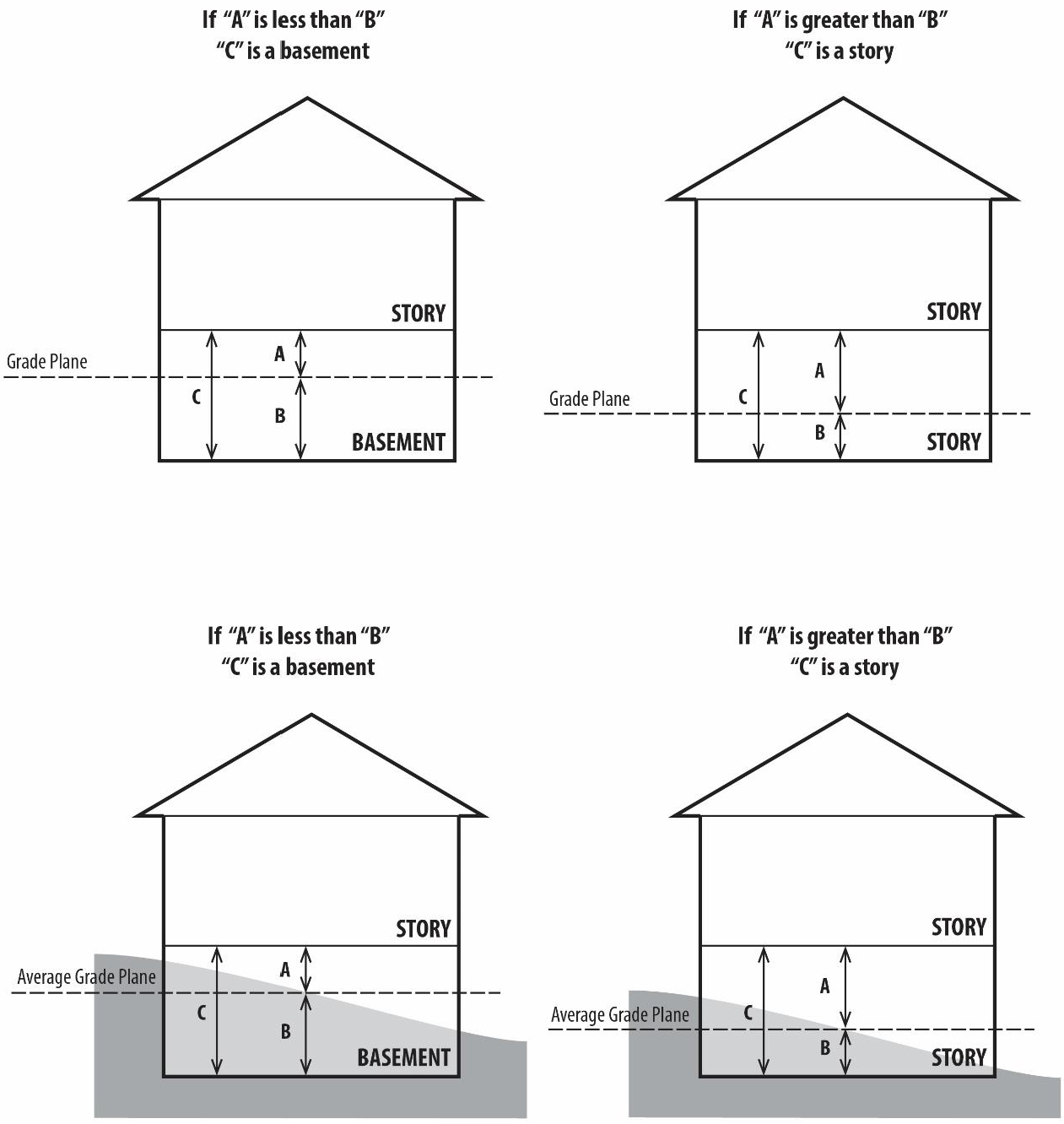
Basin.
(1)
Detention. A basin wherein water is stored for a relatively brief period of time, part of it being retained until the outlet can safely carry the ordinary flow plus the released water. Some basins have outlets usually without control gates and are used for flood regulation.
(2)
Retention. A basin wherein water is stored for a period of time until the outlet can safely carry the released water. Such basins have control gates which can be released at a given time. This type of basin is used for flood regulation.
Bed and breakfast establishment. A private, owner-occupied business in a single-family residence where overnight accommodations and a morning meal are provided to transients for compensation.
Berm. See "landscaping."
Best management practices. Structural and non-structural practices and techniques that mitigate the adverse impacts caused by land development on water quality and quantity.
Billboard. See outdoor advertising sign.
Buffer. See "landscaping."
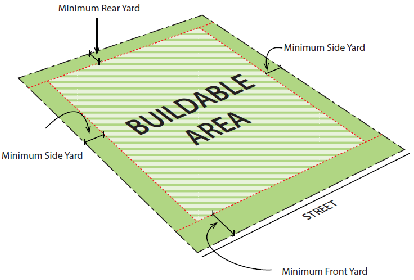
Buildable area. The buildable area of a lot or parcel is the space remaining after setback requirements of this chapter are complied with.
FIGURE 18-22 B. BUILDABLE AREA
Building. A structure, either temporary or permanent, having a roof supported by columns or walls, and intended for the shelter or enclosure of persons, animals, chattels or property of any kind. This shall include tents, excluding those used for personal recreational users, awnings or vehicles situated on private property and used for such purposes.
Building, accessory. See accessory use, building, or structure.
Building, principal. A building or structure in which the primary use of the property on which the building is located is conducted.
Building, temporary. Any structure erected on a property which is intended for limited duration.
Building Code. The currently adopted code or codes regulating building construction in Berlin Charter Township.
Building height. The vertical distance measured from the established grade of the center of the front of the building to the highest point of the roof surface for flat roofs; to the deck line of mansard roofs; and to the average height between eaves and ridge for gable, hip and gambrel roofs; and the average height between the lowest point and the highest point on a shed roof. Where a building is located on sloping terrain, the height may be measured from the average ground level of the grade at the building wall.
FIGURE 18-22 C. BUILDING HEIGHT
BUILDING HEIGHT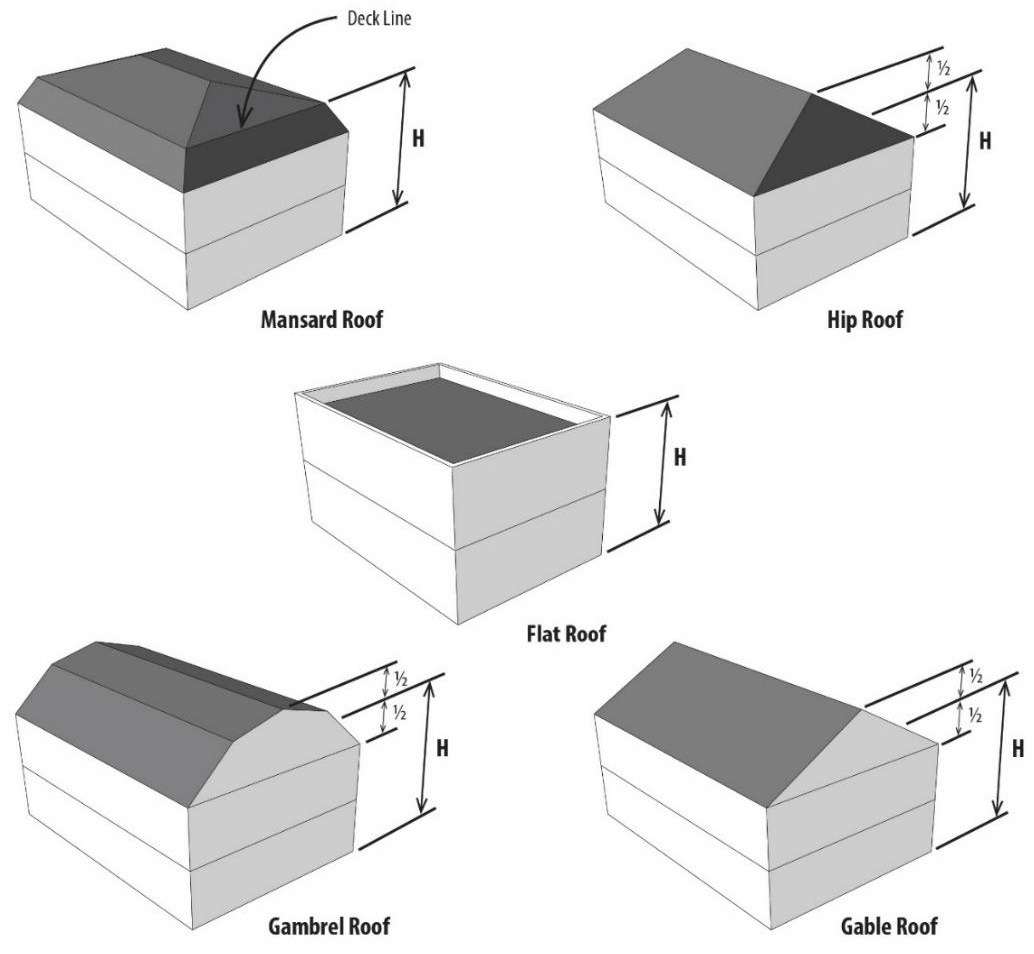
Building official. The township official or officials principally responsible for the review and enforcement of construction regulations.
Building permit. A building permit is written permission issued by the building official for the construction, alteration, or expansion of buildings or improvements on the land in conformance with this chapter.
Building setback line. A line which defines the minimum distance (as determined by the minimum front, side, or rear yard setback) which any building shall be located from a property line, existing street right-of-way, easement line of an approved private street, proposed right-of-way line as indicated in the township's master plan, or ordinary high water mark. See figure 18-22 H, lot lines.
Caliper. The method by which nursery tree stock is measured. Caliper is the diameter of the trunk of a tree measured in inches at a point six (6)-inches above the ground line if caliper measurement is four (4)-inches or less; if caliper measurement is larger, the measurement is taken twelve (12)-inches above the ground.
Campgrounds. An area or an establishment intended to contain temporary or permanent buildings, tents, recreation vehicles such as motor homes or travel trailers, or other structures established or maintained as temporary living quarters usually operated during the summer for recreation purposes. The term "campground" shall not include a "seasonal mobile home park" licensed under Public Act 96 of 1987 (MCL 25.2301 et seq.).
Cellar. See basement.
Cemetery. Property used for the interring of the dead. This may include structures and/or facilities for storing ashes of remains that have been cremated such as a mausoleum. It also may include structures for the internment of the dead in sealed crypts or compartments.
Certificate of zoning compliance. A document signed by the zoning official as a condition precedent to the commencement of a use or the construction/reconstruction of a structure or building which acknowledges that such use, structure, or building complies with the provisions of the zoning ordinance.
Child day care facilities. The following definitions shall apply in the construction and application of this chapter:
(1)
Child family day care home. A private residence in which one (1) but not more than six (6) minor children are received for care and supervision for periods less than twenty-four (24) hours per day unattended by a parent or legal guardian, excepting children related to an adult member of the family by blood, marriage, or adoption. It includes a home that gives care to an unrelated child for more than four (4) weeks in a calendar year.
(2)
Child group day care home. A private residence in which seven (7) but not more than twelve (12) children are received for care and supervision for periods less than twenty-four (24) hours per day unattended by a parent or legal guardian, excepting children related to an adult member of the family by blood, marriage, or adoptions. It includes a home that gives care to an unrelated child for more than four (4) weeks in a calendar year.
(3)
Child care center. A facility, other than a private residence, receiving more than one (1) or more children for care and supervision of periods less than twenty-four (24) hours per day, and where the parents or guardians are not immediately available to the child.
Child foster care facilities. Means the following:
(1)
Child foster care family home. A private home in which one (1) but not more than four (4) minor children, who are not related to an adult member of the household by blood, marriage, or who are not placed in the household pursuant to the adoption code, Chapter X of Act No. 288 of the Public Acts of 1939, being MCL 710.21 to 710.70, are given care and supervision for twenty-four (24) hours per day, for four (4) or more days per week, for two (2) or more consecutive weeks, unattended by a parent or legal guardian.
(2)
Child foster care group home. A private home in which more than four (4) but fewer than seven (7) minor children, who are not related to an adult member of the household be blood, marriage, or who are not placed in the household pursuant to Chapter X of Act No. 288 of Public Acts of 1939, are provided care for twenty-four (24) hours per day, for four (4) or more days per week, for two (2) or more consecutive weeks, unattended by a parent or legal guardian.
Club or lodge. An organization and its premises catering to members and their guests for social, intellectual, recreational, cultural, or athletic purposes not operated for profit.
Colocation. The location by two (2) or more wireless communication providers of wireless communication facilities on a common structure, tower, or building.
Commercial recreation facility. A privately owned facility designed and equipped for the conduct of sports, amusement, or leisure activities, and other customary recreational activities either indoors (within an enclosed building) or outdoors (outside of an enclosed building) operated as a business and open for use by the public for a fee.
Community supported agriculture (CSA). A market strategy in which a farm produces farm products for the group of farm members or subscribers who pay in advance for their share of the harvest. Typically, the farm members receive their share once per week, sometimes coming to the farm to pick up their share, or farms deliver to a central point.
Condominium. A building or lot governed under Act 59, Public Acts of 1978, as amended. The following condominium terms shall apply in the application of this chapter.
(1)
Condominium documents. The master deed, recorded pursuant to the Condominium Act, and any other instrument referred to in the master deed or bylaws which affects the rights and obligations of a co-owner in the condominium.
(2)
Condominium subdivision plan. The drawings and information prepared in accordance with Section 66 of the Condominium Act.
(3)
Condominium unit. The portion of a condominium project designed and intended for separate ownership and use, as described in the master deed.
(4)
Consolidating master deed. The final amended master deed for a contractible or expandable condominium project or a condominium project containing convertible land or convertible space, which the final amended master deed fully describes the condominium project as completed.
(5)
Contractible condominium. A condominium project containing condominium units some or all of which were occupied before the filing of a notice of taking reservations under Section 7 of the Condominium Act.
(6)
Expandable condominium. A condominium project to which additional land may be added in accordance with this chapter and the Condominium Act.
(7)
General common elements. A portion of the common elements reserved in the master deed for the use of all co-owners.
(8)
Limited common elements. A portion of the common elements reserved in the master deed for the exclusive use of less than all of the co-owners.
(9)
Master deed. The condominium document recording the condominium project to which are attached as exhibits and incorporated by reference the bylaws for the project, the condominium subdivision plan for the project and all other information required by Section 8 of the Condominium Act.
(10)
Notice of proposed action. The notice required by Section 71 of the Condominium Act, to be filed with Berlin Charter Township and other agencies.
(11)
Site condominium. A condominium development containing residential, commercial, office, industrial, or other structures or improvements for uses permitted in the zoning district in which the condominium development is located, in which each co-owner owns the exclusive right to a volume of space within which each co-owner may construct a structure or structures.
Conservation easement. A legal agreement in which the landowner retains ownership of private property but conveys certain specifically identified rights to a land conservation organization or public body.
Construction. Any assembly, erection, substantial repair, alteration or similar action, for or of public or private rights-of-way, structures, utilities, or similar property.
dB(A). A-weighted decibels; the standards used to measure environmental noise.
D.B.H. (Diameter at breast height). A measurement of the diameter of a tree trunk taken on the outside bark at breast height. Breast height is defined as four and one-half (4.5) feet from the uphill side of the tree.
Deck. A structure without a roof having a foundation to hold it erect and attached to or abutting one (1) or more walls of a building or constructed separately from a building, with or without direct access to the ground. The floor of which is above finished grade and intended for use as an outdoor living area.
Dedicated open space. Open land that is permanently set aside by the owner for retention in a generally undeveloped state which preserves natural features, scenic or wooded conditions, agricultural uses, open space, or similar conditions.
Density. The number of dwelling units situated on or to be developed per net or gross acre of land.
Drainage.
(1)
Surface water run-off.
(2)
The removal of surface water or groundwater from land by drains, grading, or other means which include run-off controls to minimize erosion and sedimentation during construction or development. The means for preserving the water supply and the prevention or alleviation of flooding.
Drive-in. A business establishment so developed that its retail or service character is dependent on providing a driveway approach or parking spaces for motor vehicles so as to serve patrons while in the motor vehicle rather than within a building or structure.
Drive-through. A business establishment or portion thereof where the design, method of operation, or any portion of whose business use eliminates the requirement that the customer leave the motor vehicle in which the customer is riding in order to obtain the delivery of the goods or services being offered.
Dwelling area. The area of a dwelling unit composed of sleeping rooms, kitchen, dining room, den, studio, bathrooms, family room and living room.
Dwelling, multiple-family. A building, structure, or portion thereof, designed exclusively for three (3) or more families living independently of each other.
Dwelling, single-family. A detached building or structure designed and occupied by one (1) family.
Dwelling, single-family attached. A building containing not less than three (3) nor more than six (6) single-family dwelling units erected side by side as a single building, each being separated from the adjoining unit or units by an uninterrupted wall extending from the basement floor to the roof. No more than one (1) dwelling unit may be served by a single stairway or by a single exterior door.
Dwelling, two-family. A building or structure designed for, or occupied by two (2) families only, with separate entrances, housekeeping, and cooking facilities.
Dwelling unit. One (1) or more rooms with principal kitchen facilities designed as a unit for residence by only one (1) family for living and sleeping purposes.
Easement. The granting of one (1) or more property rights by a property owner to and/or for use by the public, or another person or entity.
Erect. Build, construct, alter, reconstruct, or any physical operations on the premises which are required for construction. Excavation, fill, drainage, installation of utilities included.
Essential services. The erection, construction, alteration or maintenance by public utilities or municipal departments of underground, surface or overhead gas, electrical, steam, fuel or water transmission or distribution system, collection, communication, supply or disposal systems, including towers, poles, wires, mains, drains, sewers, pipes, conduits, cables, fire alarm and police call boxes, traffic signals, hydrants and similar equipment in connection herewith, but not including buildings, which are necessary for the furnishing of adequate services by such utilities or municipal departments for the general health, safety, or welfare.
Excavation. Any breaking of the ground to hollow out by cutting, digging or removing soil or rock matter, except for common household gardening and general farm care.
Family. One (1) or two (2) persons or parents, with their direct lineal descendants and adopted children (and including the domestic employees thereof), together with not more than two (2) persons not so related, living together in the whole or part of the dwelling unit comprising a single housekeeping unit.
Farm market. A place or an area where transactions between a farm market operator and customers takes place. This includes roadside stands. It does not include a physical structure such as a building and is considered part of a farm operation. The products marketed for sale at a farm market must be produced on and by the affiliated farm. Farm products may be processed more extensively into a form that adds value and makes them more marketable for direct customer sales.
Farm operation. The operation and management of a farm or a condition or activity that occurs at any time as necessary on a farm in connection with the production, harvesting, and storage of farm products, and includes, but is not limited to:
(1)
Market produce at roadside stands or farm markets.
(2)
The generation of noise, odors, dust, fumes, and other associated conditions.
(3)
The operation of machinery and equipment necessary for a farm including, but not limited to: irrigation and drainage systems and pumps and on-farm grain dryers, and the movement of vehicles, machinery, equipment, and farm products, and associated inputs necessary for farm operation on the roadway as authorized by the Michigan Vehicle Code, Act No. 300 of the Public Acts of 1949, being MCL 257.1 to 257.923.
(4)
Field preparation and ground and aerial seeding and spraying.
(5)
The application of chemical fertilizers or organic materials, conditioners, liming, materials, or pesticides.
(6)
Use of alternative pest management techniques.
(7)
The fencing, feeding, watering, sheltering, transportation, treatment, use handling, and care of livestock.
(8)
The management, storage, transport, utilization, and application of farm by-products, including manure or agricultural wastes.
(9)
The conversion from a farm operation activity to other farm operation activities.
(10)
The employment and use of labor.
Farm pond. See "pond, farm."
Fence. An accessory structure intended for use as a barrier to property ingress or egress, a screen from an objectionable vista, noise, and/or for decorative use.
Filing date. The date upon which any application and all required supporting documentation pursuant to this chapter is submitted and the required filing fee is paid.
Filling. The permanent depositing or dumping of any matter onto or into the ground, except common household gardening and general farm care.
Flood or flooding. A general and temporary condition of partial or complete inundation of normally dry land areas from:
(1)
The overflow of inland waters.
(2)
The unusual and rapid accumulation of runoff or surface water from any source.
Flood hazard area. Land which, on the basis of available floodplain information, is subject to a one percent (1%) or greater chance of flooding in any given year.
Flood insurance rate map (FIRM). A map of the township prepared by the Federal Emergency Management Agency, which identifies the 100- and 500-year floodplain and other related flood information; and which is used as the official floodplain map for flood insurance purposes.
Flood insurance study. The official report provided by the Federal Emergency Management Agency containing flood profiles, as well as the flood hazard boundary-floodway map and other water surface elevations of the base flood.
Floodplain. That portion of land adjacent to or connected to a water body or water course which is subject to periodic inundation in accordance with the one hundred (100)-year flood cycle as determined by the U.S. Army Corps of Engineers or other applicable federal agency.
Floodway. The channel of a river or other watercourse and the adjacent land areas designated in the flood insurance study which shall be reserved in order to discharge the base flood. Floodway is also the same as the regulatory floodway.
Floor area. The sum of the gross horizontal areas of each story of the building as measured from the exterior walls; exclusive of areas of basements, unfinished attics, attached garages, breezeways and enclosed and unenclosed porches.
Floor area ratio (FAR). The ratio of the floor area of a building to the area of the lot on which it is located calculated by dividing the floor area by the lot area and expressing it as a percentage. In calculating the floor area, the floor area of accessory buildings shall be included.
FIGURE 18-22 D. FLOOR AREA RATIO
FLOOR AREA RATIO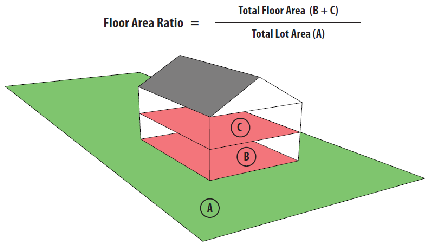
Floor area, usable. For the purposes of computing parking requirements, all ground and non-ground floor area used for, or intended to be used for, the sale of merchandise or services or for use to serve patrons, clients or customers. Such floor area which is used or intended to be used principally for the storage or processing of merchandise, or for utilities, shall be excluded from this computation of "usable floor area." Useable floor area shall be measured from the interior faces of the exterior walls, and total usable floor area for a building shall include the sum of the usable floor area for all floors.
Grade. The degree of rise or descent of a sloping surface.
FIGURE 18-22 E. GRADE
GRADE 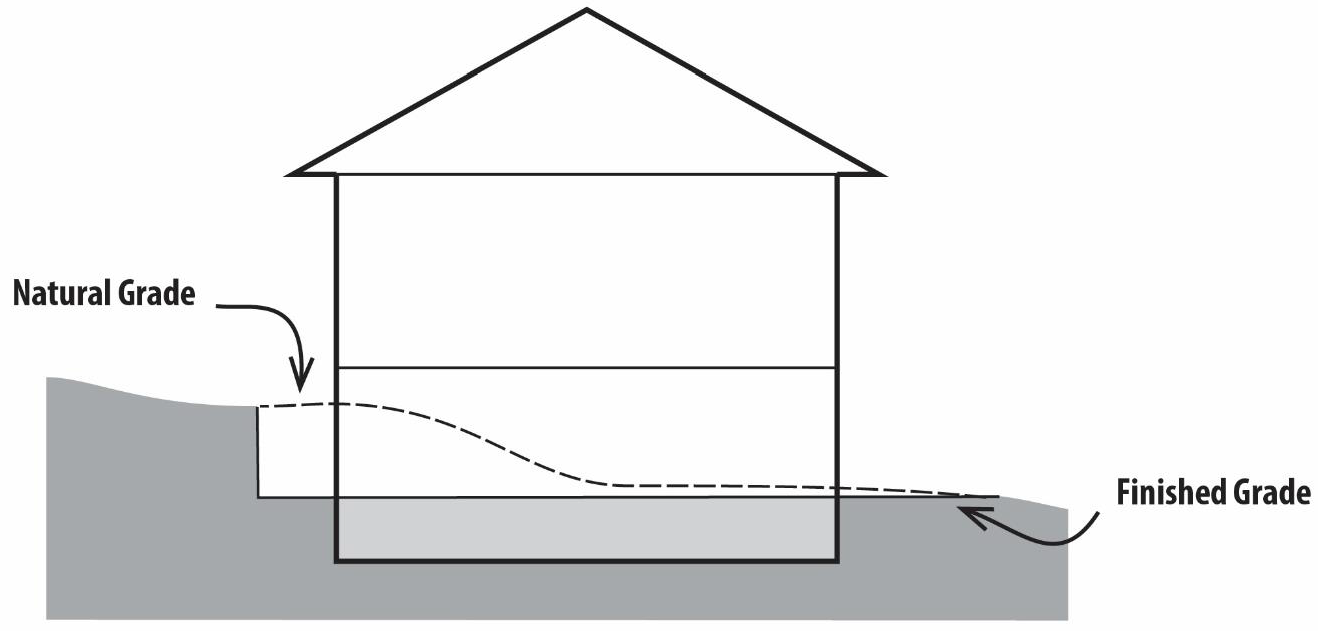
Grade, average. The arithmetic average of the lowest and highest-grade elevations in an area within five (5) feet of the foundation line of a building or structure.
Grade, finished. The lowest point of elevation between the exterior wall of the structure and a line five (5) feet from the exterior wall of the structure.
Grade, natural. The elevation of the ground surface in its natural state, before man-made alterations.
Greenbelt. A landscaped area which is intended to provide a transition between a public road right-of-way and an existing or proposed use.
Greenway. A contiguous or linear open space, including habitats, wildlife corridors, and trails, which link parks, nature reserves, cultural features, or historic sites with each other, for recreation and/or conservation purposes.
High water mark. The common, recurrent recorded highest level of a body of water including but not limited to a lake, river, stream or pond.
Home occupation. An occupation carried on by resident members of the family (no outside employees) being clearly incidental and secondary to the principal residential use provided:
(1)
That such home occupation shall be carried on within the dwelling or within a building accessory thereto;
(2)
That no article shall be sold or offered for sale on the premises, except such as produced within the dwelling or accessory building or is provided incidental to the service or profession conducted within the dwelling or accessory building;
(3)
That there shall be no exterior storage of materials or equipment;
(4)
That no nuisance shall be generated by any heat, glare, noise, smoke, vibration, noxious fumes, odors, vapors, gases or matter at any time; and
(5)
That no hazard of fire, explosion, or radioactivity shall exist at any time.
Hospital. A state licensed medical establishment whose facilities provide in-patient accommodation; a wide range of medical and surgical care; and other in-patient health services for sick, ailing or injured persons, rather than a limited scope of services provided for through special purpose hospitals; and including such related facilities as laboratories, out-patient departments, training facilities, central service, and staff offices and residences which are integral with and accessory to the principal use of the establishment.
Impervious surface. Any surface which does not allow water to be absorbed so it may percolate into deeper ground. Such surfaces are those constructed of cement, bituminous asphalt, paving brick, composed stone or gravel, or any other surface that allows no water penetration.
Impervious surface ratio. The percentage covered by all building, pavement, driveways, parking lots, and all other structures (area of all structures, pavement, and parking lots divided by the gross lot area).
Industrial park. A group of two (2) or more lots or parcels devoted to industrial, research, warehousing, or business park uses, developed according to an overall plan for the park, sharing a common public or private street system, and usually identified by a name for the park.
Kennel, commercial. Any building, structure, enclosure, or premises where five (5) or more dogs or cats, six (6) months old or over are kept for commercial purposes, including: for sale, breeding, boarding or rendering of services for profit. For the purposes hereof, five (5) animals or more over six (6) months in age kept and maintained as a hobby kennel or for any other purpose, shall be deemed and considered a commercial kennel.
Kennel, hobby. Any building, structure, enclosure, or other premises where four (4) or fewer dogs or cats, six (6) months in age or older, are kept, harbored or maintained, without renumeration:
(1)
For showing in recognized dog shows, obedience trails, or field trials.
(2)
For working or hunting.
(3)
For improving the variety or breed with a view to exhibition in shows and trials.
(4)
For household pets.
Laboratory. A place devoted to experimental study such as testing and analyzing, but not devoted to the manufacturing of a product or products.
Landscaping. The following definitions shall apply in the application of this chapter:
(1)
Berm. An erection of earthen material appropriately capped and planted to prevent erosion which is acceptable to the township engineer and planning commission.
(2)
Buffer. A landscaped area composed of living materials, wall, berm, or combination thereof, established and/or maintained to provide visual screening, noise reduction, and transition between conflicting types of land uses.
(3)
Conflicting non-residential land use. Any non-residential use, including, but not limited to office, commercial, industrial, research, parking, or public road right-of-way land use which abuts a residential land use.
(4)
Conflicting residential land use. Any residential land use developed at a higher density which abuts a residential land use developed at a lower density.
(5)
Opacity. The state of being impervious to sight.
(6)
Plant material. A collection of living evergreen and/or deciduous, woody-stemmed trees, shrubs, vines, and ground cover.
(7)
Screen. A structure providing enclosure, including, but not limited to, a fence, and/or visual barrier between the area enclosed and the adjacent property. A screen may also consist of living materials including but limited to trees and shrubs.
Livestock. Animals including, but not limited to, horses, cattle, sheep, goats, swine, poultry, and rabbits.
Livestock production facility. All facilities where livestock are kept with a capacity of fifty (50) animal units or greater and/or the associated manure facilities. Sites such as loafing areas, confinement areas, or feed-lots which have livestock densities that preclude prominence of desirable forage species are considered part of a livestock production facility. This does not include pastureland.
Loading space. An off-street parking space on the same lot with a building, or group of buildings, for temporary parking of a commercial vehicle while loading and unloading merchandise, materials or passengers.
Lodging facility. A facility such as a motel or hotel, which provides living and sleeping accommodations for transient occupancy for a fee. The following additional definitions shall apply:
(1)
Hotel. A series of attached, semi-detached, or detached rental units which provide lodging on a temporary basis and are offered to the public for compensation.
(2)
Motel. An establishment providing sleeping accommodations for compensation with a majority of all rooms having direct access to the outside without the necessity of passing through the main lobby of the building.
Lot. A parcel of land, excluding the portion in a street or other right-of-way, of at least sufficient size to meet minimum requirements for lot area, and to provide such yards and other open spaces as herein required. In no case of division or combination shall any lot or parcel created, including residuals, be less than that required by this chapter. Such lots shall have frontage on a public street, or on an approved private road.
Lot area. The total area within the lot lines of a lot, excluding any road right-of-way, a street drive or easement shall not be included in measuring minimum lot area necessary to meet district regulations.
Lot, corner. A lot located at the intersection of two (2) or more streets.
Lot, double frontage (also called through). An interior lot having frontage on two (2) more or less parallel streets. All sides of such lot adjacent to streets shall be considered frontage, and front yards shall be provided as required.
Lot, interior. Any lot other than a corner lot with only one (1) lot line fronting on a street.
FIGURE 18-22 F. LOT TYPES
LOT TYPES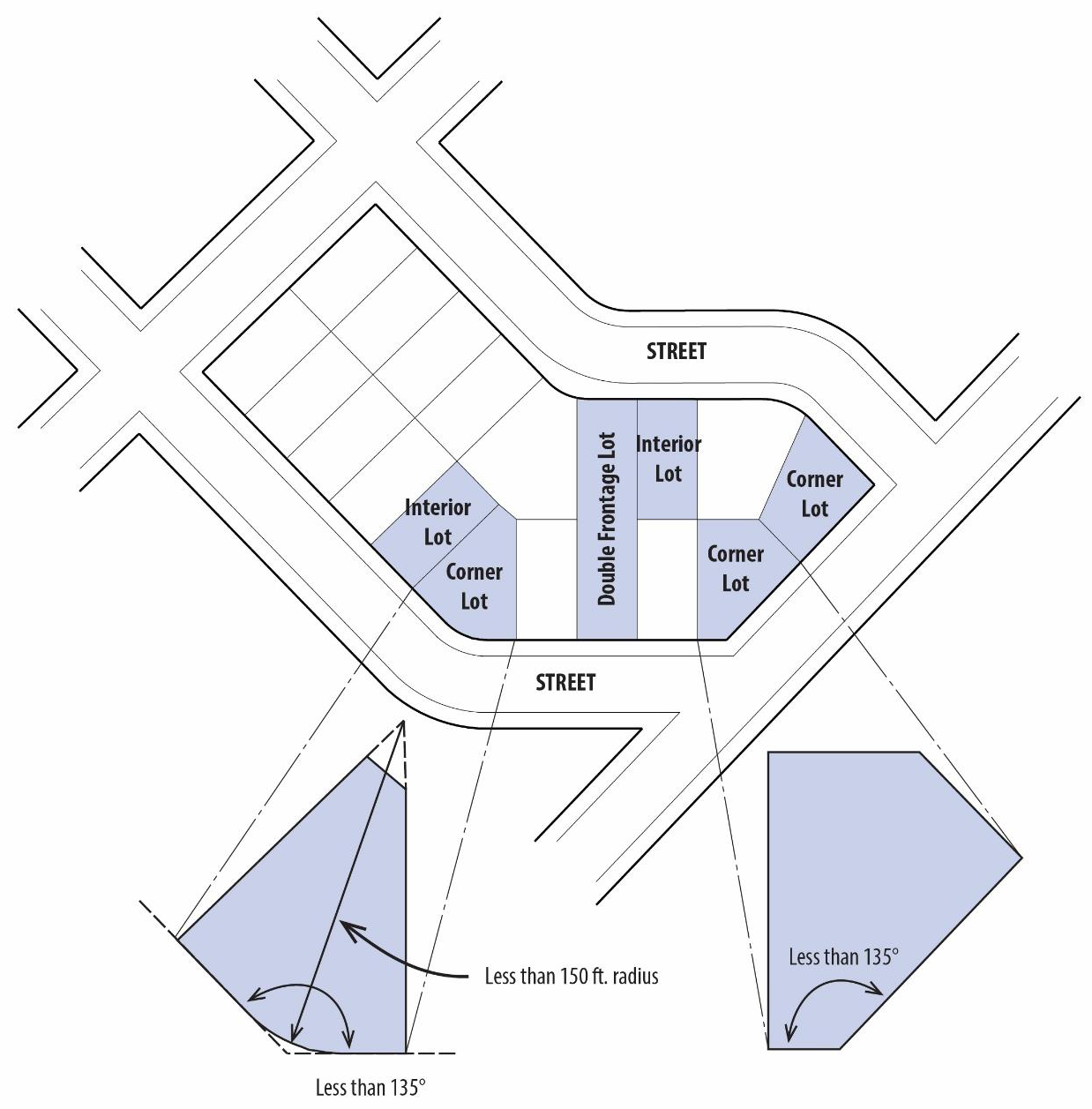
Lot coverage. The part or percent of the lot occupied by buildings or structures, including accessory buildings.
Lot depth. The horizontal distance between the front street line to the rear lot lines.
FIGURE 18-22 G. LOT DEPTH
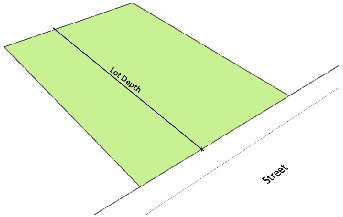
Lot frontage. The length of the front lot line.
Lot lines. The lines bounding a lot or parcel as defined herein:
(1)
Front lot line. The line(s) separating the lot from any street right-of-way, private road, or other access easement.
(2)
Rear lot line. Ordinarily, the lot line opposite and most distant from the front lot line. In the case of an irregular, triangular or gore-shaped lot, a line ten (10) feet within the lot parallel to the front lot line of the lot shall be considered to be the rear lot line for the purpose of determining depth of the rear yard.
(3)
Side lot line. Any lot lines other than the front lot line or rear lot line. A side lot line separating a lot from a street is a front lot line. A side lot line separating a lot from another lot or lots is an interior side lot line.
FIGURE 18-22 H. LOT LINES
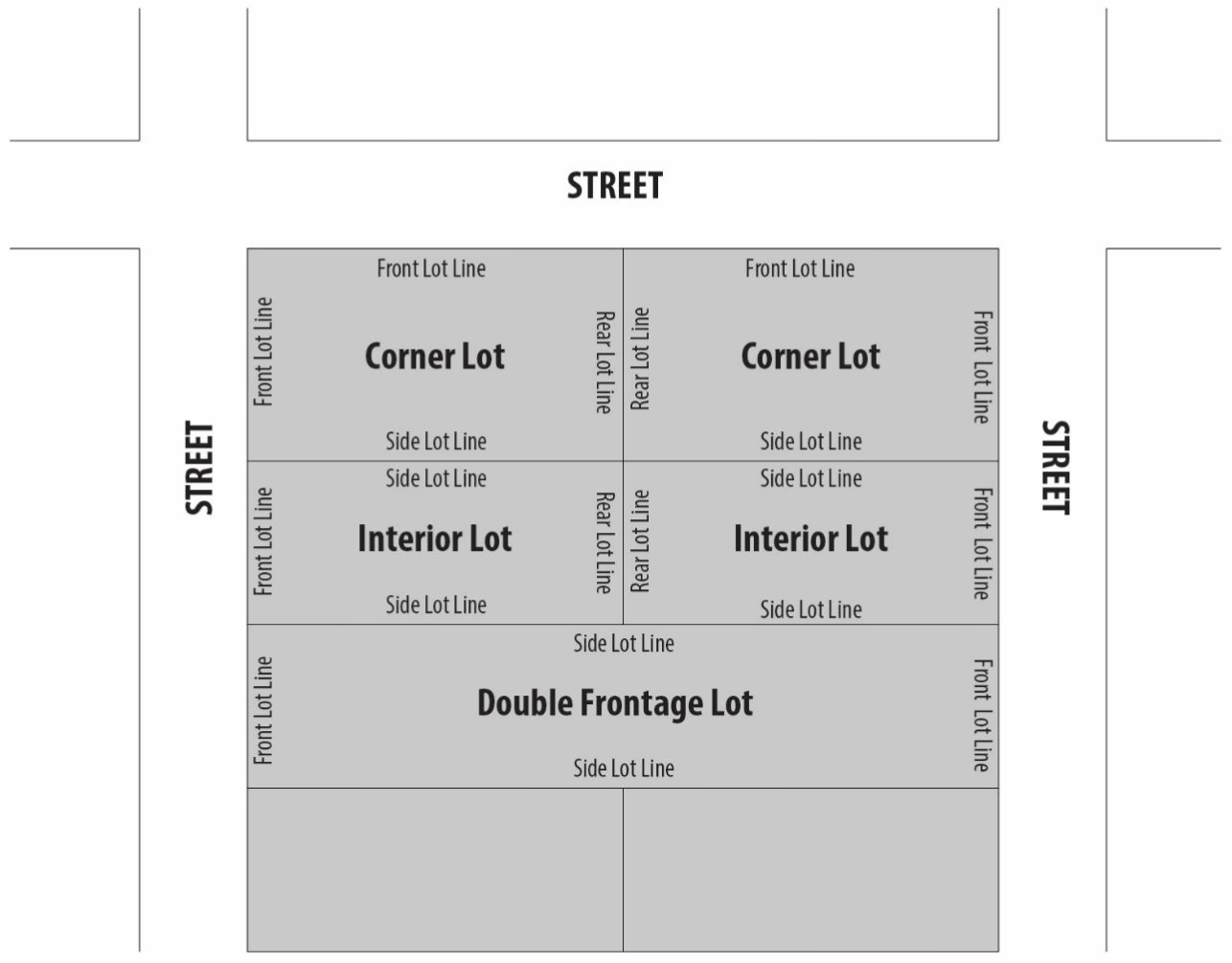
Lot of record. A tract of land which is part of a subdivision shown on a plat or map which has been recorded in the office of the register of deeds of Monroe County, or a tract of land described by metes and bounds which is subject of a deed or land contract which has been recorded in said office which existed prior to the effective date of the ordinance from which this chapter derives or amendments thereto.
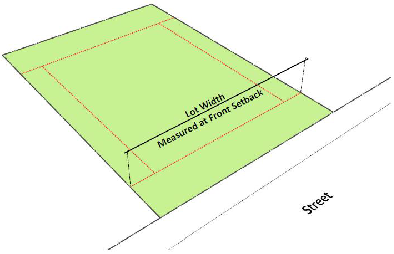
Lot Width. The horizontal, straight line distance between the side lot lines, measured at the required front setback.
FIGURE 18-22 I. LOT WIDTH
Low water mark. The minimum recorded level of water for a body of water including but not limited to a lake, river, stream or pond.
Manufactured home. A structure, transportable in one (1) or more sections, which is built on a chassis and designed to be used as a single-family dwelling with or without permanent foundation, when connected to the required utilities, and includes the plumbing, heating, air conditioning and electrical systems contained in the structure. A manufactured home does not include a recreational vehicle.
Manufactured housing community. Any parcel or tract of land under the control of any person or entity, upon which three (3) or more manufactured homes are located on a continual or non-recreational basis, or which is offered to the public for that purpose regardless of whether a charge is made therefor, together with any building, structure, enclosure, street, equipment or facility used or intended for use incident to the occupancy of a manufactured home and which is not intended for use as a temporary trailer park.
Manufactured home site. Means a parcel of ground within a manufactured housing community designed for accommodating one (1) manufactured home single dwelling unit and meeting the requirements of this chapter for a manufactured home site.
Manufacturing. The process of making products by hand, by machinery, or by other agency, often with the provision of labor and the use of machinery.
Master plan. A document containing the future development policies and map for Berlin Charter Township, together with supporting documentation, as most recently adopted or amended by the Berlin Charter Township Planning Commission pursuant to the Michigan Planning Enabling Act, 2008 PA 33 (MCL 125.3801 et seq.), as amended.
Medical clinic. Facilities for medical, dental, or psychiatric diagnosis and treatment, exclusive of major surgical procedures, for sick, ailing, and injured persons who are not kept overnight on the premises.
Mezzanine. An intermediate floor in any story occupying not to exceed one-third (⅓) of the floor area of such story.
Mixed use development. Development of a tract of land, building, or structure with a variety of complementary and integrated uses as permitted by the applicable zoning district.
Mobile Home Commission Act. Refers to Act No. 419 of the Public Acts of Michigan of 1976 (MCL 125.2301 et seq.), and subsequent revisions.
Non-conforming building or structure. A building, structure or portion thereof, lawfully constructed that no longer conforms to the requirements of the district in which it is located.
Non-conforming lot. A lot existing at the effective date of this chapter of record which does not meet the minimum dimensional requirements of the district in which the lot is located.
Non-conforming use. A use, which lawfully existed prior to the effective date of this chapter or amendments thereto, that does not conform to the use regulations of the district in which it is located.
Occupied. The use of any structure, parcel, or property for human endeavor, but not including the preparation of any structure of land for occupancy.
Off-street parking area. A land surface or facility providing vehicular parking spaces along with adequate drives and aisles for maneuvering so as to provide access for entrance and exit for the parking of three (3) or more automobiles.
Opacity. See "landscaping."
Open air business. Sales and/or display of retail merchandise or services outside of a permanent structure.
Open space. Any parcel or area of land including wetland that is unimproved and set aside, dedicated, designated, or reserved for preservation purposes, and/or public or private use or enjoyment. Such land does not include a golf course or required setbacks for individual parcels, but may include recreational trails, picnic areas, children's play areas, greenways, buffer and greenbelt areas, linear parks. Stormwater detention or retention ponds and facilities meeting low impact design criteria of the Monroe County Drain Commissioner's Office and constructed using native vegetation may be considered as open space. Land may be, but is not required to be, dedicated to the public.
Outdoor storage. A land area occupied and used for outdoor storage of building materials, sand, gravel, stone, lumber, equipment, and other supplies.
Parallel plan. See base density calculation.
Parcel. A piece or tract of land.
Parks. An area reserved for, and designed principally to offer recreation, passive or active, which may be open to the public or privately owned. This area may include, but shall not be limited to, open fields, accessory buildings, walkways, benches, multi-use courts, swimming and wading pools, amphitheaters, etc.
Parking space. One (1) unit of a parking area provided for the parking of one (1) vehicle.
Performance standards. Criteria established to control smoke and particulate matter, noise, odor, toxic or noxious matter, vibration, fire and explosion hazards, glare or heat, or radiation hazards generated by or inherent in uses of land or buildings.
Permitted use. A use allowed by right in a zoning district and subject to the restrictions applicable to that zoning district.
Personal service establishment. A business where personal services are provided for profit and where the sale of goods is only accessory to the provisions of such services, including, but not limited to the following: barber shops, beauty shops, tailor shops, laundry or dry cleaning shops, and shoe repair shops.
Photovoltaic device. A system of components that generates electric energy from incident sunlight by means of the photovoltaic effect, whether or not the device is able to store the electric energy produced for later use.
Places of assembly. Unless otherwise identified and defined by this chapter, "places of assembly" means any building, structure and/or grounds where groups meet or assemble. Places of assembly shall include, but are not limited to: auditoriums, stadiums, sports, arenas, fine and performing art venues, and other similar facilities.
Places of worship. A structure used for or intended for the regular assembly of persons for the conducting of religious services and accessory uses therewith.
Planned unit development (PUD). A form of land development comprehensively planned as an entity via a unitary site plan which permits flexibility in building, siting, usable open spaces, and the preservation of significant natural features. Such a development may contain a mix of housing types and non-residential uses.
Planning commission. The Berlin Charter Township Planning Commission as created under Public Act 33 of 2008, as amended.
Plant material. See "landscaping."
Plat. A map of a subdivision of land showing location, boundaries, and ownership of individual properties as required by the State of Michigan Land Division Act and the township subdivision control ordinance.
Pond. Any excavation, the altering of a watercourse by damming or excavation, or combination thereof, for the purpose of creating thereby a body of water greater than fifty (50) square feet in area or greater than twenty-four (24) inches in depth, except for detention or retention basins.
Pond, farm. A pond designed to provide water to an established irrigation system with associated pumps, pipes, and sprinklers, including a design (i.e., well or aquifer) for replenishing the pond water pursuant to an established bona fide farm operation as a permitted use in an agricultural district. A farm pond is considered an accessory use to the growing of farm crops and produce or for the watering of livestock.
Pond, landscape. Landscape ponds or water gardens are a type of man-made water feature two hundred (200) square feet or less in area and twenty-four (24) inches deep or less.
Portable storage units. A portable, weather-resistant receptacle designed and used for the temporary storage or shipment of household goods, wares, building materials, or merchandise.
Practical difficulties. See "variance."
Premises. All portions of contiguous land in the same ownership that are not divided by any public highway, street, or alley, and upon which is located a residence or place of business.
Principal building or structure. The main building or structure in which the primary use is conducted.
Principal use. The main use to which the premises are devoted and the main purpose for which the premises exist.
Private road. An area of land which is privately owned and which provides vehicular access, has not been dedicated to public use other than access by emergency and public safety vehicles, is maintained by its private owners, and vehicular access to more than one (1) lot, unless otherwise specified herein.
Public service. Facilities including such uses and services as: voting booths, pumping stations, fire halls, police stations, temporary quarters for welfare agencies, public health activities and similar uses including essential services.
Public utility. Any person, municipal department, board or commission duly authorized to furnish and furnishing under federal, state, or municipal regulations, to the public: electricity, gas, steam, disposal, communication, telegraph, transportation, water or sanitary sewer facilities.
Recreational vehicle. A vehicle or boat originally designed for living quarters, recreation, or human habitation, and not used as a commercial vehicle, including, but not limited to, the following:
(1)
Boat. Any vessel used for water travel. A boat mounted on a trailer shall be considered one (1) vehicle.
(2)
Camper trailer. A vehicle without its own motor power, designed as temporary living quarters for travel, camping, recreation, or vacation use.
(3)
Motorhome. A motor vehicle designed and constructed to provide living quarters for travel, camping, recreational, or vacation uses.
(4)
Off-road vehicle. A vehicle intended primarily for recreational use off road on which state vehicle licenses are required, including dune buggies, go-carts, or snowmobiles.
(5)
Racing car or cycle. A vehicle such as a race car, stock car, or racing cycle that is intended to be used in racing competition.
(6)
Vehicle trailer. A vehicle without its own motor power that is designed to transport another vehicle, such as a boat, motorcycle, or snowmobile for recreation or vacation use and that is eligible to be licensed or registered and insured for highway use. A vehicle trailer with another vehicle mounted on it shall be considered one (1) vehicle.
Restaurant. An establishment whose principal business is the sale of food and beverages to the customer in a ready-to-consume state, and whose method of operation is characteristic of a carry-out, drive-in, drive-through, sit-down restaurant, or bar/lounge, or combination thereof, as defined below:
(1)
Restaurant, carry-out. A carry-out restaurant is a restaurant whose method of operation involves sale of food, beverages, and/or frozen desserts in disposable or edible containers or wrappers in a ready-to-consume state for consumption primarily off of the premises.
(2)
Restaurant, drive-in/drive-through. A drive-in/drive-through restaurant shall be deemed to be any restaurant designed to permit or facilitate the serving of meals, sandwiches, ice cream, beverages, or other food served directly to or permitted to be consumed by patrons in cars or other vehicles parked on the premises, or permitted to be consumed by patrons elsewhere on the site outside of the main building.
(3)
Restaurant, fast food. A fast food restaurant is a restaurant whose method of operation involves minimum waiting for delivery of ready-to-consume food to the customer at a counter or cafeteria line for consumption at the counter where it is served, or at tables, booths, or stands inside or outside of the structure, or for consumption off the premises, but not in a motor vehicle at the site.
(4)
Restaurant, sit down. A standard restaurant whose method of operation involves either the delivery of prepared food by waiters and waitresses to customers seated at tables within a completely enclosed building, or the prepared food is acquired by customers at a cafeteria line, and is subsequently consumed by the customers at tables within a completely enclosed building.
(5)
Bar/lounge. A bar or lounge is a type of restaurant which is operated primarily for the dispensing of alcoholic beverages, although the sale of prepared food or snacks may also be permitted. If a bar of lounge is part of a larger dining facility, it shall be defined as that part of the structure so designated or operated.
Research and development facilities. A structure or group of structures used primarily for applied and developmental research, where product testing is an integral part of the operation and goods or products may be manufactured as necessary for testing, evaluation, and test marketing.
Retail, general. Any building or structure in which goods, wares, or merchandise are sold to the consumer for direct consumption and not for resale.
Right-of-way. A street, alley, or other thoroughfare, or an easement permanently established or dedicated for passage of persons or vehicles.
Roadside stands or markets. A temporary structure which is used seasonally for the sale of produce which is grown on the premises. See farm operation.
Salvage Operation. A place, structure, parcel or use of land where junk, waste, discard, salvage, or similar materials such as metals, wood lumber, glass, paper, rags, cloth, leather, rubber, bagging, cordage, barrels, containers, etc., are bought, sold, exchanged, stored, baled, packed, disassembled, or handled, including auto wrecking yards, house wrecking, and structural steel materials and equipment and including establishments for the sale, purchase, or storage of salvaged machinery and the processing of used, discarded, or salvaged materials, for any thirty (30) day period.
School. A building operated and maintained for educational purposes and such other community uses as deemed necessary and desirable. The term "school" shall include all educational functions, the building or structure required to house them, and all accessory uses normally incidental to a school, including, but not restricted to, athletic fields, field houses, gymnasiums, parking lots, greenhouses, playgrounds, stadiums, and open space.
Screening. See "landscaping."
Self-storage facility. A building or group of buildings, each of which consists of several individual storage units, each with a separate door and lock, and which can be leased on an individual basis. Such facilities are typically, but not necessarily, contained within a fenced, controlled access compound.
Senior housing. A building or group of buildings containing dwellings intended to be occupied by older persons as defined by the Fair Housing Act. Senior housing may include independent and/or assisted living arrangement but shall not include convalescent homes or homes for the aged regulated by the state. The following additional definitions shall apply in the application of this chapter:
(1)
Assisted Living for the Elderly. Housing that provides twenty-four (24) hour supervision and is designed and operated for elderly people who require some level of support for daily living. Residents may receive support services for daily living based on individual needs. Such support shall include daily personal care, meals, transportation, security, and housekeeping. Individual dwellings may contain kitchen units.
(2)
Independent living for the elderly. Housing that is designed and operated for elderly people in good health who desire and are capable of maintaining independent households, and do not require assistance to meet daily needs. Such housing may provide certain services such as meals, linkage to health care, transportation, security, housekeeping, and recreational and social activities. Project sites shall be designed to accommodate an active and mobile resident population. Individual dwellings are designed to promote independent living and shall contain kitchen facilities.
Setback. The distance between front, side or rear lot lines and the principal and accessory buildings, as required herein.
Sign. Any structure or part thereof, or device attached thereto or painted or represented thereon, or any material or thing, illuminated or otherwise, which displays or includes any numeral, letter, work, model, banner, emblem, insignia, device, code, mark or other representation used as or in the nature of, an announcement, advertisement, direction, or designation, of any person, firm, organizations, place, commodity service, business, profession, or industry, or any backlit building area, which is located upon any land or in or on any building in such a manner as to attract attention from outside the premises.
(1)
Abandoned sign. Any sign which no longer advertises or identifies a business, lessor, owner, or activity conducted upon, or product available on, the premises where such sign is displayed for a period of six (6) months.
(2)
Awning sign. A sign affixed flat against the surface of an awning or inscribed on an awning.
(3)
Billboard. See outdoor advertising sign.
(4)
Business flag. A flag displaying a corporate emblem or seal.
(5)
Canopy or marquee sign. Any sign attached to, or constructed within or on, a canopy or marquee.
(6)
Changeable message board. The portion of a sign on which copy is changed manually.
(7)
Conforming sign. Any sign at that is allowed under article XIII.
(8)
Drive-through board. A sign located within ten (10) feet of either side of a drive-through lane.
(9)
Electronic message sign (LED). A sign with a fixed or changing message composed of a series of lights or light-emitting diodes (LED) that may be changed through electronic means.
(10)
Flags. Fabric, canvas or other similar material that is mounted to a pole or a building at one or more edges.
(11)
Freestanding sign. A sign supported by a structure independent of any other structure.
(12)
Gas station canopy sign. A sign located at a gas station attached directly to the elevated canopy that covers pump islands.
(13)
Height of sign. The vertical distance to the top edge of the copy area or structure, whichever is higher, as measured from the adjacent street grade.
(14)
Identification sign. A sign which carries only the name of the firm, the major enterprise, or principal product or service offered for sale on the premises or a combination of these things only to identify location of said premises and not to advertise.
(15)
Incidental sign. A small sign, emblem, or decal informing the public of goods, facilities, or services available on the premises. Examples of incidental signs include credit card signs, signs indicating the hours of operation, no smoking signs, signs used to designate restroom facilities, and barrier-free accessibility.
(16)
Non-conforming sign. Any sign that was lawfully permitted at the time it was erected but is not permitted under current ordinance.
(17)
Off-site sign (off-premises sign). A sign other than an on-site sign.
(18)
On-site sign (on-premises sign). A sign which advertises or identifies only goods, services, facilities, events, or attractions on the premises where located.
(19)
Outdoor advertising sign. A sign, including billboards, on which the written or pictorial information is intended to advertise a use, product, service, goods, event, or facility located on other premises, and which is intended primarily for advertising purposes.
(20)
Portable sign. Any sign not permanently attached to the ground or a building.
(21)
Roof sign. Any sign that extends above the top of the façade or eave line and is exclusively mounted to the roof of the building or is incorporated into the material which attached to a building's roof.
(22)
Temporary banner. A sign of lightweight fabric or similar material that is temporarily mounted or attached to pole or a building.
(23)
Temporary event sign. A temporary or portable sign concerning a special event.
(24)
Temporary sign. A sign that is intended to be displayed for a limited period of time.
(25)
Wall sign. A sign attached to or erected against the wall of the building with the face in a plane parallel to the plane of the building wall.
(26)
Window sign. A sign installed on, or in, a window for the purpose of viewing from outside the premises. This term does not include merchandise located in a window.
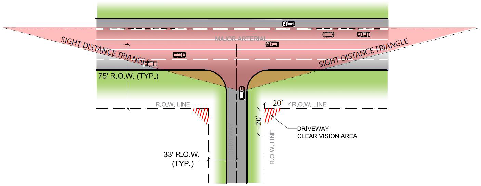
Sight distance. The length of roadway visible to the driver. Generally related to the distance or time (perception/reaction time) sufficient for the driver to execute a maneuver (turn from driveway or side street, stop or pass) without striking another vehicle or object in the roadway.
FIGURE 18-22 J. SIGHT DISTANCE
Solar array. Any number of photovoltaic devices connected together to provide a single output of electric energy or other energy.
Solar energy collector. A panel or panels and/or other devices or equipment, or any combination thereof, that collect, store, distribute and/or transform solar, radiant energy into electrical, thermal or chemical energy for the purpose of generating electric power or other form of generated energy for use in or associated with the principal land use on the parcel of the land on which the solar energy collector is located and, if permitted, for the sale and distribution of excess available electricity to an authorized public utility for distribution to other lands.
(1)
Building-mounted solar energy collector. A solar energy collector attached to the roof or wall of a building or which serves as the roof, wall, or window or other element, in whole or in part, of a building.
(2)
Ground-mounted solar energy collector. A solar energy collector that is not attached to and is separate from any building on the parcel of land on which the solar energy collector is located.
(3)
Commercial solar energy system. A utility-scale solar energy system where the primary use of the land is to generate electric energy or other energy by converting sunlight, whether by photovoltaic devices or other conversion technology, for the sale, delivery or consumption of the generated energy with a capacity greater than one megawatt (MW).
Special land use. A use of land which is permitted within a particular zoning district only if the applicable standards have been met. A special land use requires that a special land use permit be obtained by the planning commission.
Storage container. A steel enclosure without wheels that is greater than two hundred (200) square feet in area designed for shipment, storage and handling. The container is typically used for the storage of, but not limited to, merchandise, fixtures, building materials, lay-away, and used articles.
Story. That part of a building included between the surface of any floor and the surface of the next floor above it, or if there is no floor above, the open space between the floor and the ceiling next above it. (See figure 18-22 A, basement and story.)
Street. A public or private thoroughfare which affords the principal means of access to an abutting property.
Structure. Anything constructed, erected, or placed with a permanent location on the ground or affixed to something having a permanent location on the surface of the ground.
Substantial construction. Work of a substantial character done by way of preparing the site for actual use, which includes obtaining all necessary approvals and building permits, and actual physical placement of building materials in their permanent position. Clearing trees, ground, and other preparatory work does not constitute substantial construction.
Substantial improvement. Any repair, reconstruction, or improvement of a structure, the cost of which equals or exceeds fifty percent (50%) of the market value of the structure either before the improvement or repair is started, or, if the structure has been damaged or is being restored, before the damage occurred. For the purpose of this definition, such term does not include any project for improvement of a structure to comply with existing state or local health, sanitary or safety code specifications which are necessary solely for the reason of assuring safe living conditions, or any alteration of a structure listed on the National Register of Historic Places or a state inventory of historic places.
Temporary building or use. A use of a structure or premises permitted to exist for a specific and limited time during construction or reconstruction of another building or use or for special events.
Township board. The Charter Township of Berlin Board.
Trade contractor. A building or portions thereof where building and construction trade services are provided to the public. "Trade contractor" shall include, but will not be limited to: contractor offices, including landscaper's showrooms, construction supplies and storage, including: plumbing, heating, air conditioning, and building equipment and materials, and other uses similar in nature and impact.
Truck terminal. A structure to which goods, except raw or unprocessed agricultural products, natural minerals, or resources, are delivered for immediate distribution or to be amalgamated or divided for delivery in larger or smaller units to other points, or for distribution, amalgamation, or division involving transfer to other modes of transportation.
Undeveloped state. The natural state preserving natural resources, natural features, or scenic or wooded conditions; agricultural use; open space; or a similar use or condition. Land in an undeveloped state does not include a golf course but may include a recreational trail, picnic area, children's play area, greenway, or linear park. Land in an undeveloped state may be but is not required to be dedicated to the public.
Use. The lawful purpose for which land, premises, a structure, or a building thereon is designed, arranged, intended, or for which is occupied, maintained, let, or leased for a use or activity.
Variance. A relaxation of the terms of this chapter where such variance will not be contrary to the public interest and where, owing to conditions peculiar to the property and not the result of the action of the applicant, a literal enforcement of the ordinance would result in a practical difficulty. Variances are authorized by the zoning board of appeals under the provisions of this chapter and the Michigan Zoning Enabling Act.
Vehicle. Unless specifically stated otherwise, a motorized vehicle intended to be driven on roads or trails, such as cars, pickup trucks, vans, and motorcycles, and other vehicles defined as motor vehicles by the Michigan Vehicle Code.
Vehicle equipment/storage yards. Any operation or business activity in which the principal use of the storage of inoperative, wrecked, unlicensed, and/or repossessed vehicles, abandoned vehicles, and/or vehicles to be sold. Such operation or business shall not include salvage activities.
Vehicle filling/multi-use station. A building or premises used primarily for the dispensing, sale, or offering for sale of fuels directly to users of motor vehicles; together with the sale of minor accessories and services for motor vehicles such as filling tires with air, checking fluid levels, adding water to radiators, and similar activities; as well as selling convenience foods and other such items through a convenience store.
Vehicle repair facility, major. A facility which offers engine overhauling or rebuilding, valve and piston repair, transmission repair, axle and universal joint repair, body repair, painting, refinishing, and exterior detailing.
Vehicle repair facility, minor. A facility which offers oil change, engine tune-ups, electrical systems, suspension systems, brakes, exhaust systems, cooling systems, and heating and air conditioning systems repair, rust-proofing, tire replacement, wheel balancing and alignment and diagnostic services.
Vehicle wash. A building, or portion thereof, the primary purpose of which is that of washing vehicles either by automatic or self-service means or detailing of interior.
Warehouse. A building or structure used principally for the storage of goods and merchandise.
Wind energy conversion system (WECS). Any device such as a turbine, windmill, or charger that converts wind energy to a usable form of energy.
(1)
On-site wind energy conversion system. A WECS which is used only by the primary residence or residences in a cooperative effort, business or agricultural operation and not sold or transferred to the electrical grid for commercial profit.
(2)
Commercial wind energy conversion system. Any WECS that is designed and built to provide electricity to the electric utility's power grid as an on-going commercial enterprise or for commercial profit.
Wireless communications facilities. All structures and accessory facilities relating to the use of the radio frequency spectrum for the purpose of transmitting or receiving radio signals. This may include, but shall not be limited to, radio towers, television towers, telephone exchanges, microwave relay facilities, telephone transmission equipment buildings and commercial mobile radio service facilities. Not included within this definition are citizen band radio facilities; short wave receiving facilities; amateur (ham) radio facilities; satellite dishes; and, governmental facilities for which state or federal law or regulations preempt municipal regulatory authority. For purposes of this chapter, the following additional terms are defined:
(1)
Attached wireless communications facilities. Any wireless communication facility affixed to an existing structure, including, but not limited to a building, tower, water tank, utility pole, or other feature utilized to receive and transmit federally or state licensed communication services via duly licensed segments of the radio frequency spectrum. The definition shall not include support structures.
(2)
Colocation. The location by two (2) or more wireless communication providers of wireless communication facilities on a common structure, tower, or building, with the view toward reducing the overall number of structures required to support wireless communication antennas within the community.
(3)
Wireless communication support structures. Structures erected or modified to support wireless communication antennas. Support structures within this definition include, but shall not be limited to, monopoles, lattice towers, light poles, wood poles, and guyed towers, or other structures which appear to be something other than a mere support structure.
Yard. The open spaces on the same lot with a main building or main use, unoccupied and unobstructed from the ground upward, except as otherwise provided in this chapter, and as defined herein:
(1)
Yard, front. An open space extending the full width of the lot, the depth of which is the minimum horizontal distance between the front lot line and the nearest point of the foundation or building wall of the main building, whichever is closest. There shall be maintained a front yard on each street side of a corner lot or through lot.
(2)
Yard, rear. An open space extending the full width of the lot, the depth of which is the minimum horizontal distance between the rear lot line and the nearest point of the foundation or building wall of the main building, whichever is closest. In the case of a corner lot, there shall only be one (1) rear yard which shall be determined by the zoning official.
(3)
Yard, side. An open space between a main building and the side lot line, extending from the front yard to the rear yard, the width of which is the horizontal distance from the nearest point to the side lot line to the nearest point of the foundation or building wall of the main building, whichever is closest.
FIGURE 18-22 K. YARDS, CORNER LOT LAYOUT
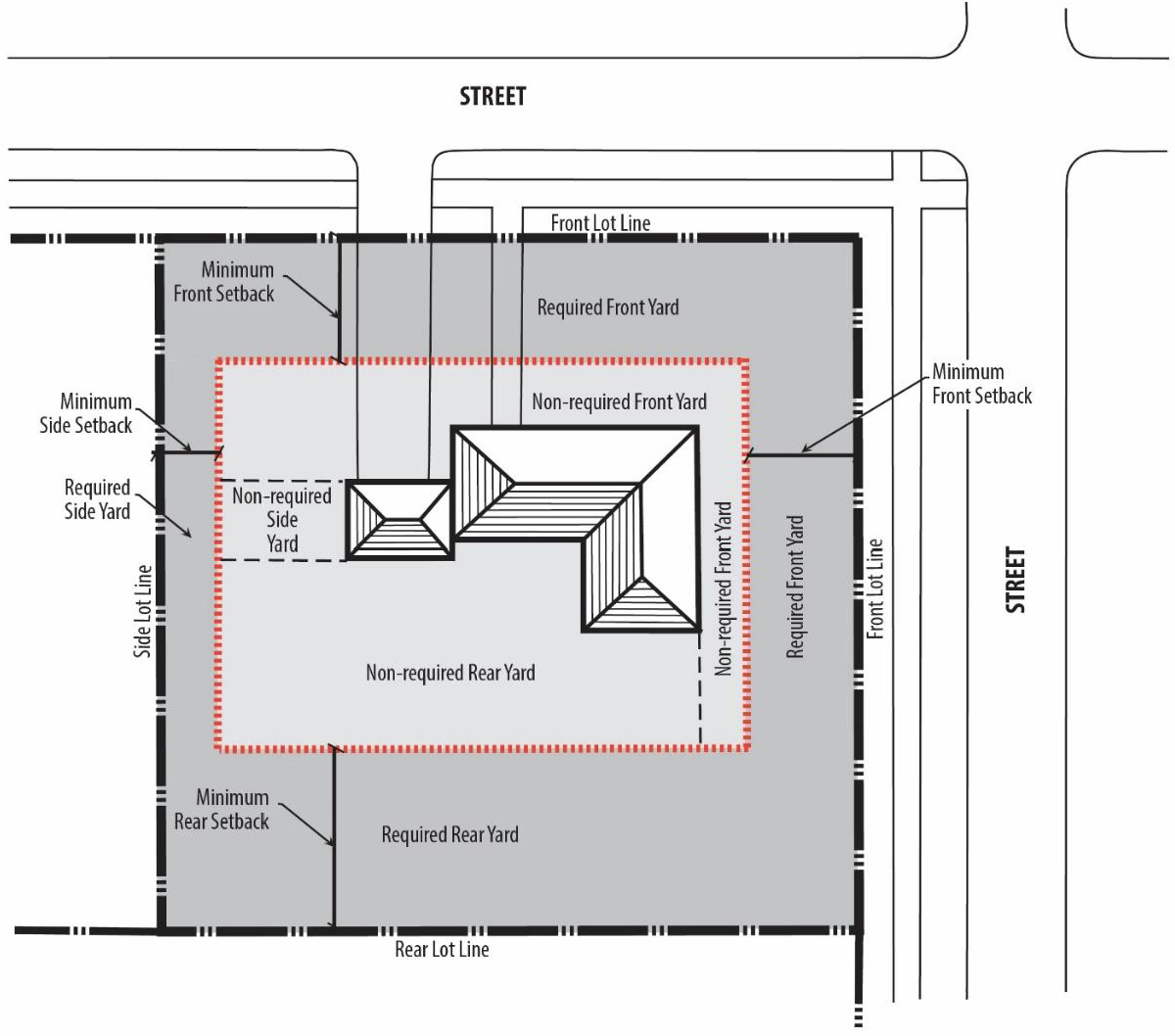
FIGURE 18-22 L. YARDS, INTERIOR LOT LAYOUT
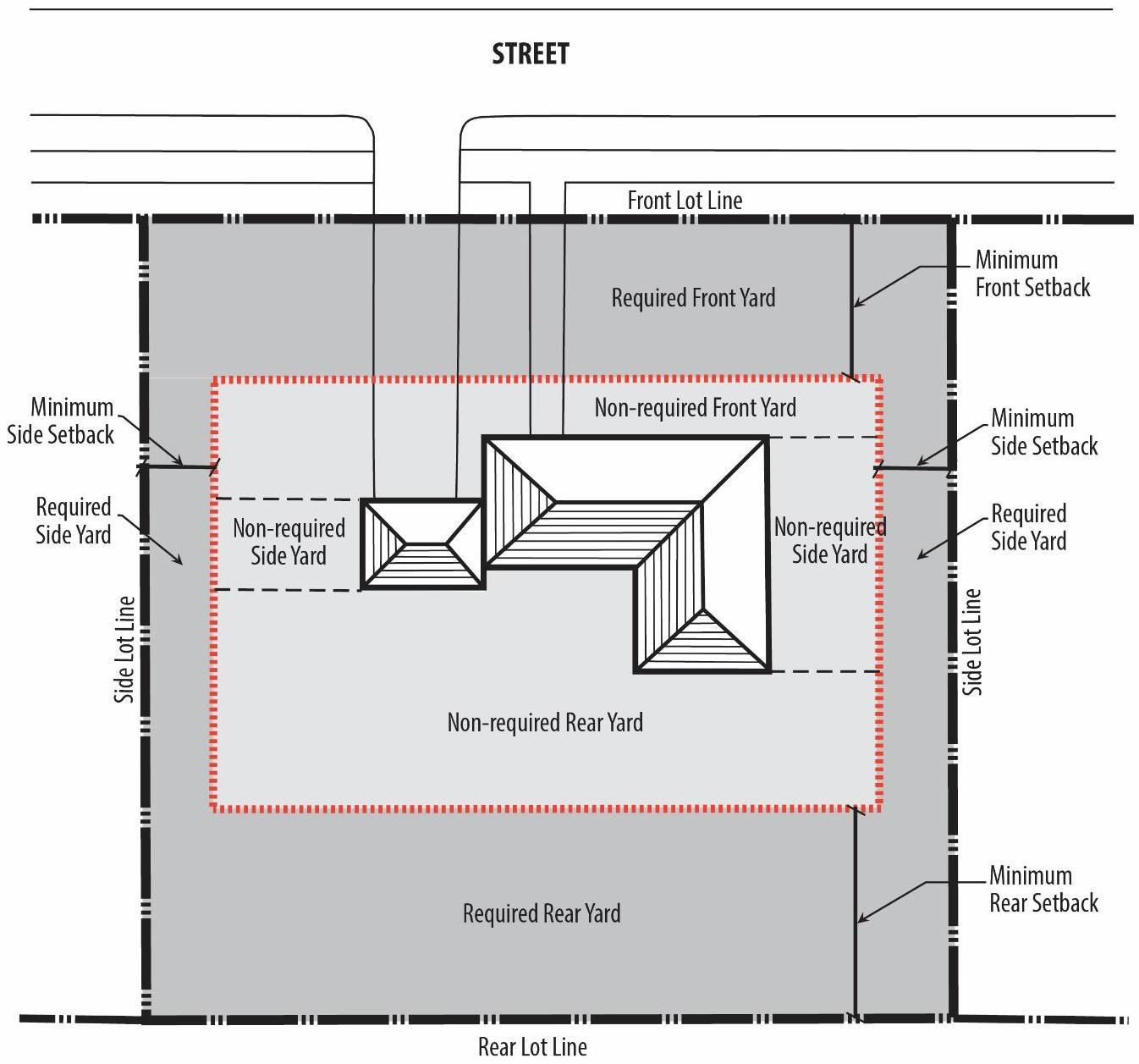
Zoning board of appeals. The Zoning Board of Appeals of Berlin Charter Township.
Zoning district. An area of land for which there are uniform regulations governing the use of buildings and premises, density of development, yard requirements, and height regulations.
Zoning Enabling Act. The Michigan Zoning Enabling Act, Act 110 of the Public Acts of Michigan of 2006, as amended.
(Ord. No. 01-20, § 18.22, 2-10-20)
Sec. 18-23. - Undefined terms.
Any term not defined herein shall have the meaning of common or standard use.
(Ord. No. 01-20, § 18.23, 2-10-20)

