Mountain Avenue Overlay District
1.
Intent: The Mountain Avenue Overlay Corridor focuses on protecting and enhancing the existing historical districts and directing the general character of new development along Mountain Avenue/Hwy 56. The overlay district defines and emphasizes unique character districts along the corridor and sets specific guidelines as to architecture, site planning, parking, urban design and streetscapes within this area. The underlying zoning remains, but specific design, architecture and setback requirements are governed by the overlay district.
2.
Applicability/Boundaries:
a.
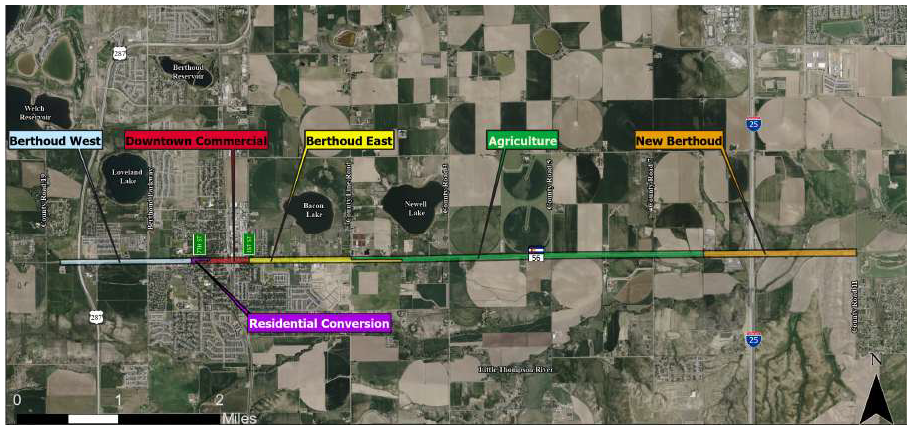
Boundary of Mountain Avenue Overlay District. The boundary of this Mountain Avenue Overlay district (herein referred to as the "Mountain Avenue Overlay District") shall be the area so labeled and depicted in the map below, and as approved in the official zoning map, which is incorporated herein by reference; which generally extends along HWY 56 and is applicable to all properties within 150 feet of the centerline of Hwy 56, Larimer County Road 8, and Weld County Road 44 within Town Limits.
b.
Applicability. All of the regulations and requirements of this Section shall fully apply when any of the following occur (the property must be brought into full compliance with this Article when any of the following occur):
1.
Construction of any new Structure.
2.
Parking area reconfiguration (repair and restriping of existing parking lot is exempt).
3.
Structural Alterations. Any structural alteration shall follow the Mountain Avenue Overlay District regulations as follows:
i.
Exterior Walls. When any change is made to the façade or an exterior wall of an existing structure, all of the façade visible from Mountain Avenue, shall be brought into full compliance with the Mountain Avenue Overlay District found herein.
ii.
Addition(s): Any addition must be in full compliance with the Mountain Avenue Overlay.
4.
Sign Permits. See Section 7 Signs.
5.
Change of Use. Any change of use will require compliance with applicable standards of the Mountain Avenue Overlay.
c.
Exemptions:
1.
General property maintenance and/or general property repair, such as roof repairs, interior remodels and repair, paint, and any other non-structural repair, or;
2.
The maintenance, repair, upgrading or replacement of any water, sewer, HVAC, or electrical facilities will not trigger a requirement that such property or structure be brought into compliance with the Mountain Avenue Overlay District.
3.
Existing single-family homes are exempt from the requirements of this overlay and shall follow the development standards of the underlying zoning district.
d.
Legal Non-conformities.
1.
Except as provided in this District to the contrary; all nonconforming uses, nonconforming structures and nonconforming lots, shall be governed by Section 30-3-107.
3.
Overlay Requirements—Character Districts. The 7.75-mile corridor passes through several distinct environments, each with a unique and definable character that separate them from other places along the corridor. These districts are often defined by architecture, land uses, scale, density, streetscapes, and landscaping. This Overlay protects and enhances the character of each district.
A.
Berthoud West Character District. This is a largely undeveloped district with views of the Rocky Mountains, and in close proximity to downtown and Highway 287. This area is envisioned as a vibrant walkable commercial district with opportunities for shopping, employment and other services. Though this district is in close proximity to the town core, it will build on the unique characteristics of downtown, but not replicate it.
1.
District Extent: This district extends approximately 800 feet west of Hwy 287 and east to 8th Street. The parcels that are located within this district are highlighted in the map below.
2.
Architecture:
Intent: As primarily a commuter route with limited business access, high vehicular speeds have been the norm, but are expected to be reduced with development to encourage pedestrians and cyclists. Building location and entry orientation will also play a key role in enhancing the patron's experience.
a.
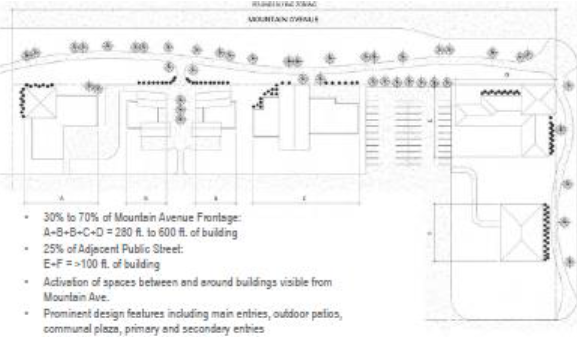
Building Facades. Buildings' facades along Mountain Avenue shall extend along a minimum of 35 percent but not more than 75 percent of the total property frontage and be built to the required setback line with minor variations for facade articulation.
Figure 3.8: Building Frontage Requirements
b.
Overall Building Location and Placement of Key Features.
i.
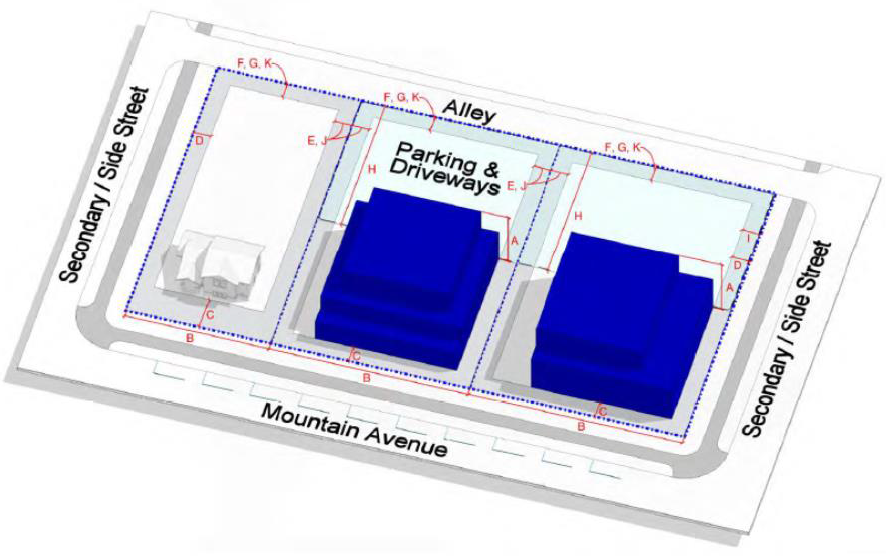
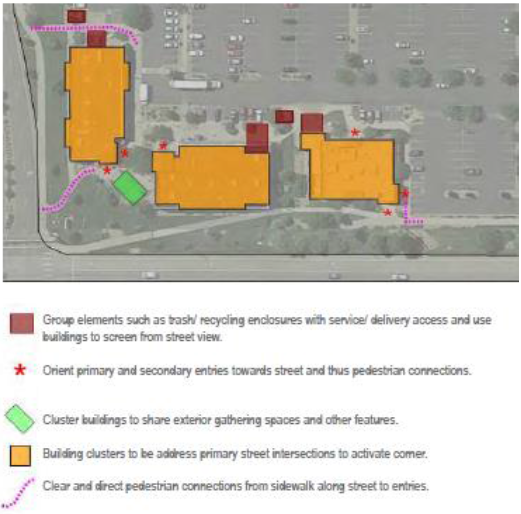
Configuration: Configuration and placement of buildings shall give intentional shape and layout to adjacent exterior gathering spaces and pedestrian/bicycle connections, while being site-specific in response to landscape and hardscape features. "Cookie-cutter" flat-facade buildings that lack articulation and site-specific features will not be allowed. Building placement should follow the principles in Figure 3.9 below.
ii.
Site Planning: Modern site planning principles include efforts to combine the infrastructure required to develop from building to building or lot to lot. Sharing infrastructure such as detention, parking, internal pedestrian spaces are strongly encouraged.
iii.
Staggered Setbacks and Heights: A variation in building placement by staggering setbacks as well a variation in building heights is required for any multi-tenant site plan or Master Plan.
iv.
Limited Access: Limited access directly from Mountain Avenue allows for long stretches of uninterrupted streetscapes, improves traffic flow on Mountain Ave, and increases the need for automobile access to developments from cross-streets and back streets.
Figure 3.9: Building Placement Example
c.
Exterior Activation.
i.
Requirement for Exterior Activation: Each building/site plan must possess at least one of the following locating the features so they are readily-visible to and from Mountain Avenue to ensure a strong visual connection: outdoor patios, primary and secondary entries, canopies and other features help "activate" a development.
ii.
Screening: Three-dimensional building elements to act as screening for service type accessories including roof- and ground-mounted HVAC equipment, electrical/gas meters, loading docks/service entries, etc. These service equipment components shall not be visible from the public R.O.W. or from adjacent properties/uses.
d.
Massing and Articulation.
i.
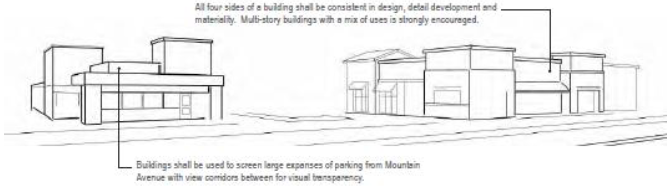
Compatibility and Configuration: A building's three-dimensional configuration plays a significant role in determining the impact it will have on the surrounding environment. The proposed building shall be designed to be compatible with other structures in the surrounding vicinity in size, scale and character. Building mass shall be well-proportioned and organized to define various horizontal and vertical elements while clearly expressing the internal function of the building. See Figure 3.10.
ii.
Multiple Buildings: Multiple buildings in a common commercial development shall be consistent in architectural form/detailing, materials, roof styles and colors to achieve a harmonious design vocabulary and continuity within itself.
iii.
Multi-tenant buildings/Buildings over 60 Feet Long: Large retail buildings shall be broken down into a series of complementary forms with a clearly defined pattern. Blend larger flat roof areas with smaller pitched roof elements that denote key functions such as entries or primary window groupings. Horizontal step backs of the facade shall be significant in relation to the overall length and scale of the building. For instance, a 60 feet long building should have two to three primary massing elements with at least four feet to six feet of grade plane changes (i.e. eight to ten percent of the overall length). Screening elements for items such as ground-mounted or roof-mounted mechanical equipment shall be integrated into the building design and not appear as an after-thought. Creating large expanses of windows with a branded display wall in close proximity to the glass so that it is readily visible from the exterior is not permitted.
Figure 3.10: Four-Sided Architecture Example
e.
Materials and Colors.
i.
Exterior Materials: facade materials shall be high-quality, durable products such as brick, stone or decorative precast concrete. The primary building skin shall be a high-quality, aesthetically pleasing, durable material such as brick, natural stone, manufactured stone, especially at the base of the building that is susceptible to damage by maintenance equipment such as plows, shovels, mowers, etc.
ii.
Primary Material: The primary material shall constitute at least 65 percent of the total wall area for the front and side facades visible from Mountain Avenue and at least 50 percent for the rear facade; excluding the glazing area of the façade.
iii.
Glazing: Exterior glazing shall be high-performance clear glass (not tinted or reflective) with a low-E coating and visible light transmittance (Tvis) of 60 percent or higher. Use of opaque/spandrel glass to simulate ground-level vision windows is discouraged. Creating large expanses of windows with a branded display wall in close proximity to the glass so that it is readily visible from the exterior is not permitted.
iv.
Secondary facade materials: may include cement-based stucco, hardboard siding or decorative metal panels with concealed fasteners and low-gloss finish.
v.
Screening elements: such as site walls for parking lots and trash enclosures shall be of the same high-quality durable material as the primary building skin.
vi.
Primary Façade Colors: Primary building facade colors shall be non-reflective, muted neutral or earth tones with only small "pops" of bright, higher intensity colors. High-gloss, metallic finishes or fluorescent colors are not allowed. Trademark colors specific to a corporate brand shall only be permitted on building signage subject to the sign code.
3.
Parking:
a.
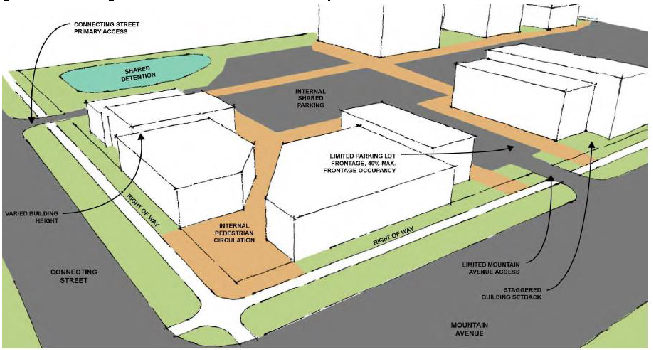
Parking: On-street diagonal parking is proposed on Gateway Park Blvd within the proposed village center. To reduce its visual presence on Mountain Avenue, required parking shall be located behind and between buildings. Required parking areas shall not occupy more than 40 percent of the Mountain Avenue frontage and must not be forward of any building or structure. In addition, such parking areas shall be screened by a landscape hedge, wrought iron fence, or wall as detailed in Table 3.4.
b.
Drive Thru Areas: Restaurant and bank drive-thrus shall be oriented away from Mountain Avenue and shall only be accessed by a rear access drive, with no visible drive thru areas fronting Mountain Avenue, as described in Table 3.4.
c.
Shared Parking: New off-street parking lots should be shared to reduce the overall footprint of paved parking areas and be tucked behind and between buildings to minimize their visual presence.
Figure 3.12: Parking and Pedestrian Circulation Examples
4.
Signage:
a.
Ground mounted freestanding signs with horizontal massing are preferred.
b.
Internally illuminated signs are permitted but the entire sign panel may not be illuminated. Text and logos may be illuminated, but the sign panel and cabinet shall be opaque.
c.
See Table 3.9 for specific signage requirements.
Table 3.4 Berthoud West Character District Dimensional Standards
Notes:
1.
The ground floor front façade may be recessed/setback to accommodate outdoor dining and or display areas, and such areas shall have a zero-foot setback.
2.
A six-foot minimum unobstructed clear zone shall be provided within the ROW around outdoor dining areas for pedestrian circulation.
3.
Balconies, bay windows, and other building projections extending in and to the public ROW shall provide a ten-foot minimum vertical clearance above the sidewalk elevation or finished grade.
4.
Off street parking areas and driveways fronting Mtn Avenue/Hwy 56 and/or secondary side streets shall be screened from view from the Public ROW. Screening shall be three feet min. in height and shall be accomplished with berms, low walls, plantings, etc. Wall materials shall match materials used on the associated building. Wood fences are not allowed.
5.
Small tower elements and roof forms/parapet walls associated with primary building areas may exceed the maximum building height by 15 percent.
6.
Permanent features such as steps, ramps, landings, and uncovered porches shall not extend more than 40 percent into the required setback.
7.
Front setbacks abutting Mountain Avenue/HWY 56 shall be measured from the edge of the ROW.
8.
Zero-foot setbacks are allowed for buildings fronting Gateway Park Blvd located at the proposed village center.
9.
Drive thru windows shall not be oriented towards Mountain Avenue and shall be located only at the rear of the building, and not fronting Mountain Avenue/HWY 56.
B.
Residential Conversion District. This district is characterized by charming older homes occupied by businesses and commercial uses. Majestic street trees create a seemingly continuous canopy over Mountain Avenue, and expanded green spaces surrounding the homes and detached walks with tree lawns create a walkable neighborhood.
1.
District Extents: The Residential Conversion character district extends along Mountain Avenue between 8 th Street and 5 th Street in the downtown area. The parcels that are located within this district are highlighted in the map below.
2.
Preservation of Historic Homes and Context:
i.
Additions should be located to the side and/or rear of the house and should be consistent with the scale of the original home. Side additions should be setback from the front face enough to allow the profile of the original structure to be clear and obvious.
ii.
When converting a single-family house to a new use, original location and character of the front porch/ stoop shall be maintained.
iii.
Providing handicapped accessibility to existing historic homes that typically have elevated stoops and porches must maintain the integrity of the original historic structure.
3.
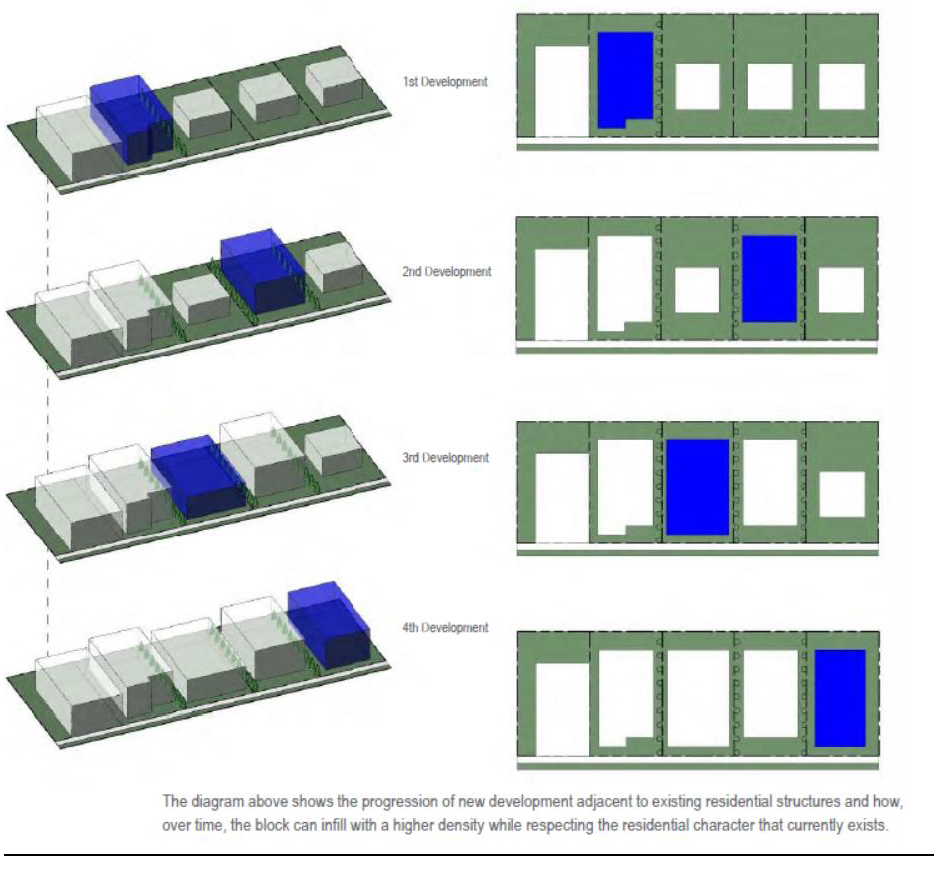
Building Setbacks: Building setbacks within the Residential Conversion District will need to maintain a portion of the typically large front lawn space of original historic homes, while allowing for the transition to smaller front and side yard lot line necessary for newer developments. Building Setbacks must follow Figure 3.13 below.
Figure 3.13: Special Residential Conversion District Infill Setback Examples
4.
Architectural Guidelines For New Construction:
i.
General proportions should be consistent with adjacent structures, including similar floor-to-floor heights and solid-to-void ratios.
ii.
Divide larger structures into smaller components that more closely mimic the traditional single-family home dimensions. These series of smaller components should not be more than 25 feet to 30 feet wide and be expressed in wall panel changes of at least eight feet; as well as material changes.
iii.
Although plate-lines/roofs on new construction will be taller, they should be consistent in form and character. This can be accomplished by blending predominately flat roof areas over larger expanses with sloped roof elements at key accent locations such as entries and highly-visible corners.
iv.
Step down stories and rooflines from back to front and from side to side.
v.
The diversity of architectural styles that currently exists shall be retained to the greatest extent possible.
vi.
New buildings shall be oriented parallel to their lot lines with the primary entry integrated into a porch or portico design element facing Mountain Avenue.
5.
Parking:
a.
Parking: Required parking shall be located behind and between buildings. Only 40 percent of required on-site parking may be allowed along Mountain Avenue frontage and shall not be forward of any building or structure. In addition, such parking areas shall be screened by a landscape hedge, wrought iron fence, or wall as detailed in Table 3.5.
b.
Drive Thru Areas: Restaurant and bank drive-thrus are not permitted.
c.
Shared Parking: New off-street parking lots should be shared to reduce the overall footprint of paved parking areas and be tucked behind and between buildings to minimize their visual presence.
6.
Signage: The type, scale and style of signage should be designed to complement the residential character of this district.
a.
Internally Lit Signs Prohibited: The use of internally illuminated signs should be restricted. If signs are illuminated, external down-lighting should be provided.
b.
Building mounted, and freestanding ground mounted signs are preferred.
c.
See Table 3.9 for additional signage requirements.
Table 3.5 Residential Conversion Character District Dimensional Standards
Notes:
1.
The ground floor front façade may be recessed/setback to accommodate outdoor dining and or display areas, and such areas shall have a zerp-foot setback.
2.
A six-foot minimum unobstructed clear zone shall be provided within the ROW around outdoor dining areas for pedestrian circulation.
3.
Balconies, bay windows, and other building projections extending in and to the public ROW shall provide a ten-foot minimum vertical clearance above the sidewalk elevation or finished grade.
4.
Off street parking areas and driveways fronting Mtn Avenue/Hwy 56 and/or secondary side streets shall be screened from view from the Public ROW. Screening shall be three feet min. in height and shall be accomplished with berms, low walls, plantings, etc. Wall materials shall match materials used on the associated building. Wood fences are not allowed.
5.
Small tower elements and roof forms/parapet walls associated with primary building areas may exceed the maximum building height by 15 percent.
6.
Permanent features such as steps, ramps, landings, and uncovered porches shall not extend more than 40 percent into the required setback.
7.
Front setbacks abutting Mountain Avenue/HWY 56 shall be measured from the edge of the ROW.
8.
Zero-foot setbacks are allowed for buildings fronting Gateway Park Blvd located at the proposed village center.
9.
Drive thru windows shall not be oriented towards Mountain Avenue and shall be located only at the rear of the building, and not fronting Mountain Avenue/HWY 56.
C.
Downtown Commercial Character District. Berthoud's Downtown District represents a concentration of character and personality, and shapes much of the Town's identity. Its buildings give a sense of history, its businesses and restaurants show the liveliness of the town, and its quirks set it apart from other towns in Northern Colorado.
1.
District Extent: The Downtown Commercial character district extends along Mountain Avenue between 5th Street and 1st Street in the downtown area.
2.
Architectural Guidelines:
a.
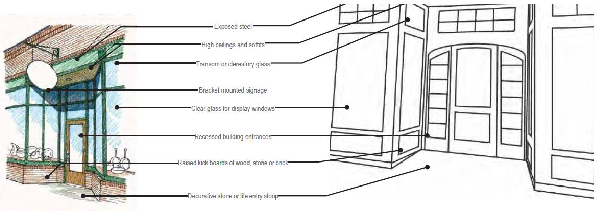
Ground level storefronts: Ground level retail storefronts are indicative of the mercantile economy of historic downtowns of the late 19th and early 20th centuries. They often feature formal, symmetrical facades, large expanses of display windows flush with the building front walls, recessed entrances and decorative glass transoms. Such storefronts should possess the following characteristics as depicted in Figure 3.16 and as described below:
i.
Retail storefronts create an intimate, pedestrian scale along the street, encouraging residents to slow down, interact and window shop.
ii.
Primarily glazed, ground level storefronts create a distinction between the public retail facade and the more private areas of the upper levels, often expressed by individual punched window openings.
iii.
The higher ceilings of historic, ground level retail storefronts have a character not often found in more modern construction.
Figure 3.15: Ground Level Storefront Example
b.
Infill development/Design: Communities are encouraging infill development of vacant downtown properties and redevelopment of inappropriate or underutilized buildings to revitalize their historic downtowns. Designed properly, new construction can blend seamlessly with original, historic buildings to create a vibrant downtown environment.
i.
Maintain natural materials and colors that often utilize local materials and represent the workmanship of local craftsmen. Modern metal siding and other industrial materials are inappropriate as primary facade materials in the historic downtown area.
ii.
New infill development shall not mimic the exact historic designs and details of existing structures but pick up on the rhythm and spacing of elements to be compatible with and complementary to them.
iii.
Orient building parallel to street and align front facade with established sidewalk edge.
iv.
If a portion of the building must be set back, use traditional urban site features to maintain defined sidewalk edge noted above
v.
Create a clearly defined front entry recessed at least three feet so out-swinging doors do not project into the perpendicular circulation path
vi.
Predominate massing at the front property line should be one- or two-stories with setbacks for additional stories
vii.
Floor-to-floor heights shall appear to be consistent with heights traditionally seen in older adjacent buildings
viii.
Building Materials: Utilize similar high-quality, durable materials such as brick or stone with only accents of more modern materials
c.
Building Awnings: Awnings have been used for centuries to shade the facades and display windows of buildings and provide residents with protection from the elements. Awnings also provide a unifying design element to enhance the downtown streetscape and provide opportunities for colorful accents and signage.
i.
Awnings Encouraged: Awnings are encouraged on all development.
ii.
Awnings should be consistent with primary building, and color should accent the primary building. On-Street Parking:
3.
Parking and Access:
a.
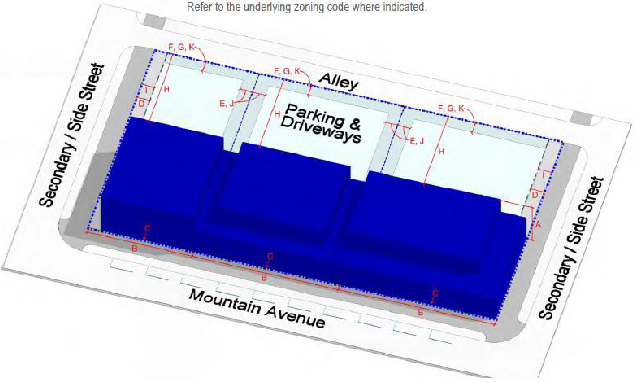
On-site parking areas shall be located at the rear of any building as depicted on Figure 3.15.
b.
Curb Cuts: No new curb cuts from Mountain Avenue shall be allowed.
c.
Drive Thru Areas: Restaurant and bank drive-thrus are not permitted.
d.
Shared Parking: New off-street parking lots should be shared to reduce the overall footprint of paved parking areas and be tucked behind and between buildings to minimize their visual presence.
Figure 3.16: Parking and Access Examples
4.
Signage:
a.
In general, building mounted signs are recommended in this district. This includes wall mounted signs, window signs, and awning signs. The type, scale and style of the signage should be designed to complement the character of this district and the building that the sign is associated with.
b.
Internally Lit Signs Prohibited. The use of internally illuminated signs and awning should be restricted. If signs are illuminated, external down-lighting should be provided.
c.
Sandwich Board Signs: Please see Section 30-7-109.H.4. Plastic signs are not allowed. A yearly sign permit is required and must be renewed on an annual basis.
d.
Free-standing signs are prohibited in this district.
e.
See Table 3.9 for additional signage requirements.
Table 3.6 Downtown Commercial Character District Dimensional Standards
Notes:
1.
The ground floor front façade may be recessed/setback to accommodate outdoor dining and or display areas, and such areas shall have a zero-foot setback.
2.
A six-foot minimum unobstructed clear zone shall be provided within the ROW around outdoor dining areas for pedestrian circulation.
3.
Balconies, bay windows, and other building projections extending in and to the public ROW shall provide a ten-foot minimum vertical clearance above the sidewalk elevation or finished grade.
4.
Off street parking areas and driveways fronting Mtn Avenue/Hwy 56 and/or secondary side streets shall be screened from view from the Public ROW. Screening shall be three feet min. in height and shall be accomplished with berms, low walls, plantings, etc. Wall materials shall match materials used on the associated building. Wood fences are not allowed.
5.
Small tower elements and roof forms/parapet walls associated with primary building areas may exceed the maximum building height by 15 percent.
6.
Permanent features such as steps, ramps, landings, and uncovered porches shall not extend more than 40 percent into the required setback.
7.
Front setbacks abutting Mountain Avenue/HWY 56 shall be measured from the edge of the ROW.
8.
Zero-foot setbacks are allowed for buildings fronting Gateway Park Blvd located at the proposed village center.
9.
Drive thru windows shall not be oriented towards Mountain Avenue and shall be located only at the rear of the building, and not fronting Mountain Avenue/HWY 56.
D.
Berthoud East Character District. A transition district from the rural agrarian areas to the downtown core. The undeveloped land on the south side of Hwy 56 is envisioned as a vibrant walkable residential district with a mixed-use area near the intersection of County Line Road 1 providing opportunities for shopping, dining, employment and other services. Appropriate land use, scale and density transitions from existing residential neighborhoods are critical.
1.
District Extents: The parcels that are located within this district are highlighted in the map below.
North side of Hwy 56 — 1 st Street to County Line Road 1.
South side of Hwy 56 — 1 st Street to one-half mile east of County Line Road 1.
2.
Architectural Guidelines for Berthoud East District: Similar to the Berthoud West District, the "East District" focuses on building massing and articulation, and to carefully balance economic interests with the public good by ensuring strong pedestrian and bicycle connectivity with the downtown and residential districts to the west.
a.
Scale and Density Focus.
i.
Multi-story, mixed use buildings will be encouraged in the denser mixed-use areas immediately adjacent to Mountain Avenue and then taper off in height, size and intensity of use as development extends further away from the overlay district.
ii.
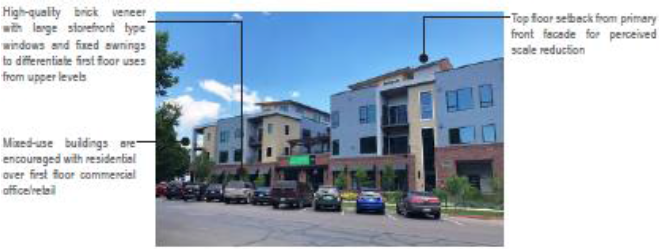
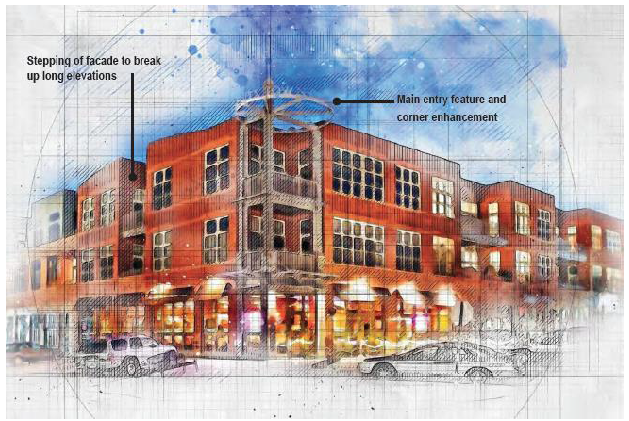
Long facades shall be broken down into smaller architectural expression through stepping. Stepping can be accomplished in both building elevation and in plan. Third story step-backs provide a gradual scale transition between building heights and opportunities for rooftop patio space.
Figure 3.17: Stepping Examples
b.
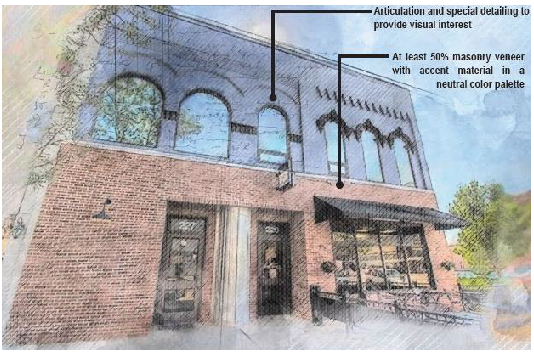
Building Materiality. Buildings are meant to convey a sense of permanence and vitality with the use of appropriate materials reinforcing this goal. Materials should be predominantly brick, stone and architectural concrete with accents of wood, stucco or metal wall panels. Variation in materiality is encouraged but should be limited to a maximum of four materiality changes over the total building facade.
i.
Recommended percentage of material variation is as follows:
50 percent to 60 percent — Masonry veneer (brick or stone), architectural concrete
ii.
Up to three accent materials required:
15 percent to 20 percent — Accent material 'A' (wood, stucco or metal wall panel)
15 percent to 20 percent — Accent material 'B' (wood, stucco or metal wall panel)
15 percent to 20 percent — Accent material 'C' (wood, stucco or metal wall panel)
iii.
Articulation and special detailing that provides visual interest and breaks up large expanses of a single building material is supported.
iv.
Color: Color palettes should be primarily of neutral tones with pops of accent color. Accent color and location are to be reviewed and approved with the Site Plan approval process.
Figure 3.18: Materiality Examples
c.
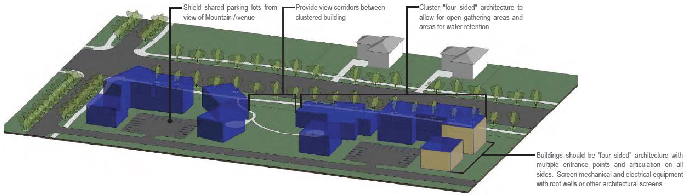
Balancing Developed Spaces: Shaping multiple buildings into dense clusters of development, formed around pedestrian and bicycle pathways while leaving reasonable expanses of open areas, will provide view corridors from Mountain Avenue and allow space for water retention.
i.
Buildings shall define a strong street edge with upper floor step back and architectural embellishments at corners and main entry features.
ii.
Buildings shall be oriented on front edge of setback to Mountain Avenue to allow parking in the rear. This provides for a more aesthetic streetscape by screening parking from Mountain Avenue.
iii.
Provide "four-sided" architecture with multiple entrance points or articulation and mechanical and electrical equipment screening. All mechanical equipment is to be screened from views from across the street and/or middle of intersections or adjacent properties, whichever is further.
Figure 3.19: Four Sided Architecture
d.
Materials and Colors.
i.
Exterior facade materials shall be high-quality, durable products such as brick, stone or decorative precast concrete.
ii.
The primary building facade shall be of high-quality durable materials such as brick/stone veneer or decorative precast concrete, especially at the base of the building that is susceptible to damage by maintenance equipment such as plows, shovels, mowers, etc.
iii.
The primary material shall constitute at least 70 percent of the total wall area for the front and side facades visible from Mountain Avenue and at least 50 percent for the rear facade; excluding glass.
iv.
Exterior glazing shall be high-performance clear glass (not tinted or reflective) with a low-E coating and visible light transmittance (Tvis) of 60 percent or higher. Use of opaque/spandrel glass to simulate ground-level vision windows is discouraged. Creating large expanses of windows with a branded display wall in close proximity to the glass so that it is readily visible from the exterior is not permitted.
v.
Secondary facade materials can include cement-based stucco, hardboard siding or decorative metal panels with concealed fasteners.
vi.
Screening elements such as site walls for parking lots and trash enclosures shall be of the same high-quality durable material as the primary building skin.
vii.
Primary building facade colors shall be non-reflective, muted neutral or earth tones with only small "pops" of bright, higher intensity colors. Metallic or fluorescent colors are not allowed. Trademark colors specific to a corporate brand shall only be permitted on building signage subject to the sign code.
3.
Parking:
a.
Parking: Required parking shall be located behind and between buildings. Only 40 percent of required on-site parking may be allowed along Mountain Avenue frontage and shall not be forward of any building or structure. In addition, such parking areas shall be screened by a landscape hedge, wrought iron fence, or wall as detailed in Table 3.5.
b.
Drive Thru Areas: Restaurant and bank drive-thrus are not permitted.
c.
Shared Parking: New off-street parking lots should be shared to reduce the overall footprint of paved parking areas and be tucked behind and between buildings to minimize their visual presence.
4.
Signage:
a.
Building mounted signs and ground mounted freestanding signs with horizontal massing are preferred.
b.
Internally illuminated signs are permitted but the entire sign panel may not be illuminated.
c.
Text and logos may be illuminated, but the sign panel and cabinet shall be opaque.
d.
See Table 3.9 for additional signage requirements.
E.
Agricultural Character District. Farms, big skies, distant views, and scattered farmsteads provide a pleasant separation between Interstate 25 and the Town which adds to Berthoud's small-town appeal. The primary goal of this district is to retain the rural and agrarian character and to protect the iconic views to the Rocky Mountains.
1.
District Extents: The Agriculture Character District extents vary on the north and south frontages.
•
North side of Hwy 56 — County Line Road 1 to one-half mile west of I-25
•
South side of Hwy 56 — One-half mile east of County Line Road 1 to one-half mile west of I-25.
2.
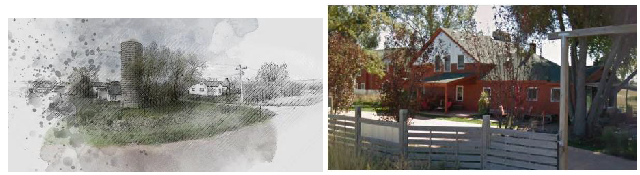
Agricultural Character District Architectural Guidelines: The architectural style of this area is of an agricultural or farmstead nature. It is recommended that all new development compliment this agricultural/farmstead nature.
a.
Building materials should be of residential grade and include cement-based stucco, hardboard siding, brick, stone, or decorative metal panels with concealed fasteners.
b.
Roof lines should be of gable end, hip, and valley styles, with dormers, and shed roofs. Clay and concrete tiles are not encouraged.
c.
Primary Building Façade Colors shall be non-reflective, muted neutral or earth tones, with limited accent colors. Metallic or fluorescent colors are prohibited.
Figure 3.20: Examples of Agricultural Style Development
3.
Signage:
a.
Building mounted signs and ground mounted freestanding signs with horizontal massing are preferred.
b.
Internally illuminated signs are permitted but the entire sign panel may not be illuminated. Text and logos may be illuminated, but the sign panel and cabinet shall be opaque.
c.
Please see Table 3.9 for additional signage requirements.
Figure 3.21: Agricultural Character Setback Graphic
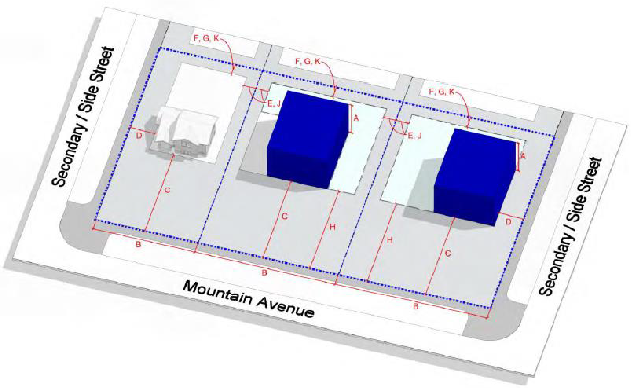
Table. 3.7 Agricultural Character District Dimensional Standards
Notes:
1.
The ground floor front façade may be recessed/setback to accommodate outdoor dining and or display areas, and such areas shall have a zero-foot setback.
2.
A six-foot minimum unobstructed clear zone shall be provided within the ROW around outdoor dining areas for pedestrian circulation.
3.
Balconies, bay windows, and other building projections extending in and to the public ROW shall provide a ten-foot minimum vertical clearance above the sidewalk elevation or finished grade.
4.
Off street parking areas and driveways fronting Mtn Avenue/Hwy 56 and/or secondary side streets shall be screened from view from the Public ROW. Screening shall be three feet min. in height and shall be accomplished with berms, low walls, plantings, etc. Wall materials shall match materials used on the associated building. Wood fences are not allowed.
5.
Small tower elements and roof forms/parapet walls associated with primary building areas may exceed the maximum building height by 15 percent.
6.
Permanent features such as steps, ramps, landings, and uncovered porches shall not extend more than 40 percent into the required setback.
7.
Front setbacks abutting Mountain Avenue/HWY 56 shall be measured from the edge of the ROW.
8.
Zero-foot setbacks are allowed for buildings fronting Gateway Park Blvd located at the proposed village center.
9.
Drive thru windows shall not be oriented towards Mountain Avenue, and shall be located only at the rear of the building, and not fronting Mountain Avenue/HWY 56.
F.
New Berthoud Character District. New Berthoud straddles the I-25/Hwy 56 interchange and is the gateway into Town. The lasting impression should relate to "Berthoud Proper" and offer a fresh new twist.
1.
District Extent: The New Berthoud Character District extends one-half mile west of I-25 to County Road 11. Parcels located within this district are highlighted in the map below.
2.
Architectural Guidelines for New Berthoud District: Expansive master planned developments are anticipated in the New Berthoud District with large scale retail/lifestyle uses near the I-25/Mountain Avenue interchange, then transitioning to mixed-use and residential developments further away.
a.
Massing and Form.
i.
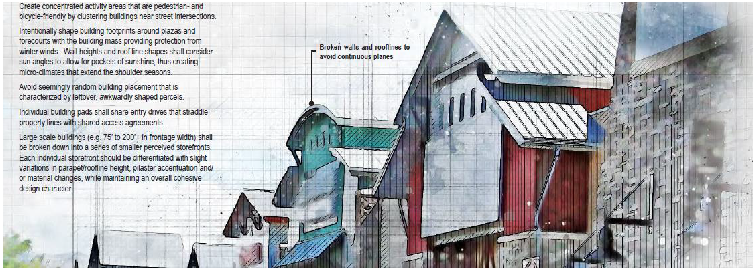
The configuration and massing of these large buildings should give the appearance of individual buildings in the manner of traditional town centers.
ii.
Wall and rooflines should be broken to avoid continuous planes, giving the appearance of individual buildings being built over an extended period of time but with a consistent architectural vocabulary.
iii.
Pedestrian approaches should be well-defined with large overhangs or dynamic canopy elements provided for weather protection.
iv.
Buildings should be clustered near street intersections to create concentrated activity areas that are pedestrian- and bicycle-friendly.
v.
Building footprints around plazas and forecourts with the building mass providing protection from winter winds. Wall heights and roofline shapes shall consider sun angles to allow for pockets of sunshine, thus creating micro-climates that extend the shoulder seasons.
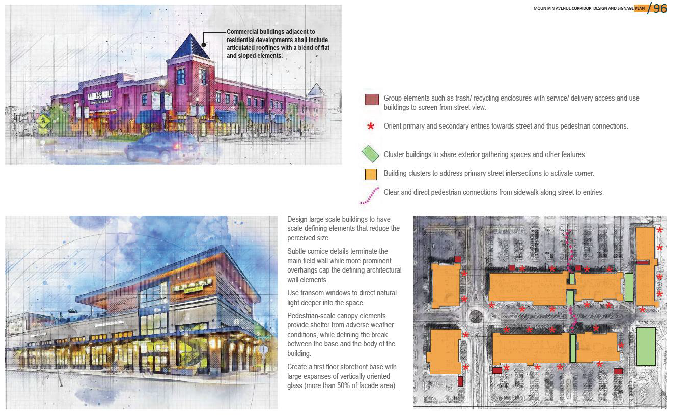
Figure 3.22: Massing New Berthoud Character District
b.
Massing and Form for Buildings over 75 feet in length.
i.
Individual building pads shall share entry drives that straddle property lines with shared access agreements.
ii.
Large scale buildings (e.g. 75 feet to 200 feet or more in frontage width) shall be broken down into a series of smaller perceived storefronts. Each individual storefront should be differentiated with slight variations in parapet/roofline height, pilaster accentuation and/or material changes, while maintaining an overall cohesive design character.
iii.
Large scale buildings (e.g. 75 feet to 200 feet or more in frontage width) shall be designed to have scale-defining elements that reduce the perceived size.
iv.
Provide cornice details that terminate in the main field wall while more prominent overhangs cap the defining architectural wall elements.
v.
Provide transom windows to direct natural light deeper into space.
vi.
Pedestrian-scale canopy elements are encouraged to provide shelter from adverse weather conditions, while defining the break between the base and the body of the building.
vii.
First floor storefront base with large expanses of vertically oriented glass (more than 50 percent of facade area) are encouraged for commercial development.
Figure 3.23: Massing for Buildings 75' in width or larger
3.
Parking:
a.
Parking: On-street diagonal parking is proposed on Gateway Park Blvd within the proposed village center. To reduce its visual presence on Mountain Avenue, required parking shall be located behind and between buildings. Required parking areas shall not occupy more than 40 percent of the Mountain Avenue frontage and must not be forward of any building or structure. In addition, such parking areas shall be screened by a landscape hedge, wrought iron fence, or wall as detailed in Table 3.4.
b.
Drive Thru Areas: Restaurant and bank drive-thrus shall be oriented away from Mountain Avenue and shall only be accessed by a rear access drive, with no visible drive thru areas fronting Mountain Avenue, as described in Table 3.4.
c.
Shared Parking: New off-street parking lots should be shared to reduce the overall footprint of paved parking areas and be tucked behind and between buildings to minimize their visual presence.
4.
Signage:
a.
Building mounted signs and ground mounted freestanding signs with horizontal massing are preferred.
b.
Internally illuminated signs are permitted but the entire sign panel may not be illuminated.
c.
Text and logos may be illuminated, but the sign panel and cabinet shall be opaque.
d.
See Table 3.9 for additional signage requirements.
Table 6.8 New Berthoud Character District Dimensional Standards
Notes:
1.
The ground floor front façade may be recessed/setback to accommodate outdoor dining and or display areas, and such areas shall have a zero-foot setback.
2.
A six-foot minimum unobstructed clear zone shall be provided within the ROW around outdoor dining areas for pedestrian circulation.
3.
Balconies, bay windows, and other building projections extending in and to the public ROW shall provide a ten-foot minimum vertical clearance above the sidewalk elevation or finished grade.
4.
Off street parking areas and driveways fronting Mtn Avenue/Hwy 56 and/or secondary side streets shall be screened from view from the Public ROW. Screening shall be three feet min. in height and shall be accomplished with berms, low walls, plantings, etc. Wall materials shall match materials used on the associated building. Wood fences are not allowed.
5.
Small tower elements and roof forms/parapet walls associated with primary building areas may exceed the maximum building height by 15 percent.
6.
Permanent features such as steps, ramps, landings, and uncovered porches shall not extend more than 40 percent into the required setback.
7.
Front setbacks abutting Mountain Avenue/HWY 56 shall be measured from the edge of the ROW.
8.
Zero-foot setbacks are allowed for buildings fronting Gateway Park Blvd located at the proposed village center.
9.
Drive thru windows shall not be oriented towards Mountain Avenue and shall be located only at the rear of the building, and not fronting Mountain Avenue/HWY 56.
4.
Signage.
a.
All Signage must satisfy the requirements in Table 3.9 below.
Table 3.9 Signage Requirements By Character District
Notes:
1.
Corporate colors and other colors used behind or around a sign to differentiate it from the building façade shall be included in the sign area.
2.
The following signs, banners, flags, and special event signage, defined and found in the Exempt Signage of Section 30-107-3, shall be allowed in the Mountain Avenue Overlay under the following conditions:
a.
Banners, flags and other special event signage is allowed for one continuous two-week period associated with a grand opening of any business.
b.
Banners, flags, and other special event signage is allowed for a continuous two-week period one time per calendar year.
c.
Two flags per the criteria of the authorized time periods in a and b above. Such flags must be placed outside of the Public ROW and be no more than eight feet in height.
d.
One Banner 32 square feet in size or less, shall be erected under the conditions of a and b of the aforementioned criteria in this code.
e.
Any other special event signage not specifically defined by this code that satisfy the conditions of a and b above, shall be 32 square feet in size or less, and located out of the ROW, shall be reviewed by Staff for approval for compliance with the criteria stated in this section.
Figure 3.23: Examples of Freestanding and Awning Signs
Figure 3.24: Examples of Canopy and Projecting Signs
(Ord. No. 1280, § 1(Exh. A), 1-28-2020; Ord. No. 1299, § 1(Exh. A), 12-14-2021; Ord. No. 1342, 8-13-2024)
Editor's note— Ord. No. 1342, adopted Aug. 13, 2024, redesignated the former § 30-3-114 as a new § 30-3-115 as reflected herein. The historical notation has been retained with the amended provisions for reference purposes.
Mountain Avenue Overlay District
1.
Intent: The Mountain Avenue Overlay Corridor focuses on protecting and enhancing the existing historical districts and directing the general character of new development along Mountain Avenue/Hwy 56. The overlay district defines and emphasizes unique character districts along the corridor and sets specific guidelines as to architecture, site planning, parking, urban design and streetscapes within this area. The underlying zoning remains, but specific design, architecture and setback requirements are governed by the overlay district.
2.
Applicability/Boundaries:
a.
Boundary of Mountain Avenue Overlay District. The boundary of this Mountain Avenue Overlay district (herein referred to as the "Mountain Avenue Overlay District") shall be the area so labeled and depicted in the map below, and as approved in the official zoning map, which is incorporated herein by reference; which generally extends along HWY 56 and is applicable to all properties within 150 feet of the centerline of Hwy 56, Larimer County Road 8, and Weld County Road 44 within Town Limits.
b.
Applicability. All of the regulations and requirements of this Section shall fully apply when any of the following occur (the property must be brought into full compliance with this Article when any of the following occur):
1.
Construction of any new Structure.
2.
Parking area reconfiguration (repair and restriping of existing parking lot is exempt).
3.
Structural Alterations. Any structural alteration shall follow the Mountain Avenue Overlay District regulations as follows:
i.
Exterior Walls. When any change is made to the façade or an exterior wall of an existing structure, all of the façade visible from Mountain Avenue, shall be brought into full compliance with the Mountain Avenue Overlay District found herein.
ii.
Addition(s): Any addition must be in full compliance with the Mountain Avenue Overlay.
4.
Sign Permits. See Section 7 Signs.
5.
Change of Use. Any change of use will require compliance with applicable standards of the Mountain Avenue Overlay.
c.
Exemptions:
1.
General property maintenance and/or general property repair, such as roof repairs, interior remodels and repair, paint, and any other non-structural repair, or;
2.
The maintenance, repair, upgrading or replacement of any water, sewer, HVAC, or electrical facilities will not trigger a requirement that such property or structure be brought into compliance with the Mountain Avenue Overlay District.
3.
Existing single-family homes are exempt from the requirements of this overlay and shall follow the development standards of the underlying zoning district.
d.
Legal Non-conformities.
1.
Except as provided in this District to the contrary; all nonconforming uses, nonconforming structures and nonconforming lots, shall be governed by Section 30-3-107.
3.
Overlay Requirements—Character Districts. The 7.75-mile corridor passes through several distinct environments, each with a unique and definable character that separate them from other places along the corridor. These districts are often defined by architecture, land uses, scale, density, streetscapes, and landscaping. This Overlay protects and enhances the character of each district.
A.
Berthoud West Character District. This is a largely undeveloped district with views of the Rocky Mountains, and in close proximity to downtown and Highway 287. This area is envisioned as a vibrant walkable commercial district with opportunities for shopping, employment and other services. Though this district is in close proximity to the town core, it will build on the unique characteristics of downtown, but not replicate it.
1.
District Extent: This district extends approximately 800 feet west of Hwy 287 and east to 8th Street. The parcels that are located within this district are highlighted in the map below.
2.
Architecture:
Intent: As primarily a commuter route with limited business access, high vehicular speeds have been the norm, but are expected to be reduced with development to encourage pedestrians and cyclists. Building location and entry orientation will also play a key role in enhancing the patron's experience.
a.
Building Facades. Buildings' facades along Mountain Avenue shall extend along a minimum of 35 percent but not more than 75 percent of the total property frontage and be built to the required setback line with minor variations for facade articulation.
Figure 3.8: Building Frontage Requirements
b.
Overall Building Location and Placement of Key Features.
i.
Configuration: Configuration and placement of buildings shall give intentional shape and layout to adjacent exterior gathering spaces and pedestrian/bicycle connections, while being site-specific in response to landscape and hardscape features. "Cookie-cutter" flat-facade buildings that lack articulation and site-specific features will not be allowed. Building placement should follow the principles in Figure 3.9 below.
ii.
Site Planning: Modern site planning principles include efforts to combine the infrastructure required to develop from building to building or lot to lot. Sharing infrastructure such as detention, parking, internal pedestrian spaces are strongly encouraged.
iii.
Staggered Setbacks and Heights: A variation in building placement by staggering setbacks as well a variation in building heights is required for any multi-tenant site plan or Master Plan.
iv.
Limited Access: Limited access directly from Mountain Avenue allows for long stretches of uninterrupted streetscapes, improves traffic flow on Mountain Ave, and increases the need for automobile access to developments from cross-streets and back streets.
Figure 3.9: Building Placement Example
c.
Exterior Activation.
i.
Requirement for Exterior Activation: Each building/site plan must possess at least one of the following locating the features so they are readily-visible to and from Mountain Avenue to ensure a strong visual connection: outdoor patios, primary and secondary entries, canopies and other features help "activate" a development.
ii.
Screening: Three-dimensional building elements to act as screening for service type accessories including roof- and ground-mounted HVAC equipment, electrical/gas meters, loading docks/service entries, etc. These service equipment components shall not be visible from the public R.O.W. or from adjacent properties/uses.
d.
Massing and Articulation.
i.
Compatibility and Configuration: A building's three-dimensional configuration plays a significant role in determining the impact it will have on the surrounding environment. The proposed building shall be designed to be compatible with other structures in the surrounding vicinity in size, scale and character. Building mass shall be well-proportioned and organized to define various horizontal and vertical elements while clearly expressing the internal function of the building. See Figure 3.10.
ii.
Multiple Buildings: Multiple buildings in a common commercial development shall be consistent in architectural form/detailing, materials, roof styles and colors to achieve a harmonious design vocabulary and continuity within itself.
iii.
Multi-tenant buildings/Buildings over 60 Feet Long: Large retail buildings shall be broken down into a series of complementary forms with a clearly defined pattern. Blend larger flat roof areas with smaller pitched roof elements that denote key functions such as entries or primary window groupings. Horizontal step backs of the facade shall be significant in relation to the overall length and scale of the building. For instance, a 60 feet long building should have two to three primary massing elements with at least four feet to six feet of grade plane changes (i.e. eight to ten percent of the overall length). Screening elements for items such as ground-mounted or roof-mounted mechanical equipment shall be integrated into the building design and not appear as an after-thought. Creating large expanses of windows with a branded display wall in close proximity to the glass so that it is readily visible from the exterior is not permitted.
Figure 3.10: Four-Sided Architecture Example
e.
Materials and Colors.
i.
Exterior Materials: facade materials shall be high-quality, durable products such as brick, stone or decorative precast concrete. The primary building skin shall be a high-quality, aesthetically pleasing, durable material such as brick, natural stone, manufactured stone, especially at the base of the building that is susceptible to damage by maintenance equipment such as plows, shovels, mowers, etc.
ii.
Primary Material: The primary material shall constitute at least 65 percent of the total wall area for the front and side facades visible from Mountain Avenue and at least 50 percent for the rear facade; excluding the glazing area of the façade.
iii.
Glazing: Exterior glazing shall be high-performance clear glass (not tinted or reflective) with a low-E coating and visible light transmittance (Tvis) of 60 percent or higher. Use of opaque/spandrel glass to simulate ground-level vision windows is discouraged. Creating large expanses of windows with a branded display wall in close proximity to the glass so that it is readily visible from the exterior is not permitted.
iv.
Secondary facade materials: may include cement-based stucco, hardboard siding or decorative metal panels with concealed fasteners and low-gloss finish.
v.
Screening elements: such as site walls for parking lots and trash enclosures shall be of the same high-quality durable material as the primary building skin.
vi.
Primary Façade Colors: Primary building facade colors shall be non-reflective, muted neutral or earth tones with only small "pops" of bright, higher intensity colors. High-gloss, metallic finishes or fluorescent colors are not allowed. Trademark colors specific to a corporate brand shall only be permitted on building signage subject to the sign code.
3.
Parking:
a.
Parking: On-street diagonal parking is proposed on Gateway Park Blvd within the proposed village center. To reduce its visual presence on Mountain Avenue, required parking shall be located behind and between buildings. Required parking areas shall not occupy more than 40 percent of the Mountain Avenue frontage and must not be forward of any building or structure. In addition, such parking areas shall be screened by a landscape hedge, wrought iron fence, or wall as detailed in Table 3.4.
b.
Drive Thru Areas: Restaurant and bank drive-thrus shall be oriented away from Mountain Avenue and shall only be accessed by a rear access drive, with no visible drive thru areas fronting Mountain Avenue, as described in Table 3.4.
c.
Shared Parking: New off-street parking lots should be shared to reduce the overall footprint of paved parking areas and be tucked behind and between buildings to minimize their visual presence.
Figure 3.12: Parking and Pedestrian Circulation Examples
4.
Signage:
a.
Ground mounted freestanding signs with horizontal massing are preferred.
b.
Internally illuminated signs are permitted but the entire sign panel may not be illuminated. Text and logos may be illuminated, but the sign panel and cabinet shall be opaque.
c.
See Table 3.9 for specific signage requirements.
Table 3.4 Berthoud West Character District Dimensional Standards
Notes:
1.
The ground floor front façade may be recessed/setback to accommodate outdoor dining and or display areas, and such areas shall have a zero-foot setback.
2.
A six-foot minimum unobstructed clear zone shall be provided within the ROW around outdoor dining areas for pedestrian circulation.
3.
Balconies, bay windows, and other building projections extending in and to the public ROW shall provide a ten-foot minimum vertical clearance above the sidewalk elevation or finished grade.
4.
Off street parking areas and driveways fronting Mtn Avenue/Hwy 56 and/or secondary side streets shall be screened from view from the Public ROW. Screening shall be three feet min. in height and shall be accomplished with berms, low walls, plantings, etc. Wall materials shall match materials used on the associated building. Wood fences are not allowed.
5.
Small tower elements and roof forms/parapet walls associated with primary building areas may exceed the maximum building height by 15 percent.
6.
Permanent features such as steps, ramps, landings, and uncovered porches shall not extend more than 40 percent into the required setback.
7.
Front setbacks abutting Mountain Avenue/HWY 56 shall be measured from the edge of the ROW.
8.
Zero-foot setbacks are allowed for buildings fronting Gateway Park Blvd located at the proposed village center.
9.
Drive thru windows shall not be oriented towards Mountain Avenue and shall be located only at the rear of the building, and not fronting Mountain Avenue/HWY 56.
B.
Residential Conversion District. This district is characterized by charming older homes occupied by businesses and commercial uses. Majestic street trees create a seemingly continuous canopy over Mountain Avenue, and expanded green spaces surrounding the homes and detached walks with tree lawns create a walkable neighborhood.
1.
District Extents: The Residential Conversion character district extends along Mountain Avenue between 8 th Street and 5 th Street in the downtown area. The parcels that are located within this district are highlighted in the map below.
2.
Preservation of Historic Homes and Context:
i.
Additions should be located to the side and/or rear of the house and should be consistent with the scale of the original home. Side additions should be setback from the front face enough to allow the profile of the original structure to be clear and obvious.
ii.
When converting a single-family house to a new use, original location and character of the front porch/ stoop shall be maintained.
iii.
Providing handicapped accessibility to existing historic homes that typically have elevated stoops and porches must maintain the integrity of the original historic structure.
3.
Building Setbacks: Building setbacks within the Residential Conversion District will need to maintain a portion of the typically large front lawn space of original historic homes, while allowing for the transition to smaller front and side yard lot line necessary for newer developments. Building Setbacks must follow Figure 3.13 below.
Figure 3.13: Special Residential Conversion District Infill Setback Examples
4.
Architectural Guidelines For New Construction:
i.
General proportions should be consistent with adjacent structures, including similar floor-to-floor heights and solid-to-void ratios.
ii.
Divide larger structures into smaller components that more closely mimic the traditional single-family home dimensions. These series of smaller components should not be more than 25 feet to 30 feet wide and be expressed in wall panel changes of at least eight feet; as well as material changes.
iii.
Although plate-lines/roofs on new construction will be taller, they should be consistent in form and character. This can be accomplished by blending predominately flat roof areas over larger expanses with sloped roof elements at key accent locations such as entries and highly-visible corners.
iv.
Step down stories and rooflines from back to front and from side to side.
v.
The diversity of architectural styles that currently exists shall be retained to the greatest extent possible.
vi.
New buildings shall be oriented parallel to their lot lines with the primary entry integrated into a porch or portico design element facing Mountain Avenue.
5.
Parking:
a.
Parking: Required parking shall be located behind and between buildings. Only 40 percent of required on-site parking may be allowed along Mountain Avenue frontage and shall not be forward of any building or structure. In addition, such parking areas shall be screened by a landscape hedge, wrought iron fence, or wall as detailed in Table 3.5.
b.
Drive Thru Areas: Restaurant and bank drive-thrus are not permitted.
c.
Shared Parking: New off-street parking lots should be shared to reduce the overall footprint of paved parking areas and be tucked behind and between buildings to minimize their visual presence.
6.
Signage: The type, scale and style of signage should be designed to complement the residential character of this district.
a.
Internally Lit Signs Prohibited: The use of internally illuminated signs should be restricted. If signs are illuminated, external down-lighting should be provided.
b.
Building mounted, and freestanding ground mounted signs are preferred.
c.
See Table 3.9 for additional signage requirements.
Table 3.5 Residential Conversion Character District Dimensional Standards
Notes:
1.
The ground floor front façade may be recessed/setback to accommodate outdoor dining and or display areas, and such areas shall have a zerp-foot setback.
2.
A six-foot minimum unobstructed clear zone shall be provided within the ROW around outdoor dining areas for pedestrian circulation.
3.
Balconies, bay windows, and other building projections extending in and to the public ROW shall provide a ten-foot minimum vertical clearance above the sidewalk elevation or finished grade.
4.
Off street parking areas and driveways fronting Mtn Avenue/Hwy 56 and/or secondary side streets shall be screened from view from the Public ROW. Screening shall be three feet min. in height and shall be accomplished with berms, low walls, plantings, etc. Wall materials shall match materials used on the associated building. Wood fences are not allowed.
5.
Small tower elements and roof forms/parapet walls associated with primary building areas may exceed the maximum building height by 15 percent.
6.
Permanent features such as steps, ramps, landings, and uncovered porches shall not extend more than 40 percent into the required setback.
7.
Front setbacks abutting Mountain Avenue/HWY 56 shall be measured from the edge of the ROW.
8.
Zero-foot setbacks are allowed for buildings fronting Gateway Park Blvd located at the proposed village center.
9.
Drive thru windows shall not be oriented towards Mountain Avenue and shall be located only at the rear of the building, and not fronting Mountain Avenue/HWY 56.
C.
Downtown Commercial Character District. Berthoud's Downtown District represents a concentration of character and personality, and shapes much of the Town's identity. Its buildings give a sense of history, its businesses and restaurants show the liveliness of the town, and its quirks set it apart from other towns in Northern Colorado.
1.
District Extent: The Downtown Commercial character district extends along Mountain Avenue between 5th Street and 1st Street in the downtown area.
2.
Architectural Guidelines:
a.
Ground level storefronts: Ground level retail storefronts are indicative of the mercantile economy of historic downtowns of the late 19th and early 20th centuries. They often feature formal, symmetrical facades, large expanses of display windows flush with the building front walls, recessed entrances and decorative glass transoms. Such storefronts should possess the following characteristics as depicted in Figure 3.16 and as described below:
i.
Retail storefronts create an intimate, pedestrian scale along the street, encouraging residents to slow down, interact and window shop.
ii.
Primarily glazed, ground level storefronts create a distinction between the public retail facade and the more private areas of the upper levels, often expressed by individual punched window openings.
iii.
The higher ceilings of historic, ground level retail storefronts have a character not often found in more modern construction.
Figure 3.15: Ground Level Storefront Example
b.
Infill development/Design: Communities are encouraging infill development of vacant downtown properties and redevelopment of inappropriate or underutilized buildings to revitalize their historic downtowns. Designed properly, new construction can blend seamlessly with original, historic buildings to create a vibrant downtown environment.
i.
Maintain natural materials and colors that often utilize local materials and represent the workmanship of local craftsmen. Modern metal siding and other industrial materials are inappropriate as primary facade materials in the historic downtown area.
ii.
New infill development shall not mimic the exact historic designs and details of existing structures but pick up on the rhythm and spacing of elements to be compatible with and complementary to them.
iii.
Orient building parallel to street and align front facade with established sidewalk edge.
iv.
If a portion of the building must be set back, use traditional urban site features to maintain defined sidewalk edge noted above
v.
Create a clearly defined front entry recessed at least three feet so out-swinging doors do not project into the perpendicular circulation path
vi.
Predominate massing at the front property line should be one- or two-stories with setbacks for additional stories
vii.
Floor-to-floor heights shall appear to be consistent with heights traditionally seen in older adjacent buildings
viii.
Building Materials: Utilize similar high-quality, durable materials such as brick or stone with only accents of more modern materials
c.
Building Awnings: Awnings have been used for centuries to shade the facades and display windows of buildings and provide residents with protection from the elements. Awnings also provide a unifying design element to enhance the downtown streetscape and provide opportunities for colorful accents and signage.
i.
Awnings Encouraged: Awnings are encouraged on all development.
ii.
Awnings should be consistent with primary building, and color should accent the primary building. On-Street Parking:
3.
Parking and Access:
a.
On-site parking areas shall be located at the rear of any building as depicted on Figure 3.15.
b.
Curb Cuts: No new curb cuts from Mountain Avenue shall be allowed.
c.
Drive Thru Areas: Restaurant and bank drive-thrus are not permitted.
d.
Shared Parking: New off-street parking lots should be shared to reduce the overall footprint of paved parking areas and be tucked behind and between buildings to minimize their visual presence.
Figure 3.16: Parking and Access Examples
4.
Signage:
a.
In general, building mounted signs are recommended in this district. This includes wall mounted signs, window signs, and awning signs. The type, scale and style of the signage should be designed to complement the character of this district and the building that the sign is associated with.
b.
Internally Lit Signs Prohibited. The use of internally illuminated signs and awning should be restricted. If signs are illuminated, external down-lighting should be provided.
c.
Sandwich Board Signs: Please see Section 30-7-109.H.4. Plastic signs are not allowed. A yearly sign permit is required and must be renewed on an annual basis.
d.
Free-standing signs are prohibited in this district.
e.
See Table 3.9 for additional signage requirements.
Table 3.6 Downtown Commercial Character District Dimensional Standards
Notes:
1.
The ground floor front façade may be recessed/setback to accommodate outdoor dining and or display areas, and such areas shall have a zero-foot setback.
2.
A six-foot minimum unobstructed clear zone shall be provided within the ROW around outdoor dining areas for pedestrian circulation.
3.
Balconies, bay windows, and other building projections extending in and to the public ROW shall provide a ten-foot minimum vertical clearance above the sidewalk elevation or finished grade.
4.
Off street parking areas and driveways fronting Mtn Avenue/Hwy 56 and/or secondary side streets shall be screened from view from the Public ROW. Screening shall be three feet min. in height and shall be accomplished with berms, low walls, plantings, etc. Wall materials shall match materials used on the associated building. Wood fences are not allowed.
5.
Small tower elements and roof forms/parapet walls associated with primary building areas may exceed the maximum building height by 15 percent.
6.
Permanent features such as steps, ramps, landings, and uncovered porches shall not extend more than 40 percent into the required setback.
7.
Front setbacks abutting Mountain Avenue/HWY 56 shall be measured from the edge of the ROW.
8.
Zero-foot setbacks are allowed for buildings fronting Gateway Park Blvd located at the proposed village center.
9.
Drive thru windows shall not be oriented towards Mountain Avenue and shall be located only at the rear of the building, and not fronting Mountain Avenue/HWY 56.
D.
Berthoud East Character District. A transition district from the rural agrarian areas to the downtown core. The undeveloped land on the south side of Hwy 56 is envisioned as a vibrant walkable residential district with a mixed-use area near the intersection of County Line Road 1 providing opportunities for shopping, dining, employment and other services. Appropriate land use, scale and density transitions from existing residential neighborhoods are critical.
1.
District Extents: The parcels that are located within this district are highlighted in the map below.
North side of Hwy 56 — 1 st Street to County Line Road 1.
South side of Hwy 56 — 1 st Street to one-half mile east of County Line Road 1.
2.
Architectural Guidelines for Berthoud East District: Similar to the Berthoud West District, the "East District" focuses on building massing and articulation, and to carefully balance economic interests with the public good by ensuring strong pedestrian and bicycle connectivity with the downtown and residential districts to the west.
a.
Scale and Density Focus.
i.
Multi-story, mixed use buildings will be encouraged in the denser mixed-use areas immediately adjacent to Mountain Avenue and then taper off in height, size and intensity of use as development extends further away from the overlay district.
ii.
Long facades shall be broken down into smaller architectural expression through stepping. Stepping can be accomplished in both building elevation and in plan. Third story step-backs provide a gradual scale transition between building heights and opportunities for rooftop patio space.
Figure 3.17: Stepping Examples
b.
Building Materiality. Buildings are meant to convey a sense of permanence and vitality with the use of appropriate materials reinforcing this goal. Materials should be predominantly brick, stone and architectural concrete with accents of wood, stucco or metal wall panels. Variation in materiality is encouraged but should be limited to a maximum of four materiality changes over the total building facade.
i.
Recommended percentage of material variation is as follows:
50 percent to 60 percent — Masonry veneer (brick or stone), architectural concrete
ii.
Up to three accent materials required:
15 percent to 20 percent — Accent material 'A' (wood, stucco or metal wall panel)
15 percent to 20 percent — Accent material 'B' (wood, stucco or metal wall panel)
15 percent to 20 percent — Accent material 'C' (wood, stucco or metal wall panel)
iii.
Articulation and special detailing that provides visual interest and breaks up large expanses of a single building material is supported.
iv.
Color: Color palettes should be primarily of neutral tones with pops of accent color. Accent color and location are to be reviewed and approved with the Site Plan approval process.
Figure 3.18: Materiality Examples
c.
Balancing Developed Spaces: Shaping multiple buildings into dense clusters of development, formed around pedestrian and bicycle pathways while leaving reasonable expanses of open areas, will provide view corridors from Mountain Avenue and allow space for water retention.
i.
Buildings shall define a strong street edge with upper floor step back and architectural embellishments at corners and main entry features.
ii.
Buildings shall be oriented on front edge of setback to Mountain Avenue to allow parking in the rear. This provides for a more aesthetic streetscape by screening parking from Mountain Avenue.
iii.
Provide "four-sided" architecture with multiple entrance points or articulation and mechanical and electrical equipment screening. All mechanical equipment is to be screened from views from across the street and/or middle of intersections or adjacent properties, whichever is further.
Figure 3.19: Four Sided Architecture
d.
Materials and Colors.
i.
Exterior facade materials shall be high-quality, durable products such as brick, stone or decorative precast concrete.
ii.
The primary building facade shall be of high-quality durable materials such as brick/stone veneer or decorative precast concrete, especially at the base of the building that is susceptible to damage by maintenance equipment such as plows, shovels, mowers, etc.
iii.
The primary material shall constitute at least 70 percent of the total wall area for the front and side facades visible from Mountain Avenue and at least 50 percent for the rear facade; excluding glass.
iv.
Exterior glazing shall be high-performance clear glass (not tinted or reflective) with a low-E coating and visible light transmittance (Tvis) of 60 percent or higher. Use of opaque/spandrel glass to simulate ground-level vision windows is discouraged. Creating large expanses of windows with a branded display wall in close proximity to the glass so that it is readily visible from the exterior is not permitted.
v.
Secondary facade materials can include cement-based stucco, hardboard siding or decorative metal panels with concealed fasteners.
vi.
Screening elements such as site walls for parking lots and trash enclosures shall be of the same high-quality durable material as the primary building skin.
vii.
Primary building facade colors shall be non-reflective, muted neutral or earth tones with only small "pops" of bright, higher intensity colors. Metallic or fluorescent colors are not allowed. Trademark colors specific to a corporate brand shall only be permitted on building signage subject to the sign code.
3.
Parking:
a.
Parking: Required parking shall be located behind and between buildings. Only 40 percent of required on-site parking may be allowed along Mountain Avenue frontage and shall not be forward of any building or structure. In addition, such parking areas shall be screened by a landscape hedge, wrought iron fence, or wall as detailed in Table 3.5.
b.
Drive Thru Areas: Restaurant and bank drive-thrus are not permitted.
c.
Shared Parking: New off-street parking lots should be shared to reduce the overall footprint of paved parking areas and be tucked behind and between buildings to minimize their visual presence.
4.
Signage:
a.
Building mounted signs and ground mounted freestanding signs with horizontal massing are preferred.
b.
Internally illuminated signs are permitted but the entire sign panel may not be illuminated.
c.
Text and logos may be illuminated, but the sign panel and cabinet shall be opaque.
d.
See Table 3.9 for additional signage requirements.
E.
Agricultural Character District. Farms, big skies, distant views, and scattered farmsteads provide a pleasant separation between Interstate 25 and the Town which adds to Berthoud's small-town appeal. The primary goal of this district is to retain the rural and agrarian character and to protect the iconic views to the Rocky Mountains.
1.
District Extents: The Agriculture Character District extents vary on the north and south frontages.
•
North side of Hwy 56 — County Line Road 1 to one-half mile west of I-25
•
South side of Hwy 56 — One-half mile east of County Line Road 1 to one-half mile west of I-25.
2.
Agricultural Character District Architectural Guidelines: The architectural style of this area is of an agricultural or farmstead nature. It is recommended that all new development compliment this agricultural/farmstead nature.
a.
Building materials should be of residential grade and include cement-based stucco, hardboard siding, brick, stone, or decorative metal panels with concealed fasteners.
b.
Roof lines should be of gable end, hip, and valley styles, with dormers, and shed roofs. Clay and concrete tiles are not encouraged.
c.
Primary Building Façade Colors shall be non-reflective, muted neutral or earth tones, with limited accent colors. Metallic or fluorescent colors are prohibited.
Figure 3.20: Examples of Agricultural Style Development
3.
Signage:
a.
Building mounted signs and ground mounted freestanding signs with horizontal massing are preferred.
b.
Internally illuminated signs are permitted but the entire sign panel may not be illuminated. Text and logos may be illuminated, but the sign panel and cabinet shall be opaque.
c.
Please see Table 3.9 for additional signage requirements.
Figure 3.21: Agricultural Character Setback Graphic
Table. 3.7 Agricultural Character District Dimensional Standards
Notes:
1.
The ground floor front façade may be recessed/setback to accommodate outdoor dining and or display areas, and such areas shall have a zero-foot setback.
2.
A six-foot minimum unobstructed clear zone shall be provided within the ROW around outdoor dining areas for pedestrian circulation.
3.
Balconies, bay windows, and other building projections extending in and to the public ROW shall provide a ten-foot minimum vertical clearance above the sidewalk elevation or finished grade.
4.
Off street parking areas and driveways fronting Mtn Avenue/Hwy 56 and/or secondary side streets shall be screened from view from the Public ROW. Screening shall be three feet min. in height and shall be accomplished with berms, low walls, plantings, etc. Wall materials shall match materials used on the associated building. Wood fences are not allowed.
5.
Small tower elements and roof forms/parapet walls associated with primary building areas may exceed the maximum building height by 15 percent.
6.
Permanent features such as steps, ramps, landings, and uncovered porches shall not extend more than 40 percent into the required setback.
7.
Front setbacks abutting Mountain Avenue/HWY 56 shall be measured from the edge of the ROW.
8.
Zero-foot setbacks are allowed for buildings fronting Gateway Park Blvd located at the proposed village center.
9.
Drive thru windows shall not be oriented towards Mountain Avenue, and shall be located only at the rear of the building, and not fronting Mountain Avenue/HWY 56.
F.
New Berthoud Character District. New Berthoud straddles the I-25/Hwy 56 interchange and is the gateway into Town. The lasting impression should relate to "Berthoud Proper" and offer a fresh new twist.
1.
District Extent: The New Berthoud Character District extends one-half mile west of I-25 to County Road 11. Parcels located within this district are highlighted in the map below.
2.
Architectural Guidelines for New Berthoud District: Expansive master planned developments are anticipated in the New Berthoud District with large scale retail/lifestyle uses near the I-25/Mountain Avenue interchange, then transitioning to mixed-use and residential developments further away.
a.
Massing and Form.
i.
The configuration and massing of these large buildings should give the appearance of individual buildings in the manner of traditional town centers.
ii.
Wall and rooflines should be broken to avoid continuous planes, giving the appearance of individual buildings being built over an extended period of time but with a consistent architectural vocabulary.
iii.
Pedestrian approaches should be well-defined with large overhangs or dynamic canopy elements provided for weather protection.
iv.
Buildings should be clustered near street intersections to create concentrated activity areas that are pedestrian- and bicycle-friendly.
v.
Building footprints around plazas and forecourts with the building mass providing protection from winter winds. Wall heights and roofline shapes shall consider sun angles to allow for pockets of sunshine, thus creating micro-climates that extend the shoulder seasons.
Figure 3.22: Massing New Berthoud Character District
b.
Massing and Form for Buildings over 75 feet in length.
i.
Individual building pads shall share entry drives that straddle property lines with shared access agreements.
ii.
Large scale buildings (e.g. 75 feet to 200 feet or more in frontage width) shall be broken down into a series of smaller perceived storefronts. Each individual storefront should be differentiated with slight variations in parapet/roofline height, pilaster accentuation and/or material changes, while maintaining an overall cohesive design character.
iii.
Large scale buildings (e.g. 75 feet to 200 feet or more in frontage width) shall be designed to have scale-defining elements that reduce the perceived size.
iv.
Provide cornice details that terminate in the main field wall while more prominent overhangs cap the defining architectural wall elements.
v.
Provide transom windows to direct natural light deeper into space.
vi.
Pedestrian-scale canopy elements are encouraged to provide shelter from adverse weather conditions, while defining the break between the base and the body of the building.
vii.
First floor storefront base with large expanses of vertically oriented glass (more than 50 percent of facade area) are encouraged for commercial development.
Figure 3.23: Massing for Buildings 75' in width or larger
3.
Parking:
a.
Parking: On-street diagonal parking is proposed on Gateway Park Blvd within the proposed village center. To reduce its visual presence on Mountain Avenue, required parking shall be located behind and between buildings. Required parking areas shall not occupy more than 40 percent of the Mountain Avenue frontage and must not be forward of any building or structure. In addition, such parking areas shall be screened by a landscape hedge, wrought iron fence, or wall as detailed in Table 3.4.
b.
Drive Thru Areas: Restaurant and bank drive-thrus shall be oriented away from Mountain Avenue and shall only be accessed by a rear access drive, with no visible drive thru areas fronting Mountain Avenue, as described in Table 3.4.
c.
Shared Parking: New off-street parking lots should be shared to reduce the overall footprint of paved parking areas and be tucked behind and between buildings to minimize their visual presence.
4.
Signage:
a.
Building mounted signs and ground mounted freestanding signs with horizontal massing are preferred.
b.
Internally illuminated signs are permitted but the entire sign panel may not be illuminated.
c.
Text and logos may be illuminated, but the sign panel and cabinet shall be opaque.
d.
See Table 3.9 for additional signage requirements.
Table 6.8 New Berthoud Character District Dimensional Standards
Notes:
1.
The ground floor front façade may be recessed/setback to accommodate outdoor dining and or display areas, and such areas shall have a zero-foot setback.
2.
A six-foot minimum unobstructed clear zone shall be provided within the ROW around outdoor dining areas for pedestrian circulation.
3.
Balconies, bay windows, and other building projections extending in and to the public ROW shall provide a ten-foot minimum vertical clearance above the sidewalk elevation or finished grade.
4.
Off street parking areas and driveways fronting Mtn Avenue/Hwy 56 and/or secondary side streets shall be screened from view from the Public ROW. Screening shall be three feet min. in height and shall be accomplished with berms, low walls, plantings, etc. Wall materials shall match materials used on the associated building. Wood fences are not allowed.
5.
Small tower elements and roof forms/parapet walls associated with primary building areas may exceed the maximum building height by 15 percent.
6.
Permanent features such as steps, ramps, landings, and uncovered porches shall not extend more than 40 percent into the required setback.
7.
Front setbacks abutting Mountain Avenue/HWY 56 shall be measured from the edge of the ROW.
8.
Zero-foot setbacks are allowed for buildings fronting Gateway Park Blvd located at the proposed village center.
9.
Drive thru windows shall not be oriented towards Mountain Avenue and shall be located only at the rear of the building, and not fronting Mountain Avenue/HWY 56.
4.
Signage.
a.
All Signage must satisfy the requirements in Table 3.9 below.
Table 3.9 Signage Requirements By Character District
Notes:
1.
Corporate colors and other colors used behind or around a sign to differentiate it from the building façade shall be included in the sign area.
2.
The following signs, banners, flags, and special event signage, defined and found in the Exempt Signage of Section 30-107-3, shall be allowed in the Mountain Avenue Overlay under the following conditions:
a.
Banners, flags and other special event signage is allowed for one continuous two-week period associated with a grand opening of any business.
b.
Banners, flags, and other special event signage is allowed for a continuous two-week period one time per calendar year.
c.
Two flags per the criteria of the authorized time periods in a and b above. Such flags must be placed outside of the Public ROW and be no more than eight feet in height.
d.
One Banner 32 square feet in size or less, shall be erected under the conditions of a and b of the aforementioned criteria in this code.
e.
Any other special event signage not specifically defined by this code that satisfy the conditions of a and b above, shall be 32 square feet in size or less, and located out of the ROW, shall be reviewed by Staff for approval for compliance with the criteria stated in this section.
Figure 3.23: Examples of Freestanding and Awning Signs
Figure 3.24: Examples of Canopy and Projecting Signs
(Ord. No. 1280, § 1(Exh. A), 1-28-2020; Ord. No. 1299, § 1(Exh. A), 12-14-2021; Ord. No. 1342, 8-13-2024)
Editor's note— Ord. No. 1342, adopted Aug. 13, 2024, redesignated the former § 30-3-114 as a new § 30-3-115 as reflected herein. The historical notation has been retained with the amended provisions for reference purposes.