
Berthoud City Zoning Code
30-3-116
1 Street Corridor Overlay District
1.
Intent. The 1 st Street Corridor Overlay District focuses on directing the general character of new development and redevelopment within the 1 st Street corridor, in accordance with the 1 st Street Corridor Plan adopted by Resolution 2023-09.
2.
Boundaries.
A.
General. The boundary of this 1 st Street Corridor Overlay District (herein referred to as the 1 st Street Overlay) shall be the area so labeled and depicted in Figure 3.24, and as approved in the official zoning map, which is incorporated herein by reference. The 1 st Street Overlay is applicable to all properties within the 1 st Street corridor within Town Limits.
B.
Districts. As depicted in Figure 3.24, the 1st Street Overlay is comprised of two Character Districts: The Innovation District and the Urban Residential District. The Innovation District is a distinct business district encompassing a majority of the 1st Street Overlay area. The Urban Residential District supports potential commercial and employment opportunities in the Innovation District.
C.
Visibility areas. As depicted in Figure 3.24, the Innovation District is comprised of a Higher Visibility Area and a Lower Visibility Area.
a.
Higher visibility areas are defined within 300 feet of the centerline of 1st Street, Bunyan Avenue, Water Avene, CR10, CR10E, and CR12.
b.
Lower visibility areas are the remaining areas outside the Higher Visibility Areas.
Figure 3.24: 1stStreet Overlay Boundaries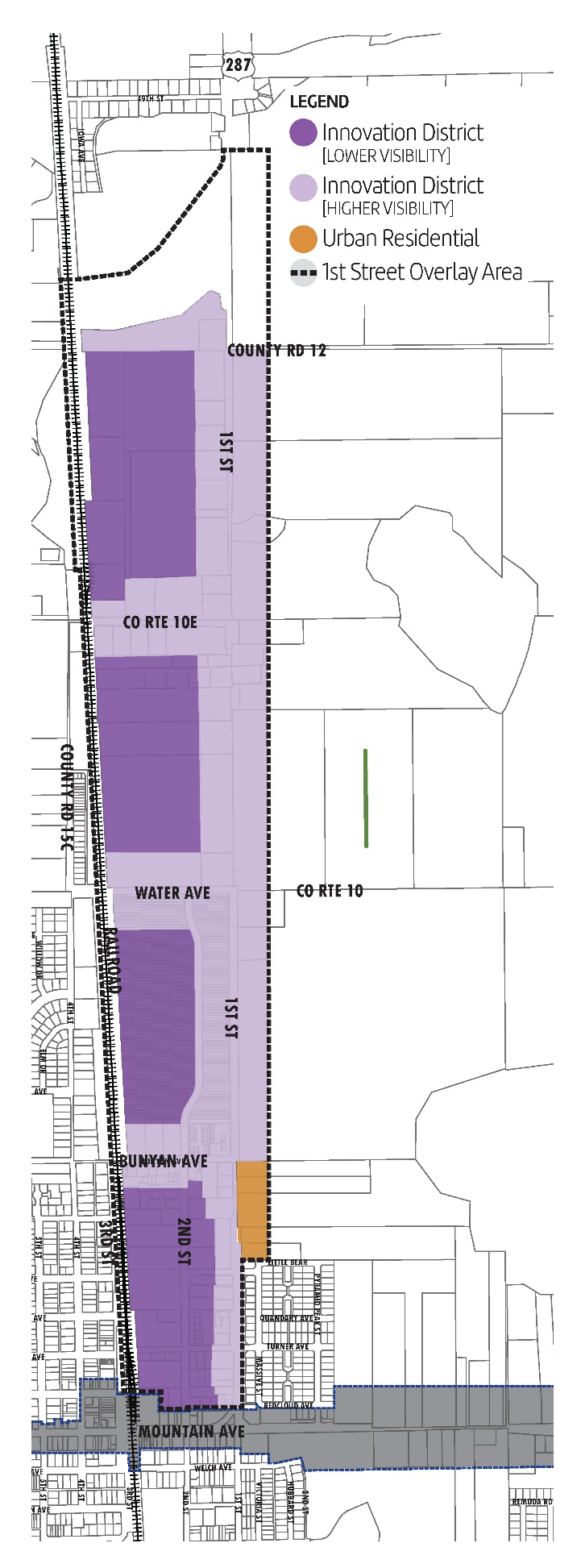
3.
Applicability. All of the regulations and requirements of this Section shall fully apply when any of the following occur on property within the 1st Street Overlay:
A.
Construction of any new principal structure.
B.
Parking area reconfiguration.
C.
Structural Alterations. Any structural alteration shall follow the 1st Street Overlay regulations as follows:
a.
Exterior Walls: When any change is made to the façade or an exterior wall of an existing structure within a Higher Visibility Area, all of the façade shall be brought into full compliance with the 1st Street Overlay found herein.
b.
Addition(s): Any addition to an existing structure within a Higher Visibility Area must be in full compliance with this 1st Street Overlay.
D.
Sign Permits. Any expansion, change, or removal of any existing signage shall be brought into compliance with Section 7 Signs.
E.
Change of Use. Any change of use will necessitate land development review and require compliance with applicable standards of this Code and the 1st Street Overlay regulations.
4.
Exemptions. The following exemptions to the regulations and requirements of this Section are applicable to property within the 1st Street Overlay:
A.
General property maintenance and/or general property repair, such as roof repairs, interior remodels and repair, exterior painting, parking lot repair/restriping, and any other non-structural repair, or;
B.
The maintenance, repair, upgrading or replacement of any water, sewer, HVAC, or electrical facilities will not trigger a requirement that such property or structure be brought into compliance with this 1st Street Overlay.
C.
Existing single-family residential uses are exempt from the requirements of this 1st Street Overlay and shall follow the development standards of the underlying zoning district.
5.
Legal nonconformities. Except as provided in this 1st Street Overlay to the contrary; all nonconforming uses, nonconforming structures and nonconforming lots, shall be governed by Section 30-3-107 Nonconforming use/buildings.
6.
Architectural standards/guidelines. All applicable development within the 1st Street Overlay shall be in accordance with the architectural standards of this Code and the Architectural Design Guidelines.
A.
All applicable development within the Urban Residential District shall be in compliance with Section 30-2-116 Residential design standards.
a.
During the land development approval process, and specifically Section 30-6-112 Site plan and Section 30-3-106 Use by Special Review as applicable, an applicant proposing development within the Urban Residential District shall illustrate how the development will comply with the requirements set forth in the Architectural Design Guidelines for the Urban Residential Character District.
B.
All applicable development within the Innovation District shall be in compliance with Section 30-2-117 Commercial and industrial standards.
a.
During the land development approval process, and specifically Section 30-6-112 Site plan and Section 30-3-106 Use by Special Review as applicable, an applicant proposing development within a Higher Visibility area shall illustrate how the development will comply with the requirements set forth in the Architectural Design Guidelines for the Urban Industrial Character District.
b.
During the land development approval process, and specifically Section 30-6-112 Site plan and Section 30-3-106 Use by Special Review as applicable, an applicant proposing mixed use development shall illustrate how the development will comply with the requirements set forth in the Architectural Design Guidelines for the Urban Downtown Character District.
7.
Use and dimensional standards. All applicable development within the 1st Street Overlay shall be in accordance with the land use and dimensional standards in Table 3.9:
Table 3.9: 1 st Street Corridor Overlay District Use and Dimensional Standards
(Ord. No. 1335, § 1(App. A), 3-12-2024)
Editor's note— Ord. No. 1335, § 1(App. A), adopted March 12, 2024, amended § 30-3-115 in its entirety to read as herein set out. Subsequently, as Ord. No. 1342, adopted Aug. 13, 2024, expressly redesignated the former §§ 30-3-113 and 30-3-114 as new §§ 30-3-114 and 30-3-115, this section was also renumbered as a new § 30-3-116 at the discretion of the editor. Prior to amendment by Ord. No. 1335, § 30-3-115 pertained to application process and derived from Ord. No. 1326, § 1(Exh. A), adopted Nov. 28, 2023.

