
Bishop City Zoning Code
CHAPTER 17
85.- SIGNAGE
17.85.010.- Purpose and intent.
The purpose of this chapter is to establish regulations that control signage allowed within the city, including the number, placement, height, size, type, and lighting of signs, to:
A.
Advance the community design standards identified in the Downtown Bishop Specific Plan.
B.
Support the local economy and help nurture businesses.
C.
Strengthen the identity of the community and support the pedestrian-oriented scale of downtown.
D.
Encourage creative design that adds character to streets and districts, contributing to an attractive and hospitable streetscape.
E.
Discourage visual clutter and negative impacts to the public realm.
F.
Eliminate glare and minimize light pollution to improve public safety and preserve views of the stars and night sky.
G.
Provide for signs as an effective channel of communication, while ensuring that signs are aesthetically compatible with the structures they identify.
H.
Safeguard and protect the public health, safety, and general welfare.
I.
Avoid traffic safety hazards to pedestrians, bicyclists, and motorists caused by visual distractions and obstructions.
J.
Maximize public convenience by providing easily visible traffic, directional, informational, and wayfinding signage.
K.
Minimize the cost of sign permits through clear and user-friendly regulations.
L.
Allow for consistent enforcement of this chapter.
M.
Distinguish between exempt, prohibited, and permitted signage to minimize the administrative burden associated with processing sign permits.
(Ord. No. 576, § 1(17.85.010), 4-25-2022)
17.85.020. - Applicability.
A.
This section shall govern and control the design, number, size, alteration, installation, lighting, and maintenance of all signs permitted within all districts established by this chapter and any amendments thereto except where explicitly superseded by an approved official development plan or as identified in this section.
B.
Message neutrality. It is the city's policy to regulate signs in a constitutional manner that is content neutral as to noncommercial messages which are within the protections of the First Amendment to the U.S. Constitution and the corollary provisions of the state constitution. The provisions of this chapter do not regulate the message content of signs (sign copy), regardless of whether the message content is commercial or noncommercial. Any noncommercial message may be substituted for the copy on any commercial sign allowed by this chapter.
C.
This section shall not require alteration of the display of any registered mark, or any trademark, service mark, trade name, or corporate name that may be associated with or incorporated into a registered mark, where such alteration would require the registered mark to be displayed in a manner differing from the mark as exhibited in the certificate or registration issued by the United States Patent and Trademark Office. It is the responsibility of the applicant to establish that a proposed sign includes a registered trademark.
D.
Strict application of numerical standards not required. In general, no sign should exceed the number, size, height and location limitations of the district in which it is located. However, as rigid numerical or other design standards may preclude exceptional design that might better achieve the purpose and objectives of this chapter, exceptions to the stated numerical or design standards, including size, shape, and location, may be approved by the approving authority when appropriate, provided that any resulting determinations or approvals shall be supported by clear and descriptive findings that are consistent with and which achieve one or more of the purposes and the objectives of this chapter. No design exceptions may be approved for prohibited signs. For any approval of a sign which does not strictly conform to the stated numerical and design standards set forth in this chapter, the applicable general development plan, or an approved sign program for a specific development or district, the approving authority must first make the following findings in writing:
1.
The proposed sign achieves the purposes and objectives of this chapter;
2.
The proposed sign exemplifies innovation and creativity and is appropriate and consistent with the architecture and context of the building and the neighborhood where the sign will be located; and
3.
The proposed sign is consistent with all applicable sign guidelines or has been determined by the approving authority to better achieve the purpose and objectives of this chapter than the strict application of said sign guidelines and standards.
E.
Signage enhancing the historic character of the city. The Eastern Sierra corridor has a regionally distinct historical trend of expressive tourist-oriented signs. Signs with historic integrity that contribute to this regional tradition shall be permitted to remain in place and be maintained.
(Ord. No. 576, § 1(17.85.020), 4-25-2022)
17.85.030. - Sign permit.
A.
Permit requirement. A sign permit is required prior to the installation or display of any sign, except those exempt signs described herein. It is unlawful for any person, firm, organization, or corporation that owns, operates, controls, rents, or leases property or land in the city to construct, maintain, display or alter, or to cause or allow to be constructed, maintained, displayed, or altered, a sign within the city except in conformance with this chapter. In the case of after-the-fact permitting, the otherwise applicable fee shall be doubled. A permit is required in compliance with this section whether temporary or permanent, unless the sign is allowed without a sign permit in accordance with section 17.85.070. Each business requires a separate sign permit. A permit is required for a change in business name on a sign.
1.
Minor alterations (e.g., repainting with same colors, routine maintenance, etc.) may be approved without a new permit.
2.
Permits for temporary signs may be approved on an annual basis provided the applicant submits a plan for the display of all temporary signs for a period of 12 consecutive months, and the plan is approved by the planning department.
B.
Application requirements. An application for a sign permit shall be made to the planning department on a form provided for that purpose. All required information identified on the form shall be provided by the applicant, together with the required fees.
C.
Other permits required. In addition to the requirements of this chapter, all signs shall be in conformance with applicable requirements of the state building standards code. Where required, the applicant shall also obtain a building permit and/or electrical permit from the building department. A city encroachment permit is required for any signage placed in the city right-of-way. State review and approval, including the issuance of an encroachment permit, is required for signs located within the state right-of-way.
D.
Review authority. Sign permits are approved by the planning director or their appointee. The decision of the planning director may be appealed to the planning commission. The decision of the planning commission may be appealed to the city council pursuant to section 17.80.110.
E.
Findings and decision. After a sign permit application is deemed complete, the review authority shall approve, conditionally approve, or deny the application. The review authority may approve a sign permit application, with or without conditions, only after finding the sign complies with the standards of this chapter.
F.
Prohibited signs. The city has a compelling interest to prohibit certain signs to uniformly further the purpose and objectives of this chapter and to enforce local, state and federal law. Unless otherwise permitted by a specific provision of this chapter, the following signs are prohibited in all zones and are subject to abatement by the city:
Table 1: Prohibited Signs
(Ord. No. 576, § 1(17.85.030), 4-25-2022)
17.85.040. - Types and sizes.
A.
1.
The standards of this section apply to all permanent signs and set minimum standards. Permanent signs include the following types: awning signs, marquee signs, projecting signs, wall signs, monument signs, murals as signage, pylon signs, and window signs.
2.
The total square footage of allowable sign area for any business shall not exceed two square feet for each three lineal feet of business frontage (i.e., linear feet of business frontage x two-thirds = maximum allowable sign area in square feet). The maximum aggregate allowed for any business is 250 square feet. Building frontage is the building facade facing the primary street.
B.
Each business is allowed a minimum of 12 square feet of signage regardless of frontage length.
(Ord. No. 576, § 1(17.85.040), 4-25-2022)
17.85.050. - Measurement standards.
A.
Determining sign area. In determining the square footage of allowable signage for any business, use, or tenant space, the area of each sign face will be added together.
B.
Measuring sign area. Sign area is the entire surface area of a sign, including nonstructural trim. The supports, uprights, or structures on which any sign is mounted shall not be included in determining sign area.
1.
Standard geometric shapes. When the surface area of a sign consists of a conventional geometric shape, such as a circle, an oval, a rhombus, a trapezoid, or a triangle, the accepted mathematical formulas for calculating area will be used to determine the surface area of a sign.
2.
Cutout letters. Sign area for cutout letters or display applied directly to the building surface and lacking a defined border or trim shall be determined by including the total area within the periphery of the cutout letters on display, which can be enclosed within a rectangle or the closest geometric shape with a maximum of two enclosing shapes.
3.
Irregular geometric shapes. If a sign consists of a symbol, or an irregular geometric shape without an accepted mathematical formula for calculating area, the entire surface area of the symbol, which can be enclosed within a rectangle or the closest geometric shape with a maximum of two enclosing shapes, shall be determined as the sign area, as shown in Figure 1.
4.
Multiple elements. If a sign consists of a symbol, graphic, or text with multiple elements that are an irregular geometric shape without an accepted multiple formula for calculating area, the entire surface area of the symbol, graphic or text, which can be enclosed within a rectangle or the closest geometric shape with a maximum of two enclosing shapes, shall be determined as the sign area.
5.
Double-faced sign. Only one side of a double-faced freestanding or projecting sign shall count toward the aggregate size measurement provided both sides are identical.
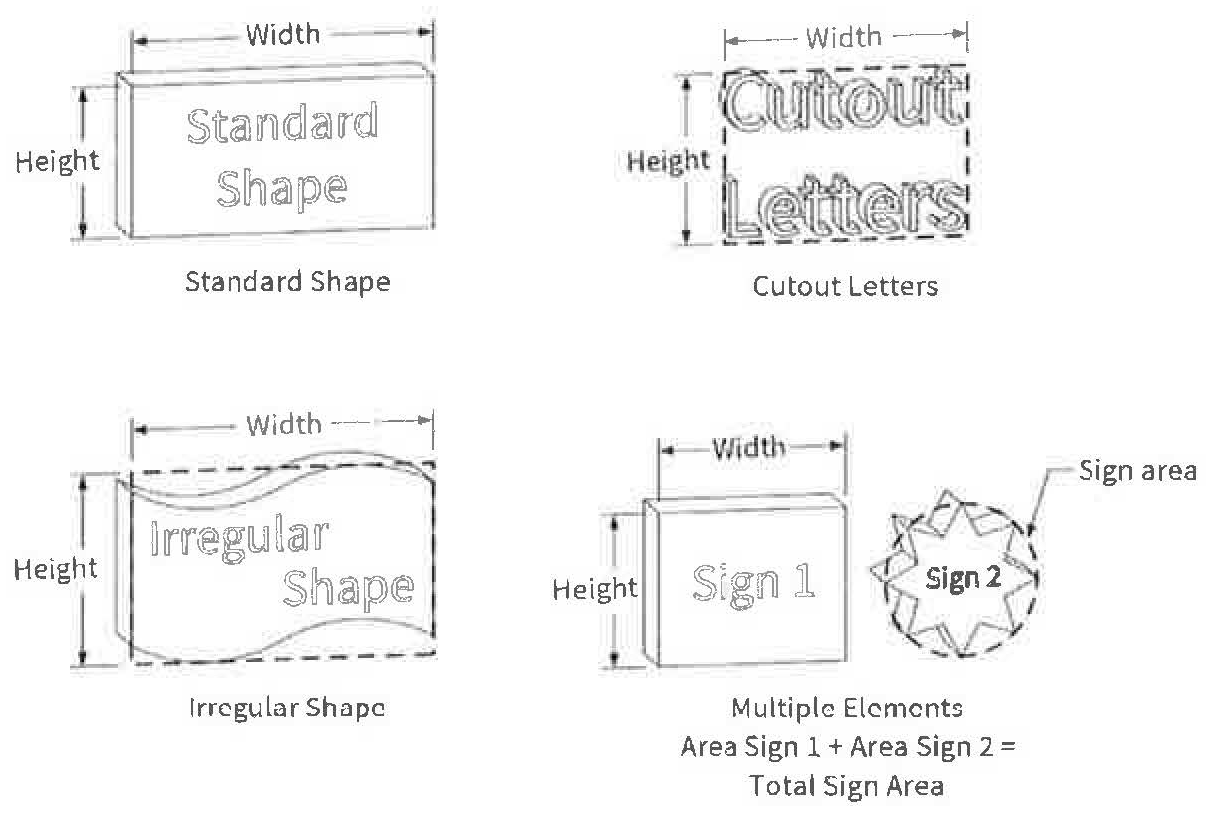
Figure 1. Measuring Sign Area
C.
Placement.
1.
On-premises. All signs shall be located on the premises of the business, use, or tenant space displaying the sign.
2.
Ground placement. Signs are not subject to the setback requirements of the zoning district where they are located.
3.
Rights-of-way. Signs are not permitted to be placed on or project into public rights-of-way, except as specifically permitted elsewhere in this section. Any sign placed within the state right-of-way will need to obtain appropriate permits from Cal-Trans.
4.
Building placement.
a.
Wall signs. Sign size should be proportionate with the scale of the building. Wall signs shall be contained within any single wall panel or other architectural component upon which they are placed and shall not exceed the height of the building wall to which the sign is affixed.
b.
Projecting, hanging, and awning signs. Signs shall be located to complement architectural elements of the building. No part of a projecting, hanging, or awning sign shall be located above the ceiling of the second story of any building. Projecting, hanging, and awning signs shall not exceed the height of the building wall to which the sign is affixed, and shall have a minimum of 8½ feet clearance above the ground.
c.
Multi-tenant buildings. Signs for businesses in multi-tenant buildings shall be located on the tenant space being identified by the sign.
D.
Determining sign height.
1.
Freestanding signs. The height of a sign or sign structure shall be measured from finished grade to the highest point of the sign or sign structure.
2.
Projecting, hanging, and awnings signs. Clearance for signs shall be measured at the smallest vertical distance between finished grade and the lowest point of the sign, including any framework or other embellishments.
3.
Wall signs. Heights shall not exceed the height of the building wall to which the sign is affixed.
(Ord. No. 576, § 1(17.85.050), 4-25-2022)
17.85.060. - Design standards.
A.
Construction. All signs and sign structures shall be made by a commercial sign manufacturer or be of similar professional quality. All signs shall be completed and erected in a professional manner.
B.
Maintenance. It shall be unlawful to fail to maintain any sign, including signs exempted from these regulations with respect to permits and fees, in good repair and appearance, including, but not limited to, the keeping in good condition of all painted and printed surfaces, cabinets, trims, poles, and text integrity.
C.
Building and electrical permits. All signs for which a sign permit is required shall be subject to the provisions of the most currently adopted version of the building and electrical codes.
D.
Design compatibility.
1.
Compatibility with the building. Signs including its supporting structure and components should be integrated with the design of the building or structure on which they are placed. The scale, size, and shape of any sign should be proportionate to the building and the area in which it is located. Signs should not obscure architectural features and should be designed in a manner that provides an artistic accent or visual point of interest for the building.
2.
Compatibility with other signs. Signs including its supporting structure and components should be integrated with the design of other signs located on or near the same building to complement or enhance the other signs. The design and alignment of signs on multi-use buildings should be complementary, but not uniform or duplicative.
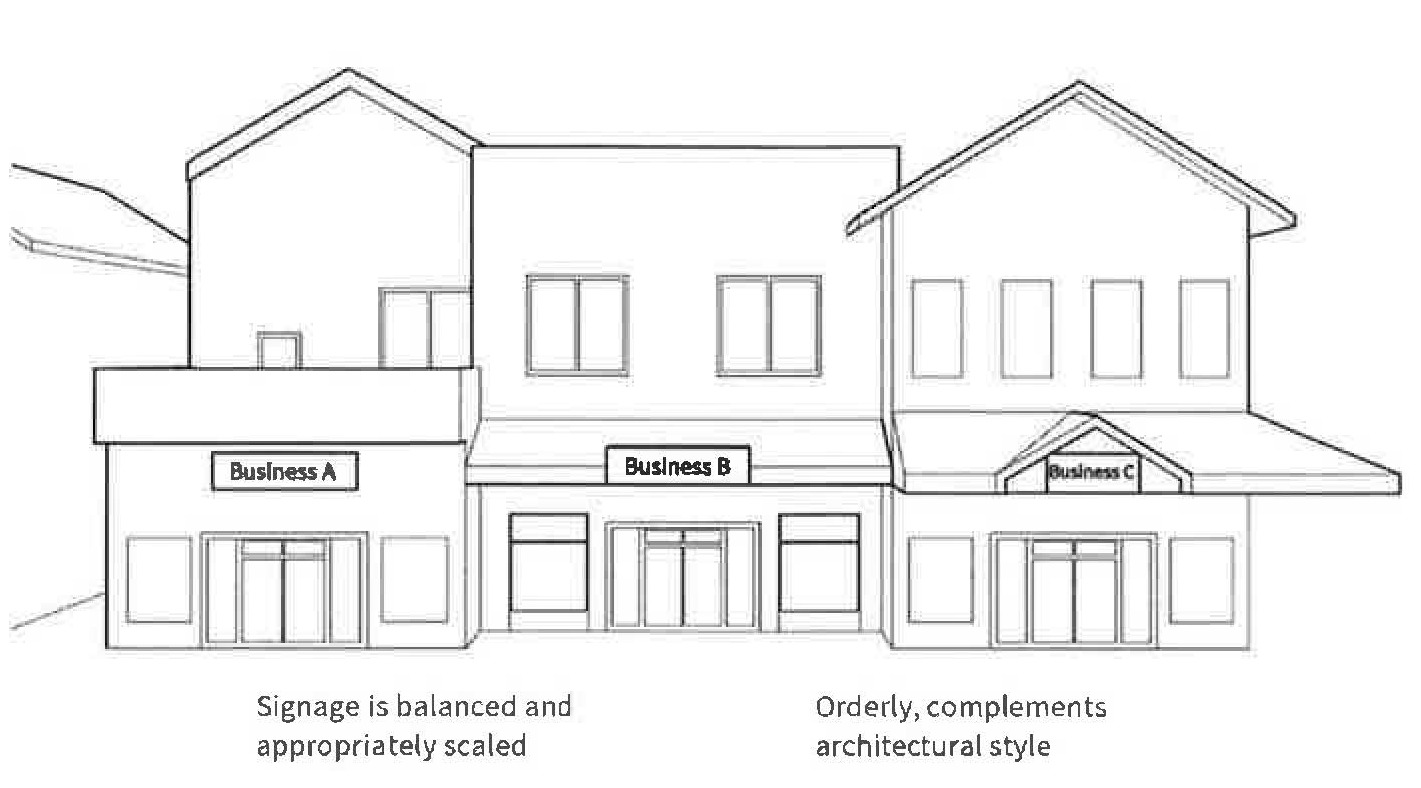
Figure 2
Sign Design Compatibility YES
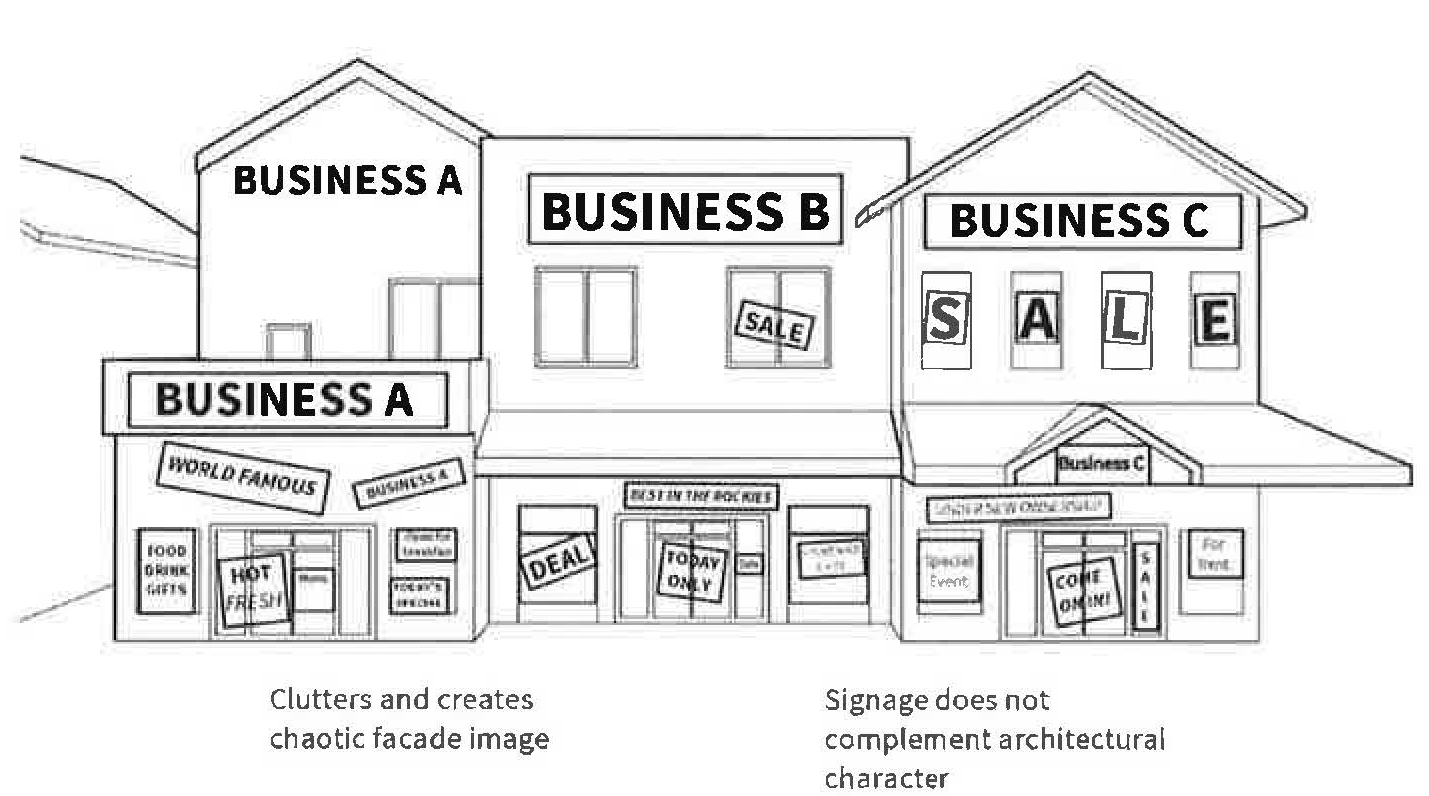
Figure 3
Sign Design Compatibility NO
E.
Materials.
1.
Sign materials should be compatible with the architectural design of the building's facade and should contribute to the legibility of the sign. In general, signs shall have mutually unifying elements which shall include uniformity in materials, color, height, letter style, sign type, shape, lighting, and location on buildings.
2.
Appropriate sign materials shall include wood; tile; formed, etched, cast metal, or decorative iron brackets or wood.
3.
Background colors shall be muted or natural tones. Bright colors should be reserved only for lettering, trim, accents, and logos. Sign colors should contribute to legibility and design integrity, and to the overall communicative effect of the sign.
4.
Reflective and glossy materials are not allowed.
5.
Plastic signs unable to withstand ultraviolet exposure are not permitted.
6.
Sign materials should be very durable and capable of withstanding wind and sun exposure with reasonable maintenance.
7.
Raised borders and raised letters are encouraged.
8.
Signs with a three-dimensional, textured surface that provide architectural relief such as carved, routed, or sandblasted designs are encouraged.
9.
Where permitted, the supporting structure of a freestanding sign shall not include a singular, exposed metal pole or column, but it should be entirely surrounded by a decorative pole or column cover that is architecturally compatible with the sign and building.
F.
Illumination. The following rules and standards apply in establishing the type of illumination that may be used for signs:
1.
The light from any internally illuminated sign shall be shaded, shielded, or directed so that the light intensity or brightness will not be disruptive to a residential use or property, or create a distraction to a motorist.
2.
Colored lights are not permitted at any location to avoid confusion with constructed traffic control devices.
3.
Neon illumination should not dominate a city block or a series of storefronts.
4.
Internally illuminated signs with light colored backgrounds, including, but not limited to, white, off-white, light gray, cream, and yellow are discouraged.
5.
Signs that are backlighted (halo-lighted) are encouraged.
6.
Sign illumination shall not blink, flash, flutter, or change light brightness, color, or intensity.
7.
Illuminated signs must comply with the City of Bishop Dark Sky Ordinance.
8.
Illuminated signs shall have controls for intensity of lighting and must be dimmable.
9.
Illuminated signs must have controls for hours of operation.
(Ord. No. 576, § 1(17.85.060), 4-25-2022)
17.85.070. - Signs exempt from sign permit process.
The following signs are exempt from the requirement that a sign permit be obtained because they either do not create safety hazards or aesthetic disruption, they promote public safety or the dissemination of public information or are accessory to the exercise of an individual's First Amendment rights.
A.
Art. Works of art, including, but not limited to, murals, sculptures, and paintings, when not used as a sign or an attention getting device.
B.
Safety signs. Any public purpose/safety sign and any other notice or warning required by a valid and applicable federal, state, or local law, regulation, or resolution.
C.
Seasonal decorations. Temporary, noncommercial decorations or displays, signs or other materials displayed on traditionally accepted civic, patriotic, and/or religious holidays, provided that such decorations are maintained in a safe and attractive condition. Seasonal window artwork should be removed or updated appropriately to the season.
D.
Window signs. Window signs shall not exceed a total coverage of more than 40 percent of the total ground floor transparency. One window sign is allowed per business. Window signage should not be an exact replica of a business's permanent signage. Window signage is not allowed in windows above the ground floor of the building. Illumination directed at window signs shall not be allowed.
E.
Drive-thru menu displays. Menu display boxes of up to an aggregate of 15 square feet. Menu display boxes may include an area used to communicate daily, weekly, or other "specials." Such signs shall be subject to the provisions of the most currently adopted version of the building and electrical codes.
F.
Vehicle station fuel price signs. Vehicle station fuel price signs required by state law, one sign per station not to exceed 12 square feet or other size as required by state law. No information other than as required or allowed by local, state or federal law shall be displayed. These signs may utilize changeable copy. Vehicle station fuel price signage shall not be LED or internally illuminated.
(Ord. No. 576, § 1(17.85.070), 4-25-2022)
17.85.080. - Nonconforming signs.
A.
Signs legally erected prior to the effective date of the ordinance codified in section 17.85 shall be deemed to be legal nonconforming signs. A nonconforming sign shall not be changed, extended, or altered in terms of its size, location, shape, height, colors, and materials without being brought into compliance with the provisions of this chapter. Changes of copy are allowed, provided that there is no change to the business name.
(Ord. No. 576, § 1(17.85.080), 4-25-2022)

