
Bloomfield Hills City Zoning Code
ARTICLE I
- IN GENERAL
Sec. 24-1.- Title.
This chapter shall be known and may be cited as the "City of Bloomfield Hills Zoning Ordinance".
(Ord. No. 188, § 100, 11-8-83)
Sec. 24-2. - Construction of language.
The following rules of construction apply to the text of this chapter:
(1)
The particular shall control the general.
(2)
In case of any difference of meaning or implication between the text of this chapter and any caption or illustration, the text shall control.
(3)
The word "shall" is always mandatory and not discretionary. The word "may" is permissive.
(4)
Words used in the present tense shall include the future; and words used in the singular number shall include the plural; and the plural the singular unless the context clearly indicates the contrary.
(5)
The phrase "used for" includes "arranged for," "designed for," "intended for," "maintained for," or "occupied for."
(6)
The word "person" includes any individual, a corporation, a partnership, an incorporated association, or any other similar entity.
(7)
The word "dwelling" includes the word "residence," and the word "lot" includes the word "plot" or "parcel."
(8)
Unless the context clearly indicates the contrary, where a regulation involves two (2) or more items, conditions, provisions, or events connected by the conjunction "and," "or," "either … or," the conjunction shall be interpreted as follows:
a.
"And" indicates that all the connected items, conditions, provisions or events shall apply.
b.
"Or" indicates that the connected items, conditions, provisions or events may apply singly or in any combination.
c.
"Either … or" indicates that the connected items, conditions, provisions or events shall apply singly but not in combination.
(9)
Terms not defined in this section or in section 24-3 shall have the meaning customarily assigned to them.
(Ord. No. 188, § 200, 11-8-83)
Cross reference— Definitions and rules of construction generally, § 1-2.
Sec. 24-3. - Definitions.
In the interpretation of this chapter, the following definitions shall apply except where the context clearly indicates a different meaning:
Accessory shall mean a use, building or structure which is clearly incidental to, customarily found in connection with, and (except in the case of accessory off-street parking spaces or loading) located on the same principal use to which it is related. An accessory use includes, but is not limited to, the following:
(1)
Residential accommodations for servants and/or caretakers located outside the main building;
(2)
Swimming pools, play courts, tennis courts and other recreational courts at grade or located wholly in the main building for the use of the occupants of a residence, or their guests;
(3)
Porches, patios, terrace and decks; and
(4)
Structures included under section 24-229(2).
Adjacent shall mean when two (2) points of reference are not widely separated, though they may not actually touch. These points of reference may lie near or close to one another and may sometimes be contiguous.
Alley shall mean any dedicated public way affording a secondary means of access to abutting property and not intended for general traffic circulation.
Alteration shall mean any change, addition or modification in construction or type of occupancy, or in the structural members of a building, such as walls or partitions, columns, beams or girders, the consummated act of which may be referred to in this chapter as "altered" or "reconstructed."
Attic, habitable shall mean an attic which has a stairway as a means of access and egress and in which the ceiling area at a height of seven and one-third (7⅓) feet above the attic floor is not more than one-third (⅓) the area of the next floor below.
Auto service station shall mean a space, building or structure designed or used for the retail sale or supply of fuels, lubricants, air, water and other operating commodities for motor vehicles, and including the customary space and facilities for the installation of such commodities in or on such vehicles, but not including space or facilities for the storage, repair, or refinishing thereof; except, however, that minor repairs and temporary storage of vehicles shall be permitted.
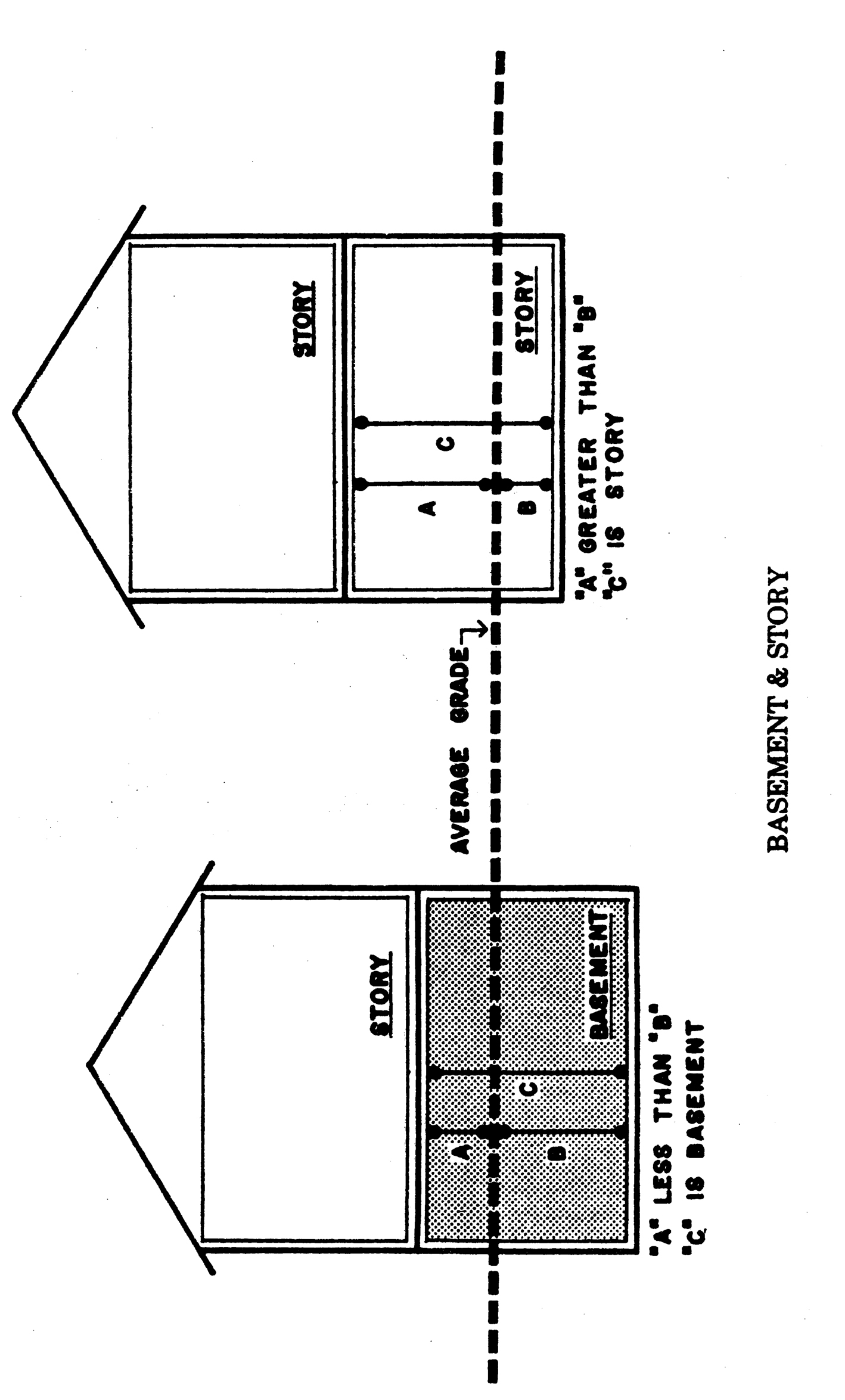
Basement shall mean that portion of a building which is partly or wholly below grade but so located that the vertical distance from the average grade to the floor is greater than the vertical distance from the average grade to the ceiling. A basement shall not be counted as a story and a basement shall not be used in computing the minimum required floor area.
Block shall mean the property abutting one (1) side of a street and lying between the two (2) nearest intersecting streets (crossing or terminating) or between the nearest such street and railroad right-of-way, unsubdivided acreage, lake, river or live stream, or between any of the foregoing and any other barrier to the continuity of the development or corporate boundary lines of the municipality.
Building shall mean a structure that encloses space intended for the occupancy of persons or animals or the storage of goods and chattels for purposes of residence, recreation, services and economic enterprises, which structure shall have a roof supported by columns or walls.
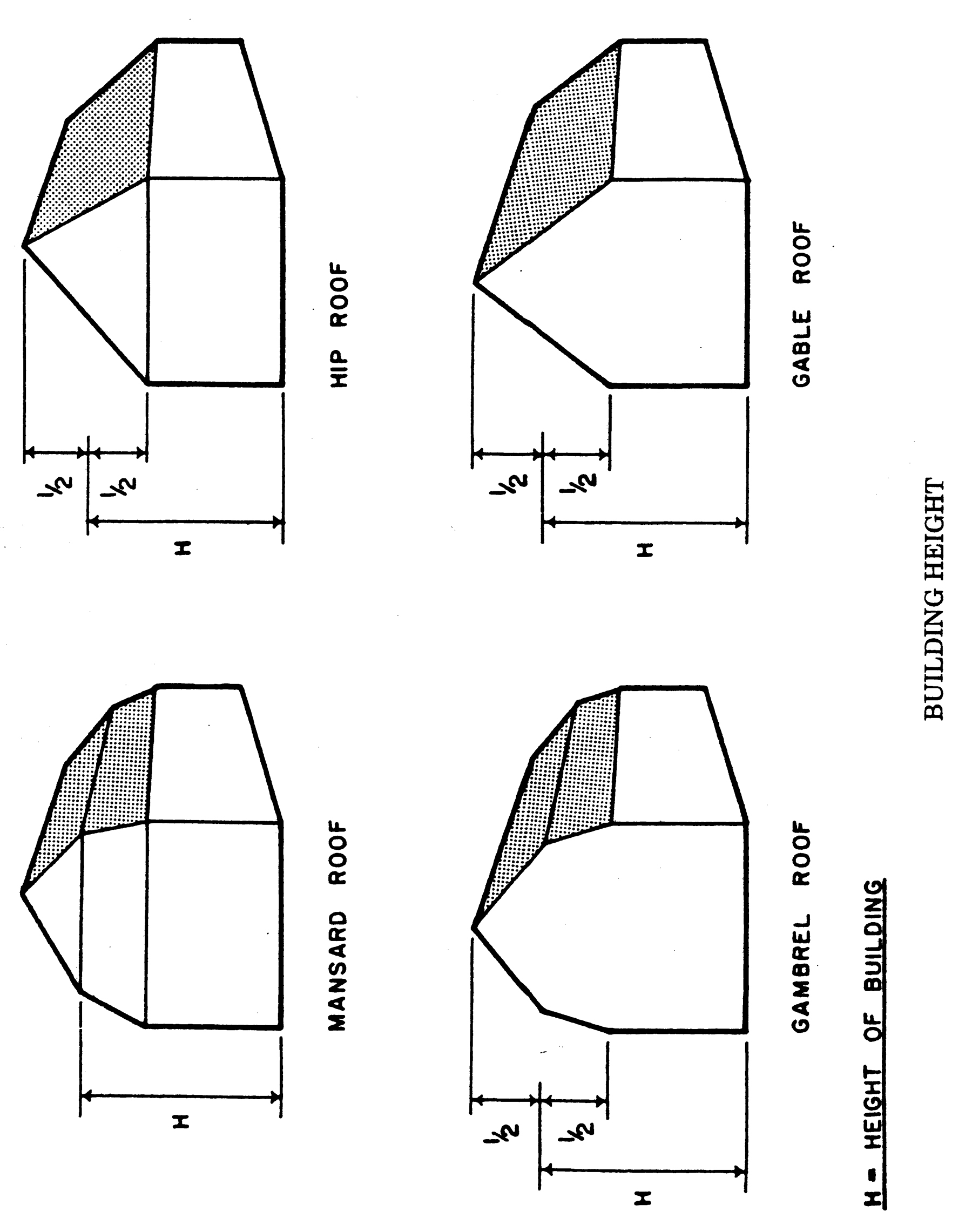
Building height shall mean the vertical distance measured from grade to the highest point of the roof surface for flat roofs; to the deck line of mansard roofs; and to the average height between eaves and ridge for gable, hip and gambrel roofs.
Building line shall mean a line formed by the face of the building. For the purposes of this chapter, a building line is the same as a front setback line.
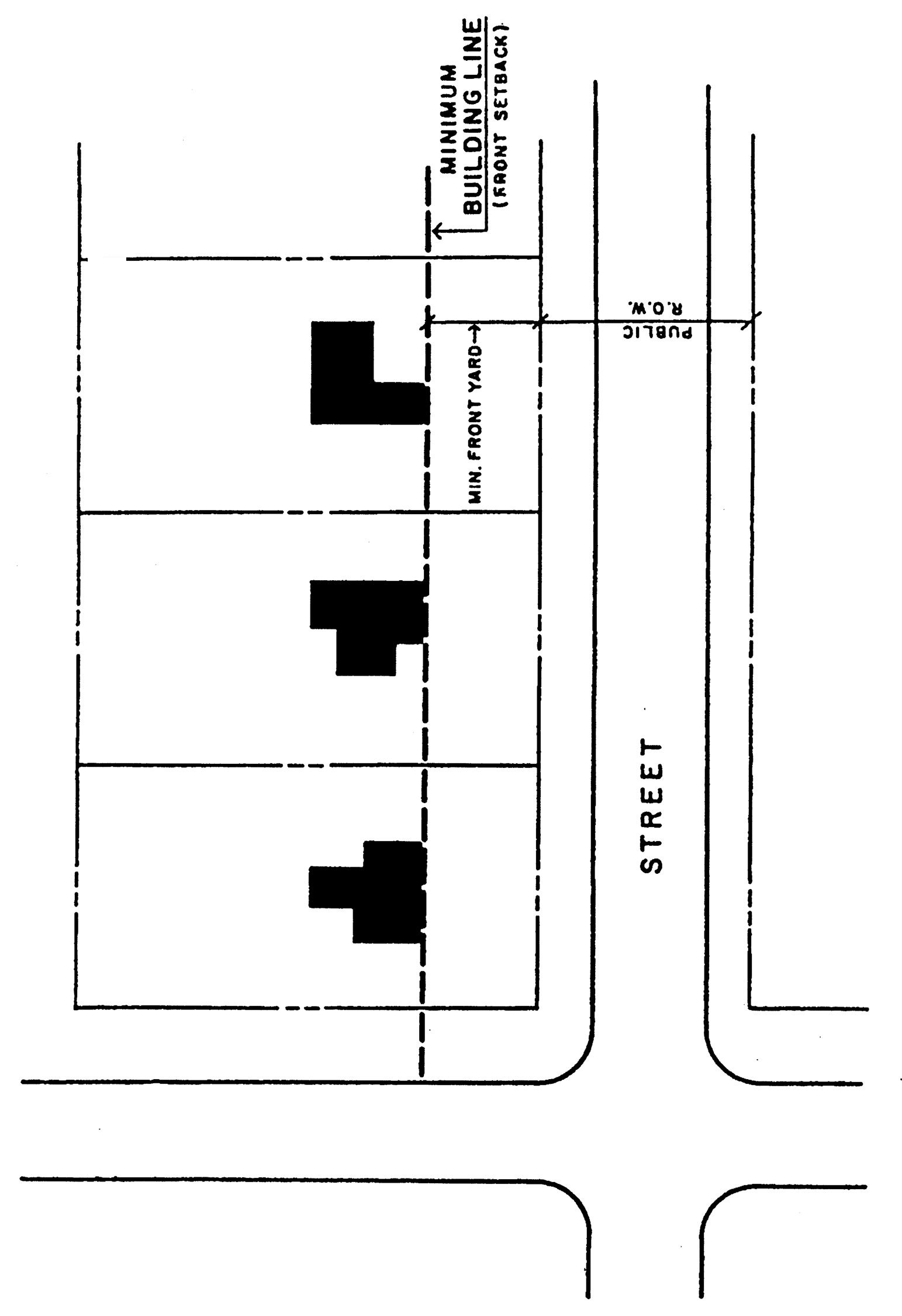
BUILDING LINE
Clinic shall mean an establishment where human patients who are not lodged overnight are admitted for examination and treatment by a group of physicians, dentists or similar professions.
Club shall mean an organization of persons for special purposes or for the promulgation of sports, arts, sciences, literature, politics, or the like, but not operated for profit.
Columbarium shall mean a structure located within a columbarium park to be used as a repository for inured cremated human remains.
Columbarium park shall mean an area of land designated for the location of columbariums.
Column or pier shall mean a pillar, pole, or post, including mailbox columns, flanking a driveway entrance constructed of brick, wood, stone, concrete, or other materials.
Convalescent home shall mean a special combination of housing, supportive services, personalized assistance, and health care designed to respond to the individual needs of its residents. This definition also applies to uses commonly referred to as nursing homes, congregate care, assisted living, memory care or continuing care.
Courtyard shall mean an open area, on the same lot with a building or group of buildings which is bounded on three (3) or more sides by such building or buildings.
Cubic content for dwellings shall mean the volume of the dwelling unit computed by using outside dimensions and the mean of the grade, and shall include all permanently enclosed and heated projections, bays, dormers and porches, balconies or projections of chimneys. The cubical content of attached garages included within or which are an integral part of a private dwelling shall not be included in the total required volume of such dwelling, except that the cubical content of any living quarters in connection therewith and having direct access to such dwelling shall be included.
District shall mean a portion of the city within which certain regulations and requirements or various combinations thereof apply under the provisions of this chapter.
Dwelling unit shall mean a building or portion thereof, designed for occupancy by one (1) family for residential purposes and having cooking facilities.
Dwelling, one-family shall mean a building designed exclusively for, and occupied exclusively by, one (1) family.
Dwelling, two-family shall mean a building or portion thereof, designed exclusively for occupancy by two (2) families living independently of each other.
Dwelling, multiple-family shall mean a building or portion thereof designed exclusively for occupancy by three (3) or more families living independently of each other.
Dwelling, one-family attached shall mean the attaching of one-family units through a common party wall subject to section 24-72.
Erected shall mean built, constructed, altered, reconstructed, moved upon or any physical operations on the premises which are required for construction. Excavation, fill, drainage and the like shall be considered a part of erection.
Essential services shall mean the erection, construction, alteration, maintenance and use by public utilities or municipal departments or underground, surface or overhead gas, electrical, steam, fuel or water transmission or distribution systems, collection, communication, supply or disposal systems, including poles, wires, mains, drains, sewers, pipes, conduits, cables, fire alarms, police callboxes, traffic signals, hydrants and similar accessories in connection herewith, but not including buildings which are necessary for the furnishing of adequate service by such utilities or municipal departments for the general health, safety or welfare. Private cable companies shall not be considered an essential service and shall be subject to the provisions of this chapter.
Excavation shall mean any breaking of ground, except common household gardening and ground care.
Family shall mean one (1) or two (2) persons, or parents, with their direct lineal descendants and adopted children (and including the domestic employees thereof) together with not more than two (2) persons not so related living together in the whole or part of a dwelling comprising a single housekeeping unit. Every additional group of two (2) or less persons living in such housekeeping unit shall be considered a separate family for the purpose of this chapter.
Fence shall mean a structure serving as a barrier or screen, excluding graded berms or living hedges, constructed of wood, metal, wire, masonry, or any other material.
Floor area for dwellings shall mean the sum of the horizontal areas of each story of the dwelling unit which shall be measured from the interior faces of the exterior walls. The floor area measurement is exclusive of areas of basements, unfinished attics, attached garages, breezeways common halls and stairways, and enclosed and unenclosed porches.
Floor area ratio (F.A.R.) shall mean a ratio resulting from the floor area of all principal and accessory buildings, including basements and excluding penthouses, measured from the interior face of the exterior walls, divided by the area of the lot excluding existing public street right-of-way. Basement level parking areas are excluded from floor area; aboveground parking structures are included.
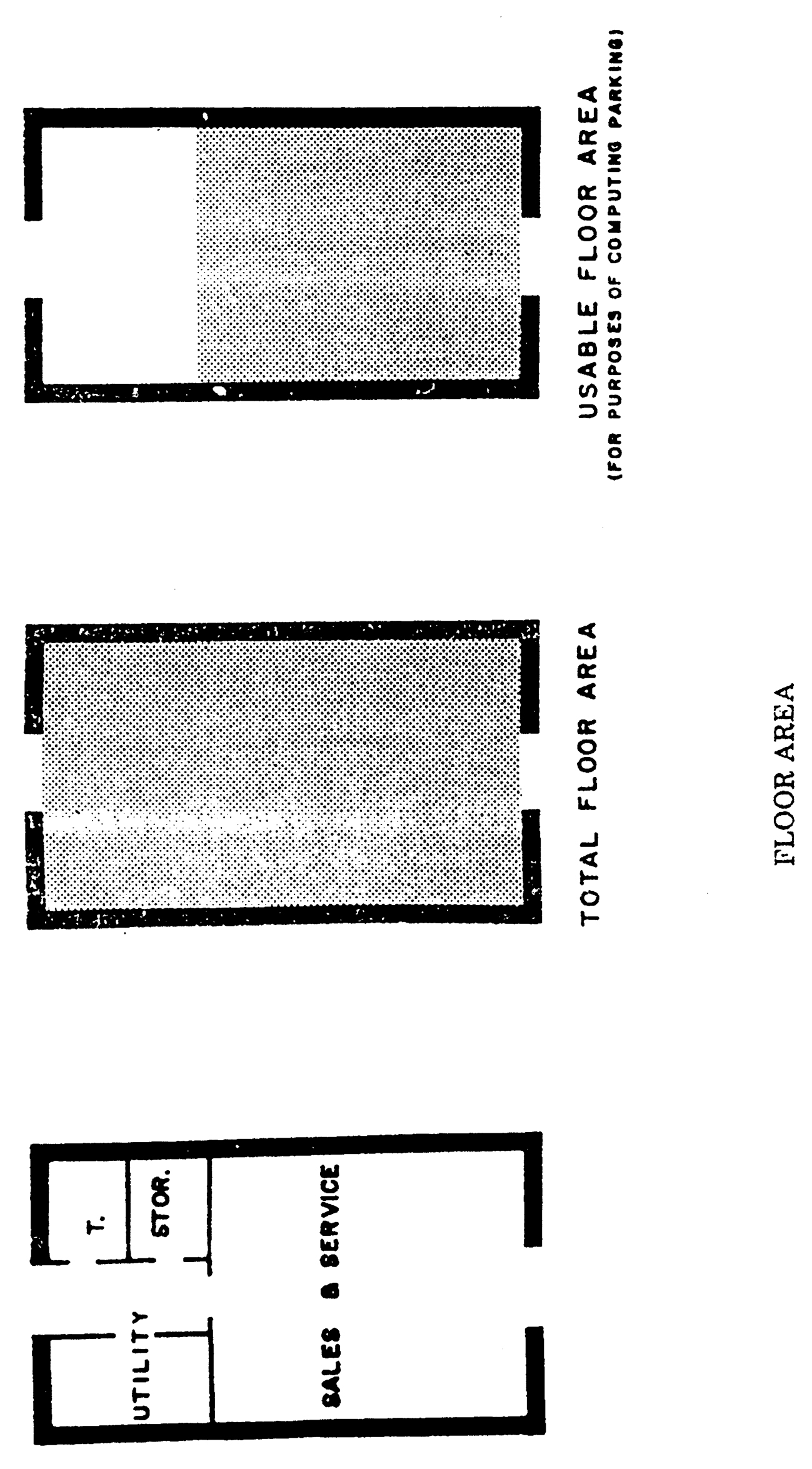
Floor area, total/gross (for the purposes of computing parking) shall mean the sum of the horizontal areas of the all floors of the building, measured from the interior faces of the exterior walls. Total gross floor area shall include usable floor area, plus all floor area used for the storage of merchandise, hallways, elevators, stairs, bulkheads, utilities or sanitary facilities. Measurement of floor area shall be the sum of the horizontal areas of all floors of the building, measured from the interior faces of the exterior walls.
Floor area, usable (for the purposes of computing parking) shall mean that area used for or intended to be used for the sale of merchandise or services, for use to serve patrons, clients or customers and all that area used for employee work space. Such floor area which is used or intended to be used principally for the storage or processing of merchandise, hallways or elevators, or for stairs, bulkheads, utilities or sanitary facilities, shall be excluded from this computation of usable floor area. Measurement of usable floor area shall be the sum of the horizontal areas of the several floors of the building, measured from the interior faces of the exterior walls.
Garage, private shall mean an accessory building or portion of a main building designed or used solely for the storage of motor-driven vehicles, boats and similar vehicles owned and used by the occupants of the building to which it is accessory.
Gate shall mean a movable frame or solid structure, including pedestrian access gates, that swings, slides, or rolls controlling ingress and egress through an opening in a fence, wall, or vegetation.
Grade shall mean a ground elevation established for the purpose of regulating the number of stories and the height of buildings. The building grade shall be the level of the ground adjacent to the walls of the building if the finished grade is level. If the ground is not entirely level, the grade shall be determined by computing the average elevation of the ground at the perimeter of the building.
Ground floor area shall mean the sum of the horizontal areas of the first story of the dwelling unit which shall be measured from the outside face of the exterior walls. The ground floor area is inclusive of attached garages and enclosed porches.
Hotel shall mean a dwelling, occupied as the more or less temporary abiding place of persons, in which the rooms are occupied for hire and in which rooms no provisions are made for cooking, and in which building there is a general kitchen and a public dining room for the accommodation of its occupants.
Landscaped open space shall mean that area of a lot which may not be used for the erection of buildings or portions thereof, including accessory uses of any type, whether pervious or impervious, or for pervious or impervious surfaces such as paved areas for parking, or access aisles, other than certain pedestrian walkways, except as provided in this chapter. Impervious surfaces shall mean those areas that the city's consulting engineers determine are covered by materials that are not sufficiently porous to allow water and/or other liquids to pass through said surface areas.
Loading space shall mean an off-street space on the same lot with a building, or group of buildings, for the temporary parking of a commercial vehicle while loading and unloading merchandise or materials.
Lot shall mean a parcel of land occupied or to be occupied by a main building or a group of such buildings and accessory buildings, or utilized for the principal use and uses accessory thereto, together with such open spaces as are required under the provisions of this chapter.
Lot of record shall mean a parcel of land the dimensions of which are shown on a document or maps on file with the county register of deeds or in use by the city or city officials, and which actually exists as so shown, or any part of such parcel held in a recorded ownership separate from that of the remainder thereof.
Lot area shall mean the total horizontal area within the lot lines of the lot.
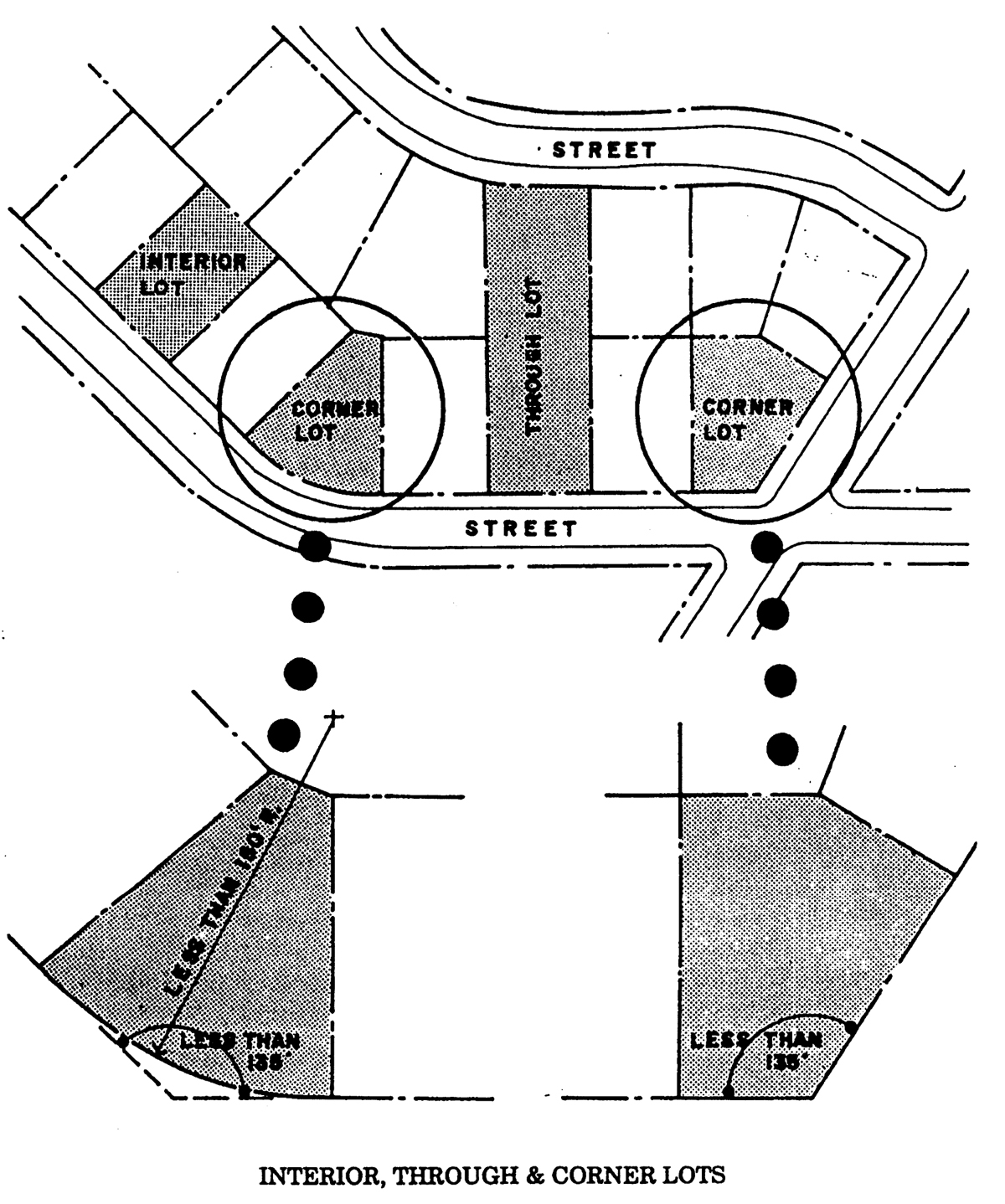
Lot, corner shall mean a lot where the interior angle of two (2) adjacent sides at the intersection of two (2) streets is less than one hundred thirty-five (135) degrees. A lot abutting upon a curved street or streets shall be considered a corner lot for the purposes of this chapter if the arc is of less radius than one hundred fifty (150) feet and the tangents to the curve, at the two (2) points where the lot lines meet the curve or the straight street line extended, form an interior angle of less than one hundred thirty-five (135) degrees.
Lot depth shall mean the horizontal distance between the front and rear lot lines, measured along the median between the side lot lines.
Lot, double frontage shall mean any interior lot having frontages on two (2) more or less parallel streets as distinguished from a corner lot. In the case of a row of double frontage lots, all sides of such lots adjacent to streets shall be considered frontage, and front yards shall be provided as required.
Lot, interior shall mean any lot other than a corner lot.
Lot lines shall mean the lines bounding a lot as defined below:
(1)
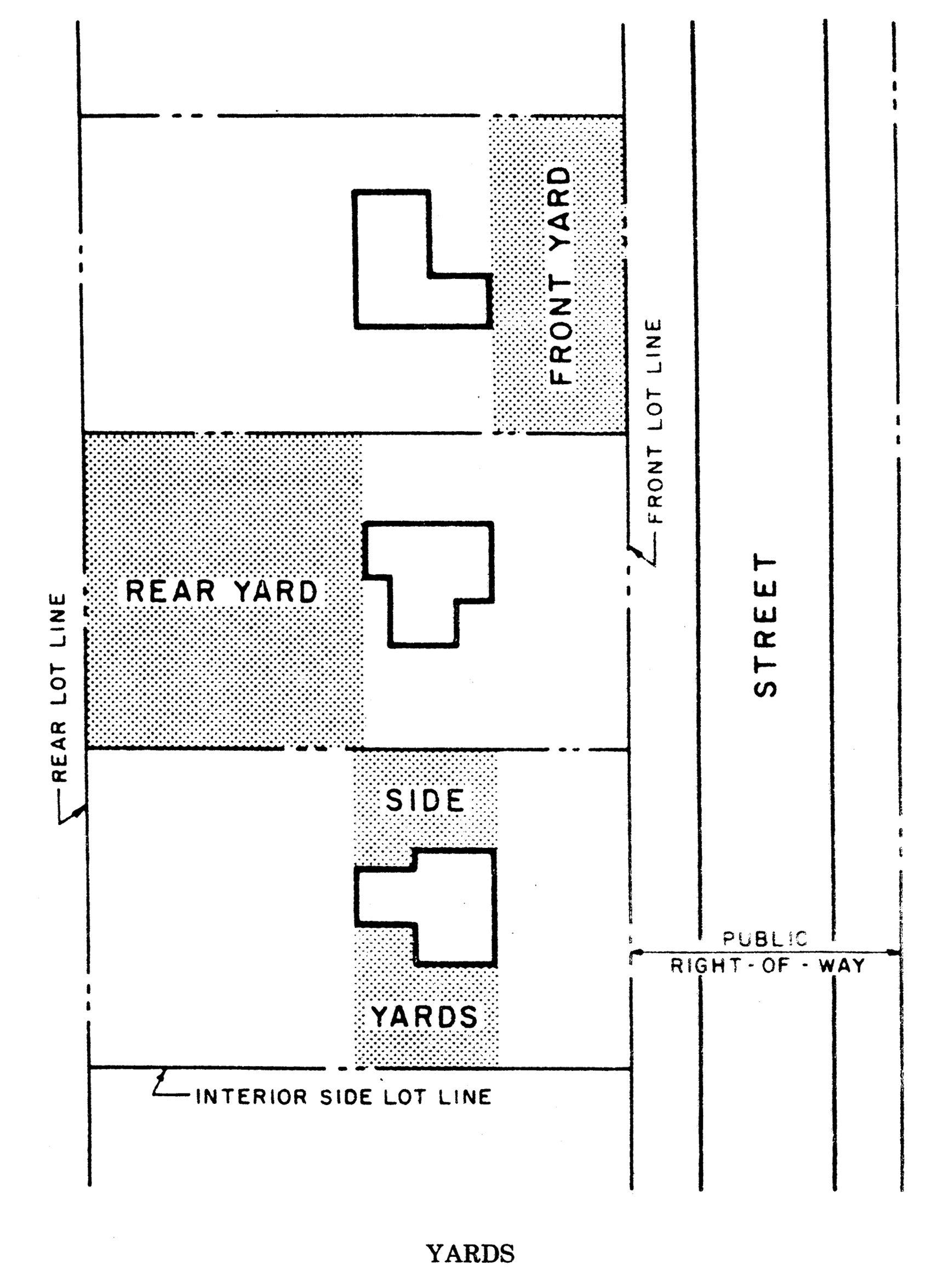
Front lot line in the case of an interior lot, is that line separating such lot from the street. In the case of a corner lot, or double frontage lot, it is that line separating such lot from either street.
(2)
Rear lot line is that lot line opposite the front lot line. In the case of a lot pointed at the rear, the rear lot line shall be an imaginary line parallel to the front lot line, not less than ten (10) feet long, lying farthest from the front lot line and wholly within the lot. In the case of an "L" shaped or other irregular lot, where two (2) or more lines are so located, all shall be considered to be rear lines except such as may be within fifty (50) feet of the front lot line, or which may be twenty (20) feet or less in length.
(3)
Side lot line is any lot line other than the front lot line or rear lot line. A side lot line separating a lot from another lot is an interior side lot line.
Lot width shall mean the horizontal distance between the side lot lines, measured at the two (2) points where the building line or setback intersects the side lot lines.
Main building shall mean a building in which is conducted the principal use of the lot upon which it is situated.
Main use shall mean the principal use to which the premises are devoted and the principal purpose for which the premises exist.
Major thoroughfare shall mean an arterial street which is intended to serve as a large volume trafficway for both the immediate municipal area and the region beyond, and is designated as a major thoroughfare, parkway, freeway, expressway or equivalent term on the major thoroughfare plan to identify those streets comprising the basic structure of the major thoroughfare plan.
Master plan shall mean the comprehensive community plan including graphic and written material indicating the general location for streets, parks, schools, public buildings and all physical development of the municipality, and includes any unit or part of such plan and any amendment to such plan or parts thereof.
Mechanical amusement device shall mean any amusement machine or device operated by means of the insertion of a coin, token or similar object for the purpose of amusement or skill and for the playing of which a fee is charged. "Mechanical amusement device" does not include vending machines in which are not incorporated gaming or amusement features, nor does the term include any coin-operated mechanical musical device.
Municipality shall mean the City of Bloomfield Hills, Michigan.
Nonconforming building shall mean a building or portion thereof lawfully existing on November 8, 1983, or on the effective date of amendments hereto that does not conform to the provisions of this chapter in the district in which it is located.
Nonconforming use shall mean a use which lawfully occupied a building or land on November 8, 1983, or on the effective date of amendments hereto and that does not conform to the use regulations of the district in which it is located.
Off-street parking lot shall mean a facility providing vehicular parking spaces along with adequate drives and aisles for maneuvering so as to provide access for entrances and exits for the parking of more than two (2) vehicles.
Open fence, wall, or gate shall mean a fence, wall, or gate constructed in such a way so that no more than twenty (20) percent of the surface area obstructs a ground level view through the fence, wall, or gate.
Parking setback shall mean a line back of a lot line between which line and the lot line no vehicular parking or standing or access aisles other than necessary drives between parking areas and the public right-of-way and more or less perpendicular thereto may be permitted, except as provided in this chapter.
Parking space shall mean an area of definite length and width, which area shall be exclusive of drives, aisles or entrances giving access thereto, and shall be fully accessible for the parking of permitted vehicles.
Planning commission shall mean the planning commission of the City of Bloomfield Hills.
Pool house shall mean an accessory building or structure intended for all uses customarily found in connection with a swimming pool and may include bathrooms, changing rooms, and cooking facilities but not bedrooms.
Principal use shall mean the main use to which the premises are devoted and the principal purpose for which the premises exist.
Public utility shall mean any person, firm or corporation, municipal department, board or commission duly authorized to furnish and furnishing under federal, state or municipal regulations to the public gas, steam, electricity, sewage disposal, communication, telegraph transportation or water.
Retaining walls shall mean walls that are solely used for the purpose of retaining or maintaining soils native to the property in question and in the immediate vicinity of the proposed location of that wall. Retaining walls shall not include walls that retain or maintain soils when any portion of said soils were brought onto the property in question from other property and/or properties.
Reception antenna facility shall mean an apparatus installed out-of-doors which is capable of receiving communications for radio and/or television purposes, including satellite reception antennas, but excluding such facilities as have been preempted from city regulation by applicable state or federal law or regulation.
Setback shall mean the distance required to obtain minimum front, side or rear yard open space provisions of this chapter.
Sign shall mean the use of any words, numerals, figures, devices, designs or trademarks by which anything is made known (other than billboards) such as are used to show an individual firm, profession, or business, and are visible to the general public.
Sign, accessory shall mean a sign which is accessory to the principal use of the premises.
Sign, nonaccessory shall mean a sign which is not accessory to the principal use of the premises.
Solid fence, wall, or gate shall mean a fence, wall or gate constructed in such a way so that more than twenty (20) percent of the surface area obstructs a ground level view through the fence, wall or gate.
Story shall mean that part of a building included between the surface of one (1) floor and the surface of the next floor, or if there is no floor above, then the ceiling next above. A basement shall not be counted as a story.
Story, half shall mean an uppermost story lying under a sloping roof, the usable floor area of which does not exceed seventy-five (75) percent of the floor area of the story immediately below it, and not used or designed, arranged or intended to be used in whole or in part as an independent housekeeping unit or dwelling.
Street shall mean a thoroughfare which affords the principal means of access to abutting property.
Structure shall mean anything constructed or erected, the use of which requires location on the ground or attachment to something having location on the ground.
Temporary use or building shall mean a use or building permitted by the board of appeals to exist during a period or periods of construction of the main building or use or for special events.
Urban design shall mean the relationship between buildings, open space, topography, pedestrian and vehicular circulation, and land uses as they affect the function, economics and essential character of the community or its parts.
Use shall mean the principal purpose for which land or a building is arranged, designed or intended, or for which land or a building is or may be occupied.
View shall mean the scene from the primary living area of a residence. The term "view" includes both upslope and down slope scenes, but is generally medium or long range in nature, as opposed to short range.
Wall shall mean an upright structure of, stone, brick or masonry or combination of those materials serving to enclose, divide, or support and usually having greater mass than a fence. A wall shall not include an architectural feature of a residence that is an integral part of the residence and does not act as an enclosure as its primary purpose.
Yards shall mean the open spaces on the same lot with a main building unoccupied and unobstructed from the ground upward except as otherwise provided in this chapter, and as defined below:
(1)
Front yard shall mean an open space extending the full width of the lot, the depth of which is the minimum horizontal distance between the front lot line and the nearest point of the main building. All yards abutting on a street shall be considered as front yards for setback purposes.
(2)
Rear yard shall mean an open space extending the full width of the lot, the depth of which is the minimum horizontal distance between the rear lot line and the nearest point of the main building. In the case of a corner lot, the rear yard may be opposite either street frontage.
(3)
Side yard shall mean an open space between a main building and the side lot line, extending from the front yard to the rear yard, the width of which is the horizontal distance from the nearest point on the side lot line to the nearest point of the main building.
Zoning exceptions and variances:
(1)
Exception shall mean a use permitted by the zoning board of appeals only after review of an application, such review being necessary because the provisions of this chapter covering conditions, precedent or subsequent, are not precise enough to permit the approval of applications without interpretation, and such review is required by this chapter.
(2)
Variance shall mean a modification of the literal provisions of this chapter concerning height and area restrictions, setback, open space, parking and similar restrictions granted when strict enforcement of this chapter imposes practical difficulties in the occupation or development of property due to circumstances unique to the individual property on which the variance is granted. The characteristics of a variance are (a) practical difficulties, (b) unique circumstances, (c) peculiar to the specific property involved. A variance is not justified unless all three (3) elements are present in the case.
The "exception" differs from the "variance" in several respects. Among them, an exception does not require "practical difficulties" in order to be allowable. The exceptions that are authorized by this chapter may be granted on review by the zoning board of appeals.
(Ord. No. 188, § 201, 11-8-83; Ord. No. 195, § 1, 12-11-84; Ord. No. 203, § 1, 7-8-86; Ord. No. 211, § 1, 5-10-88; Ord. No. 220, § 1, 6-13-89; Ord. No. 303, § 1, 11-13-97; Ord. No. 304, § 1, 11-13-97; Ord. No. 348, §§ 1, 2, 11-8-05; Ord. No. 355, § 1, 12-12-06; Ord. No. 383, § 1, 5-11-10; Ord. No. 391, § 1, 7-12-11; Ord. No. 404, § 1, 11-13-12; Ord. No. 413, § 1, 11-12-13; Ord. No. 424, § 1, 10-18-16; Ord. No. 439, § 2, 10-7-19; Ord. No. 444, § 1, 6-9-20; Ord. No. 452, § 1, 7-12-22; Ord. No. 457, § 1, 12-12-23)
Sec. 24-4. - Severability.
This chapter and the various parts, sections and clauses thereof are hereby declared to be severable. If any part, sentence, paragraph, section or clause is adjudged unconstitutional or invalid, it is hereby provided that the remainder of the chapter shall not be affected thereby. Provided, however, that in the event of the entry of a final judgment of a court of competent jurisdiction, holding and determining that the requirements of any use district provided for in this chapter are unconstitutional or otherwise invalid as to any specific parcel of land therein, the uses permitted on and the regulations applicable to the parcel shall be those of another use district in accordance with the following table:
(Ord. No. 188, Art. XX, 11-8-83)
Sec. 24-5. - Interpretation.
In interpreting and applying the provisions of this chapter, they shall be held to be the minimum requirements for the promotion of the public safety, health, convenience, comforts, morals, prosperity and general welfare. It is not intended by this chapter to interfere with or abrogate or annual any ordinance, rules, regulations or permits previously adopted or issued which are not in conflict with any of the provisions of this chapter, or which shall be adopted or issued pursuant to law relating to the use of buildings or premises and likewise not in conflict with this chapter; nor is it intended by this chapter to interfere with or abrogate or annual any easements, covenants or other agreements between parties; provided, however, that where this chapter imposes a greater restriction upon the use of buildings or premises or upon height of buildings or requires larger open spaces or larger lot areas than are imposed or required by such agreements, the provisions of this chapter shall control.
(Ord. No. 188, Art. XXI, 11-8-83)
Sec. 24-6. - No vested right granted.
It is hereby expressly declared that nothing in this chapter shall be held or construed to give or grant to any person any vested right, license, privilege or permit.
(Ord. No. 188, Art. XXIV, 11-8-83)
Sec. 24-7. - Uses in violation of law prohibited.
Uses as established in this chapter for any enterprise, activity, conduct, or venture in the city that are contrary to federal, state or local laws or ordinances are prohibited. This section shall not be interpreted to prevent the use of medical marijuana by a state licensed patient in their personal residence. Provided, however, the cultivation and/or distribution of medical marijuana is strictly prohibited.
(Ord. No. 387, § 1, 9-14-10)
Sec. 24-8. - Penalty.
Any person or anyone acting in behalf of such person violating any of the provisions of this chapter shall, upon conviction thereof, be subject to a fine not more than five hundred dollars ($500.00) and the cost of prosecution or, in default of the payment thereof, by imprisonment in the county jail for a period not to exceed ninety (90) days, or by both such fine and imprisonment at the discretion of the court. Each day that a violation is permitted to exist shall constitute a separate offense. The imposition of any sentence shall not exempt the offender from compliance with the requirements of this chapter. In addition, the city or any property owner shall have the right to enforce this chapter through appropriate court action.
(Ord. No. 188, Art. XXII, 11-8-83)

