
Bloomfield Hills City Zoning Code
ARTICLE IV
GENERAL PROVISIONS
Sec. 24-226.- Conflicting regulations.
Wherever any provision of this chapter imposes more stringent requirements, regulations, restrictions or limitations than are imposed or required by the provisions of any other law or ordinance, then the provisions of this chapter shall govern. Whenever the provisions of any other law or ordinance impose more stringent requirements than are imposed or required by this chapter, then the provisions of such law or ordinance shall govern.
(Ord. No. 188, § 1600, 11-8-83)
Sec. 24-227. - Scope.
No building or structure or part thereof shall hereafter be erected, constructed, altered and/or maintained, and no new use or change shall be made or maintained of any building, structure or land, or part thereof, except in conformity with the provisions of this chapter.
(Ord. No. 188, § 1601, 11-8-83)
Sec. 24-228. - Nonconforming lots, nonconforming uses of land, nonconforming structures, nonconforming uses of structures and premises.
(a)
Intent.
(1)
Within the districts established by this chapter or amendments that may later be adopted there exist lots, structures and uses of land and structures which were lawful before this chapter was passed or amended, but which would be prohibited, regulated or restricted under the terms of this chapter or future amendment.
(2)
It is the intent of this chapter to permit these nonconformities to continue until they are removed, but not to encourage their survival. Such uses are declared by this chapter to be incompatible with permitted uses in the districts involved. It is further the intent of this chapter that nonconformities shall not be enlarged upon, expanded or extended, nor be used as a reason for adding other structures or uses prohibited elsewhere in the same district.
(3)
A nonconforming use of a structure, a nonconforming use of land, or a nonconforming use of a structure and land shall not be extended or enlarged after passage of this chapter by attachment on a building or premises of additional signs intended to be seen from off the premises, or by the addition of other uses of a nature which would be prohibited generally in the district involved.
(4)
To avoid undue hardship, nothing in this chapter shall be deemed to require a change in the plans, construction or designated use of any building on which actual construction was lawfully begun prior to November 8, 1983, or on the effective date of amendment of this chapter and upon which the actual building construction has been diligently carried on. Actual construction is hereby defined to include the placing of construction materials in permanent position and fastened in a permanent manner; except that where demolition or removal of an existing building has been substantially begun preparatory to rebuilding, such demolition or removal shall be deemed actual construction, provided that work shall be diligently carried on until completion of the building involved.
(b)
Nonconforming lots. In any district in which single-family dwellings are permitted, notwithstanding limitations imposed by other provisions of this chapter, a single-family dwelling and customary accessory buildings may be erected on any single lot of record lawfully usable as a building site on November 8, 1983, or on the effective date of an amendment of this chapter. This provision shall apply even though such lot fails to meet the requirements for area or width, or both, that are generally applicable in the district, provided that yard dimensions and other requirements not involving area or width, or both, of the lot shall conform to the regulations for the district in which such lot is located. Variance of yard requirements shall be obtained through the approval of the zoning board of appeals.
(c)
Nonconforming uses of land. Where, on November 8, 1983, or on the effective date of an amendment of this chapter, lawful use of land exists that is made no longer permissible under the terms of this chapter as enacted or amended, such use may be continued, so long as it remains otherwise lawful, subject to the following provisions:
(1)
No such nonconforming use shall be enlarged or increased, nor extended to occupy a greater area of land than was occupied on November 8, 1983, or at the effective date of amendment of this chapter.
(2)
No such nonconforming use shall be moved in whole or in part to any other portion of the lot or parcel occupied by such use on November 8, 1983, or on the effective date of an amendment of this chapter.
(3)
If such nonconforming use of land ceases for any reason for a period of more than thirty (30) days, any subsequent use of such land shall conform to the regulations specified by this chapter for the district in which such land is located.
(d)
Nonconforming structures. Where a lawful structure exists on November 8, 1983, or on the effective date of an amendment of this chapter that could not be built, under the terms of this chapter by reason of restrictions on area, lot coverage, height, yards, or other characteristics of the structure or its location on the lot, such structure may be continued so long as it remains otherwise lawful, subject to the following provisions:
(1)
No such structure may be enlarged or altered in a way which increase the nonconformity.
(2)
Should such structure be destroyed by any means to an extent of more than fifty (50) percent of its replacement cost at time of destruction, it shall not be reconstructed except in conformity with the provisions of this chapter.
(3)
Should such structure be moved for any reason for any distance whatever, it shall thereafter conform to the regulations for the district in which it is located after it is moved.
(e)
Nonconforming uses of structures and land. If a lawful use of a structure, or of structure and land in combination, exists on November 8, 1983, or on the effective date of an amendment of this chapter, that would not be allowed in the district under the terms of this chapter, the lawful use may be continued so long as it remains otherwise lawful, subject to the following provisions:
(1)
No existing structure devoted to a use not permitted by this chapter in the district in which it is located shall be enlarged, extended, constructed, reconstructed, moved or structurally altered except in changing the use of the structure to a use permitted in the district in which it is located.
(2)
Any nonconforming use may be extended throughout any parts of a building which were manifestly arranged or designed for such use, and which existed at the time of adoption or amendment of this chapter, but no such use shall be extended to occupy any land outside such building.
(3)
If no structural alterations are made, any nonconforming use of a structure, or structure and premises, may be changed to another nonconforming use provided that the zoning board of appeals, either by general rule or by making findings in the specific case, shall find that he proposed use is equally appropriate or more appropriate to the district than the existing nonconforming use. In permitting such change, the zoning board of appeals may require appropriate conditions and safeguards in accord with the purpose and intent of this chapter.
(4)
Any structure, or structure and land in combination, in or on which a nonconforming use is superseded by a permitted use, shall thereafter conform to the regulations for the district in which such structure is located, and the nonconforming use may not thereafter be resumed.
(5)
When a nonconforming use of a structure, or structure and premises in combination, is discontinued or ceases to exist for six (6) consecutive months or for eighteen (18) months during any three-year period, the structure, or structure and premises in combination, shall not thereafter be used except in conformance with the regulations of the district in which it is located. Structures occupied by seasonal uses shall be excepted from this provision.
(6)
Where nonconforming use status applies to a structure and premises in combination, removal or destruction of the structure shall eliminate the nonconforming status of the land.
(f)
Repairs and maintenance.
(1)
On any building devoted in whole or in part to any nonconforming use, work may be done in any period of twelve (12) consecutive months on ordinary repairs, or on repair or replacement of nonbearing walls, fixtures, wiring or plumbing to an extent not exceeding fifty (50) percent of the assessed value of the building as fixed by the city assessor, provided that the cubic content of the building as it existed at the time of the passage or amendment of this chapter shall not be increased.
(2)
Nothing in this chapter shall be deemed to prevent the strengthening or restoring to a safe condition of any building or part thereof declared to be unsafe by any official charged with protecting the public safety, upon order of such official.
(g)
Uses under exception provisions not nonconforming uses. Any use for which a special exception is permitted as provided in this chapter shall not be deemed a nonconforming use, but shall without further action, be deemed a conforming use in such district.
(h)
Change of tenancy or ownership. There may be a change of tenancy, ownership or management of any existing nonconforming uses of land, structures and premises provided there is no change in the nature or character of such nonconforming uses.
(Ord. No. 188, § 1602, 11-8-83)
Sec. 24-229. - Accessory buildings and structures.
(a)
Accessory buildings. Accessory buildings, except as otherwise permitted and regulated in this chapter, shall be subject to the regulations imposed in this section:
(1)
Where an accessory building is attached to a main building, it shall conform to all regulations of this chapter applicable to main buildings.
(2)
In the A-1 through A-4 districts, accessory buildings or structures may be located in any side yard or rear yard which is in excess of the side or rear yard setback requirement. In such rear yard, the building or structure shall not be located closer to a side lot line than the distance required for the side yard setback.
(3)
No detached building shall be located closer than twenty (20) feet to any main building.
(4)
In the A-1 through A-4 districts, the total floor area of all accessory buildings shall not exceed the maximum garage credit plus one-quarter (¼) of the ground floor area of the main building. The maximum garage credit for the affected districts is:
(5)
No detached accessory building in any A-1 through A-6 or B-1 district shall exceed one (1) story or fourteen (14) feet in height. Accessory buildings in all other districts may be constructed to equal the permitted maximum height of structures in such district subject to review and approval by the planning commission.
(6)
In an A-1 through A-4 district, when an accessory building is intended for a use other than the storage of private motor vehicles or, a pool house that is properly screened from adjacent properties, such accessory building and the use for which such building is intended shall be subject to approval of the planning commission in accordance with the provisions of section 24-284.
(b)
Accessory structures. Accessory structures, except as otherwise permitted and regulated in this chapter, shall be subject to the regulations imposed in this section:
(1)
Accessory structures in any A-1 through A-6, B-1 and I-1 district which are intended for recreational use including, but not limited to, swimming pools, tennis courts and similar structures shall be permitted subject to the following:
a.
Such structure shall not be erected in any required yard and shall be located only in a nonrequired rear yard except as otherwise provided in section 24-211(10).
b.
Reserved.
c.
When such structure is located on a corner lot, the side lot line of which is substantially a continuation of the front lot line of the lots to its rear, such structure shall not project beyond the front yard line required on the lot in the rear of such corner lot. When such structure is located on a corner lot, the side lot line of which is substantially a continuation of the side lot line of the lot to its rear, such structure shall not project beyond the side yard line of the lot in the rear of such corner lot.
(2)
Accessory structures including, but not limited to, decorative landscape features such as fountains, sculptures, decorative lighting fixtures, and similar decorative elements; screening walls, screening fences, retaining walls, tree wells, site lighting and similar site improvement features; which are clearly incidental to and customarily found in connection with the exterior improvement of a site for occupancy by a principal permitted use shall be permitted in a required yard subject to the following:
a.
For any use or district requiring site plan approval under the provisions of section 24-236(a), the location, height, design and arrangement of such structures shall be in accord with the approved site plan.
b.
For any use which does not require site plan approval under the provisions of section 24-236(a), such structures shall be subject to the following requirements:
1.
Fountains and sculptures shall not exceed five (5) feet in height.
(3)
Accessory structures to obscure rooftop equipment, see section 24-211(7).
(4)
Accessory structures to enclose service areas, see section 24-237.
(5)
Accessory structures to provide access through yards, see section 24-238.
(6)
Accessory structures to identify residential entranceways, see section 24-239.
(7)
Accessory structures, reception antenna facilities, see section 24-240.
(8)
Accessory sign shall be permitted subject to the requirements of chapter 16.
(9)
Columbarium parks shall be permitted subject to the requirements of section 24-147(2).
(10)
Structures which support lighting fixtures, other than signs, may be permitted in any yard where off-street parking is permitted.
(11)
Central air conditioning units, generators, heat pumps or similar noise producing mechanical system components (referred to herein as "unit") that are typically required to be located on the exterior of a house shall be subject to the following:
a.
The nearest point of the unit shall be located not more than five (5) feet from the main building or a detached accessory building.
b.
If not located within a building, units shall be screened by densely planted landscaping or a solid screen or masonry wall at least one (1) foot higher than any part of the unit, located to screen the view from abutting property or a public street. The solid screen or masonry wall shall contain the use of materials identical to those used in the main building at the point of placement of the unit. Plantings shall be spaced so as to provide an immediate screening effect. Evergreen plant material utilized in screening shall be maintained in a healthy condition. Dead or diseased plant materials shall be replaced with healthy materials of like size and kind.
c.
The noise generated by such unit shall not exceed 65dB(A) when measured from the nearest point at the property line, as determined by the manufacturer's specifications. Testing or maintenance of such unit shall only be permitted between the hours of 9:00 a.m. and 5:00 p.m. Monday through Friday.
d.
The unit shall be located within the non-required rear yard. In those instances where a property owner desires a side yard location, such placement shall be subject to review and approval of the building official in accordance with conditions below:
1.
Such unit shall not be located within the required minimum side or rear yard setback for the district.
2.
The unit be of such location, size and character that it will be in harmony with the appropriate and orderly development of the district in which it is situated and will not be detrimental to the orderly development of the district in which it is situated as well as adjacent districts.
e.
If an applicant is aggrieved by the decision of the building official, the property owner shall have the right to appeal the decision or apply for a variance from the zoning board of appeals in accordance with the provisions of this chapter.
(Ord. No. 188, § 1603, 11-8-83; Ord. No. 195, § 3, 12-11-84; Ord. No. 203, § 5, 7-8-86; Ord. No. 250, §§ 1, 2, 10-15-91; Ord. No. 307, § 1, 7-14-98; Ord. No. 337, § 1, 12-9-03; Ord. No. 348, §§ 3, 4, 11-8-05; Ord. No. 372, § 1, 5-12-09; Ord. No. 384, § 2, 6-8-10; Ord. No. 413, § 2, 11-12-13)
Sec. 24-230. - Off-street parking requirements.
There shall be provided in all districts, at the time of erection or enlargement of any main building or structure, automobile off-street parking spaces with adequate access to all spaces. The required number of off-street spaces, in conjunction with all land or building uses, shall be shown on a plan included with the application for a building permit. Compliance with the regulations of this section shall be confirmed prior to the issuance of a certificate of occupancy, as prescribed below:
(a)
Location.
(1)
In the C-1, O-1, O-2, and I-1 districts, off-street parking may be located within a front, side, or rear yard in compliance with the minimum parking lot setback requirements in section 24-196, provided that sites should be designed to avoid or minimize front yard parking to the extent practical as determined by the planning commission. Further, within the "City Center" area, as identified in the master plan, an applicant must demonstrate to the planning commission that any parking in the front yard is the best design solution in consideration of the following factors:
a.
Views to and from the parking lot;
b.
Compatibility with adjacent land uses;
c.
Convenient access to and from the building;
d.
The amount of landscaping provided to screen views of vehicles;
e.
Physical features of the site, such as topography; and
f.
The amount of parking in the front yard compared to the total area of the front yard.
(2)
Off-street parking for other than residential uses shall be either on the same lot or within three hundred (300) feet of the building it is intended to serve. Distance shall be measured from the nearest point of the building to the nearest point of the off-street parking lot. Ownership shall be shown of all lots or parcels intended for use as parking by the applicant.
(b)
Residential parking. Residential off-street parking spaces for a single family home shall consist of a parking strip, driveway, garage or combination thereof and shall be located on the premises they are intended to serve, and subject to the provision of section 24-229, applicable to accessory buildings.
(c)
Removal of off-street parking. Any area once designated as required off-street parking shall never be changed to any other use unless and until equal facilities are provided elsewhere subject to planning commission review and recommendation for approval.
(d)
Reduction of off-street parking. Off-street parking existing in connection with the operation of an existing building or use shall not be reduced to an amount less than hereinafter required for a similar new building or new use.
(e)
Storage and repair of vehicles. Off-street parking is intended only for temporary vehicle parking related to activities on the premises. The storage of merchandise, motor vehicles for sale, recreational vehicles, limousines, or trucks and trailers is prohibited, except for uses approved for this type of storage. Use of off-street parking for the storage or parking of wrecked or junked cars or the repair of vehicles is prohibited.
(f)
Uses not mentioned. For those uses not specifically mentioned, the requirements for off-street parking facilities shall be in accordance with a use which the planning commission considers as being similar in type in terms of parking demand. For those uses found not to be of a similar character, the planning commission shall establish a requirement for off-street parking based on published parking research or acceptance of a parking study provided by the applicant in accordance with subsection 24-230(m).
(g)
Off-street parking space requirements. The minimum number of off-street parking spaces by type of use, including changes in use or building alterations or changes in employment, shall be determined in accordance with Table 24-230(1). For the purpose of computing the number of parking spaces, the definition of "floor area, total/gross," in section 24-3, shall govern.
(h)
Reserved.
(i)
Reserved.
(j)
Reduced parking requirements. Developments proposed in C-1 commercial and O-1 and O-2 office districts may be approved by the planning commission for reduced parking area construction if all of the following conditions have been fulfilled:
(1)
The planning commission determines substantial evidence has been presented by the applicant that parking requirements of the proposed use will be less than the applicable requirements of this chapter based on a parking study that shall be provided and prepared in accordance with subsection 24-230(m).
(2)
The site plan for the proposed development shall illustrate that sufficient area is reserved to accommodate the required additional parking area and that site stormwater facilities are designed to accommodate runoff from the additional parking in the event construction is required in the future. The site plan shall illustrate the additional parking area with dotted parking lot layout, including dimensions and landscape islands. The additional parking area shall be maintained as landscaped open space until such time as the parking is constructed and shall not be converted to another use.
(3)
An agreement between the property owner and the city, acceptable to the city attorney, shall be executed that requires construction of the additional parking area, including required landscaping and stormwater improvements, upon a determination by the planning commission of a demonstrated need for additional parking. Such determination may be made at any time subsequent to granting of the original special permit.
(4)
The applicant shall provide a parking study, prepared in accordance with subsection 24-230(m), within nine (9) months of occupancy of the building, to demonstrate that actual parking demand is consistent with the approved reduction or to identify that some additional parking is required. The planning commission may specify a more expedited submittal of such a study or allow a postponement until at least eighty (80) percent of the building is occupied.
(5)
An occupancy permit shall not be issued for any subsequent use until a review of the parking usage has been made by the planning commission to confirm parking is adequate. The planning commission may require the applicant to provide parking usage data.
(k)
Shared parking provisions. Parking required for two (2) or more buildings or uses that use a common parking facility shall be equal to the required number of spaces for all of the uses computed separately, provided the planning commission may permit a reduction, if all of the following conditions have been fulfilled:
(1)
The reduced number of parking spaces is supported by a parking study, prepared in accordance with subsection 24-230(m), and, for an existing site, observed conditions.
(2)
The reduced parking results in additional landscaped open space equal to or greater than the amount that would have been required for the parking area.
(3)
The shared parking is conveniently located in proximity to all the buildings or uses served.
(4)
The location of the shared parking in relation to the buildings or uses will not create pedestrian safety hazards due to vehicular/pedestrian conflicts or physical barriers.
(5)
A shared parking agreement between the property owners, acceptable to the city attorney, shall be executed.
(l)
Maximum allowed parking. In order to improve aesthetics and minimize excessive areas of pavement that increases the amount of stormwater runoff, exceeding the minimum parking space requirements by more than twenty (20) percent shall require a special use permit by the planning commission. In granting such additional parking, the planning commission shall determine that such parking will be required, based on documented evidence, to accommodate the parking demands for the use during a typical peak parking period. The planning commission may require that additional spaces be constructed with alternative paving materials, such as permeable/grass pavers or pervious concrete. A required or requested use of alternative paving materials shall include a maintenance plan and agreement from the property owner deemed satisfactory to the planning commission.
(m)
Parking studies. Parking studies shall be prepared by a qualified expert, such as a professional transportation engineer or professional transportation planner, based upon standards, manuals and research published by professional organizations, such as the Institute of Transportation Engineers, the Transportation Research Board and the Urban Land Institute. The planning commission may require parking studies of comparable uses in the general area as part of the study.
(Ord. No. 188, § 1604, 11-8-83; Ord. No. 250, § 3, 10-15-91; Ord. No. 383, § 2, 5-11-11)
Cross reference— Traffic and motor vehicles generally, Ch. 20.
Sec. 24-231. - Off-street parking space layout and driveway standards, construction and maintenance.
Whenever the off-street parking requirements in section 24-230, or the P-1 parking district require the building of an off-street parking facility, such off-street parking lots and associated driveways shall be laid out, constructed and maintained in accordance with the following standards and regulations:
(a)
Design.
(1)
Parking spaces and aisles shall be laid out in accord with the minimum dimensions indicated in subsection (b) of this section, exclusive of the portions of planting islands required in subsection (d), below, or other landscaped open space areas required in section 24-235.
(2)
Parking spaces shall be designed so that maneuvering vehicles do not interfere with the operational area of streets, driveways, loading zones or waste receptacles.
(3)
Barrier-free parking spaces shall be provided in accordance with the Michigan barrier-free design.
(b)
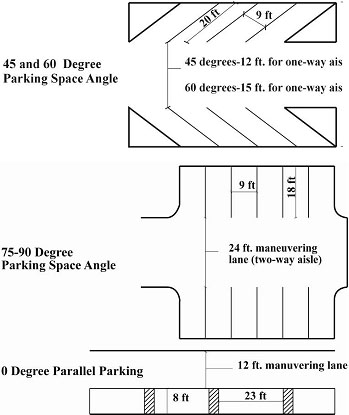
Dimensional requirements. Plans for the layout of the parking lot shall be in accordance with Table 24-231(1), and the following graphic, and show a total dimension across two (2) tiers of spaces and one (1) aisle (maneuvering lane).
Table 24-231(1)
Off-Street Parking Dimensional Requirements
(c)
Access.
(1)
Adequate ingress and egress to the parking lot by means of clearly limited and defined drives shall be provided for all vehicles.
(2)
All drives shall be surfaced in a manner equivalent to that which is provided for the parking areas under section 24-167, with a geometric design and deceleration lanes or tapers as required by the city engineer or, in accordance with the design requirements of the road commission for Oakland County or the Michigan Department of Transportation for county and state roads.
(3)
Driveways and parking lots must be designed to provide adequate access and circulation for fire trucks, garbage trucks, delivery vehicles and other large vehicles that will be expected to use the property. Dimensions for turning movements by these vehicles must be shown on a plan prior to the issuance of a building permit. Turning movement dimensions must be provided to demonstrate safe and adequate access to loading spaces and waste receptacles.
(d)
Driveway spacing. Minimum spacing between a proposed nonresidential driveway and an intersection either adjacent or on the opposite side of the street shall meet the requirements in Table 24-231(2), measured from the near edge of the proposed driveway to the near lane edge of the intersecting street or pavement edge for uncurbed sections. For sites with insufficient street frontage to meet the below requirements, the planning commission may require construction of the driveway on a side street, a shared driveway with an adjacent property, or construction of the driveway along the lot line farthest from the intersection.
Table 24-231(2)
Minimum Commercial Driveway Spacing from Street Intersection
(1)
Minimum spacing between two (2) nonresidential driveways shall be as provided in Table 24-231(3), determined based upon posted speed limits along the lot frontage. The minimum spacing indicated below is measured from centerline to centerline.
Table 24-231(3)
Minimum Commercial Driveway Spacing from Another Driveway
(2)
To reduce left turn conflicts, new driveways shall be aligned with those across the street, where possible. If alignment is not possible along major streets, driveways shall be offset from those on the opposite side of the street a distance equal to subsection (b), above.
(3)
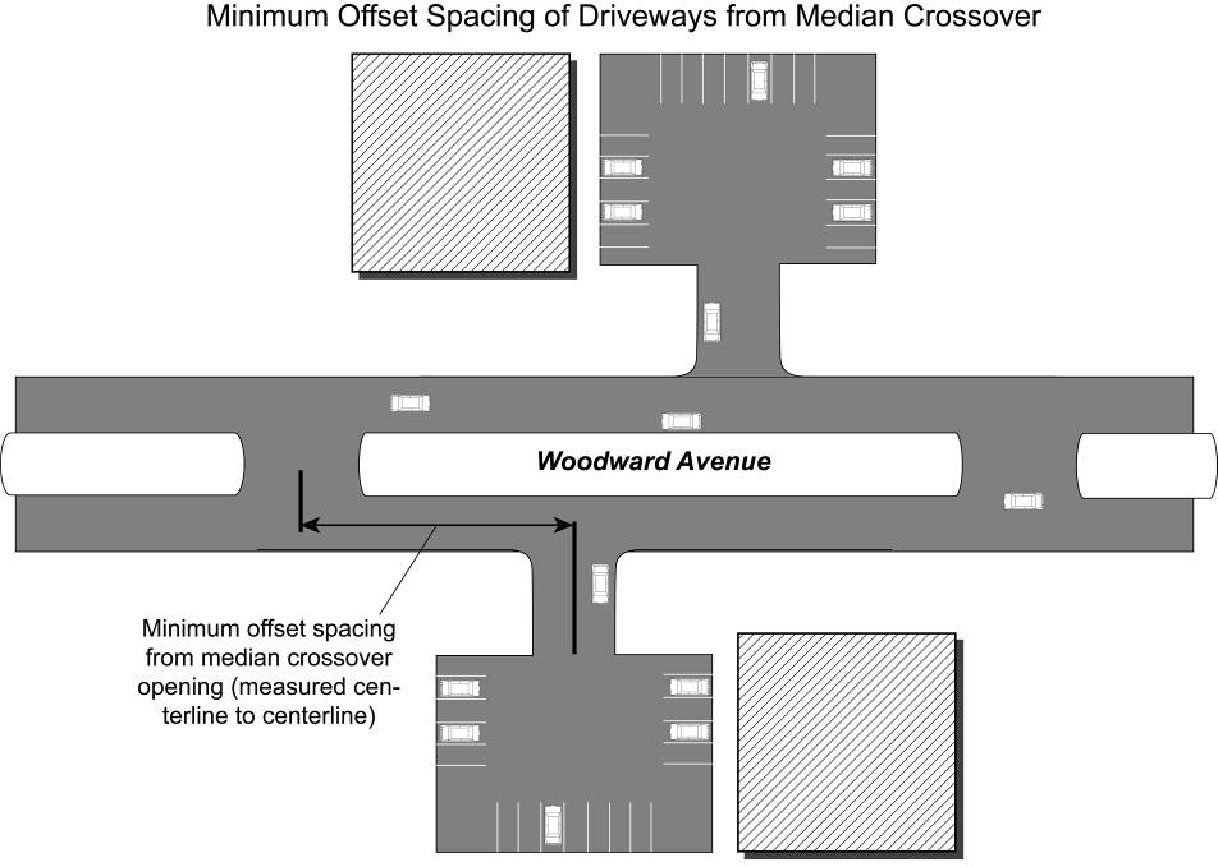
Access points along Woodward Avenue shall also be located in consideration of the need for sufficient length to safely accommodate weaving maneuvers to or from median crossovers across travel lanes to driveways. Access points shall generally be offset a minimum of two hundred fifty (250) feet from the crossover, centerline to centerline, provided that, in some cases, a shorter dimension may be acceptable for a use that generates low traffic volumes or direct alignment may be acceptable; in both cases such location must be approved by the Michigan Department of Transportation.
(4)
In the case of expansion, alteration or redesign of an existing development, where it can be demonstrated that preexisting conditions prohibit adherence to the minimum driveway spacing standards, the planning commission may modify the driveway spacing requirements. Any modification shall be the minimum necessary, but in no case shall spacing of a full-access driveway be less than sixty (60) feet, measured centerline to centerline. As an alternative, the planning commission may restrict movements to only right turns.
(5)
The number of driveways serving a property shall be the minimum number necessary to provide reasonable access and access for emergency vehicles, while preserving traffic operations and safety along the public street. Access shall be provided per separately owned lot by means of an individual driveway, shared driveway or via a service drive. Additional driveways may be permitted for property meeting one (1) of the following:
a.
One (1) additional driveway for properties with a continuous frontage of over three hundred (300) feet, and one (1) additional driveway per additional three hundred (300) feet of frontage.
b.
Two (2) one-way driveways may be permitted where the frontage is at least one hundred twenty five (125) feet.
c.
A traffic impact study determines additional access is justified without compromising traffic operations along the public street.
(e)
Landscaping. One (1) canopy tree shall be required for each ten (10) parking spaces, rounded upward to the nearest whole number, in accordance with the following:
(1)
Canopy trees shall be a minimum of two and one-half (2½) inch caliper at the time of planting. Canopy trees shall be species of deciduous trees that normally grow to a mature height of twenty-five (25) feet or more. Up to twenty-five (25) percent of the required trees may be evergreen trees, which must be a minimum of seven (7) feet tall, at locations that do not obstruct traffic visibility. All trees shall be tolerant of a parking lot environment and adaptive to the Michigan climate.
(2)
Required parking lot tree trunks shall be placed within the parking lot or within ten (10) feet from the edge of the pavement.
(3)
At least one-half (½) of the required trees shall be placed within islands in the paved portion of the parking lot that includes lawn, or planting area and curbing. The planning commission may waive the curbing requirement for low-impact stormwater management facilities such as rain gardens or bioswales, based upon the recommendation of the city engineer.
(4)
Canopy trees shall have a minimum clearance of four (4) feet between the ground and the lowest branches.
(5)
Landscape islands shall be dispersed throughout the parking lot to break up pavement and help direct pedestrian and traffic flow.
(6)
Landscaped parking lot islands shall be a minimum of three hundred (300) square feet, a minimum width of eighteen (18) feet, a depth two (2) feet shorter than the adjacent parking space with a minimum radii of ten (10) feet at ends facing main circulation aisles and one (1) foot for other locations.
(7)
Screening, landscaping and lighting shall be provided in keeping with the requirements of section 24-235.
(8)
The planning commission may require additional landscaping, beyond the requirements above, for the purpose of minimizing views of vehicles where any front yard parking is proposed in the "City Center" area identified in the master plan.
(f)
Screening.
(1)
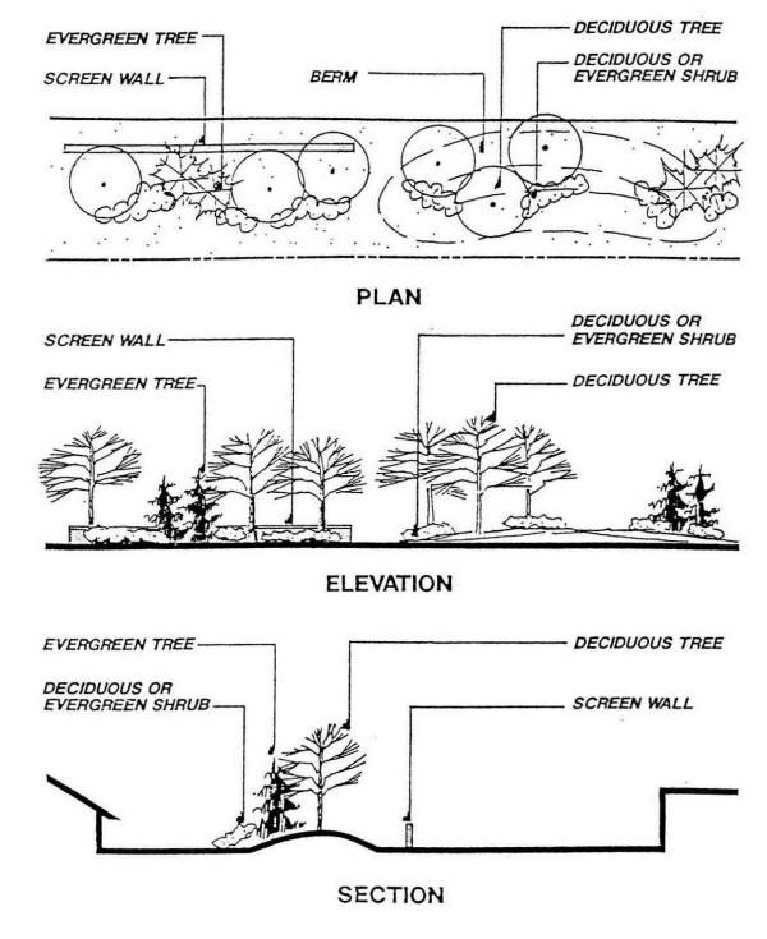
Off-street parking areas for all uses, except for single-family dwelling units, shall be provided with a continuous and essentially obscuring face brick or stone wall or a landscaped earth berm, not less than four (4) feet nor more than six (6) feet in height, measured from the surface of the parking area, adjusted to reflect topography, on all sides where the next zoning district is designated as a residential district. Where a berm is used, it shall have a maximum slope ratio of 4:1 and be landscaped with a minimum of one (1) canopy tree, two (2) evergreen trees and four (4) shrubs for each forty (40) feet of common property line length.
(2)
In C-1 commercial districts and in O-1 and O-2 office districts an essentially obscuring face brick or stone wall or landscape berm shall be constructed on a side lot line where such lot line separates adjacent parking areas under separate ownership. The length and location of each wall or berm must be approved by the planning commission and shall be such as to contain within the site or minimize adverse influences of automobile parking and drives provided thereon. The wall or berm shall be not less than four (4) feet nor more than six (6) feet in height, as measured from the surface of the adjacent parking area, to reflect topographic characteristics.
(g)
Maintenance.
(1)
Parking lot pavement, curbing, pavement markings, signs, light fixtures and other similar items must be properly maintained to ensure visibility, clarity and good condition.
(2)
All parking lots shall be maintained free of trash and debris.
(3)
All landscaping shall be maintained in a healthy and orderly state. Any dead or diseased plants shall be removed and replaced with the same or similar species within one (1) year from the time that the plant dies. Trees required by this section must be maintained so long as they remain healthy and shall not be removed unless approved by the city.
(h)
Parking structures. Parking structures shall meet the following requirements:
(1)
Parking stall and driving aisles shall meet the parking lot layout requirements of section 24-231, above.
(2)
Internal arrangement and design shall be reviewed by the city engineer for appropriate grades, traffic circulation, aisle length, column spacing, ceiling height, exit stairwell and elevator location.
(3)
Storage areas for entering and exiting traffic shall be long enough to minimize backups of traffic onto surrounding streets or within the garage.
(4)
Adequate lighting shall be provided for the safe movement of vehicles and pedestrians and for the security of patrons and parked vehicles.
(5)
Parking structures shall be set back the same distance as required for principal buildings.
(6)
Parking structures shall be architecturally compatible with the buildings they serve. Building materials and colors shall match or complement the principal building. Openings within the facade of the parking structure shall have proportions that are similar to the fenestration of the principal building on the site.
(i)
Parking lot lighting. Parking lot lighting shall be provided in accordance with section 24-250.
(Ord. No. 188, § 1606, 11-8-83; Ord. No. 383, § 3, 5-11-10)
Sec. 24-232. - Off-street loading and unloading.
(a)
Location. On the same premises with every building, structure or part thereof used in the receipt or distribution of vehicles or materials or merchandise, there shall be provided and maintained in the rear yard on the lot adequate off-street space(s) for standing, loading and unloading in order to avoid undue interference with public use of parking area or dedicated rights-of-way. The planning commission may permit central loading areas to be shared by multiple uses, such as a retail shopping center or office park.
(b)
Size. The size of all required loading/unloading spaces shall be at least ten (10) feet by fifty (50) feet or five hundred (500) square feet in area, with a clearance of at least fourteen (14) feet in height. The planning commission may modify this requirement for uses that will involve smaller delivery trucks, such as offices. The size and location of the loading area shall be sufficient to prevent undue interference with adjacent required parking spaces, maneuvering aisles, or traffic flow on streets.
(c)
Approaches. Loading dock approaches shall be constructed of concrete with a base sufficient to accommodate expected vehicle weight.
(Ord. No. 188, § 1606, 11-8-83; Ord. No. 383, § 4, 5-11-10)
Sec. 24-233. - Plant materials.
Whenever in this chapter a greenbelt or planting is required, it shall be planted to completion within three (3) months, and no later than November 30, from the date of issuance of a certificate of occupancy if the certificate is issued during the April 1 to September 30 period; if the certificate is issued during the October 1 to March 30 period, the planting shall be completed no later than the ensuing May 31; plantings shall thereafter be reasonably maintained, including permanence and health of plant materials to provide a screen to abutting properties and including the absence of weeds and refuse. Spacing, as required by this section, shall be provided in any required greenbelt or planting.
(1)
Plant material spacing and size.
a.
Plant material shall not be located within four (4) feet of the property line.
b.
Where materials are placed in two (2) or more rows, plantings shall be staggered in rows.
c.
Evergreen trees shall not be less than seven (7) feet in height. When planted in informal groupings, they shall be spaced not more than twenty (20) feet on centers. When planted in rows, they shall be spaced not more than twelve (12) feet on centers.
d.
Narrow evergreen trees shall not be less than five (5) feet in height. When planted in informal groupings, they shall be spaced not more than ten (10) feet on centers. When planted in rows, they shall be planted not more than five (5) feet on centers.
e.
Large shrubs shall not be less than thirty (30) inches in height. When planted in informal groupings, they shall be spaced not more than six (6) feet on centers. When planted in a single row, they shall not be more than four (4) feet on centers.
f.
Small shrubs shall not be less than thirty (30) inches in spread. They shall be planted not more than four (4) feet on centers.
g.
Large deciduous trees shall not be less than two and one-half (2½) inches in caliper. When placed in informal groupings, they shall be planted not more than thirty (30) feet on centers.
h.
Small deciduous trees shall not be less than two (2) inches in caliper. When planted in informal groupings, they shall be spaced not more than fifteen (15) feet on centers.
(2)
A mixture of plant materials (evergreen and deciduous trees and shrubs) is suggested in all landscape plans as a protective measure against disease and insect infestation. Plant materials used together shall meet the following on-center spacing requirements:
SUGGESTED PLANT MATERIALS
TREES NOT PERMITTED
DISTANCE BETWEEN PLANT MATERIALS
(3)
Whenever a greenbelt or plant materials are required under the provisions of this chapter, a detailed planting plan of such greenbelt shall be submitted for approval prior to the issuance of a building permit. The planting plan shall indicate, to scale, the location, spacing, starting size and description for each unit of plant material proposed for use within the required greenbelt area.
(4)
The planting plan shall be reviewed relative to:
a.
The proper spacing, placement and location of plant materials relative to the length and width of greenbelt so as to ensure that the required horizontal and vertical obscuring effect of proposed land uses will be achieved;
b.
The selection of plant materials so that root systems will not interfere with public utilities and so that fruit and other debris (other than leaves) will not constitute a nuisance within public rights-of-way or to abutting property owners;
c.
The proposed relationship between deciduous and evergreen plant materials so as to ensure that the desired obscuring effect will be accomplished;
d.
The size of plant material (both starting and ultimate) to ensure adequate maturity and optimum screening effet of proposed plant materials.
(Ord. No. 188, § 1607, 11-8-83)
Sec. 24-234. - Use restriction.
No portion of a lot used in complying with the provisions of this chapter for yards, lot area per family or percentage of lot occupancy, in connection with an existing or projected building or structure, shall again be used as part of the lot required in connection with any other building or structure existing or intended to exist at the same time. Where less than the total lot or parcel area is used to comply with the provisions for yards, lot area per family or percentage of lot occupancy, the plot plan shall be drawn to designate that portion used for such compliance which may not thereafter be used again and that portion not used for such compliance which may not thereafter be used again and that portion not so used and which may be used at some future time for purposes of additional construction. When the total area of a lot or parcel is required for a proposed development, this fact shall be entered on the plot plan indicating that no additional development capacity is available for that parcel.
(Ord. No. 188, § 1608, 11-8-83)
Sec. 24-235. - Landscape open space.
(a)
Where parking and vehicular circulation space is provided in any zone except one-family residential districts, such parking and circulation space shall be effectively screened from public rights-of-way and/or from any adjacent residential districts by one (1) or more of the following means:
(1)
Buildings in accordance with all applicable codes and ordinances of the city.
(2)
Plant materials as specified in section 24-233.
(3)
Earth-molding or a differential in topography not less than four (4) feet in height measured from the surface of the parking area, and so designated as to minimize the view of parked cars or paved surface.
(4)
A continuous obscuring face brick or stone wall not less than four (4) feet and not more than six (6) feet in height measured from the surface of the parking area, adjusted to reflect topographic characteristics. Whenever such wall is required, all land between such wall or fence and the lot line or boundaries of P-1 districts shall be kept free from refuse and debris and shall be landscaped with deciduous or evergreen plants, and ornamental trees of height and size and density as approved by the planning commission. The ground area shall be planted and kept in lawn. All such landscaping and planting shall be maintained in a healthy, growing condition, neat and orderly in appearance.
(5)
Parking decks, underground garages or other effectively screened parking structures.
(b)
All landscaping plans shall be submitted to the planning commission for approval as to suitability of planting material and arrangement thereof, in accordance with the provisions of the preceding paragraph.
(c)
Where lighting facilities for parking or exteriors of buildings are provided, they shall be so arranged or so screened by landscaping or other means as to reflect the light away from residential districts and public rights-of-way.
(d)
For the purposes of computing the landscaped open space as required in section 24-196, the following shall apply:
(1)
Impervious surface areas intended solely for pedestrian walkways or plant holders or structures that have no purpose other than for decoration, such as, but not limited to, sculptures and pieces of art, shall be included as open space, provided that such areas shall not exceed thirty (30) percent of the total required landscaped open space.
(2)
Patios or terraces, including those portions of patios and terraces which can be used for pedestrian walkways, shall not be calculated as open space.
(3)
Tennis courts, sports courts and other recreational courts, whether pervious or impervious, shall not be calculated or included as open space.
(4)
Impervious surfaces adjacent to swimming pools and/or cabana areas shall not be calculated as open space.
(5)
Only those portions of planting islands within parking lots, and open space area at the perimeter of parking lots, which are located beyond the maximum vehicle overhang as permitted in section 24-231(4) shall be included as landscaped open space. The minimum width of a planter island shall be four (4) feet, exclusive of the vehicle overhang area.
(6)
Necessary drives of a width not exceeding ten (10) feet and the length being the single most direct route between the road right-of-way and a garage bay area not exceeding twenty (20) feet in width and twenty (20) feet in depth may be included as open space. Any area of a drive exceeding those dimensions are not considered open space.
(Ord. No. 188, § 1609, 11-8-83; Ord. No. 303, § 2, 11-13-97; Ord. No. 439, § 1, 10-7-19; Ord. No. 441, § 3, 1-14-20; Ord. No. 452, § 2, 7-12-22)
Sec. 24-236. - Site plan review (all districts).
(a)
By planning commission. Preliminary and final site plans shall be submitted to the planning commission for approval of:
(1)
Any use or development for which the submission of a site plan is required by any provision of this chapter;
(2)
Any development, except one-family residential, for which off-street parking areas are provided as required in section 24-230;
(3)
Any use in an A-5, A-6, B-1, C-1, O-1, O-2, I-1 and P-1 district lying contiguous to or across a street from a one-family residential district;
(4)
Any use which lies contiguous to a major thoroughfare;
(5)
All residentially related uses permitted in one-family districts such as but not limited to churches and golf and country clubs.
(6)
Any site condominium project shall be subject to the requirements of this section and also all of the requirements of section 24-245.
(7)
Any proposed subdivision shall be subject to the requirements of this section as well as all of the requirements of Article III, Subdivision Controls, of Chapter 19 of the Bloomfield Hills' City Code. In the event that there are any conflicts between the requirements of this section and the requirements of Article III, Subdivision Controls, of Chapter 19 of the Bloomfield Hills' City Code shall control.
(b)
Considerations. In reviewing the site plan, the planning commission shall consider:
(1)
One-family development on the basis of a subdivision layout.
(2)
The location and design of driveways providing vehicular ingress to and egress from the site in relation to streets giving access to the site and in relation to pedestrian traffic.
(3)
The traffic circulation features within the site and location of automobile parking areas, and may make such requirements with respect to any matters as will ensure:
a.
Safety and convenience of both vehicular and pedestrian traffic both within the site and in relation to access streets;
b.
Satisfactory and harmonious relations between the development on the site and the existing and prospective development of contiguous land and adjacent neighborhoods.
(4)
The adequacy of essential public facilities and services such as highways, streets, police and fire protection, drainage structures, refuse disposal, utilities and schools.
(5)
The desirability and stability of the proposed development in order to ensure the contiguous property will not be unreasonably affected.
(6)
The planning commission may further require landscaping, fences and walls in pursuance of these objectives and same shall be provided and maintained as a condition of the establishment and the continued maintenance of any use to which they are appurtenant.
(c)
Form, contents of site plans. Every preliminary and final site plan submitted to the planning commission in accordance with the requirements of this section shall contain such information and be in such form as prescribed in this section. No site plan shall be approved until same has been reviewed for compliance with the standards of all applicable ordinances of the city.
(d)
Rules for site plan submission (all zoning districts).
(1)
Statement of purpose. The requirements set forth in this section are intended to provide the sponsors of projects requiring site plans with guidelines which will expedite the submission and review of plans, and which will generate clear understandings between the developer and the city and its representative.
(2)
Application for site plan review.
a.
Submission of application. In order to be placed on the agenda and considered, an application for site plan review, with all requisite material, shall be delivered to the office of the city clerk in accordance with the schedule adopted by city commission.
b.
Contents of site plan review application. The application shall state:
1.
The legal description of the land involved. If separately described parcels of land owned by more than one (1) party are involved, then all the information required in this and the following subsections shall be separated and supplied as to each individual parcel.
2.
The purpose of the proposed site development.
3.
The name of the owner of the fee simple legal and equitable title to the land, and current address and telephone number of same, and if an artificial entity, the name, address and telephone number of the natural person who is the legal representative.
(3)
Material to accompany application. The material required to accompany an application is divided essentially into the following categories:
a.
An area map showing the site location relative to the section, major thoroughfares, public lands and abutting uses. Property lines shall be submitted in eleven (11) copies, one (1) of which shall be a reproducible transparency. The area map may be placed on a sheet of the topographic map if suitable space is available. Otherwise, the area map shall be drawn on a separate sheet either eight and one-half (8½) by eleven (11) inches or eleven (11) by fifteen (15) inches.
b.
Plans and data displaying the characteristics of the site and its surroundings (see subsection (d)(4), Information concerning existing condition of site and surrounding area).
c.
Plans and data displaying the proposed developed condition of the site, including topographic alterations, improvements, facilities and structures. The site plan shall show complete and detailed information with exact dimensions which, when approved by the planning commission, shall be understood to represent a firm commitment, and from which actual site development shall not deviate excepting upon approval by the planning commission of a revised site plan.
(4)
Information concerning existing condition of site and surrounding area. The following information displaying the characteristics of the site and its surroundings shall be provided:
a.
Property survey. There shall be supplied a property survey presented on a drawing at suitable scale, signed and sealed by a registered land surveyor with notation of the date of survey. The property survey information may be presented on the required topographic survey drawing. If not a separate drawing, the property survey shall be submitted in eleven (11) legible copies, one (1) of which shall be a clearly reproducible transparency.
b.
Topographic survey. There shall be supplied a topographic map made, signed and sealed by a registered land surveyor or a civil engineer licensed to practice in the state. Accurate photogrammetric surveys made under the direction of and verified by a registered land surveyor or civil engineer and with supplemental details and data added by one (1) of the foregoing will be acceptable, and shall include:
1.
Scale and sheet size. The topographic survey shall be presented on plan or map drawn to a standard engineer's scale not smaller than fifty (50) feet to one (1) inch. Plan sheets shall be not larger than thirty (30) inches by forty-two (42) inches. Additional matching sheets shall be used if the area covered at the scale used exceeds the thirty-inch by forty-two-inch size.
2.
Datum. All elevations shall be on U.S.C. and G.S. datum.
3.
Information required. The topographic map shall be drawn true to scale throughout and shall show at least the following information:
i.
The surface configuration and elevation of the land and all abutting streets, highways and alleys.
ii.
All existing structures on the site and on abutting property within such distance beyond the property lines as the topographic map is required to extend as provided in this section for various sizes and types of sites. The dimensions, type of construction and use of each structure shall be noted.
iii.
All single trees having trunk diameter of four (4) inches or more at four (4) feet above the ground shall be shown and identified. Wooded areas shall be delineated by symbolic lines tracing the spread of outermost branches and shall be described as to the general sizes and kinds of trees contained.
iv.
All watercourses including defined intermittent drainage lines shall be located and identified as to character and size.
v.
All bridges and culverts which provide passage of stormwater onto or away from the site, under abutting roads, shall be shown with details of sections, length and elevation listed.
vi.
All recorded easements across the site shall be shown, as shall all evidences of possible unrecorded easements such as existing roadways, pipelines, pole lines, etc.
vii.
The details of improvement of abutting streets and thoroughfares shall be shown, including width and kind of surfacing, curbs, shoulders and ditches (all with all dimensions and elevations requisite to provide a clear definition of existing conditions). Trees or planting within street or highway right-of-way shall be shown.
viii.
All existing roadways or driveways entering abutting streets or thoroughfares from the site, or from adjoining land within the limits of survey overlaps hereinafter listed, and all streets, roadways or driveways entering the opposite sides of abutting streets or highways within the same limits, shall be delineated on the map.
ix.
The use of properties on the opposite side of abutting streets or thoroughfares, and of all properties abutting the site shall be noted on the map.
x.
Where abutting thoroughfares have been officially designated for eventual widening, the existing centerline and the proposed future right-of-way line shall be shown.
xi.
All existing utilities including storm and sanitary sewers, water mains, gas mains, electric and telephone lines, located in streets, alleys or easements abutting the site shall be identified and shown in their true locations and the locations dimensioned in relation to right-of-way or easement lines. All visible utility structures, including manholes, wells, shut-off boxes and catchbasins shall be shown in their true locations. Field measured elevations of flow lines of storm and sanitary sewers shall be shown. Known proposed utility lines shall also be shown and identified.
4.
Extent of topographic survey and map; details of representations of land configuration. The extent and type of topographic survey and map shall be as follows:
i.
For a site of not more than three (3) acres, excluding the existing right-of-way of any undedicated thoroughfare and the declared future right-of-way of any existing thoroughfare, the survey and map shall extend to a distance of at least fifteen (15) feet beyond the lines between the site and abutting properties and shall cover abutting streets or thoroughfares to distances not less than thirty (30) feet beyond the limits of the site.
ii.
For a site of more than three (3) acres and not more than ten (10) acres excluding the existing right-of-way of any undedicated thoroughfare and the declared future right-of-way of any existing thoroughfare, the survey and the map shall be extended at least forty (40) feet beyond the lines of abutting properties and shall cover abutting streets or thoroughfares to distances of not less than one hundred (100) feet beyond the limits of the site.
iii.
For a site of more than ten (10) acres, the survey and map shall be extended at least one hundred (100) feet beyond the lines of abutting properties and shall cover abutting streets or thoroughfares to a distance of not less than two hundred (200) feet.
iv.
Surface configuration of the surveyed area shall be shown by contours which shall be at elevation intervals as follows:
Contour elevations shall be identified at sufficiently frequent intervals to make the map readily comprehensible. At each of the listed contour intervals, every fifth contour shall be accepted. Elevation in figures shall be noted at highest points within hilltop contours, at lowest points within depression contours and at control points between equal contours denoting saddle formation. Within street and thoroughfare rights-of-way, contours shall be supplemented by noting in figures the elevation of all controlling points.
(5)
General requirements.
a.
Responsibility. A site plan may be prepared under the principal direction of a registered architect, registered civil engineer, registered community planner, registered land surveyor or registered landscape architect (licensed to practice in the state).
b.
Details.
1.
The site plan shall be prepared at the same scale and in the same sheet arrangement as the topographic map so as to permit ready comparison.
2.
Each sheet of the site plan shall show a north arrow and a notation of the drawing scale. The principal sheet of the plan shall show a graphic scale as well as scale in figures.
3.
The name of the proposed development and the name and address of the proprietor or responsible developer shall appear on each sheet of plan. Each sheet of plan shall bear a drawing number and date of completion.
4.
Any drawing altered after initial submission to the planning commission shall bear notations stating the date and nature of each revision.
5.
The survey dimensions of the site shall be shown on the site plan.
6.
All abutting thoroughfare and street rights-of-way with center line indicated and all existing street improvements which will be undisturbed by the site development shall be reproduced on the site plan.
(6)
Additional requirements.
a.
Preparation. With the requirements of subsection (d)(2), Application for site plan review, satisfied, a preliminary site plan shall present the proposed development to at least meet the minimum requirements set forth in this chapter: section 24-196, Schedule of regulations; article IV, General Provisions, and article III, General Exceptions. The sections applying to all site plans would include, but are not limited to:
1.
Section 24-196 (including footnotes), Height, bulk, density;
2.
Section 24-211(7), General exceptions, rooftop equipment;
3.
Section 24-230, Parking requirements;
4.
Section 24-231, Off-street parking space layout;
5.
Section 24-233, Plant materials;
6.
Section 24-235, Landscaped open space.
The plan shall be completely dimensioned and shall be specific relative to data presented.
b.
General details. The following data, where applicable, shall be presented with each site plan:
1.
A statement of land area, in acres, and each land type, including:
i.
Total area of site in question.
ii.
Area in existing and proposed public or dedicated private streets in each land use type.
iii.
Total area falling within subaqueous, swampy or submerged bottomland of lakes or streams.
2.
A statement of density projected for the site including the number of total rooms and/or dwelling units projected for the site eligible for computation of density.
3.
A statement, with all computations included, indicating usable area for the computation of off-street parking needs, and the proposed number of spaces provided. The parking layout shall be fully dimensioned.
4.
On a separate sheet, the following details shall be superimposed on the site plan:
i.
Finished elevations of grading and paving shall be calculated and shown on the plan.
ii.
The storm drainage system shall be shown in specific location on the plan, with catchbasins, manholes and deflection points in ditches (if any) positioned by dimension. Controlling flow line elevations shall be shown.
iii.
On-site sanitary sewers, if any, shall be shown in specific location on the plan, with manholes and building sewer connection locations positioned by dimensions. Controlling flow line elevations shall be shown.
5.
Structure dimensions and locations.
i.
Each structure shall be completely dimensioned in plan or alternatively if the structure outline involves many offsets, the preliminary plan may show a rectilinear envelope within which the structure will be totally contained. If the latter alternative is adopted, spacing between envelopes, property boundaries, roadways and other features shall be not less than the minimum spacing for structures in the same circumstances.
ii.
The location and orientation of each structure (or structure envelope) shall be positively fixed on the plan by dimensions and directions.
6.
Off-street parking layouts, landscape plans and wall details shall be fully dimensioned and specified in detail so as to meet the requirements of those sections of this chapter pertaining to the related facilities and improvements.
(e)
Conditional approvals.
(1)
A preliminary plan may be approved by the planning commission without having the following material finalized:
a.
Landscape plan;
b.
Floor plan;
c.
Grading plan.
A statement must be furnished on the preliminary plan by the sponsor of the project indicating that the final plan will meet the requirements of this chapter.
(2)
The final plan shall show all details and requirements of this chapter prior to final approval. Conditional approval shall not be permitted in the final plan stage.
(f)
Duration of approval.
(1)
Preliminary plans approved shall remain effective for a period of six (6) months from the date of approval. If final plans are not submitted within this period, the approval of preliminary plans shall cease to be effective.
(2)
Approval of a final site plan by the planning commission shall remain firm for a period of one (1) year, during which construction of the development covered by the plan shall be initiated and carried on with reasonable diligence. If construction is not initiated within one (1) year from the date of approval of the site plan, such failure shall be considered abandonment of the plan and shall render its approval null and void. If construction, once started under an approved site plan, is discontinued for a period of six (6) months, the undeveloped portion of the plan shall be considered abandoned and its approval shall be null and void. If extended approval is desired for a site plan, upon which construction is not started within one (1) year, or for the uncompleted portion of a site plan upon which work has been discontinued for six (6) months, a new application shall be made to the planning commission who will reconsider the plan in the light of regulations and conditions then existing. The duration of any extension of approval granted by the planning commission shall be determined by the planning commission, but in no case shall be more than one (1) year, for any one (1) extension.
(g)
Fees. Fees for review of site plans shall be established from time to time by a resolution of the city commission.
(h)
Engineering plans, specifications, inspection. Subsequent to site plan approval, and before any construction proceeds, complete engineering plans and specifications for construction of storm sewers and drains, sanitary sewers, water mains, roads and parking area improvements, all conformed to the city's standard requirements, shall be submitted for review and approval by the city and, when required, by county and state agencies. Construction of any of the above improvements shall not be commenced until the requisite deposit to cover inspection costs has been paid to the city and a construction permit is issued.
(i)
Improvements.
(1)
As used in this section, "improvements" means those features and actions associated with a project which are considered necessary by the planning commission in granting site plan approval, to protect natural resources or the health, safety and welfare of the residents of the city and future users or inhabitants of the proposed project or project area, including roadways, parking, lighting, utilities, sidewalks, screening, drainage and similar features. Improvement does not include the entire project which is the subject of site plan approval.
(2)
To ensure compliance with this chapter any conditions imposed by this chapter, the planning commission may require that a cash deposit, certified check or irrevocable bank letter of credit, acceptable to the city, covering the estimated cost of improvements associated with a project for which site plan approval is sought, be deposited with the city clerk to ensure faithful completion of the improvements. The performance guarantee shall be deposited at the time of the issuance of the building permit. The planning commission shall not require the deposit of the performance guarantee prior to the time when the city is prepared to issue the permit. The planning commission shall establish procedures whereby a rebate of any cash deposits in reasonable proportion to the ratio of work completed on the required improvements will be made as work progresses.
(Ord. No. 188, § 1610, 11-8-83; Ord. No. 242, § 1, 12-11-90; Ord. No. 363, § 1, 11-13-07; Ord. No. 386, § 1, 6-8-10)
Sec. 24-237. - Purpose.
The purpose of this section is to establish standards which preserve and enhance the physical appearance and natural beauty and strengthen the character of the city as recommended in the master plan. These standards are also intended to foster a more attractive economic and business climate which protects the general health, safety and welfare of the community.
(Ord. No. 421, § 1, 11-10-15)
Sec. 24-237(A). - General rule.
The design standards in this section apply to all buildings, building alterations other than routine maintenance and site plans associated with all zoning districts, except those in one-family dwelling districts.
(Ord. No. 421, § 1, 11-10-15)
Sec. 24-237(B). - Administration.
(1)
Requirement for approved design: nature of review. Except for one-family dwellings, no permit for the erection, construction, alteration or repair other than routine maintenance of any building or structure or any site development which involves an exterior design feature shall be issued by the city unless and until the planning commission grants an approval which conforms with the design standard requirements as provided in this section. The planning commission may determine that no exterior design feature is involved in the work for which the approval is sought, in which case the planning commission may so specify.
(2)
Application. Drawings and plans for site development and erection, construction, alteration or repair of any building or structure shall be required as part of the site plan review application. Site development plans shall conform to the requirements described in section 24-236. Building and structure plans shall be at a scale of not smaller than one (1") inch equals twenty (20') feet and conform to all city requirements. All plans shall provide sufficient detail to illustrate clearly the design for which approval is sought. Such plans shall show the following:
(a)
Site plans shall show existing conditions, topography, trees (both public and private) and natural features, all structures and uses, improvements, public streets, rights-of-way, sidewalks, zoning, public and private easements and restrictions, and the official grade of public rights-of-way, as established by the city engineer or the county road commission for the subject site and all property within the distance required by section 24-236.
(b)
Architectural elevations shall show all exterior building elevations, colors of exterior walls, trims and roofs, lighting materials, ornamental, pictorial or decorative material to be used in or about the exterior of the structure. Samples of building materials and colors shall be submitted.
(c)
Such other information as may be required by the planning commission to permit reasonable consideration of the application.
(Ord. No. 421, § 1, 11-10-15)
Sec. 24-237(C). - Design standards.
(1)
Criteria. The design standards herein provide criteria which shall be considered in the design of the site, buildings and structures, plantings, signs, site accessories and other miscellaneous structures which are observed by the public. These criteria are not intended to restrict imagination, innovation, or variety, but to provide a guide for decision making that will maintain the character and enhance the visual appearance of the city. The standards in this section are a supplement to regulations and requirements contained in other sections of this chapter including, but not limited to; area, bulk and other requirements of particular zoning districts, schedule of regulations, general provisions which govern off-street parking, plant materials, landscape open space and enclosure of exterior service areas. The standards shall be applied during the site plan review process.
(2)
Site and building design.
(a)
To the extent reasonably feasible, building design, scale and location on site shall be compatible with the character of the site, adjacent buildings, and surrounding area.
(b)
Architectural style is not restricted. Evaluation of appearance of a project shall be based on the quality of its design and relationship to surroundings. Harmony in texture, lines, and masses is required.
(c)
Adjacent buildings of different architectural styles shall be transitioned by such means as screens, site breaks, and materials.
(d)
Monotony of design in single or multiple building projects shall be avoided. Variation of building detail and siting shall be used to provide visual interest. In multiple building projects, variable siting of individual buildings may be used to prevent a monotonous appearance.
(e)
Buildings shall be constructed of quality, durable materials such as brick and stone. Synthetic finishes such as Exterior Installation Finishing System (EIFS), vinyl and aluminum shall be limited to building accents unless unusual conditions mandate their expanded use.
(f)
Building materials shall be selected for suitability to the character and type of building and the design in which they are used. Buildings shall have the same materials, or those which are architecturally harmonious, used for all building walls and other exterior building components wholly or partly visible from public ways.
(g)
In a building design where the structural frame is exposed to view, the structural materials shall meet the criteria for materials described in this section.
(h)
Building components, such as windows, doors, eaves, and parapets, shall have good proportions and relationship to one another.
(i)
Colors shall be harmonious with the character of the site, buildings, and surrounding area and not used to draw attention, i.e. serve as a sign.
(j)
Mechanical equipment or other utility hardware on roof, ground, or buildings shall be screened from public view with materials harmonious with the building, or they shall be located so as not to be visible from any public ways or residential district.
(k)
Exterior lighting shall be part of the architectural concept. Fixtures and all exposed accessories shall be harmonious with building design.
(l)
Refuse and waste removal areas, service and storage yards, and exterior work areas shall be screened from view from public ways using materials as stated in criteria for equipment screening.
(m)
Parking areas shall be designed to avoid front yard parking to the extent practical and include decorative elements, building wall extensions, plantings, berms or other innovative means so as to largely screen parking areas from view from public ways.
(n)
Newly installed utility services and service revisions necessitated by exterior alterations shall be underground, unless not reasonably feasible.
(o)
All new fences, walls, gates and columns to be located on properties in commercial, office or institutional zoning districts shall comply with the requirements of section 24-242(c) unless reviewed and approved by the planning commission.
(3)
Landscape and site treatment.
(a)
Landscape elements included in these criteria consist of all forms of planting and vegetation, ground forms, rock groupings, water features, and all visible construction except buildings and utilitarian structures. Landscape and site treatment shall complement and be compatible with the character of the site and surrounding area.
(b)
Where natural or existing topographic conditions contribute to beauty and utility of a development, they shall be preserved and developed. Modification to topography may be allowed (as permitted by ordinance) where it improves site appearance.
(c)
Landscape treatment shall be provided to enhance architectural features, strengthen vistas and important relationships, and provide shade. Spectacular effects shall be reserved for special locations only.
(d)
Unity of design shall be achieved by repetition of certain plant varieties and other materials, and by correlation with adjacent developments.
(e)
Attractive landscape transition to adjoining properties shall be provided.
(4)
Miscellaneous structures and site accessories.
(a)
Miscellaneous structures include any structures, other than buildings, visible to view from any public way. Site accessories include all objects not commonly referred to as structures and located outside of buildings and in public view.
(b)
Miscellaneous structures and site accessories located on private property shall be designed to be part of the architectural concept of building design and landscape. Materials shall be compatible with buildings, scale shall be in proportion to site and buildings, and colors shall be in harmony with buildings and surroundings.
(c)
Lighting in connection with miscellaneous structures and site accessories shall meet the criteria applicable to the site, the landscape, the buildings and the signs.
(5)
Maintenance; planning and design considerations. Selections of materials and finishes shall consider their durability, wear and maintenance requirements, and visual appearance. Proper measures and devices shall be incorporated into the design for protection against the elements, neglect, damage and abuse and which provide for appropriate maintenance.
(Ord. No. 421, § 1, 11-10-15; Ord. No. 441, § 2, 1-14-20)
Sec. 24-237(D). - Appeals.
An appeal shall be taken by filing with the zoning board of appeals a notice of appeal specifying the grounds thereof pursuant to article VI, section 24-280.
The zoning board of appeals shall consider whether to uphold the decision in whole or in part or whether to reverse the decision in whole or in part.
(Ord. No. 421, § 1, 11-10-15)
Sec. 24-238. - Enclosure of exterior service areas.
In all zoned districts, except one-family residential, rubbish and garbage collection areas and other service areas shall be enclosed by an obscuring structural appurtenance not less than five (5) feet in height, or as approved by the planning commission. The structure, location and materials shall be acceptable to the planning commission as a prerequisite to issuance of a building permit.
(Ord. No. 188, § 1611, 11-8-83; Ord. No. 363, § 1, 11-13-07; Ord. No. 421, § 3, 11-10-15)
Editor's note— Ord. No. 421, §§ 1, 3, adopted November 10, 2015, added new provisions set out as §§ 24-237, 24-237(A)—24-237(D) and renumbered the remaining §§ 24-237—24-240 as §§ 24-238—24-241.
Sec. 24-239. - Access through yards.
For the purpose of this chapter, access drives may be placed in the required front or side yards so as to provide access to rear yards and/or accessory or attached structures. These drives shall not be considered as a structural violation in front or side yards. Further, any walk, terrace or other pavement serving a like function, and not in excess of nine (9) inches above the grade upon which placed, shall, for the purpose of this chapter, not be considered a structure and shall be permitted in any required yard.
(Ord. No. 188, § 1612, 11-8-83; Ord. No. 421, § 3, 11-10-15)
Editor's note— Former § 24-239. Please see editor's note, § 24-238.
Sec. 24-240. - Residential entranceway.
(a)
In all A-1 through A-6 and in B-1 residential districts, so-called entranceway structures, including, but not limited to, walls, columns and gates marking entrance to one-family subdivisions and multiple-family developments may be permitted and may be located in a required yard. Such entranceway shall comply with all codes and ordinances of the city and to ensure such compliance, the chief building inspector will certify to such compliance and issue permit for such use.
(b)
When such entrance ways include any sign as part of the structure, the zoning board of appeals shall review the proposal in accordance with the standards set forth in section 24-283 prior to the granting of approval by the chief building inspector. The zoning board of appeals shall require that any numerals, letters or graphics included as part of the structure shall refer only to the subdivision or development upon which located, and it shall find that such sign shall represent a minor portion of the structure.
(Ord. No. 188, § 1613, 11-8-83; Ord. No. 421, § 3, 11-10-15)
Editor's note— Former § 24-240. Please see editor's note, § 24-238.
Sec. 24-241. - Reception antenna facilities.
In all zoning districts, the installation and/or use of a reception antenna facility shall be considered to be a special land use, and shall be permitted only as an accessory use, and only as authorized in the following provisions of this section. Application for approval of this special land use shall be filed with the city clerk, who shall place the application on the agenda of the planning commission. Notice of the time and place of the planning commission's consideration of the application shall be given in the manner provided for zoning board of appeals hearings pursuant to section 24-282 of this chapter and by notice published in a newspaper of general circulation in the city not less than five (5) or more than fifteen (15) days before the hearing. Upon review of the application, the planning commission shall grant approval if it is found that the plans comply in all respects with this chapter.
(1)
Objectives. It is the intent and purpose of this section to provide reasonable regulation for the mounting of reception antenna facilities. The objectives of these regulations are:
a.
To promote safety, and prevent dangers to persons and property resulting from accidents involving antenna facilities which become dislodged in whole or in part and fall from building or structural mountings due to wind load, snow load, and/or other factors and/or instrumentalities which may reasonably be expected to impact upon such facilities when so mounted;
b.
To promote utilization of ground mounting for antenna facilities where reasonably feasible;
c.
To require the screening of ground-mounted facilities, and the minimizing of visibility with respect to roof or structure mounted facilities, in the interest of maintaining high architectural and aesthetic quality of property improvements, and in the interest of maintaining and preserving property values;
d.
To conditionally exclude from the operation of this section, conventional VHF and UHF television antennas, based upon the following findings: there is relatively small concern for wind and snow load issues; there has been a long demonstrated safety record; there has been an historical acceptance of such facilities from architectural and aesthetic standpoints; and, the cost of complying with the procedure for application and review would be greater in relation to the cost of purchasing and installing the facility;
e.
To balance and minimize the regulation of the place and manner of reception antenna installation based upon the right and duty of the city to promote and protect the public health, safety and welfare by the exercise of its police powers in relation to the right of the public to construct and use reception antennas to receive signals without unreasonable restriction.
(2)
Ground-mounted facilities. Ground-mounted reception antenna facilities shall be subject to the following conditions.
a.
The maximum height of any part of the facility shall be fourteen (14) feet;
b.
The antenna facility shall be located only in the rear yard area, but shall not be located in a required yard setback area;
c.
The antenna facility shall be obscured from view from adjacent properties by a screening wall or fence, berm, evergreen plantings, or a combination of such means, provided, if there is no conforming location on the property where the facility may be so obscured from view, screening shall be accomplished to the extent reasonably feasible, as proposed by the applicant and approved in the discretion of the planning commission, by the aforementioned means.
(3)
Roof- or structure-mounted facilities in single-family residential districts. In single-family residential districts, reception antenna facilities mounted on a roof of a building, or on a structure more than three (3) feet in height, shall be subject to the following regulations:
a.
The antenna facility itself shall not be larger than eight (8) feet in height and/or width. Moreover, the facility shall be of perforated, mesh or rod and/or pole construction, and shall not be of solid sheet or panel construction.
b.
A roof-mounted antenna facility shall be located on that portion of the roof adjacent to the rear yard on the property, and a structure-mounted facility shall be located in the rear yard area but shall not be located in a required yard setback area. The applicant may, however, propose in the application to situate the antenna facility in an alternative location, provided, the applicant shall set forth in the application an explanation as to why:
1.
The alternative location is as safe or safer; and
2.
Visibility of the antenna facility from adjacent properties, and by pedestrian and vehicular passers-by, is reduced or unaltered in relation to the rear yard orientation/location.
c.
No part of the antenna facility shall extend higher than;
1.
Three (3) feet above the ridge and/or peak of the roof, but in no event higher than the maximum height limitation in the zoning district, in the case of a building mounted facility; and/or
2.
Seventeen (17) feet above grade in the case of a structure mounted facility.
d.
If it clearly appears to the planning commission in the review of an application that the location of the antenna facility results in less than maximum safety and/or minimum visibility:
1.
In the case of a roof-mounted facility, the planning commission shall condition approval of the special use upon the facility being situated in a specified location, including a ground-mounted location, and/or upon the applicant proposing and the planning commission approving a satisfactory screening device; or
2.
In the case of a structure-mounted facility, the planning commission shall condition approval upon the facility being situated in a specified location and/or the facility being further screened by wall, fence, berm, evergreen plantings, or a combination of such means.
(4)
Roof- or structure mounted facilities not situated in single-family residential districts.
a.
Reception antenna facilities mounted on the roof of a building in districts other than a single-family residential district shall be subject to the requirements of section 24-211(7), and such requirements shall apply whether or not the facility would exceed the height limits of the zoning district.
b.
Reception antenna facilities mounted on a structure other than the roof of a building in districts other than single-family residential shall be subject to the regulations contained in subparagraphs a through d, inclusive, of paragraph (3) above.
(5)
Interpretation guidelines. The provisions of this section shall be interpreted to carry out the stated objectives of this section, and shall not be interpreted so as to impose costs on the applicant which are excessive in light of the purchase and installation cost of the antenna facility and accessory equipment.
(6)
Conditional exemption. Conventional VHF and/or UHF television antennas which have width and height dimensions of not more than one hundred thirty-five (135) inches and ten (10) feet, respectively, which are situated on that portion of the roof adjacent to the rear yard on the property, and which do not extend higher than eight (8) feet above the ridge and/or peak of the roof or the maximum height limitation in the zoning district, shall be exempted from the requirement of applying for and receiving approval under this section.
(7)
Reception antenna facility. No reception antenna facility shall be installed, constructed, erected, used, or moved upon property within the city without an accessory structure building permit required by section 24-258(d) being applied for and issued.
(Ord. No. 188, § 1614, 11-8-83; Ord. No. 197, § 2, 5-14-85; Ord. No. 201, § 1, 2-11-86; Ord. No. 203, §§ 2, 3, 7-8-86; Ord. No. 278, § 2, 5-10-94; Ord. No. 421, § 3, 11-10-15)
Editor's note— Former § 24-241. Please see editor's note, § 24-238.
Sec. 24-242. - Fences in residential districts.
(a)
Permits required. No fence, wall, gate or column structure shall be erected or replaced without the prior issuance of a zoning permit from the city. Any front or side yard fence, wall, or gate, permitted in this section is subject to review and approval by the planning commission. Retaining walls do not require review and approval by the planning commission but shall comply with the standards contained in subsection 7.5-2(10) of the Grading Ordinance and shall not adversely impact drainage conditions onto adjacent properties.
(b)
Development standards for fences, walls, gates, and columns.
1.
All fences, walls, gates and columns shall meet the following requirements:
a)
The finished side of the fence, wall or gate shall face the adjacent property or private or public right of way.
b)
Fences, walls, and gates shall be constructed of high quality, durable materials including brick, natural stone, decorative wood, or decorative metal such as wrought iron or painted aluminum. Chain link fences and chain link gates shall be subject to the requirements of subsection 24-242(c).
c)
No fence, wall, gate or column shall be located within a public or private road right-of-way or pathway easement. Any existing fence, wall, gate or column located within any road right-of-way may be required to be removed at the owner's expense.
d)
A four-foot tall mailbox wooden post or column may be located within a road right-of-way. The maximum height of four (4) feet does not include the mailbox unit. A concrete, brick or mortar post or column structure containing a mailbox shall be prohibited.
e)
Clear vision area. The purpose of the provisions of this section is to provide an unobstructed view of approaching traffic on the intersecting roads. Solid walls, fences, or gates shall not exceed a maximum height of thirty (30) inches and all shrubs and plants shall be pruned to a height not to exceed thirty (30) inches above the road level at its nearest point in an area bounded by the right-of-way lines of intersecting roads or easements for vehicular access, public or private and a straight line joining points on such right-of-way lines twenty (20) feet distant from their intersection. All side limbs of trees in such area shall be pruned to a height of not less than ten (10) feet above the road surface. The city engineer may prescribe greater restrictions than the height set forth in this paragraph where unusual conditions make such additional restrictions desirable in the interest of the public safety.
f)
The vertical dimension of any fence, wall, gate or column shall be measured from the finished grade on both sides of any such fence, wall, gate or column to any point on top of the fence, wall, gate or column, including post/column caps and any ornamental features.
g)
All fences, walls, and gates shall be maintained in good condition by the property owner.
h)
The planning commission, when considering whether to approve a fence, gate, wall or column located in the front or side yard of any lot in a residential district, may take into consideration recorded deed restrictions or covenants that affect the property, particularly as such restrictions or covenants regulate or prohibit fences on the subject property.
2.
Rear yard fences, walls, and gates. Fences, walls, and gates may be located in rear yard areas subject to the following requirements:
a)
Fences, walls and gates shall not exceed six (6) feet in height as measured from grade.
b)
Fences, walls and gates may be of open or closed construction.
c)
The planning commission may allow fences, walls, and gates to exceed six (6) feet provided the following requirements are met:
i.
The size, height and location of the fence, wall or gate does not in any way endanger the public safety.
ii.
The size, location, height, design and materials of the fence, wall or gate are aesthetically in harmony with both the property on which it is located as well as surrounding properties.
iii.
The proposed removal of vegetation and trees and disturbance to natural terrain has been minimized.
iv.
Any fence or wall may be required to be landscaped. Screen plantings required as a condition of approval for any fence or wall shall be maintained in good condition by the property owner.
v.
The size, height, design and location of the fence, wall or gate does not create a traffic or pedestrian hazard.
vi.
The size, height, location and nature of the fence, wall or gate shall not discourage the development of adjacent land or impair the value thereof.
vii.
The size, height, and location of the fence, wall or gate shall not interfere with the view of adjacent property owners.
3.
Front and side yard fences, walls and gates, not including driveway gates addressed in subsection 24-242(b)4. Front yard fences, walls and gates are prohibited in a front yard on property that faces the main entrance of the residence on the property. The planning commission may allow fences, walls and gates in other front yards, such as in a through lot, that do not face the main entrance of the residence on the property, or in a side yard subject to the following requirements:
(a)
Fences, walls and gates with an open design shall not exceed four (4) feet in height.
(b)
Fences, walls and gates with a solid design may not exceed three (3) feet in height.
(c)
Fences, walls and gates located in front yard or side yards must be in keeping with the character of neighboring properties.
(d)
All fences or walls in a front or side yard that are required by Appendix G of the Michigan Residential Code to surround a swimming pool, spa or hot tub shall be reviewed and approved by the planning commission.
(e)
The size, height and location of the fence, wall or gate does not in any way endanger the public safety.
(f)
The size, location, height, design and materials of the fence, wall or gate are aesthetically in harmony with both the property on which it is located as well as surrounding properties.
(g)
The proposed removal of vegetation and trees and disturbance to natural terrain has been minimized.
(h)
Any fence, wall or gate located in a front or side yard shall be required to be landscaped so as to sufficiently screen the fence, wall or gate from view from the road and adjacent properties. Screen plantings required as a condition of approval for any fence, wall or gate shall be maintained in good condition by the property owner and the fence, wall, or gate as well as areas on both sides of the fence, wall or gate shall be maintained in good condition by the property owner.
(i)
The size, height, design and location of the fence, wall or gate does not create a traffic or pedestrian hazard.
(j)
The size, height, location and nature of the fence, wall or gate shall be such that it does not discourage the development of adjacent land or impair the value thereof.
(k)
The size, height, and location of the fence, wall or gate shall not interfere with the view of adjacent property owners.
(l)
Exceptions: Planning Commission approval is not required for a side yard fence or wall as follows:
i.
Walls, fences or gates of a solid design required to screen generators or air conditioners in compliance with section 24-229 of the Zoning Ordinance.
4.
Driveway gates. The City of Bloomfield Hills Master Plan provides that visibly gated driveways (security gates) can alter the feel of a residential street and therefore, such gated driveways should be generally avoided. The planning commission may allow driveway gates in front yards adjacent to: Long Lake Road, Quarton Road, and Lahser Road right-of-ways subject to the following requirements:
a)
Driveway gates located in a front yard must be of an open design and shall not exceed four (4) feet in height. The minimum unobstructed opening distance between columns located at a driveway entrance shall be sixteen (16) feet. All driveway gates located at and/or across a driveway entrance shall either be black or a dark metallic color with a matte finish and shall not exceed twenty (20) feet in length.
b)
The driveway gate shall be set back on the lot such that there shall be a sufficient area between a driveway gate located in the front yard and the road to allow vehicles to turn around so as not to obstruct traffic. No portion of the area to allow vehicles to turn around shall be located in the road right-of-way.
c)
Any driveway gate restricting vehicular access to property shall be accessible using a public safety department-provided code in the event of an emergency. The city shall be held harmless for any damage caused to any driveway gate by city emergency vehicles, for any damage caused to any public safety vehicles and for any delays in responding to emergencies due to the existence of the driveway gate. The homeowner (applicant) shall sign an indemnification agreement agreeable to the city.
d)
Security shall not be a primary concern the planning commission approving a driveway gate.
e)
The size, height and location of the driveway gate does not in any way endanger the public safety.
f)
The size, location, height, design and materials of the driveway gate are aesthetically in harmony with both the property on which it is located as well as surrounding properties.
g)
The proposed removal of vegetation and trees and disturbance to natural terrain has been minimized.
h)
. The size, height, design and location of the driveway gate does not create a traffic or pedestrian hazard.
i)
. The size, height, location and nature of the driveway gate shall be such that it does not discourage the development of adjacent land or impair the value thereof.
j)
The size, height, and location of the driveway gate shall not interfere with the view of adjacent property owners.
5.
Except as otherwise provided in item 5(d) herein, columns or piers may be located in a front yard or side yard subject to the following requirements:
(a)
Columns or piers shall have a maximum height of five (5) feet including decorative features.
(b)
The minimum unobstructed opening distance between columns or piers located at a driveway entrance shall be sixteen (16) feet.
(c)
The Planning Commission may allow wing walls attached to columns or piers flanking driveway entrances, provided that said wing walls do not exceed six (6) feet in length.
(d)
The Planning Commission may allow piers or columns not exceeding three (3) feet in height in auto-courts located in front yards.
(c)
Prohibited fences, walls, gates, columns types. The following are prohibited:
1.
Chain-link or cyclone fences, including any fence with bare lengths of wire stretched between metal poles, with the exception of dark green or black chain-link fences located in heavily wooded and/or vegetated areas that obscure the chain link fences from a public view, or chain link fences that are approved by the planning commission.
2.
Barbed or razor wire fences, including any fence with attached barbs, sharp points, or razors.
3.
Electric fences, including any fence containing an electric current or charge of electricity.
4.
Any fence, wall, gate or column located within a public or private road right-of-way or pathway easement except for a mailbox column.
(d)
Fences, walls, gates, and columns requiring public notice. Permit requests for all front and side yard fences, walls, and gates and rear yard fences, walls, and gates that exceed six (6) feet require notification pursuant to subsection 24-263(2). The notice of the public hearing, the provisions of subsection 24-263(2) notwithstanding, shall be sent to the owners of the property assessed within five hundred (500) feet of the boundary of such property.
(e)
Requirements for nonconforming fences, walls, gates, and columns. Replacement of existing legal nonconforming fences, walls, gates, and columns shall be subject to the requirements in this ordinance. Exceptions may be granted pursuant to item (i) (below) of this ordinance, or where the strict application of these requirements will result in a hardship for the property owner.
(f)
Repairs. Repair of short sections of legal nonconforming fences, walls, gates, or columns (repair of less than fifty (50) feet or repair of no greater than twenty-five (25) percent of total fence or wall length) will not require zoning approval if no other work is done on the same structure over a twelve-month period.
(g)
Replacement. The replacement of any nonconforming structure shall be prohibited if the city manager determines that a public safety hazard exists or that the structure encroaches in an easement or public right-of-way. Fences and walls as determined by the city manager to contribute to the historical character of the city may be allowed to be rebuilt.
(h)
Violations. Any fence, wall, gate or column constructed without a lawfully issued permit shall be in violation pursuant to section 24-7 of the City Code.
(i)
Exceptions. Exceptions may be granted for the replacement of existing nonconforming fences, walls, gates and columns referenced in subsections (e) and (g), subject to a noticed hearing and upon the zoning board of appeals approval pursuant to subsection 24-278(2) making all of the following findings:
1.
The height and design of the proposed fence, wall, gate or column are compatible with other such structures in the neighborhood;
2.
The proposed removal of vegetation and trees and disturbance to natural terrain has been minimized; and
3.
The proposed structure is otherwise in compliance with all regulations and policies set forth in the Bloomfield Hills City Code and the Bloomfield Hills Master Plan.
Any fence, wall, gate or column proposed to be located closer to the right-of-way (public or private) than required shall require a variance in accordance with the provisions of article VI, zoning board of appeals, section 24-279 of the zoning ordinance.
(Ord. No. 208, § 1, 12-8-87; Ord. No. 391, § 2, 7-12-11; Ord. No. 404, § 2, 11-13-12; Ord. No. 424, § 2, 10-18-16; Ord. No. 441, § 1, 1-14-20; Ord. No. 444, §§ 2, 3, 6-4-20)
Cross reference— Barbed wire fences within three feet from public sidewalk declared a nuisance, § 10-2(15).
Sec. 24-243. - Parking and storage of recreational vehicles in residential districts.
(1)
For the purposes of this section, the term "recreational vehicle" shall mean any motor vehicle or trailer designed and used as a travel trailer, tractor trailer, pickup camper, camper, camping trailer, motor home, travel coach, motorized dwelling, tent trailer, boat, boat trailer, snowmobile, snowmobile trailer, horse trailer, dune buggy and any other similar equipment.
(2)
No recreational vehicle shall be parked or stored on any lot in a residential district except in an enclosed garage; provided however that a recreational vehicle may be parked on a driveway or in the rear yard of a residential lot for a period not to exceed a total of twenty-four (24) hours during loading or unloading. Under extraordinary circumstances the city manager may issue a temporary permit allowing the parking of a recreational vehicle in a rear yard on private property not to exceed a period of one (1) week. All recreational vehicles parked or stored shall not be used for living, sleeping or housekeeping purposes and shall not be connected to sanitary facilities when on a residential lot.
(Ord. No. 209, § 1, 1-12-88)
Sec. 24-244. - Parking of vehicles, trailers and machinery at construction sites in all zoning districts.
Any and all vehicles, trailers and machinery associated with and/or used for construction purposes at a construction site in all zoning districts shall be required to park on the construction site at all times. Parking on the construction site shall be defined as the actual physical location of the vehicles, trailers and machinery on the property which constitutes the construction site. No vehicle, trailer or machinery shall be parked on the traveled portion of the street and/or in the street right-of-way in the vicinity of the construction site. In the event due to unusual soil conditions, topography or other unique features of the construction site that any vehicles, trailers or machinery cannot be parked on the construction site, application may be made to the city manager for special permission to utilize the street adjacent to the construction site upon such conditions as may be imposed by the city manager. In the event special permission is granted as outlined above, said approval shall be granted only when such parking is in conformance to the preservation of the public health, safety and welfare.
Vehicles, trailers and machinery located on a construction site which, in the judgment of the city manager, are not being utilized on a regular basis for construction purposes shall not be permitted to be parked or stored on the construction site and shall, upon the order of the city manager, be immediately removed.
(Ord. No. 229, § 1, 12-12-89; Ord. No. 425, § 1, 2-14-17)
Charter reference— City manager, Ch. III, §§ 9, 10.
Cross reference— City manager, § 2-171, et seq.
Sec. 24-245. - Site condominium projects.
(a)
Definitions. The following definitions shall apply in the construction and application of this section:
Building envelope shall mean the ground area occupied, or to be occupied by, the principal structure which is, or is intended to be placed on a building site, together with any attached accessory structures, e.g., house and attached garage.
Building site shall mean the condominium unit, including the building envelope, and the contiguous limited common area or element under and surrounding the building envelope and shall be the counterpart of "lot" as used in connection with a project developed under the Subdivision Control Act, Act 288 of the Public Acts of 1967, as amended. Lines defining building sites (lots) shall be fully dimensioned on all plans.
Director shall mean the city manager of the City of Bloomfield Hills.
Site condominium project shall mean a condominium project proposed to be developed under Act 59 of the Public Acts of 1978, as amended, in an A-1, A-2, A-3, A-4, A-5 or A-6 zoning district.
Subdivision control ordinance shall mean and refer to the subdivision control ordinance provisions codified as Article III, Subdivision Control, of Chapter 19 of the Bloomfield Hills' City Code, the same being incorporated as part of this section by reference. In construing the subdivision control ordinance, reference to principal building or structure shall be construed as being the "building envelope" and reference to lot or parcel shall be construed as being the "building site."
(b)
Approval under this section shall be required as a condition to the right to construct, expand or convert a site condominium project or the convert an existing development to a site condominium project in the city. The approval process shall involve three phases:
(1)
Preliminary site plan approval.
(2)
Final site approval.
(3)
Final engineering plan approval.
(c)
Following approval of the preliminary site plan, if the developer desires to proceed with the project, an application for final site plan approval shall be submitted for review in accordance with the requirements of this section and also the requirements of section 24-236. In addition to any information required to be submitted for site plan review, the developer shall include with the application for site plan approval, sufficient information for determination whether the project conforms with all applicable laws, codes, ordinances, rules and regulations enforceable by the city.
(1)
The application for site plan review shall also include a copy of the proposed master deed, by-laws, proposed restrictions and any additional documentation to be recorded with the register of deeds, for review and approval by appropriate city consultants. The master deed shall be reviewed by the planning commission, with the advice of city consultants as deemed appropriate by the planning commission, with respect to all matters subject to regulation by the city, including, without limitation, ongoing preservation and maintenance of drainage, retention, wetland and other natural areas and common areas, and maintenance of landscaping in the project.
(2)
If the site plan conforms in all respects to this section, site plan approval shall be granted by the planning commission. If the site plan fails to conform, the planning commission shall either deny the application, or grant approval with conditions with a time limit for compliance with such conditions and resubmission, as deemed appropriate by the planning commission.
(3)
Site plan approval shall be effective for a period of one (1) year. Such approval may be extended if applied for by the developer within the effective period and granted by the city planning commission.
(d)
Following the grant of final site plan approval, if the developer desires to proceed with the project, an application for final engineering approval shall be submitted which shall include plans and information in sufficient detail for the city and appropriate consultants to determine compliance with all applicable laws, codes, ordinances, rules and regulations for the construction of the project, including, without limitation, the design standards of Article III, Subdivision Control, of the Subdivision of Land Ordinance. Subject to applicable provisions of subsection (5), immediately following, a building permit for construction of a unit on a building site shall be issuable at such time as final engineering plans have been approved, all applicable permits and approvals have been secured from other governmental entities, and all improvements for the project have been constructed, provided, however, the planning commission may determine that certain improvements need not be constructed prior to issuance of building permits for units on building sites on the condition that all improvements will be completed prior to issuance of a certificate of occupancy and the developer posts cash, or a letter of credit or establishes pursuant to an escrow agreement an escrow in a form, amount and with an escrow agent determined appropriate by the planning commission following advice of city consultants, for the timely completion of such improvements.
(e)
Additional regulations applicable to site condominium projects.
(1)
Each building site shall front on and have direct access to a street or easement.
(2)
The area within each building site shall be equal in area to the lot area required by the zoning ordinance. In the case of streets, the building site area may be included to the dedicated street right-of-way line and for easements, the building site area may be included to the edge of the easement.
(3)
In the case of streets, front yard setbacks shall be measured from the dedicated street right-of-way line. For easements, the front yard setbacks shall be measured from the edge of the easement.
(4)
All streets shall be dedicated to the public unless private streets or easements are allowed by the planning commission. In considering whether or not to allow private streets or easements, the planning commission shall give consideration to the following criteria:
a.
If the site is an unusual shape or located in such a way that right-of-way for public streets would create an impractical situation.
b.
If the site contains natural features that could be better preserved through the use of private streets.
c.
The use of private streets would not prevent the interconnection of existing or planned public streets.
(5)
There shall be compliance with all requirements of the schedule of regulations, and all other provisions of this section and other applicable ordinances, with the understanding that reference to "lot" in such regulations shall mean and refer to "building site" as defined in this section, and reference to "building" (meaning principal building) or "structure" (meaning principal structure) shall mean and refer to "building envelope" as defined under this section. In the review of preliminary plans, site plans and engineering plans, it is recognized that it may not be feasible to precisely apply traditional definitions and measures applicable to developments proposed under, for example, the Subdivision Control Act. However, the review of plans submitted under this section shall be accomplished with the objective and intent of achieving the same results as if the improvements were being proposed pursuant to the Subdivision Control Act (aside from procedure).
(6)
Prior to the issuance of building permits for units, the developer shall demonstrate approval by the Oakland County Road Commission, the Oakland County Drain Commission, the Oakland County Treasurer, the Oakland County Health Department, the state treasurer's office, the Michigan Department of Transportation, the Michigan Department of Natural Resources and all other county, state, municipal and other entities having jurisdiction with regard to any aspect of the development, including, without limitation, roads, water supply and sewer disposal.
(7)
Prior to issuance of certificates of occupancy, the developer shall demonstrate approval by all governmental entities having jurisdiction, and the director shall determine that all improvements have been completed in accordance with approved plans. If the director determines that a temporary certificate of occupancy may be issued prior to full completion, such a temporary certificate of occupancy shall be granted for a specified period on the condition that a suitable letter of credit or corporate surety bond, issued by a company licensed to do business in Oakland County, in a form and in the amount approved by the director following advice from city consultants, or on the condition that an escrow is established, with the escrow agent and escrow agreement approved by the director, with advice from city consultants. The security shall be in an amount equal to one and one-half (1½) times the cost of the improvement based upon either a contract executed for completion of the improvement or estimate of the cost by the city engineer, as determined appropriate by the director.
(8)
With respect to each building envelope, within sixty (60) days following inspection of the improvement, the developer shall submit to the director an "as-built" survey, including dimensions between each improvement and the boundaries of the building site, and distance of each improvement from any wetland, flood plain and/or floodway. The corners of each building site shall be staked in the customary manner in connection with the survey performed for the project by a registered land surveyor or professional engineer.
(9)
The fees for all reviews shall be established by ordinance and/or resolution adopted by the city commission.
(10)
Any proposed amendment of a master deed which would involve any subject matter reviewed or reviewable under this section shall be reviewed and approved by the planning commission prior to recordation.
(Ord. No. 243, § 1, 12-11-90)
Sec. 24-246. - Wireless communication facilities.
(a)
Purpose and intent. It is the general purpose and intent of the city to carry out the will of the United States Congress by authorizing communication facilities needed to operate wireless communication systems. However, it is the further purpose and intent of the city to provide for such authorization in a manner which will retain the integrity of neighborhoods and the character, property values and aesthetic quality of the city at large. In fashioning and administering the provisions of this section, attempt has been made to balance these potentially competing interests.
Recognizing the number of providers authorized to establish and operate wireless communication services and coverage, it is the further purpose and intent of this section to:
(1)
Provide for the administration of this section so as to preclude the necessity of having new, lattice tower or pole structures in the city, and so as to discourage the establishment of wireless communication facilities in residential neighborhoods or on or near school properties in residential neighborhoods.
(2)
Facilitate adequate and efficient provision of sites for wireless communication facilities.
(3)
Establish predetermined districts or zones of the number, shape, and in the location considered best for the establishment of wireless communication facilities, subject to applicable standards and conditions.
(4)
Recognize that operation of a wireless communication system may require the establishment of facilities in locations not within the predetermined districts or zones. In such cases, it has been determined that it is likely that there will be greater adverse impact upon neighborhoods and areas within the city. Consequently, more stringent standards and conditions should apply to the review, approval and use of such facilities.
(5)
Ensure that wireless communication facilities are situated in appropriate locations and relationships to other land uses, structures and buildings.
(6)
Limit inappropriate physical and aesthetic overcrowding of land use activities and avoid adverse impact upon existing population, transportation systems, and other public services and facility needs.
(7)
Promote the public health, safety and welfare.
(8)
Provide for adequate information about plans for wireless communication facilities in order to permit the city to effectively plan for the location of such facilities.
(9)
Minimize the adverse impacts of technological obsolescence of such facilities, including a requirement to remove unused and/or unnecessary facilities in a timely manner.
(10)
Minimize the negative visual impact of wireless communication facilities on neighborhoods, city landmarks, historic sites and buildings, natural beauty areas and public rights-of-way. This contemplates the establishment of as few structures as reasonably feasible, and the use of structures which are designed for compatibility, including the use of existing structures and the avoidance of lattice structures that are unnecessary, taking into consideration the purposes and intent of this section.
(11)
The city commission finds that the presence of tower and/or pole structures, particularly if located within residential areas, would decrease the attractiveness and destroy the character and integrity of the city. This, in turn, may have an adverse impact upon property values. Therefore, it is necessary to minimize the adverse impact from the presence of numerous relatively tall tower structures having low architectural and other aesthetic appeal to most persons, recognizing that the absence of regulation would result in a material impediment to the maintenance and promotion of property values, and further recognizing that this economic component is an important part of the public health, safety and welfare.
(b)
Definitions. The following definitions shall apply in the interpretation of this section:
Attached wireless communications facilities shall mean wireless communication facilities that are affixed to existing structures, such as existing buildings, towers, water tanks, utility poles, and the like. A wireless communication support structure proposed to be newly established shall not be included within this definition.
Colocation shall mean the location by two (2) or more wireless communication providers of wireless communication facilities on a common structure, tower, or building, with the view toward reducing the overall number of structures required to support wireless communication antennas within the city.
Planning official shall mean the city manager, or his or her designee.
Wireless communication facilities shall mean and include all structures and accessory facilities relating to the use of the radio frequency spectrum for the purpose of transmitting or receiving radio signals. This may include, but shall not be limited to, radio towers, television towers, telephone devices and exchanges, microwave relay facilities, telephone transmission equipment building and private and commercial mobile radio service facilities. Not included within this definition are: citizen band radio facilities; shortwave receiving facilities; radio and television broadcast reception facilities; federally licensed amateur radio facilities; satellite dishes; and, governmental facilities which are subject to state or federal law or regulations which preempt municipal regulatory authority.
Wireless communication support structures shall mean structures erected or modified to support wireless communication antennas. Support structures within this definition include, but shall not be limited to, monopoles, lattice towers, light poles, wood poles and guyed towers, or other structures which appear to be something other than a mere support structure.
(c)
Authorization.
(1)
The planning official may permit an attached wireless communication facility under any one (1) of the following circumstances:
a.
The facility and any accessory equipment shall be located within an existing building or structure of a principal permitted use and shall not be visible from outside of the structure in which located. In the A-1 through A-4 Districts and in the B-1 Districts, such facility shall be permitted only with uses that are other than residential uses.
b.
The facility is proposed to be colocated upon a wireless communication support structure which had been preapproved for such colocation as part of an earlier approval by the city.
c.
The facility is proposed to be attached to an existing utility pole or tower located within the RR District.
(2)
The planning commission may permit an attached wireless communication facility in the C-1, O-1, O-2 or I-1 District provided that the following conditions are met:
a.
The facility is attached to an existing building or structure of a principal permitted use.
b.
The commission finds that the facility is designed in such a manner that it is compatible with the character of existing building or structure. Any accessory building necessary for the enclosure of equipment shall be covered with the same or compatible building material as the principal building. The facility shall be attached to the structure in such a manner as to minimize its identity. If attached to a building, the height of the facility shall not extend above the height of the existing building.
(3)
Wireless communication facilities subject to the standards and conditions set forth below shall be authorized as special land uses to be approved by the city commission following public hearing and recommendation by the planning commission, within the I-1 District or on land occupied by an existing golf course or riding or hunt club located within the A-1, A-2 or A-3 One-Family Dwelling District subject to the following conditions:
a.
The base of the wireless communication facilities shall have a minimum setback of five hundred (500) feet to any lot line located in an A-1 through A-6 or B-1 District.
b.
The base of the wireless communication facilities and any other structures connected therewith shall provide the minimum setback required by the district to any abutting C-1, O-1, O-2, I-1 or RR District; provided that the setback of the wireless communication facilities shall be not less than the height of the facility.
c.
If located on the same zoning lot with another permitted use, such wireless communication facilities and any other structures connected therewith shall not be located in a front yard.
d.
Exceptions to these conditions may be permitted by the city commission where the commission finds that circumstances of the site and in the surrounding area warrant different conditions.
e.
Such wireless communications facilities shall further be subject to the conditions set forth in subsections (d) and (e) below.
(4)
If it is demonstrated by an applicant that a wireless communication facility may not reasonably be established as a permitted use under subsections (c)(1), (2) or (3), above, and is required to be established outside of a district identified in subsections (c)(1), (2) and (3), above, in order to operate a wireless communication service, then wireless communication facilities may be permitted elsewhere in the city as a special land use to be approved by the city commission following public hearing and recommendation by the planning commission, subject to the criteria and standards of subsections (d), (e), and (f) below.
(d)
General regulations.
(1)
Standards and conditions applicable to special land use facilities. Applications for special approval of wireless communication facilities shall be reviewed in accordance with the following standards and conditions, and, if approved, shall be constructed and maintained in accordance with such standards and conditions. In addition, if the facility is approved, it shall be constructed and maintained with any additional conditions imposed by the city commission in its discretion after recommendation of the planning commission:
a.
Facilities shall not be demonstrably injurious to neighborhoods or otherwise detrimental to the public safety and welfare.
b.
Facilities shall be located and designed to be harmonious with the surrounding areas.
c.
Wireless communication facilities shall comply with applicable federal and state standards relative to the environmental effects of radio frequency emissions.
d.
Applicants shall demonstrate a justification for the proposed height of the structures and an evaluation of alternative designs which might result in lower heights.
e.
The following additional standards shall be meet:
1.
The maximum height of the new or modified support structure and antenna shall be the minimum height demonstrated to be necessary for reasonable communication by the applicant and any known colocated wireless service provider. (Wireless entities proposing facilities which do not have a cellular topology must locate on an existing structure and may not propose a height increase of any existing structure or facilities which establish the maximum height of a structure to be permitted as a special land use.) The accessory building contemplated to enclose such things as switching equipment shall be limited to the maximum height for accessory structures within the respective district.
2.
The distance of the support structure from any residential district shall be no less than the height of the highest point of any support structure on the premises unless otherwise provided in (c)(3) above.
3.
Where an attached wireless communication facility is proposed on the roof of a building, if the equipment enclosure is proposed as a roof appliance or penthouse on the building, it shall be designed, constructed and maintained to be architecturally compatible with the principal building. The equipment enclosure may be located within the principal building or may be an accessory building. If proposed as an accessory building, it shall conform with all district requirements for principal buildings, including yard setbacks.
4.
The city commission shall, with respect to the color of the support structure and all accessory buildings, review and approve so as to minimize distraction, reduce visibility, maximize aesthetic appearance, and ensure compatibility with surroundings. It shall be the responsibility of the applicant to maintain the wireless communication facility in a neat and orderly condition.
5.
There shall be unobstructed access to the support structure for operation, maintenance, repair and inspection purposes which may be provided through or over an easement. The access shall have a width and location determined by such factors as: the location of adjacent superhighway and traffic and circulation within the site; utilities needed to service the tower and any attendant facility; the location of buildings and parking facilities; proximity to residential districts in minimizing disturbance to the natural landscape; and the type of equipment which will be needed to access the site.
6.
The division of property for the purpose of locating a wireless communication facility is prohibited unless all zoning requirements and conditions are met.
f.
The applicant shall demonstrate the need for the proposed facility to be located as proposed based upon the presence of one (1) or more of the following factors:
1.
Proximity to a superhighway or major thoroughfare.
2.
Concentration of commercial, industrial, and/or other business centers.
3.
Areas where signal interference has occurred due to tall buildings, masses of trees, or other obstructions.
4.
Topography of the proposed facility location in relation to other facilities with which the proposed facility is to operate.
5.
Other specifically identified reason(s) creating facility need.
g.
The proposal shall be reviewed in conformity with the colocation requirements of this section.
h.
The use of high intensity (strobe) lighting on a wireless communication facility shall be prohibited, and the use of other lighting shall be prohibited absent a demonstrated need. Where the FCC (in concert with the FAA) requires the installation and maintenance of marking and lighting or the use of high intensity or dual lighting systems for aeronautical reasons, the applicant shall propose a height reduction such that these requirements are eliminated or shall submit detailed technical data for review by the city which clearly demonstrates the need for the requested height including an analysis demonstrating that other sites are unavailable or inadequate for the communication purposes proposed.
i.
Applications made which do not include the signature of the licensed operator of a wireless communication service at the time of city processing may be tentatively approved, but shall not receive final approval unless and until the application has been amended to include a signature on behalf of a licensed operator. A tentative approval shall be valid for ninety (90) days. If, during a ninety-day tentative approval period, final approval is granted to authorize a wireless communication facility within two (2) miles of the property on which a facility has been tentatively approved, such tentative approval shall thereupon expire unless the applicant granted tentative approval demonstrates that it would not be feasible for it to colocate on the facility that has been newly granted final approval.
j.
The antenna and other attachments on a wireless communication facility shall be designed and constructed to include the minimum attachments required to operate the facility as intended at the site, both in terms of number and size, and shall be designed and constructed to maximize aesthetic quality. If the structure is not designed to physically accommodate other colocated users, the applicant shall prepare and submit a statement as to rationale for not so constructing the facility. This may include statements from other potential users indicating a lack of interest in using the facility.
(2)
Standards and conditions applicable to all facilities. Wireless communication facilities shall comply with applicable federal and state standards relative to the environmental effects of radio frequency emissions.
(e)
Application requirements.
(1)
A site plan prepared in accordance with section 24-236 shall be submitted, showing the location, size, screening and design of all buildings and structures, including fences, and the location and size of outdoor equipment, and the location, number, and species of proposed landscaping.
(2)
The site plan shall also include a detailed landscaping plan where the support structure is being placed at a location which is not otherwise developed, or where a developed area will be disturbed. The purpose of landscaping is to provide screening and aesthetic enhancement for the structure base, accessory buildings and enclosure. In all cases, there shall be shown on the plan fencing which is required for protection of the support structure and security from children and other unauthorized persons who may otherwise access facilities.
(3)
The application shall include a signed certification by a state licensed professional engineer with regard to the manner in which the proposed structure will fall, which certification will be utilized, along with other criteria such as applicable regulations for the district in question, in determining the appropriate setback to be required for the structure and other facilities.
(4)
The application shall include a description of security to be posted at the time of receiving a building permit for the facility to ensure removal of the facility when it has been abandoned or is no longer needed, as provided in subsection (h) below. In this regard, the security shall, at the election of the applicant, be in the form of cash, surety bond, letter of credit, or an agreement in a form approved by the attorney for the city and recordable at the office of the register of deeds, establishing a promise of the applicant and owner of the property to remove the facility in a timely manner as required under this section, with the further provision that the applicant and owner shall be responsible for the payment of any costs and attorneys fees incurred by the city in securing removal.
(5)
The application shall include a map showing existing and known proposed wireless communication facilities within the city, and further showing existing and known proposed wireless communication facilities within areas surrounding the borders of the city in the location, and in the areas, which are relevant in terms of potential colocation or in demonstrating the need for the proposed facility. If and to the extent the information in question is on file with the city, the applicant shall be required only to update as needed. Any such information which is trade secret and/or other confidential commercial information which, if released would result in commercial disadvantage to the applicant, may be submitted with a request for confidentiality in connection with the development of governmental policy. MCL 15.243(1)(g). This ordinance shall serve as the promise to maintain confidentiality to the extent permitted by law. The request for confidentiality must be prominently stated in order to bring it to the attention of the city.
(6)
The name, address and phone number of the person to contact for engineering, maintenance and other notice purposes. This information shall be continuously updated during all times the facility is on the premises.
(7)
A fee, established by resolution of the city commission, shall be paid with each application presented for approval of a wireless communication facility. Such fee shall cover the cost of advertising and printing and shall be paid to the city clerk to be credited to the general fund of the city.
(8)
The owner or duly authorized representative of all ownership interest in the land on which the wireless communication facility is proposed to be located shall sign the application. In addition, if a licensed entity intended to be the operator on the facility does not sign the application, approval shall be restricted as provided in the general regulations above.
(9)
A copy of the application submitted to the FCC detailing technical parameters and/or a copy of the FCC authorization for the proposed facilities along with any notification submitted to the FAA.
(f)
Special requirements for facilities proposed to be situated outside district. For facilities which are not permitted uses under subsection (c)(1) or (2), above, and proposed to be located outside of a district identified in (c)(1), (2) or (3) above, an application shall be reviewed and, if approved, facilities shall be constructed and maintained in accordance with the following additional standards and requirements, along with those in subsection (d):
(1)
At the time of the submittal, the applicant shall demonstrate that a location permitted in subsection (c)(1), (2) or (3) above cannot reasonably meet the coverage and/or capacity needs of the applicant and that the applicant shall demonstrate that it has reasonably exhausted all efforts to locate its facility in accordance with subsection (c)(1), (2) and (3).
(2)
Wireless communication facilities shall be of a design such as (without limitation) a steeple, bell tower, or other form which is compatible with the existing character of the proposed site, neighborhood and general area, as approved by the city.
(g)
Colocation.
(1)
Statement of policy. It is the policy of the city to minimize the overall number of newly established locations for wireless communication facilities and wireless communication support structures within the city and encourage the use of existing structures for attached wireless communication facility purposes, consistent with the statement of purpose and intent set forth in subsection (a) above. Each licensed provider of a wireless communication facility must, by law, be permitted to locate sufficient facilities in order to achieve the objectives promulgated by the United States Congress. However, particularly in light of the dramatic increase in the number of wireless communication facilities reasonably anticipated to occur as a result of the change of federal law and policy in and relating to the Federal Telecommunications Act of 1996, it is the policy of the city that all users should colocate on attached wireless communication facilities and wireless communication support structures in the interest of achieving the purposes and intent of this section, as stated above, and as stated in subsection (a) of this section. If a provider fails or refuses to permit colocation on a facility owned or otherwise controlled by it, where colocation is feasible, the result will be that a new and unnecessary additional structure will be compelled, in direct violation of and in direct contradiction to the basic policy, intent and purpose of the city. The provisions of this subsection are designed to carry out and encourage conformity with the policy of the city.
(2)
Feasibility of colocation. Colocation shall be deemed to be feasible for purposes of this section where all of the following are met:
a.
The wireless communication provider entity under consideration for colocation will undertake to pay market rent or other market compensation for colocation.
b.
The site on which colocation is being considered, taking into consideration reasonable modification or replacement of a facility, is able to provide structural support.
c.
The colocation being considered is technologically reasonable, e.g., the colocation will not result in unreasonable interference, given appropriate physical and other adjustment in relation to the structure, antennas, and the like.
d.
The height of the structure necessary for colocation will not be increased beyond a point deemed to be permissible by the city, taking into consideration the several standards contained in subsections (d) and (e) above.
(3)
Requirements for colocation.
a.
A permit for the construction and use of a new wireless communication facility shall not be granted unless and until the applicant demonstrates that a feasible colocation is not available for the coverage area and capacity needs.
b.
All new and modified wireless communication facilities shall be designed and constructed so as to accommodate colocation.
c.
The policy of the city is for colocation. Thus, if a party who owns or otherwise controls a wireless communication facility shall fail or refuse to alter a structure so as to accommodate a proposed and otherwise feasible colocation, such facility shall thereupon and thereafter be deemed to be a nonconforming structure and use and shall not be altered, expanded or extended in any respect.
d.
If a party who owns or otherwise controls a wireless communication facility shall fail or refuse to permit a feasible colocation, and this requires the construction and/or use of a new wireless communication support structure, the party failing or refusing to permit a feasible colocation shall be deemed to be in direct violation and contradiction of the policy, intent and purpose of the city, and, consequently such party shall take responsibility for the violation and shall be prohibited from receiving approval for a new wireless communication support structure within the city for a period of five (5) years from the date of the failure or refusal to permit the colocation. Such a party may seek and obtain a variance from the zoning board of appeals if and to the limited extent the applicant demonstrates entitlement to variance relief which, in this context, shall mean a demonstration that enforcement of the five-year prohibition would unreasonably discriminate among providers of functionally equivalent wireless communication services, or that such enforcement would have the effect of prohibiting the provision of personal wireless communication services.
(4)
Incentive. Review of an application for colocation, and review of an application for a permit for use of a facility permitted under subsection (c)(1) and (2), above, shall be expedited by the city.
(h)
Removal.
(1)
A condition of every approval of a wireless communication facility shall be adequate provision for removal of all or part of the facility by users and owners upon the occurrence of one (1) or more of the following events:
a.
When the facility has not been used for one hundred eighty (180) days or more. For purposes of this section, the removal of antennas or other equipment from the facility, or the cessation of operations (transmission and/or reception of radio signals) shall be considered as the beginning of a period of non-use.
b.
Six (6) months after new technology is available at reasonable cost as determined by the municipal legislative body, which permits the operation of the communication system without the requirement of the support structure.
(2)
The situations in which removal of a facility is required, as set forth in subsection (h)(1)a. above, may be applied and limited to portions of a facility.
(3)
Upon the occurrence of one (1) or more of the events requiring removal, specified in (h)(1) above, the property owner or persons who had used the facility shall immediately apply or secure the application for any required demolition or removal permits, and immediately proceed with and complete the demolition/removal, restoring the premises to an acceptable condition as reasonably determined by the planning official.
(4)
If the required removal of a facility or a portion thereof has not been lawfully completed within sixty (60) days of the applicable deadline, and after at least thirty (30) days' written notice, the city may remove or secure the removal of the facility or required portions thereof, with its actual cost and reasonable administrative charge to be drawn, collected and/or enforced from or under the security posted at the time application was made for establishing the facility.
(i)
Effect of approval.
(1)
Subject to the following subsection (2), final approval under this section shall be effective for a period of six (6) months.
(2)
If construction of a wireless communication facility is commenced within two (2) miles of the land on which a facility has been approved, but on which construction has not been commenced during the six-month period of effectiveness, the approval for the facility that has not been commenced shall be void thirty (30) days following notice from the city of the commencement of the other facility unless the applicant granted approval of the facility which has not been commenced demonstrates that it would not be feasible for it to colocate on the facility that has been newly commenced.
(Ord. No. 297, § 1, 5-13-97)
Sec. 24-247. - Valid term of certain planning commission approvals.
Except as otherwise specifically provided for in this chapter, such as in sections 24-236 and 24-245, any approval, permission and/or exception granted by the planning commission which permits the erection, construction, installation or alteration of a building, structure or thing and/or permits the use of a building, premises or structure, including, but not limited to, any approval, permission and/or exception granted pursuant to sections 24-132, 24-169, 24-210, 24-211, 24-229, 24-230, 24-237, 24-240, and 24-242, shall only be valid for a period of one (1) year from the date of the planning commission's grant of the approval, permission and/or exception unless a building permit for the erection, construction, installation or alteration is obtained within said one-year period and the erection, construction, installation or alteration is started and proceeds to completion in accordance with the terms of such permit, or if such use is established within said one-year period provided, however, that where such use permitted is dependent upon the erection, construction, installation or alteration of the building, structure or other thing, such approval, permission and/or exception shall continue in force and effect if a building permit for such erection, installation, construction or alteration is obtained within such period and said construction, erection, installation or alteration is started and proceeds to completion in accordance with the terms on such permit.
(Ord. No. 308, § 1, 9-8-98)
Sec. 24-248. - Open space preservation.
Sections 24-44, 24-60 and 24-75 permit the preservation of open spaces under certain conditions. These options shall be subject to the following review requirements:
(1)
Criteria for approval. In determining the location, shape and suitability of the open space and the lot or unit layout or configuration proposed under this option, the planning commission shall apply the following criteria:
a.
Areas to be preserved may include:
1.
Wetlands, floodplains and natural watercourses.
2.
Woodlands.
3.
Scenic views.
4.
Historic structures.
5.
Recreation facilities.
6.
Open space buffers to roads or abutting land uses.
7.
Other natural or manmade features acceptable to the Planning Commission.
b.
Water retention basins may be included in the calculation of open space only if existing, horizontal, natural land contours are followed for the outline of the basin and slopes do not exceed one (1) foot vertical change for every six (6) foot horizontal distance and the area is not fenced or required to be fenced.
c.
The area and width of the resulting individual lots and building setback requirements under this open space preservation option shall be reasonable and rationally related to the type of development proposed and shall comply, to the maximum extent feasible, with the standards, requirements and intent of the zoning district in which the proposed development is located. Factors to be considered in determining the reasonableness of the area, width and setback requirements shall include the amount of open space, the density permitted in the zoning district or as determined by a parallel plan.
(2)
Requirements.
a.
The undeveloped state of the open space shall be maintained in perpetuity by means of a conservation easement, plat dedication, restrictive covenant or other assurance that runs with the land. Such document shall be recorded with the Oakland County Register of Deeds.
b.
Land area within twenty-five (25) feet of a building and land located between a building and any vehicular street, road, drive or aisle shall not be included in the calculation of open space, provided that land included within individual lot lines or site condominium lines shall not be included in the calculation of open space.
c.
Access shall be provided to areas dedicated for open space for those units not bordering on such open space by means of streets or pedestrian access ways.
d.
The proprietor or developer shall dedicate the total open space area at the time of filing of the final site plan.
e.
Provisions satisfactory to the planning commission shall be made to provide for financing any improvements shown on the plan for the open space areas and any common use areas which are to be included within the development. The physical maintenance of such improvements shall be assured by a means satisfactory to the planning commission.
(3)
Submission and notice.
a.
A site plan or plat shall be submitted in accordance with section 24-236 or section 24-245, respectively. Material submitted for review shall include, in addition to that required by section 24-236, documentation necessary to address the criteria for establishing the open space areas to be preserved under section 24-248.
b.
The planning commission shall hold a public hearing on the proposed open space option. Notice of the hearing shall be given in accordance with section 24-263.
(4)
Open space application fee. The city, by resolution of the city commission, may establish a review fee to be paid by the developer to the city upon the filing of such application.
(Ord. No. 330, § 5, 12-10-02)
Sec. 24-249. - Natural feature setbacks (all districts).
(1)
Intent and purpose. It is the intent of this section to require a minimum setback from natural features, and to regulate activity within such setback in order to prevent physical harm, impairment and/or destruction of or to a natural feature. It has been determined that, in the absence of such regulation, intrusions in or onto natural features would occur, resulting in harm, impairment and/or destruction of natural features contrary to the public health, safety and general welfare. This regulation is based on the police power, for the protection of the public health, safety and welfare, including the authority granted in the Zoning Enabling Act.
It is the purpose of this section to establish and preserve minimum setback from natural features in order to recognize and make provision for the special relationship, interrelationship and interdependency between the natural feature and the setback area in terms of: Spatial relationship; interdependency in terms of physical location, plant species, animal species and an encouragement of diversity and richness of plant and animal species; over land and subsurface hydrology; water table; water quality; erosion of sediment deposition.
If a greater setback or prohibition is required by other ordinance, or other provision of this ordinance, such greater setback or prohibition shall apply.
(2)
Regulation. A natural feature setback shall be maintained in relation to all areas defined in this ordinance as being a "natural feature," unless, and to the extent, it is determined by the city to be in the public interest not to maintain such setback.
(3)
Definition of "activity." Activity herein shall be defined as any physical process that involves the relocation, repair, placement or replacement or removal of any structures, recreational features, landscape products, soils, vegetation, water or water products, such as fountains or aerators.
(4)
Definition of "natural feature." A natural feature shall mean a wetland, as defined in the City Wetlands Ordinance and shall mean a watercourse, including a lake, pond, river, stream, or creek.
(5)
Authorization and prohibition.
(a)
The natural feature setback shall be an area or feature with boundaries and limitations determined in accordance with the standards and provision in this section in relation to respective types of natural features.
(b)
In conjunction with the review of plans submitted for authorization to develop property or otherwise undertake an activity in or on, or adjacent to, a natural feature, applicable natural feature setbacks shall be determined, and authorizations and prohibitions established, by the body undertaking the plan review. In the event an activity is proposed within a setback area as designed under subsection 8(a) or 8(b), below, but such activity is not proposed in conjunction with an activity within the natural feature itself, such as dredging of a pond, placing docks, using the water for legal means, review under this section shall be conducted by the planning commission reviewing the proposed activity.
(c)
Within an established natural feature setback, unless and only to the extent determined to be in the public interest by the body or official undertaking plan review, there shall be no activity such as construction of any structures requiring a concrete footing, placement of patios, pools, decks, sport courts, or other accessory structure, installation of driveways, removal or deposit of any structures or soils, filling or land balancing, and removal of native vegetation. This prohibition shall not apply with regard to those activities exempted from this prohibition, below.
(d)
In determining whether proposed construction or operations are in the public interest, the benefit which would reasonably be expected to accrue from the proposal shall be balanced against the reasonably foreseeable detriments of the construction or other operation, taking into consideration the local, state and national concern for the protection and preservation of the natural feature in question. If, as a result of such a balancing, there remains a debatable question whether the proposed project and/or operation is clearly in the public interest, authorization for the construction and/or operation within the natural features setback shall not be granted. The following general criteria shall be applied in undertaking this balancing test:
i.
The relative extent of the public and private need for the proposed activity.
ii.
The availability of feasible and prudent alternative locations and methods to accomplish the expected benefits from the activity.
iii.
The extent and permanence of the beneficial or detrimental effects which the proposed activity may have on the public and private use to which the area is suited, including the benefits the natural feature and/or natural feature setback provides.
iv.
The probable impact of the proposed construction and/or operation in relation to the cumulative effect created by other existing and anticipated activities in the natural feature to be protected.
v.
The probable impact on recognized historic, cultural, scenic, ecological, or recreational values, and on fish, wildlife and the public health.
vi.
The size and quantity of the natural feature setback being considered.
vii.
The amount and quantity of the remaining natural feature setback.
viii.
Proximity of the proposed construction and/or operation in relation to the natural feature, taking into consideration the degree of slope, general topography in the area, soil type and the nature of the natural feature to be protected.
ix.
Economic value, both public and private, of the proposed construction and/or operation, and economic value, both public and private, if the proposed construction and/or operation were not permitted.
x.
The necessity for the proposed construction and/or operation.
(6)
Exemptions. If and to the extent the city is prohibited by its ordinances and/or law from regulating the proposed activity in or on the respective natural feature, regulation under this section shall be exempted. In addition, the following activities shall be exempted, provided, it is not the intent of this provision to exempt regulation by other ordinance provisions relative to the natural feature itself:
(a)
Maintenance of established lawn areas.
(b)
Grading and filling necessary in order to conform with express requirements imposed by the city.
(c)
The connection to a public or private utility that is located in or beyond the natural feature setback and reasonable alternatives do not exist.
(d)
Installation of storm water drains with proper water quality measures, irrigation piping or other related material provided the disturbed area is promptly restored with native plantings.
(e)
Addition of native plant materials including trees, shrubs, and native grasses or flowers.
(f)
Temporary encroachment for the construction of permissible structures that will lie outside of the natural feature setback provided the disturbed area is promptly restored with native plantings.
(g)
Department of public works or other city projects.
(h)
The removal of dead or diseased shrubs, bushes or trees, provided that the natural feature is protected from debris and/or contaminants during this operation and the disturbed area is promptly restored with native plantings.
(i)
Maintenance of an existing water feature such as a pond or detention/retention storm water basin provided the natural feature setback area is restored to existing conditions. Provided however, hydraulic dredging, that does not require setting platforms and heavy equipment in the water and on the banks, can be approved administratively. Provided further that if the dredging involves major equipment, it shall require planning commission approval.
(7)
Application form. Application shall be made under this section on the form approved by the city commission and provided by the city clerk.
(8)
Setback standards. Unless otherwise determined by the body or official undertaking the plan review, the following setbacks shall apply:
(a)
A 25-foot setback from the boundary or edge of a wetland, as defined and regulated in the City Wetland Ordinance.
(b)
A 25-foot setback from the ordinary high water mark of a watercourse.
(9)
Appeals. An interested person who is aggrieved by the determination under this section may request relief in accordance with applicable law.
(Ord. No. 342, 9-14-04; Ord. No. 405, § 1, 11-13-12)
Editor's note— Ordinance No. 342, adopted Sept. 14, 2004, enacted provisions designated as § 24-248. Inasmuch as there already exists such a section said provisions have been redisignated as § 24-249 to avoid duplication of numbers.
Sec. 24-250. - Lighting (all districts).
(1)
Intent and purpose. It is the intent of this section to protect the health, safety, and welfare of the public by recognizing that buildings and sites need to be illuminated for safety, security, and visibility for occupants, users, pedestrians, and motorists. To do so, this article provides standards for various forms of lighting that will:
(a)
Minimize light pollution;
(b)
Maintain safe nighttime driver performance on public roadways;
(c)
Preserve the restful quality of nighttime by eliminating intrusive artificial light and lighting that unnecessarily contributes to "sky glow";
(d)
Reduce light trespass from light sources onto adjacent properties;
(e)
Conserve electrical energy; and
(f)
Curtail the degradation of the nighttime visual environment.
(2)
Applicability. The standards in this article shall apply to any light source that is visible from any property line, or beyond, for the site from which the light is emanating. The city manager or designee may review any building or site to determine compliance with the requirements under this article. Whenever a person is required to obtain a building permit, electrical permit for outdoor lighting or signage, a special land use approval, subdivision approval or site plan approval from the city, the applicant shall submit sufficient information to enable the city manager or designee to determine whether the proposed lighting will comply with this article.
(3)
Lighting definitions. The following words, terms and phrases, when used in this article, shall have the meanings ascribed to them in this section, except where the context clearly indicates a different meaning:
Canopy structure. Any overhead protective structure which is constructed in such a manner as to allow pedestrians/vehicles to pass under.
Flood or spotlight. Any light fixture or lamp that incorporates a reflector or refractor to concentrate the light output into a directed beam in a particular direction.
Footcandle. The standard imperial unit used to measure the amount of light falling onto a surface, such as a roadway or parking lot.
Fully shielded fixture. Outdoor light fixtures shielded or constructed so that zero (0) percent of the lamp lumens are emitted above ninety (90) degrees. A luminaire mounted in a recessed fashion under a canopy or other structure such that the surrounding structure effectively shields the light in the same manner is also considered fully shielded for the purposes of this article.
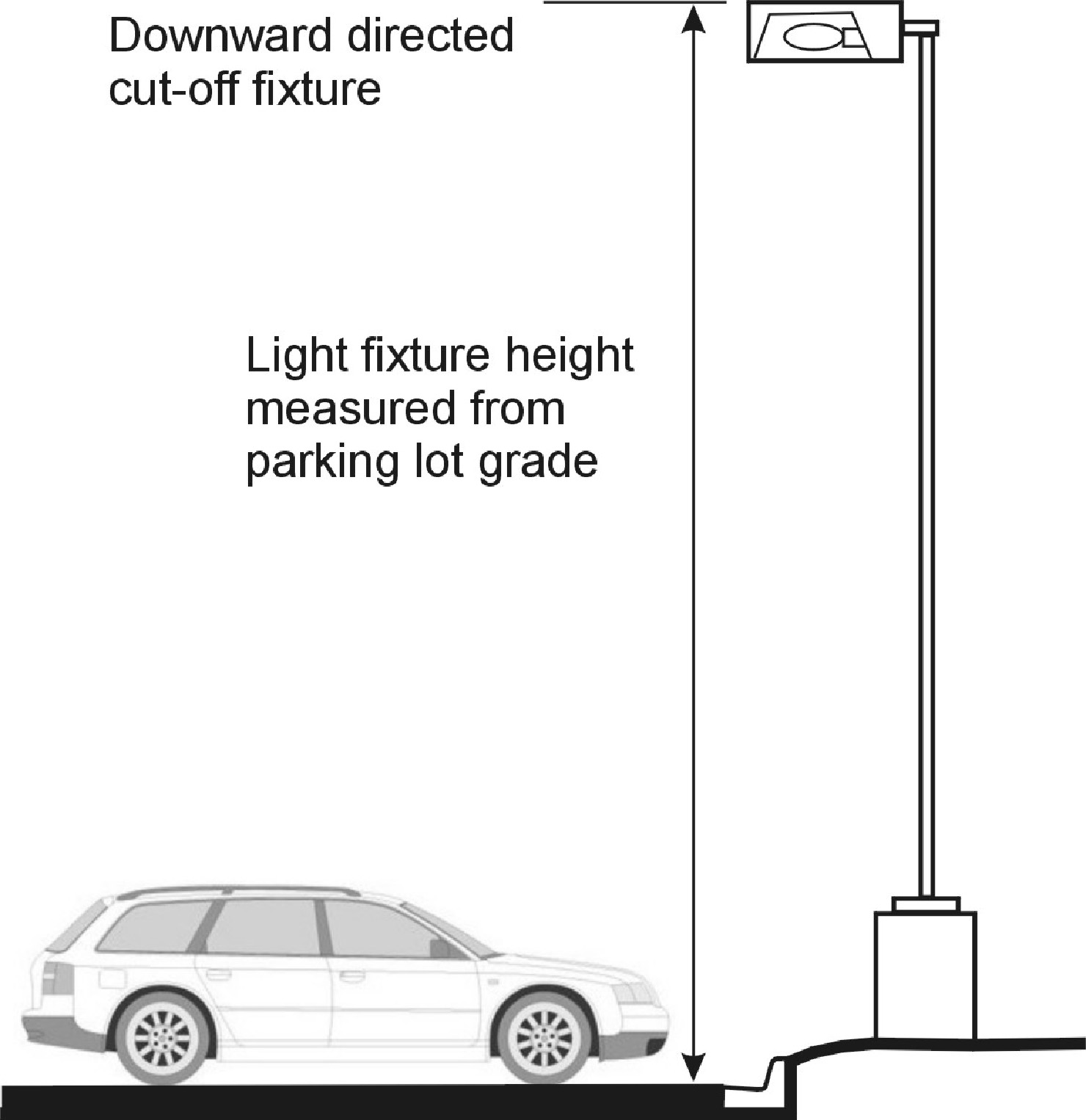
Glare. Direct light emitted by a lamp, luminous tube lighting or other light source.
Lamp. The component of the luminaire that produces the actual light including luminous tube lighting.
Light fixture. The assembly that holds a lamp and may include an assembly housing, a mounting bracket or pole socket, a lamp holder, a ballast, a reflector or mirror, and a refractor or lens. A light fixture also includes the assembly for luminous tube and fluorescent lighting.
Light pollution. Artificial light which causes a detrimental effect on the environment, or enjoyment of the night sky or causes undesirable glare or unnecessary illumination of adjacent properties.
Light trespass. The shining of light produced by a luminaire beyond the boundaries of the property on which it is located in an objectionable manner, as determined by the city manager or his designee.
Luminaire. The complete lighting system including the lamp and light fixture.
Luminous tube lighting. Gas-filled tubing which, when subjected to high voltage, becomes luminescent in a color characteristic of the particular gas used, e.g., neon, argon, etc.
Outdoor light fixtures. Outdoor artificial illuminating devices, outdoor fixtures, lamps and other similar devices, permanently installed or portable, used for floodlighting, general illumination or advertisement.
Sky glow. The "haze" or "glow" that surrounds highly populated areas and reduces the ability to view the nighttime sky. Specifically, light that enters the sky from an outdoor lighting system by indirect light reflected from atmospheric particles such as fog, dust, or smog.
(4)
Submittal requirements. The following information must be included for all site plan submissions and where site plan approval is not required, some or all of the items may be required by the city manager or designee prior to lighting installation:
(a)
Location of all freestanding, building-mounted and canopy light fixtures on the site plan and building elevations.
(b)
Photometric grid overlaid on the proposed site plan indicating the overall light intensity throughout the site (in footcandles).
(c)
Specifications and details for the type of fixture being proposed, including the total lumen output, type of lamp and method of shielding.
(d)
Use of the fixture proposed.
(e)
Any other information deemed necessary by the planning commission, city manager or designee to determine compliance with provisions of this article.
(5)
Lighting standards. Unless exempted under subsection (6), exemptions, herein, all lighting must comply with the following standards:
(a)
Freestanding pole lighting.
1.
Exterior lighting shall be fully shielded and directed downward to prevent off-site glare. Fixed (not adjustable), downward directed, metal halide, LED or induction full cutoff fixtures or approved decorative fixtures shall be used in an effort to maintain a unified lighting standard throughout the city and prevent "sky glow".
2.
The intensity of light within a site shall not exceed ten (10) footcandles within any site or one (1) footcandle at any property line, except where it abuts a service drive or other public right-of-way. Footcandles abutting a residential district or use can be a maximum of 0.5 footcandle at the property line. The only exception is for gas station canopy and automobile dealership lighting, where a maximum of twenty (20) footcandles is permitted within the site, but the above standards shall apply to intensity at the property line.
3.
The planning commission, city manager or designee (depending upon who has approval authority over the project) may approve decorative light fixtures as an alternative to shielded fixtures when it can be proven that there will be no off-site glare and the proposed fixtures are necessary to preserve the intended character of the site.
4.
The maximum height of parking lot light fixtures shall be twenty (20) feet, except that the planning commission may permit a maximum height of thirty (30) feet within commercial and office zoning districts and in institutional districts when the poles are no closer than one hundred fifty (150) feet to a residential district or use.
5.
Parking lot poles shall be located in parking lot islands or in the periphery parking lot area. Light poles shall be prohibited in parking spaces.
6.
Except where used for security purposes and not creating off-site glare, all outdoor lighting fixtures, existing or hereafter installed and maintained upon private property within nonresidential zoning districts, shall be turned off between 11:00 p.m. and sunrise, except where such use continues after 11:00 p.m. but only for so long as such use continues.
(b)
Building-mounted lighting.
1.
Building-mounted lighting shall be fully shielded and directed downward to prevent off-site glare. Fixed (not adjustable), downward directed, metal halide fixtures shall be used in an effort to maintain a unified lighting standard throughout the city and prevent sky glow.
2.
The intensity of light within a site shall not exceed ten (10) footcandles within any site or one (1) footcandle at any property line, except where it abuts a service drive or other public right-of-way. Footcandles abutting a residential district or use can be a maximum of 0.5 footcandle at the property line.
3.
The planning commission, city manager or designee (depending upon who has approval authority over the project) may approve decorative light fixtures as an alternative to shielded fixtures when it can be proven that there will be no off-site glare and the proposed fixtures will improve the appearance of the site.
4.
Luminous tube and exposed bulb fluorescent lighting is prohibited as an architectural detail on all buildings, e.g., along the roof line and eaves, around windows, etc.
(c)
Window lighting.
1.
Any light fixtures visible through a window must be shielded to prevent glare at the property line.
2.
Luminous tube and exposed bulb fluorescent lighting (visible from the property line) is prohibited unless it is part of a sign that meets the requirements of chapter 16 of the city code.
(d)
Accessory lighting. Lighting provided for all accessory uses such as, but not limited to, tennis courts, swimming pools or other outdoor facilities shall be arranged and shielded so that the light pattern shall not extend beyond the property line and the light source shall not be directly visible from beyond the property line. In addition, the maximum height for fixtures that illuminate tennis courts is twenty-four (24) feet and shall be turned off between 10:00 p.m. and sunrise.
(e)
Private road street lighting.
1.
Street lights along private residential roads may be required by the planning commission as part of a condominium or site condominium project. Where required, the applicant shall provide a full lighting plan including all of the information required by subsection 24-250(4), above.
2.
Where such lighting is required, the planning commission shall use the following standards for guidance:
a.
Lighting may be provided along both sides of the street, or staggered on opposite sides with spacing generally between four hundred (400) and six hundred (600) feet.
b.
Fixtures should be fully shielded and downward directed unless decorative light fixtures are used that provide no off-site glare and are in keeping with the character of the site.
c.
Fixture height should not exceed twenty (20) feet.
d.
Lighting intensity should be limited to a range between one (1) and six (6) footcandles, depending upon the fixture style, with the greater intensity at intersections and crosswalks.
e.
A determination should be made that the proposed lighting plan will not adversely impact surrounding properties.
(f)
Other lighting.
1.
The internal illumination of building-mounted canopies is prohibited.
2.
Indirect illumination of signs, canopies and buildings is permitted provided there is no off-site glare.
3.
The use of a laser light source, searchlights or any similar high intensity light for outdoor advertisement or entertainment is prohibited.
4.
Lighting shall not be of a flashing, moving or intermittent type.
5.
Luminous tube and exposed bulb fluorescent lighting is permitted as part of a sign meeting the requirements of chapter 16 of the city code.
6.
Sports field lighting is permitted to be in use no later than 10:00 p.m., provided it is located at least five hundred (500) feet away from any existing residential zone or use. Sports field lighting may be approved by the planning commission after a determination that the lighting is directed away from residential properties, to the extent feasible, and that all efforts possible were made to minimize negative impacts to surrounding uses.
(6)
Exemptions. The following are exempt from the lighting requirements of this article, except that the city manager or designee may take steps to eliminate the impact of the exempted items when there is off-site glare and deemed it necessary to protect the health, safety, and welfare of the public.
(a)
Swimming pools (below the water surface only).
(b)
Holiday decorations.
(c)
Window displays without glare.
(d)
Shielded pedestrian walkway lighting.
(e)
Residential lighting with no light trespass.
(f)
Residential entry piers with no more than one (1) footcandle along the front lot line.
(g)
Low-voltage, or solar-powered landscape lighting.
(h)
Street or directional lighting in existing public rights-of-way.
(7)
Lamp or fixture substitution. Should any light fixture regulated under this section, or the type of light source therein, be changed after the permit has been issued, a change request must be submitted to the city manager or designee for approval, together with adequate information to assure compliance with this section, which must be received prior to substitution.
(Ord. No. 384, § 1, 6-8-10)

