
Boiling Spring Lakes
City Zoning Code
City Zoning Code
ARTICLE 9
- DEVELOPMENT REVIEW PROCESS
Sec. 9-1.- Purpose and applicability.
(A)
The purpose of this article is to establish an orderly process to develop land within the city of Boiling Spring Lakes. It is also the intent of this article to provide a clear and comprehensible development process that is fair and equitable to all interests including the petitioners, affected neighbors, city staff, related agencies, the planning board, board of adjustment, and the board of commissioners. Approved plans shall be the guiding documents for final approval and permitting. Rights, privileges, benefits, burdens, and obligations created by a development approval attach to, and run with the land.
(B)
If an application for a minor site plan, major site plan, or special use permit is denied, a similar application for the same property or any portion thereof shall not be filed until the expiration of a twelve-month period from the date of the most recent denial, unless substantially different (see appendix A) from the original application.
(C)
The development review process applies to all development within the city of Boiling Spring Lakes except for a change in principal use where such change would not result in a change in lot coverage, parking, or other site characteristics. Applications for development approvals shall be made by the landowner, lessee or person holding an option to purchase or lease the land, or an authorized agent of the landowner.
(D)
A foundation survey shall be submitted to the UDO administrator by the applicant upon completion of the building foundation to ensure that setbacks and building orientation match the approved site plan. If the survey is not received within ten (10) days of the foundation inspection, and/or the survey shows that the placement of the building is incorrect, a stop-work order shall be issued, and all construction shall be halted until the problem is remedied. Prior to the issuance of a zoning compliance certificate and a certificate of occupancy by building inspections, the UDO administrator, or designee, shall conduct a final zoning inspection. A final as-built survey, completed by a licensed surveyor, shall also be required, and shall indicate the location of all site improvements. If the final as-built survey shows that the placement of the building(s) is/are incorrect, as outlined in section 5-7 table of area, setback, living area and height requirements, then the provisions of article 4-4 and 4-5 shall be followed.
(Ord. No. 2023-16, 8-1-2023)
Sec. 9-2. - Plot plan procedures.
Plot plan review is intended to ensure that the layout and general design of low-intensity development is compatible with all applicable standards in this article and all other applicable city regulations. Plot plans shall be submitted for review of the following development types:
(A)
Accessory structures.
(1)
Proposals for accessory structures not exceeding four hundred (400) square feet need only provide a sketch of the proposed location of the structure in relation to existing property lines, setbacks, existing structures, easements, utilities, environmental features.
(B)
Any enlargement of a principal building by less than twenty (20) percent of its existing size provided such enlargement will not result in parking or landscaping improvements.
(C)
Single-family detached and two-family residential (duplex) development.
9-2-1
Plot plan requirements.
All proposed plot plans shall be based upon a recent boundary survey (less than two (2) years old). The survey and plot plan shall be prepared by a licensed surveyor and shall include the following as a minimum requirement:
(A)
Property owner information.
(B)
Total square footage/acreage of the lot and lot lines with dimensions.
(C)
All existing and proposed buildings, including porches, decks, patios, roof overhangs, etc. with overall dimensions and setbacks (required and proposed) from all property lines.
(D)
Existing and proposed driveways with distance to side property line, dimensions, and surface material described.
(E)
Total percentage of existing and proposed impervious coverage.
(F)
Location of all utilities, including well and septic drainage fields.
(G)
Location of easements (width and type listed).
(H)
Location and description of environmental features (streams, buffers, flood zone boundaries and designation, etc.).
(I)
Table containing the size, and species of all trees >7.9 inches DBH.
(1)
Proposals for accessory structures may, in lieu of including the table on the plot plan, include a separate hand-drawn sketch of the size and species of all trees >7.9 inches DBH proposed for removal in relation to the location of the proposed structure.
(Ord. No. 2025-02, 2-4-2025)
Sec. 9-3. - Site plan procedures.
9-3-1
Pre-application meeting and sketch plan.
The applicant is encouraged to schedule a pre-application meeting with the UDO administrator to review a sketch plan of proposed development. The sketch plan shall generally indicate the location of all existing and proposed structures, amount of impervious surface, and extent of land disturbance. The UDO administrator will advise the applicant of all applicable City regulations and policies, suggest development alternatives, application procedures, and fees.
The pre-application meeting is a non-binding and informal review of a development proposal intended to provide information to the applicant on the procedures and policies of the city of Boiling Spring Lakes and does not confer upon the applicant any development rights. The UDO administrator may submit a sketch plan to other departments or agencies for input and recommendations.
9-3-2
Application and submittal procedures.
(A)
Applicability and process. Minor site plans, major site plans, special use permit plans, and other site-specific plans shall be submitted in accordance with this section, except where specifically noted. Upon determination by the UDO administrator or his designee that an application is complete, the review process for the proposed project type shall be initiated. all plans shall be prepared by a land surveyor, engineer, landscape architect, or architect registered to practice in the state of North Carolina with his or her seal. Prior to construction, detailed plans and specifications shall be reviewed and approved by any other relevant entity, such as the county, in accordance with their respective policies regarding the facilities and/or improvements. Approval of the site plan does not imply or satisfy approval requirements for the facilities and/or improvements.
(B)
Submittal requirements. Three (3) paper copies and one (1) digital copy of a minor site plan, major site plan, or special use permit plan shall be submitted for UDO administrator and technical review committee review. Five (5) paper copies and one (1) digital copy of major site plans and special use permit plans are required prior to review by the planning board/BOA. Information to be included on each plan type is included in appendix B.
Sec. 9-4. - Minor site plans.
Projects requiring minor site plan approval:
(A)
Development whereby less than one (1) acre of land is disturbed;
(B)
Nonresidential development under ten thousand (10,000) square feet of gross floor area; or
(C)
Residential development of three (3) to four (4) units on a single-lot.
9-4-1
Application requirements.
Applicants for minor site plan approval shall submit all information required as specified in appendix B, and any additional information needed to demonstrate and support compliance with the standards of evaluation. No application shall be accepted as complete unless accompanied by all required fees and all required submission information.
9-4-2
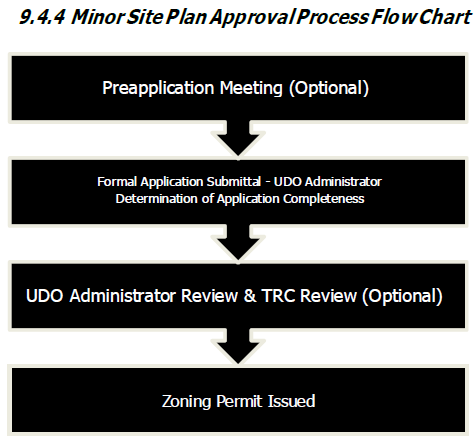
Review process.
(A)
The UDO administrator shall review and, if the minor site plan submitted otherwise meets all of the standards of this article, approve the minor site plan.
(B)
The UDO administrator may seek the recommendation of the technical review committee (TRC) where applicable including review of proposed stormwater, utilities, or roadway infrastructure.
(C)
Upon minor site plan approval and issuance of a zoning permit, the applicant may apply for a building permit. NOTE: Additional approval of Brunswick County environmental health, US Fish & Wildlife Service, NCDEQ, or other agencies may be required prior to issuance of a building permit.
9-4-3
Expiration.
Minor site plan approval expires twenty-four (24) months from the date of approval, if work is not substantially commenced. For approvals for which construction has commenced and is then discontinued, minor site plan approval shall expire twenty-four (24) months after discontinuation.
9-4-4
Minor site plan approval process flow chart.
Sec. 9-5. - Major site plans.
Projects requiring major site plan approval:
(A)
Development whereby one (1) or more acres of land is disturbed;
(B)
Residential developments greater than four (4) units on a single lot;
(C)
Nonresidential developments greater than or equal ten thousand (10,000) square feet of gross floor area; or
(D)
Any form of development not exempted from site plan review or reviewed as a minor site plan.
9-5-1
Application requirements.
Applicants for major site plan approval shall submit all information required as specified in appendix B, and any additional information needed to demonstrate and support compliance with the standards of evaluation. No application shall be accepted as complete unless accompanied by all required fees and all required submission information.
9-5-2
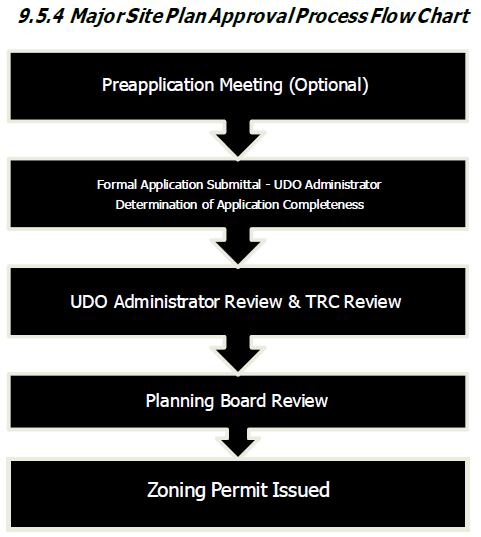
Review process.
(A)
The UDO administrator and technical review committee shall review the major site plan and provide written recommendations to the planning board for review. The UDO administrator may circulate the site plan to relevant government agencies and officials for comments and recommendations.
(B)
The planning board shall review the major site plan and written recommendations of the UDO administrator and the TRC prior to approving, denying, or conditionally approving the major site plan. If the site plan submitted otherwise meets all of the standards of this article, the planning board shall approve such.
(C)
Upon site plan approval and issuance of a zoning permit, the applicant may apply for a building permit. NOTE: Additional approval of Brunswick County environmental health, US Fish & Wildlife Service, NCDEQ, or other agencies may be required prior to issuance of a building permit.
9-5-3
Expiration.
Major site plan approval expires twenty-four (24) months from the date of approval, if work is not substantially commenced. For approvals for which construction has commenced and is then discontinued, major site plan approval shall expire twenty-four (24) months after discontinuation.
9-5-4
Major site plan approval process flow chart.
Sec. 9-6. - Special use permit.
9-6-1
Purpose and applicability.
This article provides for a number of uses to be located by right in each general zoning district subject to the use meeting certain area, height, yard, and off-street parking and loading requirements. In addition to these uses, this article allows some uses to be allowed in these districts on a special use basis, subject to issuance of a special use permit by the board of adjustment. The purpose of having special uses is to ensure they will be compatible with surrounding development and the purposes of the general zoning district in which they are located, and that they will meet other criteria as set forth in this section.
9-6-2
Application requirements.
In the course of evaluating the proposed special use, the board of adjustment may request additional information from the applicant. A request for any additional information may stay any further consideration of the application by the board of adjustment.
No application shall be deemed complete unless it contains or is accompanied by all applicable items listed in in the submission requirements in appendix B for the respective plan type, plot plan, minor site plan, or major site plan, as provided herein. The application shall be subject to the thresholds establishing the applicability for each plan type as provided in this article.
9-6-3
Review process.
(A)
The UDO administrator and technical review committee shall review the special use permit plot/site plan for compliance with the UDO. The UDO administrator may circulate the plan to relevant government agencies and officials for comments and recommendations.
(B)
The TRC may, in its review, suggest reasonable conditions to the location, nature, and extent of the proposed use and its relationship to surrounding properties, parking areas, driveways, pedestrian and vehicular circulation systems, screening and landscaping, timing of development, hours of operation, and any other conditions the TRC may find appropriate. The conditions may include dedication of any rights-of-way or easements for streets, water, sewer, or other public utilities necessary to serve the proposed development and provisions for recreational space and facilities.
(C)
The TRC shall forward its comments to the board of adjustment.
9-6-4
Board of adjustment action.
(A)
Special use permit cases are quasi-judicial, and all witnesses are to be sworn in.
(B)
Once the TRC has reviewed the proposed plan, the board of adjustment shall hold a hearing to consider the application. A quorum of the board of adjustment is required for this hearing. Notice of the hearing shall be subject to the requirements provided in section 3-20.
(C)
In approving an application for a special use permit, the board of adjustment may attach fair and reasonable conditions to the approval. The petitioner will have a reasonable opportunity to consider and respond to any additional requirements prior to approval or denial by the board of adjustment. In no instance shall any of these conditions be less restrictive than any requirements which would pertain to that particular development found elsewhere in a similar zoning district. The petitioner's written consent to all conditions related to a special use permit shall be required.
(D)
The applicant has the burden of producing competent, material and substantial evidence tending to establish the facts and conditions which subsection 9-6-4(E) requires.
(E)
The board of adjustment shall issue a special use permit if it has evaluated an application through a quasi-judicial process and determined that:
(1)
The proposed use will have either a minimal effect or positive effect on the public health or safety;
(2)
The use meets all required conditions and specifications of the UDO;
(3)
The proposed use will have no material adverse effect on the value of adjoining or abutting properties unless the use is a public necessity;
(4)
The proposed use is in harmony with the city land use plan and/or other plans adopted by the board of commissioners;
(5)
Adequate measures have been, or will be taken, to provide ingress and egress so designed as to minimize traffic congestion in the public streets.
9-6-5
Effect of approval.
If an application for a special use permit is approved by the board of adjustment, the owner of the property shall have the ability to develop the use in accordance with the stipulations contained in the special use permit.
9-6-6
Binding effect.
Any special use permit so authorized shall be binding to the property included in the permit unless subsequently changed or amended by the board of adjustment.
9-6-7
Change in special use permit.
Any request to materially change the special use permit once it has been issued shall constitute initiation of a new review procedure as provided herein.
9-6-8
Expiration.
Special use permit approval expires twenty-four (24) months from the date of approval.

