
Boiling Spring Lakes
City Zoning Code
City Zoning Code
ARTICLE 7
- DEVELOPMENT STANDARDS
Sec. 7-1. - Purpose.
The purpose of this section is to provide consistent development standards for application throughout the City of Boiling Spring Lakes.
Sec. 7-2. - Fences and walls.
7-2-1
General.
(A)
No fence or wall shall be erected without the issuance of a zoning permit.
(B)
No fence or wall shall impede the visual locating of 911 emergency street addresses.
(C)
No fence or wall shall block pedestrian access from doors or windows and must have a clearance of at least two (2) feet from building walls, except where perpendicular to a building wall.
(D)
Fences or walls shall not alter or impede the natural flow of water in any stream, creek, drainage swale, or ditch.
(E)
The finished side of a fence shall face off-site.
(F)
The following height limits for fences and walls shall apply within all zoning districts:
(1)
Within front yards, the maximum height is four (4) feet;
(2)
Within any side or rear yards, the maximum height is six (6) feet;
(3)
Height limits shall not apply to electric/gas substations, water/sewer treatment plants or facilities, municipal water storage facilities, or waste treatment facilities;
(4)
Height limits shall not apply to chain link fences surrounding tennis courts or ball field backstops, provided that fences for private tennis courts shall comply with the required setbacks for accessory uses in that zoning district;
(5)
Fence height shall be measured along the grade of the adjacent property.
(G)
Where fences or walls are required to be greater than four (4) feet in height, for example to enclose outdoor storage, the fence or wall and the use required to be enclosed shall not be located in any required front yard.
7-2-2
Placement.
(A)
Fences or walls may not be located within the required site triangle.
(B)
Fences and walls are not subject to setback requirements and may be placed up to the property line. Applicants are encouraged to inform adjacent property owners of impending fence/wall installment
7-2-3
Fences.
The following types of fences are prohibited:
(A)
Fences constructed primarily of barbed or razor wire and fences carrying electrical current, when not for the purpose of enclosing livestock in the R-6 district.
(B)
Fences constructed in whole or in part of readily flammable material such as paper, cloth, or canvas;
(C)
Fences topped with barbed wire or metal spikes except those serving an institution requiring a security fence or for public safety purposes.
7-2-4
Walls.
(A)
Walls shall be constructed of one (1) or a combination of the following materials: stucco over concrete block, exposed aggregate concrete, brick, stone, or architectural block in a structurally safe and attractive condition.
(B)
Alternative walls may be permitted planning board if the board finds that such alternative walls provide a similar level of opacity to that of the listed materials and are in keeping with the architecture of the development and surrounding area. No walls of exposed, painted-only, plain concrete cinder block shall be permitted.
(C)
No wall shall be located within any required drainage, utility or similar easement.
7-2-5
Retaining walls.
Retaining walls up to four (4) feet in height may be located within required yards.
7-2-6
Maintenance.
Any fence or wall which, through neglect, lack of repair, type or manner of construction, method of placement or otherwise, constitutes a hazard or endangers any person, animal or property is hereby deemed a nuisance. If such conditions exist, the UDO administrator shall require the owner or occupant of the property upon which the fence or wall is located to repair, replace or demolish the fence causing the nuisance.
Sec. 7-3. - Mechanical equipment and trash handling.
7-3-1
Applicability.
This section shall apply to all development except individual one- and two-family residences unless otherwise provided.
7-3-2
Location.
All mechanical equipment and trash handling facilities shall be located on the same lot as the use served unless shared facilities are approved by the planning board. No such facilities shall be located in a required front yard, including for one- and two-family residences. All trash receptacles shall meet the minimum setback requirements of the underlying zoning district.
7-3-3
Screening.
All utilities (including heating or air conditioning units and other mechanical equipment), dumpsters and trash handling facilities shall be screened in conformance with section 7-35.
7-3-4
Access.
All required dumpster, recycling and trash handling facilities shall be designed with appropriate means of access to a street or alley in a manner that will least interfere with traffic movement, and will most facilitate the service of the facilities.
7-3-5
Utilization.
Space allocated to any off-street dumpster, and trash handling facilities shall not be used to satisfy the space requirements for off-street parking or loading facilities, nor shall any parking or loading spaces be used to satisfy the space requirements for any dumpster or trash handling facility.
7-3-6
Performance.
All food-related businesses shall provide water quality treatment to mitigate runoff from trash handling facilities.
Sec. 7-4. - Underground electrical lines.
Electrical utility lines must be installed underground from all utility poles to any building, including residences, accessory/utility buildings, and detached garages.
Sec. 7-5. - Building design standards.
7-5-1
Purpose and applicability.
The purpose of this section is to ensure architectural compatibility and the establishment and preservation of architectural character throughout the city. The requirements of this section shall apply in the following circumstances:
(A)
Construction of any new use other than single-family or duplex.
(B)
Expansion or modification of an existing commercial, multi-family, office, or institutional use that increases the total enclosed floor area by at least fifty (50) percent or five thousand (5,000) square feet, whichever is greater.
(C)
Communication towers shall be exempt from these requirements.
7-5-2
General requirements for all buildings.
(A)
Adjacent buildings shall be compatible in regards to spacing, setbacks, proportions, materials, and scale.
(B)
The primary entrance shall be architecturally and functionally designed on the front facade facing the primary public street.
(C)
Except for corner lots, the front facade of the principal structure shall be parallel to the front lot line and street.
(D)
Ground mounted mechanical equipment, solid waste storage, recycling storage, and restaurant operations shall be located to the rear or side yard and screened from view of the street. Roof-mounted mechanical equipment shall be screened from view by a parapet wall matching the primary building materials.
7-5-3
Non-residential and multi-family buildings.
7-5-3.1 Requirements for building massing, arrangement, and facade.
(A)
The design shall help integrate the development with its surroundings by breaking down the apparent mass and scale of the building on all sides.
(B)
No more than fifteen thousand (15,000) gross square feet of the footprint of any structure shall be designed as an individual distinct mass. Preferably, two (2) or more building masses shall be expressed.
(C)
All facades visible from a public roadway shall be given equal design significance. There shall be no blank, featureless walls, including rear walls. The design shall present a continuity of style on all facades visible from the public roadway, except where separated by a party wall located on a lot line.
(D)
Outparcels shall be designed and integrated with the main project or principal structure.
(E)
No portion of a building facing a street shall be constructed of adorned (unfaced) concrete masonry units. No more than forty (40) percent of the façade of a building facing a street shall be constructed of corrugated and/or sheet metal upon approval of the UDO administrator.
(F)
No single facade extending unbroken more than thirty-five (35) feet in a horizontal plane may be visible from a public roadway. Compliance may be obtained through one of the following:
(1)
The use of projections or recesses. When used, each projection or recess shall have a projection (or depth) dimension of no less than eighteen (18) inches and a width of no less than thirty-six (36) inches; or
(2)
The use of columns or other architectural detail to provide visual interest. Where used, columns should be harmonious with the general design of the structure.
(G)
At least twenty-five (25) percent of the first floor of the street facade(s) must be transparent (including all sides facing a street right-of-way). Street level windows shall be visually permeable. Mirrorized glass is not permitted in any location. False or display casements are not permitted in lieu of exterior window treatments for the frontage elevation. A window shall be measured as follows:
(1)
Maximum sill height (first floor): forty-two (42) inches.
(2)
Minimum area: sixteen (16) square feet.
(3)
Minimum width: three (3) feet.
(4)
Minimum height: four (4) feet.
(H)
Ventilation grates or emergency exit doors located at the first floor level oriented toward a public street shall be decorative.
(I)
A pitched roof shall have eaves a minimum of twelve (12) inches from the building face including gutters.
(J)
Parapet walls shall have decorative cornices or caps.
(K)
When used, awnings and canopies shall be placed at the top of window or doorway openings. No awning shall extend more than the width of the sidewalk or ten (10) feet, whichever is less. Awnings must be self-supporting from the wall. No supports shall rest on or interfere with the use of pedestrian walkways or streets. In no case shall any awning extend beyond the street curb or interfere with street trees or public utilities.
(L)
Alternative compliance may be approved provided the design satisfies the intent of this section. In such cases, the UDO administrator in conjunction with the building inspector, shall have the authority to approve the following:
(1)
Reduced transparency requirements (up to ten (10) percent reduction).
(2)
On double-frontage lots where rear building elevations are not facing a thoroughfare or collector road, and for buildings used solely for storage and/or warehousing, the use of false windows, enclosed window wells supplemented with awnings, or similar architectural detail that satisfies the intent of the ordinance.
7-5-4
Integration into the street network.
Internal and new streets shall connect to existing streets or be designed to facilitate future connections to the maximum extent practicable.
7-5-5
Review required.
Compliance with the requirements shall be demonstrated through submittal of architectural drawings in conjunction with minor or major site development plan review. Drawings shall include, but not be limited to, a floor plan, roof plan and all exterior building elevations, and any other information deemed necessary by the UDO administrator to demonstrate compliance with this section.
7-5-6
Criteria for approval.
The UDO administrator shall apply the following criteria in making a determination of compliance with these requirements.
(A)
The architectural drawings are complete and the information accompanying the minor or major site plan is sufficient and correct enough to allow adequate time and final action.
(B)
The submitted architectural drawings illustrate compliance with the requirements of this section.
(C)
The design demonstrates unique, site-sensitive architecture.
(D)
The design is compatible with surrounding properties.
(Ord. No. 2024-06, 5-7-2024)
Sec. 7-6. - Fill and grade.
(A)
Any lot which requires fill in order to bring it into compliance with or a county septic permit, may be improved by the use of "clean fill". (For purposes of this section, clean fill shall be defined as soil that does not have any material over one-half (½) inch in diameter and does not have any foreign material or man-made material contained within.)
(B)
A county stormwater permit shall be obtained prior to placing any fill material in excess of four (4) inches on any lot within the city of Boiling Spring Lakes. Permits are to be secured from the Brunswick County stormwater administrator prior placing any such fill on a lot. The city shall have the authority to inspect the fill prior to its deposit upon the property.
(C)
Failure to secure a permit and/or placing any fill material in excess of four (4) inches on any lot shall be considered a violation of this ordinance. Any material placed in violation of this section shall be removed within seven (7) days notice to remove same from the property.
Sec. 7-7. - Lake regulations.
(A)
These regulations shall apply to structures on and adjacent to city-owned and privately-owned lakes.
(B)
The lakes are classified according to their sizes as shown in the following chart, which is made a part of this ordinance. The maximum permitted length of waterside structures in the residential, PRD, conservation, and recreation districts shall be in accordance with the chart below, and subject to design and size criteria outlined in 7.7(C)(D)(E):
(C)
In establishing the maximum permitted length of a waterside structure in accordance with the ten (10) percent rule, the applicant shall measure the distance to the opposite shoreline most closely perpendicular to the applicant's waterfront property line. For example, if the shoreline to shoreline measurement is one hundred (100) feet, then the maximum length of the waterside structure shall be ten (10) feet.
(D)
A maximum of one (1) walkout (pier), which is most closely perpendicular as possible to the applicant's waterfront property line, shall be permitted. The width of the walkout (pier) shall be no less than four (4) feet and no greater than eight (8) feet.
(E)
The maximum size of the waterside structure, not including walkout (pier), shall be two hundred fifty (250) square feet. This shall include, but is not limited to, any cross-member structure, decking, and covered areas (covered areas include any roof assembly over water).
Example (the big lake):
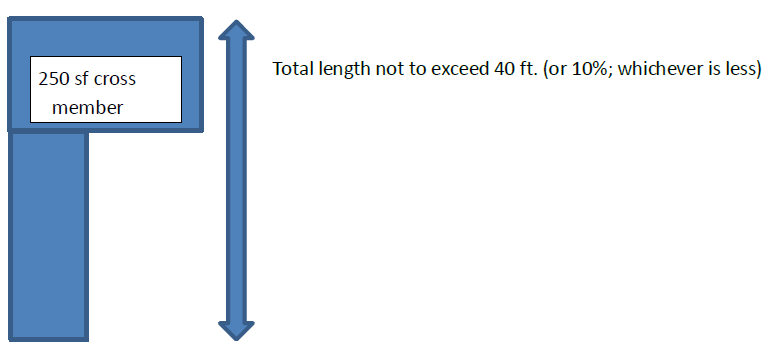
4 ft. wided walkout (pier).
Example (the big lake):
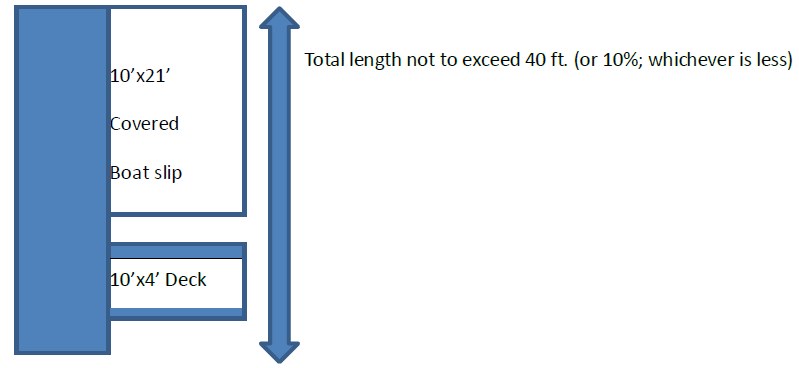
5 ft. wided walkout (pier).
(F)
No enclosed structures may be built on any lake.
(G)
Bulkheads on Patricia Lake shall be installed with the top elevation minimum thirty-two (32) feet and maximum thirty-five (35) feet above sea level.
(H)
A letter or certification of approval from the Army Corp of Engineers may be required for bulkheads prior to issuance of a building permit.
(I)
Waterside structures, except for bulkheads, shall be subject to the side setback requirements of the applicable zoning district, when extended beyond the waterfront property line adjacent to such structures. A principal structure is not required for permitting of waterside structures.
(J)
Property lines under water or distances from the water.
(1)
Property line under water. Where the property line stakes are under water, the permitted maximum lake zone length of the waterside structure will be measured from the property line..
(2)
Property line distances for waterside structures from the water on lakes other than Patricia Lake. Where the property line is a considerable length from the water, the permitted maximum lake zone length of the waterside structure shall be measured from the normal high water line.
(K)
No permanent raft shall be permitted on any lake. Permanent shall be defined as one that is permanently secured to the lake floor via anchors, concrete blocks, etc. Temporary rafts (not to exceed ten (10) feet by ten (10) feet in size) shall be permitted on all lakes except for Patricia Lake, but can only be used on the lake between the hours of 7:00 a.m. and 8:00 p.m. or sunset, whichever comes first. At sunset, the raft must be taken to shore and affixed by the owner. If the raft is pulled into the lake with a rope, the rope must be detached between the raft and shore so as not to create a hazard on the water. That is, there shall be no rope laying on or in the water between the land and water.
A raft shall not interfere with navigation of any water craft. Any raft shall be the responsibility of the owner who shall assume liability for same.
(L)
Permission for installing any equipment or erecting any building for use in connection with any activity in parks shall be approved by the board of commissioners.
(M)
Patricia lake (the big lake): The setback on this lake shall be from the normal water level. The normal water level for Patricia Lake is thirty-one (31) feet above sea level, i.e., the water level is at the top of the dam spillway. The survey for the foundation footprint shall indicate that the minimum setback is based on the dam spillway elevation.
(N)
Waterside structures in the C-1 commercial and city center districts shall be permitted as an accessory use only, and subject to the following design and use criteria:
(1)
The maximum length of any waterside structure, including pier and platform, shall be fifty (50) feet from shoreline.
(2)
The width of the walkout pier shall be a minimum of five (5) feet, and a maximum of eight (8) feet.
(3)
The maximum length of the platform shall be forty (40) feet.
(4)
Finger piers shall be five (5) feet wide, and a maximum of sixteen (16) feet long.
(5)
Maximum width of slips shall be twelve (12) feet.
(6)
All commercial waterside structures shall be ADA compliant.
(7)
Commercial waterside structures shall not provide services, including, but not limited to, permanent docking spaces, dry storage, fueling facilities, repair services, etc.
Sec. 7-8. - General transportation provisions.
7-8-1
Purpose and scope.
The purpose of this section is to provide a safe and efficient transportation system; improve connectivity between adjacent properties; ensure adequate on-site parking, loading, and vehicular storage; promote walking and biking; reduce vehicle miles of travel and travel times; improve air quality; reduce emergency response times; and free up arterial capacity to better serve travel needs.
7-8-2
Consistency with other documents.
The design and evaluation of transportation and access facilities built in conjunction with new development shall adhere to city of Boiling Spring Lakes standards and adopted plans, in addition to meeting the requirements of this section.
Sec. 7-9. - Access and driveways.
7-9-1
Minimum access points.
Any development of more than one hundred (100) residential units or twenty (20) acres, and any additions to existing developments such that the total number of units exceeds one hundred (100) or total size of development tracts exceeds twenty (20) acres, shall be required to provide a minimum of two (2) vehicular access points unless such provision is deemed impractical by the UDO administrator due to topography, natural features, or the configuration of adjacent development.
7-9-2
Cross access.
(A)
All development, except individual one- and two-family residences, shall be designed to allow for cross access to adjacent properties to encourage shared parking and shared access points on public or private streets and/or driveways.
(B)
New development, except individual one- and two-family residences, shall connect to existing streets, driveways, sidewalks, paths, and other access ways unless the UDO administrator determines that topography, the presence of natural features, and/or vehicular safety factors make connection impractical.
(C)
Where new development, except individual one- and two-family residences, is adjacent to vacant land or developed land with poor adjacent connections, all streets, driveways, sidewalks, paths, and other access ways shall be designed to allow future connections at property boundaries unless the UDO administrator determines that topography, the presence of natural features, and/or vehicular safety factors make connection impractical.
(1)
When required, a cross-access easement shall be shown on the final plat for property involving a subdivision, or recorded by separate instrument when no plat is proposed. The cross-access easement must be recorded prior to final zoning approval.
(2)
Cross-access connections shall not be blocked or obstructed in such a way as to prevent intended vehicular traffic.
(D)
Where vehicular access connections are determined by the UDO administrator to be impractical, pedestrian and bicycle connections should still be provided.
7-9-3
Driveway requirements.
These driveway requirements do not apply to individual one- and two-family residences.
(A)
Driveways shall be not less than ten (10) feet in width for one-way traffic and eighteen (18) feet in width for two-way traffic.
(B)
Twelve (12) foot wide driveways are permissible for two (2) way traffic when:
(1)
The driveway is not longer than fifty (50) feet; and
(2)
The driveway provides access to not more than six (6) parking spaces; and
(3)
Sufficient turning space and stacking area is provided so that vehicles need not back into a public street.
(C)
In no case shall a driveway width exceed thirty-six (36) feet, except as required by NCDOT.
(D)
No surface parking or circulation driveway is permitted within any required buffer area, except that driveways providing access to the parking area may be installed across these areas.
(E)
In parking lots where large hourly volumes of entering traffic may be expected, the developer shall provide a setback between pavement edge of the public roadway and the edge of proposed internal drives to accommodate vehicle stacking within the parking lot.
(F)
Driveways shall be as nearly perpendicular to the street right-of-way as possible.
(G)
Driveways on opposite sides of the street shall either be offset by at least fifty (50) feet or aligned, unless such standards cannot be met for safety reasons.
(H)
No driveway on NC Highway 87 shall be less than three hundred (300) feet from an existing driveway, unless a shared driveway arrangement is not feasible, or other similar hardships as determined by the UDO administrator.
(I)
No drive shall be located closer than twenty-five (25) feet to the right-of-way of any local street intersection.
(J)
All driveways connecting to NCDOT-maintained roads must be approved by NCDOT prior to issuance of any building permits by the city, and be completed with any required turn lanes prior to issuance of any certificate of occupancy.
(K)
Driveways, except churches and synagogues shall be paved using: asphalt, concrete, paver blocks or brick.
7-9-4
Driveway connections to city streets.
No driveway shall be connected to the city street system without a permit which shall be issued by the UDO administrator. With the exception of permit applications accompanied by certified engineer/surveyor drawings, the following shall be applicable for all driveway connections approved for driveways abutting City-owned streets:
(A)
All costs (labor, material, permit cost) shall be borne by the property owner.
(B)
Driveway culverts without abutments shall be either metal pipe (fully galvanized), or plastic high density polyethylene pipe with a diameter of at least twelve (12) inches and a length of twenty (20) feet, as determined by the public works department, prior to the issuance of a permit. Plastic culvert pipe (HDPE) must be smooth core with a rib outer wall forming a double wall type of construction.
(C)
Any design wherein a paved surface (either concrete or asphalt) driveway abuts or passes over the city right-of-way must be approved in detail by the public works department prior to the issuance of a permit prior to construction.
(D)
In no event shall any driveway connection interfere with the normal street drainage system or the grade level of the street abutting such driveway.
(E)
The maintenance of driveways and culverts shall be the responsibility of the property owner.
(F)
Driveways constructed in violation of this section may be removed by the Boiling Spring Lakes public works department, and such action on the part of a property owner shall constitute a violation of this ordinance.
(G)
With the exception of driveway connections that have been designed by certified engineers/surveyors, and work performed as part of an approved stormwater management plan, all driveway connections will be checked for elevation by the city of Boiling Spring Lakes public works department and the ditch area shall be prepared by said personnel for the culvert installation. Installation of the culvert will be completed by the Boiling Spring Lakes public works department. The culvert to be used and the material to cover the pipe must be at the location prior to the site preparation.
(H)
When work on driveway connections is performed by someone other than the public works department, the applicant shall submit a written certification from a licensed professional indicating the culvert was installed at the correct elevation prior to issuance of a certificate of occupancy.
7-9-5
Driveway abutments.
(A)
A building permit shall be required for construction of an abutment.
(B)
Where the height of a driveway connection exceeds four (4) feet in height, along any point of the span, prior to issuance of building permit, a professional engineer must certify that the construction plans are both sufficient to maintain structural integrity and the stormwater flow is unobstructed adjacent to the driveway.
(C)
Abutments shall be made with concrete blocks, poured concrete or brick similar to brick used on homes.
(D)
Distance between abutments shall not exceed the length of the culvert, outside to outside measurement, so as not to cover ditch pipe.
(E)
Abutments shall not extend more than two (2) feet from centerline of pipe toward roadway.
(F)
Mailboxes, paper boxes, etc., shall not be a part of the abutment.
(Ord. No. 2024-05, 4-2-2024; Ord. No. 2024-06, 5-7-2024)
Sec. 7-10. - Parking general provisions.
The purpose of this section is to ensure that adequate and well-designed parking is provided for developments in the city of Boiling Spring Lakes. The following are general requirements for all new developments except single-family detached residential and two-family attached residential (duplexes). The expansion of existing development shall follow these requirements to the greatest extent possible.
(A)
Surfacing. All parking lots with ten (10) or more spaces shall provide a dustproof surface with adequate drainage facilities. Parking facilities containing between ten (10) and twenty-four (24) spaces may be paved or surfaced with a stone material provided that handicap spaces must comply with all applicable codes, ordinances, and technical requirements. Parking facilities containing twenty-five (25) or more spaces shall be paved with concrete, asphalt material, or with alternative paving material determined to exhibit equivalent water resistance and load bearing characteristics as asphalt or concrete. When parking is proposed in excess of the minimum requirements, alternative pervious surface materials are encouraged.
(B)
Lighting. Any lighting shall be so arranged as to direct the light and glare away from streets and adjacent property.
(C)
Yards. All parking lots shall observe a minimum front yard of not less than five (5) feet and a side yard on a corner lot of not less than five (5) feet. Parking lots in residential districts shall have front yards of not less than fifteen (15) feet and side and rear yards of not less than five (5) feet.
(D)
Curb or bumpers. The required yards shall be set off from parking areas by either continuous curb or one (1) noncontinuous stationary bumper for each parking space abutting on a yard, which curb or bumper shall not be less than five (5) inches or more than two (2) feet high.
(E)
Drainage. Parking lots shall not drain onto or across public sidewalks, or into adjacent property except into a natural watercourse or a drainage easement. In already developed areas where this condition would be impossible to meet, the UDO administrator may exempt the developer from this requirement, provided that adequate provision is made for drainage.
(F)
Separation of bumper and walkways. In the event any parking stall abuts upon a walkway, there shall be a space of three and a half (3½) feet between the wheel bumper or curb and the edge of the walkway.
(G)
Off-street parking areas shall be designed to facilitate adequate movement and access by sanitation, emergency, and other public service vehicles.
(H)
Off-street parking areas shall be designed so that parked vehicles do not encroach upon, extend onto, or cause vehicles to back into public rights-of-way, sidewalks, or strike against or damage any wall, vegetation, utility, or other structure.
(I)
The size of any single surface parking lot area shall be limited to three (3) acres, unless divided by a street, building, or landscaped area. Larger parking lots shall be separated by buildings or landscaped areas.
(J)
Paved parking areas shall have lines demarcating each parking space.
(K)
Off-street parking areas shall be properly maintained in all respects. In particular, and without limiting the foregoing, off-street parking area surfaces shall be kept in good condition (free from potholes, etc.) and parking space lines or markings shall be kept clearly visible and distinct.
(L)
A secure bicycle rack is required for all parking lots greater than twenty-five (25) spaces. Bicycle parking may be placed in the front yard and signs indicating the presence and location of such parking shall be scaled for easy reading by bicyclists and pedestrians as well as motorists.
7-10-3
Separation from walkways, sidewalks, and streets.
All parking, loading, and service areas shall be separated from walkways, sidewalks, and streets by curbing or other suitable protective device to prevent vehicles from intruding into these areas.
7-10-4
Handicapped parking requirements.
Handicapped parking spaces shall be in accordance with the regulations set forth by the NC building code, provided that in no event shall such spaces be located more than one hundred (100) feet from a major building entrance.
7-10-5
Shared parking.
The joint use of shared off-street parking between two (2) uses may be made by contract by two (2) or more adjacent property owners. Developments that operate at different times may jointly use or share the same parking spaces with a maximum of one-half (½) of the parking spaces credited to both uses if one use is a church, theater, assembly hall, or other use whose peak hours of attendance will be at night or on Sundays, and the other use will be closed at night or on Sundays.
7.10.6
Parking connectivity.
Adjacent parking lots shall be interconnected except in the case of existing steep topography between the sites. Each parking area that is interconnected may reduce their minimum parking requirement by ten (10) percent.
Sec. 7-11. - Parking lot dimensions.
Each automobile parking area shall comply with the following minimum dimensions:
Sec. 7-12. - Parking lot design and locational requirements.
(A)
All off-street parking lots including exits, entrances, drives, and parking areas shall:
(1)
Be designed to allow for traffic movement in accordance with generally accepted geometric design principles;
(2)
Have physical access to a public street by forward motion;
(3)
Be located to the rear or side of the principal building, rather than between the building and the street, where practicable;
(4)
Be graded, properly drained, stabilized and maintained to prevent dust and erosion;
(5)
Be continuously provided and maintained as long as the use which they serve exists;
(6)
Incorporate landscape peninsulas no more than fifteen (15) spaces apart and at least the ends of all parking rows. Peninsulas shall contain at least one hundred (100) square feet in area and at least eight (8) feet in width, measured from back of curb/barrier to back of curb/barrier. Peninsulas or medians shall be designed to the extent possible to aid in the collection and ground absorption of parking lot stormwater runoff.
(B)
No parking lot designed or provided for more than four (4) cars shall be located in the required front yard within a residential zoning district.
(C)
Parking lots with ten (10) or more spaces shall be designed to incorporate landscaping as required by this ordinance. Landscape plans shall be prepared in accordance with section 7-32 for parking lots with 10 or more spaces.
Sec. 7-13. - Parking ratios.
The following table establishes the formulas to be used to calculate the number of parking spaces required for a particular use. If no specific parking standard is established in this table for a particular use, the UDO administrator shall apply the most analogous standard. Some uses identified in this table are not identified the table of permitted uses as specific uses.
Nevertheless, parking standards for the most similar use shall apply.
*NOTE: Any fractional space shall be considered the next whole number (i.e., 47.3 would be considered 48). For any use not listed, the UDO administrator shall determine the applicable parking requirement using the closest use shown.
(Ord. No. 2024-02, 2-6-2024)
7.13.1
Design and layout of stacking spaces
Required stacking spaces shall be subject to the following design and layout standards:
(1)
Stacking spaces shall be a minimum of nine and one-half (9.5) feet in width by nineteen (19) feet in length.
(2)
Stacking spaces shall not impede on or off-site traffic movements or movements into or out of off-road parking spaces.
(3)
Stacking spaces shall be separated from other internal driveways by raised medians if deemed necessary by the UDO administrator for traffic movement and safety.
(Ord. No. 2024-06, 5-7-2024)
Sec. 7-14. - Vehicle storage.
7-14-1
Residential districts.
(A)
For the purposes of this ordinance, a recreational vehicle shall not be deemed a dwelling unit and the usage of a recreation vehicle for living, sleeping, or housekeeping purposes and the connection of the vehicle to utility services, other than for periodic maintenance and/or repair purposes, shall be prohibited unless the vehicle is located in a camping and recreational vehicle park so designed to accommodate recreation vehicles.
(B)
Only vehicles intended for personal use shall be parked or stored on any property in a residentially zoned district, excluding commercial vehicles driven to and from a place of employment by an employee. On any lot of less than two (2) acres in size located in a residential zoning district, one (1) commercial vehicle may be parked on an overnight basis on private property and shall be limited to class 1 or class 2 vehicles (gross vehicle weight of up to ten thousand (10,000) pounds), provided that the vehicle is parked off the street and is used by a resident of the premises.
(C)
No person shall park or place construction or maintenance equipment, machinery, or materials, or allow the same to be parked or placed upon public property, streets, right-of-way or upon private property in the residential zoning districts.
(D)
No junked/inoperative motor vehicle or nuisance vehicle shall be permitted to be parked or stored out of doors longer than twenty-four (24) hours. Operable and licensed school buses are exempt from this requirement.
(E)
No storage of commercial or government inventory whatsoever shall be permitted. This does not prohibit the storage of on-site construction materials for a building under construction.
(F)
Vans, trucks, and buses of more than two (2) tons carrying capacity and motor vehicles used for drag or stock racing shall not be parked openly in the front, side, or rear yards in a residential district.
7-14-2
Commercial and industrial districts.
Customer and employee parking is permitted along with the parking and storing of governmental or commercial vehicles, in any business or industrial district. Inoperative vehicles shall only be permitted to be parked or stored while undergoing repairs at a commercial garage or automobile service station or if stored in an approved junk or wrecking yard in an industrial district.
Sec. 7-15. - Off-street loading requirements.
In any district in which a building hereafter erected is to be occupied by any manufacturing, processing, assembly, wholesaling, retailing, laundering, dry cleaning, or any other activity requiring the receiving or distribution by vehicles of material or merchandise, there shall be provided and maintained on the same lot with such building at least one off-street loading space, unless the applicant for such use can demonstrate that such space is not required for the use. Each such loading space shall be at least twelve (12) feet in width, thirty (30) feet in length, and shall have a height clearance of at least fourteen (14) feet. All ingress and egress areas shall satisfy NCDOT requirements.
Off-street loading spaces shall be located in the rear yard. No area allocated to loading and unloading facilities may be used to satisfy the area requirements for off-street parking, nor shall any portion of any off-street parking area be used to satisfy the area requirements for loading and unloading facilities.
Loading space shall be provided in accordance with the following schedule:
Loading Exceptions. If a peculiar characteristic of an establishment makes the requirements of this section clearly unrealistic, the board of adjustment may grant the applicant a modification of the loading requirements in regard to that particular establishment.
Sec. 7-16. - Pedestrian facilities.
(A)
Sidewalks shall be at least five (5) feet wide and constructed of concrete at least five (5) inches thick, or such other material as may be approved by the city of Boiling Spring Lakes city engineer.
(B)
Sidewalks shall be installed along the frontage of all new development or redevelopment within the C-1, and C-C zoning districts. Sidewalks shall be installed within the right-of-way and connect to adjacent facilities where applicable.
(C)
Sidewalks built adjacent to an NCDOT road facility shall be built to meet NCDOT sidewalk standards.
(D)
Pedestrian walkways shall form an on-site circulation system that minimize conflict between pedestrians and traffic at all points of pedestrian access to on-site parking and building entrances. Pedestrian walkways shall connect building entrances to one another and from building entrances to public sidewalk connections. Pedestrian walkways shall be provided to any pedestrian access point or any parking space that is more than fifty (50) feet from the building entrance or principal on-site destination. All developments containing more than one (1) building shall provide walkways between the principal entrances of the buildings.
Sec. 7-17. - Traffic impact study.
7-17-1
Purpose.
A traffic impact study shall be required for any non-single-family or two-family residential use generating more than one thousand five hundred (1,500) trips per day, as defined by the American Association of State Highway Officials (AASHTO). The study will enable the city of Boiling Spring Lakes to assess the impact of a proposed development on the highway system when that system is at or near capacity or a safety problem exists. Its purpose is to insure that proposed developments do not adversely affect the highway network and to identify any traffic problems associated with access from the site to the existing transportation network. The purpose of the study is also to identify solutions to potential problems and to present improvements to be incorporated into the proposed development.
7-17-2
Conduct.
A traffic impact study shall be prepared by a qualified professional traffic engineer and/or certified transportation planner with previous traffic study experience. The procedures and standards for the traffic impact study are set forth in section 7-7-5 of this article. The traffic impact study shall be referred to NCDOT for review and comment.
Prior to the preparation of a traffic impact study, a scoping meeting shall be held, including the planning staff, the applicant, and the preparer of the study. The discussion at this meeting should set the study parameters, including the study area, planned and committed roadway improvements (by NCDOT or others), road links and intersections to be analyzed, preliminary traffic distribution, other planned developments to be considered, traffic growth rate, available data, periods for which analysis is to be performed, and other staff concerns. The qualifications of the preparer may be discussed at or prior to this meeting.
7-17-3
Applicability.
Except as described below, a traffic impact study shall be required for all development that meet the following criteria:
(A)
Special use permit, site plan or subdivision plat required.
Estimated traffic generated by the development exceeds one thousand five hundred (1,500) trips/day.
Developments that produce more than one thousand five hundred (1,500) trips per day traffic may be exempted from the requirements to prepare and submit a traffic impact study if: (1) a traffic impact study has previously been prepared for this particular project or development, and (2) there is to be no change in land use or density that would increase travel, (3) there is to be no change in access to the external street system, or (4) material is submitted to demonstrate that traffic created by the proposal when adding to existing traffic will not result in a need for transportation improvements. The board of adjustment will review material submitted in support of an exemption and will determine from that material whether or not to grant the exemption. All exemptions shall be concurred with by the NCDOT district 3 office. If an exemption is granted, documentation of the exemption will be submitted as part of the staff recommendation.
7-17-4
Capacity analysis of the existing system.
An indication of the adequacy of the existing street system is a comparison of traffic volumes versus the ability of the streets to move traffic freely at a desirable speed. The ability of a street to move traffic freely, safely, and efficiently with a minimum delay is controlled primarily by the spacing of major devices utilized. Thus, the ability of a street to move traffic can be increased by restricting parking and turning movements, using proper sign and signal devices, and by the application of other traffic engineering strategies.
Capacity is the maximum number of vehicles which has a "reasonable expectation" of passing over a given section of roadway, during a given time period under prevailing roadway and traffic conditions. The relationship of traffic volumes to the capacity of the roadway will determine the level of service (LOS) being provided. Six (6) levels of service have been selected for analysis purposes. They are given letter designations from A to F with LOS A representing the best operating conditions and LOS F the worst.
(A)
LOS A. Describes primarily free flow conditions. The motorist experiences a high level of physical and psychological comfort. The effects of minor incidents of breakdown are easily absorbed. Even at the maximum density, the average spacing between vehicles is about five hundred twenty-eight (528) feet or twenty-six (26) car lengths.
(B)
LOS B. Represents reasonably free flow conditions. The ability to maneuver within the traffic stream is only slightly restricted. The lowest average spacing between vehicles is about three hundred thirty (330) feet or eighteen (18) car lengths.
(C)
LOS C. Provides for stable operations, but flows approach the range in which small increases will cause substantial deterioration in service. Freedom to maneuver is noticeably restricted. Minor incidents may still be absorbed, but the local decline in service will be great. Queues may be expected to form behind any significant blockage. Minimum average spacing's are in the range of two hundred twenty (220) feet or eleven (11) car lengths.
(D)
LOS D. Borders on unstable flow. Density begins to deteriorate somewhat more quickly with increasing flow. Small increases in flow can cause substantial deterioration in service. Freedom to maneuver is severely limited, and the driver experiences drastically reduced comfort levels. Minor incidents can be expected to create substantial queuing. At the limit, vehicles are spaced at about one hundred sixty-five (165) feet or nine (9) car lengths.
(E)
LOS E. Describes operation at capacity. Operations at this level are extremely unstable, because there are virtually no usable gaps in the traffic system. Any disruption to the traffic stream, such as a vehicle entering from a ramp, or changing lanes, requires the following vehicles to give way to admit the vehicle. This can establish a disruption wave that propagates through the upstream traffic flow. At capacity, the traffic stream has no ability to dissipate any disruption. Any incident can be expected to produce a serious breakdown with extensive queuing. Vehicles are spaced at approximately six (6) car lengths, leaving little room to maneuver.
(F)
LOS F. Describes forced or breakdown flow. Such conditions generally exist within queues forming behind breakdown points.
7-17-5
General requirements and standards.
The traffic impact study shall contain the following information:
(A)
General site description. The site description shall include the size, location, proposed land uses, number of units and gross square footage by land use, existing land use and zoning, construction staging, and completion date of the proposed land development to the extent known or able to be described at the time the application is prepared. If the development is residential, types of dwelling units and number of bedrooms shall also be included. A brief description of other major existing and proposed land developments within the study area shall be provided. The general site description shall also include probable socio-economic characteristics of potential site users to the extent that they may affect the transportation needs of the site (i.e., number of senior citizens).
(B)
Transportation facilities description. The description shall contain a full documentation of the proposed internal and existing external transportation system. This description shall include proposed internal vehicular, bicycle, and pedestrian circulation; all proposed ingress and egress locations; all internal roadway widths and rights-of-way, turn lanes, parking conditions, traffic channelization's; and any traffic signals or other intersection control devices at all intersections within the site.
The report shall describe the entire external roadway system within the study area. Major intersections in the study area and all intersections or driveways adjacent to or within eight hundred (800) feet of the site shall be identified and sketched. All existing and proposed public transportation services and facilities within one (1) mile of the site shall also be documented. Future highway improvements, including proposed construction and traffic signalization, shall be noted. All proposed traffic signals shall be approved by the NCDOT district 3 office. This information shall be obtained from North Carolina's transportation improvement program and the Boiling Spring Lakes thoroughfare plan. Any proposed roadway improvements due to proposed surrounding developments shall also be noted.
(C)
Existing traffic conditions. Existing traffic conditions shall be documented for all roadways and intersections in the study area. This shall include documentation of traffic accident counts as recorded by the NC department of transportation district engineers office, city law enforcement, and the NC highway patrol. Existing traffic volumes for average daily traffic, peak highway hour(s) traffic, and peak development generated hour(s) traffic, if appropriate, shall be recorded. Manual traffic counts at major intersections in the study area shall be conducted, encompassing the peak highway and development generated hour(s), if appropriate, and documentation shall be included in the report. Existing average daily or peak-hour traffic counts made within one (1) year of the study date may be used subject to the UDO administrator's approval. A volume/capacity analysis based upon existing volumes shall be performed during the peak highway hour(s) and the peak development generated hour(s), if appropriate, for all roadways and major intersections expected to be impacted by development traffic.
Levels of service shall be determined for each signalized intersection or roadway segment analyzed above.
This analysis will determine the adequacy of the existing roadway system to serve the current traffic demand. Roadways and/or intersections experiencing levels of service E or F shall be noted as congestion locations (see section 7-7-4).
(D)
Transportation impact of the development. Estimation of vehicular trips to result from the proposed development shall be completed for the average weekday, the average daily peak hours of highway travel in the study area, and if appropriate, the peak hour of traffic generation by the development. Vehicular trip generation rates to be used for this calculation shall be obtained from an accepted source such as "trip generation" (institute of transportation engineers, fourth edition, 1987 as amended). These development-generated traffic movements, as estimated, and the reference source(s) and methodology followed shall be documented. These generated volumes shall be distributed to the study area and assigned to the existing roadways and intersections throughout the study area. Documentation of all assumptions used in the distribution and assignment phase shall be provided. All average daily traffic link volumes within the study area shall be shown graphically. Peak hour turning movement volumes shall be shown for signalized and other major intersections, including all access points to the development. Pedestrian and bicycle volumes at school crossings and as otherwise applicable shall be reported. Any characteristics of the site that will cause trip generation to vary significantly from average rates available in published sources shall be documented, including such factors as diversion of passer-by traffic, internal capture, staggered work hours, or use of transit.
(E)
Analysis of transportation impact. The total traffic demand that will result from construction of the proposed development shall be calculated. This demand shall consist of the combination of the existing traffic, traffic generated by the proposed development, and traffic due to other developments and other growth in traffic that would be expected to use the roadway at the time the proposed development is completed. If staging of the proposed development is anticipated, calculations for each stage of completion shall be made. This analysis shall be performed for average weekday traffic, the peak highway hour(s) and, if appropriate, peak development-generated hour(s) for all roadways and major intersections in the study area.
Volume/capacity calculations shall be completed for all major intersections. It is usually at these locations that capacity is most restricted.
All access points and pedestrian crossings shall be examined for adequate sight distance and for the necessity of installing traffic signals. The traffic signal evaluation shall compare the projected traffic and pedestrian volumes to the warrants for traffic signal installation.
(F)
Conclusions and recommended improvements. Levels of service for all roadways and signalized intersections serving ten (10) percent or more of peak-hour project traffic shall be reported. All roadways and/or signalized intersections showing a level of service below D in urban or developed areas or below C in rural areas shall be considered deficient, and specific recommendations for the elimination of these problems shall be listed. This listing of recommended improvements shall include, but not be limited to, the following elements: internal circulation design, site access location and design, external roadway and intersection design and improvements, traffic signal installation and operation including signal timing, and transit service improvements. All physical roadway improvements shall be shown on the site plan.
7-17-6
Submission and implementation.
The traffic impact study will be submitted to the UDO administrator within the applicable time frame indicated below. The UDO administrator will review the study as part of the development review process. Recommendations will be incorporated into the approval process as indicated below.
(A)
Special use permits.
(1)
Time of submission. The traffic impact study shall be submitted to the UDO administrator with, and as a part of, the application for the special use permit.
(2)
Implementation. The UDO administrator and such other agencies or officials as may appear appropriate in the circumstances of the case shall review the impact study to analyze its adequacy in solving any traffic problems that will occur due to the proposed use.
The board of commissioners shall consider the impact study and the analysis of the impact study before the application is approved or denied. The board of commissioners may decide that certain improvements on or adjacent to the site or on roadways or intersections for which the improvements are needed to adequately and safely accommodate site traffic are mandatory for special use permit approval and may make these improvements conditions of approval, may require modifications in the use, or may deny the permit.
(B)
Site plan/preliminary plat approval.
(1)
Time of submission. The traffic impact study will be submitted to the UDO administrator with, and as a part of, the site plan or preliminary plat.
(2)
Implementation. The UDO administrator and such other agencies or officials as may appear appropriate in the circumstances of the case shall review the impact study to analyze its adequacy in solving any traffic problems that will occur due to development proposed on the site plan. The board of commissioners may recommend that certain improvements on or adjacent to the site or on roadways or intersections for which the improvements are needed to adequately and safely accommodate site traffic are mandatory for site plan approval and may require these improvements to be on the approved site plan.
Sec. 7-18. - Purpose and intent.
Nonresidential buildings and projects, including outparcels, shall be designed to provide safe, convenient, and efficient lighting for pedestrians and vehicles. Lighting shall be designed in a consistent and coordinated manner for the entire site. The lighting and lighting fixtures shall be integrated and designed so as to enhance the visual impact of the project on the community and/or should be designed to blend into the surrounding landscape. Lighting design and installation shall ensure that lighting accomplishes on-site lighting needs without intrusion on adjoining properties.
Sec. 7-19. - Applicability.
The requirements of this section shall apply to:
(A)
All nonresidential development and multi-family development; and
(B)
All residential subdivisions with four (4) or more lots.
Sec. 7-20. - Exempt.
(A)
The following activities are exempt from the requirements of this section.
(1)
Outdoor lights used for a temporary event; permitted through a temporary use permit.
(2)
Outdoor lights used exclusively for recreational activities, concerts, plays or other outdoor events that are open to the public, provided that the event or function meets all other applicable ordinance requirements. Such lighting shall be located at least fifty (50) feet from any adjoining residential district or use.
(3)
Outdoor lighting exempt from the section shall only be illuminated while the activity takes place and during high traffic periods immediately before and after the event.
(B)
Single-family and two-family development.
Sec. 7-21. - Lighting plan.
Lighting plans shall demonstrate that sufficient light will be available to provide security for property and people using public facilities and common areas after dark. This includes, but is not limited to, roads, driveways, walkways, bikeways, parking lots, and recreational areas.
Lighting plans will be reviewed as part of the review process for all applicable permit applications.
Sec. 7-22. - Site lighting design requirements.
7-22-1
Fixture (luminaire).
(A)
The light source shall be completely concealed behind an opaque surface and recessed within an opaque housing and shall not be visible from any street right-of-way or adjoining properties. Overhead lighting fixtures shall be designed to prevent light from emitting upwards towards the sky.
(B)
Under canopy lighting fixtures should be completely recessed within the canopy.
7-22-2
Fixture height.
(A)
Lighting fixtures shall be a maximum of forty (40) feet in height within the parking lot and shall be a maximum of fifteen (15) feet in height within non-vehicular pedestrian areas. All light fixtures located within fifty (50) feet of any residential use or residential property boundary shall not exceed fifteen (15) feet in height.
(B)
The UDO administrator shall allow fixtures above this height to provide internal lighting for stadiums, arenas, and similar facilities subject to planning board approval.
7-22-3
Light source (lamp).
(A)
Incandescent, florescent, metal halide, or color corrected high-pressure sodium are preferred. The UDO administrator shall have the authority to approve other lamp types (including light emitting diodes (LEDS) and fiber optics) provided the color emitted is similar to the preferred types. Non color corrected high pressure sodium lamps are prohibited.
(B)
The same light source type must be used for the same or similar types of lighting on any one (1) site throughout any development.
7-22-4
Mounting.
Fixtures shall be mounted in such a manner that the cone of light is contained on-site and does not cross any property line of the site.
7-22-5
Architectural lighting.
Architectural lighting is required. The maximum illumination on any vertical surface or angular roof surface shall not exceed five and zero tenths (5.0) average maintained foot-candles. Light fixtures shall be carefully selected, located, aimed, and shielded so that light is directed only onto the building facade. Fixtures shall not be directed toward adjacent streets or properties. To the extent practicable, fixtures shall be mounted on the building, shielded, and directed downward to "wash" the facade or roof with light. All building sides facing a right-of-way shall be fully lighted.
Sec. 7-23. - Illumination levels.
(A)
All site lighting shall be designed so that the level of illumination as measured in foot-candles (fc) at any one point meets the standards in the table below with minimum and maximum levels measured on the pavement within the lighted area and average level (the overall generalized ambient light level), measured as a not-to-exceed value calculated using only the area of the site intended to receive illumination.
(B)
The maximum level of illumination at the outer perimeter of the site or project shall be zero and five tenths (0.5) foot-candles when abutting a residential zoning district and five and zero tenths (5.0) foot-candles when abutting all other districts and/or streets.
Sec. 7-24. - Excessive illumination.
(A)
Lighting shall not be oriented so as to direct glare or excessive illumination onto streets in a manner that may distract or interfere with the vision of drivers on such streets.
(B)
Fixtures used to accent architectural features, landscaping or art shall be located, aimed, or shielded to minimize light spill into the night sky.
(C)
Blinking or flashing lights shall be prohibited.
Sec. 7-25. - Nonconforming lighting.
Modifications, replacement or expansions, shall conform to the standards of this Ordinance.
Sec. 7-26. - Objective.
The governing body and advisory boards of the city of Boiling Spring Lakes recognize the importance of the contribution made to the community by the abundance of trees and vegetation. In fact, the present character of Boiling Spring Lakes is dependent largely upon the existing trees and plantings in both publicly and privately-owned properties. It is this vegetation that gives the city an aesthetic appeal that contributes to its growth and economic prosperity. As economic growth occurs, the removal of this valued vegetation sometimes results, contributing to a depletion of a most valuable resource. The city feels it is necessary to both conserve and restore those valuable assets and declares the objective of this ordinance to be as follows:
(A)
To encourage the conservation of existing trees and vegetation, when practicable;
(B)
To provide visual and spatial buffering between adjoining and competing uses;
(C)
To enhance the beautification of the city;
(D)
To enhance property values and protect public and private investment;
(E)
To preserve the identity and environment of the city;
(F)
To provide a habitat for living things that might not otherwise occur in an urban environment;
(G)
To ensure that planting areas are distributed within developing sites in a manner which will provide shade, buffer noise, and filter glare;
(H)
To comply with the requirements of the Red Cockaded Woodpecker habitat conservation plan.
Sec. 7-27. - Applicability.
(A)
Tree preservation is required for all land, developed or undeveloped, within the city of Boiling Spring Lakes as specified in section 7-29. No tree shall be removed, regardless of size, except for in compliance with this ordinance.
(B)
Landscape plans and installation is required for all new development within the city of Boiling Spring Lakes except for the following:
(1)
Single-family and two-family dwellings.
(2)
Accessory structures.
(3)
Any enlargement of a principal building by less than twenty (20) percent of its existing size provided such enlargement will not result in parking improvements.
(4)
A change in principal use where such change would not result in a change in lot coverage, parking, or other site characteristics.
(5)
The following site areas are required to be addressed in accordance with the provisions of this section for all non-residential and multi-family uses:
(a)
Street yards.
(b)
Foundation planting.
(c)
Vehicular surface areas (parking lots).
(d)
Buffer yards.
(e)
Screening for dumpsters and outdoor storage areas.
Sec. 7-28. - General provisions.
(A)
Whenever the landscaping requirements of this ordinance are applicable, no site shall be cleared or graded for the purpose of pending construction until a landscape plan and/or a tree removal permit has been submitted and approved by the city.
(B)
The owners and their agents shall be responsible for protecting and maintaining all landscape materials in accordance with the landscape plan approved by the city.
(C)
Provision for other uses. Up to fifteen (15) percent of the area to be landscaped may be covered with surfaces specifically intended to afford intensive use and enjoyment by employees or the public (such as walking paths, bench and table pads, etc.).
(D)
It is encouraged that stormwater management systems be integrated into the landscaping plan.
(E)
The following list shall be used as a guide in identifying and categorizing approved landscaping. Although the list may be expanded, as approved by the UDO administrator, and recommended by the NC Cooperative Extension, applicants must show that plant materials meet the standards of the ordinance and are appropriate for the area. In no case shall invasive plants be permitted. Minimum height and diameter at breast height (DBH = four and five tenths (4.5) feet above ground) at planting for the following planting categories/list shall be as follows:
(1)
Canopy trees. At the time of planting, the tree shall have a minimum three (3) inch DBH with a height of eight (8) to ten (10) feet. Canopy trees shall be of a species having an average minimum height of thirty (30) feet and a minimum mature crown spread of twenty (20) feet.
(2)
Understory trees. At the time of planting, the tree shall have a minimum two (2) inch DBH. Understory trees shall be of a species having an average minimum height of ten (10) feet and a minimum mature crown spread of twelve (12) feet.
(3)
Shrubs. Shrubs shall have a minimum mature height of twenty-four (24) inches and a minimum planting height of eighteen (18) inches.
(F)
The city of Boiling Spring Lakes prefers to maintain existing trees in order to satisfy vegetation requirements and credit may be given for existing trees located between the proposed principle building and the street right-of-way. The retention of viable natural vegetation is encouraged when practicable. No credit shall be given for any tree which is unhealthy. Credit shall be given on a "tree per tree basis" or "one (1) to one (1) ratio".
(G)
Notwithstanding the provisions of this section, nothing shall be planted adjacent to an approved driveway and street connection which would impede vision between a height of two and a half (2½) and ten (10) feet in a triangular area formed by a diagonal line between a point on the driveway perimeter and the curb line or pavement edge of the street, twenty-five (25) feet from where they intersect.
(H)
Trees and shrubbery in or along streets and sidewalks.
(1)
Citizens may plant trees in front of their lots and along the sidewalks adjacent to their property under the supervision of the UDO administrator, but no trees shall be planted in the streets, gutters, or ditches of the city. The UDO administrator shall notify all persons having trees in front of their lots to have them properly trimmed either by a company engaged in the business of tree trimming or by the property owners themselves following acceptable pruning standards. During normal street right-of-way maintenance by the city, all city employees involved in trimming of trees shall operate under the direction of the UDO administrator and in accordance with acceptable pruning standards. In addition, all other public service or utility companies shall also follow the guidelines for acceptable pruning standards and shall notify the city prior to maintenance within the jurisdiction.
(2)
The cutting, trimming, destruction, lopping of branches or mutilation in any manner of trees or shrubbery standing along, in or extending over the street right-of-way of any municipal or state maintained street by any person is hereby prohibited, except when done under the supervision and according to the direction of the UDO administrator.
(Ord. No. 2024-06, 5-7-2024)
Sec. 7-29. - Tree preservation.
(A)
The purpose of this section is to protect, preserve, and enhance the forested character and natural resources of the city. The city finds that the presence of trees improves air quality, conserves energy, provides wildlife habitat, reduces soil erosion, enhances storm water retention and drainage, and preserves and enhances property values. The policy of the City is to balance the private property rights of landowners with the public health, safety, and welfare that is promoted by the existence and maintenance of all trees in the city.
(B)
U.S. Fish and Wildlife Service restrictions. All applications for cutting or clearing will first be reviewed by the UDO administrator or his/her designee, to determine if the subject parcel includes any lands identified by USFWS as required habitat for the Red Cockaded Woodpecker. If the property does fall within the designated woodpecker area, the owner/applicant must contact USFWS to obtain authorization to cut any trees or to clear the property.
(C)
No tree containing a Red Cockaded Woodpecker nest, regardless of diameter, may be cut without the express written consent of the U.S. Fish and Wildlife Service.
(D)
For those properties not located in designated Red Cockaded Woodpecker habitat, and for properties within the woodpecker area that have secured written authorization from USFWS to proceed with tree removal, the following provisions of this section shall apply:
(1)
Undeveloped parcels. A parcel of land that does not contain a principal structure or dwelling. Any tree of up to and including 7.9 inches may be removed without a permit.
a.
On parcels of twenty-five (25) acres or greater zoned C-1, where development is not yet subject to an approved site plan, a permit shall be issued for the removal of trees >7.9 inches DBH upon a finding of the following:
i.
If significant trees are proposed to be removed, the applicant shall submit with the application, a survey indicating the species, size, and condition of the significant tree(s). Removal of significant trees shall be mitigated in accordance with section 7.29(E), unless the tree(s) is/are shown to be dead, dying, or severely damaged or diseased. Tree mitigation may occur at a future date, no later than twenty-four (24) months following issuance of a tree removal permit, and may be addressed and/or incorporated into a future site plan for the property to be submitted no less than twenty-four (24) months following issuance of a tree removal permit.
1.
Tree protection for any retained tree(s) shall be in accordance with section 7.36.
ii.
No trees proposed for removal are located within required street yards or required bufferyards, unless the property owner agrees to submit a site plan for development of the property within twenty-four (24) months.
(2)
Significant trees. Any tree at least twenty-four (24) inches in DBH, and dogwoods, live oaks, and American Hollies at least eight (8) inches DBH, anywhere on the site shall be considered protected, and must be preserved or their removal mitigated as in accordance with section 7-29(E), regardless of location on the site, unless the trees are shown to be dead, dying or severely damaged or diseased as a result of natural factors.
(3)
New construction.
(a)
Clearing, fill, grade, and driveway permits must be obtained from the UDO administrator before any land-disturbing activity commences.
(b)
Before a zoning permit is issued, an up-to-date tree survey, plot plan, or site plan must be submitted and approved by the UDO administrator or appropriate approval authority (planning board, board of adjustment, and/or board of commissioners). The plan must show the footprint for the principal structure, septic systems, detached buildings (sheds, garages) driveways, and all trees identified by species greater than eight (8) inches DBH. Any tree not being used as a Red Cockaded Woodpecker nest may be removed within fifteen (15) feet of the principal structure or the septic system and within five (5) feet of detached buildings (sheds, accessory structures, garages) and driveways subject to the provisions of this section. Significant trees, as defined herein, will require mitigation.
(4)
Existing development. A parcel of land containing a principal structure or dwelling. Any tree with a DBH of up to and including 7.9 inches may be removed without a permit.
(a)
Prior to issuance of a tree removal permit, a plot plan (hand sketched if necessary) must be submitted showing the footprint for the principal structure, septic system, detached buildings, pools, driveways, and trees proposed for removal. Any tree not being used as a Red Cockaded Woodpecker nest may be removed within fifteen (15) feet of principal structures septic systems, and pools and within five (5) feet of detached buildings and driveways subject to the provisions of this section. Significant trees, as defined herein, and trees removed within 5.1 feet and fifteen (15) feet of a pool will require mitigation.
(i)
On residential parcels with a principal structure, the UDO Administrator may approve the removal of trees outside of these parameters upon submittal of documentation from the applicant's insurance company that the tree(s) pose a risk to the structure, and the policy is in jeopardy of cancellation, and for usable open area upon a finding that a minimum of one (1) inch DBH per two hundred twenty (220) square feet of lot area will be preserved. Only trees 7.9 inches and larger shall be used in calculating the preserved DBH, and all trees 7.9 inches and larger located within the distance parameters in (D)(4)(a) shall not count towards the preserved DBH.
(E)
Mitigation. The removal of any "significant tree" as defined by this ordinance must be mitigated in accordance with the following standards:
(1)
The total diameter at breast height (DBH) of all significant trees proposed for removal shall be totaled. The resultant number of DBH inches to be removed must be planted back on the site with an appropriate number of the significant tree species type removed to replace the DBH of those trees removed. Lots with one- and two-family dwellings (or proposed for such not as part of a major subdivision) shall only be required to mitigate twenty-five (25) percent of the total DBH of significant trees removed. A minimum of one (1) significant tree of the same species removed shall be installed through mitigation.
(2)
Any mitigation trees required as a result of the removal of significant tree(s) shall not be counted to meet the requirements of the street yard, buffers or interior parking requirements. These trees must be provided in addition to any tree required by this ordinance.
(3)
In situations where site features make it impractical to plant trees back on the site, payment may be made to the tree management fund, upon approval of the UDO Administrator, in an amount sufficient to cover the cost of the required replanting.
(F)
Exceptions. The requirement to obtain a clearing permit shall not apply to the activities listed below.
(1)
The removal of dead, severely damaged, or diseased trees, and trees which are injurious to sanitary sewers, electrical power lines, gas lines, water lines, streams or conveyance channels. The UDO Administrator may require determination be made by a certified arborist in cases of dead, damaged, and/or diseased trees.
(2)
Parcels with an approved site plan, provided such approval has not expired, and all clearing is done in strict accordance with the approved plan.
(3)
Forestry activity on forestland that is taxed on the basis of its present-use value as forestland under Article 12 of Chapter 105 of the General Statutes, or forestry activity that is conducted in accordance with a forest management plan that is prepared or approved by a forester registered in accordance with Chapter 89B of the General Statutes.
(Ord. No. 2024-11, 8-6-2024; Ord. No. 2025-07, 7-8-2025)
Sec. 7-30. - Landscaping plan.
(A)
Landscaping plans shall contain the information outlined in appendix B for submittal requirements.
Sec. 7-31. - Street yards.
(A)
A street yard shall be provided when adjacent to a street right-of-way, with a minimum depth of fifty (50) percent of the required front or corner side yard as measured perpendicular to the street right-of-way, provided that no street yard in excess of fifteen (15) feet in depth shall be required. Street yards in excess of five (5) feet shall not be required in C-1A districts.
(B)
Planting requirements. One (1) canopy tree per every fifty (50) linear feet; one (1) understory tree per every twenty (20) linear feet of road frontage; twenty (20) shrubs per one hundred (100) linear feet of road frontage. Where overhead utility lines are present, understory trees with a height of less than thirty (30) feet at maturity should be used in place of the canopy tree requirement.
Sec. 7-32. - Vehicular surface areas (parking lots).
(A)
All vehicular surface areas containing more than ten (10) spaces shall be landscaped in accordance with the following minimum standards:
(1)
At least nine (9) percent of the gross paved area of a parking facility shall be landscaped and located in the interior. For purposes of this section, interior shall mean the area within the parking facility curb or pavement and extensions that create a common geometric shape such as a square, rectangle-triangle.
(2)
Trees and shrubbery planted pursuant to this section shall include at least one (1) canopy tree for every seven (7) parking spaces and a minimum of four (4) shrubs. This requirement shall not be counted towards other landscape requirements contained herein except that retained trees located within the interior of the lot shall be counted towards meeting the minimum requirements.
(3)
In support of the above, the following standards shall apply to interior plantings:
(a)
All plantings shall be evenly distributed throughout the parking facility;
(b)
All interior plantings shall be curbed or otherwise physically protected. If not curbed, the interior planting shall be designed to accommodate stormwater;
(c)
Consecutive parking spaces shall incorporate landscape peninsulas no more than fifteen (15) spaces apart and at least the ends of all parking rows. Peninsulas shall contain at least one hundred (100) square feet in area and at least eight (8) feet in width, measured from back of curb/barrier to back of curb/barrier. When an island contains one (1) or more canopy trees, the island must have at least three hundred (300) square feet of unpaved space per shade tree;
(d)
Peninsulas or medians shall be designed to the extent possible to aid in the collection and ground absorption of parking lot stormwater runoff;
(e)
Linear planting strips or medians along the lengths of parking isles are encouraged rather than numerous small tree islands. If a linear strip is used, fifteen (15) shrubs (no taller than three (3) feet at maturity) per one hundred (100) feet of planting strip must be planted in addition to the required trees.
(4)
Where more than two hundred (200) parking spaces are required for a development, planting areas may be interspersed throughout the site so that no parking stall shall be located farther than seventy-five (75) feet from the trunk of a shade tree in a planting area with two (2) or more trees, provided a minimum planting area of four hundred (400) square feet or more is provided.
(5)
Following review and recommendation by the UDO administrator, the planning board may waive all or part of the requirements of this section for any facility which is limited to periodic or intermittent use for vehicular parking, such as parking lots for churches or recreational facilities, provided the facility is completely covered by grass or otherwise presents a landscaped effect.
(6)
Following review and recommendation by the UDO administrator, the planning board may waive the requirements of this section for temporary parking lots when determined that a waiver is necessary to relieve hardship and will not violate the purposes of this section. Any such waiver shall not exceed one (1) year.
(B)
Each planting area provided in accordance with this section may be counted as one (1) parking space when computing the number of spaces required by this ordinance, provided that the number of parking spaces required by this ordinance shall not be reduced in excess of ten (10) percent.
(C)
Additional or expanded vehicular surface areas shall meet one hundred (100) percent of the requirement of this section.
(D)
The provisions of this section shall not apply to vehicular surface areas used for authorized commercial vehicular display, provided all other requirements of the UDO are met or exceeded.
(E)
Loading areas.
(1)
All loading areas shall be screened from public right-of-way and adjacent properties by suitable fencing or hedge which shall maintain an opacity of at least seventy-five (75) percent year round.
(2)
Fencing to be used must be a minimum of six (6) feet in height and made of a material compatible with that of the principal building.
(3)
Shrubs, when utilized must be of an evergreen variety, a minimum of three (3) feet in height at planting and a minimum of six (6) feet in height within three (3) years.
(4)
A combination of fencing and shrubbery may be used when the screening objectives are satisfied.
Sec. 7-33. - Foundation plantings.
For all portions of buildings, which are adjacent to parking facilities or internal drive aisles, foundation plantings shall be required and located between the buildings face and the parking or drive isle curb. Where sidewalks will be provided, the planting shall be located on the building side of the sidewalk. The following minimum standard shall apply:
(A)
The area of the building face adjacent to the parking area or internal drive isle shall be calculated and multiplied by a minimum of twelve (12) percent. The resultant total square footage shall be planted as landscaped areas of shrubs, grass, and groundcover. Understory trees are encouraged where ample space is available.
(B)
Exemptions from these requirements may be granted when the following circumstances exist or when any of the following conditions are proposed on the site:
(1)
For those portions of buildings which have drive up services along any side or rear of the building. (Such examples would include but not be limited to pharmacies, banks, fast food restaurants, dry cleaners, and photo shops.)
(2)
On the rear side of a building when less than ten (10) percent of the total required parking is located in the rear of the building and the rear is not adjacent to any public right-of-way.
Sec. 7-34. - Bufferyards.
(A)
Where there are competing or conflicting land uses and/or differences in the intensity of the land uses, bufferyards and screening shall be required.
(1)
Perpendicular encroachments by driveways, pedestrian-ways, and utilities are permitted, but should be minimized to the extent feasible.
(2)
Bufferyards shall not overlap into required street yards.
(3)
Stormwater BMPs and impoundments may be placed within a required buffer only when the applicant demonstrates that no reasonably practicable alternative exists, and provided that the performance standard of the buffer can be maintained. Bioretention areas may be placed within buffers without additional justification provided the performance standard of the buffer is maintained.
(4)
All significant trees and trees greater than eight (8) [inches] DBH located within required buffers shall be retained and protected.
(5)
Bufferyards shall range in width from ten (10) to sixty (60) feet. The following table illustrates the required bufferyard widths:
#1—CON
#2—R-6
#3—R-1, R-2, R-3, R-4, R-5
#4—C-1, C-2, C-C
#5—C-1A, O/I
#6—I-1
*Where non-residential development or multi-family development is proposed to develop next to an existing single-family or two-family dwelling, a minimum twenty-foot type A buffer is required, regardless of the adjacent property's zoning district.
(B)
Bufferyards shall be required to meet the following minimum screening requirements:
(D)
Alternatives: Fences, walls, and earth berms.
(1)
If required landscaping of a bufferyard makes up over twenty (20) percent of the total square footage of a lot, the use of a solid wall or fence may reduce the yard requirement by one half (½). If the yard requirement is reduced, it shall meet the following:
(a)
A fence or solid wall shall be of material compatible with the principal building in composition and color;
(b)
Maximum height of a fence or solid wall used in a bufferyard shall be six (6) feet;
(c)
Plantings shall be located between the fence or wall and the adjoining property line;
(d)
The net area of bufferyard shall meet subsection (B), above.
Sec. 7-35. - Screening for dumpsters and outdoor storage areas.
The following uses shall be screened from the view of any public right-of-way or adjacent property. Screening shall be at least six (6) feet in height and may consist of living and nonliving material as specified in this article.
(A)
The rear side of a building where that side abuts a street right-of-way, or any dumpster or trash receptacle storage area used in connection with any business establishment.
(B)
Outdoor storage areas. The keeping, in an unroofed area, of any goods, junk, material, or merchandise in the same place for more than twenty-four (24) hours.
(1)
All outdoor storage areas shall be fenced with a minimum of a six (6) foot fence.
(2)
Evergreen shrubs shall be planted at a minimum of three (3) feet separation around the fencing perimeter for any parcel adjoining residential property or any section of fence facing a street. Such a buffer may count towards meeting any additional required landscape buffering.
(3)
Where possible, all outdoor storage materials shall be kept in the rear of buildings and in no case shall outdoor storage materials be located in any required setback.
Sec. 7-36. - Tree protection during construction.
Except by permit, construction activities under the drip line of a retained tree is prohibited. Activities include, but are not limited to, treating or grading, storage of materials or equipment, passage or heavy equipment within the drip line and spillage of chemicals or other materials which are damaging to trees.
When applying for a permit, the party doing construction work under the drip line of a tree shall submit a plan showing in full detail the method or means by which a tree or trees will be protected during the entire construction process. The plan shall be subject to the approval of the UDO administrator or his/her designee. The plan must be approved prior to a permit being issued.
Sec. 7-37. - Maintenance.
(A)
Except for one- and two-family dwellings, all planted and retained living material, required to meet the provisions of this section, shall be maintained by the owner of the property on which the material is located. Any planted material which becomes damaged or diseased or dies shall be replaced by the owner within sixty (60) days of the occurrence of such condition. If, in the opinion of the UDO administrator, there are seasonal conditions which will not permit the timely replacement of the vegetation (e.g., too hot or too cool for successful replanting), this requirement may be administratively waived until a time certain.
(B)
Nonliving screening buffers shall be maintained, cleaned, or repaired by the owner of the property on which the buffer is located. Such buffers shall be kept free of litter and advertising.
Sec. 7-38. - Authority of UDO administrator to treat or remove trees on private property.
(A)
No foliage shall be allowed to extend from public or private property into any portion of a street right-of-way below a height of eight (8) feet above the grade of the sidewalk at the property line, or, if no sidewalk grade has been established the height shall be measured vertically above the center of the roadway. The UDO administrator may cause or order corrective action to prevent any such condition from existing.
(B)
The UDO Administrator may cause or order the removal of any dead or diseased trees on private property when such trees constitute a hazard to life and property, or harbor insects or disease which constitutes a potential threat to other trees. The UDO Administrator or their designee will notify in writing the owner(s) of such trees and removal shall be done at the owner(s) expense within thirty (30) calendar days after the date of service of notice. In the event of failure of the owner(s) to comply with such provisions, the City shall have the authority to remove such trees and charge the cost of removal to the owner(s).
(Ord. No. 2025-07, 7-8-2025)
Sec. 7-39. - Exemptions.
(A)
The UDO administrator may waive the requirements of this section during an emergency such as a hurricane, tornado, windstorm, tropical storm, flood, or other act of God.
(B)
If any tree shall be determined to be in a hazardous condition so as to (a) immediately endanger the public health, safety, or welfare, or (b) cause an immediate disruption of public service, the UDO administrator may determine that replacement with additional trees is necessary. In making determinations, the UDO administrator shall utilize such professional criteria and technical assistance as may be necessary.

