


Bozeman City Zoning Code
DIVISION 38.320
FORM AND INTENSITY STANDARDS
Sec. 38.320.010. - Interpretation of tables.
A.
The form and intensity standards tables within this division include the form and intensity requirements for development specific to individual zoning districts. The zoning districts are located on the vertical columns and the form/intensity elements being addressed are located on the horizontal row of these tables. Where a "-" is listed in a cell, it means that the use type or standard does not apply to the district.
B.
Where a code reference or link appears after the form and intensity topic, the use is subject to standards set forth in that section or chapter.
C.
If a number appears in the box, refer to the development condition with the corresponding number immediately following the table. If there are multiple numbers, then all development conditions apply.
D.
Division 38.350 provides clarification and exceptions to the form and intensity standards herein.
Sec. 38.320.020. - Form and intensity standards elements.
A.
Lot area and width.
1.
All lots must have a minimum area as set forth in the form and intensity standards tables within this division and the more restrictive applies. These minimums assume a lack of development constraints. All newly created lots must have a minimum area adequate to provide for required setbacks and parking as set forth in the tables within this division Lots less than 3,000 square feet, or less than 25 feet wide may be limited in their ability to comply with other required standards of the municipal code.
2.
All lots must have a minimum width as set forth in the form and intensity standards tables within this division. These minimums assume a lack of development constraints. All lots must conform to development standards for provision of public and private utilities.
3.
Lot area and width may be reduced to allow a density bonus through the PUD process. The amount of a bonus, methodology for calculating the bonus, and standards for allowing a bonus are described in section 38.430.090.E.2.b(6).
B.
Minimum density. New residential development must provide a minimum net density in applicable zones, as set forth in the form and intensity standards tables within this division. A minimum is required to support efficiency in use of land and provision of municipal services, and to advance the purposes and goals of this chapter and the adopted growth policy. Density may be achieved by averaging lot sizes over an entire development.
C.
Lot coverage and floor area.
1.
Maximum lot coverage by principal and accessory buildings are set forth in the form and intensity standards tables within this division.
2.
Minimum floor area requirements for each dwelling in all districts are that area required by the city's adopted International Building Code.
3.
Maximum floor area ratios (FAR) must not exceed the ratios set forth in the form and intensity standards tables within this division. FAR refers to the total floor area of all buildings or structures (excluding basements) on a lot divided by the size of the lot.
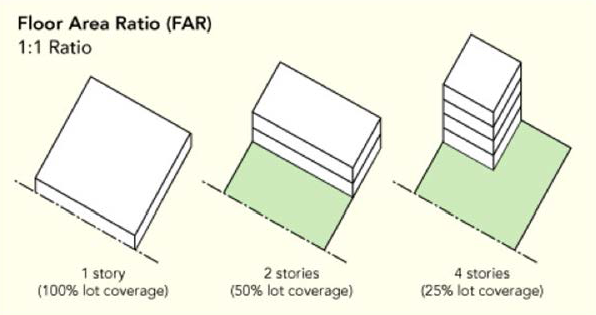 |
| Figure 38.320.020.C Clarification of floor area ratio and lot coverage. |
D.
Maximum building height for each district are set forth in the form and intensity standards tables within this division.
E.
Minimum setbacks.
1.
Minimum setbacks for each district are set forth in the form and intensity standards tables within this division.
2.
When a lot has one or more principal buildings which are oriented to place the functional rear of a building adjacent to a side lot line, a setback from the property line equal to that for a rear setback must be provided.
3.
All setbacks are subject to the provisions of sections 38.340.060, 38.350.050, 38.410.100, 38.400.100 and 38.550.050.
4.
Setbacks for accessory structures are set forth in section 38.360.030.
5.
Easements for utilities or other special standards may require adjustments to minimum building setbacks.
F.
All developments except single to four-household dwellings are subject to the block frontage standards of division 38.510, which provides standards for building placement and related block frontage provisions depending on the applicable block frontage designation.
(Order No. 2018-01, § 6, 4-18-2018)
Sec. 38.320.030. - Form and intensity standards—Residential districts.
Table 38.320.030.A
Minimum and maximum lot area
Notes:
1.
In order to comply with the standards contained in this chapter, lot area in excess of the required minimum may be needed (for corner lots, parking, landscaping or large residential structures, for example), and may be necessary for property adjacent to watercourses, ridgelines, or other environmental features in order to provide an appropriate buildable area on the lot.
2.
For townhouse or rowhouse clusters, the lot area per dwelling may be averaged within the cluster.
3.
Departures from the maximum lot size requirements may be allowed where the planned development fits into the context of the neighborhood and proposed pedestrian and vehicular circulation measures meet community objectives.
Table 38.320.030.B
Minimum lot width (feet)
Notes:
1.
When the lot is adjacent to an alley and vehicle access is taken only from that alley.
2.
Lot width is subject to section 38.400.090. Lot widths of 25 feet or less may jeopardize compliance with standards for legal and physical access, street trees, on-street parking, garage design, drive access width and placement, and utilities. Home design and size will be restricted as a result. Mitigation measures may be required for placement and separation of public and private utilities.
3.
Second dwellings in accessory buildings are subject to all restrictions in this chapter relating to accessory buildings. Lot area and width must be provided as if the dwelling were attached to the principal use. Dwellings to be developed under this option are subject to section 38.360.040.
4.
Lot widths may be variable provided they are sized and shaped sufficient to accommodate permitted uses and conform to applicable design and density standards.
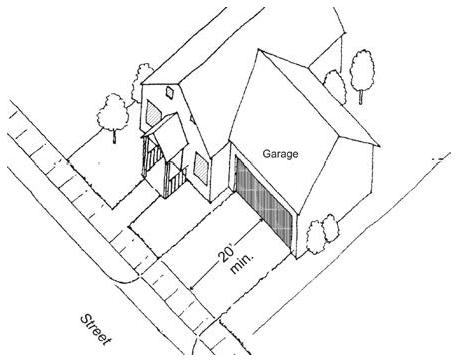 |
| Figure 38.320.030.1. Minimum setback to an individual, garage oriented to the street |
Table 38.320.030.C
Density, building height, and setbacks
Notes:
1.
The minimum density in the R-5 zone is eight dwelling units per "gross" acre.
2.
In all residential zoning districts for those lots used to satisfy the requirements of division 38.380, not more than 60 percent of the lot area can be covered by principal and accessory buildings. When a larger lot has a portion of its total dwellings subject to the requirements of division 38.380, either directly or inherited from a previous subdivision, the portion used for those dwellings may have up to 60 percent of the lot area covered by principal and accessory buildings.
3.
The maximum lot coverage for townhouses and rowhouses:
a.
R-1, R-2, R-3, and RMH districts: 50 percent.
b.
R-4 and townhouses complying with affordable housing provisions of division 38.380 of this chapter: 85 percent.
4.
Floor area ratio adjustments:
a.
For townhouse developments, the floor area ratio standard applies to all townhouse lots. Designated common area specifically associated with the townhouses may be used as applicable site area in determining compliance with the floor area ratio requirement.
b.
Dwellings used to satisfy requirements of division 38.380 of this chapter are allowed a 25 percent increase in allowable floor area ratio.
5.
An area, not to exceed a total of ten percent of the building footprint, may extend above the maximum building height by up to 12 feet. Such elements may include stair or elevator penthouses, service elements, or habitable area and must be set back from the edge of the building by at least five feet (see Figure 38.320.030.1 below for an example) to reduce the visibility of such feature.
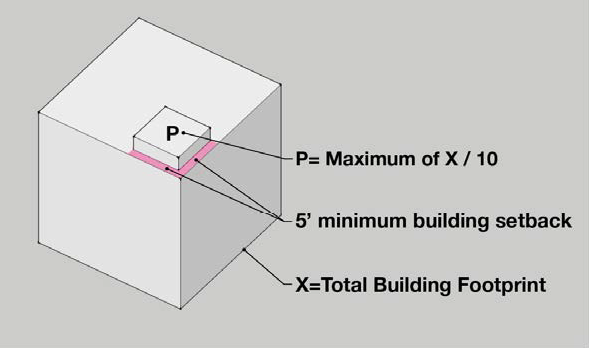 |
| Figure 38.320.030.2. Limited exceptions to height limits for elevator or stair penthouses or similar features are permitted provided they occupy no more than ten percent of building's footprint and are setback from the edge of the building by at least five feet to reduce their visibility from the ground level. |
6.
All barns, stables or permanent corrals must be set back not less than 100 feet from any residence or public road and not less than 50 feet from any property line.
7.
Porches and covered entries in the R-5 district may project as allowed 38.350.050.
8.
All vehicle entrances, oriented to the street, into garages shall be no closer than 20 feet to a property line, unless explicitly authorized otherwise under this chapter.
9.
No side setback is required for the interior walls of townhouses.
(Ord. No. 2014, § 2, 6-3-2019; Ord. No. 2019, § 2, 6-3-2019; Ord. No. 2059, § 2, 1-26-2021; Ord. No. 2070, § 1, 6-8-2021; Ord. No. 2105, § 5, 9-27-2022)
Sec. 38.320.040. - Form and intensity standards—Residential emphasis mixed-use zoning district.
Table 38.320.040
Table of Form and Intensity Standards—
Residential Emphasis Mixed-Use Zoning District
Notes:
1.
Supplemental townhouse/rowhouse cluster standards:
a.
Portions of site development review applications within the REMU zone for attached multi-household developments should be urban in character and may be designed such that each dwelling unit has a ground level entry oriented to the public realm, and shares one or more walls with another dwelling unit.
b.
Such units should be broadly consistent in scale and level of architectural detail, but must be designed to emphasize a distinction in individual dwelling units through form, massing, articulation, color and other architectural means.
c.
Townhouse/rowhouse units may incorporate home-based businesses at the ground level with direct access from a public right-of-way or other accessible route. These uses are exempt from off-street parking requirements.
d.
Developments incorporating townhouse/rowhouse units may include individual retail uses at the ground level no greater than 2,000 square feet in area, when located along the primary frontage. The first 2,000 square feet of any non-residential use in this development type is exempt from off-street parking requirements. Parking lots for such uses must not be permitted along primary street frontages. Apply standards of section 38.540.050.D for accessible parking spaces.
2.
Additional area for accessory dwelling unit: 800 square feet minimum.
3.
Apply standards of Table 38.320.030 (lot area standards), section 38.360.135, or if a structured internal parking facility is provided, then required lot area may be reduced by up to 50 percent.
4.
Lot coverage may be up to 100 percent if a structured parking facility that accommodates all required parking is provided.
5.
Lot coverage may be up to 100 percent if parking requirements are met by shared or off-site parking facilities, or if a structured parking facility that accommodates all required parking is provided.
6.
Special parking standards.
a.
Structured parking incentive. A floor area bonus of one square foot of non-residential up to a total of 50 percent of the gross building area of all uses may be granted for each square foot of structured parking area.
b.
Parking for individual lots may be provided elsewhere within the district with a shared parking agreement, provided that the overall parking ratio for the district is comparable with documented parking ratios in developments of similar scale, intensity of use, population density, and scope.
7.
Special setback standards for mixed-use:
a.
No minimum setbacks are required for the mixed-use district. Easements for utilities or other special standards may require buildings to be placed back from lot lines.
b.
Maximum setback. Buildings must be oriented to the adjacent street. At least 50 percent of the total building frontage must be placed within ten feet of any minimum required separation from the property line.
8.
Special setback standards for non-residential uses:
a.
Minimum setback. No minimum setback are required for non-residential uses. Easements for utilities or other special standards may require buildings to be placed back from lot lines.
b.
Maximum setback. Buildings must be oriented to the primary street. At least 50 percent of the total building frontage must be placed within ten feet of any minimum required separation from the property line.
c.
Special setback requirements. All setbacks associated with non-residential development must be subject to the provisions of section 38.550.050.B, additional screening requirements, and section 38.550.050.C (parking lot landscaping), when applicable.
9.
Allow "zero-lot line" development through shared use easements or placement of buildings on or near one of the side lot lines.
10.
Or zero feet for interior walls of townhouses.
11.
All vehicle entrances oriented to the street into garages must be no closer than 20 feet to a property line, unless otherwise explicitly authorized under this chapter.
12.
Special garage standards for single to four-household uses. To ensure that the subject housing types contribute to a community-oriented, pedestrian-friendly streetscape, they must comply with the following specific standards of this chapter:
a.
Section 38.350.070, parking and garages for single to four-household residential uses.
b.
Section 38.400.090.C.2.a, drive access requirements—residential.
c.
Section 38.540.010.A.4, stacking of off-street parking spaces.
d.
Section 38.540.010.A.5, no parking permitted in required front or side setbacks.
e.
Section 38.540.010.A.6, parking permitted in rear setbacks.
13.
Bicycle parking. Covered bicycle parking must be provided by all mixed use development. The covered spaces must be either ten bicycle parking spaces or one-half of the total minimum bicycle parking, whichever is less.
14.
Mixed-use and non-residential developments are subject to block frontage standards of division 38.510.
(Ord. No. 2059, § 3, 1-26-2021; Ord. No. 2161, § 2, 6-18-2024)
Sec. 38.320.050. - Form and intensity standards—Non-residential and other mixed-use districts.
Table 38.320.050
Table of Form and Intensity Standards—
Non-Residential and Other Mixed-Use Districts
Notes:
1.
The lot area must provide all required setback areas and off-street parking and loading. Lot area per dwelling must not be less than 5,000 square feet per detached single-household dwelling and 3,000 square feet per attached dwelling. Lot area per each dwelling used to satisfy the requirements of division 38.380 must not be less than 2,700 square feet per detached single-household dwelling and 2,500 square feet per attached dwelling.
2.
Reserved.
3.
Reserved.
4.
In the UMU district, the footprint of individual buildings must not exceed 45,000 square feet.
5.
The maximum lot coverage must be 40 percent for principally residential uses or 100 percent for principally non-residential uses.
6.
Buildings within a development or each phase of a multi-phased development must have varying heights achieved through the use of multiple stories.
7.
Height exceptions:
a.
Maximum height may be increased by up to a maximum of 50 percent when the zoning district is implementing a regional commercial and services growth policy land use designation.
8.
B-2M height limits:
a.
For buildings designed for non-residential or mixed-use: Five stories or 60 feet (whichever is less), provided the top floor of five-story buildings within 30 feet of the front property line feature has a stepback of at least ten feet from the front face of the building.
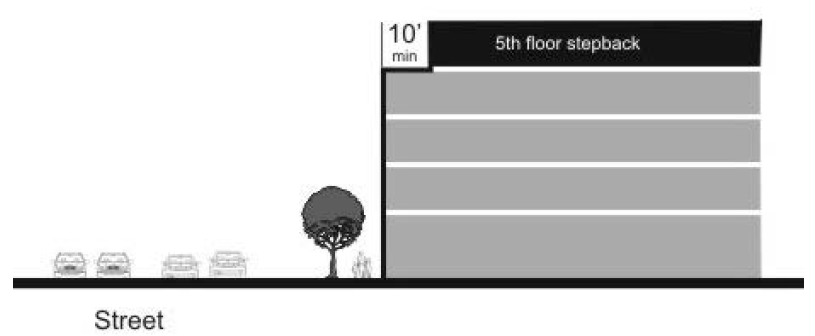 |
| Figure 38.320.050.1. The top floor of five story buildings within 30 feet of a street property line must feature a ten-foot stepback along the front façade to reduce the perceived scale of the building. |
b.
For buildings designed for single purpose residential use: Four stories or 50 feet (whichever is less).
c.
An area, not to exceed a total of ten percent of the floor area which is located at street level, may extend above the maximum building height by up to 12 feet.
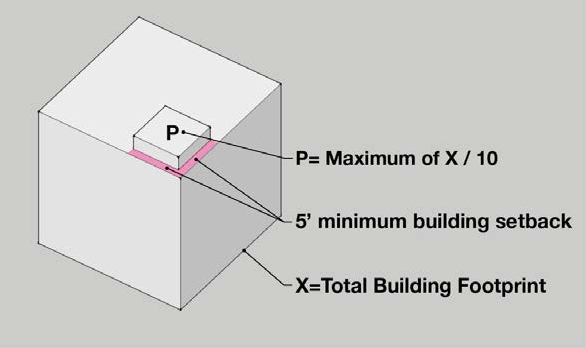 |
| Figure 38.320.050.2. Limited exceptions to height limits for elevator or stair penthouses or similar features are permitted provided they occupy no more than ten percent of building's footprint and are set back from the edge of the building by at least five feet to reduce their visibility from the ground level. |
9.
Maximum building height in the B-3 district must be 55 feet in the district core area and 70 feet outside of the core area.
10.
Maximum building height may be increased by up to but not more than an additional 25 feet when structured parking is provided per section 38.330.040.E.2, and when determined to be in compliance with the review criteria of 38.230.100.
11.
Front setback provisions are set forth in the block frontage standards in division 38.510 and in 38.350.070.
12.
In the PLI district, there is no setback requirement except when a lot is adjacent to another district. The setbacks then must be the same as those in the adjacent district. The setback requirements of RS must be interpreted as those of R-1.
13.
The minimum rear setback is five feet for accessory buildings.
14.
Zero lot lines are allowed per 38.350.050.B.
15.
All vehicle entrances into garages must be no closer than 20 feet to a property line, unless explicitly authorized otherwise under this chapter.
16.
Side and rear setbacks for parking may be allowed to be zero feet when coordinated parking arrangements between adjacent properties are provided.
17.
Rear and side setbacks adjacent to alleys must be at least five feet.
18.
Garage location standards: for single to four-household uses, see 38.350.070.
19.
This chapter provides opportunities for parking requirements to be met by shared and off-site parking as allowed by division 38.540 of this chapter.
20.
Non-residential and multi-household developments are subject to the block frontage standards of division 38.510.
21.
Floor-to-floor height is defined as the height between each floor plate in a building measured from the top of the ground floor to the top of the floor above. This standard applies to non-residential buildings, and mixed-use buildings, except for residential portions of mixed-use buildings.
(Ord. No. 2014, § 3, 6-3-2019; Ord. No. 2070, § 2, 6-8-2021; Ord. No. 2062, § 1, 11-16-2021)
Sec. 38.320.060. - Zone edge transitions.
A.
Intent. To provide measures that help to provide a compatible transition between certain higher and lower intensity zoning districts.
B.
Zone edge transition standards. The following standards are intended to supersede other form and intensity standards in this division.
1.
Setback adjustments.
a.
Minimum side and rear setbacks for development within BP, M-1, and M-2 districts where adjacent to a residential district: 15 feet. No additional setbacks required adjacent to alleys and streets.
b.
Minimum side and rear setbacks for development within B-3 and UMU districts adjacent to a residential district: five feet. No additional setbacks are required adjacent to alleys and streets
2.
Height/setback adjustments.
a.
For development on sites in the B-3, B-2M, UMU, and R-5 districts that are adjacent to the RS, R-1, or R-2 district. From a height of 38 feet at a ten foot setback from the property line adjacent to applicable residential districts, buildings must step back at a 45-degree angle away from the applicable property line as shown in figure 38.320.060. No such 45 degree angle setback is required if separated by a street.
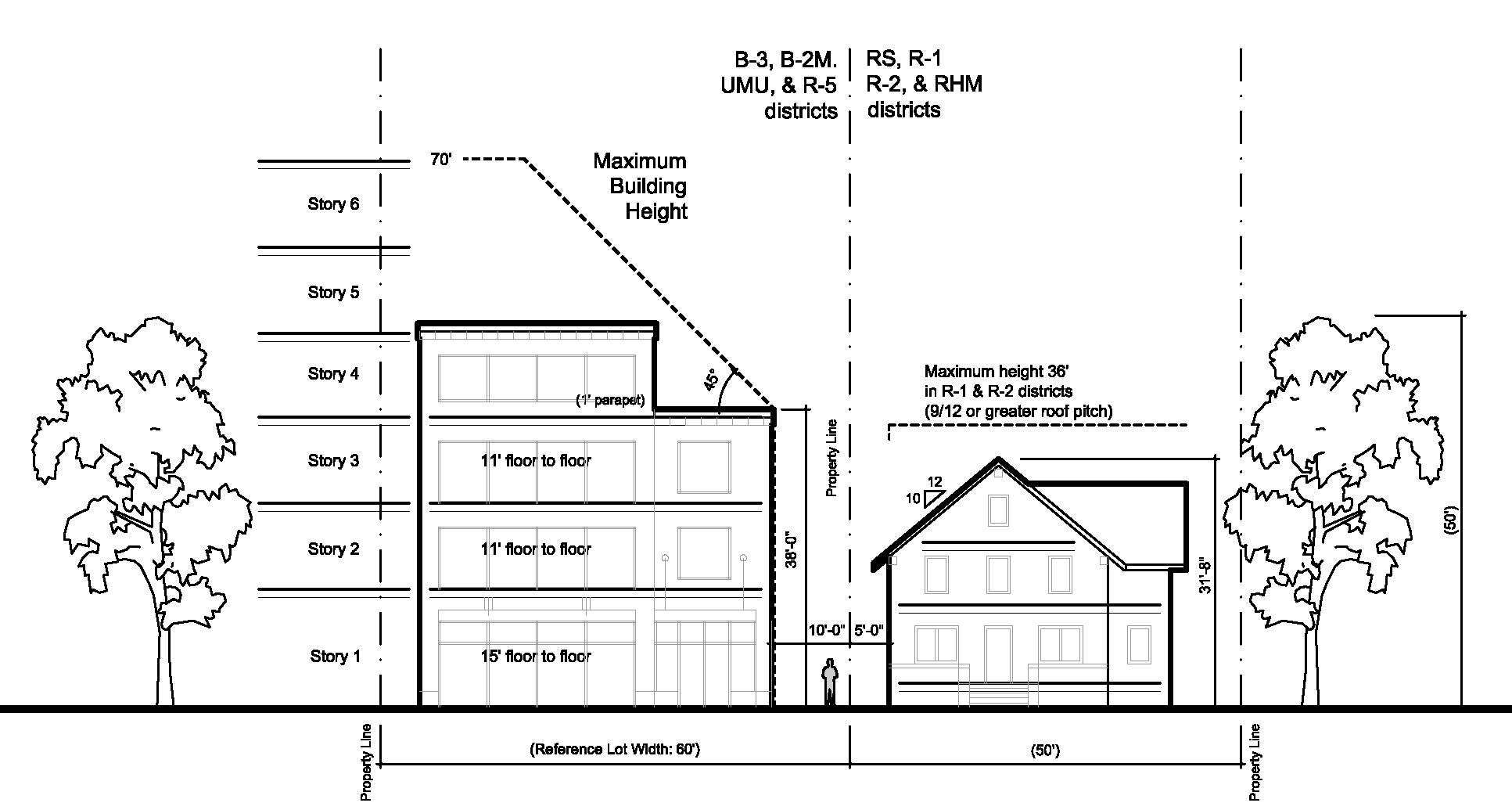 |
| Figure 38.320.060. 45 degree angle stepback rule for certain zone edge development. |
b.
For development on sites in the B-3 district that border R-3 and R-4 districts. From a height of 38 feet at a five foot setback from the property line adjacent to applicable residential districts, buildings must step back at a 45 degree angle away from the applicable property line.
c.
For buildings located at the edge of a zoning district and which use the height incentives of 38.380.030. At the required setback from property line for the district in which the site is located; and from the maximum building height allowed in the district without the height incentive; buildings must step back at a 45-degree angle away from property lines. This requirement does not apply to interior common walls within the same development, such as between townhomes.
d.
Permitted 45 degree angle step back encroachments in a-c of this paragraph:
(1)
Permitted horizontal encroachments include those elements and standards set forth in section 38.350.050.A.
(2)
Permitted vertical encroachments include those elements and standards set forth in section 38.350.050.D.
(Ord. No. 2105, § 6, 9-27-2022)
Sec. 38.320.070. - Departures for housing creation.
A.
Intent. The intent of this provision is to allow minor departures from existing residential development standards when the review authority determines that the departure will reduce the cost of production of and an increase production of housing while maintaining consistency with the city's adopted growth policy and purposes of this chapter. These departures are especially applicable to infill sites as defined in 38.700.100 and missing middle housing as defined in 38.700.120.
B.
Applicability. The review authority may approve departures from residential development standards as identified in Table 38.320.070 if the review authority determines that the criteria in Subsection C below have been met. Approval of a departure authorizes development with a different standard than is otherwise required by this chapter.
Table 38.320.070
C.
Criteria. To approve departures the review authority must determine that criteria 1 and 2; and at least one of criteria 3—5 are met:
1.
The departure will result in at least one more home than would otherwise be possible; and
2.
The purpose of the standard can still be accomplished if the departure is granted; and
3.
The departure will not impose negative impacts on surrounding property; or
4.
The departure is applicable to missing middle housing; or
5.
The departure is applicable to an infill site.
D.
Procedure. The request for a departure must be submitted with the initial application for any development. Review times and processes are coordinated with the development application. These departures are not applicable to subdivision reviews.
E.
Appeals. A decision by the review authority to approve or deny a departure may not be appealed independently, but the decision regarding an application as a whole that includes a departure may be appealed pursuant to Division 38.250.
(Ord. No. 2111, § 2, 6-28-2022)