


Bozeman City Zoning Code
DIVISION 38.350
GENERAL LAND USE STANDARDS AND REQUIREMENTS
Sec. 38.350.010. - Area requirements for individual buildings—restrictions.
No part of any setback, open space, or off-street parking or loading space required in connection with any building for the purpose of complying with this chapter may be included as part of a setback, open space or off-street parking or loading space similarly required for any other building except as provided in section 38.540.060.
Sec. 38.350.020. - Setbacks and lots reduction prohibited.
No setback or lot existing at the time of the adoption date of the ordinance from which this chapter is derived may be reduced in dimension or area below the minimum requirements of this chapter except as set forth herein. Setbacks or lots created after the effective date of said ordinance must meet at least the minimum requirements established by this chapter.
Sec. 38.350.030. - Use of lands; buildings and structures.
A.
Only uses specifically identified by this chapter are to be built. No building, or structure or part thereof may be erected, altered or enlarged for a use, nor must any existing building, structure or part thereof, or land, be used for a purpose or in a manner that is not in conformity with the uses listed as authorized uses for the zone in which such buildings, structure or land is situated. In addition, any land, building or structure to be erected or used for a purpose listed as a special use in such zone must first receive final approval of a permit for the use. Existing nonconforming uses and structures must comply with division 38.270 of this chapter.
B.
No building, or part thereof, or structure may be erected, nor may any existing building be altered, enlarged or rebuilt, or moved into any zone, nor may any open space be encroached upon or reduced in any manner, except in conformity to the setback regulations designed for the zone in which such building or open space is located, except as otherwise specified in this chapter.
C.
Recreational vehicle parking on residential lot. No person may park or occupy any recreational vehicle or mobile home on the premises of any occupied dwelling or on any lot which is not a part of the premises of any occupied dwelling, either of which is situated outside of any approved manufactured home community or recreational vehicle park except that:
1.
The parking of only one unoccupied recreational vehicle in any accessory individual garage, or in a rear setback in any district is permitted, provided no living quarters may be maintained or any business practiced in the recreational vehicle while such recreational vehicle is so parked or stored; and
2.
In the event of hardship, temporary use permits may be granted for occupying such recreational vehicle or mobile home.
D.
Municipal infrastructure requirements.
1.
Whenever any building lots and/or building sites are created inside the city limits or existing lots are annexed, and prior to the issuance of any building permits on such lots or sites, municipal water distribution, municipal sanitary sewer collection, and streets must be provided to the site. Each building site must utilize and be connected to both the municipal water distribution and municipal sanitary sewer collection systems. Installation of improvements is subject to division 38.270 of this chapter.
a.
Alternative. When, in the city's sole determination, it is in the city's long term best interests to allow a building lot or site to be created or developed without immediate access to either municipal water or municipal sewer the city may, at its sole discretion, make such allowance when all of the following have been met:
(1)
The non-municipal system to service the lot or site must be designed, reviewed and constructed to meet city standards. Systems serving more than one lot or user must be central systems;
(2)
The non-municipal system must be designed and constructed in a manner to allow connection to the municipal system components shown in applicable facility plans to serve the property at such time as it becomes available;
(3)
The landowner must provide waivers of right to protest creation of special improvement districts or other financing methods to extend municipal water and sewer services. Such extensions or connections may require construction of system components that are not immediately adjacent to the building lot or site;
(4)
The landowner must agree to connect to municipal water and sewer services and abandon and remove non-municipal services when so instructed by the city. Such agreement must be binding on all successors and run with the land;
(5)
If the city takes responsibility to operate the non-municipal system it may impose a surcharge to cover extra operational expenses. City operation of the system is at the city's discretion;
(6)
The requirement for future connection to the municipal water and/or sewer system, waivers and agreements, and other applicable materials must be either noted on the plat or final plan or a separate notice be recorded at the county clerk and recorder's office so that such notice will appear on a title report or abstract of the property;
(7)
No non-municipal water or sewer systems must be constructed until all necessary approvals from the state department of environmental quality, City of Bozeman, county health department, and any other relevant agency have been received; and
(8)
The use of municipal water or sewer systems is considered to be the best means to protect the public interest and welfare. The alternative for the use of non-municipal systems is intended to be used sparingly and in extraordinary circumstances. In order to protect the public interest, in approving a non-municipal system the city may impose such conditions of approval as it deems necessary.
2.
These improvements must be designed, constructed and installed according to the standards and criteria as adopted and approved by the city prior to the issuance of any building permits.
3.
The issuance of a building permit may be allowed prior to completion of the public infrastructure, provided the criteria, standards, and limitations of section 38.270.030 are met.
(Ord. No. 2104, § 16, 9-27-2022; Ord. No. 2124, § 23, 10-18-2022)
Sec. 38.350.040. - Dwelling unit restrictions.
A.
No use of unfinished structures. No cellar, garage, tent, tepee, yurt, basement with unfinished structure above, accessory building, or vehicle; or any manufactured home or recreational vehicle outside of an approved manufactured home community, recreational vehicle park, or approved individual lot in accordance with section 38.360.170 can at any time be used as a dwelling unit, unless approved for use as a temporary dwelling unit due to a demonstrated hardship.
B.
Use of basements. The basement portion of a finished home must be properly damp-proofed and have nature lighting, heating, ventilation, and suitable fire protection and exits if used for living.
(Ord. No. 2059, § 3, 1-26-2021)
Sec. 38.350.050. - Setback and height encroachments, limitations and exceptions.
A.
Permitted encroachments into setbacks. The following are permitted encroachments into required setbacks, subject to any and all applicable International Building Code requirements and/or utility easements:
1.
Architectural features which do not add usable area to a structure, such as chimneys, wing walls, sills, pilasters, lintels, cornices, eaves, gutters, awnings, window wells and steps, provided such architectural features do not extend more than five feet into any required front or rear setback;
2.
Architectural features, which do not add usable area to a structure, such as chimneys, wing walls, sills, pilasters, lintels, cornices, awnings, window wells and steps, provided such architectural features do not extend more than two feet into any required side setback, except that eaves and gutters may extend two and one-half feet into any required side setback;
3.
Terraces and patios, uncovered decks and stoops or similar features, provided that such features do not extend above the height of the ground floor level of the principal structure nor more than five feet into any required front or rear setback or two feet into any required side setback;
4.
Porches and entries on residential structures, except multi-household developments featuring more than four attached dwelling units, may project up to five feet into the front setback area except where front setback utility easements prevent such projects;
5.
Fire escapes may be permitted in required side or rear setbacks only;
6.
Wheelchair ramps may encroach into any required setback, but must not be located closer than three feet from any property line;
7.
Flagpoles, ornamental features, trees, shrubs, walkways, and nameplate signs may be located within a required setback. Street vision triangle requirements apply; and
8.
Essential services Type I and Type II may be located within a required setback when they are within a utility easement.
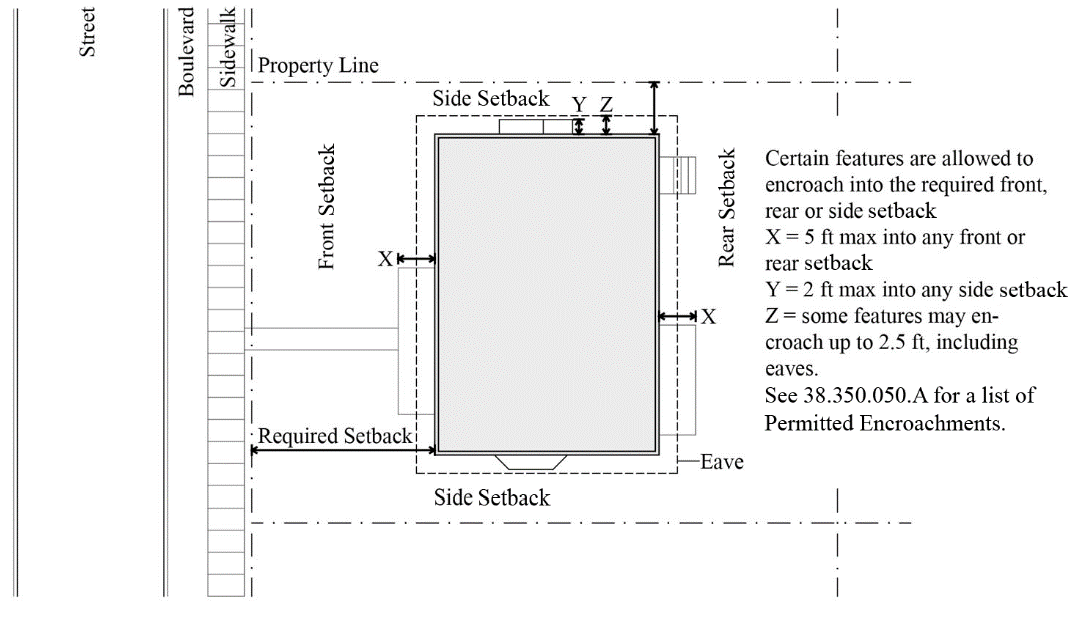 |
| Figure 38.350.050.A. Example of permitted encroachments. |
B.
Zero lot line conditions. In districts where zero side setbacks are not otherwise allowed, where an individual owns two or more adjoining lots, or where the owners of two or more adjoining lots make legal written agreement recorded at the county clerk and recorder, a zero lot line concept may be used for commercial, or single-household dwelling unit developments, or detached accessory structures. In all such cases in residential districts, a minimum eight-foot side setback must be maintained adjacent to the exterior side, or nonzero lot line side, of the structure.
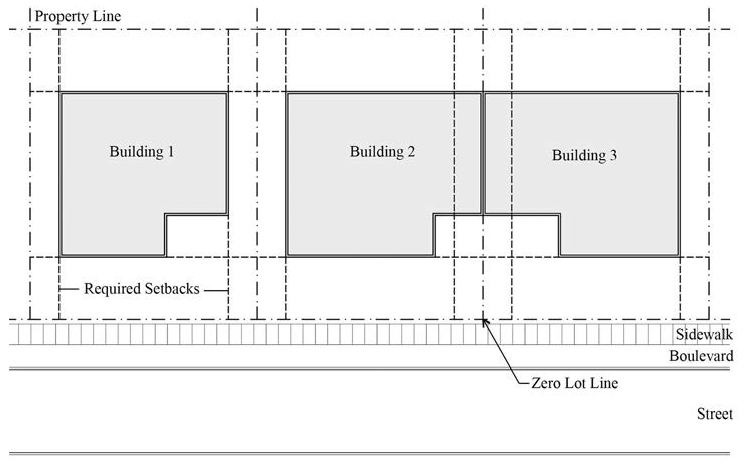 |
| Figure 38.350.050.B. Zero lot line conditions. |
C.
Required setbacks from watercourses are set forth in section 38.410.100.
D.
Height limitation exceptions.
1.
Non-specific exemptions. No building, or part thereof, or structure must be erected, reconstructed or structurally altered to exceed in height the limit herein designated for the district in which such building is located, except as is specified in division 38.250 of this chapter.
2.
Specific exemptions.
a.
Height limitations do not apply to church spires, belfries, cupolas and domes; monuments; chimneys and smokestacks; flag poles; public and private utility facilities; parapet walls extending no more than four feet above the limiting height of the building except as hereinafter provided: amateur radio antennae; solar energy collectors and equipment used for the mounting or operation of such collectors; and building mounted horizontal and vertical axis wind energy collectors under 15 feet in height from the building mounting surface, and equipment used for the mounting or operation of such collectors.
b.
Places of public assembly in churches, schools and other permitted public and semi-public buildings may exceed height limitations otherwise established by this chapter, provided that:
(1)
The portion of the building that exceeds the height limit must be limited to 10 percent of the total building footprint; and
(2)
That for each one foot by which the height of such building exceeds the maximum height otherwise permitted in the district, its side and rear setbacks must be increased in width or depth by an additional one foot over the side and rear setbacks required in the district.
c.
Elevator and stair penthouses, water tanks, monitors and scenery lofts are exempt from height limitations otherwise established in this chapter, provided that no linear dimension of any such structure exceed 50 percent of the corresponding street frontage line.
d.
Towers and monuments, cooling towers, gas holders or other structures, where the manufacturing process requires a greater height, and grain elevators and silos are exempt from this chapter, provided that any structure above the height otherwise permitted in the district must occupy no more than 25 percent of the area of the lot and must be at least 25 feet from every lot line.
e.
Height restrictions for wireless facilities are governed by division 38.370 of this chapter.
(Ord. No. 2014, §§ 5, 6, 6-3-2019; Ord. No. 2104, § 17, 9-27-2022)
Sec. 38.350.060. - Fences, walls and hedges.
A.
Location and height. Except as provided in section 38.400.100, fences, walls and hedges in any district may be located on lot lines, provided such fences, walls and hedges comply with the following height requirements:
1.
Do not exceed six feet in height in any required rear or required side setback. Fences exceeding six feet in height must be subject to the minimum setback requirements of the district in which such fences are located. Decorative post caps may exceed the height limit by no more than one additional foot. Fences in excess of six feet in height require a building permit before installation may commence. Fences may not exceed eight feet in height.
a.
A gate may be provided which defines an entrance point. The gate may have a defining structure so long as the defining structure is not more than one foot wide on either side of the gate. Gate structure heights may not exceed twice the allowed fence height.
2.
For lots with one front setback, do not exceed four feet in height in the front setback. Lots with more than one front setback, do not exceed four feet in the setback adjacent to the street on which the property has its assigned address. In non-addressed front setbacks, fences must not exceed four feet in height in the portion of the front setback that is adjacent to the building façade nearest the front setback. Decorative post caps may exceed the height limit by no more than one additional foot.
3.
Fences used in an agricultural pursuit to retain stock animals or for public safety must be excepted.
4.
The height of fences located in the B-3 district must meet the requirements of this section for any provided, not required, setbacks.
B.
Relation to linear parks. Fences located in the rear or side setback of properties adjoining any city linear park must have a maximum height of four feet.
C.
Construction and maintenance. Every fence or wall must be constructed in a substantial, workman-like manner and of substantial material reasonably suited for the purpose for which the fence or wall is proposed to be used. Every fence or wall must be maintained in a condition of reasonable repair and must not be allowed to become and remain in a condition of disrepair, damage or unsightliness, or constitute a nuisance, public or private. Any such fence or wall which is, or has become, dangerous to the public safety, health or welfare, or has become unsightly through improper maintenance or neglect is a public nuisance and the building official must commence proper proceedings for the abatement thereof.
D.
Barbed wire and electric fences.
1.
No barbed wire or similar sharp fencing or electric fences is permitted, except in R-S districts; except that barbed wire or other similar sharp fencing materials may be used on the top of security fences in M-1 and M-2 districts.
2.
When electrically charged fences are used in an R-S district, such fences must be posted with warning signs at intervals not to exceed 150 feet where such fences are adjacent to public rights-of-way.
E.
Measuring fence and wall height. In case of a fence erected on top of a retaining wall, the height must be measured from the grade of the high side of the wall.
F.
"Finished" side out. Any fence or wall constructed so as to have only one elevation "finished," which must be defined as not having its supporting members significantly visible, must be erected such that the finished elevation of the fence is exposed to the adjacent property.
G.
Fencing of utilities and outdoor storage areas.
1.
All utility substations, wells, storage facilities or other utilities must be screened from view by a wall, fence, hedge or landscape screen.
2.
All storage for commercial operations must be conducted within a completed enclosed building or within an area completely enclosed, except for access points, by a wall, fence, hedge or landscape screen at least six feet in height.
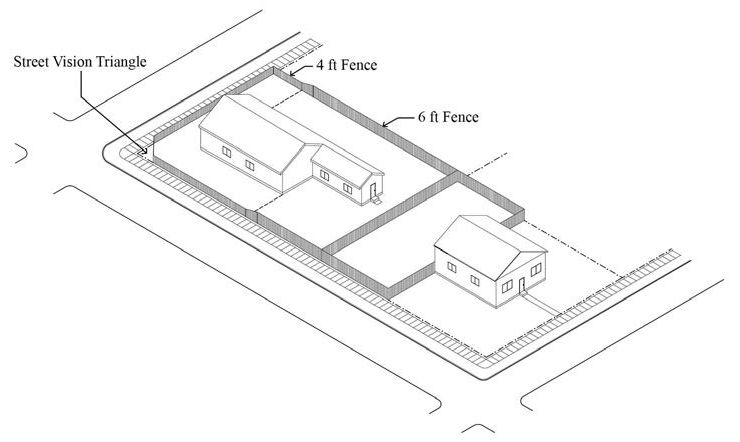 |
| Figure 38.350.060. Fences. |
(Order No. 2018-01, § 7, 4-18-2018; Ord. No. 2061, § 1, 4-6-2021)
Sec. 38.350.070. - Parking and garages for single to four-household residential uses.
A.
Applicability. The following standards apply to all residential development, except multi-household developments featuring more than four attached dwelling units.
B.
General requirements.
1.
Surface parking may be allowed within the front setback when located in front of a parking space that meets setback provisions of division 38.320.
2.
Surface parking may be allowed in the rear setback.
3.
See section 38.400.090 for drive access requirements.
C.
Residential garage setback standards.
1.
Individual garages are subject to setback standards in Tables 38.320.030—38.320.040.
2.
All garages facing the street must be at least four feet behind the front façade of the structure. Garage entrances may also be tucked under the second floor to help meet this requirement.
D.
Residential garage width standards.
1.
Where a garage door or doors facing the street occupy more than ten feet of the façade's width, the total width of the garage door or doors must comprise no more than 50 percent of the width of the ground level façade facing the street.
2.
There is no restriction on the number of individual garage doors facing the street, only the proportion of the façade associated with a garage door or doors exceeding ten feet in total width.
E.
Individual garages facing the street are not permitted in the B-3 district when an alley is adjacent to the property.