


Bozeman City Zoning Code
DIVISION 38.360
INDEX OF SUPPLEMENTAL USE CRITERIA
Sec. 38.360.010. - Purpose.
The purpose of this section is to further describe the standards and conditions under which certain uses may be permitted as principal or special uses in specific districts.
(Ord. No. 2124, § 24, 10-18-2022)
Sec. 38.360.020. - Applicability.
All uses listed in this section are subject to the specific standards described for each use, in addition to all other applicable standards.
Sec. 38.360.030. - Accessory buildings, uses and equipment.
A.
An accessory building is an integral part of the principal building if it is connected to the principal building by a common wall for not less than five feet horizontally and eight feet vertically.
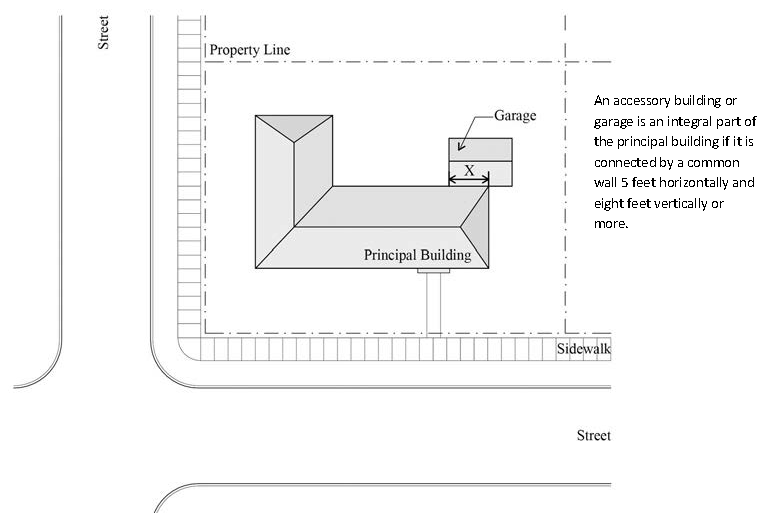 |
| Figure 38.360.030.A. Accessory building example. |
B.
Accessory buildings, uses or equipment may not be stored or constructed between the front lot line and front façade of the building. On a corner lot with two streets, the accessory building must be placed behind both front façades of the primary structure. For lots with three or more frontages, alternate locations may be allowed. The review authority shall consider the predominant placement of accessory structures in the site vicinity, the consistency of the proposal with the established and/or desired character of the surrounding area, and the visual impact of the structure given its proposed placement.
C.
Accessory buildings and garages may not be located within a utility easement without written approval of the easement holder.
D.
Accessory buildings in any business or industrial district may be located only to the rear of the front line of the principal building.
E.
No accessory building may exceed the footprint of the principal building unless such accessory building has been otherwise approved per this chapter.
F.
Accessory buildings with less than five feet separation between walls or with any connecting elements will be considered a single structure for determination of maximum size allowed.
G.
Accessory building height and setback limitations in residential zoning districts:
1.
Accessory buildings may not exceed the height of the principal building unless such accessory building has been otherwise approved per this chapter; and
2.
From a height of 15 feet at the minimum side setback as set forth in division 38.320, buildings must step back at a 45 degree angle away from the side property line as shown in figure 38.360.030.G below, except zero lot line situations meeting the standards of section 38.350.050.B:
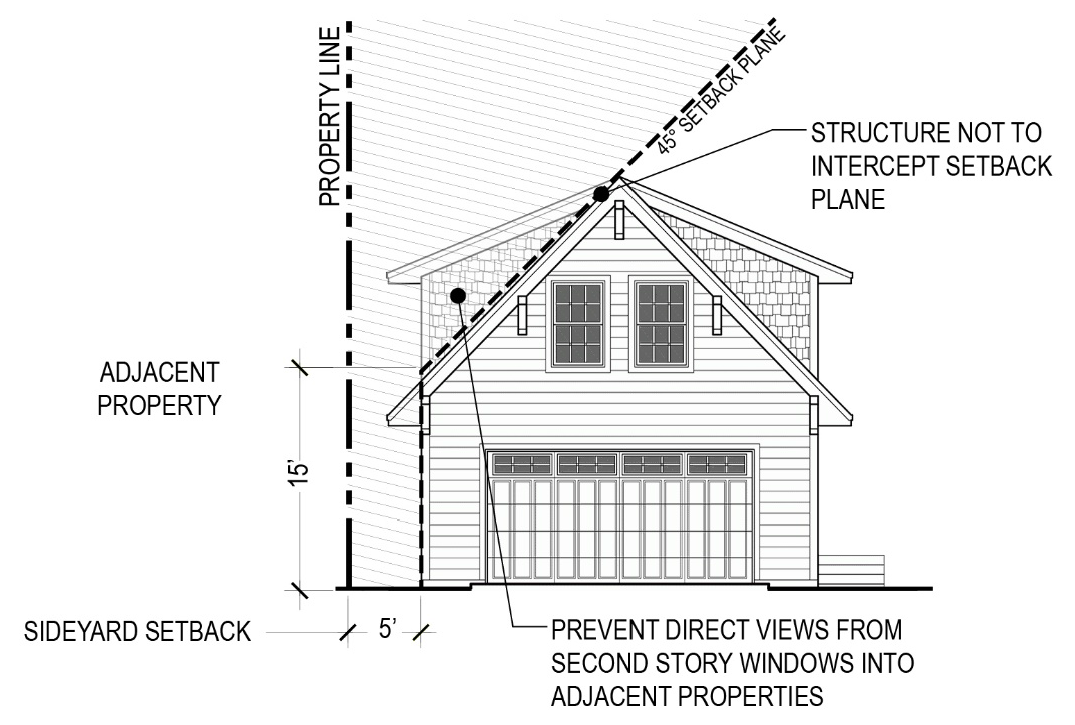 |
| Figure 38.360.030.G. Angled setback plane for accessory buildings alongside setbacks. |
Permitted setback plane encroachments:
a.
Permitted horizontal encroachments include those elements and standards set forth in section 38.350.050.A.
b.
Permitted vertical encroachments include those elements and standards set forth in section 38.350.050.D.
H.
Mechanical equipment screening.
1.
Rooftop mechanical equipment must be screened. Screening must be incorporated into the roof form when possible. The requirement for screening of rooftop mechanical equipment does not apply to solar or wind energy collection devices.
2.
Ground-mounted mechanical equipment must be screened from public rights-of-way with walls, fencing or evergreen plant materials. Mechanical equipment may not encroach into required setbacks.
I.
Detached structures setback requirements.
1.
Accessory structures less than or equal to 120 square feet in footprint may not be located in any front, side, or corner-side setback and must maintain a minimum setback of three feet from the property lines in the rear setback.
2.
Accessory structures greater than 120 square feet but less than or equal to 600 square feet in footprint may not be located in any front, side, or corner-side setback. The accessory structure must be set back a minimum of either:
a.
Six feet, or
b.
When parking is provided between the structure and the rear property line, 20 feet except when required parking spaces need a greater setback for back-up maneuverability.
See the following examples:
3.
Accessory structures greater than 600 square feet may not be located in any required front or side setback, or in a rear setback when no alley is present. Adequate back-up maneuverability for required parking spaces must be provided.
4.
Accessory structures greater than 600 square feet may be located in required rear setbacks when an alley is present and must provide adequate backup maneuverability for required parking spaces.
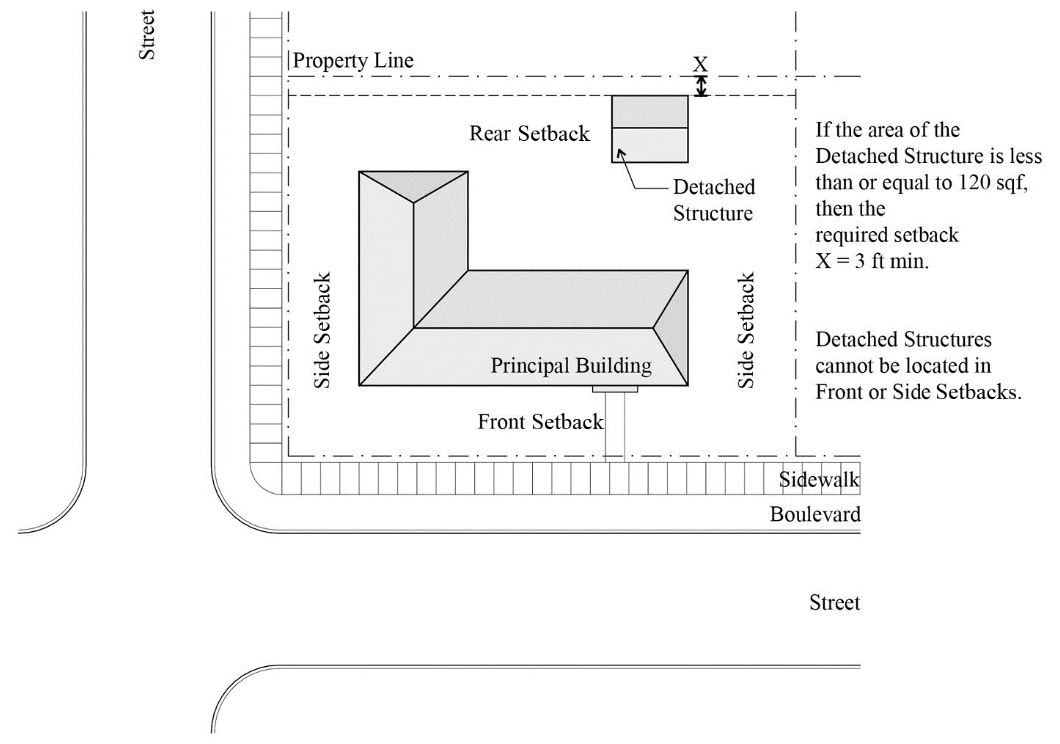 |
| Figure 38.360.030.I.1. Detached structure setback requirements. |
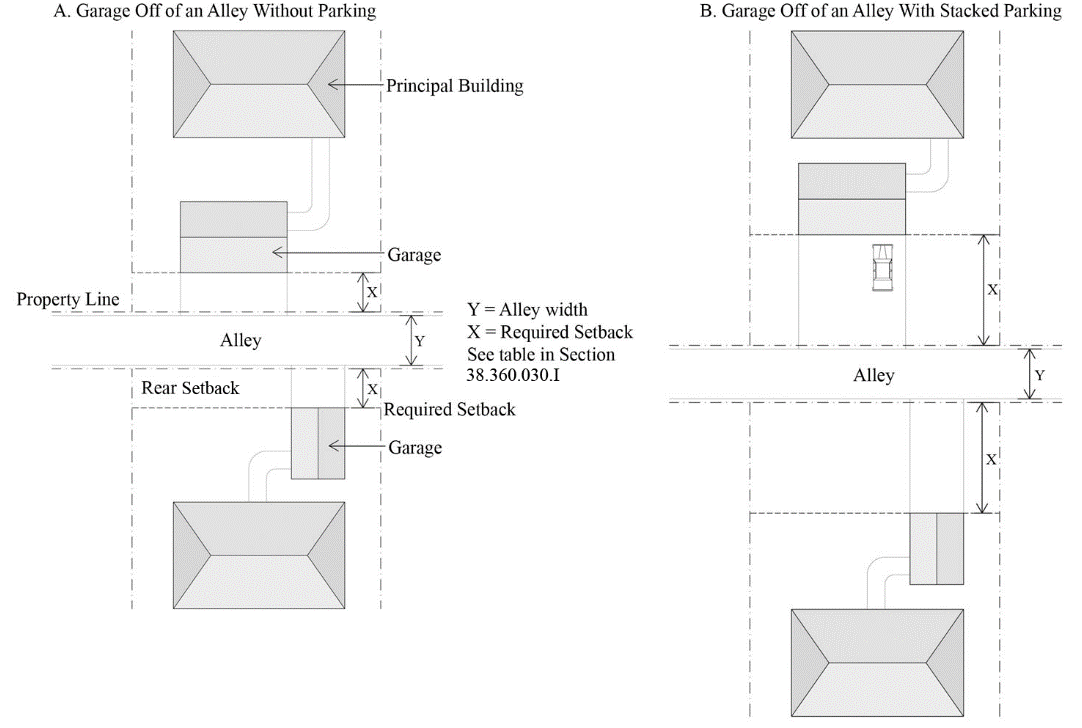 |
| Figure 38.360.030.I.2. Garage setback requirements. |
J.
Structures may occupy no more than 40 percent of the area of the lot located to the rear of the principal building.
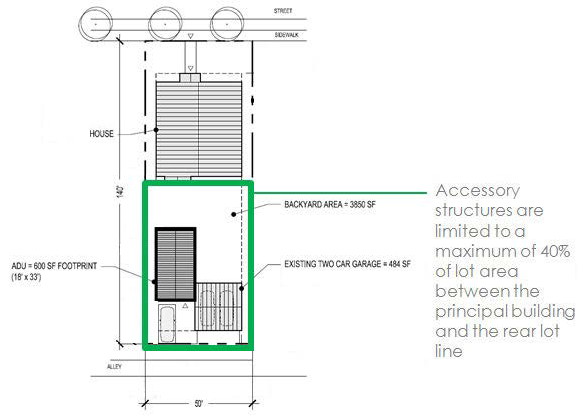 |
| Figure 38.360.030.J. Accessory structures are limited to a maximum of 40% of the lot area between the principal building and the rear lot line. |
K.
All structures located within the neighborhood conservation district require a certificate of appropriateness unless exempted in division 38.340 of this article.
(Order No. 2018-01, § 8, 4-18-2018; Ord. No. 2014, § 7, 6-3-2019)
Sec. 38.360.040. - ADU use table in residential zoning districts.
Table 38.360.040
ADU use table in residential zoning districts
The following ADU standards and 38.320.070 apply to all zoning districts:
Notes:
Location. The ADU may be a part of the principal dwelling unit, provided the ADU is clearly incidental to the principal dwelling unit and meets all of the following criteria:
a.
Lot area per Table 38.320.030 is provided.
b.
The ADU does not exceed one-third of the total area of the principal structure.
c.
If the entrance for the ADU is separate from the entrance of the principal structure, the entrance must be on a façade different than that of the main entry.
(Ord. No. 2014, § 8, 6-3-2019; Ord. No. 2041, § 2, 9-17-2020; Ord. No. 2091, § 1, 12-21-2021; Ord. No. 2105, § 8, 9-27-2022)
Editor's note— Ord. No. 2014, § 8, adopted June 3, 2019, repealed the former § 38.360.040, and enacted a new § 38.360.040 as set out herein. The former § 38.360.040 pertained to accessory dwelling units (ADU) and derived from Ord. No. 1994, § 3, adopted March 31, 2018 and Order No. 2018-01, § 1, adopted April 18, 2018.
Sec. 38.360.050. - Adult businesses.
A.
In addition to the requirements for all development established in this chapter, the following requirements apply to all adult businesses:
1.
An adult business must be separated by at least a 500-foot radius from any other adult use, residence, residential district, school, place of worship, public park or any youth-oriented establishment. Subsequent establishment of one of the above-listed uses within the required separation radius does not compel the relocation of an adult business.
Sec. 38.360.060. - Alcohol sales for on-premises consumption.
A.
Alcohol sales for on-premises consumption, on either a temporary or permanent basis, may not be conducted on the same lot or premises where an adult business or the sale of auto retail fuel is permitted.
B.
Pursuant to section 4.02.020, the restrictions in MCA 16-3-306(1) do not apply to:
1.
A person operating a temporary event using a catering endorsement; or
2.
The sales of alcohol for on-premises consumption pursuant to a state issued alcohol retail license as long as such establishment complies with the following requirements and provides the city an annual certification with its business license application of such compliance:
a.
Gambling or gaming is prohibited.
C.
Sales of alcohol for on-premises consumption in the M-1 and M-2 districts are permitted with the following conditions:
1.
Restaurants serving alcoholic beverages are limited to those with state beer and wine licenses issued since 1997, prohibiting any form of gambling and occupying not more than 45 percent of the total building area of a food processing facility; and/or
2.
Retail sales for on-premises consumption of alcohol produced on site, not to exceed 10,000 square feet or 50 percent of the facility, whichever is less.
(Ord. No. 1999, § 2, 4-16-2018; Ord. No. 2124, § 25, 10-18-2022; Ord. No. 2132, § 5, 7-18-2023)
Editor's note— Section 3 of Ordinance No. 1999, adopted May 16, 2018, states "Section 16-3-306(4), MCA recognizes the City's authority to supplant the provisions of 16-3-306(1), MCA. The City Commission hereby supplants such restrictions as provided for in Sections 1 and 2 of this Ordinance."
Sec. 38.360.070. - Apartment buildings, limited.
A.
Apartment building, limited is subject to the following:
1.
No fewer than five or more than eight dwellings in a single building.
2.
Do not exceed 120 feet in width or length
 and 10,000 square feet in maximum floor area within all dwellings, attached parking
structures, and parking spaces internal to the building combined. Common interior
spaces are not included in the calculation of the 10,000 square feet maximum area.
Common interior spaces means enclosed spaces which are designed for use by occupants
of more than a single dwelling. Examples include but are not limited to elevators,
shared stairs, walkways, atriums, laundry rooms, and mail rooms.
and 10,000 square feet in maximum floor area within all dwellings, attached parking
structures, and parking spaces internal to the building combined. Common interior
spaces are not included in the calculation of the 10,000 square feet maximum area.
Common interior spaces means enclosed spaces which are designed for use by occupants
of more than a single dwelling. Examples include but are not limited to elevators,
shared stairs, walkways, atriums, laundry rooms, and mail rooms.
3.
The maximum area of common interior spaces attached to or included within an individual
apartment building, limited is
:
a.
One thousand square feet plus 250 square feet per dwelling in the individual building; and
b.
If an apartment building, limited is part of a larger development, and there are common spaces attached to the building to serve the larger development, an additional 150 square feet per dwelling in the larger development is allowed to be added to the common interior spaces attached to an apartment building, limited.
4.
Departure criteria. Departures to the above standards that feature the
symbol will be considered by the review authority provided the alternative proposal
meets the intent of the standards, plus the following criteria.
a.
A departure may be granted to alter the proportion of area of common interior spaces to area of dwellings. The criteria for the departure is the combined area of dwelling area and common interior spaces does not exceed 13,000 square feet.
b.
A departure for additional building length or width may be granted on lots larger than 24,000 square feet at a rate of one linear foot of building length or width per 3,500 square feet of lot area in excess of 24,000 square feet up to 160 total lineal feet of building length or width.
c.
Departures must demonstrate the additional common area or length/width meets the intent of the apartment buildings, limited designation to allow more flexibility in building form and dwelling unit arrangement while also being consistent with the mass and scale of medium density zoning districts.
(Ord. No. 2059, § 3, 1-26-2021)
Editor's note— Ord. No. 2059, § 3, adopted Jan. 26, 2021, renumbered the former §§ 38.360.070—38.360.260 as 38.360.080—38.360.270, and added a new § 38.360.070 as set out herein. The historical notations have been kept with the amended provisions for reference purposes.
Sec. 38.360.080. - Automobile repair and/or fuel sales.
A.
In addition to applicable project design standards in article 5 of this chapter and the requirements for all convenience uses in section 38.360.110 and elsewhere in this chapter, the following requirements apply to all service station and automobile uses as listed in this section. Compliance with all criteria listed in this section does not necessarily guarantee approval by the city.
1.
Gas pump and pump island canopies must be located not closer than ten feet to any side or rear property line. Design of the canopy must architecturally match the design of the main building. All canopies must be connected to the roof of the main structure unless otherwise approved. All lighting must meet the lighting standards of this chapter. The maximum height of the canopy must not exceed 18 feet. All signs must conform to the sign regulations of division 38.560 of this chapter;
2.
All on-site activities, except those normally performed at the fuel pumps, must be performed within a completely enclosed building;
3.
Where towing service is to be provided, a parking bay for the towing vehicle must be provided. Vehicles that are either under repair or vehicles that have been repaired may be stored on a temporary basis, not to exceed seven days, and designated parking bays must be provided for each vehicle awaiting repairs. Vehicle storage areas are subject to the same screening requirements as parking lots;
4.
All structures approved under these standards must be of a design character that is appropriate to the area in which they are to be constructed. Color renderings of buildings must accompany each application and construction must be in conformity thereto. Architectural detailing must be consistent on all four sides of the building;
5.
Parking space for each service stall in the station must be provided. Pump islands must not be considered as service bays. Standing areas at pump islands and interior circulation areas must not be used as parking areas in calculating required parking spaces;
6.
No outside storage of, and no sale, lease or rental of trailers, trucks or similar equipment is permitted except as may be specifically allowed in that zone;
7.
Automotive repair facilities.
a.
All repairs or painting must be performed within a building;
b.
No site plan will be approved which exposes unassembled vehicles, auto repair activities or auto parts to any street or residential district;
c.
Any facility must be designed to contain and minimize noise and odors; and
d.
All facilities must have a water quality facility (oil/water separator) as part of the water quality design for stormwater runoff, and must conform to section 38.410.080.
(Ord. No. 2059, § 3, 1-26-2021)
Editor's note— See the editor's note to § 38.360.070.
Sec. 38.360.090. - Community center.
A.
Within residential districts, there must be public street access onto an arterial or collector standard street within 600 feet of the entrance to a community center site.
B.
Community centers located within residential districts must, when any individual structure exceeds 5,000 square feet in gross floor area or exceeds the district's allowed maximum height, provide a 20 foot landscaped setback between the building and adjacent residential uses. A structure separated from the adjacent residential uses by a parking lot, public street, watercourse, public open space, or similar separation is exempt from the additional setback width requirement.
C.
Each community center site with more than 40 parking spaces must provide a minimum of two ingress/egress points which comply with section 38.400.090.
(Ord. No. 2059, § 3, 1-26-2021)
Editor's note— See the editor's note to § 38.360.070.
Sec. 38.360.100. - Condominiums.
A.
Unit ownership act. Condominium developments must comply with all provisions of the Unit Ownership Act, MCA 70-23-101 et seq., and all regulations adopted to implement to Act.
B.
Condominium association. A condominium association must be established for each condominium development. The developer must prepare bylaws for the condominium association, as well as covenants, conditions and restrictions for the condominium development, in compliance with division 38.220 of this chapter. The bylaws, covenants, conditions and restrictions must be submitted to the city for review and approval prior to the granting of plan approval or approval for condominiumization of existing development.
C.
Internal circulation in a condominium development must be designed in accordance with division 38.540 of this chapter, and must, when deemed necessary by the city engineer, comply with section 38.400.020.
(Ord. No. 2059, § 3, 1-26-2021; Ord. No. 2105, § 9, 9-27-2022)
Editor's note— See the editor's note to § 38.360.070.
Sec. 38.360.110. - Convenience uses and drive-through/drive-in restaurants.
A.
In addition to applicable building design standards in division 38.530 of this chapter, the following supplemental architectural guidelines must apply:
1.
All convenience uses must be designed with an architectural and design character that is appropriate for and compatible with the area;
2.
Standardized corporate identification themes integrated into the architectural design is considered sign area and is subject to the requirements of division 38.560. Excessive use of such themes may be grounds for denial of the project;
3.
When located in shopping centers, the architectural character of the building must be integrated with the design theme of the center through the use of the same building materials, shapes and details. The effect of color in creating a design character that is appropriate for and compatible with the area will be considered. All parking, circulation, drive aisles, setbacks and signage must be integrated with the entire design theme of the project;
4.
The elevation design of the building must provide design character and detailing on all four sides; and
5.
Screening of drive-through areas may be required to control glare affecting public right-of-way or adjacent properties.
B.
Noise from drive-through speakers must not be audible from adjacent residential districts.
(Ord. No. 2059, § 3, 1-26-2021)
Editor's note— See the editor's note to § 38.360.070.
Sec. 38.360.120. - Cottage housing subdivisions.
A.
Purpose and intent.
1.
The purpose of this section is to achieve the goals and objectives of the land use and housing chapters of Bozeman's growth policy and the goals of division 38.380 Affordable Housing. Cottage housing enables higher density development by allowing smaller lots, smaller home sizes, and clustered home sites, which are subject to design standards. This housing development option encourages more efficient use of land and energy.
2.
Cottage housing development regulations are designed to:
a.
Provide opportunities for creative, diverse and high quality infill and greenfield development compatible with existing neighborhoods;
b.
Support development of diverse housing in accordance with the growth policy;
c.
Increase the variety of housing types available within the community;
d.
Support the creation of neighborhoods with a mix of housing opportunities for mixed incomes; and
e.
Provide opportunities for small, detached cottages within existing neighborhoods.
B.
Goals.
1.
Increase housing supply and the choice of housing styles available in the community as encouraged by the growth policy;
2.
Provide for development of housing that responds to changing demographics and smaller-sized households;
3.
Support the efficient use of land and higher density infill in developed areas;
4.
Promote housing affordability and greater choice by encouraging smaller and more diverse home sizes;
5.
Promote high-quality housing design to minimize impacts of more dense development on adjacent properties;
6.
Allow flexibility in site and design standards while promoting infill projects compatible with existing single-household developments;
7.
Ensure cottage housing contributes to the overall character of residential areas;
8.
Provide for centrally located and functional common open space that fosters a sense of community;
9.
Provide for semi-private areas around individual cottages to enable diversity in landscape design and foster a sense of ownership;
10.
Minimize visual impacts of parking areas; and
11.
Provide opportunities for creative, diverse and high quality developments compatible with existing neighborhoods.
C.
Cottage housing subdivisions.
1.
Cottage housing developments involve the subdivision of a parcel of land, referred to herein as the primary lot, into: a) dependent lots for individual dwellings; and b) a private common area for the common use of the owners of the dependent lots.
2.
The review procedures for cottage housing subdivisions are as follows:
a.
For the creation of five or fewer lots, the provisions for approval of a first minor subdivision apply;
b.
For the creation of six or more lots, the provisions for approval of a major subdivision apply;
c.
A cottage housing subdivision is exempt from subdivision review pursuant to section 38.240.310 if;
(1)
The primary lot was previously reviewed as part of a subdivision;
(2)
All public street, water, sewer, and stormwater infrastructure (excluding individual services to proposed lots and internal main extensions) is installed; and
(3)
All park requirements applicable to the proposed density of dwellings have been satisfied.
d.
Cottage housing subdivisions meeting the requirements of section 38.360.120.D.2.c must:
(1)
Include notice to the public equal to that required for a site plan in Table 38.220.420; and
(2)
The subdivision application is subject to review for acceptability and adequacy pursuant to section 38.230.090.
3.
Requirements and restrictions.
a.
The development as a whole must meet the development standards of this chapter applicable at the time the subdivision application is deemed adequate.
b.
The primary lot must meet the size, length, width, frontage, and similar development standards of this chapter.
c.
Homes on dependent lots do not need to meet the lot size, lot coverage, lot configuration, or setback requirements (except watercourse and overlay district) in this chapter except as shown in table 38.360.120.G-1. Private open space for each cottage must be provided on the same lot as the cottage it serves and any structure must be within the boundary of the dependent lot.
d.
Lot subdivisions and subsequent platting actions, additions or modifications to the structure(s) may not create or increase any nonconformity of the primary lot.
e.
Notes on the conditions of approval page of the plat must include the restrictions applicable to the dependent lots including but not limited to:
(1)
The dependent lot is not a buildable lot independent of the primary lot and associated cottage housing development;
(2)
Additional development of the dependent lots may be limited as a result of the application of development standards applicable to the primary lot;
(3)
Any and all restrictions that apply to the common open areas; and
(4)
Permitted cottage square footages.
f.
A cottage housing subdivision may use the concurrent construction provisions of section 38.270.030.D without the requirement of a planned unit development.
g.
Reciprocal joint use and maintenance agreements, for each dependent lot within the primary lot, must be executed for access, use and maintenance of common garage or parking areas, common open area and other similar features, and recorded with the Gallatin County Clerk and Recorder's Office along with the final plat.
h.
A cottage housing subdivision must include establishment of a property owner's association which meets the requirements of sections 38.220.310 and 38.220.320. The property owner's association must hold title to and maintain all common areas.
i.
Separation or use of a dependent lot in a manner contrary to the approved cottage housing subdivision is a material modification of the project and subject to section 38.100.070.
j.
If a subdivision exemption is used to create a cottage housing subdivision, installation of all required water and sewer mains and services, parking areas, and similar features must be completed and accepted by the city prior to recording of the subdivision exemption; or the developer may enter into an improvements agreement to secure the same work.
k.
The following modifications require compliance with section 38.100.070:
(1)
Increasing the number of cottages;
(2)
Altering the character of the development by relocating common spaces, adding or removing common buildings, or changing the design of more than 20 percent of the cottages;
(3)
Increasing the floor area in one building by more than ten percent;
(4)
Changing access points to the primary lot;
(5)
Moving buildings around on the site;
(6)
Reducing the area of common open spaces by more than two percent; or
(7)
Diminishing the effectiveness of perimeter buffers.
D.
Density standards.
1.
The following density standards apply to cottage housing subdivisions and replace those listed in sections 38.320.020 and 38.320.030. A "cluster" refers to a group of cottages oriented toward a common open area.
a.
Up to two cottages may be built for each non-cottage single-household dwelling allowed under the zoning applied to the property.
b.
Existing single-household dwellings on the primary lot will count towards total units. If the existing dwelling exceeds the maximum allowed gross floor area of a cottage it counts as two cottages in determining maximum allowed density.
c.
Minimum units per cottage cluster: four.
d.
Maximum units per cottage cluster: 12.
e.
Maximum units per cottage housing development: 24.
f.
Accessory dwelling units are not allowed within a cottage development.
g.
When cottage housing units meet the definition of affordable housing under division 38.380 the maximum units under (d) and (e) do not apply. Every unit in the proposed development would have to be affordable in order to exceed the maximum.
2.
Existing dwellings. An existing detached single-household dwelling that is incorporated into a cottage housing subdivision as a residence and which exceeds the standards of this section may remain and will be counted as one or more of the allowed units. However, the extent of the noncompliance may not be increased unless the proposed change is determined by the review authority to be consistent in character, scale and design with the cottage housing development. Repair, maintenance and reconstruction of a nonconforming dwelling are regulated by division 38.280. An existing dwelling may be replaced with cottage units consistent with this section.
E.
Departures from the design standards in this section.
1.
An applicant may request departures from the provisions of paragraphs G-I of this section. Departures must be consistent with the purpose, intent and requirements of this section.
2.
The applicant must describe each requested departure, and document in writing how the departure is consistent with the purpose, intent and requirements of this section.
3.
A departure must not exceed ten percent of any numeric standard. A departure may not alter procedural requirements. A departure may only apply to the application of standards internal to the primary lot and not to standards applicable to the separation or interaction of cottage housing to an adjacent parcel.
4.
The review authority may approve a departure after documenting in writing that the departure is consistent with the intent, purpose and requirements of this chapter; and do not threaten the public health, safety, or welfare.
F.
Design standards. The cottage housing option minimizes the required sizes of side, rear, and front setbacks on dependent lots. As a result, small lots are ultimately shaped by building configuration. Designers should consider how the arrangement of interior space affects exterior massing and how the configuration of building elements responds to adjacent buildings. Design strategies incorporating neighborhood context include considerations of: building height transitions, arrangement of buildings and open space, landscape elements, vehicular drive aisles and pedestrian paths, and architectural details and scaling devices that break down the massing of the development. With reduced setback requirements and small lot areas, providing access to air, light, and ventilation is more challenging than with typical single dwelling designs. Architects and builders must use the following design standards to take full advantage of the unique design opportunities presented to them to create livable environments.
These design standards:
1.
Ensure that cottage designs are based on a coherent architectural concept;
2.
Ensure that the overall sizes of cottages are smaller and cause less visual impact than standard sized single-household dwellings;
3.
Ensure that cottages contribute positively to the architectural character of the neighborhood;
4.
Provide flexibility in design and contrast among individual cottages while assuring attention to design features and character; and
5.
Provide variety in cottage housing developments through a mixture of building sizes and footprints.
The following table establishes specific performance standards for development of cottages and cottage housing. All cottage development must be evaluated against the standards of this table.
Table 38.360.120.G-1
6.
Cottage size. Areas within a cottage which do not count toward the gross floor area or footprint calculations:
a.
Interior spaces with a finished ceiling height of six feet or less, such as in a second floor area under the slope of the roof;
b.
Unheated storage space located under the ground floor of the cottage;
c.
Attached unenclosed porches;
d.
Detached garages;
e.
Carports; or
f.
Architectural projections (i.e., bay windows, fireplaces or utility closets) no greater than 12 inches in depth and four feet in width.
7.
Documentation of approved cottage size. The total approved square footage of a cottage must not be increased from its approved size by more than two percent. A note must be placed on the conditions of approval sheet of the final plat stating this limitation for each dependent lot and noting the approved size of the cottage for that dependent lot.
8.
Roofs. A gable, hipped, or other sloped roof form is required. Non-sloped roofs may be considered as a departure. Dormers are allowed.
9.
Orientation of cottages.
a.
Each cottage must be oriented toward a common open space, and not less than 60 percent of the units must abut the common open space;
b.
Dependent lots in a cottage housing development are not required to abut a public street. Lots not abutting a public street must provide legal and physical access from a public street to the dependent lot;
c.
Each cottage abutting a public street (not including alleys) must have a secondary entrance, porch, bay window, or other architectural enhancement oriented to the public street;
d.
Cottages must be arranged around the common open space. The cottage's main entries may be either off the common open space or from the public street.
10.
Private open space. The private open space required in Table 38.360.120.G-1 must be provided contiguous to each cottage and be contained within the boundary of the dependent lot for the exclusive use of the cottage residents. Orientation of private open spaces toward the common open space is required unless applicant demonstrates that an alternative location provides a superior outcome for both the individual cottage and cottage housing subdivision. The area of an unenclosed porch may be included in the required private open space. Private open space must have no dimension less than ten feet.
11.
Basements. Cottages may have basements. In areas where groundwater is determined to be at a depth of less than nine feet no basement is allowed.
12.
Cottages located facing a public street. Cottages located facing a public street must provide:
a.
A covered entry feature (with a minimum dimension of six feet by six feet) visible from the street;
b.
At least two architectural details visible from the street, such as:
(1)
Decorative lighting;
(2)
Decorative trim;
(3)
Special door details;
(4)
Trellis or decorative building element;
(5)
Bay window; or
(6)
Alternative design treatments, which may be considered by the review authority on a case-by-case basis.
13.
Character and diversity. Cottages and accessory buildings within a cluster must be designed within the same family of architectural styles.
a.
Examples of unifying architectural elements include:
(1)
Similar building/roof form and pitch;
(2)
Similar siding materials;
(3)
Similar porch detailing; and
(4)
Similar window trim.
b.
Variety in building and site design. Cottage housing developments must avoid the repetitive use of the same combination of building size, styles, features, and site design elements within an entire cottage housing subdivision and between adjacent dwellings. Dwellings with the same combination of features and treatments may not be located adjacent to each other.
c.
Porches. Porches must create a visual and physical connectivity to the common open space and to other cottages. Cottage porches must:
(1)
Be unenclosed, covered;
(2)
Surround or enclose the primary entrance to the cottage;
(3)
Be oriented toward a common open space or a public street; and
(4)
Have at least 80 square feet in area with no horizontal dimension shorter than six feet.
d.
Façade transparency. Transparent windows and/or doors are required on the façades of cottages facing a street and common open space. The area of the windows and doors must be at least ten percent of the area of the façade on which they are located.
14.
Fence design standards. The standards of this paragraph are in addition to the standards of section 38.350.060.
a.
Fencing and screening. The intent of internal decorative fencing and screening is to delineate private yards and to screen parking structures, community assets and cottage walls. A cottage housing development must internally be an open community sharing common areas;
b.
Decorative fencing may be used for delineating private yards;
c.
Fencing or shrubbery may be used to screen parking areas, community assets, and cottage walls;
d.
Dependent lot fencing and shrubbery may not exceed 36 inches in height, except directly adjacent to a parking area.
G.
Community assets.
1.
Common open space. Setbacks and common areas serve a dual function, and therefore deserve particular attention. They act both as habitable outdoor space for owners and as shared areas within the proposed development and the neighborhood. The setback is a visual amenity to the development, neighborhood, and passers-by. Additionally, it serves as a semi-transparent bridge between the private interior of the home and common areas. Landscaping should be visually interesting, sustainable, and relatively easy to maintain. The minimum common open space requirements set forth in this section are intended to provide a sense of openness, visual relief, and community. Common open spaces provide many of the functions of required rear and front setbacks in sections 38.320.020 and 38.320.030. Common open space must provide a centrally located, focal area for the cottage housing subdivision.
a.
The total common open space must be at least 1,600 square feet, regardless of the number of units in the cluster;
b.
The required common open space may be divided into no more than two separate areas per cluster;
c.
To be included as part of the common open space requirement, a common area must have minimum dimensions of 20 feet on all sides;
d.
At least two sides of each common open space must have cottages along the perimeter;
e.
Common open space must comply with the term's definition in section 38.700.040. However, the building footprints of community buildings, excluding garages, are counted towards the common open space requirements;
f.
Landscaping requirements:
(1)
All common open spaces must have landscaping as defined in section 38.700.110 except those portions developed for play structures, common structures, gardens or similar uses;
(2)
All cottage housing developments must be designed to have a minimum of 160 square feet of tree canopy cover per dwelling at maturity of the species selected for the landscaping;
(3)
The provisions of section 38.550.060 do not apply to cottage housing subdivisions.
2.
Community buildings.
a.
Community buildings are permitted in cottage housing developments.
b.
Community buildings must be clearly incidental in use and size to cottages.
c.
Design must be similar to and compatible with the design of the cottages.
d.
Other shared facilities could include tool sheds, gazebos, workshops, or similar common elements.
3.
Storage.
a.
Storage closets for each cottage may be included as part of community buildings or added to garages.
b.
Storage for gardening supplies or similar shared items may be included as part of a community building.
H.
Access and parking.
1.
Purpose. The intent of these access and parking standards is to minimize the visual impact of vehicles and parking areas for residents of the cottage housing development and adjacent properties and to provide for adequate off-street parking for cottage housing.
2.
Off-street parking.
a.
No off-street parking space is required to be enclosed.
b.
Garages may not exceed 125 percent of the minimum width or area required by Table 38.540.020 for a single vehicle.
c.
Guest parking may be clustered with resident parking. Guest parking must be clearly identified as reserved for visitors.
d.
At least one stall of each parking type must meet the accessibility standards of the building code.
e.
Enclosed garages may not be located on the façade of the cottage with the primary entrance. Carports or unenclosed parking adjacent to a cottage may be on the façade with the primary entrance.
3.
Parking design. The intent of these parking design standards is to create unobtrusive parking, by screening parking structures and spaces from surrounding properties, including screening by architectural design and/or vegetation, and by minimizing the number of contiguous parking spaces.
a.
Shared detached garage structures may not exceed four garage doors per building and a total footprint of 1,200 square feet.
b.
Parking must be separated from the common open space, adjacent properties, and public streets by landscaping and/or architectural screening. Solid board fencing is not allowed as an architectural screen. Exception: One parking structure may be adjacent to the common open area, if the garage includes architectural features to make it look consistent with the cottages and community buildings.
c.
Parking, including garages, must be set back a minimum of 20 feet from a public street.
d.
The parking layout must be designed to minimize walking distance to cottages.
e.
A sloped roof is required for all parking structures.
f.
The design of garages and carports, including roof lines, must be similar to and compatible with that of the cottages within the cottage housing development.
g.
Parking may be located between or adjacent to cottages or common garages, if it is located toward the rear of the structure and is served by an alley or driveway.
h.
Parking stalls, circulation areas, and related spaces must comply with division 38.540. If there is a conflict between division 38.540 and this paragraph, the provisions of this paragraph apply.
4.
Walkways.
a.
A system of interior paved walkways must connect all cottages with each other, the parking area, and the sidewalks abutting any public streets bordering the cottage housing development.
b.
Interior walkways must be a minimum of five feet and a maximum of eight feet in width.
(Ord. No. 1994, §§ 5, 6, 3-31-2018; Ord. No. 2059, § 3, 1-26-2021; Ord. No. 2105, §§ 10, 11, 9-27-2022)
Editor's note— See the editor's note to § 38.360.070.
Sec. 38.360.130. - Essential services.
A.
In recognition of Section 69-4-201, MCA, city ordinances cannot conflict with the National Electric Safety Code (NESC).
B.
In recognition of Section 69-3-102, MCA, vesting control over fees, charges, and tariffs for public utilities in the public service commission, the city does not determine the costs charged to customers for services.
C.
Essential services of Types I, II, or III operable prior to September 3, 1991, must be considered to have developed under an approved plan, and must be reviewed under section 38.230.160. Reuse, change in use or further development of sites developed prior to September 10, 2014 (Ordinance No. 1893).
(Ord. No. 2059, § 3, 1-26-2021)
Editor's note— See the editor's note to § 38.360.070.
Sec. 38.360.135. - Group living.
A.
Applicability. All group living uses (as defined in section 38.700.080) except for health care facilities and community residential facilities with eight or fewer residents are subject to the standards of this section.
B.
Density.
1.
The density of residents in a group living use is limited to generally approximate and correspond with the density limits that apply to other types of housing in residential zoning districts. Limiting density addresses areas of legitimate public concern and the purposes of zoning as established by the state legislature and adopted locally in section 38.100.040.
2.
For the purpose of these regulations, "residents" include all people living at the site, including children; except that people who provide support services, building maintenance, care, and supervision, are not considered residents.
3.
Group living use requires the following area of land within the site for each resident.
C. On-site service and facilities. In any R district other than REMU, on-site services and facilities may be provided only to residents of the group living use.
D.
Group living is not a substitute for a hotel, motel, or other transitory service facility. Therefore, duration of terms of occupancy for residents is 30 days or greater.
E.
On-site open space for group living uses is required per section 38.520.060.
(Ord. No. 2029, § 9, 12-18-2019; Ord. No. 2059, § 3, 1-26-2021)
Editor's note— See the editor's note to § 38.360.070.
Sec. 38.360.140. - Transitional and emergency housing.
A.
Purpose and intent. The purpose of this section is to provide for the regulation of transitional and emergency housing and related services to ensure compatibility of uses and to promote public health, safety and welfare.
B.
Applicability. This section applies to all transitional and emergency housing and related services as defined in section 38.700.180.
C.
Required standards. All applicable development standards of this chapter apply unless noted in this subsection C. In addition, the following standards must be met in order for a special use permit to be granted for the use:
1.
Transitional and emergency housing may be provided in:
a.
A shared structure on any level where residential use is allowed;
b.
A mixed-use structure on any level where residential use is allowed;
c.
Detached ground-level units only if the units include individual bathrooms.
2.
The structure must be on a permanent foundation.
3.
The tract or parcel of land on which the use is proposed must be under single ownership, or the application for the use must be filed jointly by all of the owners of the property to be included in the development.
4.
On-site facilities and related services are provided only for the residents of the transitional and emergency housing unless the provision of such services to non-residents is permitted in the applicable zoning district.
5.
This use is exempt from parkland dedication requirements. Open-space requirements per section 38.520.060 apply.
6.
A management plan from the applicant addressing the following factors:
a.
Provision for continuous on-site management from an employee or volunteer during all hours of operation.
b.
Staff training.
c.
Intake screening of clients to insure compatibility with services provided at the facility.
d.
Client code of conduct.
e.
Provision of on-site storage for clients' belongings.
f.
Security measures to be adopted.
D.
Additional criteria. The review authority may, in its sole discretion, apply additional criteria the review authority deems necessary to mitigate impact(s) of the proposed use as a condition of approving a special use permit, including but not limited to:
1.
The site where such use is proposed is within ¼ mile of a sheltered public transit stop.
2.
Limitation on the maximum occupancy and/or number of beds provided by the facility.
(Ord. No. 1997, § 3, 3-19-2018; Ord. No. 2059, § 3, 1-26-2021)
Editor's note— See the editor's note to § 38.360.070.
Sec. 38.360.150. - Home-based businesses.
A.
Generally. A home-based business is a use that is considered accessory to a dwelling unit. Buildings combining live/work arrangements located in districts where both the residential and non-residential uses to be combined are authorized are not subject to the requirements of this section.
B.
Home-based business as accessory use.
1.
The use must be clearly incidental and secondary to the use of the dwelling for residential purposes and must not change the character of the dwelling or adversely affect the uses permitted in the residential district of which it is a part. The home-based business must not be conducted in an accessory structure, and must comply with the standards of subsection C of this section.
2.
Purpose. It is in the intent of this section to eliminate as accessory home-based businesses for all uses except those that conform to the standards set forth in this section. In general, an accessory home-based business is a use so located and conducted that the average neighbor, under normal circumstances, would not be aware of its existence with the exception of permitted signage as allowed by division 38.560 of this chapter. The standards for home-based businesses included in this section are intended to ensure compatibility with other permitted uses and with the residential character of the neighborhood. A clearly accessory or incidental status in relation to the residential use of the main building is the criteria for determining whether a proposed accessory use qualifies as an of-right home-based business.
3.
Necessary conditions for accessory use. Accessory home-based businesses are permitted accessory uses in residential districts only so long as all the following conditions are observed:
a.
Such home-based business must be conducted by resident occupants in their residence with not more than one on-premises halftime nonresident employee;
b.
No more than 25 percent of the gross area of all structures may be used for such purpose;
c.
No use may require internal or external alterations or involve construction features or the use of electrical or mechanical equipment that would change the fire rating of the structure;
d.
No home-based business may cause an increase in the use of any one or more utilities (water, sewer, garbage, etc.) so that the combined total use for dwelling and home-based business purposes exceeds the average for residences in the neighborhood;
e.
There shall be no outside storage of any kind related to the home-based business;
f.
The use may increase vehicular traffic flow and parking by no more than one additional vehicle at a time. Depending on the individual circumstances of each application, an additional off-street parking space may be required; and
g.
No use must create noise, dust, vibration, smell, smoke, glare, electrical interference, fire hazard or any other hazard or nuisance to any greater or more frequent extent than that usually experienced in an average residential occupancy in the district in question under normal circumstances where no home-based business exists.
4.
Notice of intent to operate an accessory home-based business. Any individual applying for a business license, with the intent of operating the business from such person's home, must acknowledge by signature such person's understanding of the requirements and conditions of this chapter.
C.
Home-based business as special use.
1.
Purpose. The use must be secondary to the use of the lot for residential purposes and must not be incompatible with the character of the zoning district thereof or adversely affect the principal uses permitted in the residential district of which it is a part. When a home-based business has been established through the SUP process, it means that the owner, lessee or other persons who have a legal right to the use of the dwelling also have the right to conduct the home-based business whether in the principal or an accessory structure. The home-based business must comply with the standards of subsection C.3 of this section.
2.
Special use. It is the intent of this section to provide, through the special use process established in division 38.230 of this chapter, opportunities for home-based businesses which are more intensive in nature than those which would be allowed as an accessory use. In general, a home-based business approved through the special use process is an accessory use which complies with the requirements of this chapter and is subordinate to the primary use of the particular lot for residential purposes. The standards for home-based businesses included in this section are intended to ensure compatibility with other permitted uses and with the residential character of the neighborhood. A secondary, but not incidental, status in relation to the residential use of the main building is the criteria for determining whether a proposed use may, under certain circumstances, qualify as a home-based business which may be approved by the special use process. Special uses start from the presumption that they are incompatible with the zoning district but may under specific and limited conditions become compatible. Unless such conditions are found, there is no right to the practice of a home-based business which does not comply with the terms of an accessory home-based business as listed in this section.
3.
Necessary conditions for special use. Home-based businesses permitted through the special use permit process are allowed in residential districts only so long as all the following conditions are observed:
a.
Such home-based business must be conducted by resident occupants with not more than one on-premises halftime nonresident employee;
b.
No more than 30 percent of the gross area of all structures may be used for such purpose;
c.
No use may require internal or external alterations or involve construction features or the use of electrical or mechanical equipment that would change the fire rating of the structure beyond that allowed in a residential use;
d.
No home based business may cause an increase in the use of any one or more utilities operated by the city so that the combined total use for dwelling and home-based business purposes exceeds the average for residences in the neighborhood;
e.
There may be no outside storage of any kind related to the home-based business;
f.
No use may create noise, dust, vibration, smell, smoke, glare, electrical interference, fire hazard or any other hazard or nuisance to any greater or more frequent extent than that allowed by this chapter;
g.
Home-based businesses by special use permit may only be allowed on lots occupied by single-household detached dwellings;
h.
Such special use must be subject to all conditions set forth in this chapter, except the provisions of section 38.550.060, Landscape Performance Standards; and
i.
All permits required by the city, including, but not limited to, building permits and business licenses, must be received prior to establishing the home-based business.
4.
Home-based business allowed through a special use permit. Any individual seeking to operate a home-based business greater in scope than that allowed by an accessory home-based business, must make application for a special use permit under the terms of division 38.230 of this chapter. The community development director must determine if a home-based business requires a special use permit.
D.
Complaints. Complaints by citizens of the city may be cause for termination of the home-based business. Final administrative actions in relation to complaints are subject to appeal per article 2 of this chapter.
E.
Prohibited uses. The following uses are not permitted as home-based businesses: adult businesses; auto repair, minor or major; carpentry work; dance instruction; dental offices; medical offices; medical marijuana not meeting the exclusion in section 38.360.180.A.3; mobile oil and lube services; painting of vehicles, trailers or boats; private schools with organized classes; radio or television repair; and upholstering.
F.
Appeal to city commission. Any person may appeal the community development director's action relating to a home-based business as provided for by article 2 of this chapter.
(Order No. 2018-01, § 10, 4-18-2018; Ord. No. 2059, § 3, 1-26-2021)
Editor's note— See the editor's note to § 38.360.070.
Sec. 38.360.160. - Large-scale retail, size limitations and design and site development guidelines and requirements.
A.
Purpose.
1.
The purpose of this section is to establish general development standards for large scale retail developments. These standards are intended and designed to ensure compatibility of uses; to prevent urban blight, deterioration and decay; and to enhance the health, safety and general welfare of the residents living within the city.
2.
These standards are also intended to supplement applicable project design standards of article 5 of this chapter and be used as guidelines for evaluating the quality and design of proposed large scale retail developments. The particulars of any large scale retail development will be evaluated against their respective standards contained in this division 38.360. It is expected that the quality and design of large scale retail developments, while not necessarily complying with the exact standards of this division, will meet or exceed the intent behind these standards.
3.
Applicability. All uses listed in this division 38.360 must comply with the specific standards described for each use, in addition to all other applicable standards which may apply.
B.
Design and site development guidelines for certain retail developments.
1.
Retail development consisting of a single-tenant building greater than 40,000 square feet must comply with the design and site development criteria and development standards contained in subsections B.2 and 3 of this section. These guidelines must be applied as part of the review and approval process for use permits and detailed applications. If there is any conflict between the project design standards in article 5 of this chapter and the guidelines herein, the more restrictive provision must apply. The guidelines in this section must not be applied to any development or portion of a development that is covered by an approved use permit as of March 21, 2003, unless modifications to the use permit are proposed by the applicant.
2.
Design criteria and development standards. In addition to all other applicable review procedures and design criteria, all development governed by this section must exceed the site, building, and landscaping design standards of divisions 38.520—38.530 and 38.550, regardless of location or zoning district. Said design standards must be exceeded through design practices such as additional architectural detailing, exceptional landscape design, improved public spaces, use of renewable energy and/or recycled construction materials, and provisions for alternative modes of transportation. The review authority must determine whether established design standards have been exceeded based on a recommendation from the design review board.
3.
Adaptability for reuse/compartmentalization. The building design must include specific elements for adaptation for multi-tenant reuse. Such elements may include but are not limited to compartmentalized construction, including plumbing, electrical service, heating, ventilation and air conditioning. The building design must also allow for:
a.
The interior subdivision of the structure into separate tenancies;
b.
Façades that readily adapt to multiple entrances and adapt to entrances on all but one side of the building;
c.
Parking lot schemes that are shared by establishments or are linked by safe and functional pedestrian connections;
d.
Landscaping schemes that complement the multiple entrance design; and
e.
Other elements of design which facilitate the multi-tenant reuse of the building and site.
4.
Appeals. Appeals may be taken as provided for in division 38.250 of this chapter.
C.
Additional criteria and site development guidelines for certain retail developments.
1.
Applications for large scale retail development must include a renewal plan that will afford maximum opportunity, consistent with the sound needs of the municipality as a whole, for the rehabilitation or redevelopment of the structure in the event of closure or relocation by the original occupant. Such plan will be approved if the review authority finds that:
a.
The plan conforms to the city's growth policy and the requirements of this chapter or parts thereof for the municipality as a whole;
b.
A sound and adequate plan exists for said redevelopment;
c.
The plan affords maximum opportunity for rehabilitation or redevelopment of the structure by both private enterprise and the city; and
d.
The renewal plan provides a maintenance plan for normal repairs and upkeep of property, including but not limited to building, parking lot and surfacing, landscaping, signage and elimination of legible impressions, images, or remnants of signs remaining on a building or sign surface after the use for which the sign was permitted ceases to operate.
2.
The city may enter into an agreement with the owner of the real property and undertake activities, including the acquisition, removal or demolition of structures, improvements or personal property located on the real property, to prepare the property for redevelopment. A development agreement entered into in accordance with this section must contain provisions obligating the owner to redevelop the real property for a specified use consistent with the provisions of this chapter and offering recourse to the city if the redevelopment is not completed as determined by the city.
(Ord. No. 2059, § 3, 1-26-2021)
Editor's note— See the editor's note to § 38.360.070.
Sec. 38.360.170. - Manufactured homes on individual lots.
A.
Intent. It is the intent of this section to allow manufactured homes, as defined in section 38.700.120 of this chapter, in specified zoning districts in which similar single-household dwellings constructed on the site are permitted subject to requirements and procedures set forth herein to ensure acceptable similarity in exterior appearances between such manufactured homes and dwellings that have been or might be constructed under these and other regulations on adjacent lots in the same district or area. It is the intent of this section to permit only those manufactured homes certified as meeting the Mobile Home Construction and Safety Standards of the U.S. Department of Housing and Urban Development.
B.
Application, material to be supplied. One copy of the application for the proposed manufactured home on the individual building lot must be submitted to the building department in conjunction with the application for a building permit for the building foundation. The application must include all information deemed necessary by the community development director to make determinations as to conformity with subsection C of this section, and it must include a minimum of color photographs of all sides of the manufactured home; the nearest existing residences or other grounds or buildings on each side of the proposed site; existing residences or grounds fronting upon the same street as the proposed site and opposite thereto, and those within 150 feet of each corner of the proposed site. As a minimum requirement, it must also include a description of siding and roofing material in sufficient detail as to make possible determination as to its appearance and durability.
C.
Standards for determination of acceptable similarity in exterior appearance and construction. The following standards must be used in determinations of acceptable similarity in appearance and construction between manufactured homes with permanent foundations and residences constructed near the site to ensure that such manufactured homes will be compatible in appearance with site built housing that has been or may be constructed in adjacent or nearby locations:
1.
The roofing material must be shake, tile, composition shingle, or other materials commonly found on conventionally built homes in the surrounding areas.
2.
The exterior covering material must be similar or closely compatible to that found on conventionally built residential structures in the surrounding area. Reflection from such exterior must not be greater than from siding coated with clean, white, glossy, exterior enamel.
3.
The exterior covering material must extend below the top of the foundation.
4.
A solid concrete or masonry perimeter foundation must be used.
5.
The exterior covering and roofing materials of additions or accessory buildings must be compatible with the materials on the manufactured home.
6.
The manufactured home must be located on the lot so that the home presents a primary entrance to the principal street frontage. Such primary entrance may be established by the presence of porches, overhanging gables, and similar architectural features consistent with the character of site built homes in the near vicinity.
7.
Manufactured homes may be approved for location on individual building lots only if they have been certified as meeting the Mobile Home Construction and Safety Standards of the U.S. Department of Housing and Urban Development.
(Ord. No. 2059, § 3, 1-26-2021)
Editor's note— See the editor's note to § 38.360.070.
Sec. 38.360.180. - Marijuana.
A.
Any activity involving a marijuana business as defined in chapter 16 of this code must meet all requirements of state law including, but not limited to, the standards of MCA tit. 16, ch. 12 (MCA 16-12-101 et seq.), and any applicable administrative rules established by the state. Should such rules or laws change, any marijuana business must immediately begin any required process to come into compliance with the new rules. This includes submittal for review of applications to the city as they may relate to zoning, licensing, or other municipal requirements. Compliance with city zoning regulations does not shield any person, corporation, or other legal entity from the requirements of, or enforcement by, other governing entities, or from civil liabilities.
1.
Unless specifically exempted, any person or existing or proposed entity intending to conduct activities which meet the definitions of "agriculture," "manufacturing," "office" or "retail" as established in division 38.700 of this chapter which is for the purpose of cultivation, manufacturing, processing, transporting, testing, distribution, sale or any other marijuana business must, in addition to this section, comply with all other provisions of this code, and must not be located within 500 feet of and on the same street as:
a.
All schools or facilities, where students are regularly present, owned or operated by Bozeman School District 7 whether located inside or outside the city limits; or
b.
All private schools, not including home schools, where students are regularly present, whether located inside or outside the city limits, which provide instruction in the class range from kindergarten to 12th grade and which are either subject to MCA 20-5-109, or listed as a kindergarten provider by the county superintendent of schools.
c.
Any postsecondary school defined by MCA 20-5-402, where students are regularly present.
d.
A building used exclusively as a church, synagogue, or other place of worship as defined for the purposes of this section by the state.
e.
For purposes of this section, distances will be measured pursuant to state law and rules promulgated by the state.
2.
All medical marijuana businesses within the city limits that were duly licensed and authorized to conduct medical marijuana business by the city on or before [the effective date of the ordinance from which this section derives] are exempt from the above requirements in section 38.360.180 A(1)(a)—(e) and may continue to operate, including conducting businesses related to non-medical marijuana, in the established location at the size and capacity originally licensed. Any marijuana business that is duly licensed by the state and city to operate in a location and is operational prior to a school, postsecondary school, church, synagogue, or other place of worship establishing a location that would have precluded the marijuana business from being licensed based on the restrictions in a—e, may continue to operate in the established location at the size and capacity originally licensed.
3.
Any activities meeting the definitions of "agriculture," "manufacturing," "office" or "retail" as established in article 7 of this chapter which is for the purpose of cultivating, growing, processing, manufacturing, testing, transporting, distribution, and/or any other activity related to marijuana business where marijuana or marijuana product is physically present may not be located in the R-4 and R-5 districts, or on properties adjacent to Main Street within the core area of the B-3 district as defined in section 38.300.110.D.
4.
The requirements of subsections 1 and 2 of this section do not apply to personal use or personal growing of marijuana plants permitted by state law.
5.
Establishing a marijuana business may result in a change in the designation of building code occupancy type. A change in use or occupancy type may require physical modifications to the structure, which must be approved by the building division prior to any construction as required by section 38.200.100.
6.
Air discharge control. Any marijuana cultivation, growing, manufacturing or processing operation must provide a forced air vent discharge point that provides a mechanical filtration system to control discharges of particulates and odors. The ventilation filtration system must be designed by a mechanical engineer licensed to practice in the state such that odors and particulates may not be detected by unaided human observation at the property boundary, and noise produced by the system must be controlled and minimized.
7.
Any person applying for a zoning approval for a marijuana business must provide evidence of state licensure and must maintain state licensure approval at all times. Failure to maintain any and all state licensing requirements may immediately suspend zoning approval to operate a marijuana business in the city.
8.
These regulations are for review of applications to the city and do not restrict property owners from establishing more stringent standards for their properties.
(Ord. No. 1994, § 7, 3-31-2018; Ord. No. 2059, § 3, 1-26-2021; Ord. No. 2084, § 4, 11-9-2021)
Editor's note— See the editor's note to § 38.360.070.
Sec. 38.360.190. - Mini warehouses.
A.
Minimum site size must be one acre.
B.
On-site circulation, drives and parking.
1.
Each mini warehouse site must provide a minimum of two exits;
2.
All one-way drive aisles must provide for one ten-foot parking lane and one 12-foot travel lane. Traffic direction and parking must be designated by signing or painting;
3.
All two-way drive aisles must provide for one ten-foot parking lane and two ten-foot travel lanes; and
4.
The parking lanes may be eliminated when the driveway does not serve storage cubicles.
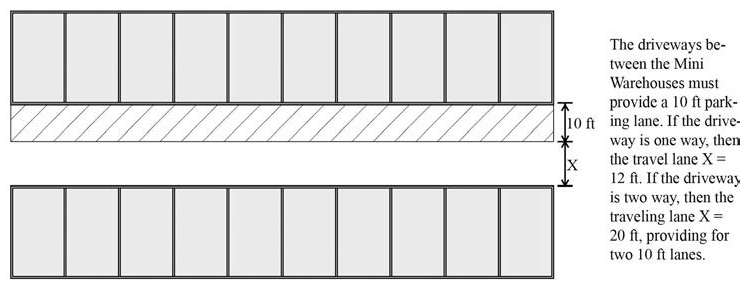 |
| Figure 38.360.190. Mini warehouses. |
(Ord. No. 2059, § 3, 1-26-2021)
Editor's note— See the editor's note to § 38.360.070.
Sec. 38.360.200. - Outdoor sales and display.
A.
Merchandise which is offered for direct sale, rental or lease to the ultimate consumer or user may be displayed beyond the confines of a building in any commercial district, but the area occupied by such outdoor display must not constitute a greater number of square feet than ten percent of the ground floor area of the building housing the principal use, unless such merchandise is a type customarily displayed outdoors, such as automobiles and garden supplies. In such cases, the maximum area for outdoor sales and display must not exceed 50 percent of the total lot area.
B.
Outdoor sales and display areas must not be located in any required setback and are also subject to section 38.320.110.
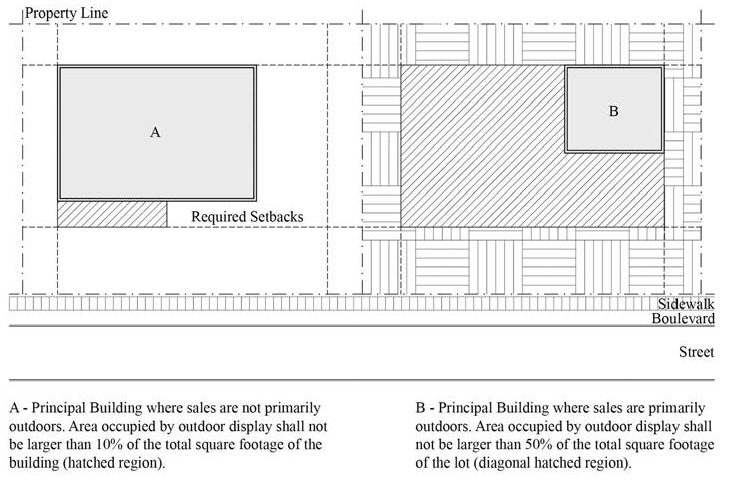 |
| Figure 38.360.200. Outdoor sales and display. |
(Ord. No. 2059, § 3, 1-26-2021)
Editor's note— See the editor's note to § 38.360.070.
Sec. 38.360.210. - Recreational vehicle park and overnight campground.
A.
Recreational vehicle parks and overnight campgrounds are included in the state classification of land subdivisions by rent or lease. Therefore, applicants for such developments must apply for and be reviewed under both site plan and subdivision procedures unless exempted by section 38.240.200.
1.
Recreational vehicle parks must be screened from view of any adjacent residential development.
2.
Internal circulation roads must be paved with a concrete or asphaltic concrete surface.
3.
Individual recreational vehicle parking pads must be plainly marked and maintained with a dust free surface.
4.
Individual recreational vehicle parking pads must be set back at least 30 feet from the perimeter of the park and 30 feet from any public street right-of-way.
5.
Approved trash disposal, bathroom and laundry facilities, including facilities for the handicapped, must be provided for use of overnight campers.
6.
Recreational vehicle spaces must be separated by no less than 15 feet and must be no less than 1,500 square feet in area.
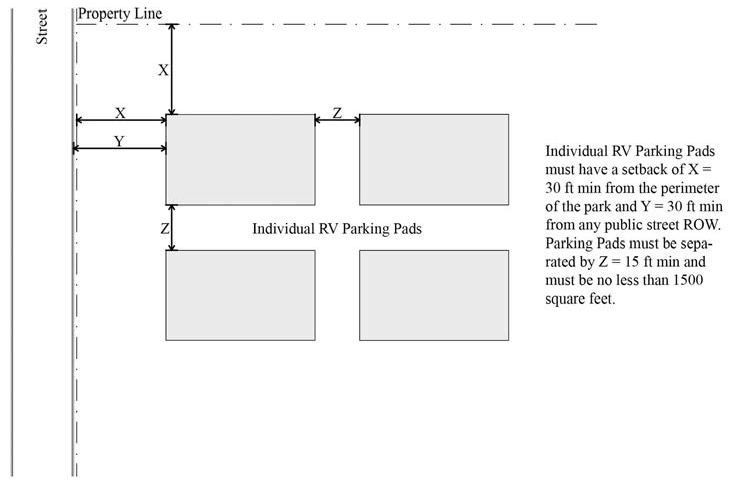 |
| Figure 38.360.220. Recreational vehicle park and overnight campground. |
(Ord. No. 2059, § 3, 1-26-2021)
Editor's note— See the editor's note to § 38.360.070.
Sec. 38.360.220. - Single, two, three, and four-household dwellings.
A.
Purpose.
1.
To enhance the character of the street.
2.
To maintain "eyes on the street" for safety to pedestrians and to create a more welcoming and interesting streetscape.
3.
To de-emphasize garages and drive aisles as major visual elements along the street.
4.
To provide usable setback space for residents.
B.
Entries.
1.
Clear and obvious pedestrian access between the sidewalk and a building entry that faces the street is required for new dwellings (the driveway may be used to help meet this requirement).
2.
All new dwellings must provide a covered pedestrian entry with minimum weather protection of three feet by three feet.
C.
Residential garages.
1.
Where lots abut an alley, it may be necessary to take access from alley to meet another standard in the municipal code.
2.
See section 38.350.070 for garage location and design standards.
D.
Driveway access standards. See section 38.400.090.
E.
Minimum useable open space for alley-loaded lots. All new alley-loaded dwelling units must provide a contiguous open space within the side or rear yard with a minimum dimension of 15 feet on all sides. The open space(s) must be equivalent to ten percent (minimum) of the lot size (excluding area within an adjacent alley or right-of-way). For example, a 6,000 square foot lot would require a contiguous open space of at least 600 square feet, or 20 feet by 30 feet in area. Drive aisles do not count in the calculations for usable open space. Additions must not create or increase any nonconformity with this standard.
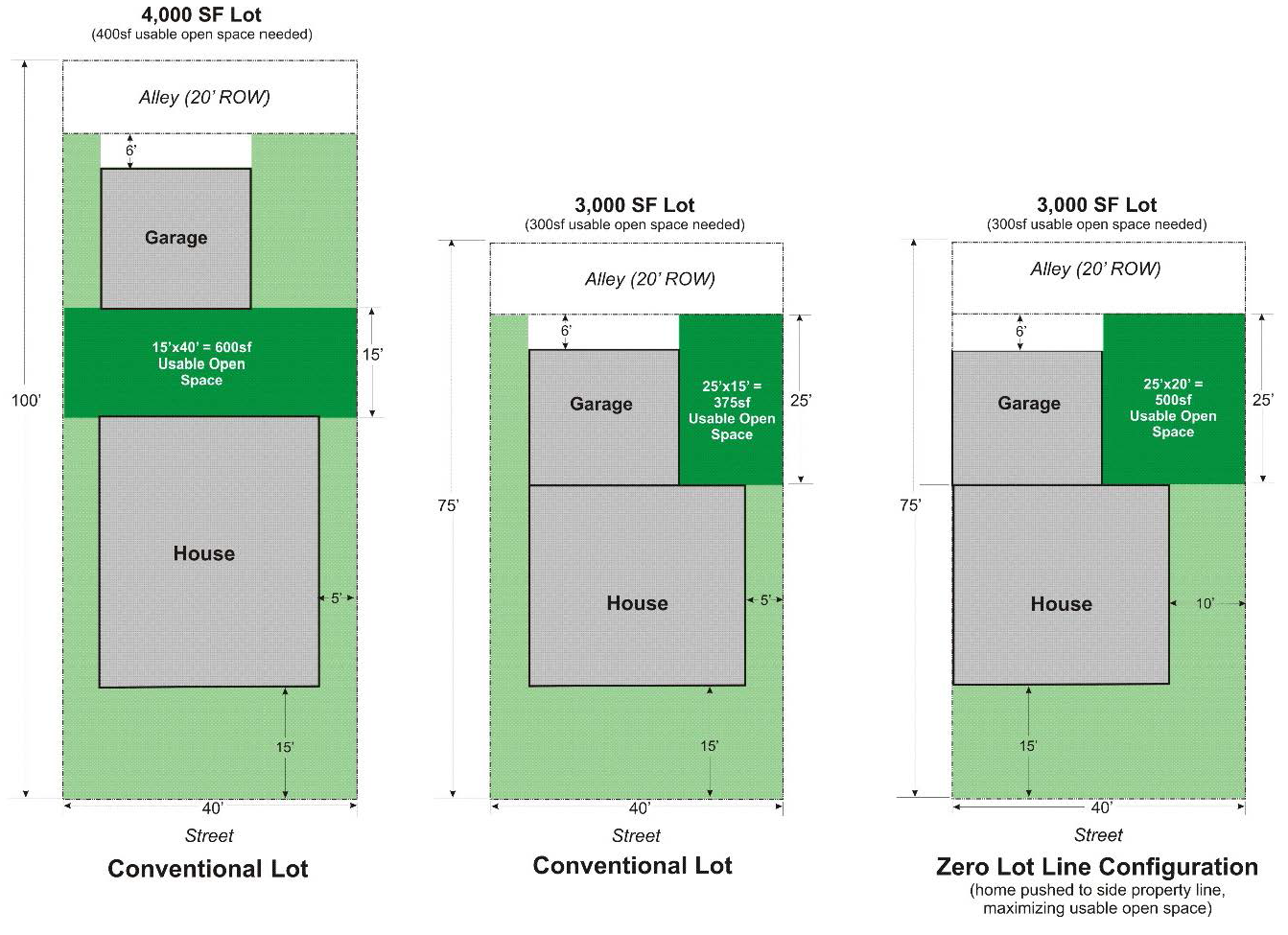 |
| Figure 38.360.220.E. Examples of how to meet open space requirements for alley-loaded lots. |
(Order No. 2018-01, § 11, 4-18-2018; Ord. No. 2014, § 9, 6-3-2019; Ord. No. 2059, § 3, 1-26-2021)
Editor's note— See the editor's note to § 38.360.070.
Sec. 38.360.230. - Stable, commercial.
A.
The minimum property size must be ten acres.
B.
Structures or facilities used for stabling, storing, showing or training of animals must be set back a minimum of 100 feet from any adjacent privately owned property. Dwelling units, accessory structures incidental to dwelling units and irrigated pasturage may occur within the 100-foot setback area, subject to the setback requirements of the applicable zoning district.
C.
There must be at least a 20-foot setback adjacent to any street.
D.
Shows or other activities which would generate more traffic than is normal to a residential area are prohibited, unless the proposed site has direct access from an arterial street as set forth in the city growth policy. Permission for such shows and activities must be obtained from the city. Notification must be provided in a letter that explains the nature and duration of the activity, and accommodations for spectators, traffic control and additional parking for cars and trailers. This letter must be submitted to the community development department at least one month prior to the date of the show or activity.
E.
All pasture and animal storage areas must be enclosed with fences or walls of a minimum of four feet six inches in height. The design of these enclosures must be shown on drawings submitted with the special use permit application.
F.
All laws applicable to public health and appropriate care of animals must be complied with for the entire period of operation of the stable.
G.
All activity and pasture areas that are not grassed must be treated for dust control.
H.
Adequate parking for daily activities must be shown on the site plan and improved to city parking standards. Additional parking must be provided for shows or other special events. Amounts and required improvements to temporary parking must be determined through a special temporary use permit if such temporary parking was not shown and approved through the original approval.
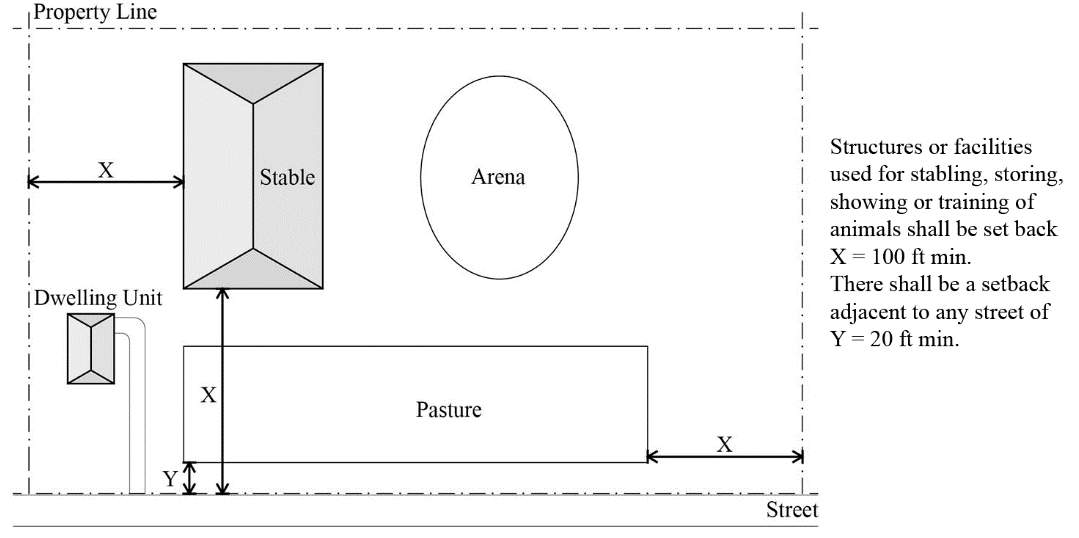 |
| Figure 38.360.230. Stable, commercial. |
(Ord. No. 2059, § 3, 1-26-2021; Ord. No. 2124, § 26, 10-18-2022)
Editor's note— See the editor's note to § 38.360.070.
Sec. 38.360.240. - Tennis and racquet club.
A.
The use will be compatible with any adjacent neighborhood and will not be detrimental to the same due to:
1.
Increased automobile traffic;
2.
Noise generated from within the site.
B.
Perimeter fencing of the site may be required. Fencing of outdoor courts must not exceed 16 feet in height, and fencing may be required to be opaque by the review authority.
C.
When the club is located within a residential zoning district, shows, tournaments or other activity which would generate more traffic than is normal to a residential area are prohibited, unless access is provided from an arterial street as set forth in the city's long range transportation plan. If access is not provided from an arterial street, permission for such shows and activities must be obtained from the city through the special temporary use process.
D.
There must be a landscaped 50-foot buffer strip adjacent to any residential zoning district, or as otherwise determined by the ADR or DRB.
E.
Hours of operation may be controlled by the review authority.
(Ord. No. 2059, § 3, 1-26-2021)
Editor's note— See the editor's note to § 38.360.070.
Sec. 38.360.250. - Townhouse and rowhouse dwellings.
A.
Purpose.
1.
To enhance the character of the street.
2.
To maintain "eyes on the street" for safety to pedestrians and to create a more welcoming and interesting streetscape.
3.
To de-emphasize garages and drive aisles as major visual elements along the street.
4.
To provide usable open space for residents.
5.
To reduce the apparent bulk and scale of large townhouse/rowhouse buildings.
6.
To promote architectural variety that adds visual interest to the neighborhood.
B.
Parking and garage access.
1.
Setbacks. See division 38.320 for minimum building and garage setbacks for the applicable district.
2.
For buildings with less than five attached units, see section 38.350.070 for parking and garage standards.
3.
Buildings with five or more attached units are subject to the landscaped block frontage standards as set forth in section 38.510.030.C. This includes standards for entrances, façade transparency, weather protection, parking, landscaping, and sidewalk widths.
4.
Individual garages facing the street are not allowed in the B-3 district when an alley is adjacent to the property.
5.
See section 38.400.090.C. for driveway standards.
C.
For rowhouses where the primary pedestrian access to the dwelling is from an alley or private internal vehicular access, buildings must emphasize individual pedestrian entrances over individual garages by using both of the following measures:
1.
Enhance entries with a trellis, small porch, or other architectural feature that provides cover for a person entering the unit and a transitional space between outside and inside the dwelling.
2.
Provide a planted area in front of each pedestrian entry of at least 20 square feet in area, with no dimension less than four feet.
Alternative designs will be considered, provided they meet the intent of the standards.
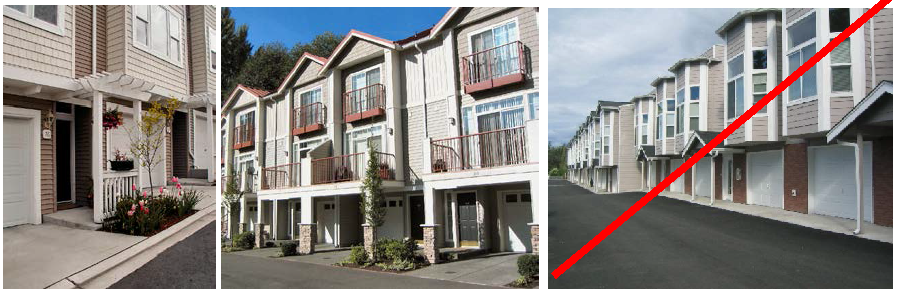 |
| Figure 38.360.250.C. Good and bad examples of garage/entry configurations. The left example features a landscaped area and a trellis to highlight the entry. In the middle image, the balconies and landscaped areas deemphasize the garage. In the right image, the lack of landscaping near the entries would not be allowed (where this is the primary pedestrian entry to the unit). |
D.
Internal drive aisle standards.
1.
Must meet minimum widths of any city adopted International Fire Code.
2.
Minimum building separation along uncovered internal drive aisles must be 24 feet. The purpose is to provide adequate vehicular turning radius, allow for landscaping elements on at least one side, and to provide adequate light and air on both sides of the dwelling units and drive aisles, which often function as usable open space for residents.
3.
Upper level building projections over drive aisles are limited to three feet, and must comply with provisions in subsection D.2 of this section.
E.
Usable open space. Townhouse and rowhouse dwellings must provide open space at least equal to ten percent of the building living space, not counting automobile storage. The required open space may be provided by one or more of the following ways:
1.
Usable private open space directly adjacent and accessible to dwelling units. Such space must have minimum dimensions of at least 12 feet on all sides and be configured to accommodate human activity such as outdoor eating, gardening, toddler play, etc. Front setbacks may be used to meet this standard, provided they are defined with a fence meeting the standards of section 38.350.060.
2.
Balconies, roof decks and/or front porches.
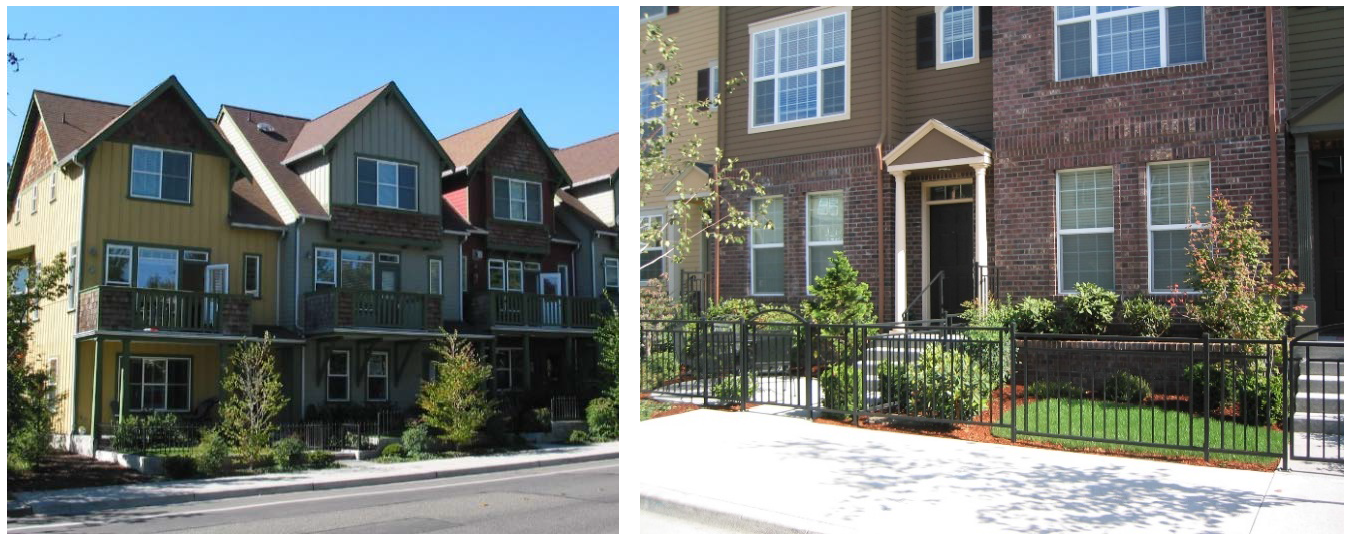 |
| Figure 38.360.250.E.2.a. Usable open space examples for townhouses/rowhouses. |
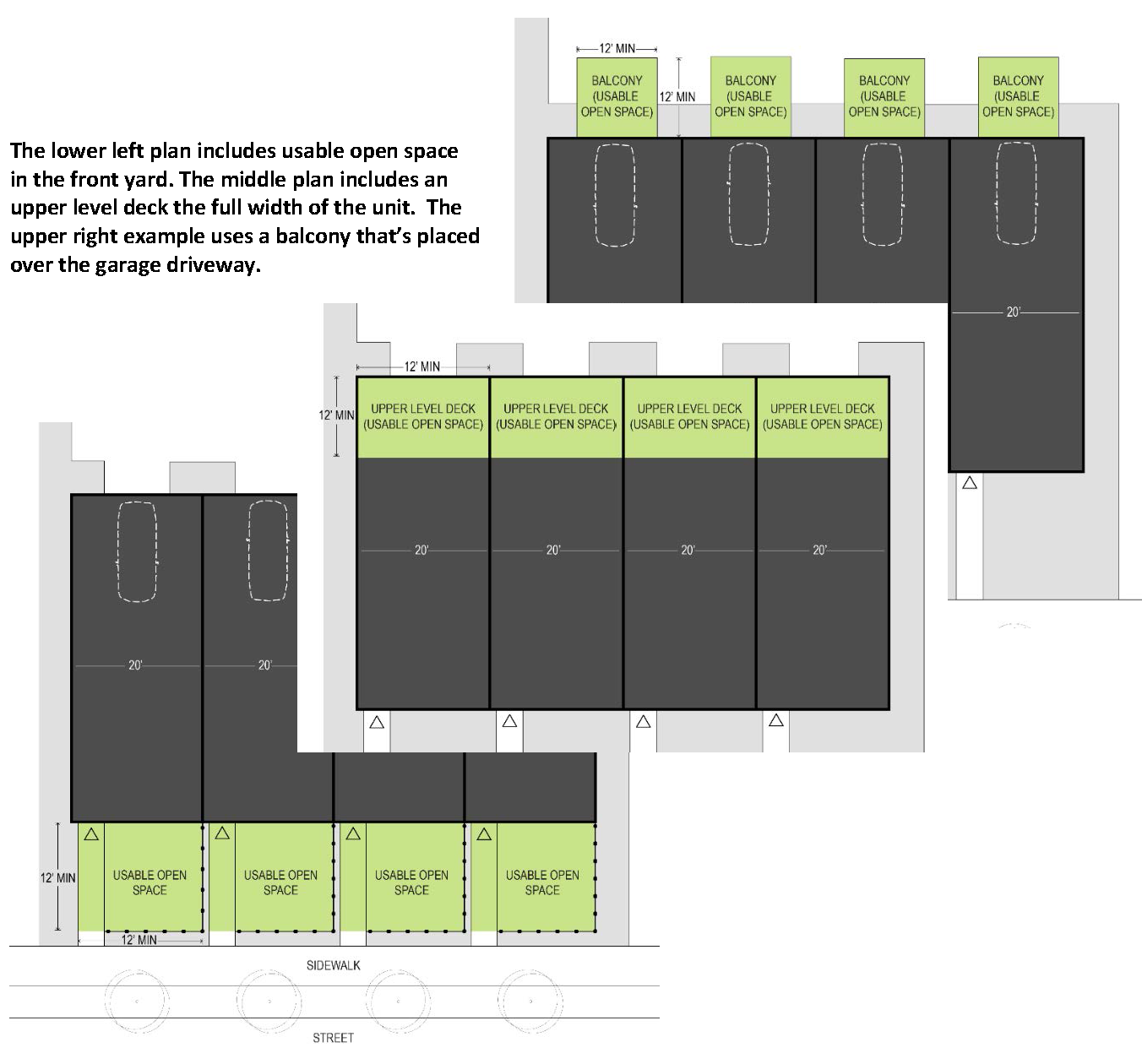 |
| Figure 38.360.250.E.2.b. Usable open space examples for townhouses/rowhouses. |
F.
Building design.
1.
Townhouse/rowhouse articulation. Townhouse and rowhouse buildings must comply with residential building articulation standards as set forth in section 38.530.040.C except that the articulation intervals must be no wider than the width of units in the building. Thus, if individual units are 15 feet wide, the building must include at least three articulation features for all façades facing a street, common or other shared open space, and common parking areas at intervals no greater than 15 feet.
2.
Repetition with variety. [see figures 38.360.250.F.1 and 2] Townhouse and rowhouse developments must employ one or more of the following "repetition with variety" guidelines:
a.
Reversing the elevation of two out of four dwellings.
b.
Providing different building elevations by changing the roofline, articulation, windows, and/or building modulation patterns.
c.
Adding a different dwelling design or different scale of the same design, such as adding a one-story version of the basic dwelling design where two-stories are typical (or a two-story design where three stories are typical).
d.
Other design treatments that add variety or provide special visual interest. While the variable use of color on buildings can be effective in reducing the perceived scale of the building and adding visual interest, color changes alone are not sufficient to meet the intent of the standards.
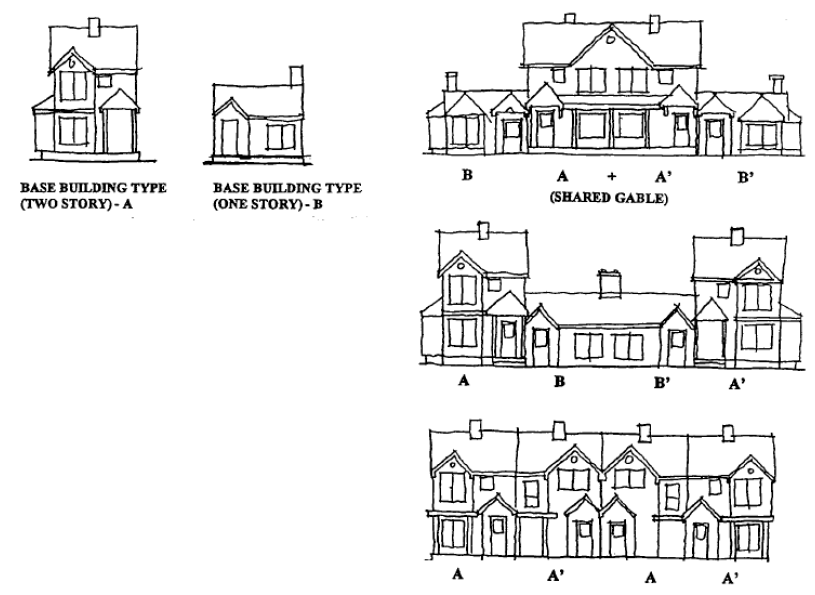 |
| Figure 38.360.250.F.1. Acceptable townhouse configuration employing the repetition with variety concept. |
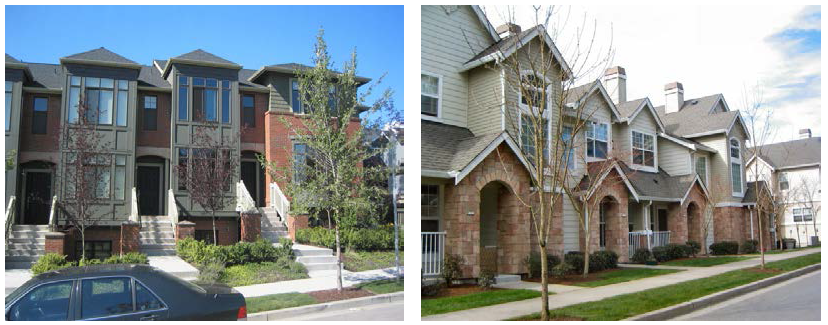 |
| Figure 38.360.250.F.2. Acceptable townhouse/rowhouse buildings integrating the "repetition with variety" guidelines. The internal units in the left image each have distinct, but identical windows and roof forms. The outside unit is differentiated through the use of building materials, window design, unit size, and façade detailing. The internal and external units in the right example include reverse elevations. |
(Order No. 2018-01, § 12, 4-18-2018; Ord. No. 2059, § 3, 1-26-2021)
Editor's note— See the editor's note to § 38.360.070.
Sec. 38.360.260. - Short term rentals.
A.
Purpose and intent. The purpose of this section is to provide for the regulation of short term rentals in certain zoning districts within the city to preserve neighborhood character and promote a supply of long term rental housing stock, while encouraging economic activity and diversity, and to promote public health, safety, and welfare.
B.
Applicability.
1.
The provisions of this section apply to transient occupancy of a short term rental as defined herein.
2.
This section does not apply to any rental of a dwelling unit which is governed by The Montana Residential Landlord and Tenant Act of 1977 (Landlord Tenant Act).
3.
A lower-priced or moderate-priced home subject to and defined by chapter 38, article 380, or a dwelling that received financial support from the city, including but not limited to down payment assistance, impact fee payment, or other consideration including affordable units developed using regulatory incentives, infrastructure prioritization or assistance or a financial subsidy, may not be used as a short term rental until such time as either the lien instrument against the property in favor of the city securing the amount of such subsidy has been released and the release recorded with the county clerk and recorder's office or the expiration of an applicable affordability covenant. The prohibition on use as a short term rental under this subsection will continue until the later of a lien release or expiration of an affordability covenant.
C.
Definitions. For purposes of this article, the following definitions apply:
1.
"Booking transaction" means any reservation or payment service provided by a hosting platform that facilitates a short term rental transaction between an owner and a transient occupant.
2.
"Host" means a natural person who occupies a dwelling unit as the person's primary residence and has the legal right to offer the dwelling unit for use as a short term rental.
3.
"Hosting platform" means a person or entity that participates in the short term rental business by collecting or receiving a fee directly or indirectly for any booking transaction through which an owner may offer a dwelling unit or portion thereof for transient occupancy. Hosting platform includes but is not limited to an online service and an individual using any other means to collect or receive a fee on behalf of an owner for a transient occupancy of a short term rental.
4.
"Operate, operation of," or "operating a short term rental" means the short term rental has been rented by or on behalf of the host to the general public for compensation for transient occupancy. "Operate" "operation of" or "operating" a short term rental does not include mere advertisement of or offering to rent short term rental(s).
5.
"Primary residence" means the dwelling unit a natural person occupies for a minimum of 70 percent of the calendar year. A natural person can have only one primary residence.
6.
"Responsible person" means the person responsible for addressing all maintenance, nuisance, and safety concerns related to a short term rental, as designated by the host.
7.
"Short term rental is defined in article 7 of this chapter."
8.
"Transient occupancy" of a short term rental means occupancy which has the following characteristics:
a.
The period of occupancy is less than 28 consecutive days, and
b.
The person(s) occupying the short term rental has a primary residence other than the short term rental.
D.
Short term rental classifications. Short terms rentals are classified as:
1.
Type-1: A short term rental of one or more bedrooms in a host's primary residence while the host is occupying the same dwelling unit for the entire short term rental period.
2.
Type-2: A type-2 short term rental is the short term rental of a dwelling unit if the host is not occupying the dwelling unit during the entire short term rental period. Type-2 short term rentals include:
a.
Type-2A: A short term rental of a dwelling unit if the host is not occupying the dwelling unit during the entire short term rental period. The dwelling unit offered as a short term rental must be the host's primary residence, as defined herein.
b.
Type-2B: A short term rental of an accessory dwelling unit (ADU) on the same lot as the host's primary residence, or a short term rental of no more than one additional dwelling unit in the same building as the host's primary residence regardless of whether the host is present in the host's primary residence during the short term rental period.
E.
Where allowed. A host may operate a short term rental in all zoning districts where such use is authorized in chapter 38 subject to the requirements of this chapter and pursuant to a valid and current short term rental hosting permit.
F.
Compliance with laws.
1.
In addition to the provisions of this chapter, a host must comply with all other applicable local, state and federal laws, including but not limited to city parking regulations, including time limitations and ADA parking restrictions; lodging facility use tax and accommodations sales tax regulations; health department permitting requirements; the Americans with Disabilities Act; fair housing laws; building codes and fire codes, and the non-discrimination provisions in chapter 24, article 10. Loss of any required permit or license will result in revocation of the short term rental hosting permit in accordance with subsection J. of this section.
2.
Compliance with all applicable laws and regulations is the sole responsibility of the host. City approval of an application for a short term rental hosting permit in no way waives or transfers to the city such responsibility. In addition, the host is solely responsible for verifying the use of a property as a short term rental is compatible with insurance and mortgage contracts, home owners' association covenants, rental agreements and any other contracts which govern the use of the property.
G.
Administration. The director will collect all permit fees and will issue permits and renewals thereof in the name of the city to all persons qualified under the provisions of this chapter and has the power to:
1.
Make rules. The director will promulgate and enforce all reasonable rules and regulations necessary to the operation and enforcement of this section, including, but not limited to, providing alternative means to comply with hosting platform reporting requirements of 38.360.260.J.2. by maintaining an online tool accessible to the city that includes all required data. All rules are subject to city commission review and modification.
2.
Adopt forms. The director will adopt all forms and prescribe the information to be given therein.
3.
Obtain approvals. The director will submit all applications to interested city officials for their approval as to compliance by the applicant with all city regulations which they have the duty of enforcing.
4.
Investigate. The director will investigate and determine the eligibility of any applicant for a short term rental permit as prescribed herein.
5.
Examine records. The director may examine the books and records of any host when reasonably necessary to the administration and enforcement of this section. The city may issue administrative subpoenas as necessary to obtain information regarding a short term rental or booking transaction.
6.
Give notice. The director shall notify any applicant of the acceptance or rejection of the application and will, upon the director's refusal of any permit and at the applicant's request, state in writing the reasons for the denial and deliver it to the applicant.
7.
Record keeping. The director will maintain at all times a record of permitted short term rentals, including the full name of each host, the address at which such short term rental is operated, the date of issuance, the fee paid therefor, the telephone and address of the host, and the time such permit will continue in effect.
H.
Hosting permits. The following requirements apply to all short term rental hosting permits unless otherwise noted.
1.
General. It is unlawful for any person to operate within the city a short term rental without having first obtained approval for a short term rental hosting permit with the department of community development. A separate permit shall be required for each short term rental. Approval of a short term rental application results in the city issuing a permit for the short term rental.
2.
Application; submittal materials. The applicant must complete and submit an application for a short term rental hosting permit to the department of community development using a form provided by the city. The form will include an acknowledgement and agreement the short term rental meets and will continue to meet the definition of short term rental classification (type-1, type-2A, or type-2B) during the permit term. Before the application will be accepted by the director, the applicant must provide:
a.
The name, telephone number, address, and email address of all property owners and of the responsible person, if different. If the property owner is a business, the name(s) and contact information of all business owners must be provided.
b.
The state department of revenue tax registration number for the short term rental.
c.
A sketch plan with a description of the short term rental, including street address, number of bedrooms, and number of off-street parking spaces available for guests' use.
d.
Certification the short term rental meets and will continue to meet the definition of short term rental classification (type-1, type-2A, or type-2B) during the registration term.
e.
Certification the applicant has read, understands, and acknowledges the standards of this section, the property is the applicant's primary residence, and the applicant has the legal right to offer the dwelling unit for use as a short term rental.
f.
All hosting platforms on which the short term rental is listed.
g.
The permit fee and fire inspection fee.
3.
Safety inspections.
a.
Initial inspection. Prior to issuance of the first short term rental hosting permit for any property, an inspection by the city fire department must be completed and signed off by a city fire inspector, or by an NFPA or ICC-certified fire inspector using an inspection form approved by the city fire marshal. A fire inspection checklist form will be provided to the applicant with the application materials. If a short term rental hosting permit lapses for any period of time, upon reapplication for a permit an inspection must be completed and signed off as described in this subsection before the short term rental hosting permit will be issued.
b.
Re-inspection. If re-inspection or multiple visits by a fire inspector are required before the inspection form may be signed, an additional inspection fee will apply for each inspection after the initial inspection.
c.
Subsequent inspections; self-certification. A short term rental must be inspected by the city fire department every three years. The host must self-certify continued compliance with each item on a fire inspection checklist upon annual renewal of a permit for each year that an inspection is not required. The city fire marshal may require a repeat inspection at any time upon complaint or evidence of noncompliance.
4.
Safety hazards. The host acknowledges that the city, or any authorized representative thereof, have the right to suspend operation of any short term rental when the city determines the short term rental is causing or contributing to an imminent public health or safety hazard.
5.
Fees. Short term rental hosting permit and inspection fees shall be established by resolution of the city commission.
6.
Issuance of permit. Once the applicant submits the completed application form, all required submittal materials, and registration and inspection fees, the director will review the application form and submittal materials and determine whether the short term rental meets all city requirements for permit. The director may issue the short term rental hosting permit when:
a.
The director determines the short term rental meets all city requirements for a permit; and
b.
The applicant has provided either a signed pre-operational inspection report from the health department indicating the short term rental may operate as a public accommodation or a valid and current public accommodation license issued by the state department of health and human services pursuant to MCA Title 50, Chapter 51.
7.
Display of short term rental hosting permit number. The host must include the short term rental hosting permit number issued by the city in all listings and advertisements of the host's short term rental on any hosting platform and print advertising.
8.
Change in status of host. A short term rental hosting permit does not run with the land, and a change in primary residence status of the short term rental host terminates the permit. In order for the dwelling unit to remain eligible for use as a short term rental after a host no longer uses the dwelling unit as their primary residence, a new application identifying a new host as primary resident must be submitted to the city.
9.
Expiration. Permits issued pursuant to this section are valid for one year from the month in which such permit is issued and will expire automatically unless renewed in accordance with this section.
10.
Renewal. The host may apply to renew the permit annually using a form provided by the city. Renewals must comply with the requirements of this Code which are in place at the time of renewal. Failure of host to renew a permit results in the termination of the lawful use of a property as a short term rental. It is the host's responsibility to renew the short term rental hosting permit prior to the expiration of the permit. Failure of a host to renew a short term rental hosting permit prior to the expiration of the current permit period requires the host to file a new permit application for a short term rental hosting permit and is subject to the initial inspection and fee.
I.
Short term rental standards. The following requirements apply only to type-2 short term rentals unless otherwise noted.
1.
Short term rental agreement; written rules for guests. The short term rental owner must enter into a written rental agreement with the guest for each stay in the short term rental.
a.
The guest must be provided with a written list of rules applicable to the short term rental with the rental agreement, and the rental agreement must include a written acknowledgement by the guests of their agreement to comply with such rules.
b.
The list of rules must include those rules required by this section to be included.
c.
The list of rules must be prominently displayed within the short term rental.
2.
Responsible person. The host must designate a person responsible for addressing all maintenance, nuisance, and safety concerns related to a short term rental. The responsible person must be available to take and respond to reports of concerns and complaints 24 hours per day, seven days per week during the term of the short term rental hosting permit. The name and contact information for the responsible person must be included in the list of rules.
3.
Maximum occupancy for type-2 short term rentals. The maximum occupancy of a type-2 short term rental is two persons per bedroom plus two additional persons, except that this number may be reduced by the city based on available parking spaces. The maximum occupancy will be noted on the short term rental hosting permit and must be included in the list of short term rental rules.
4.
Maximum number of bedrooms that may be rented in a type-1 short term rental; maximum occupancy. The owner of a type-1 short term rental may rent or offer for rent up to two bedrooms in the dwelling, except that in a two-bedroom dwelling, only one bedroom may be rented or offered for rent. No other area of the dwelling may be rented or offered for rent. The maximum occupancy of a type-1 short term rental is two persons per bedroom.
5.
Trash removal. The responsible person must ensure proper disposal of solid waste pursuant to local and state rules, regulations and laws. The schedule for trash and recycling collection and instructions for proper disposal must be included within the short term rental rules.
6.
Signage. Exterior signs identifying the unit as a short term rental are prohibited. During a rental period, there must be a sign posted inside the front door of the short term rental showing the locations of all fire extinguishers in the unit, the gas shut-off valve, and fire exits.
7.
Noise and nuisance.
a.
The host must ensure that use of the short term rental by guests is in compliance with the noise provisions of chapter 16, article 6 and all nuisance provisions of this Code.
b.
A prohibition against making loud noise in such a manner as to disturb the quiet, comfort or repose of a reasonable person of normal sensitivity must be included in the short term rental rules.
c.
All outdoor activities producing noise discernible from a neighboring property shall cease by 10:00 p.m. This requirement must be included in the short term rental rules.
J.
Hosting platforms obligations.
1.
Compliance with laws. In addition to the provisions of this section, a hosting platform must comply with all other applicable local, state and federal laws.
2.
Reporting requirements. A hosting platform must provide a report to the city on a quarterly basis that includes, but is not limited to the following:
a.
The address of each short term rental located in the city for which it conducts a booking transaction;
b.
The name of any host or responsible person for each transient occupancy for which the hosting platform conducted a booking transaction.
3.
Required information for booking transaction. A hosting platform must include the city permit number in all hosting platforms' publicly available listings prior to performing a booking transaction for each short term rental within the city.
4.
Obligation to remove listings. If the hosting platform has reason to believe a short term rental is in violation of any provision of this Code, including but not limited to notice from the city of a violation or a host's failure to supply to the hosting platform the city permit number for the short term rental, the hosting platform must remove the listing from its hosting platform within ten business days.
K.
Violations; enforcement.
1.
Registration suspension or revocation. The director may suspend or revoke a short term rental hosting permit, impose administrative remedies as provided herein, or enforce a suspension or revocation through a civil action when the host commits one or more of the following acts or omissions:
a.
Failure to comply with any provision of this Code;
b.
Operating or allowing the operation of the short term rental in such a manner as to create a public nuisance, cause a breach of the peace, constitute a danger to the public health, safety, welfare or morals, or interfere with the rights of abutting property owners;
c.
Cancellation of the health department's public accommodation license, tax authority registration, or any other required permit; or
d.
The securing of the permit by fraud or misrepresentation, including but not limited to supplying false or incorrect information on the permit application.
2.
Procedure. Should the director decide to suspend or revoke a hosting permit, the host will be given notice and an opportunity to respond following the procedures in this subsection, except that should the director determine the short term rental or its operation present a safety hazard or require immediate remedy, the director may order operation of the short term rental to cease immediately.
a.
The host will be notified in writing by the director at least seven days prior to the action contemplated and the reasons therefore.
b.
Upon receipt of the notice, the host may request a meeting with the director. Such request must be in writing and must be received by the director within seven days of the host's receipt of the notice. Failure on the part of the permittee to request in writing a meeting and within the specified time period shall be a waiver of the host's right to a meeting.
c.
If a meeting is requested by the host, the director will set a time, date and place and will so notify the host, in writing.
d.
When a meeting is conducted, the city will present the evidence supporting the contemplated action. The director may request evidence be presented by other parties. The host may present evidence. The director will take all evidence admitted under advisement and once a decision has been made the director will notify the host of the findings and decision in writing.
3.
Civil penalty. The director may recover the following civil penalties for any violation of this section. Each day a violation continues constitutes a separate violation.
a.
For any violation by a host, the director may recover a civil penalty of not more than $500.00.
b.
For any violation by a hosting platform, the director may recover a civil penalty of not more than $500.00.
4.
Appeal. An aggrieved person may file an application to appeal the matter to the city commission according to the procedures in section 38.250.030.
5.
Unpaid fee constitutes debt. The amount of any unpaid fee, the payment of which is required hereunder, constitutes a debt due the city.
6.
Violation constitutes a misdemeanor. In addition to suspension or revocation under subsection A. of this section, or the imposition of a civil penalty as provided herein, a knowing violation of this article constitutes a misdemeanor punishable as described in section 38.200.160 except a person may not be imprisoned for a violation of this section.
(Order No. 2018-01, § 13, 4-18-2018; Ord. No. 2059, § 3, 1-26-2021; Ord. No. 2131, § 2, 8-11-2023; Ord. No. 2149, § 2, 11-14-2023)
Editor's note— See the editor's note to § 38.360.070.
Sec. 38.360.270. - Agricultural uses in residential suburban.
Agricultural use standards per two and one-half acres: one horse or one cow; two sheep or two goats; ten rabbits; 36 fowl (chickens, pheasants, pigeons, etc.) or six larger fowl (ducks, geese, turkeys, etc.). For larger parcels the review authority may determine that a larger number of livestock is consistent with the requirements of this section.
(Ord. No. 2059, § 3, 1-26-2021)
Editor's note— See the editor's note to § 38.360.070.
Sec. 38.360.280. - Agricultural water user facilities.
A.
Purpose. The purpose of this section is to recognize and protect property rights established through water rights issued by the State of Montana and the associated rights of conveyance for agricultural water user facilities. Development of land has potential to negatively impact such rights and function of such facilities. The state has adopted requirements including but not limited to MCA 70-17-112, 85-7-2211 and 85-7-2212, to protect agricultural water user facilities and prevent interference with them.
B.
Notice requirements concerning agricultural water user facility:
1.
Where an agricultural water user facility is present on-site, or on an adjoining property within 100 feet of the exterior boundaries of the proposed development, the developer must:
a.
Provide written notice to the applicable water users and/or agricultural water user facility's authorized representatives of the proposed development,
b.
Provide them with a copy of the proposed development layout,
c.
Provide a description of any anticipated adverse effects to the agricultural water user facility,
d.
Provide a description of any mitigation proposed to remedy such adverse effects, and
e.
Provide 45 calendar days for the water users and/or agricultural water user facility's authorized representatives to submit written comments.
2.
Notice to the water users and/or agricultural water user facility's authorized representatives must be as follows.
a.
In the event the agricultural water user facility conveys water for an incorporated or otherwise organized group of water users such as a ditch or canal company, and the water users have officially elected or otherwise appointed a representative or group of representatives, written notice shall be to the agricultural water user facility's authorized representatives.
b.
In the event the agricultural water user facility conveys water for water users that have not organized or officially elected or otherwise appointed a representative, the developer shall give written notice to all water users.
c.
In the event the agricultural water user facility conveys water in a combination of the scenarios described in i and ii above, the subdivider shall give written notice to the agricultural water user facility's authorized representatives, and any water users not represented by the agricultural water user facility's authorized representatives.
d.
The Montana Department of Natural Resources and Conservation is the agency that maintains the official records for water rights.
3.
The pre-application or concept plan submittal shall include the names and contact information for the water users and agricultural water user facility's authorized representatives that were provided with written notice, and the date they were provided written notice; and a copy of the notice sent.
4.
If the water users and/or agricultural water user facility's authorized representatives have provided the applicant with written comments, those comments shall be submitted with the pre-application or concept plan submittal.
5.
If there are changes to the project between the pre-application plan or concept plan submittal and formal application stage that would result in additional impacts to the agricultural water user facility, the developer shall comply with the notice and documentation requirements described above to be submitted with the formal application.
6.
If the subject of this subsection was fully addressed with a previous development review and a new application is fully in compliance with the earlier approval then compliance with the notice provisions of this subsection is not required.
C.
Persons holding water rights, agricultural water user facility owners, or their representatives may conduct necessary maintenance such as cleaning and removal of accumulated silt, branches, trees, sticks and other debris as well as repair or restoration activities consistent with state law and the terms of any applicable easement or other authority.
D.
Agricultural water user facilities may also be subject to section 38.410.060.
(Ord. No. 2089, § 22, 12-7-2021)