
Bradbury City Zoning Code
PART V
- ZONING DISTRICTS AND ALLOWABLE LAND USES
CHAPTER 75. - RESERVED[6]
Editor's note— Ord. No. 383, § 6, adopted July 19, 2022, repealed ch. 75, which pertained to two-unit housing development and derived from Ord. No. 380, adopted Dec. 21, 2021.
CHAPTER 85. - SECONDARY LIVING QUARTERS AND SB 9 UNITS[7]
Editor's note— Ord. No. 398, § 2, adopted July 15, 2025, amended the Code by repealing former Ch. 85, §§ 9.85.010—9.85.030, 9.85.100—9.85.160, 9.85.200, 9.83.210, 9.85.300—9.85.320, and 9.85.400—9.85.450, and adding a new Ch. 85. Former Ch. 85 pertained to similar subject matter, and derived from Ord. No. 383, adopted July 19, 2022; and Ord. No. 388, adopted October 17, 2023.
CHAPTER 88. - AFFORDABLE HOUSING OVERLAY ZONES[9]
Editor's note— Ord. No. 389, § 4, adopted November 28, 2023, amended the Code by repealing former Ch. 88, §§ 9.88.010—9.88.040, and adding a new Ch. 88. Former Ch. 88 pertained to similar subject matter, and derived from Ord. No. 316, adopted April 20, 2010.
Sec. 9.58.010.- Purpose of chapter.
This chapter establishes the zoning districts applied to property within the City, determines how the zoning districts are applied on the Zoning Map, and provides general permit requirements for development and new land uses.
(Ord. No. 297, § 9.05.010.010, 3-20-2007)
Sec. 9.58.020. - Zoning districts established.
Bradbury shall be divided into zoning districts which consistently implement the General Plan. The zoning districts shown in Table 58-1 are established, and shall be shown on the official Zoning Map.
(Ord. No. 297, § 9.05.010.020, 3-20-2007)
Sec. 9.58.030. - Zoning map adopted.
There is hereby adopted the "Official Zoning Map" of the City, a true copy of which is attached to the ordinance from which this part is derived as Exhibit "A" and incorporated herein by this reference. All properties within the City are hereby placed in the zones as indicated on said map. Said map shall remain on file in the Office of the City Clerk, and all changes to said map shall be noted on a facsimile thereof as soon as the same become effective. The official zoning map for the City may be amended by reference to this section.
TABLE 58-1. ZONING DISTRICTS
EXHIBIT A
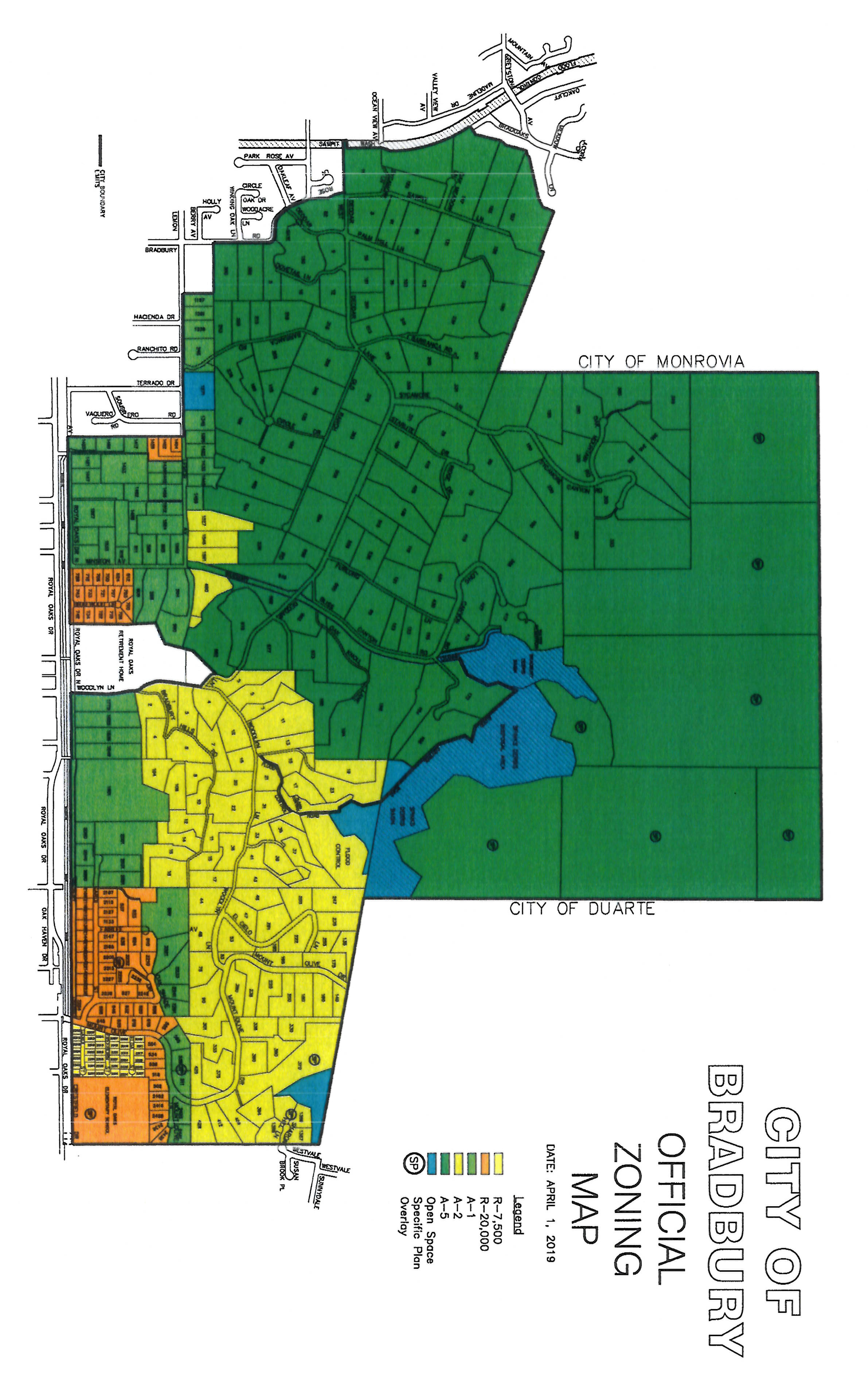
(Ord. No. 297, § 9.05.010.030, 3-20-2007; Ord. No. 316, § 2(A), 4-20-2010; Ord. No. 366, § 5, 10-15-2019; Ord. No. 389, § 2, 11-28-2023)
Sec. 9.58.040. - Uncertainty of boundaries.
Where uncertainty exists as to boundaries of any zone shown upon the official zoning map, or any part thereof or amendment thereto, the same shall be resolved pursuant to Section 9.58.070.
(Ord. No. 297, § 9.05.010.040, 3-20-2007)
Sec. 9.58.050. - Annexations.
Areas annexed to the City shall be classified in an appropriate zone by the City Council, in the manner specified by the provisions of this title or as permitted by applicable general laws of the State.
(Ord. No. 297, § 9.05.010.050, 3-20-2007)
Sec. 9.58.060. - Failure to designate zone on map.
Any property which, for any reason, is not designated on the map as being classified in any zone shall be deemed to be in the corresponding zone to the listed land use designation as specified in the General Plan Land Use Element.
(Ord. No. 297, § 9.05.010.060, 3-20-2007)
Sec. 9.58.070. - Clarification of ambiguity.
If an ambiguity shall be found with reference to these regulations, including, but not limited to, the appropriate classification of a particular use, the Planning Commission shall consider the matter and shall, by resolution, recommend to the City Council the clarification of such ambiguity. When such a Commission resolution has been approved by the City Council, the same shall be deemed to be in force and effect and shall govern the interpretation of the affected provisions hereof, to which the same relates, until such time as an appropriate amendment thereto has been duly adopted.
(Ord. No. 297, § 9.05.010.070, 3-20-2007)
Sec. 9.58.080. - Certificate of occupancy.
No person shall commence a new use of any building, land or structure, nor shall the owner of any property allow such use, unless and until the City Manager or the City Manager's designee issues, for such use, a certificate of occupancy, indicating the same complies with all applicable laws, including, but not limited to, the provisions hereof. Any such certificate issued erroneously for a use, building or structure, which does not comply with law, shall, for all purposes, be null, void and of no effect.
(Ord. No. 297, § 9.05.010.080, 3-20-2007)
Sec. 9.58.090. - Building permit.
No building permit required pursuant to the City's building regulations or a certificate of occupancy shall be issued for any building, structure or use which has been erected, constructed, maintained or utilized in violation of any provision hereof, or any other applicable law. Any such permit issued erroneously for a use, building or structure, which does not comply with law, shall, for all purposes, be null, void and of no effect.
(Ord. No. 297, § 9.05.010.090, 3-20-2007)
Sec. 9.58.100. - Public utilities; lot design.
Notwithstanding any other provision of this title to the contrary, as part of a subdivision or parcel map approval process, the City Council may authorize the creation of a lot, not meeting minimum lot size for the zone, if the lot is forever dedicated for public utility purposes.
(Ord. No. 297, § 9.05.010.100, 3-20-2007)
Sec. 9.61.010.- Purpose of chapter.
In order to provide for the development of single-family residential areas and to maintain the integrity of existing single-family residential areas within the City, the regulations of this chapter shall be applicable to all properties classified in zone R-7,500.
(Ord. No. 297, § 9.05.020.010, 3-20-2007; Ord. No. 370, § 2, 3-17-2020)
Sec. 9.61.020. - Permitted uses.
No person shall use, nor shall any property owner permit the use of any lot classified in any R-7,500 zone for any use, other than the following:
(1)
Principal uses.
a.
One single-family dwelling.
b.
Open spaces.
c.
Small residential care facility (six or fewer residents).
d.
Group homes of any size operating as a single-family residence.
e.
Supportive and transitional housing.
f.
Employee housing.
(2)
Accessory uses.
a.
Accessory buildings or structures.
b.
Accessory living quarters as allowed by Chapter 85 of this title.
c.
Accessory dwelling units as allowed by Chapter 85 of this title.
d.
Nursery stock, orchards, vineyards, the raising of field crops, trees, berry and bush crops, or vegetable or flower gardening; provided that no roadside stands or sales offices shall be permitted, nor shall there be permitted any retail sale from the premises or advertising signs of any nature.
e.
The keeping of animals as specified in Chapter 124 of this title.
f.
The storage of building materials during the construction of any building or part thereof, and for a period of 30 days after construction is completed. The temporary use of portable prefabricated metal storage containers is permitted until construction is completed.
g.
Not to exceed one home occupation.
h.
Private garages and carports.
i.
Open spaces.
j.
Manufactured housing units to include mobile homes that comply with the State Housing Code and the City's design guidelines are permitted when installed on a permanent foundation.
(3)
Conditional uses.
a.
Land reclamation.
b.
Large residential care facility (seven or more residents).
(Ord. No. 297, § 9.05.020.020, 3-20-2007; Ord. No. 316, § 2(B), (C), 4-20-2010; Ord. No. 362, § 4, 1-15-2019; Ord. No. 370, § 2, 3-17-2020; Ord. No. 399, § 3, 7-15-2025)
Sec. 9.61.030. - Uses expressly prohibited.
(a)
No use shall be permitted on any R-7,500 zoned lot except as expressly authorized herein.
(b)
Permanent use of portable prefabricated metal storage containers.
(c)
Short term rentals.
(Ord. No. 297, § 9.05.020.030, 3-20-2007; Ord. No. 359, § 2, 10-16-2018; Ord. No. 370, § 2, 3-17-2020)
Sec. 9.61.040. - Development standards.
All premises in the R-7,500 zone shall comply with the following standards of development:
(1)
Required lot area. Each lot in the R-7,500 zone shall have a minimum lot area of not less than 7,500 square feet.
(2)
Lot width. Each lot or parcel of land in the R-7,500 zone shall have a minimum average width of not less than 60 feet with a minimum street frontage width of 45 feet.
(3)
Yards.
a.
Front yards. Each lot in the R-7,500 zone shall maintain a front yard area of not less than 20 feet in depth. Second stories shall maintain a front yard setback of not less than 25 feet in depth.
b.
Side yards. Each lot in the R-7,500 zone shall maintain side yards of not less than ten feet in depth. Second stories shall maintain side yard setbacks of not less than 20 feet in depth.
c.
Rear yards. Each lot in the R-7,500 zone shall maintain a rear yard of not less than ten feet in depth. Second stories shall maintain a rear yard setback of not less than 30 feet in depth.
d.
Private streets. Notwithstanding any other provision of this chapter, no building shall be located closer than 50 feet to any private street or vehicular easement serving more than two parcels of property.
(4)
Dwelling size. Each dwelling in the R-7,500 zone, exclusive of guest houses, pool houses, servants' quarters, or other permitted accessory dwellings, shall have a minimum size of 1,500 square feet. Such square footage shall be exclusive of porches and garages, or other accessory buildings attached to the dwelling. Two story dwellings shall not exceed a gross floor area ratio of 50 percent and a lot coverage area of 35 percent of the net lot area.
(5)
Height limits. No building, structure or improvement in the R-7,500 zone shall exceed the lesser of:
a.
The height approved by the Planning Commission pursuant to the ridgeline and view preservation regulations, Chapter 43 of this title, if applicable; or
b.
One story and 28 feet, except that the principal single-family dwelling may have two stories.
All measurements of height shall be made from the finished grade to the highest ridge beam and shall not include the chimneys. Chimneys shall not exceed the minimum height required by this Code or have a width larger than the minimum required for proper draft, plus a facing for the exterior of the flue.
(6)
Off-street parking. The owner and/or person in possession of each lot or parcel of land in the R-7,500 zone shall have and maintain off-street parking facilities as required by Chapter 103 of this title.
(7)
Roof pitch. Not more than 20 percent of the roof of any main building may have a pitch of less than 3½:12. Dwellings with two stories shall have hipped roofs all around with roof pitches of 4:12 or lower.
(8)
Improvement of yards abutting rights-of-way. Improvements shall be designed and installed in manners that are consistent with the City's Design Guidelines. Hardscape shall not exceed 40 percent of the yard areas abutting rights-of-way.
(9)
Parkway improvements. The parkway or the area between a roadway and the curb or swale and a lot line shall be paved with materials in a manner approved by the City Engineer, and/or landscaped with materials in a manner approved by the City Manager or designee and in compliance with the City of Bradbury Water Efficient Landscape Ordinance.
(Ord. No. 297, § 9.05.020.040, 3-20-2007; Ord. No. 362, § 4, 1-15-2019; Ord. No. 366, § 1, 10-15-2019; Ord. No. 370, § 2, 3-17-2020; Ord. No. 374, § 2, 5-18-2021)
Sec. 9.61.050. - Placement of buildings or structures.
Placement of buildings on each R-7,500 lot shall conform to the following: no building or structure shall occupy any portion of a required yard or open space area, except as otherwise provided in this chapter.
(Ord. No. 297, § 9.05.020.050, 3-20-2007; Ord. No. 370, § 2, 3-17-2020)
Sec. 9.61.060. - Existing uses; exemption.
Notwithstanding any provision of this title to the contrary, any building and/or structure located on any R-7,500 zoned lot:
(1)
Which was in existence under a valid building permit or for which building permits have been issued as of the date of adoption of the ordinance from which this title is derived;
(2)
Which conformed to the development code regulations of the City in effect as of said date; and
(3)
Which would otherwise be rendered nonconforming solely by reason of the application thereto of this chapter, shall not be deemed to have acquired a nonconforming status, within the meaning given in Section 9.25.020, provided that:
a.
Any new use, building or structure proposed to be located on such lot shall comply with all of the regulations contained in this title as to such proposed new use, building or structure; and
b.
The exemption granted hereunder shall not apply to any building or structure which is damaged or destroyed, by any cause, to the extent that the cost of reconstruction or rehabilitation thereof would exceed an amount equal to the assessed value of such building or structure, as estimated by the Building Official, for building permit purposes.
(Ord. No. 297, § 9.05.020.060, 3-20-2007; Ord. No. 370, § 2, 3-17-2020)
Sec. 9.61.070. - Additions to a nonconforming building or structure.
Additions may be made to a nonconforming building or structure which is not in violation of any provisions of this title and is nonconforming only because it does not meet the following standards of development as provided herein:
(1)
Yards, provided such addition or expansion is developed pursuant to the setback standards that were in existence at the time of the construction of the existing building or structure and providing that such addition or expansion does not expand the degree of nonconformity.
(2)
Access and paving width of access drives, provided such addition or expansion shall be developed pursuant to the vehicle parking standards of this title. Where the amount of parking provided prior to such addition is sufficient to comply with said provisions after such expansion, it shall be deemed to comply with this subsection.
(Ord. No. 297, § 9.05.020.070, 3-20-2007; Ord. No. 370, § 2, 3-17-2020)
Sec. 9.64.010.- Purpose of chapter.
In order to provide for the development of single-family residential areas and to maintain the integrity of existing single-family residential areas within the City, the regulations of this chapter shall be applicable to all properties classified in Zone R-20,000.
(Ord. No. 297, § 9.05.030.010, 3-20-2007)
Sec. 9.64.020. - Permitted uses.
No person shall use, nor shall any property owner permit the use of any lot classified in any R-20,000 Zone for any use, other than the following:
(1)
Principal uses.
a.
One single-family dwelling.
b.
Open spaces.
c.
Small residential care facility (six or fewer residents).
d.
Group homes of any size operating as a single-family residence.
e.
Supportive and transitional housing.
f.
Employee housing.
(2)
Accessory uses.
a.
Accessory buildings or structures.
b.
Accessory living quarters as allowed by Chapter 85 of this title.
c.
Accessory dwelling units as allowed by Chapter 85 of this title.
d.
Nursery stock, orchards, vineyards, the raising of field crops, tree, berry and bush crops, or vegetable or flower gardening; provided that no roadside stands, or sales offices shall be permitted, nor shall there be permitted any retail sale from the premises or advertising signs of any nature.
e.
The keeping of animals as specified in Chapter 124 of this title.
f.
The storage of building materials during the construction of any building or part thereof, and for a period of 30 days after construction is completed. The temporary use of portable prefabricated metal storage containers is permitted until construction is completed.
g.
Not to exceed one home occupation.
h.
Private garages and carports.
i.
Open spaces.
j.
Manufactured housing units to include mobile homes that comply with the State Housing Code and the City's design guidelines are permitted when installed on a permanent foundation.
(3)
Conditional uses.
a.
Land reclamation.
b.
Large residential care facility (seven or more residents).
(Ord. No. 297, § 9.05.030.020, 3-20-2007; Ord. No. 316, § 2(D)—(F), 4-20-2010; Ord. No. 362, § 4, 1-15-2019; Ord. No. 399, § 3, 7-15-2025)
Sec. 9.64.030. - Uses expressly prohibited.
(a)
No use shall be permitted on any R-20,000 zoned lot except as expressly authorized herein.
(b)
Permanent use of portable prefabricated metal storage containers.
(c)
Short term rentals.
(Ord. No. 297, § 9.05.030.030, 3-20-2007; Ord. No. 359, § 2, 10-16-2018)
Sec. 9.64.040. - Development standards.
All premises in the R-20,000 zone shall comply with the following standards of development:
(1)
Required lot area. Each lot in the R-20,000 zone shall have a minimum lot area of not less than 20,000 square feet.
(2)
Lot width. Each lot or parcel of land in the R-20,000 zone shall have a minimum average width of not less than 80 feet with a minimum street frontage width of 60 feet.
(3)
Yards.
a.
Front yards. Each lot in the R-20,000 zone shall maintain a front yard area of not less than 35 feet in depth.
b.
Side yards. Each lot in the R-20,000 zone shall maintain side yards of not less than 15 feet in depth.
c.
Rear yards. Each lot in the R-20,000 zone shall maintain a rear yard of not less than 15 feet in depth.
d.
Private streets. Notwithstanding any other provision of this chapter, no building shall be located closer than 50 feet to any private street or vehicular easement serving more than two parcels of property.
(4)
Minimum dwelling size. Each dwelling in the R-20,000 zone, exclusive of accessory living quarters and accessory dwelling units, shall have a minimum size of 1,850 square feet. Such square footage shall be exclusive of porches and garages, or other accessory buildings attached to the dwelling.
(5)
Height limits. No building, structure, or improvement in the R-20,000 zone shall exceed the lesser of:
a.
The height approved by the Planning Commission pursuant to the ridgeline and view preservation regulations, Chapter 43, of this title, if applicable; or
b.
28 feet. To the extent that an owner of property seeks to construct a building to a greater height than the limit provided in the zone in which the property is located, relief may be granted through variance proceedings.
All measurements of height shall be made from the finished grade to the highest ridge beam and shall not include the chimneys. Chimneys shall not exceed the minimum height required by this Code or have a width larger than the minimum required for proper draft, plus a facing for the exterior of the flue.
(6)
Off-street parking. The owner and/or person in possession of each lot or parcel of land in the R-20,000 zone shall have and maintain off-street parking facilities as required by Chapter 103 of this title.
(7)
Roof pitch. Not more than 20 percent of the roof of any main building may have a pitch of less than 3½:12.
(8)
Improvement of yards abutting rights-of-way. Improvements shall be designed and installed in manners that are consistent with the City's Design Guidelines. Hardscape shall not exceed 35 percent of the yard areas abutting rights-of-way.
(9)
Parkway improvements. The parkway or the area between a roadway and the curb or swale and a lot line shall be paved with materials in a manner approved by the City Engineer, and/or landscaped with materials in a manner approved by the City Manager or designee and in compliance with the City of Bradbury Water Efficient Landscape Ordinance.
(Ord. No. 297, § 9.05.030.040, 3-20-2007; Ord. No. 362, § 4, 1-15-2019; Ord. No. 366, § 1, 10-15-2019; Ord. No. 374, § 3, 5-18-2021)
Sec. 9.64.050. - Placement of buildings or structures.
Placement of buildings on each R-20,000 lot shall conform to the following: No building shall occupy any portion of a required yard or open space area, except as otherwise provided in this chapter.
(Ord. No. 297, § 9.05.030.050, 3-20-2007)
Sec. 9.64.060. - Existing uses, exemption.
Notwithstanding any provision of this title to the contrary, any building and/or structure located on any R-20,000 zoned lot:
(1)
Which was in existence under a valid building permit or for which building permits have been issued as of the date of adoption of the ordinance from which this title is derived;
(2)
Which conformed to the development code regulations of the City in effect as of said date; and
(3)
Which would otherwise be rendered nonconforming solely by reason of the application thereto of this chapter shall not be deemed to have acquired a nonconforming status, within the meaning given in Section 9.25.020, provided:
a.
That any new use, building or structure, proposed to be located on such lot shall comply with all of the regulations contained in this title as to such proposed new use, building or structure; and
b.
That the exemption granted hereunder shall not apply to any building or structure which is damaged or destroyed, by any cause, to the extent that the cost of reconstruction or rehabilitation thereof would exceed an amount equal to the assessed value of such building or structure, as estimated by the Building Official, for building permit purposes.
(Ord. No. 297, § 9.05.030.060, 3-20-2007)
Sec. 9.64.070. - Additions to a nonconforming building or structure.
Additions may be made to a nonconforming building or structure which is not in violation of any provisions of this title and is nonconforming only because it does not meet the following standards of development as provided herein:
(1)
Yards, provided such addition or expansion is developed pursuant to the setback standards that were in existence at the time of the construction of the existing building or structure and providing that such addition or expansion does not expand the degree of nonconformity.
(2)
Access and paving width of access drives, provided such addition or expansion shall be developed pursuant to the vehicle parking standards of this title. Where the amount of parking provided prior to such addition is sufficient to comply with said provisions after such expansion, it shall be deemed to comply with this subsection.
(Ord. No. 297, § 9.05.030.070, 3-20-2007)
Sec. 9.67.010.- Purpose of chapter.
In order to provide for the development of single-family residential areas and to maintain the integrity of existing single-family residential areas within the City, the regulations of this chapter shall be applicable to all properties classified in Zone A-1.
(Ord. No. 297, § 9.05.040.010, 3-20-2007)
Sec. 9.67.020. - Permitted uses.
No person shall use, nor shall any property owner permit the use of any lot classified in any A-1 zone for any use, other than the following:
(1)
Principal uses.
a.
One single-family dwelling.
b.
Open spaces.
c.
Nursery stock, orchards, vineyards, the raising of field crops, tree, berry and bush crops, or vegetable or flower gardening; provided that no roadside stands, or sales offices shall be permitted, nor shall there be permitted any retail sale from the premises or advertising signs of any nature.
d.
Small residential care facility (six or fewer residents).
e.
Group homes of any size operating as a single-family residence.
f.
Supportive and transitional housing.
g.
Employee housing.
h.
Supportive housing for the homeless.
(2)
Accessory uses.
a.
Accessory buildings or structures.
b.
Accessory living quarters as allowed by Chapter 85 of this title.
c.
Accessory dwelling units as allowed by Chapter 85 of this title.
d.
Nursery stock, orchards, vineyards, the raising of field crops, tree, berry and bush crops, or vegetable or flower gardening; provided that no roadside stands, or sales offices shall be permitted, nor shall there be permitted any retail sale from the premises or advertising signs of any nature.
e.
The keeping of animals as specified in Chapter 124 of this title.
f.
The storage of building materials during the construction of any building or part thereof, and for a period of 30 days after construction is completed. The temporary use of portable prefabricated metal storage containers is permitted until construction is completed.
g.
Not to exceed one home occupation.
h.
Private garages and carports.
i.
Open spaces.
j.
Manufactured housing units to include mobile homes that comply with the State Housing Code and the City's design guidelines are permitted when installed on a permanent foundation.
(3)
Conditional uses.
a.
Land reclamation.
b.
Large residential care facility (seven or more residents).
(Ord. No. 297, § 9.05.040.020, 3-20-2007; Ord. No. 316, § 2(G)—(I), 4-20-2010; Ord. No. 362, § 4, 1-15-2019; Ord. No. 399, § 3, 7-15-2025)
Sec. 9.67.030. - Uses expressly prohibited.
(a)
No use shall be permitted on any A-1 zoned lot except as expressly authorized herein.
(b)
Permanent use of portable prefabricated metal storage containers.
(c)
Short term rentals.
(Ord. No. 297, § 9.05.040.030, 3-20-2007; Ord. No. 359, § 2, 10-16-2018)
Sec. 9.67.040. - Development standards.
All premises in the A-1 zone shall comply with the following standards of development:
(1)
Required lot area. Each lot in the A-1 zone shall have a minimum lot area of not less than one acre.
(2)
Lot width. Each lot or parcel of land in the A-1 zone shall have a minimum average width of not less than 100 feet with a minimum street frontage width of 75 feet.
(3)
Yards.
a.
Front yards. Each lot in the A-1 zone shall maintain a front yard area of not less than 50 feet in depth.
b.
Side yards. Each lot in the A-1 zone shall maintain side yards of not less than 25 feet in depth.
c.
Rear yards. Each lot in the A-1 zone shall maintain a rear yard of not less than 25 feet in depth.
d.
Private streets. Notwithstanding any other provision of this chapter, no building shall be located closer than 50 feet to any private street or vehicular easement serving more than two parcels of property.
(4)
Minimum dwelling size. Each dwelling in the A-1 zone, exclusive of accessory living quarters and accessory dwelling units, shall have a minimum size of 2,250 square feet. Such square footage shall be exclusive of porches and garages, or other accessory buildings attached to the dwelling.
(5)
Height limits. No building, structure, or improvement in the A-1 zone shall exceed the lesser of:
a.
The height approved by the Planning Commission pursuant to the ridgeline and view preservation regulations, Chapter 43, of this title, if applicable; or
b.
28 feet. To the extent that an owner of property seeks to construct a building to a greater height than the limit provided in the zone in which the property is located, relief may be granted through variance proceedings.
All measurements of height shall be made from the finished grade to the highest ridge beam and shall not include the chimneys. Chimneys shall not exceed the minimum height required by this Code or have a width larger than the minimum required for proper draft, plus a facing for the exterior of the flue.
(6)
Off-street parking. The owner and/or person in possession of each lot or parcel of land in the A-1 zone shall have and maintain off-street parking facilities as required by Chapter 103 of this title.
(7)
Roof pitch. The roof of any building shall have a design slope of a minimum of one-eighth unit vertical in 12 units horizontal (one percent slope) as also required by the most current version of the California Building Code in effect at the time that the plans are submitted for a building permit. Mechanical equipment and appurtenances should not be located on the roof or on the exterior of the building except when necessary and, if necessary, shall be screened. Screening and/or parapets should hide equipment so as not to be visible to a passerby or from an adjacent property, including properties which may be located upslope and with a view of said roof. The approval body may require the applicant to provide documented proof of necessity.
(8)
Improvement of yards abutting rights-of-way. Improvements shall be designed and installed in manners that are consistent with the City's Design Guidelines. Hardscape shall not exceed 30 percent of the yard areas abutting rights-of-way.
(9)
Parkway improvements. The parkway or the area between a roadway and the curb or swale and a lot line shall be paved with materials in a manner approved by the City Engineer, and/or landscaped with materials in a manner approved by the City Manager or designee and in compliance with the City of Bradbury Water Efficient Landscape Ordinance.
(Ord. No. 297, § 9.05.040.040, 3-20-2007; Ord. No. 332, § 1(9.05.040.040), 1-21-2014; Ord. No. 362, § 4, 1-15-2019; Ord. No. 366, § 1, 10-15-2019; Ord. No. 374, § 4, 5-18-2021)
Sec. 9.67.050. - Placement of buildings or structures.
Placement of buildings on each A-1 lot shall conform to the following: No building shall occupy any portion of a required yard or open space area, except as otherwise provided in this chapter.
(Ord. No. 297, § 9.05.040.050, 3-20-2007)
Sec. 9.67.060. - Existing uses, exemption.
Notwithstanding any provision of this title to the contrary, any building and/or structure located on any A-1 zoned lot:
(1)
Which was in existence under a valid building permit or for which building permits have been issued as of the date of adoption of the ordinance from which this title is derived;
(2)
Which conformed to the development code regulations of the City in effect as of said date; and
(3)
Which would otherwise be rendered nonconforming solely by reason of the application thereto of this chapter, shall not be deemed to have acquired a nonconforming status, within the meaning given in Section 9.25.020, provided:
a.
That any new use, building or structure proposed to be located on such lot shall comply with all of the regulations contained in this title as to such proposed new use, building or structure; and
b.
That the exemption granted hereunder shall not apply to any building or structure which is damaged or destroyed, by any cause, to the extent that the cost of reconstruction or rehabilitation thereof would exceed an amount equal to the assessed value of such building or structure, as estimated by the Building Official, for building permit purposes.
(Ord. No. 297, § 9.05.040.060, 3-20-2007)
Sec. 9.67.070. - Additions to a nonconforming building or structure.
Additions may be made to a nonconforming building or structure which is not in violation of any provisions of this title and is nonconforming only because it does not meet the following standards of development as provided herein:
(1)
Yards, provided such addition or expansion is developed pursuant to the setback standards that were in existence at the time of the construction of the existing building or structure and providing that such addition or expansion does not expand the degree of nonconformity.
(2)
Access and paving width of access drives, provided such addition or expansion shall be developed pursuant to the vehicle parking standards of this title. Where the amount of parking provided prior to such addition is sufficient to comply with said provisions after such expansion, it shall be deemed to comply with this subsection.
(Ord. No. 297, § 9.05.040.070, 3-20-2007)
Sec. 9.70.010.- Purpose of chapter.
In order to provide for the development of single-family residential areas and to maintain the integrity of existing single-family residential areas within the City, the regulations of this chapter shall be applicable to all properties classified in Zone A-2.
(Ord. No. 297, § 9.05.050.010, 3-20-2007)
Sec. 9.70.020. - Permitted uses.
No person shall use, nor shall any property owner permit the use of any lot classified in any A-2 zone for any use, other than the following:
(1)
Principal uses.
a.
One single-family dwelling.
b.
Open spaces.
c.
Nursery stock, orchards, vineyards, the raising of field crops, tree, berry and bush crops, or vegetable or flower gardening; provided that no roadside stands, or sales offices shall be permitted, nor shall there be permitted any retail sale from the premises or advertising signs of any nature.
d.
Small residential care facility (six or fewer residents).
e.
Group homes of any size operating as a single-family residence.
f.
Supportive and transitional housing.
g.
Employee housing.
h.
Supportive housing for the homeless.
(2)
Accessory uses.
a.
Accessory buildings or structures.
b.
Accessory living quarters as allowed by Chapter 85 of this title.
c.
Accessory dwelling units as allowed by Chapter 85 of this title.
d.
Nursery stock, orchards, vineyards, the raising of field crops, tree, berry and bush crops, or vegetable or flower gardening; provided that no roadside stands, or sales offices shall be permitted, nor shall there be permitted any retail sale from the premises or advertising signs of any nature.
e.
The keeping of animals as specified in Chapter 124 of this title.
f.
The storage of building materials during the construction of any building or part thereof, and for a period of 30 days after construction is completed. The temporary use of portable prefabricated metal storage containers is permitted until construction is completed.
g.
Not to exceed one home occupation.
h.
Private garages and carports.
i.
Open spaces.
j.
Manufactured housing units to include mobile homes that comply with the State Housing Code and the City's design guidelines are permitted when installed on a permanent foundation.
(3)
Conditional uses.
a.
Land reclamation.
b.
Large residential care facility (seven or more residents).
(Ord. No. 297, § 9.05.050.020, 3-20-2007; Ord. No. 316, § 2(J)—(L), 4-20-2010; Ord. No. 362, § 4, 1-15-2019; Ord. No. 399, § 3, 7-15-2025)
Sec. 9.70.030. - Uses expressly prohibited.
(a)
No use shall be permitted on any A-2 zoned lot except as expressly authorized herein.
(b)
Permanent use of portable prefabricated metal storage containers.
(c)
Short term rentals.
(Ord. No. 297, § 9.05.050.030, 3-20-2007; Ord. No. 359, § 2, 10-16-2018)
Sec. 9.70.040. - Development standards.
All premises in the A-2 zone shall comply with the following standards of development:
(1)
Required lot area. Each lot in the A-2 zone shall have a minimum lot area of not less than two acres.
(2)
Lot width. Each lot or parcel of land in the A-2 zone shall have a minimum average width of not less than 120 feet with a minimum street frontage width of 90 feet.
(3)
Yards.
a.
Front yards. Each lot in the A-2 zone shall maintain a front yard area of not less than 50 feet in depth.
b.
Side yards. Each lot in the A-2 zone shall maintain side yards of not less than 25 feet in depth.
c.
Rear yards. Each lot in the A-2 zone shall maintain a rear yard of not less than 25 feet in depth.
d.
Private streets. Notwithstanding any other provision of this chapter, no building shall be located closer than 50 feet to any private street or vehicular easement serving more than two parcels of property.
(4)
Minimum dwelling size. Each dwelling in the A-2 zone, exclusive of accessory living quarters and accessory dwelling units, shall have a minimum size of 2,500 square feet. Such square footage shall be exclusive of porches and garages, or other accessory buildings attached to the dwelling.
(5)
Height limits. No building, structure, or improvement in the A-2 zone shall exceed the lesser of:
a.
The height approved by the Planning Commission pursuant to the ridgeline and view preservation regulations, Chapter 43, of this title, if applicable; or
b.
28 feet. To the extent that an owner of property seeks to construct a building to a greater height than the limit provided in the zone in which the property is located, relief may be granted through variance proceedings.
All measurements of height shall be made from the finished grade to the highest ridge beam and shall not include the chimneys. Chimneys shall not exceed the minimum height required by this Code or have a width larger than the minimum required for proper draft, plus a facing for the exterior of the flue.
(6)
Off-street parking. The owner and/or person in possession of each lot or parcel of land in the A-2 zone shall have and maintain off-street parking facilities as required by Chapter 103 of this title.
(7)
Roof pitch. The roof of any building shall have a design slope of a minimum of one-eighth unit vertical in 12 units horizontal (one percent slope) as also required by the most current version of the California Building Code in effect at the time that the plans are submitted for a building permit. Mechanical equipment and appurtenances should not be located on the roof or on the exterior of the building except when necessary and, if necessary, shall be screened. Screening and/or parapets should hide equipment so as not to be visible to a passerby or from an adjacent property, including properties which may be located upslope and with a view of said roof. The approval body may require the applicant to provide documented proof of necessity.
(8)
Improvement of yards abutting rights-of-way. Improvements shall be designed and installed in manners that are consistent with the City's Design Guidelines. Hardscape shall not exceed 25 percent of the yard areas abutting rights-of-way.
(9)
Parkway improvements. The parkway or the area between a roadway and the curb or swale and a lot line shall be paved with materials in a manner approved by the City Engineer, and/or landscaped with materials in a manner approved by the City Manager or designee and in compliance with the City of Bradbury Water Efficient Landscape Ordinance.
(Ord. No. 297, § 9.05.050.040, 3-20-2007; Ord. No. 332, § 1(9.05.050.040), 1-21-2014; Ord. No. 362, § 4, 1-15-2019; Ord. No. 366, § 1, 10-15-2019; Ord. No. 374, § 5, 5-18-2021)
Sec. 9.70.050. - Placement of buildings and structures.
Placement of buildings on each A-2 lot shall conform to the following: No building shall occupy any portion of a required yard or open space area, except as otherwise provided in this chapter.
(Ord. No. 297, § 9.05.050.050, 3-20-2007)
Sec. 9.70.060. - Existing uses, exemption.
Notwithstanding any provision of this title to the contrary, any building and/or structure located on any A-2 zoned lot:
(1)
Which was in existence under a valid building permit or for which building permits have been issued as of the date of adoption of the ordinance from which this title is derived;
(2)
Which conformed to the development code regulations of the City in effect as of said date; and
(3)
Which would otherwise be rendered nonconforming solely by reason of the application thereto of this chapter, shall not be deemed to have acquired a nonconforming status, within the meaning given in Section 9.25.020, provided that:
a.
Any new use, building or structure proposed to be located on such lot shall comply with all of the regulations contained in this Code as to such proposed new use, building or structure; and
b.
The exemption granted hereunder shall not apply to any building or structure which is damaged or destroyed, by any cause, to the extent that the cost of reconstruction or rehabilitation thereof would exceed an amount equal to the assessed value of such building or structure, as estimated by the Building Official, for building permit purposes.
(Ord. No. 297, § 9.05.050.060, 3-20-2007)
Sec. 9.70.070. - Additions to a nonconforming building or structure.
Additions may be made to a nonconforming building or structure which is not in violation of any provisions of this title and is nonconforming only because it does not meet the following standards of development as provided herein:
(1)
Yards, provided such addition or expansion is developed pursuant to the setback standards that were in existence at the time of the construction of the existing building or structure and providing that such addition or expansion does not expand the degree of nonconformity.
(2)
Access and paving width of access drives, provided such addition or expansion shall be developed pursuant to the vehicle parking standards of this title. Where the amount of parking provided prior to such addition is sufficient to comply with said provisions after such expansion, it shall be deemed to comply with this subsection.
(Ord. No. 297, § 9.05.050.070, 3-20-2007)
Sec. 9.73.010.- Purpose of chapter.
In order to provide for the development of single-family residential areas and to maintain the integrity of existing single-family residential areas within the City, the regulations of this chapter shall be applicable to all properties classified in Zone A-5.
(Ord. No. 297, § 9.05.060.010, 3-20-2007)
Sec. 9.73.020. - Permitted uses.
No person shall use, nor shall any property owner permit the use of any lot classified in any A-5 zone for any use, other than the following:
(1)
Principal uses.
a.
One single-family dwelling.
b.
Open spaces.
c.
Nursery stock, orchards, vineyards, the raising of field crops, tree, berry and bush crops, or vegetable or flower gardening; provided that no roadside stands, or sales offices shall be permitted, nor shall there be permitted any retail sale from the premises or advertising signs of any nature.
d.
Small residential care facility (six or fewer residents).
e.
Group homes of any size operating as a single-family residence.
f.
Supportive and transitional housing.
g.
Employee housing.
h.
Supportive housing for the homeless.
(2)
Accessory uses.
a.
Accessory buildings or structures.
b.
Accessory living quarters as allowed by Chapter 85 of this title.
c.
Accessory dwelling units as allowed by Chapter 85 of this title.
d.
Nursery stock, orchards, vineyards, the raising of field crops, tree, berry and bush crops, or vegetable or flower gardening; provided that no roadside stands, or sales offices shall be permitted, nor shall there be permitted any retail sale from the premises or advertising signs of any nature.
e.
The keeping of animals as specified in Chapter 124 of this title.
f.
The storage of building materials during the construction of any building or part thereof, and for a period of 30 days after construction is completed. The temporary use of portable prefabricated metal storage containers is permitted until construction is completed.
g.
Not to exceed one home occupation.
h.
Private garages and carports.
i.
Open spaces.
j.
Manufactured housing units to include mobile homes that comply with the State Housing Code and the City's design guidelines are permitted when installed on a permanent foundation.
(3)
Conditional uses.
a.
Land reclamation.
b.
Large residential care facility (seven or more residents).
(Ord. No. 297, § 9.05.060.020, 3-20-2007; Ord. No. 316, § 2(M)—(O), 4-20-2010; Ord. No. 362, § 4, 1-15-2019; Ord. No. 399, § 3, 7-15-2025)
Sec. 9.73.030. - Uses expressly prohibited.
(a)
No use shall be permitted on any A-5 zoned lot except as expressly authorized herein.
(b)
Permanent use of portable prefabricated metal storage containers.
(c)
Short term rentals.
(Ord. No. 297, § 9.05.060.030, 3-20-2007; Ord. No. 359, § 2, 10-16-2018)
Sec. 9.73.040. - Development standards.
All premises in the A-5 zone shall comply with the following standards of development:
(1)
Required lot area. Each lot in the A-5 zone shall have a minimum lot area of not less than five acres.
(2)
Lot width. Each lot or parcel of land in the A-5 zone shall have a minimum average width of not less than 250 feet with a minimum street frontage width of 150 feet.
(3)
Yards.
a.
Front yards. Each lot in the A-5 zone shall maintain a front yard area of not less than 50 feet in depth.
b.
Side yards. Each lot in the A-5 zone shall maintain side yards of not less than 25 feet in depth.
c.
Rear yards. Each lot in the A-5 zone shall maintain a rear yard of not less than 25 feet in depth.
d.
Private streets. Notwithstanding any other provision of this chapter, no building shall be located closer than 50 feet to any private street or vehicular easement serving more than two parcels of property.
(4)
Minimum dwelling size. Each dwelling in the A-5 zone, exclusive of accessory living quarters and accessory dwelling units, shall have a minimum size of 2,500 square feet. Such square footage shall be exclusive of porches and garages, or other accessory buildings attached to the dwelling.
(5)
Height limits. No building, structure, or improvement in the A-5 zone shall exceed the lesser of:
a.
28 feet, unless the Planning Commission approves a building height in excess of 28 feet;
b.
35 feet, unless the Planning Commission makes all of the following findings:
1.
The proposed structure is at least 8,000 square feet in size;
2.
The proposed structure does not contain more than two stories;
3.
The interior ceiling height of each story is at least ten feet, zero inches;
4.
The minimum roof pitch is 5:12;
5.
No mechanical equipment shall be located on the roof;
6.
The roof structure exceeding 28 feet in height does not contain any flat surfaces other than that which may be required for skylights or similar roof elements;
7.
A gable end of a roof and any flat vertical wall surface of such roof must be designed consistent with the designated architectural style of the structure in order to exceed the 28-foot height limit of the zone;
8.
The roof plane exceeding 28 feet shall be articulated or divided by dormers or similar architectural features;
9.
The proposed project does not negatively impact views of mountains, valleys or ridgelines from the surrounding existing or future dwellings; and
10.
The proposed project does not negatively impact the privacy of the surrounding existing or future dwellings.
All measurements of height shall be made from the finished grade to the highest ridge beam and shall not include the chimneys. Chimneys shall not exceed the minimum height required by this Code or have a width larger than the minimum required for proper draft, plus a facing for the exterior of the flue.
(6)
Off-street parking. The owner and/or person in possession of each lot or parcel of land in the A-5 zone shall have and maintain off-street parking facilities as required by Chapter 103 of this title.
(7)
Roof pitch. The roof of any building shall have a design slope of a minimum of one-eighth unit vertical in 12 units horizontal (one percent slope) as also required by the most current version of the California Building Code in effect at the time that the plans are submitted for a building permit. Mechanical equipment and appurtenances should not be located on the roof or on the exterior of the building except when necessary and, if necessary, shall be screened. Screening and/or parapets should hide equipment so as not to be visible to a passerby or from an adjacent property, including properties which may be located upslope and with a view of said roof. The approval body may require the applicant to provide documented proof of necessity.
(8)
Improvement of yards abutting rights-of-way. Improvements shall be designed and installed in manners that are consistent with the City's Design Guidelines. Hardscape shall not exceed 15 percent of the yard areas abutting rights-of-way.
(9)
Parkway improvements. The parkway or the area between a roadway and the curb or swale and a lot line shall be paved with materials in a manner approved by the City Engineer, and/or landscaped with materials in a manner approved by the City Manager or designee and in compliance with the City of Bradbury Water Efficient Landscape Ordinance.
(Ord. No. 297, § 9.05.060.040, 3-20-2007; Ord. No. 332, § 1(9.05.060.040), 1-21-2014; Ord. No. 335, § 1, 4-15-2014; Ord. No. 362, § 4, 1-15-2019; Ord. No. 366, § 1, 10-15-2019; Ord. No. 374, § 6, 5-18-2021)
Sec. 9.73.050. - Placement of buildings and structures.
Placement of buildings on each A-5 lot shall conform to the following: No building or structure shall occupy any portion of a required yard or open space area, except as otherwise provided in this chapter.
(Ord. No. 297, § 9.05.060.050, 3-20-2007)
Sec. 9.73.060. - Existing uses; exemption.
Notwithstanding any provision of this title to the contrary, any building and/or structure located on any A-5 zoned lot:
(1)
Which was in existence under a valid building permit or for which building permits have been issued as of the date of adoption of the ordinance from which this title is derived;
(2)
Which conformed to the development code regulations of the City in effect as of said date; and
(3)
Which would otherwise be rendered nonconforming solely by reason of the application thereto of this chapter, shall not be deemed to have acquired a nonconforming status, within the meaning given in Section 9.25.020, provided that:
a.
Any new use, building or structure, proposed to be located on such lot shall comply with all of the regulations contained in this title as to such proposed new use, building or structure; and
b.
The exemption granted hereunder shall not apply to any building or structure which is damaged or destroyed, by any cause, to the extent that the cost of reconstruction or rehabilitation thereof would exceed an amount equal to the assessed value of such building or structure, as estimated by the Building Official, for building permit purposes.
(Ord. No. 297, § 9.05.060.060, 3-20-2007)
Sec. 9.73.070. - Additions to a nonconforming building or structure.
Additions may be made to a nonconforming building or structure which is not in violation of any provisions of this title and is nonconforming only because it does not meet the following standards of development as provided herein:
(1)
Yards, provided such addition or expansion is developed pursuant to the setback standards that were in existence at the time of the construction of the existing building or structure and providing that such addition or expansion does not expand the degree of nonconformity.
(2)
Access and paving width of access drives, provided such addition or expansion shall be developed pursuant to the vehicle parking standards of this title. Where the amount of parking provided prior to such addition is sufficient to comply with said provisions after such expansion, it shall be deemed to comply with this subsection.
(Ord. No. 297, § 9.05.060.070, 3-20-2007)
Sec. 9.76.010.- Purpose of chapter.
Certain areas of the City are so located, configured, or possessed of such geologic features that the residential or other structural use thereof may endanger the health, safety and welfare of the residents of the City, or such areas are necessary for the preservation of natural resources within the community, and for said reasons these areas are classified herein as open space use, known and designated as Zone OS.
(Ord. No. 297, § 9.05.070.010, 3-20-2007)
Sec. 9.76.020. - Permitted uses.
The following uses shall be permitted uses within the OS zone:
(1)
Public or private dedicated open spaces.
(2)
Propagation nurseries and horticultural uses, provided that no dwellings, either temporary or permanent, be permitted in relation thereto, nor any on-premises sales or advertising.
(Ord. No. 297, § 9.05.070.020, 3-20-2007; Ord. No. 389, § 3, 11-28-2023)
Sec. 9.76.030. - Conditional uses.
The following public and private uses may be permitted within the OS zone only if the location and development are approved by the City as a conditional use pursuant to the provisions of Chapter 49 of this title:
(1)
Flood control channels, spreading grounds, settling basins, freeways, and parkways.
(2)
Parks, playgrounds, wildlife preserves, recreation areas, and such non-occupied buildings and structures as are accessory thereto.
(3)
Water wells, reservoirs, tanks, dams, treatment plants, gauging stations, pumping stations, and any use normal and appurtenant to the obtainment, storage and distribution of water.
(4)
Electric transmission substations, electric distribution stations, communications equipment building, microwave radio and telephone transmission facilities uses in the operation of public utility functions.
(Ord. No. 297, § 9.05.070.030, 3-20-2007)
Sec. 9.76.040. - Uses expressly prohibited.
The following uses are expressly prohibited within the OS zone:
(1)
Residential uses.
(2)
Commercial uses other than those regulated and under the regulation of the parks and/or City, County or State recreational agency.
(3)
Industrial uses.
(4)
Other uses. Any use not expressly permitted in Section 9.76.020 or 9.76.030.
(Ord. No. 297, § 9.05.070.040, 3-20-2007)
Sec. 9.76.050. - Development standards.
All property in the OS zone shall be developed in accordance with the requirements specified in any conditional use permit granted therefor pursuant to Chapter 49 of this title and according to the following standards:
(1)
Lot area. No limitation.
(2)
Lot dimension. No requirements.
(3)
Yards. Yards may be established by the Planning Commission pursuant to the conditions of approval that may be imposed as part of the project architectural review.
(4)
Population density. No dwelling units are permitted in this zone.
(5)
Lot coverage. No structures permitted except for accessory buildings or structures related to public, park and recreational facilities. In no case shall building coverage exceed ten percent of the total lot area.
(6)
Building height. No building or structure erected in this zone shall have a height greater than 18 feet.
(Ord. No. 297, § 9.05.070.050, 3-20-2007)
Sec. 9.79.010.- Purpose.
The purpose of this chapter is to provide regulations for development within the moderate and high environmentally sensitive areas of the City which are identified in the General Plan and which are defined on the official zoning map with the overlay zoning district designation specific plan (SP). The specific plan overlay district provides guidance for development in addition to the standards and regulations of the primary zoning districts, where important site, neighborhood, safety or conservation issues require particular attention in project planning.
(Ord. No. 297, § 9.05.080.010, 3-20-2007)
Sec. 9.79.020. - Applicability of specific plan overlay district.
The applicability of the specific plan overlay zoning district to specific sites is shown on the official zoning map with the designation (SP). The provisions of this chapter apply to proposed land uses and development in addition to all other applicable requirements of this title. In the event of any perceived conflict between the provisions of this chapter and any other provisions of this title, this chapter shall control.
(Ord. No. 297, § 9.05.080.020, 3-20-2007)
Sec. 9.79.030. - Allowable land uses.
Any land use normally allowed in the primary zoning district may be allowed with the SP overlay zoning district, except when the specific plan includes limitations on allowable land uses.
(Ord. No. 297, § 9.05.080.030, 3-20-2007)
Sec. 9.79.040. - Permit requirements.
Development permits shall not be issued in areas that are subject to the specific plan overlay zone designation until a specific plan has been adopted, in accordance with the provisions of this title, for the designated area.
(Ord. No. 297, § 9.05.080.040, 3-20-2007)
Sec. 9.79.050. - Development standards.
All development within the specific plan overlay zone district shall comply with the hillside development standards and all other provisions of this title except as those standards may be amended by the adoption of a required specific plan.
(Ord. No. 297, § 9.05.080.050, 3-20-2007)
Sec. 9.82.010.- Purpose.
The purpose of this chapter is to require a consistent street frontage treatment along Lemon and Winston Avenues and Royal Oaks Drive North, from the property addressed 2060 Royal Oaks Drive North west to the City boundary. The intent is to achieve a higher quality aesthetic appearance, as well as creating a safer traveling environment for pedestrians and cyclists along the street.
(Ord. No. 333, § 1(9.05.085.010), 12-17-2013)
Sec. 9.82.020. - Applicability.
The Lemon/Winston/Royal Oaks Drive North overlay zoning district applies to any and all parcels with any amount of street frontage along the identified streets at such time as the property is being considered for development pursuant to Chapter 34 of this title. The overlay zone will be indicated on the zoning map. The provisions of this chapter apply to proposed land uses and development in addition to all other applicable requirements of this title. In the event of a perceived conflict between the provisions of this chapter and any other provisions of this title, this chapter shall control.
(Ord. No. 333, § 1(9.05.085.020), 12-17-2013)
Sec. 9.82.030. - Development standards.
(a)
The first ten feet, as measured from the back of the curb or curb equivalent inward toward the property, shall remain clear and unobstructed of development features, including gates, walls, fences, hedges, and raised planted areas.
(b)
An applicant for architectural review shall provide a "clear area plan" as part of the application showing how the clear area will be treated.
(c)
Minor incidental features such as a lamppost or a mailbox can be located in the clear area. Existing mature trees can also be considered for retention in the clear area.
(d)
The final approved design of the clear area is subject to the discretion of the Planning Commission or City Council, whichever is the final decision-making body. Findings shall be made that the clear area meets the following goals:
(1)
The clear area is aesthetically favorable and designed in a consistent or compatible design with the remainder of the property;
(2)
The clear area creates a safer condition for a pedestrian or cyclist than existed previously.
(e)
Property owners in the overlay zone are not required to allow trespassers on their private property, other than a momentary occurrence to avert a traffic safety hazard if one arises.
(Ord. No. 333, § 1(9.05.085.030), 12-17-2013)
Sec. 9.88.010.- Purpose.
The purpose of this chapter is to provide opportunities and regulations for development of various affordable dwelling units and supportive services designed to meet the needs of the affordable housing target population.
(Ord. No. 389, § 4, 11-28-2023)
Sec. 9.88.020. - Applicability.
(a)
The Affordable Housing Overlay (AHO) zone may be assigned to any legally created parcel of land located within the various residential zones, provided that such site has adequate access and is provided with acceptable water and sewer or septic service for the intended use. In the event of any perceived conflict between the provisions of this chapter and any other provisions of this title, this chapter shall control.
(b)
The Affordable Housing Civic Center Overlay (AHCCO) zone is specifically assigned only to a portion of that parcel located at 600 Winston Avenue in the City of Bradbury. Unless otherwise specified, all provisions of the AHCCO zone are the same as the AHO zone. In the event of any perceived conflict between the provisions of this chapter and any other provisions of this title, this chapter shall control.
(Ord. No. 389, § 4, 11-28-2023)
Sec. 9.88.030. - Allowable land uses.
Any land use normally allowed in the primary zoning district may be allowed within the affordable housing overlay zone. In addition to the uses of land permitted by the primary zoning district, the following uses are permitted by right when they meet the development standards set forth herein:
(1)
Emergency shelter. The use of a residential dwelling, whether single-family, multi-family, or a secondary dwelling unit for emergency shelter for homeless persons with minimal supportive services shall be approved by the City Manager, provided that the subject property and facilities meet the following development standards prior to occupancy:
a.
The site has or will be provided with water and sewer or septic service;
b.
The emergency shelter shall not be required to be located more than 300 feet from any other emergency shelter as measured from the property line;
c.
Required parking shall be based on the minimum spaces needed to provide sufficient parking to accommodate all staff working in the emergency shelter during one shift.
d.
Not more than six individuals, not including an on-site manager, shall reside in the facility at any one time, provided that the occupancy does not constitute overcrowding;
e.
No individual shall reside in the emergency shelter for more than 180 consecutive days;
f.
The client intake area shall not exceed 200 square feet;
g.
The facility shall have at least one on-site manager at all times;
h.
The facility shall be equipped with security provisions and lighting in compliance with the building and safety codes;
i.
Client intake shall be limited to the hours of 8:00 a.m. to 8:00 p.m. only.
(2)
Transitional housing.
(3)
Supportive housing.
(4)
Affordable housing.
(Ord. No. 389, § 4, 11-28-2023)
Sec. 9.88.040. - Allowable land uses—Affordable Housing Civic Center Overlay (AHCCO) zone.
In addition to the uses set forth in section 9.88.030, the AHCCO zone shall also allow:
(1)
Low barrier navigation center that meets the requirements of Government Code sections 65660—65668.
(Ord. No. 389, § 4, 11-28-2023)
Sec. 9.88.050. - Development standards for Affordable Housing Overlay (AHO) zone.
For a use allowed in this zone, the following development standards shall apply:
(1)
Affordable housing. The housing development must provide a minimum of 20 percent affordable housing for lower income households or 100 percent affordable housing for moderate income households.
(2)
Density. The density in the AHO zone shall be a minimum of 20 dwelling units per acre and a maximum of 25 dwelling units per acre.
(3)
Required lot area. The lot area shall not be less than 7,500 square feet.
(4)
Lot width. A lot shall have a minimum average lot width of not less than 60 feet, not including any portion of the lot that is used only for access.
(5)
Setbacks.
a.
Setback from public streets. Any lot shall maintain a yard area of not less than 20 feet in depth for all stories and the basement level from a public street.
b.
Setback from private streets. No building including any basement level shall be located closer than ten feet to any private street.
c.
Other setbacks. Except as specified in a and b above:
1.
Any one-story structure on any lot shall maintain setbacks of not less than five feet.
2.
Any two-story structure on any lot shall maintain setbacks of not less than ten feet.
3.
Any basement level of a structure on any lot shall maintain setbacks of not less than ten feet.
(6)
Height limits. No building, structure, or improvement on any lot shall exceed a height of 28 feet and two stories. All measurements of height shall be made from the finished grade to the top of the highest ridge beam. Any rooftop fixtures and appurtenances shall not extend more than two feet above the surface of the roof. There may be one basement level of a depth of not more than ten feet.
(7)
Off-street parking. An affordable multi-family housing development shall have and maintain off-street parking at the rate of one parking space per three dwelling units.
(8)
Improvement of setbacks and parkways. All parkways and landscaped portions of setback areas shall be landscaped in compliance with the State Water Efficient Landscape requirements.
(Ord. No. 389, § 4, 11-28-2023)
Sec. 9.88.060. - Development standards for Affordable Housing Civic Center Overlay (AHCCO) zone.
The following development standards shall apply to the AHCCO zone
(1)
Affordable housing. An affordable housing development in the AHCCO zone shall be required to be 100 percent affordable to lower and moderate income households with at least 55 percent of the units available to lower income households.
(2)
Density. The density in the AHCCO zone shall be a minimum of 20 dwelling units per acre and a maximum of 35 dwelling units per acre.
(3)
Lot dimensions. There are no minimum lot dimensions for the AHCCO zone.
(4)
Setbacks. The setbacks shall be the same as in the AHO zone.
(5)
Height limits. No building, structure, or improvement on any lot shall exceed a height of 35 feet and three stories. All measurements of height shall be made from the finished grade to the top of the highest ridge beam. Any rooftop fixtures and appurtenances shall not extend more than two feet above the surface of the roof. There may be one basement level of a depth of not more than ten feet.
(6)
Off-street parking. Parking shall be as required in the AHO zone.
(7)
Improvement of setbacks and parkways. Landscaping shall be as required in the AHO zone.
(Ord. No. 389, § 4, 11-28-2023)
Sec. 9.90.010.- Purpose.
(a)
The purpose of this chapter is to implement the provisions of Government Code Section 65650 et seq. relating to supportive housing for a target population of homeless persons as defined in California Health and Safety Code Section 5067.14.
(b)
The provisions of this Chapter take precedence over any section of the Development Code to the contrary.
(Ord. No. 399, § 4, 7-15-2025)
Sec. 9.90.020. - Use by right.
A supportive housing development of no more than 50 units that meets the requirements of this chapter shall be a use by right in the following zones:
A-1 Agriculture Residential Estate
A-2 Agriculture Residential Estate
A-5 Agriculture Residential Estate
(Ord. No. 399, § 4, 7-15-2025)
Sec. 9.90.030. - Application/processing.
(a)
The standard application for the housing development project shall be supplemented with the following information:
(1)
The plan for providing supportive services with appropriate documentation showing that the supportive services will be provided onsite to the residents in the project;
(2)
The name of the proposed entity or entities that will provide supportive services;
(3)
The proposed funding source(s) for the provided onsite supportive services;
(4)
Proposed staffing levels by shift;
(5)
The number of units that are restricted to residents who meet criteria of the target population;
(6)
The amount of nonresidential floor area that shall be used for onsite supportive services;
(7)
An identification of the number of manager units that will be provided; and
(8)
An identification of the number of rental dwelling units on site, or units that have been vacated in the five-year period preceding the application, which are subject to a recorded covenant, ordinance, or law that restricts rents to levels affordable to persons of lower or very low income; subject to any other form of rent or price control through a public entity's valid exercise of its police power, or occupied by lower or very low income households.
(b)
An application shall be reviewed for completeness within 30 days of receipt. The application shall be acted on within 60 days after the application is complete for a project with 50 or fewer units, or within 120 days for a supportive housing project with more than 50 units.
(c)
The application for a supportive housing project that complies with all applicable requirements, including the requirement for replacement housing, shall be approved.
(Ord. No. 399, § 4, 7-15-2025)
Sec. 9.90.040. - Parking requirements.
The following parking requirements shall apply:
(1)
Parking shall be required at the rate of one-half space per unit. However, no minimum parking requirement shall apply for the units occupied by supportive housing residents if the development is within one-half mile of a public transit stop.
(2)
A minimum of one parking space shall be provided for each manager's unit.
(3)
Parking at the rate of one space for every employee on the largest shift.
(Ord. No. 399, § 4, 7-15-2025)
Sec. 9.90.050. - Affordability restriction.
The City shall record an affordability restriction against the property which restricts the units to lower income households for a period of 55 years. The applicant shall be required to sign and notarize all necessary documents prior to issuance of a certificate of occupancy.
(Ord. No. 399, § 4, 7-15-2025)
Sec. 9.85.010. - Purpose.
(a)
The purpose of this chapter is to implement the requirements for the establishment of accessory dwelling units, junior accessory dwelling units, secondary living quarters and Senate Bill 9 (Ch. 162, 2021 Legislative Session) housing.
(b)
In cases of conflict between this chapter and any other provision of this title, the provisions of this chapter shall prevail. To the extent that any provision of this chapter is in conflict with State law, the mandatory requirement of State law shall control, but only to the extent legally required.
(Ord. No. 398, § 2, 7-15-2025)
Sec. 9.85.020. - Summary of allowed development.
The development allowed in each zone under this chapter for the primary unit, ADUs and JADUs, SB 9 developments, and accessory living quarters (ALQ) shall be as summarized in the table below and as further described in the specific provisions of each of the articles of this chapter.
(1)
For size of primary unit, see the requirement of the specific zone.
(2)
For ADU/JADU see Chapter 85, Article II.
(3)
For SB 9, see Chapter 85, Article IV.
(4)
For ALQ (Accessory Living Quarters), Chapter 85, Article III.
(Ord. No. 398, § 2, 7-15-2025)
Sec. - 9.85.030. Los Angeles County fire department/building code requirements.
Notwithstanding any other provision in this chapter to the contrary, all new construction must:
(1)
Meet the requirements of the Los Angeles County Fire Department; and
(2)
Comply with the provisions of the California Building Code as set forth in Title XVII of the Bradbury Municipal Code.
(Ord. No. 398, § 2, 7-15-2025)
Sec. 9.85.100. - Purpose/definitions.
(a)
The purpose of this article is to implement the requirements for the establishment of accessory dwelling units and junior accessory dwelling units as required by the State ADU Law (California Government Code sections 66310 through 66342).
(b)
For purposes of this Chapter 9.85, words and phrases defined in the State ADU Law shall have the same meaning when used herein.
(Ord. No. 398, § 2, 7-15-2025)
Sec. 9.85.110. - Applications.
(a)
Applications for accessory dwelling units (ADUs) and junior accessory dwelling units (JADUs) shall be ministerially approved or denied within 60 days of receipt of a complete application and shall be approved if they meet the requirements of this chapter.
(1)
If the application is submitted in conjunction with an application for a new primary single-family unit, the application for the ADU or JADU shall not be acted upon until the application for the new primary single-family unit is approved.
(2)
The City shall grant a delay if requested by the applicant.
(3)
Notwithstanding the above, if the applicant uses a plan for an accessory dwelling unit that has been preapproved by the City or a plan that is identical to a plan used in an application for a detached accessory dwelling unit approved by the City within the current triennial California Building Standards Code cycle, the application shall be approved or denied within 30 days from the date of a complete application.
(b)
All applications for ADUs and JADUs shall be accompanied by the applicable application fee.
(c)
ADUs and JADUs shall be subject to applicable inspections and permit fees.
(d)
If an application for a detached ADU requires demolition of a detached garage, the application shall be submitted with the demolition application and the two applications shall be reviewed at the same time. If the ADU is approved, the permits shall be issued at the same time.
(Ord. No. 398, § 2, 7-15-2025)
Sec. 9.85.115. - Denial.
(a)
If the City denies an application for an ADU or JADU, the City shall return a full set of comments to the applicant with a list of items that are defective or deficient and a description of how the application can be remedied. The comments must be in writing and returned to the applicant within 60 days of receipt of a complete application.
(b)
No application shall be denied due to the need to correct a nonconforming zoning condition, building code violation, or due to unpermitted structures, unless those conditions present a threat to the public health and safety and are affected by the construction of the ADU, or JADU.
(c)
No application or permit shall be denied for an ADU or JADU that was constructed prior to January 1, 2020, based on either of the following:
(1)
The ADU is in violation of building standards pursuant to Article 1 of Chapter 5 of Part 1.5 of Division 13 of the Health and Safety Code (commencing with section 17960); or
(2)
The ADU does not comply with State law or the provisions of the Bradbury Development Code regulating ADUs.
(3)
Subparagraphs (1) and (2) of this subsection (c) shall not apply if the City makes a finding that correcting the violation is necessary to comply with the standards specified in Health and Safety Code section 17920.3 or if the building is deemed substandard pursuant to Health and Safety Code section 17920.3.
(4)
Upon receiving an application to permit a previously unpermitted ADU or JADU constructed before January 1, 2020, an inspector from the City may inspect the unit for compliance with health and safety standards and provide recommendations to comply with such standards in order to obtain a permit. The City shall not penalize an applicant for having the unpermitted ADU or JADU and shall approve necessary permits to correct noncompliance with health and safety standards.
(Ord. No. 398, § 2, 7-15-2025)
Sec. 9.85.120. - Allowed zones/density.
(a)
An ADU or JADU may be constructed in any zone on a lot which contains an existing or proposed primary unit.
(b)
ADUs and JADUs shall not count in determining density or lot coverage and are considered a residential use consistent with the existing general plan and zoning designation for the lot.
(Ord. No. 398, § 2, 7-15-2025)
Sec. 9.85.130. - Accessory dwelling units (ADUs)—Development standards/requirements.
(a)
Type of building. An attached or detached ADU shall be a permanent structure on a permanent foundation with permanent provisions for living, sleeping, food preparation, sanitation, and bathing. A manufactured home as defined by California Health and Safety Code section 18007 shall qualify. An ADU includes an efficiency unit as defined by Health and Safety Code section 17958.1.
(b)
Location of ADU. An ADU may be located within, attached to, or detached from an existing or proposed primary unit as further set forth in Government Code section 66314(d).
(c)
Height. The height of an ADU shall be as follows:
(1)
A height of 18 feet for a detached accessory dwelling unit on a lot with an existing or proposed single family or multifamily dwelling unit.
(2)
A height of 18 feet for a detached accessory dwelling unit on a lot with an existing or proposed single family or multifamily dwelling unit that is within one-half mile walking distance of a major transit stop or a high-quality transit corridor. An additional two feet shall be allowed if required to accommodate a roof pitch on the accessory dwelling unit that is aligned with the roof pitch of the primary dwelling unit.
(3)
A height of 18 feet for a detached accessory dwelling unit on a lot with an existing or proposed multifamily, multistory dwelling.
(4)
A height of 25 feet or the height limit of the applicable zone that applies to the primary dwelling, whichever is lower, for an accessory dwelling unit that is attached to a primary dwelling unit or built above an existing garage. In no event shall the accessory dwelling unit exceed two stories.
(5)
An ADU converted from previously existing permitted space which already exists above the permitted ground floor area or garage - to the height already existing if greater than the height set forth in subsections (c)(1)—(4), above.
(d)
Size.
(1)
Maximum size - an attached or detached ADU shall not exceed 1,000 square feet.
(2)
Minimum size - the square footage of an ADU shall not be less than that allowed for an efficiency unit.
(e)
Application of underlying development standards.
(1)
The objective development standards of the underlying zone shall apply, except as may be specified herein.
(2)
If application of any development standard of the underlying zone or this chapter prevents the construction of an ADU that meets the height requirements specified in subsection (c), such development standard shall be waived to the extent needed to allow an 800 square foot ADU. The waiver of standards does not apply to the requirement for minimum four-foot side and rear yard setbacks.
(f)
Setbacks.
(1)
Attached and detached ADUs shall be located behind the front yard setback line of the primary unit.
(2)
The maximum side and rear yard setback requirements for an ADU, including an ADU added in an already existing and permitted space above a garage or other floor area shall be four feet. This does not prevent the applicant from providing a larger setback.
(3)
The setback requirements in subsections (f)(1) and (2) above shall not apply if the ADU is being converted from an existing accessory structure, including a garage, or is being constructed in the same location and to the same dimensions as an existing accessory structure, including a garage.
(g)
Parking.
(1)
Parking shall be required at the rate of one space for each ADU.
(2)
Parking spaces for an ADU may be provided through tandem parking on an existing driveway; provided, that such parking does not encroach into the public right-of-way or a private street.
(3)
Parking spaces for ADUs may be provided in the paved portions of setback areas; provided, that the amount of paving does not exceed the total amount of paving and hardscaped areas that are otherwise allowed by this title at the time the ADU is approved.
(4)
When a garage, carport, uncovered parking space, or covered parking structure is converted into an ADU, or is demolished to accommodate the construction of an ADU, such parking spaces need not be replaced.
(5)
Tandem parking and parking in setback areas shall not be allowed if the City Manager makes specific findings that such parking is not feasible based upon specific site or regional topographical, or fire and life safety conditions.
(6)
Notwithstanding any other provision of this subsection (g), no additional parking shall be required for the ADU if any of the following conditions apply:
a.
The ADU is located within one-half mile walking distance of a public transit stop;
b.
The ADU is located within an architecturally and historically significant historic district;
c.
The ADU is part of a proposed or existing primary unit or an existing accessory structure;
d.
When on-street parking permits are required, but not offered to the occupant of the ADU;
e.
When there is a car share vehicle located within one block of the ADU; or
f.
When a permit application for an accessory dwelling unit is submitted with a permit application to create a new single- or multi-family dwelling on the same lot, provided the ADU or parcel satisfies any other criteria listed in this paragraph.
(h)
Design.
(1)
The ADU shall be the exact same color as the primary unit.
(2)
The ADU shall have the exact same roof pitch as the primary unit.
(3)
The ADU shall have a separate entrance from the primary unit.
(i)
Utilities—Connections, fees, and capacity charges.
(1)
For an ADU contained within an existing primary unit, or an existing accessory structure meeting the requirements of section 9.85.140(a)(1) below, the City shall not require the installation of a new or separate utility connection between the ADU and the utility or impose a connection fee or capacity charge, unless the accessory dwelling unit was constructed with a new single-family dwelling.
(2)
For all ADUs other than those described in subsection (i)(1) above, the City shall require a new or separate utility connection between the ADU and the utility and shall charge a connection fee or capacity charge that is proportionate to the burden of the proposed ADU based on the size or number of drainage fixture unit (DFU) values upon the water or sewer system.
(j)
Impact fees.
(1)
No impact fee shall be imposed on any ADU of up to 750 square feet in size.
(2)
Notwithstanding any fee resolution to the contrary, for ADUs larger than 750 square feet, impact fees shall be charged proportionately in relation to the square footage of the primary unit.
(3)
All applicable public service and recreation impact fees shall be paid prior to occupancy in accordance with California Government Code sections 66000 et seq. and 66012 et seq.
(4)
For purposes of this section, "impact fee" shall have the meaning set forth in California Government Code section 66324.
(5)
No impact fees or connection or capacity charges shall be imposed on a homeowner applying for a permit for a previously unpermitted ADU or JADU built before January 1, 2020, except when the utility infrastructure is required to comply with Health and Safety Code section 17920.3 and authorized by Government Code section 66324(e).
(Ord. No. 398, § 2, 7-15-2025)
Sec. 9.85.135. - Fire sprinklers.
(a)
Fire sprinklers shall be required in the ADU if they were/are required in the primary unit at the time of construction.
(b)
The construction of an ADU shall not trigger a requirement for sprinklers to be installed in the primary unit.
(Ord. No. 398, § 2, 7-15-2025)
Sec. 9.85.140. - Mandatory approvals.
(a)
Notwithstanding any other provision of this chapter, the City shall ministerially approve an application for any of the following categories of ADUs and/or JADUs within a residential zone, subject only to the provisions of this Section.
(1)
An ADU and a JADU within the existing or proposed space of the primary unit or accessory structure, subject to the following requirements:
a.
An ADU or JADU shall have exterior access separate from the existing or proposed primary unit.
b.
An expansion of up to 150 square feet shall be allowed for an existing accessory structure that is to be converted to an ADU, solely for the purpose of accommodating separate ingress and egress.
c.
The side and rear yard setbacks shall be sufficient for fire and safety.
d.
The JADU shall comply with the requirements of sections 9.85.150 and 9.85.160 below.
(2)
One detached ADU that will have at least four-foot side and rear yard setbacks on an existing lot with an existing or proposed primary unit, provided that the ADU shall not be more than 800 square feet and shall not exceed the height requirements set forth in sections 9.85.130(c)(1)—(c)(3). The ADU may be combined with a JADU so long as it complies with all the requirements of sections 9.85.150 and 9.85.160 below.
(3)
On a lot with an existing multifamily dwelling structure, up to 25 percent of the total multifamily dwelling units, but no less than one ADU or JADU, shall be allowed within the portions of the existing structure that are not used as livable space, including, but not limited to, storage rooms, boiler rooms, passageways, attics, basements, or garages, provided that each dwelling unit complies with State building standards for dwellings. For purposes of this section, "livable" means a space in a dwelling intended for human habitation, including living, sleeping, eating, cooking, or sanitation.
(4)
On a lot with an existing multifamily dwelling structure, there may be up to eight detached ADUs, but in no event more than the number of existing units, provided that none of the ADUs exceeds the height requirements set forth in sections 9.85.130(c)(1)—(3) and that the ADUs have at least four-foot side and rear yard setbacks.
(5)
On a lot with a proposed multifamily dwelling, there may be up to two detached ADUs, provided that none of the ADUs exceeds the height requirements set forth in sections 9.85.130(c)(1)—(3) and that the ADUs have at least four-foot side and rear yard setbacks.
(b)
For those ADUs and JADUs that require mandatory approval under this section, the City shall not require the correction of legal, nonconforming zoning conditions as a condition of permit approval.
(c)
Any ADU created under this Section 9.85.140 shall not be rented for a period of less than 31 days.
(Ord. No. 398, § 2, 7-15-2025)
Sec. 9.85.150. - Junior accessory dwelling units—Development standards/requirements.
(a)
One JADU shall be allowed on single-family residentially zoned lots in conjunction with an existing or proposed primary single-family unit, including in an attached garage. A JADU may be allowed on the same lot as a detached ADU where the detached ADU is no larger than 800 square feet and does not exceed the height requirements set forth in section 9.85.130(c).
(b)
The JADU shall be required to contain at least an efficiency kitchen which includes cooking appliances and a food preparation counter and storage cabinets that are of reasonable size in relation to the size of the JADU.
(c)
The JADU shall be required to have a separate entrance from the primary unit.
(d)
The JADU may, but is not required to, include separate sanitation facilities. If separate sanitation facilities are not provided, the JADU shall share sanitation facilities with the primary single-family unit and shall have direct access to the primary unit from the interior of the JADU.
(e)
Parking.
(1)
No additional parking shall be required for a JADU.
(2)
If a garage is converted to develop a JADU, no replacement parking shall be required.
(f)
The owner of the property on which a JADU is constructed shall record with the County Recorder of Los Angeles County, a deed restriction which shall run with the land and a copy of the recorded deed restriction shall be filed with the City after recordation. The deed restriction shall provide for the following:
(1)
A prohibition on the sale of the JADU separate from the sale of the primary unit;
(2)
A prohibition on the JADU being larger than 500 square feet;
(3)
A prohibition on renting either the primary unit or the junior accessory dwelling unit for less than 31 consecutive, calendar days;
(4)
A restriction that the owner resides in either the primary unit or the JADU. This restriction shall not apply if the owner of the primary single-family unit is a governmental agency, land trust, or housing organization; and
(5)
A statement that the deed restrictions may be enforced against future purchasers.
(g)
For the purposes of applying any fire or life protection ordinance or regulation, or providing service water, sewer, or power, including a connection fee, a JADU shall not be considered a separate or new dwelling unit.
(h)
The City shall not require the correction of legal, nonconforming zoning conditions as a requirement for approval of a JADU.
(Ord. No. 398, § 2, 7-15-2025)
Sec. 9.85.160. - Regulations—Accessory dwelling units (ADUs) and junior accessory dwelling units (JADUs).
(a)
Sales. ADUs and JADUs cannot be sold separately from the primary unit, except to the extent the sale meets the requirements of Government Code sections 66340 and 66341 with regard to a qualified nonprofit corporation.
(b)
Rental.
(1)
Short-term rentals of the ADU and JADU are prohibited.
(2)
The ADU or JADU may be rented separate from the primary unit.
(c)
Owner/occupancy.
(1)
The City shall not enforce any owner/occupancy requirement imposed on an ADU. No owner/occupancy requirement shall be imposed on any ADU.
(2)
All properties on which a JADU is developed shall have an owner-occupancy requirement in accordance with section 9.85.150(f).
(d)
This chapter shall in no way validate any existing illegal ADU nor shall it change a legal, nonconforming unit to a conforming unit.
(e)
An application to convert an illegal and/or nonconforming ADU and/or JADU to a legal conforming ADU or JADU shall be subject to the same standards and requirements as for a newly proposed unit.
(f)
Subsections (d) and (e) above shall not apply to any unpermitted accessory dwelling unit which is subject to Government Code section 66332 unless the City makes a finding that correcting the violation is necessary to protect the health and safety of the public or occupants of the structure.
(g)
Guest houses that were previously approved and which have a valid building permit on file shall not be affected by this chapter. However, an application to convert a guest house to an ADU shall be subject to this chapter.
(h)
Enforcement. Until January 1, 2030, the City shall issue a statement along with a notice to correct a violation of any provision of any Building Code standard relating to an ADU or JADU that provides substantially as follows:
You have been issued an order to correct violations or abate nuisances relating to your accessory dwelling unit or junior accessory dwelling unit. If you believe that this correction or abatement is not necessary to protect the public health and safety you may file an application with the City Manager. If the City determines that enforcement is not required to protect the health and safety, enforcement shall be delayed for a period of five years from the date of the original notice.
This provision shall only apply to ADUs and JADUs built before January 1, 2020.
(i)
The City shall not issue a certificate of occupancy for an ADU before it issues a certificate of occupancy for the primary dwelling unit.
(Ord. No. 398, § 2, 7-15-2025)
Sec. 9.85.300. - Development standards for accessory living quarters.
Accessory living quarters shall be developed in accordance with the following standards:
(1)
When a lot has not been split under Chapter 164 of the Development Code, which implements SB 9:
a.
A-1 Zone: SRO Development of two to four units and a guest house up to a combined total of 1,500 square feet maximum;
b.
A-2 Zone: SRO Development of two to six units and a guest house up to a combined total of 2,000 square feet maximum;
c.
A-5 Zone: SRO Development of two to ten units and a guest house up to a combined total of 2,500 square feet maximum.
(1)
When a lot has been split in accordance with Chapter 164 of the Development Code, the accessory living quarters allowed on the single lot in the A-1, A-2, or A-5 zone shall be split between the two lots in the same percentage as the lot split created by Chapter 164, provided that the SRO Development on any lot must consist of a minimum of two units and the total square footage identified in subsection (a) above is not exceeded between the two lots.
(2)
Accessory living quarters are permitted only on residential lots which are developed with an existing or proposed primary unit. The accessory living quarters may not be built before the primary unit.
(3)
Accessory living quarters must comply with the Bradbury Development Code, applicable at the time the plans for Planning Department approval for the accessory living quarters are submitted.
(4)
All accessory living quarters, whether attached or detached, must conform to all setback, lot coverage, floor area, emergency evacuation capacity, and building bulk requirements of the applicable zone, and if detached, must be at least 20 feet from any other building.
(5)
The maximum allowed height for a detached accessory living quarter unit or building shall not exceed 28 feet, even when allowed as a second story above an existing primary unit, garage, or accessory structure.
(6)
No accessory living quarter shall exceed one floor in height; however, that floor may be a second story.
(7)
The owner of the property must occupy either the primary unit or an accessory living quarter unit.
(8)
A minimum of one on-site parking space shall be provided for each accessory living quarter, in addition to the parking requirement for the primary single-family unit. The parking spaces for the accessory living quarters need not be covered, except for multi-family dwellings for which the parking spaces shall be in carports. All parking spaces shall be paved and accessible from a single, common driveway for the primary and accessory living quarter units. Tandem parking is not permitted to meet this off-street parking requirement.
(9)
Single room occupancy (SRO) residential units within an SRO development are subject to the following additional requirements:
a.
Each SRO unit within the development shall have a minimum floor area of 150 square feet and a maximum floor area of 300 square feet.
b.
Each SRO unit shall have a private toilet as defined by the California Residential Code.
c.
Each SRO unit shall have a separate closet.
d.
Each SRO unit shall have an efficiency kitchen which shall include a cooking facility with appliances and a food preparation counter and storage cabinets that are of reasonable size in relation to the size of the SRO.
e.
Each SRO development shall have a laundry room for the storage of cleaning supplies, with a wash tub with hot and cold running water and a minimum of one washer and one dryer for the development.
f.
No more than two persons shall be allowed to reside in any SRO unit.
(Ord. No. 398, § 2, 7-15-2025)
Sec. 9.85.310. - Accessory living quarters—Neighborhood compatibility review—Standards.
All development of accessory living quarters shall be subject to the procedures for neighborhood compatibility review and approval pursuant to Chapter 34 of this title. In addition to the standards and determinations required by Chapter 34 of this title, the following findings shall be required for approval of accessory living quarters:
(1)
The accessory living quarter(s) will be appropriate to the size and character of the lot on which it will be located, and to the character of the neighborhood.
(2)
The accessory living quarter(s) will not overload the capacity of the neighborhood to absorb the physical impacts of the unit(s) in terms of parking, adequacy of water and sewer services, traffic volumes and flows, emergency evacuation capacity, and utilities consumption.
(3)
The accessory living quarter(s) will not be materially detrimental to the public health, safety, and general welfare, or to the use, enjoyment, or valuation of property of other persons located in the vicinity.
(Ord. No. 398, § 2, 7-15-2025)
Sec. 9.85.320. - Nonconforming uses.
(a)
No nonconforming accessory living quarter(s) may be expanded or remodeled by the addition of any space or addition of plumbing fixtures or cooking facilities unless it is brought into compliance with the provisions set forth in this Code prior to occupancy.
(b)
Any accessory living quarter legally permitted prior to January 1, 2020, shall be allowed to remain as a legal, non-conforming use.
(Ord. No. 398, § 2, 7-15-2025)
Sec. 9.85.400. - Definitions.
For purposes of this article IV, the following definitions shall apply:
Housing development shall mean no more than two primary units on a lot within a single-family zone that meets the requirements of this section. The two units may consist of two new units or one new unit and one existing unit.
Single-family residential zone shall mean the R-7,500 Single-Family Residential Zoning District, the R-20,000 Single-Family Residential Zoning District, the A-1 Agriculture Residential Estate Zoning District, the A-2 Agriculture Residential Estate Zoning District, and the A-5 Agriculture Residential Estate Zoning District.
Urban lot split means a lot split of a single-family residential lot into two parcels that meets the requirements of Chapter 164 of the Development Code.
(Ord. No. 398, § 2, 7-15-2025)
Sec. 9.85.410. - Application processing.
(a)
The City shall approve or deny an application for a housing development within 60 days from the date of a complete application.
(b)
If the City fails to approve or deny an application within this time frame, the application shall be deemed approved.
(c)
If the City denies the application, it must provide the applicant with a full set of comments with a list of items that are defective or deficient and a description of how the application can be remedied within 60 days from a complete application.
(Ord. No. 398, § 2, 7-15-2025)
Sec. 9.85.420. - Housing development approval.
The City shall ministerially approve a housing development containing no more than two primary units if it meets the following requirements:
(1)
The parcel is located within a single-family residential zone.
(2)
The parcel is not located in any of the following areas and does not fall within any of the following categories:
a.
A historic district or property included on the State Historic Resources Inventory, as defined in California Public Resources Code section 5020.1, or within a site that is designated or listed as a City landmark or historic property or district pursuant to a City ordinance.
b.
Wetlands as defined in the Unites States Fish and Wildlife Service Manual, Part 660 FW 2 (June 21, 1993).
c.
A very high fire hazard severity zone as further defined in California Government Code section 65913.4(a)(6)(D). This does not apply to sites excluded from the specified hazard zones by a local agency, pursuant to subdivision (b) of section 51179, or sites that have adopted fire hazard mitigation measures pursuant to existing building standards or State fire mitigation measures applicable to the development.
d.
A delineated earthquake fault zone as determined by the State Geologist in any official maps published by the State Geologist, unless the development complies with applicable seismic protection building code standards adopted by the California Building Standards Commission under the California Building Standards Law and by the City's Building Department.
e.
A special flood hazard area subject to inundation by the one percent annual chance flood (100-year flood) as determined by the Federal Emergency Management Agency (FEMA) in any official maps published by FEMA. If an applicant is able to satisfy all applicable federal qualifying criteria in order to provide that the site satisfies this subparagraph and is otherwise eligible for ministerial approval under this section, the City shall not deny the application on the basis that the applicant did not comply with any additional permit requirement, standard, or action adopted by the City that is applicable to that site. A development may be located on a site described in this subparagraph if either of the following are met:
1.
The site has been subject to a letter of map revision prepared by FEMA and issued to the City; or
2.
The site meets FEMA requirements necessary to meet minimum flood plain management criteria of the National Flood Insurance Program as further spelled out in Government Code section 65913.4(a)(6)(G)(ii).
f.
A regulatory floodway as determined by FEMA in any of its official maps, published by FEMA unless the development has received a no-rise certification in accordance with section 60.3(d)(3) of Title 44 of the Code of Federal Regulations. If an applicant is able to satisfy all applicable federal qualifying criteria in order to provide that the site satisfies this subparagraph and is otherwise eligible for ministerial approval under this section, the City shall not deny the application on the basis that the applicant did not comply with any additional permit requirement, standard, or action adopted by the City that is applicable to that site.
g.
Lands identified for conservation in an adopted natural community conservation plan, habitat conservation plan, or other adopted natural resource protection plan as further spelled out in Government Code section 65913.4(a)(6)(I).
h.
Habitat for protected species identified as candidate, sensitive, or species of special status by State or federal agencies, fully protected species, or species protected by the federal Endangered Species Act of 1973 (16 U.S.C. Sec. 1531 et seq.), the California Endangered Species Act (Chapter 1.5 (commencing with section 2050) of Fish and Game Code Division 3), or the Native Plant Protection Act (Chapter 10 (commencing with section 1900) of Fish and Game Code Division 2).
i.
Lands under a conservation easement.
(3)
The proposed housing development would not require demolition or alteration of any of the following types of housing:
a.
Housing that is subject to a recorded covenant, ordinance or law that restricts rents to levels affordable to persons and families of moderate, low, or very low income;
b.
Housing that has been occupied by a tenant in the last three years.
(4)
Unless demolition or alteration is prohibited pursuant to subsection (3) above, a housing unit may be demolished.
(5)
The parcel is not a parcel on which an owner of residential real property has exercised his rights under Government Code section 7060 et seq. to withdraw accommodations from rent or lease within 15 years before the date of the application.
(6)
The development is not located within a historic district or property as specified in Government Code section 65852.21(a)(5).
(Ord. No. 398, § 2, 7-15-2025)
Sec. 9.85.430. - Number of units.
(a)
For lots developed under Government Code section 65852.21 (SB 9) where there is no lot split, the total number of units allowed shall not exceed four units and may be in any configuration of primary units, ADUs and JADUs, provided there are not more than two primary units, at least one of which must meet the minimum size requirement of the zone. Accessory living quarters shall also be allowed in addition to the four units as provided for in Article III above.
(b)
For lots developed under Government Code section 65852.21 where there has been a lot split under Chapter 164 of the Development Code, the total number of units allowed on each lot shall not exceed two units in any configuration of primary units, ADUs, and JADUs, but must include at least one primary unit per lot. At least one primary unit on any of the lots must meet the minimum size requirement of the zone. Accessory living quarters shall also be allowed as provided for in Article III above, provided that the square footage of such units is split in the same proportion as the lot split under Chapter 164 of the Development Code.
(Ord. No. 398, § 2, 7-15-2025)
Sec. 9.85.440. - Standards and requirements.
The following requirements shall apply in addition to all other objective standards pertaining to the underlying zone. In cases of conflict, the requirements set forth in this section shall prevail:
(1)
No setback shall be required for an existing structure or a structure constructed in the same location and to the same dimensions as an existing structure.
(2)
Except for those circumstances described in subsection (1) above, for any new housing developed under this chapter, the setback for side and rear lot lines shall not be less than four feet. This does not prevent the applicant from providing a larger setback. The front setback shall be as set forth in the applicable single-family residential zone.
(3)
The applicant shall provide easements for the provision of public services and facilities as required.
(4)
Driveways shall be provided in accordance with Chapter 103 of the Development Code. Easements shall be provided as required to ensure pedestrian and vehicular access across lots.
(5)
Required off-street parking shall be limited to one space per unit, except that no parking shall be required if the parcel is located within one-half mile walking distance of either a high-quality transit corridor or a major transit stop, or there is a car share vehicle located within one block of the parcel. Parking spaces shall meet the following requirements:
a.
Parking spaces may be covered or uncovered, and shall be allowed in the paved portions of setback areas.
b.
Tandem parking between units shall be prohibited.
(6)
For residential units connected to an onsite wastewater treatment system (septic tank), the applicant provides a percolation test completed within the last five years, or if the percolation test has been recertified, within the last ten years, which shows that the system meets acceptable infiltration rates.
(7)
The number and size of the primary units, ADUs, and JADUs, allowed on a single lot or an SB 9 lot, shall comply with the other provisions of this title regulating such uses as set forth in Section 9.85.020, except that only one primary unit must comply with the minimum size of a primary unit for the zone.
(8)
The number and size of accessory living quarters allowed on a single lot in one of the Agriculture Residential Estate zones shall not exceed that allowed in Article III of this Chapter. If the lot is split into two SB 9 lots, the total amount of accessory living quarters allowed on the single lot may be split between the two new lots as provided for in Section 9.85.300.
(9)
Design standards. To the extent not superseded by this chapter, the SB 9 unit shall meet all existing objective design standards of the underlying zone.
(10)
If there is no existing unit on the original parcel prior to any lot split allowed pursuant to Chapter 9.164, one of the allowed units may be built to the standards for a main house under the applicable zone.
(Ord. No. 398, § 2, 7-15-2025)
Sec. 9.85.450. - Denials.
(a)
The City shall not deny an application solely because it proposes adjacent or connected structures provided that all building code safety standards are met and they are sufficient to allow a separate conveyance.
(b)
The City may deny the housing development if the building official makes a written finding, based upon a preponderance of the evidence, that the proposed housing development project would have a specific, adverse impact, as defined and determined in California Government Code section 65589.5(d)(2), upon the public health and safety and for which there is no feasible method to satisfactorily mitigate or avoid the specific, adverse impact.
(Ord. No. 398, § 2, 7-15-2025)
Sec. 9.85.460. - Affidavit required.
An applicant for housing under this chapter shall be required to sign an affidavit in a form approved by the City Attorney to be recorded against the property stating the following:
(1)
That the uses shall be limited to residential uses.
(2)
That the rental of any unit created pursuant to this section shall be for a minimum of 31 consecutive calendar days.
(3)
That the maximum number of units and square footage to be allowed shall be as set forth in Title IX of the Bradbury Municipal Code.
(Ord. No. 398, § 2, 7-15-2025)
Sec. 9.85.470. - Other municipal code provisions.
(a)
Unless contrary to the provisions of this chapter, all other applicable objective provisions of Title IX, including the provisions of the underlying zone, shall apply.
(b)
Notwithstanding the above, the City shall not impose any zoning or design standards that would have the effect of physically precluding the construction of two units on either of the resulting parcels under an urban lot split or that would result in a unit size of less than 800 square feet.
(Ord. No. 398, § 2, 7-15-2025)
Sec. 9.91.010. - Definitions.
The following words, terms and phrases, when used in this chapter, shall have the meanings ascribed to them in this section, except where the context clearly indicates a different meaning:
Cannabis has the same meaning as set forth in Business and Professions Code § 19300.5(f) as the same may be amended from time to time.
Caregiver or primary caregiver has the same meaning as set forth in Health and Safety Code § 11362.7 as the same may be amended from time to time.
Commercial cannabis activity has the same meaning as that set forth in Business and Professions Code § 19300.5(k) as the same may be amended from time to time.
Cooperative means two or more persons collectively or cooperatively cultivating, using, transporting, possessing, administering, delivering or making available medical marijuana, with or without compensation.
Cultivation has the same meaning as set forth in Business and Professions Code § 19300.5(l) as the same may be amended from time to time.
Cultivation site has the same meaning as set forth in Business and Professions Code § 19300.5 (x) as the same may be amended from time to time.
Delivery has the same meaning as set forth in Business and Professions Code § 19300.5(m) as the same may be amended from time to time.
Dispensary has the same meaning as set forth in Business and Professions Code § 19300.5(n) as the same may be amended from time to time. For purposes of this chapter, the term dispensary also includes a cooperative. The term dispensary shall not include the following uses:
(1)
A clinic licensed pursuant to Health and Safety Code Division 2, Chapter 1.
(2)
A health care facility licensed pursuant to Health and Safety Code Division 2, Chapter 2.
(3)
A residential care facility for persons with chronic life-threatening illnesses licensed pursuant to Health and Safety Code Division 2, Chapter 3.01.
(4)
A residential care facility for the elderly licensed pursuant to Health and Safety Code Division 2, Chapter 3.2.
(5)
A residential hospice or home health agency licensed pursuant to Health and Safety Code Division 2, Chapter 8.
Dispensing has the same meaning as set forth in Business and Professions Code § 19300.5(o) as the same may be amended from time to time.
Distribution has the same meaning as set forth in Business and Professions Code § 19300.5(p) as the same may be amended from time to time.
Distributor has the same meaning as set forth in Business and Professions Code § 19300.5(q) as the same may be amended from time to time.
Manufacturer has the same meaning as set forth in Business and Professions Code § 19300.5(y) as the same may be amended from time to time.
Manufacturing site has the same meaning as set forth in Business and Professions Code § 19300.5(af) as the same may be amended from time to time.
Medical cannabis, medical cannabis product, or cannabis product has the same meanings as set forth in Business and Professions Code § 19300.5(ag) as the same may be amended from time to time.
Medical Marijuana Regulation and Safety Act or MMRSA means the following bills signed into law on October 9, 2015, as the same may be amended from time to time: AB 243, AB 246, and SB 643.
Nursery has the same meaning as set forth in Business and Professions Code § 19300.5(ah) as the same may be amended from time to time.
Qualifying patient or qualified patient has the same meaning as set forth in Health and Safety Code § 11362.7 as the same may be amended from time to time.
Testing laboratory has the same meaning as set forth in Business and Professions Code § 19300.5(z) as the same may be amended from time to time.
Transport has the same meaning as set forth in Business and Professions Code § 19300.5(am) as the same may be amended from time to time.
Transporter has the same meaning as set forth in Business and Professions Code § 19300.5(aa) as the same may be amended from time to time.
(Ord. No. 345, § 3(9.05.110.010), 12-20-2016)
Sec. 9.91.020. - Prohibition.
(a)
Commercial cannabis activities of all types are expressly prohibited in all zones in the City. No person shall establish, operate, conduct or allow a commercial cannabis activity anywhere within the City.
(b)
To the extent not already covered by Subsection (a) of this section, all deliveries of medical cannabis are expressly prohibited within the City. No person shall conduct any deliveries that either originate or terminate within the City.
(c)
This section is meant to prohibit all activities for which a State license is required. Accordingly, the City shall not issue any permit, license or other entitlement for any activity for which a State license is required under the MMRSA.
(d)
Except as provided in Article III of this chapter, cultivation of cannabis for noncommercial purposes, including cultivation by a qualified patient or a primary caregiver, is expressly prohibited in all zones in the City. No person, including a qualified patient or primary caregiver, shall cultivate any amount of cannabis in the City, even for medical purposes.
(Ord. No. 345, § 3(9.05.110.020), 12-20-2016)
Sec. 9.91.130. - Definitions.
For purposes of this Article II, which relates to the nonmedical use of marijuana as authorized by the Adult Use of Marijuana Act, the following words, terms and phrases shall have the meanings ascribed to them in this section, except where the context clearly indicates a different meaning:
AUMA means the Control, Regulate and Tax Adult Use of Marijuana Act (the Adult Use of Marijuana Act) identified as Proposition 64 on the November 8, 2016, General Election ballot, as the same may be amended from time to time.
Commercial marijuana activity includes the cultivation, possession, manufacture, distribution, processing, storing, laboratory testing, labeling, transportation, distribution, delivery or sale of nonmedical marijuana and marijuana products. Where applicable, the definitions set forth in Business and Professions Code § 26001 shall apply as the same may be amended from time to time.
Marijuana has the same meaning as set forth in Health and Safety Code § 11018 as the same may be amended from time to time.
Private residence means a house, an apartment unit, a mobile home, or other similar dwelling.
(Ord. No. 345, § 3(9.05.110.030), 12-20-2016)
Sec. 9.91.140. - Prohibition.
(a)
Commercial marijuana activities of all types are expressly prohibited in all zones in the City. No person shall establish, operate, conduct or allow a commercial marijuana activity anywhere within the City.
(b)
To the extent not already covered by Subsection (a) of this section, all deliveries of marijuana are expressly prohibited within the City. No person shall conduct any deliveries that either originate or terminate within the City.
(c)
This section is meant to prohibit all activities for which a State license is required under AUMA. Accordingly, the City shall not issue any permit, license or other entitlement for any activity for which a State license is required under the AUMA.
(d)
Except as provided in Article III of this chapter, cultivation of marijuana for noncommercial purposes is expressly prohibited in all zones in the City.
(Ord. No. 345, § 3(9.05.110.040), 12-20-2016)
Sec. 9.91.250. - Definitions.
For purposes of this Article III, the following words, terms and phrases shall have the meanings ascribed to them in this section, except where the context clearly indicates a different meaning:
Authorized grower means a person 21 years and older who is authorized by, and in compliance with, State law to cultivate marijuana indoors for personal use, including medical use, and who has obtained a permit from the Development Services Department to cultivate plants for personal use in accordance with AUMA.
Cultivation means any activity involving the planting, growing, harvesting, drying, curing, grading, trimming, or otherwise processing of marijuana plants or any part thereof.
Fully enclosed and secure structure means a fully-enclosed space within a building that complies with the California Building Code (CBC), as adopted by the City, or if exempt from the permit requirements of the CBC, that has a complete roof, a foundation, slab or equivalent base to which the floor is secured by bolts or similar attachments, is secure against unauthorized entry, and is accessible only through one or more lockable doors. Walls and roofs must be constructed of solid materials that cannot be easily broken through such as two inch by four inch nominal or thicker studs overlaid with three-eighths inch or thicker plywood or the equivalent. Plastic sheeting, regardless of the mil or inches, or similar products do not satisfy this requirement. If indoor grow lights or air filtration systems are used, they must comply with the building and construction codes as adopted by the City. If skylights are used, security bars shall be added to the skylights.
Immature marijuana plant means a marijuana plant, whether male or female, that has not yet flowered and which does not yet have buds that are readily observed by unaided visual examination.
Mature marijuana plant means a marijuana plant, whether male or female, that has flowered and which has buds that are readily observed by unaided visual examination.
Outdoor means any location within the City that is not within a fully enclosed and secure structure.
Private residence means a house, apartment unit, mobile home, or other similar dwelling unit.
(Ord. No. 345, § 3(9.05.110.050), 12-20-2016)
Sec. 9.91.260. - Outdoor cultivation.
No outdoor cultivation of marijuana plants shall be allowed in the City, even for personal use. (This section shall be of no further force or effect and shall be deemed repealed upon a determination by the California Attorney General that nonmedical use of marijuana is lawful in the State under Federal law.)
(Ord. No. 345, § 3(9.05.110.060), 12-20-2016)
Sec. 9.91.270. - Indoor cultivation; regulations; permit for residential zones.
(a)
Notwithstanding anything in Article I or II of this chapter to the contrary, an authorized grower shall be allowed to cultivate marijuana for personal use only within a private residence or a fully enclosed and secure accessory structure to a private residence, not visible to the public, in a residential or agricultural zone, subject to the following regulations in addition to all regulations set forth in AUMA:
(1)
The marijuana cultivation area shall be contained within one single room.
(2)
The marijuana plants shall not come within 12 inches of the ceiling or any cultivation lighting.
(3)
Marijuana cultivation lighting shall not exceed 1,200 watts in total for the total cultivation area within the residence.
(4)
The use of gas products such as but not limited to CO 2 , butane, methane, or any other flammable or nonflammable gas for marijuana cultivation or processing is prohibited.
(5)
There shall be no exterior visibility or evidence of marijuana cultivation outside the private residence or accessory structure from the public right-of-way, including but not limited to any marijuana plants, equipment used in the growing and cultivation operation, and any light emanating from cultivation lighting.
(6)
The authorized grower shall reside full-time in the residence where the marijuana cultivation occurs.
(7)
The authorized grower shall not participate in marijuana cultivation in any other location within the City.
(8)
The residence shall include fully functional and usable kitchen, bathroom, and bedroom areas for their intended use by the resident authorized grower, and the premises shall not be used primarily or exclusively for marijuana cultivation.
(9)
The marijuana cultivation area shall be in compliance with the provisions of the applicable building and construction codes as set forth in the Bradbury Municipal Code. The Building Official may impose additional conditions to meet such codes if necessary, including but not limited to installation of fire suppression sprinklers.
(10)
The marijuana cultivation area shall not result in a nuisance or adversely affect the health, welfare, or safety of the resident or nearby residents by creating dust, glare, heat, noise, noxious gasses, odors, smoke, traffic, vibration, or other impacts, or be hazardous due to use or storage of materials, processes, products or wastes.
(11)
No more than six marijuana plants, mature or immature, may be planted, cultivated, harvested, dried, or processed within a single private residence at one time.
(12)
The marijuana plants and any marijuana in excess of 28.5 grams produced by plants must be kept in a locked space on the grounds of the private residence, which space is not visible from the public right-of-way by normal unaided vision.
(b)
No person shall cultivate marijuana in any private residence unless and until such person first secures a permit from the City and pays such fee as may be required and set forth by resolution of the City Council.
(c)
The permit application shall be in a form approved by the City and shall, at a minimum, include:
(1)
The person's name and date of birth as verified by a valid driver's license, State-issued identification card, or passport;
(2)
A site plan of the residence and accessory structure if applicable, which may be hand-drawn, indicating where the plants will be located;
(3)
A description of the method used to secure the plants;
(4)
An identification of any special lighting or other equipment that will be used to aid in the cultivation of the plants;
(5)
If the applicant is the owner of the private residence, proof of such ownership; and
(6)
If the applicant is not the owner of the private residence, a copy of the lease or other rental agreement, along with a signed statement from the owner that the applicant has permission to cultivate plants in accordance with the provisions of AUMA and this chapter.
(Ord. No. 345, § 3(9.05.110.070), 12-20-2016)
Sec. 9.91.380. - Violation.
It is hereby declared to be unlawful, a public nuisance and a violation of this chapter for any person owning, leasing, occupying, or having charge or possession of any property within the City to cause or allow such property to be used in a manner which violates this chapter.
(Ord. No. 345, § 3(9.05.110.080), 12-20-2016)
Sec. 9.91.390. - Misdemeanor.
Any violation of this chapter shall be punishable as a misdemeanor. The prosecuting attorney, in his sound discretion, may prosecute a violation of this chapter as an infraction rather than a misdemeanor, or reduce or agree to the reduction of a previously filed misdemeanor to an infraction.
(Ord. No. 345, § 3(9.05.110.090), 12-20-2016)
Sec. 9.91.400. - Public nuisance.
Any use or condition caused, or permitted to exist, in violation of any provision of this chapter shall be, and hereby is declared to be, a public nuisance and may be summarily abated by the City pursuant to Civil Procedure Code § 731 or any other remedy available to the City.
(Ord. No. 345, § 3(9.05.110.100), 12-20-2016)
Sec. 9.91.410. - Civil penalties.
In addition to any other enforcement permitted by this chapter, the City Attorney may bring a civil action for injunctive relief or the City may pursue administrative fines and penalties pursuant to Title I, Chapter 5, of this Code against any person or entity that violates this chapter. In any civil action brought pursuant to this chapter, a court of competent jurisdiction may award reasonable attorney's fees and costs to the prevailing party.
(Ord. No. 345, § 3(9.05.110.110), 12-20-2016)

