
Bradley City Zoning Code
ARTICLE I
- IN GENERAL
Sec. 60-1.- Short title.
This chapter shall be known and referred to as the Bradley Zoning Ordinance.
(Ord. No. O-11-03-4, § 1.00, 11-24-2003)
Sec. 60-2. - Intent.
(a)
This chapter is based on the comprehensive plan (general development plan) for the village, which was adopted by the village board of trustees as Ordinance No. O-4-07-13 on April 23, 2007, and subsequently recorded in the office of the county recorder of deeds. Said comprehensive plan included a study of existing land use, population growth, geographic base, transportation, community facilities, goals and policies, general development plan, trends in planning and implementation.
(b)
This chapter is adopted for the following purposes:
(1)
To promote the public health, safety, comfort, morals, convenience and general welfare.
(2)
To secure adequate light, pure air, and safety from fire and other dangers.
(3)
To conserve the taxable value of land and buildings throughout the village.
(4)
To avoid or lessen congestion in the public streets.
(5)
To protect against fire, explosion, noxious fumes and other hazards in the interest of public health, safety, comfort, and general welfare.
(c)
To these ends, the chapter is designed to set up and accomplish certain standards and objectives as follows:
(1)
To divide the entire village into districts and restricting and regulating therein the location, construction, reconstruction, alteration, and use of buildings, structures, and land, whether for residence, business, industrial or other specified uses.
(2)
To prevent the overcrowding of land through regulating and limiting the height and bulk of buildings hereafter to be erected as related to land area.
(3)
To establish, regulate and limit the building or setback lines on or along streets, alleys, or property lines.
(4)
To regulate and limit the intensity of the use of lot areas, and regulating and determining the area of open spaces within and surrounding such buildings.
(5)
To establish standards to which buildings or structures therein shall conform.
(6)
To prohibit buildings, structures or uses incompatible with the character of the residence, business, or office-commercial districts.
(7)
To prevent additions to and alterations or remodeling of existing buildings or structures in such a way as to avoid the restrictions and limitations imposed hereunder.
(8)
To provide for the gradual elimination of those uses, buildings, and structures which are incompatible with the character of the districts in which they are made or located, including, without being limited thereto:
a.
The elimination of such uses of unimproved lands or lot areas when the existing rights of the persons in possession, thereof are terminated or when the uses to which they are devoted are discontinued;
b.
The elimination of uses to which such buildings and structures are devoted if they are adaptable for permitted uses; and
c.
The elimination of such buildings and structures when they are destroyed or damaged in major part or when they have reached the age fixed by the corporate authorities or the municipality as the normal useful life of such buildings or structures.
(9)
To protect the air, water and land resources of the village from the hazards of pollution.
(10)
To protect land and buildings and the lawful uses of land and buildings from natural hazards including flooding and erosion.
(11)
To encourage the development of the residential and other districts so that there is compliance with the general development plan.
(12)
To define and limit the powers and duties of the administrative officers and bodies as provided herein.
(13)
To prescribe the penalties for the violation of the provisions of this chapter or of any amendment thereto.
(14)
Nothing contained in this chapter shall be deemed to be a consent, license, or permit to use any property or to locate, construct or maintain any building, structure of facility, or to carry on any trade, industry, occupation or activity.
(Ord. No. O-11-03-4, § 2.00, 11-24-2003)
Sec. 60-3. - Rules.
In the construction of this chapter the rules and definitions contained in this section shall be observed and applied except when the context clearly indicates otherwise:
(1)
The singular number includes the plural, and the plural the singular.
(2)
The present tense includes the past and future tense, and the future tense the present.
(3)
The term "shall" is mandatory, while the word "may" is permissive.
(4)
The masculine gender includes the feminine and the neuter.
(5)
The term "used for" includes the terms "arranged for," "designed for," "intended for," "maintained for," and "occupied for."
(6)
Whenever a word or term defined hereinafter appears in the text of this chapter, its meaning shall be construed as set forth in the definition thereof; and any word appearing in parenthesis, between a word and its definition herein, shall be construed in the same sense as that word.
(7)
All measured distances, expressed in feet, shall be to the nearest integral foot; if a fraction is one-half foot or more the integral foot next above shall be taken.
(8)
The following words and terms, wherever they occur in this chapter, shall be interpreted as here defined.
(Ord. No. O-11-03-4, § 3.00, 11-24-2003)
Sec. 60-4. - Definitions.
For the purposes of this chapter, and the interpretation and enforcement thereof, the following terms, phrases, words and their derivatons shall have the meanings given herein, unless the context in which they are used shall indicate otherwise. When not inconsistent with the context, words used in the present tense include the future, words in the singular number include the plural number, and words in the plural number include the singular number. The words "shall" and "will" are mandatory and the word "may" is permissive. Words not defined shall be given their common and ordinary meaning:
Abandonment means an action to give up one's rights or interest in property.
Abutting means to have a common property line or district line.
Accessory building, structure, or use means a building, structure, or use is one which:
(1)
Is subordinate to and serves a principal building or principal use;
(2)
Is subordinate in building area, intensity of use, or purpose to the principal building or principal use served;
(3)
Contributes to the comfort, convenience, or necessity of occupants of the principal building or principal use served; and
(4)
Is located on the same zoning lot as the principal building or principal use served, with the single exception of such accessory off-street parking facilities as are permitted to be located elsewhere than on the same zoning lot with the building or use served.
Acreage means any tract or parcel of land having an area of one acre or more which has not heretofore been subdivided or platted.
Adult-use cannabis business establishment means any adult-use cannabis cultivation center, craft grower, processing organization, infuser organization, dispensing organization or transporting organization.
Adult-use cannabis craft grower means any facility operated by an organization or business that is licensed by the Illinois Department of Agriculture to cultivate, dry, cure, and package cannabis and to perform other necessary activities to make cannabis available for sale at a dispensing organization or use at a processing organization, per the Cannabis Regulation and Tax Act, as it may be amended from time-to-time, and regulations promulgated thereunder.
Adult-use cannabis cultivation center means any facility operated by an organization or business that is licensed by the Illinois Department of Agriculture to cultivate, process, and transport cannabis and to perform other necessary activities to provide cannabis and cannabis-infused products to licensed cannabis business establishments, per the Cannabis Regulation and Tax Act, as it may be amended from time-to-time, and regulations promulgated thereunder.
Adult-use cannabis dispensing organization means any facility operated by an organization or business that is licensed by the Illinois Department of Financial and Professional Regulation to acquire cannabis from licensed cannabis business establishments for the purpose of selling or dispensing cannabis, cannabis-infused products, cannabis seeds, paraphernalia or related supplies to purchasers or to qualified registered medical cannabis patients and caregivers, per the Cannabis Regulation and Tax Act, as it may be amended from time-to-time, and regulations promulgated thereunder.
Adult-use cannabis infuser organization or infuser means any facility operated by an organization or business that is licensed by the Illinois Department of Agriculture to directly incorporate cannabis or cannabis concentrate into a product formulation to produce a cannabis-infused product, per the Cannabis Regulation and Tax Act, as it may be amended from time-to-time, and regulations promulgated thereunder.
Adult-use cannabis processing organization or processor means any facility operated by an organization or business that is licensed by the Illinois Department of Agriculture to either extract constituent chemicals or compounds to produce cannabis concentrate or incorporate cannabis or cannabis concentrate into a product formulation to produce a cannabis product, per the Cannabis Regulation and Tax Act, as it may be amended from time-to-time, and regulations promulgated thereunder.
Adult-use cannabis transporting organization or transporter means any organization or business that is licensed by the Illinois Department of Agriculture to transport cannabis on behalf of a cannabis business establishment or a community college licensed under the Community College Cannabis Vocational Training Pilot Program, per the Cannabis Regulation and Tax Act, as it may be amended from time-to-time, and regulations promulgated thereunder.
Alley means a dedicated minor public right-of-way, affording a secondary means of access to abutting property and not intended for general traffic circulation.
Alteration means any change in size, shape, character, occupancy, or use of a building or structure.
Animal hospital means any building or portion thereof designed or used for the care, observation or treatment of domestic animals.
Apartment. See Dwelling, apartment.
Area, gross, means the total area (in acres), of a parcel or development, in fee ownership, which excludes right-of-way already dedicated but includes nonresidential land uses and private streets.
Area, net, means the area of a parcel or development is the area (in acres) of the actual tract of land upon which the dwelling units are proposed to be located. The term "net area" includes the site for all principal and accessory building and associated parking area, but does not include common open space or recreational facilities, or the vehicular circulation system, either private or public.
Atrium means a covered space which extends vertically two or more stories through the building.
Attic means the space between the ceiling beams of the top habitable story and the roof rafters.
Auditorium means a room, hall or building made a part of a church, theater, school, recreation building or other building assigned to the gathering of people as an audience to hear lectures, plays and other presentations.
Automobile laundry (carwash), self-service orroll-over, means a building or portion thereof containing facilities for washing automobiles, using self service spray devices or mechanical brushes, but which don't have a conveyor system for moving automobiles through the washing facilities.
Automobile laundry (carwash), tunnel with conveyor, means any drive-through or drive-in facility where motor vehicles are washed with the use of a conveyor and blower or other cleaning devices.
Automobile repair, major, means the engine rebuilding or major reconditioning of worn or damaged motor vehicles or trailers; collision service, including body, frame or fender straightening or repair, and painting of vehicles.
Automobile repair, minor, means the incidental repair, replacement of parts and motor service to automobiles, but not including any operation specified under the term "automobile repair, major." "Automobile repair, minor," also includes, without limitation, lawn mower repair shops and all activities normally associated therewith.
Automobile service station (gas station), means any building or portion thereof or premises used for dispensing or offering for sale at retail any automotive fuels or oils; having pumps and storage tanks thereon, or where batteries, tires, accessories and other small minor services are sold or rendered, but only if sold or rendered wholly within lot lines. The term "automobile service stations" does not include open sales lots or public garages, as defined herein.
Awning means a roof-like cover, temporary in nature, which projects from the wall of a building and which may overhang a street right-of-way.
Banks and financial institutions mean commercial banks, currency exchanges, savings and loan associations, brokerage offices and other similar financial institutions, but not including loan offices, finance companies and pawn shops.
Basement means that portion of a building having one-half or more of its height above the average grade of the adjoining ground. A basement shall be counted as a story for the purposes of floor area ratio and height measurement.
Block means a block is a tract of land bounded by street rights-of-way, or by a combination of street rights-of-way and public parks, cemeteries, railroad and utility rights-of-way, bulkhead lines or shore lines of waterways, or corporate boundary lines.
Boardinghouse. (See Lodginghouse.)
Buildable area means that area remaining on a lot after all yard requirements have been complied with.
Building means any structure, with a permanent roof, separated on all sides from adjacent open space by exterior or party walls, built for the support, shelter, or enclosure of persons, animals, chattels or moveable property of any kind, and which is permanently affixed to the ground.
Building, accessory. (See Accessory building, structure or use.)
Building, completely enclosed, means a building separated on all sides from the adjacent open space or from other buildings or structures by a permanent roof and party wall, and by exterior walls pierced by only windows and normal entrance or exit doors.
Building, detached means a building surrounded by open space on the same zoning lot.
Building height means the vertical distance measured from average established grade to the highest point of the building. In determining height limits, penthouses, roof tanks, bulkheads, chimneys, and similar roof structures shall be not included unless the aggregate of such structures exceed one-third of the area of the roof or the building; except if a penthouse provides for residential accommodations or commercial use in part or total then such area providing for such use shall be included in the building height measurement.
Building line means the line nearest the front of and across a zoning lot, establishing the minimum open space to be provided between the front line of a building or structure and the street right-of-way line. (See Setback).
Building, structure, or use, principal, means a principal building, structure or use is the primary building or structure housing the use permitted or special permitted within the district, in contradistinction to the term "accessory building, structure or use."
Building, temporary, means a structure designed, built, erected or occupied for short and/or intermittent periods of time and shall include tents, lunch wagons, dining cars, trailers and other roofed structures on wheels or other supports used for residential, business, mercantile, storage, commercial, industrial, institutional, assembly, educational or recreational purposes. For the purpose of this definition the term "roof" includes an awning or other similar covering whether or not it is permanent in nature.
Bulk means the term that is used to determine the size and placement of buildings or structures and the location of same with respect to one another. The term "bulk" includes the following:
(1)
Size and height of buildings;
(2)
Location of exterior walls at all levels in relation to lot lines, streets or to other buildings;
(3)
Gross floor area of buildings in relation to lot area (floor area ratio);
(4)
All open spaces allocated to buildings;
(5)
Amount of lot area and lot width provided per dwelling unit.
Business or service means any occupation, employment or enterprise wherein merchandise is exhibited or sold, or which occupies time, attention, labor and materials or where services are offered for compensation.
Cannabis Regulation and Tax Act means the Cannabis Regulation and Tax Act (P.A. 101-0027), as amended from time to time.
Carport means a roofed automobile shelter with two or more open sides.
Carwash. (See Automobile laundry.)
Cellar means the portion of a building located partly or wholly underground and having half or more than half of the clear floor-to-ceiling height below the average grade of the adjoining ground.
Cemetery means a parcel of land or structure dedicated to and at least a portion of which is being used for the internment of human remains. A cemetery may include crematories, mausoleums, and columbariums.
Child care center. (See Day care center.)
Clinic. (See Health care facilities.)
Club or lodge, private, means a group or association of persons who are bona fide members paying dues, which owns, hires, or leases a building or portion thereof; the use of such premises being restricted to members and their guests. The affairs and management of such private club or lodge are conducted by a board of directors, executive committee, or similar body chosen by the members or owners. It shall be permissible to serve food and meals on such premises, to members and their guests, provided adequate dining room space and kitchen facilities are available. The sale of alcoholic beverages to members and their guests shall be allowed provided it is secondary and incidental to the promotion of some other common objective of the organization, and further provided that such sale of alcoholic beverages is in compliance with the applicable federal, state and municipal laws.
Clustering of residences means a grouping of residential buildings around courts, culs-de-sac, or short streets more closely than in conventional residential plans, in order to preserve natural site amenities and open space.
Community center means a building, together with lawful accessory buildings and uses, used for recreational or cultural activities and not operated for profit. Membership shall be restricted to persons living in a specific geographical area but shall not be based upon any other criteria.
Completely enclosed structure means a building enclosed by a permanent roof and by solid exterior walls pierced only by windows and customary entrance and exit doors.
Comprehensive plan means a long range development plan for the control of growth, development and/or redevelopment of the corporate area of the village and the unincorporated area in compliance with 65 ILCS 5/11-12-6. The plan includes, but not limited to, graphic and written proposals indicating the general locations recommended for the streets, parks, schools, public buildings, land use areas, and all physical developments of the village, including any unit or part of such plan separately adopted, and any amendment to such plan and parts thereof, recommended by the village plan commission and adopted by the village board of trustees.
Condominium means a form of real estate ownership in which designated units, including volumes of space, are owned by individual owners, who, by virtue of their unit ownership, have joint use of, interest in, and ownership of halls, entrance ways, service facilities, lands and such other improvements as may be included in the condominium declaration required by the state Condominium Property Act.
Contiguous means in contact, adjoining, or touching another structure, property or boundary, as distinguished from being adjacent.
Cooperative means the mutual ownership of property by shareholders in which title to the land and building is held by a corporation.
Curb level means the level of the established curb in front of the building measured at the center of such front. Where a building faces on more than one street, the curb level shall be the average of the levels of the curb at the center of the front of each street. Where no curb level has been established, it shall be deemed to be the established level of the centerline of the street surface in front of a building or structure measured at the centerline of such front.
Day care center means an institution or place in which are received three or more children or elderly adults, not of common parentage, apart from their parents or guardian, for part of or all day but not later than 9:00 p.m.
(1)
The term "day care center" includes, but is not limited to, the following:
a.
Nursery schools;
b.
Child care centers;
c.
Geriatric care center;
d.
Day nurseries;
e.
Kindergartens; and
f.
Play groups.
(2)
The term "day care center" does not include bona fide kindergartens or nursery schools operated by public or private elementary or secondary schools systems or nursing homes.
Density, gross, means the numerical value used as measurement for the general intensity of a residential development. Gross density is obtained by dividing the total number of dwelling units in a development by the gross area (in acres) within the development, the result being the number of dwelling units per gross acre of land. (See Floor area ratio, FAR also.)
Density, net, means the numerical value used as a measurement for the specific intensity of that portion of a development upon which buildings are placed. Net density is obtained by dividing the total number of dwelling units in a development by the net area (in acres) within the development, the result being the number of dwelling units per net acre of land. (See Floor area ratio, FAR also.)
Detention basin means a covered or uncovered reservoir designed to hold an excessive accumulation of stormwater so as to reduce peak flow in a stormwater drainage system.
Distribution means the process by which commodities get to the consumer. The term "distribution" shall not be interpreted as warehousing.
District means an area within which certain uniform regulations and requirements or various combinations thereof, apply under the provisions of this chapter.
Drive-in establishment means a place of business being operated for the sale and purchase at retail of food and other goods, services, or entertainment, which is designed and equipped so as to allow its patrons to be served or accommodated while remaining in their automobiles.
Driveway means a pathway for motor vehicles from a street to an off-street building, facility, or parking area.
Dwelling means a building, or portion thereof, designed or used exclusively for residential occupancy including single-family dwellings, two-family dwellings, and multiple-family dwellings, but not including mobile homes, hotels, motels, rooming, boarding, or lodginghouses.
Dwelling, apartment, means a room or suite of rooms in a multiple-family building which is arranged, designed, used or intended to be used as a single housekeeping unit. Complete bath (water closet, tub and/or shower and sink) and kitchen facilities (sink, stove, refrigerator and storage facilities) permanently installed, shall always be included for each separate apartment.
Dwelling, apartment, elderly, means an apartment for the elderly is a room or suite of rooms in a multiple-family building which is arranged, designed, used or intended to be used as a single housekeeping unit. Complete kitchen and bath facilities may or may not be included for each separate apartment.
Dwelling, apartment hotel, means an apartment in which at least 90 percent of the hotel accommodations are for occupancy by the permanent guests. An apartment hotel having not less than 50 guestrooms, may have a dining room open to the public which is accessible only from an inner lobby or corridor.
Dwelling, detached, means a dwelling which is entirely surrounded by open space on the same zoning lot.
Dwelling, semi-detached, means a dwelling which is joined to one other dwelling by a party wall.
Dwelling unit means a unit consisting of one or more rooms which are arranged, designed or used as living quarters for one family only. Individual bathrooms and complete kitchen facilities, permanently installed, shall be included in each dwelling unit.
Dwelling unit, efficiency. An efficiency dwelling unit consists of one principal room for living, sleeping and eating plus facilities for cooking and complete bath-and toilet facilities.
Dwelling unit, modular, means a factory fabricated transportable building designed to be used by itself or to be incorporated with similar units at a building site into a modular structure that will be a finished building in a fixed location on a permanent foundation. The term is intended to apply to major assemblies, and does not include prefabricated panels, trusses, plumbing trees, and other prefabricated subelements incorporated into a structure at the site. The term "modular unit" shall be deemed a single-family dwelling and shall not be deemed a mobile home.
Dwelling unit, multiple-family, means a building or portion thereof, consisting of three or more dwelling units with varying arrangements of entrances and party walls. The term "multiple-family dwelling unit" includes, but shall not be limited to, the following:
(1)
Apartment;
(2)
Condominium;
(3)
Cooperative;
(4)
Quadrominium;
(5)
Three-flat; and
(6)
Triplex.
Dwelling unit, single-family, means a building containing a single dwelling unit only, which is separated from all other dwelling units by open space.
Dwelling unit, single-family, attached (group, rowhouse, townhouse), means a building consisting of not more than four dwelling units which are attached by common vertical side walls, with each dwelling unit having two separate entrances at grade level. An attached single-family dwelling unit shall include the following:
(1)
Townhouse; and
(2)
Rowhouse.
Dwelling unit, two-family, means a building consisting of two dwelling units which may be either attached, side-by-side, or one above the other, with each dwelling unit having a separate or combined entrances.
Easement means an authorization or grant by a property owner for the use by another, and for a specific purpose, of any designated part of this property.
Educational institution, private, means every private school or educational institution, however designated, which offers a program of college, professional, preparatory, high school, junior high school, elementary, kindergarten or any combination thereof. The term "private educational institution" does not include:
(1)
An institution which is under the supervisory jurisdiction of an established state public school district;
(2)
Any activity offering instruction which is carried on by a single teacher, tutor, or instructor having a total enrollment of not more than eight students; or
(3)
Any day care or foster home care having eight children or less under 12 years of age, including all children of the operator's or owner's family, living on the premises.
No private educational institution shall be deemed a home occupation.
Family means a group of one or more persons occupying a premises and living as a single housekeeping unit, whether or not related to each other by birth, adoption, or marriage, but no unrelated group shall consist of more than five persons, as distinguished from a group occupying a boardinghouse, lodginghouse or hotel as herein defined.
Floodwater (stormwater) management regulations. See chapter 42, stormwater management and erosion control.
Floor area.
(1)
The term "floor area" means, for the purpose of determining, floor area ratio, conversions of existing buildings and maximum size of business establishment. The sum of the horizontal area of floor space contained in all floors, including a basement floor, but not including a cellar floor of a building or buildings on a lot, measured in square feet from the exterior faces of the exterior walls of each building, or from the centerline of party walls separating two buildings. Such term "floor area" also includes,under such determintation, the following:
a.
Space devoted to elevator shafts and stairwells at each floor;
b.
Floor space used for mechanical equipment when the structural headroom exceeds seven feet, ten inches in height, except equipment such as bulkheads, water tanks and cooling towers when located on the roof, whether or not such equipment is in the open or enclosed;
c.
Floor space in that part of a one half story where headroom is seven feet, ten Inches or more in height;
d.
Floor space devoted to interior balconies, mezzanines and enclosed porches;
e.
Floor space devoted to accessory uses in the principal building and in the accessory building or buildings; and
f.
Floor space devoted to enclosed off-street parking and off-street loading.
(2)
The term "floor area" means, for the purpose of determining, off-street parking and off-street loading requirements, the sum of the gross horizontal areas of the several floors of the building or portion thereof, devoted to such use requiring off-street parking and off-street loading. However, the term "floor area" shall not include:
a.
Atriums, elevator shafts;
b.
Floor area devoted to off-street parking or loading facilities, including aisles, ramps and maneuvering space; or
c.
Cellar floor area other than area devoted to retailing activities, to the production or processing of goods, or to business or professional offices.
Floor area ratio means the numerical value obtained through dividing the total floor area of a building or buildings by the gross lot area on which such building or buildings are located.
Frontage means all the property on one side of a street between two intersecting streets (crossing or terminating), measured along the line of the street, or if the street is dead-ended, then all of the property abutting on one side between an intersecting street and the dead-end of the street.
Garage, private, means an accessory building or an accessory portion of the principal building or both which is intended and used to store motor vehicles designed to carry not more than ten passengers. Such a garage may be used for the storage of not more than one truck having a load capacity of 1½ tons or less.
Garage, public, means any building or premises except those used as a private or storage garage, used for equipping, repairing, hiring, selling or storing motor-driven vehicles.
Garage storage or parking, means any building or premises, used for housing only, of motor-driven vehicles pursuant to previous arrangements and not to transients and at which automobile fuels and oils are not sold, and motor-driven vehicles are not equipped, repaired, hired or sold.
Golf course means public, semi-public or private golf courses are grounds over which the game of golf is played, including accessory buildings and land uses incidental thereto, and consisting of at least 60 acres for each standard nine-hole course; and 30 acres for nine-hole par 3 course.
Grade means for buildings having:
(1)
Walls adjoining one street only, the elevations of the sidewalk at the center of the wall adjoining the street.
(2)
Walls adjoining more than one street, the average of the elevation of the sidewalk at the centers of all walls adjoining the streets.
(3)
No wall adjoining the street, the average level of the finished surface of the ground adjacent to the exterior walls of the building.
Any wall approximately parallel to and not more than five feet from a street line is to be considered as adjoining the street. Where no sidewalk exists the grade shall be established by the village engineer.
Guest, permanent, means a person who occupies or has the right to occupy a hotel or apartment hotel accommodation as a domicile and place of permanent residence.
Health care facilities. The following are types of health care facilities:
Clinic, means a building containing an association or group of physicians, dentists, clinical psychologists, and similar professional health care practitioners, including allied professional assistants who are assembled for the purpose of carrying on their professions. The health care facility may include apothecary, dental and medical laboratories, and/or X-ray facilities, but shall not include in-patient care or operating rooms for major surgery.
Hospital means any institution, place, building, or agency, public or private, whether organized for profit, or not, devoted primarily to the maintenance and operation of facilities for the diagnosis and treatment or care of two or more unrelated persons admitted for overnight stay or longer in order to obtain medical care of illness, including obstetric, psychiatric and nursing, care of illness, disease, injury, infirmity, or deformity.
(1)
The term "hospital," without regard to length of stay, shall also include:
a.
Any facility which is devoted primarily to providing psychiatric and related services and programs for the diagnosis and treatment or care of two or more unrelated persons suffering from emotional or nervous disease; and
b.
All places where pregnant women are received, cared for, or treated during delivery irrespective of the number of patients received.
(2)
The term "hospital" includes general and specialized hospitals, tuberculosis sanitaria, mental or physical hospitals and sanitaria, and includes maternity homes, lying-in-homes, and homes for unwed mothers in which aid is given during delivery.
Home occupation means any gainful occupation or profession engaged in by the occupant of a dwelling at or from the dwelling where such home occupation is incidental and secondary to the use of the dwelling for dwelling purposes. (See section 60-11). The term "home occupation" includes the use of the premises by a physician, surgeon, dentist, lawyer, or other professional person for consultation of emergency treatment but not for the general practice of their profession.
Homeless shelter means a building, or portion thereof, in which congregate style lodging, either with or without meals and ancillary services on the premises, are provided on an emergency basis for temporarily homeless individuals and families and not intended to be permanent residences or a substitute for permanent residences.
Hotel-motel means an establishment containing lodging accommodations designed for use by transients or travelers or temporary guests. Facilities customarily provided may include maid service, laundering of linen used on the premises; telephone and secretarial or desk service, meeting rooms, restaurants, including the sale of alcoholic beverages.
Kennel means any premises portion on which three or more dogs, cats, or other household domestic animals over four months of age, or any combination thereof, are kept or which more than two such animals are maintained, boarded, bred, or are cared for in return for remuneration or are kept for the purpose of sale.
Launderette means a business that provides coin operated self-service type washing, drying, dry cleaning and ironing facilities providing that:
(1)
Not more than four persons, including owners, are employed on the premises; and
(2)
No pickup or delivery service is maintained.
Lawn mower means all motorized lawn mowers, including, but not limited to, all self-propelled and riding lawn mowers.
Lawn mower repair shop means any place where lawn mowers are repaired for a charge and any place where the work of repairing lawn mowers is carried on as an incident to the business of selling new or used lawn mowers or new or used lawn mower parts or as an incident to any other traffic in lawn mowers or their parts or equipment.
Lodging room means a room rented as sleeping and living quarters, but without cooking facilities and with or without an individual bathroom. In a suite of rooms without cooking facilities, each room which provides sleeping accommodations shall be counted as one lodging room.
Lodginghouse (including boardinghouse and roominghouse) means a residential building, or portion thereof, other than a motel, hotel, containing lodging rooms which accommodate persons who are not members of the keeper's family, where lodging with or without meals is provided for compensation on a weekly or monthly basis.
Lot means a parcel of land which is either a lot of record or a zoning lot.
Lot area, except as hereinafter provided within specific zoning districts, means the area of a horizontal plane of the lot bounded by the lot lines.
Lot, corner, means one situated at the intersection of two or more streets, where the interior angle of such intersection coterminous with right-of-way lines of such streets does not exceed 135 degrees.
Lot coverage means that portion of percentage of a lot permitted to be covered by buildings or structures.
Lot depth means the mean horizontal distance between the front lot line and the rear lot line of a lot, measured within the boundaries.
Lot, interior, means any lot other than a corner lot.
Lot line means the property boundary line of any lot held in single or separate ownership, except that where any portion of the lot extends into the abutting street or alley, the lot line shall be deemed to be the street or alley right-of-way lines.
Lot line, front, means that boundary line of a lot which is along an existing or dedicated street lot line and which is established by the owner as a front lot line. On corner lots, the owner may select either street lot line as the front lot line.
Lot line, rear, means that boundary of a lot which is most distant from, and is, or is approximately parallel to the front lot line. If the rear lot line is less than ten feet in length, or if the lot forms a point at the rear, the rear lot line shall be deemed to be a line ten feet in length within the lot, parallel to and at the maximum distance from the front lot line.
Lot line, side, means any boundary of a lot which is not a front or rear lot line.
Lot of record means a lot which is part of a subdivision, the plat of which has been recorded in the office of the county recorder of deeds; or a parcel of land, the deed to which was recorded in the office of said recorder of deeds pursuant to the Plat Act, 765 ILCS 205/1 et seq.
Lot, reversed corner, means a lot, the rear of which abuts upon either side of another lot, whether across an alley or not. (See Illustration.)
Lot, through, means any interior lot which has a pair of opposite lot lines along two substantially parallel streets; (See Illustration.)
Lot, zoning, means a single tract of land, which (at the time of filing for a building permit) is designated by its owner or developer as tract to be used, developed or built upon as a unit, under single ownership or control. Therefore a zoning lot may or may not coincide with a lot of record. A parcel of land may not be declared to be zoning a lot where such zoning lot crosses zoning district boundary lines.
Miniwarehouse means a building containing separate storage areas of varying sizes which are leased or rented on an individual basis.
Motel. See Hotel-motel.
Motor freight terminal means a building and premises in which freight, brought by motor, truck, or railroad is received, sorted and/or stored for routing for local, intrastate and/or interstate shipment by motor truck. Stored freight shall not be interpreted as operating a warehouse.
Motor vehicle means every vehicle which is self-propelled and which vehicle is capable of being licensed for operation upon the streets and highways of the state. (See chapter 50, traffic and vehicles.) The term "motor vehicles" are divided into two divisions:
(1)
First division. Those motor vehicles which are designed for the carrying of not more than ten persons.
(2)
Second division. Those motor vehicles which are designed for carrying more than ten persons, those designed or used for living quarters and those motor vehicles which are designed for pulling or carrying freight or cargo, and those motor vehicles of the first division remodeled for use and used as motor vehicles of the second division.
Moving and storage building means a building in which household goods and similar materials brought by motor truck are received and stored for future recall. Stored freight and household goods shall not be interpreted as operating a warehouse.
Nonconforming building or structure means any building or structure which:
(1)
Does not comply with all of the regulations of this chapter or of any amendment hereto governing bulk for the zoning district in which such building or structure is located; or
(2)
Is designed or intended for a use which is not permitted in the zoning district.
Nonconforming use means any use of land, building, or structure which the use is not permitted in the zoning district in which use is located, but which use conformed with all of the codes, ordinances, and other legal requirements applicable at the time such use was established.
Not-for-profit ornot-for-profit corporation means any corporation chartered as such by the state; no part of its income of which is distributable to its members, directors, or officers; provided, however, that the payment of reasonable compensation for services rendered and the making of distributions upon dissolution or final liquidation, as permitted by the Corporation Act of the Illinois Revised Statutes, shall not be deemed a distribution of income.
Notice, legal publication. Legal publication of notice shall be in compliance with the Notice by Publication Act, 715 ILCS 5/0.01 et seq.
Noxious matter means material which is capable of causing injury or malaise to living organisms or property by biological or chemical activity and is capable of causing detrimental effects upon the health or the psychological, social, or economic well-being of human beings.
Octave band means a term denoting all frequencies between any given frequency and double that frequency.
Octave band filter means an electrical frequency analyzer, designed according to standards formulated by the American Standards Association and used in conjunction with a sound level meter to take measurements in specific octave intervals. (American Standard for Sound Level Meters, A.S.S. No. 224.3-1944).
Off-street loading and unloading, space or berth means a hard-surfaced area of land other than a street, the principal use of which is for the loading and unloading of goods or materials from motor vehicles and trailers, to avoid undue interference with streets, alleys and access drives. Such space shall comply with article VII of this chapter.
Off-street parking space means a space within a public or private parking area in compliance with the requirements set forth in article VII of this chapter.
Open sales lot means a lot or parcel of land used or occupied for the purpose of buying, selling, rental or trading of all goods and commodities and including the storage of same prior to rental, sale or exchange.
Open space.
(1)
Public open space. The term "public open spaces" means areas permanently reserved for open space purposes which are owned, operated and maintained by local political jurisdiction with no limitations on access or use.
(2)
Private open space. The term "private open space" means areas reserved by owners' choice, which are under private ownership and management and which have some limitations on access or use and are not controlled by the public.
(3)
Planned residential open space.
a.
Private open space. The term "private open space" means a parcel of land located immediately adjacent to an individual dwelling unit, owned and maintained by its resident, and reserved exclusively for their use.
b.
Common open space. The term "common open space" means a parcel or parcels of land exclusive of permanent buildings or structures, reserved primarily for the leisure and active recreational use of the planned residential development, residents and owners, operated and maintained by such residents/owners as an undivided portion of such land, or where such land is in common ownership, generally through a homeowners' association.
Parking area, private, means an open, hard-surfaced area other than a street, designed, arranged and made available for the storage of private passenger automobiles only, for occupants of the building or buildings for which the parking area is accessory thereto. Parking area, private, shall comply with requirements of article VII of this chapter.
Parking area, public, means an open, hard-surfaced area, other than a street, intended to be used for the temporary, daily off-street parking of passenger automobiles and commercial vehicles and available to the public whether for compensation, free, or as an accommodation to clients or customers. Commercial vehicles shall be limited to those displaying class "B" license plates and shall not include any combination of a trailer or a semitrailer.
Parking area, truck, means any land used or intended to be used for the storage and parking of trucks, trailers, tractors which includes commercial vehicles, while not loading or unloading, which displays class "B" and "C" license plates.
Particulate matter means matter which is suspended in or discharged into the atmosphere in finely divided form as a liquid or solid at atmospheric temperature and pressure.
Party wall means a wall starting from the foundation and extending continuously through all stories to or above the roof which separate one building from another, and is in joint use by each building.
Planned development means either (i) the development of a parcel of land or contiguous parcels of land of a size sufficient to create its own character, controlled by a single landowner or by a group of landowners in common agreement as to control, to be developed as a single entity, the character of which is compatible with adjacent parcels, and the intent of the zoning district or districts in which it is located and/or (ii) the development of a parcel of land or contiguous parcels of land for a use that is determined, by the corporate authorities of the village, to present unique planning opportunities and challenges and where the greater flexibility afforded by the planned development process will promote the health, safety, welfare, and morals of the citizens and residents of the village. The developer(s) of a planned development may be granted relief from specific land-use regulations and design standards and may be awarded certain premiums in return for assurances of an overall quality of development, including any specific features which will be of exceptional benefit to the village as a whole and which would not otherwise be required by this chapter. The area of a planned development shall remain under one ownership or unified control unless safeguards are provided that, in the opinion of the planning and zoning commission and board of trustees of the village, will provide for the continuation of the original planned development concept and as may be modified from time to time.
Planning and zoning commission means the village planning and zoning commission.
Plaza means an open area at ground level accessible to the public at all times, and which is unobstructed from its lowest level to the sky. Any portion of a plaza occupied by landscaping, statuary, pools and open recreation facilities shall be considered to be a part of the plaza for the purpose of computing a floor area premium credit. The term "plaza" shall not include off-street loading areas, driveways, off-street parking areas, or pedestrian ways accessory thereto.
Plaza, enclosed, means a plaza with less than 25 percent of its perimeter abutting a street or plaza.
Plaza, unenclosed, means a plaza with 25 percent or more of its perimeter abutting a street or plaza.
Recreational center means a building, buildings, or use of land operated on a profit basis, with or without membership requirements for the provision of entertainment, sport or health activities delivered directly to the consumer, including, but not limited to, skating rink, bowling alley, pool hall, racquet club, swim club, health club, indoor golf center, or indoor archery, pistol, or rifle range. Accessory sales of related sporting goods shall occupy not more than ten percent of the total floor area.
Refuse means all waste products resulting from human habitation, except sewage.
Research laboratory means a building or group of buildings in which are located facilities for scientific research, investigation, testing or experimentation, but not facilities principally for the manufacture or sale of products.
Restaurant means any business establishment the primary purpose of which is to offer food and beverages for sale and served for consumption at a counter and/or table in nondisposable containers on the premises; except as a secondary purpose a restaurant may serve food and beverage in disposable containers for consumption off the premises.
Carry-outrestaurants means any business establishment whose primary purpose is to offer food and beverages for sale and served in disposable containers for consumption on or off the premises.
Sitdownrestaurants means any business establishment, the primary purpose of which is to offer food and beverages for sale and served for consumption at tables in nondisposable containers on the premises. Dancing and live entertainment is permitted in a sitdown restaurant as a special use within specific zoned districts.
Retail means the sale of commodities directly to customers when such commodities are used or consumed by the customer and not purchased primarily for the purpose of resale.
Retention means a wet bottom stormwater storage area that is designed to be maintained with a free water surface or pond.
Right-of-way means a strip of land dedicated to the public and occupied or intended to be occupied by a street, crosswalk, railroad, electric transmission line, oil or gas pipeline, water main, sanitary or storm sewer main, or for another special use. The term "right-of-way," for land platting purposes in the village, means every right-of-way hereinafter established and shown on a final plat is to be separate and distinct from the lots or parcels adjoining such right-of-way, and not included within the dimensions or areas of such lots or parcels. Rights-of-way intended for streets, crosswalks, water mains, sanitary sewers, storm drains, or any other use involving maintenance by a public agency shall be dedicated to public use by the maker of the plat on which such right-of-way is established.
Roadway means that portion of a street which is used or intended to be used for the travel of motor vehicles.
Screening means a structure erected or vegetation planted for concealing from viewers the area behind it.
Secondhand store means any retail establishment that buys, markets for a price, and/or sells used and/or previously owned items of personal property, however described, at retail. Secondhand store includes, without limitation, pawn shops, thrift stores, consignment stores, and all other similar retail facilities.
Setback means the minimum horizontal distance between a right-of-way line and the nearest wall in a building or side of a structure facing such street line or edge of the area of operation of a principal use when no building or structure is involved.
Shed means a freestanding accessory structure used to store tools, equipment and materials.
Shopping center means an integrated and harmonious design of a building or structure or buildings or structures in which is located a group of business enterprises and which has adequate and properly arranged facilities for internal traffic circulation, collective off-street parking and loading facilities, landscaping, and other features and facilities common to shopping center developments. A shopping center is usually, but not necessarily, planned, developed, owned or managed as a unit.
Smoke means the visible discharge from a chimney, stack, vent, exhaust or combustion process which consists of particulate matter.
Story means that portion of a building, other than a cellar, included between the surface of any floor and the surface of the floor next above it or, if there be no floor above it, then the space between the floor and the ceiling next above it.
Story, half, means that space under a sloping roof which has the line of intersection of roof decking and wall face not more than three feet above the top floor level, and in which space not more than 60 percent of the floor area is finished off for use. A half story may be used for occupancy only in conjunction with and by the occupants of the floor immediately below.
Street means a primary means of vehicular access to abutting properties, whether designated as a street, avenue, highway, road, boulevard, lane, throughway, or however otherwise designated, except driveways to buildings, whether in public or private ownership.
(1)
Arterial street. The term "arterial street" means a major or minor street of greater continuity which is intended to serve as a large volume traffic-way for both the immediate area and region beyond 1 and may be designated on the villages comprehensive plan, as a principal or minor arterial, parkway, tollway, freeway, expressway, or equivalent term to identify those streets comprising the basic structure of the street plan.
(2)
Collector street. The term "collector street" means a secondary street used primarily to carry traffic from minor streets to arterials.
(3)
Minor street. The term "minor street" means a street of limited continuity used primarily for access to abutting residential properties.
(4)
Frontage road. The term "frontage road" means a minor street paralleling, adjacent and often within the right-of-way of an arterial which provides access to local street systems and protection from through traffic.
(5)
Other streets.
a.
Cul-de-sac street is a minor street of short length, having one end open to traffic and being permanently terminated at the other end by a vehicular turn-around.
b.
Private street is an undedicated street which is privately owned and maintained, or an easement of access benefiting a dominant tenant.
Structural alteration means any change to supporting members of a building, such as the addition, removal or alteration of bearing walls, columns, beams, girders, or foundations, or any substantial change in the roof or exterior walls except such repairs or replacement as may be necessary for the safety of the building.
Structure means anything constructed or erected which requires location on the ground or is attached to something having location on the ground, including a fence or freestanding wall. A sign, billboard or other advertising medium, detached or projecting, shall be construed to be a structure.
Structure, detached, means any structure having no party wall or common wall with another structure. Bridges, tunnels, breezeways, and other similar means of connecting one structure to another shall not, for the purposes of this chapter, be considered to constitute a party wall or a common wall.
Structure, temporary, means a structure designed for a limited period of time or tenure on a zoning lot. A sign, billboard or other advertising device detached or projecting shall not be constructed to be a temporary structure.
Swimming pool, permanent, means pool built above or below grade which have a foundation and cannot be readily disassembled.
Swimming pool, portable, means a pool maintained above grade and can readily be disassembled and stored. Portable pools are those which have a capacity of 1,000 gallons of water or greater. For the purpose of this chapter, the portable swimming pools are presumed to require re-erection each year.
Swimming pool, private (single-use), means a swimming pool and the apparatus and equipment pertaining to the swimming pool, maintained by an individual for the sole use of a family and guests, without charge for admission, and not for the purpose of profit or in connection with any business operated for profit, located on a lot as an accessory use to a residence.
Swimming pool, public, means a swimming pool and the apparatus and equipment pertaining to the swimming pool, maintained and operated by a municipality or other units of government for the general public whether or not an admission fee is charged.
Swimming pool, quasi-public, means a swimming pool and the apparatus and equipment pertaining to the swimming pool, maintained and operated by a hotel or motel or other quasi-public use for the exclusive use of the occupants and their guests.
Tavern or lounge means a building, or portion thereof where liquors are sold to be consumed on, the premises but not including restaurants where the principal business is serving food.
Theatre means any building or structure designed for the enactment of dramatic performances and/or showing of motion pictures. For the purpose of this chapter, a dinner theatre shall be deemed a restaurant, and a drive-in motion picture theatre and adult amusement or entertainment theatres and drive-in theatres are deemed separate and distinct uses.
Tobacco shop means an establishment engaged in the retail sale and display of tobacco, tobacco products, alternative nicotine products, electronic cigarettes, vape or vaping products including, without limitation, vapes, vaporizers, vape pens, vapor cigarettes and alternative vapor transmission modalities and paraphernalia associated with any of the foregoing. The term "tobacco shop" shall also include smoking lounges, which are retail establishments dedicated in whole or in part to entertaining smokers and users of tobacco and vape products, and includes without limitation both hookah lounges and vaping lounges. The term "tobacco shop" does not include cannabis business establishments.
Tower means a structure or antenna attached to a building or a detached structure or antenna affixed to the ground, used in the generation of electrical power or in the transmission, relaying or receiving of microwaves or radio or television communications.
Use means any purpose for which a building, structure or a tract of land may be designed, arranged, intended, maintained or occupied; also, any activity, occupation, business or operation carried on, or intended to be carried on, in or on a building, structure or on a tract of land.
Use, lawful, means the use of any building, structure or land that conforms with all of the regulations of this chapter or any amendment hereto and which conforms with all of the codes, ordinances, and other legal requirements, as existing at the time of the enactment of this chapter or any amendment thereto, for the structure or land that is being considered.
Use, permitted, means any use which is or may be lawfully established in a particular district or districts, provided it conforms with all requirements, regulations and when applicable, with this chapter for the district in which such use is located.
Use, principal, means the main use of land or buildings as distinguished from a subordinate or accessory use. The principal use may be either a permitted or a special use.
Use, special, means a use, either public or private, which, because of its unique characteristics, cannot be properly classified as a permitted use in a particular district or districts.
Used car lot means a zoning lot on which used or new cars, trailers, or trucks are displayed in the open for sale or trade.
Variance means a relaxation of the terms of this chapter where such variances will not be contrary to the public interest and where owing to conditions peculiar to the property and not the results of the actions of the applicant, a literal enforcement of this chapter would result in unnecessary and undue hardship. As used in this chapter, a variance is authorized only for height, area and size of building or size of yards and open spaces. Establishment or expansion of a use, otherwise prohibited, shall not be allowed by variance nor shall a variance be granted because of the presence of nonconformities in the zoning district or uses in an adjoining zoning district.
Vehicle, abandoned, means all vehicles in a state of disrepair rendering the vehicle incapable of being driven in its condition; or any vehicle that has not been moved or used for seven consecutive days or more and is apparently deserted.
Vehicle, antique, means a motor vehicle that is more than 25 years of age and a bona fide replica thereof which is driven on the highways only going to and returning from an antique auto show or exhibition, for servicing or demonstration, or a firefighting vehicle more than 20 years old which is not used as firefighting equipment but is used only for the purpose of exhibition or demonstration.
Vehicle, commercial, means any vehicle operated for the transportation of persons or property in the furtherance of any commercial or industrial enterprise, and all vehicles displaying commercial advertising or commercial name.
Vehicle, motor driven cycle, means every motorcycle and every motor scooter with less than 150 cubic centimeter piston displacement including motorized pedal cycles.
Vehicle, motorcycle, means every motor vehicle having a seat or saddle for the use of the rider and designed to travel on not more than three wheels in contact with the ground, but excluding a tractor.
Vehicle, motorized pedal cycle, means a bicycle type vehicle, which has tires with an overall inflated diameter of 19 inches or more, with fully operative pedals for propulsion by human power, equipped with a power drive system that functions directly or automatically only and not requiring clutching or shifting by the operator after the drive system is engaged, and a helper motor with a cylinder capacity not exceeding 50 cubic centimeter displacement, which produces no more than 2.0 brake horsepower, and is capable of propelling the vehicle at a maximum speed of no more than 30 miles per hour on ground level.
Vehicle, recreational, means every vehicle originally designed or permanently converted and used for living quarters or for human habitation and not used as a commercial vehicle, including, but not limited to, any camper, house car, house trailer, or private living coach.
Veterinary clinic means a facility rendering surgical and medical treatment to animals (household pets), and providing for overnight accommodations for animals under treatment or observation. For the purpose of this chapter, animals shall be deemed to be ordinary household pets, excluding equines or other such animals not normally housed or cared for entirely within the confines of a residence.
Veterinary hospital means a facility rendering surgical and medical treatment to animals, and having no limitation on overnight accommodations for such animals. Crematory facilities shall not be allowed in a veterinary hospital, unless approved by the state environmental protection agency. For the purpose of this chapter, where a veterinary hospital is permitted, a veterinary clinic shall also be permitted.
Village board means the board of trustees of the village.
Warehouse means a building, structure, or part thereof used principally for the storage of goods or merchandise, and not for retail sale of such goods.
Wetlands means the land areas in which the groundwater table or zone of saturation periodically interacts the surface and which contain wetland plant species. Wetland plants are distinguished from aquatic plants in that they are limited to species that can complete their life cycle without submersion but which have the ability to withstand a permanent or seasonally long submersion of at least the plant root system. The term "wetlands" includes areas of poorly drained soils with the water table within two feet of the ground surface for at least three months of the year.
Wholesale establishment means any building, wherein the primary occupation is the sale of merchandise in gross for resale, and any such building wherein the primary occupation is the sale of merchandise to institutional, commercial and industrial consumers and not for retail sale of such goods and merchandise.
Wind energy system means equipment that converts and then stores or transfers energy from the wind into usable forms of energy and includes any base, blade, foundation, generator, nacelle, rotor, wind tower, transformer, turbine, vane, wire, or other component used in the system.
Wind tower means a freestanding structure that supports a wind turbine.
Wind turbine means the mechanical and electrical conversion components mounted at the top of a wind tower in a wind energy system.
Yard means an open space on the same lot with a building, unoccupied and unobstructed by any portion of a structure from the ground upward, except on ground parking, private drives, walkways, and signs and as otherwise provided herein. See article VII, of this chapter, off-street parking and loading, and chapter 38, signs, and chapter 56, vegetation, for location requirements for parking areas and signs. In measuring a yard for the purpose of determining the width of a side yard, the depth of a front yard or the depth of a rear yard, the mean horizontal distance between the lot line and the principal building shall be used. (See Illustrations.)
Yard, corner side, means a side yard, which adjoins any street to a width specified in the yard requirements for the zoning district.
Yard, front, means a yard extending along the full length of the front lot line between the side lot lines to a depth specified in the yard requirements for the zoning district.
Yard, rear, means a yard extending across the rear of a lot measured between the side lot lines and being the minimum horizontal distance between the rear lot line and the rear of the principal building or any projection other than steps, unenclosed balconies or unenclosed porches. On corner lots the rear yard shall be considered as parallel to the street upon which the lot has its least dimension. On both corner lots and interior lots the rear yard shall in all cases be at the opposite end of the lot from the front yard.
Yard, side, means a yard between the principal building and the side line of the lot, and extending from the front lot line to the rear yard line.
Zero lot line means a development approach in which a building is sited on one or more lot lines with no yard.
Zoning administrator means that person designated as zoning administrator/building inspector by ordinance or resolution of the village board and such deputies as may be appointed by the village board. The zoning administrator/building commissioner is hereby authorized to administer and enforce the provisions of this chapter, making such determinations, interpretations and orders as are necessary therefor, and requiring such plats, plans and other descriptive material in connection with applications/permits as are necessary to comply with this chapter.
Zoning district means a section of territory for which the regulations and requirements governing use, lot, and bulk of buildings and premises are uniform.
Zoning lot. (See Lot, zoning.)
Zoning map means the map incorporated herein, as part hereof designating zoning districts.
(Ord. No. O-11-03-4, § 4.01, 11-24-2003; Ord. No. O-8-07-1, § 2, 8-13-2007; Ord. No. O-5-08-4, § 2, 5-27-2008; Ord. No. O-3-10-2, § 2, 4-12-2010; Ord. No. O-8-10-2, § 2, 8-23-2010; Ord. No. O-11-19-4, § 2, 11-12-2019; Ord. No. O-5-22-3, § 2, 5-9-2022; Ord. No. O-7-22-6, § 2, 7-11-2022; Ord. No. O-6-23-2, § 2, 6-12-2023)
Sec. 60-5. - Interpretation.
(a)
Minimum requirements. The provisions herein shall be held to be the minimum requirements for the promotion of public health, morals and welfare.
(b)
Relationship with other laws. Where the conditions imposed by any provision herein upon the use of land or buildings or upon the bulk of buildings are either more restrictive or less restrictive than comparable conditions imposed by any other provision herein or any other law, ordinance, resolution, rule or regulations of any kind, the regulations which are more restrictive or impose higher standards or requirements, shall govern.
(c)
Effect of existing agreement. This chapter is not intended to abrogate any easement, covenant or another private agreement, provided that where the regulations are more restrictive or impose higher standards or requirements than such easements, covenants or other private agreements, the requirements herein shall govern.
(Ord. No. O-11-03-4, § 5.01, 11-24-2003)
Sec. 60-6. - Separability.
It is hereby declared to be the intention of the village that the several provisions of this chapter are separable in accordance with the following:
(1)
If any court of competent jurisdiction shall adjudge any provision of this chapter to be invalid, such judgment shall not affect any other provisions not specifically included in said judgment.
(2)
If any court of competent jurisdiction shall adjudge invalid the application of any provision of this chapter to a particular property, building or other structure, such judgment shall not affect the application of said provisions to any other property, building or structure not specifically included in said judgment.
(Ord. No. O-11-03-4, § 5.02, 11-24-2003)
Sec. 60-7. - Repeal.
The zoning ordinance, from which this chapter is derived, enacted September 11, 1989, and included in the village Code previously as appendix A, as amended relating to the zoning of land is hereby repealed and all other ordinances or parts of ordinances of the village conflicting with this chapter, to the extent of such inconsistency only, are hereby repealed.
(Ord. No. O-11-03-4, § 5.03, 11-24-2003)
Sec. 60-8. - Scope of regulations.
(a)
Change in buildings, structures or uses. Except as may otherwise be provided, all buildings erected hereafter, all uses of land or buildings established hereafter, all structural alterations or relocations of existing buildings occurring hereafter, and all enlargements of or additions to existing uses occurring hereafter, shall be subject to all regulations herein which are applicable to the zoning district in which such buildings, uses or land shall be located.
(b)
Minimum yards and open spaces. The minimum yards and open spaces, including lot area per family, required by this chapter for each and every building existing at the time of passage of the ordinance from which this chapter is derived or for any building hereafter erected, shall not be encroached upon or considered as part of the yard or open space required for any other building, nor shall any lot area be reduced below the requirements of this chapter for the district in which each lot is located.
(c)
Nonconforming buildings, structures and uses. Any lawful building, structure or use existing at the time of the enactment of the zoning ordinance from which this chapter is derived, may be continued, even though such building, structure or use does not conform to the provisions herein for the district in which it is located, and whenever a district shall be changed hereafter, the then existing lawful use may be continued, subject to the provisions in section 60-50.
(d)
Building or structure. Where the word building is used in this chapter, it shall also include structure. (See section 60-4 definitions.)
(e)
Building permits. Where a building permit for construction of a building or structure or part thereof has been issued in accordance with the law prior to the effective date of the ordinance from which this chapter is derived, and provided that construction is begun within 90 days of such effective date and diligently prosecuted to completion, said building or structure may be completed in accordance with the approved plans on the basis of which the building permit was issued, and further may, upon completion be occupied under a certificate of occupancy by the use for which originally designated subject thereafter the provisions of section 60-50.
(f)
Consultants. The planning and zoning commission and the village board may utilize the services of professional consultants for research, investigation, and professional opinion, for assistance in arriving at recommendations or decisions. The applicant whose request to either the planning and zoning commission or village board require the use of such professional services, shall reimburse the village the reasonable cost it incurred for the services rendered by its consultants, within ten days after the submission of the bill by the village. The consultants shall bill for their services at the same hourly rate, which they normally charge municipal clients. The village consultants shall include but not be limited to the persons who provide the village with advice in the field of engineering, law, planning, traffic, design and finance.
(Ord. No. O-11-03-4, § 5.04, 11-24-2003)
Sec. 60-9. - Use and bulk regulations.
(a)
Control over use. No building, structure or land shall hereafter be used or occupied and no building or part thereof, or other structure shall be erected, raised, moved, reconstructed, extended, enlarged or altered except in conformity with the regulations herein specified for the district in which it is located, except as otherwise provided by law, as authorized by a preexisting section.
(b)
Control over bulk. All new buildings and structures shall conform to the building regulations established herein for the district in which each building shall be located, except that chimneys, cooling towers, elevator bulkheads, fire towers, stacks and necessary mechanical appurtenances shall be permitted to exceed the maximum height provisions when erected in accordance with all other ordinances of the village.
(Ord. No. O-11-03-4, § 5.05, 11-24-2003)
Sec. 60-10. - Lot coverage.
(a)
Maintenance of yards, courts and other open spaces. The maintenance of yards, courts and other open spaces and minimum lot area legally required for a building shall be a continuing obligation of the owner of such building or of the property on which it is located, as long as the building is in existence. Furthermore, no legally required yards, courts or other open space or minimum lot area allocated to any building, shall by virtue of change of ownership or for any reason be used to satisfy yard, court, or other open space, or minimum lot area requirements for any other building.
(b)
Division of zoning lots. No improved zoning lot shall hereafter be divided into two or more zoning lots unless all improved zoning lots resulting from each subdivision shall conform with all the applicable bulk regulations of the zoning district in which the property is located.
(c)
Access across residential property. No land which is located in a residential district shall be used for vehicular access purposes to any lot which is located in a business or industrial district, or used for any purpose not permitted in a residence district, except in the case of a special use or planned development.
(d)
Location of required open space. All yards, courts and other open spaces allocated to a building or dwelling group shall be located on the same zoning lot as such building or dwelling group.
(1)
Any changes in the front yard setback and/or corner side yard requirement shall be submitted to the planning and zoning commission for its review and recommendation, and for the consideration for approval by the village board.
(2)
The minimum space between buildings or structures shall be not less than the required width of the combined side yards for any new developments, alterations or additions approved after the effective date of the ordinance from which this chapter is derived.
(e)
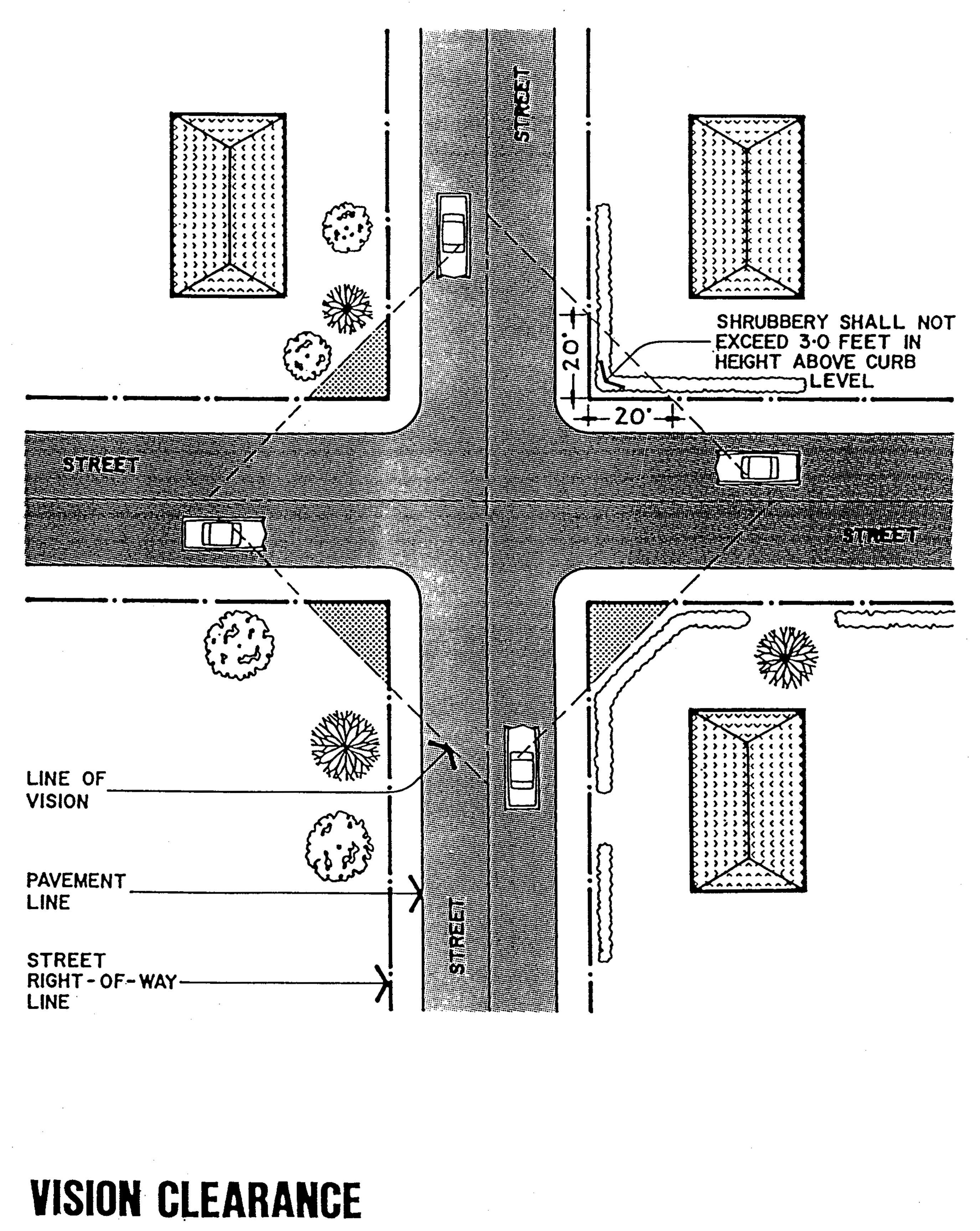
Vision clearance; corner lots. (See Illustrations.) All corner lots shall provide for a clear sight distance (traffic view obstruction triangle), not less than three feet in height above the elevation at the centerline of the traveled way, free from all buildings, structures, plant materials, play equipment, or parking, loading or storage uses in accordance with the following specifications:
(1)
All residence districts, a sight distance of not less than 20 feet measured along the intersecting street right-of-way line bordering corner lots.
(2)
All business or industrial districts, a sight distance of not less than 25 feet measured along the intersecting street right-of-way line bordering corner lots except as herein provided.
(Ord. No. O-11-03-4, § 5.06, 11-24-2003)
Sec. 60-11. - Home occupations.
(a)
In all residence districts, a home occupation shall be permitted without requiring a special use public hearing provided:
(1)
It is conducted entirely within the dwelling by a person residing in the dwelling and only when such home occupation is incidental and secondary to the use of the dwelling for dwelling purposes.
(2)
The entrance to the space devoted to such occupation is from within the dwelling and the portion of the dwelling devoted to such occupation shall not exceed 30 percent of the gross floor area of the dwelling.
(3)
There is no display, activity, or storage of equipment that will indicate from the exterior of the dwelling that it is being used in whole or in part for any use other than a dwelling.
(4)
No product assembled or made on the premises shall be offered for sale in any dwelling unit.
(5)
Th teaching of musical instruments, arts and crafts and dancing shall be conducted only in a single-family detached dwelling and then, to not more than four pupils at one time.
(b)
Home occupations not meeting the criteria set forth in subsection (a) of this section shall be permitted by special use only.
(Ord. No. O-11-03-4, § 5.07, 11-24-2003)
Sec. 60-12. - Height and area exceptions and modifications.
(a)
Height.
(1)
The height regulations prescribed herein shall not apply to television and radio towers, church spires, belfries, monuments, tanks, water and fire towers, stage towers or scenery lofts, cooling towers, ornamental towers and spires, chimneys, elevator bulkheads, smokestacks, conveyers and flagpoles.
(2)
Noncommercial and television towers and antennas. All radio and television towers and antennas, including the structure therefor, shall be permitted under the following conditions:
a.
All radio or television towers or antennas, as covered by this section, or any part thereof, shall comply with applicable Federal Communications Commission (FCC) height restrictions.
b.
Radio or television towers or antennas shall not be permitted within the required front or side yard setback requirements. (See sections 60-3, 60-10 and 60-18).
(3)
Public, semi-public or public service buildings, hospitals, institutions or schools, where permitted, may be erected to a height not exceeding 60 feet and churches and temples may be erected to a height not exceeding 75 feet when the required side and rear yards are each increased by one foot for each foot of additional building height above the height regulations for the district in which the building is located.
(4)
The limitation on number of stories shall not apply to buildings used exclusively for storage purposes provided such buildings do not exceed the height in feet permitted in the district in which they are located.
(b)
Yards.
(1)
Required yards for existing buildings. No yards now or hereafter provided for a building existing on the effective date of the zoning ordinance from which this chapter is derived shall subsequently be reduced below or further reduced below if already less than the minimum yard requirements of this chapter for equivalent new construction.
(2)
Front yards.
a.
When 40 percent or more of the frontage on one side of the street between two intersecting streets is improved with buildings that have a front yard which is greater or less than the required front yard in the district, no building shall project beyond the average front yard so established; provided, however, that a front yard depth shall not be required to exceed 50 percent in excess of the front yard otherwise required in the district in which the lot is located.
b.
On lots having double frontage, the required front yard shall be provided on both streets. (See illustrations.)
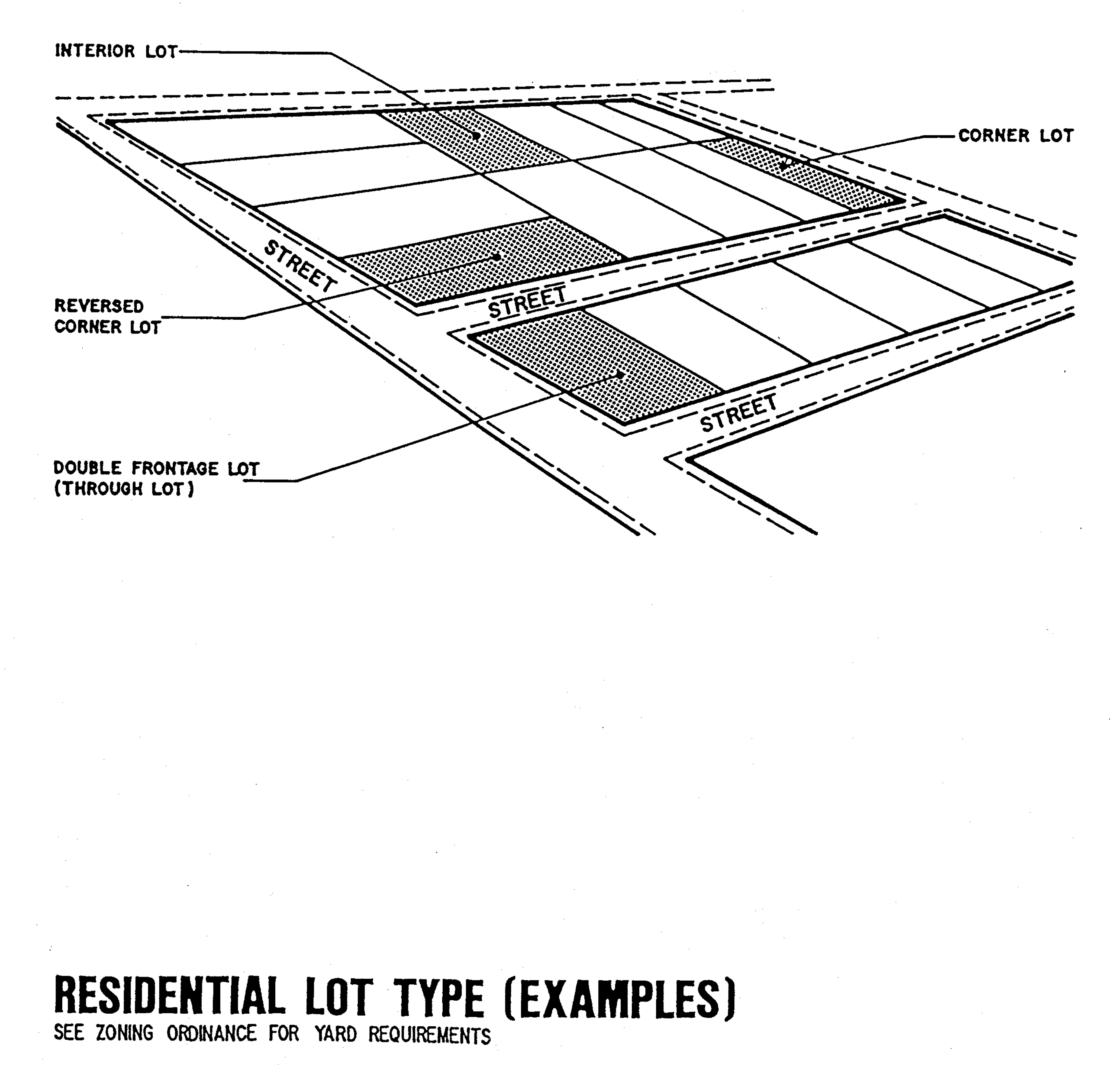
c.
Automobile service station pumps and pump islands may be located within a required yard, provided they are not less than 15 feet from any street line and not less than 50 feet from the boundary of any residence district.
(3)
Side yards.
a.
On a corner lot the width of the yard along the side street shall not be less than any required front yard on such street, provided; however, that the buildable width of a lot of record shall not be reduced to less than 32 feet.
b.
No accessory building shall project beyond a required yard line along any street.
c.
Where dwelling units are erected above a commercial establishment no side yard is required except when required for the commercial building on the side of a lot adjoining a residence district.
d.
For the purpose of side yard regulations, a two-family dwelling or multiple dwelling shall be considered as one building occupying one zoning lot.
e.
Where a lot of record at the time of the effective date of the ordinance from which this chapter is derived is less than 40 feet in width the required side yard may be reduced to ten percent of the width of the lot; provided, however, that no side yard shall be less than three feet.
(4)
Rear yards, (accessory buildings).
a.
Where a lot abuts upon an alley, one-half of the alley width may be considered as part of the required rear yard.
b.
An accessory building may occupy not to exceed 30 percent of the rear yard and unenclosed parking spaces may occupy not to exceed 90 percent of the area of a required rear yard but no accessory building shall be closer than ten feet to the main building nor closer than five feet to any rear or side lot line. In all areas which are zoned R-1 through and including R-5 the maximum area of an accessory building shall not exceed 784 square feet.
c.
Open or lattice-enclosed fire escapes, outside stairways and balconies opening upon fire towers, and the ordinary projections of chimneys and flues into a rear yard may be permitted by the administrative officer for a distance not to exceed five feet when these are so placed as not to obstruct light and ventilation.
(5)
Lot area and dimension.
a.
Contiguous parcels. When two or more parcels of land, each of which lacks adequate area and dimension to qualify for a permitted use under the requirements of the use district in which they are located and contiguous and are held in one ownership, they shall be used as one zoning lot for such use.
b.
Lots or parcels of land of record. Any single lot or parcel of land, held in one ownership, which was of record at the time of adoption of the ordinance from which this chapter is derived that does not meet the requirements for minimum lot width and area may be utilized for a permitted use, provided that yards, courts of usable open spaces are not less than 75 percent of the minimum required dimensions of areas.
c.
Lot area greater than 15 acres. A lot as defined in section 60-4 when 15 acres or larger shall be developed as a planned development special use. (See division 9 of article VIII of this chapter.)
(Ord. No. O-11-03-4, § 5.08, 11-24-2003)
Sec. 60-13. - Permitted accessory buildings, structures and uses.
The following accessory buildings, structures, and uses are permitted and may be obstructions in yards as follows, but in no case shall they be situated closer than ten feet to another building in any easement:
(Ord. No. O-11-03-4, § 5.09, 11-24-2003)
Sec. 60-14. - Access to public streets.
Except as otherwise provided for herein, every building shall be constructed or erected upon a lot or parcel of land which abuts upon a public street, unless a permanent easement of access to a public street was of record prior to the adoption of the ordinance from which this chapter is derived.
(Ord. No. O-11-03-4, § 5.10, 11-24-2003)
Sec. 60-15. - Number of buildings on a zoning lot.
Except in the case of a planned development or in the B-3 village shopping center district not more than one principal detached building shall be located on a zoning lot, nor shall a principal detached building be located on the same zoning lot with any other principal building.
(Ord. No. O-11-03-4, § 5.11, 11-24-2003)
Sec. 60-16. - Two uses on a zoning lot.
Where two or more permitted or special uses, each requiring a minimum lot area, are provided on the same zoning lot, the required lot area for such uses shall be the sum of the areas required for each individual use.
(Ord. No. O-11-03-4, § 5.12, 11-24-2003)
Sec. 60-17. - Rezoning of public and semi-public areas.
An area indicated on the zoning map as a public park, recreation area, public school site, cemetery or other similar open space, shall not be used for any other purpose than that which it is zoned and planned for, and when the use of the area is discontinued, it shall be rezoned to the most restrictive adjoining district until appropriate zoning is authorized by the village board of trustees within three months after the day the application was filed for rezoning.
(Ord. No. O-11-03-4, § 5.13, 11-24-2003)
Sec. 60-18. - Accessory building, structures and uses.
(a)
Accessory uses shall be compatible with the principal use and shall not be established prior to the establishment of the principal use, and shall not include the keeping, propagation or culture of pigeons, poultry or livestock; whether or not for profit, except as otherwise permitted by section 60-115 of this Code. Private swimming pools shall be a permitted accessory use in any residence district, provided it conforms with the regulations of this chapter and other applicable ordinances of the village.
(b)
No accessory building unless it is structurally a part of the principal building, and unless it conforms with requirements of accessory building for special uses shall be erected or altered, nor moved to a location within ten feet of the nearest wall of the principal building, nor within the required area for front or side yard of the lot, set forth for the district and in residence districts within the buildable area. An accessory building in a rear yard shall be not less than five feet from any property line.
(c)
No accessory building shall encroach upon the side yard of a corner lot which is adjacent to the street, nor upon that side yard of a reversed comer lot which is adjacent to the street, nor upon the rear yard of a through lot.
(d)
No accessory building shall have more than one story, nor exceed 18 feet in height, unless otherwise permitted and approved as accessory to business and manufacturing uses, or to authorized special uses.
(e)
Towers as accessory structures, provided the following criteria are met:
(1)
No part of any tower shall project through a horizontal plane more than 15 feet above the maximum building height for the zoning district in which it is located, except that if the tower is designed to extend and retract, then it may be extended temporarily beyond that maximum horizontal plane but only while receiving or transmitting signals.
(2)
The setback for the base of the tower shall be a minimum of ten feet from all property lines and any public easements, for towers up to 30 feet in height and the minimum rear yard (only) setback shall increase by one foot for every three feet of increase in tower height. All horizontal elements of the tower shall be setback a minimum of ten feet from all property lines and any public easements.
(3)
All towers shall be in compliance with all adopted codes and ordinances of the village as well as any current applicable rules and regulations of the FCC and/or FAA and the Electronic Industries Association Manual on Structural Standards for Steel Antenna Towers and Antenna Supporting Structures, document RS-222C (Revision of RS-222B) dated, March 1976, or as amended and any and all building codes and ordinances of the village.
(f)
The maximum size for an accessory building in a business or industrial zoning district shall be 28 feet by 28 feet, or a maximum of 784 square feet.
(g)
The maximum size for a shed in a residence zoning district shall be 12 feet by 14 feet, with a maximum height of 14 feet, or a maximum of 168 square feet.
(h)
The maximum size for a detached garage shall be 28 feet by 28 feet, with a maximum height of 14 feet, or a maximum of 784 square feet.
(Ord. No. O-11-03-4, § 5.14, 11-24-2003; Ord. No. O-8-10-2, § 3, 8-23-2010; Ord. No. O-5-22-3, § 3, 5-9-2022; Ord. No. O-8-22-1, § 2, 8-8-2022; Ord. No. O-8-23-3, § 4, 8-28-2023)
Sec. 60-19. - Temporary buildings.
(a)
A temporary real estate office may be allowed in conjunction with a new housing development, limited to the selling or renting of new units in such development, but in no case to be in operation for ore than one year following completion of construction of said housing development unless approval is obtained from the village board.
(b)
Temporary buildings for construction purposes may be allowed in any district for a period not to exceed the completion date of such construction.
(Ord. No. O-11-03-4, § 5.15, 11-24-2003)
Sec. 60-20. - Existing special uses.
Where a use is classified as a special use and exists as a permitted use at the date of the adoption of the ordinance from which this chapter is derived, it shall be considered a legal special use, without further action by the village board of trustees or the planning and zoning commission.
(Ord. No. O-11-03-4, § 5.16, 11-24-2003)
Sec. 60-21. - Uses not specifically permitted in district.
When a use is not specifically listed in the sections devoted to permitted uses, it shall be assumed that such uses are hereby expressly prohibited, unless by a written recommendation of the planning and zoning commission and approved by the village board it is determined that said use is similar to and not more objectionable than uses listed. Such uses may then be permitted.
(Ord. No. O-11-03-4, § 5.17, 11-24-2003)
Sec. 60-22. - Temporary model home regulations.
Temporary model homes shall be used primarily to offer for sale or rental dwelling units located within the same subdivision or planned development in which the model home is located. The following regulations shall govern the operation of a model home:
(1)
Upon request by the village, the owners of the property shall provide information relating to the use of the model home, including, but not limited to, a record of sales or rentals made from the model home.
(2)
Building materials may be stored within the model home but not upon the lot on which a model home is situated.
(3)
Sales offices, rental offices and construction offices may be contained in a model home; provided that the appearance of the model home is not substantially different from that of the other dwelling units in the subdivision or planned development.
(4)
A temporary off-street parking lot may be permitted if recommended by the planning and zoning commission and approved by the village board.
(5)
Exterior floodlights may be used to illuminate the model home; provided that lights are sufficiently screened so that private dwelling units and traffic are not adversely affected by the floodlights. The exterior floodlights shall be turned off not later than 8:00 p.m.
(6)
Signs, as permitted in chapter 38.
(Ord. No. O-11-03-4, § 5.18, 11-24-2003)
Sec. 60-23. - Access to public sidewalk and construction of public sidewalk.
Except as otherwise provided for herein, every building shall be constructed or erected upon a lot or parcel of land which abuts upon a public sidewalk adjacent to a roadway or public street. Any person who proposes to construct a new building upon a lot or parcel of land shall construct a public sidewalk adjacent to a roadway or public street if a public sidewalk has not already been constructed and shall dedicate a permanent easement for the public sidewalk.
(Ord. No. O-11-12-1, § 2, 11-26-2012)
Sec. 60-24. - Minimum improvements.
Except as otherwise provided for herein, any person who proposes to construct a new building upon a lot or parcel of land shall be required to construct minimum improvements in accordance with the village's design guidelines and standards for land improvement and landscape standards for new development.
(Ord. No. O-11-12-1, § 2, 11-26-2012)

