
Brandon City Zoning Code
ARTICLE 10
- DEFINITIONS AND INTERPRETATION
10.1 - Rules for words and phrases.
For the purpose of this ordinance, words used in the present tense include the future tense; words in the singular number include the plural number, and words in the plural number include the singular number; the word "building" includes the word "structure"; the word "shall" is mandatory and not directory; the word "may" is permissive; the word "used" includes "designed" and "intended or arranged to be used or occupied"; and the word "person" includes a firm, association, organization, partnership, trust, foundation, company or corporation as well as an individual.
10.2 - Definitions.
For the purpose of this ordinance certain words, phrases and terms used herein shall be interpreted as stated in this article 10. Any word, phrase or term not defined herein shall be defined by the zoning administrator, the interpretation based on its common and ordinary usage.
• Accessory building or use. Any detached building or use which is subordinate or incidental to the main building or dominant use of the lot or premises, including but not limited to swimming pools and satellite dishes but excluding driveways, sidewalks and fences.
• Alley. A public right-of-way which affords only secondary means of access to abutting property.
• Anchor. See "Ground anchor."
• Bail bonding. It is defined as pledging United States currency, United States postal money orders, cashier's checks, a surety bond or other property as bail for a person in connection with a judicial proceeding, and receiving or being promised therefore money or other things of value.
• Basement. A story wholly or partially underground. For the purpose of height regulation, a basement shall be counted as a story when more than one-half of its height is above the average grade level, or when it is used for commercial purposes.
• Buffer area. An area which acts as a buffer or separation area between two or more uses or structures not compatible due to design, function, use or operation.
• Building. Any enclosed structure built for the housing shelter, or enclosure of persons, animals, or chattel. The term building shall be construed as if followed by the words or part thereof.
• Buildable area, maximum. That portion of a lot remaining after required yards have been provided.
• Building height. The vertical distance from the ground to the highest point of the coping of a flat roof, or the deck line of a mansard roof, or the average height of the highest gable of a pitch or hip roof.
• Building permit. A permit issued by the zoning administrator as required by this ordinance.
• Building, portable. Any building that is portable in nature, without any wheels, and built on a chassis or frame designed and constructed to be used without a permanent foundation. Depending upon the location of the portable building, such structures may be subject to anchorage or tie down requirements. Building permits are required prior to the placement of such buildings on any lot.
• Building, structural alteration of. Any rearrangement in the supporting members, walls, beams, columns, or girders of a building.
• Canopy. A rooflike structure which is not enclosed on all sides and may or may not project from a building (see also Marquee).
• Certificate of occupancy. The certificate issued by the zoning administrator prior to occupancy of any new building.
• Change of use. An alteration or change from a previous use of land, buildings, or structures to another use of land, buildings, or structures.
• Conditional use. A land use which may generally be appropriate in a particular zoning district, but which, with certain restrictions or conditions, would in the judgement of the mayor and board of aldermen promote the public health, safety, morale, or general welfare of the city and would not adversely affect adjacent properties.
• Conforming use. Any lawful use of a building or lot which complies with the provisions of this zoning ordinance.
• Coverage. That part of a lot covered by buildings.
• Display surface. The entire background area upon which copy can be placed.
• Display surface area. The sum of the gross display surface. The area of each display surface shall be computed by calculating the area of the circle, square, triangle, rectangle, or combination of such common geometric forms necessary to enclose such surface. However, such area shall not include any structural or framing elements lying outside the limits of such sign and not forming an integral part of the display. Only one side of a double-faced sign shall be included in calculating the sum of display surface area.
• Density. The intensity of land use and also the maximum intensity of use of a minimum lot or land area physically possible observing all yard, height, and lot or land area coverage provisions of this zoning ordinance, exclusive of any publicly dedicated rights-of-way.
• District. Any area of the City of Brandon for which regulations governing the use of land and the use, density, bulk, height, and coverage of buildings and other structures are established by this ordinance.
• Dwelling, modular. A factory fabricated transportable building unit designed and constructed in compliance with local and state codes and area of placement and to be incorporated at a building site into a permanent structure when placed on a permanent foundation as a dwelling when connected to indicated utilities.
• Dwelling, multiple-family. Any residential building or portion thereof which is occupied by three or more families living independently of each other. The term multiple-family dwelling shall be understood to include apartment houses or complexes, townhouses, and all other dwellings of similar character.
• Dwelling, single-family. A site-built residential building designed for occupancy by one family. For the purposes of this ordinance, single-family dwelling does not refer to mobile, manufactured, modular, panelized or pre-cut homes.
• Dwelling, townhouse. A single-family dwelling forming one of a group or series of two or more attached single-family dwellings separated from one another by party walls without doors, windows, or other provisions for human passage or visibility.
• Dwelling, two-family (duplex). A detached residential building designed to be occupied by two families living independently of each other.
• Dwelling unit. One or more rooms including a kitchen designed as a unit for occupancy by one family for the purpose of cooking, living and sleeping.
• Dwelling, zero lot line. A detached single-family dwelling unit which is constructed against one side lot line and/or the rear lot line.
• Easement. A strip of land granted by the property owner to the public, a corporation or persons for a specific purpose, or otherwise acquired for such purpose.
• Elevations. A scale drawing of the sides, front, and rear of a proposed or existing structure.
• Employee (staff). Any person who is on the premises of a business or industrial establishment for productive use on a part-time or fulltime basis. For the purposes of this ordinance the maximum number of employees on the premises of an establishment at one time shall constitute the number of employees.
• Family. One person living alone, or two or more persons living together as a single, housekeeping unit, whether related to each other legally or not, as distinguished from a group occupying a boardinghouse, lodging house, hotel, motel, dormitory or similar dwelling for group use. A family shall be deemed to include domestic servants employed by said family when these servants are on-premises residents.
• Floor area. The sum of the gross area of all floors of a building exclusive of all porches, balconies or garages. Such floor area shall not include floors used for parking in the same structure.
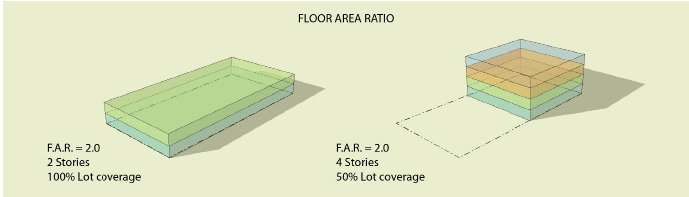
• Floor area ratio. The ratio of the total building floor area in square feet to the total land area in square feet, based upon a 1:0 ratio, constituting a one-story building or structure occupying 100 percent of the underlying land.
• Frontage. Property on one side of a street measured along the line of the street, or in the case of a corner lot, the property on each street measured along the lines of both streets.
• Garage (private). The term "garage" shall mean a private garage, which is an accessory building (i.e., detached from the main building) or portion of a main building used primarily for the storage of privately-owned automobiles.
• Governing body (or governing authorities). The Mayor and Board of Aldermen of Brandon, Mississippi.
• Grade or grade level. The finished elevation of land after completion of site preparations for construction.
• Gross leasable area. Gross leasable area (GLA) is the amount of floor space available to be rented in a commercial property. Specifically, gross leasable area is the total floor area designed for tenant occupancy and exclusive use, including any basements, mezzanines, or upper floors.
• Ground anchor. Any device to which tie-downs are attached for the purpose of securing a mobile home or portable building to the ground.
• Homes association. A nonprofit organization (corporate or otherwise) operating under recorded land agreements through which each property owner is subject to a charge for a proportionate share of expenses for maintaining common open space, other activities and facilities.
• Lot. A parcel of land of at least sufficient size to meet minimum zoning requirements for use, coverage, and area, and to provide such yards and open spaces as required herein. Such lot shall have frontage on or approved access to an improved public street and may consist of:
• A single lot of record;
• A parcel of land described by metes and bounds.
• Lot area. The total area of a lot included within the front, side and rear lot lines.
• Lot, corner. A lot abutting upon two or more streets at their intersections.
• Lot depth. The average horizontal distance between the front and rear lot line.
• Lot, double frontage. A lot, other than a corner lot, which runs through a block from street to street (i.e., has frontage on more than one street); double frontage lots are also called through lots.
• Lot frontage. The front of a lot shall be construed to be that dimension of a lot abutting on a street or approved private drive. For the purpose of determining yard requirements on corner lots or double frontage lots, all sides of such lots abutting on public streets shall be considered lot frontage, and yards shall be provided as indicated in this ordinance.
• Lot, interior. A lot other than a corner lot.
• Lot line, front. In the case of an interior lot, the property boundary line separating said lot from the street. In the case of a corner lot or double frontage lot, the line separating said lot from the street on which the building will face, as determined from the application for a building permit.
• Lot line, rear. The property boundary line opposite and most distant from the front lot line. In the case of a pointed or irregular lot, it shall be an imaginary line parallel to and farthest from the front lot line.
• Lot lines. The lines bounding a lot as such parcel of land is defined herein.
• Lot of record. A lot which is a part of a subdivision, the map of which is recorded in the office of the chancery clerk of Rankin County, Mississippi, or a lot described by metes and bounds, the description of which has been recorded in said office.
• Lot width. The distance from side of lot to side of lot measured at the front minimum building setback line. Buildable width shall be the width of lot left to be built upon after the required yards are provided.
• Manufactured home. These are homes built entirely in a factory under a Federal building code administered by the U.S. Department of Housing and Urban Development (HUD). The Federal Manufactured Home Construction and Safety Standards (commonly known as the HUD Code) went into effect June 15, 1976. Manufactured homes may be single or multi-section and are transported to a site and installed.
• Marquee. A rooflike structure projecting from a building and often bearing a signboard (see also "Canopy").
• Massage. The rubbing or kneading of body parts, usually with the hands, in order to stimulate circulation and make muscles or joints supple and/or to relieve tension. Massage shall not include any touching or other stimulation of male or female genitals or female breasts. Massage does not preclude necessary medical treatments performed on any part of the human body if earned out by, or under the direction of, medical practitioners including physicians, chiropractors, and associated medical professionals licensed by the State of Mississippi.
• Manufactured home space (or lot). A plot of ground within a mobile home designed for and designated as (on an approved site plan) the location of one mobile home, and which has water, sewer and electricity at the space.
• Manufactured home stand or pad. The paved runners or paved parking area in each mobile home space upon which the mobile home is placed, together with the paved patio and paved off-street vehicular parking area.
• Modular homes. These factory-built homes are built to the state, local or regional code where the home will be located. Modules are transported to the site and installed.
• Nonconformities. Any land, lot, building, structure or parts thereof existing prior to the enactment of this ordinance [June 3, 1986], which subsequent to the enactment of this ordinance or amendment thereto, does not conform with the use regulations and/or dimensional regulations of the district in which it is situated, and/or does not comply with any other requirements herein.
• Open space or common open space. A parcel or parcels of land not occupied by dwellings or residential structures, accessory structures and yards, which may consist of jogging trails, tennis courts, a golf course, swimming pool, associated recreational buildings and the like, and which is permanently maintained in a suitable state for the shared enjoyment by the owners and/or occupants of individual dwelling units or residential structures within a particular development.
• Panelized homes. These are factory-built homes in which panels—a whole wall with windows, doors, wiring and outside siding—are transported to the site and assembled. The homes must meet state or local building codes where they are sited.
• Parking space. For the purposes of this ordinance, the term parking space shall refer only to parking places not located on a public street. Each parking space shall be sufficient in size to store one full-size automobile.
• Paved driveway/paved parking area. A hard-surfaced area designed and constructed specifically for use by motorized vehicles as a path for the vehicle to be driven across or as a location at which a vehicle could be parked or stored. Such driveways and parking areas shall include only that surface area that is continuously connected to a public or private street via a paved surface wide enough for use by a standard passenger car.
• Planned unit development (PUD). An area of a minimum contiguous size, as specified by this ordinance, to be planned and developed as a single entity containing one or more residential clusters and in which land not used for residential structures or yards but required by the basic zoning of the site shall be reserved collectively in contiguous units accessible to all building sites in the development as open space for the purpose of providing recreational facilities and pedestrian circulation.
• Planning commission. The duly appointed planning commission of the City of Brandon, Mississippi.
• Portable building. See "Building, portable."
• Pre-cut homes. This is the name for factory-built housing in which building materials are factorycut to design specifications, transported to the site and assembled. Pre-cut homes include kit, log and dome homes. These homes must meet local, state or regional building codes.
• Principal building. A structure or, where the context so indicates, a group of structures, in which the principal use of a lot or parcel is conducted. This includes any buildings that are attached to the principal structure by a covered structure.
• Property line. The legal boundary line separating buildings or tracts in different ownership.
• Regular meeting of planning commission. Meetings shall be held on the first Monday [after the first official board meeting of each month], unless that day falls on a recognized state holiday in which case the meeting will be held on the second Monday of the month.
• Sanitation ordinance.Chapter 66 of the Brandon City Code.
• Schools. The term school as used in this ordinance shall include public, private, and parochial institutions of learning and shall include trade or industrial schools (i.e., those schools offering training to students in skills required for the practice of trades and industry).
• Screening. Landscape and/or architectural barriers which block vision.
• Side street. A street bordering the side of a lot and intersecting the street on which a structure on the lot faces, as determined by the zoning administrator; in the case of buildings (as opposed to other types of structures), the street which the building faces shall be determined by the principal entrance to the building.
• Sign. Any device used for visual communication, including any announcement, declaration, demonstration, display, ribbon, banner, illustration, figures, design, symbol, trademark or insignia, which is used to attract the attention of persons not on the premises, or to advertise, promote the interest, or attract to any business, industry, individual, group, enterprise, subject, public performance, article, machine, or merchandise whatsoever when same is placed in the view of the general public. This shall include every sign and billboard, poster panel, illuminated sign or sign painted on exterior surface of a building or other structure.
• Sign, advertising. Any sign, including but not limited to billboards, which directs attention to a business, commodity, service or entertainment conducted, sold, or offered elsewhere other than upon the premises where such sign is located, or which it is affixed.
• Sign, animated. Any any sign with motion or action, having visible moveable parts, requiring electrical energy, but not including wind actuated elements such as banners or flags. This definition does not include public service signs such as time and temperature, or revolving signs.
• Sign, business. Any sign the name of which directs attention to a lawful use of the premises on which it is located, including signs indicating the business transacted, services rendered, goods sold or produced on the premises, the name of the person occupying the premises.
• Sign, copy. All words, letters, numbers, figures, characters, artwork, symbol or insignia that are used in the display surface area.
• Sign, copy, changeable. All words, letters, numbers, figures, characters, artwork, symbol, or insignia that are used in the display surface that are removable.
• Sign, flashing. Any sign which has any flashing device intermittent illumination, revolving or rotating lighting device, or constant lighting device which is made to vary in brilliance by mechanical or other means. This definition does not include public service signs such as time and temperature.
• Sign, ground. Any sign which is supported by one or more uprights, poles, braces, or other structure anchored in or on the ground.
• Sign, incidental. Advertisement of another service provided at location, other than primary business.
• Sign, permanent. Any sign except a temporary sign.
• Sign, projecting. Any sign, other than a wall sign, which projects from and is supported by a wall of a building or other structure.
• Sign, reader board. That portion of a sign that has changeable words, letters, numbers, figures, characters, artwork, symbol or insignias.
• Sign, revolving. A sign which revolves 360 degrees, but does not exceed eight RPM.
• Sign, temporary. A banner, pennant, poster or advertising display constructed of cloth, canvas, plastic sheet, cardboard, wallboard or other like materials with or without frames, intended to be displayed for a limited period of time only.
• Sign, temporary trailer. Temporary sign structures for use with or without changeable copy illuminated or unilluminated, mounted on a boat-type trailer with or without wheels, not permanently attached to the grounds.
• Sign, wall. Any sign attached flat and parallel to the exterior of wall or screening surface of a building or other structure and confined within limits thereof and which projects from that surface less than 12 inches at all points.
• Sign, window. Any sign displayed on the inside or outside of a window and visible from a public street, walkway, parking lot or any other public way.
• Site plan review committee. The committee created by the board of aldermen to review site plans as required by this ordinance.
• Special exception. See "Conditional use."
• Start of construction. This is the first placement construction of a structure (other than a mobile home) on a site, such as the pouring of slabs or footings or any work beyond the stage of excavation. Permanent construction does not include land preparation, such as clearing, grading, and filling; nor does it include the installation of streets and/or walkways; nor does it include excavation for a basement, footings, piers or foundations or the erection of temporary forms; nor does it include the installation on the property of accessory buildings, such as garages or sheds not occupied as dwelling units or not as part of the main structure. For a structure (other than a mobile home) without a basement or poured footings, the start of construction means the affixing of the mobile home to its permanent site. For mobile homes within mobile home parks or mobile home subdivisions, start of construction is the date on which the construction of facilities for servicing the site on which the mobile home is to be affixed (including, at a minimum, the construction of streets, either final site grading or the pouring of concrete pads, and installation of utilities) is completed.
• Story. That portion of a building included between the surface of any floor and the surface of the next floor above it, or if there be no floor above it, then the space between the floor and the ceiling next above it. For the purposes of height measurement, a basement shall be counted as a story when more than one-half of its height is above the average grade elevation, or when the basement is used for commercial activities (see "Basement").
• Street. A right-of-way other than an alley dedicated or otherwise legally established for public use which usually affords the principal means of access to abutting property. A street may be designated as a highway, thoroughfare, parkway, boulevard, road, avenue, lane, drive or other appropriate name.
• Street line. The right-of-way line of a street.
• Structure. Anything constructed or erected, the use of which requires a fixed location on the ground, or attached to something having a fixed location on the ground. Among other things, structures include buildings, mobile homes, walls, fences, and billboards, but shall not include transient trailers (travel trailers) as defined herein. The term structure shall be construed as if followed by the words or part thereof.
• Structural alteration of a building. See "Building, structural alteration of."
• Subdivision. The division or redivision of land into two or more lots, tracts, sites, or parcels for the purpose of transfer of ownership, or for development, whether immediate or in the future, by means of an appropriately recorded legal instrument.
• Tiedown. Any device designed for the purpose of securing a mobile home or portable building to ground anchors.
• Townhouse. A single-family dwelling forming one of a group or series of two or more attached single-family dwellings separated from one another by party walls without doors, windows, or other provisions for human passage or visibility through such walls from basement or cellar to roof, and having roofs which may extend from one of the dwelling units to another.
• Transient trailer (travel trailer). A portable or mobile living unit used for temporary human occupancy away from the place or residence of the occupants. For the purposes of this ordinance, such transient trailer shall be considered a vehicle and not a structure. The term transient trailer or travel trailer shall include pickup truck campers, motor homes, and camping trailers.
• Undeveloped lot. A vacant lot or parcel of land.
• Use. The specific purpose for which land or a building is designed, arranged, intended, or for which it is or may be occupied or maintained. The term permitted use shall not be deemed to include any nonconforming use. See section 4, uses and use standards, for a list of defined uses.
• Variance. A variance is a relaxation of the terms of this zoning ordinance where such variance will not be contrary to the public interest and where a literal enforcement of the ordinance would result in unnecessary and undue hardship.
• Yard (or minimum yard or setback). The required open space between any main building or portion thereof and the adjoining lot lines, which shall remain unoccupied and unobstructed by any portion of a structure, except as otherwise specifically provided herein. (However, fences and walls may be permitted in such required yards subject to the height restrictions and other regulations of this ordinance.)
• Yard, front. The required unoccupied and unobstructed space on the same lot with a main building, extending the full width of the lot, and situated between the front property line and the nearest exterior limits (e.g. vertical portion) of the main building.
• Yard, rear. The required unoccupied space on the same lot with a main building, situated between the rear property line and the nearest exterior limits (e.g. vertical portion) of the main building, and extending the full width of the lot.
• Yard, side. The required unoccupied and unobstructed space on the same lot with a main building, situated between the side property line and the nearest exterior limits (e.g. vertical portion) of the main building.
• Zero lot line duplex. Multiple dwellings to accommodate not more than two families, constructed on two adjoining lots with a common wall provided along the middle lot line in order that either occupant may acquire and hold title to one of the dwellings.
• Zoning administrator. The official (or officials) charged by the mayor and board of aldermen with the administration and enforcement of this zoning ordinance, or his duly authorized representative.
• Zoning district. See "District."
(Ord. of 4-6-20(1), Exh. A)

