
Brandon City Zoning Code
ARTICLE 5
- DEVELOPMENT STANDARDS
5.1 - Purpose.
In order to fully implement the goals of Plan Brandon Comprehensive Plan, supplementary development standards are required to insure that new development, renovation, and reconstruction are designed, sized, and sited to achieve functionally efficient, economically productive, pedestrian friendly, aesthetically pleasing environments. development which These standards are intended to contributes to the stability, vitality and long term livability of the city. Such standards are also required to promote sound environmental stewardship, public safety, efficient delivery of public services, and transportation choice.
5.2 - Applicability.
5.2.1 Generally. The following development standards shall be applied by zoning district in according to the development standards tables with the following exceptions:
• Routine maintenance related to plumbing, mechanical, or electrical systems of buildings and sites.
• All plumbing, mechanical and electrical equipment when such work is entirely within the interior of a building.
• Construction or alteration necessary for the compliance with a lawful order of the city, fire department, police department, or public works department related to the immediate public health or safety.
• Any interior alterations, repairs, or renovation which does not change the principal use of the structure.
• Demolition or wrecking, repair, construction, reconstruction, alteration, rehabilitation, moving, demolition, or change in use for either land or buildings within any historic district approved by the historic preservation commission.
5.2.2 Alternative compliance. Requests for alternative compliance to the elements and requirements contained in table 5.5 development standards may be granted by the mayor and board of aldermen for any permit application to which the development standards apply, when one or more of the following conditions are met.
• Improved environmental quality would result from alternative compliance.
• Topography, soil, vegetation, drainage or other site conditions are such that full compliance is impractical.
• Spatial limitations, unusually shaped pieces of land, unusual servitude requirements, or prevailing practices in the surrounding neighborhood may justify alternative compliance.
• Public safety considerations make alternative compliance appropriate.
• Public improvement projects make alternative compliance appropriate.
The alternative compliance process is not to be used with respect to any item which:
• Is subject to a dimensional requirement. Dimensional requirements are subject to the variance provisions of section 9.6.
• References or conflicts with any other building, fire, or city code.
• References or conflicts with any other federal, state, or local law or standard.
(Ord. of 4-6-20(1), Exh. A)
5.3 - Relation to special districts.
These standards shall also apply in all overlay districts if the standard would apply to the applicable underlying district, unless an alternative standard is set forth in the overlay district.
5.4 - Organizational principles and design standards table.
The development standards are organized in 5.5 development standards table. Compliance shall be determined by the department of community development.
Standards are divided into the following major building and construction elements.
• Parking and traffic circulation.
• Parking lot design.
• Pedestrian and bicycle circulation.
• Site lighting and building illumination.
• Building form and materials.
• Fences, walls and screening.
• Landscaping and buffers.
(Ord. of 4-6-20(1), Exh. A)
5.5 - Development standards table.
| TABLE 5.5 DEVELOPMENT STANDARDS | |||||||||||||||||
|---|---|---|---|---|---|---|---|---|---|---|---|---|---|---|---|---|---|
| Development Standard | Zoning District | ||||||||||||||||
| Residential | Commercial | Employment | Special | ||||||||||||||
| ■ = Required X= Not Applicable | RR | R-12 | R-8 | RM-8 | RM-4 | RH | MH | NC | CC | RC | I-1 | I-2 | ORC | VMU | TND | PUD | |
| PARKING AND TRAFFIC CIRCULATION | |||||||||||||||||
| Curb Cuts | |||||||||||||||||
| 5.5.1 | Curb cuts shall be located no closer than 75 feet from the intersection of two streets as measured from the end of the radius nearest the proposed cut. Where the width of the site is less than 75 feet, the curb cut shall be placed the as far as possible from the street intersection. | X | X | X | X | X | X | X | ■ | ■ | ■ | ■ | ■ | ■ | X | X | X |
| 5.5.2 | Curb cuts, except where shared, shall be located a minimum of 10 feet from a parcel or lot line measured from edge. | X | X | X | X | X | X | X | ■ | ■ | ■ | ■ | ■ | ■ | X | X | ■ |
| 5.5.3 | Curb cuts shall be located directly opposite one another or separated by a minimum of 150 feet measured from edge. | ■ | X | X | X | X | X | X | ■ | ■ | ■ | ■ | ■ | ■ | X | X | ■ |
| 5.5.4 | Curb cuts shall be limited to one for every 300 feet of street frontage. Parcels with less than 300 feet of frontage shall be limited to one curb cut per street frontage. | X | X | X | X | X | X | X | ■ | ■ | ■ | ■ | ■ | ■ | X | X | ■ |
| Entrances | |||||||||||||||||
| 5.5.5 | Entrances and exits to the site shall be so located such that parking spaces and traffic aisles do not conflict with entering and exiting traffic. | X | X | X | X | X | X | X | ■ | ■ | ■ | ■ | ■ | ■ | ■ | ■ | ■ |
| 5.5.6 | One-way driveway entrance curb cuts shall be a minimum of 12 feet and a maximum 14 feet wide. | X | X | X | X | X | X | X | ■ | ■ | ■ | ■ | ■ | ■ | ■ | ■ | ■ |
| 5.5.7 | Two-way driveway entrances shall be a maximum of 24 feet wide. | X | X | X | X | X | X | X | ■ | ■ | ■ | ■ | ■ | ■ | ■ | ■ | ■ |
| 5.5.8 | Three-way driveway entrances shall be a maximum of 36 feet wide. | X | X | X | X | X | X | X | ■ | ■ | ■ | ■ | ■ | ■ | ■ | ■ | ■ |
| 5.5.9 | Shared driveways are required on developing parcels. | X | X | X | X | X | X | X | ■ | ■ | ■ | ■ | ■ | ■ | ■ | ■ | ■ |
| PARKING LOT DESIGN | |||||||||||||||||
| 5.5.10 | Vehicular and pedestrian cross access shall be provided to all adjacent commercial properties. | X | X | X | X | X | X | X | ■ | ■ | ■ | ■ | ■ | ■ | ■ | ■ | ■ |
| 5.5.11 | The number of required spaces shall conform to parking space requirements in Section 7. | ■ | ■ | ■ | ■ | ■ | ■ | ■ | ■ | ■ | ■ | ■ | ■ | ■ | X | ■ | ■ |
| 5.5.12 | No parking or loading areas may be designed to allow vehicles to back directly onto an adjacent public street. | X | X | X | X | X | X | X | ■ | ■ | ■ | ■ | ■ | ■ | X | X | ■ |
| 5.5.13 | Parking spaces shall be delineated by white pavement striping unless otherwise required by ADA. Reflective striping is encouraged. | X | X | X | ■ | ■ | ■ | ■ | ■ | ■ | ■ | ■ | ■ | ■ | ■ | ■ | ■ |
| 5.5.14 | Non-residential uses shall provide emergency vehicle access in accordance with the currently adopted Fire Code. | X | X | X | X | X | X | X | ■ | ■ | ■ | ■ | ■ | ■ | ■ | ■ | ■ |
| 5.5.15 | Fire lanes shall be a minimum of 14 feet in width or as specified in the applicable fire code. | X | X | X | X | X | X | X | ■ | ■ | ■ | ■ | ■ | ■ | X | X | X |
| 5.5.16 | Rear access to buildings shall comply with the adopted fire code. | ■ | ■ | ■ | ■ | ■ | ■ | ■ | ■ | ■ | ■ | ■ | ■ | ■ | ■ | ■ | ■ |
| 5.5.17 | All parking areas and loading areas shall be provided with a permanent cement concrete curb designed to permit low impact stormwater treatment. All landscaped areas that may be encroached upon by a motor vehicle shall be protected by a cement wheel stop appropriately anchored to the pavement, and set a minimum of two feet back from the edge of pavement. | X | X | X | X | X | X | X | ■ | ■ | ■ | ■ | ■ | ■ | ■ | ■ | ■ |
| 5.5.18 | Loading docks, overhead doors, and truck parking shall be positioned, or screened in such a way as to not be visible from the public street. | X | X | X | X | X | X | X | ■ | ■ | ■ | ■ | ■ | ■ | ■ | ■ | ■ |
| 5.5.19 | A landscaped island not less than 8 feet wide and 20 feet in length or 160 square feet, measured from back of curb, shall be installed for each 100 linear feet of parking area and shall cap ends of parking rows. | X | X | X | X | X | X | X | ■ | ■ | ■ | ■ | ■ | ■ | ■ | ■ | ■ |
| 5.5.20 | No more than 15 spaces can occur in a continuous row without interruption by a landscape island. | X | X | X | X | X | X | X | ■ | ■ | ■ | ■ | ■ | ■ | ■ | ■ | ■ |
| PEDESTRIAN AND BICYCLE CIRCULATION | |||||||||||||||||
| External to Site | |||||||||||||||||
| 5.5.21 | Sidewalks shall be provided along all public streets on the entire frontage of a development site and align with existing sidewalks on adjacent properties. | X | ■ | ■ | ■ | ■ | ■ | ■ | ■ | ■ | ■ | ■ | ■ | ■ | ■ | ■ | ■ |
| 5.5.22 | Minimum sidewalk width is five feet or per site plan review. | X | ■ | ■ | ■ | ■ | ■ | ■ | X | X | X | X | X | X | ■ | ■ | ■ |
| 5.5.23 | Minimum sidewalk width is eight feet. | X | X | X | X | X | X | X | X | X | X | X | X | X | ■ | ■ | ■ |
| 5.5.24 | Sidewalks shall be ADA complaint. Handicapped access ramps shall be constructed at street corners. | X | ■ | ■ | ■ | ■ | ■ | ■ | ■ | ■ | ■ | ■ | ■ | ■ | ■ | ■ | ■ |
| 5.5.25 | Where adjacent sidewalks are not yet present, sidewalks shall be constructed at least five feet behind the curb. When present, new walks shall connect to existing. | X | ■ | ■ | ■ | ■ | ■ | ■ | ■ | ■ | ■ | ■ | ■ | ■ | ■ | ■ | ■ |
| 5.5.26 | Sidewalks shall not be required to cross driveways as long as the driveway provides an ADA compliant connection between the sidewalk ends. | X | ■ | ■ | ■ | ■ | ■ | ■ | ■ | ■ | ■ | ■ | ■ | ■ | ■ | ■ | ■ |
| 5.5.27 | Sidewalks shall be composed of broom finished, colored, or exposed aggregate concrete or brick. Asphalt sidewalks are prohibited. | X | ■ | ■ | ■ | ■ | ■ | ■ | ■ | ■ | ■ | ■ | ■ | ■ | ■ | ■ | ■ |
| 5.5.28 | Crosswalks shall be provided to connect external pedestrian circulation systems to a site and safely convey pedestrians to the site destination. | X | ■ | ■ | ■ | ■ | ■ | ■ | ■ | ■ | ■ | ■ | ■ | ■ | ■ | ■ | ■ |
| 5.5.29 | Crosswalks shall be striped in conformance with the latest edition of the Manual on Uniform Traffic Control Devices. | X | ■ | ■ | ■ | ■ | ■ | ■ | ■ | ■ | ■ | ■ | ■ | ■ | ■ | ■ | ■ |
| 5.5.30 | Bicycle Circulation. Bicycle circulation shall be accommodated on streets and/or on dedicated bicycle paths. Where feasible, any existing bicycle routes shall be preserved and enhanced. Facilities for bicycle travel may include off-street bicycle paths (generally shared with pedestrians and other non-motorized users) and separate, striped, 4-foot bicycle lanes on streets. | X | ■ | ■ | ■ | ■ | ■ | ■ | ■ | ■ | ■ | ■ | ■ | ■ | ■ | ■ | ■ |
| 5.5.31 | Bicycle parking and storage facilities shall be provided. | X | X | X | X | X | X | X | ■ | ■ | ■ | X | X | ■ | ■ | ■ | ■ |
| 5.5.32 | Motor vehicle circulation shall be designed to minimize conflict with pedestrians and bicycles. Traffic calming features such as curb extensions, traffic c circles, and medians should be used to encourage slow traffic speeds. | X | ■ | ■ | ■ | ■ | ■ | ■ | ■ | ■ | ■ | ■ | ■ | ■ | ■ | ■ | ■ |
| Internal Circulation | |||||||||||||||||
| 5.5.33 | Internal pedestrian circulation shall be provided to create interconnected walkways safely conveying pedestrians from adjacent streets and parking areas to the site destination. | X | ■ | ■ | ■ | ■ | ■ | ■ | ■ | ■ | ■ | ■ | ■ | ■ | ■ | ■ | ■ |
| 5.5.34 | Material may include brick, pavers, tile, stone, washed aggregate concrete, or stamped concrete. The use of asphalt, cinderblock, and gravel is prohibited. | X | ■ | ■ | ■ | ■ | ■ | ■ | ■ | ■ | ■ | ■ | ■ | ■ | ■ | ■ | ■ |
| 5.5.35 | Crosswalks shall be designated by white pavement striping or materials of a different color and texture from the surrounding surface but conforming to the overall color scheme of the development. | X | ■ | ■ | ■ | ■ | ■ | ■ | ■ | ■ | ■ | ■ | ■ | ■ | ■ | ■ | ■ |
| 5.5.36 | Distinguish walkways from driving surfaces by using varied paving treatments and by raising walkways to curb level | X | X | X | X | X | X | X | ■ | ■ | ■ | ■ | ■ | ■ | ■ | ■ | ■ |
| SITE LIGHTING AND BUILDING ILLUMINATION | |||||||||||||||||
| 5.5.37 | Streets, driveways, parking lots, walks and service areas shall be adequately illuminated as evenly as possible, not exceeding an average of .3 foot-candles diminishing to zero at a site's boundary. Lighting intensity shall be demonstrated by means of a site lighting plan illustrating compliance. | X | X | X | X | X | X | X | ■ | ■ | ■ | ■ | ■ | ■ | ■ | ■ | ■ |
| 5.5.38 | Site lighting shall not extend beyond site boundaries. Luminaries shall be shielded, shaded, or directed to prevent light from being cast on adjacent property. | X | X | X | X | X | X | X | ■ | ■ | ■ | ■ | ■ | ■ | ■ | ■ | ■ |
| 5.5.39 | No exterior lighting fixture shall be placed or directed so as to interfere with the operation of vehicles. | ■ | ■ | ■ | ■ | ■ | ■ | ■ | ■ | ■ | ■ | ■ | ■ | ■ | ■ | ■ | ■ |
| 5.5.40 | No exterior light shall have any blinking, flashing, or fluttering light, or other illuminating device which has a changing light intensity or brightness of color. | ■ | ■ | ■ | ■ | ■ | ■ | ■ | ■ | ■ | ■ | ■ | ■ | ■ | ■ | ■ | ■ |
| 5.5.41 | Lighting fixtures shall be compatible in style with the architecture of their associated buildings and shall otherwise comply with any officially adopted streetscape plan. | X | X | X | X | X | X | X | ■ | ■ | ■ | ■ | ■ | ■ | ■ | ■ | ■ |
| 5.5.42 | Pole mounted luminaries shall be full cutoff with shields, reflectors, or refractor panels to direct and cut-off emitted light at 90 degrees or less. | X | X | X | X | X | X | X | ■ | ■ | ■ | ■ | ■ | ■ | ■ | ■ | ■ |
| 5.5.43 | Building mounted luminaries shall be full cut-off using shields, reflectors, or refractor panels to direct and cut-off the emitted light at 45 degrees or less except for low intensity decorative lighting not exceeding 45 watts per bulb (incandescent equivalent). | ■ | ■ | ■ | ■ | ■ | ■ | ■ | ■ | ■ | ■ | ■ | ■ | ■ | ■ | ■ | ■ |
| 5.5.44 | Poles in commercial and multiple-family developments, whether mounted upon a building or independently upon a light standard, shall not exceed 20 feet in height. | X | X | X | X | X | X | X | ■ | ■ | ■ | X | X | X | ■ | ■ | ■ |
| 5.5.45 | Lighting fixtures within industrial developments shall not exceed 25 feet in height, except in those instances where the subject property adjoins any residentially zoned property, in which case, poles may not extend above the roof line of the associated building. | X | X | X | X | X | X | X | X | X | X | ■ | ■ | ■ | X | X | ■ |
| BUILDING FORM AND MATERIALS | |||||||||||||||||
| 5.5.46 | When adjoining a residential zone, structures shall be compatible with the character of single-family residential structures. Compatibility shall be determined by comparing the consistency of existing and proposed design elements, colors, materials, height, bulk and landscaping. | X | X | X | X | X | X | X | ■ | ■ | ■ | X | X | ■ | ■ | ■ | ■ |
| 5.5.47 | Multiple buildings on a site should be clustered to create plaza or pedestrian mall areas. Where this cannot be achieved buildings shall be connected by means of pedestrian walkways defined by separate paving textures and accented by landscape areas. | X | X | X | X | X | X | X | ■ | ■ | ■ | X | X | X | X | X | ■ |
| 5.5.48 | False or stage-set façades are prohibited. Materials and colors used on the street façade face shall continue to the sides and rear of the building where visible from a street right-of-way or adjacent residence. | X | X | X | X | X | X | X | ■ | ■ | ■ | ■ | ■ | ■ | ■ | ■ | ■ |
| 5.5.49 | The maximum, unbroken façade plane shall be 60 feet. The façade plane shall be interrupted by projections, recesses, portals, courtyards, plazas, or other appropriate architectural design. Façade plane breaks shall have a minimum depth of six inches per foot. | X | X | X | X | X | X | X | ■ | ■ | ■ | X | X | X | ■ | ■ | ■ |
| 5.5.50 | No split faced block or metal surfaces shall be visible upon the exterior of any building as a primary surface material. Flat-faced cement block shall have the appearance and proportions of traditional brick subject to approval. | X | X | X | X | X | X | X | ■ | ■ | ■ | X | X | ■ | ■ | ■ | ■ |
| 5.5.51 | Pitched roofs shall, as a primary roof form, have a slope not less than 5/12. Porches shall be sloped not less than 3/12. | X | X | X | X | X | X | X | ■ | ■ | ■ | X | X | X | ■ | ■ | ■ |
| 5.5.52 | Parapet façades may be used when of unified construction with the primary surface of the wall and of the same material and color. The parapet shall be designed such that the reverse side of all elements shall not be visible to public view. False mansards are prohibited. | X | X | X | X | X | X | X | ■ | ■ | ■ | X | X | ■ | ■ | ■ | ■ |
| 5.5.53 | Parapets shall extend above the highest level of any roof mounted building equipment on all sides. | X | X | X | X | X | X | X | ■ | ■ | ■ | ■ | ■ | ■ | ■ | ■ | ■ |
| 5.5.54 | Building materials shall suit the architectural style of a building and be consistent or complementary throughout. Exterior surface materials shall be selected from the following: brick, cementitious stucco, stone, vertical board and batten, wood or cementitious siding and approved architectural concrete masonry unit. Dryvit or EFIS may only be used in banding, decorator strips, cornice lines and wall capping. | X | X | X | X | X | X | X | ■ | ■ | ■ | X | X | ■ | ■ | ■ | ■ |
| 5.5.55 | Building materials for residential construction shall use well-proportioned integrated materials of: brick, stone, masonry, stucco, and composite siding, using well planned architectural design. Vinyl / aluminum siding is allowed only on eaves and trim. | X | X | X | X | X | X | X | X | X | X | X | X | X | ■ | ■ | ■ |
| 5.5.56 | Roof design shall be appropriate to the architectural style of a building. Where exposed to public view, roof material shall be selected from enameled standing seam metal, concrete or clay tiles, copper metal, or wood textured (architectural grade) or composition asphalt shingles. The use of plastic, fiberglass, other metal, or glass visible to public view is prohibited. | X | X | X | X | X | X | X | ■ | ■ | ■ | ■ | ■ | ■ | ■ | ■ | ■ |
| 5.5.57 | Wall surfaces shall be composed of at least 75% a single material and color. With the exception of decorator accents, colors shall be subtle, neutral, or earth tone or relate to appropriate historic building colors found within the city. | X | X | X | X | X | X | X | ■ | ■ | ■ | X | X | ■ | ■ | ■ | ■ |
| 5.5.58 | Walls that can be seen from an arterial or collector street shall be treated as a building façade. | X | X | X | X | X | X | X | ■ | ■ | ■ | X | X | ■ | ■ | ■ | ■ |
| 5.5.59 | No less than 50% of the horizontal distance of any building front shall be designed with arcades, windows, entrances, awnings, or similar features. | X | X | X | X | X | X | X | ■ | ■ | ■ | X | X | ■ | ■ | ■ | ■ |
| 5.5.60 | Retail façades shall be glazed with clear glass no less than 40% of the first story, or 70% in the VMU and TND Districts. Other uses may provide the authentic appearance of such transparency. | X | X | X | X | X | X | X | ■ | ■ | ■ | X | X | X | ■ | ■ | ■ |
| Fences | |||||||||||||||||
| 5.5.61 | Fences and walls within a development shall be of compatible design and materials. | ■ | ■ | ■ | ■ | ■ | ■ | ■ | ■ | ■ | ■ | X | X | ■ | ■ | ■ | ■ |
| 5.5.62 | Fences and walls shall be constructed such that the "finished" part of the fence or wall is located toward and facing the exterior of the property. | ■ | ■ | ■ | ■ | ■ | ■ | ■ | ■ | ■ | ■ | ■ | ■ | ■ | ■ | ■ | ■ |
| 5.5.63 | Barbed wire, woven wire or electrical fencing may be used in agricultural applications only. | ■ | ■ | ■ | ■ | ■ | ■ | ■ | ■ | ■ | ■ | ■ | ■ | ■ | ■ | ■ | ■ |
| 5.5.64 | Fences or walls topped with or containing metal spikes, broken glass, razor wire or similar material are prohibited. | ■ | ■ | ■ | ■ | ■ | ■ | ■ | ■ | ■ | ■ | ■ | ■ | ■ | ■ | ■ | ■ |
| 5.5.65 | No fence or wall shall be placed on any lot closer to the front property line than 15 feet behind the front corners of the residence or primary building, located on said lot. Fences, walls or hedges on a corner lot (a lot involving a lot abutting two or more streets at their intersections) shall not be located any closer than ten feet to the side street property line. | ■ | ■ | ■ | ■ | ■ | ■ | ■ | ■ | ■ | ■ | ■ | ■ | ■ | ■ | ■ | ■ |
| 5.5.66 | Uncoated chain link and other wire material fences shall not be permitted in a front setback except in the case of athletic or play surfaces. | ■ | ■ | ■ | ■ | ■ | ■ | ■ | ■ | ■ | ■ | X | X | ■ | ■ | ■ | ■ |
| 5.5.67 | Chain link fencing shall be black vinyl coated. | X | X | X | X | X | X | X | ■ | ■ | ■ | ■ | ■ | ■ | ■ | ■ | ■ |
| 5.5.68 | The maximum height of fences and walls shall be four feet above grade when located in a front yard. Otherwise the maximum height of a fence is eight feet. | X | ■ | ■ | ■ | ■ | ■ | ■ | X | X | X | X | X | X | ■ | ■ | ■ |
| Walls | |||||||||||||||||
| 5.5.69 | Retaining walls less than three feet tall may be constructed of treated timbers, split-faced concrete block, flat-faced concrete block, or poured-in-place concrete with either a flat or decorative face. | X | X | X | X | X | X | X | ■ | ■ | ■ | ■ | ■ | ■ | ■ | ■ | ■ |
| 5.5.70 | Retaining walls three feet or more in height shall only be constructed of splitfaced concrete block or poured-in place concrete with a decorative face. | X | X | X | X | X | X | X | ■ | ■ | ■ | ■ | ■ | ■ | ■ | ■ | ■ |
| Outside Storage and Waste | |||||||||||||||||
| 5.5.71 | Commercial refuse container areas shall comply with Ordinance 66-48 | X | X | X | X | X | X | X | ■ | ■ | ■ | ■ | ■ | ■ | ■ | ■ | ■ |
| 5.5.72 | Berms, landscaping, walls and buildings, or a combination thereof, shall be used to screen outside storage areas. | X | X | X | X | X | X | X | ■ | ■ | ■ | ■ | ■ | ■ | ■ | ■ | ■ |
| 5.5.73 | Trash containers and waste oil and grease containers must be visually screened on all sides. Combinations of berming, landscaping, walls, fences and buildings shall be used to screen containers and enclosures. | X | X | X | X | X | X | X | ■ | ■ | ■ | X | X | ■ | ■ | ■ | ■ |
| 5.5.74 | Wash down areas shall be tied into the sanitary sewer in accordance with city specifications. | X | X | X | X | X | X | X | ■ | ■ | ■ | ■ | ■ | ■ | ■ | ■ | ■ |
| 5.5.75 | Outside storage areas and waste containers shall be located to the side or rear of principal structures and be constructed with water wash down facilities. | X | X | X | X | X | X | X | ■ | ■ | ■ | ■ | ■ | ■ | ■ | ■ | ■ |
| 5.5.76 | Outside storage areas and waste containers shall be sited to avoid conflict with vehicular and pedestrian movement. | X | X | X | X | X | X | X | ■ | ■ | ■ | ■ | ■ | ■ | ■ | ■ | ■ |
| LANDSCAPING AND BUFFERS | |||||||||||||||||
| 5.5.77 | Separation buffers shall be required according to section 5.6. | ■ | ■ | ■ | ■ | ■ | ■ | ■ | ■ | ■ | ■ | ■ | ■ | ■ | ■ | ■ | ■ |
| Street Protective Yards | |||||||||||||||||
| 5.5.78 | Street protective yard shall be a minimum of 5 feet measured perpendicular to right-of-way. | X | X | X | X | X | X | X | ■ | ■ | ■ | ■ | ■ | ■ | ■ | ■ | ■ |
| 5.5.79 | Street protective yards shall have one street tree per 40 linear feet of street yard. Trees can be clustered and do not need to be evenly spaced. Trees should preferably be located between the sidewalk and the curb, within the landscaped area of a boulevard, or in tree wells installed in pavement or concrete. | X | X | X | X | X | X | X | ■ | ■ | ■ | ■ | ■ | ■ | ■ | ■ | ■ |
| 5.5.80 | Street protective yards shall have at least 10 live shrubs per 50 linear feet of street yard measured from the corners of the property. | X | X | X | X | X | X | X | ■ | ■ | ■ | ■ | ■ | ■ | ■ | ■ | ■ |
| 5.5.81 | Street protective yards shall have at least 20 lives shrubs per 50 linear feet of street yard measured from the corners of the property when screening vehicular areas. | X | X | X | X | X | X | X | ■ | ■ | ■ | ■ | ■ | ■ | ■ | ■ | ■ |
| 5.5.82 | Street protective yards shall have no more than 15% cover with impervious surfaces. The impervious surfaces may be used for ingress and egress, walls, and the like. | X | X | X | X | X | X | X | ■ | ■ | ■ | ■ | ■ | ■ | ■ | ■ | ■ |
| Interior Planting Areas | |||||||||||||||||
| 5.5.83 | All new surface vehicle access within 50' feet of right-of-way shall have a landscape screen of plants, walls, fences, or berms or combination thereof. | X | X | X | X | X | X | X | ■ | ■ | ■ | ■ | ■ | ■ | ■ | ■ | ■ |
| 5.5.84 | Screen must occupy 75% of the required edges of the vehicle area and shall have a minimum mature height of 3 feet. | X | X | X | X | X | X | X | ■ | ■ | ■ | ■ | ■ | ■ | ■ | ■ | ■ |
| 5.5.85 | Berms shall be covered with live vegetation and vegetation can be of less mature height when combines with height of berm. | X | X | X | X | X | X | X | ■ | ■ | ■ | ■ | ■ | ■ | ■ | ■ | ■ |
| 5.5.86 | Optional—Horizontal parking can use interior planting between rows of parking to meet required planting. | X | X | X | X | X | X | X | ■ | ■ | ■ | ■ | ■ | ■ | ■ | ■ | ■ |
| Building Base Areas | |||||||||||||||||
| 5.5.87 | A 3-foot minimum width landscape strip shall be provided adjacent to the front and sides of the base of the building with the exception of the area adjacent to drive thru windows or within five feet of an entrance or access point. | X | X | X | X | ■ | ■ | X | ■ | ■ | ■ | X | X | ■ | X | X | X |
| 5.5.88 | A minimum shrub area shall be at least 5% of the total front yard area. The minimum shrub specifications shall be 5-gallon size for background/foundation and 1-gallon size for foreground. | ■ | ■ | ■ | ■ | X | X | X | X | X | X | X | X | X | ■ | ■ | |
| 5.5.89 | All trees shall be double staked. All trees shall be tied to stakes with a rubber "cinch tie" or equal. | ■ | ■ | ■ | ■ | ■ | ■ | ■ | ■ | ■ | ■ | ■ | ■ | ■ | ■ | ■ | ■ |
| Material Standards | |||||||||||||||||
| 5.5.90 | Plant material must be locally adapted and non-invasive. | ■ | ■ | ■ | ■ | ■ | ■ | ■ | ■ | ■ | ■ | ■ | ■ | ■ | ■ | ■ | ■ |
| 5.5.91 | Mature plant size should be appropriate to placement and sensitive to utility lines, sight triangles, under plantings, etc. | ■ | ■ | ■ | ■ | ■ | ■ | ■ | ■ | ■ | ■ | ■ | ■ | ■ | ■ | ■ | ■ |
| 5.5.92 | Street trees—Minimum of 8' in height at planting and minimum 2.5" caliper. | ■ | ■ | ■ | ■ | ■ | ■ | ■ | ■ | ■ | ■ | ■ | ■ | ■ | ■ | ■ | ■ |
| 5.5.93 | Ornamental trees—Minimum of 6' height at planting and minimum 15-gallon or equivalent. | ■ | ■ | ■ | ■ | ■ | ■ | ■ | ■ | ■ | ■ | ■ | ■ | ■ | ■ | ■ | ■ |
| 5.5.94 | Shrubs—Minimum of 18" in height at planting for upright shrubs, minimum of 3-gallon container size. | ■ | ■ | ■ | ■ | ■ | ■ | ■ | ■ | ■ | ■ | ■ | ■ | ■ | ■ | ■ | ■ |
| 5.5.95 | At least two trees (min. 2 "caliper) in addition to the required street trees are to be planted per residential front yard. Alternatively, three 15-gallon size trees can be used in place of the two 2" caliper. | X | ■ | ■ | ■ | ■ | X | ■ | X | X | X | X | X | X | X | ■ | ■ |
| Continuous Maintenance Requirements | |||||||||||||||||
| 5.5.96 | All plant growth in landscaped areas be controlled by pruning, trimming, or other suitable methods so that plant materials do not interfere with public utilities, restrict pedestrian or vehicular access, or otherwise constitute a traffic hazard. | ■ | ■ | ■ | ■ | ■ | ■ | ■ | ■ | ■ | ■ | ■ | ■ | ■ | ■ | ■ | ■ |
| 5.5.97 | All planted areas be maintained in a relatively weed-free condition and clear of undergrowth. | ■ | ■ | ■ | ■ | ■ | ■ | ■ | ■ | ■ | ■ | ■ | ■ | ■ | ■ | ■ | ■ |
(Ord. of 4-6-20(1), Exh. A; Ord. of 8-16-21(1))
Editor's note— Ordinance adopted April 6, 2020(1), Exh. A, renumbered § 5.5 as § 5.6, and § 5.6 as § 5.7, as set out therein.
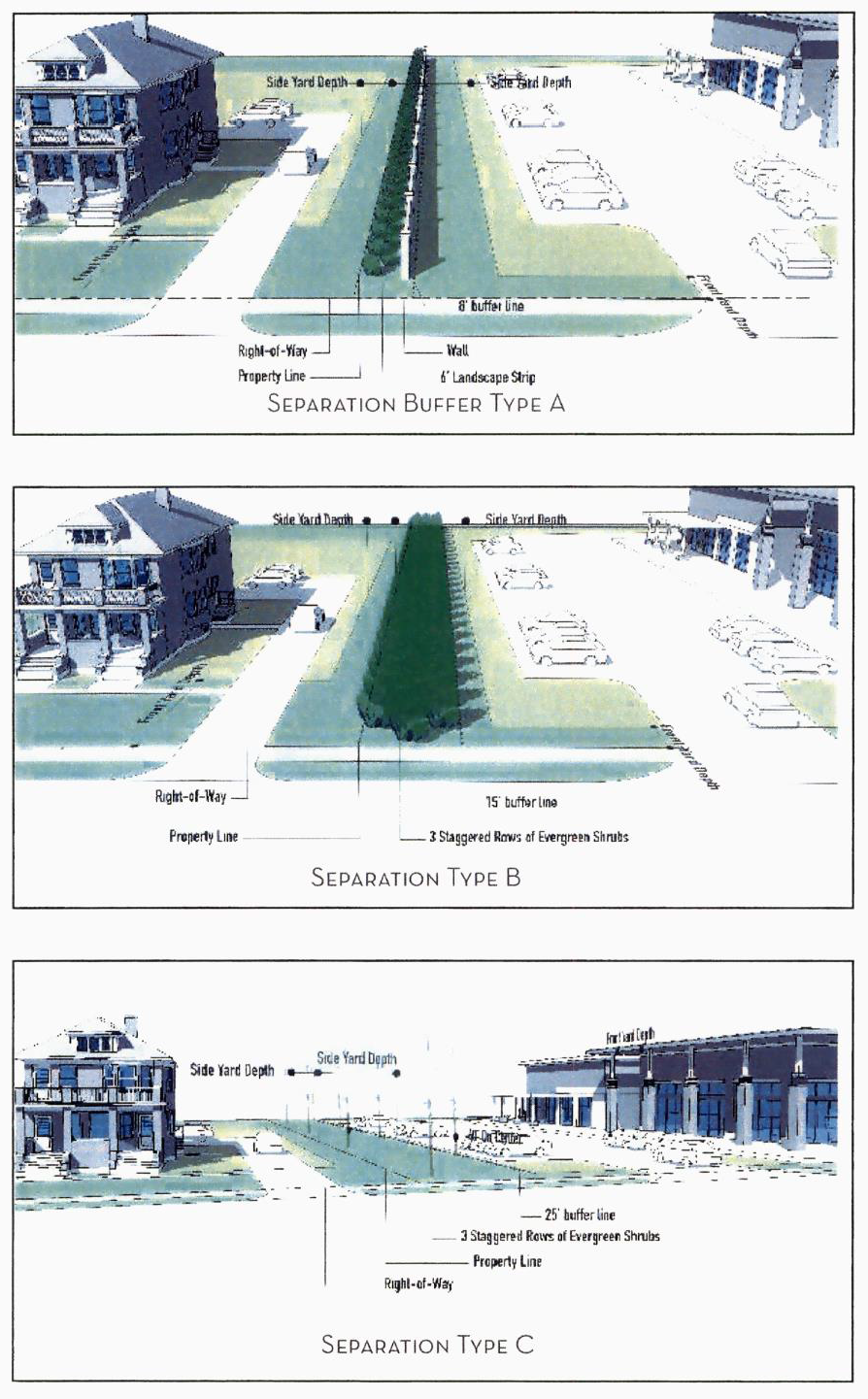
5.6 - Separation buffer types established.
5.6.1 The following types of separation buffers are hereby established.
5.6.1.1 Type A—Solid wall with exterior landscaping. (eight-foot minimum width) This buffer can be used to minimize the width of the separation buffer while maintaining a visual and auditory separation between uses. A solid, opaque wall constructed of brick, stone, masonry, or products designed to resemble these materials shall be at least six feet in height (ten-foot maximum height). A six-foot-wide landscape strip (minimum width) shall be located on the exterior side of the wall facing the adjacent properties. One evergreen shrub shall be installed for every four linear feet of wall. One understory or ornamental tree can be substituted for every four shrubs, provided the tree is a minimum of eight feet tall and three inches in caliper.
5.6.1.2 Type B—Planting screen. (15-foot minimum width) At maturity, intended to be a completely visually opaque barrier. At a minimum, three staggered rows of evergreen shrubs spaced five feet on center from one another shall fill the entire length of the buffer. The vegetation used shall be designed to grow to a minimum height of eight to ten feet.
5.6.1.3 Type C—Semitransparent greenspace. (25-foot minimum width) A wide buffer designed to provide limited visual permeability between uses. At a minimum, the buffer shall contain trees planted at a maximum of 40 feet on center from one another.
(Ord. of 4-6-20(1), Exh. A)
Editor's note— Ordinance adopted April 6, 2020(1), Exh. A, renumbered § 5.5 as § 5.6, as set out therein.
5.7 - Application of separation buffers.
5.7.1 Separations buffers shall be applied to development and redevelopment where adjacent development differs in use and scale to the degree that such separation is desirable.
5.7.2 The developer shall select proposed buffer separations in consultation with the director and subject to the approval of the site plan review committee.
5.7.3 Separation buffers shall be subject to applicable standards in table 5.5, development standards, and be installed prior to site or building occupancy.
5.7.4 In the case of redevelopment, where sufficient space is inadequate to accommodate required separations, buffer separations may be adjusted for width but shall achieve the same intended opacity.
(Ord. of 4-6-20(1), Exh. A)
Editor's note— Set editor's note in § 5.5.

