
Bristol City Zoning Code
CHAPTER 11
LANDSCAPE AND BUFFERING
Sec. Z-1101.- Purpose and intent.
The general purpose of this chapter is to provide landscaping requirements in order to:
A.
Enhance the City's environmental and visual character for its citizens' and visitors' use and enjoyment.
B.
Preserve and improve the area's natural environment.
C.
Continually mitigate the effects of air, water, and noise pollution.
D.
Safeguard property values.
E.
Help ensure land use compatibility and lessen the impact of high-intensity uses on neighboring properties.
F.
Provide for the continued maintenance of required landscape and buffering areas that have been installed according to the approved landscape plan.
Sec. Z-1102. - Submission of landscape plan.
A.
A landscape plan adhering to all the applicable requirements of this Chapter must be submitted as part of the site plan application.
B.
The landscape plan must include the following information:
1.
Common name of the planting materials included in the project;
2.
Typical planting details (heights, circumferences, etc.);
3.
Location of landscape areas and their relationship to property lines, buildings, parking areas and driveways;
4.
Identification and location of existing vegetation to be retained;
5.
Location and materials used for any required buffering.
Sec. Z-1103. - Landscape requirements.
A.
Applicability. All new developments and redevelopments in the City must comply with the requirements of this Chapter; except for:
1.
Single-Family and Duplex uses.
2.
Those developments and redevelopments located in the B-2 and B-2E zones that are built at the property line (including the main building structure, porches, patios, or similar structures). Such developments and redevelopments are exempt from meeting the landscape requirements except for the provisions of Section Z-1104 Parking Area Landscape Requirements and the provisions of Section Z-1105 Buffer Requirements. Developments in the B-2 and B-2E zones that are not designed to be constructed at the property lines shall comply with all requirements of this chapter.
B.
Landscape area must be a minimum of five (5) percent of the disturbed project area.
Sec. Z-1104. - Parking area landscape requirements.
A.
Street Frontage Landscaping. A landscape area must be established between the right-of-way and the parking area when a development's parking area is adjacent to an abutting public street, excluding access ways.
1.
Minimum street frontage landscaping area width is ten (10) feet.
2.
One (1) deciduous tree is required for each fifty (50) linear feet of street frontage and for any fraction of street frontage footage over twenty-five (25) linear feet. For example, seventy-four (74) feet of street frontage would require one (1) tree and seventy-five (75) feet of street frontage would require two (2) trees.
a.
Location and type of landscaping materials within the street frontage landscaping must be compatible with utility lines, sidewalks, and the safe use of streets.
b.
Trees can be grouped or placed at intervals appropriate to the tree species. A maximum of four (4) trees can be located in a single group.
c.
For existing parking areas expanded by fifty (50) feet or more along the street frontage;
i.
The new parking areas shall meet the requirements of the landscape regulations.
ii.
The existing parking areas will be modified to provide at least twenty-five (25) percent of the amount of street frontage landscaping which would be required for a comparable new development.
iii.
If the area for the required street frontage landscaping does not exist, the required landscape area including any required trees may be planted in pavement cutouts of sufficient size to accommodate landscape material at maturity.
d.
The required street frontage landscaping may be reduced from a minimum of ten (10) feet to a minimum of five (5) feet by installing building perimeter landscaping.
i.
Building perimeter landscaping must be placed adjacent to the building and along the building façade adjacent to the parking area.
ii.
Building perimeter landscaping must be placed along at least fifty (50) percent of the building façade. Doorway and entranceway areas do not count towards the fifty (50) percent requirement.
iii.
Building perimeter landscape area must be of sufficient width to extend beyond the building overhang and by a width sufficient to accommodate landscape material at maturity.
B.
Parking Area Landscaping. This landscaping involves the land area within and adjacent to all parking areas and associated access drives. This landscaping serves to provide visual relief for parking areas.
1.
All new parking areas must provide parking area landscaping.
a.
Parking areas less than five thousand (5,000) square feet are exempt.
b.
Parking area landscaping must total at least five (5) percent of the total parking area.
c.
Parking area landscaping width must be at least five (5) feet to accommodate landscape materials at maturity. If trees are located in the parking area landscaping, the required width is eight (8) feet.
d.
One (1) tree must be planted for each two hundred fifty (250) square feet of required parking area landscaping and for any fraction of footage over one hundred twenty-five (125) square feet. For example, three hundred seventy-four (374) square feet of required parking area landscaping would require one (1) tree and three hundred seventy-five (375) square feet of required parking area landscaping would require two (2) trees. The use of shade trees is encouraged.
e.
Landscape areas may be grouped.
f.
Interior landscape areas should be located in such a way as to divide and break up the expanse of paving and to guide traffic flow.
g.
A maximum of three hundred twenty (320) square feet of landscaping located in a single landscape area will be credited towards required parking area landscaping, except for provision of a contiguous landscape area between head on parking rows. When a landscape area is installed between head on parking rows, the required width of the landscape area is eight (8) feet.
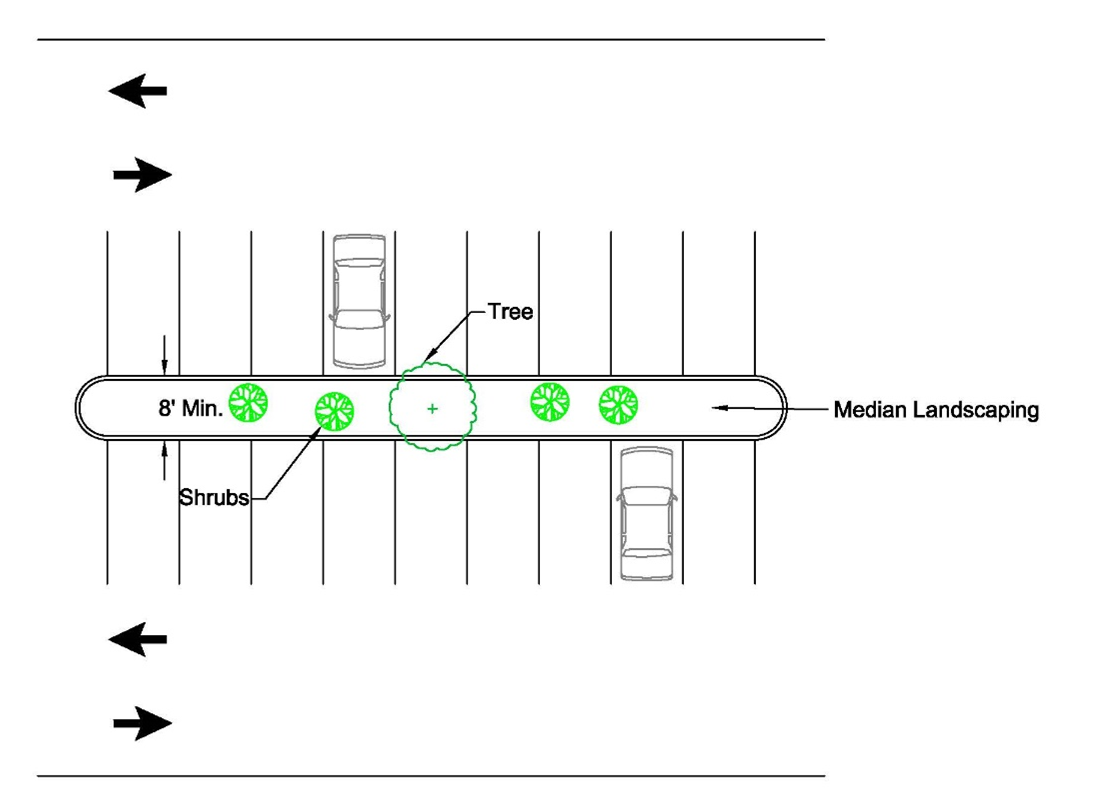
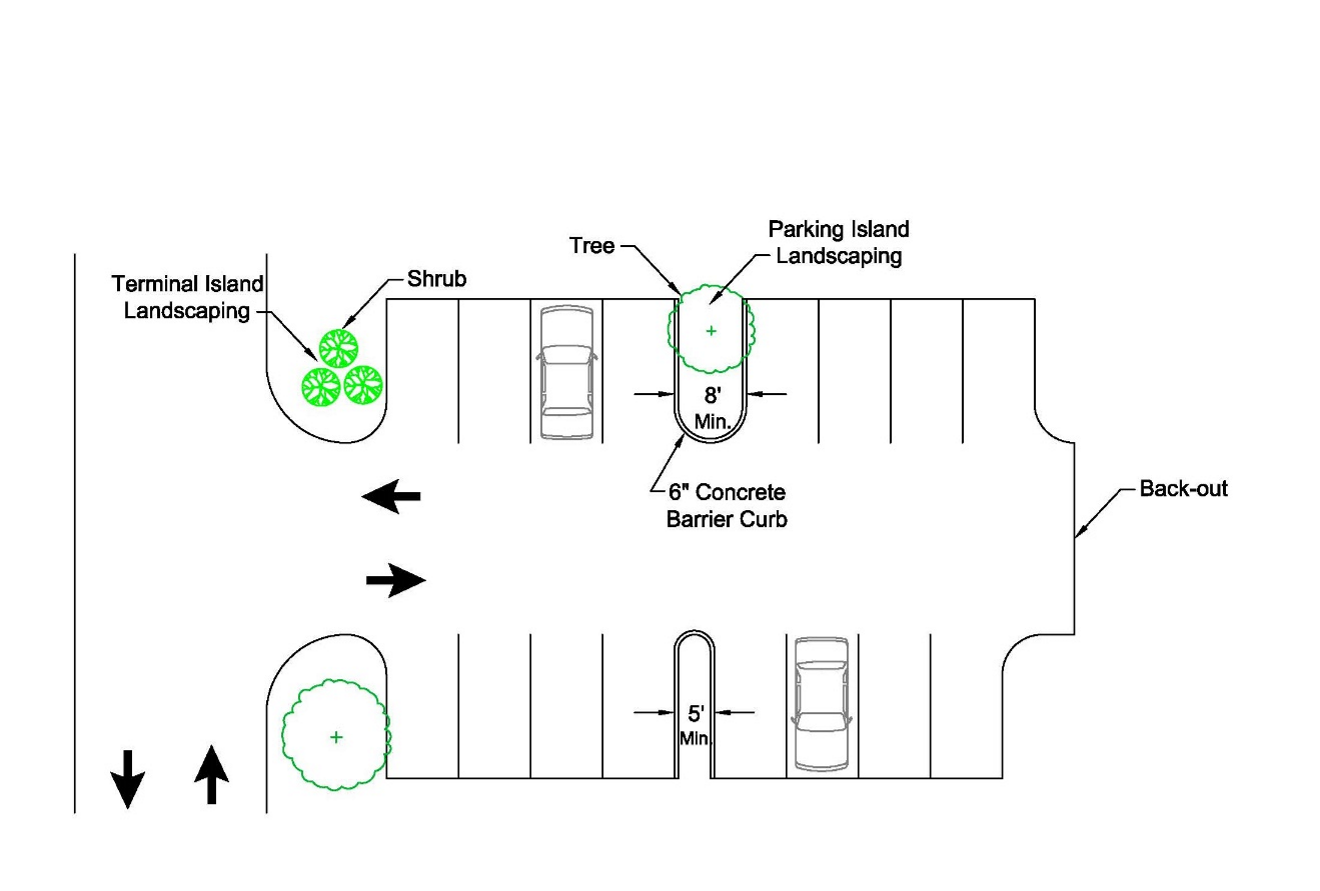
h.
The use of terminal landscape islands for parking space rows is encouraged.
i.
A minimum of ninety (90) square feet of landscaping must be placed in each landscape island.
j.
Minimum width of a landscape island is five (5) feet. If the landscape island includes a tree, a minimum width of eight (8) feet must be provided.
k.
The perimeter of landscape islands or medians must be curbed with a six (6) inch barrier curb of concrete.
l.
Calculation of landscape area is exclusive of curbing.
2.
For existing parking areas that are enlarged or expanded by five thousand (5,000) square feet or more;
a.
The new parking areas shall meet the requirements of the landscape regulations.
b.
The existing parking areas will be modified to provide at least twenty-five (25) percent of the amount of landscaping which would be required for a comparable new development.
c.
Buffering of the new parking areas must be provided as specified in Section Z-1105.
3.
For a change of use which results in the property becoming a higher impact use and where the existing parking area is greater than five thousand (5,000) square feet.
a.
The existing parking areas must be modified to meet the landscape regulations as if it were a new development.
b.
Buffering of the existing parking areas must be provided as specified in Section Z-1105.
Sec. Z-1105. - Buffer requirements.
A.
Buffering. Buffering is the onsite use of landscape elements to reduce potentially adverse impacts of adjacent, dissimilar land uses/zones. Buffering must be maintained in perpetuity, consistent with the approved landscaping plan.
1.
Buffering is required between abutting uses as set out in the following table:
A, B, and C indicate buffering area types.
Impact Classification Levels.
a.
No Impact. Abutting uses/zones which have little or no impact on each other and are any use permitted in the O-S, R-M, R-1A, and R-1B zoning districts.
b.
Low Impact. Abutting uses/zones which have a low impact to each other and are any uses permitted in the PRD, R-E, R-2, R-3, R-4, and R-5 districts.
c.
Medium Impact. Abutting uses/zones which have a medium or moderate impact on each other and require a moderate amount of buffering and are uses permitted in the MH, and B-1A, B-1B, B-2, B-2E, B-3, and PBD zoning districts.
d.
High Impact. Abutting uses/zones which have a high or extreme impact on each other and require a heavy amount of buffering and are any uses permitted in the M-1, M-2, and M-3 zoning districts.
2.
Buffer Options.
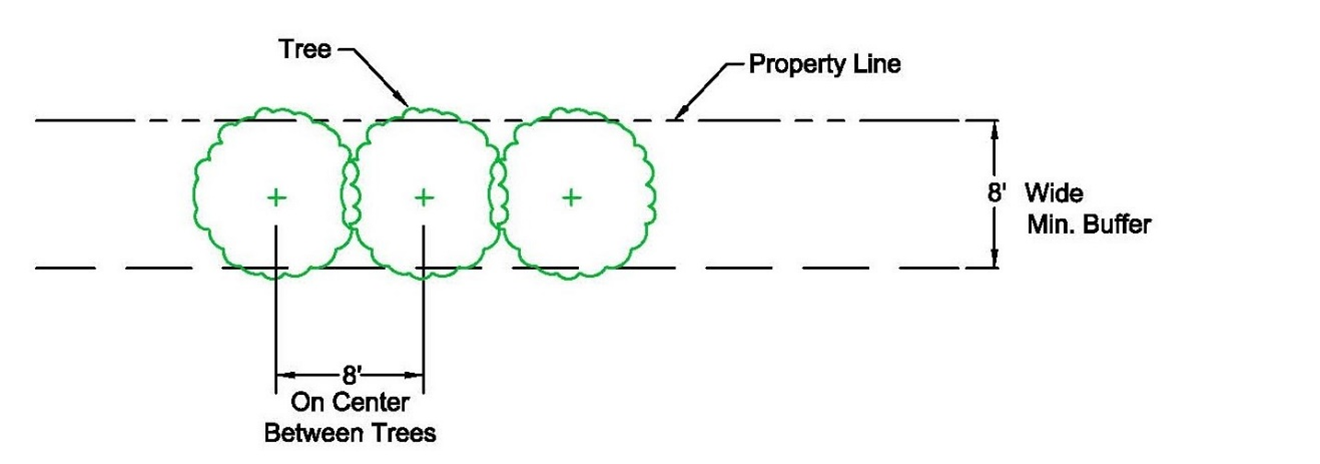
Type A - Option 1: A buffer strip at least eight (8) feet in width with one (1) row of evergreen trees or other acceptable buffer species, spaced no greater than eight (8) feet on center. See graphic below:
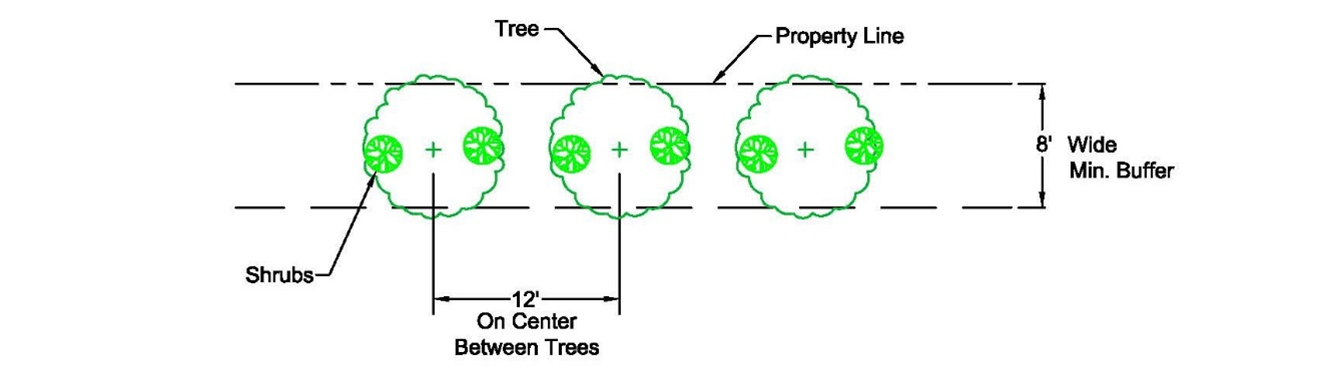
Type A - Option 2: A buffer strip at least eight (8) feet in width with one row of evergreen trees or other acceptable buffer species, spaced no greater than twelve (12) feet on center and at least two (2) evergreen shrubs per tree. See graphic below:
Type A - Option 3: A buffer strip at least five (5) feet in width with a solid-barrier masonry wall, wooden fence or equivalent. The wall or fencing must be at least six (6) feet tall with the finished side facing towards the adjacent property. Wire fencing and unfinished cinder block walls are not permitted. See graphic below:

Type B - Option 1: A buffer strip at least ten (10) feet in width with a row of evergreen trees no more than twelve (12) feet on center and at least six (6) evergreen shrubs per tree. See graphic below:
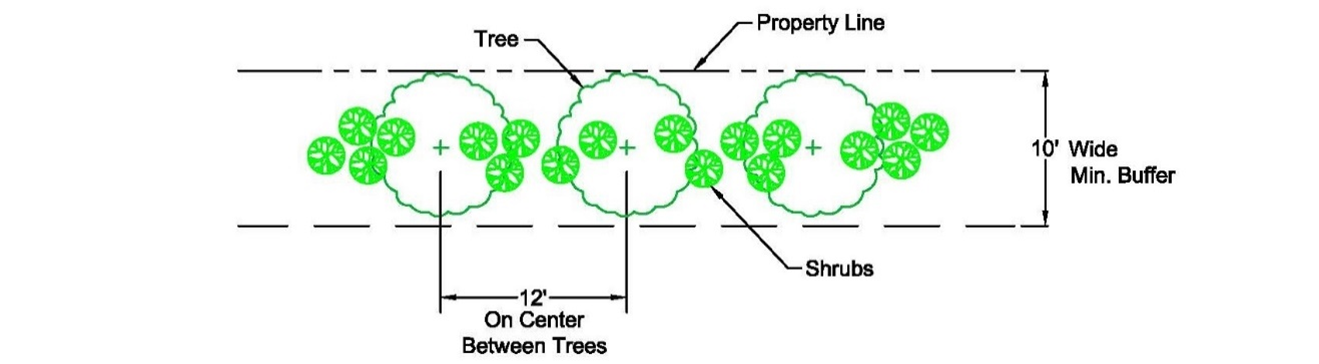
Type B - Option 2: A buffer strip at least ten (10) feet in width with a solid-barrier masonry wall, wooden fence or equivalent placed ten (10) feet from the property line. The wall or fencing must be at least six (6) feet tall with the finished side facing towards the adjacent property. Wire fencing and unfinished cinder block walls are not permitted. A row of evergreen trees or other acceptable buffer species, spaced no greater than twelve (12) feet on center and at least two (2) evergreen shrubs per tree must be planted between the wall or fence and the adjacent property. See graphic below:
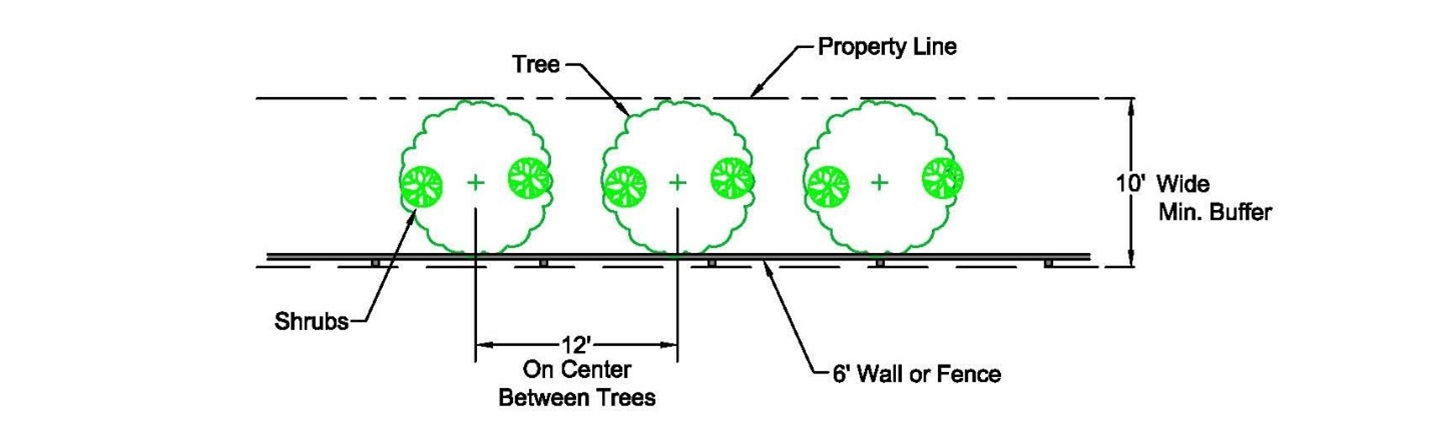
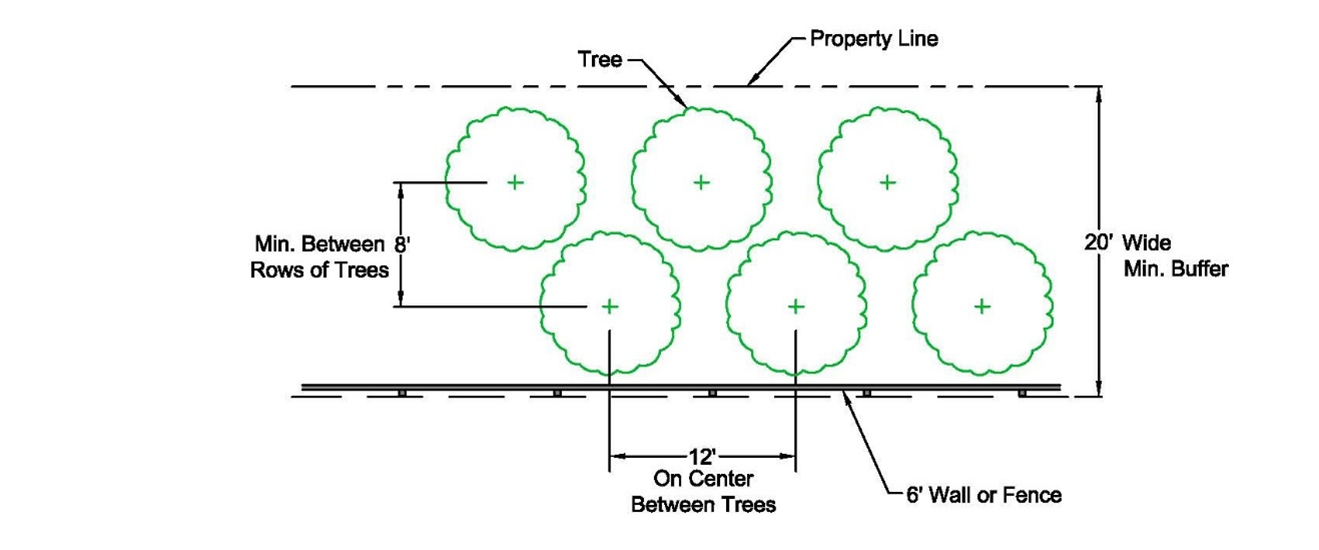
Type B - Option 3: A buffer strip at least twenty (20) feet in width with a double row of evergreen trees. Trees must be spaced no greater than twelve (12) feet on center with a row separation of eight (8) feet. Tree placement on alternate rows should be staggered. See graphic below:
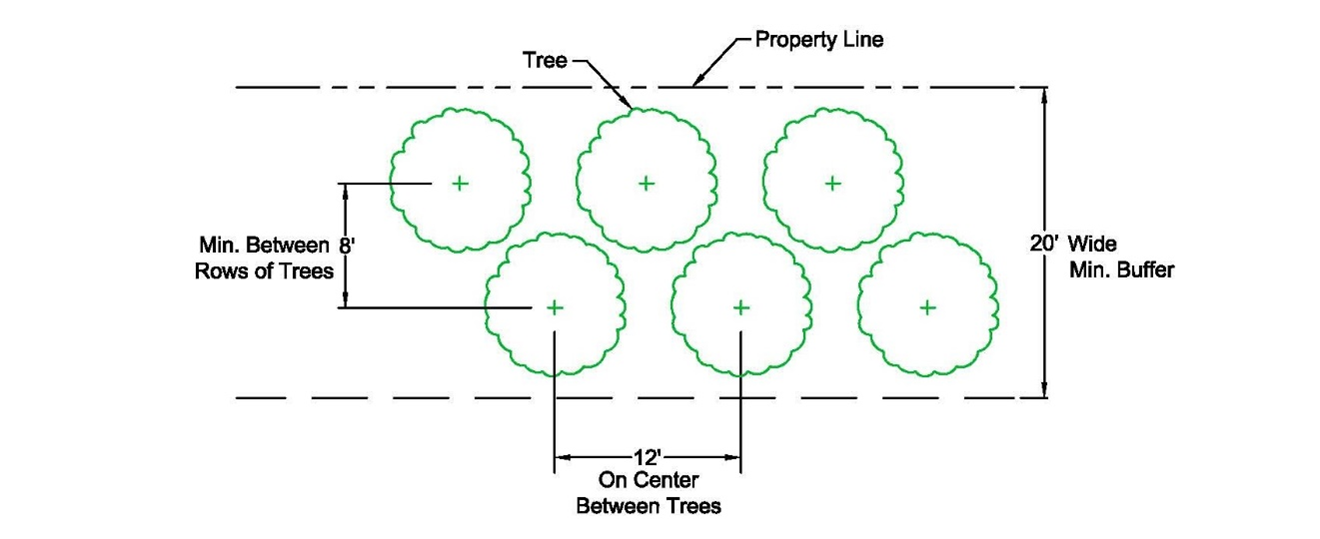
Type C - Option 1: A buffer strip at least twenty-five (25) feet in width with a triple row of evergreen trees or other acceptable buffer species. Trees must be spaced no greater than sixteen (16) feet on center with a row separation of eight (8) feet. Tree placement on alternate rows should be staggered. See graphic below:
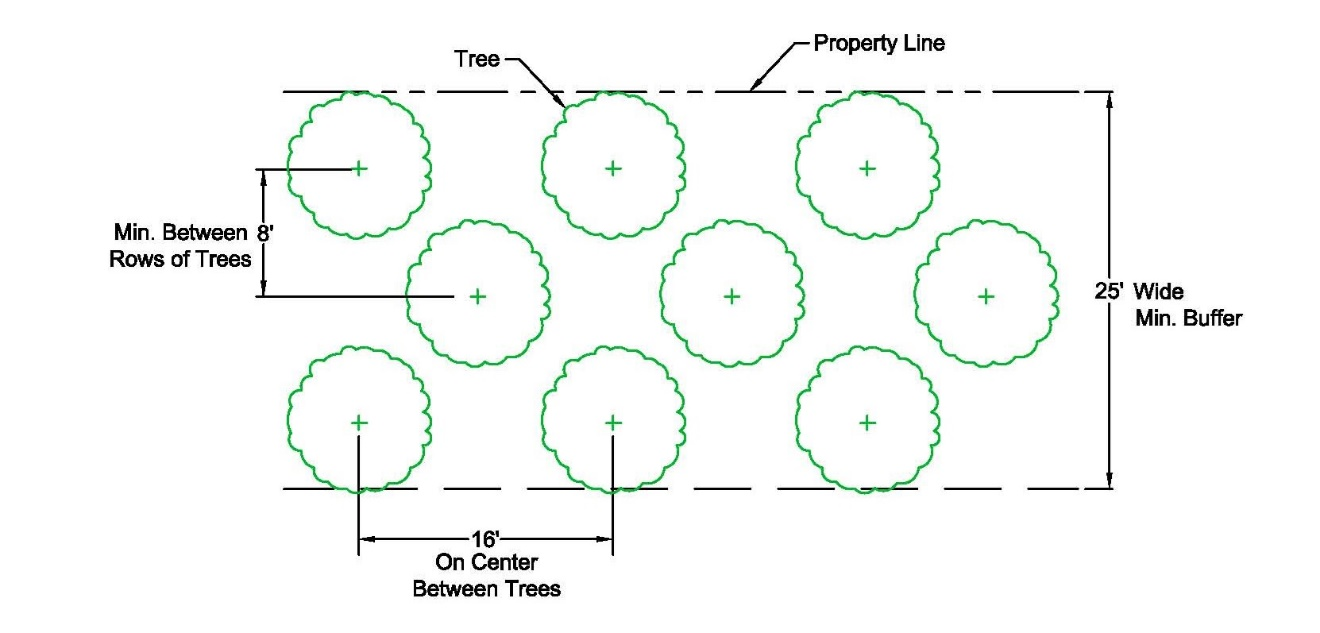
Type C - Option 2: A buffer strip at least twenty (20) feet in width with a solid-barrier masonry wall, wooden fence or equivalent placed twenty (20) feet from the property line. The wall or fencing must be at least six (6) feet tall with the finished side facing towards the adjacent property. Wire fencing and unfinished cinder block walls are not permitted. A double row of evergreen trees or other acceptable buffer species, spaced no greater than twelve (12) feet on center with a row separation of eight (8) feet must be planted between the wall or fence and the adjacent property. Tree placement on alternate rows should be staggered. See graphic below:
Sec. Z-1106. - Standards for landscaping areas and materials.
A.
Deciduous Trees. Deciduous trees shall be a minimum of eight (8) feet tall (but not less than two (2) inches in diameter at forty-eight (48) inches from the ground), at the time of installation.
B.
Evergreen Trees. Evergreen trees shall be a minimum of five (5) feet tall, as measured from grade to peak, in height at the time of installation.
C.
Shrubs. Shrubs shall have a minimum installation height of two (2) feet or a minimum spread of twelve (12) inches or a three (3) gallon pot size depending upon the shrub species. When used as a screen or hedge, the shrub species installed will be capable of growing to a height of five (5) feet at maturity.
D.
The retention of existing mature trees and plantings is encouraged and existing mature trees and plantings may be used to satisfy the required landscape area, provided:
1.
The tree or planting is healthy and meets the size, locations, and other applicable requirements of the ordinance.
2.
The tree or planting will not interfere with utilities, vision clearance standards, or obscure streetlights.
3.
When trees or plantings are retained, they must be properly protected during construction to ensure their survival.
E.
Berms may be substituted for required shrubs or fencing as follows:
1.
Berms substituted for shrubs must be a minimum of three (3) feet tall.
2.
Berms substituted for fencing must be a minimum of five (5) feet tall.
3.
Grass or other suitable ground covers must be planted on the berms.
F.
Prohibited Locations.
1.
No species prone to clogging water or sewer lines with roots, may be planted within any recorded sewer, water or drainage easement. These species include, but are not limited to:
Poplar Box Elder.
Silver Maple American Elm.
Catalpa Siberian Elm.
Cottonwood Black Walnut.
Weeping Willow.
2.
No species known to reach a mature height greater than twenty (20) feet may be planted under overhead electric or telephone lines.
3.
Within landscape areas, plantings, berms, buffering, and fencing may not be located and installed in a manner that will interfere with required vehicular sight distance.
G.
Completion & Maintenance. Landscaping must be installed as shown on the approved landscape plan.
1.
Plants in or adjacent to landscape areas must be protected from vehicular damage by the use of curbs, wheel stops or other barriers. Whenever possible, drainage from paved impervious parking surfaces should be channeled into planted areas.
2.
All required landscape plant material must be maintained in a healthy condition. The property owner will be responsible for the continuing maintenance of all landscape areas. Dead, seriously diseased or damaged plants or dying ones shall be removed and replaced. Such replanting will take place at the next planting season appropriate for the landscape materials or within six (6) months.
H.
No certificate of occupancy shall be issued prior to installation and completion of required landscaping, unless an extension is granted by the City Manager or his designee as described below. Should a certificate of occupancy be desired during off-landscaping-season, then an appropriate surety instrument must be provided until installation at the following planting season.
1.
Such surety instrument will be in an amount established by a landscape professional for one hundred ten (110) percent of the cost of the materials and installation cost of landscaping per the approved plan.
2.
Landscaping must be planted the following landscaping season from which the surety is posted.
3.
Surety can be in the form of cash or a letter of credit.
(Ord. No. 21-14, 1-2022)

