
Brookfield City Zoning Code
ARTICLE II
DISTRICTS
DIVISION 7. - RESERVED[2]
Editor's note— Ord. No. 2019-58, § 11, adopted Dec. 9, 2019, repealed div. 7, §§ 62-205—62-210, which pertained to the Medical Cannabis Overlay District, and derived from Ord. No. 2015-42, § 3, adopted June 22, 2015.
Sec. 62-46. - Zoning district classifications and standards.
No building or structure shall be erected, converted, enlarged, reconstructed or structurally altered, nor shall any structure or land be used for any purpose other than is permitted in the district in which it is located. These regulations set forth herein are established in order to protect the health and environment; promote public safety, convenience, comfort, morals and welfare; to avoid or lessen congestion in the public streets; to lessen or avoid hazard to persons and damage to property resulting from the accumulations of runoff of stormwater or floods; and to conserve the value of land and buildings throughout the village.
(Code 1964, § 30-6; Ord. No. 96-14, 3-25-1996)
Sec. 62-66. - Residential districts.
The residential district regulations are provided for single- and multiple-family development. In the single-family residential districts, the regulations reflect the development of the community and the uniqueness of each district, including, but not limited to, subdivision design and historical development. The multiple-family residential districts provide for higher density dwelling development for such reasons, including, but not limited to, enhancing access to transportation corridors and facilities, shopping facilities and places of employment. The regulations governing each of these zoning districts are intended to maintain the quality of life and amenities found unique to each of the individual residential districts while encouraging new or expanded development which is compatible and consistent with the overall character of the district.
(Code 1964, § 30-6.01; Ord. No. 96-14, 3-25-1996; Ord. No. 2002-41, 9-23-2002; Ord. No. 2006-64, 9-11-2006)
Sec. 62-67. - Permitted uses.
(a)
The following use and no other is permitted as of right in the single-family districts A, A-1, A-2, A-3:
(1)
One family dwellings.
(2)
Community residence, small.
(3)
Community residence, large, for three to eight persons with an administrative occupancy permit.
(b)
The following uses and no others are permitted as of right in the multiple-family district B:
(1)
One-family dwellings.
(2)
Two-family dwellings.
(3)
Townhomes.
(4)
Multiple-family dwellings.
(5)
Community residence, small.
(6)
Community residence, large, for three to eight persons with an administrative occupancy permit.
(c)
The following uses and no others are permitted as of right in the multiple-family district B-1:
(1)
Multiple-family dwellings.
(2)
Nursing homes.
(3)
Community residence, small.
(4)
Community residence, large, for three to eight persons with an administrative occupancy permit.
(d)
The following uses and no others are permitted as of right in the multiple-family district B-2:
(1)
Multiple-family dwellings.
(2)
Townhomes.
(3)
Community residence, small.
(4)
Community residence, large, for three to eight persons with an administrative occupancy permit.
(Code 1964, § 30-6.01(A); Ord. No. 96-14, 3-25-1996; Ord. No. 2002-41, 9-23-2002; Ord. No. 2006-64, 9-11-2006)
Sec. 62-68. - Accessory buildings, structures and uses.
Accessory buildings, structures and uses as defined in section 62-2 and as may be regulated elsewhere in this chapter.
Note: In multiple-family residential districts, a rental management firm may, for the purposes of maintaining and managing properties located within the village, utilize a maximum of one dwelling unit for all their holdings within the village, that office unit being located within a multiple-family building, provided that in addition to being in conformity with this and all other ordinances and regulations of the village, no such office shall be used as the general office or headquarters or any firm and that no more than two employees be assigned to that location.
(Code 1964, § 30-6.01(B); Ord. No. 96-14, 3-25-1996; Ord. No. 2002-41, 9-23-2002; Ord. No. 2006-64, 9-11-2006)
Sec. 62-69. - Home occupations.
Home occupations as defined by and as may be regulated within this chapter are permitted. A home occupation shall not occupy more than 25 percent of the floor area and shall not exceed 400 square feet in area, whichever is less, and shall not change the outside appearance of the building from that of a residential dwelling. The use of a garage facility is not permitted where such use reduces or eliminates the required number of off-street parking spaces as specified within this chapter. There shall be no traffic or parking need generated in greater volume than would be expected in a normal residential neighborhood, and no noise, vibration, fumes, odors, electrical interference, glare, heat, or safety hazard to the occupants of nearby properties or which produces other offensive effects detectable off the lot (for single-family residences) or outside the dwelling unit (for all other dwelling units).
(Code 1964, § 30-6.01(C); Ord. No. 96-14, 3-25-1996; Ord. No. 2002-41, 9-23-2002; Ord. No. 2006-68, 8-28-2006; Ord. No. 2006-64, 9-11-2006)
Sec. 62-70. - Reserved.
Editor's note— Ord. No. 2022-52, § 5, adopted Nov. 14, 2022, repealed § 62-70, which pertained to temporary uses, and derived from the Code of 1964, § 30-6.01(D); Ord. No. 96-14, adopted Mar. 25, 1996; Ord. No. 2002-41, adopted Sept. 23, 2002; Ord. No. 2006-64, adopted Sept. 11, 2006; and Ord. No. 2017-54, § 6, adopted Sept. 11, 2017.
Sec. 62-71. - Special uses.
Except as specifically limited or regulated elsewhere in this chapter, the following uses may be permitted in the respective residential districts as shown subject to the issuance of a special use permit, as provided for in this chapter and subject to the additional standards hereinafter set forth or made applicable to the specific special use permit requested:
(1)
The following uses may be considered for application under the appropriate special use or planned development procedures of this chapter in single-family residential districts A, A-1, A-2, A-3:
a.
Clubs, private not for profit.
b.
Churches, temples and similar places of worship.
c.
Community residence, large, for more than eight persons.
d.
Convents and monasteries incidental to schools.
e.
Curb cuts on public streets for residential structures (see section 46-391).
f.
Multi-family buildings, so long as they are part of an adaptive reuse of a former religious use or school.
g.
Planned developments.
h.
Public utility substations.
i.
Libraries, private.
j.
Schools, pre-collegiate, public and private, including gymnasiums, offices and facilities incidental thereto.
(2)
The following uses may be considered for application under the appropriate special use or planned development procedures of this chapter in Multiple-Family Residential District B:
a.
Clubs, private not for profit.
b.
Churches, temples and similar places of worship.
c.
Community residence, large, for more than eight persons.
d.
Convents and monasteries.
e.
Curb cuts on public streets for multi-family structures (see section 46-391).
f.
Institutions of a philanthropic or charitable nature.
g.
Planned developments.
h.
Private, for-profit professional, clinical, service, or retail facilities utilized in conjunction with, but incidental to nursing homes and senior housing facilities and which do not exceed ten percent of the floor area of the primary use structure.
i.
Public utility substations.
j.
Recreational facilities, private noncommercial.
k.
Libraries, private.
l.
Schools, pre-collegiate, public and private, including gymnasiums, offices and facilities incidental thereto.
(3)
The following use may be considered for application under appropriate special use or planned development procedures of this chapter in Multiple-Family Residential District B-2: Community residence, large, for more than eight persons.
(Code 1964, § 30-6.01(E); Ord. No. 96-14, 3-25-1996; Ord. No. 2002-41, 9-23-2002; Ord. No. 2006-64, 9-11-2006; Ord. No. 2020-84, § 4, 11-23-2020; Ord. No. 2021-07, § 5, 1-11-2021)
Sec. 62-72. - Administrative occupancy requirement for community residence, large (three to eight persons).
A community residence housing three to eight developmentally disabled persons is required to meet the following conditions in order to receive an administrative occupancy permit by the building and zoning department:
(1)
The residence shall be licensed by the state;
(2)
The residence shall meet the spacing requirements for community residences, large;
(3)
All codes, regulations and policies of the village shall be complied with;
(4)
Each residence shall provide one parking space per employee present, plus one space for each resident who owns and/or operates a motor vehicle. All required parking shall be accommodated in the residence's garage and driveway located behind the building setback line;
(5)
All community residences requiring an administrative occupancy permit shall renew their permit annually and provide a copy of their current state license;
(6)
Any increase in the number of residents living in the facility beyond what the administrative occupancy permit allows will require reapplication by the community residence operator; and
(7)
If any of the above requirements cannot be met, then the community residence shall be required to obtain a special use permit.
(Code 1964, § 30-6.01(F); Ord. No. 96-14, 3-25-1996; Ord. No. 2002-41, 9-23-2002; Ord. No. 2006-64, 9-11-2006)
Sec. 62-73. - Spacing requirement for community residence, large.
No community residence, large, shall be located within 1,200 lineal feet (as measured property line to property line) from an existing or approved community residence, large, unless petitioner can prove that the legitimate government interest of normalization through dispersion can be maintained.
(Code 1964, § 30-6.01(G); Ord. No. 96-14, 3-25-1996; Ord. No. 2002-41, 9-23-2002; Ord. No. 2006-64, 9-11-2006)
Sec. 62-74. - Parking and loading requirements.
Parking and loading requirements applicable to all residential zoning districts are contained in article III of this chapter.
(Code 1964, § 30-6.01(H); Ord. No. 96-14, 3-25-1996; Ord. No. 2002-41, 9-23-2002; Ord. No. 2006-64, 9-11-2006)
Sec. 62-75. - Bulk, yard and space requirements.
(a)
The building height, lot area, yard and coverage requirements applicable in all residential zoning districts are set forth in the table in this subsection. (Footnotes follow in subsection (b) of this section. Take special note of asterisked "*" provisions.)
* or within three feet of existing primary buildings immediately adjacent, or within three feet of the average of the front setback lines on the block.
(b)
Exceptions and explanatory footnotes for this division:
(1)
Where zoning lots have already been developed with a single-family residential dwelling on the effective date of the ordinance from which this chapter is derived and a request for removal and replacement of the residential structure is made to the village, a permit allowing such replacement shall be authorized providing that the proposed construction is in conformity with all provisions of all village codes and ordinances, including the provisions of this chapter, except as follows: In the A-2 Single-Family District, one single-family residence may be constructed on any zoning lot legally existing on the effective date of the ordinance from which this chapter is derived and containing a minimum width of 45 feet and a minimum lot area of 5,625 square feet; in the A-3 Single-Family District, one single-family residence may be constructed on an interior zoning lot containing a minimum width of 44 feet and a minimum lot area of 5,500 square feet; provided that in all such cases, all height, yard and coverage requirements established by this chapter are met.
(2)
In a planned residential development where housing types are mixed, the square footage of the site, providing the minimum total square footage required has been met, shall be the cumulative square foot total of all unit minimums applied to each of the respective types of dwelling units then multiplied by the total number of dwelling units for that type of dwelling unit. In a mixed commercial/residential planned development, the minimum square footage of the site shall be the minimum site required for the commercial site plus the minimum of 25,000 square feet or the square footage required by the cumulative total of the housing type multiplied by the respective number of dwelling units. However, in a mixed commercial/residential planned development where all residential units are to be located above the first floor, the minimum or first 25,000 square feet of the residential requirements may be waived. Nothing in this subsection is intended to preclude consideration of any residentially zoned property from being included within a planned development which is wholly commercial in nature, provided that the minimum property size required in the commercial district has been first met.
(Code 1964, § 30-6.01(I); Ord. No. 96-14, 3-25-1996; Ord. No. 2002-41, 9-23-2002; Ord. No. 2006-64, 9-11-2006; Ord. No. 2007-25, § 2, 3-26-2007; Ord. No. 2007-26, § 4, 3-26-2007; Memo of 3-13-2015; Ord. No. 2017-59, § 5, 10-23-2017)
Sec. 62-94. - Business districts.
(a)
The business districts are provided for a wide range of commercial uses needed to serve the residents of the village and neighboring trade areas in a suburban setting.
(b)
The C-1 General Service District is intended to provide for the needs of a population base greater than that of the municipality, so as to provide areas for services, commercial and retail uses requiring vehicular access, generally of uses generating larger volumes of vehicle and pedestrian traffic.
(c)
The C-2 Restricted Planned Service District is intended to provide areas for development for service, commercial and retail uses in a unique location adjacent to general service uses, transportation links, and multiple-family uses. The creation of this district is intended to encourage the establishment of planned commercial and commercial/residential developments characterized by coordinated uses, planned sites and controlled access.
(d)
The C-3 Centralized Commercial Districts are intended to provide for the development of a concentrated pedestrian oriented commercial shopping area. This type of district provides a symbiotic relationship with public transportation and public services in the immediate vicinity. This district is intended to encourage the preservation of the historic characteristics of the district while encouraging the establishment of planned commercial and residential development.
(e)
The C-4 Local Retail District is intended to provide for limited basic shopping needs occurring daily or frequently for the convenient shopping of persons residing in the adjacent residential neighborhoods while providing highly limited services to nonlocal traffic. The uses permitted are intended to generate only low to moderate nonlocal vehicular traffic.
(f)
C-5 Restricted Local Retail District, because of its location and limited size, it is intended to provide limited office and service uses which, although attractive to low to moderate vehicular traffic levels, do not create incompatibility with the general character of nearby low density residential use.
(g)
C-6 Restricted Special Service District, because of its development, close proximity to low density residential use, as well as the village zoo, it is intended to provide limited office and service uses which do not create incompatibility with the general character of nearby low density residential use. These uses are intended to produce low vehicular traffic patterns.
(Code 1964, § 30-6.02; Ord. No. 00-11, 3-13-2000; Ord. No. 2002-26, 6-10-2002; Ord. No. 2002-27, 6-10-2002; Ord. No. 2006-64, 9-11-2006)
Sec. 62-95. - Reserved.
Editor's note— Ord. No. 2017-9, § 4.B., adopted Jan. 9, 2017, repealed § 62-95, which pertained to permitted and special uses and derived from Code 1964, § 30-6.02(A); Ord. No. 00-11, adopted March 13, 2000; Ord. No. 2002-26, adopted June 10, 2002; Ord. No. 2002-27, adopted June 10, 2002; Ord. No 2006-64, adopted Sep. 11, 2006; Ord. No. 2007-59, § 2, adopted June 25, 2007; Ord. No. 2010-69, § 12(30-6.02(A)), adopted Oct. 25, 2010; and Ord. No. 2014-33, § 3, adopted May 27, 2014.
Sec. 62-96. - Accessory uses.
(a)
Accessory uses are permitted, provided that: It is subordinate in extent and purpose to and serves the principal use on the zoning lot; it is customarily found as an incidental use to such principal use or structure; it contributes to the comfort, convenience or necessity of those occupying, working at, or being served by the principal structure; except as otherwise expressly authorized by the provisions of this chapter, it is located on the same zoning lot as the principal structure; it is under the same ownership and control as the principal structure or use.
(b)
Except as otherwise expressly permitted by this chapter, outdoor storage shall not be allowed as an accessory use.
(Code 1964, § 30-6.02(C); Ord. No. 00-11, 3-13-2000; Ord. No. 2002-26, 6-10-2002; Ord. No. 2002-27, 6-10-2002; Ord. No. 2006-64, 9-11-2006)
Sec. 62-97. - Reserved.
Editor's note— Ord. No. 2022-52, § 6, adopted Nov. 14, 2022, repealed § 62-97, which pertained to temporary uses, and derived from the Code of 1964, § 30-6.02(D); Ord. No. 00-11, adopted Mar. 13, 2000; Ord. No. 2002-26, adopted June 10, 2002; Ord. No. 2002-27, adopted June 10, 2002; Ord. No. 2006-64, adopted Sept. 11, 2006; and Ord. No. 2017-54, § 7, adopted Sept. 11, 2017.
Sec. 62-98. - Parking and loading requirements.
Parking and loading requirements applicable to all commercial zoning districts are contained in article III of this chapter.
(Code 1964, § 30-6.02(D); Ord. No. 00-11, 3-13-2000; Ord. No. 2002-26, 6-10-2002; Ord. No. 2002-27, 6-10-2002; Ord. No. 2006-64, 9-11-2006)
Sec. 62-99. - Bulk, yard and space requirements.
(a)
The building height, lot area, yard and coverage requirements applicable in all commercial zoning districts are set forth in the table in this section. (Footnotes follow in subsection (b) of this section).
(b)
Exceptions and explanatory footnotes for this division:
(1)
Height regulations governing garages and accessory buildings are contained in section 62-15. The height exceptions permitted of right are contained by section 62-14. In the case of planned developments, no building height may be considered in any commercial zoning district in excess of 75 feet or six stories, whichever is less.
(2)
In the construction of any new structures or remodeling of any existing structure where no residential use exists upon the first floor upon the effective date of the ordinance from which this chapter is derived, no such use may be permitted upon said first floor. Where a residential use currently legally exists upon the first floor on the effective date of the ordinance from which this chapter is derived, no remodeling or alterations shall be permitted which shall expand the number of dwelling units located upon such first floor. However, nothing in this subsection (b) shall prohibit the remodeling or renovation of an existing legally established first floor dwelling unit, provided that such remodeling or alteration conforms to all other provisions of this Code. This prohibition upon the use of the first floor for residential dwelling purposes shall not apply to a legally established bed and breakfast, hotel, motel or tourist home.
(3)
With respect to planned developments, nothing in this subsection (b) is intended to preclude consideration of inclusion of any residentially zoned property from being included within a planned development which is a mixed residential/commercial development or wholly a commercial development, provided that the minimum property size required in the specific commercial zoning district has been first met.
(4)
No manufacturing, production, assembly or other distribution is permitted in any business zoning district, except for those activities that are customarily incidental to the service rendered by the permitted primary use.
(5)
No warehousing exceeding 40 percent of the total gross floor area of all structures on the zoning lot shall be permitted in any commercial zoning district.
(6)
No exterior open-air storage or the sale of materials and goods is permitted in any commercial zoning district, unless specifically authorized elsewhere in this chapter.
(7)
On a corner lot where two or more streets intersect, no structure may be erected, material placed or planting materials installed or maintained so as to create a visual impairment between the height of 2.5 feet and ten encompassing the two centerlines of the intersecting streets, encompassing the two centerlines of the intersecting streets, points as measured 80 feet in each direction along said centerline and a line connecting said points.
(Code 1964, § 30-6.02(F); Ord. No. 00-11, 3-13-2000; Ord. No. 2002-26, 6-10-2002; Ord. No. 2002-27, 6-10-2002; Ord. No. 2006-64, 9-11-2006)
Sec. 62-127. - Industrial districts.
(a)
The industrial districts provided for in this chapter reflect the special and unique character of two distinct areas of the village. The regulations for these districts are intended to provide adequate space in suitable locations for high quality, nuisance-free manufacturing, warehousing, and wholesaling uses that are compatible with the suburban residential character of the village. Unless otherwise specifically authorized in this chapter, all business, servicing, or processing shall take place within completely enclosed buildings.
(b)
The I-1 General Light Industrial District provides a location which affords access only to primary thoroughfares and proximate access to the interstate system allowing for industrial and manufacturing and kindred support operations requiring direct access moderate motor vehicle use.
(c)
The I-2 Restricted Light Industrial District provides a location which affords both truck and rail transportation access. This location is not intended to provide for those types of industrial and manufacturing uses which are intended to attract frequent vehicular traffic by consumers.
(Code 1964, § 30-6.03; Ord. No. 2006-64, 9-11-2006)
Sec. 62-128. - Reserved.
Editor's note— Ord. No. 2017-9, § 4.C., adopted Jan. 9, 2017, repealed § 62-128, which pertained to permitted and special uses and derived from Code 1964, § 30-6.03(A); Ord. No 2006-64, adopted Sep. 11, 2006; Ord. No. 2010-63, § 12(30-6.03(A)), adopted Oct. 25, 2010; and Ord. No. 2014-33, § 4, adopted May 27, 2014.
Sec. 62-129. - Planned developments.
(a)
A planned development is a form of special use. Besides meeting the requirements of article VIII of this chapter governing planned developments and any other provisions specifically established for each planned development by the village, any proposed planned development located or partially within an industrial zoning district must meet certain other specific minimum requirements related to parcel size and configuration.
(b)
No planned development located within an industrial zoning district may contain any residential dwelling units, excepting that overnight plant security accommodations may be provided as accessory and incidental to the primary use.
(c)
Planned developments shall meet the following minimum requirements:
(1)
In any I-1 Industrial Zoning District, the minimum area which can be considered for a planned development, shall be not less than 25,000 square feet in size, nor less than 125 feet in average depth.
(2)
In any I-2 Industrial Zoning District, the minimum area which can be considered for a planned development shall be not less than 43,560 square feet in size.
(Code 1964, § 30-6.03(B); Ord. No. 2006-64, 9-11-2006)
Sec. 62-130. - Accessory uses.
(a)
Accessory uses are permitted, provided that:
(1)
It is subordinate in extent and purpose and serves the principal use on the zoning lot.
(2)
It is customarily found as an incident to such principal use or structure.
(3)
It contributes to the comfort, convenience, or necessity of those occupying, working at, or being served by the principal structure; except as otherwise expressly authorized by the provisions of this chapter, is located on the same zoning lot as the principal use.
(4)
It is under the same ownership and control as the principal structure or use.
(b)
Except as otherwise expressly permitted by this chapter, outdoor storage shall not be allowed as an accessory use. However, this subsection is not intended to preclude the right to petition for the consideration of outdoor storage under the provisions of a special use permit. The village board may apply provisions, restrictions and stipulations as may be appropriate to provide for the health, safety and general welfare with respect to the issuance of such a special use permit, including, but not limited to, hours of use, setting of a period of specific expiration date of such use, and landscaping and screening requirements.
(Code 1964, § 30-6.03(C); Ord. No. 2006-64, 9-11-2006)
Sec. 62-131. - Reserved.
Sec. 62-132. - Parking and loading requirements.
Parking and loading requirements applicable to all industrial zoning districts are contained in article III of this chapter.
(Code 1964, § 30-6.03(E); Ord. No. 2006-64, 9-11-2006)
Sec. 62-133. - Bulk, yard and space requirements.
(a)
The building height, lot area, yard and coverage requirements applicable in all industrial zoning districts are set forth in the table in this section. (Footnotes follow in subsection (b) of this section).
(b)
Exceptions and explanatory footnotes for this division:
(1)
Height regulations governing garages and accessory buildings are contained in section 62-15. Height exceptions permitted of right are contained in section 62-15. In the case of planned developments, no building height may be considered in any industrial zoning district in excess of 75 feet or six stories.
(2)
No building or structure containing any residential dwelling unit shall be permitted to be erected nor alteration made to any existing structure increasing the number of any existing dwelling units in any industrial zoning district. Where one or more dwelling units exist in a structure located in any industrial zoning district on the effective date of the ordinance from which this chapter is derived, and so long as such use or uses continue, no alteration may be made to the property which reduces the zoning lot to less than 25 feet in street frontage width for each such dwelling unit. Additionally, where such structure is used wholly for residential purposes, all yard and coverage requirements of the B Residential Zoning District shall be applied and maintained. However, nothing in this subsection shall prohibit the remodeling or renovation of existing legally established dwelling units, provided that such remodeling or alteration conforms to all other provisions of this Code.
(3)
No exterior open-air storage or the sale of material or goods is permitted in any industrial zoning district unless specifically authorized elsewhere in this chapter.
(4)
On a corner lot where two or more streets intersect, no structure may be erected, material placed or planting materials installed or maintained so as to create a visual impairment between a height of two and one-half feet and ten feet above the plane surface formed by the triangular area encompassing the two centerlines of the intersecting streets, points as measured 80 feet in each direction along said centerlines and on a line connecting said points.
(5)
No garage accessory to the principal structure shall hereafter be erected or altered to exceed 25 feet or two stories in height, nor other accessory building to exceed ten feet in height.
(Code 1964, § 30-6.03(F); Ord. No. 2006-64, 9-11-2006)
Sec. 62-163. - Purpose.
(a)
Special districts are provided to recognize the existence of major open space within the village which offer active and passive recreational use, contain waterways with recognized floodplains, and may in some cases offer potential for enhanced development without negatively affecting the environment or intensify flooding.
(b)
The S-1 General Open Space Zoning District is intended to provide for limited development of redevelopment which will continue to provide public space which is properly planned to take into account environmental consideration and maintain a high quality natural or naturally planned environment. The S-2 Restricted Planned Open Space District is intended to provide for planned development potential of public open space which cannot only maintain a high quality natural environment but would also offer enhanced benefit to the community as a whole by taking into account proximity to major thoroughfares.
(Code 1964, § 30-6.04; Ord. No. 2006-64, 9-11-2006)
Sec. 62-164. - Permitted uses.
(a)
The following uses and no others are permitted as of right in the S-1 General Open Space District:
(1)
Arboreta.
(2)
Baseball fields, amateur, publicly owned.
(3)
Boat (nonmotorized) and canoe ramps.
(4)
Botanical and zoological gardens.
(5)
Bicycle, hiking and walking trails.
(6)
Conservatories.
(7)
Courts, including basketball, tennis, horseshoe, publicly owned.
(8)
Forest preserves.
(9)
Municipal buildings, facilities and support structures.
(10)
Parks, publicly owned.
(11)
Picnic areas.
(12)
Playgrounds, publicly owned.
(13)
Playfields, including soccer, tag-football, publicly owned.
(14)
Swimming pools, indoor or outdoor, municipally owned.
(b)
The following uses and no other are permitted as of right in the S-2 Restricted Planned Space District:
(1)
Arboreta.
(2)
Baseball fields, amateur, publicly owned.
(3)
Boat (nonmotorized) and canoe ramps.
(4)
Botanical and zoological gardens.
(5)
Bicycle, hiking and walking trails.
(6)
Clubs, open-air, excluding hunting and shooting.
(7)
Conservatories.
(8)
Courts, including basketball, tennis, horseshoe, publicly owned.
(9)
Forest preserves.
(10)
Golf courses, public or private, including club houses and pro shops.
(11)
Municipal buildings, facilities and support structures.
(12)
Parks, publicly owned.
(13)
Picnic areas.
(14)
Playgrounds, publicly owned.
(15)
Playfields, including soccer, tag-football, publicly owned.
(16)
Swimming pools, outdoor.
(Code 1964, § 30-6.04(A); Ord. No. 2006-64, 9-11-2006)
Sec. 62-165. - Planned developments.
A planned development is a form of special use. Besides meeting the requirements of article VIII of this chapter governing planned developments and any provisions specifically established for each individual planned development by the village, any proposed planned development must meet certain other specific minimum requirements related to the parcel size and configuration. Nothing in this subsection is intended to preclude the inclusion of adjacent property from being included in a planned development proposal; however, the minimum requirements herein established represent the minimum dimensions contained within each respective open space zoning district. Such planned developments shall meet the following requirements:
(1)
In all cases, the planned development must be served by municipal water and sewer service and shall have an adequate point or points of access, as determined by the village, to public thoroughfares, so as to avoid unnecessary hazards or undue traffic congestion, as well as providing for stormwater management meeting the village and the Chicago Metropolitan Water Reclamation District's standards.
(2)
In any S-1 Zoning District, the minimum area which can be considered for a planned development shall be not less than 2.5 acres in size, excluding and floodplain area as defined and regulated by the village's floodplain ordinance, all being within the S-1 Zoning District. In no case may a structure exceeding 35 feet in height be erected closer then 125 feet, nor any structure less than 35 feet be located closer than 50 feet to any public right-of-way, or closer than 25 feet to any property line contained within any neighboring zoning district.
(3)
In any S-2 Zoning District, the minimum area which can be considered for a planned development shall be not less than ten acres in size, excluding any floodplain area as defined by the village's floodplain ordinance.
(Code 1964, § 30-6.04(B); Ord. No. 2006-64, 9-11-2006)
Sec. 62-166. - Accessory uses.
(a)
Accessory uses are permitted provided that:
(1)
It is subordinate in extent and purpose to and serves the principal use on the zoning lot;
(2)
It is customarily found as an incident to such principal use or structure;
(3)
It contributes to the comfort, convenience or necessity of those occupying, working at or being served by such principal structure;
(4)
Except as otherwise expressly authorized by the provisions of this chapter, it is located on the same zoning lot as the principal structure or use;
(5)
It is under the same ownership and control as the principal use or structure.
(b)
Except as otherwise expressly permitted by this chapter, outdoor storage shall not be allowed as an accessory use when it is closer than 125 feet of any adjacent public right-of-way or property line.
(Code 1964, § 30-6.04(C); Ord. No. 2006-64, 9-11-2006)
Sec. 62-167. - Reserved.
Editor's note— Ord. No. 2022-52, § 8, adopted Nov. 14, 2022, repealed § 62-167, which pertained to temporary uses, and derived from the Code of 1964, § 30-6.04(D); and Ord. No. 2006-64, adopted Sept. 11, 2006.
Sec. 62-168. - Parking and loading requirements.
Parking and loading requirements applicable to all zoning districts are contained in article III of this chapter.
(Code 1964, § 30-6.04(E); Ord. No. 2006-64, 9-11-2006)
Sec. 62-169. - Bulk and yard requirements.
(a)
The building height, lot area, yard and coverage requirements applicable in an open space zoning district are set forth in the table in this subsection. (Footnotes follow in subsection (b) of this section.)
(b)
Exceptions and explanatory footnotes for this division.
(1)
Interior side yards, where adjacent parcels are under the same ownership as the parcel for which a permit is sought, may have their side yards to a point where the then-nearest structure's distance is no closer than the height of the permitted structure.
(2)
No parcel may have impermeable surface coverage exceeding 50 percent of the lot area, excluding floodplain.
(3)
Contiguous properties or parcels within the S-1 and S-2 Zoning Districts may contain more than one principal building, provided that: It is subordinate in extent and purpose and serves or is related in purposes to the principal use on the site; it is customarily found as an incident to such principal use or structure; it contributes to the comfort, convenience or necessity of those occupying, working at, or being served by such principal use or structure; it is under the same ownership and control as the principal structure or use.
(Code 1964, § 30-6.04(F); Ord. No. 2006-64, 9-11-2006)
Sec. 62-190. - Purpose.
It is the purpose of this section to regulate the location of sexually oriented businesses in order to promote the health, safety, morals and general welfare of the citizens of the village and to establish reasonable and uniform regulations to prevent the deleterious secondary effects of sexually oriented businesses within the village. The provisions of this section have neither the purpose nor effect of imposing a limitation or restriction on the content or reasonable access to any communicative materials, including sexually oriented materials. Similarly, it is not the intent or effect of this section to restrict or deny access by adults to sexually oriented materials protected by the First Amendment or to deny access by the distributors and exhibitors of sexually oriented entertainment to their intended market. Neither is it the intent nor effect of this section to condone or legitimize the distribution of obscene material.
(Ord. No. 2010-69, § 14(30-6.05(A)), 10-25-2010)
Sec. 62-191. - Findings.
Based on evidence of the adverse secondary effects of sexually oriented businesses on the communities, presented in hearings and in reports made available to the planning and zoning commission and recommended to the village president and board of trustees, and on findings incorporated in the cases of Pap's A.M. vs. City of Erie, 2000 U.S. LEXIS 2347 (Mar. 29, 2000); City of Renton Playtime Theatres, Inc., 475 U.S. 41 (1986), Young vs. American Mini Theatres, 426 U.S. 50 (1976), and Barnes vs. Glen Theatre, Inc., 501 U.S. 560 (1991), Schultz vs. City of Cumberland, 26 F.Supp.2d 1128 (W.D. Wisc. 1998), aff'd in part, rev'd in part, 2000 U.S. App. LEXIS 23773 (7th Cir. 2000); Berg vs. Health & Hospital Corp., 865 F.2d 797 (1989); DiMa Corp. vs. Town of Hallie, 185 F.3d 823 (1999); Entertainment Concepts vs. Maciejewski, 631 F.2d 497 (1980); Genusa vs. City of Peoria, 619 F.2d 1203 (1980); Graff vs. City of Chicago, 9 F.3d 1309 (1993); North Avenue Novelties, Inc. vs. City of Chicago, 88 F.3d 441 (1996); and other cases; and on reports of secondary effects occurring in and around sexually oriented businesses, both in Cook County and in other communities including, but not limited to, Denver, Colorado — 1998; Rochester, New York — 2000; Indianapolis, Indiana — 1984; Kansas City, Missouri — 1998; Los Angeles, California — 1977; Newport News, Virginia — 1996; St. Paul, Minnesota — 1987/1988 Supplemental Study; Springfield, Missouri — 1986; New York, New York — 1994; Phoenix Arizona — 1979; Tucson, Arizona — 1990; Garden Grove, California — 1991; Whittier, California — 1978; Adams County, Colorado — 1988; Manatee County Florida — 1987; Minneapolis, Minnesota — 1980; Las Vegas, Nevada — 1978; Ellicottville, New York — 1998; Islip, New York — 1980; New York Times Square Study — 1994; New Hanover County, North Carolina — 1989; Cleveland, Ohio — 1977; Oklahoma City, Oklahoma — 1986/1992; Amarillo Texas — 1977; Austin, Texas — 1986; Beaumont, Texas — 1982; Cleburne, Texas — 1997; Dallas, Texas — 1997; El Paso, Texas — 1986; Houston, Texas — 1983/1997; Bellevue, Washington — 1988; Des Moines, Washington — 1984; Seattle, Washington — 1989; St. Croix County, Wisconsin — 1993; and also on findings from the Report of the Attorney General's Working Group on the Regulation of Sexually Oriented Businesses, (June 6, 1989, State of Minnesota), the village president and board of trustees find:
(1)
Sexually oriented businesses lend themselves to ancillary unlawful and unhealthy activities that tend to have an adverse impact on the surrounding community. Further, there are presently insufficient mechanisms in the village to regulate the location of sexually oriented businesses to minimize the adverse impact on surrounding property owners.
(2)
Certain employees of unregulated sexually oriented businesses defined in this chapter as adult theatres and cabarets engage in higher incidence of certain types of illicit sexual behavior than employees of other establishments.
(3)
Unlawful sexual acts occur at unregulated sexually oriented businesses, especially those which provide private or semi-private booths or cubicles for viewing films, videos or live sex shows and generally results in an increase in crime with the village.
(4)
Offering and providing such unregulated locations encourages such activities, which has an adverse impact on the village's retail trade, property values of surrounding properties which results in a reduction in the quality of the village's neighborhoods, commercial districts and suburban life.
(5)
Persons frequent certain adult theatres, adult arcades and other sexually oriented businesses for the purpose of engaging in sex within or about the premises of such sexually oriented businesses, or for the purpose of purchasing or selling illicit drugs.
(6)
Numerous communicable diseases may be spread by activities occurring in or about sexually oriented businesses, including, but not limited to, syphilis, gonorrhea, human immunodeficiency virus infection (HIV-AIDS), genital herpes, hepatitis salmonella, campylobacter and shigella infections, chlamydia, myoplasmal and ureoplasmal infections, trichomoniasis and chancroid.
(7)
Sanitary conditions in some sexually oriented businesses are unhealthy, in part because the activities conducted there are unhealthy and, in part because of the unregulated nature of the activities and the failure of the owners and the operators of the facilities to self-regulate those activities and maintain those facilities.
(8)
Numerous studies and reports have determined that bodily fluids are found in the areas of sexually oriented businesses where persons view adult oriented films.
(9)
The presence of sexually oriented businesses can have an adverse effect on residential neighborhoods, neighborhood children and community improvement efforts.
(10)
The findings noted in subsections (1) through (9) of this section raise substantial governmental concerns.
(11)
Sexually oriented businesses have characteristics that tend to have secondary adverse effects on surrounding property and should be reasonably regulated in order to protect those substantial governmental concerns.
(12)
Zoning is an appropriate mechanism to minimize the impact of sexually oriented businesses and provide a reasonable alternate avenue of communication for sexually oriented businesses. Further, zoning permits sexually oriented businesses to be located in areas consistent with the health, safety and welfare of the community and citizens of the village. It is appropriate to require reasonable limitations on the location of sexually oriented businesses.
(13)
The general welfare, health, morals and safety of the citizens of the village will be promoted by the enactment of this chapter.
(Ord. No. 2010-69, § 14(30-6.05(B)), 10-25-2010; Ord. No. 2013-69, § 22, 12-16-2013)
Sec. 62-192. - Classification.
Sexually oriented business uses are classified as follows:
(1)
Adult arcades;
(2)
Adult bookstores or adult video stores;
(3)
Adult motels;
(4)
Adult motion picture theaters;
(5)
Adult theaters;
(6)
Adult cabarets;
(7)
Escort agencies;
(8)
Nude model studios; or
(9)
Sexual encounter centers.
(Ord. No. 2010-69, § 14(30-6.05(C)), 10-25-2010)
Sec. 62-193. - Locational restrictions.
(a)
Sexually oriented businesses shall be permitted only in the Sexually Oriented Business Overlay District. The Sexually Oriented Business Overlay District shall be that portion of the village's I-1 General Light Industrial Zoning District described as follows:
(1)
Property between Raymond Avenue and Arthur Avenue.
a.
Lots 37, 38, 39, 40, 41, 42, 43 and 44 in Arthur T. Mcintosh's Congress Park Farms, a subdivision of the southeast quarter of the southwest quarter of Section 3, Township 38 North, Range 12 East of the Third Principal Meridian in the county.
b.
Lot 3 in Butkovick's Resubdivision of Lots 35 and 36 in Arthur T. Mcintosh's Congress Park Farms, a subdivision of the southeast quarter of the southwest quarter of Section 3, Township 38 North, Range 12 East of the Third Principal Meridian in the county.
(2)
Property between Arthur Avenue and Elm Avenue. Lots 9 and 10, except those parts of said lots dedicated for Maple Avenue, and Lots 11, 12, 13, 14, 15, 16, 17 and 18 in Arthur T. Mcintosh's Congress Park Farms, a subdivision of the southeast quarter of the southwest quarter of Section 3, Township 38 North, Range 12 East of the Third Principal Meridian in the county.
(3)
Property Between Elm Avenue and Plainfield Road.
a.
That part of Lot 13 lying south of the north line of Lot 14 extended easterly, and Lots 14, 15, 16, 17, 18, 19, 20, 21, 22, 23, 24, and 25 in Block 12 in Oliver Salinger and Company's Bungalow Park, a subdivision in the northeast quarter of the southwest quarter and part of the west half of the southeast quarter of Section 3, Township 38 North, Range 12 East of the Third Principal Meridian in the county.
b.
That part of the west half of the southeast quarter of Section 3, Township 38 North, Range 12 East of the Third Principal Meridian described as follows:
Beginning in the centerline of Plainfield Road, 62 feet northeasterly from the point of intersection of the south line of the southeast quarter of said Section 3 with the said centerline of Plainfield Road; thence northeasterly, along the centerline of Plainfield Road 350 feet; thence northwesterly, at right angles to the centerline of Plainfield Road 311.14 feet; thence southwesterly, parallel with the centerline of Plainfield Road, 350 feet; thence southeasterly 311.14 feet to the point of beginning (except that part used for public road known as Plainfield Road), in the county.
(4)
Property between Plainfield Road and Vernon Avenue.
a.
Lots 1, 2, 3, 4, 5, 6, 7, 8 and 9 in Block 13 in Oliver Salinger and Company's Bungalow Park, a subdivision in the northeast quarter of the southwest quarter and part of the west half of the southeast quarter of Section 3, Township 38 North, Range 12 East of the Third Principal Meridian in the county.
b.
Lots 1, 2, 3, 4, 5 and 6 in Auspitz and Oakes Brookfield Park Subdivision in the southeast quarter of Section 3, Township 38 North, Range 12 East of the Third Principal Meridian in the county.
(5)
Property between Vernon Avenue and Prairie Avenue. Lots 7, 8, 9, 10 and 11 in Auspitz and Oakes Brookfield Park Subdivision in the southeast quarter of Section 3, Township 38 North, Range 12 East of the Third Principal Meridian in the county.
(6)
Property between Prairie Avenue and Forest Avenue. Lots 22, 23, 24, 25, 26 and the south 20 feet of the east 100 feet of Lot 27 Auspitz and Oakes Brookfield Park subdivision in the southeast quarter of Section 3, Township 38 North, Range 12 East of the Third Principal Meridian in the county.
(7)
Property between Forest Avenue and Grove Avenue. Lot 1 in Stocker's Resubdivision Number 1, a resubdivision of Lots 7 to 12 in Block 2 in Pinkert's State Road Addition, a subdivision of the east half of the southeast quarter of the southeast quarter of Section 3, Township 38 North, Range 12 East of the Third Principal Meridian in the county.
(8)
Property between Grove Avenue and Custer Avenue. Lots 8, 9, 10 and 11 in Block 3 in Pinkert's State Road Addition, a subdivision of the east half of the southeast quarter of the southeast quarter of Section 3, Township 38 North, Range 12 East of the Third Principal Meridian in the county.
(b)
The boundaries of the Sexually Oriented Business Overlay District shall be depicted on the official zoning map of the village.
(c)
A sexually oriented business may not be operated in the same building, structure, or portion thereof, containing another sexually oriented business that is classified in accordance with section 62-192.
(Ord. No. 2010-69, § 14(30-6.05(D)), 10-25-2010)
Sec. 62-194. - Permitted use only.
A sexually oriented business shall not be allowed as a special use in any zoning district.
(Ord. No. 2010-69, § 14(30-6.05(E)), 10-25-2010)
Sec. 62-195. - Regulations supplement other regulations.
The regulations of the Sexually Oriented Business Overlay District shall supplement and are in addition to the regulations of the I-1 General Light Industrial Zoning District. In case of conflict between the regulations of the I-1 General Light Industrial Zoning District and the regulations of the Sexually Oriented Business Overlay District, the regulations of the Sexually Oriented Business Overlay District shall prevail.
(Ord. No. 2010-69, § 14(30-6.05(F)), 10-25-2010)
Sec. 62-196. - Setback requirements.
(a)
A sexually oriented business that is an adult entertainment facility, as that phrase is defined in Section 11-5-1.5 of the Illinois Municipal Code (65 ILCS 5/11-5-1.5), shall not be located in violation of the locational restrictions set forth in said Section 11-5-1.5 of the Illinois Municipal Code (65 ILCS 5/11-5-1.5), as amended, provided that if any locational restriction of said section or the application thereof to any person or circumstance is held to be invalid, a sexually oriented business that is an adult entertainment facility shall be located in the Sexually Oriented Business Overlay District.
(b)
A sexually oriented business may not be operated in the same building, structure, or portion thereof, containing another sexually oriented business that is classified in accordance with section 62-192.
(c)
For purposes of subsections (a) and (b) of this section, measurement shall be made in a straight line, without regard to intervening structures or objects, from the nearest portion of the building or structure used as a part of the premises where a sexually oriented business is conducted, to the nearest property line of the school, day care center, cemetery, public park, forest preserve, public housing, or place of religious worship.
(Ord. No. 2010-69, § 14(30-6.05(G)), 10-25-2010)
Sec. 62-197. - Parking.
Sexually oriented businesses shall provide five off-street parking spaces for every 1,000 square feet of gross floor area.
(Ord. No. 2010-69, § 14(30-6.05(H)), 10-25-2010)
Sec. 62-198. - Nonconforming uses; amortization.
Any business lawfully operating on the effective date of the ordinance from which this chapter is derived that is in violation of the locational or structural configuration requirements of this chapter shall be deemed a nonconforming use. The nonconforming use will be permitted to continue for a period not to exceed two years, unless sooner terminated for any reason or voluntarily discontinued for a period of 30 days or more. Such nonconforming uses shall not be increased, enlarged, extended or altered except that the use may be changed to a conforming use.
(Ord. No. 2010-69, § 14(30-6.05(I)), 10-25-2010)
Sec. 62-215. - Overview.
Intent
(a)
Intent. The regulations of the station area districts are intended to promote pedestrian-oriented redevelopment around each of the station areas in the village core as well as to preserve the scale and character of the areas. The station area districts have been created and mapped to further the intents of the village master plan in areas of change within the a walkable radius from each stations. Further, these districts are intended to achieve the following:
(1)
Mixed-use. To achieve a balanced pattern of development, provide for mixed-use development that encourages a high level of activity through the day and into the evening.
(2)
High quality and distinctive. To require high quality development that draws on the distinctive characteristics existing in the downtown.
(3)
Appropriate scale. To achieve development that is appropriate in scale and intensity for downtown and adjacent neighborhoods.
(4)
Mix of housing. To ensure that a mix of housing types and sizes can be developed to meet the needs of the entire community.
(5)
Sustainable development. To promote sustainability goals, such as reductions in vehicle miles traveled (VMT) and greenhouse gas (GHG) emissions through a focus on pedestrian-friendly design, transit-supportive development, and a mix of daily uses within a pedestrian-oriented center.
(b)
Organization of code.
(1)
Section 62-215: Overview. A set of districts address the three mixed-use station areas of the village: the Congress Park Station Area, Brookfield Station Area, and Hollywood Station Area.
(2)
Section 62-216: Building types. Five building types are defined for use in the station area districts. A mix of building types are typically permitted per district. These building types outline the desired building forms for new construction and renovation of structures. The building types contain regulations that determine basic physical building elements such as build-to-zones, transparency levels, entrance location, and parking location.
(3)
Section 62-216: Uses. Use requirements for the station area districts are defined in section 62-216 for each of the station area districts. Uses may also be further limited by the building types based on location within the building. Refer to section 62-216, building types under "uses" in the tables per building type.
(4)
Section 62-217: General design. Design requirements applicable to all building types are defined in this section.
(c)
Mapping.
(1)
Village-wide zoning map. These regulations apply to the station areas in the village as mapped on the village's zoning map: Congress Park Station Area, Brookfield Station Area, Hollywood Station Area.
(2)
Primary frontage designation. In the station area districts, the front lot line is determined by the primary street designation. Several of the building type requirements are specific to the primary frontage.
a.
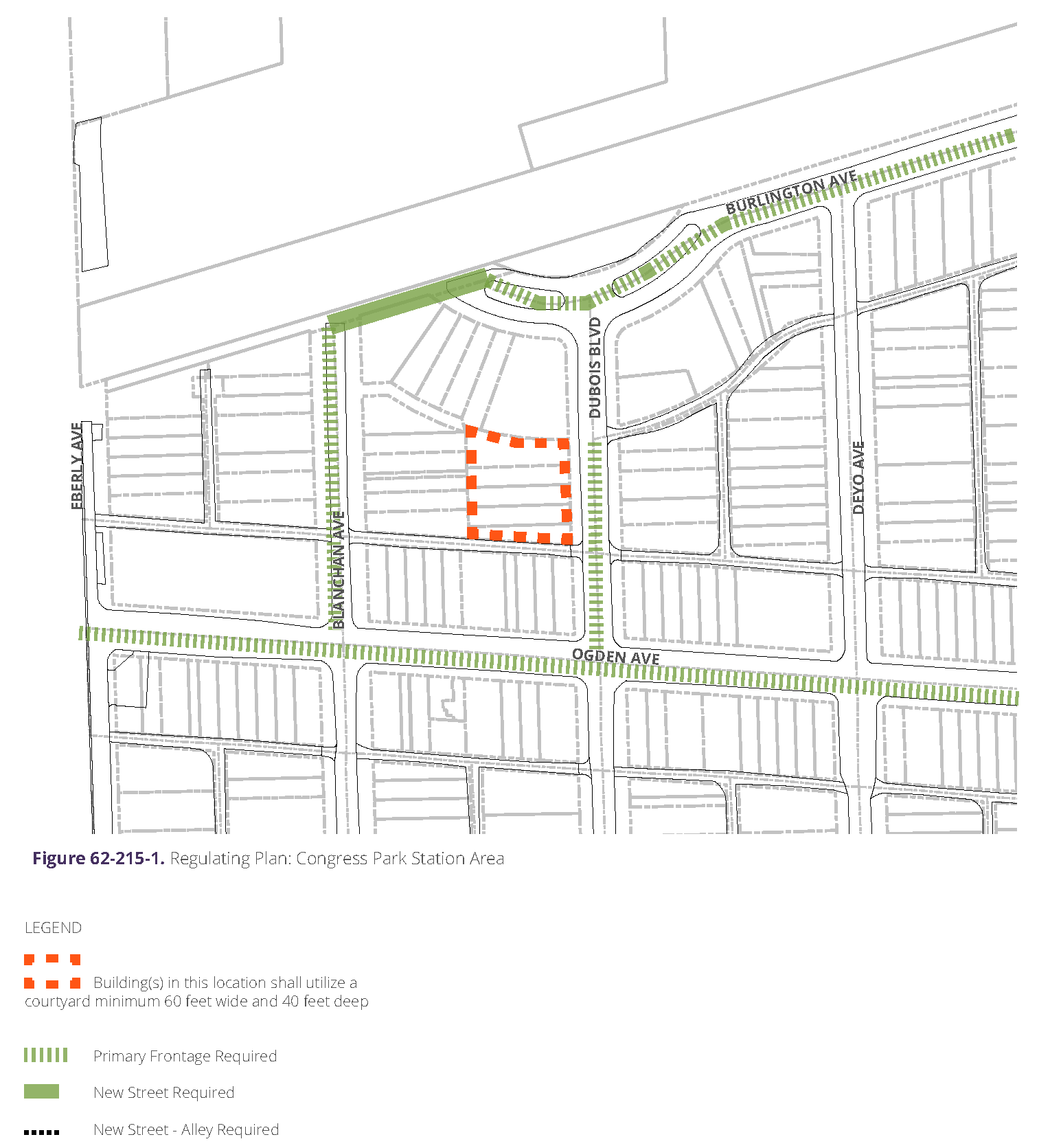
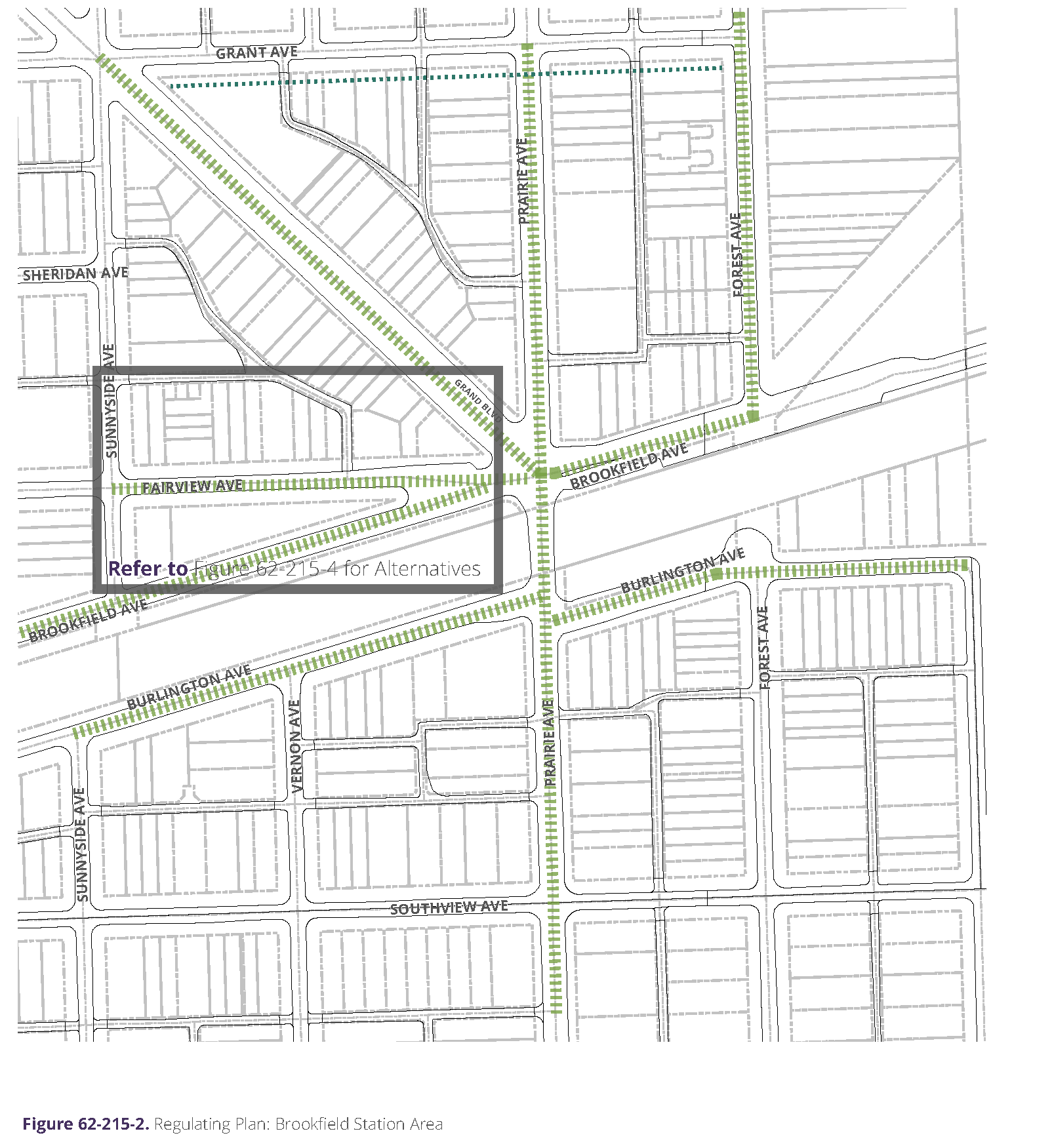
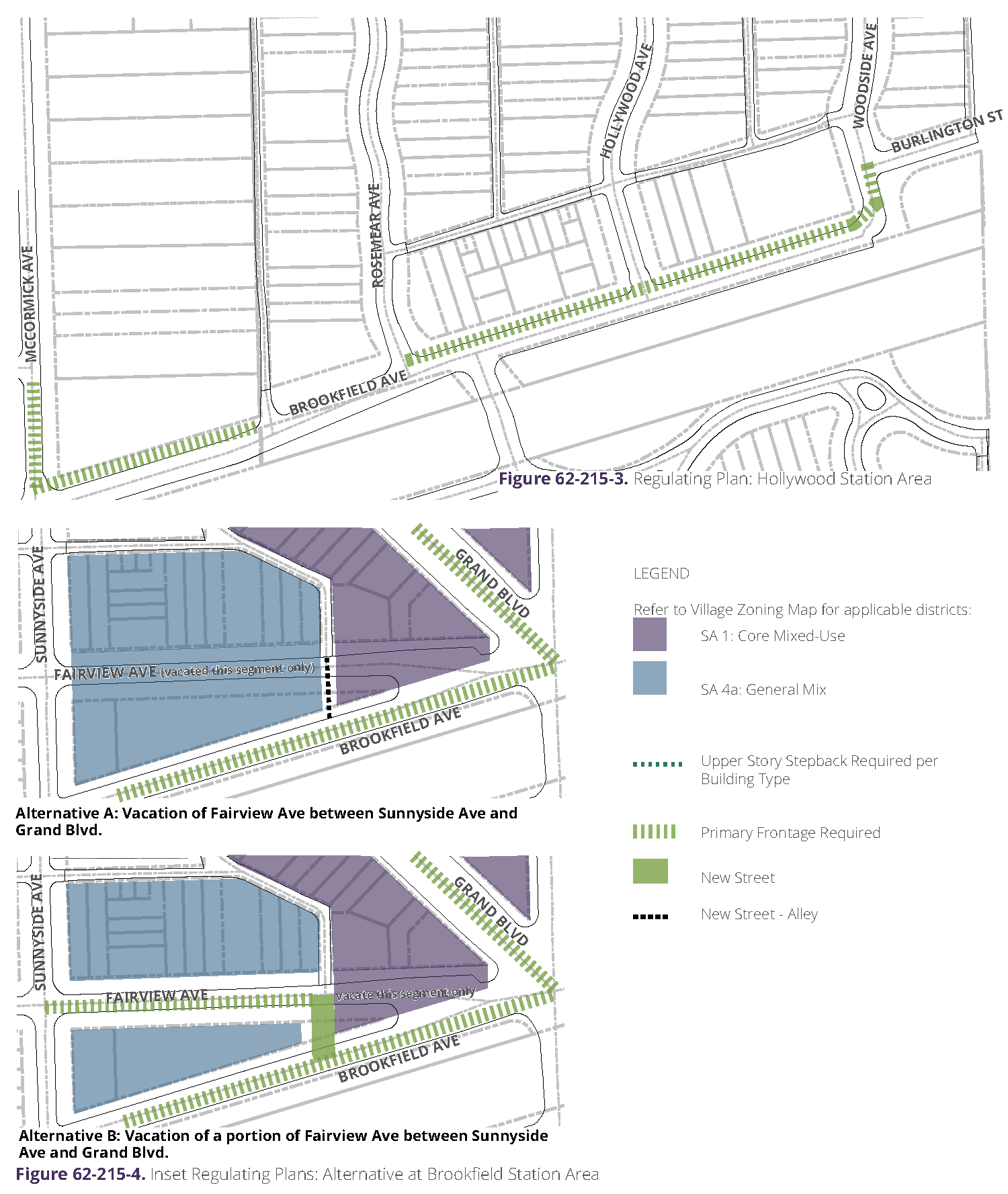
Regulating plans. The regulating plans (Figure 62-215-1, Figure 62-215-2, and Figure 62-215-3) designate certain streets as primary within each station area. These designations prioritize the street frontages for locating the front lot line as well as required amounts of building frontage and allowable amounts of parking frontage.
b.
Two primary streets. When two primary streets abut a parcel, the Village Manager shall determine which street shall serve as the primary street, unless otherwise defined in these sections 62-215 through 62-217.
(3)
Congress Park Station Area special street requirements. Refer to Figure 62-215-5. Illustrative Example of Congress Park Station Area Development, for one example of the requirements of this code. The following street and block requirements apply:
a.
Burlington extension. Burlington Avenue shall extend to Blanchan Avenue with the same cross section as Blanchan Avenue. Parallel or head-in diagonal parking is required along at least one side of the street.
b.
Streetscape. Streetscape is required along all block faces, including the following:
1.
Street trees. Street trees, placed a minimum of 40 feet on center with layout and type approved by the village manager or his/her designee.
2.
Sidewalk. Sidewalk, a minimum of five feet in width, continuous with appropriate ramps and intersection treatments, approved by the village manager. Where the sidewalk crosses an alley or driveway, the sidewalk pattern and material shall continue through the alley or driveway, signalizing pedestrian priority.
3.
Driveway or alley access. New driveway or alley access shall generally align with access across street, so that buildings across the streets shall face new buildings on the site.
4.
On-street parking. Head-in angled or parallel parking shall be utilized off Blanchan and the commercial segments of Dubois to provide visitor and customer parking for the development.
5.
Courtyard required. A courtyard is required for buildings located along Dubois Boulevard as illustrated on Figure 62-215-1. The courtyard shall open onto Dubois Boulevard and shall be a minimum 60 feet wide along the right-of-way and a minimum 40 feet deep, measured perpendicular to the right-of-way. Refer to 62-215(g), definitions for courtyard.
(4)
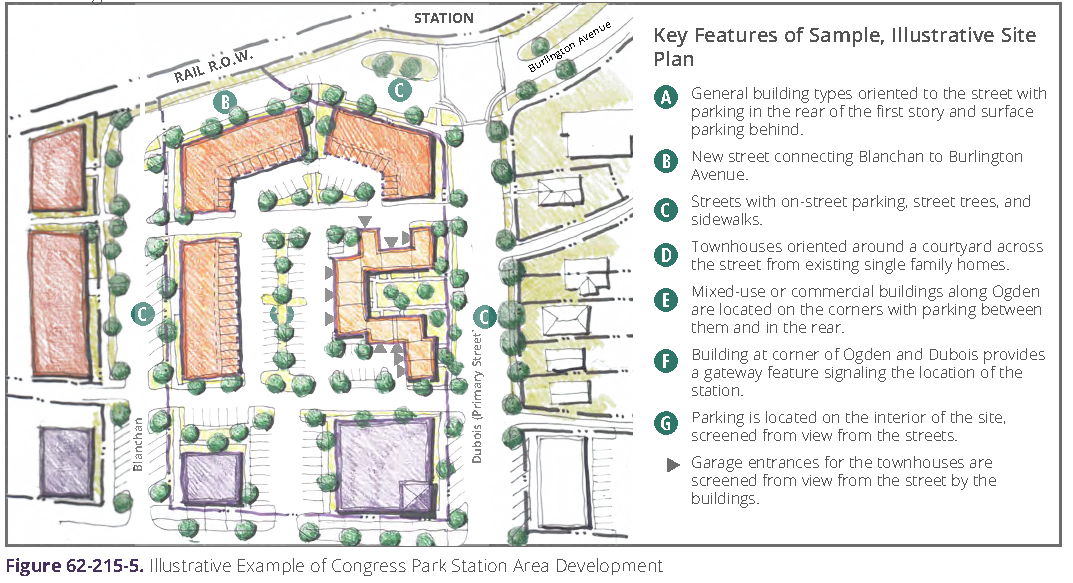
Regulating plan alternatives: Fairview Ave. Two alternative plans represent right-of-way vacation scenarios the Village Manager may approve with acceptable redevelopment of the adjacent parcels under these sections 62-215 through 62-217.
a.
Alternative A. Vacation of the entire segment of Fairview Avenue between Sunnyside Avenue and Grand Boulevard requires the following:
1.
Redevelopment of all parcels along this segment of Fairview Avenue.
2.
Extension of the alley to Brookfield Avenue as shown. Alley right-of-way to be a minimum of 22 feet wide with paving a minimum of 20 feet wide.
3.
Both Brookfield Avenue and Grand Boulevard shall be treated as primary streets.
b.
Alternative B. Vacation of the segment of Fairview Avenue between the midblock alley and Grand Boulevard requires the following:
1.
Redevelopment of the three parcels along this segment of Fairview Avenue on the north side.
2.
Ownership of the triangularly shaped parcel between Fairview Avenue and Brookfield Avenue to accommodate the extension of Fairview Avenue.
3.
Extension of Fairview Avenue to Brookfield Avenue with the same cross section as existing Fairview Avenue.
4.
Both Brookfield Avenue and Grand Boulevard shall be treated as primary streets.
(d)
Districts. The following districts are established for development within the station areas. These districts have been written for the specific geographic locations on which they are designated, considering the scale and context of the existing parcels. Figure 62-215-1, Figure 62-215-2, and Figure 62-215-3 illustrate the locations for the districts.
(1)
SA 1: Core Mixed-Use District.
a.
Intent. The SA 1 district applies to core lots intended to continue and enhance the scale and walkability of the existing mixed-use, main-street style buildings.
b.
Description. The SA 1 district is a mid-scale district that supports one to six story buildings that make up the core of the mixed use areas adjacent to the stations. The main street building type of this district establishes a street wall of ground story, storefront facades built up to the sidewalk, and utilizes on-street parking or parking in the rear. This district focuses pedestrian friendly retail and service uses on the ground story with residential and/or office uses in upper stories.
(2)
SA 2: Neighborhood Mixed Use District.
a.
Intent. The SA 2 district applies mainly to corner lots outside the downtown area, intended to continue and enhance the scale and pedestrian orientation of the existing mixed-use, mainstreet-style buildings at the Hollywood Station area and to create new similar scale buildings at the Congress Park Station area.
b.
Description. The SA 2 district is a low-scale district that supports up to three story buildings, smaller in scale than the SA 1 buildings. The main street building type of this district establishes a street wall of ground story, storefront facades built up to the sidewalk, and utilizes on-street parking or parking in the rear. This district focuses pedestrian-friendly retail and service uses on the ground story with residential and/or office uses in upper stories.
(3)
SA 3: Corridor Mixed-Use District.
a.
Intent. The corridor mixed-use district is intended to increase the pedestrian-orientation of shopping centers and commercial uses that are more automobile oriented, mainly along Ogden Avenue.
b.
Description. The corridor mixed-use district is a lower scale, one to three story commercial district designed to serve the greater community. A wider range of commercial uses are permitted as well as more off-street parking location options.
(4)
SA 4a and 4b: General Mix District.
a.
Intent. The SA 4 District is a transitional district, intended to support the core with offices and residential uses at the edges of the core area and within the neighborhood station areas,.
b.
Description. The SA 4 District is a mid-scale district that supports a mix of building heights: in SA 4a, heights range from 2 to 6 stories and, in SA 4b, heights range from 1 to 3 stories. The form of this area remains pedestrian-centered but allows for a looser mix of uses, including residential and office on the ground floor, and a variety of building forms.
(5)
SA 5: Residential Mix District.
a.
Intent. The SA 5 District is intended to allow for redevelopment of transit-supportive residential in the station areas, while respecting the scale of adjacent neighborhood residential.
b.
Description. The Residential Mix District is a lowscale mainly residential district of two to six stories within a mix of pedestrian-oriented building types, with parking located in the rear and entrances on the front facades.
(6)
SA 6: Residential Multi-Unit District.
a.
Intent. The SA 6 district is a low scale residential district serving as a transition between other station area (SA) districts and single-family residential neighborhoods outside the SA districts (subject to traditional zoning).
b.
Description. The SA 6 district is a low-scale residential district with a maximum of three stories. The SA 6 district allows rowhouse and townhouse buildings as well as houses with surrounding yards. Parking is located in the rear and entrances on the front facades.
(e)
Development approval process.
(1)
Site plan approval. An approved Site Plan submittal is required for the development or redevelopment of all parcels in any station area (SA) district per the following.
(2)
Applicability. Development or redevelopment is defined as construction of a new building, any addition to an existing building or site, renovation to the exterior facades or site, or change in use. Minor repairs and maintenance are not required to be submitted for Site Plan approval.
(3)
Approval process. The Village Manager or his/her designee shall review the Site Plan submittal and approve, reject, or approve with conditions.
(4)
Pre-submittal meeting. For new buildings, additions to buildings, additions or renovation of site features, and changes to the exterior facade, a pre-submittal meeting is required with staff.
(5)
Submittal materials. In SA districts, an application and the following review documents are required. All maps and plans shall include the date of preparation, north arrow, and scale.
a.
Site location map, legal description/limits of plan.
b.
Plat of survey. Dimensions of property lines, easements, rights-of-way. Plat shall be no older than five years from date of application submittal.
c.
Development boundaries and proposed phasing, if applicable.
d.
Existing conditions plan. Existing on-site and adjacent off-site structures, streets, utilities, easements, pavement noted either on an aerial photograph or site survey.
e.
Existing natural conditions plan. Existing topography, vegetation, drainageways, floodplain/ way, or other unique features either on an aerial photograph or site survey.
f.
Site plan. A Site Plan delineating all proposed structures and surfaces, including parking, pavement, decks, patios, landscape, and retaining walls.
g.
Building plan(s). Floor plans for all buildings illustrating compliance with the requirements of section 62-216, building types.
h.
Declaration of use. A table of uses is required on the building plan delineating locations and gross square footages of categories of uses, special uses, and illustrating compliance with section 62-217, uses.
i.
Building elevations. Building elevations of all facades, rendered to illustrate compliance with the requirements of section 62-216, building types, including but not limited to such items as color, materials, depth of details on facades required to create an expression line, glass locations, entrance locations, and types of glass.
j.
Landscape plan. Landscape plan illustrating compliance with the requirements of 62-218-B Landscape. All ground plane vegetation shall be illustrated. For sites with less than ten percent landscape area, the landscape plan may be combined with the site plan.
k.
Parking plan. Parking layout/location plan with table of spaces keyed to plan, illustrating compliance with 62-218-A Parking. Driveways, shared parking arrangements, cooperative parking, and any other parking reductions shall be included and noted for compliance with 62-218-A Parking.
l.
Sign plan, if signs are included. Sign location plan, and large scaled plan(s) and elevation(s) illustrating each sign in detail with dimensions, colors, and materials of all components.
(6)
Special uses. Special Use permits shall follow the process defined in 62-821 of the zoning regulation.
(7)
Appeal. Refer to 62-736 and 62-737 for matters of appeals.
(8)
Exceptions process. The applicant shall submit requested exceptions to the village manager or his/ her designee with the site plan review application.
(9)
Minor exceptions. Minor exceptions may be requested for approval by the village manager, as follows:
a.
Conditions. Exceptions, outlined below, are permitted under the following conditions:
1.
The exception fulfills the intent defined for this chapter of the zoning regulations. Refer to 62-215(a), Intent.
2.
The resulting form is consistent or compatible with the surrounding context.
b.
Permitted exceptions. The following are the only permitted exceptions, if the above conditions are met.
1.
The location of the building within up to one foot from any minimum yard requirement or build-to zone width/location.
2.
Up to ten percent increase in total impervious coverage, not to exceed the total amount of permitted impervious plus semi-pervious coverage.
3.
Up to ten percent decrease in front property line coverage.
4.
Additional height of any story up to two feet, as long as the overall building height does not exceed the allowable height of all floors at their maximum permitted height.
5.
Up to ten percent decrease in transparency or a ten percent increase in blank wall limitation for corner side facades.
(10)
Design exceptions. Design exceptions may be requested for approval by the village manager per the following. The village manager is authorized to request the review and recommendation by the planning and zoning commission.
a.
Alternative building materials. Alternative building materials may be exempted from the requirements of section 62-217(a), materials, unless expressly prohibited under section 62-217(a), materials. For approval, the following shall be met:
1.
The applicant shall submit samples and local examples of the material a minimum of four weeks prior to the review, to allow site visits to the location.
2.
The submitted application meets the intent of the materials requirements and the village manager determines that the material will maintain its structure, color, and appearance for a minimum period of 15 years with little or no maintenance.
b.
Existing building exceptions. The following exceptions are permitted when applied to the renovation of an existing building(s):
1.
For renovation of existing buildings, the maximum front property line coverage may be waived with an existing coverage of 60 percent; however, any expansion on the ground story shall contribute to the extension of the front property line coverage.
2.
For renovation of existing buildings, the location of the building within up to five feet from any minimum yard requirement or build-to zone width/location.
3.
For renovation of existing buildings, the minimum height of the ground story and upper story may be increased or decreased by up to two feet for existing stories.
4.
For renovation of existing buildings, other required dimensions may be modified up to five feet or ten percent, whichever is less, unless otherwise modified by this section.
(f)
Nonconforming structures. All building type standards apply to all new construction and renovation of existing structures. The following exception for nonconforming buildings in the station area (SA) districts is in addition to the requirements of chapter 62, article IV.
1.
General design requirements. For any expansion or exterior renovation, section 62-217, general design requirements shall be met.
2.
General renovations. Where any renovation includes an addition of more than 50 percent in gross building square footage within a five-year period, all requirements of this division shall be met.
3.
Facade renovations. For any level of renovation, if the building's façade exists or will exist within the required build-to zone of these regulations, the facade requirements of the applicable building type shall be met, if the renovation includes any one of the following:
a.
Installation of additional doors or a change in location of a door.
b.
Expansion or change in location of 30 percent of windows on any street façade.
c.
Replacement of 30 percent or more of facade materials on any street facing facade with a different facade material.
4.
Roof renovations. For any level of renovation, if the renovation of the shape or style of more than 50 percent of the roof occurs and 30 percent of the street facing façade exists within the build-to zone, the cap type requirements of the applicable building type (per section 62-216(h), cap types) shall be met.
a.
Installation of additional doors or a change in location of a door. For a storefront door and window system, installation or change in location of two or more doors.
b.
Expansion or change in location of 30 percent of windows on any street façade.
c.
Replacement of 30 percent or more of facade materials on any street facing facade with a different facade material.
(g)
Definitions. For the purposes of sections 62-615 through 62-618, the following terms shall have the following meanings:
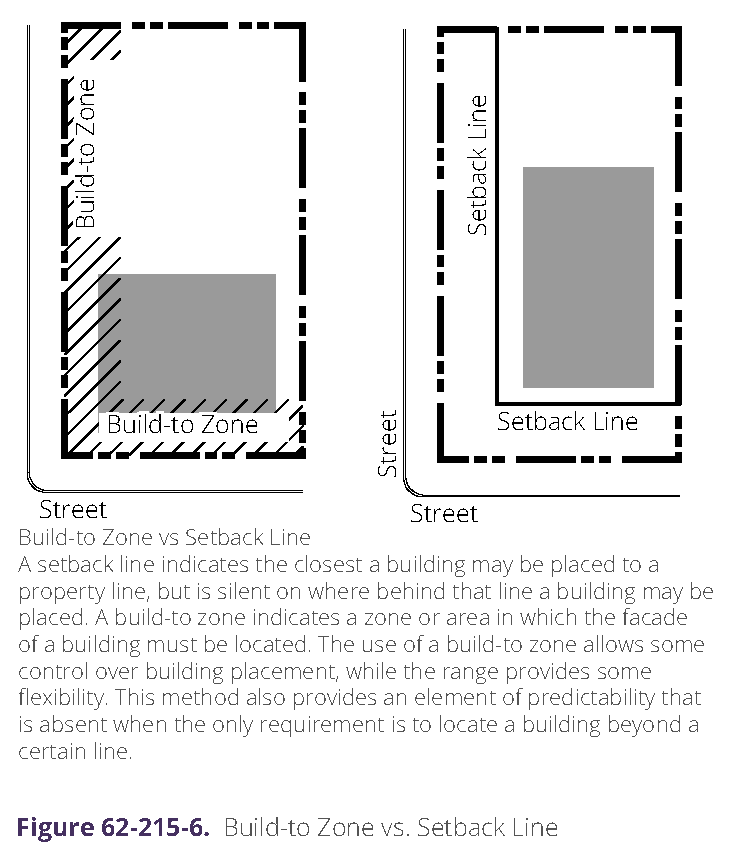
Build-to zone. An area in which the front or corner side facade of a building shall be placed; it may or may not be located directly abutting a lot line. The zone dictates the minimum and maximum distance a structure may be placed from a lot line. Refer to Figure 62-215-6. build-to zone vs. setback line.
Courtyard. An outdoor area enclosed by a building or buildings on at least three sides for at least 75 percent of the length of each side, and open to the sky.
Expression line. An architectural feature consisting of a decorative, three-dimensional, linear element, horizontal or vertical, protruding or indented at least two inches from the exterior facade of a building typically utilized to delineate the top or bottom of floors or stories of a building, intended to create a shadow line. Examples may include cast stone cornices, pilasters, or stepped brick coursing.
Impervious site coverage. The percentage of a lot developed with principal or accessory structures and impervious surfaces, such as driveways, sidewalks, and patios.
Occupied space. Interior building space regularly occupied by the building users. It does not include storage areas, utility space, or parking.
Pedestrianway. A pathway designed for use by pedestrians; it can be located mid-block allowing pedestrian movement from one street to another without traveling along the block's perimeter
Pervious surface. Also referred to as pervious material. A material or surface that allows for the absorption of water into the ground or plant material.
Pervious surface, semi-. Also referred to as semi-pervious material. A material that allows for at least 40 percent absorption of water into the ground or plant material, such as pervious pavers, permeable asphalt and concrete, gravel, vegetated or green roofs.
Primary street. A street that receives priority over other streets in terms of setting front lot lines and locating building entrances. Refer to Figure 8.101 C-1 for mapped primary streets.
Story, ground. Also referred to as ground floor. The first floor of a building that is level to or elevated above the finished grade on the front and corner facades, excluding basements or cellars.
Story, half. A story either in the base of the building, partially below grade and partially above grade ("basement"), or a story fully within the roof structure with transparency facing the street.
Story, upper. Also referred to as upper floor. The floors located above the ground story of a building.
Street face. The facade of a building that faces a street right-of-way.
Transparency. The measurement of the percentage of a facade that has highly transparent, low reflectance windows. Mirrored glass is not permitted.
Visible basement. A half story partially below grade and partially exposed above with required transparency on the street facade.
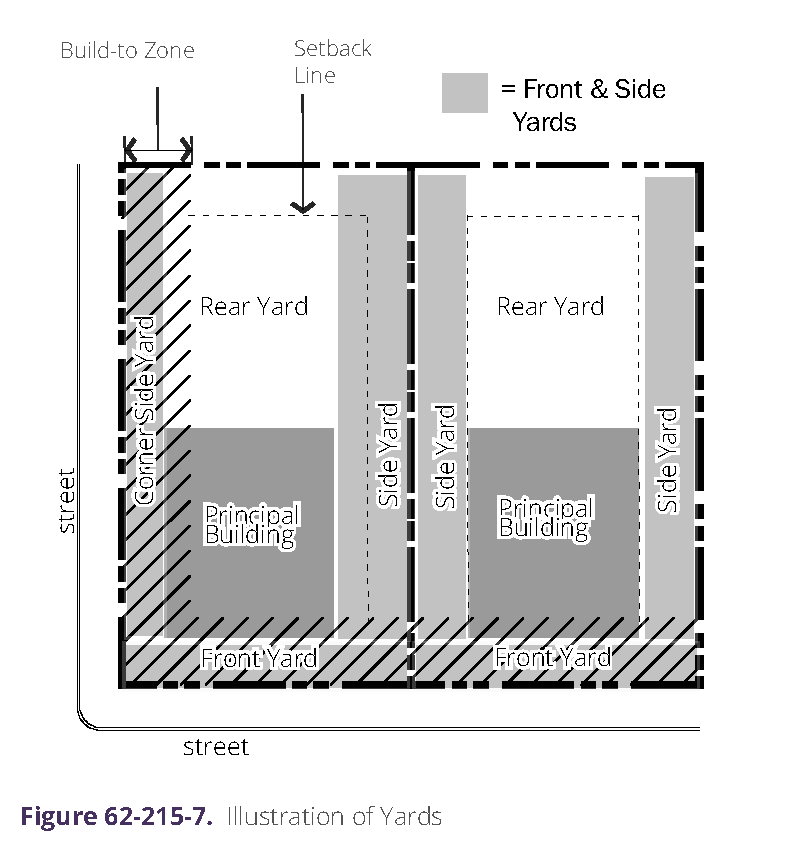
Yard. The space on a lot which is unoccupied and unobstructed from the ground to the sky by the principal structure. Refer to Figure 62-215-7. illustration of yards. Note that the rear yard is fully screened from the street by the structure.
Yard, corner side. For the purposes of sections 62-615 through 62-617, A yard extending from the corner side building facade along a corner side property line between the front yard and rear property line.
Yard, front. A yard extending from the front facade of the principal structure along the full length of the front property line, between the side property lines or side and corner side property lines.
Yard, rear. A yard extending from the rear building facade along the rear property line between the side yards or, on a corner lot, the corner side and side yards.
Yard, side. A yard extending from the side building facade along a side property line between the front yard and rear property line.
(Ord. No. 2017-9, § 4.D., 1-9-2017)
Sec. 62-216. - Building types.
(a)
General requirements.
(1)
Applicability. This section establishes the building type regulations for new construction and renovated structures within the districts defined in section 62-215 and located on the village's zoning map. Refer to the regulating plans (figure 62-215-1, figure 62-215-2, and figure 62-215-3) for additional requirements.
(2)
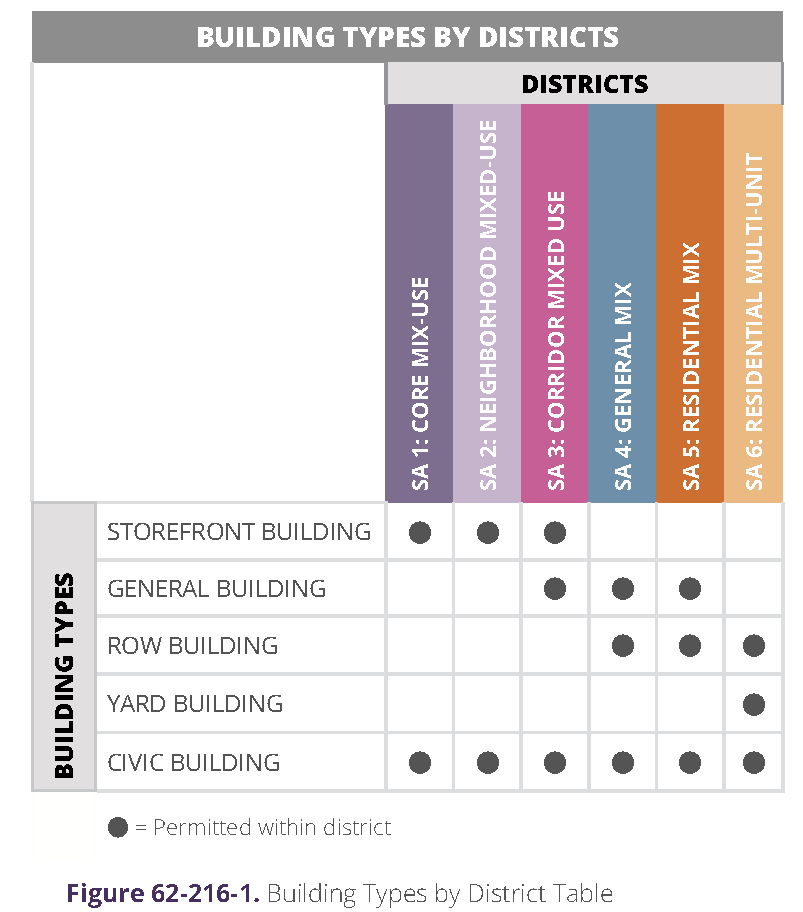
Building types by zoning districts. Each building type shall be constructed only within its designated district(s) as defined by Figure 62-216-1. building types by district table.
(3)
Uses. Each building type can house a variety of uses depending on the district in which it is located. Refer to section 62-216(i), uses for uses permitted per district. Some building types have additional standards on permitted uses.
(4)
No other building types. All buildings constructed shall meet the standards of one of the permitted building types within the zoning district of the lot.
(5)
Multiple principal buildings on one lot. For all building types, multiple principal buildings are permitted on all lots; however, each building must meet the requirements of the building type, unless otherwise noted.
(6)
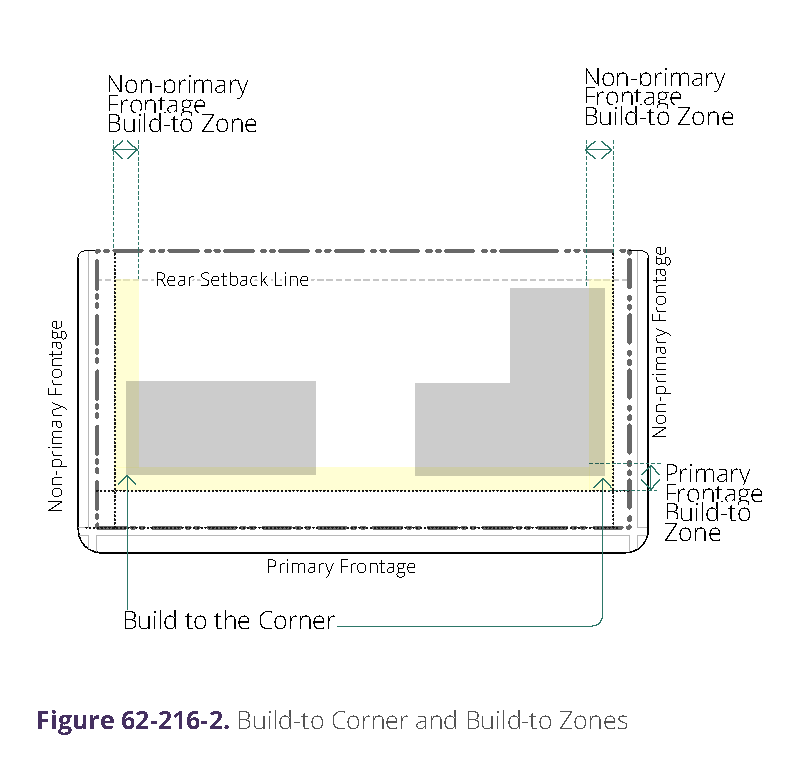
Build to the corner. The intersections of two build-to zones at a corner shall be occupied by building. Refer to Figure 62-216-2. build-to corner and build-to zones.
(7)
Permanent structures. All buildings constructed shall be permanent construction without a chassis, hitch, or wheels, or other features that would make the structure mobile, unless otherwise noted.
(8)
Primary and non-primary street frontages. A hierarchy of frontages is established for the station area districts by the definition of primary streets on the regulating plans (Figure 62-215-1, Figure 62-215-2, and Figure 62-215-3). Refer to Figure 62-216-2. Refer to building type requirements (refer to 62-216(b) through (f)) for requirements along these street frontages.
a.
Frontages along civic or open space. Lots containing or abutting civic spaces or public open space shall treat frontages abutting that space as primary frontages.
b.
Corners. At all intersections of primary and non-primary streets, primary frontage facade treatments shall extend along the facade of the non-primary street from the corner a minimum of 30 feet along the facade. Refer to Figure 62-216-3. Examples of storefront extending down the non-primary street façade.
c.
Non-primary frontages. Non-primary frontages allow for a lower level of facade treatment as well as permit locations for garage and parking lot driveways entrances. Non-primary frontages may always be treated at the higher level of a primary frontage.
(9)
Landscape and hardscape areas. The following outlines the treatments permitted for site surfaces other than building locations:
a.
Landscape areas. All front yards, build-to zones, side yards, corner side yards, and rear yards not covered by buildings, parking, or driveway shall contain either landscape, patio space, or sidewalk space.
b.
Permitted parking and driveway locations. Parking areas and driveway locations are permitted in specific locations by building type. Generally, parking is not permitted in front or corner side yards, unless specifically noted.
c.
Build-to zones and setbacks. Parking and driveways are not permitted in build-to zones or setbacks except as follows: Where driveway access is permitted off streets, driveways may cross perpendicularly through the build-to zone or setback with a maximum width of 22 feet for two-way driveways and 12 feet for one-way and residential driveways for eight units or less.
(10)
Utility structures. Utility structures permitted in the district are exempted from the building type standards.
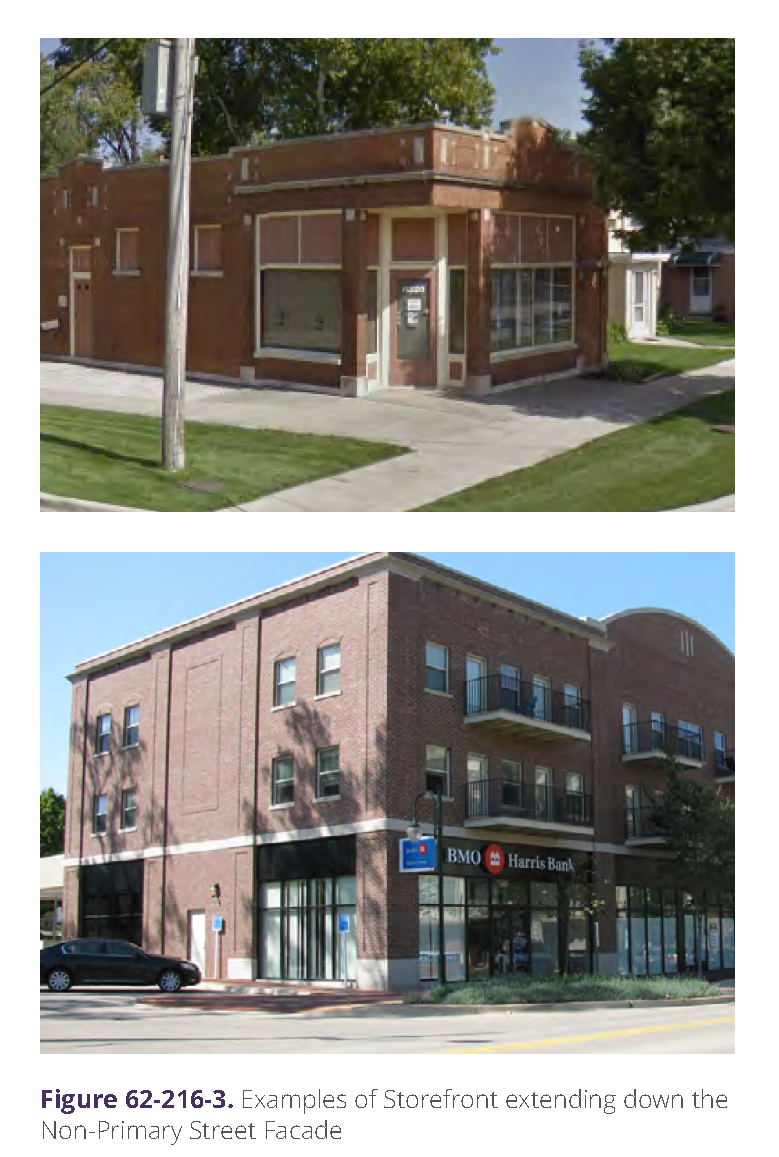
(b)
Storefront building type. Refer to Figure 62-216-1. building types by district table and the village's zoning map for permitted locations for the storefront building type.
(1)
Description and intent. The storefront building type is a highly pedestrian-oriented, mixed-use building. Ground story storefront is required along all primary streets with retail sales, eating and drinking establishments, and a variety of service uses to provide activity. Upper story uses are highly flexible. Parking is in the rear and side yards, depending on the district.
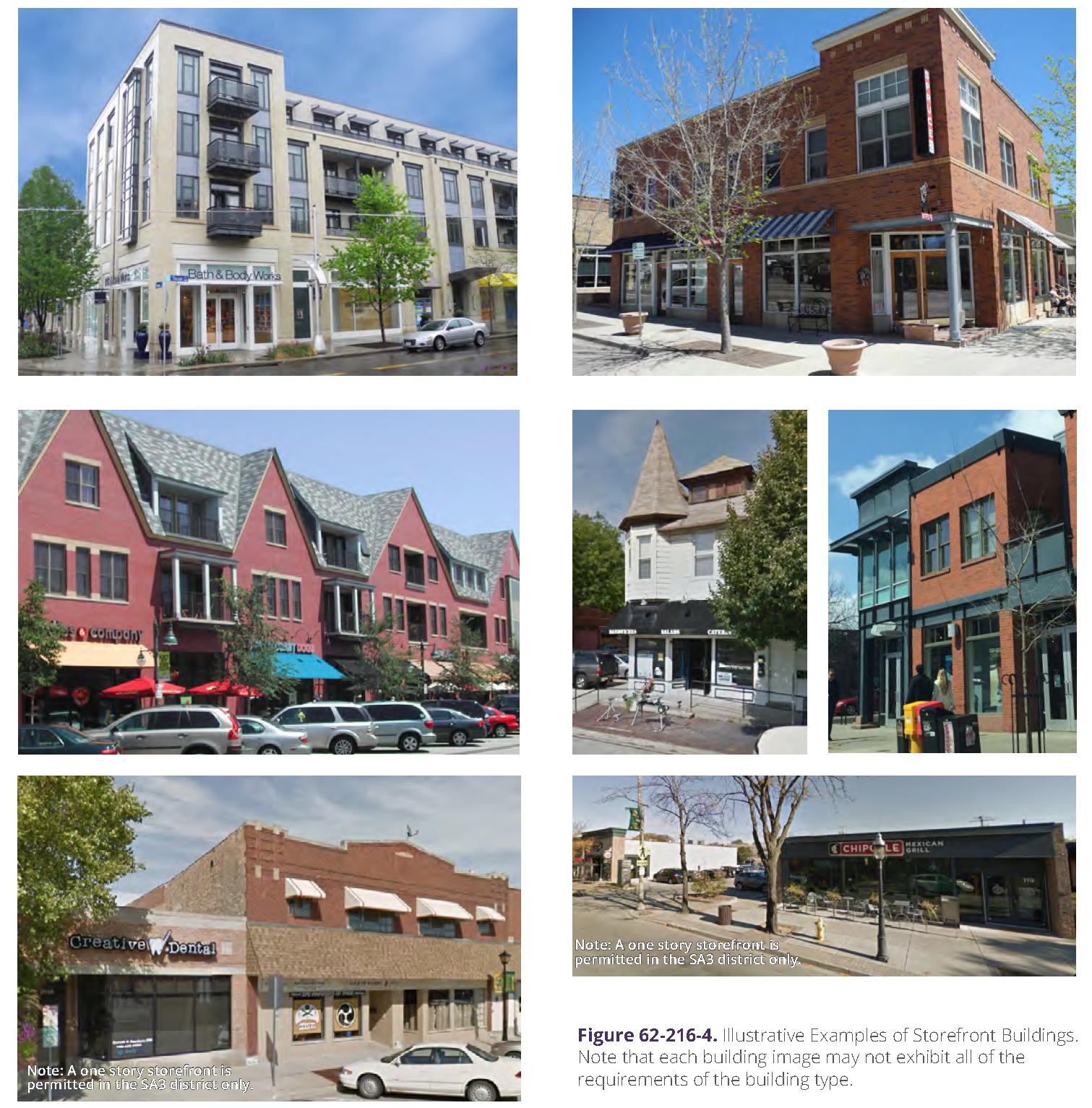
(2)
Requirements. The following defines the requirements specific to this building type. Refer to 62-216(a) and 62-216(h) for requirements applicable to all building types.
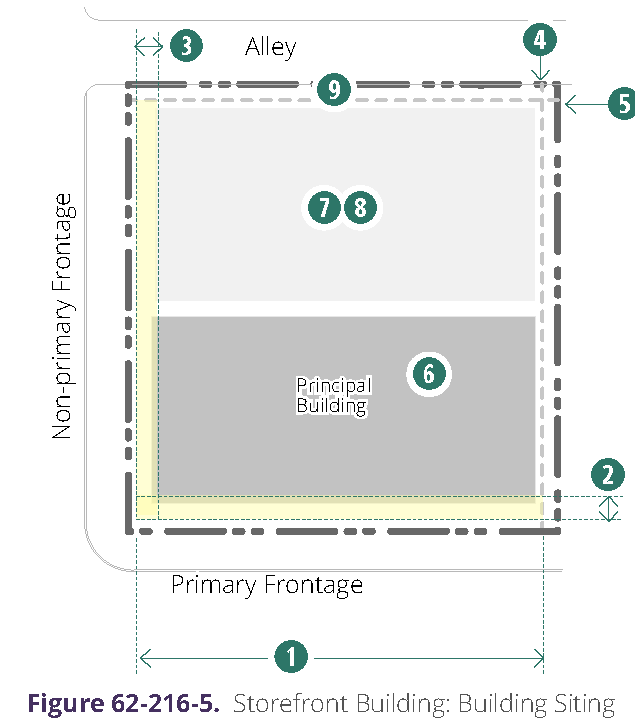
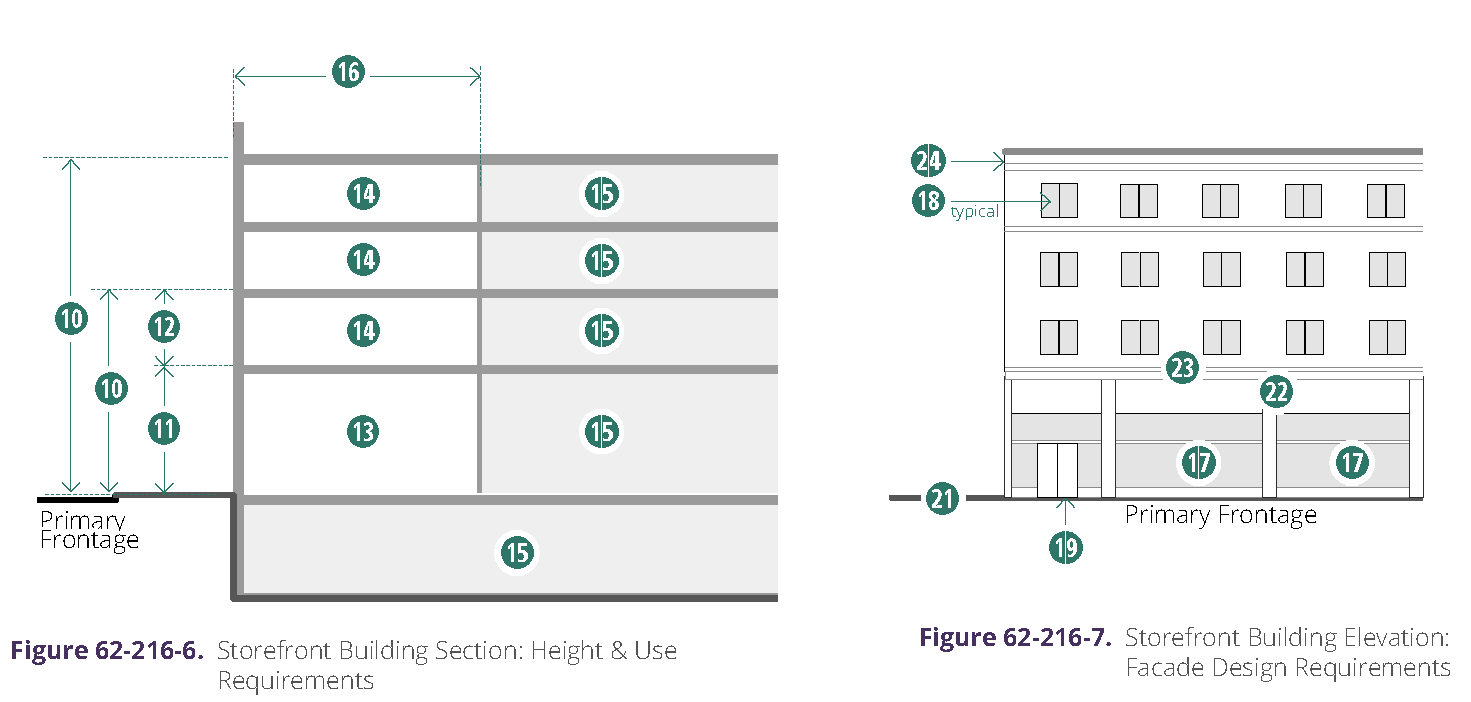
(3)
Notes. The following notes supplement the above requirements for the Storefront building type.
a.
Courtyards. One courtyard, maximum of 30% of facade width or 30 feet wide, whichever is less, may count towards the Minimum Primary Frontage Build-to Zone Coverage.
b.
Limited parking. Limited Side Yard parking means one double or single loaded aisle, perpendicular to the street. Limited Front and Corner Side parking means head-in parking off the adjacent right-of-way. Refer to section 62-217(h), landscape Requirements for screening requirements.
c.
Driveways off streets. If no alley exists or is required per the Regulating Plan, one driveway or garage entrance is permitted off non-primary street or facade. Refer to Figure 62-215-1. Regulating Plan: Congress Park Station Area, Figure 62-215-2. Regulating Plan: Brookfield Station Area, and Figure 62-215-3. Regulating Plan: Hollywood Station Area.
d.
Stepped back stories. Refer to Figure 62-215-2. Regulating Plan: Brookfield Station Area for locations where buildings are required to step back stories above the third story. Stories above the third shall be stepped back a minimum of 12 feet from the front facade located in the build-to zone. Refer to Figure 62-216-8. Examples of Upper Story Stepped Back Facade above the Third Story.
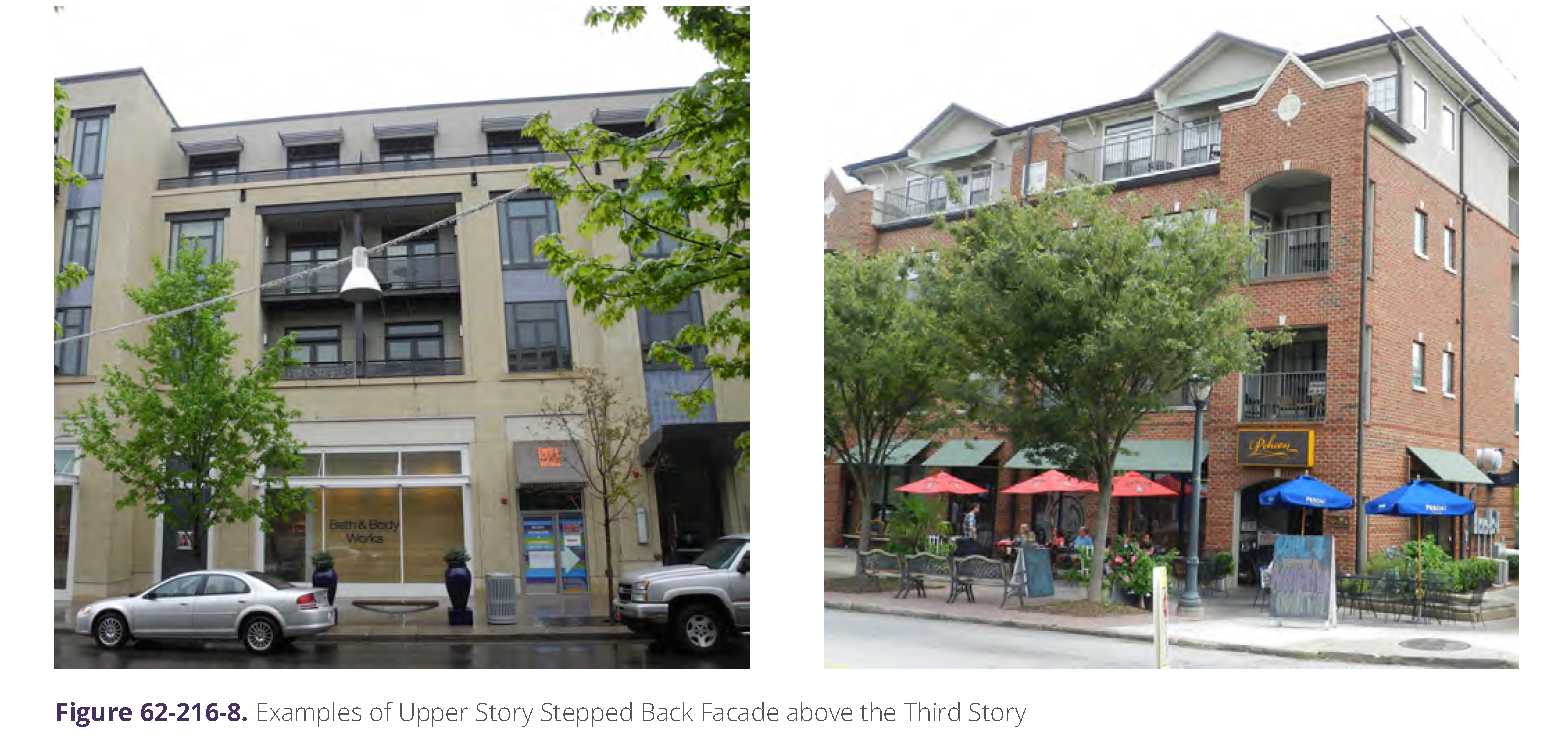
(c)
General building type. Refer to Figure 62-216-1. Building Types by District Table and the Village's zoning map for permitted locations for the General building type.
(1)
Description and intent. The General building type is a basic building that can accommodate a wide range of uses, from residential to office to light industrial. The General building type differs from the storefront by its lack of requirement for additional ground story glass and the more flexible ground story grade elevation requirements.
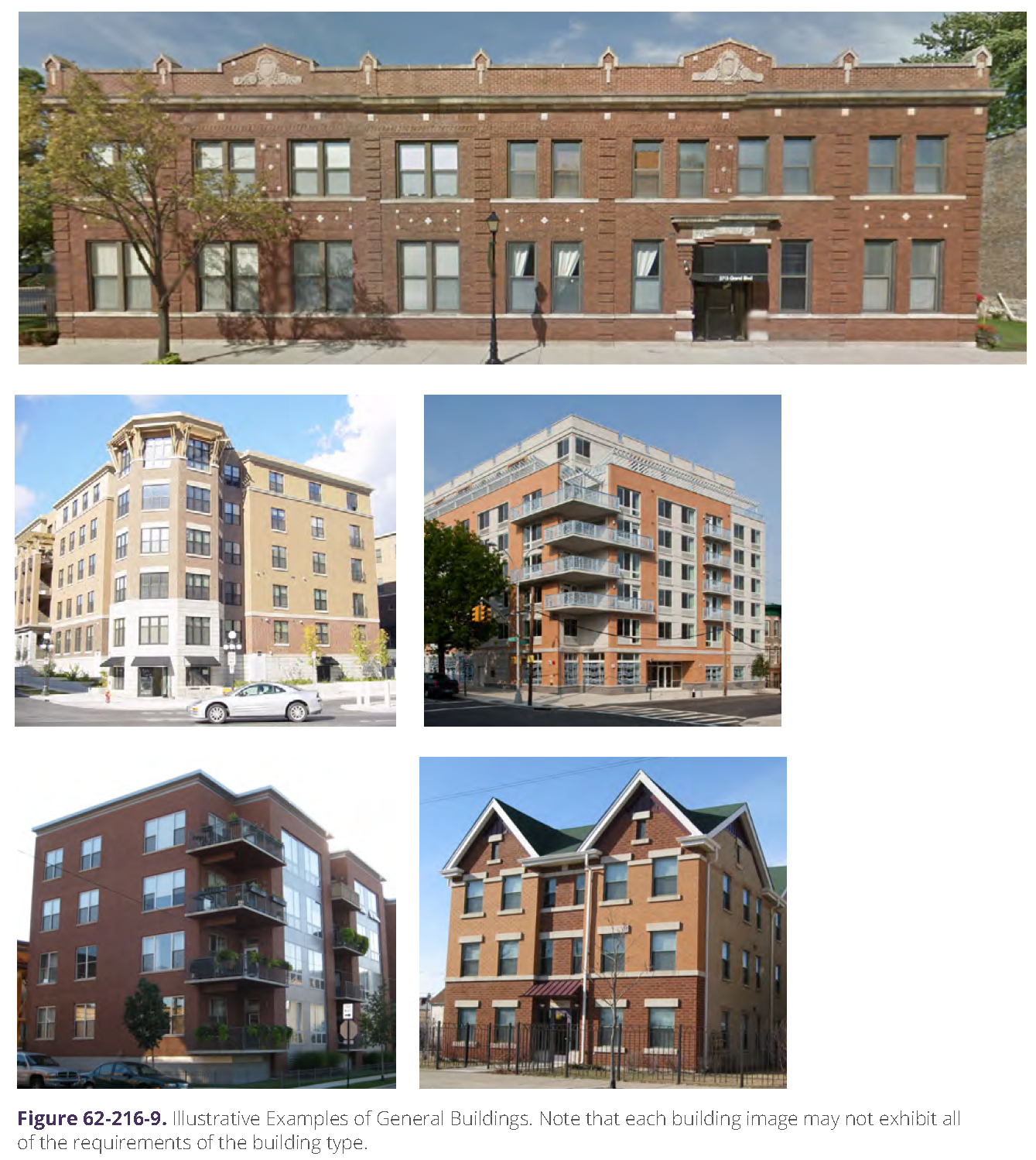
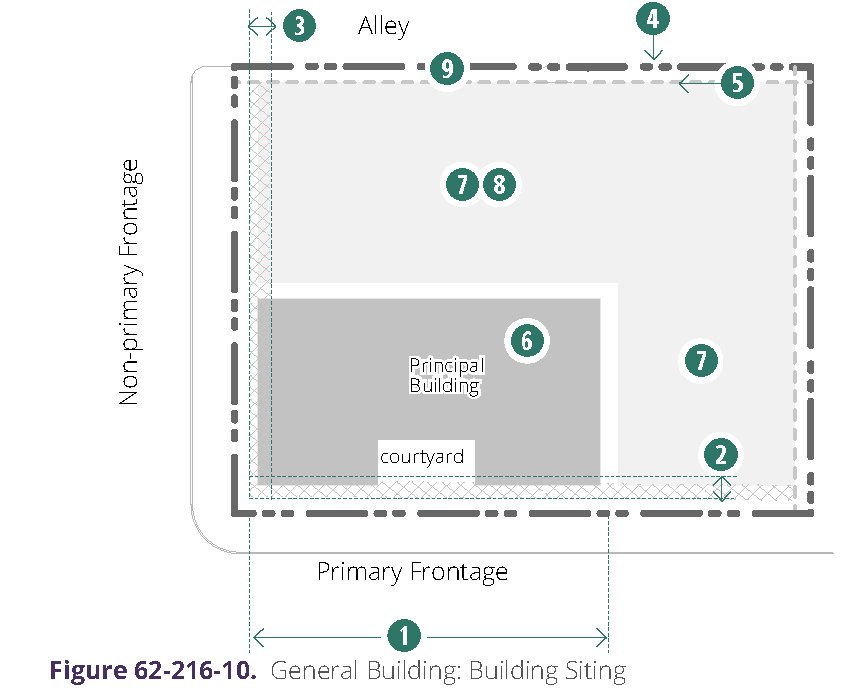
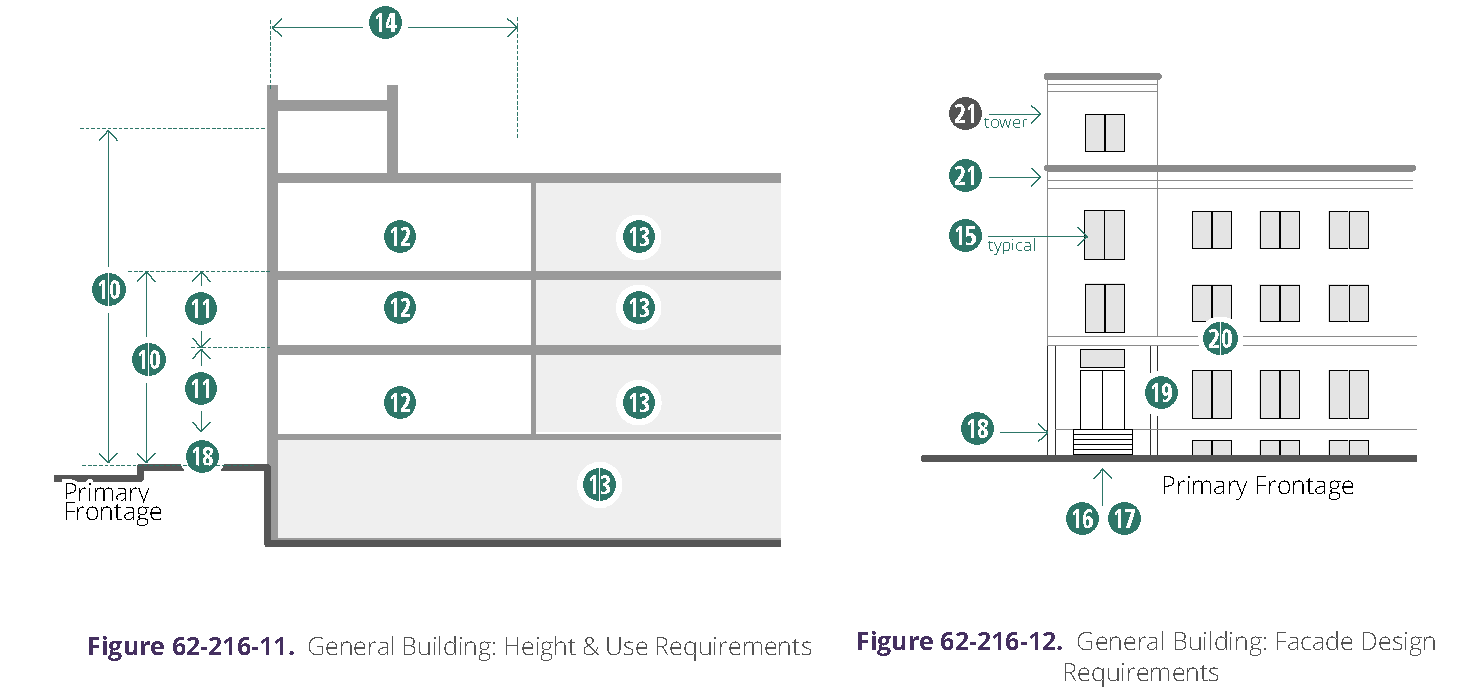
3.
Notes. The following notes supplement the above requirements for the General building type.
a.
Courtyards. One courtyard, maximum of 30% of facade width or 30 feet wide, whichever is less, may count towards the Minimum Primary Frontage Build-to Zone Coverage.
b.
Limited parking. Limited side yard parking means one double or single loaded aisle, perpendicular to the street. Limited front and corner side parking means head-in parking off the adjacent right-of-way. Refer to section 62-217(h), landscape requirements for screening requirements.
c.
Driveways off streets. If no alley exists or is required per the regulating plan, one driveway or garage entrance is permitted off non-primary street or facade. Refer to Figure 62-215-1. Regulating plan: Congress Park Station Area, Figure 62-215-2. Regulating plan: Brookfield Station Area, and Figure 62-215-3. Regulating plan: Hollywood Station Area.
d.
Stepped back stories. Refer to Figure 62-215-2. Regulating plan: Brookfield Station Area for locations where buildings are required to step back stories above the third story. Stories above the third shall be stepped back a minimum of 12 feet from the front facade located in the build-to zone. Refer to Figure 62-216-8. examples of upper story stepped back facade above the third story.
(d)
Row building type. Refer to Figure 62-216-1. building types by district table and the village's zoning map for permitted locations for the row building type.
(1)
Description and intent. The row building type is similar to the general building, but is smaller in scale and divided into different vertical units each with separate entrances. Townhouses, rowhouses, or live-work units exemplify this building type.
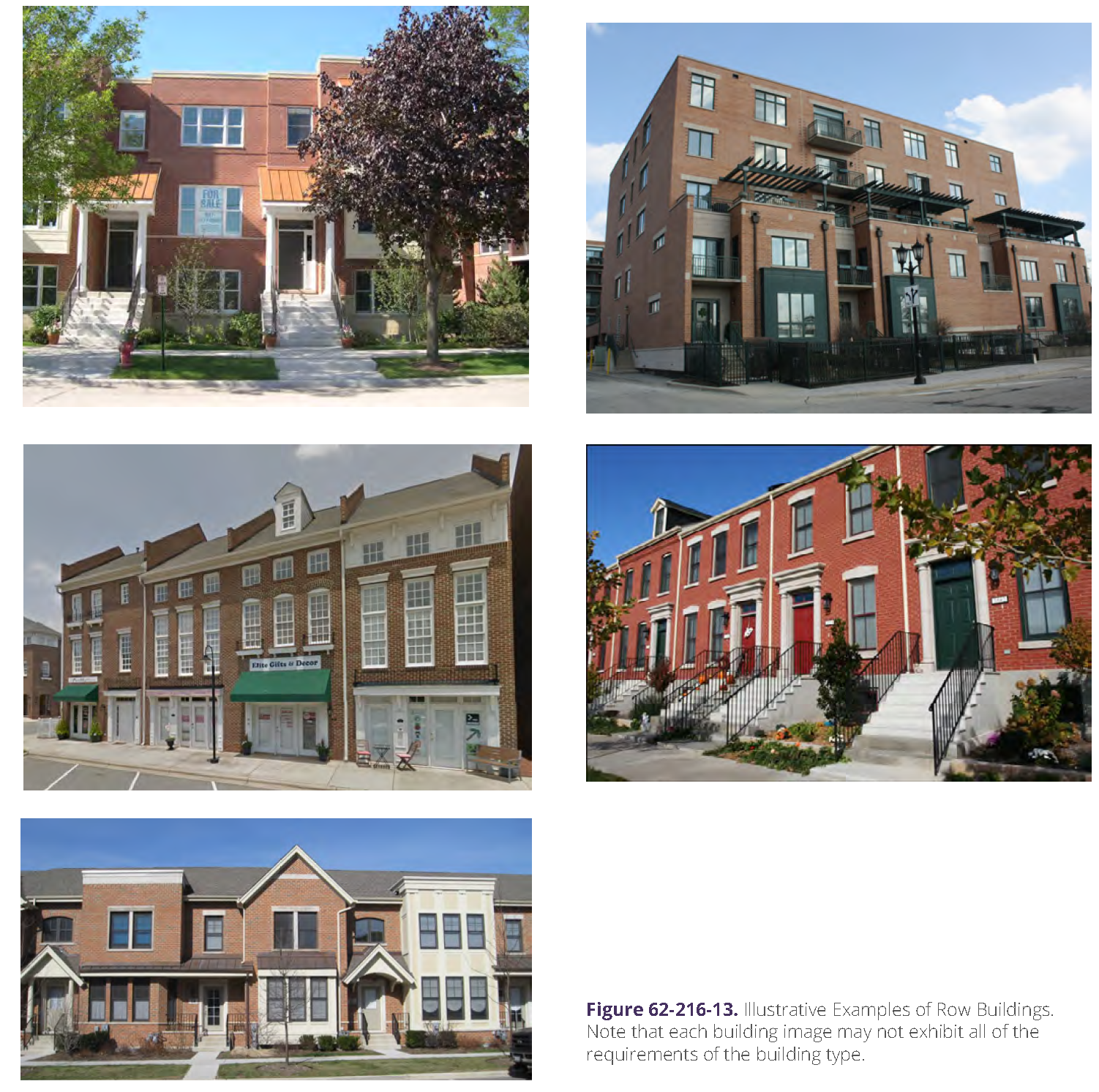
(2)
Requirements. The following defines the requirements specific to this building type. Refer to sections 62-216(a) and 62-216(h) for requirements applicable to all building types.
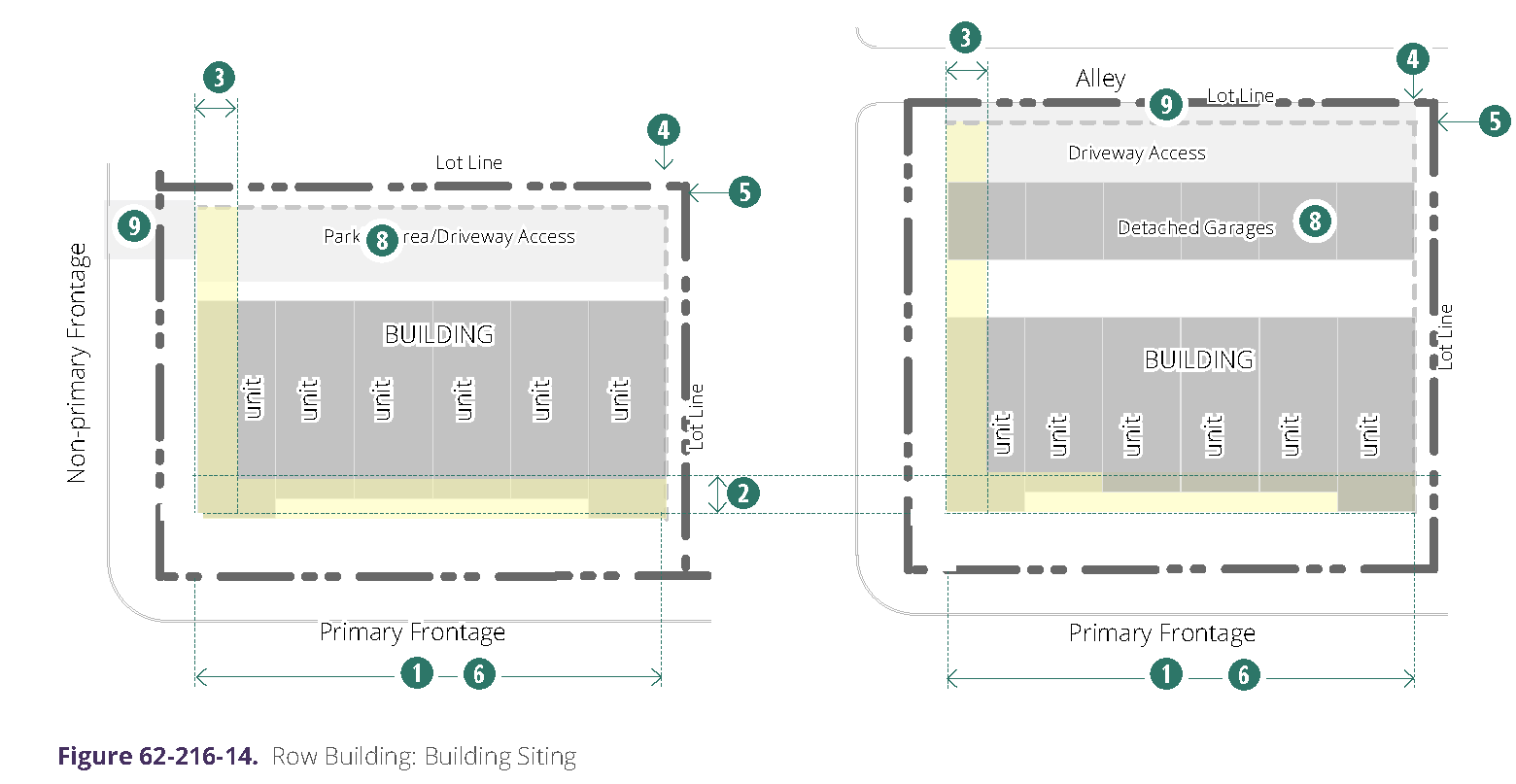
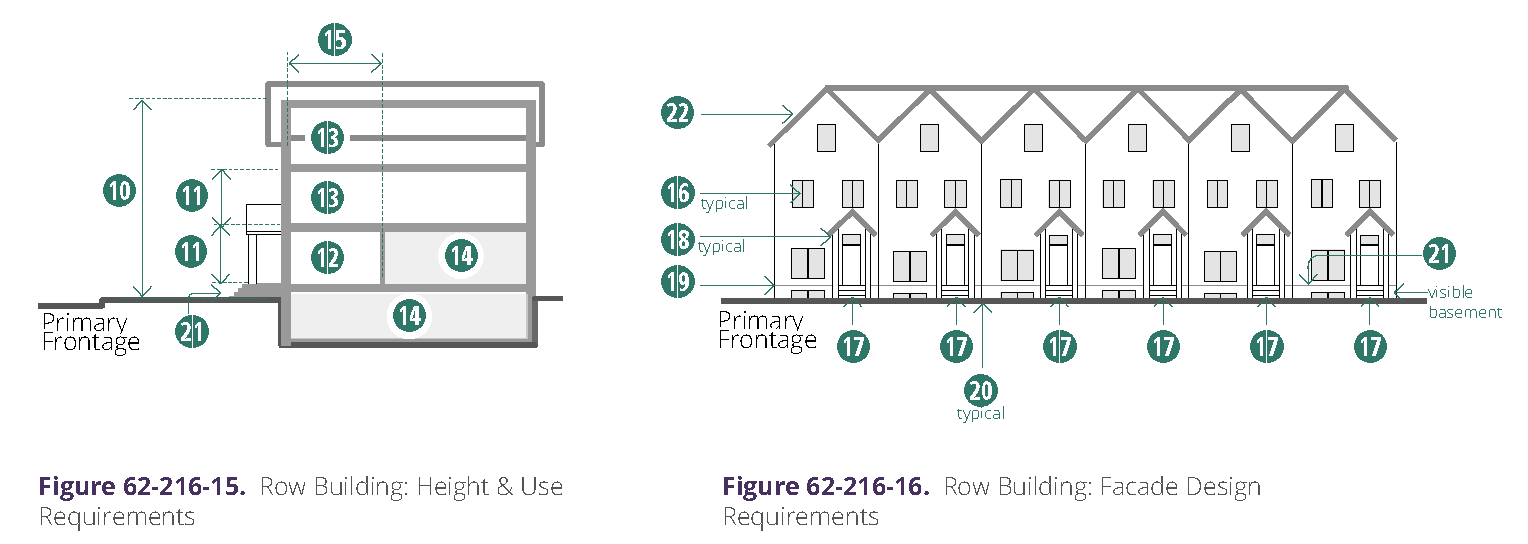
(3)
Notes. The following notes supplement the above requirements for the row building type.
a.
Front facade and entrances. Each unit shall have a facade located within the primary build-to zone, except one of every three units may front a courtyard, existing open space/park, waterway, or non-primary street with its principal entrance. Refer to entrance location and number for additional requirements. Refer to Figure 62-216-17, below for one illustration of a courtyard siting.
b.
Courtyards. A courtyard may contribute to the minimum primary frontage build-to zone coverage. One courtyard, maximum of 30 percent of facade width or 30 feet wide, whichever is less, may count towards primary frontage build-to zone coverage. Refer to Figure 62-216-17, below for one illustration of a courtyard siting.
c.
Alley access off streets. If no alley exists or is required per regulating plan, a private alley is required with access off a non-primary street. One access point is permitted off a secondary street for every 175 feet of street frontage. If a non-primary street exists, one access point off a primary street is permitted, maximum 18 feet in width. Refer to Figure 62-215-1. Regulating plan: Congress Park Station Area, Figure 62-215-2. Regulating plan: Brookfield Station Area, and Figure 62-215-3. Regulating plan: Hollywood Station Area.
d.
Visibility of garage doors. Units shall be configured so that garage doors are screened from the street by the building.
e.
Live-work unit. In the SA 4 district, units may be designated on the site plan for live-work uses in one of the following configurations: All units in the build-to zone shall be live-work or any units on corners of buildings may be live-work. If only one live-work unit is designated, it must be an end unit located at an intersection of two streets. Live-work units in these configurations may have larger storefront-style glass on the facade and may be located within five feet of the primary street lot line
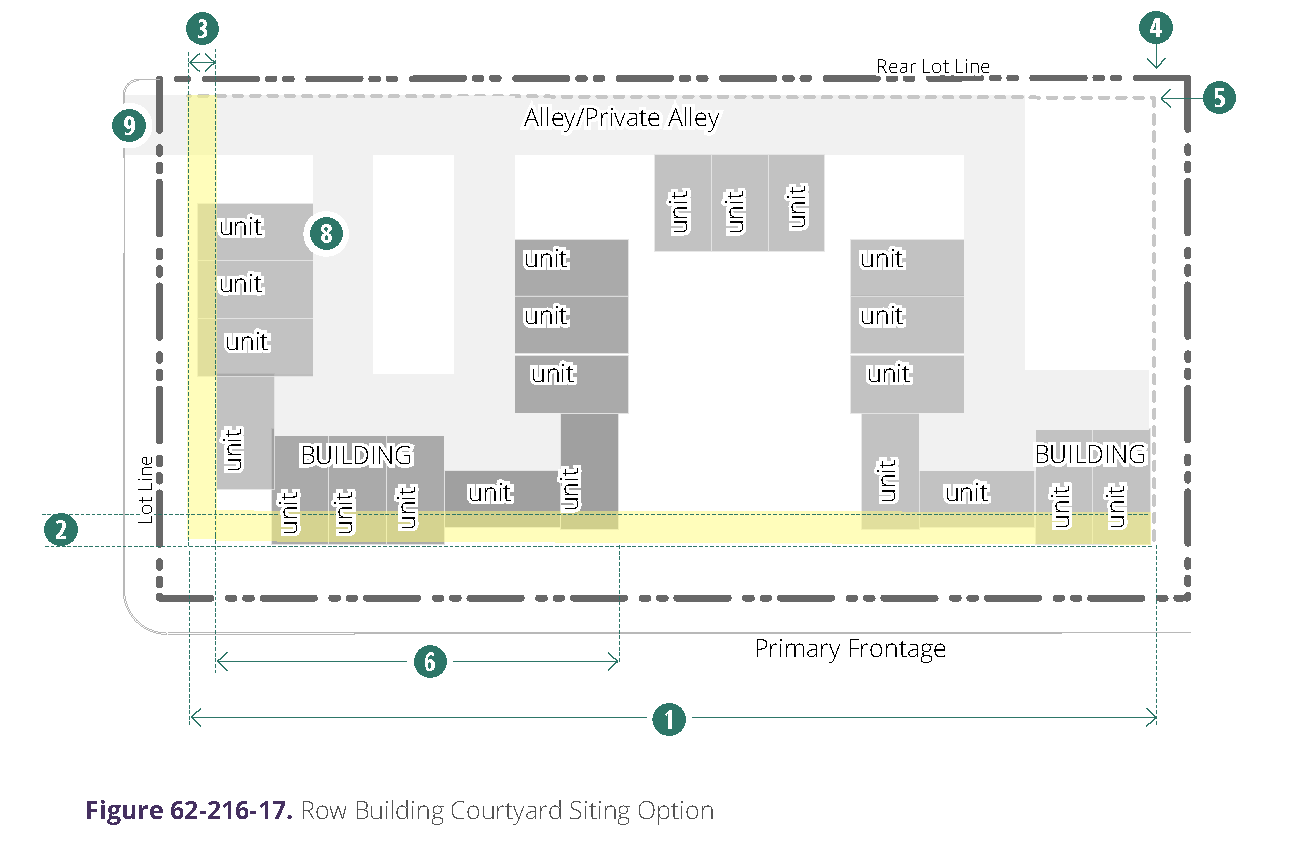
(e)
Yard building type. Refer to Figure 62-216-1. building types by district table and the village's zoning map for permitted locations for the yard building type.
(1)
Description and intent. The yard building is low scale building, surrounded by yard and landscape area, housing one to six family units, with requirements for a front stoop or porch and parking in the rear.
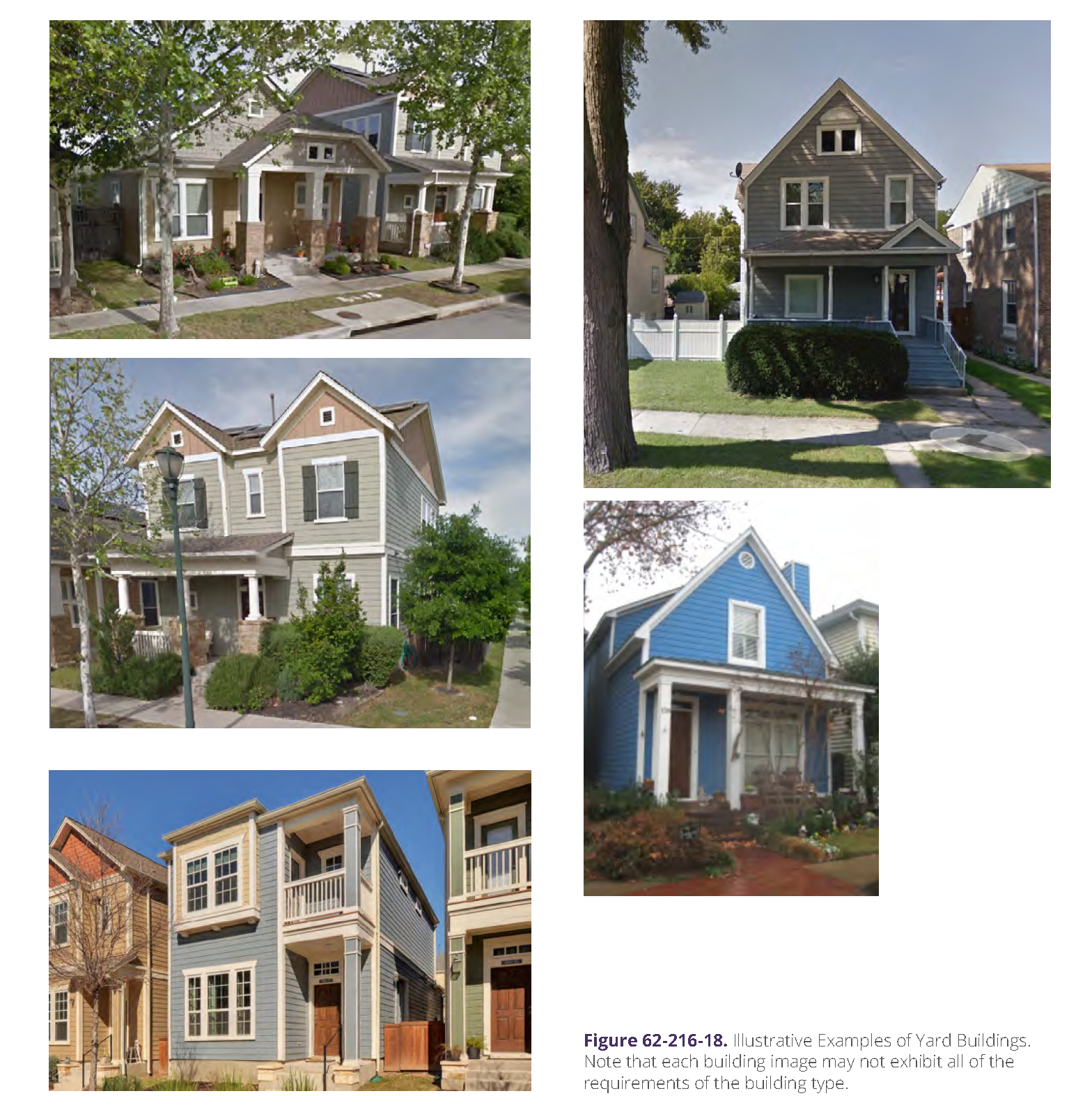
(2)
Requirements. The following defines the requirements specific to this building type. Refer to section 62-216(a) and 62-216(h) for requirements applicable to all building types.
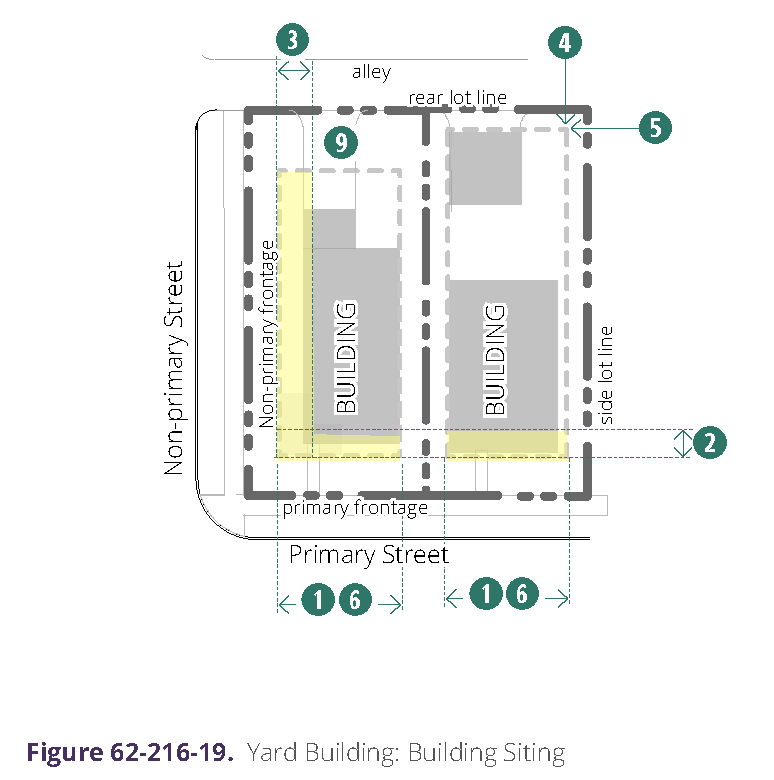
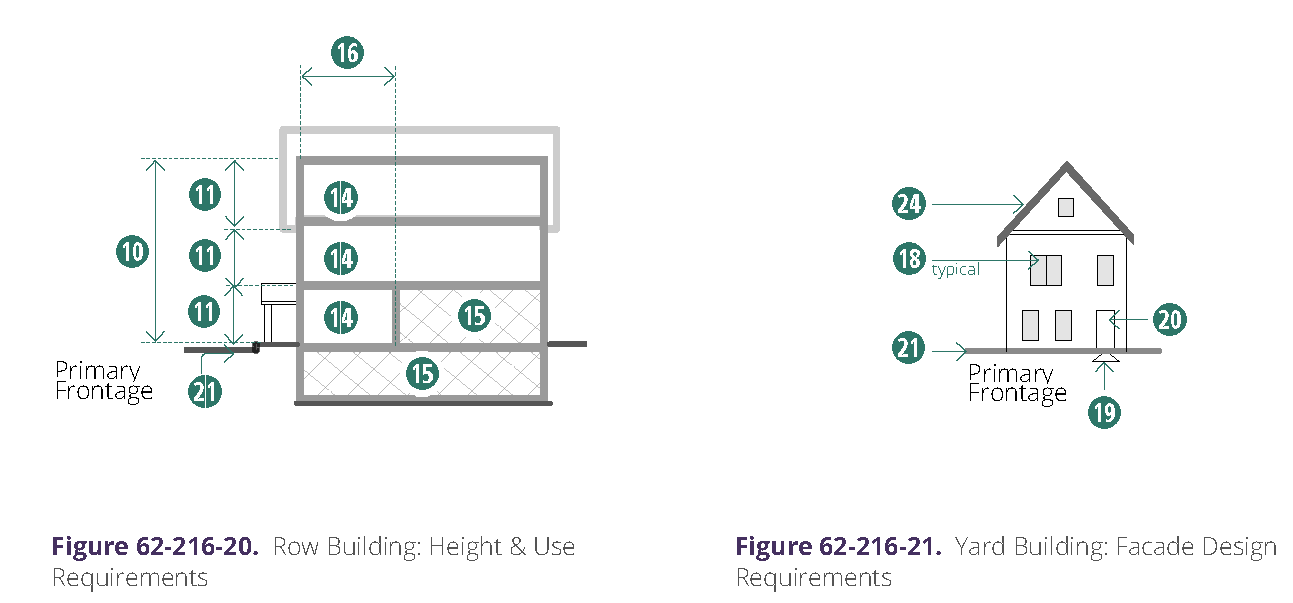
(3)
Notes. The following notes supplement the above requirements for the yard building type.
a.
Front facade and entrances. Each unit shall have a facade located within the primary build-to zone, except one of every three units may front a courtyard, existing open space/park, waterway, or non-primary street. Refer to entrance location and number for additional requirements.
b.
Courtyards. Multiple yard buildings may be organized on a lot to create a yard building court. Refer to Figure 62-216-22. A courtyard may contribute to the minimum primary frontage build-to zone coverage. One courtyard, maximum of 30 percent of facade width or 30 feet wide, whichever is less, may count towards primary frontage build-to zone coverage.
c.
Alley access off streets. If no alley exists or is required per regulating plan, a private alley is required with access off a non-primary street. One access point is permitted off a secondary street for every 175 feet of street frontage. If a non-primary street exists, one access point off a primary street is permitted, maximum 18 feet in width. Refer to Figure 62-215-1. Regulating plan: Congress Park Station Area, Figure 62-215-2. Regulating plan: Brookfield Station Area, and Figure 62-215-3. Regulating plan: Hollywood Station Area.
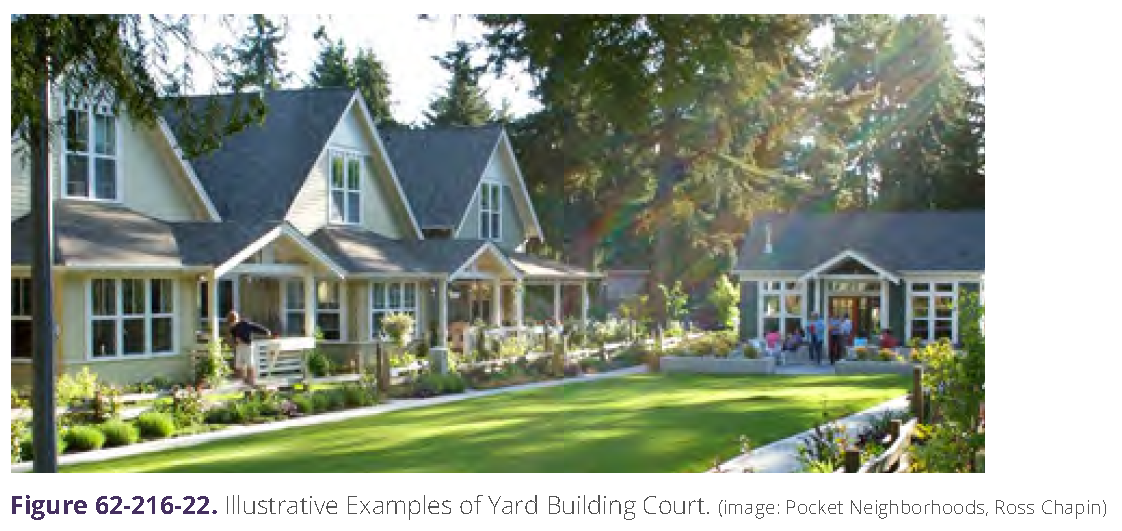
(f)
Civic building type. Refer to Figure 62-216-1. building types by district table and the village's zoning map for permitted locations for the civic building type.
1.
Description and intent. The civic building type is the most flexible building, meant to allow for singular, more iconic designs within the district. This building type, however, is limited to civic and institutional uses.
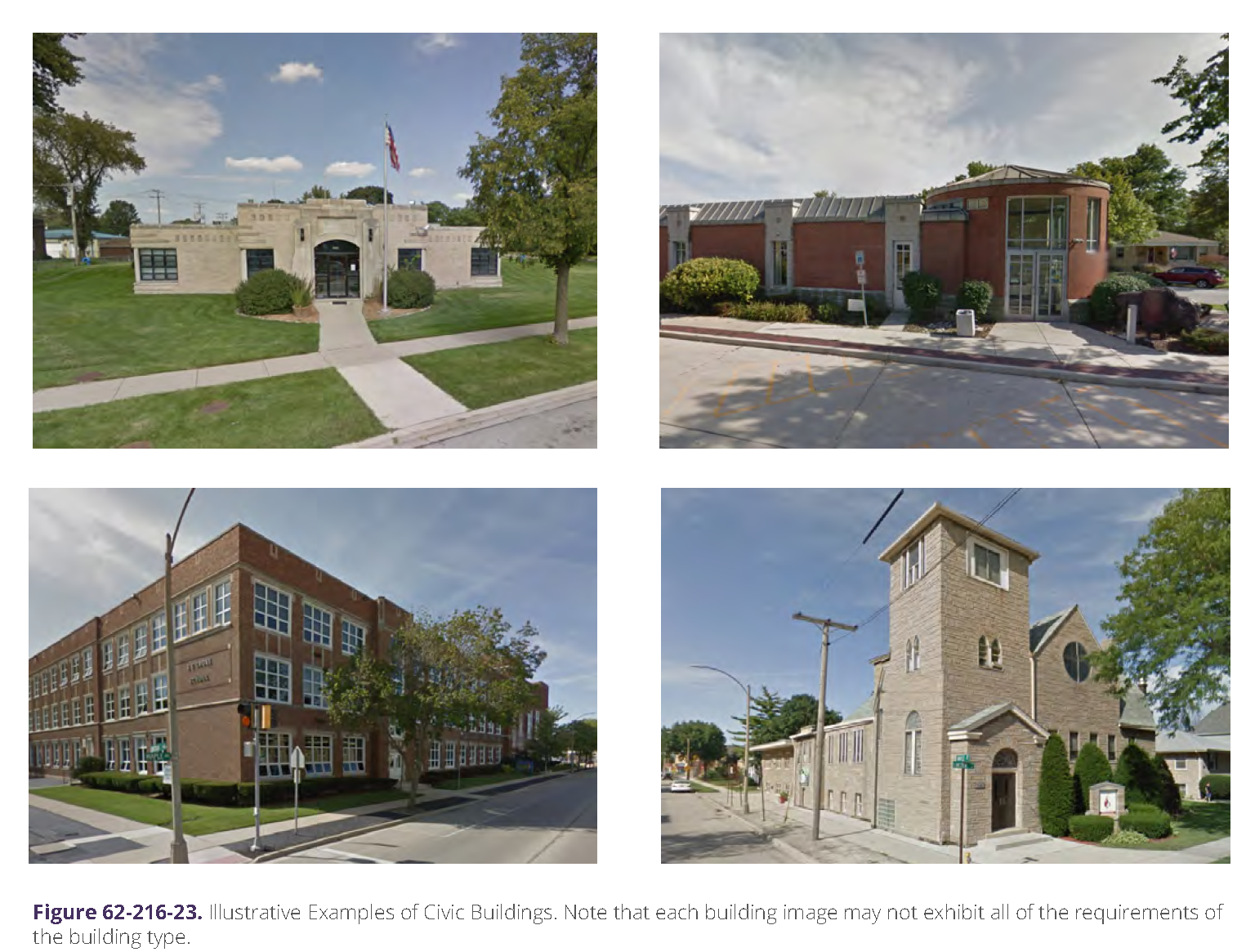
2.
Requirements. The following defines the requirements specific to this building type. Refer to section 62-216(a) and 62-216(h) for requirements applicable to all building types.
In all districts, development of this building type requires a special use permit.
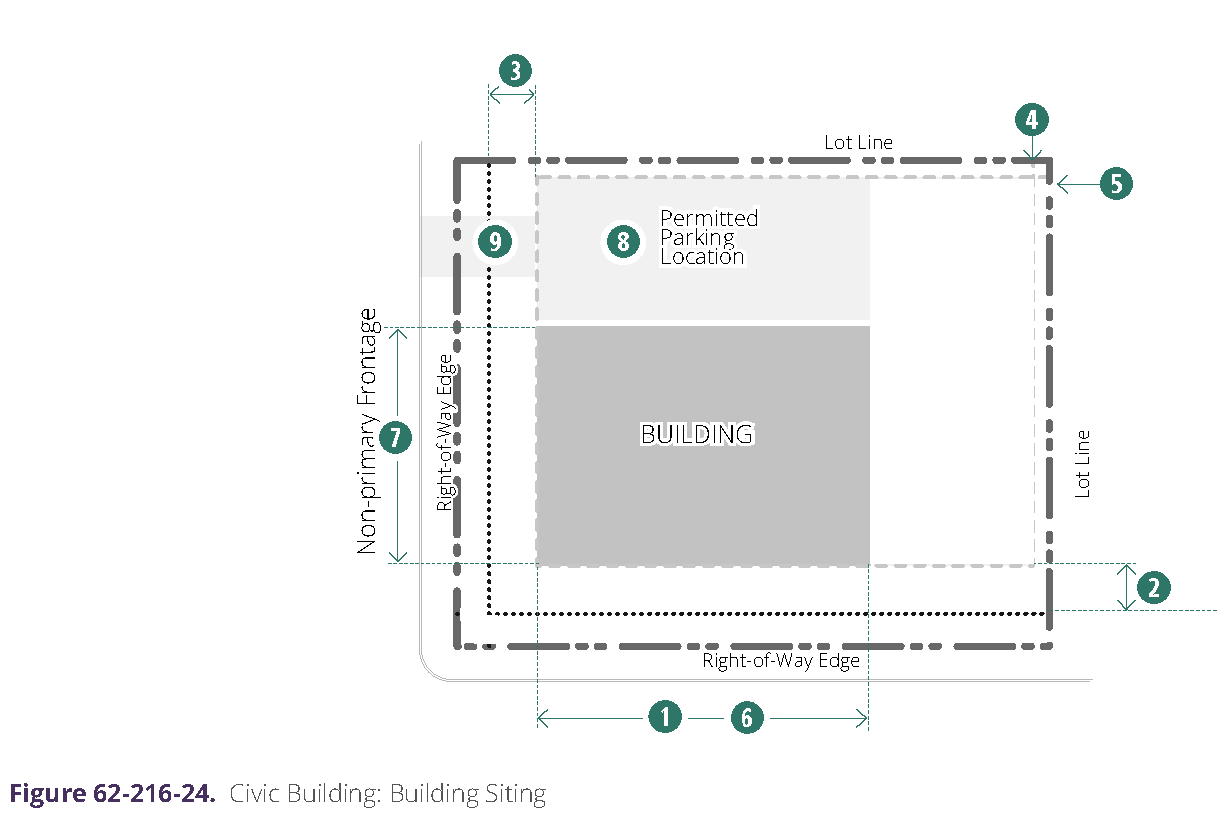
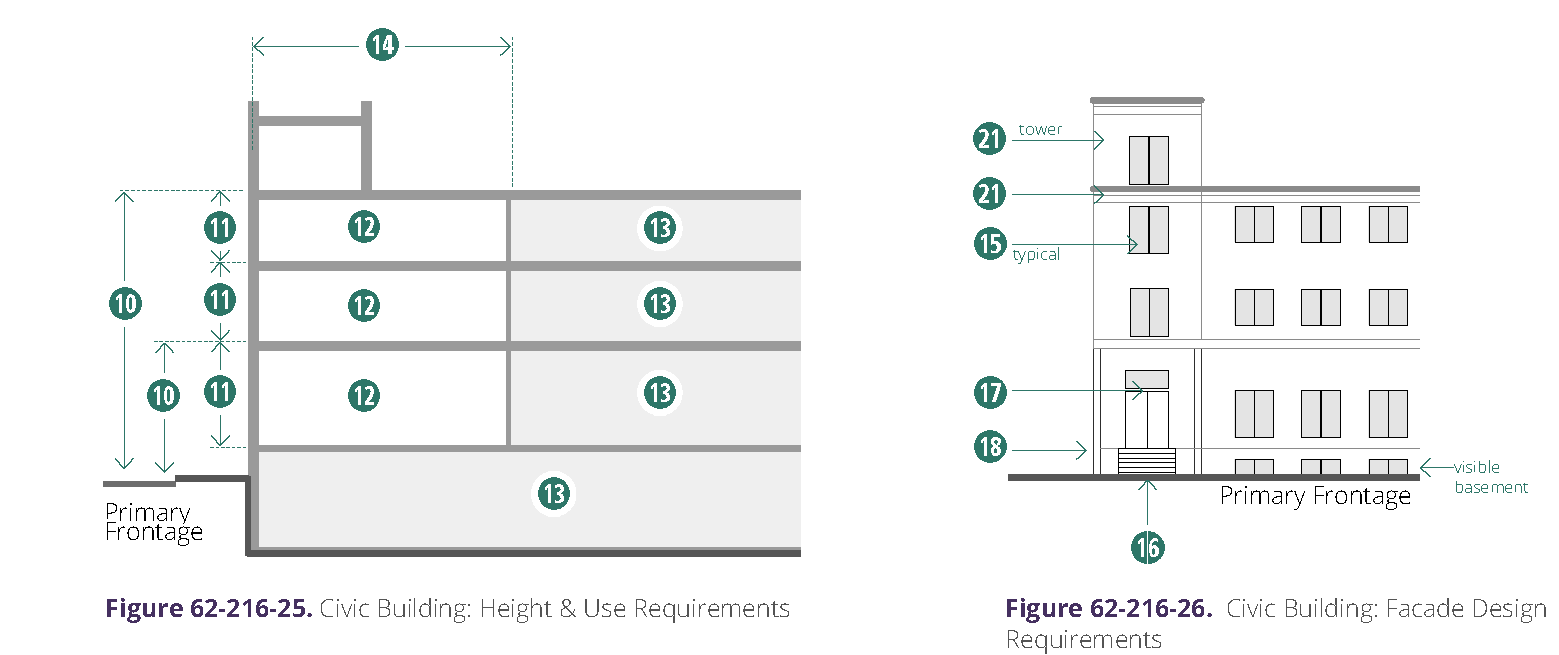
(3)
Notes. The following notes supplement the above requirements for the civic building type.
a.
Courtyards. A courtyard may contribute to the minimum primary frontage build-to zone coverage. One courtyard, maximum of 30 percent of facade width or 30 feet wide, whichever is less, may count towards primary frontage build-to zone coverage.
b.
Limited side yard parking. Limited side yard parking means one double or single loaded aisle, perpendicular to the street. Limited front and corner side parking means head-in parking off the adjacent right-of-way.
c.
Driveway access off streets. If no alley exists or is required per the regulating plans, one driveway is permitted off non-primary street or facade. If no non-primary street exists, one driveway is permitted off a primary street, maximum width of 22 feet. Refer to Figure 62-215-1. Regulating plan: Congress Park Station Area, Figure 62-215-2. Regulating plan: Brookfield Station Area, and Figure 62-215-3. Regulating plan: Hollywood Station Area.
(g)
Measurement of building type requirements. The following explains and further defines the standards outlined on the tables on the previous pages, specific to each building type, refer to 62-216(c) through (f).
(1)
Minimum primary frontage lot line coverage. The minimum percentage of building facade along the primary frontage of a lot is designated on each building type table.
a.
Measurement. The width of the principal structures (as measured within the build-to zone along the frontage edge) is divided by the length of the frontage parallel to the property line following the street. Refer to Figure 62-216-27. minimum primary frontage lot line coverage.
b.
Courtyards. Where noted by building type, courtyards, per 62-215(g), definitions, located along the facade in the build-to zone count towards the minimum coverage.
c.
Civic space type. Open spaces per civic space type requirements are exempt from minimum primary frontage lot line coverage.
1.
Build-to zone. The build-to zone is designated separately for each frontage on each building type table. Refer to Figure 62-216-28. build-to zones.
i.
Measurement. The build-to zone for all frontages is measured from the property line parallel to the frontage, unless otherwise noted. When additional streetscape area is required, the build-to zone is measured from the edge of the required streetscape onto the site.
ii.
Encroachments. Awnings, balconies, and building mounted signage may extend up to three feet beyond the build-to zone into any yard area, but may not extend into the street right-of-way.
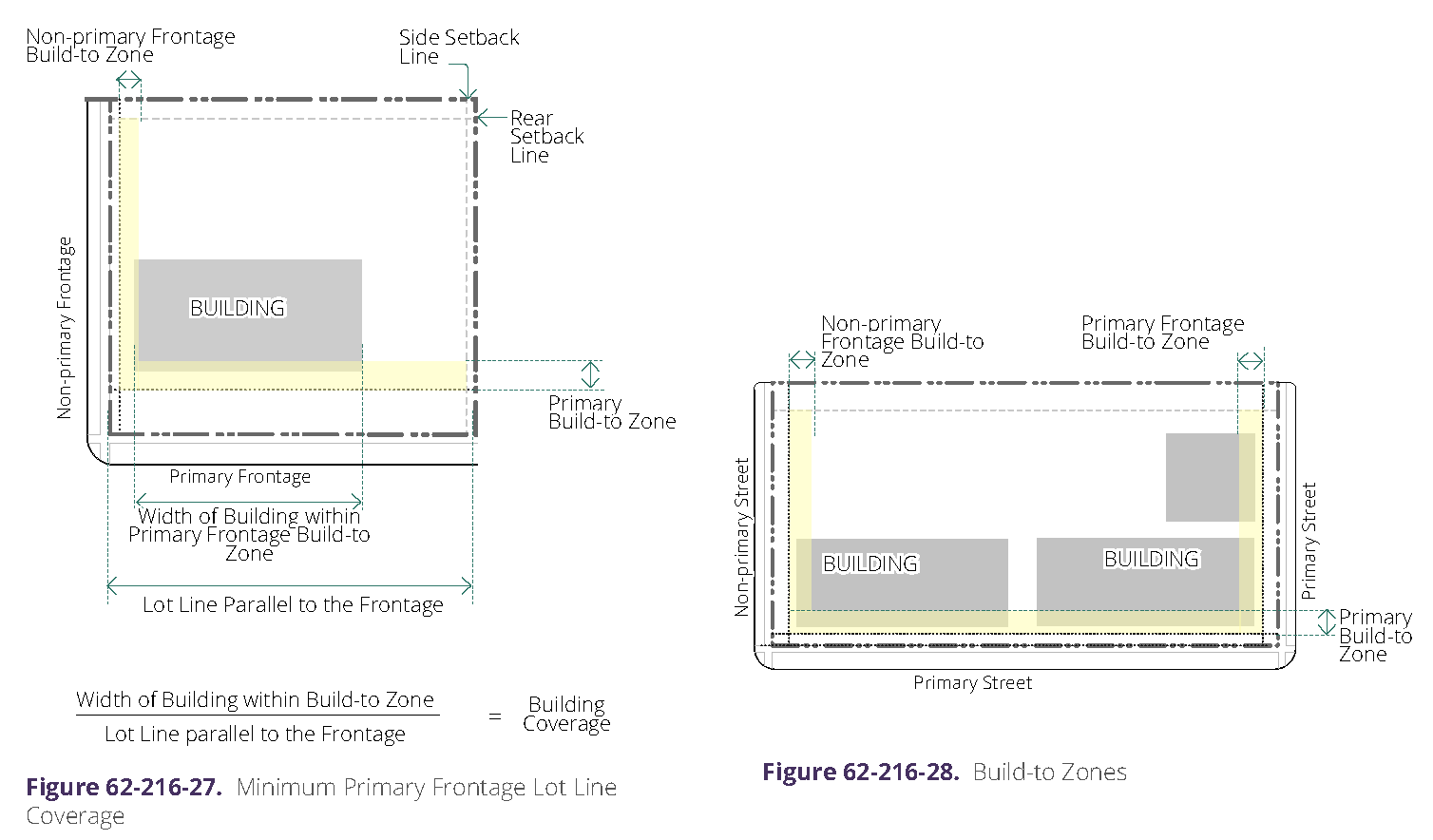
(2)
Ground story and upper stories, minimum and maximum height. (Refer to Figure 62-216-29. measuring stories with floor-to-floor height).
a.
Minimum overall height. Minimum heights require a minimum number of stories on the primary frontage facades of the building. The building must meet the minimum required height for the first 30 feet of occupied building space measured from the primary frontage facade into the building.
b.
Maximum overall height. Maximum heights are specified both in number of stories and overall dimension. This requirement applies to the entire building.
1.
Towers. Where noted, towers may exceed the overall maximum height per 62-216(h), cap types.
2.
Cap type. Where noted, certain cap types may allow additional height.
c.
Two half stories. Refer to 62-215(g) for definition of a half story. A building incorporating both a half story within the roof and a visible basement shall count the height of the two half stories as one full story.
(3)
Minimum and maximum height per story. Each story is measured with a range of permitted floor-to-floor heights. Refer to Figure 62-216-29. measuring stories with floor-to-floor height.
a.
Measurement. Floor height is measured in feet between the floor of a story to the floor of the story above it. Minimum and maximum floor-to-floor heights are required to be met on floors along facades, a minimum of 80 percent of each story.
b.
Single story buildings and top floor measurement. For single story buildings and the uppermost story of a multiple story building, floor-to-floor height shall be one foot less than noted per building type and measured from the floor of the story to the ceiling.
c.
Mezzanines. Mezzanines may be included within the floor-to-floor height of any story, included in the calculation of stories. Mezzanines occupying more than 30 percent of the floor area below and extending above the story's allowable floor-to-floor height shall count as an additional story, including articulation of the story per section 62-217(d), building articulation.
d.
Taller spaces. Spaces exceeding the allowable floor-to-floor heights of the building are not permitted on primary frontage facades. These spaces are unlimited on interior lots and non-primary frontage facades, but shall be counted as the number of stories that would fit within their height.
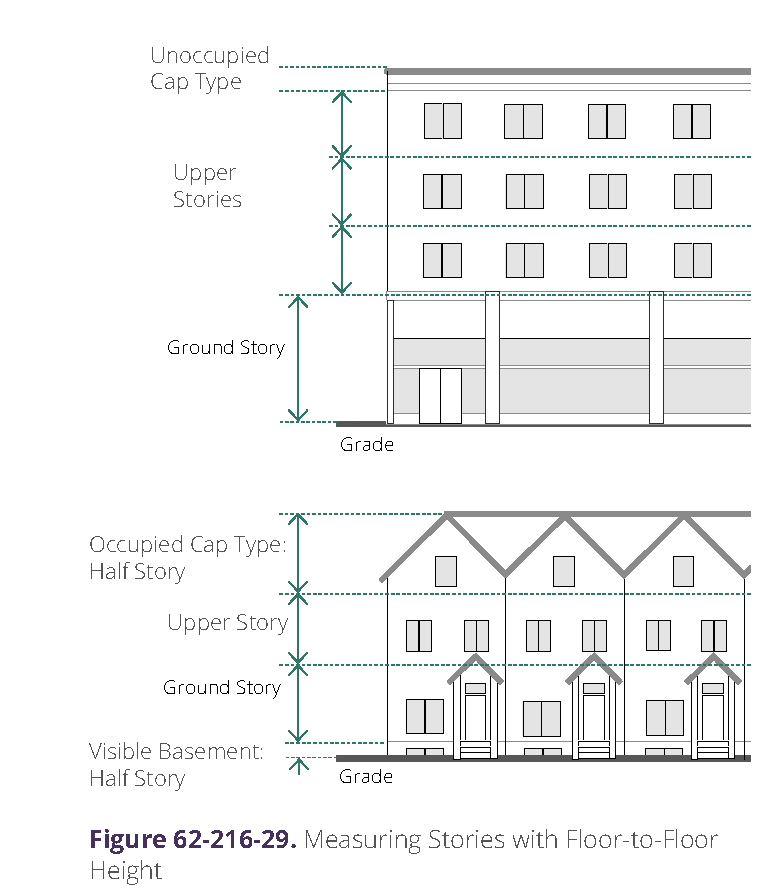
4.
Minimum required transparency. Per the requirements of each building type, a minimum amount of transparency is required on all stories of all facades.
a.
Measurement. Minimum facade transparency is measured from floor-to-floor of each story separately. Refer to Figure 62-216-30. measuring minimum facade transparency. Transparency, defined in 62-215(g), definitions, includes windows and any glass in doors that is highly transparent with low reflectance. The measurement may include the frame, mullions, and muntins, but shall not include trim or casing.
b.
Blank wall segments. No more than a 15-foot wide section, measured horizontally, and no more than 30 percent of any story shall be without transparency.
i.
Exception. When a facade of any story is located within three feet of a parallel building facade, no minimum transparency is required for that story.
c.
Minimum ground story transparency. When required by the building type, ground story transparency shall be measured between two feet and either eight or ten feet, as noted, from the average grade at the base of the facade. Minimum ground story transparency supersedes the overall minimum transparency required for the building type.
d.
Tall stories. Stories that are 18 feet or taller in height shall be counted as two stories for the purpose of calculating minimum facade transparency, with each horizontal half of the story calculated separately.
e.
Half stories. All half stories located within roof structure and visible basements are required to meet the minimum transparency.
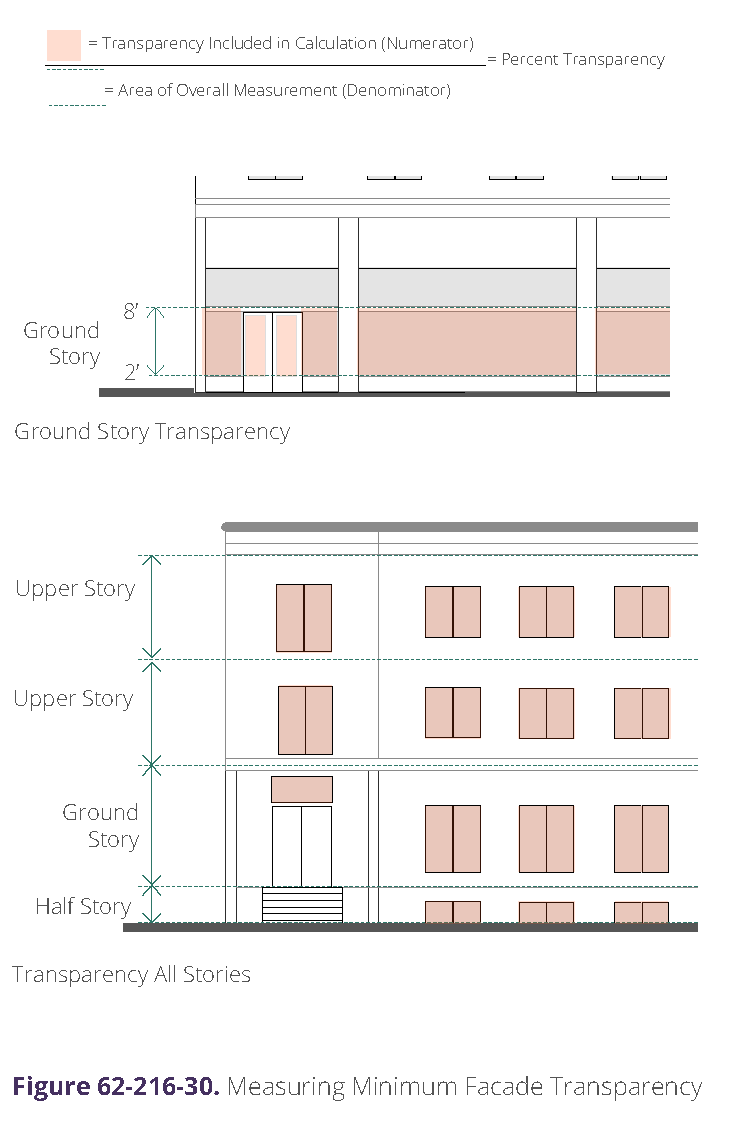
(h)
Cap types. The major components of any roof shall meet the requirements of one of the cap types permitted per building type. Roofs for bay or bow windows and dormers are not required to meet a cap type.
(1)
Other cap types. Special cap designs otherwise not defined in this section may be approved through an minor design exception during the design review process with the following requirements:
a.
The building shall warrant a separate status from the majority of buildings in the district, with a correspondence between the form of the cap and the building use, such as a dome for a planetarium, a dome for a place of worship, or a unique, singular roof for a more distinctive city hall.
b.
The cap type shall not create additional occupiable space beyond that permitted by the building type.
c.
The shape of the roof shall be different from those defined in this section 62-216(h), cap types, such as a dome, spire, or vault, and not a gabled roof, hipped roof, butterfly roof, gambrel roof, mansard roof, roof with parapet, or flat roof.
(2)
Pitched cap type. (Refer to Figure 62-216-31. examples of pitched cap type). This cap type is a sloped or pitched roof. Slope is measured with the vertical rise divided by the horizontal span or run.
a.
Pitch measure. The roof may not be sloped less than a 4:12 (rise:run) or more than 14:12. Slopes less than 4:12 are permitted to occur on second story or higher roofs.
b.
Configurations.
1.
Hipped, gabled, and combination of hips and gables with or without dormers are permitted.
2.
Butterfly (inverted gable roof) and shed roofs are permitted with a maximum height of eight feet, inclusive of overhang.
c.
Parallel ridge line. A gabled end or perpendicular ridge line shall occur at least every 100 feet of roof when the ridge line runs parallel to the front lot line. (Refer to Figure 62-216-31. examples of pitched cap type).
d.
Roof height. Roofs without occupied building space and/or dormers shall have a maximum height on primary and non-primary frontage facades equal to no more than one and one-half times the upper story floor to floor height utilized on the building.
e.
Occupied building space. Occupied building space may be incorporated behind this cap type. If used, the space counts as a half story.
f.
Rooftop appurtenances. With the exception of solar panels, any rooftop appurtenances shall be recessed within the pitched roof with no visibility on any street elevation drawing.
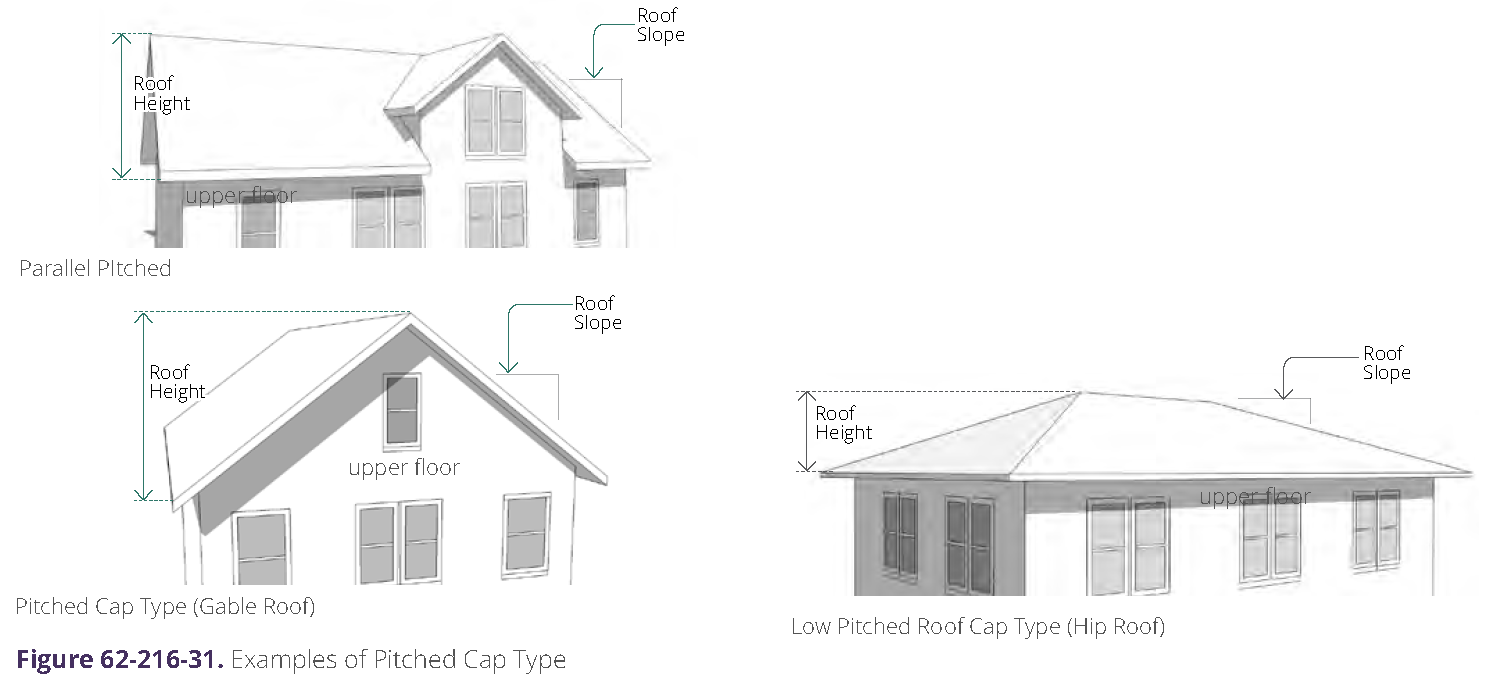
(3)
Parapet cap type. (Refer to Figure 62-216-32. example of a parapet cap type). A parapet is a low wall projecting above a building's roof along the perimeter of the building.
a.
Parapet height. Height is measured from the top of the upper story to the top of the parapet. Minimum height is 2 feet with a maximum height of six feet. Horizontal expression lines. An expression line shall define the parapet from the upper stories of the building and shall also define the top of the cap. Refer to section 62-215(g), definitions for expression line.
b.
Occupied building space. Occupied building space shall not be incorporated behind this cap type.
c.
Rooftop appurtenances. With the exception of solar panels, any rooftop appurtenances shall be located towards the rear or interior of the parapet roof. The parapet shall screen the mechanicals from the elevation of the sidewalk across the street
(4)
Flat cap type. (Refer to Figure 62-216-33. example of a flat cap type). This cap type is a visibly flat roof with overhanging eaves.
a.
Configuration. The roof shall have no visible slope from the street and eaves are required on all primary and non-primary frontage facades.
b.
Eave depth. Eave depth is measured from the building facade to the outside edge of the eave. Eaves shall have a depth of at least 14 inches.
c.
Eave thickness. Eave thickness is measured at the outside edge of the eave, from the bottom of the eave to the top of the eave. Eaves shall be a minimum of six inches thick.
d.
Interrupting vertical walls. Vertical walls may interrupt the eave and extend above the top of the eave with no discernible cap.
1.
No more than one-third of the front facade may consist of an interrupting vertical wall.
2.
Vertical walls shall extend no more than eight feet above the top of the eave.
e.
Occupied building space. Occupied building space shall not be incorporated behind this cap type.
f.
Rooftop appurtenances. With the exception of solar panels, any rooftop appurtenances shall be located behind the interrupting vertical wall with no visibility on any street elevation drawing.
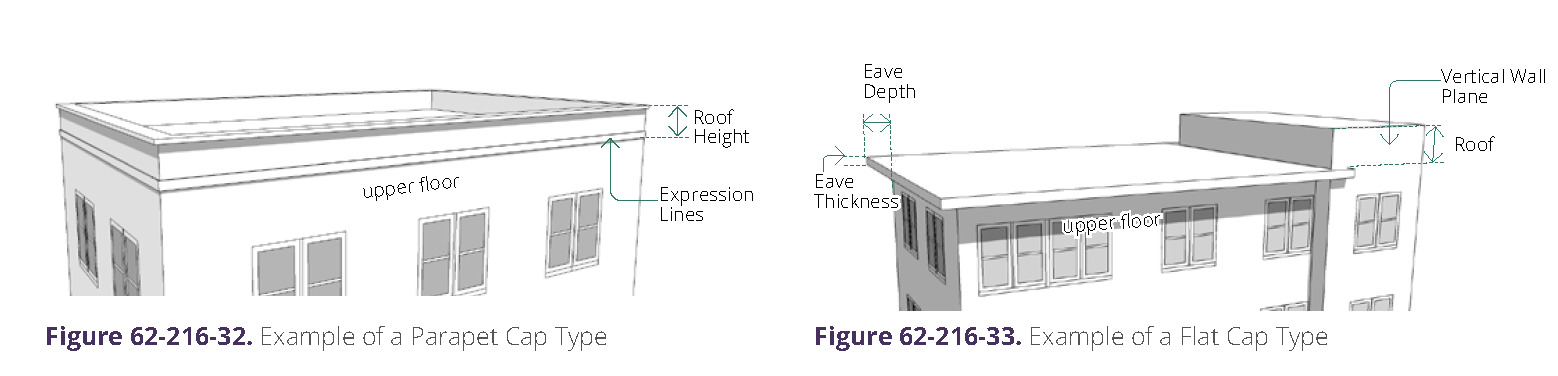
(5)
Towers. A tower is a vertical element, polygonal (simple), rectilinear or cylindrical in plan that shall be used with other cap types. Refer to Figure 62-216-34. example of a tower.
a.
Quantity. The number of towers permitted on each building type is specified in the building type tables (sections 62-216(b) through (f)). Tower locations are typically limited to allowing towers associated with the facade design and visible from the street, and those more functional towers located beyond the facade.
b.
Tower height. Maximum height, measured from the top of the parapet or eave to the top of the tower shaft not including the cap, is the equivalent of the height of one upper floor of the building to which the tower is applied.
c.
Tower width. Maximum width along all facades is one-third the width of the front facade or 30 feet, whichever is less.
d.
Tower spacing. Towers shall be generally spaced from other towers a minimum of 60 feet and specifically by a minimum of 120 feet along a primary or non-primary frontage facade.
e.
Transparency. Towers that meet the minimum floor-to-floor to height of the building type and are located within 30 feet of a facade shall meet the minimum transparency requirements of the building.
f.
Horizontal expression lines. An expression line is required between the fourth and fifth stories of any tower and at the cap of the tower.
g.
Occupied building space. Towers may be occupied by the same uses allowed in upper stories of the building type to which it is applied, unless otherwise stated.
h.
Rooftop appurtenances. No rooftop appurtenances are permitted on tower roofs.
i.
Tower cap. The tower may be capped by the parapet, pitched, or flat roof cap types.
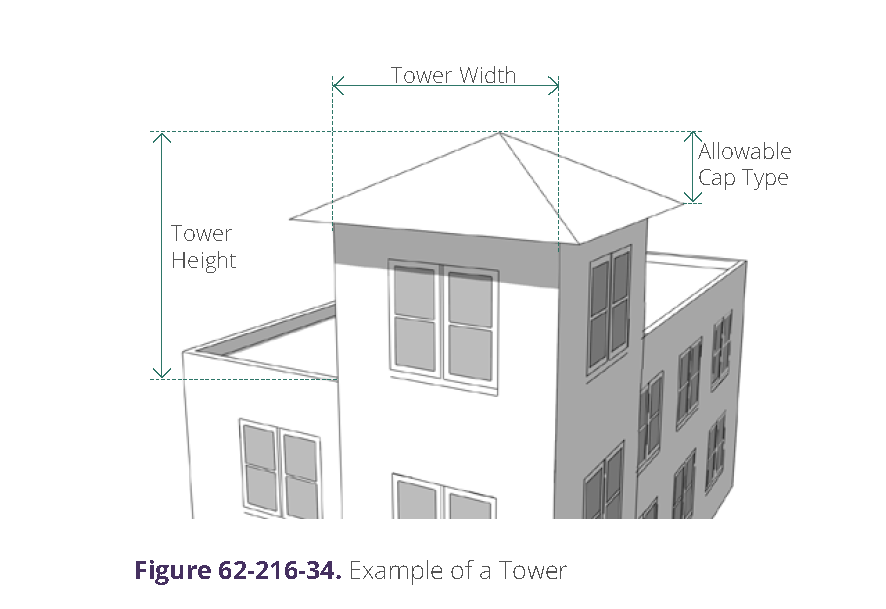
(Ord. No. 2017-9, § 4.D., 1-9-2017; Ord. No. 2019-18(2), § 7, 4-22-2019; Ord. No. 2019-58, §§ 11, 12, 12-9-2019; Ord. No. 2021-39, § 4, 4-12-2021; Ord. No. 2021-43, § 4, 4-26-2021; Ord. No. 2024-18, § 4, 3-25-2024)
Sec. 62-217. - General design.
(a)
Materials. The following establishes general materials requirements applicable to all building types.
1.
Intent. The intent of the following requirements is to require well-tested, high quality, durable materials intended for the majority of finished surfaces, while permitting a wider range of materials for details.
2.
Major materials. A minimum of 80 percent of each street facade, not including window and door areas, shall be constructed of Major Materials.
a.
Simplicity of surface materials. A minimum of 70 percent of each facade, not including window and door areas, shall be constructed of one or two major materials per this section.
b.
Side and rear facades. Permitted major materials shall continue around the corner of a building from the street facade onto the side or rear facade for no less than 30 feet along the side or rear facade. Refer to limited use major materials for materials permitted on side and rear facades.
c.
Permitted major materials. Major materials shall be finish quality materials. The following are acceptable major materials. Refer to Figure 62-217-1. major materials.
1.
Stone.
2.
Brick.
3.
Glass curtain wall.
4.
Architectural metal panels.
5.
Wood and composite wood.
6.
Architectural finish fiber cement concrete panels and plank.
d.
Prohibited major materials. The following materials are not permitted for use as major materials:
1.
Exposed, unfinished concrete.
2.
Synthetic stucco (using foam insulation board).
3.
Unfinished or untreated wood except as listed above.
4.
Glass block.
5.
Vinyl siding.
6.
Plastic, fiberglass and acrylic panels.
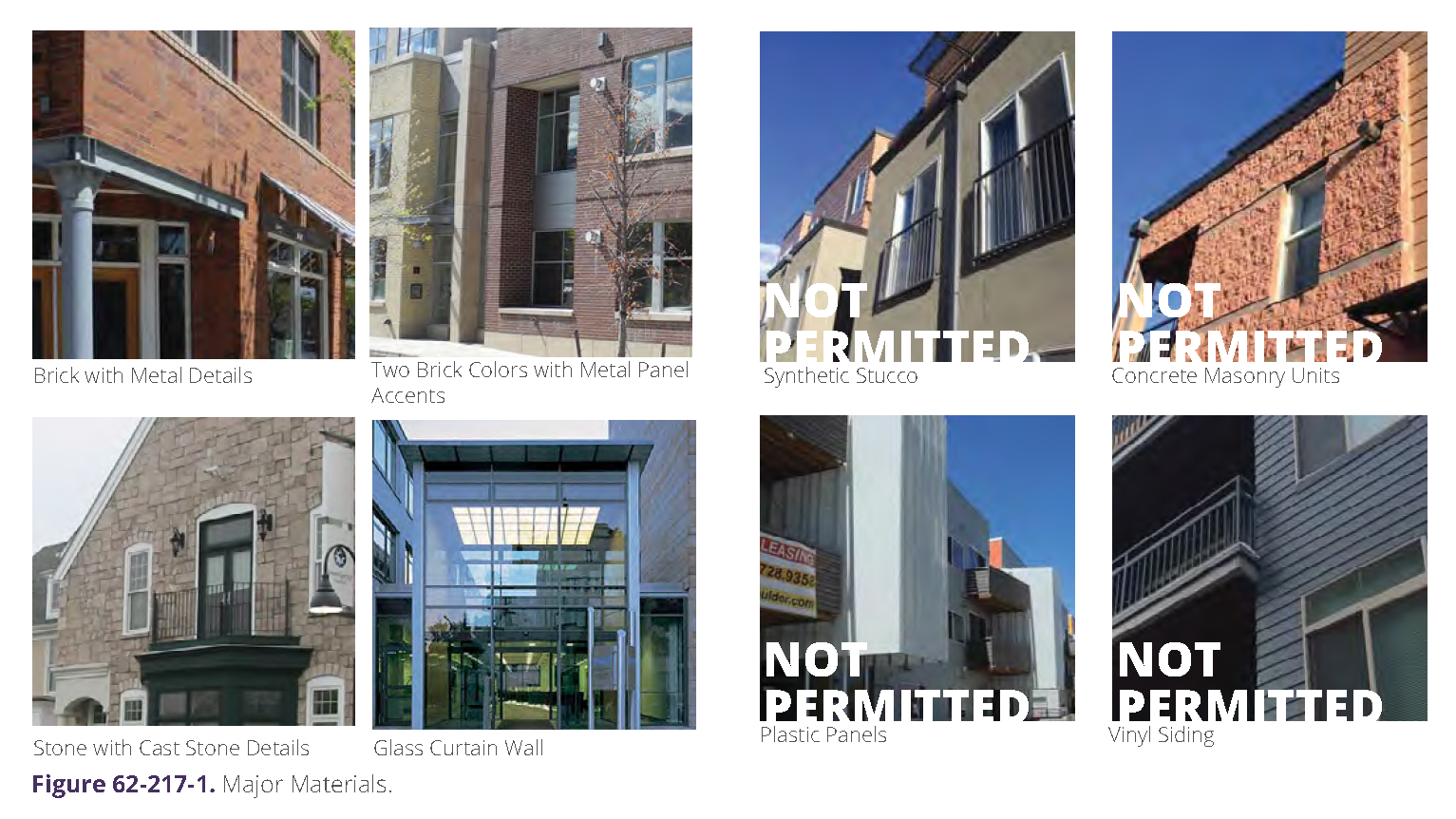
e.
Limited use major materials. The following materials are prohibited except consistent with the following:
1.
Economy bricks. Brick types larger than three inches in height are permitted as major materials on interior side, rear, and alley facades.
2.
Fiber cement board. Fiber cement lap siding or shingles (such as Hardie Plank or Hardie Shingle or similar) are permitted.
3.
Wood lap siding and shingles. Painted wood, engineered wood, or composite wood lap siding and wood shingles are permitted.
4.
Cement-based stucco. Cement-based stucco is permitted on all stories above the third story, and on all story facades facing rear yards or alleys.
5.
Concrete masonry units (CMU). Burnished, glazed, or honed concrete masonry units (CMU) or block are permitted as major materials on facades facing rear yards or alley.
(3)
Minor materials. Minor materials are limited to trim, details, and other accent areas that combine to less than 20 percent of the total surface of each facade.
a.
Major materials. All permitted major materials may serve as minor facade materials.
b.
Permitted minor materials. Permitted minor materials include the following:
1.
Fiber cement and wood trim pieces;
2.
Metal for beams, lintels, trim, exposed structure, and other ornamentation;
3.
Burnished, glazed, or honed concrete masonry units (CMU) or block for columns, trim, and details, and no surfaces except storefront knee walls;
4.
Split-face, honed, or glazed concrete masonry units with a height less than 4.5 inches for surfaces less than ten percent of the facade surface;
5.
Cast stone concrete elements;
6.
Vinyl for window trim and soffits;
7.
Cement-based stucco for surfaces.
c.
Limited use minor materials. The following materials are permitted as minor surface materials on upper floor facades only:
1.
Synthetic stucco or exterior insulation and finishing systems (EIFS), such as Dryvit.
2.
Fiber cement lap siding or shingles (such as HardiePlank or HardieShingle or similar) on storefront, general, and civic building types.
(4)
Roof materials. Acceptable roof materials include dimensional asphalt composite shingles, wood shingles and shakes, metal tiles or standing seam, slate, and ceramic tile. "Engineered" wood or slate may be approved during the site plan process with an approved sample as delivered to the village manager and documented examples of successful, high quality local installations.
(5)
Other materials with approval. Other high quality materials, not listed, may be requested with a minor design exception during the design review approval process. Samples and examples of successful, high quality local installations shall be provided by the applicant to the village manager.
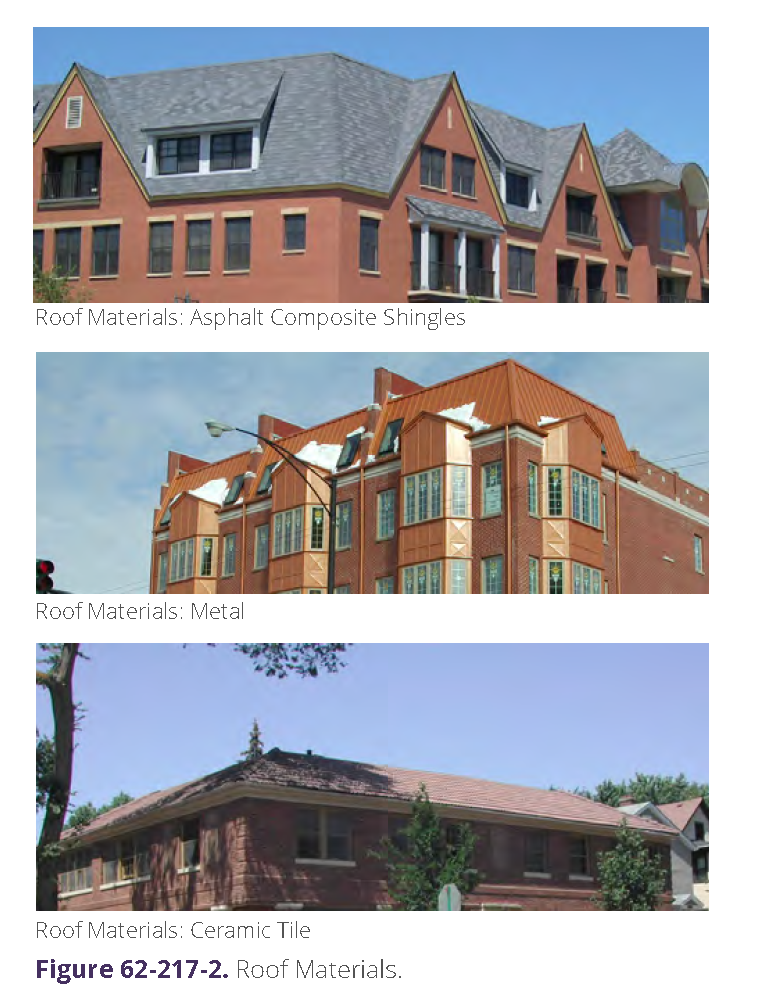
(6)
Appropriate grade of materials. Commercial grade doors, windows, and hardware shall be used on all building types with the exception of the row building and the yard building. Refer to Figure 62- 217-3.
(b)
Building facade elements. The following establishes general building facade design requirements applicable to all building types.
(1)
Windows. Windows on all buildings shall be constructed per the following requirements as shown in Figure 62-217-4. vertically oriented windows with expressed lintels. The following requirements apply to all buildings in the special design areas.
a.
Amount. The required percentage of transparency is defined per building type. Refer to sections 62-216(b) through 62-216(f)
b.
Recessed. On all buildings, all windows, with the exception of ground story storefront systems, shall be recessed with the glass a minimum of two inches back from the facade surface material or adjacent trim.
c.
Vertically oriented. All windows shall be vertically oriented with the following exceptions:
1.
Flat cap type. When the flat cap type (refer to section 62-216(h), cap types) is utilized, horizontally oriented windows are permitted for 30 percent of the total transparency area of each story above the ground story.
2.
Rear and side facades. On rear and side facades, up to 50 percent of the total transparency area of each story may include horizontally oriented windows.
3.
Exception. Horizontally oriented windows exceeding 40 percent or more of the level of transparency for any story may be requested through the minor design exception process.
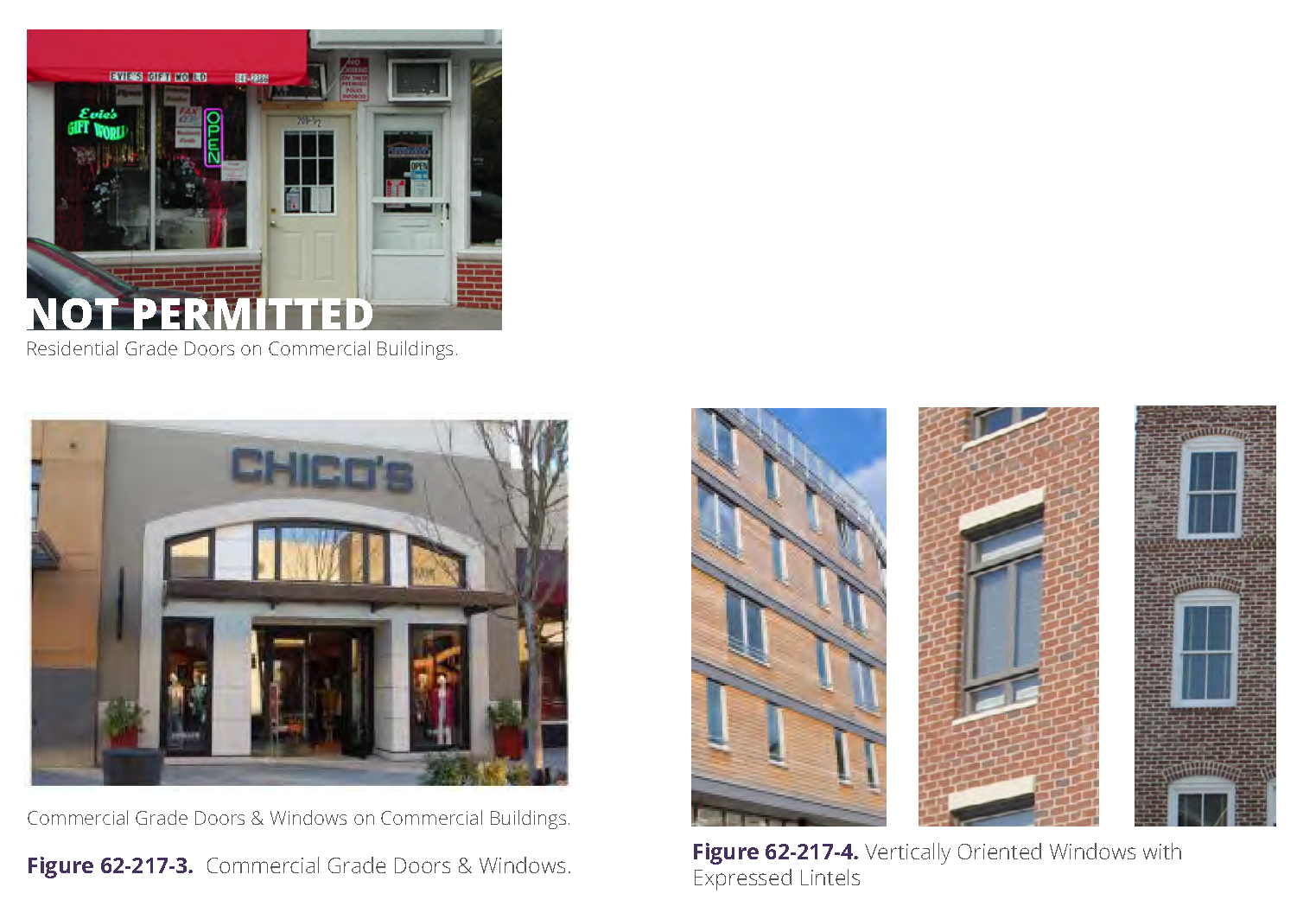
d.
Visibility through glass. Reflective glass and glass block are prohibited on street facades. Refer to section 62-215(g), definitions for permitted reflectance of window and door glass.
e.
Operable windows. A minimum of 50 percent of the windows on each story of each facade shall be operable.
f.
Expressed lintels. Lintels shall be expressed above all windows and doors, whether by a change in brick coursing or a separate element.
(2)
Awnings. Refer to Figure 62-217-5. examples of permitted awnings.
a.
Material. All awnings shall be canvas or metal. Plastic awnings are prohibited.
b.
Shapes. Waterfall or convex, dome, and elongated dome awnings are not permitted.
c.
Lighting. Backlit awnings are not permitted.
d.
Supports. Frames shall be metal and shall be wall mounted. Support poles are not permitted unless utilized for outdoor eating areas over 8 feet in depth.
e.
Clearance. All portions of any awning shall provide at least eight feet of clearance over any walkway and shall not extend over any driveway.
f.
Multiple awnings on the facade. When more than one awning is mounted on a facade, the awning types and colors shall be coordinated by matching the color, shape, material, or other element.
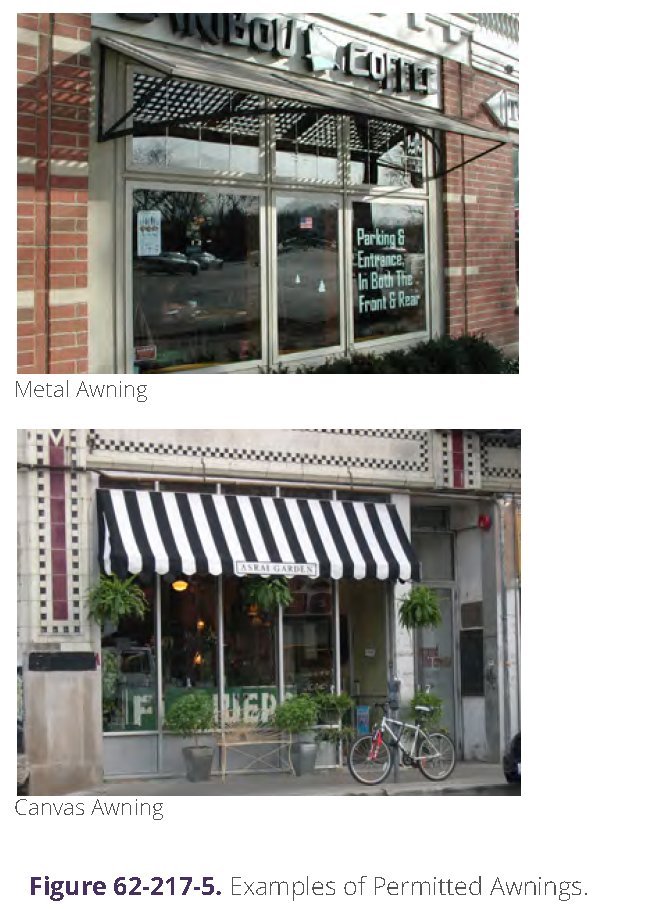
(3)
Security grills. Interior and exterior security bars, grills, mesh or similar obstructions, whether permanently or temporarily affixed, shall not cover any exterior door or more than ten percent of any individual window or contiguous window area.
4.
Balconies. The installation or construction of balconies on street facades is encouraged, but not required. Refer to Figure 62-217-6. examples of balconies.
a.
Applicability. These provisions apply to locations where balconies are incorporated into the facade design facing any street or public way.
b.
Size. Balconies shall be a minimum of four feet deep and five feet wide.
c.
Balcony structure. Balcony structure shall not include more than one balcony. The balcony support structure shall be integrated with the building facade; separate columns or posts supporting any balcony from the ground are prohibited. Balconies on stepped-back stories may be independently secured, extending from the facade.
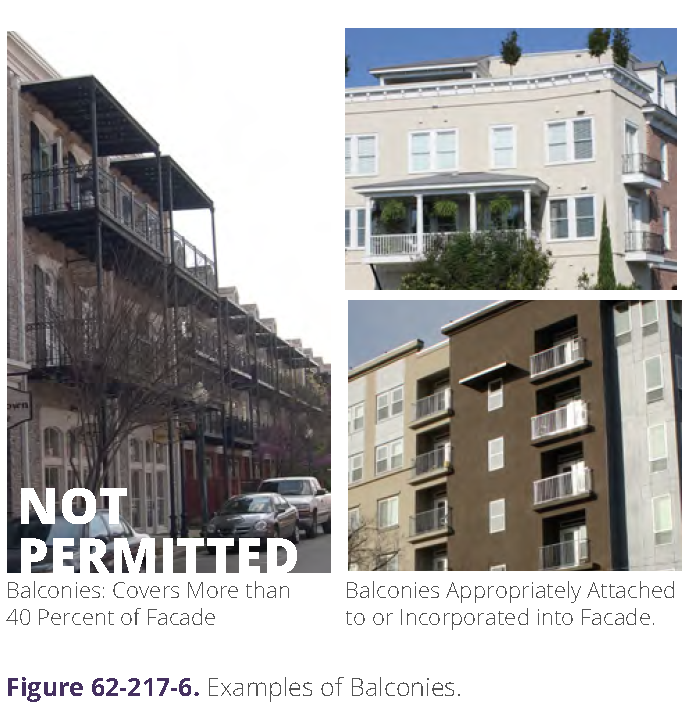
d.
Facade coverage. A maximum of 40 percent of the primary and mon-primary frontage facades, calculated separately for each facade, may be covered by balconies. The balcony area is calculated by drawing a rectangle around the platform/floor of balcony, any columns or indentions, and any ceiling/upper balcony.
(5)
Shutters. If installed, shutters on any facing facade, whether functional or not, shall meet the following requirements:
a.
Size. All shutters shall be sized for the windows, so that if the shutters were to be closed, they would completely cover the window.
b.
Materials. Shutters shall be wood, metal, or fiber cement. Vinyl shutters are not permitted. Other "engineered" woods may be approved by the village manager with an approved sample and examples of successful, high quality local installations showing no degradation or wear of the material.
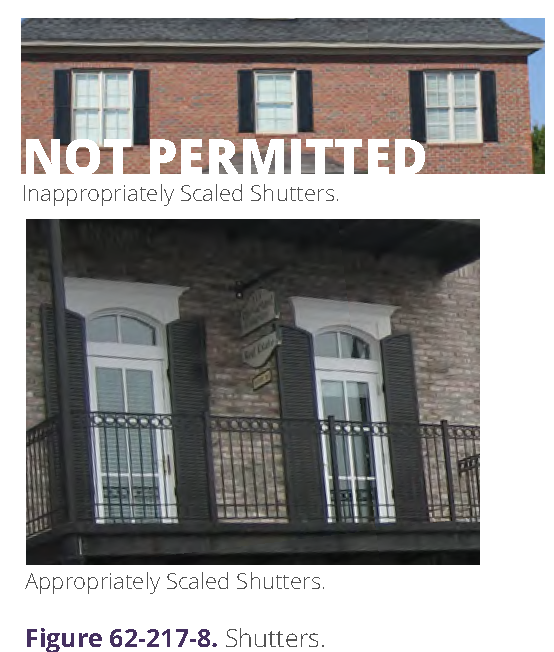
(6)
Principal entryway. Refer to Figure 62-217-7. examples of defined principal entryway. Principal entrances to buildings or units shall be clearly delineated through one or more of the following:
a.
Cap or canopy. The entryway shall be covered by a cap or canopy differentiating it from the overall building cap.
b.
Sidelights and transom. Sidelights and/or transom windows shall be included around the entryway.
c.
Extended articulation. The entryway shall be included in a separate bay of the building extended up at least two stories.
d.
Other design options. The village manager may approve different design options that add emphasis and draw attention to the entryway through a minor exception during design review.
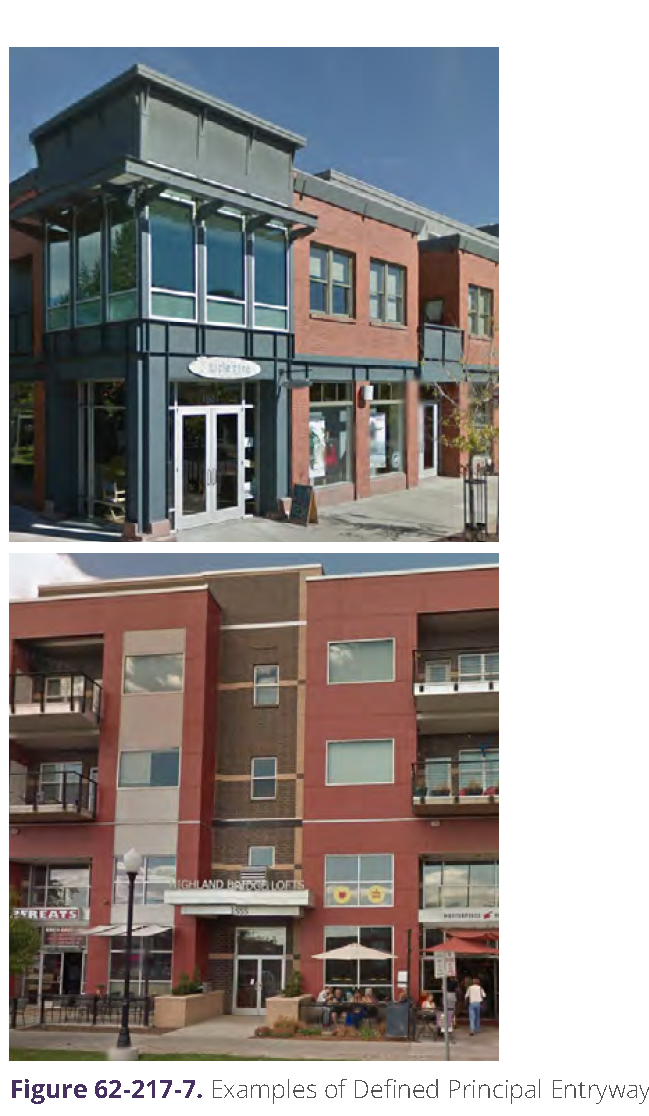
(7)
Rear parking facade design. The following applies in all locations where a public building entrance occurs on the rear or side facade adjacent to a parking lot. Refer to Figure 62-217-9. rear parking facade design examples.
a.
Entrance type. The "entrance configuration" requirement under facade and cap requirements for the building type shall be utilized. Refer to building types, sections 62-216(b) through 62-216(f).
b.
Materials. The materials permitted for street facades, above, shall be utilized for the portions of the facade with a public entrance.
c.
Transparency requirement. Public building entrance facade area, minimum 20 feet wide, shall utilize one of the following:
1.
On Storefront buildings, a minimum 45 percent transparency is required for the ground floor facade entrance, and the door shall be a minimum of 45 percent transparent.
2.
On any other building, the minimum transparency required for upper floors of the street facade shall apply to the rear ground floor entrance area, and the door shall be a minimum of 45 percent transparent.
d.
Awnings and signage. Awnings and signage are encouraged. When awnings and signage are utilized on the front facade, that treatment is required to be continued on entrance portions of rear parking lot facades.
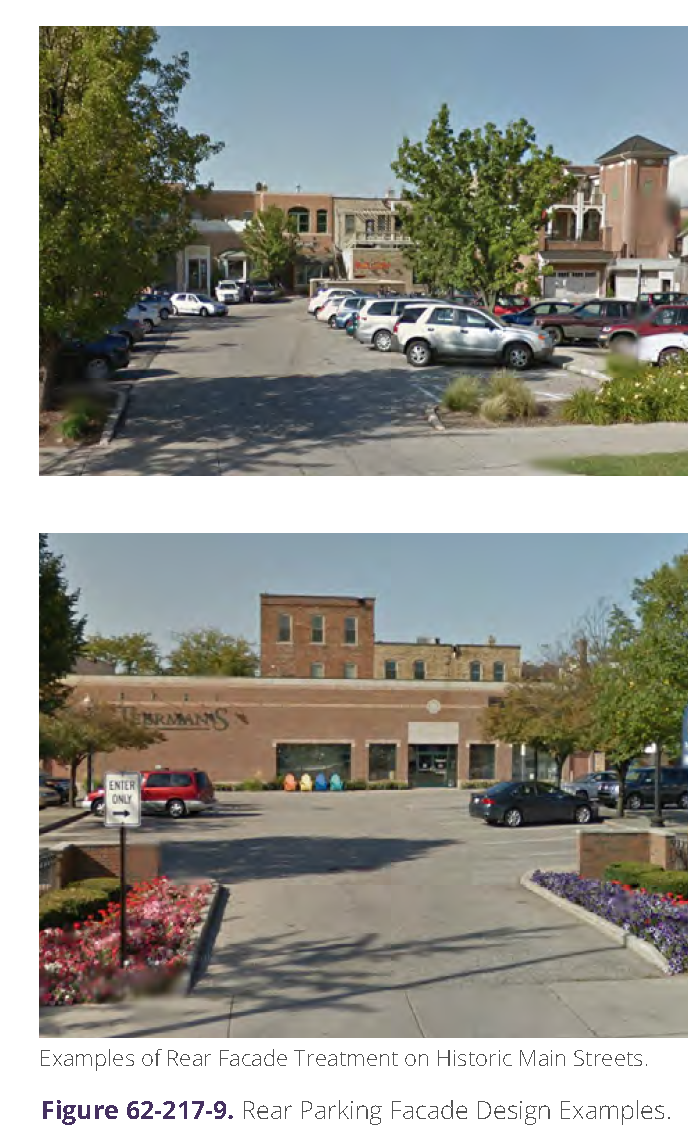
(c)
Auto-oriented structures. The following applies to the auto-oriented structures outlined and developed within the station area districts.
(1)
Parking structures. Parking structures as the principal use on the lot require a special use permit (refer to chapter 62, article IX) and shall meet the following. Refer to Figure 62-217-10 for one illustration of a compliant parking structure.
a.
Materials. Major and minor material requirements, per section 62-216(a), above, shall be met on all street facades. Additional permitted secondary material is stained, finished concrete.
b.
Ramps and slopes. Ramps and slopes shall be located on non-primary street facades. Refer to regulating plans (Figure 62-215-1, Figure 62-215-2, and Figure 62-215-3).
c.
Vertical divisions. Vertical divisions extending to the full height of the structure are required every 30 feet to de-emphasize the horizontal decks. Divisions shall be a minimum of two feet in width with a minimum projection of two inches.
d.
Blank wall limitations. No rectangular area greater than 30 percent of any story's facade, as measured from floor to floor, and no horizontal segment of a story's facade greater than 15 feet in width may be solid, blank wall.
e.
Entry tower. A defined pedestrian entrance/exit is required separate from the vehicular entrance and directly accessing the sidewalk. If the space is enclosed, windows are required to meet a transparency rate of 65 percent. Refer to the tower defined in section 62-216(h)(5).
f.
Cap. The top story of the parking structure shall include a parapet or cap type along the street facades. Refer to cap types defined in section 62-216(h), cap types.
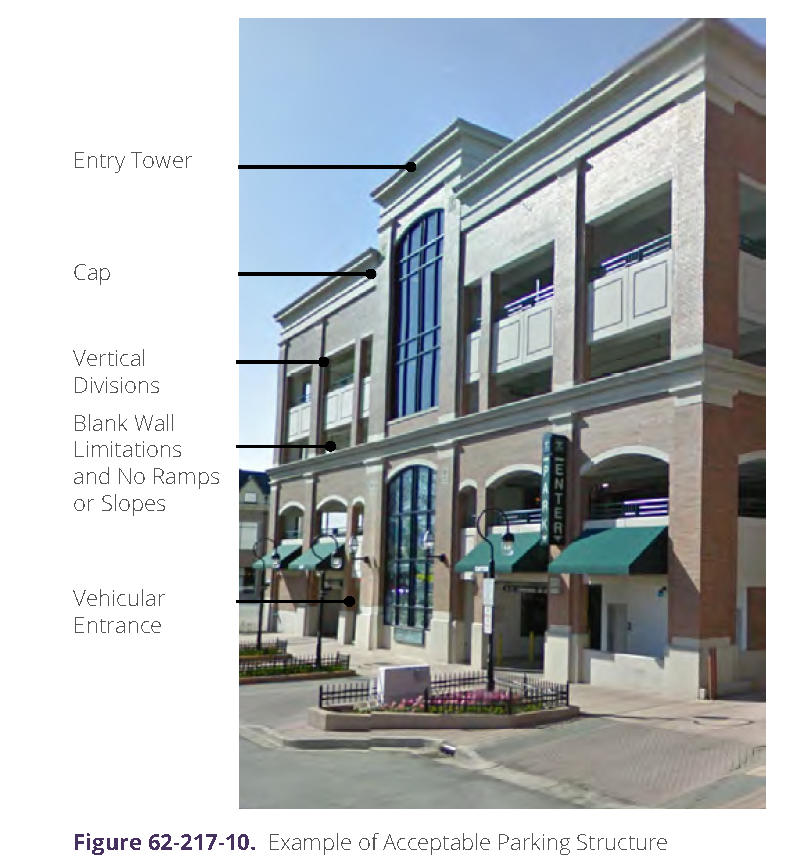
g.
Vehicular entrances. Driveways shall be no wider than 22 feet and the entrance and exit should be split if possible. Access should be located on a non-primary street, when feasible. No more than two access points shall be located on any one street, totaling no more than 24 feet of drives crossing sidewalk.
(2)
Fuel stations and car washes. Fueling stations and car washes require a special use permit (refer to article IX ) and shall meet the following. Refer to Figure 62-217-11. example of fuel station for one illustration of a compliant fuel station.
a.
Location of pumps. Any fueling pumps shall be located in the rear or interior side yard.
b.
Convenience store/building. A building on the premises of a fueling station shall be located in the build-to zone and shall occupy any corner. The building shall fulfill all requirements of the building type with the exception of the minimum primary build-to zone coverage and the minimum height requirement.
c.
Car wash facility. Any car wash facility shall be located in the rear of the lot. Vehicle entrance doors may be located on the rear facade, non-primary street facade, or an interior facade not visible from the primary street. Vehicular entrances are prohibited on the primary street facade, unless otherwise approved through a minor design exception.
d.
Additional drive entrance. One driveway entrance, in addition to the driveways permitted by building type, is permitted on the lot, maximum width 22 feet. With a minor design exception, the driveway may be located on the primary street.
(3)
Drive-through facilities. A drive-through facility is a structure or portion of a building that permits patrons to purchase goods or services while remaining in their vehicle. Refer to Figure 62-217-12. recommended drive-through facility layout, for one illustration of a compliant drive-through facility.
a.
Location. The drive-through shall be located on the rear of the building, fully screened by the building from the primary street. In SA 3, the drive-through may be located on the interior side facade.
b.
Stacking. Stacking of cars shall be accommodated in the rear yard.
c.
Accessory structures/signs. The menu board and speaker shall be located in the rear yard.
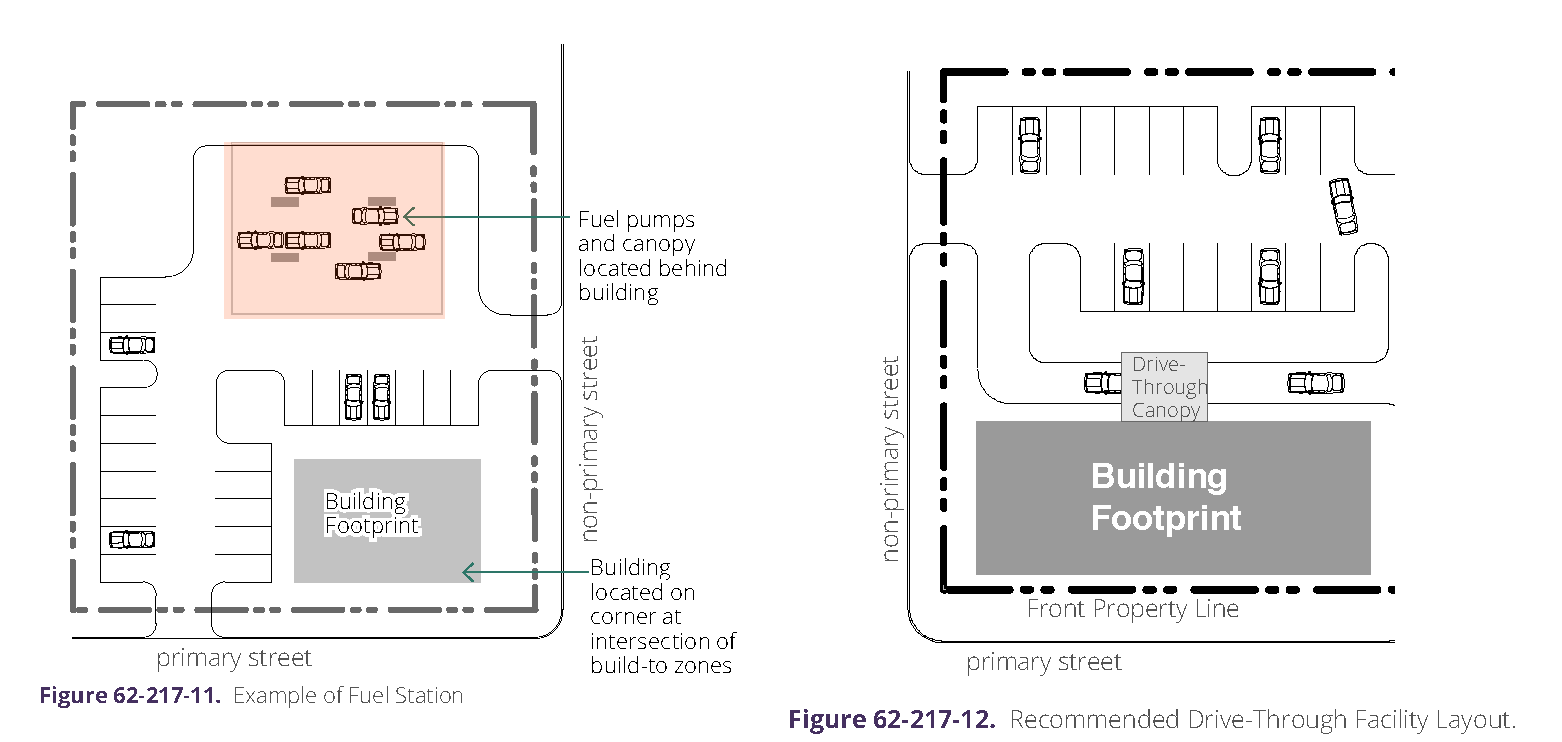
(d)
Building articulation. The following applies to all building types developed in the station area (SA) districts. Articulated buildings include clearly differentiated, components, using surface materials, expression lines, and separate patterns or configurations.
(1)
Base, middle, top. Layering the components of the building provides a sense of order and stability to buildings. The following intent statements support the requirements specified in sections 62-216, building types, and 62-217, general design. All buildings are meant to include a clearly articulated base, middle, and top as discussed in the following. Refer to Figure 62-217-13. illustration of base, middle, and cap.
a.
Base. The base of a building shall be differentiated from the upper stories per the requirements of section 62-216, building types.
1.
For mixed use and non-residential buildings, the base is meant to establish an active ground story along the street, providing a public face (such as retail, service, or restaurant uses) for activities that occur within a building.
2.
For residential buildings, the base may be offset in height to separate the ground story from the sidewalk elevation as permitted by the building type regulations (section 62-216). More public spaces, such as lobbies, community rooms, workout rooms, should be located on the ground story as transition space between the public and the private residences.
b.
Middle. The middle section of a building is meant to be occupied by people throughout the day and into the evening, with transparent windows providing visibility to the street. Balconies and terraces in the middle section of the building further this intent.
c.
Top. The top of the building shall cap the building and complete the design, as required by section 62-216(h), cap types.
(2)
Articulation of stories. Stories shall be clearly readable and articulated on all street and rail facades utilizing the following.
a.
Fenestration. Fenestration or window placement shall be organized by stories. Minimum transparency is required per story per building type (refer to sections 62-216(c) through (f), building types). Refer to 62-216(h)(5) for requirements for measuring transparency.
b.
Expression lines. Horizontal expression lines and/or lintels may be used to delineate stories. Minimum expression lines are required per building type (refer to sections 62-216(b) through (f), building types).
c.
Mezzanines. Mezzanines designed with a separate floor to floor height and story shall be articulated on the facade as a separate story.
d.
Taller spaces. Refer to section 62-216(g)(4)d. for transparency requirements on tall stories, over 18 feet in floor to floor height.
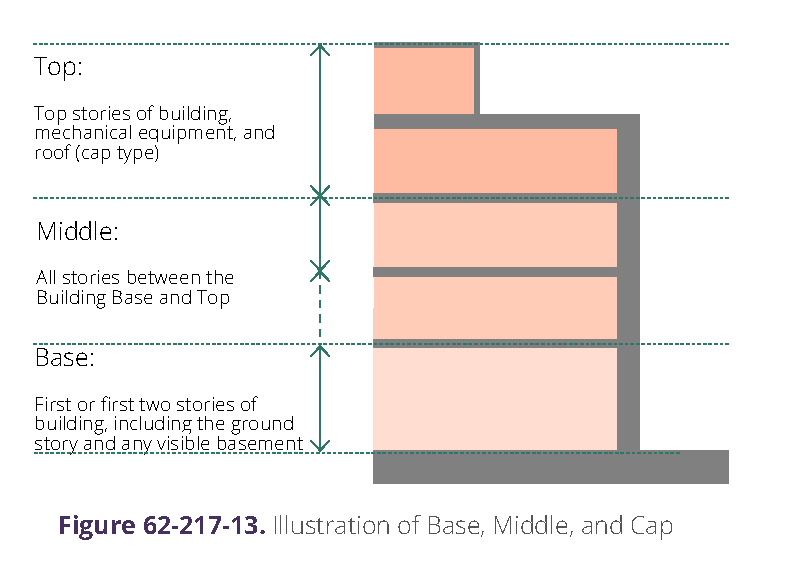
(3)
Building facade variety. All buildings 100 feet in width or greater along any primary street frontage shall fulfill the following requirements:
a.
Increments. Each primary frontage facade shall be varied in segments less than or equal to 90 feet.
b.
Requirements. Each facade segment shall vary by the type of dominant material, or color, scale, or orientation of that material, and at least two of the following:
1.
The proportion of recesses and projections.
2.
The location of the entrance and window placement, unless storefronts are utilized.
3.
Cap type, plane, or material, unless otherwise stated in the building type requirements.
4.
Building heights.
(e)
Signs. Refer to chapter 42 for sign regulations. The following additional requirements apply to the station area (SA) districts.
(1)
Back-lit box signs. In all SA districts, back-lit box signs are prohibited, whether projecting, wall, or freestanding signs. Back-lit box signs include any sign with a box configuration and lighting within the box, shining through the front panel, whether the panel is opaque or translucent.
(2)
Plastic. Plastic is permitted only to be utilized for separate alphanumeric characters or logos on any sign type. Translucent or plastic panels are prohibited for all sign types.
(3)
Freestanding signs. Freestanding signs are prohibited in all SA districts, with the exception of SA 3. In SA 3, the following applies:
a.
Monument sign. Freestanding signs in SA 3 may be constructed as monument signs with a maximum overall height of six feet. A monument sign includes a base with a sign panel mounted directly upon the base. The base height shall be less than 30 percent of the overall sign height.
b.
Pole-mounted signs. Pole-mounted signs are prohibited.
(4)
Projecting signs. Projecting signs in all SA districts shall be oriented to the pedestrian on the sidewalk and limited to a maximum of seven square feet for each sign face. Projecting signs may be mounted no higher than 16 feet from the sidewalk elevation. A maximum of one pedestrian-scaled projecting sign is permitted for every 30 feet of storefront facade.
(5)
Wall signs. Wall sign letters in the SA districts are limited to a maximum of two feet in height and shall not cover any architectural detail on the building. Separate letters, each pin-mounted, are preferred to panels.
(6)
Total signage. For all SA districts, the total square feet of signage for each street face shall not exceed 150 square feet.
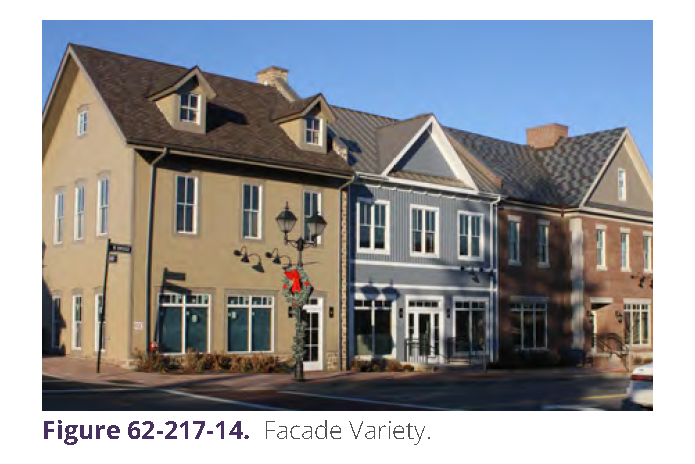
(f)
Mechanical appurtenances. In the station area (SA) districts, mechanical appurtenances shall be located to create the least visual impact.
(1)
Rooftop mechanical equipment. The visual impact of rooftop mechanical equipment, including, without limitation, vents, ventilators, skylights, antennas, solar systems, condensers, air handling systems shall be minimized.
a.
Rooftop mechanical equipment shall be located using one of the following methods.
1.
Locate all equipment within the interior of the building.
2.
Incorporate equipment into the roof design per section 62-216(h), cap types.
3.
Locate the equipment in a tower set a minimum of 15 feet from any primary frontage facade. Refer to 62-216(h)(5), towers
b.
The village manager may approve rooftop mechanical equipment that is not located per paragraph (1)a., above, through a minor design exception.
c.
Solar and wind energy equipment are exempted from (f)(1)a. and (f)(1)b., above.
(2)
Mechanical appurtenances on facades. Mechanical appurtenances, such as but not limited to dryer vents, gas meters, and air conditioners, shall be located as follows:
a.
Facade. All mechanical appurtenances required to be exposed on an exterior facade shall be located on a non-primary frontage facade.
b.
Alignment. Multiple mechanical appurtenances shall be organized on the facade in a regular pattern, aligned, and illustrated on the drawing elevations submitted for approvals.
c.
Material coordination. To the extent possible, mechanical appurtenances shall be located on a surface material that limits their visibility. For example, dark colored vents will likely be more visible on light colored stucco than a textured, darker surface such as brick.
(3)
Mechanical appurtenances on other horizontal surfaces. Mechanical appurtenances located on the ground, decks, or horizontal surfaces other than the roof, such as but not limited to electrical equipment, transformers, and air conditioners, shall be located as follows:
a.
Mechanical equipment and appurtenances are expressly prohibited on primary street frontages.
b.
All mechanical appurtenances may be located in the rear.
c.
Mechanical appurtenances may be located in a side yard, screened from the primary frontage sidewalk.
d.
The village manager may approve appurtenances located on a non-primary street frontage through a minor design exception.
(g)
Streetscape requirements. For all developments in station area (SA) districts, the following streetscape is required to be installed by the applicant, unless otherwise determined by the village manager.
(1)
Streetscape location. Streetscape occupies the full pedestrian area of any street right-of-way (back of curb to edge of street right-of-way) and the front yard of all developments as defined by the type of development in (g)(2) and (3), below.
(2)
Non-storefront developments. For all residential and office developments without storefronts, the following minimum landscape is required on all street frontages.
a.
Parkway planting. The parkway area between the back of curb and the sidewalk shall be planted with street trees and ground plane vegetation per section 62-217(h)(2), stormwater accommodations, lighting, and signage may be located in this area.
b.
Street yards. The front and corner side yard areas shall be planted with a minimum of 40 percent planting bed. The remaining area may be grass or patio area.
(3)
Storefront developments. For all developments with storefront on the front facade, the following streetscape and landscape is required along all street frontages.
a.
Streetscape required. The entire area from building face to back of curb shall be designed as a combination of hardscape, tree wells, and/or bed areas.
b.
Standard specifications. Streetscape shall meet any standards defined by the village for sidewalk, curb, access, and parkway construction. The village manager, at his/her discretion, may request additional requirements or waive any requirements.
c.
Streetscape design submittal. A consistent streetscape design shall be submitted for approval with site plan review for all new streets within the development and any existing streets. At a minimum, the streetscape design submittal shall include the following:
1.
Street trees. Trees meeting the minimum requirements of chapter 58, article II, shall be included in the streetscape design, with details related to tree pits, tree grates, and tree planting.
2.
Pavement design. Paving materials and pattern is required for each street. Pavement design shall include the minimum sidewalk widths required by the village and any extension of the sidewalk to the back of curb included on the private lot.
3.
Street furnishings. For a full block development, benches and/or seatwalls, planters, planter fences, tree grates, tree guards, and trash receptacles shall be specified and quantities and locations listed for each street. For each block face, a minimum of two benches and one trash receptacle is required.
4.
Bicycle racks. Bicycle racks shall be supplied to meet the minimum bicycle parking requirements of the blockface uses per chapter 62, article III, for required bicycle parking spaces. If rear bicycle parking is utilized, a minimum of 50 percent of the required ground floor use bicycle parking shall be supplied within the streetscape, coordinated with the village manager.
5.
Landscape design. Ground plane vegetation per section 62-217(h)(2) shall be designated for any landscape bed areas, planter areas, and open tree wells.
6.
Lighting. Pedestrian and vehicular lighting shall be specified and locations and quantities noted. All lighting shall meet any requirements of the village standards and specifications manual. Cut sheets and samples shall be submitted upon request of the village manager.
d.
Streetscape design continuation. The approved streetscape design for each street may be utilized by the village for the extension of any street outside the development to provide district continuity.
(h)
Landscape requirements. The following establishes general landscape requirements applicable to all building types in the station area (SA) districts.
(1)
General installation requirements. The installation of landscape shall adhere to the following standards.
a.
National standards. All landscape shall be installed in conformance with the practices and procedures established by the most recent edition of the American Standard for Nursery Stock (ANSI Z60.1) as published by the American Association of Nurserymen.
b.
Seasonal preclusion of installation. If seasonal conditions preclude the complete installation, a cash escrow or irrevocable letter of credit, equal to one and one-half times the installation costs as estimated by a qualified professional will be submitted to the village. Complete installation is required within nine months of the issuance of the occupancy permit or the cash escrow or letter of credit may be forfeited.
c.
Condition of planting materials. The landscape materials used shall be free from visible signs of disease, infestation, or physical defect at the time of planting.
d.
Selection of materials. Landscape materials shall be appropriate for the conditions of the location, including sun and wind exposure, air quality, salt exposure, soil type, expected moisture content of soil, and slope. Plant material shall not be considered invasive or potentially invasive.
e.
Compost and organic matter. Compost and organic matter shall be utilized within the soil mix to reduce the need for fertilizers and increase water retention.
f.
Establishment. All installed plant material shall be fully maintained until established, including watering, fertilization, and replacement as necessary. All landscaping and trees shall be maintained according to the most recent edition of the American National Standards Institute, including its provisions on pruning, fertilizing, support systems, lighting protection, and safety.
(2)
Ground plane vegetation requirements. All unpaved areas on the lot shall be covered by one of the following.
a.
Planting bed. Planting beds shall include shrubs, ornamental grasses, ground cover, vines, or perennials. A minimum of 60 percent of the bed area shall be covered in plant material. The remaining portion of the bed shall be covered with non-living permeable materials, such as mulch or landscape aggregate.
b.
Grass. Seeded, plugged, or sodded grass shall be established within 90 days of planting or the area must be reseeded, replugged, or resodded.
3.
Frontage buffer. The frontage buffer is required in all locations in the station area (SA) districts where vehicular areas are adjacent to or visible from any street right-of-way, except alleys.
4.
Frontage buffer requirements.
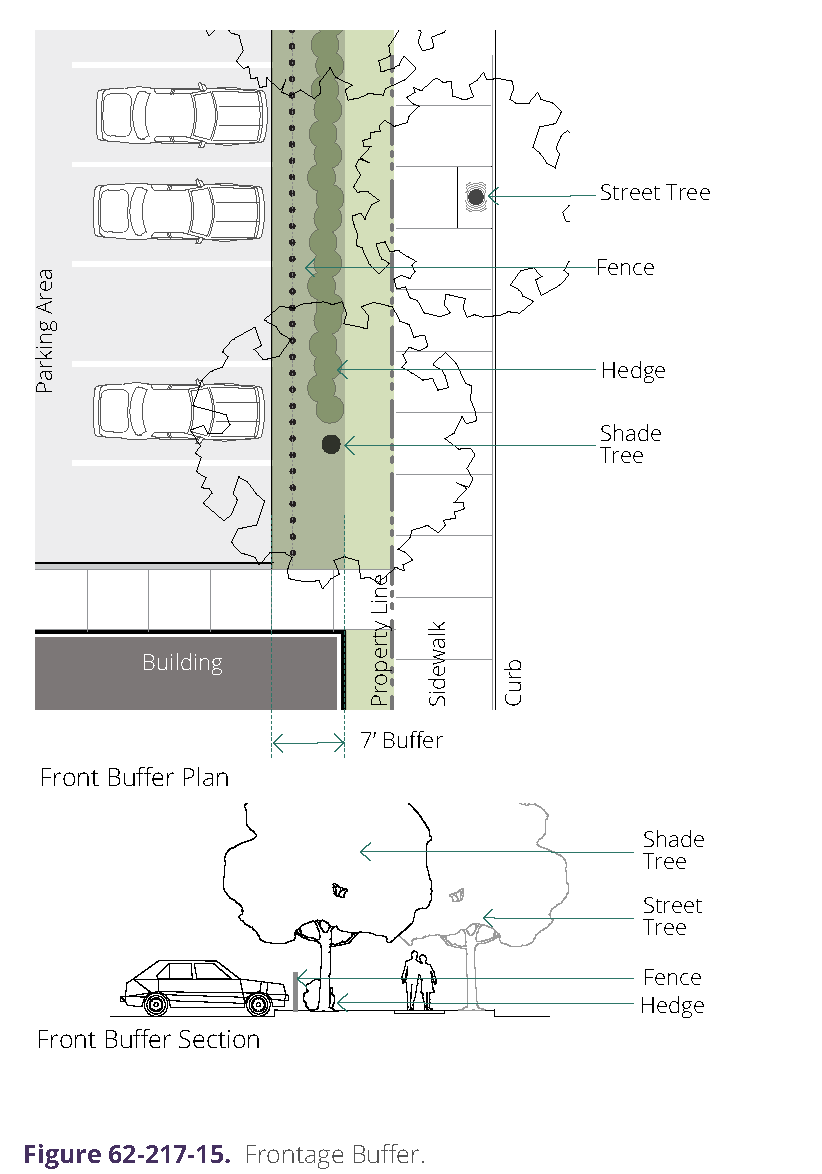
(Ord. No. 2017-9, § 4.D., 1-9-2017; Ord. No. 2025-9, §§ 4—6, 1-27-2025)

