
Brookford City Zoning Code
ARTICLE VII
NONCONFORMITIES
Purpose: This article provides for the continuance of nonconformities along with regulations that protect the county's planning process, surrounding neighborhoods, and property rights. Specifically, this article:
♦
Describes the different types of nonconforming situations, including nonconforming lots/land, nonconforming uses and nonconforming structures.
♦
Establishes conditions on the continuance of nonconforming situations.
♦
Limits the expansion or worsening of nonconforming situations.
♦
Allows expansion where the nonconforming situation is compatible with the neighborhood.
Sec. 44-700.- Applicability and classification.
(a)
This article applies to the following types of nonconformities:
(1)
Lots/land;
(2)
Uses;
(3)
Structures;
(4)
The expansion of a nonconforming use or structure;
(5)
Reconstruction or reestablishment of a nonconforming use or structure after it is damaged or destroyed; and
(6)
The abandonment of a nonconforming use or structure.
(b)
This article applies whether the nonconformity is created by private action, or a lawful public taking or action pursuant to a court order.
(c)
This article does not apply to signs, manufactured home parks and floodplain management nonconformities that are addressed separately in this chapter.
(Ord. No. 2021-05, 6-21-2021)
Sec. 44-701. - Procedures.
The procedure for approving nonconformities under this article shall be those followed for special use permit and variance applications as described under sections 44-328 and 44-329, and follows a quasi-judicial process by the board of adjustment, unless as stated differently in this article.
(Ord. No. 2021-05, 6-21-2021)
Sec. 44-702. - Nonconforming lots/land.
(a)
Applicability. This section applies only to undeveloped lots/land that are considered nonconforming or substandard with respect to their dimensional standards in relation to the current zoning district. A lot/land is considered undeveloped if it has no existing structures.
(b)
Nonconformities as to lot size.
(1)
Subject to the requirements of this section, a nonconforming lot existing prior to the adoption of this chapter (February 5, 2007) may be used for any use permitted by right in the zoning district. However, no use that requires a greater lot size than the established minimum lot size in table 44-404-1, shall be permitted on a nonconforming lot.
(2)
Structures on a nonconforming lot platted and recorded as of the date of adoption of this chapter (February 5, 2007) must conform to all setbacks as required in the zoning district. If the proposed structure cannot comply with the building setbacks, the planning director may allow a front setback reduction when the average of the front setbacks of the adjoining properties is less than the minimum required front setback. In this case, the required front setback may be reduced to this lesser average depth, but in no case less than ten feet. For the purpose of computing such average, an adjacent vacant lot shall be considered as having the minimum required front setback specified for the zoning district. Any side setback reductions shall require a variance approved by the board of adjustment. Approval is subject to a written finding that such reduction is reasonably necessary for any use of the lot in its current zoning classification and will not have substantial adverse effects on adjacent property.
(c)
Land area of nonconformity. The land area for a nonconforming use cannot expand beyond the land area which existed at the date the nonconformity was created.
(Ord. No. 2021-05, 6-21-2021)
Sec. 44-703. - Nonconforming uses.
(a)
Applicability. This section applies to any characteristics of uses that were lawful when established, but that are prohibited, regulated or restricted by this article or a subsequent amendment, or no longer conform to any development standards established in this division.
(b)
Change of use. Any nonconforming use of structures may be changed to a use of equal or less intensity, subject to the planning director's approval. Any change of use shall comply with article V except in situations where the planning director deems these improvements impractical due to necessary demolition of existing pavement or the configuration of existing structures. The director may wave compliance with article V for less intensive uses. In permitting a change of use the director may also require appropriate conditions and safeguards consistent with this article.
(c)
Subdivisions with pre-existing or existing manufactured housing.
(1)
Class A and B (doublewide/multi-section and singlewide) manufactured homes meeting appearance criteria are allowed on the following:
a.
Vacant lots never occupied within an existing manufactured home subdivision. An existing manufactured home subdivision must meet all of the following:
1.
Platted and recorded prior to the adoption of this chapter (February 6, 2007);
2.
Consist of three or more lots;
3.
Had at least one manufactured home as of the effective date of this chapter (February 6, 2007); and
4.
Be located in or outside of the doublewide manufactured home overlay (DWMH-O) district.
b.
Lots which were previously occupied as of February 28, 2005 within an existing manufactured home subdivision. An existing manufactured home subdivision must meet all of the following:
1.
Consist of three or more lots; and
2.
Be located in or outside of the doublewide manufactured home overlay (DWMH-O) district.
(2)
Class D and E (doublewide/multi-section and singlewide) manufactured homes not meeting the appearance criteria, which were located within the county as of March 18, 1996, are allowed on vacant lots within an existing manufactured home subdivision. An existing manufactured home subdivision must meet all of the following:
a.
Approved on or before March 18, 1996;
b.
Consist of three or more lots;
c.
Had at least one manufactured home as of the date of this chapter (February 6, 2007); and
d.
Be located within the doublewide manufactured home overlay (DWMH-O) district.
(3)
Underskirting requirement.
a.
Class A and D (doublewide/multi-section) manufactured homes must be underskirted with material manufactured for this purpose in accordance with subsection 44-432(6)a or b.
b.
Class B and E (singlewide) manufactured homes must have the entire perimeter of each home enclosed from the ground to the bottom of the structure with material manufactured for this purpose in accordance with standards set by the state regulations for manufactured/mobile homes. Examples of commonly recognized building materials suitable for use as underpinning include, but are not limited to, the following list: brick masonry, concrete block masonry; natural or synthetic stone masonry; or vinyl. Assemblies, products and materials manufactured expressly for the purpose of underpinning must be installed in accordance with the manufacturers' specifications.
(d)
Manufactured home parks.
(1)
If the operating permit should be revoked, or if the nonconforming park should cease operation for a period of 90 days, the park cannot reopen until it complies with all the standards of section 44-447 and all other applicable state and local regulations.
(2)
Parks operating as existing nonconforming uses are prohibited from expanding the land area of the park or the number of sites within the park.
(3)
Class A and B (doublewide/multi-section and singlewide) manufactured homes meeting appearance criteria may be placed in a nonconforming manufactured home park.
(4)
Class D and E (doublewide/multi-section and singlewide) manufactured homes not meeting appearance criteria which were located within the county as of March 18, 1996, may be relocated to a nonconforming manufactured home park approved on or before March 18, 1996, whether inside or outside the DWMH-O.
(5)
Underskirting requirement.
a.
Class B and E (singlewide) manufactured homes must be underskirted with material manufactured for this purpose in accordance with subsection 44-703(c)(3)b. above.
b.
Class A and D (doublewide/multi-section) manufactured homes must be underskirted with material manufactured for this purpose in accordance with subsection 44-432(6)b.
(e)
Replacement of nonconforming singlewide manufactured homes on individual lots. A nonconforming singlewide manufactured home can be replaced with a class A or B (doublewide/multi-section or singlewide) manufactured home meeting appearance criteria, a modular or stick-built home meeting building code. A singlewide manufactured home must be underskirted with material manufactured for this purpose in accordance with subsection 44-703(c)(3)b. above.
(f)
Replacement of nonconforming doublewide/multi-section manufactured homes on individual lots. A nonconforming doublewide/multi-section manufactured home can be replaced only with a class A (doublewide/multi-section) manufactured home meeting the appearance criteria as required in section 44-432, a modular or stick-built home meeting building code. A doublewide/multi-section manufactured home must be underskirted with material manufactured for this purpose in accordance with subsection 44-432(6)a or b.
(Ord. No. 2021-05, 6-21-2021)
Sec. 44-704. - Expansion of a nonconforming use or structure.
(a)
Applicability.
(1)
This section applies to any nonconforming structures or nonconforming uses of structures that lawfully existed as of the effective date of this chapter (February 5, 2007) or became nonconforming by the adoption of this chapter.
(2)
Structures or uses may expand on the land that existed when the structure became nonconforming if the board of adjustment approves an expansion of nonconforming use permit subject to the standards in subsection (b) below.
(3)
A nonconforming use may be extended throughout any portion of a vacant enclosed building that already houses or contains a portion of the nonconforming use. Open areas such as storage yards, loading docks, carports, and similar areas are not eligible for this expansion provision.
(4)
Any nonconforming residential or nonresidential structure which is voluntarily demolished the resulting rebuilding shall be in compliance with this chapter.
(b)
Nonresidential and multifamily structures.
(1)
Administrative approval. Approval for the expansion of existing nonresidential structures or additional detached nonresidential structures may be granted administratively when the total square footage of the expansion/addition is ten percent or less of the total area of the principal structure as it existed as of the date of this chapter. A public hearing is not required. A detailed site plan reflecting the footprint of the existing and new building must be submitted.
(2)
Board of adjustment approval. Approval for the expansion of existing nonresidential structures or construction of additional freestanding nonresidential structures may be granted by the board of adjustment, when the total square footage of the expansion/addition is over ten percent of the total area of the primary building, as it existed as of the date of this chapter.
(3)
Submittal requirements. In addition to the requirements in article III, an application for the board of adjustment must include the additional number and percentage of employees that will be added due to the expansion of use.
(4)
Standards. The board of adjustment shall only approve an expansion of a nonconforming use permit if it finds that all the following conditions exist, unless the applicant has agreed to completely mitigate those conditions as a condition of the special exception permit approval. The expansion must not:
a.
Adversely affect traffic;
b.
Adversely affect the physical environment pertaining to water pollution, air pollution, and noise pollution;
c.
Adversely affect the provision of services and utilities;
d.
Create a health or safety hazard;
e.
Adversely affect other property values; and
f.
Impair the health, safety and general welfare of the surrounding neighborhood and substantial justice would be done in carrying out the request.
(5)
Conditions. The board of adjustment may require appropriate conditions and safeguards in accordance with this article. Such conditions and safeguards may include any of the following that are reasonably related to the impacts of the expansion:
a.
Improvements to streets or other infrastructure, with the approval of NCDOT;
b.
Existing and expanded building areas or freestanding buildings must meet all landscaping standards set forth in article V, division 4. The board of adjustment may reduce the landscaping requirements in specific areas where added landscaping would require demolishing pavement or interfere with building configuration to the extent deemed impractical by the board of adjustment; or
c.
Existing and expanded building areas or freestanding buildings shall meet all parking standards set forth in article V, division 5.
d.
Existing and expanded building areas or freestanding buildings shall meet all signage standards set forth in article V, division 7.
(c)
Single-family and two-family residential. Any stick-built/modular residential structure may be enlarged if the enlargement:
(1)
Does not create new nonconformities; and
(2)
Meets current district setbacks (see figure 44-704-1 below);
(d)
Enlargement of existing manufactured homes. Enlargement of existing manufactured homes (not replacement) may be allowed if the enlargement:
(1)
Meets current district setbacks (see figure 44-704-1 below);
(2)
Meets building code; and
(3)
Does not attach a manufactured home to the existing manufactured home.
Figure 44-704-1. Expansion of nonconforming structure.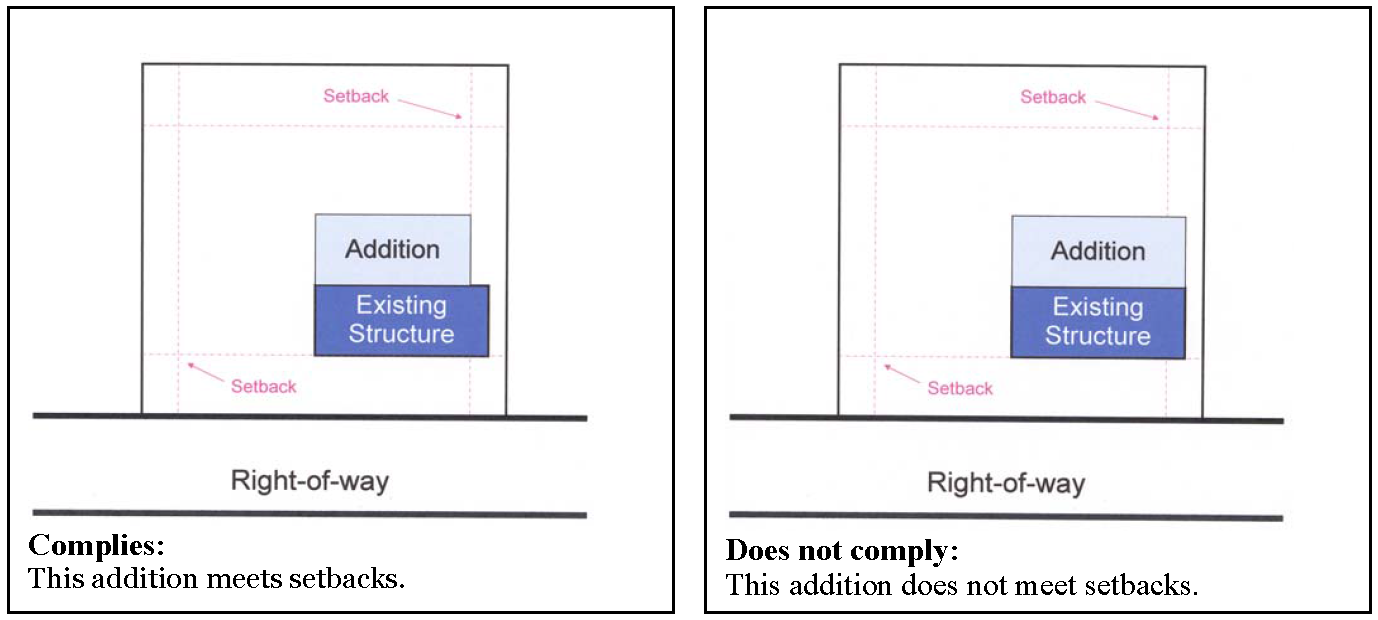
(e)
Routine repair, maintenance. Routine repair and maintenance for residential and nonresidential structures does not require a zoning authorization permit.
(Ord. No. 2021-05, 6-21-2021)
Sec. 44-705. - Rebuilding or re-establishment of a nonconforming use or structure after accidental damage or destruction by natural causes.
(a)
Applicability. This section applies only to all structures accidentally damaged or destroyed by natural causes or fire. Examples include, but are not limited to, wind or flooding. Time-related deterioration or damage caused by animal or insect infestation does not constitute accidental damage or destruction by natural causes.
(b)
Single-family and two-family residences. Nonconforming single-family residences or two-family residences which are partially or fully destroyed may be rebuilt or repaired by right. The footprint of the replacement structure can be enlarged but cannot increase the pre-existing nonconformity.
(c)
Nonresidential and multifamily structures.
(1)
Nonconforming non-residential and multifamily (three or more dwelling units) structures, which are partially or fully destroyed, may be rebuilt or repaired, provided that the board of adjustment makes the following findings of fact:
a.
The use will not adversely affect traffic;
b.
The use will not adversely affect the physical environment pertaining to water pollution, air pollution, and noise pollution;
c.
The use will not adversely affect the provision of services and utilities;
d.
The use will not create a health or safety hazard;
e.
The use will not adversely affect other property values; and
f.
The use will not impair the health, safety and general welfare of the surrounding neighborhood and substantial justice would be done in carrying out the request.
(2)
In permitting such reconstruction, the board of adjustment may require appropriate conditions and safeguards to protect the purpose and intent of this Article.
(3)
The footprint of the replacement structure can be enlarged but cannot increase the pre-existing nonconformity.
(Ord. No. 2021-05, 6-21-2021)
Sec. 44-706. - Discontinuance of use.
If active operations, including marketing the property for sale, are discontinued for a continuous period of 180 days, with respect to a nonconforming use of land or structure:
(1)
The land or structure may only be used for a conforming use; and
(2)
All development standards of this chapter shall apply at the time that the use or structure is re-established or reconstructed.
(Ord. No. 2021-05, 6-21-2021)
Sec. 44-707. - Monitoring of nonconforming uses.
The planning director may monitor, on an ongoing basis, uses of open land and uses of structures not meeting the requirements of this article.
(Ord. No. 2021-05, 6-21-2021)

