
Broward County Unincorporated
City Zoning Code
City Zoning Code
ARTICLE XII
OFFSTREET PARKING AND LOADING
Sec. 39-215.- Offstreet parking required.
(a)
Every building, use or structure, except buildings and structures on portions of plots occupied by a farm, instituted or erected after the effective date of this article shall be provided with offstreet parking facilities in accordance with the provisions of this article for the use of occupants, employees, visitors or patrons.
(b)
All existing offstreet parking facilities and all offstreet parking facilities instituted after the effective date of this article shall be maintained and continued as an accessory use as long as the building with which the offstreet parking facilities are associated continues to exist.
(c)
When any building is modernized, altered or repaired, and provided there is no increase in floor area, capacity, density or change of occupancy, no additional parking space shall be required.
(d)
When any building or use is changed in use or occupancy, or is increased in capacity, floor area, or density, the minimum amount of offstreet parking spaces required by this article shall be provided for the gross floor area occupied by any new use or occupancy and for any increased floor area, capacity, or overall density. Any such change in use or occupancy or increase in floor area, capacity, or density shall also comply with the requirements of Article VIII, "Landscaping for Protection of Water Quality and Quantity," of this Code, to the extent feasible based on the physical characteristics of the site, and shall also comply with Chapter 5, Article IX, Broward County Land Development Code. For the purpose of this section, a change of use or occupancy shall mean a change from one (1) category of offstreet parking requirements to another such category under Section 39-228.
(e)
Any change of use or occupancy or any increase in floor area, capacity or density which would result in more than a fifty percent (50%) increase of parking spaces to the existing offstreet parking facilities shall require the entire premises to be brought into full conformance with the requirements of this article, as a condition of the issuance of any site plan approval or permit required for such changes.
(f)
Maintenance: It shall be unlawful for any owner or operator of any building, structure or use affected by this article to discontinue, change or dispense with the required parking facilities, apart from the discontinuance, sale or transfer of such structure or use, without establishing alternative vehicle parking facilities which meet the requirements of this article. It shall be unlawful for any person, firm or corporation to occupy such building, or structure, for any purpose without providing the offstreet parking facilities to meet the requirements of and be in compliance with this article. Failure to maintain the required offstreet parking facilities in accordance with this article shall constitute grounds for revocation of any certificate of use issued for use of the premises.
(g)
It shall be unlawful to use any part of private or public property for offstreet parking or storage of vehicles that is not constructed, designated, and maintained in compliance with this article; except that, in residential zoning districts, the temporary parking of operable, currently licensed private passenger vehicles shall be permitted adjacent to one-family dwellings in the swale area of rights-of-way sixty (60) feet or less in width, which are not designated as collectors or arterials by the Broward County Trafficways Plan or are non-trafficway collector roads.
(Ord. No. 80-25, § 1, 4-11-80; Ord. No. 95-49, § 1, 11-28-95; Ord. No. 2000-36, § 18, 8-22-00; Ord. No. 2001-18, § 8, 5-22-01; Ord. No. 2013-04, § 2, 2-12-13; Ord. No. 2019-25, § 1, 9-10-19; Ord. No. 2020-34, § 1, 9-22-20)
Sec. 39-216. - Nonconforming uses.
In cases of a building occupied by a use which is not permitted as a new use in the district in which such building is located, where repairs, alterations or refurbishing are carried out in accordance with article VII, Nonconforming Uses and Structures, the existing offstreet parking facilities shall also be repaired and refurbished and landscaping installed to the maximum extent possible without reducing the amount of existing parking spaces on site by more than 20 percent.
(Ord. No. 80-25, § 1, 4-11-80; Ord. No. 95-49, § 2, 11-28-95; Ord. No. 2020-34, § 1, 9-22-20)
Sec. 39-217. - Location, character, and size.
(a)
Location: The offstreet parking facilities required by this article shall be located on the same plot or parcel of land such facilities are intended to service, except as provided in section 39-240, "off-site parking lots," of this Code. All offstreet parking facilities shall be designed, developed and maintained in accordance with all applicable provisions of this article. When the required offstreet parking is to be provided upon an additional plot of land, the owner of such additional plot of land and the owner of the land intended to be served by such offstreet parking facilities shall enter into an agreement with the county, whereby the land providing the additional parking area shall never be sold or disposed of except in conjunction with the sale of the building or the use which the additional parking area serves, so long as such parking facilities are required; and said agreement shall be approved by the Office of the County Attorney for Broward County, and recorded in the public records of Broward County, Florida, at the expense of the owner, and shall be considered to be a restriction running with the land, and shall bind the heirs, successors and assigns of said owner; however, another additional plot or plots, complying with the provisions of the Zoning Code, and subject to a recorded agreement as above specified may be substituted for the additional plot of land. In the case of a new or substitute agreement for the use of a plot of additional land to meet offstreet parking requirements, the original or preceding agreement shall be voided by the execution and recording of the new agreement.
(b)
Size: Each parking space and aisle width shall not be less than the parking dimension standards depicted below:
Table I, Minimum Space Requirements at Various
Parking Angles for Self-Parking Facilities
Note: *D - Dimensions are for one-way direction movement. Two-way direction movement requires a minimum of twenty-four (24) feet in width regardless of parking angle and dimensions given in Table I above.
Angles for Self-Parking Facilities: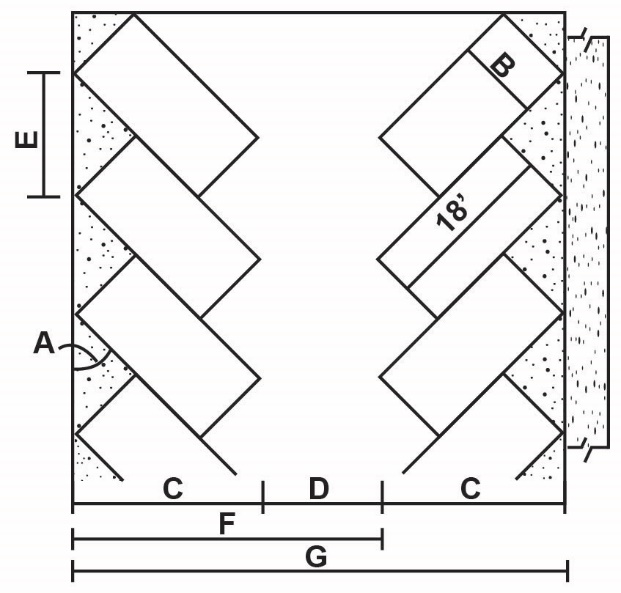
Minimum Space Requirements:
+0° - Parallel parking shall be designed according to the following diagram:

If a parking aisle requires access for emergency vehicles, garbage trucks, or trucks moving to or from a loading area, that parking aisle shall be at least fifteen (15) feet wide.
(c)
Access: All required parking spaces shall be directly accessible from a public or private street, alley or recorded ingress and egress easement. All offstreet parking areas shall be designed to permit safe maneuvering of vehicles, and each space shall be accessible without driving over or through any other parking space, except for one-family detached dwellings, two-family dwellings and townhouses having a carport or garage as part of the dwelling unit. No parking space shall be designed to permit backout parking onto a street or alley, nor shall parking spaces be located so as to require backing onto or across a sidewalk, pedestrian crosswalk or other area of high pedestrian concentration except for one-family detached and two-family dwellings and townhouses which have an attached carport or garage as part of the townhouse unit. Backout parking shall not be permitted in any case, on any street or highway designated on the Broward County Trafficways Plan or as a non-trafficway collector road.
(d)
Parking space designation: All required offstreet parking spaces shall be clearly delineated by four-inch wide, yellow or white, painted striping, except for one-family detached and two-family dwellings and townhouse dwellings which have an attached carport or garage as part of the townhouse unit, and except for nonresidential uses in rural and agricultural districts which shall require bumper guards or wheel stops in lieu of striping. Parking stalls which abut landscaped areas, sidewalks, structures or property lines shall be designed with bumper guards, wheel stops or contiguous curbing. The required bumper guards, wheel stops or curbing shall be located a minimum of two and one-half (2½) feet from any landscaped area, sidewalk or property line.
(e)
Overhead garage doors: No required offstreet parking space may be located in front of any overhead garage door or other loading area in a nonresidential building, except self-storage warehouses. Such area may, however, be used to satisfy the requirements of Section 39-229, Offstreet loading, so long as sufficient driveway or aisle width, according to Table I, as depicted in (b) above, is provided before and is adjacent to such offstreet loading area.
(f)
Composition, design, and maintenance: Unless otherwise specifically permitted herein, the required offstreet parking areas, access aisles, and driveways shall be constructed of a course of at least six (6) inches of native limerock, surfaced with asphaltic concrete or Portland concrete. Brick or interlocking pavers may be utilized for one-family and two-family dwellings, and for townhouses with attached carports or garages as parking and driveway facilities. The permitted paving surface shall be maintained in a smooth and well-graded condition, free from any signs of discoloration, neglect, or disrepair. Offstreet parking areas shall be designed to ensure safe and efficient traffic circulation. The parking facilities shall be of sufficient size to allow necessary functions for loading, unloading, and parking maneuvers to be carried out on private property, and completely off the street right-of-way.
(g)
Grass parking: 25 percent of the required offstreet parking facilities may be provided through the use of grass parking for the following specific uses:
(1)
Theaters and convention centers
(2)
Schools
(3)
Religious facilities
(4)
Hospitals
50 percent of the required offstreet parking facilities may be provided through the use of grass parking for the following specified uses:
(1)
Stadiums and sports arenas
(2)
Racetracks, fairgrounds, circus grounds
(3)
Outdoor recreation establishments
(4)
Funeral homes, mortuaries, cemeteries
(5)
Outdoor flea market or swap meet
Required offstreet parking facilities for buildings and uses in agricultural, estate and rural zoning districts may be provided through the use of grass parking.
Grass parking surfaces shall conform to county specifications, which includes at least a six (6) inch course of natural limerock, surfaced with a species of grass acceptable for high-traffic use. All requirements for landscaping vehicular use areas shall be met as well as all required interior landscaping requirements for parking areas. Grass parking areas shall not count toward satisfying any landscaping area required by article VIII of this chapter or pervious area requirement of chapter 5, article IX of the Broward County Land Development Code.
(h)
Setbacks:
(1)
Nonresidential uses:
a.
Pedestrian walkways shall be at least ten (10) feet from any building wall which provides less than 20 percent visibility at eye level, from the interior to the exterior of the building, through windows or doors. Pedestrian walkways shall remain free of obstructions, including but not limited to tables and chairs, displays of merchandise, and vending machines.
b.
All driveways and parking aisles shall be at least five (5) feet from any main or accessory building or structure.
(2)
Residential uses: All driveways and parking spaces for one-family attached and detached dwellings on separate plots or lots of record shall be set back at least two and one-half (2½) feet from any side property line.
(i)
Drainage: All offstreet parking facilities required by this article shall be drained so as not to cause any nuisances on adjacent or public property and shall be in accordance with the requirements of the appropriate enforcing agency.
(j)
Identification of parking lots: All offstreet parking areas required by this article shall be provided with identification as to purpose and location in the form of signage visible to vehicular traffic when such parking areas are not clearly evident from a street or alley. Signage shall comply with all requirements of this chapter for location, size and permitting.
(Ord. No. 80-25, § 1, 4-11-80; Ord. No. 95-23, § 1.01, 6-6-95; Ord. No. 95-49, § 3, 11-28-95; Ord. No. 1997-12, § 1, 3-11-97; Ord. No. 2000-36, § 19, 8-22-00; Ord. No. 2020-34, §§ 1, 20, 9-22-20; Ord. No. 2023-26, §§ 4, 5, 9-7-23, eff. 9-13-23)
Sec. 39-218. - Additional and overflow parking.
Every building, use or structure which complies with the offstreet parking requirements of this article may provide additional parking spaces. Such parking spaces may be designed as tandem if attendant parking is utilized.
(Ord. No. 95-49, § 4, 11-28-95; Ord. No. 2020-34, § 1, 9-22-20)
Sec. 39-219. - Drive-through facilities.
(a)
Businesses that provide a drive-through service are required to provide drive-through service lanes or stacking spaces for stacking or queuing, as separate and distinct lanes from the circulation lanes necessary for entering or exiting the plot.
(b)
Each drive-through lane or stacking space shall be separated from other on-site lanes or aisles. Each such drive-through lane or stacking space shall be curbed, striped, marked or otherwise distinctly delineated.
(c)
Drive-through lanes leading to or from gasoline pumps or pump islands shall provide a minimum width of 12 feet for one-way entrance and exit. All drive-through lanes which lead to 2 gasoline pump islands shall provide a minimum of 24 feet from curb to curb, between pumps or pump islands.
(d)
All drive-in bank facilities shall provide a minimum 8 feet wide vehicular service position between each drive-in teller facility.
(e)
An escape lane shall be provided, unless the drive-through lane and stacking spaces adjoin and are parallel to a parking aisle, of at least twenty-four (24) feet in width. A public street or alley shall not be counted as an escape lane.
(f)
Drive-through lanes or stacking spaces shall not conflict or otherwise hamper access to or from any parking space.
(g)
Pedestrian walkways shall be clearly separated from drive-through lanes or stacking spaces.
(h)
Except for drive-in teller facilities at banks and gasoline pump island drive-through lanes as specified above, any other drive-through lane or stacking space is hereby defined as being nine (9) feet wide by 22 feet in length.
(i)
Inbound drive-through lanes or stacking spaces shall be counted from the last service stop. Outbound drive-through lanes or stacking spaces shall be counted from the last stopping point before exiting the property.
(j)
The required amount of stacking spaces shall be as described in section 39-228(f) of this article. Any business not listed in section 39-228(f) shall have the same requirements as the most similar use described therein as determined by the zoning official.
(Ord. No. 95-49, § 5, 11-28-95; Ord. No. 1997-13, § 4, 3-11-97; Ord. No. 2020-34, § 21, 9-22-20)
Sec. 39-220. - Parking plans.
(a)
Plans as required by Section 39-17, Plans and Surveys, and Chapter 5, Article IX, Broward County Land Development Code, shall be submitted with every application for a permit or development order for a new building, an addition to an existing building, or for a change in the use of any existing building or plot of land required to provide offstreet parking under this article, which plan shall clearly and accurately designate the required parking spaces, access aisles and driveways, and relation to the uses or structures these offstreet parking facilities are intended to serve. An offstreet parking data box on the site plan shall list the project's offstreet parking provided in reference to the satisfaction of all offstreet parking regulations of this article, including proposed building and site usage and parking totals showing required versus provided.
(b)
Parking plans shall comply with the following:
(1)
All required parking stalls shall have direct and unobstructed access from a parking aisle; and
(2)
All parking areas shall be arranged so that there are no more than ten (10) contiguous parking stalls along the same parking aisle without an interior landscape island. A terminal landscape island shall be required at each end of the parking aisle. The landscaped island shall be a minimum of nine (9) feet in width, excluding curb. If the end of a parking aisle is located next to a landscape area, a five (5) foot terminal island shall be provided. Other suitable solutions or innovative designs may be substituted when approved by the Highway Construction and Engineering Division.
(Ord. No. 95-49, § 6, 11-28-95; Ord. No. 2020-34, § 1, 9-22-20; Ord. No. 2022-22, § 9, 5-11-22)
Sec. 39-221. - Calculating required parking.
(a)
Uses not specifically mentioned. The parking requirements for uses not specifically mentioned shall be the same as provided in this article for the most similar use as determined by the zoning official.
(b)
Fractional spaces. When units or measurements determining the total number of required offstreet parking spaces result in a fractional space, any such fraction shall require a full offstreet parking space.
(c)
Mixed uses.
(1)
In the case of mixed uses, the total requirement for offstreet parking spaces shall be the sum of the various uses computed separately and offstreet parking for any other use, except for shopping centers, general industrial complexes and storage or distribution warehouses as specified in section 39-228(b)(42), 39-228(c)(2) and 39-228(c)(8).
(2)
Shared usage: Section 39-222 designates the requirements for time of operation differences between uses.
(d)
Measurements. Gross floor area shall mean the gross floor area inside the exterior walls. In stadiums, sports arenas, religious facilities, bars and other places of assembly in which occupants utilize benches, pews, stools or other similar seating facilities, every twenty (20) lineal inches of such seating shall be counted as one seat for the purpose of computing offstreet parking requirements.
(e)
Open air seating. Open air seating shall mean any seating area without a heating or cooling system and where a minimum of two (2) sides are open and unenclosed by walls other than canvas or mesh screening.
(f)
Full service restaurant. A full service restaurant shall mean a restaurant which functions for the purpose of serving complete meals, prepared and cooked in a kitchen within the restaurant to people seated at tables on the premises, and within which no entertainment is provided other than recorded or live music during the service of meals.
(g)
Fast food restaurant. A fast food restaurant shall mean a restaurant which functions for the purpose of serving either meals or individual food items, prepared and cooked in a kitchen within the restaurant to people either seated at tables on the premises or for consumption off the premises.
(Ord. No. 95-49, § 7, 11-28-95; Ord. No. 1997-13, § 4, 3-11-97; Ord. No. 2000-36, § 20, 8-22-00; Ord. No. 2020-34, § 1, 9-22-20)
Sec. 39-222. - Shared usage.
Required parking spaces may be permitted to be utilized for meeting the parking requirements
of two (2) separate permitted uses when it is clearly established by the applicant
that the two (2) uses will utilize the spaces at different times of the day, week,
month or year, such as a church sharing spaces with a retail store. A recordable covenant,
with the correct legal description, shall be
submitted by the owners of the property and the two (2) businesses or tenants involved
in a form acceptable to the office of the county attorney. The covenant shall be recorded
in the public records of Broward County at the applicant's expense, and shall run
with the land. The covenant shall provide that the use or portion of a use, that requires
the shared parking in order to obtain the necessary permits or licenses, shall cease
and terminate upon any change in their respective schedules of operation that results
in conflicting or overlapping usage of the parking facilities, and no nonresidential
use may be made of that portion of the property until the required parking facilities
are available and provided. The covenant shall also provide that the county may collect
attorneys' fees if litigation is necessary to enforce the requirements of this section.
(Ord. No. 95-49, § 8, 11-28-95)
Sec. 39-223. - Combined offstreet parking.
Nothing in this article shall be construed to prevent collective provision for, or joint use of, offstreet parking facilities for two or more buildings or uses by 2 or more owners or operations, provided that the total of such parking spaces when combined or used together shall not be less than the sum of the requirements of the several individual uses computed separately in accordance with this article. In such cases, a recorded agreement shall be executed in the same manner as provided for in section 39-217(a).
(Ord. No. 80-25, § 1, 4-11-80; Ord. No. 95-49, § 9, 11-28-95; Ord. No. 2020-34, § 1, 9-22-20)
Sec. 39-224. - Use of offstreet parking facilities.
Parking spaces approved in conformance with this article may be used only for parking of vehicles of owners, tenants, employees and customers utilizing the building or site served by such required parking space. The following uses and activities shall not be permitted in required offstreet parking facilities:
(1)
Parking to serve an off-site building;
(2)
Storage, repair or commercial display of any vehicles, equipment or merchandise;
(3)
Parking or storage of commercial vehicles owned, operated or used in the business of a commercial occupant of a building between the hours of 8:00 a.m. and 5:00 p.m.;
(4)
Parking of recreational vehicles, boats and accessory equipment on nonresidentially zoned or used property; and
(5)
Parking of any vehicle, which due to its size, shape, contents or location, creates an obstruction or public safety hazard or which cannot be contained within a single designated parking space.
(Ord. No. 80-25, § 1, 4-11-80; Ord. No. 95-49, § 10, 11-28-95; Ord. No. 2020-34, § 1, 9-22-20)
Sec. 39-225. - Storage lots for vehicles, boats and equipment.
All open air storage lots for vehicles, boats or trucks located in a commercial zoning district shall be surfaced with asphalt or concrete. All open air storage lots for commercial vehicles, heavy equipment or other motor-driven equipment in an industrial zoning district may be on a non-paved surface, provided same is compacted, stabilized and dust-free.
(Ord. No. 95-49, § 11, 11-28-95)
Sec. 39-226. - Reserved.
Editor's note— Ord. No. 2019-04, § 4, adopted Jan. 29, 2019, repealed § 39-226, which pertained to lighting and derived from Ord. No. 95-49, § 12, adopted Nov. 28, 1995.
Sec. 39-227. - Parking for disabled persons.
All applicable state and federal laws relating to parking spaces for certain disabled persons in all public and private parking areas, including minimum dimensions, requirements, and location and posting of signs, shall be adhered to on all proposed developments and parking facilities that require revisions. All such spaces shall be a minimum of 12 feet by 18 feet, unless provided otherwise by federal law or the Florida Building Code.
(Ord. No. 95-49, § 13, 11-28-95; Ord. No. 2022-22, § 10, 5-11-22)
Sec. 39-228. - Number of offstreet parking spaces.
(a)
The following minimum amounts of offstreet parking shall be provided for all residential buildings and uses:
(b)
The following minimum number of offstreet parking spaces shall be supplied for all business and commercial buildings and uses:
(c)
The following minimum amounts of offstreet parking shall be provided for all industrial uses of buildings and properties:
(d)
The following minimum amounts of offstreet parking shall be provided for all outdoor recreational uses and properties:
(e)
The following minimum amounts of parking shall be provided for uses of buildings or property specified below:
(f)
Stacking spaces necessary per service position or drop-off point for the provisions of this section shall be determined using the following table:
(Ord. No. 80-25, § 1, 4-11-80; Ord. No. 95-23, § 1.02, 6-6-95; Ord. No. 95-49, § 14, 11-28-95; Ord. No. 1997-13, § 4, 3-11-97; Ord. No. 1998-06, § 2, 3-24-98; Ord. No. 2000-36, § 21, 8-22-00; Ord. No. 2001-18, § 9, 5-22-01; Ord. No. 2018-06, § 5, 1-23-18; Ord. No. 2019-25, § 2, 9-10-19; Ord. No. 2020-34, § 1, 9-22-20)
Editor's note— Ord. No. 2018-06, § 5, adopted Jan. 23, 2018 amended the title of § 39-228 to read as set out herein. The former title of § 39-228 pertained to amount of offstreet parking.
Sec. 39-229. - Offstreet loading.
(a)
On the same plot with every structure or use specified herein that is hereafter erected or created, there shall be provided and maintained adequate space for loading and unloading of materials, goods, or things, and for delivery and shipping, so that vehicles for these services may use this space without interfering with the public use of streets, alleys, and offstreet parking areas by pedestrians and vehicles. The offstreet loading facility shall be designed to accommodate both the parking and maneuvering of the design vehicle exclusive of those areas designated for aisles, driveways, or parking stalls. On-street loading shall be permitted on a local cul-de-sac street abutting commercial and industrial development. Where permitted, such on-street loading areas shall berth the design vehicle exclusive of the public right-of-way.
(b)
Where any structure is enlarged or any use is extended so that the size of the resulting occupancy comes within the scope of this section, the full amount of offstreet loading space shall be supplied and maintained for the structure or use in its enlarged or extended size. Where the use of a structure or land or any part thereof is changed to a use requiring offstreet loading space under this section, the full amount of offstreet loading space shall be supplied and maintained to comply with this section.
(c)
For the purposes of this section, an offstreet loading space shall be an area at the grade level at least twelve (12) feet wide by forty-five (45) feet long with a 14-foot vertical clearance, except that for plots containing an aggregate amount of less than 10,000 square feet of gross floor area of buildings, and except for office buildings and banks, an offstreet loading space may be ten (10) feet in width by twenty-five (25) feet long. Each offstreet loading space shall be directly accessible from a street, alley or driveway without crossing or entering any other required offstreet loading space, shall be clearly marked as to purpose, and shall be arranged for convenient and safe ingress and egress by motor truck and/or trailer combination. Offstreet loading spaces shall not be located in a parking aisle and shall not be more than thirty (30) feet from the building which the offstreet loading space serves. Any pedestrian walkway crossing ingress and egress to an offstreet loading space shall be clearly marked.
(d)
Offstreet loading spaces shall be provided and maintained in accordance with the following schedule:
(1)
For each retail complex; storage warehouse, excluding self-storage warehouses; wholesale establishment; industrial plant; factory; freight terminal; restaurant; mortuary; laundry; office building; dry cleaning establishment; or similar use that has an aggregate gross floor area of:
Up to 7,000 square feet (sq. ft.) .....Loading spaces not required
Over 7,000 sq. ft. but not over 20,000 sq. ft. .....1 space
Over 20,000 sq. ft. but not over 60,000 sq. ft. .....2 spaces
Over 60,000 sq. ft. but not over 120,000 sq. ft. .....3 spaces
Over 120,000 sq. ft. but not over 200,000 sq. ft. .....4 spaces
Over 200,000 sq. ft. but not over 290,000 sq. ft. .....5 spaces
Plus, for each additional 90,000 sq. ft. over 290,000 sq. ft. or major fraction thereof .....1 space
(2)
For each auditorium, convention hall, exhibition hall, museum, hotel, sports arena, stadium, hospital, or similar use which has an aggregate gross floor area of: .....
Over 20,000 sq. ft. but not over 40,000 sq. ft. .....1 space
Plus, for each additional 40,000 sq. ft. over 40,000 sq. ft. or major fraction thereof .....1 space
(3)
For any use not specifically mentioned in this section, the requirements for offstreet parking for a use which is so mentioned and to which the unmentioned use is similar shall apply. One-family and two-family dwellings and multiple-family dwellings shall not require offstreet loading facilities.
(e)
Offstreet loading facilities supplied to meet the needs of one use shall not be considered as meeting offstreet loading needs of any other use.
(f)
No area or facilities supplied to meet the required offstreet parking facilities for a use shall be utilized for or be deemed to meet the requirements of this article for offstreet loading facilities.
(g)
Nothing in this section shall prevent the collective, joint or combined provision of offstreet loading facilities for two or more buildings or uses on the same site, provided that such offstreet loading facilities are equal in size and capacity to the combined requirements of the several buildings or uses and are so located and arranged as to be usable thereby.
(h)
Plans for buildings or uses requiring offstreet loading facilities under the provisions of this section shall clearly indicate the location, dimensions, clearances and access of all such required offstreet loading facilities.
(i)
All offstreet loading facilities shall be located on the plot which they are intended to serve.
(Ord. No. 80-25, § 1, 4-11-80; Ord. No. 95-49, § 17, 11-28-95; Ord. No. 1997-13, § 4, 3-11-97; Ord. No. 2020-34, §§ 1, 22, 9-22-20; Ord. No. 2022-22, § 11, 5-11-22)
Sec. 39-230. - Reserved parking offsets and reductions.
Businesses that cannot meet the minimum required offstreet parking may apply parking offsets and reductions included in this section. Parking offsets and reductions do not count toward the parking required to meet standards of the Americans with Disabilities Act. Parking offsets and reductions shall only be approved for uses designated as Permitted in the Master Business List. Use of the following parking offsets and reductions is at the option of the applicant for a Certificate of Use. It is the responsibility of the applicant to demonstrate that adequate offstreet parking is being provided for business operations, safe and efficient ingress/egress, and internal traffic circulation.
(a)
Bicycle racks. A permanent bicycle rack, located within twenty (20) feet of the main door and that accommodates at least four (4) bicycles, may be counted as one (1) required offstreet parking space. No more than three (3) required spaces may be offset by bicycle racks. At no time shall the offset equal twenty-five percent (25%) of the required parking.
(b)
On-street public parking. On-street public parking, if permitted by the Highway Construction and Engineering Division, may count as required offstreet parking to serve the adjacent property as follows:
(1)
When one (1) whole on-street parking space is located between the two (2) property lines that are perpendicular to the street, the whole on-street parking space shall count as one (1) required offstreet parking space; and
(2)
When fifty percent (50%) or more of an on-street parking space is located adjacent to the street-side property boundary, that parking space shall count toward that street-side property's parking requirement.
(c)
Retail or service businesses. A retail or service business, with a floor area devoted to retail or service activities under six hundred (600) square feet, shall not be required to meet minimum offstreet parking requirements.
(Ord. No. 2022-22, § 12, 5-11-22)
Sec. 39-231. - Parking location.
Businesses that cannot meet the minimum required offstreet parking requirements may locate the required parking off-site, provided the off-site parking is located within four hundred (400) feet of the site. The four hundred (400) foot distance shall be measured by the shortest path of pedestrian travel, using designated sidewalks and pedestrian walkways. The off-site parking shall be joined to the principal site by a unity of title or a shared parking agreement. The business may not count parking that is separated from the site by an arterial roadway towards its required parking. The off-site parking must be designated on an approved site plan and clearly marked by signage that indicates the business(es) it serves.
(Ord. No. 2022-22, § 13, 5-11-22)
Sec. 39-232. - Parking determined by the zoning official.
The zoning official may reduce the number of parking spaces required for uses allowed within commercially zoned districts. Such a reduction shall be limited by the Certificate of Use to a specific business and site. When making such a determination, the following shall be considered:
(a)
Whether the applicant has utilized the parking reductions and off-site parking identified in Sections 39-230 and 39-231;
(b)
Whether the proposed business involves redevelopment or revitalization of an existing site;
(c)
Whether any variances are pending or have been issued;
(d)
Whether the applicant has outstanding code enforcement violations;
(e)
Whether the parking reduction negatively impacts the safe movement of traffic, bicycles, and pedestrians; and
(f)
Whether the applicant has submitted a parking study or other documentation certified by a licensed engineer to validate that the use does not demand the amount of parking required in Section 39-228.
(Ord. No. 2022-22, § 14, 5-11-22)

