
Broward County Unincorporated
City Zoning Code
City Zoning Code
ARTICLE XL
GARDEN PARK DISTRICTS
Sec. 39-651.- Garden Park Districts.
The following shall constitute the Garden Park Districts ("Districts") for the purposes of this Code:
GP-1: Garden Park Neighborhood District ("GP-1")
GP-2: Garden Park Corridor District ("GP-2")
(Ord. No. 2023-31, § 2, 9-19-23, eff. 9-20-23)
Sec. 39-652. - Purpose of districts.
(a)
The GP-1 Garden Park Neighborhood District is intended to: (i) emphasize urban form and design; (ii) facilitate multifamily residential development; and (iii) serve as a transition between the GP-2 Garden Park Corridor District and adjacent residential zoning districts. The primary emphasis of the GP-1 District is on urban form and design. Landscaping features shall be incorporated into development as much as possible but are secondary to urban form.
(b)
The GP-2 Garden Park Corridor District is intended to facilitate mixed land uses along collector and arterial roads. Land or parcels not adjacent to a collector or arterial road shall not be eligible for GP-2 zoning. The primary emphasis of the GP-2 District is on urban form and design. Landscaping features shall be incorporated into development as much as possible but are secondary to urban form.
(Ord. No. 2023-31, § 2, 9-19-23, eff. 9-20-23)
Sec. 39-653. - General provisions.
All development within the Districts shall be subject to Section 39-294 of the Broward County Code of Ordinances ("Code"), except as otherwise provided in this article. New development within the Districts shall be exempt from Article XXXIX of Chapter 39 of the Code.
(Ord. No. 2023-31, § 2, 9-19-23, eff. 9-20-23)
Sec. 39-654. - Permitted uses.
Sec. 39-655. - Other uses.
(a)
No section, regulation, or provision within this article shall be applied in a manner that will have the effect of prohibiting a fuel retailer, as provided by Section 377.707, Florida Statutes.
(b)
In addition to this article, alcoholic beverage establishments and adult entertainment establishments shall be subject to the requirements of Article XI of Chapter 39 of the Code.
(Ord. No. 2023-31, § 2, 9-19-23, eff. 9-20-23)
Sec. 39-656. - Development standards.
(a)
Area requirements:
(1)
Lot size.
GP-1: Four thousand (4,000) square feet minimum
GP-2: No minimum
(2)
Lot coverage. The combined area occupied by all buildings and roofed structures shall not exceed the following maximum percentages on any site plan:
GP-1: Forty percent (40%) of the net lot area
GP-2: Lot coverage as permitted by setbacks
(b)
Density. Density shall be measured per gross acre, as defined by the Comprehensive Plan's Broward Municipal Services District Land Use and Community Planning Element and the Broward County Land Use Plan. Determination of maximum permitted density shall be:
(1)
As permitted by the Broward Municipal Services District Land Use Plan, as modified by Broward County Land Use Plan Policy 2.16.3 or 2.16.4;
(2)
Through the allocation of residential flexibility units. Residential flexibility units may be administratively allocated as part of an approved site plan by the Director provided:
a.
Residential flexibility units are available for allocation; and
b.
The site plan includes at least two (2) amenities that may include, but are not limited to, the following:
1.
Easements to provide for an expanded sidewalk width;
2.
Public spaces, such as plazas, seating areas, and fountains;
3.
Covered walkways;
4.
Rights-of-way or easement dedication to accommodate transit improvements;
5.
Dedication/donation/construction of a bus shelter; or
6.
Other amenities as approved by the Director.
c.
Allocated residential flexibility units shall expire if a building permit for vertical construction is not issued within one (1) year after site plan approval. One (1) six-month extension may be granted upon showing of progress being made towards the issuance of a building permit. Site plan approval shall expire when the residential flexibility unit allocation expires. Reallocation of residential flexibility units will require a new site plan application; or
(3)
As permitted by Section 125.01055(6), Florida Statutes.
(c)
Building form typologies.
(1)
Permitted Building Typology by District:
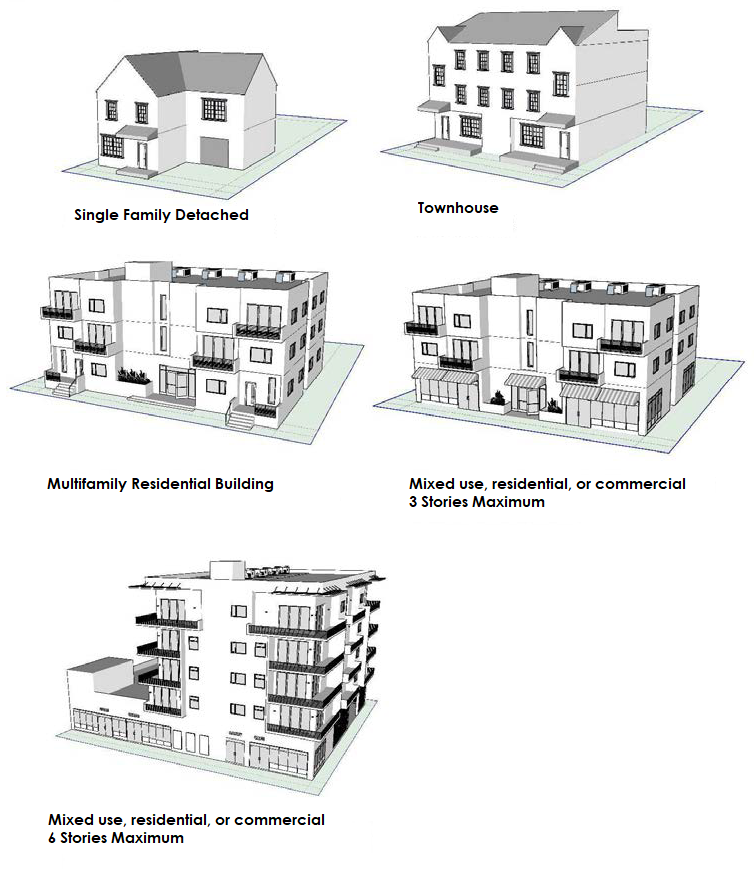
(2)
Basic illustrative models of the permitted building typologies are depicted below:
(d)
Maximum permitted height/stories.
(1)
GP-1:
a.
Three (3) stories maximum.
b.
Heights:
1.
Forty foot (40') maximum height for any building or structure.
2.
Thirty-five foot (35') maximum height for any portion of buildings and structures within fifty feet (50') of a property zoned RS-1 to RS-6.
3.
Active rooftop uses shall not be permitted within fifty feet (50') of a property zoned RS-1 to RS-6.
(2)
GP-2:
a.
Buildings shall be at least two (2) stories and no more than six (6) stories.
b.
Heights:
1.
Seventy foot (70') maximum height for any building or structure.
2.
Thirty-five foot (35') maximum height for any portion of a buildings and structures within fifty feet (50') of a property zoned RS-1 to RS-6.
3.
Buildings greater than thirty-five feet (35') in height or three (3) stories that are contiguous to a property zoned RD-5 to RD-10 or RM-5 to RM-6 shall have a step-back beginning on the third (3rd) story of at least eight feet (8').
4.
The first floor of any portion of a building utilized for a commercial use shall have a minimum ceiling height of fourteen feet (14').
5.
Elevator(s), stairwell(s), and other similar access areas may exceed maximum permitted height by no more than eight feet (8').
(e)
Setbacks and build-to line.
(1)
Buildings with street frontage shall have a build-to line from the street as follows:
a.
Arterial road shall be fifteen feet (15')
b.
Collector road shall be ten feet (10')
c.
Other rights-of-way that are forty feet (40') or wider:
1.
GP-1 shall be fifteen feet (15'); except that the frontage of a single family dwelling shall be between fifteen feet (15') and twenty-five feet (25')
2.
GP-2 shall be no less than five feet (5')
d.
Rights-of-way less than forty feet (40') wide:
1.
GP-1 shall be a minimum of five feet (5')
2.
GP-2 shall be a minimum of zero feet (0')
(2)
Rear: The rear yard setback shall be at least ten feet (10')
(3)
Interior side yard setback:
a.
GP-1:
1.
Multifamily shall be a minimum of ten feet (10')
2.
Single family and townhouse/villa shall be a minimum of five feet (5')
b.
GP-2:
1.
Shall be a minimum of zero feet (0')
2.
If contiguous to GP-1 or RS-1 to RS-6, then shall be a minimum of ten feet (10').
(4)
Allowable encroachments.
a.
In GP-1, unenclosed covered front porches may encroach eight feet (8') into the build-to line; steps shall not be counted for the purposes of calculating the eight feet (8'). Balconies may encroach five feet (5') into any required setbacks or build-to lines. Balconies shall be prohibited along façades that are contiguous to, and face, a property being used or zoned for use as a single family detached residential property.
b.
In GP-2, canopies and other cantilevered shade structures shall be permitted to encroach eight feet (8') into the required build-to line of an arterial or collector road. The rooftop surface of a structured overhang may be used for active space. Balconies may encroach five feet (5') into the build-to line and rear yard setback.
(f)
Dwelling unit floor areas:
(1)
GP-1: Dwelling unit floor area requirements for buildings within the GP-1 zoning district shall be as follows:
a.
Single family detached residential shall be a minimum of eight hundred (800) square feet in floor area, as measured from the outside of the exterior walls, exclusive of a carport, garage, patio, porch, and utility room(s).
b.
Townhouse/villa units shall be a minimum of six hundred (600) square feet in floor area, with a minimum average of eight hundred (800) square feet for all units within the building.
c.
Multifamily units, as measured from the interior walls, shall be a minimum of four hundred (400) square feet in floor area, with a minimum average of six hundred (600) square feet for all units within the building.
(2)
GP-2: Dwelling units within the GP-2 zoning district shall be, as measured from the interior walls, a minimum of four hundred (400) square feet in floor area, with a minimum average of six hundred (600) square feet for all units within the building.
(g)
Building frontage. Building frontages along arterial and collector roads shall be a minimum of fifty percent (50%) of the width of the lot frontage, except as required to provide for minimum requirements related to vehicular and pedestrian access to and from the property; provided, however, that all buildings shall have at least forty percent (40%) of the frontage along the build-to line.
(h)
Building size and mass. Buildings shall be constructed as variable masses with applied horizontal and vertical extrusions to create the desired building form.
(1)
The continuous unarticulated façade of a building shall not occupy more than one hundred fifty feet (150') of continuous frontage along any street.
(2)
For building articulation, a break in the building façade shall occur at least every one hundred feet (100') on buildings that occupy one hundred fifty feet (150') or more of continuous frontage.
(3)
All breaks in building façade shall be recessed from the build-to line a minimum of two feet (2').
(i)
Building orientation. Buildings with frontage along a street that has a right-of-way that is forty feet (40') or wider shall face at least one (1) street with at least one (1) clearly identifiable entrance. Developments with multiple frontages shall prioritize the clearly identifiable entrance(s) of the building(s) in the following order: arterial, collector, then all others. Where more than one (1) of the roads are of the same classification, building frontage shall follow the development pattern of the block, where possible. Each residential unit or building along a street frontage shall be designed to face the street, including entrances and porches. Residential units at the street frontage shall have a finished floor height that is a minimum of three feet (3') above the sidewalk, as measured from the nearest edge of the right-of-way. Where a development provides for multiple homes to be built along the street frontage, the three-foot (3') finished floor height may be averaged for the full length of the development's frontage.
(j)
Services.
(1)
All services shall be subject to the following:
a.
Development along a right-of-way that is less than forty feet (40') in width shall locate all services, including aboveground equipment and trash enclosures, away from that frontage to the greatest extent possible.
b.
Where the development does not have frontage along a right-of-way of less than forty feet (40') in width, all services, including aboveground equipment and trash enclosures, shall be located behind the build-to line, and subject to all applicable standards for building placement.
c.
All services shall be screened from the street view by habitable building space, landscaping, or walls and shall not encroach into required setback and landscaped areas. Trash enclosures shall be screened consistent with Section (n) below.
(2)
With the exception of fire hydrants, new utilities shall run underground, where possible.
(k)
Windows.
(1)
Nonresidential building walls facing arterial or collector roads at ground level shall have windows that provide unobstructed transparency of at least sixty percent (60%) of the building wall.
(2)
Nonresidential portions of building walls facing all other streets at ground level shall have windows that provide unobstructed transparency of at least forty percent (40%) of the building wall.
(l)
Rooftop equipment. Where rooftop equipment, such as exhaust, heating, ventilation, air conditioning, communication systems, and similar equipment, may be seen from the ground level, screening shall be provided. Developments with flat roofs shall provide a parapet, a minimum of four feet (4') in height, to screen rooftop equipment.
(m)
Fencing. Where permitted within a District, fencing and walls shall be designed and sited to ensure visibility between the building and street frontages, while still providing the opportunity to secure property as further provided below.
(1)
Except as provided in (2) below, all permitted fencing shall be constructed of weather-durable materials (such as iron or composite) as further described in this section. Columns may be constructed with concrete block (a/k/a CBS).
a.
Fencing of developments with ground floor residential street frontage and other similarly situated porches and patios shall be a maximum of three feet (3') in height and may only be constructed of picket or wrought iron. Columns at entryways to walkups or front porches shall be a maximum of four feet (4') in height. Opaque, solid, shadow box, board on board, and other similar design is prohibited.
b.
Fencing within interior side and rear yards shall not exceed six feet (6') in height. Opaque designs are permitted.
(2)
Prohibitions.
a.
Chain link fencing is prohibited in the Districts.
b.
Arterial and collector road frontages shall not be permitted to have fencing of any type.
(3)
No portion of this section shall be construed to prohibit railing/fencing constructed as part of a front patio, stoop, or landing of a residential unit. Such construction shall be consistent with permitted materials.
(n)
Dumpsters and waste receptacles. Dumpsters and other waste receptacles shall not be visible from a right-of-way and shall be hidden by an opaque enclosure that is a minimum of six feet (6') in height. Restaurant uses shall require a fully enclosed, air-conditioned dumpster room.
(o)
Entrances that face a collector or arterial road shall be recessed a minimum of five feet (5') from the building line.
(Ord. No. 2023-31, § 2, 9-19-23, eff. 9-20-23; Ord. No. 2024-22, § 1, 6-18-24; Ord. No. 2025-15, § 19, 4-1-25)
Sec. 39-657. - Parking.
Except as set forth herein, offstreet parking and loading shall be provided in accordance with the standards set forth in Article XII of Chapter 39 of the Code.
(a)
Amount of parking. The minimum parking shall be calculated according to Section 39-228 of the Code, except as provided below:
It is the responsibility of the applicant to demonstrate the parking plan is in compliance with the requirements of the Americans with Disabilities Act and this Code including, but not limited to, the provision of sufficient offstreet parking for the business operations, safe and efficient ingress and egress to the site, and adequate internal traffic circulation.
(b)
Alternative amount of parking calculation. Alternative parking requirement calculations may be considered, provided they are accompanied by a parking study that is completed by a certified engineer or planner with appropriate credentials in performing such work. Such requests shall be reviewed by the Division. If in the Director's sole discretion, the findings of the study are found acceptable and consistent with industry standards, the alternative parking requirements shall be approved.
(c)
Location. Parking setbacks along street frontages shall comply with all setback requirements of this article for buildings and structures. Surface parking areas shall have a setback of at least five feet (5') from the rear and interior property lines.
(d)
On-street parking. All developments shall be required, to the extent possible, to provide adjacent on-street parking except as provided below:
(1)
On any State road, unless approved by the Florida Department of Transportation; or
(2)
On any County arterial or collector road, unless approved by Broward County Traffic Engineering Division, or its successor.
(e)
Parking dimensions. Parking dimensions shall comply with Section 39-217 of the Code, except as provided herein:
(1)
Onsite ninety degree (90°) parking shall be designed and constructed to the following minimum standards:
a.
Parking spaces shall be a minimum of nine feet (9') by eighteen feet (18'); and
b.
Drive aisles shall be a minimum of twenty-two feet (22') wide.
(2)
Parallel parking spaces (onsite or on-street) shall be a minimum of seven feet (7') by twenty-two feet (22'), exclusive of the curb or drainage valley, and drive aisles shall be a minimum of fifteen feet (15') wide. Parallel parking shall include a minimum of one (1) landscape island for every three (3) contiguous parking spaces.
(f)
Parking offsets. Bicycle racks and on-street parking may be utilized to satisfy offstreet parking requirements as set forth below. However, such parking offsets may not be utilized to satisfy the parking requirements of the Americans with Disabilities Act.
(1)
Bicycle racks. A permanent bicycle rack located within twenty feet (20') of the main door and that accommodates at least four (4) bicycles may be counted as one (1) required offstreet parking space for a nonresidential use.
(2)
On-street parking. On-street parking to serve the adjacent property may be counted towards the offstreet parking requirements of Section (a) as follows:
a.
When one (1) whole on-street parking space is located between the two (2) property lines that are perpendicular to the street, that whole on-street parking space shall count as one (1) required offstreet parking space; or
b.
When fifty percent (50%) or more of an on-street parking space is located adjacent to the street-side property boundary, that parking space shall count toward that street-side property's offstreet parking requirement.
(g)
Ground level parking, understory parking, and parking structures. Ground level parking or parking structures may constitute no more than thirty-five percent (35%) of a development's roadway frontage on an arterial or collector road. Ground level parking and parking structures may front rights-of-way that are less than forty feet (40') in width. All other parking structures and understory parking shall only be permitted behind an active building liner with a minimum depth of twenty feet (20') of habitable building space. Notwithstanding the foregoing, detached single family homes shall be permitted to have a carport or enclosed garage that faces a street.
(Ord. No. 2023-31, § 2, 9-19-23, eff. 9-20-23; Ord. No. 2024-22, § 2, 6-18-24)
Sec. 39-658. - Access.
Except as provided herein, offstreet parking and loading shall be provided in accordance with the standards set forth in Article XII of Chapter 39 of the Code.
(a)
Vehicular access. Where the entire frontage between two (2) avenues along NW 1st Street, inclusive of lots to the north and south, is being redeveloped, traffic flow along NW 1st Street shall be limited to eastbound only, except for that portion between NW 27th Avenue and 27th Terrace, which may be westbound only. All other areas within the Districts shall have two-way traffic. Each development shall be permitted curb cuts as provided below.
(1)
Developments adjacent to NW 1st Street shall be permitted a minimum of one (1) curb cut along NW 1st Street.
(2)
Developments on local roads with no frontage along NW 1st Street shall be permitted one (1) curb cut along the street frontage.
(3)
Developments with frontage on an arterial or collector road shall be permitted one (1) curb cut along that frontage, as approved by the Florida Department of Transportation and/or the Broward County Highway Construction Engineering Division ("HCED").
(4)
Single family detached residential homes shall be permitted one (1) curb cut per residence.
(b)
Curb cut size. Unless HCED determines otherwise, permitted curb cuts, as measured at the property line, shall not exceed:
(1)
Arterial and collector roads-twenty-four feet (24');
(2)
NW 1st Street-twenty-two feet (22');
(3)
All other street frontages equal to or greater than one hundred feet (100') in length-twenty feet (20'); and
(4)
All other street frontages less than one hundred feet (100') in length-ten feet (10').
(c)
Pedestrian access. Sites shall be designed to ensure safe, convenient, and barrier-free pedestrian travel.
(1)
At least one (1) pedestrian entrance shall face the adjacent road of greatest hierarchy, with an arterial road taking precedence over a collector road, a collector road taking precedence over a local road, and a local road taking precedence over an alley.
(2)
Pedestrian entrances shall be easily identifiable from the street and emphasized through projections, recessed areas, canopies, or other architectural elements.
(3)
Ground level doors adjacent to public sidewalks shall be inset so as not to project into the sidewalk when open.
(4)
Desired pedestrian movements shall be clearly delineated through features such as walkways, landscaping, bollards, and surface striping.
(5)
Parking garages shall provide separate and clearly delineated access for pedestrians.
(6)
Delivery zones shall be separated from designated pedestrian areas.
(Ord. No. 2023-31, § 2, 9-19-23, eff. 9-20-23; Ord. No. 2024-22, § 3, 6-18-24)
Sec. 39-659. - Landscaping.
(a)
Required landscaping. Except as provided in this section and where limited by the regulations of this article, development shall comply with the requirements of Article VIII of Chapter 39 of the Code to the greatest extent possible.
(1)
Mixed use developments shall comply with the minimum landscape requirements for commercial zoning districts.
(2)
Residential developments shall comply with the minimum landscape requirements for multifamily, commercial, and mixed uses, as applicable.
(3)
All landscaped areas, including those within the rights-of-way, shall include an irrigation system with a rain sensor.
(b)
Landscape waiver. The Director may waive portions of Section 39-87 of the Code in situations where a proposed development furthers the purpose and intent of the applicable Garden Park District.
(c)
Street trees. Street trees (i.e., trees placed within a right-of-way) shall have a minimum trunk caliper of five inches (5") and shall be spaced at a maximum of twenty-five feet (25') average on center, unless integrated with parking or silva cells, or similar technology is utilized. All required street trees shall be hardwood.
(1)
Street trees shall be planted in one (1) or more of the following methods:
a.
Sidewalk cutouts. Sidewalk cutouts shall mean areas where trees are planted within openings of the sidewalk. Openings shall be covered by permeable surfaces that may include, but are not limited to, brick pavers, smoothed rock, or various resin bond surfaces, which are flush with the sidewalk and perforated to permit natural irrigation or similar technology. Tree grates shall be prohibited.
b.
Landscape islands. Landscape islands shall mean trees that are planted in the landscaped area between groups of parallel parking spaces. Landscape islands shall be covered with grass and other natural groundcover to permit natural irrigation.
c.
Continuous landscape strips. Continuous landscape strips shall mean trees that are planted in the area between the curb or roadway edge and the sidewalk. In addition to the required trees, such strips shall be covered with grass and other natural groundcover to permit natural irrigation.
(2)
Arterial and collector roads. Where possible, developments adjacent to arterial and/or collector roads shall provide a ten-foot (10') sidewalk/share path easement along the frontage, provided the remaining adjacent rights-of-way can be used for landscaping.
(3)
Local roads. Where possible, developments adjacent to local roads shall provide an eight-foot (8') to ten-foot (10') sidewalk along the frontage. An easement may be required to achieve the desired sidewalk width in order to accommodate landscaping within the rights-of-way.
(Ord. No. 2023-31, § 2, 9-19-23, eff. 9-20-23; Ord. No. 2024-22, § 4, 6-18-24)
Sec. 39-660. - Signage.
Signage shall conform with the requirements of Article VI of Chapter 39 of the Code, as set forth below.
(a)
GP-1.
(1)
Except as provided in Section (2) below, signage on properties within the GP-1 District shall conform to the standards provided in Section 39-60(b) of the Code.
(2)
If a property within the GP-1 District meets the requirements of a. through d. below, signage on such property shall conform to the standards provided in Section 39-60(c) of the Code:
a.
The use does not conform to Section 39-61(a) of the Code;
b.
The development has a minimum of one hundred fifty feet (150') of street frontage;
c.
The development is a minimum of three (3) stories; and
d.
The development exceeds ten (10) units per acre.
(b)
GP-2.
(1)
Signage on properties within the GP-2 District that are developed after September 20, 2023, the effective date of this article, shall be in accordance with the following:
a.
Each nonresidential unit shall be permitted one (1) wall sign per building frontage. Such wall signs may be above storefront windows or on a structural overhang.
b.
Each canopy shall be permitted to have one (1) sign.
c.
Window signage shall not exceed twenty percent (20%) of any individual pane.
d.
One (1) under overhang blade sign shall be permitted per unit.
e.
One (1) freestanding sign shall be permitted, provided it is incorporated into an open plaza area and conforms with all setbacks of Article VI of Chapter 39 of the Code.
f.
Buildings that are three (3) stories or higher shall be permitted one (1) parapet sign facing a collector or arterial road.
g.
With the exception of directional signs, all other sign types are prohibited.
(2)
Signage on properties within the GP-2 District that were developed as of the effective date of this article shall be in accordance with Article VI of Chapter 39 of the Code.
(Ord. No. 2023-31, § 2, 9-19-23, eff. 9-20-23)
Sec. 39-661. - Nonconforming uses and structures within the Garden Park Districts.
(a)
Nothing contained in this article shall be deemed or construed to prohibit the continuation of a legally established nonconforming use or structure, as provided by Article VII of Chapter 39 of the Code. The intent of this section is to encourage nonconforming structures to be brought into compliance with the standards outlined in this article.
(b)
Legal nonconforming buildings and structures. All references to nonconforming structures and provisions for nonconforming structures within this section refer to and apply to legal nonconforming buildings and structures.
(1)
Legally established nonconforming structures may continue to be used and maintained, so long as the structure was legally conforming at the time of original construction.
(2)
Expansions, repairs, alterations, and improvements to nonconforming structures shall be permitted in accordance with the following provisions:
a.
Internal and external repairs or improvements (general upkeep) that do not increase the square footage of the nonconforming structure shall be permitted and shall not be subject to the requirements of this section.
b.
Expansions to a nonconforming structure shall be permitted as follows:
1.
If the total square footage of the proposed improvement is less than or equal to thirty percent (30%) of the original square footage of the structure at the time it became nonconforming, then the addition shall not be required to comply with the build-to line; however, it shall not encroach beyond the build-to line.
2.
If the total square footage of the proposed improvement is greater than thirty percent (30%) of the original square footage of the structure at the time it became nonconforming, the entire structure and site improvements shall be brought into compliance with the provisions of this article.
(Ord. No. 2023-31, § 2, 9-19-23, eff. 9-20-23)

