
Broward County Unincorporated
City Zoning Code
City Zoning Code
ARTICLE XVII
COMMERCIAL DISTRICTS
Sec. 39-292.- Commercial zoning districts.
The following shall constitute commercial zoning districts for the purposes of this Code:
B-1 Limited Commercial Business District
B-2 General Commercial Business District
B-3 Intense Commercial Business District
B-4 Commercial Redevelopment Overlay Districts
C-1 Commercial Warehouse District
CR Commercial Recreation District
OP Office Park District
(Ord. No. 1999-23, § 3, 5-11-99; Ord. No. 2000-14, § 1, 4-11-00)
Sec. 39-293. - Purpose of districts.
(a)
The B-1 Limited Commercial Business District is intended to meet the personal service needs of the local neighborhood. Such districts are primarily located on a local collector road, contiguous to residentially-zoned properties, rather than a major thoroughfare. All activities of permitted uses are limited to the interior of a building, except as specifically permitted in section 39-300, "Limitations of uses."
(b)
The B-2 General Commercial Business District is intended to meet the shopping and service needs of several residential neighborhoods or a substantial residential area. B-2 districts are primarily located on a major thoroughfare or arterial catering to vehicular traffic. All activities of permitted uses are limited to the interior of a building, except as specifically permitted in section 39-300, "Limitations of uses."
(c)
The B-3 Intense Commercial Business District is intended primarily to accommodate establishments and services catering to the business and industrial community and for services not used by residents on a regular basis. Such districts are not appropriate for locations which are contiguous to residential properties. Due to the size of permissible items which may be sold or maintained, display and storage are permitted outside.
(d)
The B-4 Commercial Redevelopment Overlay Districts are intended to provide incentives for redevelopment of older, commercial areas which have experienced a decline in occupancy, maintenance and economic viability.
(e)
The C-1 Commercial Warehouse District is intended for certain repair and maintenance services, wholesale, storage and warehouse uses, and sales or rental of large or heavy machinery and equipment. Such districts serve a regional clientele or nearby industrial areas and do not cater to residential areas or pedestrian traffic.
(f)
The CR Commercial Recreation District is intended to accommodate major public and private commercial recreation facilities which offer opportunities to residents and tourists.
(g)
The OP Office Park District is intended to encourage the location of planned office complexes and corporate headquarters in a campus-like atmosphere with substantial buildings and ample open space, including limited services for employees such as shopping and food service establishments.
(Ord. No. 1999-23, § 3, 5-11-99; Ord. No. 2000-14, § 2, 4-11-00)
Sec. 39-294. - General provisions.
(a)
Alcoholic Beverage Establishments. Any establishment selling or dispensing alcoholic beverages or allowing on-premises consumption of alcoholic beverages must comply with all requirements of Article XI of this Chapter, "Alcoholic Beverage and Adult Entertainment Establishments."
(b)
Display of products for sale. In B-1, B-2, B-4, RO, and OP districts, all products displayed for sale shall be located within a building, except that produce, plants, and lawn and garden equipment may be displayed and stored outside in an area designated on an approved site plan, provided the display and storage area is located at least fifty (50) feet from any residentially-zoned plot and is not within any required landscape buffer. Such outside display areas shall be enclosed with a fence at least six (6) feet in height. At least one (1) side of the display and storage area shall be contiguous to the principal building to which it is accessory. Stocking of the produce or plants or pick-up by customers shall be done internally or through a single gate at the designated offstreet loading area.
(c)
Dumpsters and dumpster enclosures. Dumpsters located on any property in a commercial zoning district shall comply with the following:
(1)
Dumpsters shall be kept within opaque or translucent enclosures and shall be located at least five (5) feet inside any plot line; however, no dumpster or dumpster enclosure shall be located in a required setback or buffer area, unless a street or dedicated alley separates the commercial plot from any adjacent residential property.
(2)
Dumpsters shall be maintained free of jagged or sharp edges or inside parts which could prevent the free discharge of their contents.
(3)
Dumpsters shall be emptied by a licensed collector at intervals which will preclude overflow. Dumpsters and the area around the dumpster and dumpster enclosure shall not be used for disposal of furniture and major appliances and shall be maintained by the property owner free of overflowing refuse at all times. If a continuous problem of insufficient dumpster capacity is proven to exist, additional or larger capacity dumpsters and enclosures or increased frequency of pick-up shall be required in order to eliminate the overflow problem.
(4)
All dumpster pads shall be at least two (2) feet larger than the dumpster on all sides. Wheel stops or posts shall be permanently affixed to the pad at least one foot inside the perimeter of the pad to prevent the dumpster from striking the enclosure during collection.
(5)
Dumpsters and dumpster enclosures shall be located in a position accessible for collection by the equipment of the collector.
(6)
The dumpster enclosure shall be constructed so as to accommodate recycling bins, if the recycling bins are over forty (40) gallons.
(7)
The gates of the enclosure shall be constructed of a frame with opaque or translucent walls affixed thereto, and both frame and walls shall be of a material of sufficient strength to withstand normal use. Gates shall be attached to metal posts at least three (3) inches in diameter with at least two (2) hinges. Each gate shall have a wheel at the bottom to prevent sagging and shall have drop pins or rods to hold the gates in place in both open and closed positions.
(8)
The base of the enclosure must be poured concrete, in accordance with the requirements of the Florida Building Code. The base shall extend three (3) feet beyond the front opening of the enclosure as an apron, and all concrete must be level with the adjacent surface.
(d)
Landscaping. All buildings and uses shall provide landscaping in accordance with Article VIII of this chapter, "Landscaping for Protection of Water Quality and Quantity."
(e)
Offstreet parking. All buildings and uses shall provide offstreet parking, loading areas and lighting in accordance with Article XII of this Chapter, "Offstreet Parking and Loading," except as provided for B-4 Commercial Redevelopment Overlay Districts.
(f)
Setbacks and buffers between commercial business and residential districts.
(1)
Except for CR Commercial Recreation districts, the minimum setback for the construction or erection of any building or structure, except fences and walls, in any commercial zoning district which is contiguous to a residentially-zoned plot in separate ownership, shall be twenty-five (25) feet from such plot line, unless a greater setback is required for a specific use in this article. A landscape buffer as required by Article VIII, "Landscaping for Protection of Water Quality and Quantity," shall be provided within the setback area, including a visual barrier in the form of a fence, wall, or hedge a minimum of six (6) feet in height, constructed or planted and maintained as provided in Subsection (7) following.
(2)
Except for CR Commercial Recreation districts, the minimum setback for the construction or erection of any building or structure, except fences and walls, in any commercial zoning district which is separated from a residentially-zoned plot by a street, dedicated alley, canal, water area, railroad right-of-way, or public open space, shall be ten (10) feet from any such plot line, unless a greater setback is required for a specific use in this article. The entire setback area shall be a landscape buffer as required by Article VIII of this chapter, "Landscaping for Protection of Water Quality and Quantity," crossed only by pedestrian walkways and driveways necessary for ingress and egress to and from the plot.
(3)
No building or structure, except fences and walls, shall be erected or maintained in any CR Commercial Recreation district closer than one hundred (100) feet from any plot line.
(4)
No building or structure shall be erected or maintained within twenty-five (25) feet of the intersection of two streets, nor within fifteen (15) feet of the intersection of any driveway and street, except as permitted in subsection (7) following.
(5)
The setback areas in OP Office Park districts shall be double the sizes specified in subsections (1) and (2) above.
(6)
The setbacks required by this section shall also apply to those unincorporated lands which abut a municipal jurisdiction. Such setbacks shall be applied in the same manner as if the municipal lands were unincorporated lands.
(7)
Fences, walls, and hedges may be erected or planted and maintained within the setback to a maximum height of eight (8) feet, except in vehicular use areas. Fences and walls shall be translucent. Hedges used as a required visual barrier shall be a minimum of four (4) feet in height at time of planting and shall be of a species that will reach a height of at least six (6) feet within two (2) years after planting. Open-weave or chain-link fences may only be used if appropriate landscape material, in accordance with Article VIII, is planted along such fence, which, after planting, will obscure the fence and provide a translucent barrier within one (1) year after planting. Within twenty-five (25) feet of the intersection of two (2) streets, or within fifteen (15) feet of the intersection of a private accessway and a street, no fencing may be erected or maintained. The use of barbed wire, razor wire, or electrified fencing that does not satisfy the definition of "low-voltage electric fence," as defined by Section 553.793, Florida Statutes, as amended, shall be prohibited.
(g)
Signs. All buildings and uses shall be subject to provisions in Article VI, of this Chapter, "Signs," except as specified in Section 39-301(d)(5) of this article.
(h)
Use of residentially-zoned property for access. No privately owned land or public or private street that directly abuts the front yards of residentially-zoned properties shall be used for driveway or vehicular access purposes to any plot in a commercial district, except where a public street provides the sole access to the commercial property.
(i)
Use of premises without buildings. All permitted uses shall be conducted from a building on the plot which building shall be a minimum of one hundred fifty (150) square feet in floor area and which shall contain permanent sanitary facilities.
(j)
Definitions. Terms used herein are defined in Article II, "Definitions," of this Chapter.
(k)
Nonconforming uses and structures. Nonconforming uses and structures in commercial business districts shall be subject to Article VII, "Nonconforming Uses and Structures," of this Chapter.
(l)
Property maintenance. Buildings and properties in commercial business districts shall be maintained in accordance with Article X, "Property Maintenance and Junk and Abandoned Property," of this Chapter.
(m)
Miscellaneous provisions. In addition to general provisions herein, commercial business districts shall also be subject to Article IX, "General Provisions," of this Chapter.
(n)
Design standards.
(1)
General purpose and intent. Commercial districts are predominantly located along major roadways with high-traffic volumes and visibility. The corridors serve as gateways to the residential neighborhoods and largely establish a community's image. Broward County recognizes it has a responsibility to provide a safe and desirable public realm and that the success of both the residential and commercial districts is related to the provision of high-quality urban design. The intent of the design standards is to regulate the design of individual buildings and structures. The design standards are further intended to synchronize with redevelopment projects. Implementation of the design standards implementation is not intended to have the effect of precluding the redevelopment, reuse, or repurposing of existing buildings and structures through strict application.
(2)
Applicability. With the exception of properties zoned C-1, Commercial Warehouse District, or CR, Commercial Recreation District, the design standards shall apply to all properties zoned Commercial pursuant to Chapter 39, Article XVII, of the Code, as set forth herein:
a.
All new construction of buildings, structures, and additions for which a development permit is obtained after February 26, 2018, shall fully comply with the design standards of this Section 39-294;
b.
Except as provided in Subsection e. below, the design standards shall not apply to façade improvement projects that do not affect the rest of the site, and such projects shall not require site plan approval per the Broward County Code of Ordinances;
c.
The design standards shall not apply to signs that are regulated by Chapter 39, Article VI, of the Zoning Code;
d.
Where additions to an existing building or structure result in an increase of fifty (50) percent or more of the existing floor area, or improvements to the existing building or structure result in an increase of fifty (50) percent or more of the appraised value of the existing building or structure, as determined by the Broward County Property Appraiser, the existing building or structure and the addition(s) shall fully comply with the design standards; and
e.
Where the improvements to a building or structure only involve façade improvements, result in an increase of less than fifty (50) percent of the appraised value of the existing building or structure, as determined by the Broward County Property Appraiser, or where additions to a building or structure result in an increase of floor area of less than fifty (50) percent of the existing floor area, the property owner shall comply with the design standards as much as reasonably possible to increase the level of conformity, as determined by the Director or designee. To enable this determination, the property owner shall submit a proposed design plan for consideration by the Director or designee that demonstrates the following:
1.
That the design plan generally conforms with the purpose and intent of the design standards;
2.
That each variation from the design standards is necessitated by an existing condition;
3.
That each variation from the design standards is in the minimum amount reasonably necessary to address the existing condition; and
4.
That there are unique and special circumstances or conditions applicable to the property in question, or to the intended use of the property, that do not apply generally to other properties in the same district.
(3)
Administrative Amendment. The Housing and Urban Planning Division Director, or designee, may approve adjustments to colors that are consistent with the approved design.
(4)
Definitions.
a.
Accent color shall mean the color used on wall signs, awnings, and doors.
b.
Banding shall mean horizontal subdivisions of a wall accomplished through a change in profile or a change in materials.
c.
Base color shall mean the color used on the majority of a building's vertical surface.
d.
Building elements shall mean parts of a building such as walls, bandings, cornices, moldings, parapets, windows, awnings, canopies, roofs, doorjambs, frames, sills, shutters, or fasciae.
e.
Cornice shall mean a horizontal decorative molding that crowns a building, door, or window.
f.
Material shall mean the composition of building elements such as metal, brick, stone, wood, and concrete.
g.
Molding shall mean a decorative raised surface along the edge of an architectural feature such as a wall, door, window, or column.
h.
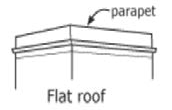
Parapet shall mean a low wall or barrier at the edge of the roof.
i.
Texture shall mean the surface characteristics, grains, and patterns of a material, such as striped, blocked, pebbled, brushed, or smooth.
j.
Transom light shall mean a flat glass panel above a door, usually multipaned.
k.
Trim color shall mean the color used on windows or doorjambs, frames, sills, shutters, or fasciae.
(5)
Visual interest. To avoid monotony of design, front and street side exterior walls consisting of a single undifferentiated plane with a single color or texture are prohibited. Differentiation may be achieved by using a combination of ornamentation, pattern, and composition as listed below:
(6)
Roofs. For new construction, including new buildings and new additions, flat roofs shall be designed with parapets at least forty-two (42) inches high on all façades.
(7)
Windows, doors, and entrances.
a.
At least one (1) entrance door of each building shall face the arterial or collector roadway and be emphasized through features such as moldings, arches, transom lights, sidelights, or tilework.
b.
Entrances from the sidewalk shall be inset to allow doors to open without encroaching upon the sidewalk. The Zoning official may waive this requirement where an existing building is being renovated and the requirement is deemed infeasible, based on the design of the existing building.
c.
Blank or windowless elevations that face public streets are prohibited. Walls that do not include window glazing or storefront entrances shall be articulated by the provision of faux windows trimmed with frames, sills, lintels, awnings, murals, or similar elements.
d.
First floor windows shall consist of clear glass and shall occupy at least forty percent (40%) of the first floor front and street-side elevations that face public streets. Glass shall be a minimum of eighteen (18) inches above the sidewalk.
(8)
Outdoor equipment. Except for rooftop photovoltaic solar systems installed in accordance with Section 39-109 of the Broward County Code of Ordinances, all heating, ventilation, air conditioning, electrical, mechanical, and similar equipment shall be completely screened from view or isolated so as to not be visible from any adjacent public right-of-way or residential zoning district. Any screening shall be designed to maintain a uniform appearance with the rest of the building.
(9)
Prohibitions. Neon tubing as well as neon, fluorescent, iridescent, metallic, and similar colors in paint, fabric, and other materials are prohibited.
(o)
Setback Waiver. Required setback distances set forth herein shall be waived by ten percent (10%) up to a maximum of one (1) foot for any existing and completed commercial building or structure that exists prior to February 26, 2018.
(Ord. No. 1999-23, § 3, 5-11-99; Ord. No. 2000-36, § 36, 8-22-00; Ord. No. 2013-04, § 2, 2-12-13; Ord. No. 2018-01, § 3, 1-9-18; Ord. No. 2019-25, § 3, 9-10-19; Ord. No. 2020-34, §§ 1, 31, 9-22-20; Ord. No. 2021-13, § 1, 2-22-21; Ord. No. 2022-22, § 18, 5-11-22; Ord. No. 2024-14, § 1, 5-7-24; Ord. No. 2025-39, § 3, 11-13-25)
Sec. 39-295. - Permitted uses.
Permitted principal uses in all business districts shall be limited to those uses specified in the Master Business List. Any use not specifically listed herein, but that is commercial in nature, shall be determined by the zoning official to be permitted in the zoning district specifying the most similar use thereto. All permitted uses shall be subject to Section 39-300, "Limitations of uses." Specific section references are included in the following Master Business List:
Master Business List
*May not be located within five hundred (500) feet of the real property that comprises a public or private elementary school, middle school, or secondary school, unless approved by the Board of County Commissioners after a quasi-judicial public hearing, pursuant to Section 39-30 of the Broward County Code of Ordinances, at which the Board determines that the location promotes the public health, safety, and general welfare of the community.
(Ord. No. 1999-23, § 3, 5-11-99; Ord. No. 2000-14, § 3, 4-11-00; Ord. No. 2000-36, § 37, 8-22-00; Ord. No. 2011-09, § 3, 5-24-11; Ord. No. 2013-04, § 2, 2-12-13; Ord. No. 2014-19, § 3, 6-10-14; Ord. No. 2014-37, § 2, 11-12-14; Ord. No. 2018-06, § 6, 1-23-18; Ord. No. 2020-34, § 32, 9-22-20; Ord. No. 2022-18, § 6, 4-27-22; Ord. No. 2025-15, § 12, 4-1-25)
Sec. 39-296. - Prohibited uses.
Any use which is not specifically listed, or which by inference is not listed, in section 39-295 shall be prohibited.
(Ord. No. 1999-23, § 3, 5-11-99)
Sec. 39-297. - Plot size.
(a)
There shall be no minimum plot size, except as specified in section 39-300, in B-1, B-2, B-3, B-4, and C-1 districts.
(b)
There shall be a minimum plot size of five (5) acres in any CR Commercial Recreation district.
(c)
There shall be a minimum plot size of ten (10) acres in any OP Office Park district.
(Ord. No. 1999-23, § 3, 5-11-99; Ord. No. 2000-14, § 4, 4-11-00)
Sec. 39-298. - Plot coverage.
(a)
In addition to pervious area requirements of the Broward County Land Development Code, the maximum plot coverage in any commercial zoning district, except OP Office Park, shall not exceed thirty-five percent (35%) of the net acreage, except as permitted in section 39-301, "Special regulations for overlay districts."
(b)
The maximum plot coverage in any OP Office Park district shall not exceed twenty percent (20%) of the net acreage.
(Ord. No. 1999-23, § 3, 5-11-99)
Sec. 39-299. - Height.
(a)
No building or structure located within one hundred (100) feet of any plot zoned for detached one-family dwellings, two-family dwellings, or townhouses shall be erected or altered to a height exceeding thirty-five (35) feet.
(b)
A building or structure may be erected or altered to a height of fifty-five (55) feet, provided the building or structure is located more than one hundred (100) feet from any plot zoned for detached one-family dwellings, two-family dwellings, or townhouses.
(c)
A building or structure may be erected or altered to a height of one hundred twenty (120) feet, provided the building or structure is located more than two hundred (200) feet from any plot zoned for detached one-family dwellings, two-family dwellings, or townhouses.
(d)
Scenery lofts, towers, cupolas, steeples and domes, not exceeding in gross area, at maximum horizontal section, thirty percent (30%) of the roof area, and flagpoles, airplane beacons, broadcasting towers and antenna for radio and television, chimneys, stacks, tanks, roof structures and parapets, used only for ornamental or mechanical purposes, may exceed the permissible height limit in the zoning district by not more than twenty-five percent (25%) or by twenty-five percent (25%) of the height of the building, whichever is less.
(Ord. No. 1999-23, § 3, 5-11-99; Ord. No. 2020-34, § 33, 9-22-20)
Sec. 39-300. - Limitations of uses.
(a)
Accessory dwellings and structures.
(1)
Accessory dwellings shall be permitted, subject to the availability and allocation of redevelopment units in accordance with the Future Unincorporated Area Land Use Element. Except for self-storage warehouses, each dwelling unit shall not exceed one thousand five hundred (1,500) square feet in floor area, shall not be less than four hundred (400) square feet, and the aggregate gross floor area of all dwelling units shall not exceed fifty percent (50%) of the gross floor area of the commercial uses within the building where the unit is located. Such dwelling units shall be located within the building to which the dwelling is accessory, on an upper story of the building.
(2)
Accessory structures shall be permitted for the storage of materials and supplies, provided the floor area does not exceed two hundred (200) square feet and the height does not exceed ten (10) feet.
(b)
Amusement parks and other outdoor commercial recreation uses. No race track, mechanical riding device, shooting range or other outdoor amusement activity in a CR Commercial Recreation district shall be located within five hundred (500) feet of any residentially-zoned plot.
(c)
Amusement centers, billiard centers. Amusement centers and billiard centers in Commercial Recreation districts may be permitted only as an accessory use occupying not more than ten percent (10%) of the gross floor area of the principal use on the premises.
(d)
Automobile, truck and sports utility vehicle accessories; sales and installation. All activities associated with facilities for the sale and installation of accessories such as stereos, trim, wheels, wheel covers, bedliners, etc. and including interior vehicle modifications, shall be conducted inside a building in B-2 and B-4 districts.
(e)
Auto repair garages. Any building or open air area used for automobile repair, including paint and body shops, and any storage area for vehicles being or to be repaired, shall be located at least fifty (50) feet from any residentially-zoned district and shall be screened from the residentially-zoned district by a fence or hedge as specified in section 39-294(f)(7). Any open air areas used for repairs shall be considered as additional work bays which shall be delineated on the approved site plan and which shall require the appropriate amount of offstreet parking. In B-3 districts automobile paint and/or body shops shall only be permitted as an accessory use to new vehicle dealerships. Small dent repair not involving the use of paint, sanding, body fillers, chemicals or mechanical equipment shall be considered the same as auto repair garages and shall be permitted in B-3 districts.
(f)
Boarding or breeding kennels. Boarding or breeding kennels shall not be permitted on any plot which is contiguous to any residentially-zoned district, or which is separated only by a street, alley, canal, or railroad right-of-way.
(g)
Boat building, repair and storage. Any plot which is used for building or repairing boats shall be separated from any residentially-zoned district by three hundred (300) feet. Any plot used for dry storage of boats shall be at least one hundred (100) feet from any residentially-zoned district.
(h)
Bus terminals. In B-2 districts, no maintenance of buses shall be permitted. Storage of buses shall be limited to an area designated on an approved site plan, which shall be buffered from adjoining plots through the use of translucent fencing or landscaping as specified in section 39-294(f)(7). No bus shall be stored within fifty (50) feet of any residentially-zoned plot.
(i)
Cabinet and carpenter shops. Any plot upon which a cabinet or carpenter shop is located shall be at least one hundred (100) feet from any residentially-zoned plot.
(j)
Child care centers and pre-schools. All child care centers and pre-schools shall be designed to accommodate an outdoor play area that is separated and buffered from offstreet parking areas, drive aisles, streets and alleys. Such play areas shall be completely enclosed with a fence at least five (5) feet in height.
(k)
Clothing donation bin. Clothing donation bins shall be permitted only in compliance with the provisions of this chapter, including the following requirements:
(1)
The charitable organization operating the clothing donation bin has obtained a valid permit from Broward County;
(2)
One (1) clothing donation bin shall be permitted on the property of a retail or professional building of at least thirty thousand (30,000) square feet in interior space, none of which is part of a shopping center;
(3)
One (1) clothing donation bin shall be permitted for each thirty thousand (30,000) square feet of building size on property of a shopping center of at least thirty thousand (30,000) square feet in interior building size; and
(4)
All other conditions of this chapter for clothing donation bins are satisfied and there is continuing compliance with the provisions of this chapter.
(l)
Commercial vehicle storage yards. Commercial vehicle storage yards shall not include storage of heavy equipment, including, but not limited to, backhoes, bobcats, cranes, tractors, or other such equipment which is not intended as a means of transportation on public streets. Commercial vehicle storage yards shall not be located within fifty (50) feet of any residentially-zoned district.
(m)
Contractor shops. Contractor shops shall be limited to office and warehouse storage and accessory equipment. Any storage of building materials shall be inside a building. Contractor shops shall not be located within two hundred (200) feet of any residentially-zoned district.
(n)
Day labor employment agencies. All clients awaiting employment or transportation to a job-site must be accommodated inside the building.
(o)
Equipment sales. Heavy equipment sales and rental facilities shall be located at least three hundred (300) feet from any residentially-zoned district.
(p)
Funeral homes and mortuaries. A funeral home or mortuary may have a crematory as an accessory use thereto, provided the crematory is within the principal building.
(q)
Fuel retailer.
(1)
The minimum plot size for any gasoline station shall be twenty-two thousand five hundred (22,500) square feet, with a minimum street frontage on each street of one hundred fifty (150) feet.
(2)
No gasoline pump island shall be closer than twenty-five (25) feet from any plot line.
(3)
Convenience stores, fast food restaurants, automatic drive-through car washes, and automotive repairs, excluding paint and body repairs, shall be permitted as accessory uses. If repairs are performed on the premises, any vehicular storage shall be in an area other than required parking spaces, and such area shall be screened from view of adjoining properties by a fence or landscaping as specified in section 39-294(f)(7).
(r)
Marinas. Marinas desiring to provide for live-aboard boats shall be required to request allocation of reserve units, if available. Such use shall also demonstrate conformity with all applicable federal, state, or local codes relating to sewage pump facilities or other equivalent facilities.
(s)
Mobile collection centers.
(1)
No mobile collection center shall be closer than one hundred (100) feet from any residentially zoned plot, nor closer than fifty (50) feet from any street.
(2)
The minimum length of any trailer shall be twenty (20) feet and no trailer shall exceed forty (40) feet in length.
(3)
Only one trailer shall be located on a single plot.
(4)
One sign shall be permitted, mounted on the outside of the trailer. The sign may state the name of the business, address, telephone number and hours of operation.
(5)
All mobile collection centers, with the exception of mechanical depositories, shall be staffed by at least one employee during hours of operation.
(6)
There shall be a one thousand (1,000) foot separation between mobile collection centers. Such separation shall be measured by following a straight line between the points of each mobile collection center closest to each other.
(t)
Mobile food units.
(1)
Mobile food units, other than those limited to the preparation and sale of frankfurters, shall be permitted to remain on private property for the purpose of selling food products for a maximum of one (1) hour, and shall not return to the same location more than three (3) times in any twelve (12) hour period. Mobile food units limited to the preparation and sale of frankfurters may be permitted on private property, with the written authorization of the property owner, for the purpose of selling frankfurters. Such units may not remain at one (1) location for more than eight (8) consecutive hours. Only one (1) unit shall be permitted on any individual plot. The owner of such mobile food units shall obtain a certificate of use, which shall be renewed on an annual basis for a period not to exceed five (5) years. At the time of initial application for the certificate of use, and for each subsequent renewal, the applicant shall submit proof of compliance with all applicable state laws and requirements, including, but not limited to, occupational licensing, health and safety regulations, and all County permitting and licensing requirements, together with proof of general liability insurance coverage in the minimum amount of three hundred thousand dollars ($300,000.00), which includes product liability. Persons in compliance with all requirements of this subsection may make sales from vehicles temporarily stationary on a street to occupants of abutting property, providing no impediment or hazard to vehicular or pedestrian traffic is created.
(2)
Persons vending from mobile food units who are inappropriately attired shall be considered to cause a hazard or impediment to traffic. Inappropriate attire shall include clothing which shows any portion of the anal cleft, cleavage or buttocks of males or females such as G-strings, T-back bathing suits, thong bikinis or any other clothing or covering that does not completely and opaquely cover the anal cleft, cleavage or buttocks of males and females. Inappropriate attire shall also include clothing which shows the portion of the human female breast directly or laterally below a point immediately above the top of the areola with less than a fully opaque covering. This definition shall include the entire lower portion of the human female breast, including the areola and nipple, but shall not include any portion of the cleavage of the human female breast exhibited by a dress, blouse, shirt, leotard, bathing suit or other clothing, provided the areola is not exposed.
(u)
Parts stores, retail. All storage and display of parts shall be inside a building. No vehicle parts salvage operations shall be permitted.
(v)
Pawnshops. Pawnshops shall not be permitted on any plot which is contiguous to a residentially-zoned district or which is separated from a residentially-zoned district only by a street, alley, canal, or railroad right-of-way.
(w)
Recreational vehicle parks.
(1)
The maximum density for recreational vehicle parks shall be ten (10) sites per net acre, and shall be subject to availability and allocation of reserve units, if located on property designated nonresidential on the Future Unincorporated Area Land Use Element Map Series.
(2)
Recreational vehicle parks providing fifty (50) or more sites may have a retail store and a personal service shop for the convenience of the occupants. Such uses shall not exceed five percent (5%) of the plot area and shall be conducted from an enclosed building with no signs or displays visible from any street or adjacent private property.
(3)
A permanent detached one-family dwelling with a maximum of one thousand five hundred (1,500) square feet of floor area may be constructed for the park manager and immediate family.
(4)
Each site for a recreational vehicle shall be at least one thousand five hundred (1,500) square feet in area with at least one dimension of fifty (50) feet.
(5)
Each site shall provide a paved parking area of at least ten (10) feet by forty (40) feet extending to and abutting a road not less than thirty (30) feet in width with a paved surface not less than twenty-two (22) feet in width.
(6)
A twenty-five (25) foot wide buffer shall be established and maintained around the entire perimeter of the recreational vehicle park to provide visual and noise separation from adjacent property. Landscape and visual buffers shall be provided in accordance with Article VIII of this chapter, "Landscaping for Protection of Water Quality and Quantity," and with Subsection 39-294(f)(7) of this article.
(7)
Additions and temporary structures shall be permitted on recreational vehicles, subject to permitting requirements in section 39-15 of this Chapter, "Permits Required" and section 39-17, "Plans and Surveys." No part of any recreational vehicle or any addition thereto shall be closer than ten (10) feet side to side, eight (8) feet end to side, or six (6) feet end to end, from any other recreational vehicle.
(8)
All recreational vehicles and additions thereto shall be set back at least ten (10) feet from the adjoining road.
(9)
All recreational vehicle parks shall provide at least five percent (5%) of the plot area for recreational purposes of the temporary residents. If more than one recreation area is provided, no such area shall be less than ten thousand (10,000) square feet.
(10)
All recreational vehicle parks shall provide sanitary facilities in a permanent building located not more than three hundred (300) feet from any site.
(11)
Recreational vehicles may remain on a site indefinitely; however, residency is limited to six (6) months in any one year period.
(x)
Restaurants, fast food. Outside play areas for children provided at fast food restaurants shall be in walled-in or fenced-in areas only. The wall or fence design must be compatible in design, materials, and color with the main structure. Between any such area and adjoining sidewalks, parking spaces, or other vehicular use areas, a landscape strip of no less than five (5) feet shall be provided containing trees and tall shrubs of three (3) feet minimum height. Play equipment shall be limited to a maximum height of ten (10) feet or the height of the fascia, whichever is lower. There shall be no access to or from the play area except through the interior of the restaurant.
(y)
Skateboard facilities and skating rinks. Only indoor skateboard facilities and skating rinks shall be permitted in B-2 and B-3 zoning districts.
(z)
Swimming pool supplies. Except for bulk quantities of sodium hypochlorite, all swimming pool chemicals, including pre-packaged chemicals, shall be dispensed strictly through retail sales and shall be stored within a completely enclosed structure.
(aa)
Trade or vocational schools. Trade or vocational schools involving vehicle or equipment repair instruction shall be on a plot which is at least three hundred (300) feet from any residentially-zoned district.
(bb)
Veterinary hospital. Veterinary hospitals shall not be permitted on any plot which is contiguous to a residentially-zoned district or which is separated from a residentially-zoned district only by a street, alley, or canal.
(cc)
Warehouses, self-storage.
(1)
Self-storage warehouses shall only be used for self-service storage. No businesses shall be permitted to operate from, or be licensed at, the facility. No personal activities, such as but not limited to, hobbies, arts and crafts, woodworking, repair, restoration, or maintenance of vehicles, machinery or equipment, etc. shall be permitted.
(2)
Outside storage areas for boats, vehicles, etc. shall be located on the interior of the facility, not visible from any adjacent property or street.
(3)
Building height shall not exceed thirty-five (35) feet.
(4)
Storage bay doors on any perimeter building shall not face any abutting property located in a residentially-zoned district.
(5)
One accessory dwelling unit shall be permitted, subject to the availability and allocation of a reserve unit as provided in the Future Unincorporated Area Land Use Element. Such dwelling unit shall not exceed one thousand five hundred (1,500) square feet in floor area.
(Ord. No. 1999-23, § 3, 5-11-99; Ord. No. 2000-14, § 5, 4-11-00; Ord. No. 2002-09, § 2, 2-26-02; Ord. No. 2013-04, § 2, 2-12-13; Ord. No. 2014-19, § 3, 6-10-14; Ord. No. 2020-34, §§ 1, 34, 9-22-20; Ord. No. 2022-18, § 7, 4-27-22)
Sec. 39-301. - Special regulations for B-4 commercial redevelopment overlay districts.
(a)
Applicability. The B-4 commercial redevelopment overlay district is intended to apply to developed commercial areas identified by ordinance of the County Commission as having at least seventy-five percent (75%) of the principal buildings in existence for ten (10) years or more and which meet the criteria set forth in Subsection (b). District regulations are intended to reverse decline in the economic viability of the area, encourage enhancement of physical and functional characteristics of the buildings and properties, encourage use of the area by neighboring residents as well as vehicular traffic, and deter crime. An ordinance of the County Commission designating an area as a B-4 commercial redevelopment overlay district shall be enacted pursuant to the provisions of Section 125.66, Florida Statutes.
(b)
Criteria. No area shall be considered for the B-4 district classification which does not meet three (3) or more of the following criteria:
(1)
The area has a minimum of one-half (½) mile of frontage on a major arterial.
(2)
The area has had a substantial decrease in offstreet parking due to road widening over the past twenty (20) years.
(3)
The area has maintained a substantial vacancy rate over the past five (5) years.
(4)
The area has deteriorated in overall appearance due to lack of maintenance.
(5)
The area has attracted occupants which are not compatible with the retail and service needs of the community, and which statistically attract criminal activities.
(6)
The area has encountered a steady increase in crime.
(7)
At least ten percent (10%) of the properties are occupied by nonconforming uses.
(c)
Application and administration. Any property owner desiring to develop or redevelop property within a B-4 district shall submit an application for a development permit, as that term is defined in Chapter 380, Florida Statutes, and a conceptual site plan to the Planning and Environmental Regulation Division, or successor agency.
(d)
Redevelopment incentives. To encourage upgrading, refurbishing and revitalization of existing commercial areas, the following redevelopment incentives have been established:
(1)
The amount of offstreet parking and loading required by section 39-228 of this Code may be reduced by fifty percent (50%), provided a determination is made by the design review committee as specified in subsection (e)(6) following, that such reduction will not adversely affect the public safety or create unsafe traffic conditions; and further provided that no reduction of twenty-five percent (25%) or more shall be approved unless at least ten percent (10%) of the total amount of required parking is designated for bicycle parking as provided in this subsection.
a.
Bicycle parking facilities shall be indicated on the site plan accompanying any redevelopment project. The number of bicycle parking spaces shall be indicated in the site data box.
b.
Bicycle parking facilities may be in the form of:
1.
Racks that support the bicycle frame and wheels firmly and in a stable position; have cables, chains or movable parts that secure the frame and/or both wheels of the bicycle and which shall support the bicycle firmly and in a stable position;
2.
An area within a building where bicycles can be constantly observed;
3.
A bicycle storage locker; or
4.
Check-in parking systems where the bicycle is left with an attendant.
c.
Bicycle parking facilities shall be designed, constructed and maintained in accordance with the following standards:
1.
Bicycle parking areas shall be clearly labeled as available for bicycle parking and shall not be hidden from view of the public.
2.
If a room or bicycle storage locker is not divided into individual spaces or rack space, one bicycle parking space shall consist of an area not less than twelve (12) square feet with locking devices.
3.
Parallel bicycle parking spaces shall provide an adjacent access aisle of four (4) feet in width. Head-in bicycle parking spaces shall provide a back-out aisle of six (6) feet in width.
(2)
The amount of pervious area required by the Broward County Land Development Code may be reduced to twenty percent (20%) without the need to supplement required landscaping.
(3)
The location of required accessory structures such as dumpster enclosures, buffer fences, sign structures, etc. may encroach into any required yard or buffer to accomplish the redevelopment project, provided no hazard to pedestrian or vehicular traffic is created.
(4)
Fees related to applications for development orders, as provided in the Broward County Land Development Code, and permits shall be reduced by fifty percent (50%) and such applications shall be given a review priority over other similar projects not in a B-4 district.
(5)
Staff of the various divisions of Broward County may provide assistance to the property owner in locating sources for financing, architectural and engineering services.
(e)
Redevelopment requirements. Development permits issued pursuant to the development incentives set forth in Section (d) shall be subject to the limitations on permitted uses in the B-4 district, as set forth below:
(1)
The development or redevelopment shall be subject to compliance with the principles of Crime Prevention Through Environmental Design (CPTED).
(2)
The development or redevelopment shall be aesthetically designed to compliment and enhance any other redevelopment in the same redevelopment area which used the B-4 overlay district regulations. All buildings and structures on the property shall present a unified architectural theme. The rear and sides of the building shall be finished with materials that, in texture and color, resemble the front of the building. Coloration of all buildings and structures shall be a natural blend with a maximum of three (3) colors, exclusive of the roof. The use of "earth tones," light pastel colors, white or gray shall be required for building walls. Decorative trim may be any color which compliments the primary building colors.
(3)
The property and building(s) will be maintained on a regular basis, consistent with Section 39-133 of this code.
(4)
No new billboard signs shall be permitted on the property for which the development permit is issued.
(5)
Conceptual site plan review. A design review committee is hereby established to review the conceptual site plan for conformity with the requirements of this section. Each member of the committee shall submit written comments to the zoning official, or designee, who shall review the comments and make final recommendations. Any changes recommended or required by the zoning official shall be incorporated into the approved conceptual site plan. The design review committee shall be comprised of one (1) staff member from each of the following offices or divisions of Broward County, who shall be persons regularly involved in the review process for plats and site plans:
a.
Housing and Urban Planning Division;
b.
Highway Construction and Engineering Division;
c.
Traffic Engineering Division; and
d.
Fire Marshal, Broward Sheriff's Office.
Within six (6) months following approval of the conceptual site plan by the zoning official, the property owner shall attend a preapplication conference with the design review committee and submit a final site plan in the same form prescribed in Section 39-411(b). In addition to submittal requirements therein, the applicant shall also submit preliminary elevation and landscape plans, including colors and materials for building finishes, and at least four (4) different eight (8) inch by ten (10) inch color photographs of the property indicating its current condition. A copy of the application shall also be transmitted to the Office of Economic and Small Business Development, or successor agency, and the Department to serve as notice that the applicant is authorized for and is interested in participating in any available programs relating to grants, funding, or economic development incentives.
(Ord. No. 1999-23, § 3, 5-11-99; Ord. No. 2005-17, § 13, 6-28-05; Ord. No. 2013-04, § 2, 2-12-13; Ord. No. 2018-15, § 1, 4-10-18; Ord. No. 2020-34, § 1, 9-22-20; Ord. No. 2022-22, §§ 15, 18, 5-11-22; Ord. No. 2025-39, § 3, 11-13-25)
Sec. 39-302. - Limitations of accessory uses in Office Park districts.
The gross floor area occupied by permitted accessory uses shall not exceed twenty percent (20%) of the aggregate gross floor area of all buildings reflected on the approved site development plan for any plot in an Office Park zoning district.
(Ord. No. 1999-23, § 3, 5-11-99)

