
Brown Deer Village City Zoning Code
ARTICLE I
- IN GENERAL
Sec. 121-1.- Rules.
In the construction of this chapter, the following rules shall be observed and applied, except when the context clearly indicates otherwise:
(1)
Words used in the present tense shall include the future tense;
(2)
The singular number shall include the plural number and the plural number the singular number;
(3)
The term "building" shall include the word "structure";
(4)
The term "shall" is mandatory and not directory; and
(5)
The term "may" is permissive.
(Prior Code, § 22-11-11.01(A); Ord. of 9-20-1954, 22-11-11.01)
Sec. 121-2. - Definitions.
The following words, terms and phrases, when used in this chapter, shall have the meanings ascribed to them in this section, except where the context clearly indicates a different meaning:
Abuts or abutting means having a common property line or district line.
Accessory structure means a subordinate building or a portion of a main building, the use of which is incidental to that of a building, and which is located on the same lot as the main building.
Adjacent means lying near or close to or in the neighborhood or vicinity of.
Adjoining means touching or contiguous, as distinguished from lying near or adjacent.
Alley means a right-of-way with a width of not less than 16 feet nor more than 24 feet, which affords a secondary means of vehicular access to abutting properties. A street shall not be considered an alley.
Alteration means a change in size, shape, occupancy or use of a building or structure.
Animal hospital means a building or portion thereof designed or used for the care, observation, or treatment of domestic animals.
Automobile laundry means a building or portion thereof containing facilities for washing more than two motor vehicles, using production-line methods.
Automobile service station means a building or portion thereof or premises used for offering for retail sale to the public, of fuels, lubricating oil, grease, tires, batteries, and accessories for motor vehicles where repair service is incidental, where no storage or parking space is offered for rent, and where no motor vehicles, boats or trailers are offered for sale or rent.
Awning means a roof-like mechanism, retractable in operation, which projects from the wall of a building.
Basement means a story having part but not more than one-half of its floor to clear ceiling height below grade. When a basement is used for storage, garages for use of occupants of the building, or other facilities common for the rest of the building, it shall not be counted as a story.
Big box development, stand alone, means large-scale commercial and/or retail operation that occupies more than 60,000 square feet of floor area and is not connected or attached to another commercial or retail use.
Block means a tract of land bounded by streets, or by a combination of streets and public parks, cemeteries, railroad rights-of-way, or other lines of demarcation. A block may be located in part beyond the corporate limits of the village.
Buildable area means the area of a lot not reserved for the front, side or rear setbacks.
Building, completely enclosed, means a building separated on all sides from the adjacent open space, or from other buildings or structures, by a permanent roof and by exterior walls, pierced only by windows and normal entrance and exit doors.
Building, detached, means a building surrounded by open space.
Building height means the vertical distance from grade to the highest point of the coping of a flat roof or to the deck line of a mansard roof, or to the mean height level between eaves and ridge for gable, hip or gambrel roofs.
Building inspector means the official of the village, duly appointed and designated as the building inspector.
Building, principal, means a nonaccessory building in which the principal use of the lot is conducted.
Building, temporary, means any building not designed to be permanently located at the place where it is, or where it is intended to be temporarily placed or affixed.
Bulk means an indication of the size and setback of buildings or structures, and the location of the same with respect to one another, and includes the following:
(1)
Size and height of buildings;
(2)
Location of exterior walls;
(3)
Floor area ratio;
(4)
Open space allocated to buildings; and
(5)
Lot area and lot width provided per dwelling unit.
Business means an occupation, employment, or enterprise which occupies time, attention, labor, and materials, or wherein merchandise is exhibited or sold, or where services are offered.
Capacity in persons means the maximum number of persons that can avail themselves of the services or goods of an establishment or use at any one time with reasonable comfort and safety.
Carport means a roofed automobile shelter, with two or more open sides.
Cellar means an area having more than one-half of its floor to clear ceiling height below grade and which is not counted as a story.
Clinic, medical or dental, means a building or portion thereof, the principal use of which is for offices of physicians or dentists or both, for examination and treatment of persons on an out-patient basis.
Closed cup flash point means the lowest temperature at which a combustible liquid under the most favorable conditions, will give off a flammable vapor which will burn momentarily.
Club or lodge, private, means a nonprofit association of persons who are bona fide members and whose facilities are restricted to members and their guests. Food and alcohol beverages may be served on its premises provided they are secondary and incidental to the principal use.
Community garden means land commonly shared and maintained by multiple users and appropriate for and limited to the tillage of soil and the production, cultivation and harvesting of any agricultural, floricultural or horticultural commodity but not including retail sales of such items, and the keeping of poultry or livestock.
Conditional permitted use means a classification of use which, if specified within district regulations, may be permitted in accordance with procedures and standards set forth in this chapter.
Conforming building or structure means a building or structure which:
(1)
Complies with all the regulations of this comprehensive chapter or of any amendment thereto governing bulk of the district in which said building or structure is located; or
(2)
Is designed or intended for a permitted or conditional permitted use as allowed in the district in which it is located.
Contiguous means in actual contact.
Court means an open unoccupied space other than a yard on the same lot with a building or group of buildings and which is bounded on two or more sides by such building or buildings.
Decibel means a unit of measurement of the intensity (loudness) of sound; sound level meters, which are employed to measure the intensity of sound, are calibrated in "decibels."
District means a portion of the village within which on a uniform basis, certain uses of land and buildings are permitted and certain other uses of land and buildings are prohibited as set forth in this chapter, or within which certain setbacks and other open spaces are required or within which certain lot areas, dwelling sizes and density requirements are established or within which a combination of such aforesaid regulations are applied.
Domestic pet service means an establishment where clipping, bathing and other services except that of a veterinary nature are rendered to dogs, cats, and domestic pets. No boarding shall be permitted.
Drive-in establishment means an establishment or part thereof in which are provided facilities where serving or consuming commodities or both are intended to occur primarily in patrons' automobiles parked on the premises.
Dwelling means a building or portion thereof designed or used exclusively for residential purposes, multiple-family dwellings, but not including mobile homes, or other trailers or lodging rooms in hotels, motels, or lodginghouses.
Dwelling, attached, means a dwelling joined to two other dwellings by party walls, or vertical cavity walls and above ground physically unifying horizontal structural elements.
Dwelling, bi-level, means a dwelling that has two floors, excluding cellars, but including finished basement area not used for storage, garages, laundries, or other area common for the rest of the building, which floors are vertically separated by at least eight feet.
Dwelling, detached, means a dwelling which is surrounded on all sides by open space on the same lot.
Dwelling, one-story, means a dwelling with one floor level or for the purposes of determining the required ground floor area, any dwelling which does not meet the definition standards of a bi-level, tri-level, or two-story building.
Dwelling, semi-attached, means a dwelling joined to one other dwelling by a party wall or vertical cavity wall, and aboveground physically unifying horizontal structural elements.
Dwelling, single-family, means a dwelling containing one dwelling unit in a detached building unless otherwise specified.
Dwelling, tri-level, means a dwelling that has at least one intermediate story, excluding mezzanines or balconies, between the floor grade of the lower story and the floor grade of the upper story. Each story shall be separated in elevation by a minimum of 21 inches. Tri-levels with all three levels above the highest ground grade adjacent the dwelling shall contain a minimum of 2,000 square feet.
Dwelling, two-family detached, means a dwelling containing two dwelling units only, one above the other.
Dwelling, two-story, means a dwelling which has two floors, excluding basements or cellars which are vertically separated by at least eight feet.
Dwelling unit means one or more rooms which are arranged, designed, or used as living quarters for one family only. Individual bathrooms and complete single kitchen facilities, permanently installed to serve the entire family, shall always be included within each "dwelling unit."
Efficiency unit means a dwelling unit consisting of one principal room, exclusive of bathroom, kitchen, hallway, closets or dining alcove directly off the principal room.
Electric distribution center means a terminal at which electric energy is received from the transmission system and is delivered to the distribution system only.
Electric substation means a terminal at which electric energy is received from the transmission system and is delivered to other elements of the transmission system, and, generally, to the local distribution system.
Engineer, village, means the official of the village duly appointed and designated as the village engineer.
Establishment, business, means a place of business carrying on operation, the ownership or management of which is separate and distinct from those of any other place of business located on the same or other lot.
Fallout shelter means an accessory building and use which incorporates the fundamentals for fallout protection (shielding mass, ventilation, and space to live) and which is constructed of such materials in such manner as to afford to the occupants substantial protection from radioactive fallout.
Family means one person or two or more persons each related to the other by blood, marriage, or legal adoption, or a group of not more than four persons not all so related, together with his or their domestic servants, maintaining a common household in a dwelling unit. A family may include, in addition thereto, not more than two roomers, boarders, or permanent guests, whether or not gratuitous.
Farmers market means a market held on pre-established dates in an open area or structure at which homegrown produce (fruits and vegetables), edible grains, nuts and berries, eggs, maple syrup, honey, bakery goods, nonalcoholic beverages, condiments, cheese, meat, poultry, cut or dried flowers, house plants, herbs and handcrafted nonfood items are sold. Handcrafted items shall be first-time sales items made only in Wisconsin and shall not include second-hand or flea market-type products. Handcrafted items shall comprise no more than 30 percent of the total merchandise sold at the market. Products, goods and merchandise which shall not be sold are rummage articles, live animals and pets, trees and shrubs and wholesale purchased items.
Fence means a structure, or tree or shrub hedge which is a barrier and used as a boundary or means of protection or confinement.
Fence, open, means a fence, including gates, which has, for each one foot wide segment extending over the entire length and height of the fence, 50 percent of the surface area in open spaces which afford a direct view through the fence.
Fence, solid, means a fence, including gates, which conceals from view from adjoining properties, streets or alleys, activities conducted behind it.
Financial institution means a bank, trust company, savings bank, savings and loan association or other savings institution, or credit union, chartered and supervised under state or federal law.
Floor area means the sum of the gross horizontal areas of all floors, including also the basement floor of a building, measured from the exterior faces of the exterior walls, or from the centerlines of walls separating the two buildings. The "floor area" shall also include the horizontal areas on each floor devoted to elevator shafts and stairwells, mechanical equipment, except if located on the roof, when either open or enclosed (i.e., bulkheads, water tanks, and cooling towers), habitable attic space permitted by chapter 105, interior balconies and mezzanines, enclosed porches, and accessory uses. The "floor area" of structures used for bulk storage of materials (i.e., grain elevators, petroleum tanks, etc.) shall be included in the "floor area," and such "floor area" shall be determined on the basis of the height of such structures with one floor for each ten feet of structure height, and if such structure measures less than ten feet, but not less than five feet over such floor height intervals, it shall be construed to have an additional floor.
Floor area for determining off-street parking and off-street loading requirements means when prescribed as the basis of measurement for off-street parking spaces and off-street loading spaces for any use, the sum of the gross horizontal area of all floors of the building. All horizontal dimensions shall be taken from the exterior of the walls.
Floor area ratio means numerical value obtained by dividing the "floor area" within a building or buildings on a lot by the area of such lot. The floor area ratio as designed for each district when multiplied by the lot area in square feet shall determine the maximum permissible "floor area" for the building or buildings on the lot.
Floor area, usable, means any floor area within outside walls of a residential building exclusive of areas in cellars, basements, unfinished attics, garages, open porches and accessory buildings, but including any area "roughed in" but not completed which is designed and intended for human occupancy. The horizontal area in each floor of a building devoted to off-street parking and off-street loading facilities, and the horizontal area of a cellar floor shall not be included in the "floor area."
Free burning means the rate of combustion described by a material which burns actively, and easily supports combustion.
Freight terminal means a building or area in which freight brought by motor truck or railroad freight car is assembled or stored for routing in intrastate or interstate shipment by motor trucks or railroad freight cars.
Frequency means the number of oscillations per second in a sound wave, and is an index of the pitch of the resulting sound.
Garage, private, means an accessory building designed and used for the storage of motor vehicles owned and used by the occupants of the building to which it is accessory, and in which no occupation or business for profit is carried on. Not more than one of the motor vehicles may be a commercial vehicle of not more than 1½ ton capacity.
Garage, public, means a building or portion thereof other than a private or storage garage, designed or used for equipping, servicing, or repairing motor vehicles. Hiring, selling, or storing of motor vehicles may be included.
Garage, storage, or off-street parking means a building or portion thereof designed or used, or land used exclusively for storage of motor vehicles, and in which motor fuels and oils are not sold, and motor vehicles are not equipped, repaired, hired, or sold.
Grade means the established grade of the street or yard as prescribed by the village.
Gross density means the ratio between the total number of dwelling units on a lot, and the total lot area in acres.
Ground floor means the heated living area of principal building measured on the floor levels located at or above the highest ground grade adjacent to the building, from the exterior faces of the exterior walls, but excluding open porches or terraces, and garages or carports, except in the case of a bi-level dwelling the finished basement area may be included in the "ground floor area."
Group home means a dwelling unit housing not more than six minors, whether related or unrelated to one another, operated under the care of adults (house parents) other than the lawful parents of the minors, in a state-approved (licensed) and state-funded foster care program.
Guest, permanent, means a person who occupies or has the right to occupy a lodginghouse, roominghouse, hotel, apartment hotel or motel accommodation as his domicile and place of permanent residence.
High technological assembly means the design and assembly of sophisticated electronics, computers, semi-conductors, electronic components, office machinery, medical and other measuring devices, photographic or communications equipment and similar equipment.
Home occupation means any gainful business, occupation or profession conducted within a dwelling unit by a member of the family residing in the dwelling unit which is incidental and secondary to the use of the dwelling unit for dwelling purposes.
Hotel means an establishment containing lodging rooms, for occupancy by transient guests in contradistinction to a lodginghouse, or a roominghouse, and is commonly known as a hotel in the village, and which provides customary hotel services such as a maid, telephone and secretarial, bellboy and desk services; and the use of upkeep of furnishings and the laundry of linens.
Hotel apartment means a combined hotel and multiple-family dwelling where more than 50 percent of the accommodations are in dwelling units occupied or intended for occupancy by permanent guests securing such accommodations by prearrangement for a continuous period of 30 days or more.
Institution means a building occupied by a nonprofit corporation wholly for public or semipublic use.
Intense burning means the rate of combustion described by a material that burns with a high degree of activity and is consumed rapidly.
Junkyard means an open area of land and any accessory building or structure thereon which is used primarily for buying, selling, exchanging, storing, baling, packing, disassembling, or handling waste or scrap materials, including vehicles, machinery and equipment not in operable condition or parts thereof, and other metals, paper, rags, rubber tires, and bottles. A "junkyard" does not include an establishment located in the applicable manufacturing district that engages exclusively in the processing of scrap iron or other metals to be sold only to establishments engaged in manufacturing of steel or metal alloys.
Kennel means any premises or portion thereof on which more than two dogs, cats, or other household domestic animals over one year are kept, or on which more than two such animals are maintained, boarded, bred, or cared for in return for remuneration, or kept for the purpose of sale.
Launderette means a business that provides coin operated self-service type washing, drying, drycleaning and ironing facilities, providing that not more than four persons, including owners, are employed on the premises and no pickup or delivery service is maintained.
Loading space means a space within the principal building or on the same lot as the principal building providing for the standing, loading or unloading or trucks and with access to a street or alley.
Loan office means a person other than a financial institution that is licensed by the state department of financial institutions and engages in the business of providing loans to its customers including loans secured by a lien or mortgage, or equivalent security interest, on real property.
Lodging room means a room or suite or rooms rented as sleeping and living quarters, but without cooking facilities and with or without an individual bathroom. In a suite or rooms, each room which provides sleeping accommodations shall be counted as one "lodging room" for the purpose of this chapter.
Lodginghouse means a building originally designed for and used as a single- or two-family dwelling, all or a portion of which contains lodging rooms and which accommodate persons who are not members of the keepers' family. Lodging or meals, or both, are provided for compensation for three or more, but not more than ten persons.
Lot means a tract of land, at the time of filing for a building permit, which is designated by its owners or developer as a tract to be used, developed, or built upon a unit under single ownership or control. Therefore, a "lot" may or may not coincide with a lot of record.
Lot area means that area of a horizontal plane bounded by the front, side, and rear lines of a lot.
Lot coverage means the part or percent of the lot occupied by buildings or structures, including accessory buildings or structures.
Lot depth means the mean horizontal distance between the front lot line and the rear lot line on a lot measured within the lot boundaries.
Lot, interior, means a lot that is not a corner lot.
Lot, through, means a lot having a pair of opposite lot lines along two more or less parallel streets, and which is not a corner lot.
Lot line, front, means that boundary of a lot which abuts a street line. On a corner lot, the lot line having the shortest length abutting a street line shall be the front lot line.
Lot line, interior, means a lot line which does not abut a street.
Lot line, rear, means that boundary of a lot which is most distant from, and is, or is most nearly, parallel to the front line, and in the case of an irregular, triangular, or gore-shaped lot, a line ten feet in length within the lot, parallel to, and at the maximum distance from the front lot line.
Lot line, side, means any boundary of a lot which is not a front lot line or a rear lot line.
Lot of record means a lot which is part of a subdivision, the map of which has been recorded in the office of the county register of deeds, or a parcel of land, the deed of which was recorded in the office of the county register of deeds prior to the effective date of the ordinance from which this chapter is derived.
Lot width means the minimum horizontal distance between the side lot lines of a lot measured at the narrowest width within the buildable area.
Manufacturing establishment means an establishment the principal use of which is manufacturing, fabricating, processing, assembly, repairing, storing, cleaning, servicing, or testing of materials, goods or products.
Mobile home means a trailer designed and constructed for dwelling purposes which contains cooking, sanitary and electrical facilities, and has a gross floor area of 220 square feet or more.
Moderate burning means a rate of combustion described by material which supports combustion and is consumed slowly as it burns.
Motel means an establishment consisting of a group of attached or detached lodging rooms with bathrooms, and where more than 50 percent of the lodging rooms are occupied or designed for occupancy by transient automobile tourists. A "motel" furnishes customary hotel services such as maid service and laundering of linen, telephone, secretarial and desk service, and the use and upkeep of furniture. Cooking facilities shall not be included in any of the lodging rooms, but one dwelling unit may be included for occupancy by the owner of manager of the motel.
Motor freight terminal means a building or area in which freight brought by motor truck is assembled or stored for routing in intrastate or interstate shipment by motor truck.
Multiple-family dwelling means a dwelling other than a single-family semi-attached, single-family attached, or two-family detached which contains more than eight units connected by an interior hall/corridor.
No-access strip means a strip of land within and along a rear lot line of a through lot adjoining a street which is designated on a recorded subdivision plat or property deed as land over which motor vehicular travel shall not be permitted.
Nonconforming building or structure means any building or structure lawfully established which does not comply with all regulations of this chapter or of any amendment hereto governing bulk of the district in which such building or structure is located, or is designed or intended for a nonconforming use.
Nonconforming use means any building or structure and the use thereof or the use of land that does not conform with the regulations of this chapter or any amendment thereto governing use in the district in which it is located but conformed with all of the codes, ordinances and other legal requirements applicable at the time such building or structure was erected, enlarged or altered and the use thereof or the use of land was established.
Noxious matter or material means a material which is capable of causing injury to living organisms by chemical reaction, or is capable of causing detrimental effects on the physical or economic well-being of individuals.
Nursery, child-care or school, means an establishment for the part-time care of five or more children of pre-elementary school age in addition to the members of the family residing therein.
Nursing home means a home for the aged, chronically ill, care of children, infirm, or incurable persons, or a place of rest for those persons suffering bodily disorders, in which three or more persons not members of the family residing on the premises are received and provided with food, shelter, and care, but not including hospitals, clinics, or similar institutions devoted primarily to the diagnosis and treatment of disease or injury, maternity causes, or mental illness.
Octave band means a method of dividing the range of sound frequencies into octaves in order to classify sound according to pitch.
Octave band filter means an electrical frequency analyzer designed according to standards formulated by the American Standards Association and used in conjunction with a sound level meter to take measurements in specific octave intervals.
Odor threshold means the minimum concentration of odorous matter in the air that can be detected as an odor.
Official map means the official map of the village.
Open sales lot means land used or occupied for the purpose of buying, selling or renting merchandise stored or displayed out-of-doors prior to sale. Such merchandise includes automobiles, trucks, motor scooters, motorcycles, boats, or similar commodities.
Parking space means an area, enclosed in a building or unenclosed, reserved for the parking of one motor vehicle and which is accessible to or from a street or alley.
Particulate matter means finely divided solid or liquid matter other than water, which is released into the atmosphere.
Party wall means a common wall which extends from its footing below grade to the underside of the roof and divides buildings.
Performance standard means a criteria established to control smoke and particulate matter, noise, odor, toxic or noxious matter, vibration, fire and explosion hazards, glare or heat, or radiation hazards generated by or inherent in uses of land or buildings.
Planned development means a parcel or tract of land which is the site for a development, planned and constructed as a unified development and for which an application for the planned development district has been or is intended to be processed in accordance with this chapter.
Radiation hazards means the deleterious and harmful effects of all ionizing radiation, which shall include all radiation capable of producing ions in their passage through matter. Such radiations shall include, but are not limited to, electromagnetic radiations such as X-rays and gamma rays and particulate radiations such as electrons or beta particles, protons, neutrons, and alpha particles.
Railroad right-of-way means a strip of land containing railroad tracks and customary auxiliary facilities for track operations, serving as the mainline for trains not necessarily having Milwaukee and its immediate surrounding areas as points of destination. For the purpose of this chapter, a "railroad right-of-way" does not include land used, or intended to be used, for switching, spur, lead, team, or siding tracts, freight depots or stations, loading platforms, train sheds, warehouses, car or locomotive shops, car yards or classification yards.
Research laboratory or laboratory means a building or group of buildings in which are located facilities for scientific research investigating, testing, or experimentation, but not facilities for the manufacture or sale of products, except as incidental to the main purpose of the laboratory.
Roadway means that portion of a street which is used or intended to be used for the travel of motor vehicles.
Satellite earth station means a dish shaped antenna, in excess of one meter in diameter, designed to receive or transmit telecommunication signals relayed by microwave transmission from earth orbiting communication satellites or from land based transmission antennas.
Self-service storage warehouse means a building or portion thereof designed or used by persons, firms or corporations for the storage of materials, goods, supplies and equipment. The storage of hazardous materials and motorized vehicles of any kind is prohibited. All storage must occur within enclosed buildings; outside storage is explicitly prohibited.
Setback means the minimum horizontal distance between a lot line and the nearest wall of a building or side of a structure facing such lot line.
Setback, established, means when 40 percent or more of the lots fronting on the one side of a street within a block are improved, the existing setbacks of such improved lots are used for determining the depth of the required front setbacks for the remainder of the lots along such street frontage, as regulated in this chapter.
Shopping center means a complex of commercial retail uses grouped together under unified control or ownership.
Smoke means the visible discharge from a chimney, stack, vent, exhaust, or combustion process which is made up of particulate matter.
Sound level means the intensity of sound of an operation or use as measured in decibels.
Sound level meter means an instrument standardized by the American Standards Association for measurement of the intensity of sound.
Story means the horizontal division of a building by a floor, including basements, but not cellars.
Story, half means a partial story under a gable, hip or gambrel roof, the wall plates of which on at least two opposite exterior walls are not more than three feet above the floor of such story, except that any partial story used for residence purposes, other than for a janitor or caretaker or his family, or by a family occupying the floor immediately below it, shall be deemed a full story.
Street means any right-of-way which affords or is intended to afford the primary means of vehicular access to abutting properties. When such right-of-way is not an existing or dedicated public "street" it shall be not less than 40 feet in width, unless otherwise herein regulated. An alley shall not be considered a street.
Street frontage means all of the property fronting on one side of a street between two intersecting streets, or in the case of a dead-end street, all of the property along one side of the street between an intersecting street and the end of such dead-end street.
Street line means the street right-of-way line abutting a property line of a lot.
Structural alteration means any change in the supporting members of a building such as bearing walls, columns, beams or girders, or any substantial change in the roof or in the exterior walls, excepting such repair or replacement as may be required for the safety of the building.
Structure means any thing constructed or erected, the use of which requires more or less a permanent location on the ground, including, but without limiting the generality of the foregoing, advertising signs, back stops for tennis courts, and pergolas.
Tavern means an establishment where liquors are sold to be consumed on the premises but not including restaurants where the principal business is the serving of food.
Three-component measuring system means instruments which measure simultaneously earthborn vibrations in horizontal and vertical planes.
Toxic matter or material means those materials which are capable of causing injury to living organisms by chemical means.
Use means the purpose or activity for which the land or building thereon, is designed, arranged, or intended, or for which it is occupied or maintained, and shall include any manner of performance of such activity with respect to the performance standards of this chapter.
Use, accessory, means a use which is incidental to the dominant use of the premises.
Use, lawful, means the use of any building, structure, or land that conforms with all of the regulations of this chapter, or any amendment hereto, and which conforms with all of the codes, ordinances, and other legal requirements, as existing at the time of the enactment of this chapter or any amendment thereto, for the structure or land that is being examined.
Use, permitted, means any use which is or may be lawfully established in a particular district or districts; provided it conforms with all requirements, regulations, and when applicable performance standards of this chapter for the district in which such use is located.
Use, principal, means the dominant use of land or buildings as distinguished from a subordinate or accessory use.
Vehicle, motor, means any passenger vehicle, truck, truck-trailer, trailer or semitrailer propelled or drawn by mechanical power.
Vending machine means a machine for dispensing merchandise or services designed to be operated by the customer.
Vibration means the periodic displacement, measured in inches, of earth at designated frequency.
Yard means an open area on a lot which is unobstructed from its lowest level to the sky, except as otherwise provided in this chapter.
Yard, front, means a yard which is bounded by the side lot lines, front lot line and the nearest wall of the principal structure.
Yard, interior, side, means a side yard which adjoins another lot or an alley separating such side yard from another lot.
Yard, rear, means a yard which is bounded by the side lot lines, the rear lot line and the nearest wall of the principal structure.
Yard, side, means a yard which is bounded by a side lot line, the front yard, the rear yard and the nearest wall of the principal structure.
Yard, side-adjoining street, means a yard which is bounded by a side lot line adjoining a street, the front yard, the rear yard and the nearest wall of the principal structure.
Zoning board of appeals means the zoning board of appeals of the village.
Zoning districts means the districts into which the village has been divided for zoning regulations and requirements as set forth on the zoning district map.
(Prior Code, § 22-11-11.01(B); Ord. of 9-20-1954, § 22-11-11.01; Ord. No. 04-04, §§ VIII, IX, 4-19-2004; Ord. No. 05-06, §§ II—IV, 2-21-2005; Ord. No. 10-04, §§ I(A), (B), 4-19-2010)
Sec. 121-3. - Purpose.
The provisions of this chapter shall be held to be minimum requirements adopted to promote the health, safety, morals, prosperity and general welfare of the village. Among other provisions, such provisions are intended to provide for adequate light, air, and safety from fire and other dangers, to promote the safety and efficiency of public streets and highways, to aid in conserving and stabilizing the economic values of the community, to preserve and promote the general attractiveness and preserve the character and quality of the built and natural environment by maintaining the integrity of those which have a discernable character, to guide the proper distribution and location of population and of the various land uses, to conserve and protect from misuse such areas as floodplains and wetlands, to prevent flood damage to persons and property, minimize expenditures for flood relief and flood control projects, to otherwise provide for the healthy and prosperous growth of the community, and to raise the level of community expectations for the quality of its environment.
(Prior Code, § 22-1-1.01; Ord. of 9-20-1954, 22-1-1.01)
State Law reference— Purpose of zoning ordinances, Wis. Stats. §§ 61.35, 62.23(7)(c).
Sec. 121-4. - Intent.
This chapter is intended to establish and accomplish certain standards and objectives by:
(1)
Dividing the entire village into districts and regulating therein the location, construction, reconstruction, alteration, and use of building, structures, and land for residence, business, manufacturing, or other specified uses;
(2)
Avoiding or lessening congestion in the public streets by adequate requirements for off-street parking and loading facilities;
(3)
Preventing the overcrowding of land through regulating and limiting the height and bulk of buildings hereafter erected as related to land area;
(4)
Establishing, regulating, and limiting the building or setback lines on or along streets, alleys, or property lines;
(5)
Regulating and limiting the intensity of the use of lot areas, and regulating and determining the area of open spaces within and surrounding such buildings;
(6)
Permitting in each of the zoning districts only those uses, buildings and structures that are compatible with the character of each district;
(7)
Providing controls over additions, alterations and remodeling of existing buildings and structures;
(8)
Providing controls governing the continuation of those uses, buildings, and structures, which are incompatible with the character of the districts in which they are located;
(9)
Defining the powers and duties of the administrative officers and bodies for the administration and enforcement of this chapter; and
(10)
Prescribing penalties for the violation of the provisions of this chapter or of any amendment thereto.
(Prior Code, § 22-1-1.02; Ord. of 9-20-1954, § 22-1-1.02)
Sec. 121-5. - Interpretation.
In their application, the provisions of this chapter shall be held to be the minimum requirements for the promotion and protection of the public health, safety, morals, and general welfare, and the provisions shall be interpreted in accordance with the following:
(1)
Where the conditions imposed by any provision of this chapter upon the use of land, buildings, or structures, height of buildings or structures, floor area requirements, lot area and width requirements, and setback and other open space requirements are either more restrictive or impose higher standards or requirements than such easements, covenants, or other private agreements, the requirements of this chapter shall govern.
(2)
This chapter is not intended to abrogate any easement, covenant, or other private agreement; provided that where the regulations of this chapter are more restrictive or impose higher standards or requirements than such easements, covenants, or other private agreements, the requirements of this chapter shall govern.
(3)
No building, structure, or use not lawfully existing at the time of the adoption of this chapter, shall become or be made lawful solely by reason of the adoption of this chapter; and to the extent that and in any manner that said unlawful building, structure or use is in conflict with the requirements of this chapter, said building, structure, or use remains unlawful hereunder.
(Prior Code, § 22-1-1.03; Ord. of 9-20-1954, § 22-1-1.03; Ord. No. 10-04, § I(C), 4-19-2010)
Sec. 121-6. - Establishment of districts.
In order to carry out the purpose and provisions of this chapter, the village is hereby divided into the following zoning districts:
(1)
R1, single-family detached residence.
(2)
R2, single-family detached residence.
(3)
R3, single-family detached residence.
(4)
R3-A, single-family detached residence.
(5)
R4, single-family attached and multiple-family residence.
(6)
R5, single-family detached and two-family detached and semi-attached residence.
(7)
B1, planned local shopping center.
(8)
B3, commercial.
(9)
B4, commercial.
(10)
Commercial overlay.
(11)
M, manufacturing.
(12)
PD, planned development.
(13)
I, institutional.
(14)
P, park.
(15)
RPD, residential planned development.
(16)
BPD, business planned development.
(17)
OVPD, original village planned development.
(Prior Code, § 22-1-1.05; Ord. of 9-20-1954, § 22-1-1.05; Ord. No. 16-01(Corrected), § I, 3-7-2016)
State Law reference— Districts authorized, Wis. Stats. §§ 61.35, 62.23(7)(b).
Sec. 121-7. - Zoning district map.
The districts of the village and their boundaries are shown on the map accompanying the ordinance from which this article is derived, entitled "Zoning District Map—Village of Brown Deer, Wisconsin," dated June 21, 1967; such map and all amendments thereto, and all notations, references and other information shown thereon, are hereby incorporated and made a part of this chapter. The original zoning district map properly attested, is on file with the village.
(Prior Code, § 22-1-1.06; Ord. of 9-20-1954, § 22-1-1.06)
Sec. 121-8. - Boundaries of districts.
The following rules shall apply with respect to the boundaries of the various districts, as shown on the zoning district map:
(1)
District boundary lines are the centerlines of railroad rights-of-way; centerlines of highway, street, or alley rights-of-way; lot lines; or in each case such lines extended, unless otherwise indicated on the map.
(2)
Wherever a district is indicated as a strip adjacent to and parallel or approximately parallel to a highway, street, or railroad right-of-way, and the boundaries of the district are not shown as set forth in subsection (1) of this section, the depth of such strips shall be in accordance with dimensions shown on the map measured at right angles from the centerline of the abutting right-of-way and the frontage along the right-of-way, shall be in accordance with dimensions shown on the map, measured from a section, quarter section or division lines or centerlines of a right-of-way, or combination thereof, unless otherwise indicated.
(3)
Where a district boundary line divides a lot in single ownership, the district regulations of either portion of the lot may, at the owners discretion, extend to the entire area of the lot; provided the portion of the lot in the other zoning district does not extend more than 25 feet from the district boundary line.
(4)
Questions concerning the exact location of district boundary lines shall be resolved by the board of appeals.
(Prior Code, § 22-1-1.07; Ord. of 9-20-1954, § 22-1-1.07)
Sec. 121-9. - General requirements.
No commercial, industrial, institutional, park, or multifamily residential structure or facility (except single-family and two-family dwellings) shall hereinafter be erected, moved, or reconstructed until the plan commission has reviewed and approved plans for the site and the structure. If more than 25 percent of a building's square footage or a site's total square footage of improvements is extended, enlarged or altered, the plan commission shall review and approve such plans prior to construction. Changes less than 25 percent shall be reviewed and approved by village staff and shall be subject to review and approval by other village boards, committees or commissions as necessary.
(Prior Code, § 22-1-1.08; Ord. of 9-20-1954, § 22-1-1.08)
Sec. 121-10. - Control over use.
(a)
Establishment of new uses. The use of a structure or tract of land established after the effective date of the ordinance from which this chapter is derived shall be for a use which is herein specified as a permitted or conditional permitted use in the district regulations applicable to the district in which such building, structure or land is located.
(b)
Existing building permits and existing uses.
(1)
Where a building permit for a building or structure has been issued in accordance with law, prior to the effective date of the ordinance from which this chapter is derived, and where construction has begun within six months of such effective date and is being prosecuted to completion, said building or structure may be completed in accordance with the approved plans, and further, may upon completion, be occupied under a certificate of occupancy by the use originally designated.
(2)
Where the uses of a structure, or the use of land existing at the time of adoption of this chapter is rendered nonconforming under the provisions of this chapter, the provisions of section 121-65 shall apply to each use.
(3)
Where a building or structure and the use thereof or use of land lawfully exists on the effective date of the ordinance from which this chapter is derived, and is classified by this chapter as a conditional permitted use in the district where it is located, such use shall be considered a lawful conditional permitted use. A conditional use permit issued in accordance with procedures herein set forth shall be required only for any expansion or major alteration of such existing legal conditional permitted use.
(c)
Conditional permitted uses.
(1)
To provide for the location of special classes of uses which are deemed desirable for the public welfare within a given district or districts, but which are potentially incompatible with typical uses specified as permitted uses in this chapter, a classification of conditional permitted uses is hereby established and specific conditional permitted uses are enumerated within each district.
(2)
An application for a conditional use permit shall be referred to the plan commission and thereafter processed in accordance with procedures set forth in Wis. Stats. § 62.23(7)(d). The village board may thereafter grant a conditional use permit when in accordance with such statutory requirements and in compliance with regulations herein set forth and additional regulations that the board considers necessary to protect the public health, safety, and welfare.
(3)
Development plans and specifications shall be submitted at the time of application for a conditional use permit. Such plans and specifications shall show, when applicable, utility installations; site and land improvements; location, architectural elevations, and construction details of buildings and structures; locations of vehicular ingress and egress and traffic control facilities; and other improvements.
(Prior Code, § 22-2-2.01; Ord. of 9-20-1954, § 22-2-2.01)
State Law reference— Nonconforming uses, Wis. Stats. §§ 61.35, 62.23(7)(h).
Sec. 121-11. - Control over bulk.
(a)
Establishment of new structures. New structures shall conform with the bulk regulations established herein for the district in which each such structure is located.
(b)
Existing structures. Existing structures shall not be enlarged, reconstructed, structurally altered, converted, or relocated in such manner as to conflict or further conflict with the bulk regulations of this chapter for the district in which such structures are located.
(c)
Existing residential lots of record. A lot of record, at the time of the adoption of this chapter in a residence district which is unable to meet the requirements of this chapter as to area, lot width and setback requirements, may be used for a single-family detached dwelling, provided it shall meet all the other requirements of this chapter and the following additional requirements:
(1)
The applicant shall furnish with the application for a building permit a certified survey showing the lot upon which he proposes to erect a single-family dwelling, and also showing the lots on either side of the said lot with all improvements thereon and widths of adjoining side setbacks and any projections of buildings or structures therein duly plotted on said survey.
(2)
An affidavit shall be provided by the owner of record of the lot described in the application for a building permit, which states the applicant is not holding title to said contiguous lot or lots in trust or for the benefit of any other person except as stated in said affidavit, and neither the applicant nor any of said persons has been the owner of, either directly or indirectly, or through any other person, of the contiguous lots on either side of the subject lot at any time following the effective date of the ordinance from which this chapter is derived.
(3)
The building inspector shall issue a permit for erecting a single-family detached dwelling on the subject lot upon compliance with all of the foregoing provisions and all other applicable provisions of this chapter, and said building inspector may, when requested by the applicant, approve, in specific cases, a reduction in side setback width requirements, but neither side setback shall have a width less than ten percent of the width of the lot.
(d)
Structure height.
(1)
No structure shall be erected, converted, enlarged, reconstructed or structurally altered to exceed the height limit herein established for the district in which the structure is located, except that penthouses or roof structures for the housing of elevators, stairways, tanks, ventilation fans, or similar equipment required to operate and maintain the structure, and fire or parapet walls, skylights, towers, steeples, flagpoles, chimneys, smokestacks, electric and telephone service poles, water tanks, silos, storage hoppers, elevators or similar structures may be erected above the height limits herein prescribed.
(2)
Grade from which structure height is measured shall be the existing or established grade at the building setback line midway between the two side lot lines, except that where the buildable area has an average slope of ten percent, or more, between any two corners, the building inspector shall establish the grade from which the building height is measured.
(e)
Minimum lot area; two or more uses on a lot. Where two or more permitted or conditional permitted uses, each requiring a minimum lot area, are provided in the same building or on the same lot, the required lot area shall be the sum of the areas required for each use individually. When one or more use has a required minimum lot area and is located on a lot with a use which does not have a required lot area, the total lot area shall equal the sum of the required lot areas plus an additional area equivalent to that devoted to the use which does not have a required minimum lot area.
(Prior Code, § 22-2-2.02; Ord. of 9-20-1954, § 22-2-2.02; Ord. No. 10-04, § I(D), 4-19-2010)
Sec. 121-12. - Control over yards and other open areas.
(a)
Required setbacks. Setbacks and other open spaces as required by this chapter shall be located on the same lot as the principal structure or use, and shall have not less than the minimum width, depth, or area as herein required for the district in which such structure or use is located, except as otherwise provided for setbacks and for planned developments.
(b)
Through lots. On vacant through lots the front lot line shall be along the street right-of-way line designated by the building inspector, except that when a front lot line has been established on one or more lots in the same block and all have front lot lines established along the same street right-of-way line, in such a case the street right-of-way line designated as the front lot line for such lots shall be the front lot line on all vacant through lots in such block.
(c)
Corner lots. On a corner lot, the front lot line shall be the lot line having the shortest dimension along a street right-of-way line.
(d)
Nontransferable. No legally required setbacks, open space or lot area for any building, structure or use shall be used to satisfy setback, open space or lot area requirements for any other building, structure or use.
(e)
Existing setbacks. No setbacks allocated to a building, structure or use existing on the effective date of the ordinance from which this chapter is derived shall be subsequently reduced or further reduced below the setback requirements of this chapter, except a setback adjoining a street may be reduced in depth in the event the right-of-way width of such street is subsequently increased.
(Prior Code, § 22-2-2.03; Ord. of 9-20-1954, § 22-2-2.03; Ord. No. 10-04, § I(E), 4-19-2010)
Sec. 121-13. - Control over setbacks along streets and thoroughfares.
(a)
Minimum setbacks on lots abutting a street or thoroughfare. Minimum setbacks on lots abutting a street or thoroughfare shall be the distance required for a front setback, or side setback adjoining a street in the districts where such lots are located, measured from the existing right-of-way line of the street or thoroughfare, or from the proposed right-of-way line as designated on the official map of the village, and as duly established by other ordinances of the village or as established by county or state highway authorities, whichever has the greater right-of-way width requirements.
(b)
Established setbacks. When 40 percent or more of the lots fronting one side of a street within a block have established building setbacks of a depth other than herein required for a front setback in the district in which the lot is located, and where the contiguous street or thoroughfare is not designated on the official map for right-of-way widening, the setback for each remaining lot along such street frontage shall be as follows:
(1)
Interior lots. The depth of the setback on any lot shall be the average of the setbacks already established on the two lots located on each side of such lot, and if no setback is established on one of the adjacent lots, the required front setback depth for that lot shall be used in calculating the average setback of the two adjacent lots.
(2)
Corner lots. The depth of the setback lines shall be as herein required for front setbacks or side setbacks adjoining streets in the districts where the lots are located.
(Prior Code, § 22-2-2.04; Ord. of 9-20-1954, § 22-2-2.04; Ord. No. 10-04, § I(F), 4-19-2010)
Sec. 121-14. - Control over accessory structures and uses.
(a)
Establishment of accessory uses. Accessory structures and uses are permitted and conditional permitted uses allowed in the various districts. Accessory structures and uses shall be compatible with the principal use, and shall not be established prior to the establishment of the principal use. Accessory uses shall not include the keeping, propagation, or culture of pigeons, poultry, rabbits, bees, livestock, or other nonhousehold animals whether or not for profit, except on such lots where the pursuit of agriculture is a permitted principal or accessory use.
(b)
Spacing. A detached accessory structure shall not be nearer than ten feet to the nearest wall of the principal buildings, but for each foot over ten feet in length that the wall of an accessory structure parallels and is next to the rear wall of the principal structure, the required distance between the structures shall be increased by an additional foot. If the accessory structure has walls adjacent to the principal building protected with not less than one hour fire-resistive construction, this setback may be reduced to five feet, but in this event for each foot over five feet in length that the wall of an accessory structure parallels and is next to the rear wall of the principal structure, the required distance between the structures shall be increased by an additional foot.
(c)
Accessory structures and uses in yards.
(1)
Detached accessory structures shall:
a.
Except for detached garages, be not more than one story or 15 feet in height, whichever is lower; and
b.
Cover not more than 30 percent of the area of the rear.
(2)
The following detached or attached accessory structures and uses are permitted and may be obstructions in yards and courts ("F" denotes front yards and side yards adjoining streets, "S" denotes interior side yards, "R" denotes rear yards, and "C" denotes open courts):
a.
Awnings or canopies, attached, projecting not more than 25 percent of the width or depth of a setback and not more than three feet into a court: F, S, R, C.
b.
Arbors or trellises, detached: R, C.
c.
Arbors or trellises, attached: F, S, R, C.
d.
Air conditioning equipment shelters: R, C.
e.
Balconies: R.
f.
Bay windows projecting not more than three feet into a setback: F, R.
g.
Chimneys, attached, projecting not more than four feet into a front setback and rear setback, and not more than two feet into a side setback or court: F, S, R, C.
h.
Eaves and gutters projecting not more than four feet into a front setback and rear setback, and not more than 24 inches into a side setback or court: F, S, R, C.
i.
Fallout shelters, and other emergency shelters, attached or detached: R.
j.
Fences, open, not more than five feet in height, except in business and manufacturing districts, such fences may be higher with village staff approval, and in manufacturing districts open fences may be located in the front yard: S, R.
k.
Fences, solid, not more than six feet in height except in business and manufacturing districts, such fences may be higher with village staff approval: S, R.
l.
Fire escapes, open or enclosed, or fire towers projecting into a front setback or side setback adjoining a street not more than five feet and into an interior side setback or court not more than three and one-half feet: F, S, R, C.
m.
Flagpoles: F, S, R, C.
n.
Garages, or carports detached and no larger than 1,000 square feet in size and not taller than the principal structure; provided that the associated single-family dwelling predates the effective date of the ordinance from which this article is derived; and provided that such detached garages or carports are no closer than five feet to the nearest lot line: S, R.
o.
Growing of farm and garden crops in open: S, R.
p.
Lawn furniture, such as benches, sun dials, bird baths and similar architectural features: F, S, R, C.
q.
Open off-street loading spaces: R.
r.
Open off-street parking spaces which shall be located not less than 2½ feet from a lot line, nor less than ten feet from a building wall in courts or as otherwise regulated herein: S, R, C.
s.
Ornamental light standards: F, S, R, C.
t.
Playground and laundry-drying equipment: R, C.
u.
Sheds and storage buildings for garden equipment and household items, provided such sheds are not larger than 200 square feet and no closer than five feet to the nearest lot line; sheds greater than 200 square feet but not larger than 400 square feet shall require building board approval: S, R.
v.
Signs and nameplates as regulated in article IX: F, S, R, C.
w.
Sills, belt courses, cornices and ornamental features of the principal building, projecting not more than 18 inches into a setback or court: F, S, R, C.
x.
Steps, open, necessary for access to and from the dwelling or an accessory building, steps as access to the lot from the street and in gardens or terraces; provided there are no more than eight steps for access to and from a principal or accessory building: F, S, R, C.
y.
Swimming pools, private, when conforming also with other codes and ordinances of the village, and provided such pools are no closer than five feet to the nearest lot line: S, R.
z.
Terraces, patios, and outdoor fireplaces: R.
aa.
Tennis courts, private: R.
bb.
Trees, shrubs, and flowers: F, S, R, C.
cc.
Satellite earth stations: As herein regulated.
dd.
Greenhouses, provided that they are not for commercial purposes and are no larger than 200 square feet and are no closer than five feet to the nearest lot line: S, R.
(d)
Special accessory uses. Modifications to the above referenced standards for accessory structures and uses are allowed if upon review and approval by the plan commission, in its sole authority, said modifications are determined to be consistent with the spirit of the Code and subject to any such conditions as deemed necessary for harmonious land use development. Notice of review at the plan commission shall be extended to all property owners within 200 feet of residential property and 500 feet of commercial property.
(Prior Code, § 22-2-2.05; Ord. of 9-20-1954, § 22-2-2.05; Ord. No. 10-04, § I(G), 4-19-2010; Ord. No. 13-01, §§ II, VI, 2-18-2013; Ord. No. 16-12, § I, 9-19-2016)
Sec. 121-15. - Vision clearance.
The required vision clearance at the intersection of public or private streets, alleys and entrances to parking areas of 20 or more spaces shall be achieved through clear sight triangle dimensions as defined by the most recent edition of the American Association of State Highway and Transportation Officials (AASHTO), A Policy on Geometric Design of Highways and Streets, which is on file with the village's department of public works.
No building, pole, structure, shrub or other obstruction (except as noted below), which has a height of more than 36 inches above the adjacent road grade shall be erected, altered, planted or maintained within the area of the clear sight triangles at the intersections in the above paragraph. Trees which are planted in such areas shall be maintained so that the trees shall not have branches lower than eight feet above the adjacent road grade. Poles, structures, shrubs or other obstructions placed in such areas shall be allowed only if they do not completely obscure the clear vision of an oncoming vehicle.
(Prior Code, § 22-2-2.06; Ord. of 9-20-1954, § 22-2-2.06; Ord. No. 10-11, § IA, 10-18-2010)
Sec. 121-16. - Single-family detached dwellings.
In any residential district every single-family detached dwelling and accessory building or structure hereafter erected or structurally altered shall be located on a lot, and there shall be no more than one such principal building on one lot. Each single-family detached dwelling shall have a ground floor area not less than the minimum ground floor area herein set forth applicable to the district where such dwelling is located.
(Prior Code, § 22-2-2.07; Ord. of 9-20-1954, § 22-2-2.07)
Sec. 121-17. - Lot divisions.
No lot shall hereafter be divided into two or more lots for the purpose of transfer of ownership, unless all lots resulting from each such division shall have lot areas and widths as required in this chapter.
(Prior Code, § 22-2-2.08; Ord. of 9-20-1954, § 22-2-2.08)
Sec. 121-18. - Tents.
Tents shall not be erected, used or maintained on any lot, except such small tents that are customarily used for recreation purposes and located on the same lot as a dwelling. Temporary use of tents for religious, amusement and recreation, business or manufacturing purposes shall be permitted when a permit has been issued by the building inspector in accordance with provisions set forth in article II of this chapter.
(Prior Code, § 22-2-2.09; Ord. of 9-20-1954, § 22-2-2.09)
Sec. 121-19. - Sewage and water system.
Each use hereafter established within the village which requires sewage and water facilities shall be served by public or community sewage and water systems.
(Prior Code, § 22-2-2.10; Ord. of 9-20-1954, § 22-2-2.10)
Sec. 121-20. - Floodplain area.
Any development or use within the official boundaries of designated floodplains in the village shall conform in all respects to the requirements of article VII of chapter 109.
(Prior Code, § 22-2-2.11; Ord. of 9-20-1954, § 22-2-2.11)
Sec. 121-21. - Exemption.
The following public utility installations are permitted in any districts: poles, towers, wires, cables, conduits, underground vaults, laterals, pipes, mains, valves or any other similar distributing installations. However, such installations shall conform with applicable federal, state, and village laws other than zoning.
(Prior Code, § 22-2-2.12; Ord. of 9-20-1954, § 22-2-2.12)
Sec. 121-22. - Storage of junk, refuse and disabled or damaged motor vehicles.
The open storage of junk, refuse, scrap, disabled or damaged motor vehicles, whether awaiting repair or not, is declared to be a public nuisance and is prohibited in all zoning districts.
(Prior Code, § 22-2-2.13; Ord. of 9-20-1954, § 22-2-2.13)
Sec. 121-23. - Fences.
(a)
No barbed wire, chicken wire, or electrically charged fences shall be allowed except as hereafter provided. In business and manufacturing districts and on school or municipal property, barbed wire may be allowed on the top of a fence six feet or more in height.
(b)
All perimeter or border fences within five feet of a lot line shall be constructed with the finished or decorated side facing the adjacent or abutting properties.
(c)
No fence shall be constructed within the village without first obtaining a permit from the village manager or his designated agent. Such a permit shall be issued upon a showing that there will be compliance with all applicable ordinances. Permit fees shall be in accordance with the village's fee schedule.
(Prior Code, § 22-2-2.14; Ord. of 9-20-1954, § 22-2-2.14; Ord. No. 16-10, § I, 9-19-2016)
Sec. 121-24. - Controls on installation of satellite earth stations.
(a)
Installation in residential districts. Satellite earth stations located in the R1, R2, R3, R3A or R5 residential districts shall comply with the following provisions:
(1)
Not more than one satellite earth station shall be permitted on each individual lot in a residential district.
(2)
Satellite earth stations shall be allowed in rear and side yards.
(3)
Satellite earth stations shall not exceed 12 feet in diameter.
(4)
Side and rear setbacks for satellite earth stations shall be equal to or greater than the required side and rear setbacks for the principal structure within the respective zoning district, but not less than the total vertical height of the satellite earth station.
(5)
Satellite earth stations attached to the wall or roof of any principal or accessory structure shall be permitted subject to engineering calculations being prepared by a registered professional engineer certifying that the proposed satellite earth station installation is structurally sound.
(6)
All satellite earth stations shall be permanently mounted in accordance with the manufacturer's specifications for installation. All installations shall meet a minimum wind load design velocity of 80 miles per hour.
(7)
Ground-mounted satellite earth stations shall meet the height requirement for accessory structures in the zoning district in which they are located. Building mounted satellite earth stations shall not exceed the maximum height regulation of the zoning district in which they are located.
(8)
No form of advertising or identification is allowed on the dish or framework other than the customary manufacturer's identification plates.
(9)
Portable or trailer-mounted satellite earth stations are prohibited.
(10)
Electrical installations for satellite earth stations, including grounding of the system, shall be completed in accordance with state standards.
(11)
All cable used to conduct current or signals from the satellite earth station to the receivers shall be installed underground.
(12)
Satellite earth stations shall be filtered and/or shielded so as to prevent the emission or reflection of electromagnetic radiation that would cause any harmful interference with the radio and/or television broadcasting or reception on adjacent properties. In the event that harmful interference is caused subsequent to its installation, the owner of the satellite earth station shall promptly take steps to eliminate the harmful interference in accordance with Federal Communications Commission regulations.
(13)
The installation and use of every satellite earth station shall be in conformity with the Cable Communications Policy Act of 1984 and regulations adopted thereunder.
(b)
Installation in commercial, manufacturing, R4 residential and planned development districts. Satellite earth stations located in the B1, B3, B4, M, OVPD, RPD or BPD districts shall be installed only after review and approval by the village building inspector in accordance with the following:
(1)
The satellite earth station shall be located on the property in an inconspicuous location upon the determination of the building inspector.
(2)
No form of advertising or identification is allowed on the dish or framework, other than customary manufacturer's identification plates.
(3)
The height of the dish shall not exceed ten feet above the roofline.
(4)
The installation of the satellite earth station shall be in accordance with construction techniques to withstand wind velocity up to 100 miles per hour.
(5)
Electrical and cable installations for the satellite earth station, including grounding of the system, shall be completed in accordance with state standards.
(6)
All installations shall comply with applicable Federal Communications Commission regulations.
(7)
Satellite earth stations shall be filtered and/or shielded so as to prevent the emission or reflection of electromagnetic radiation that would cause any harmful interference with the radio, television and/or telephone broadcasting or reception on adjacent properties. In the event that harmful interference is caused subsequent to its installation, the owner of the satellite earth station shall promptly take steps to eliminate the harmful interference in accordance with Federal Communications Commission regulations.
(8)
All applicable village construction and electrical permits shall be obtained from the village building inspector.
Variances from the above shall be granted through the village board of appeals.
(c)
Permit required.
(1)
No satellite earth station shall be erected in the village without first obtaining a permit from the building inspector.
(2)
Applications for such permit shall be accompanied by sufficient information to allow the building inspector to review the proposed installation for compliance with this section.
(3)
The fee for such permit shall be as established by the village board.
(d)
Appeal procedure. Any person seeking relief from any of the requirements set forth herein or from a decision of the building inspector concerning installation may file an appeal with the village board of appeals.
(Prior Code, § 22-2-2.16; Ord. of 9-20-1954, § 22-2-2.16; Ord. No. 10-04, § I(H), 4-19-2010)
Sec. 121-25. - Accessory dwelling units (ADUs).
(a)
Accessory dwelling units are allowed only on lots occupied by a single-family detached dwelling, two-family detached dwelling and semi-attached dwelling. All accessory dwelling units must comply with the regulations of this subsection.
(1)
Accessory dwelling units are subject to all applicable regulations of the zoning district in which they are located, unless otherwise expressly stated in this section.
(2)
No more than one accessory dwelling unit is allowed per lot.
(3)
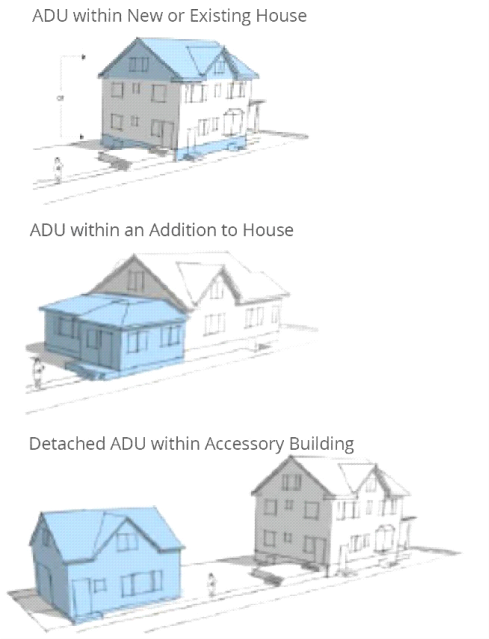
An accessory dwelling unit may be created through any of the following methods:
a.
Converting existing area within the interior of a single-family detached, two-family detached or semi-attached dwelling (e.g., attic or basement) to an ADU;
b.
Adding floor area to an existing single-family detached, two-family detached or semi-attached dwelling to accommodate an ADU;
c.
Constructing a detached accessory dwelling unit on a parcel with an existing single-family detached, two-family detached or semi-attached dwelling;
d.
Converting space within a detached accessory building; or
e.
Constructing a new single-family detached, two-family detached or semi-attached dwelling with an internal or detached accessory dwelling unit.
(4)
The floor area of an ADU may not exceed the useable floor area of the existing dwelling unit(s) on the subject lot, or nine hundred square feet, whichever is less.
(5)
No additional parking is required for an accessory dwelling unit. Existing required parking for the principal dwelling unit must be maintained or replaced on-site.
(6)
Before the issuance of a building permit for the construction of any new accessory dwelling unit, plans must be reviewed and approved by the village manager or his designee to determine compliance with all applicable building and life safety codes and the Brown Deer Building Board for architectural considerations.
(b)
The regulations of this subsection apply to all newly constructed detached buildings and building additions proposed to be occupied by ADUs.
(1)
The exterior finish material must be the same or visually match in type, size and placement, the exterior finish material of the principal building.
(2)
The roof pitch must be the same as the predominant roof pitch of the principal building.
(3)
Trim on edges of elements on the building addition or the detached accessory structure occupied by the ADU must be the same in type, size and location as the trim used on the principal building.
(4)
Entrances to ADUs occupying detached accessory structures may not face the nearest side or rear property line.
(5)
A detached accessory dwelling unit must be located at least ten feet behind the principal building. This required ten-foot separation distance must be free of structures except that it may include walkways, patios, decks and similar structures that do not exceed 30 inches in height above finished grade.
(6)
The maximum allowed height of a detached accessory dwelling unit is no higher than the height of the principal building.
(7)
Detached accessory dwellings shall only be located in rear yards or in front yards on properties with more than 275 feet of depth if a majority of the principal building is in the rear half of the parcel.
(8)
Any detached accessory dwelling shall be placed on a slab or foundation. Temporary or mobile home structures are not permitted as ADUs.
(Ord. No. 24-02, § I, 4-1-2024)

