
Butler Village City Zoning Code
ARTICLE XIII
ACCESSORY USES AND STRUCTURES
Sec. 54-599.- Accessory uses or structures.
(a)
Principal use to be present. An accessory use or structure in any zoning district shall not be established prior to the principal use or structure being present or under construction. Any accessory use or structure shall conform to the applicable regulations of the district in which it is located, except as specifically otherwise provided.
(b)
Placement restrictions; residential districts. An accessory use or structure in a residential district may be established subject to the following regulations:
(1)
Accessory uses and detached accessory structures, such as garages, and garden or utility sheds may be placed or erected in the rear yard, upon the issuance of a building permit, provided that there is no more than one of each type of accessory structure.
(2)
No accessory structure shall be closer than ten feet to the principal structure.
(3)
No accessory structure shall exceed 15 feet in height.
(4)
No accessory structure shall be located closer than three feet to any lot line.
(5)
No residential accessory garage shall exceed 650 square feet in area.
(6)
No other accessory structure shall exceed 250 square feet in area, and the total of all accessory structures shall not exceed 50 percent of the rear yard area. However, no detached garage or carport shall be placed or erected in the rear yard of a lot in the R-1 Single-Family Residential District.
(c)
Use restrictions; residential district. Accessory uses or structures in residential districts shall not involve the conduct of any business, trade or industry except for home occupations as defined and authorized herein and shall not be occupied as a dwelling unit.
(d)
Use restrictions; nonresidential districts. An accessory use or structure in a business or manufacturing district may be established in the rear yard or side yard and shall have setbacks as prescribed in each zoning district.
(e)
Reversed corner lots. When an accessory structure is located on the rear of a reversed corner lot, it shall not be located beyond the front yard required on the adjacent interior lot to the rear, or nearer than five feet to the side line of the adjacent structure.
(f)
Landscaping and decorative uses. Accessory structures and vegetation used for landscaping and decorating may be placed in any required yard area. Permitted structures and vegetation include flag poles, ornamental light standards, lawn furniture, sun dials, bird baths, trees, shrubs and flowers and gardens.
(g)
Temporary uses. temporary accessory uses such as real estate sale field offices or shelters for materials and equipment being used in the construction of the permanent structure may be permitted by the zoning administrator, and shall be removed within 30 days of occupancy of the project.
(h)
Garages in embankments in front yards. Where the mean natural grade of a front yard is more than eight feet above the curb level, a private garage may be erected within the front yard, following approval by the village board, provided as follows:
(1)
That the private garage shall be located not less than five feet from the front lot line;
(2)
That the floor level of the private garage shall be not more than one foot above the curb level; and
(3)
That at least one-half the height of the private garage shall be below the mean grade of the front yard.
(i)
Outdoor lighting. Outdoor lighting installations shall not be permitted closer than three feet to an abutting property line and, where not specifically otherwise regulated, shall not exceed 15 feet in height and shall be adequately shielded or hooded so that no excessive glare or illumination is cast upon the adjoining properties.
(j)
Lawn accessories. Walks, drives, paved terraces and purely decorative garden accessories such as pools, fountains, statuary, flag poles, etc., shall be permitted in setback areas but not closer than three feet to an abutting property line other than a street line.
(k)
Retaining walls. Retaining walls may be permitted anywhere on the lot; provided, however, that no individual wall shall exceed six feet in height, and a terrace of at least three feet in width shall be provided between any series of the walls and provided further that along a street frontage no the wall shall be closer than three feet to the property line.
(l)
Offensive uses prohibited. No accessory use shall be dangerous, obnoxious or offensive to persons residing in the vicinity, or shall impair the use, enjoyment or value of any property.
(m)
Prohibited dwelling use. No accessory dwelling unit in any residential district shall be used or let for living purposes except as permitted by this article.
(n)
Gardening. Home gardening may be an accessory use on any dwelling lot or the principal use on any vacant lot or parcel.
(Code 2003, § 13-1-140)
Sec. 54-600. - Outside storage of firewood.
(a)
No person shall store firewood in the front yard on residentially zoned property, except that firewood may be temporarily stored in the front yard for a period of 30 days from the date of its delivery.
(b)
Firewood should be neatly stacked and may not be stacked closer than two feet to any lot line and not higher than six feet from grade, except adjacent to a fence where firewood can be stacked against the fence as high as the fence. Fences as used in this section shall not include hedges and other vegetation.
(c)
All brush, debris and refuse from processing of firewood shall be promptly and properly disposed of and shall not be allowed to remain on the premises.
(d)
Woodpiles that contain diseased wood that is capable of transmitting disease to healthy trees and woodpiles that harbor or are infested or inhabited by rats or other vermin are public nuisances and may be abated pursuant to the provisions of this Code.
(e)
Not more than 15 percent of the side and rear yard may be used for storage of firewood at any one time.
(Code 2003, § 13-1-141)
Sec. 54-601. - Fences.
(a)
In general.
(1)
Legislative purpose. The intent of this section is to place restrictions on fences and provide definitions so that the Village of Butler may maintain public safety, preserve property values, and maintain the village's character and aesthetic standards.
(2)
Defined. The following words, terms, and phrases, when used in this article, shall have the meanings ascribed to them in this section, unless the context clearly indicates otherwise:
a.
Aesthetic fence means a fence constructed to enhance the appearance of the structure or the landscape.
b.
Boundary fence means a fence placed along the property lines of adjacent properties.
c.
Fence means a physical structure that serves as a barrier enclosing or delineating an area consisting of wood, stone, or metal. A fence is intended to prevent ingress or egress, or mark a boundary on the property
d.
Privacy fence means a fence designed to inhibit public view and provide seclusion.
e.
Ornamental fence means an aesthetically designed fence that is not to exceed two and one-half feet in height.
f.
Protective fence means a fence constructed to enclose a hazard to the public health, safety, and welfare.
g.
Security fence means a fence that is designed with the intent to restrict unauthorized entry and to enhance a property's safety.
h.
Street yard means the portion of a property that lies between a building and the street right-of-way.
i.
Side yard means a yard of a lot extending from the front yard to the rear yard, and from the side lot line to the nearest wall of the primary structure on the lot.
j.
Rear yard means the portion of the lot abutting the rear lot line and extending across the width of the lot, spanning from the rear lot line to the primary structure.
k.
Front yard means the portion of the lot located at the front of the property between the front of the lot line and front of the primary structure.
(b)
Fence permit required. No person shall erect, alter, repair, or modify an existing fence in the village without first obtaining a fence permit from the building inspector, paying a fee as prescribed in the village fee schedule, and receiving approval from the building board. The applicant shall provide the building inspector with accurate design information for the proposed fence including height, type of materials, location, and length of fence. Permits may only be issued for proposed fences complying with this section.
(c)
Residential fence specifications.
(1)
Location and construction.
a.
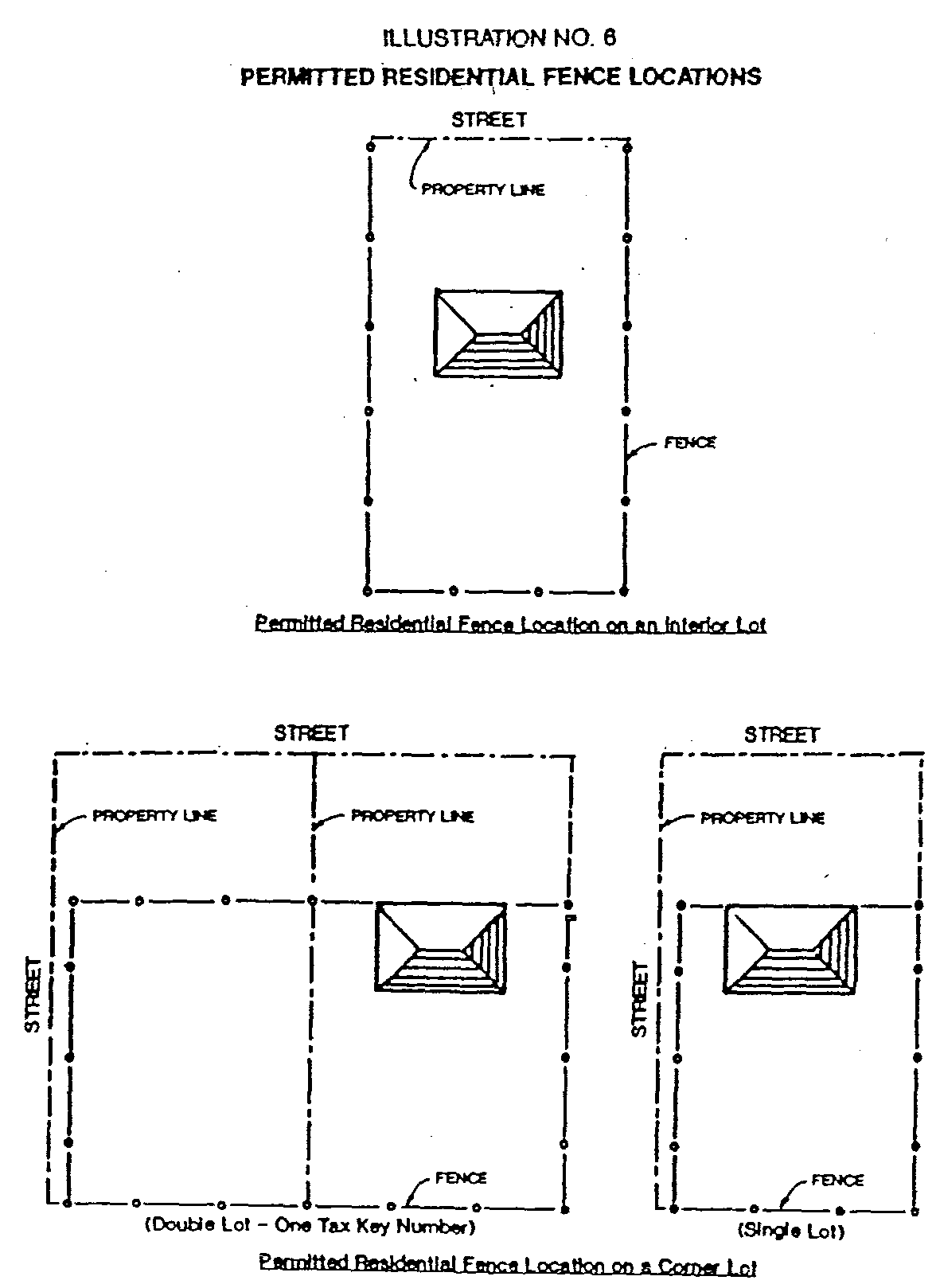
Residential fences are permitted in side and rear yards, including street side yards on corner lots as long as the fence does not extend past the front face of the house, provided that a building permit is obtained (see Illustration No. 6). No front yard fences shall be permitted.
b.
Street side yard fences on corner lots shall have a setback of at least three feet from the lot line to ensure street visibility for motor vehicles (See illustration No. 6).
c.
Fences shall not infringe into the right-of-way of the street.
d.
Fences shall not extend across driveways to ensure accessibility for emergency services.
(2)
Location determination. The property owner erecting a fence is solely responsible for ensuring that the fence is located properly on their property.
(3)
Height. Fences shall not exceed six feet above the ground and shall not be closer than two feet to any public right-of-way. An exception is allowed when a property in a residential district abuts a property in an industrial district; in such case, the fence height may be up to eight feet.
(4)
Visibility. Residential fences located in the street yard shall have at least 50 percent of their surface area open to ensure unobstructed sightlines and maintain neighborhood visibility.
(5)
Material. Fences shall be built with approved fence materials, which includes wire, standard fence wood, vinyl, or metal, including wrought iron.
(d)
Ornamental fences.
(1)
Ornamental fences are permitted, upon the issuance of a building permit in the street yard in any district, but shall not be erected in a street right-of-way and shall not exceed a height of two and one-half feet.
(2)
Ornamental fences shall not extend into a vision clearance triangle as outlined in section 54-412.
(3)
Ornamental fences shall not exceed an aggregate length in all locations of 50 percent of the width of the street yard on any lot or 32 feet, whichever is greater. Corner lots may be permitted an ornamental fence in only one street yard.
(4)
Ornamental fences shall be constructed to be open for at least 50 percent of their surface area.
(e)
Fence doors and gates. Doors and gates of fences shall be attached to the fence and composed of the same materials as the fence itself or better. Fence doors and/or gates shall swing into the property. A door and/or gate shall be required when a fence is placed over an easement to allow for readily access to the easement by the easement holder.
(f)
Security and protective fences. Security and protective fences are permitted to be placed on the property lines in all districts except residential districts, but shall not exceed eight feet in height and shall be of an open type similar to woven wire or wrought iron fencing. No other fencing materials shall be permitted for these types of fences.
(1)
Security and protective fences may be up to ten feet in height, only if the property owner and tenant receive approval from the building board to place barbed or razor wire on top of the fence and the wiring complies with subsection (i) of this section.
(g)
Nonconforming fences. Any fence existing on the effective date of this Code and not in conformance with this section may be maintained, but any alteration, modification or improvement of more than 50 percent of the fence shall result in the entire fence being brought into compliance with this section.
(1)
When 51 percent of the total fence is deemed dilapidated by the zoning administrator the whole fence shall be brought into compliance with all applicable village ordinances.
(h)
Temporary fences. The issuance of a permit shall not be necessary for temporary fences as described herein, but the fences shall not be erected for more than 45 days within a 365-day period. The fences shall comply with all applicable rules and regulations, including the setback requirements, outlined in this section.
(1)
Temporary fences shall be erected for purposes such as the protection of planting, to warn of construction hazards, or for similar short-term needs as approved by the zoning administrator.
(2)
Temporary fences that serve as the protection for construction shall be clearly visible or marked with colored streamers or other warning devices at four-foot intervals.
(3)
Temporary fences that approach the initial 45-day timeframe may request a one-time extension of up to an additional 45 days. This request may be granted by the zoning administrator at his/her discretion. Upon expiration of the extension, the fence must either be removed or brought into compliance through issuance of a fence permit.
(i)
Prohibited fences.
(1)
No fence shall be constructed in a dangerous condition, or in a manner that conducts electricity, is designed to electrically shock or incorporates barbed wire. However, barbed wire may be used in industrially zoned areas if the devices securing the barbed wire to the fence are ten feet above the ground or height and angled toward the fenced property and away from any public area. See subsection (f) for guidelines of security and protective fences.
(2)
No fence shall be composed solely of fence posts or an incomplete fence that consists of only posts and supporting members.
(3)
No fence shall be constructed of unsightly or dangerous materials that would constitute a nuisance as deemed by the zoning administrator. No fence should be built with scrap lumber, chicken wire, wood pallets, or other unapproved materials determined by the village board or zoning administrator.
(j)
Fence maintenance.
(1)
All fences shall be maintained and kept safe and in a state of good repair, and the finished side or decorative side of a fence shall face the adjoining property.
(2)
Fences not so maintained, and which become unsightly or otherwise adversely affect property values in the neighborhood, may be declared dilapidated and a nuisance by the Zoning Administrator and ordered to be repaired or removed by the property owner. Upon repair or replacement, such fences must comply with the requirements of this chapter. Failure to comply with the order to repair or remove may result in the levying of a municipal forfeiture against the property and the property owner.
(k)
Penalty. Violations of this section shall be subject to the penalties provided in chapter 1, sections 1-12 through 1-15 (§ 1-1-6: Ord. No. 08-1, Ord. No. 20-06, § 1-2-1, § 1-2-2, § 1-2-3) and chapter 54, section 54-653 (§ 13-1-176).
(Code 2003, § 13-1-142; Ord. No. 18-05, § 1, 5-15-2018; Ord. No. 25-11, § I, 10-7-2025)
Sec. 54-602. - Swimming pools.
(a)
Definition. A permanent private or residential swimming pool is an outdoor structure containing a body of water in a hard sided structure with PVC or steel framing or other permanent container having a depth for water at any point greater than 1½ feet located above or below the surface of ground elevation, used or intended to be used solely by the owner, operator or lessee thereof and his family, and by friends invited to use it, and includes all structural facilities, appliances and appurtenances, equipment and other items used and intended to be used for the operation and maintenance of a private or residential swimming pool.
A temporary private or residential swimming pool are pools that are constructed so that they may be readily disassembled to its original integrity and are less than 20 feet in diameter.
(b)
Exempt pools. Storable children's swimming or wading pools, with a maximum dimension of 15 feet and a maximum wall height of 15 inches and which are so constructed that they may be readily disassembled for storage and reassembled to their original integrity, are exempt from the provisions of this section.
(c)
Permit required for swimming pools. Permanent private swimming pools are permitted, upon the issuance of a building permit, in the rear yard in any district, except the C-1 Conservancy District, the FWO Floodway Overlay District, or the FFO Floodplain Fringe Overlay District. Before work is commenced on the construction or erection of private or residential swimming pools or on any alterations, additions, remodeling or other improvements, an application for a swimming pool building permit to construct, erect, alter, remodel or add must be submitted in writing to the building inspector. Plans and specifications and pertinent explanatory data should be submitted to the building inspector at the time of application. The building permit application shall show the location and dimensions of the pool; the volume of water in gallons; the location of the required fence and other means of securing the pool; and the location of all pool appurtenances. No work or any part of the work shall be commenced until a written permit for the work is obtained by the applicant. The minimum building permit fee pursuant to the village building code shall accompany the application.
Temporary private swimming pools shall abide by the same permitting, location, and safety regulations of permanent pools but are exempt from fencing or decking requirements provided they have a locking or tip-up ladder.
(d)
Construction requirements. In addition to the other requirements as may be reasonably imposed by the building inspector, the building inspector shall not issue a permit for construction as provided for in subsection (b) of this section, unless the following construction requirements are observed:
(1)
All materials and methods for construction in the construction, alteration, addition, remodeling or other improvements and pool installation shall be in accord with all state regulations and codes and with any and all ordinances of the village now in effect or enacted.
(2)
All plumbing work shall be in accordance with all applicable ordinances of the village and all state codes. Every private or residential swimming pool shall be provided with a suitable draining method and, in no case, shall waters from any pool be drained into the sanitary sewer system, onto lands of other property owners adjacent to that on which the pool is located or in the general vicinity.
(3)
All electrical installations, including lighting and heating but not limited thereto, which are provided for, installed and used in conjunction with a private swimming pool shall be in conformance with the state laws and village ordinances regulating electrical installations.
(e)
Setbacks and other requirements.
(1)
Private swimming pools shall be erected or constructed on rear or side lots only, and only on a lot occupied by a principal building. No swimming pool shall be erected or constructed on an otherwise vacant lot. A lot shall not be considered vacant if the owner owns the contiguous lot and the lot is occupied by a principal building.
(2)
No swimming pool shall be located, constructed or maintained closer to any side or rear lot line than is permitted in this chapter for an accessory building, but in no case shall the water line of any pool be less than three feet from any lot line.
(f)
Fence.
(1)
Permanent pools within the scope of this section which are not enclosed with a permanent building shall be completely enclosed by a fence of sufficient strength to prevent access to the pool, or shall have a cover or other protective device over the swimming pool of such a design and material that the same can be securely fastened in place and when in place shall be capable of sustaining a person weighing 250 pounds. The cover or protective device shall be securely fastened in place at all times when the swimming pool is not in actual use for swimming or bathing purposes. The fence or wall shall not be less than four feet or more than five feet in height and so constructed as not to have voids, holes or openings larger than four inches in one dimension.
(2)
The pool enclosure may be omitted where portable pools are installed aboveground and have a raised deck around the entire pool perimeter with an attached enclosed railing or uncovered sidewall railing a minimum of 36 inches high, provided that ladder or stairs access can be restricted.
(3)
Access to swimming pools shall be controlled. Access to inground swimming pools shall be controlled by a self-latching gate and all the gates shall be kept securely closed and locked at all times when the owner is not present at the pool. For an aboveground swimming pool, a tip-up ladder may be provided in lieu of a gate. There shall furthermore be no uncontrolled access from a residence to the pool area.
(g)
Electrical service. Swimming pools shall not be constructed directly under or over electric transmission lines or within ten feet of overhead electrical transmission lines. All electrical connections to a swimming pool shall be properly grounded to that no electrical current can be discharged into any part of the swimming pool or the surrounding fence.
(h)
Draining and approval thereof. No private swimming pool shall be constructed so as to allow water therefrom to drain into any sanitary sewer or septic tank or to overflow upon or cause damage to any adjoining property. Provisions may be made for draining the contents of any swimming pool into a storm sewer, but the installation shall be subject to prior approval by the building inspector.
(i)
Filter system required. All private swimming pools within the meaning of this article must have, in connection therewith, some filtration system to ensure proper circulation of the water therein and maintenance of the proper bacterial quality thereof.
(j)
Dirt bottoms prohibited. All swimming pools of a permanent nature shall have the sides and bottom of a smooth finish, and no sand or dirt bottom shall be permitted.
(k)
Miscellaneous provisions.
(1)
Heating units, pumps, and filter equipment shall be screened from view, and shall be adequately housed and muffled;
(2)
No lighting installed around swimming pools shall throw any rays onto adjacent properties; and
(3)
Swimming pool installations shall comply with any additional requirements for private swimming pools set forth in the village building code.
(4)
Temporary swimming pool shall not be installed prior to May 1 st and shall be removed by October 1 st , annually.
(Code 2003, § 13-1-143; Ord. No. 20-04, § 1, 7-21-2020)
Sec. 54-603. - Portable storage structure.
(a)
Definitions. The following words, terms and phrases, when used in this article, shall have the meanings ascribed to them in this section, except where the context clearly indicates a different meaning:
Portable storage structure means any container, storage unit, shed-like container or other portable structure, other than an accessory building or shed complying with all building codes and land use requirements, that can or is used for the storage of personal property of any kind and which is located for the purposes outside an enclosed building.
(b)
Use. The use of portable storage structures are allowed under the following conditions:
(1)
There must be no more than one portable storage structure per property.
(2)
The portable storage structure must be no larger than ten feet wide, 20 feet long and ten feet high.
(3)
A portable storage structure must not remain at a property in any zoning district in excess of 30 consecutive days, and must not be placed at any one property in a zoning district in excess of 30 days in any calendar year.
(4)
The portable storage structure must be set back a minimum of five feet from all property lines.
(5)
The portable storage structure must be set back a minimum of five feet from the nearest wall of a building.
(6)
The portable storage structure must be placed on an asphaltic concrete surface.
(7)
Portable storage structures associated with construction at a site where a building permit has been issued, are permitted for the duration of construction and shall be removed from the site within 14 days of the end of construction. Portable storage structures associated with construction are exempt from the aforementioned conditions.
(Ord. No. 08-08, 5-20-2008)
Sec. 54-604. - Decks.
(a)
Permit required. No person shall construct, install, enlarge or alter any deck described in subsection (b) of this section unless a permit therefore has first been obtained from the village building board per section 2-28(b)(1)(j) and all other provisions of this section are complied with. Application for a permit shall be on forms provided by the village and shall be accompanied by the following:
(1)
The fee prescribed in the village fee schedule;
(2)
Plans drawn to scale;
(3)
A landscaping plan;
(4)
The other items required by the building inspector that may deem applicable.
The building inspector shall have the authority, as a condition to granting the permit, to require the additions, changes and safeguards as he determines to be necessary or appropriate to carry out the provisions of this section.
(b)
Construction requirements. Any deck subject to this section, including the construction thereof, shall be subject in all respects to the requirements and other provisions of tis chapter.
(c)
Location. A deck shall be located within the setback and offset lines of the lot upon which it is located.
(d)
No permit is required for "at-grade" decks or patios but must adhere to setbacks per zoning code.
(Ord. No. 09-05, § 13-1-144, 8-3-2009)

