
Butler Village City Zoning Code
ARTICLE VII
TRAFFIC VISIBILITY, LOADING, PARKING AND ACCESS
Sec. 54-412.- Visibility standards.
(a)
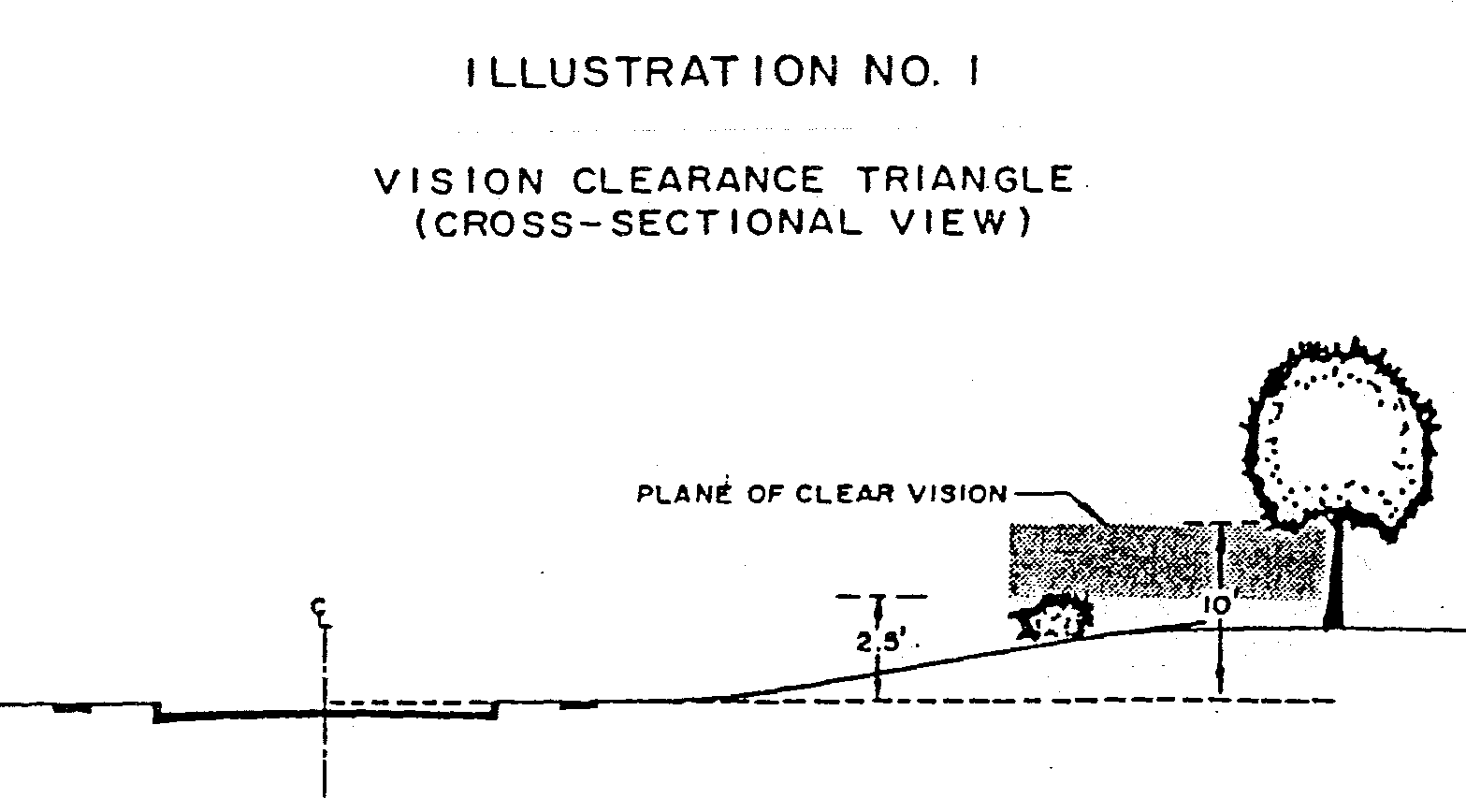
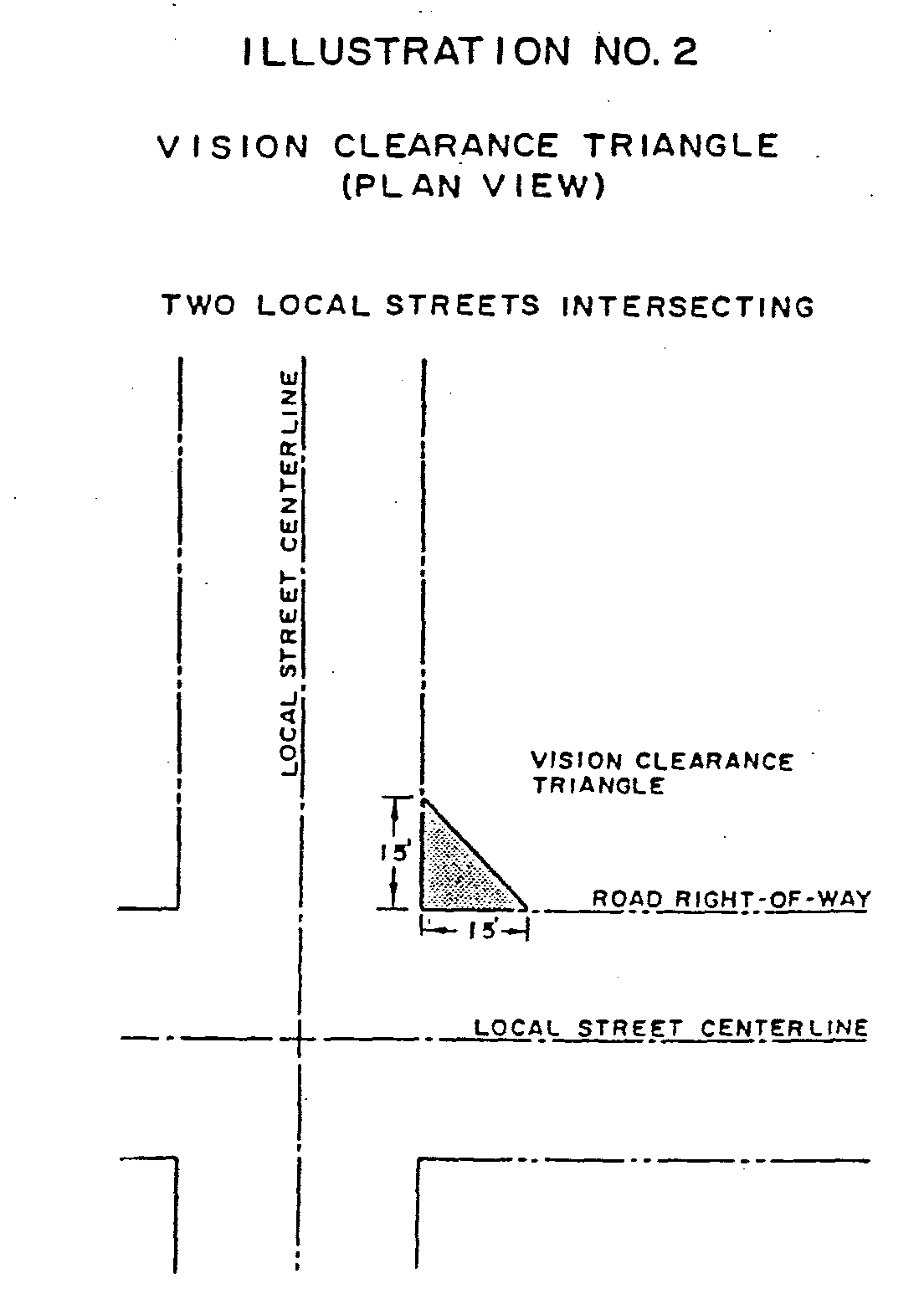
No obstruction, such as structures, parking, or vegetation, shall be permitted in any district between the heights of 2½ feet and ten feet above the plane through the mean curb grades (see Illustration No. 1) within the triangular space formed by any two existing or proposed intersecting street or alley right-of-way lines and a line joining points on the lines located a minimum of 15 feet from their intersection (see Illustration No. 2.)
(b)
The vision clearance triangle should be seeded or sodded, however, the vision clearance triangle may be paved, provided that the owner takes measures to ensure that no parking will be permitted in the vision clearance triangle.
(Code 2003, § 13-1-90)
Sec. 54-413. - Loading requirements.
(a)
Generally. In all districts, except residential districts, adequate loading areas shall be provided so that all vehicles loading, maneuvering, or unloading are completely off the public ways and so that all vehicles need not back onto any public way.
(b)
Location. All loading berths shall be located 45 feet or more from the intersection of two street right-of-way lines. Loading berths shall not be located within any required front yard or street yard setback area. Access to the loading berth shall be located in conformance with this section. All loading areas shall be located on the private lot and shall not be located within, or so as to interfere with, any public right-of-way.
(c)
Surfacing and marking. All required loading areas shall be surfaced with asphalt, concrete or permeable surfacing where approved by the Village Engineer, and maintained in a dust-free condition at all times. The surface shall be marked in a manner which clearly indicates required loading areas.
(d)
Use of required loading areas. The use of all required loading areas shall be limited to the loading and unloading of vehicles. The area shall not be used to provide minimum required parking spaces.
(Code 2003, § 13-1-91; Ord. No. 23-05, § 1, 8-15-2023)
Sec. 54-414. - Parking requirements.
In all districts and in connection with every use, there shall be provided at the time any use is erected, enlarged, extended, or increased, off-street parking stalls for all vehicles in accordance with the following:
(1)
Access. Adequate access to a public street shall be provided for each parking space, and driveways shall be at least nine feet wide in all districts except the M-2 and M-3 industrial districts, and a minimum of 24 feet at the property line in the M-2 and M-3 districts. Aisles in parking lots shall have a minimum width of 20 feet. In the case of one-way ingress and egress, the minimum may be reduced to 15 feet.
(2)
Parking in the street yard. Parking in the street yard, as defined by this article, is prohibited in all districts except in the B-1 Community Business District, the M-1 and the M-3 industrial districts, provided that the property owner has been issued an approved angle parking permit. Parking facilities, driveways and walkways may occupy a maximum of 50 percent of the required street yard in the M-3 Heavy Industry District, provided that a ten foot landscaped buffer is provided between the street right-of-way line and the parking facility. Vehicles may, notwithstanding the street yard prohibition, be parked in the driveways in the R-1 and R-2 residential districts.
(3)
Parking space dimensions. The minimum dimensions of each parking space shall be nine feet in width and 18 feet in width, exclusive of the space required for ingress and egress. Spaces for use by physically disabled persons shall, however, be sized as specified in subsection (11) of this section.
(4)
Compact vehicle parking. Parking space dimensions may be reduced to nine feet by 16 feet for the purpose of compact vehicle parking. Compact vehicle parking shall be identified with appropriate signing or pavement markings. An allotment of compact-sized parking spaces shall be determined by the building inspector, with the approval of the building board, based on the factors as the configuration of the parking lot; access from the street; site layout; the ability to meet overall parking requirements; and other factors as determined by the building inspector or building board.
(5)
Location. Location of parking spaces is to be on the same lot as the principal use or not more than 400 feet from the principal use. Unless off-site parking is owned and maintained by the village, or a shared parking plan is approved under subsection 54-414(19) below, the facilities shall be in the same ownership as the lot occupied by the principal use to which the parking facility is accessory. A covenant running with the land shall be recorded in the office of the county register of deeds on the lot upon which the accessory off-street parking lot is located, which prohibits any other use on that lot, and a certified copy by the county register of deeds of the recorded covenant shall be deposited with the building inspector. The covenant shall not be released until the time as either one of the following conditions occur:
a.
The structure on the lot containing the principal use is removed and the principal use terminated; or
b.
Another lot of the required size within the required distance is properly developed and used for the required accessory off-street parking in place of and in lieu of the initial lot used for accessory off-street parking, with the same requirements, covenants, and conditions attaching to the substitute accessory use lot as required for approval of the initial off-street parking.
(6)
Landscaping requirements.
a.
Landscaping. All public and private off-street parking areas which serve five vehicles or more and are created or redesigned and rebuilt subsequent to the adoption of this Code shall be provided with accessory landscape areas totaling not less than ten percent of the surfaced area. The minimum size of each landscape area shall not be less than 100 square feet.
b.
Location. Location of landscape areas, plant materials, protection afforded the plantings, including curbing and provision for maintenance by the property owner, shall be subject to approval by the building inspector.
c.
Plans. All plans for the proposed parking areas, at the discretion of the building inspector, shall include a topographic survey or grading plan which shows existing and proposed grades and location of improvements. The preservation of existing trees, shrubs, and other natural vegetation in the parking area may be included in the calculation of the required minimum landscape area.
d.
Special residential requirements. Those parking areas for five or more vehicles if adjoining a residential use shall be screened from the use by a solid wall, fence, evergreen planting of equivalent visual density, or other effective means, built and maintained at a minimum height of five feet. Where a solidly constructed decorative fence is provided along the interior lot line, the minimum setback for the parking area shall be five feet from the lot line. The fence shall be located a minimum of one foot from the lot line. A combination of fencing and plantings may be used in order to incorporate vegetated stormwater management measures into landscaped areas.
e.
Street setback area. No parking shall be permitted between the street right-of-way line and the building setback line prevailing in the zone in which the proposed parking area is to be located. The resulting open area shall be planted in grass, a vegetated stormwater management measure or otherwise landscaped to create a permanent green area.
(7)
Surfacing. All off-street parking areas and outside storage areas shall be surfaced with an asphalt or Portland cement pavement, or permeable surfacing approved by the Village Engineer, in accordance with village standards and specifications so as to provide a durable and dust free surface, and shall be so graded and drained as to dispose of all surface water without the need to cross neighboring properties. Surfacing shall be completed within 18 months following construction of the principal structure or use. The village board shall require the installation of catch basins in parking areas adjacent to the existing storm sewer system or may require that parking areas be designed to detain stormwater. Any parking area for more than five vehicles shall have the aisles and spaces clearly marked.
(8)
Repair and service. No motor vehicle repair work or service of any kind shall be permitted in association with unenclosed parking facilities provided in residence districts.
(9)
Lighting. Any lighting used to illuminate off-street parking areas shall be directed away from residential properties and public streets in such a way as not to create a nuisance. However, in no case shall the lighting exceed three footcandles measured at the lot line.
(10)
Curbs or barriers. Curbs or barriers shall be installed a minimum of four feet from a property line so as to prevent the parked vehicles from extending over any lot lines.
(11)
The following guide specifies the minimum number of parking spaces required. The reference herein to "the work shift with the largest number of employees" means the maximum number of full-time or part-time employees present at the facility at any one time. For example, the largest work shift may be a particular day of the week, or a lunch or dinner period in the case of a restaurant. The reference herein to "maximum capacity" means the maximum number of persons which may be accommodated by the use as determined by its design or by applicable building code regulations, whichever is greater. In the case of structures or uses not specified herein, the number of spaces specified for a use which is similar shall apply. In developments involving the establishment of two or more uses on one lot or parcel, the number of spaces required for each use shall determine the total number of spaces required.
a.
Residential uses.
1.
Single- and two-family dwelling: Two spaces per dwelling unit.
2.
Multiple family dwelling: Two spaces per dwelling unit. For buildings with more than eight units where all spaces are in common (i.e. not reserved) required number of spaces is reduced to 1.2 per dwelling unit plus one space per every four dwelling units.
3.
Housing for the elderly: 0.75 space per dwelling unit.
b.
Retail sales and customer service uses; places of entertainment. Retail sales and customer service uses, and places of entertainment, except as specifically set forth below: One space per 200 square feet of gross floor area of customer sales and service. Other retail sales and customer service uses and places of entertainment:
1.
Financial institutions: One per 275 square feet of gross floor area.
2.
Financial institutions with drive-through facilities: One per 175 square feet of gross floor area; maximum of three drive-through lanes with sufficient waiting space for 2 vehicles at each lane.
3.
Funeral homes: One space per four patron seats of maximum capacity of 25 spaces per chapel unit, whichever is greater.
4.
Grocery stores or supermarkets: One space per 150 square feet of gross floor area.
5.
Motels and hotels: One space per room or suite, plus one space per three persons of maximum capacity of each public meeting or banquet room.
6.
Lodges and clubs: One space per three persons based on the maximum capacity of the facility.
7.
Repair services: One space per 500 square feet of gross floor area.
8.
Restaurant, standard sit-down: One space per 150 square feet of gross floor area, plus one space per employee for the work shift with the largest number of employees.
9.
Theaters, auditoriums and other places of public assembly: One space per three patrons based on the maximum capacity of the facility.
10.
Barbershops; beauty shops, personal services: Whichever is greater of the following; two spaces per treatment station or one space per 250 square feet of gross floor.
11.
Health Clubs: One space per 400 square feet of gross floor area.
12.
Convenience grocery stores: One space per 200 square feet of gross floor area.
13.
Restaurants, drive-in: One space per 120 square feet of gross floor area. Drive-in restaurants shall have a maximum of one drive-through lane and shall provide sufficient space for six waiting vehicles at each drive-through service lane.
14.
Taverns, dance halls, night clubs and lounges: 0.5 spaces per maximum occupancy.
15.
Motor vehicle sales establishments: One space per 500 square feet of gross floor area.
16.
Motor vehicle repair, maintenance and service stations: Two spaces per indoor service bay plus one space per 500 square feet of gross floor area.
17.
Animal hospitals: One space per 400 square feet of gross floor area.
18.
Plant nurseries and garden and lawn supply sales establishments: One space per 400 square feet of gross floor area including outdoor retail and display area.
19.
Shopping centers (gross leasable area of at least 50,000 square feet): 5½ spaces per 1,000 square feet of gross leasable area.
20.
Car washes: One space per 500 square feet gross floor area with a minimum of 2 spaces. Car washes shall provide sufficient space for two waiting vehicles at each washing stall and sufficient space for drying one vehicle after washing stall.
c.
Offices.
1.
Medical, dental and similar professional health service offices: One space per 250 square feet of gross floor area.
2.
Government, professional and business offices: One space per 200 square feet of gross floor area.
d.
Commercial/recreational uses. Commercial/recreational uses, except as specifically set for below: One space per three patrons based on the maximum capacity of the facility. Other commercial/recreational uses:
1.
Bowling alleys: Five spaces for each lane.
2.
Golf courses: Five spaces per hole.
3.
Golf driving ranges: One space per tee.
4.
Indoor tennis, racquetball and handball courts: Three spaces per court, plus one space per employee for the work shift with the largest number of employees.
5.
Miniature golf courses: 1½ spaces per hole, plus one space per employee for the work shift with the largest number of employees.
6.
Skating rinks, ice or roller: One space per-three patrons based on the maximum capacity of the facility.
e.
Industrial and related uses.
1.
Manufacturing, processing, fabrication operations, wholesale business and warehousing: One space per 2,000 square feet.
2.
Mini-warehouse: One space per ten storage cubicles.
3.
Extractive and related operations: One space per employee for the work shift with the largest number of employees.
f.
Institutional and related uses.
1.
Churches: One space per three seats based on the maximum capacity of the facility.
2.
Libraries: One space per 300 square feet of gross floor area.
3.
Museums: One space per 300 square feet of gross floor area.
4.
Rooming houses and boardinghouses, fraternity and sorority houses, dormitories and rectories: Whichever is greater of the following; One space per room or one space per 400 square feet of gross floor area.
5.
Convents and monasteries: One space per three residents, plus one space per employee for the work shift with the largest number of employees, plus one space per five chapel seats if the public may attend.
6.
Nursing homes: One space per three patient beds.
7.
Hospitals: Two spaces per patient bed.
8.
Schools.
(i)
Elementary schools and high schools: One space for each teacher and staff member, plus one space for each ten students 16 years of age and older.
(ii)
Colleges, universities, and trade schools: One space for each teacher and staff member during the highest class attendance period, plus one space for each two students during the highest attendance period.
(iii)
Children's nursery schools or day schools: One space per employee for the work shift with the largest number of employees, plus one space per six students at the highest class attendance period.
(12)
Uses not listed. In the case of structures or uses not mentioned, the provision for a use which is similar shall apply. An applicant also may submit information specific to the proposed use as provided in subsection (o) below. Floor space or area means the gross floor area inside the exterior walls, where floor space is indicated above as a basis for determining the amount of off-street parking required.
(13)
Handicapped parking requirements. In addition to any other requirements relating to parking spaces contained in this Code, the provisions contained in Wis. Stats. §§ 101.13, 346.503 and 346.56 and any state administrative code sections adopted pursuant thereto are adopted by reference and made applicable to all parking facilities whenever constructed. All open off-street parking areas providing more than 25 parking spaces, except for parking areas restricted to use by employees only, shall provide parking spaces for use by motor vehicles which transport physically disabled persons in accordance with the following minimum standards:
a.
One parking space shall be provided in parking areas containing 26 to 49 spaces.
b.
Two percent of the total number of spaces shall be provided in parking areas containing 50 to 1,000 spaces.
c.
In addition to the number of spaces required in subsection (13)b of this section, one percent of each 1,000 spaces over the first 1,000 spaces for parking areas providing more than 1,000 spaces.
d.
The minimum dimensions for all parking spaces provided for use by physically disabled persons shall be 12 feet by 18 feet.
e.
Parking spaces provided for the use of physically disabled persons shall be located as close as possible to an entrance which allows the persons to enter and leave the parking area without assistance.
f.
All parking spaces provided for the use of physically disabled persons shall be marked by a sign which includes the international symbol for barrier-free environments and a statement informing the public that the parking space is reserved for use by physically disabled persons.
g.
In the event that state law or state administrative code are amended, the amendments will supersede the authority of this article.
(14)
Changes in buildings or use. Whenever a building or use is changed, structurally altered or enlarged to create a need for an increase of 50 percent or more in the number of existing parking spaces, the spaces shall be provided on the basis of the enlargement or change.
(15)
Off-lot parking.
a.
Required off-street parking spaces shall be located on the same lot with the principal use, or when this requirement cannot be met, the parking spaces may be located off-lot provided the parking spaces are located in the same district. Off-lot parking spaces shall also be held in fee simple ownership by the owner of the use requiring the parking or be leased or rented through a written agreement satisfactory to the village attorney.
b.
Off-lot parking spaces for residential uses shall be within 250 feet of the principal entrance or the entrance for the individual occupants for whom the spaces are reserved while the farthest portions of a parking lot for all other uses shall be within 300 feet of the entrance of the establishment.
c.
Accessory parking may be located in residential districts, provided that the lots or property are immediately adjacent to a commercial, business or industrial zoning district.
d.
All off-street parking lots adjoining lots zoned for residential use shall have a minimum setback of ten feet from any interior lot line, except if the adjoining lot is used for legally conforming parking purposes.
(16)
Fire lanes. A fire lane shall be required to provide access to any portion of any structure equal to or less than 40 feet tall which is more than 150 feet from the nearest street right-of-way, and to any portion of any structure greater than 40 feet tall which is more than 50 feet from the nearest street right-of-way. The zoning administrator may also require the provision of a fire lane or lanes to any part of any structure upon a determination that the distance of the structure from the nearest hydrant, the configuration of development on the site, or other special characteristics of the site otherwise inhibit effective fire extinguishment. All fire lanes shall: provide clear, unobstructed access for vehicles and apparatus at all times through a combination of pavement marking and signage; shall be a minimum of 18 feet wide; and shall be surfaced as an all-weather roadway.
(17)
Lighting. All off-street parking and traffic circulation areas serving six or more cars shall be lit so as to ensure the safe and efficient use of the areas during the hours of use. An illumination level of between 0.4 and one footcandle is recommended for the areas.
(18)
Request for modification of required parking based on information from a comparable use. Any applicant may submit parking survey and traffic study information from a comparable use in a comparable setting, and may request the Plan Commission approve a specific parking ratio based on the information submitted. Such information shall have been prepared or collected no more than three years prior to the time of application. However, in making a determination under this subsection, in no case shall the Plan Commission increase the number of parking spaces by more than five percent over the number of spaces that would be required under this Title for a comparable use or uses.
(19)
Shared Parking. As a matter of policy the Village of Butler finds that coordination of parking among mixed or combined uses is desirable to reduce the amount of paved surface on a site. Combinations of any of the uses set forth in Sec. 54-414(11) above may provide the total number of off-street parking stalls and/or queuing space required for each individual use, or may submit for Plan Commission approval a Shared Parking Analysis and Plan in accordance with the following:
a.
A Shared Parking Plan shall be submitted with site plan showing a complete and accurate description of the proposed uses, the floor area dedicated to each use, and the distance from each use to the proposed parking area. The principal entryway of each use participating in the shared parking plan must be located within 500 linear feet of the nearest point of the parking area.
b.
A Shared Parking Analysis shall be presented showing the parking demand for each individual use by time period, in the form of a matrix. The time periods shall include a weekday morning, weekday lunch time, weekday afternoon, weekday evening, Saturday midday and Saturday evening. If a use or uses experience significant seasonal variation, the analysis should be based on a peak period (i.e. summer, winter, special event). For each use, the matrix shall indicate the individual parking requirement corresponding to section 54-414(11) above, the expected demand for each time period analyzed (expressed as a percent of peak demand), and the resulting number of parking spaces required for that use at a particular time period. The largest number resulting shall be the maximum number of spaces required to be provided in the Shared Parking Plan. For example, in the Table below, the maximum period is the Weekday PM, with 90 spaces required.
Shared Parking Analysis Format
c.
The Shared Parking Plan shall indicate any spaces that would be reserved or signed for a particular use (i.e. residential spaces within structures or garages, pick-up and delivery vehicle spaces for restaurants, etc.). The locations of signed or reserved spaces shall be clearly related and proximate to the associated use, and shall be limited to the minimum number required to support the associated use. Sufficient spaces shall remain unmarked and unreserved to support the function of the Shared Parking Plan.
d.
The Shared Parking Plan and Matrix should be undertaken by a professional planner or engineer, and should be based on published shared parking guidance from the Urban Land Institute, Institute of Transportation Engineers, American Planning Association, or similar professional organization.
e.
Signed acknowledgement of the Shared Parking Plan, on a form prescribed by or sufficient to the Village Attorney, shall be required for each tenant, owner or operator of a use subject to the Plan prior to issuance of a Certificate of Occupancy.
f.
In the event of any change of use, or a change in the area or size of any use, the Shared Parking Plan shall be updated to reflect the change of use or area. If the revised number of parking spaces is equal to or less than the number available, the Building Inspector shall have the authority to approve an amendment to the Shared Parking Plan. If the number of parking spaces must be increased, approval of the Plan Commission is required.
(Code 2003, § 13-1-92; Ord. No. 23-05, § I, 8-15-2023)
Sec. 54-415. - Highway access.
(a)
Private access restricted. No direct private access shall be permitted to the existing or proposed rights-of-way of expressways, or to any controlled access arterial street without permission of the highway agency that has access control jurisdiction.
(b)
Public or private access prohibited. No direct public or private access shall be permitted to the existing or proposed rights-of-way of the following:
(1)
Freeways, interstate highways and their interchanges or turning lanes or to intersection of interchanging streets within 1,500 feet of the most remote end of the taper of the turning lanes.
(2)
Arterial streets intersecting another arterial street within 100 feet of the intersection of the right-of-way lines.
(3)
Streets intersecting an arterial street within 50 feet of the intersection of the right-of-way lines.
(c)
Public access barriers. Access barriers, such as curbing, fencing, ditching, landscaping or other topographic barriers shall be erected to prevent unauthorized vehicular ingress or egress to the above specified streets or highways.
(d)
Temporary access. temporary access to the above rights-of-way may be granted by the zoning administrator after review and recommendation by the highway agencies having jurisdiction. The access permit shall be temporary, revocable and subject to any conditions required and shall be issued for a period not to exceed 12 months.
(Code 2003, § 13-1-93)
Sec. 54-416. - Parking trucks or buses in residential districts.
No licensed vehicle having a gross weight in excess of 10,000 pounds, bus, or licensed trailer shall be parked or stored outside of a fully enclosed structure in any residential district, except when loading, unloading or rendering a service.
(Code 2003, § 13-1-94)
Sec. 54-417. - Parking and storage or recreational vehicles and equipment.
(a)
For the purpose of this article, the term "recreational vehicle or equipment" shall include boats and their trailers, motor homes, pickup campers, camping trailers, travel trailers, fifth-wheel trailers, utility trailers, race cars and their trailers, snowmobiles and their trailers, sport aircraft and their trailers, canoes or kayaks and their trailers, all-terrain vehicles and their trailers, tent campers, folding campers, and similar equipment and vehicles. For the purpose of administration, two snowmobiles (or similar recreational vehicles) located on a trailer intended for transporting those vehicles shall be considered one unit, however, two the vehicles not located on a trailer shall be counted as two units.
(b)
Outside parking or storage of recreational vehicles or equipment shall be subject to the following regulations:
(1)
No more than two recreational vehicles (or units) or equipment shall be parked or stored outside.
(2)
Recreational vehicles or equipment parked outside shall not exceed 28 feet in length, eight and one-half feet in width, and ten feet in height.
(3)
If the driveway of a residence extends beyond the front yard into the side or rear yard, no parking or storage of recreational vehicles or equipment shall be permitted on the driveway in the front yard.
(4)
If the driveway of a residence does not extend beyond the front yard into the side or rear yard, then parking or storage of one recreational vehicle or equipment is permitted in the front yard. One additional recreational vehicle or equipment may be parked or stored in the side or rear yard. Under any circumstances, no parking of recreational vehicles or equipment is permitted in the front yard off the driveway.
(5)
Recreational vehicles or equipment shall not be parked closer than two feet from a side or rear property line; or closer than 15 feet to a neighboring residence, whichever distance is greater.
(6)
Recreational vehicles or equipment shall not be parked in an existing or future street right-of-way; a vision clearance triangle; or within drainage or utility easements.
(7)
Recreational vehicles or equipment shall be maintained and be in good condition. The exterior of the vehicle or equipment shall be intact.
(8)
Recreational vehicles or equipment shall be roadworthy. Vehicles or equipment which require a license shall be properly licensed.
(9)
Recreational vehicles or equipment parked outside shall be owned by the resident of the property on which they are located.
(10)
Recreational vehicles or equipment shall be parked or stored as inconspicuously as possible on the property. Areas where vehicles and equipment are parked or stored shall be kept weed-free and free of the accumulation of other storage material.
(11)
Recreational vehicles and equipment, including those larger than permitted by these regulations, may be parked on a driveway for a reasonable period of time to accommodate loading and unloading, and to accommodate visitors.
(Code 2003, § 13-1-95)
Sec. 54-418. - Specifications for angle parking areas in the M-1 and M-3 industrial districts.
To angle park in the M-1 and M-3 zoning district, one must submit a plan of the parking area. The plan must include:
(1)
Plat of survey, if deemed necessary.
(2)
Grades: parking area must meet the proper elevation at the back of the curb and must show sufficient grade to allow proper drainage.
(3)
Information showing that the parking area is:
a.
Hard surfaced with six inches of compacted stone as a base and a minimum of three inches of bituminous concrete or six inches of Portland cement concrete.
b.
At least 20 feet of land is available between the building line and the proposed curb line.
(4)
Complete set of plans drawn to one-eighth inch equals one foot scale showing:
a.
All dimensions of the lot, buildings, proposed parking area, overhead and service doors, loading docks, and dumpsters.
b.
Any landscaping that may be required.
c.
The number of signs, and an attached copy of the permit application for signs, that are necessary for orderly parking, also the number of signs and location, if requested, by property owner as per license agreement.
d.
A detail showing the striping of parking that allows for a minimum nine feet wide stall, and that the stall will be at a 90-degree angle to the street.
e.
A plan of maintenance showing:
1.
The conditions under which sealing and restriping will be completed, ten years for sealing and five years for restriping would be considered a maximum.
2.
How snow will be removed and where it will be stored.
3.
Location of fire hydrants if adjacent to the property.
f.
Completed application for permit to pave or alter portions of village right-of-way.
(Code 2003, § 13-1-96)
Sec. 54-419. - Driveways.
All driveways installed, altered, changed, replaced, or extended after the effective date of this article shall meet the following requirements:
(1)
Driveway offsets. Driveway offsets shall be provided in each zoning district as shown in the following table:
(2)
Driveway widths.
a.
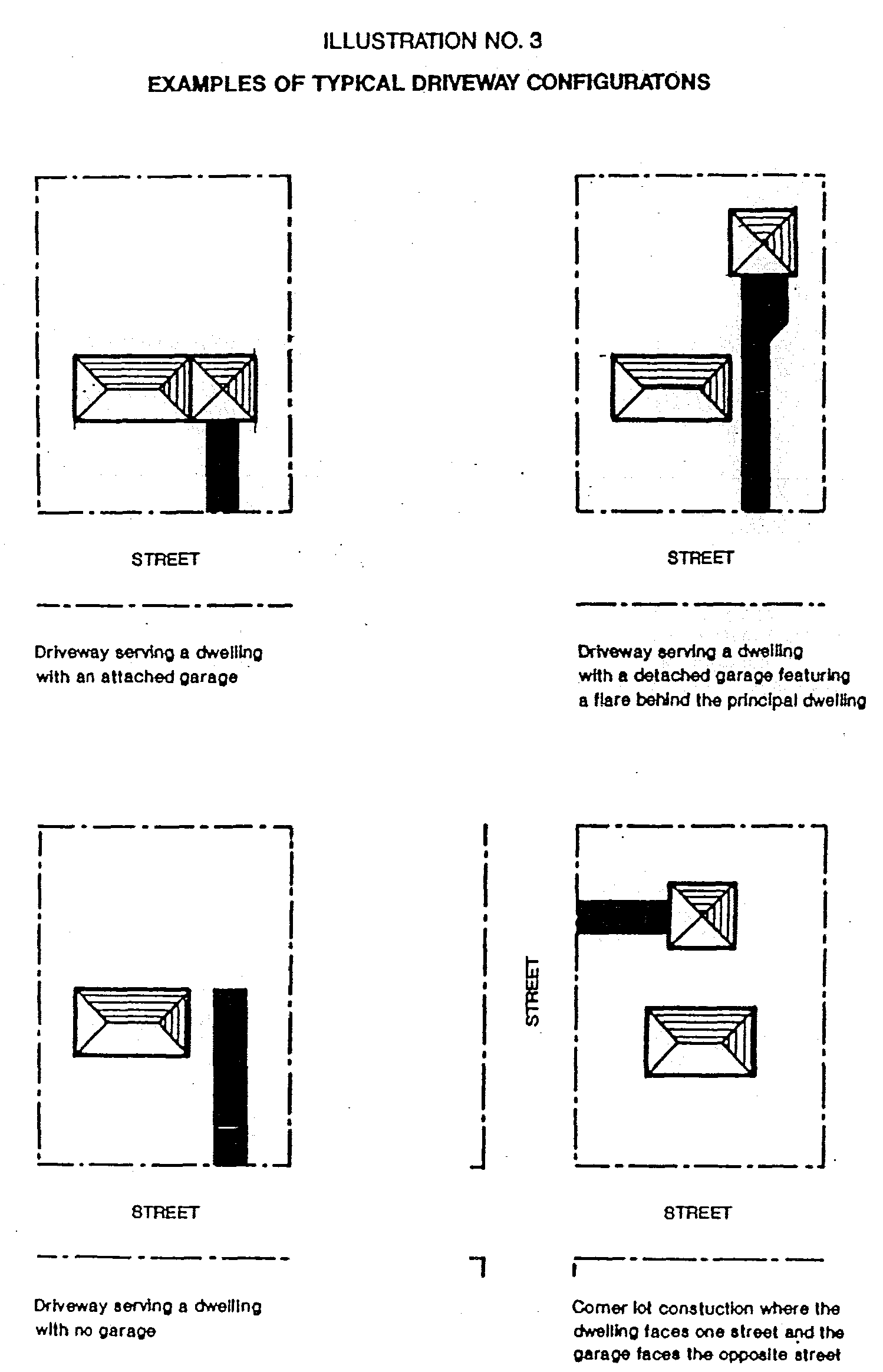
Driveway widths from the street right-of-way to the rear of the principal structure shall not exceed 12 feet in an R-2 district or 24 feet in an R-1 or R-3 residential district or 40 feet in any other district. No driveway in any district shall be less than nine feet in width and driveways shall maintain a constant width from the street right-of-way to the rear of the principal structure. Driveways which do not lead to a carport or garage shall terminate at the rear of the principal structure. Driveways serving corner lots in an R-2 district may be greater than 12 feet in width, but not greater than 24 feet, when the residential structure faces one street and the garage or carport faces the opposite street (see Illustration No. 3.) Furthermore, a driveway in the R-2 district may be up to 24 feet in width when it serves a two car or larger garage, provided that the driveway does not vary in width from the street right-of-way to the rear of the principal structure. Driveways serving corner lots in an R-2 district may be greater than 12 feet in width, but not greater than 24 feet, when the residential structure faces one street and the garage or carport faces the opposite street (see Illustration No. 3.) Furthermore, a driveway in the R-2 district may be up to 24 feet in width when it serves a two-car or large garage, provided that the driveway does not vary in width from the street right-of-way to the rear of the principal structure.
b.
A driveway that serves two-car or larger attached garage must maintain a 12-foot width from the street right-of-way to a point 20 feet in front of the garage at which point it may be flared or widened to 20 feet until it meets the garage.
(3)
Hard surfacing replacement. Driveways constructed after July 1, 1992, shall be hard surfaced with concrete, asphalt, or paving bricks for their entire width within 18 months following construction of the principal structure or use; and shall be properly drained. Ribbon-type driveways utilizing alternating strips of hard-surface materials and sod shall be prohibited.
(4)
Rear yard extensions. Driveways in single-family and two-family residential districts shall not extend into the rear yard beyond the back of the garage or carport; or where there is no garage or carport, shall terminate at the rear of the principal structure.
(5)
Street address. Access to a public street in a residential district shall be provided by not more than one driveway opening per lot except in an R-2 district which may have a total of two driveways if there is a minimum 80 feet street frontage and there are two attached garages.
(6)
Driveway flare.
a.
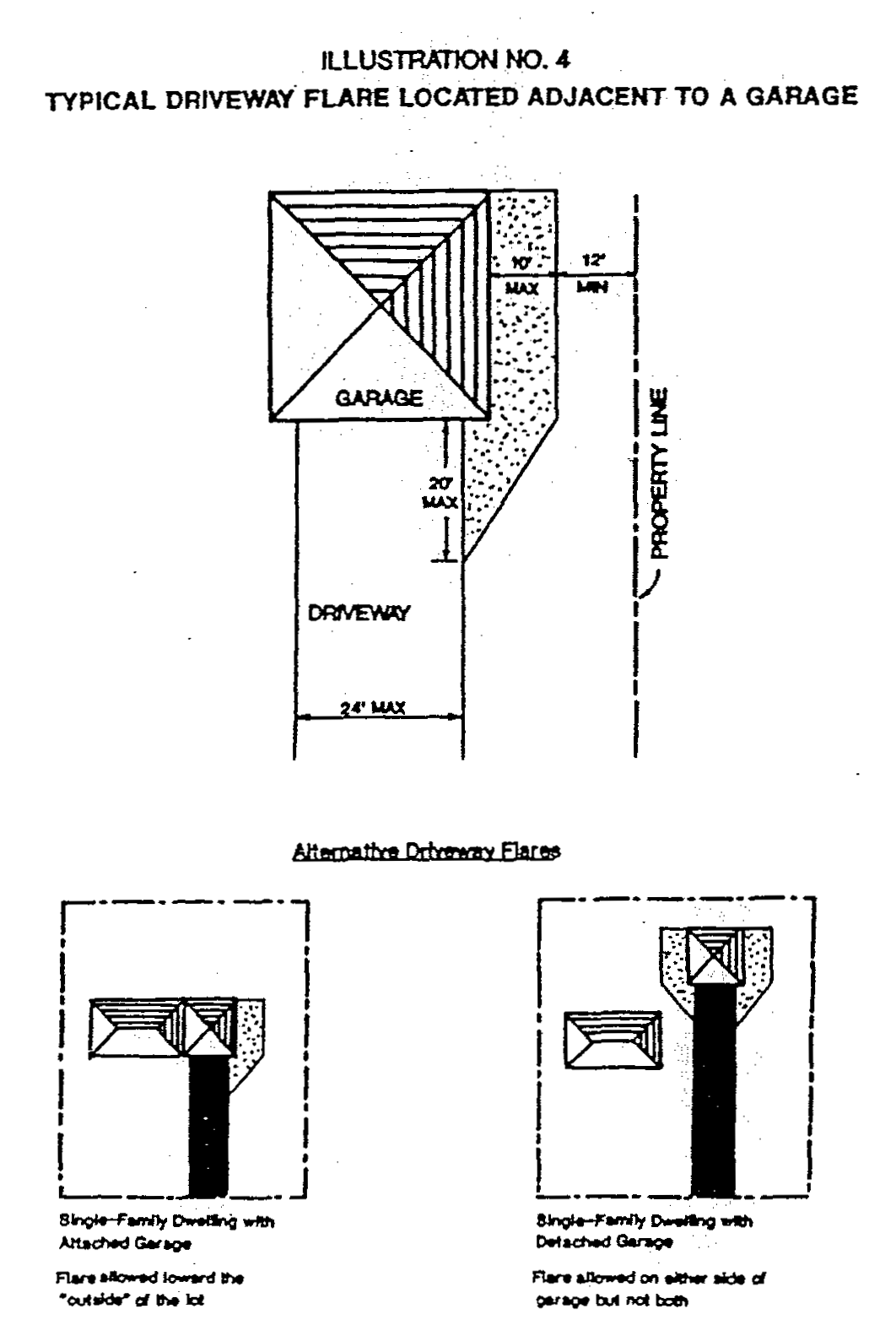
A driveway flare is permitted adjacent to a garage in the R-1 residential district, provided that the existing driveway does not exceed 24 feet in width; the driveway flare shall not extend more than ten feet from a garage foundation; shall not be located closer than 12 feet to a lot line, alley line, or other right-of-way; and shall be hard surfaced (asphalt or concrete.) A driveway flare may not begin more than 20 feet in front of the garage and no driveway flare may extend beyond the rear of the garage. No more than one parking space shall be provided in a driveway flare and any vehicle shall be parked parallel and adjacent to the garage. (See Illustration No. 4.)
b.
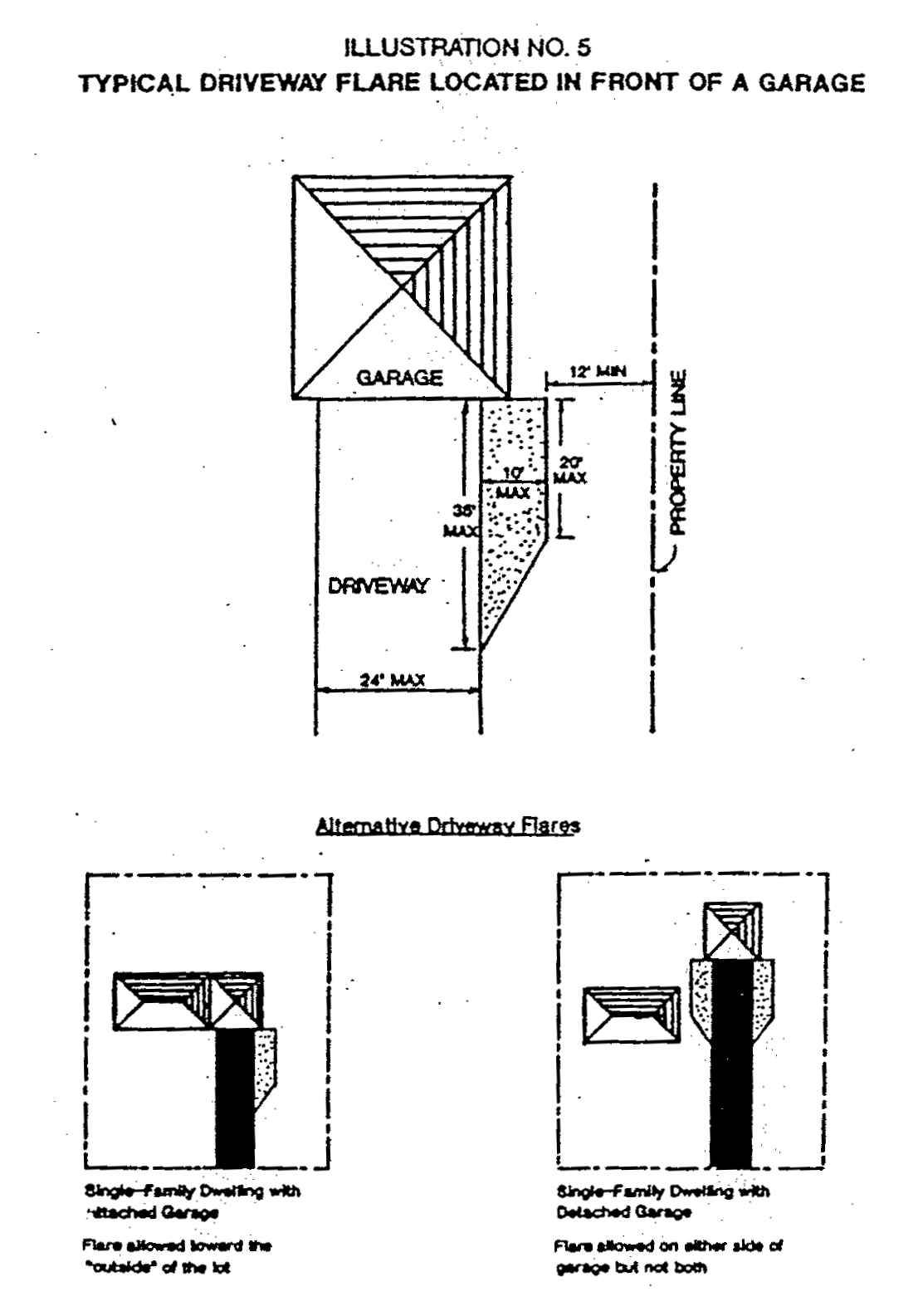
In the alternative, a driveway flare may be permitted in front of a garage in an R-1 residential district, provided that the driveway flare shall not exceed ten feet in width; shall not be located closer than 12 feet to a property line; and shall be hard surfaced (asphalt or concrete). A driveway flare located in front of a garage shall not exceed 20 feet in length and the flare shall not begin more than 35 feet in front of the garage. No more than one parking space shall be provided in a driveway flare. (See Illustration No. 5.)
(Code 2003, § 13-1-97)

