


Butler Village City Zoning Code
ARTICLE XIV
MODIFICATIONS
Sec. 54-627.- Height modifications.
The district height limitations stipulated elsewhere in this article may be exceeded, but the modification shall be in accord with the following:
(1)
Architectural projections. Architectural projections such as spires, belfries, parapet walls, cupolas, domes, flues and chimneys are exempt from the height limitations of this article.
(2)
Special structure height limitations. Special structures such as elevator penthouses, gas tanks, grain elevators, scenery lofts, radio and television receiving antennas, manufacturing equipment and necessary mechanical appurtenances, cooling towers, fire towers, substations and smokestacks are exempt from the height limitations of this article.
(3)
Essential services height limitations. Essential services, utilities, water towers, and electric power and communication transmission lines are subject to conditional use permit.
(4)
Communications structures height restrictions. Communications structures such as radio and television transmission and relay towers, aerial and observation towers, shall not exceed in height three times their distance from the nearest lot line.
(5)
Public facilities height restrictions. Public or semi-public facilities such as schools, churches, hospitals, monuments, sanitariums, libraries, governmental offices and stations may be erected to a height of 60 feet, provided all required yards are increased not less than one foot for each foot the structure exceeds the district's maximum height requirement.
(Code 2003, § 13-1-150)
Sec. 54-628. - Yard modifications.
The yard requirements stipulated elsewhere in this article may be modified as follows:
(1)
Uncovered stair restrictions. Uncovered stairs, landings and fire escapes may project into any yard, but not to exceed six feet and not closer than six feet to any lot line, and must be eight feet or more aboveground.
(2)
Architectural projection restrictions. Architectural projections such as chimneys, flues, sills, eaves, belt courses and ornaments may project into any required yard (setback requirements), but the projection shall not exceed two feet.
(3)
Cul-de-sac and curve restrictions. Residential lot frontage on cul-de-sacs and curves may be less than 60 feet provided the width at the building setback line is at least 60 feet and the street frontage is no less than 45 feet.
(4)
Essential services exemptions. Essential services, utilities, electric power and communication transmission lines are exempt from the yard and distance requirements of this article.
(5)
Awnings, canopies and marquees. Awnings, canopies and marquees are permitted, upon the issuance of a building permit, to extend into any yard in the B-1 district. However, awnings, canopies and marquees shall not extend more than 12 feet beyond the building; shall not extend more than six feet into a required side yard or rear yard; and shall not extend into the street yard or street right-of-way closer than one foot to the vertical plane formed by the curbline. Awnings, canopies, and marquees shall not be less than ten feet above the sidewalk or less than 15 feet above a driveway or alley.
(6)
Average street yard restrictions. The required street yards may be decreased in any residential or business district to the average of the existing street yards of the abutting structures on each side, but in no case less than 15 feet in any residential district.
(7)
Additions. Additions in the street yard of existing structures shall not project beyond the average of the existing street yards on the abutting lots or parcels.
(8)
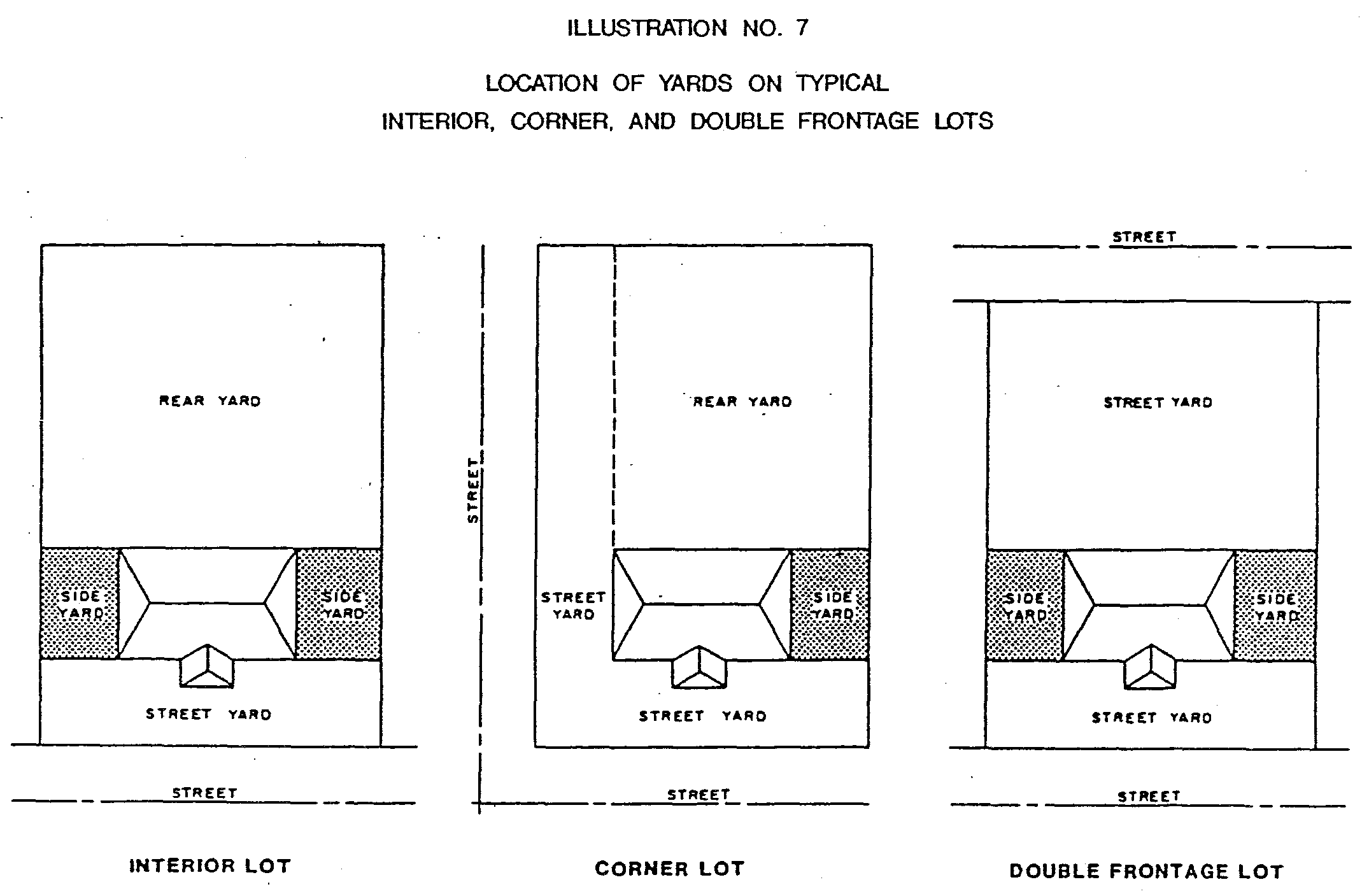
Corner lots. Structures shall provide a front yard setback as required by this article on the street that the structure faces as established by this article. A second front yard setback shall be provided on the side of the structure abutting a public or private street. The second front yard setback shall be the same setback as required in that district, except in the R-2 residential district. For corner lots in the R-2 residential district the minimum front yard setback on the shortest street frontage shall be 25 feet from the street right-of-way. The minimum front yard setback on the longest street frontage shall be eight feet. (See Illustration No. 7.)
(9)
Double frontage lot. Lots abutting two opposite streets shall provide the front yard setback required by the district in which the lot is located from each street upon which the lot abuts. (See Illustration No. 7.)
(10)
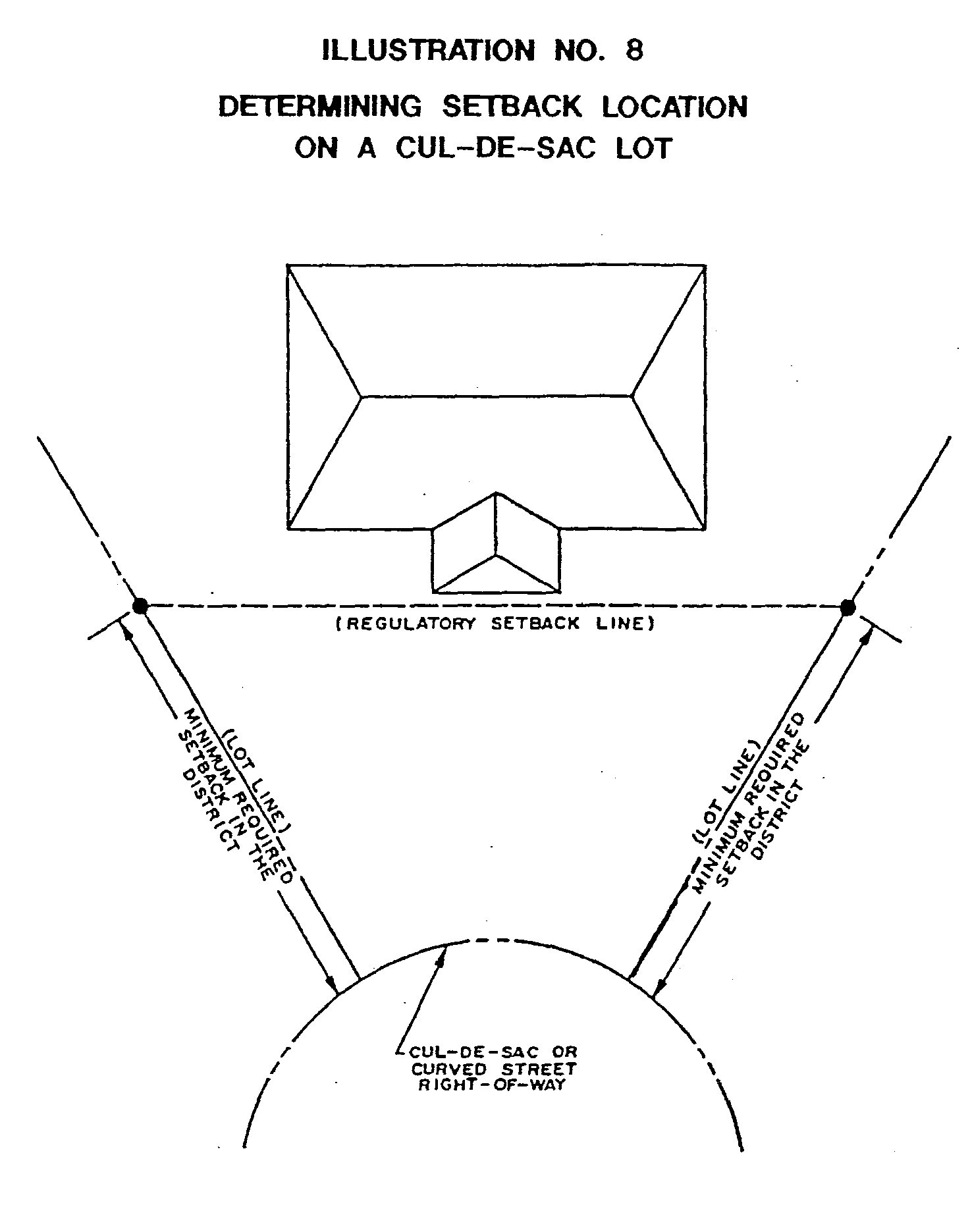
Measuring setbacks on cul-de-sacs. The required setback on cul-de-sacs and curved streets shall be determined by measuring the required setback alongside lot line and connecting those two points with a straight line. (See Illustration No. 8.)
(Code 2003, § 13-1-151)
Sec. 54-629. - Existing substandard lots.
A lot that does not contain sufficient area to conform to the dimensional requirements of this article may be used as a single-family building site, provided that the use is permitted in the zoning district, provided that the lot is of record in the county register of deed's office prior to the effective date of this article, and provided that the lot is in separate ownership from abutting lands. If two more substandard lots with continuous footage have the same ownership as of the effective date of this article, the lots involved shall be considered to be an individual parcel for the purpose of this article. Substandard lots shall be required to meet the setback and other yard requirements of this article.
(Code 2003, § 13-1-152)