
Butte County Unincorporated
City Zoning Code
City Zoning Code
ARTICLE II
Zoning Districts, Land Uses, and Development Standards
24-12 - Purpose of the agriculture zones.
A.
Agriculture (AG). The purpose of the AG zone is to support, protect, and maintain a viable, long-term agricultural sector in Butte County. Standards for the AG zone maintain the vitality of the agricultural sector by retaining parcel sizes necessary to sustain viable agricultural operations, protecting agricultural practices and activities by minimizing land-use conflicts, and protecting agricultural resources by regulating land uses and development intensities in agricultural areas. Permitted uses include crop cultivation, animal grazing, stock ponds, and agricultural processing. More intensive agricultural activities, such as animal processing, dairies, hog farms, stables, forestry and logging, and mining and oil extraction, are permitted with the approval of a Conditional Use Permit. One (1) single-family home and one (1) accessory dwelling unit is permitted on each legally established parcel within the AG zone, and residential uses for agricultural employees are permitted as an accessory use within the AG zone. The minimum permitted parcel size in the AG zone ranges from twenty (20) acres to one hundred sixty (160) acres. The AG zone implements the Agriculture land use designation in the General Plan.
B.
Agriculture Services (AS). The purpose of the AS zone is to protect, maintain, promote, and enhance agriculture as a viable, long-term economic sector by accommodating agricultural uses or compatible commercial and light industrial uses that directly support agricultural activities within the county. Standards for the AS zone are intended to allow most agricultural uses allowed in the AG zone while encouraging new, compatible support industries and operations, and to protect agricultural and other neighboring land uses by minimizing conflicts. Agricultural support uses permitted as-of-right in the AS zone include uses with minimal potential impacts on adjacent parcels, such as agricultural equipment sales and rental, light manufacturing, warehousing, and distribution and storage. Agricultural support uses that are more likely to impact adjacent parcels, such as agricultural vehicle repair and heavier manufacturing, require the approval of a Conditional Use Permit. Residential uses arc not permitted in the AS zone, except caretaker quarters as an accessory use, which requires an Administrative Use Permit. The maximum permitted floor area ratio in the AS zone is eight-tenths (0.8). The AS zone implements the Agriculture Services land use designation in the General Plan.
(Ord. No. 4062, § 1, 9-10-13; Ord. No. 4132, § 1(Att. A), 9-12-17; Ord. No. 4134, § 1(Att. A), 9-26-17; Ord. No. 4197, § 7, 1-12-21)
24-13 - Land use regulations for agriculture zones.
A.
Permitted Uses. Table 24-13-1 (Permitted Land Uses in the Agriculture Zones) identifies land uses permitted in the agriculture zones.
Notes:
[1]
See Article 42 (Glossary) for definitions of listed land uses.
[2]
Standards in the Zoning Ordinance that apply to specific uses are identified under the column "Applicable Regulations," defined under Section 24-8G.5, and are intended to direct the reader to a section that is related to the use.
[3]
Permitted only as an accessory use.
[4]
One (1) single-family home and an accessory dwelling unit is permitted per legal parcel. Accessory dwelling units are not allowed on parcels subject to Williamson Act contracts.
[5]
Permitted only for organizations that provide a service to the agricultural community, such as a grange or similar organization.
[6]
Manufacturing uses that directly support agricultural activities are permitted as "Agricultural Support Services, General" and "Agricultural Support Services, Light."
[7]
Permitted only when not requiring permanent improvements and not interfering materially with agricultural operations.
[8]
Solar Energy Systems under Utilities, Major and Utilities, Intermediate shall only be permitted on "Grazing Land" or "Other Land" as defined under the latest mapping provided by the California Department of Conservation Division of Land Resource Protection Farmland Mapping Program and as shown under General Plan Agriculture Element, Figure AG-1, and only on those lands not subject to a Williamson Act Contract, unless the landowner has rescinded the Williamson Act Contract and entered into a solar-use easement pursuant to State law for marginally productive or physically impaired farmland.
B.
Agricultural Maintenance Plan.
1.
An Agricultural Maintenance Plan shall be submitted as part of any application for a non-agricultural use requiring a Conditional Use Permit or Minor Use Permit on a parcel with existing agricultural operations. The Agricultural Maintenance Plan shall identify specific measures to be implemented to ensure that the proposed use does not adversely impact agricultural activities on the parcel.
2.
The Zoning Administrator and Agricultural Commissioner shall review the Agricultural Maintenance Plan and shall prepare comments and recommended conditions for consideration of the Planning Commission or Zoning Administrator at the hearing for the Conditional Use Permit or Minor Use Permit.
3.
To approve a Conditional Use Permit or Minor Use Permit on a parcel with existing agricultural operations, the Planning Commission or Zoning Administrator shall consult with the Agricultural Commissioner to determine that the Agricultural Maintenance Plan will adequately mitigate any potential adverse impacts to agricultural operations on the parcel, in addition to making all the findings required by Article 31 (Conditional Use and Minor Use Permits).
(Ord. No. 4062, § 1, 9-10-13; Ord. No. 4091, § 1, 1-27-15; Ord. No. 4094, § 2, 4-21-15; Ord. No. 4132, § 1(Att. A), 9-12-17; Ord. No. 4134, § 1(Att. A), 9-26-17; Ord. No. 4159, § 1(Att. A), 3-26-19; Ord. No. 4161, § 1(Att. A), 5-7-19; Ord. No. 4175, § 1, 11-19-19; Ord. No. 4197, § 7, 1-12-21; Ord. No. 4225, § 1, 1-24-23; Ord. No. 4244, § 1, 4-23-24)
24-14 - Development standards for agriculture zones.
A.
Agriculture Sub-Zones. The AG zone is divided into five (5) sub-zones, each with its own minimum parcel size. All standards that apply to the AG zone in general also apply to each individual sub-zone, except for minimum parcel area as specified in Table 24-14-1 (Parcel Size and Density for Agriculture Zones).
Notes:
[1]
Applies only to the creation of new parcels.
[2]
Accessory dwelling units are permitted.
[3]
Caretaker quarters permitted as an accessory use.
[4]
Floor Area Ratio (FAR) is defined and illustrated in Article VII, Division 1 (Glossary).
B.
Parcel Size and Density. Table 24-14-1 (Parcel Size and Density for Agriculture Zones) identifies the parcel size and density standards that apply in the agriculture zones.
C.
Setbacks and Height. Table 24-14-2 (Setback and Height Standards for Agriculture Zones) identifies development standards that apply in the agriculture zones.
Notes:
[1]
For parcels with a front property line extending to the centerline of the public right-of-way abutting the parcel, the front setback shall be measured from the edge of the public right-of-way.
D.
Maximum Permitted Height in Agriculture Zones.
1.
Residential Structures. The maximum permitted height of residential structures within an agriculture zone is thirty-five (35) feet.
2.
Non-Residential Structures. The maximum permitted height of non-residential structures within an agriculture zone is fifty (50) feet, except as allowed by Subsection 3 below.
3.
Exceptions for Non-Residential Structures. Water tanks, granaries, barns, pole buildings, electronic towers, antennas, agricultural processing equipment and silos, aggregate processing equipment, and similar structures associated with agricultural operations may exceed fifty (50) feet in height provided they do not exceed height restrictions in regulated airport approach zones. Such structures shall not exceed the maximum height necessary to perform its intended function. See also Section 24-157 (Alternative Energy Structures) concerning the height of alternative energy structures, and Article IV, Division 2 (Telecommunication Facilities) concerning the height of towers, antennas, and similar structures not associated with agriculture. No structures shall exceed the maximum permitted height in areas as specified in Section 24-49 (Height Measurement) and the County's Military Overlay Zone Map.
E.
Rezoning of Agricultural Lands. The rezoning of land zoned AG or AS to a different zone shall be allowed only if all of the following criteria are met in addition to all applicable Zoning Ordinance Map Amendment requirements specified in Article VI, Division 6 (Zoning Ordinance Amendments):
1.
The parcels for which rezoning is requested ("subject parcels") are adjacent to uses other than agriculture or agricultural support uses.
2.
The rezoning will not be detrimental to existing agricultural operations.
3.
The subject parcels are adjacent to existing development or urban infrastructure and conversion will constitute a logical contiguous extension of a designated urban area.
4.
No feasible development alternative exists that is less detrimental to agriculture.
5.
Full mitigation of impacts to the extent allowed under the law is provided, including, but not limited to, roads, drainage, schools, fire protection, law enforcement, recreation, sewage, and lighting, as established by the Board of Supervisors.
6.
The subject parcels are not subject to a contract with the County pursuant to the Williamson Act.
7.
The rezoning will not otherwise interfere with a Butte County General Plan policy, including the Chico Area Greenline policies.
F.
Rezoning from Larger to Smaller Agriculture Sub-Zones. In order to preserve the viability of agricultural operations in Butte County, special criteria shall be met prior to the rezoning of parcels from one (1) AG sub-zone to another AG sub-zone that allows a smaller minimum parcel size (e.g., rezoning from AG-40 to AG-20). The Board of Supervisors may approve an application for such a rezoning only if all of the following criteria are met in addition to all applicable Zoning Ordinance Map Amendment requirements specified in Article VI, Division 6 (Zoning Ordinance Amendments):
1.
The rezoning complies with Agricultural Buffer requirements as outlined in Article III, Division 7 of the Zoning Ordinance and Butte County General Plan Agriculture Element Policy 5.3, and all other applicable General Plan policies.
2.
Building site envelopes allowed for by the rezoning can be accommodated in compliance with all Agricultural Buffer requirements.
3.
The applicant has prepared and committed to implement an Agricultural Production and Stewardship Plan that details how the property will be kept in commercial agricultural use. The Plan shall show how the property will be planted with crops, orchards, vineyards, or utilized for grazing and animal production. The Plan shall specify agricultural infrastructure and facilities, including a production water source, irrigation, fences, and farm worker housing if needed. The Plan shall be reviewed by the County Agricultural Commissioner to verify that it will sustain farming practices and maximize agricultural compatibility.
4.
For identified flood hazard areas, building site envelopes shall be located outside of the flood hazard area. Development permits will be prohibited within flood hazard areas unless findings based on substantial evidence provided by the owner show that development meets current government standards for flood protection. Some flood hazard areas may be removed from FEMA maps by requesting a change with the National Flood Insurance Program.
5.
For areas of high erosion as identified by Butte County General Plan 2030 Figure HS-5 —Erosion Hazard Potential, the residential density allowed by the rezoning shall not increase sediment load or erosion characteristics on or off the subject parcels.
6.
The reduced parcel size meets the terms specified under any applicable Williamson Act Contract.
G.
Agricultural Worker Housing Center.
1.
Permit Process. Agricultural worker housing centers shall be subject to an administrative permit pursuant to Article 29, Administrative Permits.
2.
Location. The agricultural worker housing center shall be located in an area that will present the least amount of impact to agricultural resources (e.g., close to existing access and other structures, and in a locations that will present the least amount of disturbance to agricultural resources and operations).
3.
Size. Agricultural housing units shall be clustered in close proximity to each other and shall occupy an area of no more than one (1) contiguous acre per parcel. No more than twelve (12) agricultural worker housing units or a single building that contains no more than thirty-six (36) beds, and other facilities associated with a residence, may be developed within the one acre area.
4.
Occupancy. Agricultural worker housing shall be occupied by agricultural employees. The family members of an agricultural employee residing in agricultural worker housing are allowed occupants.
5.
Deed Restriction. Prior to the issuance of a building permit for an agricultural worker housing center, a covenant of restriction to run with the land shall be recorded which specifies that the agricultural worker housing center cannot be sold separately, that the housing shall only be used to house agricultural workers and their families, and that these restrictions shall be binding on successors in ownership.
6.
Williamson Act. Agricultural Worker Housing Centers shall comply with any applicable Williamson Act Program.
(Ord. No. 4062, § 1, 9-10-13; Ord. No. 4091, § 1, 1-27-15; Ord. No. 4134, § 1(Att. A), 9-26-17; Ord. No. 4175, § 2, 11-19-19; Ord. No. 4197, § 7, 1-12-21)
24-15 - Purpose of the natural resource zones.
A.
Timber Mountain (TM). The purpose of the TM zone is to preserve Butte County's valuable timber resources and to protect both the economic and environmental value of these lands. Standards for the TM zone are intended to support the growing and harvesting of timber, pulp woods, and other forestry products for commercial purposes. Permitted uses include logging, timber processing, crop cultivation, agricultural processing, and the management of forest lands for timber operations and animal grazing. Extractive uses that are generally compatible with forestry operations, including mining and oil and gas extraction, are conditionally permitted in the TM zone. The minimum permitted parcel size in the TM zone is one hundred sixty (160) acres. The TM zone allows for one (1) single-family home per parcel. The TM zone implements the Timber Mountain land use designation in the General Plan.
B.
Timber Production (TPZ). The purpose of the TPZ zone is to preserve and protect land where timber is actively being grown and harvested, as well as minimize impacts to neighboring uses from active timber operations.
The California Forest Taxation Reform Act of 1976 places values on bare land that is related to its ability to grow trees, and it substitutes a percent tax on the value of timber at the time of harvest ("yield" tax) for the annual property tax on the trees. In exchange for this tax benefit, landowners dedicate their timberland to timber growing and compatible uses for a period of at least ten (10) years. Unless terminated by the County or landowner, these ten (10) years renew each year, thus creating a rolling minimum or self-perpetuating ten (10) year commitment (California Board of Equalization, 2000). Lands zoned in this manner are called Timberland Production Zones (TPZ).
Permitted uses include logging, timber processing, crop cultivation, the management of forest lands for timber operations and animal grazing, and compatible uses, which are uses that are determined to not significantly detract from the use of the property for, or inhibit, growing and harvesting timber. Extractive uses that are generally compatible with forestry operations, including mining and oil and gas extraction, are conditionally permitted in the TPZ zone. Minimum parcel size and development standards for development in the TPZ zone are generally equivalent to the TM zone. The TPZ zone implements the Timber Mountain land use designation in the General Plan.
C.
Resource Conservation (RC). The purpose of the RC zone is to protect and preserve natural, wilderness, and scientific study areas that are critical to environmental quality within Butte County. Standards for the RC zone are intended to protect sensitive natural resources and to provide limited recreational and commercial recreational uses for the enjoyment of Butte County residents and visitors. Permitted land uses in the RC zone include livestock grazing and limited recreational and commercial recreational uses that do not detract from the area's value for habitat, open space, or research. The minimum permitted parcel size in the RC zone is forty (40) acres. The RC zone allows for one (1) single-family home per parcel. The RC zone implements the Resource Conservation land use designation in the General Plan. Mining may be considered by a Mining Permit in this zone when it will result in an improvement or no degradation of the habitat area as the end use pursuant to the Surface Mining and Reclamation Act.
(Ord. No. 4062, § 1, 9-10-13)
24-16 - Land use regulations for natural resource zones.
A.
Permitted Uses. Table 24-16-1 (Permitted Land Uses in the Natural Resource Zones) identifies land uses permitted in the natural resource zones.
Notes:
[1]
See Article 42 (Glossary) for definitions of listed land uses.
[2]
Standards in the Zoning Ordinance that apply to specific uses are identified under the column "Applicable Regulations," defined under Section 24-8G.5, and are intended to direct the reader to a section that is related to the use.
[3]
Only passive recreation with limited improvements is permitted. Allowed improvements include informational kiosks, parking areas, and other similar improvements.
[4]
No Conditional Use Permit or minor use permit shall be granted in a TPZ zone until a specific finding has been made that the proposed use is compatible with the growing and harvesting of timber and timber products, see section below.
[5]
Use allowed only if no alternative non-TPZ property available in the project area.
(Ord. No. 4062, § 1, 9-10-13; Ord. No. 4091, § 1, 1-27-15; Ord. No. 4094, § 3, 4-21-15; Ord. No. 4134, § 1(Att. A), 9-26-17; Ord. No. 4159, § 1(Att. A), 3-26-19; Ord. No. 4161, § 1(Att. A), 5-7-19; Ord. No. 4197, § 7, 1-12-21; Ord. No. 4225, § 1, 1-24-23; Ord. No. 4244, § 1, 4-23-24; Ord. No. 4253, § 1, 10-8-24)
24-17 - Development standards for natural resource zones.
A.
Parcel Size and Density. Table 24-17-1 (Parcel Size and Density for Natural Resource Zones) identifies the parcel size and density standards that apply in the natural resource zones.
Notes:
[1]
Applies only to the creation of new parcels.
B.
Setbacks and Height. Table 24-17-2 (Setback and Height Standards for Natural Resource Zones) identifies development standards that apply in the natural resource zones.
Notes:
[1]
For parcels with a front property line extending to the centerline of the public right-of-way abutting the parcel, the front setback shall be measured from the edge of the public right-of-way.
C.
Maximum Permitted Height in Natural Resources Zones.
1.
Residential Structures. The maximum permitted height of residential structures within a natural resources zone is thirty-five (35) feet.
2.
Non-Residential Structures. The maximum permitted height of non-residential structures within a natural resource zones is fifty (50) feet, except as allowed by Subsection 3 below.
3.
Exceptions for Non-Residential Structures. Water tanks, agricultural processing equipment and silos, aggregate processing equipment, granaries, barns, pole buildings, electronic towers, antennas, and similar structures associated with agricultural and natural resource extraction uses may exceed fifty (50) feet in height provided they do not exceed height restrictions in regulated airport approach zones. Such structures shall not exceed the maximum height necessary to perform its intended function. See also Section 24-157 (Alternative Energy Structures) concerning the height of alternative energy structures, and Article IV, Division 2 (Telecommunication Facilities) concerning the height of towers, antennas, and similar structures not associated with agriculture. No structures shall exceed the maximum permitted height in areas as specified in Section 24-49 (Height Measurement) and the County's Military Overlay Zone Map.
D.
Rezoning. Any rezoning of the land from a Timber Production Zone (TPZ) zone to another zone shall be in strict conformance with the requirements of the California Timberland Productivity Act of 1982 (Section 51100 et seq. of the Government Code).
E.
Conditional Use Permits and Minor Use Permits in TPZ Districts. No Conditional Use Permit or Minor Use Permit shall be granted in a TPZ zone until the following additional requirements are met:
1.
A Registered Professional Forester (RPF) will be required to find that the use will not negatively detract from the ability to grow and harvest timber and timber products. The conditional use will be determined to be compatible with timber growing and harvesting. The RPF will provide all supporting documentation to the Department of Development Services.
2.
A "right-to-log" disclosure shall be signed by the owner/operator in a TPZ zone when a Conditional Use Permit or Minor Use Permit is proposed. The "right-to-log" disclosure shall be provided to the Department of Development Services and shall include provisions that permitted uses may be subject to inconveniences associated with timber management and harvesting, and that such operations take precedent over conditionally permitted uses.
(Ord. No. 4062, § 1, 9-10-13)
24-18 - Purpose of the residential zones.
A.
Foothill Residential (FR). The purpose of the FR zone is to allow for the appropriate development of large-lot single-family home, small farmsteads, and related uses in the foothill areas of the county. Standards for the FR zone are intended to ensure that the development of homes respond sensitively to the foothill setting. Permitted residential uses in the FR zones include a single-family home, small residential care home, and an accessory dwelling unit. The FR zone also conditionally permits non-residential uses compatible with a low-density rural setting, including public and quasi-public uses, mining, animal services, hunting and fishing clubs, nurseries, and commercial stables. Animal grazing, crop cultivation, private stables, on-site agricultural product sales, and other similar agricultural activities are permitted uses in the FR zone. The minimum permitted parcel size in the FR zone ranges from one (1) acre to forty (40) acres. The FR zone implements the Foothill Residential land use designation in the General Plan.
B.
Foothill Country Residential (FCR). The purpose of the FCR zone is to allow for the appropriate development of large-lot single-family homes, small farmsteads, and related uses in the foothill areas of the county. The FCR zone is applied to regional areas of the county for the protection of a quiet, country-like setting and does not permit certain uses that would interfere with this purpose. Standards for the FCR zone are intended to ensure that the development of homes respond sensitively to the foothill setting. Permitted residential uses in the FCR zones include a single-family home, small residential care home, and an accessory dwelling unit. Animal grazing, crop cultivation, private and semiprivate stables, on-site agricultural product sales, and other similar agricultural activities are permitted uses in the FCR zone. The minimum permitted parcel size in the FCR zone is twenty (20) acres. The FCR zone implements the Foothill Residential land use designation in the General Plan.
C.
Rural Residential (RR). The purpose of the RR zone is to allow for the appropriate development of large-lot single-family homes, small farmsteads, and related uses in the rural and agricultural areas of the county. Standards for the RR zone are intended to preserve and protect the character of existing rural residential areas and ensure that future rural residential development is compatible with adjacent agricultural uses. Permitted residential uses in the RR zones include a single-family home, small residential care home, and an accessory dwelling unit. The RR zone also conditionally permits non-residential uses compatible with a rural residential setting, including public and quasi-public uses, personal services, nurseries, and animal services. Animal grazing, crop cultivation, private stables, on-site agricultural product sales, and other similar agricultural activities are permitted uses in the RR zone. The minimum permitted parcel size in the RR zone ranges from five (5) to ten (10) acres. The RR zone implements the Rural Residential land use designation in the General Plan.
D.
Rural Country Residential (RCR). The purpose of the RCR zone is to allow for the appropriate development of large-lot single-family homes, small farmsteads, and related uses in the rural and agricultural areas of the county. The RCR zone is applied to regional areas of the county for the protection of a quiet, country-like setting and does not permit certain uses that would interfere with this purpose. Standards for the RCR zone are intended to preserve and protect the character of existing rural residential areas and ensure that future rural residential development is compatible with adjacent agricultural uses. Permitted residential uses in the RCR zones include a single-family home, small residential care home, and an accessory dwelling unit. Animal grazing, crop cultivation, private and semiprivate stables, on-site agricultural product sales, and other similar agricultural activities are permitted uses in the RCR zone. The minimum permitted parcel size in the RCR zone is ten (10) acres. The RCR zone implements the Rural Residential land use designation in the General Plan.
E.
Very Low Density Residential (VLDR). The purpose of the VLDR zone is to allow for single-family homes and related uses in residential neighborhoods within the county. Standards for the VLDR zone are intended to preserve and protect the character of existing neighborhoods and to ensure that new residential neighborhoods provide an appropriate transition from rural to more developed areas. Permitted residential uses in the VLDR zones include single-family homes, small residential care homes, accessory dwelling units, animal grazing, on-site agricultural product sales, and private stables. The VLDR zone also conditionally permits non-residential uses compatible with a residential setting, including public and quasi-public uses, golf courses, park and recreational facilities, personal services, animal-keeping, large residential care homes, and medical offices and clinics. The minimum permitted parcel size in the VLDR zone is one (1) acre. The VLDR zone implements the Very Low Density Residential land use designation in the General Plan.
F.
Very Low Density Country Residential (VLDCR). The purpose of the VLDCR zone is to allow large lot single-family homes and related uses in existing residential neighborhoods that are adjacent to or surrounded by areas with uses of a different type or residential uses of a different density. Standards for the VLDCR zone are intended to preserve and protect the character of existing residential neighborhoods. Permitted residential uses in the VLDCR zones include single-family homes, small residential care homes, accessory dwelling units, animal grazing, on-site agricultural product sales, and private stables. The VLDCR zone conditionally permits uses compatible with a low-density residential setting including semi-private stables animal keeping, and major home-occupations. The minimum permitted parcel size in the VLDCR zone is one (1) acre. The VLDCR zone implements the Very Low Density Residential land use designation in the General Plan.
G.
Low Density Residential (LDR). The purpose of the LDR zone is to allow for a mixture of housing types in a low density setting. Standards for the LDR zone are intended to preserve and protect the character of existing neighborhoods. Permitted housing types in the LDR zones include single-family homes and accessory dwelling units. Non-residential uses conditionally permitted in the LDR zone include public and quasi-public uses, park and recreational facilities, personal services, and medical offices and clinics. The minimum permitted parcel size in the LDR zone is thirteen thousand five hundred (13,500) square feet. The LDR zone implements the Low Density Residential land use designation in the General Plan.
H.
Medium Density Residential (MDR). The purpose of the MDR zone is to allow for a mixture of housing types in a medium density setting. Permitted housing types in the MDR zones include single-family homes and accessory dwelling units. Non-residential uses conditionally permitted in the MDR zone include public and quasi-public uses, park and recreational facilities, personal services, medical offices and clinics, and general retail. The minimum permitted parcel size in the MDR zone is six thousand (6,000) square feet. The MDR zone implements the Medium Density Residential land use designation in the General Plan.
I.
Medium High Density Residential (MHDR). The purpose of the MHDR zone is to allow for a mixture of housing types in a medium high density setting. Permitted housing types in the MHDR zone include single-family homes, duplex homes, multi-family dwellings, and accessory dwelling units. The MHDR zone also conditionally permits mobile home parks. Non-residential uses conditionally permitted in the MHDR zone include public and quasi-public uses, park and recreational facilities, personal services, medical offices and clinics, and general retail. The maximum permitted residential density in the MHDR zone is fourteen (14) dwelling units per acre. The MDHR zone implements the Medium High Density Residential land use designation in the General Plan.
J.
High Density Residential (HDR). The purpose of the HDR zone is to allow for a mixture of housing types in a high density setting. Permitted housing types in the HDR zones include single-family homes, duplex homes, multi-family dwellings, and accessory dwelling units. The HDR zone also conditionally permits mobile home parks. Non-residential uses conditionally permitted in the HDR zone include public and quasi-public uses, park and recreational facilities, personal services, medical offices and clinics, and general retail. Permitted residential density in the HDR zone ranges from a minimum of fourteen (14) dwelling units per acre to a maximum of twenty (20) dwelling units per acre. The HDR zone implements the High Density Residential land use designation in the General Plan.
K.
Very High Density Residential (VHDR). The purpose of the VHDR zone is to allow for a mixture of housing types at the highest residential densities in unincorporated Butte County. Permitted housing types in the VHDR zones include single-family homes, duplex homes, multi-family dwellings, and accessory dwelling units. The VHDR zone also conditionally permits mobile home parks. Non-residential uses conditionally permitted in the VHDR zone include public and quasi-public uses, park and recreational facilities, personal services, medical offices and clinics, and general retail. Permitted residential density in the VHDR zone ranges from a minimum of twenty (20) dwelling units per acre to a maximum of thirty (30) dwelling units per acre. The VHDR zone implements the Very High Density Residential land use designation in the General Plan.
(Ord. No. 4062, § 1, 9-10-13; Ord. No. 4091, § 1, 1-27-15; Ord. No. 4134, § 1(Att. A), 9-26-17; Ord. No. 4197, § 7, 1-12-21; Ord. No. 4237, § 2, 1-23-24)
24-19 - Land use regulations for residential zones.
A.
Permitted Uses. Table 24-19-1 (Permitted Land Uses in the Residential Zones) identifies land uses permitted in the residential zones.
Notes:
[1]
See Article 42 (Glossary) for definitions of listed land uses.
[2]
Standards in the Zoning Ordinance that apply to specific uses are identified under the column "Applicable Regulations," defined under Section 24-8G.5, and are intended to direct the reader to a section that is related to the use.
[3]
Permitted only on sites five (5) acres or larger.
[4]
Requires the approval of a mining permit and reclamation plan pursuant to Butte County Code Chapter 13.
[5]
Permitted only on sites one-acre or larger.
[6]
One single-family home and an accessory dwelling unit is permitted per legal parcel.
[7]
Micro Wind Systems are subject to an Administrative Permit in all residential zones.
[8]
Agricultural Wind Energy System permitted in the FR and RR with a Minor Use Permit and not allowed in all other residential zones.
[9]
Small Wind Energy Systems are subject to a Conditional Use Permit in the RR, RCR, FR and FCR zones and not allowed in all other residential zones.
[10]
Large Wind Energy Systems not allowed.
[11]
Medical Offices and Clinics are not permitted in areas subject to the Unique Agriculture Overlay Zone.
[12]
Micro Wind Systems are not permitted in the VLDCR Zones.
[13]
Minor Use Permit for Tier 2 Solar Electric System only, all other Utility, Accessory uses not allowed.
[14]
Permitted only on parcels of four (4) acres or larger.
[15]
Permitted only as an interim use on parcels of one (1) acre or more in size, prior to subdivision and development with residential uses.
(Ord. No. 4062, § 1, 9-10-13; Ord. No. 4091, § 1, 1-27-15; Ord. No. 4094, § 4, 4-21-15; Ord. No. 4105, § 1, 1-12-16; Ord. No. 4134, § 1(Att. A), 9-26-17; Ord. No. 4159, § 1(Att. A), 3-26-19; Ord. No. 4161, § 1(Att. A), 5-7-19; Ord. No. 4183, § 1, 5-26-20; Ord. No. 4197, § 7, 1-12-21; Ord. No. 4225, § 1, 1-24-23; Ord. No. 4244, § 1, 4-23-24)
24-20 - Development standards for residential zones.
A.
Foothill Residential (FR Sub-Zones). The FR zone is divided into six (6) sub-zones, each with its own minimum parcel size. All standards that apply to the FR zone in general also apply to each individual sub-zone, except for minimum parcel area as specified in Table 24-20-1 (Parcel Size and Density for Residential Zones).
B.
Parcel Size and Density. Table 24-20-1 (Parcel Size and Density for Residential Zones) identifies the parcel size and density standards that apply in residential zones.
Notes:
[1]
A minimum forty (40) foot parcel frontage is permitted for cul-de-sac parcels.
[2]
Accessory dwelling units are permitted in all residential zones.
[3]
In the FR, FCR, RR, RCR, VLDR, VLDCR, LDR and MDR zones, only one (1) primary dwelling unit and one (1) accessory dwelling unit is permitted per parcel, regardless of parcel size.
[4]
Applies only to the creation of new parcels through the subdivision process.
C.
Structure Setbacks and Height. Table 24-20-2 (Setback and Height Standards for Residential Zones) identifies structure setback and height standards that apply in residential zones.
Notes:
[1]
Additional setbacks may be required by the Butte County Fire Safe regulations and the Public Resources Code, Section 4290.
(Ord. No. 4062, § 1, 9-10-13; Ord. No. 4105, § 1, 1-12-16; Ord. No. 4132, § 1(Att. A), 9-12-17; Ord. No. 4134, § 1(Att. A), 9-26-17; Ord. No. 4197, § 7, 1-12-21; Ord. No. 4237, § 3, 1-23-24; Ord. No. 4241, § 1, 3-26-24)
24-21 - Purpose of the commercial and mixed use zones.
A.
General Commercial (GC). The purpose of the GC zone is to allow for a full range of retail, service, and office uses to serve residents, workers, and visitors. Standards for the GC zone are intended to ensure that a diversity of commercial uses are available within convenient locations throughout the county. Permitted uses include general retail, personal services, professional offices, restaurants, gas and service stations, hotels and motels, and other similar commercial uses. Multiple-family dwellings, vehicle repair, light manufacturing, and warehousing and storage are permitted in the GC zone with the approval of a Conditional Use Permit. Single-family homes are not permitted in the GC zone. The maximum permitted floor area ratio in the GC zone is four-tenths (0.4). The GC zone implements the Retail and Office land use designation in the General Plan.
B.
Neighborhood Commercial (NC). The purpose of the NC zone is to allow for retail and service uses that meet the daily needs of nearby residents and workers. Standards for the NC zone are intended to reduce the need to drive by providing everyday goods and services close to where people live and work, and by allowing for centers of neighborhood activity that support small, businesses. Permitted uses in the NC zone are similar to the GC zone, except that vehicle repair, light manufacturing, and warehousing and storage uses are not allowed. The maximum permitted floor area ratio in the NC zone is three-tenths (0.3). The NC zone implements the Retail and Office land use designation in the General Plan.
C.
Community Commercial (CC). The purpose of the CC zone is to allow for retail and service uses in proximity to residents in rural areas of the county. Standards in the CC zone are intended to increase rural residents' access to retail products and services and to reduce the need for residents of remote communities to drive long distances to meet basic needs. Permitted uses include general retail, personal services, professional offices, restaurants, hotels and motels, and other similar commercial uses. Dwelling units are permitted in the CC zone. The maximum permitted floor area ratio in the CC zone is two-tenths (0.2). The CC zone implements the Retail and Office land use designation in the General Plan.
D.
Recreation Commercial (REC). The purpose of the REC zone is to allow for unique recreation and tourism-related uses to serve County residents and visitors. Standards in the REC zone are intended to allow for only those uses that are consistent with this objective. Conditionally permitted uses in the REC zone include golf courses and country clubs, parks and recreational facilities, RV parks, marinas, resorts and vacation cabins, restaurants, retail, and other similar uses. The maximum permitted floor area ratio in the REC zone is four-tenths (0.4). The REC zone implements the Recreation Commercial land use designation in the General Plan.
E.
Sports and Entertainment (SE). The purpose of the SE zone is to allow for sports and entertainment uses, including sports facilities, golf courses, theaters, and amphitheaters, as well as a range of related commercial uses that are compatible with the Sports and Entertainment zone. The related uses may include localized retail, commercial retail, and service establishments. The maximum permitted floor area ratio in the SE zone is four-tenths (0.4). The SE zone implements the Sports and Entertainment land use designation in the General Plan. The Sports and Entertainment designation was enacted under Butte County Ordinance 3570, where additional information concerning this designation may be found. This designation is unique to several parcels of approximately one hundred (100) acres located in Butte Valley near the intersections of Highway 70 and Highway 191 (Clark Road).
F.
Mixed Use (MU). The purpose of the MU zone is to allow for a mixture of residential and commercial land uses located close to one (1) another, either within a single building, on the same parcel, or on adjacent parcels. Standards in the MU zone are intended to reduce reliance on the automobile, create pedestrian-oriented environments, and support social interaction by allowing residents to work or shop within walking distance to where they live. Permitted commercial uses include general retail, personal services, restaurants, professional offices, and other similar uses. Permitted residential density in the MU zone ranges from a minimum of six (6) dwelling units per acre to a maximum of twenty (20) dwelling units per acre. The maximum permitted floor area ratio in the MU zone ranges from three-tenths (0.3) to five-tenths (0.5). The MU zone implements the Mixed Use land use designation in the General Plan.
(Ord. No. 4062, § 1, 9-10-13; Ord. No. 4105, § 1, 1-12-16)
24-22 - Land use regulations for commercial and mixed use zones.
A.
Permitted Uses. Table 24-22-1 (Permitted Land Uses in the Commercial and Mixed Use Zones) identifies land uses permitted in the commercial and mixed use zones.
Notes:
[1]
See Article 42 (Glossary) for definitions of listed land uses.
[2]
Standards in the Zoning Ordinance that apply to specific uses are identified under the column "Applicable Regulations," defined under Section 24-8G.5, and are intended to direct the reader to a section that is related to the use.
[3]
Permitted only in conjunction with a permitted commercial use. Single-family homes shall comply will all site development standards for MDR zones as specified in Section 24-20 (Development Standards for the Residential Zones).
[4]
Permitted only as an interim use on parcels of one (1) acre or more in size prior to subdivision and development with commercial uses.
[5]
Agricultural Wind Energy System not allowed in any commercial zone.
[6]
Permitted only on sites of two (2) acres or more in size.
(Ord. No. 4062, § 1, 9-10-13; Ord. No. 4091, § 1, 1-27-15; Ord. No. 4094, § 5, 4-21-15; Ord. No. 4105, § 1, 1-12-16; Ord. No. 4119, § 1, 9-13-16; Ord. No. 4134, § 1(Att. A), 9-26-17; Ord. No. 4159, § 1(Att. A), 3-26-19; Ord. No. 4161, § 1(Att. A), 5-7-19; Ord. No. 4197, § 7, 1-12-21; Ord. No. 4225, § 1, 1-24-23; Ord. No. 4237, § 4, 1-23-24; Ord. No. 4244, § 1, 4-23-24)
24-23 - Development standards for commercial and mixed use zones.
A.
Mixed Use Sub-Zones. The MU zone is divided into three sub-zones, each with its own minimum parcel size. All standards that apply to the MU zone in general also apply to each individual sub-zone, except for minimum parcel area as specified in Table 24-23-1 (Parcel Size, Residential Density, and Intensity Standards for Commercial and Mixed Use Zones).
B.
Parcel Size and Density. Table 24-23-1 (Parcel Size, Residential Density, and Intensity Standards for Commercial and Mixed Use Zones) identifies the parcel size, residential density, and intensity standards that apply in commercial and mixed-use zones.
Notes:
[1]
Applies only to the creation of new parcels through the subdivision process.
[2]
Floor Area Ratio is defined and illustrated in Article VII, Division 1 (Glossary). The calculation of floor area ratio excludes floor area occupied by residential uses.
C.
Structure Setbacks and Height. Table 24-23-2 (Setback and Height Standards for Commercial and Mixed Use Zones) identifies structure setback and height standards that apply in commercial and mixed use zones.
[1]
Buildings on corner lots in Commercial and Mixed Use zones shall be designed to provide for adequate and safe sight distance for vehicles at adjacent intersections as approved by the Director of Public Works.
D.
Expansion or Replacement of Existing Allowed Uses in the REC Zone.
1.
A single expansion or a replacement of existing allowed uses within the REC zone is allowed through a Minor Use Permit for no more than:
a.
Two thousand five hundred (2,500) square feet per structure; or
b.
Ten thousand (10,000) square feet total if:
1.
The project is in an area where all public services and facilities are available to allow for maximum development permissible in the General Plan, and
2.
The area in which the proposed expansion is located is not environmentally sensitive.
2.
The Minor Use Permit shall be subject to all development standards (e.g., parking, landscaping, and setbacks) as set forth under this chapter.
3.
A single minor expansion or replacement of existing allowed uses within the REC zone for no more than fifty (50) square feet per structure is allowed through an Administrative Permit.
E.
Allowed Uses, Expansion or Replacement of Existing Allowed Uses in the REC zone applicable to property owned and operated by the Jonesville Cabin Owner's Association for seasonal use vacation cabins in the Jonesville area of Butte County.
1.
Commercial uses as set forth under Table 24-22-1, Permitted Land uses in the Commercial and Mixed Use Zones are not permitted.
2.
Each of the existing seasonal use vacation cabins may be expanded in size or replaced subject to an Administrative Permit, unless otherwise noted, and subject to the following requirements:
a.
The governing board and owner of the property shall provide the County with their permission to approve the proposed expansion or replacement as proposed under the Administrative Permit and Building Permit.
b.
The expansion or replacement shall not cause the total size of the cabin to exceed one thousand eight hundred (1,800) square feet.
c.
A single minor expansion or replacement for not more than two hundred twenty-five (225) square feet per cabin is allowed without being subject to an Administrative Permit. Additional expansions or replacements shall be subject to an Administrative Permit.
(Ord. No. 4062, § 1, 9-10-13; Ord. No. 4105, § 1, 1-12-16)
24-24 - Additional standards for the sports and entertainment zone.
A.
Applicable Regulations. All new development on the site shall be reviewed to comply with all applicable federal, State, and local laws, ordinances, and regulations.
B.
Utilities. A water system for a public use and a sewage treatment and disposal system shall be constructed in compliance with applicable standards.
C.
Roadways. All interior roadways shall be private roads; the installation and maintenance of such shall not be borne by the County or any other public agency. By the same token, the construction of private roads need not be pursuant to County standards.
D.
Highway Access. Access to a parcel zoned SE from any State highway shall be provided as required by the California Department of Transportation.
E.
Traffic Control and Security Plan. At least thirty (30) days prior to the first event at any amphitheater facility, a traffic control and security plan shall be prepared in coordination with the Butte County Sheriff, the Butte County Office of Emergency Services, the California Highway Patrol, the Butte County Agricultural Commissioner, and the Butte County Fire Marshall. This plan shall address such elements as satellite parking facilities, shuttle bus usage and routes, information brochures, emergency services access, employee ride share during major events, avoidance of conflicts with agricultural operations, and the security and safety for spectators, visitors and employees, including fire and police protection, costs of which shall be borne by the owners of the facility. The plan shall be updated at least every two (2) years in coordination with the same agencies.
F.
Archaeological Resources. If evidence of subsurface archaeological resources is found during construction, excavation in the vicinity of the find shall cease, a professional archaeologist shall conduct an evaluation in accordance with State and federal laws and regulations, and the find shall be documented or preserved to the extent required by applicable laws and regulations.
(Ord. No. 4062, § 1, 9-10-13)
24-25 - Purpose of the industrial zones.
A.
Light Industrial (LI). The purpose of the LI zone is to allow for light industrial and service commercial uses with little potential to create noise, odor, vibration, or other similar impacts to adjacent uses and surrounding areas. Permitted uses in the LI zone include construction, maintenance and repair services; equipment sales and rentals; vehicle repair, service and maintenance; research and development; light manufacturing; and warehousing, wholesaling and distribution and emergency shelters. Limited amounts of retail, personal services, restaurants, and pubic/quasi-public uses are permitted to serve area workers, and ancillary retail areas are permitted for the sale of products manufactured on-site. Caretaker quarters that are accessory to a primary use and live/work units are the only form of residential uses allowed. The maximum permitted floor area ratio in the LI zone is four-tenths (0.4). The LI zone implements the Industrial land use designation in the General Plan.
B.
General Industrial (GI). The purpose of the GI zone is to allow for a variety of industrial and service commercial uses in Butte County. Standards for the GI zone are intended to preserve locations for existing and future employment-generating businesses, including both traditional businesses and innovative green technology enterprises. In addition to the uses permitted in the LI zone, the GI zone also permits agricultural and timber processing and heavy manufacturing with the approval of a Conditional Use Permit. The maximum permitted floor area ratio in the GI zone is one-half (0.5). The GI zone implements the Industrial land use designation in the General Plan.
C.
Heavy Industrial (HI). The purpose of the HI zone is to allow for a full range of industrial uses, including operations that necessitate the storage of large volumes of hazardous or unsightly materials, or which produce dust, smoke, fumes, odors, or noise at levels that would affect surrounding uses. Uses permitted in the HI are similar to the GI zone, except that heavy industrial uses are permitted either as-of-right or with a Conditional Use Permit, and retail, personal service and restaurant uses are not allowed. The maximum permitted floor area ratio in the HI zone is one-half (0.5). The HI zone implements the Industrial land use designation in the General Plan.
(Ord. No. 4062, § 1, 9-10-13; Ord. No. 4132, § 1(Att. A), 9-12-17)
24-26 - Land use regulations for industrial zones.
A.
Permitted Uses. Table 24-26-1 (Permitted Land Uses in the Industrial Zones) identifies land uses permitted in the industrial zones.
Notes:
[1]
See Article 42 (Glossary) for definitions of listed land uses.
[2]
Standards in the Zoning Ordinance that apply to specific uses are identified under the column "Applicable Regulations," defined under Section 24-8G.5, and are intended to direct the reader to a section that is related to the use.
[3]
Agricultural Wind Energy System not allowed in any Industrial Zone.
[4]
Permitted only as an interim use on parcels of one (1) acre or more in size prior to subdivision and development with industrial uses.
(Ord. No. 4062, § 1, 9-10-13; Ord. No. 4091, § 1, 1-27-15; Ord. No. 4094, § 6, 4-21-15; Ord. No. 4105, § 1, 1-12-16; Ord. No. 4132, § 1(Att. A), 9-12-17; Ord. No. 4134, § 1(Att. A), 9-26-17; Ord. No. 4159, § 1(Att. A), 3-26-19; Ord. No. 4161, § 1(Att. A), 5-7-19; Ord. No. 4197, § 7, 1-12-21; Ord. No. 4225, § 1, 1-24-23; Ord. No. 4244, § 1, 4-23-24)
24-27 - Development standards for industrial zones.
A.
Parcel Size and Density. Table 24-27-1 (Parcel Size and Intensity Standards for Industrial Zones) identifies the parcel size and intensity standards that apply in industrial zones.
Notes:
[1]
Applies only to the creation of new parcels.
B.
Structure Setbacks and Height. Table 24-27-2 (Setback and Height Standards for Industrial Zones) identifies structure setback and height standards that apply in industrial zones.
Notes:
[1]
Buildings on corner lots in Industrial zones shall be designed to provide for adequate and safe sight distance for vehicles at adjacent intersections as approved by the Director of Public Works.
[2]
Structures associated with industrial operations may exceed fifty (50) feet in height provided they do not exceed height restrictions in regulated airport approach zones. Such structures shall not exceed the maximum height necessary to perform its intended function.
C.
Industrial Buffer Yards.
1.
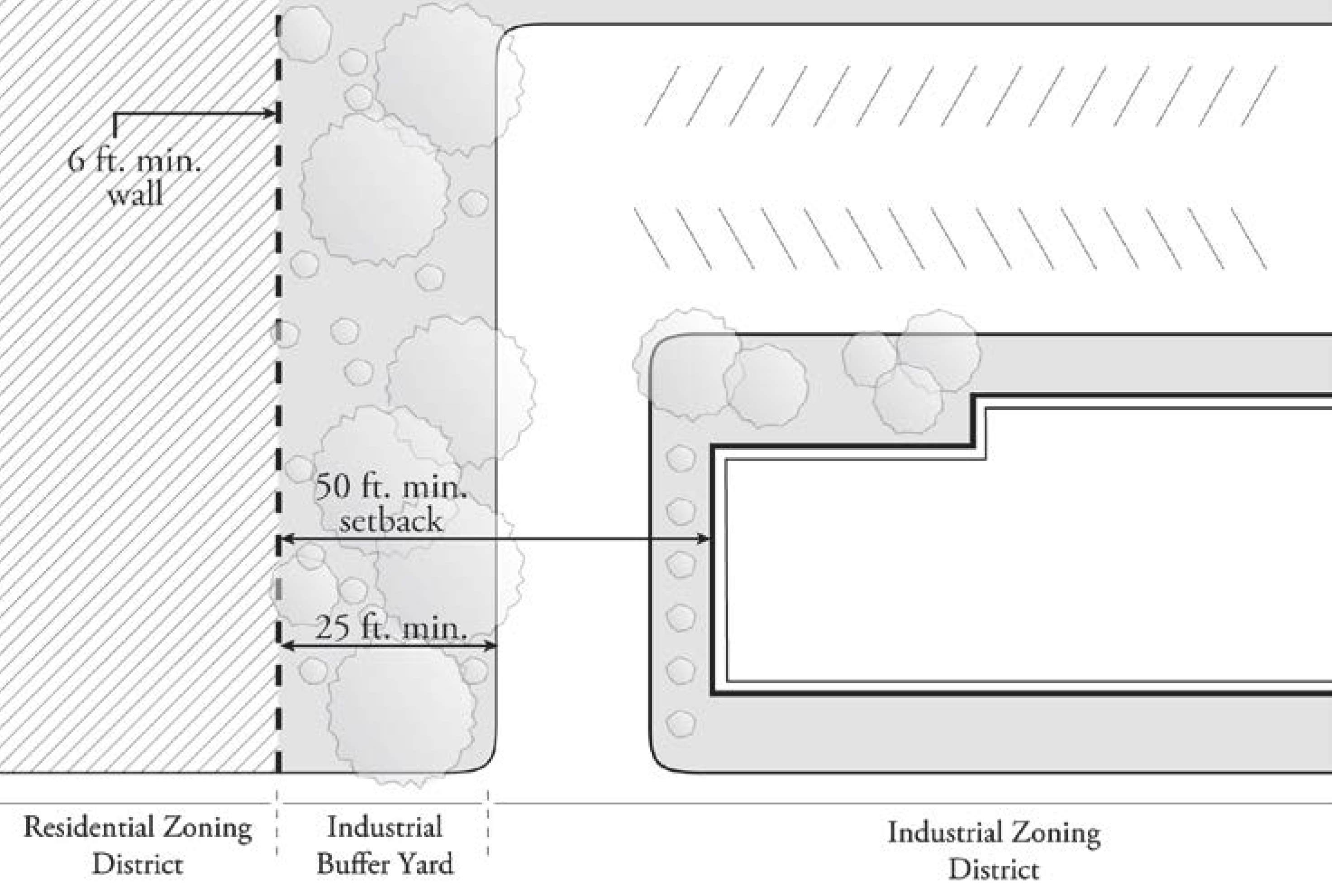
Industrial Buffer Yard Defined. An industrial buffer yard is an area of plantings and walls that shields neighboring residential properties from negative impacts created by industrial land uses.
2.
When Required. An industrial buffer yard is required for any development within an industrial zone that is adjacent to a residential zone.
3.
Buffer Yard Standards.
a.
Industrial buffer yards shall be located along the outer perimeter of a property line abutting a residential zone. See Figure 24-27-1 (Industrial Buffer Yards).
b.
The minimum width of an industrial buffer yard shall be twenty-five (25) feet located within the fifty (50) foot minimum setback area. See Figure 34-27-1 (Industrial Buffer Yards).
c.
Industrial buffer yards shall include a solid masonry or equivalent wall no less than six (6) feet in height.
d.
Industrial buffer yards shall be planted with a mix of deciduous and evergreen trees and shrubs of suitable type, size, and spacing to achieve screening year-round.
e.
All plantings within an industrial buffer yard shall be maintained in a manner consistent with Section 24-118 (Maintenance) in Article III, Division 11 (Landscaping).
f.
Paved surfaces shall be prohibited within industrial buffer yards. Buffer yards shall not be used for parking, driveways, trash enclosures, building areas, or any other activity associated with the primary use on the property.
FIGURE 24-27-1 INDUSTRIAL BUFFER YARDS
(Ord. No. 4062, § 1, 9-10-13; Ord. No. 4105, § 1, 1-12-16)
24-28 - Purpose of the special purpose zones.
A.
Public (PB). The purpose of the PB zone is to allow for public and quasi-public facilities that serve Butte County residents and visitors and enhance the quality of life within the county. Permitted uses in the PB zone include public and private schools; parks and playgrounds; community centers; interpretive facilities; public libraries; governmental offices; and police and fire stations. Uses permitted with the approval of a Conditional Use Permit include hospitals, cultural institutions, religious facilities, and large scale facilities such as dams and reservoirs, landfills, cemeteries and mausoleums, correctional institutions, major utilities, and other similar public works projects. The maximum FAR in the PB zone is one-half (0.5). The PB zone implements the Public land use designation in the General Plan.
B.
Airport (AIR). The purpose of the AIR zone is to preserve and protect Butte County's airports by allowing land uses and activities that are typically associated with airport operations, and preventing the encroachment of incompatible uses. Standards in the AIR zone are intended to supports aeronautics-related businesses and services that benefit from or require proximity to an airport. Permitted land uses include unscheduled air carrier facilities, charter aircraft operations, aircraft sales and service, aircraft storage, sale of aviation petroleum products, pilot lounges and airport offices, and other similar uses. Airport-related uses typically associated with scheduled air services, or that may not be appropriate in all locations, are permitted with the approval of a Conditional Use Permit. Land uses that serve visitors to the airport and the general public, such as retail, services, and restaurants, are also permitted with the approval of Conditional Use Permit. The maximum FAR in the AIR zone is one-half (0.5). The AIR zone implements the Industrial land use designation in the General Plan.
C.
Research and Business Park (RBP). The purpose of the RBP zone is to accommodate the development of high quality, extensively landscaped, and well-maintained commercial and light industrial projects in a campus-like environment. Permitted land uses with approval of a Master Development Plan include research and development, business/professional corporate headquarters, and light industrial and manufacturing. Retail, services, and clustered residential uses are permitted as accessory uses. Development within the RBP zone is subject to detailed standards relating to site planning, building design, and landscape design. Prior to development occurring in the RBP zone, a Master Development Plan shall be approved by the Planning Commission that establishes a detailed plan for proposed buildings, uses, and site improvements. The maximum FAR in the RBP zone is one-half (0.5). Residential uses are permitted when clustered. The RPB zone implements the Research and Business Park designation in the General Plan.
D.
Planned Development (PD). The purpose of the PD zone is to allow for high quality development that deviates from standards and regulations applicable to other zones within the county. The PD zone is intended to promote creativity in building design, flexibility in permitted land uses, and innovation in development concepts. The PD zone is also intended to ensure project consistency with the General Plan, sensitivity to surrounding land uses, and the protection of sensitive natural resources. The PD zone provides land owners with enhanced flexibility to take advantage of unique site characteristics to develop projects that will provide public benefits for residents, employees, and visitors to Butte County. This zone is not identified in Table 24-29-1 (Permitted Land Uses in Special Purpose Zones) as it is intended to allow for a variety of uses and development, refer to Section 24-32 (Planned Development Zone Requirements) for further discussion.
(Ord. No. 4062, § 1, 9-10-13)
24-29 - Land use regulations for special purpose zones.
A.
Permitted Uses in the PB, AIR and RBP Zones. Table 24-29-1 (Permitted Land Uses in Special Purpose Zones) identifies land uses permitted in the PB, AIR, and RBP zones.
B.
Permitted Uses in the PD Zone. Permitted land uses shall conform to the land uses allowed by the applicable General Plan land use designation. Planned Development zoning is allowed in the Residential, Commercial and Industrial zones.
Notes:
[1]
See Article 42 (Glossary) for definitions of listed land uses.
[2]
Standards in the Zoning Ordinance that apply to specific uses are identified under the column "Applicable Regulations," defined under Section 24-8G.5, and are intended to direct the reader to a section that is related to the use.
[3]
Permitted only as an accessory use. The maximum number of units shall not exceed one (1) unit per acre of gross project area.
[4]
Square footage shall not exceed one (1) percent of the floor area of a parcel or the total floor area of the entire research and business park. Uses may be developed only after twenty-five (25) percent of the approved research and business park floor area is built out, unless the use is operated by and included in the building of a primary permitted use.
[5]
Use shall be owned and operated by governmental agencies or recognized 'not for profit' agencies. Privately owned, for-profit facilities are prohibited.
[6]
Agricultural Wind Energy Systems are not allowed in any Special Purpose Zone.
(Ord. No. 4062, § 1, 9-10-13; Ord. No. 4091, § 1, 1-27-15; Ord. No. 4094, § 7, 4-21-15; Ord. No. 4134, § 1(Att. A), 9-26-17; Ord. No. 4159, § 1(Att. A), 3-26-19; Ord. No. 4161, § 1(Att. A), 5-7-19; Ord. No. 4197, § 7, 1-12-21; Ord. No. 4225, § 1, 1-24-23; Ord. No. 4244, 4-23-24)
24-30 - Development standards for special purpose zones.
A.
Parcel Size and Density.
1.
Table 24-30-1 (Parcel Size, Residential Density, and Intensity Standards for Special Purpose Zones) identifies the parcel size, density, and intensity standards that apply in the PB, AIR, and RBP zones.
2.
Residential density and intensity standards in the PD zone shall be as allowed by the applicable General Plan land use designation. Parcel size standards in the PD zone shall be as specified in an approved Development Plan as described in Section 24-32 (Planned Development Zone Requirements).
B.
Structure Setbacks and Height.
1.
Table 24-30-2 (Setback and Height Standards for Special Purpose Zones) identifies structure setback and height standards that apply in the PB, AIR, and RBP zones.
2.
Structure setback and height standards in the PD zone shall be as specified in an approved Development Plan as described in Section 24-32 (Planned Development Zone Requirements).p
Note:
[1]
Buildings on corner lots in special purpose zones shall be designed to provide for adequate and safe sight distances for vehicles at adjacent intersections as approved by the Director of Public Works.
C.
Additional AIR Zone Standards.
1.
Performance Standards. Any use that is not primarily aeronautic in nature shall not produce glare, heat, noise, or odor above ambient levels at the property line.
2.
Building and Development Standards. All structures shall be designed and constructed to limit indoor noise levels to no greater than forty-five (45) decibels during aircraft operation.
3.
Minimum Requirements for New Airport Zones. Sites proposed for AIR zoning shall demonstrate that the site can meet all the permitting requirements of the California Department of Transportation, Division of Aeronautics.
(Ord. No. 4062, § 1, 9-10-13)
24-31 - Research and business park zone requirements.
A.
Design Standards. All development within the RBP zone shall comply with the following design standards. Compliance with these standards may be modified through the Master Development Plan review process, described in Subsection B below. Development within the RBP zone shall also be subject to all other applicable development standards contained in the Zoning Ordinance, including but not limited to standards for parking, signage, and landscaping.
1.
Site Design.
a.
Development shall be sensitive to viewshed preservation for nearby properties within and beyond the business park.
b.
Parking lots shall not be a visually dominant site feature when viewed from adjacent streets. Large expanses of parking lot surface are to be avoided in favor of smaller amounts.
c.
Employee parking areas shall be separated from streets by structures unless unusual site conditions require an alternative configuration.
d.
Where parking lots are visible from streets, parked vehicles shall be partially screened with perimeter landscaping or landscaped earthen berms that do not interfere with sight distance at driveways and road intersections.
e.
Plazas and courtyards, protected from weather and nuisance factors (e.g., loading and service areas and mechanical equipment), shall be provided within each project for the benefit and enjoyment of employees.
f.
Residential development intended to provide housing opportunities for employees may be provided within the RBP zone. The number of residential units shall not exceed one (1) unit per gross acre. Residential lots may vary in size but shall be no smaller than six thousand (6,000) square feet and no larger than ½ acre. Residential development and parcel layout shall be approved as part of the Master Development Plan.
g.
A Subdivision Map (if a subdivision is proposed) application shall be submitted with the Master Development Plan.
2.
Architectural Design.
a.
All primary building materials shall be able to withstand local weather conditions with little or no degradation in appearance or function.
b.
Large expanses of uninterrupted wall planes are prohibited where visible from a street or research and business park property line. Various techniques may be utilized to reduce the visual monotony of such vertical surfaces, including deep off-sets and recesses, windows, trellises, variations in colors and materials, and architectural detailing that creates definite shadow patterns.
c.
The appearance of large, monolithic structure mass is prohibited. Where large footprint, rectilinear structures are necessary and appropriate, the perception of mass shall be reduced by breaking wall planes into smaller, connected sizes. Apparent structure mass can also be reduced by incorporating extensive tree screening.
d.
Primary structure entrances shall be oriented toward the street.
3.
Public Facilities and Utilities. All utilities shall be installed underground, with the exception of transformers which may be pad-mounted. Pad-mounted facilities shall be screened from off-site view using shrubs.
4.
Grading, Drainage, and Erosion Control. Contour grading techniques shall be used to blend site grading into natural topography. Grading shall be designed to:
a.
Conserve natural topographic features by minimizing the amount of cut and fill and by blending graded slopes and benches with the natural topography; and
b.
Retain major natural topographic features, including canyons, knolls, ridgelines, and prominent landmarks.
5.
Agricultural Uses and Environmental Resources.
a.
Agricultural uses may be integrated into private or common open space or landscaped areas within a research and business park development.
b.
Mature trees, creeks, rock outcroppings and other natural features shall be preserved and incorporated into business parks unless project objectives cannot be achieved without their removal.
6.
Streetscape. Development in the RBP Zone shall provide a consistent streetscape theme addressing all elements of the streetscape, including plant materials, street lighting fixtures, street signage, and pavement material.
B.
Permitting Requirements.
1.
Master Development Plan Required. No development may occur within the RBP zone prior to the approval of a Master Development Plan. The Master Development Plan will serve as a comprehensive program that identifies the parameters and standards for the uses, design, and maintenance of all land within the RBP zone boundary.
2.
Pre-Application Conference. An optional pre-application conference with the Department of Development Services is encouraged for all Master Development Plans.
3.
Application Submittal and Review. An application for a Master Development Plan shall be filed and reviewed in compliance with Article V, Division 1 (Permit Application and Review) and shall, at a minimum, include all of the following materials and information:
a.
A site development plan showing development parcels and their uses, building areas, vehicular and pedestrian access and circulation, open space areas, landscaping, and parking.
b.
A statement identifying any requested modifications to the design standards identified in Subsection A above, and a description of the proposed method of administering and enforcing design standards and maintaining open space areas within the project.
c.
Typical elevations that illustrate the range of permitted architectural styles for proposed buildings.
d.
A schematic infrastructure plan (i.e., roads, sewer, water, storm drainage) showing size and availability of facilities and a description of necessary utilities.
e.
A topographic map of the project site and land and structures within one hundred (100) feet of the project boundaries. The map shall be drawn to a scale of not less than one (1) inch equals one hundred (100) feet with a contour interval of five (5) feet.
f.
Maps of existing and final slope depicting the following slope categories: zero (0) — five (5) percent, six (6) — ten (10) percent, eleven (11) — fifteen (15) percent, and sixteen (16) percent and higher.
g.
A preliminary grading, erosion control, and drainage plan.
h.
A biological resource assessment of the subject site by a qualified biologist including the location and species of trees over six (6) inches in diameter at breast height, habitat type, and the occurrence of any special-status species within the area.
i.
A traffic study prepared by a qualified traffic engineer to assess current levels of service and needed improvements of both on-site and off-site roads. The study shall also evaluate pedestrian and bicycle opportunities, transit, and unique characteristics of the vehicle mix.
j.
A description of project phasing, if applicable.
4.
Specific Plan Permitted. A specific plan, as identified in Section 65450 et seq. of the California Government Code, or a development agreement pursuant to Article 40 (Development Agreements), may be used by the applicant to fulfill the requirement for preparation of a Master Development Plan.
5.
Public Notice and Hearing. The Planning Commission shall hold a public hearing on the application for a Master Development Plan in compliance with Article VI, Division 2 (Public Notice and Hearings).
6.
Findings. The Planning Commission may approve an application for a Master Development Plan only if all of the following findings can be made:
a.
The Master Development Plan is consistent will all standards and regulations that apply to the RBP zone as well as all other applicable standards in the Zoning Ordinance.
b.
The Master Development Plan complies with applicable standards in the Zoning Ordinance, other County ordinances, the General Plan and any other applicable community or specific plan.
c.
The location, size, design, and operating characteristics of the research and business park will be compatible with existing and future land uses in the vicinity of the project site.
d.
The research and business park is properly located within the county and adequately served by existing or planned services and infrastructure.
e.
The Master Development Plan carries out the intent of the RBP zone by providing for high quality, extensively landscaped, and well-maintained commercial and light industrial development in a campus-like environment.
7.
Modifications Permitted. The Planning Commission may approve modifications to development standards for the RBP zone specified in Section 24-30 (Development Standards for Special Purpose Zones) during the Master Development Plan review process. A modification may be approved if it is determined that the modification meets the intent of the RBP zone, would result in a superior development or results in a comparable outcome, and would not result in greater impacts on surrounding properties or the environment in general.
8.
Master Development Plan Amendment Process. Modifications to an approved Master Development Plan shall be approved as specified in Section 24-246 (Changes to an Approved Project).
9.
Relationship to Subdivision Process. A tentative parcel map or tentative subdivision map shall be submitted and processed concurrently with a Master Development Plan.
10.
Administrative Permit Process.
a.
Once a Master Development Plan has been approved by the Planning Commission, the Zoning Administrator shall grant Administrative Permits for any use or structure consistent with the Master Development Plan. A building permit or grading permit shall not be issued until an Administrative Permit has been approved by the Zoning Administrator.
b.
The Zoning Administrator shall determine that all uses and development standards are consistent with the approved Master Development Plan and within the scope of the environmental review and determination for the overall research and business park. The Zoning Administrator shall also verify that the applicant has received design review approval by the research and business park property owners association or other established entity, as applicable. The CC&Rs, as required in Subsection 11 below, shall be submitted for review and approval.
11.
Deed Restrictions.
a.
Where multiple owners or parcels are included, deed restrictions, or covenants, conditions and restrictions (CC&Rs), administered and enforced by a property owners association, shall be submitted as part of the Administrative Permit process. CC&Rs shall be reviewed and approved by the Zoning Administrator and County Counsel to assure conformance with the master development plan. All uses within the research and business park shall adhere to the recorded CC&Rs.
b.
CC&Rs shall give particular attention to administration and enforcement of design guidelines and to maintenance of common open space and landscaping.
(Ord. No. 4062, § 1, 9-10-13)
24-32 - Planned development zone requirements.
A.
General Rezoning Requirements. In addition to the requirements contained in this section, the rezoning of any parcel to Planned Development (PD) shall comply with the requirements for a Zoning Ordinance Map Amendment as specified in Article VI, Division 6 (Zoning Ordinance Amendments).
B.
Minimum Parcel Size. The minimum size of a site proposed for rezoning to the PD zone is three (3) acres.
C.
Pre-Application Conference. Prospective applicants are required to request a pre-application conference with the Department of Development Services before completing and filing an application for a PD rezoning. At the pre-application conference, prospective applicants shall describe the general concepts of the development project, including site layout, land uses, building height and bulk standards, circulation, and other information necessary to describe key aspects of the project. The Department of Development Services shall provide preliminary feedback on the described development project relative to project consistency with County policies. The Department of Development Services shall also review with the prospective applicant submittal requirements for a PD rezoning and the process for application review and action by the Planning Commission and Board of Supervisors.
D.
Application Submittal. An application for a PD rezoning shall be filed in compliance with Article V, Division 1 (Permit Application and Review). The application shall include the information and materials specified in the Department of Development Services handout for Zoning Ordinance Map Amendments, in addition to the following materials:
1.
Project Description. The applicant shall provide a written description of the project proposed within the PD zone. The project description shall include a narrative statement of the project's objectives and a statement of how the proposed project will comply with General Plan goals and policies for the land use designation of the project site. The project description may also include a diagram illustrating the proposed project.
2.
Site Map. The application shall include maps depicting the existing topography, on-site structures and natural features, mature trees, and other significant vegetation and drainage patterns. The map shall show the proposed PD zone boundaries and all properties within three hundred (300) feet of the site boundary. The map shall be accompanied by a description of the type and condition of mature trees.
3.
Parcel or Subdivision Map. If the project within the proposed PD zone involves the subdivision of land, the application shall include a tentative parcel map or tentative subdivision map as required by Chapter 20 (Subdivisions) of the Butte County Code.
4.
Infrastructure. The application shall include a written description of the infrastructure necessary to serve each phase of the project proposed within the PD zone.
5.
Public Facilities Financing Plan. If the proposed project will not be adequately served by existing public infrastructure and facilities or through the adopted countywide impact fee program, the application shall include a public facilities financing plan that identifies the needed public improvements and establishes a plan to pay for and develop the required public improvements.
6.
Open Space Summary.
a.
The open space summary shall include the amount (in square feet or acres) and percentage of site area that will be provided as total open space, private open space, common open space, and usable open space, as applicable. The summary shall also include a description of all open space areas, including proposed recreational facilities and amenities.
b.
In residential PD projects, not less than twenty-five (25) percent of the residential portion of the project shall be utilized for purposes other than residential dwellings and paved areas for vehicular uses. No less than forty-five (45) percent of such twenty-five (25) percent shall be utilized for recreation or park areas available for use by all residents. The same criteria for open space area shall apply to agricultural PD projects which may or may not include residential uses. For industrial or commercial PD projects, not less than ten (10) percent of the project shall be developed as landscaped areas.
7.
Development Plan. The application for a PD rezoning shall be accompanied by a Development Plan that includes the following information about the project proposed for the PD zone:
a.
Land Use. The Development Plan shall include a map showing the location of each land use proposed within the site, including open space and common areas. The land use map shall be accompanied by a narrative description of permitted land uses, allowable accessory uses, and uses allowed with a Conditional Use Permit.
b.
Subdivision Regulations. The Development Plan shall include a Subdivision Map (if a subdivision is proposed), including minimum parcel area and minimum parcel dimensions.
c.
Circulation. The Development Plan shall include a map and narrative of the major circulation features within the site, including vehicular, bicycle, and pedestrian facilities, as applicable.
d.
Development Standards. The Development Plan shall identify development standards for all structures within the site, including, but not limited to, density, setback, structure height, site coverage, and parking requirements.
e.
Design Guidelines. The Development Plan shall include design guidelines pertaining to development features such as landscaping; building materials; fences, walls and screenings; and open spaces.
E.
Planning Commission Review and Recommendation.
1.
The Planning Commission shall hold a public hearing on the PD rezoning application as required by Article VI, Division 6 (Zoning Ordinance Amendments). The Planning Commission shall consider the full PD rezoning application at this hearing, including the Development Plan.
2.
The Planning Commission shall forward a written recommendation, and reasons for the recommendation, on the proposed PD rezoning and Development Plan to the Board of Supervisors. The recommendation shall be based on the findings in Subsection G (Findings), in addition to the Zoning Ordinance Map Amendment findings specified in Section 24-275 (Findings and Decision).
F.
Board of Supervisors Review and Decision. Upon receipt of the Planning Commission's recommendation, the Board of Supervisors shall conduct a public hearing and either approve, approve in modified form, or deny the PD rezoning and Development Plan. The Board of Supervisors may approve the application only if all of the findings in Subsection G (Findings) below can be made, in addition to the Zoning Ordinance Map Amendment findings specified in Section 24-275 (Findings and Decision).
G.
Findings. The Board of Supervisors may approve an application for PD rezoning with accompanying Development Plan only if all of the following findings can be made:
1.
The proposed development is consistent with the goals, policies, and actions of the General Plan and any applicable specific plan and community plan.
2.
The site for the proposed development is adequate in size and shape to accommodate proposed land uses.
3.
The site for the proposed development has adequate access considering the limitations of existing and planned streets and highways.
4.
Adequate public services exist or will be provided to serve the proposed development.
5.
The proposed development will not have a substantial adverse effect on surrounding property and will be compatible with the existing and planned land use character of the surrounding area.
6.
In coordination with the applicable school district, the proposed development shall dedicate adequate and appropriately-located land for school district facilities that are needed to serve residents within the project.
7.
The proposed development carries out the intent of the PD zone by providing a more efficient use of the land and an excellence of site design greater than that which could be achieved through the application of established zoning standards.
H.
Ordinance Approving the Development Plan. If the Board of Supervisors approves the establishment of a PD zone, it shall do so by adoption of an ordinance and adoption by reference of the Development Plan. The ordinance shall also include any other provisions that the Board of Supervisors finds to be necessary to constitute the regulations for use, property maintenance, and property improvement in the PD zone.
I.
Effect of Development Plan. All proposed development and new land uses within a PD zone shall comply with the approved Development Plan.
J.
Minor Modifications. Modifications to an approved Development Plan shall be approved as specified in Section 24-246 (Changes to an Approved Project).
(Ord. No. 4062, § 1, 9-10-13)
24-33 - Purpose of overlay zones.
The overlay zones in this article establish standards and regulations that apply to specified areas, in addition to the requirements established by the underlying base zone. Whenever a requirement of an overlay zone conflicts with a requirement of the underlying base zone, the overlay zone requirement shall control. Where two (2) or more overlay zone requirements conflict, the Zoning Administrator shall determine the appropriate requirement. For overlay zones that implement an adopted specific plan or neighborhood plan, the standards and regulations from each specific plan or neighborhood plan shall apply.
(Ord. No. 4062, § 1, 9-10-13)
24-34 - Airport compatibility overlay zone.
A.
Purpose. The Airport Compatibility (-AC) overlay zone identifies areas in unincorporated Butte County where additional requirements apply to ensure the compatibility of land uses and development with nearby airport operations.
B.
Applicability. The -AC overlay zone applies to land within unincorporated Butte County designated as an Airport Influence Area in the Butte County Airport Land Use Compatibility Plan (ALUCP).
C.
Land Use Regulations. All development projects and land use actions proposed within the -AC overlay zone shall comply with the compatibility criteria specified in the ALUCP, excluding those criteria specifically overruled by the Board of Supervisors in a manner consistent with Public Resources Code Section 21676.
D.
Actions Requiring Airport Land Use Commission (ALUC) Review.
1.
Prior to final action by the County, the Department of Development Services shall submit to the ALUC application materials for the following proposed land use actions:
a.
General Plan amendments affecting land located within the -AC overlay zone.
b.
Specific plans or specific plan amendments affecting land located within the -AC overlay zone.
c.
Zoning Ordinance or Building Code amendments affecting land located within the -AC overlay zone.
2.
For proposed land use actions requiring ALUC review, the County shall consider ALUC comments, if available, at a public hearing prior to taking final action on the application. If the ALUC finds that the proposed land use action conflicts with the Butte County Airport Land Use Compatibility Plan, the County may approve the application and overrule the ALUC only as specified in Public Resources Code Section 21676.
(Ord. No. 4062, § 1, 9-10-13)
24-34.1 - Butte Creek Canyon overlay zone.
A.
Purpose: The Butte Creek Canyon (-BCC) overlay zone preserves and protects the uniquely valuable qualities of Butte Creek Canyon which is a significant resource of Butte County. The purpose of the -BCC overlay zone is to facilitate the protection and preservation of the scenic resource and the historical and ecological foundation of Butte Creek Canyon, including the survival of endangered wild salmon, steelhead and other sensitive plants and animals such as the East Tehama Deer herd, preservation of historical sites and ecological preserves, and the optimum balance of recreation and residential use.
B.
Administrative Relief. If the application of the -BCC overlay zone inhibits development of a primary dwelling, as allowed by the base zone, to the extent that it cannot be permitted, the Director of Development Services shall determine a feasible and appropriate building site based upon existing site constraints and the -BCC overlay zone's land use development standards.
C.
Applicability:
1.
The -BCC overlay zone applies to the Butte Creek Canyon area, as shown by the -BCC overlay zone map.
2.
The -BCC overlay zone may be combined with any base zone except the AG-160 (Agriculture, 160-acre minimum parcel size), TM (Timber Mountain), TP (Timber Preserve), and Industrial zones. The -BCC overlay zone may be applied to any future rezone of an AG-160, TM, TP, or Industrial zone in the Butte Creek Canyon area.
3.
The -BCC overlay zone shall not require changes to existing legal uses and structures, or cause such structures or uses to become nonconforming. Any expansion or modification of nonconforming uses and structures shall comply with this chapter and Butte County Code Chapter 24, Article 22. Nonconforming Uses and Structures.
D.
Land Use and Development Standards:
1.
Public Hearings and Noticing. When a public hearing is required in accordance with the Butte County Zoning Ordinance, in addition to the requirements set forth under Chapter 24, Article 36, Public Notice and Hearings, which requires notice of the hearing to be mailed to all owners of real property within three hundred (300) feet of the exterior boundary of the parcel that is the subject of the hearing, public notice shall also be provided by email to all interested parties through a list maintained by the Department of Development Services.
2.
Hillside Development Standards. This section does not apply to operations subject to the State Forest Practices Act or State Forest Practice Rules.
a.
Slope. Development in areas with a slope of greater than fifteen (15) percent shall be permitted only when an alternative development area with a slope of less than fifteen (15) percent is not available on the parcel, or as otherwise permitted by the Director of Development Services pursuant to Section 24-34.1 B. Administrative Relief.
b.
Vegetation Removal. Removal of living and healthy vegetation outside of a development area as defined in Chapter 24, Article 42 (Glossary) shall not be permitted, except under the following circumstances:
i.
Vegetation removal required to comply with defensible space requirements set forth in Public Resources Code Section 4290 (Fire Safety Regulations).
ii.
Removal of dead, dying, diseased, or hazard trees.
iii.
Fuel breaks and fuel reduction consistent with projects undertaken by local Fire Safe Councils or other public and non-profit entities.
iv.
Routine agricultural grading as defined under Chapter 13, Article 1. Grading, Section 135(g).
v.
Projects relating to the installation, maintenance, or repair of a public utility.
vi.
Projects undertaken in compliance with a Streambed Alteration Permit approved by the California Department of Fish and Wildlife.
vii.
Non-native and invasive plant eradication.
viii.
Pedestrian walkways and trails.
3.
Clustered Development. Clustered Development as allowed by Chapter 24, Article 18, Clustered Development, shall be prohibited.
4.
Butte Creek Canyon Ridgeline Development. The specific canyon ridgelines subject to this section are shown on the -BCC overlay zone exhibit. Ridgelines on the -BCC overlay zone map are shown in their approximate location. A site review is required to determine specific locations (see below). In order to preserve views of designated canyon ridgelines, development on either side of designated canyon ridgelines shall comply with the following minimum development standards:
a.
Ridgeline Setbacks:
i.
Buildings less than twenty-five (25) feet in height: A 100-foot building setback is required from either side of the designated ridgeline.
ii.
Buildings equal to or greater than twenty-five (25) feet in height: A 150-foot building setback is required from either side of the designated ridgeline.
iii.
Walls and fences pursuant to Chapter 24, Article 13, Walls and Fences: A 100-foot building setback is required from either side of the designated ridgeline.
iv.
Accessory decks, patios, and railings are not subject to the ridgeline setback.
v.
The specific location of the designated canyon ridgeline shall be determined through an on-site review by the Department of Development Services.
b.
Alternative Building Design Standards. As an alternative to the ridgeline setbacks as set forth under this section, the following building design standards shall be required through an administrative permit. The building design standards as set forth shall be approved by the Director of Development Services during administrative permit review. It is the obligation of the applicant to furnish the materials and plans necessary, with the administrative permit application, to facilitate review and compliance with these standards:
i.
Exterior Wall Surfaces. The apparent size of exterior wall surfaces visible from off the site shall be minimized through the use of setbacks, overhangs, roof pitches, native landscaping, and/or other means of horizontal and vertical articulation to create changing shadow lines and break up massive forms.
1.
Colors and Materials. A mixture of materials and color shall be used to blend structures with the natural appearance of the hillside.
2.
Based upon the graphic principle that darker colors are less noticeable than light colors, darker tones, including earth tones shall generally be used for building walls and roofs on highly visible sites so that buildings and exterior finishes appear to blend in with the natural terrain.
ii.
Roofs. Roof pitches shall generally be placed to follow the angle of the slope; but with variations to avoid a monotonous appearance.
iii.
Support Structures. Support structures (for example, columns, pilings, etc.) below the lowest floor on the downhill side of a house shall be enclosed or colored and de-signed to blend with the natural appearance of the hillside.
iv.
Any additional standards proposed by the applicant that would mitigate visual impacts to the ridgeline as determined by the Director of Development Services.
5.
Historic, Cultural, and Archeological Sites. Prior to any building permit issuance or discretionary approval at the following recognized sites, the Department of Development Services shall consult with the California Historical Resources Information System (Northeast Information Center) at CSU Chico for recommendations and mitigations necessary to preserve historic, cultural and archeological resources:
a.
Nicholl Family Cemetery in Helltown.
b.
Boneyard Flat in Helltown.
c.
Centerville Schoolhouse.
d.
Centerville Cemetery.
e.
Honey Run Covered Bridge.
6.
Heavy Equipment Storage:
a.
Heavy equipment storage yards in the FR (Foothill Residential) and RR (Rural Residential) zones shall be setback one hundred (100) feet from County roads and screened to prevent view from the road through the use of a wall, fence or vegetation. Walls and fences used for this purpose shall comply with Butte County Code Chapter 24, Article 13, Walls and Fences.
7.
Outdoor Lighting:
a.
All outdoor lighting shall be regulated using the same standards as set forth under Butte County Code Chapter 24, Article 14, Outdoor Lighting.
b.
Outdoor lighting shall use full cut-off fixtures directing lighting to buildings and outdoor activity areas, shielding off-site areas and the night sky.
8.
Watershed Protection. This section does not apply to operations subject to the State Forest Practice Act or State Forest Practice Rules.
a.
Land Use Regulations. Zoning amendments that propose to allow for the creation of additional parcels (exceeding amounts allowed under the November 6, 2012 Zoning Map) shall not be allowed, unless the Board of Supervisors, through its police powers, acts to amend this section of the zoning ordinance to allow such zoning amendments.
b.
Maximum Impervious Surface. Impervious surfaces are those surfaces that prevent normal water infiltration and/or cause runoff to other areas, such as asphalt, concrete, and structures (surfaces that are one hundred (100) percent impermeable to water percolation). For new development within the -BCC overlay zone, impervious surfaces shall be limited in accordance with the following standards:
i.
Parcels one (1) acre in size or greater. Impervious surface shall not exceed fifteen (15) percent of the parcel's total size.
ii.
Parcels less than one (1) acre in size, see Table 24-34.1-1 below.
Table 24-34.1-1 Maximum Impervious Surface for Parcels Less than 1-acre in Size
iii.
Road surfaces and other areas such as patios and driveways shall not count as being impervious if they are surfaced with gravel or are finished with pervious pavement or asphalt.
c.
Vegetative Buffers. In addition to the requirements set forth under Chapter 24, Article 16 (Riparian Areas), vegetative buffers shall be maintained on all sides of water bodies as follows:
i.
Perennial and intermittent rivers and streams, as shown on the latest USGS 7.5 minute quad map: One hundred (100) lineal feet.
ii.
Buffer distances shall be measured in accordance with Chapter 24, Article 16 (Riparian Areas), Section 24-77 A.
iii.
All structures, grading, excavation, removal of trees, use of fertilizers and pesticides, sewage disposal, and paving, excepting those uses set forth under Article 16 (Riparian Areas) Section 24-78 A. Permitted Activities, and Section 24-78 B. Conditionally Permitted Uses, are prohibited within vegetative buffer areas.
iv.
Vegetation removal, as permitted under Section 24-34.1 (D)(2)(b), is allowed.
d.
Septic System and Portable Chemical Toilet Setbacks:
i.
Septic systems for new development shall be setback a minimum of two hundred (200) feet from perennial and intermittent rivers and streams, as shown on the latest USGS 7.5 minute quad map.
ii.
Minimum setback distances shall be measured in accordance with Chapter 24, Article 16 (Riparian Areas), Section 24-77 A.
iii.
Repair or replacement of a septic system on existing development that does not com-ply with the 200-foot setback may be allowed if it is determined by the Local Enforcement Agency that water quality can be maintained.
iv.
If no other feasible alternative exists, a 100-foot septic system setback may be allowed for new development if it is determined by the Local Enforcement Agency that water quality can be maintained.
v.
Portable chemical toilets for temporary use at construction sites or for special events shall be setback a minimum of two hundred (200) feet from perennial and intermittent rivers and streams.
e.
Erosion Control:
a.
An erosion and sediment control plan, pursuant to Butte County Code Section 13-10, shall be approved by the county prior to issuance of a building permit and subject to the following additional requirements and building standards:
i.
Erosion and sediment control plans shall not be required for public utilities, residential additions that are less than twenty-five (25) percent of the size of the original structure, or permitted accessory uses and structures defined under Butte County Code Section 24-156.
ii.
The plan shall be prepared by a professional civil engineer registered by the State of California, or a Qualified Stormwater Developer who holds the certification required by the CA Water Quality Control Board's Construction General Permit 2009-009-DWQ.
iii.
The plan shall identify measures to prevent sediment and other pollutant discharges from reaching watershed drainages and streams, and shall address both interim (during construction) and final (post construction) erosion control measures.
iv.
All driveways proposed for new home sites shall be surfaced with at least two (2) inches of Class 2 aggregate base, unless required by the County to be developed to a higher standard.
v.
Soil disturbance shall not be conducted during the rainy season (November 15 through April 1). The county may require financial security to ensure that control measures are implemented and maintained.
vi.
All areas where land clearing has been completed between April 1 and November 15 shall be re-vegetated, hydroseeded, mulch protected, or otherwise stabilized no later than December 1.
vii.
Site work shall be limited to the permitted development area, and shall preserve natural topography and vegetation at the site to the greatest possible extent.
E.
Coordination with Other Regulatory Agencies. All required permits from the California Department of Fish and Wildlife, the California Department of Forestry and Fire Protection, the U.S. Army Corps of Engineers, the California State Regional Water Quality Control Board, the Central Valley Flood Protection Board, or other applicable agencies, including any permit required under an approved Habitat Conservation Plan, shall be obtained prior to, concurrently with, or as a condition of, the approval of any county permits for development within the -BCC overlay zone. Evidence of approval or pending approval of any such permit shall be submitted to the county, including all appropriate supporting materials, environmental documentation, and studies.
(Ord. No. 4144, § 1(Att. A), 4-24-18; Ord. No. 4189, § 1, 10-27-20)
24-35 - Chapman Mulberry overlay zone.
A.
Purpose. The Chapman Mulberry (-CM) overlay zone is intended to preserve and enhance the unique characteristics of the Chapman Mulberry neighborhood in a manner consistent with the Chapman Mulberry Neighborhood Plan. The -CM overlay zone identifies the areas where the goals, policies, and standards contained in the Chapman Mulberry Neighborhood Plan apply.
B.
Applicability. The -CM overlay zone applies to all parcels within the Chapman Mulberry area as shown on the Zoning Map.
C.
Land Use Regulations. All development in the -CM overlay zone shall comply with the provisions in the Chapman Mulberry Neighborhood Plan as adopted by the Board of Supervisors on January 25, 2000 (Resolution #00-12 and Ordinance #3579). Should the provisions of the Chapman Mulberry Neighborhood Plan and the Zoning Ordinance conflict, the Chapman Mulberry Neighborhood Plan shall control.
(Ord. No. 4062, § 1, 9-10-13)
24-36 - Cohasset overlay zone.
A.
Purpose. The Cohasset (-CH) overlay zone establishes development standards and use regulations to ensure that development within the overlay zone is consistent with adopted policies and standards for the Cohasset Planning Area. The general intent of these standards and regulations is to preserve the foothill character of the area, protect sensitive natural resources, allow development in a manner consistent with environmental constraints, and protect persons and property from natural hazards related to development within foothill areas.
B.
Applicability. The -CH overlay zone applies to parcels within the boundaries of the Cohasset Planning Area.
C.
General Requirements. All development within the -CH overlay zone shall comply with the Development Policies, Standards, and Implementation Measures for the Cohasset Planning Area as adopted by the Board of Supervisors on May 20, 1986 (Ordinance No. 2526).
D.
Land Use Regulations. Permitted and conditionally permitted uses in the -CH overlay zone shall be the same as the base zone.
E.
Hillside Development Standards.
1.
Development in areas with a slope of greater than thirty (30) percent shall be permitted only when:
a.
An alternative building site with a slope of thirty (30) percent or less is not available on the parcel; and
b.
All other applicable development standards can be met.
2.
Removal of vegetation outside of a development area as defined in Article VII, Division 1 (Glossary) shall not be permitted, except to comply with defensible space requirements set forth in Public Resources Code 4290 (Fire Safety Regulations).
3.
Grading is limited only to the minimum required for preparation and access to the development area of a parcel.
F.
Setbacks. The minimum setback from all property lines is thirty (30) feet for all structures or as required by current Public Resources Code 4290 (Fire Safe Regulations).
G.
Structure Separation. The minimum separation between structures on a parcel shall be sixty (60) feet.
H.
Private Driveways.
1.
Private driveways less than two hundred (200) feet in length shall be not less than twelve (12) feet in width.
2.
Private driveways two hundred (200) feet or more in length shall be:
a.
Not less than sixteen (16) feet in width; and
b.
Terminated by a circular driveway as specified in the Development Policies, Standards, and Implementation Measures for the Cohasset Planning Area.
(Ord. No. 4062, § 1, 9-10-13)
24-37 - Deer herd migration overlay zone.
A.
Purpose. The Deer Herd Migration (-DH) overlay zone is intended to protect sensitive habitat areas for migratory deer herds while continuing to allow development and the reasonable use of land within these areas.
B.
Applicability.
1.
The -DH overlay zone may be combined with any base zone.
2.
The -DH overlay zone implements the Winter and Critical Winter Deer Herd Migration Area Overlay General Plan designation.
C.
Land Use Regulations. Permitted and conditionally permitted uses in the -DH overlay zone are the same as the base zone, subject to the requirements of this section.
D.
Minimum Parcel Size. Any subdivision of land within the -DH overlay zone shall comply with the following minimum parcel size requirements:
1.
Winter range area: twenty (20) acres.
2.
Critical winter area: forty (40) acres.
E.
Clustering of Structures.
1.
Development within the -DH overlay zone may be clustered in a manner consistent with Article III, Division 8 (Clustered Development).
F.
Fence Standards.
1.
Fences within the -DH overlay zone shall comply with the following standards, except as exempted by Subsection 2 below:
a.
The distance between ground and bottom strand or board of the fence shall be no less than sixteen (16) inches.
b.
The fence height shall be no more than forty-eight (48) inches.
c.
The fence shall be constructed from smooth wire, barbed wire, wood, or similar material that will not be harmful to deer.
2.
The following fences shall be exempt from the fence standards in Subsection 1 above:
a.
Fences around home sites designed to exclude wildlife from gardens or landscaping.
b.
Fences or corrals used for livestock.
c.
Fencing necessary to secure domestic animals and private kennels or enclosures for securing dogs.
(Ord. No. 4062, § 1, 9-10-13)
24-38 - North Chico specific plan overlay zone.
A.
Purpose. The North Chico Specific Plan (-NCSP) overlay zone identifies areas where the goals, policies and standards contained in the North Chico Specific Plan apply.
B.
Applicability. The -NCSP overlay zone applies to parcels within the boundaries of the North Chico Specific Plan.
C.
Development Regulations. All development in the -NCSP overlay zone shall comply with the provisions in the North Chico Specific Plan. Should the provisions of the North Chico Specific Plan and the Zoning Ordinance conflict, the North Chico Specific Plan shall control.
(Ord. No. 4062, § 1, 9-10-13)
24-39 - Public housing overlay zone.
A.
Purpose. The Public Housing (-PH) overlay zone is intended to support the continued operation of existing public housing facilities and those facilities under the direct ownership, operation, control, or oversight of a governmental or quasi-governmental agency. This overlay zone is intended to support the implementation of the County's Housing Element and to support the County's agricultural labor, special needs, and low- and moderate-income housing communities. The -PH overlay zone supports a mixed-use living environment developed at a scale that is complimentary and accessory to the primary housing purposes of the site. It encourages and accommodates the development of a variety of land uses in addition to housing focused on serving the needs of on-site residents and local community populations with health care, education, recreation, and support services.
B.
Applicability. The -PH overlay zone may be applied to any parcel owned, operated, or otherwise controlled by a governmental or quasi-governmental entity within unincorporated Butte County and may be combined with the Public base zone.
C.
Use Regulations. Permitted and conditionally permitted uses in the -PH overlay zone shall be the same as the base zone, except as specified below.
1.
Permitted Uses. The following uses are permitted as-of-right in the -PH overlay zone:
a.
Single- or multiple-family residential dwelling units not exceeding thirty-five (35) feet in height.
b.
Health clinics and health service facilities supporting the needs of on-site and local community populations served by the public entity.
c.
Education centers and facilities supporting the needs of on-site and local community populations.
d.
Religious facilities supporting the needs of on-site and local community populations.
e.
Housing and administrative offices supporting the needs of on-site and local community populations served by the public entity.
f.
Recreation facilities and structures supporting the needs of on-site and local community populations served by the public entity.
g.
Utility services and infrastructure to include water and waste disposal facilities necessary and sized to accommodate on-site utility needs.
h.
Public transit amenities.
i.
Accessory structures and uses supporting permitted uses.
2.
Minor Use Permit Required.
a.
Permitted Uses. The following uses are permitted in the -PH overlay zone with the approval of a Minor Use Permit.
1.
Multiple-family residential dwelling units exceeding thirty-five (35) feet in height.
2.
Neighborhood Commercial (Article 7, Section 24-21B) uses of one thousand five hundred (1,500) square feet or less and consistent with the primary use of the site for public housing purposes.
3.
Personal Services uses, as defined under Article VII, Division 1 (Glossary), of one thousand (1,000) square feet or less and consistent with the primary use of the site for public housing purposes.
4.
Community Gardens as defined under Article VII, Division 1 (Glossary) and Animal Keeping subject to the standards for residential zones under Section 24-158 (Animal Keeping).
5.
Other similar uses determined by the Zoning Administrator to be consistent with the purpose and intent of the -PH overlay zone as allowed by Section 24-8 (Rules of Interpretation).
b.
Submittal Requirements. In addition to the submittal materials required by Article V, Division 5 (Conditional Use and Minor Use Permits), applicants shall submit all information and materials as required by the Zoning Administrator to determine compliance with the requirements of the -PH overlay zone.
3.
Use Permit Required.
a.
When Required. Any use that exceeds the limitations for a Minor Use Permit may be allowed within the -PH overlay zone subject to the issuance of a Conditional Use Permit.
b.
Submittal Requirements. In addition to the submittal materials required by Article V, Division 5 (Conditional Use and Minor Use Permits), applicants shall submit all information and materials as required by the Development Services Department to determine compliance with the requirements of the -PH overlay zone.
D.
Development and Operational Standards.
1.
Housing Density. Density within the -PH overlay zone shall be as provided under the Medium Density Residential zone, allowing up to six (6) units per acre.
2.
Parcel Size. The minimum parcel size for the -PH overlay zone is five (5) acres.
3.
Other Standards. All other standards (e.g. setbacks, height, parcel coverage) for development and uses within the -PH overlay zone are the same as the development standards that apply to the base zone.
(Ord. No. 4062, § 1, 9-10-13)
24-40 - Recreation commercial overlay zone.
A.
Purpose. The Recreation Commercial (-REC) overlay zone allows for the development of recreational activities and facilities to serve County residents and visitors in areas where such uses are prohibited by the base zones.
B.
Applicability. The -REC overlay zone may be combined with any base zone, except for the Agriculture (AG), Agriculture Services (AS), Timber Production (TPZ), Public (PB), and Airport (AIR) zones.
C.
Land Use Regulations. Permitted and conditionally permitted uses in the -REC overlay zone are the same as the base zone, except as specified below.
1.
Permitted Uses. The following uses are permitted as-of-right in the -REC overlay zone:
a.
Bed and Breakfasts
b.
Commercial Recreation, Indoor
c.
Commercial Recreation, Outdoor
d.
Caretaker Quarters, only in conjunction with a permitted commercial use
e.
Clubs, Lodges, and Meeting Halls
f.
Hotels and Motels
g.
Hunting and Fishing Clubs
h.
Recreational Vehicle Parks
i.
Restaurants
j.
Retail, General
k.
Stables, Commercial
l.
Utilities, Minor
2.
Administrative Permit Required. The following uses are permitted in the -REC overlay zone with the approval of an Administrative Permit:
a.
Gas and Service Stations
b.
Reverse Vending Machines
c.
Parking Facilities
d.
Utilities, Accessory, excluding Agricultural Wind Energy Systems
3.
Minor Use Permit Required. The following uses are permitted in the -REC overlay zone with the approval of a Minor Use Permit:
a.
Child Care Center
b.
Cultural Institutions
c.
Golf Courses and Country Clubs
d.
Outdoor Education
e.
Parks and Recreational Facilities
f.
Stables, Semi-Private
g.
Utilities, Intermediate
4.
Conditional Use Permit Required. The following uses are permitted in the -REC overlay zone with the approval of a Conditional Use Permit:
a.
Theme Parks and Amusement Parks of ten (10) acres or more in size
b.
Utilities, Major
c.
Water Ski Lakes
D.
Development Standards. Development standards (e.g., setbacks, height, parcel coverage) for recreational development and uses within the -REC overlay zone are the same as the development standards that apply in the Recreation Commercial (REC) base zone.
(Ord. No. 4062, § 1, 9-10-13)
24-41 - Retail overlay zone.
A.
Purpose. The Retail (-RET) overlay zone provides for needed commercial uses in areas that would have otherwise been limited by the base zone.
B.
Applicability. The -RET overlay zone may be combined only with a residential or industrial base zone.
C.
Land Use Regulations. Permitted and conditionally permitted uses in the -RET overlay zone are the same as the base zone, except as specified below.
1.
Permitted Uses. The following uses are permitted as-of-right in the -RET overlay zone:
a.
General Retail: Up to one thousand five hundred (1,500) square feet.
b.
Personal Services: Up to one thousand (1,000) square feet.
2.
Minor Use Permit Required. The following uses are permitted in the -RET overlay zone with the approval of a Minor Use Permit:
a.
General Retail: Greater than one thousand five hundred (1,500) square feet.
b.
Personal Services: Greater than one thousand (1,000) square feet.
c.
Veterinary Offices.
d.
Pet Stores and Services.
e.
Bed and Breakfast.
f.
Drive-through Facilities.
g.
Equipment Sales and Rental.
h.
Hotel and Motel.
i.
Medical Offices and Clinics.
j.
Professional Offices.
k.
Restaurants.
l.
Vehicle Repair.
m.
Vehicle Sales and Rental.
n.
Vehicle Service and Maintenance.
D.
Development Standards. Development standards (e.g., setbacks, height, parcel coverage) for commercial development and uses within the -RET overlay zone are the same as the development standards that apply in the Neighborhood Commercial (NC) zone.
(Ord. No. 4062, § 1, 9-10-13)
24-42 - Scenic highway overlay zone.
A.
Purpose. The Scenic Highway (-SH) overlay zone establishes standards to preserve the natural aesthetic qualities of areas visible from roadways designated as scenic highways by the State of California or the Butte County Board of Supervisors (Butte County General Plan Figure COS-9, Scenic Highway Overlay Zones). Development within the -SH overlay zone is intended to feature high quality architectural design, preserve views from the highway, and maintain existing topographic features on the site.
B.
Applicability.
1.
The -SH overlay zone extends three hundred fifty (350) lineal feet outward from the edges of the scenic highway right-of-way. See Figure 24-42-1 (Scenic Highway Overlay Zone).
2.
The -SH overlay zone may be combined with any base zone.
FIGURE 24-42-1 SCENIC HIGHWAY OVERLAY ZONE
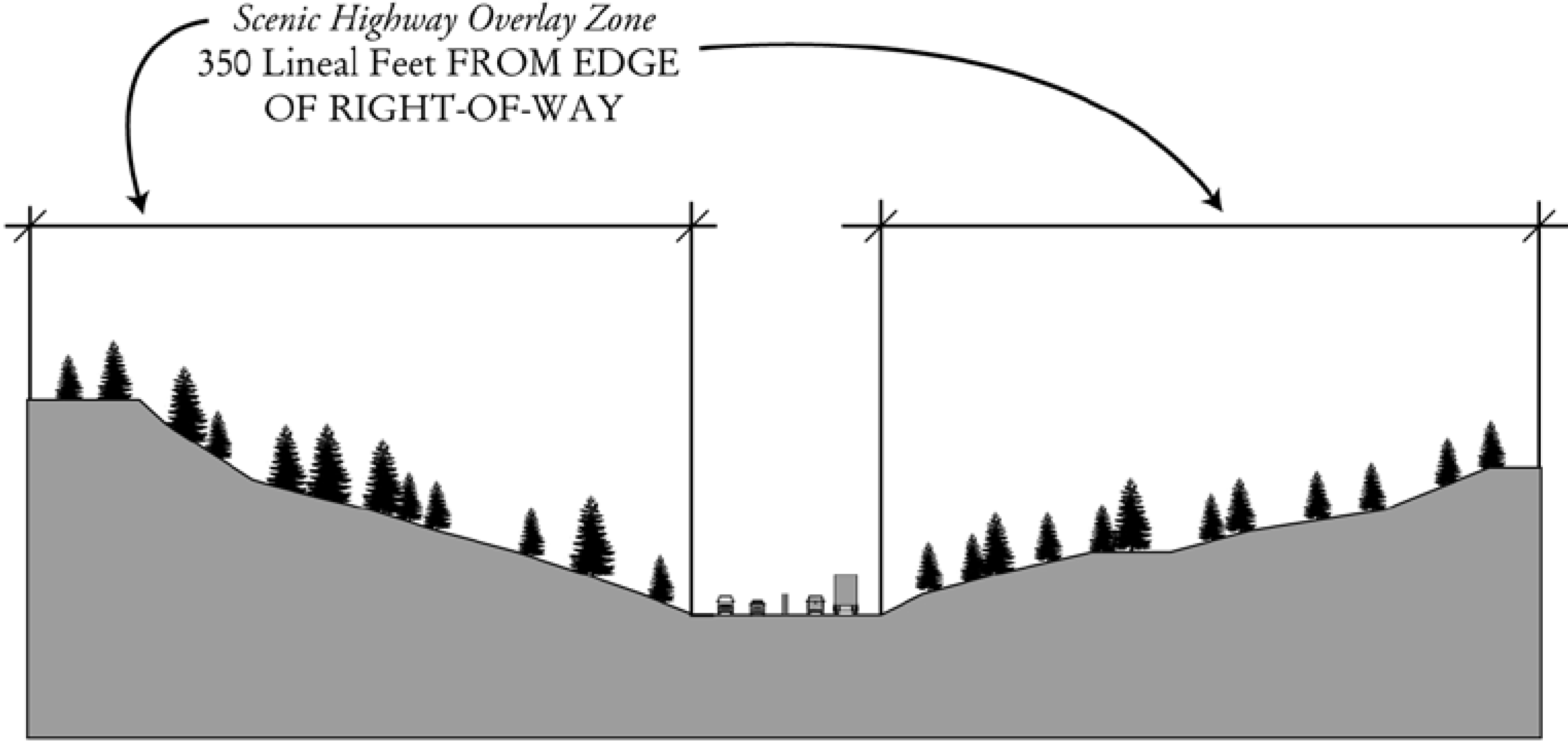
C.
Permit Required. Any development within the -SH overlay zone requiring the approval of a Building Permit shall also require the approval of a Minor Use Permit, except for:
1.
A single-family home;
2.
Accessory structures associated with a single-family home;
3.
Parking facilities with ten (10) or fewer parking spaces; and
4.
Demolitions.
5.
Walls and Fences pursuant to Article III, Division 3 shall be subject to an Administrative Permit.
D.
Land Use Regulations. Permitted or conditionally permitted uses in the -SH overlay zone, including minimum parcel sizes required for land divisions, are the same as the base zone, subject to the requirements of this section.
E.
Development Standards. All structures and improvements to land in the -SH overlay zone shall comply with the following development standards:
1.
All utilities and electric and communication distribution facilities shall be located underground.
2.
The following signs as defined and discussed in Article III, Division 10 (Signs) shall be prohibited:
a.
Off-site signs;
b.
Temporary signs in all forms, including banners, pennants, streamers or posters; and
c.
Freestanding signs.
3.
Walls and fences shall be constructed of high quality materials and not detract from the aesthetic qualities of the -SH overlay zone or block views from the highway. Design standards as set forth under Section 24-60B (Design) shall apply.
F.
Findings. To approve a Minor Use Permit for a proposed project within the -SH overlay zone, the review authority shall make all of the following findings, in addition to the findings required by Article V, Division 5 (Conditional Use and Minor Use Permits):
1.
The architectural design of the proposed structures complements the scenic qualities of the site and surrounding areas.
2.
The proposed project maintains existing views of scenic resources as viewed from the public right-of-way.
3.
To the greatest extent possible, site grading and excavation associated with the proposed project preserves natural features on the site.
4.
Landscaping associated with the proposed project complements the scenic qualities of the site and surrounding areas.
(Ord. No. 4062, § 1, 9-10-13)
24-43 - Stringtown Mountain specific plan overlay zone.
A.
Purpose. The Stringtown Mountain Specific Plan (-SMSP) overlay zone identifies areas where the goals, policies, and standards in the Stringtown Mountain Specific Plan apply.
B.
Applicability. The -SMSP overlay zone applies to parcels within the boundaries of the Stringtown Mountain Specific Plan.
C.
Land Use Regulations. All development in the -SMSP overlay zone shall comply with the provisions in the Stringtown Mountain Specific Plan approved by the Board of Supervisors on September 27, 1994 under resolution 94-114. Should the provisions of the Stringtown Mountain Specific Plan and the Zoning Ordinance conflict, the Stringtown Mountain Specific Plan shall control.
(Ord. No. 4062, § 1, 9-10-13)
24-44 - Neal Road recycling, energy, and waste facility overlay zone.
A.
Purpose. The Neal Road Recycling, Energy, and Waste Facility (-RW) overlay zone promotes compatible development around the Neal Road Recycling and Waste Facility. The -RW overlay zone also ensures adequate separation between the Neal Road Recycling and Waste Facility and land uses that are potentially incompatible with landfill activities. This overlay will help to promote the diversion of solid wastes into appropriate recycling facilities, energy generation, and other uses that add value and benefit to the local economy.
B.
Location. The -RW overlay zone includes the Neal Road Recycling and Waste Facility, and the adjacent industrially zoned land and extends two thousand (2,000) linear feet from the boundaries of the Neal Road Recycling and Waste Facility, and the adjacent industrially zoned land.
C.
Applicability. The -RW overlay zone may be combined with any other underlying zone.
D.
Land Use Regulations. Permitted and conditionally permitted uses in the -RW overlay zone are the same as the base zone, except as specified below.
1.
Prohibited Uses. All residential uses and uses that involve on-going occupation by people (e.g., hotels and motels, emergency shelters, hospitals) are prohibited in the -RW overlay zone.
2.
Permitted Uses. Utilities, Minor.
3.
Administrative Permit Required. Utilities, Accessory uses are permitted with the approval of an Administrative Permit.
4.
Minor Use Permit Required. The following uses are permitted in the -RW overlay zone with the approval of a Minor Use Permit:
a.
Composting facilities.
b.
Anaerobic digestion facilities (in conjunction with power generation).
c.
Solar power facilities.
d.
Wind power facilities.
e.
Septage receiving facilities.
f.
Bio-gas extraction and power generation.
g.
Recycling collection facilities.
h.
Utilities, intermediate.
i.
Telecommunication facilities.
j.
Retail uses and restaurants serving surrounding businesses.
k.
Parks and recreational facilities.
l.
Public and quasi-public facilities.
m.
Recycling processing facilities.
5.
Conditional Use Permit Required. The following uses are permitted in the -RW overlay zone with the approval of a Conditional Use Permit:
a.
All manufacturing and processing uses.
b.
Construction, maintenance, and repair services.
c.
Equipment sales and rentals.
d.
Vehicle repair.
e.
Vehicle service and maintenance.
f.
Warehousing, wholesaling and distribution.
g.
Utilities, major.
E.
Development Standards.
1.
The minimum parcel size in the -RW overlay zone is two and one-half (2.5) acres.
2.
All other development standards (e.g., setbacks, height, parcel coverage) for development and uses within the -RW overlay zone are the same as the development standards that apply in base zone.
3.
Development of land between SR-99 and the west face of the Neal Road Recycling and Waste Facility shall be assessed for visual impacts from SR-99.
4.
Industrial uses shall be subject to the industrial standards specified in Section 24-27 (Development Standards for Industrial Zones).
(Ord. No. 4062, § 1, 9-10-13)
24-45 - Unique agriculture overlay zone.
A.
Purpose. The Unique Agriculture (-UA) overlay zone is intended to support and enhance Butte County's family farms, unique crops, or historic ways of farming by maintaining viable small-scale/historic agricultural operations and their essential rural setting in unique Rural Residential, Foothill Residential and Agricultural areas of the county. The -UA overlay zone accommodates a variety of uses developed at a scale that is complementary and accessory to unique agricultural pursuits. It encourages residents and visitors to learn more about agriculture in the county by allowing educational and tourism uses on working farms. This overlay zone also includes provisions to protect adjacent residential and agricultural uses.
B.
Applicability. The -UA overlay zone may be combined with the Agriculture (AG), Rural Residential (RR), and Foothill Residential (FR) zones.
C.
Use Regulations. Permitted and conditionally permitted uses in the -UA overlay zone are the same as the base zone, except as specified below.
1.
Permitted Uses. The following uses are permitted as-of-right in the -UA overlay zone:
a.
Bed and breakfasts (maximum one (1) per parcel).
b.
Farm tours.
c.
Farmstays.
d.
Special events, such as farm trail events, weddings, concerts, parties, educational classes, corporate events and other similar activities.
2.
Special Events - Maximum Number of Attendees. The following table provides maximum number of attendees at special events in the -UA overlay zone, based parcel size:
Notes:
[1]
Permitted as an accessory use.
[2]
Outdoor activities are limited to Sunday through Thursday 8:00 a.m. to 7:00 p.m.; and Friday, Saturday and Holidays 8:00 a.m. to 11:00 p.m. Indoor activities are permitted without restriction as to day or time.
[3]
Noise levels shall not exceed sixty (60) decibels (maximum) as measured at the nearest property line.
[4]
Individual events for up to four hundred (400) people approved through an Administrative Permit.
a.
Agriculture-related museums.
b.
Public tasting rooms for unique agricultural products produced within the -UA overlay zone.
c.
Cooking demonstrations and food and wine parings not sold for consumption. The sale of catered food by licensed vendors. Vending machines and the sale of commercial pre-packaged foods.
d.
Growing and harvesting of unique agricultural products as defined by Article VII, Division 1 (Glossary).
e.
On-site fruit and vegetable picking of unique agricultural products.
f.
Interactive animal displays (petting farms).
g.
Processing, bottling or packaging of unique agricultural products produced within the Unique Agriculture Overlay.
h.
Sale of unique agricultural products or merchandise related to the region.
i.
Picnic areas.
j.
Trails.
k.
Other similar uses determined by the Zoning Administrator to be consistent with the purpose and intent of the -UA overlay zone as allowed by Section 24-8 (Rules of Interpretation).
3.
Minor Use Permit Required. The following uses are permitted in the -UA overlay zone with the approval of a Minor Use Permit.
a.
Small restaurants or cafes (16 seats or less) showcasing locally grown foods.
4.
Uses Not Allowed. Medical Offices and Clinics shall not be allowed in the Unique Agriculture Overlay Zone.
D.
Development and Operational Standards.
1.
Limitation on Processing Activities. Permitted agricultural processing activities are limited to products grown, cultivated, or produced within the -UA overlay zone.
2.
Signs. Farm and Farm Trail signs that comply with the standards contained in Table 24-105-3 (Allowed Signs in Agriculture and Natural Resources Zones) shall be permitted in the -UA overlay zone by Administrative Permit.
3.
Parking. Minimum on-site parking required for uses with the -UA overlay zone are specified in Section 24-93 (On-Site Parking Requirements). Required parking for uses not listed in Section 24-93 shall be as determined by the Zoning Administrator, consistent with Section 24-8 (Rules of Interpretation).
4.
Hours of Operation. Retail sales and similar commercial activities may be conducted only between the hours of 8:00 a.m. and 6:00 p.m. unless otherwise approved as part of a Minor Use Permit.
5.
Tour Buses and Vans. Tour buses and vans shall not idle more than ten (10) minutes per hour on-site within the -UA overlay zone, so as to minimize noise and air quality impacts to the area. Buses and tour vans shall be provided with adequate off-street parking and turn-around areas.
(Ord. No. 4062, § 1, 9-10-13)
24-46 - Watershed protection overlay zone.
A.
Purpose. The Watershed Protection (-WP) overlay zone is intended to maintain and improve water quality by establishing additional development standards within sensitive watershed areas.
B.
Applicability.
1.
The -WP overlay zone may be combined with any base zone.
2.
Areas subject to the -WP overlay zone include the Firhaven Creek watershed and the Paradise and Magalia Reservoirs watershed, as shown on the Zoning Map.
C.
Land Use Regulations. Permitted and conditionally permitted uses in the -WP overlay zone are the same as the base zone, except as specified below.
1.
Existing parcel sizes in the Firhaven Creek Watershed shall be maintained. No further division of lots or parcels shall be permitted.
2.
Existing zoning shall be maintained within the Magalia Reservoir, Paradise Reservoir, and Firhaven Creek Watersheds. Rezoning to a smaller minimum parcel size is not allowed.
3.
Prior to the approval of a rezoning or discretionary permit application, the applicant shall demonstrate to the satisfaction of the review authority that the cumulative effects of additional sewage disposal and surface water runoff resulting from the proposed action will not result in any adverse impacts on the water quality of the watershed.
4.
Accessory dwelling units and any new, modified, or expanded sewage disposal systems proposed within the -WP overlay zone shall require an erosion and sediment control plan.
5.
Clustered development as allowed by Article III, Division 8 (Clustered Development) shall be prohibited within the -WP overlay zone.
D.
Maximum Impervious Surface. For new development within the -WP overlay zone, impervious surfaces shall not exceed fifty (50) percent of the total site area.
E.
Vegetative Buffers.
1.
Vegetative buffers shall be maintained on all sides of water bodies in the -WP overlay zone as follows:
a.
Lakes and reservoirs: Two hundred (200) lineal feet.
b.
Perennial and intermittent rivers and streams: One hundred (100) lineal feet.
2.
For rivers and streams, minimum buffer distances shall be measured from the annual average stream bank.
3.
All structures are prohibited within buffer areas.
4.
Grading, excavation, removal of trees, the use of fertilizers and pesticides, sewage disposal, and paving are prohibited within buffer areas.
F.
Septic System Regulations. Leach fields, septic tanks, and chemical toilets shall be setback a minimum of fifty (50) feet in addition to the required vegetative buffer under Subsection F.1 above.
G.
Erosion Control.
1.
All driveways for new home sites shall be surfaced with at least two (2) inches of Class 2 aggregate base, unless required by the county to be developed to a higher standard.
2.
Erosion and sediment control plans shall not be required for public utilities, residential additions that are less than twenty-five (25) percent of the size of the original structure, or permitted accessory uses and structures defined under Butte County Code Section 24-156.
3.
An erosion and sediment control plan shall be approved by the county prior to issuance of a building permit. The plan shall be developed by a professional civil engineer registered by the State of California or by a Qualified Stormwater Developer who holds the certification required by the CA Water Quality Control Board's Construction General Permit 2009-009-DWQ. The plan shall identify measures to prevent sediment and other pollutant discharges from reaching watershed drainages and streams, and shall address both interim (during construction) and final (post construction) control measures.
4.
Soil disturbance shall not be conducted during the rainy season (November 15 through April 1.) The county may require financial security to ensure that control measures are implemented and maintained.
5.
All areas where land clearing has been completed between April 1 and November 15 shall be revegetated, hydroseeded, mulch protected, or otherwise stabilized no later than December 1.
6.
Site work shall preserve natural topography and vegetation at the site to the greatest possible extent.
H.
Timber Harvest. Timber harvesting permitted under a less than three-acre conversion exemption approved by CAL-FIRE shall not be conducted in the -WP overlay during the period from November 15 to April 1.
(Ord. No. 4062, § 1, 9-10-13; Ord. No. 4134, § 1(Att. A), 9-26-17; Ord. No. 4189, § 2, 10-27-20; Ord. No. 4197, § 2, 1-12-21)
24-47 - Military airspace overlay zone (-MA).
A.
Purpose. The regulations of this section shall be applied to protect the public safety of persons residing under Military Operations Area (MOA) by requiring that all new development is compatible with military operations within the MOA. The MOA is a three (3) dimensional airspace designated for military training and transport activities that has a defined floor (minimum altitude) and ceiling (maximum altitude). Butte County MOA boundaries and minimum altitudes or floor elevations are depicted in the County's Military Overlay Zone Map.
B.
Applicability. The regulations set out in this section shall apply in all areas where a MOA is designated in addition to the regulations specified in this title. If any of the regulations specified in this section differ from any corresponding regulation specified in this title for any base zone, then in such case the provisions of this section shall apply.
C.
Land Use Regulations.
1.
The MOA is established to regulate new development to ensure that it is compatible with military operations. Within the MOA, all new development that could penetrate the defined floor elevation shall require issuance of an Administrative Permit or Minor Use Permit. If the use is already subject to an Administrative Permit, Minor Use Permit, or Use Permit no additional Administrative Permit or Minor Use Permit is required. No permit shall be approved for any use in any zone which is subject to the MOA Overlay until an investigation is conducted by the Planning Director who shall review the proposed project for hazards to aircraft and military operations including but not limited to:
a.
Uses that release into the air any substance such as steam, dust and smoke which would impair pilot visibility;
b.
Uses that produce light emissions, glare or distracting lights which could interfere with pilot vision or be mistaken for airfield lighting;
c.
Uses that physically obstruct any portion of the MOA due to relative height above ground level.
2.
For the purposes of determining whether a project penetrates the defined floor elevation of the MOA, a penetration shall mean physical obstructions from a structure or object, and/or a visual obstruction such as steam, dust, and smoke.
3.
For the purposes of calculating height of new proposed structures within the MOA, the height of all structures (including wind turbines) shall mean the distance from ground to the top of the highest point of the structure. For wind turbines this shall mean the highest point of the turbine blade in vertical position.
4.
For all proposed Administrative Permit, Minor Use Permit or Use Permit applications within the Military Review Areas that could penetrate the defined floor elevation shown in the County's Military Overlay Zone Map, including but not limited to wind energy system permit applications, notice with the project description including location and height, shall be mailed or delivered to the military expert for the Navy Region Southwest who is responsible for operations in the Military Operations Area upon receipt of the application to the Planning Department for review.
D.
Special Provisions. Special provisions for the -MA Overlay district shall be as follows:
1.
Within the Military Review Areas depicted in the County's Military Overlay Zone Map, any structure or land use that is determined to physically or visually obstruct any portion of the applicable MOA shall not be permitted, established or otherwise constructed unless an Administrative Permit, Minor Use Permit, or Use Permit is granted subject to a finding that the proposed structure or land use will not impact military operations within the MOA as follows:
2.
Proposed structures and uses with impacts contained under the floor elevation of the applicable MOA shall be permitted with the issuance of a Administrative Permit, Minor Use Permit or Use Permit upon a finding that;
a.
The proposed structure and use does not penetrate the floor elevation of the MOA;
b.
That the project is not detrimental to the function of the MOA and would not pose a health or safety hazard to the public and/or military personnel, and;
c.
That the proposed structure and use is consistent with all other applicable provisions of this ordinance.
3.
Proposed structures and uses with impacts that penetrate the floor elevation of the applicable MOA as determined by the Planning Director during review of the Administrative Permit may only be permitted with the issuance of a Minor Use Permit or Use Permit as follows:
a.
Unless the military expert responsible for operations in the Military Operations Area first provides the Planning Director with written concurrence that the height of the proposed structure or use would be compatible with military operations and mission, and notwithstanding any other provisions in this title, no Minor Use Permit or Use Permit may be issued for any structure that is above the floor elevations shown in the County's Military Overlay Zone Map.
b.
In instances where the required written concurrence from the military expert is requested but not received within thirty (30) calendar days, the Minor Use Permit may be considered and approved by the Zoning Administrator.
c.
Approval of a Minor Use Permit or Use Permit for structures above the floor elevations shown in the County's Military Overlay Zone Map may be approved by the Board of Supervisors upon a finding that the benefits of the requested obstruction into the Military Operating Area outweigh the potential impacts on military flight operations.
d.
That the proposed structure and use is consistent with all other applicable provisions of this ordinance.
4.
Where a finding is made during the Minor Use Permit or Use Permit review that the proposed structure and use penetrates the MOA floor elevation such that military operations within the MOA are impacted, and that the project is detrimental to the function of the MOA and would pose a health or safety hazard to the public and/or military personnel, the Minor Use Permit or Use Permit shall be denied.
(Ord. No. 4062, § 1, 9-10-13)
24-47.1 - Urban flood protection overlay zone.
A.
Purpose. The Urban Flood Protection Overlay Zone (-FP), as shown on the Zoning Map, is intended to ensure improved protections and limit damage from flooding within the County and ensure that the County provides an Urban Level of Flood Protection in accordance with State law.
B.
Applicability. The -FP overlay zone may be combined with any base zone and any other overlay zones. Areas subject to the -FP overlay zone include all known urbanized and urbanizing land located within the two hundred-year floodplains in the County, as shown on the Zoning Maps and based on the DWR two hundred-year flood mapping with inundation of greater than three (3) feet (as demonstrated by the proposed development applicant using DWR mapping data provided by the County if available, or other adequate studies if not available). In the event of a conflict between the provisions of the base zone and the provisions of the -FP overlay zone, the stricter provisions shall prevail.
C.
Land Use Regulations. Permitted and conditionally permitted uses and land use regulations applicable in the -FP overlay zone are the same as those applicable within the base zone, except as specified below.
1.
New uses that involve erecting, altering, moving, or enlarging any structure are prohibited unless findings detailed in Sections 26-22 and 26-24 of the Building Code have been made.
2.
New health-care facilities and government facilities (as defined below) are prohibited in the -FP overlay zone. The floodplain administrator may approve exceptions if it can be determined that the operations of the proposed facility would be substantially compromised at an alternative location outside the -FP overlay zone. The following use types (as indicated in the Zoning Ordinance Use Tables) are subject to this provision:
a.
Emergency shelters.
b.
Medical offices and clinics.
c.
Hospitals.
d.
Government offices.
e.
Public safety facilities.
(Ord. No. 4120, § 3, 10-25-16)

