
Butte County Unincorporated
City Zoning Code
City Zoning Code
ARTICLE III
- General Regulations
24-48 - Purpose.
This article establishes rules for the measurement of structure height and identifies permitted exceptions to the maximum allowed structure height. Specific height standards are set forth in Article II -Zoning Districts, Land Uses, and Development Standards.
(Ord. No. 4062, § 1, 9-10-13)
24-49 - Height measurement.
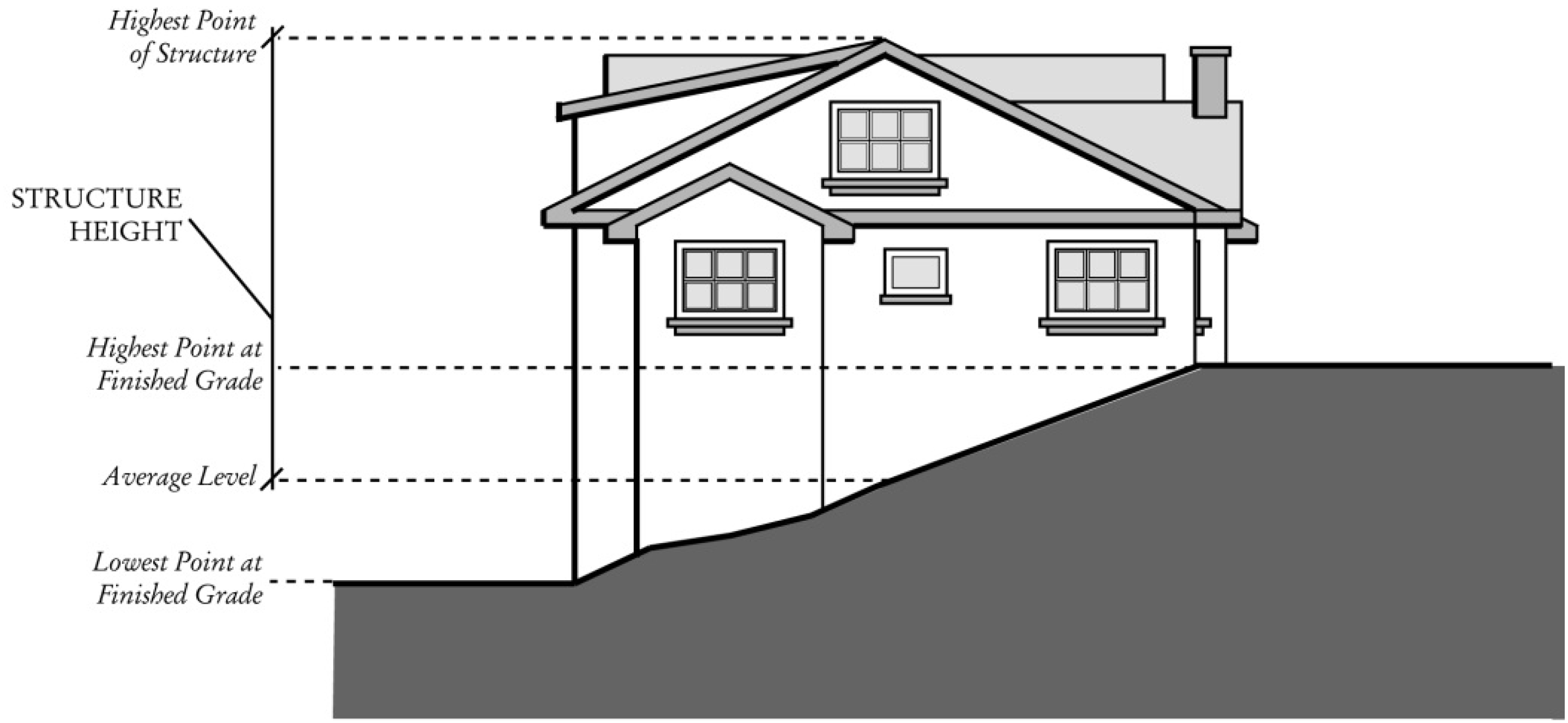
The height of a structure shall be measured as the vertical distance from the average level of the highest and lowest point of the portion of finished grade covered by the structure to the highest point of the structure. See Figure 24-49-1 (Structure Height).
FIGURE 24-49-1 STRUCTURE HEIGHT
(Ord. No. 4062, § 1, 9-10-13)
24-50 - Maximum height of structures.
A structure shall not exceed the maximum permitted height for the zone in which it is located, except as allowed by Section 24-51 (Height Limit Exceptions).
(Ord. No. 4062, § 1, 9-10-13)
24-51 - Height limit exceptions.
A.
Telecommunication Facilities. Wireless telecommunications facilities are regulated under Article IV, Division 2 (Telecommunication Facilities).
B.
Alternative Energy Structures. Alternative energy structures are regulated under Section 24-157 (Alternative Energy Structures).
C.
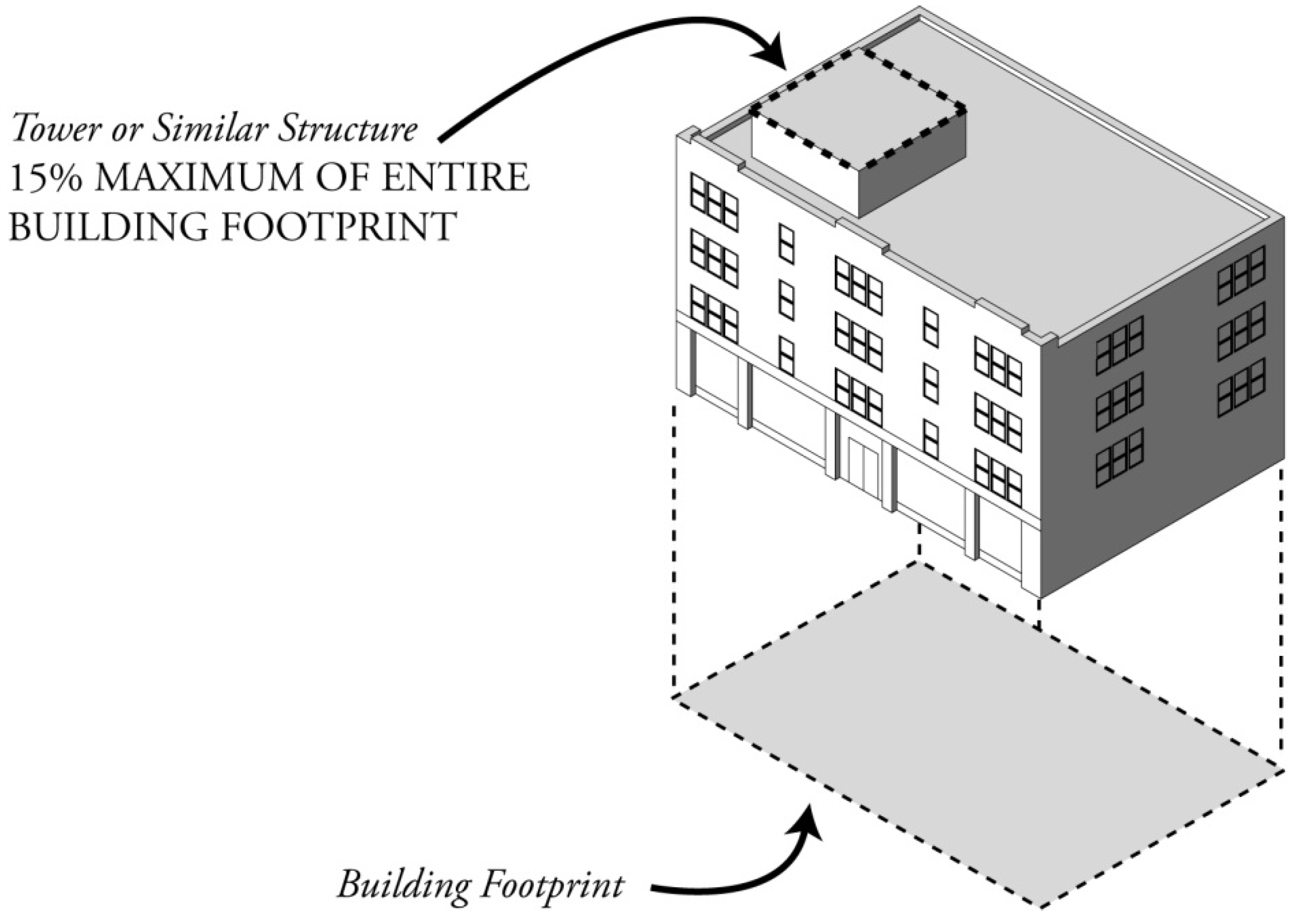
Allowed Exceptions. Towers, gables, spires, cupolas, water tanks, and similar structures, including mechanical appurtenances, may exceed the maximum permitted structure height if all of the following apply:
1.
The tower or similar structure covers an area fifteen (15) percent or less of the total structure footprint area;
2.
The tower or similar structure is not used for sleeping or eating quarters; and
3.
The tower or similar structure is used only for purposes incidental to the primary use of the habitable space. See Figure 24-51-1 (Exceptions to Height Limit).
FIGURE 24-51-1 EXCEPTIONS TO HEIGHT LIMIT
4.
No structures shall exceed the maximum permitted height in the Military Review Area as identified in the County's Military Overlay Zone Map, except as specified in section 24-47 Military Airspace Overlay Zone (-MA).
5.
For the purposes of calculating height, the height of wind turbines shall mean the distance from ground to top of the blade in vertical position.
D.
Permit Required. Allowed exceptions to the maximum permitted structure height identified in Subsection C (Allowed Exceptions) require the approval of:
1.
An Administrative Permit if the structure exceeds the height limit by ten (10) feet or less; or
2.
A Minor Use Permit if the structure exceeds the height limit by more than ten (10) feet but no more than twenty (20) feet.
(Ord. No. 4062, § 1, 9-10-13)
24-52 - Purpose.
This article establishes rules for the measurement of setbacks and identifies permitted exceptions to the minimum required setbacks of structures from property lines.
(Ord. No. 4062, § 1, 9-10-13; Ord. No. 4105, § 1, 1-12-16)
24-53 - Setback measurement.
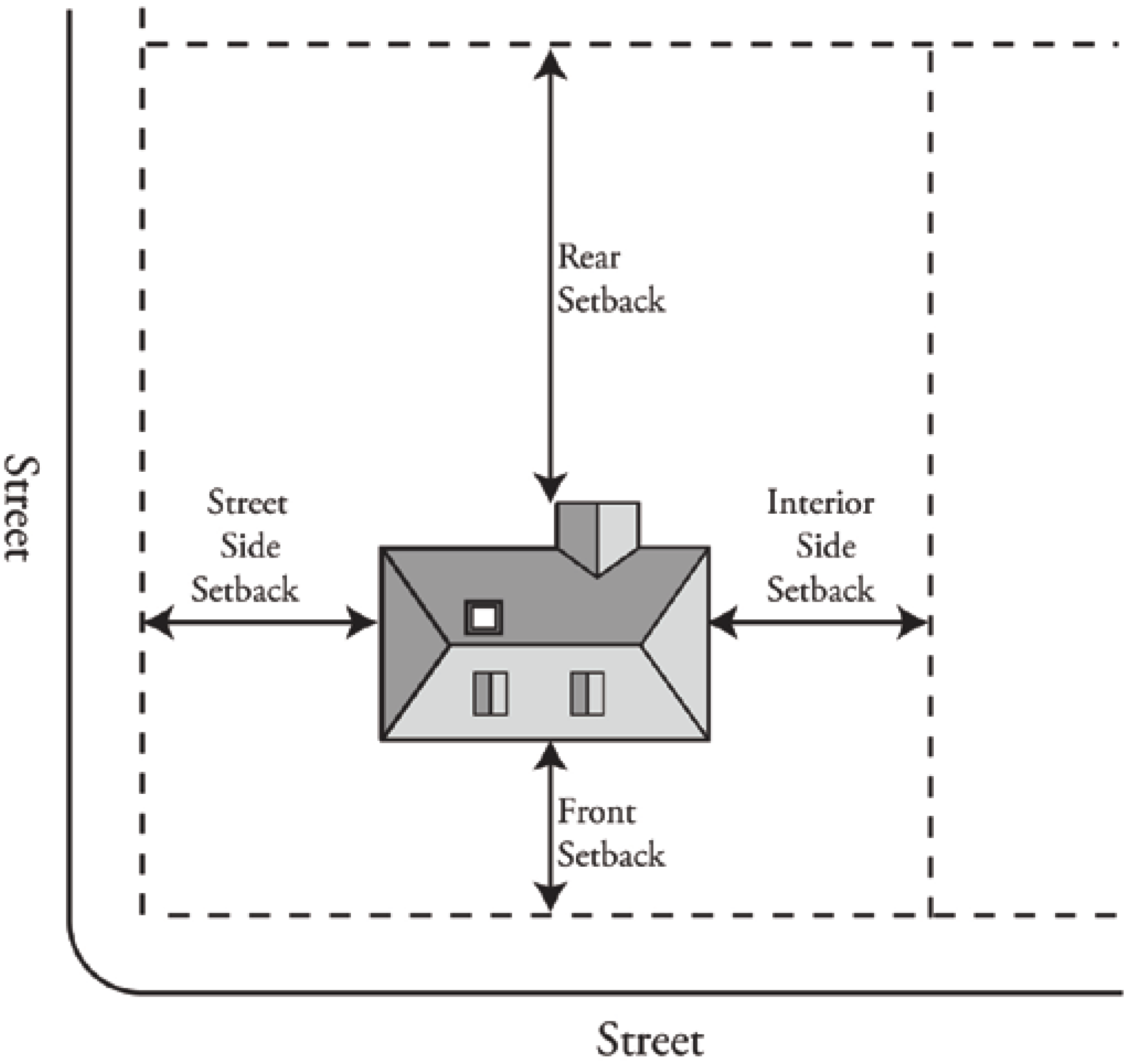
Setbacks shall be measured at right angles from the nearest point on the property line to the nearest point of the structure. On odd-shaped and corner lots, the Zoning Administrator shall determine the location of front, rear, and side property lines. See Figure 24-53-1 (Setback Measurement).
FIGURE 24-53-1 SETBACK MEASUREMENT
(Ord. No. 4062, § 1, 9-10-13; Ord. No. 4105, § 1, 1-12-16)
24-54 - Allowed projections.
Projections into required setback areas shall be permitted only as shown in Table 24-54-1 (Allowed Projections into Setback Areas).
(Ord. No. 4062, § 1, 9-10-13; Ord. No. 4105, § 1, 1-12-16)
24-55 - Projections over property lines.
Structures may not extend beyond a property line or into the public right-of-way.
(Ord. No. 4062, § 1, 9-10-13; Ord. No. 4105, § 1, 1-12-16)
24-56 - Road setbacks.
If the property line is located along the centerline of an existing road easement, the building setback line shall be established as the distance equal to one-half (½) the distance of the ultimate right-of-way as designated in the most recently adopted County Improvement Standards, plus the building setback line required by the applicable zone. If a property line is only partially located within an existing road easement, the setback will be equal to the distance from the property line to the edge of the right-of-way, plus the building setback line required by the applicable zone.
(Ord. No. 4062, § 1, 9-10-13; Ord. No. 4105, § 1, 1-12-16)
24-56.1 - Residential setback from orchards and vineyards.
A setback is established for residential development from existing orchards and vineyards that are located in residential zones in order to reduce interference and conflict with preexisting agricultural operations, while providing for the development potential allowed by residential zones. The residential setback from orchards and vineyards is subject to the following requirements (Refer to Article III, Division 7, Agricultural Buffers, for agricultural buffer setbacks required where a developing residentially zoned parcel is adjacent to a parcel zoned Agriculture):
A.
A setback between a new residence and an existing active orchard or vineyard shall be established as far away from the orchard or vineyard as practicable, taking into account adjacent agricultural uses and practices, provided it does not limit the allowed residential density permitted by the residential zone, and in no case is less than twenty-five (25) feet.
B.
Any proposed land division adjacent to an existing active orchard or vineyard use shall apply for a Residential Setback Recommendation with the Development Services Department in accordance with this section. The Residential Setback Recommendation shall be reviewed by the Agricultural Commissioner, in consultation with Development Services to determine an appropriate setback width (pursuant to Subsection A.). The Residential Setback Recommendation shall become part of the application and reviewed by the hearing body. Public noticing shall include reference to the Residential Setback Recommendation and the residential setback's recommended width.
C.
All building permits for residential development adjacent to existing orchards or vineyards shall be reviewed for compliance with the required residential setback. If no residential setback is shown on an applicable recorded parcel map or subdivision map, a review by the Zoning Administrator at a noticed public hearing shall be conducted to determine the appropriate setback pursuant to Subsection A.
D.
The residential setback shall be imposed from the property line (s) on the developing parcel and shown on the recorded parcel map or subdivision map or building permit site plan.
E.
The setback shall not apply to residential development adjacent to row crops or greenhouses and wholesale nurseries primarily engaged in growing crops, plants, vines or trees and their seeds.
F.
The setback shall not apply to backyard gardens and fruit and nut trees accessory to a residential use.
G.
The setback shall not apply to accessory structures as defined under Section 24-156 (Accessory Uses and Structures) excepting guest houses, which must comply with the setback.
H.
The setback shall not apply to orchard or vineyard uses that start operations after a building permit is approved (this does not apply to an existing orchard or vineyard that is removed and replaced).
I.
If the orchard or vineyard use is discontinued (i.e., the land is developed with residential uses) the setback shall no longer be applicable.
(Ord. No. 4105, § 1, 1-12-16)
24-57 - Purpose.
This article establishes rules for the measurement of walls and fences and identifies the maximum permitted height and design standards for walls and fences.
(Ord. No. 4062, § 1, 9-10-13)
24-58 - Measurement of fence or wall height.
A.
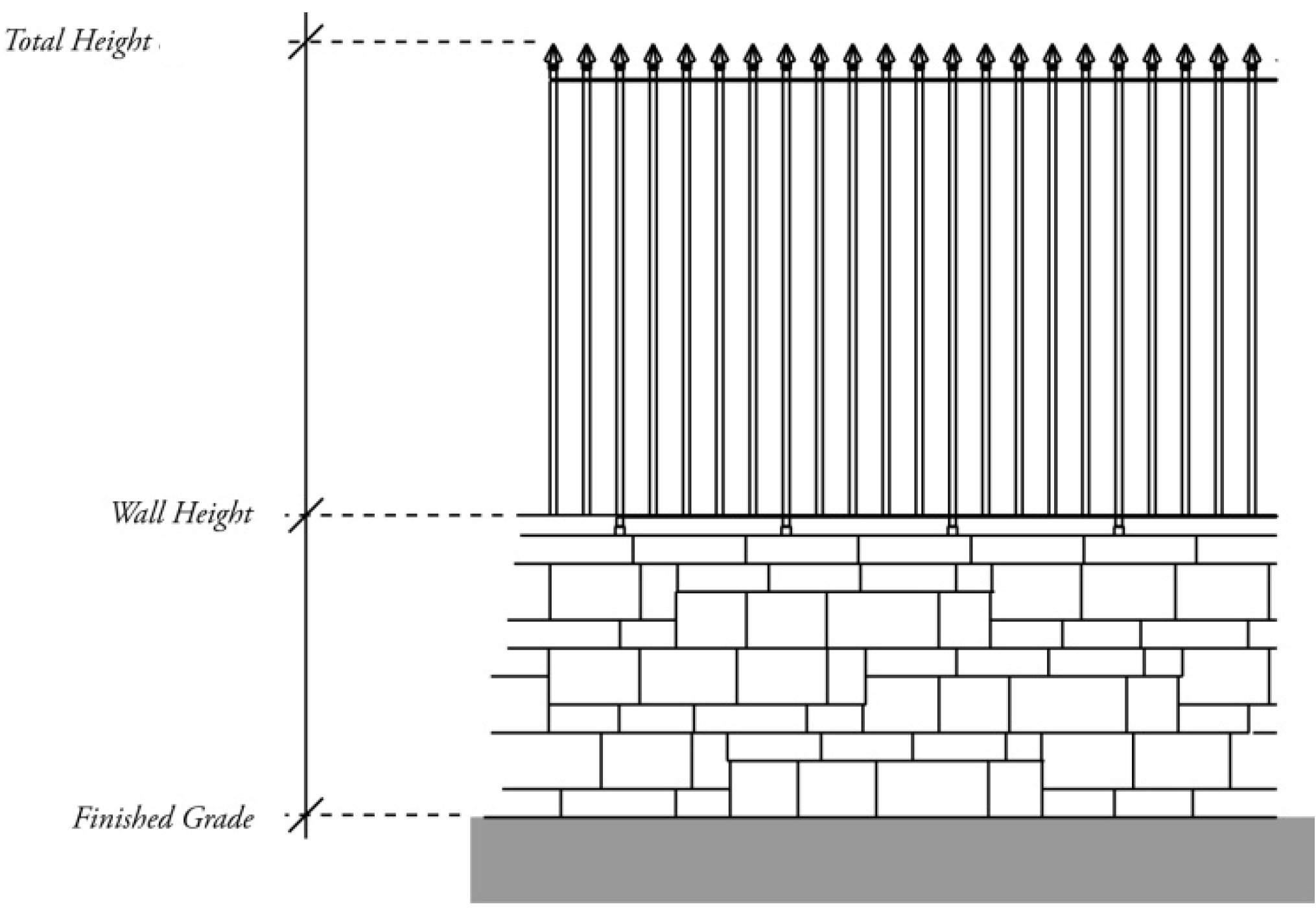
The height of a fence or wall shall be measured from the adjacent finished grade at the base of the fence or wall to the top edge of the fence or wall.
B.
Ornamental features that provide a screening function and are fifty (50) percent or more opaque shall be included in the height measurement of a fence or wall.
C.
If a fence is atop a wall, the total height shall be measured from the base of the wall. See Figure 24-58-1 (Fence and Wall Height).
D.
If the adjacent finished grade is different on opposite sides of the fence or wall, the height shall be measured from the side with the highest finished grade to the highest point on the fence.
FIGURE 24-58-1 FENCE AND WALL HEIGHT
(Ord. No. 4062, § 1, 9-10-13)
24-59 - Height limits.
A.
A fence or wall shall not exceed the maximum permitted height as shown in Table 24-59-1 (Maximum Height of Fences and Walls).
Notes:
[1]
Section 10-9 requires fences and walls within setback areas adjacent to a public road to be approved for traffic safety by the Director of Public Works.
[2]
Side property line fences located within the front property line setback that do not visually obstruct line of sight of vehicles entering roadways may be allowed up to six (6) feet if approved by the Director of Public Works.
B.
Two (2) feet of additional fence or wall height beyond that shown in Table 24-59-1 is permitted with the approval of an Administrative Permit.
C.
Within residential zones, an additional two (2) feet of height is permitted without an Administrative Permit for ornamental features that do not provide a screening function, such as an archway over a gate or ornamental figures intermittently situated along the top of a fence or wall.
(Ord. No. 4062, § 1, 9-10-13)
24-60 - Design.
A.
Standards that Apply in all Zones. In addition to any standards in specific zones, the following design standards for fences and walls shall apply in all zones.
1.
Fences and walls shall not be constructed of inappropriate materials such as sheet metal, vehicles, underground/above-ground tanks, garage doors, aluminum siding, corrugated tin, non-constructed or dumped piles of rock, soil or debris, and other similar materials not specifically designed for use as fencing.
2.
Fence and wall design shall conform to the California Building Code and all development standards required for safety.
3.
The use of barbed wire, razor wire, and other similar materials is permitted only in the Rural Residential, Rural Country Residential, Foothill Residential, Foothill Country Residential, Timber Mountain, Industrial, Agriculture, and Timber Production zones.
B.
Standards that Apply in Urban Zones. The following design standards for fences and walls shall apply only in urban zones.
1.
Fences and walls shall be constructed of decorative masonry, ornamental steel or iron, or wood. Other materials may be considered if the Zoning Administrator determines the design to be compatible with adjacent structures and its surrounding neighborhood.
2.
Fences and walls shall be constructed so that no hazards, such as nails, spikes, wires or other sharp or pointed objects, protrude from or exist upon the fence.
(Ord. No. 4062, § 1, 9-10-13)
24-61 - Amortization of inappropriate nonconforming fences.
Any wall or fence that does not comply with the design requirements specified in Section 24-60.A.1 and A.3 (Design) of this article, shall be regarded as a nonconforming use that may be continued until five (5) years after the effective date of the Zoning Ordinance. At the conclusion of the amortization period, fences shall be removed or replaced in conformance with this article.
(Ord. No. 4062, § 1, 9-10-13)
24-61.1 - Golf ball safety nets.
A.
Purpose. The purpose of this article is to regulate golf ball safety nets as defined in section 24-61.1.B.1. and 24-304. Such golf ball safety nets are designed to protect property, and the health and safety of residents adjacent to established golf courses and shall be subject to an administrative permit issued pursuant to this article. Regulation of golf ball netting is necessary to ensure that they are compatible with surrounding properties with the standards as described in section 24-61.1 E., maintained in proper working order and constructed with appropriate Butte County building code review. The golf ball safety nets are otherwise exempt from the walls and fences sections 24-59 and 24-60 with regards to setbacks, height limitations and types of permitted walls and fences.
B.
Definition.
1.
Golf Ball Safety Nets. For the purpose of this article, "golf ball safety nets" shall mean any netting type situated along the property line of a zone that permits a residential structure that is designed to block errant golf balls from adjacent golf courses, thus limiting potential injury to persons or damage property. The height of such nets is determined by a qualified study and may exceed one hundred (100) feet.
C.
Applicability. The provisions set forth under this section apply to all residentially zoned properties, or zone that allows a residential use, adjacent to an established golf course.
D.
Permit Process. All golf ball safety nets as described under this section require the approval of an administrative permit through the Department of Development Services. Golf ball safety net administrative permits are ministerial and are considered categorically exempt under section 15268 of the California Environmental Quality Act (CEQA). The administrative permit application shall include the following items:
1.
Applicant Information. The name, mailing address, email and telephone number of the applicant. The applicant shall submit proof of ownership of said premises.
2.
Qualified Study. The total proposed height of the golf ball net will be established and supported by a qualified study through golf ball impact analysis, illustrated with elevation views of the net. The study shall be submitted with the Administrative Permit and reviewed by the Development Services Department.
3.
Location of the Golf Ball Safety Net. A site plan illustrating the proposed location of the golf ball net on the subject property.
4.
Supporting Evidence to Meet Design Standards. A detailed explanation of the applicant's conformance to the design standards found in section 24-61.1.E.
E.
Design Standards. Administrative Permits for all golf ball safety nets are subject to design standards under this section. Sufficient information must be submitted with the application to determine compliance with these standards. The design shall conform with the findings set forth within the qualified study.
1.
Aesthetics. Applicant shall provide the color of the nets and posts that must match the surrounding area (i.e., nearby structures and vegetation) so as not to be considered an unwanted attraction. The applicant shall furnish samples of the material or photos that adequately represent the material being used. The review of the aesthetic qualities of the golf ball safety net will be evaluated by the Director of Development Services or their designee upon successful application of the administrative permit.
2.
Maintenance. The golf ball net shall be maintained at all times in a complete and functional manner. Replacement of netting shall take place in accordance with manufacturer recommendations. This requirement applies to the current and future owners of the subject property. If the golf ball net is not maintained and repaired in a complete and functional manner, the structure will be subject to Chapter 41 Code Enforcement action.
3.
Location. The location of the golf ball net must be on the subject property along the property line(s), or easement, adjacent to the golf course as analyzed and supported by a qualified study.
4.
Department of Development Services, Building Division.
a.
Applicant shall satisfy all California State Building Code requirements and apply for a Building Permit with the Butte County Department of Development Services Building Division pursuant to Chapter 26 of Butte County code.
5.
Height Restrictions.
a.
Golf course netting height within an airport compatibility zone shall be incompliance with the height restrictions per the Butte County Airport Land Use Compatibility Plan Table 3A (Compatibility Zones B1/B2 - no greater than thirty-five (35) feet; C—no greater than seventy (70) feet; D—no greater than 100 feet). If additional height is requested above the allowed maximum height, an airspace review by the Butte County Airport Land Use Commission will be required.
b.
Aerial Agricultural Applicators Notification. For netting located on a parcel adjacent to an Agriculture zone, upon permit approval, the Development Services Department shall send a notification to all aerial agricultural applicators registered in the County informing them of the netting's location and height.
F.
Permit Revocation or Modification. The procedures and requirements relating to effective dates, permit expiration, and changed plans are provided for under Butte County Code, Chapter 24, Division 8, Post-Decision Procedures.
(Ord. No. 4261, § 1, 3-25-25)
Editor's note— Ord. No. 4261, § 1, adopted March 25, 2025, set out provisions intended for use as 24-62. To avoid the duplication of section numbers and at the editor's discretion, these provisions have been included as 24-61.1.
24-62 - Purpose.
This article establishes minimum requirements for outdoor lighting in residential areas in order to reduce light trespass and glare, and to protect the health, property, and well-being of Butte County residents and visitors.
(Ord. No. 4062, § 1, 9-10-13)
24-63 - Applicability.
A.
The requirements of this article shall apply to all outdoor lighting in all residential zones. This article does not apply to lighting at publicly owned facilities, including public rights-of-way. Lighting in non-residential zoning districts that exists at the time of the effective date of this Zoning Ordinance is exempt from this article.
(Ord. No. 4062, § 1, 9-10-13)
24-64 - New development.
All residential outdoor lighting installed after the initial effective date of the standards in this article (November 26, 2009) shall be in conformance with the requirements of this article.
(Ord. No. 4062, § 1, 9-10-13)
24-65 - Time limitations for compliance.
A.
Outdoor lighting existing at the time of the effective date of the Zoning Ordinance that does not meet the requirements of this article shall be brought into compliance or removed as follows:
1.
Within three (3) months of the effective date of the Zoning Ordinance, where re-direction of the light fixture is feasible and will bring the light fixture into compliance; or
2.
Within six (6) months of the effective date of the Zoning Ordinance, in all other cases.
(Ord. No. 4062, § 1, 9-10-13)
24-66 - Compliance with lighting standards.
Light fixtures not meeting the standards of this article shall be brought into compliance in any of the following ways:
A.
Re-direction of the light fixture;
B.
Shielding of the lamp;
C.
Redesign or relocation of the light fixture;
D.
Replacement of the light fixture with a conforming fixture; or
E.
Removal of the light fixture.
(Ord. No. 4062, § 1, 9-10-13)
24-67 - Standards.
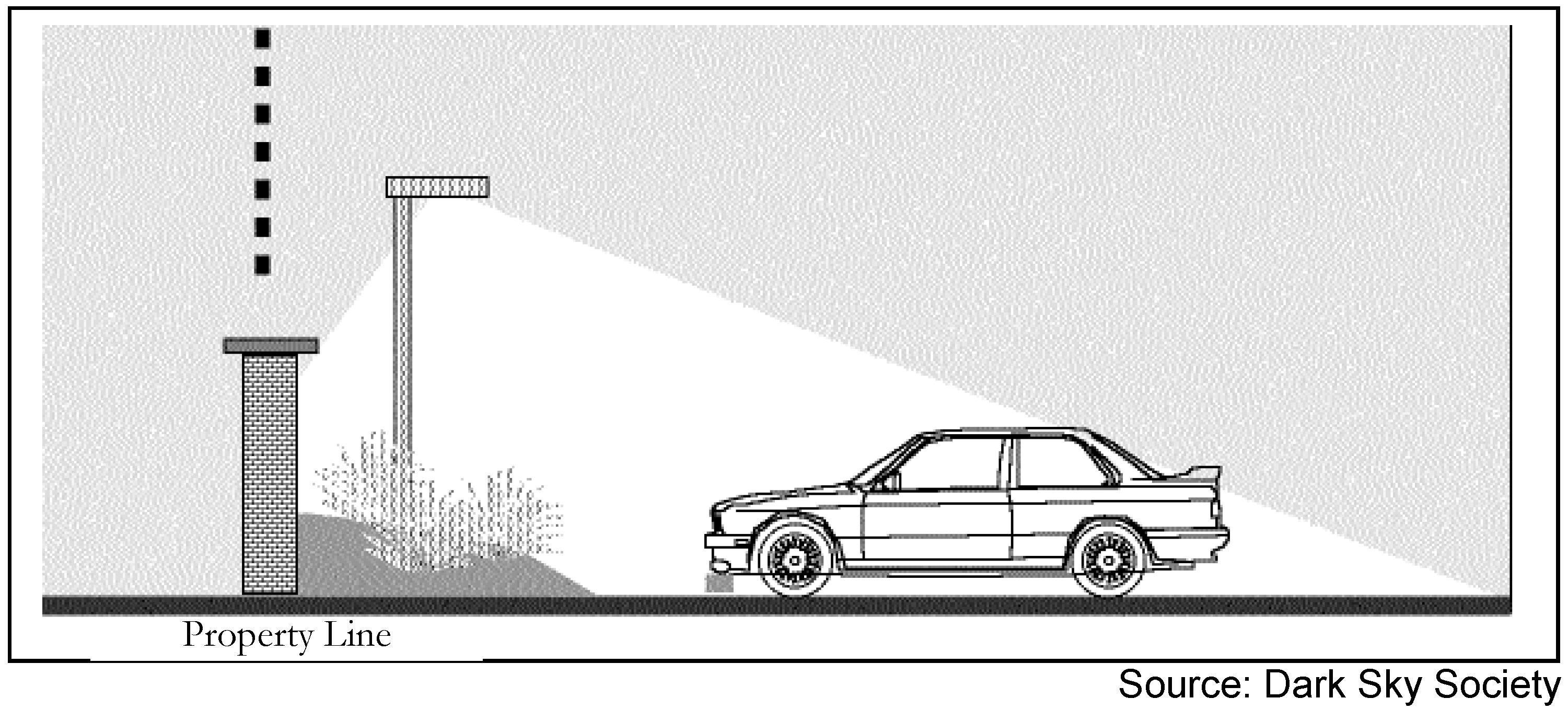
All outdoor lighting shall be located, adequately shielded, and directed such that no direct light falls outside the property line, or into the public right-of-way as illustrated in Figure 24-67-1 (Inadequate and Adequate Shielding) and Figure 24-67-2 (Light Source Not Directly Visible Outside Property Perimeter).
(Ord. No. 4062, § 1, 9-10-13)
24-68 - Exemptions.
The following types of lighting are exempt from the requirements of this article:
A.
Holiday and temporary lighting (less than thirty (30) days in any one (1) year); and
B.
Temporary lighting used by law enforcement or emergency personnel to protect life or property.
(Ord. No. 4062, § 1, 9-10-13)
24-69 - Security lighting.
Security lighting triggered by motion or noise shall be permitted subject to all of the provisions of this article. Sensors for such lighting shall not be triggered by activity located outside the subject property.
(Ord. No. 4062, § 1, 9-10-13)
24-70 - Prohibited lighting.
Flashing, flickering, or other lighting that is distracting or may be confused with traffic or emergency signals shall be prohibited.
FIGURE 24-67-1 INADEQUATE AND ADEQUATE SHIELDING
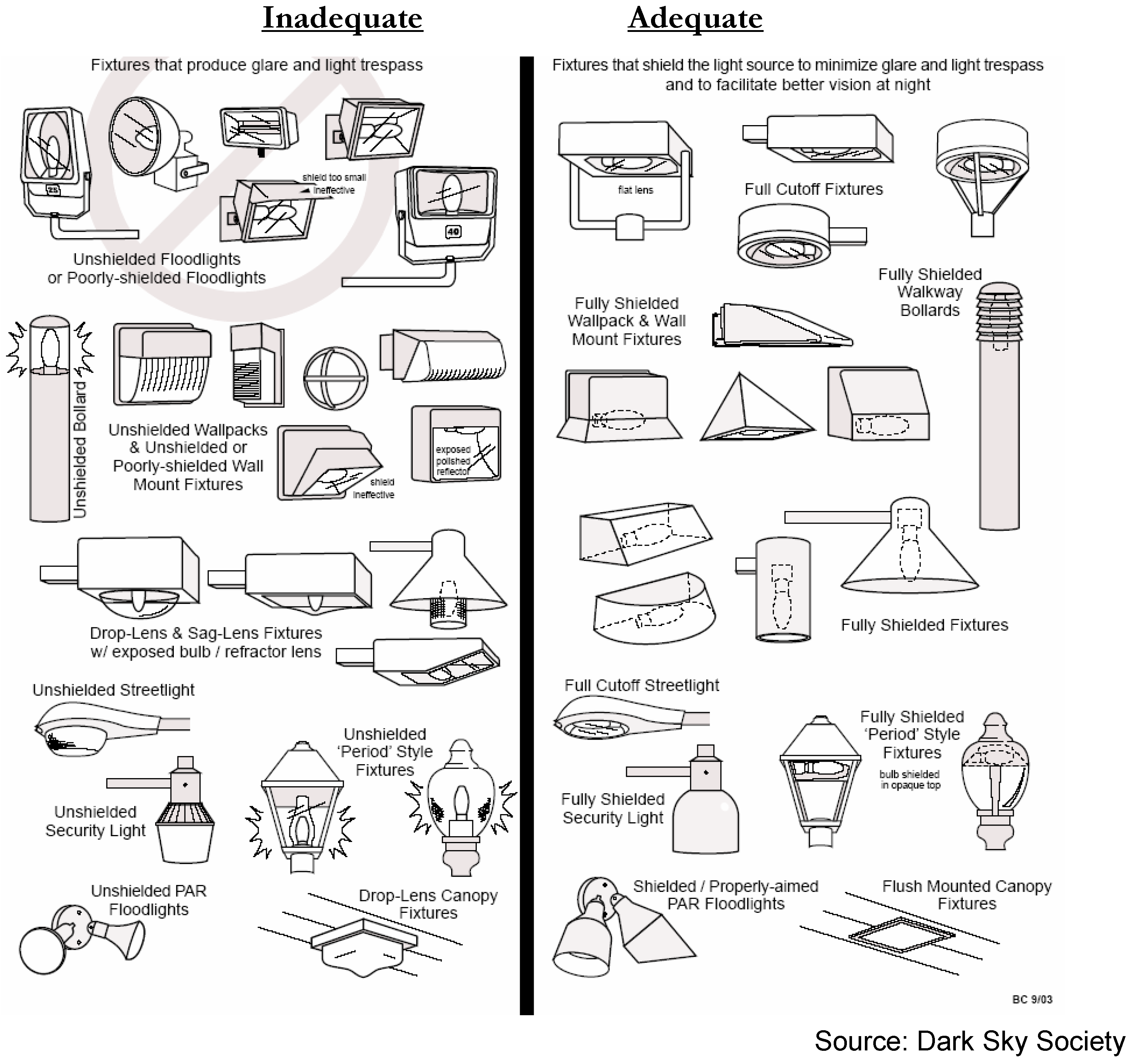
FIGURE 24-67-2 LIGHT SOURCE NOT DIRECTLY VISIBLE OUTSIDE PROPERTY PERIMETER
(Ord. No. 4062, § 1, 9-10-13)
24-71 - Purpose.
This article establishes standards for the parking and outdoor storage of recreational vehicles, boats, and camping activities.
(Ord. No. 4062, § 1, 9-10-13)
24-72 - Applicability.
The requirements of this article shall apply in all zones.
(Ord. No. 4062, § 1, 9-10-13)
24-73 - Permanent residences.
Recreational Vehicles, including travel trailers, motor homes, and campers used as permanent residences may be located only in officially-designated mobile home parks, except as provided for under Section 24-174.E (Recreational Vehicle as Temporary Residences).
(Ord. No. 4062, § 1, 9-10-13)
24-74 - Parking and storage in urban residential zones.
A.
Recreational vehicles and boats may not be stored within any required front or street side setback area unless they are parked on a driveway or paved surface, are parked perpendicular to the street, and do not encroach over a sidewalk or other part of the public right-of-way. Recreational vehicles and boats may be stored within an interior side yard without screening if the recreational vehicle or boat is placed upon a paved surface. For the purposes of these provisions, the term "stored" means continuously parked in the same location for more than seventy-two (72) hours.
B.
As otherwise allowed in subsection (A) above, all stored recreational vehicles and boats shall be screened from public view by building walls, decorative screen walls or fences, and landscaping to the greatest extent possible.
C.
A stored recreational vehicle or boat shall bear current vehicle registration or a legal non operation registration as required by State law.
D.
Recreational vehicles or boats shall not be stored in a wrecked, dismantled, or inoperative condition.
E.
Recreational vehicles or boats shall not be parked within a public or private right-of-way for longer than nine (9) days.
(Ord. No. 4062, § 1, 9-10-13)
24-75 - Camping.
This section regulates camping as a use that may be engaged in by a property owner or individual with the permission of a property owner. It does not give individuals who do not own a property or do not have the permission of the property owner to camp on that property. Camping outside any lawfully established outdoor recreational facility, campground, recreational vehicle park, or hunting/fishing camp is prohibited except under the following circumstances:
A.
Camping by means of recreational vehicle or tent is allowed on all parcels in Rural Zones (AG, TM, TPZ, RC, RR, and FR) subject to the following standards:
1.
Camping in a currently registered recreational vehicle connected to approved power, including power from a local utility, solar energy system, wind energy system, batteries and/or generator, an approved sewage disposal system and approved domestic water supply shall be limited to one hundred eighty (180) or fewer days annually. An Administrative Permit is required prior to connection.
2.
Camping without connection to approved power, an approved sewage disposal system, and an approved domestic water supply shall be limited to fourteen (14) or fewer days within any thirty (30) day period.
3.
No more than two (2) recreational vehicles or tents shall occupy a parcel for the purpose of camping at any one (1) time.
4.
No more than two (2) families shall occupy a parcel for the purpose of camping at any one (1) time.
5.
Solid waste shall be properly managed in accordance with Sections 31-51, Failure to Remove Solid Waste, and 31-52, Burning of Garbage, of the Butte County Code.
(Ord. No. 4062, § 1, 9-10-13)
24-76 - Purpose.
This article establishes standards for riparian areas to:
A.
Reduce risks to property owners and the public from erosion and flooding;
B.
Protect and enhance the chemical, physical, and biological integrity of water resources in the county;
C.
Minimize pollutants entering water bodies from urban stormwater runoff; and
D.
Preserve riparian vegetation and protect wildlife habitat and wildlife corridors along natural drainage ways.
(Ord. No. 4062, § 1, 9-10-13)
24-77 - Applicability.
A.
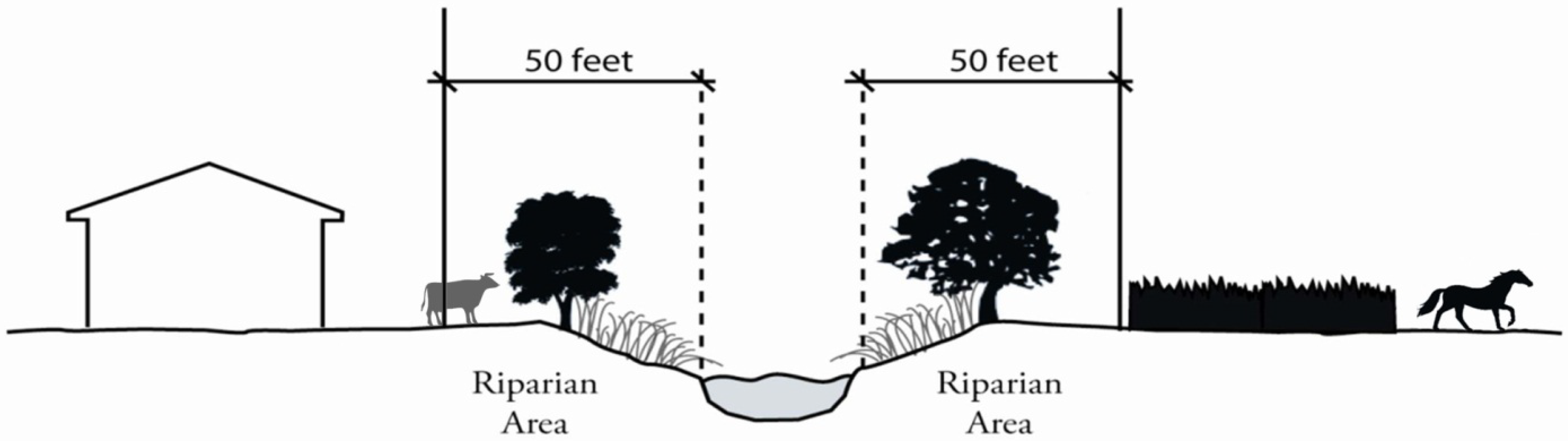
The standards in this article apply to all riparian areas within the county, in addition to the permitting requirements set forth under Article II, Zoning Districts, Land Uses, and Development Standards. As shown in Figure 24-77-1 (Riparian Areas), riparian areas are defined as areas between the banks and fifty (50) feet in width measured from the top bank of any intermittent or perennial stream or river landward. Excluded from this definition are stock ponds and other stock watering facilities, culverted sections of creeks and engineered systems developed by a public agency for collection of storm or flood waters, or systems other than natural creeks designed to deliver irrigation or water supplies.
(Ord. No. 4062, § 1, 9-10-13)
24-78 - Use regulations.
A.
Permitted Activities. The following activities are permitted as-of-right in riparian areas, subject to applicable performance standards below:
1.
Livestock grazing and agricultural practices in the Agriculture, Foothill Residential, Foothill Country Residential, Rural Residential, Rural Country Residential, Timber Mountain, and Timber Production zones;
2.
Native landscaping;
[3.
FIGURE 24-77-1 RIPARIAN AREAS]
FIGURE 24-77-1 RIPARIAN AREAS
4.
Fencing that does not interfere with the flow of flood waters or wildlife migration corridors, consistent with Article III, Division 3 (Walls and Fences);
5.
Roads used primarily for the maintenance of a property;
6.
Utilities, including the installation, operation and maintenance of water pumps;
7.
Storm drains into riparian areas and creeks;
8.
Trails and passive recreational activities not involving the establishment of any structures;
9.
Construction and maintenance of County-owned culverts, rip-rap, and other drainage facilities; and
10.
Construction and maintenance of County-owned bridges.
B.
Conditionally Permitted Uses.
1.
Uses, structures, and activities permitted in the applicable zone are permitted within riparian areas only with approval of a Minor Use Permit, except as described below for Commercial and Industrial Zones.
2.
To approve a Minor Use Permit for riparian area development, the Zoning Administrator shall make all of the following findings in addition to the findings in Article V, Division 5 (Conditional Use and Minor Use Permits):
a.
The proposed use, structure, or encroachment cannot be feasibly located outside the riparian area because such location would have a more adverse effect on the stream environment.
b.
Measures are included that provide adequate protection of wildlife habitat, water quality and in-stream habitat, and capacity for flood management.
C.
Uses allowed with an Administrative Permit in the Commercial and Industrial Zones.
1.
Uses, structures and activities permitted by-right in the applicable zone are permitted within riparian areas only with the approval of an administrative permit provided all of the following requirements are met:
a.
The Zoning Administrator has determined that site constraints limit the ability to develop the proposed uses outside of the riparian area.
b.
A biological resource evaluation is prepared indicating that the altered riparian area would be sufficient to protect the riparian resource. A minor use permit shall be required to address any findings of significant impacts to biological resources.
c.
An erosion and sediment control plan is prepared pursuant to Butte County Code Section 13-10. The plan shall identify measures to prevent sediment and other pollutant discharges from reaching riparian resources, and shall address both interim (during construction) and final (post construction) erosion control measures.
d.
Soil disturbance shall not be conducted during the rainy season (November 15 through April 1). The County may require financial security to ensure that control measures are implemented and maintained.
e.
All areas where land clearing has been completed between April 1 and November 15 shall be re-vegetated, hydroseeded, mulch protected, or otherwise stabilized no later than December 1.
f.
All other requirements under this chapter apply under the administrative permit.
(Ord. No. 4062, § 1, 9-10-13; Ord. No. 4161, § 1(Att. A), 5-7-19)
24-79 - Performance standards.
A.
Construction. Construction is prohibited in riparian areas unless the necessary permits have been obtained from other responsible governmental agencies and plans have been approved by the Director of Public Works and the Zoning Administrator.
B.
Grading or Alterations to Riparian Vegetation. Grading, alteration of the natural contours of the land, or cutting or alteration of natural vegetation that protects a riparian habitat is prohibited within riparian areas except when such action is:
1.
Necessary to protect public health and safety.
2.
Associated with an approved creek restoration and enhancement project intended to improve the health and environmental integrity of the waterway.
3.
Associated with an approved administrative permit, conditional use permit, minor use permit, tentative parcel or subdivision map, or mining permit.
C.
Streambed Alteration. Filling, grading, excavating, or obstructing streambeds is prohibited except in the following circumstances:
1.
Placement of County-approved storm drain and irrigation outflow structures shall be designed so as to eliminate or minimize increases in the rate and amount of storm or irrigation water discharge;
2.
Placement of public and nonpublic utility lines;
3.
Construction of bridges and their connecting roadways;
4.
Maintenance activities necessary to protect public health and safety; and
5.
Creek restoration and improvement projects.
6.
Development associated with an approved conditional use permit, minor use permit, tentative parcel or subdivision map, or mining permit.
(Ord. No. 4062, § 1, 9-10-13; Ord. No. 4162, § 1, 6-11-19))
24-80 - Coordination with other regulatory agencies.
All required permits from the California Department of Fish and Game, the U.S. Army Corps of Engineers, the California State Water Resources Control Board, the Central Valley Flood Protection Board, or other applicable agencies, including any permit required under an approved Habitat Conservation Plan, shall be obtained prior to, concurrently with, or as a condition of, the approval of any County permits for development within riparian areas. Evidence of approval or pending approval of any such permit shall be submitted to the County, including all appropriate supporting materials, environmental documentation, and studies.
(Ord. No. 4062, § 1, 9-10-13)
24-81 - Purpose.
This article establishes a means to conserve and stabilize agricultural land uses in order to protect agricultural lands from encroachment and conversion to residential uses. This article advances this purpose by:
A.
Requiring residential development to provide land use transitions, setbacks, and buffers between residential development and agricultural uses, in order to reduce interference and conflict;
B.
Creating development and performance standards designed to protect agricultural uses from residential encroachment conflicts; and
C.
Providing a clear delineation between long-term agricultural production lands and residential areas.
(Ord. No. 4062, § 1, 9-10-13; Ord. No. 4105, § 1, 1-12-16)
24-82 - Applicability.
A.
This article applies to residential structures in all agricultural buffer areas. The agricultural buffer is applied to the following areas of the county:
1.
All lands zoned Agriculture;
2.
Other zones within three hundred (300) feet of the boundary of Agriculture zones; and
3.
Areas inside and within three hundred (300) feet of sphere of influence boundaries for incorporated cities, where the boundary abuts parcels zoned Agriculture.
4.
Areas within three hundred (300) feet of a Williamson Act Contract.
B.
The agricultural buffer requirement shall apply to the parcel where residential development is proposed.
(Ord. No. 4062, § 1, 9-10-13; Ord. No. 4105, § 1, 1-12-16)
24-83 - Agricultural buffer setbacks.
A.
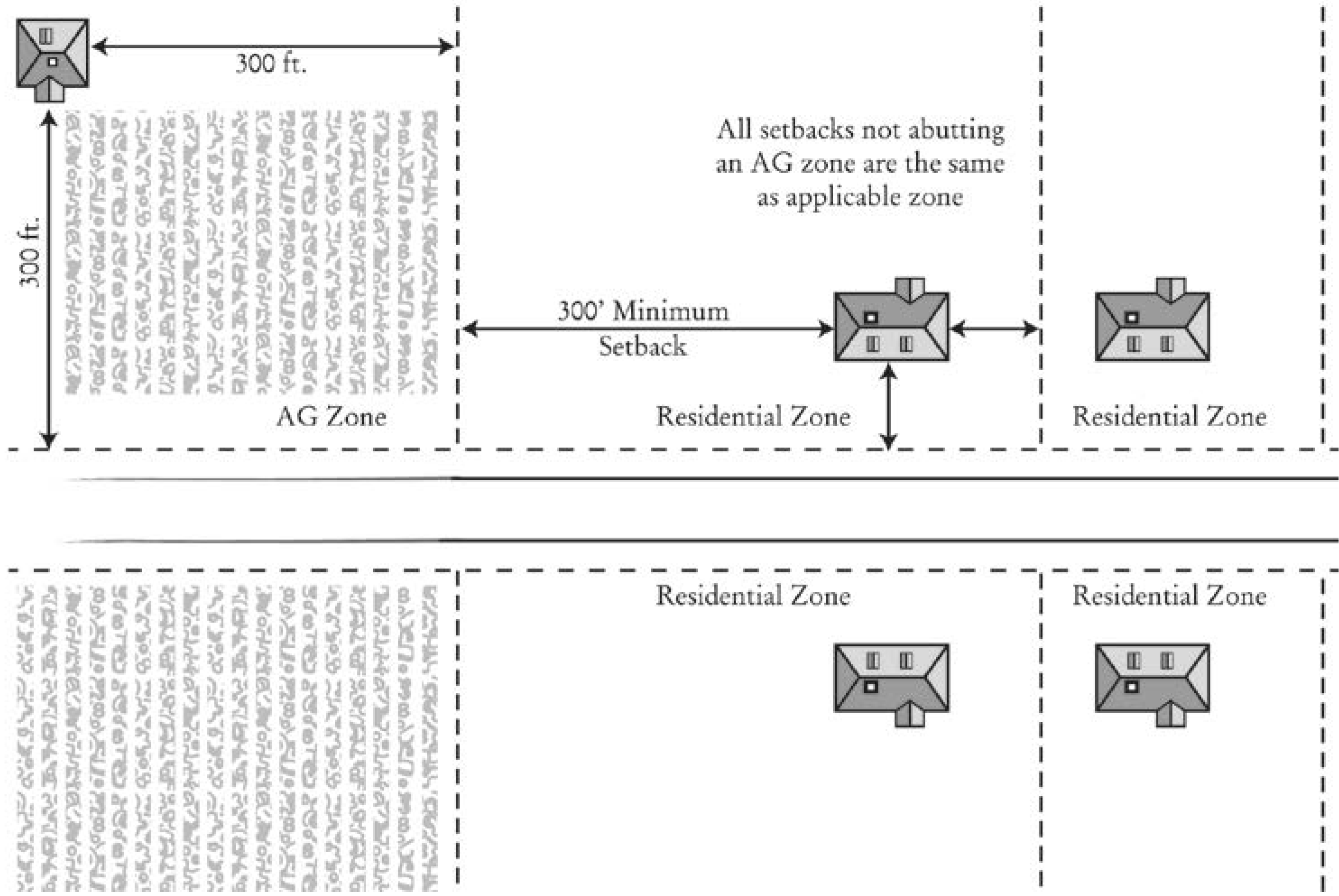
As shown in Figure 24-83-1 (Agricultural Buffer Setbacks), the setback distance for dwellings within an agricultural buffer area shall be three hundred (300) feet from any property line that abuts Agriculture zones. This distance may be adjusted for ministerial permits based upon the Agricultural Buffer Guidelines as adopted by the Board of Supervisors on December 16, 2008 (and as amended) or an Unusual Circumstance Review in Section 24-84 (Exceptions to Agricultural Buffer Setback).
B.
If an agricultural buffer setback is shown on a recorded map, but the Agriculture zone and Williamson Act contract (or either one of them individually where only one applied) that the buffer setback was designed to protect is no longer in effect, the agricultural buffer setback may be reduced as follows: if there is an orchard or a vineyard on the previously Agriculturally zoned parcel and/or on the parcel previously subject to a Williamson Act contract, Section 24-56.1 shall apply if the adjacent agricultural use is not removed; or in all other instances, the agricultural buffer setback shown on the map, shall no longer be enforced.
FIGURE 24-83-1 AGRICULTURAL BUFFER SETBACKS
(Ord. No. 4062, § 1, 9-10-13; Ord. No. 4105, § 1, 1-12-16; Ord. No. 4209, § 2(Exh. A), 10-26-21)
24-84 - Exceptions to agricultural buffer setback.
A.
Eligibility. Any project applicant for ministerial permits may request an adjustment to the 300-foot agricultural buffer setback requirement through an Unusual Circumstances Review, as described below. Discretionary project applications are not eligible for exceptions.
B.
Review Authority.
1.
A request for Unusual Circumstance Review submitted concurrently with a ministerial permit application shall be reviewed by the Zoning Administrator.
C.
Application Submittal. An application for an Unusual Circumstances Review shall be filed and reviewed in compliance with Article V, Division 1 (Permit Application and Review). The application shall include the information and materials specified in the Department of Development Services Buffer Guidelines for Unusual Circumstances Review applications, together with the fee in compliance with the Planning Fee Schedule. It is the responsibility of the applicant to provide evidence in support of the findings required by Subsection F (Criteria for Decision).
D.
Consultation with Agricultural Commissioner. The Zoning Administrator shall consult with the Agricultural Commissioner prior to taking action on an Unusual Circumstances Review.
E.
Public Hearing. No public notice or hearing is required for Unusual Circumstances Reviews associated with ministerial permits.
F.
Criteria for Decision. The review authority may approve an adjustment to the required setback only if the following findings can be made:
1.
The adjustment will not result in a modification to adjacent agricultural practices.
2.
Unusual circumstances are present on the subject properties or surrounding properties that render the 300-foot setback requirement infeasible or unnecessary. Unusual circumstances include, but are not limited to, parcel size and shape, the location of existing residences, infrastructure and other existing uses, and natural physical features and topography.
3.
The proposed dwelling is placed the greatest distance possible from all property lines abutting an agriculture zone or other location that presents the least detriment to agricultural practices on adjacent properties.
4.
The location of the proposed residence does not interfere with easements, septic systems, or prior conditions of approval applicable to the subject property.
G.
Buffer Guidelines. Agricultural Buffer Guidelines as adopted by the Board of Supervisors on December 16, 2008 (Butte County Resolution #08-166 and as amended) shall be utilized as a guide in evaluating the proper agricultural buffer and in rendering determinations on requested adjustments to the required setback.
H.
Post-Decision Procedures. The procedures and requirements relating to notices of decision, effective dates, permit expiration, permit revocation, and changed plans shall apply to Unusual Circumstance Reviews as provided in Article V, Division 8 (Post-Decision Procedures). The procedures and requirements relating to appeals shall apply to Unusual Circumstances Reviews as provided in Article VI, Division 3 (Appeals and Calls for Review).
I.
Agricultural Worker Housing Center. Within Agriculture zones, Agricultural Worker Housing Centers, as defined under this chapter, shall not be subject to the Agricultural Buffer Setback.
(Ord. No. 4062, § 1, 9-10-13; Ord. No. 4209, § 2(Exh. A), 10-26-21)
24-85 - Purpose.
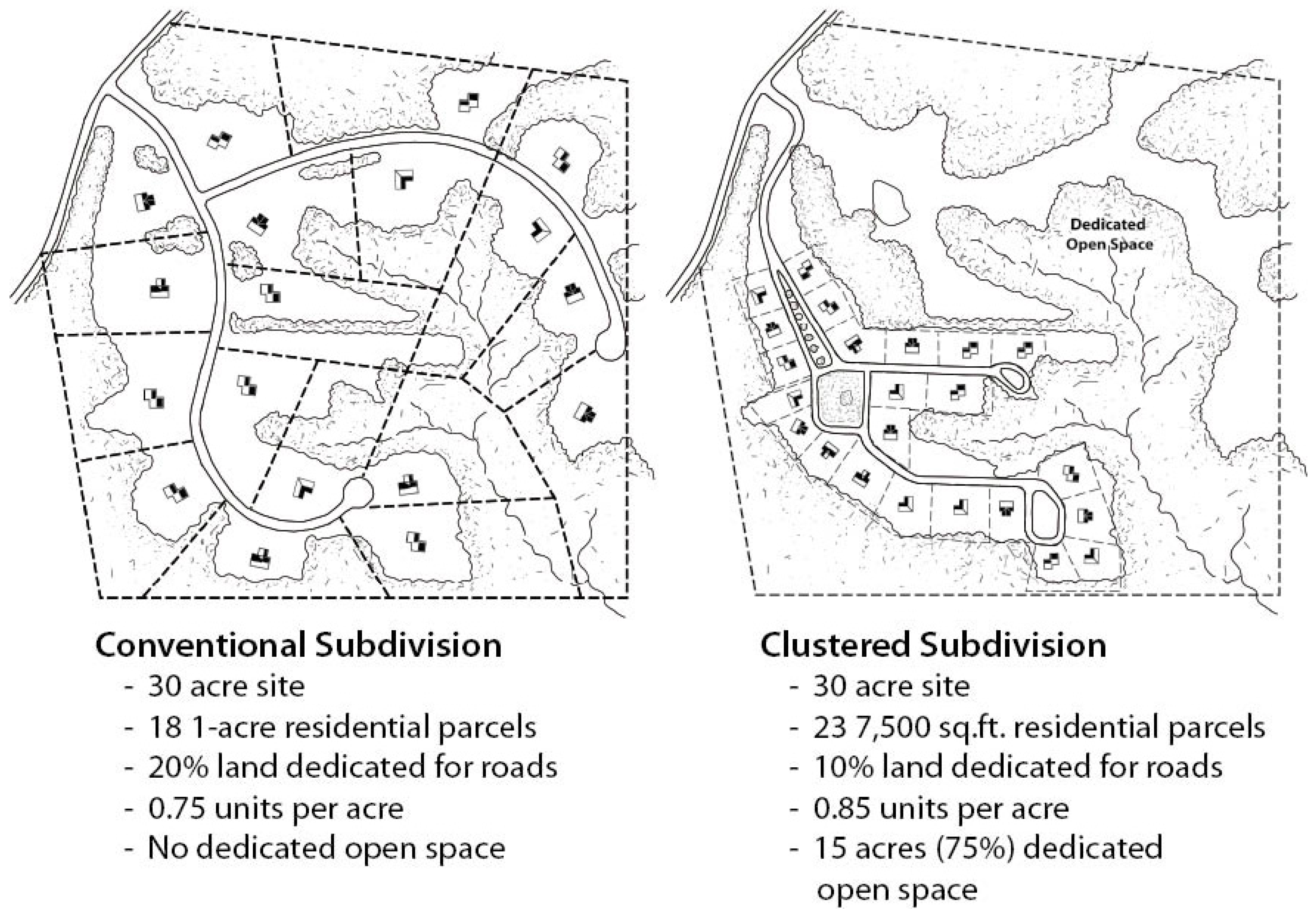
This article establishes provisions for clustered development in order to facilitate the retention of natural resources, open space (a minimum of forty (40) percent of the total project site must be dedicated as permanent open space to qualify as a Clustered Development), and wildlife habitat; avoid hazardous areas; and further implement the goals and policies of the General Plan. Figure 24-85-1 (Clustered Development Concept) illustrates the clustered development concept for a prototypical thirty (30) acre subdivision. Specific objectives of these provisions are to:
A.
Provide an incentive to create quality residential developments, particularly where special conditions exist that prevent the attainment of the maximum permitted density of a property that could otherwise be attained through conventional subdivision design;
B.
Require the preservation of environmentally sensitive areas (e.g., wetlands and special-status species habitat), productive agricultural and timber lands, and important cultural and scenic resources;
C.
Facilitate innovative development concepts that achieve greater consistency with the Butte County General Plan;
D.
Provide permanent open space for a variety of natural resource purposes;
E.
Preclude additional development that may conflict with neighborhood quality of life;
F.
Provide increased open space which may include active and passive recreation features that reduce demand for public park land; and
G.
Reduce infrastructure requirements by reducing the length of streets and water and sewer lines and by potentially reducing street width requirements.
FIGURE 24-85-1 CLUSTERED DEVELOPMENT CONCEPT
(Ord. No. 4062, § 1, 9-10-13)
24-86 - Applicability.
A.
Location. Clustered development shall be allowed as an alternative to conventional subdivision design in the TM, FR, RR, VLDR, VLDR-2.5, VLDCR, and LDR zones. Clustered Development subdivisions are subject to all of the requirements of the State Subdivision Map Act and local subdivision ordinance in addition to the provisions set-forth under this chapter. A Conditional Use Permit, Planned Development (PD), or other rezoning application is not required to utilize these provisions.
B.
Optional Use. The use of clustered development provisions is optional. Persons wishing to subdivide and develop land may utilize these provisions or proceed under the otherwise applicable Zoning Ordinance requirements without use of these provisions.
C.
Applicable Parcel Size. Clustered development projects may be proposed for parcels that could potentially be subdivided based on the minimum parcel size specified in the applicable zone.
(Ord. No. 4062, § 1, 9-10-13)
24-87 - Application requirements.
A.
Preliminary Application. Prior to submitting a formal application for a clustered development project, an applicant shall submit to the County a preliminary application. The preliminary application shall include the following materials:
1.
An opportunities and constraints map that illustrates land not suitable for development, as described in Section 24-90 (Clustered Development Open Space Requirements).
2.
A conceptual development plan that identifies proposed building lots and sites, and a description of the maximum number of lots, roads, open space areas, and other features based on the opportunities and constraints mapping. The conceptual development plan shall address all items listed in Section 24-90 (Clustered Development Open Space Requirements). Where appropriate, information may be provided in narrative form.
B.
Preliminary Application Review Meeting.
1.
Once a preliminary application has been submitted, the applicant shall schedule a preliminary application review meeting with County staff, including representatives from the Development Services Department, Environmental Health Division, Public Works Department, Butte County Fire Department, and any other agency with applicable interest in the proposed development site. The purpose of this meeting is to provide the following preliminary direction to the applicant:
a.
Identify any potential inconsistencies between the proposed project and County ordinances and policies;
b.
Identify design components and filing requirements recommended for the formal project application;
c.
Discuss the application review process;
d.
Identify potential environmental impacts; and
e.
Identify special studies that may be required to accompany the formal application.
2.
Any direction given to the applicant by County staff shall be preliminary and subject to further refinement or change as the proposed project progresses through the formal application process. Following the meeting, the Department of Development Services shall send a letter to the applicant describing recommended direction, additional filing requirements for the formal application, and other determinations reached at the meeting.
C.
Formal Application Requirements. Following completion of the required preliminary application process, a formal subdivision application for a clustered development project shall be filed and reviewed in compliance with Butte County Code and the State Subdivision Map Act requirements governing tentative subdivision, parcel map and parcel map waiver applications. Residential development applications submitted pursuant to this article shall be clearly identified as being so-designed on the tentative map.
(Ord. No. 4062, § 1, 9-10-13)
24-88 - Development standards.
Clustered development projects shall adhere to the development standards for the zone applicable to the property, except as modified below.
A.
Density Incentives.
1.
As an incentive for development projects to conserve open space and protect natural resources, an additional residential density incentive shall be granted for projects that provide additional dedicated open space beyond fifty (50) percent. Additional residential density incentive shall be granted as specified in Table 24-88-1 (Additional Density Incentive for Dedicated Open Space). In no event shall the maximum density incentive for a clustered development project be greater than twenty-five (25) percent. Density is determined by the number of residences not by the number of parcels. Parcels not used for residential purposes (e.g. water or sewer systems or other type of utility), shall be clearly marked for that purpose and will not be available for residential development.
B.
Lot Size.
1.
The minimum lot size in a clustered development project shall be seven thousand five hundred (7,500) square feet.
2.
The maximum residential lot size in a clustered development project shall be one (1) acre.
3.
Final subdivision and parcel maps shall include a notation that stipulates that the parcels created as part of a clustered development project cannot be further divided.
C.
Building Setbacks/Yard Area and Parcel Dimension Requirements. Primary structures shall be setback a minimum of five (5) feet from all property lines, except the front property line setback, which will be in accordance with the applicable zone. All site development shall be consistent with the County's Fire Safe requirements and Public Resources Code Section 4290.
D.
Street Design. Street improvements within a clustered development project shall be governed by the following factors:
1.
Streets may be privately owned and maintained, or may be proposed for dedication to the County.
2.
Deviation from conventional road and sidewalk requirements may be requested by the applicant. The review authority may approve deviations depending upon project design, site conditions, and other factors.
3.
All street design standards shall be approved for safety by the Director of Public Works and the County Fire Marshal.
E.
Sewage Disposal/Potable Water. Each application for a clustered development project shall obtain tentative clearance from the Butte County Health Department, Environmental Health Division for the proposed parcel sizes. Soil tests, drilling of test wells, or geologic reports may be required to provide evidence of sewage disposal capacity and domestic water availability.
F.
Flood Zones. Clustered development projects shall be prohibited within flood zones unless one (1) or more of the following apply:
1.
Fewer dwelling units are located within the flood zone as part of a clustered development than would be allowed by conventional development;
2.
The clustered development will be developed in an area of the flood zone that has a higher average elevation as compared to what would be allowed by conventional development, and thus would be subject to less flooding and associated impacts; or
3.
Clustered development allows the preservation of natural vegetation and topography on the site that reduces flood-related hazards.
G.
Final Subdivision and Parcel Maps. Final subdivision and parcel maps shall include a notation that stipulates that the parcels created as part of a clustered development project cannot be further divided.
H.
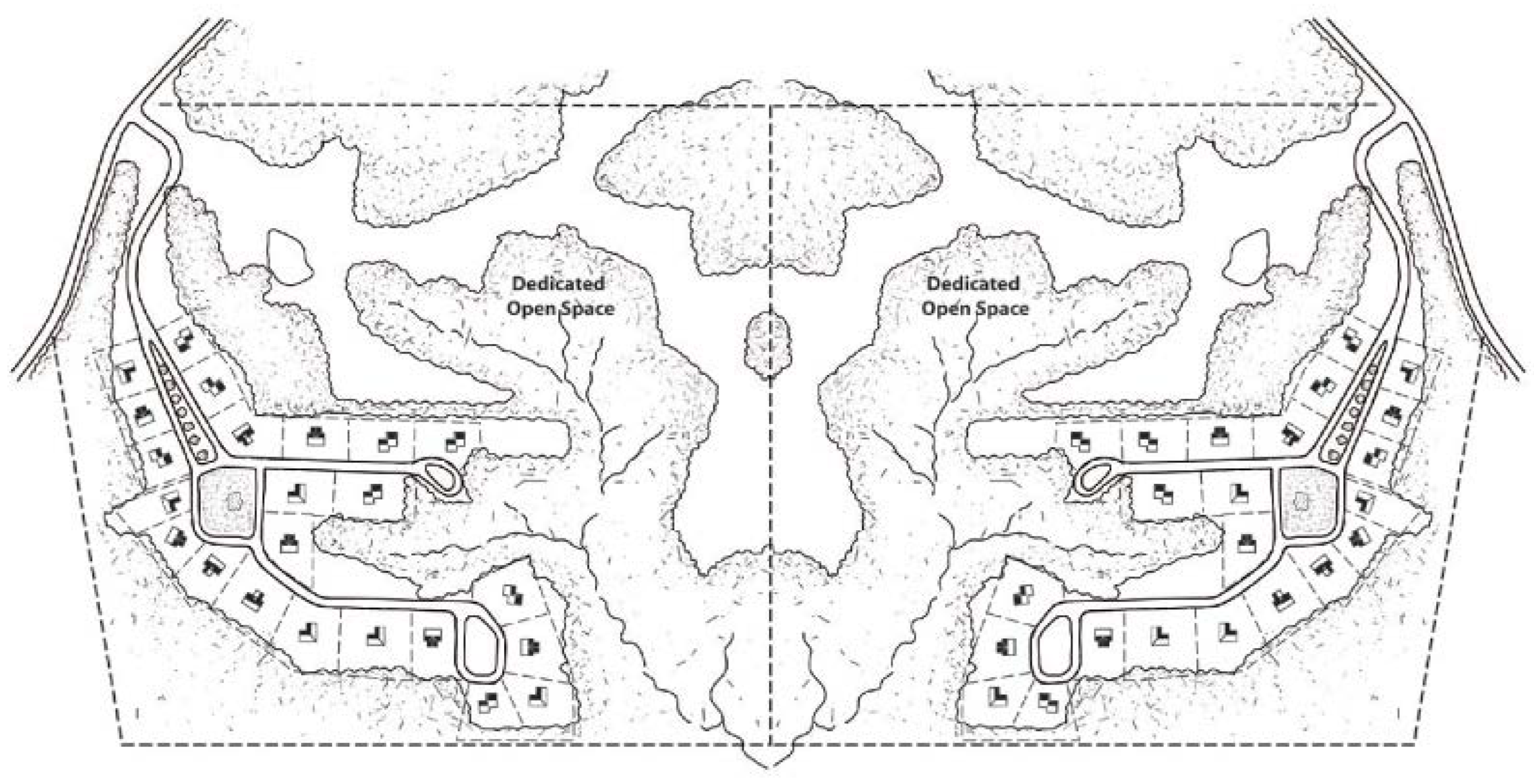
Adjacent Clustered Developments. As shown in Figure 24-88-1 (Clustered Development), developed areas within adjacent clustered developed projects shall be separated by dedicated open space as required by this article.
FIGURE 24-88-1 CLUSTERED DEVELOPMENT
(Ord. No. 4062, § 1, 9-10-13)
24-89 - Permitted uses.
A.
Applicable Zone. All land uses permitted in the zone applicable to the property shall be permitted for clustered development projects, except within the dedicated open space area, which is regulated under Section 24-90 (Clustered Development Open Space Requirements).
B.
Open Space Areas. Uses allowed in dedicated open space shall only be as described in Section 24-90 (Clustered Development Open Space Requirements).
(Ord. No. 4062, § 1, 9-10-13)
24-90 - Clustered development open space requirements.
Dedicated open space areas within a clustered development project shall be separated from residential parcels and shall comply with the following standards:
A.
Primary Areas Not Suitable for Development. Primary areas shall be avoided and reserved as permanent open space in all instances. Primary areas shall include the following:
1.
One hundred (100) year flood zones unless development is allowed by 24-88.F (Development Standards);
2.
Wetlands, riparian areas and other sensitive biological habitats;
3.
Unstable slopes; and
4.
Sensitive archaeological sites.
B.
Secondary Areas Not Suitable for Development. The review authority may require that secondary areas or portions of secondary areas be avoided and reserved as permanent open space. Secondary areas shall include the following:
1.
Timber areas;
2.
Scenic areas;
3.
Historic areas;
4.
Deer migration, established fawning and winter range areas;
5.
Areas with a slope of thirty (30) percent or greater; and
6.
Viable/important grazing lands.
C.
Other Areas Not Suitable for Development. Portions of a site that do not qualify as Primary or Secondary Areas Not Suitable for Development, as defined in Subsections A and B above, may be reserved as open space if proposed by the applicant or when necessary to comply with minimum open space requirements.
D.
Dedication or Reservation of Open Space. Areas within a clustered development project not designated for development shall be reserved as open space. Open space shall be guaranteed in perpetuity using one (1) or more of the following control mechanisms:
1.
Dedication of a conservation (or open space) easement to the County, other public agency or a public interest land trust;
2.
Dedication of land in fee-title to the County or other public agency; or
3.
Deed restrictions recorded with the County Recorder.
E.
Open Space Management Plan Required. Public and private open space shall be maintained in accordance with an open space management plan acceptable to and approved by the County. Such plans shall, at a minimum, address the following:
1.
A description of site conditions such as vegetation and habitat type, natural and man-made features, and other characteristics of the site;
2.
Grass and brush clearing for fire fuel management, as required by site conditions;
3.
Erosion control;
4.
Sewage disposal, water well, and stormwater drainage facilities, including ditches and detention basins, if proposed for the development;
5.
Fencing if required for the protection of resources;
6.
Recreational activities compatible with open space; and
7.
Other natural resource management activities and uses. Open space management plans shall include provisions for long-term maintenance of improvements and facilities that will not result in a fiscal impact on the County.
F.
Open Space Minimums. The amount of dedicated open space reserved in a clustered development project shall comply with the following requirements:
1.
A minimum of forty (40) percent of the total project site shall be dedicated as permanent open space.
2.
Projects granted density incentives as allowed by Section 24-88 (Development Standards) shall dedicate the amount of permanent open space as specified in Table 24-88-1 (Additional Density Incentive for Dedicated Open Space).
G.
Uses Permitted In Dedicated Open Space. Uses and activities within dedicated open space shall be compatible with open space land. Unless limited or restricted by a conservation easement, development agreement, conditions on the approved tentative map, or other restricting mechanism, the following uses shall be permitted:
1.
Agriculture, including grazing and timber management, when allowable by the zone applicable to the property;
2.
Resource conservation;
3.
Wildlife management;
4.
Recreational activities compatible with the objectives of the open space management plan;
5.
Community wells, community septic systems, community sewage disposal systems, and individual wells under certain circumstances;
6.
Pedestrian, bicycle and equestrian trails. Public access is not required, but may be permitted subject to a public access easement being recorded; and
7.
Other similar uses, as determined through the application review process.
H.
Contiguity. Dedicated open space areas shall not be fragmented but shall be consolidated or linked to facilitate wildlife movement, maintain functioning biological communities, and accommodate recreational opportunities. Open space connections to adjoining land beyond the project site should be anticipated and identified where possible.
I.
Access to Open Space. To the extent possible, all residential parcels shall have physical or visual contact with permanent open space to facilitate surveillance, foster routine maintenance, and improve the quality of life for project residents through the integration of home sites into a permanent open space setting.
J.
Trails. Where pedestrian, bicycle or equestrian trails are constructed in dedicated open space areas, the following requirements shall apply:
1.
Environmentally sensitive areas shall not be impacted.
2.
Privacy of proposed on-site and existing off-site residences shall not be intruded upon.
3.
Public access shall be permitted only where public access easements, consistent with an adopted trail master plan, have been acquired.
(Ord. No. 4062, § 1, 9-10-13)
24-91 - Purpose.
This article establishes standards for vehicle parking facilities, freight loading areas, and related transportation infrastructure. These standards are intended to:
A.
Ensure a sufficient supply of on-site parking and loading facilities for all land uses;
B.
Provide parking design standards appropriate for both urban and rural areas;
C.
Promote the use of alternative forms of transportation;
D.
Protect neighborhoods from vehicular noise and traffic associated with adjacent non-residential land uses; and
E.
Ensure the maneuverability of emergency vehicles.
(Ord. No. 4062, § 1, 9-10-13)
24-92 - Applicability.
A.
New Structures and Uses. All new structures and uses proposed or established after the effective date of the Zoning Ordinance shall comply with the standards in this article.
B.
Existing Structures and Uses. When an existing structure or use is expanded, on-site parking as required by this article shall be provided only as needed to accommodate the expanded portion of the structure or use.
C.
Replaced Uses. A new use that replaces an existing use shall provide parking only for the additional parking required for the new use beyond that which was required by the existing use.
(Ord. No. 4062, § 1, 9-10-13)
24-93 - On-site parking requirements.
A.
Number of Spaces. All land uses shall provide on-site parking as required in Table 24-93-1 (On-Site Parking Requirements).
B.
Unlisted Uses.
1.
The Zoning Administrator shall determine on-site parking requirements for uses not listed in Table 24-93-1 (On-Site Parking Requirements).
2.
On-site parking requirements for unlisted uses shall be based on the parking requirements of similar uses in Table 24-93-1(On-Site Parking Requirements).
3.
The Zoning Administrator may require the preparation of a parking demand study to determine the parking requirement for unlisted uses.
C.
Multiple Uses. When more than one (1) land use is conducted on a parcel, the required number of parking spaces shall be the sum of the number of parking spaces required for each individual use, or as determined by a parking demand study.
D.
Unknown Uses.
1.
The Zoning Administrator shall determine on-site parking requirements for non-residential "shell" structures with no identified tenants.
2.
Parking requirements shall be based on anticipated tenants for the structures, as determined by the Zoning Administrator.
E.
Fractional Spaces. If the number of required parking spaces does not result in a whole number, the number shall be rounded down to the nearest whole number.
F.
Availability and Use of Spaces.
1.
Required parking spaces shall be permanently available and maintained for parking purposes for the use they are intended to serve.
2.
Owners, lessees, tenants, or persons having control of the operation of a use for which parking spaces are required shall not prevent or restrict authorized persons from using these spaces.
3.
Required parking spaces shall be used exclusively for the temporary parking of vehicles and shall not be used for the sale, lease, display, repair, or storage of vehicles, trailers, boats, campers, mobile homes, merchandise, or equipment, or for any other use not authorized by the Zoning Ordinance.
(Ord. No. 4062, § 1, 9-10-13; Ord. No. 4134, § 1(Att. A), 9-26-17; Ord. No. 4197, § 7, 1-12-21)
24-94 - General requirements.
A.
Use and Availability.
1.
All on-site parking facilities shall be designed and maintained to be fully usable for the duration of the use.
2.
Areas required to meet applicable parking requirements may not be used for any other purpose.
B.
Parking for Persons with Disabilities.
1.
Parking facilities shall be properly designed, constructed, and maintained to provide for access by the physically disabled from public rights-of-way, across intervening parking spaces, and into structures.
2.
The number of parking spaces for the disabled shall be as required by the California Building Code, the Federal Accessibility Guidelines, and the California Code of Regulations (Title 24, Article II, Chapter 2-71).
3.
Parking spaces required for the disabled shall count toward compliance with the number of parking spaces required by Table 24-93-1 (On-Site Parking Requirements).
C.
Parking for Motorcycles.
1.
The minimum number of motorcycle parking areas shall be provided as shown in Table 24-94-1 (Motorcycle Parking Requirements).
2.
One (1) motorcycle parking area may count towards fulfilling the requirement for one (1) automobile parking space.
3.
A motorcycle parking area shall be a minimum of fifty-six (56) square feet in area and a minimum eight (8) feet wide in its longest dimension.
4.
All motorcycle parking areas shall have bollards installed and appropriately spaced to prevent automobile usage. Motorcycle parking areas shall be clearly marked.
5.
Motorcycle parking areas shall be paved with concrete to prevent damage from motorcycle kick and center stands.
D.
Off-Site Parking.
1.
The County may approve required parking off-site if a covenant for the maintenance and continued use of such parking facilities is approved by County Counsel and filed with the County Recorder. The covenant shall state that the off-site parking spaces will remain available for the duration of the use that it is to serve.
2.
Off-site parking shall be located no more than two hundred (200) feet from the site of the use that it is intended to serve or as close to this standard as possible.
E.
Reductions to the Required Number. Required on-site parking as specified in Table 24-93-1 (On-Site Parking Requirements) may be reduced with Planning Commission approval of a Conditional Use Permit. The Planning Commission may grant a reduction in required parking when one (1) or more of the following conditions exist:
1.
Shared Parking. Multiple uses may use joint parking facilities when operations for the uses are not normally conducted during the same hours, or when hours of peak use differ. Requests for the use of shared parking may be approved if:
a.
A parking demand study approved by the Zoning Administrator demonstrates that there will be no substantial conflicts between the uses' principal hours of operation and periods of peak parking demand;
b.
The total number of parking spaces required for the uses does not exceed the number of parking spaces anticipated at periods of maximum use; and
c.
The proposed joint parking facility is not located farther than four hundred (400) feet from the uses which it serves.
2.
Low Demand. The number of parking spaces may be reduced if the use will not utilize the required number of spaces due to the nature of the specific use, as demonstrated by a parking demand study approved by the Zoning Administrator.
3.
Transportation Management Plan. The number of required parking spaces may be decreased, subject to Planning Commission approval of an alternate commute mode awareness plan.
4.
Bus Stop/Transportation Facility Credit. Required parking spaces may be reduced by up to five (5) percent for a commercial or multiple-family development project within one thousand five hundred (1,500) feet of a transportation facility.
5.
Mixed-Use Projects. If supported by a parking use study approved by the Zoning Administrator, a mixed-use project with commercial and residential units may reduce parking requirements up to fifty (50) percent for either the commercial or residential use, whichever parking requirement is smaller. A mixed-use project with both office and commercial uses may reduce parking requirements up to seventy-five (75) percent for either the office or commercial uses, whichever parking requirement is smaller.
(Ord. No. 4062, § 1, 9-10-13)
24-95 - Parking design standards.
A.
Standards that Apply in All Zones. The following parking design standards shall apply in all zones.
1.
Dimensions.
a.
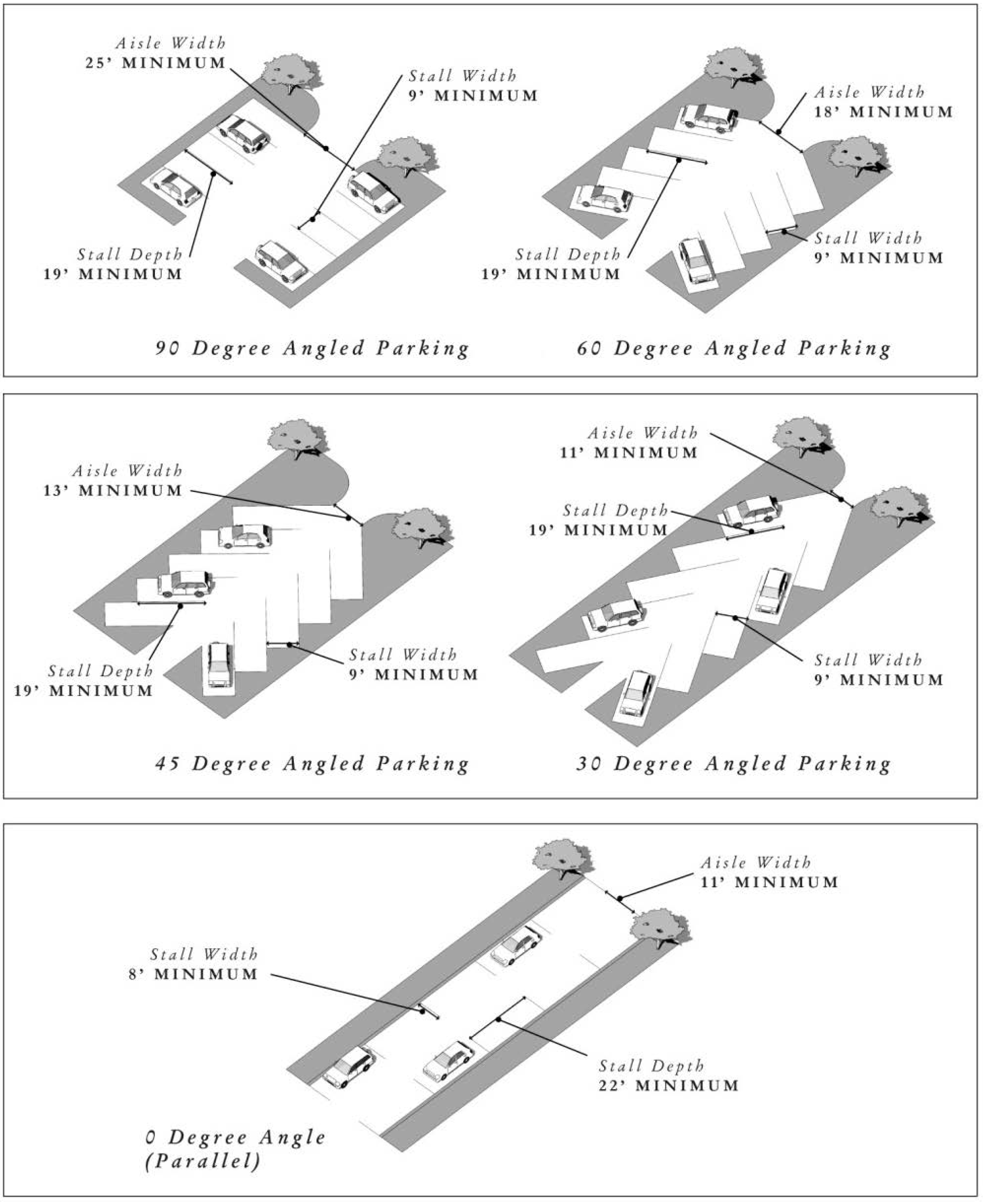
Standard parking spaces shall be nine (9) feet wide by nineteen (19) feet long.
b.
Angled and parallel parking spaces and parking lot aisles shall comply with the dimensions in Table 24-95-1 (Minimum Angled and Parallel Parking Stall Dimensions) and Figure 24-95-1 (Parking Dimension Standards).
FIGURE 24-95-1 PARKING DIMENSION STANDARDS
1.
Surfacing.
a.
All parking areas shall be surfaced with a dust-minimizing treatment or paved with asphalt, concrete or other all-weather surface.
b.
Permeable paving materials such as porous concrete/asphalt, open-jointed pavers, and turf/gravel grids are a permitted surface material.
c.
The use of light colored materials to help reduce surface temperatures is encouraged.
2.
Road Access. All parking areas shall provide suitable maneuvering room so that all vehicles may enter and exit an abutting street in a forward direction.
3.
Drainage. Drainage for all parking areas shall comply with the requirements of the Department of Public Works.
4.
Maintenance. All parking facilities shall be permanently maintained free of weeds, litter, and debris.
5.
Lighting. All outdoor lighting used to illuminate parking areas shall comply with the requirements of Section 24-67 (Standards) in Article III, Division 4 (Outdoor Lighting).
6.
Driveways. A residential parcel with vehicular access from a major or secondary arterial shall provide, if space allows, a circular driveway or turnaround so that vehicles may enter and exit the street in a forward motion.
7.
Compact Parking Stalls.
a.
Parking facilities may provide compact parking stalls for no more than ten (10) percent of the total required parking spaces.
b.
The dimensions and design of compact parking stalls shall be a minimum eight (8) feet wide by sixteen (16) feet long.
c.
All parking spaces for compact cars shall be clearly marked with the word "Compact" either on the wheel stop or curb, or on the pavement at the opening of the space.
d.
Compact parking stalls shall be reasonably dispersed throughout the parking area.
B.
Urban Zone Standards. The following standards shall apply only in urban zones.
1.
Labels and Markings.
a.
All spaces reserved for carpools and vanpools shall be clearly marked with the words "Carpool Only" or "Vanpool Only" on either the wheel stop or curb at the back of each space, or on the pavement at the opening of the space.
b.
Within multiple-family residential developments, required guest parking spaces shall be clearly marked with the word "Guest" either on the wheel stop or curb at the back of each space, or the pavement at the opening of the space.
2.
Pedestrian Access.
a.
Commercial and office developments with more than one hundred (100) parking spaces shall include pedestrian walkways at a minimum width of four (4) feet connecting the furthest distance of the parking area to the building which it serves.
b.
Pedestrian walkways shall be clearly visible and distinguished from parking spaces and areas for vehicle circulation through striping, use of alternative paving materials, or other method approved by the Zoning Administrator.
3.
Wheel Stops and Curbs.
a.
Drive aisles and parking surfaces contiguous with planter areas shall have a six (6) inch raised curb separation.
b.
All parking spaces located adjacent to buildings or walls shall have concrete wheel stops located at least two (2) feet from the building or wall.
4.
Passenger Loading Areas.
a.
Passenger loading areas shall be provided for any building or building complex that will generate one hundred (100) or more employees at maximum occupancy. Such areas shall be located convenient to the primary employee entrances, and shall be designated either by signs or painted pavement.
b.
Passenger loading areas shall be designed so that vehicles can safely stop and discharge passengers.
5.
Lighting. All employee and visitor parking areas shall include lighting capable of providing adequate illumination for security and safety. Lighting fixtures shall be placed to avoid interference with mature trees and other required landscaping.
6.
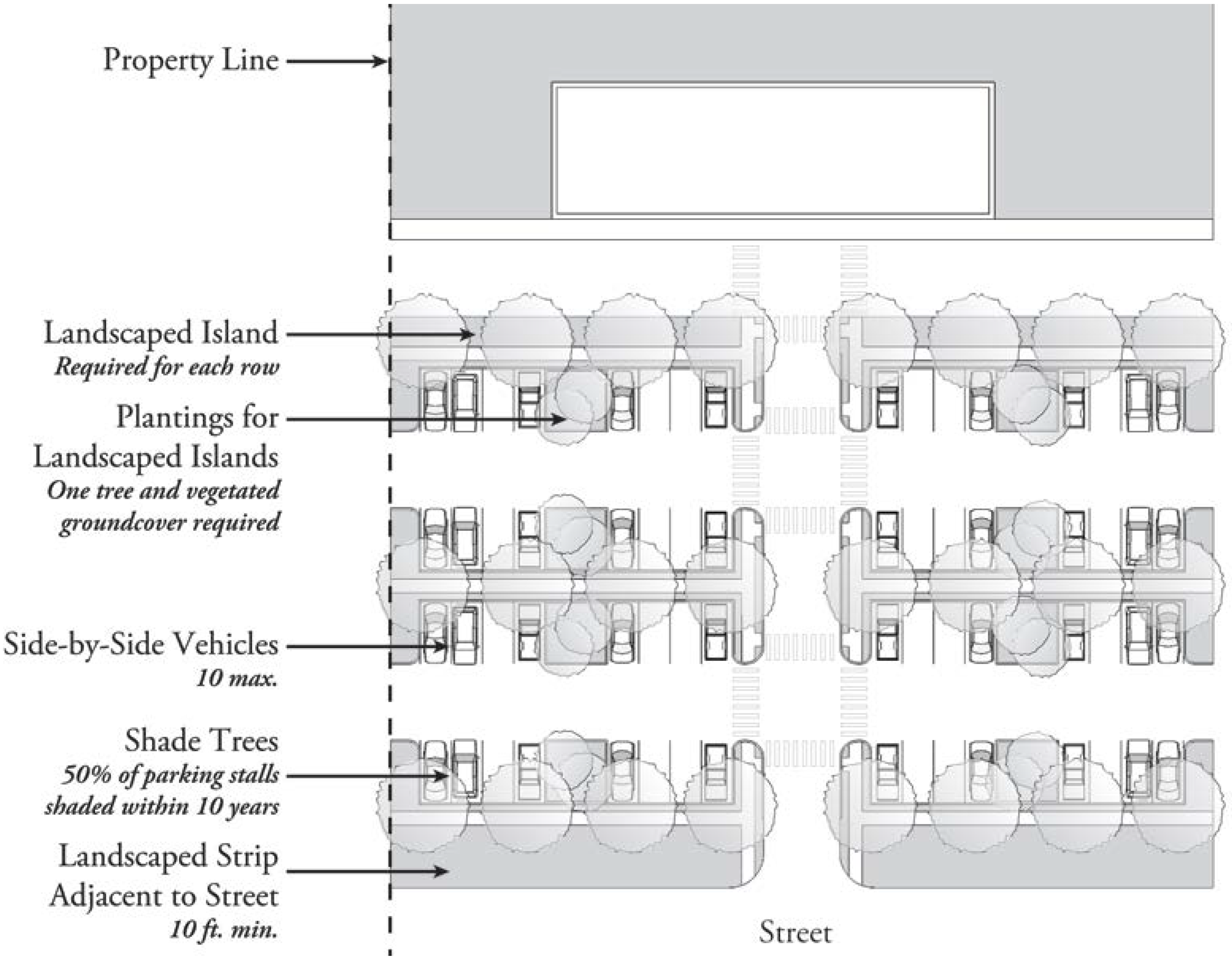
Landscaping. Parking areas shall comply with the following landscaping standards, as illustrated in Figure 24-95-2 (Parking Lot Landscaping Standards).
a.
Street Frontage Landscaping.
1.
When a parking lot is located adjacent to a public or private street, or a main drive aisle that functions as a street, a ten (10) foot landscaped strip shall be provided between the parking area and the street or drive aisle.
2.
The landscape strip may not contain any paved surfaces, except for pedestrian walkways or vehicular drives that cross the strip.
b.
Landscaping Adjacent to a Residential Use.
1.
When a parking lot is located adjacent to a residential zone, an eight (8) foot landscaped strip shall be provided between the parking area and the street, drive aisle or residential property.
2.
The landscape strip may not contain any paved surfaces, excepting pedestrian walkways or vehicular drives that cross the strip.
c.
Parking Lot Landscaping.
1.
Within parking lots, landscaping shall be provided as specified by Table 24-95-2 (Residential/Commercial/Industrial Interior Parking Lot Landscape Requirements). For the purposes of this section, parking lot landscaping is defined as any landscaped area surrounded on at least two (2) sides by parking spaces or drive aisles, excluding those areas around the site or structure perimeter.
FIGURE 24-95-2 PARKING LOT LANDSCAPING STANDARDS
d.
Landscape Islands.
1.
All rows of parking spaces shall feature landscape islands at each row terminus to protect parked vehicles, ensure visibility, confine moving traffic to drive aisles and driveways, and provide space for landscaping.
2.
Landscape islands shall be provided within each row of parking spaces so as to prevent more than ten (10) vehicles from being parked side-by-side in an abutting configuration.
3.
An island for a single row of parking spaces shall contain at least one (1) tree and vegetative groundcover or turf.
4.
An island for a double row of parking spaces shall contain at least two (2) trees and vegetative groundcover or turf.
e.
Concrete Curbs.
1.
All landscape areas within parking lots shall be separated from parking spaces, drive aisles, and driveways by a continuous, raised concrete curb to protect landscaped areas from encroachment by vehicular traffic.
2.
The concrete curb shall be a minimum of six (6) inches high by six (6) inches wide, except where a landscape area is parallel and adjacent to a parking stall, the curb shall be a minimum of six (6) inches high by twelve (12) inches wide to provide an area for persons to step when entering or exiting a motor vehicle.
f.
Shade Trees.
1.
Shade trees shall be provided within parking lots so that within ten (10) years of planting fifty (50) percent of the parking area is shaded at the summer solstice (June 21).
2.
At least one (1) tree shall be provided for every four (4) parking spaces, with the maximum spacing between trees or clusters of trees not to exceed thirty (30) feet.
3.
This requirement is waived if fifty (50) percent or more of the parking lot is covered by a Solar Canopy (Butte County Code Section 24-157 C. 8.). If less than fifty (50) percent of the parking lot is covered by a solar canopy, shade trees shall be used to reach the fifty (50) percent requirement.
g.
Permanent Landscaped Areas. All areas not used for driveways, maneuvering areas, parking spaces, or walks within a parking area shall be permanently landscaped with suitable materials and permanently maintained.
h.
Rainwater Management. Rainwater shall be managed on-site with designs that encourage infiltration, evapotranspiration, and water re-use by:
1.
Utilizing permeable paving for parking spaces, drive aisles, overflow parking, and other hard surfaces in the parking lot, where applicable;
2.
Planting trees, shrubs, and other permeable landscaping throughout the parking lot to provide shade and places for water infiltration;
3.
Creating bio-retention areas, such as swales, vegetated islands and overflow ponds; and
4.
Incorporating opportunities to harvest rainwater (active or passive) from rooftops and other hard surfaces for landscape irrigation.
i.
Solar Panel Exemptions. Parking lots that incorporate solar panels into the parking lot design are eligible for reduced parking lot landscaping requirements with the approval of a Minor Use Permit.
7.
Screening. Within commercial and industrial zones, parking areas that abut residentially zoned property shall be screened by a row of densely planted evergreen trees or similar landscaping.
8.
Access to Right-of-Way. Any parking lot or loading facility with vehicular access to or across a public right-of-way shall meet the following standards:
a.
Joint access ways serving adjacent uses shall be provided wherever possible as a means to minimize curb cuts and avoid breaks in the continuity of street frontages.
b.
The maximum allowed width for a residential curb cut shall be twenty-four (24) feet. The maximum allowed width for a non-residential curb cut shall be thirty-five (35) feet.
9.
Driveways.
a.
Driveways for single-family residences shall be at least ten (10) feet wide.
b.
All other driveways or aisles shall be at least twelve (12) feet wide for one-way traffic and twenty (20) feet wide for two-way traffic.
(Ord. No. 4062, § 1, 9-10-13; Ord. No. 4132, § 1(Att. A), 9-12-17)
24-96 - Bicycle facilities.
A.
Applicability. The following bicycle facility standards shall apply only in urban zones
B.
Parking for Bicycles.
1.
For non-residential uses, bicycle parking spaces shall be provided at a rate appropriate for the use. Spaces may be in the form of racks (for more transient use) or lockers (for long-term use by employees).
2.
For multiple-family housing, bicycle parking spaces shall be provided at a rate equal to ten (10) percent of the total required parking spaces.
3.
Bicycle parking shall be located in highly visible locations and weather protected areas.
4.
Bicycle and automobile parking areas shall be separated from one (1) another by a physical barrier or sufficient distance to protect bicycles and their riders from damage.
5.
Bicycle parking and storage areas shall be paved with asphalt, concrete, or other all-weather surface.
C.
Shower Facilities.
1.
Employee shower facilities and dressing areas shall be provided in new and rehabilitated buildings that result in a total floor area as identified in Table 24-96-1 (Shower Facilities Required for Employees).
(Ord. No. 4062, § 1, 9-10-13)
24-97 - On-site loading.
A.
General Requirements.
1.
On-site freight and equipment loading spaces shall be provided for all commercial, office, and industrial land uses.
2.
The minimum numbers of loading spaces are shown in Table 24-97-1 (Required Loading Spaces).
3.
Industrial developments with two (2) or more dock-high loading spaces shall provide one (1) trailer parking/waiting space, twelve (12) feet wide by forty-five (45) feet long minimum, for each two (2) loading spaces.
B.
Dimensions.
1.
Each loading space shall have minimum dimensions of twelve (12) feet wide, forty (40) feet long and fourteen (14) feet in vertical clearance.
2.
Deviations from the minimum maneuvering standards may be approved by the Zoning Administrator if the spatial needs are less than the minimum required due to the truck size and type that will be utilized in the operation of a specific business.
C.
Location.
1.
Loading areas shall be designed to ensure that loading and unloading takes place on-site and in no case within adjacent public rights-of way.
2.
Loading and maneuvering areas shall not encroach into required employee or visitor parking areas or other areas on-site required for vehicle circulation.
3.
Loading and maneuvering areas shall not encroach into required front yard setback.
4.
Where loading docks or doors face a private street or main drive aisle serving three (3) or more units, loading doors and openings shall be positioned such that they do not face the private street or drive aisle.
D.
Striping and Identification. Loading areas shall be striped and clearly identified as for loading purposes only.
E.
Wheel Stops and Curbs. Loading areas contiguous with planter areas shall have a 6-inch raised curb separation.
(Ord. No. 4062, § 1, 9-10-13)
24-98 - Purpose.
This article establishes regulations relating to the permitted type, size, height, placement, and design of signs. The intent of these regulations is to:
A.
Support economically viable businesses serving County residents, workers and visitors;
B.
Preserve and enhance the scenic qualities of rural and open space areas;
C.
Promote high quality design and attractive communities within urban areas;
D.
Minimize hazards to pedestrians and motorists caused by distracting sign displays; and
E.
Provide standards for signs that safeguard life, health, property, and the public welfare.
(Ord. No. 4062, § 1, 9-10-13)
24-99 - Applicability.
The standards in this article apply to signs within all zones.
(Ord. No. 4062, § 1, 9-10-13)
24-100 - Definitions.
A.
Awning Sign. A sign incorporated into, attached to, or painted on an awning.
B.
Banner Sign. A sign made of fabric, cloth or any other non-rigid material.
C.
Community Identification Sign. A sign that identifies or announces entry into a city, neighborhood, or unincorporated community within Butte County.
D.
Farm Sign. A sign identifying a farm or ranch, including an agricultural processing business.
E.
Farm Trail Sign. A sign identifying an agricultural use, farm trail or tour route, including wineries and tasting rooms, olive oil manufacturing and tasting, and other agritourism destinations, which offer on-site product sales, educational programs, and other services in order to promote and market local agricultural operations in the county.
F.
Freestanding Sign. A sign fixed in an upright position on the ground not attached to a structure other than a framework, pole, or device that is erected primarily to support the sign. Excludes Monument signs.
G.
Freestanding Sign, Digital. A sign fixed in an upright position on the ground not attached to a structure other than a framework, pole, or device that is erected primarily to support the sign that uses digital display technology as a means of changing sign images. Excludes Monument signs.
H.
Freeway Sign. An on-site sign that advertises a business providing a service primarily for the freeway-motoring public, such as gas, food, or lodging.
I.
Monument Sign. An independent, freestanding structure supported on the ground having a solid base as opposed to being supported by poles or open braces.
J.
Monument Sign, Digital. An independent, freestanding structure supported on the ground having a solid base as opposed to being supported by poles or open braces that uses digital-display technology as a means of changing sign images.
K.
Off-Site Sign. A sign identifying a use, facility, service, or product which is not located, sold, or manufactured on the same premises as the sign or which identifies a use, service, or product by a brand name which, although sold or manufactured on the premises, does not constitute the principal item for sale or manufactured on the premises (aka as a billboard sign).
L.
Off-Site Sign, Digital. An off-site sign as defined above that uses digital-display technology as a means of changing sign images.
M.
Projecting Sign. A sign attached to a building wall and extending away from the wall more than twelve (12) inches, generally at a right angle to the building wall.
N.
Sign. Any device, structure or fixture designed or used to attract attention to an object, person, institution, business, product, service, event, or location by any means, including words, letters, figures, designs, symbols, fixtures, colors, illumination, or projected images.
O.
Temporary Sign. A sign intended to be displayed for a limited period of time and capable of being viewed from a public right-of-way, parking area or neighboring property.
P.
Wall Sign. A sign which is attached to or painted on the exterior wall of a structure with the display surface of the sign approximately parallel to the building wall. Wall signs include any interior sign which faces a window exposed to public view and is located within five (5) feet of the window.
Q.
Window Sign. A sign posted, painted, placed, or affixed in or on a window exposed to public view.
(Ord. No. 4062, § 1, 9-10-13; Ord. No. 4091, § 1, 1-27-15; Ord. No. 4161, § 1(Att. A), 5-7-19)
24-101 - Signs allowed without permits.
A.
Types of Signs. The following signs are allowed without a permit and do not count towards the allowable area or number of signs on a site.
1.
A sign no greater than eight (8) square feet that is consistent with all applicable standards in this article.
2.
Temporary signs. See Section 24-108 (Temporary Signs).
3.
Directional signs.
4.
On-site directional or informational signs that provide information for the convenience or safety of the public, with a maximum area of five (5) square feet. This type of sign includes directional signs in parking lots, signs listing hours of business, and signs identifying the locations of telephones or restrooms.
5.
Official flags of any municipality, state, nation, or fraternal or religious organization, if the pole height is twenty-five (25) feet or less and the flag's longest dimension is twenty-five (25) percent or less of the pole's length.
6.
One (1) commemorative plaque that is cut into a permanent building material or made of a noncombustible material, with a maximum area of sixteen (16) square feet.
7.
One (1) construction sign, with a maximum area of thirty-two (32) square feet.
8.
One (1) professional name plate, with a maximum area of sixteen (16) square feet.
9.
One (1) bulletin board on the premises of a meeting facility or public building, with a maximum area of twelve (12) square feet.
10.
One (1) garage sale sign at the residence where the garage sale is taking place, with a maximum area of sixteen (16) square feet.
11.
Signs within a building, or on the premises of a building, that are not visible from a public street.
12.
Murals on the exterior of a building that do not advertise a product, business, or service.
13.
Temporary exterior decorations and banners that are associated with a seasonal, cultural, religious, or national holidays, and that are not used to advertise a product, business, or service.
14.
Signs that are required by local, State, or federal law or by court order.
15.
Signs that are posted or required by a government agency, or a public utility or service, or private road signs installed in accordance with County standards that are essential to protect the public health, safety, and welfare, including official signs for traffic control, official public notices, and warnings of potential hazards.
16.
On-site signs used by businesses providing directional information for access, circulation, and transportation.
B.
Changes to Sign Face. Changes to a sign face that do not structurally alter the sign or its size are allowed without a permit.
(Ord. No. 4062, § 1, 9-10-13)
24-102 - Permit requirements.
A.
Administrative Permit Required. All signs not specifically identified in Section 24-101 (Signs Allowed Without Permits) require Zoning Administrator approval of an Administrative Permit, except as noted in subsection C, D and E below.
B.
Submittal Requirements. An Administrative Permit application for a sign shall include all information and materials required by Article 29 (Administrative Permits). A conditional use permit or minor use permit application for a sign shall include all information and materials required by Article 31 (Conditional Use and Minor Use Permits). Applications shall also include:
1.
The name and address of the property owner and the sign contractor;
2.
Site plans showing the location of the proposed sign;
3.
Scale drawings showing the sign design and materials;
4.
An inventory of the location, sign area, and sign type of all existing signs on the site, excluding signs that are allowed without a permit; and
5.
Any additional information required by the Zoning Administrator to verify compliance with this article.
C.
Zones Abutting Residential Zones. A Conditional Use Permit shall be required for any freestanding, freeway, or off-site sign proposed on any Commercial, Mixed-Use, or Industrial zone that abuts a residential zone.
D.
Off-Site Sign, Digital. A minor use permit shall be required for any off-site digital sign.
E.
Freeway Signs, Agriculture Zones. A Minor Use Permit shall be required for any Freeway sign in an Agriculture Zone.
(Ord. No. 4062, § 1, 9-10-13; Ord. No. 4091, § 1, 1-27-15; Ord. No. 4132, § 1(Att. A), 9-12-17)
24-103 - Prohibited signs.
The following signs shall be prohibited:
A.
Signs that identify a use, facility, or service which is not located on the parcel or premise where the sign is located, except for temporary real estate signs consistent with Section 24-108 (Temporary Signs) and off-site billboards in industrial zones and the General Commercial zone consistent with Section 24-105 (Types of Signs Allowed by Zone).
B.
Any sign that projects above the building wall or roof to which it is affixed.
C.
Signs that have become a public nuisance due to inadequate maintenance, dilapidation, or abandonment.
D.
Signs that obstruct a door, window, fire escape, or other required access way.
E.
Signs that encroach into any right-of-way or easement, means of ingress or egress, or path of travel, except as specifically allowed by this article.
F.
Signs containing obscene matter.
G.
Signs that were unlawfully installed, erected, or maintained.
H.
Signs that include any part that appears to flash, blink, move, change color, or change intensity, excluding approved digital signs, standard barber poles, time and temperature signs that are located in commercial and industrial zones, and community identification signs.
I.
Signs that emit sound.
J.
Signs that interfere with visibility for drivers at an intersection, public right-of-way, or driveway.
K.
Signs adversely affecting traffic control or safety.
L.
Signs located on public property, excluding official signs that are posted or required by a government agency, public utility, or public service.
M.
Signs attached to a tree.
N.
Signs that have less horizontal or vertical clearance from overhead utilities than required by State agencies.
(Ord. No. 4062, § 1, 9-10-13; Ord. No. 4091, § 1, 1-27-15; Ord. No. 4161, § 1(Att. A), 5-7-19)
24-104 - General standards.
A.
Measurement of Sign Area.
1.
The area of each face of a sign is measured as the area of the smallest rectangle or circle that encloses all of the words, characters, images, and symbols on the sign face, and also includes any border or frame around any information and any background color on the sign face.
2.
The area of a sign that has two (2) parallel and back-to-back faces is counted only once. For such a sign, the area shall be measured as the area of the largest face.
3.
The area of a three (3) dimensional sign is measured as the area of the smallest rectangle that encloses the projection of that sign onto a vertical plane.
4.
Structural elements that are clearly incidental to the display of a sign and that do not include advertising are not counted as part of a sign's area.
B.
Maintenance. Signs shall be maintained in a state of good repair at all times. Damage to signs, including cracked sign faces, frayed or weathered fabric, and broken lighting, shall be repaired.
C.
Illumination. All signs may be illuminated from an internal or external light source. Illuminated signs in residential zones shall comply with the provisions of Article III, Division 4 (Outdoor Lighting). Signs with individual, three (3) dimensional letters may also use rear "halo" illumination for each letter.
D.
Setbacks. Freestanding, monument, freeway, and off-site signs taller than forty-two (42) inches shall not be located within fifteen (15) feet of any parcel line adjacent to a residential zone or within fourteen (14) feet of any intersection, driveway or alley, or obstruct adequate and safe sight distance for vehicles as determined by the Director of Public Works, unless it can be certified by a Registered Civil Engineer that the sign will not obstruct adequate and safe sight distances. There shall be no setback requirements for all other types of signs. No sign shall be placed within any road right-of-way.
E.
Removal. If an establishment ceases to operate for a period of two (2) years, all signs and their structures associated with the establishment shall be removed. Blank, broken, abandoned, or unused signs on a parcel not used by the existing business shall be removed, unless a plan for use is presented and approved by the Zoning Administrator.
F.
Content Neutrality. It is the County's policy to regulate signs in a constitutional manner that is content neutral.
G.
Traffic Safety. No sign shall restrict safe sight distances for vehicles on any public or private road as approved by the Director of Public Works.
(Ord. No. 4062, § 1, 9-10-13)
24-105 - Types of signs allowed by zone.
A.
Residential Zones.
1.
A dwelling unit may display one (1) wall or window sign, in conjunction with a Home Occupation (Section 24-162).
2.
A multiple-family residential development that contains at least four (4) dwelling units may include one (1) entrance or freestanding sign, with a maximum area of ten (10) square feet, and one (1) window, awning, or canopy sign, with a maximum area of five (5) square feet.
3.
For residential subdivisions of fifteen (15) or more units, a maximum of two (2) monument or freestanding signs may be displayed at each entrance to the subdivision. Each sign shall have a maximum area of eighteen (18) square feet and a maximum height of six (6) feet. The signs shall be located on privately-owned parcels, and a requirement for permanent maintenance by a homeowners' association or similar entity shall be recorded on the parcels.
B.
Commercial, Mixed Use, and Public Zones.
1.
In all commercial and mixed use zones, signs shall be permitted as specified in Table 24-105-1 (Allowed Signs in Commercial, Mixed Use, and Public Zones). Types of signs are illustrated in Figure 24-105-1 (Sign Types).
[1]
Off-site signs shall be located a minimum distance of five hundred (500) feet from another off-site sign on the same side of street that is four (4) lanes (two (2) lanes in each direction) and three hundred (300) feet between signs on streets or roads that are two (2) lanes (one (1) lane in each direction).
[2]
Thirty-five (35) feet for two-lane roads (one (1) lane in each direction)
[3]
Off-site signs are permitted in the General Commercial zoning district only.
[4]
Prohibited in Mixed Use zones.
2.
Signs associated with a residential use or parcel within a commercial or mixed use zone shall comply with Subsection A (Residential Zones) above.
C.
Industrial Zones. In all industrial zones and the Airport (AIR) zone, signs are permitted as specified in Table 24-105-2 (Allowed Signs in Industrial and Airport (AIR) Zones).
FIGURE 24-105-1 SIGN TYPES
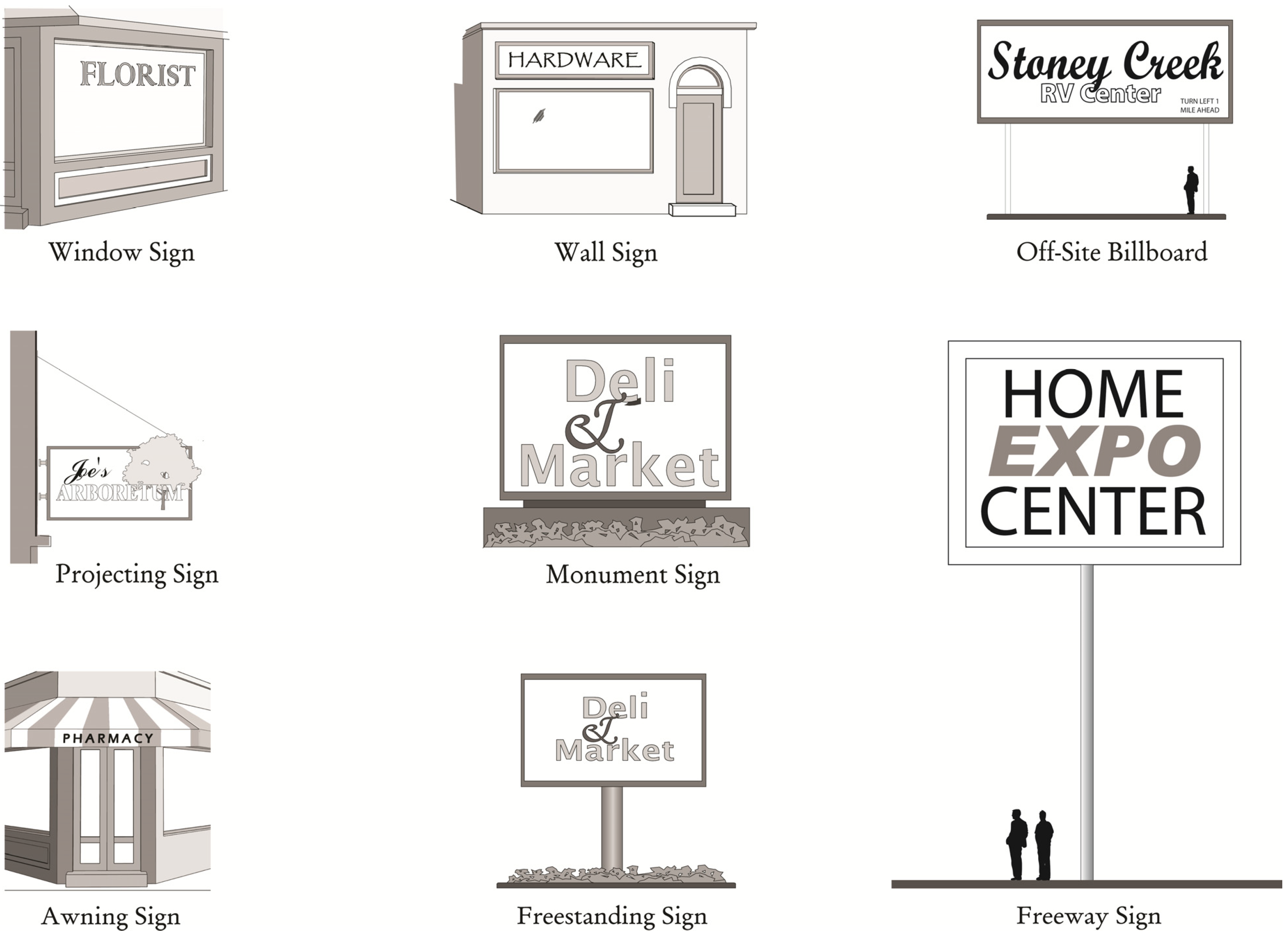
Notes:
[1]
Off-site signs shall be located a minimum distance of five hundred (500) feet from another off-site sign on the same side of street that is four (4) lanes (two (2) lanes in each direction) and three hundred (300) feet between signs on streets or roads that are two (2) lanes (one (1) lane in each direction).
[2]
Off-site signs are permitted in industrial zoning districts only.
[3]
Thirty-five (35) feet for two-lane roads (one (1) lane in each direction).
[4]
Freestanding signs, digital, and monument signs, digital are subject to a minor use permit in the Airport Zone.
D.
Agriculture and Natural Resource Zones.
1.
In all agriculture and natural resource zones, signs shall be permitted as specified in Table 24-105-3 (Allowed Signs in Agriculture and Natural Resource Zones).
Notes:
[1]
Allowed only in the Agriculture zone.
2.
The maximum total area for all signs on an agricultural parcel shall be 1-square-foot per lineal foot of building frontage, or two hundred (200) square feet, whichever is less.
3.
Signs associated with a residential use or parcel within an agriculture zone shall comply with Subsection A (Residential Zones) above.
E.
Planned Development (PD) and Research Business Park (RBP) Zone. Signage within Planned Development (PD) and Research Business Park (RBP) zones shall comply with the standards and specifications contained within an approved Master Sign Program.
(Ord. No. 4062, § 1, 9-10-13; Ord. No. 4091, § 1, 1-27-15; Ord. No. 4161, § 1(Att. A), 5-7-19)
24-106 - Standards for specific types of signs.
A.
Freeway Signs. Freeway signs shall be permitted only if all of the following criteria are met:
1.
The sign is located on the same parcel as the business being advertised;
2.
The sign is located on a parcel that is located a maximum distance of eight hundred (800) feet from the centerline of State Route 99 and/or State Route 70 at its closest point; and
3.
The sign advertises a business that provides a service primarily for the freeway-motoring public, such as gas, food, or lodging.
B.
Awning Signs. Awning signs that are suspended beneath an awning shall provide at least eight (8) feet of clearance above the ground, shall not extend more than five (5) feet into the public right-of-way, and shall provide a minimum two (2) foot horizontal clearance from the street curb face. See Figure 24-106-1 (Awning Signs).
C.
Projecting Signs. Projecting signs shall provide at least eight (8) feet of clearance above the ground, shall not extend more than five (5) feet into the public right-of-way, and shall provide a minimum two (2) foot horizontal clearance from the street curb face. See Figure 24-106-2 (Projecting Signs).
FIGURE 24-106-1 AWNING SIGNS
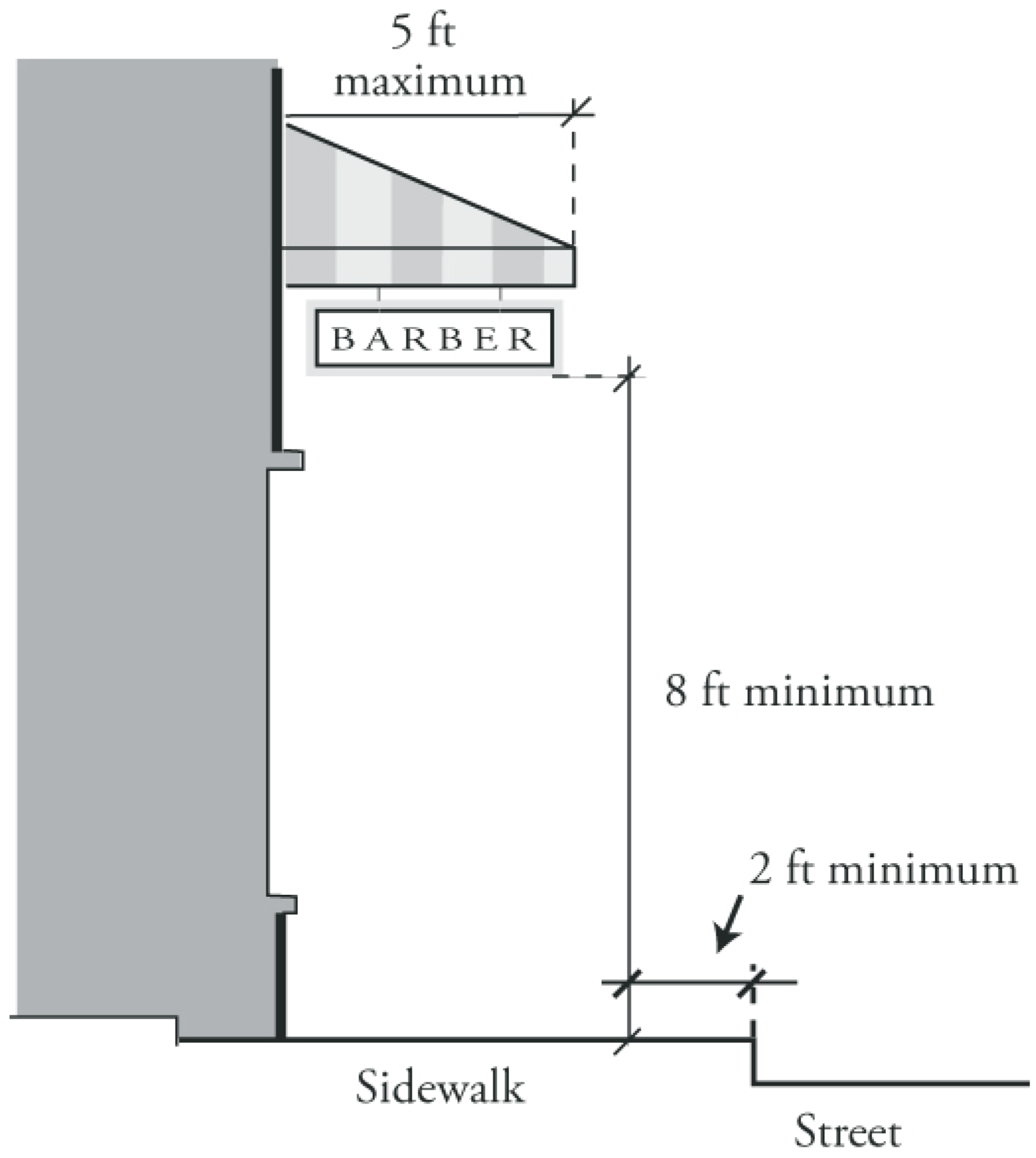
FIGURE 24-106-2 PROJECTING SIGNS
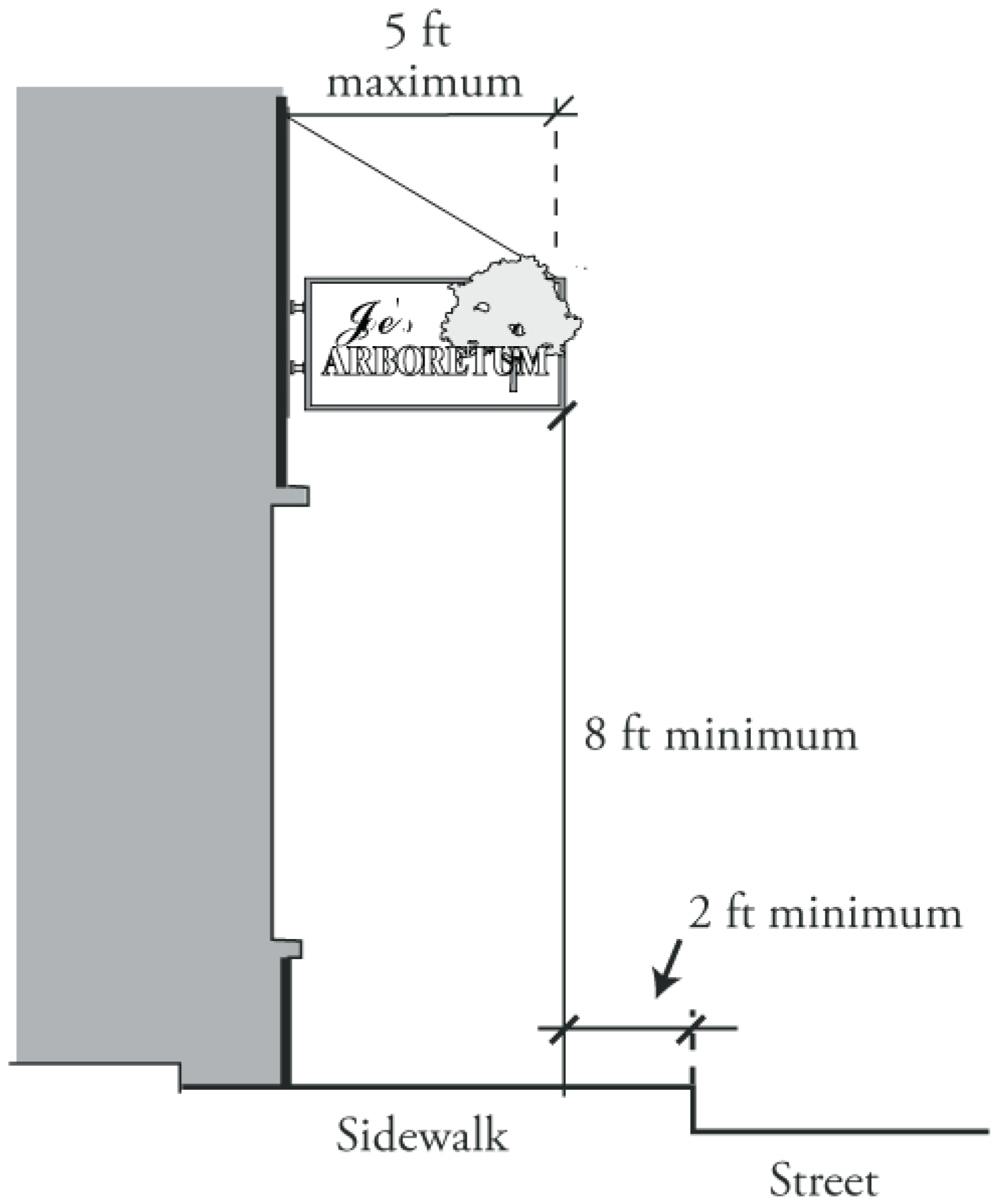
D.
Window Signs. Window signs shall not cover more than twenty-five (25) percent of any window. If a window has multiple panes, the window's total area shall be measured as the framed area of all panes.
E.
Digital Signs, Off-Site, Freestanding, and Monument. Off-site, freestanding, and monument digital signs shall be permitted only if all of the following criteria are met:
1.
All digital display faces must be oriented primarily for viewing from the adjacent roadway.
2.
The sign may only present a series of still images, each of which is displayed for at least eight (8) seconds. The still images may not move or present the appearance of motion and may not use flashing, scintillating, blinking, or traveling lights or any other means not providing constant illumination. Transition between one (1) still image and the next shall not include any interval of black or blank screen time.
3.
The light emitted from the sign shall not be of an intensity or brilliance as to cause direct illumination of an adjacent residential area, impair the vision of any driver, or interfere with any driver's operation of a motor vehicle. The following standards for lighting are required for all digital signs:
a.
The sign shall contain an automatic dimmer and a photo cell sensor to adjust the luminance intensity or brilliance in accordance with these standards.
b.
The sign shall not operate at an intensity or brilliance that will exceed three-tenths (0.3) footcandles above ambient light (as measured using a footcandle meter at a distance of two hundred fifty (250) feet from the sign face).
c.
The sign shall not operate at an intensity or brilliance that will exceed one-tenth (0.1) footcandles above ambient light as measured using a footcandle meter in any adjacent residential zone.
(Ord. No. 4062, § 1, 9-10-13; Ord. No. 4091, § 1, 1-27-15; Ord. No. 4161, § 1(Att. A), 5-7-19)
24-107 - Master sign program.
A.
Purpose. The purpose of these Master Sign Program provisions is to provide a coordinated approach to signage for multi-tenant commercial developments.
B.
Applicability.
1.
A Master Sign Program shall be prepared for multi-family use with more than one (1) permanent sign proposed, and any non-residential development with six (6) or more tenants.
2.
A Master Sign Program shall be required for any proposed development project within a Planned Development (PD) and Research Business Park (RBP) zone.
C.
Permit Required. A Master Sign Program shall require the approval of an Administrative Permit.
D.
Application. An Administrative Permit application for a Master Sign Program shall include all information and materials specified in Section 24-102 (Permit Requirements). In addition, an application shall include a written statement identifying how the proposal will modify any of the regulations or standards of this article, if applicable, and explaining how these modifications would contribute to a superior project design than would otherwise result from the standards contained in this article.
E.
Design Standards.
1.
A Master Sign Program may deviate from standards contained in this article relating to permitted sign height, number of signs, sign area, and type of sign.
2.
Master Sign Programs shall feature a unified and coordinated approach to the materials, color, size, type, placement, and general design of signs proposed for a project or property.
F.
Effect of Master Sign Program.
1.
All subsequent signs proposed for a development or property subject to an approved Master Sign Program shall comply with the standards and specifications included in the Master Sign Program.
2.
Approval of a Master Sign Program shall supersede the regulations of this article. Any aspect of the proposed signs not addressed by the Master Sign Program shall be in compliance with this article.
(Ord. No. 4062, § 1, 9-10-13)
24-108 - Temporary signs.
Temporary signs that comply with the following standards shall be permitted without an Administrative Permit.
A.
Real Estate Signs, On-Site.
1.
Residential properties.
a.
One (1) sign no more than six (6) square feet in area and six (6) feet in height shall be permitted on an individual parcel.
b.
Two (2) temporary signs no more than thirty-two (32) square feet in area and six (6) feet in height shall be permitted for residential subdivisions with four (4) or more parcels with less than fifty (50) percent of parcels sold.
2.
Non-residential properties. One (1) sign no more than thirty-two (32) square feet in area and six (6) feet in height shall be permitted for each street frontage.
3.
All temporary on-site real estate signs shall be removed seven (7) days after property is no longer offered for lease, rent, or sale.
B.
Real Estate Signs, Off-Site
1.
Portable "open house" A-frame real estate signs shall be no more than three (3) feet in height and six (6) square feet in area. Signs shall be prohibited within the public right-of-way and shall remain in place for a maximum duration of forty-eight (48) hours.
2.
Non-portable real estate, subdivision, or development signs secured in place at a specific off-site location shall be no more than thirty-two (32) square feet in area and six (6) feet in height. Signs may be displayed for a maximum duration of two (2) years or the duration of development activity, whichever is less. No more than two (2) signs may be displayed for a single property, subdivision, or development project.
C.
Political Signs.
1.
Signs shall be installed no earlier than ninety (90) days prior to the election and removed no later than seven (7) days following the election.
2.
Signs shall be prohibited within the public right-of-way.
D.
Special Events.
1.
Temporary signs for special functions, such as sales and grand openings, shall be allowed only in non-residential zones.
2.
One (1) sign no more than twenty-four (24) square feet in area and twelve (12) feet in height as measured from the top of the sign to the ground below it shall be permitted for each street frontage.
3.
Signs may be displayed for a maximum duration of fourteen (14) consecutive days at a frequency of no greater than once each calendar quarter.
E.
Business Identification.
1.
Temporary business identification signs, either freestanding or mounted on a building, may be permitted prior to installation of permanent signs for a newly established business.
2.
One (1) sign no more than twenty-four (24) square feet in area and twelve (12) feet in height as measured from the top of the sign to the ground below it shall be permitted for each street frontage.
3.
Signs may be displayed for a maximum duration of ninety (90) consecutive days.
(Ord. No. 4062, § 1, 9-10-13)
24-109 - Nonconforming signs.
A.
Any sign that does not comply with the requirements of this article but which was constructed, operated, and maintained in compliance with all previous regulations, shall be regarded as a legal nonconforming use.
B.
A nonconforming sign that has been abandoned, or whose advertised use has ceased to function for a period of one hundred eighty (180) days or more, shall be brought into conformity or removed.
C.
The following requirements apply to the reconstruction of a legal nonconforming sign.
1.
Reconstruction of a legal nonconforming sign that has been demolished or destroyed shall begin within one-year and shall be completed within three (3) years.
2.
The reconstructed sign shall not exceed the original structure in regards to maximum height, size, encroachment into setbacks, and other property characteristics as determined by the Zoning Administrator.
3.
Non-conforming standard off-site signs may be converted to off-site digital signs with the approval of a minor use permit.
4.
The Zoning Administrator may approve an extension of two (2) additional years to complete reconstruction of the demolished sign.
5.
If reconstruction is not completed by the specified time limit, the property shall be deemed abandoned.
D.
The following exceptions apply to the above requirements for nonconforming signs:
1.
A sign that is part of a designated historic resource may be deemed nonconforming only if at least one (1) of the following conditions applies:
a.
The sign does not contribute to the historic significance of the historic landmark.
b.
The sign poses an immediate threat to public safety. If the sign is deemed nonconforming solely because it threatens public safety, it shall be repaired or modified, if possible, rather than removed.
(Ord. No. 4062, § 1, 9-10-13; Ord. No. 4091, § 1, 1-27-15)
24-110 - Purpose.
This article establishes landscaping standards to enhance the aesthetic appearance of developed areas within the county and to promote the efficient use of water resources.
(Ord. No. 4062, § 1, 9-10-13)
24-111 - Applicability.
A.
The requirements contained in this article shall apply only to properties located within urban zones.
B.
The following development projects within urban zones shall install and maintain landscaping in compliance with the requirements of this article:
1.
New construction and rehabilitated landscapes for public agency projects and private development projects with a landscape area equal to or greater than two thousand five hundred (2,500) square feet requiring a building permit.
2.
New construction and rehabilitated landscapes which are developer-installed in single family and multi-family projects with a landscape area equal to or greater than two thousand five hundred (2,500) square feet requiring a building permit.
3.
New construction landscapes which are homeowner-provided and/or homeowner-hired in single-family and multi-family residential projects with a total project landscape area equal to or greater than five thousand (5,000) square feet requiring a building permit.
4.
The construction of a new parking lot or the reconstruction of an existing parking lot.
(Ord. No. 4062, § 1, 9-10-13)
24-112 - Model water efficient landscaping ordinance.
In addition to the standards contained in this article, all applicable development in Butte County shall also comply with the Model Water Efficient Landscaping Ordinance prepared by the California Department of Water Resources (DWR), when required by the California Water Conservation in Landscaping Act (Government Code Section 65591 et seq.) If conflicts occur between the Model Water Efficient Landscaping Ordinance and the Zoning Ordinance, the more restrictive shall control.
(Ord. No. 4062, § 1, 9-10-13)
24-113 - Parking lot landscaping.
See Subsection B.6 (Landscaping) in Section 24-95 (Parking Design Standards).
(Ord. No. 4062, § 1, 9-10-13)
24-114 - Landscape plans.
A.
Landscape Plan Required. Projects subject to the requirements of this article shall submit a landscape plan as part of applications for all permits as required by the Zoning Ordinance and as part of subsequent Building Permit applications.
B.
Required Contents. Landscape plans shall include the following features and information:
1.
Site boundaries of the subject property;
2.
Existing structures on the subject property;
3.
Structures immediately adjacent to the subject property;
4.
All new structures and improvements proposed as part of the development project;
5.
Existing landscaping, trees, and vegetation to be retained;
6.
All new landscaping proposed as part of the development project; and
7.
Any additional information as determined by the Zoning Administrator to demonstrate compliance with the requirements of this article.
C.
Review and Approval. The Department of Development Services shall review all landscape plans to verify compliance with the requirements of this article. Landscape plans shall be approved by the review authority acting upon the permit application for the proposed new development, or as assigned by the review authority to the Zoning Administrator.
D.
Changes to Approved Landscape Plans.
1.
Substantial modifications to an approved landscape plan shall be made only by the review authority which approved the landscape plan.
2.
The Zoning Administrator may approve minor modifications to a landscape plan previously approved by the Planning Commission or Board of Supervisors. Minor modifications are defined as changes to a landscape plan that do not decrease the total amount of landscaped area, alter the general design character of the landscaped area, or alter a feature of the landscaped area specifically required by the decision-making authority.
(Ord. No. 4062, § 1, 9-10-13)
24-115 - Landscape standards.
A.
General Standards. The following standards apply within all urban zones.
1.
Plant Selection. Plants shall be selected from a County-approved list of native and non-native, drought-tolerant and non-invasive species.
2.
Turf lawns.
a.
Turf shall be prohibited on slopes twenty-five (25) percent or greater.
3.
Plant Groupings. Where irrigation is proposed, plants shall be grouped in separate hydrozones (i.e., plants within each irrigation valve area shall have the same watering requirements).
4.
Water Features. Decorative water features (e.g., fountains, ponds, waterfalls) shall have recirculating water systems.
5.
Public Safety. Plant species shall be selected and located so that at maturity they do not interfere with pedestrian, bicycle, or vehicular circulation and do not conflict with overhead lights, or utility lines.
B.
Residential Zones. The following standards shall apply within all urban residential zones:
1.
No more than fifty (50) percent of required front and side setbacks may be covered with paving or other impervious surfaces. The review authority may grant exceptions to this requirement for small or irregularly-shaped parcels if compliance would result in inadequate vehicular or pedestrian access to the site, or to accommodate accessibility for disabled persons.
2.
Front yard landscaping shall not completely obscure views of the street and adjoining neighbors.
3.
Unpaved areas shall be landscaped with any combination of living plants such as trees, shrubs and grass or related natural features such as rock, stone or bark chips. Decorative hardscape featuring pervious materials are permitted within required unpaved areas.
4.
For multi-family residential dwellings, all front setbacks that are not occupied by a structure or used for required parking shall be landscaped or maintained as open space.
C.
Commercial, Mixed Use, and Industrial Zones. The following standards shall apply to projects within commercial, mixed use, and industrial zones.
1.
The minimum landscaped area on a site shall be as shown in Table 24-115-1 (Minimum Landscaped Area in Commercial, Mixed Use and Industrial Zones). This minimum area is based upon the applicable zone and the gross floor area of all structures within the site.
Note:
[1]
Based on gross floor area of structures located on-site.
[2]
Forty (40) percent on parcels ten (10) acres or larger
2.
All front setbacks that are not occupied by a structure or used for required parking shall be landscaped or maintained as open space. Impervious surfaces are prohibited within setbacks, except for driveways, emergency access lanes, pedestrian walkways, bicycle paths, and similar improvements as determined by the Zoning Administrator.
3.
Drought-tolerant landscaping is encouraged to satisfy minimum landscaped area requirements.
(Ord. No. 4062, § 1, 9-10-13)
24-116 - Irrigation and water efficiency.
Landscaped areas shall comply with the following irrigation and water efficiency standards and California Green Building Code requirements.
A.
Irrigation System. Water-efficient irrigation systems (e.g., bubbler type, drip, mini-spray) shall be required. Irrigation systems shall include check valves to prevent low head drainage, appropriate nozzles to prevent overspray and automatic and self-adjusting irrigation controllers that include moisture and/or rain sensor shutoff.
B.
Irrigation Schedule. Landscape irrigation shall be scheduled between the hours of 2:00 a.m. and 10:00 a.m. to avoid irrigating during times of high wind, high temperature and high water usage.
(Ord. No. 4062, § 1, 9-10-13)
24-117 - Timing of installation.
Landscaping systems shall be installed prior to final building permit inspection or certification of occupancy.
(Ord. No. 4062, § 1, 9-10-13)
24-118 - Maintenance.
A.
General. Landscape areas shall be maintained in a neat and healthful condition at all times.
B.
Replacement of Dead or Dying Plants. Within ninety (90) days, a plant that is dead or severely damaged or diseased shall be replaced by the property owner in accordance with the standards specified in this article.
C.
Removal of Landscaping. Any removed mature landscaping shall be replaced with landscaping of similar size and maturity as that which was removed.
D.
Irrigation Systems. Irrigation systems shall be maintained in a fully functional manner as approved by the County and required by this article.
(Ord. No. 4062, § 1, 9-10-13)
24-119 - Purpose.
This article establishes regulations for nonconforming uses and structures. In addition, this article is intended to:
A.
Ensure that nonconforming uses and structures do not adversely impact neighboring properties;
B.
Provide for a process to allow for the minor expansion of nonconforming uses and structures;
C.
Allow for repairs and maintenance to nonconforming structures; and
D.
Provide for the elimination of nonconforming uses as appropriate due to abandonment, obsolescence, and destruction.
(Ord. No. 4062, § 1, 9-10-13; Ord. No. 4228, § 1, 5-23-23)
24-120 - Applicability.
This article applies to existing uses and structures which do not conform to the regulation of the zone in which they are located.
(Ord. No. 4062, § 1, 9-10-13; Ord. No. 4228, § 1, 5-23-23)
24-121 - General provisions.
A.
A nonconforming use or structure may be continued if it was legally established in compliance with all applicable regulations in effect at the time it was established.
B.
To be considered legally established, a legal nonconforming use or structure shall have been physically constructed or in existence, not merely contemplated. Conditional Use Permits, Variances, Building Permits, or other permits not exercised within the required time do not establish the right to a legal nonconformity.
C.
Any unpermitted residential dwelling unit constructed prior to January 1, 1978, and not in compliance with zoning regulations in effect at the time of construction shall be considered a legal, nonconforming use and structure, subject to an Administrative Permit.
a.
Development Standards.
i.
Unpermitted residential dwelling units must be located in a residential zone, or a zone that allows a residential use under current zoning.
ii.
Obtain a building permit.
iii.
Comply with Butte County Code Chapter 19 (On-Site Wastewater Systems).
iv.
Comply with Butte County Code Chapter 23B (Water Wells).
D.
Any person asserting a right to a nonconforming use or structure has the burden of proof to demonstrate the existence of the use prior to the establishment of the applicable zone or regulation for which it is nonconforming.
E.
When approving a Minor Use Permit or another permit associated with a nonconforming use or structure, the review authority may at its own discretion establish a date for either the termination of the use or review of the Minor Use Permit.
(Ord. No. 4062, § 1, 9-10-13; Ord. No. 4228, § 1, 5-23-23)
24-122 - Nonconforming uses.
A.
Change in Ownership, Tenancy, or Management. A change in ownership, tenancy, or management of a nonconforming use shall not affect its legal nonconforming status provided that the intensity of use does not increase.
B.
Resuming a Nonconforming Use. A nonconforming use changed to a conforming use shall not return to a nonconforming use.
C.
Replacement of a Nonconforming Use. A nonconforming use may not be replaced by another nonconforming use.
D.
Intensification of Use.
1.
The enlargement of a structure or site occupied by a nonconforming use, or the intensification in any way of the operation of a nonconforming use, shall require the approval of a Minor Use Permit.
2.
To approve a proposed intensification to a nonconforming use, the Zoning Administrator shall make all findings in Section 24-125 (Findings).
(Ord. No. 4062, § 1, 9-10-13; Ord. No. 4228, § 1, 5-23-23)
24-123 - Nonconforming structures.
A.
Enlargements to Nonconforming Structures.
1.
The enlargement of a nonconforming structure shall require the approval of a Minor Use Permit.
2.
To approve a proposed enlargement, the Zoning Administrator shall make all the findings in Section 24-125 (Findings).
B.
Reconstruction.
1.
Reconstruction of a legal nonconforming structure that has been demolished or destroyed shall begin within one year and shall be completed within three (3) years.
2.
The reconstructed structure shall not exceed the original structure in regards to maximum height, floor area, encroachment into setbacks and other property characteristics as determined by the Zoning Administrator.
3.
The Zoning Administrator may approve an extension of two (2) additional years to complete reconstruction of the demolished structure.
4.
If reconstruction is not completed by the specified time limit, the property shall be deemed abandoned.
(Ord. No. 4062, § 1, 9-10-13; Ord. No. 4228, § 1, 5-23-23)
24-124 - Loss of legal status.
A.
A nonconforming use or structure shall lose its legal nonconforming status if:
1.
A nonconforming use has been discontinued for a period of twenty-four (24) consecutive months; or
2.
A nonconforming structure has been vacant for a period of twenty-four (24) consecutive months.
B.
Based on Subsection A. above, the Zoning Administrator may determine that a nonconforming use or structure has lost its legal status and shall mail a notice to the property owner and occupant.
C.
The property owner or occupant may appeal the determination of the Zoning Administrator to the Planning Commission within fifteen (15) days of the mailing of the notice. The appeal shall be filed and heard as provided in Article VI, Division 3 (Appeals and Calls for Review).
(Ord. No. 4062, § 1, 9-10-13; Ord. No. 4228, § 1, 5-23-23)
24-125 - Findings.
The Zoning Administrator may approve a Minor Use Permit for a nonconforming use or structure if all of the following findings can be made in addition to the findings in Article V, Division 5 (Conditional Use and Minor Use Permits):
A.
Available evidence indicates that the nonconforming use or structure was legally established.
B.
The nonconforming use or structure has not resulted in a notable negative impact or nuisance to the surrounding area.
C.
The nonconforming use or structure is compatible with the general character of the surrounding area.
D.
The proposed action is compatible with the purpose and intent of the applicable zone.
(Ord. No. 4062, § 1, 9-10-13; Ord. No. 4228, § 1, 5-23-23)
24-126 - Appeals.
Any decision on a requested modification to a nonconforming use or structure may be appealed as allowed by Article VI, Division 3 (Appeals and Calls for Review).
(Ord. No. 4062, § 1, 9-10-13; Ord. No. 4228, § 1, 5-23-23)
24-127 - Purpose.
This article implements Government Code Section 65915, which requires the County to provide incentives for affordable housing, senior housing, and child care facilities. In the event of any conflict between this article and Section 65915 of the Government Code, the provisions of the Government Code shall apply.
(Ord. No. 4062, § 1, 9-10-13)
24-128 - Definitions.
A.
"Affordable Housing Project" means a Housing Project which will be made available to and reserved for very low-income households, low-income households, or moderate-income households at a monthly rent or payment not to exceed thirty (30) percent of the total combined monthly income of the targeted income group.
B.
"Density Bonus" means a density increase over the otherwise maximum allowable residential density as permitted by the applicable zone in the Zoning Ordinance.
C.
"Common-Interest Development" means a community apartment project, a condominium project, a planned development, or a stock cooperative.
D.
"Child Care Facility," means an establishment providing child day care services, other than a family day care home, including, but not limited to, infant centers, preschools, extended day care facilities, and school-age child care centers.
E.
"Housing Project" means a development project for five (5) or more residential units, a subdivision or common interest development of five (5) or more unimproved residential parcels, a development project to substantially rehabilitate and convert an existing commercial building to contain five (5) or more residential units, or the substantial rehabilitation of an existing multi-family dwelling where the result of the rehabilitation would be a net increase in five (5) or more residential units.
F.
"Incentive" means the waiver or reduction of a County standard, regulation, or requirement as necessary to render an Affordable Housing Project financially feasible.
G.
"Low-Income Households" means a household with a total combined income not exceeding eighty (80) percent of the Area Median Income, adjusted for household size, as established by the U.S. Department of Housing and Urban Development.
H.
"Maximum Allowable Residential Density" means the maximum residential density permitted by the applicable zone as established in the Zoning Ordinance.
I.
"Moderate Income Household" means a household with a total combined income not exceeding one hundred twenty (120) percent of the Area Median Income, adjusted for household size, as established by the U.S. Department of Housing and Urban Development.
J.
"Senior Housing" means a development project of at least thirty-five (35) dwelling units reserved for households headed by a person sixty-two (62) years of age or older.
K.
"Very Low Income Household" means a household with a total combined income not exceeding fifty (50) percent of the Area Median Income, adjusted for household size, as established by the U.S. Department of Housing and Urban Development.
(Ord. No. 4062, § 1, 9-10-13)
24-129 - Eligibility.
The following types of development projects are eligible for a density bonus and incentives as identified in this article.
A.
Affordable Housing Projects. Affordable housing projects including one (1) or more of the following:
1.
At least ten (10) percent of the units affordable for low-income households.
2.
At least five (5) percent of the units affordable for very low-income households.
3.
At least ten (10) percent of the total dwelling units in a common-interest development affordable to moderate-income households, provided that all units are offered to the public for purchase.
B.
Senior Housing. A senior housing development or a mobile home park that limits residency based on age requirements for housing for older persons, in compliance with Civil Code Section 798.76 or 799.5.
C.
Donation of Land. A donation of land for the purpose of constructing housing for very low-income households.
D.
Condominium Conversions. The conversion of apartments to condominiums that provides either of the following:
1.
At least thirty-three (33) percent of the units affordable to low- or moderate-income households.
2.
At least fifteen (15) percent of the units affordable to very low-income households.
(Ord. No. 4062, § 1, 9-10-13)
24-130 - Amount of density bonus.
If requested by the applicant, the County shall grant density bonuses in the amounts identified below.
A.
Very Low-Income Projects. Housing projects with at least five (5) percent of units affordable to very low-income households are entitled to a density bonus as shown in Table 24-130-1 (Amount of Density Bonus for Very Low-Income Projects).
B.
Low-Income Projects. Housing projects with at least ten (10) percent of units affordable to low income households are entitled to a density bonus as shown in Table 24-130-2 (Amount of Density Bonus for Low-Income Projects).
C.
Moderate-Income Projects. Common interest development projects with at least ten (10) percent of units affordable to moderate-income households are entitled to a density bonus as shown in Table 24-130-3 (Amount of Density Bonus for Moderate-Income Projects).
D.
Senior Housing. Senior housing projects are entitled to a density bonus of twenty (20) percent of the number of senior housing units.
E.
Donations of Land. Projects that donate land for very low-income housing consistent with Section 24-132 (Donations of Land) are entitled to a density bonus as shown in Table 24-130-4 (Amount of Density Bonus for Donations of Land).
F.
Condominium conversions.
1.
Condominium conversion projects meeting affordability requirements identified in Section 24-129 (Eligibility) are entitled to a density bonus of twenty-five (25) percent of the number of apartments within the structure to be converted.
2.
As an alternative to the twenty-five (25) percent density bonus, the County may provide an incentive of equivalent value.
3.
Condominium conversions are ineligible for a density bonus if the rental units to be converted received a density bonus when they were originally constructed.
G.
Calculation of Density Bonus.
1.
All density calculations resulting in fractional units shall be rounded up to the next whole number.
2.
Affordable housing projects shall choose a density bonus from only one (1) affordability category (e.g., very low-income) and may not combine categories.
3.
A density bonus for a senior housing project may not be combined with a density bonus for an affordable housing project.
4.
A density bonus for the donation of land may be combined with density bonuses for affordable and senior housing. However, in no case may a total density bonus exceed thirty-five (35) percent.
(Ord. No. 4062, § 1, 9-10-13)
24-131 - Standards for affordable units.
All affordable units built under the provisions of this article shall meet the following requirements:
A.
Concurrency. Affordable units shall be built concurrently with market rate units unless the County and the applicant agree within the density bonus housing agreement to an alternative schedule for development.
B.
Location. Affordable units shall be built on-site wherever possible and, where practical, shall be dispersed within the housing development.
C.
Unit Size. The average number of bedrooms of the affordable units shall be equivalent or greater to the bedroom mix of the housing development's other units.
D.
Design. The design and appearance of the affordable units shall be compatible with the design of the housing development as a whole.
E.
Development Standards. Housing developments shall comply with all applicable development standards, except those that may be modified as permitted by this article.
F.
Linked Sites. Circumstances may arise in which the public interest would be served by allowing some or all of the affordable units associated with one (1) housing development to be produced and operated at an alternative development site. If the developer and the County agree to allow the production and operation of affordable units at an alternative site, the resulting linked developments shall be considered a single housing development for the purposes of this article.
(Ord. No. 4062, § 1, 9-10-13)
24-132 - Donations of land.
All land donated for the purpose of constructing affordable housing shall meet the following requirements:
A.
Date of Transfer. The applicant shall donate and transfer the land no later than the date of approval of the final subdivision map, recorded parcel map, or residential development application.
B.
Developable Acreage. The developable acreage of the land being transferred shall be sufficient to permit construction of units affordable to very low-income households in an amount not less than ten (10) percent of the number of residential units in the proposed development.
C.
Minimum Size. The transferred land shall have an area sufficient to permit development of at least forty (40) units.
D.
Appropriate Regulations and Infrastructure. The transferred land shall have the appropriate General Plan land use designation, zoning and development standards to make the development of affordable units feasible, and it shall have existing or planned public facilities and infrastructure that are adequate to support the development.
E.
Entitlements. No later than the date of approval of the final subdivision map, recorded parcel map, or residential development application, the transferred land shall have all of the permits and approvals, other than building permits, necessary for the development of the very low-income housing units on the transferred land.
F.
Deed Restriction. The transferred land and the affordable units shall be subject to a deed restriction ensuring continued affordability of the units consistent with the requirements of this article. The restriction shall be recorded on the property at the time of dedication.
G.
Recipient. The land shall be transferred to the County or to a housing developer approved by the County. The County may require the applicant to identify and transfer the land to the developer.
H.
Location. The transferred land shall be within the boundary of the proposed development or, if the County agrees, within one-quarter (¼) mile of the boundary of the proposed development.
(Ord. No. 4062, § 1, 9-10-13)
24-133 - Incentives.
A.
Eligibility. An applicant who applies for a density bonus may also request one (1) to three (3) incentives, as identified in Subsection D (Available Incentives), as needed to contribute to a development project's financial feasibility.
B.
Number of Incentives. An applicant may request the following number of incentives:
1.
One (1) incentive for projects that include at least ten (10) percent of the total units for low-income households, at least five (5) percent for very low-income households, or at least ten (10) percent for persons and families of moderate income in a common-interest development.
2.
Two (2) incentives for projects that include at least twenty (20) percent of the total units for low-income households, at least ten (10) percent for very low-income households, or at least twenty (20) percent for persons and families of moderate income in a common-interest development.
3.
Three (3) incentives for projects that include at least thirty (30) percent of the total units for low-income households, at least fifteen (15) percent for very low-income households, or at least thirty (30) percent for persons and families of moderate income in a common-interest development.
C.
Additional Incentives. The County may, at its discretion, grant additional incentives to increase the number of affordable units provided or to increase the affordability of the affordable units.
D.
Available Incentives. Each development incentive may include one (1) and only one (1) of the following types of regulatory relief or change:
1.
Reduced minimum parcel sizes or dimensions.
2.
Reduced minimum setbacks.
3.
Reduced minimum building separation requirements.
4.
Increased maximum floor area ratio.
5.
Increased maximum building height.
6.
Reduced on-site parking requirements.
7.
The waiver, reduction or deferral of planning, plan check, construction permit and/or development impact fees.
8.
Approval of mixed-use zoning for the project site in conjunction with the housing development, if commercial, office, industrial or other land uses will reduce the cost of the housing development and if the commercial, office, industrial or other land uses are compatible with the housing development and the existing or planned development in the area where the proposed development will be located.
9.
Direct financial aid, such as a redevelopment set-aside or community development block grant funding, in the form of a loan or grant to subsidize or provide low-interest financing for on-site or off-site improvements, land or construction costs.
10.
Other similar regulatory incentives or concessions that result in identifiable and financially sufficient cost reductions.
E.
Justification for Incentives. An applicant requesting an incentive shall show, using one (1) of the following methods, that the incentive is necessary to make the affordable units economically feasible:
1.
A development pro forma showing the capital costs, operating expenses, return on investment, loan-to-value ratio, debt coverage ratio, the contributions provided by any applicable subsidy programs, the economic effect created by the minimum thirty (30) year use and income restrictions on the affordable housing units, and the benefit created by the density bonus and the requested incentives.
2.
An appraisal report indicating the value of the density bonus and of the incentives.
3.
A funds statement identifying the projected financing gap for the project. The analysis shall show how much of the funding gap is covered by the density bonus and how much by the incentives/concessions.
F.
Provision of Incentives. The County shall provide the specific incentive or incentives requested by an applicant, unless the County makes a written finding, based upon substantial evidence, of any of the following:
1.
The incentive is not required in order to provide for affordable housing costs, as defined in Section 50052.5 of the Health and Safety Code, or for rents for the targeted units to be set as specified in this section.
2.
The incentive would have a specific adverse impact, as defined in Government Code Section 65589.5(d)(2), upon public health and safety or the physical environment, or on any real property that is listed in the California Register of Historical Resources, and for which there is no feasible method to satisfactorily mitigate or avoid the specific adverse impact without rendering the development unaffordable to very low-income, low-income and moderate-income households.
3.
The incentive is contrary to State or federal law.
(Ord. No. 4062, § 1, 9-10-13)
24-134 - Waivers or reductions of development standards.
A.
Eligibility. An applicant who applies for a density bonus may also request a waiver or reduction of any development standard that would physically prevent the construction of the development project.
B.
Development Standards Defined.
1.
Development standards include any adopted County standard or regulation related to the physical location or type of construction, including but not limited to, structure height, setbacks, parking, floor area ratio, and the placement of public works improvements.
2.
As defined in this section, development standards do not include land use regulations, permitting procedures, inclusionary housing requirements, or development impact fees.
C.
Number of Waivers or Reductions.
1.
There shall be no limit to the number of waivers or reductions available to an applicant.
2.
The approval of waivers or reductions shall neither reduce nor increase the number of incentives available to a project pursuant to Section 24-133 (Incentives).
D.
Justification for Approval. The County shall approve the requested waiver or reduction if the applicant can demonstrate that it is physically impossible to construct the project without the waiver or reduction.
E.
Provision of Waivers or Reductions. The County shall approve the requested waiver or reduction, unless the County makes a written finding, based upon substantial evidence, of either of the following:
1.
The waiver or reduction would have a specific adverse impact, as defined in Government Code Section 65589.5(d)(2), upon public health and safety or the physical environment, or on any real property that is listed in the California Register of Historical Resources, and there is no feasible method to satisfactorily mitigate or avoid the specific adverse impact without rendering the development unaffordable to low-income and moderate-income households.
2.
The waiver or reduction is contrary to State or federal law.
(Ord. No. 4062, § 1, 9-10-13)
24-135 - Reduced parking requirement.
Development projects entitled to a density bonus and incentives are also entitled to a reduced on-site parking requirement as described below.
A.
Number of Spaces. Upon the request of the applicant, the County shall reduce the required on-site parking requirement to one (1) parking space for a zero to one (1) bedroom dwelling unit.
B.
Calculation of Required Parking. If the total number of parking spaces required for a development is other than a whole number, the number shall be rounded up to the next whole number.
C.
Configuration and Location of Parking. A development project may provide on-site parking through tandem parking, provided tandem parking spaces serve the same dwelling unit, but not through on-street parking.
D.
Additional Parking Incentives. An applicant may request parking incentives beyond those provided in this section pursuant to Section 24-133 (Incentives).
(Ord. No. 4062, § 1, 9-10-13)
24-136 - Housing with child care facilities.
A.
Additional Bonus or Incentive. A development project eligible for a density bonus or incentive that includes a child care facility as part of the project is entitled to one (1) of the following:
1.
An additional density bonus equal to the amount of square footage of the facility; or
2.
One (1) additional incentive that contributes significantly to the economic feasibility of the child care facility.
B.
Conditions. The County shall require, as a condition of approving a housing development with a child care facility, that the following occur:
1.
The child care facility shall remain in operation for a period of time that is as long as or longer than the period of time during which the density bonus units are required to remain affordable.
2.
Of the children who attend the child care facility, the percentage of children who reside in affordable units shall equal or exceed the percentage of dwelling units that are available for very low-income, low-income, or moderate-income households.
C.
Basis for Denial. The County is not required to provide a density bonus or incentive for a child care facility if it finds, based upon substantial evidence, that the vicinity of the proposed project is adequately served by existing child care facilities.
(Ord. No. 4062, § 1, 9-10-13)
24-137 - Application and review.
A.
Application. A developer seeking approval of a density bonus and an additional incentive or incentives shall file an application with the Development Services Department. The Department shall process the application concurrently with any other application required for the development project. The form and content of the application shall be as specified by the Department and subject to a fee established by resolution of the Board of Supervisors.
B.
Hearing Process. The application shall be heard and decided by the Planning Commission, unless the applicant is requesting incentives requiring Board of Supervisors approval, as set forth in subsection (C)(2) below, in which case the application shall be approved by the Board of Supervisors with a recommendation from the Planning Commission. The procedure for giving notice of the application shall be as specified in Article VI, Division 2 (Public Notice and Hearings), except that the notice shall also identify the density bonus and additional incentive or incentives requested for the project. The Planning Commission's decision may be appealed as provided in Article VI, Division 3 (Appeals and Calls for Review).
C.
Approval of Incentives. The Planning Commission and Board of Supervisors shall be authorized to approve incentives as follows:
1.
The Planning Commission shall be authorized to approve development incentives that include the modification of site development standards, or the modification of zoning.
2.
Approval by the Board of Supervisors shall be required for all other development incentives.
(Ord. No. 4062, § 1, 9-10-13)
24-138 - Continued affordability.
The following requirements apply to all affordable units that qualify for a density bonus or other incentive.
A.
Duration of Affordability.
1.
All units shall remain affordable for thirty (30) years or a longer period of time if required by the construction or mortgage financing assistance program, mortgage insurance program, or rental subsidy program.
2.
Rents shall be set at affordable levels as defined in Health and Safety Code Section 50053.
3.
Owner-occupied units shall be available at an affordable cost as defined in Health and Safety Code Section 50052.5.
B.
Equity Sharing Agreement. The County shall enforce an equity sharing agreement for the resale of all common interest moderate-income units. The following apply to the equity sharing agreement:
1.
Upon resale, the seller of the unit shall retain the value of any improvements, the down-payment, and the seller's proportionate share of appreciation.
2.
The County shall recapture any initial subsidy, and its proportionate share of appreciation, which shall be used by the County within five (5) years as described in Health and Safety Code Section 33334.2(e).
3.
The County's initial subsidy shall be equal to the fair market value of the home at the time of initial sale minus the initial sale price to the moderate-income household, plus the amount of any down-payment assistance or mortgage assistance. If upon resale the market value is lower than the initial market value, then the value at the time of the resale shall be used as the initial market value.
4.
The County's proportionate share of appreciation shall be equal to the ratio of the County's initial subsidy to the fair market value of the home at the time of initial sale.
(Ord. No. 4062, § 1, 9-10-13)
24-139 - Density bonus housing agreement.
A.
Agreement Required. As a condition for the approval of a density bonus and additional incentives, the applicant shall agree to enter into a density bonus housing agreement with the County. The executed density bonus housing agreement shall be recorded on the parcel or parcels designated for the construction of affordable units, or donated for the purpose of constructing housing units as specified in this section. The approval and recordation shall occur prior to final map approval or, where a map is not being processed, prior to the issuance of building permits for the parcels or units. The density bonus housing agreement shall be binding upon all future owners and successors in interest.
B.
Content of Agreement. The density bonus housing agreement shall, at a minimum, include all of the following:
1.
The total number of units approved for the housing development, including the number of affordable units.
2.
A description of the household income groups to be accommodated by the housing development, and the standards for determining the corresponding affordable rent or affordable sales price and housing cost.
3.
The location, unit size in square feet, and number of bedrooms of each affordable unit.
4.
The location and square footage of any land being donated for the purpose of constructing housing units that are affordable to very low-income households.
5.
The location and square footage of any child care facility for which a density bonus or additional incentive is being granted.
6.
Tenure of use restrictions for affordable units and units built on donated land.
7.
A schedule for the completion and occupancy of affordable units.
8.
A description of the additional incentives, waivers, or reductions being provided by the County.
9.
A description of remedies for breach of the agreement by either party, including the provision that tenants or qualified purchasers are third-party beneficiaries under the agreement.
10.
Other provisions as appropriate to ensure implementation and compliance with this article's requirements for density bonuses and additional incentives.
C.
For-Sale Requirements. In the case of for-sale housing developments, excluding affordable units for moderate-income households, the density bonus housing agreement shall provide for the following requirements during the use restriction period:
1.
The initial sale of each affordable unit shall be to a household that meets the income requirement for the affordable unit or, for senior citizen housing, to a senior citizen that meets the income requirement for the affordable unit.
2.
The initial occupant of each affordable unit shall be a household that meets the income requirement for the affordable unit or, for senior citizen housing, a senior citizen that meets the income requirement for the affordable unit.
3.
The initial purchaser of each affordable unit shall execute an instrument or agreement approved by the County restricting the sale of the affordable unit during the duration of affordability period as set forth in Section 24-138.A (Continued Affordability). The instrument or agreement shall be recorded against the parcel containing the affordable unit and shall contain provisions as required by the County to ensure continued compliance with this chapter and with State law.
D.
Moderate-Income Requirements. In the case of affordable units for moderate-income households, the density bonus housing agreement shall provide for the following requirements:
1.
The initial sale of each affordable unit shall be to a household that meets the income requirement for the affordable unit.
2.
When the initial purchaser sells the unit, the initial purchaser shall retain the value of any improvements, the down payment and the value of the unit's appreciation, less the County's share of the appreciation.
3.
When the initial purchaser sells the unit, the County shall receive a share of the unit's appreciation equal to the percentage by which the initial sale price to the moderate income household was less than the fair market value of the home at the time of initial sale. The County shall use this share of appreciation for any of the purposes described in subdivision of Health and Safety Code Section 33334.2(e).
E.
Rental Requirements. In the case of rental housing developments, the density bonus housing agreement shall provide for the following requirements during the use restriction period:
1.
Rules and procedures for qualifying each tenant, determining affordable rents, filling vacancies and retaining affordable units for qualified tenants.
2.
Provisions requiring owners to verify tenant incomes and maintain books and records to demonstrate compliance with this section.
3.
Provisions requiring owners to submit an annual report to the County, including the name, address and income of each person occupying an affordable unit and the bedroom size and monthly rent or cost of each affordable unit.
F.
Child Care Facility Requirements. In the case of child care facilities for which a density bonus or additional incentive is being granted, the density bonus housing agreement shall provide for the following requirements:
1.
Operating duration requirements for the child care facility, such that the child day care facility shall remain in operation for as long as or longer than the period of time during which the density bonus units are required to remain affordable.
2.
Provisions requiring that for children who attend the child care facility, the percentage of children from the income group associated with the development's affordable units shall be equal to or greater than the minimum percentage of affordable units that shall be provided for that income group in order to receive a density to the requirements of this section.
(Ord. No. 4062, § 1, 9-10-13)
24-140 - Purpose.
This article establishes performance standards to minimize various negative impacts resulting from land uses and development within Butte County. The intent of these standards is to:
A.
Promote compatibility among various land uses;
B.
Protect and enhance the rural character of Butte County;
C.
Protect the general health, safety, or welfare of the community; and
D.
Control noise, dust, odor, smoke, vibration, danger to life and property, or similar causes likely to create a public nuisance.
(Ord. No. 4062, § 1, 9-10-13)
24-141 - Applicability.
A.
The standards in this article shall apply to all new and existing land uses in unincorporated Butte County.
B.
The standards in this article are the required minimum and shall not be construed as preventing the County from requiring more restrictive standards as deemed necessary.
(Ord. No. 4062, § 1, 9-10-13)
24-142 - Compliance procedures.
A.
The Zoning Administrator may require pertinent information demonstrating that the proposed land use complies or will comply with all applicable performance standards. This information may consist of a report prepared by a qualified technical consultant.
B.
When technical information is required, accurate and representative measurements shall be made according to accepted engineering or scientific practice. All measurements shall be made at the exterior property lines.
(Ord. No. 4062, § 1, 9-10-13)
24-143 - Air quality.
All uses shall comply with applicable local, State, and federal laws and regulations regarding contaminants and pollutants. This requirement includes, but is not limited to, emissions of suspended particles, carbon monoxide, hydrocarbons, odors, toxic or obnoxious gases and fumes.
(Ord. No. 4062, § 1, 9-10-13)
24-144 - Electromagnetic interference.
Devices which generate electromagnetic interference shall not cause interference with any activity carried on beyond the boundary line of the property upon which the device is located. Public utilities shall comply with all applicable State and federal regulations.
(Ord. No. 4062, § 1, 9-10-13)
24-145 - Erosion control.
The following erosion control standards shall apply to all development projects in all urban zones:
A.
The smallest area practical of land shall be exposed at any one (1) time during development;
B.
When land is exposed during development, the exposure shall be kept to the shortest practical period of time;
C.
Natural features such as trees, groves, natural terrain, waterways, and other similar resources shall be preserved where feasible;
D.
Temporary vegetation or mulching shall be used to protect critical areas exposed during development;
E.
The permanent final vegetation and structures shall be installed as soon as practical in the development;
F.
Wherever feasible the development shall be fitted to the topography and soils to create the least erosion potential;
G.
Provisions shall be made to effectively accommodate the increased runoff caused by changed soil and surface conditions during and after development as specified in Chapter 50, Stormwater Management and Discharge Control; and
H.
Sediment basins (debris basins, desalting basins, or silt traps) shall be installed and maintained to remove sediment from runoff waters from land undergoing development where needed.
(Ord. No. 4062, § 1, 9-10-13)
24-146 - Fire and explosion hazards.
All uses involving the use or storage of combustible, explosive, caustic, or otherwise hazardous materials shall comply with all applicable local, State, and federal safety standards and shall be provided with adequate safety devices against the hazard of fire and explosion, and adequate fire-fighting and fire suppression equipment in accordance with the requirements of the Fire Marshal.
(Ord. No. 4062, § 1, 9-10-13)
24-147 - Heat.
No use shall generate heat so that increased ambient air temperature or radiant heat is measurable at any exterior lot line.
(Ord. No. 4062, § 1, 9-10-13)
24-148 - Light and glare.
Outdoor lighting in residential zones shall comply with the requirements of Article III, Division 4 (Outdoor Lighting).
(Ord. No. 4062, § 1, 9-10-13)
24-149 - Radioactivity.
No radiation of any kind shall be emitted in quantities which is dangerous to humans.
(Ord. No. 4062, § 1, 9-10-13)
24-150 - Vibrations.
No use shall generate ground vibration which is perceptible without instruments beyond the property line. Ground vibration caused by motor vehicles, aircraft, temporary construction work or agricultural equipment are exempt from these standards.
A.
"Exceptions. Upon written application from the owner or operator of an industrial or commercial vibration source, the review authority, as part of a permit approval, may conditionally authorize exceptions to this section, based upon analysis supported by the Development Services Department, in the following situations:
1.
Infrequent vibration.
2.
If, after applying best available control technology, a use existing prior to the effective date of the Zoning Ordinance is unable to conform to the standards established by this section"
(Ord. No. 4062, § 1, 9-10-13)
24-151 - Outdoor storage in residential zones.
A.
Relationship to Primary Use. Within residential zones, the outdoor storage of equipment, materials, and other similar items typical of residential occupancy shall be permitted as an incidental use of property in conjunction with a permitted primary use.
B.
Screening from View. Outdoor storage areas shall be entirely enclosed and screened from view from public right-of-ways or adjacent residential properties by building walls, decorative screen walls, fences, and/or landscaping six (6) feet in height.
C.
Maximum Height. Items stored outside shall be stacked no more than six (6) feet in height.
(Ord. No. 4062, § 1, 9-10-13)
24-152 - Liquid, solid, and hazardous wastes.
A.
All uses are prohibited from discharging liquid, solid, toxic, or hazardous wastes onto or into the ground and into streams, lakes, or rivers. Discharge into a public or private waste disposal system in compliance with applicable local, State, and federal laws and regulations is permitted.
B.
Wastes detrimental to a public sewer system or a sewage treatment plant shall not be discharged to a public sewer system unless they have been pretreated to the degree required by the authority having jurisdiction over the sewerage system.
C.
The handling and storage of hazardous materials, the discharge of hazardous materials into the air and water, and the disposal of hazardous waste in connection with all uses shall be in conformance with all applicable local, State, and federal regulations.
D.
All burning of waste materials accessory to any use shall comply with the Butte County Air Quality Management District rules and regulations.
E.
The disposal or dumping of solid wastes accessory to any use, including, but not limited to, slag, paper and fiber wastes or other industrial wastes, shall be in compliance with applicable local, State, and federal laws and regulations.
(Ord. No. 4062, § 1, 9-10-13)
24-153 - Noise.
A.
Standards. Noise shall be regulated pursuant to Chapter 41A, Noise Control.
(Ord. No. 4062, § 1, 9-10-13)
24-154 - Enforcement.
The County may modify a condition or revoke the permit for or abate any use that violates the standards contained within this article in a manner consistent with Chapter 41 (Code Enforcement Policies and Procedures), Chapter 32A (Property Maintenance and Abatement of Nuisances) and all other applicable sections of the Butte County Code.
(Ord. No. 4062, § 1, 9-10-13)

