
Butts County Unincorporated
City Zoning Code
City Zoning Code
CHAPTER 5
STANDARDS FOR ACCESSORY AND TEMPORARY USES
Sec. 5.00.00.- Generally.
The provisions of chapter 5 apply to accessory uses, accessory structures, and temporary uses. Home occupations are considered accessory uses to residential development. Standards for home occupations are set forth in section 5.01.00. Standards pertaining to accessory structures are set forth in section 5.02.00. Standards for temporary structures and uses are set forth in section 5.03.00. Standards for signs, which may be either accessory structures, or the principal use on a parcel, are provided in section 5.04.00. Standards for wireless communication facilities, which may be located on a lot or parcel with a principal use, or which may be the principal use, are provided in section 5.05.00.
Sec. 5.01.01. - Generally.
(a)
A home occupation is permissible in a lawfully established dwelling unit in any zoning district where residential uses are permissible. All home occupations shall meet the standards set forth in sections 5.01.02 and 5.01.03.
(b)
The following and similar uses shall be considered home occupations:
(1)
Office for professionals, such as attorneys, drafters, realtors, insurance agents, engineers, architects, and other consultants;
(2)
Instruction or teaching, such as, but not limited to, academic tutoring, performing arts, fine arts, or culinary arts provided that no more than two students are instructed at any one time;
(3)
Administrative or clerical support services, such as transcription, court reporters, stenographers, notary public, or addressing services;
(4)
Personal services, such as beauty or barber shop, nail technician, dressmaking or tailoring, provided that the service is limited to one station;
(5)
Pet grooming;
(6)
Day care for six or fewer children;
(7)
Licensed medical practitioner (excluding veterinarians);
(8)
Manufacturers' representative; and
(9)
Studios for artists, photographers, or artisans.
(c)
An interpretation that a use not listed in section 5.01.01(b) is similar shall be based on the tasks and activities normally associated with the proposed use and the similarity of those tasks and activities with the tasks and activities normally associated with a listed use.
Sec. 5.01.02. - Standards for home occupations, Type I.
Type I home occupations are those which meet the following standards, and the representing requirements permit minimal business practices in certain residential zoning districts while maintaining residential character. Type I home occupations shall be permitted uses, consistent with the provisions of 2.02.00, Table of Permitted Uses and Lot Standards, of this ordinance:
(a)
The use of a dwelling unit for the home occupation shall be clearly incidental and subordinate to the residential use of the property.
(b)
The home occupation shall not involve the employment of any person other than those residing at the location of the home occupation.
(c)
At least one person residing on the premises shall be the primary operator of the home occupation.
(d)
The home occupation shall not involve any exterior storage or display of products, equipment, or materials that can be visible from the street.
(e)
The home occupation shall not make any use of accessory structures, including detached garages and sheds.
(f)
The home occupation shall not utilize more than 25 percent of the total floor area of the primary structure.
(g)
The home occupation shall not require any exterior, structural or aesthetic alterations to the dwelling unit that change the residential character of the dwelling unit.
(h)
The home occupation shall not require any additional entrances to the dwelling unit.
(i)
The home occupation shall not require increasing or enhancing the size, capacity, or flow of the water, gas, septic, sewer, or electrical system beyond that which is standard for a residence.
(j)
The home occupation shall not provide parking for customers or visits for business purposes that require the addition of any off-street parking spaces.
(k)
The home occupation shall not require the use of commercial vehicles for pickup and deliveries other than from the U.S. Postal Service or other express couriers.
(l)
No more than one vehicle associated with the home occupation may be parked at the site. Such vehicle is not to exceed one ton carrying capacity and two axles and must be used exclusively by the resident.
(m)
The following are permitted home occupations provided they do not violate any of the provisions of the previous paragraph:
(1)
Dressmaking, sewing and tailoring;
(2)
Studios for painting, sculpturing, writing and other fine arts;
(3)
Telephone answering and marketing;
(4)
Home crafts, such as model making, rug weaving, and lapidary work;
(5)
Instruction or teaching, such as academic tutoring, performing arts, or fine arts limited to one student at any given time;
(6)
Computer application and internet sales, not including sale of computers;
(7)
Office space for professionals, such as attorneys, drafters, realtors, insurance agents, engineers, architects, and other consultants;
(8)
Administrative or clerical support services, such as transcription, court reporters, stenographers, notary public, or addressing services;
(9)
Repair of clocks, instruments or other small appliances which do not create a nuisance due to noise, vibration, glare, fumes, odors or result in electrical interference;
(10)
Barbershops and beauty parlors; limited to one operator and station;
(11)
General construction and maintenance contractors;
(12)
Lawn care and maintenance providers;
(13)
Janitorial and cleaning services;
(14)
Consultants and representatives for the sales industry, having no product displays on site;
(15)
Pet grooming;
(16)
Day care for six or fewer children;
(17)
Licensed medical practitioner (excluding veterinarian).
Sec. 5.01.03. - Standards for home occupations, Type II.
Type II home occupations are those which meet the following standards, and the representing requirements permit reasonable business practices in certain residential districts while maintaining the residential character. Type II home occupations shall be considered special uses, consistent with the provisions of section 5.02.00, Accessory Uses, of this ordinance.
(a)
The home occupation shall not involve the employment of any more than one person who does not reside at the location of the home occupation.
(b)
At least one member residing on the premises shall be the primary operator of the business.
(c)
The home occupation shall not require any exterior storage or display of equipment, materials, or appliances being serviced by the home occupation.
(d)
No more than 40 percent of the total floor area of any level of the primary structure shall be used for the home occupation.
(e)
Business practices in accessory structures, such as detached garages and sheds, shall not be permitted.
(f)
The home occupation shall not require any exterior structural or aesthetic alterations to the dwelling unit that change the residential character of the dwelling unit.
(g)
The home occupation may have a sign, attached to the primary structure, not exceeding two square feet.
(h)
The home occupation shall not require increasing or enhancing the size, capacity, or flow of the water, gas, septic, sewer, or electrical system beyond what is standard for a residence.
(i)
No more than two additional parking spaces shall be added to the lot(s) on which the residence is located.
(j)
The home occupation shall not require the use of commercial vehicles for pickup and deliveries other than from the U.S. Postal Service or other express couriers.
(k)
Due to incompatibility with the residential character and qualities of residential zoning districts, no license shall be issued for a home occupation in any of the following trades or businesses:
(1)
Automotive repair;
(2)
Firearms and firearms' supplies dealers/sales/service (including gunsmithing);
(3)
Group assembly or instruction involving more than four persons;
(4)
Mobile oil change;
(5)
Pest control services;
(6)
Septic tank operation or repair;
(7)
Taxicab/limousine services;
(8)
Transporting autos for dealerships;
(9)
Wrecker/towing service.
Sec. 5.02.01. - Accessory uses permissible in agricultural and residential zoning classifications.
(a)
The following uses are permitted as accessories in the A-R, R-1, R-2, R-3, R-4, R-5 and R-M zoning classifications:
(1)
Private garage or carport not to exceed the storage capacity of three automobiles.
(2)
Structure for the storage of equipment and supplies used in maintaining the principal building and its grounds.
(3)
Structure for a children's playhouse and the storage of children's play equipment.
(4)
Private swimming pool and bathhouse or cabana meeting the following development standards: All such swimming pools which are at least three feet deep must be completely enclosed by a fence as specified by the state minimum standard building code.
(5)
Private tennis court and/or basketball facilities. If lighted, lights must be designed so that they do not intrude upon adjacent lots. Such a court may be surrounded by a fence up to ten feet high.
(6)
Noncommercial garden, including a greenhouse and other customary garden structures not over eight feet high.
(7)
Deck, patio, barbecue grill, or other such facility.
(8)
Fence, wall, exterior lighting fixture, or other general landscaping and site development facility.
(9)
Antenna: Satellite, television, radio.
(10)
Temporary building for storage of materials meeting the following development standards:
a.
Permitted only in conjunction with construction of a building.
b.
Allowed either on the same lot where construction is taking place or on an adjacent lot.
c.
Such a use must be terminated upon completion of construction.
(11)
The parking of one pleasure boat.
(12)
Signs as permitted by the Butts County sign regulations.
(13)
In the A-R district only, roadside stands for sale of agricultural products grown on the premises, but not to exceed 500 square feet in floor area. Road-side stands are prohibited as accessory uses in all other districts.
(14)
Except in R-4, R-5 and R-M districts, accessory dwelling unit meeting the following development standards:
a.
No more than one is permitted on a lot with another dwelling.
b.
Shall not be occupied by more than two adult occupants.
c.
The property has sufficient wastewater capacity as certified by the health department or Butts County, et al., water and sewer authority.
d.
Shall not exceed 30 percent of the total gross floor area of the primary dwelling, minus square footage associated with storage or utility spaces and similar un-insulated or un-inhabitable areas.
e.
Two additional parking spaces which may be legally allocated to the accessory unit must be in existence and provided for the accessory unit.
In R-4, R-5 and R-M zoning districts, accessory dwelling units shall not be permitted.
(b)
The following accessory uses are permitted as special uses in agricultural and residential districts:
(1)
Type II home occupation in A-R, R-1, R-2, R-3, R-4, R-5 and R-M.
(2)
Manufactured home for temporary hardship meeting the development standards contained in chapter 54 of the Code of Ordinances in A-R, R1, R-2 and R-3, but not in R-4, R-5 or R-M.
(c)
All accessory uses must meet the following standards:
(1)
They must be located in the rear or side yard, and not in any front yard.
(2)
They may not be located closer than eight feet to any property line in AR, R-1, R-2 and R-3 zoning districts, and not closer than five feet to any property line in the R-4, R-5 or R-M districts.
(3)
Accessory buildings and structures not attached to the principal building must be located at least eight feet from the principal building on the lot in the A-R zoning district, and at least 12 feet from the principal building in R-1, R-2, R-3, R-4, R-5 and R-M districts.
(d)
All accessory uses not expressly permitted in the particular zoning district are prohibited.
(e)
Accessory uses shall be permitted prior to the construction of a principal structure only in the following circumstances:
(1)
A barn or storage building for the storage of tools and equipment primarily intended for use on the subject property.
(2)
Structures for temporary or transient overnight use by the owner and guests, but not for rent, and which is not a primary residence.
Sec. 5.02.02. - Accessory uses in the office, commercial and manufacturing zoning classifications.
(a)
Permitted accessory uses:
(1)
In the O-1, C-1, C-2, M-1, M-2 and M-3 zoning classifications, the permitted accessory uses will be those determined by the zoning administrator to be customarily appurtenant to the permitted principal use on the property.
(2)
In the O-1 district, satellite dish antennas and television antennas.
(3)
In the C-2 district, manufacturing in connection with the principal retail business or service on the lot meeting the following standards:
a.
Occupies less than 40 percent of the floor area.
b.
Employs no more than five persons. (The intent here is to ensure that activities which are primarily manufacturing in nature are directed away from commercial areas and into manufacturing areas. Establishments with five or fewer manufacturing employees in connection with a commercial activity are considered to be primarily commercial and compatible with a commercial district. Manufacturing activities with more than five employees would be considered large enough to belong in a manufacturing district with other such uses rather than in a commercial district.)
(b)
The following accessory uses are permitted as special uses:
In the P-R and O-1 district, Type II home occupations.
(c)
All accessory uses must meet the following standards:
(1)
They must be located at least eight feet from any property line.
(2)
Accessory buildings and structures not attached to the principal building must be located at least 12 feet from the principal building on the lot.
(d)
In the O-1 and C-1 zoning districts, accessory uses must be located in the rear or side yard, and not in any front yard.
Sec. 5.02.03. - Recreational vehicles.
The parking and use of recreational vehicles is permitted in all zoning classifications, subject to the following restrictions:
(a)
Recreational vehicles shall be parked in side or rear yards whenever possible; where not possible, recreational vehicles shall not be parked on or within 15 feet of the public right-of-way. The provisions of this subsection do not apply to recreational vehicles which are parked in the C-1, C-2, M-1, M-2 & M-3 zoning classifications and not being used for living quarters.
(b)
Except in the C-1, C-2, M-1, M-2 and M-3 zoning classifications, no lot shall have more than one recreational vehicle parked upon it at one time.
(c)
Permanent residential use of recreational vehicles is prohibited in all zoning classifications.
(1)
The use of a recreational vehicle for living quarters for more than 30 days in any calendar year (consecutive or non-consecutive) is deemed to be a permanent residential use, and is prohibited.
(2)
For the purposes of this ordinance, whenever the vehicle is occupied for a period greater than four hours within a 24-hour period, it will be deemed to be being used for living quarters on that particular day.
(3)
No lot shall have recreational vehicles parked on the lot for use as living quarters more than 30 days in one calendar year.
Sec. 5.02.04. - Temporary storage structures.
(a)
Except as otherwise provided in this ordinance, the temporary storage of structures and materials within temporary structures shall be permitted as an accessory use in the A-R, C-1, C-2, M-1, M-2 and M-3 districts, subject to administrative permit issued by the zoning administrator.
(b)
Application for administrative permit.
(1)
An application fee as specified by this ordinance or established by resolution of the Butts County board of commissioners shall apply to each property for which an application is filed.
(2)
Time for decision. When an application for an administrative permit is received, the zoning administrator shall have 15 business days to make his/her decision to approve or deny the application.
(3)
Notification. When an administrative permit application is received, the zoning administrator shall notify all adjacent property owners by regular and certified mail giving the adjacent property owners seven business days to respond, comment, etc. All responses, comments, etc. shall be submitted in writing to the zoning administrator.
(4)
Posting of sign. When an administrative permit application is received, the zoning administrator must post a sign in a conspicuous place on the property. The sign must set forth the fact that a permit for temporary structures has been filed, date to respond and/or comment by, and it must inform the public that additional information may be obtained from the zoning administrator.
(c)
The following conditions shall apply to any temporary storage of structures and materials within temporary structures under this provision. The administrative permit shall be issued if the zoning administrator finds that the following conditions exist:
(1)
The property is properly zoned under this provision for such temporary storage of structures and materials within temporary structures;
(2)
The temporary structures will not be located within any front yard or setback, and where possible, will be restricted to a rear yard rather than a side yard;
(3)
The location of the temporary structures will not substantially impair or injure any neighboring property;
(4)
The placement of the temporary structures shall be limited in time, which shall be specified in the permit, and which in no case shall be greater than six months. An applicant may apply for additional periods so long as such application is filed before the expiration of the initial period. The granting of a permit shall not be construed to vest rights to the placement of temporary structures beyond the period for which they are expressly permitted; and
(5)
Such temporary structures shall not be connected to any utilities and shall not be used for habitation.
(6)
Whenever all of the foregoing conditions are met, and the proposed temporary structure is 120 square feet or less in area, no permit application shall be required.
Sec. 5.02.05. - Outside storage.
(a)
Outside storage shall be allowed in C-1, C-2, M-1, M-2 and M-3 zoning districts only. Outside storage in C-1, C-2, M-1, M-2 and M-3 districts must be located in a side or rear yard and screened from all rights-of-way and residential districts that abut a permitted outside storage area. Such storage shall be screened by a fence, hedge, durable masonry wall, or stand of trees of sufficient opacity to provide a visual blind designed to be compatible with the character of adjoining properties. Said fence or wall shall be a minimum of five feet and a maximum of eight feet in height. Hedges, trees, or comparable natural plantings shall be of a rapid growth evergreen species and be a minimum height of three feet at time of planting (with the exception that specific provisions for outdoor storage associated with uses subject to supplemental standards are set forth in section 4.03.00).
(b)
Stored materials shall not exceed the height of the fence enclosing the outside storage area.
(c)
Materials shall not be stored within any required buffer area, stormwater management area, or easement.
(d)
No vehicle, trailer or manufactured home shall be used as a storage building. This requirement shall apply to all vehicles and trailers, including commercial vehicles, recreational vehicles, panel vans, tractor trailer rigs, and railroad box cars, with the exception that tractor trailer rigs and trailers may be used for temporary storage on properties zoned C-1, C-2, M-1, M-2 and M-3 where there are businesses operating on the same property.
Sec. 5.02.06. - Dumpsters.
(a)
Dumpsters shall be screened with a solid masonry wall or opaque fence. The fence shall be a minimum of six feet and a maximum of eight feet in height.
(b)
A gate shall be provided for access.
(c)
Dumpsters shall be located on a paved surface of sufficient size to accommodate the dumpster.
(d)
Dumpsters for food service establishments shall provide a drain.
(e)
Dumpsters for food service establishments shall provide a grease trap.
(f)
The dumpster location shall be easily accessible for pick-up.
(g)
Dumpsters shall be located to the rear of the principal building. A location in the side of the principal building shall be permissible only where rear yard locations cannot provide adequate access for pick-up.
(h)
Dumpsters shall not be located within any required buffer area, required landscaped area, required parking lot landscaping, or stormwater management area.
Sec. 5.02.07. - Alternative energy generation devices.
(a)
Alternative energy generation devices shall be allowed in A-R, R-1, R-2, R-3, R-4, O-1, C-1, C-2, M-1, M-2, and M-3 zoning districts only. Alternative energy devices include wind turbines, solar panels, awnings, shutters and other shade structures marketed for the purpose of reducing energy consumption, and retractable clotheslines.
(b)
Alternative energy generation devices, excluding solar panels, must be located in the rear yard of the lot on which the principal building is located. Devices affixed to a dwelling or building shall not be visible from the public right-of-way.
(c)
Wind turbines shall be set back at least a distance equal to the height of the tower on which the turbine is mounted plus 15 feet from any dwelling, zoning district line, or public property.
(d)
Alternative energy generation devices and maintenance/operation structures (including guy wires) shall comply with the setbacks as required by the zoning district in which the device is to be located.
(e)
The height applications applicable to buildings in zoning districts in which a tower is located shall not apply to wind turbines.
Sec. 5.02.08. - Vehicle storage yard.
(a)
Section specific definitions:
Operational means in a condition in which the vehicle may be driven off or, if a trailer, pulled off the premises without the need of any maintenance or repair other than inflating tires or adding electricity or fuel.
Vehicle(s) means an automobile, truck or trailer with a chassis on wheels with tires, including the following types of such vehicles: cars, recreational vehicles, pull-behind camping trailers, pull-behind boat trailers (with or without a boat), truck-tractors and semi-trailers.
Vehicle storage yard means an enclosed area of land as specified under this section for the temporary parking of operational vehicles.
(b)
The following conditions must be met for the property to be used as a vehicle storage yard:
(1)
Road frontage. The property to be used for a vehicle storage yard shall have at least 60 feet of frontage on a county road which shall not be adjacent to or have road frontage on a state highway and shall not be on a no thru truck traffic road. The no thru traffic road list is found in Table 5.02.08(a) and may be amended from time to time.
(2)
Fencing. The vehicle storage yard shall have a fence at least eight feet in height. The fence shall be masonry, wood, or chain-link as approved by the planning commission or the director, shall be maintained and replaced when in disrepair, and shall be set back from the property line no less than ten feet.
(3)
Landscaping and screening. The vehicle storage yard shall have a landscaped buffer which shall be planted in such a manner and with such vegetation to screen the fence from all rights-of-way and adjoining properties. Said landscaped buffer shall be planted between the property line and the required fence. Landscaping for screening purposes shall include hedges, trees, or comparable natural plantings as approved by the director that are of a rapid growth species a minimum height of five feet at time of planting and shall be maintained and replaced when the plants die.
(4)
Surface treatment. Parking and driving surfaces inside and outside the fenced yard must be a paved surface. The surface treatment shall be constructed in accordance with the following minimum standards and subject to inspection and review by the county engineer; compacted soil subgrade; compacted graded aggregate base for storage of automobiles or vehicles similar weight or eight-inch compacted graded aggregate base for vehicles of greater weight such as tractor trailers; two-inch asphalt binder; and 1.5-inch asphalt topping.
Table 5.02.08(a).
BUTTS COUNTY
No Thru Truck Roads
(Ord. of 4-12-2021(1), § 1; Ord. of 6-14-2021(2), § 1; Ord. of 6-14-2021(4), § 1)
Editor's note— An ordinance adopted June 14, 2021(2), § 1, amended the title of § 5.02.08 to read as herein set out. The former § 5.02.08 title pertained to vehicle yard.
Sec. 5.03.01. - Temporary structures and uses during construction.
A temporary building or use in connection with a construction project shall be permitted during the construction period. The following standards shall be met by temporary uses established during construction:
(a)
A building permit shall be required.
(b)
Temporary offices may be located on a construction site to be used for administrative functions during construction, sales functions or sales offices allowing for the sale, resale, or marketing of dwellings, structures, or property within the development in which it is located, or adjacent developments under the same control.
(c)
The proposed construction building shall meet tie-down requirements for mobile structures and have a contract for sewage pump-out if approved by the Department of Natural Resources, Environmental Protection Division. Construction buildings, equipment, machinery, and materials shall be removed within 30 days of completion of the construction site for which they are permitted.
(d)
On-site outdoor storage of equipment and construction materials shall be allowed during the period of construction.
(e)
Portable toilet facilities shall be provided.
(f)
Construction and demolition debris dumpsters are allowable and are not required to be screened.
(g)
On-site temporary use of structures and equipment for the building of roads, public utilities, and government projects shall be allowed.
Sec. 5.03.02. - Mobile food services.
(a)
Applicability. Mobile food services are permissible on vacant lots or on lots containing a business in the commercial and industrial zoning districts in accordance with the standards of this section.
(b)
The applicant shall apply for a temporary use permit, which shall be issued by the zoning administrator upon finding that the requirements of this section have been met. A temporary use permit may be issued for no more than 90 days.
(c)
The applicant shall have written permission of the property owner to conduct food services.
(d)
The applicant shall possess a valid occupational license and a valid food service permit from the board of health.
(e)
Mobile food services shall not be located within:
(1)
The public right-of-way;
(2)
Any required setback area or buffer area;
(3)
Any required parking space;
(4)
Any driveway or access way, or in such a manner as to block a driveway or access way; or
(5)
Any designated fire lane or in such a manner as to block a fire lane.
(f)
Mobile food services shall provide parking spaces:
(1)
Parking spaces shall be provided in addition to any required parking serving an established use on the lot.
(2)
Parking spaces shall have a graveled or paved surface.
Sec. 5.03.03. - Roadside vendors (transient merchants).
(a)
Applicability. Roadside vendors conducting retail sales are permissible on vacant lots or on lots containing a business in the commercial or industrial zoning districts in accordance with the standards of this section.
(b)
The applicant shall apply for a temporary use permit, which shall be issued by the zoning administrator upon finding that the requirements of this section have been met. A temporary use permit may be issued for no more than 90 days.
(c)
The applicant shall have written permission of the property owner to conduct retail sales.
(d)
The applicant shall possess a valid occupational license.
(e)
Roadside vendors shall not be located within:
(1)
The public right-of-way;
(2)
Any required setback area or required buffer area;
(3)
Any required parking space;
(4)
Any driveway or access way, or in such a manner as to block a driveway or access way; or
(5)
Any designated fire lane or in such a manner as to block a fire lane.
(f)
Roadside vendors shall provide parking spaces:
(1)
Parking spaces shall be provided in addition to any required parking serving an established use on the lot.
(2)
Parking spaces shall have a graveled or paved surface.
Sec. 5.03.04. - Model homes and sales offices.
Model homes are permissible only in conjunction with a new residential development during the period of construction of site improvements and new homes, subject to the following standards:
(a)
Model homes may be erected or displayed in districts that include residential uses, provided that such models shall not be used for residential purposes, but only for display as a means to sell homes;
(b)
A model home shall be located on a platted lot meeting all standards of this UDO;
(c)
A model home shall be located to meet all site design standards of this UDO, except for the modifications specifically enumerated herein;
(d)
A model home may include a sales office. Hours of sales operations shall not extend beyond 8:00 p.m.;
(e)
One off-street parking space shall be provided for each employee plus one off-street parking space per model home. In addition, one off-street parking space shall be provided for handicapped parking. These spaces shall be provided on the same lot as the model dwelling unit or on a contiguous lot within the specific project;
(f)
The model home shall be discontinued as a model unit and sales office when 90 percent of the lots or homes in the residential development have been sold. The model home site shall be redesigned to comply with all site design requirements applicable to the residential development. Such redesign includes, at a minimum, removal of parking in excess of that associated with a single-family home; removal of any signs; and removal of any exterior lighting associated with the model home and sales office.
Sec. 5.03.05. - Portable outdoor storage containers.
Portable outdoor storage containers shall be allowed in all zoning districts on a lot, parcel, or tract of land for a period of time not to exceed 30 days.
Sec. 5.04.01. - General provisions and definitions.
(a)
No sign shall be placed or maintained within the county except in conformity with this sign ordinance.
(b)
Notwithstanding any other restrictions in this sign ordinance, any sign, display or device allowed under this ordinance may contain any commercial or non-commercial message, or any political or non-political message; except that such messages cannot depict obscenity, as defined by O.C.G.A. § 16-12-80, nor can they depict sexual conduct or sexually explicit nudity, as defined in O.C.G.A. § 36-60-3, nor advertise any activity illegal under the laws of Georgia or the United States.
(c)
Definitions. As used in this article, the following words have the following meanings. The general definitions and interpretative rules of this UDO shall also be used. To the extent those general rules or definitions conflict with these specific definitions, these definitions shall control.
De minimis signs means signs that are one square foot or less in area, so long as they are not joined with other signs to express a single message. De minimis signs may be placed in any zoning classification and do not count against the maximum number or area of signs allowed on the lot on which the de minimis sign is located.
Entrance sign means a sign erected at the entrance to a development or subdivision.
Ground sign means a sign that is anchored to the ground and is wholly independent of a building for support. Freestanding signs are included in this definition, as are signs on poles, frames, or other mounting structures other than buildings.
Sign face means the actual message-carrying portion of the sign that can be used to display content, including any area that can display or does display words, pictures or other communicative elements of the sign, including the background color.
Sign structure includes all the elements of the sign, including its supporting structure, sign face, base, lights and every portion of the sign.
Temporary signs means signs which are made of fabric, cardboard, paper, plastic or similar degradable materials, which are not permanently affixed to the ground or a structure, and which are displayed for a period of no longer than 60 days within a calendar year and no more than 30 consecutive days. One temporary sign is permitted on each lot in the county at a time, regardless of zoning classification; such temporary sign shall be no larger than ten square feet.
Wall sign means a sign that is fastened directly to or is placed or painted directly upon the exterior wall of a building, with the sign face parallel to the wall, and extending from the surface of the wall no more than 24 inches.
Window sign means a sign mounted inside of a structure and designed to be seen from outside of the structure through a window.
Sec. 5.04.02. - Permitted signs by zoning district.
(a)
If not otherwise stated, any sign not specifically permitted in a zoning district as provided under this section shall be prohibited. These regulations apply to signs located on any lot or development, except that any sign not visible from the outside of a structure or to passing members of the public is not restricted or regulated by this article.
(1)
Sign height: Sign height is measured from grade to the highest portion of the sign structure.
(2)
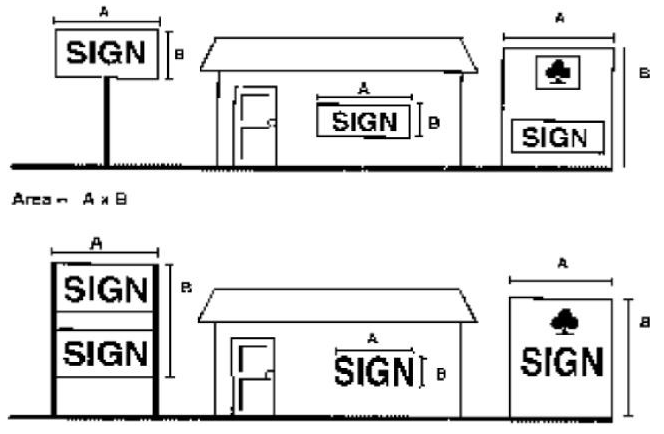
Sign face area: The area of a sign is calculated by determining the area of the smallest square or rectangle which encloses the sign face and the structure surrounding the sign face. For example, the pole or base would not be included, but any frame holding the sign face in place would be counted. See examples, below. However, this example is not a substantive regulation as to permissible types of signs.
(b)
Signs permitted in A-R, R-1, R-2, R-3, R-4, R-5, R-M and P-R zoning districts:
(1)
Ground signs: Two double-faced signs per lot. No single sign face may exceed 32 square feet. Height is limited to five feet.
(2)
Window signs: Two per dwelling, total of up to eight square feet of window signs.
(3)
Wall signs: Not permitted.
(4)
Entrance signs: Two per subdivision development, maximum area of each sign is 32 square feet. Entrance signs may only be single-sided, unless only one is erected, in which case it can be double-sided. Entrance signs are only permitted at the entrance to a subdivision development. Entrance signs must be set back from the right-of-way a distance equal to their height plus one foot for safety reasons, and cannot block traffic sight lines. Maximum height is six feet.
(c)
Signs permitted in the O-1, C-1, C-2, and P-M zoning districts:
(1)
Ground signs: Two double-faced signs per lot. Except in the C-2 zoning district, no sign face may exceed 100 square feet. In the C-2 zoning district, no sign face may exceed 300 square feet, and the total square footage of all ground sign faces on a lot shall not exceed 600 square feet. Maximum height for all ground signs shall be the same as the maximum height for the district.
(2)
Window signs: Total signage not to exceed 25 percent of the area of windows facing road frontage.
(3)
Wall signs: Up to four signs per lot, with no sign face larger than 50 square feet, and a maximum of 125 square feet per lot.
(4)
Entrance signs: Two per lot or, in the P-M district, per development. The maximum area of each sign is 50 square feet. Entrance signs may only be single-sided, unless only one is erected, in which case it can be double-sided. Entrance signs are only permitted at the entrance to the planned center. Entrance signs must be set back from the right-of-way a distance equal to their height plus one foot for safety reasons, and cannot block traffic sight lines. The maximum height of entrance signs is six feet.
(d)
Signs permitted in the M-1, M-2 and M-3 zoning districts, for individual uses:
(1)
Ground signs: Two double-faced signs per lot. No sign face may be larger than 50 square feet. The maximum height for each sign is the maximum height for structures in the district.
(2)
Window signs: Total signage not to exceed 25 percent of the area of windows facing road frontage.
(3)
Wall signs: Up to four signs per lot, with no sign face larger than 100 square feet, and a maximum of 250 square feet per lot.
(4)
Entrance signs: Two per lot, maximum area of each sign is 50 square feet. Entrance signs may only be single-sided, unless only one is erected, in which case it can be double-sided. Entrance signs are only permitted at the entrance to the lot. Entrance signs must be set back from the right-of-way a distance equal to their height plus one foot for safety reasons, and cannot block traffic sight lines. Maximum height is ten feet.
Sec. 5.04.03. - Regulations for signs.
(a)
Location and setback.
(1)
The property owner must give permission for all sign placement on the owner's property. Private individuals and entities are not permitted to erect signs on the county's rights-of-way.
(2)
All signs must comply with all side and rear setbacks of the underlying zoning district.
(3)
Signs can be located in front setback areas, but no portion of a sign or sign structure erected on private property shall encroach on or overhang the public right-of-way or any other person's property.
(4)
Entrance signs must be set back from the right-of-way a distance equal to their height plus one foot for sight distance requirements and must comply with any applicable provision in the Manual on Uniform Traffic Control Devices, latest edition.
(5)
Distances are measured from the closest portion of the sign (whether that be the base, sign face, or the sign structure) to the right-of-way, curb or pavement.
(b)
Illumination.
(1)
Signs cannot be illuminated in the A-R, R-1, R-2, R-3, R-4, R-5, R-M or P-R districts. Only one sign may be illuminated in developments in the P-M zoning classification.
(2)
Flashing, blinking or otherwise varying illumination is not permitted in any zoning district, except as provided below in subsection (c). Multiple-message signs. No external or internal illumination that causes confusion with or distraction from any traffic signal or safety device shall be permitted in any zoning district.
(3)
All externally-illuminated signs shall utilize low wattage luminaries, mounted in fixtures designed to direct the light and eliminate light trespass, such as light shining into residences or other neighboring structures.
(4)
All internally-illuminated signs shall utilize low wattage luminaries designed to reduce light glow.
(5)
All illuminated signs over ten feet in height shall be internally illuminated or illuminated by external lighting fixtures located above the sign area, firing downward, and not directed towards passing motorists.
(c)
Multiple-message signs.
(1)
Multiple-message signs are those which change the message or copy on the sign face mechanically or electronically by movement or rotation of panels or slates, or by changing electronic display on the sign face.
(2)
Multiple-message signs are prohibited in the A-R, R-1, R-2, R-3, R-4, R-5, R-M or P-R zoning districts. Multiple-message signs are permitted in the O-1, C-1, C-2, M-1, M-2 and M-3 zoning districts, except that they shall not be permitted within 1,000 feet of any railroad crossings.
(3)
No multiple-message sign may change its message or copy, or any pictures or images that are part of the message, more frequently than once every ten seconds.
(4)
When the message of a multiple-message sign is changed mechanically, it shall be accomplished in three seconds or less. When the message of a multiple-message sign is changed in an electronic manner, through the use of light emitting diodes, back lighting or other light source, the transition shall occur within two seconds.
(5)
When any multiple-message sign is located within 150 feet of any residential district, the display of multiple messages shall discontinue between the hours of 11:00 p.m. and 6:00 a.m., and the sign shall be static and not display more than one message during that period.
(6)
Multiple-message signs which are illuminated or which use electronic lighting to display messages shall be subject to the restrictions and limitations applicable to illumination in this ordinance.
(7)
There shall be located no more than one multiple-message sign per lot, and such sign shall be permitted only on a ground sign or freestanding structure which is a permitted sign in the lot's zoning classification, and not on any wall sign or window sign.
(d)
Interstate signs.
(1)
Notwithstanding the other provisions of this ordinance, owners of properties directly adjacent to the Interstate 75 right-of-way in the county shall be entitled to erect interstate signs in a manner consistent with the following provisions. These provisions may allow for larger signs facing Interstate 75 in recognition of the greater distance from the signs to the travelling public, the wider rights-of-way, and greater speed of travel along Interstate 75. Whenever a property owner erects a sign pursuant to this subsection, that sign shall be counted against the number of signs available under the underlying zoning district according to this article.
(2)
All signs located on lots facing or designed to be visible from the Interstate 75 right-of-way shall conform with O.C.G.A. § 32-6-70 et seq. (the Georgia Outdoor Advertising Code) and shall meet all federal and state requirements necessary to obtain a permit under such code. In instances where the sign controls of this article are more strict, such regulations shall apply.
(3)
Interstate signs shall meet the following requirements:
a.
Uniform size. The outside measurements of all sign faces shall be 12 feet in height and 50 feet in length, with or without trim.
b.
Illumination. All illuminated signs shall use base-mounted fluorescent or mercury vapor lights and shall be activated by photo-electric cells. Additional lighting including, but not limited to, neon, animation and running lights is prohibited.
c.
Height above interstate grade. All sign faces shall be a minimum of ten feet above adjacent interstate pavement measuring from the lower portion of the sign face. Signs shall not exceed 30 feet in height. Two signs in the same location (back-to-back) or V-formation shall be the same height above the interstate's surface.
d.
Extrusions. Extrusions beyond the face of the sign, excluding aprons, are prohibited.
e.
Number of signs per location. No more than two interstate sign faces per lot, and each sign face shall face a different direction of interstate travel. The sign faces may be mounted back-to-back on the same sign structure, in a V-formation, or on separate sign structures.
f.
Spacing. Interstate sign structures shall be no less than 500 feet apart, measuring from the two closest points.
g.
Distance of structures from property or right-of-way line. Interstate sign structures shall be no less than ten feet from any property or right-of-way line.
Sec. 5.04.04. - Safety and construction standards.
(a)
Official confusion. Signs which contain or are in imitation of an official traffic sign or signal, or can be confused with an official traffic sign, are prohibited.
(b)
Fire safety. No sign or sign structure may be erected or maintained which obstructs any fire escape, ventilation, or door; nor shall any sign or sign structure be attached to a fire escape.
(c)
Corner visibility. No sign or sign structure above a height of three feet shall be maintained within 15 feet of the intersection of the right-of-way lines of two streets, or of a street intersection with a railroad right-of-way.
(d)
Traffic visibility and safety. No sign shall obstruct the traffic sight line or the view of vehicles entering the roadway (i.e., the view of oncoming traffic by vehicles attempting to enter the road, or vice versa). No sign shall be erected on any traffic island.
(e)
Good repair. All signs, together with all their supports, braces, guys, and anchors, shall be kept in good repair and shall be structurally sound.
(f)
Removal of signs. The county may remove a sign in violation of this ordinance, without giving notice to any party, if said sign is upon the public right-of-way or upon other public property; or said sign poses an immediate safety threat to the life or health of any members of the public.
Sec. 5.04.05. - Prohibited signs.
The following types of signs are prohibited in every zoning district:
(a)
Roof signs (which means signs mounted above a roof or projecting above the roof-line of a structure).
(b)
Rotating signs (which includes any sign designed to revolve, rotate, or otherwise turn, in whole or in part, by means of electrical power).
(c)
Portable signs (which means signs which are attached to vehicles, trailers, movable structures, or attached to sign structures which are not permanently anchored into the ground, or any sign which may be transported or is designed to be transported). Such signs include, but are not limited to, printed banners or billboards attached to vehicles and trailers; portable signs do not include signs or messages that are painted on or permanently affixed to vehicles that are licensed, tagged and operable.
(d)
Moving signs, or signs with moving parts. This includes, but is not limited to, animated signs involving motion or sound; signs with moving words; signs with waiving elements, whether motorized or wind-powered; or similar moving signs.
Sec. 5.04.06. - Continuance of nonconforming signs.
Invariably, at the time a sign ordinance is adopted or amended, certain signs which lawfully existed prior to the adoption or amendment will not conform to specified regulations and development standards. These are known as nonconforming signs, and in order to feasibly adopt the ordinance and so as not to cause undue economic hardship on owners of nonconforming signs, these signs are allowed to continue under special conditions as outlined in the following subsections of this section:
(a)
Where a nonconforming sign has ceased to be used for more than six months or has changed to a permitted or conforming sign, further use of the sign must be in conformance with the standards and requirements of this ordinance.
(b)
A nonconforming sign must not be extended or altered unless the extension or alteration is in conformance with the requirements of this ordinance.
(c)
A nonconforming sign which is altered or extended must meet applicable county building codes and development regulations. When an applicant seeks a sign permit for the extension or alteration of a nonconforming sign, the zoning administrator will inspect the sign and determine what (if anything) is needed to bring the sign into conformance with applicable building codes and development regulations. Upon determining that the sign meets applicable building codes and development regulations, he will issue the sign permit for the nonconforming sign.
(d)
If a nonconforming sign suffers damage which does not exceed 50 percent of its assessed valuation, the sign may be reconstructed and reused as before if done within 12 months from the time such damage occurred. If such damage is greater than 50 percent of its assessed valuation, such a sign may only be reconstructed and used in conformity with the standards and requirements of this ordinance.
Sec. 5.04.07. - Permits, inspections, etc.
(a)
Permit required. Except as otherwise provided herein, it shall be unlawful for any person to erect, construct, enlarge, move, or convert any sign in the county or cause the same to be done without first obtaining a sign permit from the zoning administrator. These directives shall not be construed to require any permit for change of copy on any sign, replacement of the sign face, nor for the repainting, cleaning, or other normal maintenance or repair of a sign or sign structure for which a permit has previously been issued, so long as the sign structure is not modified or enlarged in any way. No permit or fee shall be required for signs having no electrical connection and a sign face less than 32 square feet in area.
(b)
Application. Sign permits may be applied for by the owner of the property upon which the sign will be located, or by that person or entity's authorized agent. In order to obtain a permit to erect, alter or relocate any sign under the provisions of this ordinance, an applicant therefor shall submit to the zoning administrator a sign permit application which shall set forth in writing a complete description of the proposed sign including:
(1)
The name, address, and telephone number of the owner or persons entitled to possession of the sign and of the sign contractor or erector;
(2)
The name, address and telephone number of the owner or lessee of the lot on which the sign is located if different from those designated above;
(3)
The location by street address and parcel number of the proposed sign structure;
(4)
A drawing of the proposed sign showing dimensions and construction specifications, prepared and signed by an architect or engineer licensed by the state of Georgia;
(5)
Where the sign construction requires an electrical connection, the electrical contractor shall obtain an electrical permit;
(6)
Each applicant shall present to the zoning administrator on request a certificate of liability insurance prior to the issuance of a sign permit; and
(7)
Where the application is for a multiple-message sign using electronic lighting as part of the display on the sign face, a copy of the sign manufacturer's specifications for luminosity shall be attached to the application.
(c)
Issuance of permit if application in order. It shall be the duty of the zoning administrator, upon receipt of a completed application for a sign permit, to examine such plans and specifications and other data and, if the proposed structure is in compliance with the requirements of this section and all other applicable provisions of this ordinance, to issue, within five working days from date of filing, to the applicant a written permit evidencing the applicant's compliance therewith. Sign permits shall be issued in the name of the property owner upon which the sign is to be located. Issuance of the permit shall in no way prevent the zoning administrator from later declaring said sign to be nonconforming if the permit is obtained based on false information submitted by the applicant.
(d)
Permit duration. A sign permit shall become null and void if the construction of the sign for which the permit was issued has not begun within a period of six months after the date of issuance and completed within 12 months after date of issuance.
(e)
Work on illegal signs. No person shall erect or assist in the erection, construction, maintenance, alteration, relocation, repair or painting of, or do any work upon any sign for which a permit has not been obtained where required. Any such sign shall be illegal, and the zoning administrator may order the owner to remove the same immediately. If the owner fails to remove the same within 30 days, the zoning administrator shall proceed in accordance with this ordinance.
(f)
Inspection. All signs for which a permit is required by this ordinance are subject to inspection by the zoning administrator.
(g)
Revocation. The zoning administrator is hereby authorized to revoke any permit upon failure of the holder thereof to comply with the provisions of this section within 30 days after notification in writing.
(h)
Permit fees. Before any permit is issued under the provisions of this section, the applicant shall pay a fee in the amount of $50.00.
Sec. 5.04.08. - Sign and sign structure maintenance.
(a)
Signs and sign structures shall be maintained in good repair, structurally sound, with proper anchorage capable of supporting the imposed loads, so as not to pose a threat to the public health, safety or welfare. All structural members shall be maintained free from deterioration and shall be capable of safely supporting the imposed dead and live loads.
(b)
All exterior surfaces shall be maintained in good condition. Exterior wood surfaces, other than decay-resistant woods, shall be protected from the elements and decay by painting or other protective covering or treatment. Peeling, flaking and chipped paint shall be eliminated and surfaces repainted. When required, all exposed surfaces of metal or wood shall be protected from the elements and against decay or rust by periodic application of weather-coating materials, such as paint or similar surface treatment. Sign faces shall be maintained in good repair and shall have neatly painted, posted or otherwise maintained display surfaces, free of defects such as holes, tears, cracks, breaks or missing portions, which are plainly visible from the public right-of-way.
(c)
When a sign or sign structure is found to be in need of maintenance, a notice of violation shall be issued to the property owner which shall describe the maintenance issue and provide a reasonable amount of time to repair the violation.
(d)
If, after receiving the notice of violation, the property owner fails to remedy the maintenance issue within the time provided, it shall be a violation of this ordinance, subject to citation. The county may also institute the appropriate proceeding at law or in equity to restrain, correct or abate such violation or to require the removal of the sign or sign structure where appropriate. The reasonable cost of any action taken by the county or its agents to remedy the maintenance issue shall be charged against the real estate upon which the structure is located and shall constitute a lien upon such real estate.
Sec. 5.05.01. - Requirements.
Towers may be permitted in zoning districts pursuant to those additional restrictions listed herein:
(a)
General requirements.
(1)
A special land use permit granted by the board of commissioners shall be required for the construction of all new communications towers within the county after the following factors are considered:
a.
The proposed height of the tower.
b.
Proximity to residential structures and residential district boundaries.
c.
Nature of uses on adjacent and nearby properties.
d.
Surrounding topography, tree coverage and foliage.
e.
Design of the tower, with particular reference to design characteristics which have the effect of reducing or eliminating visual obtrusiveness.
(2)
All permit applications submitted to the community development department shall include a complete inventory of the applicant's existing towers and receivers/transmitters located within Butts County including each asset's location, height and collocation usage or capabilities. The community development department shall utilize such information to promote collocation alternatives for other applicants.
(3)
All applicants must demonstrate that no existing tower or structure can accommodate the proposed antenna(s). Evidence of an engineering nature shall be documented by the submission of a certification by a qualified engineer. Such evidence may consist of the following:
a.
No existing towers or structures are located within the geographic area required to meet the applicant's engineering requirements.
b.
No existing structure is of sufficient height to meet the applicant's engineering requirements.
c.
No existing tower or structure has sufficient structural strength to support the applicant's proposed antenna(s) and related equipment.
d.
The applicant's proposed antenna(s) would cause electromagnetic interference with the antenna(s) on the existing tower or structure.
e.
The fees or costs required to share the existing tower or structure or to adapt the existing tower or structure for shared use are unreasonable. Costs exceeding new tower development are presumed unreasonable.
f.
Such other limiting factor(s) as may be demonstrated by the applicant.
(4)
At the time of filing the application for a tower, the applicant shall provide the federal statutory provision under which approval is sought, a site plan and information regarding tower location, accessory structures, neighboring uses and proposed landscaping. Documentation must be submitted and certified by a qualified engineer delineating coverage and propagation zones, tower design and collocation capabilities.
(5)
All collocation applications shall be ruled upon within 90 days of the filing of a completed application; all other applications shall be ruled upon within 150 days of a completed application. Applications which are not completed at the time of filing shall not be accepted, and county staff shall review the application to verify completeness within 30 days from the filing of the application. In the event that an application is determined to not be complete within the initial 30-day period after filing, county staff shall promptly notify the applicant, and the time for issuance of the decision shall be tolled for the time period between such notification to the applicant and the date the applicant files materials which complete the application. The time periods within this subparagraph may be extended by the mutual consent of the county and the applicant.
(6)
In granting a special land use permit, the board of commissioners may impose additional conditions to the extent determined necessary to minimize adverse effects on adjoining property.
(7)
In any case where an application is denied, the county shall issue a written decision which lists the reasons and evidence in the record supporting such denial.
(b)
Standards.
(1)
All towers must be set back a distance of twice the full height of the tower from any residentially-zoned property or structure used for residential purposes. This condition shall not apply in areas zoned heavy industry district.
(2)
All towers shall be separated from each other by a distance of at least 1,000 feet.
(3)
All new self-supporting towers which do not incorporate alternative design features must be designed and built in a manner that allows at least one other entity to collocate on the structure.
(4)
All towers and their related structures shall maximize the use of building materials, colors, textures, screening and landscaping that effectively blend the tower facilities within the surrounding natural setting and built environment. Towers shall be painted so as to reduce their visual obtrusiveness, subject to any applicable standards of the Federal Aviation Administration (FAA).
(5)
Any tower which directly abuts a residentially-zoned property shall have a minimum 50-foot landscaped buffer with a solid fence or wall no less than six feet in height.
(6)
All landscaping plans shall be prepared by a registered landscape architect. For each 30 linear feet of perimeter fencing, no less than two trees and two shrubs shall be installed.
(7)
Towers shall be enclosed by security fencing not less than six feet in height and shall be equipped with an appropriate anti-climbing device; provided, however, that such requirements may be waived for alternative design mounting structures.
(8)
Lattice and guy-wire supported structures are permitted only within heavy industrial districts.
(9)
All towers must meet or exceed current standards and regulations of the Federal Communications Commission (FCC) and FAA.
(10)
Subsequent to commission approval, but prior to the issuance of any building permits, compliance with section 106 of the Natural Historic Preservation Act shall be demonstrated.
(11)
Tower heights shall be measured from the existing ground base level to the highest point on the tower or other structure, even if said highest point is an antenna, and limited to the following:
* Refers to the number of separate entities collocating on the same structure.
(c)
Administrative approval.
(1)
The addition of transmitting and/or receiving whip antennas and panels may be approved administratively by the zoning administrator so long as any such addition does not add more than ten feet in height to an existing structure more than 50 feet in height, or more than five feet in height to an existing structure less than 50 feet in height but greater than 20 feet in height and all necessary building permits are obtained. Such acceptable structures include buildings, signs, light poles, water towers, and other freestanding nonresidential structures. Antennas attached to existing structures, along with supporting electrical and mechanical equipment, shall be of a color identical to, or closely compatible with, that of the supporting structure.
(2)
The zoning administrator may administratively approve alternative mounting structures such as fake trees, clock towers, bell steeples, light standards, and similar alternative mounting structures, provided such alternative structure is determined by the director to satisfy such factors set forth in subsection (a). These structures shall also be exempt from the additional separation and setback requirements pertaining to towers.
(3)
The zoning administrator may administratively approve the shared use of an existing tower or structure by another provider, including the placement of additional accessory buildings or other supporting equipment. The director may administratively waive district setback requirements by up to 50 percent to accommodate the placement of such additional buildings or other supporting equipment in order to encourage the shared use of existing infrastructure.
(4)
The addition of antennas to an existing tower structure is exempted from all setback requirements which pertain to residentially-zoned or used properties.
(d)
Removal of antennas and/or towers. All towers shall be maintained in compliance with standards contained in applicable building and technical codes so as to ensure the structural integrity of such towers. If upon inspection by the building inspection division of the community development department, such tower is determined not to comply with the code standards and to constitute a danger to persons or property, then upon written notice by certified mail, return receipt requested, or by personal service being provided to the owner of the tower, the owner shall have 30 days to bring such tower into compliance.
(e)
Exceptions.
(1)
Antennas or towers located on publicly-owned property or owned by governmental bodies shall be exempt from the requirements of this ordinance provided a license or lease authorizing such antenna or tower has been approved by the appropriate governing body.
(2)
A tower under 70 feet in height owned and operated by a federally-licensed amateur radio station operator shall be exempted from these requirements. However, the owner or operator of such tower shall be required to comply with all applicable local, state, and federal codes.

