
Calaveras County Unincorporated
City Zoning Code
City Zoning Code
Subtitle IV
- countywide Regulations
Chapter 17.16 - General Site Regulations
Sections:
Chapter 17.17 - Cannabis Retailers
Sections:
Chapter 17.18 - Regulation of Commercial and Non-commercial Cannabis Cultivation and Commerce (Except for Cannabis Retailers Pursuant to Chapter 17.17)
Sections:
Chapter 17.19 - Groundwater Management
Sections:
Chapter 17.20 - Landscaping
Sections:
Chapter 17.21 - Nonconforming Uses, Structures, and Parcels
Sections:
Chapter 17.22 - Parking
Sections:
Chapter 17.23 - Post-Disaster Recovery
Sections:
Chapter 17.24 - Signs
Sections:
Chapter 17.25 - Standards for specific uses
Sections:
17.16.010 - Purpose.
The purpose of this chapter is to ensure development is consistent with the general plan, complies with the regulations of this chapter, and produces an environment that is compatible with existing and future development.
17.16.020 - Applicability.
The regulations in this chapter shall apply to all zones, structures, and additions to structures specified in this chapter.
17.16.030 - Detached accessory structures.
A.
Applicability. The provisions of this section apply to roofed structures, including but not limited to garages, carports, barns, sheds, workshops, gazebos, and covered patios which are detached from and accessory to a primary building on the site. These provisions also apply to open, unroofed structures such as decks, and trellises, that are over twenty-four inches in height and are detached from and accessory to a main building on the site.
1.
Accessory Dwelling Units. These provisions do not apply to accessory dwelling units, attached or detached, which are subject to the standards of Section 17.25.040, Accessory Dwelling Units.
B.
Relation to Existing Uses. A detached accessory structure may only be constructed on a lot on which there is a permitted main use to which the accessory structure is related except as follows.
1.
A maximum of one detached accessory structure with a maximum size of one hundred twenty square feet plus one detached accessory structure with a maximum size of five hundred seventy-six square feet may be allowed on a lot without a permitted main use provided neither is plumbed or electrified.
C.
Living Quarters Prohibited. The use of detached accessory structures as a dwelling unit is prohibited.
D.
Development Standards. Detached accessory structures shall meet the development standards of the zone in which they are located.
17.16.040 - Access.
A.
Proof of Legal Access Required. Proof of legal access from the nearest public road, as indicated by recorded deed, parcel or subdivision map, or other document determined adequate by the planning director, shall be provided for all new construction and site alteration.
B.
Construction Standards. Required access shall be constructed in compliance with county standards and all applicable fire safety requirements of Title 15.
17.16.050 - Slopes fifty percent or more.
A proposed residential development that is located on slopes of fifty percent or more may be subject to one or more of the following requirements per the planning director:
A.
Increased lot size.
B.
Provisions for alternate access.
C.
Engineered or enlarged site plans showing slope; soil stabilization.
D.
Implementation of methods of erosion control.
E.
Grading plans prepared by a registered civil engineer.
F.
Permit denial until necessary requirements to ensure a stable, safe, and adequate building site are taken.
17.16.060 - Historic buildings and structures.
A.
Purpose. To prevent irreversible destruction of the county's historic resources, this section is intended to:
1.
Establish the county's local register of historically important buildings and structures for purposes of determining what buildings or structures in the county qualify for application of the alternative standards set forth in the State Historical Building Code (California Health and Safety Code § 18950 et seq.).
2.
Establish the county's local register of historically important buildings and structures for purposes of determining which proposals to demolish, alter or relocate such buildings or structures require further review before a demolition or building permit is issued by the county.
3.
Set forth standards for reviewing and, if applicable, protecting qualifying historical buildings and structures.
4.
Implement the Mills Act.
B.
Applicability.
1.
This chapter applies to exterior alteration to, demolition, or relocation of buildings or structures that are:
a.
Listed on the National Register of Historic Places or the California Register of Historic Resources; or
b.
Have been determined by the state historical resources commission to be eligible for listing on the National Register of Historic Places or the California Register of Historical Resources; or
c.
At least seventy-five years old and meet one or more of the following criteria:
i.
Associated with events that have made a significant contribution to the broad patterns of local or regional history or the cultural heritage of California or the United States; or
ii.
Associated with the lives of persons important to local, California or national history; or
iii.
Embody the distinctive characteristics of a type, period, region or method of construction or represents the work of a master or possess high artistic value; or
iv.
Have yielded, or has the potential to yield, information important to the prehistory or history of the local area, California or the nation; and
v.
Have not been altered in a manner that substantially diminishes historic significance or integrity of the resource. Integrity, as used in this section, means the authenticity of a resource's historic identity, evidenced by the survival of physical characteristics that existed during the resource's historic or prehistoric period.
C.
Determination and Review Procedure.
1.
The planning director shall be responsible for determining whether a building or structure proposed for alteration, demolition, or relocation meets the criteria of subsection 17.16.060.B.1, consulting appropriate resource including but not limited to the county archivist.
2.
Notwithstanding any other provision of this title, any appeal of the planning director's determination under this subsection shall be limited to determining whether or not the director correctly identified the building or structure as qualifying under subsection 17.16.060.B.1.
D.
Mills Act Applicability. Owners of designated landmarks and historic resources identified under subsection 17.16.060.B.1 may apply to the county for a Mills Act contract pursuant to procedures adopted by resolution of the board of supervisors. Such owners may qualify for property tax relief if they pledge to maintain and/or rehabilitate the historical and architectural character of the property for a minimum ten-year period. Contracts are automatically renewed for one year each year and are transferred to new owners when the property is sold.
E.
Local Register of Historical Buildings and Places.
1.
The county, through adoption of the ordinance from which this chapter is derived, hereby establishes a register of historic resources that includes all buildings and structures that are:
a.
Listed on the National Register of Historic Places or the California Register of Historic Resources; or
b.
Have been determined by the state historical resources commission to be eligible for listing in the National Register of Historic Places or the California Register of Historical Resources; or
c.
At least seventy-five years of age and have been determined by the county to be of historical significance pursuant to subsection 17.16.060.B.1.c and that have been identified through the review process of subsection F below.
2.
Buildings, structures, places, and other cultural resources may be added to the local register of historic resources through the procedure established be subsection 17.16.060.F or as may be identified through cultural resources analysis performed pursuant to the California Environmental Quality Act for discretionary project applications submitted to the county.
3.
A property owner may voluntarily request to have building, structure, or place added to the local register of historic resources if such resource meets the criteria for listing as determined by the planning director as described in subsection 17.16.060.B.1.
F.
Additional Review Required For Demolition, Alteration or Relocation of Historical Buildings; Application of State Historical Building Code.
1.
Prior to issuing a demolition permit or a building permit for an alteration or relocation of a building or structure, the building official shall request the planning director's determination of whether or not the demolition, alteration or relocation as proposed involves a building or structure as described in subsection 17.16.060.B.1.
2.
If the proposed project affects a building or structure as described in subsection 17.16.060.B.1, the chief building official shall not issue a demolition permit or a permit for alteration or relocation until a conditional use permit as described in subsection 17.16.060.G has first been applied for and approved by the planning commission concerning the proposed demolition, alteration or relocation activity.
3.
If the proposed project affects a building or structure as described in subsection 17.16.060.B.1, the chief building official shall apply the State Historic Building Code (California Health and Safety Code § 18950 et seq.) to its review of any demolition permit or permit for alteration or relocation pertaining to that building or structure.
G.
Limited Scope Conditional Use Permit.
1.
Unless the proposed demolition, alteration or relocation activity is part of a land use project that independently requires a discretionary land use approval by the county, review of the application for a conditional use permit under this chapter shall be limited to a review of potentially significant impacts to the listed historical building or structure as described in subsection 17.16.060.H.
2.
If, upon the review described in subsection 17.16.060.H, it is determined that carrying out the proposed demolition, alteration or relocation activity will result in one or more potentially significant impacts to the listed historical building or structure, conditions of approval may be required.
3.
If, upon the review described in subsection 17.16.060.H, it is determined that conditions of approval will not suffice to reduce the potential impacts to the listed historical building or structure to less than significant, the application may be denied.
4.
Review under the California Environmental Quality Act (CEQA) and/or the National Environmental Policy Act (NEPA) prior to approval of a conditional use permit under this chapter shall, to the extent allowable by law, be limited in scope to reflect the limited scope of discretionary review authorized by this chapter. CEQA and/or NEPA compliance shall be the responsibility of the planning director.
5.
If the proposed demolition, alteration or relocation activity is part of a land use project that independently requires a discretionary land use approval through the planning department, the planning commission, or other county department, the review required pursuant to this section shall be added to the review required for this other discretionary land use approval and subsection G.4 above shall not apply. All discretionary use permit applications and procedures under subsection 17.16.060.F that trigger the application of this chapter shall be processed as conditional use permits under Chapter 17.31 of the county code, with review by the planning commission.
6.
Except as otherwise stated in this chapter, the application, review, and hearing procedures for permits issued under this chapter shall be the same as those described in Chapter 17.27 of this title.
H.
Panel Review of Limited Scope Conditional Use Permit Applications Under This Chapter.
1.
After an application for a limited scope conditional use permit under this chapter has been submitted to the planning department and deemed complete, the application shall be reviewed and reported on within thirty days by a panel consisting of the following:
a.
The planning director or their designee;
b.
The chief building official or their designee; and
c.
A designee of the Calaveras County Historical Society.
2.
The panel shall be charged with the following tasks, which shall culminate in a written report to the planning director:
a.
Determine in writing whether the proposed demolition, alteration or relocation activity will result in one or more potentially significant impacts to the listed historical building or structure described in subsection 17.16.060.B.1. In making this determination, the panel shall utilize the significance criteria described in 14 Cal. Code Regs. Sections 15064.5(b)(1)—(3).
b.
If potentially significant impacts are identified to buildings or structures described in subsection 17.16.060.B.1, describe them in writing.
c.
If potentially significant impacts are identified pursuant to subsection 17.16.060.B.1, the panel shall describe in writing what, if any, requirements or conditions can be feasibly imposed as a condition of the county's approval of the proposed activity that will reduce impacts to the point of insignificance.
i.
In developing these requirements and conditions, the panel shall consider the guidelines in the U.S. Secretary of the Interior's Standards for Treatment of Historic Properties (1992).
ii.
The panel shall not impose conditions that exceed those necessary to reduce the identified impacts to the point of insignificance.
iii.
If the panel identifies more than one potential condition that could feasibly be imposed to reduce an identified impact to the point of insignificance, the panel shall present these as options that the applicant may choose from.
iv.
A requirement or condition that would result in a violation of this title or of other local, state, or federal laws, ordinances, or regulations, including but not limited to the State Historical Building Code, cannot be feasibly imposed.
d.
State in writing whether or not the imposition of the requirements or conditions described in subsection 17.16.060.F.2.c will mitigate all identified impacts to the point of insignificance.
3.
After receiving the panel's report, the planning director shall develop and submit their recommendations for CEQA compliance and permit issuance to the planning commission for review. The staff report developed for the planning commission hearing on the limited scope conditional use permit shall include the report of the panel described in subsection 17.16.060.H.2.
I.
Planning commission review of limited scope conditional use permit.
1.
The planning commission shall not approve the limited scope conditional use permit without:
a.
A finding that CEQA has been complied with.
b.
A finding that the approval of the permit is consistent with the general plan and any applicable community plan.
c.
A finding that the proposed activity involves a structure or building described in county code subsection 17.16.060.B.1.
d.
A finding that the commission has read and considered the report prepared by the review panel pursuant to subsection 17.16.060.H.2.
e.
An explanation of what conditions of approval, if any, will be imposed and why they are required to reduce potential impacts to the historical characteristics of the building or structure to the point of insignificance.
2.
Conditions of project approval shall be limited to those measures or requirements that are necessary to reduce or eliminate the impacts to the historical characteristics of the building or structure as described in this chapter. No conditions shall be imposed for which there is not a reasonable relationship between the condition and the direct effects of the project on the historical characteristics of the building or structure.
J.
Maintenance and Repair.
1.
Nothing in this section prohibits the ordinary maintenance and repair of any exterior feature of any building or structure on property listed in the local register; however, such maintenance or repair shall not involve a change in the design or result in the modification, demolition or removal of any architectural feature of the property.
2.
The prohibitions of this section shall not apply to the demolition of a structure that has been damaged due to a natural disaster and the structure presents an imminent threat to the public or damage to adjacent property, as determined by the building official; or when the state office of historic preservation determines, pursuant to California Public Resources Code Section 5028 that the structure may be demolished, destroyed, or significantly altered.
(Ord. No. 3213, § 1, 1-14-2025)
17.16.070 - Density bonus.
A.
Purpose. The purpose of this section is to implement the State Density Bonus Law, California Government Code Section 65915.
B.
Applicable Zoning Districts. This section shall be applicable in all zones that allow residential uses.
C.
Qualifications. All proposed housing developments that qualify under California Government Code Section 65915 for a density increase and other incentives, and any qualified land transfer under California Government Code Section 65915 shall be eligible to apply for a density bonus (including incentives and/or concessions) consistent with the requirements, provisions and obligations set forth in California Government Code Section 65915, as may be amended.
D.
Density Bonus, Incentives and Concessions. The county shall grant qualifying housing developments and qualifying land transfers a density bonus, the amount of which shall be as specified in California Government Code Section 65915 et seq., and incentives or concessions also as described in California Government Code Section 65915 et seq.
E.
Application. An application for a density bonus or other incentive under this section for a housing development shall be submitted in writing to the planning department to be processed concurrently with all other entitlements of the proposed housing development. The application for a housing development shall contain information sufficient to fully evaluate the request under the requirements of this section, and in connection with the project for which the request is made, including, but not limited to, the following:
1.
A brief description of the proposed housing development; and
2.
The total number of housing units proposed in the development project, including unit sizes and number of bedrooms; and
3.
The total number of units proposed to be granted through the density increase and incentive program over and above the otherwise maximum density for the project site; and
4.
The total number of units to be made affordable to or reserved for sale or rental to, very low, low, or moderate income households, or senior citizens, or other qualifying residents; and
5.
The zoning, general plan designations and assessor's parcel number(s) of the project site; and
6.
A vicinity map and preliminary site plan, drawn to scale, including building footprints, driveway(s) and parking layout; and
7.
A list of any concession(s) or incentive(s) being requested to facilitate the development of the project, and a description of why the concession(s) or incentive(s) is needed.
F.
Review and Consideration. The application shall be considered by the planning commission or board of supervisors at the same time the project for which the request is being made is considered. If the project is not to be otherwise considered by the planning commission or the board of supervisors, the request being made under this section shall be considered by the planning director. The request shall be approved if the applicant complies with the provisions of California Government Code Section 65915 et seq.
G.
Continued Affordability. Consistent with the provisions of California Government Code Section 65915 et seq., prior to a density bonus or other incentives being approved for a project, the county and the applicant shall agree to an appropriate method of assuring the continued availability of the density bonus units.
17.16.080 - Setbacks.
A.
Setback Requirements. Setbacks required by zoning district standard, subdivision approval, specific use standard, development approval, or other regulation or approval pursuant to this title shall be unobstructed from the ground to the sky except where allowed pursuant to a specific development approval or identified as an allowed encroachment below.
1.
Allowed Encroachments into Required Setbacks. Unless limited by another regulation or permit requirement, the following may encroach into required setback areas subject to all applicable requirements of the building code, fire safety codes, and other applicable codes and regulations.
a.
Eaves and Overhangs. Eaves, overhangs, and similar architectural features may project up to ⅓ the required setback, but shall project no closer than three feet from the property line.
b.
Accessways and Utilities. Roads, driveways, or walkways; parking areas; utility poles and lines; guy wires; and similar features.
c.
Landscaping and Incidental Furnishings. Flag poles, landscaping, planters, incidental yard furnishings, and similar features.
d.
Fences and Walls. Fences, retaining walls, decorative walls, arbors, trellises, and similar features, subject to applicable requirements of Title 15, Building and Construction.
e.
Docks. Docks permitted by tri-dam authority or other applicable authorities.
f.
Mechanical Equipment. Mechanical equipment such as heating and air conditioning units, and generators no closer than three feet from property line. All mechanical equipment located within the required front setback must be screened with landscaping or a solid fence.
g.
Propane Tanks. Propane tanks may encroach provided they are located in compliance with Section 6104 of the California Fire Code. All propane tanks located within the required front setback must be screened with landscaping or a solid fence.
h.
Water Tanks (less than five thousand gallons). Water tanks with a capacity under five thousand gallons.
i.
Structures to Ensure Safe Access. In sloped areas, parking decks, staircases, and other structures determined necessary by the planning director may encroach into the required front setback in order to provide safe access.
j.
Small Shed. One shed less than one hundred twenty square feet in size and less than twelve feet in height, and not requiring a building permit, may encroach within the required interior side and rear setback areas.
B.
Stream and Wetland Setbacks. All new development shall be setback a minimum fifty feet from the top of bank line of an intermittent or perennial stream and from the outer edge of wetland habitat determined by a field survey. This required setback may be adjusted with administrative use permit approval where the planning director determines, based on a qualified biologist's recommendation, that a different setback is appropriate to adequately protect the stream or wetland from degradation, encroachment, or loss.
1.
Development. For the purposes of this section, development is as defined in Chapter 17.43, Definitions, and includes structures, buildings of any type, swimming pools, driveways, parking areas, patios, platforms, decks, liquid storage tanks, and broken concrete rubble, earth fill or other structural debris or fill.
2.
Exceptions. The only activities and development allowed within the required setback are the following when located, developed, and conducted consistent with the general plan, other county policy documents, or environmental documents and, where applicable, approved by the county and any other governmental agency having jurisdiction over them.
a.
Agricultural activities that utilize best management practices (BMPs), as recommended by the agriculture commission.
b.
Fencing that does not interfere with the flow of waters or identified wildlife migration corridors.
c.
Access necessary for the maintenance of the property and/or allowed uses and development.
d.
Drainage facilities designed to eliminate or minimize increases in the rate and amount of stormwater discharge.
e.
Vegetation cutting or removal for normal maintenance, related to restoration and enhancement of the stream and riparian habitat, and/or to permit adequate flow of water, facilitate drainage, prevent flooding, and/or comply with fire safe regulations. Such cutting or removal of vegetation shall be limited to the minimum amount necessary, with special care to avoid removal of vegetation immediately adjacent to the banks of the stream or wetland.
f.
Fill, grading, or excavating for purposes of low intensity, passive recreation or conservation uses designed and executed to minimize erosion, sedimentation, or runoff in or into the stream or wetland.
g.
Minor restoration or maintenance necessary to prevent flooding, reduce siltation, remove debris, and minor weed abatement activity necessary to protect life or property or otherwise provide for the public health and safety.
3.
Dedication of Drainage and Scenic Easements. The county may, as a condition of a development permit or subdivision, require the dedication of a drainage and/or scenic easement over and maintenance of each stream channel within the top of each bank or such other distance as specified by the review authority to avoid excavation, filling, development or construction that could adversely affect the public health and safety by aggravating drainage flows during flooding conditions or interfering with the stream or wetland habitat.
C.
Agricultural Buffers.
1.
Purpose. The purpose of the agricultural buffer requirement is to provide for the long-term viability of agricultural operations and minimize potential conflicts between agricultural uses and new, non-agricultural development and uses.
2.
Required Buffer. New residential dwellings, residential dwelling building sites, and structures or outdoor areas designed for residential habitable space shall maintain a buffer separation from any lot line of any lot in the resource production general plan land use category.
3.
Buffer Size. The size of the buffer separation shall be a minimum of 400 feet. This buffer requirement may be adjusted with administrative use permit approval where the planning director determines, in consultation with the agricultural commissioner that:
a.
Specific site characteristics exist such as topography, prevailing winds, vegetation, and other site features provide adequate buffering such that the required setback is not necessary to promote and protect agriculture and protect public health and safety; or
b.
Site constraints such as size and configuration are such that the required buffer is infeasible, and the reduced setback provides the maximum feasible buffer from the agricultural use.
4.
Use of Buffers.
a.
Agricultural buffers shall not be used for dwellings, structures designed for human occupancy, or outdoor areas designed for intensive human use.
b.
The agricultural buffer shall incorporate vegetative or other physical barriers as determined necessary to minimize potential land use conflicts.
c.
Agricultural buffers may accommodate drainage, trails, roads, other facilities or infrastructure, landscaping, and other uses that would be compatible with ongoing agricultural operations.
17.16.090 - Height exceptions.
Antennae, chimneys, poles, silos, stair towers, roof top mechanical equipment and associated screening, and safety devices may exceed the maximum permitted height for the zoning district in which they are located, subject to limitations within the airport overflight overlay zone and other limitations within this title. Stair towers and mechanical equipment shall not exceed the maximum permitted height for the zoning district in which they are located by more than ten feet.
17.16.100 - Lighting and illumination.
A.
Purpose. The purpose of this section is to enhance the character of our communities and rural areas by minimizing light pollution, glare, and light trespass caused by inappropriate or misaligned light fixtures or luminaires. The intent of the following standards is to ensure that outdoor lighting does not constitute a hazard or danger to persons or vehicular travel and to prevent glare and light trespass on adjacent properties and light pollution in the night sky. To ensure a continued ability to enjoy the night sky and minimize conflicts with neighbors, it is necessary to adopt standards for outdoor lighting to accomplish the following objectives:
1.
Encourage a less light-oriented nighttime environment for residents, businesses, and visitors, consistent with the concurrent need for nighttime safety, security, and productivity.
2.
Require a reduction in unnecessary light intensity and glare, while minimizing light pollution and trespass onto adjacent properties.
3.
Protect the ability to view the night sky by restricting unnecessary upward projections of light.
4.
Promote energy conservation and a reduction in greenhouse gas emissions that can result from excessive or unwanted outdoor lighting.
B.
Applicability. The standards of this section apply to all new or replaced outdoor luminaires, light fixtures, and/or systems and to existing lighting as provided below unless specifically exempted below or required pursuant to any other applicable code or regulation.
1.
Existing Lighting. Adjustable light fixtures that can be redirected without requiring replacement or reconstruction of the fixture shall be redirected to prevent glare and light spillover onto adjacent properties consistent with the requirements of this section.
2.
New and Replaced Lighting. The standards of this section apply to all new or replaced outdoor luminaires, light fixtures, and/or systems, except as specifically exempted pursuant to Subsection B.3, Exemptions.
3.
Exemptions. The following lighting is exempt from the provisions of this section.
a.
Lighting not under the jurisdiction of the county
b.
Safety and Security Lighting. Security lighting necessary for public safety facilities.
c.
Construction and Emergency Lighting. All construction or emergency lighting fixtures, provided they are temporary and are discontinued immediately upon completion of the construction work or abatement of the emergency.
d.
Temporary Seasonal Lighting. Temporary seasonal lighting displays related to cultural or religious celebrations.
e.
Luminaries with a maximum output of sixty lumens, including solar lights.
f.
Underwater lights used to illuminate swimming pools, spas, fountains, and other water features.
g.
Temporary lighting for agricultural activities of a limited duration.
C.
Prohibitions. The following types of exterior lighting are prohibited.
1.
Searchlights. The operation of searchlights and/or laser lights for advertising purposes.
2.
Mercury Vapor. The operation of mercury vapor lights for any purpose.
3.
Low Pressure Sodium. Low pressure sodium lights in residential and commercial zones.
4.
Any lights operated in such a manner as to constitute a hazards or danger to persons or vehicular travel.
D.
General requirements.
1.
Compliance With State Codes & Regulations. All lighting installations shall comply with the currently adopted versions of the California Energy Code, California Green Building Standards Code, and all other codes, regulations, & laws applicable to lighting projects with respect to efficiency, lighting controls, minimum & maximum light levels, and other considerations governed by such codes.
2.
Maximum Light Levels at Property Lines. The light level at property lines shall not exceed 0.1 foot-candles, except as provided below or where allowed through the approval of a conditional use permit.
a.
Abutting or Within a Commercial or Industrial Zone. Where a property is located within a commercial or industrial zone and the neighboring property is located within a commercial or industrial zone, the maximum lighting level at the shared property line shall be ¼ foot-candles.
3.
Shielding. All outdoor light fixtures shall be fully shielded or full cut off, except as provided below or as specifically stated in another part of this code.
a.
Decorative string lights are not required to be shielded.
b.
Outdoor light fixtures used for outdoor recreational facilities shall be fully shielded except when such shielding would cause impairment to the visibility required in the intended recreational activity. In such cases, partially shielded fixtures and downward lighting methods shall be utilized to limit light pollution, glare, and light trespass.
c.
Partially shielded light fixtures are allowed provided the light source is obscured by translucent glass or other means, the light fixture does not exceed eight hundred fifty lumens, and the lighting complies with all other provisions of this section.
d.
Unshielded light fixtures may be allowed provided the light source is obscured by translucent glass or other means, the light fixture does not exceed six hundred lumens, and the fixture is located within a covered porch or under a roofed area where no upward directed lighting may escape.
4.
Glare Prevention. All lights shall be selected, directed, and oriented to prevent light spillover and glare onto adjacent properties. No unobstructed beam of exterior light shall be directed off-site.
5.
Timing Controls. All outdoor lighting in nonresidential development shall utilize a time clock, photo-sensor, motion controls, and/or other lighting control systems to prevent operation during daylight hours, when the building or site is not in use, and when the lighting is not required for security except as follows.
a.
Code Required Lighting. Building, emergency, or other construction and safety code required lighting for steps, stairs, walkways, entrances, parking areas, and other building and site features that is dimmed to the minimum light level necessary to meet code requirements.
6.
Kelvin. Light fixtures for outdoor security lighting shall not exceed 5,000 Kelvin. All other outdoor light fixtures shall not exceed 3,500 Kelvin.
7.
Maximum Height. Lighting fixtures shall be installed at the lowest height required to achieve the design purpose of the lighting fixture.
a.
Building Mounted. Light fixtures shall not exceed the height of the building upon which it is attached.
b.
Freestanding Light Fixtures. The maximum height of freestanding light fixtures and lighting fixtures mounted on a structure or feature other than a building is as follows:
i.
Within and/or within twenty-five feet of a residential zone: sixteen feet from finished grade.
ii.
Other locations: thirty feet from finished grade.
c.
Exceptions: The director may allow additional height of up to twenty percent of the allowed height for activities, uses, or development with unique lighting needs where the additional light fixture height will not appreciably interfere with the enjoyment of the night sky on nearby properties.
8.
Uplighting. Uplighting is allowed for government flags and commemorative objects such as statues and plaques with a narrow beam focused on the top of the flagpole or commemorative object, subject to the following standards.
a.
Flagpoles less than fifty feet in height: maximum four hundred lumens.
b.
Flagpoles fifty feet or more in height: maximum five hundred lumens.
c.
Statues, plaques, and other commemorative objects: maximum three hundred lumens.
9.
Sign Illumination. Sign illumination shall be in compliance with Section 17.24.090, Illumination.
E.
Submittal of Plans and Evidence of Compliance. Any application for a permit that includes outdoor light fixtures subject to the standards of this section shall include evidence that the proposed outdoor lighting will comply with all the standards of this section. The application shall include:
1.
Plans showing the location and height of all outdoor lighting fixtures.
2.
Description of the outdoor lighting fixtures including luminaire, lamp or bulb type, wattage, lumen output, temperature rating, and shielding.
3.
Photometric plans showing foot-candle readings every ten feet within the property or site and ten feet beyond the property lines, except as provided below.
a.
Applications for outdoor lighting associated with residential development and property-owner installed lighting are not required to submit photometric plans unless requested by the director due to project location, size, use, and proposed lighting.
4.
The above plans and descriptions shall be sufficiently complete to enable the plan examiner to readily determine whether compliance with the requirements of this section have been met.
17.16.110 - Non residential outdoor storage.
A.
Applicability. The standards of this section shall apply to storage of goods, materials, machines, equipment, and inoperable vehicles or parts outdoors for more than seventy-two hours.
B.
Location. Outdoor storage shall be located entirely within the parcel and outside of pedestrian ways, parking, and circulations areas, and required landscaped areas.
C.
Perimeter Fencing Required. There shall be a minimum six-foot-high, minimum eighty percent solid fence around the perimeter of outdoor storage areas located within, or within fifty feet of, a residential or commercial zoning district.
17.16.120 - Right to farm.
Any legally existing agriculture land use (farming, ranching, orchard, livestock, row crops, food processing) is considered to have a right to enjoy the productive and economic fruits of labors without fear of infringement on this right by encroaching residential or other non-agriculture development on adjoining parcels and lands in the general vicinity. The right to farm shall take precedence over all other adjoining and nearby land uses.
17.16.130 - Swimming pools and spas.
Swimming pools, spas, and any manmade body of water having a depth of more than eighteen inches and related equipment shall comply with the following standards.
A.
Location of Swimming Pool or Spa. The inside wall of the water-containing portion of any swimming pool or spa shall be located a minimum of five feet from any property line.
B.
Location of Pool or Spa Related Equipment. Aboveground pool or spa related equipment, including, but not limited to motors, filters, slides, shall comply with the standard setbacks of the zoning district or be located a minimum of five feet from the property line, whichever results in a lesser required setback.
C.
Location of Pool or Spa Related Structures. Awnings, outbuildings, and other structures associated with the swimming pool or spa, are required to comply with the standard setbacks of the zone district.
17.16.140 - Visibility at intersections and driveways.
A.
Purpose. The purpose of this section is to reduce potential vehicle conflicts at public intersections and private driveways through the regulation of obstructions that may interfere with the view of approaching traffic.
B.
Applicability. The regulations in this section shall apply to all corner parcels and to all parcels containing or abutting a parcel containing a right of way easement, or driveway.
C.
Measurement of Visual Clearance Area. The required visual clearance area shall be determined as follows:
1.
Corner Parcels. On corner parcels, the visual clearance area shall consist of a triangle having two sides thirty-five feet long, running along each right of way or roadway, said length beginning at their intersection, and the third side formed by a straight line connecting the two ends. See Figure 17.16.140, Visual Clearance Area.
2.
Parcels Containing or Abutting a Right of Way Easementor Driveway. On parcels containing or abutting a parcel containing a right of way easement or driveway, the visual clearance area shall consist of a triangle having two sides thirty-five feet long, running along each side of the driveway/right of way easement and the edge of the roadway, said length beginning at their intersection, and the third side formed by a line connecting the two ends. See Figure 17.16.140, Visual Clearance Area.
3.
Obstructions in Visual Clearance Area. It is unlawful to install or maintain any view obstructing structure, fence, wall, hedge, or other obstacle between two feet, six inches and eight feet above the nearest roadway surface or right of way easement within the required visual clearance area.
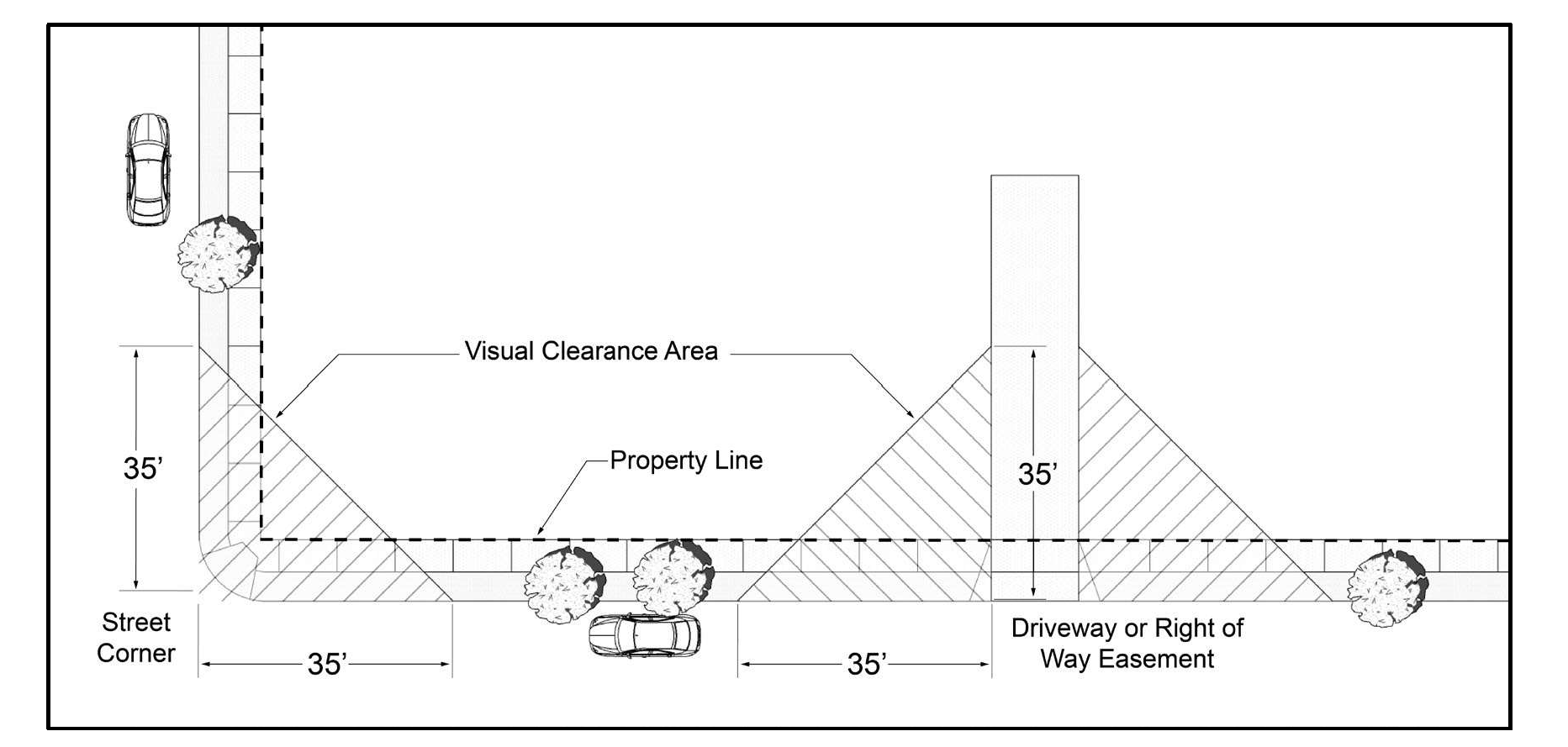
FIGURE 17.16.140: VISUAL CLEARANCE AREA
17.17.010 - Purpose and intent.
A.
It is the purpose and intent of this chapter to regulate, in compliance with the Medicinal and Adult Use of Cannabis Regulation and Safety Act (hereinafter "MAUCRSA", Section 26000 et seq. of the California Business and Professions Code), the retail sales of cannabis from licensed cannabis retailers within the unincorporated area of Calaveras County to consumers of non-medical cannabis and to qualified patients, persons with an identification card and/or primary caregivers of medical cannabis.
B.
The purpose and intent of this chapter is also to regulate, permit, and control cannabis retailers within the county in order to protect the public health, safety, and welfare of county residents; and to reduce or eliminate any adverse public health, safety, welfare, and environmental effects of new and existing cannabis retailers in the county.
C.
The purpose and intent of this chapter is also to reduce conditions that create public nuisances by enacting reasonable regulations including, without limitation, restrictions as to the location and type of cannabis retailers to more effectively control the potential adverse impacts associated with cannabis retailers.
D.
Any ambiguity in this chapter should be construed in whatever manner best effectuates this intent.
17.17.020 - Applicability and interpretation.
A.
The regulations in this chapter shall apply to the location, permitting, and operation of cannabis retailers in zoning districts where such use is authorized under the Calaveras County Code.
B.
The current provisions of this chapter shall supersede any prior provisions of this chapter, and the provisions of this chapter shall apply regardless of whether any of the activities they regulate existed or occurred prior to the adoption of this chapter.
C.
Nothing in this chapter is intended, nor shall it be construed, to exempt any cannabis retailer from compliance with any other applicable county zoning and land use regulations or any other applicable provisions of the Calaveras County Code.
D.
Nothing in this chapter is intended, nor shall it be construed, to exempt cannabis retailers from any and all applicable local and state environmental, structure or land use standards or permitting requirements.
E.
Nothing in this chapter shall be construed to authorize any use, possession, cultivation, sale, transfer, transport, or distribution of cannabis or cannabis products in interstate commerce or that is in violation of State law, Chapter 17.18, Regulation of Commercial and Non-commercial Cannabis Cultivation and Commerce (Except for Cannabis Retailers Pursuant to Chapter 17.17), of this title.
F.
Nothing in this chapter is intended nor shall it be construed to preclude a landlord from limiting or prohibiting cannabis use, cultivation, retail sales, or other related activities by tenants within the limits of state and local law, whether the cannabis activity is commercial or non-commercial.
G.
A separate permit pursuant to this chapter is required for each premises on which an applicant proposes to own or operate a cannabis retailer within the county, and there shall be no more than one cannabis retailer premises per parcel.
H.
Except when citing to various sections or past versions of this chapter, all references to laws and ordinances shall be interpreted as applying equally to any subsequent amendments made to such laws and ordinances.
17.17.030 - Definitions.
Unless defined separately in this chapter, or unless it is apparent from the context that they have a different meaning, all terms shall have the same meaning as they do in Chapter 17.43, Definitions.
A.
"Applicant" means a person or entity who has submitted a cannabis retailer administrative use permit in accordance with this chapter.
B.
"Cannabis accessories" shall have the same meaning as it does in B&P Section 26001.
C.
"Cannabis products" shall have the same meaning as it does in B&P Section 26001.
D.
"Licensed cannabis retailers" means cannabis retailers that have a state-issued "retailer" license as described in B&P Section 26070.
E.
"Landowner", "land owner", "parcel owner" or "property owner" means the person or entity identified as the owner on the recorded deed for the parcel.
F.
"Permittee" or "permit holder" means a person or entity with an administrative use permit issued under this chapter.
G.
"Premises" shall have the same meaning as it does in B&P Section 26001.
H.
"Pre-existing permitted medical cannabis retailers" means cannabis retailers that have been operating as medical cannabis dispensaries under an administrative use permit issued pursuant to the 2005 version of this chapter.
I.
"Self-distribution license" refers to the subtype of "transport only" distributor license described in 16 C.C.R.§ 5315.
J.
"State-issued license" means a license issued by the state under MAUCRSA.
K.
"State licensing authority" shall have the same meaning as "licensing authority" as defined in B&P Section 26001.
L.
"Type 10 state retailer license" is a state-issued cannabis retailer license for retailers who have storefronts that are open to the public. It is distinguishable from a "Type 9 retailer license", which is issued to non-storefront retailers which are not open to the public and which conduct sales exclusively via delivery.
M.
"Validated", in the context of a permit issued under this chapter, shall mean an action of the planning director indicating compliance with all provisions of this chapter and that an appropriate cannabis license has been issued by the state of California.
17.17.040 - Nuisance declared; Non-compliant cannabis retail activities prohibited.
All cannabis retailers, except as provided in this chapter, are unlawful in all zoning districts and a public nuisance that may be abated and subject to enforcement pursuant to Section 17.17.130, Enforcement; Fines; Liability to Pay Costs and Fines, and Chapter 8.06, Property Maintenance and Administrative Enforcement Procedures, of the Calaveras County Code, or, without limitation, as otherwise permitted by law.
17.17.050 - Cannabis retailer administrative use permit; General provisions and minimum requirements.
A.
Before a person or entity initiates operations for a new cannabis retailer the person or entity shall apply to the planning department and receive from the county a cannabis retailer administrative use permit, pursuant to Chapter 17.30, administrative use permits, on the terms and conditions set forth in this chapter. New cannabis retailers shall not begin operations before the administrative use permit is approved and validated.
B.
Cannabis retailers shall be located only in the CP (professional office) zoning district.
C.
Cannabis retailers shall provide separation of one thousand feet from the property line from any of the following uses in existence at the time the initial application is deemed complete. The distance shall be measured in a straight line from the property line of the use to the closest property line of the parcel containing the premises.
1.
A park.
2.
A school providing instruction in kindergarten or any grades one through 12, as defined by Health and Safety Code Section 11362.768(h).
3.
A day care center, as defined by Health and Safety Code Section 1596.76, or a family day care home, as defined by Health and Safety Code Section 1596.78.
4.
A youth center, as defined by Health and Safety Code Section 11353.1(e)(2).
5.
The County Central Library and its branches.
D.
The fact that an applicant possesses other types of state or county permits, licenses, or other entitlements does not exempt the applicant from the requirement of obtaining an administrative use permit from the county to operate a cannabis retailer within the jurisdiction of the county.
E.
A commercial cannabis retailer shall be limited to the following commercial cannabis activities, and no commercial cannabis activities, other than the following, shall be permitted on a parcel containing a cannabis retailer:
1.
Self-distribution of cannabis cultivated on the parcel in compliance with California Code of Regulations, Title 16 Section 5315 and pursuant to a state license.
2.
Cannabis cultivation pursuant to a permit issued under Chapter 17.18, Regulation of Commercial and Non-commercial Cannabis Cultivation and Commerce (Except for Cannabis Retailers Pursuant to Chapter 17.17), and pursuant to a conforming state license.
3.
Cannabis retail sales pursuant to this chapter and pursuant to a Type 10 state retailer license.
4.
Deliveries in conformance with MAUCRSA for a Type 10 licensee.
F.
Non-storefront retailers, as described in California Code of Regulations, Title 16 Section, 5414, are prohibited.
G.
No cannabis retailer permit will be issued or renewed for a parcel until the parcel is cleared of all violations described under Chapter 8.06, Property Maintenance and Administrative Enforcement Procedures, of the Calaveras County Code.
17.17.060 - Cannabis retailer application requirements; Processing; Changes.
A.
All applicants for cannabis retailer administrative use permits shall submit a complete application on a form(s) provided by the planning director.
B.
The planning director, in consultation with the division of cannabis control, shall develop criteria for what information and documents shall be submitted to constitute a complete cannabis retailer administrative use permit application but, at a minimum, shall include:
1.
Contact information for the permittee and, if different, the landowner.
2.
An emergency contact who can be reached on a 24/7 basis and who can quickly provide access to the premises in the event of an emergency.
3.
Written landowner consent.
4.
A fully executed indemnification agreement as described in Section 17.17.120, Indemnification.
5.
The premises diagram submitted to or to be submitted to the state pursuant to California Code of Regulations, Title 16, Section 5006.
6.
The operating procedures submitted to or to be submitted to the state as part of the cannabis retailer application pursuant to California Code of Regulations, Title 16, Section 5002, including but not limited to the transportation, inventory, quality control, security, and delivery procedures described in Forms BCC-LIC-015, 016, 017, 018, and 020.
7.
Written consent to inspections by enforcement officials, which may be conducted randomly without prior notice or by first notifying the permittee.
8.
For an entity applicant or entity landowner, adequate evidence of signature authority.
C.
Regardless of whether or not an administrative use permit has already issued pursuant to this chapter, any changes to the information provided in the application required under this chapter shall be reported in writing to the planning department within three business days.
D.
Applications submitted under this chapter shall be processed pursuant to Chapter 17.30, administrative use permits, and shall be subject to the payment of applicable fees.
E.
For the purpose of informing the state that a licensure applicant and their associated premises is eligible to qualify to participate in the county's cannabis retailer program as described in this chapter, a letter of conditional authorization from the county may be issued by the planning department in conjunction with a permit. A letter of conditional authorization is not a substitute for a permit under this chapter and does not itself authorize any commercial cannabis activities to take place in the county. If the permit is not timely validated, or if it is revoked, the county will issue a subsequent letter rescinding the conditional authorization and informing the State that permittee is no longer eligible to engage in commercial cannabis retailer activities in the county.
F.
The burden of proving the accuracy of parcel, premises, or cultivation site boundaries for the purpose of establishing whether or not a parcel, premises, or cultivation site meets the setback, separation, size, or locational requirements, or any other provision of this chapter for which a determination of parcel, premises, or cultivation site boundaries might be determinative shall be borne by the applicant/permittee and not by the county. In the event of a dispute, evidence sufficient to satisfy the burden of proof shall require, at a minimum, a survey performed by a person licensed to practice surveying in the state.
17.17.070 - Validation and revocation of cannabis retailer administrative use permits.
A.
An administrative use permit for a cannabis retailer and/or self-distribution may be issued by the planning department to an eligible applicant with an eligible premise who has not yet received a state license; but the permit will not be validated, and commercial cannabis activities will remain prohibited on the premises, until:
1.
The planning department receives a copy of the applicant's state retailer and/or transport only self-distribution license for the premises, including any conditions or restrictions imposed by the state, and
2.
The planning department verifies that all permit eligibility criteria and, if applicable, permit conditions have been met.
B.
Permit applications under this chapter may be denied, and permits issued pursuant to this chapter may be revoked, for failure to comply with the conditions of project approval and/or with Title 17 of the county code, including this chapter, and/or for any of the following reasons:
1.
The applicant, after receiving a permit, fails or refuses to inform the county of alterations to the property or operations that would compromise the original permit approval, has submitted false or misleading information as part of the application, fails to comply with the permit conditions, or either fails to obtain or loses through revocation any other required local, county, regional, or state permit or license that is related to the property where the administrative use permit is issued.
2.
After issuance of the permit, the county discovers that approving the permit violated a county, State, or local law or regulation, or the permit was otherwise issued in error.
3.
Failure to timely pay fees established in this chapter.
4.
Failure to pay the tax as described in Chapter 3.56, Commercial Cannabis Cultivation and Cannabis Wholesale and Retail Activity Tax, of the county code or to comply with all provisions of that chapter that apply to the cannabis activities occurring on the parcel.
C.
The planning director's written determination shall be served by mail to the last permittee address provided by the permittee, with a statement of factual and/or legal reasons for the determination.
D.
If a permit is revoked pursuant to this section, the planning director's shall notify the State Bureau of Cannabis Regulation pursuant to Business and Professions Code Section 26200 as well as the Calaveras County Sheriff.
E.
Revocation of a permit under this chapter does not in any way operate to limit any existing power of the county to simultaneously or subsequently enforce county ordinances, to abate any and all nuisances, or employ any remedy available at law or equity with respect to the parcel, including but not limited to the nuisance abatement and enforcement provisions of Title 8, Health and Safety, of the county code, or Chapter 17.41, Enforcement.
17.17.080 - Appeals.
The planning director's decision on an application for an administrative use permit or renewal of an administrative use permit under this chapter may be appealed pursuant to Chapter 17.30, Administrative Use Permits.
17.17.090 - Operating restrictions for cannabis retailers.
A.
administrative use permits for cannabis retailers will be issued with specific premises indicated on the permit, with the same boundaries as the premises for which the State retailer license is issued.
B.
The permitted premises shall, at all times, be in full compliance with MAUCRSA, state regulations implementing MAUCRSA, and all conditions of the permittee's state commercial cannabis license for the same premises.
C.
Reserved.
D.
The parcel on which the cannabis retailer is located shall remain in compliance with all applicable laws and regulations.
E.
Permittees shall not sublet any portion of the permitted premises.
F.
A cannabis retailer shall at all times be operated in such a way as to ensure the health and safety of employees, independent contractors, vendors, distributors, visitors, customers, neighboring property owners, and end users of cannabis and to safeguard against the diversion of cannabis across State lines or to any other market or end user deemed unlawful under MAUCRSA.
G.
A cannabis retailer shall have and maintain at all times a current, valid Type 10 state license in good standing. Permittees shall have a continuing duty to notify the planning department and the Calaveras County Sheriff within three business days of:
1.
Any modification of their State-issued commercial cultivation license or of any denial, suspension, revocation, or non-renewal of the license.
2.
Any modification to any of the information provided in the application materials provided to the planning department pursuant to Section 17.17.060, Cannabis Retailer Application Requirements; Processing; Changes.
H.
Any citation issued to a retailer under B&P Section 26134, or any seizure of cannabis or cannabis products from a retailer under B&P Section 26135, shall be reported to the planning department and the Calaveras County Sheriff within three business days of the permit holder receiving the citation.
I.
Permittees shall notify the Calaveras County Sheriff's Office of any theft, loss, or criminal activity as required under California Code of Regulations, Title 16, Section 5036.
J.
The operator shall provide the name, physical address, mailing address, contact phone number and written consent, on a form provided by the planning department, of a willing, competent, adult individual who permanently resides within thirty miles of the site to serve as a twenty-four-hour emergency contact for law enforcement, fire, utility, and county personnel and who has the means and authorization to provide these personnel access to the site in an emergency. Changes to this contact person and/or information shall be reported in writing to the planning department within three business days of any change.
K.
The permit holder shall possess and maintain a current, valid business license issued by the county pursuant to Title 5, Business Taxes, License and Regulations, of the Calaveras County Code.
L.
The permit holder shall not allow cannabis in any form to be smoked, ingested, vaped, or otherwise consumed on the premises of the retailer.
M.
Pursuant to B&P Section 26160(c), the permit holder shall comply with any request by a county enforcement official to inspect the premises or the records of the retailer.
N.
The permit holder shall secure the premises in accordance with the security plan submitted to and approved by the state as part of his/her/its licensure application, a copy of which shall be submitted to the Calaveras County Sheriff.
O.
The retailer and any cannabis cultivation on the parcel shall be in a lawful, permitted structure(s) that is enclosed by four walls and a roof, and which has window coverings or screens that reasonably prevent all cannabis and cannabis products from being viewed by members of the public present on public roads, public lands, or public properties.
P.
The permit holder shall not, without the written pre-approval of the planning director (and, as required by law, the state licensing body), materially or substantially change or alter the premises, the usage of the premises, or the mode or character of business operation conducted from the premises. A "material or substantial" physical change to or change in use of the premises shall include, but not be limited to, a substantial increase or decrease in the total area of the licensed premises previously diagrammed, or any other physical modification resulting in substantial change in the mode or character of business operation. Should a modification or alteration require a change to the permit holder's state license, the revised license shall be provided to the planning director within three business days of its issuance.
Q.
Any armed security personnel employed by the permittee to patrol the parcel shall be registered by the California Bureau of Security and Investigative Services. Notice that armed security is or will be employed on the parcel shall be provided to the Calaveras County Sheriff.
R.
If the planning department receives a written revocation of landowner consent to a cannabis retailer permit, the planning department shall send written notice to the permittee at the mailing address provided on the permit application. The cannabis retailer permit shall be automatically revoked thirty days after the planning department mails this notice.
S.
A permit holder shall not engage in interstate commerce as it relates to cannabis and shall be in compliance with state law and Chapter 17.18, Regulation of Commercial and Non-commercial Cannabis Cultivation and Commerce (Except for Cannabis Retailers Pursuant to Chapter 17.17).
(Ord. No. 3214, § 1, 1-28-2025)
17.17.100 - Pre-existing permitted medical cannabis retailers.
A.
Pre-existing permitted medical cannabis retailers may continue to engage in all medical cannabis activities allowed under that permit until it expires, so long as the activities are in full compliance with state law.
B.
In order to continue cannabis sales and, if applicable, cultivation after expiration of a pre-existing medical cannabis dispensary permit, retailers shall comply with the terms of this chapter.
C.
Before the expiration of their current administrative use permits, pre-existing permitted medical cannabis retailers may apply under this chapter for modified administrative use permits to engage in the broader range of retail cannabis activities allowed under the current version of this chapter, including retail sales of non-medical cannabis. Any pre-existing administrative use permits shall expire as of the date of the validation of the new administrative use permits.
17.17.110 - Cannabis cultivation and self-distribution on same parcel as cannabis retailer.
A.
Cultivation.
1.
No commercial cannabis cultivation shall occur on a parcel containing a cannabis retailer without the cannabis retailer also obtaining and maintaining a separate commercial cannabis cultivation permit under Chapter 17.18, Regulation of Commercial and Non-commercial Cannabis Cultivation and Commerce (Except for Cannabis Retailers Pursuant to Chapter 17.17). The cultivation shall occur on a premises that is separated from the retail premises by walls in accordance with state law. The cannabis cultivation premises must always comply with Chapter 17.18, Regulation of Commercial and Non-commercial Cannabis Cultivation and Commerce (Except for Cannabis Retailers Pursuant to Chapter 17.17).
2.
To continue any cannabis cultivation activities on the parcel after the expiration of their current permit, pre-existing permitted medical cannabis retailers must file a complete application for a commercial cultivation permit pursuant to Chapter 17.18, Regulation of Commercial and Non-commercial Cannabis Cultivation and Commerce (Except for Cannabis Retailers Pursuant to Chapter 17.17). If the commercial cultivation permit is denied or revoked, all cultivation shall cease on the parcel.
B.
Self-Distribution. A person or entity who receives a commercial cannabis cultivation permit under Chapter 17.18, Regulation of Commercial and Non-commercial Cannabis Cultivation and Commerce (Except for Cannabis Retailers Pursuant to Chapter 17.17), and who also receives a state self-distribution license as described in California Code of Regulations, Title 16, Section 5315, may engage in the activities allowed under the self-distribution license so long as these activities involve only that cannabis lawfully cultivated pursuant to the applicant's county cannabis cultivation permit.
17.17.120 - Indemnification.
As a condition of issuing a permit pursuant to this chapter, the applicant and, if different, the parcel owner shall execute a standard agreement provided by the county to defend, indemnify, and hold harmless the county and its agents, officers, and employees from any claim, action, or proceeding brought against the county, its agencies, boards, planning commission or board of supervisors arising from the county's review and issuance of a permit for the site. The indemnification shall apply to any damages, costs of suit, attorney fees or other expenses incurred by the county, its agents, officers, and employees in connection with such action.
17.17.130 - Enforcement; Fines; Liability to pay costs and fines.
A.
Inspections of the premises shall be conducted by county enforcement officials at least yearly, and may be conducted randomly, without prior notice, or by first notifying the permittee. The county may conduct additional inspections if determined necessary by enforcement officials. Inspections may continue to be conducted after denial of an application and during the pendency of any appeals to ensure compliance with the provisions of the chapter.
B.
Any commercial cannabis retail activity, except as authorized pursuant to this chapter, shall be a misdemeanor that shall be subject to injunction, abatement or any other administrative, criminal or civil remedy available to the county under applicable state and county laws, including but not limited to Government Code Sections 25845 and 53069.4, Business and Professions Code Section 26038, and Chapters 8.06, Property Maintenance and Administrative Enforcement Procedures, of the county code, and Chapter l7.30, administrative use permits.
C.
Each person or entity violating this chapter shall be liable for a separate violation for every day during which a storefront is open for retail business or delivery service is available after a notice of violation and order to abate is served upon the property owner and/or the person or business entity responsible for the violation.
D.
The operator of the illegal retailer and the owner(s) of the parcel on which the violation is found to exist shall be jointly and severally liable for all administrative costs and actual abatement costs incurred by the county in enforcing the provisions of this chapter.
E.
In addition to costs of administrative enforcement and costs of abatement incurred by the county in enforcing this chapter, any person or business entity, and property owner that has been served a notice of violation and fails to comply with an order to abate shall be assessed a fine in the amount of one thousand dollars per day.
F.
Nothing herein shall be read, interpreted, or construed in any manner to limit any existing right or power of the county to enforce county ordinances and regulations, to abate all nuisances, or to employ any remedy available at law or equity.
G.
Notwithstanding the fact that this chapter involves retailer premises rather than cultivation premises, citations for violations of this chapter may be issued and served in accordance with the expedited cannabis cultivation enforcement procedures under Section 8.06.700, Alternative Notice of Violation, Citation, and Appeal Procedure for Violations Related to Cannabis Cultivation On a Property; Establishment of Office of county Hearing Officer, et seq. of the County Code, and these expedited procedures shall apply to violations of this chapter.]
H.
Issuance of a warning shall not be a requirement prior to enforcement of any provision of this chapter.
17.17.140 - Fees.
The county may impose by board of supervisors resolution such fees as are reasonably necessary to recoup the county's cost in administering and implementing the provisions of this chapter, including, but not limited to capital expenses and staff costs for processing applications, issuing permits, administrative adjudication of staff decisions, and administrative enforcement.
17.18.010 - Purpose and intent.
A.
It is the purpose and intent of this chapter to allow limited regulated cannabis cultivation and other commercial cannabis activities, the goal being to preserve the public peace, health, safety, and general welfare of the citizens of Calaveras County and the environment while retaining the ability of cannabis consumers to have access to cannabis in the county.
B.
It is also the purpose and intent of this chapter to develop reasonable regulations to prevent commercial cannabis cultivation in higher-density residential zones and to minimize its impact on residents but to also provide those state-compliant commercial medical cannabis cultivators who complied with the May 10, 2016 version of this chapter an opportunity to apply for a commercial cannabis cultivation permit under this current Chapter and, if necessary, to either apply for compatible zoning districts for their parcels, relocate to available parcels with compatible zoning, or transfer their permit or right to apply for their permit to another qualified person or entity with an eligible and compliant site.
C.
It is also the purpose and intent of this chapter to reduce conditions that create public nuisances by enacting regulations including, without limitation, restrictions as to location, type, size, and operation of cannabis cultivation premises to more effectively control the adverse impacts on county residents and the environment associated with cannabis cultivation and other commercial cannabis activities.
D.
It is also the purpose and intent of this chapter to develop reasonable regulations for non-commercial cannabis cultivation protected under State law to preserve the public peace, health, safety, and general welfare of the citizens of the county and the environment.
E.
It is also the purpose and intent of this chapter to promote a robust and well-regulated cannabis industry in Calaveras County by regulating the testing, and distribution of cannabis and cannabis products.
F.
Any ambiguity in this chapter should be construed in whatever manner best effectuates this intent.
G.
Except when citing to various sections or past versions of this chapter, all references to laws and ordinances shall be interpreted as applying equally to any subsequent amendments made to such laws and ordinances.
17.18.020 - Definitions.
Unless the context clearly indicates a different meaning, the definitions in this section are intended to apply to this chapter only. Any term which is not specifically defined for purposes of this chapter shall have the definition, if any, provided by Title 17 of the Calaveras County Code or elsewhere within the county code.
A.
"A-type" has the same meaning as "A-license" in B&P § 26001.
B.
"Accessory use" or "accessory" has the same meaning as in county code Chapter 17.43.
C.
"Adoption of this chapter" means the day on which the board of supervisors votes to adopt this chapter.
D.
"Applicant" means a person who has submitted an application for a cannabis activity permit pursuant to this chapter.
E.
"B&P" means California Business and Professions Code.
F.
"Cannabis" shall have the same meaning as it does in B&P § 26001. "Cannabis" shall also include "cannabis products" as defined in B&P § 26001, which includes both "edible cannabis products" as defined in B&P § 26001 and topical cannabis, meaning a cannabis product that is applied to the skin.
G.
"Cannabis activity permit" means a permit issued under this chapter authorizing cannabis commerce in the form of distribution or testing, or a permit authorizing cannabis cultivation, each as defined and provided for in this chapter.
H.
"Cannabis distribution" shall have the same meaning as "distribution" in B&P § 26001.
I.
"Cannabis manufacturing" shall have the same meaning as "manufacture" in B&P § 26001.
J.
"Cannabis processing" shall have the same meaning as "processing" in 3 CCR § 8000.
K.
"Canopy" shall have the same meaning as it does in 3 CCR § 8000 except that it shall also apply to immature cannabis cultivated by nurseries.
L.
"Carbon dioxide equivalent" or "C02e" means the number of metric tons of C02 emissions with the same global warming potential as one metric ton of another greenhouse gas, and is calculated using Equation A-1 in 40 CFR Part 98.
M.
"Caregiver" or "primary caregiver" shall have the same meaning as it does in H&S § 11362.7.
N.
N. "CCR" means California Code of Regulations.
O.
"Child resistant" shall have the same meaning as it does in B&P § 26001.
P.
"Clerk" shall mean, unless otherwise specified, clerk of the office of county hearing officer.
Q.
"Code" or "county code" means the Calaveras County Municipal Code.
R.
"Co-location" means multiple premises on a single parcel.
S.
"Commercial cannabis activity," or "cannabis activity," refers to the cultivation, manufacture, distribution, laboratory testing, transport, storage, possession, processing, labeling, dispensing, sale, or other activities involving cannabis that are subject to state licensure under the Medical and Adult Use Cannabis Regulation and Safety Act (MAUCRSA), state regulations implementing MAUCRSA, and their subsequent amendments.
T.
"Cannabis cultivation permit" or "cultivation permit" means a permit issued under this chapter to state-licensed commercial cannabis premises within the county, thereby allowing the cultivation to occur at that location by an applicant.
U.
"Costs of enforcement" or "enforcement costs" means all costs, direct or indirect, actual or incurred related to the performance of various administrative acts required pursuant to the enforcement of this chapter, which include but are not limited to: administrative overhead, salaries and expenses incurred by county officers and enforcement officers, site inspections, investigations, evidence storage, notices, telephone contacts and correspondence, as well as time expended by county staff in calculating the above expenses. The costs also include the cost of time and expenses associated with bringing the matter to hearing, the costs associated with any appeals from any decision rendered by any hearing body, hearing officer or court, the costs of executing an abatement warrant, and all costs associated with removing, correcting or otherwise abating any violation, including costs of collecting administrative penalties of this chapter.
V.
"County" means the County of Calaveras.
W.
"Cultivation" shall have the same meaning as it does in B&P § 26001, whether referring to commercial or non-commercial cannabis.
X.
"Cultivation activity" means activity involving the planting, growing, harvesting, drying, curing, grading, or trimming of cannabis, whether referring to commercial or non-commercial cannabis.
Y.
"Cultivation site" shall have the same meaning as it does in 3 CCR § 8000.
Z.
"Delivery" shall have the same meaning as it does in B&P § 26001.
AA.
"Dispensing," "dispensary," or "cannabis dispensary" refers to the premises from which a cannabis retailer, as defined in B&P § 26070, conducts commercial activities related to the retail sales and delivery of cannabis, as well as the actions involved in conducting such activities. "Cannabis dispensary" also has the same meaning as it does in Chapter 17.43 of the Calaveras County Code.
BB.
"Distribution" shall have the same meaning as it does in B&P § 26001.
CC.
"Distributor permit" or "cannabis distributor permit" shall mean and refer to a local permit issued under this chapter authorizing distribution of cannabis under a state license. This permit type is distinct from the authorization provided in Section 17.18.050.E for activities allowed under a state issued self-distribution license as described in 16 CCR § 5315(c). A county issued Distributor Permit may be "general" (allowing the full scope of activities the state allows under a Type 11 license), "transport only" (allowing the full scope of activities the state allows under a Type 13 license) or "limited" (as further described in Section 17.18.050.F.8, authorizing the full scope of activities the state allows under a Type 11 license but restricting the permittee to distribution only of his/her own cannabis cultivated under a separate cultivation permit.
DD.
"Distributor" shall have the same meaning as it does in B&P § 26070.
EE.
"Division of cannabis control" shall mean the county division of cannabis control charged with implementation of this chapter.
FF.
"Dwelling," for purposes of this chapter, means a building intended for human habitation that has been legally established, permitted, constructed, and for which a certificate of occupancy has been issued as a single-family or multi-family dwelling.
GG.
"Effective date" means the date on which the ordinance adopted by the board of supervisors goes into effect pursuant to the Government Code § 25123. However, "effective date," when referring to a fee, means the date on which the fee is in effect and can be collected pursuant to Government Code § 66016 et seq.
HH.
"Enforcement officer" or "enforcement official" means a county code enforcement officer, the county agricultural commissioner, the county Sheriff, or a department head who is authorized by county code to enforce this title or other title of the Calaveras County Code, or the authorized deputies or designees of any of these officials, each of whom is independently authorized to enforce this chapter.
II.
"H&S" means California Health and Safety Code.
JJ.
"Immature" has the same meaning as it does in 3 CCR § 8000.
KK.
"Indoor cultivation" shall have the same meaning as it does in 3 CCR § 8000.
LL.
"Labeling" shall have the same meaning as it does in B&P § 26001.
MM.
"Land disturbance" shall have the same meaning as it does in Attachment A to the State Water Resources Control Board's Cannabis Cultivation Policy.
NN.
"M-type" shall have the same meaning as "M-license" in B&P § 26001.
OO.
"Manufacture" or "manufacturing," when referring to medical cannabis, has the same meaning as it does in B&P § 26001.
PP.
"Mature" has the same meaning as it does in 3 CCR § 8000.
QQ.
"MAUCRSA" means the Medicinal and Adult-Use Cannabis Regulation and Safety Act.
RR.
"Medical cannabis" shall have the same meaning as "medicinal cannabis" as defined in B&P § 26001.
SS.
"Minor" or "minors" means a person or people under twenty-one years of age. "Minor" or "minors" does not include a person or people between eighteen and twenty years of age who use medical cannabis in compliance with the Compassionate Use Act (CUA), Medical Marijuana Program Act (MMPA), and MAUCRSA.
TT.
"Mixed-light cultivation" shall have the same meaning as it does in 3 CCR § 8000.
UU.
"Multi-family dwelling" is a "dwelling" containing multiple private residences.
VV.
"Non-commercial cannabis" or "non-commercial," as used in this chapter, refers to any cannabis cultivation within the restrictions of Section 17.18.050.C.
WW.
"Non-medical cannabis" refers to all cannabis that is not "medical cannabis".
XX.
"Nursery," when referring to cannabis, shall have the same meaning as it does in 3 CCR § 8000.
YY.
"Outdoor cultivation" shall have the same meaning as it does in 3 CCR § 8000.
ZZ.
"Owner," or "landowner" when referring to the owner of the parcel, means the person(s) identified as the owner on the recorded deed for the parcel.
"Owner," when referring to a person holding an ownership interest in a cannabis operation, shall have the same meaning as it does in B&P § 26001.
AAA.
"Parcel" means any unit of real property that may be separately sold in compliance with the subdivision map act (commencing with § 66410 of the Government Code).
BBB.
"Park" means a parcel or parcels of land owned and operated by a public agency, fraternal organization, or non-profit organization, which contains an outdoor area that is open to the public and devoted to recreational uses such as sports fields, picnic areas, and playgrounds.
CCC.
"Permittee" means a person that has been issued a permit under this chapter to engage in a cannabis activity within the unincorporated areas of Calaveras County.
DDD.
"Person" means any individual, firm, partnership, joint venture, association, corporation, limited liability company, estate, trust, business trust, receiver, syndicate, or any other group, combination, or business entity acting as a unit, whether organized as a non-profit or for-profit entity, and includes the plural as well as the singular number.
EEE.
"Personal cultivation" means that cultivation of cannabis for personal use that is allowed under MAUCRSA and the provisions of this chapter.
FFF.
"Plant" has the same meaning as "live plants" in B&P § 26001 and its subsequent amendments.
GGG.
"Possessing" or "possession," when referring to cannabis, has the same meaning as it does for purposes of the Health and Safety Code.
HHH.
"Premises" has the same meaning as it does in B&P § 26001.
III.
"Primary caregiver" shall have the same meaning as it does in H&S § 11362.7.
JJJ.
"Private residence" means a "dwelling" as defined in this chapter; or an individual unit of a multi-family dwelling; or a temporary dwelling as provided in Chapter 17.23 of the County Code to the extent it houses victims eligible for relief due to a currently declared disaster.
KKK.
"Processor" shall have the same meaning as it does in 3 CCR § 8201.
LLL.
"Retailer" shall have the same meaning as it does in B&P § 26070.
MMM.
"Security fencing" means fencing at least six feet in height with a lockable gate that is reasonably designed and installed to prevent unauthorized entry by trespassers and children. Security fencing made of plastic material shall not be penetrable by a knife.
NNN.
"Separation" means the horizontal distance that is required between a cultivation site or parcel and the parcel boundary of a sensitive use, as required in Section 17.18.090.Q.
OOO.
"Setback" means the horizontal distance that is required between a cannabis cultivation site and the nearest property line of a parcel that is not owned or leased by the permittee.
PPP.
"State" means the state of California.
QQQ.
"State license," shall mean a state license issued pursuant to California Business and Professions Code Section 26000 et seq.
RRR.
"Testing" or "laboratory testing," when referring to cannabis, has the same meaning as "testing laboratory" as defined in B&P § 26001.
SSS.
"Testing permit," or "cannabis testing permit," shall mean a local permit issued under this chapter authorizing testing of cannabis under a state license.
TTT.
"Total canopy area" means the gross area of all canopy on the premises.
UUU.
"Transport," "transporting," or "transportation," refers to the transporting of cannabis and cannabis products between holders of state-issued licenses under MAUCRSA.
VVV.
"Utility-provided water" means water service provided to the parcel by a water district or similar entity providing water from a surface or ground water source and regulated by the state of California or the county of Calaveras. It does not mean an entity that uses vehicles to transport water to a property.
WWW.
"Validated" means the division of cannabis control has determined and noted on the commercial cannabis activity permit that a permittee has met all permit conditions to the point where commercial activities may commence or be re-activated on the premises as described in Section 17.18.080. With respect to use permits, it also refers to the permit validation process described in Chapter 17.27 of the county code.
17.18.030 - Relationship to other local and state laws.
A.
It is intended that the provisions of this chapter will supersede any other provisions of the Calaveras County Code found to be in conflict and shall apply regardless of whether the activities existed or occurred prior to the adoption of this chapter.
B.
For the purpose of informing the applicable state agencies that a licensure applicant and their associated premises are eligible to participate in the county's cannabis cultivation and commerce program as described in this chapter, a letter of conditional authorization from the county shall be issued by the division of cannabis control if the applicant currently meets all eligibility criteria in Section 17.18.050.D except for subsections 8 and 9 for cultivation and Section 17.18.050.F, except for subsections 3 and 4 for testing and distribution. A letter of conditional authorization is not a substitute for a permit under this chapter and does not itself authorize any commercial cannabis activities to take place in the county. If the permit is not timely validated, or if it is revoked, the county will issue a subsequent letter rescinding the conditional authorization and informing the state that permittee is no longer eligible to participate in the commercial cannabis cultivation or commerce activity in the county.
C.
Nothing in this chapter is intended nor shall it be construed to preclude a landlord from limiting or prohibiting cannabis cultivation, smoking, or other related activities by tenants within the limits of State and local law, whether the cannabis activity is commercial or non-commercial. If the division of cannabis control receives a written revocation of landowner consent to a commercial cannabis activity permit, the planning department shall send written notice to the permittee at the mailing address provided on the permit application. The commercial cannabis activity permit shall be automatically revoked thirty days after the planning department mails this notice.
D.
No cannabis cultivation activity or premises (or any portion thereof) shall be deemed "agriculture," "agricultural," "agriculturally," "agribusiness," "agritourism," "farm," or "farming" for any purpose in which these words are used—either alone or in conjunction with other words or phrases—in any portion of Titles 6, 14, 15, 16, or 17 of the Calaveras County Code except as expressly provided in this chapter. In addition, no cannabis cultivation premises shall be deemed a "home occupation" as that term is used in this title 17.
E.
Cannabis cultivation shall not form the basis for any person to apply with the county to enter into a Williamson Act contract pursuant to California Government Code Section 51200 et seq.; however, a landowner who otherwise qualifies for a Williamson Act contract due to another qualifying agricultural operation on the property at issue shall not be denied a Williamson Act contract solely because cannabis is also cultivated on the property.
F.
The burden of proving the accuracy of parcel, premises, or cultivation site boundaries for the purpose of establishing whether or not a parcel, premises, or site at which a cannabis activity will be conducted meets the setback, separation, size, or locational requirements, or any other provision of this chapter for which a determination of parcel or cultivation site boundaries might be determinative shall be borne by the applicant/permittee and not by the county. In the event of a dispute, evidence sufficient to satisfy this burden of proof shall require, at a minimum, a survey performed by a person licensed to practice surveying in the state of California.
17.18.040 - Nuisance Declared; Cannabis cultivation and commercial cannabis activities prohibited.
All cannabis cultivation and all commercial cannabis activities, except as provided in Section 17.18.050, Allowable Cannabis Activities, as well as other standards of this chapter, are unlawful in all zones and a public nuisance that may be abated and subject to enforcement pursuant to Section 17.18.160, Enforcement; Fines; Liability to Pay Costs and Fines, and Chapter 8.06, Property Maintenance and Administrative Enforcement Procedures, of the county code. This section shall not affect the right to use or possess cannabis as authorized by state law.
17.18.050 - Allowable cannabis activities.
The following cannabis activities are allowed:
A.
Dispensaries/Retailers. A lawful, permitted cannabis dispensary (retailer) operating in compliance with MAUCRSA and Chapter 17.17, Cannabis Retailers.
B.
Transportation by State-Licensed Out-Of-County Distributors to and from Locally Permitted Cannabis Dispensaries and Commercial Cannabis Cultivators.
1.
The lawful transportation of cannabis by an out-of-county licensed cannabis distributor (holding a current, valid Type 11, Type 12, or Type 13 license or similar temporary or provisional license pursuant to MAUCRSA) to or from a State-licensed and locally permitted cannabis dispensary (retailer) in compliance with MAUCRSA and with Chapter 17.17, Cannabis Retailers.
2.
The lawful transportation of cannabis by an out-of-county licensed cannabis distributor (holding a current, valid Type 11, Type 12, or Type 13 license or similar temporary license pursuant to MAUCRSA) to or from a State-licensed and locally permitted cannabis cultivation premises in compliance with MAUCRSA and this chapter.
C.
Non-Commercial Cannabis Cultivation. The non-commercial cultivation of non-medical cannabis by person(s) aged 21 or older, or the non-commercial cultivation of medical cannabis by person(s) aged 18 years or older in compliance with state law is exempt from the permit requirements of this chapter, provided that such cultivation complies with state law and with all the following requirements:
1.
Not more than six live cannabis plants may be cultivated per private residence, regardless of:
a.
Whether the cannabis is medical or non-medical;
b.
Whether the cannabis is grown inside the private residence or in an accessory structure thereto or outdoors on the grounds of a residence;
c.
The size or maturity of the plant(s); or
d.
The number of non-medical users, medical users, or primary caregivers residing together in the private residence.
2.
An outdoor non-commercial cannabis cultivation site shall be set back a minimum of seventy-five feet from the closest property line separating parcels that are not contiguously owned.
3.
Indoor non-commercial cannabis cultivation sites shall be in full compliance with all other applicable requirements of the county code, the lighting requirements of Section 17.18.090, Commercial Cannabis Cultivation Operating Restrictions, California Building Standards Code, and applicable state laws and local fire district ordinances.
4.
No cultivation is permitted within the common areas of a multi-unit dwelling, residential development, mobile home park, or similar residential arrangement.
5.
The cannabis plants and any cannabis produced by the plants shall be kept in a space fully enclosed by security fencing or a structure, and securely locked, using a child resistant lock, in a manner designed to reasonably prevent access to the cannabis by trespassers and children. The plants shall not be visible by normal unaided vision from a public place, as required by Health and Safety Code Section 11362.2.
6.
There shall be at least one dwelling as defined in this chapter (or a temporary dwelling as provided in Chapter 17.23, Post-Disaster Recovery, on any parcel on which non-commercial cannabis is cultivated.
7.
Each person cultivating non-commercial cannabis shall maintain their residence in a dwelling on the parcel on which the cultivation occurs.
D.
Commercial Cannabis Cultivation. The commercial cultivation of cannabis by applicants who meet all the following criteria:
1.
The applicant:
a.
Timely submitted an application for commercial cannabis cultivation registration under the terms of the May 10, 2016 version of this chapter, or held a medical cannabis dispensary use permit under Chapter 17.17, Cannabis Retailers, as enacted in 2005;
b.
Did not withdraw the application or have it denied or revoked by the county;
c.
Applied for a temporary cultivation license from the state by June 7, 2018 for the cultivation site identified in Section 17.18.050.D.1(a), and either received that license or was denied the license only because of the county's subsequent cultivation ban;
d.
Never had the temporary license for that premises suspended or revoked by THE State.
2.
The applicant, if applying for an outdoor or mixed-light cultivation permit, owns a parcel or contiguous parcels, or leases all or part of a parcel on which they apply to cultivate, conforming to the following requirements:
3.
The applicant, if applying for an indoor cultivation permit, owns or leases a parcel conforming to the following requirements:
4.
The applicant has and maintains notarized written landowner consent to engage in commercial cannabis cultivation activities on the parcel.
5.
The applicant has never owned or leased a parcel at a time when cannabis was eradicated from it by the county pursuant to a warrant issued by the superior court.
6.
The applicant has never:
a.
Received a citation from the county for unlawful cultivation pursuant to Section 8.06.700, of the county code, or
b.
Provided written consent for some other person or entity to cultivate cannabis on a parcel owned or co-owned by the applicant, followed by that other person or entity receiving a citation from the county for unlawful cultivation pursuant to Section 8.06.700, of the county code.
c.
This does not apply if the person or entity who received the citation was subsequently exonerated by the county or an appropriate appellate authority.
7.
The person or entity is not delinquent in paying any county taxes, fees, or penalties due on any commercial cannabis activity within the county.
8.
The person or entity applies for and receives the appropriate type of commercial cannabis cultivation permit required under this chapter.
9.
The person or entity has and maintains a county business license for the premises.
10.
The person or entity and the premises are and remain in compliance with all applicable provisions of the county code.
11.
The person or entity is and remains in compliance with all applicable provisions of MAUCRSA and all applicable state regulations implementing MAUCRSA.
12.
The premises are able to meet the operating restrictions described in Section 17.18.090, Commercial Cannabis Cultivation Operating Restrictions, for the type of permit applied for.
13.
If cultivating indoors on a parcel with zoned professional office (CP), the person or entity has a current, valid permit pursuant to Chapter 17.17, Cannabis Retailers, and is and remains in compliance with all provisions of that chapter.
14.
The number of cultivation permits any one person or entity may apply for under this chapter shall be restricted to the number of premises for which that person or entity met the criteria described in Section 17.18.090, Commercial Cannabis Cultivation Operating Restrictions, except that:
a.
The person or entity may transfer some or all their rights to apply as described in this section to a successor-in-interest who qualifies, and whose premises qualifies, with all provisions of this chapter except for Section 17.18.090, Commercial Cannabis Cultivation Operating Restrictions; or
b.
The person or entity may acquire additional rights to apply from those who have them but do not wish to exercise them; and
c.
The applicant shall have the burden of establishing to the satisfaction of the division of cannabis control how many premises he/she/it has a right to apply for pursuant to this section.
15.
Any person who meets the eligibility criteria under Section 17.18.050.D or who has acquired eligibility pursuant to Section 17.18.050.D.14 or Section 17.18.100 may, in addition to applying for these permit types, also apply for one cannabis processor permit from the division of cannabis control.
16.
Any unexercised right to apply for a cultivation permit, whether held by an applicant who meets the eligibility criteria under Section 17.18.050.D.1 or an applicant who has acquired eligibility pursuant to Section 17.18.050.D.14, that has not been utilized as part of a complete application submitted under Section 17.18.060 on or before October 22, 2024, shall expire as of that date. This sunset date does not affect any other portion of Chapter 17.18, now or as may be amended, including but not limited to transfer of permits (Section 17.18.100), alterations or expansion of premises (Section 17.18.110), relocation of permitted premises or changes to parcel boundaries (Section 17.18.120).
E.
Self-Distribution of Commercial Cannabis.
1.
A person who receives a commercial cannabis cultivation permit under this chapter, and who also receives a state self-distribution license as described in 16 C.C.R. § 5315, may engage in the activities allowed under the self-distribution license so long as these activities involve only that cannabis lawfully cultivated pursuant to the applicant's county cannabis cultivation permit.
2.
The premises for which the state self-distribution license is obtained shall be located on the same parcel for which a county commercial cannabis cultivation permit has been issued.
3.
Self-distribution activities may only be conducted by a permittee whose commercial cannabis cultivation permit has been and remains validated.
4.
A permittee engaging in self-distribution activities as provided in this section shall provide to the Calaveras County Sheriff all transport vehicle information to the full extent that it shall be provided to the state under 16 C.C.R. § 5312.
5.
A permittee engaging in self-distribution activities as provided in this section shall comply with all transport personnel requirements of California Code of Regulations, Title 16, Section 5313 and with all shipping manifest requirements of California Code of Regulations, Title 16, Section 5314.
6.
A permittee engaging in self-distribution activities as provided in this section shall comply with all transport personnel requirements of 16 C.C.R. § 5313 and with all shipping manifest requirements of 16 C.C.R. § 5314.
F.
Testing or Distribution of Commercial Cannabis Cultivation. The testing and distribution of cannabis by applicants who meet all of the following criteria:
1.
The applicant owns or leases a parcel conforming to the following requirements:
2.
The premises utilized for cannabis testing and/or distribution meets the separation requirements set forth in Section 17.18.090.Q, with the terms "testing" or "distribution" substituted for "cultivation" for purposes of this subsection.
3.
The person applies for and receives the appropriate type of commercial cannabis distributor or testing permit required under this chapter.
4.
The person has and maintains a county business license for the premises.
5.
The person and the premises are and remain in compliance with all applicable provisions of the county code.
6.
The person is and remains in compliance with all applicable provisions of MAUCRSA and all applicable state regulations implementing MAUCRSA.
7.
The premises are able to meet the operating restrictions described in Section 17.18.080 for the type of permit applied for.
8.
A limited distributor permit may be issued on parcels zoned A1, AP, GF, RA, and CP only under the following circumstances:
a.
A commercial cannabis cultivation permit has been issued and validated by the county on the same parcel for which the limited distributor permit application has been made.
b.
Distribution is limited to the cannabis cultivated on the same parcel or on an adjacent parcel or parcels by the same permittee who has applied for the distributor permit.
c.
The limited distribution premises shall meet the setback requirements of Section 17.18.090.1.
d.
Notwithstanding subsections a. and b., if a limited distributor has permits for additional cannabis cultivation sites in the county, the limited distributor may engage in limited distribution activities between all of his/her sites under a single limited distribution permit.
9.
No more than five general distribution permits will be issued by the county at any one time. Applications will be processed on a first-come, first-served basis pursuant to an application process developed by the division of cannabis control.
17.18.060 - Commercial cannabis activity permit application.
A.
All applicants for a cannabis activity permit pursuant to this chapter shall submit a complete application on a form(s) developed by the county's division of cannabis control. The division of cannabis control shall develop criteria for what information and documents shall be submitted to constitute a complete application for a commercial cannabis activity permit, but at a minimum, the application shall conform to the requirements of this section.
B.
Cultivation. An applicant for a commercial cannabis cultivation permit shall submit an application demonstrating compliance with the provisions of this chapter, including the following requirements and information:
1.
Contact information for the permittee and, if different, the landowner.
2.
An emergency contact who can be reached on a 24/7 basis and who can quickly provide access to the premises in the event of an emergency.
3.
Written landowner consent.
4.
A fully executed indemnification agreement as described in Section 17.18.210.
5.
The property diagram submitted, or to be submitted, to the state pursuant to 3 CCR § 8105.
6.
The premises diagram submitted to or to be submitted to the state as part of the cultivation plan pursuant to 3 CCR § 8106, for each state-licensed premises to be included as part of the county permit.
7.
Written consent to inspections by enforcement officials.
8.
An application fee.
9.
For an applicant requiring a conditional use permit pursuant to Section 17.18.050.D.2, a complete conditional use permit application and application fee, which shall be processed as a separate application, pursuant to Chapter 17.31, in addition to the application required under this chapter.
10.
For an applicant or landowner other than an individual, adequate evidence of signature authority.
11.
Greenhouse Gas (GHG) emissions offsets.
a.
For outdoor or mixed light cultivation, evidence of a reduction in annual GHG emissions equivalent to a one-time offset of 17.2 metric tons of CO2e (carbon dioxide equivalent) for construction-related emissions for each twenty-two thousand square feet or portion thereof of total canopy area.
b.
For indoor cultivation, evidence of a reduction in annual GHG emissions equivalent to a one-time offset of 11.3 metric tons of CO2e for construction-related emissions.
c.
As an alternative to subsection a or b, above, evidence of a reduction equivalent to the construction GHG emissions associated with the specific cultivation site, as calculated using an ARB-accepted model/technique. Evidence of the offsets required may include, but is not limited to, the following, in order of preference:
i.
Evidence of photovoltaic panels on structures on the premises along with a written determination by a qualified professional that solar is a feasible means of generating power on the applicant's premises (based on factors such as roof orientation and shade).
ii.
Evidence that a well pump used to supply irrigation water to the premises is powered by photovoltaic cells.
iii.
Documentation that offset credits of metric tons of CO2e associated with construction of the new outdoor commercial grow site have been obtained, including the loss of carbon-sequestering vegetation. The offset credit must be issued by an ARB approved offset project registry.
12.
For applicants who are exempt or conditionally exempt from State Water Resources Control Board's Cannabis Cultivation General Order No. WQ 2019-0001-DWQ or its subsequent amendments because land disturbance on the premises does not exceed two thousand square feet, a complete administrative use permit application and administrative use permit application fee, which shall be processed as a separate application in addition to the application required under this chapter. This provision shall not apply to applicants proposing to cultivate cannabis indoors or to applicants for a processor permit in existing, permitted structures.
C.
Distribution and Testing. An applicant for a cannabis distributor permit or cannabis testing permit shall submit an application demonstrating compliance with the provisions of this chapter, including the following requirements and information:
1.
Contact information for the permittee and, if different, the landowner.
2.
An emergency contact who can be reached on a 24/7 basis and who can quickly provide access to the premises in the event of an emergency.
3.
Written landowner consent.
4.
A fully executed indemnification agreement as described in Section 17.18.210.
5.
The premises diagram submitted to or to be submitted to the state pursuant to 16 CCR 5006.
6.
The operating procedures submitted to or to be submitted to the state as part of the cannabis distribution or testing application pursuant to 16 CCR § 5002, including but not limited to the transportation, inventory, quality control, security, and delivery procedures.
7.
Written consent to inspections by enforcement officials, which may be conducted randomly without prior notice or by first notifying the permittee.
8.
For an applicant or landowner other than an individual, adequate evidence of signature authority.
9.
The person has and maintains a county business license for the premises and cannabis activity.
10.
For an applicant requiring a use permit pursuant to Section 17.18.050.F.1, a complete conditional use permit or administrative use permit application and application fee, which shall be processed as a separate application within the county planning department, pursuant to Chapter 17.31 or 17.30, in addition to the application required under this chapter.
11.
Applications for commercial cannabis distributor and testing permits shall not be accepted by the division of cannabis control until the effective date of the applicable permit application fee.
17.18.070 - Commercial cannabis activity permit issuance and validation.
A.
No permit for commercial cannabis activities shall be issued until the division of cannabis control receives:
1.
A complete application pursuant to Section 17.18.060.
2.
Evidence of a site inspection conducted by an enforcement official resulting in a finding that the premises and parcel satisfactorily comply with the provisions of this chapter.
3.
If applicable, a conditional or administrative use permit.
4.
For a commercial cannabis cultivation permit, the following additional requirements apply:
a.
If the applicant is seeking a permit for a premises located on a different parcel than the one that cultivation had been authorized on under the May 10, 2016 version of this chapter, evidence that the former cultivation site has been fully remediated in compliance with Section 17.18.130.
b.
No premises located on a former cannabis cultivation site, as defined in Section 17.18.130 shall be permitted under this chapter until remediation per Section 17.18.130 is complete.
c.
If the applicant is relying on one or more wells as a water source for the commercial cannabis activity, a written report shall be prepared on behalf of the applicant by a state licensed A-1 general contractor, C-57 well drilling contractor, 6-61/D-21 limited specialty contractor — machinery and pumps, registered environmental health specialist, registered geologist, hydrogeologist, or professional civil engineer. The report shall estimate the average daily water use of the operation during the months of July through September and demonstrate adequate water utilizing a twenty-four-hour, or as recommended by a state certified hydrologist or registered geologist, pumping test of the well(s) conducted after a minimum of eight hours of non-operation of the well pump. The report shall provide an assessment of the well's static water level, production capacity, and recovery rate. To demonstrate an adequate supply of water, the well shall recover within twenty-four hours. Recovery means that the water level has returned to within ninety percent of the static water level measured prior to the test.
d.
A cash deposit or surety bond of five thousand dollars to cover the costs of destruction of cannabis or cannabis products, and clean-up of the site of trash, debris, or other wastes from the commercial cannabis operation if necessitated by a violation of permit requirements.
e.
Payment of the road impact mitigation (RIM) fee pursuant to Chapter 12.10 of the county code.
B.
A cannabis activity permit may be issued by the division of cannabis control to an eligible applicant with an eligible premises who has not yet received a state license; but the permit will not be validated, and commercial cannabis activities will remain prohibited on the premises, until:
1.
The division of cannabis control receives a copy of the applicant's state license to conduct cultivation, distribution, or testing of cannabis on the premises, including but not limited to any conditions or restrictions imposed by the state, and
2.
The division of cannabis control verifies that all permit eligibility criteria and, if applicable, permit conditions have been met.
17.18.080 - Cannabis testing permit and cannabis distributor permit operating restrictions.
The following requirements apply to all cannabis testing or distribution in the county:
A.
Cannabis permits for testing or distribution will be issued for premises rather than parcels, and a permitted premises shall have the same boundaries as the premises for which the state license is issued.
B.
A permitted premises shall, at all times, be in full compliance with MAUCRSA, state regulations implementing MAUCRSA, and all conditions of the permittee's state cannabis license for the same premises. Permittees shall have a continuing duty to notify the division of cannabis Control and sheriff within three business days of:
1.
Any modification of their state-issued distributor or testing license or of any denial, suspension, revocation, or non-renewal of the license.
2.
Any modification to any of the information provided in the application materials provided to the division of cannabis control pursuant to Section 17.18.060.C.
C.
Reserved.
D.
A physical copy of the shipping manifest shall be maintained during transportation and shall be made available upon request to law enforcement or any agents of the state or county charged with enforcement of this chapter. The shipping manifest shall be sufficiently detailed and include all of the information required by 16 CCR § 5314, and a physical copy must be made available to an enforcement officer upon request during the transport of cannabis.
E.
Distribution facilities shall maintain appropriate records of transactions and shipping manifests. An organized and clean method of storing and transporting cannabis and cannabis products shall be provided to maintain a clear chain of custody.
F.
The driver of a vehicle transporting cannabis and cannabis products shall be the permittee themselves, or directly employed by the permitted cannabis distributor pursuant to 16 CCR § 5313(b).
G.
All vehicles utilized by a permitted distributor for transportation of cannabis shall be registered with the Calaveras County Sheriff's Office, together with the vehicle description and plate numbers, and California driver's license information for individuals transporting cannabis. The division of cannabis control shall provide a registration form for this purpose.
H.
The permittee shall provide the name, physical address, mailing address, contact phone number and written consent, on a form provided by the division of cannabis control, of a willing, competent adult individual who permanently resides within thirty miles of the site to serve as a twenty-four-hour emergency contact for law enforcement, fire, utility, and county personnel and who has the means and authorization to provide these personnel access to the site in an emergency. Changes to this contact person and/or information shall be reported in writing to the division of cannabis control within three business days of any change.
I.
Permittees shall notify the Calaveras County Sheriff's Office of any theft, loss, or criminal activity as required under 16 CCR § 5036.
J.
The permit holder shall secure the premises in accordance with the security plan submitted to and approved by the state as part of their licensure application, a copy of which shall be submitted to the sheriff.
K.
The permit holder shall not, without the written pre-approval of the director of cannabis control (and, as required by law, the state licensing body), materially or substantially change or alter the premises, the usage of the premises, or the mode or character of business operation conducted from the premises. A "material or substantial" physical change to or change in use of the premises shall include, but not be limited to, a substantial increase or decrease in the total area of the licensed premises previously diagrammed, or any other physical modification resulting in substantial change in the mode or character of business operation. Should a modification or alteration require a change to the permit holder's state license, the revised license shall be provided to the division of cannabis control within three business days of its issuance.
L.
Any armed security personnel employed by the permittee to patrol the parcel shall be registered by the California Bureau of Security and Investigative Services. Notice that armed security is or will be employed on the parcel shall be provided to the county sheriff's office.
M.
All lighting provided in conjunction with facility security or other lighting not associated with the cultivation of live plants shall be installed, directed downward and away from nearby property lines, and shielded to confine all direct rays of light within the boundaries of such facilities.
N.
Storage facilities for cannabis distribution activities in CP, C2, M1, M2 and M4 zones shall use a filtered ventilation system which relies on activated carbon filtration, negative ion generation, and/or other odor control mechanism demonstrated to be effective in reducing cannabis odors, and which is installed and maintained so that cannabis odors cannot be detected by a person of average sensitivity outside the structure in which cannabis is stored.
O.
If the division of cannabis control receives a written revocation of landowner consent to a cannabis activity permit, the division shall send written notice to the permittee at the mailing address provided on the permit application. The cannabis commerce permit shall be automatically revoked thirty days after the division of cannabis control mails this notice.
P.
For a permittee authorized to conduct cannabis distribution who is required to comply with Section 17.18.050.F.8, continued and strict compliance with said provision shall be an operating restriction on the permit.
Q.
The posting requirements of Section 17.18.090.X shall apply to all distribution premises.
(Ord. No. 3214, § 2, 1-28-2025)
17.18.090 - Commercial cannabis cultivation operating restrictions.
The following requirements apply to all commercial cannabis cultivation in the county:
A.
Commercial cannabis cultivation permits will be issued for premises rather than parcels, and a permitted premises shall have the same boundaries as the premises for which the state commercial cultivation license is issued.
B.
A permitted premises shall, at all times, be in full compliance with MAUCRSA, state regulations implementing MAUCRSA, and all conditions of the permittee's state commercial cannabis license for the same premises.
C.
An outdoor cultivation permittee shall not have more than one acre of total canopy area per permit, regardless of whether the permittee's state license allows for more.
D.
A mixed-light cultivation permittee shall not have more than twenty-two thousand square feet of total canopy area per permit, regardless of whether the permittee's state license allows for more.
E.
An indoor cultivation permittee shall not have more than ten thousand square feet of total canopy area per permit regardless of whether the permittee's state license allows for more.
F.
Co-location of multiple permitted premises on a parcel is permissible if the following criteria are met:
1.
For outdoor or mixed light cultivation, there shall be no more than one acre of total canopy size per 20 acres of parcel size.
2.
For indoor cultivation, there shall be no more than five premises per parcel.
3.
The premises and parcel shall meet all conditions of this chapter.
4.
The parcel is zoned A1, AP, GF, M1, M2 or M4.
5.
Co-location setbacks.
a.
For co-located cultivation in excess of one acre of total cultivation area, the cultivation sites within the parcel shall be at least one hundred fifty feet from the closest property line of parcels that are not owned or leased by the owner(s) of the parcel containing the co-located cultivation sites. Setbacks shall be measured from the perimeter of the co-located premises to the closest property line of parcels that are not contiguously owned or leased by the permittee.
b.
The setback requirement described in subsection a., above, shall not apply to the first permitted premises on a parcel so long as the cultivation permit for that premises was issued prior to the county having received any applications for cultivation permits for additional premises to be located on the same parcel.
c.
The cultivation sites of a "first permitted premises" as described in subsection b., above, shall be at least seventy-five feet from the closest property line of parcels that are not owned or leased by the owner(s) of the parcel containing the co-located cultivation sites.
6.
Co-location of processor premises outside of industrial (M) zones is prohibited.
G.
All owners and workers, as these terms are defined in Chapter 9.22 of the county code, shall have and maintain a current, valid cannabis background clearance badge, as defined in Chapter 9.22, whenever engaging in any commercial cannabis activity on the premises and shall comply with all provisions of Chapter 9.22.
H.
The premises shall be in full compliance with all other applicable requirements of state law and the county code, including but not limited to the building, safety, sanitation, labor, and technical codes and requirements relevant to obtaining necessary building, plumbing, electrical, mechanical, grading, or other permits, inspection of structures requiring permits, and, as appropriate, the issuance of certificates of occupancy. All structures on the premises shall be permitted as required by Title 15 of the county code. "Structures," for purposes of this paragraph, shall have the same meaning as it does in California Health and Safety Code § 18908.
I.
The following minimum setback shall apply to all cultivation sites located on A1, AP, GF, and RA zoned land:
1.
Seventy-five feet;
2.
Notwithstanding subsection (I)(1), 150 feet for co-location of cultivation sites as provided in Section 17.18.090.F, and for parcels adjacent to parcels of less than 20 acres zoned RR, R1, R2 and R3;
3.
Setbacks shall be measured from the perimeter of the cultivation sites to the closest property line of parcels that are not contiguously owned or leased by the permittee.
J.
Indoor cultivation premises located on M1, M2, M4 and CP zoned land shall comply with the setback requirements and measurement criteria of the parcel's zone.
K.
No cultivation is permitted within the common areas of a multi-family dwelling, residential development, mobile home park, or other similar residential arrangements.
L.
Whenever the premises contains cannabis, the cultivation site shall be fully enclosed by security fencing or a structure and shall be securely locked, using a child resistant lock, in a manner designed to reasonably prevent access to the cannabis by trespassers and children. Unaccompanied minors shall not be allowed on or within cultivation site at any time cannabis is present there. If there is both medical and non-medical cannabis on the cultivation site, the more restrictive definition of "minor" shall apply.
M.
Lighting.
1.
Lighting used for the purpose of growing live plants shall comply with state and local law requirements, and shall be covered at all times between sunset and sunrise in a manner that wholly prevents light from escaping.
2.
All lighting provided in conjunction with facility security or other lighting not associated with the cultivation of live plants shall be installed, directed downward and away from nearby property lines, and shielded to confine all direct rays of light within the boundaries of such facilities.
N.
Generators.
1.
No generator shall be used for any cultivation activities, including pumping, except as an emergency backup to another power source. The term "emergency," for purposes of this provision, means a temporary outage of the primary power source due to circumstances that are verifiably beyond the permittee's control and unrelated to non-payment of a utility or other vendor providing or servicing the primary power source.
2.
The permittee shall have the burden of establishing that there was a verifiable "emergency" requiring the use of a generator.
3.
Any generator providing temporary, emergency power to the premises shall be:
a.
Set back a minimum of seventy-five feet from the closest property line separating parcels that are not contiguously owned or leased;
b.
In compliance with the county's noise ordinance; and
c.
Permitted by the building department if required by a county or state standard. Permitted installations shall be inspected for compliance prior to any use.
O.
Soil amendments, pesticides, herbicides, rodenticides, fungicides, fertilizers and other hazardous materials shall be used, stored, and disposed of in full compliance with federal, state, and local laws.
P.
Permittees shall comply with all laws, including but not limited to all federal, tribal, state, regional, district, and local laws and regulations relating to water, wetlands, riparian issues, stream, timber, wildlife waste and wastewater disposal, weights and measures, and fire safety.
Q.
Commercial cultivation shall provide separation of one thousand feet from the cultivation site or six hundred feet from the property line, whichever is greater, from any of the following sensitive uses in existence at the time the permit is issued:
1.
A park.
2.
A school providing instruction in kindergarten or any grades 1 through 12, as defined by state law.
3.
A day care center, as defined by state law.
4.
A youth center, as defined by state law.
5.
For an outdoor or mixed-light premises, a state scenic highway or national scenic byway.
6.
The county central library and its branches.
Depending on which measurement is used, the distance shall be measured in a straight line from the property line of the sensitive use to the closest premises cultivation site boundary or to the closest property line of the parcel containing the premises.
R.
The premises shall be located within a single designated area of the parcel(s) on which it is located.
S.
There shall be no camping or sheltering in violation of county code Section 17.25.080, on any parcel on which cannabis is cultivated pursuant to this chapter except as provided in Chapter 17.23 of the county code (to the extent the camping or sheltering houses victims eligible for relief due to a currently declared disaster).
T.
Permittees shall not sublet any portion of the permitted premises.
U.
Permittees shall have a continuing duty to notify the division of cannabis control and sheriff within three business days of:
1.
Any modification of their state-issued commercial cultivation license or of any denial, suspension, revocation, or non-renewal of the license.
2.
Any modification to any of the application materials provided to the division of cannabis control pursuant to Section 17.18.060.
V.
Permittees shall notify the Calaveras County Sheriff's Office of any theft, loss, or criminal activity as required under 3 C.C.R. § 8409.
W.
Outdoor Cultivation Posting Requirements.
1.
Outdoor cultivation permittees shall ensure that the most current permit issued by the division of cannabis control is weatherproofed and visibly and clearly posted within ten feet of the ingress to the premises.
2.
The permit shall be posted between four and six feet above the ground on a durable, rigid, and rectangular signboard of no less than eighteen inches per side containing reflective material sufficient to allow an enforcement official to readily locate it with a flashlight after dark.
3.
If multiple premises are contained within a single fenced cultivation site, all permittees with premises on that cultivation site shall additionally post the permit within their premises boundaries per subsections 1 and 2, above.
X.
Indoor Cultivation and Processor Posting Requirements.
1.
Indoor cultivation and processor permittees shall ensure that the most current permit issued by the division of cannabis control is visibly and clearly posted in the structure containing the premises so that it can be readily noticed by an inspector entering the structure.
2.
If multiple premises are contained within a single indoor cultivation site, all permittees with premises in that cultivation site shall additionally post the permit within their premises boundaries per subsection 1, above.
Y.
Any armed security personnel employed by the permittee to patrol the parcel shall be registered by the California Bureau of Security and Investigative Services and shall not operate within the setback areas established by this chapter. Notice that armed security is or will be employed on the parcel shall be provided to the county's designee.
Z.
Indoor commercial cultivation sites shall use a filtered ventilation system which relies on activated carbon filtration, negative ion generation, and/or other odor control mechanism demonstrated to be effective in reducing cannabis odors, and which is installed and maintained so that cannabis odors cannot be detected by a person of average sensitivity outside the structure in which cannabis is cultivated.
AA.
If a sulfur burner or carbon dioxide enhancement equipment will be used at an indoor or mixed light commercial cultivation site, a warning to this effect shall be prominently posted beside all exterior doors into the structure containing the cultivation site.
BB.
Permittees shall maintain enrollment for coverage as required under the State Water Resources Control Board's Cannabis Cultivation General Order No. WQ 2019-0001-DWQ or its subsequent amendments based on the maximum land disturbance that will potentially occur on the premises under the permit. Permittees who are exempted or conditionally exempted from the general order based on land disturbance under two thousand square feet shall be required to apply for and receive an administrative use permit. This provision shall not apply to applicants proposing to cultivate cannabis indoors in existing, permitted structures.
CC.
The permittee shall notify the division of cannabis control within seventy-two hours of any change to the permittee's or emergency contact's contact information.
DD.
The permittee shall not burn any cannabis waste, as that term is defined in 3 CCR § 8108, and shall comply with all cannabis waste provisions described therein.
EE.
The permittee shall, one time each year for the first five years after receiving the initial permit, and one time in the seventh year after receiving the initial permit, repeat the well testing procedure described in Section 17.18.070.A.4(c) for each well serving as a source of water for the commercial cannabis activity and obtain reports as described in that section for each well, which shall be submitted to the county's designee as a condition of permit continuation under [Section] 17.18.140. Ground water adequacy tests conducted pursuant to this section shall be conducted between August 1 and October 31 of each year. Reports submitted to the county's designee shall be made available for public inspection and copying consistent with state law. If the county determines that a report or any portion thereof cannot be publicly disclosed, it shall explain the authority and reasons for withholding it from disclosure.
FF.
The use of vehicles to transport water to a parcel for cultivation shall be prohibited except as an emergency backup to another water source. The term "emergency," for purposes of this provision, means a temporary outage of the primary water source due to circumstances that are verifiably beyond the permittee's control and unrelated to non-payment of a utility or other vendor providing or servicing the primary water source.
GG.
All premises boundaries shall be clearly demarcated so that an enforcement official inspecting the parcel and/or cultivation site can readily determine where each premises begins and ends, and the demarcation shall be maintained so that it remains clearly visible by an enforcement official at any time of day and in any season.
17.18.100 - Transfers of commercial cannabis activity permits.
A.
Commercial cannabis activity permits issued pursuant to this chapter may be transferred to a permittee's successor-in-interest only in accordance with this section, only with respect to the same premises, and only provided that the successor-in-interest is, except for the specifications set forth in Section 17.18.050.D.1 when concerning a cultivation permit, otherwise eligible under this chapter for the permit being transferred.
B.
The successor-in-interest shall submit a complete cannabis activity permit transfer application developed by the division of cannabis control and have the application approved and permit validated by the division of cannabis control before the successor-in-interest may commence commercial cannabis activities on the premises.
C.
The commercial cannabis activity permit transfer application shall be processed ministerially and shall apply to transfers of commercial cannabis activity permits regardless of whether or not a conditional use permit (CUP) or administrative use permit (AUP) was required for the permit. The terms of any CUP or AUP that had been required for the initial permit shall be transferred as-is to the successor-in-interest unless the successor-in-interest proposes a change in the use of the premises that requires an amendment to the CUP or AUP.
D.
If the successor-in-interest's property and/or premises diagram submitted to or to be submitted to the state per 3 CCR § 8106 differs from the property and/or premises diagram submitted by the prior permittee pursuant to Section 17.18.060, the successor-in-interest shall be required to additionally apply for an alteration of premises pursuant to Section 17.18.110.
E.
The board of supervisors shall, by resolution, establish fees for processing cannabis cultivation, distributor, and testing permit transfer applications, and no transfer application shall be accepted by the division of cannabis control until the effective date of the applicable fee.
17.18.110 - Alteration or expansion of premises; Change in permit type.
A.
If a permittee wishes to expand the size of an existing premises or alter the existing premises in a way that will require a change to the property diagram and/or premises diagram submitted pursuant to Section 17.18.060, the permittee shall, before commencing the alteration or expansion:
1.
Submit a complete application to alter/expand premises or change permit type developed by the division of cannabis control and have that application approved and validated.
2.
If an alteration or expansion of the premises will require the permittee to obtain state approval of a physical modification pursuant to 3 CCR § 8205 or 16 CCR § 5027, submit a complete copy of the state's notification of approval.
B.
If a permittee wishes to change from one type of commercial cannabis activity permit to another while keeping the premises located on the same parcel, the permittee shall, before commencing any activities that require a different permit:
1.
Submit a complete application to alter/expand premises or change permit type developed by the division of cannabis control and have that application approved and validated.
2.
If a change in permit type will require the permittee to obtain state approval of a physical modification to the premises pursuant to 3 CCR § 8205 or 16 C.C.R. § 5027, submit a complete copy of the state's notification of approval.
3.
If a change in permit type will require the permittee to obtain a new or amended state license for the premises, submit a complete copy of the new or amended license, including but not limited to any additional restrictions or conditions imposed on it by the state.
C.
The application to alter/expand premises or change permit type shall be processed ministerially. However, if a cannabis activity on the premises is subject to a conditional or administrative use permit, and the requested change to the premises or permit type exceeds the scope of the existing conditional or administrative use permit, the application to alter/expand premises or change permit type shall not be approved until the permittee applies for and receives a modification to the conditional or administrative use permit.
D.
The board of supervisors shall, by resolution, establish a fee for processing an application to alter/expand premises or change permit type, and no application to alter or expand the premises shall be accepted by the division of cannabis control until the effective date of this fee.
17.18.120 - Relocation of permitted premises or changes to parcel boundaries.
A.
If a cannabis activity permittee wishes to relocate the premises to a new parcel, or if the permittee wishes to alter or expand the premises in a manner that requires a change to the parcel boundaries, the permittee shall apply for, and, if qualified under this chapter, receive and have validated a new commercial cannabis activity permit under this chapter.
B.
A new commercial cannabis cultivation permit shall not be issued to an applicant seeking to relocate a premises to a new parcel until the applicant's existing permitted premises has been fully remediated and restored as required by Section 17.18.130.
17.18.130 - Remediation and restoration of former cannabis cultivation sites.
A.
A "former cannabis cultivation site" or "site" for purposes of this section is that portion of a parcel on which any cannabis cultivation or related activities, whether legal or illegal, have occurred since May 10, 2016, regardless of whether or not anyone is or was lawfully residing on the parcel and regardless of whether or not the original cannabis cultivator retains physical or legal possession of the parcel.
B.
The current legal owner(s) and former cultivator(s) of a parcel containing a former cannabis cultivation site, whether or not cannabis cultivation on the site was authorized under any version of this chapter, shall have a joint and several duty to take immediate steps to restore the site in a manner which prevents soil erosion and sediment run-off; visual blight; illegal diversion of water supply; contamination of soil; contamination of waters of the state from soil additives such as soil and mulch, amendments, and fertilizers; improper keeping, storage and/or disposal of rodenticides, fungicides, herbicides and pesticides; and improper keeping, generation, storage, or disposal of household waste, fuel and chemical containers, and/or other hazardous waste or materials which may cause harm to public health or the environment.
C.
The current owner(s) of a parcel and former cultivator(s) on a parcel containing a former cannabis cultivation site shall additionally have a joint and several duty to take all of the following actions to remediate and restore the former cannabis cultivation site prior to approval of a commercial cannabis cultivation permit on the same parcel or by the same permittee on a different parcel:
1.
All preparation and/or development of the site for future cannabis cultivation or related activities that are not permitted under this chapter shall cease, regardless of whether or not a grading permit, building permit, or other similar permit has been issued.
2.
To the extent an unexpired permit exists for earthmoving activity, water diversion activity, waste discharge, timber harvesting, construction, or any other activity, and to the extent such unexpired permit imposes conditions for the site upon cessation of cannabis cultivation activity, these conditions shall be fully complied with.
3.
To the extent that earthmoving activity, water diversion activity, timber harvesting, construction, or any other activity occurred on the site which requires a permit under local, state, or federal law, but for which a permit was never applied for or received, a permit shall be applied for and received, and its conditions shall be fully complied with, regardless of whether or not the unpermitted activity has ceased.
4.
All remediation and restoration activities shall be performed in compliance with all applicable local, state, and federal rules and regulations.
5.
Best management practices shall be employed to control soil erosion and protect water quality on the site.
6.
Any unlawful diversion or use of water for cannabis cultivation on the site shall cease, and both the site and the streambed(s) or waterway(s) impacted by the diversion shall be restored to their pre-diversion state in compliance with all laws.
7.
Soil amendments, pesticides, herbicides, rodenticides, fungicides, fertilizers and other hazardous materials shall be properly disposed of or stored as required by law.
8.
All temporary structures placed on the site for purposes of cannabis cultivation or related activities, including but not limited to hoop houses and unpermitted greenhouses, recreational vehicles, outhouses, temporary structures for storage of equipment or supplies, and temporary fencing shall be removed and properly disposed of or permitted for permanent use.
9.
All waste, including but not limited to household, commercial, and agricultural waste, fuel and chemical containers, and any other hazardous waste shall be properly collected and removed from the site in accordance with all laws to prevent a nuisance and public health hazard.
D.
Former cannabis cultivation sites that existed prior to the adoption of the current version of this chapter shall be fully remediated and restored in compliance with this chapter by February 9, 2020.
E.
The provisions of subsection C do not require restoration of the site to its pre-cannabis-cultivation condition but require the site to be remediated to a condition that allows for suitable subsequent use of the property.
17.18.140 - Annual permit continuation fee.
A.
After receiving validation of an initial cannabis activity permit under this chapter, all cannabis activity permittees shall submit payment in full to the division of cannabis control of an annual permit continuation fee at least thirty days before the anniversary of the permit validation the amount of which shall be determined by resolution of the board of supervisors.
B.
Cultivation permits continuations shall be subject to the following additional requirements upon application for continuation under this section:
1.
Submit evidence of an annual offset of 5.9 metric tons of CO2e for each twenty-two thousand square feet or portion thereof for outdoor or mixed light operations and 56.5 metric tons of CO2e for indoor operations for one year of operational emissions or a reduction equivalent to the annual operational GHG emissions associated with the specific cultivation site, as calculated using an ARB-accepted model/technique, and in the manner described in Section 17.18.060.B.11.
2.
If applicable, submit the annual well report required per Section 17.18.090.EE demonstrating that either:
a.
An adequate supply of water, as specified in Section 17.18.070.A)(4)(c), continues to be available for the operation; or
b.
Provide evidence that an alternative water source has been procured for each well that is not determined to provide an adequate supply of water pursuant to Section 17.18.070.A.4(c).
c.
Submit evidence that the surety required in Section 17.18.070.A.4(d) has been renewed or remains otherwise fully collectable by the county if the permittee failed to perform the covered obligations.
17.18.150 - Revocation of cannabis activity permits.
A.
The division of cannabis control may revoke a cannabis activity permit issued under this chapter, and the county planning department may revoke an accompanying conditional or administrative use permit upon a determination at any time that there has been noncompliance with one or more of the provisions of this chapter and/or the conditions of the permit. The county's written determinations shall be served by mail to the last permittee address provided by the permittee, with a statement of factual and/or legal reasons for the determination.
B.
Failure to timely pay fees established in this chapter shall be grounds for revocation of the cannabis activity permit.
C.
If the permit is revoked pursuant to this section, the county's designee shall notify the applicable state agency pursuant to Business and Professions Code § 26200 as well as the Calaveras County Sheriff.
17.18.160 - Enforcement; Fines; Liability to pay costs and fines.
A.
Inspections of the premises shall be conducted by county enforcement officials at least yearly, and may be conducted randomly, without prior notice, or by first notifying the permittee. The county may conduct additional inspections if determined necessary by enforcement officials. Inspections may continue to be conducted after denial of an application and during the pendency of any appeals to ensure compliance with the provisions of the chapter.
B.
Whenever any enforcement official determines that a public nuisance as described in this chapter exists within the unincorporated county, he or she is authorized to utilize the enforcement, abatement, cost recovery, and administrative hearing provisions described in Chapter 8.06 of the county code, including, as necessary, the summary abatement provisions of that chapter. The county shall also have the right to utilize any injunction, enforcement, cost recovery, abatement or other administrative, criminal or civil remedy available to the county under applicable laws, including but not limited to the civil, criminal and administrative remedies provided in this chapter, Chapter 17.41 of the county code, Government Code § 25845, and MAUCRSA.
C.
Any person that owns or occupies a residence or parcel upon which cannabis is cultivated, manufactured, tested, distributed or transported in violation of this chapter, or which otherwise violates any of the provisions of this chapter, may be subject to any and all remedies legally available to the county.
D.
Nothing herein shall be read, interpreted or construed in any manner so as to limit any existing right or power of the county to enforce county ordinances and regulations, or to employ any remedy available at law or equity.
E.
In any enforcement action brought to enforce the provisions of this chapter, each parcel owner, permittee, and/or occupant who causes, permits, allows, or maintains unlawful cannabis activities shall be jointly and severally liable for all resulting administrative fines and for any and all actual costs of enforcement incurred by the county, in the event the county brings and prevails in any administrative proceeding, civil suit, or any other action to enforce the provisions of this chapter.
F.
Cannabis activities in violation of this chapter shall be an infraction. Each plant found on any unlicensed premises in excess of that which is allowed for personal use pursuant to Section 17.18.050.C, and each plant found on any licensed premises that exceeds the amount allowed on the premises under this chapter, shall constitute an independent violation. Every violation shall be punishable as described in Government Code § 25132.
G.
Each person violating this chapter shall be guilty of a separate offense for each and every day on which any violation of any portion of this chapter is committed, continued, or permitted by any such person.
H.
In addition to fines for violations incurred under this section, parcel owners, permittees, and occupants shall be jointly and severally liable for administrative costs of enforcing abatement orders. Costs of enforcement, if not paid upon request, shall be the basis of an abatement lien recorded against the subject parcel pursuant to Government Code § 25845 and Chapter 8.06 of the county code.
I.
Citations for violations of this chapter may be issued and served in accordance with expedited cannabis enforcement procedures under Section 8.06.700 et seq. of the county code.
J.
Issuance of a warning shall not be a requirement prior to enforcement of any provision of this chapter. Cultivation of cannabis and other cannabis activities in violation of this chapter and any code violation that exists to facilitate the cultivation of cannabis in violation of this chapter may be subject to the immediate imposition of fines in accordance with Government Code § 53069.4. Citations for cannabis related code violations shall be served concurrently with citations for cannabis activities in accordance with § 8.06.700 et seq. of the county code.
17.18.170 - Appeal of application denial or permit revocation.
A.
This section applies to the denial or revocation of any permit described in this chapter except for appeals from such determinations involving conditional or administrative use permits, to which Section 17.27.140 of the county code or Section 17.18.050 of the county code would apply.
B.
After an application has been denied or a permit revoked, an applicant wishing to appeal shall, within 15 days after service of the county's designee's written determination, submit a written request for an appeal to the division of cannabis control.
C.
Any request to appeal submitted under the previous subsection shall be submitted on an appeal form approved by the county's designee. The appellant's written appeal shall state the alleged facts, considerations, or mitigating factors that warrant reversal of the county's designee's decision. The appeal form shall require, at a minimum, the following information:
1.
The name of the appellant;
2.
The primary telephone number of the appellant and/or the counsel for the appellant;
3.
The mailing address of the appellant and/or counsel of the appellant;
4.
The email address of the appellant and/or appellant's counsel, together with a notification that the appellant may elect to receive electronic service in lieu of service by mail of all documents associated with the appeal including staff reports, documents and evidence to be used by the county, correspondence from the clerk and orders after hearing; and
5.
The factual and/or legal grounds for reversal of the county's designee's decision.
D.
Appellants may attach additional briefs, documents, or other relevant matters, as needed, to the appeal form. The appeal form and attachments may be delivered in person, by mail, or electronically to the division of cannabis control, pursuant to procedures promulgated by the county's designee.
E.
An appellant shall, concurrently with submission of the appeal, submit an appeal fee with the division of cannabis control in an amount calculated to recover the costs of the administrative hearing and the costs borne by division of cannabis control in preparing for and appearing at the hearing. The amount of the appeal fee shall be set by resolution of the board of supervisors. No appeal shall be processed without receipt of the appeal fee.
F.
Further Consideration; Hearing Date.
1.
Upon receiving a request for an appeal, the county's designee may, in his or her discretion, ask for additional documents or information from the applicant and may choose to reverse his or her decision. If the decision is reversed, the appeal fee shall be returned, less a processing fee, to the applicant and no hearing shall be scheduled.
2.
If the county's designee chooses not to reverse the decision to deny an application or to revoke a permit after receiving the request for appeal, the division of cannabis control shall have the clerk set a hearing not less than twenty-one days and not more than forty-five days after the request for appeal was received by the division of cannabis control. The request for a hearing shall be made via email to the clerk.
G.
Staff Reports and Appellants' Briefs.
1.
The county's designee shall serve on the clerk and the appellant, at least ten days before the hearing, a staff report which states the factual and legal basis of the decision, a copy of the denial letter, appellant's appeal request, and any further documents or pleadings the county's designee wishes to provide in support of his or her decision to deny the application or revoke the permit.
2.
Appellants may submit additional information for consideration of the hearing officer, with receipt no less than five days before the scheduled hearing, by:
a.
Submitting it to the clerk in person at the county administrative office,
b.
Mailing it to:
Clerk of the Office of County Hearing Officer
c/o County Administrative Office
891 Mountain Ranch Road
San Andreas, CA 95249, or
c.
Emailing it to:
hearingofficer@co.calaveras.ca.us
d.
Providing a copy to the county's designee.
H.
If a party requests an appeal and fails to appear, the hearing shall be vacated and the decision of the county's designee shall become final. Failure to appear at an appeal hearing shall constitute failure to exhaust administrative remedies. The appeal fee shall not be refundable.
17.18.180 - Appeals shall be heard by the office of the county hearing officer.
A.
Except as specified in Section 17.18.170.A, appeals of application denials, permit revocations, and of enforcement actions pursuant to this chapter shall be heard before office of county hearing officer, which was established in Chapter 8.06 of the county code.
B.
In addition to the powers enumerated in Government Code Sections 27721, 27722 and those powers specifically enumerated in Chapter 8.06 of the county code, a hearing officer shall have the power to:
1.
Undertake de novo review of staff decisions and enforcement actions;
2.
Reverse or uphold the assessment of administrative fines assessed pursuant to Section 17.18.160;
3.
Reverse or uphold a decision by the county's designee to deny a cannabis application or revoke a permit.
4.
Hearings shall be open to public observation, however, the hearing officer, in his or her discretion, may order closure of a hearing or make other protective orders to the extent necessary or proper for any of the following purposes:
a.
To satisfy the United States Constitution, the California Constitution, federal or state statute, or other law, including but not limited to laws protecting privileged, confidential, or other protected information.
b.
To conduct the hearing, including the manner of examining witnesses, in a way that is appropriate to protect a minor witness or a witness with a developmental disability, as defined in § 4512 of the Welfare and Institutions Code, from intimidation or other harm, taking into account the rights of all persons.
c.
To ensure a fair hearing in the circumstances of the particular case.
5.
Where a hearing is closed to public observation, the record of the proceedings shall be subject to the Public Records Act and no portion of the proceeding or any of the materials made part of the proceeding shall be exempt from public disclosure except as provided by law.
6.
A hearing officer shall have the power in his or her discretion to grant continuances upon a showing of good cause.
a.
A request for a continuance should be made in writing and received by the clerk at least five days before the scheduled hearing. The clerk shall forward the request to the hearing officer that has been assigned to the case, to staff and staff's assigned counsel, so that they may have an opportunity to agree to or object to the continuance and state grounds for any such objection. Objection shall be sent, in writing, and provided to the appellant, appellant's counsel and the hearing officer assigned to the case. All objections or communication with hearing officer shall be made through the clerk and no requests for continuance or objections to a continuance may be made ex parte to the hearing officer.
b.
A fee, which shall be set by resolution of the board of supervisors, shall be assessed to recover the administrative and staff costs of rescheduling a hearing if a request for a continuance is not received by the clerk at least five days before the hearing and the request for continuance is granted.
17.18.190 - Administrative hearing procedures.
A.
Those parties who file a timely request to appeal, shall be given an opportunity, at an administrative hearing, to present and elicit testimony to contest any portion or all of the findings and orders made by the county's designee or code compliance officers in support of the decision or determination that is the subject of the appeal hearing. An attorney authorized to practice law in the state of California may represent any party to the appeal.
B.
Administrative hearings are intended to be informal in nature. Formal rules of evidence and discovery do not apply. The hearing officer may admit into the record all relevant evidence, including but not limited to incident reports, correspondence between county staff and applicants or permittees, the case notes of enforcing officers, affidavits of witnesses, and other materials deemed appropriate by the hearing officer. The hearing officer is not required to accept into the record evidence that is irrelevant to the matter before him or her. Where such documents or exhibits are rejected, the hearing officer may, in his or her discretion either:
1.
Have the exhibits or documents briefly described in the record and returned to the party who proffered such evidence; or
2.
Have such materials entered into the record as evidence not considered by the hearing officer.
C.
Witnesses shall be sworn. The hearing officer may question witnesses at any time and recall them as necessary for further testimony.
D.
All participants, including parties, counsel, and witnesses, will be expected to maintain a civil demeanor and to present only relevant evidence.
E.
The hearing officer shall consider the matter de novo, shall exercise independent judgment in reviewing the evidence, and may affirm, reverse, or modify the decision or determination of the county's designee, or enforcing officers.
F.
Ex parte communications, meaning communications between a hearing officer and a party to an administrative proceeding, shall be restricted as follows:
1.
While the proceeding is pending, except as provided in subsection (F)(5) below, there shall be no communication, direct or indirect, regarding any issue in the proceeding, to the hearing officer from any party or employee or agent of the division of cannabis control or other county staff that participated in the pre-adjudicative stage of a proceeding without notice and an opportunity for all parties to participate in the communication.
2.
While the proceeding is pending, there shall be no communication direct or indirect regarding any issue in the proceeding to the assigned hearing officer by an appellant or other interested party without notice and an opportunity for all parties to participate in the communication.
3.
For the purpose of this section, a proceeding is pending from the initiation of any county or department enforcement action or submittal of any request for appeal to the issuance of a final written decision by the hearing officer.
4.
Communications concerning matters of procedure, practice, and requests for continuances shall be directed to the clerk. The clerk shall refuse to provide legal advice to appellants.
5.
Notwithstanding subsection (F)(1), communications to a hearing officer from an employee or agent of the county are permissible in any of the following circumstances:
a.
A written communication that is served on all parties to the hearing;
b.
Any communication made on the record at the hearing in which the matter is being heard;
c.
The communication involves a technical issue in the proceeding and the advice is necessary for, and is not otherwise reasonably available to, the hearing officer, provided the content of the advice is disclosed on the record and all parties are given an opportunity to address it in a manner required by subsection (F)(6).
6.
If a hearing officer received a communication in violation of this section, the hearing officer shall make all of the following part of the record in the proceeding:
a.
If the communication is written, the writing and any written response of the hearing officer; or
b.
If the communication is oral, a memorandum stating the substance of the communication, any response made by the hearing officer, and the identity of each person from whom the hearing officer received the communication.
7.
Documents described in subsections (F)(6)(a) and (F)(6)(b), shall be delivered by mail or email to the clerk, the clerk shall disseminate the writing and any written response to all parties, and copies of the writing and any written response shall be scanned and placed in the case file.
G.
Disqualification. A party to an appeal hearing may file a motion to disqualify a hearing officer where he or she has reason to believe that the assigned hearing officer is biased or prejudiced against the party or has a personal interest in the subject matter of the hearing.
1.
A hearing officer has a disqualifying bias in the matter if any of the following conditions apply:
a.
The hearing officer has represented one of the parties in the hearing in his or her capacity as a lawyer and the subject matter of the representation is relevant to hearing;
b.
The party is a close friend or immediate family member of the hearing officer; or
c.
The hearing officer has a direct pecuniary interest in the outcome of the hearing.
2.
Without further evidence of bias, prejudice, or personal interest, the following shall not, alone, be grounds for disqualification:
a.
The hearing officer is or is not a member of a particular racial, ethnic, religious, sexual, or similar group, and the proceeding involves the rights of a member of that group.
b.
The hearing officer has experience, technical competence, or specialized knowledge of, or has, in any capacity, expressed a view on, a legal, or policy issue presented in the proceeding.
3.
If a hearing officer has direct, personal, and specific knowledge of disputed material facts in a matter before him or her, and these facts are not generally known or publicly available, the hearing officer shall either disclose to the parties, on the record, the nature, scope, and source of such knowledge or recuse himself or herself from hearing the matter. If after receiving a motion for disqualification, the hearing officer denies the motion and declines to recuse himself or herself, he or she shall state the reason for such a decision into the record and include, in the final written decision, the grounds for denying the motion for disqualification.
17.18.200 - Decisions of the hearing officer
A.
The decision shall be in writing and shall include a statement of the factual and legal basis for the decision.
B.
The statement of the factual basis for the decision may be in the language of, or by reference to, the staff reports or pleadings of the party(ies). If the statement is no more than mere repetition or paraphrase of the relevant statute or regulation, the statement shall be accompanied by a concise and explicit statement of the underlying facts of record that support the decision. If the factual basis for the decision includes a determination based substantially on the credibility of a witness, the statement shall identify any specific evidence of the observed demeanor, manner, or attitude of the witness that supports the determination.
C.
Nothing in this section limits the information that may be contained in the decision, including a summary of evidence relied on.
D.
Prior decisions of hearing officers are not binding and may not be relied upon, in and of themselves, as precedent limiting future decisions. Each matter should be determined on its own merits within the framework of applicable statutes, ordinances, or controlling published appellate court cases.
17.18.210 - Indemnification.
As a condition of issuing a permit for a commercial cannabis activity pursuant to this chapter, the applicant and, if different, the parcel owner shall execute a standard agreement provided by the county to defend, indemnify and hold harmless the county and its agents, officers, and employees from any claim, action, or proceeding brought against the county, its agencies, boards, planning commission or board of supervisors arising from the county's review and issuance of a permit for the site. The indemnification shall apply to any damages, costs of suit, attorney fees or other expenses incurred by the county, its agents, officers and employees in connection with such action.
17.19.010 - Declaration of findings and purpose.
The board of supervisors hereby finds and declares:
A.
Adequate supplies of water are vital to the economy of the county and the health and well-being of its citizens.
B.
The ground water underlying the county has been and will continue to be an important source of water for the people and lands of the county for agricultural, domestic, municipal, and other purposes.
C.
Under California case law, water may be appropriated from a ground water basin if the ground water supply is surplus and exceeds the reasonable and beneficial needs of overlying users.
D.
It is essential for the protection of the health, welfare, and safety of the residents of the county, that the ground water resources of the county be protected from harm resulting from the extraction of ground water for use on lands outside of the county until such time as needed additional surface water supplies are obtained for use on lands of the county, or as further and more accurate quantification of ground water resources within the county is developed and ground water management plans for affected basins have been adopted.
E.
California courts have recognized and upheld the ability of counties, through the exercise of their police powers, to regulate ground water extraction and transfer from basins within their boundaries. See, e.g., Baldwin, et al. Tehama county (1994) I Cal. App. 4th 166.
F.
Because of the need for increased water supply to meet future needs within the county, and because surface water supplies obtained in the future may be used conjunctively with available local ground water for reasonable and beneficial local uses, it is vital that the county's ground water supply and quantity be preserved.
G.
It is essential for information gathering and monitoring purposes, and for the protection of the county's ground water resources, that the county adopt a permit process addressing the extraction of ground water for use outside the county, or in place of surface water used similarly. In adopting and codifying this chapter, the county does not intend to limit other authorized means of managing the county ground water and intends to work cooperatively with interested local public agencies to further develop and implement joint ground water management practices.
17.19.020 - Title.
This chapter shall be known and may be cited as the Calaveras County Ground Water Management Ordinance.
17.19.030 - Definitions.
The terms used in this chapter shall have the following meanings:
A.
"Aquifer" means an aquifer as defined in Chapter 8.20.
B.
"Basin" means an underground aquifer or the land immediately overlying such an aquifer.
C.
"District" means any special district wholly or in part located within the boundaries of the county, which is a purveyor of waters for agricultural domestic, or municipal use.
D.
"Domestic water well" means a well devoted exclusively to the residential and associated uses on a parcel of land.
E.
"Ground water Management Act" means ground water management as defined in California Water Code Section 10750 et seq.
F.
"Ground water" for the purposes of this chapter and as defined in California Water Code Section 10752(a), means all water beneath the surface of the earth within the zone below the water table in which the soil is completely saturated with water, but does not include water which flows in known and definite channels.
G.
"Ground water extraction" means removal of ground water by a well, a pump or other artificial means from an underground aquifer.
H.
Ground water transfer, transferring, transferred" means the intentional transfer by a person of ground water through any type of method of conveyance, including but not limited to pipes, drainages, ditches, canals, streams, rivers or motor vehicles. Ground water transfer as defined in this chapter shall not include transfers which take place internal to the county.
I.
"Hard rock formation" means an impermeable geologic formation, including but not limited to, igneous, including granitic and metamorphic, including serpentine rocks.
J.
"Historical practice" means the consistent or predominant practice of an applicant within seven years preceding the operative date of this chapter.
K.
"Hydraulic gradient" means the slope of the water table.
L.
"Hydrology" means the origin, distribution and circulation of water through precipitation, stream flow, infiltration, ground water storage and evaporation.
M.
"Overdraft" means the condition of a ground water supply in which the amount of water withdrawn by pumping exceeds the amount of water replenishing the supply over a period of time and also the point at which extractions from the supply exceed its safe yield plus any temporary surplus.
N.
"Percolation" means the movement of water through the soil to the around water table.
O.
"Permeability" means the capability of the soil or another geologic formation to transmit water.
P.
"Person" means not only any natural person, but also any corporation, partnership, association, trust, municipality or any other entity with legal existence under California law.
Q.
"Piezometric surface" means the surface to which the water in a confined aquifer will rise.
R.
"Porosity" means voids or open spaces in alluvium and rocks that can be filled with water.
S.
"Recharge" means flow to ground water storage from precipitation, irrigation, infiltration from streams, spreading basins, injection and other sources of water.
T.
"Safe yield" means the maximum quantity of water which can be withdrawn annually from a ground water supply under a given set of conditions without causing overdraft or adverse water quality conditions. Specifically "safe yield" is the amount of water which can be withdrawn without:
1. Exceeding in any calendar year the long-term mean annual water supply of the basin (considering all sources of recharge and withdrawal);
2. Lowering water levels so as to make further drilling of water wells uneconomical;
3. Causing water pumped from the basin to deteriorate below drinking water standards;
4. Violating water rights or restrictions in pumpage in the ground water basin as established by court adjudication or applicable state or federal law.
U.
"Specific capacity" means the volume of water pumped from a well in gallons per minute per foot of draw-down.
V.
"Spreading water" means discharging native or imported water to a permeable area for the purpose of allowing it to percolate to the zone of saturation. Spreading, artificial recharge and replenishment all refer to operations used to place water in a ground water table.
W.
"Transmissivity" means the rate of flow of water through an aquifer.
X.
"Usable storage capacity" means the quantity of ground water of acceptable quality that can be economically withdrawn from storage.
Y.
"Water table" means the surface or level where ground water is encountered in a well in an unconfined aquifer.
Z.
"Water year" for the purposes of this chapter and as defined in California Water Code Section 7168), means the period commencing on October 1st of one calendar year and ending on September 30th of the calendar year immediately following.
AA.
"Well" means a well or water well as defined in Chapter 8.20.
BB.
"Zone of saturation" means the area below the water table in which the soil is completely saturated with ground water.
17.19.040 - Applicability.
The provisions in this chapter shall apply to the transfer of extracted groundwater to outside of the county, except as follows:
A.
This chapter shall not apply to the extraction of ground water for
1.
Activities occurring prior to the adoption of this chapter;
2.
Bottling, and/or transferring bottled water by a commercial bottling water enterprise; or
3.
Use by a district on land or within an area that is within the boundaries of a district.
17.19.050 - Permit required for transfer of groundwater outside of the county.
It shall be unlawful to extract ground water underlying the county, directly or indirectly, for use of that ground water outside county boundaries, or use of that ground water to replace water transferred outside county boundaries, without first obtaining a permit as provided in this chapter.
17.19.060 - Radius of influence of well restricted.
It shall be unlawful for any person to operate, or for a property owner to allow for any person to operate, any well, excepting a domestic well devoted exclusively to the residential and associated uses on a parcel of land, in such a manner that the radius of influence of such well extends beyond the boundaries of the parcel of land upon which the well is located, or alternatively, beyond the boundaries of contiguous parcels of land under the same ownership.
17.19.070 - Application for permit.
A.
An application for a permit shall be filed with the planning department on forms provided by the planning department and shall contain all information required by the Department, including that deemed necessary to conduct the appropriate environmental review in accordance with the California Environmental Quality Act. The application for a permit shall be accompanied by the fees which shall be established from time to time by the board of supervisors.
B.
An application for a permit shall be accompanied by a report prepared at the applicant's expense by a California Registered Civil Engineer or Certified Hydrologist with expertise and experience in geologic and hydrologic testing. The information provided in the application should provide information necessary to support the required findings and to establish appropriate conditions. The report must provide the following information:
1.
The location of the proposed project for extraction of ground water for use outside of county boundaries:
2.
The design of the project, the term of the project, and a description of the method of extraction;
3.
The quantity of water to be extracted and transferred on an annual basis;
4.
The amount of the maximum monthly rate of extraction for transfer;
5.
The location, size, spacing and depths of all extraction wells;
6.
A description of the monitoring plan and the location of monitoring wells to measure ground water levels, evaluate gradient, flow direction and water quality; and
7.
Such other matters as the planning department may require.
C.
In those cases where ground water is used to replace or enhance surface water transfer outside of the county, documentation must be provided disclosing the seller, the buyer, the permits, or entitlements received from the state water resources control board, the duration of the action and any conditions upon that surface water transfer.
D.
The environmental review shall be undertaken in accordance with the California Environmental Quality Act and county guidelines. All costs of the environmental review shall be the responsibility of the applicant.
E.
If the applicant is applying to pump water from a district, city, or the unincorporated territory in which a ground water management plan has been adopted pursuant to the Ground Water Management Act, the planning department shall consider a ground water management plan, or any other relevant information provided by the district, city, or other local agency. Any interested person or agency may provide comments relevant to the matter of the extraction of ground water.
17.19.080 - Public review and planning commission recommendation to board of supervisors concerning issuance of permit.
At the planning commission's public review, the applicant shall be entitled to present any oral or documentary evidence relevant to the application, and the applicant shall have the burden of proof of establishing the facts necessary for the planning commission's to make the required findings. The planning commission may request any additional information it deems necessary for its decision, the cost of which, if any, shall be borne by the applicant. The board of supervisors shall also hear relevant evidence presented by other interested persons and entities, the planning department, other county staff and the public. Formal rules of evidence shall not apply during the public review, but the planning commission's may establish, such rules as will enable the expeditious presentation of the matter and relevant information thereof. The planning commission shall consider all effects that the granting of the permit application would have on the affected aquifer including, but not limited to, the hydraulic gradient, hydrology, percolation, permeability, piezometric surface, porosity, recharge, safe yield, specific capacity, spreading waters, transmissivity, usable storage capacity, water table, and zone of saturation after which the commission shall make a recommendation to the board of supervisors. This recommendation will specify the effects of granting a permit will not cause the following:
A.
Increase an overdraft of the ground water basin or water bearing hard rock formation underlying the county;
B.
Adversely affect the long-term ability for storage or transmission of ground water within the aquifer;
C.
Exceed the safe yield of the ground water underlying the county;
D.
Will not otherwise operate to the injury of the reasonable and beneficial uses of overlying ground water users;
E.
Will otherwise comply with Water Code Section 1220 if applicable; and
F.
Will not result in an adverse impact to a water replenishment, storage, or restoration project operated in accordance with statutory authorization.
17.19.090 - Burden of proof.
The applicant shall have the burden of proof of establishing the facts necessary for the board of supervisors to make the required findings. The permit may only be granted by the board of supervisors if a majority of the total membership of the board of supervisors finds and determines that extraction:
A.
Will not cause or increase an overdraft of the ground water basin or water bearing hard rock formation underlying the county;
B.
Will not adversely affect the long-term ability for storage or transmission of ground water within the aquifer;
C.
Will not exceed the safe yield of the ground water underlying the county;
D.
Will not otherwise operate to the injury of the reasonable and beneficial uses of overlying, ground water users;
E.
Will otherwise comply with Water Code Section 1220 if applicable; and
F.
Will not result in an injury to a water replenishment, storage or restoration project operated in accordance with statutory authorization. Permits for extraction of ground water, other than where extraction is a part of a ground water replenishment program, shall limit extraction to no more than the demonstrated reasonable historical use or in an amount not to exceed what is required to maintain the public health, safety, and welfare of the people of Calaveras County, whichever is less. Other conditions in the permit may include but are not limited to, requirements for observation and/or monitoring wells.
17.19.100 - Re-application after permit denial.
Re-application for a permit which has been denied may not be filed with the planning department until the following water year and must be accompanied with information that demonstrates a significant change in conditions in the ground water and/or change in the proposed extraction.
17.19.110 - Duration of permit.
All permits shall be valid for a term set by the board of supervisors, not to exceed three water years from the date of issuance of the permit. Nothing contained in this chapter or in the conditions of the permit shall be construed as giving an exclusive right to ground water or to establish a compensable right in the event that the permit is subsequently revoked or modified by the board of supervisors after a hearing on a challenge to the permit.
17.19.120 - Limitation of permit.
The permit process of this chapter is not to be construed as a grant of any right or entitlement but rather the permit provides evidence that the health, welfare, and safety of the residents of the county will not be harmed by the extraction and transfer of ground water for off-parcel use as defined in this chapter. The permit in no way exempts, supersedes or replaces any other provisions of federal, state, and local laws and regulations including but not limited to Water Code Section 1220, the Groundwater Management Act and any actions provided for in California ground water law, well drilling and maintenance or building permit requirements.
17.20.010 - Purpose.
The purpose of this chapter is to promote installation of landscaping that enhances properties while promoting water conservation and the efficient use of water resources. This chapter establishes minimum landscape requirements to enhance the appearance of developments, reduce heat and glare, control soil erosion, enhance on-site stormwater management, conserve water, and ensure the ongoing maintenance of landscaped areas.
17.20.020 - Applicability.
The provisions of this chapter shall apply to all landscape projects installed in the county.
17.20.030 - Water efficient landscaping and irrigation.
Landscaping installed pursuant to this chapter shall comply with and be installed and maintained consistent with Title 23 Section 2.7 Model Water Efficient Landscape Ordinance of the California Code of Regulations, and California Green Building Standards Code Section 4.304.1.
17.20.040 - Areas to be landscaped.
In addition to areas required to be landscaped pursuant to other sections of this title, the following areas shall be landscaped.
A.
R2 and R3 Zoning Districts: Required Front and Street Side Setbacks. In the R2 and R3 Zoning Districts, all required front and street side setbacks except areas used for exit and entry shall be landscaped. Existing natural shrubs and trees may be incorporated into the required landscaped areas.
B.
Commercial Zoning Districts: Areas Between Buildings and Streets or Sidewalks. In Commercial Zoning Districts, the area between the front building plane and the public right-of-way except areas used for exit, entry, parking, outdoor dining and seating, and other similar improvements shall be landscaped. Existing natural shrubs and trees may be incorporated into the required landscaped areas.
C.
M4 Zoning District: Areas Between Buildings and Streets or Sidewalks. In the M4 zoning district, the area between the front building plane and the public right-of-way except areas used for exit, entry, parking, outdoor dining and seating, and other similar improvements shall be landscaped. Existing natural shrubs and trees may be incorporated into the required landscaped areas.
D.
Parking Areas. Parking areas as required by Chapter 17.22, Parking.
E.
Disturbed Areas. Any vegetation disturbed by construction activities shall be replaced by native or drought tolerant landscaping.
17.21.010 - Purpose.
This chapter is intended to permit the use of parcels, continuation of uses, and continued occupancy and maintenance of structures that were legally established but do not comply with all the standards and requirements of this title in a manner that does not conflict with the general plan. To that end, this chapter establishes the circumstances under which a nonconforming parcel, use, or structure may be continued or changed and provides for the removal of nonconforming uses and structures when their continuation conflicts with the general plan and public health, safety, and general welfare.
17.21.020 - Applicability.
The provisions of this chapter apply to legally established structures, parcels, and uses that have become nonconforming through the adoption of or amendment to the zoning code, including the current version of this code.
17.21.030 - General provisions.
A.
Nonconformities, Generally. Any lawfully established use, structure, or parcel that is in existence on the effective date of this title or any subsequent amendment but does not comply with all the standards and requirements of this title shall be considered nonconforming.
B.
Right to Continue. Any use or structure that was lawfully established prior to the effective date of this title or of any subsequent amendments to its text or to the zoning map may only be continued and maintained provided there is no alteration, enlargement, addition, or other change to any building or structure; and no substitution, expansion, or other change including an increase in occupant load or any enlargement of the area, space, or volume occupied by or devoted to such use, except as otherwise provided in this chapter.
1.
The right to continue a nonconforming use or structure shall attach to the land and shall not be affected by a change in ownership.
2.
The right to continue a nonconforming use or structure shall not apply to uses or structures deemed to be a public nuisance because of health or safety conditions.
3.
The right to continue a nonconforming use or structure shall not apply if the nonconforming use has been abandoned or vacated as described in Section 17.21.080, Abandonment of Nonconforming Uses.
17.21.040 - Nonconforming parcels.
Any parcel that is smaller than the minimum parcel size required by this title or does not meet any of the applicable dimensional requirements shall be considered a lawful nonconforming parcel if it is described in the official records on file in the office of the county Recorder as a parcel of record. A nonconforming parcel may be used as a building site subject to compliance with all applicable requirements, or, if it is not possible to comply with all applicable requirements, a variance is approved as provided for in Chapter 17.35, Variances.
17.21.050 - Maintenance of and alterations and additions to nonconforming structures.
Lawful nonconforming structures may be continued and maintained in compliance with the requirements of this section unless deemed by the Building Official to be a public nuisance because of health or safety conditions.
A.
Maintenance and Repairs. Structural and nonstructural maintenance, repair, and interior alterations to a nonconforming structure are permitted if the changes and improvements do not enlarge the structure, change the building footprint, or increase building height.
B.
Alterations and Additions. Alterations and additions to nonconforming structures are allowed if the alteration or addition complies with the development standards of this title and the use of the property is either a conforming or nonconforming residential use or a conforming nonresidential use.
C.
Nonconforming Signs. Lawfully established signs that do not conform to the requirements of this title may only be maintained in compliance with the requirements of Chapter 17.24, Signs.
17.21.060 - Repair and replacement of damaged or destroyed nonconforming structures.
A nonconforming structure that is damaged or partially destroyed by fire, explosion, earthquake, or natural disaster which is not caused by a willful act or deliberate omission of a property owner, their agent, or person acting on their behalf or in concert with, may be restored or rebuilt subject to the following provisions.
A.
Restoration When Damage is fifty Percent or Less of Existing Floor Area. If fifty percent or less of the existing floor area is damaged, replacement of the damaged portions of the structure is allowed by right provided that the replaced portions are the same size, extent, and configuration as previously existed, except that additions and alterations to nonconforming structures otherwise allowed by this chapter may also be made at the same time.
B.
Restoration When Damage Exceeds fifty Percent of Existing Floor Area. If more than fifty percent of the existing floor area is damaged, the land and building shall be subject to all of the requirements of this title, including the provisions below.
1.
Non-residential Uses and Structures. Any nonconforming use must permanently cease. The structure may be restored and used only in compliance with the requirements of this title.
2.
Residential Uses and Structures. Nonconforming residential uses and structures may be reconstructed, restored, or rebuilt and the nonconforming use, if any, may be resumed provided the rebuilt development complies with current standards as provided in this section.
a.
Timing. Building permits must be obtained within one year of the date of the damage or destruction and construction shall be diligently pursued to completion unless another time period is specified through conditional use permit approval.
17.21.070 - Expansions, changes, and substitutions of nonconforming uses.
Nonconforming uses shall not be expanded, moved, or changed except as provided below.
A.
Expansion.
1.
Residential Use. Nonconforming residential uses may be enlarged and expanded provided no new dwelling units are created, unless exempted pursuant to state law.
2.
Nonresidential Use. Nonconforming nonresidential uses may only be expanded with conditional use permit approval.
a.
Required Findings. The following findings must be made in order to approve a conditional use permit for the expansion of a nonconforming nonresidential use.
i.
The nonconforming use was legally established.
ii.
The proposed expansion of the nonconforming use would not be detrimental to public health, safety, or general welfare.
b.
Conditions. When making its decision on an application for an expansion of a nonconforming use, the planning commission may establish conditions that are necessary to accomplish the purposes of this chapter, including, but not limited to:
i.
Required improvement of, or modifications to existing improvements on, the property;
ii.
Limitations on hours of operations;
iii.
Limitations on the nature of operations; and
iv.
A specified term of years for which the expanded nonconforming use shall be allowed.
B.
Change in Tenancy, Ownership, or Management. Any nonconforming use may change ownership, tenancy, or management where the new use is of the same use classification as the previous use, as defined in Chapter 17.42, Use Classifications.
C.
Absence of Permit. Any use that is nonconforming solely by reason of the absence of a permit or approval required by this title may be changed to a conforming use by obtaining the appropriate permit or approval.
17.21.080 - Abandonment of nonconforming uses.
No nonconforming use may be resumed, reestablished, reopened or replaced by any other nonconforming use after it has been abandoned or vacated for a period of 12 months as established by one of the following:
A.
The site is vacated;
B.
The business license lapses;
C.
Utilities are terminated;
D.
The lease is terminated; or
E.
Similar evidence.
17.22.010 - Purpose.
The purpose of this chapter is to provide standard parking requirements to ensure that all land uses have adequate parking, and to ensure that parking is usable and will not impede the flow of traffic or create hazards for pedestrians.
17.22.020 - Applicability.
The requirements of this chapter apply to the establishment, alteration, expansion, or change in any use or structure, as provided in this section.
A.
New Buildings and Land Uses. Parking in accordance with this chapter shall be provided at the time any main building or structure is erected or any new land use is established.
B.
Reconstruction, Expansion, and Change in Use of Existing Non-Residential Buildings. The following apply to the reconstruction, expansion, and/or change in use of existing non-residential buildings.
1.
When a change in use, expansion of a use, or expansion of floor area creates an increase of ten percent or more in the number of required on-site parking spaces, additional on-site parking shall be provided for such addition, enlargement, or change in use and not for the entire building or site.
a.
Exception, Changes of Use in the HC Zone. In the HC zone, additional parking is not required for the change of use provided there is no expansion of floor area.
2.
The existing parking, up to the amount of parking spaces required for the existing use and/or building before expansion, reconstruction, or change, shall be maintained.
3.
If the number of existing parking spaces is greater than the requirements for such use, the number of spaces in excess of the prescribed minimum may be counted toward meeting the parking requirements for the addition, enlargement, or change in use.
4.
A change in occupancy is not considered a change in use unless the new occupant's business or activity is in a different use classification than the former occupant.
5.
Additional parking spaces are not required for the reconstruction of an existing building when there is no increase in floor area.
C.
Alterations that Increase the Number of Dwelling Units. Unless otherwise specified, the creation of additional dwelling units through the alteration of an existing building or construction of an additional structure or structures requires parking to serve the new dwelling units. See Table 17.22.040, Required Parking Spaces.
D.
When Constructed. Parking facilities required by this chapter shall be constructed or installed prior to the issuance of a Certificate of Occupancy for the uses that they serve.
17.22.030 - General provisions.
A.
Existing Parking to be Maintained. No existing parking serving any use may be reduced in amount or changed in design, location or maintenance below the requirements for such use, unless equivalent substitute facilities are provided.
B.
Nonconforming Parking. An existing use of land or structure shall not be deemed to be nonconforming solely because of a lack of currently existing parking facilities required by this chapter, provided that facilities used for parking as of the date of adoption of this title are not reduced in number.
C.
Accessibility. Parking areas must be accessible for its intended purpose during all hours of operation of the use it serves.
17.22.040 - Required parking spaces.
A.
Minimum Number of Spaces Required. Each land use shall be provided at least the number of parking spaces stated in Table 17.22.040, Required Parking Spaces. The parking requirement for any use not listed in Table 17.22.040 shall be determined by the director based upon the requirements for the most similar comparable use, the particular characteristics of the proposed use, and any other relevant data regarding parking demand.
B.
Calculation of Required Spaces. The number of required parking spaces shall be calculated according to the following rules:
1.
Floor Area. Where a parking requirement is stated as a ratio of parking spaces to floor area, the floor area is assumed to be total floor area, unless otherwise stated. See Section 17.02.030.F, Determining Floor Area.
2.
Employees. Where a parking requirement is stated as a ratio of parking spaces to employees, the number of employees shall be based on the largest shift that occurs in a typical week.
3.
Bedrooms. Where a parking requirement is stated as a ratio of parking spaces to bedrooms, any rooms meeting the standards of the building code as a sleeping room shall be counted as a bedroom.
4.
Seats. Where parking requirements are stated as a ratio of parking spaces to seats, each eighty inches of bench-type seating at maximum seating capacity is counted as one seat.
C.
Sites with Multiple Uses. If more than one use is located on a site, the number of required parking spaces shall be equal to the sum of the requirements calculated separately for each use unless a reduction is approved pursuant to Section 17.22.050, Parking Reductions.
17.22.050 - Parking reductions.
The number of parking spaces required by Section 17.22.040, Required Parking Spaces, may be reduced as follows.
A.
Motorcycle Parking. Motorcycle parking may substitute for up to five percent of required automobile parking. Each motorcycle space must be at least four feet wide and seven feet deep.
B.
HC Zone. In the HC Zone, required parking for any use may be reduced by twenty-five percent.
C.
Shared Parking. Where a shared parking facility serving more than one use will be provided, the total number of required parking spaces may be reduced up to twenty-five percent with approval of an administrative use permit or up to fifty percent with approval of a conditional use permit, if the review authority finds that:
1.
The peak hours of use will not overlap or coincide to the degree that peak demand for parking spaces from all uses will be greater than the total supply of spaces;
2.
The proposed number of parking spaces to be provided will be adequate to serve each use; and
3.
In the case of a shared parking facility that serves more than one property, a parking agreement has been prepared consistent with the provisions of Section 17.22.070.A.1, Allowance for Off-Site Parking.
D.
Other Parking Reductions. Required parking for any use may be reduced by up to twenty-five percent with approval of an administrative use permit. Additional parking reductions require approval of a conditional use permit.
1.
Criteria for Approval. The review authority may approve a Use Permit for reduced parking if it finds that:
a.
Special conditions exist that will reduce parking demand at the site including, but not limited to, the nature of the proposed operation; transportation characteristics of persons residing, working, or visiting the site; the location of the use in a main street shopping area in townsites, community centers, or community plan areas; or because existing development precludes the addition of parking spaces; and
b.
The use will adequately be served by the proposed parking.
2.
Parking Demand Study. In order to evaluate a proposed project's compliance with the above criteria, submittal of a parking demand study that substantiates the basis for granting a reduced number of spaces may be required.
17.22.060 - Parking in-lieu fees.
If a parking In-Lieu Fee Program has been established, a fee may be paid to the county in lieu of providing required parking within the district.
A.
In-lieu Fee Amount. The amount of the in-lieu fee shall be calculated and paid as set forth in a resolution of the board of supervisors which may be changed from time to time
B.
Use of Funds. In-lieu fees shall be used for programs to reduce parking impacts within that assessment district.
17.22.070 - Location of required parking.
A.
On-Site Parking Required. Required parking shall be located on the same lot as the use it serves except as allowed below.
1.
Allowance for Off-Site Parking. Required parking may be located off-site provided the off-site parking facility is located within five hundred feet, along a route used by pedestrians, of the principal entrance containing the use(s) for which the parking is required.
2.
Parking Agreement. A parking agreement, which guarantees the long-term availability of the parking lot for the use it is intended to serve, shall be recorded with the county clerk recorder's office. The agreement shall be in a form approved by the county counsel and the planning director.
17.22.080 - Parking design standards.
A.
Access Control.
1.
Parking areas shall have adequate barriers, directional signs, or curbs, to direct access from the paved parking areas to approved encroachments.
2.
Curbs, bumper guards, and/or wheel stops may be installed at the option of the developer, or the requirements of any permit approval.
3.
Parking areas shall be designed or set back so that no portion of any vehicle parked in the lot is able to extend onto adjoining property or right-of-way.
B.
Encroachments.
1.
Access to parking lots shall be designed and placed according to the requirements of the public works department for county roads, and Caltrans for state highways.
2.
The use of shared driveways and parking areas are encouraged in order to reduce the number of driveways encroaching onto major and minor collectors, and minor arterials.
3.
Whenever possible, shared encroachments or frontage roads should be integrated into parking area design.
C.
Parking Space and Drive Aisle Dimensions. Parking lots shall be designed and constructed to the minimum dimensions in Table 17.22.080.C, Minimum Parking Dimensions, and Figure 17.22.080.C, Minimum Parking Dimensions.
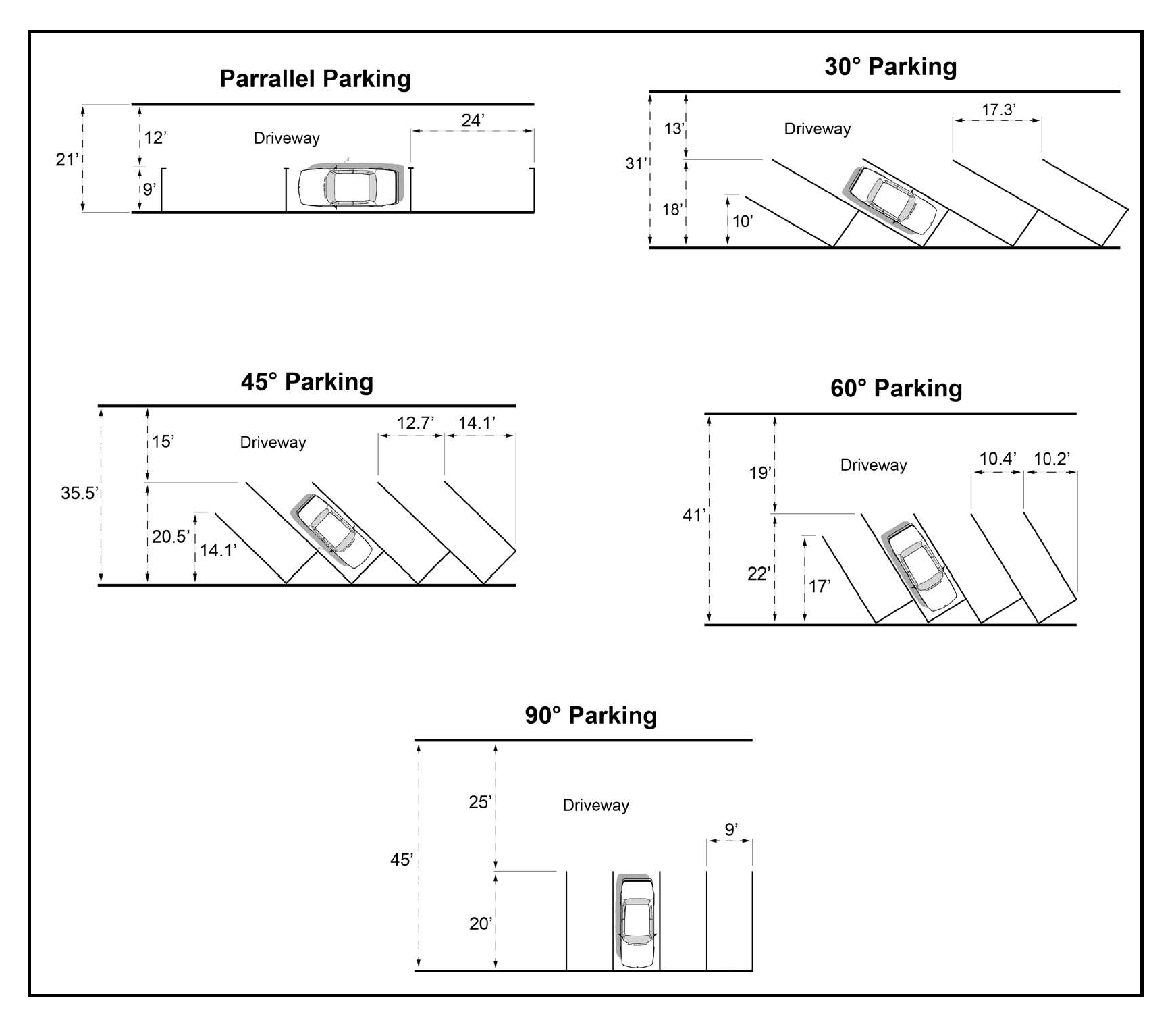
FIGURE 17.22.080.C: MINIMUM PARKING DIMENSIONS
D.
Parking Lot Design and Circulation.
1.
Interior Circulation. Parking lots shall be designed to ensure that no vehicle needs to use a public road to travel from one portion of the parking lot or facility to another. Dead-end aisles shall be provided with adequate paved turnaround area at the closed end.
2.
Storm Water Runoff. Design of the parking lot shall include provisions for control of surface runoff waters onto adjoining property and roads as approved by the Public Works Department.
3.
Emergency Access. Based on the requirements of the responsible fire protection agency, access for emergency vehicles may be required. Such access may include an alternate access for emergency use only and a fire lane.
4.
Snow Storage Area. All parking lots above the four thousand foot elevation shall include an area equal to ten percent of the parking area for the storage of snow removed from the parking area.
5.
Trailer Accommodations. Businesses located in areas where patron traffic is likely to include recreation vehicles, vehicles towing trailers, or other unusually long vehicles, may, at the option of the planning director, be required to provide additional parking lots for such vehicles. Driveway width and turning radii may be enlarged to accommodate the usage.
6.
Drive Through Facilities. Uses with drive-through pick-up or service windows shall have circulation patterns designed to accommodate both transient parking patrons and drive-through patrons. Patrons using the parking lot shall be able to access parking spaces and exit the property without using the drive-through area. Vehicles in line at the drive-through window during peak traffic times shall be located in such a manner so that regular parking and circulation is not subjected to interference. Drive-through lanes shall be clearly marked. The above requirements shall be met if a drive-through is added to an existing use.
7.
Motor Vehicle Fuel Sales. If an existing use is remodeled to include sales of motor vehicle fuels, a parking and circulation plan shall be submitted to and approved by the planning director prior to the use or occupancy of the development. Parking and access shall comply with this title, even in such cases where there is no addition to an existing structure.
8.
Service Station Conversion. If an existing vehicle service station is converted to a retail use, whether the fuel pumps remain in use or service, a parking and circulation plan shall be submitted to and approved by the planning director prior to the use or occupancy of the development. Parking and access shall comply with this title, even in such cases where there is no addition to an existing structure. The fuel pump parking shall not be included as meeting the required spaces for the retail use.
E.
Parking Striping. All parking spaces and, when required, aisles, pedestrian walkways and crossings, visitors' parking, fire lanes, no-parking areas and driveways, shall be striped and otherwise designated to provide for the safe loading, unloading and parking and storage of vehicles and shall be so installed as to be in accordance with the standards of the county for such improvements in accordance with this chapter and any other applicable State, federal, or other regulation.
F.
Paving. Other than parking areas for single-unit residential, campgrounds, and agriculture or timber uses, parking areas shall be paved with a minimum of four inches of class 2 aggregate base and a surface minimum of two inches of asphalt concrete or equivalent durable and dust-free surface approved by the public works department.
G.
Parking Lot Lighting Requirements. Lighting in compliance with Section 17.16.100, Lighting and Illumination, shall be required for areas designed to accommodate four or more vehicles, providing a minimum of one-half foot-candle and a maximum of three foot-candles of light during the hours of use from one-half hour before dusk until one-half hour after dawn.
H.
Perimeter Landscaping. For all uses, except single-unit dwellings, all off-street parking lots or facilities abutting a public street or highway, excepting those portions comprising driveways or pedestrian walkways, shall be bounded on the street or highway side or sides by a minimum three-foot-wide landscaped area.
I.
Alternative Parking Area Designs and Paving. Applicants may submit alternative parking area designs and paving to the planning director. If the applicant can demonstrate that variations in the requirements of this section are warranted to achieve environmental design and green building objectives, including but not limited to achieving certification under the LEED green building rating system or equivalent, an alternative parking area design or paving may be approved.
J.
Maintenance. Parking lots, including landscaped areas, driveways, and loading areas, shall be maintained free of refuse, debris, or other accumulated matter, and shall always be kept in good repair.
17.23.010 - Purpose.
The purpose of this chapter is to facilitate the establishment of temporary housing for residents who have lost their homes due to a disaster and to establish procedures for rebuilding structures damaged or destroyed as a result of a disaster while protecting the public health and safety of the residents within the declared disaster area.
17.23.020 - Declaration of emergency; Duration.
The provisions of this chapter are applicable for a period of two years following the declaration of each disaster for which a local emergency has been declared by the board of supervisors and shall take precedence over any conflicting ordinances in the Calaveras County Code that would apply in the absence of the emergency. By resolution of the board of supervisors, the provisions of this chapter may be extended for additional years, one year at a time, if the board of supervisors finds that additional time is necessary to prevent dislocation of residents who lost homes during the disaster and that systemic delays beyond the control of the individual property owners have occurred affecting reconstruction financing or construction.
17.23.030 - Definitions.
The following terms as used in this chapter shall have the following meanings, unless the context in which a term is used plainly requires another meaning:
A.
"Disaster" means a wildfire, flood, earthquake, or other natural or human-caused event that damages or destroys dwellings or other property and displaces people and which forms the basis for a declared local state of emergency.
B.
"Footprint" means the area that falls directly beneath and shares the perimeter of a structure and any area in which debris from a destroyed building remained after the disaster.
17.23.040 - Temporary on-site housing.
Temporary replacement housing consisting of a mobile home, manufactured home, modular unit, recreational vehicle, or similar temporary shelter located on a parcel on which a residence sustained damage such that the residence was destroyed or was rendered uninhabitable as a result of the disaster shall be authorized by the building official or designee subject to the following provisions:
A.
The permittee for temporary replacement housing was the property owner at the time that the disaster occurred.
B.
Temporary replacement housing authorized pursuant to this chapter shall be removed within two years of the date of the board action declaring the local emergency, unless a one-year extension is granted by the board of supervisors pursuant to Section 17.23.020, in which case it may remain until the extension expires.
C.
Temporary replacement housing shall meet the following installation standards:
1.
The land owner shall provide proof of ownership and proof that a permitted residence was destroyed as a result of the disaster. Proof that a residence was destroyed or rendered uninhabitable as a result of the disaster may be provided in the form of a prior finaled building permit, assessor's records, aerial photos, or other documentation satisfactory to the building official. If the temporary housing is erected prior to certification that it is free of all public hazards and toxic debris, the following provisions shall apply:
a.
A waiver of liability shall be signed by the land owner;
b.
The temporary replacement housing shall be located a minimum of one hundred fifty feet from the footprint of any damaged structure and in a manner that does not impede the debris removal process.
c.
The property owner shall implement mitigation measures adequate to prevent exposure of hazardous wastes and safety risks to humans and animals.
2.
The temporary replacement housing shall, absent a waiver of liability signed by the land owner, be located outside of the footprint of any damaged structure and shall not be erected until the site is certified by the county environmental health department or a state-managed debris removal program as being free of all public hazards and all toxic debris or residue caused by the disaster.
3.
The temporary replacement housing shall be located outside the boundaries of any recorded easements but may be located within the setback area of the applicable zone district so that placement of the temporary mobile home or recreational vehicle will allow for unobstructed reconstruction on the site.
4.
The temporary replacement housing shall be connected to an approved source of water meeting one of the following criteria:
a.
Public water supply;
b.
Existing well provided that it has been certified by the environmental health department as safe for domestic consumption;
5.
The temporary replacement housing shall be connected to an approved sewage disposal system meeting one of the following criteria:
a.
Public sewer system;
b.
Existing on-site sewage disposal system that has been certified by the on-site wastewater department to be intact and functioning following the disaster;
c.
Temporary holding tank with a contract with a pumping company for regular pumping. A copy of the contract shall be provided to the county.
d.
Other method of sewage disposal approved by the county environmental health officer.
6.
The temporary replacement housing shall be connected to an approved source of electricity meeting one of the following criteria:
a.
Permitted electrical service hook-up.
b.
Permitted solar panels.
c.
Other power electrical source approved by the county building official.
7.
Temporary replacement housing shall not be located in a designated "special flood hazard area" (SFHA) as defined in Section 15.06.020, other officially designated special hazard area, or in any mapped area established by separate action of the board or other authorized federal, state, or local official, as a moratorium area due to hazards to health and safety caused by the disaster and which require in-depth study before allowing rebuilding of any kind.
8.
The temporary replacement housing may be converted to a temporary construction trailer upon issuance of a building permit for a permanent residence pursuant to Section 17.25.220.A.3, Mobile Home or Trailer as a Temporary Residence.
D.
The property owner shall self-certify, on a form provided by the building department, that the above criteria have been satisfied for recreational vehicles. The self-certification shall include an agreement to remove the temporary housing in conformance with the provisions of subsections 17.23.040.A and B.8. All other temporary residential units shall be subject to permitting and inspection requirements as set forth by the California Department of Housing and Community Development.
17.23.050 - Replacement of damaged or destroyed housing or other structures.
Structures damaged or destroyed by a disaster may be replaced pursuant to the following provisions:
A.
Structures illegally constructed or uses illegally established before the disaster shall not be reconstructed or reestablished.
B.
Except as otherwise provided in this section, non-conforming buildings and non-conforming uses shall be subject to the provisions of Chapter 17.21.
C.
Non-conforming buildings damaged or destroyed by a disaster may be replaced subject to the following provisions:
1.
Replacement structures shall be located in the same location, with no change to the size, height, or footprint of the destroyed structure, except as provided in paragraph (C)(4) of this section.
2.
Replacement site-built structures shall comply with the current California Code of Regulations, Title 24 standards.
3.
Prior to the issuance of a building permit, the site of the structure shall be certified by the California Department of Resources, Recycling and Recovery (Cal Recycle) or the county environmental health department to be free of all public hazards and toxic debris or residue caused by the disaster.
4.
Replacement of mobile homes, manufactured homes or recreational vehicles shall comply with the National Manufactured Housing Act (42 U.S.C. Section 5401 et seq.), the Special Occupancy Parks Act (Health and Safety Code Section 18860), the Manufactured Housing Act of 1980 (Health and Safety Code Section 18020 et seq.), and current California Code of Regulations, Title 25 standards.
5.
Replacement structures shall not be located in a designated "special flood hazard area" (SFHA) as defined in Section 15.06.020, or other officially designated special hazard area.
D.
Structures in conformance with current county standards may be reconstructed or replaced subject to the following provisions:
1.
Prior to the issuance of a building permit, the site of the structure shall be certified by the California Department of Resources, Recycling and Recovery (Cal Recycle) or the county environmental health department that the site is free of all public hazards and toxic debris or residue caused by the disaster.
2.
Replacement site-built structures shall comply with the current California Code of Regulations, Title 24 standards.
3.
Replacement of mobile homes, manufactured homes or recreational vehicles shall comply with the National Manufactured Housing Act (42 U.S.C. Section 5401 et seq.), the Special Occupancy Parks Act (Health and Safety Code Section 18860), the Manufactured Housing Act of 1980 (Health and Safety Code Section 18020 et seq.), and current California Code of Regulations, Title 25 standards.
4.
Replacement structures shall not be located in a designated "special flood hazard area" (SFHA) as defined in Section 15.06.020, or other officially designated special hazard area.
E.
One garage or storage building may be permitted as an accessory structure prior to the issuance of a permit for a single family dwelling on any parcel on which a residence was destroyed by a disaster.
17.23.060 - Repair criteria.
Structures that have been damaged as the result of a disaster shall be repaired in accordance with the following criteria:
A.
When the estimated value of repair is less than fifty percent of the replacement value of the structure, the damaged elements may be repaired. Any repairs must comply with the current California Code of Regulations, Title 24 standards.
B.
When the estimated value of repair is fifty percent or more of the replacement value of the structure, the entire structure shall be brought into conformance with the current California Code of Regulations, Title 24 standards.
17.23.070 - Temporary emergency shelter and off-site temporary housing.
Construction or installation of one or more off-site dwelling units as a temporary shelter or temporary emergency housing for persons displaced by the disaster may be authorized, subject to the following provisions:
A.
With the exception of temporary placement of a single mobile home, manufactured home, or recreational vehicle on a privately owned parcel, temporary housing for displaced persons shall be located only in the following zones: REC, R2, R3, CP, C1, C2, and M4;
B.
Temporary replacement housing authorized pursuant to this chapter shall be removed or lawfully converted into permanent housing within two years of the date of the board action declaring the local emergency, unless an extension is granted by the board of supervisors pursuant to Section 17.23.020, in which case it shall be removed or converted prior to the expiration of such extension.
C.
Temporary shelters or emergency housing consisting of more than one unit shall be connected to water and sewer service and power source approved by the county building official. A single off-site unit shall be connected to water and sewer as provided in Sections 17.23.040.B.4 and B.5.
D.
With the exception of temporary placement of a single mobile home, manufactured home, or recreational vehicle on a privately owned parcel, off-site temporary housing and emergency shelters authorized under this chapter may only be established and operated by a federal, state, or county agency or a 501(C)(3) not-for-profit organization.
E.
The entity providing emergency shelter or housing shall enter into an agreement with the county to remove all housing units and other facilities upon expiration of the temporary use permit or when the need for the temporary housing ceases, whichever occurs first.
17.23.080 - Fees; Replacement of damaged or destroyed housing or other structures.
All current permit fees apply, including demolition permit fees, unless otherwise modified or waived by the board of supervisors as part of a specific emergency proclamation.
A.
During the time period when this chapter is applicable per Section 17.23.020, application filing fees that are normally paid at the time the application is submitted may be deferred at the applicant's request and paid at the time the permit is issued.
B.
During the time period when this chapter is applicable per Section 17.23.020, the RIM Fee, benefit basin fees, and school impact fees will be not be charged for replacement of lawful pre-existing improvements that were already subject to such fees or that were lawfully constructed prior to such impact fees. These fees will be charged for new or expanded improvements.
17.23.090 - Debris removal; Site certification required.
All hazardous materials and debris, including but not limited to household hazardous wastes, asbestos, ash from burned structures, metals, damaged or destroyed vehicles, and all public hazards shall be removed prior to reconstruction or reuse of property damaged by the disaster and shall, in all cases, be removed and disposed of within one hundred eighty days of the disaster for which the local state of emergency was declared unless the county environmental health director grants a discretionary ninety day extension upon a showing of good cause. Debris removal and disposal shall comply with all laws and regulations, and the site shall be certified within the time period described herein by the California Department of Resources, Recycling and Recovery or the county environmental health department that it is free of all toxic debris or residue caused by the disaster.
17.23.100 - Debris disposal.
All burned building debris and other hazardous debris created by the disaster that is removed from the site shall be disposed of in accordance with state law and policies and procedures developed and published by county environmental health department.
17.23.110 - Temporary facilities for post-disaster recovery.
Temporary facilities necessary for the timely removal of debris, stabilization of soils, erosion control, and other needs as determined by the agency or agencies directing post-disaster recovery and clean-up operations may be established as needed subject to the following provisions:
A.
Staging areas for equipment, vehicles, and storage on private property shall be subject to issuance of a temporary use permit, pursuant to Chapter 17.32. The temporary use permit shall identify the expiration date and shall specify clean-up and restoration provisions for the site upon termination of the use.
B.
Staging areas on public land shall be subject to the authorization of the agency managing said land.
C.
Off-site processing and storage, recycling, or other handling of disaster-generated debris shall be subject to the following provisions:
1.
The site is properly zoned for the activity and all required permits have been previously issued and validated, or
2.
A temporary use permit, pursuant to Chapter 17.32, has been issued. The temporary use permit shall specify the duration of the use, an expiration date, and clean-up and restoration provisions for the site upon termination of the use.
17.23.120 - Severability and pre-emption.
A.
If any section, subsection, sentence, clause, or phrase of this chapter, is for any reason held to be invalid, unlawful, or unconstitutional, such invalidity or unconstitutionality shall not affect the validity, lawfulness, or constitutionality of any or all other portions of this chapter.
B.
To the extent that any part of this chapter conflicts with any portion of an executive order signed by the governor of the state of California related to a disaster for which this chapter is invoked, the executive order shall control.
17.24.010 - Purpose.
The purpose of this chapter is to promote the public health, safety, and welfare through a comprehensive system of reasonable, effective, consistent, content-neutral, and nondiscriminatory sign standards and requirements. More specifically, this chapter is intended to:
A.
Balance public and private objectives by allowing adequate avenues for both commercial and non-commercial messages;
B.
Allow signs to serve as an effective channel of communication while preventing visual clutter that will detract from the aesthetic character of the county;
C.
Maintain and enhance the county's appearance by regulating the location, number, type, quality of materials, size, illumination, and maintenance of signs;
D.
Restrict signs that may create a nuisance to nearby properties, violate privacy, or create hazards or unreasonable distractions for pedestrians or drivers;
E.
Provide clear and unambiguous sign standards that enable fair and consistent enforcement; and
F.
Ensure that the constitutionally guaranteed right of free speech is protected.
17.24.020 - Applicability.
The provisions of this chapter apply to all signs in all zoning districts, unless otherwise specified, constructed, or physically altered on or after the effective date of this chapter.
A.
Nothing in this chapter shall be construed to prohibit a person from holding a sign while picketing or protesting on public property that has been determined to be a traditional or designated public forum, so long as the person holding the sign does not block ingress and egress from buildings, create a safety hazard by impeding travel on sidewalks, in bike or vehicle lanes, or on trails, or violate any other reasonable time, place, and manner restrictions adopted by the county.
B.
The provisions of this chapter shall not require alteration of the display of any registered mark, or any trademark, service mark, trade name, or corporate name that may be associated with or incorporated into a registered mark, where such alteration would require the registered mark to be displayed in a manner differing from the mark as exhibited in the certificate of registration issued by the United States Patent and Trademark Office. When applicable, it is the responsibility of the applicant to establish that a proposed sign includes a valid registered mark.
17.24.030 - Exempt signs.
The following signs are exempt from the permit requirements of this chapter, and they do not count toward the total sign area limit for a site, provided that they conform to the specified standards.
A.
Signs required by federal/state law.
B.
Temporary holiday displays and decorations.
C.
Community bulletin boards, whether sponsored by a private entity or public organization.
D.
Signs for special events such as yard, barn, and garage sales; open houses; theatrical performances; musical events; fundraising activities; and similar events that comply with the following requirements. Additional signage may be allowed pursuant to Section 17.24.100.F, Temporary signs.
1.
Are smaller than eighteen inches by thirty inches.
2.
Are posted for no longer than seven days prior to event.
3.
Are removed within seventy-two hours of the last day of the event.
4.
Are not posted on traffic-control signs, utility poles or traffic advisory signs.
E.
"No Trespassing" signs.
F.
"Open" and "Closed" signs.
G.
Address numbers less than eight inches in height.
H.
Signs placed by utilities or other publicly regulated service providers indicating location of underground facilities, danger, and aids to service or safety, including official advisory and signal flags.
I.
Informational signs not more than eight square feet in area for the direction or convenience of the public such as outlining/assisting vehicle and pedestrian circulation within a site, egress, ingress, and any public facilities such as restrooms, telephones, walkways, and other similar features.
J.
Signs that are in the interior areas of a building or site not visible from the public right-of-way, and at least five feet from a window, door, or other exterior wall opening.
K.
Murals or other artistic paintings on walls, provided no logos, emblems, or other similar devices, sign copy, or illustrations of activities associated with uses on the premises or in the vicinity are included in the mural or painting.
L.
Commemorative plaques, tablets, date of construction, and similar signs.
M.
Memorial tablets or signs and historic markers.
N.
Construction informational signs up to a maximum size of four-square feet per sign, erected during construction and removed upon final inspection or occupancy, whichever occurs first.
O.
Political signs informing of political candidates, parties, issues, measures, propositions, philosophies, or personal beliefs, and which are not commercial messages, shall be exempt from all regulations of this chapter, except that such signs shall not be placed within the public right-of-way. Political signs shall conform to the requirements of the Elections Code for placement and removal.
P.
Signs adhered to windows up to a maximum size of 25 percent of the total window area of the building elevation where the signs are located.
17.24.040 - Prohibited signs.
Unless otherwise permitted by a specific provision of this chapter, the following sign types are prohibited:
A.
Animated or Moving Signs. Animated, flashing, blinking, reflecting, revolving, or other similar sign with visibly moving or rotating parts or visible mechanical movement of any kind. This provision does not apply to signs using digital display technology, such as LED (light emitting diodes) or functionally equivalent display methods, which are permitted, subject to the regulations of this chapter.
B.
Balloons, Inflatable Signs, Streamers, Pennants, and Other Attention-Getting Devices. Balloons, inflatable signs, streamers, pennants, and other movable attention-getting devices, made of light-weight fabric or similar material, designed to rotate, or move with the wind, that direct, promote, or that are otherwise designed to attract attention are prohibited except when used as promotional signs pursuant to Section 17.24.100.F, Temporary signs.
C.
Mobile Billboards. Any sign carried or conveyed by a vehicle for the primary purpose of general advertising for hire, except when used as promotional signs pursuant to Section 17.24.100.F, Temporary signs. This prohibition does not apply to displays on vehicles related to the goods or services provided by the vehicle owner or operator and public transit/public carrier graphics on properly licensed buses, taxicabs, and similar vehicles for hire that legally pass through the county.
D.
Signs Located in the Public Right-of-Way or on Public Property. Other than official government signs or warning signs required by law, no inanimate sign can be placed in or project into the public right-of-way or on public property unless authorized by an encroachment permit.
E.
Signs Affixed to Utility Poles or Trees. Signs affixed to or cut into any utility pole or tree or other living vegetation.
F.
Signs on Terrain. Signs cut, burned, marked, or displayed in any manner on a street, sidewalk, cliff, or hillside.
G.
Signs Creating Traffic Hazards or Affecting Pedestrian Safety.
1.
Signs placed or located in such a manner as to constitute a safety hazard or to impede the public use of the public right-of-way.
2.
Signs which contain any design, symbol or content that parodies, imitates, or resembles traffic-control signs or devices.
H.
Signs Blocking Ingress or Egress, and Access. Any sign erected in such a manner that will limit, prohibit, or otherwise obstruct the use of any doors, windows, access routes or emergency access routes.
I.
Signs for Prohibited Uses. A sign displaying a commercial message promoting a business that is a prohibited use and has not been established as a legal nonconforming use.
J.
Signs that Produce Noise or Emissions. Signs that produce visible smoke, vapor, particles, odor, noise, or sounds that can be heard at the property line, excluding voice units at menu boards and devices for servicing customers from their vehicles.
17.24.050 - Measuring sign area.
The area of a sign shall be calculated by enclosing the extreme limits of framing, emblem, logo, representation, letters applied to the structure without a distinctive background (e.g., channel letter), or other display within a maximum of two squares and/or rectangles. Supporting structures, such as bases and columns, are not included in sign area provided that they contain no lettering or graphics. See Figure 17.24.050: Sign Area Measurement.
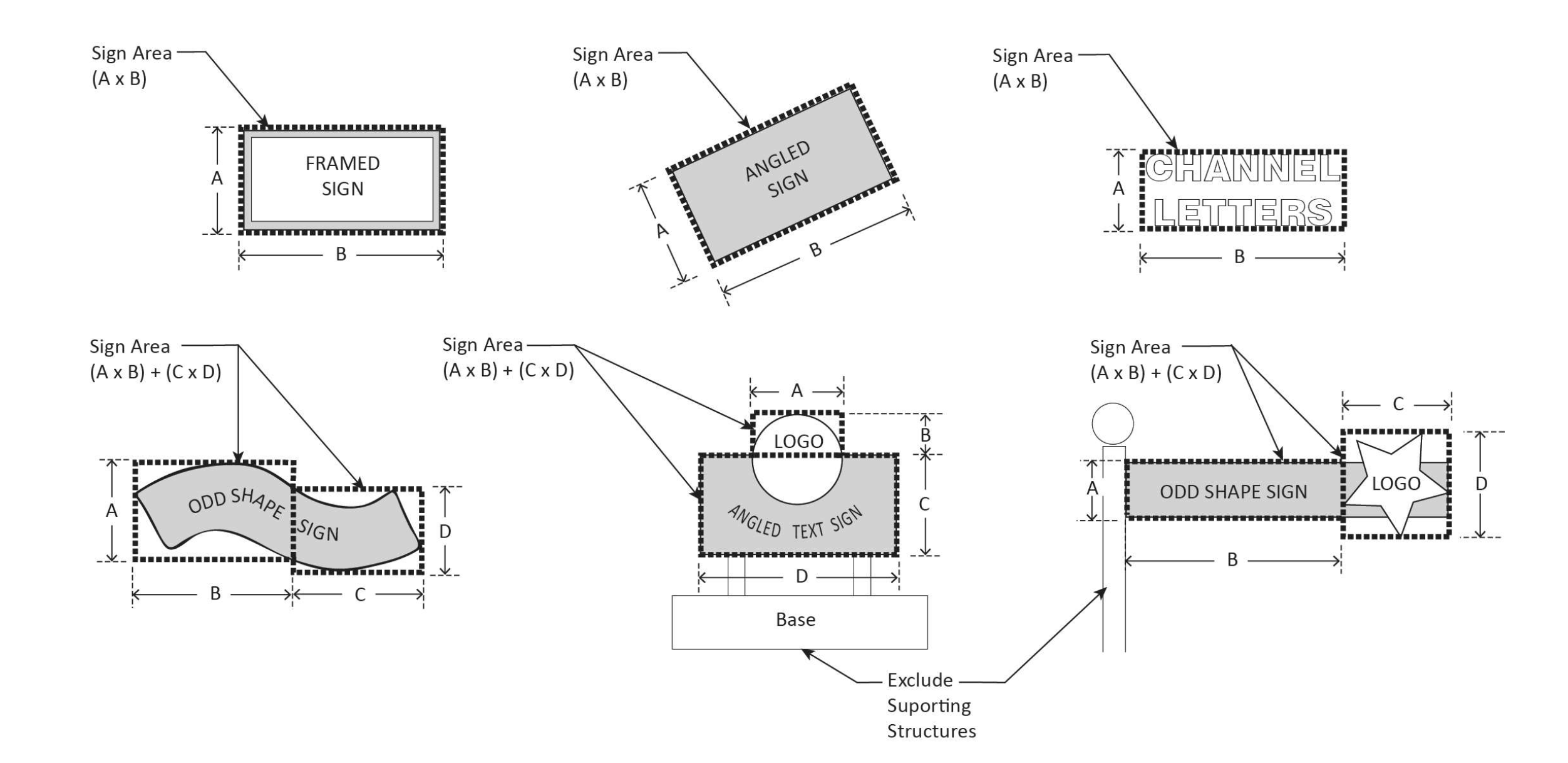
FIGURE 17.24.050: SIGN AREA MEASUREMENT
A.
Single-Faced Signs. The sign area of a sign with a single face area is the area of the sign face.
B.
Double-Faced Signs. Where two faces of a double-faced sign are located two feet or less from one another at all points or located at an interior angle of forty-five degrees or less from one another, the sign area of double-faced signs is computed as the area of one face. Where the two faces are not equal in size, the larger sign face will be used. Where two faces of a double-faced sign are located more than two feet or greater than forty-five degrees from one another, both sign faces are counted toward sign area.
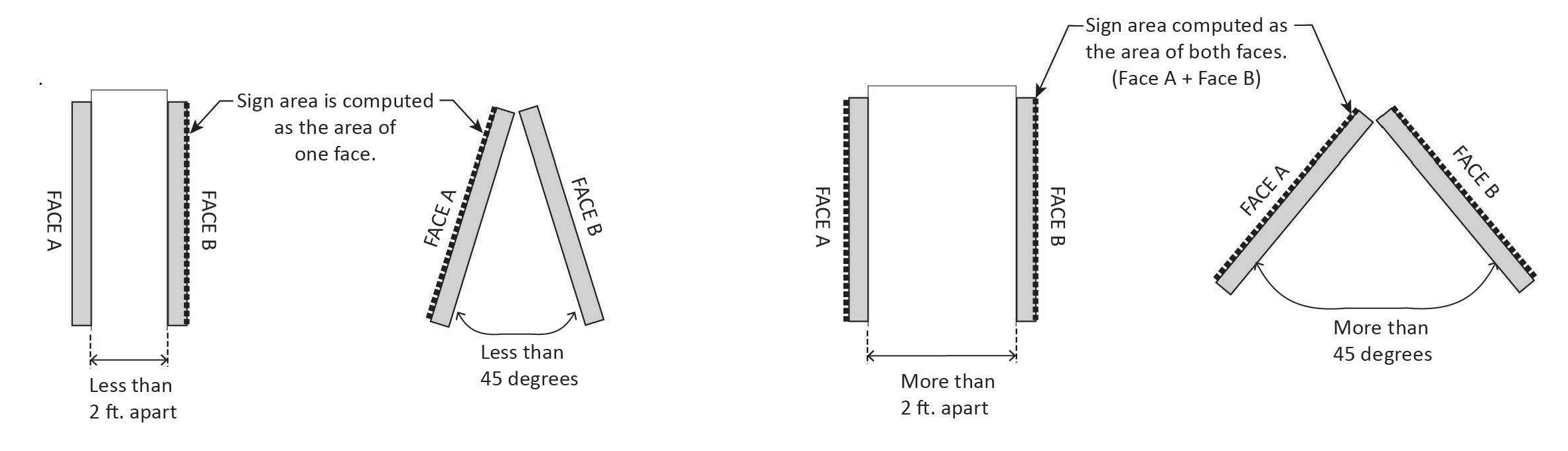
FIGURE 17.24.050.B: MEASURING DOUBLE-FACED SIGNS
C.
Multi-Faced Signs. On a multi-faced sign, where at least one interior angle is forty-five degrees or less, the area of two faces (the largest and smallest face) must be summed to determine sign area. In all other situations involving a sign with three or more sides, sign area will be calculated as the sum of all faces.
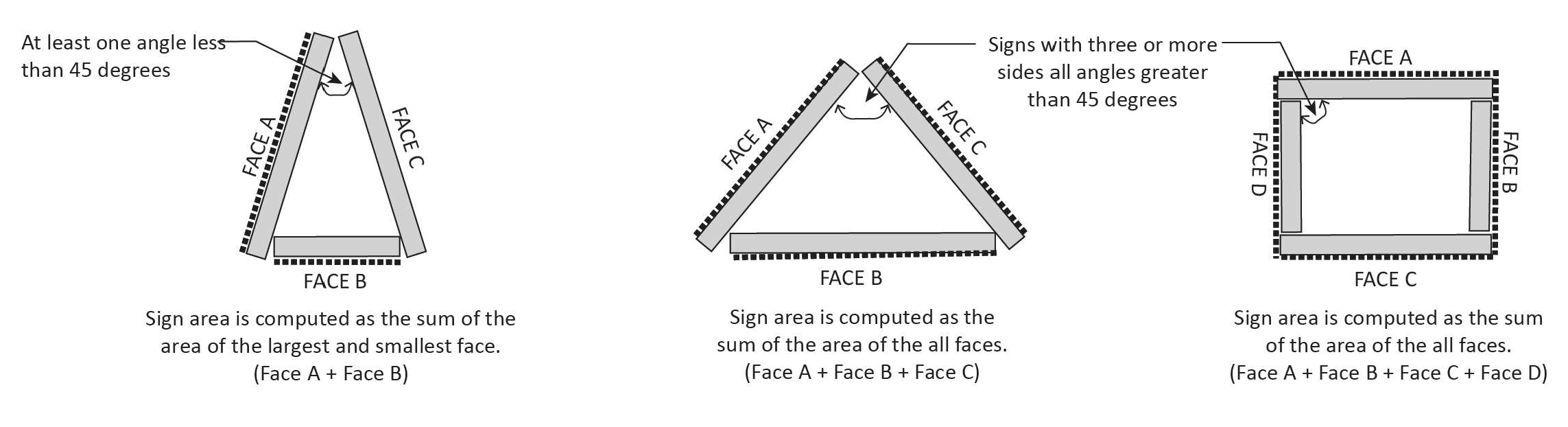
FIGURE 17.24.050.C: MEASURING MULTI-FACED SIGNS
D.
Three-Dimensional Signs. Signs that consist of, or have attached to them, one or more three-dimensional objects (i.e., balls, cubes, clusters of objects, sculpture, or statue-like trademarks), may have a sign area that is the sum of all areas using the four vertical sides of the smallest rectangular prism that will encompass the sign.
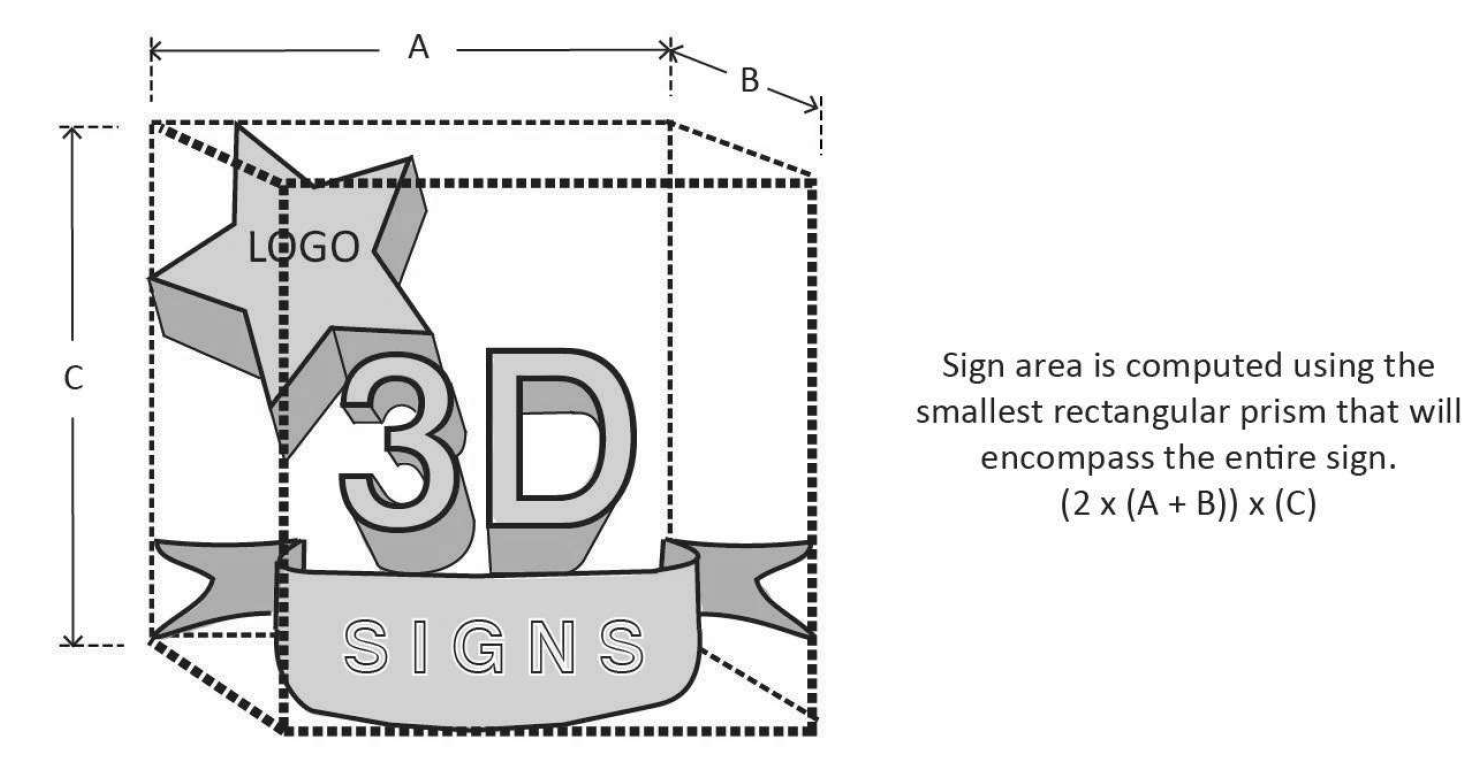
FIGURE 17.24.050.D: MEASURING THREE-DIMENSIONAL SIGNS
17.24.060 - Required Permits.
A.
Applicable Codes. In addition to complying with the provisions of this section, all signs must be constructed in accordance with the building code, the Sign Code, the Electrical Code, and all other applicable laws, rules, regulations, and policies.
B.
Zoning Clearance. A zoning clearance pursuant to Chapter 17.28, Zoning Clearance, is required for all signs, except those specifically exempted in Section 17.24.030, Exempt Signs.
C.
Encroachment Permits. Signs mounted on private property may project into or above public property or the public right-of-way only with approval by the public works director of an encroachment permit.
D.
Comprehensive Sign Program. The purpose of a comprehensive sign program is to provide a method for an applicant to integrate the design and placement of signs within a project with the overall development design to achieve a more unified appearance.
1.
Applicability. A comprehensive sign program is required whenever a deviation from the standards of this chapter is requested. A comprehensive sign program may also be requested for any project with two or more nonresidential tenants.
2.
Application. Comprehensive sign program applications shall contain all written and graphic information needed to fully describe the proposed sign program, including the proposed location and dimension of each sign, as well as proposed color schemes, font types, materials, methods of attachment or support, and methods of illumination. A comprehensive sign program application shall also include calculation of total allowed sign area, and total proposed sign area, for the site.
3.
Allowable Modifications. A comprehensive sign program may provide for deviations from the standards of this chapter.
4.
Review Authority. All comprehensive sign programs are subject to review and approval of the review authority for the project with which the signs are associated. A comprehensive sign program may be submitted separately or as part of the permit application for the project.
5.
Required Findings. In order to approve a comprehensive sign program, the review authority must find that all of the following are met, in addition to other applicable regulations in this chapter.
a.
The proposed signs are compatible in style and character with any building to which the signs are to be attached, any surrounding structures and any adjoining signage on the site;
b.
Future tenants will be provided with adequate opportunities to construct, erect or maintain a sign for identification; and
c.
Directional signage and building addressing are adequate for pedestrian and vehicular circulation and emergency vehicle access.
6.
Lessees to Be Informed of Comprehensive Sign Program. Lessees within developments subject to the requirements of an approved Comprehensive Sign Program shall be made aware of the Comprehensive Sign Program in their lease.
17.24.070 - Sign copy.
A.
Changes to Copy of Approved Signs. Changes to the copy of approved signs that were legally established and have not been modified to become illegal are exempt from permitting pursuant to this chapter. Changes to copy do not include changes to the type or level of illumination of an approved sign.
B.
Noncommercial Signs. Non-commercial signs are allowed wherever commercial signs are permitted and are subject to the same standards and total maximum allowances per site or building of each sign type specified in this chapter.
C.
Message Substitution. A non-commercial message of any type may be substituted, in whole or in part, for any duly permitted commercial message, any non-commercial message may be substituted for any other non-commercial message, and any on-site commercial message may be substituted, in whole or in part, for any other on-site commercial message.
1.
No Additional Approval. Such substitution of message may be made without any additional approval, permitting, registration, or notice to the county. The purpose of this provision is to prevent any inadvertent favoring of commercial speech over non-commercial speech or favoring of any particular non-commercial message over any other noncommercial message.
2.
Limitations. This message substitution provision does not: 1) create a right to increase the total amount of signage on a parcel, lot or land use; 2) affect the requirement that a sign structure or mounting device be properly permitted; 3) allow a change in the physical structure of a sign or its mounting device; or 4) authorize the substitution of an off-site commercial message in place of an on-site commercial message or in place of a non-commercial message.
D.
Changeable Copy.
1.
Manual Changeable Copy. Manually changeable copy is allowed.
2.
Automatic Changeable Copy and Electronic Message Center Signs. Electronic Message Center (EMC) signs and automatic changeable copy in which copy can be changed or altered by electric, electro-mechanical, electronic, or any other artificial energy means, are allowed subject to the following standards.
a.
Display Duration. The display shall change no more frequently than once every eight seconds and must have an unlighted interval between copy displays of 0.3 second or more.
b.
Static Message. Displays shall contain static messages only, and shall not have movement, or the appearance or optical illusion of movement, of any part of the sign structure, design, or pictorial segment of the sign, including the movement or appearance of movement of any illumination, or the flashing, scintillating, or varying of light intensity.
c.
Light Intensity. 0.3 foot-candles over ambient lighting conditions when measured at a distance equal to the square root of one hundred times the area of the sign in square feet. All electronic copy must be equipped with a sensor or other device that automatically determines the ambient illumination and programmed to automatically dim according to ambient light conditions, or that can be adjusted to comply with the 0.3 foot-candle measurements.
d.
Automatic Controls. All electronic message displays shall be equipped with automatic controls to allow for adjustment of brightness based on ambient lighting conditions.
17.24.080 - Sign height.
A.
Maximum Sign Height. The top of any sign structure or display area shall not be more than twenty-five feet above the average ground elevation as measured within one hundred feet of the sign, or more than ten feet above the highest point of the on-site structure, whichever is less.
B.
Minimum Sign Clearance.
1.
The bottom of any sign located within the vision clearance zone established in Section 17.16.140, Visibility at Intersections and Driveways, shall be no less than eight feet above the highest elevation of the road surface within the clearance zone.
2.
Signs that extend over pedestrian-exclusive access shall be a minimum of ten feet above the highest elevation under the sign. Signs that extend over a vehicle-pedestrian or vehicle-exclusive access area shall be a minimum of sixteen feet above the highest surface elevation under the sign.
C.
Billboards. Billboards shall be a maximum of twenty feet above the ground elevation on which the billboard is located.
17.24.090 - Illumination.
Unless otherwise established by planned development or design review criteria, signs may be illuminated either directly or indirectly. Sign illumination shall be in compliance with Section 17.16.100, Lighting and Illumination and the following:
A.
Externally illuminated signs shall use top mounted light fixtures which shine downward and are directed so that lighting does not shine or glare into traffic patterns within a parking lot, on a road, or onto adjoining property.
B.
Internally illuminated signs shall not produce light such that lighting levels increase by more than 0.3 foot-candles over ambient lighting conditions as measured using a foot candle meter at a distance of one hundred fifty feet from the sign. The light source, lamps, or bulbs shall not be directly visible and shall be obscured by translucent or filtered lenses or designs.
17.24.100 - Allowed signage.
A.
Nonresidential Uses. In addition to other signs allowed pursuant to this section, nonresidential uses are allowed the following signs:
1.
Nonresidential Uses in Residential Zones. Nonresidential uses in residential zones, including home occupations and short term vacation rentals, a single-sided sign without illumination is permitted, provided that the sign is mounted on the residence, and is no larger than twelve inches in height and twenty-four inches in length.
2.
Nonresidential Uses in Zones other than Residential Zones. Nonresidential uses in zones other than residential zones are allowed a maximum of one square foot of sign area for each linear foot of principal building elevation.
a.
The property owners shall select the elevation of the structure that is considered the principal elevation. The principal elevation is used for determining allowable sign area; however, sign placement is not limited to the designated principal elevation.
b.
The maximum allowed sign area applies to the cumulative sign area of all signs located on the subject parcel.
B.
Entrance Signs. Nonresidential developments with two or more tenants and residential subdivisions may erect entrance identification signs with a maximum cumulative sign area of two hundred fifty square feet per development or subdivision.
C.
Directional Signs. The overall purpose of directional signs is to inform tourist and travel visitors to the county of various recreation, historic, civic, and cultural features. Directional signs, pursuant to the Outdoor Advertising Act, are permitted for businesses which rely primarily on tourist and travel-oriented clientele. Such signs shall be no more than thirty-two square feet in total area, and shall be subject to the provisions of an administrative use permit. Limitations on the style of graphics, color scheme or other features of the sign may be set to maintain a conformity in concept between the various directional signs in the county.
D.
Billboards. Billboards of a maximum area of one hundred twenty-eight square feet may be permitted on private property in the M2 zone upon approval of a conditional use permit. Billboards shall comply with the provisions of Division 3, Chapter 2 of the California Business and Professions Code, and the following requirements:
1.
Billboards shall not be erected in a manner to block the visibility along the highway for pedestrians and vehicles of other vehicular traffic.
2.
Billboards may be illuminated, except that blinking or animated lighting shall not be permitted.
3.
No billboard shall be erected within three hundred feet of any other billboard facing the same traffic direction. No billboard shall be erected within three hundred feet of an on-site sign for the same business erected in conformance with this chapter.
4.
No billboard shall be erected without the issuance of a permit pursuant to the Outdoor Advertising Act from the California Department of Transportation.
E.
Community Identification Signs. Freestanding community identification signs containing the name of a recognized community in the general plan or a city, are permitted in any zone at or near an entrance to the community or city pursuant to an administrative use permit and the following regulations:
1.
Community Information. A community identification sign may include a community theme and directional information but shall not contain other advertising matter.
2.
Area. Signs shall not exceed sixty square feet in sign area.
3.
Height. Signs shall not exceed fifteen feet in height.
4.
Design. Signs shall be architecturally compatible with the community area in which they are located and shall be constructed with decorative materials that are compatible with the location and the community.
5.
Community Outreach Required. To approve a community identification sign, the review authority shall find that adequate community outreach has occurred to ensure the community is aware of the application and has had the opportunity to provide input.
F.
Temporary Signs. Temporary signs are allowed as follows.
1.
General Temporary Signs. Temporary signs are allowed provided they comply with the following requirements.
a.
Are smaller than four feet by eight feet.
b.
Are posted for no longer than six weeks.
c.
Are not replaced in substantially the same form until at least four calendar weeks have passed from the conclusion of the last previous display of the sign.
d.
Are not posted on traffic-control signs, utility poles or traffic advisory signs.
e.
Across-the-road banners require the approval of the department of public works for county roads and Caltrans for State highways.
2.
Real Estate. Signs offering property for sale or lease are permitted as follows, provided that such signs are removed upon close of escrow for sale transactions, or the initial period of full occupancy for lease or rental transactions:
a.
Residential parcels of less than five acres: maximum cumulative sign area is four square feet.
b.
Residential multi-unit developments of fewer than ten units: maximum cumulative sign area is eight square feet.
c.
Other types of real estate and development: maximum cumulative sign area is thirty-two square feet.
3.
Sandwich Boards. Sandwich boards are permitted in compliance with the following.
a.
Maximum Width: Two feet.
b.
Maximum Height: Three feet.
c.
Maximum Number: One per tenant space.
d.
Location: May be located within required setback areas. Shall not unreasonably impede access to or use of doorways, walkways, drive aisles, parking areas, and/or spaces.
4.
New Development Signs. Residential subdivisions for which a final tract map has been recorded, and commercial or industrial complexes for which parcel maps have been recorded, may erect temporary signs in compliance with the following.
a.
Location. Such signs may be placed upon private property within two road miles of the subdivision or project provided that the record owner of the private property has agreed to such placement.
b.
Maximum Sign Area. Signs shall have a maximum area of thirty-two square feet.
c.
Maximum Total Number of Signs. A maximum of six signs shall be permitted.
d.
Maximum Number of Signs Per Parcel Frontage. A maximum of one sign per parcel frontage.
e.
Duration. The maximum term that new development signs may be displayed under the provisions of this section is eighteen months.
i.
The time period is measured from the date of erection of the first sign. All additional signs are assigned time periods from this first date.
ii.
Additional units or phases of the same subdivision count as additional subdivisions for the purposes of determining the eighteen month duration.
iii.
The starting time and date for the additional units shall be based on the date of recordation of the final maps for the additional subdivision units.
iv.
The maximum of six signs, however, applies to the additional units. It is prohibited to have more than a total of six signs, even when there is more than one subdivision unit.
17.24.110 - Nonconforming signs.
A.
Continuance and Maintenance. Reasonable and routine maintenance and repairs may be performed on signs that are nonconforming provided there is no expansion of any nonconformity.
B.
Abandonment of Nonconforming Sign. Whenever a nonconforming sign has been abandoned, or the use of the property has been discontinued for a continuous period of twelve months, the nonconforming sign must be removed.
C.
Restoration of a Damaged Sign. A nonconforming sign with damage that does not exceed fifty percent of the total sign area, including hardware and attachments, may be restored provided that the repairs start within sixty days of the date of damage and are diligently pursued to completion.
17.24.120 - Sign maintenance.
All signs erected in conformance with this chapter shall be maintained in a safe and orderly appearance. The sign owner shall perform such maintenance tasks as necessary on a regular basis, including and not limited to repainting, replacement of structural members, repair of sign facing and illumination, and removal of vegetation around the base of the sign or structure.
17.25.010 - Purpose.
The purpose of this chapter is to establish standards for specific uses and activities that are permitted or conditionally permitted in several or all zones. These provisions are supplemental standards and requirements to minimize the impacts of these uses and activities on surrounding properties and to protect the health, safety, and welfare of their occupants and of the general public.
17.25.020 - Applicability.
A.
Each land use and activity covered by this chapter shall comply with the requirements of the section applicable to the specific use or activity, in addition to any applicable standard this title required in the zone where the use or activity is proposed and all other applicable provisions of this title.
B.
The uses that are subject to the standards in this chapter shall be located only where allowed by the Land Use Regulation tables in Subtitle II: Base Zoning Districts or specific plan and/or planned development use regulations.
C.
The uses that are subject to the standards in this chapter are allowed only when authorized by the planning permit required by zone, specific plan, or planned development regulations, such as a conditional use permit, except where this chapter establishes a different planning permit requirement for a specific use.
17.25.030 - Accessory uses.
Accessory uses that are clearly incidental and customarily associated with a principal use on the site may be allowed in conjunction with the principal use to which it relates. Accessory uses shall be subject to the same regulations as the principal use and any standards applicable to specific uses and activities found in this title. Examples of uses considered accessory to agricultural operations include, but are not limited to, small scale equipment servicing operations and small scale lumbering operations.
17.25.040 - Accessory dwelling units.
Accessory dwelling units shall comply with all provisions of the base, overlay, or specific plan zone, except as modified by this section.
A.
Residential Density. An accessory dwelling unit is a residential use that is consistent with the existing general plan and zoning designations for the lot. Any accessory dwelling unit constructed pursuant to this section will not cause the allowable density to be exceeded (i.e. accessory dwelling units do not count in density calculations).
B.
Primary Dwelling Unit Required. The lot shall be zoned to allow single-unit or multi-unit dwellings and contain an existing dwelling unit at the time a building permit for an accessory dwelling unit is submitted, or the building permit for the accessory dwelling unit may be made in conjunction with the development of the primary dwelling.
C.
Number and Type of Units.
1.
Lots with Existing or Proposed Single-Unit Dwellings. The following accessory dwelling units are permitted on lots with existing or proposed single-unit dwellings.
a.
One detached accessory dwelling unit or one accessory dwelling unit within the existing or proposed space of a single-unit dwelling, and
b.
One junior accessory dwelling unit within the existing or proposed space of a single-unit dwelling, including an attached garage. See Section 17.25.040.E.4, Junior Accessory Dwelling Unit.
2.
Lots with Existing Multi-Unit Dwellings. The following accessory dwelling units are permitted on lots with existing multi-unit dwellings.
a.
Two detached accessory dwelling units, and
b.
Up to twenty-five percent of the number of units within a multi-unit structure, with a minimum of one accessory dwelling unit, constructed within portions of the multi-unit structure that are not used as livable space.
D.
Standards for Attached and Detached Accessory Dwelling Units.
1.
Floor Area. Maximum one thousand two hundred square feet.
2.
Setbacks. Accessory dwelling units shall comply with the setback standards applicable to other structures within the zone in which the lot is located except as provided below.
a.
Interior Side and Rear Setbacks. Minimum four-foot side and rear setbacks.
b.
Accessory Dwelling Unit Constructed Above a Garage. If an accessory dwelling unit is constructed above a garage, a setback of no more than five feet from the interior lot lines shall be required for the accessory dwelling unit.
E.
Standards for Accessory Dwelling Units Constructed Within Existing or Proposed Structures. For purposes of this subsection, to be considered an existing structure, the structure must be a legally permitted structure that conforms to current zoning or is legally permitted but nonconforming as to current zoning.
1.
Floor Area. The accessory dwelling unit shall be contained entirely within the permitted floor area of the primary residence or accessory structure on the same lot as the primary residence. A maximum one hundred fifty square feet expansion to existing floor area is allowed to accommodate ingress and egress.
2.
Exterior Access. Exterior access that is independent from the primary residence shall be provided.
3.
Setbacks. The interior setbacks shall be sufficient for fire safety.
4.
Junior Accessory Dwelling Unit. Accessory dwelling units within existing or proposed structures may be designed as a junior accessory dwelling units subject to the following standards.
a.
Floor Area. Maximum five hundred square feet.
b.
Efficiency Kitchen Required. The junior accessory dwelling unit shall have an efficiency kitchen which shall include all of the following.
i.
A cooking facility with appliances.
ii.
A food preparation counter and storage cabinets that are of reasonable size in relation to the size of the junior accessory dwelling unit.
c.
Owner Occupancy Required. The owner of the single-unit dwelling in which the junior accessory dwelling unit is located shall reside in either the remaining portion of the structure or the junior accessory dwelling unit.
F.
Conversions.
1.
Setbacks. No setback shall be required for an existing living area or accessory structure, or a structure constructed in the same location and to the same dimensions as an existing legal structure that is converted to an accessory dwelling unit or to a portion of an accessory dwelling unit.
2.
Parking. If enclosed or covered parking for the primary dwelling is converted or demolished in conjunction with the construction of an accessory dwelling unit, replacement parking is not required.
G.
Required Parking. Automobile parking is not required for an accessory dwelling unit. Required parking for the primary dwelling shall be provided pursuant to Chapter 17.22, Parking.
H.
Water, Wastewater, and Fire Protection. Applicable building code requirements, environmental health requirements pertaining to domestic water supply and onsite wastewater treatment systems requirements, and fire protection codes shall be met.
I.
Determination of Adequate Water Source Capacity.
1.
When an accessory dwelling is not served by a public water system, the adequacy of any well serving more than one residential unit shall be determined by the Environmental Health Department based on an assessment of the well's water production adequacy in a source capacity report, as specified in Section 16.12.090(B) of the Calaveras County Code, that has been prepared by a qualified professional as defined in Section 16.03.365.
2.
The well shall be considered an adequate source of water when one of the following criteria have been documented in the source capacity report:
a.
Source capacity of five gallons per minute or greater that is sustained during a twenty-four-hour period of continuous pumping, or until seven thousand two hundred gallons of water has been pumped, whichever is less, with a minimum of one thousand five hundred gallons of storage in a tank approved by the American Water Works Association (AWWA) or equivalent; or
b.
Source capacity of two and a half gallons per minute or greater that is sustained during a twenty-four hour period of continuous pumping, or until seven thousand two hundred gallons of water has been pumped, whichever is less, with a minimum of two thousand five hundred gallons of storage in a tank approved by the American Water Works Association (AWWA) or equivalent.
3.
Nothing herein shall restrict the development of a second well to provide water for the accessory dwelling in lieu of the source capacity testing specified herein.
J.
Fire Sprinklers. An accessory dwelling unit shall not be required to provide fire sprinklers if they are not required for the primary residence.
K.
Emergency Access and Egress. The site of an accessory dwelling unit shall meet the minimum emergency access and egress requirements as set forth in the California Code of Regulations, Title 14, Division 1.5, Chapter 7, Article 2 if located in the state responsibility area and in a high or very high fire severity zone.
L.
Historic Structures and Places. If the accessory dwelling unit is located on real property listed in the California Register of Historic Places the unit shall conform to any standards adopted by the State or county that prevent impacts to the historic quality of the site.
M.
Sale and Rental Limitations. Accessory dwelling units may be rented separately from the primary residence but may not be sold or otherwise conveyed separate from the primary residence, except as allowed pursuant to Government Code Section 65852.2. Rental terms shall be a minimum of thirty consecutive days.
N.
Transient Occupancy Prohibited. An accessory dwelling shall not be used as a transient occupancy unit where paying guests occupy a dwelling unit for periods of less than thirty days.
O.
Permit Review. An application for an accessory dwelling unit that complies with all applicable requirements of this chapter and California Government Code Section 65852.2 shall be approved ministerially through the building permit process. A building permit application for an accessory dwelling unit on a parcel with an existing or proposed single-family or multi-family dwelling shall be approved or denied within sixty days of the building permit application being deemed complete. The building permit applicant may request a delay in the county processing of the building permit, which shall result in the suspension of the sixty day time period.
17.25.050 - Agricultural homestays and dude ranches.
Agricultural homestays and dude ranches shall be located, developed, and operated in compliance with the following.
A.
Purpose. The primary purpose of the agricultural homestay or dude ranch establishment is the guest's education and active participation in the on-site agricultural or ranching activities. Lodging and meals are incidental and not the primary function of the agricultural homestay or dude ranch establishment.
B.
Minimum Parcel Size. The property proposed for an agricultural homestay or dude ranch shall be twenty acres or greater in size.
C.
Accessory to an Agricultural Operation. Agricultural homestays and dude ranches shall be accessory to a farm, as defined in Section 52262 of the Food and Agricultural Code, that produces agricultural products as its primary source of income.
D.
Location. The homestay or dude ranch shall be located in the primary residence occupied by the property owner, as evidenced by a homeowners' exemption carried on the latest equalized assessor rolls. Homestays and dude ranches are prohibited in accessory dwelling units. Failure to maintain the homeowners' exemption shall be grounds for prohibition of further occupancy as an agricultural homestay or dude ranch.
E.
Maximum Number of Rooms and Guests. The agricultural homestay or dude ranch shall have no more than five guest rooms and accommodates no more than ten guests.
F.
Food Service. Agricultural homestays and dude ranches shall serve food only to their registered guests to the extent to which the price of food is included in the price of the overnight transient occupancy accommodation.
G.
Limitation on Activities and Events. Any activities or events that involve more than ten guests are not allowed.
17.25.060 - Animal keeping.
A.
Applicability. The standards of this section apply to the keeping of animals in all zones other than the GF, TP, A1, AP, and RA zones. The keeping of animals in the GF, TP, A1, AP, and RA zones are instead subject to Title 6, Animals, of the Calaveras County Code, and Section 17.25.070, Animal Production.
B.
Accessory Use. Animal keeping is only allowed as an accessory use to a primary residential use.
C.
Calaveras County Code Title 6, Animals. In addition to the standards of this section, animals shall be kept in compliance with Title 6, Animals, of the Calaveras County Code.
D.
Youth-Oriented Projects. The temporary keeping of animals to finish the animals for sale as part of a formal, supervised youth-oriented animal husbandry projects, sponsored, conducted or approved by the Future Farmers of America, Boy Scouts of America, Girl Scouts of America, 4H Club, or any similar nonprofit organization, is allowed in the RR and R-1 zones.
E.
Rabbits and Hens; R-1 Zone. Hens and rabbits may be kept as an accessory use to a primary residential use in the R-1 zone, in accordance with the following. Roosters are prohibited.
1.
Minimum Lot Size. four thousand square feet.
2.
Maximum Number. A total of eight hens and rabbits, including chicks.
3.
Enclosure. Hens and rabbits shall be located within an enclosure and not be allowed to roam at large.
4.
Location. The enclosure shall be located in the rear yard, a minimum of thirty feet from a residential dwelling on an adjacent property.
F.
Domestic Animals; RR Zone and Lots Less than ten Acres in the RA Zone. Livestock, including horses, donkeys, mules, burros, cattle, sheep, goats, swine, rabbits, hens, and other animals commonly kept for domestic purposes, except dogs and cats, may be kept as an accessory use to a primary residential use in the RR zone and lots less than ten acres in the RA zone in accordance with the following. The keeping of other domestic animals is subject to Title 6, Animals, of the Calaveras County Code.
1.
Minimum Lot Size. One acre.
2.
Maximum Number. A maximum of one animal equivalent unit is allowed per acre of land available for use by the animal(s). The animal equivalent unit per animal type is listed below.
a.
Cattle, horses, donkeys, mules, burros, and similar livestock: Each individual animal is equal to one animal equivalent unit.
b.
Sheep, goats, llamas, large birds (such as emus), pigs (including pot-bellied pigs), and similar animals: Each individual animal is equal to 0.20 animal equivalent units (five sheep, goats, or pigs, or combination thereof, equal one animal equivalent unit).
c.
Rabbits and hens: Each individual animal is equal to 0.025 animal equivalent units (forty rabbits, hens, or combination thereof, equal one animal equivalent unit).
G.
Additional Animals. Additional animals may be kept as an accessory use to a primary residential use pursuant to conditional use permit approval.
17.25.070 - Animal production.
A.
Permitted Animal Production Operations. In the GF, A1, and AP zones and on parcels ten acres or larger in RA zones, the following animal production operations are permitted in the amount not to exceed the reasonable carrying capacity of the property: The raising, production, and/or sale of livestock, including cattle, sheep, goats, pigs, horses, llamas, rabbits, fur-producing animals, poultry, fowl, fish and all other kinds of animal husbandry; includes dairying and ranching. Animal production operations that exceed the criteria established below require administrative use permit approval.
1.
Dairies: mature dairy cows, two hundred heads.
2.
Hog farms: swine (less than fifty-five pounds), three thousand heads.
3.
Hog farms: swine (fifty-five pounds or greater), seven hundred fifty heads.
4.
Poultry facilities: one thousand five hundred ducks.
5.
Poultry facilities: nine thousand laying hens or broilers.
6.
Poultry facilities: sixteen thousand five hundred turkeys.
7.
Rabbit facilities: one thousand five hundred rabbits.
17.25.080 - Camping on private property.
A.
Camping on Private Property Outside of Designated Camping Areas. A property owner is allowed to camp on their private property either in a recreation vehicle or other shelter or means for a continuous period of up to fourteen days or a cumulative period not to exceed thirty days in one calendar year.
17.25.090 - Campgrounds and RV parks.
A.
Campgrounds and RV Parks. Campgrounds and RV parks are allowed where specified in Subtitle II, Base Zoning Districts, and/or any other section of this title, in compliance with the following.
1.
All campgrounds and RV parks shall meet the requirements of Title 25, Division I, Chapter 2.2, Special Occupancy Parks of the California Code of Regulations.
2.
All campgrounds and RV parks serving recreation vehicles shall have a sewage/septage receptacle for the emptying of vehicle tanks of a size and design meeting the requirements of the department of environmental health.
3.
All campgrounds and RV parks shall be served by flush-type toilets as necessary to serve the campground and RV park with a septic system or sewer connection meeting the requirements of the department of environmental health.
4.
Campgrounds and RV parks shall meet the requirements of the responsible fire protection agency.
5.
All campgrounds and RV parks shall be served by access routes capable of safe and adequate capacity and surface material to handle the projected peak traffic load.
6.
Campground and RV park parking areas shall be exempt from the paving requirements of Chapter 17.22, Parking. Access roads to the campgrounds and RV parks may require improvement or paving in conformance with county requirements.
7.
Emergency Access and Evacuation. Emergency access and evacuation shall be provided pursuant to Public Resource Code sections 4290 and 4291. Compliance with Public Resource Code sections 4290 and 4291 shall be reviewed and approved by the fire marshall.
17.25.100 - Community gardens.
Community gardens (see Section 17.42.020) shall be located, developed, and operated in compliance with the following. Residential accessory gardens cultivated or attended to in whole or in part by neighboring residents or property owners are not subject to the standards of this section.
A.
Management. A manager shall be designated for each garden who shall serve as liaison between gardeners, property owner(s), and the county.
B.
Hours of Operation. Gardens shall only be tended between dawn and dusk unless additional hours are approved pursuant to an administrative use permit.
C.
Buildings and Structures. Accessory buildings, such as sheds, greenhouses, and hoophouses are allowed and shall comply with the property development standards of the base zoning district.
D.
Equipment. Use of mechanized farm equipment is prohibited except as provided below or approved pursuant to an administrative use permit.
1.
Heavy equipment may be used initially to prepare the land for gardening.
2.
Landscaping equipment designed for household use is permitted.
E.
Maintenance.
1.
The operator shall be responsible for the overall maintenance of the site and shall remove weeds, debris, etc. in a timely manner.
2.
Soil amendments, composting, and waste material shall be managed and shall not attract or support the growth of flies or other pests.
F.
Composting.
1.
Compost and compost receptacles shall be located so as not to be visible from a public right-of-way.
2.
Compost and compost receptacles shall be set back a minimum of twenty feet from residential structures.
3.
In residential zones, composting is limited to producing compost materials that will be used on-site.
G.
Produce Stands. Produce stands are permitted on the site of a community garden subject to the following regulations:
1.
Maximum Size. Limited to one hundred twenty square feet.
2.
Sales. Product sales are limited to produce grown on-site.
3.
Hours of Operation. Operating hours for a produce stand are limited to 8:00 a.m. to 7:00 p.m.
17.25.110 - Emergency shelters.
Emergency shelters for homeless persons (see Section 17.42.020) shall be located, developed, and operated in compliance with the following.
A.
Location. A new emergency shelter shall not be established or operated at any location less than 300 feet from another emergency shelter.
B.
Length of Stay. The length of stay for clients in any emergency shelter shall not exceed six months.
C.
Number of Beds. The maximum number of beds in each shelter shall be limited to the facility's ability to provide basic sanitation for all clients.
D.
Interior Waiting Area. A separate enclosed interior client waiting room or intake area shall be provided for each shelter. The size of the interior waiting room or intake area shall be no less than 100 square feet.
E.
Exterior Waiting or Gathering Areas. Exterior waiting or gathering areas shall be located within fenced, screened and landscaped areas.
F.
Exterior Lighting. Exterior lighting sufficient to ensure fully lit parking, gathering, and waiting areas shall be provided and shall be consistent with section 17.16.100, Lighting and Illumination.
G.
On-Site Management. Each shelter shall be operated by a responsible agency, organization, group or individual with experience managing and/or providing social services. An on-site manager shall be present at the shelter at all times the shelter is in operation and shall have authority to enforce the provisions of operating procedures, management plans, and safety plans.
H.
Security. On-site security by individuals trained in providing security shall be provided during the hours the shelter is in operation.
17.25.120 - Employee housing (for farmworkers).
The following applies to employee housing for farmworkers, as that housing is defined in Health & Safety Code §17008, which applies to five or more employees. Said housing is regulated under the Health and Safety Code and the California Code of Regulations.
A.
Six or Fewer Employees. Under Health and Safety Code Section 17021.5, employee housing providing accommodations for six or fewer employees shall be deemed to be a single-unit structure with a residential land use, and shall be treated the same as a single unit dwelling of the same type in the same zoning district.
B.
Zoning Districts Where Agriculture Uses Are Allowed. Under Health and Safety Code section 17021.6, the permitted occupancy in employee housing in a zone allowing agricultural uses shall include agricultural employees who do not work on the property where the employee housing is located, and may consist of no more than 36 beds in a group quarters or 12 units or spaces designed for use by a single family or household on land zoned for agricultural uses. Such employee housing shall be deemed an activity that in no way differs from an agricultural use.
17.25.130 - Farmer's markets.
Farmer's markets shall be located, developed, and operated in compliance with the following.
A.
Required Permits. The market operator and vendors shall obtain any permits required pursuant to this title and secure all necessary licenses, certificates, and health permits. Copies of all permits shall be in the possession of the farmer's market manager or the vendor, as applicable, on the site of the farmer's market during all hours of operation.
B.
Management Plan. A management plan shall be prepared and provided to the planning director. The management plan shall include the following:
1.
Identification of a market manager or managers, who shall be present during all hours of operation.
2.
A set of operating rules addressing the governance structure of the market; the method of assigning booths and registering vendors; hours of operation; maintenance; security; refuse collection; and parking.
C.
Hours of Operation. Market activities may be conducted between the hours of 7:00 a.m. and 8:00 p.m. with specific hours and duration to be approved by the county. Set-up of market operations cannot begin more than two hours prior to the operational hours of the market and take-down shall be completed within two hours of the close of the market.
D.
Waste Disposal. Adequate composting, recycling, and trash containers shall be provided during hours of operation and shall be removed from site for appropriate disposal at the end of each day of operation.
17.25.140 - Home occupations.
Home occupations shall be located, developed, and operated in compliance with the following standards:
A.
Applicability. This section applies to home occupations in any residential unit in the county regardless of the zoning district. It does not apply to family day care, which is regulated separately.
B.
Business License Required. Where applicable, a separate county business license is required for each home occupation.
C.
General Standards. All home occupations shall be located and operated consistent with the following standards:
1.
Residential Appearance. The appearance of the property which the home occupation is conducted shall be maintained, and no exterior indication of a home occupation is permitted except signage consistent with the provisions of this title.
2.
Location. All home occupation activities shall be conducted entirely within the residential unit, garage, or other accessory structure.
3.
Floor Area Limitation. No more than thirty-three percent of the total floor area of all the structures on the property may be used in the conduct of the home occupation.
4.
Employees. In addition to individuals residing on the property, a maximum of one employee or independent contractor shall be permitted to work at the location of a home occupation except as otherwise allowed for cottage food operations.
5.
On-Site Client Contact.
a.
Number. The number of customers or clients shall be limited to three at any time.
b.
Hours. Hours for clients shall be limited to 8:00 a.m. to 8:00 p.m. weekdays and 10:00 a.m. to 5:00 p.m. on weekends and holidays.
6.
Direct Sales Prohibition. Home occupations involving the display or sale of products or merchandise are not permitted from the site except by mail, telephone, internet, or other mode of electronic communication or except as otherwise allowed for cottage food operations.
7.
Storage. Exterior storage of materials, supplies, and/or equipment for the home occupation shall meet the outdoor storage requirements of the zone in which the property is located.
8.
Hazardous Materials. Activities conducted and equipment or materials used shall not change the fire safety or occupancy classifications of the premises, nor use utilities different from those normally provided for residential use. There shall be no storage or use of toxic or hazardous materials other than the types and quantities customarily found in connection with a dwelling unit.
9.
Nuisances. A home occupation shall be conducted such that no offensive or objectionable noise, dust, vibration, smell, smoke, heat, humidity, glare, refuse, radiation, electrical disturbance, interference with the transmission of communications, interference with radio or television reception, or other hazard or nuisance is perceptible at or beyond any lot line of the unit or structure within which the home occupation is conducted, or outside the dwelling unit if conducted in other than a detached single-unit dwelling.
10.
Traffic and Parking Generation. Home occupations shall not generate more than 7.5 average daily trips in the vicinity or on the street on which the dwelling is located or the need for additional parking spaces.
11.
Contractor Vehicles. Light commercial and utility vehicles used by the proprietor for travel to a job site may be kept on the property.
12.
Trailers and Equipment. Trailers, lowboys, heavy equipment, backhoes, and other similar equipment or trailers shall be stored out of view from adjacent parcels and the public right-of-way. Any repair and maintenance shall be conducted within an enclosed building.
D.
Cottage Food Operations. A cottage food operation, as defined in Section 113758 of the California Health and Safety Code, is allowed as a home occupation and an accessory use to any legally established residential unit subject to the following standards:
1.
Registration. Cottage food operations shall be registered with the State as "class A" or "class B" cottage food operations and shall meet the respective health and safety standards set forth in Section 114365 et seq. of the California Health and Safety Code.
2.
Sales. Sales directly from a cottage food operation are limited to the sale of cottage food products. A cottage food operation shall not exceed the maximum gross annual sales established in Section 113758 of the California Health and Safety Code.
3.
Operator and Employee Allowed. Only the cottage food operator and members of the household living in the unit, as well as one full-time equivalent cottage food employee, may participate in a cottage food operation.
4.
Equipment. Cottage food operations may employ kitchen equipment as needed to produce products for which the operation has received registration, provided that equipment would not change the residential character of the unit, result in safety hazards, or create smoke or steam noticeable at the lot line of an adjoining residential property. Venting of kitchen equipment shall not be directed toward neighboring residential uses.
E.
Prohibited Home Occupations. The following specific businesses are not permitted as home occupations:
1.
Eating and drinking establishments; and
2.
Hotels and motels; and
3.
Retail sales.
17.25.150 - Mobile home parks.
The following standards apply to all mobile home parks in addition to any State or federal requirements.
A.
Mobile Home Sites.
1.
Site Identification. Each mobile home site shall be plainly marked and numbered for identification.
2.
Minimum Site Area. Each mobile home site shall have a minimum of three thousand square feet in area.
3.
Minimum Site Width. Each mobile home site shall have a minimum width of thirty feet plus the width of the mobile home, unless it is shown that adequate space for a patio, parking, and side yard(s) will be assured, despite a site of lesser width.
B.
Yards.
1.
Front Yard. Each mobile home site shall have a front yard of not less than seven feet. The front yard so required shall not be used for vehicle parking, except such paved portion thereof as is devoted to driveway use.
2.
Side Yard, Corner Lot. On corner sites, the side yard adjoining the mobile home park street shall not be less than five feet.
3.
Side Yards, Interior. Each mobile home site shall have side yard on each side of not less than five feet.
4.
Side Yard, Driveway. When used for access to a parking facility, a side yard shall be wide enough for a ten foot-wide unobstructed driveway.
5.
Rear Yard. Each mobile home site shall have a rear yard of not less than five feet in depth.
C.
Projection Into Yard. The following structures may be erected or projected into any required yard:
1.
Eaves, stairways, and awnings not to exceed one foot.
2.
Landscape elements including trees, shrubs, and other plants, except hedges, provided that such landscape feature does not hinder the movement of the mobile home in or out of its space.
3.
Mobile home hitches.
4.
Necessary appurtenances for utility services.
D.
Distance Between Structures. No portion of a mobile home or attached accessory structure shall be closer than ten feet to another mobile home or attached accessory structure.
E.
Maximum Site Coverage. The mobile home and accessory structures shall not cover more than seventy-five percent of the mobile home site.
F.
Number of Homes per Site. Not more than one single-family mobile home may be placed on a mobile home site.
G.
Buffer Space. All mobile home parks shall have a minimum of thirty feet buffer space between the adjacent developments.
H.
Landscaping. In addition to the requirements of Chapter 17.20, Landscaping, the following landscaping provisions apply to all mobile home parks:
1.
All open areas except driveways, parking area, walkways, utility areas, improved decks, patios, or porches shall be landscaped.
2.
Trees shall be planted along street frontage as may be required by the planning commission.
I.
Streets. Mobile home park streets shall be provided in such a pattern as to provide convenient traffic circulation within the mobile home park. On-street parking is not permitted except on streets designed to accommodate on-street parking. Streets shall be built to the following standards:
1.
All mobile home park streets shall have a width of not less than thirty feet including curbs.
2.
There shall be concrete roll curbs on each side of the street.
3.
The streets shall be paved. Detailed plans shall be submitted to the public works director for review and approval.
J.
Park and Recreation Areas. Each mobile home park shall provide a central recreation area of a minimum of one hundred square feet per mobile home site. The recreation area may contain community club houses, swimming pools, shuffleboard courts, and similar facilities. The planning commission may permit decentralization of the recreation facilities in accordance with principles of good planning provided that the total recreation area meets the above stated minimum size.
K.
Office. Every mobile home park shall include a permanent building for office use. Such building may include a single-family dwelling for the exclusive use of the owner or manager.
L.
Mail Boxes. Each mobile home park shall be equipped with receptacles for mail deliveries in accordance with the standards prescribed by the local postmaster.
M.
Storage Areas. Areas used for the storage of travel trailers, boats, and other such items may be established in a mobile home park provided they are adequately screened from public view.
N.
Utilities. All utility distribution facilities serving individual mobile home sites shall be placed underground. The owner is responsible for complying with these requirements and shall make the necessary arrangements with each of the serving utilities for the installation of such facilities. Transformers, terminal boxes, meter cabinets, pedestals, concealed ducts, and other necessary appurtenant structures may be placed aboveground. Water and sewer distribution facilities shall be installed in conformance with specifications of the utility engineer.
O.
Sale of Mobile Homes at Mobile Home Parks.
1.
Conditional Use Permit. The operation of a business or occupation, either full or part, for the purpose of mobile home sales, shall be allowed on the premises of any legally established mobile home park, subject to the issuance of a conditional use permit.
2.
Restrictions. In no event shall the holder of the conditional use permit or any other person maintain or allow to be maintained on the mobile home park premises for display any mobile home either assembled or disassembled which is not installed on the site and connected to all utilities sufficient to be legally adequate for immediate occupancy. The maximum number of unoccupied mobile homes so installed for display shall not exceed three units at any one time.
17.25.160 - Outdoor dining and seating.
Outdoor dining and seating shall be located, developed, and operated in compliance with the following standards.
A.
Applicability. The standards of this section apply to outdoor dining and seating located on private property. Outdoor dining and seating located in the public-right-of-way is subject to an encroachment permit issued by the Public Works Department pursuant to Chapter 12.09 of the Calaveras County Code.
B.
Accessory Use. Outdoor dining and seating shall be conducted as an accessory use to a legally established eating and drinking establishment that is located on the same lot or an adjacent lot.
C.
Parking. Where an outdoor dining and seating area occupies less than five hundred square feet, additional parking spaces for the associated eating and drinking establishment are not required. Parking shall be provided according to the required ratio in Chapter 17.22, Parking, for any outdoor dining and seating area exceeding five hundred square feet.
D.
Location. Outdoor dining and seating areas may be in required setback areas but shall not encroach into pedestrian pathways or required parking areas. Outdoor dining and seating areas may be allowed to encroach into a public right-of-way with an approved encroachment permit issued by the public works director.
E.
Litter Removal. Outdoor dining and seating areas shall always remain clear of litter.
17.25.170 - Outdoor display and sales.
Outdoor display and sales shall be located, developed, and operated in compliance with the following standards.
A.
Temporary Outdoor Display and Sales. The temporary outdoor display and sale of merchandise shall comply with Section 17.25.220, Temporary Uses, and Chapter 17.32, Temporary Use Permits.
B.
Size. There is no limit on the size of outdoor display areas for vehicle sales and leasing, building materials sales, garden shops, and wholesale nurseries and greenhouses. For other uses, outdoor display areas five hundred square feet or less in size are permitted. Outdoor display areas more than five hundred square feet in size require administrative use permit approval.
C.
Relationship to Main Use. The outdoor display and sales area shall be directly related to a business occupying a primary structure on the subject parcel.
D.
Allowable Merchandise. Only merchandise sold at the business is permitted to be displayed outdoors.
E.
Location. The displayed merchandise shall be located in compliance with all of the following:
1.
Shall be located entirely on private property and not in the public right-of-way;
2.
Shall occupy a fixed, specifically approved, and defined location;
3.
Shall not disrupt the normal function of the site or its circulation; and
4.
Shall not encroach upon parking spaces, driveways, pedestrian walkways, or required landscaped areas.
17.25.180 - Rural home industry.
Rural home industries (see Section 17.42.030) shall be located, developed, and operated in compliance with the following standards.
A.
Allowed Activities. Rural home industries may process, fabricate, or manufacture goods or commodities, but not those which are hazardous or produce excessive noise, dust, odor, or traffic.
1.
Hazardous or Toxic Materials. Prior to a change of use, issuance of a business license, or issuance of a building permit, whichever occurs first, a project proponent shall submit a list or plan of all substances to be used or produced by the proposed business to the county health officer. The health officer shall review the plan or list to determine if the type, method of use or quantity of the substance(s) is such that there may be a significant effect on the environment associated with the substances. If there is a significant effect, the health officer shall notify the planning director.
B.
Required Findings. No rural home industry shall be approved without a finding that the use is compatible with neighboring properties.
C.
Performance Standards. The following performance standards shall apply in addition to any other standards in this title:
1.
Operation of the rural home industry shall not become the cause of repeated and legitimate complaints concerning noise, dust, odor, traffic volume or composition, or number of employees;
2.
Siting of structures and location of new trees shall be undertaken with care to ensure that shadows do not block solar energy collection devices on adjoining parcels;
3.
The paving of driveways and parking areas serving rural home industries located below the three thousand foot elevation shall be at the discretion of the planning commission or local Fire Protection Agency on the basis of projected traffic generation. Above the three thousand foot elevation, driveways serving the rural home industry structures shall be paved;
4.
No rural home industry shall be approved without meeting the requirements of the responsible fire protection agency;
5.
At the discretion of the planning commission, based on existing land use and the proposed rural home industry, fences or landscaped screening may be required as a condition of permit approval;
6.
Noise levels generated by the rural home industry shall not exceed sixty Ldn as measured at the property line of any adjoining residentially zoned property;
7.
If the road from which the rural home industry is not a publicly maintained road, the permit holder shall join an existing road maintenance entity or form a new road maintenance entity to the satisfaction of the planning director;
8.
No rural home industry use shall commence unless or until the permit holder establishes a primary, permanent, full-time residence upon the same assessor parcel as the rural home industry.
17.25.190 - Special events.
The purpose of a special event permit is to provide for a review process to consider activities or uses which may be compatible with other permitted uses within a zone district, but due to their nature may have an impact on the environment or the public health, safety and welfare of the community. Special event permits require consideration of site design, adjacent land uses, availability of public infrastructure and services, and environmental impacts, based on the specific location of any proposed activity or use requiring such a permit. It is not the intent of this review process to regulate conduct, the sole or principal object of which is the expression, dissemination or communication by verbal, visual, literary or auditory means of opinion, views or ideas which are protected by the First Amendment of the United States Constitution or Article 1, Section 2 of the California Constitution.
A.
Special Events, Defined. Special events are organized activities, assembly, or events to which the public is invited to watch, listen or participate, and for which compensation may be made, for the use of the site and facilities if held on private property. Special events are subject to the requirements of this section.
B.
Where Allowed. Special events are allowed as an accessory use to a primary use on-site as follows. Special events that are not accessory to an on-site primary use are considered event centers (see Section 17.42.030) and subject to the standards and requirements for event centers included in this title.
1.
A1 and AP Zones. Special events are allowed as a secondary use to an on-site farm as defined in Section 52262 of the Food and Agricultural Code provided no more than three percent of the total land or ten acres, whichever is less, is used subject to the following permit requirements:
a.
Up to twelve special events may be held in a calendar year as a permitted use.
b.
Thirteen to twenty-four special events, held during a calendar year requires an administrative use permit.
c.
Over twenty-four special events, held during a calendar year requires a conditional use permit.
2.
Other Zones. In all zones other than A1 and AP, special events are allowed as secondary uses to an established primary use, pursuant to the allowances, requirements, and permit requirements of this section.
C.
Permit Required.
1.
Special events may be held on any lands located within the unincorporated boundaries of the county, subject to approval and validation of the appropriate use permit, except as provided in Sections 17.25.190.B.1.a and 17.25.190.D.
2.
It is unlawful for any person to hold, engage in, or conduct, within the unincorporated boundaries of the county, any special event subject to the provisions of this title and not expressly exempt hereunder without having first obtained a valid permit and without having first complied with all applicable provisions of this section.
3.
The planning director, planning commission, or board of supervisors, as applicable, are authorized to issue permits for special events pursuant to the procedures established in this section.
4.
A copy of the county approved permit shall be kept on site at the venue of the special event and shall be made available for review by any county official upon request.
5.
Compliance with the provisions of this title does not exempt the holder of a permit from compliance with all other provisions of the county code or any other federal, state or local law or regulation.
D.
Exemptions. The following special events are exempt from this section:
1.
A parade covered by an approved road closure permit, which is not held in conjunction with a larger event.
2.
Funeral processions by a licensed mortuary or funeral home.
3.
Special events held in existing legal theaters, meeting halls, or other public assembly facilities and public parks where the event complies with all applicable state, federal and local laws and regulations, where there is adequate parking and the number of attendees or type of events does not require additional emergency or security personnel to be present.
4.
Special events held at the county fairground facilities, where the event complies with all applicable state, federal and local laws and regulations, where there is adequate parking and the number of attendees or type of events does not require additional emergency or security personnel to be present, as determined by the county Sheriff.
5.
Live music in conjunction with a restaurant, cafe, pub, tavern, bar or tasting room subject to Chapter 9.02, Noise Control, of the Calaveras County Code, and subject to any limitation on the number of attendees as set forth in the Zoning District for the property on which the use occurs.
6.
Any school event on a school campus including but not limited to athletic events, school dances, rallies, educational assemblies, etc.
7.
Lawful picketing or demonstrations on private property or public sidewalks or other public rights-of-ways owned or controlled by the county so long as application of traffic regulations, laws or controls are complied with.
8.
Special events exempt from county regulation under applicable state or federal law.
9.
Although not required to obtain a permit for an activity exempted pursuant to this subsection, an event organizer is required to comply with general regulations governing public and environmental health and safety and all other applicable federal, state, and local laws and regulations.
10.
Events that are in compliance with Section 17.25.080.H, Recurring and Historical Events.
E.
Similar events. When a special event is not specifically listed in this section, the planning director shall determine whether the special event is similar in nature to listed special events and shall establish the appropriate permit required.
F.
Type of Permit Required.
1.
Temporary Use Permit. A special event that would require a temporary use permit is a one-time special event with no impact to the environment, adjacent property, the neighborhood and the community and does not require interdepartmental routing for review and conditions by other county departments. Special events subject to a temporary use permit are typically self-contained on a single property, not requiring additional county services and/or any other event that the planning director determines to meet the requirement of needing a temporary use permit. These types of events would qualify to be exempt from the California Environmental Quality Act.
2.
Administrative Use Permit. A special event that would require an administrative use permit is one that would have limited or less than significant impact to the environment, on adjacent property, the neighborhood or community and would require interdepartmental routing and conditions of approval outside of the standard conditions placed on a temporary use permit. Events characterized as needing this type of permit qualify for an exemption from the California Environmental Quality Act and may include, but are not limited to carnivals, parades, car shows, pedestrian or bicycle races, and craft exhibits or bazaars. An administrative use permit can be issued for a one-time event that does not qualify for a Temporary Use Permit, as well as multiple events for the same location, that occur at various times throughout the year.
3.
Conditional Use Permit. A special event that would require a conditional use permit is one that could have the potential to cause effects on the environment or adversely impact adjacent property, the neighborhood or the community. It would require interdepartmental and/or outside agency routing. These types of events are characterized as having a large attendance, routinely occurring on a yearly basis, and include, but are not limited to music or concert festivals, overnight festivals and year round markets. These types of events may not be exempt from the California Environmental Quality Act and require a more detailed environmental review. Special event conditional use permits are also subject to the provisions of Chapter 17.31, conditional use permits.
G.
Development and Operational Standards.
1.
Any person or entity desiring to conduct a special event for which a special event permit is required, shall file an application with the planning department per the following timeframe:
a.
Temporary Use Permit. Thirty calendar days prior to the special event.
b.
Administrative Use Permit. Thirty calendar days prior to the special event.
c.
Conditional Use Permit. Six months prior to the special event.
2.
All applications shall be completed on a county application form and contain at a minimum all of the following information:
a.
The name of the applicant, the sponsoring organization, the approval of the sponsoring organization for the applicant to apply for the permit on its behalf, the special event organizer who promotes and manages the special event, if any, and the mailing addresses, e-mail addresses and telephone numbers of each, and the proposed date, time, duration and location of the special event.
b.
Property owner authorization.
c.
If applicable, the proposed location of the parade assembly and disbanding areas, the route to be traveled, and the parade assembly starting and ending times.
d.
The nature and purpose of the special event and a description of all of the equipment and planned activities, including, without limitation, all of the following:
i.
The sale, distribution, donation, or collection of any merchandise, food, beverages, or services;
ii.
Cooking of food or open fires;
iii.
The sale or consumption of alcoholic beverages;
iv.
The use of temporary fencing, temporary structures and whether the fencing or structures will be prefabricated or site built;
v.
The use of pyrotechnics or fireworks;
vi.
The operation of carnival or animal rides and any demonstrations with animals; and
vii.
The use of specialized recreational equipment which is to be operated as part of an event activity.
e.
The approximate number of anticipated special event participants, which includes, without limitation, spectators, staff, volunteers, security personnel, first aid and medical services personnel.
f.
The plan to accommodate vehicle and bicycle parking by participants, including parking for the disabled, of on-street parking, and a parking shuttle plan, if applicable. For special events in parks, whether vehicle access into the park is requested, the number of vehicles, the planned path of travel, and whether the vehicle(s) will remain in the park overnight. For special events that will involve temporary street, alley, or sidewalk closures, or temporary on-street parking restrictions, a traffic control and/or parking management plan consistent with the California Manual on Uniform Traffic Control Devices for Streets and Highways may be required.
g.
An event site plan to identify locations and number of all equipment and facilities including, without limitation, temporary fencing, temporary structures, staging, bleachers, portable restrooms and hand washing stations, cooking facilities, tables and chairs, waste and recycling containers, electrical and water sources and connections, fuel storage, emergency medical service area(s), pyrotechnic devices or fireworks, carnival and animal rides, and specialized recreational equipment. The site plan shall also identify the paths for access by participants, vehicles and emergency vehicles, and the area(s) for the sale or consumption of alcoholic beverages, if applicable.
h.
Whether the special event will involve the use of amplified sound, the type, location, and direction of the amplified sound, and the type of amplified sound equipment.
i.
For parades, an estimate of the maximum parade length; the total number of bands, sound vehicles or musical units, if any, their type and number of members in each unit; the total number of marching units, if any, their type and the number of members in each unit; the number of animals, if any, and type; the number of floats, if any, their size, type and how powered; and the space between the units and floats and their speed.
j.
Any other information which the county deems to be necessary to process the permit.
3.
All special events shall adhere to the following operational standards:
a.
All events shall comply with the noise standards set forth in Chapter 9.02 Noise Control, of the Calaveras County Code.
b.
Parking must be onsite. If an event exceeds the onsite capacity, a parking plan is required. Parking can include offsite shuttle parking, permission of adjacent or nearby property owners to utilize land for event parking or on street parking as long as it does not unduly interfere with the surrounding neighborhood.
c.
Event hours shall be 7:00 a.m. - 10:00 p.m. for Temporary and administrative use permit; hours for an event that requires a conditional use permit will be determined during the review process.
4.
Any changes to the application including, without limitation, an increase in the number of participants, and any additional vehicles, equipment, or activities, shall be submitted in writing not later than ten days before the date of the special event.
H.
Recurring and Historical Events. Recurring community events that have been lawfully and historically held in the county on a regular basis for at least five years shall obtain a Master administrative use permit to comply with the provisions of this section.
I.
Insurance and Indemnity Requirements.
1.
Evidence of general liability insurance coverage for special events requiring an administrative use permit or temporary use permit shall be furnished to the county prior to approval or a permit. The county shall be named as an additional insured on the policy, at no cost to the county if the event is to be held on county owned property.
2.
All special event permit applications shall be subject to the requirements of Section 17.27.030.B.1, Application Forms, and may also require evidence of general liability insurance coverage as set forth above in subsection A, depending on the type and duration of the special event.
J.
Permit Denial.
1.
Permits for special events may be denied upon findings that approving the permit would have an impact to the environment that cannot be mitigated or is contrary to the public health, safety, or welfare for one of the following reasons:
a.
The time and duration of street closures and parking restrictions will unduly interfere with the operation of businesses, schools, hospitals, churches, or other private, public or quasi-public institutions located in close proximity to the proposed special event site and the applicant is unable or unwilling to modify the special event size, location, date, time, or duration to minimize such interference; or
b.
The time, duration, and frequency of the use of amplified sound would unduly interfere with the residents' quiet enjoyment of their property for an extended and unreasonable period of time, and the applicant is unable or unwilling to modify the special event size, location, time or duration to minimize such interference.
2.
Approving the permit would be contrary to the public health, safety, or welfare for one of the following reasons:
a.
The special event will unduly interfere with ingress to, egress from, or travel on a state designated highway or county road.
b.
The special event requires a temporary street closure which will unduly interfere with the orderly and safe movement of traffic, the provision of public services such as transit services or emergency police and fire services, and the applicant is unable or unwilling to modify the special event size, location, date, time or duration to minimize such interference.
c.
The special event will require a significant diversion of sheriff's, fire and paramedic personnel such that protection for other areas of the county may be adversely impacted and the applicant is unable or unwilling to modify the special event size, location, date, time or duration to minimize such impact.
d.
The anticipated number of special event participants would exceed the capacity of the streets, sidewalks, alleys, parks, or available parking, thereby creating public health and safety concerns.
e.
The assembly to occupy all or any portion of a public street, sidewalk, alley, or park would detract from the use of such public facilities for their intended and ordinary purposes and the special event activities, location, date, time, or duration would adversely impact the surrounding neighborhood.
3.
Applications for a special event permit may be denied if the applicant or the sponsoring organization was issued a citation within the prior year period for failure to obtain a special event permit or for violation of the permit conditions and the citation fees or liens have yet to be paid.
K.
Revocation.
1.
An administrative use permit or a Temporary Use Permit for special events may be revoked for any of the following reasons:
a.
The applicant, after receiving a permit, fails or refuses to inform the county of the significant changes to the special event from what was set out in the application, has submitted false or misleading information as part of the application, fails to comply with a permit condition, or fails to obtain or comply with any other required county, state or local permit;
b.
A significant number of the participants expected to attend the special event have made it known that they have a specific intent, manifested by specific plans, to engage in or provoke violence or criminal activity.
2.
A conditional use permit for special events may be revoked as set forth in Section 17.27.130, Revocation of Permits.
L.
Appeals. An appeal of any decision made under this section shall comply with the procedures in Section 17.27.140, Appeals.
M.
Violation—Enforcement.
1.
The first violation of any provision of this section is an infraction.
2.
Any subsequent violation of this section by any person within twelve months from a conviction for violating any provision of this section or that forfeits bail in connection with a prior violation of this section is a misdemeanor.
3.
All violations of this chapter constitute a public nuisance, which, in addition to or in lieu of any other remedies in this section, may be abated and punished in any manner set forth in Chapter 8.06, Property Maintenance and Administrative Enforcement Procedures, of the Calaveras County Code and Section 21532 of the Government Code, including but not limited to, abatement or issuance of administrative citations, or by appropriate action in court. Notwithstanding anything to the contrary in Chapter 8.06 of the Calaveras County Code, the penalties in Section 21532 of the Government Code apply to violations of this section.
4.
The remedies provided for in this chapter shall be cumulative and not exclusive.
N.
Conflicts with Other Laws. The provisions of this section shall not be deemed to supersede or repeal other existing laws which are designed to control public nuisances or disturbances.
O.
Existing Special Events and Applications.
1.
Permitted Existing or Legal, Non-Conforming Special Events. All special events in existence on the effective date of this section that have a county issued permit prior to the effective date of this section may be continued as long as the scope and frequency of the existing special event does not expand. Any expansion in the scope or frequency of an existing special event, including but not limited to a change in location of the event, shall be subject to the provisions of this section.
2.
Unpermitted Special Events that are Part of a Current Application. All special events in existence on the effective date of this section that are part of an application for a permit that has been deemed complete but that has not been issued shall continue to be processed under prior existing law as they would not be subject to this new Section.
17.25.200 - Single room occupancy (SROs).
Single room occupancy (SROs) (see Section 17.42.010) shall be located, developed, and operated in compliance with the following.
A.
Common Area. At least four square feet per living unit, with at least two hundred square feet of interior common area, excluding janitorial storage, laundry facilities and common hallways, shall be provided.
B.
Laundry Facilities. Laundry facilities must be provided in a separate room at the ratio of one washer and one dryer for every twenty units or fractional number thereof, with at least one washer and one dryer per floor.
C.
Unit Size. Each SRO unit shall be a minimum of four hundred square feet and a maximum of four hundred square feet in size.
D.
Unit Occupancy. Each SRO unit shall accommodate a maximum of two persons.
E.
Bathroom. An SRO unit is not required to but may contain partial or full bathroom facilities. A partial bathroom facility shall have at least a toilet and sink; a full facility shall have a toilet, sink and bathtub, shower or bathtub/shower combination. If a full bathroom facility is not provided, one common shower or bathtub/shower combination shall be provided per seven persons, with at least one full bathroom per floor. Locking doors shall be provided.
F.
Kitchen. An SRO unit is not required to but may contain partial or full kitchen facilities. A full kitchen includes a sink, a refrigerator, and a stove or a range top and oven. A partial kitchen is missing at least one of these appliances. If a full kitchen is not provided, common kitchen facilities shall be provided with a minimum of one full kitchen per floor and a minimum of one full kitchen per 10 units.
G.
Closet. Each SRO unit shall have a separate closet.
H.
Tenancy. Tenancy of SRO units shall be limited to a minimum of 30 days.
I.
Management.
1.
An SRO with six or more units shall provide on-site management.
2.
Each SRO shall provide a management plan which addresses management and operation of the facility, rental procedures, safety and security of residents and building maintenance for review and approval by the planning director.
17.25.210 - Telecommunication facilities.
A.
Applicability and Exemptions. The requirements of this section apply to all telecommunication facilities that transmit and/or receive electromagnetic signals, including but not limited to personal communications services (cellular and paging) and radio and television broadcast facilities. The requirements apply to telecommunication facilities that are the primary use of a property and those that are accessory facilities, except that the following accessory facilities are exempt:
1.
Licensed amateur (ham) radio and citizen band operations.
2.
Hand-held, mobile, marine, and portable radio transmitters and/or receivers.
3.
Emergency services radio.
4.
Radio and television mobile broadcast facilities.
5.
Antennas and equipment cabinets or rooms completely located inside of permitted structures.
6.
A single ground- or building-mounted receive-only radio or television antenna not exceeding the maximum height permitted by this title, including any mast, or a receive-only radio or television satellite dish antenna, subject to the following restrictions:
a.
Residential Zones.
i.
Satellite Dish One Meter (39.37 inches) or Less. A satellite dish that does not exceed one meter (39.37 inches) in diameter and is for the sole use of a resident occupying the same residential parcel is permitted anywhere on a lot in the Residential Zone.
ii.
Satellite Dish Greater than One Meter (39.37 inches). A satellite dish that is greater than one meter (39.37 inches) in diameter, is not located within a required front yard or side yard abutting a street, and is screened from view from any public right-of-way and adjoining property.
iii.
Antennas. An antenna that is mounted on any existing building or other structure that does not exceed 25 feet in height. The antenna shall be for the sole use of a resident occupying the same residential parcel on which the antenna is located.
b.
Nonresidential Zones.
i.
Satellite Dish Two Meters (78.74 inches) or Less. A satellite dish that does not exceed two meters (78.74 inches) in diameter and is located so as to not reduce required parking, diminish pedestrian or vehicular access, or require removal of required landscaping.
ii.
Satellite Dish Greater than Two Meters (78.74 inches). A satellite dish that is greater than two meters (78.74 inches) in diameter that is not located within a required front yard or side yard abutting a street and is screened from view from any public right-of-way and adjoining property.
iii.
Mounted Antennas. An antenna that is mounted on any existing building or other structure when the overall height of the antenna and its supporting tower, pole or mast does not exceed a height of 30 feet.
iv.
Freestanding Antennas. A free standing antenna and its supporting tower, pole, or mast that complies with all applicable setback requirements when the overall height of the antenna and its supporting structure does not exceed a height of thirty feet.
v.
Undergrounding Required. All wires and/or cables necessary for operation of an antenna shall be placed underground or attached flush with the surface of the building or the structure of the antenna.
7.
Any antenna or wireless communications facility that is exempt from local regulation pursuant to the rules and regulations of the Federal Communications Commission (FCC) or a permit issued by the California Public Utilities Commission (CPUC). If an exemption is claimed, the owner or operator of such facility shall, prior to initiating its installation, provide the director with a written summary of the asserted basis for the exemption as well as a copy of the current FCC or CPUC permit or applicable FCC regulations it believes authorize the exemption.
8.
Minor modifications to existing wireless facilities, including replacement in-kind or with smaller or less visible equipment, that meet the standards set forth in this section and will have little or no change in the visual appearance of the facility. No modification extending beyond the footprint of the existing facilities shall be deemed a "minor modification" for purposes of this section.
B.
Permit Requirements.
1.
Replacement, Removal, or Co-location of Transmission Equipment (Eligible Facilities Request). The co-location of new transmission equipment, removal of transmission equipment, or the replacement of transmission equipment is permitted by right provided the modification of an existing tower or base station does not substantially change the physical dimensions of such tower or base station.
2.
Stealth Facilities. Stealth facilities in which the antenna, and sometimes the support equipment, are hidden from view in a structure or concealed as an architectural or natural feature, are permitted as follows:
a.
Residential and Commercial Zoning Districts: conditional use permit required.
b.
Zoning Districts Other than Residential or Commercial Zoning Districts: administrative use permit required.
3.
Co-located Facilities. Co-located facilities are permitted by right when proposed to be co-located on a facility that was subject to a discretionary permit issued on or after January 1, 2007 and an environmental impact report was certified, or a negative declaration or mitigated negative declaration was adopted for the wireless telecommunication collocation facility in compliance with the California Environmental Quality Act and the collocation facility incorporates required mitigation measures specified in that environmental impact report, negative declaration, or mitigated negative declaration.
4.
Non-stealth Facilities. Permitted in nonresidential zones subject to conditional use permit approval.
C.
Standards. Telecommunication facilities shall be located, developed, and operated in compliance with all of the following standards and with applicable standards of the zoning district in which they are located.
1.
Location.
a.
All wireless telecommunication facilities shall be set back from any residence a minimum distance equal to the height of the facility, measured from the center of the tower to the closest support element of the residence.
b.
Residential Zoning Districts. In Residential Zoning Districts, all wireless telecommunication facilities shall be set back from all property lines a minimum distance equal to the height of the facility or the setback of the zone in which it is located, whichever results in a greater setback.
c.
Nonresidential Zoning Districts. In nonresidential zoning districts, all wireless telecommunication facilities shall meet the building setback standards of the zone in which they are to be located.
2.
Siting, Co-location Required.
a.
When feasible, providers of personal wireless services shall co-locate facilities in order to reduce adverse visual impacts. The director may require the applicant to accommodate co-location or multiple-user wireless telecommunication facilities based on a determination that it is feasible and consistent with the purposes and requirements of this section.
b.
When determined to be feasible and consistent with the purposes and requirements of this section, the director shall require the applicant to make unused space available for future co-location of other telecommunication facilities, including space for different operators providing similar, competing services.
3.
Support Structures. Support structures for telecommunication facilities may be any of the following:
a.
An existing nonresidential building.
b.
An existing structure other than a building, including, but not limited to, light poles, electric utility poles, water towers, smokestacks, billboards, lattice towers, and flag poles. This term includes an electric utility pole erected to replace an existing electric utility pole, if the replacement pole will serve both electric and wireless communications functions, and if the replacement pole is substantially equivalent to the predecessor pole in placement, height, diameter and profile.
c.
An alternative tower structure such as a clock tower, steeple, functioning security light pole, functioning recreational light pole, or any similar alternative-design support structure that conceals or camouflages the telecommunication facility. The term "functioning" as used herein means the light pole serves a useful and appropriate lighting function as well as a wireless communications function.
d.
Existing publicly-owned and operated monopole or an existing publicly-owned and operated lattice tower exceeding the maximum height limit.
e.
A single pole (monopole) sunk into the ground and/or attached to a foundation. Any new monopole shall be constructed to allow for co-location of at least one other similar communications provider.
f.
A monopole mounted on a trailer or a portable foundation if the use is for a temporary communications facility.
4.
Height Requirements. The maximum height of telecommunication facilities shall be as provided below.
a.
Building-Mounted Facilities. Building-mounted telecommunication facilities shall not exceed a height of fifteen feet above the height limit of the zone or fifteen feet above the existing height of a legally established building, whichever is lower, measured from the top of the facility to the point of attachment to the building.
b.
Facilities Mounted on Structures. Telecommunication facilities mounted on an existing structure other than a building shall not exceed the height of the existing structure unless camouflaged as part of the structure design, except antennas may extend up to fifteen feet above the height of utility or light pole.
c.
Freestanding Facilities. The maximum height of freestanding facilities shall be established as part of the Use Permit approval.
i.
Minimum Functional Height. All free-standing facilities shall be designed to be the minimum functional height and width required to support the proposed antenna installation, unless it can be demonstrated that a higher antenna, monopole, or tower will facilitate co-location.
5.
Design and Screening. Telecommunication facility structures and equipment shall be located, designed and screened to blend with the existing natural or built surroundings, as well as any existing support structures, so as to reduce visual, noise, and vibration impacts to the extent feasible.
a.
Stealth Facilities. State of the art stealth design technology shall be utilized as appropriate to the site and type of facility. Where no stealth design technology is proposed for the site, a detailed analysis as to why stealth design technology is physically and technically infeasible for the project shall be submitted with the application.
b.
Other Facility Types. If a stealth facility is not feasible, the order of preference for facility type is, based on their potential aesthetic impact: facade-mounted, roof-mounted, ground-mounted, and free-standing tower or monopole. A proposal for a new ground-mounted or free-standing tower shall include factual information to explain why other facility types are not feasible.
c.
Camouflage Design. Telecommunication facilities that are mounted on buildings or structures shall be located, incorporated in building design elements, camouflaged, or otherwise screened to minimize their appearance in a manner that is compatible with the architectural design of the building or structure.
d.
Equipment Cabinets. Equipment cabinets shall be located within the building upon which antennae are placed, if technically feasible. Otherwise, equipment cabinets and buildings, and associated equipment such as air conditioning units and emergency generators, shall have their sound damped and shall be screened from view by a wall and/or landscaping, as approved by the county. Any wall shall be architecturally compatible with the building or immediate surrounding area.
e.
Landscaping. Landscaping shall be provided for and maintained to screen any ground structures or equipment visible from a public right-of-way and/or from any existing private adjacent residence or business.
f.
Lighting. Artificial lighting of a telecommunication facility, including its components, is prohibited, unless required by the Federal Aviation Administration. A motion-sensor light may be used for security purposes if the beam is directed downwards, shielded from adjacent properties, and kept off except when personnel are present at night.
g.
Advertising. No advertising shall be placed on telecommunication facilities, equipment cabinets, or associated structures.
6.
Security Features. All facilities shall be designed to minimize opportunities for unauthorized access, climbing, vandalism, graffiti, and other conditions that would result in hazardous conditions, visual blight, or attractive nuisances.
a.
Fencing. Security fencing, if any, shall not exceed the fence height limit of the base zoning district. Fencing shall be effectively screened from view through the use of landscaping. No chain link fences shall be visible from public view.
b.
Maintenance. Any landscaping shall be irrigated and maintained for the life of the facility. The site and any stealth facilities shall be maintained in good working order and good appearance, free from graffiti and debris.
7.
Radio Frequency Standards and Interference.
a.
Radio Frequency. Telecommunication facilities shall comply with federal standards for radio frequency emissions and interference. Failure to meet federal standards may result in termination or modification of the permit.
b.
Interference. Telecommunications facilities shall not interfere with public safety radio communications.
8.
Co-location. The applicant and owner of any site on which a telecommunication facility is located shall cooperate and exercise good faith in co-locating telecommunication facilities on the same support structures or site. Good faith shall include sharing technical information to evaluate the feasibility of co-location, and may include negotiations for erection of a replacement support structure to accommodate co-location. A competitive conflict to co-location or financial burden caused by sharing information normally will not be considered as an excuse to the duty of good faith.
a.
All facilities shall make available unused space for co-location of other telecommunication facilities, including space for these entities providing similar, competing services. Co-location is not required if the host facility can demonstrate that the addition of the new service or facilities would impair existing service or cause the host to go offline for a significant period of time. In the event a dispute arises as to whether a permittee has exercised good faith in accommodating other users, the director may require the applicant to obtain a third-party technical study at applicant's expense. The director may review any information submitted by applicant and permittee(s) in determining whether good faith has been exercised.
b.
All co-located and multiple-user telecommunication facilities shall be designed to promote facility and site sharing. Telecommunication towers and necessary appurtenances, including but not limited to parking areas, access roads, utilities and equipment buildings, shall be shared by site users whenever possible.
c.
No co-location may be required where it can be shown that the shared use would or does result in significant interference in the broadcast or reception capabilities of the existing telecommunication facilities or failure of the existing facilities to meet federal standards for emissions.
d.
Failure to comply with co-location requirements when feasible or cooperate in good faith as provided for in this section shall result in denial of a permit request or revocation of an existing permit.
9.
Fire Prevention, Defensible Space. In addition to all other applicable building and fire safety requirements, telecommunication facilities shall comply with Public Resources Code Section 4291 for defensible space.
10.
Surety Bond. As a condition of approval, an applicant for a building permit to erect or install a telecommunication facility shall be required to post a cash or surety bond in a form and amount acceptable to county Counsel to cover removal costs of the facility in the event that its use is abandoned or the approval is otherwise terminated.
D.
Required Findings.
1.
General Findings. In approving a telecommunication facility, the review authority shall make the following findings:
a.
The proposed use conforms with the specific purposes of this section and any special standards applicable to the proposed facility;
b.
The applicant has made good faith and reasonable efforts to locate the proposed facility on a support structure other than a new ground-mounted antenna, monopole, or lattice tower or to accomplish co-location;
c.
The proposed site results in fewer or less severe environmental impacts than any feasible alternative site; and
d.
The proposed facility will not be readily visible or it is not feasible to incorporate additional measures that would make the facility not readily visible.
2.
Additional Findings for Facilities Not Co-Located. To approve a telecommunication facility that is not co-located with other existing or proposed facilities the review authority shall find that co-location or siting on an existing structure is not feasible because of technical, aesthetic, or legal considerations including that such co-location or siting:
a.
Would have more significant adverse effects on views or other environmental considerations; or
b.
Is not permitted by the property-owner; or
c.
Would impair the quality of service to the existing facility; or
d.
Would require existing facilities at the same location to go off-line for a significant period of time.
3.
Additional Findings for Setback Reductions. To approve a reduction in setback, the review authority shall make one or more of the following findings:
a.
The facility will be co-located onto or clustered with an existing, legally established telecommunication facility; and/or
b.
The reduced setback enables further mitigation of adverse visual and other environmental impacts than would otherwise be possible.
4.
Additional Findings for Any Other Exception to Standards. The review authority may waive or modify requirements of this section upon finding that strict compliance would result in noncompliance with applicable federal or State law.
E.
Vacation and Removal of Facilities. The service provider shall notify the director of the intent to vacate a site at least thirty days prior to the vacation. The operator of a telecommunications facility shall remove all unused or abandoned equipment, antennas, poles, or towers within sixty days of discontinuation of the use and the site shall be restored to its original, pre-construction condition.
17.25.220 - Temporary uses.
This section establishes standards for certain uses that are intended to be of limited duration of time and that will not permanently alter the character or physical facilities of the site where they occur.
A.
Temporary Uses Not Requiring a Use Permit. The following types of temporary uses may be conducted without a use permit. Other permits, such as building permits, may be required.
1.
Yard/Garage Sales. Sales of personal property conducted by a resident of the premises with a maximum term of three consecutive days and occurring no more than six times a year.
2.
Small Fundraising Activities by Non-Profit Organizations. Temporary fund raising sales by tax exempt organizations pursuant to 501(c) of the Federal Internal Revenue Code are allowed in non-residential zones with the permission of the land owner(s) of the site where the activity will take place so long as the total area within which the activity will occur does not exceed one thousand square feet; all applicable laws and regulations are followed (including regulations and ordinances that may be enforced by other county departments such as Public Works, Building, and Environmental Management); and there is no disruption to the normal circulation of the site; no encroachment upon driveways, pedestrian walkways, or required parking or landscaped areas; no obstruction to sight distances; and no other hazard created for vehicle or pedestrian traffic. Examples of the types of temporary activities that may be exempted from the temporary use permit requirement under this section include cookie and bake sale stands, manual car wash fundraisers, drive-through food sales, and ticket sales by non-profits, schools, or other charitable organizations.
3.
Mobile Home or Trailer as a Temporary Residence. A single-wide mobile home, recreation vehicle or travel trailer with a current, valid registration and license may be permitted as a residence where there is a building permit issued for a permanent residence on the same parcel, subject to the following standards.
a.
Maximum Number. Only one temporary residence is allowed per assessor parcel.
b.
Building Permit Required. A mobile home or trailer shall not be used as a temporary residence prior to obtaining and paying for a building permit for a permanent residence.
c.
Cessation of Use and Removal. The use of a mobile home or trailer as a residence shall cease and the mobile home or trailer shall be removed or converted to a permitted use prior to issuance of a certificate of occupancy for the permanent residence.
d.
Enforcement. Failure to comply with the provisions of this section shall result in enforcement pursuant to this title and may also result in the revocation of the building permit for the permanent residence.
B.
Temporary Uses Requiring a Temporary Use Permit. Other temporary uses may be permitted pursuant to Chapter 17.32, Temporary Use Permits, subject to the following standards. Additional or more stringent requirements may be established through the temporary use permit process to prevent the use from becoming a nuisance.
1.
Model Home Sales Office. Model homes with sales offices and temporary information/sales offices in new residential developments are subject to the following requirements.
a.
Time Limit. Model homes and sales offices may be established and operated until completion of the sale of the lots or units.
b.
Must Comply with Area Requirements. All buildings and structures shall comply with all height and area requirements of the zone district in which it is located.
c.
Limitation on Sales and Marketing. The model home sales facility shall only apply to the marketing of homes proposed to be constructed within the new subdivision and not for units to be constructed outside the limits of the proposed subdivision.
d.
Conversion Upon Completion. Upon completion of all sales activity and construction activity, any portion of a home used for commercial purposes shall be converted to its intended residential purpose. All signs of any contractor and any temporary signs shall be removed.
i.
Any off-street parking provided for the model home shall be removed and either a dwelling constructed, or the lot shall be landscaped with a suitable groundcover and maintained.
2.
Filming. Television, motion picture, or commercial productions.
3.
Mobile Vending. Mobile vendors in compliance with the following standards:
a.
Location. Mobile vendors may only operate in non-residential zones.
b.
Number. Maximum one mobile vendor per day per lot unless authorized through an administrative use permit.
c.
Duration. Maximum six hours per day per lot. No lot may have a mobile vendor onsite for more than ninety days total in any twelve month period.
d.
Parking Surface. The vehicle shall only be stopped or parked on surface paved with concrete, asphalt, or another surface approved by the director.
e.
Required Parking. No parking spaces are required for a mobile vendor that meets all the standards under this section.
f.
Displaced Parking. Mobile vendors may displace required parking spaces for an existing non-residential use without limitation if the existing non-residential use is not open during the event. If the non-residential use is open during the event, mobile vendors may temporarily displace up to three required non-residential parking spaces for a maximum of six hours per day per parking lot, provided that no more than twenty-five percent of the total number of parking spaces on site are temporarily displaced.
g.
Location. Vehicles shall not be left unattended at any time, left onsite when inactive, or stored onsite overnight.
h.
Obstructions. Location and operation including customers, seating, and equipment, shall not obstruct the right-of-way, sight distances, or otherwise create hazards for vehicle or pedestrian traffic. The location and operation shall comply with applicable accessibility requirements and the Americans with Disabilities Act.
i.
Nuisances. Mobile vendors shall be responsible for keeping the area clean of any litter or debris and shall provide trash receptacles for customer use on site. No vendor shall ring bells, play chimes, play an amplified musical system, or make any other notice to attract attention to its business while operating. Signage shall be in compliance with Section 17.24, Signs.
j.
Modifications. Modifications to the standards of this section may be approved through an administrative use permit.
4.
Temporary Outdoor Sales. Temporary outdoor sales—including, but not limited to, grand opening events, and other special sales events—are subject to the following standards:
a.
Temporary outdoor sales shall be part of an existing business on the same site.
b.
Outdoor display and sales areas shall be located on a paved or other approved hard surfaced area on the same lot as the structure(s) containing the business with which the temporary sale is associated.
c.
Location of the displayed merchandise shall not disrupt the normal circulation of the site, nor encroach upon driveways, pedestrian walkways, or required landscaped areas, or obstruct sight distances or otherwise create hazards for vehicle or pedestrian traffic.
5.
Seasonal Sales. The annual sales of holiday related items such as Christmas trees, pumpkins and similar items may be permitted in accordance with the following standards. This subsection is only applicable to temporary seasonal sales that are not in conjunction with an existing business.
a.
Location. Seasonal sales are limited to non-residential zones.
b.
Time Period.
i.
Seasonal sales are allowed up to forty-five days preceding the associated holiday and one week following the associated holiday.
ii.
The subject lot shall not be used for seasonal sales more than three times within the calendar year.
c.
Display.
i.
Location of the displayed merchandise shall not disrupt the normal circulation of the site, nor encroach upon driveways, pedestrian walkways, or required parking or landscaped areas, or obstruct sight distances or otherwise create hazards for vehicle or pedestrian traffic.
ii.
All items for sale, as well as signs and temporary structures, shall be removed within ten days after the end of sales, and the appearance of the site shall be returned to its original state.
C.
Temporary Uses Requiring an administrative use permit. Other temporary uses that do not meet the standards for temporary uses not requiring a permit or requiring a temporary use permit may be allowed in nonresidential zones with the approval of an administrative use permit so long as they do not extend longer than one month and found to not unreasonably impair circulation or the operation of other uses in the area or otherwise create significant impacts.
1.
Special Events. This section does not apply to special events which are subject to Section 17.25.190, Special Events.
17.25.230 - Wind and Solar Energy Systems.
Wind and solar energy systems used primarily to reduce on-site consumption of energy shall be located, developed, and operated in compliance with the following standards. When adjoining parcels are under common ownership, a wind or solar energy system on one parcel used to reduce consumption of energy on one or more of the adjoining parcels shall be deemed to be "on-site" for every adjoining parcel so served. Commercial and/or wind and solar energy commercial energy facilities, including wind arrays and solar farms, used primarily for off-site energy consumption are considered public works and utilities.
A.
Wind Energy Systems.
1.
Permitted Wind Energy Systems. Small wind energy systems with a maximum height of thirty-five feet are permitted as accessory uses in the GF, TP, A1, AP, RA, and RR Zones on properties one acre or more in size provided they are set back from all property lines a minimum distance equal to the height of the system or the setback of the Zone, whichever results in a greater setback.
2.
Wind Energy Systems Allowed with conditional use permit Approval. Wind energy systems with a maximum height of eighty feet are allowed in the A1, AP, RA, and RR Zones on properties ten acres or more in size subject to conditional use permit approval.
a.
Maximum Tower Height. Tower height, measured from grade to the top of the fixed portion of the tower, excluding the wind turbine, shall not exceed eighty feet or the height recommended by the manufacturer or distributor of the system, whichever is lower.
b.
Minimum Setback. The tower shall be set back from the property line at a distance equal to the height of the tower plus the furthest extent of the turbine blade.
c.
California Energy Commission. The system's turbine must have been approved by the California Energy Commission as qualifying under the Emerging Renewables Fund of the Commission's Renewables Investment Plan or certified by a national program recognized and approved by the Energy Commission.
B.
Solar Energy Systems. Solar energy systems are allowed in all zones in compliance with the following standards and requirements.
1.
Height, Ground-Mounted Solar Energy Systems. The maximum height of a ground-mounted solar energy collector system is twenty-five feet or the maximum height allowed in the base or overlay zone, whichever is less.
2.
Required Permit. Roof-mounted solar energy systems and ground-mounted solar energy systems located over a parking area are allowed in all zones and no use permit is required. Ground-mounted solar energy systems that are not located over a parking area are subject to administrative use permit approval.

