
Calaveras County Unincorporated
City Zoning Code
City Zoning Code
Subtitle VI
- Terms and Definitions
Chapter 17.42 - Use Classifications
Sections:
Chapter - 17.43 Definitions.
Sections:
The following terms shall have the following meanings when used in this zoning code.
17.42.010 - Residential uses.
Residential Housing Types.
Single-Unit Dwelling, Detached. A dwelling unit that is designed for occupancy by one household with private yards on all sides and located on a separate lot from any other unit (except an accessory dwelling unit, where permitted). This subclassification includes individual manufactured housing units installed on a foundation system pursuant to Section 18551 of the California Health and Safety Code.
Single-Unit Dwelling, Attached. A dwelling unit that is designed for occupancy by one household located on a separate lot from any other unit (except an accessory dwelling unit, where permitted), and is attached through common walls to more than one dwelling on abutting lots, such as townhomes.
Multi-Unit Dwelling. Two or more attached or detached dwelling units on a single lot. Types of multi-unit dwellings can include duplexes, multiple detached residential units, and apartment buildings.
Accessory Dwelling Unit. An attached or detached residential dwelling unit that is accessory to the primary single-unit dwelling on the same site and provides complete independent living facilities for one or more persons, including permanent provisions for living, sleeping, eating, cooking, and sanitation.
Employee Housing. Has the same meaning as "employee housing" as set forth in Health & Safety Code §17008 for farmworkers.
Caretaker Unit. A dwelling unit on the site of a nonresidential use that is occupied either by the business owner(s) and their immediate families or by employees (and their immediate families) employed by the owner for the purpose of on-site management, maintenance, or upkeep.
Co-housing. Developments containing clusters of small homes or multi-unit dwelling units generally near services and including at least one common building where residents can meet, eat, gather.
Family Day Care. A day care facility licensed by the state of California, located in a residential unit where the resident of the dwelling provides care and supervision for children under the age of eighteen for periods of less than twenty-four hours a day.
Small. A facility that provides care for eight or fewer children, including children who reside at the home and are under the age of ten (California Health and Safety Code Section 1597.44).
Large. A facility that provides care for seven to 14 children, including children who reside at the home and are under the age of 10 (California Health and Safety Code Section 1597.465).
Mobile Home Park. Any area or tract of land where two or more lots are rented or leased, held out for rent or lease, or were formerly held out for rent or lease and later converted to a subdivision, cooperative, condominium, or other form of resident ownership, to accommodate manufactured homes, mobile homes, or recreational vehicles used for human habitation (California Health and Safety Code Section 18214).
Residential Facility, Assisted Living. A facility that provides a combination of housing and supportive services for the elderly or functionally impaired, including personalized assistance, congregate dining, recreational, and social activities. These facilities may include medical services. Examples include residential care facilities licensed by the state of California to provide care for more than six persons, assisted living facilities, retirement homes, and retirement communities. These facilities typically consist of individual units or apartments, sometimes containing kitchen facilities and common amenities. The residents in these facilities require varying levels of assistance.
Single Room Occupancy (SROs). A residential facility where living accommodations are individual secure rooms, with or without separate kitchen or bathroom facilities for each room and rented to one or two-person households. This use classification includes extended stay hotels intended for long-term occupancy (more than thirty days) but excludes Hotels and Motels, and Residential Care Facilities.
Small Residential Care Facilities. A facility licensed by the state of California to provide living accommodations, twenty-four-hour care for six or fewer persons requiring personal services, supervision, protection, or assistance with daily tasks. Facilities may include shared living quarters, with or without a private bathroom or kitchen facilities. This classification includes both for- and not-for-profit institutions but excludes Supportive Housing and Transitional Housing.
Supportive Housing. Dwelling units with no limit on length of stay that are occupied by the target population as defined in subdivision (d) of Section 53260 of the California Health and Safety Code, and that are linked to onsite or offsite services that assist the supportive housing resident in retaining the housing, improving their health status, and maximizing their ability to live and, where possible, work in the community.
Transitional Housing. Buildings configured as rental housing developments, but operated under program requirements that call for the termination of assistance and recirculation of the assisted unit to another eligible program recipient at some predetermined future point in time, which shall be no less than six months (California Health and Safety Code Section 50675.2(h)).
17.42.020 - Public/semi-public uses.
Cemetery. Establishments primarily engaged in operating sites or structures reserved for the interment of human or animal remains, including mausoleums, burial places, and memorial gardens.
Crematories. Establishments engaged in the cremation or decomposition (i.e., composting) of bodies of the dead.
Colleges and Trade Schools. Institutions of higher education primarily for adults providing curricula of a general, religious, or professional nature, granting degrees or professional certifications and including junior colleges, business and computer schools, management training, and technical and trade schools. This classification excludes Instructional Services such as music lessons.
Community Assembly. A facility for public or private meetings and gatherings, including community centers, union halls, meeting halls, religious facilities, and membership organizations. This classification includes the use of functionally related facilities for the use of members and attendees, such as kitchens, multi-purpose rooms, classrooms, and storage.
Community Garden. Use of land by several individuals or households for and limited to the cultivation of herbs, fruits, flowers, or vegetables, including the cultivation and tillage of soil and the production, cultivation, growing, and harvesting of any agricultural, floricultural, or horticultural commodity. This classification excludes the cultivation of cannabis and any other controlled substance.
Cultural Institutions. A public or private institution and/or associated facility engaged in activities to promote aesthetic and educational interest among the community that are open to the public on a regular basis. This classification includes performing arts centers, spaces for display or preservation of objects of interest in the arts or sciences, libraries, museums, historical sites, aquariums, art galleries, zoos, and botanical gardens. This classification excludes schools or institutions of higher education providing curricula of a general nature (see Colleges and Trade Schools).
Day Care Centers. Establishments providing non-medical care for persons on a less than twenty-four hour basis other than family day care. This classification includes nursery schools, preschools, and day care facilities for children or adults, and any other day care facility licensed by the state of California.
Detention Facility. A facility providing housing, care, and supervision for persons confined by law under the direction and control of any law enforcement agency including the California State Department of Corrections, Federal Bureau of Prisons, and the U.S. Immigration and Naturalization Service.
Emergency Shelter. Housing with minimal supportive services for homeless persons that is limited to occupancy of six months or less, as defined in Section 50801 of the California Health and Safety Code. Medical assistance, counseling, and meals may be provided. This classification excludes temporary housing for residents who have lost their homes due to a disaster (see Chapter 17.23, Post-Disaster Recovery).
Government Offices. Administrative, clerical, or public contact offices of a government agency, including postal facilities and courts. This classification excludes corporation yards, equipment service centers, and similar facilities that require maintenance and repair services and storage facilities for related vehicles and equipment.
Hospitals and Clinics. State-licensed facilities providing medical, surgical, psychiatric, or emergency medical services to sick or injured persons. This classification includes facilities for inpatient or outpatient treatment, including substance-abused programs, as well as training, research, and administrative services for patients and employees. This classification excludes veterinaries and animal hospitals (see Animal Care, Sales, and Services).
Clinic. A facility providing medical, psychiatric, or surgical service for sick or injured persons exclusively on an out-patient basis including emergency treatment, diagnostic services, administration, and related services to patients who are not lodged overnight. Services may be available without a prior appointment. This classification includes licensed facilities offering substance abuse treatment, blood banks and plasma centers, and emergency medical services offered exclusively on an out-patient basis. This classification does not include private medical and dental offices that typically require appointments and are usually smaller scale.
Hospitals. A facility providing medical, psychiatric, or surgical services for sick or injured persons, primarily on an inpatient basis, and including supplementary facilities for outpatient and emergency treatment, diagnostic services, training, research, administration, and services to patients, employees, or visitors. The institutions are to be licensed by the state of California to provide surgical and medical services.
Skilled Nursing Facility. A state-licensed facility or a distinct part of a hospital that provides continuous skilled nursing and supportive care to patients whose primary need requires the availability of skilled nursing care on an extended basis. The facility provides twenty-four-hour inpatient care and, at a minimum, includes physician, nursing, dietary, pharmaceutical services, and an activity program. Intermediate care programs that provide skilled nursing and supportive care for patients on a less-than-continuous basis are classified as skilled nursing facilities.
Instructional Services. Establishments that offer specialized programs in personal growth and development such as music, martial arts, vocal, fitness, dancing, reading, and math instruction. Attendance is typically limited to hourly classes rather than full-day instruction. The establishments do not grant diplomas or degrees, though instruction could provide credits for diplomas or degrees granted by other institutions. This classification also includes tutoring facilities which offer academic instruction to individuals or groups.
Park and Recreation Facilities, Public. Noncommercial park and recreation facilities, including both passive and active areas used as parks, playgrounds, recreation facilities, trails, wildlife preserves, public campgrounds, related open spaces, and other recreational activities on land owned and/or managed by a public agency or non-profit organization. This classification also includes playing fields, courts, gymnasiums, swimming pools, skate parks, picnic facilities, tennis courts, public golf courses, and botanical gardens, as well as related visitor areas, food concessions, or community centers within the facilities.
Passive Recreation. Recreational activities that involve the existing natural resources and has minimal impact or development. Passive recreation generally consists of open space and/or trail systems for such activities as hiking, walking, bicycling, horseback riding, and picnicking.
Active Recreation. Recreation activities requiring some constructed facilities and/or playing fields.
Parking Lots. Surface lots and structures offering parking for a fee when such use is not incidental to another on-site activity.
Public Safety Facilities. Facilities providing public-safety and emergency services, including police and fire protection and emergency medical services, ranger stations, lookout towers, and forest stations, with incidental storage, training, and maintenance facilities.
Schools, Private. Facilities for primary or secondary education, including private and parochial schools, that provide full-time school instruction for children in the several branches of study required to be taught in the public schools of the State in a manner that is adequate to qualify its students for the exemption from compulsory public-school attendance in California Education Code § 48220 et. seq.
Social Service Facilities. Facilities providing a variety of supportive services for disabled and homeless individuals and other targeted groups on a less than twenty-four-hour basis. Examples of services provided are counseling, meal programs, personal storage lockers, showers, instructional programs, television rooms, and meeting spaces. This classification is distinguished from licensed day care centers (see Day Care Centers), clinics, and emergency shelters providing twenty-four-hour care (see Emergency Shelter).
17.42.030 - Commercial uses.
Animal Care and Boarding Services. Services related to the medical care and boarding of animals.
Animal Sanctuary. A facility for the care and/or rehabilitation of animals, including large, exotic, and/or undomesticated animals.
Animal Shelter. A public or nonprofit facility for the safekeeping and/or impoundment of dogs, cats, or other domestic animals not owned by the operator of the facility.
Animal Boarding. The commercial keeping, boarding, training, breeding, or maintaining, dogs, cats, or other household pets and animals not owned by the owner or operator of the facility. Overnight boarding may be offered.
Kennel, Private or Commercial. Private and commercial kennels as defined in Title 6, Animals, of the Calaveras County Code.
Veterinary Services. Veterinary services for dogs, cats, or other household pets and animals. This classification may allow twenty-four-hour accommodation of animals receiving medical services and treatment, including animal hospitals, and pet clinics.
Banks and Financial Institutions. Institutions such as banks, credit unions, lending institutions, trust companies, credit agencies, brokers and dealers in securities and commodity contracts, investment companies, and similar financial services.
Business Support Services. Establishments providing business related services, including printing, and copying, blueprint services, advertising and mailing, office equipment rental and leasing, office security, custodial services, photofinishing, and model building.
Cannabis.
Cannabis Retailer. See Chapter 17.17, Cannabis Retailers.
Commercial Cannabis Cultivation. See Chapter 17.18, Regulation of Commercial and Non-commercial Cannabis Cultivation and Commerce (Except for Cannabis Retailers Pursuant to Chapter 17.17).
Commercial Entertainment and Recreation. Provision of participant or spectator entertainment to the general public on privately owned land. These classifications may include incidental restaurants, snack bars, and other related food and beverage services to patrons.
Agricultural Entertainment and Recreation. Commercial activities associated with agricultural operations such as self-pick fruit and vegetables, trails, picnic facilities, corn/hay mazes, pony rides, petting zoo, mini train rides, wagon rides, tours, and similar activities.
Equestrian Facility. Equine facilities, boarding stables, riding schools and academies, riding arenas, exhibition facilities, and other facilities that provide for the raising, boarding, breeding, training, riding, and showing of equines on a commercial basis.
Hunting/Fishing Club. Privately operated areas and facilities for participants engaged in the pursuit of fish and game species.
Indoor Entertainment and Recreation. Establishments providing sports, recreation, exercise, amusement, and entertainment services conducted primarily within an enclosed building. Typical uses include movie theaters, arcades, bingo halls, bowling alleys, billiard parlors, card rooms, health clubs, gymnasiums, ice- and roller-skating rinks, indoor racquetball courts, basketball courts, pickleball courts, athletic clubs, indoor shooting ranges, and physical fitness centers.
Outdoor Entertainment. Predominantly spectator uses, conducted in open or partially enclosed or screened facilities. Typical uses include amusement parks, sports stadiums and arenas, racetracks, amphitheaters, and drive-in theaters.
Outdoor Sports and Recreation. Predominantly participant sports and entertainment activities conducted in open or partially enclosed or screened facilities. Typical uses include driving ranges, private golf courses, sports complexes, miniature golf courses, tennis clubs, basketball courts, pickleball courts, outdoor batting cages, swimming pools, shooting and archery ranges, and motocross/ATV parks.
Drive-Through Facility. A motor vehicle drive-through facility which is a commercial building or structure or portion thereof which is designed or used to provide goods or services to the occupants of motor vehicles. This classification includes banks and other financial services, fast food establishments, drugstores, and coffee kiosks, but excludes drive-in theaters (see Commercial Entertainment and Recreation), service stations, or car-wash operations (see Vehicle Sales and Services).
Eating and Drinking Establishments. Businesses primarily engaged in serving prepared food and/or beverages for consumption on or off the premises.
Bars/Night Clubs/Lounges. Businesses serving alcoholic beverages for consumption on the premises as a primary use, including on-sale service of alcohol including beer, wine, and mixed drinks. This subclassification includes establishments where alcoholic beverages are sold and consumed but are not operated and maintained as bona fide eating establishments and establishments where beverage production, brewing, or distilling is subordinate to the sale of alcoholic beverages.
Restaurant. Establishments where food and beverages are served to patrons on-site or off-site, including full-service, limited-service, and take-out/delivery businesses. This subclassification includes cafes, coffee shops, delicatessens, fast-food businesses, and bakeries that have tables for on-site consumption of products, as well as establishments operated and maintained as a bona fide eating place that serves alcoholic beverages. It excludes catering services and commercial kitchens that do not sell food or beverages for on-site consumption.
Tasting Rooms. Operations offering tasting of food and beverage products that are available for purchase. Products offered for tasting and purchase may include wine, olive oil, honey, cheese, and/or other food and beverage products.
Event Center. An indoor or outdoor facility accommodating gatherings, assembly, entertainment, and related support facilities (e.g., kitchens, offices, etc.) for special events or occasions. Event centers may include overnight accommodations.
Farmer's Markets. Temporary but recurring outdoor retail sales of food, plants, flowers, and products such as jellies, breads, and meats that are predominantly grown or produced by vendors who sell them.
Food Preparation. Establishments preparing and/or packaging food primarily for off-site consumption, including catering kitchens, retail bakeries, and small-scale specialty food production. This classification excludes establishments with an industrial character in terms of processes employed, waste produced, water used, and traffic generation.
Funeral Parlor. An establishment primarily engaged in the preparation of the dead for burial or cremation and conducting memorial services. This subclassification excludes crematories (see Crematories) and cemeteries and burial parks (see Cemeteries).
Home Occupation. A commercial use conducted on residential property by the inhabitants of the subject residence in compliance with Section 17.25.140, Home Occupations.
Lodging. An establishment providing overnight accommodations to transient patrons for payment for periods of less than thirty consecutive calendar days. Lodging may include the incidental provision of food, drink, sales, and services for the convenience of overnight guests.
Agricultural Homestays and Dude Ranches. Lodging facilities operated by a resident of the property on which the facility is located that is accessory and subordinate to an on-site, bona fide agricultural or ranching operation which educates guests about the work done on-site and allows guests to take part in the on-site agricultural or ranching activities.
Bed and Breakfast Inn. A residential structure or a portion of such structure or dwelling unit inhabited by a full time, permanent resident, and a maximum of five bedrooms are rented independently for less than thirty consecutive days, with any meals available but limited exclusively for guests of the inn.
Campgrounds and RV Parks. An area developed where one or more campsites are rented or leased, or held out for rent or lease, to accommodate tents, trailers, and RV's for transient occupancy (thirty days or less), including organizational group camps sponsored by a church, youth group, corporation, or other organization. Campgrounds and RV parks may include restrooms, electric hookups, recreational amenities, shower and laundry facilities, and incidental retail services.
Hotels and Motels. An establishment providing overnight lodging to transient patrons. These establishments may provide additional services, such as conference and meeting rooms, restaurants, bars, or recreation facilities available to guests or to the general public. This use classification includes hotels, motor lodges, motels, inns, hostels, and tourist courts.
Resort and Retreat Center. Establishments engaged in recreational, educational, therapeutic, and similar activities, with day use and overnight facilities to serve the guests. Establishments are often focused on self-improvement or relaxation in a natural setting, although indoor facilities such as conference rooms, lodging, and dining facilities for the guests may be included. It includes, but is not limited to conference, retreat, or outdoor education centers, and health spas but does not include health clubs and beauty salons/day spas where no lodging facilities are provided.
Office. Offices of firms, organizations, solo practitioners or public agencies providing professional, executive, management, administrative or design services, such as accounting, architectural, computer software design, engineering, graphic design, interior design, investment, insurance, legal, and real estate and mortgage brokerage services, but excludes banks and savings and loan associations with retail banking services (see Banks and Financial Institutions). This classification also includes offices where medical and dental services are provided by physicians, dentists, chiropractors, acupuncturists, optometrists, and similar medical professionals, including medical/dental laboratories within medical office buildings, but excludes clinics, independent research laboratory facilities (see Research and Development), and hospitals.
Personal Services. An establishment providing non-medical services of personal convenience to individuals. Personal services include barber and beauty shops, permanent makeup studios, day spas, nail salons, tanning salons, electrolysis, and other cosmetic and appearance care services; pet grooming, shoe and luggage repair, photographers, laundry and cleaning services and pick-up stations, tattoo and body modification parlors, repair and fitting of clothes, and similar services.
Repair and Maintenance Services. Establishments engaged in the maintenance or repair of larger consumer products, including office machines, household appliances, electronics, furniture, and similar items. This classification excludes repair and maintenance of motor vehicles (see Vehicle Sales and Services) and personal apparel (see Personal Services).
Retail Sales.
Agricultural Product Sales. The sale of agricultural products grown on-site, or products made with ingredients grown on-site.
Building Materials Stores. Retail sales or rental of building supplies or equipment. This classification includes lumber yards, tool and equipment sales, or rental establishments, and includes establishments devoted principally to retail sales to individuals for their own use. This subclassification does not include construction and material yards, hardware stores less than ten thousand square feet in floor area, or plant nurseries.
Feed and Farm Supply Store. An establishment primarily engaged in selling or renting agricultural equipment and supplies for use in soil preparation and maintenance, the planting and harvesting of crops, and other operations and processes pertaining to farming and ranching such as feed sales, irrigation equipment, fertilizer, agricultural sprays, livestock equipment, small indoor livestock such as rabbits and chickens, and fencing. The sale or rental of agricultural equipment does not include tractors and other motorized, self-propelled farm vehicles, which are included under large vehicle and equipment sales, service, and rental.
Food and Beverage Sales. Retail sales of food and beverages primarily for off-site preparation and/or consumption. This subclassification includes food markets, grocery stores, liquor stores, meat markets and butcher shops, and retail bakeries.
General Retail. The retail sale or rental of merchandise not specifically listed under another use classification. This subclassification includes retail establishments such as department stores, clothing stores, furniture stores, small hardware stores (with ten thousand square feet or less of floor area), and businesses retailing the following goods: household pets and pet supplies, toys, books, hobby materials, handcrafted items, jewelry, cameras, photographic supplies and services (including portraiture and retail photo processing), medical supplies and equipment, pharmacies, electronic equipment, sporting goods, kitchen utensils, hardware, appliances, antiques, art galleries, art supplies and services, paint and wallpaper, carpeting and floor covering, office supplies, bicycles, video rental, and new automotive parts and accessories (excluding vehicle service and installation). Retail sales may be combined with other services such as office machine, computer, electronics, and similar small-item repairs.
Garden Shop. Any establishment(s) primarily engaged in retailing nursery and garden products, such as trees, shrubs, plants, seeds, bulbs, and sod that are predominantly grown elsewhere.
Rural Home Industries. Small-scale industries which are secondary to the principal residential use of the property where the review authority finds the use is compatible with neighboring properties. These industries may process or manufacture goods or commodities, but not those which are hazardous or produce excessive noise, dust, or traffic.
Sexually Oriented Business.
A.
Purpose. The purpose of defining and regulating sexually oriented businesses as a distinct use classification is to prevent community-wide adverse secondary effects that can be generated by the unregulated operation of sexually oriented businesses. These adverse secondary effects include, but are not limited to: depreciation of property values; increased vacancy rates in residential and commercial areas; increased criminal activity; increased litter, noise, and vandalism; and interference with the enjoyment of residential property in the vicinity of such businesses.
B.
Definitions.
1.
"Sexually oriented business" shall mean a business whose primary purpose is the offering of sexually explicit matter and includes any of the following:
a.
Adult arcade. An "adult arcade" is an establishment where, for any form of consideration, as a regular and primary course of conduct one or more still or motion picture projectors, or similar machines, for viewing by five or fewer persons each, are used to show films, computer generated images, motion pictures, video cassettes, slides or other photographic, digital, or video reproductions that are characterized by an emphasis upon any specified sexual activities described in (B)(7) or the exposure of any specified anatomical area described in (B)(6).
b.
Adult cabaret. An "adult cabaret" is an establishment that, for any form of consideration, as a regular and primary course of conduct presents live performances that are characterized by an emphasis upon any specified sexual activities described in (B)(7) or exposure of any specified anatomical area described in (B)(6).
c.
Adult motion picture theater. An "adult motion picture theater" is an establishment that, for any form of consideration, as a regular and primary course of conduct offers to show films, computer-generated images, motion pictures, video cassettes, slides, or other photographic, digital, or video reproductions that are characterized by an emphasis upon any specified sexual activities described in (B)(7) or the exposure of any specified anatomical area described in (B)(6).
d.
Adult retail store. An "adult retail store" is an establishment that, for any form of consideration, as a regular and primary course of conduct offers for sale, rent, or viewing either any adult entertainment material described in (B)(2), any adult entertainment merchandise described in (B)(3) or both.
e.
Any business that, for any form of consideration, as a regular and primary course of conduct offers to its patrons products, merchandise, services or entertainment characterized by an emphasis upon any specified sexual activities described in (B)(7) or the exposure of any specified anatomical area described in (B)(6).
2.
"Adult entertainment material" shall mean any audio tape, book, periodical, magazine, photograph, drawing, sculpture, motion-picture film, videotape recording, or other visual representation, characterized by an emphasis upon any specified sexual activities described in (B)(7) or the exposure of any specified anatomical area described in (B)(6).
"Adult entertainment material" shall not include any material that does not fall within the definition of "Harmful Matter" in Sections § 313 et. seq. of the California Penal Code.
3.
"Adult entertainment merchandise" shall mean adult entertainment implements or paraphernalia, such as, but not limited to: dildos; auto sucks; vibrators; edible underwear; benwa balls; inflatable orifices; anatomical balloons with orifices; simulated vaginas and similar adult entertainment devices that are designed or marketed primarily for the stimulation of human genital organs or sadomasochistic activity.
4.
"Characterized by an emphasis upon" shall mean the dominant or essential theme of the object described by such phrase.
5.
"Regular and primary course of conduct" shall mean that any of the following conditions exist:
a.
At least sixty percent of the stock-in-trade is devoted to adult entertainment material, adult entertainment merchandise, or both; provided, however, that this criteria shall not apply to mail order businesses or wholesale businesses with no patrons on the premises.
b.
At least sixty percent of the total display area is devoted to adult entertainment material, adult entertainment merchandise, or both; provided, however, that this criteria shall not apply to mail order businesses or wholesale businesses with no patrons on the premises.
c.
The business presents, as at least sixty percent of its total performance time presented, any type of entertainment, live or otherwise, characterized by an emphasis upon any specified sexual activities described in (B)(7) or featuring any specified anatomical area described in (B)(6).
d.
At least sixty percent of the gross receipts of the business are derived from the sale, trade, rental, display or presentation of services, products, materials or entertainment that is characterized by an emphasis upon any specified sexual activities described in (B)(7) or the exposure of any specified anatomical area described in (B)(6).
6.
"Specified anatomical areas" shall mean any of the following:
a.
Less than completely and opaquely covered human (i) genitals or pubic region; (ii) female breast below a point immediately above the top of the areola;
b.
Human male genitals in a discernibly turgid state, even if completely and opaquely covered;
c.
Any device, costume or covering that simulates any of the body parts included in subparagraphs (1) or (2) above.
7.
"Specified sexual activities" shall mean any of the following, whether performed directly or indirectly through clothing or other covering:
a.
The fondling or other erotic touching of human genitals, pubic region, buttocks, anus, or female breast;
b.
Sex acts, actual or simulated, including intercourse, oral copulation, or sodomy;
c.
Masturbation, actual or simulated;
d.
Excretory functions as part of, or in connection with, any of the other activities described in subparagraphs (1) through (3) of this paragraph.
Smoking Lounge. A business which primarily serves tobacco or non-tobacco products (e.g., fruit, vegetables) whereby patrons, who are eighteen years of age or older, smoke the tobacco or non-tobacco products or share them from a hookah, water pipe, or similar device.
Vehicle Sales and Services. Retail or wholesale businesses that sell, rent, and/or repair vehicles such as automobiles, pickup trucks, boats, recreational vehicles, trucks, vans, trailers, ATVs, and/or motorcycles.
Automobile Rental. Establishment providing for the rental of automobiles. Typical uses include car rental agencies.
Automobile/Vehicle Sales and Leasing. Sale or lease, retail or wholesale, of automobiles, light trucks, motorcycles, motor homes, and trailers, together with associated repair services and parts sales, but excluding body repair and painting. Typical uses include automobile dealers.
Service and Repair, Minor. The service and repair of automobiles, light-duty trucks, and motorcycles, including the incidental sale, installation, and servicing of related equipment and parts. This classification includes automotive accessories and supply stores, and smog checks, tire sales and installation, auto radio/electronics installation, auto air conditioning/heater service, and quick-service oil, tune-up shops, and brake and muffler shops where repairs are made, or service provided in enclosed bays and no vehicles are stored overnight.
Repair, Major. Repair of automobiles, trucks, motorcycles, motor homes, boats, and recreational vehicles, generally on an overnight basis that may include disassembly, removal, or replacement of major components such as engines, drive trains, transmissions or axles, automotive body and fender work, vehicle painting, or other operations that generate excessive noise, objectionable odors or hazardous materials, and towing services. This classification excludes vehicle dismantling or salvaging and tire retreading or recapping.
Large Vehicle and Equipment Sales, Service, and Rental. Sales, servicing, rental, fueling, and washing of large trucks, recreational vehicles, trailers, tractors, and other equipment used for construction, agriculture, moving, or landscape gardening activities.
Service Stations. Establishments primarily engaged in retailing automotive fuels and charging or retailing these fuels/charging in combination with activities, such as providing minor automobile/vehicle repair services; selling automotive oils, replacement parts, and accessories; and/or providing incidental food and retail services. These facilities may include "mini-marts" and/or convenience stores that sell products, merchandise, or services that are ancillary to the primary use related to the operation of motor vehicles.
Towing and Impound. Establishments primarily engaged in towing light or heavy motor vehicles, both local and long distance. These establishments may provide incidental services, such as vehicle storage and emergency road repair services (for automobile dismantling, see Salvage and Wrecking).
Washing. Washing, waxing, or cleaning of automobiles or similar light vehicles, including self-serve or automatic washing facilities.
17.42.040 - Industrial uses.
Agricultural, Food, and Beverage Processing. Establishments engaged in the production, processing, packaging, or manufacturing of food or beverage products. This classification excludes the slaughtering of animals or fowl but does include butchering of already slaughtered animals. Examples include coffee roasters, micro-breweries, micro-distilleries, wine manufacturing, cheese makers, wholesale bakeries, and produce-on-premises operations which provide ingredients and equipment for customers to manufacture their own product, as well as cooking, dehydrating, refining, bottling, canning, milling, and other treatment of agricultural products.
Contractor and Materials Yards. Storage of construction and contractor materials or equipment on a site other than a construction site. This classification also includes non-government agency corporation yards and establishments that sell bulk landscaping materials such as soil or bark by the ton.
Custom Manufacturing. Any establishment primarily engaged in on-site production or fabrication of goods by small scale manufacturing or artistic endeavor, which involves the use of hand tools or small mechanical equipment, and which may include incidental instruction or direct sales for consumers. Typical uses include ceramic studios, fabric and needleworking, leather working, metalworking, glass working, candle-making shops, woodworking, and custom jewelry manufacturers.
Light Industrial. Establishments engaged in manufacturing of non-edible products and finished parts from already-manufactured base materials by means of physical assembly or reshaping. These industrial activities produce limited impacts on nearby properties, such as noise, gas, odor, or vibration. This classification includes uses where retail sales are clearly incidental to an industrial or manufacturing use, commercial laundries and dry-cleaning plants, monument works, printing and engraving, publishing, computer and electronic product manufacturing, furniture and related product manufacturing, and industrial services.
General Industrial. Establishments engaged in manufacturing of non-edible products from extracted or raw materials or recycled or secondary materials, or bulk storage and handling of such products and materials. Production typically involves some transformation by way of heating, chilling, combining, or through a chemical or biochemical reaction or alteration. This classification includes manufacturing for biomass energy conversion, commercial cosmetics and perfumes, electrical appliances and explosives, film and photographic processing plants, apparel and textile mills, leather and allied products manufacturing, wood and paper, glass and glass products, medical/pharmaceutical products, plastics and rubber, nonmetallic minerals, primary and fabricated metal products, and automotive and heavy equipment.
Intensive Industrial. Industrial uses that regularly use hazardous chemicals or procedures or produce hazardous materials or byproducts, including the following: manufacturing of acetylene, cement, lime, gypsum or plaster-of-paris, chlorine, corrosive acid or fertilizer, insecticides, disinfectants, poisons, explosives, paint, lacquer, varnish, petroleum products, coal products, plastic and synthetic resins, and radioactive materials. This classification also includes petrochemical tank farms, gasification plants, smelting, oil refining, asphalt and concrete plants, chemical manufacturing, and tanneries. Intensive industrial uses have high potential for external impacts on the surrounding area in terms of noise, vibration, odor, hours of operation, and traffic.
Lumbermill/Sawmill. Facility where logs are cut into lumber.
Research and Development. A facility for the scientific research and the design, development, and testing of electrical, electronic, magnetic, optical, pharmaceutical, and biotechnology components and products in advance of product manufacturing. This classification includes assembly of related products from parts produced off site, where the manufacturing activity is secondary to the research and development activities, in addition to involving the production of prototypes.
Salvage and Wrecking. Storage and dismantling of vehicles and equipment for sale of parts, as well as their collection, storage, exchange, or sale of goods including, but not limited to, any used building materials, used containers or steel drums, used tires, and similar or related articles or property.
Storage, Warehousing, and Wholesaling. Storage, warehousing, and wholesaling facilities that store and/or engage in wholesale sales of merchandize to retail establishments; industrial, commercial, institutional, agricultural, or professional businesses; or facilities acting as agents or brokers in buying or selling merchandise/commodities to such businesses. Wholesalers are primarily engaged in business-to-business sales but may sell to individual consumers through mail or internet orders. These establishments have little or no display of merchandize and are not designed to solicit walk-in traffic except for storage space exclusively and directly accessible to a specific tenant.
Indoor. Storage, warehousing, and wholesaling of goods and merchandise within an enclosed building.
Boat and RV Storage. Facilities offering outdoor storage areas with individual access for boats, RVs, trailers, and other recreational vehicles. This subclassification does not include indoor facilities which are considered Personal Storage.
Outdoor. Storage, warehousing, and wholesaling of goods in open lots.
Personal Storage. Facilities offering enclosed storage with individual access for personal effects and household goods including mini-warehouses and mini-storage, and records or inventory storage for businesses. This classification includes moving company businesses which offer storage and transporting services, but excludes workshops, hobby shops, manufacturing, or commercial activity.
Chemical, Mineral, and Explosives Storage. Establishments other than Intensive Industrial or Service Station uses, the business of which includes the storage of hazardous materials including but not limited to: bottled gas, chemicals, minerals and ores, petroleum or petroleum-based fuels, fireworks, and explosives.
Woodyard. Storage of wood for seasoning, splitting, cutting, or bucking as firewood for sale or resale.
17.42.050 - Transportation, communication, and utility uses.
Aviation.
Personal Landing Field. A private use aviation landing area that is used for fixed-wing aircraft or helicopter landing operations that are incidental and ancillary to established allowable land uses, including, but not limited to, agricultural, ranching or mining activities, as long as no aviation-related commerce is conducted at the personal landing fields. Personal landing fields do not engage in scheduled or nonscheduled air transportation activities, or in any scenic and sightseeing transportation service, or any other form of aviation commerce. The term "personal landing field" does not apply to "nonmunicipal air strips and glider ports," or to public airports operated by any federal, state, or local government agencies.
Nonmunicipal Air Strips and Glider Ports. Any Federal Aviation Administration (FAA) recognized public use landing area, privately owned, and operated for scheduled or nonscheduled air transportation activities, where commercial uses and aviation-related commerce can occur. Such use may include provision of landing privileges, hangar, and tie-down lease/rental spaces, fuel and lubrication service, flight instruction, plane rental, mechanical repairs, or any other form of aviation commerce. Uses can also include scenic and sightseeing transportation service, including helicopter rides, glider plane rides, air balloon rides, ultra-light and experimental aircraft activities and aircraft charters. The term "nonmunicipal air strips and glider ports" does not apply to public airports operated by any federal, state, or local government agencies. The term also does not apply to a personal landing field that is used for fixed-wing aircraft or helicopter landing operations that are incidental and ancillary to established allowable uses, including, but not limited to, agricultural, ranching or mining activities, as long as no aviation-related commerce is conducted at the personal landing fields.
Airports. Facilities for the takeoff and landing of airplanes, including runways, related facilities, and support activities.
Heliports. Facilities for the takeoff and landing of helicopters, including helipads, related facilities, and support activities.
Communication Facilities. Facilities for the provision of broadcasting and other information-relay services using electronic and telephonic mechanisms.
Facilities Within Buildings. Indoor facilities which include radio, television or recording studios, and telephone switching centers.
Telecommunication. Broadcasting and other communication services accomplished through electronic or telephonic mechanisms, as well as structures and equipment cabinets designed to support one or more reception/transmission systems. This subclassification includes wireless telecommunication towers and facilities, radio towers, television towers, telephone exchange/microwave relay towers, cellular telephone transmission/personal communications systems towers, and associated equipment cabinets and enclosures.
Freight/Truck Terminals and Distribution. Property and improvements used for freight, courier, and postal services; freight transfer truck terminals; transfer, loading, and unloading points for trucks and automobiles carrying goods and produces; or for the operations of a "common carrier trucking company," including the parking, or servicing, or repairing, or storage of trucks, truck tractors, and/or truck trailers.
Light Fleet-Based Services. Passenger transportation services, local delivery services, medical transport, and other businesses that rely on fleets of three or more vehicles with rated capacities less than ten thousand lbs. This classification includes parking, dispatching, and offices for taxicab and limousine operations, ambulance services, non-emergency medical transport, local messenger and document delivery services, home cleaning services, and similar businesses.
Public Works and Utilities. Generating plants; commercial energy facilities, including wind arrays and solar farms; solid waste collection, including transfer stations and materials recovery facilities; landfills; commercial composting and waste reduction facilities; solid waste treatment and disposal; wastewater treatment plants; potable water facilities occupying more than one acre of land and/or with treatment facilities; elevated water storage tanks; and, similar facilities of public agencies or public/private utilities. This classification also includes private corporation yards, equipment service centers, and similar facilities that primarily provide maintenance and repair services and storage facilities for vehicles and equipment.
Recycling Facility. A facility for receiving, temporarily storing, transferring and/or processing materials for recycling, reuse, or final disposal. This use classification does not include waste transfer facilities that operate as materials recovery, recycling, and solid waste transfer operations and are classified as utilities.
Reverse Vending Machine. An automated mechanical device that accepts, sorts and processes recyclable materials and issues a cash refund or a redeemable credit slip.
Recycling Collection Facility. An incidental use that serves as a neighborhood drop off point for the temporary storage of recyclable or reusable materials but where the processing and sorting of such items is not conducted on-site.
Small Collection Facility. Small collection facilities occupy no more than two hundred square feet and may include:
A "mobile recycling unit," which means an automobile, truck, trailer, or van, licensed by the Department of Motor Vehicles, and used for the collection of recyclable materials. A mobile recycling unit also means the bins, boxes or containers transported by trucks, vans or trailers, and used for the collection of recyclable materials;
Bulk reverse vending machines or a grouping of reverse vending machines occupying more than fifty square feet;
Booth-type units which may include permanent structures; and
Unattended containers placed for the donation of recyclable materials.
Large Collection Facility. A recycling facility for the acceptance by donation, redemption, or purchase of recyclable materials from the public. A large collection facility does not use power-driven processing equipment and occupies an area greater than two hundred square feet.
Recycling Processing Facility. A facility that receives, sorts, stores and/or processes recyclable materials.
17.42.060 - Agricultural and natural resource use classifications.
Agricultural Production.
Animal Production. Commercial facilities engaged in the raising, production, and sale of livestock, including cattle, sheep, goats, pigs, horses, llamas, rabbits, fur-producing animals, poultry, fowl, fish, and all other kinds of animal husbandry; includes dairying and ranching. This classification excludes feedlots, stockyards, slaughterhouses, fertilizer works, or plants for the reduction of animal matter.
Crop and Horticulture Production. Commercial facilities engaged in the cultivation and tillage of the soil, irrigation, pruning, protection against frost, control of bird or animal damage, lawful and proper use of agricultural chemicals, pesticides, and fertilizers, growing and harvesting of any agricultural commodity, including timber, trees, shrubs, vines, berries, flowers, herbs, vegetables, hay, grains, and all other plants, food and fiber crops. Includes viticulture, horticulture, apiculture, aquaculture.
Agricultural/Environmental Education Center. An educational center consistent with Education Code Sections 8700 through 8784.
Feed Lot. Confined animal feeding operation where cattle and/or other livestock are concentrated in numbers per acre without the limitations of Section 17.25.070, Animal Production, and fed, without reliance on grazing, prior to slaughter. Does not include stockyards, places where feeding is incidental, pens for weaning or doctoring and locations used for youth projects such as 4-H, Future Farmers of America and Grange Youth Fair Program.
Forest Improvement Program. Projects under the auspices of the California Forest Improvement Program (CFIP), or any other state, federal, or public forestation program.
Forestry. The operation and harvesting of timber tracts, tree farms, forest nurseries, whether planted or of natural growth, standing or down, including Christmas trees and nursery stock for restocking commercial forest land and related activities such as reforestation services, also the gathering of gums, barks, sap, moss and other forest products.
Stockyard. Any place, establishment, or facility commonly known as stockyards, conducted, or operated for compensation or profit as a public market, consisting of pens, or other enclosures, and their appurtenances, in which live cattle, sheep, swine, horses, mules, or goats, are received, held, or kept for sale or shipment in commerce.
Mineral Extraction. The act or process of extracting resources, such as rock, sand, gravel, ores, coal, oil, clay, hydrocarbons, or mineral from the earth. The term also includes exploration; quarrying; excavating; drilling; well operation; milling, such as crushing, screening, washing and flotation; and other preparation customarily done at the mine site or as part of a mining activity.
Nurseries and Greenhouses, Wholesale. A business which is primarily engaged in the raising, propagation, growth of landscape vegetation and garden plants for sale or for planting elsewhere.
Resource Management. Lands and management activities dedicated to the protection and conservation of natural resources, such as aquatic environments, wetland and sensitive riparian habitat, water recharge areas, and rare or endangered plant or animal habitat. Resource management includes the utilization of techniques to improve grazing potential and wildlife habitat, reduce erosion, protect watershed, and minimize the risk of wildfire. These techniques include, but are not limited to, brush removal, tree thinning, control burns, re-seeding, pond and spring development, application of herbicides, and fencing.
Slaughterhouse. Establishments engaged in the slaughtering and butchering of animals, including facilities dedicated for dead animal reduction and fat rendering.
17.43.010 - "A" terms.
A.
Abutting. Having a common boundary.
B.
Access. The place or way through which pedestrians and/or vehicles have safe, adequate, and usable ingress and egress to a property or use.
C.
Accessory Building. See "Building, Accessory".
D.
Accessory Structure. See "Structure, Accessory".
E.
Accessory Use. See "Use, Accessory".
F.
Adjacent. Directly abutting, having a common boundary or property line, or contiguous to.
G.
Adjoining. See "Abutting".
H.
administrative use permit. A land use permit issued in a zone for uses that are consistent with the goals, objectives, and policies of the general plan and purposes of the zone where they are proposed and are generally limited in potential impacts, but still require special consideration to ensure that they can be designed, located, and operated in a manner that will be compatible with the surrounding area and uses. See Chapter 17.30, administrative use permits.
I.
Agent or Authorized Agent. Any person who can show certified written proof that they are representing and acting in the place of another person or individual.
J.
Aggrieved Person. Any person who, in person or through a representative, appeared at a county public hearing in conjunction with a decision or action appealed or who, by other appropriate means prior to a hearing, informed the local government of the nature of his or her concerns or who, for good cause, was unable to do either and whose position has not been adopted by the reviewing body. This definition is not intended to and does not confer standing to maintain an action in a court of law where standing would not otherwise exist.
K.
Agricultural Equipment or Machinery. Any tool, implement, piece of equipment or machinery that serves a function within an agricultural operation.
L.
Alley. A public or private way, other than a street, which is designated as an alley by the county, reserved primarily for secondary vehicular access to abutting lots.
M.
Allowed Use. A use of land identified as a use permitted or conditionally permitted.
N.
Alteration. Any change, addition, or modification that changes a structure or object. Alteration includes changes in exterior surfaces, changes in materials, additions, remodels, demolitions, and relocation of buildings or structures, but excludes ordinary maintenance and repairs.
O.
Applicant. The person, partnership, corporation, or state or local government agency applying for a permit, certificate, zoning approval, or other entitlement.
P.
Architectural Feature. An exterior building feature, including a roof, walls, windows, doors, porches, posts, pillars, recesses or projections, and exterior articulation or walls, and other building surfaces.
Q.
Assessor. The Tax Assessor of the county of Calaveras.
R.
Attached Building or Structure. See "Building, Attached" and "Structure, Attached".
S.
Awning. A roof-like cover that projects from the wall of a building for the purpose of shielding a doorway or window from the elements.
17.43.020 - "B" Terms.
A.
Basement. The portion of building between the floor and ceiling which has more than fifty percent below the natural or finished grade of the exterior ground surface.
B.
Bedroom. Any room meeting the standards of the Building Code as a sleeping room.
C.
Block. All property fronting on one side of a street and lying between the two nearest intersecting or intercepting streets, or nearest intersecting or intercepting street and railroad right-of-way, undivided land or watercourse.
D.
Board of Supervisors. The board of supervisors of Calaveras County.
E.
Buffer. An open area or barrier used to separate potentially incompatible activities and/or development features.
F.
Building. Any structure having a roof supported by columns or walls and intended for the shelter, housing, or enclosure of persons, animals or property of any kind.
1.
Building, Accessory. A detached, subordinate building used only as incidental to the main building or structure, or principal use on the same lot.
2.
Building, Attached. A building which has a four or more linear feet of common wall or roof with another building or structure that is four feet in length or more.
3.
Building, Detached. A building which does not have a common wall or roof with another building or structure or whose common wall or roof with another building is less than four feet in length.
4.
Building, Main. A building in which a principal use of the parcel on which it is located is conducted.
5.
Building, Nonconforming. A building, or portion thereof, which was lawfully erected or altered or maintained, but which, because of the adoption of or amendment to the zoning code, no longer conforms with the standards and requirements of the zoning code.
G.
Building Code. Any ordinance or regulations of the county governing the type and method of construction of buildings and structures, including sign structures and any amendments thereto and any substitute therefor including, but not limited to, the California Building Code and other State-adopted uniform codes.
H.
Building Face. The general outer surface of the structure or walls of a building.
I.
Building Footprint. See "Footprint".
J.
Building Frontage. See "Frontage, Building".
K.
Building Height. See "Height".
L.
Building Site. A lot or parcel of land occupied or to be occupied by a building or group of buildings.
17.43.030 - "C" Terms.
A.
California Environmental Quality Act (CEQA). Public Resources Code §§21000, et seq. or any successor statute and regulations promulgated thereto (14 California Code of Regulations §§15000, et seq.) that require public agencies to document and consider the environmental effects of a proposed action before a decision.
B.
Camper. As defined in the California Vehicle Code.
C.
Canopy. A roofed shelter projecting over a sidewalk, driveway, entry, window, or similar area that may be wholly supported by a building or may be wholly or partially supported by columns, poles, or braces extending from the ground.
D.
Carport. An accessible and usable covered space enclosed on not more than two sides, designed, constructed, and maintained for the parking or storage of one or more motor vehicles.
E.
Centerline. The line located equidistant from the edges of an easement or right-of-way. Centerline of a road right-of-way or easement does not mean the center of the physical location of the road.
F.
Change of Use. The replacement of an existing use on a site, or any portion of a site, by a new use, or a change in the type of an existing use; does not include a change of ownership, tenancy, or management associated with a use for which the previous type of use will remain substantially unchanged.
G.
Commission. See "planning commission".
H.
Common Area. A parcel or parcels that are part of a subdivision which are retained in the common ownership of the property owners of the subdivisions for common use or development. Common area parcels may not be separately sold or developed for other than common use.
I.
Compatible. That which is harmonious with and will not adversely affect buildings and/or uses in the surrounding area.
J.
Condition of Approval. A performance standard, required change in a project, environmental mitigation measure, or other requirement imposed by the decision-making body to alter or modify a project in any manner from the description in the application originally submitted for county approval.
K.
Conditional Use. A use that is generally compatible with other permitted uses, but that requires individual review of its location, design, configuration, and intensity and density of use and structures, and may require the imposition of conditions pertinent thereto to ensure the appropriateness of the use at that location.
L.
Conditionally Permitted. Permitted subject to approval of a Use Permit.
M.
Conditional Use Permit. A land use permit issued in a zone for uses which have the potential to be incompatible with neighboring land uses and zoning and are to be permitted following a public hearing in which interested parties have the opportunity to comment. See Chapter 17.31, conditional use permits.
N.
Condominium. As defined in the Business and Professions Code. In general, it is a multiple-unit residential land use in which the interior air space of each dwelling unit is individually owned. The exterior walls, structures and common area are held by a corporation made up of the condominium owners. It is a system of separate ownership of individual units in a multiple-unit building.
O.
Construction. The physical development of a parcel, including site excavation and grading, framing and finishing, up to the point of final inspection, use or occupancy, whichever occurs first.
P.
county. The county of Calaveras.
17.43.040 - "D" Terms.
A.
Deck. A platform, either freestanding or attached to a building that is supported by walls, pillars or posts.
B.
Density. The number of dwelling units per acre of land.
C.
Detached Building. "See Building, Detached".
D.
Detached Structure. "See Structure, Detached".
E.
Development. Any manmade change to improved or unimproved real estate, including but not limited to the division of a parcel of land into two or more parcels; the construction, reconstruction, conversion, structural alteration, relocation, or enlargement of any structure; any mining, excavation, landfill or land disturbance; and any use or extension of the use of land.
F.
Development Agreement. An agreement between the county and any person having a legal or equitable interest in real property for the development of such property, and which complies with the applicable provisions of the Government Code for such development agreements. See Chapter 17.37, development agreements.
G.
Director. The Planning Director of Calaveras County or their designee.
H.
District. See "zoning district".
I.
Driveway. An accessway that provides direct vehicular access for vehicles between a street and the parking or loading facilities located on an adjacent property.
J.
Dwelling Unit. One or more rooms designed, occupied, or intended for occupancy as separate living quarters, with full cooking, sleeping, and bathroom facilities for the exclusive use of a single household.
17.43.050 - "E" Terms.
A.
Easement. Any legal right defined as an easement in the California Code of Civil Procedure, Section 800 et seq. Generally, an easement is the right, privilege or interest which one party has in the land of another.
B.
Effective Date. The date on which a permit or other approval becomes enforceable or otherwise takes effect, rather than the date it was signed or circulated.
C.
Electrical Code. The California Electrical Code and any local code regulating the alteration, repair, and the installation and use of electricity or electrical fixtures.
D.
Emergency. A sudden unexpected occurrence demanding immediate action to prevent or mitigate loss or damage to life, health, property, or essential public services.
E.
Emergency Vehicle. A self-propelled vehicle or trailer used in the discharge of duties of public districts, agencies or departments, or privately-owned public utilities responsible for fire prevention and control, policing, sanitation, sewerage, drainage, levee maintenance, flood control, public utility lines and all essential services.
F.
Environmental Impact Report (EIR). An Environmental Impact Report as required under the California Environmental Quality Act (CEQA).
G.
Environmental Review. An evaluation process pursuant to CEQA to determine whether a proposed project may have a significant impact on the environment.
H.
Equipment. Non-vehicular items such as, but not limited to, boats, campers, camper shells, tents and related camping supplies, tools, machinery, aircraft, barrels, drums, large cans or containers and parts related to these items.
I.
Erect. To build, construct, attach, hang, place, suspend, or affix to or upon any surface. Such term also includes the painting of wall signs.
J.
Explosives. Any explosive substance as defined in Cal. Health & Safety Code §12000.
17.43.060 - "F" Terms.
A.
Facade. The exterior wall of a building exposed to public view or that wall viewed by persons not within the building.
B.
Family. One or more persons living together in a single household unit, with common access to, and common use of, all living and eating areas and all areas and facilities for the preparation and storage of food; who share living expenses, including rent or mortgage payments, food costs and utilities, and who maintain a single mortgage, lease, or rental agreement for all members of the household.
C.
Feasible. Capable of being accomplished in a successful manner within a reasonable period of time, taking into account economic, environmental, social, and technological factors.
D.
Fence. Any horizontal or vertical structural device forming a physical barrier intended to enclose areas, separate properties, form a screen, or prevent intrusion.
E.
Floor Area. The total horizontal area of all floors below the roof and within the outer surface of the walls of a building or other enclosed structure unless otherwise stipulated. See also Section 17.02.030.F, Determining Floor Area.
F.
Floor Area Ratio (FAR). The ratio of the total floor area of all buildings on a lot to the lot area or building site area. See also Section 17.02.030.G, Determining Floor Area Ratio.
G.
Foot-Candle. A quantitative unit of measure for luminance. One foot-candle is equal to the amount of light generated by one candle shining on one square foot surface located one foot away. It is equal to one lumen uniformly distributed over an area of one square foot.
H.
Footprint. The horizontal area, as seen in plan view, of a building or structure, measured from the outside of exterior walls and supporting columns, and excluding eaves.
I.
Freeway. A multilane State or Interstate highway for through traffic with full control of access and with grade separations at all intersections and railroad crossings, and to which highway the owners of abutting lands have no right of easement or access to or from their abutting lands.
J.
Frontage, Building. The face of a building that is parallel to or is at a near parallel angle to a street.
K.
Frontage, Street. That portion of a lot or parcel of land that borders a street. Street frontage shall be measured along the common lot line separating said lot or parcel of land from the street, highway, or parkway.
17.43.070 - "G" Terms.
A.
Garage. An accessory structure or portion of a main structure, enclosed on all sides and containing accessible and usable enclosed space designed, constructed, and maintained for the parking and storage of one or more motor vehicles.
B.
General Plan. The general plan of Calaveras County.
C.
Glare. The effect produced by a light source within the visual field that is sufficiently brighter than the level to which the eyes are adapted, such as to cause annoyance, discomfort, or loss of visual performance and ability.
D.
Government Code. The Government Code of the state of California.
E.
Grade. The location of the ground surface.
1.
Grade, Existing or Natural. Ground elevation prior to any grading or other site preparation related to, or to be incorporated into, a proposed development or alteration of an existing development.
2.
Grade, Finished. Final ground elevation after the completion of any grading or other site preparation related to, or to be incorporated into, a proposed development or alteration of an existing development.
F.
Grading. Any stripping, cutting, filling, or stockpiling of earth or land, including the land in its cut or filled condition.
G.
Ground Floor. The first floor of a building other than a basement that is closest to finished grade.
17.43.080 - "H" Terms.
A.
Hazardous Materials. Any material, including any substance, waste, or combination thereof, which because of its quantity, concentration, or physical, chemical, or infectious characteristics may cause, or significantly contribute to, a substantial present or potential hazard to human health, safety, property, or the environment when improperly treated, stored, transported, disposed of, or otherwise managed.
B.
Heat. Thermal energy of a radiant, conductive, or convective nature.
C.
Height. The vertical distance from a point on the ground below a structure to a point directly above. See also Section 17.02.030.C, Measuring Height.
D.
Household. See "Family."
17.43.090 - "I" Terms.
A.
Illegal Use. Any use of land or building that does not have the currently required permits, and was originally constructed and/or established without permits or approvals required for the use at the time it was brought into existence.
B.
Improvement. An object affixed to the ground other than a structure.
C.
Impervious Surface. Impervious surfaces are mainly artificial structures—such as pavements (roads, sidewalks, driveways and parking lots, as well as industrial areas such as airports, ports and logistics and distribution centers) that are covered by impenetrable materials such as asphalt, concrete, brick, stone, etc.
D.
Incidental Use. See "Use, Incidental".
E.
Intensity of Use. The extent to which a use or the use in combination with other uses affects the natural and/or built environment in which it is located; the demand for services; and persons who live, work, and visit the area. Measures of intensity include, without limitation: requirements for water, gas, electricity, or public services; number of automobile trips generated by a use; parking demand; number of employees on a site; hours of operation; the amount of noise, light, or glare generated; the number of persons attracted to the site, or in eating establishments, the number of seats.
F.
Intersection, Street. The area common to two or more intersecting streets.
17.43.100 - "J" Terms.
A.
Junk. Junk means, and is not limited to, trash, refuse, paper, glass, cans, bottles, rags, ashes, trimming from lawns, yards, trees, and shrubbery, including plants and leaves, and other solid waste or salvageable materials other than garbage; inoperable appliances, parts, tools; inoperable and unregistered vehicles, vehicle parts, vehicle hulks; discarded furniture; dirt, rocks, and materials from the demolition, alteration or construction of buildings or structures, unless such dirt, rocks, or other materials from demolition, alteration or construction are being used for purposes of fill.
17.43.110 - "K" Terms.
A.
Kelvin. Kelvin is used in lighting to measure the color temperature of a light bulb. In short, the higher the Kelvin rating (expressed in K), the whiter the light will be.
B.
Kitchen. Any room or space within a building intended to be used for the cooking or preparation of food.
17.43.120 - "L" Terms.
A.
Land Use. The purpose for which land or a structure is designed, arranged, intended, occupied, or maintained, including residential, commercial, industrial, etc.
B.
Landscaping. The planting, configuration, and maintenance of trees, ground cover, shrubbery, and other plant material, decorative natural and structural features (walls, fences, hedges, trellises, fountains, sculptures), earth-patterning and bedding materials, and other similar site improvements that serve an aesthetic or functional purpose.
C.
Light Fixture. The assembly that holds a lamp and may include an assembly housing, a mounting bracket or pole socket, a lamp holder, a ballast, a reflector or mirrors, and a refractor or lens.
1.
Full Cutoff. A light fixture constructed and mounted such that the luminous intensity (in candelas) at or above an angle of 90° above nadir is zero, and the luminous intensity (in candelas) at or above a vertical angle of 80° above nadir does not numerically exceed ten percent of the luminous flux (in lumens) of the lamp or lamps in the lighting fixture.
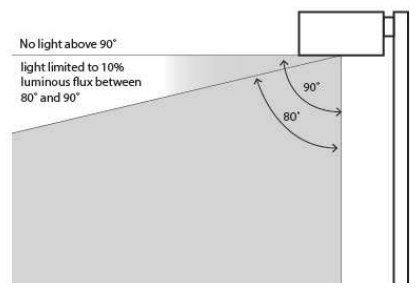
FIGURE 17.43.120.C.1: FULL CUTOFF LIGHT FIXTURE
2.
Fully Shielded. A light fixture constructed and mounted such that the luminous intensity (in candelas) at or above an angle of 90° above nadir is zero.
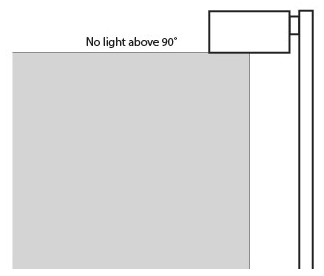
FIGURE 17.43.120.C.2: FULLY SHIELDED LIGHT FIXTURE
3.
Partially Shielded. A light fixture constructed and mounted such that most light emitted by the fixture is projected below the horizontal. A partially shielded light fixture may allow some light to pass through a semi-translucent barrier, and/or may allow visibility of the lamp from certain perspectives.
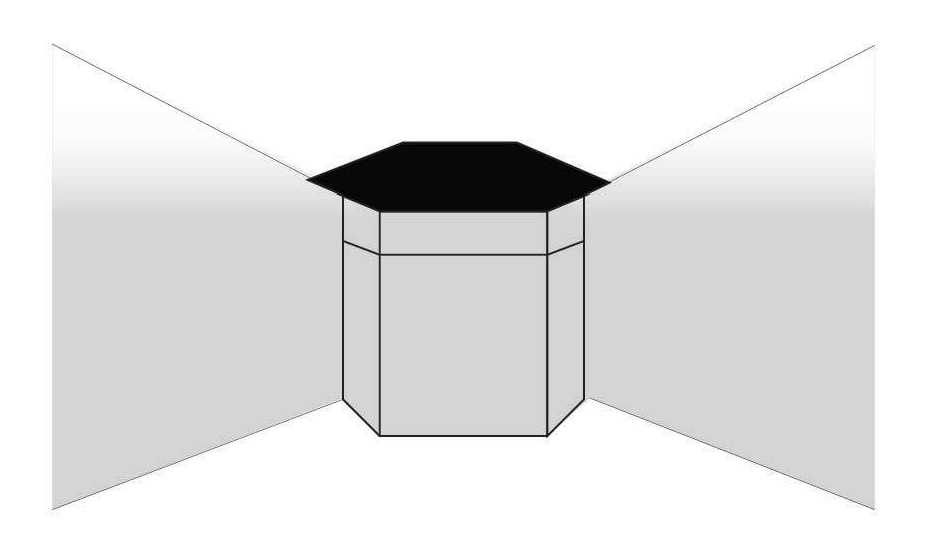
FIGURE 17.43.120.C.3: PARTIALLY SHIELDED LIGHT FIXTURE
4.
Unshielded. A light fixture that allows light to be emitted above the horizontal direction from the lowest point of the bulb within the fixture.

FIGURE 17.43.120.C.4: UNSHIELDED LIGHT FIXTURE
D.
Living Area. The legally permitted interior area of a dwelling unit, with the exception of a garage or any accessory structure, including basements and attics which meet the habitability requirements of the building code.
E.
LED. LED stands for light emitting diode. LED lighting products produce light up to ninety percent more efficiently than incandescent light bulbs. An electrical current passes through a microchip, which illuminates the tiny light sources we call LEDs and the result is visible light.
F.
Lumen. A unit of light quantity equal to the light on a unit surface all points of which are at a unit distance from a point source of light having a strength of one candle.
G.
Luminaire. A fixture with an integrated light source, usually LED.
H.
Lot. A parcel, tract, or area of land whose boundaries have been established by a legal instrument, such as a deed or recorded map, and which is recognized as a separate legal entity for purposes of transfer of title, except public easements or rights-of-way. Lot types include the following:
1.
Abutting Lot. A lot having a common property line or separated by a public path or lane, private street, or easement to the subject lot.
2.
Corner Lot. A lot or parcel bounded by two or more adjacent street lines that have an angle of intersection of not more than one hundred thirty-five degrees.
3.
Double Frontage Lot. See "Through Lot".
4.
Flag Lot. A lot so shaped that the main portion of the lot area does not have access to a street other than by means of a corridor having less than twenty feet of width.
5.
Interior Lot. A lot other than a corner lot.
6.
Through Lot. A lot having frontage on two parallel or approximately parallel streets.
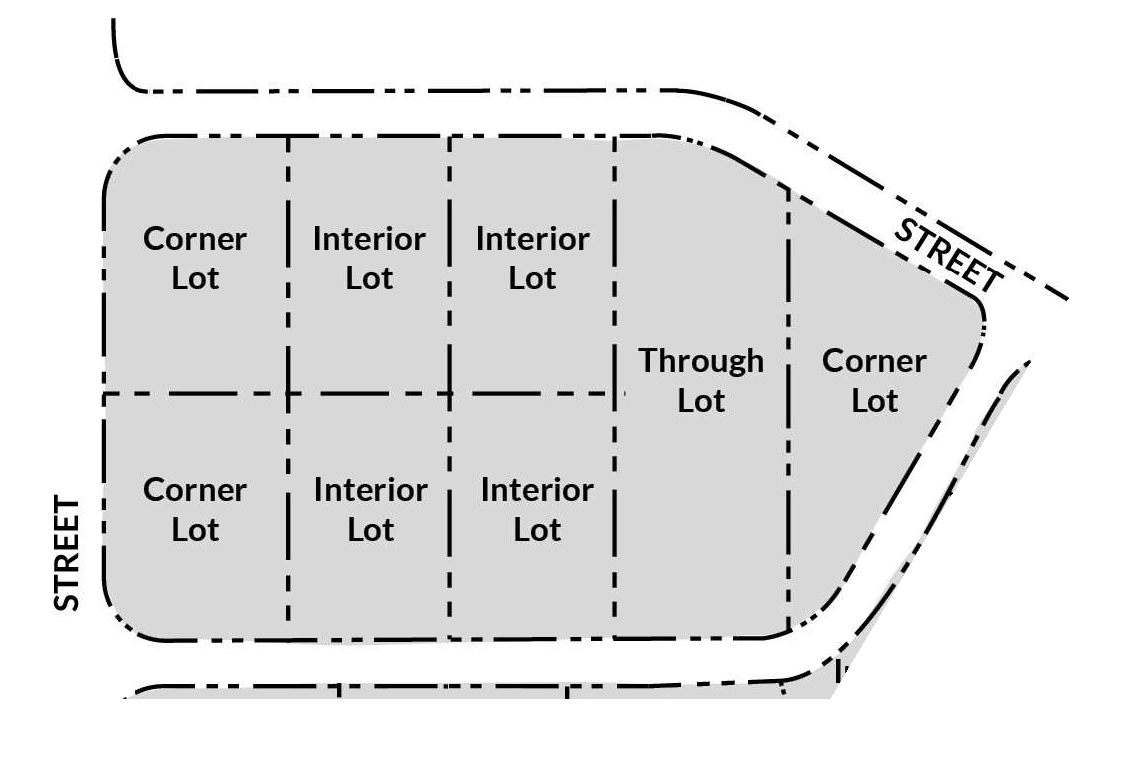
FIGURE 17.43.120.H: LOT TYPES
I.
Lot Area. The area of a lot enclosed by bounding lot lines, measured horizontally.
J.
Lot Depth. The horizontal distance between the front and rear property lines of a site. See also Section 17.02.030.D, Measuring Lot Width and Depth.
K.
Lot Frontage. See "Frontage, Street."
L.
Lot Line. The boundary between a lot and other property or the public right-of-way.
1.
Front Lot Line. On an interior lot, the line separating the lot from the street. On a corner lot, the shorter lot line abutting a street. On a through lot, the lot line abutting the street providing the primary access to the lot. On a flag lot, the interior lot line most parallel to and nearest the street from which access is obtained.
2.
Corner Side Lot Line. A side lot line of a corner lot that is adjacent to a street.
3.
Interior Lot Line. Any lot line that is not adjacent to a street.
4.
Rear Lot Line. The lot line that is opposite and most distant from the front lot line. Where no lot line is within forty-five degrees of being parallel to the front lot line, a line ten feet in length within the lot, parallel to and at the maximum possible distance from the front lot line, will be deemed the rear lot line for establishing the minimum rear setback.
5.
Side Lot Line. Any lot line that is not a front or rear lot line.
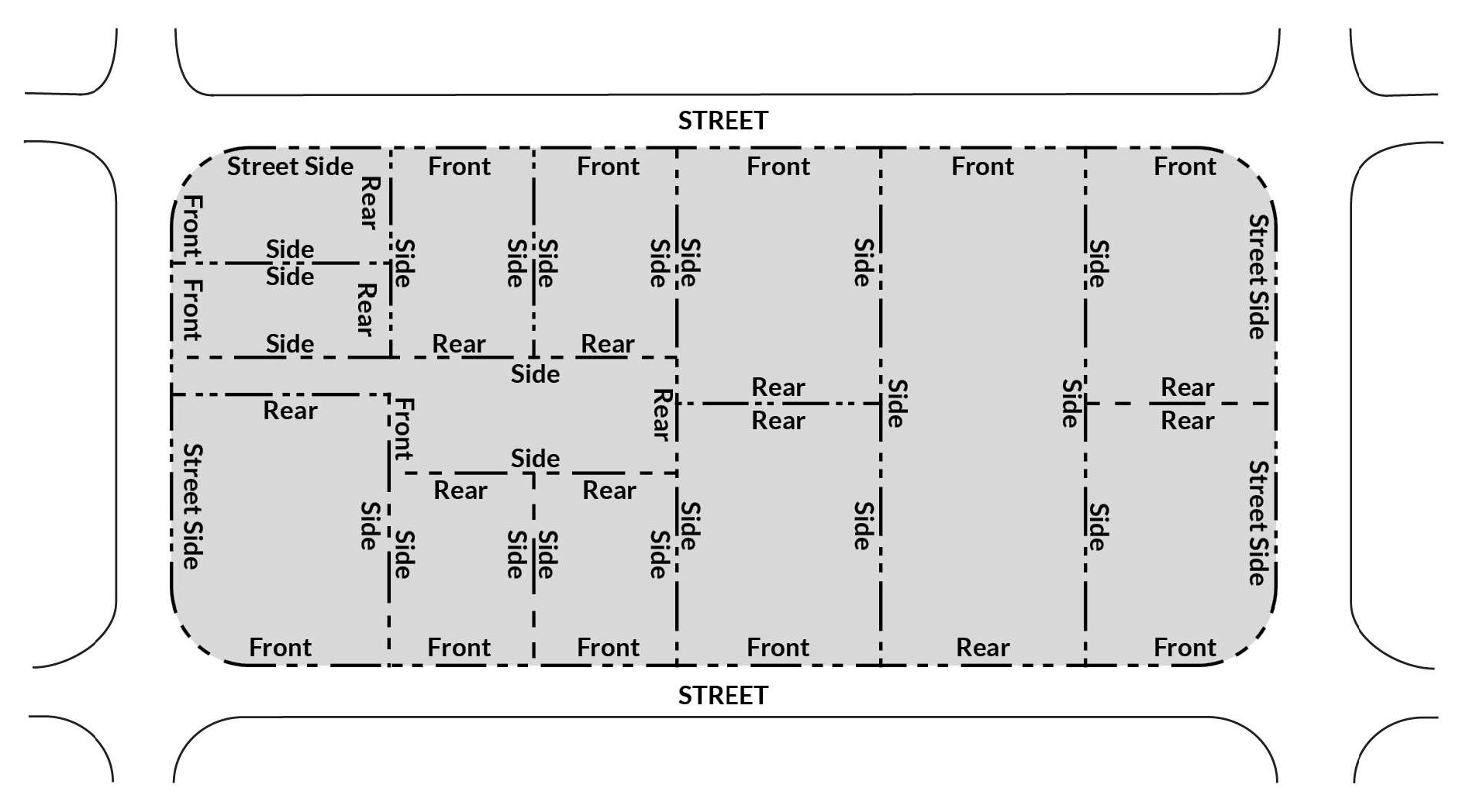
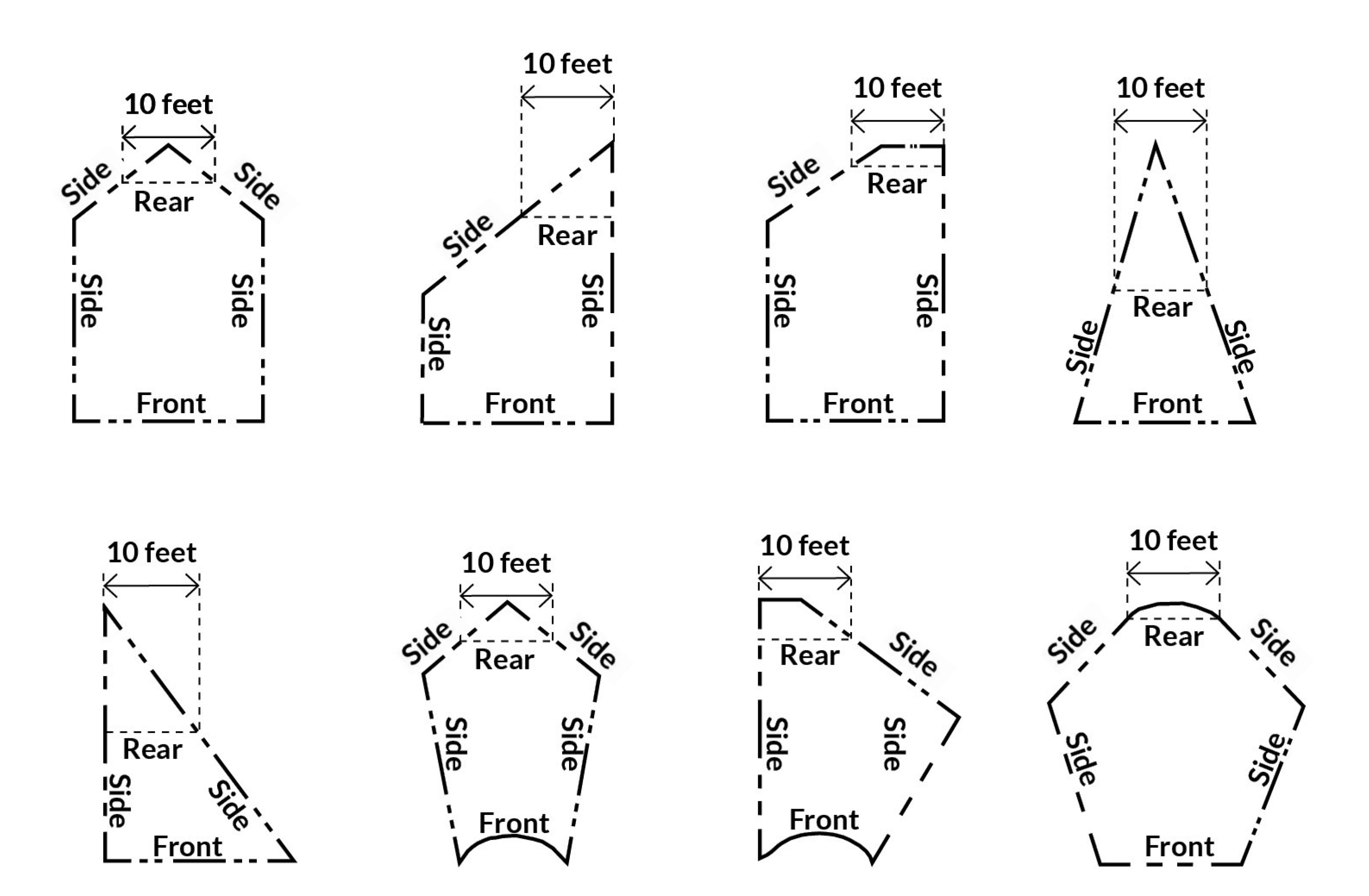
FIGURE 17.43.120.L: LOT LINE TYPES
M.
Lot, Nonconforming. A legal parcel of land having less area, frontage, or dimensions than required by the zoning code.
N.
Lot Width. The average distance between the side lot lines measured at right angles to the lot depth. See also Section 17.02.030.D, Measuring Lot Width and Depth. When not applicable due to irregularity of lot shape, lot width shall be determined by the director.
17.43.130 - "M" Terms.
A.
Maintenance and Repair. The repair or replacement of walls, fixtures, wiring, roof, or plumbing that restores the character, scope, size, or design of a structure to its previously existing, authorized, and undamaged condition.
B.
Mills Act. The historic property incentive program established pursuant to California Government Code Section 50280.1 et seq. and Revenue and Taxation Code Section 439 et seq. to provide local property tax reductions for the maintenance, rehabilitation, and/or remodel of qualifying structures, buildings, objects, sites, or districts consistent with the Secretary of the Interior's standards and guidelines.
C.
Mobile Home. A structure transportable in one or more sections, and which is built on a permanent chassis, and designed to be used as a dwelling unit.
D.
Municipal Code. The Calaveras County Municipal Code.
(Ord. No. 3213, § 2, 1-14-2025)
17.43.140 - "N" Terms.
A.
Noise. Any sound.
B.
Nonconforming Building. See "Building, Nonconforming".
C.
Nonconforming Lot. See "Lot, Nonconforming".
D.
Nonconforming Structure. See "Structure, Nonconforming".
E.
Nonconforming Sign. See "Sign Terms", "Nonconforming Sign".
F.
Nonconforming Use. See "Use, Nonconforming".
17.43.150 - "O" Terms.
A.
Off-Site. An improvement or other reference concerning a proposed project or subject property which is not located on the parcel under discussion.
B.
On-Site. An improvement or other reference located on-site concerning the subject property under discussion.
C.
Outdoor Storage. The keeping, in an unroofed area, of any goods, junk, material, merchandise, or vehicles in the same place for more than seventy-two hours, except for the keeping of building materials reasonably required for construction work on the premises pursuant to a valid and current building permit issued by the county.
D.
Owner. A person or persons holding single or unified beneficial title to the property, including without limitation, the settlor of a grantor trust, a general partner, firm, or corporation.
17.43.160 - "P" Terms.
A.
Parapet. That part of a wall that extends above the roof line.
B.
Parcel. A described area of land within an ownership. Parcel may also mean a parcel established for tax purposes, sometimes called an "assessor parcel."
C.
Parking Area. An area of a lot, structure, or any other area, including driveways, which is designed for and the primary purpose of which is to provide for the temporary storage of operable motor vehicles.
D.
Passenger Vehicle. As defined in the California Vehicle Code.
E.
Permit. A property development approval or temporary use permit issued by the county. Permits include variances, use permits, planned development permits, mining permits, reclamation plans, encroachment permits, septic system permits or building permits, as well as any other development permits issued by the county.
F.
Permitted Use. See "Use, Permitted".
G.
Person. Any individual, firm, association, organization, partnership, business trust, company, or corporation.
H.
Planning Commission. The planning commission of Calaveras County.
I.
planning department. The planning department of Calaveras County.
J.
planning director. The planning director of Calaveras County or their designee.
K.
Pre-existing. In existence prior to the effective date of this zoning code.
L.
Principal Use. See "Use, Principal".
M.
Project. Any proposal for a new or changed use or for new construction, alteration, or enlargement of any structure that is subject to the provisions of this zoning code. This term includes, but is not limited to, any action that qualifies as a "project" as defined by the California Environmental Quality Act.
N.
Property Line. The recorded boundary of a lot or parcel of land.
O.
Public Agency. A political subdivision, federal, state or local government or its departments, or governmental jurisdictions or districts.
P.
Public Resources Code. The Public Resources Code of the state of California.
Q.
Public Works Director. The public works director of Calaveras County.
17.43.170 - "Q" Terms.
A.
Qualified Applicant. The property owner, the owner's agent, or any person, corporation, partnership, or other legal entity that has a legal or equitable title to land that is the subject of a development proposal or is the holder of an option or contract to purchase such land, or otherwise has an enforceable proprietary interest in such land.
17.43.180 - "R" Terms.
A.
Reasonable Accommodation. Any deviation requested and/or granted from the strict application of the county's zoning and land use laws, rules, policies, practices and/or procedures under provisions of federal or California law to make housing or other facilities readily accessible to and usable by persons with disabilities and thus enjoy equal employment or housing opportunities or other benefits guaranteed by law.
B.
Recreational Vehicle. A motor home, travel trailer, truck camper, or camping trailer, with or without motive power, originally designed for human habitation for recreational, emergency, or other occupancy.
C.
Review Authority. Body or entity responsible for making decisions on applications.
D.
Right-of-Way. A strip of land acquired by reservation, dedication, forced dedication, prescription or condemnation and intended to be occupied or occupied by a road, railroad, electric transmission lines, oil or gas pipeline, water line, sanitary storm sewer, or other similar use.
E.
Roofline. The top edge of a roof or building parapet, whichever is higher, excluding any cupolas, pylons, chimneys, or minor projections.
17.43.190 - "S" Terms.
A.
Scenic Highway. A road identified as a State scenic highway.
B.
Senior Citizen. An individual sixty-two years of age or older.
C.
Setback. The distance between a property line and a building or structure that must be kept unoccupied and unobstructed from the ground upward, except as otherwise provided by this zoning code.
1.
Front Setback. A setback area extending across the front of a lot for the full width of the lot between the side lot lines. The depth of a front setback shall be a distance specified by this zoning code for the zoning district in which it is located and measured inward from the front lot line.
2.
Interior Setback. A setback which does not abut a street.
3.
Interior Side Setback. A setback area extending from the rear line of the required front setback, or the front property line of the site where no front setback is required, to the front line of the required rear setback, or the rear property line of the site where no rear setback is required, the depth of which is the minimum horizontal distance between the side property line and a line parallel thereto on the site and which does not abut a street.
4.
Rear Setback. A setback area extending across the rear of a lot for its full width between side lot lines, and to a depth specified by this zoning code for the zoning district in which it is located. If a lot has no rear lot line, a line ten feet in length within the lot, parallel to and at the maximum possible distance from the front lot line, will be deemed the rear lot line for establishing the minimum rear setback.
5.
Required Setback. A setback area which complies with the minimum setback requirements for the zoning district in which the lot is located.
6.
Side Setback. A setback area extending from the rear line of the required front setback, or the front property line of the site where no front setback is required, to the front line of the required rear setback, or the rear property line of the site where no rear setback is required, the depth of which is the minimum horizontal distance between the side property line and a line parallel thereto on the site.
7.
Street Side Setback. A setback area on a corner lot extending from the front setback to the rear lot line between the building setback line and the nearest side street lot line.
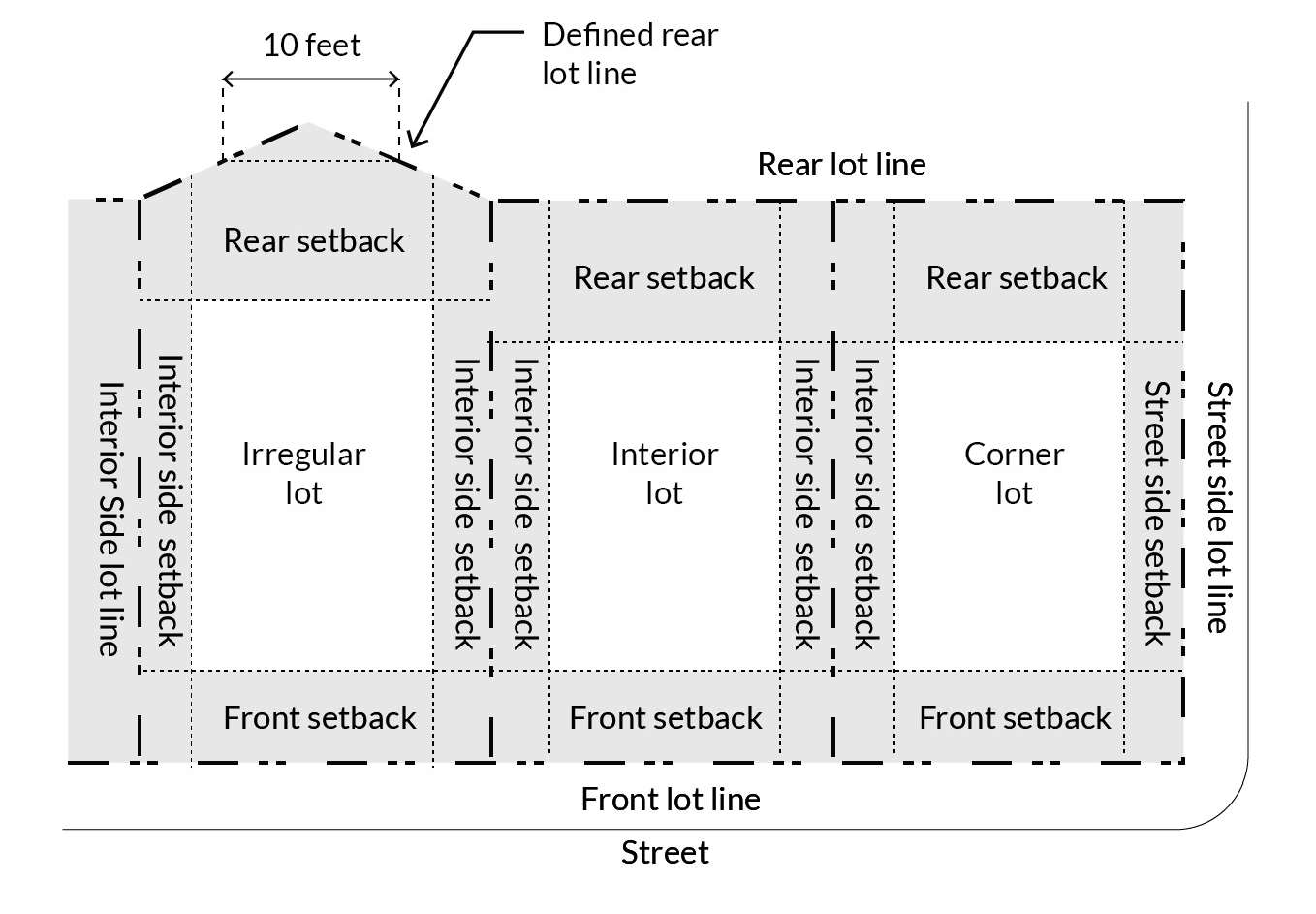
FIGURE 17.43.190.B: SETBACK TYPES
D.
Sidewalk. A paved, surfaced, or leveled area, paralleling and usually separated from the street, used as a pedestrian walkway.
E.
Sign Terms.
1.
Animated Sign. A sign with messages that visually change, or images that move or appear to move, flash on or off, wink or blink with varying light intensity, show motion or create the illusion of motion, or revolve to create an illusion of being on or off.
2.
Awning Sign. A sign placed on an awning.
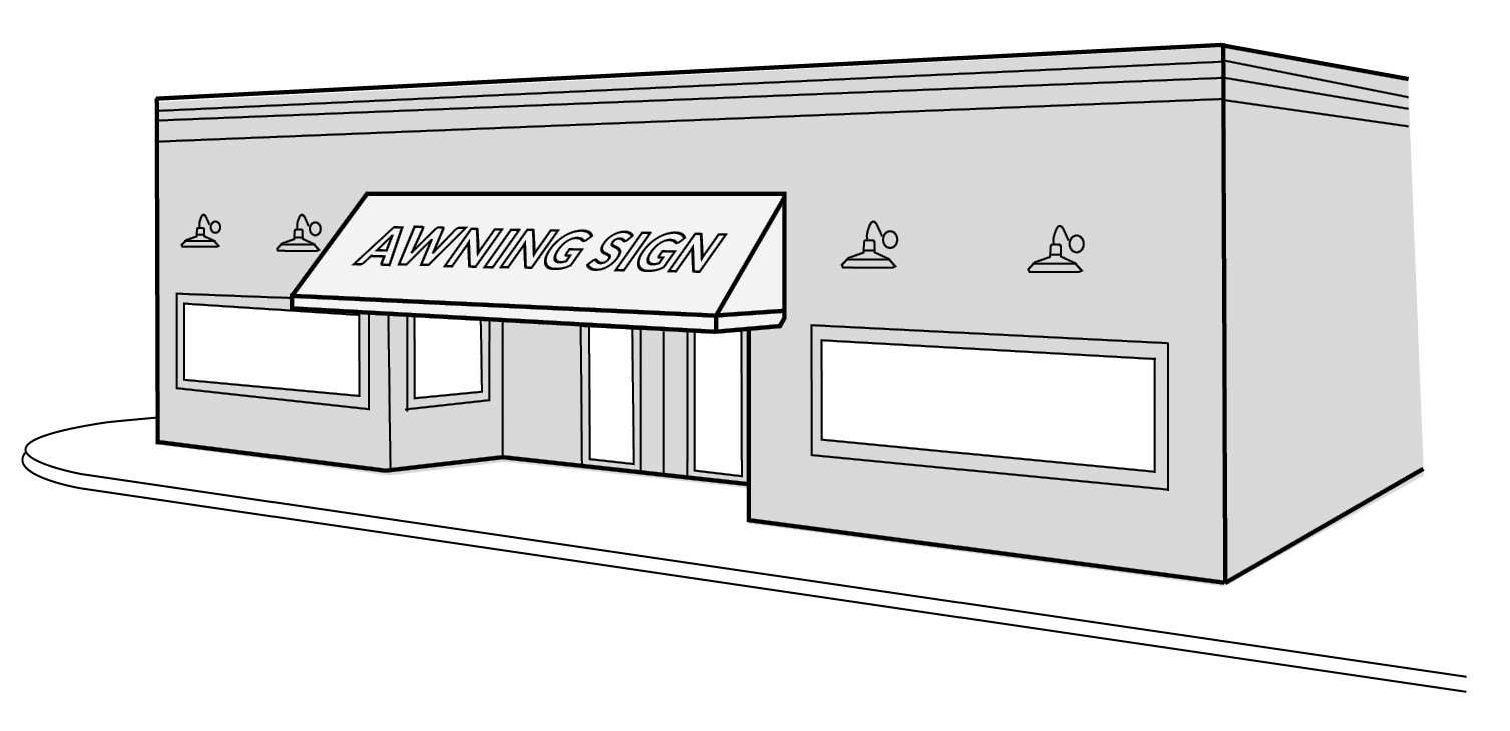
FIGURE 17.43.190.D.2: AWNING SIGN
3.
Balloon. Any air or gas-filled device used for the purposes of signage or advertising.
4.
Banner Sign. A sign that is painted or printed on lightweight flexible material and hung from a staff or other device by ropes, wires or similar means in a manner to minimize movement.
5.
Billboard. An outdoor sign advertising, promoting or informing of a business, product, issue or activity which takes place or is available at a location other than the location of the billboard.
6.
Canopy Sign. A sign placed on a canopy.
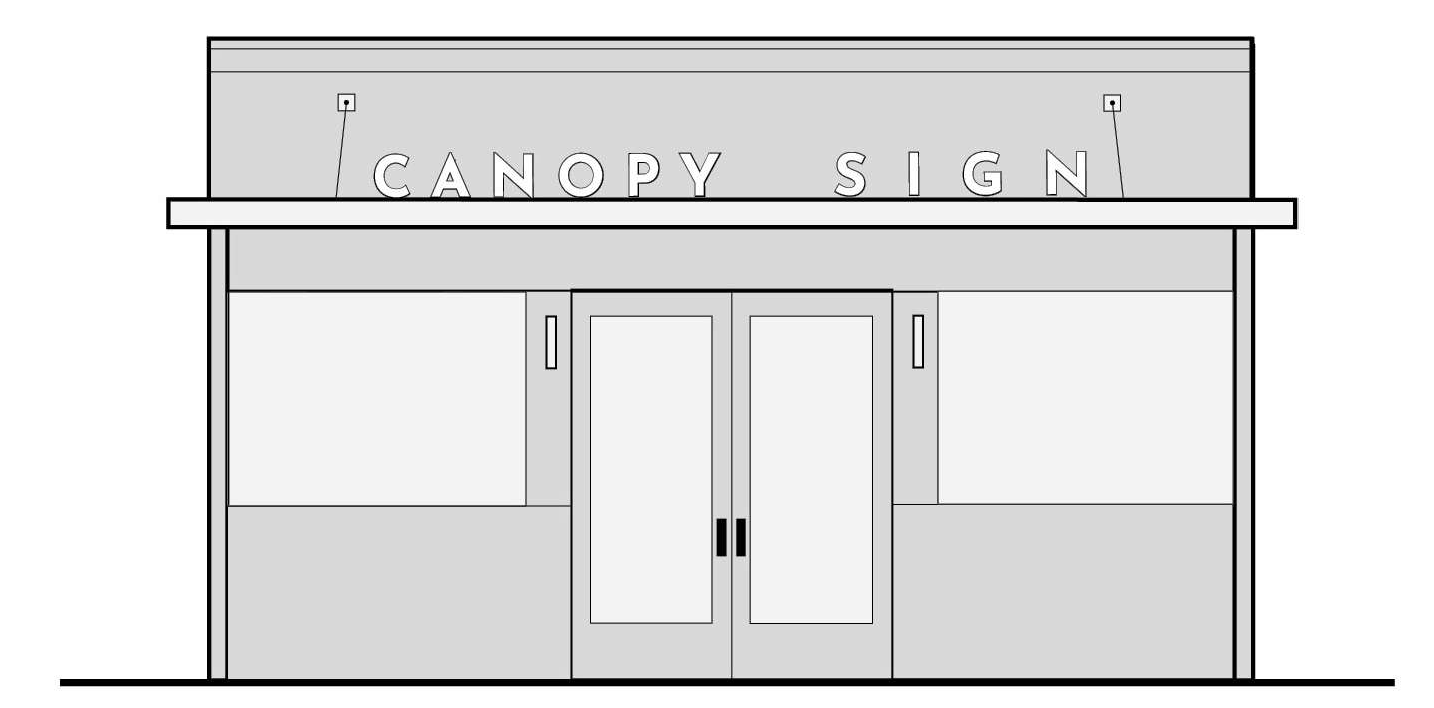
FIGURE 17.43.190.D.6: CANOPY SIGN
7.
Commercial Message. A message on a sign, or portion of a sign, that promotes, informs, or proposes an economic transaction, primarily concerns the economic interests of the sign sponsor and/or audience, or is intended to further discussion in the marketplace of goods and services.
8.
Copy. Also called "sign copy." The visually communicative elements mounted on a sign.
9.
Digital Display. A method of displaying a communicative visual image by use of LEDs (light emitting diodes) or their functional equivalent, that allows for the message or image to be easily changed, typically by remote control or computer programming. This definition applies to signs displaying a series of still images, as well as those presenting the appearance of motion.
10.
Directional Sign. A sign promoting a visitor-oriented use, attraction or place pursuant to Section 17.24.100.C, Directional Signs.
11.
Electronic Message Center Sign. A sign with a static message formed by the selective illumination of an array of light bulbs, light emitting diodes (LEDs), or liquid crystal displays (LCDs) that can be changed electronically. These signs may display text and/or graphic images, and may be programmable.
12.
Flag. Any fabric or banner containing distinctive colors, patterns, or design that displays the symbol(s) of a nation, state, local government, company, organization, belief system, idea, or other meaning.
13.
Freestanding Sign. A sign supported by structures or supports that are placed on or anchored in the ground, and which are structurally independent from any building, including "monument signs", "pole signs", and "ground signs".
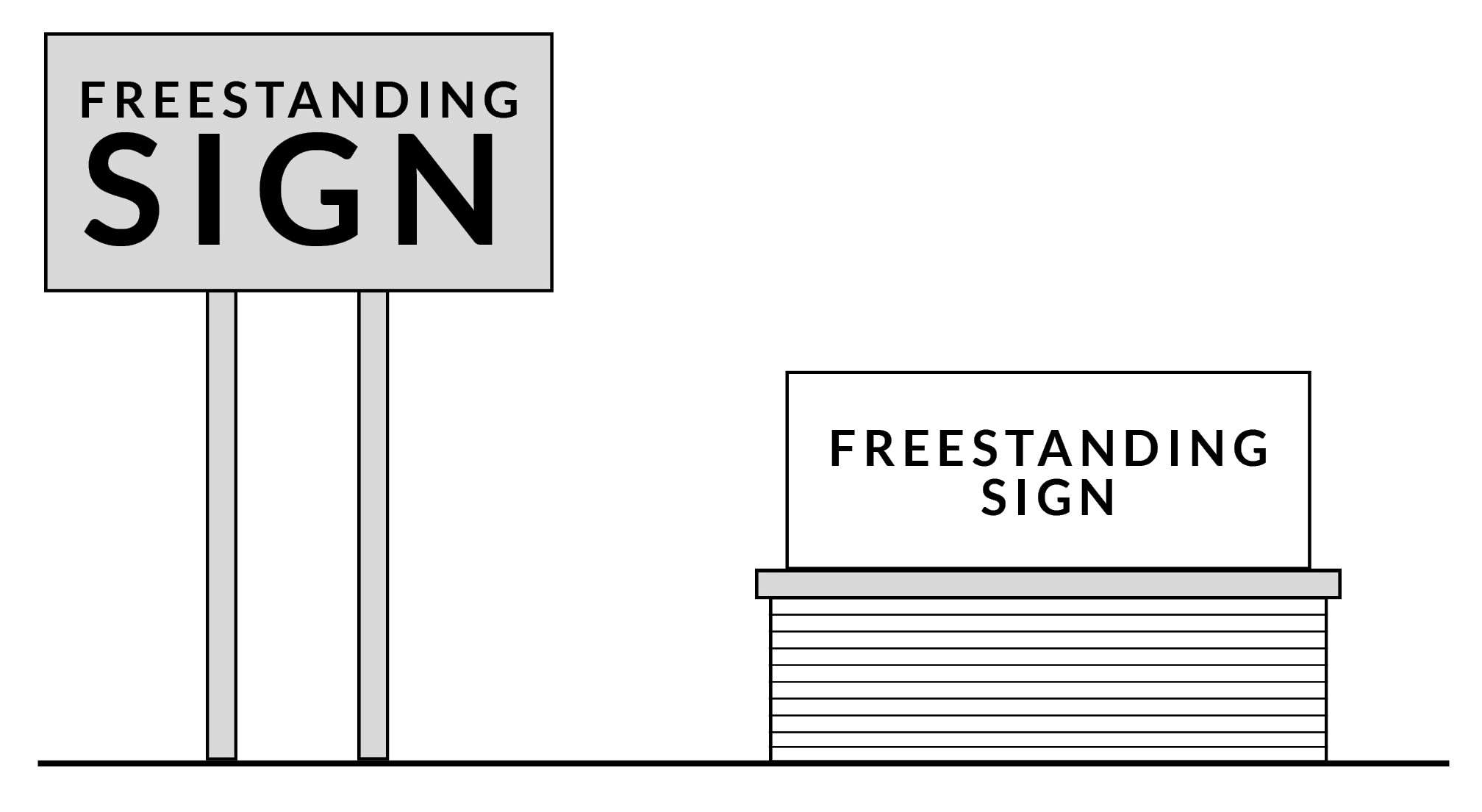
FIGURE 17.43.190.D.13: FREESTANDING SIGN
14.
General Advertising for Hire. The advertising or promoting of other businesses, establishments or causes using methods of advertising, typically for a fee or other consideration, in contrast to self-promotion or on-site advertising.
15.
Graffiti. Marks, such as inscriptions, drawings, or designs, which are placed, scratched, etched, painted, or sprayed on public or private property without the owner's consent.
16.
Inflatable Sign. A form of inflatable device (e.g., shaped as an animal, blimp, or other object) that is displayed, printed, or painted on the surface of an inflatable background, and is primarily installed outside a building to attract attention to or to advertise a business, a business location, a service, a product, or an event.
17.
Informational Sign. A sign that directs or guides pedestrian or vehicular traffic and which is non-advertising in nature (e.g., accessible parking, one-way, exit, and entrance).
18.
Mobile Billboard. Any vehicle, or wheeled conveyance which carries, conveys, pulls, displays, or transports any sign or billboard for the primary purpose of advertising a commercial or noncommercial message, or other general advertising for hire.
19.
Moving Sign. A sign or any portion thereof that rotates, moves, or appears to move in some manner by mechanical, electrical, natural, or other means.
20.
Non-Commercial Message. A message or image on a sign that directs public attention to or advocates an idea or issue of public interest or concern that does not serve to advertise or promote any business, product, activity, service, interest, or entertainment.
21.
Nonconforming Sign. A sign lawfully erected and maintained, but which, because of the adoption of or amendment to the zoning code, no longer complies with the standards and requirements of the zoning code.
22.
Outdoor Advertising Structure. Any structure of any kind or character erected or maintained for outdoor advertising purposes, upon which any outdoor advertising sign may be placed, located on a site other than the site on which the advertised use is located or on which the advertised product is produced.
23.
Pennant. A device made of flexible materials, (e.g., cloth, paper, or plastic) that may or may not contain copy, and which is installed for the purpose of attracting attention.
24.
Permanent Sign. A sign that is intended to be and is so constructed as to be of a lasting and enduring condition, remaining unchanged in character, condition (beyond normal wear) and position, and in a permanent manner affixed to the ground, wall, or building.
25.
Projecting Sign. A sign that projects horizontally from the face of a building.
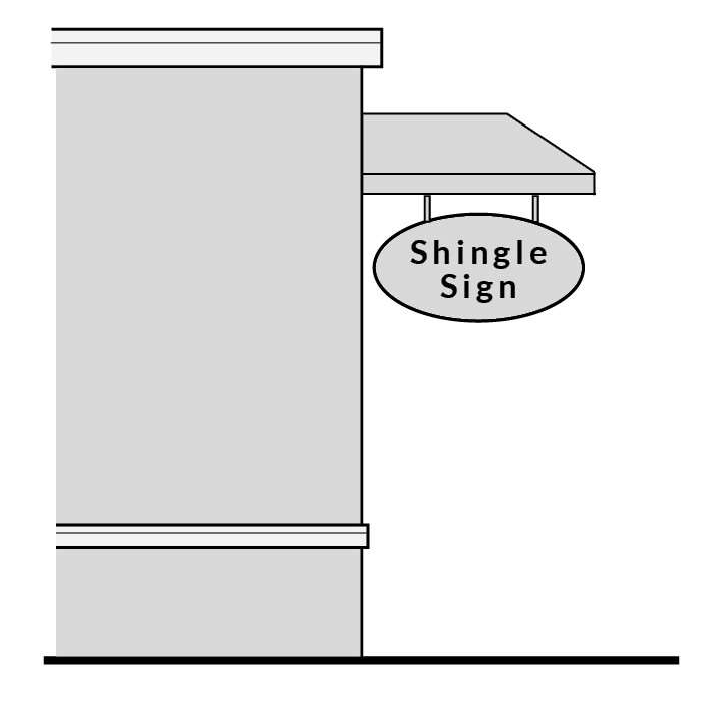
FIGURE 17.43.190.D.25: PROJECTING SIGN
26.
Sandwich Board. A freestanding portable upright, rigid, self-supporting frame sign ordinarily in the form of a triangle, a sideways "H", or some variation thereof, which is readily movable and not permanently attached or anchored to the ground, a building, or any other structure.
27.
Shingle Sign. A sign that is suspended beneath a marquee, covered walkway, canopy, or awning.
FIGURE 17.43.190.D.27: SHINGLE SIGN
28.
Sign. Any identification, description, illustration, or device illuminated or non-illuminated, which is visible to the general public from any exterior public right-of-way, and directs attention to a product, service, place, activity, person, institution, business or solicitation, including any permanently installed or situated merchandise; or any emblem, painting, banner, pennant, or placard designed to advertise, identify, or convey information. A display, device, or thing need not contain lettering to be a sign.
29.
Sign Area. The area contained within a single continuous perimeter enclosing all parts of such sign copy, excluding any structural elements outside the limits of the sign required to support the sign.
30.
Sign Face. An exterior display surface of a sign, including non-structural trim, exclusive of the supporting structure. The area of a sign which is available for mounting and public display of the visually communicative image.
31.
Temporary Sign. A structure or device used for the public display of visual messages or images, which is typically made of lightweight or flimsy materials which is not intended for or suitable for long term or permanent display.
32.
Traffic Sign. A sign for traffic direction, warning, and roadway identification.
33.
Wall Sign. A sign affixed to and wholly supported by a building in such a manner that its exposed face is approximately parallel to the plane of such building.

FIGURE 17.43.190.D.33: WALL SIGN
34.
Window Sign. A temporary or permanent sign with a single face of copy that is adhered to a glass window or door.
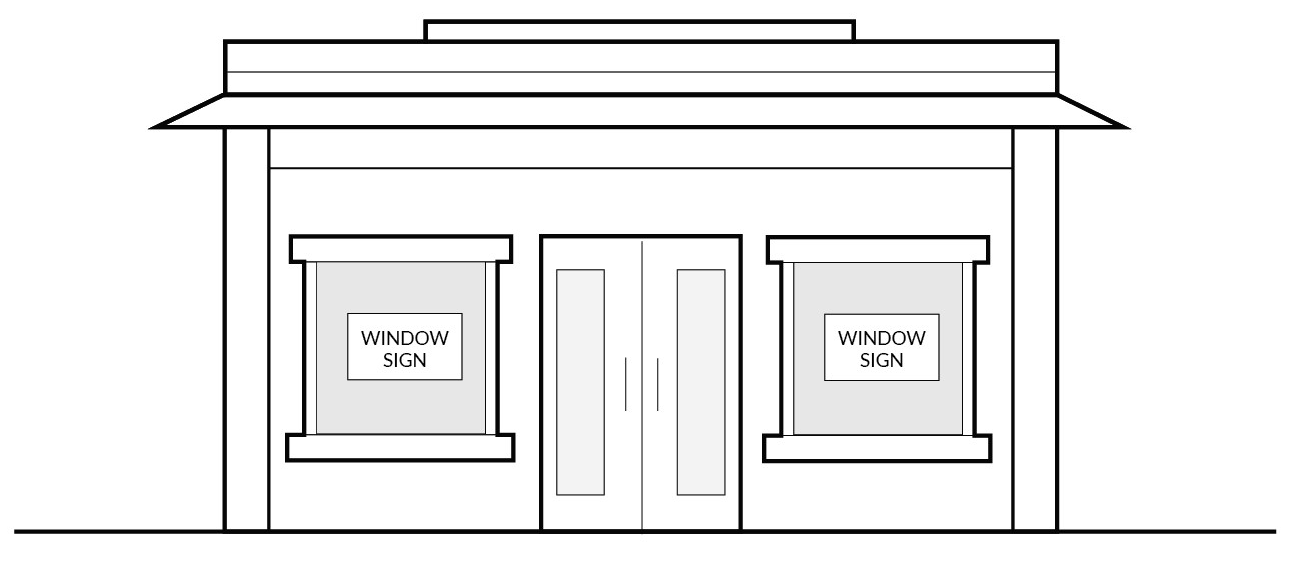
FIGURE 17.43.190.D.34: WINDOW SIGN
F.
Site. A lot, or group of contiguous lots, that is proposed for development in accordance with the provisions of this zoning code and is in a single ownership or under unified control.
G.
Soil. Naturally occurring superficial deposits overlying bedrock.
H.
Specific Plan. A plan for all or part of the area covered by the general plan that is prepared to be consistent with and to implement the general plan, pursuant to the provisions of Government Code, §§ 65450 et seq.
I.
State. The state of California.
J.
Story. That portion of a building included between the upper surface of any floor and the upper surface of the floor next above, except that the topmost story is that portion of a building included between the upper surface of the topmost floor and the upper surface of the roof above.
K.
Street. A public or private thoroughfare, which affords the principal means of access to a block and to abutting property. "Street" includes avenue, court, circle, crescent, place, way, drive, boulevard, highway, road, and any other thoroughfare, except an alley or walkway.
L.
Street Line. The boundary between a street and a lot or parcel of land.
M.
Structure. Anything constructed or erected which requires a location on the ground, including a building but not including a swimming pool.
1.
Structure, Accessory. A detached subordinate structure used only as incidental to a main building or structure, or principal use on the same site or lot.
2.
Structure, Attached. A structure which is affixed to another building or structure on the site with a common wall or roof that is four feet in length or more.
3.
Structure, Detached. A structure which is not affixed to another building or structure on the site or whose common wall or roof with another building or structure is less than four feet in length.
4.
Structure, Nonconforming. A building or structure, or portion thereof, which was lawfully erected or altered or maintained, but which, because of the adoption of or amendment to the zoning code, no longer complies with the standards and requirements of the zoning code.
5.
Structure, Main. A structure housing the primary or principal use of a site or functioning as the primary or principal use.
6.
Structure, Temporary. A structure without any foundation or footings, and which is intended to be removed when the designated time period, activity, or use for which the temporary structure was erected has ceased.
N.
Swimming Pool. A pool, pond, lake, or open tank capable of containing water to a depth greater than eighteen inches at any point.
17.43.200 - "T" Terms.
A.
Tandem Parking. An arrangement of parking spaces such that one or more spaces must be driven across to access another space or spaces.
B.
Tenant. A person renting or leasing a housing unit or non-residential space.
C.
Trailer. A vehicle with or without motor power, which is designed or used for hauling materials or vehicles, or for human habitation, office, or storage including camper, recreational vehicle, travel trailer, and mobile home, but not including mobile homes on a permanent foundation.
17.43.210 - "U" Terms.
A.
Use. The purpose for which a site or structure is arranged, designed, intended, constructed, erected, moved, altered, or enlarged or for which either a site or a structure is or may be occupied or maintained.
1.
Use, Accessory. A use that is customarily associated with, and is incidental and subordinate to, a principal use and located on the same lot as a principal use.
2.
Use, Incidental. A secondary use of a lot and/or building that is located on the same lot, but is not customarily associated with the principal use.
3.
Use, Nonconforming. The use of a building, structure, site, or portion thereof, which was lawfully established and maintained, but which, because of the adoption of or amendment to the zoning code, no longer complies with the standards and requirements of the zoning code.
4.
Use, Permitted. Any use or structure that is allowed in a zone without a requirement for approval of a Use Permit, but subject to any restrictions applicable to that zone.
5.
Use, Principal. A primary, principal, or dominant use established, or proposed to be established, on a lot.
B.
Use Classification. A system of classifying uses into a limited number of use types on the basis of common functional, product, or compatibility characteristics. All use types are grouped into the following categories: residential, public/semi-public, commercial, industrial, and transportation, communication, and utilities, and agricultural and natural resource. See Chapter 17.42, Use Classifications.
C.
Use Permit. A discretionary permit which may be granted by the appropriate authority to provide for the accommodation of land uses with special site or design requirements, operating characteristics, or potential adverse effects on surroundings, which are not permitted as of right, but which may be approved upon completion of a review process and, where necessary, the imposition of special conditions of approval. See Chapter 17.30, administrative use permits, and Chapter 17.31, conditional use permits.
D.
Use Type. A category that classifies similar uses based on common functional, product, or compatibility characteristics.
E.
Utilities. Equipment and associated features related to the mechanical functions of a building(s) and services such as water, electrical, telecommunications, and waste.
17.43.220 - "V" Terms.
A.
Variance. A discretionary grant of permission to depart from the specific requirements of this zoning code that is warranted when, due to special circumstances regarding the physical characteristics of the property, the strict application of standards would deprive the property of privileges available to other property in the same zone. See Chapter 17.35, Variances.
B.
Vehicle. Any vehicle, as defined by the California Vehicle Code, including any automobile, camper, camp trailer, trailer, trailer coach, motorcycle, house car, boat, or similar conveyance.
C.
Vibration. Oscillations occurring about an equilibrium point.
D.
Visible. Capable of being seen (whether legible) by a person of normal height and visual acuity walking or driving on a public road or in a public place.
17.43.230 - "W" Terms.
A.
Wall. Any vertical exterior surface of building or any part thereof, including windows and/or a solid horizontal or vertical structural device forming a physical barrier intended to enclose areas, separate properties, form a screen, or prevent intrusion.
B.
Wireless Telecommunication Terms.
1.
Antenna. Any system of wires, poles, rods, horizontal or vertical elements, panels, reflecting discs, or similar devices used for the transmission and/or reception of electromagnetic waves.
2.
Co-Location. The location of two or more wireless communications facilities owned or used by more than one public or private entity on a single support structure, or otherwise sharing a common location. Co-location also includes the location of wireless communications facilities with other facilities, such as buildings, water tanks, light standards, and other utility facilities and structures.
3.
Mast. A pole of wood or metal or a tower fabricated of metal that is used to support an antenna and maintain it at the proper elevation.
4.
Personal Communications Services (PCS). Digital wireless telephone technology such as portable phones, pagers, faxes, and computers. PCS is also sometimes known as Personal Communication Network (PCN).
5.
Multi-User Telecommunication Facility. A telecommunication facility comprised of multiple telecommunication towers or buildings supporting one or more antennas owned or used by more than one public or private entity, excluding research and development industries with antennas serving internal company uses only.
6.
Satellite Dish. A device (also known as a parabolic antenna) incorporating a reflective surface that is solid, open, or mesh or bar-configured, and is in the shape of a shallow dish, cone, horn cornucopia, or flat plate that is used to receive or transmit radio or electromagnetic waves between terrestrially and/or or bitally based units. This term includes satellite earth stations, satellite receivers, satellite discs, direct broadcast systems, television-reception-only systems, and satellite microwave antennas.
7.
Support Equipment. The physical, electrical, and/or electronic equipment included within a telecom facility used to house, power, transport, and/or process signals from or to the facility's antenna or antennas.
8.
Tower. Any structure that is designed and constructed primarily for the purpose of supporting one or more antennas.
9.
Tower, Lattice. A multiple-sided, open, metal frame support structure that supports antennas and related equipment, typically with three or four support legs.
17.43.240 - "X" Terms.
Reserved.
17.43.250 - "Y" Terms.
A.
Yard. The area between the property line and the nearest wall of the first main building on a lot.
1.
Front Yard. A yard extending across the front of a lot for the full width of the lot between the side lot lines.
2.
Interior Yard. A yard which does not abut a street.
3.
Rear Yard. A yard extending across the rear of a lot for its full width between side lot lines.
4.
Side Yard. A yard extending from the rear line of the front yard to the front line of the rear yard.
5.
Street Side Yard. A yard on a corner lot along a street side lot line extending from the rear line of the front yard to the rear lot line.
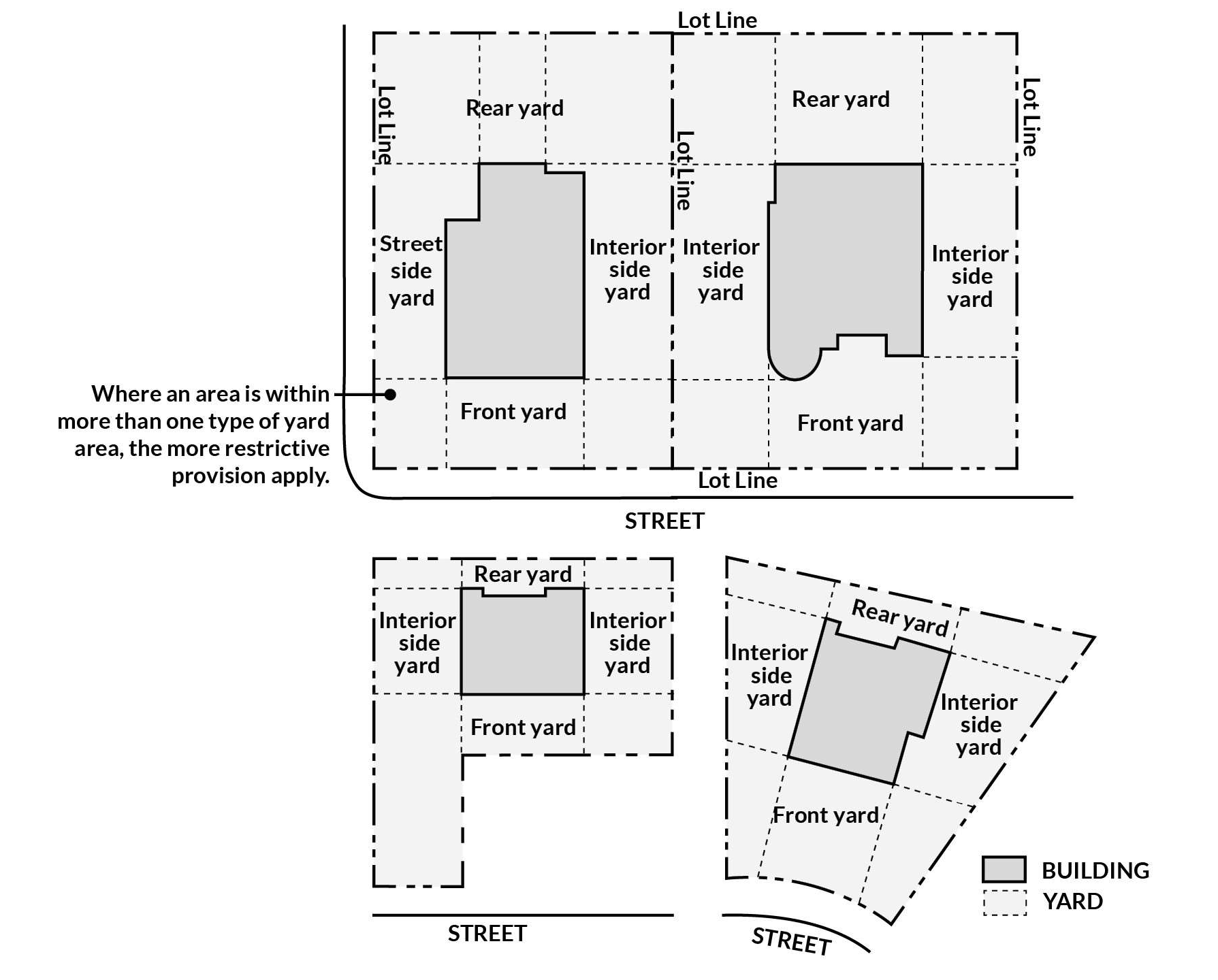
FIGURE 17.43.250.A: YARD TYPES
17.43.260 - "Z" Terms.
A.
Zone. See "Zoning District".
B.
Zoning District. A specifically delineated area in the county within which regulations and requirements uniformly govern the use, placement, spacing, and size of land and buildings.

