
Calhoun County Unincorporated
City Zoning Code
City Zoning Code
ARTICLE II
- INTERPRETATION AND DEFINITIONS
Section 2:1. - Interpretation.
2:1.1. Words used in this ordinance shall have their customary and ordinary meanings as defined in a standard dictionary, except for specific words and phrases defined in this ordinance.
2:1.2. The present tense includes the past and future tenses. Singular words shall include the plural, and plural words shall include the singular.
2:1.3. The word "person" includes an individual, a firm, association, partnership, trust, company, corporation or any other legal entity.
2:1.4. The word "shall" is mandatory; the word "may" is permissive.
2:1.5. References to NAICS codes shall mean those codes assigned to businesses in the 1987 Standard Industrial Classification Manual published by the federal Office of Management and Budget. NAICS codes may be listed in the tables of uses for each district as an aid in interpretation and determination of those specific uses included in a general class of uses.
Section 2:2. - Definitions.
2:2.1.
Abandonment. The status of a home or building that has been unoccupied for one year or is not healthful or safe for occupancy and shows evidence of abandonment, or that exhibits deterioration that would require repairs in excess of 50 percent of its current replacement value and is unoccupied.
2:2.2.
Accessory. A building or use subordinate to and serving a principal building or use which is subordinate in area, extent or purpose to the principal building or use served; designed for the comfort, convenience or necessity of occupants of the principal use served; located on the same lot as the principal building or use served, except for permitted off-site accessory uses; and which meets all setback requirements for the principal structure. Accessory uses shall include, but not be limited to: barns, sheds, home tennis courts, swimming pools, boat houses, docks, automobile garages, decks, patios, and private recreation areas.
2:2.3.
Alley. A minor right-of-way used or intended to be used primarily for service access to the rear or side of properties otherwise abutting a street. An alley is not considered to be a street for purposes of this ordinance.
2:2.4.
Alteration of building. Any change in the supporting members of a building, such as bearing walls, columns, or girders; any addition or reduction to a building.
2:2.5.
Antenna. Any device for radiating or receiving electromagnetic waves, including, but not limited to, radio, television, telephone, communication, microwave, and satellite dish antennas.
2:2.6.
Apartment. A portion of a building consisting of a room or rooms intended, designed, or used as a residence by an individual or family.
2:2.7.
Automobile service station. [See NAICS Codes 447110 and 447190.] Use involving the sale of gasoline, lubricating oils, merchandise such as tires, batteries, auto parts, minor repairs, and may include limited sale of groceries or carwashes, but may not include storage of dismantled or wrecked vehicles or parts.
2:2.8.
Bed and breakfast. [See NAICS Code 721191.] An owner occupied dwelling or portion thereof offering five or fewer guest rooms to transient lodgers in return for compensation, with or without meals. If meals are served, they shall be restricted to breakfast only. The use of a dwelling as a Bed and Breakfast Inn shall not be considered as an accessory use or a customary home occupation.
2:2.9.
Boarding house. [See NAICS Code 721310 - rooming and boarding houses.] A dwelling other than a motel or hotel in which rooms are rented, with or without meals, on a fee basis. A structure in which five (5) or more rooms are rented shall be classified as a hotel or motel.
2:2.10.
Buildable area. That portion of a lot which may be used or built upon in accordance with zoning district regulations.
2:2.11.
Building. Any structure having a roof supported by columns or walls and which is designed for shelter, support or enclosure of persons, animals or property of any kind.
2:2.12.
Common Open Space. Land and/or water bodies used for recreation, amenity, or buffer. Common Open Space included on a Rural Residential Site Plan may also include Working Farms.
2:2.13.
Community residential care facility. An institution providing for a period exceeding 24 consecutive hours room, board, some personal assistance in feeding, dressing or other living activities to two or more individuals not related to the operator, including chemical abuse residential treatment facility or half-way house providing inpatient or detoxification services.
2:2.14.
Conditional use. A use permitted by the district regulations upon compliance with specified conditions without review by the Board of Zoning Appeals.
2:2.15.
Convenience Store. A retail establishment offering for sale prepackaged food products, household items, and other general merchandise, and which may offer gasoline for sale, but shall not offer any automobile maintenance or repair services.
2:2.16.
Critical Root Zone. The soil surrounding a tree that contains the tree's critical roots. Critical roots are the minimum amount of roots a tree needs for survival.
2:2.17.
Day care. The care, supervision or guidance of an unrelated person, unaccompanied by the parent, guardian or custodian, on a regular basis for periods of less than 24 hours per day in a place other than the operator's own home.
2:2.18.
Day Care Home. A home occupation (accessory use) in which a permanent occupant or resident owner of the dwelling provides for the care of up to five (5) children, some of which may be related to or adopted by the permanent occupant or resident owner of the home. Only those residing in the home may be involved in the day-to-day operation of the child care home. Such a facility shall comply with all state and local codes and/or ordinances regarding zoning, building, fire, and health.
2:2.19.
DBH. Diameter at breast height, a standard method for expressing the diameter of the trunk of a standing tree
2:2.20.
Day care facility. A state licensed facility providing day care, for profit or nonprofit. This definition includes, but is not limited to, day nurseries, nursery schools, kindergartens, day care centers, group day care homes and family day care homes. It does not include education facilities for grades one or above, shopping center or office building temporary care facilities, summer or day camps, or vacation Bible schools.
2:2.21.
Density. The number of dwelling units per net acre of developed land, excluding land devoted to streets, alleys, parks, playgrounds, schools or other public uses.
2:2.22.
Density Bonus. An increase in the total number of dwelling units or lots permitted on a development site in exchange for the provision of Common Open Space. A Density Bonus is only permitted in the RP and RN Districts in accordance with Section 6:12.
2:2.23.
District. A geographical area assigned a zoning district designation pursuant to the provisions of this ordinance.
2:2.24.
Drinking place. [See NAICS Code 722410.] Establishment primarily engaged in retail sale of alcoholic drinks for consumption on-premises. Sale of food may account for a substantial portion of receipts.
2:2.25.
Dwelling. A building or portion thereof designed, occupied, or intended for human residential occupancy, not including a hotel, motel, rooming or boarding house.
2:2.26.
Dwelling, group. A dwelling occupied by several unrelated persons or families, but in which separate cooking facilities are not provided for each group. Group dwellings include rooming houses, apartment hotels, and similar facilities. Hotels, motels and tourist homes are not group dwellings.
2:2.27.
Dwelling, multi-family. A dwelling containing three or more separate dwelling units in one building. Apartments, tenements, condominiums, cooperatives and similar structures are multi-family dwellings.
2:2.28.
Dwelling, one-family. A detached dwelling, other than a mobile or manufactured home, designed, occupied or intended for occupancy by a single family unit.
2:2.29.
Dwelling, two-family. A detached dwelling, other than a mobile or manufactured home, containing two (2) separate dwelling units in one building, commonly known as a duplex.
2:2.30.
Dwelling unit. A dwelling for occupancy by a single-family unit.
2:2.31.
Family. One or more persons related by blood or marriage, or not more than five unrelated persons, occupying a single dwelling unit. Domestic employees may be housed on the premises.
2:2.32.
Financial institutions. Establishments primarily engaged in accepting demand and other deposits and making commercial, industrial, and consumer loans.
2:2.33.
Gross floor area. The total horizontal area of all floors of a building, including exterior balconies and mezzanines, measured from the faces of the exterior walls.
2:2.34.
Home occupation. A customary occupation, profession, or trade carried on by an occupant of a one-family dwelling unit as a secondary use which is clearly incidental and subordinate to the residential character of the unit, and which does not involve more than 25% of the total floor area of the unit.
2:2.35.
Hotel. [See NAICS Code 721110.] A building in which lodging for pay is offered to the public, with or without meals, for transient or permanent guests, including motel or tourist court, containing five (5) or more guest rooms.
2:2.36.
Installation Permit. A permit issued by the county authorizing the setup and installation of a manufactured home in the county as a residential dwelling.
2:2.37.
Junk, salvage, scrap, or wrecking yards. [See NAICS Code 423930.] Any use involving storage or processing of inoperable, unused, dismantled, or wrecked vehicles, equipment, or machinery or the storage or processing of scrap metal, waste paper, rags, food processing wastes, construction wastes, industrial wastes, secondhand building materials, or other scrap, salvage, waste, or junk materials.
2:2.38.
Lane. A narrow public way for vehicular and pedestrian travel which provides the principal means of access to abutting property, but not including an alley.
2:2.39.
Lot. An area, plot, parcel or tract of land defined by metes and bounds in a deed or plat recorded in the land records of Calhoun County.
2:2.40.
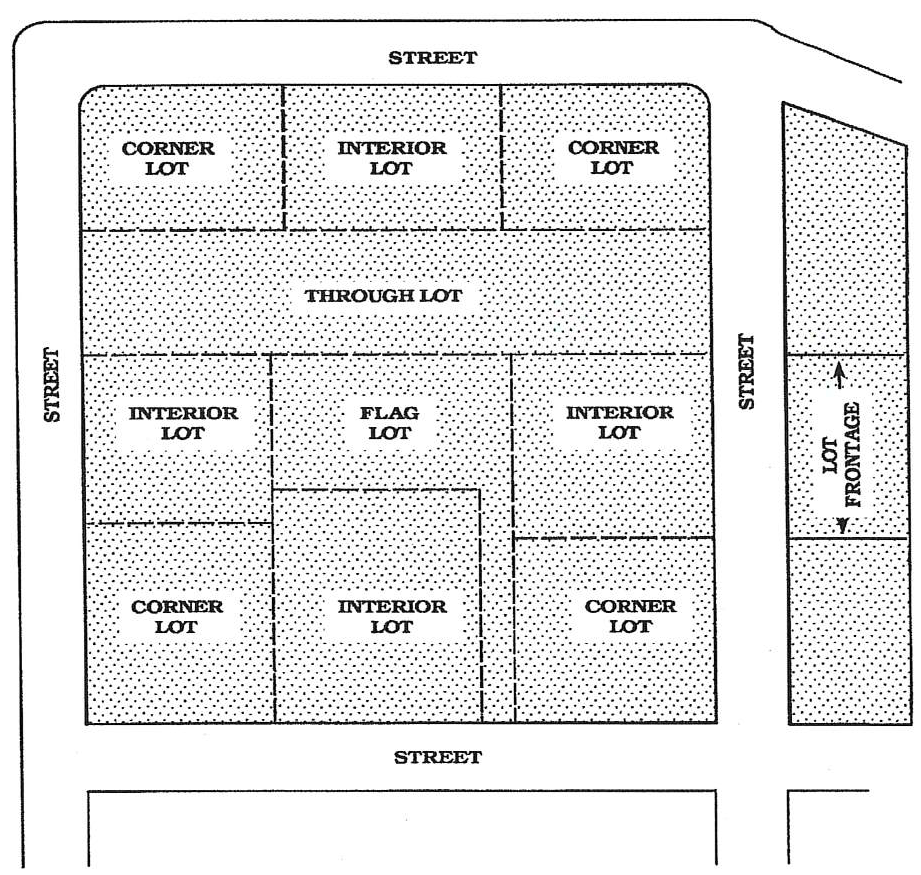
Lot, corner. A lot located at the intersection of two or more streets.
2:2.41.
Lot depth. The mean horizontal distance between front and rear lot lines.
2:2.42.
Lot, double frontage. A lot which has frontage on more than one street, other than an alley. A corner lot is not a double frontage lot unless it has frontage on three or more streets.
2:2.43.
Lot, interior. A lot other than a corner lot, with only one street frontage.
2:2.44.
Lot width. The distance between side lot lines measured at the front building line.
2:2.45.
Manufactured home. A structure manufactured after June 15, 1976, bearing certification of compliance with HUD standards pursuant to S.C. Code 1976, § 40-29-70, transportable in one or more sections, which in the traveling mode is eight body feet or more in width or forty body feet or more in length, or when erected on-site, is 320 or more square feet, and which is built on a permanent chassis and designed to be used as a dwelling with or without permanent foundation when connected to the required utilities, and includes the plumbing, heating, air conditioning, and electrical systems contained in it.
2:2.46.
Manufactured home park. A lot providing rented parking space for five or more manufactured homes used for dwelling units, including service buildings and facilities. Manufactured home sales or storage lots for unoccupied units are not manufactured home parks.
2:2.47.
Manufactured Home Subdivision. The division of land into 4 or more Lots for the purpose of establishing a Manufactured Home on each Lot.
2:2.48.
Miniwarehouse. [See NAICS Code 493110.] A building or group of buildings on a fenced controlled access lot which contain individual locked compartments for storage of personal property.
2:2.49.
Meadow. An open field vegetated by grasses, wildflowers, or other non-woody plants.
2:2.50.
Mobile home. A structure manufactured prior to June 15, 1976, or manufactured after June 15, 1976 without certification of compliance with HUD standards pursuant to S.C. Code 1976, § 40-29-70, which is a movable or portable dwelling unit over thirty (30) feet in length constructed to be towed on its own chassis, without permanent foundation, consisting of a single or two or more connected components. The term does not include prefabricated, modular or unitized dwelling on a permanent foundation, or travel trailer, camper, or similar recreational unit.
2:2.51.
Modular building. A structure consisting of two or more prefabricated components designed to be transported to a lot and placed on a permanent foundation, and which is certified by the South Carolina Building Codes Council as conforming to Southern Building Code standards for site built units. A mobile home, house trailer, or manufactured home is not a modular building.
2:2.52.
Motel. [See NAICS Code 721110.] A building or buildings in which lodging, with or without meals, is offered to the public for compensation, including a hotel, tourist court, or inn.
2:2.53.
Nightclub or Tavern. An establishment used primarily for the serving of alcoholic beverages to the general public, and which may or may not offer entertainment and food service as accessory to the primary use.
2:2.54.
Nonconforming. A term applied to lots, structures, uses of land or structures, and characteristics of use of land or structures which were lawful before the passage or amendment of this zoning ordinance, but which are prohibited by this ordinance or are not in compliance with the requirements of this ordinance.
2:2.55.
Open Fence. A fence that has, for each 1-foot wide segment extending over the entire length and height of the fence, at least 50% of the surface area in open spaces that afford direct views through the fence.
2:2.56.
Open Space Subdivision. A detached single-family residential subdivision where at least 40 percent of the land is reserved in perpetuity as Common Open Space, a Working Farm.
2:2.57.
Park. A public or private lot or facility for active or passive recreation, exercise, sports or similar activities, enhancement of natural features or beauty, but not including a commercially operated amusement park.
2:2.58.
Parking lot. A public or private open lot for parking motor vehicles as a principal use or as an accessory to a commercial or industrial use.
2:2.59.
Parking space. An area on a lot designated for parking a motor vehicle.
2:2.60.
Pasture. Open, uncultivated land vegetated by perennial grasses used for grazing livestock or horses.
2:2.61.
Perimeter Buffer. A bufferyard located along the exterior boundaries of a Rural Residential Site Plan Development.
2:2.62.
Permanent building. A structure on a separately constructed permanent foundation intended to remain in one location and last indefinitely.
2:2.63.
Permitted use. A use permitted outright by district regulations.
2:2.64.
Permitting Agent or Licensing Agent. A person designated by resolution of the county to enforce this ordinance and to issue the required permits or licenses.
2:2.65.
Principal structure or use. A structure or use which is significant or primary rather than accessory.
2:2.66.
Recreational Vehicle. A vehicular unit which is designed as a temporary dwelling for travel, recreational, and vacation use, and which may be self-propelled, pulled by another vehicle, or mounted on another vehicle; examples include, but are not limited to, park model trailers, tiny houses, travel trailers, camping trailers, truck campers, motor homes, fifth wheel trailers, and van conversions.
2:2.67.
Recreational Vehicle Park. A parcel of land on which two or more sites are established for parking a Recreational Vehicle for use as temporary living quarters for recreation or vacation purposes by campers, vacationers or travelers, regardless of whether or not a fee is charged.
2:2.68.
Residence. A dwelling.
2:2.69.
Retail and service establishments. Establishments primarily engaged in sales or service, including food and beverage.
2:2.70.
Rural Cross Roads Businesses. A small commercial establishment located on a Corner Lot at the intersection of two arterial streets or an arterial street and a collector street. These street types are defined in Section 6:3.
2:2.71.
Rural Residential Site Plan (RRSP). A detached single-family residential development where 8 or more lots are proposed. There are 3 types of Rural Residential Site Plan: RRSP-S, RRSP-25, and RRSP-50.
2:2.72.
Rural Residential Site Plan—Standard (RRSP-S). A residential subdivision that does not provide Common Open Space, or that provides less than 25% Common Open Space.
2:2.73.
Rural Residential Site Plan—25 (RRSP-25). A RRSP in which at least 25% of the land is reserved in perpetuity as Common Open Space.
2:2.74.
Rural Residential Site Plan—50 (RRSP-50). A RRSP in which at least 50% of the land is reserved in perpetuity as Common Open Space.
2:2.75.
Setback. The depth or width of any required yard; the minimum distance between a structure and an adjacent lot or street; the area required to be unobstructed except for fences, flagpoles, clothes lines, bird houses or yard accessories.
2:2.76.
Sexually Oriented Businesses. A commercial establishment devoted to erotic or sexual activity, including adult arcades, adult bookstores, adult video stores, adult cabarets, adult motels, adult theaters, escort agencies, nude or semi-nude model studios, and sexual encounter centers.
2:2.77.
Sign. Any device designed to inform, advertise or attract attention such as a billboard, poster, painted surface, announcement, display, ribbon, pennant, flag, banner, illustration, or insignia, lighted or unlighted, stationary or moving.
2:2.78.
Single-Loaded Street. A Street that has Dwellings or other Structures abutting only one side of the Street, with the other side of the Street abutting Common Open Space or a required bufferyard.
2:2.79.
Solar Installation. A ground-mounted photovoltaic solar facility with components and subsystems that generate electricity from sunlight, to be sold to a utility provider and an inter-connection with the local utility power grid. The area of the facility includes all the land inside the perimeter of the system, which extends to any fencing, land area required for setbacks, landscaping, and signage.
2:2.80.
Special exception. A use specifically permitted after review and approval by the Board of Zoning Appeals, subject to ordinance standards and additional conditions set by the Board of Zoning Appeals.
2:2.81.
Standard Subdivision. A residential subdivision that does not include Common Open Space or one that provides less than 25 percent Common Open Space.
2:2.82.
Street. A public thoroughfare for vehicular and pedestrian travel which provides the principal means of access to abutting property, but not including an alley.
2:2.83.
Structure. Anything constructed or erected, the use of which requires location of the ground, or attachment to something located on the ground, including buildings, mobile homes, travel trailers, signs, swimming pools, fences, and antennae, but excluding minor landscaping features such as ornamental pools, planters, bird baths, paved surfaces, walkways, driveways, recreational equipment, flagpoles, and mailboxes.
2:2.84.
Tourist (guest) home. A dwelling in which lodging is provided in not more than three (3) rooms for paid guests, with or without meals. A tourist home shall not be considered an accessory use or customary home occupation.
2:2.85.
Variance. Relief granted by the Board of Zoning Appeals from the strict application of zoning regulations in an individual case of unnecessary hardship based on factual findings required by law.
2:2.86.
Working Farm. Active agricultural production operations of 10 or more acres where crop production, tree farming, timber harvesting, and livestock grazing are the primary activities; ancillary activities including Pick Your Own orchards or produce, Seasonal Produce Stands, Community Gardens, Community Supported Agriculture businesses, Riding Academies and Stable Leasing businesses may be permitted as Conditional Uses.
2:2.87.
Yard. A required open space unoccupied and unobstructed by structures except those specifically permitted.
2:2.88.
Yard, front. A yard situated between the front building line and the front lot line extending the full width of the lot.
2:2.89.
Yard, rear. A yard situated between the rear building line and the rear lot line and extending the full width of the lot.
2:2.90.
Yard, side. A yard situated between the side building line and a side lot line and extending from the front yard to the rear yard.
Figure 1: Illustration of Types of Lots
(Ord. No. 2022-17, 7-25-2022; Ord. No. 2023-17, 9-25-2023)

