
Cape Carteret City Zoning Code
CHAPTER 11
ZONING DISTRICTS
Sec. 14.11.1.- Authority and enactment.
The Board of Commissioners, in pursuance of the authority granted by G.S. 160D-702 et seq., hereby ordains and enacts into law the following sections as set forth in this chapter.
(1997 Code, § 44-1; 2016 Code § 156.001)
Sec. 14.11.2. - Short title.
This chapter shall be known and may be cited as the zoning code of the Town.
(1997 Code, § 44-2; 2016 Code § 156.002)
Sec. 14.11.3. - Jurisdiction.
(A)
Generally. This chapter shall apply to all land within the corporate limits of the Town and within any present or future extraterritorial area of the Town.
(B)
Bona fide farms exempt. This chapter shall in no way regulate, restrict, prohibit or otherwise deter any bona fide farm and its related uses; except that any use of property for non-farm purposes shall be subject to regulation.
(1997 Code, § 44-3; 2016 Code § 156.003)
Sec. 14.11.4. - Establishment of base zoning districts.
For the purpose of this chapter, the Town is hereby divided into eight districts as follows:
(A)
R-10 single-family residential district;
(B)
R-10M multifamily residential district;
(C)
R-13 single family residential district;
(D)
R-20 single-family residential district;
(E)
R-30 single-family residential district;
(F)
B-10 business and professional offices;
(G)
B-20 retail sales and shopping centers;
(H)
B-30 light industrial; and
(I)
TC Town Center mixed use district.
(1997 Code, § 44-31; Ord. 2009-11, passed 4-20-2009; 2016 Code § 156.015)
(Ord. of 9-9-2024, § 1)
Sec. 14.11.5. - Table of permitted and special uses.
P = Permitted by right in the zoning district
SUP = Permitted by Special Use Permit in the zoning district
P* = Permitted by right in the zoning district and subject to further provisions of this UDO
B = 1 space for each room or office plus 1 space for each 3 students over 16 years of age.
**NOTE: Parking category definitions are as follows:
(Ord. of 8-12-2024; Ord. of 9-9-2024, § 2; Ord. of 10-14-2024, § 1; Ord. of 07-14-2025(1), § 1)
Sec. 14.11.6. - Parking category definitions.
***NOTE: See Section 14.11.8.4(B) for applicable conditions.
(1997 Code, Ch. 44, App. B; Am. Ord. 8-76, passed 12-20-1999; Am. Ord. 00-04-01; Am. Ord. passed 4-18-2005; Am. Ord. 2007-02, passed 2-12-2007; Am. Ord. 2011-01, passed 2-21-2011; Am. Ord. 2010-12-06, passed 12-13-2010; Am. Ord. 2012-10-04, passed 10-15-2012; Ord. 2017-06-01, passed 6-12-2017; Ord. 2017-08-03, passed 8-21-2017; Ord. 2018-05-01, passed 5-14-2018; Ord. 2018-07-01, passed 7-9-2018; Ord. 2018-07-06, passed 7-9-2018)
Sec. 14.11.7. - Overlay districts.
In accordance with G.S. 160D-703(a)(4), overlay districts may be created in which different requirements are imposed on certain properties within one or more underlying conventional, conditional, or form-based districts.
Sec. 14.11.8. - Residential Base Zoning Districts.
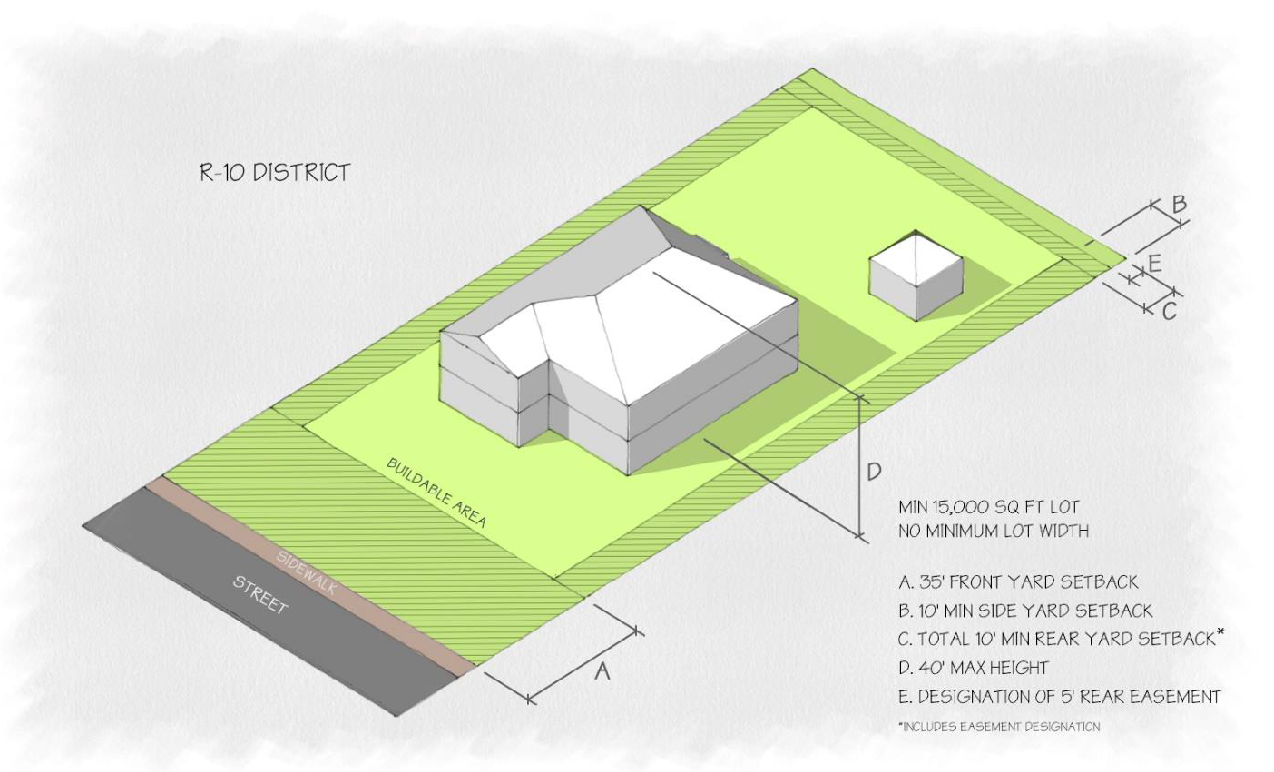
14.11.8.1. R-10 Single-Family Residential District.
(A)
Within the residential district R-10, the only uses permitted shall be those uses denoted as permitted in Section 14.11.5 of this chapter.
(B)
The following provisions shall apply to those uses:
(1)
Restrictions.
a)
A manufactured home shall be allowed only on a lot that contains 15,000 square feet or more.
b)
The minimum lot size for a church shall be five acres.
c)
All swimming pools, spas and tennis courts shall meet those requirements set forth in Sections 14.10.4 and 14.10.3 respectively.
d)
No school engaged in commercial or industrial trade education shall be permitted.
e)
All recreational facilities must be operated on a nonprofit basis.
f)
Public utility substations, carrier stations, water tanks and towers and similar facilities shall be permitted only if:
i.
The facilities are essential to the service of the immediate area;
ii.
The site is not used for storage of vehicles or materials and contains no offices except for a fire station office;
iii.
All buildings and parking areas shall be set back at least 20 feet from all adjoining property lines;
iv.
All dangerous apparatus or equipment shall be enclosed by a chain link fence at least eight feet in height;
v.
There shall be a densely planted and maintained buffer strip, as required in Section 14.12.10, along all property lines other than those adjacent to a street right-of-way; and
vi.
All accessory buildings or structures must be located at least 50 feet from any street right-of-way and five feet from any side or rear property line.
g)
Fire and rescue stations shall be permitted only if there shall be a densely planted and maintained buffer strip, as required in Section 14.12.10, along all property lines abutting residential districts.
(2)
Accessory buildings or structures.
a)
Accessory buildings or structures shall be located ten feet or more behind the front building line of the principal building and five feet from the side property line.
b)
For the purpose of this chapter, eaves, steps and open porches shall be considered as a part of the building.
c)
All accessory structures shall adhere to a ten-foot rear yard setback.
(3)
Off-street parking requirements. Two spaces shall be required for each dwelling unit, and additional spaces shall be provided as required in Section 14.11.6 of this chapter.
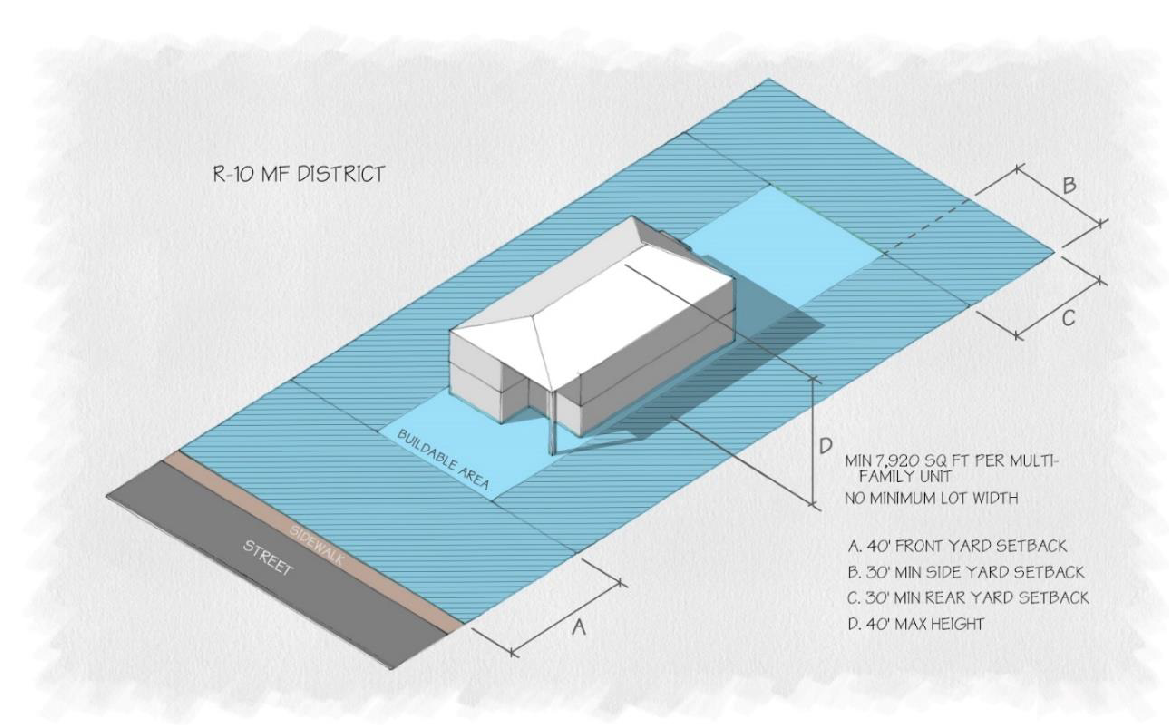
14.11.8.2. R-10M Multi-Family Residential District.
(A)
Within the residential district R-10M, the only uses permitted shall be those uses denoted as permitted in Section 14.11.5 of this chapter.
(B)
The following provisions shall apply to those uses:
(1)
Restrictions.
a)
The minimum lot size for a church shall be five acres.
b)
All swimming pools, spas and tennis courts shall meet those requirements set forth in Sections 14.10.4 and 14.10.3 respectively.
c)
No school engaged in commercial or industrial trade education shall be permitted.
d)
All recreational facilities must be operated on a nonprofit basis or by a governmental entity.
e)
Public utility substations, carrier stations, water tanks and towers and similar facilities shall be permitted only if:
i.
The facilities are essential to the service of the immediate area;
ii.
The site is not used for storage of vehicles or materials and contains no offices except for a fire station office;
iii.
All buildings and parking areas shall be set back at least 20 feet from all adjoining property lines;
iv.
All dangerous apparatus or equipment shall be enclosed by a chain link fence at least eight feet in height;
v.
There shall be a densely planted and maintained buffer strip, as required in Section 14.12.10, along all property lines other than those adjacent to a street right-of-way; and
vi.
All accessory buildings or structures must be located at least 50 feet from any street right-of-way and five feet from any side or rear property line.
f)
Fire and rescue stations shall be permitted only if there shall be a densely planted and maintained buffer strip, as required in Section 14.12.10, along all property lines abutting residential districts.
(2)
Accessory buildings or structures.
a)
Accessory buildings or structures shall be located ten feet or more from the front line of the principal building and five feet from the side property line.
b)
For the purpose of this chapter, eaves, steps and open porches shall be considered as a part of the building.
c)
All accessory structures shall adhere to a ten-foot rear yard setback.
(3)
Off-street parking requirements. Two spaces shall be required for each dwelling unit, and spaces for other uses in the R-10M zoning district shall be provided as required in Section 14.11.5 and 14.11.6 of this chapter.
Parking spaces for multi-family dwellings shall be provided in the garage associated with each individual unit and/or incorporated into individual driveways serving each individual unit, either in the front or rear of the individual units.
(4)
Buffer strip required.
a)
There shall be a minimum 20-foot wide landscaping buffer consisting of existing native vegetation and/or new plantings and landscaping features in a specifically and intentionally delineated landscape design along all property lines. The 20-foot wide landscaping buffer replaces and supersedes other buffer requirements outlined in Section 14.12.9.
(5)
Water and sewer requirements. Each R-10M development must provide a state approved water system and sewage treatment facility. Connection to an existing system having excess capacity would satisfy this requirement if approved by the state.
(6)
Additional standards for multi-family dwellings.
a)
The minimum lot size for a parcel developed with multi-family dwellings shall be two acres.
b)
The maximum density for multi-family dwellings shall be five and one-half units per acre
c)
There shall be no more than four individual connected dwellings in any structure containing multi-family dwelling units.
d)
The minimum required width for individual connected dwellings in any structure containing multi-family dwelling units is 22 feet.
e)
The minimum required setback between structures containing multi-family dwelling is 40 feet. Common parking lots are permitted within the protect setbacks and between structures to accommodate overflow parking reguirements.
(7)
Preparation and Approval Procedure.
a)
For multi-family dwellings projects constructed in the R10-M zoning district that will remain under single ownership, the preparation and approval process outlined in Section 8-21[sic] shall apply, with review and a recommendation provided by the UDO Administrator and final approval of the project site plan reserved for the Board of Commissioners. Provided, however, that the Planning Board shall also review the project site plan after the UDO Administrator review and recommendation, and the Planning Board shall also provide its recommendation to the Board of Commissioners.
b)
For multi-family dwelling projects constructed in the R10-M zoning district that will include the subdivision, recording, and conveyance of individual units, the preparation and approval process outlined in Section 14.13.9 and 14.13.10 shall apply. The preliminary plat shall delineate the boundaries of individual units to be recorded and conveyed, and the associated common areas to be owned and maintained by a property owners' association. The developer shall submit documentation outlining the creation of the property owners' association, the governance of the association, the responsibilities of the association, and the projected dues, revenues, and expenses to properly maintain the project in perpetuity.
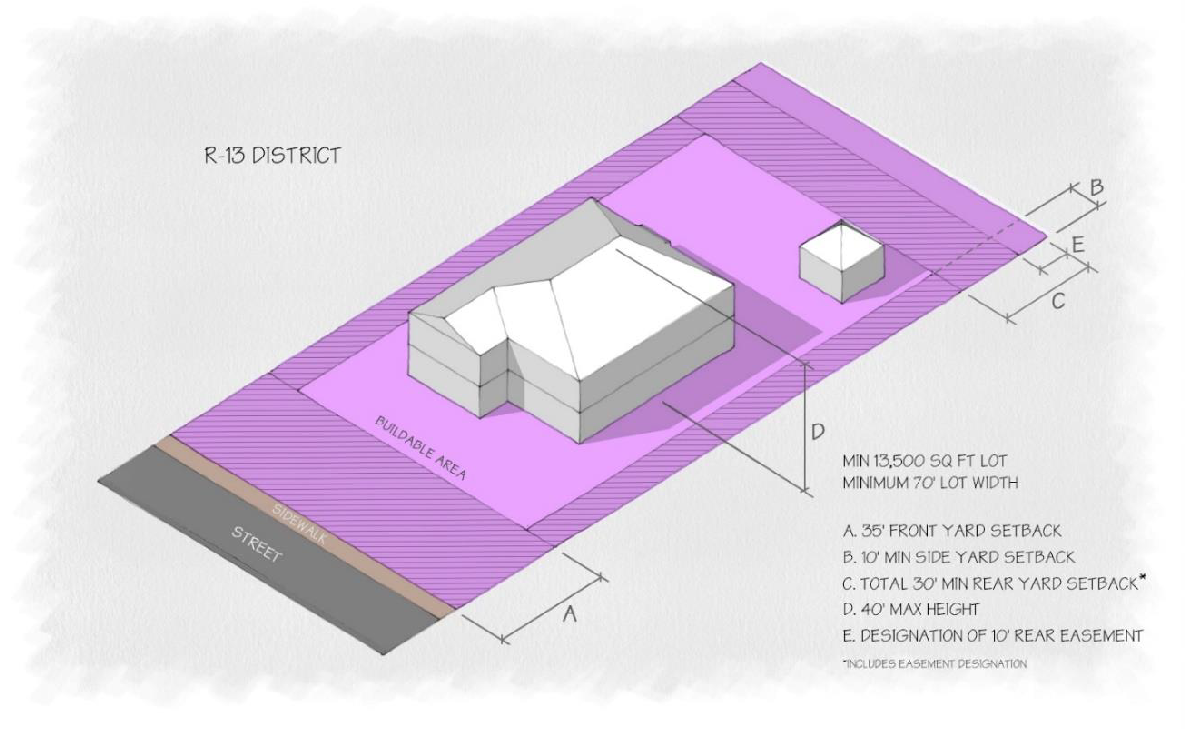
14.11.8.3. R-13 Single-Family Residential District.
(A)
Within the Residential District R-13, the only uses permitted shall be those uses denoted as permitted in Section 14.11.5 of this chapter.
(B)
The following provisions shall apply to those uses:
(1)
Restrictions.
a)
The minimum lot size for a church shall be five acres.
b)
All swimming pools, spas and tennis courts shall meet those requirements set forth in Sections 14.10.4 and 14.10.3 respectively.
c)
No school engaged in commercial or industrial trade education shall be permitted.
d)
All recreation facilities must be operated on a nonprofit basis or by a government entity.
e)
Public utility substations, carrier stations, water tanks and towers and similar facilities shall be permitted only if:
i.
The facilities are essential to the service of the immediate area;
ii.
The site is not used for storage of vehicles or materials and contains no office except for a fire station office;
iii.
All buildings and parking areas shall be set back at least 20 feet from all adjoining property lines;
iv.
All dangerous apparatus or equipment shall be enclosed by a chain link fence at least eight feet in height;
v.
There shall be a densely planted and maintained buffer strip, as required in Section 14.12.10, along all property lines other than those adjacent to a street right-of-way; and
vi.
All accessory buildings or structures must be located at least 50 feet from any street right-of-way and five feet from any side or rear property line.
f)
Fire and rescue stations shall be permitted only if there shall be a densely planted and maintained buffer strip, as required in Section 14.12.10, along all property lines abutting residential districts.
(2)
Accessory buildings or structures.
a)
Accessory buildings or structures shall be located ten feet or more behind the front building line of the principal building and five feet from the side property line.
b)
For the purpose of this chapter, eaves, steps and open porches shall be considered a part of the building.
c)
All accessory structures shall adhere to a ten-foot rear yard setback.
(3)
Off-street parking requirements. Two spaces shall be required for each dwelling unit, and additional spaces shall be provided as required in Section 14.11.6 of this chapter.
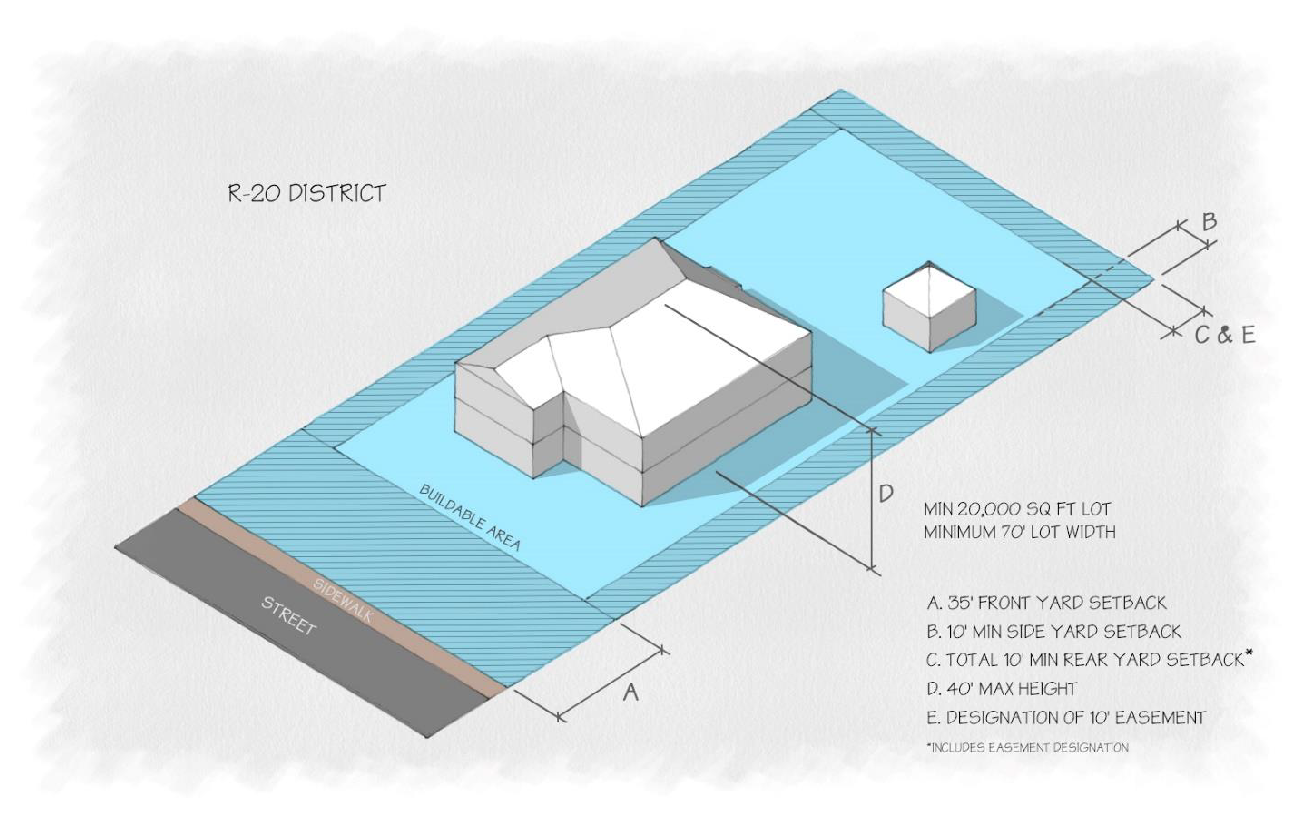
14.11.8.4. R-20 Single-Family Residential District.
(A)
Within the residential district R-20, the only uses permitted shall be those uses denoted as permitted in Section 14.11.5 of this chapter.
(B)
The following provisions shall apply to those uses:
(1)
Restrictions.
a)
The minimum lot size for a church shall be five acres.
b)
All swimming pools, spas and tennis courts shall meet those requirements set forth in Sections 14.10.4 and 14.10.3 respectively.
c)
No school engaged in commercial or industrial trade education shall be permitted.
d)
All recreation facilities must be operated on a nonprofit basis or by a governmental entity.
e)
Public utility substations, carrier stations, water tanks and towers and similar facilities shall be permitted only if:
i.
The facilities are essential to the service of the immediate area;
ii.
The site is not used for storage of vehicles or materials and contains no offices except for a fire station office;
iii.
All buildings and parking areas shall be set back at least 20 feet from all adjoining property lines;
iv.
All dangerous apparatus or equipment shall be enclosed by a chainlink fence at least eight feet in height;
v.
There shall be a densely planted and maintained buffer strip, as required in Section 14.12.10 along all property lines other than those adjacent to a street right-of-way; and
vi.
All accessory buildings or structures must be located at least 50 feet from any street right-of-way and five feet from any side or rear property line.
f)
Fire and rescue stations shall be permitted only if there shall be a densely planted and maintained buffer strip, as required in Section 14.12.10, along all property lines abutting residential districts.
(2)
Accessory buildings or structures.
a)
Accessory buildings or structures shall be located ten feet or more behind the front building line of the principal building and five feet from the side property line.
b)
For the purpose of this chapter, eaves, steps and open porches shall be considered as a part of the building.
c)
All accessory structures shall adhere to a ten-foot rear yard setback.
(3)
Off-street parking requirements. Two spaces shall be required for each dwelling unit, and additional spaces shall be provided as required in Section 14.11.6 of this chapter.
(4)
Satellite parking requirements. Satellite parking (parking on premises not contiguous with the principal use) is permitted in residential district R-20 provided all of the following conditions are met.
a)
The satellite parking lot shall be located within 200 feet of the church or governmental principal use property.
b)
The satellite parking lot shall have a ten-foot planted (living) screen buffer as defined in Section 14.12.10(E)(1), provided that the buffers are not required on property lines that abut a street or right-of-way. Notwithstanding the language contained in Section 14.12.10 concerning non-residential districts, the screening required in this subsection shall comply with all of the provisions of Section 14.12.10 applicable to planted (living) screen(s).
c)
There shall be no lighting in the satellite parking lot except security lighting place on bollards or similar supporting structures, but in any event, there shall be no light fixture nor any part thereof at a height of more than four feet above grade at the location of the light.
d)
There shall be no overnight parking allowed in any satellite parking lot.
e)
The satellite parking lot shall be used for no other purpose than parking for persons attending meetings or other legitimate functions at the site of the principal use to which the satellite parking lot is appurtenant.
f)
The owner/operator of the principal use to which the satellite parking lot is appurtenant shall provide to the Code Enforcement Officer of the Town a written statement with the notarized signatures of all adjacent property owners or their duly authorized agents clearly evidencing their consent to the use requested by the owner/operator of the principal use.
g)
The owner/operator of the principal use to which the satellite parking lot is appurtenant shall ensure through the use of permeable surface materials, use of on-premises storm water catch basin(s) and/or other methods satisfactory to the Town's Code Enforcement Officer that all storm water runoff will be retained on the site of the satellite parking lot.
14.11.8.5. R-30 Single-Family Residential District.
(A)
Within the residential district R-30, the only uses permitted shall be those uses denoted as permitted in Section 14.11.5 of this chapter.
(B)
The following provisions shall apply to those uses:
(1)
Restrictions.
a)
The minimum lot size for a church shall be five acres.
b)
All swimming pools, spas and tennis courts shall meet those requirements set forth in Sections 14.10.4 and 14.10.3 respectively.
c)
No school engaged in commercial or industrial trade education shall be permitted.
d)
Except for full-length golf courses and facilities and activities associated with them, including a clubhouse, all recreation facilities must be operated on a nonprofit basis or by a governmental entity.
e)
Public utility substations, carrier stations, water tanks and towers and similar facilities shall be permitted only if:
i.
The facilities are essential to the service of the immediate area;
ii.
The site is not used for storage of vehicles or materials and contains no offices except for a fire station office;
iii.
All buildings and parking areas shall be set back at least 20 feet from all adjoining property lines;
iv.
All dangerous apparatus or equipment shall be enclosed by a chainlink fence at least eight feet in height;
v.
There shall be a densely planted and maintained buffer strip, as required in Section 14.12.10, along all property lines other than those adjacent to a street right-of-way, and
vi.
All accessory buildings or structures must be located at least 50 feet from any street right-of-way and five feet from any side or rear property line.
f)
Fire and rescue stations shall be permitted only if there shall be a densely planted and maintained buffer strip, as required in Section 14.12.10, along all property lines abutting residential districts.
(2)
Accessory buildings or structures.
a)
Accessory buildings or structures shall be located 20 feet or more behind the front building line of the principal building and ten feet from the side property line.
b)
For the purpose of this chapter, eaves, steps and open porches shall be considered as a part of the building.
c)
All accessory structures shall adhere to a ten-foot rear yard setback.
(3)
Off-street parking requirements. Two spaces shall be required for each dwelling unit, and additional spaces shall be provided as required in Section 14.11.6 of this chapter.
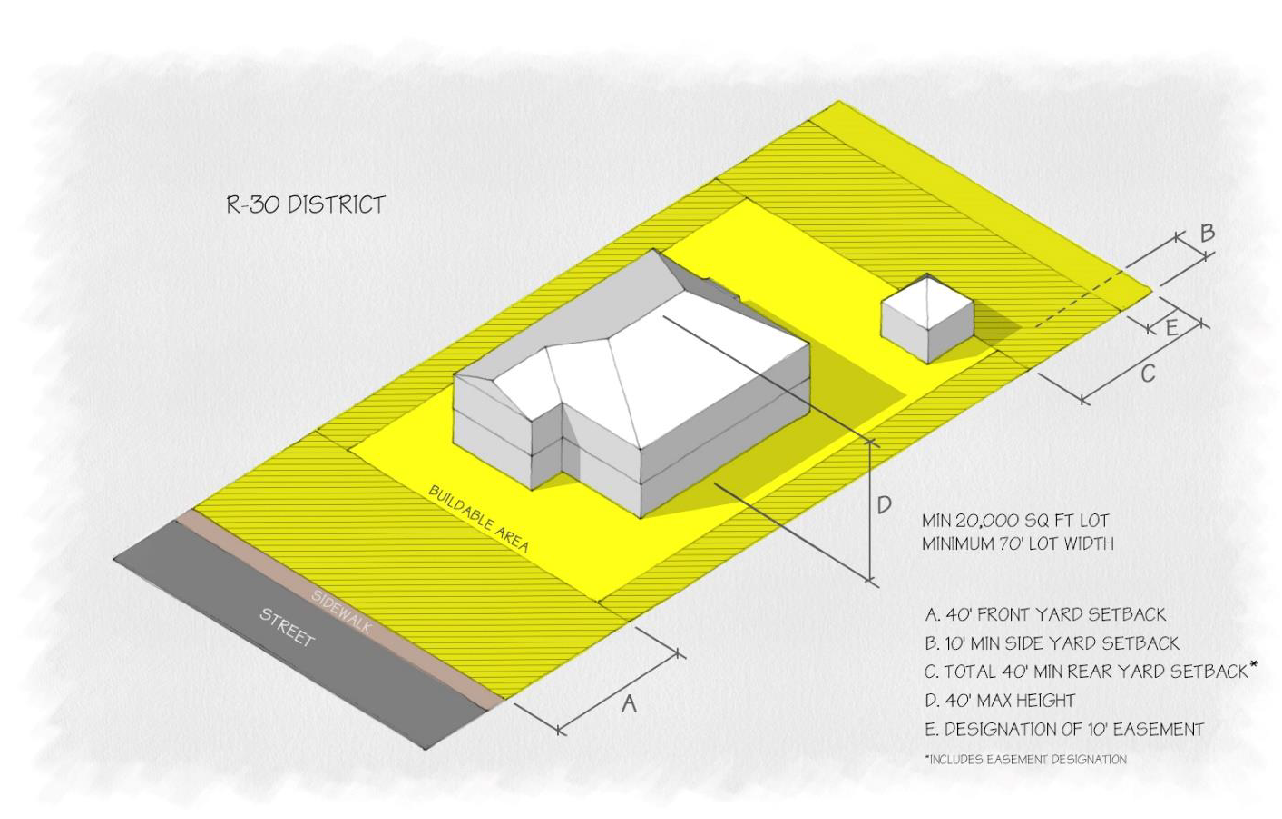
(1997 Code §§ 44-61—44-64; Am. Ord. 00-12-08, passed 12-18-2000; Am. Ord. passed 5-10-2004; Am. Ord. passed 4-18-2005; Ord. 2009-11, passed 4-20-2009; Am. Ord. 2013-12-05, passed 12-9-2013; 2016 Code §§ 156.040— 156.044; Am. Ord. 10-10-2022)
(Ord. of 5-13-2024)
Sec. 14.11.9. - Nonresidential Use Base Districts.
14.11.9.1. B-10 Business and Professional Offices District. Within the business district B-10, the only uses permitted shall be those uses denoted as permitted in Section 14.11.5 of this chapter, and the following provisions shall apply to those uses:
(A)
Restrictions.
(1)
The minimum lot size for a church shall be three acres.
(2)
All swimming pools, spas and tennis courts shall meet those requirements set forth in §§ 10.4 and 10.3 respectively.
(3)
Public utility substations, carrier stations, water tanks and towers and similar facilities shall be permitted only if:
a)
The facilities are essential to the service of the immediate area;
b)
The site is not used for storage of vehicles or materials and contains no offices except for a fire station office;
c)
All buildings and parking areas shall be set back at least 20 feet from all adjoining property lines;
d)
All dangerous apparatus or equipment shall be enclosed by a chainlink fence at least eight feet in height;
e)
There shall be a densely planted and maintained buffer strip, as required in Section 14.12.10 along all property lines other than those adjacent to a street right-of-way; and
f)
All accessory buildings or structures must be located at least 50 feet from any street right-of-way and six feet from any side or rear property line.
(4)
Fire and rescue stations shall be permitted only if there shall be a densely planted and maintained buffer strip, as required in Section 14.12.10, along all property lines abutting residential districts.
(B)
Accessory uses, buildings or structures.
(1)
Accessory uses, buildings or structures are permitted provided they are clearly incidental to a permitted use and will not create a nuisance or hazard.
(2)
Accessory buildings or structures shall be located 50 feet or more from the minimum building setback line and six feet from the side property line. For the purpose of this chapter, eaves, steps and open porches shall be considered as a part of the building.
(C)
Off-street parking requirements.
(1)
Permanent off-street parking shall be constructed and provided, at the time of the erection of any building, or at the time any principal use is expanded or enlarged, or at any time the principal use of a lot changes, as specified hereinafter; except that this section shall not be applicable to any single-family dwelling.
(2)
The number of off-street parking spaces shall be provided as required in Section 14.11.6 of this chapter.
(D)
Buffer. There shall be a densely planted and maintained buffer strip, as required in Section 14.12.10, along all property lines adjacent to a residential district.
(E)
Mobile accommodations.
(1)
At the time a permit for a temporary mobile accommodation is applied for, plans for a permanent structure and removal of the temporary accommodation must be presented.
(2)
Permits for temporary buildings shall expire a maximum of 18 months following issuance, and the temporary building must be removed prior to the expiration of the permit.
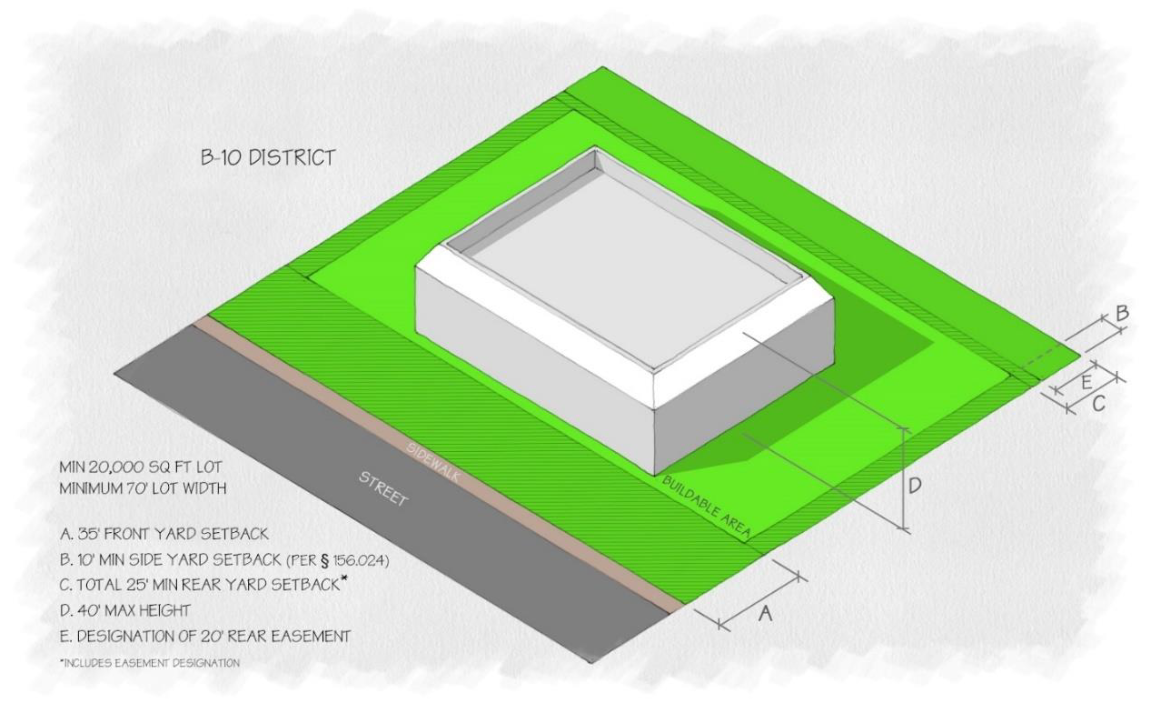
14.11.9.2. B-20 Business Retail Sales and Shopping Center District. Within the business district B-20, the only uses permitted shall be those uses denoted as permitted in Section 14.11.5 of this chapter, and the following provisions shall apply to those uses:
(A)
Restrictions.
(1)
All swimming pools, spas and tennis courts shall meet those requirements set forth in Sections 14.10.4 and 14.10.3 respectively.
(2)
Public utility substations, carrier stations, water tanks and towers and similar facilities shall be permitted only if:
a)
The facilities are essential to the service of the immediate area;
b)
The site is not used for storage of vehicles or materials and contains no offices except for a fire station office;
c)
All buildings and parking areas shall be set back at least 20 feet from all adjoining property lines;
d)
All dangerous apparatus or equipment shall be enclosed by a chainlink fence at least eight feet in height;
e)
There shall be a densely planted and maintained buffer strip, as required in Section 14.12.10, along all property lines other than those adjacent to a street right-of-way; and
f)
All accessory buildings or structures must be located at least 50 feet from any street right-of-way and six feet from any side or rear property line.
(3)
Fire and rescue stations shall be permitted only if there shall be a densely planted and maintained buffer strip, as required in Section 14.12.10, along all property lines abutting residential districts.
(B)
Accessory uses, buildings or structures.
(1)
Accessory uses, buildings or structures are permitted provided they are clearly incidental to a permitted use and will not create a nuisance or hazard.
(2)
Accessory buildings or structures shall be located 50 feet or more from the minimum building setback line and six feet from the side property line. For the purpose of this chapter, eaves, steps and open porches shall be considered as a part of the building.
(C)
Off-street parking requirements.
(1)
Permanent off-street parking shall be constructed and provided at the time of the erection of any building, or at the time any principal use is expanded or enlarged, or at any time the principal use of a lot changes, as specified hereinafter, except that this section shall not be applicable to any single-family dwelling.
(2)
The number of Off-street parking spaces shall be provided as required in Section 14.11.6 of this chapter.
(D)
Buffer. There shall be a densely planted and maintained buffer strip, as required in Section 14.12.10, along all property lines adjacent to a residential district or to a B-10 district.
(E)
Mobile accommodations.
(1)
At the time a permit for a temporary mobile accommodation is applied for, plans for a permanent structure and removal of the temporary accommodation must be presented.
(2)
Permits for temporary buildings shall expire a maximum of 18 months following issuance, and the temporary building must be removed prior to the expiration of the permit.
(F)
Development requirements.
(1)
The site must be adjacent to a major or minor thoroughfare.
(2)
The street and highway system serving the area shall be adequate to handle expected traffic generated by the development, without creating undue hazards to safety or unreasonable impediments to the flow of other traffic.
(3)
The site shall not extend across any major highway.
(4)
Total ground area occupied by all buildings shall not exceed 40 percent of the gross land area.
(5)
Utilities must be adequate to serve the development.
(G)
Sexually oriented businesses. Sexually oriented businesses, only those businesses defined and provided for in this section and the Town of Cape Carteret code of ordinances, and provided the following conditions are met:
(1)
Sexually oriented businesses shall not be located in a building or on a premises where alcohol or alcoholic beverages are sold or in a building or on a premises that allows alcohol or alcoholic beverages to be consumed.
(2)
No sexually oriented businesses shall be permitted in any building which is:
a)
Located within 1,000 feet in any direction from a building used as a dwelling in the B-20 Zoning District.
b)
Located within 1,000 feet in any direction from a residential zoning district.
c)
Located within 1,000 feet in any direction from a building in which a sexually oriented business is located.
d)
Located within 1,000 feet in any direction from a building in which a religious complex is located.
e)
Located within 1,000 feet in any direction from a building in which a library, school, or a state licensed child day care center is located.
f)
Located within 1,000 feet in any direction from any lot or parcel on which a public playground, public swimming pool, public ocean or estuarine access, or public park is located.
(3)
Measurement shall be made in a straight line, without regard to the intervening structures or objects, from the nearest portion of the building or structure used as the part of the premises where a sexually oriented business is conducted to the nearest portion of a building or structure of a use listed above.
(4)
Signs are allowed, as permitted by this chapter, but may not include promotional displays, flashing lights, or photographs, silhouettes, drawings, or pictorial representations of any manner depicting sexual activity, themes or nudity.
(5)
That the applicant(s) obtain a license in accordance with the Town of Cape Carteret code of ordinances.
(H)
Home center.
(1)
A Home Center's inventory shall be generally maintained within the building and any fenced area attached to the building; however, seasonal inventory such as gas and/or charcoal grill, lawn and garden equipment, plants, and the like may be displayed outside the building and its fences area, and inventory which is too large to be displayed practicably within the building, including by way of illustration and not by way of limitation, outdoor storage sheds (or models thereof), dog pens, utility trailers and the like, may also be displayed outside the building and the attached, fenced area. If such inventory is displayed outside the building and fenced area, the operator of the business shall ensure that it is so displayed as not to interfere with vehicular traffic flow and not to render unusable any required parking spaces, fire lanes, vehicular travel lanes and the like.
(2)
The attached, fenced area, if any, shall be entirely surrounded by fencing at least 20 feet tall.
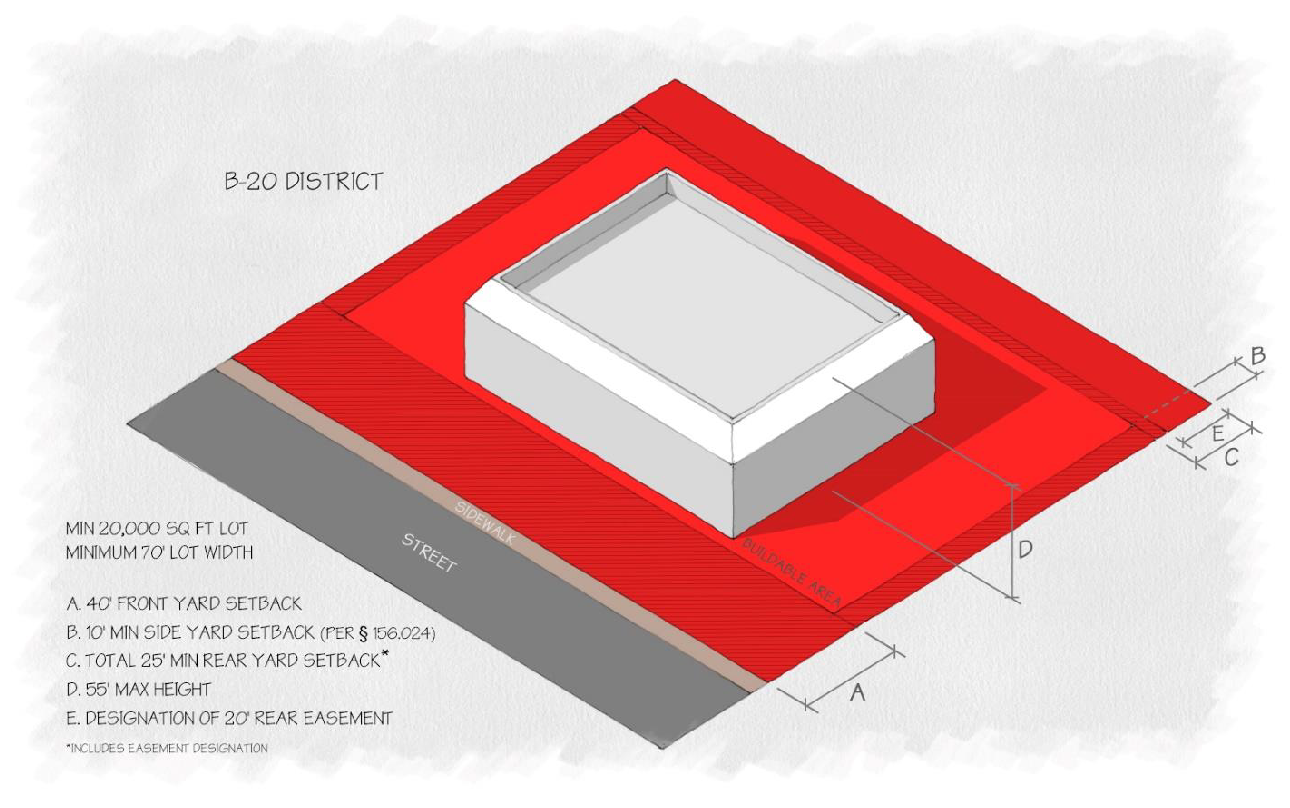
(1997 Code, §§ 44-65, 44-66; Am. Ord. 00-12-08, passed 12-18-2000; Am. Ord. passed 11-18-2002; Ord. 2007-01, passed 2-12-2007; Am. Ord. 2013-12-05, passed 12-9-2013; 2016 Code §§ 156.045, 156.046; Ord. of 06-09-2025(2), 6-9-2025)
14.11.9.3. B-30 Light Industrial Business District.
(A)
Within the business district B-30, the only uses permitted shall be those uses denoted as permitted in Section 14.11.5 of this chapter.
(B)
The following provisions shall apply to those uses:
(1)
Restrictions.
a)
The minimum lot size for a church shall be three acres.
b)
All swimming pools, spas and tennis courts shall meet those requirements set forth in Sections 14.10.4 and 14.10.3 respectively.
c)
Public utility substations, carrier stations, water tanks and towers and similar facilities shall be permitted only if:
i.
The facilities are essential to the service of the immediate area;
ii.
The site is not used for storage of vehicles or materials and contains no offices except for a fire station office;
iii.
All buildings and parking areas shall be set back at least 20 feet from all adjoining property lines;
iv.
All dangerous apparatus or equipment shall be enclosed by a chainlink fence at least eight feet in height;
v.
There shall be a densely planted and maintained buffer strip, as required in Section 14.12.10, along all property lines other than those adjacent to a street right-of-way; and
vi.
All accessory buildings or structures must be located at least 50 feet from any street right-of-way and six feet from any side or rear property line.
d)
Fire and rescue stations shall be permitted only if there shall be a densely planted and maintained buffer strip, as required in Section 14.12.10, along all property lines abutting residential districts.
e)
Addiction rehab centers may not be located within 1,500 feet, measured by straight line, of any building housing a public or private school, church or religious facility, library, public park, or other addiction rehab center.
f)
Adult entertainment may not be located within 1,500 feet, measured by straight line, of any building housing a public or private school, church or religious facility, library, or public park, or other adult entertainment use.
g)
Cannabis dispensaries, retail may not be located within 1,500 feet, measured by straight line, of any building housing a public or private school, church or religious facility, library, or public park, or other cannabis dispensaries, retail use.
h)
Hemp-derived psychoactive product dispensaries, retail may not be located within 1,500 feet, measured by straight line, of any building housing a public or private school, church or religious facility, library, or public park, or other hemp-derived psychoactive product dispensaries, retail use.
i)
Homeless shelters may not be located within 1,500 feet, measured by straight line, of any building housing a public or private school, church or religious facility, library, or public park, or other homeless shelter.
j)
Sexually oriented businesses may not be located within 1,500 feet, measured by straight line, of any building housing a public or private school, church or religious facility, library, or public park, or other sexually oriented businesses.
k)
Smoke/vape/drug accessories and paraphernalia sales may not be located within 1,500 feet, measured by straight line, of any building housing a public or private school, church or religious facility, library, or public park, or other smoke/vape/drug accessories and paraphernalia sales.
l)
Tobacco and vape shops may not be located within 1,500 feet, measured by straight line, of any building housing a public or private school, church or religious facility, library, or public park, or other tobacco and/or vape shop.
(2)
Accessory uses, buildings or structures.
a)
Accessory uses, buildings or structures are permitted provided they are clearly incidental to a permitted use and will not create a nuisance or hazard.
b)
Accessory buildings or structures shall be located 50 feet or more from the minimum building setback line and six feet from the side property line. For the purpose of this chapter, eaves, steps and open porches shall be considered as a part of the building.
(3)
Off-street parking requirements.
a)
Permanent Off-street parking shall be constructed and provided, at the time of the erection of any building, or at the time any principal use is expanded or enlarged, or at any time the principal use of a lot changes, as specified hereinafter; except that this section shall not be applicable to any single-family dwelling.
b)
The number of Off-street parking spaces shall be provided as required in Section 14.11.6 of this chapter.
(4)
Buffer. There shall be a densely planted and maintained buffer strip, as required in Section 14.12.10, along all property lines adjacent to a residential district or to a B-10 district.
(5)
Mobile accommodations.
a)
At the time a permit for a temporary mobile accommodation is applied for, plans for a permanent structure and removal of the temporary accommodation must be presented.
b)
Permits for temporary buildings shall expire a maximum of 18 months following issuance, and the temporary building must be removed prior to the expiration of the permit.
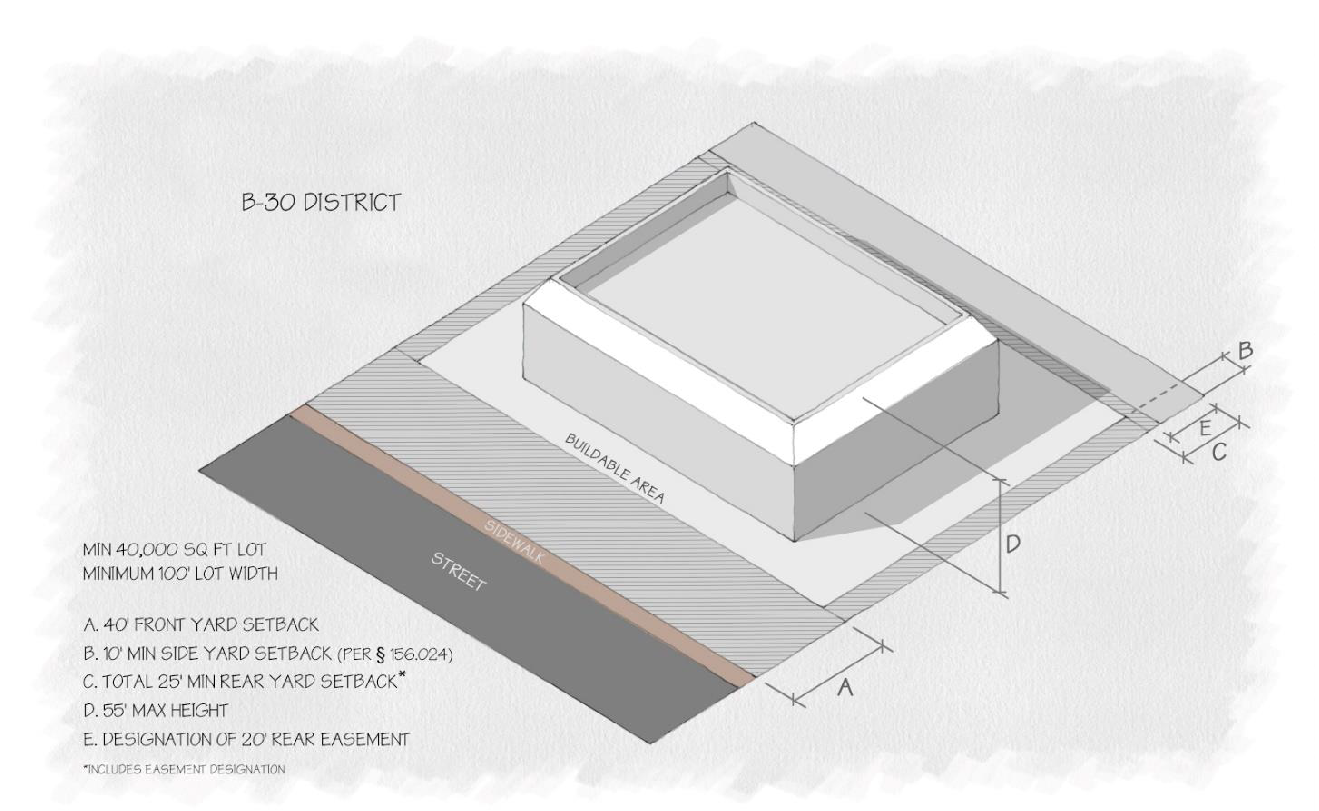
14.11.9.4. PRD Planned Residential Development.
(A)
Within designated zoning districts within the Town, planned residential developments are allowed as shown in Section 14.11.5 to this chapter. Planned residential developments (PRDs) shall be affixed, in accordance with the provisions and procedures set out hereinafter, to specific tracts of land upon application submitted by the owner of the tract. PRD designation shall be approved by the Town only for properties meeting the specific requirements as more fully set out hereafter, and only when a decision is made by the Town that the designation would provide, because of the flexible design criteria, development of benefit to the Town.
(B)
There shall be no requirement that any property be designated as a PRD, the designation being available only upon voluntary request by the owner of the property, and approval of the designation in accordance with the procedures more fully set out in this chapter.
(1)
Restrictions.
a)
The property for which the request for PRD is submitted, whether owned by 1 or more individuals, shall be of a minimum size of six acres.
b)
No structure constructed within a PRD shall exceed 50 feet in height.
c)
Uses shall be limited to residential uses and noncommercial recreational uses, except that no more than 15 percent in total land area of the PRD may be utilized for uses allowed in the B-10 and B-20 zone.
d)
There shall be no more than eight living units allowed per residential acre within the PRD. Residential acre shall mean the total PRD acreage less that portion of the acreage approved for uses other than residential and recreational.
e)
Prior to construction of any improvements within an approved PRD, state approval of the water and sewage facilities for the development must be provided to the Town. Each PRD must have established for its benefit a homeowners' association or other entity with the binding legal obligation to maintain all streets, roads and common areas within the PRD, and the association must have the right to assess the ultimate owners or users of structures within the PRD moneys for the maintenance and upkeep.
(2)
Signs. Within the area designated for uses other than residential and recreational, the only signs permitted are signs allowed in the B-10 district for equivalent uses. Within the rest of the PRD, signs are permitted as allowed in the R-10 district for equivalent uses.
(3)
Accessory uses, buildings or structures. Accessory uses, buildings or structures shall be allowed to the extent reasonably necessary to service the other allowed uses within the PRD.
(4)
Parking. Two Off-street parking spaces shall be required for each dwelling unit, and guest or overflow parking facilities shall be required on the basis of one space for every five living units. Parking for allowed recreation and commercial uses shall be as specified in Section 14.11.6.
(5)
Open spaces. A minimum of 25 percent of the total land area shall be utilized for open spaces or outdoor recreational uses, excluding streets or roads, and excluding land restricted in use to the owners of particular, designated structures.
(6)
Application and review process.
a)
Application. An application to establish a PRD must be submitted, with ten copies, to the Town Clerk for submission to the Chairperson of the Planning Board for review at its next regularly scheduled meeting occurring ten days or more following the submission of the completed application to the Chairperson of the Planning Board. A request for a PRD will only be considered if application is made by the owner of the property or his authorized agent. The application must include the following information and supporting data:
i.
A boundary survey showing the total acreage, present zoning classification, date and north arrow;
ii.
The name of each owner, with their address, and the tax parcel numbers of all abutting properties as shown on the tax records of the county;
iii.
All known and existing easements, reservations and rights-of-way encumbering the tract;
iv.
A narrative description of the proposed use of the land and structures, including the total number of proposed living units and the approximate square footage of all other proposed structures;
v.
A plan showing the approximate location of all living units and other structures, including traffic, parking and circulation plans, and the interconnection of all streets and roads to those adjoining;
vi.
The approximate height of each structure;
vii.
The proposed method of provision of all required utility services to the tract;
viii.
The proposed building materials; and
ix.
The proposed phasing, if any, and approximate completion time of each phase of the project.
b)
Review and approval.
i.
In considering an application for the establishment of a PRD, the Town may attach reasonable and appropriate conditions to the location, nature and extent of the proposed use and the proposed structures. All conditions shall relate to the relationship of the proposed uses and structures to surrounding property and the interrelation among the proposed uses and structures within the tract. Approval, if given, shall specify the conditions attached, and the approval relates only to the proposed uses and structures as approved. Any substantial modification of the uses or structures, or any substantial deviation from the phasing or timing of construction, shall only be permitted after review by the Board of Commissioners and the Planning Board. Other, minor modifications shall not require review by the Planning Board as a whole unless the Board of Commissioners and the Planning Board Chairman believe that the proposed change alters the fundamental character of the approved PRD, in which event the request for modification shall be submitted by the Board of Commissioners for review by the Planning Board.
ii.
The Planning Board shall submit a recommendation to the Board of Commissioners within 35 days following the date it first reviews an application. A copy of the recommendation shall be provided to the applicant. The Board of Commissioners shall consider the proposed application at its next meeting following receipt of the recommendation of the Planning Board, and shall either approve or disapprove, or approve with conditions, the application. If approval is made with conditions, the conditions shall be submitted to the applicant; and the applicant shall have 30 days in which to respond, in writing, to the approval. The applicant may either accept the approval with the attached conditions, or the applicant may reject the PRD, in which event the PRD shall not attach to the tract, or the petitioner may request modification of the proposed conditions. If modifications are requested, the Board of Commissioners shall consider the modifications at its next meeting following receipt of the requested modifications; if no changes are made in the requested conditions, the applicant shall have ten days following the meeting to elect, in writing, to accept the PRD with the attached conditions, or to reject the same. If any applicant fails or refuses to respond within the time allowed, it shall be deemed that the conditions have been rejected and the PRD zone shall not attach. The Town shall cause notice of its actions, and the required time for response by the applicant, to be given in writing to the applicant at his or her address as shown on the application within three working days following any action taken by the Board of Commissioners.
c)
Effect of approval.
i.
If an application is approved, the PRD is established and all conditions which have been attached to the approval are binding on the property. All subsequent development and use of the property must be in accordance with the approved plan and conditions. The intent of this zone is to provide an alternative procedure for specific development proposals. It is intended that all property be zoned PRD only in accordance with firm plans to develop. It is also intended that PRD be an elective zone established only upon request of the owner of property, and that the zone be established only with conditions approved by the owner of a tract. However, once approved, the zoning shall be binding on the tract, and all subsequent owners thereof, until the time as the approval shall expire.
ii.
The PRD shall expire and the property designated PRD shall revert to its previously existing zone unless the development of the parcel is proceeding substantially in accordance with the approved phasing schedule submitted at time of approval of the PRD or unless the Board of Commissioners (without necessity of review by the Planning Board) extends for an additional period of time the approval, which extension shall only be granted upon review and approval of a revised phasing and construction schedule as submitted by the applicant. The applicant shall submit a schedule within 30 days following request to do so by the Town.
(7)
Setbacks. There shall be no required setbacks relating to structures within the PRD, or from private streets within the PRD. Private streets, roads and driveways are specifically permitted. Setbacks from adjoining properties shall be based upon the proposed use of that portion of the property proximate to each neighboring tract and shall be based upon the setback that would be required within that zoning district most equivalent to the proximate use, as determined by the Board of Commissioners.
(8)
Minimum lot size. There shall be no minimum lot size.
(9)
Documentation. Project documentation creating the homeowners' association or other management entity must be submitted for review by the Town and its legal counsel prior to the issuance of any building permit for any portion of the property. The applicant shall reimburse to the Town the moneys expended by the Town in causing the documents to be reviewed and commented by Town legal counsel.
14.11.9.5. Conditional Use District.
(A)
Purpose.
(1)
This section contains regulations which establish zoning districts and assign land uses to one or more of those districts. The section also provides standards for development which regulate lot size, yards, parking and open space. There are, however, certain circumstances which occasionally arise when a general zoning district designation would not be appropriate for a certain property, but a specific use permitted under the district would be consistent with the objectives of this section. In order to accommodate this situation, this section establishes the conditional use zone and describes the rezoning process relating to the conditional use zone.
(2)
The conditional use district is established to address those situations involving a rezoning when a particular use may be acceptable, but the general classification which would allow that use would not be acceptable. It allows the Board of Commissioners to approve a rezoning proposal for a specific use with reasonable conditions to assure the compatibility of the use with surrounding properties and with the land use plan. Any use permitted in a conditional use zone must be a permitted use in a general zoning district of the Town. At a minimum, the land use restrictions in the general zoning classification allowing the proposed use must be complied with in all particulars prior to approval of a conditional use zone. Where the use is allowed in more than one general zoning district, the most restrictive provisions shall apply.
(3)
This proceeding is a voluntary proceeding which may only be instituted at the request of a property owner. It is not intended to be utilized except where specific development criteria have been established for a particular piece of property by its owner, and the owner is prepared to commence construction within six months following approval of the conditional use rezoning application.
(B)
Application and review process.
(1)
Application. Rezoning petitions to establish a conditional use district must be submitted to the Planning Board and will be processed in accordance with the procedure for processing zoning amendments to the extent not in conflict with the provisions of this section. A conditional use district classification will be considered only if the application is made by the owner of the property or his or her agent or any person holding a contract to purchase the land contingent upon approval of the application. All applications must include a schematic plan drawn to scale and any supporting text for the ordinance amendment. The application should include at least the items listed below:
a)
A boundary survey showing the total acreage, present zoning classification, date and north arrow;
b)
The owners' names, addresses and the tax parcel numbers of all abutting properties as shown on the tax records of the county;
c)
All existing easements, reservations and rights-of-way and all yards required for the zoning district applicable;
d)
Proposed use of land and structures.
i.
For residential uses, this should include the number of units and an outline of the area where the structures will be located.
ii.
For nonresidential uses, this should include the approximate square footage of all structures and an outline of the area where the structures will be located.
e)
Traffic, parking and circulation plans, showing the proposed locations and arrangement of parking spaces and access points to adjacent streets.
(2)
Additional requirements.
a)
It may be necessary to request additional information in order to evaluate a proposed use and its relationship to the surrounding area. Therefore, the Planning Board and/or Board of Commissioners may request additional information as they deem necessary. This information may include but is not limited to the items listed below:
i.
Proposed screening, including walls, fences or planting areas, as well as treatment of any existing natural features;
ii.
Proposed architectural design of structures;
iii.
Delineation of areas within the regulatory flood zone as shown on the official FEMA flood zone maps for the county;
iv.
Existing and proposed topography at two-foot contour intervals or less;
v.
Generalized information on the number, height, size and the location of structures;
vi.
Proposed number, size and location of signs; and
vii.
Proposed phasing, if any, and approximate completion time of the project.
b)
The application for a conditional use district must contain information and/or site plans which indicate all of the principal accessory uses which are proposed to be developed on the site. Subsequent to the approval of a conditional use district, only those principal and accessory uses indicated on the approved plan may be constructed on the site. Any substantial modifications to an approved plan, including any changes in the permitted principal or accessory uses, must comply with the provisions of subsection (B)(2)(a)(5).
(3)
Review and approval.
a)
In evaluating an application for the establishment of a conditional use district, the Board of Commissioners shall consider the following:
i.
The policies and objectives of the land use plan;
ii.
The potential impacts on surrounding property values and utilization;
iii.
Traffic impacts;
iv.
Environmental impacts;
v.
The conditions of other properties owned by the applicant; and
vi.
Any other factors deemed reasonably relevant by the Board of Commissioners.
b)
The Board of Commissioners may attach reasonable conditions to any approval relating in any way to the location, appearance or utilization of the proposed use. Those conditions may include reasonable mechanics for determining compliance with the conditions after issuance of the permit, and may include a procedure for revoking a permit if any conditions are not met after reasonable notice and opportunity to comply.
c)
The approval, with attached specific conditions, shall be given to the applicant in writing within 30 days following the vote by the Board of Commissioners approving the conditional use zone. The applicant shall have 30 days after the notice of approval with conditions has been forwarded to him or her, postage prepaid, return receipt requested, to consent to all conditions. Failure to consent in writing to all conditions shall render the approval null and void.
(4)
Documentation and effect of approval.
a)
Following approval of an application and acceptance of conditions by the applicant, the applicant shall cause to be prepared restrictive covenants incorporating all agreed restrictions, which covenants shall name the Town as a beneficiary of the covenants, with full right of enforcement of the conditions, with all cost of enforcement to be borne by the applicant or his or her successors and assigns. A draft of restrictive covenants shall be provided to the Town for review by its legal counsel. Following approval of the covenants, these covenants shall be recorded in the office of the Register of Deeds of the county and a copy of the recorded covenants shall be provided to the Town. At the time as a copy of the recorded restrictive covenants are provided to the Town, a zoning permit may be issued upon a request of the applicant. The conditional use district and conditions attached thereto shall be binding on the property and all subsequent owners of the property.
b)
The Building Inspector of Carteret County shall inspect the property one year from date of issuance of the zoning permit. If satisfactory progress has not been made towards construction of the permitted improvements, the Building Inspector shall provide to the Board of Commissioners a written report specifying the status of progress, and the owner's stated intent towards completion of the project. The Board of Commissioners shall review the report, gather any additional information it deems relevant, and may, after giving notice to the owner and an opportunity for the owner to speak before the Board of Commissioners, terminate the conditional use district designation if reasonable progress has not been made towards completion. Upon the termination, the property shall revert to its zoning classification as it existed immediately prior to the approval of the conditional use zone.
(5)
Alterations to an approved conditional use district. Changes to approved plans and conditions of development will be processed the same as changes to the zoning map and will be processed as an amendment. However, minor changes in the detail of the approved plan that will not alter the basic relationship of the proposed development to adjacent property, that will not alter the uses permitted or increase the density or intensity of development, and that will not decrease the Off-street parking ratio or reduce the yards provided at the boundary of the site may be reviewed by the Planning Board and approved by the Board of Commissioners without going through the amendment process.
(6)
Issuance of a zoning permit for conditional zoning. A zoning permit shall be issued by the UDO Administrator of the Town, which permit shall specify the conditions imposed upon approval of the conditional use district, at the request of the owner of the property assigned the conditional use zone in accordance with the procedures contained herein.
(C)
Zoning map designations. Following Board of Commissioners approval of a conditional use district, the property so zoned will be identified on the zoning maps by the appropriate parallel conditional use district designation. This designation is the general zoning district designation plus the letters CU.
(1997 Code, §§ 44-66, 44-68, 44-69; Am. Ord. 00-12-08, passed 12-18-2000; Am. Ord. 2007-01, passed 2-12-2007; Am. Ord. 2013-12-05, passed 12-9-2013; Ord. 2016-09-01, passed 9-19-2016; 2016 Code §§ 156.047— 156.049)
(Ord. of 8-12-2024)
Sec. 14.11.10. - Mixed Use Zoning Districts.
14.11.10.1. TC Town Center Mixed Use District.
(A)
Within the mixed use zoning district TC, the only uses permitted shall be those denoted as permitted or special use in Section 11.5 of this chapter.
(B)
The following development standards shall apply in the TC zoning district:
(1)
Traditional single-family residential development in the TC zoning district shall be required to comply with all development standards applicable in the R-20 Single Family Residential District.
(2)
Traditional commercial and institutional development in the TC zoning district shall be required to comply with all development standards applicable in the B-20 Business Retail Sales and Shopping Center District.
(3)
Multi-family residential, mixed-use, and village single-family residential development shall be required to comply with the following development standards:
a.
All new multi-family residential, mixed-use development, and village single-family residential development shall comply with applicable building and fire code requirements.
b.
Residential density shall not exceed eight dwelling units per acre for multi-family residential and mixed-use development, and six dwelling units per acre for village single-family residential. Residential density shall be calculated on the basis of the entire development site subject to an application, without removal of acreage dedicated to non-residential uses, including dedicated public streets, public uses, and other areas designated for public use.
c.
The minimum lot size for multi-family residential and mixed-use development is one acre. The minimum lot size for village single-family residential development is 7,200 square feet.
d.
The maximum building height for multi-family residential and mixed-use development is 40 feet. The maximum building height for village single-family residential development is 40 feet.
e.
The minimum required front yard setback for multi-family residential, mixed use development, and village single-family residential is five feet, and the maximum front yard setback is ten feet.
f.
The minimum required rear yard setback for multi-family residential, mixed use development, and village single-family residential is five feet. In cases where the parcel directly abuts property zoned R-10, R-10M, R-20, and R-30, the required rear yard setback is 30 feet.
g.
The required side yard setback for multi-family residential, mixed use development, and village single-family residential is five feet. In cases where the parcel directly abuts property zoned R-10, R-10M, R-20, and R-30, the required side yard setback is 30 feet.
h.
There shall be a minimum 30-foot wide landscaping buffer consisting of existing native vegetation and/or new plantings and landscaping features in a specifically and intentionally delineated landscape design along all property lines where the parcel directly abuts property zoned R-10, R-10M, R-20, and R-30. The 30-foot wide landscaping buffer replaces and supersedes other buffer requirements outlined in Section 14.12.9.
i.
All new subdivision streets and sidewalks deemed as collector streets shall be dedicated as public streets and sidewalks, with curb and gutter constructed of concrete and/or brick, and shall comply with applicable rights-of-way and construction standards outlined in the UDO. All other new subdivision streets and sidewalks may be dedicated as public or private streets and sidewalks, with curb and gutter constructed of concrete and/or brick, and shall comply with applicable rights-of-way and construction standards outlined in the UDO.
j.
All parking facilities shall be located on the side or in the rear of the structure, and shall comply with applicable parking facility standards in the UDO. A minimum of two parking spaces per residential unit are required. On-street parking spaces located directly adjacent to the structure may count toward the required number of parking spaces for the structure.
k.
All new development shall comply with applicable storm water management requirements outlined in the UDO.
l.
Signage associated with all new development in the Town Center zoning district shall comply with applicable B-20 sign regulations outlined in the UDO, provided, however that freestanding signs associated with multi-family residential, mixed-use, and village single-family residential shall only be required to meet the minimum required front yard and side yard setback of five feet.
m.
All new development shall maintain a minimum of 25 percent of the project area as vegetated area. The vegetated area may be utilized to support on-site septic disposal systems and/or storm water management features. Site specific landscaping plans are required and shall include the location of any existing natural areas to be retained and the proposed location and extent of all new vegetated and landscaped areas. Site specific landscaping plans shall include the incorporation of new trees in the public rights-of-way to achieve an attractive streetscape consisting of streets, sidewalks, and vegetation.
n.
Adequate space shall be provided within the project area for the collection of garbage and other refuse, and all dumpsters and other equipment used for garbage collection shall be screened from public view.
(C)
Preparation and Approval Procedure.
(1)
For multi-family residential and mixed-use development constructed in the TC zoning district that will remain under single ownership, the preparation and approval process outlined in Section 14.8.21 shall apply, with review and a recommendation provided by the UDO Administrator and final approval of the project site plan reserved for the Board of Commissioners. Provided, however, that the Planning Board shall also review the project site plan after the UDO Administrator review and recommendation, and the Planning Board shall also provide its recommendation to the Board of Commissioners.
(2)
For multi-family residential, mixed-use development, and village single-family residential constructed in the TC zoning district that will include the subdivision, recording, and conveyance of individual units, the preparation and approval process outlined in Section 14.13.9 and 14.13.10 shall apply. The preliminary plat shall delineate the boundaries of individual units to be recorded and conveyed, and the associated common areas to be owned and maintained by a property owners' association. The developer shall submit documentation outlining the creation of the property owners' association, the governance of the association, the responsibilities of the association, and the projected dues, revenues, and expenses to properly maintain the project in perpetuity.
(Ord. of 9-9-2024, § 3; Ord. of 2-10-2025(1), § 1)

