
Cape Carteret City Zoning Code
CHAPTER 12
GENERAL DEVELOPMENT STANDARDS
USE
No building or land, residential or commercial, shall hereafter be used or occupied and no building or structure or part thereof shall be erected, moved or structurally altered except with a valid zoning permit, in conformity with the regulations of this UDO, or amendments thereof, for the district in which it is located.
(1997 Code, § 44-35; 2016 Code § 156.019)
Sec. 14.12.1. - Height or density.
No building shall hereafter be erected or altered so as to exceed the height or density regulations of this chapter for the district in which it is located.
(1997 Code, § 44-36; 2016 Code § 156.020)
Sec. 14.12.2. - Lot size.
No lot may have its size changed unless the change complies with the provisions of Chapter 13 and the lot, once altered, meets all minimum lot size requirements of this UDO.
(1997 Code, § 44-37; 2016 Code § 156.021)
Sec. 14.12.3. - Yard use limitations.
No portion of any lot may be used simultaneously to comply with any requirements of this UDO as it relates to more than one principal building.
(1997 Code, § 44-38; 2016 Code § 156.022)
Sec. 14.12.4. - One principal building on any lot.
Only 1 principal building and its customary accessory buildings may hereafter be erected on any residential lot; no buildings shall be erected on any lot which does not have access to a street.
(1997 Code, § 44-39; 2016 Code § 156.023)
Sec. 14.12.5. - Elevated structures.
All structures located on pilings, or otherwise elevated, shall have all ductwork, plumbing supply and drain lines, and insulation, concealed so that they are not visible from the right-of-way or adjoining properties.
(Ord. 2009-08, passed 4-20-2009; 2016 Code § 156.032)
Sec. 14.12.6. - Water connection.
All new construction shall be required to connect to the public water supply for potable water.
(Ord. 2009-10, passed 4-20-2009; 2016 Code § 156.033)
Sec. 14.12.7. - Specifications for accessory structures.
All accessory structures located within the residential zoning districts of the Town shall not be used as dwelling units, sleeping quarters, and the like. The following shall be prohibited within accessory structures toilets, showers, bathtubs, sleeping quarters, and kitchens. Accessory structures for the purpose of this section includes sheds, garages, pool houses and other structures that are subordinate to the principal structure.
(Ord. 2019-02-01, passed 2-11-2019; 2016 Code § 156.035)
Sec. 14.12.8. - Fences and walls.
All fences and walls located within the residential zoning districts of the Town are limited to a height of eight feet measured from the interior adjacent grade of the lot where the fence is located. A zoning permit must be obtained prior to the construction of a fence or wall. The following conditions shall apply to all fences and walls:
(A)
Fences and walls must be maintained in a safe condition by the property owner, fences and walls must be either repaired or replaced within 30 days of damage;
(B)
Fences and walls shall not be constructed within any Town right-of-way or within any utility easement, including electric utility easements;
(C)
Fences and walls must be constructed in a manner that does not obstruct or divert the flow of flood or rain water onto adjacent properties;
(D)
Fences and walls shall be limited to a height of four feet if located in the front yard;
(E)
Fences and walls shall not obstruct sight visibility on corner lots or on areas located near residential driveways;
(F)
The individual responsible for enforcing the Town's Code of Ordinances may limit or prohibit fences and walls in certain locations if a hazard would be created as a result of the construction of a fence or wall;
(G)
Rear and/or side yard fences must be setback a minimum of ten feet from any overhead electric utility lines.
i.
A map of existing overhead electric utility lines is included in Appendix B.
ii.
This provision shall not apply to individual overhead electric service lines connecting the private structure to the electric utility easement.
iii.
Existing non-compliant fences may remain, but must be relocated in conjunction with any development on the site that is subject to a new zoning permit.
iv.
Approval of a fence permit does not guarantee compliance with applicable easements and/or restrictive covenants, and property owners are encouraged to consult with appropriate regulating entities.
(H)
Violations of this section shall subject offenders to a civil penalty in the amount of $50.00 per day with each day that the violation occurs representing a separate and distinct offense.
(Ord. 2019-02-02, passed 2-11-2019; 2016 Code § 156.036)
(Ord. of 7-8-2024, § 1)
Sec. 14.12.9. - Required screening and buffer zone.
(A)
Between residential and nonresidential districts. Any person owning real property located in a nonresidential district adjoining or contiguous to the boundary line of a residential district shall be required to design, install and maintain a buffer strip along the boundary line of the property adjoining the residential zone, when the owner either proposes new construction for his or her tract of land, or proposes a substantial change in use. As used herein, residential district shall include the following districts: R-10, R-10M, R-13, R-20 and R-30.
(B)
Between R-10M and single-family residential districts. Any person owning real property located in an R-10M district adjoining or contiguous to the boundary line of any single-family residential district, and who proposes to construct multifamily units in excess of 4, shall be required to design, install and maintain a buffer strip along the boundary line of the property adjoining the single-family residential district.
(C)
Between B-20 or B-30 district and B-10 district. Any person owning real property located in a B-20 or B-30 district that adjoins or is contiguous to the boundary line of any B-10 district, and who proposes new construction for his or her tract of land, shall be required to design, install and maintain a buffer strip along the boundary line of the property adjoining the B-10 zone.
(D)
On Town main streets. Any person owning commercial real property abutting W.B. McLean Drive (N.C. Highway 24), Taylor Notion Road, or N.C. Highway 58, and who proposes new construction for his or her tract of land, shall be required to either leave or plant a buffer strip along the street (roadway) a minimum of a 20-foot wide strip of green or natural area, consisting of shrubs not exceeding three feet in height, grass, flowers, and trees. Branches of mature trees retained or established in the 20-foot buffer may be trimmed or limbed up to a maximum of ten feet, as authorized by the Zoning Officer. Additionally, the Zoning Officer may require that trees be retained or established every 15 lineal feet in this area.
(E)
Buildings prohibited in buffer areas. No building or structure of any kind shall be placed within a buffer area.
(F)
Sidewalks and hike-bike trails. Sidewalks and hike-bike trails may be placed in the buffer area only when there is insufficient space in the street right-of-way to accommodate these pedestrian and bike paths. The burden shall be on the property owner to demonstrate that there is insufficient space in the right-of-way to meet the requirements of this section. In such case, the owner of the property shall dedicate such portion of the buffer area as is used for sidewalks and hike-bike trails to public use for those purposes, in such form as the Town may require and shall record such dedication in the County Registry in a form acceptable to the Town.
(G)
Types of screening. The following standards shall be used to protect affected property. The highest elevation of any two properties at their common property line shall be used in determining the minimum height of a screening buffer. The degree of effectiveness for opacity shall be judged from the property being screened.
(1)
Planted (living) screen. The minimum width of a planted screen shall be ten feet. The minimum height of a planted screen shall be four feet at initial planting, and at least ten feet within three years thereafter. The minimum height of shrubbery in a planted screen shall be at least three feet at initial planting. A planted screen shall afford 100 percent visual opacity at maturity.
(2)
Combination screens (screens using opaque fencing and plants). The minimum width of a combination screen shall be 15 feet. The planted portion of a combination screen shall be placed on the side of the fence opposite to the improvements on the lot, shall be a minimum height of three feet at initial planting, and shall afford at least 50 percent opacity to a minimum height of ten feet within three years after planting. The minimum height of the solid portion of the fence portion of such a screen shall be eight feet.
(3)
Required amount of screening and buffering width. The minimum acceptable screening and buffering width required to provide adequate protection to affected properties is variable with the individual site. The amount of screening and buffering width is based on the intensity of the uses allowed within each zoning district and the extent of development, as determined by the total amount of principal building floor space per lot. The minimum acceptable screening and buffering width shall be as follows:
(H)
Maintenance. All planted living screening material shall be maintained by the owner of the property on a continuing basis for the life of the property, or on a continuing basis for the life of the development. Nonliving screening buffers shall be maintained, cleaned and repaired by the owner of the property on a continuing basis for the life of the development. The buffers shall be kept free of litter and advertising.
(I)
Administration and enforcement.
(1)
Prior to the issuance of a zoning permit for any construction, renovation or alteration of any structure for which a screening buffer must be provided, a plan indicating the type, amount and location of screening buffer and any required landscaped open space, prepared in conformance with the provisions of this section, shall be submitted by the property owner to the UDO Administrator.
(2)
No certificate of occupancy for any construction or renovation shall be approved by the Building Inspector of Carteret County until the required screening buffer is completed in accordance with the approved plan.
(3)
The UDO Administrator may modify or waive the requirements of this section, where it can be demonstrated by the property owner that the specific screening buffer and/or landscaped open space is not needed for the protection of surrounding residential areas because of intervening streets, roadways, drainageways, or other factors such as natural or topographic features, or where there already exists on the same property natural growth of sufficient height and density to serve the same purpose as the required screening buffer.
(1997 Code, § 44-40; Am. Ord. 2006-16, passed 10-30-2006; Am. Ord. 2009-11, passed 4-20-2009; 2016 Code § 156.024)
Sec. 14.12.10. - Off-street parking.
(A)
When required. There shall be constructed and provided, at the time of the erection of any building, or at the time any principal use is expanded or enlarged, or at any time the principal use of a lot changes, permanent Off-street parking as specified hereinafter, with the exception that this section shall not be applicable to any single family dwelling.
(B)
General provisions.
(1)
Each parking space shall have a minimum width of ten feet and a minimum depth of 20 feet.
(2)
Handicap parking shall be provided as required in the handicapped section of the State Building Code.
(3)
All off-street parking lots subject to this section, and all driveways and all planted areas that are elements thereof, shall be curbed, which shall be integrated with the curbing (or the lack thereof) on adjacent streets and developments.
(C)
Planted areas.
(1)
Purpose and intent. The objective of this section is to protect and promote the public health, safety and general welfare by requiring the landscaping of parking lots, which will serve to reduce wind and air turbulence, heat and noise, and the glare of automobile lights; to act as a natural drainage system and thereby reduce stormwater drainage problems; to reduce the level of carbon dioxide; to provide shade; to conserve and stabilize property values; and to otherwise facilitate the creation and continuation of a convenient, attractive and harmonious community through relief of the blighted appearance of parking lots by preserving a healthful and pleasant environment through the community.
(2)
Landscape and parking lot plan. All sketch plans submitted pursuant to this UDO shall be drawn to scale and clearly delineate the existing and/or proposed parking spaces, access aisles, driveways, curbs and the location and description of landscape areas and materials.
(3)
Interior planting requirements. Not less than six percent of the interior of a parking facility shall be reserved for planting deciduous trees and shrubbery. The reserve planting areas shall be reasonably dispersed throughout the parking facility. Trees and shrubbery shall be planted in the proper manner, according to the sketch plan submitted pursuant to this section, prior to the parking facility being ready for use. Trees and shrubs shall be maintained and replaced as required as long as the parking facility continues in use.
(4)
Peripheral planting requirements. A peripheral planting strip with a minimum width of ten feet shall be located along any side of a parking facility that abuts adjoining property that is not a right-of-way. One evergreen tree for each 15 feet, or fraction thereof, and appropriate shrubbery shall be properly planted within the peripheral planting strip. Trees and shrubbery shall be planted in a proper manner prior to the parking facility being ready for use. Trees and shrubs shall be maintained and replaced as required as long as the parking facility continues in use.
(5)
Street planting requirements. A street planting buffer strip shall be located along any side of a parking facility that abuts a street, roadway or any other right-of-way. The buffer strip shall be at least 20 feet wide abutting W.B. McLean Drive (N.C. Highway 24), Taylor Notion Road or N.C. Highway 58, and a minimum width of ten feet along other Town streets, roadways or any other rights-of-way. This green or natural area shall be designed, installed and maintained consistent with the requirements of Section 14.12.10, with shrubs not exceeding three feet in height, grass, flowers and trees. Vegetation may be left bordering the street (roadway) and/or planted in order to provide the required buffer. Branches of mature trees retained or established in the buffer may be trimmed or limbed up to a maximum of ten feet as authorized by the Zoning Officer. Additionally, the Zoning Officer may require that trees be retained or established every 15 lineal feet in this area. Trees and shrubbery shall be planted in a proper manner prior to the parking facility being ready for use. Trees and shrubs shall be replaced as required as long as the parking facility exists.
(D)
Parking space required. Parking spaces shall be provided in all zoning districts as required in Section 14.11.6 of this UDO.
(E)
Sketch plan required. No off-street parking facility, parking lot, traffic aisle or traffic drive consisting of ten or more spaces and/or at least 2,500 square feet shall be constructed, reconstructed or enlarged until a sketch plan for that facility has been reviewed and approved by the Planning Board for compliance with this section.
(1997 Code, § 44-42; Am. Ord. 2006-17, passed 10-30-2006; 2016 Code § 156.026)
Sec. 14.12.11. - Driveway regulations.
(A)
General provisions.
(1)
Any person owning real property located in a residential district shall be required to design, install and maintain a driveway in conformity with the regulations contained herein.
(2)
All driveways proposed to connect to roads maintained by the State of North Carolina shall be governed by regulations as promulgated by the North Carolina Department of Transportation in addition to the requirements contained herein.
(3)
All driveways shall be so located as to avoid undue interference with or restriction of the free movement of normal traffic on Town roads. In accordance with this principal, driveways should be constructed where the road alignment and profile are favorable, i.e., where there are no sharp curves or steep grades and where sight distance is adequate for safety.
(B)
Driveway width. The minimum driveway width shall be ten feet flared to a minimum width of between one and one-half to two times the driveway width at its intersection with the Town road. A cleared area of at least two feet shall be provided on each side of the driveway within the Town's right-of-way to provide adequate clearance for delivery trucks.
(C)
Driveway angle. Driveways shall be constructed as near to 90 degrees to the Town road as sight conditions will permit; with a normal minimum of 60 degrees.
(D)
Driveway profile contours.
(1)
Vertical curves on driveways should be flat enough to prevent the dragging of a vehicle's undercarriage.
(2)
Every driveway connected to a Town road shall be level to or as near level as possible to the Town road.
(E)
Driveway cross sections. The cross section of a driveway shall be graded so as to insure that water runoff from the driveway is directed to the edges of the driveway to minimize the amount of runoff entering Town roads from driveways.
(F)
Drainage.
(1)
Drainage at the edge of the shoulder area shall not be interrupted. The condition and size of existing ditches shall be preserved when constructing a driveway which connects to a Town road. The use of a swale or a pipe underdrain for proper drainage is required.
(2)
If a culvert is required, the owner of a lot who constructs a driveway therein which connects to a Town road shall be responsible for installing and maintaining a culvert of suitable size to prevent any accumulation of runoff or erosion on the Town road.
(3)
Where a ditch or swale exists at the point where the driveway meets the road, and a pipe is required, the minimum pipe underdrain shall be 12 inches or as specified by the Town Public Works Supervisor.
(Ord. 00-07-02, passed 7-17-2000; Am. Ord. passed 11-18-2002)
Sec. 14.12.12. - Sidewalk regulations.
(A)
Residential subdivisions. Any person who subdivides any property otherwise than as excepted by Section 14.13.6 shall install sidewalks in accordance with Section 14.13.7.2 and other applicable sections of this Code.
(B)
Commercial development. Any person who develops or performs any other construction, reconstruction, addition, or otherwise constructs any substantial improvements on any commercial property, shall install sidewalks in accordance with Section 14.13.7.2 and other applicable sections of this Code.
(Ord. 2006-13, passed 8-21-2006; 2016 Code § 156.029)
Sec. 14.12.13. - Street access.
No building shall be erected on a lot which does not abut a street or have access to a public street by means of an unobstructed permanent access easement of record or private street. For the purposes of this ordinance, an easement of record shall mean that the easement is recorded in the county register of deeds office and made a part of the deed for the property it is on.
Sec. 14.12.14. - Visibility of intersections.
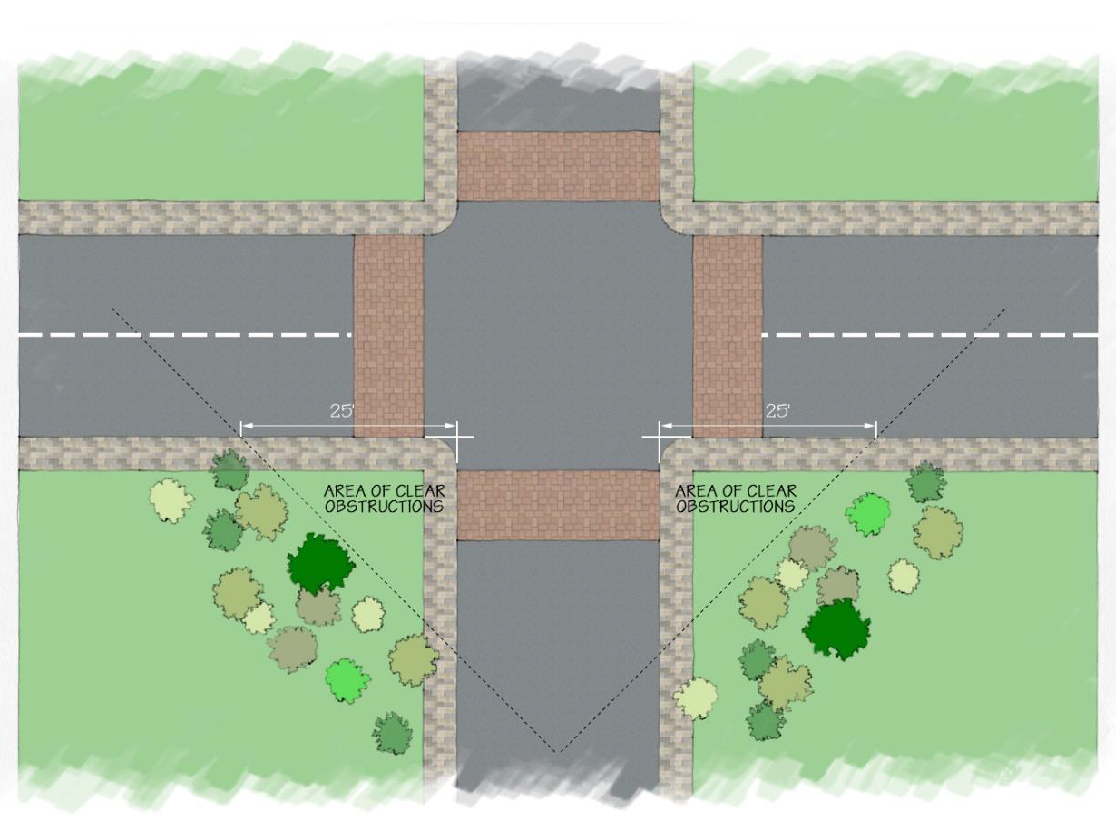
On a corner lot in any district, no planting, structure, fence, wall or obstruction to vision more than three feet in height measured from the centerline of the street shall be placed or maintained within the triangular area formed by the intersecting street lines and a straight-line connecting points on the street lines, each of which is 25 feet distance from the point of intersection.
(1997 Code, § 44-122; 2016 Code § 156.081)
Sec. 14.12.15. - Offensive lighting prohibited.
It shall be unlawful for any person on private, residential or commercial, property to install, aim, locate, direct, or maintain any permanent or portable outdoor lighting in such a manner as to present a hazard to drivers or pedestrians by impairing their ability to safely traverse, or so as to create a nuisance by projecting or reflecting objectionable light onto a neighboring property such that it interferes with the privacy of persons residing therein, bothers or affects the ability of persons residing therein to sleep, or interferes with or affects the ability of the persons residing therein to carry on normal household duties or actions. Violations of this article shall subject the offender to a civil penalty in the amount of $50.00.
(Ord. 2018-10-04, passed 10-8-2018; 2016 Code § 156.050)
Sec. 14.12.16. - Stormwater management.
All new development and/or redevelopment shall install stormwater measures as specified in this section.
(A)
State stormwater permits. When a development or redevelopment project, involving any land use, is required to obtain a stormwater management permit from the North Carolina Department of Environmental Quality, the applicant shall provide a copy of the approved permit and plans to the Town.
These plans should include stormwater management features designed to accommodate a minimum two-inch rainfall event or the rainfall event required by the State, whichever is greater.
(B)
Town stormwater requirements. Any development or redevelopment project that is not required to obtain a stormwater management permit from the North Carolina Department of Environmental Quality is required to meet Town stormwater requirements outlined in this section as a condition of the issuance of a zoning permit.
(1)
Commercial, industrial, or institutional projects. These plans must be prepared by a North Carolina registered design professional, and shall include stormwater management features designed to store and infiltrate on-site the runoff from all impervious surfaces during a minimum two-inch rainfall event. Storage and infiltration may be accomplished by the creation of appropriately sized surface basins or sub-surface infiltration chambers. Runoff may also be conveyed to on-site wetlands or other water features with adequate capacity to accept runoff associated with a minimum two-inch rainfall event, provided runoff is conveyed via a vegetated swale a minimum of 30 feet in length.
(2)
Residential subdivisions that involve the construction of new public streets, private streets, common driveways, multi-family units, and/or other common improvements.
These plans must be prepared by a North Carolina registered design professional, and shall include stormwater management features designed to store and infiltrate on-site the runoff from all impervious surfaces during a minimum two-inch rainfall event. Storage and infiltration may be accomplished by the creation of appropriately sized surface basins or sub-surface infiltration chambers. Runoff may also be conveyed to on-site wetlands or other water features with adequate capacity to accept runoff associated with a minimum two-inch rainfall event, provided runoff is conveyed via a vegetated swale a minimum of 30 feet in length.
These plans may, but are not required to accommodate the future runoff generated by the future development of individual residential lots. If a residential subdivision plan does not accommodate the future runoff generated by the future development of individual residential lots, then the individual residential lots shall be required to meet the standards outlined elsewhere in this section. If a new residential subdivision plan accommodates the future runoff generated by the future development of individual residential lots, then the new individual residential lots shall not be required to meet the standards outlined elsewhere in this section at the time of new construction on the individual lots. However, any future development of individual residential lots that exceeds the assumptions and/or conditions of the original plan shall be required to meet the standards outlined elsewhere in this section.
(3)
Individual residential lots—New construction exceeding 30 percent impervious. Development on individual residential lots with impervious surface that exceeds 30 percent of the total lot area shall include stormwater management features designed to store and infiltrate on-site the runoff from all impervious surfaces during a minimum one and one-half-inch rainfall event. Storage and infiltration may be accomplished by the creation of appropriately sized surface basins or sub-surface infiltration chambers, and all runoff shall be directed and conveyed from impervious surfaces to the infiltration basins or chambers. Runoff may also be conveyed to on-site wetlands or other water features with adequate capacity to accept runoff associated with a minimum one and one-haf-inch rainfall event, provided runoff is conveyed via a vegetated swale a minimum of 30 feet in length. Plans may be designed by a North Carolina registered design professional, a general contractor, a landscaping professional, or the property owner.
(4)
Individual residential lots—Expansion or modification of existing development. The expansion or modification of existing development on a residential lot that results in total impervious surface that exceeds 30 percent of the total lot area shall include stormwater management features. Such features shall be designed to store and infiltrate on-site the runoff that results from any impervious surface exceeding 30 percent of the total lot area during a minimum one and one-half-inch rainfall event. Storage and infiltration may be accomplished by the creation of appropriately sized surface basins or sub-surface infiltration chambers, and all runoff shall be directed and conveyed from impervious surfaces to the infiltration basins or chambers. Runoff may also be conveyed to on-site wetlands or other water features with adequate capacity to accept runoff a minimum one and one-half-inch rainfall event, provided runoff is conveyed via a vegetated swale a minimum of 30 feet in length. Plans may be designed by a North Carolina registered design professional, the general contractor, a landscaping professional, or the property owner.
The modification of existing development on a residential lot that already includes total impervious surface that exceeds 30 percent of the total lot area, and that does not increase the total impervious coverage as a result of the modification, is not required to include additional stormwater management features required by this section.
(5)
All new development or redevelopment. All new development or redevelopment, involving any land use, shall also be required to incorporate the following into the site design:
(a)
The driveway(s) shall be sloped down and away from the directly adjacent road surface at a slope of four percent to the midpoint of the street right-of-way between the directly adjacent road surface and private property line, so as to prevent runoff from the driveway from entering the adjacent road and/or allow existing drainage swales to flow across the driveway, OR
(b)
The driveway(s) shall include the installation of a driveway grate across the entire width of the driveway at its intersection with the street right-of-way, with runoff directed to a surface basin, sub-surface infiltration chamber on the site, or a driveway culvert installed under the driveway, OR
(c)
The driveway(s) shall incorporate other design features to effectively divert runoff away from the adjacent road so that it is infiltrated on the site.
This driveway requirement shall also apply to any new or replacement driveway installed at an existing developed property.
The UDO administrator shall determine the appropriate option required herein based on the specific stormwater management features currently existing in the street right-of-way in the proximity of the proposed new development or redevelopment.
All new development or redevelopment shall also be required to install appropriate stormwater management features to ensure continued proper operation of existing stormwater management features in the adjacent street right-of-way or existing public stormwater management features on the property or nearby stormwater easements.
(6)
Impervious surfaces. The following materials shall be considered as impervious surface under this section, unless otherwise exempted under this section:
(a)
Roofs;
(b)
Concrete driveways, sidewalks, or patios;
(c)
Asphalt driveways, sidewalks, or patios;
(d)
Paver block driveways, sidewalks, or patios;
(e)
Compacted gravel or stone used as a driveway or parking area.
The following materials shall specifically be exempted and shall not be considered as impervious surface under this section:
(a)
Swimming pool water;
(b)
Slatted wooden decking;
(c)
Gravel or stone used for landscaping purposes;
(d)
Porous concrete;
(e)
Permeable interlocking concrete pavers;
(f)
Concrete grid pavers;
(g)
Porous asphalt;
(h)
A surface of #57 stone; and
(i)
Artificial turf, manufactured to allow water to drain through the backing of the turf and installed according to the manufacturer's specifications over a porous surface; and
(j)
Any other material with pervious characteristics, as determined and authorized by the State of North Carolina.
(C)
Compliance. When plans have been prepared by a North Carolina registered design professional, a letter sealed by the design professional shall be submitted indicating compliance with the approved stormwater plans prior to the issuance of a certificate of occupancy.
Construction on individual residential lots must have all stormwater features installed prior to issuance of a certificate of occupancy.
Each site plan submitted with a zoning permit application for residential or commercial development shall document in a table individual impervious area calculations. Each site plan submitted with a zoning permit application for a modification to an existing residential or commercial structure shall document in a table individual impervious area calculations of existing impervious surfaces and the proposed changes to be made on the property (removal of existing and/or installation of additional impervious surfaces).
A representative format of a representative table of individual impervious area calculations follows:
(Ord. 2009-07, passed 4-20-2009; Am. Ord. 2010-04, passed 6-21-2010; 2016 Code § 156.031)
(Ord. of 10-9-2023, § 1; Ord. of 8-12-2024, § 1; Ord. of 9-9-2024, § 1; Ord. of 2-10-2025(3), § 1)
Sec. 14.12.17. - Reserved.
Editor's note— Section 2 of an ord. adopted Oct. 9, 2023, repealed § 14.12.17, which pertained to water runoff conditions and derived from § 44-44 of the 1997 Code; Ord. No. 2013-12-05, adopted Dec. 9, 2013; and § 156.028 of the 2016 Code.
Sec. 14.12.18. - Reserved.
Editor's note— Section 3 of an ord. adopted Oct. 9, 2023, repealed § 14.12.18, which pertained to water runoff prevention policy and derived from § 36-108 of the 1997 Code; and § 156.118 of the 2016 Code.

