
Carroll County Unincorporated
City Zoning Code
City Zoning Code
4.5
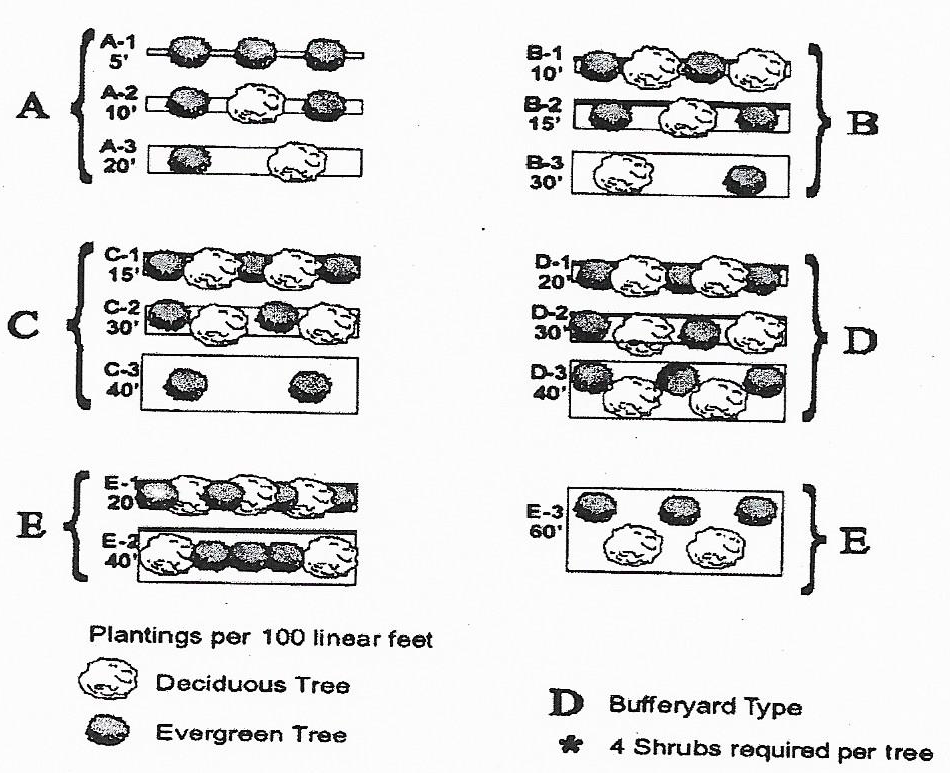
Bufferyard standards. The following bufferyard standards shall apply to all subdivisions, and to all multifamily, commercial and industrial projects. Site plans shall include detailed drawings of enclosure and screening methods to be provided. Table 4-4 lists the types of bufferyards required between adjacent land uses. Exhibit 4-1 illustrates the minimum widths and plantings for each type of bufferyard listed in table 4-4.
A.
Bufferyards required. Bufferyards shall be required between parcels with different land uses as listed in table 4.4 and as otherwise required herein. The bufferyard is required in addition to other landscaping requirements, provided however, that bufferyard plantings may be counted toward total landscape area requirements. The county may authorize a reduction of bufferyard requirements where the land use on abutting property is not consistent with the comprehensive plan. [Amended Ord. 08/03/04].
B.
Types of bufferyards required. Table 4-4 shows the type of bufferyard required to buffer an adjacent property based on its land use. Exhibit 4-1 illustrates a typical bufferyard for each type. The applicant may choose to install any of the sub-types of bufferyards. For instance, D-1, D-2 and D-3 are subtypes shown in exhibit 4-1.
C.
Bufferyard location. Bufferyards and open spaces shall be provided on the site of the new development, regardless of existing setbacks, bufferyards or open space otherwise provided on the adjacent property. Bufferyards may be included within required building setbacks and shall be shown as landscape areas on the plat and site plan.
Table 4-4: Required Bufferyards [Amended Ord. 08/03/04, 10/04/05]
Exhibit 4.1: Bufferyard Planting Illustrations*
Distances shown are the minimum widths of required bufferyards. The type of bufferyard shall be consistent with table 4.4. The applicant shall determine which subtype (e.g., B-1, B-2 or B-3) to use on the property.
Notes: [Notes added Ord. 08/03/04]
1.
The applicant has the option to plant only trees (and not shrubs) in Bufferyards D and E. If this option is pursued, the applicant must plant 10 evergreen trees per 100 feet on ten-foot centers
2.
The applicant has the option to plant only deciduous trees in Bufferyard B.
3.
Opaque fence required in Bufferyard E
4.
All telecommunications towers (i.e., cell towers), shall utilize Bufferyard E-1. [Added Ord. 10/04/05]

