
Cass City City Zoning Code
ARTICLE III
ZONING DISTRICT REGULATIONS
DIVISION 11. - P-1 VEHICULAR PARKING DISTRICTS[4]
Cross reference— Stopping, stranding and parking, § 38-71 et seq.
Sec. 46-121. - Districts established.
For the purpose of this chapter, the village is hereby divided into the following districts:
(1)
Residential Districts.
RA-1 one-family residential district
RA-1B one-family residential district
RA-2 one-family residential district
RB two-family residential district
RC multiple-family residential district
MH mobile home district
(2)
Nonresidential Districts.
OS-1 office service district
B-1 community business district
B-2 general business district
I-1 light industrial district
I-2 general industrial district
P-1 vehicular parking district
(Ord. of 3-28-1988, § 300)
Sec. 46-122. - District boundaries.
The boundaries of these districts are established as shown on the zoning districts map, village zoning ordinance, which is on file in the office of the village clerk, and which map with all notations, references and other information shown thereon shall be as much a part of this chapter as if fully described in this section.
(Ord. of 3-28-1988, § 301)
Sec. 46-123. - District boundaries interpreted.
Where uncertainty exists with respect to the boundaries of the various districts as shown on the zoning districts map, the following rules shall apply:
(1)
Boundaries indicated as approximately following the centerlines of streets, highways, or alleys shall be construed to follow such centerlines.
(2)
Boundaries indicated as approximately following platted lot lines shall be construed as following such lot lines.
(3)
Boundaries indicated as approximately following village limits shall be construed as following village limits.
(4)
Boundaries indicated as following railroad lines shall be construed to be the midway between the main tracks.
(5)
Boundaries indicated as parallel to or extensions of features indicated in subsections (1) through (5) of this section shall be so construed. Distances not specifically indicated on the official zoning map shall be determined by the scale of the map.
(6)
Where physical or natural features existing on the ground are at variance with those shown on the official zoning districts map, or in other circumstances not covered by subsections (1) through (5) of this section, the board of appeals shall interpret the district boundaries.
(7)
Insofar as some or all of the various districts may be indicated on the zoning districts map by patterns which, for the sake of map clarity, do not cover public rights-of-way, it is intended that such district boundaries do extend to the center of any public right-of-way.
(Ord. of 3-28-1988, § 302)
Sec. 46-124. - Zoning of annexed areas.
Whenever any area is annexed to the village, one of the following conditions will apply:
(1)
Land that is zoned previous to annexation shall be classified as being in whichever district of this chapter most closely conforms with the zoning that existed prior to annexation, such classification to be recommended by the planning commission to the village council and the council shall approve such classification by resolution.
(2)
Land not zoned prior to annexation shall be automatically classified as an RA-1 district until a zoning map for such area has been adopted by the village council. The planning commission shall recommend the appropriate zoning districts for such area within three months after the matter is referred to it by the village council.
(Ord. of 3-28-1988, § 303)
Sec. 46-125. - Zoning of vacated area.
Whenever any street, alley or other public way within the village shall be vacated, such street, alley or other public way, or portion thereof, shall automatically be classified in the same zone district as the property to which it attaches.
(Ord. of 3-28-1988, § 304)
Sec. 46-126. - District requirements.
All buildings and uses in any district shall be subject to the provisions of division 12 of this article, schedule of regulations, article IV of this chapter, supplementary regulations, and article VI of this chapter, general exceptions.
(Ord. of 3-28-1988, § 305)
Sec. 46-151. - Intent.
The RA-1, RA-1B and RA-2 one-family residential districts are designed to be the most restrictive of the residential districts. The intent is to provide for an environment of predominantly low-density, one-family detached dwellings along with other residentially related facilities which serve the residents in the RA-1, RA-1B and RA-2 districts.
(Ord. of 3-28-1988, § 400)
Sec. 46-152. - Principal uses permitted.
In an RA-1, RA-1B and RA-2 one-family residential district, no building or land shall be used and no building shall be erected except for one or more of the following specified uses, unless otherwise provided in this chapter:
(1)
One-family detached dwelling units.
a.
One-family detached dwelling units shall:
1.
Be permanently attached to a perimeter foundation.
2.
Have a minimum width of 20 feet on at least two sides within any single, vertical plane.
3.
Have an overhang or eave as required by the building code of residential dwellings.
4.
Be provided with an exterior building wall configuration which represents an average width-to-depth or depth-to-width ratio which does not exceed three to one.
b.
Procedures are as follows:
1.
Applications for one-family detached dwelling units shall be submitted to the zoning administrator who may require the applicant to furnish such plans, photographs, elevations or similar documentation necessary to permit a complete review and evaluation.
2.
Should the zoning administrator find that any dwelling unit does not conform with the standards of this section, he may deny the application or ask for an opinion from the planning commission. The applicant or any affected property owner located within 300 feet of the property in question may appeal the zoning administrator's decision by requesting a public hearing before the zoning board of appeals. Notice of hearing shall be given in accordance with section 46-88, notice of hearing.
(2)
Farms on those parcels of land separately owned outside the boundaries of either a proprietary or supervisor's plat, having an area of not less than five acres, all subject to the health and sanitation provisions of the village, and provided further that no farms shall be operated as piggeries, or for the disposal of garbage, sewage rubbish, offal or rendering plants, or for the slaughtering of animals except such animals as have been raised on the premises or have been maintained on the premises for at least a period of one year immediately prior thereto and for the use and consumption by persons residing on the premises.
(3)
Publicly owned and operated libraries, parks, parkways and recreational facilities.
(4)
Cemeteries which lawfully occupied land at the time of adoption of this chapter.
(5)
Public, parochial and other private elementary schools offering courses in general education and not operated for profit.
(6)
A state-licensed residential facility providing supervision or care, or both, to six or less persons as required to be a permitted residential use by section 36 of Public Act No. 207 of 1921 (MCL 125.583b).
(7)
Accessory buildings and uses customarily incident to any of the permitted uses of this section.
(8)
Garage sales may be permitted as temporary uses, accessory to the principal use of a dwelling, provided that such sales shall not exceed three consecutive days and are limited to three sales annually at a single location.
(Ord. of 3-28-1988, § 401; Ord. No. 143, 9-29-1997)
Sec. 46-153. - Principal uses permitted subject to special conditions.
The following uses shall be permitted in the RA-1, RA-1B and RA-2 districts, subject to the conditions imposed in this section for each use and subject further to the review and approval of the site plan by the planning commission:
(1)
Churches and other facilities normally incidental thereto subject to the following conditions: Buildings of greater than the maximum height allowed in division 12 of this article, schedule of regulations, may be allowed, provided that front, side and rear yards are increased above the minimum required yards by one foot for each foot of building height that exceeds the maximum height allowed.
(2)
Public, parochial and private intermediate and/or secondary schools offering courses in general education, not operated for profit. Vehicular access to the site shall be in accordance with section 46-487. All buildings shall have a setback of at least 40 feet.
(3)
Public utility and public service buildings and uses (without storage yards).
(4)
Nursery schools, day nurseries and child care centers (not including dormitories) subject to the following:
a.
The zoning lot shall contain not less than one-half acre.
b.
Building setbacks shall be not less than 30 feet.
c.
The outdoor play space shall have a total minimum area of not less than 4,000 square feet.
d.
There shall be provided and maintained a minimum area of 150 square feet of outdoor play space for each child cared for.
e.
All vehicular access to the site shall be in accordance with section 46-487, unless the use is located in a church.
(5)
Private noncommercial recreational areas, institutional or community recreation centers, and nonprofit swimming pool clubs, all subject to the following conditions:
a.
The proposed site for any of the uses permitted in this section which would attract persons from, or are intended to serve, areas beyond the immediate neighborhood shall have at least one property line abutting a major or secondary street as designated on the village's thoroughfare plan, and the site shall be so planned as to provide all vehicular access in accordance with section 46-487.
b.
Front, side and rear yards shall be at least 40 feet wide.
c.
Off-street parking shall be provided so as to accommodate not less than one-half of the member families and/or individual members. The planning commission may modify the off-street parking requirements in those instances wherein it is specifically determined that the users will originate from the immediately adjacent areas, and will, therefore, be pedestrian. Prior to the issuance of a building permit or zoning compliance permit, bylaws of the organization shall be provided in order to establish the membership involved for computing the off-street parking requirements. In those cases wherein the proposed use or organization does not have bylaws or formal membership, the off-street parking requirement shall be determined by the planning commission on the basis of usage.
d.
Whenever a swimming pool is constructed under this chapter, such pool area shall be subject to the provisions of village swimming pool requirements in article II of chapter 6.
(6)
Golf courses, which may or may not be operated for profit, subject to the following conditions:
a.
Development features including the principal and accessory buildings and structures shall be so located and related as to minimize the possibilities of any adverse effects upon adjacent property. All principal or accessory buildings shall be not less than 100 feet from any property line abutting residentially zoned lands; provided, however, that where topographic conditions are such that buildings would be screened from view, the planning commission may modify this requirement.
b.
Whenever a swimming pool is to be provided, such pool shall be subject to the provisions of village Ordinance No. 66, swimming pool ordinance.
(7)
Colleges, universities and other such institutions of higher learning, public and private, offering courses in general, technical or religious education and not operated for profit, all subject to the following conditions:
a.
All vehicular access to such site shall be in accordance with section 46-487.
b.
No building shall be closer than 80 feet to any property line.
c.
No off-street parking lot shall be closer than 40 feet to any property line. A berm, constructed in accordance with section 46-483, walls and berms, and planted in accordance with section 46-478, plant materials, shall be provided between off-street parking lots and property lines that abut one-family residential districts.
(8)
Skilled or basic nursing homes or convalescent homes, subject to the following conditions:
a.
Not less than 1,000 square feet of open space for each bed or unit shall be provided on the site. The 1,000 square feet of area shall provide for landscape setting, off-street parking, service drives, loading space, yard requirements and accessory uses, but shall not include the area covered by main or accessory buildings.
b.
No building shall be closer than 70 feet to any abutting single-family residential zoning lot. In no instance, however, shall any building be located closer than 25 feet to any property line.
c.
Buildings shall not exceed one story in height.
(9)
Accessory buildings and uses customarily incident to any of the permitted uses in this section.
(10)
Private pools shall be permitted as an accessory use within the rear yard only, subject further to the provisions of village Ordinance No. 66, swimming pool ordinance.
(11)
Home occupation, subject to the following:
a.
Such home occupation shall not exceed 200 square feet or 20 percent of the floor area of the residential structure as defined in this chapter, whichever is greater.
b.
There shall be no alteration in the residential character or function of the premises in connection herewith; nor shall any garage or accessory building be used in connection herewith.
c.
There shall be no exterior display, other than one nonilluminated nameplate, which is not more than two square feet in area which may be attached to the building.
d.
No more than one assistant or employee shall be employed in connection with the home occupation, provided that family members shall not be counted as employed.
e.
There shall be no equipment or machinery used in connection with the home occupation which is discernable beyond the property line because of noise, odor, glare or vibration.
f.
Home occupations, not meeting the criteria of this subsection (11), may be permitted, subject to the review and approval of the board of appeals, when such use is not in conflict with the residential character of the area and subject to conditions they may impose. The board may apply conditions such as limiting time of operation or requiring screening that will assist in maintaining the residential character.
(12)
Bed and breakfast, subject to the following conditions:
a.
Not more than 30 percent of the total floor area of the dwelling unit shall be used for bed and breakfast sleeping rooms; provided, however, that the number of sleeping rooms shall not exceed three.
b.
There shall be no separate cooking facilities for bed and breakfast occupants.
c.
A sign not to exceed two square feet in area may be provided. Such sign may be located in the setback area.
d.
One off-street parking space shall be provided for each leasable bedroom in addition to the two residential spaces.
(13)
Funeral homes, subject to the following:
a.
The zoning lot shall contain not less than one acre.
b.
The zoning lot shall have a front lot line with no less than 100 feet of width along Main Street.
c.
All buildings shall have a minimum setback of 30 feet.
d.
If there is a common side lot with a residential use, then a landscaped greenbelt of not less than ten feet will be required.
e.
Parking is permitted within a front yard, provided that a landscaped greenbelt of not less than ten feet is maintained between the parking and the front lot line.
f.
All vehicular access to the site shall be in accordance with section 46-487, access to a major or secondary street.
(Ord. of 3-28-1988, § 402; Ord. No. 130, § 2, 1-26-1993)
Sec. 46-154. - Area and bulk requirements.
See division 12 of this article, schedule of regulations, limiting the height and bulk of buildings, the minimum size of lot permitted by land use, the maximum density permitted, and providing minimum yard setback requirements for the RA-1, RA-1B, and RA-2 districts.
(Ord. of 3-28-1988, § 403)
Sec. 46-181. - Intent.
The RB two-family residential districts are designed to afford a transition of use in existing housing areas by permitting new construction or conversion of existing structures between adjacent residential and commercial, office, thoroughfares or other uses which would affect residential character. This RB district also recognizes the existence of older residential areas of the village where larger houses have been or can be converted from single-family to two-family residences in order to extend the economic life of these structures and allow the owners to justify the expenditures for repairs and modernization. This RB district also allows the construction of new two-family residences where slightly greater densities are permitted.
(Ord. of 3-28-1988, § 500)
Sec. 46-182. - Principal uses permitted.
In an RB two-family residential district, no building or land shall be used and no building shall be erected except for one or more of the following specified uses, unless otherwise provided in this chapter:
(1)
All uses permitted and as regulated in the one-family residential districts. The standards of division 12 of this article, schedule of regulations, applicable to the RA-2 one-family residential district, shall apply as minimum standards when one-family detached dwellings are erected.
(2)
Two-family dwellings, subject to the conditions of section 46-152(1)a and (1)b.
(3)
A state-licensed residential facility providing supervision or care, or both, to six or less persons as required to be a permitted residential use by section 36 of Public Act No. 207 of 1921 (MCL 125.583b).
(4)
Accessory buildings and uses customarily incident to any of the permitted uses in this section.
(Ord. of 3-28-1988, § 501)
Sec. 46-183. - Area and bulk requirements.
See division 12 of this article, schedule of regulations, limiting the height and bulk of buildings, the minimum size of lot permitted by land use, the maximum density permitted, and providing minimum yard setback requirements for the RB district.
(Ord. of 3-28-1988, § 502)
Sec. 46-201. - Intent.
The RC multiple-family residential districts are designed to provide sites for multiple-family dwelling structures and related uses which will generally serve as zones of transition between the nonresidential districts and lower density single-family districts. The RC multiple-family district is further provided to serve the limited needs for the apartment type of unit in an otherwise medium density, single-family community.
(Ord. of 3-28-1988, § 600)
Sec. 46-202. - Principal uses permitted.
In an RC multiple-family residential district, no building or land shall be used and no building shall be erected except for one or more of the following specified uses, unless otherwise provided in this chapter:
(1)
All uses permitted and as regulated in the RB two-family residential district; provided, however, that the area and bulk requirements of the RC district shall apply to all permitted uses other than one-family dwellings.
(2)
Multiple-family dwellings, subject to the conditions of section 46-152(1)a and (1)b.
(3)
A state-licensed residential facility providing supervision or care, or both, to six or less persons as required to be a residential use by section 36 of Public Act No. 207 of 1921 (MCL 125.583b).
(4)
Accessory buildings and uses customarily incident to any of the permitted uses of this section.
(Ord. of 3-28-1988, § 601)
Sec. 46-203. - Required conditions.
(a)
In the case of multiple dwelling developments in the RC district, all site plans shall be submitted to the planning commission for its review and approval prior to issuance of a building permit.
(b)
Approval shall be contingent upon a finding that:
(1)
The site plan shows that a proper relationship exists between local streets and any proposed service roads, driveways and parking areas to encourage pedestrian and vehicular traffic safety.
(2)
All the development features, including the principal buildings and any accessory buildings or uses, open spaces, service roads, driveways and parking areas, are located so as to minimize the possibility of any adverse effects upon adjacent property, such as, but not limited to, channeling excessive traffic onto local residential streets, lack of adequate screening or buffering of parking or service areas, or building groupings and circulation routes located so as not to interfere with police or fire equipment access.
(Ord. of 3-28-1988, § 602)
Sec. 46-204. - Uses permitted subject to special conditions.
The following uses shall be permitted in the RC district, subject to the conditions imposed in this section for each use and subject further to the review and approval of the site plan by the planning commission:
(1)
General hospitals, with no maximum height restrictions, when the following conditions are met:
a.
All such hospitals shall be developed only on sites consisting of at least six acres in area.
b.
All vehicular access to the site shall be in accordance with section 46-487.
c.
The minimum distance of any main or accessory building from bounding lot lines or streets shall be at least 100 feet for front, rear and side yards for all two-story structures. For every story above two, the minimum yard distance shall be increased by at least 20 feet.
(2)
Private offices for doctors or dentists, or similar professions provided that all vehicular access to the site is in accordance with section 46-487.
(3)
Housing for the elderly when the following conditions are met:
a.
All dwellings shall consist of at least 350 square feet per unit (not including kitchen and sanitary facilities).
b.
Total coverage of all buildings, including dwelling units and related service buildings, shall not exceed 25 percent of the total site exclusive of any dedicated public right-of-way.
(4)
Convalescent homes or orphanages when the following conditions are met:
a.
There shall be provided on the site not less than 1,000 square feet of open space for each bed in the home. The 1,000 square feet of land area may include landscape setting, off-street parking, service drives, loading space, yard requirement and accessory uses, but shall not include the area covered by main or accessory buildings.
b.
No building shall be closer than 25 feet to any property line.
(5)
Accessory buildings and uses customarily incident to any of the permitted uses of this section.
(Ord. of 3-28-1988, § 603)
Sec. 46-205. - Area and bulk requirements.
See division 12 of this article, schedule of regulations, limiting the height and bulk of buildings, the minimum size of lot permitted by land use, maximum density permitted, and providing minimum yard setback requirements for the RC district.
(Ord. of 3-28-1988, § 604)
Sec. 46-231. - Intent.
The MH mobile home districts are designed to provide for the appropriate location of and requirements for mobile home parks. Mobile home parks possess characteristics of site development, use and density which are unique. Such characteristics are more intensive than those of one-family residential districts and, therefore, mobile home parks are treated as a distinct zoning district in this chapter.
(Ord. of 3-28-1988, § 800)
Sec. 46-232. - Principal uses permitted.
(a)
In an MH mobile home district, no building or land shall be used and no building shall be erected except for the following specified use, unless otherwise provided in this chapter and further subject to the review and approval of the site plan by the planning commission: Mobile home parks.
(b)
Mobile home parks may include the following:
(1)
Mobile homes.
(2)
One management building exclusively provided for the conducting of business operations of the mobile home park in which located.
(3)
Utility building for laundry facilities and auxiliary storage space for tenants or management of the mobile home park.
(4)
Community building for the accessory use of tenants of the mobile home park in which located.
(5)
Recreation facilities such as, but not limited to, swimming pools, field and court games and sports, and passive recreation areas.
(6)
The sale of mobile homes, provided that:
a.
Such sale is clearly accessory to the occupancy of individual lots within the mobile home park.
b.
Such sale is not made by a person or business engaged in the sale of mobile homes as a commercial operation. Mobile homes located on lots within the mobile home park to be used and occupied on that site may be sold by a licensed dealer or broker. This shall not prohibit the sale of a mobile home owned and occupied by a resident of the mobile home development, provided that the development permits the sale.
(7)
Accessory structures and uses customarily incident to any principal use permitted.
(Ord. of 3-28-1988, § 801)
Sec. 46-233. - Procedures.
(a)
Application.
(1)
An application for approval of a mobile home park shall require submission of a preliminary site plan to the planning commission for review and approval.
(2)
The date of receipt of the preliminary plan shall be not less than 15 days prior to the regular meeting of the planning commission.
(b)
Preliminary site plan.
(1)
Preliminary site plans and specifications of the proposed mobile home park shall be submitted in accordance with section 46-485.
(2)
The preliminary plan shall be submitted to the county road commission, county health department and the county drain commission where required by section 11 of Public Act No. 96 of 1987 (MCL 125.2311).
(3)
The planning commission shall either approve, modify or disapprove the site plan within 60 days of the date of receipt of the preliminary plan.
(4)
The preliminary site plan shall be approved by the planning commission prior to submission of a final site plan. If the planning commission does not approve the preliminary plan, it shall indicate the reasons for such denial in the minutes of the planning commission meeting. The applicant shall have the right to appeal such decision of the planning commission to the village council, provided that it is done so in writing within seven days of the planning commission meeting at which the denial took place.
(c)
Final site plan. For purposes of recordkeeping, three copies of drawings of the proposed mobile home park, approved by the state for construction, shall be submitted to the village by the applicant. Building permits are not required by this section.
(Ord. of 3-28-1988, § 802)
Sec. 46-234. - Area, height and bulk requirements.
(a)
All mobile home sites shall have a site area of not less than 5,000 square feet, except that if parks provide common open space for use by the residents, site areas may be reduced by 20 percent, provided that the common open space shall be at least equal to the total area by which any sites have been reduced.
(b)
No mobile home, community building or service building shall be located closer than ten feet to any mobile home park perimeter lot line or 50 feet to any existing or proposed major or secondary thoroughfare right-of-way line.
(c)
Accessory buildings servicing the mobile home park shall not exceed 25 feet in height. Mobile homes shall not exceed 14 feet in height.
(d)
A mobile home park shall provide an open area of at least 25,000 square feet. For mobile home parks containing more than 50 sites, the minimum area shall be increased by 200 square feet for each site over 50. Open space resulting from site reductions permitted in subsection (a) of this section may be applied to this open space requirement. Land designated for recreational use shall be so located and designed to facilitate access and usability and shall be shaped so that its length is no greater than three times its width.
(Ord. of 3-28-1988, § 803)
Sec. 46-235. - Required conditions.
(a)
Uses permitted for mobile home parks in section 46-232 shall be subject to the following conditions:
(1)
Mobile home parks shall not be permitted on parcels of less than ten acres in area.
(2)
Vehicular access to a mobile home park shall be directly from a major or secondary street as shown on the village's thoroughfare plan. If a mobile home park does not directly abut such thoroughfare, vehicular access shall be by means of a public right-of-way of not less than 60 feet in width. Access shall not be permitted through one-family residential districts unless property bordering such access is publicly owned or is already developed for a permitted use other than one-family residential.
(3)
Storm drainage facilities shall be provided so as to protect residents of the mobile home park as well as adjacent property owners. Facilities shall be of a capacity which will ensure adequate drainage and prevent the accumulation of stagnant pools of water in or adjacent to the park. Storm drainage facilities shall meet the requirements of the state department of public health and the applicable requirements of the village.
(4)
All utility lines shall be underground.
(5)
All off-site connections to utilities (water, sanitary and storm sewer) shall be made in accordance with applicable village codes and ordinances.
(6)
All mobile homes shall be anchored by means of an anchoring system approved by the state construction code commission.
(7)
Where an off-street parking lot is abutting or adjacent to a residential district, an obscuring wall or landscaped berm, as specified in section 46-483, walls and berms, shall be provided.
(8)
Outdoor signs shall be permitted and regulated as provided in section 46-479, signs, for the RC multiple-family residential districts.
(b)
The regulations and standards as provided for and promulgated under Public Act No. 96 of 1987 (MCL 125.2301 et seq.), are adopted and shall apply to and control in all mobile home parks, unless exceeded by the requirements of this chapter.
(Ord. of 3-28-1988, § 804; Ord. No. 130, § 3, 1-26-1993)
Sec. 46-261. - Intent.
The OS-1 office service districts are designed to accommodate uses such as offices, banks and personal services which can serve as transitional areas between residential and commercial districts and to provide a transition between major streets and residential districts.
(Ord. of 3-28-1988, § 900; Ord. No. 130, § 4, 1-26-1993)
Sec. 46-262. - Principal uses permitted.
In an OS-1 office service district, no building or land shall be used and no building shall be erected except for one or more of the following specified uses, unless otherwise provided in this chapter:
(1)
Office buildings for any of the following occupations: executive, administrative, professional, accounting, writing, clerical, stenographic, drafting and sales.
(2)
Medical and dental offices, including clinics.
(3)
Facilities for human care such as hospitals, sanitariums, rest and convalescent homes.
(4)
Banks, credit unions, savings and loan associations, and similar uses; drive-in facilities as an accessory use only.
(5)
Personal service establishment including barbershops, beauty shops and health salons.
(6)
Off-street parking lots.
(7)
Churches.
(8)
Rehabilitation centers.
(9)
Other uses similar to the uses of this section.
(10)
Accessory structures and uses customarily incident to the permitted uses of this section.
(Ord. of 3-28-1988, § 901)
Sec. 46-263. - Principal uses permitted subject to special conditions.
The following uses shall be permitted in the OS-1 district, subject to the conditions imposed in this section for each use and subject further to the review and approval of the site plan by the planning commission:
(1)
An accessory use customarily related to a principal use authorized by this section, such as, but not limited to, pharmacy or apothecary shops, stores, limited to corrective garments or bandages, or optical service may be permitted.
(2)
Mortuary establishments when adequate assembly area is provided off-street for vehicles to be used in funeral processions, provided further that such assembly area shall be in addition to any required off-street parking area. A caretaker's residence may be provided within the main building of mortuary establishments.
(3)
Publicly owned buildings, telephone exchange buildings and public utility offices, but not including storage yards, transformer stations, substations or gas regulator stations.
(Ord. of 3-28-1988, § 902)
Sec. 46-264. - Required conditions.
The following conditions are required in the OS-1 district:
(1)
No interior display shall be visible from the exterior of the building.
(2)
The outdoor storage of goods or material shall be prohibited.
(3)
Warehousing or indoor storage of goods or materials beyond that normally incident to the permitted uses of this division shall be prohibited.
(Ord. of 3-28-1988, § 903)
Sec. 46-265. - Area and bulk requirements.
See division 12 of this article, schedule of regulations, limiting the height and bulk of buildings, the minimum size of lot by permitted land use, and providing minimum yard setback requirements for the OS-1 district.
(Ord. of 3-28-1988, § 904)
Sec. 46-291. - Intent.
The B-1 community business districts, as established in this division, are designed to meet the day-to-day convenience and comparison shopping and service needs of persons residing in adjacent residential areas.
(Ord. of 3-28-1988, § 1000)
Sec. 46-292. - Principal uses permitted.
In a B-1 community business district, no building or land shall be used and no building shall be erected except for one or more of the following specified uses, unless otherwise provided in this chapter:
(1)
Generally recognized retail businesses which supply commodities on the premises such as, but not limited to, groceries, meats, dairy products, baked goods or other foods, drugs, dry goods, clothing and notions or hardware.
(2)
Personal service establishments which perform services on the premises such as, but not limited to, repair shops (watches, radio, television, shoe, etc.), tailor shops, beauty parlors or barbershops, photographic studios, and self-service laundries and dry cleaners.
(3)
Laundry, dry cleaning establishments, or pickup stations, dealing directly with the consumer. Central dry cleaning plants serving more than one retail outlet shall be prohibited.
(4)
Business establishments which perform services on the premises such as, but not limited to, banks, loan companies, insurance offices and real estate offices.
(5)
Professional services including the following: offices of doctors, dentists, osteopaths, and similar or allied professions; clinics.
(6)
Business schools, colleges, dance schools or private schools operated for profit.
(7)
Private clubs, fraternal organizations and lodge halls.
(8)
Restaurants or other places serving food or beverage, except those having the character of a drive-in or carryout.
(9)
Hotels or motels.
(10)
Theaters, assembly halls, concert halls or similar places of public assembly when conducted within enclosed buildings.
(11)
Mortuaries subject to the conditions of section 46-263.
(12)
Post office and similar governmental office buildings.
(13)
Off-street parking lots.
(14)
Rehabilitation centers.
(15)
Other uses similar to the uses of this section.
(16)
Residential occupancy shall be permitted in buildings which are two stories or more in height, provided that:
a.
Dwellings shall be permitted only on floors above the ground floor.
b.
Dwelling units shall meet all applicable building, housing, fire and safety codes of the village.
(17)
Accessory structures and uses customarily incident to the permitted uses of this section.
(Ord. of 3-28-1988, § 1001)
Sec. 46-293. - Required conditions.
Required conditions in the B-1 district are as follows:
(1)
All business establishments shall be retail or service establishments dealing directly with customers. All goods produced on the premises shall be sold at retail on premises where produced.
(2)
All business, servicing, or processing, except for off-street parking or loading, shall be conducted within a completely enclosed building.
(Ord. of 3-28-1988, § 1002)
Sec. 46-294. - Principal uses permitted subject to special conditions.
The following uses shall be permitted in the B-1 district, subject to the conditions imposed in this section for each use and subject further to the review and approval of the site plan by the planning commission:
(1)
Gasoline service station for the sale of gasoline, oil and minor accessories only, and where no repair work is done, other than incidental service, but not including steam cleaning or undercoating, vehicle body repair, painting, tire recapping, engine rebuilding, auto dismantling, upholstering, auto glass work and such other activities of which the external effects could adversely extend beyond the property line.
a.
The curb cuts for access to a service station shall not be permitted at such locations that will tend to create traffic hazards in the streets immediately adjacent thereto. Entrances shall be no less than 25 feet from a street intersection (measured from the road right-of-way) or from adjacent residential districts.
b.
The minimum lot area shall be 15,000 square feet and so arranged that ample space is available for motor vehicles which are required to wait. Gasoline service stations which are intended solely for the sale of gasoline, oil and minor accessories and having no facilities for repair or servicing of automobiles (including lubricating facilities) may be permitted on lots of 10,000 square feet, subject to all other provisions required in this section.
c.
Off-street loading and unloading space shall be provided in the ratio of at least ten square feet per front of building but may be located in any required yard notwithstanding section 46-477.
(2)
Publicly owned buildings, public utility buildings, telephone exchange buildings, electric transformer stations and substations, gas regulator stations with service yards but without storage yards, and water and sewage pumping stations.
(3)
Residential occupancy of first (ground) floor: The first (ground) floor of a building may be used for residential, one family occupancy, providing the following conditions are met:
a.
Each first floor dwelling unit shall have a separate, non-public entrance/exit into a non-public hallway with access onto the frontage street.
b.
Exterior design and facade materials of the new or redeveloped residential building shall complement or be comparable to the facade plan of surrounding residential/commercial structures.
(Ord. of 3-28-1988, § 1003; Ord. No. 164, § 1, 11-27-2006)
Sec. 46-295. - Area and bulk requirements.
See division 12 of this article, schedule of regulations, limiting the height and bulk of buildings, the minimum size of lot by permitted land use, and providing minimum yard setback requirements for the B-1 district.
(Ord. of 3-28-1988, § 1004)
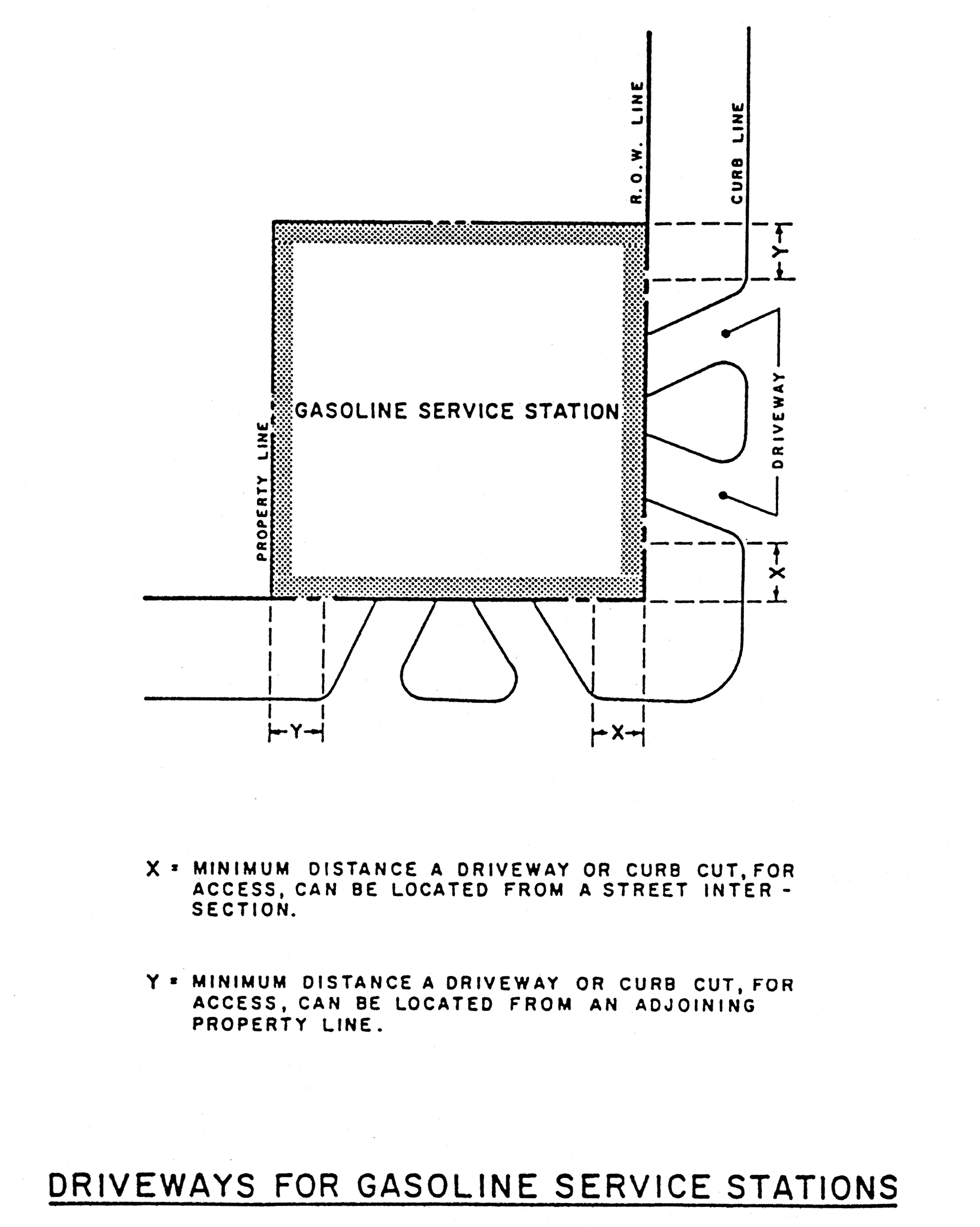
Driveways for Gasoline Service Stations
Sec. 46-321. - Intent.
The B-2 general business districts are designed to provide sites for more diversified business types which would often be incompatible with the pedestrian movement in the B-1 community business district.
(Ord. of 3-28-1988, § 1100)
Sec. 46-322. - Principal uses permitted.
In a B-2 general business district, no building or land shall be used and no building shall be erected except for one or more of the following specified uses, unless otherwise provided in this chapter:
(1)
Any use permitted in B-1 districts as principal uses permitted and uses permitted subject to special conditions.
(2)
Farm equipment and machinery sales.
(3)
Dancehall or catering hall when completely enclosed in a building.
(4)
Auto wash when completely enclosed in a building.
(5)
Tire, battery and accessory sales.
(6)
Bus passenger stations.
(7)
Retail sales of plant materials, lawn furniture, playground equipment and other house or garden supplies.
(8)
Laundry and dry cleaning establishments performing their operation on the site.
(9)
Lawn mower sales or service.
(10)
New and used car salesroom, showroom or office.
(11)
Carryout restaurant.
(12)
Publicly owned buildings, telephone exchange buildings and public utility offices, but not including storage yards, transformer stations, substations or gas regulator stations.
(13)
Other uses similar to the uses of this section.
(14)
Accessory structures and uses customarily incident to the permitted uses of this section.
(Ord. of 3-28-1988, § 1101)
Sec. 46-323. - Principal uses permitted subject to special conditions.
The following uses shall be permitted in the B-2 district, subject to the conditions imposed in this section for each use and subject further to the review and approval of the site plan by the planning commission:
(1)
Outdoor sales space for exclusive sale of new or secondhand automobiles, mobile homes, or rental of trailers, or automobiles, all subject to the following:
a.
The lot or area shall be provided with a permanent, durable and dustless surface and shall be graded and drained as to dispose of all surface water accumulated within the area.
b.
Access to the outdoor sales area shall be at least 60 feet from the intersection of any two streets.
c.
No major repair or major refinishing shall be done on the lot.
d.
All lighting shall be shielded from adjacent residential districts.
(2)
Business in the character of a drive-in, (including restaurants) drive-through or open front store, subject to the following conditions:
a.
A setback of at least 60 feet from the right-of-way line of any existing or proposed street must be maintained.
b.
Access points shall be located at least 60 feet from the intersection of any two streets.
c.
All lighting shall be shielded from adjacent residential districts.
d.
A five-foot high completely obscuring wall shall be provided when abutting or adjacent districts are zoned for any R district, MH, OS-1, B-1 or B-2 district. Such wall shall meet the requirements of article IV of this chapter, supplementary regulations.
(3)
Veterinary hospitals or clinics, provided that all activities are conducted within a totally enclosed main building and provided further that all buildings are set back at least 200 feet from abutting residential districts on the same side of the street.
(4)
Bowling alley, billiard hall, indoor archery range, indoor tennis courts, indoor skating rink, or similar forms of indoor commercial recreation when located at least 100 feet from any front, rear or side yard of any residential lot in an adjacent residential district.
(Ord. of 3-28-1988, § 1102)
Sec. 46-324. - Area and bulk requirements.
See division 12 of this article, schedule of regulations, limiting the height and bulk of buildings, the minimum size of lot by permitted land use, and providing minimum yard setback requirements for the B-2 district.
(Ord. of 3-28-1988, § 1103)
Sec. 46-351. - Intent.
The I-1 light industrial districts are designed so as to primarily accommodate wholesale activities, warehouses and industrial operations of which the external, physical effects are restricted to the area of the district and in no manner affect in a detrimental way any of the surrounding districts. The I-1 district is so structured as to permit, along with any specified uses, the manufacturing, compounding, processing, packaging, assembly or treatment of finished or semifinished products from previously prepared material. It is further intended that the processing of raw material for shipment in bulk form, to be used in an industrial operation at another location, not be permitted. The general goals of this I-1 use district include, among others, the following specific purposes:
(1)
To provide sufficient space, in appropriate locations, to meet the needs of the village's expected future economy for all types of manufacturing and related uses.
(2)
To protect abutting residential districts by separating them from manufacturing activities, and by prohibiting the use of such industrial areas for new residential development.
(3)
To promote manufacturing development which is free from danger of fire, explosions, toxic and noxious matter, radiation, and other hazards, and from offensive noise, vibration, smoke, odor and other objectionable influences.
(4)
To protect the most desirable use of land in accordance with a well-considered plan. To protect the character and established pattern of adjacent development, and in each area to conserve the value of land and buildings and other structures, and to protect the village's tax revenue.
(Ord. of 3-28-1988, § 1200)
Sec. 46-352. - Principal uses permitted.
In an I-1 light industrial district, no building or land shall be used and no building shall be erected except for one or more of the following specified uses, unless otherwise provided in this chapter:
(1)
Any use charged with the principal function of basic research, design and pilot or experimental product development when conducted within a completely enclosed building.
(2)
Any of the uses in this subsection (2) when the manufacturing, compounding or processing is conducted wholly within a completely enclosed building. That portion of the land used for open storage facilities for materials or equipment used in the manufacturing, compounding or processing shall be totally obscured by a wall on those sides abutting RA, RB, RC, OS-1, B-1 and B-2 districts, and on any front yard abutting a public thoroughfare except as otherwise provided in section 46-483. In I-1 districts, the extent of such a wall may be determined by the planning commission on the basis of usage. Such a wall shall not be less than four feet, six inches, in height and may, depending upon land usage, be required to be eight feet in height and shall be subject further to the requirements of article IV of this chapter, supplementary regulations. A chainlink fence, with intense evergreen shrub planting, shall be considered an obscuring wall. The height shall be determined in the same manner as the wall height as set forth in this section.
a.
Warehousing and wholesale establishments, and trucking facilities.
b.
The manufacture, compounding, processing, packaging, or treatment of such products as, but not limited to, bakery goods, candy, cosmetics, pharmaceuticals, toiletries, food products, hardware and cutlery, tool, die, gauge and machine shops.
c.
The manufacture, compounding, assembling or treatment of articles or merchandise from previously prepared materials: bone, canvas, cellophane, cloth, cork, elastomers, feathers, felt, fibre, fur, glass, hair, horn, leather, paper, plastics, rubber, precious or semiprecious metals or stones, sheetmetal, shell, textiles, tobacco, wax, wire, wood and yarns.
d.
The manufacture of pottery and figurines or other similar ceramic products using only previously pulverized clay, and kilns fired only by electricity or gas.
e.
The manufacture of musical instruments, toys, novelties and metal or rubber stamps, or other molded rubber products.
f.
The manufacture or assembly of electrical appliances, electronic instruments and devices, radios and phonographs.
g.
Laboratories: experimental, film or testing.
h.
The manufacture and repair of electric or neon signs, light sheetmetal products, including heating and ventilating equipment, cornices, eaves and the like.
i.
Central dry cleaning plants or laundries, provided that such plants shall not deal directly with the consumer at retail.
j.
All public utilities, including buildings, necessary structures, storage yards and other related uses.
(3)
Warehouse, storage and transfer and electric and gas service buildings and yards; public utility buildings, telephone exchange buildings, electrical transformer stations and substations, and gas regulator stations; water supply and sewage disposal plants; water and gas tank holders; railroad transfer and storage tracts; railroad rights-of-way; and freight terminals.
(4)
Storage facilities for building materials, sand, gravel, stone, lumber, storage of contractor's equipment and supplies, provided that such is enclosed within a building or within an obscuring wall or fence on those sides abutting all residential, office or business districts, and on any yard abutting a public thoroughfare. In any I-1 district, the extent of such fence or wall may be determined by the planning commission on the basis of usage. Such fence or wall shall not be less than six feet in height and may, depending on land usage, be required to be eight feet in height. A chainlink type fence with heavy evergreen shrubbery inside of such fence shall be considered to be an obscuring fence.
(5)
Municipal uses such as water treatment plants and reservoirs, sewage treatment plants, and all other municipal buildings and uses, including outdoor storage.
(6)
Commercial kennels.
(7)
Greenhouses.
(8)
Trade or industrial schools.
(9)
Freestanding nonaccessory signs.
(10)
Indoor tennis or racquet court facilities, indoor ice or roller skating arenas, and other similar uses which require large structures such as are normally found in industrial districts.
(11)
Other uses of a similar and no more objectionable character to the uses of this section.
(12)
Accessory buildings and uses customarily incident to any of the permitted uses of this section.
(Ord. of 3-28-1988, § 1201)
Sec. 46-353. - Principal uses permitted subject to special conditions.
The following uses shall be permitted in the I-1 District, subject to the conditions imposed in this section for each use and subject further to the review and approval of the site plan by the planning commission:
(1)
Auto engine and body repair, and undercoating shops when completely enclosed.
(2)
Retail uses which have an industrial character in terms of either their outdoor storage requirements or activities (such as, but not limited to, lumberyard, building materials outlet, upholsterer, cabinet maker, outdoor sales of boats, mobile homes, automobile garages or agricultural implements).
(3)
Outdoor storage of trucks, recreation vehicles, boats or automobiles, subject to the following conditions:
a.
Any abutting residential district shall be screened by a six-foot to eight-foot high wall or berm as provided in section 46-483.
b.
Any vehicles having engines, such as refrigeration units, that will be operated overnight or between the hours of 9:00 p.m. and 7:00 a.m. shall not be located within 300 feet of any residential district.
(4)
Uses not expressly permitted by village ordinances are prohibited. Uses for enterprises or purposes that are contrary to federal, state or local laws or ordinances are prohibited. Waivers are prohibited unless it is reviewed and findings submitted by the village planning commission and approved by the village council.
(5)
Other uses of a similar character to the uses of this section.
(Ord. of 3-28-1988, § 1202; Ord. No. 159, § 2, 7-25-2005; Motion No. 2010.09.27-09 )
Sec. 46-354. - Area and bulk requirements.
See division 12 of this article, schedule of regulations, limiting the height and bulk of buildings, the minimum size of lot by permitted land use, and providing minimum yard setback requirements for the I-1 district.
(Ord. of 3-28-1988, § 1203)
Sec. 46-381. - Intent.
The I-2 general industrial districts are designed primarily for manufacturing, assembling and fabrication activities including large scale or specialized industrial operations of which the external physical effects will be felt to some degree by surrounding districts. The I-2 district is so structured as to permit the manufacturing, processing and compounding of semifinished or finished products from raw materials as well as from previously prepared material.
(Ord. of 3-28-1988, § 1300)
Sec. 46-382. - Principal uses permitted.
In an I-2 general industrial district, no building or land shall be used and no building shall be erected except for one or more of the following specified uses, unless otherwise provided in this chapter:
(1)
Any principal use first permitted in an I-1 district.
(2)
Heating and electric power generating plants.
(3)
Any of the following production or manufacturing uses (not including storage of finished products), provided that they are located not less than 800 feet distant from any residential district and not less than 300 feet distant from any other district:
a.
Incineration of garbage or refuse when conducted within an approved and enclosed incinerator plant.
b.
Blast furnace, steel furnace, blooming or rolling mill.
c.
Manufacture of corrosive acid or alkali, cement, lime, gypsum or plaster of Paris.
d.
Petroleum or other inflammable liquids, production, refining or storage.
e.
Smelting of copper, iron or zinc ore.
(4)
Lumber and planing mills when completely enclosed and when located in the interior of the district so that no property line shall form the exterior boundary of the I-1 district.
(5)
Metal plating, buffing and polishing, subject to appropriate measures to control the type of process to prevent noxious results and/or nuisances.
(6)
Any other use which shall be determined by the planning commission, to be of the same general character as the permitted uses in this section. In granting special approval for such use, the planning commission may impose setback or performance standards so as to ensure public health, safety and general welfare.
(7)
Accessory buildings and uses customarily incident to any of the permitted uses of this section.
(Ord. of 3-28-1988, § 1301)
Sec. 46-383. - Area and bulk requirements.
See division 12 of this article, schedule of regulations, limiting the height and bulk of buildings, the minimum size of lot by permitted land use, and providing minimum yard setback requirements for the I-2 district.
(Ord. of 3-28-1988, § 1302)
Sec. 46-401. - Intent.
The P-1 vehicular parking districts are intended to permit the establishment of areas to be used solely for off-street parking of private passenger vehicles as a use incidental to a principal use. This P-1 district will generally be provided by petition or request to serve a use district which has developed without adequate off-street parking facilities.
(Ord. of 3-28-1988, § 1400)
Sec. 46-402. - Principal uses permitted.
Premises in such P-1 districts shall be used only for an off-street vehicular parking area and shall be developed and maintained subject to such regulations as are provided in this division.
(Ord. of 3-28-1988, § 1401)
Sec. 46-403. - Required conditions.
Required conditions in the P-1 district are as follows:
(1)
The parking area shall be accessory to and for use in connection with one or more businesses, or industrial establishments, located in adjoining business or industrial districts, or in connection with one or more existing professional or institutional office buildings or institutions.
(2)
Such parking lots shall be contiguous to an RC or nonresidential district. Parking areas may be approved when adjacent to such districts, or on the end of a block where such areas front on a street which is perpendicular to that street servicing the district. There may be a private driveway or public street or public alley between such P-1 district and such other districts listed in this section.
(3)
Parking area shall be used solely for parking of private passenger vehicles for periods of less than one day.
(4)
No commercial repair work or service of any kind, or sale or display thereof, shall be conducted in such parking area.
(5)
No signs of any kind, other than signs designating entrances, exits and conditions of use, shall be maintained on such parking area.
(6)
No buildings other than those for shelter or attendants shall be erected upon the premises and they shall not exceed 15 feet in height.
(7)
Applications for P-1 district rezoning shall be made by submitting a dimensional layout of the area requested showing the intended parking plans in accordance with sections 46-476 and 46-485.
(Ord. of 3-28-1988, § 1402)
Sec. 46-404. - Minimum distances and setbacks.
(a)
Side and rear yards. Where the P-1 district is contiguous to the side or rear lot lines of premises within a residentially zoned district, the required wall shall be located along such lot line.
(b)
Front yards. Where the P-1 district has a common boundary with a residential district and the districts have frontage on the same street, a setback from the street shall be required which is equal in depth to the required front yard setback of the adjacent residential district, or 25 feet, whichever is greater. The required wall shall be located on this minimum setback line unless, under unusual circumstances, the planning commission finds that no good purpose would be served. The land between such setback and street right-of-way line shall be kept free from refuse and debris and shall be planted with shrubs, trees or lawn and shall be maintained in a healthy, growing condition, neat and orderly in appearance.
(Ord. of 3-28-1988, § 1403)
Sec. 46-405. - Parking; space layout; standards; construction and maintenance.
P-1 vehicular parking districts shall be developed and maintained in accordance with the requirements of article IV of this chapter, supplementary regulations.
(Ord. of 3-28-1988, § 1404)
Sec. 46-431. - Schedule limiting height, bulk, density and area by zoning district.
Notes to Schedule of Regulations:
(a)
See section 46-432, averaged lot size, section 46-433, subdivision open space plan, section 46-434, zero lot line option, and section 46-435, site condominium option, regarding flexibility allowances.
(b)
For all uses permitted other than one-family residential, the setback shall equal the height of the main building or the setback required in division 2 of article III of this chapter or section 46-431, whichever is greater.
(c)
In the case of a rear yard abutting a side yard, the side yard setback abutting a street shall not be less than the minimum front yard setback of the district in which located and all regulations applicable to a front yard shall apply.
(d)
The areas used for computing density shall be the total site area exclusive of any dedicated public right-of-way of roads located on the perimeter of the site. All units shall have at least one living room and one bedroom, except that not more than ten percent of the units may be of an efficiency apartment type. For the purpose of computing the permitted number of dwelling units per acre, the following lot area assignments shall control:
Plans presented showing one or two bedroom units and including a den, library or other extra room shall count such extra room as a bedroom for the purpose of computing density.
(e)
Where more than one building occupies a single zoning lot, the following building relationships shall be maintained:
The front and rear of the multiple-family building shall be considered to be the distance along the longest dimension of said building. The builder may designate the front and rear of the structures. The depth of any yard shall be increased by one foot for each ten feet or part thereof, by which the length of any main building exceeds 40 feet in overall dimension along the adjoining lot line. No building shall exceed 180 feet in length. The depth of any court shall not be greater than three times the width.
(f)
Off-street parking shall be permitted to occupy a portion of the required front yard provided that there shall be maintained a minimum unobstructed and landscaped setback of ten feet between the nearest point of the off-street parking area, exclusive of access driveways, and the nearest street right-of-way.
(g)
No side yards are required along the interior side lot lines of the district, except as otherwise specified in the building code, provided that if walls of structures facing such interior side lot lines contain windows, or other openings, side yards of not less than ten feet shall be provided. On a corner lot which has a common lot line with a residential district, there shall be provided a setback of 20 feet on the side or residential street. Where a lot borders on a residential district or a street, there shall be provided a setback of not less than ten feet on the side bordering the residential district or street.
(h)
See section 46-477, off-street loading and unloading.
(i)
Off-street parking shall be permitted in a required side yard setback.
(j)
Off-street parking for visitors, over and above the number of spaces required under section 46-475, may be permitted within the required front yard, provided that such off-street parking is not located within 20 feet of the front lot line and provided that the number of such spaces does not equal more than ten percent of the total number of spaces required.
(k)
No building shall be located closer than 50 feet or the height of the building, whichever is the greater to the outer perimeter (property line) of such district when such property line abuts any residential district.
(l)
All storage shall be in the rear yard and shall be completely screened with an obscuring wall or fence, not less than six feet high, or with a chainlink type fence and a greenbelt planting so as to obscure all view from any adjacent residential, office or business district or from a public street.
(Ord. of 3-28-1988, § 1500; Ord. No. 130, § 5, 1-26-1993; Ord. No. 154, § 1, 2-24-2003)
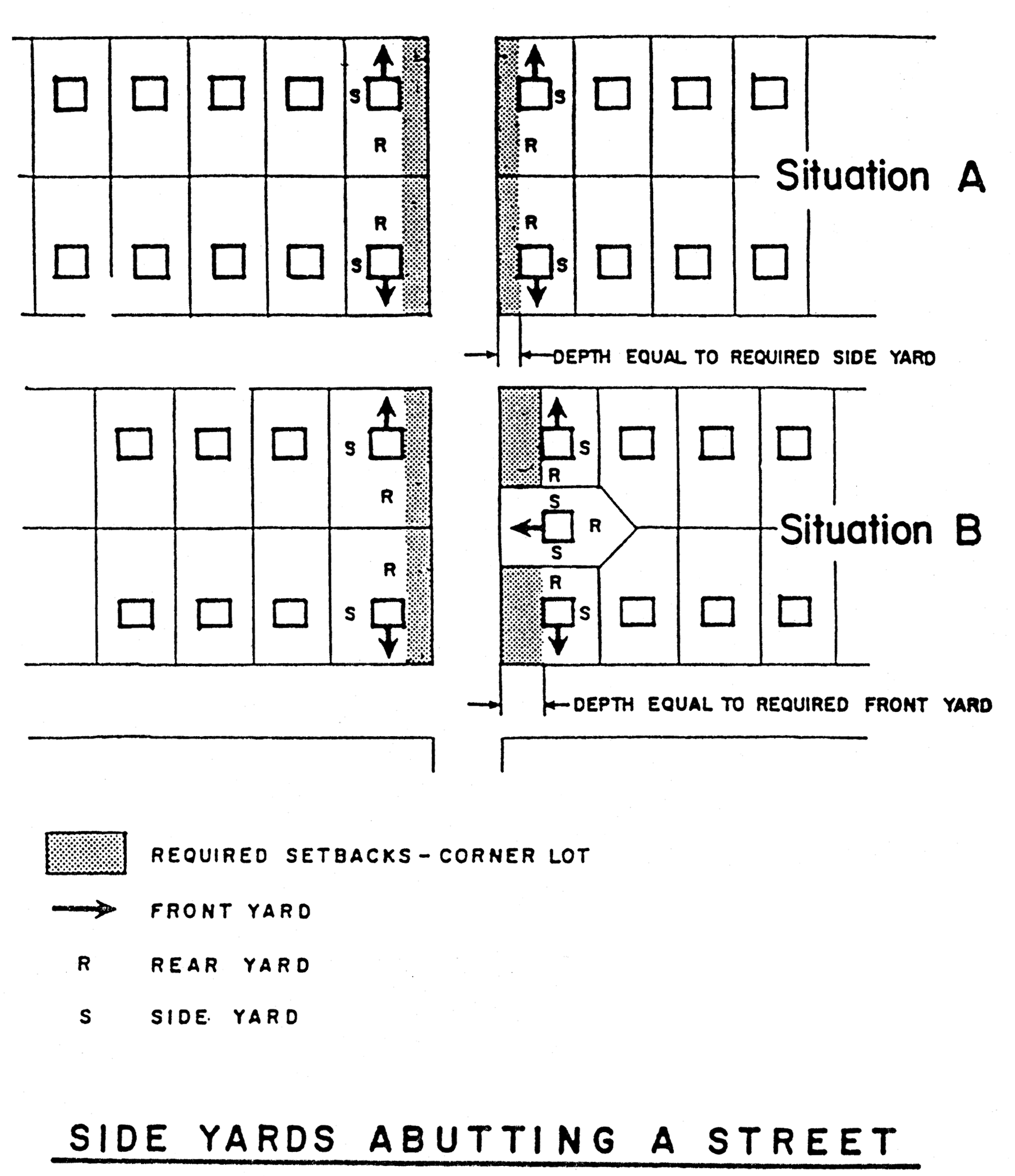
Side Yards Abutting a Street
Sec. 46-432. - Averaged lot size.
The intent of this section is to permit the subdivider or developer to vary lot sizes and lot widths so as to average the minimum size of lot per unit as required in this division for each one-family residential district. If this option is selected, the following conditions shall be met:
(1)
In meeting the average minimum lot size, the subdivision shall be so designed as not to create lots having an area or width greater than ten percent below that area or width required in this division and shall not create an attendant increase in the number of lots.
(2)
Each final plat submitted as part of a preliminary plat shall average the minimum required for the district in which it is located.
(3)
All computations showing lot area and the average resulting through this technique shall be indicated on the print of the preliminary plat.
(Ord. of 3-28-1988, § 1501)
Sec. 46-433. - Subdivision open space plan.
(a)
The intent of the subdivision open space plan is to promote the following objectives:
(1)
Provide a more desirable living environment by preserving the natural character of open fields, stands of trees, brooks, hills and similar natural assets.
(2)
Encourage a more creative approach in the development of residential areas.
(3)
Bypass natural obstacles on the site resulting in a reduction of development costs and to encourage a more efficient, aesthetic and desirable use of open area.
(4)
Encourage the provision of open space within reasonable distance to all lot development of the subdivision and to further encourage the development of recreational facilities.
(b)
Modifications to the standards as outlined in this division may be made in the one-family residential districts when the following conditions are met:
(1)
The lot area in all one-family residential districts, which are served by a public sanitary sewer system, may be reduced up to 20 percent. In the RA-2 district, this reduction may be accomplished in part by reducing lot widths up to six feet. In the RA-1 districts, this reduction may be accomplished in part by reducing lot widths up to ten feet. These lot area reductions shall be permitted, provided that the dwelling unit density shall be not greater than if the land area to be subdivided were developed in the minimum square foot lot areas as required for each one-family district under this division. All calculations shall be predicated upon the one-family districts having the following gross densities (including roads):
RA-1 equals 2.7 dwelling units per acre
RA-1B equals 2.7 dwelling units per acre
RA-2 equals 3.8 dwelling units per acre
(2)
Rear yards may be reduced to 30 feet when such lots border on land dedicated for park, recreation, and/or open space purposes, provided that the width of such dedicated land shall not be less than 100 feet measured at the point at which it abuts the rear yard of the adjacent lot.
(3)
Under the provisions of subsection (b)(1) of this section, for each square foot of land gained within a residential subdivision through the reduction of lot size below the minimum requirements as outlined in this division, at least equal amounts of land shall be dedicated to the common use of the lot owners of the subdivision in a manner approved by the village or the land may be dedicated to the village.
(Ord. of 3-28-1988, § 1502; Ord. No. 130, § 6, 1-26-1993)
Sec. 46-434. - Zero lot line option.
The intent of this section is to permit one-family detached housing to be located on an interior side lot line if compensating space is located within the side yard of an abutting lot and a maintenance easement is provided. This section shall be applicable only to lots meeting the area and width requirements of section 46-431.
(1)
Any interior side yard may be reduced to zero, provided that the remaining side yard equals 20 feet in the RA-1 or RA-1B district and 12 feet in the RA-2 district. Where a zero side yard setback is used, the abutting property must be held under the same ownership at the time a zoning compliance permit is issued or the owners of the abutting property must record an agreement or deed restriction acceptable to the village council consenting to such zero setback.
(2)
A separation of ten feet in the RA-1 or RA-1B district and six feet in the RA-2 district shall be provided between structures on abutting lots where a zero side yard is utilized.
(3)
For the purpose of upkeep and repair of structures located on an interior property line, a maintenance easement shall be recorded between the owner of the property containing such structure and the owner of the property upon which entry must take place in order to perform maintenance activities. Such easement shall be an irrevocable covenant and shall run with the land and be acceptable to the village council. Proof that such easement is recorded shall be submitted to the zoning administrator prior to issuance of a zoning compliance permit. Such easement shall be wide enough to provide the minimum separation required in subsection (2) of this section.
(Ord. of 3-28-1988, § 1503)
Sec. 46-435. - Site condominium option.
(a)
The site condominium option is intended to provide for the division of land as regulated by the condominium act, Public Act No. 59 of 1978 (MCL 559.101 et seq.) rather than the land division act, Public Act No. 288 of 1967 (MCL 560.101 et seq.). In accordance with section 141 of Public Act No. 59 (MCL 559.241), it is further intended that site condominiums are treated similarly to a subdivision developed under the land division act and that the same standards are applied in their design layout and improvements. If this option is selected, the following stipulations are applicable:
(1)
This division limiting the height and bulk of buildings, the minimum lot sizes and yard requirements shall be applicable as permitted in each zoning district or as otherwise altered within this section.
(2)
Any development which utilizes the site condominium option shall conform to the requirements of the village subdivision regulations, article II of chapter 18.
(3)
Other options as defined and regulated by sections 46-432, 46-433 and 46-434 can be used in conjunction with this section.
(4)
Setbacks shall be provided for each building envelope equal to the minimum setback requirements of the zoning district and shall be measured as specified as follows:
a.
Front setbacks shall be measured from the street right-of-way for public or private streets, and from the pavement edge for streets not having a right-of-way. In instances where there is no right-of-way, the setback shall be increased by 15 feet.
b.
Rear setbacks shall be measured from the rear lot line to the rear building envelope line.
c.
Side setbacks shall be measured from the side area lot line to the side building envelope line.
(5)
In the instance in which building plans are available, setbacks will be measured to the actual building rather than to the building envelope. If this alternative is used, building floor plans and elevations must be submitted and a building footprint must be shown on the site plans. The planning commission may request that several different facades be used to provide a variety of building appearances.
(6)
Plans for the development and landscaping of all commons areas must be submitted in accordance with section 46-478, plant materials.
(7)
All streets shall be dedicated to the public unless private streets are allowed by the planning commission. In considering the approval of private streets at least, the following criteria will be considered:
a.
If the site is oddly shaped and the right-of-way required for public streets would create an impractical situation, i.e., double frontage lots, single loaded frontage.
b.
If the site contains natural features that could be better preserved through the use of private streets.
c.
The use of private streets would not prevent the interconnection of existing or planned public streets.
d.
Construction standards for private streets must meet or exceed village standards.
(b)
These criteria are included as guidelines and do not exclude further considerations.
(c)
The means of maintaining all limited and general commons areas shall be specified in the master deed.
(d)
A copy of the master deed shall be submitted for review and acceptance by the village attorney prior to final plan approval.
(Ord. of 3-28-1988, § 1504; Ord. No. 130, § 7, 1-26-1993)

