
Cass City City Zoning Code
ARTICLE IV
SUPPLEMENTARY REGULATIONS
Sec. 46-471.- Conflicting regulations.
Whenever any provision of this chapter imposes more stringent requirements, regulations, restrictions or limitations than are imposed or required by the provisions of any other law or ordinance, then the provisions of this chapter shall govern. Whenever the provisions of any other law or ordinance impose more stringent requirements than are imposed or required by this chapter, then the provisions of such ordinance shall govern.
(Ord. of 3-28-1988, § 1600)
Sec. 46-472. - Scope of chapter.
No building or structure, or part thereof, shall hereafter be erected, constructed or altered and maintained, and no new use or change shall be made or maintained of any building, structure or land, or part thereof, except in conformity with the provisions of this chapter.
(Ord. of 3-28-1988, § 1601)
Sec. 46-473. - Nonconforming lots, uses of land, structures, and uses of structures and premises.
(a)
Intent. It is the intent of this chapter to permit legal nonconforming lots, structures or uses to continue until they are removed but not to encourage their survival. It is recognized that there exists within the districts established by this chapter and subsequent amendments, lots, structures and uses of land and structures which were lawful before this chapter was passed or amended which would be prohibited, regulated or restricted under the terms of this chapter or future amendments. Such uses are declared by this chapter to be incompatible with permitted uses in the districts involved. It is further the intent of this chapter that nonconforming uses shall not be enlarged upon, expanded or extended, nor be used as grounds for adding other structures or uses prohibited elsewhere in the same district. A nonconforming use of a structure, a nonconforming use of land, or a nonconforming use of a structure and land shall not be extended or enlarged after passage of this chapter by attachment on a building or premises of additional signs intended to be seen from off the premises, or by addition of other uses of a nature which would not be permitted generally in the district involved. To avoid undue hardship, nothing in this chapter shall be deemed to require a change in the plans, construction or designated use of any building on which actual construction was lawfully begun prior to the effective date of adoption or amendment of the ordinance from which this chapter is derived and upon which actual building construction has been diligently carried on. Actual construction is defined to include the placing of construction materials in permanent position and fastened in a permanent manner; except that where demolition or removal of an existing building has been substantially begun preparatory to rebuilding, such demolition or removal shall be deemed to be actual construction provided that work shall be diligently carried on until completion of the building involved.
(b)
Nonconforming lots. In any district in which single-family dwellings are permitted, notwithstanding limitations imposed by other provisions of this chapter, a single-family dwelling and customary accessory buildings may be erected on any single lot of record at the effective date of adoption or amendment of the ordinance from which this chapter is derived. This subsection shall apply even though such lot fails to meet the requirements for area or width, or both, that are generally applicable in the district; provided, however, that yard dimensions and other requirements not involving area or width, or both, of the lot shall conform to the regulations for the district in which such lot is located. Yard requirement variances may be obtained through approval of the board of appeals.
(c)
Nonconforming uses of land without buildings. Where, at the effective date of adoption or amendment of the ordinance from which this chapter is derived, lawful use of land exists that is made no longer permissible under the terms of this chapter, as enacted or amended, such use may be continued so long as it remains otherwise lawful, subject to the following provisions:
(1)
No such nonconforming use shall be enlarged or increased, nor extended to occupy a greater area of land than was occupied at the effective date of adoption or amendment of the ordinance from which this chapter is derived.
(2)
No such nonconforming use shall be moved in whole or in part to any other portion of the lot or parcel occupied by such use at the effective date of adoption or amendment of the ordinance from which this chapter is derived.
(3)
If such nonconforming use of land ceases for any reason for a period of more than 90 days, any subsequent use of such land shall conform to the regulations specified by this chapter for the district in which such land is located.
(d)
Nonconforming structures. Where a lawful structure exists at the effective date of adoption or amendment of the ordinance from which this chapter is derived that could not be built under the terms of this chapter by reason of restrictions on area, lot coverage, height, yards or other characteristics of the structure or its location on the lot, such structure may be continued so long as it remains otherwise lawful, subject to the following provisions:
(1)
No such structure may be enlarged or altered in a way which increases its nonconformity. Such structure may be enlarged or altered in a way which does not increase its nonconformity.
(2)
Should such structure be destroyed by any means to an extent of more than 60 percent of its replacement costs, exclusive of the foundation, it shall be reconstructed only in conformity with the provisions of this chapter.
(3)
Should such structure be moved for any reason for any distance whatever, it shall thereafter conform to the regulations for the district in which it is located after it is moved.
(e)
Nonconforming uses of structures and land. If a lawful use of a structure, or of structure and land in combination, exists at the effective date of adoption or amendment of the ordinance from which this chapter is derived, that would not be permitted in the district under the terms of this chapter, the lawful use may be continued so long as it remains otherwise lawful, subject to the following provisions:
(1)
No existing structure devoted to a use not permitted by this chapter in the district in which it is located shall be enlarged, extended, constructed, reconstructed, moved or structurally altered except in changing the use of the structure to a use permitted in the district in which it is located.
(2)
Any nonconforming use may be extended throughout any parts of a building which were manifestly arranged or designed for such use, and which existed at the time of adoption or amendment of the ordinance from which this chapter is derived, but no such use shall be extended to occupy any land outside such building.
(3)
If no structural alterations are made, any nonconforming use of a structure, or structure and land in combination, may be changed to another nonconforming use of the same or a more restricted classification, provided that the board of appeals, either by general rule or by making findings in the specific case, shall find that the proposed use is equally appropriate or more appropriate to the district than the existing nonconforming use. In permitting such change, the board of appeals may require conditions and safeguards in accord with the purpose and intent of this chapter. Where a nonconforming use of a structure, land, or structure and land in combination is hereafter changed to a more conforming use, it shall not thereafter be changed to a less conforming use.
(4)
Any structure, or structure and land in combination, in or on which a nonconforming use is superseded by a permitted use, shall thereafter conform to the regulations for the district in which such structure is located, and the nonconforming use may not thereafter be resumed.
(5)
When a nonconforming use of a structure, or structure and land in combination, is discontinued or ceases to exist for six consecutive months or for 18 months during any three-year period, the structure, or structure and land in combination, shall not thereafter be used except in conformance with the regulations of the district in which it is located. Structures occupied by seasonal uses shall be excepted from this subsection.
(6)
Where nonconforming use status applies to a structure and land in combination, removal or destruction of the structure shall eliminate the nonconforming status of the land.
(f)
Repairs and maintenance. On any building devoted in whole or in part to any nonconforming use, work may be done in any period of 12 consecutive months on ordinary repairs, or on repair or replacement of nonbearing walls, fixtures, wiring or plumbing to an extent not exceeding 50 percent of the assessed value of the building, provided that the cubic content of the building as it existed at the time of passage or amendment of this chapter shall not be increased. Nothing in this chapter shall be deemed to prevent the strengthening or restoring to a safe condition of any building or part thereof declared to be unsafe by any official charged with protecting the public safety, upon order of such official.
(g)
Uses under exception provisions not nonconforming uses. Any use for which a special exception is permitted as provided in this chapter shall not be deemed a nonconforming use, but shall, without further action, be deemed a conforming use in such district.
(h)
Change of tenancy or ownership. There may be a change of tenancy, ownership or management of any existing nonconforming uses of land, of structures or of structures and land in combination.
(i)
Acquisition of uses or structures. The village council may acquire, by purchase, condemnation or otherwise, private property or an interest in private property for the removal of nonconforming uses or structures all in accordance with the applicable provisions of Public Act No. 207 of 1921 (MCL 125.581 et seq.), as amended.
(Ord. of 3-28-1988, § 1602)
Sec. 46-474. - Accessory buildings and structures.
Accessory buildings or structures shall be subject to the following regulations, unless otherwise provided in this chapter:
(1)
Accessory buildings or structures located in any use district shall be subject to the following conditions:
a.
Where an accessory building or structure is structurally attached to a main building, it shall be subject to, and must conform to, all regulations of this chapter applicable to the main building.
b.
Accessory buildings or structures shall not be erected in any minimum side yard setback nor in any front yard.
c.
No detached accessory building shall be located closer than ten feet to any main building nor shall it be located closer than three feet to any side or rear lot line.
d.
A detached accessory building shall not be located within one foot of an alley right-of-way. In no instance shall an accessory building or structure be located within a dedicated easement right-of-way.
e.
See section 46-475 and section 46-476 regarding accessory off-street parking.
f.
See section 46-477 regarding accessory off-street loading and unloading.
g.
See section 46-479 regarding accessory signs.
h.
Antenna structures for radio or television reception may be permitted as accessory to the principal use subject to the following additional conditions:
1.
Ground-mounted antenna structures shall be subject to the following conditions:
i.
Antennas made of solid materials shall be effectively screened from view from residential districts or public streets by natural plants, trees or other suitable sight barrier provided that it does not interfere with the reception "window" of the antenna.
ii.
Temporary or demonstration installations shall be permitted for not more than 14 days.
2.
Roof-mounted antennas shall be subject to the following requirements:
i.
The antenna shall be located on that portion of the roof that is adjacent to the rear yard.
ii.
An antenna may exceed the height limit of the district by three feet, provided that the portion extending above the height limit does not exceed ten square feet in area.
3.
Antennas may be located on another portion of the roof or may exceed the height permitted or may be located in a side yard setback upon approval as a special exception by the zoning board of appeals, provided that the applicant submits documentation that such location or height is necessary for reasonable reception.
(2)
Accessory buildings or structures located in any RA, RB or MH district shall be subject to the following regulations:
a.
Detached accessory buildings shall not exceed 14 feet in height and shall occupy not more than 25 percent of a rear yard setback nor more than 40 percent of any rear yard in excess of the rear yard setback. Accessory structures located within the rear yard setback shall not exceed 14 feet in height.
b.
In no instance shall the combined floor area of detached accessory buildings exceed the ground floor area of the main building.
c.
In order to permit solar energy collecting devices in instances where the percentage of lot coverage limitations would be exceeded, the percentage lot coverage of lots occupied by a residential structure prior to the effective date of this amendment (April 6, 1988) may be increased to the following amounts stated if the purpose is to add solar energy collectors:
1.
Thirty percent of a rear yard setback.
2.
Fifty percent of any rear yard in excess of a rear yard setback.
3.
Lot coverage of solar devices shall be excluded from computation of accessory floor area to the total ground floor area of the main building.
d.
When an accessory building or structure is located on a corner lot, the side lot line of which is substantially a continuation of the front lot line of the lot to its rear, such building or structure shall not be located within a setback which is equal to the front yard setback required of the lot to the rear of such corner lot. In no instance shall an accessory building or structure be located within ten feet of a street right-of-way line.
e.
See section 46-484 regarding accessory residential fences.
f.
Ground-mounted antenna structures shall not exceed 125 square feet in area.
(3)
Accessory buildings or structures located in any district or portion of a district, other than those included under subsection (2) of this section, shall be subject to the following regulations:
a.
No detached accessory building in RC, OS-1 or B-1 districts shall exceed 14 feet in height unless adhering to all requirements of a main building.
b.
On any corner lot or through lot, the setback requirements for main buildings from a street shall be applicable to accessory buildings or structures, unless otherwise provided.
c.
Structures which support lighting fixtures, other than signs, may be permitted in any yard where off-street parking lots are permitted.
d.
Dumpsters may be permitted as accessory to any use, other than one-family or two-family residential, provided that the dumpster is located in a rear yard or interior side yard and is clearly accessible to servicing vehicles.
(4)
Accessory buildings and structures located in any RA, RB or MH district shall include recreational equipment and shall be subject to the following regulations:
a.
Recreational equipment shall include, but is limited to, the following:
1.
Boats, large size floats and rafts, and boat trailers or similar transport vehicles.
2.
Folding tent trailers, pop-up trailers, and similar types of vehicles that are convertible in nature, mounted on wheels and intended for travel and vacation use.
3.
Pickup campers, travel trailers, fifth wheelers, pull-behinds and similar vehicles designed primarily to be mounted on a pickup truck or truck chassis, and intended for use as a temporary dwelling for travel, recreational and vacation use.
4.
Utility trailers or similar vehicles which are used to transport motorcycles, snowmobiles, go-carts, stock cars, or similar recreational vehicles.
5.
Motorized homes or similar vehicles which are used as portable dwellings and are designed and constructed as an integral part of a self-propelled vehicle.
6.
Motorized off-road vehicles, including but not limited to motorcycles, snowmobiles, go-carts and stock cars, which are not licensed for general operation on public roadways.
b.
The storage of recreational equipment shall not be permitted on any public street or public right-of-way.
c.
Recreational equipment shall only be parked or stored within the confines of the rear yard and shall further respect any requirements related to distances from principal structures, lot lines and easements.
d.
Recreational equipment may be temporarily parked, for purposes of loading, unloading and travel preparation, in any front yard setback area for a period not to exceed 14 continuous days. A new 14-day period does not commence until the recreational equipment has been absent from the front yard setback area for a period of at least 48 consecutive hours.
e.
Recreational equipment may be parked or stored in that part of the side yard that is not a part of the required front yard setback, provided the recreational equipment is no closer than three feet to any principal structure and provided that such recreational equipment is adequately screened from view of adjacent property or public roadways.
f.
No person shall permanently occupy, reside or live in any recreational equipment parked or stored upon any property within the village. However, recreational equipment may be used for temporary occupancy purposes for a period not to exceed 14 consecutive days. A new 14-day period does not commence until the recreational equipment has been unoccupied for a period of at least seven consecutive days.
g.
No owner of recreational equipment, nor any property owner where the recreational equipment is parked or stored shall permit any recreational equipment to hook, attach or connect to sanitary facility service leads or connections, whether such connection is permanent or temporary.
h.
Recreational equipment that is parked or stored within the village shall be kept in good repair and carry license plates and registration.
(Ord. of 3-28-1988, § 1603; Ord. No. 148, § 1, 2-6-2002)
Sec. 46-475. - Off-street parking requirements.
There shall be provided in all districts except the B-1 community business district, at the time of erection or enlargement of any main building or structure, automobile off-street parking space with adequate access to all spaces. The provision of such spaces may or may not be the responsibility of the village. The number of off-street parking spaces, in conjunction with all land or building uses, shall be provided prior to the issuance of a certificate of occupancy, as prescribed in the following:
(1)
Off-street parking spaces may be located within a rear yard or within a side yard which is in excess of the minimum side yard setback unless otherwise provided in this chapter. Required off-street parking spaces shall not be permitted within a minimum front yard setback nor within a minimum side yard setback unless otherwise provided in this chapter.
(2)
Off-street parking for other than residential use shall be either on the same lot or within 300 feet of the building it is intended to serve, measured from the nearest point of the building to the nearest point of the off-street parking lot. Ownership shall be shown of all lots or parcels intended for use as parking by the applicant.
(3)
Required residential off-street parking spaces shall consist of a parking strip, parking bay, driveway, garage or combination thereof and shall be located on the premises they are intended to serve, and subject to the provisions of section 46-474, accessory buildings and structures.
(4)
Minimum required off-street parking spaces shall not be replaced by any other use unless and until equal facilities are provided elsewhere.
(5)
Off-street parking existing at the effective date of the ordinance from which this chapter is derived, in connection with the operation of an existing building or use, shall not be reduced to an amount less than required in this section for a similar new building or new use.
(6)
Two or more buildings or uses may collectively provide the required off-street parking in which case the required number of parking spaces shall not be less than the sum of the requirements for the several individual uses computed separately.
(7)
In the instance of dual function of off-street parking spaces where operating hours of buildings do not overlap, the board of appeals may grant an exception.
(8)
The storage of merchandise, motor vehicles for sale, trucks, or the repair of vehicles is prohibited.
(9)
For those uses not specifically mentioned, the requirements for off-street parking facilities shall be in accord with a use which the planning commission considers is similar in type.
(10)
When units or measurements determining the number of required parking spaces result in the requirement of a fractional space, any fraction up to and including one-half shall be disregarded and fractions over one-half shall require one parking space.
(11)
For the purpose of computing the number of parking spaces required, the definition of the term "usable floor area" in section 46-4 shall govern.
_____
(12)
The minimum number of off-street parking spaces by type of use shall be determined in accordance with the following schedule:
(Ord. of 3-28-1988, § 1604)
Cross reference— Stopping, standing and parking, § 38-71 et seq.
_____
Sec. 46-476. - Off-street parking; space layout, standards, construction and maintenance.
Whenever the off-street parking requirements in section 46-475 require the building of an off-street parking facility, or where P-1 vehicular parking districts (division 11 of article III of this chapter) are provided, such off-street parking lots shall be laid out, constructed and maintained in accordance with the following standards and regulations:
(1)
No parking lot shall be constructed unless and until a permit therefor is issued by the zoning administrator. Applications for a permit shall be submitted to the village administrator and shall be accompanied with two sets of site plans for the development and construction of the parking lot showing that the provisions of this section will be fully complied with.
_____
(2)
Plans for the layout of off-street parking facilities shall be in accord with the following minimum requirements:
_____
(3)
All spaces shall be provided adequate access by means of maneuvering lanes. Backing directly onto a street shall be prohibited.
(4)
Adequate ingress and egress to the parking lot and to all parking spaces shall be provided for all vehicles by means of clearly limited and defined drives.
(5)
Ingress and egress to a parking lot lying in an area zoned for other than single-family residential use shall not be across land zoned for single-family residential use.
(6)
Maneuvering lanes serving angle parking shall permit only one-way traffic movement; lanes serving the 90-degree pattern may permit two-way movement.
(7)
Each entrance to and exit from any off-street parking lot located in an area zoned for other than single-family residential use shall be at least 20 feet distant from adjacent property located in any one-family residential district.
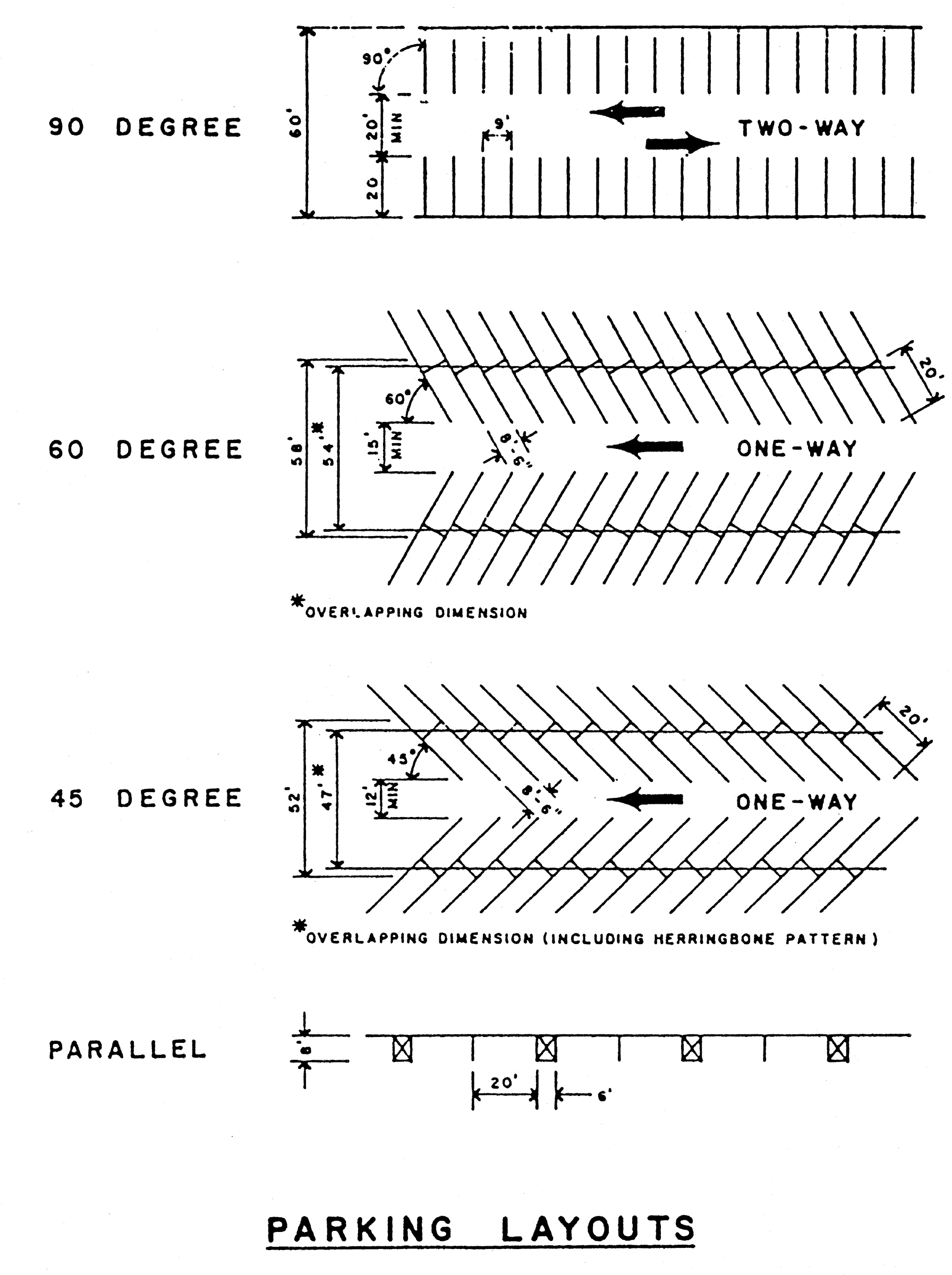
Parking Layouts
(8)
The off-street parking area shall be provided with screening as required by section 46-483, walls and berms.
(9)
Off-street parking lots, including parking spaces and maneuvering lanes required under this section, shall be provided with a durable and dustless surfacing in accordance with specifications approved by the village manager.
(10)
Off-street parking lots shall be drained so as to dispose of all surface water accumulated in the parking area in such a way as to preclude drainage of water onto adjacent property or toward buildings.
(11)
All lighting used to illuminate any off-street parking area shall be installed in accordance with section 46-480, exterior lighting.
(12)
In all cases where a wall extends to an alley which is a means of ingress and egress to an off-street parking lot, it shall be permissible to end the wall not more than ten feet from such alley line in order to permit a wider means of access to the parking lot.
(13)
The planning commission, upon application by the property owner of the off-street parking area, may modify the yard or wall requirements where, in unusual circumstances, no good purpose would be served by compliance with the requirements of this section.
(Ord. of 3-28-1988, § 1605)
Sec. 46-477. - Off-street loading and unloading.
On the same premises with every building or structure, or part thereof, involving the receipt or distribution of vehicles or materials or merchandise, there shall be provided and maintained on the lot adequate space for standing, loading and unloading in order to avoid undue interference with the public use of dedicated rights-of-way. Such space shall be provided as follows:
(1)
OS districts. Within any OS district, off-street loading space shall be provided as follows:
a.
For office buildings of less than 100,000 square feet in gross floor area, at least one loading space, separate from off-street parking, shall be provided and may be located in any yard. Loading space shall have a dimension of at least nine feet by 20 feet.
b.
For office buildings of 100,000 space feet in gross floor area or more, at least one loading space with a dimension of at least ten feet by 50 feet, or 500 square feet in area, with a clearance of at least 14 feet in height, in the rear or interior side yard only.
(2)
B districts. Within any B district, off-street loading space shall be provided in the rear yard only and in the ratio of at least ten feet square feet per front foot of building. In exceptional instances, such space may be permitted in an interior side yard with approval of the zoning administrator or of the planning commission, provided that such location is necessitated by the site conditions and provided that the area is screened from view from any public street.
(3)
I districts. Within an industrial district, off-street loading space shall be provided as follows:
a.
All spaces shall be laid out in the dimension of at least ten feet by 50 feet, or 500 square feet in area, with a clearance of at least 14 feet in height.
b.
Loading dock approaches shall be surfaced with asphaltic or concrete paving so as to provide a permanent, durable and dustless surface.
c.
All spaces in I districts shall be provided in the following ratio of spaces to floor area:
d.
All spaces shall be provided off-street in the rear yard or interior side yard and shall in no instance be permitted in a front yard. In those instances where exterior side yards abut an industrial district across a public street, loading and unloading may take place in such exterior side yard when the setback is equal to at least 50 feet.
(4)
Access. Access to the loading-unloading area shall be designed in such a manner as to allow trucks to enter and leave the loading area without having to back from or onto the public street.
(5)
Alleys. Where a public alley exists or is provided at the rear of buildings, the loading requirements may be computed from the center of such alley.
(Ord. of 3-28-1988, § 1606)
Cross reference— Stopping, standing and parking, § 38-71 et seq.
Sec. 46-478. - Plant materials.
Whenever in this chapter a greenbelt or planting is required, it shall be planted within six months from the date of issuance of a certificate of occupancy and shall thereafter be reasonably maintained with permanent plant materials to provide a screen to abutting properties subject further to the requirements of the village ordinance, Ordinance No. 59. Suitable materials, equal in characteristics to the plant materials listed, shall be provided.
_____
SUGGESTED PLANT MATERIALS
(Ord. of 3-28-1988, § 1607)
_____
Sec. 46-479. - Signs.
(a)
Intent. The village finds that signs and other visual outdoor advertising tends to promote commerce and are related to the health, safety, and or general welfare of the residents of the village, and that the preservation of the existing character of the community requires regulation of signs and of other visual outdoor advertising. The village finds that failure to regulate the size, location, and construction of signs and other outdoor advertising may have an adverse effect upon the promotion of business and commerce in the village, may lead to poor identification of businesses, may have an adverse effect upon the existing aesthetic character of the village, and may cause deterioration of business and residential areas of the community. Therefore, the purpose of this section and subsections is to permit and regulate such signs and visual outdoor advertising of all types in all zoning districts. The regulation of outdoor signs is intended to enhance the physical appearance of the village, to preserve scenic and natural beauty and to create a climate that is attractive to business. It is further intended by the provisions of this chapter to improve traffic safety by avoiding sign distractions and the canceling out effect of conflicting overlapping signs.
(b)
Definitions. The following words, terms and phrases, when used in this section, shall have the meanings ascribed to them in this subsection, except where the context clearly indicates a different meaning:
Accessory sign means a sign, located on the premises which pertains to the principal use of the premises.
Awning and canopy sign mean a type of building sign that is painted, printed or otherwise attached directly to the surface of an awning.
Banner sign means a sign of fabric or similar nonrigid material with no enclosing framework, attached at all edges to a building or other structure.
Business center means any group of two or more commercial establishments having not less than 100 feet of frontage on a major street and which are under one common ownership or management, have a common arrangement for the maintenance of the grounds and are connected by party walls, partitions, covered canopies or other structural members to form one continuous structure; or share a common parking area.
Exterior building entrance means only those available for use by customers or patrons and does not include service or employee entrances.
Festoon sign means a sign where incandescent lightbulbs, banners or pennants or other such features are hung or strung overhead and are not an integral physical part of the buildings or structure they are intended to serve.
Flashing, animated or moving sign means a sign that intermittently reflects lights from either an artificial source or from the sun or sign which has movement of any illumination such as intermittent, flashing, scintillating or varying intensity or a sign that has any visible portion in motion, either constantly or at intervals, which motion may be caused by either artificial or natural sources.
Ground sign means a sign not attached to any building and supported by uprights or braces or some object on the ground and is a type of freestanding sign.
Height (for signs) means the distance from the ground to the highest point of the sign, including the sign frame.
Inflatable sign means a sign that is either expanded to its full dimension or supported by gases contained within the sign or sign parts at a pressure greater than atmospheric pressure.
Mural means a sign, that is a design and/or artwork that is painted, drawn, or attached in any form on the exterior building wall of a structure that does not promote a business, product, service or activity.
Nameplate means an accessory sign stating the name or street number of a person, firm, building or institution of a certain permitted use.
Nonaccessory sign means a sign which does not pertain to the principal use of the premises.
Painted wall sign means a sign painted directly on any exterior building wall or door surface, exclusive of window and door glass areas on any outside wall or roof or on glass of any building.
Political sign means a sign relating to the election of a person to public office or relating to a political party or relating to a matter to be voted upon at an election called by a public body.
Portable sign means a sign and sign structure which is designed to facilitate the movement of the sign from one zoning lot to another. The sign may or may not have wheels, changeable lettering and/or hitches for towing.
Projecting sign means a sign attached to a building or other structure and extending in whole or in part more than 12 inches beyond the surface of the portion of the building line or extending over public property.
Real estate development sign means a sign placed on the premises of a subdivision or other real estate development to indicate a proposed start or to inform relative to availability.
Real estate sign means a sign placed upon a property advertising that particular property for sale, rent or lease.
Sidewalk sign means a temporary freestanding sign, typically with an "A" or "T" frame.
Sign means the use of any words, numerals, figures, devices, designs or trademarks by which anything is made known such as to show an individual firm, profession, business, product or message and which are visible to the general public.
Sign area means the entire area within a single continuous perimeter enclosing the extreme limits of writing, representation, emblem or any figure of similar character, together with any frame or other material or color forming an integral part of the display, excluding the necessary supports or uprights on which such sign is placed. Where a sign has two or more faces, the area of all faces shall be included in determining the area of the sign.
Snipe sign means a sign which is tacked, nailed, posted, pasted, glued or otherwise attached to trees, poles, stakes, fences or to other objects and the advertising matter appearing thereon is not applicable to the present use of the premises upon which such sign is located.
Temporary sign means a sign not permanently anchored or secured to a structure or the ground.
Vehicle business sign means a vehicle upon which a sign is painted or attached and is parked or placed upon the owner's premises primarily for advertising purposes.
Wall sign means a sign erected or fastened to the wall of a building with the exposed face of the sign in a plane approximately parallel to the plane of such wall and not extending more than 12 inches beyond the surface of the portion of the building wall on which erected or fastened. For the purposes of this chapter, a sign affixed to a marquee, canopy, awning, or mansard roof projection from a facade shall be considered a wall sign and shall not project more than 12 inches beyond the projecting face of the structure.
(c)
General provisions. The following conditions shall apply to all signs erected or located in any use district:
(1)
Except for signs erected by the village, Elkland Township, the county, village public schools, or state or federal governments, no sign shall be located in, project into, or overhang a public right-of-way or dedicated public easement. Signs illegally located within a public right-of-way may be immediately removed by the zoning administrator without notice.
(2)
Signs mounted on a building shall not project beyond or overhang the wall by more than 12 inches. Canopies and awnings located on the front and rear facades of buildings are excluded from this subsection.
(3)
Signs shall not project above the cornice, wall facade, parapet or eave of the building to which it is affixed. Roof signs are not permitted.
(4)
Signs shall be permitted in any required yard and for the purposes of determining required height and required setbacks, signs shall be exempt from other provisions of this chapter and the standards provided in this section shall apply.
(5)
No sign shall be erected which simulates or imitates in size, color, lettering, or design any traffic sign or signal or other word, phrase, symbol or character in such a manner that, in the opinion of the zoning administrator, may interfere with, mislead, or confuse traffic.
(6)
Except for signs displaying stock market index information, time, or temperature, no illumination will be intermittent, oscillating or flashing.
(7)
Accessory signs shall be permitted in any use district, subject to the requirements of this chapter.
(8)
Nonaccessory signs shall be permitted only in the I-1 and I-2 industrial districts, subject to the requirements of this chapter.
(9)
Wall signs may be placed upon the face of marquees, awnings or canopies. When canopies include a mansard roof, signs are permitted on the roof of the canopy, parallel to the face of the building, but in no instance projecting beyond the face of the mansard roof.
(10)
All signs are subject to section 46-482, corner clearance.
(11)
All signs shall be constructed in conformance with the following:
a.
The construction, support, and location of any sign shall in no way constitute a hazard to the safety of the public or to adjacent property, the provisions of this section notwithstanding.
b.
Illuminated signs shall conform in all respects to the electrical codes of the county building codes.
c.
All signs are subject to section 46-480, exterior lighting.
d.
Signs using glass shall be constructed and located so as to pose no safety hazard if broken.
e.
Signs and all necessary supports shall be constructed to withstand a horizontal force of 30 pounds per square foot applied to the sign display area. The manufacturer of any sign must provide documentation verifying that this requirement will be met prior to issuance of a permit.
(12)
Temporary portable business advertising signs are intended for the promotion of a particular product, grand opening, announcement of service, management, or event, including signs used by churches, service clubs, and civic organizations for the promotion of charitable purposes and events. Temporary portable signs shall have a minimum setback of ten feet from any future street or road right-of-way line. They may be illuminated provided such lights are not flashing or intermittent and are not placed or designed such that they can be confused with traffic safety devices or highway signs. No portable sign shall be located in such a manner as to interfere with vehicular or pedestrian traffic flow or visibility. Temporary portable business advertising signs, not to exceed 32 square feet in surface display area per face, or 64 square feet if double faced, other than those specifically provided for, are allowed in any district with approval and issuance of a permit by the zoning administrator. Temporary portable signs may be allowed for up to four times, for no more than a total of 80 days, in any one calendar year. For the purposes of this section, a shopping center or other collective grouping of buildings shall have the same rights as an individual use.
(d)
General exceptions. The following signs shall not require a permit:
(1)
Temporary, accessory, real estate signs in residential districts, provided that such signs shall not exceed six square feet in area per sign face nor exceed 42 inches in height. Such signs shall be located on the property to be rented, leased or sold, and placed at least 15 feet from any road right-of-way or property line. Any such sign shall be removed within seven days after the consummation of the lease or sale transaction.
(2)
Temporary, accessory, real estate signs in nonresidential districts, provided that such signs shall not exceed 15 square feet in area per sign face, nor exceed ten feet in height, and, if they are freestanding, such signs shall be set back a minimum of 25 feet from the nearest edge of existing pavement of adjacent streets. Any such sign shall be removed within seven days after the consummation of the lease or sale transaction.
(3)
Temporary, off-premises real estate signs for the purpose of direction shall be permitted in any district provided that such sign shall not exceed six square feet in area per sign face. Such signs may be located off-premises between the hours of 9:00 a.m. and 9:00 p.m. and only for two consecutive days and for two days each week. Such sign shall not have a height exceeding 42 inches. Permission to locate the subject sign shall be obtained from the owner or occupant of property on which the sign is located. Failure to comply with this condition shall be cause for immediate removal of such sign.
(4)
Temporary seasonal decorations.
(5)
Signs erected by the village, Elkland Township, the county, village public schools, or state or federal governments, for any of the following:
a.
Street identification, or general traffic control.
b.
Legal notices, identification, or informational signs.
c.
Signs or markers obtained from a state or federal agency identifying buildings or sites as having been designated as a centennial farm, historic landmark, a state historical site or as a site listed in the National Register of Historic Places.
d.
Signs to identify public buildings or uses or to establish hours of activity or conditions of use.
e.
Community event signs.
(6)
One accessory nonilluminated nameplate sign not exceeding one square foot in area shall be permitted in any district.
(7)
Two on-premises, and one off-premises nonilluminated temporary ground sign pertaining to a garage sale, estate sale, or similar type of sale may be permitted in any residential district. Such signs shall not exceed four square feet in area, nor a height of 30 inches. No such sign shall be posted earlier than 24 hours prior to the sale. All signs shall display the dates of the sale and shall be removed within 24 hours after the sale.
(8)
Accessory on-site directional signs, each with an area of not more than four square feet and a height of no more than three feet.
(9)
Political signs not exceeding six square feet in area per sign face and not exceeding 42 inches in height, provided that such signs are removed within ten days after the election for which they were erected. No such sign shall be displayed on public land. All political signs shall have a minimum setback of 25 feet from the nearest edge of existing pavement of adjacent streets.
(10)
Flags, not more than three per zoning lot and not more than four feet by six feet in dimension.
(11)
Signs for essential services denoting utility lines, hazards and precautions.
(12)
Memorial signs which are either cut into the face of a masonry surface or constructed of bronze or other noncombustible material when located flat on the face of a building.
(13)
Exterior banners and pennants are intended for the promotion of business and as such shall be for the purpose of advertising special events, product promotion, and changes in service. These signs do not require a permit; provided, however, that such business advertising signs shall be subject to the following criteria:
a.
Banners and pennants shall be maintained in a neat and orderly fashion in recognition that they are intended as an enhancement for the promotion of the business community.
b.
Banners will be changed with regularity and in keeping with the statement of subsection (d)(13)a of this section.
c.
Banners shall not exceed ten percent of the total square foot area of a building facade.
d.
Banners and pennants shall not be located closer than ten feet from the future road or street right-of-way. No banner or pennant shall be located in such a manner as to interfere with vehicular or pedestrian traffic flow or visibility.
e.
Banners and pennants shall only be allowed in the RC, OS-1, B-1, B-2, I-1 and I-2 zoning districts.
(e)
Administration and enforcement.
(1)
It shall be unlawful for any person to erect, reerect, alter or relocate any sign unless a permit shall have been first obtained from the zoning administrator, except as otherwise provided in this chapter.
(2)
Application for sign permits shall be made to the zoning administrator upon forms supplied by the village.
(3)
The zoning administrator will review the sign for conformance to village standards and has the authority to approve or deny all sign applications in all zoning districts. In all instances, the zoning administrator may require review and approval by the planning commission.
(4)
Applicants have the right to appeal any decision of the zoning administrator or planning commission to the zoning board of appeals in conformance with division 2, article II of this chapter, board of appeals.
(5)
A fee schedule shall be set by the village council which shall be collected with each application for a sign permit, unless otherwise waived by the village council.
(6)
All signs shall be inspected at original installation. Should any sign be found unsafe, insecure, improperly constructed or not in accordance with the requirements of this chapter, the erector and/or owner shall be required to make the sign safe, secure and otherwise in compliance with the requirements of this chapter within 30 days' notice. All signs for which a permit is required and all supports therefor shall be kept in compliance with the plans and specifications filed and approved for issuance of the sign permit and shall be kept and maintained in a safe condition.
(7)
Signs determined to be unsafe and an immediate hazard to health or safety shall be removed or repaired at the owner's expense within 24 hours of notification by the village. If the sign is not removed or the violations corrected within the allotted time period, the sign shall be deemed a public nuisance and the zoning administrator may take such action as is necessary to have the sign removed.
(f)
Signs in the RA-1, RA-1B, RA-2, RB, RC and MH districts. In the RA-1 RA-1B, RA-2, RB, RC and MH districts, signs shall be permitted subject to the following:
(1)
One ground sign identifying a subdivision or multiple-family housing development subject to the following:
a.
A maximum area of 32 square feet.
b.
A maximum height of six feet.
c.
A minimum setback of ten feet from the future road right-of-way (as shown in the village master plan) of any existing road and a setback of ten feet from the right-of-way of any existing or approved road.
d.
Such signs are to be maintained by the developer until all lots are sold and development is complete, at which time it will be deeded to the village for future care.
(2)
One temporary sign for a new residential development, advertising the sale or lease of lots, buildings or units within such development subject to the following:
a.
A maximum area of 32 square feet.
b.
A maximum height of six feet.
c.
A minimum setback of 20 feet from the future right-of-way (as shown in the village master plan) of any existing road and a setback of ten feet from the right-of-way of any existing or approved road.
d.
Such signs shall be allowed on a temporary basis for a period not to exceed two years. However, the planning commission shall have authority to grant authorization to continue such signs for a reasonable period thereafter, upon a showing that a substantial number of lots, buildings or units remain vacant.
(3)
Nonresidential uses permitted in the district such as offices, hospitals, churches and schools shall be allowed the following signs:
a.
One sign subject to the following:
1.
A maximum area of 18 square feet.
2.
A maximum height of six feet.
3.
A minimum setback of 20 feet from any future road right-of-way.
b.
One nonilluminated wall sign not to exceed 50 square feet and mounted flat against the wall of the principal building.
(4)
Accessory buildings in the RC and MH districts, such as rental and/or management offices, may be permitted one identification sign subject to the following:
a.
A maximum area of six square feet.
b.
Ground signs are limited to a height of four feet.
c.
Wall signs are limited to a height of ten feet.
d.
A minimum setback of 20 feet from any future road right-of-way.
(5)
Accessory signs may be permitted in the RC district for hospitals and clinics, such as directional signs for emergency and medical services, parking, and other such purposes.
(6)
Home occupations and bed and breakfast establishments shall be subject to the provisions of this chapter as stated in section 46-153, principal uses permitted subject to special conditions.
(g)
OS-1 districts. In the OS-1 districts, signs shall be permitted subject to the following:
(1)
One nameplate sign for each exterior building entrance shall be permitted. Such sign shall not exceed six square feet in area.
(2)
One ground sign for each zoning lot, subject to the following:
a.
A maximum area of 18 square feet.
b.
A maximum height of six feet.
c.
A minimum setback of ten feet from any future road right-of-way.
d.
A minimum setback of 100 feet to any adjacent residential district.
(3)
For each use occupying a building, one wall sign, each with a maximum of 18 square feet, shall be permitted.
(h)
B-1 districts. In the B-1 districts, signs shall be permitted subject to the following:
(1)
One nameplate sign for each exterior building entrance shall be permitted. Such sign shall not exceed four square feet in area.
(2)
Wall signs shall be permitted subject to the following:
a.
For each zoning lot, one wall sign shall be permitted on each building facade that fronts on an adjacent street. Such signs shall be limited in area to 100 square feet.
b.
For each zoning lot, one wall sign shall be permitted on each building facade that fronts on an adjacent alley. Such signs shall not exceed 15 square feet in area.
c.
The total area of all wall signs on any one facade shall be limited to an area no greater than ten percent of the area of that facade.
(3)
One ground sign shall be permitted for each zoning lot subject to the following:
a.
Ground signs shall not be more than 20 feet in height and shall have a minimum setback of ten feet from any future right-of-way line. Such signs may be multifaced but shall not exceed 32 square feet in surface display area per face.
b.
A minimum setback of 100 feet to any adjacent residential district.
(4)
Gasoline service stations are permitted the following signs, in addition to those permitted in this subsection (h):
a.
Directional signs on the face of the building over doorways necessary for customer convenience such as "restrooms," "lubrication," "bay 1," or words of similar import.
b.
Signs may be displayed on the gasoline pumps.
(i)
B-2 districts. In the B-2 districts, signs shall be permitted subject to the following:
(1)
One ground sign shall be permitted for each zoning lot subject to the following:
a.
Additional ground signs may be permitted when the following conditions exist:
1.
Two signs may be permitted on a corner lot that has at least 200 feet of frontage on each of two thoroughfares, provided that only one sign is oriented toward each thoroughfare.
2.
Two signs may be permitted where the zoning lot, not a corner lot, has frontage on two major thoroughfares and has vehicular access via both such thoroughfares, provided that only one sign is oriented toward each thoroughfare.
3.
For each lot having a frontage of 300 feet or more, one additional sign shall be permitted, provided that such signs are at least 200 feet apart.
b.
Ground signs shall not be more than 30 feet in height and shall have a minimum setback of ten feet from any future right-of-way line. Such signs may be multifaced but shall not exceed 32 square feet in surface display area per face.
c.
A minimum setback of 100 feet to any adjacent residential district.
(2)
A business center shall be permitted one freestanding sign, subject to the following:
a.
A maximum height of 30 feet.
b.
A minimum setback of ten feet to any future road right-of-way.
c.
The area of such sign shall not exceed one square foot for each linear foot separating the building from the front street right-of-way line, plus one square foot for each linear foot between the sign and the front street right-of-way line. However, in no instance shall a sign have an area greater than 100 square feet per sign face.
d.
A minimum setback of 100 feet to any adjacent residential district.
e.
No such sign shall be closer to a rear or side lot line than a distance equal to its height.
(3)
Each use shall be permitted one wall sign on each building facade with road frontage. Such signs shall be limited to an area equal to not more than ten percent of the area of the wall of the establishment upon which the sign is placed.
(4)
Gasoline service stations are permitted the following signs, in addition to those permitted in subsection (i)(1) and (i)(2) of this section:
a.
Directional signs on the face of the building over doorways necessary for customer convenience such as "restrooms," "lubrication," "bay 1," or words of similar import.
b.
Signs may be displayed on the gasoline pumps.
(5)
Restaurants with drive-through windows shall be permitted one menu board ground sign in addition to those permitted in subsections (i)(1) and (i)(2) of this section. Such sign shall be located in a rear yard or interior side yard and shall not exceed a height of six feet, nor an area of 36 square feet.
(j)
I-1 and I-2 districts. In the I-1 and I-2 districts, signs shall be permitted subject to the following:
(1)
One ground sign identifying an industrial subdivision subject to the following:
a.
A maximum area of 100 square feet.
b.
A maximum height of ten feet.
c.
A minimum setback of ten feet from the future road right-of-way (as shown in the village master plan) of any existing road and a setback of ten feet from the right-of-way of any existing or approved road.
d.
Such signs are to be maintained by the developer until all lots are sold and development is complete, at which time it will be deeded to the village for future care.
(2)
One ground sign shall be permitted for each zoning lot subject to the following:
a.
Additional ground signs may be permitted when the following conditions exist:
1.
Two signs may be permitted on a corner lot that has at least 200 feet of frontage on each of two thoroughfares, provided that only one sign is oriented toward each thoroughfare.
2.
Two such signs may be permitted where the zoning lot, not a corner lot, has frontage on two major thoroughfares and has vehicular access via both such thoroughfares, provided that only one sign is oriented toward each thoroughfare.
3.
For each lot having a frontage of 300 feet or more, one additional sign shall be permitted, provided that such signs are at least 200 feet apart.
b.
Ground signs shall be subject to the following:
1.
A maximum area of 50 square feet per sign face.
2.
A maximum height of ten feet.
3.
A minimum setback of ten feet from any future road right-of-way.
(3)
Each use shall be permitted one wall sign on each building facade with road frontage. Such signs shall be limited to an area equal to not more than five percent of the area of the wall of the establishment upon which the sign is placed.
(4)
Nonaccessory signs are permitted in the I-1 and I-2 districts subject to the following:
a.
A maximum height of ten feet.
b.
A maximum area of 100 square feet.
c.
A minimum setback of 25 feet from any property line or street right-of-way.
d.
Nonaccessory signs shall be permitted but shall be spaced no closer than 1,000 feet between signs on the same side of the street right-of-way.
e.
The height and area of nonaccessory signs may be increased beyond the standards identified in subsections (j)(4)a and (j)(4)b of this section when the following conditions are met:
1.
The sign area may be increased by two square feet for every one foot of setback added beyond the minimum setback from any future road right-of-way, but in no instance shall be greater than 300 square feet.
2.
The sign height may be increased by one foot for every five feet of setback added beyond the minimum setback but in no instance shall exceed 20 feet.
(Ord. of 3-28-1988, § 1608; Ord. of 3-23-1998; Ord. No. 158, § 1, 6-27-2005)
Sec. 46-480. - Exterior lighting.
(a)
All outdoor lighting in all use districts used to light the general area of a specific site shall be shielded to reduce glare and shall be so arranged as to reflect light away from all adjacent residential districts or adjacent residences.
(b)
All outdoor lighting in all use districts shall be directed toward and confined to the ground areas of lawns or parking lots.
(c)
All lighting in nonresidential districts used for the external illumination of buildings, so as to feature such buildings, shall be placed and shielded so as not to interfere with the vision of persons on adjacent highways or adjacent property.
(d)
Illumination of signs shall be directed or shaded downward so as not to interfere with the vision of persons on the adjacent highways or adjacent property.
(e)
All illumination of signs and any other outdoor feature shall not be of a flashing, moving or intermittent type. Artificial light shall be maintained stationary and constant in intensity and color at all times when in use.
(Ord. of 3-28-1988, § 1609)
Sec. 46-481. - Residential entranceway.
In all residential districts, so-called entranceway structures including, but not limited to, walls, columns and gates marking entrances to single-family subdivisions or multiple housing projects may be permitted and may be located in a required yard, except as provided in section 46-482, corner clearance, provided that such entranceway structures shall comply to all codes of the village and shall be approved by the zoning administrator and a permit issued.
(Ord. of 3-28-1988, § 1610)
Sec. 46-482. - Corner clearance.
No fence, wall, shrubbery, sign or other obstruction to vision above a height of two feet from the established street grades shall be permitted within the triangular area formed at the intersection of any street right-of-way lines by a straight line drawn between such right-of-way lines at a distance along each line of 25 feet from their point of intersection.
(Ord. of 3-28-1988, § 1611)
Sec. 46-483. - Walls and berms.
For those use districts and uses listed as follows, there shall be provided and maintained on those sides abutting or adjacent to a residential district an obscuring wall or landscaped berm as required:
(1)
In those instances where the border between districts or uses requiring a wall or berm is a major or secondary street, a greenbelt may be substituted for the wall or berm adjacent to the street, planted in accordance with section 46-478, plant materials.
_____
(2)
The height of the wall or berm shall be measured from the surface of the parking area or land on the nonresidential side of the wall or berm, required as follows, except as otherwise provided in subsection 12 of this section:
_____
(3)
Required walls shall be located along the lot line except where underground utilities interfere and except in instances where this chapter required conformance with front yard setback lines in abutting residential districts.
(4)
Required walls may, upon approval of the planning commission and after public hearing as provided in section 46-48, be located on the opposite side of an alley right-of-way from a nonresidential zone that abuts a residential zone when mutually agreeable to affected property owners. The continuity of the required wall on a given block will be a major consideration.
(5)
Berms shall be a landscaped earth mound, the same height as required for a wall with a maximum slope of three to one (three foot horizontal to one foot vertical). All berms shall have a nearly flat, horizontal area at their highest point, at least two feet in width.
(6)
Berm slopes shall be protected from erosion by sodding or seeding. If slopes are seeded, they shall be protected, until the seed germinates and a permanent lawn is established, by a straw mulch, hydromulching or netting specifically designed to control erosion. The berm area shall be kept free from refuse and debris and shall be planted with shrubs, trees or lawn and shall be maintained in a healthy, growing condition.
(7)
A planting plan and grading plan shall be prepared for the berm and shall be reviewed by the planning commission. Plant materials within the berm area shall be installed in accordance with the requirements of greenbelt and plant material as set forth in section 46-478.
(8)
Such walls or berms shall have no openings for vehicular traffic or other purposes, except as otherwise provided in this chapter and except such openings as may be approved by the chief of police and the zoning administrator.
(9)
All walls required in this section shall be constructed to specifications approved by the zoning administrator to be durable, weather resistant, rustproof and easily maintained; and wood or wood products shall be specifically excluded.
(10)
Masonry walls may be constructed with openings which do not in any square section (height and width) exceed 20 percent of the surface. Where walls are so pierced, the openings shall be so spaced as to maintain the obscuring character required, and shall not reduce the minimum height requirement. The arrangement of the openings shall be reviewed and approved by the zoning administrator.
(11)
The requirement for an obscuring wall between off-street parking areas, outdoor storage areas, and any abutting residential district shall not be required when such areas are located more than 200 feet distant from such abutting residential district.
(12)
The planning commission may waive or modify the requirements of this section where cause can be shown that no good purpose would be served, provided that in no instance shall a required wall be permitted to be less than four feet, six inches in height, except where section 46-482 applies.
a.
In consideration of request to waive wall requirements between nonresidential and residential districts, the planning commission shall determine whether or not the residential district is an area in transition that will become nonresidential in the future.
b.
In such cases, the planning commission may temporarily waive wall requirements for an initial period not to exceed 12 months. Granting of subsequent waivers shall be permitted, provided that the planning commission shall make a determination, as described in this section, for each subsequent waiver prior to the granting of such waiver.
(Ord. of 3-28-1988, § 1611; Ord. No. 130, § 8, 1-26-1993)
Sec. 46-484. - Fences (residential).
Fences are permitted, or required, subject to the following:
(1)
Fences on all lots of record in all residential districts which enclose property and/or are within a required side or rear yard shall not exceed six feet in height, measured from the surface of the ground, and shall not extend toward the front of the lot nearer than the front of the house or the required minimum front yard, or whichever is greater.
(2)
Recorded lots having a lot area in excess of two acres and a frontage of at least 200 feet, and acreage or parcels not included within the boundaries of a recorded plat, in all residential districts, are excluded from the regulations of this section.
(3)
Fences on lots of record shall not contain barbed wire, electric current or charge of electricity.
(4)
Fences which enclose public or institutional parks, playgrounds, or public landscaped areas, situated within an area developed with recorded lots shall not exceed eight feet in height, measured from the surface of the ground, and shall not obstruct vision to an extent greater than 25 percent of their total area.
(Ord. of 3-28-1988, § 1613)
Sec. 46-485. - Site plan review.
(a)
The purpose of site plan review with the planning commission is to determine compliance with the provisions of this zoning ordinance, to promote the orderly development of the village, to prevent the depreciation of land value because of uses or structures which do not give proper attention to siting or area protection, and to provide consultation and cooperation between applicants and the planning commission so that applicants may accomplish their objectives in the utilization of their land in conformity with the provisions of this zoning ordinance.
(b)
A site plan shall be submitted to the planning commission for approval for any use requiring off-street parking, except one-family residential dwellings.
(c)
An application for site plan review shall be made by filing the application form, required information, and the required fee, including any fees to be deposited in an escrow account, with the zoning administrator. Once deemed complete, the zoning administrator shall forward the application and fee to the clerk. Such fees are necessary to pay for professional services related to site plan review, engineering reviews, and staffing planning commission meetings. The application fee and any additional fees to be deposited in an escrow account to pay for professional planning and engineering services shall be set by resolution of the Cass City Village Council.
(d)
The following information shall be included on the site plan:
(1)
Applicant and/or owner's names, addresses and telephone numbers.
(2)
Professional seal of architect, engineer, surveyor, landscape architect, or planner, and their name and address, phone number and e-mail if available.
(3)
Scale, north arrow, date of plan preparation, and date of each revision. Sheet size shall be at least 24"x 36" with plan view drawn to a scale of no greater than 1"= 50' for property less than three acres or no greater than 1"= 100' for property three or more acres.
(4)
Vicinity/locational map drawn at a scale of 1"= 2,000' with north point indicated.
(5)
Location of existing and proposed lot lines, including dimensions, gross and net acreage figures, and zoning classification of the site.
(6)
Adjacent land uses, property owners, zoning and location of adjacent buildings or structures, property lines, rights-of-way, abutting streets, drives, curb cuts, and access easement, and parking within 100 feet of subject property.
(7)
Location and dimensions of existing and proposed buildings/structures; including intended uses, floor area, number of floors, width, length, height, number and type of dwelling units (where applicable), and setback distances.
(8)
Existing natural and man-made features to be retained and/or removed.
(9)
Location of existing and proposed water bodies, watercourses, including county and village drains, man-made surface drainage ways, floodplains and wetlands.
(10)
The location of all existing and proposed access drives, street intersections, driveway locations, sidewalks, bike paths, curbing, and other walkways associated with the site, including general alignment, right-of-way, surface type, width and centerline.
(11)
Location, number and size of parking spaces, including width and method of surfacing, dimensions of spaces and aisles, acceleration, deceleration and passing lanes and approaches.
(12)
Proposed phasing of project.
(13)
The location of all accessory structures, including light poles, flagpoles, storage sheds, transformers, dumpsters, including method of screening.
(14)
Detailed signage and lighting plans, including locations and illumination patterns, for both existing and proposed parking lots and structures.
(15)
A landscape plan indicating the location, type and quantity of plant materials both existing and proposed. The location and description of all existing berms, fencing, walls, and other screening provisions.
(16)
Location of outdoor storage/display areas including a description of the items to be located outdoors, as well as the location and description of required screening.
(17)
Loading and unloading areas for commercial and industrial developments.
(18)
Storage and containment areas, if the use of hazardous substances is involved.
(19)
Location and size of all existing and proposed utility services above and below ground, to include water, electric, gas, phone, cable, stormwater, storm sewer, catch basins, and fire hydrants.
(20)
Location and width of any easements (utility and otherwise) on the site.
(21)
Designation of fire lanes.
(22)
Any other pertinent physical features.
(23)
Existing topography with a maximum contour interval of two feet. Topography on the site and beyond the site for a distance of 100 feet in all directions should be indicated. Grading plan, showing finished contours at a maximum interval of two feet, correlated with existing contours so as to clearly indicate required cutting, filling, grading, and the direction of drainage. Any other items as deemed necessary by the zoning administrator in order to ensure that the proposed development is in compliance with this zoning ordinance and other village ordinances, as well as State and Federal [statutes].
(e)
Site plan review procedure.
(1)
Once the application and fee are forwarded to the clerk by the zoning administrator, the zoning administrator shall preliminarily review the submitted site plan for completeness. In the event that the site plan is not considered complete, the applicant shall be informed that the site plan needs to be updated and complete prior to review with the planning commission.
(2)
At the next regularly scheduled meeting, planning commission shall review the site plan for conformance to the standards and requirements set forth in this chapter.
(3)
Following its review of the proposed site plan, the planning commission shall take one of the following actions:
a.
Approve the site plan if it is found to satisfy the requirements of this zoning ordinance.
b.
Place conditions on the site plan approval to ensure that it satisfies the requirements of this zoning ordinance.
c.
Deny the site plan if it is found that the proposed site plan fails to satisfy the requirements of this zoning ordinance. In the event of denial, the applicant shall be informed of the decision in writing, with the reasons for denial contained in the letter.
(4)
The planning commission shall generally render its decision within 30 days from the date the application was received by the zoning administrator. The 30 day time period may be extended by the mutual consent between the applicant and the planning commission.
(f)
The planning commission shall review the site plan for compliance with the requirements of this zoning ordinance and conformity to the following general standards:
(1)
All elements of the site plan shall be harmoniously and efficiently organized in relation to topography, the size and type of the lot, the character of adjoining property and the size and type of buildings. The site shall be developed so as not to impede the normal and orderly development or improvement of surrounding property for uses permitted in this zoning ordinance.
(2)
The landscape shall be preserved in its natural state, insofar as practical, by minimizing tree and soil removal and by topographic modifications, which result in maximum harmony with adjacent areas.
(3)
All stormwater shall be given to proper site drainage such that the controlled release of stormwaters will not adversely affect neighboring properties.
(4)
The site plan shall provide for reasonable visual and sound privacy for all dwelling units located on the site. Fences, walks, barriers and landscaping shall be used, as appropriate, for the protection and enhancement of property and for the privacy of its occupants.
(5)
All buildings or groups of buildings shall be so arranged as to permit emergency access by some practical means to all sides.
(6)
Every structure or dwelling unit shall have access to a public street, walkway or other area dedicated to common use.
(7)
All loading and unloading areas and outside storage areas, including areas for the storage of trash, which face or are visible from residential districts or public thoroughfares, shall be screened by a vertical screen consisting of structural or plant materials no less than six feet in height.
(8)
Exterior lighting shall be arranged so that it is deflected away from adjacent properties and so that it does not impede the vision of traffic along adjacent streets.
(9)
With respect to vehicular and pedestrian circulation, including walkways, interior drives and parking, special attention shall be given to the location and number of access points, general interior circulation, the separation of pedestrian and vehicular traffic, and the arrangement of parking areas that are safe and convenient and that do not, insofar as practicable, detract from the design of the proposed buildings and structures and the neighboring properties.
(10)
All streets shall be built in accordance with the requirements of the village.
Site plans shall conform to all applicable requirements of state and federal statutes, and approval may be conditioned on the applicant receiving necessary state and federal permits before final site plan approval or an occupancy permit is granted.
(g)
A site plan approved under this section shall be valid for a period of one year. If construction has not commenced within this time period, the site plan shall become null and void. Upon a written request from the applicant, the planning commission may grant one extension of the site plan for a period not to exceed 60 days.
(Ord. of 3-28-1988, § 1614; Ord. No. 169 , 8-30-2010)
State Law reference— Site plan inclusions, 125.584d.
Sec. 46-486. - Frontage on a public street.
No lot shall be used for any purpose permitted by this chapter unless such lot abuts a public street or unless otherwise provided for in this chapter.
(Ord. of 3-28-1988, § 1615)
Cross reference— Streets, sidewalks and other public places, ch. 34.
Sec. 46-487. - Access to a major or secondary street.
For uses making references to this section, vehicular access shall be provided only to a major or secondary street as designated on the village's thoroughfare plan. Access driveways may be permitted to other than a major or secondary street where the following conditions are met:
(1)
Such access is provided to a street where the property directly across the street from such driveway and all property abutting such street between the driveway and major or secondary street is zoned for multiple-family use or nonresidential uses.
(2)
Such access is provided to a street where the property directly across the street is developed with permanent uses other than one-family residences or is an area which, in the opinion of the planning commission, will be used for other than single-family purposes in the future.
(3)
This exception shall apply only if the planning commission finds that there are special circumstances which indicate that there will be a substantial improvement in traffic safety by reducing the number of driveways to a major or secondary street.
(Ord. of 3-28-1988, § 1616; Ord. No. 130, § 9, 1-26-1993)
Sec. 46-489. - Prohibition of recreational marijuana establishments.
(a)
Marijuana establishments, as authorized by and defined in the Michigan Regulation and Taxation of Marijuana Act (the "Act"), are prohibited in all zoning districts in the village, and shall not be permitted as home occupations under [article III] of this chapter.
(b)
No use that constitutes or purports to be a marijuana grower, marijuana safety compliance facility, marijuana processor, marijuana microbusiness, marijuana retailer, marijuana secure transporter or any other type of marijuana related business authorized by the Act, that was engaged in prior to the enactment of this section, shall be deemed to have been a legally established use under the provisions of the village Code of Ordinances; that use shall not be entitled to claim legal nonconforming status.
(c)
Violations of this section are subject to the violations and penalties pursuant to section 46-54 of this chapter and if provided for separately may be abated as nuisances pursuant to section 46-54.
(d)
This section does not supersede rights and obligations with respect to the transportation of marijuana by marijuana secure transporters through the village to the extent provided by the Act, and does not supersede rights and the regulations under [article II] of this chapter with respect to medical marijuana facilities established pursuant to the Michigan Medical Marijuana Act and the Medical Marijuana Facilities Licensing Act.
(Ord. No. 182 , § 1, 1-28-2019)

