
Casselberry City Zoning Code
CHAPTER V
GLOSSARY
CODE COMPARATIVE TABLE 1982 CODE
This table gives the location within this Code of those sections of the 1982 Code, as updated through March 26, 1990, which are included herein. Sections of the 1982 Code, as supplemented, not listed herein have been omitted as repealed, superseded, obsolete or not of a general and permanent nature. For the location of ordinances adopted subsequent thereto, see the table immediately following this table.
Section 5-21.1. - General interpretation.
For the purpose of the land development regulations, certain terms used herein are herewith defined. When not inconsistent with the context, words used in the present tense include the future; words in the singular number include the plural; and words in the plural number include the singular number. The word "shall" is always mandatory and not merely directory. The word "structure" shall include the word "building." The word "used" shall include arranged, designed, constructed, altered, converted, rented, leased or intended to be used. The word "lot" includes the word "plot," "tract," and "building site."
Section 5-21.2. - Definition of terms.
Terms not otherwise defined herein shall be interpreted first by reference to the Comprehensive Plan and land development regulations; secondly, by reference to generally accepted engineering, planning, or other professional terminology if technical; and otherwise according to common usage, unless the context clearly indicates otherwise.
For the purpose of enforcing and administering these regulations, the following words shall have the definition and meanings herein ascribed:
Abandon. To discontinue a use for more than six months.
Abutting. See Adjoining lot or land.
Access. A way or means of approach to provide physical entrance to a property.
Access improvements. Improvements designed and constructed to provide safe and adequate ingress and egress including, but not limited to, rights-of-way, easements, paving of adjacent or connecting roadways, turn lanes, deceleration and acceleration lanes, traffic control devices, signs and markings, and drainage and utilities.
Access, point of. A driveway, curb cut or other opening through which vehicles may enter a public street.
Accessory structure (or accessory building). A structure or building detached from a principal building on the same lot and customarily incidental and subordinate to the principal building or use.
Accessory use. A use of land or of a building or portion thereof customarily incidental and subordinate to the principal use of the land or building and located on the same lot with such principal use.
Accessory vehicular use area. All land upon which vehicles traverse the property, excluding the parking lot.
Accessway. A paved or unpaved area intended to provide ingress and egress from a public or private right-of-way to a public or private premises, including an off-street parking area.
Addition (to an existing building). Any walled and roofed expansion to the perimeter of a building in which the addition is connected by a common loadbearing wall other than a firewall. Any walled and roofed addition which is connected by a firewall or is separated by independent perimeter loadbearing walls is new construction.
Adjoining lot or land. A lot or parcel of land that shares all or part of a common lot line including a common right-of-way with another lot or parcel of land.
Administrative Official. The official(s) designated by the City Manager shall serve as the "Administrative Official" for purposes of administering the Unified Land Development Regulations.
Administrative services (public or not-for-profit). Activities typically performed by not-for-profit private or public social services and utility administrative offices.
Administratively approved. As used in F.S. § 166.04151, approval by the City Manager after input from the Administrative Official in accordance with the City's Code of Ordinances and Unified Land Development Regulations and the Comprehensive Plan.
Aesthetic. The perception of elements of the natural or manmade environment which are pleasing to the eye.
Alley. A serviceway providing a secondary means of public access to abutting property and not intended for general traffic circulation.
Alteration. Any change in the arrangement of a building, including work affecting the structural parts of a building.
Alternative Citywide road impact fee. Any alternative fee calculated by an applicant and approved by the City Engineer or City Commission pursuant to F.S. § 160.12.
Amortization. A method of eliminating nonconforming uses by requiring the termination of the nonconforming use after a special period of time.
Amusement device. Any video machine, pinball machine, pool table, bumper pool, pingpong table, or arcade-type entertainment equipment or device, including a device which is activated or operated by means of coin, token or similar medium of exchange.
Appeal. A request for a review of a decision, finding, order, interpretation or other action concerning the land development regulations.
Application for development. The application form and all accompanying documents and exhibits required of an applicant by an approving authority for development review purposes.
Approved landscape plan. A landscape plan that has been approved by the Administrative Official and/or the Planning and Zoning Commission.
Aquatic areas. Streams, lakes, ponds, and wetlands, including the lands underlying the waters. The upper limit of aquatic areas is the ordinary high-water line. Aquatic areas do not include retention ponds, detention ponds, or drainage ditches.
Aquifer. An underground bed or stratum of earth, gravel or porous stone that contains water.
Aquifer recharge area. The exposed ground level portion of the aquifer.
Archaeological site. Land or water areas which show evidence or artifacts of human, plant or animal activity, usually dating from periods of which only vestiges remain.
Architectural arcade. An architectural arcade is a succession of contiguous arches, with each arch supported by columns or piers. Exterior arcades are designed to provide a sheltered walkway for pedestrians.
Architectural feature. Prominent or significant parts or elements of a building or structure. These include; texture, color changes, arches, porticos, parapets, canopies, cornices, arcades, awnings, windows, balconies, columns, clock towers, artwork and the like.
Assisted living facility. A facility licensed as an assisted living facility under F.S. § 429.07, providing housing, meals, and one or more personal services to 15 or more live-in adults who are not relatives of the owner or operator. Facilities may also provide health and medical care, but care is not as intensive as care typically offered at a nursing home. The facility may include more than one type of living unit and offer different levels of daily living and medical assistance, ranging from independent living to nursing care. Assisted living facilities may be comprised of residential suites. Independent living units within an assisted living facility are considered as dwelling units. See also independent living units and residential suite.
Automotive vehicle or motor vehicle. Any self-propelled vehicle or conveyance designed and used to transport or move persons, animals, freight, merchandise, or any substance, including passenger cars, trucks, buses, motorcycles, or scooters, but not including tractors, construction equipment, or machinery, or any device used for performing a job, except as stated above.
Awning. A light, protective appurtenance to a building.
Bakery. An establishment where products such as bread, cake and pastries are baked and sold.
Balcony. A platform enclosed by a railing or parapet projecting from the wall of a building for the private use of tenants for exterior access from living units.
Bar or lounges. An establishment, primarily in the business of selling or dispensing malt, vinous or other alcoholic beverages for on-site consumption.
Barrier. A solid and unbroken visual screen, including a masonry wall or solid fence which presents a 100 percent opaque screen. An open chain link fence shall not constitute a barrier. A barrier can be made up from shrubs which form a hedge or a landscape berm.
Basement. That portion of a building having its floor subgrade (below ground level) on all sides.
Bed and breakfast lodging. Overnight accommodations with a meal(s) in a dwelling unit provided to transitory lodgers for compensation.
Berm. Mounding of soil which is planted with living plant material designed as a natural landscape buffer to screen incompatible land uses or to absorb or otherwise reduce impacts.
Blade sign. A pedestrian oriented non-illuminated double faced sign, comprised of one individual panel, projecting from the building wall on which it is mounted.
Boat sales. All rowboats, canoes, dinghies, skiffs, rafts, dugouts, dredges, and other watercraft vessels or transportation for use on water, including inboard and outboard motorboats, including all objects tied to or connected therewith while being propelled through the water. Boat sales, due to their size, shall be limited to areas that can also accommodate outdoor storage.
Body art establishment. A location where a licensed tattoo artist creates an indelible mark, graphic illustration, figure, or word upon a human body by the insertion of inks, dyes or pigments of any kind in or under the skin or by producing scars. This term does not include those premises where tattooing is performed by a person licensed to practice medicine or dentistry, and such tattooing is incidental and subordinate to that person's practice of medicine or dentistry and involves only the camouflaging of scars or skin blemishes or the restoration of normal skin. The service may be the puncturing or cutting of a part of the human body to create an opening in which jewelry or an object may be worn.
Breweries. An establishment where beer is made. Beer is sold, served, or given away for consumption on the premises. This term does not include full service restaurants, or bars or lounges.
Buffering. The on-site use of landscaping elements, screening devices, open space, drainageways and landforms for reduction of the potentially adverse impacts of adjoining, dissimilar land uses.
Buffer strip. A parcel or tract of land, plant material, or other landscaping that is used to separate one use from another to shield or block noise, light or other nuisances.
Bufferyard. A unit of land together with required landscaping which may be required between land uses to eliminate or minimize conflicts between them.
Buildable area. The portion of the building site (lot) remaining after required yard setbacks (the "unbuildable area") have been provided.
Building. Any structure having a roof supported by columns or walls.
Building, height of. The vertical distance from the average elevation of the finished grade within 20 feet of the structure to the highest point of the coping of a flat roof or to the mean height level between eaves and ridge for gable, hip, and gambrel roofs.
Building mass. The three-dimensional bulk of a building: height, width, and depth.
Building material yards. A place where lumber, windows, doors, and other components of residential and nonresidential buildings are stored and sold to the public.
Building permit. An official document or certificate issued by the City under the authority of an ordinance or law, authorizing the construction or siting of any building. For purposes of this Code, the term shall also include tiedown permits for structures of buildings, such as a mobile home, that do not require a building permit in order to be occupied.
Building site. A parcel of land which is or may be occupied by a building, and including the required open spaces and yard setbacks. See the definition of Lot.
Bulkhead. A retainer wall or structure designed to prevent the erosion of land by water action or acts or nature.
Business and professional offices. Offices extending the following services which provide advice, information or consultation of a professional nature; insurance, real estate, and financial services; banking services; and executive management and administrative activities. This classification excludes commercial storage of goods and chattels for the purpose of sale or resale as a principal use.
Business services. Any commercial activity primarily conducted in an office, not involving the sale of goods or commodities available in the office and not dispensing personal services, and including such businesses as insurance agencies and adjusters, real estate brokers, counselors, consultants, accountants, collection agencies, title and abstract companies, income tax services, travel agencies, advertising agencies, laboratories, studios of art, music, dancing and photography, business or stenographic schools, and any similar office-type use.
Caliper. Trunk caliper is the measurement of trunk diameter six inches from the ground on trees up to and including four inches in caliper, and 12 inches above the ground for larger trees. (Grades and Standards for Nursery Plants, Part I (2005) and Part II (2005), State of Florida, Department of Agriculture).
Camper, self-propelled. A self-propelled wheeled vehicle containing living facilities and includes the terms "house trailer" or "camp car."
Canal. An excavation, channel, trench, artificial ditch, or receptacle for the confining and transmission of water, located wholly or partly within the City.
Car wash. A facility built for the maintenance of vehicles through washing, cleaning, vacuuming, waxing, detailing or otherwise to improve the appearance of a vehicle. This use is separate from vehicular service and parts sales.
Carriage homes. A two-story residential building with a first floor garage unit and second floor living area.
Cemetery. Property used for the interring of the dead.
Certificate of occupancy. An official certificate issued by the City under the authority of ordinance or law, authorizing the occupancy for its intended use of a building, or any portion thereof, within a road impact construction.
Check cashing/payday loan business means an entity that is engaged in the business of providing currency for payment instruments for a fee, including, but not limited to, deferred presentment providers, as defined by Florida Statutes. Check cashing/payday loan businesses may also provide other services to their customers, including, but not limited to, tax preparation and postal services. However, retail businesses that provide a check cashing service as an incidental part of their business; and financial institutions, such as banks, credit unions, and trust companies; are not included in this definition.
Child or adult care facility. Includes any child center or child care arrangement that provides child care for more than five children unrelated to operator and which received a payment, fee or grant for any of the children receiving care, wherever operated, and whether or not operated for profit, except that the following are not included: public schools and nonpublic schools which are in compliance with the compulsory school attendance law, F.S. ch. 232; summer camps having children in fulltime residence; summer day camps, and Bible schools normally conducted during vacation periods. The provisions of this act shall not apply to a child care facility which is an integral part of a church or parochial schools conducting regular classes or courses of study. This term also includes facilities for the care of adults in a non-medical, non-overnight setting.
Church or other places of worship. Any structure and/or site legally approved for and utilized for a period of at least one year by an established religious organization. Religious organizations which have a Federal tax exemption as a non-profit religious organization [501(c)(3)] and that assemble on, at the least, a weekly basis for public worship are considered to be an established religious organization.
Class 1 flammable liquid. Any liquid defined as a Class 1 flammable liquid in the latest edition of the National Fire Protection Association 30 Flammable and Combustible Liquids Code.
Clinic. Any structure or premises used as an establishment for medical, dental or surgical examination and/or treatment of persons classed as outpatients who are not lodged overnight and maintained and/or operated by any licensed person or organization of persons, whether those are medical doctors, chiropractors, osteopaths, chiropractors, osteopaths, optometrists, dentists, or any other such profession, the practice of which is lawful in the state.
Clubs and lodges, private. Buildings, facilities, and property owned and operated by a corporation or association of persons for social or recreational purposes, including those organized chiefly to promote friendship and welfare among its members, but not operated primarily for profit or to render a service which is customarily carried on as a business.
Collection bin owner. The agent, entity, or legal representative of a company owning the collection bin container that may or may not be associated with a non-profit charitable entity.
Collection bins. Any free-standing container, receptacle, or similar device located on property and used to collect donated clothing, household items, or other goods for resale.
Columns. An architectural support of definite proportions, usually cylindrical in shape, with shaft, capital, and a base. It may be free-standing or attached to a wall.
Commercial. As used in Fla. Stat. 166.04151(7), any use involving in part or in whole the sale of merchandise, materials, or services, excluding properties used for medical or institutional purposes such as hospitals and clinics.
Commercial amusement. Establishments engaged primarily in providing amusement or entertainment for a fee or admission charge.
Commercial amusement, enclosed. A commercial establishment which offers, display, furnishes or otherwise makes available two or more amusement devices or utilizes more than 40 square feet of floorspace for amusement devices for use by the general public or business invitees shall be considered a commercial amusement establishment. A facility used exclusively as a warehouse, garage or other distribution facility, the primary purpose of which is to provide a place for the storage or repair of amusement devices, shall not be deemed to be a commercial amusement establishment.
Commercial amusement, temporary. A commercial amusement which is established as a temporary use. This definition includes, but is not limited to, the following: circuses, carnivals, festivals, fairs, and special exhibitions.
Commercial kitchen. Commercial kitchens produce take-away food products without being a drive-through or sit-down restaurant. Food is prepared on-site, sold via on-line or phone orders, and picked up or delivered for consumption off-premises. There is no seating or tables provided at the facility for consumption on-premises.
Communication antenna. An antenna designed to transmit or receive communications as authorized by the Federal Communications Commission.
Community centers, including private not-for-profit lodges. Activities typically performed by a group of persons for social or recreational purposes which are not operated for profit and do not include activities which are customarily carried on as a business or for profit.
Community residential home. A dwelling unit licensed to serve residents who are clients of the Department of Elderly Affairs, the Agency for Persons with Disabilities, the Department of Juvenile Justice, or the Department of Children and Families or licensed by the Agency for Health Care Administration which provides a living environment for one to 14 unrelated residents who operate as the functional equivalent of a family, including such supervision and care by supportive staff as may be necessary to meet the physical, emotional, and social needs of the residents. Community residential homes licensed through Department of Health and Rehabilitative Services and housing seven to 14 residents, as defined in F.S. ch. 419, shall be considered multiple-family units and shall be accommodated in any multiple-family residential land use zoning designation or any mixed use land use designation which accommodates multiple-family units, providing the community residential units satisfy the criteria of the city's ULDRs.
Complete streets. Complete streets are planned, designed, operated, and maintained to enable safe access for all users of all ages and abilities, meaning that pedestrians, cyclists, the disabled, motorists, freight and service operators, and public transportation users are able to safely and efficiently move through the transportation network. Complete streets are designated by the City Commission. Complete streets should provide access to all users in a manner that promotes safe. efficient movement of people and goods, whether by car, truck, transit, assistive device, foot, or bicycle. Depending on context, streets may serve diverse activities, functions, and intensity of uses, and not all uses are necessarily appropriate for all complete streets. City policies regarding complete streets are found in Complete Streets Policy and Design Guidelines adopted by the City Commission.
Comprehensive Plan. The Comprehensive Plan of the City of Casselberry adopted and amended pursuant to the Local Government Comprehensive Planning and Land Development Regulation Act and Chapter 74-612, Special Acts of Florida, 1972, or their statutory successors in function.
Condominium. That form of ownership of condominium property under which units of improvements are subject to ownership by one or more owners, and there is appurtenant to each unit as part thereof an undivided share in the common elements. Condominium property means and includes the land in a condominium whether or not contiguous, and all improvements thereon and all easements and rights appurtenant thereto intended for use in connection with the condominium.
Conservatory style areas. A room with glass roof and walls which are attached to a restaurant.
Contiguous. Next to, abutting, or touching and having a boundary, or portion thereof, which is coterminous.
Cornice. Any horizontal member, structural or nonstructural, of any building projecting outward from the exterior walls at the roof line, including eaves and another roof overhang.
Cultural or civic activities. Activities typically performed by public or private not-for-profit entities for the promotion of a common cultural or civic objective such as literature; science; music; drama; art; the promotion of an historical, educational, or cultural interest; or similar objectives.
Day care facilities. See Child or adult care facilities.
Density. The number of dwelling units per acre of land.
Designates. As used in Fla. Stat. 166.04151(7)(f), to designate property with a future land use category in the comprehensive plan.
Developer. The legal or beneficial owner or owners of a lot or of any land included in a proposed development including the holder of an option or contract to purchase, or other persons having enforceable proprietary interests in such land.
Development. The division of a parcel of land into two or more parcels; the construction, reconstruction, conversion, structural alteration, relocation, or enlargement of any structure; any mining, excavation, landfill or land disturbance, or any extension of the use of the land.
Disabled motor vehicle. Any motor-driven vehicle, regardless of size, which is incapable of being self-propelled on the public streets of the City or which does not meet the requirements for operation on the public streets, including a current motor vehicle license.
District. A part, zone or geographic area within the municipality within which certain zoning or development regulations apply.
Docks, piers, and boat slips (non-commercial). A structure or platform, stationary or floating, supported by pillars, pilings, or other anchoring devices, extending alongshore or out from the shore into a body of water, to which boats or vessels may be moored.
Drainage. (1) Surface water runoff; (2) The removal of surface water or groundwater from land by drains, grading or other means which include runoff controls designed to minimize erosion and sedimentation during and after construction or development, preserve the water supply and prevent or alleviate flooding.
Dredging. A method for deepening streams, swamps or coastal waters by removing solids from the bottom.
Dripline. An imaginary line on the ground defined by vertical lines which extend from the outermost tips of the tree branches to the ground (see Article XIII).
Drive-through establishment. A place or facility where one can be served without leaving one's car either at an individual stall or through a driveway window for pick-up of product.
Driveway. A private roadway providing access for vehicles to a parking space, garage, dwelling or other structure.
Drugstore. An establishment engaged in the sale of non-prescribed medicine and a variety of general products including consumable and non-consumable products, including but not limited to pre-packaged food and beverages, batteries, electronics, beer and wine, toiletries, healthcare products, vitamins, nutritional supplements and beauty supplies.
Dwelling. Any building or portion thereof which is designed for or used for human habitation.
Dwelling, attached. A one-family dwelling attached to two or more one-family dwellings by common vertical walls.
Dwelling, detached. A dwelling which is not attached to any other dwelling by any structural means.
Dwelling, mid-rise with mixed-use. A residential building designed for urban conditions comprising of multiple floors of residential use and with other uses included within the same building. The building may include a parking garage or connection to a multi-modal facility.
Dwelling, multiple-family. A residential building designed for or occupied by three or more families, with the number of families in residence not exceeding the number of dwelling units provided.
Dwelling, one-family or single-family. A detached residential building containing only one dwelling unit and occupied exclusively by one family as a single housekeeping unit.
Dwelling, two-family (duplex). A residential building designed for or used as homes or residences for two separate and distinct families. Each unit in the duplex shall comply with the definition for a "one-family dwelling."
Dwelling unit. One room or rooms connected together, constituting a separate, independent housekeeping establishment for owner occupancy, or rental or lease on a weekly, monthly or longer basis, and physically separated from any other rooms or dwelling units which may be in the same structure, and containing independent cooking, sleeping, and toilet facilities.
Easement. A grant of one or more of the property rights by the property owner to and/or for the use of the public, a corporation or another person or entity.
Eave. The lower edge of a sloping roof surface; the top edge of a parapet or flat roof.
Educational facility. A place, whether public or private, that provides adult and/or technical instruction toward a license or certification requirement.
Educational institution. A public or private place for systematic instruction using a State or Seminole County School Board certified curriculum for elementary, middle, and secondary school. These activities include pre-school and kindergarten facilities designed to provide a systematic program to meet organized training requirements.
Egress. An exit.
Elevation. (1) A vertical distance above or below a fixed reference level; (2) A flat scale drawing of the front, rear, or side of a building.
Environmentally sensitive areas. Wetlands, lakes, wildlife habitats for endangered species, threatened species and species of special concern, floodplains, drainageways, and conservation areas.
Erect. To build, construct, attach, hang, place, suspend, or affix and shall also include the painting of wall signs.
Essential services. The erection, construction, alteration, or maintenance, by governmental agencies, or of underground or transmission or distribution systems, collection, communication, supply, or disposal systems, including poles, wires, mains, drains, sewers, pipes, conduits, cables, fire alarm boxes, traffic signals, hydrants, and other similar equipment and accessories in connection therewith reasonably necessary for the furnishing of adequate service by the public utilities or municipal or other governmental agencies, or for the public health, safety, or general welfare, but not including buildings.
Excavation. Removal or recovery by any means whatsoever of soil, rock, minerals, mineral substances or organic substances other than vegetation, from water or land on or beneath the surface thereof, or beneath the land surface, whether exposed or submerged.
Expression line. A horizontal linear element extending across a facade evidenced as a noticeable difference of projection or recess, change of color or material, or identified as a clear architectural feature of ornamentation such as a cornice. The line is the objective its expression may vary significantly from building to building and in accordance with different architectural styles.
Extended stay hotels (also, all-suite hotel). A form of lodging within non-residential zoning districts where a portion or all of the rooms are designed for either daily or greater rental. Rooms typically include a bed(s), a living room, a kitchen/kitchenette, a bathroom(s), and a laundry facility.
Facade. The exterior wall of a building exposed to public view or that wall viewed by persons not within the building.
Family. One or more persons occupying a single dwelling unit and living as a single household unit. Unless all members are related by law, blood, adoption, or marriage, no family shall contain more than four persons; however, domestic servants employed on the premises may be housed on the premises without being counted as separate or additional family or families. The term "family" shall not be construed to mean a fraternity, sorority, club, monastery, convent, or institutional group.
Fence. An artificially constructed barrier of any material or combination of materials erected to enclose or screen areas of land.
Financial institutions and banks. Structures providing banking services, including savings and loan activities, including automated teller machines (ATM's).
Flag lot. A lot not fronting on or abutting a public road and where access to the public road is by a narrow, private right-of-way.
Flood or flooding. A general and temporary condition of partial or complete inundation of normally dry land areas from: (1) the overflow of inland or tidal waters; (2) the unusual and rapid accumulation of runoff of surface waters from any source.
Flood hazard boundary map (FHBM). An official map of the community used by the Federal Emergency Management Agency where the boundaries of the areas of special flood hazard have been defined as Zone A.
Flood insurance rate map (FIRM). An official map of a community on which the Federal Emergency Management Agency has delineated both the areas of special flood hazard and the risk premium zones applicable to the community.
Flood insurance study. The official report provided by the Federal Emergency Management Agency. The report contains flood profiles as well as the flood boundary-floodway map and the water surface elevation of the base flood.
Floodplain. An area likely to flood based on the officially adopted flood insurance rate map (FIRM).
Floodway. The channel of a river or other watercourse and the adjacent land areas that must be reserved in order to discharge the base flood without cumulatively increasing the water surface elevation more than one foot.
Floor area, gross. See Gross floor area.
Floor area ratio. The floor area of the building or buildings on any lot divided by the area of the lot.
Florida-friendly landscaping. Landscapes that conserve water, protect the environment, are adaptable to local conditions, and are drought tolerant as stated in F.S. § 373.185.
Foster housing facility. Substitutes for family units where one or two resident adults care for no more than three persons in an environment which approximates family living.
Funeral home. A premises, structure or site used as a commercial establishment for the preparation of deceased humans for burial and/or for the conduction of funeral services prior to burial or other disposition of deceased human remains. Such a premises, structure or site shall not be used for the burial, prolonged storage or permanent disposition of deceased human remains.
Garage apartment. An accessory or subordinate building, not a part of or attached to the main building, a portion of which contains living facilities for not more than one family and the enclosed space for at least one automobile is attached to the living quarters.
Garage, private. An accessory building or a portion of a main building used for the parking or storage of automobiles of the occupants of the main building. A carport shall be considered a private garage.
General retail sales and services. Retail sale or rental from the premises of goods and/or services to include all uses listed under limited commercial activities as well as the following:
Appliance store, without major warehousing.
Art shops and supplies.
Bakeries, excluding wholesale production and distribution.
Bicycle shops.
Copying services.
Cosmetic services.
Department stores.
Drapery stores.
Drugstores.
Dry cleaning establishments complying with Class IV or Class V fire code prevention requirements and using only Class IV solvents such a perchlorethelene, except as otherwise provided for in the fire prevention code.
Dry goods store.
Fabric stores.
Furniture stores.
Garden supplies.
Grocery stores.
Hardware stores, without outside storage of lumber and other building supplies.
Health and exercise studios.
Home furnishing stores.
Lawn and garden supplies.
Large specialty shops.
Luggage and leather goods stores.
Office equipment and supplies.
Paint and wallpaper retail sales.
Pet supply and pet shops.
Sporting goods stores.
Video stores.
Other similar retail sales and service activities conducted within a fully enclosed building approved by the City Commission after receipt of a recommendation from the Planning and Zoning Commission.
The use shall not include: warehousing, outside storage and distribution functions. The use shall not exhibit any characteristic dissimilar or incompatible with the uses identified herein. In review and approval of a use as required for "similar" use, the Planning and Zoning Commission and the City Commission shall use appropriate performance criteria.
Golf course and related facilities. An area designed for playing the game of golf, including any clubhouse, with or without bar and banquet facilities. Commercial miniature golf courses and driving ranges and similar facilities are commercial amusements and are expressly excluded from this activity as defined.
Grocery store. An establishment engaged primarily in the sale of produce and pre-packaged food and beverages. Ancillary sales may include but are not limited to beer and wine, tobacco products, kitchen and cooking products, beauty products and toiletries, vitamins and nutritional supplements, gift cards, stamps and made or cut to order baked goods, cheese, meat, poultry and seafood such as occurs in delicatessens, butcher shops and seafood stores.
Gross acreage. The total number of acres within the perimeter boundaries of the project.
Gross floor area. The area within the inside perimeter of the exterior walls with no deduction for corridors, stairs, closets, thickness of walls, columns or other features, exclusive of areas open and unobstructed to the sky. Gross floor area does not include interior parking spaces, loading spaces for motor vehicles, or any space where the floor-to-ceiling height is less than six feet.
Guest (for purposes of Section 2-7-37). Any patron, customer, tenant, lodger, boarder or occupant of a hotel, motel or transient lodging.
Heavy machinery. Mechanical land clearing, earth-moving, or earth-working equipment with a gross weight in excess of 5,000 pounds. For purposes of this ordinance all machinery which utilizes steel tracks for traction shall be considered to be heavy machinery.
Height. The vertical distance of a structure measured from the average elevation of the finished grade within 20 feet of the structure to the highest point of the structure. See Building height.
Heliport. An area, either at ground level or elevated on a structure, licensed or approved for the loading and takeoff of helicopters, and including auxiliary facilities such as parking, waiting room, fueling and maintenance equipment.
Home based business f/k/a Home occupation. A business that operates in whole or in part from a residential property and meets the criteria in Fla. Stat. 559.955 and this Code.
Hospital. A building or group of buildings, having facilities for one or more overnight patients, used for providing services for the inpatient medical or surgical care of sick or injured humans, and which may include related facilities such as laboratories, outpatient departments, training facilities, and staff offices; provided, however, it is coordinate to the main use and must be an integral part of the hospital operations.
Hotel manager. An employee working in the capacity as a manager for a hotel, motel, or transient lodging.
Hotels, motels and transient lodging. 1) A building or other structure used, maintained or advertised as a place where sleeping accommodations are supplied for rent to transient guests, in which rooms are furnished for the accommodation of such guests, and which may have as an accessory use one or more dining room areas, laundry facilities, gymnasium, or pool; 2) Any public lodging establishment containing sleeping room accommodations for 25 or more guests and providing the services generally provided by a hotel and recognized as a hotel in the community in which it is situated or by the industry.
Impervious surface. Any material which reduces and prevents absorptions of stormwater into previously undeveloped land.
Improvement. Any manmade, immovable item which becomes part of, placed upon, or is affixed to, real estate.
Independent living units. Dwelling units in an assisted living facility with kitchen facilities for a resident where the residents are capable of caring for themselves and do not require a provider of food or personal services.
Ingress. Access or entry.
Institution. A nonprofit corporation or a nonprofit establishment for public use.
Institutional pharmacy. The ancillary dispensing of prescription medicine by a state licensed caregiver in conjunction with medical services, or within a hospital, nursing home, clinic or other related medical facility.
Intensity. Intensity shall be the floor area ratio as defined herein (cross reference Section 2-5.4(B)).
Interior parking space. Any parking space which is not adjacent to a required landscape strip.
Invasive exotic vegetation. Plants which have been introduced into the area and may have undesirable growth habits or maintenance constraints.
Junk. Old and dilapidated modes of conveyance such as automobiles, trucks, tractors, watercraft, and other such vehicles and parts thereof; wagons and other kinds of vehicles and parts thereof; household appliances, scrap building material, scrap contractors' equipment, tanks, casks, cans, barrels, boxes, drums, piping, bottles, glass, old iron machinery, rags, paper, excelsior, hair, mattresses, beds, and bedding or any other kind of scrap or waste material which is stored, kept, handled or displayed.
Junk vehicle. A vehicle which does not have a current license plate or cannot be moved under its own power.
Junkyard. A place where waste, discarded or salvaged materials are bought, sold, exchanged, stored, baled, cleaned, packed, disassembled or handled, including auto wrecking yards, housewrecking yards, used lumber yards, and places or yards for use of salvaged housewrecking and structural steel materials and equipment, but excluding pawnshops and establishments for the sale, purchase or storage of used cars in operable condition, salvaged machinery, used furniture and household equipment, and the processing of used, discarded or salvaged materials as part of manufacturing operations. The storage of nonoperable machinery, equipment or automobiles for 60 days or longer shall be prima facie evidence the property is a junkyard.
Kennel. An establishment in which more than six dogs or domesticated animals more than one year old are housed, groomed, bred, boarded, trained or sold.
Kitchenette. An alcove or portion of a residential unit containing any combination of microwave oven, sink and/or refrigerator intended for limited food preparation.
Laboratory. A place where drugs and chemicals are manufactured. Also, a building equipped for scientific experimentation, research, observation or testing.
Lake. Any single, continuous body of water with a water surface area of one acre or more as shown on the Casselberry, Florida, N2837.5-W8115/7.5 quadrangle map of the United States Geological Survey, or other body of water of one acre or more in surface area created subsequent to that map, located wholly or partly within the City, including lakes, ponds, pools, and the like, irrespective of the local or official names of the bodies of water, and including all such described bodies of water regardless of ownership of bottomlands or location of property lines.
Land clearing. The removal or grubbing, by any means, of any type of vegetation from land, not including, however, activities governed by a tree removal permit.
Land clearing plan. A map of appropriate dimensions showing the number, size, type, and location of existing trees and vegetative cover; the nature of existing terrain, the changes being proposed to both trees and terrain; and a description of the methods to be used to assure conformance to the requirements of these regulations.
Landscape island. A strip of land required between head to head parking spaces.
Landscape strip. A strip containing trees, barriers, ground cover and/or other plant material as required by this Section.
Land use. A description of how land is occupied or utilized.
Landscape. The aggregate vegetative features of a given region or tract of land, including trees and other substantive forms of vegetation.
Large retail establishment. A retail establishment or any combination of retail establishments in a single building, which may include an interior tire store and a separate free-standing fuel sales area, site-planned as a single development site, with a ground story footprint occupying more than fifty thousand (50,000) gross square feet and a minimum façade dimension of two hundred (200) feet in length as designated frontage along any public street.
Light manufacturing. Light manufacturing includes warehousing, storage, assembly and distribution of goods, and light processing activities.
Limited commercial activities. Small limited-item businesses generally limited to retail/wholesale sales or services typically needed on a frequent and recurring basis or small specialized businesses which do not generate heavy truck traffic or heavy point of purchase traffic. This land use classification is intended to accommodate businesses with limited inventory serving a household market area in the immediate vicinity as opposed to City-wide or region-wide; or a specialized market with customized service demand which may extend beyond the immediate neighborhood.
This classification is intended to include the following, and other similar uses approved by the City Commission after considering the recommendation of the Planning and Zoning Commission pursuant to criteria:
Barber and beauty shops.
Book and stationery stores.
Candy and ice cream stores.
Clothiers.
Drugstores and laundry pickup, substations and self-service facilities.
Florists.
Food markets.
Gift shops.
Hardware stores.
Hobby and handicraft shops.
Interior decorators.
Jewelry stores.
Medical supplies.
Neighborhood convenience stores.
Novelty and curio shops.
Offices and financial institutions.
Optical stores.
Photo supplies and studios.
Shoe repair shops.
Specialty shops.
Tailors or seamstress.
Living area. For the purpose of calculating minimum "living area," it shall be the total habitable floor area of all habitable rooms in the dwelling unit, excluding garages, carports, unenclosed porches and steps and all other non-habitable areas or exterior walls.
Loading dock. A platform used for the loading and unloading of freight.
Loading space. An offstreet space within the main building or on the same lot, providing for the standing, loading, or unloading of vehicles.
Lodging. Lodging includes a hotel, motel or transient lodging establishment. Generally refers to overnight room rental to guests.
Lot. A designated parcel, tract or area of land established by plat, subdivision, or as otherwise permitted by law, to be used, developed or built upon as a unit. "Lot" includes the terms "parcel" or "tract."
Lot area. The total area within the lot lines of a lot, excluding any street rights-of-way.
Lot, buildable. A building site of at least sufficient size to meet minimum zoning requirements for use, coverage and area, including the open spaces mandated; such building site may be a single lot or a combination of lots of record having frontage on a street.
Lot depth. The mean horizontal distance between the front lot line and the rear lot line measured at right angles to the width.
Lot, double-frontage. See Through lot cited herein under Lot types.
Lot frontage. Lots are normally platted within blocks to uniformly front along a street which is the "frontage" or "primary" street. The portion of a lot nearest the street. For purpose of determining yard requirements on corner lots and through lots, all sides of a lot adjacent to streets shall be considered frontage, and yards shall be provided as indicated under Yards in this Section.
Lot lines. The lines bounding a lot or buildable site as defined herein.
Lot line, front. The lot line separating a lot from a street right-of-way.
Lot line, rear. The lot line opposite and most distant from the front lot line; or, in the case of triangular or otherwise irregularly shaped lots, a line of ten feet in length entirely within the lot, parallel to and at a maximum distance from the front lot line.
Lot of record. A lot which is part of a subdivision, the plat of which has been recorded in the office of the clerk of the circuit court of the county; or a parcel of land, the deed of which was recorded in the office of the clerk of the circuit court of the county on or before the effective date of these regulations.
Lot types.
Corner lot. A lot located at the intersection of two or more streets. A lot abutting on a curved street or streets shall be considered a corner lot if straight lines drawn from the foremost point of the lot meet at an interior angle of less than 135 degrees.
Interior lot. A lot other than a corner lot with only one frontage on a street.
Through lot. An interior building site having frontage on two parallel or approximately parallel streets. Through lots abutting two streets may be referred to as double-frontage lots.
Lot width. The mean horizontal distance between the side lot lines, measured at right angles to the depth.
Main street. A safe and inviting thoroughfare that accommodates a mix of shops, restaurants, housing, and office uses along a pedestrian-oriented street that draws a large variety of people and acts as a gathering place for the community. Main streets are designated by the City Commission. A main street should be a catalyst for social and economic activity by offering walkable destinations. Main streets should provide a vital space for business activity and civic life. Main streets should accommodate pedestrian volumes by providing high quality walking and cycling infrastructure through well-designed sidewalks, landscaping, and streetscapes.
Major renovation. Where the total cost of the renovation related to the building envelope or the technical building systems is greater than 25 percent of the value of the building, excluding the value of the land upon which the building is situated, as determined by the property appraiser; or if more than 25 percent of the surface of the building envelope undergoes renovation.
Manufactured building. A closed structure, building assembly, or system of subassemblies, which may include structural, electrical, plumbing, heating, ventilating or other service systems manufactured in manufacturing facilities, for installation or erection, with or without other specified components, as a finished building or as part of a finished building, which shall include but not be limited to residential, commercial, institutional, storage and industrial structures (F.S. § 553.36). The building plans for such structures must be sealed by the Florida Department of Community Affairs.
Manufactured home. A building transportable in one or more sections which: (1) is built on a permanent chassis and designed to be used with or without a permanent foundation when connected to the required utilities; and (2) complies with State of Florida building standards of F.S. chs. 320 and 550, the U.S. Department of Housing and Urban Development Manufactured Home Construction and Safety Standards of 1974; and applicable City building and fire codes.
Manufacturing. Places where raw materials or parts are converted into finished products.
Massing or mass. The three dimensional bulk of a structure: height, width, and depth.
Mean sea level. The average height of the sea for all stages of tide. The term is used as a reference for establishing various elevations within the floodplain. For purposes of these regulations, the term is synonymous with National Geodetic Vertical Datum (NGVD).
Mechanical equipment. Equipment used to generate power or provide a service.
Medical marijuana dispensing facility. An establishment operated by a Medical Marijuana Treatment Center in accordance with the Department of Health rules, where marijuana is dispensed for medical use to qualified patients or caregivers. For purposes of this definition, the terms "marijuana," "medical use," "qualified patients," and "caregivers" shall have the same meanings ascribed to them by F.S. § 381.986, as amended from time to time. Medical marijuana dispensing facilities are permitted as principal uses in those zoning districts in which pharmacies are identified as a permitted principal use. Medical marijuana dispensing facilities are permitted as accessory uses in those zoning districts in which pharmacies are identified as permitted accessory uses. A medical marijuana dispensing facility does not prepare, transfer, cultivate or process any form of marijuana.
Medical office. A facility for individual or small groups of physicians, that provide diagnoses and outpatient care, but not prolonged in-house medical or surgical care.
Medical services. The provision of therapeutic, preventive or other corrective personal treatment services by physicians, dentists and other licensed medical practitioners, as well as the provision of medical laboratory testing and analysis services. These services are provided to patients who are admitted for examination and treatment by a physician and with no overnight lodging. This land use classification includes Institutional Pharmacies when developed as an accessory use within a medical service facility and free-standing emergency rooms.
Memory care facility. See "nursing home".
Mining. The removal, either in or upon the soil of the earth or beneath the soil, of any valuable inert or lifeless substance formed or deposited in its present position through natural agencies alone, as a commercial business.
Micro-brewery or micro-winery. Micro-breweries, craft breweries, and micro-wineries are small-scale production facilities of beer or wine in limited quantities. The facility is designed to sell the product in wholesale or directly on-premises to customers and often include outdoor seating, indoor seating, food consumption on-site, and entertainment. The facility shall produce no more than 15,000 barrels (465,000 U.S. gallons) of beer per year (micro-brewery), and 100,000 U.S. gallons of wine per year (micro-winery).
Mixed use residential. As used in Fla. Stat. 166.04151(7)(a) and (f), mixed-use residential means at least 65 percent of the square footage is residential; non-residential uses shall not include a home-based business or institutional use.
Mobile home. A movable or portable detached single-family dwelling designed for and capable of being used for longterm occupancy.
National Geodetic Vertical Datum (NGVD). A vertical control used as a reference for establishing varying elevations within the floodplain.
Noncomplying building or structure. Any building or other structure which does not comply with all applicable provisions of this Code, including bulk regulations, offstreet parking requirements, landscape requirements, performance standards, or other size and dimensional requirements, on the effective date of this ordinance.
Nonconforming use. A use of a building or structure or of a tract of land which, at the time of the commencement of the use, was a permitted use in the zoning district, but which does not, on the effective date of the Unified Land Development Regulations, conform to the use criteria of the district in which it is located.
Non-traditional uses. A service use that requires additional regulations to ensure that the business is in harmony with the goals and vision of the City. Non-traditional uses include body art establishments, pawn shops, and check cashing and/or/payday loan businesses.
Nuisance plants. Those plants which may or may not be native, and their growth habits are hard to control or they exhibit some undesirable features.
Nursing home. Also known as a convalescent home, this term is defined as a facility licensed by the state as a nursing home under F.S. § 400.062, which provides residential nursing, personal or custodial care for three or more persons not related to the caregiver, who by reason of illness, physical infirmity or advanced age require such services. The following are excluded from this term: hospitals, clinics, and detoxification facilities. Nursing home rooms are not residential suites.
Office. A building housing one or more tenants where the affairs of a business, commercial, or industrial organization, professional person or firm are conducted.
Open space (green area). Open space includes the gross area of the site less building coverage, parking surface and internal traffic circulation system, and other impervious surfaces. Certain active recreation areas may be calculated as open space pursuant to criteria of the Unified Land Development Regulations.
Ordinary high-water line. This shall constitute the landward edge of a given water body during normal hydrological conditions and the elevation established by a compilation of relevant evidence, specific to a water body, which includes:
Botanical indicators. The presence of water for sufficient periods of time precludes the existence of terrestrial plant communities and tends to establish conditions whereby shoreline plant species (hydrophytic) inhabit the nearshore and shoreline areas. As these communities tend to change at a slow rate, they are widely utilized to accurately distinguish the uplands from those lands susceptible to the normal inundation of a specific water body. The ordinary high-water line shall be indicated by that elevation where upland, terrestrial plant communities tend to terminate and shoreline (hydrophyte) plants are established as the prevalent plant community(ies).
Physical indicators. Any observable physical feature along a given shoreline resulting from the presence of water in a given water body for sufficient periods of time so as to leave a physical line, mark, or other distinguishable feature, which includes, but is not limited to: water marks on trees, older docks and seawalls, and water marks on older bridges and abutments. For the purposes of this rule and to aid in an accurate establishment of the ordinary high-water line, the affidavits and like testimony of longtime residents of a given water body and other acceptable collateral evidence shall be an acceptable indicator.
Geomorphological indicators and compositional changes in soils. The normal sustained presence of water along a given shoreline of either lakes (still waters) or streams (flowing waters) tends to leave specific surficial indications of that normal sustained preserve, such as deposits of organic silts, peat and muck, natural beach ridges and scarps and natural levees. These deposits and other indicators may be multiple, depicting historical sustained low-water elevations. The elevation of the high-water line is indicated by the most landward scarp, beach ridge or levee found along a given shoreline and is likewise indicated by the highest or most landward silt, peat or muck deposits or the most landward stratification of those deposits.
Water level records. Water level elevations obtained and recorded by a governmental agency, registered land surveyor, or others whose records are verifiable can be used to establish the ordinary high-water elevation. These records can span for a period of at least 20 consecutive years which, with the approval of the City Engineer or other designated staff, shall then be considered as primary evidence.
Controlled lake elevation. Where lake elevations are controlled by properly engineered structures, the normal high-water line is assumed to be one-half foot above said control elevation. Where a conflict between the ordinary high-water line established by this method and the other indicators contained herein exists, a determination of said line will be made by the City Engineer or other designated staff. Said determination should include all of the indicators contained herein, but additional hydrologic surveys or engineering studies may be required.
Outdoor storage. The keeping, in an unroofed area, of any goods, junk, material, merchandise, or vehicles in the same place for more than 24 hours. This definition includes equipment storage, building materials storage, plants for sale at a nursery, and other outdoor displays that businesses and individuals use to sell or promote a product.
Owner. Any and all persons, firms, entities, partnerships, trusts, corporations, associations, or other organizations who possess sufficient proprietary interest to seek development of land regulated by this Code.
Parking lot. An area or plot of ground used for the storage or parking of motor vehicles for less than 24 hours and shall be an accessory to a principal use.
Parking space, offstreet. Shall mean a space adequate for parking an automobile with room for opening doors on both sides, together with properly related access to a public street or alley and maneuvering room. Required offstreet parking areas for three or more automobiles shall have individual spaces marked and shall be so designed, maintained and regulated that no parking or maneuvering incidental to parking shall be on any public street, walk or alley, and so that any automobile may be parked and unparked without moving another.
For purposes of rough computation, an offstreet parking space and necessary access and maneuvering room may be estimated at 300 square feet, but offstreet parking requirements will be considered to be met only when actual spaces meeting the requirements above are provided and maintained, improved in a manner appropriate to the circumstances of the case, and in accordance with all ordinances and regulations of the City.
Parks and recreation, active. Public parks and recreation land and facilities developed for active use by the general public, including playground activities, ballfields, shuffleboard courts, and other similar active recreation uses open to the general public.
Parks and recreation, passive. Passive recreation facilities pursuant to Comprehensive Plan Policy 1-2.7.1 include the following water-related and non-water-related facilities. The water-related facilities are permitted as a conditional use within wetlands.
Water-related facilities:
•
Boardwalks and docks not exceeding a width of five feet.
•
Fishing piers. (Fishing piers exceeding a width of five feet may not be located in a wetland but can be located within a lake.)
•
Boat ramps and related facilities.
Non-water-related facilities:
•
Hiking trails not exceeding a width of four feet.
•
Picnic areas.
•
Golf courses maintaining a minimum of ten percent of uplands in natural vegetative state.
•
Observation towers.
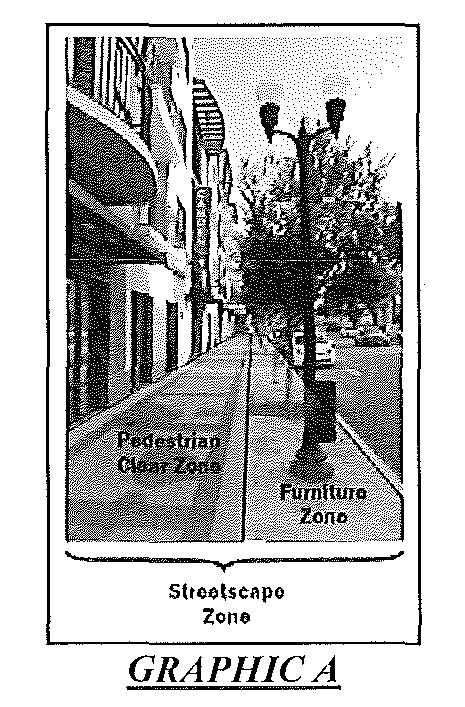
Parkway strip. The unpaved portion of the rights-of-way between the back of curb and the sidewalk. The parkway strip typically includes street light poles and lights, utility poles, regulatory signage, traffic signal equipment and street trees. In some instances, a streetscape zone may not have a parkway strip. See Graphic A below definition of Streetscape Zone.
Pawn shop. A business that is not a financial institution or a bank, and that offers monetary loans in exchange for an item of value that is given to the pawn broker. If an item is pawned for a loan, within a certain contractual period of time that the person pawning the item may purchase it back for the amount of the loan plus some agreed-upon amount for interest. If the loan is not paid (or extended, if applicable) within the time period, the pawned item will be offered for sale by the pawnbroker/secondhand dealer.
Pedestrian clear zone. The unencumbered paved, or sidewalk portion of the streetscape zone inside the rights-of-way. The pedestrian clear zone may or may not be separated from the travel lane by a street furniture zone or parkway strip. See Graphic A below definition of Streetscape Zone.
Permanent driveway. A driveway composed of concrete, asphalt or other impervious material.
Permeable surface. Any surface permitting full or partial absorption of stormwater into the ground.
Person. The term "person" shall include any person, firm, partnership, corporation, association, company, including joint stock company, and all political subdivisions of a state or any agency or instrumentality thereof.
Personal services. Establishments primarily engaged in providing services involving the care of a person or his or her apparel.
Pharmacy. An establishment licensed by the State of Florida as a Community Pharmacy (Schedule II and III) for the retail dispensing of medicinal drugs; or, for purposes of this Land Development Code, a Medical Marijuana Treatment Center Dispensing Facility, for the retail dispensing of derivative product and marijuana delivery devices, as defined by the Florida Statutes or the Florida Administrative Code.
Planned unit development. A "planned unit development" is land under unified control, planned and developed as a whole in a single operation or approved programmed series of operations for dwellings, for dwelling units and related uses and facilities; includes principal and accessory uses and structures substantially related to the character of the development and the surrounding area of which it is part; and is developed according to the comprehensive and detailed plans which include but are not limited to streets, utilities, lots or building sites and the like but also site plans and detailed plans for other uses and improvements, facilities and services as will be for common use by some or all of the occupants of the planned unit development but will not be provided, operated or maintained at public expense.
Plat. A map or drawing depicting the division of lands into lots, blocks, parcels, tracts, or other units pursuant to provisions of this Code.
Pool. Any constructed pool facility containing or intending to contain water and used for swimming, bathing, wading, aquatic uses, or other similar uses.
Portico. A set of columns or colonnades that support a roof or covered walkway leading to a building entrance.
Preferred trees. Trees particularly adaptive to Central Florida as identified in the most up to date version of the Florida-Friendly Landscaping Guide to Plant Selection and Landscape Design, provided by the University of Florida, Institute of Food and Agricultural Sciences (IFAS).
Premises. Any land together with any structures occupying it.
Principal structure. A building occupied by the principal use of the premises or lot.
Private urban realm. Privately owned geographic areas within the Urban Realm which are both visually accessible from the public realm and provide spaces where people may live, work or visit.
Private way. Any street, road, avenue, drive, cul-de-sac, or other thoroughfare used for vehicular traffic and any easement or right-of-way that provides sole access to more than one parcel or lot and which is not included in the definition of "public way" and which is not maintained by the City or other public entity. This term shall include, but is not limited to, roadways or driveways in mobile home parks, apartments, condominiums, commercial or industrial complexes, which have been named and signed in accordance with this City Code of Ordinances.
Property owner. The person named in the Seminole County Tax Collector's public records as the owner of real property or a legal representative.
Protected tree. A specimen tree or a tree which has been noted to be preserved on a landscape plan.
Protective area. An area surrounding a protected tree within which physical intrusion is prohibited in order to prevent damage to the tree, roots and soil around the tree base.
Protective services. Fire, law enforcement and emergency medical related facilities planned and operated for the general welfare of the public.
Public access easements. An easement provided through privately owned property for the purpose of providing a pedestrian connection to the public park land from the roadway and neighboring sites.
Public and private utilities (including essential government services). Use of land which is customary and necessary to the maintenance and operation of essential public services, such as electricity and gas transmission systems; water distribution, collection and disposal; communication; and similar services and facilities.
Public park land. The area of public park land throughout the Lake Concord Overlay District known as Lake Concord Park, including the boardwalk provided at Lake Concord.
Public urban realm. Geographic areas with publicly owned streets, pathways, rights-of-ways, public park land, publicly accessible open spaces and any public and civic building and facilities.
Public water and sewer service. This shall mean water and sewer systems, including pipes, rights-of-way and treatment plants, owned and operated by the City.
Public way. An area of a public road or right-of-way, either paved or unpaved, which is intended for vehicular traffic, and that has been dedicated to this City or other public entity for the purpose of vehicular traffic and for use as a thoroughfare for vehicular traffic whether accepted or not by this City or other public entity, excluding, however, service entrances or driveways.
Recreational vehicle. An item of tangible personal property designed as temporary living quarters for recreational, camping or travel use, which either has its own motive power or is mounted on or drawn by another vehicle.
Redevelopment. Redevelopment shall be deemed to constitute "development" and shall be subject to the provisions of the Unified Land Development Regulations.
Replacement trees. Replacement trees shall at a minimum comply with the provisions of Section 3-14.8.
Residential suite. Also known as an assisted living unit, this term means a room or rooms connected together, constituting a separate housekeeping establishment, for owner occupancy, or rental or lease on a weekly, monthly or longer basis, and physically separated from any other rooms or dwelling units which may be in the same structure, but that is not designed for fully independent living, and that does not have a full kitchen, but rather has a kitchenette within the room(s), or has a full service dining room on the premises from which residents obtain their meals.
Restaurants. Any establishment, including drive-throughs, where the principal business is the sale of food, desserts, or beverages to the customer in a ready-to-consume state.
Right-of-way line. The boundary line between highway, road or street and a tract or parcel of land adjoining such highway, road or street. The right-of-way line shall be considered the property line.
Screened enclosure. An enclosure surrounding a structure, the walls and roof of the enclosure consisting entirely of screen mesh except for minimum essential structural framework required for its support.
Self-storage limited access. A self-storage facility, with one to two access points from the exterior of the building to interior halls that serve individual climate controlled bays designed for the storage of goods.
Self-storage multi-access. A self-storage facility with multi-access points from the exterior of the building to individual non-climate controlled bays designed for the storage of goods.
Service craft. A craft which may be used on the lakes to carry out any necessary work to the lake areas.
Service station. A structure or place where gasoline, oil, and greases are supplied and dispensed to the motor vehicle trade. No repairs to motor vehicles are made. The facility may include a convenience store for the sale of products other than gasoline, oil, and greases.
Setback. The required open spaces of a lot where buildings are not permitted and having the following characteristics:
(1)
"Setbacks" are required for the purpose of providing and ensuring open space and become part of the yard but not necessarily the total yard.
(2)
"Setbacks" shall be measured from the lot, building site, boundary lines and will be designated as "front yard setback," "rear yard setback," "side yard setback(s)," combining to surround and define the remaining buildable area.
(3)
"Setbacks" go with the land and are not intended to control or direct the actual placement or orientation of buildings.
(4)
Buildings may be designed and constructed to fit on any part of the buildable area and do not have to front on the platted front of the lot or building site.
Shopping center. A group of commercial establishments planned, constructed and managed as a total entity with customer and employee parking provided onsite, provisions for goods delivery separated from customer access, aesthetic considerations and protection from the elements.
Shoreline. The ordinary high-water line.
Sign band. Area designated for a sign located above the transom where one exists.
Site plan. The development plan for a proposed manmade improvement to the land required pursuant to this Code.
Special use park. A park which frequently holds events organized by the City and which is exempt from requiring a special use permit for a special event as required by Section 14-28, of Chapter XIV, Amusements. Specimen Tree. A tree which is determined by a tree expert to be of value to the community, because of its species, size, age or other significant tree characteristics, ecological value, nonindigenous character, historic association, unique characteristics, or community value.
SRX Alcoholic Beverage License: That special restaurant license issued by the Florida Division of Alcoholic Beverages in accordance with the rules of the Division.
Story. That portion of a building included between the surface of any floor and the surface of the next floor above it or, if there is no floor above it, then the space between the floor and the ceiling next above it.
Stream. A watercourse having a source, terminus, banks, and channel, through which waters flow at least periodically; it usually empties into other streams or lakes but does not lose its character as a watercourse even though it may break up and disappear.
Street. A thoroughfare which affords principal means of access to abutting property. Street classifications include the following:
Arterial. Arterial streets serve as principal routes through the City. The purpose of these facilities is to move large volumes of traffic from one part of the region or county to another. Arterial roads also provide connection between major activity centers of the county or City.
Major collector streets. Major collector streets collect and distribute traffic from residential access streets to arterial streets or other collector streets.
Minor collector streets. Minor collector streets collect traffic from local streets and feed traffic to major collectors and arterials.
Residential access streets (local streets). Streets which directly serve abutting properties and residences. These streets should be relatively safe and quiet and should be completely free of any through traffic.
Street furniture zone. The paved portion of the streetscape zone typically located between the back or curb and the sidewalk. The street furniture zone typically includes street light poles and lights, utility poles, regulatory signage, traffic signal equipment and street trees. In some cases, a streetscape zone may not have a furniture zone. See Graphic A below definition of Streetscape Zone
Street right-of-way line. The dividing line between a lot, tract, or parcel of land and a contiguous street.
Streetscape zone. The portion of a street between the back of curb and the adjacent property lines, consisting of a sidewalk and a parkway strip or a street furniture zone. See Graphic A Below.
Structural alterations. Any change, except for repair or replacement, in the supporting members of a building such as bearing walls, columns, beams or girders, floor joists, or roof joists.
Structure. Anything built, constructed or assembled with a fixed location on, above, or below the surface of the land or water. Structures include, but are not limited to, buildings, mobile homes, walls, fences, signs and poster panels, driveways, pools, and ponds.
Structure, temporary. A structure without any foundation or footings and which is removed when the designated time period, activity, or use for which the temporary structure was erected has ceased.
Subdivision. Division of a lot, tract or parcel of land into two or more lots, tracts or parcels, or other divisions of land for sale, development, or lease.
Substantial improvement. Any combination of repairs, reconstruction, alteration, or improvements to a building, taking place during the life of a building, in which the cumulative cost equals or exceeds 50 percent of the fair market value of the building. The market value of the building should be: the appraised value of the building prior to commencement of the initial repair or improvement; or, in the case of damage, the value of the building prior to the damage occurring. For the purpose of this definition, "substantial improvement" is considered to occur when the first alteration of any wall, ceiling, floor, or other structural part of the building commences, whether or not that alteration affects the external dimensions of the structure. The term does not, however, include any project for improvement of a building required to comply with existing health, sanitary, or safety code specifications which are solely necessary to assure safe living conditions.
Television and radio broadcasting establishment. A place where television and radio programs are broadcast and which may be equipped with broadcast transmitting infrastructure.
Tent-like structure. A temporary or semi-permanent shelter or decorative device or roof-like covering, either fully enclosed or not completely enclosed, used as a carport or for another permanent purpose, consisting of sheets of fabric or other material draped over, connected to or mounted on a frame of poles.
Terrain. The physical features or topography of a tract of land.
Townhouse. A one-family dwelling in a group of at least four and no more than seven such units in which each unit has its own front and rear access to the outside, and the units are designed with distinctive facades or varied setbacks. No unit is located over another unit, and each unit is separated from any other unit by one or more common fire-resistant walls.
Trades and skilled services. Establishments providing services requiring skilled labor or craftsmanship for repair including household items, office equipment, appliances, printing, blueprinting, carpet sales and service, showroom sales, medical and dental laboratories, lawn and maintenance services, newspaper printing, radio and television broadcasting, restaurant equipment and supply sales and services. All such activities shall not include outdoor storage.
Transmission equipment. Equipment that facilitates transmission for any FCC- licensed or authorized wireless communication service, including, but not limited to, radio transceivers, antennas, coaxial or fiber-optic cable, and regular and backup power supply. The term includes equipment associated with wireless communications services including, but not limited to, private, broadcast, and public safety services, as well as unlicensed wireless services and fixed wireless services such as microwave backhaul.
Transom. A transverse horizontal structural beam or bar, or a crosspiece separating a door from a window above it.
Tree bank fund. A tree bank fund is established by the City to provide an opportunity to make a cash payment to the City in lieu of providing required replacement trees on site.
Tree expert. A certified arborist, landscape architect, horticulturalist, urban forester or other horticultural expert.
Tree removal. Shall mean any act which will cause a tree to die within a period of two years, e.g., damage inflicted upon the root system by heavy machinery; changing the natural grade above and below the root system or around the trunk; damage inflicted on the tree resulting in disease, pest infestation or application of any chemical; or paving with concrete, asphalt, or other impervious material to within six feet of the outside diameter of trees, without prior approval from the Planning and Zoning Commission.
Tree survey. An examination in detail of a tract of land for the purpose of determining the number, size, type, and location of existing trees.
Trip. A single or one-way vehicle movement from an origin (one trip end) to a destination (the other trip end).
Trip ends. The total number of trips entering and leaving a specific land use or site over a designated period of time.
Trip generation. The total number of trip ends produced by a specific land use or activity.
Undesirable trees. All species of trees identified as an "undesirable tree" as listed by Florida Exotic Pest Plant Council (FEPPC) Invasive Plant List, as amended from time to time.
Urban realm. Geographic areas which include all exterior places, linkages and built form elements that are physically and/or visually accessible regardless of ownership. Urban realm includes the entire district, both public and private portions of the Lake Concord Overlay District.
Use. The purpose or activity for which land or buildings are designed, arranged, or intended, or for which land or buildings are occupied or maintained.
Use, conditional. A use permitted in a particular zoning district only upon showing that such use in a specified location will comply with all the conditions and standards for the location or operation of such use as specified in the land development regulations.
Use, permitted. Any use allowed in a zoning district pursuant to restrictions and procedures established in this Code.
Use, temporary. A use established for a fixed period of time with the intent to discontinue such use upon the expiration of the time period.
Variance. A variance is a departure from the literal requirements of the land development regulations where such variance will not be contrary to the public interest and where, owing to conditions peculiar to the property and not the result of the actions of the applicant, a literal enforcement of the Code would result in unnecessary and undue hardship. As used in this Code, a variance is authorized only for height, area, size of structure, or size of yards and open spaces. Establishment or expansion of a use including increasing the maximum density or intensity which is otherwise prohibited shall not be allowed by variance; nor shall a variance be granted because of the presence of nonconformities in the zoning district or uses in an adjoining zoning district.
Vehicular sales, service and leasing. An open area, other than a right-of-way or public parking area, used for display, sale, rental or leasing of new or used vehicles in operable condition and where service of such vehicles is provided.
Vehicular services, maintenance and light mechanical repair. Establishments for the dispensing of motor fuels and related products at retail and having pumps, underground storage tanks and other facilities for such activity and which may include the retail sale of minor automobile parts and accessories such as tires, batteries, sparkplugs, fanbelts, shock absorbers, mirrors, floor mats, cleaning and polishing materials and similar items, and which may include the inspection, servicing or minor repair of motor vehicles. Minor repair of motor vehicles may include repairing scratches, small dents, minor damage to bumpers, minor part replacement such as mirrors or trim, applying vinyl wraps and decals, paint touch-ups or spot painting (but not including full-body repainting or resprays), and other minor cosmetic repairs. Minor repairs and paint touch-ups shall occur in an enclosed structure. These services shall not include frame straightening, tire recapping or vulcanizing, sales and major service, or storage of vehicles, equipment, parts, or chassis.
Veterinary and pet-related services. A facility for animal examinations, medical procedures, and general care, including grooming, daycare, and overnight boarding, in which all services and activities are conducted indoors. This use may include retail sale of pet-related merchandise.
Visitor (for purposes of Section 2-7-37). A person at a lodging facility who is not a guest or a hotel employee, but who is at the facility at the express invitation of a guest or hotel employee.
Wall. The vertical exterior surface of a building. Also, the vertical interior surfaces which divide a building's space into rooms.
Watercourse. Any natural or artificial channel, ditch, canal, stream, river, creek, waterway or wetland which flows either continuously or intermittently, and which has a definite channel, bed, banks or other discernible boundary.
Waterway. Any natural or artificial stream, river, creek, ditch, channel, canal, conduit, culvert, drain, waterway, gully, ravine or wash in which water flows in a definite direction or course, either continuously or intermittently, and has a definite channel, bed and banks, and includes any area adjacent thereto subject to inundation by reason of overflow or floodwater, including wetlands.
Wetland. Wetlands shall be defined based on hydrology as well as hydric soil and wetland vegetation. Wetlands shall include those areas that are inundated or saturated by surface or groundwater at a frequency and duration sufficient to support, and that under normal circumstances do or would support, a prevalence of vegetation typically adapted for life in saturated soil conditions. Flora and fauna species which shall be protected by the regulations of Section 3-11.7 are listed in Official Lists of Endangered and Potentially Endangered Fauna and Flora in Florida, Florida Game and Freshwater Fish Commission, latest edition, and as hereafter may be amended. Wetland boundaries shall be made in accordance with the requirements of the FDER, SJRWMD, and the U.S. Army Corps of Engineers and shall include the largest or most inclusive area whether isolated or contiguous with a natural or artificial water body.
Wineries and wine rooms. Wineries are establishments for making wine. A winery or wine room is a facility specifically designed for a combination of the following activities: tasting, fruit processing, fermentation, barrel aging of wine, and packaging and onsite consumption.
Yard. An open space at grade between the principal or accessory building or buildings and the nearest lot line. Such yard is unoccupied and unobstructed from the ground upward, except as may be specifically provided for in this Code. In measuring a yard for the purpose of determining the width of a side yard, the depth of a front yard, or the depth of a rear yard, the minimum horizontal distance between the lot line and the main building shall be used.
Yard, back. That area of a lot or parcel located behind the rear building facade of the principal structure and extending to the rear property line.
Yard, front. A yard extending across the front of a lot between the side yard lines, which is the minimum horizontal distance between the street line and the main building or any projections thereof other than projections or encroachments specifically provided for in this Code. On corner lots the front yard shall be considered as being that portion on which the structure fronts.
Yard, rear. A yard extending across the rear of a lot between the side lot lines and which is the minimum horizontal distance between the rear of the main building or any projections thereof other than projections or encroachments specifically provided for in this Code. For all corner lots, the rear yard shall be as indicated below under corner lots.
Yard, side. A yard between the main building and the side line of the lot and extending from the front lot line to the rear yard, which is the minimum horizontal distance between a side lot line and the side of the main buildings or any projections thereof. For all corner lots, the side yard shall be as indicated below.
Yard, rear and side (corner lot). On corner parcels abutting two intersecting streets there shall be only one side yard. The remaining parcel line shall be deemed the rear parcel line. The side parcel line shall be determined as follows:
a.
The parcel line opposite the parcel line having the greatest street frontage; or
b.
If the parcel lines abutting on both streets are of equal length, the side parcel line shall be determined as follows:
i.
Where the corner parcel abuts both a side parcel line and a rear parcel line on adjacent parcels, the side parcel line for the corner parcel shall be the same as for the abutting line.
ii.
Where the corner parcel abuts either two side parcel lines or two rear parcel lines on adjacent parcels, the side parcel line for the corner parcel shall be designated by the applicant at the time of his application for a site development permit or development plan approval, as applicable.
c.
On corner parcels abutting three intersecting streets, the remaining parcel line shall be deemed the side parcel line.
Zoned. As it has been traditionally defined, the division of the City into areas, or districts, which specify allowable uses for real property and restrictions on size and placement of buildings within these areas, all as set out in the Unified Land Development Regulations, as directed in the policies of the comprehensive plan.
(Ord. No. 98-901, § I, 2-2-98; Ord. No. 02-1045, §§ 33—35, 5-13-02; Ord. No. 04-1121, § 15, 3-22-04; Ord. No. 04-1150, § 3, 3-14-05; Ord. No. 05-1164, § 2, 7-25-05; Ord. No. 10-1313, § 3, 3-8-10; Ord. No. 14-1414, § III, 1-26-15; Ord. No. 15-1418, § VIII, 4-13-15; Ord. No. 15-1419, § IV, 4-13-15; Ord. No. 15-1420, § 1, 3-9-15; Ord. No. 16-1447, § 3, 7-25-16; Ord. No. 17-1463, § 5, 7-24-17; Ord. No. 18-1477, § III, 5-14-18; Ord. No. 18-1486, § 3, 7-23-18; Ord. No. 19-1511, § III, 5-13-19; Ord. No. 19-1527, § III, 12-9-19; Ord. No. 20-1531, § III, 2-10-20; Ord. No. 20-1546, § III(Exh. B), 12-14-20; Ord. No. 22-1573, § V, 11-14-22; Ord. No. 23-1586, § IV, 12-11-23; Ord. No. 24-1606, § III, 9-23-24; Ord. No. 24-1607, § III, 9-23-24; Ord. No. 25-1624, § I, 10-13-25; Ord. No. 25-1625, § XII, 11-17-25)

