
Catoosa County Unincorporated
City Zoning Code
City Zoning Code
ARTICLE I
- GENERAL PROVISIONS
1.01.00 - TITLE
Appendix A of the Catoosa County Code of Ordinances shall be known as and entitled the "Catoosa County Unified Development Code" and may be referred to as the "UDC."
1.02.00 - AUTHORITY
This UDC is enacted based on the authority vested in Catoosa County by the State of Georgia, including but not limited to: the Georgia Constitution of 1983 (Article 9, Section 2, Paragraph 4) and Zoning Procedures Law (O.C.G.A. 36-66).
1.03.00 - INTENT AND PURPOSE
A.
The Catoosa County Comprehensive Plan is the official development policy and implementation guide for the county to coordinate and direct physical and economic development, related public investment, and, to provide reasonable regulations for the development of private property in the interest of public health, safety, convenience, and general welfare. This UDC is intended to implement all provisions of the Comprehensive Plan for the development and use of land.
B.
The purpose of this UDC is to:
1)
Provide for the security and stability of property owners;
2)
Maintain property values;
3)
Lessen congestion in the streets and roads;
4)
Secure safety from fire, panic and other dangers;
5)
Encourage economically sound land development;
6)
Create a comprehensive and stable pattern of land uses upon which to plan public infrastructure and facilitate economic development;
7)
Assure the provisions of required streets, utilities, and other facilities and services;
8)
Assure the adequate provisions of safe and convenient traffic access and circulation, both vehicular and pedestrian;
9)
Assure the provision of needed public open spaces and building sites through the dedication or reservation of land for recreational, educational, and other public purposes;
10)
Assure the control and disposition of surface stormwater in new developments and adjacent areas;
11)
Regulate the distribution and density of land uses relative to capacity of public infrastructure and to avoid both the undue concentration of population and the inappropriate dispersion of population;
12)
Provide for the continuing orderly growth and development of the County;
13)
Ensure that proposed development and new land uses protect natural resources and preserve the county's rural setting;
14)
Prevent blight and deterioration while conserving the value of buildings;
15)
Assure compatibility between different types of development and land uses;
16)
Encourage the most appropriate use of land, buildings and structures; and
17)
Assure that land is developed in conformity with the Catoosa County Comprehensive Plan.
1.04.00 - APPLICABILITY
1.04.01 Generally
A.
This UDC shall apply only to the unincorporated areas of Catoosa County, Georgia, as now or hereafter established.
B.
No building, structure, or land shall be used or occupied; no land shall be subdivided; and no building, structure, or part thereof shall be erected, constructed, reconstructed, moved, enlarged, or structurally altered unless in conformity with the provisions and requirements of this UDC.
C.
A change of use shall conform to the provisions and requirements of this UDC.
D.
Agricultural activities subject to Best Management Practices for Agricultural Businesses shall be regulated by the Georgia Department of Agriculture and USDA, and enforcement shall be the responsibility of said agencies.
1.04.02 Exemptions and Exceptions
The following general conditions or circumstances are exempt from the provisions and requirements of this UDC:
A.
Buildings or structures that are legally under construction on the date of adoption of this UDC;
B.
Buildings or structures for which a building permit has been issued as of the effective date of this UDC, provided that construction commences prior to the expiration of the building permit, and continues until completed;
C.
Development pursuant to an approved development plan or subdivision plat approved prior to the effective date of this UDC, provided that development commences not later than one year after the effective date of this UDC; or
D.
The proposed use of property lawfully approved as of the effective date of this UDC.
1.05.00 - ADMINISTRATION
A.
Zoning Administrator.
1)
The Catoosa County Zoning Administrator (Zoning Administrator), with exceptions as noted in this Section, is assigned to administer, interpret, implement and enforce the standards, criteria, and procedures of this UDC.
2)
The Zoning Administrator is responsible for specific tasks identified in this UDC, including the following:
a.
Receipt, processing and review of all applications for rezoning, variances, special use permits and UDC text amendments.
b.
Receipt, processing and review of site plans, preliminary subdivision plats and final subdivision plats.
c.
Undertaking all administrative activities related to the use or occupancy or land and buildings under this UDC.
d.
Filing or requesting cease and desist or work stoppage orders.
3)
Throughout this UDC, the term "Zoning Administrator" is used to indicate the responsibility for specified actions, except where specified actions are reserved or specifically delegated by law to another official. In all instances, "Zoning Administrator" shall mean the "Zoning Administrator or designee."
B.
Stormwater Director. The Catoosa County Stormwater Director is assigned to administer, interpret, implement and enforce Article III of this UDC. Responsibilities also include receipt, processing and review of applications and plans identified in Article III.
C.
Building Official. The Catoosa County Chief Building Official (Building Official) is assigned to administer and enforce the provisions of the State Minimum Standard Codes for Construction.
D.
Public Works Director. The Catoosa County Public Works Director is responsible for the administration of Article VI of this UDC.
1.06.00 - RULES OF INTERPRETATION
1.06.01 Generally
A.
In the interpretation and application of the UDC all standards, provisions, and requirements shall be liberally construed in favor of the objectives and purposes of Catoosa County and shall not be construed to limit nor repeal any other powers granted under state or federal statutes.
B.
Specific provisions of this UDC shall be followed in lieu of general provisions that may be in conflict with the specific provision.
C.
The text of this UDC shall be followed in lieu of any caption, illustration, summary table, or illustrative table that may be in conflict with the text.
D.
Where provisions of the UDC conflict with other regulations of the Catoosa County Code of Ordinances or construction codes identified in Section 1.09.00 of this UDC, the more stringent restrictions shall be applied.
E.
The Article, Section and paragraph headings and enumerations used in this UDC are included solely for convenience and shall not affect the interpretation of the UDC.
1.06.02 Responsibility for Interpretations
A.
In the event that any question arises concerning the application of regulations, standards, definitions, development criteria, or any other provision of this UDC, the Zoning Administrator shall be responsible for interpretation. In the interpretation of this UDC, the Zoning Administrator shall be guided by the Catoosa County Comprehensive Plan and applicable state or federal law. The Director may also refer any issue to the County Attorney, the Catoosa County Planning Commission (Planning Commission), or to the Catoosa County Board of Commissioners (Board of Commissioners) for their determination.
B.
Responsibility for interpretation by the Zoning Administrator as set forth in this section shall be limited to standards, regulations, and requirements of the UDC, and shall not be construed to include interpretation of any technical codes adopted by reference in the UDC. Interpretation shall not be construed to override the responsibilities assigned by the Board of Commissioners, the Planning Commission, or to any commission, board, or official named in other sections or chapters of the UDC.
C.
The Building Official shall be authorized to render interpretations of the State Minimum Standard Codes for Construction, which are consistent with their intent and purpose.
D.
The Catoosa County Stormwater Director shall be authorized to render interpretations of Article III of this UDC which are consistent with its intent and purpose.
1.06.03 Zoning District Boundary Interpretations
Interpretations regarding boundaries of zoning districts described in Article II shall be made by the Zoning Administrator in accordance with the following:
A.
Boundaries shown as approximately following the centerlines of streets or highways, street lines, or highway rights-of-way lines shall be construed as following such centerlines.
B.
Boundaries shown as approximately following any platted lot, deed or tax parcel lines shall be construed as following such line.
C.
Boundaries shown as approximately parallel to the centerlines of streets, highways or railroads, or rights-of-way of same shall be construed as being parallel to such centerlines and at such distance therefrom as indicated on the zoning map. If no distance is given, such dimension shall be determined by the use of the scale shown on said zoning map.
D.
Where a district boundary line, as appearing on the zoning map divides a lot in single ownership at the time of enactment of this UDC, the district requirements for the least restricted portion of such lot shall be deemed to apply to the whole thereof, provided that such extensions shall not include any part of such a lot more than 200 feet beyond the district boundary line, so long as this use does not infringe on the buffer as otherwise provided in this UDC.
1.06.04 Permissible Land Use Interpretations
Interpretations regarding a requested use that is not identified as a permissible land use in Article II shall be made by the Zoning Administrator in accordance with Section 2.03.02 of this UDC.
1.06.05 Construction of Words and Phrases
A.
Words used in the present tense include the future tense.
B.
Words used in the singular number include the plural, and words used in the plural include the singular.
C.
The word "person" includes a firm, association, organization, partnership, corporation, trust, limited liability company, and company as well as an individual.
D.
The word "lot" includes the words "plot," "tract," or "parcel."
E.
The word "building" is included in the word "structure."
F.
The words "shall," "must," "will," "is to," and "are to" are always mandatory.
G.
The conjunction "and" indicates that all the connected items, conditions, provisions, or events shall apply.
H.
The conjunction "or" indicates that the connected items, conditions, provisions, or events may apply singly or in any combination.
I.
The use of "either…or" indicates that the connected items, conditions, provisions, or events shall apply singly and not in combination.
J.
The words "includes" or "including" shall not limit a term to the specific example but is intended to extent its meaning to all other instances or circumstances of like kind or character.
K.
The word "day" means a calendar day.
L.
The word "month" means a calendar month.
M.
The word "week" means seven days.
N.
The word "year" means a calendar year.
O.
The word "used" or "occupied" as applied to any land or building shall be construed to include the words "intended, arranged or designed to be used or occupied."
P.
The word "map," "zoning map," or "Catoosa County Zoning Map" means the "Official Zoning Map of Catoosa County, Georgia."
Q.
References in this UDC to another section hereof, shall also include references to the subsections of such section.
R.
References to a subsection shall include any portions of the section (including its other subsections) within which the subsection (being referred to) is located that are needed to construe such subsection (being referred to).
1.06.06 Computation of Time
A.
Except as otherwise provided by time period computations specifically applying to other laws, when a period of time measured in days, weeks, months, years or other measurements of time except hours is prescribed for the exercise of any privilege or the discharge of any duty, the first day shall not be counted but the last day shall be counted; and, If the last day falls on Saturday or Sunday, the party having such privilege or duty shall have through the following Monday to exercise the privilege or to discharge the duty.
1)
When the last day prescribed for such action falls on a public and legal holiday as set forth in O.C.G.A. § 1-4-1, the party having the privilege or duty shall have through the next business day to exercise the privilege or to discharge the duty.
2)
When the period of time prescribed is less than seven days, intermediate Saturdays, Sundays and legal holidays shall be excluded in the computation.
B.
Whenever a number of days is specified in this UDC, or in any permit, condition of approval, or notice provided in compliance with this UDC, the number of days shall be construed as consecutive calendar days.
1.06.07 Severability
It is intended that the provisions of this UDC be severable; and should any portion be held invalid, such invalidity shall not affect any other portion of this UDC.
1.07.00 - DOCUMENTS ADOPTED BY REFERENCE
The documents identified in the following sections include any attachments, future additions, appendices, indexes, and amendments, including local amendments adopted by Catoosa County.
1.07.01 Official Zoning Map of Catoosa County
The Official Zoning Map of Catoosa County, together with all explanatory matter thereon, is hereby adopted by reference and declared to be a part of this UDC.
1.07.02 Catoosa County Future Development Map
The Catoosa County Future Development Map, together with all explanatory matter thereon and accompanying supporting data, is hereby adopted by reference and declared to be a part of this UDC.
1.07.03 Construction Codes
Each construction code listed in Sections 1.07.03(A) through (K) is hereby adopted by reference as if set forth in its entirety. The following minimum standard codes as approved by the State of Georgia include any attachments, future editions, indexes, supplements and amendments, including local amendments adopted by Catoosa County.
A.
International Building Code
B.
International Residential Code
C.
International Fire Code
D.
International Plumbing Code
E.
International Mechanical Code
F.
International Fuel Gas Code
G.
National Electrical Code
H.
International Energy Conservation Code
I.
International Existing Building Code
J.
International Property Maintenance Code
K.
International Swimming Pool and Spa Code
L.
Rules and Regulations of the Safety Fire Commissioner Chapter 120-3-3: Rules and Regulations for the State Minimum Fire Safety Standards
1.07.04 Reserved.
Editor's note— A resolution adopted Sept. 19, 2017, repealed § 1.07.04, which pertained to major road plan of Catoosa County and derived from a resolution adopted April 7, 2015.
1.07.05 Georgia Stormwater Management Manual
The Georgia Stormwater Management Manual (latest edition), published by the Atlanta Regional Commission, is hereby adopted by reference and declared to be part of this UDC.
1.07.06 Manual for Erosion and Sediment Control
The Manual for Erosion and Sediment Control in Georgia (latest edition), published by the State Soil and Water Conservation Commission, is hereby adopted by reference and declared to be part of this UDC.
1.07.07 Areas of Special Flood Hazard
The areas of special flood hazard identified by the Federal Emergency Management Agency (FEMA) in its current effective Flood Insurance Study (FIS) dated September 11, 2009, with accompanying maps and other supporting data, and any revision thereto, is hereby adopted by reference and declared to be part of this UDC. For those land areas acquired by a municipality through annexation, the current effective FIS dated September 11, 2009, with accompanying maps and other supporting data and any revision thereto, for Catoosa County, is hereby adopted by reference and declared to be part of this UDC. The repository for public inspection of the flood insurance study (FIS), accompanying maps and other supporting data, is located: Catoosa County Stormwater Management, 184 Tiger Trail Ringgold, GA 30736.
1.07.08 Manual for On-Site Sewage Management Systems
The Manual for On-Site Sewage Management Systems (latest edition), published by the Georgia Department of Human Resources Division of Public Health, is hereby adopted by reference and declared to be a part of this UDC.
1.07.09 Groundwater Recharge Area District Map
The map depicting significant recharge areas as identified by the Georgia Department of Natural Resources in Hydrologic Atlas 18 (1989 edition) is hereby adopted by reference and declared to be part of this UDC.
1.07.10 Georgia Pollution Susceptibility
The Georgia Pollution Susceptibility Map, Hydrologic Atlas 20 (1992 edition), published by the Georgia Department of Natural Resources, is hereby adopted by reference and declared to be part of this UDC.
1.07.11 Generalized Wetlands Map
The Generalized Wetlands Map, defined as the current effective U.S. Fish and Wildlife Service National Wetlands Inventory Maps for Catoosa County, Georgia together with all explanatory matter thereon and attached thereto, is hereby adopted by reference and declared to be a part of this UDC.
1.07.12 Water Supply Watershed Protection District Overlay Map
The Water Supply Watershed Protection District Overlay Map of Catoosa County, together with all explanatory matter thereon and attached thereto, is hereby adopted by referenced and declared to be a part of this UDC.
1.07.13 FHWA Manual of Uniform Traffic Control Devices
The FHWA Manual of Uniform Traffic Control Devices (latest edition), published by the Federal Highway Administration, is hereby adopted by reference and declared to be part of this UDC.
1.07.14 American National Standards Institute Codes
American National Standards Institute (ANSI) Codes (latest edition) regulating communications towers and antenna, and any other ANSI code cited in this UDC, are hereby adopted by reference and declared to be part of this UDC.
1.07.15 Engineering Technical Standards Manual
The Catoosa County Engineering Technical Standards Manual, together with all explanatory matter thereon, is hereby adopted by reference and declared to be a part of this UDC.
1.08.00 - ACRONYMS AND DEFINITIONS
Except as specifically defined herein, all words used in this UDC shall have their customary dictionary definitions. The following terms are defined for the purposes of this UDC.
1.08.01 Acronyms
A-1 — Agricultural District
AASHTO — Association of State and Highway and Transportation Officials
ADT — Average Daily Traffic
ANSI — American National Standards Institute
BFE — Base Flood Elevation
BMP — Best Management Practice(s)
CBR — California Bearing Ratio
C-1 — General Business District
C-2 — Neighborhood Business District
C-3 — Office District
CCSWCD — Catoosa County Soil and Water Conservation District
CPESC — Certified Professional in Erosion and Sediment Control
C-R — Commercial-Residential District
DIP — Ductile Iron Pipe
d.u. — Dwelling Units
EPD — Environmental Protection Division of the Georgia Department of Natural Resources
FHBM — Flood Hazard Boundary Map
FIRM — Flood Insurance Rate Map
GDOT — Georgia Department of Transportation
GSWCC — Georgia Soil and Water Conservation Commission
HSG — Hydrologic Soil Group
I-1 — Heavy Industrial District
I-2 — Light Industrial District
LIA — Local Issuing Authority
MRPA — Metropolitan River Protection Act
MS4 — Municipal (County) Separate Storm Sewer System
NAVD — North American Vertical Datum
NGVD — National Geodetic Vertical Datum
NPDES — National Pollutant Discharge Elimination System
NOI — Notice of Intent
NOT — Notice of Termination
NTU — Nephelometric Turbidity Units
PCFD — Planned Commercial Farm District
PUD — Planned Unit Development
R-A — Residential-Agricultural District
RCP — Reinforced Concrete Pipe
R-1 — Single-Family Residential District (22,000 sq. ft.)
R-2 — Residential Attached District
R-3 — Single-Family Residential District (10,000 sq. ft.)
R-4 — Manufactured Home Development District
R-T/Z — Residential Townhouse/Zero Lot Line District
RV — Recreational Vehicle
UDC — Unified Development Code
USGS — United States Geological Survey
1.08.02 Definitions
A
Abandoned vehicle. A vehicle, including cars, trucks, trailers, boats, motorcycles, recreational vehicles, mobile homes, manufactured homes, or any other similar vehicle that meets one or more of the following conditions:
A.
Has been left unattended upon a highway, street, or alley or other public property outside a designated parking space for a period of 48 hours; and/or
B.
Is within public view and is inoperable, partially or wholly dismantled, wrecked, junked, discarded or similar condition, or any vehicle without a current license plate as required by law, and is located outside of an enclosed building, garage, carport, licensed junkyard or other place of business designated and lawfully used for the storage of such inoperable vehicles for a period exceeding 30 days.
Accessory structure. A structure having minimal value and used for parking, storage and other nonhabitable uses, such as garages, carports, storage sheds, pole barns, hay sheds and the like.
Accessory use. A use clearly incidental to, customarily found in connection with, and subordinate to the principal use or building, and located on the same lot with such principal use or building.
Addition (to an existing building). Any walled and roofed expansion to the perimeter of a building in which the addition is connected by a common load-bearing wall other than a firewall. Any walled and roofed addition, which is connected by a firewall or is separated by an independent perimeter load-bearing wall, shall be considered new construction.
Address program administrator. The official of the county charged with the administration of this article, including his authorized representative. The address program administrator shall be the 911 administrator of the county.
Administrative variance. See "Variance, administrative."
Adult entertainment establishment. An "adult bookstore," an "adult dancing establishment," an "adult mini-motion picture theater," an "adult motion picture arcade," an "adult motion picture theater," an "adult video store," an "erotic dance establishment," an "escort bureau or introduction service," and a "massage parlor" as these terms are defined in this UDC:
Adult bookstore. An establishment having as a substantial or significant portion of its stock in trade magazines or other periodicals distinguished or characterized by their emphasis on matter depicting, describing or relating to specified sexual activities or specified anatomical areas or an establishment with a segment or section comprising five percent or more of its total floor space, devoted to the sale or display of such materials or five percent or more of its net sales consisting of printed materials which are distinguished or characterized by their emphasis on matter depicting, describing or relating to specified sexual activities or specified anatomical areas.
Adult dancing establishment. A business that features dancers displaying or exposing specified anatomical areas.
Adult mini-motion picture theater. An enclosed building with a capacity of less than 50 persons used for commercially presenting material distinguished or characterized by an emphasis on matter depicting or relating to specified sexual activities or specified anatomical areas for observation by patrons therein.
Adult motion picture arcade. Any place to which the public is permitted or invited wherein coin-operated or slug-operated or electronically, electrically or mechanically controlled still or motion picture machines, projectors or other image-producing devices are maintained to show images to five or fewer persons per machine at any one time and where the images so displayed are distinguished or characterized by an emphasis on depicting or describing specified sexual activities or specified anatomical areas.
Adult motion picture theater. An enclosed building with a capacity of 50 or more persons used for presenting material distinguished or characterized by an emphasis on matter depicting, describing or relating to specified sexual activities or specified anatomical areas for observation by patrons therein.
Adult video store. An establishment having as a substantial or significant portion of its stock in trade videotapes or movies or other reproductions, whether for sale or rent, distinguished or characterized by their emphasis on matter depicting, describing or relating to specified sexual activities or specified anatomical areas or an establishment with a segment or section, comprising at least five percent of its total floor space, devoted to the sale or display of such material or that derives more than five percent of its net sales from videos characterized or distinguished by their emphasis on matter depicting, describing or relating to specified sexual activities or specified anatomical areas.
Erotic dance establishment. A nightclub, theater or other establishment that features live performances by topless and/or bottomless dancers, go-go dancers, strippers or similar entertainers, where such performances are distinguished or characterized by an emphasis on specified sexual activities or specified anatomical areas.
Escort bureau or introduction service. Any business, agency or person who, for a fee, commission, hire, reward or profit, furnishes or offers to furnish names of persons, or who introduces, furnishes or arranges for persons who may accompany other persons to or about social affairs, entertainments or places of amusement, or who may consort with others about any place of public resort or within any private quarters.
Massage parlor. Any establishment to which the public is invited and wherein the business, trade or profession of a masseur or masseuse is practiced.
Agricultural operations (or use). The raising, harvesting, or storing of crops; feeding, breeding, or managing livestock; producing or storing feed for use in the production of livestock, including but not limited to cattle, calves, swine, hogs, goats, sheep and rabbits; the production of aquacultural, horticultural, dairy, livestock, and apiarian products. Includes all associated activities and structures, including pastures and grasslands for the production of livestock; and barns, sheds, silos, granaries, windmills and related uses. The term "agricultural operations" shall not include "poultry production" as defined by this UDC.
Agriculture, retail sales. Retail selling of agricultural products raised or produce on the premises.
Agriculture, wholesale sales. Wholesale selling of agricultural products raised or produce on the premises.
Airport. A place where aircraft can land and take off, usually equipped with a runway, hangars, facilities for refueling and repair, and an airport control tower.
Alley. A minor way, public or private, used for service access to the back or side of properties otherwise abutting a street.
Amusement or theme park. A facility, primarily outdoors, that may include structures and buildings where there are a variety of attractions, such as mechanical rides, water rides, games, shows, theme exhibits, refreshment stands, and picnic grounds.
Animal and pet services. Establishments that provide animal and pet care services such as boarding, grooming, sitting and training. This definition does not include "veterinary services", "kennels" and "pet or pet supply stores."
Animal racetrack/event arena. Any facility which operates race tracks or events involving animals, which include, but are not limited to, horse or dog racing, rodeos, horse shows or equine activities conducted for commercial purposes and for which the property is primarily used or dedicated.
Appeal. A request for a review of a decision; or, of an interpretation of any provision of this UDC by the Zoning Administrator, Stormwater Director, Planning Commission, or authorized enforcement agency or personnel in accordance with the provisions of this UDC.
Applicant. The owner of land proposed to be subdivided or developed or his legally appointed representative, including any employee, agent, consultant or contractor acting on behalf of an applicant that has submitted an application for development under this UDC.
Aquifer. Any stratum or zone of rock beneath the surface of the earth capable of containing or producing water from a well.
Area of shallow flooding. A designated AO or AH zone on a community's flood insurance rate map (FIRM) with base flood depths from one to three feet, and/or where a clearly defined channel does not exist, where the path of flooding is unpredictable and indeterminate, and where velocity flow may be evident.
Area of special flood hazard. The land in the floodplain within a community subject to a one percent or greater chance of flooding in any given year. In the absence of official designation by the Federal Emergency Management Agency, areas of special flood hazard shall be those designated by the local community and referenced in Article III of this UDC.
Assisted-living facility. A personal care home servicing 25 residents or more that is licensed by the Georgia Department of Community Health to provide assisted living care. See also "Personal care home."
Authorized enforcement agency. The Catoosa County Planning and Zoning Office or such other agency of Catoosa County as designated by the Board of Commissioners from time to time. Authorized enforcement agency shall be deemed to include the employees or designees of the director of the county agency designated to enforce the provisions of this UDC.
Automobile parking facilities. Any public or private area designed and used for parking motor vehicles, including surface parking (open or covered); multi-storied parking structure with ramps; and underground parking structure with ramps.
Automobile repair and service. A specialized structure for auto repair and service, including service garages and other structures that have bays for automobile service.
Automobile service station. See "Gas station."
B
Banquet hall. A facility, smaller than an exhibition, convention or conference structure, that maintains an on-site catering staff and hosts events such as: trade shows, graduation parties, wedding receptions, and business or retirement luncheons.
Bar. Any commercial establishment licensed by Catoosa County to serve any alcoholic beverages on the premises for immediate consumption. These establishments may also provide limited food and entertainment (primarily music) services. These establishments are also known as bars, taverns, nightclubs, dance clubs or drinking places.
Base flood elevation (BFE). The elevation shown on the flood insurance rate map for zones AE, AH, A1-A30, AR, AR/A, AR/AE, AR/A1-A30, AR/AH, AR/AO, V1-V30, and VE that indicates the water surface elevation resulting from a flood that has a one percent chance of equaling or exceeding that level in any given year.
Base flood. The flood having a one percent chance of being equaled or exceeded in any given year.
Basement. That portion of a building having its floor subgrade (below ground level) on all sides. See Figure 7.
Bed and breakfast inn (B&B). The renting of not more than three (3) rooms in an owner-occupied dwelling for lodging and serving of breakfast to not more than six transient roomers, provided that the renting of such rooms for such purpose is incidental and subordinate to the principal use of the dwelling and shall not be for a duration greater than one week. The term "bed and breakfast inn" is synonymous with the term "tourist home." This definition does not include hotels, motels, tourist courts, or boardinghouses.
Best management practices (BMPs). For the purposes of Section 3.02.00 of this UDC, BMPs include sound conservation and engineering practices to prevent and minimize erosion and resultant sedimentation, which are consistent with, and no less stringent than, those practices contained in the "Manual for Erosion and Sediment Control in Georgia" published by the Georgia Soil and Water Conservation Commission as of January 1 of the year in which the land-disturbing activity was permitted. For the purposes of Section 3.06.00, BMPs are schedules of activities, prohibitions of practices, general good housekeeping practices, pollution prevention and educational practices, maintenance procedures, and other management practices to prevent or reduce the discharge of pollutants, directly or indirectly, into stormwater, receiving waters, or stormwater conveyance systems. For the purposes of Section 3.06.00, BMPs also include treatment practices, operating procedures, and practices to control site runoff, spillage or leaks, sludge or water disposal, or drainage from raw materials storage.
Biomedical waste treatment or disposal facility. A facility that disposes of or treats pathological waste, biological waste, cultures and stocks of infectious agents or associated biologicals, chemotherapy waste, discarded medical equipment or parts, but does not include expendable supplies and materials that have been decontaminated.
Block. A piece or parcel of land entirely surrounded by public highways or streets, other than alleys.
Boardinghouse. A dwelling, other than a hotel or motel, where meals or housing accommodations are provided and where more than four nonfamily members reside regardless of whether remuneration is paid. This term shall be synonymous with the term "roominghouse."
Board or Board of Commissioners. The Board of Commissioners of Catoosa County, Georgia.
Buffer. A landscaped area, barrier, wall or natural area intended to visually separate dissimilar land uses or properties from one another. For the purposes of Section 3.02.00 of this UDC, the term "buffer" shall be defined as the area of land immediately adjacent to the banks of state waters in its natural state of vegetation, which facilitates the protection of water quality and aquatic habitat. For the purposes of Section 3.05.00 of this UDC, the term "buffer" shall be defined as a natural or enhanced vegetated area with no or limited minor land disturbances, such as trails and picnic areas, located adjacent to reservoirs or perennial streams within a water supply watershed.
Natural buffer. A visual screen created by vegetation of such density so as to present an opaque visual separation when viewed from one side to the other throughout the year.
Structural buffer. A visual screen created through construction of a solid wooden fence, decorative masonry wall, earthen berm, or combination of fence or wall with an earthen berm, which may be supplemented with vegetation, so as to present an opaque visual separation when viewed from one side to the other throughout the year.
Buildable area. That portion of a lot bounded by the minimum required front, rear and side yards as established by the minimum building setback lines for a principal building.
Building. Any structure having a roof supported by columns or by walls and intended for shelter, housing or enclosure of persons, animals or chattels or that is intended for storage.
Building, accessory. A detached, subordinate structure designed for the use of which is clearly incidental to, customarily associated with, and related to the principal structure or use of the land, and which is located on the same lot as the principal structure or use.
Building, principal. A building in which is conducted the main use of the lot on which said building is located.
Building Inspector. The person appointed, employed, or otherwise designated as the Director of Building Inspections; the County Building Official or any of his or her assistants.
Building code. Minimum standards as set by the International Building Code, as amended.
Building line. A line beyond which no foundation wall or part of the structure of any building shall project, with the exception of the roof overhang and the subsurface projection of footings. The building line shall be determined by the required front, side and rear yards.
Bus or truck maintenance facility. A specialized structure for bus or truck repair and service, including service garages and other structures that have bays for automobile service.
Business entity or business entities. One or more persons engaging in activities for a profit, either individually or through the use of any of the following: company or corporation; general partnership; joint venture; limited liability company; limited liability partnership; limited partnership; sole proprietorship; a trust; or any other corporate or related entity similar in nature or function to any of those listed above.
C
Campground/RV Park. A site where one or more lots are used, or are intended to be used, by campers and their equipment, including tents, tent trailers, travel trailers, and recreational vehicles. These establishments may provide facilities and services, such as cabins, washrooms, food services, recreational facilities and equipment, and organized recreational activities.
Car rental. An establishment that rents or leases passenger cars without drivers.
Car wash. An establishment that engages in cleaning, washing, and/or waxing automotive vehicles, such as passenger cars, trucks, and vans, and trailers.
Catering business. An establishment that provides single event-based food services, transporting food via equipment and vehicles to events or prepare food at an off-premise site. This term shall be synonymous with "caterer."
Cemetery. Property used for the interment of the dead. A cemetery may include: a burial park for earth interments; a mausoleum for vault or crypt interments; a columbarium with niches for urns; and a chapel. Types of cemeteries include: the monument cemetery, the lawn cemetery, and the garden memorial park.
Certificate of occupancy. A document issued by the Building Inspector certifying that a building and use or reuse of a particular building or land is in conformity with applicable requirements set forth by this UDC, and that such building or land may be occupied for the purpose stated therein.
Certificate of zoning compliance. A certificate issued by the Zoning Administrator that a proposed use is either in conformity or nonconformity with existing zoning laws.
Certified personnel. A person who has successfully completed the appropriate certification course approved by the Georgia Soil and Water Conservation Commission.
Channel. A natural or artificial watercourse with a definite bed and banks that conducts continuously or periodically flowing water.
Charter bus terminal. Any premises for the storage or parking of motor-driven buses and the loading and unloading of passengers. The terminal may include ticket purchase facilities and restrooms.
Child day care. Establishments that are licensed or commissioned by the Georgia Department of Human Resources to care for infants and preschool children for less than 24 hours of day without transfer of legal custody. Some offer pre-kindergarten education programs or provide care services for older children. Child day care facilities are classified as follows:
Family day care home. A private residence operated as day care for up to six children.
Group day care home. Any place operated as day care for not less than seven or more than 18 children.
Child day care center. Any place operated as day care for 19 or more children.
Church. See "Place of worship."
Clean Water Act. The Federal Water Pollution Control Act (33 U.S.C. §1251 et seq.), and any subsequent amendments thereto.
Cluster housing. The grouping of conventional single-family detached houses on a site to allow the remaining land to be preserved as greenspace. See also "Conservation subdivision."
College. Means only such state, county, city, church or other colleges which teach the subjects commonly taught in the common colleges of this state. Includes junior colleges, colleges, universities, and professional schools. These educational institutions furnish academic or technical courses and grant degrees, certificates, or diplomas at the associate, baccalaureate, or graduate levels. The requirement for admission is at least a high school diploma or equivalent general academic training.
Commercial stable. Any place where horses are kept, housed, boarded, lodged, fed, hired, trained, sold or bred as a commercial activity. Commercial stables are also known as riding stables, riding academies, and riding schools.
Communications and information uses. Establishments that produce or distribute information. These establishments include publishing (newspapers, magazines and other periodicals, books, databases, calendars, greeting cards, maps and similar works, as well as computer software); motion pictures and sound recording (production, publishing, and distribution); telecommunications and broadcasting (excluding wireless telecommunication facilities); Internet access and service providers; library or archive services; and news syndicates.
Compatible. Congruous with, tolerant of and having no substantial adverse effects on neighboring uses. This term shall be synonymous with the term "consistent."
Compliance. As used in the context of being in compliance with this UDC or the terms thereof, this means not only the following of the literal wording and intent of this UDC, but also the following of the wording and intent of the orders, decisions and interpretations given to this UDC (or portions hereof) by the zoning entity.
Comprehensive plan. The official development policy and implementation guide for the county to coordinate and direct physical and economic development, related public investment, and, to provide reasonable regulations for the development of private property in the interest of public health, safety, convenience, and general welfare. The plan shall be adopted or amended in accordance with the Georgia Comprehensive Planning Act (O.C.G.A. § 50-8-1 et seq.) and the applicable Minimum Standards and Procedures for Local Comprehensive Planning as adopted by the Georgia Department of Community Affairs. The term "comprehensive plan" is synonymous with the term "Catoosa County Comprehensive Plan."
Condition of zoning approval. A requirement adopted by the Board of Commissioners at the time of approval of a rezoning or special use, placing greater additional requirements or restrictions on the property than provided in this UDC for the protection or benefit of neighboring properties to ameliorate the effects of a zoning change.
Conditional use. See "Special use."
Condominium. Individual ownership units in a multi-family structure combined with joint ownership of common areas of the building, grounds, in accordance with all applicable provisions of the Georgia Condominium Act of 1975 (1975 Ga. Laws, as amended).
Congregate personal care home. See "Personal care home."
Conservation easement. An agreement between a land owner and Catoosa County or another government agency or land trust that permanently protects open space or greenspace on the owner's land by limiting the amount and type of development that can take place, but continues to leave the remainder of the fee interest in private ownership.
Conservation subdivision. A form of subdivision design which allows increased residential density in areas of a site that are more suitable for development, thereby preserving environmentally sensitive areas of the site as undisturbed greenspace.
Construction activity. Activities subject to NPDES Construction Permits or the provisions of the Georgia Erosion and Sedimentation Control Act. These include construction projects resulting in land disturbance. Such activities include but are not limited to clearing and grubbing, grading, excavating, and demolition.
Construction related businesses. Establishments that either build buildings or structures, or perform additions, alterations, reconstruction, installation, and repairs. They may also provide building demolition or wrecking services. These establishments usually include onsite storage of equipment and materials and may include office space associated with the business. This definition also includes establishments engaged in blasting, test drilling, landfill, leveling, earthmoving, excavating, land drainage, and other land preparation.
Control and disposition of surface water. The plan approved by the Soil Conservation District for the control of surface water, soil erosion and sedimentation, as approved by the Planning Commission and the Director of Stormwater Management.
Convenience store. An establishment that primarily sells a limited line of goods that generally includes milk, bread, soda, snacks, newspapers and magazines, and a limited amount of freshly prepared foods for off-premises consumption.
Corridor. For the purposes of Section 3.05.00 of this UDC, the term "corridor" shall be defined as all land within the buffer areas established adjacent to reservoirs or perennial streams within a water supply watershed and within other setback areas specified in Section 3.05.00.
County road. Any road or highway located within the unincorporated areas of Catoosa County, Georgia, and which are also within the jurisdiction and control of the Board of Commissioners.
County separate storm sewer system. The storm drainage system or systems located within the boundaries of Catoosa County, Georgia.
County (the County). The County of Catoosa, State of Georgia.
Courier and messenger services. Establishments that provide air, surface, or combined courier delivery services of parcels and messages within or between metropolitan areas or urban centers. These establishments may form a network including local, and point-to-point pickup and delivery.
Critical facility. Any public or private facility, which, if flooded, would create an added dimension to the disaster or would increase the hazard to life and health. Critical facilities include:
A.
Structures or facilities that produce, use, or store highly volatile, flammable, explosive, toxic, or water-reactive materials;
B.
Hospitals and nursing homes, and housing for the elderly, which are likely to contain occupants who may not be sufficiently mobile to avoid the loss of life or injury during flood and storm events;
C.
Emergency operation centers or data storage centers which contain records or services that may become lost or inoperative during flood and storm events; and
D.
Generating plants, and other principal points of utility lines.
Crops. Fruits and products of all annual or perennial plants, trees, and shrubs and shall also include plants, trees, shrubs, and other agricultural products that are produced for sale.
Cut. A portion of land surface or area from which earth has been removed or will be removed by excavation; the depth below original ground surface to the excavated surface. Also known as excavation.
D
Dangerous chemical. Any chemicals that pose a significant risk of death or serious illness to human beings by exposure to their vapor, combustion, external bodily (skin) contact or touch. Such chemicals include known or suspected carcinogens via such exposure.
Daycare. See "Child day care."
Design professional. A professional licensed by the State of Georgia in the field of: engineering, architecture, landscape architecture, forestry, geology, or land surveying; or a person that is a certified professional in erosion and sediment control (CPESC) with a current certification by Certified Professional in Erosion and Sediment Control, Inc.
Detention facility. A detention basin or structure designed for the detention of stormwater runoff and gradual release of stored water at controlled rates.
Detention. The temporary storage of stormwater runoff in a stormwater management facility for the purpose of controlling the peak discharge.
Developer. A person who undertakes land development activities.
Development. Any manmade change to improved or unimproved real estate, including, but not limited to, buildings or other structures, mining, dredging, filling, grading, paving, excavating, drilling operations, and storage of materials or equipment; a land development or land development project.
Diagonal tie. Any tiedown designed to resist horizontal or shear forces and that deviates not less than 30 degrees from a vertical point.
Dispose. The discharge, deposit, injection, dumping, spilling, leaking, placing of any solid waste or hazardous waste or dangerous chemicals into or on any land or water so that such solid waste or hazardous waste or any constituent thereof may enter the environment or be emitted into the air or be emitted into any waters, including groundwaters, or be burned, incinerated or deposited by any other means onto or into the air, land or water, including groundwater.
Domesticated animals. Those animals that are tamed, associated with a family life, and accustomed to living in or near habitations of humans.
Drainage easement. An easement appurtenant or attached to a tract or parcel of land allowing the owner of adjacent tracts or other persons to discharge stormwater runoff onto the tract or parcel of land subject to the drainage easement.
Drainage structure. A device composed of a virtually non-erodible material such as concrete, steel, plastic or other such material that conveys water from one place to another by intercepting the flow and carrying it to a release point for stormwater management, drainage control, or flood control purposes.
DRASTIC. The standardized system for evaluating groundwater pollution potential using the hydrogeologic settings described in U.S. Environmental Protection Agency document EPA-600-2-87-035. (Note: The DRASTIC methodology is the most widely used technique for evaluating pollution susceptibility).
Drive-in theater. See "Theater, drive-in."
Driving range. A stand-alone golf practice facility that operates outside of a golf course, where golf balls are prevented from leaving the facility due to the use of netting. Includes the term "golf driving range."
Driveway. A private way, beginning at the property line of a lot abutting a public road, private road, easement or private right-of-way, giving access from the public road, recorded easement, recorded private road or private right-of-way, and leading to a building, on that lot.
Duplex. See under "Dwelling."
Dwelling. A building designed, arranged or used for permanent living quarters for one or more persons.
Accessory dwelling. A second dwelling unit that is added to an existing lot for use as a complete and independent facility. The dwelling unit may be established within the principal building or in a separate building on the same lot as the principal building. This definition includes carriage houses, guest houses, second units, granny flats and accessory apartments.
Two-family dwelling (duplex). A building containing two single-family dwelling units totally separated from each other by an unpierced wall extending from basement to roof.
Multi-family dwelling. A building either designed, constructed, altered, or used for more than four adjoining dwelling units, with each dwelling unit having a party wall or party floor ceiling connecting it to at least one other dwelling unit in the building. The term "multi-family dwelling" shall include the terms "multiple family dwelling" and "apartment building."
Single-family detached dwelling. A detached building containing (1) dwelling unit. See also "Manufactured home," "Mobile home," "Modular home," "Residential industrialized building," and "Site-built single-family detached dwelling."
Zero lot line dwelling. A building located on a lot in such a manner that one or more of the dwelling's sides rests on a lot line.
Dwelling unit. A building or portion thereof, providing complete living facilities (sleeping, cooking and sanitary) for one family.
E
Easement. A grant by a property owner of the use of land for a specific purpose or purposes by the general public, a corporation, or a certain person or persons.
Elevated building. A non-basement building built to have the lowest floor of the lowest enclosed area elevated above the ground level by means of fill, solid foundation perimeter walls, pilings, columns, piers, or shear walls adequately anchored so as not to impair the structural integrity of the building during a base flood event.
Erosion and sedimentation control plan. A plan that is designed to minimize the accelerated erosion and sediment runoff at a site during land disturbance activities.
Erosion, sedimentation and pollution control plan. A plan required by the Erosion and Sedimentation Act, O.C.G.A. Chapter 12-7 that includes, as a minimum, protections at least as stringent as the state general permit, best management practices, and requirements in Section 3.02.00 of this UDC.
Erosion. The process by which land surface is worn away by the action of wind, water, ice or gravity.
Establishment. For the purposes of this Article, the term "establishment" shall be defined as an economic unit where business is conducted or services or industrial operations are performed.
Exhibition, convention, or conference structure. A facility designed to accommodate special events that require an exhibition hall, meeting rooms, an auditorium and/or kitchen and banquet facilities. Trade shows, public shows, conventions, food functions, receptions, dances, banquets, assemblies, and other activities are typically hosted in these structures.
Existing construction. For the purposes of determining flood insurance rates, structures for which the "start of construction" commenced before September 28, 1979.
Existing manufactured home park or subdivision. A manufactured home park or subdivision for which the construction of facilities for servicing the lots on which the manufactured homes are to be affixed (including at a minimum the installation of utilities, the construction of streets, and final site grading or the pouring of concrete pads) is completed before March 12, 1987.
Expansion to an existing manufactured home park or subdivision. The preparation of additional sites by the construction of facilities for servicing the lots on which the manufactured homes are to be affixed, including the installation of utilities, the construction of streets, and either final site grading or the pouring of concrete pads.
Extended detention. The detention of stormwater runoff for an extended period, typically 24 hours or greater.
Extreme flood protection. Measures taken to prevent adverse impacts from large low-frequency storm events with a return frequency of 100 years or more.
F
Factory-built home. See "Modular home."
Family. An individual or two or more persons related by blood or marriage, including stepchildren or adopted children living together in a dwelling unit having no roomers or boarders or having not more than four persons who need not be related by blood or marriage living together in a dwelling unit (regardless of whether such roomer or boarders are paying an enumeration for said boarding). For purposes of this ordinance, "a family" may include five or fewer foster children placed in a family foster home licensed by the State of Georgia, but shall not include fraternities, sororities, roominghouses or boardinghouses, rest homes, or tourist homes. For the purposes of this ordinance, a "family" may also include residents occupying a host home (as that term is defined herein) provided that the host home complies with all applicable state laws and regulations governing host homes.
Family personal care home. See "Personal care home."
Field verified topographical survey. Physically entering the property and verifying the elevations, drainage and accuracy of the topographical map.
Fill. A portion of land surface to which soil or other solid material has been added; the depth above the original ground surface or an excavation.
Final stabilization. All soil-disturbing activities at the site have been completed, and that for unpaved areas and areas not covered by permanent structures and areas located outside the waste disposal limits of a landfill cell that has been certified by EPD for waste disposal, 100 percent of the soil surface is uniformly covered in permanent vegetation with a density of 70 percent or greater, or equivalent permanent stabilization measures (such as the use of riprap, gabions, permanent mulches or geotextiles) have been used. Permanent vegetation shall consist of: planted trees, shrubs, perennial vines; a crop of perennial vegetation appropriate for the time of year and region; or a crop of annual vegetation and a seeding of target crop perennials appropriate for the region. Final stabilization applies to each phase of construction.
Finished grade. The final elevation and contour of the ground after cutting or filling and conforming to the proposed design.
Fitness, gym or athletic club. An indoor recreational facility which provides services for fitness or recreational sports teams, clubs, or individual activities. The facility may include any of the following: sauna, spa or hot tub facilities, exercise rooms, indoor tennis, handball, racquetball, and other indoor sports and fitness activities. Does not include adult entertainment establishments.
Flea market. An indoor establishment that retails a general line of used goods. Includes thrift stores and antique stores.
Flood hazard boundary map (FHBM). An official map of a community, issued by the Federal Insurance and Mitigation Administration, where the boundaries of areas of special flood hazard have been defined as zone A.
Flood insurance rate map (FIRM). An official map of a community, issued by the Federal Insurance and Mitigation Administration, delineating the areas of special flood hazard and/or risk premium zones applicable to the community.
Flood insurance study. The official report by the Federal Insurance and Mitigation Administration evaluating flood hazards and containing flood profiles and water surface elevations of the base flood.
Flood or flooding. A volume of surface water that is too great to be confined within the banks or walls of a conveyance or stream channel and that overflows onto adjacent lands; A general and temporary condition of partial or complete inundation of normally dry land areas from:
A.
The overflow of inland or tidal waters; or
B.
The unusual and rapid accumulation or runoff of surface waters from any source.
Floodplain. Any land area susceptible to flooding.
Floodproofing. Any combination of structural and nonstructural additions, changes, or adjustments to structures, which reduce or eliminate flood damage to real estate or improved real property, water and sanitary facilities, structures and their contents.
Floodway fringe, lower. The portion of the area of special flood hazard that is located between the limit of the floodway and a line connecting all points half the distance between the floodway and the limit of the area of special flood hazard.
Floodway fringe, upper. The portion of the area of special flood hazard that is located between the lower floodway fringe and the boundary of the area of special flood hazard.
Floodway. The channel of a river or other watercourse and the adjacent land areas that must be reserved in order to discharge the base flood without cumulatively increasing the water surface elevation more than a designated height.
Freeboard. A factor of safety usually expressed in feet above a flood level for purposes of floodplain management. "Freeboard" tends to compensate for the many unknown factors that could contribute to flood heights greater than the height calculated for a selected size flood and floodway conditions, such as wave action, bridge openings, and the hydrological effect of urbanization of the watershed.
Funeral home. A building used for the preparation of the deceased for burial and the display of the diseased and rituals connected therewith before burial or cremation. A funeral home may contain assembly rooms; rooms for embalming, caskets, showing and other functions; cremation facilities; and sleeping quarters for employees.
G
Gas station. Structures that are specialized for selling gasoline with storage tanks, often underground or hidden. They may have bays for car washes. Does not include the term "truck stop" as defined in this Article.
Generalized wetlands map (Environment, Wetland Protection). The current U.S. Fish and Wildlife Service National Wetlands Inventory maps for Catoosa County, Georgia.
Golf course. A tract of land laid out for at least nine holes for playing the game of golf that may include a clubhouse, snack bars, pro shop, and practice facilities. A golf course may comprise dining facilities and other recreational facilities that are known as country clubs. These establishments often provide food and beverage services, equipment rental services, and golf instruction services. This definition does not include the terms "driving range" or "miniature golf" as defined in this Article.
Golf driving range. See "Driving range."
Grade school. Means only such state, county, city, church or other schools as teach the subjects commonly taught in the common schools in this state and which meet the State of Georgia requirements for education.
Grading. Altering the shape of ground surfaces to a predetermined condition; this includes stripping, cutting, filling, stockpiling and shaping or any combination thereof and shall include the land in its cut or filled condition.
Grandfathered use. See "Non-conforming use."
Greenhouse. See "Plant nursery."
Greenspace. Permanently protected areas of a site that are preserved in a natural state. This definition includes, but is not limited to, wetlands, river buffer zones, woodlands, wildlife corridors, pastures, meadows, and similar natural property. See also "Open space."
Grocery store. An establishment that primarily sells a general line of food products for off-premises preparation and consumption. These establishments include meat and seafood markets, delicatessen-type establishments, establishments retailing baked goods (not for immediate consumption and made off-premises); and specialty food stores.
Ground anchor. Any device at the manufactured house stand designed to secure a manufactured house to the ground.
Ground elevation. The original elevation of the ground surface prior to cutting or filling.
Group project. Two or more buildings used for multi-family residential, commercial, industrial, educational, medical, religious, or civic uses that are constructed on a plot of land in accordance with the provisions of this UDC.
Gun range, indoor. See "Shooting range, indoor."
H
Hazardous materials. Any material, including any substance, waste, or combination thereof, which, because of its quantity, concentration, or physical, chemical, or infectious characteristics, may cause, or significantly contribute to, a substantial present or potential hazard to human health, safety, property, or to the environment when improperly treated, stored, transported, disposed of, or otherwise managed.
Hazardous waste. Any solid waste which has been defined as a hazardous waste in regulations promulgated by the administrator of the United States Environmental Protection Agency pursuant to the Federal Act which is now in force and effect on February 1, 1988, codified as 40 CFR section 261.3 and any designated hazardous waste.
Hazardous waste facility. Any property or facility that is intended or used for storage, treatment or disposal of hazardous waste, including but limited to: chemical manufacturing plants; fertilizer deposit areas (pile or piles covering an area in excess of one acre); a use that involves the ponding or pooling of liquid industrial use or liquid chemicals which, in their mixed or unmixed state are suspected or proven to cause danger to human health; or, a use the includes the burying of solid or liquid chemicals which, in their mixed or unmixed state, are suspected or proven to cause danger to human health. This definition does not include service stations where liquids are used as motor fuels and are stored and dispensed from fixed equipment into the fuel tanks of motor vehicles; oil change businesses which service the changing of oil on automobiles, motorcycles and other motor vehicles; automotive mechanic shops; automotive body shops; automotive garages; provided that such excepted facilities use the tract of land upon which such businesses are located exclusively for the excepted uses or uses incidental thereto (such as convenience stores, food markets, facilities for the sale and service of tires, facilities for the sale and service of batteries and accessories and the sale of gifts and other crafts).
Health and human services. Medical and non-medical establishments that provide health care and social assistance and that are bound to the regulations and oversight of local, state, and federal health and human services departments. Medical establishments provide health care services outside of a hospital, such as: ambulatory or outpatient care services; clinical offices for physicians, dentists, chiropractors, optometrists, etc.; outpatient care centers or clinics; medical and diagnostic laboratories; and, blood and organ banks. Non-medical establishments provide social assistance and associated services, such as: social assistance, welfare, and charitable services; child and youth services (non-day care), community food services, emergency and relief services, elderly and persons with disabilities services (outside of home); other family services such as hotline centers, suicide crisis centers, and self-help organizations; veterans affairs; and vocational rehabilitation. The definition of "health and human services" excludes "pain management clinics" and "drug addiction treatment centers" as defined by this Article.
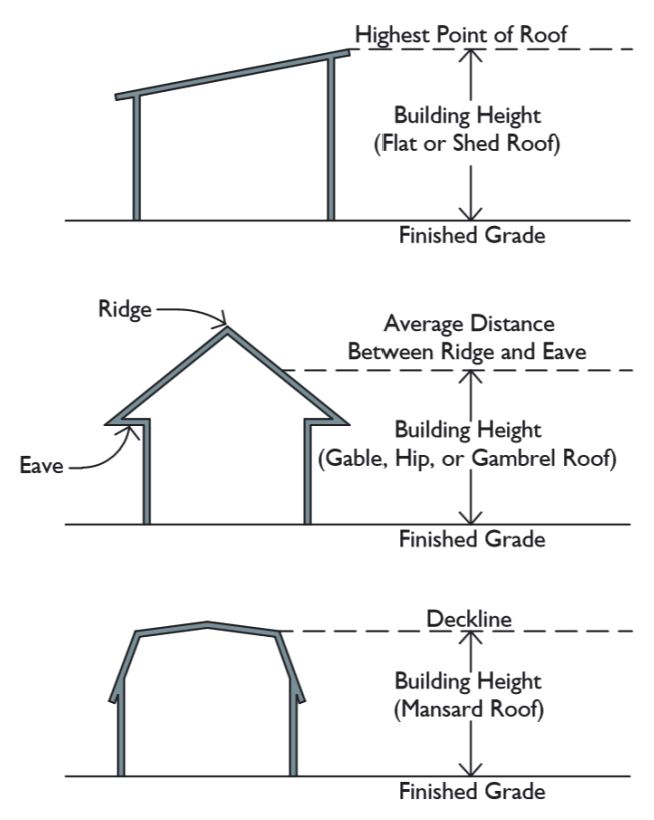
Height, building. The vertical distance to the highest point of the roof for flat roofs; to the deck of mansard roofs; and to the average height between eaves and the ridge for gable, hip, and gambrel roofs, measured from the curb level if the building is not more than 10 feet from the front lot line or from the average elevation of the finished grade surrounding the structure in all cases.
Heliport. A place used exclusively for the landing and takeoff of helicopters, together with appurtenant buildings and facilities. The heliport accommodates helicopters used by individuals, corporations and helicopter air tax services. Also known as a general aviation heliport.
Highest adjacent grade. The highest natural elevation of the ground surface, prior to construction, adjacent to the proposed foundation of a building.
Historic structure. Any structure that is:
A.
Listed individually in the National Register of Historic Places (a listing maintained by the U.S. Department of Interior) or preliminarily determined by the Secretary of the Interior as meeting the requirements for individual listing on the National Register;
B.
Certified or preliminarily determined by the Secretary of the Interior as contributing to the historical significance of a registered historic district or a district preliminarily determined by the Secretary to qualify as a registered historic district;
C.
Individually listed on a state inventory of historic places and determined as eligible by states with historic preservation programs which have been approved by the Secretary of the Interior; or
D.
Individually listed on a local inventory of historic places and determined as eligible by communities with historic preservation programs that have been certified either:
1)
By an approved state program as determined by the Secretary of the Interior, or
2)
Directly by the Secretary of the Interior in states without approved programs.
Home occupation. Any activity carried out for profit by the resident and conducted as an accessory use in the resident's principal dwelling unit.
Hospital authority. Shall have the same meaning as set forth in O.C.G.A. § 31-7-72, as amended.
Hospital. Any building, facility, or place in which are provided two or more beds and other facilities and services that are used for persons received for examination, diagnosis, treatment, surgery, or maternity care for periods continuing for 24 hours or longer and which is classified by the Department of Human Resources of the State of Georgia as a hospital.
Host home. A private residence or dwelling in a residential area in which the occupant-owner or lessee provides housing and provides or arranges for the provision of food, one or more personal services, supports, care, or treatment exclusively for one or two persons who are not related to the occupant-owner or lessee by blood or marriage, all as more specifically defined and described under the provisions of O.C.G.A. § 37-1-20, as amended from time to time. A Host Home shall comply with all requirements of O.C.G.A. Tit. 37, as well as other applicable state law, including all regulations promulgated by the Georgia Department of Behavioral Health and Developmental Disabilities. The owner-operator of any host home shall provide a copy of any contract or agreement he or she has with the applicable state agency (or its designee) to operate the host home to the zoning administrator for its records.
Hotel. An establishment with guest rooms or suites that are directly accessed from an enclosed interior lobby and are rented to the general public for transient lodging. A hotel may or may not have kitchen facilities. These establishments include resort hotels that do not have gambling services. They may also offer food services, recreational services, convention hosting services, laundry services, etc. and may provide accessory guest facilities such as swimming pools, tennis courts, indoor athletic facilities, accessory retail uses, etc. This definition does not include motels (see "Motel.")
Hotspot. An area where the use of the land has the potential to generate highly contaminated runoff, with concentrations of pollutants in excess of those typically found in standard or normal stormwater runoff.
Hydrologic soil group (HSG). A natural resource conservation service classification system in which soils are categorized into four runoff potential groups. The groups range from Group A soils, with high permeability and little runoff produced, to Group D soils, which have low permeability rates and produce much more runoff.
I
Illegal discharge. Any direct or indirect non-stormwater discharge to the storm drain system, except as exempted in Section 3.06.00 of this UDC.
Illicit connection. Means any one of the following:
A.
Any drain or conveyance, whether on the surface or subsurface, which allows an illegal discharge to enter the storm drain system, including but not limited to any conveyances which allow any non-stormwater discharge (including sewage, processed wastewater, and wash water) to enter the storm drain system and any connections to the storm drain system from indoor drains and sinks, regardless of whether said drain or connection had been previously allowed, permitted, or approved by an authorized enforcement agency; or
B.
Any drain or conveyance connected from a commercial or industrial land use to the storm drain system which has not been documented in plans, maps, or equivalent records and approved by an authorized enforcement agency.
Impervious cover. A surface composed of any material that significantly impedes or prevents the natural infiltration of water into soil. Impervious surfaces include, but are not limited to, rooftops, buildings, decks, patios, swimming pools, streets and roads, and any concrete or asphalt surface.
Impervious surface. See "Impervious cover."
Incinerator. All devices intended or used for the reduction or destruction of solid, liquid or gaseous waste by burning. Includes the term "garbage or trash incinerator."
Indoor games or recreation facility. An establishment that provides indoor amusement and entertainment services for a fee or admission charge, including bowling alleys, ice skating and roller skating, pool and billiard rooms as primary uses, coin-operated amusement arcades, electronic game arcades (video games, pinball, etc.) and dance halls, clubs and ballrooms.
Industrial activity. Any activity subject to NPDES Industrial Permits as defined in 40 CFR, § 122.26(b)(14).
Industrial stormwater permit. A national pollutant discharge elimination system (NPDES) permit issued to an industry or group of industries which regulates the pollutant levels associated with industrial stormwater discharges or specifies on-site pollution control strategies.
Industrialized building. Any structure or component thereof which is designed, constructed and installed in compliance with the Georgia Industrialized Building Act (O.C.G.A. Title 8, Chapter 2, Article 2, Part 1) and the Rules of the Commissioner of the Georgia Department of Community Affairs for Industrialized Buildings and is wholly or in substantial part made, fabricated, formed, or assembled in manufacturing facilities for installation or assembly and installation on a building site and has been manufactured in such a manner that all parts or processes cannot be inspected at the installation site without disassembly, damage to, or destruction thereof. See also "Residential industrialized building."
Infiltration. The process of percolating stormwater runoff into the subsoil.
Injurious. In terms of light, noise or other attributes, an effect on the comfort or enjoyment of property such that the sufferer is subjected to a deprivation or hardship as balanced against the ability of the landowner (of the land upon which the attribute originates) to take action to confine the effects of the attribute. This term shall be synonymous to the term "annoying" and may be referred to in this UDC as an "attribute."
Inspection and maintenance agreement. A written agreement providing for the long-term inspection and maintenance of stormwater management facilities and practices on a site or with respect to a land development project which, when properly recorded in the deed records, constitutes a restriction on the title to a site or other land involved in a land development project.
Install. For the purpose of manufactured home installation, the term "install" shall be defined as follows: To construct a foundation system and to place or erect a manufactured home on such foundation system. Such term includes, without limitation, supporting, blocking, leveling, securing, or anchoring such manufactured home and connecting multiple or expandable sections of such manufactured home.
J
Junk. Wrecked or inoperative (whether repairable or not) motor vehicle(s), scrap copper, scrap brass, scrap rope, scrap glass, scrap rags, scrap metal, scrap paper, scrap batteries, scrap appliances, scrap beds and bedding, scrap rubber, scrap tires, scrap motor vehicle parts, scrap furniture, scrap wood, scrap building materials, scrap tools or other used materials that have been abandoned from their original use but may or may not be used again in their present form or in a new form.
Junkyard. Any outside use involving the storing, disposal, buying or selling of junk that can be viewed from other property, public streets or public roads.
Jurisdictional wetland determination. A delineation of jurisdictional wetland boundaries by the U.S. Army Corps of Engineers, as required by Section 404 of the Clean Water Act, 33 U.S.C. § 1344, as amended.
Jurisdictional wetlands. An area that meets the definitional requirements for wetlands as determined by the U.S. Army Corps of Engineers. For the purposes of Section 3.07.00, the term "jurisdictional wetlands" shall be defined as an area that is inundated or saturated by surface water or groundwater at a frequency and duration sufficient to support a prevalence of vegetation typically adapted for life in saturated soil conditions, commonly known as hydrophytic vegetation.
K
Kennel. Any land designated or arranged for the boarding and care of more than five dogs or five cats (under eight week old pups and kittens shall be excluded from such count) that is not completely enclosed. A kennel may be either commercial or noncommercial.
L
Laboratory or specialized industrial facility. A laboratory or unique and specialized light industrial structure. Testing laboratories perform physical, chemical, and other analytical testing services, such as acoustics or vibration testing, assaying, biological testing (except medical and veterinary), calibration testing, electrical and electronic testing, geotechnical testing, mechanical testing, nondestructive testing, or thermal testing.
Land development activities. Those actions or activities which comprise, facilitate or result in land development.
Land development project. A discrete land development undertaking.
Land development. Any land change, including, but not limited to, clearing, digging, grubbing, stripping, removal of vegetation, dredging, grading, excavating, transporting and filling of land, construction, paving, and any other installation of impervious cover.
Land-disturbing activity. Any activity which may result in soil erosion from water or wind and the movement of sediments into state waters or onto lands within the state, including, but not limited to, clearing, dredging, grading, excavating, transporting, and filling of land but not including agricultural practices as described in Section 3.02.00 of this UDC.
Landfill. A disposal site employing an engineering method of disposing of solid waste in a manner that minimizes environmental hazards by spreading or applying cover materials over all exposed waste at intervals. The term "landfill" shall be synonymous with the term "sanitary landfill."
Large water supply watershed. A watershed containing 100 square miles or more of land within the drainage basin upstream of a governmentally owned public drinking water supply intake.
Larger common plan of development or sale. A contiguous area where multiple separate and distinct construction activities are occurring under one plan of development or sale. For the purposes of this paragraph, "plan" means an announcement; piece of documentation such as a sign, public notice or hearing, sales pitch, advertisement, drawing, permit application, zoning request, or computer design; or physical demarcation such as boundary signs, lot stakes, or surveyor markings, indicating that construction activities may occur on a specific plot.
Lawful use. A use which complies with all federal, state and county laws, ordinances, regulations and statutes as interpreted by the appellate courts.
Liquid product (non-water) storage. Tanks that primarily store fuel, oil, and other liquid products (except water). Also known as a tank farm.
Livestock. Any animal, including, but not limited to, cattle (both dairy and beef cattle), elk, reindeer, bison, horses, deer, sheep, goats, mules, donkeys, swine, poultry (including the Gallus domesticus chicken and other egg producing poultry), llamas, alpacas, emu, ostrich and any other domesticated animal ordinarily kept or raised on farms primarily for agricultural purposes.
Local issuing authority. The Catoosa County Board of Commissioners or its assigned or designated representative, which shall be responsible for administering Section 3.02.00 of this UDC and which is certified pursuant to subsection (a) O.C.G.A. § 12-7-8.
Lot. A portion or tract of land devoted to a common use, or occupied by a building or group of buildings devoted to a common use together with the customary accessories and open spaces belonging to the same that meets the minimum requirements for lot size depending upon the use as set forth in in this UDC.
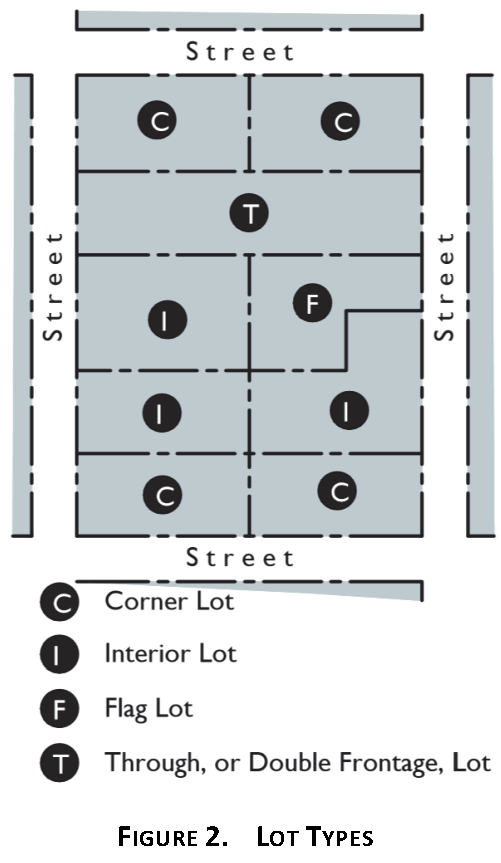
Corner lot. A lot abutting upon two or more streets at their intersection.
Double-frontage lot ("Through lot"). A lot that fronts on two parallel streets or that fronts on two streets that do not intersect at the boundaries of the lot.
Flag lot. A lot not meeting minimum frontage requirements with access provided to the bulk of the lot by means of a narrow corridor.
Interior lot. A lot having frontage on only one street.
Reverse frontage lot. A through lot with frontage on two parallel streets with vehicular access restricted to only one of the streets.
Lot depth. The mean horizontal distance between the front and rear lot lines, measured in the general direction of the side lot lines.
Lot frontage. The length of the front lot line measured at the street right-of-way line.
Lot line. The boundary dividing a given lot from the street or adjacent lots.
Front lot line. The lot line that abuts a street. A lot adjacent to more than one street will have more than one front lot line.
Rear lot line. The lot line that does not intersect with a street right-of-way line and is not a front lot line.
Side lot line. The lot line that intersects with a street right-of-way line and is not a front lot line.
Lot width. The width of the lot at the building line measured parallel to the street right-of-way or in the case of a curvilinear street parallel to the chord of the arc between the intersection of the side lot lines and the street right-of-way line.
Lot of record. A lot whose existence, location and dimension have been legally recorded or registered in a deed or on a plat.
Lowest floor. The lowest floor of the lowest enclosed area, including basement. An unfinished or flood resistant enclosure, used solely for parking of vehicles, building access, or storage, in an area other than a basement, is not considered a building's lowest floor, provided that such enclosure is not built so as to render the structure in violation of other provisions of this UDC.
Lumber yard. An area and structures used for the storage, distribution, and sale of finished or rough-cut lumber and lumber products.
M
Major traffic corridor. A roadway with Georgia DOT traffic counts above 2,000 per day (both directions).
Manufactured home park or subdivision. A parcel (or contiguous parcels) of land divided into two or more manufactured home lots for rent or sale.
Manufactured home. A structure, transportable in one or more sections, which, in the traveling mode, is eight body feet or more in width or 40 body feet or more in length or, when erected on site, is 320 or more square feet and which is built on a permanent chassis and designed to be used as a dwelling with or without a permanent foundation when connected to the required utilities and includes the plumbing, heating, air conditioning, and electrical systems contained therein; except that such term shall include any structure which meets all the requirements of this paragraph except the size requirements and with respect to which the manufacturer voluntarily files a certification required by the secretary of housing and urban development and complies with the standards established under the National Manufactured Housing Construction and Safety Standards Act of 1974, 42 U.S.C. Section 5401, et seq. This definition excludes travel trailers, recreational vehicles and mobile homes.
Pre-owned manufactured home. Any manufactured home that has been previously used as a residential dwelling and has been titled.
Manufactured house. See "Manufactured home."
Manufacturing. Establishments engaged in the mechanical or chemical transformation of materials or substances into new products, including the assembling of component parts, the creation of products, and the blending of materials. Categories of manufacturing include the following:
Manufacturing—Food, textiles and related products. Manufacturing establishments that produce or manufacture: food products for intermediate or final consumption in a process that primarily uses raw materials from livestock or agricultural products; nonalcoholic and fermented and distilled alcoholic beverages; ice; tobacco products; textiles and apparel; and leather and leather substitute (such as rubber, plastics or textiles) products.
Manufacturing—Wood, paper and printing products. Manufacturing establishments that manufacture: wood and paper products, such as lumber, plywood, veneers, wood containers, wood flooring, wood trusses, and prefabricated wood buildings; paper, pulp or converted paper products, such as paper bags; printed materials, such as newspapers, books, periodicals, and greeting cards; and furniture and related articles, such as mattresses, windows blinds, cabinets, fixtures, furniture parts, and frames.
Manufacturing—Chemicals and adhesives. Manufacturing establishments that transform or refine chemicals, that manufacture products from chemicals, or that manufactures adhesives. These establishments manufacture: petroleum and coal products (by transforming crude petroleum and coal into usable products); chemicals, plastics, and rubber products; nonmetallic mineral products such as bricks, refractories, ceramics, glass, cement, concrete, lime, gypsum, abrasives, ceramic plumbing fixtures, statuary, cut stone products, and mineral wool. These establishments include, but are not limited to, asphalt plants, concrete plants, cement plants, and glue factories.
Manufacturing—Metals, machinery and electronics. Manufacturing establishments that transform or refine metals or that that manufacture products from metals. These establishments manufacture: basic metal products, such as ingot, billet, sheets, strips, bars, rods, wires, and castings, or finished products (by smelting/refining and transforming metal); products that apply mechanical force, such as machinery for agriculture, construction, mining, ventilation, industrial/commercial heating and cooling, and metalworking; electrical equipment, appliance, and components manufacturing, such as computers, computer peripherals, communications equipment, audio equipment, lighting equipment, batteries, motors, and other products that generate, distribute and use electrical power; and equipment for transporting people and goods, such as automobiles.
Manufacturing—Miscellaneous. Manufacturing establishments that manufacture products not classified elsewhere, such as: jewelry and silverware; dolls, toys, games and musical instruments; office supplies (excluding paper); and signs.
Marina. Docking and storage facilities for pleasure craft owners. A marina may retail fuel and marine supplies, and may repair, maintain, or rent pleasure boats in addition to operating facilities.
Mean sea level. The average height of the sea for all stages of the tide. It is used as a reference for establishing various elevations within the floodplain. For purposes of the Flood Damage Prevention section in Article III of this UDC, the term is synonymous with National Geodetic Vertical Datum (NGVD).
Metropolitan River Protection Act (MRPA). A state law referenced as O.C.G.A. § 12-5-440 et seq. which addresses environmental and developmental matters in certain metropolitan river corridors and their drainage basins.
Miniature golf. Indoor or outdoor novelty golf game played on a miniature course. These establishments are distinct from golf courses.
Mobile home. A structure, transportable in one or more sections, which, in the travelling mode, is eight body feet or more in width, or 40 body feet or more in length or, when erected on site, is 320 or more square feet, and is built on a permanent chassis and designed to be used as a dwelling with or without a permanent foundation when connected to the required utilities and includes the plumbing, heating, air-conditioning, and electrical systems contained therein and manufactured prior to June 15, 1976.
Modular home. See "Residential industrialized building."
Motel. An establishment with guest rooms or suites that are directly accessed from an exterior walkway and are rented to the general public for transient lodging. A motel may or may not have kitchen facilities. They may also offer food services, recreational services, convention hosting services, laundry services, etc. and may provide accessory guest facilities such as swimming pools, tennis courts, indoor athletic facilities, accessory retail uses, etc. This definition includes tourist courts.
Motor speedway. See "Racetrack."
Motor vehicle. Every vehicle which is self-propelled, except trackless trolleys, which are classified as streetcars.
Movie theater. See "Theater, movie."
Multi-family. See "Multi-family dwelling" under "Dwelling."
Museum or exhibition facility. Establishments that present displays of natural, historic, educational, or cultural interest such as: exhibitions and art galleries; planetariums; aquariums; and outdoor facilities without a major structure.
N
National Geodetic Vertical Datum (NGVD). As corrected in 1929 is a vertical control used as a reference for establishing varying elevations within the floodplain.
National Pollutant Discharge Elimination System (NPDES) Stormwater Discharge Permit. A permit issued by the United States Environmental Protection Agency (or by a state under authority delegated pursuant to 33 U.S.C. §1342(b) that authorizes the discharge of pollutants to waters of the United States, whether the permit is applicable to the activities of an individual, group, or on a general, area-wide basis.
Natural ground surface. The ground surface in its original state before any grading, excavation or filling.
Neighboring property(ies). Properties adjacent to or nearby the property which is the subject of regulation, rezoning, variance or other similar zoning action.
Nephelometric turbidity units (NTU). Numerical units of measure based upon photometric analytical techniques for measuring the light scattered by finely divided particles of a substance in suspension. This technique is used to estimate the extent of turbidity in water in which colloidally dispersed or suspended particles are present.
New construction. Means, for the purposes of determining insurance rates, structures for which the "start of construction" commenced after September 28, 1979, and includes any subsequent improvements to such structures. For floodplain management purposes, "new construction" means structures for which the "start of construction" commenced after March 12, 1987, and includes any subsequent improvements to such structures.
New development. A land development activity on a previously undeveloped site.
New manufactured home park or subdivision. A manufactured home park or subdivision for which the construction of facilities for servicing the lots on which the manufactured homes are to be affixed (including at a minimum, the installation of utilities, the construction of streets, and either final site grading or the pouring of concrete pads) is completed on or after March 12, 1987.
NOI. A notice of intent form provided by EPD for coverage under the state general permit.
Nonconforming lot. A lot of record whose area, frontage, width or other dimensions, or location were lawful prior to the adoption or amendment of this UDC, and which, by reason of such adoption or amendment, no longer meets or exceeds one or more such requirements of the applicable zoning district.
Nonconforming sign. A sign that was lawfully erected and maintained prior to the adoption or amendment of this Development Code, and which by reason of such adoption or amendment fails to conform to all applicable regulations and restrictions of this UDC.
Nonconforming structure. A structure or building whose size, dimensions, location on a property or other features were lawful prior to the adoption or amendment of this UDC, but which, by reason of such adoption or amendment, no longer meets or conforms to one or more such requirements of this UDC.
Nonconforming use. A use or activity that was lawfully established prior to the adoption or amendment of this UDC, but which, by reason of such adoption or amendment, is no longer a use or activity permitted by right or no longer meets or conforms to the requirements of this UDC.
Non-point source pollution. A form of water pollution that does not originate from a discrete point such as a sewage treatment plant or industrial discharge, but involves the transport of pollutants such as sediment, fertilizers, pesticides, heavy metals, oil, grease, bacteria, organic materials and other contaminants from land to surface water and groundwater via mechanisms such as precipitation, stormwater runoff, and leaching. Non-point source pollution is a by-product of land use practices such as agricultural, silvicultural, mining, construction, subsurface disposal and urban runoff sources.
Non-stormwater discharge. Any discharge to the storm drain system that is not composed entirely of stormwater.
Nonstructural stormwater management practice or nonstructural practice. Any natural or planted vegetation or other nonstructural component of the stormwater management plan that provides for or enhances stormwater quantity and/or quality control or other stormwater management benefits, and includes, but is not limited to, riparian buffers, open and greenspace areas, overland flow filtration areas, natural depressions, and vegetated channels.
North American Vertical Datum (NAVD). As corrected in 1988 is a vertical control used as a reference for establishing varying elevations within the floodplain.
NOT. A notice of termination form provided by EPD to terminate coverage under the state general permit.
Nuisance. A nuisance is defined as provided in O.C.G.A. §§ 41-1-6 and 41-1-1 as anything that causes hurt, inconvenience, or damage to another and which tends to annoy the community, or injure the health of the citizens in general, or corrupt the public morals; provided, for the purposes of this code that a nuisance shall be only that which is directly related to junk; junk cars; keeping of non-domesticated animals in a residential zone; noise that is not caused by an animal; visual clutter; illegal filling of land; a nonconforming use in a district; dilapidated structures; or discharge of stormwater or soil or sediments onto county roads or right-of-ways which constitute a potential danger to motorists.
Nursing home. Any facility that primarily provides skilled nursing care and related services to residents who require medical or nursing care; rehabilitation services to the injured, disabled, or sick; or on a regular basis, health care and services to individuals who because of their mental or physical condition require care and services (above the level of room and board) which is available to them only through these facilities, and is not primarily for the care and treatment of mental diseases. Establishments are required to be licensed by the Georgia Department of Community Health. Also known as a rest home.
O
Off-site facility. A stormwater management facility located outside the boundaries of the site.
Open space. Any parcel or area of land or water that is permanently set aside though dedication, designation or reservation to remain in a natural state or to be improved for passive or active recreation.
Common open space. Open space within a development that is designed and intended for the common use by all residents within the development.
Greenspace. Permanently protected areas of a site that are preserved in a natural state.
Operator. The party or parties that have:
A.
Operational control of construction project plans and specifications, including the ability to make modifications to those plans and specifications.
B.
Day-to-day operational control of those activities that are necessary to ensure compliance with an erosion, sedimentation and pollution control plan for the site or other permit conditions, such as a person authorized to direct workers at a site to carry out activities required by the erosion, sedimentation and pollution control plan or to comply with other permit conditions.
Other property(ies). Property(ies) owned by persons other than the owner of the property which is the subject of the zoning use proposed.
Outdoor recreational sports facility. A facility providing various outdoor sports for fitness or recreational sports teams, clubs or individual activities, where the facilities are oriented more toward participants than spectators, such as: athletic/sports fields (baseball, football, softball, soccer, track and field, etc.); skateboard parks, swimming pools, and court sports (basketball, handball, squash, tennis, volleyball, racquetball, etc.) This definition does not include the terms "animal racetracks/event arenas" or "shooting ranges."
Outfall. The location where stormwater in a discernible, confined and discrete conveyance, leaves a facility or site or, if there is a receiving water on site, becomes a point source discharging into that receiving water.
Overbank flood protection. Measures taken to prevent an increase in the frequency and magnitude of out-of-bank flooding (i.e., flow events that exceed the capacity of the channel and enter the floodplain), and that are intended to protect downstream properties from flooding for the two-year through 25-year frequency storm events.
Owner. The legal or beneficial owner of a site, including, but not limited to, a mortgagee or vendee in possession, receiver, executor, trustee, lessee or other person, firm or corporation in control of the site; an individual, firm, association, syndicate, partnership, or corporation having sufficient proprietary interest to seek development of land.
P
Package store. An establishment licensed by Catoosa County to sell packaged alcoholic beverages in unbroken packages for off-premises consumption and where the sale of alcoholic beverages in unbroken packages comprises more than 50 percent of the licensee's annual gross sales and where the sale of nonalcoholic items is incidental to the business of the licensee at that location.
Pain management clinic. Shall mean either:
A.
Any entity, location, or business regardless of the name of the entity and regardless of the name displayed for the general public, which fulfills all of the following criteria:
1)
A privately owned clinic, medical practice, business, entity, or office;
2)
Which is owned by one or more persons or other business entity;
3)
The intention of which is for it to be operated for a profit;
4)
That is not affiliated with any of the following:
a.
Any facility for the treatment of the terminally ill; or,
b.
A hospital authority; or
c.
A non-profit health organization; or
d.
Any hospice; or
e.
Any hospital; and,
5)
Which employs one or more physicians who are primarily engaged in the treatment of pain by prescribing pain medicine; or,
B.
Any entity, location, or business regardless of the name of the entity and regardless of the name displayed for the general public, which fulfills all of the following criteria:
1)
Any clinic, medical practice, business, entity or office;
2)
Which dispenses schedule II, III, or IV drugs. Excluded from this definition is an entity engaged in the practice of pharmacy which derives less than 25 percent of its gross revenue from the sales of schedule II, III, or IV drugs; hospitals; physician groups owned or operated by a health care system; surgery centers; in-patient care facilities; assisted living facilities; outpatient facilities owned or operated by a hospital system; any facility owned or operated by a hospital authority; any rehabilitation center where a portion of the patients reside at the center; any nursing home where a portion of the patients reside at the nursing home, and drug addiction treatment centers.
Perennial stream. A stream that flows throughout the whole year as indicated on a USGS Quad map.
Performance theater. See "Theater, performance."
Permit. The authorization necessary to conduct a land-disturbing or land development activity under the provisions of this UDC.
Person (Roads, Obstruction or Blocking of Streets, Roads and Highways). Any individual, partnership, corporation, firm, association, joint venture, trust, estate, commission, board, institution, or any other legal entity, except where the context clearly indicates a different meaning.
Person. Any individual, trust, firm, joint stock company, corporation, partnership, association, estate, state or municipal commission, board, public or private institution, utility, cooperative, political subdivision of the state (excluding Catoosa County), any interstate body or any other legal entity.
Personal care home. Any dwelling, whether operated for profit or not, which undertakes through its ownership or management to provide or arrange for the provision of housing, food service, and one or more personal services for two or more ambulatory adults who are not related to the owner or administrator by blood or marriage and who are not mentally ill persons posing a danger to others. Establishments are required to be licensed by the Georgia Department of Community Health.
Congregate personal care home. A home for adults which offers care to three to 25 persons.
Family personal care home. A home for adults in a residence, non-institutional in character, which offers care to up to two persons.
Personal care services. Establishments providing non-medical services involving the care of a person or his or her personal goods or apparel. These establishments include: barber and beauty shops; tailor and dressmaker shops; shoe repair; coin-operated laundromats; dry cleaning pick-up stores; massage therapy services that are licensed in accordance with the Georgia Massage Therapy Practice Act; locksmiths; clothing rental stores; and tanning salons that are registered in accordance with O.C.G.A. Title 31 Chapter 38. The term "personal care services" also includes establishments that sell health and personal care merchandise from a fixed point-of-sale location, including pharmacy or drug stores, cosmetic and beauty supply stores, and optical stores.
Pet or pet supply store. An establishment that sells pets, pet foods, and other pet supplies. Does not include the sale of animals for farming purposes.
Phase or phased. Sub-parts or segments of construction projects where the sub-part or segment is constructed and stabilized prior to completing construction activities on the entire construction site.
Place of worship. A permanent freestanding building located in an area designated for such use by the UDC where persons regularly assemble for religious worship, which shall be publicly designated as a religious facility, but does not include a residence or place of business also used for religious purposes. Includes churches, synagogues, temples, mosques or other facilities where persons regularly assemble for religious worship.
Planned unit development (PUD). A planned development without regard to the customary lot size requirements or the segregation of housing types or uses and which may include multiple zones within the same tract.
Planning Commission. The Catoosa County Planning Commission.
Plant nursery. An establishment that grows food crops of any kind under cover or grows nursery stock (including shrubbery, bulbs, fruit stock, and sod) and flowers. "Under cover" is generally defined as greenhouses, cold frames, cloth houses, and lath houses. The crops grown are removed at various stages of maturity and have annual and perennial life cycles. The nursery stock includes short rotation woody crops that have growth cycles of 10 years or less. This definition includes greenhouses.
Plat. A map, plan or layout of a county, city, town, lot, section, subdivision or development indicating the location and boundaries of properties.
Platted lot. A lot designated on a plat which has been duly recorded in the clerk of superior court's office of Catoosa County, showing the division of land into lots, streets and areas, marked upon the earth, and represented on paper.
Pollutant. Anything which causes or contributes to pollution. Pollutants may include, but are not limited to paints; varnishes, and solvents; oil and other automotive fluids; non-hazardous liquid and solid wastes and yard wastes; refuse, rubbish, garbage, litter, or other discarded or abandoned objects, ordinances, and accumulations, so that same may cause or contribute to pollution; floatables; pesticides, herbicides, and fertilizers; hazardous substances and wastes; sewage, fecal coliform and pathogens; dissolved and particulate metals; animal wastes; wastes and residues that result from constructing a building or structure; and noxious or offensive matter of any kind.
Pollution susceptibility. The relative vulnerability of an aquifer to being polluted from spills, discharges, leaks, impoundments, applications of chemicals, injections and other human activities in the recharge area.
Pollution susceptibility map. The relative vulnerability to pollution prepared by the department of natural resources, using the DRASTIC methodology. (Georgia Department of Natural Resources Hydrologic Atlas 20: Groundwater Pollution Susceptibility Map of Georgia.)
Post-development. Refers to the time period, or the conditions that may reasonably be expected or anticipated to exist, after completion of the land development activity on a site as the context may require.
Poultry production. Breeding, hatching or raising poultry for meat or egg production for commercial purposes. Breeding, hatching or raising poultry for meat or egg production for personal uses for a property owner and his or her immediate family shall not be considered "poultry production" under this Code but is otherwise regulated under Section 2.05.00 of this Code.
Predevelopment. Refers to the time period, or the conditions that exist, on a site prior to the commencement of a land development project and at the time that plans for the land development of a site are approved by the plan approving authority. Where phased development or plan approval occurs (preliminary grading, roads and utilities, etc.), the existing conditions at the time prior to the first item being approved or permitted shall establish predevelopment conditions.
Premises. Any building, lot, parcel of land, or portion of land, whether improved or unimproved, including adjacent sidewalks and parking strips.
Pre-owned manufactured home. See under "Manufactured home."
Principal use. Primary purpose for which land or a building is used.
Private club. An establishment engaged in promoting the interests of its members, who are affiliated with a nationally chartered organization, either service, athletic or charitable; usually characterized by certain membership qualifications, payment of fees and dues, regular meetings, and a constitution and bylaws. Establishments may operate bars and restaurants for their members as an incidental use in accordance with the requirements of Article 6 Alcoholic Beverages of the Catoosa County Code of Ordinances.
Private road. Any one-way or two-way road for ingress and/or egress not for use by the general public that serves two or more properties.
Professional office. A building or space within a building for office-type use, such as: finance and insurance establishments (including bank, credit union, or savings institution; credit and finance establishment; investment banking, securities, and brokerage establishment; insurance-related establishment; and, fund, trust, or other financial establishment); real estate and property management services; business, professional, scientific, and technical services (including legal services; accounting, tax, bookkeeping, payroll services; architectural, engineering, and related services; graphic, industrial, and interior design services; consulting services; research and development services; advertising, media and photography services); and, administrative services (including facilities support services; employment agency; business support services; collection agency; travel arrangement and reservation services; investigation and security services). This definition does not include "Services to buildings and dwellings."
Project. A land development project; the entire proposed development project regardless of the size of the area of land to be disturbed.
Properly designed. Designed in accordance with the design requirements and specifications contained in the "Manual for Erosion and Sediment Control in Georgia" (manual) published by the Georgia Soil and Water Conservation Commission (GSWCC) as of January 1 of the year in which the land-disturbing activity was permitted and amendments to the manual as approved by the GSWCC up until the date of NOI submittal.
Public road. Any road, street, highway, thoroughfare or other way of passage that has been irrevocably dedicated to the public or in which the public has acquired rights by prescription, without regard to whether it is open for travel.
Q
Quad-plex. A building containing four dwelling units, and each unit has two open-space exposures and shares one or two walls with adjoining unit or units.
R
Racetrack. Any facility located within the boundaries of Catoosa County, Georgia, which has as its primary purpose the conducting of motor vehicle races and practice laps, which include, but are not limited to, drag races, stock car races, dirt track races or any other race which involves a motor vehicle, as well as any practice track for motor vehicles. Includes the terms "motor speedway," "automobile race track," "motorcycle race track," "motocross track," and "supercross track."
Railroad facility. Includes railroad switching facilities and railroad sheds and other support structures.
Recharge area. Any portion of the earth's surface, where water infiltrates into the ground to replenish an aquifer.
Recorded plat. A plat recorded in the office of the clerk of the superior court of Catoosa County.
Recreational vehicle (RV). A vehicle, which is:
A.
Built on a single chassis;
B.
Four hundred square feet or less when measured at the largest horizontal projection;
C.
Designed to be self-propelled or permanently towable by a light duty truck; and
D.
Designed primarily not for use as a permanent dwelling but as temporary living quarters for recreational, camping, travel, or seasonal use.
Recycling collection point. An incidental use that serves as a neighborhood dropoff point for temporary storage for recoverable resources. No processing of such items would be allowed. This facility would generally be located in a shopping center parking lot or in other public/quasi-public areas such as those at churches and schools.
Recycling plant. A facility that is not solely a landfill in which recoverable resources or products (such as paper, plastic, glass or metal) are recycled, compressed, reprocessed or treated to begin to return such product to a condition in which it may again be used for production
Redevelopment. A land development project on a previously developed site, but excludes ordinary maintenance activities, remodeling of existing buildings, resurfacing of paved areas, and exterior changes or improvements which do not materially increase or concentrate stormwater runoff, or cause additional non-point source pollution.
Regional stormwater management facility or regional facility. Stormwater management facilities designed to control stormwater runoff from multiple properties, where the owners or developers of the individual properties may assist in the financing of the facility, and the requirement for on-site controls is either eliminated or reduced.
Regulated activity. For the purpose of wetland protection, the term "regulated activity" shall be defined as activity which will, or which may reasonably be expected to, result in the discharge of dredged or fill material into waters of the U.S. excepting those activities exempted in Section 404 of the Federal Clean Water Act.
Reservoir boundary. The edge of a water supply reservoir defined by its normal pool level.
Residential industrialized building. An industrialized building that is a dwelling unit designed and constructed in compliance with the Georgia State Minimum Standard One and Two Family Dwelling Code which is wholly or in substantial part, made, fabricated, formed, or assembled in a manufacturing facility and cannot be inspected at the installation site without disassembly, damage to, or destruction thereof. Any such structure shall not contain a permanent metal chassis and shall be affixed to permanent load-bearing foundation. The term shall not include manufactured homes as defined by the National Manufactured Housing Construction and Safety Standards Act of 1974, 42 U.S.C. Section 5401, et seq. The term "residential industrialized building" shall be synonymous with the term "modular home."
Retail sales. Indoor establishments engaged in a sales and service use in which household or personal items are rented or sold in small quantities and not in bulk, and in stores that are designed to attract a high volume of walk-in customers. Product lines often include: apparel, books, paint, cosmetics, photographic equipment, jewelry, toys, art supplies, flowers, cellular phones, and dry goods. Items tend to be smaller than those provided by establishments selling or renting heavy consumer goods. Definition does not include adult entertainment businesses.
Retail sales - Heavy consumer goods. Establishments engaged in a sales and service use in which household or personal items tend to be larger and there are more varied product lines and services, when compared to "Retail sales" establishments. In addition, products may be sold in bulk. Establishments that provide heavy consumer goods often include department stores, warehouse clubs, superstores, electronics and appliances stores, furniture or home furnishing stores, hardware stores or home centers, heating and plumbing equipment sales, lawn and garden supply stores, and lumber yards and building material sales.
Department store, warehouse club or superstore. An establishment that offers a large variety of goods from a single location. Products may include: apparel; furniture, appliances and home furnishings, paint, hardware, toiletries, cosmetics, photographic equipment, jewelry, toys, sporting goods and groceries.
Electronics and appliances stores. An establishment that offers electronics and appliance merchandise from point-of-sale locations and may offer maintenance and repair services. Products sold at these establishments include household-type appliances, cameras, televisions, stereos, and other electronic goods. These establishments often sell computer hardware and software along with other lines of merchandise. Does not include "computer and software stores," "camera and photographic supplies stores," and "cellular telephone stores."
Furniture or home furnishing store. An establishment that offers furnishings such as: baby furniture; outdoor furniture; office furniture (except those sold in combination with office supplies and equipment); floor coverings (rugs, carpets, vinyl floor coverings, and floor tile not only ceramic or wood); and window treatments (curtains, drapes, blinds, and shades). Some of these items may be sold in combination with major appliances or home electronics, or in combination with installation and repair services.
Hardware store or home center. An establishment that offers materials and supplies for home building or repairs. They also sell other products, such as lumber, plumbing goods, electrical goods, tools, house wares, hardware, and, sometimes, lawn and garden supplies.
Heating and plumbing equipment sales. An establishment that sells heating and plumbing equipment. Does not include heating and plumbing contractors that retail and install or service equipment.
Lawn and garden supply store. An establishment that offers specialized products and services for lawn and garden. They come in two variations: a). Some sell new outdoor power equipment which may or may not be accompanied with repair services and replacement parts. b). Others sell nursery and garden products, such as trees, shrubs, plants, seeds, bulbs, and sod, that are predominantly grown elsewhere (these establishments may sell a limited amount of a product they grow themselves).
Building materials sales. An establishment that stores, distributes and sells finished or rough-cut lumber and lumber products in retail lumber yards; also sells other heavy building materials.
Reverse frontage lot. See under "Lot."
Rezoning. See "Zoning change."
Right-of-way line. The dividing line between a lot, tract or parcel of land and a contiguous road right-of-way.
Right-of-way. An area or strip of land either public or private on which a right of use has been recorded.
Road address. The combination of numbers and road names assigned by the county that identifies a particular building or lot
Roadway drainage structure. A device such as a bridge, culvert, or ditch, composed of a virtually non-erodible material such as concrete, steel, plastic, or other such material that conveys water under a roadway by intercepting the flow on one side of a traveled roadway consisting of one or more defined lanes, with or without shoulder areas, and carrying water to a release point on the other side.
Roof. The outside top covering of a building. See Figure 1.
Flat roof. A roof that is not pitched and the surface of which is generally parallel to the ground.
Gable roof. A ridged roof forming a gable at both ends of the building.
Gambrel roof. A gabled roof with two slopes on each side, the lower steeper than the other.
Hip roof. A roof with sloping ends and sides.
Mansard roof. A roof with two slopes on each of four sides, the lower steeper than the other.
Shed roof. A roof with one slope.
Roominghouse. See "Boardinghouse."
Runoff. Stormwater runoff.
S
Sailport. A site used exclusively for the landing and takeoff of a sailplane (glider); includes appurtenant buildings and facilities. A sailplane is an aircraft without an engine.
Sawmill. An establishment engaged in sawing dimension lumber, boards, beams, timbers, poles, ties, shingles, shakes, siding, and wood chips from logs or bolts. Sawmills may plane the rough lumber that they make with a planing machine to achieve smoothness and uniformity of size. Sawmills may include a woodyard.
Sediment. Solid material, both organic and inorganic, that is in suspension, is being transported, or has been moved from its site of origin by wind, water, ice, or gravity as a product of erosion.
Sedimentation. The process by which eroded material is transported and deposited by the action of water, wind, ice or gravity.
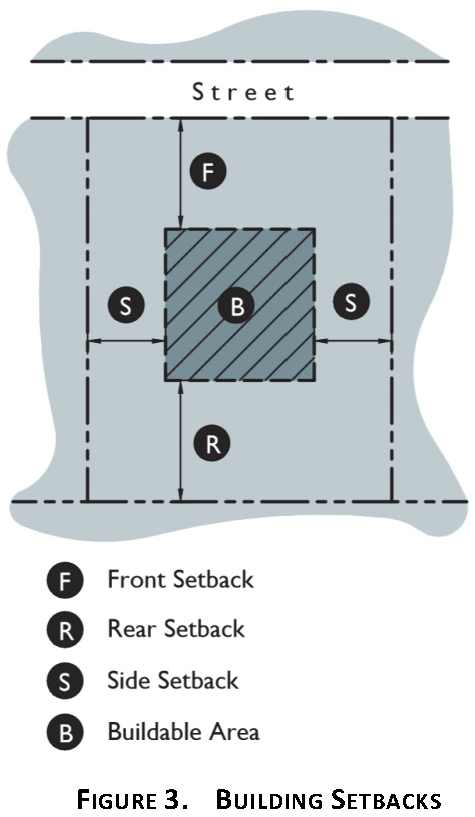
Sensitive use structure. Shall mean a church, building owned or leased by a school (public or private), governmentally owned and operated building, library building, civic center building, park, hospital building, community club building, prison building, jail building, building owned or leased by a hospital authority, or any residence.
Services to buildings and dwellings. Establishments that primarily provide services associated with building maintenance and that may require use of a vehicle fleet. Examples of these establishments include pest control and extermination services; janitorial services for building and transportation equipment interiors, as well as windows; landscaping services; carpet and upholstery cleaning; and packing, crating and convention trade show services, which package client owned materials and organize, promote, and manage events such as business and trade shows, conventions, conferences, and meetings.
Setback. The required minimum distance between the building line and the related right-of-way or side or rear property line.
Sexually oriented business. See "Adult entertainment establishment."
Sheriff. The Sheriff of Catoosa County, Georgia.
Shooting range, indoor. A totally enclosed facility that is designed to offer a controlled indoor sport shooting environment. Includes indoor gun ranges and indoor archery ranges.
Shooting range, outdoor. An outdoor facility that offers a controlled sport shooting environment and that provides protective natural or artificial barriers preventing bullets, shells, pellets or arrows from traveling to human occupied areas. Includes outdoor gun ranges and outdoor archery ranges.
Sign. Any display of words, shapes or images designed to convey a message to the viewer, located on the exterior of any building or structure, or located anywhere on a lot upon a dedicated supporting structure or device, including poles, banners, windows and similar devices. The following terms are defined for the purposes of Section 5.05.00 of this UDC:
Animated sign. Any sign, or part of a sign, that uses any movement or change of lighting or color to depict action or create a special effect or scene. This definition includes any signs that electronically change the sign face, whether by substitution of copy or scrolling.
Awning sign. Any sign that is part of, or attached to, an awning, canopy or other fabric, plastic or structural protective cover over a door, entrance, window, or outdoor service area. Includes the term "canopy sign."
Banner. Fabric or plastic signs which are not attached to any rigid frame. Flags of governmental jurisdictions are not banners.
Billboard. A type of pole sign with a sign face exceeding 288 square feet.
Billboard, interstate. A billboard within 660 feet of nearest edge of the right-of-way of Interstate 1-75 and is visible to persons in vehicles traveling in the through lanes of Interstate 75.
Billboard, non-interstate. A billboard on a parcel having frontage on a state route that is a part of the primary highway system operated by the Georgia Department of Transportation.
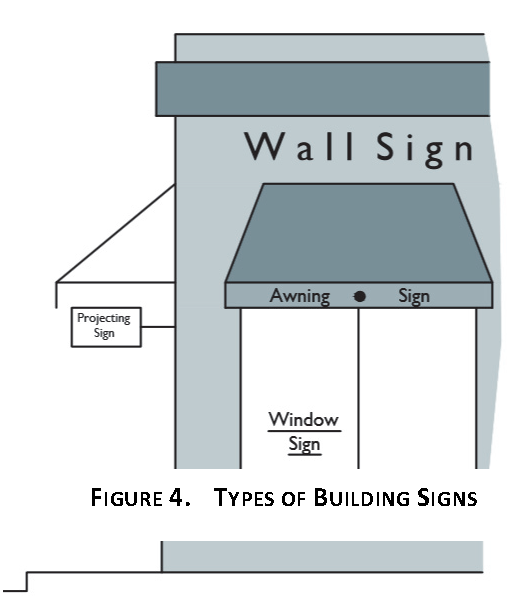
Building sign. A sign that in any manner is fastened to, projects from, or is placed or painted upon the exterior wall, window, or door of a building. The term "building sign" includes but is not limited to the following: awning sign, projecting sign, wall sign, and window sign.
Changeable copy sign. Letters, numerals, or other copy that may be manually affixed to and/or removed from a sign or that may be mechanically changed. Examples of manual changeable copy include boards with changeable letters or changeable pictorial panels. Mechanical changeable copy shall mean an "electronic sign." The definition does not include "multiple message signs."
Double-faced sign. A sign which has two display areas against each other, where one face is designed to be seen from one direction and the other face from another direction.
Electronic sign. A sign whose message may be changed at intervals by computer controller, microprocessor controller or by remote control, and whose message is displayed through the use of LED, LCD, plasma or other similar type of technology.
Freestanding sign. A sign supported by any structure or support placed in or anchored in the ground and not attached to any building or structure.
Ground sign. See "Monument sign."
Illuminated sign, external. A sign illuminated by an external light source that does not change color, flash or alternate.
Illuminated sign, internal. A sign illuminated by an internal light source that does not change color, flash or alternate.
Inflatable sign. Any sign inflated or supported internally by wind, air, or pneumatic noncombustible pressure.
LCD sign. An electronic sign utilizing liquid crystal diodes to form some or all of the sign message.
LED sign. An electronic sign utilizing light-emitting diodes to form some or all of the sign message.
Official flag. Any fabric, banner, or bunting containing distinctive colors, patterns or symbols, used as a symbol of a government.
Monument sign. A freestanding sign mounted directly upon the ground and not attached to or part of or supported by a building and designed in such a manner that the base of the sign face is flush with the supporting solid base which is flush with the ground. The base shall be at least as wide as the sign.
Multiple message sign. A sign, display, or device which changes the message or copy on the sign mechanically by movement or rotation of panels or slats. An example is a tri-vision sign. The definition does not include "changeable copy signs."
Pennant. Any lightweight plastic, fabric, or material, whether or not containing a message of any kind, suspended from a rope, wire, or string, usually in series, designed to move in the wind as a means of attracting attention. Flags of governmental jurisdictions are not pennants. Includes the term "streamer."
Permanent sign. Any sign that is not temporary.
Pole or pylon sign. A freestanding sign that is mounted on one or more poles, pylons, columns, or similar supports such that the bottom of the sign face or lowest sign module is not in contact with the ground.
Portable sign. Any sign attached to a vehicle, trailer, movable structure, or attached to sign structures which are not permanently anchored in the ground, or any sign which may be transported or is designed to be transported from one place to another. Such sign that has its wheels or supports removed and that is converted or attached, temporarily or permanently, to the ground or other structure shall be defined as a portable sign. Such signs include, but are not limited to, printed banners or signs attached to vehicles and trailers.
Projecting sign. A double faced sign suspended from an awning or similar type structure; or affixed to a bracket-mount to the building or structure. Includes the term "swinging sign."
Roof line. The top of a flat roof or the ridge of a gable, hip or gambrel roof.
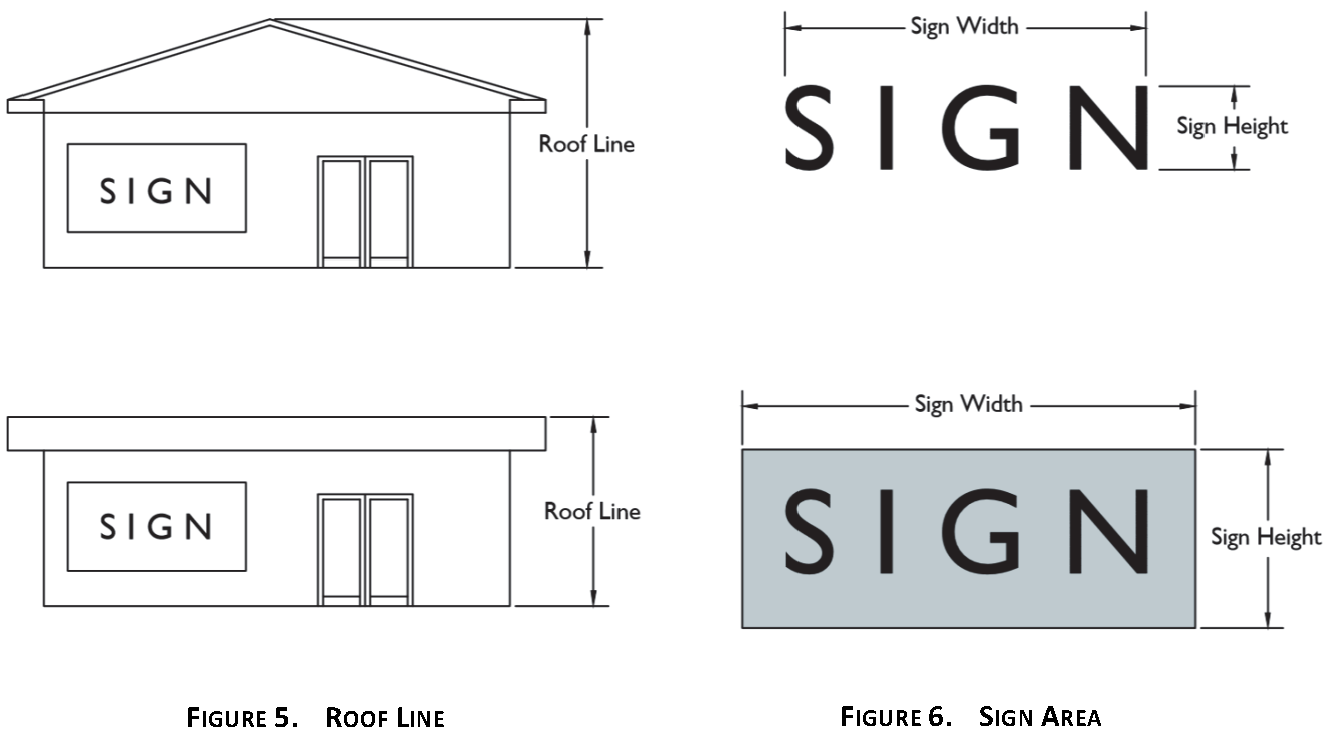
Roof sign. A sign erected upon or above a roof structure or that is wholly dependent upon a building for support and that projects above the top edge or roof line of a building with a flat roof, the eave line of a building with a gambrel, gable, or hip roof, or the deck line of a building with a mansard roof. A "roof sign" shall also constitute any signage placed upon sloped building fascia intended to appear as or actually be roof elements of the building.
Sign area. The area within a continuous perimeter of a sign which encloses the limits of writing, representation, emblem or any figure of similar character, together with any frame, other material, open space, or color forming an integral part of the display or used to differentiate such sign from the background against which it is placed.
Sign face. The message-carrying portion of the sign that can be used to display content, including any area that can display or does display words, pictures or other communicative elements of the sign, including the background color.
Sign structure. Includes all the elements of the sign, including its supporting structure, base, lights and every portion of the sign.
Swinging sign. See "Projecting sign."
Temporary sign. Any sign not permanently affixed to the ground or other permanent structure and designed to be displayed for a limited time.
Tri-vision sign. A sign designed with a series of triangular slats, panels or columns that mechanically rotate in sequence with one another to show three different sign messages in rotation.
Wall face. A measurement of area equal to the height of the structure from the ground to the coping or eave of the roof multiplied by the width of the wall associated with the individual business. The wall face is to be measured for each wall independently.
Wall sign. Any sign attached parallel to a wall, painted on the wall surface or erected and confined within the limits of an outside wall of any building or structure, which is supported by such wall or building and which displays only one sign surface. Includes the term "painted sign."
Window sign. Any sign that is placed inside a window or upon the window panes or glass (including glass doors), either inside or outside the building, and is visible from the exterior of the building.
Yard sale sign. A temporary sign erected by the owner of the property on which the sale is conducted.
Significant recharge areas. Those areas mapped by the Georgia Department of Natural Resources in Hydrologic Atlas 18 (1989 edition).
Similar. Of like kind or nature.
Site. The parcel of land being developed, or the portion thereof on which the land development project is located.
Site-built single-family detached dwelling. A single-family detached dwelling constructed on the building site from basic materials delivered to the site, in contrast to assembly of pre-constructed and which is constructed in accordance with all requirements of the construction codes as adopted by Catoosa County.
Skirting/underpinning. Installation of acceptable material from the exterior base of a manufactured house to the ground which may or may not provide support to the house.
Small water supply watershed. A watershed that contains less than 100 square miles of land within the drainage basin upstream of a governmentally owned public drinking water supply intake.
Solar energy farm. Property used in solar energy development; more specifically, land utilized in the construction and installation of an energy conversion system, including appurtenances, that converts solar energy to a usable form of energy to be used on-site or to transfer to the public electric grid in order to sell electricity to a public utility entity. Also known as "solar farm."
Soil and water conservation district approved plan. An erosion, sedimentation and pollution control plan approved in writing by the Catoosa County Soil and Water Conservation District.
Solid waste. Means solid waste as defined by regulations promulgated by the administrator of the United States Environmental Protection Agency pursuant to the Federal Act which is now in force and effect on February 1, 1988, codified as 40 CFR, 261.1, 261.2(a)—(d), and 261.4(a).
Special event. The term "special event" or "event" shall mean any organized activity having as its purpose entertainment or recreation, such as a festival, celebration, foot race or vehicle race, horse race, barrel race, rodeo, rock concert, parade or march, rally or assembly which takes place on a public street, sidewalk or right-of-way, or occurs on private property and impacts government services on public rights-of-way or may impact the health, safety or welfare of the public generally because of the nature of the assembly or the size of the assembly. The term "special event" or "event" does not include an organized activity having as its purpose entertainment, recreation or education which occurs on county or school board property or in the county public use buildings.
Special use. A use not ordinarily allowed but which may be allowed upon the imposition of conditions related to the promotion of the public health, safety, morals or general welfare and designed to minimize the negative impact on surrounding lands. A special use is allowed upon approval of a Special Use Permit in accordance with the procedures in this UDC. See also "Zoning change."
Stabilization. The process of establishing an enduring soil cover of vegetation by the installation of temporary or permanent structures for the purpose of reducing to a minimum the erosion process and the resultant transport of sediment by wind, water, ice or gravity.
Start of construction. The date the development permit was issued, provided the actual start of construction, repair, reconstruction, or improvement was within 180 days of the permit date. The actual start means the first placement of permanent construction of the structure such as the pouring of slabs or footings, installation of piles, construction of columns, or any work beyond the stage of excavation, and includes the placement of a manufactured home on a foundation. (Permanent construction does not include initial land preparation, such as clearing, grading and filling; nor does it include the installation of streets and/or walkways; nor does it include excavation for a basement, footings, piers or foundations or the erection of temporary forms; nor does it include the installation on the property of buildings appurtenant to the permitted structure, such as garages or sheds not occupied as dwelling units or part of the main structure. (Note: Accessory structures are not exempt from any ordinance requirements.)) For a substantial improvement, the actual start of construction means the first alteration of any wall, ceiling, floor, or other structural part of a building, whether or not that alteration affects the external dimensions of the building.
State general permit. The National Pollution Discharge Elimination System (NPDES) general permit or permits for stormwater runoff from construction activities as is now in effect or as may be amended or reissued in the future pursuant to the state's authority to implement the same through federal delegation under the Federal Water Pollution Control Act, as amended, 33 U.S.C. Section 1251, et seq., and subsection (f) of O.C.G.A. § 12-5-30.
State waters. Any and all rivers, streams, creeks, branches, lakes, reservoirs, ponds, drainage systems, springs, wells, and other bodies of surface or subsurface water, natural or artificial, lying within or forming a part of the boundaries of Georgia which are not entirely confined and retained completely upon the property of a single individual, partnership, or corporation.
Self-storage facility. A building or group of buildings consisting of individual, self-contained units that are directly accessed from enclosed corridors and are leased or rented on an individual basis for the temporary storage of personal property. Also known as mini-warehouses and self-storage units.
Storage, hazardous waste facility. The containment or holding of hazardous waste, either on a temporary basis or for a period of years, in such a manner as not to constitute disposal of such hazardous waste.
Storage, outdoor. An area dedicated as an exterior depository of materials or products. Outdoor storage may be enclosed by a structure that includes a roof, but no side walls, in which case the structure shall be deemed outdoor storage. Outdoor storage may involve fencing or screening without a roof in which case fencing or screening shall be deemed outdoor storage. The term "outdoor storage" shall be synonymous with the terms "storage yard" and "outside storage."
Storage yard. See "Storage, outdoor."
Storm drainage system. Any publicly-owned facilities by which stormwater is collected and/or conveyed, including but not limited to any roads with drainage systems, county streets, gutters, curbs, inlets, catch basins, piped storm drains, pumping facilities, structural stormwater controls, retention and detention basins, ditches, swales, natural and human-made or altered drainage channels, reservoirs, and other drainage structures.
Stormwater. Any surface flow, runoff, and drainage consisting entirely of water from any form of natural precipitation, and resulting from such precipitation.
Stormwater better site design. Nonstructural site design approaches and techniques that can reduce a site's impact on the watershed and can provide for nonstructural stormwater management. Stormwater better site design includes conserving and protecting natural areas and greenspace, reducing impervious cover and using natural features for stormwater management.
Stormwater management. The collection, conveyance, storage, treatment and disposal of stormwater runoff in a manner intended to prevent increased flood damage, stream bank channel erosion, habitat degradation and water quality degradation, and to enhance and promote the public health, safety and general welfare.
Stormwater management facility. Any infrastructure that controls or conveys stormwater runoff.
Stormwater management measure. Any stormwater management facility or nonstructural stormwater practice.
Stormwater management plan. A document describing how existing runoff characteristics will be affected by a land development project and containing measures for complying with the provisions of this article.
Stormwater management system. The entire set of structural and nonstructural stormwater management facilities and practices that are used to capture, convey and control the quantity and quality of the stormwater runoff from a site.
Stormwater pollution prevention plan. A document which describes the best management practices and activities to be implemented by a person or business to identify sources of pollution or contamination at a site and the actions to eliminate or reduce pollutant discharges to stormwater, stormwater conveyance systems, and/or receiving waters to the maximum extent practicable.
Stormwater retrofit. A stormwater management practice designed for a currently developed site that previously had either no stormwater management practice in place or a practice inadequate to meet the stormwater management requirements of the site.
Stormwater runoff. The flow of surface water resulting from precipitation.
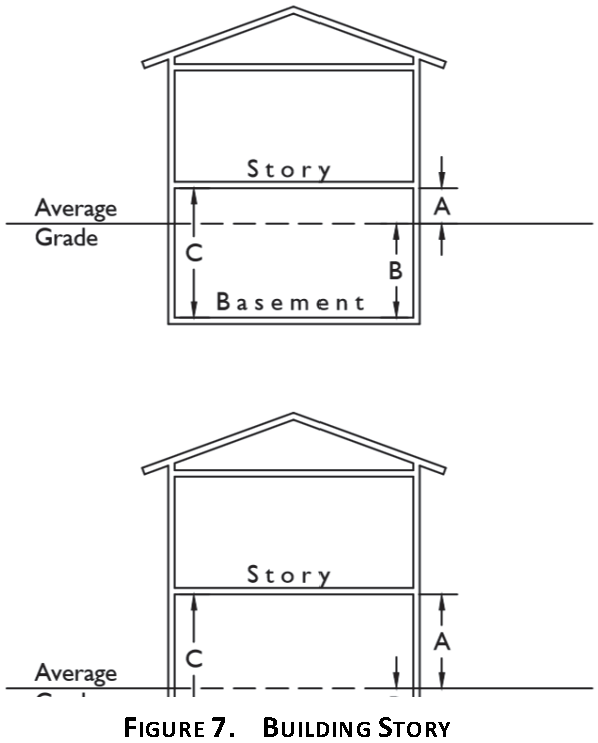
Story, building. That portion of a building between a floor and the floor or roof next above. The first floor of a two or multi-story building shall be deemed the story that has: a) no floor immediately below it that is designed for living quarters or for human occupancy but has at least one-half (½) of its height on one side below grade (see also "Basement"). Those stories above the first floor shall be numbered consecutively.
Structural erosion, sedimentation and pollution control practices. Practices for the stabilization of erodible or sediment-producing areas by utilizing the mechanical properties of matter for the purpose of either changing the surface of the land or storing, regulating or disposing of runoff to prevent excessive sediment loss. Examples of structural erosion and sediment control practices are riprap, sediment basins, dikes, level spreaders, waterways or outlets, diversions, grade stabilization structures and sediment traps, etc. Such practices can be found in the publication "Manual for Erosion and Sediment Control in Georgia."
Structural stormwater control. A structural stormwater management facility or device that controls stormwater runoff and changes the characteristics of that runoff including, but not limited to, the quantity and quality, the period of release or the velocity of flow of such runoff.
Structure. A walled and roofed building that is principally above ground, a manufactured home, or a gas or liquid storage tank.
Subdivider. The person, firm or corporation having such a proprietary interest in the land to be subdivided as will authorize the maintenance of proceedings to subdivide such land under this UDC, or the authorized agent of such person, firm or corporation.
Subdivision. All divisions of a tract or parcel of land into two or more lots, building sites or other divisions for the purpose, whether immediate or future, of sale, legacy or building development, and includes all division of land involving a new street or a change in existing streets, and includes resubdivision and, where appropriate to the context, relates to the process of subdividing or to the land or area subdivided. The transfer of unsubdivided land or the transfer of a lot or parcel of land established by deed or plat recorded in the office of the clerk of superior court prior to the effective date of this ordinance is not included in this definition.
Substantial damage. Damage of any origin sustained by a structure whereby the cost of restoring the structure to its before-damaged condition would equal or exceed 50 percent of the market value of the structure before the damage occurred.
Substantial improvement. Any reconstruction, rehabilitation, addition, or other improvement of a structure, taking place during a five-year period, in which the cumulative cost equals or exceeds 50 percent of the market value of the structure prior to the "start of construction" of the improvement. Note: The market value of the structure should be (1) the appraised value of the structure prior to the start of the initial repair or improvement, or (2) in the case of damage, the value of the structure prior to the damage occurring. This term includes structures, which have incurred "substantial damage", regardless of the actual amount of repair work performed. For the purposes of this definition, "substantial improvement" is considered to occur when the first alteration of any wall, ceiling, floor, or other structural part of the building commences, whether or not that alteration affects the external dimensions of the building. The term does not, however, include (1) those improvements of a structure required to comply with existing violations of state or local health, sanitary, or safety code specifications which are solely necessary to assure safe living conditions and which have been identified by the code enforcement official, and not solely triggered by an improvement or repair project, or (2) any alteration of a "historic structure" provided that the alteration will not preclude the structure's continued designation as a "historic structure".
Substantially improved existing manufactured home parks or subdivisions. Where the repair, reconstruction, rehabilitation or improvement of the streets, utilities and pads equals or exceeds 50 percent of the value of the streets, utilities and pads before the repair, reconstruction or improvement commenced.
T
Taxi and limousine service. An establishment that provides passenger transportation by automobile or van, not over regular routes or regular schedules. Taxicab owner/operators, taxicab fleet operators, and taxicab organizations are included. Also included are limousine and luxury sedan establishments, which may provide an array of specialty and luxury passenger transportation services.
Technical, trade, and other specialty schools. Schools that offer vocational and technical training in a variety of technical subjects and trades, such as: barbering, hair styling or cosmetic arts; business management; computer training; driving education; fine and performing arts education; flight training; and sports and recreation education. The training often leads to job-specific certification.
Theater, drive-in. An outdoor movie theater, where motion pictures are projected upon a screen for viewing by patrons seated in automobiles.
Theater, movie. A specialized indoor theater for showing movies or motion pictures.
Theater, performance. An indoor facility with fixed seats that are arranged on a sloped or stepped floor and are oriented toward a performance stage. This definition includes concert halls.
Timber harvesting. An operation engaged in harvesting standing timber for delivery as pulpwood, logs, poles, posts, or wood chips to a woodyard or processing plant.
Tourist court. See "Motel."
Towing and other road and ground services. Establishments that tow light or heavy motor vehicles, both local and long distance. These establishments may provide incidental services, such as storage and emergency road repair services.
Townhouse. A building that has three or more separate dwelling units divided vertically, and each unit has separate entrances to a front and rear yard. The term "townhouse" shall be synonymous with the term "townhome."
Transport. For the purposes of regulating hazardous waste, the term shall be defined as the transportation or carrying of hazardous waste or dangerous chemicals or liquids in a storage tank, drum, tanker, or other container on or in a motor vehicle (except within a tank being used to feed or supply the motor vehicle with a means of energy for locomotion at the time of transport) on roads on the county system of roads.
Travel trailer. A portable structure whether self-propelled or pulled by a power unit, designed as temporary occupancy for travel, recreation, and vacation uses, which is identified on the unit by the manufacturer as a camper or travel trailer or bus. This definition includes campers and buses.
Tri-plex. A building containing three dwelling units, and each dwelling unit has a separate entrance from the outside or through a common vestibule.
Trout streams. All streams or portions of streams within the watershed as designated by the Wildlife Resources Division of the Georgia Department of Natural Resources under the provisions of the Georgia Water Quality Control Act, O.C.G.A. § 12-5-20, in the rules and regulations for Water Quality Control, Chapter 391-3-6 at www.gaepd.org. Streams designated as primary trout waters are defined as water supporting a self-sustaining population of rainbow, brown or brook trout. Streams designated as secondary trout waters are those in which there is no evidence of natural trout reproduction, but are capable of supporting trout throughout the year. First order trout waters are streams into which no other streams flow except springs.
Truck. As used in Article VI of this UDC (related to the topic of "road use bonds") a truck is defined as any tractor and trailer or other truck having more than six wheels and being exempt pursuant to O.C.G.A. § 32-6-25 from the width, length and load requirements of O.C.G.A. §§ 32-6-23, 32-6-24.
Truck stop. A use primarily engaged in the maintenance, servicing, storage, parking or repair of commercial vehicles, including the sale of motor fuels or other petroleum products, and the sale of accessories or equipment for over-the-road trucks and similar commercial vehicles. A truck stop may also include overnight accommodations, showers, vehicle scales, restaurant facilities, game rooms, and/or other services and diversions intended mainly for use by truck drivers and interregional travelers. Includes the term "travel plaza."
Truck and freight transportation services. Establishments that provide over-the-road transportation of cargo using motor vehicles, such as trucks and tractor trailers. Includes truck terminals.
U
Ultralight landing strip. A place where ultralight vehicles, as defined and regulated by the Federal Aviation Administration, can land and take off.
Unified Development Code (UDC). Catoosa County Unified Development Code.
Utility substation. An assembly of equipment in an electric power system through which electrical energy is passed for transmission, distribution, interconnection, transformation, conversion, or switching.
Utility. Public or private water or sewer piping systems, water or sewer pumping stations, electric power lines, fuel pipelines, telephone lines, roads, driveways, bridges, river/lake access facilities, stormwater systems and railroads or other utilities identified by a local government.
V
Variance. A grant of relief from the requirements of this UDC, which permits construction in a manner otherwise prohibited by this UDC.
Variance, administrative. Modification of requirements pertaining to yard, building height, parking, loading, and buffer requirements that may be granted by the Zoning Administrator in accordance with Section 8.04.00 of this UDC.
Vegetative erosion and sedimentation control measures. Measures for the stabilization of erodible or sediment-producing areas by covering the soil with:
A.
Permanent seeding, sprigging or planting, producing long-term vegetative cover, or
B.
Temporary seeding, producing short-term vegetative cover; or
C.
Sodding, covering areas with a turf of perennial sod-forming grass.
Vehicle and marine craft sales. Establishments that sell new or used motor vehicles and marine craft, including: compact automobiles and light trucks (sold at car dealerships); buses, recreational vehicles (RVs), manufactured homes, and trucks not sold at car dealerships; motorcycles, motor scooters, motor bikes, mopeds, and off-road terrain vehicles (ATV's); boats, personal watercraft, outboard motors, and boat trailers. These establishments may have showrooms or open lots for selling vehicles and may provide repair and maintenance services.
Vehicle rental. An establishment that rents or leases passenger vehicles without drivers.
Veterinary services. Establishments with licensed practitioners of veterinary medicine, dentistry, or surgery for animals; also included are establishments that provide testing services for licensed veterinary practitioners.
Violation. For the purposes of floodplain management, the term shall mean the failure of a structure or other development to be fully compliant with the community's floodplain management regulations. A structure or other development without the elevation certificate, or other certifications, or other evidence of compliance required by this UDC is presumed to be in violation until such time as that documentation is provided.
W
Warehouse. Building used for the reception and temporary or permanent retention of goods.
Wastewater. Any water or other liquid, other than uncontaminated stormwater, discharged from a facility.
Water supply reservoir. A governmentally owned impoundment of water for the primary purpose of providing water to one or more governmentally owned public drinking water systems. This excludes the multipurpose reservoirs owned by the U.S. Army Corp of Engineers.
Water supply watershed. The area of land upstream of a governmentally owned public drinking water intake.
Watercourse. Any natural or artificial watercourse, stream, river, creek, channel, ditch, canal, conduit, culvert, drain, waterway, gully, ravine, or wash in which water flows either continuously or intermittently and which has a definite channel, bed and banks, and including any area adjacent thereto subject to inundation by reason of overflow or floodwater.
Wetlands. Those areas that are inundated or saturated by surface or groundwater at a frequency and duration sufficient to support, and that under normal circumstances do support, a prevalence of vegetation typically adapted for life in saturated soil conditions. Wetlands generally include swamps, marshes, bogs, and similar areas. The ecological parameters for designating wetlands include hydric soils, hydrophytic vegetation, and hydrological conditions that involve a temporary or permanent source of water to cause soil saturation.
Wholesale trade establishment. An establishment that either sell s or arranges the purchase of goods to other businesses and normally operates from a warehouse or office building.
Wireless telecommunication facility. The set of equipment and network components, exclusive of the underlying wireless support structure, including antennas, transmitters, receivers, base stations, power supplies, cabling, and accessory equipment, used to provide wireless data and wireless telecommunication services. Also known as "wireless facility." The following terms and phrases are defined for the purposes of Section 5.04.00 of this UDC:
Accessory equipment. Any equipment serving or being used in conjunction with a wireless facility or wireless support structure and includes, but is not limited to, utility or transmission equipment, power supplies, generators, batteries, cables, equipment buildings, cabinets, and storage sheds, shelters, or similar structures.
Accessory facility or structure. An accessory facility or structure serving or being used in conjunction with wireless telecommunications facilities, and located on the same property or lot as the Wireless Telecommunications Facilities, including but not limited to, utility or transmission equipment storage sheds or cabinets.
Antenna. Communications equipment that transmit, receives, or transmits and receives electromagnetic radio signals used in the provision of all types of wireless communication services.
Application. A formal request submitted to the local governing authority to construct, collate collocate, or modify a wireless support structure or a wireless facility.
Camouflage (or Stealth or Stealth Technology). Disguising a wireless support structure and facility so as to make it less visually obtrusive and not recognizable to the average person as a wireless telecommunications facility.
Collocate or collocation. The placement or installation of new wireless facilities on previously approved and constructed wireless support structures, including monopoles and towers, both self-supporting and guyed, in a manner that negates the need to construct a new freestanding wireless support structure. Such term includes the placement of accessory equipment within an existing equipment compound.
Complete application. An application containing all documents, information, and fees specifically enumerated in or required by the local governing authority's regulations, ordinances, and forms pertaining to the location, construction, collocation, modification, or operation of wireless facilities.
Equipment compound. An area surrounding or adjacent to the base of a wireless support structure within which accessory equipment is located.
Modification or modify. The improvement, upgrade, expansion, or replacement of existing wireless facilities on an existing wireless support structure or within an existing equipment compound, provided such improvement, upgrade, expansion, or replacement does not increase the height of the wireless support structure or increase the dimensions of the equipment compound.
Utility. Any person, corporation, municipality, county, or other entity, or department thereof or entity related or subordinate thereto, providing retail or wholesale electric, data, cable, or telecommunications services.
Wireless support structure. A freestanding structure, such as a monopole, tower, either guyed or self-supporting, or suitable existing or alternative structure designed to support or capable of supporting wireless facilities. Such term shall not include any telephone or electrical utility pole or any tower used for the distribution or transmission of electrical service.
Woodyard. A place where timber is cut and stored prior to delivery to wholesale or retail lumberyards.
X
Y
Yard. An area that lies between the principal building on a lot and the nearest lot line. See Figure 8.
Front yard. A yard extending the full width of the lot between the principal building and the right-of-way line, projected to the side lines of the lot.
Rear yard. A yard extending the full width of the lot between the principal building and the rear lot line and projected to the side lines of the lot.
Side yard. A yard extending from the front yard to the rear yard between the principal building and the side lot line. Any lot line not a rear line or a front line shall be deemed a side line.
Z
Zero lot line dwelling. See under "Dwelling."
Zoning change. An amendment to the zoning map (rezoning), approval of a special use permit, or approval of a change in the conditions of approval associated with a rezoning or a special use permit.
Zoning decision. A final legislative action by the Catoosa County Board of Commissioners which results in:
A.
The adoption of zoning requirements within this UDC;
B.
The adoption of an amendment to this UDC which changes the text of the zoning requirements;
C.
The adoption of an amendment to the official zoning map which rezones property from one zoning classification to another; or
D.
The grant of a permit relating to a special use of property.
Zoning entity. As used in Article IX, term shall mean: the Zoning Administrator, Planning Commission or governing authority.
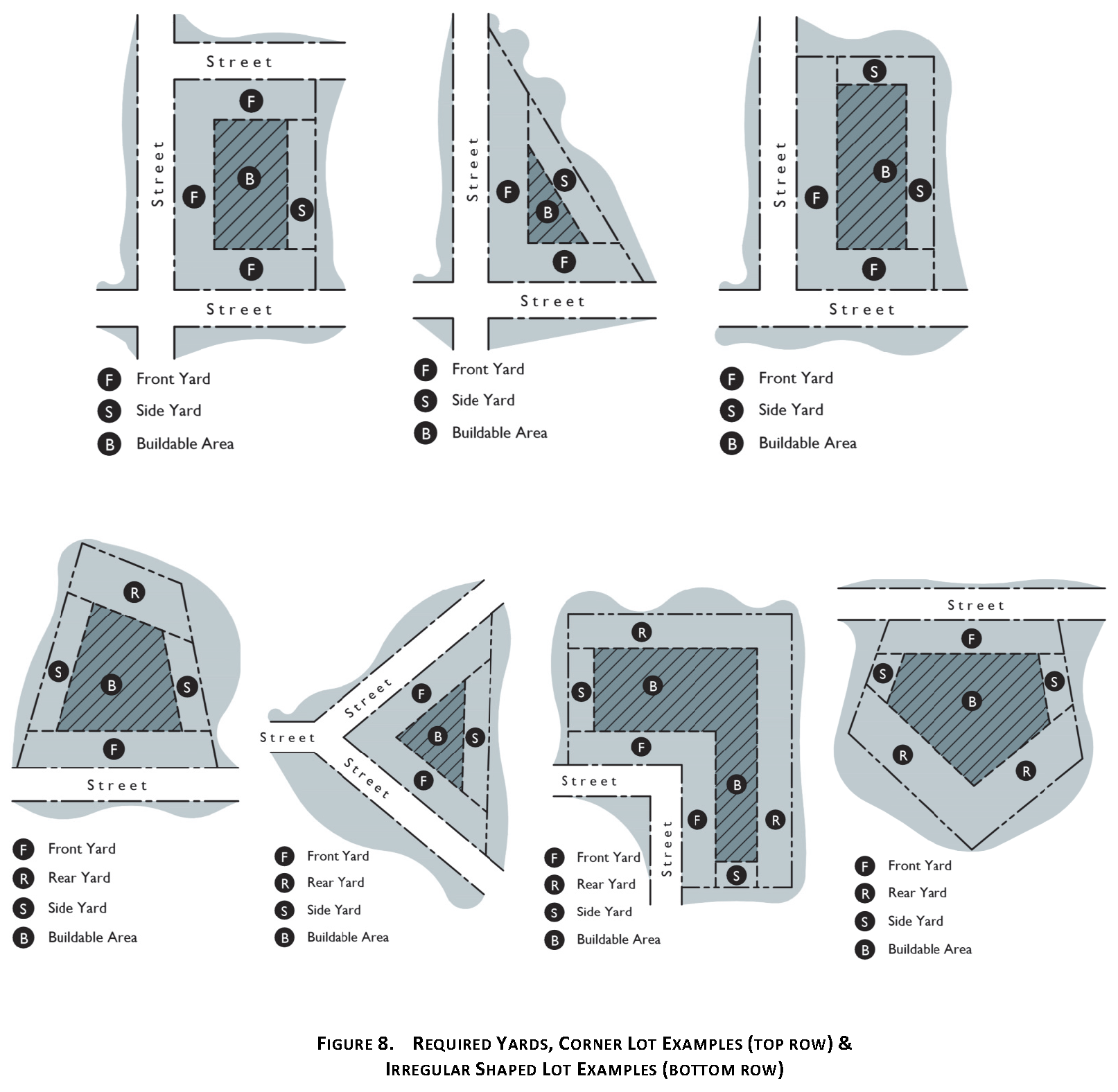
(Ord. of 2-5-19(1), §§ 1, 2; Ord. of 4-18-23(1), §§ (i), (ii))

