
Catoosa County Unincorporated
City Zoning Code
City Zoning Code
ARTICLE IV
- SITE DESIGN STANDARDS
4.01.00 - GENERALLY
The purpose of Article IV is to provide design standards applicable to all development activity within unincorporated Catoosa County. This Article expands upon the standards in Article II for each zoning district by addressing additional details of site planning and project design, including parking, tree planting, lighting, and buffers. This Article also provides standards applicable in specific situations, such uses that require additional standards to address potential impacts on surrounding areas and provisions for "family ties" land division.
4.02.00 - DESIGN STANDARDS FOR LOTS AND BLOCKS
4.02.01 Lot Design Criteria
A.
Each lot shall meet lot width and area requirements stated in Section 2.04.00 of this UDC.
B.
Required dimensional standards for building height and location (setbacks) by zoning district are included in Section 2.04.00.
C.
Any lot which will be served by a septic tank shall be approved by the Catoosa County Health Department.
D.
All corner lots shall make allowance for setback lines.
E.
Only one principal building and its allowable accessory buildings shall hereafter be erected on any one lot, parcel, or tract of land, with the exception that two or more principal buildings may be allowed on a lot in accordance with the requirements for a "group project" as delineated herein.
F.
A group project (multi-family residential, commercial, industrial, educational, medical, religious, or civic uses) of two or more buildings to be constructed on a plot of land of at least two acres not subdivided into customary streets and lots, and which will not be so subdivided, may be constructed provided:
1)
Such uses are limited to those permitted within the district in which the project is located;
2)
The overall density of land use is no higher, and the standard of open space is no lower than that permitted on the district in which the is located;
3)
The distance of every building from the nearest property line shall meet the front yard setback and side yard requirements of the district in which the project is located;
4)
The building heights do not exceed the height limits permitted in the district in which the project is located.
5)
Such residential uses only include multi-family residential (apartments), assisted living facilities and nursing homes.
G.
In cases of sick or aged relatives or of extreme physical hardship, the Planning Commission may grant a temporary variance as long as the health department regulations can be met and a letter of necessity is provided by a medical doctor.
4.02.02 Block Lengths and Widths
A.
Blocks shall be not greater than 1,800 feet nor less than 600 feet in length, except in unusual circumstances.
B.
Blocks shall be wide enough to provide two tiers of lots of minimum depth except where abutting upon major streets, limited-access highway, or railroads or where other situations make this requirement impracticable.
4.02.03 Lot Lines
All lot lines shall be perpendicular or radial to street lines, unless not practicable because of topographic or other features.
4.02.04 Lots Abutting Public Streets
Each lot shall abut upon a dedicated public street, except as noted in Article VI.
4.02.05 Double-Frontage and Reverse-Frontage Lots
A.
Double-frontage and reverse-frontage lots should be avoided except where essential to provide separation of residential development from traffic arteries or to overcome specific disadvantages of topography and orientation.
B.
On lots having frontage on more than one street in residential districts, the minimum front yard shall be provided for each street in accordance with the provisions of this UDC.
4.02.06 Corner Lots
On lots having frontage on more than one street in residential districts, the minimum front yard shall be provided for each street in accordance with the provisions of this ordinance. Provided however, that if the side street is a minor street, that setback shall be no less than 25 feet.
4.02.07 Flag Lots
No more than two adjacent flag lots shall be permitted to front on any county road. In addition, each flag lot shall contain a minimum of 25 feet of road frontage if the acreage of said lot is five acres or less. Each flag lot shall contain a minimum of 50 feet of road frontage if the acreage of said lot is greater than five acres. Lots created in accordance with the Family Ties Land division process (see Section 4.03.00) may be exempt from the flag lot requirements.
4.02.08 Yard Setbacks for All Structures
The setback requirements of Section 2.04.00 for structures shall not apply to any lot where the average existing building setback line on lots located wholly or in part within 100 feet on each side of such lot, within the same block and zoning district, and fronting on the same side of the street as such lot, is less than the minimum setback required. In such cases, the setback on such lots may be less than the required setback, but not less than the average of the existing setbacks on the aforementioned lots; and in no case shall the front setback be less than 25 feet from the street right-of-way.
4.02.09 Yard Service to One Building
No part of a yard, or other open space, or off-street parking or loading space required about, or in connection with, any building for the purpose of complying with this UDC shall be included as part of a yard, open space, or off-street parking or loading space similarly required for any other building.
4.03.00 - DESIGN STANDARDS FOR FAMILY TIES LAND DIVISION
4.03.01 Applicability
The provisions of this Section apply to Family Ties Land Divisions in the A-1 and R-A zoning districts.
4.03.02 Exemptions from Platting Requirements
Lots created as a result of the Family Ties Land Division are exempt from the platting requirements set forth in Article IX, provided that the lots are conveyed to a grandparent, parent, stepparent, adopted parent, sibling, child, stepchild, adopted child, or grandchild of the owner of the parcel to be divided (parent parcel).
4.03.03 Application Requirements
A.
Applications to create lots under the Family Ties Land Division process shall be submitted by the owner of parcel to be divided.
B.
The following materials are required to be submitted to the Zoning Administrator, who shall process the application:
1)
An affidavit to indicate the family relationship, as described in Section 4.03.02, between the owner of the parcel to be divided and the lots to be conveyed.
2)
All lots created under the Family Ties Land Division process shall have a recorded survey prior to the issuance of any building permit.
4.03.04 Design Standards for Lots to be Conveyed
A.
All lots created under the Family Ties Land Division process shall comply with all development standards for the zoning district in which the lots are located, as shown in Table 2-4 in Article II, except as specifically provided in this Section.
B.
The minimum lot area of each conveyed lot shall be one acre.
C.
The parent parcel may be divided to create up to five lots for conveyance to family members if the condition of Subsection D. below is met.
D.
The remainder of the parent parcel, after creation of lots under the Family Ties Land Division process, shall meet the minimum development standards of the zoning district in which the parent parcel is located, as shown in Table 2-4 in Article II. These standards include, but not are limited to, lot size requirements.
E.
All lots created under the Family Ties Land Division process shall meet one of the following requirements for access:
1)
Have a minimum of 50 feet of frontage on a paved public right-of-way and meet the lot width requirements set forth in Table 2-4 in Article II; or
2)
Provide one access driveway as follows:
a.
The access driveway easement shall be a minimum of 25 feet wide and shall be recorded as an all-purpose easement; and
b.
The access driveway shall be an all-weather, non-dirt road having a minimum width of 12 feet with a minimum clearance of 20 feet in width and 12 feet in height;
c.
The access driveway shall have a concrete or asphalt paved area at the point of connection with a paved public right-of-way and said area shall be a minimum width of 12 feet and a minimum length of 5 feet and of sufficient depth to support conventional vehicle traffic.
4.04.00 - DESIGN STANDARDS FOR CONSERVATION SUBDIVISIONS
See Article III of this UDC.
4.05.00 - PARKING STANDARDS
4.05.01 Off-Street Parking
A.
Off-street automobile parking or storage space shall be provided on every lot on which any of the following uses are hereafter established.
B.
Such automobile parking or storage space shall be provided with vehicular access to a street or alley and shall be equal in area to at least the minimum requirements for the specific use as set forth in Table 4-1.
C.
For any use not listed in Table 4-1, the standards for the most similar use shall be applied. The Zoning Administrator and Building Official shall determine the proper required maximum number of spaces by classifying the use among the uses specified.
D.
Each off-street parking space shall be at least 9 feet wide and 18 feet deep from the edge of the drive.
E.
If the required automobile parking or storage space cannot be provided on the same lot on which the principal use is located, the Planning Commission may approve such space to be provided on other off-street property, provided such space is within 500 feet of such principal use. Such space shall be associated with the allowed use and shall not thereafter be reduced or encroached upon in any manner.
F.
All off-street automobile parking and storage space in residential districts shall be so arranged that vehicles will not be required to back onto a street, road, or highway when leaving the premises.
G.
Any decrease in the number of required parking spaces must be approved by the Catoosa County Planning Commission under the variance procedures set forth in this UDC, with the exception that a request to reduce the number by no more than 20 percent shall be subject to the administrative variance procedures set forth in this UDC.
H.
The number, design and location of parking spaces provided to ensure handicapped access shall comply with the Americans with Disability Act (ADA) standards for accessible design.
I.
Outdoor lighting of off-street parking areas shall be directed away and shielded from abutting residential districts, dwellings and all rights-of-way.
J.
Landscape strips/islands, if installed in a parking area, shall be pervious. In addition, if curbed, there shall be openings to allow stormwater to enter.
Table 4-1 Parking Space Requirements
4.05.02 Loading Spaces
A.
Every building or structure used for business, trade, or industry shall provide space as indicated herein for the loading and unloading of vehicles off the right-of-way of the street or public alley.
1)
Such space shall have access to an alley or, if there is no alley, to a street.
2)
Such space shall have at least 14 feet of vertical clearance.
3)
Such space shall be so arranged that no vehicle is required to back onto a public street, road, or highway in order to leave the premises.
B.
Retail business loading space requirements: One space, 10 feet by 25 feet, for each 3,000 square feet of floor area or any part thereof.
C.
Wholesale and industry loading space requirements: One space, 10 feet by 50 feet, for each 10,000 square feet of floor area or any part thereof.
D.
Bus and truck terminals loading space requirements: Sufficient space to accommodate the maximum number of buses or trucks to be stored or to be loading or unloading at the terminal at any one time.
4.06.00 - STREET TREE STANDARDS
4.06.01 Street Tree Planting Requirements, General
A.
Any subdivision containing 12 or more lots shall be required to plant street trees which conform to the requirements of this Section of the UDC.
B.
Street trees shall be planted behind the sidewalks except in subdivisions which contain a designated planting strip, at least 6 feet in width, between the street curb and the sidewalk. In such subdivisions, the street trees may be planted in the designated planting strip.
4.06.02 Street Tree Selection
Street trees shall be native species that are appropriate for the Plant Hardiness Zone(s) for Catoosa County as defined by the Cooperative Extension, University of Georgia College of Agricultural and Environmental Sciences.
4.06.03 Street Tree Spacing, Placement and Pruning
A.
Unless otherwise approved by the Planning Commission due to special site conditions or safety concerns, the following requirements shall govern the spacing, placement and pruning of street trees:
1)
Street trees shall be at least 2½ inches caliper measured and 6½ feet (American National Standard for Nursery Stock) above the finished grade of the ground.
2)
Residential street trees shall be planted at the rate of one tree for every 50 linear feet of road frontage. Driveway widths may be subtracted when calculating the linear foot requirement of this subsection.
3)
In commercial developments which do not contain street yard plantings, the developer shall either retain existing trees or plant new trees (or some combination of the two) along any frontage which is adjacent to public rights-of-way, such that there is an average within the development of at least one tree for every 30 feet of street frontage. The location of the trees may be varied, however, spacing of trees shall be no less than a minimum of one tree for each 100 feet of street frontage. Driveway widths may be subtracted calculating the linear foot requirement of this subsection.
4)
Trees shall not be planted closer than 25 feet from the curb line of intersections of streets or alleys, and not closer than 10 feet from private driveways (measured at the back edge of the sidewalk), fire hydrants or utility poles.
5)
Street trees shall not be planted closer than 20 feet from light standards. Except in situations required to protect public safety, no new light standard shall be positioned closer than 10 feet to any existing street tree and it shall be preferable that new light standards be positioned at least 20 feet from any existing street tree.
6)
Except in situations meeting the requirements for a designated planting strip, trees shall not be planted closer than 13 feet from the face of the curb.
7)
Trees shall not be planted within 3 feet of any permanent hard surface paving or walkway. Any concrete cuts in sidewalks for trees shall be at least 10 square feet in area. However, larger cuts are encouraged in order to promote the overall health of trees planted. Spaces between planted trees and the adjacent hard surface may be covered with permeable, nonpermanent hard surfaces such as grates, bricks on sand or paver blocks.
8)
As planted trees grow, they shall be pruned to provide at least eight feet of clearance above sidewalks and 12 feet of clearance above road surfaces.
9)
Existing trees within a development may be used as street trees if there has been no damage to the tree from the development which would kill or otherwise weaken the tree. Subject to the approval of the planning commission, sidewalks of varying widths and elevations from the standard width and elevation requirements may be utilized in order to save existing trees.
10)
All street tree pruning requirements imposed by this Section shall at all times be the responsibility of either the property owner upon whose property the tree is located, the developer of the subdivision or a homeowners' association and shall not be the responsibility of Catoosa County.
4.06.04 Street Tree Replacement
A.
Existing street trees removed by development activity shall be replaced by the developer.
B.
The replacement trees shall be of size and species similar to those removed or shall be of a native species that are appropriate for the Plant Hardiness Zone(s) for Catoosa County as defined by the Cooperative Extension, University of Georgia College of Agricultural and Environmental Sciences
C.
Existing street trees which die shall be replaced with street trees which meet the requirements of this ordinance.
D.
All street tree replacement requirements imposed by this Section shall at all times be the responsibility of either the property owner upon whose property the tree is located, the developer of the subdivision or a homeowners' association and shall not be the responsibility of Catoosa County.
4.07.00 - LIGHTING REQUIREMENTS, BUILDINGS
A.
Application. The provisions of this Section shall apply only to commercial buildings and other buildings or facilities constructed or erected in C-1 (General Commercial), C-2 (Neighborhood Commercial), C-3 (Office), C-R (Commercial-Residential), I-1 (Heavy Industrial), and I-2 (Light Industrial) districts.
B.
Requirements. The exterior lighting of all buildings and other structures to which the provisions of this Section are applicable shall, to the greatest extent possible, be installed such that the lighting source is shrouded, recessed or otherwise indirect such that the lighting source is not visible from the public right-of-way of any public road or street. The lighting shall also contain the minimum wattage necessary to service the property and shall utilize all reasonable methods (e.g. location, glare reduction, etc.) necessary to carry out and otherwise meet the requirements of this subsection.
C.
Exceptions. In the event the requirements of subsection (B) hereof cannot be met with respect to any particular building or structure, the exterior lighting of said building or structure may be installed in a manner approved by the Zoning Administrator, in his discretion, provided said installation protects, to the greatest extent possible, the safety of motorists utilizing the public roads and streets and adjoining property owners. In determining whether a particular building or structure meets the requirements of this subsection, the Zoning Administrator shall review such factors as the location of lighting, the type of lighting utilized (including lamp wattage), the amount of lighting utilized and the amount of glare projected onto neighboring properties and/or public streets. After reviewing the factors set forth herein and the plan for the building and/or structure, the Zoning Administrator shall have the discretion to accept, reject or modify the lighting plan for the building and/or structure to ensure that the safety and other concerns set forth herein are met. Any final decision of the Zoning Administrator shall be appealable pursuant to the terms of this UDC.
4.08.00 - BUFFERS
4.08.01 Buffers, Generally
A.
Buffers shall separate different use districts and/or uses on one property from uses on another property of the same use district of a different use district.
B.
Buffers, including natural plantings and/or structural treatments, shall be located on the site to best achieve the screening required, in accordance with the County approved site plan.
C.
The buffer area shall supersede the setback line distance but may be included in the distance to determine a setback.
D.
A buffer area may be used for vehicular access and utility easements and for drainage improvements required by the County.
4.08.02 Buffers, Where Required
A.
An adequate buffer strip of at least 50 feet in width shall be required and maintained between single-family conventional residential property in any zone and any area zoned other than R-1, R-2, R-3, RTZ, A-1, or C-R. Such buffer shall be constructed and/or maintained by the owner of the land zoned other than R-1, R-2, R-3, RTZ, A-1, or C-R, unless the conditions described in subsection E below are present.
B.
An adequate buffer strip at least 50 feet in width shall be required and maintained between any manufactured home and any single-family, two-family, tri-plex, quadplex or multi-family residential housing or zoning district. Evergreen or opaque screening will usually be required between any manufactured home and any non-manufactured home dwellings or zoning districts. Sufficient screening may be provided by natural vegetation that provides a substantially opaque natural screen, or the topography or other conditions existing at the site may provide a substantially opaque screen.
C.
A buffer strip of at least 50 feet in width shall be required and maintained between any area zoned commercial, (C-1, C-2 or C-3), and any residential property in any zone. Such buffer shall be constructed and/or maintained by the owner of the land zoned as commercial, unless the conditions described in subsection E. below are present.
D.
A buffer strip of at least 100 feet in width shall be required and maintained between any area zoned industrial (I-1 or I-2), and any other zone. Such buffer shall be constructed and/or maintained by the owner of the land zoned as industrial, unless the conditions described in subsection E. below are present.
E.
When a proposed development adjoins an existing development of a higher intensity, but the full width of the required buffer does not exist on the existing development, the new development shall provide a buffer of adequate width to meet the full width requirements as presented in this Section when considered in combination with any existing buffer on the property of the adjoining existing development.
(Ord. of 6-22-21(1))
4.08.03 Buffers, Minimum Screening
A.
A buffer shall be provided that creates a barrier between dissimilar land uses or properties. Said buffer shall substantially block such attributes as sight lines, noise transmission, dust, and the transfer of artificial light and reflected light between dissimilar land uses or properties.
B.
Unless otherwise specified in this UDC, a required buffer can take the form of blinders, opaque walls, opaque fences, opaque blocking, fence slats, trees or shrubs (including evergreen trees and shrubs that can provide an opaque visual screen during all seasons of the year), or dirt or rock embankments to block the attribute, or specific devices used to muffle, control, modify, or reduce the level of such attribute.
C.
A required buffer shall also incorporate optimal placement of the foregoing components on the property and in relationship to the adjoining property, so as to provide the most effective barrier described above. This shall include particular consideration to the vertical relationship, lines of sight and resulting view angles between differing land uses and adjoining properties and may involve the grading design, building heights, architectural styles, and placement of design elements on the property being developed.
D.
Vegetation and/or topography or other conditions existing at the site that contribute to or create an effective barrier may be used to meet buffer requirements.
4.08.04 Natural Buffers
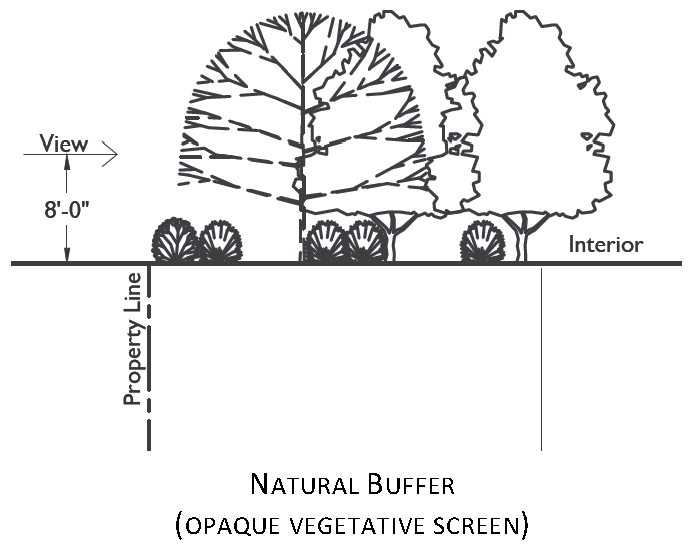
Natural buffers may contain deciduous or perennial vegetation, but shall contain evergreen shrubs and trees suitable to local growing conditions that will provide an opaque visual screen during all seasons of the year. An example of a natural buffer is shown below:
4.08.05 Structural Buffers
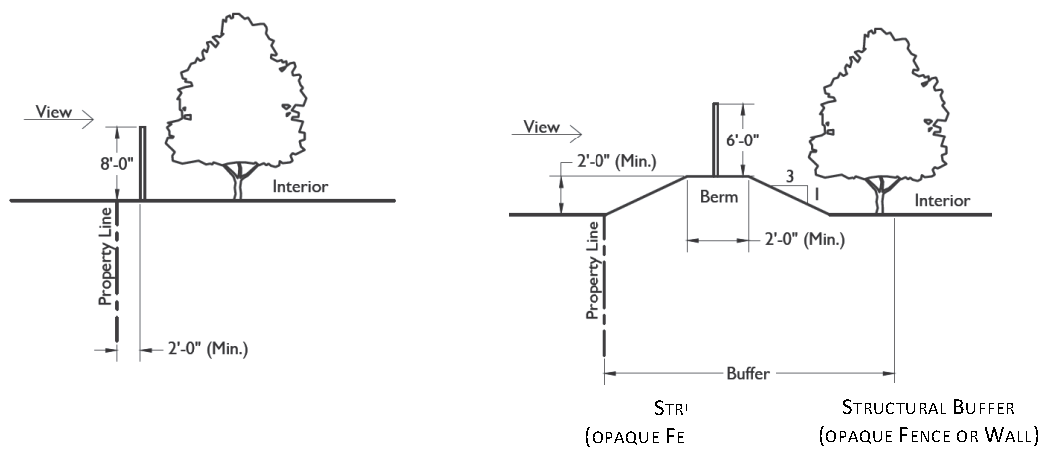
Fences used in buffers shall:
A.
Be located no closer to the property line than 2 feet;
B.
Present a finished and decorative appearance to the abutting property; and
C.
Be made of rot-resistant material or protected from deterioration with waterproofing materials.
Examples of structural buffers are shown below:
4.08.06 Buffers, Maintenance
A.
Screening shall be deemed to be a continuing requirement.
B.
The screens required shall be maintained by the landowner, and the zoning entity may require replacement, replanting or such other screening maintenance that will ensure that the screen or barrier continues to serve the purpose for which it was intended.
C.
Every buffer required under this Article shall be maintained so as to provide an opaque visual screen of a minimum height of 8 feet on a continuous, year-round basis unless otherwise specified in this UDC.
4.08.07 Buffers, Special Uses
In addition to all other provisions of Section 4.08.00, a proposed use requiring a Special Use Permit (see also Article IX) may be required to have additional barriers and screens (that is, of the additional type, additional size, additional depth, additional height, additional arrangement and other specific additional characteristics).
A.
The criteria for determining whether such screens or barriers shall be required shall be made upon a balancing of the property owners' need for the proposed use (without the use of such screens or barriers) as weighed against any depreciating effects to neighboring properties and to persons occupying such neighboring properties that could be remedied by screening or barriers. In balancing such factors, the Board of Commissioners shall consider the following:
1)
The aesthetic effect of the attribute (of the use causing the need for any screening or barriers) upon the neighboring properties;
2)
The extent to which such attribute interferes with the enjoyment and use of neighboring properties;
3)
The practical effect that any screening or barriers would have on the level of any interference with the enjoyment and use of neighboring properties; and
4)
The time of day or night that the attribute typically interferes with neighboring properties or to persons occupying such neighboring properties.
B.
Where the depreciating effects outweigh the property owner's need for the proposed use (without the use of screens or barriers), then screening or barriers shall be required as set forth as follows:
1)
In determining the size, location, depth, height, arrangement, distance and type of screens or barriers to be required, the Board of Commissioners shall only impose such requirements as will be expected to protect other properties (provided however that such buffers shall not exceed the depth or dimensions of those needed to provide protection from injurious effects on other properties, or of the largest buffer depth and dimensions otherwise provided for in this UDC, whichever is less).
2)
Unless natural barriers such as trees, dirt banks, etc., are in existence on the buffer area that exceed 15 feet in height, such screens or barriers shall not be required to measure in excess of 15 feet in height when erected (however, blinders or other devices may be required to hang or be placed at levels higher than 30 feet from the ground level).
3)
The following requirements shall apply to such screens and barriers:
a.
They shall not be required to be of a depth in excess of the buffer zone depth required elsewhere in this UDC;
b.
They shall not be in such location as would not block the view of or noise from such attribute to other property, to a public street or to a public road;
c.
They shall not be of such arrangement as would require the complete destruction or loss of use of a complete building or buildings;
d.
They shall not be of such distance as would extend beyond the boundary lines of the subject property; and
e.
They shall not be of such type as would cost sums disproportionate to other less expensive alternatives that are available and proposed by the landowner which would accomplish a similar result in terms of alleviating the attribute causing interference.
4)
The Board of Commissioners shall consider and review any less expensive alternative modifications to operations, alternative barriers or screens, or other muffling devices proposed in writing by the landowner and the extent to which that may be anticipated to accomplish such similar result.
4.08.08 Buffers, Prohibited Uses or Activities
A.
A buffer area may not be used for the erection of any permanent structure thereon except for fencing or sign installed in accordance with applicable provisions of this UDC.
B.
A buffer area may not be used for any parking.
C.
A buffer area may be used for the construction of drainage improvements, field lines, septic tanks, sewer lines or other underground piping improvements that cannot be viewed from aboveground.
D.
Except as provided herein, the natural topography of the land shall be preserved and natural growth shall not be disturbed beyond that which is necessary to prevent a nuisance, or to thin such natural growth where too dense for normal growth, or to remove diseased, misshapen, or dangerous and decayed timbers. However, a slope easement may be cleared and graded where required to prevent soil erosion upon approval of the Stormwater Director. Furthermore, selective cutting of timbers or trees may be allowed upon the approval by the Zoning Administrator of a written plan providing for replacement planting or screening that is no less opaque than were the original timbers or trees.
4.09.00 - ADDITIONAL REQUIREMENTS FOR SPECIFIC USES
4.09.01 Adult Entertainment Establishments
A.
Adult entertainment establishments must meet the location requirements of Chapter 10, Article II, Section 10-37. Location of the Catoosa County Code of Ordinances.
4.09.02 Agricultural Operations
Agricultural operations must meet the following minimum requirements if located in the R-A zoning district:
A.
The raising of a minimum number of horses, beef cattle, sheep, or goats such that no more than one animal per acre is maintained on such property; provided that the buffer between any barn or stable or other animal housing facility for such animal(s) shall have a minimum of 200 feet of buffer between the subject property's boundary line and the nearest building line of such animal housing facility;
B.
Due to the introduction of new breeds of animals and trends in animal ownership, other nondomesticated animals may be allowed upon approval of a Special Use Permit in accordance with Article IX of this UDC so long as such animals do not include chickens or other poultry, pigs or other swine, or wild nondomesticated animals known to attack humans without provocation.
1)
In determining whether to allow the raising of other nondomesticated animals not listed in this subsection, the Board of Commissioners shall balance the benefits of raising the proposed type of animal with any possible detrimental effects that the raising of such animal may have on other properties;
2)
In conducting such balancing, the Board of Commissioners shall consider any objections made by other property owners, the approximate degree of emission of odors from this type of animal(s) or from its actions, the tendency of such animal(s) to escape fenced or other types of confinement, the noise typically emitted by this type of animal(s), any particular health aspects of such animal(s) and the approximate life span of such animal(s).
4.09.03 Agriculture, Retail Sales
Retail selling of agricultural products raised or produce on the premises shall require the space necessary for the parking of customers' vehicles off the public rights-of-way.
4.09.04 Airport
An airport is subject to the following additional minimum requirements:
A.
Approval of a Special Use Permit as provided in Article IX of this UDC.
B.
Such use shall be located on a minimum of 200 acres of land and shall be located a minimum distance of 2,000 feet from any residential dwelling.
4.09.05 Automobile Repair and Service
A.
All structures and buildings, except principal use signs, and including storage tanks, shall be placed not less than 25 feet from any side or rear property line except where such side or rear property lines abut a street, in which case the setback shall be that required for such streets measured from the right-of-way.
B.
All buildings or structures, including gas pumps and storage tanks, except principal use signs, shall comply with the setback requirements of any abutting street.
C.
Ingress and egress shall be arranged and designed so as to minimize the interference with the flow of traffic either vehicular or pedestrian.
4.09.06 Bar
The location requirements of Chapter 6, Article II, Division 2, Subdivision 1, Section 6-214. Grounds for Denial of License of the Catoosa County Code of Ordinances must be met.
4.09.07 Bed and Breakfast Inn (B&B)
A.
The owner of the bed and breakfast must reside in and continue to reside in the dwelling as his/her/their principal residence.
B.
No more than three rooms may be rented and not more than six transient roomers may occupy the dwelling at one time; said roomers may rent a room for a duration not to exceed one week.
C.
Breakfast may be provided subject to applicable local codes and Environmental Health Department regulations.
4.09.08 Child Day Care
Prior to making application to operate a child day care facility (including a child day care center, a family day care home and a group day care home) in Catoosa County, the applicant shall show proof of registration and licensing as required by the Georgia Department of Human Resources.
4.09.09 College
College buildings must be served by a public sewer system.
4.09.10 Commercial Stable
A.
Commercial stables shall be located on lands of 10 acres or more.
B.
When the property on which a commercial stable is located adjoins a residential area, the stable must have a minimum of 200 feet of buffer between the residential property line and the nearest stable area.
4.09.11 Construction Related Businesses
Storage yards shall be screened from view by a solid wall, planted screen or similar opaque partition at least 6 feet in height.
4.09.12 Convenience Store (without Gas Station)
The location requirements of Chapter 6, Article II, Division 2, Subdivision 1, Section 6-214. Grounds for Denial of License of the Catoosa County Code of Ordinances must be met, if alcohol is to be sold.
4.09.13 Funeral Home
A funeral home must be located on a major street.
4.09.14 Gas Station
The requirements of Section 4.09.05 Automobile Repair and Service must be met.
4.09.15 Grade School
Grade school buildings must be served by a public sewer system.
4.09.16 Grocery Store
When located in the C-2 District, a grocery store must be less than 5,000 square feet.
4.09.17 Hazardous Waste Facility
A hazardous waste facility is subject to the following additional minimum requirements:
A.
Approval of a Special Use Permit as provided in Article IX of this UDC.
B.
The location requirements of Chapter 66, Article IV, Section 66-121. Conditions on Hazardous Waste Facility of the Catoosa County Code of Ordinances.
C.
Such use shall not occur within a two-mile radius of the most significant groundwater recharge areas shown on the Georgia Department of Natural Resources Groundwater Recharge Area District Map.
4.09.18 Heliport, Sailport and Ultralight Landing Strip
A heliport, sailport or ultra-light landing strip is sub subject to the following additional minimum requirements:
A.
Approval of a Special Use Permit as provided in Article IX of this UDC.
B.
Such use shall be located on a minimum of 50 acres of land and shall be located a minimum distance of 1,000 feet from any residential dwelling.
4.09.19 Junkyard
A junkyard is subject to the following additional minimum requirements:
A.
Approval of a Special Use Permit as provided in Article IX of this UDC.
B.
Such use shall be completely screened from view (along a leveled altitude) from adjoining properties by a solid opaque wall or existing natural screen at least 8 feet in height, and the tract containing the junkyard shall have a setback buffer of at least 500 feet between location of junk on the property and the adjoining property lines.
C.
The junkyard shall not adjoin a residential area.
4.09.20 Kennel
A kennel is subject to the following additional minimal requirements:
A.
Approval of a Special Use Permit as provided in Article IX of this UDC.
B.
The kennel shall have a minimum of 1,000 feet of buffer between any adjoining residential property line and the nearest kennel area.
C.
Animal noise shall carry no more than 100 feet from the use.
4.09.21 Lumberyard
Storage yards shall be screened from view by a solid wall, planted screen or similar opaque partition at least 6 feet in height.
4.09.22 Manufactured Homes
A.
Size. All manufactured homes shall be greater than 16 feet in width, with the following exceptions:
1)
A manufactured home existing at the time of adoption of this UDC that is 16 feet or less in width may be replaced with a similar sized manufactured home.
2)
Manufactured homes in the R-4 Zoning District may be 16 feet or less in width.
B.
General Standards. The following standards shall apply to all manufactured homes:
1)
All new and pre-owned manufactured homes placed in the County shall require a State moving permit and a County manufactured home moving permit prior to placing or relocating the home into the County. To obtain a County manufactured home permit, the applicant shall provide the following to the Building Inspector:
a.
An affidavit signed by the applicant that the manufactured home, if pre-owned, meets health and safety standards required by the National Manufactured Housing Construction and Safety Standards Act of 1974, 42 U.S.C. Section 5401, et seq.
b.
Upon receipt of a permit, applicants shall arrange for an inspection prior to placement of the manufactured home.
c.
Once the manufactured home is placed on site, the applicant shall arrange for required inspections.
d.
A Certificate of Occupancy shall be issued to that applicant at such time that the building inspector certifies that the requirements of this ordinance have been met.
e.
Occupancy of the home is not allowed prior to receiving a Certificate of Occupancy.
f.
A permit and inspection fee shall be charged to the applicant to cover the cost to the County to process the permit application and inspect the pre-owned manufactured home. Such fee shall cover the initial inspections and the applicant will be charged a re-inspection fee that may be necessary. Fees will be based on the fee structure as may be established by the Board of Commissioners from time to time.
g.
A Georgia Licensed Mobile Home Installer is required to move any manufactured home. The name of the installer shall be provided to the County.
2)
All manufactured homes placed in the County shall be constructed in conformity with the requirements of the U.S. Department of Housing and Urban Development (HUD) and shall comply with the following standards:
a.
Any manufactured home shall be required to be skirted/underpinned at the time of installation. The underpinning shall consist of one of the following: masonry, stucco, brick, concrete (permanent faced). Vinyl skirting or aluminum siding/panels or such other material are only allowed in approved manufactured home parks. The following types of materials are not permitted to be used, including but not limited to, tin, wood (unless of natural decay-resistant types such as cedar), plastic sheeting or gypsum board (black board). The underpinning must be adequately secured to the manufactured house and, where necessary for stability, secured to the ground.
b.
Two access doors are required to be installed in a manner which will provide adequate access for inspections and maintenance. Provisions must be made for adequate ventilation for the crawl space underneath the manufactured home.
c.
All tongues, wheels, axles, transporting lights, and other towing apparatus shall be removed from the home and placed out of sight prior to occupancy.
d.
All manufactured homes placed in the County shall be installed so as to comply with Chapter 120-3-7 Rules and Regulations for Manufactured Homes of the Rules of Comptroller General Safety Fire Commissioner, as authorized by O.C.G.A. § 8-2-160 et seq. The installation of tiedowns and ground anchors may vary from model to model and may comply with manufacturer's specifications where said specifications exist.
e.
Any porch or deck located 30 inches or greater above the ground shall be provided with guardrails and handrails as indicated in the International Residential Code for One and Two Family Dwellings. Steps higher than three risers shall be provided with handrails.
f.
Electric service equipment (meter base and outside service disconnect switch) may be permanently attached to a manufactured home only when installed in accordance with the manufacturer's specifications.
g.
Each owner of a manufactured home located in the County shall obtain, at the time of purchase and each year thereafter that said home is located in the County, between January 1 and April 1, a County location decal (County tax sticker). Said decal shall be purchased from the tax commissioner of the County. No person shall be entitled to purchase a decal until he/she presents to the tax commissioner a certificate of title or other proof of his/her ownership. Failure to obtain a decal each year shall constitute a violation of this Section.
h.
Any manufactured home, which is damaged beyond repair, as determined by the building inspector and/or fire inspector of the County, by fire, natural disaster, or man-made disaster, shall be removed and disposed of by the owner within 60 days after said damage occurred.
i.
No manufactured home permit shall be issued until the applicant provides certification from the City of Ringgold or the City of Fort Oglethorpe that the parcel is served by public sewer or, if a private septic tank system is proposed, whether existing or new, said system has been approved by the Board of Health and the applicant receives from said board a septic system permit.
j.
No manufactured home shall be used for any purpose other than as a dwelling unit, except in commercial applications when the unit has been specifically manufactured for that commercial purpose (i.e., office trailer on construction site).
C.
Pre-Owned Manufactured Homes. In addition to meeting the requirements of subsection A. above, pre-owned manufactured homes shall require a safety inspection permit prior to placing or relocating the home in Catoosa County.
1)
All pre-owned manufactured homes shall require a manufactured home moving permit. Should the owner of a pre-owned manufactured home request to relocate the home from its current location in Catoosa County to another location in the County, the following information shall be provided to the Building Inspector in order to apply for a manufactured home moving permit:
a.
Proof that the manufactured home is located in the County, in the form of documentation from the office of the Tax Commissioner of the County that all taxes were paid during each year as the said taxes become due. If the owner is not able to establish that taxes have been paid on a yearly basis, then that manufactured home shall not be allowed to be relocated and a manufactured home moving permit shall not be issued.
b.
A certificate of ownership (title) which corresponds with the manufacturer's serial number stamped into the frame of the manufactured home.
c.
A copy of the Board of Health septic permit or certification of sewer service by the City of Ringgold or the City of Fort Oglethorpe.
d.
A completed County manufactured home moving permit application form.
e.
The permit and inspection fees required by the County.
f.
Name of the Georgia Licensed Mobile Home Installer that will move the manufactured home.
2)
A pre-owned manufactured home shall be issued a manufactured home moving permit after it is found by the Building Inspector to be in compliance with: the electrical wiring standards as set forth in the National Electric Code; the standards set forth in Chapter 120-3-7 Rules and regulation for Manufactured Homes of the Rules of Comptroller General Safety Fire Commissioner, as authorized by O.C.G.A. § 8-2-160 et seq.; and, the following minimum health and safety standards:
a.
The home shall comply with HUD requirements and shall not have been altered in such way that the home no longer meets the HUD requirements.
b.
Every floor, interior wall, and ceiling shall be in sound condition. Doors and windows shall be operable, watertight and in good working condition. The floor system shall be in sound condition and free of warping, holes, water damage, or deterioration.
c.
The exterior of a home shall be free of loose or rotting boards or timbers and other conditions that might admit rain or moisture to siding shall be free of rot and rust. Roofs shall be structurally sound and have no obvious defects that might admit rain or cause moisture to collect on the interior portion of the home.
d.
Every plumbing fixture, water, and waste pipe shall be in a sanitary working condition when properly connected, and shall be free from leaks and obstructions. Each home shall contain a kitchen sink. Each bathroom shall contain a lavatory and water closet. At least one bathroom shall contain a tub and/or shower facilities. Each of these fixtures shall be checked upon being connected to ensure they are in good working condition.
e.
Heating shall be safe and in working condition. Un-vented heaters shall be prohibited.
f.
Electrical systems, including but not limited to switches, receptacles, and fixtures, shall be properly installed and wired shall be working condition. Distribution panels shall be in compliance with the approved listing, complete with required breakers, with all unused openings covered with solid covers approved and listed for that purpose. All branch circuit conductors shall be copper. The home shall be subject to an electrical continuity test to assure that all metallic parts are properly bonded.
g.
Each home shall contain a water heater in safe and working order.
h.
Each bedroom shall have at least one operable window of sufficient size to allow egress if necessary.
i.
The kitchen shall have at least one operating window or other ventilating device.
j.
Each home shall contain one operable battery-powered smoke detector in each bedroom and outside each separate sleeping are in the immediate vicinity of the bedrooms. The detectors shall be installed in accordance with the manufacturer's recommendations.
D.
Design Standards. In addition to meeting the requirements of subsections B. and C. above, manufactured homes that are greater than 16 feet in width shall include the following:
1)
A pitched roof with a minimum rise of 1 foot for each 5 feet of horizontal run.
2)
A continuous permanent masonry foundation connected by mortar mix, unpierced except for required ventilation and access spaces.
E.
Manufactured Home Park. In addition to the requirements above for manufactured homes, the following requirements shall apply to any manufactured housing development (manufactured home park).
1)
Development of a manufactured home park shall require a site plan to accompany the application for rezoning to R-4 or for expansion of an existing park. The site plan shall include: existing conditions and proposed site development as required in this Section, including preliminary plans of all buildings, improvements and facilities constructed or to be constructed within said park; this plan shall be shown on a topographic map with 5-foot contour intervals.
2)
The location and description of the boundaries of the property proposed for the manufactured home park.
3)
A buffer strip at least 25 feet wide shall be located adjacent to each exterior property line of the manufactured home park and shall not be included within any individual manufactured home lot.
a.
This buffer strip shall be increased to a minimum width of 50 feet when located adjacent to single family conventional residences. A minimum 50 feet buffer strip shall also be required adjacent to any other residential zoning district or to any residential dwelling in any zoning district when the manufactured home park includes commercial establishments as allowed herein.
b.
The buffer strip, regardless of required width, shall be densely planted with fast-growing evergreen shrubs and/or trees; such exemption may only be given if the natural topography or such other conditions would provide the substantial equivalent of such opaque screening as would be provided by such dense planting.
c.
Additionally, any required buffer strip shall be a continuing requirement notwithstanding any change of land uses adjacent to the manufactured home park.
4)
A minimum of 10 percent of the total usable area of any manufactured home park shall be set aside, designated and maintained for recreational purposes. If a swimming pool is provided, it may be counted as part of the area allotted for recreational use; and such pool must be constructed in accordance with the International Swimming Pool and Spa Code.
5)
The manufactured home park shall be located on a well-drained and properly graded site. Necessary site drainage improvements as may be required by the Planning Commission and the governing authority shall be provided.
6)
Wherever there is not a public fire hydrant within 1,000 feet to each manufactured home space, as measured along the roadways, the manufactured home park shall provide hydrants or water service connections within 20 feet of each manufactured home space, equipped for use with standard garden hose.
7)
No manufactured home having less than 500 square feet floor space and/or one not containing a built-in bathroom with water closet, lavatory and shower or tub (which are in working condition), shall be allowed in a manufactured home park.
8)
All interior drives and walkways within the park shall be lighted at night with electric lamps (minimum 175 watt mercury vapor or equivalent) spaced at intervals of no more than 200 feet.
9)
Requirements for streets, driveways, parking and walkways are as follows:
a.
Streets: All manufactured home spaces shall abut upon an interior paved street of no less than 20 feet in width, which shall have unobstructed access to a public street or highway in accordance with regulations of the county. Streets are required to be constructed according to minimum requirements of Article VI of this UDC (except curbing and dedication of streets legally accepted by the county).
b.
Driveways/Parking: Each manufactured home site shall be provided with drives connecting with the interior drive and sufficient to provide at least two off-street parking spaces that are adequately marked.
c.
Off-Street Parking: In addition to providing at least two off-street parking spaces for each manufactured home site, the developer shall provide one additional off-street parking space, dust free and adequately marked, for each three manufactured home spaces in the park.
d.
Walkways: Hard-surface walkways no less than three feet wide shall be provided from manufactured home spaces to service buildings. All interior driveways and walkways within the park shall be adequately maintained by the park owner.
10)
Requirements for signs are as follows:
a.
One park entrance sign not to exceed 32 square feet in area shall be allowed.
b.
One sign not exceeding 1 square foot in area shall be allowed for each home.
c.
Signs shall be non-flashing, non-animated and non-electronic.
d.
Signs shall not be located so as to impair motor vehicle visibility at any intersection of streets or driveways with street lines.
11)
If garbage pickup service is provided, individual watertight covered refuse containers of not less than 10 gallons nor more than 30 gallons capacity shall be provided at each occupied manufactured home space; and stands must be provided to hold the refuse containers upright or buried. Collection service at least twice weekly shall be provided and disposal shall be required.
12)
If refuse collection stations are provided, one refuse collection station shall be provided for each 20 families or fraction thereof. It shall be conveniently located for collection not more than 200 feet from any manufactured home served. The collection station(s) must be fitted with lids to close all openings which must be kept closed at all times.
13)
Convenience establishments of commercial nature, including stores, pickup laundry and dry cleaning agencies, and beauty shops and barbershops may be permitted in manufactured home parks provided that such establishments and the parking areas primarily related to their operation are adequate to serve their customers and approved by the Zoning Administrator as within the requirements of this UDC and:
a.
Occupy not more than 10 percent of the areas of the park;
b.
Be subordinated to the residential use and character of the park; and
c.
Be located, designed and intended to serve frequent trade or service needs of persons residing in the park only.
14)
Every manufactured home park shall be provided with a service building containing emergency sanitary facilities consisting of at least one lavatory with hot and cold water and one flush toilet for each sex per 50 manufactured home spaces or fraction thereof. These sanitary facilities may be provided in connection with laundry and other service facilities.
15)
Any manufactured housing development validly existing prior to the adoption date of this UDC shall not be expanded or enlarged in regards to the number of lots or pads for the purpose of accommodating additional manufactured homes unless in conformity with this UDC. Manufactured homes located in a nonconforming manufactured home park space shall not be replaced when space is vacated unless that space is brought up to conformity with this UDC.
16)
No permanent addition of any kind shall be built into or become a part of any manufactured home with the exception of awnings and porches as long as yard requirements are met.
17)
The owner of a manufactured home shall provide a treated wood deck or concrete patio at least 4 inches thick at each entrance. The deck or patio shall be a minimum of 8 feet in width and a minimum of 20 feet in length. A landing not more than 6 inches beneath the bottom of the door shall be required at each entrance. The minimum size landing shall be not less than 5 feet long and 5 feet wide. Steps shall lead from the landing to ground level shall be maintained at all times. All steps shall be equipped with handrails, as well as the landing. Handrails shall be maintained at all times. The use of unsecured cinder blocks stacked on one another for the purpose of steps, a deck, a landing, or treading upon, is prohibited.
4.09.23 Multi-Family Dwellings
The following are general design parameters for the construction of multi-family developments:
A.
All units shall be constructed to the fire safety and fire separation standards as defined in the current construction codes approved by the State of Georgia, including local amendments adopted by Catoosa County.
B.
Each multi-family development must abut directly on a collector street or be within 250 feet (measured along the street) of an existing major street. Street designations are those of the Comprehensive Plan for Catoosa County.
C.
There shall be two paved parking spaces (off-street) for each dwelling unit.
D.
Building line setbacks shall be as defined elsewhere in this ordinance.
E.
Provisions for public water supply shall be made. A copy of the Board of Health septic permit or certification of sewer service by the City of Ringgold or the City of Fort Oglethorpe must be received and lot sizes made according to the Board of Health regulations, where applicable.
F.
Each development shall have eight percent of the site devoted to outdoor recreation, developed and maintained by the owner. Parking area and driveways are not counted toward the eight percent area. Yard spaces for the individual units may count for not more than 50 percent of the required space.
G.
Areas of entry, such as exterior walks, courtyards or interior corridors that are used by more than one dwelling unit shall be lighted by the owner to a 5-foot candle exterior or 15-foot candle interior level. Walks serving only one dwelling may be lighted by a light assigned to and controlled by the individual dwelling unit.
H.
The installation of plumbing, electrical and heating systems will be governed by the International Plumbing Code, National Electric [Electrical] Code, and International Fuel Gas Codes, respectively.
I.
The owner shall be responsible for maintaining health and sanitary places of abode both inside the unit and upon the grounds.
J.
The owner/developer shall submit a site plan showing by metes and bounds, the locations of all proposed buildings, mobile homes, modular homes or other structures to be located on the site. This location plan may not be varied from without planning commission approval, but shall not be required for multiple dwellings lived in by relatives of one another.
K.
In order to provide for safe access for fire, police and ambulance equipment, on-street parking will not be allowed on any street, public or private. It shall be the responsibility of the owner to monitor parking and prevent on-street parking by his tenants.
4.09.24 Package Store
The location requirements of Chapter 6, Article II, Division 2, Subdivision 1, Section 6-214. Grounds for Denial of License of the Catoosa County Code of Ordinances must be met.
4.09.25 Pain Management Clinic
The location requirements of Chapter 19, Article IV, Section 19-55. Prohibited Acts of the Catoosa County Code of Ordinances must be met.
4.09.26 Poultry Production
Any poultry house must be located at least 500 feet from adjoining property lines; provided further that if the adjoining property is residential property, then and in that event, said poultry house or houses shall be located no less than 700 feet from the closest point to any dwelling, school or governmental owned building on the adjoining property.
4.09.27 Private Club
The location requirements of Chapter 6, Article II, Division 2, Subdivision 1, Section 6-214. Grounds for Denial of License of the Catoosa County Code of Ordinances must be met, if alcohol for on-site consumption is proposed to be sold.
4.09.28 Racetrack
In addition to meeting the requirements to obtain a Special Use Permit under this UDC, any racetrack must meet the requirements of Chapter 74, Article II, Division 3. Racetracks of the Catoosa County Code of Ordinances.
4.09.29 Restaurant
The location requirements of Chapter 6, Article II, Division 2, Subdivision 1, Section 6-214. Grounds for Denial of License of the Catoosa County Code of Ordinances must be met, if alcohol for on-site consumption is proposed to be sold.
4.09.30 Retail Sales
When located in the C-2 District or C-3 District, retail establishments shall be less than 5,000 square feet of cumulative space (includes total square footage of all businesses or buildings).
4.09.31 Sawmill
In addition to meeting the requirements to obtain a Special Use Permit under this UDC, any sawmill must be located a minimum distance of 500 feet from the property line of any adjoining property and must be located a minimum of 1,000 feet from the closest point of any dwelling as measured from the location of said sawmill.
4.09.32 Self-Storage Facility (Indoor, Rental)
A.
The storage of hazardous items, perishable goods, and animals is prohibited.
B.
Uses not related to the temporary storage of personal property are prohibited, including use as a residence, office, workshop (including vehicle, appliance or equipment repair), studio, band rehearsal area or place of business.
C.
No commercial transactions shall be permitted (including auctions; commercial, retail or wholesale sales; or miscellaneous or garage sales) other than the rental of the storage units.
D.
The operation of power tools, spray-painting equipment, table saws, lathes, compressors, welding equipment, kilns, or similar equipment is prohibited.
E.
In addition to meeting the requirements above, a storage facility that is located in the C-1 District must not exceed 15,000 square feet in cumulative space.
4.09.33 Shooting Range, Indoor
In addition to meeting the requirements to obtain a Special Use Permit under this UDC, any indoor shooting range or area where firing activity takes place must be located a minimum distance of 200 feet from the property boundaries of the property upon which said shooting range is located or upon which said shooting activity takes place.
4.09.34 Shooting Range, Outdoor
In addition to meeting the requirements to obtain a Special Use Permit under this UDC, any outdoor shooting range or area where firing activity takes place shall be located on lands comprising lands comprising 10 acres or more and making use of land in its predominantly natural state; be located a minimum distance of 200 feet from the property boundaries of the property upon which said shooting range is located or upon which said shooting activity takes place; and provide protective natural or artificial barriers preventing bullets, shells or pellets from traveling to human occupied areas.
4.09.35 Single-Family Attached Dwelling (Townhouse)
A.
All property lines abutting R-1 zoned property must have a grass covered berm (height to be determined based on terrain conditions) with sight-obscuring landscaping subject to review and approval of a site specific landscape plan. Existing foliage and natural terrain may be considered in lieu of berm and landscaping if intent of this Section is met.
B.
Townhouse development which fronts on exterior public streets must have front yards which are at least 65 percent grass/landscaping with any driveway and/or sidewalk to be composed of concrete or pavers. Landscaping along all property lines fronting exterior streets must be provided subject to review and approval of a site specific landscape plan. The term "exterior street" refers to any public, dedicated and accepted street existing prior to the R-T/Z development, as compared to an interior street, which is any street built as part of the R-T/Z development, both sides of which are zoned R-T/Z.
C.
A site sketch plan shall be submitted with the rezoning applications and shall show the following:
1)
Zoning of adjacent properties.
2)
Number, location and size of lot.
3)
Open space/recreation areas if provided.
4)
Off-street parking.
5)
Site access and preliminary street layout.
6)
All buffer, landscape and screen areas including site specific landscape plan.
7)
Acreage.
8)
Approximate range of unit size.
D.
Off-street parking shall be provided on the same lot or on a lot adjacent to the structure it serves at a rate of two spaces per dwelling unit. Units with four bedrooms or more shall be required to have three parking spaces.
E.
Sidewalks, if provided, are to be built according to jurisdictional standards.
F.
Provisions for Special Access and Utility Easements
1)
Due to the special nature of these housing types, the Planning Commission or governing authority may insist on special access easements and other arrangements to provide for adequate servicing and maintenance of the structures even though such easements and provisions might not normally be specified in this UDC. These easements and special covenants are to be shown on the subdivision plat at the time of its recording.
2)
In addition, deed restrictions or other provisions may be required to assure that any remodeling or reconstruction of destroyed units will be accomplished in a fashion which will be compatible with the remaining units.
4.09.36 Truck Stop
The requirements of Section 4.09.05 Automobile Repair and Service shall apply.
4.09.37 Veterinary Services
No part of any building, structure, pen or enclosure shall be located closer than 50 feet to any property line.
4.09.38 Solar Farm
In addition to meeting the requirements to obtain a Special Use Permit under this UDC, any solar farm shall meet the following requirements:
A.
A solar farm installation shall be constructed on five or more acres in agricultural zoning districts.
B.
A solar farm connected to the utility grid shall provide a "proof of concept letter" from the local utility company acknowledging the solar farm will be interconnected to the utility grid in order to sale electricity to the public utility entity.
C.
The design of the solar farm shall adhere to existing structural height requirements. If the solar farm requires a roof mounting on buildings on the property, the roof mounted installation may not exceed the maximum principal building height or accessory building height specified for the building type in the underlying zoning district.
D.
The design of the solar farm shall adhere to the setback requirements of the underlying zoning district. If the solar farm will be constructed by the utilization of ground mounting, then a ground mounting plan and process must be submitted during the county application process. The ground mounting plan may consist of standard solar manufacturer installation plans and processes for ground mounting.
E.
The operation of the solar farm shall comply with the following:
1)
Equipment shall be screened and fenced from adjacent property to restrict unauthorized access. Screening shall consists of a minimum 8 foot opaque fence with the addition of shrubbery, trees or an earthen berm as may be required to comply with the view shed/glare requirements.
2)
Solar equipment shall not be located within the minimum front yard or setback of the underlying zoning district.
3)
Solar panels shall not be placed in the vicinity of any airport in a manner that would interfere with airport flight patterns. Acknowledgement from the Federal Aviation Administration may be necessary.
4)
All power transmission lines from a ground mounted solar farm shall be located underground after connection from the solar panel combiners to the interconnection point.
5)
A solar energy system shall not be used to display signage, streamers, pennants, spinners, reflectors, ribbons, tinsel, balloons, flags, banners or similar materials, with the exception that the manufacturers' or installers' identification and appropriate warning signage shall be posted at the site in a clearly visible manner.
6)
The local utility provider shall be contacted to determine grid interconnection and net metering policies.
7)
Viewshed/glare—The applicant shall demonstrate that the proposal will not have an adverse effect on neighboring properties by providing aerials of the site, graphic renderings of the project, and/or pictures from the site of surrounding parcels demonstrating sight lines. Appropriate vegetated buffers and/or plantings may also be required to help limit the visual impact of the site and possible glare issues.
F.
The following requirements shall be met for building/development permit applications:
1)
A descriptive plot plan including setbacks, panel sizes, locations of property lines, building, and road rights-of-way.
2)
Any other relevant studies, reports, certificates and approvals as may be reasonably requested by the Planning and Zoning Office.
3)
A stormwater management study shall be provided to ensure compliance with local BMPs.
G.
The following requirements shall be met for decommissioning:
1)
Solar energy farms which have not been in active and continuous service for a period of one year shall be removed at the owners or operators expense.
2)
The site shall be restored to as natural condition as possible within six months of the removal.

