Cedar Hill City Zoning Code
APPENDIX D
HIGH POINTE OVERLAY DISTRICT STANDARDS
STANDARDS, RESTRICTIONS AND SPECIAL CONDITIONS
I.
RESIDENTIAL DEVELOPMENT
A.
GENERAL
1.
Garage conversions. Owners of homes may not alter or convert the two-car garage in any way that would prevent the use of the garage as enclosed parking for two automobiles.
2.
Building line. In single-family residential detached districts, the width of lot listed shall be at the building line due to culs-de-sac and irregular shaped lots.
3.
Driveway access. Rear entry homes serviced by an alley cannot have a front entry access driveway.
B.
PERIMETER FENCING AND LANDSCAPING
1.
Perimeter screening fences. A uniform perimeter screening fence shall be required along all public streets where residential lots back up to a public street. (If there is an alleyway between the residential lots and the public street, see section B-4 of this appendix below for alleyway screening requirements.) This fence shall be constructed on private property along the street right-of-way and shall be contained within a ten-foot wide fence easement. There shall be a minimum of four (4) feet of sodded turf established between the required fence and the sidewalk. An underground automatic electric irrigation system shall be provided within the right-of-way along all required screening fences. The screening fence, landscaping and irrigation shall be placed in fence and landscape easements granted to the District for access for maintenance. Any warranty for said fence should be transferred over to the district.
2.
Fence design and materials. All required perimeter screening fences shall conform with one of the following options:
a)
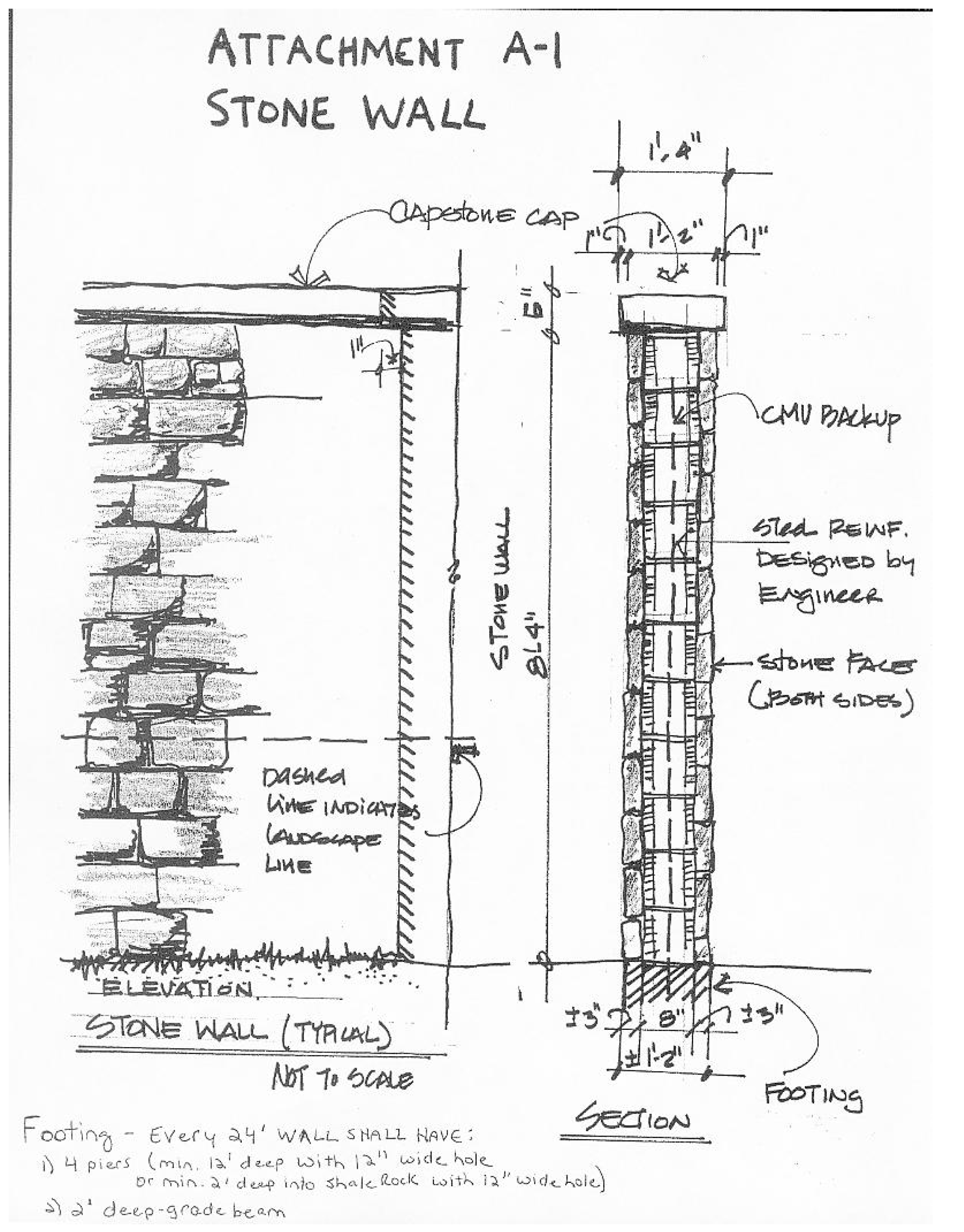
OPTION A. The perimeter-screening fence shall be an eight (8) feet masonry wall constructed of Granbury stone or approved equal with a buff color mortar and a cast stone cap. See Attachment A-I for wall detail.
b)
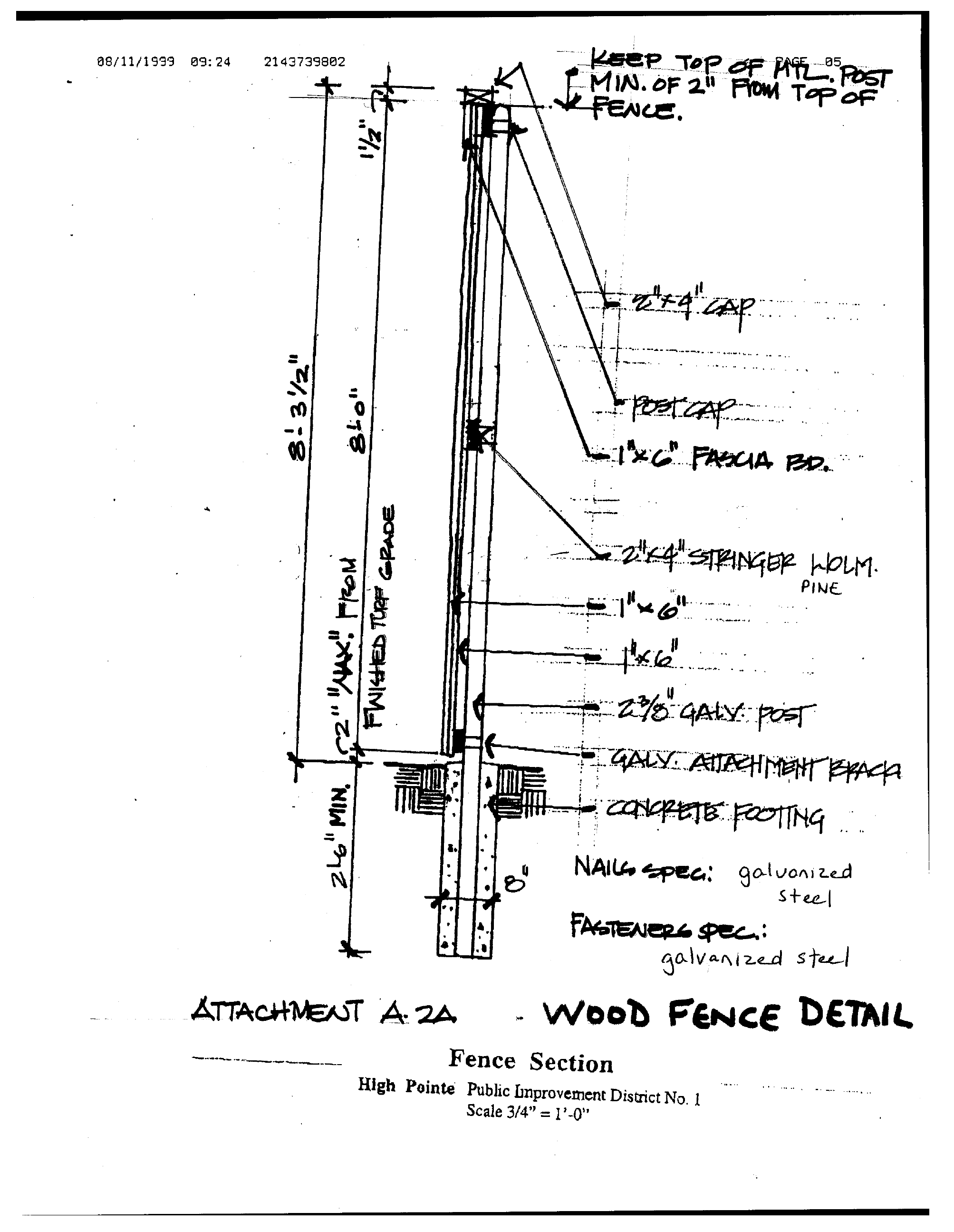
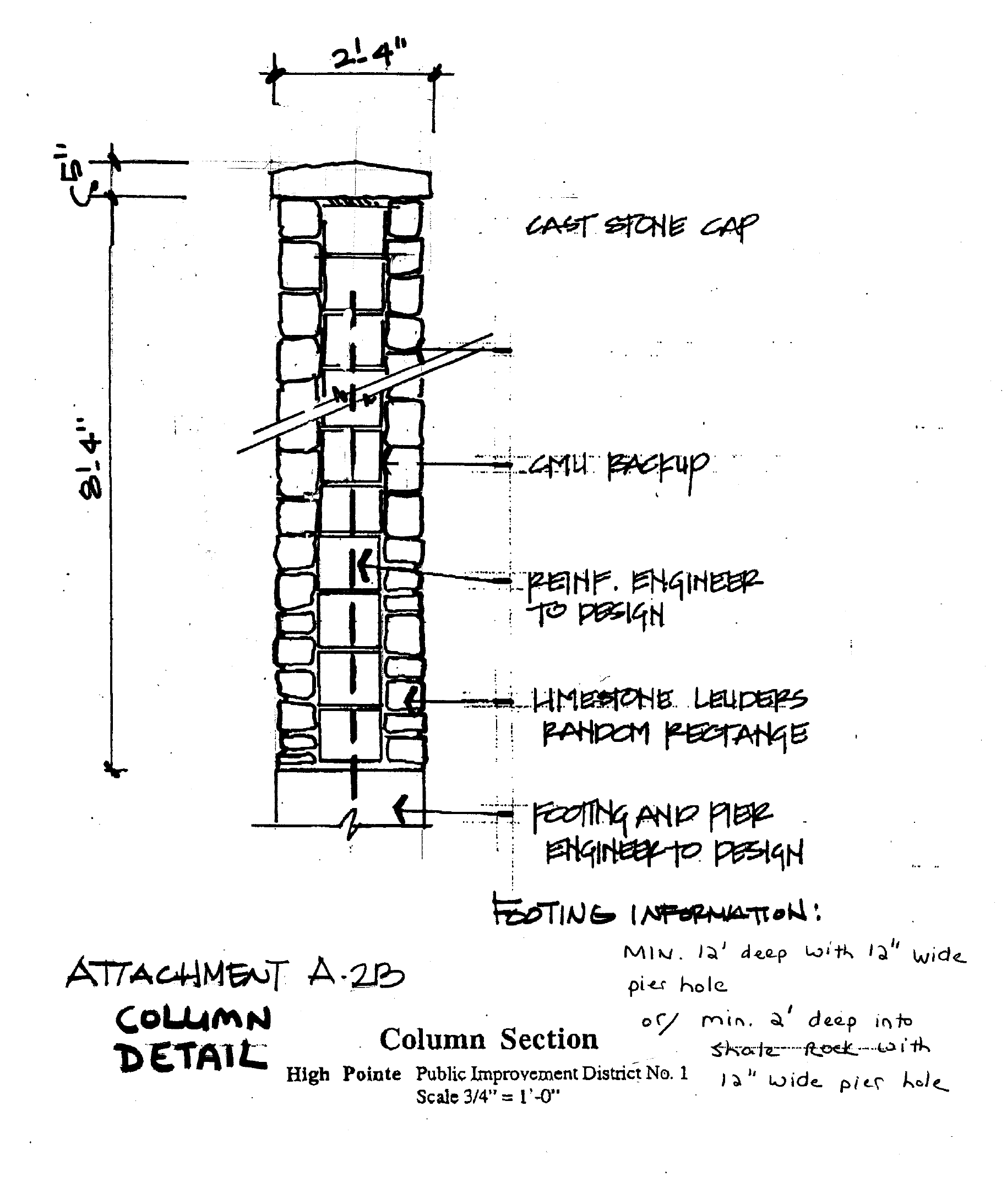
OPTION B. The uniform screening fence shall be an eight-foot board on board wood fence constructed of #1 premium grade cedar, with two "3/8" galvanized posts set on eight-foot centers, constructed with a minimum thirty-inch footing depth. The fence shall include 2′ × 2′ × 8′½″ masonry columns of Granbury stone (or approved equal) with a buff color mortar. The columns shall be placed on a maximum of twenty-seven-foot centers with a capstone cap. See Attachment A-2-A for wood fence detail and Attachment A-2-B for column detail.
c)
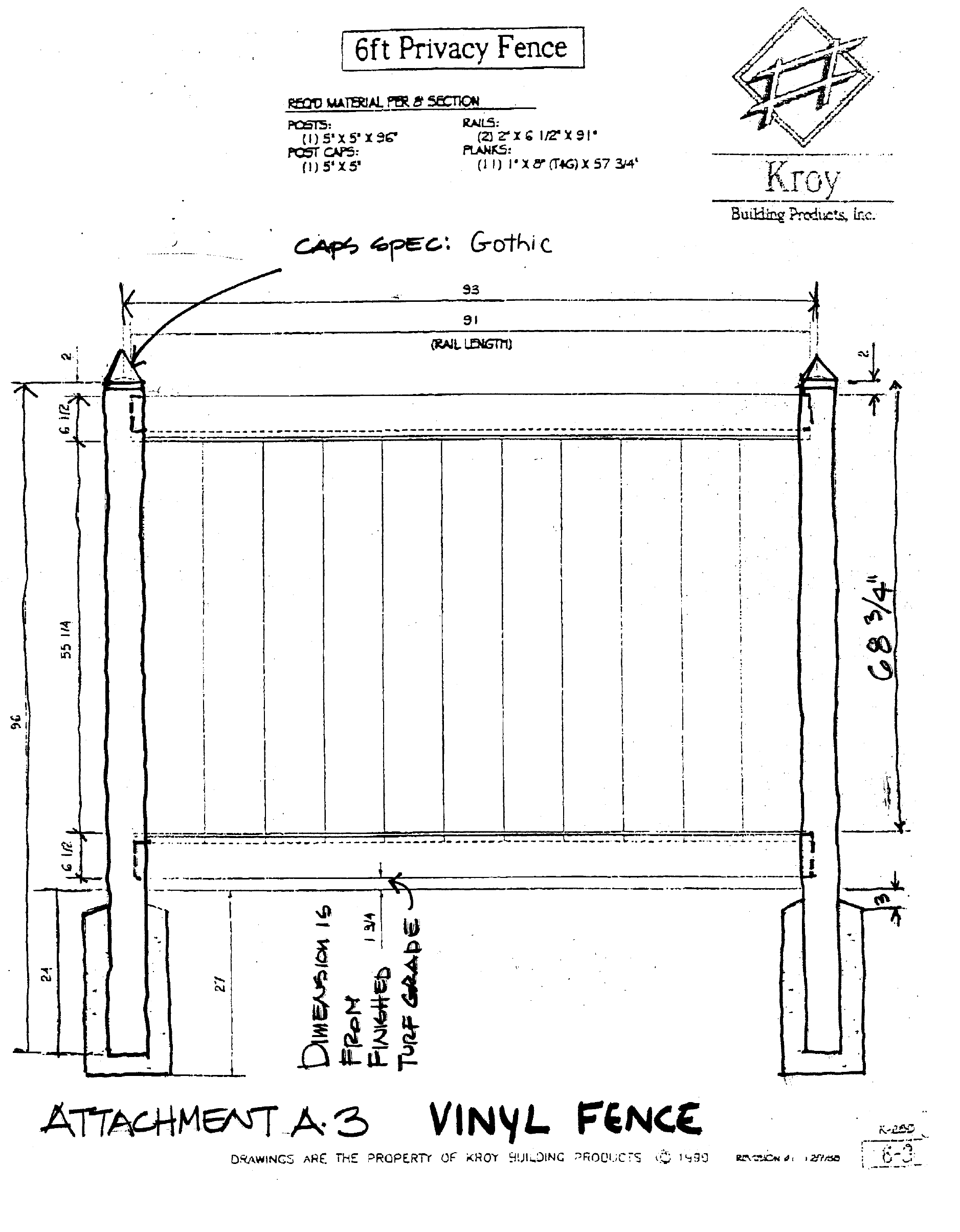
OPTION C. The uniform screening fence shall be an eight-foot tan vinyl privacy fence constructed of a quality, durable PVC vinyl material. The fence shall include 2′ × 2′ × 8′½″ masonry columns of Granbury stone (or approved equal) with a buff color mortar. The columns shall be placed on a maximum of twenty-seven-foot centers with a capstone cap. See Attachment A-3 for vinyl fence detail and Attachment A-2-B for column detail.
3.
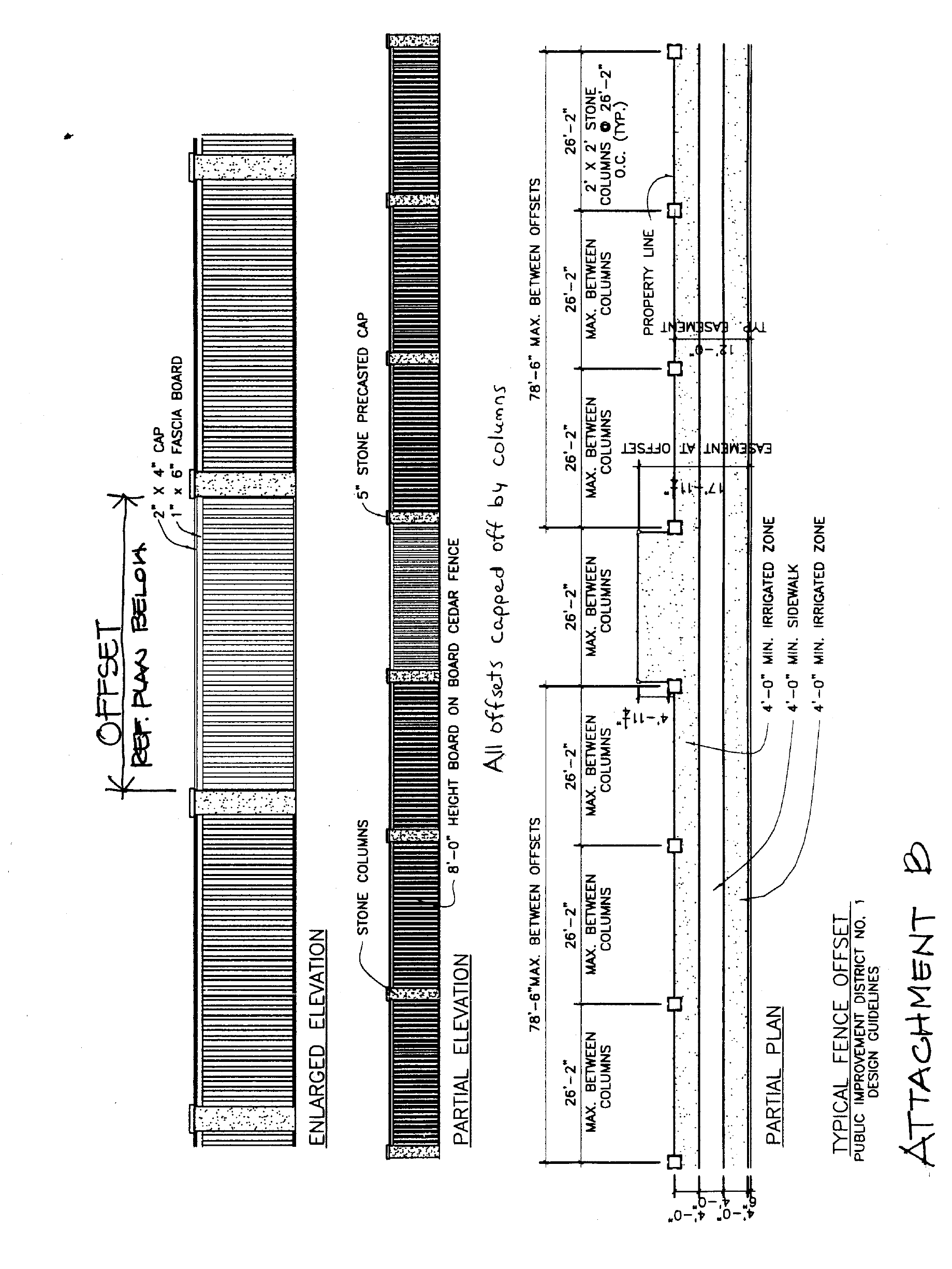
Fence offsets. Offsets shall be provided in the perimeter fence to provide a look of interest and depth from the street. Offsets shall be a maximum of twenty-seven (27) feet wide and a minimum of five (5) feet deep. There shall be no more than eighty (80) feet of continuous fence run without an offset. See Attachment B for fence offset detail. Landscape improvements to include trees, shrubs, flowers, decorative lights and street furniture shall be installed in the offsets of the required screening fence described above. Trees planted should be minimum of 3-inch caliper, locally adaptable and drought tolerant. All trees shall be staked and guyed or kept vertical by other acceptable methods.
4.
Screening for alleyways. A uniform screening fence shall be required where alleys back up to a public street or are adjacent to public rights-of-way. All required alleyway screening fences shall conform with one of the following options:
a)
OPTION A. The perimeter-screening fence shall be an eight-foot masonry wall constructed of Granbury stone or approved equal with a buff color mortar and a cast stone cap. See Attachment A-I for wall detail.
b)
OPTION B. The uniform screening fence shall be an eight-foot board on board wood fence constructed of #1 premium grade cedar, with 2′ ⅜″ galvanized posts set on 8-foot centers, constructed with a minimum thirty-inch footing depth. The fence shall include 2′ × 2′ × 8′½″ masonry columns of Granbury stone (or approved equal) with a buff color mortar. The columns shall be placed on a maximum of twenty-seven-foot centers with a capstone cap. See Attachment A-2-A for wood fence detail and Attachment A-2-B for column detail.
c)
OPTION C. The uniform screening fence shall be an eight-foot tan vinyl privacy fence constructed of a quality, durable PVC vinyl material. The fence shall include 2′ × 2′ × 8′½″ masonry columns of Granbury stone (or approved equal) with a buff color mortar. The columns shall be placed on a maximum of twenty-seven-foot centers with a capstone cap. See Attachment A-3 for vinyl fence detail and Attachment A-2-B for column detail.
d)
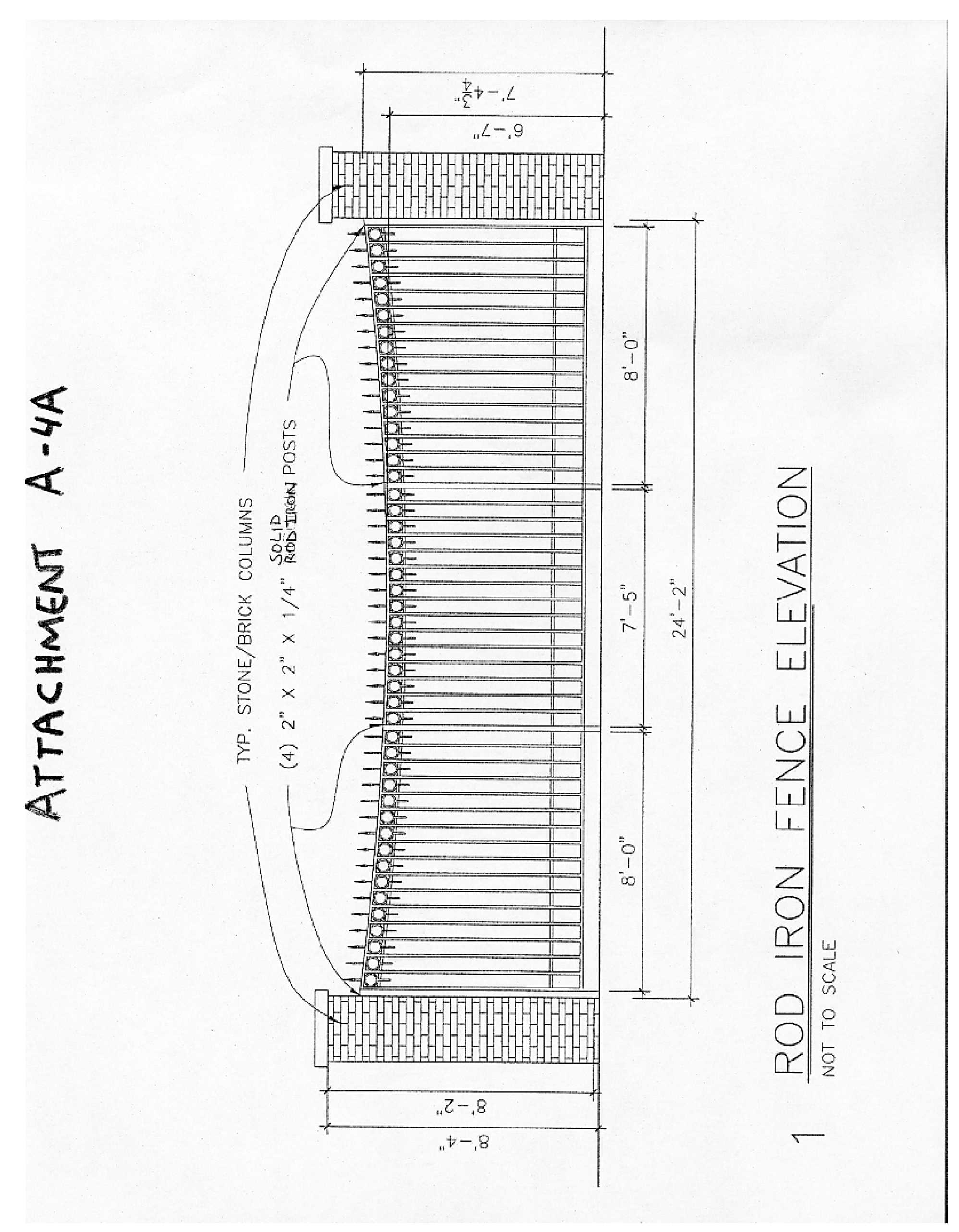
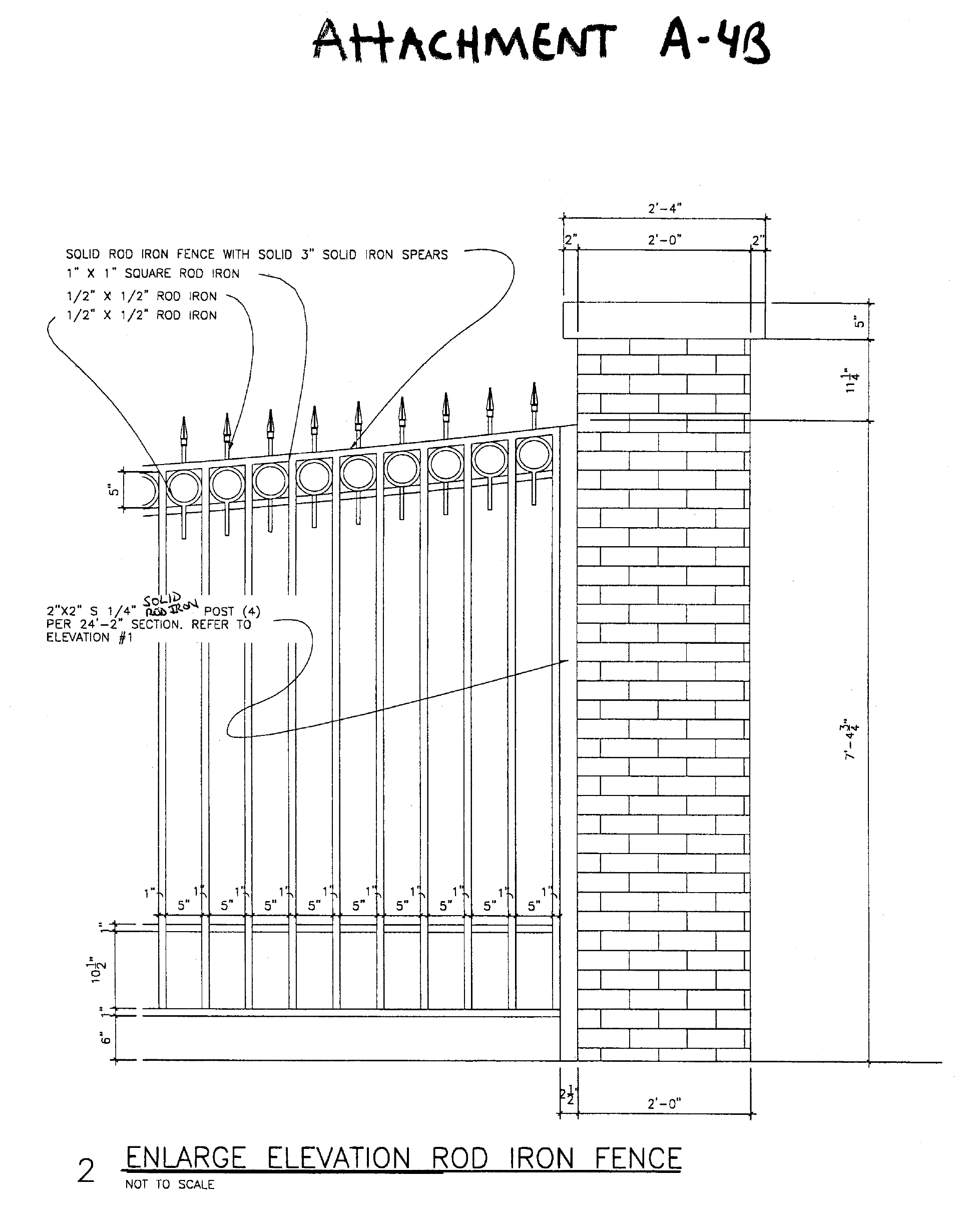
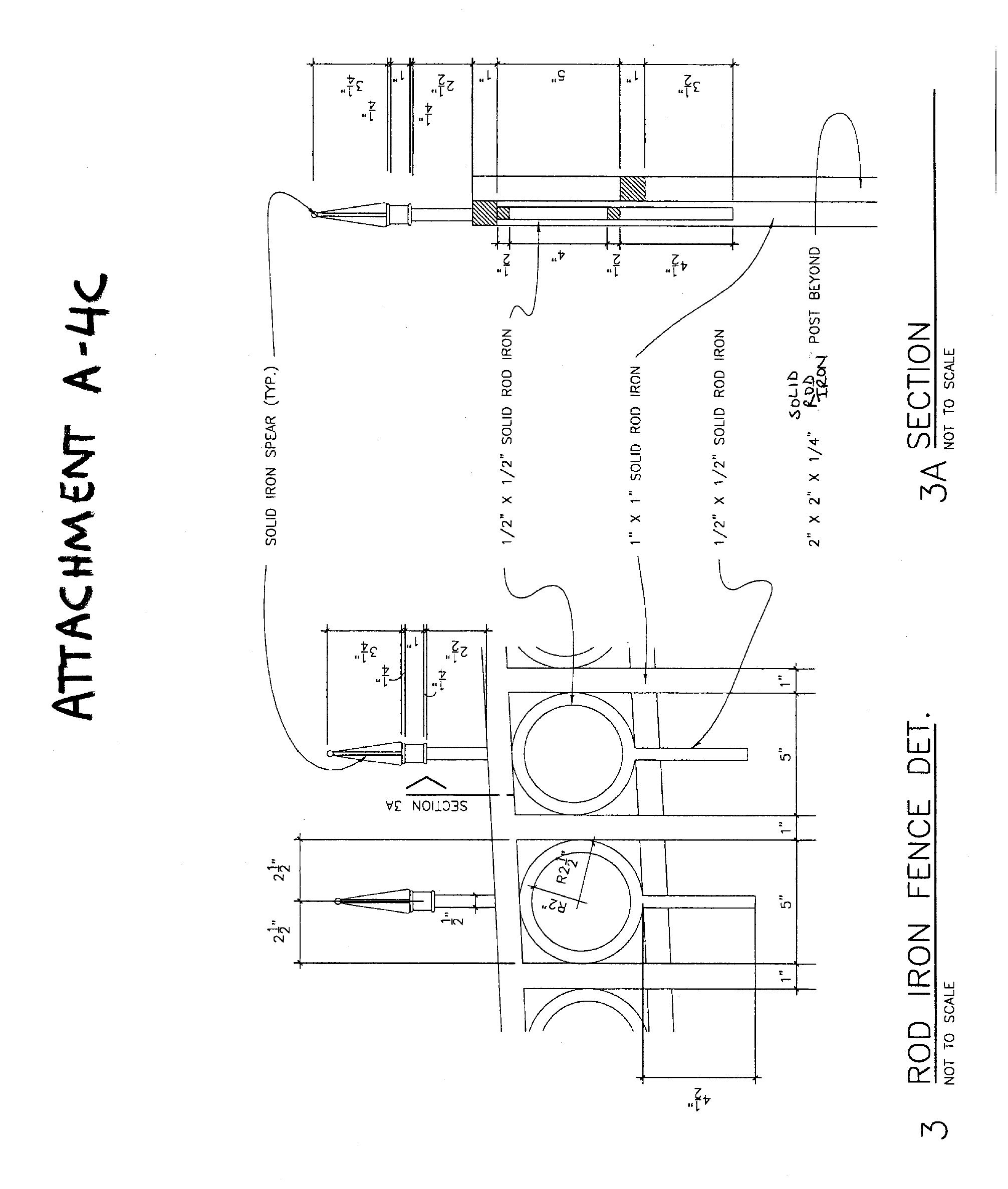
OPTION D. The uniform alleyway screening fence shall be a six-foot solid wrought iron fence (no tubular) with solid wrought iron spears with 2′ × 2′ × 6′½″ masonry columns of Granbury stone (or approved equal) with buff color mortar. See Attachment A-4 for wrought iron fence detail and Attachment A-2-B for column detail. A screening hedge shall be installed adjacent to and along the entire wrought iron fence. The screening hedge shall be a dense, evergreen hedge that is locally adaptable and drought tolerant. Plant material shall be able to achieve a minimum height of four (4) feet within three (3) years of planting. An underground automatic electric controlled irrigation system shall be provided along all required alleyway screening fences.
C.
ADDITION ENTRY FEATURES
1.
Signage.
a)
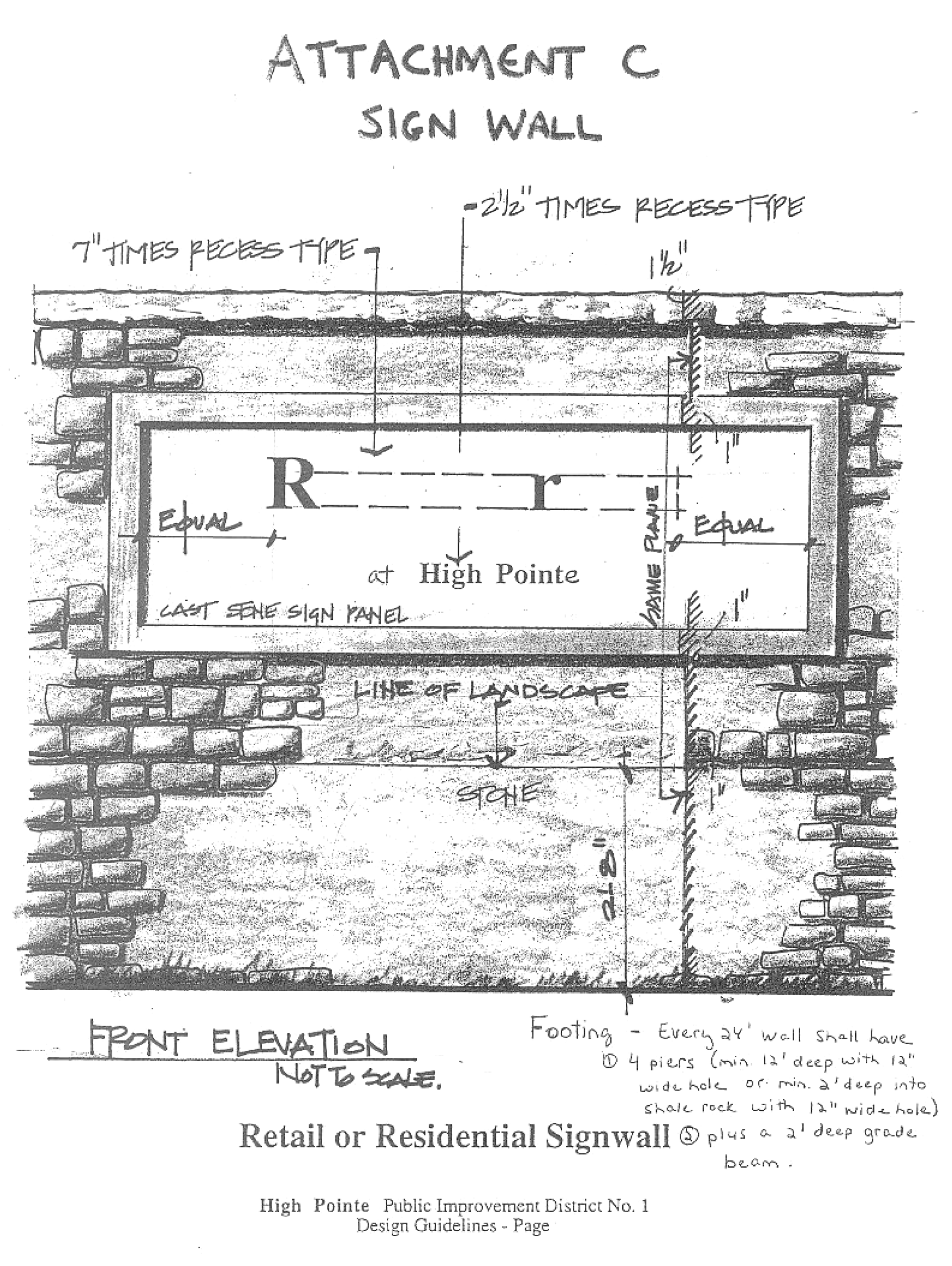
Entry signs, which identify the residential project, shall be constructed at each major addition entryway. There shall be defined by the developer at least one (1) major addition entryway for approximately every twenty (20) acres. Each major addition entryway shall have two (2) entry sign walls, one (1) on each comer of the entry into the addition. Each entry sign wall shall be a masonry wall, approximately 24′ × 1′ × 8′½″, constructed of Granbury stone (or approved equal) with buff color mortar. The entry wall shall contain a 2′ × 8′ cast stone sign with the name of the development in large letters with "at High Pointe" below in smaller letters. Sign wall shall be illuminated by upright from the grade in front of the wall. All electrical work needed to operate the sign wall lighting shall be provided by the developer. Sign walls shall be installed with a concrete foundation and quality stone masonry. See Attachment "C" for sign wall detail. All entry sign walls shall be constructed in fence and landscape easements granted to the district for maintenance purposes.
b)
All other signage shall comply with Cedar Hill City codes.
2.
Landscaping
a)
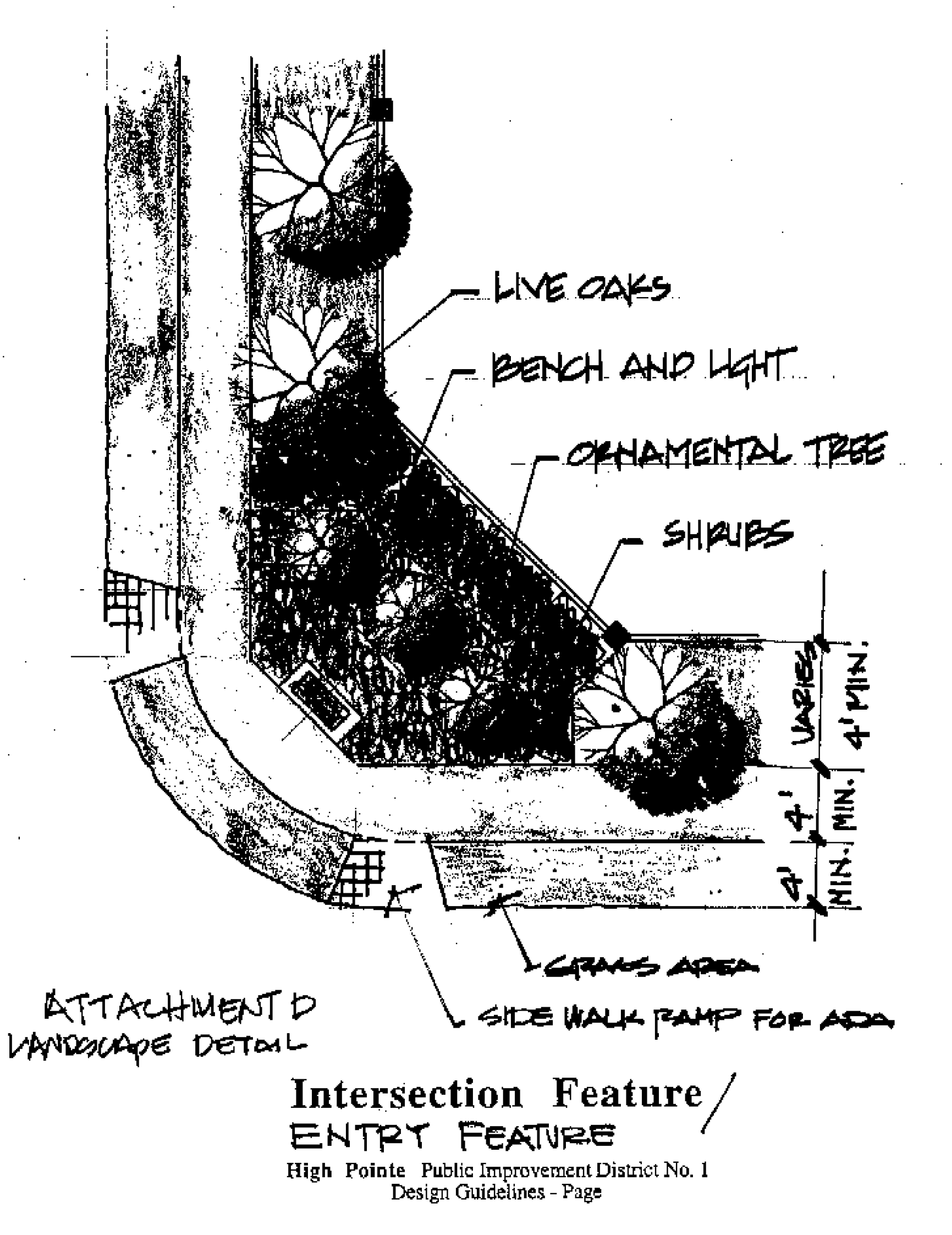
A generously landscaped bed shall be constructed in front of each sign wall. See Attachment "D" for detail of landscaped bed. Required landscaping shall include an area for annual color and an area for other landscaping that is generally locally adaptable and drought tolerant. An underground automatic electric controlled irrigation system is required and is subject to approval from the Cedar Hill public works department.
b)
The developer shall provide street furniture and lighting that is comparable in design and quality material to that existing in the neighborhood at each major addition entryway.
D.
LANDSCAPED MAJOR INTERSECTION FEATURES
1.
Signage
a)
Feature sign walls, which identify the residential project, shall be constructed at each major intersection. Major intersections are defined on the map (see Attachment E). Each major intersection comer shall have one (1) feature sign wall with a landscaped bed. Each feature sign wall shall be a masonry wall, approximately 24′ × 1′ × 8′½″ constructed of Granbury stone (or approved equal) with buff color mortar. The feature sign wall shall contain a 2′ × 8′ cast stone sign with the name of the development in large letters with "at High Pointe" below in smaller letters. Feature sign wall shall be illuminated by upright from the grade in front of the wall. All electrical work needed to operate the feature sign wall lighting shall be provided by the developer. Feature sign walls shall be installed with a concrete foundation and quality stone masonry. See Attachment "C" for feature sign wall detail. All major intersection feature sign walls shall be constructed in fence and landscaped easements granted to the district for maintenance purposes.
b)
All other signage shall comply with Cedar Hill City codes.
2.
Landscaping
a)
A generously landscaped bed shall be constructed in front of each feature sign wall. See Attachment "D" for detail of landscaped bed. Required landscaping will include an area for annual color and an area for other landscaping that is generally locally available, adaptable and drought tolerant. An underground automatic electric irrigation system is required and is subject to approval from the Cedar Hill public works department.
b)
The developer shall provide street furniture and lighting that is comparable in design and quality material as that existing in the neighborhood at each major intersection comer.
II.
RETAIL DEVELOPMENT
A.
DEVELOPMENT STANDARDS
1.
Storage. No outside storage is permitted for any use.
2.
Exterior finish. Building structure exterior masonry shall be one hundred (100) percent brick and/or stone, similar in color and style to that of surrounding residential entry and feature walls. Feature sign walls, columns and other landscape masonry structures shall be constructed of one hundred (100) percent brick and/or stone, similar in color and style as that of surrounding residential entry and feature walls.
3.
Retail buffer. The developer should provide buffer areas between retail property and adjacent residentially zoned property by providing screening walls and landscaping.
4.
Screening walls. The retail developer shall erect an eight-foot decorative masonry screening wall that is compatible in design to any existing masonry structures in the area when retail property is adjacent to residentially zoned property.
a)
Screening wall setback between retail property and alleys. Where the retail property is adjacent to residential alleys, the masonry wall should have a five-foot setback. The developer shall install and maintain a five-foot irrigated and landscaped area adjacent to and along the entire length of the masonry wall on the retail property side of the masonry wall. Developer shall install and maintain drought tolerant and locally adaptable landscaping on the residential side of the masonry wall to act as a visual buffer. Screening wall shall prohibit retail or commercial traffic any access to residential alley.
b)
Screening wall setback between retail property and all other residential property. Where the retail property is adjacent to other residentially zoned property, the masonry wall shall be placed on the retail property line. The developer shall install and maintain a five-foot irrigated and landscaped area adjacent to and along the entire masonry wall on the retail property side of the masonry wall.
5.
Building setbacks. Buildings shall have a three-foot setback for every foot of building height with a minimum of fifty-foot setback.
6.
Additional regulations. All other regulations and requirements are found in the Cedar Hill Zoning Ordinance, Neighborhood Services District.