
Cedar Hill City Zoning Code
ARTICLE 5
- DEVELOPMENT STANDARDS
DIVISION 5.2. - LANDSCAPE REQUIREMENTS[4]
Editor's note— Ord. No. 2018-655, § 20(Exh. D), adopted Sept. 25, 2018, amended Div. 5.2 in its entirety to read as herein set out. Former Div. 5.2, §§ 23-5.2.1—23-5.2.4, pertained to similar subject matter, and derived from Ord. No. 2001-71, 7-21-01; Ord. No. 2003-156, 8-26-03; Ord. No. 2004-207, 8-10-04)
DIVISION 5.3. - FENCING, WALLS AND SCREENING REQUIREMENTS[5]
Editor's note— Ord. No. 2018-655, § 21(Exh. E), adopted Sept. 25, 2018, amended Div. 5.3 in its entirety to read as herein set out. Former Div. 5.3, §§ 23-5.3.1, 23-5.3.2, pertained to similar subject matter, and derived from Ord. No. 2001-71, 7-21-01; Ord. No. 2003-143, 2-25-03; Ord. No. 2004-201, 4-13-04; Ord. No. 2011-456, 9-13-11)
DIVISION 5.7. - BUILDING DESIGN STANDARDS[6]
Editor's note— Ord. No. 2018-655, § 26(Exh. F), adopted Sept. 25, 2018, amended Div. 5.7 in its entirety to read as herein set out. Former Div. 5.7, §§ 23-5.7.1, 23-5.7.2, pertained to exterior construction requirements, and derived from original content.
DIVISION 5.8. - DEFINITIONS
Definitions. For the purpose of these regulations, certain terms and words are to be used and interpreted as defined hereinafter. Words used in the present tense shall include the future tense; words in the singular number include the plural and words in the plural number include the singular, except where the natural construction of the writing indicates otherwise. The word shall is mandatory and not directory. For any term or use not defined herein, Webster's Dictionary (latest edition) shall be used.
No use or activity defined herein shall be construed to permit a sexually oriented use or activity except for those uses defined and permitted under section 23-4.1.7 of the zoning ordinance.
Accessory apartment. See "Servant's Quarters".
Accessory building (residential). In a residential district, a subordinate building attached or detached and used for a purpose customarily incidental to the main structure such as a private garage for automobile storage, tool house, lath or greenhouse as a hobby (no business), home workshop, children's playhouse, storage house or garden shelter, but not involving the conduct of a business.
Accessory building (business or industry). In the nonresidential districts, a subordinate building to the main building, limited in height to not over the height of the main building and not exceeding fifty (50) percent of the floor area of the main building and used for purposes directly accessory and incidental to the main use.
Accessory use. A use customarily incidental, appropriate and subordinate to the principal use of land or building(s) and located upon the same lot therewith.
Adult day care facility. A facility with a structured, comprehensive program that is designed to meet the needs of adults with functional impairments through an individual plan of care by providing health, social, and related support services in a protective setting that provides services under an adult day care program on a daily or regular basis, but not overnight, to four or more elderly or handicapped persons who are not related by blood, marriage, or adoption to the owner of the facility. The owner must be licensed to establish or operate an adult day care facility in Texas and be in compliance with Texas Administrative Code § 40(1)(98).
Airport or landing field. A place where an aircraft can land and take off, usually equipped with hangars, facilities for refueling and repair and various accommodations for passengers.
Alcoholic beverages.
Alcoholic beverage. Alcohol, or any beverage containing more than one-half of one percent of alcohol by volume, which is capable of use for beverage purposes, either alone or when diluted, excepting any alcoholic beverage specifically made for clerical or religious purposes as described by the Texas Alcoholic Beverage Code.
Alcoholic beverage manufacturing. An establishment for the manufacture, blending, fermentation, processing and packaging of alcoholic beverages. This use excludes the sale of alcoholic beverages for on-premise consumption and the retail sale of alcoholic beverages for off-premise consumption.
Beer. Malt beverages with more than a half percent alcohol by volume, but not more than four (4) percent alcohol by weight (five (5) percent alcohol by volume).
Liquor. Any alcoholic beverage containing alcohol in excess of four (4) percent by weight, unless otherwise indicated. Proof that an alcoholic beverage is alcohol, spirits of wine, whiskey, liquor, wine, brandy, gin, rum, ale, malt liquor, tequila, mescal, habanero or barreteago, is prima facie evidence that it is liquor.
Liquor store. A business that sells liquor for consumption off-premises. For the purposes of this chapter, the term "liquor store" shall exclude general merchandise and food stores in which only beer and/or wine is offered for sale as a minor part of an overall larger inventory of goods.
Microbrewery. An establishment for the manufacture, blending, fermentation, processing and packaging of beer with a floor area of ten thousand (10,000) square feet or less that takes place primarily inside a building. A facility that only provides on-premise consumption or retail sale of alcoholic beverages is not a microbrewery.
Mixed beverage. An alcoholic beverage served for consumption on the premises where it is sold by the holder of a mixed beverage or private club permit. It could be beer, malt liquor/ale, wine or spirits.
Wine. Alcoholic beverages made by fermenting juice from fruit, grapes, berries or honey.
Winery. An establishment for the manufacture, blending, fermentation, processing and packaging of wine with a floor area of ten thousand (10,000) square feet or less that takes place primarily inside a building. A facility that only provides on-premise consumption or retail sale of alcoholic beverages is not a winery.
Alley. A minor right-of-way, dedicated to public use, which affords a secondary means of vehicular access to the back or side of properties otherwise abutting a street, and which may be used for public utility purposes.
Ambulance service. Provision of private (not operated by the City of Cedar Hill) emergency transportation which may include medical care, and including storage and maintenance of vehicles.
Animal boarding and kennels. Facility where small domesticated household animals are temporarily housed, groomed, bred, boarded, training, or sold for commercial purposes in indoor kennels. See "domesticated household animals (indoor)"
Animal boarding and kennels (indoor/outdoor). Facility where small or large domesticated household animals are temporarily housed, groomed, bred, boarded, trained, or sold for commercial purposes in indoor or outdoor kennels or pens. See "domesticated household animals (outdoor)".
Antenna. The arrangement of wires or metal rods used in transmission, retransmission and/or reception of radio, television, electromagnetic, or microwave signals (includes microwave reflectors/antennas and satellite dishes).
Antenna support structure. Any tower, mast, pole, tripod, box frame, or other structure utilized for the purpose of transmission, retransmission, and/or reception of electromagnetic, radio, television, or microwave signals. Erected means a tower or pole designed for the sole purpose of antenna support while mounted or attached means the use of an existing structure for antenna support.
Antique shop, sales indoors. A retail establishment engaged in the selling of works of art, furniture or other artifacts of an earlier period, with all sales and storage occurring inside a building.
Apartment. See "multi-family dwelling".
Appliance repair. See "household appliance service and repair".
Art gallery or museum. An institution for the collection, display and distribution of objects of art or science and which is sponsored by a public or quasi-public agency and which facility is open to the general public.
Artist studio. A workplace for the teaching, preparation, or practice of an art such as animation, ceramics, dance, graphic design, music, painting, photography, pottery, scrapbooking, and sculpture.
Asphalt batching plant. See "concrete batching plant".
Assembly, heavy. A business where parts, manufactured elsewhere, are assembled with the assistance of power-driven machines and materials-handling equipment, and manipulated primarily by lifting machinery which produces low dust and fiber, and all materials are assembled within an enclosed building.
Assembly, light. A business where parts, manufactured elsewhere, are assembled with the assistance of power-driven machines and materials-handling equipment, and manipulated primarily by hand which produces low dust and fiber, and all materials are assembled and stored within an enclosed building.
Assisted living facility. A congregate residence facility for ten or more elderly (over fifty-five (55) years of age) persons, regardless of legal relationship, who need limited assistance with daily living activities. A limited number of support services such as meals, laundry, housekeeping, transportation and social or recreational services may be provided or associated with the assisted living facility. Units may be attached or detached, single- or double-occupancy, and may include limited or full kitchen facilities. Full-time medical or nursing care is not typically provided by the facility, but may be privately arranged for by individual residents on a part-time or temporary basis (e.g., visiting nurses, etc.).
Audio recording studio. A studio where tapes, records, or other electronic media are recorded for the distribution of audio recordings.
Audio recording studio retreat. A residential facility that includes the secondary use of audio recording studio on the premises and provides an environment for the purposes of writing, collaborating, preforming, instruction, preparing, or completing audio recordings. This facility may include overnight accommodations for users of the facility and their guests and shall be occupied by a single family or care taker.
Auto auction. See "auto storage".
Auto laundry or car wash. Washing, waxing or cleaning of automobiles or light duty trucks.
Auto finance and leasing. Leasing of automobiles, motorcycles, and light load vehicles but no outside storage.
Auto parts and accessory sales (indoors). The use of any building or other premise for the primary inside display and sale of new or used parts for automobiles, panel trucks or vans, trailers, or recreation vehicles.
Auto rental. Storage or renting of automobiles and light trucks.
Auto sales (new & used). Retail sales of new automobiles or light load vehicles, including, as a minor part of the business, the sales of used automobiles or light load vehicles and the service of new or used vehicles.
Auto sales (used). Retail sales, or offering for sale, used automobiles or light load vehicles.
Auto salvage/wrecking yard. See "salvage/reclamation yard".
Auto storage or auto auction. The storage or impoundment, on a lot or tract, paved in accordance with parking lot paving requirements set forth in the Code of Ordinances, of operable automobiles for the purpose of holding such vehicles for sale or distribution.
Auto tow service. See "wrecker or tow service".
Automobile. A self-propelled mechanical vehicle designed for use on streets and highways for the conveyance of goods and people including but not limited to the following: passenger cars, trucks, buses, motor scooters and motorcycles.
Automobile accessory installation (minor). Minor installation of minor automobile accessories such as car alarms, radio and stereo equipment, window tinting, pin striping, cellular telephones and similar accessories.
Automobile repair garage. An establishment providing major or minor automobile repair services to all motor vehicles with the exception of heavy load vehicles.
Automobile repair, major. General repair or reconditioning of engines, air-conditioning systems and transmissions for motor vehicles; wrecker service; collision services, including body, frame or fender straightening or repair; customizing; painting; vehicle steam cleaning; undercoating and rust-proofing; those uses listed under "automobile repair, minor"; and other similar uses.
Automobile repair, minor. Minor repair or replacement of parts, tires, tubes, and batteries; diagnostic services; minor motor services such as grease, oil, spark plug, and filter changing; tune-ups; emergency road service; replacement of starters, alternators, hoses, brake parts; automobile washing and polishing; performing state inspections and making minor repairs necessary to pass said inspection; normal servicing of air-conditioning systems, and other similar minor services for motor vehicles except heavy load vehicles, but not including any operation named under "automobile repair, major" or any other similar use.
Automotive gasoline or motor fuel service station. Any building, land area or other premises, or portion thereof, used or intended to be used for the retail dispensing or sales of automobile fuels, lubricants, and automobile accessories, including those operations listed under minor automobile repair. Vehicles, which are inoperative or are being repaired, may not remain parked outside an automobile service station for a period greater than forty-eight (48) hours.
Bakery or confectionery (wholesale or commercial). A manufacturing facility over two thousand five hundred (2,500) square feet for the production and distribution of baked goods and confectioneries to retail outlets.
Bank. An establishment for the custody, loan, exchange or issue of money, the extension of credit, and/or facilitating the transmission of funds. A bank does not include a credit access business.
Barn. A structure intended for the purpose of storage of farming and ranching related equipment.
Basement (or cellar). A story partly or wholly underground. For purposes of height measurement, a basement shall be counted as a story when more than one-half of its height is above the average level of the adjoining ground or when subdivided and used for commercial or dwelling purposes by other than a janitor employed on the premises.
Base zoning district. Underlying district which shows on the most recently adopted zoning map.
Bed and breakfast inn or facility. a dwelling occupied as a permanent residence by an owner or renter which serves breakfast and provides or offers sleeping accommodations in not more than five (5) rooms for transient guests for compensation.
Block. A piece or parcel of land entirely surrounded by public highways or streets, other than alleys. In cases where the platting is incomplete or disconnected, the director of planning shall determine the outline of the block.
Boarding or rooming house. A dwelling other than a hotel, where for compensation and by prearrangement for definite periods, meals, or lodging and meals are provided.
Broadcast tower. See "radio, television and broadcast tower."
Building. Any structure intended for shelter, occupancy, housing or enclosure for persons, animals or chattel. When separated by dividing walls without openings, each portion of such structure so separated shall be deemed a separate building.
Building elevation. The exterior wall of a building or structure.
(1)
Front building elevation. The non-residential or multiple-family building elevation that has frontage on an existing or future right-of-way. Exterior walls that are perpendicular and between walls with frontage on a right-of-way shall be considered part of the front building elevation.
Building height. The height of a building, or portion of a building, shall be measured from the average established grade at the street lot line or from the average natural ground level, if higher, or if no street grade has been established, to the highest point of the roof's surface if a flat surface; to the deck line of mansard roofs; and the mean height level between eaves and ridge for hip and gable roofs. In measuring the height of a building, the following structures shall be excluded: chimneys, cooling towers, elevator bulkheads, penthouses, tanks, water towers, radio towers, ornamental cupolas, domes or spires, and parapet walls not exceeding four (4) feet in height.
Building line. A line parallel or approximately parallel, to any lot line at a specific distance there from, marking the minimum distance from the lot line that a building may be erected. (See Illustration 6)
Building, main or primary. A building in which the principal use of the lot on which it is situated is conducted. In a residential district any dwelling shall be deemed to be a main building on the lot on which it is situated.
Building materials (categories).
(1)
Primary building materials. The following exterior building materials shall be considered primary building materials: brick material, concrete masonry units, glass walls, and stone material.
(2)
Secondary building materials. The following exterior building materials shall be considered secondary building materials: acrylic matrix or synthetic plaster finish, concrete panel construction, fiber cementitious material, stucco, and tile.
(3)
Accent building materials. The following exterior building materials shall be considered accent building materials: cedar wood products, metal cladding, and other materials subject to approval by the building official.
Building materials (types).
(1)
Acrylic matrix or synthetic plaster finish. A three-component finish system consisting of one hundred (100) percent acrylic matrix ceramically colored aggregate and sealer, or one hundred (100) percent synthetic plaster having two (2) types of applications: spraying or troweling. Exterior coats may be 1/16-inch to 3/32-inch in thickness. Each product can be applied to a variety of backing such as gyp sheathing, plywood, particle board, or foam board. A base coat and fiberglass mesh is used to smooth and level surfaces, corners and joints.
(2)
Brick material. A building material that is hard-fired (kiln fired) clay or slate material which meets the latest version of ASTM standard C216, Standard Specification for Facing Brick (Solid Masonry Unit Made of Clay or Shale), shall be severe weather (SW) grade, and type FBA or FBS or better. Unfired or under-fired clay, sand, and shale brick are not allowed.
(3)
Concrete masonry units. A building material that meets the latest version of the following applicable specifications: ASTM C90, Standard Specification for Hollow Load Bearing Concrete Masonry Units; ASTM C145, Standard Specification for Solid Load Bearing Masonry Units; ASTM C129, Standard Specification for Hollow and Solid Non-Load Bearing Units. Concrete masonry units shall have an indented, hammered, split face finish or other similar architectural finish, integrally colored, subject to approval by the building official. Lightweight concrete block or cinder block construction is not acceptable as an exterior finish.
(4)
Concrete panel construction. Concrete finish, pre-cast panel or tilt wall construction shall be painted, fluted, or exposed aggregate. Other architectural concrete finish is subject to approval by the planning and zoning commission. Smooth or untextured concrete finishes are not acceptable unless painted.
(5)
Fiber cementitious material. An exterior building material composed of reinforced cement and cellulose fibers.
(6)
Glass walls. An exterior wall with a maximum reflectance of twenty (20) percent, which carries no structural loads and consists of a combination of metal, glass, or other surfacing material supported in a metal framework. Glass walls include glass curtain walls or glass block construction.
(7)
Stone material. A building material that consists of granite, marble, limestone, slate, river rock, and other hard and durable naturally occurring all weather stone. Cut stone and dimensioned stone techniques are acceptable.
(8)
Stucco. An approximately 7/8-inch, cement-based, three-coat system that is applied over an approved, weather-resistive barrier and metal lath by spraying or troweling. The three-coat system is comprised of a scratch coat, brown coat and a finish coat that is color integrated and sealed.
Building official. The inspector or administrative official charged with responsibility for issuing permits and enforcing the zoning ordinance and building code.
Building site. See "lot" definition.
Bus repair or leasing. See "truck and bus repair or leasing".
Bus station or terminal. Any premises for the transient housing or parking of motor-driven buses and the loading and unloading of passengers.
Cafeteria. See "restaurant or cafeteria".
Camper sales. See "recreational vehicle/camper sales".
Camping trailer. See "trailer, travel or camping".
Caretakers' or guards' residence (nonresidential). A residence located on premises with a main residential or non-residential use and occupied only by a caretaker or guard employed on the premises.
Carnival, circus or tent service (temporary). Outdoor or indoor commercial amusement provided on a temporary basis.
Carport. A structure open on a minimum of two sides designed or used to shelter not more than three (3) vehicles and not to exceed twenty-four (24) feet on its longest dimension. Also called "covered parking area."
Car wash. See "auto laundry".
Cement manufacturing. The act of making hydraulic or Portland cement by mixing various components such as powder of alumina, silica, lime, iron oxide, or magnesium oxide, burned together in a kiln and finely pulverized and used as an ingredient of mortar and concrete.
Cement product. Any product made by the addition of Portland cement with other ingredients to produce any cement-based product, including, but not necessarily limited to, concrete, mortar, stucco, grout and terrazzo.
Cement product forming/molding/casting (indoors only). The process of manufacturing by shaping or injecting cement product(s) into a rigid frame, mold, cast or matrix to create a finished product or structure. The mold, frame, cast or matrix may or may not become part of the finished product or structure and without any outdoor sales, storage or display of any commodity or materials and where all work is performed wholly within an enclosed building.
Cemetery or mausoleum. Land used or intended to be used for the burial of the human dead and dedicated for cemetery purposes, including columbariums, crematories, mausoleums, and mortuaries when operated in conjunction with and within the boundaries of such cemetery.
Cemetery, animal. Same as cemetery except for only the burial of dead animals.
Certificate of occupancy. An official certificate issued by the city through the building official which indicates conformance with the zoning regulations and building codes and authorizes legal use of the premises for which it is issued; may be referred to as an occupancy permit.
Chemical and allied product manufacturing (non-hazardous). The manufacturing of products primarily by chemical processes which, by way of example, may include industrial chemicals, plastics materials and synthetic resins, synthetic rubber, manmade fibers except glass, medicinal chemicals and botanical products; pharmaceutical products; biological products, except diagnostic substance, soaps, detergents, and cleaning products; perfumes, cosmetics, and other toilet preparations. This definition does not include mining of natural chemicals and fertilizers, nor does it include establishments primarily engaged in packaging, repackaging and bottling of purchased chemical products.
Child care center (or day care center). A commercial institution or place designed for the care or training of twelve (12) or more unrelated children under fourteen (14) years of age for less than twenty-four (24) hours a day.
Church, rectory, or temple. A building for regular assembly for religious worship which is used primarily and designed for such purpose and those accessory activities which are customarily associated therewith, and the place of residence for ministers, priests, nuns or rabbis on the premises (tax exempt as defined by state law). For the purposes of this chapter, bible study and other similar activities which occur in a person's primary residence shall not apply to this definition.
City council. The governing body of the City of Cedar Hill, Texas.
Civic center. A building or complex of buildings that house municipal offices and services, and which may include cultural, recreational, athletic, convention or entertainment facilities owned and/or operated by a municipality.
Civic club. See "fraternal organization, lodge, civic club, fraternity/sorority club, or union".
Cleaning plant. See "laundry and dry cleaning" or "laundry and dying plant".
College or university. An academic institution of higher learning, accredited or recognized by the State and covering a program or series of programs of academic study.
Commercial amusement (indoor). See "amusement, commercial (indoor)".
Commercial amusement, other than listed (indoor). An amusement enterprise wholly enclosed in a building which is treated acoustically so that noise generated by the enterprise is not perceptible at the bounding property line and including, but not limited to, a bowling alley, billiard parlor, bingo facility, skating rink, and amusement devices. For the purpose of this definition, amusement devices shall not include games of chance; gambling-like device versions of bingo, keno, blackjack, lottery, roulette, video poker, eight-liners or similar electronic, electromechanical, or mechanical games, or facsimiles thereof; children's rides; or jukeboxes or similar electronic or mechanical music machines that do not involve games of skill for interactive amusement.
Commercial amusement, other than listed (outdoor). Any amusement enterprise offering entertainment or games of skill to the general public for a fee or charge wherein any portion of the activity takes place in the open including, but not limited to, archery range, miniature golf course, and go-cart race tracks.
Commercial amusement (outdoor). See "amusement, commercial (outdoor)".
Commercial school. See "trade and commercial school".
Communications operations (amateur). The transmission, retransmission and/or reception of radio, television, electromagnetic, or microwave signals for private or personal use and not for the purpose of operating a business and/or for financial gain.
Communications operations (commercial). The transmission, retransmission, and/or reception of radio, television, electromagnetic, or microwave signals primarily for the purpose of operating a business and/or for financial gain.
Community center (public). A building or complex of buildings that house cultural, recreational, athletic, or entertainment facilities owned and/or operated by a governmental agency or private non-profit agency.
Community home. A place where not more than six (6) physically or mentally impaired or handicapped persons are provided room and board, as well as supervised care and rehabilitation by not more than two (2) persons as licensed by the Texas Department of Mental Health and Mental Retardation (also see Chapter 123 of the Texas Human Resources Code).
Comprehensive plan. Document adopted by the city that consists of graphic and textual policies which govern the future development of the city and which consists of various components governing specific geographic areas and functions and services of the city.
Concrete or asphalt batching plant (permanent). A permanent manufacturing facility for the production of concrete or asphalt.
Concrete or asphalt batching plant (temporary). A temporary manufacturing facility for the production of concrete or asphalt during construction of a project, and to be removed when the project is completed.
Congregate housing. See "retirement housing for the elderly."
Construction yard or field office. See "temporary field office".
Continuing care retirement community. A housing development designed to provide a full range of accommodations for older adults (55 years of age or older), including independent living, assisted living and skilled full-time nursing or medical care. Residents may move from one (1) level to another as their needs change.
Contractor's shop with outside storage. A building or part of a building that is used in conjunction with a land area for the storage of construction materials, equipment, tools, product and vehicles.
Convalescent home. See "skilled nursing facility".
Convenience store. A small retail establishment that sells gasoline or diesel fuel and convenience goods, such as prepackaged food and beverage items for off-premise consumption, tobacco, periodicals, and household goods. It is designed to attract a large volume of stop-and-go traffic.
Copy shop or printing. An establishment that reproduces, in printed form, individual orders from a business, profession, service, industry or government organization and occupies less than four thousand (4,000) square feet.
Country club (private). A land area and buildings that may include a golf course, clubhouse, dining room, swimming pool, tennis courts and similar recreational or service uses available only to members and their guests.
Court. An open, unobstructed space, bounded on more than two sides by the walls of a building. An inner court is entirely surrounded by the exterior walls of a building. An outer court has one (1) side open to a street, alley, yard, or other permanent open space.
Coverage. The lot area covered by all buildings located thereon, including the area covered by all overhanging roofs.
Credit access business. The meaning given that term in Section 393.601 of the Texas Finance Code, as amended.
Crematorium. A facility licensed, or qualified to be licensed, by the State of Texas for the cremation of human remains.
Custom personal service shop. See "personal service shop".
Dance hall. An establishment with dancing by patrons or customers.
Dance studio. See "gymnastics or dance studio".
Day camp for children. A facility arranged and conducted for the organized recreation and instruction of children including outdoor activities on a daytime basis
Day care center. See "child care center".
Density. The total number of residential buildings allowed upon a given tract of land usually expressed in total number of units per gross acres or net acre.
Deny with prejudice. This action, from an appointed or elected body charged with rendering decisions, bars the same case from again being brought for consideration to the body within twelve (12) months of the decision.
Detached. Having no physical connection above the top of the floor line of the first floor with any other building or structure.
Distribution center. A facility that serves as a way station in the supply chain for the storage and redistribution of products that have been shifted from one transport mode to the same or a different transport mode, and often to go on to fulfillment centers and retail outlets. Storage of the products is on a short-term basis and leaves as soon as it arrives since they already have another destination. Generally, daily truckload traffic for delivery trucks is higher than a warehouse. Buildings typically incorporate numerous docks to accommodate multiple trucks simultaneously.
Domesticated household animals (indoor). The following captive born species shall include: Dog, Budgerigar (Parakeet), Cat, Canary, Guinea Pig, Pigeon, Rabbit, Other Common Cage Birds, Mouse, Aquarium Fish (Captive Born), Rat, Psittacine (Captive Bred [Parrot and Parrot-Like Birds]), Gerbil, Finch (Captive Bred), Golden Hamster, Ferret, and Chinchilla.
Domesticated household animals (outdoor). The following captive born species, are included: Horse, Domestic Fowl, Donkey, Goose, Pig, Duck (Mallard Type or Muscovy), Sheep, Turkey, Goat, Guinea Fowl, Cattle, Peafowl, Llama, Alpaca, and Honey Bee in addition to those listed in Domesticated Animals (Indoor).
Drapery or furniture upholstering shop. An establishment for the production, display and sale of draperies and soft coverings for furniture.
Drive-through facility. A vehicular driveway or stacking lane that traverses through a building or on the exterior facade of a building for service and/or delivery of goods to the occupant(s) of the vehicle.
Drug store. A retail establishment that offers for sale the following items: nonprescription medicines that do not contain tetrahydrocannabinol (THC) and/or are not derived from the plant Cannabis Sativa L; prescription drugs; and personal care products. Drug stores may also sell, in limited amounts, household products, food and beverages, and other related items.
Dwelling. Any building or portion thereof, which is designed or used as living quarters for one (1) or more families.
Dwelling, single-family attached (townhouse). See "single-family (attached)".
Easement. A grant of one (1) or more of the property rights by the property owner to and/or for the use by the public, a corporation or another person or entity.
Eating place. See "restaurant or cafeteria".
Electrical substation (high voltage bulk power). A subsidiary station in which electric current is transformed.
Enclosed building. A structure that is floored, roofed and surrounded by at least three (3) outside walls.
Engine repair/motor manufacturing/remanufacturing and/or repair. The repair and maintenance of commercial and industrial machinery and equipment. Establishments engaged in either sharpen/install commercial and industrial machinery blades and saws that provide welding (e.g., automotive, general) repair services, or repair agricultural and other heavy and industrial machinery and equipment (e.g., forklifts, and other materials handling equipment, machine tools, commercial refrigeration equipment, construction equipment and mining machinery).
Extended stay motel. See "residential hotel".
Fairgrounds or exhibition area. An area or space either outside or within a building for the display of topic-specific goods or information.
Family. one (1) or more persons related by blood, marriage, or adoption; or a group not to exceed four (4) persons not all related by blood or marriage, adoption or guardianship, occupying a dwelling unit.
Family home (child care in place of residence). A facility that regularly provides care in the caretaker's own residence for not more than five (5) children under fourteen (14) years of age, excluding the caretaker's own children. No outside employment is allowed at the facility. This facility shall conform to Chapter 42 of the Human Resources Code of the State of Texas, as amended, and in accordance with such standards as may be promulgated by the Texas Department of Human Resources
Farm, ranch, garden, crops or orchard. An area used for growing usual farm products, vegetables, fruits, trees, and grain and for the raising thereon of the usual farm animals such as horses, cattle, and sheep and including the necessary accessory uses for raising, treating, and storing products raised on the premises, but not including the commercial feeding of offal or garbage to swine or other animals and not including any type of agriculture or husbandry specifically prohibited by ordinance or law.
Farmers market. A retail establishment at which fruits, vegetables, breads, eggs, milk, cheese, meat, flowers, and the like are sold by persons who typically grow, harvest, or process such items from their farm or agricultural operation with the exclusion of a winery or microbrewery.
Federal government building. See "public building".
Feed and grain store. An establishment for the selling of corn, grain and other food stuffs for animals and livestock, and including implements and goods related to agricultural processes, but not including farm machinery.
Fire, police or municipal building. Any public service building of the municipal government including a library or City Hall, but excluding storage yards, utility shops and equipment centers.
Flea market (indoor). An indoor premise where the main use is the sale of new and used household goods, personal effects, tools, art work, small household appliances, and similar merchandise, objects, or equipment, in small quantities, in broken stalls, lots or parcels, not in bulk, for the use or consumption by the immediate purchaser in a building, open air, or partly enclosed booths or stalls not within a wholly enclosed building. The term flea market shall not be deemed to include wholesale sales establishments or rental services establishments, but shall be deemed to include personal service establishments, food services establishments, retail services establishments, and auction establishments.
This definition does not pertain to retail sidewalk sales or garage sales. Arts and crafts shows or sales held by non-profit organizations are also not included under this definition.
Floodplain. An area of land subject to inundation by a 100-year frequency flood as determined using standard engineering practices and generally as shown on the FIRM Flood Insurance Rate Map of the City of Cedar Hill.
Floor area. The total gross square feet of floor space within the outside dimensions of a building including each floor level, but excluding carports, open porches, residential garages, accessory buildings, and breezeways.
Floor area ratio (FAR). The floor area of a main building or buildings on a lot, divided by the lot area. (See Illustration 1)
Florist shop. An establishment for the display and retail sale of flowers, small plants and accessories.
Forestry and tree harvesting. The use of designated, managed land for the raising and harvesting of timber, pulp woods, and other forestry products for commercial purposes, including the temporary use of a sawmill and/or chipper to process the timber cut from that parcel or contagious parcels. Excluded from this definition shall be the cutting of timber associated with land development approved by the City of Cedar Hill, which shall be considered accessory to the development of property.
Franchised private utility (not listed). A utility such as one (1) distributing heat, chilled water, closed circuit television or similar service and requiring a franchise to operate in the City of Cedar Hill.
Fraternal organization, lodge, civic club, fraternity/sorority club, or union. An organized group having a restricted membership and specific purpose related to the welfare of the members such as Elks, Masons, Knights of Columbus, or a labor union.
Front yard. See "yard, front".
Fulfillment center. A facility where inbound product inventory is processed and orders are filled, packaged, and shipped to customers. Buildings are outfitted with fulfillment-related internal infrastructure including pallet racking, pick and pack sortation systems, multi-level mezzanines and robotic picking areas. Generally, daily truckload traffic is higher than a warehouse.
Funeral home or mortuary. A place for the storage of human bodies prior to their burial or cremation, or a building used for the preparation of the deceased for burial and the display of the deceased and ceremonies connected therewith before burial or cremation.
Furniture, home furnishings or appliance stores. This group includes retail stores selling new goods for furnishing the home including, but not limited to furniture, floor coverings, draperies, glass and chinaware, domestic stoves, refrigerators, and other household electrical and gas appliances.
Furniture store (new and used). Same as above except sales may include used items.
Garage, private. An enclosed (on at least three (3) sides) accessory building, or a part of a main building, used for storage of automobiles and used solely by the occupants and their guests. Also called "enclosed parking space."
Garage/accessory/conversion dwelling. A residential dwelling unit attached to or over a garage but not attached to the main residential structure.
Garden shop. A facility which is engaged in the selling of flowers, ornamental plants, shrubs, trees, seeds, garden and lawn supplies, and other materials used in planting and landscaping, but not including cultivation and propagation activities outside a building.
Gasoline and fuel sales. Any building, land area or other premises, or portion thereof, used or intended to be used for the dispensing of gasoline and fuel for retail sales.
Gasoline service or filling station. See "automobile gasoline or motor fuel service station".
General manufacturing. See "industrial, general".
General merchandise store. A retail store for the sale of new general merchandise including clothing and other apparel, equipment for hobbies and sports, gifts, flowers and household plants, dry goods, toys, furniture, books and stationery, pets, pharmaceutical items, personal care items, household goods, and auto parts and accessories. This use does not include other uses in this chapter that are specifically listed.
General merchandise store other than listed. A retail establishment other than those listed or defined in this chapter.
Golf course. An area of twenty (20) acres or more improved with trees, greens, fairways, hazards, and which may include clubhouses.
Grocery store. A retail establishment where most of the floor area is devoted to the sale of food and beverage products for home preparation and consumption, which typically also offers other home care and personal care products, and which are substantially larger and carry a broader range of merchandise than variety stores and convenience stores.
Group day-care home. See "registered family home".
Guest house. See "servant's quarters".
Gymnastic or dance studio. A building or portion of a building used as a place of work for a gymnast or dancer or for instructional classes in gymnastics or dance.
Half-way house. See "rehabilitation care facility".
Hauling or storage company. See "motor freight company".
Heavy load vehicle. A self-propelled vehicle having a manufacturer's recommended gross vehicle weight (GVW) of greater than fifteen thousand (15,000) pounds (including trailers), such as large recreational vehicles (originally manufactured as RVs, not converted), tractor-trailers, buses, vans, and other similar vehicles. The term "truck" shall be construed to mean "heavy load vehicle" unless specifically stated otherwise.
Heavy machinery sales and storage. A building or open area used for the display, sale, rental or storage of heavy machinery, tractors or similar machines, or a group of machines which function together as a unit.
Heliport. An area of land or water or a structural surface which is used, or intended for use, for the landing and taking off of helicopters, and any appurtenant areas which are used, or intended for use for heliport buildings and other heliport facilities.
Helistop. The same as a heliport, except that no refueling, maintenance, repairs or storage of helicopters is permitted.
Home for aged, residence. A home where elderly people are provided with lodging and meals without nursing care being a primary function.
Home improvement center. A facility where materials, tools, and hardware customarily used in the construction of buildings and other structures are sold primarily to the general public and may include the indoor or outdoor storage of such products.
Home occupation or home-based business. Any occupation or activity carried on principally by the inhabitants of a dwelling which is clearly incidental and secondary to the use of the dwelling for dwelling purposes, which does not change the character thereof, and which is conducted entirely within the main building; provided that no trading in merchandise or selling of goods or services is carried out on a regular basis and in connection with which there is no display of merchandise and no mechanical equipment is used, except such as is customary for purely domestic or household purposes and does not create obnoxious noise or other conditions such as odor, increased traffic, smoke or electrical interference.
Horse stables. See "stable".
Hospice. Facility or program designed to provide a centralized program of palliative and supportive services to dying persons and their families in the form of physical, psychological, social and spiritual care either directly or on a consulting basis with the patient's physician.
Hospital (acute care). An institution where sick or injured patients are given medical or surgical treatment intended to restore them to health and an active life and which is licensed by the State of Texas.
Hospital (chronic care). An institution where those persons suffering from illness, injury, deformity or deficiency of age are given care and treatment on a prolonged or permanent basis and which is licensed by the State of Texas.
Hotel. See "motel and hotel".
Household appliance service and repair. The maintenance and rehabilitation of appliances customarily used in the home including but not limited to washing and drying machines, refrigerators, dishwashers, trash compactors, ovens and ranges, countertop kitchen appliances, vacuum cleaners and hair dryers.
Household care facility. A dwelling unit which provides residence and care to not more than nine persons, regardless of legal relationship, who are elderly; disabled; orphaned, abandoned, abused, or neglected children; victims of domestic violence; or rendered temporarily homeless due to fire, natural disaster or financial setbacks, living together with not more than two supervisory personnel as a single housekeeping unit. This definition is subject to Art. 4442c-4 (Personal Care Facility Licensing Act) V.A.C.S. (Tex.) and ART. 1011n (Community Homes for Disabled Persons Location Act) V.A.C.S. (Tex.) as they presently exist or may be amended in the future.
Household care institution. A facility which provides residence and care to ten or more persons regardless of legal relationship who are elderly; disabled; orphaned, abandoned, abused, or neglected children; victims of domestic violence; convalescing from illness; or temporarily homeless due to fire, natural disaster, or financial setback together with supervisory personnel.
HUD Code manufactured home. See "mobile home".
Incidental or accessory retail and service uses. Any use different from the primary use but which compliments and/or supplements the primary use. Incidental shall mean an area which constitutes not more than fifteen (15) percent of the main use.
Independent living center. See "retirement housing for the elderly".
Industrial, manufacturing. Establishments engaged in the manufacturing or transformation of materials into new products. These establishments are usually described as plants and factories, and characteristically use power driven machines and materials handling equipment. Manufacturing production is usually carried on for the wholesale market, rather than for direct sale to the domestic consumer.
Industrialized home or modular home. Means a structure or building module as defined, under the jurisdiction and control of the Texas Department of Labor and Standards and that is installed and used as a residence by a consumer, transportable in one (1) or more sections on a temporary chassis or other conveyance device, and designed to be used on a permanent foundation system. The term includes the plumbing, heating, air-conditioning, and electrical systems contained in the structure. The term does not include a mobile home as defined in the Texas Manufactured Housing Standards Act (Article 5221f V.T.C.S.); nor does it include building modules incorporating concrete or masonry as the primary structural component.
Inoperable vehicle holding yard (private). See "salvage/reclamation yard".
Institution for alcoholic, narcotic or psychiatric patients, also rehabilitation care institution. An institution offering resident or out-patient treatment to alcoholic, narcotic or psychiatric patients.
Junk yard. See "wrecking yard".
Kennels (indoor pens). An establishment with indoor pens in which more than four (4) dogs or domesticated animals more than one (1) year old are housed, groomed, bred, boarded, trained or sold for commercial purposes.
Kennels (outdoor pens). An establishment with outdoor pens in which more than four (4) dogs or domesticated animals more than one (1) year old are housed, groomed, bred, boarded, trained or sold for commercial purposes.
Kindergarten or nursery school (private). An establishment where more than three (3) children are housed for care or training during the day or portion thereof.
Kiosk. A small, free-standing, one-story accessory structure having a maximum floor area of one hundred (100) square feet and used for retail purposes, such as automatic teller machines or the posting of temporary information and/or posters, notices and announcements. If a kiosk is to be occupied, it shall have a minimum floor area of fifty (50) square feet.
Laboratory equipment manufacturing. A facility that makes or produces equipment or products used for research or testing.
Laboratory, scientific or research. An establishment that engages in research, testing or evaluation of materials or products.
Landscape administrator. The planning director or his/her designee.
Landscape material sales. The outdoor or indoor display, storage, sale and staging for delivery of organic and inorganic materials, such as soil and soil amendment, grass, sod, grass seed, gravel, pea gravel, hardscape products, crushed rock, river rock, sand, stone, and landscape boulders primarily used for landscaping purposes.
Landscaping. Material such as, but not limited to, grass, ground covers, shrubs, vines, hedges, trees or palms, and non-living durable material commonly used in landscaping, such as, but not limited to, rocks, pebbles, sand, walls or fences, but excluding paving.
Laundromat (or self-serve washateria). A facility where patrons wash, dry or dry clean clothing and other fabrics in machines operated by the patron.
Laundry or dry cleaning (pick-up and/or self service). A custom cleaning shop not exceeding three thousand (3,000) square feet of floor area and may include customer self-service laundry and cleaning.
Lawn/landscaping maintenance service. Business that routinely services residential and commercial landscaping. All storage of materials machinery and supplies shall be within the building. All vehicles that are used for this service will have dedicated parking.
Laundry or dying plant (commercial/wholesale). An industrial facility where fabrics are cleaned with substantially non-aqueous organic solvents on a commercial or wholesale basis.
Light load vehicles. A self-propelled vehicle having a manufacturer's recommended gross vehicle weight (GVW) not greater than fifteen thousand (15,000) pounds, and having no more than two (2) axles, such as pick-up trucks, vans, recreational vehicles (less than thirty-two (32) feet in length), campers and other similar vehicles but not including automobiles and motorcycles.
Light manufacturing. Manufacturing of finished products or parts, predominantly from previously prepared materials, including fabrication, assembly, and packaging of such products, and incidental storage, sales and distribution of such products, but excluding basic industrial processing.
Liquor store. A business that sells liquor for consumption off-premises. For the purposes of this chapter, the term "liquor store" shall exclude convenience stores, drug stores, general merchandise stores, general merchandise stores other than listed, grocery stores, specialty food stores, super stores, and variety stores in which only beer and/or wine is offered for sale as a minor part of an overall larger inventory of goods.
Loading space. An off-street space or berth used for the delivery and loading or unloading of vehicles.
Local utility line. The facilities provided by a municipality or a franchised utility company for distribution or collection of gas, water, surface drainage water, sewage, electric power or telephone service including pad and pole mounted transformers.
Lot. Platted land (as specified in § 212 of the Texas Local Government Code) occupied or intended to be occupied by one (1) main building and the required parking, or a group of main buildings, and accessory building and uses, including such open spaces as are required by the ordinance, and other laws or ordinances, and having its principal frontage on a public street or officially approved place. (See Illustrations 6, 7 and 8)
Lot area. The total area, measured on a horizontal plane, included within lot lines.
Lot, corner. A lot which has at least two (2) adjacent sides abutting for their full lengths on a street, provided that the interior angle at the intersection of such two sides is less than one hundred thirty-five (135) degrees. (See Illustration 9)
Lot depth. The closest horizontal distance between the front and rear lot lines. (See Illustration 7)
Lot, double frontage. A lot having a frontage on two (2) non-intersecting streets, as distinguished from a corner lot. (See Illustration 5)
Lot, flag. A lot having access to a street by means of a parcel of land generally having a depth greater than its frontage, but not less than thirty-five (35) feet.
Lot, interior. A lot other than a corner lot.
Lot frontage. That dimension of a lot or portion of a lot abutting on a street, excluding the side dimension of a corner lot.
Lot line, front. The narrower side of the lot abutting a street. Where two (2) lot lines abutting streets are of equal length, the owner shall have a choice in designating which shall be the lot frontage. For a lot which has a boundary line which does not abut the front street line, is not a rear lot line and lies along the same general directional orientation as the front and rear lot lines, said line shall be considered a front lot line in establishing minimum setback lines. (See Illustration 6)
Lot, key. A corner lot whose exterior side is adjacent to the front yard of another lot.
Lot line, rear. The lot line farthest from and most parallel to the front lot line. For triangular lots, the point opposite the front lot line shall be considered the rear lot line and have a value of zero. (See Illustration 8).
Lot line, side. Any lot line not the front or rear lot line.
Lot lines or property lines. The lines bounding a lot as defined herein.
Lot of record. A lot that is part of a subdivision, the plat of which has been recorded in the office of the County Clerk of Dallas County.
Lot width. The horizontal distance measured between side lot lines parallel to the front lot/property line, and measured from the point on the building line which is closest to the front building setback line. (See Illustration 6)
Machine shop. A shop wherein there are facilities and tools, which are utilized in the shaping and forging, welding or fabrication of metal products and related items.
Main building. The building or buildings on a lot which are occupied by the primary use.
Manufactured home display or sales (new). The offering for sale, storage, or display of new trailers or mobile homes on a parcel of land but excluding the use of such facilities as dwellings either on a temporary or permanent basis.
Masonry construction. Exterior construction materials including brick, stone, granite, marble, concrete and other built up/tilt panels.
Mausoleum. Property used for the interring of the dead and where bodies are interred above ground in stacked vaults.
Medical facilities.
(a)
Dental, medical, or chiropractic clinic. A facility or group of offices for one (1) or more physicians for the examination and treatment of ill and afflicted human outpatients provided that patients are not kept overnight except under emergency conditions.
(b)
Dental office or doctors office. Same as dental or medical clinic.
(c)
Hospital. An institution providing health services primarily for human inpatient medical or surgical care for the sick or injured and including related facilities such as laboratories, outpatient departments, training facilities, central services facilities, and staff offices which are an integral part of the facilities.
(d)
Massage establishment. Any place of business in which massage therapy is practiced by a massage therapist, as defined and licensed by state law. "Massage therapy", as a health care service, means the manipulation of soft tissue for therapeutic purposes. The term includes, but is not limited to, effleurage (stroking), petrissage (kneading), tapotement (percussion), compression, vibration, friction, nerve strokes, and Swedish gymnastics, either by hand or with mechanical or electrical apparatus for the purpose of body message. Massage therapy may include the use of oil, salt glows, heat lamps, hot and cold packs, tub, shower or cabinet baths. Equivalent terms for "massage therapy" are massage, therapeutic massage. Massage and "therapeutic" do not include diagnosis, the treatment of illness or disease, or any service or procedure for which a license to practice medicine, chiropractic, physical therapy, or podiatry is required by law.
(e)
Public health center. A facility primarily utilized by a health unit for providing public health services including related facilities such as laboratories, clinics and administrative offices operated in connection therewith.
(f)
Sanitarium. An institution providing health facilities for inpatient medical treatment or treatment and recuperation making use of natural therapeutic agents.
(g)
Surgical out-patient facility. An establishment offering any type of surgical procedures and related care which, in the opinion of the attending physician, can be performed safely without requiring inpatient overnight hospital care and exclusive of such surgical and related care as licensed physicians ordinarily may elect to perform in their private offices.
Massage therapist. See "medical facility: Massage establishment".
Microwave reflector/antenna. An apparatus constructed of solid, mesh, or perforated materials of any configuration that is used to receive and/or transmit microwave signals from a terrestrial or orbitally-located transmitter or transmitter relay. The definition is meant to include, but is not limited to, what are commonly referred to as satellite receive only earth stations, or satellite dishes. (Also see section 23-5.4.5.)
Mini-warehouse (also termed self-storage). Small individual storage units for rent or lease, restricted solely to the storage of items. The conduct of sales, business or any other activity within the individual storage units, other than storage, shall be prohibited.
Mobile hom or HUD code manufactured home. A dwelling designed to be transported on its own chassis on the highway in one (1) or more sections by a prime mover and which is constructed with a base section so as to be independently self-supporting and not requiring a permanent foundation for year-round living.
Mobile home as a fixed dwelling. A dwelling designed to be transported intact or in major sections on the highway and which is placed on a standard building lot, connected to utilities, placed on permanent supports and occupied as a fixed dwelling.
Mobile home display or sales (used). The offering for sale, storage, or display of used trailers or mobile homes on a parcel of land but excluding the use of such facilities as dwellings either on a temporary or permanent basis.
Mobile home park. A parcel of land not less than five (5) acres nor greater than twenty-five (25) acres which has been designed, improved, or intended to be used or rented for occupancy by one (1) or more mobile homes or trailer houses in designated spaces.
Mobile home subdivision. A parcel of land which has been designed, platted, improved, and is intended for the placement of individually owned mobile home units on platted lots which can be purchased outright by the owners of the mobile home units.
Model home. A dwelling in a developing subdivision located on a legal lot of record that is limited to temporary use as a sales office for the subdivision and to provide an example of the dwellings which have been built or which are proposed to be built in the same subdivision.
Mortuary. See "funeral home".
Motel or hotel. A facility offering temporary lodging accommodations or guest rooms on a daily rate to the general public and providing additional services, such as restaurants, meeting rooms, maid service and recreational facilities. A guest room shall be defined as a room designed for the overnight lodging of hotel guests for an established rate or fee.
Motorcycle. A usually two-wheeled self-propelled vehicle having one (1) or two (2) saddles or seats, and which may have a sidecar attached. For purposes of this ordinance, motorbikes, ATVs, motor-scooters, mopeds, and similar vehicles are classified as motorcycles.
Motorcycle sales and repair service. The display, sale and servicing, including repair work, of motorcycles.
Motor freight company. A company using trucks or other heavy load vehicles to transport goods, equipment and similar products. Includes companies that move residential or commercial belongings.
Motor vehicle. Any vehicle designed to carry one (1) or more persons which is propelled or drawn by mechanical power, such as automobiles, trucks, motorcycles, and buses.
Multiple-family dwelling (apartment). Three (3) or more dwelling units on a single lot designed to be occupied by three (3) or more families living independently of one another, exclusive of hotels or motels.
Municipally-owned facilities and uses. Any area, land, building, structure, and/or facility owned, used, leased, or operated by the City of Cedar Hill, Texas.
Nature center (private). An activity center featuring passive recreational or educational pursuits, to include but not be limited to interpretive programs and trail systems that take advantage of unusual geological, biological or scenic resources.
Nonconforming use. A building, structure, or use of land lawfully occupied at the time of the effective date of this ordinance or amendments thereto, but which does not conform to the use regulations of the district in which it is situated.
Nursery school. See "kindergarten".
Nursing, convalescent or rest home. See "skilled nursing facility".
Occupancy. The use or intended use of the land or buildings by proprietors or tenants.
Offices, professional and general business. A room or group of rooms used for the provision of executive, management, or administrative services. Typical uses include administrative offices, and services including real estate, insurance, property management, investment, personnel, travel, secretarial services, telephone answering, and business offices of public utilities, organizations and associations, but excluding medical offices.
Office center. A building or complex of buildings used primarily for conducting the affairs of a business, profession, service, industry or government, or like activity, that may include ancillary services for office workers such as a coffee shop, newspaper or candy stand.
Office showroom. An establishment with no more than twenty-five (25) percent of its total floor area devoted to storage and warehousing, but not accessible to the general public. The remaining area may include retail and wholesale sales areas, sales offices, and display areas for products sold and distributed from the storage and warehousing areas.
Office warehouse. An establishment with more than twenty-five (25) percent of the total floor area devoted to storage and warehousing, but not generally accessible to the public.
Officially approved place of access. Access, other than a dedicated street, to a property that is approved by the City of Cedar Hill.
Off-street parking incidental to main use. Off-street parking spaces provided in accordance with the requirements specified by this chapter and located on the lot or tract occupied by the main use or within one hundred fifty (150) feet of such lot or tract and located within the same zoning district as the main use.
Open space. An open area or recreational facility which is designed and intended to be used for outdoor living and/or recreation and meets the requirements of section 23-3.10.4.
Open storage. See outside storage.
Outdoor display. See outside display.
Outdoor storage. See outside storage.
Outside display. Outside temporary display of finished goods specifically intended for retail sale but not displayed outside on a permanent basis.
Outside storage. The permanent or continuous keeping, displaying, or storing of unfinished goods, material, merchandise, equipment or heavy vehicles outside of a building on a lot or tract for more than twenty-four (24) hours. Also referred to as "open storage" and "outdoor storage".
Overlay zoning district. An area where certain additional requirements are superimposed upon one (1) or more base zoning districts or underlying districts in which the requirements of the base of underlying district may or may not be altered.
Paint shop. A commercial establishment where painting services are performed.
Parcel. Any unplatted or portion of an unplatted tract of land. (Also see "tract")
Park or playground (private). A recreation facility, recreation center, or park not owned or operated by a public agency such as a city or school district and available to the general public.
Parking lot. An off-street, ground level area, paved in accordance with City of Cedar Hill parking lot standards, for the temporary storage of motor vehicles.
Parking lot or structure, commercial (auto). An area or structure devoted to the parking or storage of automobiles for a fee, may include, in the case of a parking structure only, a facility for servicing of automobiles provided such facility is primarily an internal function for use only by automobiles occupying the structure and creates no special problems of ingress or egress.
Parking space. See City of Cedar Hill Parking Lot Standards and Illustration 10.
Patio home (zero lot line dwelling). A lot which is designed in such a manner that the side yard and adjacent use easement make maximum use of available land area to preserve an open, yet private, use of the side yard, and permits construction of a detached single-family dwelling with one (1) side of such dwelling placed on the side property line.
Pawn shop. An establishment where money is loaned on the security of personal property pledged in the keeping of the owners (pawnbroker). Retail sales also take place of primarily used items.
Permanent cosmetics. The application of permanent or semi-permanent pigmentation into the skin for eyebrows, eyeliner, lip liner/color/blend, blush, areola re-pigmentation, scar camouflage, beauty marks, hair imitation, lash enhancement, or any other corrective purposes by a medical or dental professional or a technician that has been trained in the field of corrective cosmetics. This definition shall also include the technique of micro-blading.
Personal service shop or custom personal services. Establishments less than two thousand (2,000) square feet in gross floor area, primarily engaged in providing services generally involving the care of the person or his apparel including but not limited to barber and beauty shops, dressmaking, shoe shining, dry-cleaning and laundry pick-up stations, tailor or seamstress, and reducing salons/health clubs (no outside storage).
Pet and animal grooming shop. A retail establishment offering small animals, fish or birds for sale as pets and where such creatures are housed within the building, including the grooming of dogs, cats, and similar animals.
Petroleum extraction. See "sand, gravel, stone or petroleum extraction".
Plastic product manufacturing. The manufacturing of a range of plastic finished products thru the forming or molding of plastic beads or reclaimed plastic. Product examples many include housewares, building materials, motor vehicle parts, resilient floor coverings, and appliance parts. This definition does not pertain to plastic film, sheet, bags, profile shapes, pipe fittings, laminates, foam products and bottles.
Planned development district. Planned associations of uses developed as integral land use units such as industrial parks or industrial districts, offices, commercial or service centers, shopping centers, residential developments of multiple or mixed housing, including attached single-family dwellings or any appropriate combination of uses which may be planned, developed or operated or integral land use units either by a single owner or a combination of owners.
Planning and zoning commission. A board, appointed by the city council as an advisory body, authorized to recommend changes in the zoning and other planning functions as delegated by the city council. Also referred to as the "commission."
Plant nursery. An establishment situated in a building, or partly in a building and partly in a land area, used for the growth, indoor or outdoor display and/or sale of plants, shrubs, and trees, and other materials used for indoor or outdoor planting.
Plat. A plan of a subdivision of land creating building lots or tracts and showing all essential dimensions and other information essential to comply with the subdivision standards of the City of Cedar Hill and approved by the City of Cedar Hill and recorded in the plat records of Dallas County.
Platted lot. See "lot of record."
Playfield or stadium (private). An athletic field or stadium owned and operated by an agency other than the City of Cedar Hill or Cedar Hill Independent School District.
Playfield or stadium (public). An athletic field or stadium owned and operated by a public agency for the general public including a baseball field, football field or stadium which may be lighted for nighttime play.
Portable building sales (outdoor display). An establishment which displays and sells structures capable of being carried and transported to another location, but not including mobile homes.
Premises. Land together with any buildings or structures situated thereon.
Primary use. The principal or predominant use of any lot or building.
Principal building. Same as main building.
Printing. See "copy shop".
Private club. An establishment providing dining facilities which may provide alcoholic beverage service, to an association of persons, and otherwise falling within the definition of, and permitted under the provisions of, that portion of Title 3, Chapter 32, Vernon's Texas Codes Annotated, Alcoholic Beverage Code, as the same may be hereafter amended, and as it pertains to the operation of private clubs.
Private recreation facility or private park. A recreation facility operated for the exclusive use of private residents or neighborhood groups and their guests, and not the general public.
Produce stand. A seasonal use for which the primary purpose and design is to sell fruit, vegetables, and similar foods. No cooking of produce occurs on the site.
Professional offices. See "offices, professional and general business".
Professional service. Work performed which is commonly identified as a profession, and which may be licensed by the State of Texas.
Promotional sales, commercial. See "temporary outdoor retail sales/commercial promotion".
Propane sales. Retail sales of propane or butane.
Property line. See "line, property".
Public or municipal building or facility. Any building (except a building used primarily for general office purposes) which is owned, leased, primarily used and/or primarily occupied by the State of Texas, the United States, the City of Cedar Hill, or any subdivision or agency of the State of Texas, the United States or the City of Cedar Hill, or other public utility or agency.
Public building, shop or yard of local, state or federal agency. Facilities such as office buildings, other than City Hall, library, police or fire station, maintenance yards and shops required by branches of local, state or federal agencies for service to an area such as highway department yard, city service center or experiment station.
Public parking lot—Municipal. Paved parking and maneuvering area owned by a municipality to be used for the benefit of citizens with or without payment of a fee.
Public view. Public view means areas that can be seen from the closest public street.
Quarry. See "sand, gravel, stone, or petroleum extraction".
Radio, television or microwave tower. Structures supporting antennae for transmitting or receiving any portion of the radio spectrum, but excluding noncommercial antennae installations for home use of radio or television. (Also see section 23-5.4.5.)
Ranch. See "farm, ranch, garden, crops, or orchard".
Rear yard. See "yard, rear".
Recreational vehicle (RV). A portable or mobile living unit used for temporary human occupancy away from the place of permanent residence of the occupants and self-propelled (motorized). Also see "heavy load vehicle". A recreational vehicle park is an area or commercial campground for RVs and similar vehicles or trailers to reside, park, rent, or lease on a temporary basis.
Recycling facility. See "salvage/reclamation yard".
Registered family home. Facility that regularly provides care for six (6) to twelve (12) children for less than twenty-four (24) hours in a day.
Rehabilitation care facility (halfway house). A dwelling unit which provides residence and care to not more than nine (9) persons regardless of legal relationship who have demonstrated a tendency towards alcoholism, drug abuse, mental illness, or antisocial or criminal conduct living together with not more than two supervisory personnel as a single housekeeping unit.
Rehabilitation care institution. A facility which provides residence and care to ten (10) or more persons, regardless of legal relationship, who have demonstrated a tendency toward alcoholism, drug abuse, mental illness, or antisocial or criminal conduct together with supervisory personnel.
Rental, tools and machinery. See "tools and machinery rental shop".
Residence. Same as a dwelling; also, when used with district, an area of residential regulations.
Residence hotels or extended stay motels. A multi-dwelling unit extended stay lodging facility consisting of efficiency units or suites with a complete kitchen suitable for long term occupancy. Customary hotel services such as linen, maid service, telephone, and upkeep of furniture shall be provided. Meeting rooms, clubhouse, and recreational facilities intended for the use of residents and their guests are permitted. This definition shall not include other dwelling units as defined by this ordinance.
Rest home. See "skilled nursing facility".
Restaurant. A food establishment that is open to the public, where food and beverages are prepared, served, and consumed primarily on the premises.
Restaurant (carry-out or delivery). A food establishment that is open to the public, where food and beverages are prepared primarily for carry-out by the consumer or for delivery by the establishment to the consumer for consumption off the premises. This classification does not include mobile food establishments.
Restaurant (drive-in service). A food establishment that is open to the public, where food and beverages are prepared and served to customers primarily for consumption in motor vehicles.
Retail/residential. Building or structure where a residence is in the same building or structure, and is accessible to a retail sales area.
Retirement community—Continuing care. See "continuing care retirement community".
Retirement housing for the aged or elderly (also termed independent living center or congregate housing). A development providing self-contained dwelling units specifically designed for the needs of the elderly. Units may be rented or owner-occupied. To qualify as retirement housing, a minimum of eighty (80) percent of the total units shall have a household head 55 years of age or greater. No long-term or permanent skilled nursing care or related services are provided.
Reverse vending machine. Automated machine accepting material for recycling.
Room. A building or portion of a building which is arranged, occupied, or intended to be occupied as living or sleeping quarters but not including toilet or cooking facilities.
Rooming house. See "boarding house".
Rubber products manufacturing. The manufacturing of finished products or parts predominately from natural, and synthetic or reclaimed rubber materials into intermediate or final products using process such as vulcanizing, cementing, molding, extruding, and lathe-cutting.
RV park. A place where recreational vehicles, motor homes, and travel trailers are accommodated on a temporary basis. The maximum length of stay shall be one (1) month. (No sale of RVs, motor homes or travel trailers on-site).
RV/camper sales. An establishment that sells new and used travel trailers, motor homes, campers and similar recreational vehicles.
Salvage or reclamation of products. A parcel of land where damaged, inoperable, obsolete or used, secondhand materials are bought, sold, exchanged, temporarily stored, processed or handled. Materials include but are not limited to scrap iron and other ferrous metals, paper, rags, rubber tires, bottles, discarded goods, machinery, or more than two inoperable motor vehicles. Includes light and heavy processing facilities for recycling. Also referred to as auto salvage, wrecking yard and recycling facilities.
Sand, gravel, stone or petroleum extraction. The process of extracting sand, gravel, stone or petroleum from the earth.
School, business. A business organized to operate for a profit and offering instruction and training in a service or art such as secretarial school, barber college, beauty school or commercial art school, but not including manual trade schools.
School, commercial trade. A business organized to operate for a profit and offering instruction and training in a trade such as welding, brick laying, machinery operation and similar trades.
School, private, primary or secondary. A school under the sponsorship of a private agency or corporation other than a public or religious agency, having a curriculum generally equivalent to public elementary or secondary schools.
School, public or parochial. A school under the sponsorship of a public or religious agency providing elementary or secondary curriculum, but not including private trade or commercial schools.
Scientific and industrial research laboratories. Facilities for research including laboratories, experimental equipment, and operations involving compounding or testing of materials or equipment.
Scrap/waste recycling collection and/or storage. See "salvage/reclamation yard".
Screened. Shielded, concealed, and effectively hidden from view by a person standing at ground level on an abutting site, or outside the area or feature so screened, by a fence, wall, hedge, berm, or similar architectural or landscape feature.
Seasonal uses. Seasonal uses include the sale of Christmas trees, pumpkins, and other temporary uses which occur at certain times of the year.
Self-storage warehouse. See "mini-warehouse"
Servant's quarters or guest house (accessory apartment). An accessory dwelling in a residential district for the sole use and occupancy of a member of the immediate family or a person or persons employed on the premises by the occupant on a full time basis as domestic help, such as a maid, yard man, chauffeur, cook or gardener, but not involving the rental of such facilities or the use of separate utility connections.
Sexually oriented business. See article 4, section 23-4.1.7(c), definitions.
Side yard. See "yard, side".
Single-family dwelling (attached). A dwelling which is joined to another dwelling at one (1) or more sides by a party wall or abutting separate wall and which is designed for occupancy by one (1) family and is located on a separate lot delineated by front, side and rear lot line. Also termed "townhouse."
Single-family dwelling (detached). A dwelling designed and constructed as a free standing structure for occupancy by one (1) family and located on a lot or separate building tract and having no physical connection to a building located on any other lot or tract and occupied by one (1) family.
Skilled nursing facility (also termed nursing home, convalescent home or long-term care facility. A residence providing primarily in-patient health care, personal care, or rehabilitative services over a long period of time to persons chronically ill, aged or disabled who need ongoing health supervision but not hospitalization.
Small engine repair shop. Shop for repair of lawn mowers, chain saws, lawn equipment, and other machines with one-cylinder engines.
Solar panel system. A combination of equipment and/or controls, accessories, interconnecting means and terminal elements for the collection, storage and distribution of solar energy. Solar panel systems do not include individually powered outdoor solar lights, such as garden lights, accent lights, security lights, or flood lights.
Solar panel system (accessory use). A solar panel system that primarily produces electrical energy for use on site, though excess energy may be stored or put back into the power grid.
Solar panel system (primary use). A solar panel system that primarily produces electrical power to be put back into the power grid.
Solar panel systems—roof mounted. A solar panel system affixed to a principal or accessory building.
Solar panel systems—ground mounted. A solar panel system with a supporting framework that is placed on, or anchored in, the ground and that is independent of any building or other structure.
Specialty food store. A retail establishment that specializes in the sale of one (1) type or line of foods primarily for home preparation and consumption, such as gourmet foods, meat, seafood, cheese, oils, vinegars, and confections.
Stable, (commercial; as a principal use). A stable used for the rental of stall space or for the sale or rental of horses or mules.
Stable, (private). An area used solely for the owner's private purposes for the keeping of horses, mules or ponies, and not kept for remuneration, hire or sale.
Stadium. See "playfield".
Story. That portion of a building, other than a basement, included between the surface of any floor and the surface of the floor next above it, or, if there be no floor above it, then the space between the floor and the ceiling next above it. The average height for a residential story shall be defined as twelve (12) feet. The average height for a non-residential story shall be defined as thirty (30) feet. The definition of a story does not include parapets, gables, and other normal roof structures.
Story, half. A space under a sloping roof which has the line of intersection of roof decking and wall face not more than three (3) feet above the top floor level, and in which space not more than two-thirds (⅔) of the floor area is finished off for use. A half story containing independent apartment or living quarters shall be counted as a full story.
Street. Any dedicated public thoroughfare which affords the principal means of access to abutting property. A street is termed a major thoroughfare or arterial when the right-of-way is greater than sixty (60) feet.
Street, intersection. Any street which joins another street at an angle, whether or not it crosses the other.
Street yard. The area of a lot, which lies on the street side of the actual front wall line of the principle building(s), as such building wall line extends from the outward corners of the building, parallel to the street, until it intersects the side property lines. In determining the actual definition, steps and enclosed porches shall be excluded, but such building wall line shall follow and include the irregular indentions of the building. A front building wall is a building wall fronting on a street.
On corner lots, the street yard shall consist of all the area of such lot between all abutting street right-of-way lines and their corresponding actual front building wall lines, as such lines are imaginarily extended in the manner provided above.
When there are multiple buildings on a lot, the street yard shall consist of all the area of the lot between the street right(s)-of-way and an imaginary line beginning at one (1) side of the property line, running parallel to the street, connecting the front most walls of al buildings fronting on the street, and then extending to the other side property line, running parallel to the street. If a building has a rounded front, the front building wall corners shall be the points closest to the side boundaries. Provided, that isolated buildings, (i.e., fast food restaurants in a shopping center, photo processing drop-offs, bank drive through windows, etc.) shall not be considered in delineating the street yard.
Notwithstanding all of the foregoing, on land for which a use is established that does not contain any buildings, such as land used only for parking purposes or only as a commercial or private lot, the street yard shall consist of the entire lot.
Structure. Anything constructed or erected, the use of which requires location on the ground or which is attached to something having a location on the ground (also see definition of "building").
Structural alterations. Any change in the supporting members of a building, such as load bearing walls or partitions, columns, beams, or girders, or any substantial change in the roof or in the exterior walls.
Studios for radio and television. A building or portion of a building used as a place for radio or television broadcasting (without a tower).
Super store. A retail establishment with a floor area exceeding seventy-five thousand (75,000) square feet that offers for sale food and beverage products for home preparation and consumption, household merchandise, personal care products, clothing, and a variety of other retail goods. These items may be sold in bulk. In some cases, limited medical and personal service uses such as a pharmacies, optometrists and salons may be included.
Swimming instruction as a home occupation. The teaching of swimming in a private swimming pool. In a residential area, the offering of swimming instruction in a private pool is subject to the approval of a conditional use permit which may specify operating conditions and standards and may limit the number of students and operating time.
Swimming pool (commercial). A swimming pool with accessory facilities, not part of the municipal or public recreational system and not a private swim club, but where the facilities are available to the general public for a fee.
Swimming pool (private). A swimming pool constructed for the exclusive use of the residents of a one-family, two-family or multiple-family dwelling and located, fenced and built in accordance with Article 3.500, Uniform Swimming Pool, Spa and Hot Tub Code of the City of Cedar Hill Code of Ordinances. A private swimming pool shall not be operated as a business nor maintained in a manner to be hazardous or obnoxious to adjacent property owners.
Tattoo and body piercing studio. An establishment whose principal business activity, either in terms of operation or as held out to the public, is the practice of one (1) or more of the following: (1) placing of designs, letters, figures, symbols, or other marks upon or under the skin of any person, using ink or other substances that result in the permanent coloration or scarring of the skin, by means of the use of needles or other instruments designed to contact or puncture the skin; and/or (2) creation of an opening in the body of a person for the purpose of inserting jewelry or other decoration. This definition includes establishments engaging in both tattooing and body piercing, or either tattooing or body piercing alone.
Telemarketing or E-commerce agency. An office where the primary function is to sell via telephone or over the Internet products or services that are not produced, prepared, performed, stored or distributed on or from the office location.
Telephone and exchange, switching or relay or transmitting station. A line for the transmission of telephone signals and a central office in which telephone lines are connected to permit communication but not including a business office, storage or repair yards.
Television tower. See "radio, television, and broadcast tower".
Temporary. Used or lasting for only a limited period of time; not permanent.
Temporary building. Any nonresidential pre-manufactured structure which is not originally manufactured or constructed at its use site, required on-site installation of utilities and/or foundation.
Temporary field office or construction yard or office. A structure or shelter used in connection with a development or building project for housing on the site of temporary administrative and supervisory functions and for sheltering employees and equipment. Temporary permits for one (1) year for a specific time and location as determined may be issued by the building official and shall be subject to review and renewal for reasonable cause.
Temporary outdoor retail sale/commercial promotion. An outdoor retail sale or commercial promotion, not in excess of thirty (30) days during any twelve-month period, adjacent to an existing permanent business operated in the city where the products displayed or sold outdoors are the same as those sold inside the existing permanent business and where such activity is incidental to the normal conduct of business operated by the same merchant or his employer in an on-site building for which a valid certificate of occupancy exists and when permitted by the city. A temporary outdoor retail sale/commercial promotion shall be limited to a total of thirty (30) days during any twelve (12) month period.
Tennis court, private. A surface designed and constructed for playing the game of tennis along with all fencing, nets and related appurtenances but excluding lighting for night play in residential areas except as may be otherwise permitted.
Theater (indoor). A building or part of a building devoted to the showing of motion pictures, or for dramatic, musical or live performances.
Theater (open drive-in). An open lot with its appurtenant facilities devoted primarily to the showing of motion pictures or theatrical productions on a paid admission basis to patrons seated in automobiles.
Theater (outdoor). An outdoor establishment that is open to the public and used for dramatic, operatic, musical, motion picture, or other related entertainment performances. This category includes drive-in theaters.
Tire dealer, no open storage. A retail establishment engaged in the sale and/or installation of tires for vehicles, but without open storage.
Tire dealer, with open storage. A retail establishment engaged in the sale and/or installation of tires for vehicles, with open storage.
Tool and machinery rental shop. A building or a portion of a building used for the display and rental of tools, machinery and instruments.
Tow service. See "wrecker or tow service".
Townhouse. See "single-family dwelling [attached]".
Tract. A single individual parcel or lot.
Tractor sales. See "heavy machinery sales and storage".
Trade and commercial schools. Establishments, other than public or parochial schools, private primary or secondary schools, or colleges, offering training or instruction in a trade, art or occupation.
Trailer court. See "mobile home park".
Trailer, hauling. A vehicle to be pulled behind an automobile or truck which is designed for hauling animals, produce, goods or commodities, including boats.
Trailer home. See "mobile home" or "recreational vehicle".
Trailer (travel) or mobile home space. A plot of ground within a mobile home park, trailer court, or mobile home subdivision designed for the accommodation of one (1) manufactured home or travel trailer.
Trailer rental. The display and offering for rent of trailers designed to be towed by light load vehicles.
Trailer, travel or camping trailer. A portable or mobile living unit used for temporary human occupancy away from the place of residence of the occupants and not constituting the principal place of residence of the occupants or designed to be towed behind another vehicle.
Transmission lines. See "utility distribution/transmission lines".
Transparency. The total area of uncovered window and door openings filled with transparent glass, expressed as a percentage of the wall surface area.
Transportation and utility structures/facilities. Permanent facilities and structures operated by companies engaged in providing transportation and utility services including, but not limited to, railroad track rights-of-way, sewage pumping stations, telephone exchanges, transit station turnarounds, water reservoirs and water pumping stations.
Truck. A light or heavy load vehicle (see definition for "light and heavy load vehicle").
Truck and bus repair. An establishment providing major and minor automobile repair services to heavy load vehicles.
Truck and bus leasing. The rental of new or used panel trucks, vans, trailers, recreational vehicles or motor-driven buses in operable condition and where no repair work is done.
Truck parking lot. Area for parking heavy load vehicles.
Truck sales (heavy trucks). The display, sale or rental of new or used heavy load vehicles in operable condition.
Truck terminal. An area and building where cargo is stored and where trucks, including tractors and trailer units, load and unload cargo on a regular basis. May include facilities for the temporary storage of loads prior to shipment.
Truck tow service. See "wrecker or tow service".
Two-family dwelling, ("duplex"). Two (2) attached dwellings in one (1) structure, each designed to be occupied by one (1) family.
Undeveloped property. A platted or unplatted property that has not been developed with buildings, structures or paving.
Upholstery shop. See "drapery or furniture upholstery shop".
Use. The purpose for which land or buildings are or may be occupied in a zoning district.
Utility distribution/transmission lines. Facilities which serve to distribute and transmit electrical power, gas and water, including but not limited to electrical transmission lines, gas transmission lines, telephone lines and metering stations, whether operated by the city or private utility company.
Utility facilities. See "transportation and utility structures/facilities".
Variance. An adjustment in the application of the specific regulations of the zoning ordinance to a particular parcel of property which, because of special conditions or circumstances of hardship peculiar to the particular parcel, is necessary to prevent the property from being deprived of rights and privileges enjoyed by other parcels in the same vicinity and zoning district. Only the Board of Adjustment of the City of Cedar Hill can grant a variance.
Variety store. A retail establishment that offers for sale an assortment of inexpensive or discounted physical goods, products or merchandise directly to the consumer such as food or beverages for off-premise consumption, household products, personal grooming and health products and other consumer goods. Variety stores do not include retail stores that: contain a prescription pharmacy; sell gasoline or diesel fuel; or primarily sell specialty food items (e.g. meat, seafood, cheese, oils and vinegars, or confectioneries).
Veterinarian. A clinic or hospital where small and large domestic household animals and pets are seen or admitted for examination and medical treatment. May include indoor or outdoor kennels or pens, See "animal boarding and kennels (indoor or outdoor)".
Visibility triangle. The area of public and private property within a triangle formed by two (2) intersecting streets, commercial driveway or alley is called a visibility triangle. The legs of the triangle are formed by the curb line of the streets and are extended to the point at which they intersect, which usually forms a ninety-degree angle. Each of the legs are attached at the end by a diagonal line (the hypotenuse), which forms a triangle. Dimensions of a visibility triangle are based on speed, type of roadway and curvature of the roadway.
Wall surface area. The area of a wall derived by multiplying the distance between the foundation and the upper-most, top plate line times the width of the wall including all surface areas above the roof line as seen from a direction perpendicular to the façade or building face.
Warehouse. A building used primarily for the wholesale storage of goods and materials in longer time periods and with fewer daily trips for delivery trucks than a distribution center and a fulfillment center as described in the Institute of Transportation Engineers Trip Generation Manual.
Wind-powered generator (personal). A wind energy conversion system consisting of any combination of the following: Blades, wind turbine, supporting structure, and associated control of conversion electronics, which, in combination with each other, concerts wind energy into electrical energy, has a rated capacity of not more than 25kW and which is intended to primarily reduce on-site consumption of utility power.
Wrecker or tow service. Establishment that provides for the removal and temporary storage of vehicles but does not include disposal, permanent disassembly, salvage or accessory storage of inoperable vehicles.
Wrecking yard (junkyard or auto salvage). Any lot upon which two or more motor vehicles of any kind, which are incapable of being operated due to condition or lack of license, have been placed for the purpose of obtaining parts for recycling or resale.
Yard. An open space at grade between a building and the adjoining lot lines, unoccupied and unobstructed by any portion of a structure from the ground upward, except where otherwise specifically provided in this chapter that the building or structure may be located in a portion of a yard required for a main building. In measuring a yard for the purpose of determining the width of the side yard, the depth of a front yard or the depth of a rear yard, the shortest horizontal distance between the lot line and the main building shall be used. (See Illustration No. 6 for example)
Yard, front. A yard located in front of the front elevation of a building and extending across a lot between the side yard lines and being the minimum horizontal distance between the front property line and the outside wall of the main building. (See Illustration 6)
Yard, rear. The area extending across the rear of a lot measured between the lot lines and being the minimum horizontal distance between the rear lot line and the rear of the outside wall of the main building. On both corner lots and interior lots, the rear yard shall in all cases be at the opposite end of the lot from the front yard. (See Illustration 8)
Yard, side. The area between the building and side line of the lot and extending from the front lot line to the rear lot line and being the minimum horizontal distance between a side lot line and the outside wall of the side of the main building. (See Illustration 8)
Zero lot line dwelling. See "patio home".
Zoning district. A classification applied to any certain land area within the city stipulating the limitations and requirements of land usage and development.
Zoning district map. The official map upon which the boundaries of the various zoning districts are drawn and which is an integral part of the zoning ordinance. (See division 1.3, zoning district map and division 1.4, zoning district boundaries).
Zoo (private). A facility housing and displaying live animals, reptiles or birds, privately-owned and operated for a fee or for the promotion of some other enterprise.
Zoo (public). A publicly-owned zoo or similar facility owned and operated by the city or a nonprofit zoological society where live animals, birds and reptiles are domiciled and displayed.
(Ord. No. 2003-143, §§ 9, 10, 2-25-03; Ord. No. 2004-201, §§ 13, 14, 4-13-04; Ord. No. 2006-276, § 21, 1-10-06; Ord. No. 2008-345, § 10, 1-8-08; Ord. No. 2009-377, § 3, 1-13-09; Ord. No. 2010-418, §§ 4, 5, 9-14-10; Ord. No. 2011-435, § 6, 4-12-11; Ord. No. 2011-442, § 1, 6-28-11; Ord. No. 2011-461, § 1, 10-11-1; Ord. No. 2012-494, §§ 2—6, 10-23-12; Ord. No. 2014-542, §§ 2, 4, 7-22-14; Ord. No. 2015-557-A, § 1, 5-12-15; Ord. No. 2015-569, § 2, 9-22-15; Ord. No. 2016-580, § 1, 3-8-16; Ord. No. 2016-605, § 1, 12-13-16; Ord. No. 2018-655, §§ 27, 28, 9-25-18; Ord. No. 2019-669, §§ 8—10, 3-26-19; Ord. No. 2020-699, §§ 5—7, 6-9-20; Ord. No. 2022-763, § 5, 6-14-22; Ord. No. 2023-777, §§ 7—10, 1-24-23)
Sec. 23-5.1.1. - Purpose.
To secure safety from fire, panic, and other dangers; to lessen congestion on public streets; to facilitate the adequate provision of transportation; to conserve the value of buildings; and to encourage the most appropriate use of land. Minimum off-street parking and loading shall be provided as set forth in the following schedules and provisions.
Sec. 23-5.1.2. - Residential districts—Special off-street parking provisions.
(a)
Required off-street parking shall be provided on the same site as the use it is to serve.
(b)
All vehicle parking and maneuvering areas shall be on reinforced concrete paved surfaces. Residential driveways in excess of two hundred (200) feet in length may be constructed of any all-weather surface; however, that portion of the driveway that is within fifty (50) feet of the street shall be paved in reinforced concrete. In addition to the required enclosed parking, two exterior parking spaces shall be paved with reinforced concrete outside the garage portion of the residential structure.
(c)
No required parking space, garage, carport, or other automobile storage space shall be used for the storage of any heavy load vehicle (see definitions for "heavy load vehicle").
(d)
Required garages shall not be enclosed for residential living purposes unless and until they are replaced with separate garages, either attached or detached, that complies with the requirements of the Comprehensive Zoning Ordinance and Building Code of the City of Cedar Hill. Residential properties platted prior to March 26, 1985, and planned development districts that have no garage requirement are exempt from this paragraph.
(Ord. No. 2001-71 §§ 11, 13, 07-21-01; Ord. No. 2008-345 § 11, 01-08-08)
Sec. 23-5.1.3. - Nonresidential and MF districts—Special off-street parking provisions.
(a)
To prevent nuisance situations, all parking area lighting shall be designed and operated so as not to reflect or shine on adjacent properties and in accordance with the standards established in division 5.6.
(b)
For safety and fire-fighting purposes, free access through to adjacent nonresidential parking areas shall be provided in accordance with division 5.4.
(c)
All required off-street parking, maneuvering, loading and storage areas shall be paved with reinforced concrete and in accordance with the parking lot paving requirements in the City's Code of Ordinances (i.e., no parking shall be permitted on grass, within landscaped areas, or on other unimproved surfaces).
(d)
Parking spaces shall be permanently and clearly identified by stripes, buttons, tiles, curbs, barriers, or other approved methods. Nonpermanent type marking, such as paint, shall be regularly maintained to ensure continuous clear identification of the space.
(e)
Each standard off-street surface parking space size shall be in accordance with the design standards as shown on Illustration 10 for space size and design. Specific parking space sizes, exclusive of aisles, driveways and maneuvering areas shall be nine (9) feet by eighteen (18) feet standard spaces and eight (8) feet by twenty-two (22) feet for parallel spaces.
(f)
All parking and loading spaces, and vehicle sales or display areas on private property shall be paved and shall have a vehicle stopping device installed so as to prevent parking of motor vehicles in any required landscaped areas, to prevent vehicles from hitting buildings, to protect public and/or private utility structures/facilities, and to prevent parked vehicles from overhanging a public right-of-way line, public sidewalk, or adjacent private property. An extra-wide sidewalk on private property may be permitted so as to allow encroachment of vehicle overhang while maintaining an unobstructed three-foot minimum sidewalk width. The requirement shall apply only where spaces are adjacent to the walks, right-of-way, and required landscaping. Parking shall not be permitted to encroach upon the public right-of-way in any case. For new construction only, all vehicle maneuvering shall take place on-site. No public right-of-way shall be used for backing or maneuvering into or from a parking space, or for circulation within the parking lot.
(g)
In all nonresidential and multi-family zoning districts, the perimeter of all parking lots and driveways shall be provided with concrete curbs or other means to control traffic.
(h)
Refuse storage facilities placed in a parking lot shall not be located in a designated parking or loading space. Each refuse facility shall be located so as to facilitate pickup by refuse collection agencies.
(i)
Handicap parking space(s) shall be provided according to building codes, state laws, and requirements of the Americans with Disabilities Act (ADA).
(j)
In all nonresidential and multi-family zoning categories, designated parking and loading areas shall not be used for the repair, storage, dismantling or servicing (except for normal maintenance of a private vehicle) of vehicles or equipment; or for the storage of materials or supplies, or for any other use in conflict with the designated parking and loading areas (i.e., advertising or open storage of raw materials).
(k)
To ensure that all requirements set forth in this section are carried forward, it will be the responsibility of the owner of the parking area to adequately maintain the facility. All off-street parking areas shall be kept free of trash, debris, vehicle repair operation or display and advertising uses. At no time after initial approval of the parking area layout can changes be made in the location and number of provided spaces without approval of the planning and zoning administrator, or his designee.
(l)
When parking is prohibited within the street yard by this chapter, it shall be behind the front façade of the building and in the side or rear except if the lot or development to be built is:
(1)
Encumbered with an easement, septic system, or water feature that restricts the amount of land available for such required parking for the approved uses for that district or;
(2)
A platted lot of such size and/or existing building placement that all required parking located on the side or rear yards restrict the allowed uses for that district.
(m)
Off-street stacking requirements for drive-through facilities:
(1)
A stacking space shall be an area on a site measuring eight (8) feet by twenty (20) feet with direct forward access to a service window or station of a drive-through facility which does not constitute space for any other circulation driveway, parking space, or maneuvering area. An escape lane, of at least eight (8) feet in width and with negotiable geometric design, must be provided to allow vehicles to get out of stacking lane in the event of a stalled vehicle, emergency, accidental entry, etc.
(2)
For financial institutions with drive-through facilities, each teller window or station, human or mechanical, shall be provided with a minimum of five (5) stacking spaces. One (1) escape lane shall be provided.
(3)
For each service window of a drive-through restaurant, a minimum of six (6) spaces shall be provided for the first vehicle stop (usually the menu/order board), and two (2) spaces shall be provided for each additional vehicle stop (order/pick-up windows, etc.). One (1) escape lane shall be provided from the beginning of the stacking lane to the first stop (e.g., menu/order board).
(4)
For retail operations (other than restaurants, banks, etc.) and kiosks that provide drive-through facilities (e.g., pharmacy, dry cleaners, etc.), a minimum of three (3) stacking spaces for each service window shall be provided.
(5)
For a full-service car wash, each vacuum or gas pump lane shall be provided with a minimum of four (4) stacking spaces. For the finish/drying area, adequate vehicle stacking and storage space must be provided to keep finished vehicles out of circulation aisles, access easements, fire lanes, streets, etc.
(6)
For each automated self-service (drive-through/rollover) car wash bay, a minimum of three (3) stacking spaces, in addition to the wash bay itself, shall be provided. One (1) stacking space shall be provided at the exit end of each wash bay for window-drying and other detailing.
(7)
For each wand-type self-service (open) car wash bay, a minimum of two (2) stacking spaces, in addition to the wash bay itself, shall be provided. One (1) stacking space shall be provided at the exit end of each wash bay for window-drying and other detailing, unless a separate area/shade structure is provided (outside of circulation aisles) for these activities.
(8)
For automobile quick-lube type facilities, a minimum of three (3) stacking spaces shall be provided for each service bay in addition to the service bay(s) itself.
(Ord. No. 2004-201, § 7, 4-13-04; Ord. No. 2006-276, §§ 15, 16, 1-10-06; Ord. No. 2008-345, § 12, 1-8-08; Ord. No. 2019-669, § 7, 3-26-19)
Sec. 23-5.1.4. - Off-street loading space—All districts.
(a)
All retail, commercial, industrial and service structures shall provide and maintain off-street facilities for receiving and loading merchandise, supplies and materials within a building or on the lot or tract. All drives and approaches shall provide adequate space and clearances to allow for the maneuvering of trucks off-street. Each site shall provide a designated on-site maneuvering area for trucks (see Illustration 2). Such off-street loading space may be adjacent to a public alley or private service drive or may consist of a truck berth within the structure. Such off-street loading space or truck berth shall consist of a minimum area of ten (10) by forty-five (45) feet, and such spaces or berths shall be provided in accordance with the following schedule:
(b)
Childhood training facilities.
(1)
Kindergartens, elementary schools, day schools and similar child training establishments shall provide loading and unloading space to accommodate student drop-off and pick-up. In addition to providing off-street parking, as required by these zoning codes, such designated drop-off and pick-up spaces [shall] be located to provide access to the facility without crossing vehicular traffic lanes. Designated drop-off and pick-up spaces have off-street queuing for vehicles waiting to pick-up or drop-off students. Such off-street queuing shall be designed in a manner that it does not inhibit traffic movement, and includes an "escape lane" to allow vehicles to exit the line. The number of off-street queuing spaces required shall be determined by the number of students in the largest scheduled admittance or dismissal period. Not less than one (1) off-street queuing space shall be provided for each ten (10) students for each scheduled admittance and dismissal time.
(2)
Queuing shall be provided for each pick-up and drop-off space.
(3)
Queuing for pick-up and drop-off spaces shall not inhibit traffic movement.
(4)
Provide not less than one (1) off-street queuing space for each ten (10) students for each scheduled admittance and dismissal time.
(5)
Queuing lines shall be equipped with an "escape lane" to allow vehicles to exit the line.
(6)
Day care facilities shall provide designated drop-off/pick-up spaces located to provide access to the facility without crossing vehicular traffic lanes. In addition to providing off-street parking, as required by these zoning codes, there shall be a minimum of one (1) drop-off/pick-up space for each ten (10) children the facility is authorized to supervise.
(c)
High schools and similar training establishments shall provide one (1) paved off-street pedestrian loading and unloading space for an automobile on a through, "circular" drive for each seventy-five (75) students. An additional lane shall also be required to allow pass by or through traffic to move while automobiles waiting or parked to pick up students occupy loading/unloading areas.
(d)
All vehicles stored onsite and used in conjunction with any business will have available paved storage spaces for each vehicle stored in accordance with the paving requirement stated in section 23-5.1.3, whether such vehicles are for sale or rent, or for use of employees or students. These parking spaces shall be in addition to the minimum required parking stated in the use tables in section 23-4.1.2 for each use allowed within the city.
(Ord. No. 06-276, § 17, 1-10-06; Ord. No. 08-345, § 7, 1-8-08; Ord. No. 2018-655, § 19(Exh. C), 9-25-18)
Sec. 23-5.1.5. - Parking access from a public street—All districts.
(a)
In the approval of a detailed site plan, design consideration shall be given to providing entrance/exit drives which extend into the site to provide adequate queuing of vehicles on the site.
(b)
In all districts (except all single-family and townhome zoning districts) building plans shall provide for entrance/exit drive(s) appropriately designed and located to minimize traffic congestion or conflict within the site and with adjoining public streets as approved by the planning and zoning administrator, or his designee.
(1)
Based upon analysis by the city, if projected volumes of traffic entering or leaving a development are likely to interfere with the projected peak traffic flow volumes on adjoining streets, additional right-of-way and paving in the form of a deceleration lane or turn lane may be required of a developer in order to reduce such interference.
(2)
The determination of additional right-of-way or paving requirements shall be made at the time the final site plan is submitted for approval.
(c)
Vehicular access to non-residential uses shall not be permitted from alleys serving residential areas.
(d)
Parking space configuration, location, arrangement, size and circulation in all districts shall be constructed according to Illustration 10.
Sec. 23-5.1.6. - Schedule of parking space requirements.
In all districts, the minimum number of off-street parking spaces to be provided shall be as follows (refer to section 23-4.1.2 for relation of parking groups to permitted uses): (Ord. No. 2001-71 § 12, 07-21-01) (Ord. No. 2006-276, § 18, 01-10-06)
* Surface parking shall not exceed 110% of minimum required.
(Ord. No. 2001-71 § 12, 07-21-01; Ord. No. 2006-276, § 18, 01-10-06; Ord. No. 2023-777, § 6, 1-24-23)
Sec. 23-5.1.7. - Rules for computing number of parking spaces.
In computing the number of parking spaces required for each of the above uses, the following rules shall govern:
(a)
"Floor area" shall mean the gross floor area of the specific use.
(b)
"Seat" shall be interpreted as follows:
(1)
For fixed (e.g., church pews, grandstands, benches, etc.) seating, one (1) seat equals 1.75 feet of length;
(2)
For flexible (e.g., folding chairs, etc.) seating areas, one (1) seat equals eight (8) square feet of floor area occupied by such seating area (includes aisles).
(c)
Where fractional spaces result, the parking spaces required shall be constructed up to the next whole number.
(d)
The parking space requirements for a new or unlisted use not specifically mentioned herein shall be the same as required for a use of similar nature. If the proposed use is not similar to any of the uses listed herein, a determination shall be made by the planning and zoning administrator, or his designee, in accordance with the requirements for the most closely related use specified in this section.
(e)
Whenever a building or use is changed or enlarged in floor area, number of employees, number of dwelling units, seating capacity or otherwise, to create a need for an increase of ten (10) percent or more in the number of existing parking spaces, such spaces shall be provided on the basis of the enlargement or change.
(f)
For buildings which have mixed uses within the same structure (such as retail and office), the parking requirement shall be calculated for the most intensive use. In cases where the design of the interior of the structure is not practical for alteration, the parking requirement may be calculated for each use within a structure for buildings over forty thousand (40,000) square feet.
(g)
Shared parking may be allowed in the case of mixed uses (different buildings) under the following conditions. Up to fifty (50) percent of the parking spaces required for a theater or other place of evening entertainment (after 6:00 p.m.), or for a church, may be provided and used jointly by banks, offices, and similar uses not normally open, used, or operated during evening hours. Shared parking must be on the same parking lot. The planning and zoning administrator, or his designee shall determine reduction due to shared parking. To assure retention of the shared parking spaces, each property owner shall properly draw and execute a document expressing the same and shall file this agreement with the City of Cedar Hill.
(Ord. No. 2006-276, § 19, 01-10-06)
Sec. 23-5.1.8. - Location of parking spaces.
All parking spaces required herein shall be located on the same lot with the building or use served, except as follows:
(a)
Where an increase in the number of spaces is required by a change or enlargement of use or where such spaces are provided collectively or used jointly by two (2) or more buildings or establishments, the required spaces may be located not to exceed six hundred (600) feet from any nonresidential building served.
(b)
In any case where the required parking spaces are not located on the same lot with the building or use served, or where such spaces are collectively or jointly provided and used, approval by the planning and zoning commission and city council is required according to the following criteria:
(1)
Off-site parking may be permitted on an immediately contiguous lot or tract, or on a lot or tract within one hundred fifty (150) feet, or one thousand (1,000) feet within the OT zoning district, of such building or structure providing:
a.
That a permanent easement of the parking facilities in favor of the premises to be benefited shall be dedicated and recorded as a condition of such use, or that a long-term "Remote Parking Lease Agreement" be provided upon approval by the city as a condition of such use.
Sec. 23-5.1.9. - Use of required parking spaces, non-residential districts.
Required off-street parking and loading spaces shall be used only for these respective purposes and shall not be used for refuse containers, cart corrals, recycling kiosks, storage or permanent display of boats, trailers, campers, motor vehicles or other goods, materials, or products for sale.
Sec. 23-5.1.10. - Fire lanes.
Fire lanes shall be provided in all multi-family (and in some single-family attached) and nonresidential developments, as required by the adopted fire code of the city (also see the subdivision ordinance for certain fire lane regulations).
Sec. 23-5.2.1. - Purpose.
Landscaping provides environmental benefits to a community by cleaning the air and reducing the impacts from heat islands, stormwater runoff, lighting and glare, and noise. Additionally, landscaping adds value to property.
(Ord. No. 2018-655, § 20(Exh. D), 9-25-18)
Sec. 23-5.2.2. - General provisions.
(a)
The requirements for preservation and mitigation of protected trees are located in chapter 13, article IV entitled "tree preservation" of the Code of Ordinances.
(b)
All plantings shall be in accordance with Appendix E. Other species may be approved by the landscape administrator subject to environmental sustainability and the proposed planting locations.
(c)
Tree specifications and definitions shall be as referenced in the American Standard for Nursery Stock, ANSI Z60.1-2004.
(d)
Newly planted landscaping required by this section shall meet the following criteria upon installation.
(1)
Shade trees—A minimum of three (3) caliper inches measured six (6) inches above grade.
(2)
Screening trees—A minimum of six (6) feet in height measured above grade.
(3)
Ornamental trees—A minimum of two (2) caliper inches measured six (6) inches above grade.
(4)
Shrubs—A minimum of five (5) gallons and a minimum height of two (2) feet.
(5)
Ornamental grasses—A minimum of three (3) gallons.
(e)
Tree plantings shall not include more than thirty (30) percent of the same species unless otherwise approved by the landscape administrator.
(f)
Minimum tree spacing for shade and screening trees shall be no less than twenty (20) feet and no greater than thirty (30) feet unless approved by the landscape administrator.
(g)
A minimum distance of five (5) feet shall be maintained from the trunk distance to adjacent pavement.
(h)
All required plantings that are adjacent to pavement shall be protected with concrete curbs or equivalent barriers when necessary and shall maintain a three-foot radius vegetation free zone around fire hydrants and FDC equipment.
(i)
Plantings shall not be located within the visibility triangle.
(j)
A three-inch layer of fibrous mulch or other material approved by the landscape administrator shall be provided in shrub beds and around trees.
(k)
Under special circumstances, the installation of required plantings may be delayed up to six (6) months with issuance of a temporary certificate of occupancy subject to approval by the building official.
(l)
For all non-residential and multiple-family uses, landscaped areas shall be irrigated by an underground irrigation system.
(Ord. No. 2018-655, § 20(Exh. D), 9-25-18)
Sec. 23-5.2.3. - Utilization of existing plantings.
The utilization of existing plantings to comply with the requirements in this section shall meet the following criteria:
(a)
Existing, desirable plantings that are in a healthy, growing state shall be preserved to the extent reasonably possible. To determine the feasibility of preserving existing plantings, consideration will be given to the buildable area on the property, topographical constraints on design, drainage, access, and utilities.
(b)
The caliper inches of trees shall be measured four and a half (4½) feet above the ground.
(c)
Existing trees shall be in a healthy, growing condition surrounded by a permeable area of at least two (2) feet.
(d)
The area below the dripline shall remain undisturbed, either by cutting or filling, in the development process.
(e)
The developer/owner shall not put an impervious material under the dripline. Permeable pavements will be considered as impervious materials.
(f)
Existing trees should not be incorporated in areas less than seventy-five (75) percent of their critical root zones or drip lines.
(Ord. No. 2018-655, § 20(Exh. D), 9-25-18)
Sec. 23-5.2.4. - Non-residential and multiple-family uses.
(a)
Street yards. Property zoned "MF", "NS", "LR", "CC", "C", "I" or "IP" or non-residential uses on residentially-zoned property shall be required to have landscaping in the street yard when there is new construction on undeveloped property or when the expansion of a structure or impervious surface is located within a street yard or adjoins a street yard in accordance with this subsection.
(1)
A minimum of twenty (20) percent of the street yard shall have non-impervious coverage that includes plantings in accordance with Appendix E.
(2)
Street yards with an area of ten thousand (10,000) square feet or less—Plant one (1) shade tree per one thousand (1,000) square feet of street yard or fraction thereof within the street yard.
(3)
Street yards with an area greater than ten thousand (10,000) square feet to one hundred ten thousand (110,000) square feet—Plant ten (10) shade trees plus one (1) shade tree per two thousand five hundred (2,500) square feet or fraction thereof within the street yard.
(4)
Street yards with an area greater than one hundred ten thousand (110,000) square feet—Plant fifty (50) shade trees plus one (1) shade tree per five thousand (5,000) square feet within the street yard.
(5)
Additionally, street yards with a minimum area of three thousand (3,000) square feet shall plant at least one (1) grouping of three (3) eastern red cedar tree species subject to the width of the planting area in accordance with the following criteria.
(b)
Proximity to buildings. On property zoned "MF", "NS", "LR", "CC", "C", "I" or "IP" or a residential district with non-residential uses, landscaping shall be required within fifteen (15) feet of main buildings where the primary entrance(s) is/are located when it is new construction or expansion of the cumulative floor area by more than fifty (50) percent. Plantings shall include one (1) or a combination of the following options.
(1)
Evergreen shrubs or ornamental grasses.
i.
Installed with a minimum height of three (3) feet and shall not exceed a maximum height of four (4) feet.
ii.
The planting area shall have a minimum depth of four (4) feet and a minimum length of fifty (50) percent of the length of the elevation where the primary entrance(s) is/are located.
iii.
Plantings shall not be thorny, spiky, etc., adjacent to a pedestrian sidewalk.
(2)
Shade, screening or ornamental trees.
i.
The planting area shall have a minimum depth of ten (10) feet and a minimum length of fifty (50) feet, unless planted within a tree grate.
ii.
A drainage system or method shall be provided to ensure that all tree pits within this area have proper drainage.
(c)
Off-street parking areas. On property zoned "MF", "NS", "LR", "CC", "C", "I" or "IP" or a residential district with non-residential uses, shade trees shall be required in new off-street parking areas or in the expansion of existing off-street parking areas.
(1)
A large or medium tree shall be located within fifty (50) feet of every parking space for an automobile, passenger vehicle, or heavy vehicle.
(2)
If the required tree is within a parking landscape island, the island must be a minimum of one (1) parking space in size.
(3)
The requirements for shade trees in off-street parking areas shall not apply to the old town districts.
(d)
Screening of parking for automobiles. On property zoned "MF", "NS", "LR", "CC", "C", "I" or "IP" or a residential district with non-residential uses, screening shall be required of new parking areas for automobiles or for expansions of such existing parking areas that are within view of an existing or future public right-of-way or an existing or future park or trail. The screening shall be a minimum of three (3) feet tall and a maximum of four (4) feet tall. There shall be a two-foot overhang or a vehicle stopping device if parking spaces adjoin planting areas. Screening materials may consist of one (1) or a combination of the following materials.
(1)
Shrubs forming a continuous hedge.
(2)
An earthen berm.
(3)
A screening wall constructed of a primary building material.
(Ord. No. 2018-655, § 20(Exh. D), 9-25-18)
Sec. 23-5.2.5. - Residential uses.
This subsection shall apply to property that permits single-family residential uses on platted and unplatted parcels of ten thousand (10,000) square feet or less. Newly planted trees, shrubs and ornamental grasses shall be warranted for a period of not less than one (1) year from the date the dwelling is released by the city for occupancy. This warranty shall be completely transferable to any subsequent property owner and shall cover the plantings and their installation.
(a)
Street yard. A minimum of two (2) shade or screening trees shall be planted in the street yard when there is new construction on undeveloped property or when the expansion of a structure or impervious surface is located within a street yard or adjoins a street yard.
(b)
Proximity to buildings. Landscaping shall be required around the exposed base of a residential building's foundation when it is new construction or the floor area is expanded within a street yard or adjoining a street yard. Plantings shall meet the following criteria.
(1)
Plantings shall be evergreen shrubs or ornamental grasses.
(2)
Plantings shall be a minimum of five (5) gallons upon installation.
(3)
Plantings shall be spaced appropriately to prevent over-crowding and per industry standard spacing requirements.
(4)
The planting bed shall be the length of the building with the exception of pedestrian and vehicular entrances.
(c)
Ground cover. With the exception of driveways, walkways, sidewalks, ponds and gardens, the street yard shall be planted with grass or contain a material approved by the public works director.
(Ord. No. 2018-655, § 20(Exh. D), 9-25-18)
Sec. 23-5.2.6. - Maintenance.
Landscaping on the property shall be maintained and replaced on the property in accordance with the provisions in this subsection.
(a)
Replacement of required trees. If a required tree is voluntarily or involuntarily removed or dies, it shall be replaced within ninety (90) days of removal or death consistent with the approved landscape plan, as applicable, in accordance with the following criteria.
(1)
Shade, screening or ornamental trees less than eight (8) caliper inches—Replace with a minimum of one (1), three-inch caliper tree of a similar species and characteristics.
(2)
Shade, screening or ornamental tree of eight (8) caliper inches or greater—Follow the requirements for tree mitigation described in chapter 13, article IV entitled "tree preservation" of the Code of Ordinances.
(b)
Replacement of shrubs, grasses and ground cover. If shrubs, grasses or ground cover are voluntarily or involuntarily removed or die, they shall be replaced within ninety (90) days of removal or death consistent with the approved landscape plan, as applicable, with a similar species and characteristics.
(c)
The maintenance and pruning of trees and shrubs shall be in accordance with landscape industry best management practices, ANSI A300.
(d)
No person or entity may use improper or malicious maintenance or pruning techniques which would likely lead to the death of the tree and/or plant.
(e)
It is recommended that the property owner and/or developer consider the placement of signage on the property with respect to maintenance of the required plantings prior to approval of the landscape plan.
(Ord. No. 2018-655, § 20(Exh. D), 9-25-18)
Sec. 23-5.3.1. - Purpose.
To encourage the most appropriate use of land and conserve and protect the privacy and value of adjacent permitted uses. Regulations are prescribed for the location and type of various screening devices to be used when required in the various zoning districts or in this division in accordance with the following standards.
(Ord. No. 2018-655, § 21(Exh. E), 9-25-18)
Sec. 23-5.3.2 - Land uses.
(a)
Multiple-family and non-residential uses adjoining single-family districts. When there is new construction or expansion of multiple-family and non-residential uses, such property shall provide screening in accordance with this section along the property line adjoining a single-family district or a portion of a planned development district designated for single-family residential uses. The property owner shall be responsible for maintenance of the required screening.
(b)
Non-residential districts adjoining multiple-family districts. When there is new construction or expansion of non-residential uses in non-residential districts, such property shall provide screening in accordance with this section along the property line adjoining a multiple-family district or a portion of a planned development district designated for multiple-family uses. The property owner shall be responsible for maintenance of the required screening.
(c)
When screening is required by this section, it shall meet the following criteria:
(1)
Be constructed of a primary building material that is similar to the main building with the exception of glass walls;
(2)
Be finished on both sides; and
(3)
Have a minimum height of six (6) feet and a maximum height of eight (8) feet; or
(4)
Provide a minimum fifty-foot wide conservation buffer consisting of dense foliage as determined by the planning director.
(d)
Alternative screening. The planning and zoning commission and city council may approve alternative screening during consideration of the site plan application if it finds that the property proposes an adequate buffer from the adjacent single-family residential or multiple-family property.
(Ord. No. 2018-655, § 21(Exh. E), 9-25-18)
Sec. 23-5.3.3. - Outdoor storage.
Outdoor storage shall be screened by one (1) or a combination of the following methods. The minimum height shall be the taller of six (6) feet or one (1) foot above the height of the outdoor storage that is required to be screened.
(a)
A fence or wall constructed of a primary building material that is similar to the main building. In the industrial and industrial park districts, the fence or wall may be constructed of materials made of polyvinyl chloride (PVC) if it is located in the side or rear yards that do not have street frontage.
(b)
A berm.
(c)
Large evergreen shrubs planted a maximum of four (4) feet apart that shall create a solid screen at the required height within two (2) years.
(d)
Alternative screening. The planning and zoning commission and city council may approve alternative screening during consideration of the site plan application if it finds that the property proposes an adequate screening of the outdoor storage compatible with surrounding land uses.
(Ord. No. 2018-655, § 21(Exh. E), 9-25-18)
Sec. 23-5.3.4. - Refuse storage areas.
(a)
Location of refuse storage areas.
(1)
Refuse storage areas shall be located on the side or rear of the building as to facilitate pickup by refuse collection agencies.
(2)
Refuse storage areas shall not be located within required yard setbacks.
(3)
Refuse storage areas shall not be located within fifty (50) feet of property zoned as a single-family residential district.
(4)
Each refuse facility shall be located so as to facilitate pickup by refuse collection agencies with adequate reinforced paved areas for loading and unloading.
(b)
Refuse storage that is not within a screened service area shall be screened on three (3) sides in accordance with one (1) of the following methods. The fourth side shall be utilized for pickup service with an optional gate to secure the area. The minimum height shall be the taller of six (6) feet or one (1) foot above the height of the refuse storage area that is required to be screened.
(1)
A fence or wall constructed of a primary building material that is similar to the main building.
(2)
Redwood, cedar, preservative pressure treated wood, or other similar materials, screened with large evergreen shrubs planted four (4) feet on center and staggered thirty (30) to thirty-six (36) inches.
(3)
Fence posts shall be rust-protected metal, masonry or concrete. Six-inch concrete filled steel pipes, painted in a neutral color, shall be located to protect the enclosure from truck operations.
(4)
The planning and zoning commission and city council may approve alternative screening during consideration of the site plan application if it finds that the property proposes an adequate screening of the refuse storage area compatible with surrounding land uses.
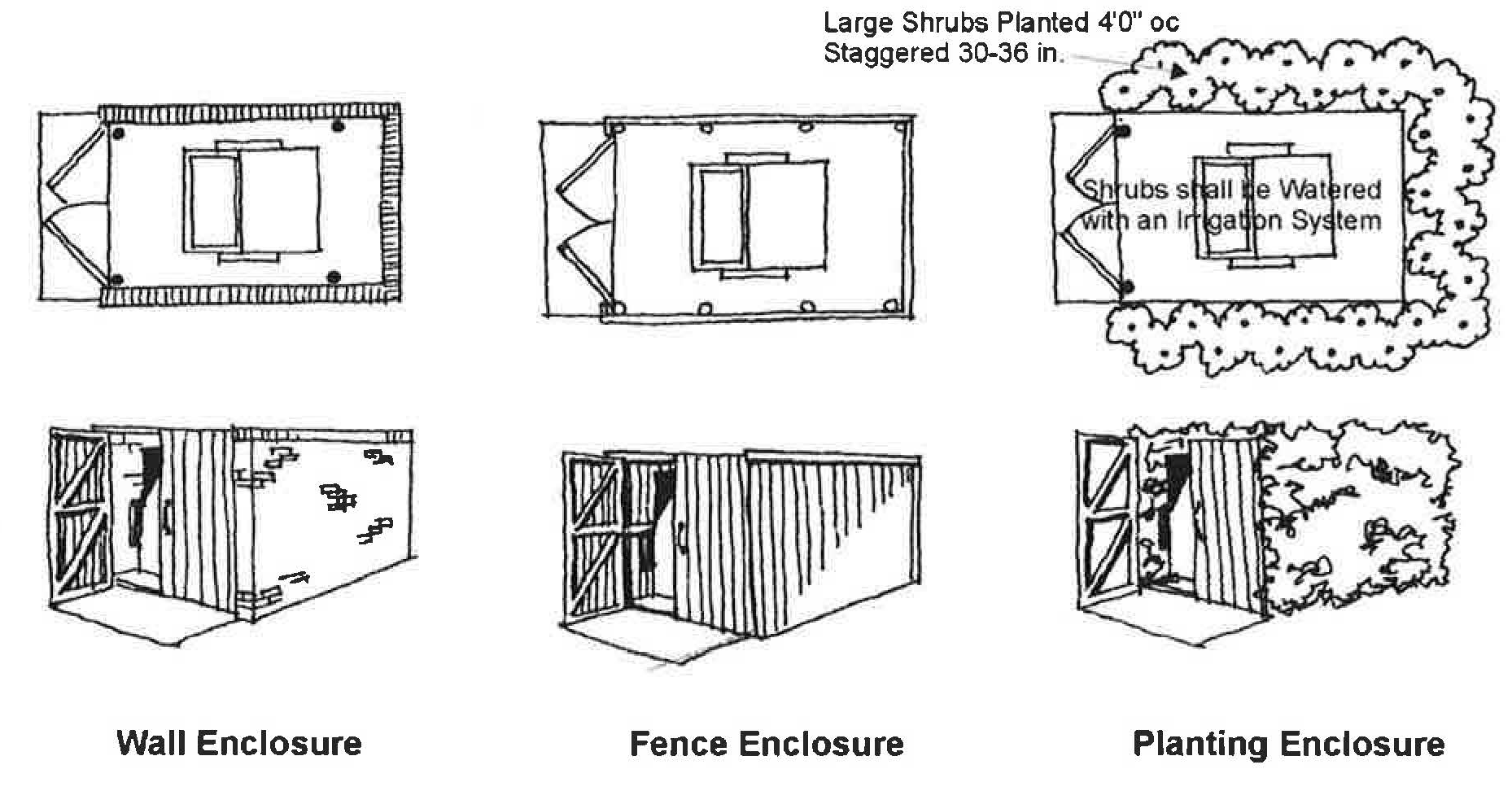
(Ord. No. 2018-655, § 21(Exh. E), 9-25-18)
Sec. 23-5.3.5. - Loading docks, service areas.
(a)
Location of loading docks and service areas.
(1)
Loading docks and service areas shall be at the side or rear of buildings.
(2)
Loading docks and service areas shall not be located within fifty (50) feet of property that is designated for single-family residential uses unless wholly enclosed within a building.
(3)
Loading docks and service areas shall not face an existing or future right-of-way, park or trail unless it is set back a minimum of seventy-five (75) feet and screened from view using a line of sight measured from a vertical height of five (5) feet.
(b)
Loading docks and service areas shall be screened in accordance with one (1) of the following methods. The minimum height shall be the taller of six (6) feet or the height required to screen the line of sight described in this section at a linear distance equal to the exposed length.
(1)
A fence or wall constructed of a primary building material that is similar to the main building.
(2)
Loading docks and service areas that are adjacent to residential uses and in use between the hours of 9:00 p.m. and 8:00 a.m. shall be enclosed on three (3) sides.
(3)
The planning and zoning commission and city council may approve alternative screening during consideration of the site plan application if it finds that the property proposes an adequate screening of the loading docks or service area compatible with surrounding land uses.
(Ord. No. 2018-655, § 21(Exh. E), 9-25-18)
Sec. 23-5.3.6. - Garage bays.
(a)
Garage bays shall be at the side or rear of buildings.
(b)
Garage bays shall not be located within fifty (50) feet of property that is designated for single-family residential uses.
(c)
Garage bays shall be screened by one (1) or a combination of the following methods. The minimum height shall be four (4) feet. A wall or fence required to screen land uses described in this division may be utilized to meet the screening requirement for garage bays.
(1)
A fence or wall constructed of a primary building material that is similar to the main building.
(2)
Large evergreen shrubs planted a maximum of four (4) feet apart that shall create a continuous hedge.
(Ord. No. 2018-655, § 21(Exh. E), 9-25-18)
Sec. 23-5.3.7. - Ground and wall-mounted mechanical equipment.
(a)
Single-family residential uses. Ground and wall-mounted mechanical equipment shall not be located in the front street yard. Ground and wall-mounted mechanical equipment that is located in a side or rear street yard shall be screened in accordance with the provisions in this section.
(b)
Non-residential and multiple-family uses. Ground and wall-mounted mechanical equipment shall be screened in accordance with the provisions in this section when located:
(1)
Facing an existing or future public right-of-way that is within one hundred (100) feet;
(2)
Facing an existing or future park or trail that is within one hundred (100) feet;
(3)
Facing a residential district or a portion of a planned development district designated for residential uses that is within one hundred (100) feet where a screening wall is not required; or
(4)
On the side of the building containing the primary entrance(s).
(c)
The minimum height and width of the screening shall be equivalent to the area of the equipment being screened and consist of one (1) or a combination of the following:
(1)
A berm;
(2)
A planting screen (hedge); or
(3)
A wall utilizing primary building materials similar to those of the main building.
(d)
Screening of utility structures shall be approved by the applicable utility company.
(Ord. No. 2018-655, § 21(Exh. E), 9-25-18)
Sec. 23-5.3.8. - Fencing on property when screening is not required.
Fencing that is not required for screening installed on property containing a non-residential or multiple-family use shall meet the following criteria.
(a)
The fencing shall not be located within a street yard unless it meets the following criteria:
(1)
The fencing is not located within the minimum required front yard setback; and
(2)
The fencing is constructed of transparent materials such as wrought iron or a similar material approved by the building official. Chain-link fencing shall not be considered a similar material to wrought iron.
(b)
Fencing that is located within a side or rear yard shall be constructed of one (1) of the following materials.
(1)
A primary building material that is similar to the main building.
(2)
Transparent materials such as wrought iron or a similar material approved by the building official. Chain-link fencing shall not be considered a similar material to wrought iron.
(3)
In the industrial and industrial park districts, fencing may be constructed of materials made of polyvinyl chloride (PVC).
(Ord. No. 2018-655, § 21(Exh. E), 9-25-18)
Sec. 23-5.4.1. - Setbacks and lot configuration.
(a)
Measuring setbacks. All setback measurements shall be made in accordance with Illustrations 6, 7, and 8.
(b)
Configuration of lots. Wherever possible, flag lots (i.e., lots with minimal, or panhandle type, frontage) shall be avoided. Similarly, through (i.e., double frontage) lots (particularly within residential zoning districts) shall also be avoided wherever possible. (Also see Subdivision Ordinance for regulations pertaining to the configuration of lots.)
Sec. 23-5.4.2. - Front yard.
(a)
On all corner lots, the front yard setback shall be observed along the frontage of both intersecting streets, unless approved specifically otherwise on a final plat. Where single-family and townhouse lots have double frontage, extending from one (1) street to another, or are on a corner, a required front yard shall be provided on both streets unless a side or rear yard building line has been established along one (1) frontage on the plat, in which event only one (1) required front yard need be observed. The side and/or rear yards in the case of single-family and townhouse uses shall be identified and the front of the structure shall not face the side or rear yard (see Illustration 9).
(b)
Where the frontage on one (1) side of a street between two intersecting streets is divided by two (2) or more zoning districts, the front yard shall comply with the requirements of the most restrictive district for the entire frontage (see Illustration 3).
(c)
The front yard shall be measured from the property line to the front face of the building, to the nearest supporting member of a covered porch or terrace, or to any attached accessory building. Eaves and roof extensions or a porch without posts or columns may project into the required front yard for a distance not to exceed four (4) feet, and subsurface structures, platforms or slabs may not project into the front yard to a height greater than thirty (30) inches above the average grade of the yard (see Illustration 4).
(d)
Lots fronting on the bubble portion of a cul-de-sac or "eyebrow" of a street shall have a minimum lot width of seventy (70) feet unless a lesser lot width is specified for the zoning district in which the lot is located. Measurement of the width of such lots shall be in a straight line from the points of the intersection of the building line with the side lot line. (See Illustration 6)
(e)
Gasoline service station pump islands that parallel a public street may be located a minimum of eighteen (18) feet to the property line adjacent to a public street. For pump islands that are perpendicular or diagonal to a public street, the setback shall be thirty (30) feet in order to prevent vehicles stacking out into the street while waiting for a pump position. Pump islands may extend beyond the front building line as described above (provided that all other requirements of this chapter are met), but shall not be closer than fifteen (15) feet to any property line that is not adjacent to a public street.
(f)
Where a future right-of-way line has been established for future widening or opening of a street or thoroughfare, upon which a lot abuts, then the front, side, or rear yard shall be measured from the future right-of-way line.
(Ord. No. 2002-103, § 1, 3-26-02)
Sec. 23-5.4.3. - Side yards.
(a)
On a corner lot used for one- or two-family dwellings, both street exposures shall be treated as front yards on all lots, except where one (1) street exposure is designated as a side yard and separated from the adjacent lot by an alley. In such case, a building line may be designated on the final plat by the planning and zoning administrator, or designee, with a minimum side yard of fifteen (15) feet. On lots which were official lots of record prior to the effective date of this Ordinance, the minimum side yard adjacent to a side street shall comply with the minimum required side yard for the respective district.
(b)
Every part of a required side yard shall be open and unobstructed except for the ordinary projections of window sills, belt courses, cornices, and other architectural features not to exceed twelve (12) inches into the required side yard, and roof eaves projecting not to exceed thirty-six (36) inches into the required side yard. Air conditioning compressors and similar equipment are permitted in the side yard.
(c)
Where a future right-of-way line has been established for future widening or opening of a street or thoroughfare, upon which a lot abuts, then the front, side, or rear yard shall be measured from the future right-of-way line.
Sec. 23-5.4.4. - Special height regulations.
(a)
In the districts where the height of buildings is restricted to two (2) or two and one-half (2.5) stories, cooling towers may extend for an additional height not to exceed fifty (50) feet above the average grade line of the building. Water stand pipes and tanks, church steeples, domes and spires, school buildings, and institutional buildings may be erected to exceed the height limit, specified in the particular zoning district, provided that one (1) additional foot shall be added to the width and depth of front, side, and rear yards for each foot that such structures exceed the district height limit.
(b)
In any district where a structure is permitted to be constructed above two (2) stories, an additional setback shall be required from any existing single-family residential use or zoning district. The additional setback shall be two (2) feet for every one (1) foot in height above two (2) stories from the single-family district boundary line or property line, whichever is closer. A conditional use permit shall be required for any request involving a building taller than the maximum height allowed in a nonresidential district.
(Ord. No. 2004-208 § 3, 06-22-04)
Sec. 23-5.4.5.1. - Telecommunications facilities.
Except for facilities listed in section 23-5.4.6(a), in all districts in which telecommunications facilities are authorized and in addition to use limitations contained in Article 4, the following standards and procedures apply to such uses.
(a)
Definitions.
(1)
Antenna: A metallic, graphite, fiberglass or other device which is attached to a transmission tower, cellular tower, monopole, mast, building or other structure for transmitting and receiving electromagnetic waves.
(2)
Building-mounted facility: A telecommunications facility in which antennas are mounted to the roof or facade of a building.
(3)
Cellular communications facility: A telecommunications facility, including but not limited to an antenna or tower.
(4)
Lattice tower: A guyed or self-supporting three- or four-sided, open steel frame structure used to support telecommunications equipment.
(5)
Monopole: A single, self-supporting vertical pole with no guy wire anchors, usually consisting of a galvanized or other unpainted metal or a wooden pole, with below grade foundations that is intended to support antennas necessary to deliver and receive cellular or personal communications services transmissions.
(6)
Telecommunications tower: A free-standing structure consisting of a support structure, antenna and associated equipment. The support structure may be a wooden pole, monopole, lattice tower, light standard or other vertical support.
(7)
Telecommunications facility: An unmanned facility consisting of equipment for the reception, switching or receiving of wireless telecommunications.
(b)
Height and setback standards for telecommunications towers.
(1)
Except as provided in section 23-5.4.5.1(b)(2), the height of a telecommunications tower, excluding antenna array, shall be a function of distance of the tower from any residential use, and shall be subject to the following standards:
a.
No tower shall be erected within two hundred (200) feet of any residential use.
b.
The height of the tower shall not exceed seventy-five (75) feet in height, if the tower is located two hundred (200) or more feet and less than two hundred fifty (250) feet from any residential use.
c.
The height of the tower shall not exceed one hundred (100) feet in height, if the tower is located two hundred fifty (250) or more and less than five hundred forty (540) feet from any residential use.
d.
The height of the tower shall not exceed one hundred twenty (120) feet in height, if the tower is located five hundred forty (540) feet or more from any residential use.
e.
Only monopole towers shall be allowed within five hundred forty (540) feet of any residential use.
f.
The antenna array shall not exceed the allowed tower height by more than ten (10) feet.
g.
All guys and guy anchors shall be set back a minimum of twenty (20) feet from any property line.
h.
The tower shall be erected and operated in compliance with current Federal Communication Commission and other applicable federal and state standards.
(2)
The height limitations in section 23-5.4.5.1(b)(1) shall not apply in the following circumstances:
a.
There are no more than two residential uses within two hundred (200) feet of the tower base.
b.
The proposed tower is erected to replace existing poles and either:
i.
The pole replaced is a functioning utility pole or light standard within a utility easement or public right-of-way, recreation facility light pole or telecommunication tower; or
ii.
Replacement tower height, including antenna array, does not exceed:
(a)
The height of the original utility, light standard, or recreation facility pole by more than ten (10) feet; and
(b)
The replacement tower does not obstruct a public sidewalk, public alley, or other public right-of-way, and
(c)
Pole function is not significantly altered.
c.
Towers erected to be used by a public agency, including those for police, fire, EMS, 911, or other similar public emergency communications for the city.
(3)
For the purpose of applying the restrictions set forth in section 23-5.4.5.1(b)(2) subsections a., b., and c., the term "residential use" has the meaning set forth in section 23-4.1.2, use charts, but excludes property that is:
a.
Vacant and unplatted; or
b.
Used as a college dormitory.
(4)
Distances in this section shall be measured along a single straight line between the center of the tower base and the nearest point on any property line of a residential zoning district or use.
Building-mounted facilities.
Antennas on the rooftop or above a structure shall be screened, constructed and/or colored to match the structure to which they are attached and may not exceed the height of the rooftop or structure by more than ten (10) feet.
Antennas mounted on the side of a building or structure shall be painted to match the color of the building or structure or the background against which they are most commonly seen.
Antennas may be located wholly within any building authorized in the zoning district.
If an accessory equipment shelter is present, it must blend with the surrounding building(s) in architectural character or color.
Landscaping. The entire facility must be aesthetically and architecturally compatible with its environment. The telecommunications tower itself must be camouflaged to blend with the surrounding environment through the use of color, materials and design. The entire facility and its landscape must be maintained in accordance with division 5.2 of these zoning district regulations. A sample of the intended design must be submitted to the city at the time of application.
Accessory buildings. A single-story unmanned accessory building of no more than three hundred (300) square feet gross floor area is permissible to store equipment needed to send and to receive transmissions but may not include offices or long term storage of vehicles.
Inspections. The city reserves the right to make inspections of any telecommunication facility with corporate limits of the city to ensure structural integrity. Based upon the results of the inspection, the city may require repair or removal of the telecommunications facility.
Application requirements. Any person, firm, corporation, or any other entity desiring to build a telecommunication facility within the corporate city limits of the city must obtain a building permit, pay appropriate fees and submit a signed application that includes all materials and information detailed herein.
Name of applicant.
Address of applicant.
Location of proposed site.
Type of support structure and antenna and height.
Photos and/or drawings of all equipment, structures and antennas.
Names and addresses of telecommunication providers or users of the proposed tower or antenna.
Applicants master antenna/tower plan for the city and surrounding area, if necessary.
Detailed account of co-location efforts.
If a new tower is allowed, the owner must certify in writing a willingness to allow co-location at the new site, as well as the technological and fiscal feasibility of co-location.
Any other requirement of this chapter.
Application fee. The city will charge an application fee of one hundred dollars ($100.00) for telecommunications towers located within the corporate city limits of the city.
Sec. 23-5.4.5.2. - Broadcast towers and antennas.
Except for facilities listed in section 23-5.4.6(a), in all districts in which broadcast towers and antennas are authorized and in addition to use limitations contained in Article 4, the following standards and procedures apply to such uses.
(a)
Design requirements:
(1)
The tower and guy wires must all be located on same tract of land.
(2)
All tower properties shall be surrounded by a fence. Tower base and guy anchors should be protected by a six-foot tall fence with at least three (3) strands of barbed wire on top. All fences shall be kept in good repair.
(3)
All towers to be constructed shall be able to support equipment that is capable of transmitting five (5) television broadcast signals and ten (10) FM broadcast signals.
(4)
All antennas required by this section shall be located at or above one thousand eight hundred (1,800) feet above sea level.
(5)
A panel antenna maybe used to meet the FM broadcast signal requirements.
(6)
A tower cross section showing antenna types and locations shall be provided by the applicant.
(7)
Steel antenna towers and antenna supporting structures shall be designed and engineered in compliance with Ansi/TIA/EIA-222-F-1996, or to current design standard.
(b)
Site plan required. A site plan must be submitted showing the following:
(1)
Property boundaries and adjacent properly lines and streets.
(2)
Tower and guy wire locations.
(3)
Building location and square feet.
(4)
Drive and parking area location and material.
(5)
Fence locations with height and material specified.
(6)
Tower cross section showing antenna types and location with elevations above sea level specified.
(c)
Building permit required. A building permit is required before adding or replacing any antenna, transmission line, or appurtenance involving a three-inch or larger line. A permit is also required for adding or replacing antenna or transmission line located more than five hundred (500) feet above the tower base. In addition to all other requirements, an applicant for a building permit shall submit the following:
(1)
A certification signed and sealed by a registered Engineer of the State of Texas attesting to structural integrity of the tower as it is planned to be loaded and during all points of construction. The certification shall include a written description of the method, materials, equipment, tools, and personnel to be used in the installation of the antenna and a statement that the tower is structurally capable of withstanding such construction activities.
(2)
Provide city with projected fall pattern for all new towers.
(3)
An indemnity agreement approved by the city attorney.
(4)
For tower applications, FAA's Determination of No Hazard to Air Navigation.
(5)
In addition to the requirements of this section 23-5.4.5.2(c), the requirements of section 23-5.4.5.1(a)(2) and section 23-5.4.6 apply to applications for a building permit for existing towers.
Sec. 23-5.4.6. - Regulations applicable to all towers and antenna.
(a)
Applicability.
(1)
The following regulations apply to all commercial and amateur antennae and support structures, unless expressly exempted in subsection (2). A building permit shall be required prior to erection or installation of any antenna, antenna support structure and related structures/equipment, except for those facilities expressly exempted in subsection (2).
(2)
The following types of direct broadcast satellite reception antennae, multi-channel multi-point distribution (as defined by the FCC) antennae, television reception antennae, or amateur radio antennae that are not mounted on a pole or mast that is twenty (20) feet or more in height are exempt from the regulations in this section, except as provided in subsection (3).
a.
Antennae that are one (1) meter or less in diameter in residential zoning districts, and antennae that are two (2) meters or less in diameter, in nonresidential zoning districts;
b.
Antennae designed to only receive television broadcasts;
c.
Amateur radio antennae concealed behind or located upon or within attics, eaves, gutters or roofing components of the building; and
d.
Amateur radio ground-mounted whips and wire antennae.
(3)
The regulations contained in sections 23-5.4.6(d)(1), 23-5.4.6(d)(5), and 5.4.6.D.11, apply to all commercial and amateur antennae and support structures.
(b)
Modifications and maintenance.
(1)
Steel antenna towers and antenna supporting structures shall submit to the city a structural analysis performed by a registered professional structural engineer whenever there is a change in antennas, and/or appurtenances, involving three-inch or larger transmission lines.
(2)
Owners of towers shall perform periodic tower inspection and maintenance to assure safety and extend the tower's service life. Commencing in 1998 for existing guyed towers approved during or prior to 1995 and for existing monopoles and self-supporting towers approved during or prior to 1993, a major inspection of each tower shall be performed, and thereafter, every three (3) years for guyed towers and every 5 years for monopoles and self supporting towers. For guyed towers approved after 1995, inspections shall commence three (3) years from the date of approval of the building permit authorizing construction of the tower and every three (3) years thereafter. For monopoles and self-supporting towers approved after 1993, inspections shall commence five (5) years from the date of approval of the building permit authorizing construction of the tower and every five (5) years thereafter.
(3)
A report containing information on the following items shall be submitted to the city upon completion of each inspection:
a.
A tower inspection crew is to be hired by the tower owner to perform the tower inspection.
b.
Tower inspection crews shall use a city-provided inspection report (see forms provided by the city).
c.
The inspection crews report will then be reviewed by a registered professional engineer familiar with tower construction to review the report and make repair recommendations.
d.
The registered professional engineer will them submit a letter to the city verifying that the repairs have been made to the tower.
e.
The tower inspection crew and registered professional engineer shall be hired by the tower owner and be an independent contractor.
f.
Once the inspection process is completed, the tower owner shall provide the city with the tower inspection report, engineer repair recommendation letter, engineer repairs and maintenance completed letter.
(c)
Nonconformity and termination of use. Towers and antennas which are not in use for six (6) months shall be deemed abandoned and shall be removed by the owner of the facility within ninety (90) days of the end of such six-month period. Upon removal, the site shall be re-vegetated to blend with the existing surrounding vegetation., and otherwise shall be returned to its original condition.
(d)
General requirements
(1)
No amateur or commercial antenna, antenna support structure, microwave reflector/antenna, or associated foundations or support wires or appurtenances shall be located within any required setback area for the front, side or rear yards.
(2)
All antennae and support structures must meet or exceed the current standards and regulations of the Federal Communications Commission (FCC), the Federal Aviation Administration (FAA), and/or all other applicable federal, state and local authorities. If those standards change, then the owner/user of an antenna or support structure must bring the antenna/structure into compliance within six (6) months or as may otherwise be required by the applicable regulating authority.
(3)
All installations shall comply with applicable federal, state and local building codes and the standards published by the Electronic Industries Association. Owners/users shall have thirty (30) days after receiving notice that an installation is in violation of applicable codes in order to bring it into full compliance.
(4)
Antennae (amateur or commercial) shall not create electromagnetic or other interference with the City of Cedar Hill's and the county's radio frequencies and public safety operations, as required by the FCC. Antennae also shall not interfere with radio or television reception of nearby property owners. In no manner shall the use of such equipment infringe upon adjoining property owners.
(5)
No antenna or support structure shall be located so as to create a visual obstruction within critical visibility areas (such as at street intersections or where a private driveway enters a roadway) or a traffic safety problem.
(6)
Safeguards shall be utilized to prevent unauthorized access to an antenna installation (e.g., on a water tower or utility structure, a freestanding installation, etc.).Safeguards include certain devices identified/recommended by the manufacturer of the antenna or support structure, a fence, a climbing guard, or other commercially available safety devices. Climbing spikes, if utilized, shall be removed immediately following use.
(7)
Temporary antennae shall only be allowed in the following instances:
a.
In conjunction with a festival, carnival, rodeo or other special event/activity.
b.
In case of an emergency (e.g., severe weather, etc.) or a news coverage event;
c.
When needed to restore service on a temporary basis after failure of an antenna installation. The city must be notified within seventy-two (72) hours of the placement of a temporary antenna. If the temporary antenna is to be needed for more than seven (7) days, then the owner/user must apply for and acquire a permit for the temporary installation on or before the eighth (8th) day following initial placement of the antenna.
(8)
Collocation is greatly encouraged by the city.
a.
All new support structures over fifty (50) feet in height shall be constructed to support antennae for at least two carriers, unless the structure is an alternative or stealth design, or the support structure is replacing an existing utility structure or light standard. Sufficient area for associated structures and equipment shall also be provided.
b.
A support structure which is modified or reconstructed in order to accommodate collocation shall be of the same type, design and height as the existing structure, and it may be moved on the same property within fifty (50) feet of its original location provided that it is not moved any closer to residentially zoned property (if the structure was allowed by CUP, then its new location shall be within the physical/land boundaries of the CUP). The original (i.e., former) support structure shall be removed from the property within ninety (90) days following completion of the new structure.
c.
Where an additional antenna is to be attached to an existing support structure that already has an antenna mounted upon it, the new antenna shall comply with and be compatible with the design of the existing antenna on the collocated structure.
(9)
Support buildings and equipment storage areas/buildings shall be screened from public view if mounted on a rooftop. When ground mounted, they shall meet all applicable front, side and rear yard setback requirements of the applicable base zoning district. They shall also be of a neutral color and shall use exterior finish colors and materials that are compatible with nearby structures. They shall be screened from public view by a dense, opaque evergreen landscaped screen with an initial planting height of three (3) feet, and which will attain an ultimate height of six (6) feet at maturity. A six-foot solid masonry wall may be used in lieu of the landscaped screen provided exterior finish materials are compatible with nearby structures. The use of a wood fence for screening is prohibited, and wrought iron or chain link may only be used in conjunction with a landscaped screen as specified above.
(10)
Satellite dishes and other similar antennae shall be permitted on the roof of a building, as long as satellite dishes do not exceed one (1) meter (thirty-nine (39) inches) in diameter and antennae do not extend over twelve (12) feet above the roof of the building. A letter certifying the roof's/building's structural stability shall be written and sealed by a registered architect or engineer, and shall be submitted to the city manager, or his/her designee, prior to any approval of a roof-mounted antenna. Roof-mounted antennae that comply with the provisions of these regulations do not require additional yard setbacks or setbacks from residential areas or dwellings.
(11)
Only one (1) amateur antenna/support structure shall be permitted per residential lot, except that a maximum of two (2) satellite dishes may be allowed if both units are no larger than one (1) meter (thirty-nine (39) inches) in diameter (only one (1) allowed if over one (1) meter in diameter). Satellite dishes in any residential district shall not exceed twelve (12) feet in diameter, and must be permitted by the city manager or his/her designee.
(12)
All commercial signs, flags, lights and attachments other than those required for emergency identification, communications operations, structural stability, or as required for flight visibility by the FAA and/or FCC shall be prohibited on any antenna or antenna support structure. However, lights may remain or be placed upon light standards that are altered or replaced in order for them to serve as antenna support structures provided that said lights are not commercial (i.e., for-profit) in nature, and provided that said lights are placed/replaced as the same size, configuration, number of bulbs, degree of luminance, etc. as they previously existed prior to support structure modification/replacement.
(Ord. No. 2006-276, § 20, 1-10-06)
Sec. 23-5.4.7. - Sight visibility.
Visual clearance shall be provided in all zoning districts so that no fence, wall, architectural screen, earth mounding or landscaping thirty (30) inches or higher above the street center line obstructs the vision of a motor vehicle driver approaching any street, alley, or driveway intersection as follows:
(a)
At a street intersection, clear vision must be maintained for a minimum of twenty-five (25) feet across any lot measured from the corner of the property line in both directions (see Illustration 12).
(b)
At an intersection with an alley, this clearance must be maintained for ten (10) feet (see Illustration 12).
(c)
Shrubs and hedges that are typically less than thirty (30) inches in height at maturity, as measured from the centerline of the street, may be located in the visual clearance areas of all districts.
(Ord. No. 2018-655, § 22, 9-25-18)
Editor's note— Ord. No. 2018-665, § 22, adopted Sept. 25, 2018 renumbered § 23-5.4.10 as 23-5.4.7. The previous § 23-5.4.7 was reserved.
Sec. 23-5.4.8. - Nonresidential uses in residential zoning districts.
Nonresidential uses (e.g., churches, schools, day/child care centers, etc.) permitted in residential zoning districts shall conform to the LR zoning district standards unless otherwise stated in this chapter.
(Ord. No. 2018-655, § 23, 9-25-18)
Editor's note— Ord. No. 2018-665, § 23, adopted Sept. 25, 2018 renumbered § 23-5.4.11 as 23-5.4.8. The previous § 23-5.4.8 pertained to open storage areas and derived from original content.
Sec. 23-5.4.9. - Certain large domestic animals allowed within specific districts.
The stabling of horses, cattle, sheep and goats may be kept within any zoning district subject to the requirements of the Cedar Hill Code of Ordinances.
(Ord. No. 2004-201, § 12, 4-13-04; Ord. No. 2018-665, § 24, 9-25-18)
Editor's note— Ord. No. 2018-665, § 24, adopted Sept. 25, 2018 renumbered § 23-5.4.12 as 23-5.4.9. The previous § 23-5.4.9 pertained to outdoor sales, storage and display and derived from Ord. No. 2004-207, § 4, 8-10-04.
Sec. 23-5.4.10. - Veterinarian uses within nonresidential districts.
Veterinarian clinics or hospitals shall be authorized within nonresidential districts if conforming to the following provisions:
(a)
An indoor clinic or hospital run under the direction of a veterinarian shall be located entirely within a completely enclosed, soundproofed, and air conditioned building and any noise or odors created by activities within shall not be perceptible beyond the property line. No animals are kept outside the building at any time. Sufficient area for outdoor exercise will be fully screened from view of any public right-of-way with a six (6) to eight (8) foot screening wall conforming to section 23-5.3.2, fencing walls and screening requirements.
(b)
An indoor/outdoor clinic or hospital run under the direction of a veterinarian shall be located entirely within a completely enclosed, soundproofed, and air conditioned building and any noise or odors created by activities within shall not be perceptible beyond the property line. Sufficient area for pens, kennels, and outdoor exercise area shall be provided and pens and kennels shall be enclosed by a permanent type of fencing. All outdoor areas shall be fully screened from view of any public right-of-way with a six (6) to eight (8) foot screening wall and the outdoor pen, kennel, and exercise area shall be set back at least one hundred fifty (150) feet and likewise screened from a residentially-zoned district, measured in a straight line from the outdoor pen area. These screening walls shall be in conformance with section 23-5.3.2, fencing walls and screening requirements - screening of nonresidential and multi-family areas.
(Ord. No. 2004-201, § 12, 4-13-04; Ord. No. 2018-655, § 25, 9-25-18)
Editor's note— Ord. No. 2018-665, § 25, adopted Sept. 25, 2018 renumbered § 23-5.4.13 as 23-5.4.10. See also note to § 23-5.4.7.
Sec. 23-5.5.1. - Conformance.
In all zoning districts, any use indicated in the permitted use list shall conform in operation, location, and construction to the performance standards as administered by county, state, or federal agencies. All uses, including those, which may be allowed by PD or CUP, shall conform in operation, location, and construction to appropriate performance standards for noise, smoke, and particulate matter, odorous matter, fire, or explosive hazard material, toxic and noxious matter, vibration, and glare.
Sec. 23-5.5.2. - Noise and requirements for toxic waste disposal observed.
All federal and state pollution, noise, and requirements for toxic waste disposal shall be observed.
Sec. 23-5.5.3. - Noise.
(a)
Definitions:
Weighted sound level means the sound pressure level in decibel as measured on a sound level meter using the A-weighing network. The level so read is designated dB(A) or dBA.
Background noise means noise from all sources other than that under specific consideration including traffic operating on public thoroughfare, and is established by measuring the noise level over an eight minute period of time.
Bounding lot line means the far side of any street, alley, stream, or other permanently dedicated open space from the stationary source when such open space exists between the lot line of the stationary source and adjacent property. When no such open space exists, the common line between two pieces of property shall be interpreted as the bounding lot line.
Daytime means the hours between 7:00 a.m. and 8:00 p.m. on any given day.
Decibel (dB) means a unit for measuring the volume of a sound, equal to 20 times the logarithm to the base 10 of the ratio of the pressure of the sound measured to the reference pressure, which is 20 Micropascals (20 Micronewtons per square meter).
Noise means any sound which annoys or disturbs humans or which causes or tends to cause an adverse psychological or physiological effect on humans.
Sound means the weighted sound pressure level obtained by the use of a sound level meter and frequency weighing network such as A, B, or C as specified in American National Standards Institute specifications for sound level meters (ANSI SI.4-1971, or the latest approved revision thereto). If the frequency weighting employed is not indicated, the A-weighting shall apply.
Sound level meter means an instrument which includes a microphone amplifier, RMS detector, integrator or time averager, output meter and weighting networks used to measure sound pressure levels.
Sound pressure means the instantaneous difference between the actual pressure and the average or barometric pressure at a given point in space, as produced by sound energy.
Sound pressure level (SPL) means 20 times the logarithm to the base 10 of the ratio of the RMS sound pressure to the reference pressure of 20 Micropascals (20 x 10-6 N/m2). The sound pressure level is denoted LP or SPL and is expressed in decibel.
Time weighted means an established period of time during which the sound pressure levels are averaged.
(b)
General provisions. A person shall not conduct a use that creates a noise level that exceeds the standards established in this section.
A sound level meter that meets the standards of the American Standards Association must be used to determine whether a noise level violates a noise standard in this section. The instrument must be maintained in a good working condition. A calibration check should be made prior to and following any noise investigation.
Traffic, aircraft, and other background noises are not considered in measuring noise levels except when such noises are being generated on and as a result of the uses of a property being investigated for a potential noise violation.
For purposes of this section, identifiable portions of a planned development district (PD) used for residential uses shall be treated as a residential zoning district. Identifiable portions of a planned development district (PD) used for nonresidential uses permitted in all nonresidential districts except commercial (C), industrial park (IP) and industrial (I) shall be treated as a nonresidential district. Identifiable portions of a planned development district (PD) used for uses allowed only in commercial (C), industrial park (IP) and industrial (I) shall be treated like an industrial/commercial district.
The requirements of this section do not apply to:
(a)
Noises coming from daytime construction and maintenance activities performed on structures housing legal uses.
(b)
Noises from safety signals, warning devices or other sound generating equipment used to warn the public of an emergency or for public safety.
(c)
Lawn maintenance, repair of personal vehicles, and home repair of places of residences as long as these activities are conducted in the daytime hours as a normal function of a permitted use and the equipment is maintained in proper working order.
(c)
Maximum permissible sound pressure levels. At no point at the bounding property line of any use shall the sound pressure level of any operation or activity exceed the standards specified in the following table.
(d)
Noise level adjustments. The maximum noise levels permitted in subsection (c) shall be adjusted by subtracting seven (7) dBA for noise present at night time.
The maximum noise levels permitted in subsection (c) shall be adjusted by subtracting seven (7) dBA for noise that is impulsive (meter reading changes at a rate greater than ten (10) decibels per second).
The maximum noise levels permitted in subsection (c) shall be adjusted by adding 10dBA when:
"Off time" is when the level of the primary noise being measured does not exceed that of the background noise by more than five (5) dBA.
Sec. 23-5.5.4. - Smoke and particulate matter.
No operation or use shall cause, create, or allow the emission for more than three (3) minutes in any one (1) hour of air contaminants which at the emission point or within the bounds of the property are:
As dark or darker in shade as that designated as No. 2 on the Ringleman Chart as published by the United States Bureau of Mines Information Circular 7118.
Of such opacity as to obscure an observer's view to a degree equal to or greater than does smoke or contaminants in the standard prescribed in 3-1302-1 above except that, when the presence of uncombined water is the only reason for failure to comply or when such contaminants are emitted inside a building which prevents their escape into the atmosphere, the standards specified in 3-1302-1 and -2 shall not apply.
The emission of particulate matter from all sources shall not exceed 0.5 pounds per acre of property within the plant site per any one (1) hour.
Open storage and open processing operations, including on-site transportation movements which are the source of wind or air borne dust or other particulate matter; or which involves dust or other particulate air contaminants, generating equipment such as used in paint spraying, grain handling, sand or gravel processing or storage or sand blasting shall be so conducted that dust and other particulate matter so generated are not transported across the boundary line of the tract on which the use is located in concentrations exceeding four grains per one thousand (1,000) cubic feet of air.
Sec. 23-5.5.5. - Odorous matter.
(a)
No use shall be located or operated which involves the emission of odorous matter from a source of operation where the odorous matter exceeds the odor threshold at the bounding property line or any point beyond the tract on which such use or operation is located.
(b)
The odor threshold as herein set forth shall be determined by observation by a person or persons. In any case, where uncertainty may arise or where the operator or owner of an odor emitting use may disagree with the enforcing officer or where specific measurement of odor concentration is required, methods and procedures shall be used according to accepted industry standards.
Sec. 23-5.5.6. - Fire or explosive hazard material.
(a)
No use involving the manufacture or storage of compounds or products which decompose by detonation shall be permitted except that chlorates, nitrates, perchlorates, phosphorus, and similar substances and compounds in small quantities for use by industry, school laboratories, druggists or wholesalers may be permitted when approved by the Fire Marshal of the City of Cedar Hill.
(b)
The storage and use of all flammable liquids and materials such as pyroxylin plastics, nitrocellulose film, solvents, and petroleum products shall be permitted only when such storage or use conforms to the standards and regulations of the City of Cedar Hill Fire Code or are approved by the fire marshall.
Sec. 23-5.5.7. - Toxic and noxious matter.
No operation or use shall emit a concentration across the bounding property line of the tract on which such operation or use is located of toxic or noxious matter which will exceed ten (10) percent of the concentration (exposure) considered as the threshold limit for an industrial worker as such standards are set forth by the Texas State Department of Health in "Threshold Limit Values Business Health Regulation No. 3," a copy of which is hereby incorporated by reference. No nuclear or radioactive manufacturing or disposal shall be permitted unless approved by the fire marshall.
Sec. 23-5.5.8. - Vibration.
No operation or use shall at any time create earth-borne vibrations which when measured at the bounding property line of the source operation exceed the limits of displacement set forth in the following table in the frequency ranges specified:
Sec. 23-5.6.1. - Purpose.
Standards for controlling lighting and glare are set forth to reduce the annoyance and inconvenience to property owners and traffic hazards to motorists. These standards are intended to allow reasonable enjoyment of adjacent and nearby property by their owners and occupants while requiring adequate levels of lighting of parking areas.
Sec. 23-5.6.2. - Nonresidential site lighting and glare standards.
(a)
Any use shall be operated so as not to produce obnoxious and intense glare or direct illumination across the bounding property line from a visible source of illumination of such intensity as to create a nuisance or detract from the use or enjoyment of adjacent property. All outside lights shall be made up of a light source and reflector so selected that acting together, the light beam is controlled and not directed across any bounding property line above a height of three (3) feet. All lighting shall have full cut-off lenses per IESNA (Illuminating Engineering Society of North America) standards and be directed toward the area it is intended to illuminate. The allowable maximum intensity measured at the property line of a residential use in a residential district shall be 0.50 foot candles. Light poles shall be placed on the site a setback equal to its height from all adjacent residential property. All existing lighting shall install full cutoff lenses per IESNA (Illuminating Engineering Society of North America) standards as replaced or be feature-focused. All façade lights and up-lights shall be limited to facades only.
(b)
All off-street parking areas for non-residential uses in non-residential districts which are used after dark shall be illuminated beginning one-half (½) hour after sunset and continuing throughout the hours of business operation. If only a portion of a parking area is offered for use after dark, only that part is required to be illuminated in accordance with these standards. However, the portion offered for use shall be clearly designated. Lighting within the parking areas shall meet the following minimum intensity requirements:
(1)
Minimum at any point on the parking area surface to be at least 0.6 foot candles initial, and at least 0.3 foot candles maintained or one-third (⅓) of the average, whichever is greater.
(2)
Illumination shall not exceed an average of one (1) foot candle at ground level and shall distribute not more than 0.50 foot candles of light upon any adjacent residentially zoned area.
(3)
The maximum illumination under canopies shall be 50-foot candles of light.
(Ord. No. 2006-276, § 22, 01-10-06)
Sec. 23-5.6.3. - Residential lighting and glare standards.
Residential lighting for security and night recreation use is permitted in all residential districts provided the following requirements are met:
(1)
Direct lighting over ten (10) feet in height is shielded from adjacent property.
(2)
No light source shall exceed thirty-five (35) feet in height. Street lights and other traffic safety lighting are exempt from this standard.
(3)
Lighting shall not directly shine on adjacent dwellings.
Sec. 23-5.6.4. - Luminaries.
Light sources shall be of a down-light type, indirect, diffused, or shielded type luminaries installed and maintained so as to reduce glare effect and consequent interference with use of adjacent properties and boundary streets. Bare bulbs above seventy-five (75) watts and strings of lamps are prohibited, except for temporary lighting as provided in section 23-5.6.5 below.
Sec. 23-5.6.5. - Special or temporary lighting—Low wattage.
Bare bulbs or strings of lamps are prohibited, except during holidays special lighting shall be permitted for a maximum time period of forty-five (45) days for each holiday used.
Sec. 23-5.7.1. - Purpose.
The regulations in this division are intended to promote development that will be sustainable over multiple end-users by utilizing durable, weather-resistant building materials and encouraging creative design consistent with the community's vision for distinctive character.
(Ord. No. 2018-655, § 26(Exh. F), 9-25-18)
Sec. 23-5.7.2. - Applicability.
(a)
The applicability of these provisions to main and accessory buildings are described in the subsequent subsections.
(b)
Buildings that are not required to adhere to certain provisions in this [division] as a result of limited expansions shall comply with the applicable regulations in effect prior to September 25, 2018.
(c)
Buildings that do not meet provisions of this [division] that were effective on September 25, 2018, shall be deemed conforming if they were legally constructed in accordance with the regulations in effect at the time building permits were issued.
(Ord. No. 2018-655, § 26(Exh. F), 9-25-18)
Sec. 23-5.7.3. - Exterior building materials.
The exterior building materials described in this section shall be required for all main buildings subject to their respective zoning districts when there is new construction on undeveloped property, when the building is expanded by more than a cumulative of fifty (50) percent, or when the exterior building materials are changed on existing buildings. This section shall also apply to buildings for non-residential uses on residentially-zoned property.
(a)
"MF", "NS", "LR", "CC", and "C" districts.
(1)
Required exterior building materials.
i.
A minimum of seventy (70) percent of each wall surface area excluding windows and doors shall be finished with at least one (1) primary building material.
ii.
A minimum of ten (10) percent of each wall surface area excluding windows and doors on property located within the uptown overlay shall also be finished with a stone material.
iii.
A maximum of thirty (30) percent of each wall surface area excluding windows and doors may be finished with secondary building materials. Acrylic matrix or synthetic plaster finish and stucco are prohibited on the bottom eight (8) feet of the structure.
iv.
A maximum of ten (10) percent of each wall surface area excluding windows and doors may be finished with an accent building material.
(2)
Variety in exterior building materials. With the exception for buildings constructed of glass walls, a minimum of two (2) primary and secondary exterior building materials shall be utilized on each building elevation excluding windows and doors. Two (2) distinctive types of brick or stone materials may be utilized to meet this requirement.
(3)
Harmonious design. Side and rear building elevations shall be finished in a similar color, texture and design as the front building elevation.
(b)
"I" and "IP" districts.
(1)
Main buildings within two hundred (200) feet of a residential district or a portion of a planned development district designated for residential uses; or adjoining Highway 67 or a right-of-way designated on the Thoroughfare Plan shall have each elevation finished with at least one (1) of the following materials:
i.
Brick material;
ii.
Concrete masonry units;
iii.
Concrete panel construction;
iv.
Glass walls;
v.
Stone material;
vi.
Stucco - prohibited on the bottom eight (8) feet of the structure;
vii.
Acrylic matrix or synthetic plaster finish - a maximum of thirty (30) percent and prohibited on the bottom eight (8) feet of the structure;
viii.
Fiber cementitious material - a maximum of thirty (30) percent.
(2)
Main buildings not subject to the aforementioned criteria shall have the bottom four (4) feet of the front building elevation finished with a primary building material. All other building elevations shall consist of at least one (1) of the following materials:
i.
Brick material;
ii.
Concrete masonry units;
iii.
Concrete panel construction;
iv.
Fiber cementitious material;
v.
Glass walls;
vi.
Metal with baked or enamel finish or painted to manufacturer's standards;
vii.
Stone material;
viii.
Stucco - prohibited on the bottom eight (8) feet of the structure;
ix.
Acrylic matrix or synthetic plaster finish - a maximum of thirty (30) percent and prohibited on the bottom eight (8) feet of the structure.
(3)
Harmonious design. Side and rear building elevations shall be finished in a similar color, texture and design as the front building elevation.
(Ord. No. 2018-655, § 26(Exh. F), 9-25-18)
Sec. 23-5.7.4. - Wall articulation.
(a)
The requirements for wall articulation in this section are applicable to building elevations of all main buildings when there is new construction on undeveloped property or when a building is expanded by more than a cumulative of fifty (50) percent. This section shall also apply to buildings for non-residential uses on residentially-zoned property:
(1)
Located on property zoned "MF", "NS", "LR", "CC", or "C"; and
(2)
Facing an existing or future public right-of-way that is within one hundred (100) feet; facing an existing or future park or trail that is within one hundred (100) feet; or facing a residential district or a portion of a planned development district designated for residential uses that is within one hundred (100) feet where a screening wall is not required; or
(3)
Containing the primary entrance(s).
(b)
Horizontal articulation. No wall surface area shall extend for a distance greater than three (3) times the mean elevation of the wall's height without having an off-set of fifteen (15) percent or more of the wall's height. This off-set shall extend for a distance equal to at least twenty-five (25) percent of the maximum length of either adjacent plane.
(c)
Vertical articulation. No horizontal wall surface area shall extend for a distance greater than three (3) times height of the wall without changing height by a minimum of fifteen (15) percent of the wall's height. This height change shall continue for a minimum distance equal to at least twenty-five (25) percent of the maximum length of either adjacent plane.
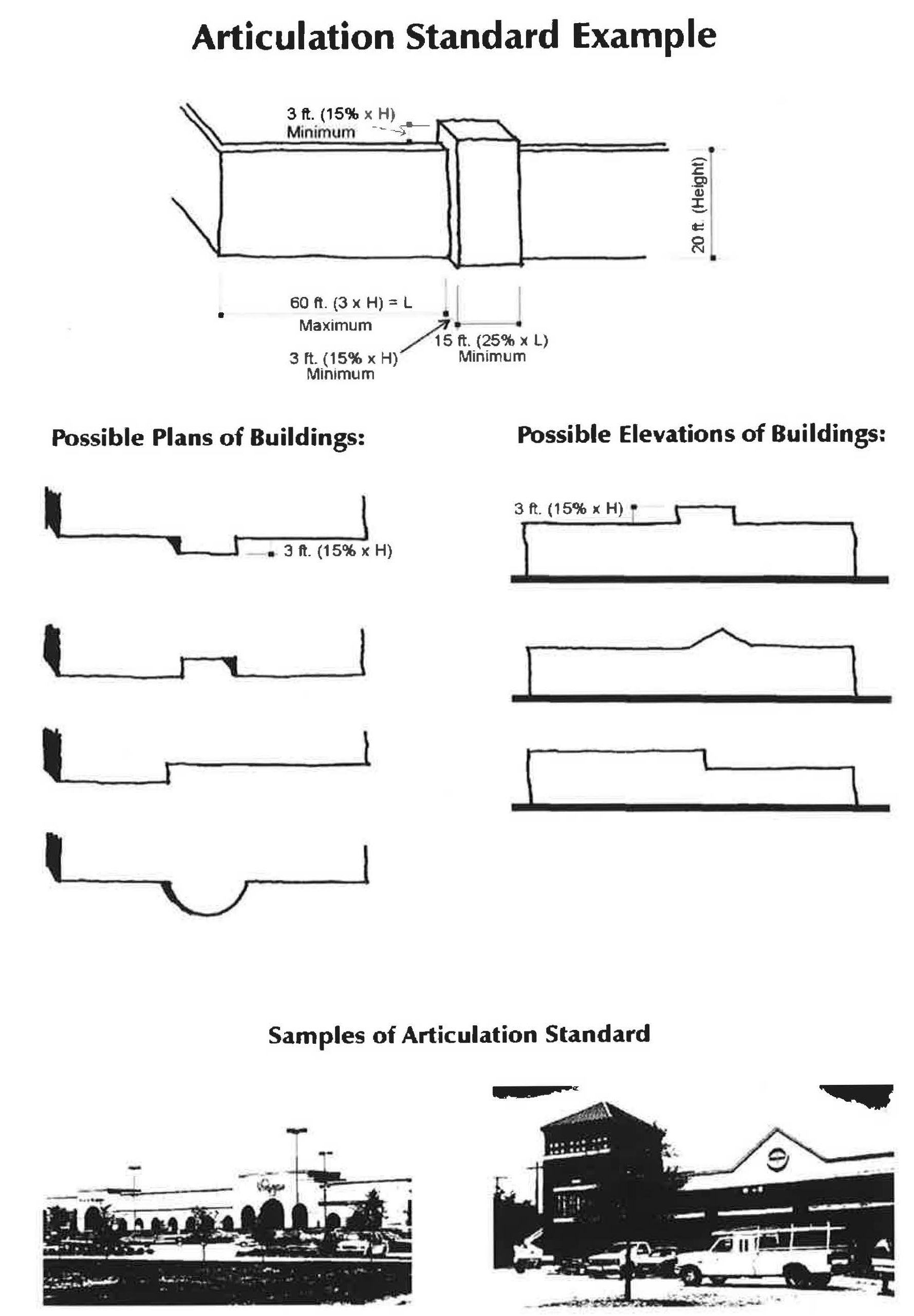
(Ord. No. 2018-655, § 26(Exh. F), 9-25-18)
Sec. 23-5.7.5. - Transparency.
(a)
The requirements for transparency in this section are applicable to the following ground story, building elevations of all main buildings subject to their respective zoning districts when there is new construction on undeveloped property or when a building is expanded by more than a cumulative of fifty (50) percent. This section shall also apply to main buildings for non-residential uses on residentially-zoned property:
(1)
Facing an existing or future public right-of-way that is within one hundred (100) feet; or facing an existing or future park or trail that is within one hundred (100) feet; or
(2)
Containing the primary entrance(s).
(b)
"MF", "NS", "LR", "CC", and "C"—Minimum thirty (30) percent.
(c)
Uptown overlay—Minimum fifty (50) percent.
(d)
Buildings that were constructed prior to August 1, 2018 and do not meet the minimum transparency requirement shall not have window or door coverings.
(Ord. No. 2018-655, § 26(Exh. F), 9-25-18)
Sec. 23-5.7.6. - Building colors.
The use of high intensity or fluorescent colors is prohibited.
(Ord. No. 2018-655, § 26(Exh. F), 9-25-18)
Sec. 23-5.7.7. - Architectural features in the uptown overlay.
In addition to the provisions in this division, the requirements in this section shall also be applicable to main buildings located within the uptown overlay when there is new construction on undeveloped property or when the building is expanded by more than a cumulative of fifty (50) percent.
(a)
All primary structures shall be designed with classical architectural elements, such as a distinct base, wall and cornice or top.
(b)
The use of arcades, covered walkways, architectural awnings, canopies, or porticos is required along twenty-five (25) percent of wall surface areas that face an existing or future public right-of-way; face an existing or future park or trail; or face a residential district or a portion of a planned development district designated for residential uses.
(c)
Exterior colors shall be low reflectance, subtle, neutral or earth tone colors. The use of high intensity, primary, black, or fluorescent colors is prohibited, except as trim or accent areas. Where used as trim or accents, those colors shall not exceed ten (10) percent of each wall surface area excluding windows and doors.
(d)
Buildings containing ground story, residential dwelling units that face an existing or future public right-of-way or an existing or future park or trail shall meet the following:
(1)
Building elevations shall include a usable front porch. Small covered entries are not considered to be front porches.
(2)
Building elevations shall include gable windows, turrets, or bay windows.
(3)
Transom windows with at least twenty (20) percent glazing.
(Ord. No. 2018-655, § 26(Exh. F), 9-25-18)
Sec. 23-5.7.8. - Roof line variations.
A minimum of two (2) elements for variations in the roof lines described in this section shall be required for all main buildings when there is new construction on undeveloped property or when a building is expanded by more than a cumulative of fifty (50) percent. This section shall apply to main buildings on property zoned "MF", "NS", "LR", "CC", and "C" and to non-residential uses on residentially-zoned property.
(a)
Overhanging eaves, extending no less than three (3) feet past the supporting walls.
(b)
Two (2) or more roof slope planes.
(c)
Sloping roofs that do not exceed the average height of the supporting walls, and that have an average slope of at least five (5) in twelve (12). Sloped roofs shall be finished with standing seam metal, corrugated metal, tile, or 30-year or better composite shingle.
(d)
Parapet walls may be utilized to simulate any of the above elements.
(Ord. No. 2018-655, § 26(Exh. F), 9-25-18)
Sec. 23-5.7.9. - Rooftop equipment.
All rooftop and wall-mounted mechanical equipment shall be screened on all sides from the view at ground level.
(Ord. No. 2018-655, § 26(Exh. F), 9-25-18)
Sec. 23-5.7.10. - Accessory buildings
(a)
Accessory buildings with a cumulative floor area that exceeds two hundred forty (240) square feet shall be subject to the regulations applicable to the main buildings.
(b)
Accessory buildings with a cumulative floor area of two hundred forty (240) square feet or less on property zoned "MF", "NS", "LR", "CC", "C", "I" and "IP" are exempt from the provisions in this division if they are not located within the street yards of the main buildings. This exemption shall also apply to non-residential uses on residentially-zoned property. The color of the building materials shall be consistent with the main buildings.
(c)
Accessory buildings with a cumulative floor area of two hundred forty (240) square feet or less that are accessory to single-family residential uses are exempt from the requirements for minimum exterior building materials in their respective districts if they are not located within the street yards of the main buildings. The color of the building materials shall be consistent with the main buildings.
(d)
Accessory buildings on property zoned for single-family residential uses with a minimum area of three (3) acres that are utilized for agricultural purposes are exempt from the requirements for minimum exterior building materials in their respective districts.
(Ord. No. 2018-655, § 26(Exh. F), 9-25-18)
Sec. 23-5.7.11. - Temporary construction and storage.
Temporary buildings, temporary building material storage areas and temporary containers to be used for construction purposes may be permitted for a specific period of time in accordance with a permit issued by the building official and subject to periodic renewal by the inspector for cause shown. Upon completion or abandonment of construction or expiration of permit, such field offices and buildings shall be removed at the direction of the building official.
(Ord. No. 2018-655, § 26(Exh. F), 9-25-18)
Sec. 23-5.7.12. - Alternative exterior building materials and design.
(a)
The planning and zoning commission may approve alternative exterior building materials on property in all zoning districts with the exception of the old town districts upon finding that the alternative materials are equivalent in maintenance and durability to the building materials required by this chapter.
(b)
The planning and zoning commission may approve alternative architectural design standards for the minimum or maximum percentage of primary and secondary building materials, wall articulation, transparency, architectural features, and roof line variations on property in all zoning districts with the exception of the old town districts upon the following findings.
(1)
The proposed building materials are equivalent or superior in durability and maintenance for the local environment.
(2)
The alternative design utilizes creativity consistent with the community's vision for distinctive character.
(Ord. No. 2018-655, § 26(Exh. F), 9-25-18)

