
Charlotte City Zoning Code
CHAPTER 10
- OVERLAY DISTRICTS
Section 10.101. - Purpose.
Overlay districts are zoning districts, which are applied only in conjunction with other zoning districts, and may grant additional use or development requirements upon the underlying zoning districts. The effect is to have both the overlay district and the underlying zoning controlling the use and development of a lot. Overlay districts are applicable on an area wide basis to support specific public policy objectives and should be consistent with the Generalized Land Plan, District Plans and Area Plans. Overlay districts may be applied to general and conditional districts. An overlay district may be initiated as an amendment by the city council, planning commission, planning department or property owner.
(Ord. No. 3523, § 1(34), 3-15-1993; Ord. No. 4877, § 1, 5-14-2012)
Section 10.201. - Purpose and applicability.
The purpose of a local historic district is to encourage the restoration, preservation, rehabilitation, and conservation of historically, architecturally, and archaeologically significant areas, structures, buildings, sites, and objects and their surroundings from potentially adverse influences which may cause the decline, decay, or total destruction of important historical, architectural, and archaeological features, which are a part of the city's heritage, and to review new construction design to ensure compatibility with the character of the district. The historic district will be applied as an overlay zoning district which will supersede other zoning districts with respect to compatibility, context, and appropriateness of exterior features as described in section 10.204 within a designated local historical district.
(Ord. No. 3739, § 1, 11-19-07)
Editor's note— Ord. No. 3739, § 1, adopted November 19, 2007, changed the title of section 10.201 from "Purpose" to "Purpose and applicability."
Section 10.202. - Designation of Historic Districts.
(1)
The historic district commission shall make an investigation and report on the historical, architectural, or archaeological significance of the buildings, structures, features, sites, objects, or surroundings included in a proposed district, and prepare a description of the boundaries of the district.
(2)
The North Carolina Department of Cultural Resources, or an agent or employee designated by its secretary, shall make an analysis of, and recommendations concerning this report and description of proposed boundaries in accordance with state law. Failure of the department to submit its written analysis and recommendations to the city council within thirty (30) calendar days after a written request for such analysis has been mailed to the department shall relieve the city of any responsibility for awaiting such an analysis, and the city council may at any time thereafter take any necessary action to adopt or amend its zoning ordinance.
(3)
Historic districts shall consist of areas which are deemed to be of special significance in terms of their history, architecture and/or culture and to possess integrity of design, setting, materials, feeling and association. The area, buildings, structures, sites, or objects shall be significant elements of the cultural, social, economic, political, or architectural history of the city or of the archaeological history or prehistory of the city and the conservation of such a district will provide for the education, pleasure, and enhancement of the quality of life of all residents of the city.
(4)
The city council shall designate the boundaries of a Historic District in accordance with procedures set forth in Chapter 6, Part 1, for amending the text of these regulations and the zoning map.
(5)
Following the city council designation and approval of a historic district, the area so designated shall be labeled "HD-O" on the official zoning map.
(6)
With respect to any changes in the boundaries of such district subsequent to its initial establishment or the creation of additional districts within the city, the investigative studies and reports shall be prepared by the historic district commission and shall be referred to the Charlotte-Mecklenburg Planning Commission for its review and comment. Changes in the boundaries of an initial district or proposals for additional districts shall also be submitted to the department of cultural resources in accordance with the provisions stated above.
Section 10.203. - Certificate of Appropriateness required.
(1)
No exterior portion of any building or other structure (including masonry walls, fences, light fixtures, steps and pavement, or other appurtenant features), nor above-ground utility structures, nor any type of outdoor advertising sign or important landscape and natural features may be erected, altered, restored, moved, or demolished within a historic district until after the property owner or his designated agent has contacted the historic district commission staff to determine whether the project will require a certificate of appropriateness ("certificate").
(2)
If a certificate shall be required, then the historic district commission staff will provide the applicant with an application form, instructions, and such technical advice as may be deemed necessary. The historic district commission shall prepare and adopt principles and guidelines, not inconsistent with G.S. ch. 160A, part 3C, "Historic Districts," for new construction, alterations, additions, moving and demolition. A copy of the adopted principles and guidelines shall be kept at the historic district commission's office and city clerk's office.
(3)
Work may not begin until a certificate has been issued. A certificate must be issued by the historic district commission prior to the issuance of a building permit or other permit granted, for the purposes of constructing, altering, moving, or demolishing structures, which a certificate may be issued subject to reasonable conditions necessary to carry out the purposes of G.S. ch. 160A, article 19, part 3C. A certificate of appropriateness shall be required whether or not a building permit is required.
Section 10.204. - Exterior features.
Exterior features include the architectural style, general design, and general arrangement of the exterior of a building or other structure, including the kind and texture of the building materials, the size and scale of the building, and the type and style of all windows, doors, light fixtures, signs, and other appurtenant fixtures. In the case of outdoor advertising signs, "exterior features" means the style, material, size, and location of all such signs. "Exterior features" may also include color and important landscape and natural features of the area.
Section 10.205. - Minor works.
The historic district commission shall have the authority to delegate to their professional staff approval of certain types of minor works consistent with the detailed standards approved by the historic district commission. Minor works are defined as not involving substantial alterations, additions, or removals, that could impair the integrity of the property and/or the district as a whole or would be incongruous with the special character of the district. Staff shall not deny a request for a certificate of appropriateness and, therefore, all questionable applications must be submitted to the historic district commission.
Section 10.206. - Duration of certificate of appropriateness.
(1)
A certificate of appropriateness shall be valid for twelve (12) months from the date of issuance. Failure to procure a building permit within twelve (12) months from the date of issuance shall be considered as a failure to comply with the certificate of appropriateness and the certificate shall expire. The certificate may be renewed for an additional twelve (12) months by staff upon written request of the applicant, before the permit expires in order to procure a building permit.
(2)
If a building permit is not required, the approved work shall be completed within twelve (12) months from the date of issuance. The certificate may be renewed for an additional twelve (12) months by staff upon written request of the applicant before the certificate expires. If the applicant fails to renew the certificate a new application must be submitted to the Historic District Commission.
Section 10.207. - Interior arrangement.
The historic district commission has no jurisdiction over interior arrangement, unless the arrangement of interior features directly affects the integrity of the exterior of the property and, therefore, would be incongruous with the special character of the district as a whole.
Section 10.208. - Procedure.
(1)
The applicant has the responsibility to submit an application for a certificate of appropriateness that is accurate, complete and accompanied by sufficient information to fully depict the proposed development, alteration, rehabilitation, or restoration. If the applicant fails to submit an application as described herein, then the application shall not be submitted for review to the historic district commission until the deficient information has been provided to the satisfaction of the historic district commission staff.
(2)
All properly filed applications for a certificate of appropriateness shall be reviewed and acted upon within a reasonable time. In cases where the historic district commission deems it necessary, it may hold a public hearing concerning the application.
Section 10.209. - Notice.
The historic district commission shall take such steps as may be reasonably required under the particular circumstances, as stated in the "Rules of Procedure," to inform the abutting property owners and any other owners of any property likely to be materially affected by the application, prior to the issuance or denial of a certificate of appropriateness.
(Ord. No. 1507, § 4, 4-17-2000)
Section 10.210. - Standards.
(1)
In considering an application for a certificate of appropriateness, the historic district commission shall first determine that the project is compatible with the district as a whole in terms of size, scale, and massing, as well as maintaining a pedestrian scale and orientation. Further, the historic district commission shall apply the Secretary of Interior's Standards for Rehabilitation (See 36 Code of Federal Regulations section 67.7. Hereinafter: "Secretary's Standards") stated in subsection (2) and the principles and guidelines, referred to in section 10.203(2), and adopted by the historic district commission. Although the historic district commission will use the "Secretary's Standards" as its guidelines, approval of a certificate of appropriateness by the historic district commission should not be interpreted as approval for any other process such as the Investment Tax Credits.
If the restoration/replacement of an historic feature necessitated in subsection (2)(f) (Secretary's Standards) below would encroach into a required yard, required setback or required buffer, the zoning administrator may grant an administrative approval per section 4.107(4) and 4.107(5).
(2)
Secretary's Standards for Rehabilitation.
(a)
A property shall be used for its historical purpose or be placed in a new use that requires minimal change to the defining characteristics of the building and its site and environment.
(b)
The historic character of a property shall be retained and preserved. The removal of historic materials or alteration of features and spaces that characterize a property shall be avoided.
(c)
Each property shall be recognized as a physical record of its time, place and use. Changes that create a false sense of historical development, such as adding conjectural features or architectural elements from other buildings, shall not be undertaken.
(d)
Most properties change over time; those changes that have acquired historic significance in their own right shall be retained and preserved.
(e)
Distinctive features, finishes, and construction techniques or examples of craftsmanship that characterize an historic property shall be preserved.
(f)
Deteriorated historic features shall be repaired rather than replaced. Where the severity of deterioration requires replacement of a distinctive feature, the new one shall match the old in design, color, texture, and other visual qualities and, where possible, materials. Replacement of missing features shall be substantiated by documentary, physical or pictorial evidence.
(g)
Chemical or physical treatments, such as sandblasting, that cause damage to historic materials shall not be used. The surface cleaning of structures, if appropriate, shall be undertaken using the gentlest means possible.
(h)
Significant archaeological resources affected by a project shall be protected and preserved. If such resources must be disturbed, mitigation measures shall be undertaken.
(i)
New additions, exterior alterations, or related new construction shall not destroy historic materials that characterize the property. The new work shall be differentiated from the old and shall be compatible with the massing, size, scale and architectural features to protect the historic integrity of the property and its environment.
(j)
New additions and adjacent or related new construction shall be undertaken in such a manner that if removed in the future, the essential form and integrity of the historic property and its environment would be unimpaired.
(3)
Parking, standards. All structures within a historic district shall comply with the regulations of the underlying zoning district, except where the historic district commission, in considering an application for a certificate of appropriateness, shall find that the number of off-street parking spaces and/or design standards for parking lots specified in the underlying zoning district would render the site incompatible with the historic aspects of the district. In such case, the historic district commission may recommend to the board of adjustment a variance to the provisions of the off-street parking requirements and/or design standards. The board of adjustment shall authorize as a variance a reduced standard concerning off-street parking provided it finds:
(a)
That the lesser standard will not create serious problems due to increased on-street parking; and
(b)
That the lesser standard will not create a threat to the public safety.
(Ord. No. 1507, § 5, 4-17-2000; Ord. No. 8006, § 1, 4-18-16)
Section 10.211. - Ordinary maintenance.
Nothing in these provisions should be construed to prevent the ordinary maintenance, repair, or removal of any exterior architectural feature in a historic district which does not involve a change in design, material, or outer appearance nor to prevent the construction, reconstruction, alteration, restoration, or demolition of any such feature which the building inspector or similar official shall certify is required for public safety because of an unsafe or dangerous condition. The historic district commission staff shall be consulted and/or the feature shall be well-documented photographically and such documentation shall be made available to the historic district commission for its files, if appropriate.
Section 10.212. - Demolition or removal.
(1)
After the designation of a historic district, no building or structure located in that district shall be demolished or otherwise removed until the owner of the property has applied for a certificate of appropriateness for demolition or removal. If the historic district commission determines that the property does not contribute to the character of the historic district because of age or structural condition, the historic district commission may grant a certificate of appropriateness for the immediate demolition or removal of the property. However, if the property is determined by the historic district commission to be a contributing element in the district, the historic district commission may delay demolition or removal for no more that one hundred eighty (180) days. During such 365-day [sic] period, the historic district commission may negotiate with the owner and with any other parties in an effort to find a means of preserving the building.
(2)
An application for a certificate of appropriateness authorizing the demolition of a building or structure within the district may not be denied. However, the effective date of such a certificate may be delayed for a period of up to three hundred sixty-five (365) days from the date of approval. The maximum period of delay authorized by this section shall be reduced by the historic district commission where it finds that the owner would suffer extreme hardship or be permanently deprived of all beneficial use of or return from such property by virtue of the delay. If the historic district commission finds that the building has no particular significance or value toward maintaining the character of the district, it shall waive all or part of such period and authorize earlier demolition or removal.
(3)
If the commission has voted to recommend designation of an area as an historic district and final designation has not been made by city council, the demolition or destruction of any building, site, or structure located in the proposed district may be delayed by the commission for a period of up to one hundred eighty (180) days or until city council takes final action on the designation, whichever occurs first. Should city council approve the designation prior to the expiration of the 180-day delay period, an application for a certificate of appropriateness for demolition must then be filed; however, the maximum period of delay for such demolition certificate shall be reduced by the commission by the period of delay while the designation was pending.
(Ord. No. 1507, § 6, 4-17-2000)
Section 10.213. - Appeal to zoning board of adjustment.
(1)
An appeal in the nature of certiorari may be taken by any aggrieved party to the zoning board of adjustment from the historic district commission's action granting or denying the certificate of appropriateness pursuant to Chapter 5 of these regulations. Any appeal must be filed with the board of adjustment within sixty (60) days from the date of the issuance or denial of the certificate. An appeal from the board of adjustment's decision in any such case shall be heard by the Superior court of Mecklenburg County.
(2)
If it is necessary to have a verbatim transcript prepared for the board of adjustment, then the petitioner shall pay for that expense and any other appropriate, reasonable expenses for the preparation of the record. If the final decision by the board of adjustment or by a court is in favor of the petitioner, then the city shall reimburse the petitioner for the costs invoiced by the city for the preparation of the record.
(Ord. No. 1507, § 7, 4-17-2000)
Section 10.214. - Enforcement.
(1)
Failure to comply with these provisions shall constitute a violation subject to enforcement action. Violations include, but are not limited to:
a.
Performing any work (including erecting, altering, restoring, moving, and/or demolishing any building, structure, street, sidewalk, site, area or object) that requires a certificate of appropriateness without first obtaining a certificate.
b.
A certificate of appropriateness is denied and the project is carried out in defiance of the denial.
c.
Work is approved and a certificate is issued and the work is carried out in a manner inconsistent with the approval.
(2)
Upon recognition of a violation, a notice of violation will be issued to the violator. The violator will have thirty (30) days to either correct the violation, or appeal the citation to the Charlotte Zoning Board of Adjustment through the zoning board of adjustment's normal hearing procedure. If the violator corrects the violation, no further action will be taken. If the violator, in the opinion the historic district commission staff, is making a good faith effort to bring the violation into compliance, further enforcement action can be held in abeyance as long as that effort is continuing.
(3)
If the violation is not corrected within thirty (30) days and the violator has not appealed to the zoning board of adjustment, a misdemeanor criminal summons may be issued to the violator and the matter will be placed on the docket for the Mecklenburg County Environmental Court. In addition, neighborhood development may take any enforcement action provided for in G.S. 160A-175 and as specifically described in chapter 8 of this zoning ordinance.
(Ord. No. 1507, § 8, 4-17-2000; Ord. No. 3017, § 1H1, 6-20-2005)
Section 10.215. - Submission of site plan and compliance with the zoning ordinance and other applicable laws.
An applicant shall submit site plans that are in compliance with the zoning ordinance and with any other local or state laws designated by the historic district commission. If the historic district commission's staff or the historic district commission determines that submitted site plans are not in compliance with the zoning ordinance or other state or local laws designated by the historic district commission, then the historic district commission's staff or historic district commission shall not be required to proceed to review the application for the certificate of appropriateness until site plans have been submitted that are in accordance with the zoning ordinance and applicable state or local laws. If site plans have been submitted that are not in compliance with the zoning ordinance or other identified state or local laws, then the certificate of appropriateness or any permits or certificates issued by the city may be revoked.
(Ord. No. 3017, § 1H1, 6-20-2005)
Section 10.216. - Revocation of building permit.
Pursuant to G.S. 160A-422, "Revocation of permits", the land use and environmental services agency shall be notified to revoke any building permits for any substantial departure from the approved application, plans, or specifications, for refusal or failure to comply with the requirements of a certificate of appropriateness. If a certificate of appropriateness is required, then a building permit shall not be issued. If a building permit has been mistakenly issued or issued based upon false statements or misrepresentations made in securing the building permits, then the building permit may be revoked by the land use and environmental services agency, or as directed by the city.
(Ord. No. 3017, § 1H1, 6-20-2005)
Section 10.217. - Denial or revocation of certificate of compliance and occupancy.
(1)
As stated in the Mecklenburg County Building Ordinance, Section B-114, "Certificates of Compliance and Occupancy", the land use and environmental services agency, on its own authority or as directed by the city, shall not issue a certificate of occupancy or certificate of compliance unless there has been compliance with any certificate of appropriateness issued by the historic district commission. Compliance with a certificate of appropriateness shall include, but not be limited to, meeting all the requirements of the certificate of appropriateness in not doing any act, which would have required a certificate of appropriateness.
(2)
Further, pursuant to Section B-115-2, "Revocation of Permits or Certificates", any permit or certificate of occupancy or certificate of compliance issued by the land use and environmental services agency, in violation of any of the historic districts' provisions, stated herein, also may be revoked by the land use and environmental services agency, on its own authority or as directed by the city.
(Ord. No. 1507, § 11, 4-17-2000; Ord. No. 3017, § 1H1, 6-20-2005)
Section 10.401. - Purpose.
The purpose of the manufactured home overlay is to provide for the development of manufactured housing in established residential zoning districts while maintaining the overall character of those districts. The intent of the prescribed conditions herein is to ensure compatibility with existing housing stock through aesthetically related standards. The manufactured home overlay shall be an overlay in any districts permitting residential development (R-3, R-4, R-5, R-6, R-8, R-8MF, R-12MF, R-17MF, R-22MF, R-43MF, O-1, O-2, O-3, B-1, B-2, MX-1, MX-2 and MX-3) established in chapters 9 and 11. The manufactured home overlay supplements the range of uses permitted in the underlying district. All other uses and regulations for the underlying district shall continue to remain in effect for properties classified under the manufactured home overlay.
Section 10.402. - Procedures for district designation; additional application content requirements.
(1)
A Manufactured Home Overlay district shall only be designated for a contiguous area of at least two (2) acres in size.
(2)
Property shall be classified under the Manufactured Home Overlay district only upon a petition filed by an owner of the property, or anyone else authorized in writing to act on the owner's behalf, and approved by the Board of Commissioners under the procedures and standards established in Chapter 6, Part 1, of these regulations. Uses in the Manufactured Home Overlay district shall be subject only to those conditions and standards established in this Part and those conditions and standards established in chapters 9 and 11, for uses permitted in the underlying district. All uses permitted in the underlying district are permitted in the Manufactured Home Overlay district.
(3)
The petition shall be accompanied by the following information: A site plan is required. The site plan shall acknowledge and demonstrate compliance with the prescribed conditions described in section 10.403. Once an overlay district is approved, a building permit shall not be issued until the site plan has been approved by the Planning Director.
(4)
Following the Board of Commissioners designation and approval of a Manufactured Home Overlay district, the area so designated shall be labeled "MH-O" on the Official Zoning Maps.
Section 10.403. - Uses permitted under prescribed conditions.
The following uses shall be permitted as of right in the Manufactured Home Overlay district provided that they meet the standards established in this section and all other requirements of these regulations.
(1)
Manufactured homes, in accordance with the following standards:
(a)
The home shall be set up in accordance with the standards set by the North Carolina Department of Insurance, and a continuous, permanent masonry wall, having the appearance of a conventional load-bearing foundation wall, unpierced except for required ventilation and access, shall be installed under the perimeter of the manufactured home;
(b)
The home will have all wheels, axles, transporting lights, and towing apparatuses removed;
(c)
The structure must be at least twenty-four (24) feet in width along the majority of its length. However, within an underlying R-8 district, the width may be reduced to twenty-two (22) feet;
(d)
All roof structures will have a minimum nominal 3/12 pitch and must provide an eave projection of no less than six (6) inches, which may include a gutter. The roof must be finished with a type of shingle commonly used in site-built residential construction;
(e)
Exterior wall materials and finishes must be comparable in composition, appearance and durability to those commonly used in standard residential construction. Vinyl and aluminum lap siding, wood, stucco, brick and similar masonry materials may be used. Reflectivity shall not exceed that of gloss white paint; and
(f)
All entrances to a manufactured home shall be provided with permanent steps, porch or similar suitable entry.
(2)
All principal and accessory uses in the underlying district are permitted.
Section 10.501. - Purpose.
The purpose of the Mountain Island Lake Watershed Overlay District is to provide for the protection of public water supplies as required by the N.C. Water Supply Watershed Classification and Protection Act (G.S. 143-214.5) and regulations promulgated thereunder. The Mountain Island Lake Watershed Overlay may be an overlay in any district established in chapters 9 and 11. The Mountain Island Lake Watershed Overlay District supplements the uses or development requirements of the underlying zoning district within the Mountain Island Lake Watershed Protection Area to ensure protection of public water supplies. All other uses and regulations for the underlying district shall continue to remain in effect for properties classified under the Mountain Island Lake Watershed Overlay District.
The Mountain Island Lake Watershed Protection Area is that area within Mecklenburg County which contributes surface drainage into Mountain Island Lake. The Mountain Island Lake Watershed Protection Area and its subareas are specifically defined on the City of Charlotte Zoning Maps.
(Ord. No. 1438, § 1(1), 1-18-2000)
Section 10.502. - General Definitions.
For the purposes of Chapter 10[,] Part 5, the following words and phrases shall be defined as specified below:
Agricultural use. The use of waters for stock watering, irrigation, and other farm purposes.
Best Management Practices (BMP's). A structural or nonstructural management-based practice used singularly or in combination to reduce non-point source input to receiving waters in order to achieve water quality protection goals.
Nonstructural BMP's. Nonengineered methods to control the amount of non-point source pollution. These may include land-use controls and vegetated buffers.
Structural BMP's. Engineered structures that are designed to reduce the delivery of pollutants from their source or to divert contaminants away from the water supply. Structural BMP's allowed for use under the high density option are those which have been approved by the North Carolina Division of Water Quality and City of Charlotte. These include wet detention ponds, extended dry detention ponds, and grass swales.
Buffer. A natural or vegetated area through which stormwater runoff flows in a diffuse manner so that the runoff does not become channelized and which provides for infiltration of the runoff and filtering of pollutants. The buffer is measured landward from the normal pool elevation of impounded structures and from the bank of each side of streams or rivers.
Built-upon area (B.U.). Built-upon areas shall include that portion of a development project and/or lots that are covered by impervious or partially impervious cover including buildings, pavement, gravel roads, recreation facilities (e.g., tennis courts), etc. (Note: wooden-slatted decks and the water area of a swimming pool are considered pervious.)
Critical area. The area adjacent to a water supply intake or reservoir where risk associated with pollution is greater than from the remaining portions of the watershed. The critical area of the Mountain Island Lake Watershed Overlay District is divided into four (4) subareas as defined in section 10.504.
Discharge. The addition of any man induced waste effluent either directly or indirectly to North Carolina surface waters.
Existing development. Existing development, as defined for the purposes of this part, means projects for which a certificate of compliance has been issued, projects for which a building permit has been issued, property which has been subdivided by a recorded instrument, or projects which have obtained vested rights under section 1.105 and/or section 1.110 as of the date of adoption of the amendment incorporating this subpart into this ordinance.
Existing lot (lot of record). A lot which is part of a subdivision, a plat of which has been recorded in the office of the register of deeds prior to the adoption of this ordinance, or a lot described by metes and bounds, the description of which has been so recorded prior to the adoption of this ordinance.
Hazardous material. Any substance listed as such in: SARA section 302, Extremely Hazardous Substances, CERCLA Hazardous Substances, or section 311 of CWA (Oil and Hazardous Substances).
Industrial discharge. The discharge of industrial process treated wastewater or wastewater other than sewage and includes:
(1)
Wastewater resulting from any process of industry or manufacture, or from the development of any natural resource;
(2)
Wastewater resulting from processes of trade or business, including wastewater from laundromats and car washes, but not wastewater from eating, drinking and entertainment establishments;
(3)
Stormwater will not be considered to be an industrial wastewater unless it is contaminated with industrial wastewater; or
(4)
Wastewater discharged from a municipal wastewater treatment plant requiring a pretreatment program.
Nonresidential development. All development other than residential development, agriculture and silviculture.
Normal pool elevation. The Mountain Island lake normal pool elevation which is at contour interval six hundred forty-eight (648) feet above mean sea level, United States Geological Survey (U.S.G.S.) Datum.
Perennial stream. A stream or creek containing a continuous natural flow of water throughout the year except possibly under exceptionally dry conditions. Such streams are identified on United States Geological Survey Quadrangle Maps.
Protected area. The area adjoining and upstream of the critical areas of water supply watersheds where risk of water quality degradation from pollution while still greater than nonwatershed designated areas, is less than in the critical areas. The protected area of the Mountain Island Lake Watershed Overlay District is divided into three (3) subareas as defined in section 10.504.
Septic tank system. A ground absorption sewage disposal system consisting of a holding or settling tank and a ground absorption field.
State standard. A quality standard for an applicable WS classification as established by the North Carolina Environmental Management Commission.
Subdivider. Any person, firm or corporation who subdivides or develops any land deemed to be a subdivision as herein defined.
Subdivision. A subdivision will include all divisions of a tract or parcel of land into two (2) or more lots, building sites, or other divisions for the purpose, whether immediate or future, of sale, or building development of any type, including both residential and nonresidential multiple building site and multisite projects even if there is no division of the underlying land into separate parcels which is to be recorded with the register of deeds and also includes all divisions of land involving the dedication of a new street or a new street right-of-way or a change in existing streets; provided, however, that the following will not be included within this definition nor be subject to the requirements of this ordinance:
1.
The combination or recombination of portions of parcels created and recorded prior to January 1, 1988, or portions of lots platted in compliance with this ordinance after January 1, 1988, where the total number of parcels or lots is not increased and the resultant parcels are equal to the standards of this ordinance.
2.
The division of land into parcels greater than five (5) acres where no street right-of-way dedication is involved.
3.
The creation of strips of land for the widening or opening of streets or the location of public utility rights-of-way.
4.
The division of a tract in single ownership whose entire area is no greater than two (2) acres into not more than three lots, where no street right-of-way dedication is involved and where the resultant lots are equal to or exceed the standards of the appropriate zoning classification.
5.
The division of land plots or lots for use as a cemetery.
6.
Creation of a separate lot or building site by a less than fee simple instrument, such as a ground lease, when the property interest created is divided from the original parcel for ten (10) years or less, including options to renew.
7.
The lease of space or other area within a building owned by the landlord.
8.
Easements for the purpose of utilities, driveways, parking, footpaths, trails or other similar purposes.
9.
The division of a tract or parcel into separate tracts or parcels, or the creation of interests in lots or parcels, by means of (a) a deed of trust, mortgage, or similar security interest solely for the purpose of securing any bona fide obligation (including transfers of such parcels or tracts pursuant to foreclosure or deeds in lieu of foreclosure) and (b) releases from the liens and operation of such deeds of trust, mortgages, or similar security interests.
10.
Proceedings to partition interests in lots or parcels pursuant to G.S. ch. 46 (or any successor statute) resulting in the division of a lot or parcel into two or more lots or parcels except where the partition proceeding is brought to circumvent the provisions of this ordinance.
11.
Transfers of tracts or parcels by inheritance or bona fide gift.
12.
Condemnation or deed in lieu of condemnation, by either a public or private condemnor; provided, however, that the condemnor must comply with the requirements of this ordinance as to the property acquired, either prior to the commencement of any development of the property acquired, or prior to the issuance of any building permit on the property acquired, or within six (6) months following the date of acquisition, whichever date first occurs.
Variance, local watershed. A variance from the requirements of this part which would not result in the relaxation of any state standard.
Variance, major watershed. A variance from the requirements of this part that would result in the relaxation of a state standard and any one or more of the following:
(1)
The relaxation, by a factor greater than ten (10) percent, of any management requirement under the low density option.
(2)
The relaxation, by a factor greater than five (5) percent, of any buffer, density, or built-upon area requirement under the high density option.
(3)
Any variation in the design, maintenance, or operation requirements of a wet detention pond or other approved stormwater management system.
Variance, minor watershed. A variance from the minimum statewide watershed protection rules that results in a relaxation, by a factor of up to and including five (5) percent, of any buffer, density, or built-upon area requirement under the high density option; or that results in a relaxation, by a factor of up to and including ten (10) percent, of any management requirement under the low density option.
Watershed. The entire land area contributing surface drainage into a stream, creek, lake or other body of water.
Water dependent structures. Those structures for which the use requires access or proximity to or sitting within surface waters to fulfill its basic purpose, such as boat ramps, boat houses, docks, piers, bulkheads and similar structures. Ancillary facilities such as eating, drinking and entertainment establishments, outlet for boat supplies, parking lots, and commercial boat storage areas are not water dependent structures.
(Ord. No. 1438, § 1(1), 1-18-2000; Ord. No. 5423, § 1, 7-21-2014)
Section 10.503. - Exceptions to applicability.
1.
Existing development, as defined in this part, is not subject to the requirements of this part. Expansions to structures classified as existing development must meet the requirements of this part, however the built-upon area of the existing development is not required to be included in the density calculations.
2.
An existing lot, as defined in this part, owned prior to the effective date of this ordinance, regardless of whether or not a vested right has been established, may be developed for single-family residential purposes subject only to the buffer requirements of section 10.508 of this part; however this exemption is not applicable to multiple contiguous lots under single ownership.
3.
Existing public utilities may expand without being subject to the restrictions of this part provided that:
a.
Such expansion complies with all applicable laws and regulations of the State of North Carolina and the United States of America, including the minimum statewide water supply watershed management requirements adopted by the Environmental Management Commission ("EMC"); and
b.
Discharges associated with the existing public utilities may be expanded, however the pollutant load shall not be increased beyond presently permitted levels.
(Ord. No. 1438, § 1(1), 1-18-2000)
Section 10.504. - Mountain Island Lake Watershed Overlay District Subareas established.
A.
Critical areas:
CA1—Lower Gar Creek. From normal pool elevation of Mountain Island Lake extending up Gar Creek to Beatties Ford Road and to approximately the ridgeline along the north side of Gar Creek and to Mt. Holly-Huntersville Road on the south side of Gar Creek, as shown more specifically on the City of Charlotte Zoning Maps.
CA2—Upper Gar Creek. From Beatties Ford Road upstream along Gar Creek to the limits of the Gar Creek drainage basin and to approximately the ridgeline along either side of Gar Creek, as shown more specifically on the City of Charlotte Zoning Maps.
CA3—McDowell Creek. From normal pool elevation of Mountain Island Lake extending one mile upstream on McDowell Creek and to approximately the ridgeline along either side of McDowell Creek, as shown more specifically on the City of Charlotte Zoning Maps.
CA4—Lake Front. Extending landward one-half mile from normal pool elevation along Mountain Island Lake and the Catawba River between the Cowan's Ford Dam and the Mountain Island Lake Dam, as shown more specifically on the City of Charlotte Zoning Maps.
B.
Protected areas:
PA1—The area beginning at the outer limits of the critical areas to five hydrologic miles from the normal pool elevation of Mountain Island Lake, as shown more specifically on the City of Charlotte Zoning Maps.
PA2—The area extending from the outer limit of the PA1 area where it intersects with N.C. 73 and running in a north-northeasterly direction along N.C. 73 to the intersection of I-77 and thence proceeding in a southerly direction along I-77 to the intersection of Gilead Road (SR 2136) and thence in an easterly direction along Gilead Road to the intersection of N.C. 115 (Old Statesville Road) and thence in a southerly direction along N.C. 115 to the intersection of Hambright Road and thence in a westerly direction along Hambright Road to the intersection of Mt. Holly-Huntersville Road and thence in a northwesterly direction along the outer limits of the CA2 and PA1 areas to the beginning point as shown more specifically on the City of Charlotte Zoning Maps.
PA3—The area extending from the outer limits of the PA2 are [area] to the limits of the Mountain Island Lake Watershed as shown more specifically on the City of Charlotte Zoning Maps.
(Ord. No. 1438, § 1(1), 1-18-2000)
Section 10.505. - Uses and standards established.
(1)
Critical areas. The intent is to require higher standards in the critical area because of the greater risk of water quality degradation from pollution. The following uses and standards apply to the Mountain Island Lake Watershed Overlay District subareas and shall be permitted if they meet the standards of this section and all other requirements of this ordinance.
(A)
Uses permitted by right:
1.
(Reserved).
2.
Dwellings, detached.
3.
Dwellings, duplex, triplex, and quadraplex (underlying R-8 district only).
4.
Parks, greenways and arboretums.
5.
Nonstructural BMP's.
(B)
Uses permitted under prescribed conditions:
1.
Adult care homes, subject to the regulations of section 12.502.
2.
Agriculture, subject to the provisions of the Food Security Act of 1985 and the Food, Agricultural, Conservation and Trade Act of 1990.
3.
Bus stop shelters, subject to the regulations of section 12.513.
4.
Cemeteries, subject to the regulations of section 12.508.
5.
Child Care homes, subject to the regulations of section 12.502.
6.
Dwellings, duplex (R-3, R-4, R-5, and R-6 only), provided that:
(a)
The dwelling will be located on a corner lot;
(b)
If more than one entrance, the entrances to each unit in the structure will face different streets; and
(c)
The dwelling must meet the minimum setback for both streets.
7.
Elementary and secondary schools, provided that:
(a)
All buildings, outdoor recreational facilities, and off-street parking and service areas will be separated by a Class C buffer for elementary and junior high schools and Class B buffer for senior high schools from any abutting property located in a residential zoning district (See section 12.302);
(b)
The use will be on a lot which fronts a collector, minor thoroughfare or major thoroughfare for elementary schools and junior high schools, and on a minor thoroughfare or major thoroughfare for senior high schools; and
(c)
Primary vehicular access to the use will not be provided by way of a residential local (Class VI) street.
8.
Equestrian oriented subdivisions, subject to regulations of section 12.514.
9.
Government buildings, up to twelve thousand five hundred (12,500) square feet, provided that:
(a)
All buildings and off-street parking and service areas will be separated by a Class C buffer from abutting property located in a residential zoning district (See section 12.302);
(b)
The use will be located on a lot that fronts a collector, minor thoroughfare or major thoroughfare; and
(c)
Primary vehicular access to the use will not be provided by way of a residential local (Class VI) street.
10.
Highways and railroad rights-of-way, provided that:
(a)
To the extent practicable, the construction of new roads in the critical area should be avoided.
11.
Open space recreational uses, subject to the regulations of section 12.516.
12.
Outdoor recreation, provided that:
(a)
The use will be located on a lot that is at least two (2) times the minimum lot area required in the district;
(b)
Off-street parking and service areas and outdoor recreational facilities will be separated by a Class C buffer from any abutting property located in a residential zoning district (See section 12.302);
(c)
No outdoor recreation facilities, such as swimming pools, tennis courts, picnic shelters, etc. shall be located within one hundred (100) feet of any lot located in a residential zoning district; and
(d)
Hours of operation will be no earlier than 6:00 a.m. and no later than 11:00 p.m., Eastern Standard Time.
13.
Public utility structures, subject to regulations of section 12.504.
14.
Public utility transmission and distribution lines, subject to the regulations of section 12.509.
15.
Radio, telephone, cellular telephone and television masts, towers, antennae and similar structures, subject to requirements of subsection 12.108(7) or subsection 12.108(8).
16.
Religious institutions, up to seven hundred fifty (750) seats, subject to regulations of section 12.506.
17.
Silviculture, subject to the provisions of the Forest Practices Guidelines Related to Water Quality (15 NCAC IT.6101-.0209).
18.
Subdivision sales offices, provided that:
(a)
The use serves the subdivision in which it is located and abutting subdivision or subdivisions by the same developer or affiliate; and
(b)
The use shall be terminated upon completion of the sale of ninety-five (95) percent of the total number of homes and/or lots; provided, however, that a model or demonstration home may be used for sales purposes until the last home or lot is sold.
19.
Temporary buildings and storage of materials, provided that the use is in conjunction with the construction of a building on the same lot where construction is taking place or on an adjacent lot. Such temporary uses shall be terminated upon completion of construction.
20.
Bed and breakfasts (B & B's), subject to regulations of section 12.521.
21.
Boardinghouses, subject to regulations of section 12.520.
(C)
Permitted accessory uses and structures:
1.
Accessory uses and structures, clearly incidental and related to the permitted principal use or structure on the lot.
2.
Bookstores, offices, printing and distribution and similar uses as accessories to religious institutions located on the same lot and subject to the regulations of section 12.506.
3.
Customary home occupations, subject to the regulations of section 12.408.
4.
Dumpsters, trash handling areas and service entrances, subject to the regulations of section 12.403.
5.
Elderly and disabled housing as an accessory to a single-family detached dwelling, subject to the regulations of section 12.407.
6.
Fences and walls, subject to the regulations of section 12.406.
7.
Guest houses and employee quarters as an accessory to a single-family detached dwelling, subject to the regulations of section 12.412.
8.
Marinas, subject to the regulations of section 12.409 and provided that:
(a)
There will be no fuel dispensing facilities
(b)
Pump out facilities will be provided if it serves more than fifty (50) dwelling units.
9.
Land clearing and inert debris landfills (LCID): on site, not within any floodplain or buffer area and subject to regulations of section 12.405.
10.
Outdoor lighting, subject to the regulations of section 12.402.
11.
Petroleum storage, accessory to a permitted principle [principal] use or building, subject to the Fire Prevention Code of the National Board of Fire Underwriters.
12.
Private kennels, subject to the regulations of section 12.410.
13.
Private stables, subject to the regulations of section 12.411.
14.
Vending machines for cigarettes, candy, soft drinks and similar items and coin-operated laundries located within an enclosed building as an accessory to the uses in the principal building or buildings.
15.
Wastewater treatment facilities, accessory to a permitted principal use provided that:
(a)
No new industrial process discharges into any stream in the Mountain Island Lake Watershed Area;
(b)
No new wastewater treatment systems requiring NPDES permits in the Mountain Island Lake Watershed that directly discharge into the lake or any of its tributaries;
(c)
Existing, privately owned wastewater treatment systems may expand, but the pollutant load shall not be increased beyond their presently permitted limits.
(D)
Prohibited uses:
1.
Cluster development.
2.
Hazardous waste.
3.
Industrial process discharges, new or expanded, requiring NPDES permits.
4.
Land clearing and inert debris landfills (LCID): off site.
5.
Landfills, sanitary.
6.
Nonresidential development new or expanded.
7.
Petroleum-contaminated soils, treatment or disposal (landfarming).
8.
Sludge application.
9.
Structural BMP's.
10.
Wastewater treatment facilities new, privately owned requiring NPDES permits.
(2)
Protected areas. The intent is to allow development with fewer restrictions in the protected areas than in the critical areas because the risk of water quality degradation from pollution is less in the protected areas than in the critical areas. These uses and standards shall apply to the PA1, PA2 and PA3 subareas and shall be permitted if they meet the standards of this section and all other requirements of this ordinance.
(A)
Permitted uses. All those permitted in the underlying zoning district except as provided in section 10.505.2(D).
(B)
Uses permitted under prescribed conditions. Those listed below and all those permitted in the underlying zoning district except as provided in section 10.505.2(D).
1.
Land clearing and inert debris landfills (LCID): off site, (PA2 and PA3 only) subject to regulations of section 12.503.
2.
Landfills, sanitary, (PA2 and PA3 only) subject to regulations of section 12.507.
3.
Storage of Hazardous Materials, subject to the filing of a spill/failure containment plan with City of Charlotte Fire Marshal.
4.
Structural BMP's, under the High Density Option, subject to regulations of section 10.508.
5.
Wastewater treatment facilities, (PA2 and PA3 only) subject to regulations of section 12.404.
(C)
Permitted accessory uses and structures. All those permitted in the underlying zoning district except as provided in section 10.505.2(D).
(D)
Prohibited uses:
1.
Industrial process discharges, new, requiring NPDES permit.
2.
Land clearing and inert debris landfills (LCID): off site.
3.
Landfills, sanitary (PA1).
4.
Petroleum-contaminated soils, treatment or disposal (landfarming).
5.
Wastewater treatment facilities, new, privately owned, requiring NPDES permits.
(Ord. No. 1438, § 1(1), 1-18-2000)
Section 10.506. - Development standards for Mountain Island Lake Watershed Overlay Districts.
All uses permitted in the Mountain Island Lake Watershed Overlay Subareas shall meet the applicable development standards established in this section and all other requirements of these regulations.
1.
Area, yard, and bulk regulations shall be as follows:
Footnote to Chart 10.506.1
(1) High Density Option—See section 10.509.
(Ord. No. 1438, § 1(1), 1-18-2000)
Section 10.507. - Cluster development.
Cluster development, as defined in section 2.201(C6) is permitted in the PA1, PA2 and PA3 subareas in accordance with the following regulations:
1.
Subject to all the cluster requirements of the underlying district.
2.
Percent B.U. shall not exceed the allowed percent B.U. for the watershed subarea (section 10.506.1(c)).
3.
The remainder of the tract shall remain in a vegetated or natural state as common open space except that nonimpervious recreational uses are permitted, provided that they are located a minimum of thirty (30) feet from the stream bank. Impervious recreational uses are permitted if they are located outside of any required buffer and do not exceed the allowable percentage built upon for the project.
4.
Subject to the buffer area requirements of section 10.508.
(Ord. No. 1438, § 1(1), 1-18-2000)
Section 10.508. - Buffer areas required.
Vegetative buffers are required along the shoreline of Mountain Island Lake measured from the normal pool elevation and along all perennial streams measured from the bank on each side of the stream.
1.
Critical areas. In the CA1, CA2, CA3 and CA4 sub areas the minimum buffer areas are as follows:
(a)
All areas adjacent to normal pool elevation of Mountain Island Lake—One hundred (100) feet.
(b)
All areas adjacent to perennial streams—One hundred (100) feet or 100-year flood plain, whichever is greater.
2.
Protected areas. In the PA1 and PA2 sub areas the minimum buffer areas are as follows:
(a)
All areas adjacent to perennial streams in the PA1 sub area:
1.
Low density option—Fifty (50) feet.
2.
High density option—One hundred (100) feet.
(b)
All areas adjacent to perennial streams in the PA2 sub area:
1.
Low density option—Thirty (30) feet.
2.
High density option—One hundred (100) feet.
(c)
Buffer areas are not required in the PA3 sub area.
3.
Additional buffer requirements. No permanent structures, built upon areas, septic tanks systems or any other disturbance of existing vegetation shall be allowed within the buffer except as follows:
a.
No trees larger than two-inch caliper are to be removed except for dead or diseased trees. Trees less than two-inch caliper and undergrowth may be removed to be replaced by an effective stabilization and filtering ground cover based upon the "Watershed Buffer Guidelines for Mecklenburg County" contained in Appendix 5 and as approved by Charlotte-Mecklenburg Storm Water Services.
b.
Stream bank or shoreline stabilization is allowed as approved on a plan submitted to the applicable Engineering Department and Charlotte-Mecklenburg Storm Water Services.
c.
Water dependent structures and public projects such as road crossings and greenway paths are allowed where no practical alternative exists. These activities should minimize built-upon surface area, direct run off away from surface waters, and maximize the utilization of nonstructural BMP's and pervious materials.
d.
During new development or the expansion of existing development the city can require enhancement of the existing vegetation in the buffer if necessary so that the buffer can effectively perform its filtering and absorption functions based on the "Watershed Buffer Guidelines for Mecklenburg County" contained in Appendix 5.
e.
In the PA1 and PA2 sub areas, non-impervious recreational development and non-impervious pedestrian trails may be allowed in the required buffer if located a minimum of thirty (30) percent from the stream bank.
4.
Mitigations of disturbed buffers required. Should existing vegetation within the buffer be disturbed (except as allowed by this ordinance) or should vegetation, which was added to a buffer pursuant to the requirement that existing vegetation in the buffer be enhanced, be disturbed (except as allowed by this ordinance), the engineering and property management (for commercial and planned multi-family projects and change of use permits) or neighborhood development (for all other residential projects and change of use permits) shall require that any vegetation remaining in the buffer be enhanced in accordance with the "Watershed Buffer Guidelines for Mecklenburg County" contained in appendix 5 of Ord. No. 3017, so that the buffer can effectively perform its filtering and absorption functions.
(Ord. No. 1438, § 1(1), 1-18-2000; Ord. No. 1962, § 1, 11-19-2001; Ord. No. 3017, § 1H3, 6-20-2005; Ord. No. 4646-Z, § 1, 4-25-2011)
Section 10.509. - High density option.
The high density option allows for a greater development density provided engineered controls (structural BMP's) are used to manage storm water runoff. Structural BMP's are required under the high density option. High density development shall meet the requirements of this section, the Charlotte Land Development Standards Manual and other published standards of the city engineering department.
1.
High density permit application.
A.
A high density development permit shall be required for new development exceeding the requirements of the low density option.
B.
Application for a high density development permit shall be submitted as follows:
1.
Development plans subject to the subdivision ordinance and the sediment and erosion control ordinance and reviewed through the Charlotte-Mecklenburg Planning Department will submit the high density development permit to the subdivision administrator as part of the subdivision review application process.
2.
Development plans not subject to the subdivision ordinance will submit the high density development permit to the city engineer as part of the sediment and erosion control requirements of the building permit application process.
3.
Applications for the high density option shall be made on the proper form and shall include the following information:
a.
A completed high density development permit application signed by the owner of the property. The signature of the consulting engineer or other agent will be accepted on the application only if accompanied by a letter of authorization.
b.
Required number of development plans and specifications of the storm water control structure.
c.
Submittal of a sediment and erosion control plan to the appropriate agency.
d.
Permit application fees.
2.
Structural BMP's.
A.
All Structural BMP's shall be designed and stamped by either a North Carolina registered professional engineer or landscape architect.
B.
Structural BMP's shall be designed for specific pollutant removal according to modeling techniques approved in the latest revision of the Charlotte-Mecklenburg BMP Design Manual. Specific requirements for these systems shall be in accordance with the design criteria and standards contained in the Charlotte Land Development Standards Manual.
C.
Qualifying areas of the structural BMP's may be considered pervious when computing total built-upon area. However, if the structure is used to compute the percentage built-upon area for one site, it shall not be used to compute the built-upon area for any other site or area.
D.
The design of the structural BMP's shall include the appropriate easements for ingress and egress necessary to perform inspections, maintenance, repairs and reconstruction.
3.
Installation of structural BMP's.
A.
Subdivisions—Posting of financial security required. When structural BMP's are required under the high density option for subdivisions, the approval of the high density development permit will be subject to the owner filing a surety bond or letter of credit or making other financial arrangements which are acceptable to the city engineering department in an amount to be determined by the city engineering department in consultation with other agencies in a form which is satisfactory to the city attorney, guaranteeing the installation and maintenance of the required structural BMP's until issuance of certificates of occupancy for seventy-five (75) percent of all construction which might reasonably be anticipated to be built within the area which drains into the structural BMP's allowing credit for improvements completed prior to the submission of the final plat. Upon issuance of certificates of occupancy for seventy-five (75) percent of all anticipated construction relative to the required structural BMP's, written notice thereof must be given by the owner to the city engineering department. The city engineering department will arrange for an inspection of the structural BMP's and if found satisfactory, will within thirty (30) days of the date of notice notify the owner in writing.
B.
Property other than subdivisions—Civil penalties. Any person who fails to install or maintain the required structural BMP in accordance with this chapter shall be subject to a civil penalty of not more than five hundred dollars ($500.00). No penalties shall be assessed until the person alleged to be in violation has been notified of the violation by registered or certified mail, return receipt requested, or other means which are reasonably calculated to give actual notice. The notice shall describe the violation with reasonable particularity, specify a reasonable time period within which the violation must be corrected, and warn that failure to correct the violation within the time period will result in the assessment of a civil penalty or other enforcement action. Each day that the violation continues shall constitute a separate violation.
4.
Maintenance responsibility of structural BMP's.
A.
For single-family developments, the owner may petition the city council for acceptance of maintenance responsibilities of the structural BMP's. The city will accept maintenance responsibilities if the structural BMP's have been built according to standards contained in the Charlotte Land Development Standards Manual or other published standards of the city engineer and are functioning as designed, provided, however, that the city council may attach reasonable conditions to its acceptance of maintenance responsibilities including requiring the granting of appropriate easements for ingress and egress.
B.
Maintenance of structural BMP's other than those in single-family developments, which have been accepted by the city, shall be the responsibility of the property owner. The property owner may apply for a credit to the property's storm water fee according to the policies of Charlotte-Mecklenburg Storm Water Services to compensate for this responsibility. The property owner will be responsible for the on-going maintenance of the structural BMP's. If at any time the BMP's are not properly maintained, the credit will be suspended.
5.
Additional requirements. An occupancy permit shall not be issued for any building within the permitted development until the city engineering department has approved the storm water control structure, as provided in subsection 10.608(3)a.
(Ord. No. 1438, § 1(1), 1-18-2000; Ord. No. 4646-Z, § 1, 4-25-2011; Ord. No. 4877, § 1, 5-14-2012)
Section 10.510. - Appeals and variances.
A.
Any appeal to reverse or modify the order, decision, determination, or interpretation of the zoning administrator shall be subject to Chapter 5, Appeals and Variances, of these regulations.
B.
A petition for a local watershed variance, as defined in this part, shall comply with all the procedures and standards of Chapter 5, Appeals and Variances, of these regulations. The board of adjustment shall have the authority to grant or to deny a local watershed variance based upon section 5.108, Standards for Granting a Variance. Any appeal of the Board's decision shall be pursuant to Chapter 5 and G.S. 160A-388(e).
C.
A petition for a minor watershed variance or a major watershed variance, as defined in this part, shall comply with all the procedures and standards of Chapter 5, Appeals and Variances, of these regulations, with the following additions:
1.
In addition to the notification requirement of Chapter 5, the zoning administrator shall mail a written notice to each local government having jurisdiction in the watershed where the subject property is located and/or any entity utilizing the receiving waters of the watershed as a water supply at least ten (10) working days prior to the public hearing. The applicant for the variance shall provide a list of those local governments and/or entities that must be notified. The notice shall include a description of the variance being requested. Recipients of the notice of the variance request may submit comments at least three (3) working days prior to the scheduled hearing date by the board of adjustment. Such comments, properly filed, shall become part of the record of proceedings.
2.
The board of adjustment shall have the authority to grant or deny a minor watershed variance based upon section 5.108 "Standards for Granting a Variance". Any appeal of the board's decision shall be pursuant to Chapter 5 and G.S. 160A-388(e).
3.
The board of adjustment shall make a recommendation to grant or a decision to deny a major watershed variance based upon section 5.108, "Standards for Granting a Variance" of these regulations and the standard provided for in 15A NCAC 2B .0104(r), which states that a major watershed variance is to be determined on a case-by-case basis, when necessary to accommodate important social and economic development.
a.
If the board of adjustment recommends that the major variance be granted, the zoning administrator shall within thirty (30) working days forward a preliminary record of the board's hearing to the North Carolina Environmental Management Commission ("EMC") for final decision in accordance with the state's rules and regulations. The preliminary record of the hearing shall include:
(a)
The variance application;
(b)
The hearing notices;
(c)
The evidence presented;
(d)
Motions, offers of proof, objections to evidence, and rulings on them;
(e)
Proposed findings and exceptions;
(f)
The proposed decision, including all conditions proposed to be added to the permit.
1.
When the EMC approves or denies the variance, the EMC will prepare an EMC decision and send it to the board. The board shall then prepare a final decision granting or denying the proposed variance. If the EMC approves the variance with condition and stipulations, the board shall prepare a final decision, including such conditions and stipulations, granting the proposed variance. The EMC decision shall constitute the final decision on the major variance request and the applicant shall be notified of the decision by the zoning administrator.
2.
Any further appeal of the EMC's decision of a major watershed variance shall be pursuant to the authority and enabling legislation of the EMC.
b.
If the board of adjustment makes a decision to deny the major variance, then the record of the board's hearing, findings, and conclusions shall not be forwarded to the North Carolina Environmental Management Commission. Any appeal of the board's denial of a major watershed variance shall be pursuant to Chapter 5 and G.S. 160A-388(e).
4.
The zoning administrator shall keep a record, including a description of each project receiving a variance and any reasons stated for granting the variance, of all approved major and minor watershed variances. The zoning administrator shall submit a record of the variances granted during the previous calendar year to the North Carolina Division of Environmental Management on or before January 1 of the following year. This record shall provide a description of each project receiving a variance and the reasons for granting the variance.
(Ord. No. 1438, § 1(1), 1-18-2000)
Section 10.601. - Purpose.
The purpose of the Catawba River/Lake Wylie Watershed Overlay District is to provide for the protection of public water supplies as required by the N.C. Water Supply Watershed Classification and Protection Act (G.S. 143-214.5) and regulations promulgated thereunder. The Catawba River/Lake Wylie Watershed Overlay may be an overlay in any district established in chapters 9 and 11. The Catawba River/Lake Wylie Watershed Overlay District supplements the uses or development requirements of the underlying zoning district within the Catawba River/Lake Wylie Watershed Protection Area to ensure protection of public water supplies. All other uses and regulations for the underlying district shall continue to remain in effect for properties classified under the Catawba River/Lake Wylie Watershed Overlay District.
The Catawba River/Lake Wylie Watershed Protection Area is that area within Mecklenburg County which contributes surface drainage into the Catawba River and its tributaries. The Catawba River/Lake Wylie Watershed Protection subareas are specifically defined on the City of Charlotte Zoning Maps.
(Ord. No. 3581, § 1, 6-21-1993)
Section 10.602. - General definitions.
For the purposes of Chapter 10, Part 6, the following words and phrases shall be defined as specified below.
Agricultural use. The use of waters for stock watering, irrigation, and other farm purposes.
Best Management Practices (BMPs). A structural or nonstructural management-based practice used singularly or in combination to reduce non-point source input to receiving waters in order to achieve water quality protection goals.
Nonstructural BMPs. Nonengineered methods to control the amount of non-point source pollution. These may include land-use controls and vegetated buffers.
Structural BMPs. Engineered structures that are designed to reduce the delivery of pollutants from their source or to divert contaminants away from the water supply. Structural BMPs allowed for use under the high density option are those which have been approved by the North Carolina Division of Water Quality and the City of Charlotte.
Buffer. A natural or vegetated area through which stormwater runoff flows in a diffuse manner so that the runoff does not become channelized and which provides for infiltration of the runoff and filtering of pollutants. The buffer is measured landward from the normal pool elevation of impounded structures and from the bank of each side of streams or rivers.
Built-upon area (B.U.). Built-upon areas shall include that portion of a development project and/or lots that are covered by impervious or partially impervious cover including buildings, pavement, gravel roads, recreation facilities (e.g., tennis courts), etc. (Note: wooden slatted decks and the water area of a swimming pool are considered pervious.)
Critical area. The area adjacent to a water supply intake or reservoir where risk associated with pollution is greater than from the remaining portions of the watershed.
Discharge. The addition of any man induced waste effluent either directly or indirectly to N.C. surface waters.
Existing development. Existing development, as defined for the purposes of this part, means projects for which a certificate of compliance has been issued, projects for which a building permit has been issued, property which has been subdivided by a recorded instrument, or projects which have obtained vested rights under section 1.105 and/or section 1.110 as of the date of adoption of the amendment incorporating this subpart into this ordinance.
Existing lot (lot of record). A lot which is part of a subdivision, a plat of which has been recorded in the office of the register of deeds prior to the adoption of this ordinance, or a lot described by metes and bounds, the description of which has been so recorded prior to the adoption of this ordinance.
Hazardous material. Any substance listed as such in: SARA section 302, Extremely Hazardous Substances, CERCLA Hazardous Substances, or section 311 of CWA (oil and hazardous substances).
Industrial discharge. The discharge of industrial process treated wastewater or wastewater other than sewage and includes:
(1)
Wastewater resulting from any process of industry or manufacture, or from the development of any natural resource;
(2)
Wastewater resulting from processes of trade or business, including wastewater from laundromats and car washes, but not wastewater from eating, drinking and entertainment establishments;
(3)
Stormwater will not be considered to be an industrial wastewater unless it is contaminated with industrial wastewater; or
(4)
Wastewater discharged from a municipal wastewater treatment plant requiring a pretreatment program.
Nonresidential development. All development other than residential development, agriculture and silviculture.
Normal pool elevation. The Catawba River, Lake Wylie normal pool elevation as determined by United States Geological Survey (U.S.G.S.) Datum.
Perennial stream. A stream or creek containing a continuous natural flow of water throughout the year except possibly under exceptionally dry conditions. Such streams are identified on United States Geological Survey Quadrangle Maps.
Protected area. The area adjoining and upstream of the critical area of water supply watersheds where risk of water quality degradation from pollution, while still greater than nonwatershed designated areas, is less than in the critical area.
Septic tank system. A ground absorption sewage disposal system consisting of a holding or settling tank and a ground absorption field.
State standard. A quality standard for an applicable WS classification as established by the North Carolina Environmental Management Commission.
Subdivider. Any person, firm or corporation who subdivides or develops any land deemed to be a subdivision as herein defined.
Subdivision. A subdivision will include all divisions of a tract or parcel of land into two (2) or more lots, building sites, or other divisions for the purpose, whether immediate or future, of sale, or building development of any type, including both residential and nonresidential multiple building site and multisite projects even if there is no division of the underlying land into separate parcels which is to be recorded with the register of deeds and also includes all divisions of land involving the dedication of a new street or a new street right-of-way or a change in existing streets; provided, however, that the following will not be included within this definition nor be subject to the requirements of this ordinance:
(1)
The combination or recombination of portions of parcels created and recorded prior to January 1, 1988, or portions of lots platted in compliance with this ordinance after January 1, 1988, where the total number of parcels or lots is not increased and the resultant parcels are equal to the standards of this ordinance.
(2)
The division of land into parcels greater than five (5) acres where no street right-of-way dedication is involved.
(3)
The creation of strips of land for the widening or opening of streets or the location of public utility rights-of-way.
(4)
The division of a tract in single ownership whose entire area is no greater than two (2) acres into not more than three lots, where no street right-of-way dedication is involved and where the resultant lots are equal to or exceed the standards of the appropriate zoning classification.
(5)
The division of land plots or lots for use as a cemetery.
(6)
Creation of a separate lot or building site by a less than fee simple instrument, such as a ground lease, when the property interest created is divided from the original parcel for ten years or less, including options to renew.
(7)
The lease of space or other area within a building owned by the landlord.
(8)
Easements for the purposes of utilities, driveways, parking, footpaths, trails or other similar purposes.
(9)
The division of a tract or parcel into separate tracts or parcels, or the creation of interests in lots or parcels, by means of (a) a deed of trust, mortgage, or similar security interest solely for the purpose of securing any bona fide obligation (including transfers of such parcels or tracts pursuant to foreclosure or deeds in lieu of foreclosure) and (b) releases from the liens and operation of such deeds of trust, mortgages, or similar security interests.
(10)
Proceedings to partition interests in lots or parcels pursuant to G.S. ch. 46 (or any successor statute) resulting in the division of a lot or parcel into two (2) or more lots or parcels except where the partition proceeding is brought to circumvent the provisions of this ordinance.
(11)
Transfers of tracts or parcels by inheritance or bona fide gift.
(12)
Condemnation or deed in lieu of condemnation, by either a public or private condemnor; provided, however, that the condemnor must comply with the requirements of this ordinance as to the property acquired, either prior to the commencement of any development of the property acquired, or prior to the issuance of any building permit on the property acquired, or within six months following the date of acquisition, whichever date first occurs.
Variance, local watershed. A variance from the requirements of this part which would not result in the relaxation of any state standard.
Variance, major watershed. A variance from the requirements of this part that would result in the relaxation of a state standard and any one or more of the following:
(1)
The relaxation, by a factor greater than ten (10) percent, of any management requirement under the low-density option.
(2)
The relaxation, by a factor greater than five (5) percent, of any buffer, density, or built-upon area requirement under the high density option.
(3)
Any variation in the design, maintenance, or operation requirements of a wet detention pond or other approved stormwater management system.
Variance, minor watershed. A variance from the minimum statewide watershed protection rules that results in a relaxation, by a factor of up to and including five (5) percent, of any buffer, density, or built-upon area requirement under the high density option, or that results in a relaxation, by a factor of up to and including ten (10) percent, of any management requirement under the low-density option.
Water dependent structures. Those structures for which the use requires access or proximity to or sitting within surface waters to fulfill its basic purpose, such as boat ramps, boat houses, docks, piers, bulkheads and similar structures. Ancillary facilities such as eating, drinking and entertainment establishments, outlet for boat supplies, parking lots, and commercial boat storage areas are not water dependent structures.
Watershed. The entire land area contributing surface drainage into a stream, creek, lake or other body of water.
(Ord. No. 3581, § 1, 6-21-1993; Ord. No. 3819, § 1, 3-21-1994; Ord. No. 765, § 1, 2-17-1997; Ord. No. 5423, § 1, 7-21-2014)
Section 10.603. - Exceptions to applicability.
(1)
Existing development, as defined in this part is not subject to the requirements of this part. Expansion to structures classified as existing development must meet the requirements of this part; however, the built upon area of the existing development is not required to be included in the calculations.
(2)
An existing lot, as defined in this part, owned prior to the effective date of this ordinance, regardless of whether or not a vested right has been established, may be developed for single-family residential purposes subject only to the buffer requirements of section 10.608 of this part; however, this exemption is not applicable to multiple contiguous lots under single ownership.
(3)
Existing public utilities may expand without being subject to the restrictions of this part provided that:
(a)
Such expansion complies with all applicable laws of the State of North Carolina and the United States of America; and
(b)
Discharges associated with the existing public utilities may be expanded, however the pollutant load shall not be increased beyond presently permitted levels.
(Ord. No. 3581, § 1, 6-21-1993)
Section 10.605. - Uses and standards established.
(1)
Critical areas. (not used)
(2)
Protected area. The intent is to allow development with fewer restrictions in the protected area than in a critical area because the risk of water quality degradation from pollution is less in the protected area than in a critical area. These uses and standards shall apply to the protected area and shall be permitted if they meet the standards of this Part and all other requirements of this ordinance.
(a)
Uses permitted by right. All those permitted in the underlying zoning district.
(b)
Uses permitted under prescribed conditions. All those permitted in the underlying zoning district and:
1.
Storage of hazardous materials, subject to the filing of a spill/failure containment plan with the City of Charlotte Fire Department.
2.
Structural BMPs, where allowed under the high density option, subject to regulations of section 10.609.
(c)
Permitted accessory uses and structures. All those permitted in the underlying zoning district except as provided in section 10.605.2.
(Ord. No. 3581, § 1, 6-21-1993)
Section 10.606. - Development standards for the Catawba River/Lake Wylie Watershed Overlay.
All uses permitted in the Catawba River/Lake Wylie Watershed Overlay shall meet the applicable development standards established in this section and all other requirements of these regulations.
(1)
Critical area. (not used)
(2)
Protected area.
(a)
Area, yard, and bulk regulations shall be as follows:
1.
Maximum residential density (D.U./AC)[:] Maximum allowed in underlying district
2.
Minimum lot area[:] Minimum required in underlying district
3.
Maximum Allowable Built Upon Area (% B.U.)(2)
a.
Residential:
1.
Low density option—24%
2.
High density option(1)—70%
b.
Nonresidential:
1.
Low density option—24%
2.
High density option(1)—70%
Footnotes to Chart 10.606.1(A3) and 10.606.2(A3)
(1) High density option. See section 10.609.
(2) Percentages apply on an individual lot basis for lots of record established on or before June 21, 1993. Lots of record established thereafter will be subject to these percentages unless otherwise specified on a recorded plat or on a subdivision plan approved by the planning department.
(Ord. No. 3581, § 1, 6-21-1993; Ord. No. 4877, § 1, 5-14-2012)
Section 10.607. - Cluster development.
Cluster development, as defined in section 2.201 is permitted in the protected area in accordance with the following regulations:
(1)
Subject to all the cluster requirements of the underlying zoning district.
(2)
% B.U. shall not exceed the allowed % B.U. for the watershed area. [subsection 10.606(2)(a)1.]
(3)
The remainder of the tract shall remain in a vegetated or natural state as common open space except that nonimpervious recreational uses are permitted provided that they are located a minimum of 30 feet from the stream bank. Impervious recreational uses are permitted if they are located outside of any required buffer and do not exceed the allowable percentage built upon for the project.
(4)
Subject to the buffer area requirements of section 10.608.
(Ord. No. 3581, § 1, 6-21-1993)
Section 10.608. - Buffer areas required.
Vegetative buffers are required along the shoreline of the Catawba River/Lake Wylie measured from the normal pool elevation and along all perennial streams measured from the top of bank on each side of the stream.
1.
Critical area. In the critical area the minimum buffer areas are as follows:
a.
Low density option—One hundred (100) feet.
b.
High density option—One hundred (100) feet.
2.
Protected area. In the protected area the minimum buffer areas are as follows:
a.
Low density option—Forty (40) feet.
b.
High density option—One hundred (100) feet.
3.
Additional buffer requirements. No permanent structures, built upon areas, septic tanks systems or any other disturbance of existing vegetation shall be allowed within the buffer except as follows:
a.
No trees larger than two-inch caliper are to be removed except for dead or diseased trees. Trees less than two-inch caliper and undergrowth may be removed to be replaced by an effective stabilization and filtering ground cover based upon the "Watershed Buffer Guidelines for Mecklenburg County" contained in Appendix 5 and as approved by Charlotte-Mecklenburg Storm Water Services.
b.
Streambank or shoreline stabilization is allowed as approved on a plan submitted to the applicable Engineering Department and Charlotte-Mecklenburg Storm Water Services.
c.
Water dependent structures and public projects such as road crossings and greenway paths are allowed where no practical alternative exists. These activities should minimize built-upon surface area, direct runoff away from surface waters and maximize the utilization of nonstructural BMP's and pervious materials.
d.
During new development or the expansion of existing development the city can require enhancement of the existing vegetation in the buffer if necessary so that the buffer can effectively perform its filtering and absorption functions based on the "Watershed Buffer Guidelines for Mecklenburg County" contained in Appendix 5.
e.
Non-impervious recreational development and non-impervious pedestrian trails may be allowed in the required buffer if located a minimum of thirty (30) feet from the stream bank.
4.
Mitigations of disturbed buffers required. Should existing vegetation within the buffer be disturbed (except as allowed by this appendix) or should vegetation, which was added to a buffer pursuant to the requirement that existing vegetation in the buffer be enhanced, be disturbed (except as allowed by this appendix), engineering and property management (for commercial and planned multi-family projects and change of use permits) or neighborhood development (for all other residential projects and change of use permits) shall require that any vegetation remaining in the buffer be enhanced in accordance with the "Watershed Buffer Guidelines for Mecklenburg County" contained in Appendix 5 so that the buffer can effectively perform its filtering and absorption functions.
(Ord. No. 3581, § 1, 6-21-1993; Ord. No. 1962, § 1, 11-19-2001; Ord. No. 3017, § 1H4, 6-20-2005; Ord. No. 4646-Z, § 1, 4-25-2011)
Section 10.609. - High density option.
The high density option allows for a greater development density provided engineered controls (structural BMP's) are used to manage storm water runoff. Structural BMP's are required under the high density option. High density development shall meet the requirements of this section, the Charlotte Land Development Standards Manual and other published standards of the city engineering department.
1.
High density permit application.
A.
A high density development permit shall be required for new development exceeding the requirements of the low density option.
B.
Application for a high density development permit shall be submitted as follows:
1.
Development plans subject to the subdivision ordinance and the sediment and erosion control ordinance and reviewed through the Charlotte-Mecklenburg Planning Department will submit the high density development permit to the subdivision administrator as part of the subdivision review application process.
2.
Development plans not subject to the subdivision ordinance will submit the high density development permit to the city engineer as part of the sediment and erosion control requirements of the building permit application process.
3.
Applications for the high density option shall be made on the proper form and shall include the following information:
a.
A completed high density development permit application signed by the owner of the property. The signature of the consulting engineer or other agent will be accepted on the application only if accompanied by a letter of authorization.
b.
Required number of development plans and specifications of the storm water control structure.
c.
Submittal of a sediment and erosion control plan to the appropriate agency.
d.
Permit application fees.
2.
Structural BMP's.
A.
All structural BMP's shall be designed and stamped by either a North Carolina registered professional engineer or landscape architect.
B.
Structural BMP's shall be designed for specific pollutant removal according to modeling techniques approved in the latest revision of the Charlotte-Mecklenburg BMP Design Manual. Specific requirements for these systems shall be in accordance with the design criteria and standards contained in the Charlotte Land Development Standards Manual.
C.
Qualifying areas of the structural BMP's may be considered pervious when computing total built-upon area. However, if the structure is used to compute the percentage built-upon area for one site, it shall not be used to compute the built-upon area for any other site or area.
D.
The design of the structural BMP's shall include the appropriate easements for ingress and egress necessary to perform inspections, maintenance, repairs and reconstruction.
3.
Installation of structural BMP's.
A.
Subdivisions—Posting of financial security required. When structural BMP's are required under the high density option for subdivisions, the approval of the high density development permit will be subject to the owner filing a surety bond or letter of credit or making other financial arrangements which are acceptable to the city engineering department in an amount to be determined by the city engineering department in consultation with other agencies in a form which is satisfactory to the city attorney, guaranteeing the installation and maintenance of the required structural BMP's until issuance of certificates of occupancy for seventy-five (75) percent of all construction which might reasonably be anticipated to be built within the area which drains into the structural BMP's, allowing credit for improvements completed prior to the submission of the final plat. Upon issuance of certificates of occupancy for seventy-five (75) percent of all anticipated construction relative to the required structural BMP's, written notice thereof must be given by the owner to the city engineering department. The city engineering department will arrange for an inspection of the structural BMP's and if found satisfactory, will within thirty (30) days of the date of notice notify the owner in writing.
B.
Property other than subdivisions—Civil penalties. Any person who fails to install or maintain the required structural BMP in accordance with this chapter, shall be subject to a civil penalty of not more than five hundred dollars ($500.00). No penalties shall be assessed until the person alleged to be in violation has been notified of the violation by registered or certified mail, return receipt requested, or other means which are reasonably calculated to give actual notice. The notice shall describe the violation with reasonable particularity, specify a reasonable time period within which the violation must be corrected, and warn that failure to correct the violation within the time period will result in the assessment of a civil penalty or other enforcement action. Each day that the violation continues shall constitute a separate violation.
4.
Maintenance responsibility of structural BMP's.
A.
For single-family developments, the owner may petition the city council for acceptance of maintenance responsibilities of the structural BMP's. The city will accept maintenance responsibilities if the structural BMP's have been built according to standards contained in the Charlotte Land Development Standards Manual or other published standards of the city engineer and are functioning as designed, provided, however, that the city council may attach reasonable conditions to its acceptance of maintenance responsibilities including requiring the granting of appropriate easements for ingress and egress.
B.
Maintenance of structural BMP's other than those in single-family developments which have been accepted by the city shall be the responsibility of the property owner. The property owner may apply for a credit to the property's storm water fee according to the policies of Charlotte-Mecklenburg Storm Water Services to compensate for this responsibility. The property owner will be responsible for the on-going maintenance of the structural BMP's. If at any time the BMP's are not properly maintained, the credit will be suspended.
5.
Additional requirements. An occupancy permit shall not be issued for any building within the permitted development until the city engineering department has approved the storm water control structure, as provided in subsection 10.609(3)a.
(Ord. No. 3581, § 1, 6-21-1993; Ord. No. 765, § 2, 2-17-1997; Ord. No. 4646-Z, § 1, 4-25-2011; Ord. No. 4877, § 1, 5-14-2012)
Section 10.610. - Appeals and variances.
A.
Any appeal to reverse or modify the order, decision, determination, or interpretation of the Zoning Administrator shall be subject to Chapter 5, Appeals and Variances, of these regulations.
B.
A petition for a local watershed variance, as defined in this part, shall comply with all the procedures and standards of Chapter 5, Appeals and Variances, of these regulations. The Board of Adjustment shall have the authority to grant or to deny a local watershed variance based upon section 5.108, "Standards for granting a variance". Any appeal of the Board's decision shall be pursuant to Chapter 5 and G.S. 160A-388(e).
C.
A petition for a minor watershed variance or a major watershed variance, as defined in this part, shall comply with all the procedures and standards of Chapter 5, Appeals and Variances, of these regulations, with the following additions:
1.
In addition to the notification requirement of Chapter 5, the Zoning Administrator shall mail a written notice to each local government having jurisdiction in the watershed where the subject property is located and/or any entity utilizing the receiving waters of the watershed as a water supply at least ten (10) working days prior to the public hearing. The applicant for the variance shall provide a list of those local governments and/or entities that must be notified. The notice shall include a description of the variance being requested. Recipients of the notice of the variance request may submit comments at least three (3) working days prior to the scheduled hearing date by the Board of Adjustment. Such comments, properly filed, shall become part of the record of proceedings.
2.
The Board of Adjustment shall have the authority to grant or deny a minor watershed variance based upon section 5.108 "Standards for granting a variance." Any appeal of the Board's decision shall be pursuant to Chapter 5 and G.S. 160A-388(e).
3.
The Board of Adjustment shall make a recommendation to grant or a decision to deny a major watershed variance based upon section 5.108, "Standards for granting a variance" of these regulations and the standard provided for in 15A NCAC 2B.0104(r), which states that a major watershed variance is to be determined on a case-by-case basis, when necessary to accommodate important social and economic development.
a.
If the Board of Adjustment recommends that the major variance be granted, the Zoning Administrator shall within thirty (30) working days forward a preliminary record of the Board's hearing to the North Carolina Environmental Management Commission ("EMC") for final decision in accordance with the state's rules and regulations. The preliminary record of the hearing shall include: (a) the variance application; (b) the hearing notices; (c) the evidence presented; (d) motions, offers of proof, objections to evidence, and rulings on them; (e) proposed findings and exceptions; (f) the proposed decisions, including all conditions proposed to be added to the permit.
1.
When the EMC approves or denies the variance, the EMC will prepare an EMC decision and send it to the Board. The Board shall then prepare a final decision granting or denying the proposed variance. If the EMC approves the variance with condition[s] and stipulations, the board shall prepare a final decision, including such conditions and stipulations, granting the proposed variance.
The EMC decision shall constitute the final decision on the major variance request and the applicant shall be notified of the decision by the zoning administrator.
2.
Any further appeal of the EMC's decision of a major watershed variance shall be pursuant to the authority and enabling legislation of the EMC.
b.
If the board of adjustment makes a decision to deny the major variance, then the record of the board's hearing, findings, and conclusions shall not be forwarded to the North Carolina Environmental Management Commission. Any appeal of the board's denial of a major watershed variance shall be pursuant to Chapter 5 and G.S. 160A-388(e).
4.
The zoning administrator shall keep a record, including a description of each project receiving a variance and any reasons stated for granting the variance, of all approved major and minor watershed variances. The zoning administrator shall submit a record of the variances granted during the previous calendar year to the North Carolina Division of Water Quality on or before January 1 of the following year. This record shall provide a description of each project receiving a variance and the reasons for granting the variance.
(Ord. No. 3581, § 1, 6-21-1993; Ord. No. 3819, § 2, 3-21-1994; Ord. No. 765, § 3, 2-17-1997)
Section 10.701. - Purpose.
The purpose of the Lower Lake Wylie Watershed Overlay District is to support the protection of Lake Wylie's water quality and to provide protection to public water supplies from the county's contribution to surface water degradation through the application of land use requirements for the control of non-point source pollution.
The Lower Lake Wylie Watershed Overlay District is that area within the county that contributes surface drainage into that portion of the Catawba River known as Lake Wylie and its tributaries from the Paw Creek watershed southward. The Lower Lake Wylie Watershed Overlay District subareas are specifically defined on the county zoning maps.
(Ord. No. 1928, § 1, 10-17-2001)
Section 10.702. - General definitions.
For the purposes of chapter 10, part 7, the following words and phrases shall be defined as specified below.
Agricultural use. The use of waters for stock watering, irrigation, and other farm purposes.
Best management practices (BMP's). A structural or nonstructural management-based practice used singularly or in combination to reduce non-point source input to receiving waters in order to achieve water quality protection goals.
Nonstructural BMP's. Nonengineered methods to control the amount of non-point source pollution. These may include land-use controls and vegetated buffers.
Structural BMP's. Engineered structures that are designed to reduce the delivery of pollutants from their source or to divert contaminants away from the water supply. Structural BMP's allowed for use under the high density option are those which have been approved by the state division of water quality and the city. These include wet detention ponds, extended dry detention ponds, and grass swales.
Buffer. A natural or vegetated undisturbed area through which stormwater runoff flows in a diffuse manner so that the runoff does not become channelized and which provides for infiltration of the runoff and filtering of pollutants. The buffer is measured landward from the full pond elevation of impounded structures and from the top of the bank of each side of streams or rivers.
Built-upon area (B.U.). Built-upon areas shall include that portion of a development project and/or lots that are covered by impervious or partially impervious cover including buildings, pavement, gravel roads, recreation facilities (e.g. tennis courts), etc. (Note: wooden slatted decks and the water area of a swimming pool are considered pervious.)
Critical area. The area adjacent to a water supply intake or reservoir where risk associated with pollution is greater than from the remaining portions of the watershed.
Discharge. The addition of any man induced waste effluent either directly or indirectly to state surface waters.
Full pond elevation. The Lower Lake Wylie full pond elevation as determined by the United States Geological Survey (U.S.G.S.) Datum.
Hazardous material. Any substance listed as such in: SARA section 302, Extremely Hazardous Substances, CERCLA Hazardous Substances, or Section 311 of CWA (oil and hazardous substances).
Industrial discharge. The discharge of industrial process treated wastewater or wastewater other than sewage and includes:
1.
Wastewater resulting from any process of industry or manufacture, or from the development of any natural resource;
2.
Wastewater resulting from processes of trade or business, including wastewater from laundromats and car washes, but not wastewater from eating, drinking and entertainment establishments;
3.
Stormwater will not be considered to be an industrial wastewater unless it is contaminated with industrial wastewater; or
4.
Wastewater discharged from a municipal wastewater treatment plant requiring a pretreatment program.
Mitigation. Actions taken either on-site or off-site as allowed by this part to offset the effects of temporary or permanent loss of the buffer.
Nonresidential development. All development other than residential development, agriculture and silviculture.
Perennial stream. A stream or creek containing a continuous natural flow of water throughout the year except possibly under exceptionally dry conditions. Such streams are identified on the United States Geological Survey Quadrangle Maps.
Protected area. The area adjoining and upstream of the critical area of water supply watersheds where risk of water quality degradation from pollution while still greater than nonwatershed designated areas, is less than in [a] critical area.
Septic tank system. A ground absorption sewage disposal system consisting of a holding or settling tank and a ground absorption field.
State standard. A quality standard for an applicable WS classification as established by the state environmental management commission.
Subdivider. Any person, firm or corporation who subdivides or develops any land deemed to be a subdivision as herein defined.
Subdivision. A subdivision will include all divisions of a tract or parcel of land into two or more lots, building sites, or other divisions for the purpose, whether immediate or future, of sale, or building development of any type, including both residential and nonresidential multiple building site and multisite projects even if there is no division of the underlying land into separate parcels which is to be recorded with the register of deeds and also includes all divisions of land involving the dedication of a new street or a new street right-of-way or a change in existing streets; provided, however, that the following will not be included within this definition nor be subject to the requirements of this part:
1.
The combination or recombination of portions of parcels created and recorded prior to January 1, 1988, or portions of lots platted in compliance with this part after January 1, 1988, where the total number of parcels or lots is not increased and the resultant parcels are equal to the standards of this part.
2.
The division of land into parcels greater than five (5) acres where no street right-of-way dedication is involved.
3.
The creation of strips of land for the widening or opening of streets or the location of public utility rights-of-way.
4.
The division of a tract in single ownership whose entire area is no greater than two (2) acres into not more than three (3) lots, where no street right-of-way dedication is involved and where the resultant lots are equal to or exceed the standards of the appropriate zoning classification.
5.
The division of land plots or lots for use as a cemetery.
6.
Creation of a separate lot or building site by a less than fee simple instrument, such as a ground lease, when the property interest created is divided from the original parcel for ten (10) years or less, including options to renew.
7.
The lease of space or other area within a building owned by the landlord.
8.
Easements for the purposes of utilities, driveways, parking, footpaths, trails or other similar purposes.
9.
The division of a tract or parcel into separate tracts or parcels, or the creation of interests in lots or parcels, by means of (a) a deed of trust, mortgage, or similar security interest solely for the purpose of securing any bona fide obligation (including transfers of such parcels or tracts pursuant to foreclosure or deeds in lieu of foreclosure) and (b) releases from the liens and operation of such deeds of trust, mortgages, or similar security interests.
10.
Proceedings to partition interests in lots or parcels pursuant to G.S. ch. 46 (or any successor statute) resulting in the division of a lot or parcel into two (2) or more lots or parcels except where the partition proceeding is brought to circumvent the provisions of this part.
11.
Transfers of tracts or parcels by inheritance or bona fide gift.
12.
Condemnation or deed in lieu of condemnation, by either a public or private condemnor; provided, however, that the condemnor must comply with the requirements of this part as [to] the property acquired, either prior to the commencement of any development of the property acquired, or prior to the issuance of any building permit on the property acquired, or within six (6) months following the date of acquisition, whichever date first occurs.
Variance, local watershed. A variance from the requirements of this part, which would not result in the relaxation of any state standard.
Variance, major watershed. A variance from the requirements of this part that would result in the relaxation of any state standard and any one or more of the following:
1.
The relaxation, by a factor greater than ten (10) percent, of any management requirement under the low-density option.
2.
The relaxation, by a factor greater than five (5) percent, of any buffer, density, or built-upon area requirement under the high-density option.
3.
Any variation in the design, maintenance, or operation requirements of a wet detention pond or other approved stormwater management system.
Variance, minor watershed. A variance from the minimum statewide watershed protection rules that results in a relaxation, by a factor of up to and including five (5) percent, of any buffer, density, or built-upon area requirement under the high density option; or that results in a relaxation, by a factor of up to and including ten (10) percent, of any management requirement under the low density option.
Water dependent structures. Those structures for which the use requires access or proximity to or sitting within surface waters to fulfill its basic purpose, such as boat ramps, boat houses, docks, piers, bulkheads and similar structures. Ancillary facilities such as eating, drinking and entertainment establishments, outlet for boat supplies, parking lots, and commercial boat storage areas are not water dependent structures.
Watershed. The entire land area contributing surface drainage into a stream, creek, lake or other body of water.
(Ord. No. 1928, § 1, 10-17-2001; Ord. No. 5423, § 1, 7-21-2014)
Section 10.703. - Exceptions to applicability.
1.
Existing development, as defined herein, is not subject to the requirements of this part. Expansion to structures classified as existing development must meet the requirements of this part, however, the built upon area of the existing development is not required to be included in the impervious area calculations.
Existing development. Existing development means projects that are built or projects that at a minimum have established a vested right under state zoning law as of the effective date of the amendment incorporating these regulations into the zoning ordinance based on at least one of the following criteria:
2.
An existing lot, as defined herein, and for which vested rights have been established, may be developed for single-family residential purposes, subject only to the buffer requirements of this part; however, this exemption is not applicable to multiple contiguous lots under single ownership.
Existing lot. A lot which is part of a subdivision, a plat of which has been recorded in the office of the register of deeds prior to the adoption of this ordinance, or a lot described by metes and bounds, the description of which has been so recorded prior to the adoption of this part.
3.
Existing public utilities may expand without being subject to the restrictions of this part provided that:
a.
Such expansion complies with all applicable laws and regulations of the state and the United States of America, including the minimum statewide water supply watershed management requirements adopted by the state Environmental Management Commission ("EMC"); and
b.
POTW's located within the critical area or the protected area may expand provided that:
(Ord. No. 1928, § 1, 10-17-2001)
Section 10.704. - Lower Lake Wylie watershed overlay district subareas established.
1.
Critical area. The critical area extends one-half mile inland from the full pond elevation of five hundred sixty-nine and four-tenths (569.4) feet above sea level of Lower Lake Wylie from the upstream side of the Paw Creek Arm ("Paw Creek Cove"), to the South Carolina state line as shown more specifically on the city zoning maps.
2.
Protected area. The protected area extends from the outer boundaries of the critical area to the extent of the watershed or approximately five (5) miles from the Lake upstream in the Paw Creek drainage basin as shown more specifically on the city zoning maps.
(Ord. No. 1928, § 1, 10-17-2001; Ord. No. 4646-Z, § 1, 4-25-2011)
Section 10.705. - Uses and standards established.
Unless otherwise provided below all uses, standards, minimums and maximums established by the underlying zoning district shall apply.
1.
Critical area. The intent is to require higher standards in the critical area because of the greater risk of water quality degradation from pollution. The following uses and standards apply to the critical area and shall be permitted if they meet the standards of this part and all other requirements of this chapter.
a.
Uses permitted under prescribed conditions.
1.
Storage of hazardous materials, subject to the filing and approval of a spill/failure containment plan with the county fire marshall.
2.
Structural BMP's, where allowed under the low density or high density option.
3.
Irrigation with tertiary treated domestic wastewater effluent.
4.
Publicly controlled wastewater treatment plants requiring an NPDES permit.
b.
Prohibited uses.
1.
Landfills: sanitary, construction and demolition, land clearing and inert debris.
2.
Petroleum-contaminated soils, treatment or disposal.
3.
Sludge applications.
4.
Wastewater treatment plants, new privately owned or operated for domestic or industrial waste requiring NPDES permit.
5.
Land application for treatment and disposal of domestic or industrial waste.
2.
Protected area. The intent is to allow development with fewer restrictions in the protected area because the risk of water quality degradation from pollution is less than in a critical area because of the distance from the water body. These uses and standards shall apply to the protected area and shall be permitted if they meet the standards of this part and all other requirements of this chapter.
a.
Uses permitted under prescribed conditions.
1.
Storage of hazardous materials, subject to the filing and approval of a spill/failure containment plan with the county fire marshall.
2.
Structural BMP's, where allowed under the low density or high density option.
3.
Irrigation with tertiary treated domestic wastewater effluent.
4.
Publicly controlled wastewater treatment plants requiring an NPDES permit.
5.
Land clearing and inert debris landfills requiring a state permit.
b.
Prohibited uses.
1.
Landfills: sanitary, construction and demolition.
2.
Petroleum-contaminated soils, treatment or disposal.
3.
Sludge applications.
4.
Wastewater treatment plants and associated discharges, new privately owned or operated for domestic or industrial waste requiring NPDES permit.
5.
Land application for treatment and disposal of domestic or industrial waste.
(Ord. No. 1928, § 1, 10-17-2001)
Section 10.706. - Development standards for the Lower Lake Wylie watershed overlay.
Unless otherwise provided below all uses, standards, minimums and maximums established by the underlying zoning district shall apply. All uses permitted in the Lower Lake Wylie Watershed Overlay shall meet the applicable development standards established in this section.
1.
Critical area. Maximum allowable built upon area (%B.U.)(2)
a.
Residential.
1.
Low density option—20%
2.
High density option(1)—50%
b.
Nonresidential.
1.
Low density option—20%
2.
High density option(1)—50%
2.
Protected area. Maximum allowable built upon area (%B.U.)(2)
a.
Residential.
1.
Density option—24%
2.
High density option(1)—70%
b.
Nonresidential.
1.
Low density option—24%
2.
High density option(1)—70%
Footnotes to Charts 10.706.1 and 10.706.2
(1)
High density option—See Section 10.709
(2)
Percentages apply on an individual lot basis for lots of record established on or before the effective date of these regulations. Lots of record established thereafter will be subject to these percentages unless otherwise specified on a recorded plat or on a subdivision plan approved by the Charlotte Mecklenburg Planning Department.
(Ord. No. 1928, § 1, 10-17-2001; Ord. No. 4877, § 1, 5-14-2012)
Section 10.707. - Cluster development.
Cluster development, as defined in section 2.201 of the city zoning ordinance is permitted in the critical and protected areas in accordance with the following regulations:
1.
Subject to all the cluster requirements of the underlying zoning district.
2.
Percent (%) built upon shall not exceed the allowed percent (%) built upon for the watershed area.
3.
The remainder of the tract shall remain in a vegetated or natural state as common open space except that nonimpervious recreational uses are permitted provided that they are located a minimum of thirty (30) feet from the stream bank. Impervious recreational uses are permitted if they are located outside of any required buffer and do not exceed the allowable percentage built upon for the project.
4.
Subject to the buffer area requirements of section 10.708.
(Ord. No. 1928, § 1, 10-17-2001)
Section 10.708. - Buffer areas required.
Undisturbed vegetative buffers are required along the shoreline of the Lower Lake Wylie measured from the full pond elevation and along each side of all perennial streams measured from the top of bank.
1.
Critical area. In the critical area the minimum buffer areas are as follows:
a.
Low density option—Fifty (50) feet.
b.
High density option—One hundred (100) feet.
2.
Protected area. In the protected area the minimum buffer areas are as follows:
a.
Low density option—Forty (40) feet.
b.
High density option—One hundred (100) feet.
3.
Additional buffer requirements. No permanent structures, built upon areas, septic tanks systems or any other disturbance of existing vegetation shall be allowed within the buffer except as follows:
a.
No trees larger than two-inch caliper are to be removed except for dead or diseased trees. Trees less than two-inch caliper and undergrowth may be removed to be replaced by an effective stabilization and filtering ground cover based upon the Watershed Buffer Guidelines for Mecklenburg County contained in Appendix 5 and as approved by Charlotte-Mecklenburg Storm Water Services.
b.
Streambank or shoreline stabilization is allowed as approved on a plan submitted to the city engineer and Charlotte-Mecklenburg Storm Water Services.
c.
Water dependent structures and public projects such as road crossings, sewer lines, runways and greenway paths are allowed where no practical alternative exists. These activities should minimize built-upon surface area, direct runoff away from surface waters and maximize the utilization of nonstructural BMP's and pervious materials.
d.
During new development or the expansion of existing development the city can require enhancement of the existing vegetation in the buffer if necessary so that the buffer can effectively perform its filtering and absorption functions based on the Watershed Buffer Guidelines for Mecklenburg County contained in Appendix 5.
e.
Non-impervious recreational development and non-impervious pedestrian trails may be allowed in the required buffer if located a minimum of thirty (30) feet from the stream bank.
f.
Buffer width shall be increased fifty (50) percent for new developments under the high-density option located along the lakeshore that have average slopes equal to or greater than fifty (50) percent within the 100-foot buffer.
The average slope shall be calculated by measuring the slope from the highest and lowest elevations at the 100-foot buffer to the 569.4-foot full pond elevation of Lake Wylie. The sum of the two (2) measurements will be divided by two (2) to determine the average slope within the 100-foot buffer. The additional buffer area shall be applied in areas of the tract where slopes are greatest to obtain the maximum benefit from the increased buffer area.
4.
Re-vegetation of disturbed buffers required. Should existing vegetation within the buffer be disturbed (except as allowed by this appendix) or should vegetation which was added to a buffer pursuant to the requirement that existing vegetation in the buffer be enhanced be disturbed (except as allowed by this appendix), the engineering and property management (for commercial and planned multi-family projects and change of use permits) or neighborhood development (for all other residential projects and change of use permits) shall require that any vegetation remaining in the buffer be enhanced in accordance with the Watershed Buffer Guidelines for Mecklenburg County contained in Appendix 5 so that the buffer can effectively perform its filtering and absorption functions.
5.
If a building permit is required for property improvement under the high density option, which will result in an increase in impervious area, shoreline stabilization is required as needed and allowed when unstable shorelines are present; and as approved on a plan submitted to the city engineer or their designee and Charlotte-Mecklenburg Storm Water Services and as allowed by Duke Power's Shoreline Management Plan.
(Ord. No. 1928, § 1, 10-17-2001; Ord. No. 3017, § 1H5, 6-20-2005; Ord. No. 4646-Z, § 1, 4-25-2011)
Section 10.709. - Mitigation.
Buffer impacts are allowed only under legitimate "hardship" situations and only following approval of a site-specific mitigation plan by Charlotte-Mecklenburg Storm Water Services. The following techniques are available for mitigation. Specifications for these pre-approved mitigation techniques are provided in the Charlotte Land Development Standards Manual.
1.
Buffer restoration. The owner may restore and preserve the buffer area on any stream of equivalent or greater drainage area within the Lower Lake Wylie Watershed area the condition of which is determined to be qualified for restoration by Charlotte-Mecklenburg Storm Water Services on a 1:1 basis utilizing the square feet of buffer impacted. This restoration shall include stream bank improvements.
2.
Buffer preservation. The owner may purchase, fee simple, other stream segments at equivalent or greater drainage area on a 1:1 square foot basis and convey fee simple and absolute title to the land to the city/county or other conservation organization.
3.
Mitigation credits. The purchase of mitigation credits on a 1:1 basis utilizing the square feet of buffer impacted and the established rate of purchase shall allow for stream buffer impacts on the specific site. Mitigation credits purchased under any other program (i.e., U.S. Army Corp of Engineers) shall not cover this requirement unless the issuing agency agrees to relinquish the funds to the appropriate city/county agency.
(Ord. No. 1928, § 1, 10-17-2001; Ord. No. 4646-Z, § 1, 4-25-2011)
Section 10.710. - High density option.
The high density option allows for a greater development density provided engineered controls (structural BMP's) are used to manage stormwater runoff. Structural BMP's are required under the high density option. High density development shall meet the requirements of this section, the Charlotte Land Development Standards Manual and other published standards of the city engineering department.
1.
High density permit application.
A.
A high density development permit shall be required for new development exceeding the requirements of the low density option.
B.
Application for a high density development permit shall be submitted as follows:
i.
Development plans subject to the subdivision ordinance and the sediment and erosion control ordinance and reviewed through the Charlotte-Mecklenburg Planning Department will submit the high density development permit to the subdivision administrator as part of the subdivision review application process.
ii.
Development plans not subject to the subdivision ordinance will submit the high density development permit to the city engineer as part of the sediment and erosion control requirements of the building permit application process.
iii.
Applications for the high density option shall be made on the proper form and shall include the following information:
a.
A completed high density development permit application signed by the owner of the property. The signature of the consulting engineer or other agent will be accepted on the application only if accompanied by a letter of authorization.
b.
Required number of development plans and specifications of the stormwater control structure.
c.
Submittal of a sediment and erosion control plan to the appropriate agency.
d.
Permit application fees.
2.
Structural BMP's.
A.
All structural BMP's shall be designed and stamped by either a North Carolina registered professional engineer or landscape architect.
B.
Structural BMP's shall be designed for specific pollutant removal according to modeling techniques approved in the latest revision of the Charlotte-Mecklenburg BMP Design Manual. Specific requirements for these systems shall be in accordance with the design criteria and standards contained in the Charlotte Land Development Standards Manual.
C.
Qualifying areas of the structural BMP's may be considered pervious when computing total built-upon area. However, if the structure is used to compute the percentage built-upon area for one site, it shall not be used to compute the built-upon area for any other site or area.
D.
The design of the structural BMP's shall include the appropriate easements for ingress and egress necessary to perform inspections, maintenance, repairs and reconstruction.
3.
Installation of structural BMP's.
A.
Subdivisions—Posting of financial security required. When structural BMP's are required under the high density option for subdivisions, the approval of the high density development permit will be subject to the owner filing a surety bond or letter of credit or making other financial arrangements which are acceptable to the city engineering department in an amount to be determined by the city engineering department in consultation with other agencies in a form which is satisfactory to the city attorney, guaranteeing the installation and maintenance of the required structural BMP's until issuance of certificates of occupancy for seventy-five (75) percent of all construction which might reasonably be anticipated to be built within the area which drains into the structural BMP's, allowing credit for improvements completed prior to the submission of the final plat. Upon issuance of certificates of occupancy for seventy-five (75) percent of all anticipated construction relative to the required structural BMP's, written notice thereof must be given by the owner to the city engineering department. The city engineering department will arrange for an inspection of the structural BMP's and if found satisfactory, will within thirty (30) days of the date of notice notify the owner in writing.
B.
Property other than subdivisions—Civil penalties. Any person who fails to install or maintain the required structural BMP in accordance with this chapter, shall be subject to a civil penalty of not more than five hundred dollars ($500.00). No penalties shall be assessed until the person alleged to be in violation has been notified of the violation by registered or certified mail, return receipt requested, or other means which are reasonably calculated to give actual notice. The notice shall describe the violation with reasonable particularity, specify a reasonable time period within which the violation must be corrected, and warn that failure to correct the violation within the time period will result in the assessment of a civil penalty or other enforcement action. Each day that the violation continues shall constitute a separate violation.
4.
Maintenance responsibility of structural BMP's.
A.
For single-family developments, the owner may petition the city council for acceptance of maintenance responsibilities of the structural BMP's. The city will accept maintenance responsibilities if the structural BMP's have been built according to standards contained in the Charlotte Land Development Standards Manual or other published standards of the city engineer and are functioning as designed, provided, however, that the city council may attach reasonable conditions to its acceptance of maintenance responsibilities including requiring the granting of appropriate easements for ingress and egress.
B.
Maintenance of structural BMP's other than those in single-family developments which have been accepted by the city shall be the responsibility of the property owner. The property owner may apply for a credit to the property's storm water fee according to the policies of Charlotte-Mecklenburg Storm Water Services to compensate for this responsibility. The property owner will be responsible for the on-going maintenance of the structural BMP's. If at any time the BMP's are not properly maintained, the credit will be suspended.
5.
Additional requirements. An occupancy permit shall not be issued for any building within the permitted development until the city engineering department has approved the stormwater control structure, as provided in subsection 10.710 3.A.
(Ord. No. 1928, § 1, 10-17-2001; Ord. No. 4646-Z, § 1, 4-25-2011; Ord. No. 4877, § 1, 5-14-2012)
Section 10.711. - Appeals and variances.
A.
Any appeal to reverse or modify the order, decision, determination, or interpretation of the zoning administrator shall be subject to chapter 5, appeals and variances, of these regulations.
B.
A petition for a local watershed variance, as defined in this part, shall comply with all the procedures and standards of chapter 5, appeals and variances, of these regulations. The board of adjustment shall have the authority to grant or to deny a local watershed variance based upon § 5.108, "Standards for granting a variance". Any appeal for the board's decision shall be pursuant to chapter 5 and G.S. 160A-388(e).
C.
A petition for a minor watershed variance or a major watershed variance, as defined in this part, shall comply with all the procedures and standards of chapter 5, appeals and variances, of these regulations, with the following additions:
1.
In addition to the notification requirement of chapter 5, the zoning administrator shall mail a written notice to each local government having jurisdiction in the watershed where the subject property is located and/or any entity utilizing the receiving waters of the watershed as a water supply at least ten (10) working days prior to the public hearing. The applicant for the variance shall provide a list of those local governments and/or entities that must be notified. The notice shall include a description of the variance being requested. Recipients of the notice of the variance request may submit comments at least three (3) working days prior to the scheduled hearing date by the board of adjustment. Such comments, properly filed, shall become part of the record of proceedings.
2.
The board of adjustment shall have the authority to grant or deny a minor watershed variance based upon § 5.108 "Standards for granting a variance". Any appeal of the board's decision shall be pursuant to chapter 5 and G.S. 160A-388(e).
3.
The board of adjustment shall make a recommendation to grant or a decision to deny a major watershed variance based upon § 5.108, "Standards for granting a variance" of these regulations and the standard provided for in 15A NCAC 2B.0104(r) which states that a major watershed variance is to be determined on a case-by-case basis, when necessary to accommodate important social and economic development.
a.
If the board of adjustment recommends that the major variance be granted, the zoning administrator shall within thirty (30) working days forward a preliminary record of the board's hearing to the state environmental management commission ("EMC") for final decision in accordance with the state's rules and regulations. The preliminary record of the hearing shall include:
(a)
The variance application;
(b)
The hearing notices;
(c)
The evidence presented;
(d)
Motions, offers of proof, objections to evidence, and rulings on them;
(e)
Proposed findings and exceptions;
(f)
The proposed decision, including all conditions proposed to be added to the permit.
1.
When the EMC approves or denies the variance, the EMC will prepare an EMC decision and send it to the board. The board shall then prepare a final decision granting or denying the proposed variance. If the EMC approves the variance with condition[s] and stipulations, the board shall prepare a final decision, including such conditions and stipulations, granting the proposed variance.
The EMC decision shall constitute the final decision on the major variance request and the zoning administrator shall notify the applicant of the decision.
2.
Any further appeal of the EMC's decision of a major watershed variance shall be pursuant to the authority and enabling legislation of the EMC.
b.
If the board of adjustment makes a decision to deny the major variance, then the record of the board's hearing, findings, and conclusions shall not be forwarded to the state environmental management commission. Any appeal of the board's denial of a major watershed variance shall be pursuant to chapter 5 and G.S. 160A-388(e).
c.
The zoning administrator shall keep a record, including a description of each project receiving a variance and any reasons stated for granting the variance, of all approved major and minor watershed variances. If applicable, the zoning administrator shall submit a record of the variances granted during the previous calendar year to the state division of environmental management on or before January 1 of the following year. This record shall provide a description of each project receiving a variance and the reasons for granting the variance.
(Ord. No. 1928, § 1, 10-17-2001)
Section 10.801. - Purpose.
The purpose of the Pedestrian Overlay District (PED) is to reestablish an urban fabric by promoting a mixture of uses in a pedestrian-oriented setting of moderate intensity and to support economic development along business corridors. The district encourages the reuse of existing structures, particularly those that contribute to the unique character or history of the area. The standards also encourage high quality design, mixed use development, the use of public transit, and development, which complements adjacent neighborhoods.
(Ord. No. 4699, § 1, 7-18-2011)
Section 10.802. - Applicability.
The PED will be applied to selected corridors as an overlay to existing zoning districts, but will not be applicable to the Mixed Use Development District (MUDD), Uptown Mixed Use District (UMUD), and the Neighborhood Services District (NS). If the regulations and standards of this Pedestrian Overlay District conflict with those of the underlying district, those of this overlay district shall apply, with one exception. If the regulations and standards of this Pedestrian Overlay District conflict with those of an Historic Overlay District, then Historic Overlay District regulations and standards for exterior features as described in section 10.204 shall take precedence over the PED regulations and standards.
A PED is not established until a rezoning petition is approved designating the boundaries for the particular corridor and a streetscape plan is approved by the city council. The designated PED shall be shown on the official zoning maps. The development and urban design standards for a PED are stated in sections 10.812 and 10.813 respectively.
(Ord. No. 4699, § 1, 7-18-2011)
Section 10.803. - Administrative approval.
To offer some degree of flexibility the planning director, or designee, has the authority to administratively alter any of the development and urban design standards by five (5) percent in this overlay district. If administrative approval is for parking, the planning director, or designee, will only grant this approval after consulting with CDOT. On matters that do not involve quantitative measurements, the planning director, or designee, may also make minor alterations if it is determined that such changes would be an innovative design approach to development and/or would be in keeping with the general intent of the PED.
Administrative approvals shall be considered under the following circumstances:
(1)
Incorporation of existing buildings, trees, topographic features, or other existing elements consistent with the PED intent;
(2)
Provision of urban open space, seating, fountains, accent landscaping, or other similar urban pedestrian amenities consistent with the intent of the PED; or
(3)
Difficulty implementing PED standards due to site constraints such as lot configuration, lot size, lot width, mature trees, topography, number of streets or other physical constraints.
(Ord. No. 4699, § 1, 7-18-2011)
Section 10.804. - Board of adjustment.
The board of adjustment shall have no jurisdiction to grant variances from the development and urban design standards of sections 10.812 and 10.813. A deviation from a development or urban design standard, however, can be obtained as a result of administrative approval pursuant to section 10.803 or as a result of a council-approved Pedestrian Overlay District (Optional). The board shall have no jurisdiction with respect to an interpretation of, or decision about, section 10.812 or 10.813 development and urban design standards except as a result of notice of zoning violation for which an appeal can be filed to the Board.
(Ord. No. 4699, § 1, 7-18-2011)
Section 10.805. - Pedestrian Overlay District (Optional); purpose.
The Pedestrian Overlay District (PED) establishes minimum standards for development. However, circumstances may arise which those regulations do not address or did not foresee. Therefore, this section establishes an alternative process by which the city council may evaluate and approve development, which does not meet the minimum standards of the PED.
The Pedestrian Overlay District (Optional), or PED-O, is established to provide a mechanism to review and address new development concepts, innovative designs, special problems, public/private ventures, and other unique proposals or circumstances, which cannot be accommodated by the standards of the PED. It also serves as a mechanism for altering or modifying of these minimum standards as they relate to a specific development.
The PED standards form the basic framework as guidelines that will be used to evaluate a PED-O proposal, but any of the standards in the PED may be modified in the approval of the PED-O application.
(Ord. No. 4699, § 1, 7-18-2011)
Section 10.806. - Pedestrian Overlay District (Optional); application.
Petitions for a zoning map amendment to establish a PED-O should be submitted to the Charlotte-Mecklenburg Planning Department. A PED-O classification will be considered only upon application of the owner of the subject property or his duly authorized agent. Applications must be accompanied by a schematic plan and by any supporting text that becomes a part of the amending ordinance.
(Ord. No. 4699, § 1, 7-18-2011)
Section 10.807. - Pedestrian Overlay District (Optional); review and approval.
The establishment of the Pedestrian Overlay District (Optional) shall be in accordance with the procedures of chapter 6, part 2: Conditional Zoning Districts. The city council will also consider the extent to which the basic standards of the PED are proposed to be modified, the impacts of those modifications on existing and future development in the area, and the public purpose to be served by permitting the requested modifications.
(Ord. No. 4699, § 1, 7-18-2011)
Section 10.808. - Pedestrian Overlay District (Optional); effect of approval; alterations.
Changes to approved plans and conditions of development will be treated the same as changes to the zoning map and will be processed in accordance with the procedures in section 10.803, "Administrative Approval".
(Ord. No. 4699, § 1, 7-18-2011)
Section 10.809. - Preliminary review.
Applicants planning any development or redevelopment in a PED area are required to meet with the Charlotte-Mecklenburg Planning staff, engineering and property management department, and Charlotte Department of Transportation at two (2) points in the design process: (1) during the conceptual design process in order that the staff may offer input into urban design objectives and to interpret the approved streetscape plan for that area, and (2) during the design development stage to insure that the plans meet the desired objectives and the minimum standards for the district. The Pedestrian Overlay District (Optional) process does not exempt applicants from this preliminary review. Building permits will not be issued until the planning department staff approves the proposal as in conformance with this ordinance.
(Ord. No. 4699, § 1, 7-18-2011)
Section 10.810. - Exceptions.
New development within areas designated as PED is subject to the development and urban design standards of PED, with the following exceptions:
(a)
Change of use, non-residential to non-residential with no expansion.
(1)
A change of use in an existing building from a non-residential use to another non-residential use that, based on the PED standards, does not require more than five (5) additional parking spaces above what is already provided will require screening of existing and expanded parking. However, none of the other PED requirements will apply.
(2)
A change of use in an existing building from a non-residential use to another non-residential use that, based on the PED standards, requires more than five (5) additional parking spaces above what is already provided shall meet the following requirements:
a.
Provide all of the additional required parking. Existing parking must comply with the parking lot screening requirements of PED. Any additional parking must conform to the PED parking standards.
b.
Meet the required streetscape standards.
None of the other PED requirements beyond those in this section, are applicable to the site.
(b)
Change from a residential use to a non-residential use with no expansion. If a residential use is changed to a non-residential use with no expansion, the use is exempt from the PED requirements except the following shall apply:
(1)
Implement streetscape requirements of subsection 10.813(1)(g).
(2)
Remove any existing parking that may be in conflict with the provision of the streetscape requirements of subsection 10.813(1)(g).
(3)
Meet buffering and screening requirements of subsections 10.812(4) and (5).
(4)
Provide required parking as per subsection 10.812(2).
(5)
Provide a five-foot sidewalk connection between the building and the sidewalk on all adjoining public streets.
(c)
Expansions of less than twenty-five (25) percent of the building area or one thousand (1,000) square feet, whichever is less, are exempt from the PED requirements except:
(1)
Such expansion must meet the minimum setback, yard and height requirements of PED.
(2)
Provide any required additional parking according to the PED standards for the amount of the expansion.
(3)
The amount of expansion is cumulative as of the adoption of this text amendment (July 18, 2011).
(d)
Expansions of more than twenty-five (25) percent or one thousand (1,000) square feet, whichever is less:
(1)
Implement streetscape requirements of subsection 10.813(1)(g).
(2)
Remove any existing parking that may be in conflict with the provisions of the streetscape requirements of subsection 10.813(1)(g).
(3)
Meet buffering and screening requirements of subsections 10.812(4) and (5).
(4)
Provide required parking as per subsection 10.812(2).
(5)
Provide a five-foot sidewalk between the building and the sidewalk on all adjoining public streets.
(e)
Creation or expansion of outdoor seating.
(1)
Creation or expansion of outdoor seating is not considered an expansion of the building area.
(2)
Additional parking spaces shall not be required unless such outdoor seating requires more than five (5) added spaces based on the PED parking standards. Any additional parking must conform to the requirements of the PED, but none of the other PED requirements are applicable.
(3)
Outdoor seating within an existing right-of-way or public sidewalk easement must have an encroachment agreement approved by the CDOT.
(f)
Additional parking for existing development. No additional parking areas may be developed in the established setback.
(g)
Removal of required buffer for additional parking. If an existing buffer or screening area is removed for more than five (5) additional parking spaces, an equal number of existing non-conforming parking spaces within the established setback must be removed and replaced with landscaping, patios and/or other related amenities, in addition to the requirements of subsection 10.812(1)(g). The additional parking must meet the requirements of this overlay district.
(Ord. No. 4699, § 1, 7-18-2011; Ord. No. 4925, § 1, 7-16-2012)
Section 10.811. - Uses.
The uses permitted in the PED shall include those permitted by right and under prescribed conditions in the underlying district, except outdoor storage, outdoor advertising signs, and drive-through service windows for eating, drinking and entertainment establishments, or retail uses. All permitted accessory uses will also be allowed except drive-thru windows for eating, drinking and entertainment establishments, and retail establishments and outdoor advertising signs.
In addition the following uses shall be permitted subject to the following requirements:
(0.5)
Breweries, permitted only in the underlying zoning districts of B-1, B-2, I-1 and I-2, and subject to the standards of section 12.544.
(1)
Dwellings, mixed use, subject to the standards of PED.
(2)
Drive-through service windows for offices must be located to the rear of the building, and are limited to no more than four (4) drive-through stations, including lanes servicing automatic teller machines (ATM's).
(3)
Eating, drinking and entertainment establishments (Type 2), and outdoor dining associated with an eating, drinking and entertainment establishment (Type 2), are subject to the regulations of section 12.546.
(4)
Off street parking lots, that are not an accessory use, with five (5) or more spaces shall be subject to the PED streetscape and screening standards.
The following use, which is not permitted in the underlying district, shall be permitted:
(1)
Residential uses in an underlying industrial district, subject to the standards of this overlay district.
(Ord. No. 4699, § 1, 7-18-2011; Ord. No. 5138, § 1, 6-17-2013; Ord. No. 5423, § 1, 7-21-2014; Ord. No. 5522, § 1, 11-17-2014)
Section 10.812. - Development standards.
The following PED Overlay standards and requirements have precedence over the underlying zoning district standards and requirements, with one exception. If the regulations of PED conflict with those of a Historic Overlay District, then Historic Overlay District regulations and standards for exterior features as described in section 10.204 shall take precedence over the PED regulations and standards. The PED development standards shall apply to all buildings or uses in PED unless specified otherwise in section 10.802.
(1)
Areas, yard and bulk regulations shall be as follows:
Table 10.812(1)
Table 10.812(2) Footnotes
(2)
Parking standards. Provisions for parking and loading shall conform to the general requirements of chapter 12, part 2, Off-street parking and loading, except as provided for in this section.
Table 10.812(3) Number of Parking Spaces
(a)
The required number of parking spaces for any building within the district, including mixed use buildings, is the sum total of the requirements for each use in the building calculated separately.
(b)
A twenty-five (25) percent parking reduction is allowed if the property is located within four hundred (400) feet of a parking facility available to the general public. (Such facility must provide at least twenty-five (25) percent of the parking spaces for public use.) This section in combination with subsection 12.202(2) allows for no more than a total of twenty-five (25) percent parking reduction.
(c)
No surface parking or maneuvering space is permitted within any required or established setback, or between the permitted use and the required setback, except that driveways providing access to the parking area may be installed across these areas. It is the intent that these driveways be as nearly perpendicular to the street right-of-way as possible.
(d)
Underground parking structures are permitted, except within any required setback.
(e)
On-street parking or recessed parking entirely within the public right-of-way is permitted in locations approved by the Charlotte Department of Transportation (CDOT). Such parking may be counted toward meeting the minimum number of parking spaces as required by this ordinance if they are located on the same side(s) of the street and abutting the use.
In the event that the city or state removes any parking that was allowed to count toward the minimum requirement, the existing use will not be required to make up the difference and will not be made non-conforming.
(f)
Reserved.
(g)
The parking requirements (for new spaces) of the district may be met on-site or off-site at a distance of up to eight hundred (800) feet from the permitted use. Off-site parking to meet the requirements of this section may be provided through a lease, subject to the review and approval of the director of engineering and property management, and the zoning administrator.
(h)
Reserved.
(i)
Parking that is located to the rear of the primary structure may extend the entire width of the lot, with the exception of any required planting strips. Parking and driveways located to the side of the primary structure may cover no more than thirty-five (35) percent of the total lot width.
(j)
The five-foot planting strip or wall as required under subsection 10.812(4)(a) may be eliminated between abutting parking lots that are combined or interconnected with vehicular and pedestrian access. If a wall is provided, then the area devoted to the wall shall be wide enough to allow for its maintenance. Surface parking lots shall conform to the "Charlotte Tree Ordinance."
(k)
The bicycle parking standards of Section 12.202 and section 12.202A are applicable in this district.
(l)
For multi-family buildings (three (3) or more units) located across from or adjacent to single-family zoning on local streets:
(1)
Parking pads and driveways for individual multi-family residential units shall not be permitted along public or private streets, except for corner lots and lots at least fifty (50) feet in width.
(2)
Corner lots may have driveway access to a public street from the side yard.
(3)
Shared driveways accessing multiple garages or parking areas, and garages or parking areas accessed by alleys are permitted if the garages are to the rear of the structure.
(4)
Front-loaded garages may be approved by the planning director if site shape, environmental and/or topographic challenges exist that present significant site constraints.
(3)
Loading standards.
(a)
Non-residential buildings and structures, excluding parking structures, subject to the provisions of this part must provide a minimum number of off-street service/delivery parking spaces. These spaces must be designed and constructed so that all parking maneuvers can take place entirely within the property lines of the premises. These parking spaces must not interfere with the normal movement of vehicles and pedestrians on the public rights-of-way, except as permitted by section 20-29[14-25] of the City Code. These parking spaces must be a minimum of ten (10) feet by twenty-five (25) feet and be provided in accordance with the following:
Non-residential uses with gross floor area:
Existing buildings without expansion are exempt from these loading standards.
(b)
No loading spaces may be permitted within any required or established setback, or between the permitted use and the required setback, except that driveways providing access to the loading area may be installed across these areas. It is the intent that these driveways are as nearly perpendicular to the street right-of-way as possible.
(c)
Loading and service areas shall not be located across from single-family zoning or abutting single-family zoning on the same side of the street.
(4)
Screening.
(a)
All surface parking lots for more than ten (10) vehicles, service entrances or utility structures associated with a building, loading docks or spaces and outdoor storage of materials, stock and equipment must be screened from the abutting property and view from a public street or from a transitway as designated by an adopted plan. Such screening shall consist of either a five-foot wide planting strip consisting of evergreen shrubbery according to the provisions of subsection 12.303(2), or a three-foot high minimum to a three and one-half-foot high maximum solid and finished masonry wall or alternative as approved by the planning director. However, a wall cannot be substituted for the planting strip along any public street or transitway unless supplemented by landscaping in a minimum three-foot wide planting strip. Screening may be reduced in height to thirty (30) inches within sight triangles as required by the CDOT.
(b)
Dumpsters or trash handling areas must always be screened from adjacent property and from public view with a minimum six-foot high solid and finished masonry wall with a solid and closeable gate. A solid wooden fence may be substituted if the dumpsters or trash handling areas are not visible from a public street or transitway. Dumpsters are not allowed in any required setback or yard space.
(c)
The planning director, or his or her authorized designee, shall have the authority to modify the screening requirements, including modification of the five-foot wide planting strip, as long as the intent of this section is met.
(5)
Buffers.
(a)
All uses in the PED, other than single-family detached units, must provide buffering along all edges abutting residential districts. In addition, uses in PED, which are separated from a residential district by an alley of twenty-five (25) feet or less, must also provide buffering along all edges abutting the alley. However, multi-family developments abutting multi-family uses or undeveloped multi-family zoning districts are exempt from this buffering requirement.
(b)
Such buffering shall consist of a ten-foot wide planting strip. The planting strip shall consist of a combination of evergreen trees and evergreen shrubs. Plant materials will be provided at a minimum of six (6) trees and twenty (20) shrubs per one hundred (100) linear feet in accordance with subsections 12.302(9)(b), (c), (d) and (e). The ten-foot wide planting strip may be reduced to eight (8) feet and the shrubs need not be planted if a masonry wall with a minimum height of six (6) to eight (8) feet in a side yard or eight (8) to ten (10) feet in a rear yard is installed. This buffering area may be interrupted with a gate/pedestrian access way to an adjacent site.
(6)
Outdoor lighting.
(a)
The maximum height of the light source (light bulb) detached from a building shall be twenty (20) feet.
(b)
All outdoor lighting will be screened in such a way that the light source cannot be seen from any adjacent residentially used or zoned property.
(7)
Urban open spaces.
(a)
All new development on lots one (1) acre or more in size must provide urban open space.
(b)
Private open space is defined as an area that is:
(1)
Accessible and visible to residents, tenants, and/or users of the development.
(2)
Improved with seating, plantings, or other amenities.
(3)
Located on the ground floor or first level of the development, a roof or terrace level, balconies, patios, in an interior courtyard area of the development, or a combination of these locations.
(4)
Out of doors, or in the open air (may be under a roof or canopy).
(c)
Public urban open space is defined as an area that is:
(1)
Accessible and open to the public.
(2)
Improved with seating, plantings, or other amenities.
(3)
Visible and accessible from the street or public pedestrian areas.
(4)
Located on the ground floor or no more than five (5) feet above or five (5) feet below ground level.
(5)
Out of doors, or in the open air (may be under a roof or canopy).
(d)
All required open space shall be located behind the sidewalk and on private property.
(e)
Open space requirements are based on the type of use, the lot size, and the gross square footage of building floor area, in accordance with the following schedule:
Table 10.812(4) Open space
(Ord. No. 4699, § 1, 7-18-2011; Ord. No. 5110, § 1, 4-15-2013; Ord. No. 5412, § 1, 6-16-2014; Ord. No. 5423, § 1, 7-21-2014; Ord. No. 5531, § 1, 11-17-2014)
Section 10.813. - Urban design standards.
(1)
Design standards. All buildings and uses developed in this overlay district must meet the following minimum standards:
(a)
Street walls. The first floor of all buildings must be designed to encourage and complement pedestrian-scale interest and activity.
(1)
The first floor of all buildings fronting a public street must be designed and/or used for active uses. These uses must include transparent windows and doors arranged so that the uses are visible from and/or accessible to the street on at least fifty (50) percent of the length of the first floor building elevation along the first floor street frontage.
(2)
Expanses of blank walls may not exceed twenty (20) feet in length. A blank wall is a facade that does not add to the character of the streetscape and does not contain transparent windows or doors or sufficient ornamentation, decoration or articulation.
When this approach is not feasible architectural elements must be used on the building facade at street level. Elements may include, but are not limited to: molding; string courses; belt courses; changes in material or color; architectural lighting; works of art; display areas, porches, or stoops.
(3)
Ventilation grates or emergency exit doors located at the first floor level in the building facade oriented to any public street must be decorative.
(b)
Street walls across from or next to single-family. For buildings across from single-family zoning or abutting single-family zoning on the same side of the street the following standards shall be met:
(1)
Roof line variation every thirty (30) feet is required. This can be accomplished by using vertical offset in ridge lines, gables, cornices, dormers, roof top patios, material changes, and/or other architectural features such as trellises, portals or porches.
(2)
Porches, if provided, shall be at least six (6) feet in depth. A porch is defined as a covered platform, usually having a separate roof, at an entrance to a building.
(3)
Entrances that face the street for ground floor units shall be provided. No more than four (4) ground floor units shall be allowed to utilize the same entrance.
(4)
Facade variations shall be provided that visually separate individual units. This can be accomplished through measures such as window arrangement and size variation, unit entrance design, roof variation, material changes, and/or offset wall planes.
(c)
Structured parking facilities. Structured parking facilities must be designed to encourage and complement pedestrian scale interest and activity.
(1)
The first floor of structured parking facilities fronting a public street Class III (major arterial), Class III-C (commercial arterial), Class IV (minor arterial), and a non-residential Class V (collector street) must be designed and/or used for active uses. These uses must include transparent windows and doors arranged so that the uses are visible from and/or accessible to the street on at least fifty (50) percent of the length of the first floor building elevation along the first floor street frontage.
(2)
Structured parking facilities must be designed so that the only openings at the street level are those to accommodate vehicular entrances and pedestrian access to the structure. In the event that any openings for ventilation, service, or emergency access are located at the first floor level in the building facade, they must be decorative and must be an integral part of the overall building design. These openings, as well as pedestrian and vehicular entrances, must be designed so that cars parked inside are not visible from the street.
(3)
The first floor of structured parking facilities fronting a Class VI (local street), or residential Class V (collector street) must either be available for commercial or residential space or have an architecturally articulated facade designed to screen the parking areas of the structure and to encourage pedestrian scale activity.
(4)
Cars on all levels of a structured parking facility must be screened from view from the street utilizing decorative elements such as grillwork or louvers.
(d)
Canopies. Canopies, awnings and similar appurtenances are encouraged at the entrances to buildings and in open space areas. Such features may be constructed of rigid or flexible material designed to complement the streetscape of the area. Any such facility may extend from the building to within two (2) feet of the back of the curb. Supports for these canopies are not allowed in the minimum setback. If this extension would reach into the public right-of-way, an encroachment agreement from the city or state is required.
(e)
Building entrances.
(1)
At least one (1) operable pedestrian entrance per building must face a street or transitway and be distinguishable from the rest of the building. Such entrances must be recessed into the face of the building with a minimum fifteen (15) square foot area to provide a sense of entry and to add variety to the streetscape. No new doors will be allowed to swing into the minimum setback, except for emergency exit doors.
(2)
Single-family and townhouse units are only required to have an entrance on one (1) building facade fronting a street. On corner lots, single-family dwellings and town homes may provide one (1) main entrance oriented to the corner or facing either of the streets.
(3)
To provide a level of comfort and security for residents on the first floor of residential buildings on major thoroughfares, the first floor shall be visually and physically separated from the sidewalk. Examples include increasing the setback, installing additional landscaping, raising or lowering the first floor or other methods.
(f)
Signs, banners, flags and pennants. Where signs, banners, flags and pennants for identification or decoration are provided, they must conform to the requirements of chapter 13, except for the following:
(1)
Specifications for permanent signs shall be according to section 13.108a, except for signs located on any building wall of a structure shall have a maximum sign surface of all signs on one wall not to exceed five (5) percent of building wall area to which the sign is attached, up to a maximum of one hundred (100) total square feet. In lieu of a ground mounted or monument sign, the area of wall signs may be increased to a maximum size of one hundred twenty (120) total square feet.
(2)
No permanent detached pole signs shall be permitted in PED.
(3)
Ground mounted or monument signs are allowed as follows:
a.
Not to exceed five (5) feet in height and twenty (20) square feet in area.
b.
Located behind the right-of-way and out of any sight distance triangle prescribed by the Charlotte Department of Transportation (CDOT).
c.
Signs must be located a minimum of fourteen (14) feet from the existing or future curb, whichever is greater.
(4)
No outdoor advertising signs will be permitted.
(5)
Marquee and message signs are allowed. Marquee signs shall meet the requirements of subsection 13.108(a)(2).
(6)
Signs are allowed to project nine (9) feet into the required setback or one-half (½) the width of the required setback, whichever is less. A minimum overhead clearance of eight (8) feet from the sidewalk must be maintained.
(g)
Streetscape requirements. The streetscape requirements of the Pedestrian Overlay District (PED) are as follows:
(1)
Sidewalks and trees will be installed in accordance with a streetscape plan approved by the city council.
(2)
Trees must be planted in accordance with the "Charlotte Tree Ordinance" as per the "Charlotte-Mecklenburg Land Development Standards Manual."
(3)
The planning director, or his or her authorized designee, with the affirmative recommendation of the city arborist/urban forester shall have the authority to modify the above streetscape requirements, including the modification of the planting strip, sidewalk location and width in order to preserve existing trees and buildings.
(h)
Valet parking service standards. A valet parking service may be incorporated into the parking plan, and shall be reviewed on a case-by-case basis. If utilized, the following requirements shall be met:
(1)
The valet parking service can be located in the following areas:
a.
For valet parking services that utilize the public right-of-way, the service may be located at the back of the existing curb of a street or thoroughfare as long as the existing curb line is not modified to provide an inset for the valet parking service or to reduce the width of the required sidewalk or planting strip.
b.
On private property the valet parking service area shall be located to the side or rear of the structure or building, but shall not be located between the building and the street.
(2)
The parking area for the valet parking service shall be incorporated into the parking lot or parking structure design, if provided.
(3)
The valet parking service and associated structures shall not disrupt the flow of pedestrian and vehicular traffic.
(4)
For valet parking services that are located on a public street or thoroughfare, or where the right-of-way is utilized by the service, a valet parking permit shall be obtained from the Charlotte Department of Transportation (CDOT). See the Charlotte Municipal Code, article XII "Valet parking", sections 19.321 through 19.325 for permit information and criteria.
(2)
Supplemental design standards for the Midtown, Morehead, Cherry Pedestrian Overlay District and the East Boulevard Pedestrian Overlay District. All new buildings and uses located within these boundaries of the Midtown, Morehead, Cherry Pedestrian Overlay District and the East Boulevard Pedestrian Overlay District shall be subject to the requirements of subsection 10.813(1) plus the following minimum standards:
(a)
Large scale building facades where the total building length is greater than two hundred fifty (250) feet shall include one or more of the following features to achieve pedestrian scale and break down the building mass and bulk:
1.
Facade modulation is intended to create variations in the facade to break up large building masses. The minimum amount of facade modulation shall be five (5) square feet per each linear foot of building length fronting a street. Each modulation shall be open to the sky with a minimum width of ten (10) feet and minimum depth of ten (10) feet, as measured from the front building line. This calculated amount of modulation may be distributed along the building length within multiple modulations. Modulations shall occur at intervals no greater than two hundred (200) feet in length.
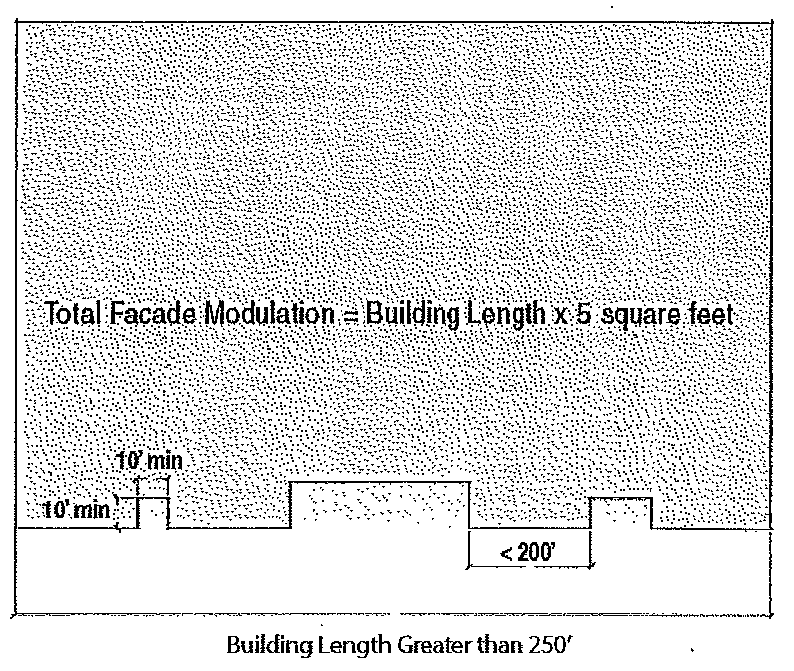
2.
Building mass separation is intended to break up long, continuous building walls and create the appearance of multiple buildings. Building mass separation shall be provided at a depth of at least twenty-five (25) feet from the front building line and a width of at least twenty-five (25) feet, open to the sky, for at least every two hundred (200) feet of total building length fronting a street.
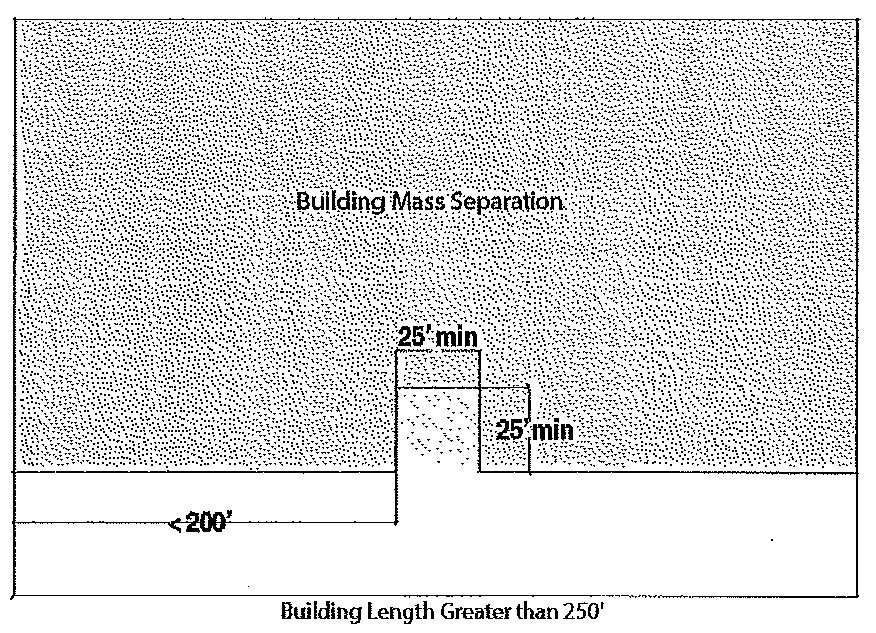
3.
Architectural variation is intended to create the appearance of smaller, attached buildings to reduce the apparent size of a building. The planning director, or his or her authorized designee, shall have the authority to approve an alternative design that incorporates architectural variations along public rights-of-way. The alternative design shall utilize a combination of the following, at increments no greater than one hundred (100) feet, to break up the building mass: varied roof pitches, building heights, architectural styles, window arrangement and size variations, external building material changes, offset wall planes.
(b)
All buildings over five (5) stories shall be designed with an architectural base distinguishable from the remainder of the building to enhance the pedestrian environment. The base shall not be more than two (2) stories in height and shall utilize a combination of the following: cornices, belt courses, molding, stringcourses, ornamentation, changes in color and material, or other sculpting of the base.
(Ord. No. 4699, § 1, 7-18-2011; Ord. No. 4836, § 1, 2-20-2012; Ord. No. 4925, § 1, 7-16-2012; Ord. No. 5137, § 1, 6-17-2013; Ord. No. 5412, § 1, 6-16-2014)
Section 10.901. - Purpose.
The transit supportive (TS) overlay district is established to:
(1)
Introduce transit supportive and pedestrian oriented development regulations and uses, [and]
(2)
Encourage properties to transition to more transit supportive development and uses up to one-half (½) mile walking distance from a transit station.
The purpose of this overlay district is to create a set of additional standards designed to accommodate the continued existence and minor expansion of existing uses while transitioning to a more compact, high intensity, transit supportive mix of uses at a lesser intensity than traditional transit oriented development.
(Ord. No. 2881, § 1(2), 2-21-2005; Ord. No. 4130, § 1, 3-19-2009)
Section 10.902. - Applicability.
The transit supportive (TS) overlay district shall be applied to select transit station areas with an approved station area plan, but shall not be applicable in the mixed use development district (MUDD), uptown mixed use district (UMUD), and the transit oriented development districts (TOD-R, TOD-E, TOD-M).
All properties zoned TOD-E, TOD-M and TOD-R on March 1, 2009 will not be subject to Ordinance # ____________ if site plans have been submitted for formal review by March 1, 2011.
(Ord. No. 2881, § 1(2), 2-21-2005; Ord. No. 4130, § 1, 3-19-2009)
Section 10.903. - Conflicts.
If the regulations and standards of this district conflict with those of the underlying district, those of this district shall apply, with one exception. If the regulations and standards of this Transit Supportive Overlay District conflict with those of an Historic Overlay District, then Historic Overlay District regulations and standards for exterior features as described in Section 10.204 shall take precedence over the Transit Supportive Overlay District regulations and standards.
(Ord. No. 2881, § 1(2), 2-21-2005; Ord. No. 3739, § 1, 11-19-2007)
Section 10.904. - Rezoning to a transit supportive overlay district (TS).
As per section 6.103(1), any amendment for the reclassification of property to a TS zoning district may be initiated by the city council, on its own motion, by any owner with a legal interest in the property, by anyone authorized in writing to act on the owner's behalf, or by any non-owner in accordance with the procedures set forth in chapter 6. However, the property must be located within one (1) mile of a rapid transit station that is included in a project for which the Federal Transit Administration (FTA) has issued a record of decision or be located within the boundaries of a council adopted transit station area plan.
(Ord. No. 2881, § 1(2), 2-21-2005; Ord. No. 4130, § 1, 3-19-2009; Ord. No. 4877, § 1, 5-14-2012)
Section 10.905. - Uses.
(1)
All uses permitted in the underlying zoning district by right or under prescribed conditions are permitted with the exception that the following uses are not allowed in the TS overlay district:
(a)
Automobile or truck washing facilities.
(b)
Vehicle sales such as tractor-trucks and accompanying trailer units.
(c)
Boat or ship sales, repairs, dry storage.
(d)
Body shops, free-standing. (Body shops that are an accessory to automotive sales and service establishments are permitted as an accessory use).
(e)
Building material sales and service.
(f)
Cemeteries.
(g)
Cold storage plants.
(h)
Contractor storage.
(i)
Distributive businesses greater than ten thousand (10,000) square feet.
(j)
Funeral homes, internment services, embalming, and crematories.
(k)
Hazardous materials storage and treatment.
(l)
Heavy industrial uses permitted by right or under prescribed conditions including, but not limited to: abrasive and asbestos products, aircraft and parts; agricultural chemicals; alcoholic beverages, with the exception of breweries; asphalt paving and roofing materials; brick, tile, and clay products; chemical manufacture, refining and processing; concrete, gypsum and plaster products; construction and related machinery; cut stone and stone products; electrical distribution equipment; electrical industrial apparatus; engines and turbines; fabricated metal products; farm and garden machinery; fats and oils processing; furniture and fixtures; glass and glassware; guided missiles, space vehicles, etc.; industrial machinery; leather tanning; manufactured housing; meat products, including slaughtering and dressing; motorcycles and parts; ordinance and accessories; paper and allied products; petroleum and coal products; plastic and rubber products; railroad equipment; refrigerator and service machinery; sugar refining, textile mill products; tires and inner tubes; wire products; and other similar uses.
(m)
Jails and prisons.
(n)
Manufactured home sales and repair.
(o)
Mining and extraction establishments.
(p)
Outdoor storage of any type, occupying more than one (1) acre.
(q)
Quarries.
(r)
Retail equipment sales, service, rental and/or leasing.
(s)
Tire recapping and retreading.
(t)
Towing services.
(u)
Truck and freight transportation services.
(v)
Truck stops and/or terminals.
(w)
Waste incinerators.
(x)
Wholesale distribution of petroleum products, heating fuel, propane, alternative fuels, etc.
(y)
Wholesale sales establishments greater than ten thousand (10,000) square feet.
(2)
The following use, which is not permitted in some of the underlying districts, shall be permitted by right or under prescribed conditions:
(a)
Breweries (only when the underlying zoning district is B-1, B-2, I-1, or I-2) and subject to the standards of this overlay district and to the prescribed conditions of section 12.544.
(b)
Residential uses, subject to the standards of this overlay district.
(Ord. No. 2881, § 1(2), 2-21-2005; Ord. No. 5138, § 1, 6-17-2013)
Section 10.906. - Accessory uses.
The following accessory uses are permitted:
(1)
Accessory uses and structures clearly incidental and related to the principal use or structure on the lot are allowed, with the following exception:
Drive-through service lanes are only permitted if allowed in the underlying zoning district. Drive-through windows shall only be located on the same site as the principal use, and shall be located to the rear of the principal use, to minimize visibility along public rights-of-way. Freestanding drive-through lanes are prohibited. Principal uses with drive-through service windows shall meet the following requirements:
(a)
For professional business and general office uses, no more than four (4) drive-through service lanes shall be permitted per individual use.
(b)
For retail uses, no more than one (1) drive-through service window with no more than two (2) service lanes shall be permitted per individual use.
(2)
Outdoor dining associated with an eating, drinking and entertainment establishment (Type 1 or Type 2) is only permitted if allowed in the underlying zoning district. Outdoor dining associated with a Type 2 eating, drinking and entertainment establishment is subject to the regulations of section 12.546.
(Ord. No. 2881, § 1(2), 2-21-2005; Ord. No. 5522, § 1, 11-17-2014)
Section 10.907. - Development standards.
The following requirements apply to all buildings or uses in TS unless specified otherwise in section 10.909:
(1)
Minimum setback.
(a)
The minimum building setbacks along public and private streets shall be determined as follows:
1.
New development across a local (public or private) street from, or abutting on the same side of a local street as, existing single family zoning (R-3, R-4, R-5, R-6, and R-8), shall have a minimum setback of thirty (30) feet. This minimum setback shall apply only if the single family parcels front onto the same local street as the development parcel. This setback shall supersede the adopted streetscape plan.
2.
Minimum setbacks for all other parcels shall be determined by a city council adopted streetscape plan. If there is not an adopted streetscape plan, or when a streetscape plan does not specify a setback, the minimum setback for all uses shall be twenty-four (24) feet on major thoroughfares and sixteen (16) feet on all other streets. If on-street parking is provided, the minimum setback from back of curb may be reduced by the width of the on-street parking.
(b)
The minimum setback shall be measured from the back of all existing or future curb lines, whichever is greater. If the existing right-of-way is greater than the minimum setback from the back of existing or future curb lines, the right-of-way line shall become the minimum setback. If the existing curb line varies, the setback shall be measured from the widest section. Curb lines are to be determined jointly by the Charlotte Department of Transportation (CDOT) director, or his designee, and the planning director, or his designee.
(c)
If new construction incorporates an existing structure located within the required setback, the CDOT director or his designee, and the planning director or his designee, may allow the setback for the addition to be reduced to the established setback. In no event shall the setback of any portion of the new structure be less than ten (10) feet from the back of the curb line.
(d)
For the purposes of this section, the minimum setback applies to all street frontages, not just to the street toward which the structure is oriented.
(e)
All above ground, at ground, and below ground utility structures associated with underground electric, natural gas, telecommunications or cable television distribution lines, pipes, or conduits shall be located behind the minimum setback, except as allowed by any city right-of-way ordinances. This includes air vents, vaults, and backflow preventers.
(f)
No new doors shall be permitted to swing into the minimum setback, except for emergency exit doors.
(g)
One story screened or open air porches and stoops may encroach into the setback up to eight (8) feet, but shall be behind the required sidewalk. Architectural features such as eaves, steps and cornices may encroach up to an additional three (3) feet into the setback. Fences and walls may also be located in the setback, behind the required sidewalk, but shall not exceed thirty-six (36) inches in height above grade. All fences and walls shall be constructed in a durable fashion of brick, stone, other finished masonry materials, wood posts and planks or metal or other materials specifically designed as fencing materials or any combination thereof.
(h)
No canopies or signs are permitted in the minimum setback, except as provided for in subsections 10.908(6) and (7).
(i)
Driveways may cross the setback, but shall be as near as possible to perpendicular to the street, so as to minimize intrusion into any landscaped area, and for pedestrian safety.
(j)
Balconies may project up to two (2) feet in the minimum setback, subject to an approved sidewalk encroachment agreement with CDOT. Balconies shall have a minimum clearance of ten (10) feet from grade.
(k)
Sidewalk arcades may be located within the sidewalk portion of the minimum setback, at sidewalk level, subject to an approved sidewalk encroachment agreement with CDOT. Sidewalk arcades shall maintain a minimum ten (10) feet clear, unobstructed space between arcade supports, and a minimum overhead clearance of ten (10) feet. No arcade support shall be located closer than fourteen (14) feet from the back of the existing or future curb line, whichever is greater.
(2)
Minimum side and rear yards. None required, except if a side or rear yard is provided, the minimum width shall be five (5) feet, with the following exceptions:
(a)
When a lot abuts an existing residential structure or a single family, multi-family, or urban residential zoning district, (excluding TS or TOD zoned property) then a minimum side yard of five (5) feet and/or a minimum rear yard of twenty (20) feet shall be required.
(b)
When a lot abuts a rapid transit corridor or a rapid transit corridor that is located within or adjacent to a freight rail corridor, a minimum rear yard setback shall be required, as specified in the approved station area plan. If a station area plan has not been adopted or does not specify a rear yard setback, then the minimum rear yard setback from the centerline of the rapid transit corridor shall be a minimum of thirty-five (35) feet, or the width of the right-of-way, including the freight rail corridor, whichever is greater.
(3)
Maximum height.
(a)
The maximum building height shall be determined as follows:
1.
The base height for all TS districts shall be forty (40) feet.
2.
For new development across a local (public or private) street from existing single family zoning (R-3, R-4, R-5, R-6, and R-8), the 40-foot base height shall be measured at the minimum setback line. The height may increase one (1) foot in height, over forty (40) feet, for every ten (10) feet in distance the portion of the building is from the required setback along that street.
3.
For new development abutting on the same side of a local (public or private) street as existing single family zoning (R-3, R-4, R-5, R-6, and R-8), the 40-foot base height shall be measured at the required yard. The height may increase one (1) foot in height, over forty (40) feet, for every ten (10) feet in distance the portion of the building is from the required yard.
4.
For all other parcels, the permitted maximum height shall be determined by the distance from the structure to the boundary line of the nearest single-family residential districts (R-3, R-4, R-5, R-6, and R-8). This distance shall be the shortest measurable distance between the building footprint edges and nearby single-family residential district boundaries. Height increases for portions of the building that are a further distance from single-family residential zoning districts, are allowed at a rate of one (1) additional foot of height for every ten (10) feet of additional distance the portion of the building is from the edges of nearby single-family zoning districts.
5.
The maximum height for the TS district shall be sixty (60) feet.
(b)
Height requirements for other permitted structures are set forth in section 12.108.
(4)
Minimum residential density.
(a)
Residential development, and the residential component of multi-use developments, shall have a minimum density of twelve (12) dwelling units per acre if an adopted station area plan exists and the site is within the 1/2 mile walk distance of the station. When a station area plan has not been adopted or a site is more than a one-half-mile walk from the station, the minimum density shall be ten (10) dwelling units per acre. Densities shall be based on the residential portion of the site.
For large or phased projects, the residential density for each phase shall meet or exceed the minimum density requirements. If phases cannot meet this requirement, but the overall master plan meets or exceeds the minimum density requirements, approval may be granted by the planning director for phases that meet at least eighty (80) percent of the minimum residential density requirements, or the applicant may choose to rezone to the optional TS-O zoning district, which allows variations in the TS standards. (See section 10.912).
(b)
The residential component of mixed-use developments shall meet the floor area ratio (FAR) requirements of subsection 10.907(5).
(5)
Floor area ratio.
(a)
The total minimum floor area ratio of buildings on a development site shall not be less than .50 square feet of floor area to one (1) square foot of the development site (.50 FAR) if an adopted transit station area plan exists and the site is within the one-half-mile walk distance of the station. If a transit station area plan has not been adopted, or a site is more than a one-half-mile walk from the station development shall have a minimum FAR of .35. The FAR shall apply to the following uses:
1.
All non-residential uses [except those excluded in section 10.907(5)(e)]
2.
Non-residential uses of multi-use developments.
3.
Residential uses of mixed-use developments.
(b)
For large or phased projects, the minimum FAR for each phase shall meet or exceed the minimum FAR requirements. If phases cannot meet this requirement, but the overall master plan meets or exceeds the minimum FAR requirements, approval may be granted by the planning director for phases that meet at least eighty (80) percent of the minimum FAR density requirements, or the applicant may choose to rezone to the optional TS-O zoning district, which allows variations in the TS standards. (See section 10.912.)
(c)
Plazas, arcades, courtyards, galleries, open air eating, drinking and entertainment establishments, rooftop gardens, and widened public sidewalks that enhance pedestrian spaces and amenities can be credited toward meeting the minimum required FAR. If the pedestrian spaces/amenities are available to the public then the square footage shall be credited at one hundred (100) percent; if private, then the square footage shall be credited at fifty (50) percent. In no instance shall more than twenty (20) percent of the pedestrian area be credited toward the required FAR.
(d)
An FAR credit shall be given for structured parking facilities that devote at least seventy-five (75) percent of the linear street level frontage of the building to retail, office, civic, institutional, or residential uses. Similarly, an FAR credit shall be allowed for structured parking facilities that provide such uses above the street level, and/or on any other side of the building. See subsection 10.907(6)(1) for credit amounts.
(e)
Certain principal uses are exempt from meeting the minimum FAR requirements:
1.
Transit stations (bus or rail), parking facilities, and bus shelters.
2.
Private parking decks (principal use only) and surface parking facilities.
3.
Existing development and expansions of existing development.
4.
Freestanding group homes for up to ten (10) residents.
5.
Public and private recreation parks and playgrounds.
6.
Utility and related facilities.
7.
Electric and gas substations.
(6)
Parking standards.
(a)
New permitted uses within this zoning overlay district shall be required to meet the minimum/maximum number of off-street parking spaces as follows: All square footage is measured as "gross footage."
1.
The required number of parking spaces for any building within the district, including mixed use buildings, shall be the sum total of the requirements for each use in the building calculated separately.
2.
Parking maximums may be exceeded by up to a total of thirty (30) percent of the maximum, under the following circumstances, if one (1) or more of the following is provided:
a.
If structured or underground parking is provided on site, parking maximums may be exceeded by twenty-five (25) percent.
b.
If a shared parking agreement is executed, the parking maximum may be exceeded by twenty (20) percent.
c.
If all parking spaces are located behind the building and are not visible from the public right-of-way, parking maximums may be exceeded by ten (10) percent.
d.
If driveways and access points are shared by at least two (2) adjacent properties, parking maximums may be exceeded by ten (10) percent.
e.
If a provision is made for combining or interconnecting adjacent parking lots and pedestrian access points, parking maximums may be exceeded by ten (10) percent.
3.
A twenty-five (25) percent parking reduction in the minimum number of parking spaces required is allowed if the principal use is located within eight hundred (800) feet of a parking facility available to the general public or within eight hundred (800) feet of public transit park-and-ride facilities with an approved joint use agreement. This section in combination with subsection 12.202(2) allows for no more than a twenty-five (25) percent parking reduction of the minimum requirements.
(b)
The provisions for parking standards shall conform to the general requirements of chapter 12, part 2, except as provided for in this section.
(c)
No surface parking or maneuvering space shall be permitted within any required or established setback, and no surface parking or maneuvering space is allowed between the permitted use and the required setback, except that:
1.
Driveways providing access to the parking area may be installed. It is the intent that these driveways be as nearly perpendicular to the street right-of-way as possible to minimize intrusion into the landscaped area, and for pedestrian safety;
2.
Driveways providing access to structured parking facilities are permitted between the rail corridor setback and the building. However, the length of the driveway shall not exceed fifty (50) percent of the length of the property line along the rail corridor.
(d)
In the event that the city or state removes any on-street parking that was allowed to count toward the minimum requirement, the existing use shall not be required to make up the difference and shall not be made non-conforming with respect to parking.
On-street parking shall be provided for properties on blocks with single family zoning except where prohibited by CDOT or NCDOT. On-street parking may be used to meet minimum residential parking requirements but shall not be counted in calculating maximum parking spaces.
(e)
All recessed on-street parking shall comply with Charlotte's Urban Street Design Guidelines, when adopted.
(f)
The vehicular parking requirements may be met on-site or off-site at a distance of up to eight hundred (800) feet from the permitted use. Off-site parking to meet the requirements of this section may be provided through a lease, subject to the review and approval of engineering and property management (for commercial and planned multi-family projects, change of use permits) or neighborhood development (for all other residential projects, and change of use permits).
(g)
Parking that is located to the rear of the primary structure may extend the entire width of the lot, with the exception of any required screening or landscaped areas. Parking that is located to the side of the primary structure shall not cover more than thirty-five (35) percent of the total lot width.
(h)
Shared parking shall be permitted and encouraged pursuant to the regulations of section 12.203.
(i)
Bicycle parking facilities shall be required as per chapter 12, part 2.
(j)
All surface parking shall conform to the internal planting requirements for parking areas in the city tree ordinance.
(k)
All parking areas for more than ten (10) motorized vehicles (except for parking areas for detached duplex, triplex or quadraplex dwellings on a single lot) shall provide screening which consists of either a five-foot-wide planting strip consisting of evergreen shrubbery according to the provisions of subsection 12.303(2), or a two and one-half (2½) foot minimum to a three-foot maximum masonry wall that shall be forty (40) percent to fifty (50) percent open and finished, or an alternative as approved by the planning director. However, a wall cannot be substituted for the planting strip along any public street or transitway unless supplemented by landscaping in a minimum three-foot-wide planting strip.
If a wall is provided, then the area devoted to the wall shall be wide enough to allow for its maintenance.
The five-foot planting strip or the wall may be eliminated if abutting parking lots are combined or interconnected with motor vehicular and pedestrian access.
Shrubs and walls may be reduced in height to thirty (30) inches when located within sight triangles as required by the Charlotte Department of Transportation (CDOT). In no instance shall a chain link fence or a barbed wire fence be permitted.
(l)
Any new or expanded structured parking facility shall meet the following requirements:
1.
At least fifty (50) percent of the linear street level frontage of the facility shall be devoted to retail, office, civic, institutional, or residential uses. If seventy-five (75) percent or more of the linear street frontage is devoted to such uses, then the total square footage of the uses shall be credited at two hundred (200) percent toward the required FAR minimums.
2.
If retail, office, civic, institutional, or residential uses are constructed on the side or rear of the building, or above the ground floor on the street frontage of the building, then the total square footage of these uses shall be credited at two hundred (200) percent toward the required FAR minimums.
3.
Underground parking structures are permitted. Subsurface parking located in the minimum setback shall be permitted, with an eight-foot clearance from the top of the subsurface structure to the sidewalk, subject to an approved encroachment agreement with CDOT. No ventilation shall be allowed in the setback.
4.
A minimum nine-foot clearance shall be maintained on the first level and any additional level that provides disabled parking spaces. A minimum seven-foot clearance shall be maintained throughout the remainder of the parking structure to ensure the safe movement of vans and emergency vehicles.
(m)
Parking lots (temporary surface lots), over one (1) acre, shall meet the following requirements:
1.
An operator of a temporary parking lot shall apply for a permit from engineering and property management. A permit shall not be issued until the planning director, or his or her designee has been consulted and supports approval. The permit shall authorize a temporary parking lot for a period of ten (10) years from the date the permit is issued.
2.
Temporary, surface parking lots shall not be permitted when the lot adjoins a residentially used parcel of land, not zoned TS, TOD-R, TOD-E, TOD-M, unless the parking lot will be located on a major thoroughfare.
3.
The use shall not require the construction of a permanent building.
4.
Any signage, which identifies the use, shall be in accordance with subsection 10.908(7).
5.
Parking and maneuvering shall observe the minimum setbacks determined in each adopted station area plan for particular streets, and be located outside the site distance triangle. If an adopted station area plan does not specify a setback, or if there is not an adopted station area plan, the minimum setback shall be twenty (20) feet.
6.
The operator is responsible for the removal of any vestiges upon cessation of the temporary parking lot, including signage.
(n)
Front-loaded garages, parking pads and driveways for individual residential units shall not be permitted along public or private streets, except for corner lots and lots at least fifty (50) feet in width. Driveways located along public or private streets shall not be allowed to cross the front setback to access individual residential garages. Corner lots may have driveway access to a public street from the side yard. Shared driveways and alleys accessing multiple (two (2) or more) individual garages are permitted if the garages are to the rear of the structure.
Front-loaded garages may be approved by the planning director if site shape, environmental and/or topographic challenges exist that present significant site constraints.
(7)
Loading standards.
(a)
Non-residential buildings and structures, excluding parking structures, subject to the provisions of this part shall provide a minimum number of off-street service/delivery loading spaces. These spaces shall be designed and constructed so that all parking maneuvers can take place entirely within the property lines of the premises. These loading spaces shall not interfere with the normal movement of vehicles and pedestrians on the public rights-of-way, except as permitted by subsection 20-29[14-25] of the City Code. These loading spaces shall be a minimum of ten (10) feet by twenty-five (25) feet and be provided in accordance with the following:
Non-residential uses with gross floor area:
Less than fifty thousand (50,000) square feet: None required.
Fifty thousand (50,000) to one hundred fifty thousand (150,000) square feet: One (1) space.
Each additional one hundred thousand (100,000) square feet: One (1) space.
Existing buildings are exempt from these loading standards.
(b)
No loading spaces shall be permitted within any required or established setback, nor between the permitted use and the required setback, except that driveways providing access to the loading area may be installed across these areas.
(c)
Loading and service areas shall not be located across from single family or abutting single family on the same side of the street.
(8)
Screening standards.
(a)
All service entrances, utility structures associated with a building, and loading docks and/or spaces shall be screened from the abutting property and from view from a public or private street or from a transit-way. Such screening shall consist of a five-foot-wide planting strip, consisting of evergreen shrubbery sufficient to visually screen these uses, or an alternative as approved by the planning director. An optional wall or fence may be used in lieu of the five-foot planting strip. Walls may be reduced in height to thirty (30) inches within sight triangles as required by the Charlotte Department of Transportation (CDOT).
1.
Any fences or walls used for screening shall be constructed in a durable fashion of brick, stone, other finished masonry materials, wood posts and planks or metal or other materials specifically designed as fencing materials or any combination thereof as may be approved by the zoning administrator. The finished side of the fence shall face the abutting property. In no instance shall a fence or wall used for screening be located within a setback, nor shall a chain link or barbed wire fence be permitted.
2.
The composition of the screening material and its placement on the lot shall be left up to the discretion of the property owner, as long as the intent of this part is met. However, a wall cannot be substituted for the planting strip along any public street or transitway unless supplemented by landscaping in a minimum three-foot-wide planting strip.
3.
Shrubs used for screening shall be evergreen, at least two (2) to two and one-half (2½) feet tall with a minimum spread of two (2) feet when planted and no further apart than five (5) feet. Shrubs shall be adequately maintained so that an average height of five (5) to six (6) feet can be expected as normal growth within four (4) years of planting. The average expected height may be reduced to four (4) feet for screening along public streets. Shrubs and trees shall be on the approved plant list in the "Approved Plant Species" matrix in the Charlotte Land Development Standards Manual. Walls may be reduced in height to thirty (30) inches within sight triangles as required by the Charlotte Department of Transportation (CDOT).
4.
The minimum height for walls and fences abutting a residential district shall be six (6) feet or whatever is sufficient to screen the use. The minimum height for screening shall be whatever shall be sufficient to visually separate the uses, but not less than four (4) feet.
(b)
Dumpsters, recycling containers, compactors, large above-ground utility structures and solid waste handling areas are not permitted in any setback or yard and shall be screened from adjacent property and from public view with a minimum six-foot high solid and finished masonry wall, with closeable gate that shall be forty (40) percent to fifty (50) percent open for safety and security purposes. In no instance shall a chain link fence or a barbed wire fence be permitted. Dumpsters are not permitted in any required setback or yard space.
(c)
Surface parking lots shall be screened in accordance with section 10.907(6)(k).
(9)
Buffer standards.
(a)
All uses, other than single-family detached units, shall provide landscaping along all property lines abutting residentially zoned property (single-family, multi-family and urban residential zoning districts) located adjacent to the transit supportive overlay zoning district. This requirement also applies in situations where an alley with a right-of-way width of twenty-five (25) feet or less, separates uses in the TS district from residential property in other zoning districts other than the TOD and TS districts. Landscaping shall be provided along all property lines abutting the alley. However, multi-family developments zoned TS are exempt from this landscaping requirement when they abut other multi-family uses or undeveloped multi-family zoning districts.
(b)
Such landscaping shall consist of a ten-foot wide planting strip. The planting strip shall consist of a combination of evergreen trees and evergreen shrubs. Plant materials shall be provided at a minimum of six (6) trees and twenty (20) shrubs per one hundred (100) linear feet in accordance with subsections 12.302(9)(b), (c), (d) and (e). The ten-foot planting strip may be reduced to eight (8) feet and the shrubs need not be planted if a masonry wall with a height of between six (6) feet to eight (8) feet in a side yard or between eight (8) feet to ten (10) feet in a rear yard is installed. No more than twenty-five (25) percent of the wall surface shall be left open. Shrubs and walls may be reduced in height to thirty (30) inches within sight triangles as required by the Charlotte Department of Transportation (CDOT). This landscaping area may be interrupted with a gate/pedestrian access way or a driveway to an adjacent alley.
In no instance shall a chain link or barbed wire fence be permitted.
(10)
Outdoor lighting standards.
(a)
All outdoor lighting fixtures for parking lots, and pedestrian activity areas shall be classified as full cut-off, cutoff or semi-cutoff. In addition, any building light fixtures used to illuminate parking and pedestrian areas, and service areas shall be classified as full cutoff, cutoff or semi-cutoff.
(b)
No outdoor lighting fixture or building light fixtures shall cause glare on public travel lanes or on adjacent residentially used or zoned property. All fixtures shall be screened in such a way that the light source shall not cast light directly on public travel lanes or on adjacent residentially used or zoned property.
(c)
The lighting of signs shall be in accordance with standards of chapter 13.
(11)
Connectivity and circulation. Transit oriented development uses shall be integrated with the surrounding community, easily accessible, and have a good internal circulation system for a variety of travel modes.
(a)
A pedestrian sidewalk system shall meet the following standards:
(1)
Internal sidewalk connections are required between buildings and from buildings to all on site facilities (parking areas, bicycle facilities, urban open space, etc.) in addition to the sidewalk requirements of subsection 10.908(8)(e). All internal sidewalks shall be hard-surfaced and at least six (6) feet in width.
(2)
External sidewalk connections are required to provide direct connections from all buildings on site to the existing and/or required sidewalk system, and to adjacent multi-use trails, parks, and greenways. The connection shall be no longer than one hundred twenty (120) percent of the straight-line distance from all buildings to the existing or proposed sidewalk, or no more than twenty (20) feet longer than the straight-line distance, whichever is less. Sidewalks shall be hard-surfaced and at least six (6) feet in width. The sidewalk width can be reduced to four (4) feet in width, if the internal sidewalk serves less than four (4) dwelling units.
The planning director shall have the authority to modify this requirement when unusual circumstances exist, such as topographical problems or compliance with ADA standards.
(3)
The on-site pedestrian circulation system shall be lighted to a level where employees, residents, and customers can safely use the system at night. The lighting system shall be shielded with full cut off fixtures.
(b)
Bicycle parking and storage facilities shall be provided in accordance with chapter 12, part 2 of this appendix.
(12)
Urban open spaces.
(a)
All new development on lots of greater than twenty thousand (20,000) square feet must provide urban open space. Such open space shall be either private open space and/or public open space.
(b)
Private open space is defined as an area that is:
1.
Accessible and visible to residents, tenants, and/or users of the development.
2.
Improved with seating, plantings, and/or other amenities.
3.
Located on the ground floor or first level of the development, or on a roof or terrace level, or in an interior courtyard area of the development, or a combination of these locations.
4.
Out of doors, or in the open air (may be under a roof or canopy).
(c)
Public urban open space is defined as an area that is:
1.
Accessible and open to the public.
2.
Improved with seating, plantings, and/or other amenities.
3.
Visible and accessible from the street or public pedestrian areas.
4.
Located on the ground floor or no more than five (5) feet above or five (5) feet below ground level.
5.
Out of doors, or in the open air (may be under a roof or canopy).
(d)
All required open space shall be located behind the sidewalk and on private property.
(e)
Open space requirements are based on the type of use, the lot size, and the gross square footage of building floor area, in accordance with the following schedule:
(f)
For developments on lots in excess of ten (10) acres (four hundred thirty-five thousand (435,600) square feet), at least fifty (50) percent of the required open space must be centrally located on the site in a common area.
(g)
Floor area ratio credits are allowed for all new developments as per section 9.1208(5)(c) when the pedestrian space is available for use by the public, including widened sidewalk areas.
(Ord. No. 2881, § 1(2), 2-21-2005; Ord. No. 3017, § 1H7, 6-20-2005; Ord. No. 4130, § 1, 3-19-2009; Ord. No. 4341, § 1, 1-19-2010; Ord. No. 5423, § 1, 7-21-2014; Ord. No. 5531, § 1, 11-17-2014)
Section 10.908. - Urban design standards.
All buildings and uses developed in this overlay district shall meet the following minimum standards:
(1)
Street walls.
(a)
All retail and office buildings fronting directly on a public or private street or fronting on a public multi-use path along a transit line and identified in an area plan shall be designed so that the first floor facade of the building(s) along all streets and pathways includes clear glass windows and doors to increase pedestrian interest. These openings shall be arranged so that the uses are visible from and to the street and/or pathway on at least fifty (50) percent of the length of the first floor street level frontage.
(b)
For all other uses, buildings shall be designed so that the first floor street facade along all streets includes the use of clear glass windows and doors arranged to that the uses are visible from and/or accessible to the street on at least twenty-five (25) percent of the length of the first floor street frontage. When this approach is not feasible, a combination of design elements shall be used on the building facade to animate and enliven the streetscape. These design elements may include but are not limited to the following: ornamentation; molding; string courses; changes in material or color; architectural lighting; works of art; fountains and pools; street furniture; stoops, landscaping and garden areas; and display areas.
(c)
The first floor facade of all buildings, including structured parking facilities, shall be designed to encourage and complement pedestrian-scale interest and activity.
(d)
Expanses of blank wall shall not exceed twenty (20) continuous feet in length. A blank wall is a facade that does not add to the character of the streetscape and does not contain clear glass windows or doors or sufficient ornamentation, decoration or articulation.
(e)
No reflective surfaces shall be permitted on street level exterior facades.
(f)
Ventilation grates or emergency exit doors located on the first floor street facade(s) shall be decorative and part of the overall building design.
(g)
For buildings across from single family zoning or abutting single family zoning on same side of the street, the roof line shall vary every thirty (30) feet is required. This can be accomplished by vertical offsets in ridge lines, gables, exaggerated cornices, dormers, roof top patios, material changes and/or other architectural features such as trellises, portals or porches.
(h)
For buildings across from single family zoning or abutting single family zoning on the same side of the street porches, if provided, shall be at least six (6) feet in depth A porch is defined as a covered platform, usually having a separate roof, at an entrance to a building.
(i)
For buildings across from single family zoning or abutting single family zoning or the same side of the street, entrances that face the street for ground floor units shall provided. No more than four (4) ground floor units shall be allowed to utilize the same entrance.
(j)
For buildings across from single family zoning or abutting single family zoning on same side of the street, facade variations shall be provided that visually separate individual units. This can be accomplished through measures such as window arrangement and size variation, unit entrance design, roof variation, material changes, and/or offset wall planes.
(k)
The ground floor of parking structures that are across the street from single family zoning or that abut single family zoning on the same side of the street, shall be wrapped with active uses such as residential, office and retail uses.
(l)
The first floor of any new building on a street identified as a retail street or site identified for ground floor retail by a council-adopted plan must have at least fifty (50) percent of the linear street frontage developed to accommodate non-residential uses but may be occupied with residential uses.
(2)
Base of high rise buildings (buildings exceeding five (5) stories).
(a)
The first three (3) floors above street grade shall be distinguished from the remainder of the building with an emphasis on providing design elements that will enhance the pedestrian environment. Such elements as cornices, corbelling, molding, stringcourses, ornamentation, changes in material or color, recessing, architectural lighting and other sculpturing of the base as are appropriate shall be provided to add special interest to the base.
(b)
In the design of the building facade, attention shall be paid to the appearance both during the day and at night. Material and color changes alone do not meet the requirements of this section and design elements, which are used to meet the requirements of this section, shall be visually continuous around the building. In the event that a building facade is not visible from a public street or right-of-way then the planning director has the option of waiving this requirement.
(c)
Special attention shall be given to the design of windows in the base. Band windows are prohibited. Recessed windows that are distinguished from the shaft of the building through the use of arches, pediments, mullions, and other treatments are encouraged.
(3)
Top of buildings.
(a)
All rooftop mechanical equipment on buildings over sixty (60) feet in height shall be screened from public view from below by integrating the equipment into the building and roof design to the maximum extent feasible, by the use of parapet walls or similar architectural treatments. Buildings under sixty (60) feet in height shall screen all rooftop mechanical equipment from public view from above or below (based on the type of mechanical equipment utilized) by integrating it into the building and roof design to the maximum extent feasible.
(4)
Building entrances and orientation.
(a)
At least one (1) or more operable pedestrian entrances shall be provided in each of the following circumstances:
1.
When a lot abuts a public or private street, at least one (1) entrance shall be provided on each building facade fronting a street. Single family and townhouse units are only required to have an entrance on one (1) building facade fronting a street.
2.
When a lot abuts an existing or proposed public open space system, multi-use trail, or greenway, entrance(s) shall be provided on the building facade closest to public open space, multi-use trail, or greenway.
3.
When an adopted station area plan depicts a required sidewalk not specified in the subsections above, an entrance(s) shall be provided on the building facade closest to the required sidewalk. Distances shall be measured in a straight line from the closest point of the property line to the closest point of the right-of-way, public open space, transit station, or light rail transit station platform.
If all three (3) of these circumstances exist, only two (2) entrances shall be required, with the third being optional.
Distances shall be measured in a straight line from the closest point of the property line to the closest point of the right-of-way, public open space, transit station platform.
(b)
Such entrances shall be distinguishable from the rest of the building to provide a sense of entry and to add variety to the streetscape. No doors shall be permitted to swing into the minimum setback, except for emergency exit doors.
(c)
On corner lots, buildings may provide one (1) main entrance oriented to the corner or facing either of the streets.
(d)
To provide a level of comfort and security for residents on the first floor of residential buildings on major thoroughfares, the first floor should be visually and physically separated from the sidewalk. Examples include increasing the setback, installing additional landscaping, raising or lowering the first floor or other method.
(5)
Structured parking facilities. Structured parking facilities shall be designed to encourage and complement pedestrian-scale interest and activity, and shall be designed so that motorized vehicles parked on all levels of the facility inside are screened from the street or transitway, or abutting residentially zoned and/or used property. Decorative elements such as grillwork or louvers shall be utilized to accomplish this objective.
Openings at the street level are limited to vehicular entrances, pedestrian access to the structure, and ventilation openings. All openings shall be decorative and shall be an integral part of the overall building design.
(6)
Canopies. Canopies, awnings, cornices, and similar architectural accents are permitted on exterior building walls. Such features shall be constructed of rigid or flexible material designed to complement the streetscape of the area. Any such feature may extend from the building up to one-half (½) of the width of the setback area in front of the building, or nine (9) feet whichever is less, and may not be closer than two (2) feet to the back of the curb line. In no instance shall such features extend over, or interfere with the growth or maintenance of any required tree plantings. Minimum overhead clearance shall be eight (8) feet. Ground supports for these features are not permitted in the minimum setback, sidewalk, or in the public right-of-way. If a canopy, awning, cornice, or other appurtenance extends into the public right-of-way, an encroachment agreement from CDOT or the state shall be required.
(7)
Signs, banners, flags and pennants. Where signs, banners, flags and pennants for identification or decoration are provided, they shall conform to the requirements of chapter 13, except for the following:
(a)
Wall signs shall meet the specifications of section 13.108a, with the exception that signs located on any building wall shall have a maximum sign surface area not to exceed five (5) percent of building wall area to which the sign(s) is attached, up to a maximum of one hundred (100) total square feet. In lieu of a ground mounted or monument sign, the area of wall signs may be increased to a maximum size of one hundred twenty (120) total square feet.
(b)
Signs are permitted to project up to six (6) feet into the minimum setback as measured from the building. Under no circumstance shall a sign project more than four (4) feet from the back of the curb line. A minimum overhead clearance of eight (8) feet from the sidewalk shall be maintained.
(c)
Marquee and message signs are permitted. Marquee signs shall meet the requirements of subsection 13.108(a)(2).
(d)
Ground mounted or monument signs are allowed as follows:
1.
Signs shall not exceed five (5) feet in height and twenty (20) square feet in area.
2.
Signs shall be located behind the right-of-way and out of any sight distance triangle prescribed by the Charlotte Department of Transportation (CDOT).
3.
Signs shall be located behind the minimum setback.
(e)
No free-standing pole signs shall be permitted.
(f)
No outdoor advertising signs shall be permitted.
(8)
Streetscape standards.
(a)
A continuous perimeter-planting strip or amenity zone (excluding driveways) shall be required whenever property abuts a curb. The width of the planting strip or amenity zone shall be determined by the approved station area plan. Because stations will have different characters and unique conditions, planting strips and amenity zones within each station area may vary. When a station area plan does not specify a planting strip width or amenity zone an eight-foot-wide planting strip shall be constructed.
If the adopted station area plan does not adequately define the curb line, then the curb line shall be determined by jointly by the Charlotte Department of Transportation (CDOT) director, or his designee, and the planning director, or his designee.
(b)
Curb lines shall be located adjacent to the perimeter planting strip, unless specified otherwise in an adopted station area plan. If the right-of-way varies along the street frontage, the planting strip shall be aligned along the widest right-of-way section.
(c)
Trees shall be planted in the continuous perimeter planting strip, as per the standards found in the city tree ordinance and in the Charlotte-Mecklenburg Land Development Standards Manual. Tree pits or trees in grates, with irrigation and sub-drainage are optional, in lieu of a planting strip, as per the requirements of subsection 21-14(c)(3)(a)(2) of the city tree ordinance. In instances where a 12-foot perimeter planting strip is required, the trees shall be centered no more than four (4) feet from the edge of the sidewalk.
(d)
City tree ordinance regulations for tree protection and replacement shall be applicable within this overlay district.
(e)
Sidewalks shall be located and constructed as specified in an adopted station area plan. This may include sidewalks along transit corridor rights-of-way. If sidewalk widths are not specified, or if a station area plan has not been adopted, then the sidewalk shall be eight (8) feet in width. Typically, sidewalks along street rights-of-way should abut the perimeter planting strip, and be located on the side closest to the building to encourage pedestrian activity. Sidewalks shall meet the standards for concrete sidewalks in accordance with the Charlotte-Mecklenburg Land Development Standards Manual.
Sidewalk easements shall be required if the sidewalk is not located within the public right-of-way.
(f)
The planning director with the affirmative recommendation of the city arborist/senior urban forester shall have the authority to modify the requirements of subsection 10.908(8), including the modification of the planting strip, sidewalk location, and width in order to preserve existing trees and to provide flexibility for a hard surface next to the curb line, where appropriate for on-street parking (e.g. handicap parking areas, loading zones).
(g)
An amenity zone is required in lieu of a planting strip along ground-floor, non-residential uses, unless on-street parking is not permitted by CDOT or NCDOT.
(9)
Valet parking service standards for new construction and site reconfigurations. If provided, a valet parking service (including drop-off areas, servicing areas, and the parking areas) shall meet the following requirements:
(a)
The valet parking service can be located in the following areas:
1.
For valet parking services that utilize the public right-of-way, the service may be located at the face of the existing curb of a street or thoroughfare as long as the existing curb line is not modified to provide an inset for the valet parking service or to reduce the width of the required sidewalk or planting strip.
2.
On private property the valet parking service area shall be located to the side or rear of the structure or building, but shall not be located between the building and the street.
(b)
The parking area for the valet parking service shall be incorporated into the parking lot or parking structure design, if provided.
(c)
The valet parking service and associated structures shall not disrupt the flow of pedestrian and vehicular traffic.
(d)
For valet parking services that are located on a public street or thoroughfare, or where the right-of-way is utilized by the service, a valet parking permit shall be obtained from the Charlotte Department of Transportation (CDOT). See sections 19-321 through 19-325 for permit information and criteria.
(Ord. No. 2881, § 1(2), 2-21-2005; Ord. No. 3822, § 1, 2-18-2008; Ord. No. 4130, § 1, 3-19-2009; Ord. No. 4836, § 1, 2-20-2012; Ord. No. 5137, § 1, 6-17-2013)
Section 10.909. - Exceptions.
All new development in this district shall be subject to the development and urban design standards of sections 10.907 and 10.908, with the following exceptions:
(1)
Change of use, non-residential to non-residential with no expansion.
(a)
If the change of use in an existing building does not require more than five (5) additional parking spaces based on the minimum/maximum number of parking spaces required in subsection 10.907(6)(a), then the requirement to provide the additional parking spaces is waived. Parking in excess of the maximum may remain.
(b)
If additional parking spaces are added, the new parking area shall meet the parking standards, internal planting requirements, and parking lot screening of subsections 10.907(6)(b) through (1).
(c)
If sidewalks and a perimeter planting strip with trees are non-existent along street frontages, the streetscape requirements of subsection 10.908(8) shall be required.
(d)
The sign, banner, flags and pennant requirements of subsection 10.908(7) shall apply.
(e)
The connectivity and circulation requirements of subsection 10.907(11) shall apply.
(2)
Change from a residential use to a non-residential use with no expansion.
(a)
All the requirements of chapter 10, part 9 shall apply with the exception of the urban design standards of subsections 10.908(1) through (4).
(b)
Any non-conforming parking located in the required setback shall be eliminated and replaced with landscaping, patios, and/or related amenities.
(3)
Expansions of existing uses.
(a)
Building expansions (for both conforming and non-conforming uses) are permitted up to ten (10) percent (total) of the gross floor area in existence at the effective date the property was reclassified to TS. Expansions shall be subject to the following:
1.
The building expansion shall meet the minimum setback, yard and height requirements of subsections 10.907(1), (2), and (3).
2.
The parking standards of subsection 10.907(6)(a) shall be met. If there are parking spaces in excess of the maximum permitted, they may remain. The creation of new parking spaces in excess of the maximum is not permitted.
3.
No exterior improvements shall make the building non-conforming in any way, or add to its non-conformity.
(b)
Building expansions (for both conforming and non-conforming uses) are permitted for between ten (10) percent to twenty (20) percent (total) of the gross floor area in existence at the effective date of the reclassification of the property. Expansions shall be subject to the following:
1.
The building expansion shall meet the minimum setback, yard, and height requirements of subsections 10.907(1), (2), and (3).
2.
The urban design standards of subsections 10.908(1) through (4) shall apply to the new facade.
3.
The expansion shall be located between the existing building and the street, but shall not encroach into the required setback. If the expansion cannot be made without encroachment into the required setback, then the portion of the expansion that would encroach into the setback can be located elsewhere on the site.
A waiver of the location of the building expansion may be granted by the Planning Director if the expansion meets the intent of the TS district and the following conditions are both met:
a.
Any non-conforming parking located between the building and the setback shall be eliminated. Any such elimination shall not require additional parking even if the site is rendered non-conforming with regard to parking, and
b.
There will be an addition of open air eating, drinking and entertainment establishments, patios, plazas, courtyards, open space, pedestrian seating areas, or other pedestrian oriented amenities on the site.
4.
The streetscape requirements of subsection 10.908(8) shall be met.
5.
The connectivity and circulation requirements of subsection 10.907 (11) shall apply.
6.
The sign, banner, flags and pennant requirements of subsection 10.908(7) shall apply for any new signs.
(c)
Building expansions over twenty (20) percent, are permitted for conforming uses only, and shall be subject to the development and urban design standards of sections 10.907 and 10.908.
(d)
Nonconforming uses of land (such as outdoor storage areas or junk yards) shall not enlarge, intensify, increase, or extend the use to occupy any additional lot area than was occupied at the effective date the property was reclassified to TS. Nor shall the use be moved in whole, or in part, to any other portion of the lot or parcel occupied by such use at the effective date the property was reclassified.
(e)
Conforming uses of land associated with outdoor sales or outdoor storage areas may expand onto abutting properties.
(4)
Creation or expansion of outdoor seating.
(a)
Additional parking spaces shall not be required unless such outdoor seating requires more than five (5) additional spaces based on the TS minimum/maximum parking standards of subsection 10.907(6)(a).
(b)
If additional parking area is provided, the new parking area shall meet the parking standards, internal planting requirements, and parking lot screening of subsections 10.907(6)(b) through (l).
(c)
If outdoor seating is located within an existing right-of-way or public sidewalk, an encroachment agreement shall be approved by CDOT.
(5)
Major facade improvements to existing buildings (including buildings with non-conforming uses. New exterior improvements (beyond paint and general maintenance such as roof or window repair or replacement) whose value exceeds twenty-five (25) percent of the current listed tax value of the entire property shall be allowed for both conforming and non-conforming uses, subject to the following:
(a)
The setback, yard and height requirements of subsections 10.907(1), (2), and (3) shall be met.
(b)
The urban design standards of sections 10.908(1) through (4) shall apply to the new facade improvements.
(c)
The streetscape requirements of subsection 10.908(8) shall be required if sidewalks and a perimeter planting strip with trees are non-existent along street frontages.
(d)
No exterior improvements shall make the building nonconforming, or more non-conforming in any manner.
(e)
Any existing, non-conforming parking shall be eliminated from the required setback. Such elimination shall not require any additional parking even if the site is rendered non-conforming, with respect to parking.
(f)
The connectivity and circulation requirements of subsection 10.907(11) shall apply.
(6)
Additional parking for existing development.
(a)
The additional parking spaces shall not exceed the maximum number of spaces permitted under subsection 10.907(6)(a).
(b)
The additional parking area shall meet the parking standards of subsections 10.907(6)(b) through (1), plus structured parking facilities shall meet the urban design requirements of subsection 10.908(5).
(c)
The additional parking area shall meet the outdoor lighting standards of subsection 10.907(10).
(d)
If there is any non-conforming parking located in the required setback, it shall be eliminated and replaced with landscaping, patios, and/or related amenities. Any such elimination shall not require additional parking even if the site is rendered non-conforming with regard to parking.
(e)
If an existing buffer or screening area is removed for more than five (5) additional parking spaces, then a perimeter planting strip, landscaping and sidewalk shall be provided, as per subsection 10.908(8), if they are non-existent.
(Ord. No. 2881, § 1(2), 2-21-2005; Ord. No. 5423, § 1, 7-21-2014)
Section 10.910. - Administrative approval.
To offer some degree of flexibility, the planning director has the authority to administratively alter any of the development and urban design standards by five (5) percent in this overlay district. If administrative approval is required for parking, or an item normally subject to approval by CDOT, the planning director shall only grant this approval after a determination by the CDOT director in conjunction with the planning director. On matters that do not involve quantitative measurements, the planning director may also make minor alterations if he/she determines that such changes would be an innovative design approach to development and/or would be in keeping with the general intent of the TS zoning district.
Any approval shall meet the following criteria:
(1)
Incorporates existing buildings, trees, topographic features, or other existing elements consistent with the TS zoning district intent; and
(2)
Provides urban open space, seating, fountains, accent landscaping, or other similar urban pedestrian amenities consistent with the intent of the TS zoning district.
(Ord. No. 2881, § 1(2), 2-21-2005)
Section 10.911. - Board of adjustment.
The zoning board of adjustment shall have the following powers and duties to be carried out in accordance with these regulations:
(1)
The board shall have jurisdiction to hear and decide appeals from, and to review any specific order, requirement, decision, interpretation, or determination made by the zoning administrator about the development and urban design standards of sections 10.907 and 10.908.
(2)
The board shall not have jurisdiction to hear and decide petitions for variances from the development and urban design standards of sections 10.907 or 10.908.
A deviation from a development or urban design standard, however, can be obtained as a result of administrative approval pursuant to section 10.910 or as a result of a city council approved rezoning to TS-Optional.
(Ord. No. 2881, § 1(2), 2-21-2005)
Section 10.912. - Transit supportive overlay district (optional).
(1)
Purpose. The transit supportive (TS) overlay district establishes minimum standards for development. However, circumstances may arise which those regulations do not address or did not foresee, or due to the specific requirements of the regulations and their application to a specific proposal create an undesirable or unintended outcome. Therefore, this section establishes an alternative process by which the city council may evaluate and approve development, which does not meet the minimum standards of TS.
The optional transit supportive overlay district or TS-O, is established to provide a mechanism to review and address new development concepts, innovative designs, special problems, public/private ventures, and other unique proposals or circumstances, which cannot be accommodated by the standards of TS. It also serves as a mechanism for altering or modifying the minimum standards as they relate to a specific development.
The TS standards are the guidelines that shall be used to evaluate a TS-O proposal, but any of the standards of TS may be modified in the approval of the TS-O application, with the exception that use variances will not be allowed.
(2)
Application. Petitions for a zoning map amendment to establish a TS-O shall be submitted to the Charlotte-Mecklenburg Planning Department. In order to expedite the rezoning process, TS-O applications shall not count toward the maximum number of cases that the city hears each month.
A TS-O classification shall be considered only upon application of the owner of the subject property or his duly authorized agent. Applications shall be accompanied by a schematic plan, which includes pedestrian and bicycle circulation elements, and by any supporting text, that becomes a part of the amending ordinance.
(3)
Approval. The establishment of the TS-O shall be in accordance with the procedures of chapter 6, part 2. The city council shall also consider the extent to which the basic standards of TS are proposed to be modified, the impacts of those modifications on existing and future development in the area, and the public purpose to be served by permitting the requested modifications. In no instance shall parking be permitted in the front setback.
(4)
Alterations. Changes to approved plans and conditions of development shall be treated the same as changes to the zoning map and shall be processed in accordance with the procedures of section 10.904.
(Ord. No. 2881, § 1(2), 2-21-2005; Ord. No. 4130, § 1, 3-19-2009; Ord. No. 4877, § 1, 5-14-2012)
Section 10.913. - Preliminary review.
Applicants planning any development or redevelopment in a TS area are required to meet with the Charlotte-Mecklenburg Planning staff, Engineering and Property Management Department, and Charlotte Department of Transportation at two (2) points in the design process:
(1)
During the conceptual design process in order that the staff may offer input into urban design objectives, and
(2)
During the design development stage to ensure that the plans meet the desired objectives and the minimum standards for the district.
Building permits shall not be issued until the planning department staff approves the proposal as in conformance with this part.
(Ord. No. 2881, § 1(2), 2-21-2005; Ord. No. 4877, § 1, 5-14-2012)

