
Charlotte City Zoning Code
CHAPTER 12
- DEVELOPMENT STANDARDS OF GENERAL APPLICABILITY
Section 12.101. - Every lot must abut a street.
(a)
No building, structure or use of land for any purpose may be placed on a lot, which does not abut a street, except for agricultural purposes, and as, provided in sections 9.406(8), 11.208 and the following exceptions:
(1)
A single-family detached dwelling may be constructed on a lot that does not abut a street, provided that the lot is at least two (2) acres in size, is provided with access to a public street by an easement at least fifteen (15) feet in width for the exclusive use of the detached dwelling, and the easement is maintained in a condition passable for emergency and service vehicles. All lots must be created in accordance with the subdivision ordinance, if they were not recorded prior to May 1, 1989.
(2)
Attached and multifamily dwellings need not abut a street, provided that all portions of every dwelling unit are within four hundred (400) feet of a public or private street that furnishes direct access to the property and that access to each dwelling unit will be made available via either a public right-of-way or a private street or vehicular or pedestrian way owned by the individual unit owner in fee or in common ownership.
(3)
Driveways in a research, institutional, office, business or industrial district may be used to provide access to uses in any of these districts which are located on lots which do not abut a street. Any such lot, which existed prior to May 20, 1985, may be used as if it abutted a street, provided that it is served with a driveway built to appropriate standards located on a permanent, recorded easement.
(4)
Nothing in this section exempts any property from the provisions of the subdivision ordinance which regulate the division of land. In any case, when there appears to be contradicting or overlapping standards or requirements, the more restrictive standard or requirement will control.
(5)
Lots or building sites which are: 1) part of a larger nonresidential development, such as a shopping center, or 2) part of a larger mixed-use development, such as a mixed-use building, need not abut a street so long as the overall site abuts a street and is designed in such a manner and way that access is furnished to all interior lots or building sites.
(6)
Previously developed sites that are a "unified development", such as an office, business, or industrial park or project, that have not been subdivided previously, and that were created prior to January 1, 1988 need not abut a street so long as the overall site abuts a street and is designed in such a manner and way that recorded access or an easement is furnished to all interior lots or building sites, or the lots/sites abut a street. All newly created lots shall meet the requirements and standards of the zoning ordinance with the following exceptions:
(a)
Lots that abut property outside of the unified development, shall be required to meet the minimum yard and screening requirements and standards of the zoning ordinance, including minimum yard and screening requirements along common property lines.
(b)
Interior lots that do not abut property outside of the unified development, shall be required to meet the minimum yard and screening requirements of the zoning ordinance, unless that location or configuration of the existing development on the site (such as buildings, parking areas, loading docks, etc.) would be in conflict with these requirements. If the required minimum yard and minimum screening can not be met, the planning director may waive the requirements, after consulting with the zoning administrator.
(b)
Interior lots that do not abut property outside of the unified development, shall be required to meet the minimum yard and screening requirements of the zoning ordinance, unless that location or configuration of the existing development on the site (such as buildings, parking areas, loading docks, etc.) would be in conflict with these requirements. If the required minimum yard and minimum screening can not be met, the planning director may waive the requirements, after consulting with the engineering and property management (for commercial and planned multi-family projects) or neighborhood development (for all other residential projects).
(Ord. No. 3523, § 1(39), 3-15-1993; Ord. No. 3017, § 1J, 6-20-2005; Ord. No. 3078, § 1, 9-19-2005; Ord. No. 4764, § 1, 10-17-2011)
Section 12.102. - Special lot, setback, yard, and building envelope requirements.
The following are various lot setback, yard, and building envelope requirements to address unique land use circumstances and provide development flexibility:
(1)
Any use, building, or structure in a research, office, business, industrial, or institutional zoning district located on a lot abutting a lot in a residential zoning district with setbacks off the same street shall meet the minimum setback requirement for uses permitted by right in the abutting residential zoning district.
(2)
Side and rear yards will not be required for lots used for nonresidential purposes when such side or rear yard would be adjacent to railroad rights-of-way in the research, office, business, and industrial districts.
(3)
Side yards and rear yards may be measured from the centerline of alleys which adjoin lots in any district. However, if the alley separates lots in residential districts from lots in nonresidential districts, this allowance will not apply.
(4)
If both the setback and rear yard of a lot abut public streets, then the required rear yard shall be the same as the required setback in the district.
(5)
Elevated pedestrian walkways, including those over public rights-of-way, may be located in any required yard or setback area provided they do not create a visual obstruction for motor vehicle traffic and have all other governmental approvals for its location over the public right-of-way. It is the intent of this provision that these walkways be as nearly perpendicular to the required setback or yard as possible.
(6)
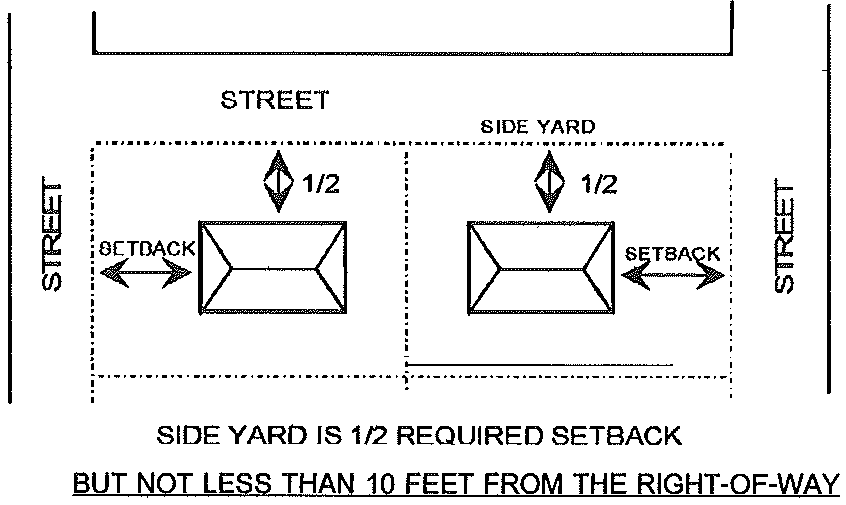
If two (2) corner lots are separated by a common rear lot line, the common side yards of the lots on the street must be a minimum of fifty (50) percent of the required setback for the district but not less than ten (10) feet from the right-of-way in which the structure is located as illustrated in Figure 12.102(a).
Figure 12.102(a)
(7)
If, in any district, a corner lot has a rear lot line in common with a side lot line of an abutting lot, then the side yard on the street side of the corner lot must be at least fifty (50) percent of the required setback for the abutting lot but not less than ten (10) feet from the right-of-way as illustrated in Figure 12.102(b).
FIGURE 12.102(b)
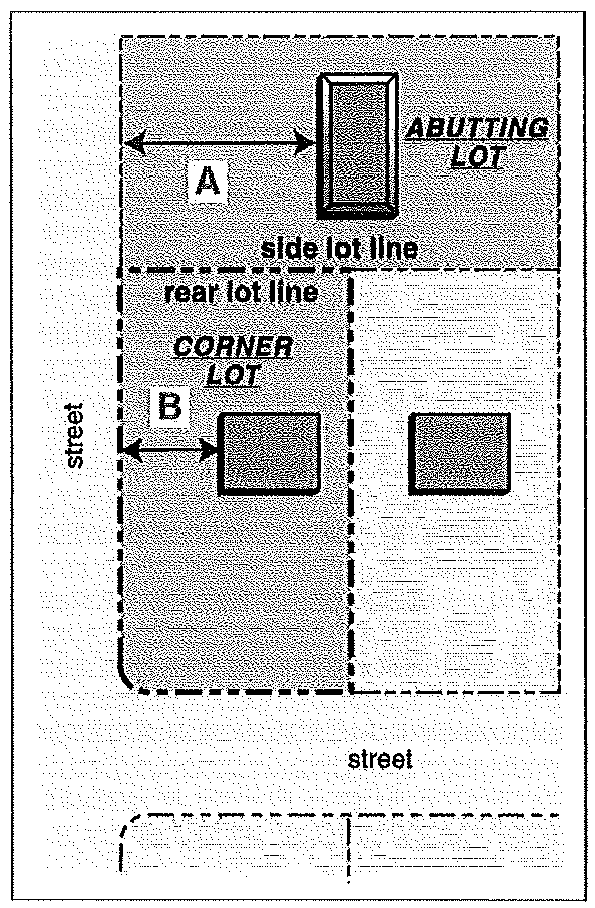
A Setback
B Side yard for corner lot shall be at least 50 percent of Setback A but not less than 10 feet from the right-of-way
(8)
If a lot is fronted on three (3) sides by streets, the setback requirement for the district shall be applied only on the two (2) opposing street fronts. The required side yard on the third street front must be at least one-half (½) the required setback in that district but not less than ten (10) feet from the right-of-way. The yard opposite the third street front must be at least the minimum side yard requirement for the district. If the lot is fronted on four (4) sides by streets, two (2) opposing streets shall have the minimum required setbacks and the other two (2) streets must have side yards of one-half (½) the required setback, but not less than ten (10) feet from the right-of-way.
(9)
The location of required setback, side and rear yards on irregularly shaped lots will be determined by the zoning administrator. The determination will be based on the spirit and intent of this ordinance to achieve an appropriate spacing and location of buildings on individual lots.
(10)
All residential lots shall have a building envelope sufficient to meet the requirements of the minimum housing code.
(11)
The location of parking shall meet the minimum standards in subsections 12.206(3).
(12)
Setbacks measured from right-of-way shall be measured from the total right-of-way as defined by chapter 20 (subdivision ordinance).
(Ord. No. 3523, § 1(40), 3-15-1993; Ord. No. 380, § 10, 9-18-1995; Ord. No. 3422-Z, § 1, 11-20-2006; Ord. No. 4421, § 1, 5-17-2010; Ord. No. 5495, § 1, 10-20-2014)
Editor's note— Ord. No. 3422-Z, § 1, adopted November 20, 2006, changed the title of section 12.102 from "Special lot, setback, and yard requirements" to "Special lot, setback, yard, and building envelope requirements."
Section 12.103. - Requirements for lots along thoroughfares.
G.S. 160A-306 states that cities shall have authority to (i) classify all or a portion of the streets within their jurisdictions according to their size, present and anticipated traffic loads, and other characteristics relevant to the achievement of the purposes of this section, and (ii) establish by ordinance minimum distances that buildings and other permanent structures or improvements constructed along each class or type of street shall be setback from the right-of-way line or the center line of an existing or proposed street. Pursuant to that authority, the following requirements shall apply:
(1)
The minimum yards or setbacks prescribed for each zoning district, which abuts a thoroughfare shall be measured from the proposed right-of-way line established for each classification of thoroughfare as follows:
1 The distance from thoroughfare centerline to proposed right-of-way line for Class III and IV thoroughfares located within the area bounded by Route 4 and I-85 shall measure forty (40) feet for Class III streets and thirty (30) feet for Class IV streets. These standards represent the normally required rights-of-way. However, additional right-of-way may be necessary in the area of interchanges, intersections, cut/fill areas, or areas where horizontal or vertical alignments must be improved and will be determined on a case by case basis by the city department of transportation. In addition, in those areas in which the existing street right-of-way exceeds the above noted dimension, the right-of-way width may not be reduced and certain thoroughfares will exceed this dimension as indicated by the thoroughfare plan.
2 Completion of the North Carolina Department of Transportation (NCDOT) U.S. 74 right-of-way acquisition portion of the construction project (Transportation Improvement Project U-209B) from Albemarle Road to Sharon Forest Drive shall cause the transitional setback to no longer apply to the section of U.S. 74 from Albemarle Road to Sharon Forest Drive.
3 Completion of the North Carolina Department of Transportation (NCDOT) U.S. 74 right-of-way acquisition portion of the construction project (Transportation Improvement Project U-2509) from Sharon Forest Drive to the southeast city limits shall cause the transitional setback to no longer apply to the section of U.S. 74 from Sharon Forest Drive to the southeastern city limits.
(2)
A transitional setback or yard shall also be established for each zoning district which abuts a thoroughfare that has an existing right-of-way which is not as wide as the right-of-way established for that thoroughfare as illustrated in Figure 12.103. The transitional setback or yard area established for lots abutting thoroughfares can be used for any purpose allowed by the particular zoning district, except for (a) those uses which are prohibited in the required setbacks or yards as established by this ordinance, or (b) to satisfy any minimum parking requirements if parking is not allowed in the setback or yard by the particular zoning district. However, the transitional setback or yard may be used for parking which exceeds the minimum ordinance parking requirements. The area between the existing right-of-way and the proposed right-of-way line may not be used to satisfy any minimum parking requirement, any minimum open space requirements, any minimum lot size requirements or any other minimum requirements, imposed by this ordinance. At the time that the proposed right-of-way is dedicated or otherwise acquired for roadway purposes, the property owner shall be responsible for the removal of any uses constructed after May 1, 1989, which are within the transitional setback or yard that are not otherwise permitted in the setback or yard by the zoning district regulations. The property owner shall have one (1) year from the date of right-of-way acquisition to remove any such uses.
Figure 12.103
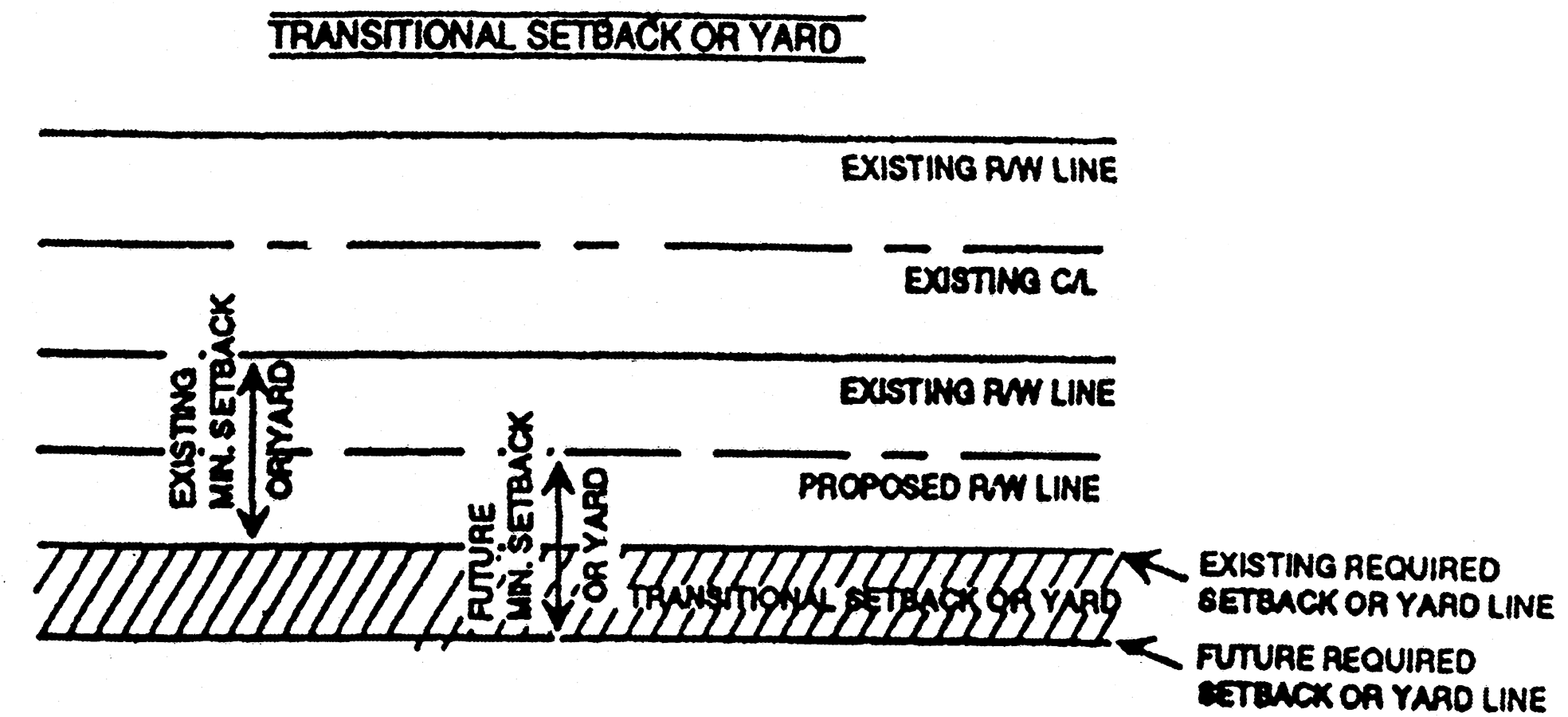
Transitional Setback or Yard
(3)
The standards of subsections 12.103(1) and 12.103(2) will not apply to any development meeting one or more of the following circumstances:
(a)
Any multibuilding site or multisite project which has at least one building built or under construction, or has a valid, unexpired building permit issued for at least one building prior to May 1, 1989.
(b)
Any project which had a site plan not requiring any additional right-of-way approved prior to May 1, 1989 either:
(i)
By the Planning Commission and/or Planning Department Staff; or
(ii)
Under the conditional zoning district and/or special use permit zoning processes of the Zoning Ordinance. However, any change in the site plan requiring a public hearing or the creation of a new parcel of land may subject the project, for which the site plan was revised, or the newly created parcel of land to the provisions of this ordinance.
(4)
An affected property owner shall have the right to appeal transitional yard or setback requirements to the Board of Adjustment for variance or modification as they apply to the particular piece of property. The Board of Adjustment may vary or modify these requirements upon a showing that:
(a)
The peculiar nature of the property results in practical difficulties or unnecessary hardships that impede carrying out the strict letter of the requirement;
(b)
The property will not yield a reasonable return or cannot be put to reasonable use unless relief is granted; and
(c)
Balancing the public interest in enforcing the setback requirements and the interest of the owner, the grant of relief is required by considerations of justice and equity.
In granting relief, the board of adjustment may impose reasonable and appropriate conditions and safeguards to protect the interest of neighboring properties. The board of adjustment's decision shall be subject to review by the superior court by proceedings in the nature of certiorari all in accordance with G.S. 160A-388(e).
(Ord. No. 3523, § 1(41), 3-15-1993; Ord. No. 3852, § 1, 4-18-1994; Ord. No. 4186, § 1, 4-27-2009; Ord. No. 4627, § 1, 3-21-2011; Ord. No. 4877, § 1, 5-14-2012)
Section 12.104. - Computation of density.
There may be circumstances when a development proposal includes land in various zoning districts. In that circumstance, the maximum allowable number of dwelling units allowed on the site will be computed by the following method: compute the maximum allowable number of dwelling units allowed for the land area in each zoning classification as if it were being developed independently, and then total the results for all zoning classifications involved. Once the maximum number of dwelling units is computed, the actual placement of the units on the site will not be restricted by the maximum allowable densities in the various districts. Nothing in this section, however, shall be construed to permit any use or category of uses on a parcel or portion of a parcel which would not otherwise be permitted in the zoning district applicable to such lot or portion of a lot, nor does this requirement change any standards applicable to the use pursuant to the underlying zoning.
Section 12.105. - Effect of certain street and public land dedications on computation of density.
Land dedicated for future streets or thoroughfares may be used to compute the number of lots or dwelling units allowed on an entire site. This does not apply to any right-of-way for existing streets, but only to the dedication of additional new right-of-way.
Land dedicated to the public for any community service facility including but not limited to public schools, parks, greenways, open space, police and fire stations, libraries, public housing, or other public use sites may be used to compute the number of lots or dwelling units allowed on the entire site. However, in the Mixed Use Districts and Cluster developments any land so dedicated may count towards the total site area in computation of the total number of lots or dwelling units, but it shall not be credited towards any additional lots, dwelling units, or further reductions in lot sizes other than those already permitted by the regulations specifically applying to them. To compute the number of lots or dwelling units that could have been built in the qualifying right-of-way or dedicated area, the following method will be used:
Total dedicated area (in acres) multiplied by the maximum permitted density for the zoning district.
The resulting number of units when added to what can be built on the remainder of the site cannot total more than the permitted density of the entire site before dedication.
In order to receive credit, any such computations are a submission requirement for a single-family subdivision and must accompany the preliminary plan, and are a mandatory submission requirement for a multifamily development and must accompany the planned multifamily or attached review submission or the rezoning petition, if one is required.
(Ord. No. 3523, § 1(42), 3-15-1993; Ord. No. 380, § 11, 9-18-1995)
Section 12.106. - Uses and structures prohibited and allowed in required setbacks and yards.
(1)
No principal building or principal structure shall be located within any setback or yard required by these regulations except as provided in this section and elsewhere in these regulations.
(2)
(a)
No accessory structures, including architectural features, as cited in five (5) below, shall be located within any setback or side yard required of these regulations, or located within three (3) feet of a lot line in the established rear yard. No accessory structure shall be located within any established setback in any residential district, except as otherwise provided. If an accessory structure exceeds a height of twenty-four (24) feet in the single-family, multi-family, urban residential and mixed use districts, it must be located at least fifteen (15) feet from the rear and side property lines. In all zoning districts, except as provided for in section 12.108, if the accessory structure exceeds the height of the principal structure, it must meet the minimum side yard of the principal structure and be located at least fifteen (15) feet from the rear property line. In addition, no accessory structure, excluding the square footage of an accessory dwelling unit, shall exceed the total square footage of the heated area located on the first floor of the principal structure.
Accessory dwelling units shall comply with the yard requirements and size limits prescribed in section 12.407. In the RE-1, RE-2, and BP districts, a security gate or guard station may be located within the required setback. Piers, docks, and other water-dependent accessory structures may be located in any required setback or yard on lots, which abut a body of water. A fence, wall, mailbox, utility pole, light-pole, or patio at grade, paths, walkways, or berm may be located in any required setback or yard. Signs may be located in a required setback or yard provided that they are in accordance with chapter 13 of these regulations. Bus stops shelters may be located in any setback or yard, which abuts a street in accordance with section 12.513.
(b)
Notwithstanding the provisions of subsection (a), above ground structures (other than a back-flow preventer) connected to and associated with underground electric, natural gas, telecommunications or cable television distribution lines, pipes, or conduits may be located in the setback subject to the following:
i.
A structure of a dimension that does not exceed four (4) feet in width, four (4) feet in length, or three (3) feet in height may be located no closer than two (2) feet to the existing or proposed right-of-way based on the street classification and no closer than ten (10) feet to the back of the curb line or edge of pavement.
ii.
A structure of a dimension that does not exceed four (4) feet in width, eight (8) feet in length, or six (6) feet in height may be located no closer than ten (10) feet to the existing or proposed road right-of-way based on the street classification.
The dimension restrictions contained in subsections (b)(i) and (ii) shall not apply to structures located in the setback prior to April 1, 2003.
This subsection shall not apply in the UR-1, UR-2, UR-3, UR-C, MUDD, UMUD, PED, RE-3, TOD, or TS zoning districts and shall not constitute a regulation of utilities in the right-of-way.
(c)
Above-ground structures located in a setback, side yard, or rear yard pursuant to this section are subject to the sight requirements of Section 14-16 of the City Code.
(d)
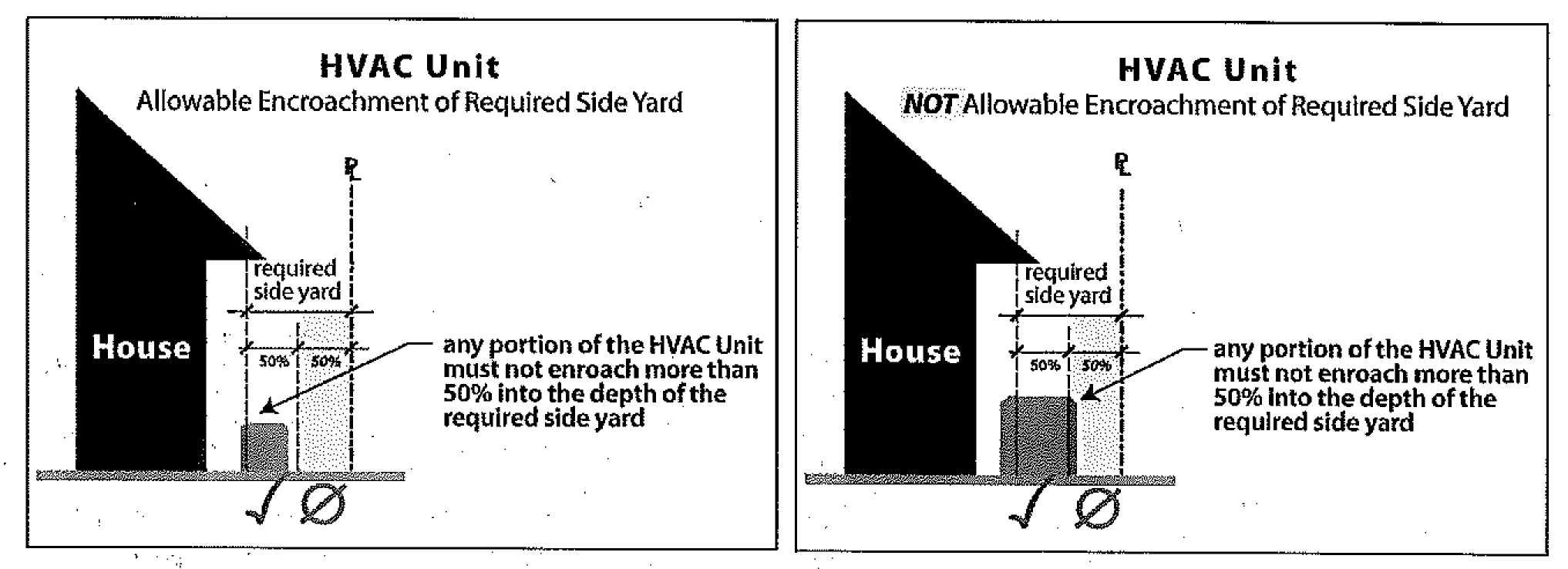
Heating, ventilation, or air conditioning equipment are considered to be part of a structure and shall not be located in any setback, sight distance triangle, or required buffer or screening. Heating, ventilation, or air conditioning equipment may encroach into the required side yard or rear yard by no more than fifty (50) percent of the required yard.
(3)
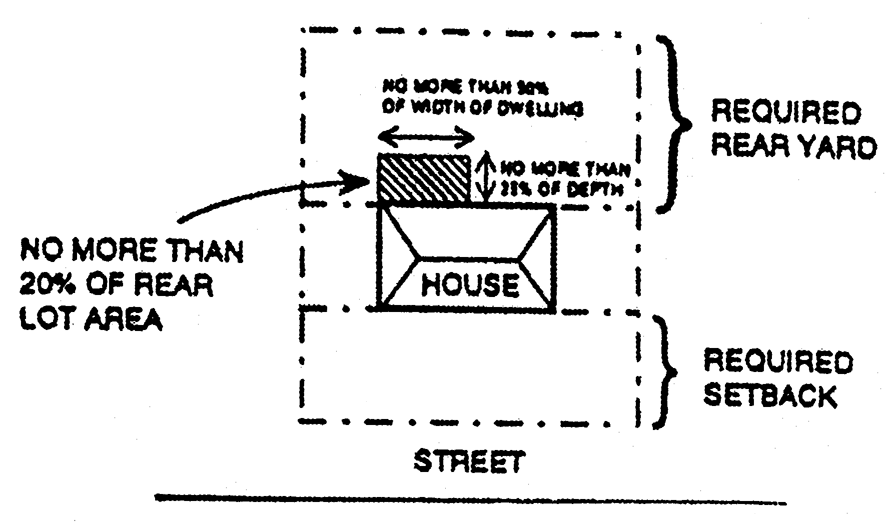
Certain portions of the required rear yard on a lot used for a single family (attached or detached) duplex, triplex, and quadraplex, may be utilized for attached garages, porches, decks, greenhouses, covered patios and utility room extensions of the principal structure in accordance with the following restrictions and as illustrated in Figure 12.106:
(a)
No more than twenty (20) percent of the area of the required rear yard may be used to accommodate extensions of the principal structure for attached garages, porches, decks, greenhouses, covered patios, or utility rooms;
(b)
No such extension may encroach into the rear yard more than twenty-five (25) percent of the depth of the required rear yard; and
(c)
No such extension may be more than fifty (50) percent of the width of the dwelling at the rear building line.
These extensions must observe the same side yard or building separation as that required
for the principal structure. If any portion of the required rear yard is used to accommodate
an extension of the principal structure as allowed by this section, no more than fifteen
(15) percent of the remaining required rear yard may be occupied by any detached accessory
structure.
Dwelling Extensions
(4)
No outdoor storage of goods and materials or refuse containers shall be located within any required setback, or within any required side yard which abuts a street, except for the temporary placement of refuse containers for curbside pickup in residential districts.
(5)
Notwithstanding other provisions of this section, architectural features such as cornices, eaves, steps, gutters, and fire escapes may project up to three (3) feet into any required yard unless they would obstruct driveways which may be used for service and emergency vehicles.
(6)
A breezeway is a covered passageway with open sides connecting a single family principal use and an accessory use. The sides of the breezeway shall be open except for structural support columns, meet the minimum yard standards for accessory structures, and be located to the rear or side of the principal structure. A breezeway connection between a single family home and related accessory structure is allowed provided the following design standards are met:
(a)
The width of the breezeway shall not exceed six (6) feet between structural supports.
(b)
The breezeway height shall not exceed fifteen (15) feet, measured from average grade to the highest part of the structure.
(c)
Walkways are not permitted on the roof of a breezeway.
(d)
The breezeway shall be included in the maximum building coverage calculations (see Table 9.205(1)(i).
(Ord. No. 3523, § 1(43), 3-15-1993; Ord. No. 380, § 12, 9-18-1995; Ord. No. 1436, § 3, 1-18-2000; Ord. No. 2049, § 1, 4-15-2002; Ord. No. 2281, § 1, 4-21-2003; Ord. No. 2412, § 3(1)A., 10-20-2003; Ord. No. 2881, § 2(1), 2-21-2005; Ord. No. 3404, § 1, 10-18-2006; Ord. No. 4338, § 1, 1-19-2010; Ord. No. 4602, § 1, 2-21-2011; Ord. No. 4658-Z, § 1, 5-23-2011; Ord. No. 4698, § 1, 7-18-2011; Ord. No. 4765, § 1, 10-17-2011; Ord. No. 4931, § 1, 7-16-2012)
Section 12.107. - More than one principal building per lot.
(1)
More than one principal building devoted to nonresidential uses may be located on a lot provided that:
(a)
An unobstructed accessway at least fifteen (15) feet wide is maintained from a public street to each building for use by service and emergency vehicles; and
(b)
Each building on the lot is separated by at least four (4) feet from any other building on the lot, unless a lesser standard is established in these regulations.
(2)
No more than one principal building devoted to residential uses shall be located on a lot, except as part of a planned multifamily development and other planned projects, such as manufactured home parks, nursing homes, etc. approved in accordance with these regulations.
Section 12.108. - Height limitations.
Height limitations are established to allow maximum development potential without adversely impacting the character of established single-family neighborhoods and ensuring the development respects and complements the surrounding development.
No structure shall exceed a height of forty (40) feet, except as provided in this section or elsewhere in these regulations.
(1)
Reserved.
(2)
Reserved.
(3)
Reserved.
(4)
The height limitations established in each zoning district shall not apply to public utility poles and lines, skylights, and roof structures for elevators, stairways, tanks, heating, ventilation and air-conditioning equipment, firewalls, chimneys, or similar equipment for the operation and maintenance of a building, and any device used to screen such structures and equipment.
(5)
The following structures are permitted above the height limit on lots in the research, institutional, office, business, and industrial districts which do not abut lots in any residential district: towers, steeples, flagpoles, firewalls, water tanks or similar structures. If this type of structure is on a lot, which abuts a residential district, then the part of the structure above the height limit must be separated from any such abutting lot line by a distance equal to its height measured from the ground.
(6)
The structures listed in subsection 12.108(5) above are also permitted above the height limit in residential districts. However, any part of such a structure which extends above the height limit must be separated from any abutting property line by a distance equal to its height measured from the ground. Television, amateur radio operators, and similar antennas, which extend above the height limit, may be separated from any abutting property line by one foot for every two (2) feet in height above the permitted height. Otherwise, the structure will be subject to the usual requirements for the particular district.
(7)
Radio and television towers and similar structures, as a principal or accessory use, are permitted above the height limit in any district. If such a structure is located on a lot in or abutting a residential district, it must be located at least two hundred (200) feet from all abutting property lines.
(8)
Wireless communications transmission facilities including, but not limited to, towers, masts, antennae and related antenna support structures are permitted above (or below) the height limit in any district. All wireless communications transmission facilities located in a residential district (residential districts: R-3, R-4, R-5, R-6, R-8, MX-1, MX-2, MX-3, R-MH, R-8MF, R-12MF, R-17MF, R-22MF, R-43MF, UR-1, UR-2, UR-3, and all of their parallel conditional districts plus any parallel conditional residential districts approved prior to January 1, 1992) or within four hundred (400) feet of a residential zoning district shall conform to the concealment standards specified in subsection 12.108.(8)(j). Wireless communications transmission facilities may be constructed up to a height of forty (40) feet in any zoning district, and need only comply with the underlying zoning district's separation standards concerning setback, side and rear yards. All wireless communications transmission facilities of up to one hundred fifty (150) feet in height, whether permitted as a principal use on a site or as an ancillary or secondary use on a site, must be designed and equipped with the technological and structural capability to accommodate at least two (2) wireless communications carriers. All such towers over one hundred fifty (150) feet in height must be designed and equipped with the technological and structural capability to accommodate at least three (3) wireless communication carriers. Lots and buildings thereon must conform to the minimum area, height and yard requirements for the district in which they are located unless otherwise indicated by subsection (a) below. If the facility is above forty (40) feet in height and is located on a lot in or adjacent to residential district, the facility must comply with subsection (7) above, unless otherwise indicated by subsections (d) and (e) below. The maximum required separation for wireless communication transmission facilities from any abutting property line in any zoning district shall be two hundred (200) feet. The facility plant and/or any related support building shall be allowed in accordance with the provision of section 12.504. Replacement of existing wireless communication transmission facilities to increase the height of such facilities shall be allowed in accordance with the separate provisions of subdivision (d) below.
(a)
Wireless communications transmission facilities are permitted above (or below) the height limit in any zoning district as an ancillary or secondary use on a site where another use (other than single-family or duplex use) is already established as the principal use of the property, such as a school, church, multifamily residential complex, shopping center, office building, commercial, golf courses, parks or other similar use. In this case, the wireless communications facility shall not be required, regardless of the underlying zoning, to separately comply with the normal district standards dealing with lot area, height and frontage on a public street and subdivision regulations so long as the principal use complies with such requirements for the underlying district nor shall the facility be required to comply with requirements of the Tree Ordinance. For lots in or adjacent to a residential district, wireless communications facilities may be constructed over forty (40) feet in height; provided, that the minimum setback, side and rear yards adjacent to the residentially zoned property are increased by one foot for each one foot of facility height in excess of forty (40) feet, up to a maximum required separation two hundred (200) feet. If a proposed wireless communications facility is located on residentially zoned property, separation from adjoining nonresidential zoned property shall be controlled by the adjoining nonresidential zoned property's minimum separation standards concerning setback, side and rear yards, as appropriate. However, if the proposed wireless communications transmission facility is located in a nonresidential district and adjoins only nonresidential districts, the facility may be constructed to any height subject to underlying minimum district requirements for separation from adjoining properties. A properly permitted wireless communications transmission facility, established as an ancillary or secondary use, may remain in its present location if the principal use of the site is abandoned, demolished or removed. However, if the wireless communication transmission tower is ever replaced, it must then comply with all applicable yards, setbacks, and separation standards as a principal use in the district. The changing of, additions to, or removal of antenna on the tower as well as the co-location of additional carriers on the tower shall be permitted and shall not require the tower to be brought into compliance with current separation requirements.
(b)
Wireless communications facilities are permitted above the height limit on lots in research, institutional, office, business, and industrial districts which do not adjoin lots in a residential district. Lots must conform to the minimum area and yard requirements for the district in which they are located unless otherwise indicated by subsection (a) above.
(c)
Wireless communications transmission facilities are permitted atop any building or structure (other than single-family or other residential structure of less than two (2) stories in height) in any district so long as such facilities do not exceed twenty (20) feet in height measured from the top of the highest point of the existing structure. Any such facility as well as the associated antennae located in a residential district or within four hundred (400) feet of a residential district must be indiscernible from the rest of the building or structure.
(d)
Replacement of existing wireless communication towers with additional height. Wireless communications transmission facilities existing at the time of the adoption of this ordinance amendment may be replaced in any zoning district with replacement facilities containing taller towers or antennae and shall not be required to conform to the separation standards concerning setback, side and rear yard requirements applicable to a tower or antenna of such increased height as provided in section (a), provided, that:
1.
The height of the replacement tower may not exceed the height of the original tower by more than fifty (50) feet. (The addition of up to fifty (50) feet in height under this section may occur only once).
2.
The replacement tower must conform to the separation standards concerning setback, side and rear yard requirements applicable to the original tower at the time it was originally constructed.
3.
The replacement tower must utilize monopole construction. Any tower up to one hundred fifty (150) feet in height must be designed and equipped with the technological and structural capability to accommodate at least two (2) wireless communications carriers. Any tower over one hundred fifty (150) feet in height must be designed and equipped with the technological and structural capability to accommodate at least three (3) wireless communication carriers.
4.
The wireless communications facility owner must provide engineering and property management with an affidavit signed by at least one other wireless communications carrier stating that it needs a wireless communications facility within one thousand (1,000) feet of the subject site and agreeing to co-locate on the replacement tower.
5.
The replacement tower must conform to the landscaping and buffering requirements in force at the time of the replacement tower permit application, and
6.
Notification of adjacent property owners and neighborhood leaders is required as outlined in section 12.108(g). However, notification of adjoining properties which are zoned for nonresidential purposes is not required.
(e)
Replacement of existing wireless communication towers at the same height. Any existing wireless communications transmission facility, including, but not limited to, towers, masts, antennae and related antenna support structures, may be removed and replaced with a new facility within one hundred (100) feet of the same location without being required to conform to the current zoning standards applicable to the underlying zoning district at the time of such replacement so long as such replacement is no closer to the setback, side or rear yards than the existing facility and provided that:
1.
The height of the replacement facility does not exceed that of the original facility.
2.
The replacement facility must utilize monopole construction. Any tower up to one hundred fifty (150) feet in height must be designed and equipped with the technological and structural capability to accommodate at least two (2) wireless communication carriers. Any tower over one hundred fifty (150) feet in height must be designed and equipped with the technological and structural capability to accommodate at least three (3) wireless communication carriers.
3.
The replacement facility shall comply with the landscaping and buffering requirements applicable at the time of replacement.
4.
If the new facility is to be used for the co-location of two or more wireless communications carriers at the time of its construction, the wireless communications facility owner must provide engineering and property management with an affidavit signed by at least one other wireless communications carrier stating that it needs a wireless communications facility within one thousand (1,000) feet of the subject site and agreeing to co-locate on the new tower for the remainder of the term of the existing lease, if the property on which the tower is located is leased.
5.
The applicant has up to ninety (90) calendar days to remove the original tower after the new facility is installed.
(f)
The wireless communications facility equipment building or buildings used in connection with facilities permitted under section 8(a), (d) or (e) shall be limited to five hundred (500) square feet per communications company using said facility and be limited to fifteen (15) feet in height; provided however, that the building height limitation may be waived by the director of engineering and property management, or his or her designee, up to a maximum height of twenty-five (25) feet in order to accommodate architectural design, screening or similar special needs.
(g)
Public notification process for certain wireless communications transmission facilities:
(1)
Purpose of notification. Wireless communication transmission facilities may have impacts on nearby properties. While the use can be permitted subject to certain standards, neighboring residential property owners should have the opportunity to learn about these uses, to hear an explanation of the proposed facility, present relative information that may affect the design of the facility, and to furnish information on the permit application.
(2)
Applicability of notification. Any application for a permit for a wireless communication facility as outlined under section 12.108(8), (8)(a) or (8)(d) for a site that is in or within one hundred (100) feet of a residential district is subject to the following notification process.
(3)
Notification process. The following notification process is required for certain wireless communication facilities or replacement of an existing tower with additional height except that notification of abutting properties which are zoned for nonresidential purposes is not required and except as provided under section 12.108(8)(b), (8)(c), (8)(e) and (8)(i). The notification process is designed to facilitate the exchange of information between the permit applicant and affected nearby property owners.
(a)
Engineering and property management shall mail a notice to all property owners, as shown on the county tax listing, within one hundred (100) feet of the proposed facility site including those across a street. In addition, engineering and property management shall mail a notice to neighborhood leaders, as determined by an updated list provided at Charlotte-Mecklenburg Planning Department staff office, within one mile of the proposed facility site.
(b)
Any permit applicant shall be responsible for supplying engineering and property management with postage paid envelopes addressed to adjacent property owners and neighborhood leaders as noted above. Any error in an owner's or neighborhood leader's list or any other procedural error or omission shall not invalidate the issuance of an otherwise properly issued permit.
(c)
Engineering and property management shall not render a decision on the application until thirty (30) calendar days has elapsed following the date of the mailing of the notification letters. The 30-day notification period may be used by any interested party to discuss the proposed wireless communication transmission facility with the permit applicant. The permit applicant shall in good faith consider any comments from such adjoining property owners concerning landscaping and screening and other design issues of the facility.
(h)
Wireless communication transmission facilities data base. Any permit applicant shall submit the following information to engineering and property management as part of the application process for any new or replacement tower or for any modifications to an existing tower. For this purpose, the changing, adding to or taking from antenna on any existing tower shall not be considered a modification to an existing tower.
1.
Street addresses for all existing wireless communication towers owned, leased, or operated by the permit applicant in Mecklenburg County.
2.
Height of all existing wireless communication towers owned, leased, or operated by the permit applicant in Mecklenburg County.
3.
The ground elevation above sea level for all existing wireless communication towers owned, leased, or operated by the permit applicant in Mecklenburg County, and
4.
The longitude and latitude for all existing wireless communication towers owned, leased, or operated by the permit applicant in Mecklenburg County.
(i)
Wireless communication transmission facilities may be installed on other nonwireless transmission towers (such as public utility towers, television towers and radio towers) as long as such facilities do not exceed twenty-five (25) feet in height above the utility transmission tower height. Such facilities do not trigger the notification provisions or the separation or yard requirements and are not required to conform to the concealment measures of subsection 12.108(8)(j).
(j)
All new wireless communication transmission facilities located in or within four hundred (400) feet of a residential zoning district are subject to the following additional standards:
1.
The tower must be designed, constructed or integrated into or as a structure in such a manner that it no longer appears to be a wireless communication tower, for example, locate in other towers on buildings, in steeples or be disguised as trees.
2.
The tower must have indiscernible antennae.
3.
Concealment measures used on any given facility (tower, antennae, and building structures at base) must blend into the character of the area or neighborhood by using architectural treatment similar in design to existing structures.
4.
The use of a flagpole as the concealment measure shall only be applicable on a site used for institutional or nonresidential uses.
Any wireless communication transmission facility lawfully operating as a conforming use shall not be rendered a nonconforming use by the subsequent rezoning to a residential district within four hundred (400) feet of such facility. This subsection (j) shall not apply to subsections 12.108(8)(d) and (e).
(k)
All new or replacement wireless communication transmission facilities as well as modifications to existing facilities shall comply with all applicable regulations of the Federal Communications Commission.
(l)
Any wireless communications transmission facility that is unused for a continuous period of twelve (12) months shall be removed by the tower owner or the property owner.
(m)
Wireless communications facilities, towers and antenna, as used in the preceding sections and subsections shall not include television and radio broadcast towers, personal or company owned and used communications towers and facilities or common carrier microwave towers. It is the intent of this ordinance that wireless communications facilities, towers and antenna include those operations which are commonly referred to as cellular and PCS services.
(Ord. No. 933, § 1, 10-22-1997; Ord. No. 1470, § 1(2), 3-20-2000; Ord. No. 1543, § 1(1), 5-18-2000; Ord. No. 3017, § 1J, 6-20-2005; Ord. No. 4698, § 1, 7-18-2011; Ord. No. 4877, § 1, 5-14-2012; Ord. No. 5531, § 1, 11-17-2014)
Section 12.109. - Clear sight triangles at street intersections.
(1)
The minimum development standards set forth in this section shall apply to land abutting street intersections delineated as follows:
(a)
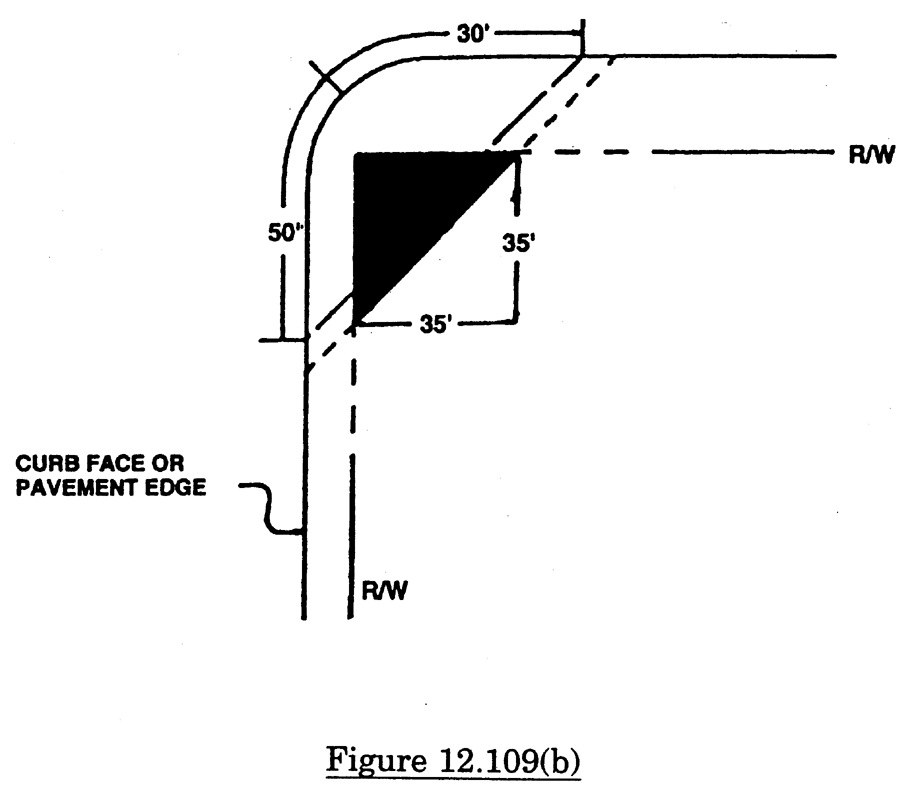
The triangle bounded on two (2) sides by the curb (or pavement edge where there is no curb), measured in each direction along the curb or pavement edge for fifty (50) feet from the midpoint of the radius of the curb or pavement edge, and on the third side by the diagonal line connecting the ends of the 50-foot sides as illustrated in Figure 12.109; and
(b)
The triangle bounded on two (2) sides by the intersecting right-of-way lines, measured thirty (35) feet in each direction from their point of intersection, and on the third side by the diagonal line connecting the ends of the 35-foot sides, as illustrated in Figure 12.109; and
Triangle Bound
(c)
On streets maintained by the City of Charlotte or the State of North Carolina, additional sight distance requirements may apply.
(2)
Within the triangles identified in subsection (1) above, and except as provided in subsection (3) below, no structure, sign, plant, shrub, tree, berm, fence, wall, or other object of any kind shall be installed, constructed, set out or maintained so as to obstruct cross-visibility at a level between thirty (30) and seventy-two (72) inches above the level of the center of the street intersection.
(3)
The restrictions of this section shall not apply to:
(a)
Existing natural grades which, by reason of natural topography, rise thirty (30) or more inches above the level of the center of the adjacent intersection;
(b)
Trees having limbs and foliage trimmed in such a manner that no limbs or foliage extend into the area between thirty (30) and seventy-two (72) inches above the level of the center of the abutting intersection; or
(c)
Fire hydrants, public utility poles, street markers, governmental signs, and traffic control devices.
(4)
In other than ninety-degree intersections or where grades mandate, the Charlotte Department of Transportation staff may impose additional sight triangles under the standards adopted by the American Association of State Highway Transportation Officials.
(5)
The clear sight triangles at street intersection restrictions established in this section shall not apply to structures located in the NS, UMUD, UR and UI districts.
(6)
The administration of this section shall be under the director of Charlotte Department of Transportation who shall investigate violations, issue notices and orders, and perform other duties required for enforcement under Chapter 8 of this ordinance.
(7)
The director of Charlotte Department of Transportation may waive all or part of these requirements of this section where a waiver could not constitute a traffic hazard or a condition dangerous to public safety. A decision by the Director of the Charlotte Department of Transportation may be appealed to city council.
(Ord. No. 3523, § 1(44), 3-15-1993)
Section 12.110. - Obstructions of public right-of-way.
Except as otherwise permitted by these regulations, no structure shall be permitted which obstructs or otherwise interferes with public use of a street right-of-way or other public easement.
Section 12.112. - Reserved.
Editor's note— Ord. No. 4602, § 1, adopted February 21, 2011, repealed the former section 12.112 in its entirety, which pertained to existing nonconforming accessory utility structures and derived from Ord. No. 252, § 1, adopted March 20, 1995.
Section 12.201. - Purpose; parking plans.
(1)
In order to relieve traffic congestion in the streets, to minimize any detrimental effects of off-street parking areas on adjacent properties, and to ensure the proper and uniform development of parking areas throughout the City of Charlotte, off-street parking and loading spaces for every use shall be provided in accordance with the standards established in this part.
(2)
For any parking lot, garage, vehicle storage area operated on a commercial basis, reconfiguration of an existing parking lot or any other off-street parking area required under this part (but excluding off-street parking for detached, duplex, triplex and quadraplex dwellings on a single lot), a plan shall be submitted to engineering and property management to review for compliance with these regulations and any other applicable ordinances. Any such parking plan shall show the number of motor vehicle parking spaces, the percentage of required spaces to be designated for use only by compact cars, the required number of existing spaces for bicycle parking and the location of bike parking facilities, the arrangement of parking aisles, the location of driveway entrances, provisions for vehicular and pedestrian circulation, the location of sidewalks and curb on or abutting the property, the location of utilities, barriers, shelters, and signs, the location of landscaped areas and the types of vegetation to be located in them, typical cross sections of pavement, storm water drainage facilities, and any other relevant information requested by engineering and property management as provided in these regulations. Engineering and property management shall forward plans to the Charlotte Department of Transportation for review and comment, as appropriate.
(Ord. No. 2916, § 1(2), 3-21-2005; Ord. No. 3017, § 1J, 6-20-2005)
Section 12.202. - Required number of off-street parking and bicycle spaces.
(1)
Except as otherwise provided in subsections (2), (4), and (5) below, and in sections 12.205 and 12.206(4), each use in a parcel shall be provided with at least the number of off-street motor vehicular parking spaces indicated for that use in Table 12.202, and the greater number of bicycle parking spaces indicated for that use in Table 12.202. Parking requirements listed are for the principal use. If more than one principal use is on a site, the bicycle parking spaces required shall be a sum of the spaces required for each individual use.
(2)
In the event that the number of parking spaces required under Table 12.202 cannot be placed on the parcel in accordance with these regulations without the demolition of an existing structure or damage of significant trees on the site or in the public right-of-way to accommodate a parking area, the planning director, in consultation with Charlotte Department of Transportation, may authorize up to a twenty-five (25) percent reduction in the total number of parking spaces required on the lot. The planning director may issue such an authorization only upon the request of the applicant and only upon determining that the reduction in the number of required parking spaces will not unreasonably increase parking congestion along public streets or in parking areas located on nearby lots. After such authorization is granted, the applicant shall not demolish or remove the existing structure or trees unless the full required amount of off-street parking is provided on the lot.
(3)
Use changes or additions may be made to existing buildings and uses that do not meet the minimum requirements for the number of off-street parking spaces if any such use changes or additions do not represent an additional parking requirement of more than five (5) off-street parking spaces. If change of use conditions require more than five (5) additional auto parking spaces, then the bicycle parking requirements will apply.
(4)
The off-street motor vehicular parking requirements of this section shall not apply to the RE-3, MUDD, NS, PED, TOD-R, TOD-E, TOD-M, TOD-RO, TOD-EO, TOD-MO, UI, UMUD, and UR districts established in these regulations, however, bicycle parking shall apply in these districts with requirements based not on the zoning district, but on the table of uses.
(5)
Long-term bicycle parking is not required if the entire development has a gross floor area of two thousand five hundred (2,500) square feet or less.
(6)
Commercial surface parking lots located within the I-277 freeway are exempt from providing bicycle parking.
Table 12.202
MINIMUM REQUIRED OFF-STREET PARKING SPACES BY USE**
* Planning department staff in conjunction with CDOT may waive or reduce bicycle parking depending on the surrounding land uses of a particular development, and the accessibility of a site by bicycle. One example of a location where less bicycle parking would be required is at a freeway interchange with no connection to the surrounding neighborhoods.
** All square footage is gross footage.
(Ord. No. 1038, § 2(1)(a), 5-18-1998; Ord. No. 1470, § 1(2), 3-20-2000; Ord. No. 2412, § 3(2)A., 10-20-2003; Ord. No. 2881, § 2(2), 2-21-2005; Ord. No. 2916, § 1(2), 3-21-2005; Ord. No. 4556-X, § 1, 11-15-2010; Ord. No. 4606, § 1, 12-20-2010; Ord. No. 4658-Z, § 1, 5-23-2011; Ord. No. 4705, § 1, 7-18-2011; Ord. No. 4813, § 1, 1-25-2012; Ord. No. 4931, § 1, 7-16-2012; Ord. No. 5423, § 1, 7-21-2014)
Editor's note— Ord. No. 2916, § 1(2), changed the title of § 12.202 from "Required number of off-street parking spaces" to "Required number of off-street parking and bicycle spaces."
Section 12.202A. - Bicycle parking standards.
(1)
Short-term bicycle parking shall meet the following standards:
(a)
Covered spaces. If twenty (20) or more short-term bicycle spaces are required, then at least fifty (50) percent of the required short-term bicycle spaces shall be covered. Coverage may be provided under roof overhangs or awnings, in bicycle lockers or within or under other structures.
(b)
Location. Short-term bicycle parking should be located along a major building approach line and clearly visible from the approach. The rack area shall be no more than one hundred twenty (120) feet from the entrance it serves, or as close as the nearest non-handicap, off-street auto parking space, whichever is farther. Rack area(s) should be clearly visible from the entrance they serve and should be provided near each actively used entrance. In general, multiple buildings should not be served with a combined, distant rack area. It is preferred to place smaller rack areas in locations that are more convenient.
Short-term bicycle parking may be located within the public right-of-way and/or within the required setback in the UR-1, UR-2, UR-3, UR-C, RE-3, MUDD, UMUD, NS, PED, TOD-R, TOD-E, TOD-M, and UI zoning districts, subject to the following additional requirements:
1.
The short-term bicycle parking shall not obstruct the required sidewalks, movement from on-street parking to the required sidewalks, or impact the minimum planting area or spacing requirements for street trees or required screening.
2.
Bicycle parking may be located in a the public right-of-way subject to approval by the Charlotte Department of Transportation (CDOT) or the North Carolina Department of Transportation (NCDOT). If bicycle parking is not approved, then the required parking must be located entirely on the site.
3.
There shall be no more than five (5) required short-term bicycle parking spaces per one hundred (100) linear feet of street frontage. Additional bicycle parking beyond the required amount can exceed the five (5) short-term bicycle parking spaces per one hundred (100) linear feet of street frontage requirement.
(2)
Long-term bicycle parking shall meet the following standards:
(a)
Covered spaces. All spaces shall be fully covered from inclement weather. Long-term bicycle parking may consist of indoor parking, racks in covered loading dock areas, racks in garage structures, and/or bicycle lockers or other means which provide coverage to the bicycle.
(b)
Location. Long-term bicycle parking shall be located no more than five hundred (500) feet from an entrance they are intended to serve. Such parking may be restricted to use only by employees, tenants, residents or others at the discretion of the property owner or management.
(3)
General standards for all bicycle parking areas:
(a)
Secured. Bike lockers and racks shall be securely anchored to the ground and on a hard surface.
(b)
Maneuvering areas. Each required bicycle parking space shall be accessible without moving another bicycle. All bicycle parking spaces and areas shall be designed to meet the standards of the Charlotte Land Development Standards Manual.
(c)
Signs. If required bicycle parking is not clearly visible from the entrance to the building, parking structure, transit station, or lot, a sign shall be posted at the primary entrances indicating the location of the parking.
(d)
Use. Required bicycle parking spaces shall be available for residents, visitors, customers and/or employees of the use.
(e)
Design. Bicycle parking areas shall meet the design specifications in the Charlotte Land Development Standards Manual. Other designs and manufacturers may be deemed acceptable by the plan review staff.
(Ord. No. 2916, § 1(2), 3-21-2005; Ord. No. 4556-X, § 1, 11-15-2010; Ord. No. 5964, § 1, 6-15-2015)
Section 12.203. - Shared parking.
(1)
Joint use of up to fifty (50) percent of required parking spaces may be permitted for two or more uses located on the same parcel or adjacent parcels, provided that the developer can demonstrate that the uses will not substantially overlap in hours of operation or in demand for the shared spaces. (See section 12.206(1)).
(2)
Any sharing of required parking spaces by uses located on different parcels shall be guaranteed by a legally binding written agreement between the owner of the parking area and the owner of any use located on a different parcel and served by the parking area. The agreement shall be reviewed and approved in accordance with subsection (1) above and filed with the Charlotte Department of Transportation.
(Ord. No. 3523, § 1(46), 3-15-1993)
Section 12.204. - Size of required parking spaces and aisles.
(1)
Each required parking space shall meet the minimum dimensional requirements as set out in the "Charlotte-Mecklenburg Land Development Standards Manual."
(2)
In parking lots with twenty (20) or more spaces, no more than twenty-five (25) percent of all required parking spaces shall be designed and designated for compact cars.
(3)
Each required parking space shall have direct and unrestricted access to an aisle of the minimum width as set out in the "Charlotte-Mecklenburg Land Development Standards Manual."
(4)
Diagonal or perpendicular parking spaces shall be developed as set out in the "Charlotte-Mecklenburg Land Development Standards Manual."
(Ord. No. 3523, § 1(47), 3-15-1993; Ord. No. 1038, § 2(1)(b), 5-18-1998; Ord. No. 1470, § 1(2), 3-20-2000; Ord. No. 2412, § 3(2)B., 10-20-2003; Ord. No. 3210, § A1, 2-20-2006)
Section 12.205. - Required carpool spaces for certain employment uses.
Where these regulations require at least one hundred (100) spaces to serve institutional, office and industrial uses on a parcel, a reduction in required parking is permitted provided a minimum of fifteen (15) percent of required parking spaces are dedicated for and restricted to use by carpools. The remaining number of parking spaces can be reduced by two (2) for each carpool space provided. The owner may restrict use of any or all carpool spaces to employees.
(Ord. No. 3455, § 1, 11-16-1992; Ord. No. 3523, § 1(45), 3-15-1993; Ord. No. 305, § 1.4(A), 6-19-1995; Ord. No. 383, § 15, 9-18-1995; Ord. No. 389, § 4(A), 10-16-1995; Ord. No. 529, § 1(6), 4-15-1996; Ord. No. 1452, § 1(3), 2-21-2000; Ord. No. 1996, § 1, 1-22-2002; Ord. No. 2239, § 1(4.A), 2-17-2003; Ord. No. 2242, § 1(3), 2-17-2003; Ord. No. 2287, § 1, 4-21-2003; Ord. No. 2880, § 1(B), 2-21-2005; Ord. No. 2916, § 1(2), 3-21-2005; Ord. No. 3177, § 1, 1-17-2006)
Section 12.206. - Location of required parking.
(1)
Required off-street parking spaces for any use shall be located no more than four hundred (400) feet from the use they are intended to serve. This standard does not apply to parking spaces for auditoriums, stadiums, assembly halls, gymnasiums and other places of assembly, industrial, wholesaling and manufacturing establishments and hospitals. Development or redevelopment of a site with at least one of the characteristics described in subsection (a) below may be considered for a deviation from the 400-foot maximum spacing requirement up to no more than a 1,200-foot separation subject to the following provisions:
(a)
The site must meet one or more of the following characteristics in order to be considered for deviation from the spacing requirement:
(1)
Feature unusual natural features that are being preserved, such as but not limited to, steep slopes, streams or environmentally sensitive areas, tree cluster areas and/or open spaces or landscape elements in excess of the required minimums;
(2)
Feature an unusual configuration;
(3)
Be located on a spacious and extensively landscaped setting such as those found in a research park; or
(4)
Feature an existing facility that has undergone a change of use resulting in the application of the provisions of this section 12.206(1) and the opportunity to utilize existing parking areas.
(b)
For sites that feature at least one of the above characteristics, as determined by the planning director, specific site plans which propose deviations from the 400-foot maximum spacing requirement up to a 1,200-foot separation may be permitted by the planning director, based upon the provision of at least two (2) of the following heightened pedestrian amenities:
(1)
Pedestrian lighting;
(2)
A well-defined pedestrian pathway system including sidewalks of no less than six (6) feet in width; or
(3)
A circulatory bus system throughout the site.
(2)
Reserved.
(3)
Development standards for off-street parking, driveways, and garages.
Table 12.206(3) Development Standards for Off-Street Parking, Driveways, and Garages
* For the purposes of this section, "improved" means surfaced with concrete, asphalt, gravel, or any other material commonly used for the parking of vehicles, but not including grass or dirt.
(4)
On-street parking or recessed parking entirely within the public right-of-way is permitted and encouraged in locations approved by the Charlotte Department of Transportation (CDOT). Such parking may be counted toward meeting the minimum number of parking spaces as required by this ordinance if they are located on the same side(s) of the street as the use and meet the minimum dimensional requirements as prescribed by the Charlotte-Mecklenburg Land Development Standards Manual.
In the event that the city or state removes any such on-street parking that was allowed to count toward the minimum required, the existing use will not be required to make up the difference and the use will not be made non-conforming.
(5)
This section shall not apply to the MUDD, PED, TOD-R, TOD-E, TOD-M, TOD-RO, TOD-EO, TOD-MO, TS, UI, UMUD, and UR districts established in these regulations.
(Ord. No. 3523, § 1(48), 3-15-1993; Ord. No. 389, § 4(A), 10-16-1995; Ord. No. 391, § 1, 10-16-1995; Ord. No. 1038, § 2(1)(c), 5-18-1998; Ord. No. 1312, § 1(1), 6-21-1999; Ord. No. 1470, § 1(2), 3-20-2000; Ord. No. 1961, § 11-19-2001; Ord. No. 2412, § 3(2)D., 10-20-2003; Ord. No. 2879, § 1, 2-21-2005; Ord. No. 2881, § 2(2), 2-21-2005; Ord. No. 3189, § 1, 1-17-2006; Ord. No. 3690, § 1A, 9-17-2007; Ord. No. 4606, § 1, 12-20-2010; Ord. No. 5423, § 1, 7-21-2014)
Section 12.207. - Parking barriers.
Barriers, such as wheel blocks, curbs, walls, or fences, shall be located along the perimeter of parking lots, garages, and vehicle storage areas, except at entrances and exits indicated on approved parking plans. These barriers shall be designed and located to prevent parked vehicles from extending beyond property lines and from hanging over any sidewalk or other pedestrian path. All barriers shall be designed and located in accordance with the standards set out in the "Charlotte-Mecklenburg Land Development Standards Manual."
Section 12.208. - Interior landscaping requirements.
All off-street parking areas shall be landscaped in accordance with the requirements of Chapter 21 of City Code, "Trees."
Section 12.209. - Allowable reductions and restrictions of parking.
When at least one hundred (100) motor vehicular parking spaces are required in table 12.202 to serve institutional, office and industrial uses on a parcel, a reduction in required parking is permitted provided a minimum of five (5) class II (short-term) bicycle parking spaces are provided. The remaining number of parking spaces may be reduced by one (1) for each additional class II (short-term) bicycle parking space provided. The remaining number of parking spaces may also be reduced by two (2) percent for the addition of two (2) showers and four (4) lockers for every two hundred fifty (250) employees. The number of motor vehicular parking spaces shall be reduced by no more that twenty-five (25) percent.
(Ord. No. 2916, § 1(3), 3-21-2005)
Section 12.210. - Maintenance responsibility for landscaped areas.
The plantings that constitute a landscaped area must be properly maintained in order for the landscaped area to fulfill the purposes for which it is established. The owner of the property shall be responsible for the maintenance of all plant material within the landscaped area. Such maintenance shall include all actions necessary to keep the landscaped areas free of litter and debris and to keep plantings healthy and orderly in appearance. Any required vegetation that constitutes part of a landscaped area shall be replaced in the event that it dies.
Section 12.211. - Parking lot screening requirements.
Unless otherwise required by these regulations, except for any detached, duplex, triplex or quadraplex dwelling on a single lot, all off-street parking for more than ten (10) automotive vehicles or loading area serving a residential or nonresidential use shall be screened in accordance with section 12.303 from any street right-of-way or abutting lot located in any district. This requirement does not apply to automotive sales lots.
Section 12.212. - Parking deck standards.
This section sets forth development standards to address parking decks as a principal or accessory use within any permitted zoning district, except the RE-1, RE-2. RE-3, MUDD, PED, TOD-R, TOD-E, TOD-M, TS, UI, UMUD, and UR districts.
(1)
Development options, which range from planting requirements to architectural treatments are proposed to lessen the impact of parking decks upon the street environment. All parking decks, unless otherwise provided, shall conform to one of the following development options:
(a)
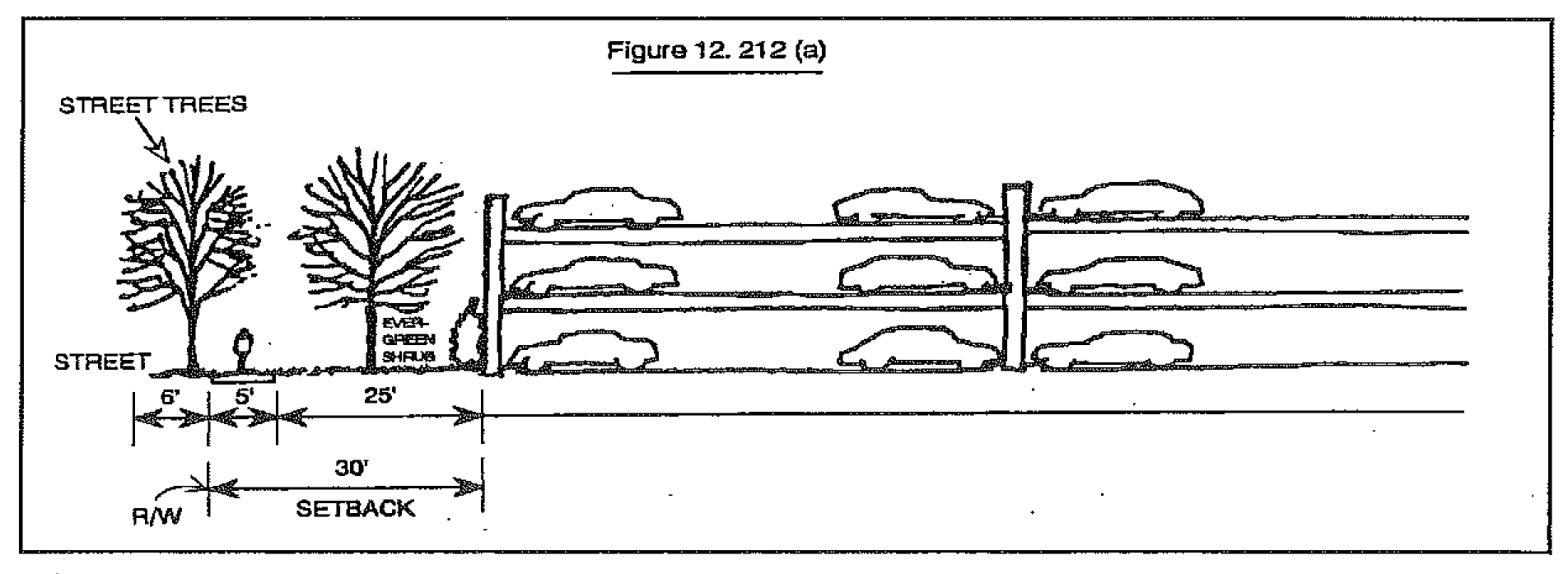
Option A: Parking decks may be constructed to the following minimum standards indicated below and which are illustrated in Figure 12.212(a):
1.
Parking decks shall have a minimum setback thirty (30) feet from the public right-of-way and must meet any more restrictive setback or other yard requirements for the district;
2.
A minimum nine-foot clearance shall be maintained on the first level and any additional level that provides disabled parking spaces and a minimum seven-foot clearance throughout the remainder of the parking deck to ensure the safe movement of vans and emergency vehicles;
3.
A minimum 25-foot planting area shall be provided between the face of the parking deck and the sidewalk. The planting area shall be planted as follows:
(i)
Large maturing trees shall be planted at a rate of one tree per forty (40) linear feet of street frontage and shall have a minimum caliper of two (2) inches measured six (6) inches above ground at time of planting.
(ii)
Evergreen shrubs meeting the requirements of subsection 12.302(9)(c) shall be planted along the face of the parking deck with a maximum spacing of five (5) feet on center.
4.
A minimum five-foot wide sidewalk shall be provided with a minimum six-foot wide planting strip between the sidewalk and the street.
(b)
Option B: Parking decks may be constructed to the following standards, provided that the parking deck is architecturally treated in a manner that avoids a monolithic appearance. This should be accomplished by treating the facade of the deck as a streetwall and articulating it through a variety of building materials and finishing that gives the deck a pedestrian scale. Development standards are as follows:
1.
Parking decks shall be setback twenty (20) feet (fifteen (15) feet from back of curb in Neighborhood Service district) and meet all yard requirements for the district;
2.
A minimum nine-foot clearance shall be maintained on the first level and any additional level that provides disabled parking spaces and a minimum seven-foot clearance throughout the remainder of the parking deck to ensure the safe movement of vehicles and emergency vehicles;
3.
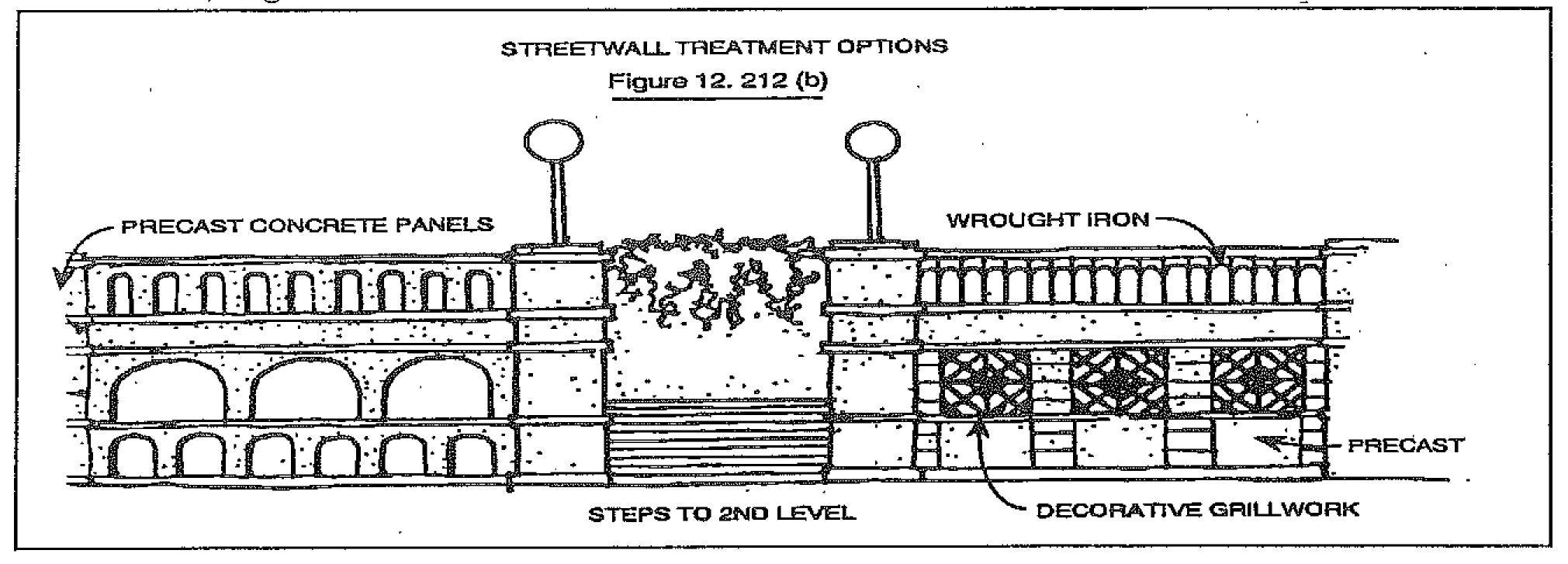
The streetwall of the parking deck shall be treated in such a manner as to partially screen street level parking as well as to provide visual interest to the pedestrian. This can be accomplished through the use of articulated precast concrete panels, or ornamental grillwork as illustrated in Figure 12.212(b), or other means such as utilizing a variety of building materials such as brick or stone;
4.
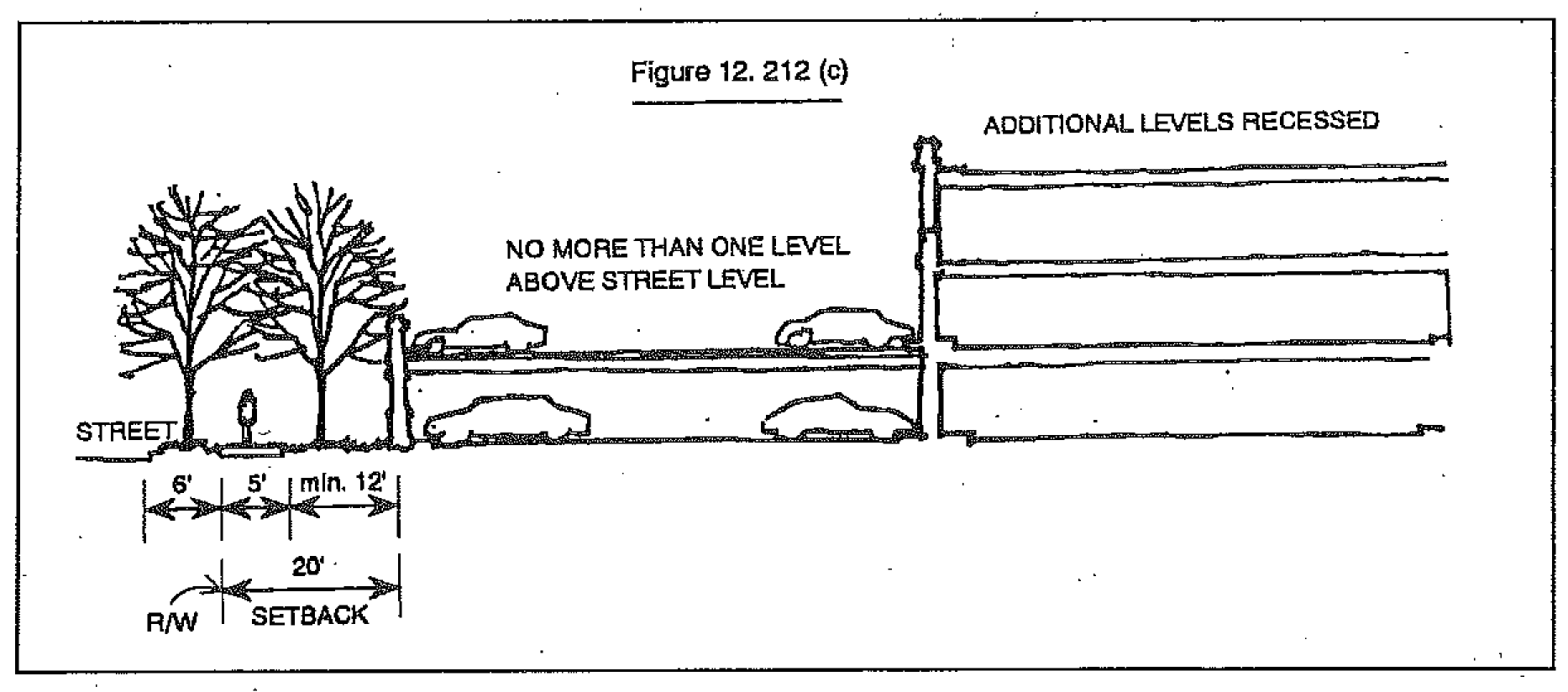
If more than two (2) floors of parking are provided above street level, the third floor above street level and higher floors must be recessed at least twenty (20) feet from the setback of the first and second floors as illustrated in Figure 12.212(c);
5.
A minimum 12-foot wide planting area shall be provided between the sidewalk and the face of the deck. The planting area shall be planted with large maturing trees at a rate of one tree per forty (40) linear feet of street frontage or small maturing trees at the rate of one tree per thirty (30) linear feet of street frontage;
6.
A minimum five-foot sidewalk shall be provided with a minimum six-foot wide planting strip between the sidewalk and the street; and
7.
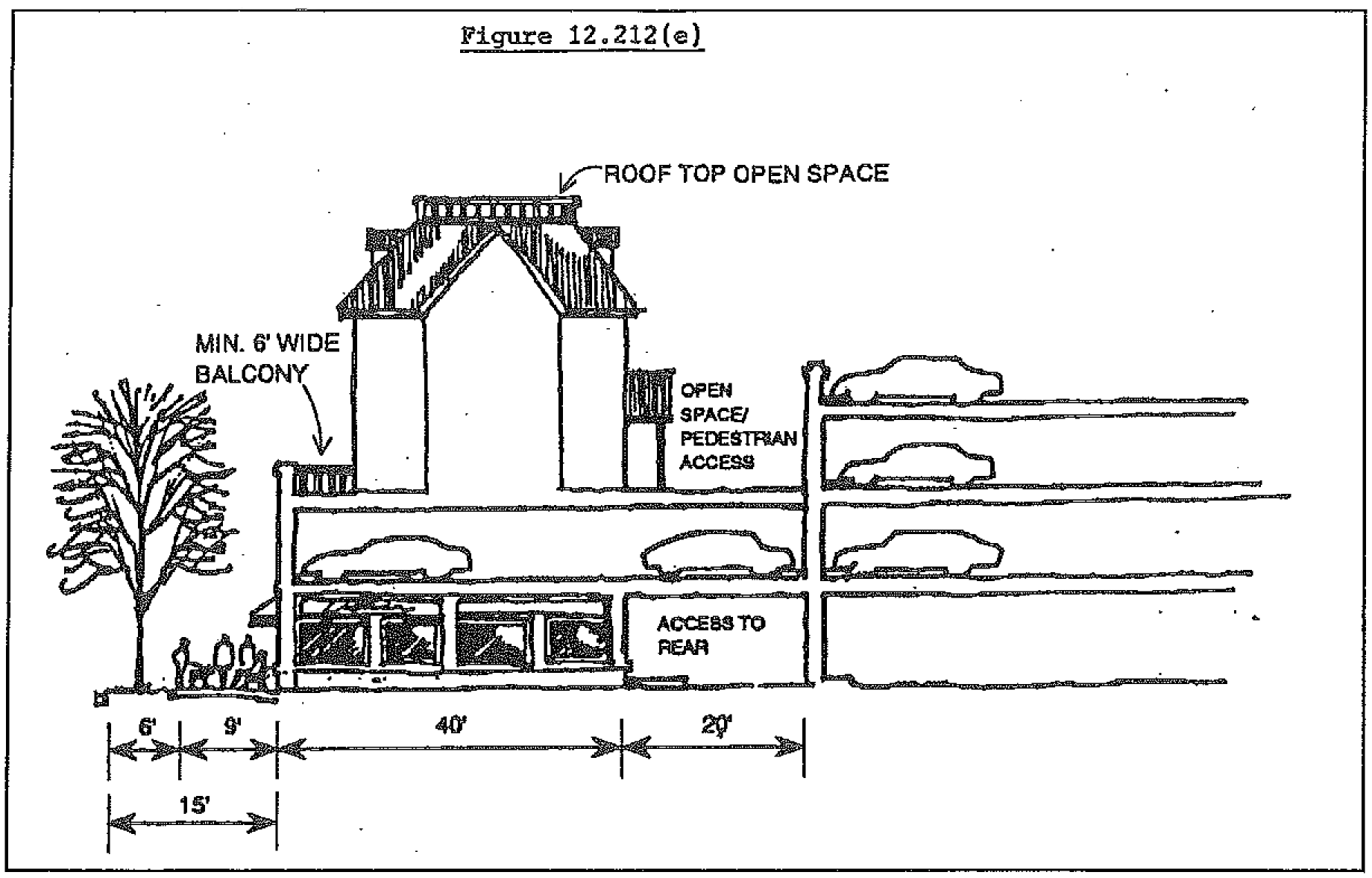
In the Neighborhood Services district, the 15-foot setback from the back of the curb shall consist of a minimum six-foot wide planting strip and minimum nine-foot wide sidewalk behind the planting strip as illustrated in Figure 12.212(e). The planting strip shall be planted with large maturing trees at a rate of one tree per forty (40) feet of street frontage. If overhead utilities exist which cannot be relocated or placed underground, then small maturing trees shall be used at a rate of one tree per thirty (30) linear feet of street frontage.
(c)
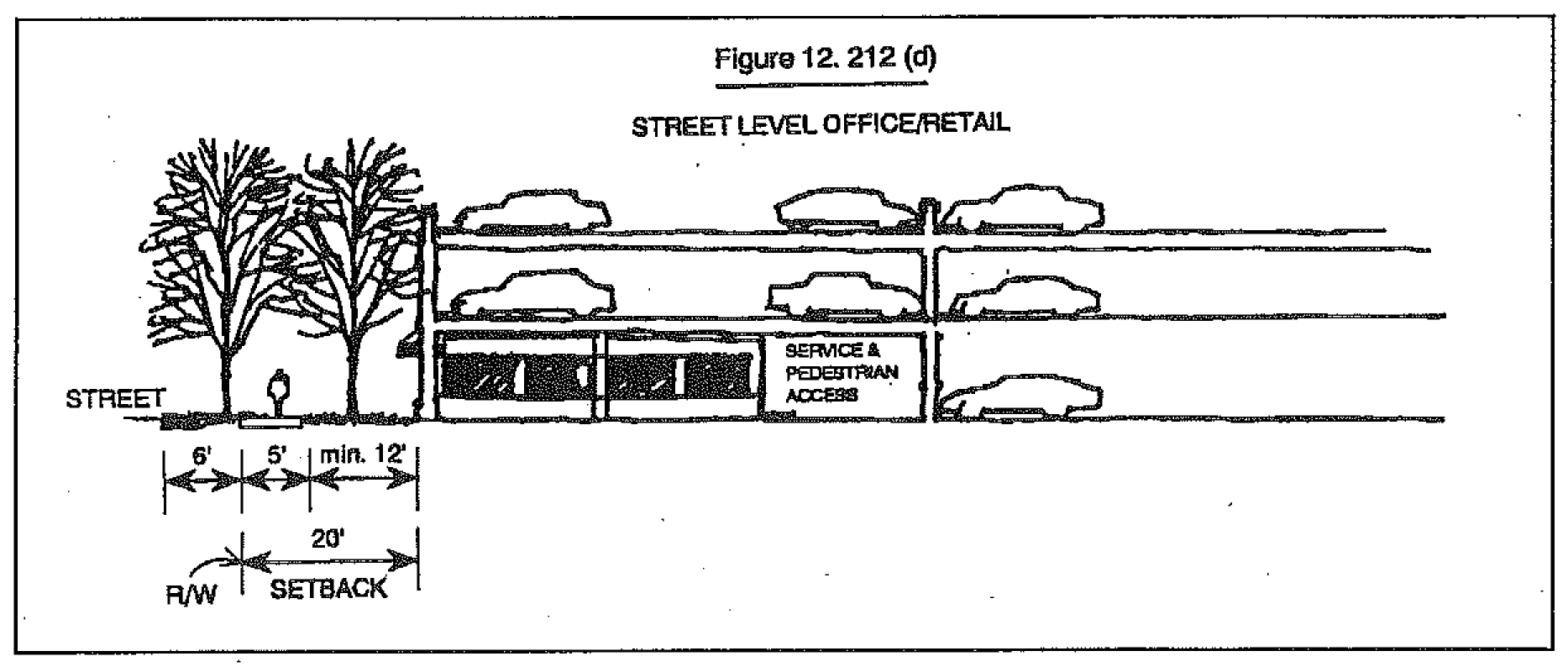
Option C: Parking decks may be constructed to the following standards, provided that at least fifty (50) percent of the street frontage of the first floor is used for retail or office use, as illustrated in Figures 12.212(d) and 12.212(e):
1.
Parking deck shall be setback twenty (20) feet (fifteen (15) feet in the Neighborhood Service district);
2.
A minimum nine-foot clearance shall be maintained on the first level and any additional level that provides disabled parking spaces and a minimum seven-foot clearance throughout the remainder of the parking deck to ensure the safe movement of vehicles and emergency vehicles.
3.
No more than two (2) floors of parking are allowed above the street level use at the setback and subsequent floors shall be recessed a minimum of twenty (20) feet;
4.
A minimum 12-foot wide planting area shall be provided between the sidewalk and the face of the deck. The planting area shall be planted with large maturing trees at a rate of one tree per forty (40) linear feet of street frontage or small maturing trees at a rate of one tree per thirty (30) linear feet of street frontage; and
5.
In Neighborhood Services district, the 15-foot setback from the back of the curb shall consist of a minimum six-foot wide planting strip and minimum of eight-foot wide sidewalk. The planting strip shall be planted with large maturing trees at a rate of one tree per forty (40) linear feet of street frontage. If overhead utilities exist and cannot be relocated or placed underground, then small maturing trees shall be used at a rate of one tree per thirty (30) linear feet of street frontage.
(d)
Illustrations for Option A, B, and C.
(1)
Reserved.
(2)
Parking decks constructed as an accessory use to an institutional use in a single-family (R-3, R-4, R-5, R-6, and R-8) or multi-family (R-8MF, R-12MF, R-17MF, R-22MF, and R-43MF) residential district, will permit the allowable F.A.R. of the institutional use to be increased by fifty (50) percent, provided that the parking deck meets the following standards:
(a)
The parking deck shall have a minimum setback of fifty (50) feet from the edge of the public right-of-way. If the parking deck is below grade, the minimum setback of the zoning district shall apply.
(b)
Any required buffer shall be at least a minimum of fifty (50) feet wide or greater, as per section 12.302;
(c)
A minimum nine-foot clearance shall be maintained on the first level and any additional level that provides disabled parking spaces, and a minimum seven-foot clearance throughout the remainder of the parking deck to ensure the safe movement of vans and emergency vehicles;
(d)
A minimum 25-foot landscaped area shall be provided between the street facade of the parking deck and the sidewalk. The planting area shall consist of the following:
1.
Large maturing trees shall be planted at a rate of one tree per forty (40) linear feet of street frontage and shall have a minimum caliper of two (2) inches measured six (6) inches above ground at time of planting;
2.
Evergreen shrubs that meet the requirements of subsection 12.302(9)(c) shall be planted along the street facade of the parking deck with a maximum spacing of five (5) feet on center;
(e)
A minimum five-foot sidewalk shall be provided with a minimum six-foot planting strip between the sidewalk and the street;
(f)
The parking deck shall be designed so that motorized vehicles parked on all levels of the facility are screened from the street and from adjacent residentially zoned and/or used properties. This shall be accomplished by using decorative elements such as grillwork or louvers, as illustrated in Figure 12.212(b);
(g)
The facade of the deck adjacent to the street right-of-way or residentially zoned or used properties shall be designed with a pedestrian scale through the use of articulated precast concrete panels, decorative elements, or a variety of building materials such as brick or stone, as illustrated in Figure 12.212(b).
A parking deck will also permit the allowable F.A.R. to be increased by fifty (50) percent if it meets the standards of subsections (a), (c), (d) and (e) above, and at least one of the following conditions are met:
1.
The parking deck is located a minimum of four hundred (400) feet from the edge of the public right-of-way and from any vacant or residentially used property located in a single-family or multi-family zoning district; or
2.
The parking deck is obscured from view from the public right-of-way and any adjacent vacant or residentially used property located in a single-family or multi-family zoning district by existing buildings and/or mature vegetation.
(Ord. No. 3589, § 1, 7-19-1993; Ord. No. 1038, § 2(1)(d), 5-18-1998; Ord. No. 1470, § 1(2), 3-20-2000; Ord. No. 2412, § 3(2)E., 10-20-2003; Ord. No. 2881, § 2(2), 2-21-2005; Ord. No. 4453-X, § 1, 6-21-2010; Ord. No. 4658-Z, § 1, 5-23-2011; Ord. No. 5963, § 1, 6-15-2015)
Section 12.213. - Underground parking structures.
Underground parking structures are permitted within any required setback, side yard, and rear yard on any lot in any institutional, office, business or industrial district, provided no portion of the underground structure extends above grade more than five (5) feet at any point nor more than four (4) feet for seventy-five (75) percent of its length along any lot line. A balustrade, parapet or railing may extend above the permitted structure height, provided it is not greater than thirty-two (32) inches in height, is set back from the property line at least three (3) feet and has openings equal to at least thirty (30) percent of its surface along each side. Along any lot line abutting a street, "grade" means the elevation at the center line of the street. Along any lot line not abutting a street, "grade" means ground elevation at the property line. Such structures must conform to any corner site distance requirements which may be in effect at the time the underground structure is built. An underground parking structure may encroach upon any area set aside for the buffer, screening or other planting requirements so long as there is at least four (4) feet of soil between the above ground surface and the top of the underground parking structure. The requirements of this section do not apply to the RE-1, RE-2, RE-3, MUDD, PED, TOD-R, TOD-E, TOD-M, TOD-RO, TOD-EO, TOD-MO, TS, UI, UMUD, and UR, districts.
(Ord. No. 1038, § 2(1)[,] (3), 5-18-1998; Ord. No. 1470, § 1(2), 3-20-2000; Ord. No. 2412, § 3(2)F., 10-20-2003; Ord. No. 2881, § 2(2), 2-21-2005; Ord. No. 4658-Z, § 1, 5-23-2011)
Section 12.214. - Number, size, and location of loading spaces.
(1)
Loading spaces of the size and number indicated shall be provided in accordance with Table 12.214. These requirements shall not apply in the MUDD, PED, TOD-R, TOD-E, TOD-M, TOD-RO, TOD-EO, TOD-MO, TS, UI, UMUD, and UR districts established in these regulations.
(2)
Any loading space and any area required for maneuvering a vehicle into and out of the loading space shall be located entirely on the same lot as the use it serves, and not on any public right-of-way or other lot.
(3)
Loading and unloading spaces and areas shall be located a minimum of sixty (60) feet from residentially used or zoned property. Distances shall be measured from the closest edge of the loading and unloading area to the property line of the residentially used or zoned property. These requirements shall not apply in the MUDD, PED, TOD-R, TOD-E, TOD-M, TOD-RO, TOD-EO, TOD-MO, TS, UI, UMUD, and UR districts.
Table 12.214
REQUIRED LOADING SPACES, BY USE
(Ord. No. 1038, § 2(1)(f), 5-18-1998; Ord. No. 1470, § 1(2), 3-20-2000; Ord. No. 2412, § 3(3)A., 10-20-2003; Ord. No. 2881, § 2(2), 2-21-2005; Ord. No. 3214, 2-20-2006; Ord. No. 5423, § 1, 7-21-2014)
Section 12.215. - Restriction on use of off-street parking and loading spaces.
The storage of merchandise or materials, or the repair of motor vehicles or any kind of equipment except for the temporary storage of construction material and equipment while work is taking place on the structure where the off-street parking is located, is prohibited in all off-street parking and loading spaces, including required and unrequired spaces.
(Ord. No. 3523, § 1(49), 3-15-1993)
Section 12.216. - Configuration of off-street parking and loading ingress and egress.
(1)
Access to and from off-street parking and loading spaces shall be provided by means of clearly limited and defined entrance and exit drives from public rights-of-way or private streets to clearly limited and defined maneuvering lanes which, in turn, provide access to individual off-street parking or loading spaces. Off-street parking and loading spaces must be designed so as not to interfere with the normal movement of vehicles and pedestrians on the public right-of-way.
(2)
Layout configurations which require backing directly onto a street from a parking or loading space are prohibited, except for any residential use as provided for in section 12.206(3).
(Ord. No. 3523, § 1(50), 3-15-1993; Ord. No. 1302, § 1(2), 6-21-1999)
Section 12.217. - Driveways and street access.
No commercial driveway or street connection to a public street shall be constructed, relocated or altered unless a driveway permit is obtained from the Charlotte Department of Transportation and the North Carolina Department of Transportation (State System Street).
(Ord. No. 3523, § 1(51), 3-15-1993)
Section 12.218. - Commercial vehicle parking in residential areas.
(1)
All residential districts.
(a)
One light or medium commercial vehicle may be parked overnight at a residence or customary home occupation.
(b)
A medium commercial vehicle must be parked on a clearly delineated driveway of the residence. Medium commercial vehicles may not be parked overnight on public streets.
(c)
Large commercial vehicles are prohibited from parking in all residential districts, except as permitted in subsection 12.218(4).
(2)
Multi-family developments.
(a)
Duplexes, triplexes, and quadraplexes that are located in residential zoning districts shall be subject to the provisions of subsection 1.
(b)
Reserved.
(3)
Mixed-use districts.
(a)
Light and medium commercial vehicles are permitted without screening in true mixed-use developments where residential and nonresidential uses are vertically integrated in the same building. (For the purposes of this section, mixed-use districts are the following districts: RE-3, MX-2, MX-3, NS, MUDD, UMUD, UR-2, UR-3, UR-C AND CC.)
(b)
In mixed-use districts where the residential uses are separated from the nonresidential uses, light and medium commercial vehicles shall only be permitted in accordance with the standards of subsections (1) and (2) above.
(4)
This section shall not be construed as to prevent the temporary parking of emergency vehicles, delivery trucks, moving vans and similar vehicles used for delivery of goods and services nor the parking of commercial vehicles at an active job site or staging area.
(5)
All pre-existing commercial vehicles parked in residential districts shall comply with Section 12.218 within six (6) months of the effective date of this ordinance amendment.
(Ord. No. 2402, § 1, 10-20-2003; Ord. No. 2919, § 1A, 3-21-2005; Ord. No. 4658-Z, § 1, 5-23-2011)
Section 12.301. - Purpose.
It is recognized that certain land uses, because of their character and intensity, may create an adverse impact when developed adjacent to other less intensive land uses. The general purposes of this section are to establish regulations protecting and preserving the appearance, character and value of property within the city and to recognize that the transition between certain uses requires attention to protect less intensive land uses. The objectives are to identify those land use relationships that may be incompatible and to specify an appropriate buffer or screen, the function of which is to minimize any adverse impacts. These provisions will not apply to developments in the ND, PED, TOD-R, TOD-E, TOD-M, TOD-RO, TOD-EO, TOD-MO, TS, UI, UMUD, and UR districts or to certain development on school sites as provided for in subsections 9.203(7)(e) and 9.303(10)(e). The buffer requirements of this section will not apply to the MUDD district.
(Ord. No. 3597, § 1, 7-19-1993; Ord. No. 1038, § 2(2), 5-18-1998; Ord. No. 1470, § 1(2), 3-20-2000; Ord. No. 2412, § 3(3)A., 10-20-2003; Ord. No. 2881, § 2(3), 2-21-2005; Ord. No. 4658-Z, § 1, 5-23-2011)
Section 12.302. - Buffer requirements.
(1)
Buffers shall be required in accordance with Table 12.302(a) when any use is being developed abutting an existing developed lot or vacant lot. Where a conflict exists between the buffer requirements for a use and zoning district, the use requirement shall control.
(2)
Buffer requirements may be reduced or waived in their entirety in accordance with the provisions of section 12.304.
(3)
Buffer requirements include a minimum distance separation from the property line and required planting of trees and shrubs within the buffer. The minimum buffer requirements, which are based on the size of the lot are in accordance with Table 12.302(b):
(4)
One hundred (100) percent of the applicable buffer requirements shall be the responsibility of the developing land use, except as follows:
(a)
Institutional uses.
(1)
For institutional uses developing abutting an existing more intensive use prior to the approval of this ordinance and for which no buffer is in place, the institutional use shall be responsible for providing a minimum of fifty (50) percent of the required buffer specified for the more intensive use.
(2)
For institutional uses developing directly across the public right-of-way from an industrially used property, without a required buffer in place, the institutional use shall provide a buffer along the frontage that is directly across the public right-of-way from the industrial property (i.e. a full buffer along the entire street frontage is not necessarily required). This buffer shall be one-half the width of a Class A buffer, based on lot size, and contain one-half the landscaping materials required in Table 12.302(b). Required landscaping for street trees can be counted toward meeting the landscaping requirements of this section. The buffer may be located in the required front setback, but not in the public right-of-way.
(b)
Residential uses.
(1)
For Residential uses developing abutting industrial uses or zoning districts, the residential use shall be responsible for providing fifty (50) percent of the required buffer specified for the more intensive use.
(2)
For residential uses developing abutting an existing, more intensive, non-industrial use developed prior January 1, 1992, that do not have a required-buffer in place, the residential use shall be responsible for providing a minimum of fifty (50) percent of the required buffer specified for the more intensive use.
(3)
For residential uses developing directly across the public right-of-way from an industrially used property, that do not have a required buffer in place, the residential use shall provide a buffer along the frontage that is directly across the public right-of-way from the industrial property (i.e. a full buffer along the entire street frontage is not necessarily required). This buffer shall be one-half the width of a Class A buffer, based on lot size, and contain one-half the landscaping materials required in Table 12.302(b). Required landscaping for street trees can be counted toward meeting the landscaping requirements of this section. The buffer may be located in the required front setback, but not in the public right-of-way.
(5)
If an abutting parcel contains a required buffer or screen, it shall count towards the buffer requirements of the developing property, subject to the regulations in Section 12.304 with the exception that a buffer provided by a residential property abutting a developed industrial zoned property, shall not count toward the buffer required by the industrial property.
(6)
If the land use relationship between two abutting lots change so that a lesser buffer would be required under these regulations, the width of the buffer may be reduced accordingly, with the exception that a buffer provided by a residential property abutting a developed industrial zoned property, shall not count toward the buffer required by any more intensive use.
(7)
If the required buffer abuts a public alley, up to one-half (½) of the alley width can be used to satisfy the buffer width requirement in these regulations.
(8)
The width of any required buffer may be reduced by twenty-five (25) percent if a wall, fence, or berm is provided that meets the following standards, with the exception that buffers required for residential uses abutting industrial property, or for industrial uses abutting residential property shall meet the standards of Section 12.202(8A).
(a)
Any fence or wall shall be constructed in a durable fashion of brick, stone, other masonry materials or wood posts and planks or metal or other materials specifically designed as fencing materials, or any combination thereof as may be approved by the Zoning Administrator. Other materials may also be considered through the alternate buffer and screening process as detailed in Section 12.304. No more than twenty-five (25) percent of the fence surface shall be left open and the finished side of the fence shall face the abutting property. A chain link fence with plastic, metal or wooden slats may not be used to satisfy the requirements of this section when abutting residential uses and districts;
(b)
Walls and fences shall be a minimum height of six (6) feet;
(c)
Berms shall be a minimum height of four (4) feet with a maximum slope of 3:1. Berms in excess of six (6) feet height shall have a maximum slope of 4:1 as measured from the exterior property line;
(d)
Berms shall be stabilized to prevent erosion and landscaped; and
(e)
Shrubs are not required if a fence or wall is built. If a berm is constructed, shrubs are required but the number may be reduced by twenty-five (25) percent. However, the number of trees is not modified by the reduction of buffer width.
(f)
Walls and fences must be located within the inner half of the buffer. However, the location of the fence or wall may be varied on sites that feature unusual topography as per Section 12.304.
(8A)
The width of any required buffer for residential uses abutting industrial property, or for industrial uses abutting residential property may be reduced by twenty-five (25) percent if a berm is provided that meets the following standards.
(a)
Berms shall be a minimum height of four (4) feet with a maximum slope of 3:1. Berms in excess of six (6) feet height shall have a maximum slope of 4:1 as measured from the exterior property line;
(b)
Berms shall be stabilized to prevent erosion and landscaped; and
(c)
If a berm is constructed, shrubs are required but the number may be reduced by twenty-five (25) percent. However, the number of trees shall not be modified by the reduction of buffer width.
(9)
Required trees and shrubs within the buffer shall meet the following standards:
(a)
Forty percent of the required trees within the buffer shall be large maturing trees;
(b)
All trees shall have a minimum caliper of two (2) inches measured six (6) inches above ground at the time of planting;
Table 12.302(a)
MINIMUM BUFFER REQUIREMENTS, BY USE AND DISTRICT CATEGORIES
DISTRICT CATEGORIES
Sq. Ft. - Square Feet
*Except that buffers shall not be required to separate adjacent public elementary schools, junior high or middle schools; senior high schools; or public parks and greenways; or colleges.
Table 12.302(b)
BUFFER REQUIREMENTS
(Minimum Widths and Required Plantings)
ft. - feet
(c)
Shrubs shall be evergreen and at least two and one-half (2½) feet tall when planted with an average height of five (5) to six (6) feet to be expected as normal growth within four (4) years. However, twenty-five (25) percent, of the shrubs may vary from the above standard. The allowed variations are as follows:
(i)
Shrubs may be deciduous; or
(ii)
Shrubs may be two (2) feet tall when planted, provided an average height of three (3) to four (4) feet is expected as normal growth within four (4) years.
Shrubs planted on a berm may be of a lesser height, provided the combined height of the berms and plantings is at least six (6) feet after four (4) years;
(d)
Shrubs and trees shall be on the approved plant species list in the "Approved Plant Species" matrix in the Charlotte Land Development Standards Manual;
(e)
All specifications for the measurement, quality, and installation of trees and shrubs shall be in accordance with the "American Standards for Nursery Stock" published by the American Association of Nurserymen, and free of disease; and
(f)
Twenty-five (25) percent of all trees within the buffer shall be evergreen.
(10)
Guidelines for landscaping buffers are as follows:
(a)
The arrangement of trees and shrubs in the buffer area shall be done in a manner that provides a visual separation between abutting land uses. Shrubs shall be massed in rows or groups to achieve the maximum screening effect; and
(b)
Guidelines for the arrangement of plant materials are illustrated in Figure 12.302.
(11)
In the event that it can be demonstrated that existing vegetation meets the intent of this section, but the plant materials are not on the approved list, the zoning administrator may waive the requirements for plant materials. If a plant material is not on the approved list, the zoning administrator may determine whether it is acceptable.
(12)
Required buffers shall not be disturbed for any reason except for required driveways, sidewalks, or other pedestrian or bicycle paths, walls, fences, or required landscaping, landscaping maintenance and replacement, or maintenance and construction of berms, or utility lines. However, utility lines construction must meet the following requirements:
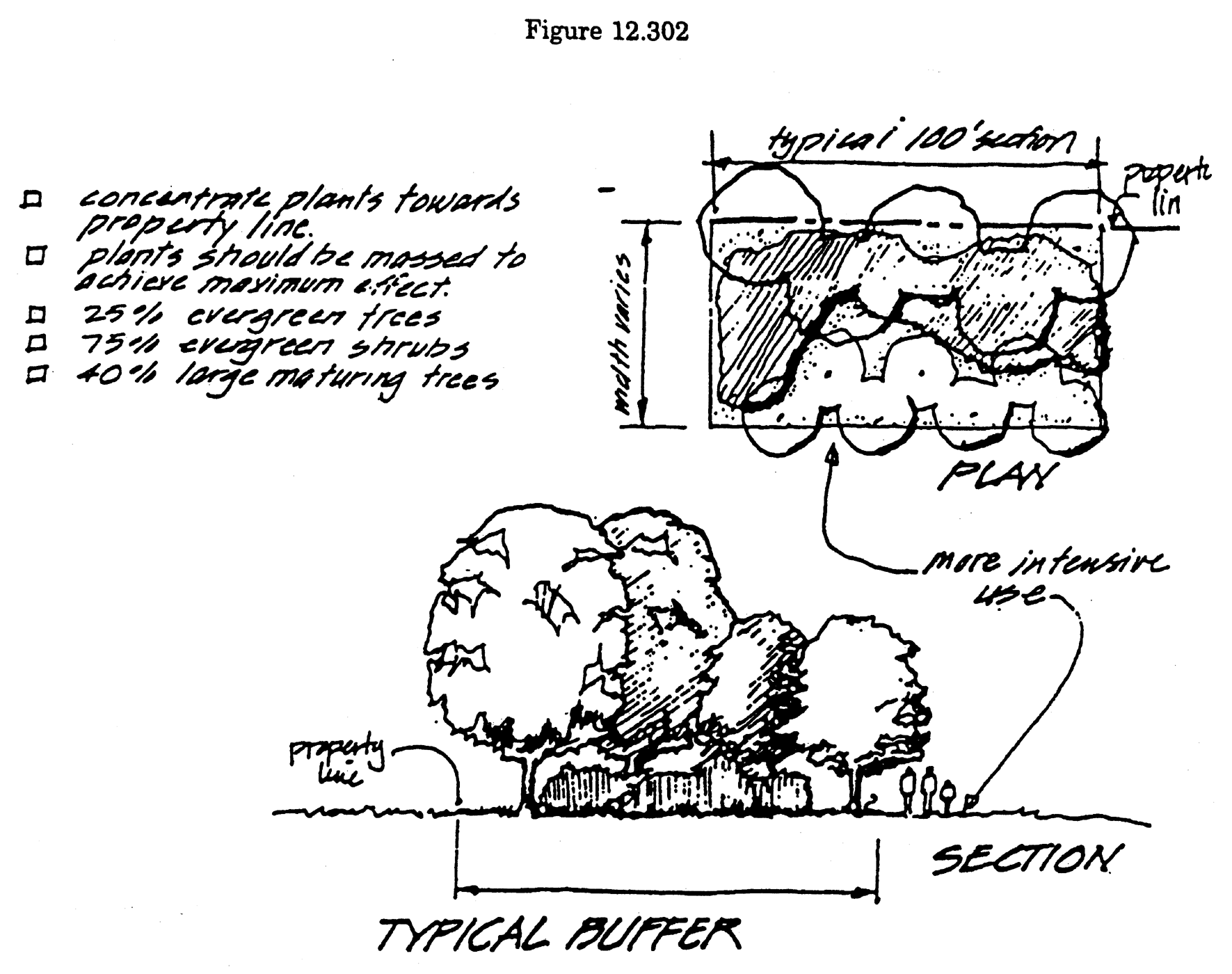
Typical Buffer
(a)
The removal of any tree larger than 8 inches caliper shall require the approval of the Zoning Administrator;
(b)
If utility lines run longitudinally within a buffer yard, the width of the buffer yard shall be increased by the same amount that is cleared for placement of the utility lines; and
(c)
To the extent possible, the path cleared for the utility lines shall be replaced with plant materials which are consistent with those that existed prior in the buffer yard.
(13)
Any required buffer abutting a park or greenway shall be waived in its entirety, if the property owner dedicates the land to be set aside for the required full buffer width to the City for incorporation into the park or greenway. Such land dedication must be acceptable to the Parks and Recreation Department.
(Ord. No. 3523, § 1(51), 3-15-1993; Ord. No. 3589, § 1, 7-19-1993; Ord. No. 380, § 13, 9-18-1995; Ord. No. 1205, § 1(3), 2-15-1999; Ord. No. 1436, § 1(2), 1-18-2000; Ord. No. 1732, § 3, 1-16-2001; Ord. No. 3709, § 1, 10-17-2007; Ord. No. 4341, § 1, 1-19-2010; Ord. No. 4658-Z, § 1, 5-23-2011; Ord. No. 5423, § 1, 7-21-2014)
Section 12.303. - Screening requirements.
The provisions of this section must be met at the time that land is developed or land and structures are redeveloped. A buffer required in section 12.302 may be used to meet the requirements of this section. The requirements of this section do not apply to lots or portions of lots, which are vacant or undeveloped.
(1)
The following uses must be screened from abutting property and from public view from a public street:
(a)
Parking lots for more than ten (10) automotive vehicles and parking decks, excluding new and used automotive sales lots and parking areas for detached, duplex, triplex or quadraplex dwellings on a single lot;
(b)
Dumpsters, recycling containers (except for recycling containers located at recycling collection centers), or solid waste handling areas;
(c)
Service entrances or utility structures associated with a building, except in the area where such use abuts other service entrances or utility structures; and
(d)
Loading docks or spaces, except in the area where such use abuts other loading docks and spaces.
(e)
Outdoor storage of materials, stock and equipment; and
(f)
Any other uses for which screening is required under these regulations.
(2)
Any screening or buffer areas used to comply with the provisions of this section or other ordinance provisions for uses other than parking decks must consist of a planted area which is at least five (5) feet wide. This area may contain any type screening materials sufficient to separate visually the land uses, provided such materials meet the requirements of this section. If only a wall or fence is used, then the area devoted to the screen need only be wide enough to accommodate the wall or fence and allow for its maintenance. The composition of the screening material and its placement on the lot will be left up to the discretion of the property owner, so long as the purpose and requirements of this section are satisfied. The following list contains specific standards to be used in installing screening:
(a)
Any fence or wall used for screening shall be constructed in a durable fashion of brick, stone, other masonry materials, wood posts and planks or metal or other materials specifically designed as fencing materials or any combination thereof as may be approved by the zoning administrator. Other materials may also be considered through the alternate buffer and screening process as detailed in section 12.304. No more than twenty-five (25) percent of the fence surface shall be left open and the finished side of the fence shall face the abutting property. A chain link fence with plastic, metal or wooden slats may not be used to satisfy the requirements of this section when abutting residential uses and districts and public streets;
(b)
The maximum height for a wall or fence which is located along a side yard in a residential district is six (6) feet;
(c)
The maximum height for a wall, fence, or an earth berm, which is located in any required setback in a residential district, is five (5) feet, unless it is part of a zero-lot line subdivision, then it may be six (6) feet;
(d)
The minimum height for screening will be whatever is sufficient to separate visually the uses, but not less than four (4) feet;
(e)
The height of any screening materials on a corner lot must also comply with the provisions of section 12.109;
(f)
Any earth berm used to meet the requirements of this section must be a minimum of four (4) feet with a maximum slope of 3:1. Berms in excess of six (6) feet in height shall have a maximum slope of 4:1 as measured from the exterior property line;
(g)
Shrubs used in any screening or landscaping must be evergreen, at least two (2) to two and one-half (2½) feet tall with a minimum spread of two (2) feet when planted and no further apart than five (5) feet. They must be of a variety and adequately maintained so that an average height of five (5) to six (6) feet could be expected as normal growth within four (4) years of planting. The average expected height may be reduced to four (4) feet for screening along public streets. Shrubs and trees shall be on the approved plant list in the "Approved Plant Species" matrix in the Charlotte Land Development Standards Manual; and
(h)
There are other landscaping and tree planting requirements contained in Chapter 21 of the City Code. Nothing in this section will exempt anyone from complying with those other requirements when they would require a higher level of performance.
(Ord. No. 3523, § 1(53), 3-15-1993; Ord. No. 380, § 14, 15, 9-18-1995; Ord. No. 1479, § 1, 3-20-2000; Ord. No. 1935, § 1, 10-17-2001; Ord. No. 4341, § 1, 1-19-2010)
Section 12.304. - Alternative buffer and screening requirements.
In the event that the unusual topography or elevation of a development site, the size of the parcel to be developed, the soil or other sub-surface condition on the site, or the presence of required buffer or screening on adjacent developed property would make strict adherence to the requirements of this part serve no meaningful purpose or would make it physically impossible to install and maintain the required buffer or screen, the director of engineering and property management (for commercial and planned multi-family projects and change of use permits) or the director of neighborhood development (for all other residential projects and change of use permits), or their designee(s) may alter the requirements of this part as long as the existing features of the development site comply with the spirit and intent of this part. Such an alteration may occur only at the request of the property owner, who shall submit a plan to the designated agency showing existing site features that would buffer or screen the proposed use and any additional buffer materials the property owner will plant or construct to buffer or screen the proposed use. The director of engineering and property management (or the director of neighborhood development, or their designee(s) shall not alter the requirements of this part unless the developer demonstrates that existing site features and any additional buffer materials will screen the proposed use as effectively as the required buffer or screening. In deciding whether to approve such a plan, the designated agency shall consult with the planning director.
(Ord. No. 3017, § 1J, 6-20-2005)
Section 12.305. - Maintenance responsibility for buffers and screening.
In order for any buffers or screening to fulfill the purpose for which it was established it must be properly maintained. The owner of the property where buffers or screening is required will be responsible for the maintenance of all buffers and screening materials. Any required plant materials such as shrubs and trees which may die must be replaced in compliance with the minimum standards of this section and fences or walls should be repaired. The zoning administrator may reduce or waive the requirement that plant materials be replaced if the buffer or screening which remains effectively buffers or screens the site. All buffers, screening and landscaping areas must be protected from damage by motor vehicles or pedestrians which could reduce the effectiveness of the screening.
Section 12.306. - Reserved.
Editor's note— Ord. No. 1436, § 1(6), adopted Jan. 18, 2000, eliminated § 12.306, which required a letter of compliance and was derived from Ord. No. 3223, adopted Sept. 23, 1991.
Section 12.307. - Buffer requirements for residential uses adjoining Class I streets with full control of access.
The purpose of this section is to establish requirements for buffering to provide a visual screen between residential uses and Class I streets with full control of access.
The following requirements will apply when property zoned as a residential district is being developed for residential purposes adjoining the right-of-way [of] a Class I street with full control of access. Residential purposes shall be defined for these requirements as being any building used as a permanent dwelling unit. Any such building, which exists prior to the effective date of this section, will not be subject to these requirements when undergoing any addition, expansion, or renovation. These requirements will not be applicable if the North Carolina Department of Transportation (NCDOT) provides a noise abatement or screening wall.
1.
A buffer area will be provided on the residential lot along the entire length of any yard or setback adjoining a Class I street right-of-way, or as provided for in section 12.304, Alternative Buffer and Screening Requirements.
2.
Such buffer will consist of five (5) trees and twenty (20) shrubs/one hundred (100) linear feet in an area of sufficient width to support the plant materials, but not less than ten (10) feet in width.
3.
The buffer area may be included as part of the required minimum yards or setback areas, but it must be out of any existing or proposed right-of-way.
4.
The buffer area will be subject to the provisions of section 12.302(9), (10), and (12).
5.
The buffer area may be replaced with the use of an earthen berm or a solid masonry wall, both with a minimum of six (6) feet to a maximum of ten (10) feet in height. Berms shall have a maximum slope of 3:1.
6.
Shrubs are not required if a fence or wall is built. If a berm is constructed, shrubs are required but trees are not.
7.
Existing trees and vegetation may be used to meet the requirements of this section if they are of sufficient magnitude to meet or exceed these requirements.
(Ord. No. 1605, § 1, 9-18-2000)
Section 12.308. - Screening requirements when a development does not propose two tiers of buildable lots.
The purpose of this section is to establish requirements for landscape screening on residential reverse frontage lots to provide a visual screen between the use and the street which will not provide direct vehicular access. Any existing residential building, which exists prior to the effective date of this section, will not be subject to these requirements when undergoing any addition, expansion, renovation, razing, or rebuilding. These requirements will not be applicable in the UR and NS zoning districts. Nor will be these requirements be applicable if the North Carolina Department of Transportation (NCDOT) provides a noise abatement or screening wall, or if the Charlotte Department of Transportation (CDOT) provides a wall as part of a major thoroughfare widening. These requirements are applicable along major and minor thoroughfares, as well as along major collectors that function as a minor arterial, whether or not if they are on the thoroughfare maps. The requirements are as follows:
1.
A deed restricted, recorded, common open space strip that is a minimum of thirty (30) feet in width, shall be provided for reverse frontage lots, and noted as "common open space". The open space shall be located adjacent to the public street right-of-way, on the lot frontage side that will not have direct vehicular access to the abutting street. The rear yard shall be measured from the inside edge of the 30-foot common open space strip. The following requirements shall be met:
a.
The common open space shall contain a berm of a minimum of four (4) feet in height, with a maximum slope of 2.5:1 and berms over six (6) feet in height shall have a maximum slope of 3.5:1 as measured from the exterior property line. In addition, trees and shrubs shall be provided on the berm with a minimum of six (6) trees (two-inch minimum caliper, of which twenty-five (25) percent must be evergreen) and twenty (20) shrubs (with a minimum height of two (2) feet, of which seventy-five (75) percent must be evergreen) per one hundred (100) linear feet. Trees and shrubs shall be evenly distributed along the length of the berm.
b.
In lieu of the berm, a minimum four (4) feet wall or fence may be provided within the 30-foot common open space strip and planted with a minimum of six (6) trees (two-inch minimum caliper, of which twenty-five (25) percent must be evergreen) and twenty (20) shrubs (with a minimum height of two (2) feet, of which seventy-five (75) percent must be evergreen) evenly distributed per one hundred (100) linear feet. The width of the common open space strip may be reduced by twenty-five (25) percent if a fence or wall is provided. The wall or fence shall not include chain link or wood materials, must be a minimum of fifty (50) percent opaque, and the finished side of the fence shall face the abutting right-of-way. Walls and fences shall be located within the inner half of the common open space strip. Variations in the placement may be allowed to avoid existing vegetation (vegetation that does not qualify as tree save area under subsection c), existing above ground or below ground utilities, or where the topography would make the wall or fence ineffective if placed within the inner half of the common open space strip. In any case, the wall or fence must be a minimum of five (5) feet from the right-of-way line and out of any sight triangles.
c.
A tree save area of existing canopy as defined in chapter 21, may be provided in lieu of a berm, fence, or wall if the species within the 30-foot common open space strip meets this definition. The required twenty (20) shrubs shall be planted and evenly distributed, per one hundred (100) linear feet within the required tree save area. If the tree save area of existing canopy does not contain six (6) trees per one hundred (100) linear feet, then supplemental tree plantings will be required to equal six (6) trees per one hundred (100) linear feet, in addition to the required shrubs. If there is an area(s) along the project frontage where an area(s) of tree save does not exist, compliance with subsection 12.108.1(a) or 1(b) will be required.
d.
If the proposed planting or berm can not fit within thirty (30) feet then the common open space strip must be increased accordingly. Trees and shrubs will not increase with greater common open space width. The rear yard will still be measured from the edge of the common open space strip.
e.
Maintenance of the common open space strip shall be the responsibility of the homeowner's association.
f.
Principal and accessory structures shall not be located within the common open space strip.
g.
A minimum rear yard of twenty (20) feet is required measured from the interior edge of the common open space strip.
2.
In lieu of common open space, or where there is no homeowner association, then the lots must provide a minimum 30-foot area to be recorded as a landscape easement. The following requirements shall be met:
a.
The easement shall be a minimum of thirty (30) feet in width, and shall contain a berm of a minimum of four (4) feet in height, with a maximum slope of 2.5:1 and berms over six (6) feet in height shall have a maximum slope of 3.5:1 as measured from the exterior property line. In addition, trees and shrubs shall be provided on the berm with a minimum of six (6) trees (two-inch minimum caliper, of which twenty-five (25) percent must be evergreen) and twenty (20) shrubs (with a minimum height of two (2) feet, of which seventy-five (75) percent must be evergreen) per one hundred (100) linear feet. Trees and shrubs shall be evenly distributed.
b.
In lieu of the berm, a minimum four (4) feet wall or fence may be provided within the thirty (30) feet easement and planted with a minimum of six (6) trees (two-inch minimum caliper, of which twenty-five (25) percent must be evergreen) and twenty (20) shrubs (with a minimum height of two (2) feet, of which seventy-five (75) percent must be evergreen) per one hundred (100) linear feet. The width of the common open space strip may be reduced by twenty-five (25) percent if a fence or wall is provided. The wall or fence shall not include chain link or wood materials, must be a minimum of fifty (50) percent opaque, and the finished side of the fence shall face the abutting right-of-way. Walls and fences shall be located within the inner half of the easement. Variations in the placement may be allowed to avoid existing vegetation (vegetation that does not qualify as tree save area under subsection c), existing above ground or below ground utilities, or where the topography would make the wall or fence ineffective if placed within the inner half of the common open space strip. In any case, the wall or fence must be a minimum of five (5) feet from the right-of-way line and out of any sight triangles.
c.
A tree save area of existing canopy as defined in chapter 21, may be provided in lieu of a berm, fence, or wall if the species within the thirty (30) feet landscape easement meets this definition. The required twenty (20) shrubs shall be planted and evenly distributed, per 100 linear feet within the required tree save area. If the tree save area of existing canopy does not contain six (6) trees per one hundred (100) linear feet, then supplemental tree plantings will be required to equal six (6) trees per one hundred (100) linear feet, in addition to the required shrubs. If there is an area(s) along the project frontage where an area(s) of tree save does not exist, compliance with subsections 12.108.2(a) or 2(b) will be required.
d.
If the proposed planting or berm can not fit within thirty (30) feet then the easement must be increased accordingly. Trees and shrubs will not increase with greater easement width. The rear yard will still be measured from the edge of the easement.
e.
Maintenance of the landscaped easement shall be the responsibility of the property owner.
f.
Principal and accessory structures shall not be located within the easement area.
g.
A minimum rear yard of twenty (20) feet is required measured from the interior edge of the easement.
(Ord. No. 3325, § 1, 7-17-2006)
Section 12.401. - General requirements.
No land or structure shall be used, developed, or occupied unless all accessory uses and structures conform to all applicable requirements of these regulations. The remaining sections of this part establish additional requirements and restrictions for particular accessory uses and structures. Any accessory use or structure may be approved in conjunction with approval of the principal use. No accessory use or structure shall be approved, established, or constructed before the principal use is approved in accordance with these regulations.
Section 12.402. - Outdoor lighting.
The following restrictions shall apply to any outdoor lighting located in any district:
(1)
All outdoor lighting for any nonresidential use shall be located, screened, or shielded so that abutting lots located in any residential district are not directly illuminated.
(2)
All outdoor lighting shall be located, screened or shielded in a manner as not to cause glare or impair the vision of motorists.
Section 12.403. - Solid waste containers, compactors, recycling containers, solid waste and recycling handling areas, and service entrances.
The following requirements shall apply to all solid waste containers (including dumpsters), compactors, recycling containers, solid waste and recycling handling areas and service entrances accessory to any multi-family or nonresidential use and shall be shown on submitted plans:
(1)
Except as provided in subsection (2) below, any such accessory use or structure shall be screened on three sides by a fence, wall or planting materials from the public view from public streets and any abutting properties located in a residential, research, office, or business zoning district in accordance with section 12.303.
(2)
Screening in accordance with section 12.303 shall not be required where any buffer, as set out in section 12.302, separates such accessory uses and structures from the public street or abutting property.
(3)
All uses. When a recycling container is placed on a property permitted before October 17, 2001, the minimum number of parking spaces required by these regulations may be reduced by up to three (3) spaces for each recycling container, if necessary, to provide space for the location and servicing of the recycling container. This provision is included in these regulations to allow existing uses or uses for which building permits have been obtained prior to the date set forth above to place recycling containers on the property without the location of such recycling containers creating a violation of these regulations.
Residential uses only. When a solid waste container or compactor is placed on a property permitted before October 17, 2001, the minimum number of parking spaces required by these regulations may be reduced by up to three (3) spaces for each compactor and two (2) spaces for each solid waste container if necessary, to provide space for the location and servicing of the compactor and solid waste containers. [This provision is included in these regulations to allow existing uses or uses for which building permits have been obtained prior to the date set forth above to place compactors, and/or solid waste containers on the property without the location of such compactors and/or solid waste containers creating a violation of these regulations.]
(4)
All non-residential uses that are permitted after October 17, 2001, shall be required to set aside space for recycling and solid waste containers. Equal space shall be allocated for both recycling and solid waste containers. Space for each of these containers shall be indicated on the submitted plans even if containers are not proposed as the primary method of solid waste or recycling collection.
All multi-family complexes, which are permitted after October 17, 2001, shall be required to set aside space for recycling containers and solid waste containers used for the collection of solid waste as follows:
Space for solid waste containers—At a minimum, space for an eight (8) cubic yard container per each thirty (30) units or eight (8) cubic yard compactor per each ninety (90) units. If there are less than thirty (30) units, no space allocation is required unless solid waste container service is the primary method of collection.
Space for recycling containers shall be allocated as follows:
All locations for recycling containers, solid waste and recycling handling areas, solid waste containers and/or compactors and their service entrances as required under section 12.403 shall be shown on site plans for their review and approval.
Exceptions to section 12.403, item (4). A permit shall not be denied if: (a) the project for which the permit is sought is for the renovation or redevelopment of an existing building or facility, and (b) the existing building or facility does not have sufficient exterior property available for a recycling container(s). The minimum number of parking spaces required by these regulations may be reduced by up to three (3) spaces, if necessary, to provide space for the location and servicing of recycling containers.
(Ord. No. 1935, § 1, 10-17-2001; Ord. No. 2056, § 1, 4-15-2002; Ord. No. 2850, § 1, 12-20-2004)
Editor's note— Ord. No. 2850, § 1, adopted December 20, 2004, changed the title of section 12.403 from "Dumpsters, compactors, recycling containers, solid waste handling areas, and service entrances" to "Solid waste containers, compactors, recycling containers, solid waste and recycling handling areas, and service entrances."
Section 12.404. - Active adult retirement community.
Active adult retirement communities shall be permitted in accordance with the following requirements:
(1)
The minimum size shall be ten (10) acres.
(2)
Up to ten (10) percent of the community may be available to households with members under fifty-five (55) years of age.
(3)
Children under eighteen (18) years of age shall not reside on the property for more than ninety (90) days per calendar year.
(4)
Up to sixty (60) percent of the dwelling units may be single-family detached.
(Ord. No. 2224, § 9, 1-21-2003)
Section 12.405. - Land clearing and inert debris landfill (LCID): on-site.
On-site LCID landfills shall be permitted as an accessory use in any zoning district in accordance with the following requirements:
(1)
Any on-site LCID landfill must obtain approval and comply with the size, siting, operational standards and notice by recordation requirements of the State of North Carolina.
(2)
Any such site may not be operated for more than twelve (12) months, after which time it must be closed in an approved fashion; provided, however, operation of such site may be extended an additional six (6) months if it remains in active use at the end of the 12-month period and such site is at least three (300) feet from an occupied dwelling.
(3)
The location of any such site must be indicated on any required final subdivision plat. Further, any parcel or lot which contains any part of any such site must have notification of the existence and extent of the site recorded as part of the deed for the lot or parcel, even if no subdivision plan is required for development of the property.
(4)
No portion of any such site may be located within fifteen (15) feet of any exterior property lines. This includes structures, equipment storage, parking areas and fill areas, except that access drives may cross this area.
(5)
Any on-site LCID landfill site which is located in an industrial zoning district is exempted from the 12-month requirement, provided that no portion of the landfill is located within one hundred (100) feet of any adjoining residentially zoned or used property.
(Ord. No. 772, § 1(2)(A), 3-17-1997)
Section 12.406. - Fences and walls in residential districts.
The following restrictions shall apply to all fences and walls located in any residential district, except for fences and walls surrounding public utility structures or radio, television, or microwave transmission or relay towers:
(1)
No fence or wall located in the required setback shall be built to a height greater than five (5) feet above grade, unless it is a part of a zero lot line subdivision, then it may be six (6) feet.
(2)
No fence or wall located in the required side yard between the required setback and established rear yard shall be built to a height greater than six (6) feet above grade.
(3)
No fence or wall located in the established rear yard shall be greater in height than eight (8) feet above grade height in the rear yard.
(4)
Any fence or wall serving as a retaining wall shall be solid cement, masonry or wood and constructed to the standards of the State Building Code.
(5)
The capital of a fence post or column may extend up to two (2) feet above the maximum height limit.
(6)
No fence or wall shall be constructed within a storm drainage easement which will block or materially impede the flow of stormwater runoff.
(Ord. No. 3523, § 1(54), 3-15-1993)
Editor's note— Any fence or wall constructed within the sight distance triangle at an intersection must conform to the cross visibility requirement regulated in City Code, section 19-245 and section 12.109 of these regulations. A fence or wall constructed along the border or bounding on any streets or sidewalks of the City, shall require certification by the Charlotte Department of Transportation (City Code, section 19-243.)
Section 12.407. - Dwellings, accessory unit.
Accessory dwelling units (ADU) shall be permitted as an accessory to any single-family detached dwelling unit in accordance with the following requirements:
(1)
The ADU shall be clearly subordinate to the principal single-family detached structure.
(2)
No more than one ADU shall be located on a lot.
(3)
The ADU and the principal dwelling shall be owned by the same person.
(4)
The ADU shall not be served by a driveway separate from that serving the principal dwelling. However, if the ADU is within an accessory structure and located on a corner lot or a lot that abuts an alley, a separate driveway may be provided from the side street or the alley, whichever applies.
(5)
An ADU located within the principal single-family detached structure shall comply with the following additional requirements:
(a)
The ADU shall be limited to thirty-five (35) percent of the total floor area of the principal structure. However in no case shall the ADU exceed eight hundred (800) heated square feet.
(b)
The ADU shall not be internally accessible from the principal dwelling.
(c)
The pedestrian entrance to the ADU shall be located to the side or rear of the structure.
(6)
An ADU located within an accessory structure shall comply with the following additional requirements:
(a)
The ADU shall have a floor area no greater than fifty (50) percent of the principal structure and under no circumstances cover more than thirty (30) percent of the established rear yard. However, in no case shall the ADU exceed eight hundred (800) heated square feet.
(b)
The structure shall be no taller than the principal dwelling.
(c)
The ADU shall be located in the rear yard and not be any closer than fifteen (15) feet to a rear property line or along any side property line within the required side yard dimension. If the ADU is located within a garage structure and the parcel abuts an alley, the structure may be located up to five (5) feet from the rear property line if the garage is accessed from the alley.
(d)
Roof and exterior wall materials and finishes of the ADU shall be similar in composition and appearance to that of the principal dwelling on the lot. However, this requirement does not apply to additions or exterior modifications to an existing accessory structure for the purpose of creating an ADU.
(Ord. No. 4931, § 1, 7-16-2012)
Editor's note— Ord. No. 4931, § 1, adopted July 16, 2012, amended section 12.407 in its entirety to read as herein set out. Formerly, section 12.407 pertained to elderly and disabled housing and derived from Ord. No. 3523, § 1(55), adopted March 15, 1993, and Ord. No. 3017, § 1J, adopted June 20, 2005.
Section 12.408. - Customary home occupations.
Applicability and exceptions: The following uses are not considered to be customary home occupations, and are exempt from this section:
(i)
Home offices with incidental storage (example is telecommuting from home). Incidental storage shall not exceed fifty (50) square feet in area.
(ii)
Residents whose job location is elsewhere, can bring work-related vehicles home, however, the commercial vehicles regulations of section 12.218 shall apply.
A customary home occupation shall be permitted as an accessory to any dwelling unit in accordance with the following requirements:
(1)
The home occupation must be clearly incidental to the residential use of the dwelling and must not change the essential residential character of the dwelling.
(2)
Use of the dwelling for all customary home occupations must be limited to twenty-five (25) percent of the total floor area of the principal building, or five hundred (500) square feet, whichever is less. Areas used for storage of materials shall be included in determining the percentage of the structure devoted to the customary home occupation. Incidental storage of fifty (50) square feet, or less, shall not count toward determining the percentage devoted to the customary home occupation. If a portion of a room is being used, the entire room will be measured, not just the portion.
Home occupation permits issued prior to the effective date of this section shall be grandfathered. However, any subsequent home occupation permit issued at the same address must be in conformance with these standards.
(3)
No accessory building or outside storage may be used in connection with the home occupation.
(4)
No chemical, mechanical, electrical, construction, paint, landscaping equipment and materials/supplies that are not normally a part of domestic or household equipment may be used or stored, with two (2) exceptions:
(a)
Medical, dental, and office equipment used for professional purposes may be used.
(b)
A single trailer with a cargo area/work platform shall not exceed a length of fourteen (14) feet (not including step bumpers less than eighteen (18) inches in length or the moving hitch or tongue), attached to a vehicle at all time-used in the customary home occupation may be stored on the premise overnight, but no construction or industrial equipment can be stored on the trailer.
(5)
Machinery that causes noises, vibration, glare, fumes, odors, dust, detectable at the property line is prohibited. Machinery that causes electrical interference with radio or television reception is also prohibited.
(6)
No internal or external alterations inconsistent with the residential use of the building will be permitted. There shall be no evidence on the exterior of the premises or visible from the exterior of the premises that the property is used in any way other than for a dwelling.
(7)
Only residents of the dwelling may be engaged in work activities at the residence. If the customary home occupation has other employees, those employees may not come to the residence for work purposes, including pick-up of materials, vehicles, assignments, or similar purposes.
(8)
No display of products shall be visible from the street.
(9)
The number of vehicles used by clients or business related visitors to any home occupation shall be limited to two (2) at any given time.
(10)
Vehicles used in connection with the conduct of the customary home occupation shall comply with the requirements of section 12.218, "Commercial vehicle parking in residential areas."
(11)
No detached signs or wall signs shall be permitted for the customary home occupation.
(12)
Clients or business related visitors shall be by appointment only.
(13)
Hours of operation for deliveries, clients, and operation of mechanical or electrical equipment shall be limited to 7:00 a.m. to 8:00 p.m.
Permitted customary home occupations include, but are not limited to: home based businesses such as offices for professionals such as architects, brokers, counselors, clergy, dentists, doctors, cartographers, engineers, insurance agents, lawyers, real estate agents, accountants, editors, publishers, journalists, psychologists, contract management, graphic design, landscape and or building contractors, landscape design, surveyors, cleaning services, alterations, certified massage therapists, retail sales of goods by appointment only, manufacturer's representatives, travel agents, telecommuting, gift baskets, instructional services (such as teaching music, dance, art, tutoring), home craft businesses (such as artists, quilters, sculptors, musicians, dressmakers, milliners, weavers, lapidary, jewelry making, photographers, and furniture making), and other similar uses.
Home baked goods with no products sold directly from the house, and subject other applicable regulations including Building Code and Mecklenburg County Health Department regulations.
Prohibited customary home occupations include, but are not limited to: caterers, food vendors, equipment and vehicle repair shops, appliance repair shops, small mechanical repair shops, barber shops, beauty shops, kennels, commercial bakeries, veterinarian clinics, funeral homes, commercial cabinetry shop, welding, trucking, adult oriented businesses, warehousing, on-site vehicular sales, and other similar uses.
(Ord. No. 2402, § 3, 10-20-2003; Ord. No. 3545, § 1, 3-19-2007)
Cross reference— Signs, ch. 13.
Section 12.409. - Marinas.
A marina shall be permitted as an accessory to any residential use in accordance with the following requirements:
(1)
No sale of goods or services or other commercial activities shall occur at the marina.
(2)
The number of boat slips shall not exceed 110 percent of the number of dwelling units in the residential development which the marina serves.
(3)
Any off-street parking, service, and outdoor storage areas shall be separated by a Class C buffer from any abutting lot located in a residential district (see section 12.302).
(4)
Marinas may include any pump out facilities required by Federal or State Water Quality Regulations.
(5)
Any accessory marina serving more than 50 dwelling units shall have a boat launching facility for use by residents only.
Section 12.410. - Private kennels.
Pens, runs, cages, houses, or other facilities for the keeping of any dogs, cats, and other small animals shall be permitted as an accessory use in any district, except INST, RE-1, RE-2, B-D and BP, in accordance with the following requirements:
(1)
Any structure for the keeping of animals that is not completely enclosed, except for fences along property lines, shall be located between the principal structure and the rear lot line, shall occupy no more than 20 percent of the rear yard and shall be located no closer than 10 feet to any side lot line.
(2)
Extensions of or additions to property line fences to confine animals to a part of the property abutting the lot line shall not be permitted.
(3)
No such accessory use shall be operated for commercial purposes.
Section 12.411. - Private stables.
Structures, pasture areas, corrals, and other enclosed areas for the keeping of horses shall be permitted as an accessory use in any district, except INST, RE-1, RE-2, B-D and BP, in accordance with the following requirements:
(1)
Minimum lot size shall be 1 acre.
(2)
Maximum number of horses is 1 horse per acre.
(3)
All structures for the keeping and maintenance of animals, equipment, or manure and all manure piles, pits, or bins shall be located at least 100 feet from any lot line.
(4)
There shall be no outdoor storage of equipment related to training or maintenance of horses.
(5)
No such accessory use shall be operated for commercial purposes.
Section 12.412. - Reserved.
Editor's note— Ord. No. 4931, § 1, adopted July 16, 2012, repealed the former section 12.412 in its entirety, which pertained to guest houses and employee quarters, and derived from Ord. No. 3523, § 1(56), adopted March 15, 1993.
Section 12.413. - Drive-in and drive-through service lanes/windows.
(1)
Drive-in and drive-through service lanes/windows shall be permitted only as an accessory use in the UMUD, NS, PED, MX-2, MX-3, Inst., RE-1, RE-2, O-1, O-2, O-3, B-1, B-2, BP, CC, I-1, and I-2 districts.
(2)
Drive-through or drive-in service lanes/windows are not allowed in the UR-1, UR-2, UR-3, U-C, or MUDD, zoning districts. However, drive-through and drive-in service lanes/windows may be allowed in the MUDD district as part of the establishment of, or amendment to, a MUDD-Optional classification.
(3)
Drive-in and drive-through service windows/lanes are permitted in the RE-3 district, however, service lanes shall not be permitted between any facade of the principal structure and any abutting public or private street.
(4)
In the TOD-R, TOD-E, and TOD-M, and TS zoning districts, drive-through service lanes are only permitted as an accessory use to professional business and general office uses located between one-fourth (¼) mile to one-half (½) mile walking distance from a transit station.
Table 12.413
MINIMUM VEHICLE STORAGE REQUIREMENTS1
1. One vehicle space equals twenty (20) feet.
2. This requirement will be reduced to three (3) spaces per window for savings and loan institutions and credit unions. For banks with more than five (5) drive-up windows, the storage requirements shall not exceed a total of twenty (20) vehicles.
3. As measured from the pick-up window.
(Ord. No. 2412, § 3(4)A., 10-20-2003; Ord. No. 2881, § 2(4), 2-21-2005; Ord. No. 2968, § 2, 5-16-2005; Ord. No. 4658-Z, § 1, 5-23-2011; Ord. No. 5423, § 1, 7-21-2014)
Editor's note— Ord. No. 2412, § 3(4)A., adopted October 20, 2003, amended § 12.413 in its entirety to read as herein set out. Formerly, § 12.413 pertained to drive-in service windows and derived from Ord. No. 3523, § 1(57), adopted March 15, 1993; Ord. No. 408, § 1, adopted November 20, 1995; Ord. No. 2223, § 3(1), adopted January 21, 2003.
Section 12.414. - Automobile, truck and trailer rental.
(1)
Automobile rental shall be permitted as an accessory use where the principal use is an airport, automobile dealership, hotel or motel or in any district where automobile rental is permitted as a principal use.
(2)
Where the principal use is a hotel or motel, automobile rental shall be permitted as an accessory use only in accordance with the following requirements:
(a)
No sign advertising the rental of automobiles shall be located outside the hotel or motel building; and
(b)
No more than ten (10) automobiles, which are not currently leased to customers, shall be parked on the same property as the hotel or motel.
(3)
Truck and trailer rental is permitted as an accessory use in any district where it is permitted as a principal use.
Section 12.415. - Helistops, limited.
A helistop, limited shall be permitted as an accessory use only in the O-1, O-2, O-3, INST, RE-1, RE-2, RE-3, B-2, B-D, BP, UMUD, CC, U-I, I-1, and I-2 districts provided it complies with all applicable Federal Aviation Administration regulations.
(Ord. No. 4658-Z, § 1, 5-23-2011)
Section 12.416. - Satellite dish farm.
Satellite dish farms are permitted as a principal use only in the I-2 zoning district, with prescribed conditions. Satellite dish farms are also permitted as an accessory use to a telecommunications and data storage facility or as an accessory use to a radio or television station (if permitted in the underlying zoning district), with the following prescribed conditions:
(1)
Satellite dishes shall not be located within the setback area of any lot or within the street side yard of a corner lot.
(2)
Satellite dishes that are ground-mounted shall be screened with a solid wall that blocks the view of the satellite dishes from any public street right-of-way for the full height of the dishes, subject to the review and approval of the planning director, or designee. The height of the wall shall be determined by the maximum height of the tallest satellite dish, when the dish is oriented to achieve its maximum vertical height, (not the height when configured for transmission/reception). The wall shall be constructed of materials and colors compatible with the exterior of other buildings on the site, or with surrounding structures.
(3)
All required walls for ground-mounted satellite dishes shall be enhanced with landscaping consisting of trees and shrubs provided along the street side of all required walls. Trees and shrubs shall meet the requirements of subsection 12.303(2)(g).
(4)
No ground-mounted satellite dish shall be located closer than four hundred (400) feet to any residential use. The distance shall be measured as the shortest distance between the nearest satellite dish in its widest horizontal configuration (not the width when configured for transmission/reception) to the closest part of the principal residential building.
(5)
The total area of an accessory satellite dish farm shall be less than the ground floor area of the principal building(s). The satellite dish area shall be calculated from the required wall(s) to the furthest edge of the satellite dish array, in their widest horizontal configuration, or by calculating the area using the furthest edge of all dishes in their widest horizontal configuration, whichever is greater. Satellite dish farms that are a principal use in the I-2 zoning district are exempt from this limitation in size.
(6)
A ground-mounted accessory satellite dish farm that legally exists as of July 18, 2011 may be expanded. Any satellite dish added to the existing site after July 19, 2011 shall meet the requirements of section 12.416.
(Ord. No. 4705, § 1, 7-18-2011)
Editor's note— Prior to the reenactment of section 12.416 by Ord. No. 4705, Ord. No. 4684-Z, § 1, adopted June 20, 2011, repealed the former section 12.416 in its entirety, which pertained to information pillars and derived from Ord. No. 2811, § 1, adopted November 15, 2004.
Section 12.417. - Outdoor sales, accessory.
(1)
Retail establishments located in all zoning districts, except as provided in subsection 12.417(2), are permitted to have accessory outdoor sales, subject to the standards of the district.
(2)
In the NS, CC, MUDD(CD), UMUD(CD), B-1SCD, B-1(CD), B-2(CD), and RE-3 zoning districts, outdoor sales are permitted as an accessory use to a retail establishment as long as outdoor sales is not a restricted use on the site plan or conditional plan. An approved, permanent garden center component of a retail use that shares common walls with the principal building is not subject to this section. All outdoor sales shall be clearly incidental to the operation of the principal use, and shall meet the following requirements:
(1)
Outdoor sales shall be operated and maintained under the same ownership, or subject to the control of the property owner, and on the same parcel as the principal use.
(2)
Planning director approval is required, and an administrative amendment will be required, if the additional outdoor retail sales area is located within the parking or maneuvering area and such outdoor retail sales area is not indicated on an approved conditional plan. The accessory, outdoor retail sales area shall not be counted toward the total allowed square footage.
(3)
Outdoor sales areas shall be fenced on all sides by a fence not less than three (3) feet or no higher than five (5) feet in height. The fence must be constructed of wrought iron, tubular aluminum, or other approved fencing material. Fencing is not required to be permanently affixed. The fence must be constructed to allow for seventy-five (75) percent surveillance from passing vehicles and/or pedestrian traffic. Spaces between bars or slats shall be no greater than six (6) inches apart. In no instance will a chain link or barbed wire fence be acceptable. Fencing shall be removed when the outdoor sales end.
(4)
Sales of retail items is allowed on the sidewalk located in front the building, but not on the public sidewalk located within any public right-of-way, however, a minimum clear zone of eight (8) feet shall be maintained for pedestrian use. The area used for sales of retail items on the sidewalk shall not exceed fifty (50) square feet in area to be used continuously for the sale of goods and merchandise. No display of merchandise is permitted. No fencing is required for items on the sidewalk. The sales area in front of the building shall be shown on the site plan or conditional plan.
(5)
All equipment rental and leasing must occur within an enclosed building.
(6)
No tractor-trailer trucks, trailers, or other mobile storage containers, shall be used in conjunction with the outdoor sales area. Tractor trailers may only be located near the loading dock area and shall be screened by a decorative fence from on-site parking lot(s).
(7)
The area designated for outdoor sales shall not be located in any minimum required parking area required by this ordinance. The outdoor sales area shall not require additional parking spaces.
(8)
The area(s) designated for outdoor sales shall not exceed ten (10) percent of the gross building square footage of the retail establishment for which this is an accessory use.
(Ord. No. 2915, § 1B, 3-21-2005; Ord. No. 3225, § A1, 3-20-2007; Ord. No. 4658-Z, § 1, 5-23-2011)
Section 12.418. - Public flags on permanent flagpoles.
(1)
Public flags or emblems of any nation, organization of nations, state, city, or any fraternal, religious or civil organization are permitted as an accessory use in nonresidential zoning districts and shall be displayed as set forth below, except as provided for in subsection 12.418(2).
(a)
References to flagpole height in this subsection refer to vertical flagpoles. References to the number of public flags, flagpoles, and public flag dimensions refer to both vertical flagpoles and mast arm flagpoles that may extend at an angle from a building.
(b)
Except as otherwise provided herein, public flags shall be displayed on permanent flagpoles. Flagpoles shall not exceed sixty (60) feet in height.
(c)
The maximum dimensions of any public flag shall be proportioned to the flagpole height. The hoist side of the flag shall not exceed twenty (20) percent of the vertical height of the flagpole. In addition, public flags are subject to the following dimensional limitations:
(d)
There shall be no more than three (3) public flags allowed per street front. These flags may be flown on one flagpole, or flown on separate flagpoles.
(e)
Flagpoles along an entrance driveway or street shall not be located in any street right-of-way, and shall be a minimum of ten (10) feet behind the existing or proposed street right-of-way, whichever is greater.
(f)
Flags, banners or pennants displaying a logo, message, statement, or expression relating to commercial interests are not considered to be a "public flag", and are subject to the sign regulations of chapter 13 of the zoning ordinance.
(g)
Public flags and flagpoles shall be maintained in good repair. Flagpoles with broken halyards shall not be used. Flags that are torn or frayed, shall not be displayed.
(h)
Flagpoles shall be permanently mounted in the ground with necessary structural support features or below grade footings, installed in accordance with all required state and local regulations or applicable codes.
(i)
Public flags shall not be draped over the hood, top, sides, or back of a vehicle, nor flown from the antennae of any parked vehicle in a non-residential zoning district.
(j)
Public flags shall never be used for advertising purposes in any manner whatsoever.
(k)
Advertising signs shall not be displayed or fastened to a flagpole, staff, or halyard from which a public flag is flown.
(2)
On United States and North Carolina holidays, there shall be no maximum flag size or number, or other limitations on manner of display as long as the flag(s) do not affect visibility or create any safety hazards or concerns.
(Ord. No. 2937A, § 1C, 4-18-2005)
Section 12.419. - Outdoor dining.
Outdoor dining associated with an eating, drinking and entertainment establishment shall meet the following prescribed conditions:
(1)
Outdoor dining associated with a Type 2 eating, drinking and entertainment establishment that is allowed in the zoning district shall meet the prescribed conditions of section 12.546;
(2)
All outdoor dining areas shall be located on private property, behind the public sidewalk and out of the public right-of-way, unless a public right-of-way encroachment agreement is approved by the Charlotte Department of Transportation, in accordance with chapter 19, article IX of the City Code, allowing outdoor dining in the public right-of-way. If no public sidewalk exists, then the outdoor dining area shall be located a minimum of ten (10) feet from the existing or proposed back of curb;
(3)
Outdoor dining areas located in the required setback shall be located on a patio, at grade, and contain no temporary or permanent roof with roof supporting structures;
(4)
Outdoor dining areas shall be located outside of all sight-distance triangles, and shall not block fire hydrants, driveway access, doors, or utilities;
(5)
Awnings that are supported only by a building wall and umbrellas are permitted, but shall not interfere or conflict with tree ordinance required plantings;
(6)
The square footage area of outdoor dining areas shall be calculated in the square footage of the establishment, for parking requirements;
(7)
Outdoor dining shall be permitted to encroach into the setback or yards, according to the public street type abutting the property according to the following table:
(Ord. No. 5522, § 1, 11-17-2014)
Section 12.501. - Purpose.
This Part provides for the regulation of certain land uses which because of their utilitarian nature or unique locational requirements may be found in a number of zoning districts. Circumstances under which these uses are allowed and what approval process is required are indicated for each use.
Section 12.502. - Adult care homes, adult care centers, child care centers in a residence, family, child care homes, and large child care centers.
For the purposes of this ordinance, facilities for the temporary care of adults are divided into two classes—adult care homes and adult care centers. Adult care homes serve up to six (6) adults, and adult care centers more than six (6) adults. Facilities for the temporary care of children are divided into four classes—family child care homes, child care centers in a residence, child care centers, and large child care centers. A family child care home serves eight (8) or fewer children. A child care center in a residence serves between six (6) and twelve (12) preschool children. A child care center serves between thirteen (13) and seventy-nine (79) children. A large child care center serves eighty (80) or more children. The development requirements for each class of facility are indicated below:
(1)
Family childcare homes. All family childcare homes for eight (8) or fewer children are required to obtain a required to obtain a change of use permit from neighborhood development. Family childcare homes, licensed by the North Carolina Department of Health and Human Services, may be established as an accessory use to a single family detached dwelling unit in all single family districts, all multi-family districts, UR-1, UR-2, UR-3, UR-C, all office, B-1 and B-2, MUDD, UMUD, MX-1, MX-2, MX-3, and R-MH districts, according to the following requirements:
(a)
The single-family detached dwelling unit containing the family child care home must be the primary residence of the operator/primary caregiver.
(b)
The minimum lot area must be equivalent to the minimum lot area for a single-family detached dwelling for the district in which it is located.
(c)
The dwelling unit must meet the minimum setback, yards, and height requirements for the district in which it is located.
(d)
New family child care homes must be separated from existing family child care homes and child care centers in a residence in a single-family residential district by a distance of four hundred (400) feet measured in a straight line from the closest point of each lot property line, excluding child care facilities operating as accessory use to a religious institution.
(e)
Any building additions and/or ornamentations to the residential dwelling unit must be in general character with other homes facing the same street as the family child care home.
(f)
Outdoor play space and play equipment must be located in the required or established rear yard but outside of any required buffers.
(g)
Outdoor play space must be screened from adjoining single-family uses and single-family residential zoning districts, per Section 12.303(2). If a fence is used, a maximum of fifty (50) percent of the fence surface may be left open and the finished side of the fence shall face the abutting property.
(h)
No outdoor play is permitted after sundown.
(i)
One unlighted identification sign, not to exceed four (4) square feet, may be attached to the residence. Detached identification signs are not permitted.
(j)
A maximum of eight (8) children are permitted during the first shift, and a maximum of five (5) children are permitted during one other shift. No more than two (2) shifts are permitted within a 24-hour period.
(k)
No more than one person, at any one time, who resides outside of the residence, may be an employee.
(l)
The operator's own preschool age children must be counted in the number of children allowed. School age children of the operator are not counted.
(m)
No additional parking is permitted beyond four (4) parking spaces.
(2)
Childcare centers in a residence. All childcare centers in a residence for six (6) to twelve (12) pre-school children are required to obtain a change of use permit from neighborhood development. Childcare centers in a residence, licensed by the North Carolina Department of Health and Human Services, may be established as an accessory use to a single family detached dwelling unit in all single family districts, all multi-family districts, UR-1, UR-2, UR-3, UR-C all office, B-1 and B-2, MUDD, UMUD, MX-1, MX-2, MX-3, and R-MH districts, according to the following requirements:
(a)
The single-family detached dwelling unit containing the child care center in a residence must be the primary residence of the operator/primary caregiver.
(b)
The minimum lot area must be equivalent to the minimum lot area for a duplex dwelling for the district in which it is located.
(c)
The dwelling unit must meet the minimum setback, yards, and height requirements for the district in which it is located.
(d)
New child care centers in a residence must be separated from existing family child care homes and child care centers in a residence in a single-family residential district by a distance of four hundred (400) feet measured in a straight line from the closest point of each lot property line, excluding child care facilities operating as accessory use to a religious institution.
(e)
Any building additions and/or ornamentations to the residential dwelling unit must be in general character with other homes facing the same street as the family child care home.
(f)
Outdoor play space and play equipment must be located in the required or established rear yard but outside of any required buffers.
(g)
Outdoor play space must be screened from adjoining single-family uses and single-family residential zoning districts, per Section 12.303(2). If a fence is used, a maximum of fifty (50) percent of the fence surface may be left open and the finished side of the fence shall face the abutting property.
(h)
No outdoor play is permitted after sundown.
(i)
One unlighted identification sign, not to exceed four (4) square feet, may be attached to the residence. Detached identification signs are not permitted.
(j)
A maximum of twelve (12) children are permitted during the first shift, and a maximum of five (5) children are permitted during one other shift. No more than two (2) shifts are permitted within a 24-hour period.
(k)
No more than two (2) persons, at any one time, who reside outside of the residence, may be employees.
(l)
The operator's own preschool age children must be counted in the number of children allowed. School age children of the operator are not counted.
(m)
No additional parking is permitted beyond four (4) parking spaces.
(3)
Child care centers. Child care centers for between sixteen (16) and seventy-nine (79) children, licensed by the North Carolina Department of Health and Human Services, may be established in all multifamily districts, UR-2, UR-3, UR-C, INST, all research, all office, NS, B-1 and B-2, BD, MUDD, UMUD, MX-2, MX-3, TOD-R, TOD-E, and TOD-M, U-I, and I-1 districts, according to the requirements listed below. Child care centers are also permitted as an accessory to uses permitted in the I-2 district, religious institutions, elementary, junior and senior high schools, and government buildings, and are exempt from the requirements listed below.
(a)
Child care centers in the multifamily residential districts must meet the minimum lot area of twelve thousand (12,000) square feet.
(b)
In all other districts where child care centers are permitted, they must meet the minimum lot size or floor area ratio of the district where located.
(c)
Setback, yard and height requirements must meet the requirements of the district where located.
(d)
In residential districts, child care centers must have frontage on a collector street or a minor or major thoroughfare. Primary access to the center may be provided by way of a local residential street that directly intersects a collector street or a minor or major thoroughfare.
(e)
Outdoor play space and equipment must be located in the required or established rear yard in all residential districts but outside of any required buffers. In nonresidential districts, outdoor play space and equipment must be located outside of the required setback and side yards.
(f)
There is no limit on the hours of operation of a child care center, but no outdoor play shall be permitted after sundown.
(g)
In residential districts, building additions and/or ornamentation must be in general character with other residential uses facing the same street as the child care center.
(h)
Buffers and screening requirements as per Part 3: Buffers and Screening.
(i)
In residential districts, detached signage will be limited to one sign with a maximum of sixteen (16) square feet in area and a maximum height of four (4) feet. Signage in nonresidential districts will be permitted according to requirements of the district where located.
(j)
Parking spaces are required based upon one space per employee, plus one space per ten (10) children.
(k)
Land may be set aside for a child care center without rezoning the property in single-family subdivisions with a minimum of two hundred fifty (250) lots when planned and developed on land that is internal to and as an integral unit in a single development operation or a definitely programmed series of development operations and according to an approved preliminary subdivision plan. The child care center must be located on a lot that fronts a collector street or a minor or major thoroughfare. Primary vehicular access may be provided by way of a local residential street. The center must meet all of the standards and requirements for child care centers and be separated by a Class C buffer from any abutting residential use or residential zoning.
(4)
Large child care centers. Large child care centers for eighty (80) or more children, licensed by the North Carolina Department of Health and Human Services, may be established in the nonresidential districts of UR-C, INST, all research and office, B-1, B-2, B-D, UMUD, MUDD, MX-2, MX-3, CC, NS, I-1, according to the requirements listed below. Large child care centers are also permitted as an accessory use in the I-2 district, and are exempt from the requirements listed below.
(a)
Large child care centers must meet the minimum lot size or floor area ratio of the district where located.
(b)
There is no limit on the hours of operation for large child care centers, but no outdoor play shall be permitted after sundown.
(c)
Outdoor play space and equipment must be located outside of the required setback and side yards and be outside of any required buffers.
(d)
Buffers and screening requirements as per Part 3: Buffers and Screening.
(e)
Signage will be permitted according to requirements of the district where located with the exception that one off-premises directional sign is permitted to direct traffic from Class II or III streets to a large child care center located on a Class IV or V street.
(f)
Parking spaces are required based upon one space per employee, plus one space per ten (10) children.
(5)
Adult care centers and homes, registered with the North Carolina Department of Human Resources, may be established as a principal use or as an accessory use in the multi-family, institutional, research, office, business, UMUD, U-1 and I-1 districts and as an accessory use in the I-2 district. An adult care home may be established as a permitted use in the single-family district. All facilities must meet the setback, yard and height requirements, which will be the minimum, required for the district in which it is located.
(6)
All of the uses listed in this section, Section 12.502, that exist before or after these regulations become effective shall not be subject to these regulations if only a change of ownership occurs.
(Ord. No. 1436, § 1(4), 1-18-2000; Ord. No. 2239, § 1(4.B), 2-17-2003; Ord. No. 3017, § 1J, 6-20-2005; Ord. No. 4658-Z, § 1, 5-23-2011; Ord. No. 5578, § 1, 2-18-2015)
Section 12.503. - Land clearing and inert debris landfill (LCID): off-site.
Application. Applications for an off-site LCID zoning permit must be submitted to engineering and property management (for commercial and planned multi-family projects) or neighborhood development (for all other residential projects). The designated agency will consider and determine entitlement to the permit based upon the regulations contained in this section. Before a decision is rendered there shall be a notification period and a public forum as described in section 4.106. Public notification process for certain land uses. Applications for minor changes or modifications, which will not alter the basic relationship to surrounding properties, will be submitted to the zoning administrator who will consider and determine entitlement based upon these same regulations. Additions to any existing building or structure of ten (10) percent or one thousand (1,000) square feet, whichever is less, will not require the notification period and public forum. However, if additional land is being considered as part of the request, the notification period and public forum requirements will apply.
A land clearing and inert debris landfill (LCID): off-site, may be established in any district subject to the following specific conditions:
An off-site LCID landfill may be established in any district subject to the following specific conditions:
(1)
Any off-site LCID must obtain a grading permit from city engineering and maintain a valid permit from and comply with the standards of the Mecklenburg County Environmental Protection Department and the State of North Carolina.
(2)
No portion of any such landfill may be located within seventy-five (75) feet of any exterior property line. This includes structures, equipment storage, parking areas, and fill areas, except that access drives and utilities may cross this area.
(3)
The actual fill area must be located at least three hundred (300) feet from any existing residential structure. The 300-foot requirement from a residential structure may be waived if the residential structure and the landfill are on the same property and the owner of the property waives the separation requirement in writing.
(4)
Vehicular access to the facility must be paved and may be provided from any Class II, III, III-C, or IV street or from any other street that is not part of a residential local or residential collector street. A metal fence and gate must be constructed at the entrance to the landfill site and be closed when the landfill is not in operation. All driveways which serve the site must be wide enough to accommodate two-way traffic at all times, and an area on the site must be provided to accommodate vehicles entering the site so that no traffic waiting to enter the site will be backed up on any public right-of-way.
(5)
The use of the site for any purpose is limited to the hours of 7:00 a.m. to 6:00 p.m., Monday through Saturday, if the site adjoins or is across the street from any property which contains any existing residential dwelling units.
(6)
No filling of any type is allowed in any portion of a regulatory floodplain, including both the floodway and the floodway fringe area.
(7)
There must be a plan submitted to engineering and property management (for commercial and planned multi-family projects) or neighborhood development (for all other residential projects) that specifies the anticipated future use of the property, upon the cessation of land filling activities, which anticipated use must not be inconsistent with the "Generalized Land Use Plan" or any district or area plan as adopted by the city council, if one exists. The plan must include provisions for the property owner to create a reserve fund, to be held by the property owner, to finance the initial capital expenses of establishing the anticipated future use of the property. The plan shall include estimates of the amount of such capital expenses, based upon the present costs of such capital expenses and an assumed annual inflationary rate of five (5) percent, and a timetable showing the expected life of the landfill.
Engineering and property management (for commercial and planned multi-family projects) or neighborhood development (for all other residential projects), with the assistance of the director of engineering, should such assistance be requested, must determine that the cost estimates presented by the applicant are reasonable estimates of the present cost of the proposed capital expenses. The applicant must, at a minimum, estimate present capital expenses in an amount equal to one thousand dollars ($1,000.00) times the number of acres in the landfill site. No more than twenty-five (25) percent of the total area to be filled may be actively used at any one time.
The owner must place funds in the reserve fund annually, in amounts equal to (a) the estimate of the present costs of the capital expenses increased by the assumed annual inflationary rate of five (5) percent, divided by (b) the number of years the landfill is anticipated to be open. The first such annual payment into the reserve fund must be made by the property owner prior to commencement of land filling operations, and evidence of such payment, in the form of a notarized statement by the property owner, must be presented to the designated agency prior to the commencement of land filling operations. On or before each subsequent anniversary date of such notarized statement, the property owner must make the required annual payment into the reserve fund and present to the designed agency a notarized statement from the property owner showing that the payment has been made for the next year of operations of the landfill, and showing the total amount held in the reserve fund. In addition, if the property owner prepares annual financial statements, a copy of the annual financial statement, showing the amount held in the reserve fund, must be sent annually to the designated agency during each year the landfill is in operation. In the event that the land filling operations at the site cease prior to the estimated number of years of operation as shown on the submitted timetable, prior to ceasing operations the property owner must pay all remaining amounts into the reserve fund and present to the designated agency a notarized statement showing that such payment has been made and showing the total amount in the reserve fund.
(8)
Any off-site LCID which existed prior to the adoption of this section, but which does not comply with the standards of this section must be brought into compliance with those standards according to the following schedule:
(Ord. No. 772, § 1(2)(C), 3-17-1997; Ord. No. 999, § 4(a), 2-16-1998; Ord. No. 3017, § 1J, 6-20-2005)
Section 12.504. - Public utility structures.
Public utility structures are permitted within any zoning district as a principal use subject to the following specific conditions:
(1)
Lots must conform to minimum setback and yard requirements of the zoning district in which they are located. Unmanned utility structures with internal floor space of less than three hundred (300) square feet are exempted from the minimum lot size requirement.
(2)
Electric and gas substations and sewage treatment plants will be separated by a Class A buffer from the street and any abutting property located in a residential zoning district, and screened from any use in any other district, in accordance with section 12.302.
(3)
Control houses, pump and lift stations, cellular transmission facilities and other similar uses shall be screened in accordance with section 12.303 from the street and any abutting property located in a residential zoning district.
(4)
A fence not easily climbable or comparable safety devices must be installed and maintained in order to make the facility inaccessible to the public.
(5)
The design of buildings, structures and facilities on a site should conform as closely as possible to the character of the area or neighborhood.
(6)
Any public utility structures not specifically listed are exempt from the requirements of this section.
(7)
Wireless communications transmission facilities including, but not limited to, transmission structures, equipment shelters and related facilities may be established in accordance with the provisions of subsection 12.108(8) and the provisions of this section. Wireless communications transmission facilities may also be established as accessory or secondary uses in accordance with the provisions of subsection 12.108(8).
(8)
The following requirements shall apply to all recycling collection centers:
(a)
Except as provided in subsection (b) below, any such use or structure shall be screened on three (3) sides by a fence, wall or planting materials from the public view from any abutting properties located in a residential, zoning district in accordance with section 12.303.
(b)
Screening in accordance with section 12.303 shall not be required where any buffer, as set out in section 12.302, separates uses and structures from abutting property located in a residential zoning district.
(Ord. No. 933, § 2, 10-22-1997; Ord. No. 1935, § 1, 10-17-2001)
Section 12.505. - Quarries.
Application. Applications for a quarry zoning permit must be submitted to engineering and property management to consider and determine entitlement to the permit based upon the regulations contained in this section. Before a decision is rendered there shall be a notification period and a public forum as described in section 4.106. Public notification process for certain land uses. Applications for minor changes or modifications, which will not alter the basic relationship to surrounding properties, will be submitted to engineering and property management to consider and determine entitlement based upon these same regulations but without the notification period and public forum. Additions to any existing building or structure of ten (10) percent or one thousand (1,000) square feet, whichever is less, will not require the notification period and public forum. However, if additional land is being considered, the notification period and public forum requirements will apply.
Quarries may be established in the General Industrial (I-2) district subject to the requirements of this Section:
(1)
The minimum site size is one hundred (100) acres.
(2)
There must be a plan submitted to the engineering and property management that specifies the anticipated future use of the property, upon the cessation of quarrying activities, which anticipated use must not be inconsistent with the generalized land use plan or district or area plan as adopted by the city council, if such a plan exists. The plan must include provisions for the property owner to create a reserve fund, to be held by the property owner, to finance the initial capital expenses of establishing the anticipated future use of the property. The plan shall include estimates of the amount of such capital expenses, based upon the present costs of such capital expenses and an assumed annual inflationary rate of five (5) percent, and a timetable showing the expected life of the quarry.
Engineering and property management must determine that the cost estimates presented by the applicant are reasonable estimates of the present cost of the proposed capital expenses. The applicant must, at a minimum, estimate present capital expenses in an amount equal to one thousand dollars ($1,000.00) times the number of acres in the quarry site proposed to be quarried.
The owner must place funds in the reserve fund annually, in amounts equal to (a) the estimate of the present costs of the capital expenses increased by the assumed annual inflationary rate of five (5) percent, divided by (b) the number of years the quarry is anticipated to be open. The first such annual payment into the reserve fund must be made by the property owner prior to commencement of quarrying operations, and evidence of such payment, in the form of a notarized statement by the property owner, must be presented to engineering and property management prior to the commencement of quarrying operations. On or before each subsequent anniversary date of such notarized statement, the property owner must make the required annual payment into the reserve fund and present to engineering and property management a notarized statement from the property owner showing that the payment has been made for the next year of operations of the quarry, and showing the total amount held in the reserve fund. In addition, if the property owner prepares annual financial statements, a copy of the annual financial statement, showing the amount held in the reserve fund, must be sent annually to the engineering and property management during each year the quarry is in operation. In the event that the quarrying operations at the site are permanently discontinued prior to the estimated number of years of operation as shown on the submitted timetable, prior to ceasing operations the property owner must pay all remaining amounts into the reserve fund and present to engineering and property management a notarized statement showing that such payment has been made and showing the total amount in the reserve fund. Any funds paid to the State of North Carolina pursuant to G.S. 74-54 will be credited toward the amount required to be established under this section. The funds required by this section will be reduced by an amount equal to the amount of any bond posted with the state for so long as the facility is permitted by the state for its operation. The total amount of funds on deposit with the state and the total amount established under these standards must always be at least equal to the amount required by this ordinance.
(3)
Dimensional requirements for quarries are specified below.
(4)
During operation of the quarry and after termination of quarrying operations at that site, the following safety features, consistent with the reuse plan for the site, must be maintained if the applicant does not elect to install a permanent fence of the type described under subsection (7) around the entire perimeter of the quarry operations:
(a)
Rock quarries.
(i)
From the edge of the pit, an area twenty (20) feet wide must be maintained free of any soil cover.
(ii)
From a point twenty (20) feet from the edge of the pit, the soil cover, if less than twenty (20) feet in depth, must be graded back to a slope of one foot vertical, or less, to one foot horizontal from the rock level to the top of the soil cover.
(iii)
If the soil cover to be stripped away exceeds twenty (20) feet in depth, a ditch 8 feet wide and three (3) feet deep, at least ten (10) feet back from the edge of the cut, may be substituted for the backsloping. If the pit has reached its maximum expansion in any direction, however, the permanent fence as described in subsection (7) below, in connection with termination of quarrying operations, will suffice instead of the backsloping or ditching in that particular area.
(b)
Gravel quarries and sand quarries. When the pit exceeds a depth of twenty (20) feet from the surface of the ground, all dense underbrush must be removed from the soil cover for a distance of twenty (20) feet from the edge of the pit.
(5)
Reserved.
(6)
Except in cases of emergency involving safety on the site, quarries may not be operated on Sunday, and may not operate earlier than 7:00 a.m. nor later than 6:00 p.m. on any other day. This restriction does not apply to quarries located in industrial districts or to office or maintenance operations conducted within an enclosed building.
(7)
Upon termination of quarry operations at any pit that exceeds a depth of twenty (20) feet from the surface of the ground, either the pit must be backfilled to the slope of one foot vertical, or less, to one foot horizontal from the bottom of the pit to the surface of the ground, or a fence designed to prevent access must be erected and maintained around the pit, or the site must be otherwise reclaimed in accordance with the reuse plan for the property. If a fence is used, it must be a minimum six (6) feet high, and a maximum of seven (7) feet high, and be constructed of wire mesh in rectangular shapes, and the sizes of the rectangles may not exceed two (2) inches by four (4) inches.
(8)
Vehicular access to the facility must be paved and may be provided from any Class II, III, III-C, or IV street or from any other street that is not a residential local or residential collector street. Acceleration/deceleration lanes will be provided unless the appropriate transportation department determines they are not suitable at that particular location. A metal fence and gate must be constructed at the entrance to the quarry site and be closed when the quarry is not in operation. All access driveways which serve the site for ingress or egress must be wide enough to accommodate two (2) lanes of traffic. An area on the site must be provided between the entrance off the street and the quarrying operation to accommodate ten (10) vehicles and no vehicles will be allowed to back up on any public right-of-way.
(Ord. No. 3314, § 1(9), 4-20-1992; Ord. No. 999, § 4(b), 2-16-1998; Ord. No. 3017, § 1J, 6-20-2005)
Section 12.506. - Religious institutions in residential districts.
Churches, synagogues, temples, mosques and other places of religious worship, along with their accessory uses, are permitted in residential districts subject to the following development approvals based upon size limitations:
All religious institutions in residential districts shall meet the standards of this Section and all other requirements of these regulations:
(1)
Maximum floor area ratio:
(a)
Small religious institutions.
(1)
Located in a single family residential zoning districts (R-3, R-4, R-5, R-6, R-8) and
a.
Located on a collector street (as classified on the most recent collector road system) and as defined in the subdivision ordinance and the zoning ordinance): Maximum FAR: .25
b.
Located on a minor or major thoroughfare (as classified on the most recent Mecklenburg-Union County Metropolitan Planning Organization Thoroughfare Plan): Maximum FAR: .50
(2)
Located in all other residential districts: Maximum FAR: .50
(b)
Medium religious institutions. Maximum FAR: 50
(c)
Large religious institutions. Max. FAR: .50
(2)
Minimum open space is twenty-five (25) percent.
(3)
The principal building and accessory uses must be on a contiguous site.
(4)
Offices associated with the activities or business of the religious institution will occupy no more than twenty-five (25) percent of the total floor area of buildings on the lot. In cases where the total floor area developed on the site is less than four thousand (4,000) square feet, office activities may occupy as much as one thousand two hundred (1,200) square feet.
(5)
All buildings, outdoor recreational facilities, and off-street parking and service areas will be separated by a Class C buffer for small and medium size religious institutions, and a Class B buffer for large religious institutions which abut property located in a residential district or abutting residential use (see section 12.302).
(6)
Street classifications. Religious institutions shall be permitted only on lots fronting the following street and thoroughfare classifications:
a.
Small religious institutions with a FAR of .25 or less shall be permitted only on a lot with frontage on a collector street, minor thoroughfare, or major thoroughfare.
b.
Small religious institutions with a FAR between .25 to .50 shall be permitted only on a lot with frontage on a minor or major thoroughfare.
c.
Medium religious institutions shall be permitted only on a lot with frontage on a minor or major thoroughfare.
d.
Large religious institutions shall be permitted only on a lot with frontage on a minor or major thoroughfare.
Street classification for the purpose of this section shall be based the most recent Mecklenburg-Union County Metropolitan Planning Organization Thoroughfare Plan, the Collector Road System, and as defined in the subdivision ordinance and the zoning ordinance.
(7)
Primary vehicular access to the use shall not be provided by way of a residential local (Class VI) street.
(8)
Reserved.
(9)
Office and non-office accessory uses which are permitted in residential districts under these provisions shall meet the following requirements in addition to any other applicable requirements of these regulations:
(a)
No merchandise or merchandise display window shall be visible from outside the building;
(b)
No business or identification sign pertaining to the accessory uses shall be visible from outside the building;
(c)
All parking shall be screened in accordance with section 12.303; and
(d)
Accessory uses shall meet the following requirements:
1.
Accessory uses shall be subordinate in area, extent, and purpose to the principal use.
2.
Accessory uses shall meet the yard, separation and buffer requirements that apply to the principal structure(s).
3.
Except as noted above, accessory uses shall be governed by other provisions of these regulations for the underlying district. Where accessory uses such as television stations, radio stations, printing presses, or sports complexes are forbidden in association with non-religious uses, they shall also be forbidden in association with religious uses. This provision shall in no way restrict accessory use family life centers and multipurpose facilities, a part of whose function may include recreation and sports activities.
(Ord. No. 3523, § 1(58), 3-15-1993; Ord. No. 3889, § 1, 4-21-2008; Ord. No. 4833, § 1, 2-20-2012)
Section 12.507. - Sanitary landfills.
Sanitary landfills are permitted in the General Industrial (I-2) district in the city subject to the development standards listed below. The establishment and operation of any landfill must comply with Solid Waste Management Rules of the State of North Carolina and the "Regulations Governing the Storage, Collection, Transporting and Disposal of Garbage and Refuse in Mecklenburg County" as adopted by the city council under authority granted by the General Statutes of North Carolina.
Applications for a sanitary landfill zoning permit must be submitted to engineering and property management which will consider and determine entitlement to the permit based upon the regulations contained in this section. Before a decision is rendered there shall be a notification period and public forum as described in section 4.106. Public notification process for certain land uses. Applications for minor changes or modifications, which will not alter the basic relationship to surrounding properties, will be submitted to engineering and property management which will consider and determine entitlement based upon these same regulations. Additions to any existing building or structure of ten (10) percent or one thousand (1,000) square feet, whichever is less, will not require the notification period and public forum. However, if additional land is being considered, the notification period and public forum requirements will apply.
(1)
Minimum site size is one hundred fifty (150) acres.
(2)
There must be a plan submitted to engineering and property management that specifies the anticipated future use of the property upon the cessation of land filling activities, which anticipated use must not be inconsistent with the generalized land plan or district or area plan as adopted by the city council, if such a plan exists. The plan must include provisions for the property owner to create a reserve fund, to be held by the property owner, to finance the initial capital expenses of establishing the anticipated future use of the property. The plan shall include estimates of the amount of such capital expenses, based upon the present costs of such capital expenses and an assumed annual inflationary rate of five (5) percent, and a timetable showing the expected life of the landfill.
Engineering and property management must determine that the cost estimates presented by the applicant are reasonable estimates of the present cost of the proposed capital expenses. The applicant must, at a minimum, estimate present capital expenses in an amount equal to one thousand dollars ($1,000.00) times the number of acres in the landfill site.
The owner must place funds in the reserve fund annually, in amounts equal to (a) the estimate of the present costs of the capital expenses increased by the assumed annual inflationary rate of five (5) percent, divided by (b) the number of years the landfill is anticipated to be open. The first such annual payment into the reserve fund must be made by the property owner prior to commencement of landfilling operations, and evidence of such payment in the form of a notarized statement by the property owner, must be presented to the Zoning Administrator prior to the commencement of landfilling operations. On or before each subsequent anniversary date of such notarized statement, the property owner must make the required annual payment into the reserve fund and present to the Zoning Administrator a notarized statement from the property owner showing that the payment has been made for the next year of operations of the sanitary landfill, and showing the total amount held in the reserve fund. In addition, if the property owner prepares annual financial statements, a copy of the annual financial statement, showing the amount held in the reserve fund, must be sent annually to the Zoning Administrator during each year the landfill is in operation. In the event that the landfilling operations at the site cease prior to the estimated number of years of operation as shown on the submitted timetable, prior to ceasing operations, the property owner must pay all remaining amounts into the reserve fund and present to the Zoning Administrator a notarized statement showing that such payment has been made and showing the total amount in the reserve fund.
(3)
Office uses must be a minimum of one hundred (100) feet from any abutting property line. All other activities on the landfill site must be located a minimum of one hundred (100) feet from any abutting property lines and a minimum of five hundred (500) feet from any existing residence or any residence under construction on abutting property at the time landfilling operations begin anywhere on the landfill site. Roads for access to the site may cross the 100-foot area and monitoring wells may be located within the 100-foot area.
(4)
A Class A buffer must be provided between the sanitary landfill and any abutting property line or public street right-of-way. Existing trees and vegetation must be maintained within one hundred (100) feet of abutting property lines and any public street right-of-way. Where the natural growth within one hundred (100) feet of the abutting property line or right-of-way does not effectively screen the landfill site from the view from abutting properties or right-of-way, then screening, in accordance with the requirements of section 12.403, must be provided. Access to the site and utilities may cross this 100-foot area.
(5)
Landfills may not be operated on Sunday, earlier than 7:00 a.m. or later than 6:00 p.m. on any other day. This restriction does not apply to landfills located in industrial districts.
(6)
Vehicular access to the facility must be paved and may be provided from any Class II, III, III-C, or IV street or from any other street that is not a residential local or residential collector street. A metal fence and gate must be constructed at the entrance to the landfill site and be closed when the landfill is not in operation. All driveways which serve the site must be wide enough to accommodate two-way traffic at all times and an area on the site must be provided to accommodate vehicles entering the site so that no traffic waiting to enter the site will be backed up on any public right-of-way.
(Ord. No. 3314, § 1(10), 4-20-1992; Ord. No. 999, § 4(c), 2-16-1998; Ord. No. 3017, § 1J, 6-20-2005)
Section 12.508. - Cemeteries, public and private.
Private or public cemeteries are permitted in all districts in accordance with the requirements listed below:
(1)
Tombstones, crypts, monuments and mausoleums must be located at least twenty-five (25) feet from any side or rear lot line which adjoins lots in a residential district and at least ten (10) feet from any side or rear lot line which adjoins lots in nonresidential districts. In any case, they must be at least forty (40) feet from any street right-of-way.
(2)
Buildings for the maintenance, management, rent and/or sale of cemetery lots must be located at least one hundred (100) feet from any lot lines which adjoin lots in any residential district. Otherwise any such buildings must conform to the requirements for principal uses in the district where they are located.
(3)
Crematory services may be provided for human corpses as an accessory use within cemetery of one hundred (100) acres or more subject to the standards of section 12.542.
(Ord. No. 4846, § 1, 3-19-2012)
Section 12.509. - Public utility transmission and distribution lines.
(1)
All electricity, telephone, CATV, and other utility distribution lines, which deliver service to the end user from a transmission line providing service to an area larger than the individual parcel or project area in developing or redeveloping areas, shall be installed underground in all districts unless terrain, subsurface or surface obstructions inhibit installation. This provision does not apply to the Research, Institutional and BP districts.
(2)
Lots created for single-family development after December 31, 2011 shall not have major overhead public utility structures which support transmission lines or otherwise part of the transmission network located in any established front setback unless the structure is one hundred (100) feet or more beyond the high voltage transmission right-of-way, and a 50-foot wide buffer consisting of nine (9) trees and sixty (60) shrubs per one hundred (100) linear feet is provided beginning twenty-five (25) feet behind the high voltage transmission right-of-way. Trees and shrubs shall meet the standards of subsection 12.302(9) and any standards and regulations set by the public utility.
This provision does not apply to neighborhood-serving minor public utility structures that provide local distribution.
(Ord. No. 4765, § 1, 10-17-11)
Section 12.510. - Mobile food vending service.
Mobile food vending services shall meet the following requirements:
(1)
The mobile food vending service shall not be located in any required setback, any sight distance triangle, or required buffer.
(2)
Any operator of a mobile food vending service must receive a zoning use permit and display placard from Neighborhood Development. The maximum duration of a mobile food vending service permit is for thirty (30) days at one location, renewable up to two (2) additional times, for a total period of ninety (90) days per calendar year at that one location.
(3)
The operator of a mobile food vending service shall submit proof that the property owner or designated agent (lessee) grants his/her permission to locate the mobile food vending service on the property. This documentation shall be submitted to Neighborhood Development and attached to the zoning use permit application.
(4)
If the operator of a mobile food vending service is issued a notice of violation at the location assigned for the permit, then the operator or his/her agent(s) are not eligible to renew the permit at the same location, during that calendar year.
(5)
Trash receptacles must be provided for customers to dispose of food wrappers, food utensils, paper products, cans, bottles, food, and other such waste. Such receptacle shall be located no more than ten (10) feet from the mobile food vendor.
(6)
The vendor is responsible for removing all trash, litter, and refuse from the site at the end of each business day. This includes food wrappers, food utensils, paper products, cans, bottles, food, and other such waste discarded improperly by customers.
(7)
The hours of operation shall be from shall be between 8:00 a.m. and 9:00 p.m.
(8)
The mobile food vending service shall provide one parking space per two hundred fifty (250) square feet of the mobile food vending unit. The mobile food vending service shall not locate in any minimum required parking spaces for other businesses on the site. Parking spaces may be shared with other uses on the site, unless the Zoning Administrator determines that parking congestion problems will be present on the site. The Zoning Administrator may require additional parking to alleviate the congestion. If enough parking cannot be provided, the use may not be located on the site.
(9)
Any person(s) so engaged shall not be relieved from complying with the provisions of this section by reason of association with any local dealer, trader, operator, merchant, organization, or auctioneer, or by conducting the mobile food vending service in connection with, as part of, or in the name of any local dealer, trader, operator, merchant, organization, or auctioneer.
(10)
The mobile food vending service shall not have ingress/egress access to a Class V (collector), Class VI, (local), or Class VI-L (cul-de-sac) street.
(11)
There shall be a minimum 400-foot separation from any other mobile food vendor service, and a minimum 400-foot separation to a residential use or residential zoning district. The distance shall be measured as the shortest distance between the nearest point of the mobile food vending service unit to the closest residential property line or district.
(12)
A zoning use placard must be posted in the front window of the mobile food vendor's vehicle or trailer, while in use.
(13)
All applicable local and state codes shall be met.
(14)
Subsections 12.510(1), (2), (3), (4), (7), (8), (9), (10), (11), and (12) shall not be applicable in the following situations:
(a)
Special events recognized by the City where mobile food vendors are permitted.
(b)
Non-profit, fundraising events of five (5) days or less in duration, where persons or organizations participate in duly recognized fundraising events, including but not limited to, religious, charitable, patriotic, or philanthropic events. With the exception that if the mobile food vendor service is the sponsor of the event, the mobile food vendor service would not be considered exempt from these regulations.
(Ord. No. 4065, § 1, 11-24-2008)
Section 12.511. - Indoor training and shooting facilities.
The following standards shall be met for indoor training and shooting facilities:
(1)
The indoor training and shooting facilities are located in a free standing building.
(2)
The indoor training and shooting facilities meet the guidelines and recommendations for design, construction, operation and management for shooting and training facilities provided by the National Rifle Association (NRA) and the National Shooting Sports Foundation (NSSF).
(Ord. No. 4929, § 1, 7-16-2012)
Section 12.512. - Riding academies and boarding stables.
Riding academies are permitted in the B-2 district provided that:
(1)
All buildings and structures related to care of animals and to the conduct of the academies must be located at least one hundred (100) feet from any lot in an abutting residential district or residential use.
(2)
Maximum number of horses boarded is two (2) per acre.
(3)
The use will locate on a lot that fronts a collector, minor thoroughfare or major thoroughfare.
(4)
All buildings, structures and off-street parking and service areas will be separated by a Class C buffer from any abutting property located in a residential district or abutting residential use (see section 12.302).
Section 12.513. - Bus stop shelters.
CATS and non-CATS bus stop shelters may be constructed and maintained in any district. Non-CATS bus stop shelters shall meet the standards listed below:
(1)
Bus stop shelters may be located within any street right-of-way or within the required setback of property which abuts a street, but may not be located so that they might obstruct the vision of drivers on the street as regulated in City Code, section 14-16 [19-245] and section 12.109. However, only governmental signs are permitted in association with a bus stop shelter.
(2)
A schematic plan must be submitted and approved by the Charlotte Department of Transportation and Planning Department for the construction of a bus shelter. The plan must include the following information:
(a)
The location of the proposed shelter relative to street, property, and setback lines; and
(b)
The size and design of the shelter, including all four (4) elevations, building materials, and any public convenience or safety features such as a telephone, lighting, heating or trash containers.
(3)
A building permit will be issued for a bus stop shelter only after all of the following conditions are met:
(a)
The plan has been approved by the Charlotte Department of Transportation regarding the design, location, construction, and transit service used for the shelter; and
(b)
The plan has been approved by the Planning Department regarding the integration of the shelter with the surrounding properties and its impact on nearby residential areas.
(4)
A bus stop shelter may be removed if the Charlotte Department of Transportation determines that it no longer serves the best interest of the public.
(Ord. No. 2284-Z, § 1, 4-21-2003; Ord. No. 4877, § 1, 5-14-2012)
Section 12.514. - Equestrian oriented subdivisions.
Equestrian oriented subdivisions are residential developments which are designed with particular emphasis placed on equestrian activities and which provide such facilities as nonprofit community stables, riding rings, pastures, and riding trails. In addition, private stables may be located on individual residential lots. Equestrian oriented subdivisions are permitted in all residential districts subject to the provisions listed below.
(1)
All buildings and structures related to the care of horses and to the operation of the riding facilities must be located at least one hundred (100) feet from any residential property line at the perimeter of the development.
(2)
Sites for community riding stables and similar facilities will be subject to the normal lot and yard requirements of the zoning district, and subsection (1) above.
(3)
Private stables for less than four (4) horses on residential lots must be located in accordance with the requirements for accessory structures in subsection (2) above.
(4)
Generally, riding trails should be located in the interior of the development and should not extend along adjoining residential property lines. Where a proposed trail is to be located along the exterior property line of the project, the trail must be a minimum of thirty (30) feet wide with adequate fencing provided to confine all equestrian activities to the project.
(5)
All stables and riding areas must be maintained according to the standards and requirements of the Mecklenburg County Health Department.
(6)
An equestrian oriented subdivision may be established through the submission of the subdivision plans to the Charlotte-Mecklenburg Planning Department. The Planning Department will approve the plans in accordance with the provisions of this section, all applicable provisions of the Subdivision Ordinance of [the] City of Charlotte and the additional standards listed below.
(a)
Lots that will have private stables must be designated and the general area in which such stables may be located must be indicated; and
(b)
All proposed community riding facilities, including community stables, riding rings, pastures, and riding trails must be indicated on the plans. A written statement describing the proposed means of ownership and proposed program for maintenance of these facilities and a copy of the proposed maintenance program must be included. A copy of the proposed maintenance program will be kept on file at neighborhood development.
(Ord. No. 3017, § 1J, 6-20-2005; Ord. No. 4877, § 1, 5-14-2012)
Section 12.515. - Special requirements for facilities located on or adjacent to the Catawba River and its impoundments (Lake Norman, Lake Wylie and Mountain Island Lake).
The purpose of this section is to provide supplemental restrictions to protect and enhance water quality, safety, and public recreational opportunities on the Catawba River and its impoundments (Lake Norman, Lake Wylie, Mountain Island Lake within the county). These requirements shall apply to the surface waters of the Catawba River and its impoundments and all land areas within one thousand (1,000) feet of their shorelines. In the case of Lake Norman, the regulatory boundary shall be measured as one thousand (1,000) feet horizontally and upland of the designated full pond level of seven hundred sixty (760) feet contour elevation. This contour elevation shall also serve as the standard from which all related measurements will be taken. In the case of the Catawba River and its other impoundments, the shoreline shall be the mean high water mark. The restrictions of this part shall be supplemental to any other standards established in these regulations and governing any individual property on or adjacent to the Catawba River and its impoundments.
(1)
In addition to the uses permitted in the underlying district elsewhere in these regulations, the following uses shall be permitted as of right provided they meet all requirements of this part and all other requirements established in these regulations:
(a)
Piers.
(b)
Moorings and floats.
(c)
Marine railways.
(d)
Breakwaters.
(e)
Swimming areas.
(f)
Boat houses.
(2)
Piers and other shoreline projections must be located and constructed within the areas described by and in accordance with the standards below.
(a)
A projection over the water may be established at each of the two (2) property lines on the shoreline. Each projection shall be perpendicular to a line connecting two (2) points on the shoreline where a ten-foot radius from that property corner intersects the shoreline at 760-foot contour on Lake Norman or mean high water mark on the other lakes, as illustrated in Figure 12.515(a). Two (2) or more abutting property owners may apply for a permit for a common pier facility and may use all or any part of the individual areas as defined above.
(b)
Piers, floats, pilings, buoys and all other appurtenances used to berth a boat at a pier shall not extend over the water more than eighty (80) feet from the shore, except that a pier may extend from the shore for the distance needed to reach a water depth of ten (10) feet below full pond level, but in no event greater than one hundred twenty (120) feet from the shore. Piers for a commercial marina may extend the distance to reach a water depth of fifteen (15) feet, but no greater than one hundred eighty (180) feet from the shore. When located in a cove, a pier shall not extend more than one-third (1/3) of the width of the cove as measured from the shore at the point of proposed construction to the closest point on the opposite shore, as illustrated in Figure 12.515(b).
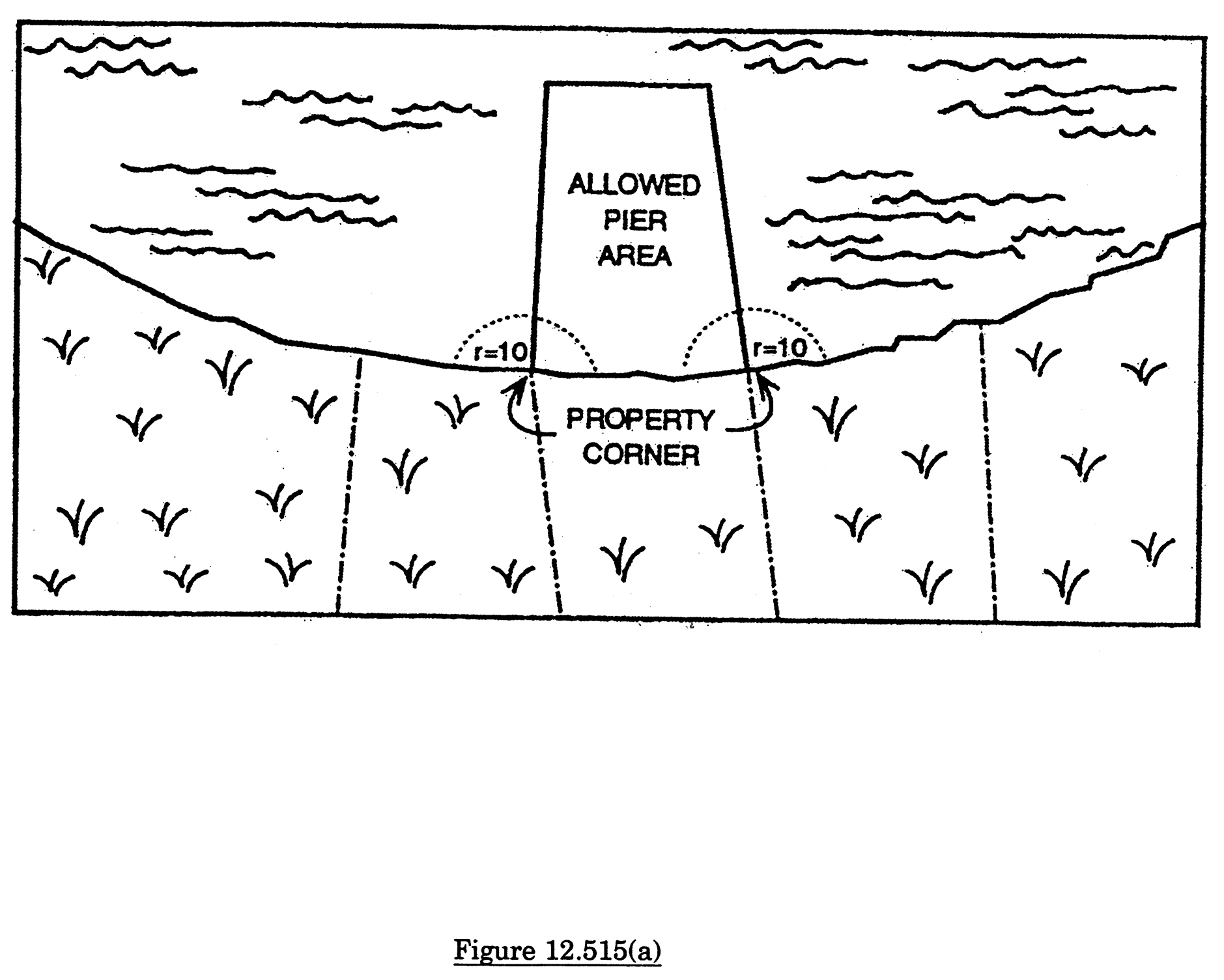
Allowed Pier Area
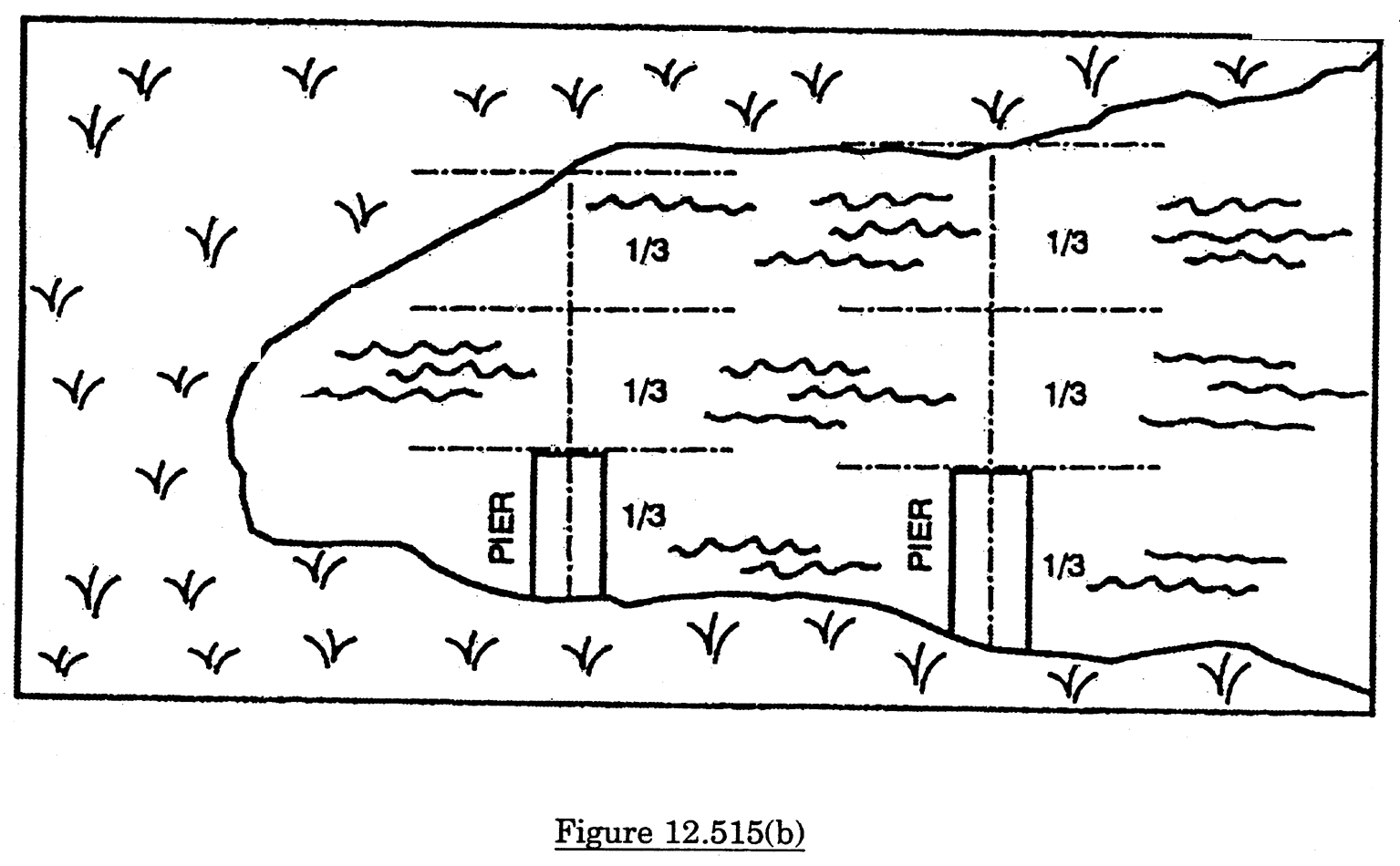
Piers
(c)
Piers serving more than fifty (50) dwelling units must also have a boat launching facility;
(d)
All piers shall be designed so that the top of the decking will be at least one foot above the water surface when at full pond level;
(e)
All piers and docks shall have two (2) white reflectors located at least six (6) inches above full pond level on the furthermost corners of the extension of the pier into the water, reflecting light parallel to the shoreline in each direction and directly across the lake or river in line with the shore from each corner. White reflectors shall be placed on each side of the pier at intervals of fifteen (15) feet or less, six (6) inches above the water, beginning at its outermost extension into the water, and extending to the shoreline at full pond level; and
(f)
Where a pier cannot be constructed within the above described area, due to existing nonconforming piers on nearby property or to unusual property configuration, the property owner may apply for, and the board of adjustment may grant a variance from this requirement. In granting the variance, the board of adjustment must find that the construction of pier facilities on other properties would not be preempted.
(3)
Moorings and floats placed in the water for navigational purposes shall only be so placed with the express written approval of the Lake Norman Marine Commission or the state wildlife commission, whoever has jurisdiction. Moorings and floats placed for the purpose of mooring boats shall be separated on every side from any other mooring or float by a distance of at least fifty (50) feet and shall be located so as to permit unobstructed passage of boats over the water. Moorings and floats shall not be anchored in such a manner as to deny or obstruct access to the water from boat docks, boathouses, or boat launching ramps. Moorings and floats shall conform with the uniform state waterway marking system.
(4)
Marine railways shall have permanent signs complying with the requirements of the state wildlife commission uniform state waterway marker system designating the location of the marine railway. Marine railways shall not extend above the normal or natural lake bed or river bed more than eighteen (18) inches between a horizontal measurement extending from the full pond level to a water depth of fifteen (15) feet below the full pond level, as diagrammed in Figure 12.515(c).
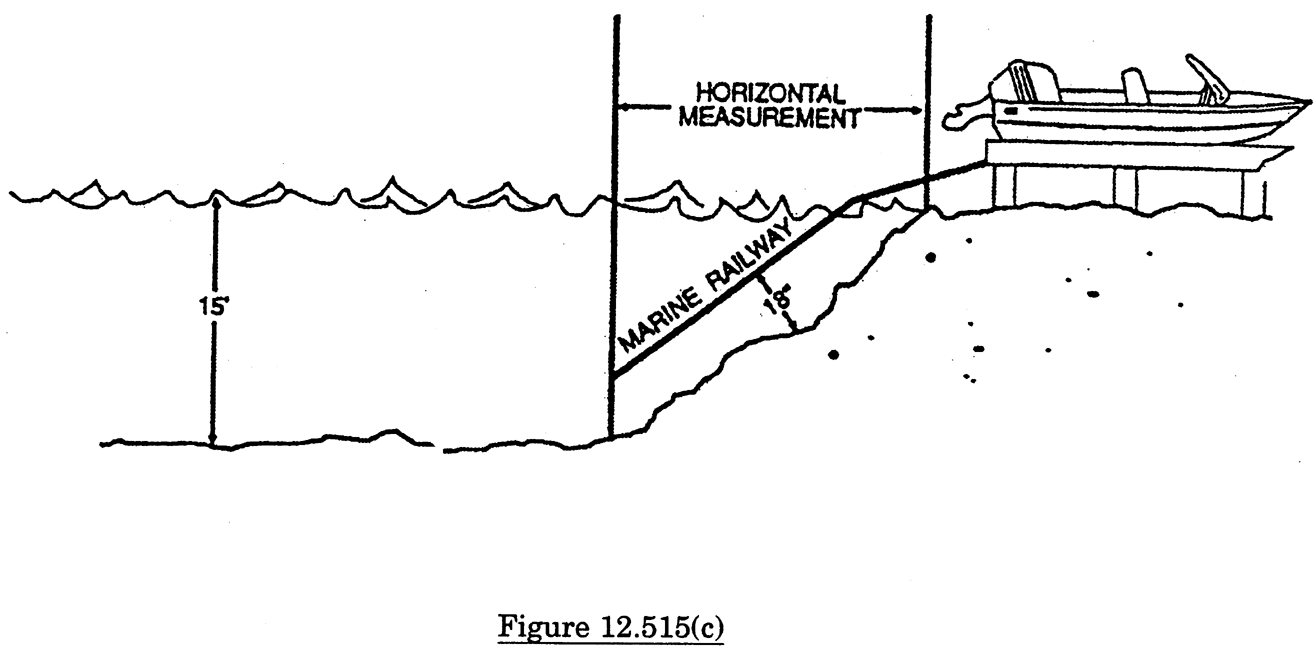
Water Depth
(5)
Breakwaters constructed for the purpose of protecting docks, piers, or other facilities, shall be placed to protect the particular facility for its width only and shall not obstruct or cause the obstruction of passage over the waters. Breakwaters shall be located and marked so as not to be a hazard to boating.
(6)
Areas specifically designated for swimming areas shall not be defined in water deeper than fifteen (15) feet and shall not extend more than eighty (80) feet from the shoreline. Swimming areas shall remain confined within the projection of the side lot lines of the lot on which the area is located and shall meet the side yard requirements of the underlying zoning district within which the lot is located. Public swimming areas shall be, and private swimming areas may be, marked and protected in conformance with state wildlife commission regulations.
(7)
Special requirements for other uses along the Catawba River and its impoundments are as follows:
(a)
All principal structures, except for boathouses, piers, walkways, breakwaters, and marine railways, shall be located at least forty (40) feet landward from the full pond level;
(b)
All filling operations shall be designed by a registered engineer and, if conducted within the waters of Lake Norman, reviewed by the Lake Norman Marine Commission, the Federal Energy Regulatory Commission, the property owner, and approved by Duke Power Company before beginning the fill. Any fill shall not be placed above the full pond level without proper and adequate riprapping to prevent the fill material from being eroded into the water. Fill shall be compacted to reach ninety (90) percent maximum dry density using the Standard Proctor Test as defined by ASTM D698 66T. Fill areas shall not obstruct access to the water, be a hazard to passage over the waters, or a nuisance to adjacent property owners;
(c)
Dredging shall not be conducted in such a way that the dredge spoil is placed back in the water so as to reduce water depth in areas outside of the dredged area. All dredging activities in Lake Norman shall be reported to the Lake Norman Marine Commission and the owner or his engineer, and approved by Duke Power Company prior to the beginning of any dredging;
(d)
Signs, other than navigational signs, shall not unduly obstruct the view of water from any adjacent shore from property and shall not be placed in the water or within twenty-five (25) feet of the shoreline. When lighted, signs shall have fixed, nonmoving, indirect or internal lighting. Off-site advertising signs placed or maintained to be visible from the water area are prohibited;
(e)
Lights installed for purposes other than navigation shall not inhibit vision in any way nor be so bright that they may cause night blindness for boat operators on the water. Lighting which offers navigational aid on Lake Norman, whether public or private, shall require approval by the Lake Norman Marine Commission; and
(f)
Overhead transmission lines shall be located at least forty-eight (48) feet above the full pond level.
(8)
Special procedures for review and approval of uses in and along Lake Norman. The following requirements shall apply to uses in and along the shoreline of Lake Norman:
(a)
The engineering and property management (for commercial and planned multi-family projects) or neighborhood development (for all other residential projects), shall submit one copy of any plans for a pier, mooring, float, marine railway, breakwater, sign, or swimming area to the Lake Norman Marine Commission for review and approval in accordance with adopted standards of the Lake Norman Marine Commission. Failure of the Lake Norman Marine Commission to respond to the plans within thirty (30) days after receiving them shall be interpreted as an approval.
(b)
The zoning administrator, or his or her designee shall refer requests for variances from the requirements of this part to the Lake Norman Marine Commission for its written opinion. The Lake Norman Marine Commission will evaluate the variance request as to the potential effect of the request on public recreation and water safety. The zoning administrator, or his or her designee shall transmit the Lake Norman Marine Commission's opinions to the zoning board of adjustment along with other pertinent information.
(Ord. No. 2026, § 1, 3-18-2002; Ord. No. 3017, § 1J, 6-20-2005)
Section 12.516. - Open space recreational uses.
Open space recreational uses, such as but not limited to, hot air balloon rides, bungee jumping, parachute jumping (not including airplane take-off or landing), polo matches, activities involving various athletic and ball fields and similar outdoor recreation, shall be permitted in all zoning districts subject to the following requirements.
(1)
Such uses shall not involve the use of motorized vehicles, such as dirt bikes, go carts, motorcycles, and similar uses.
(2)
The recreational use shall be temporary in nature. For purposes of this section temporary shall mean seasonal, certain hours of the day and/or week. It is intended that the use shall only operate at the site a minority of the time. In this regard the use shall not be allowed to operate more than one hundred eighty (180) days per year. The operator of the use shall be required to maintain an account of the days and hours of operation and shall make such records available upon request.
(3)
The use shall not involve or require the construction of a permanent building unless the building is permitted in the underlying zoning district.
(4)
A minimum of five (5) acres shall be required for the use, and, further, no portion of the use shall be allowed to be closer than fifty (50) feet to any adjoining line.
(5)
Ancillary support activities, such as the provision of food and beverages, parking and other concessions or vending operations shall be permitted on a temporary basis and only during the operation of the use.
(6)
Any signage which identifies the use shall be in accordance with the standards of the underlying zoning district. Furthermore, an area to support a minimum of eight (8) off-street parking spaces shall be provided.
The provisions of this section shall not apply to public parks or uses or activities within public parks, nor shall it apply to outdoor recreational uses defined under Section 2.201 of this zoning ordinance.
(Ord. No. 3523, § 1(59), 3-15-1993; Ord. No. 3811, § 1, 3-21-1994; Ord. No. 2544, § 1, 3-15-2004)
Section 12.517. - Group homes.
This ordinance provides for the location of group homes in a wide variety of residential and nonresidential districts. However, the public has an interest in assuring that a concentration of group homes within neighborhoods or along streets in residential districts be minimized. Accordingly, the following standard will apply to the location of group homes in single-family residential districts. New group homes must be separated from existing group homes in a single-family residential district by a distance of eight hundred (800) feet measured from the closest point of each lot property line in a straight line. This standard will not apply in circumstances when the sites are separated be a major thoroughfare, major topographical feature such as a major stream floodway, or by major nonresidential or public uses such as a park[,] school, church, or shopping or office area.
(Ord. No. 3432, § 1(9), 10-19-1992; Ord. No. 383, § 16, 9-18-1995)
Section 12.518. - Adult establishments.
Studies have shown that lowered property values and increased crime rates tend to accompany and are brought about by the concentration of adult establishments as defined herein. Regulation of these uses is necessary to insure that these effects do not contribute to the blighting of surrounding neighborhoods and to protect the integrity of the City's schools, churches, child care centers, parks and playgrounds which are typically areas in which juveniles congregate. It is the intent of this provision to establish reasonable regulations to prevent a concentration of adult establishments within the City of Charlotte and to separate adult establishments from those sensitive uses listed below.
Adult establishments are permitted in the B-2, UMUD, I-1, and I-2 districts subject to the following requirements:
(a)
Any structure in which an adult bookstore or adult mini motion picture theatre establishment is the principal or accessory use shall be separated by a distance of at least one thousand five hundred (1,500) feet from any residential district, school, church, child care center, park or playground. An adult establishment lawfully operating as a conforming use is not rendered a nonconforming use by the subsequent location of a residential district, school, church, child care center, park or playground within the 1,500-foot separation distance.
(b)
Any structure in which an adult establishment, other than an adult bookstore or adult mini motion picture theatre, is the principal or accessory use shall be separated by a distance of at least one thousand (1,000) feet from any residential district, school, church, child care center, park or playground. An adult establishment lawfully operating as a conforming use is not rendered a nonconforming use by the subsequent location of a residential district, school, church, child care center, park or playground within the 1,000-foot separation distance.
(c)
Any structure in which an adult bookstore or adult mini motion picture theatre establishment [is the] principal or accessory use shall be separated by a distance of at least one thousand (1,000) feet from any other adult establishment.
(d)
Any structure in which an adult establishment, other than an adult bookstore or adult mini motion picture theatre, is the principal or accessory use shall be separated by a distance of at least five hundred (500) feet from any other adult establishment.
(e)
The distance for the separation from residential zoning and protected uses shall be measured in a straight line from the closest edge of the building occupied by an adult use to the nearest residential zoning district or to the property line of a protected use. The distance for the separation between adult uses shall be measured in a straight line from the closest edges of the buildings occupied by adult uses.
(f)
No more than one adult establishment may be located within the same structure.
(g)
In addition to the standards set forth in section 5.108, before granting a variance from the separation requirements set forth in subsection (a) or (b) of this section, the board of adjustment shall find that thoroughfares, traffic circulation patterns, structures or other natural or man-made geographic or topographic features are likely to provide an adequate measure of protection for the protected zoning or use from any secondary effects of the adult establishment.
(Ord. No. 3782, § 2, 1-18-1994; Ord. No. 489, § 1, 3-18-1996)
Editor's note— Section 3 of Ord. No. 3782, adopted January 18, 1994, provided that all existing adult establishments that are nonconforming with respect to section 12.518(a) or (b) must comply with the provisions of Ord. No. 3782 within eight (8) years of the effective date (January 18, 1994).
Section 12.519. - Outdoor seasonal sales.
Outdoors seasonal sales are temporary uses, which include but are not limited to Christmas tree sales, pumpkin sales, plant sales, fresh produce sales (outdoors seasonal fresh produce stands are not considered to be outdoor seasonal sales, nor an outside open market), and similar uses. Outdoors seasonal sales are not intended to include the sale of manufactured items such as furniture, bedding, automobile parts, or household goods. Such sales are permitted in all nonresidential zoning districts as a use by right subject to the standards of the underlying zoning district. Outdoors seasonal sales shall be permitted in all residential districts subject to the following conditions:
(1)
Any operator of a seasonal sales use must receive a permit from neighborhood development, which describes the type of sales involved, and the duration of the sales operation.
(2)
Such sales shall not operate more than a total of ninety (90) consecutive days per calendar year.
(3)
The use may only be located on a vacant lot or on a lot occupied by a nonresidential use such as a church or school. The use shall not operate as an accessory to a principal residential use on a lot. In addition, the use shall not be located on a lot which adjoins a residential use unless the lot is located on a major thoroughfare.
(4)
The use shall be located on a Class III, III-C, or IV street.
(5)
The use shall not involve or require the construction of a permanent building.
(6)
Any signage which identifies the use shall be in accordance with the underlying zoning district.
(7)
Five (5) off-street parking spaces shall be provided for the use.
(8)
The use, including all sale items, parking and maneuvering shall observe a setback of fifteen (15) feet and sale items shall not be located in the sight distance triangle.
(9)
The operator is responsible for the removal of any vestige upon cessation of the seasonal sale including signage.
(10)
There shall be no more than one periodic retail sales event (either off-premise or on-premise), or one outdoor seasonal sales permit issued at any one time on a tax parcel.
(Ord. No. 3892, § 3, 7-17-1994; Ord. No. 950, § 1, 11-17-1997; Ord. No. 2915, § 1D, 3-21-2005; Ord. No. 3010, § 1C1, 6-20-2005; Ord. No. 3017, § 1J, 6-20-2005; Ord. No. 3748, § 1, 11-19-2007)
Section 12.520. - Boardinghouses.
Boardinghouses are permitted in all Single-Family, Multifamily and Office districts, the UR-1, B-1, B-2 UMUD districts, and the Mixed Use (MX-1, MX-2 and MX-3) conditional districts subject to the following standards that apply to the applicable districts:
(1)
The property owner or lessee must reside on the same premises as the boardinghouse with the structure serving, clearly as that person's permanent residence, which shall be the principal use of the structure.
(2)
Number of boarders and boarding rooms permitted.
(a)
All Single-Family and Mixed Use districts, and the UR-1 district—limited to four (4) boarders in no more than two (2) bedrooms.
(b)
All other districts where permitted—maximum of eight (8) boarders in no more than four (4) bedrooms.
(c)
Elderly and disabled housing when permitted as an accessory to any single-family detached dwelling unit will not count as part of the permitted number of boarders or boarding rooms, nor can they be used for boarding rooms.
(3)
The quarters to be utilized by the boarders and the occupants of the premises shall be in the principal residential structure. Separate structures, accessory buildings and garages are not permitted to be used as boarding rooms. No separate exterior doorways for individual boarding rooms shall be permitted.
(4)
Any signage which identifies the use shall be in accordance with the underlying zoning district.
(5)
The location of parking for boarders shall comply with section 12.206 as a single-family detached dwelling unit, except any additional parking beyond what can be accommodated in a driveway no wider than to sufficiently park two (2) cars must be out of the required setback and yards as specified in section 12.206. Parking for boarders shall not be served by a separate driveway from that serving the principal residential structure.
(6)
The Zoning Board of Adjustment shall not have jurisdiction to vary any of these standards, but shall have jurisdiction to interpret questions regarding the use of the property.
(Ord. No. 389, § 4(B), 10-16-1995)
Section 12.521. - Bed and breakfasts (B & B's).
Bed and breakfasts (B & B's) are permitted in all Single-Family, Multi-Family, and Office districts, the UR-1, UR-2, UR-3, B-l, B-2, MUDD, UMUD districts, and the Mixed Use (MX-1, MX-2, and MX-3) conditional districts subject to the following standards that apply to the applicable districts:
(1)
A bed and breakfast in any Single-Family district and in the Mixed Use (MX-1, MX-2, MX-3) conditional districts shall be located on a major, minor, or collector street. B & B's in any other district may by be located on any class of street.
(2)
Number of guest rooms permitted;
(a)
All Single-Family and Mixed Use districts, and the UR-1 district—Limited to four (4).
(b)
All other districts where permitted—Maximum of eight (8).
(c)
Elderly and disabled housing when permitted as an accessory to any single-family detached dwelling unit will not count as part of the number of bed and breakfast guest rooms, nor can they be used to house guests.
(3)
The quarters to be utilized by the guests and the occupants of the premises shall be in the principal residential structure. Separate structures, accessory buildings and garages are not permitted to be used as living units or sleeping rooms for bed and breakfast guests. No separate exterior doorways for individual guest rooms shall be permitted, unless the separate doorway was part of the original architecture of the house and was in existence prior to the adoption date of this provision.
(4)
Guests are limited to a length of stay of no more than seven (7) consecutive days. The resident owner shall keep a current guest register including names, permanent addresses, dates of occupancy, and motor vehicle license number of all guests.
(5)
B & Bs may provide food service, but only to guests lodging in the facility. No food preparation will be allowed in any guest bedroom.
(6)
Any signage which identifies the use shall be in accordance with the underlying zoning district.
(7)
The location of parking shall comply with section 12.206 as a single-family detached dwelling unit, except any additional parking beyond what can be accommodated in a driveway no wider than to sufficiently park two (2) cars must be out of the required setback and yards as specified in section 12.206. Parking for guests shall not be served by a separate driveway from that serving the principal residential structure.
(Ord. No. 305, § 1.4(B), 6-19-1995; Ord. No. 4169, § 1, 5-19-2009)
Section 12.522. - Short-term care facility.
Short-term care facilities are permitted in the Institutional, O-1, O-2, O-3, B-2, MUDD, UMUD, TOD-E, TOD-M, U-I, and I-1 zoning districts, subject to the standards of the individual district in addition to the following requirements. If any conflict should occur between the standards of the individual district and the following requirements, the following shall apply:
(1)
Operation.
(a)
Adequate on-site management shall be provided on a 24-hour basis. This includes having staff (employees or volunteers) on the premises twenty-four (24) hours a day. The staff must be accessible to residents, law enforcement personnel, and any other individuals who need to establish communication upon or about the premises. Adequate on-site management also requires that the staff have the authority to exercise control over the premises to ensure that the use of the premise does not result in littering, nuisance activities, noise, or other activities that interfere with the peaceful enjoyment and use of surrounding properties.
(b)
Cleaning services and utilities shall be provided.
(2)
Minimum requirements. Short-term care facilities shall provide full restroom facilities, common dining areas, and secure storage or refrigerators for medications.
(3)
Minimum bedroom size. A bedroom of the following size shall be provided per individual. Bedrooms shall be a minimum of eighty (80) square feet for the first occupant. If more than one occupant is assigned per bedroom, then an additional minimum of fifty (50) square feet shall be provided for each additional occupant.
(4)
Minimum common space. The building shall contain not less than two hundred and fifty (250) square feet of common open space such as living rooms, common dining areas, or other congregate living space. Bathrooms, laundries, hallways, vending areas, and kitchens shall not be counted as common space.
(5)
Off-street parking requirements. A minimum of two (2) parking spaces is required, plus one parking space per each employee/volunteer over two (2) in number.
(6)
Referral of individuals and length of stay. Only individuals requiring short-term convalescent care services and referred by hospitals and emergency rooms, or other medical clinic or medical practices shall be allowed. Individuals shall stay no longer than twenty (20) days following a hospital/emergency room discharge, or medical clinic or medical practice referral, unless a longer recuperation period is requested by a licensed physician and approved by the facility director, but no greater than forty-five (45) days.
(7)
Signs. Any signage that identifies the use shall not exceed four (4) square feet in size, and shall not be illuminated. One identification sign is permitted per street front.
(8)
Buffers. All buildings and off-street parking and service areas shall be separated by a Class C buffer from any abutting property zoned or used for residential purposes, except for those districts where buffers are not required.
(Ord. No. 2773, § 3, 10-18-2004; Ord. No. 4812, § 1, 1-25-2012)
Section 12.523. - Beneficial fill sites.
Beneficial fill sites with an operational area (i.e., planned disposal area) of one-fourth acre or more in size are permitted in all zoning districts in accordance with the requirements listed below:
(1)
The "Operational Guidelines for Beneficial Fill Sites" approved by the Board of County Commissioners must be followed.
(2)
Any such site may not be operated for more than 12 months, after which time it must be closed in an approved fashion.
(3)
Vehicular access to the site must be paved and will be provided from any Class II, III, III-C, IV or V-C street. Access from any other street classification will require a variance from the Zoning Board of Adjustment. The Zoning Administrator will cause the site to be posted with a notice at least 14 calendar days prior to the hearing stating the proposed use, date of hearing and where additional information can be obtained.
(4)
The site may be operated only between the hours of 8:00 a.m. and 6:00 p.m., Monday through Saturday.
(5)
Final fill elevations must match or compliment [complement] adjacent surrounding topography. The final contours and drainage patterns of the fill area may not adversely affect adjacent properties.
(6)
No fill which incudes used asphalt may be placed in any portion of a regulatory floodplain, including both the floodway and floodway fringe area.
(7)
No portion of any such site may be located within 15 feet of any exterior property lines. This includes structures, equipment storage, parking areas and fill areas; however, during closure of the site, the buffer area may be filled if necessary to match or compliment [complement] adjacent surrounding topography.
(8)
The location of any such site must be indicated on any required final subdivision plat. Further, any parcel or lot which contains any part of any such site must have notification of the existence and extent of the site recorded as part of the deed for the lot or parcel, even if no subdivision plan is required for the development of the property.
(9)
Fill activity is not exempt from and must comply with, all other applicable federal, state, and local laws, ordinances, rules, and regulations, including, but not limited to, other zoning restrictions, floodplain restrictions, wetland restrictions, mining regulations, sedimentation and erosion control regulations.
Beneficial fill sites of less than one-fourth acre on one parcel do not require a zoning permit or site approval and are exempt from this section, except for conditions (4), (5), (6), (7) and (9) above. In addition, condition (8) is required, if it contains material such as concrete, concrete block, brick or used asphalt.
(Ord. No. 772, § 1(2)(B), 3-17-1997)
Editor's note— Ord. No. 772, § 1(2)(B), (D), adopted March 17, 1997, amended App. A by adding provisions designated as § 12.522. Inasmuch as Ord. No. 382, § 1, adopted Sept. 18, 1995, already enacted provisions designated as § 12.522, the editor has redesignated these new provisions as §§ 12.523 and 12.524.
Section 12.524. - Construction and demolition (C & D) landfill.
Construction and demolition (C & D) landfills are permitted in the General Industrial (I-2) district in the City of Charlotte subject to the same provisions of section 12.507.[,] Sanitary landfill, except that the minimum acreage requirement is not applicable.
(Ord. No. 772, § 1(2)(D), 3-17-1997)
Note— See the editor's note to § 12.523.
Section 12.525. - Medical waste disposal facilities.
(1)
Intent. Thousands of cubic feet of medical waste are handled in Mecklenburg County and its environs in pursuit of health care for area citizens each year. Therefore, it is incumbent upon local government to assume its responsible role in the management of these materials. Starting from this premise, the purpose of these regulations are:
(a)
To assure that medical waste disposal facilities are sited in a manner consistent with the public health, safety and welfare;
(b)
To assure that the risks to the community are minimized to the greatest extent reasonably possible; and
(c)
To assure that the decisions with regard to the siting of medical waste disposal facilities are made in an objective fashion.
(2)
Definitions. For purposes of these regulations, the following terms are defined:
(a)
Medical waste means any solid waste which is generated in the diagnosis, treatment, or immunization of human beings or animals, in research pertaining thereto, or in the production or testing of biological matter, but does not include any hazardous waste identified or listed pursuant to the most current North Carolina General Statutes, radioactive waste, household waste as defined in Federal Regulations or those substances excluded from the definition of "solid waste" in the latest General Statutes. In the event that the definition of "medical waste," as defined therein, is amended to include additional wastes within the definition of "medical waste," this definition shall be automatically amended to include said additional wastes;
(b)
A medical waste disposal facility is a building, structure or use of land devoted, or intended to be devoted, to the storage, treatment or disposal of medical waste and that contains process equipment for the treatment of medical waste;
(c)
Process equipment means any equipment or device for treating medical waste which requires any type of state or local permit in order to treat medical waste; and
(d)
Treatment means any process, including steam sterilization, chemical treatment, incineration or other methods approved by the North Carolina Commission for Health Services which changes the character or composition of medical waste so as to render it noninfectious.
(3)
Application. Applications for medical waste disposal facility zoning permit must be submitted to engineering and property management, which will consider and determine entitlement to the permit based upon the regulations contained in this section. Before a decision is rendered there shall be a notification period and a public forum as described in section 4.106. Public notification process for certain land uses. Applications for minor changes or modifications which will not alter the basic relationship to surrounding properties will be submitted to engineering and property management which will consider and determine entitlement based upon these same regulations but without the notification period and public forum. Additions to any existing building or structure of ten (10) percent or one thousand (1,000) square feet, whichever is less, will not require the notification period and public forum.
However, if additional land is being considered, the notification period and public forum requirements will apply.
Applications for medical waste disposal facility must include the following information:
(a)
Maps of the area within five hundred (500) feet of the exterior property lines of the proposed site, and including the proposed site, which show:
(i)
All dwelling units, places of public assembly, other principal buildings and structures and streets;
(ii)
All significant topographical features;
(iii)
All surface water;
(iv)
All sanitary sewer systems;
(v)
All stormwater management systems; and
(vi)
All wells.
(b)
An engineering certification for the proposed site concerning the factors of:
(i)
Surface water drainage;
(ii)
Flooding; and
(iii)
Prevailing wind direction.
(c)
Copies of applications (or permits if they have been received) to the appropriate local, state and/or federal agencies for any of the following permits which are required for the facility:
(i)
Air quality permits;
(ii)
Solid waste permits; and
(iii)
Wastewater disposal permits.
(d)
A certification from the Mecklenburg County Director of Environmental Protection that the facility and its operations as proposed are consistent with the best commercially available design specifications and operating practices.
(4)
Special requirements. Medical waste disposal facilities as a principal use may be permitted within the General Industrial (I-2) district and are subject to all appropriate provisions of these regulations and the following supplementary requirements. Medical waste disposal facilities as an accessory use may be permitted within the institutional district, office districts, business districts and industrial districts, and are subject to all appropriate provisions of this section and the following supplementary requirements:
(a)
All storage, treatment and loading facilities handling medical waste as a principal use must be located at least three hundred (300) feet from any property zoned residential or used for residential purposes; as an accessory use, one hundred (100) feet;
(b)
Fences which are not easily climbed and are a minimum of seven (7) feet high must be installed as a safety device around all portions of the facility directly involved in the storage and handling of medical waste;
(c)
Access to medical waste disposal facilities must not make use of any residential collector or residential local streets;
(d)
All surface water and groundwater on the site must be controlled so as to minimize to the greatest extent reasonable the probability of contamination from medical waste;
(e)
All sanitary sewer and stormwater management systems on the site must be protected so as to minimize to the greatest extent reasonable the probability of contamination by medical waste; and
(f)
After approval for the zoning permit, the facility must be operated in accordance with all applicable provisions of the appropriate state and federal legislation and must hold the proper valid permit(s) issued by the appropriate state and federal agencies governing the facility's operation.
(5)
Factors. As a prerequisite to approval of an application for a medical waste disposal facility zoning permit, engineering and property management will take into consideration in reviewing the application and submitted material that:
(a)
That safe and adequate access to the facility for general, service and emergency purposes will not require the use of any residential collector or residential local streets;
(b)
That the operation of the facility will not produce fumes, odors, noise, dust, smoke or gases which will substantially adversely affect nearby properties; and
(c)
That all surface water, groundwater, sanitary sewer systems and stormwater management systems will be controlled so as to minimize to the greatest extent reasonable the probability of contamination by medical waste.
(Ord. No. 999, § 4(d), 2-16-1998; Ord. No. 3017, § 1J, 6-20-2005)
Section 12.526. - Solid waste transfer stations.
A solid waste transfer station is a facility which receives and temporarily stores solid waste as defined by this ordinance at a location other than the generation site, and which facilitates the transfer of accumulated solid waste to another facility for further processing or disposal. This term does not include recycling centers nor portable storage containers used for the collection of municipal waste.
Solid waste transfer stations may be established in the General Industrial (I-2) district subject to the requirements of this section:
(1)
Applications for a solid waste transfer station must be submitted to engineering and property management which will consider and determine entitlement to the permit based upon the regulations contained in this section. Before a decision is rendered there shall be a notification period and public forum as described in section 4.106. Public notification process for certain land uses. Application for minor changes or modifications which will not alter the basic relationship to surrounding properties will be submitted to engineering and property management which will consider and determine entitlement based upon these same regulations. Additions to any existing building or structure of ten (10) percent or one thousand (1,000) square feet, whichever is less, will not require the notification period and public forum. However, if additional land is being considered, the notification period and public forum requirements will apply.
(2)
Minimum site size is ten (10) acres.
(3)
All on-site processing and transferring of sold [solid] waste will be conducted entirely within an enclosed building(s). An enclosed building for these purposes is one in which the walls, doors and roof are made of solid materials but may contain windows and skylights.
(4)
Doors to the building(s) shall remain closed except to temporarily allow transport trucks to enter and exit the building.
(5)
Vehicle access to the site will be paved and will be provided only from any Class I, II, III, III-C or IV street or from any street built to commercial or industrial standards which leads directly from a Class I, II, III, III-C or IV street. Acceleration/deceleration lanes will be provided unless the appropriate transportation department determines they are not suitable at that particular location. All access driveways which serve the site for ingress and egress must be wide enough to accommodate two lanes of traffic. An area on the site must be provided between the entrance off the street and the solid waste transfer building to accommodate a minimum of ten (10) vehicles and no vehicles will be allowed to back up on any public right-of-way.
(6)
All activities of a solid waste transfer station must be located a minimum of fifty (50) feet from any exterior property line, except the minimum shall be increased to five hundred (500) feet from any residential zoning district or from any lot line of property used for a residential dwelling unit.
(7)
All existing trees and vegetation on the solid waste transfer station site are to remain in an undisturbed condition for the distances specified in item (6) above. Where the natural growth is inadequate to materially screen the site from the view of adjoining properties and from a public street, vegetation will be provided according to Class A buffer requirements. When the site is adjoining residentially zoned property, the exterior one hundred (100) feet must contain vegetation equivalent to a Class A buffer adjacent to the exterior property. When adjacent to any nonresidential zoning district, a 50-foot Class A buffer will be provided at the exterior property line. This 50-foot buffer can be the same minimum distance separation as stated above. The access to the site and utilities serving the site may cross all of these areas; however, underground utility areas will be replanted after installation. It is the intent of this provision that these driveways and utilities be basically in a straight line and as nearly perpendicular to the property line as possible.
(8)
When solid waste transfer stations are adjoining any residential zoning district, the facility may not be operated on Sunday or earlier than 7:00 a.m. or later than 6:00 p.m. on any other day.
(9)
Solid waste transfer stations must be served by public water and sewer facilities.
(Ord. No. 999, § 4(e), 2-16-1998; Ord. No. 3017, § 1J, 6-20-2005)
Section 12.527. - Single room occupancy (SRO) residences.
Single room occupancy (SRO) residences are permitted in the UR-2, UR-3, UR-C, O-1, O-2, O-3, B-1, B-2, UMUD, TOD-R, TOD-E, TOD-M, TOD-RO, TOD-EO, and TOD-MO, districts subject to the standards of the individual district in addition to the following requirements. If any conflict should occur between the standards of the individual district and the following requirements, the following shall apply:
(1)
Minimum rooming unit size: Rooming units shall be a minimum of eighty (80) square feet, not to exceed four hundred fifty (450) square feet total.
(2)
Rooming unit capacity: Rooming units in single room occupancy residences shall be limited to one (1) occupant per room.
(3)
Minimum common space: The building shall contain common space such as recreation areas, lounges, living rooms, dining rooms, or other congregate living spaces at a rate of five (5) square feet per rooming unit, but totaling not less than two hundred fifty (250) square feet. Bathrooms, laundries, hallways, the main lobby, vending areas, and kitchens shall not be counted as common space.
(4)
Operation: Rooming units in each building must be accessed through one primary location. On-site management shall be provided on a 24-hour basis per building. Adequate on-site management includes having an employee on premises twenty-four (24) hours a day. The employee must be accessible to residents, law enforcement personnel, and any other individuals who need to establish communication upon or about the premises. Adequate on-site management also requires that the employee has the authority to exercise control over the premises to ensure that the use of the premises does not result in littering, nuisance activities, noise, or other activities that interfere with the peaceful enjoyment and use of surrounding properties.
Cleaning services shall be provided and utilities shall be mass metered.
(5)
Number of rooming units permitted: The number of rooming units permitted shall be based upon the maximum non-residential floor area ratio (FAR) of the zoning district where located with a maximum of one hundred twenty (120) and a minimum of eleven (11) rooming units per site.
(6)
Off-street parking requirements: 0.20 space per rooming unit - may be reduced by fifty (50) percent within a quarter mile of transit line.
(7)
Signs: Any signage which identifies the use shall be in accordance with subsection 13.109(1)(c) of the city zoning ordinance.
(8)
Buffers: All buildings, outdoor active recreation facilities, and off-street parking and service areas will be separated by a Class B buffer from any abutting property zoned or used for single-family residential use.
(9)
Proximity: Single room occupancy residence sites shall maintain a minimum separation distance of one-half (0.5) mile from any other single room occupancy residence site, measured from the closest property line of each development.
(10)
Expansions of existing, legal conforming single room occupancy residences: Any legally conforming single room occupancy residence that exists as of the adoption of these regulations (July 18, 2011) shall be allowed to expand consistent with section 12.527, including existing, legal conforming single room occupancy residences located in the Institutional, Urban Industrial, and Industrial zoning districts.
(Ord. No. 1274, § 3, 5-17-1999; Ord. No. 2412, § 3(5)A, 10-20-2003; Ord. No. 4697, § 1, 7-18-2011)
Section 12.528. - Enclosure at foundation for structures.
All structures for residential and nonresidential occupancy must have a solid wall enclosure at the foundation that is of a material that is properly installed and complies with all state codes. If not required by state code, the structure must nevertheless have a continuous, permanent masonry wall, having the appearance of a conventional load-bearing foundation wall, unpierced except for required ventilation and access, which must be installed under the perimeter of any modular structure. The director of engineering and property management (for commercial and planned multi-family projects) or the director of neighborhood development (for all other residential projects), or their designee(s) are authorized to waive the applicability of this section in its entirety or with conditions attached, if the local administrator of chapter 9, "Floodway Regulations," of the City Code recommends to the designated agency that a structure must be elevated because of the location of the structure in an area of a floodway or of a flood hazard. This section shall only be applicable to new construction, except, notwithstanding the foregoing, this section shall not apply to any mobile or module units, including without limitation mobile classrooms, used at any school (public or private) or a place of worship.
(Ord. No. 1927, § 1, 10-17-2001; Ord. No. 3017, § 1J, 6-20-2005)
Section 12.529. - Sidewalk connections to public streets.
In order to promote and encourage pedestrian circulation, it is important to provide safe and adequate sidewalk facilities. Therefore, sidewalk connections will be required as described below for new commercial development, except for the following exceptions:
(a)
A change of use in an existing building from a commercial use to another commercial use.
(b)
Expansions of less than five (5) percent of the building area or one thousand (1,000) square feet, whichever is less.
(c)
Facade improvements to existing buildings.
(d)
Individual uses within a shopping center or a unified complex are not required to provide separate sidewalk connections as long as the entire center or complex as a whole provides common sidewalk connections.
1.
Sidewalk connections shall be required after the effective date of this amendment between certain commercial buildings and all adjoining public streets except for freeways or expressways.
2.
Commercial uses requiring sidewalk connections to streets include residential buildings of four (4) or more dwelling units, general offices and medical clinics, institutional uses, retail establishments, and industrial uses, except for the following uses:
Various kinds of care centers with less than six (6) patrons provided there is a driveway connection to the street.
Abattoirs.
Agricultural industries and farms.
Airports.
Boarding stables and riding academies.
Contractor offices and accessory storage.
Foundries.
Hazardous materials storage and treatment.
Heliports and helistops, unlimited.
Junkyards.
Lumber mills and storage yards.
Medical waste disposal facilities as a principal use.
Outdoor seasonal sales.
Petroleum storage facilities.
Power generation plants.
Quarries.
Raceways and drag strips.
Radio and television towers.
Sanitary landfills.
Theaters, drive-in-motion picture.
Truck stops.
Truck terminals.
Utility operations centers.
Warehousing.
Waste incinerators.
3.
Sidewalk connections shall be made to all streets adjoining the use.
4.
Sidewalk connections shall be a minimum width of five (5) feet and must be constructed of concrete, asphalt, or other material suitable to the individual landscape setting as determined by the planning director or assigns. An individual sidewalk connection will not be required if it would result in a length of one thousand three hundred twenty (1320) feet or more.
(Ord. No. 1953, § 1, 11-19-2001)
Section 12.530. - Day labor service agencies.
Day labor service agencies are permitted in the Institutional, Research, Office, Business, UMUD, U-I and Industrial zoning districts subject to approval of a site plan that shall meet the following special requirements:
(1)
Minimum spacing requirements. Any structure in which a day labor service agency is the principal or accessory use shall be separated by a distance of at least six hundred (600) feet from any residentially zoned district or from any existing residential use. The distance shall be measured in a straight line from the closest edge of any building occupied by a day labor service agency to the nearest residential zoning district or to the property line of a residential use.
(2)
Minimum spacing between day labor service agencies. Any structure in which a day labor service agency is the principal or accessory use shall be separated by a distance of at least one thousand (1,000) feet from any other day labor service agency. The distance shall be measured in a straight line from the closest edges of the buildings occupied by day labor service agencies.
(3)
Operation and on-site management. On-site management shall be provided during normal business hours, defined as the usual time of day laborers begin to gather, or 7:00 a.m., whichever occurs first. Adequate on-site management includes having an employee on premises during the hours of operation. The employee must be accessible to day laborers, law enforcement personnel, and any other individuals who need to establish communication upon or about the premises. Adequate on-site management also requires that the employee has the authority to exercise control over the premises to ensure that the use of the premises does not result in littering, nuisance activities, noise, or other activities that interfere with the peaceful enjoyment and use of surrounding properties.
(4)
Day laborer waiting area and permanent interior restroom facilities. The day labor service agency shall provide adequate seating for day laborers in an accessible waiting area of the day labor service agency. The day laborer waiting area shall allow for access to restrooms and water, during the hours of operation, but starting no later than 7:00 a.m. The day laborer waiting area shall be sized to adequately accommodate the maximum number of day laborers expected per day, and have a minimum size of twelve (12) feet × twelve (12) feet.
(5)
Nonconformity and amortization. If there is a use of a structure that purports to be a lawful "day labor service agency" under the zoning ordinance, before the effective date of this ordinance, then such use must have lawfully come into existence pursuant to any required zoning ordinance permits, and must have complied with, and continued to comply with, any of the applicable zoning ordinance standards when the use lawfully came into existence. All existing nonconforming agencies that are nonconforming with respect to subsections 12.530(1), (2), (3) or (4) must comply with the provisions of this section within the following amortization periods:
(a)
Section 12.530(1) "Minimum Spacing Requirements", within two (2) years of the effective date of Section 12.530.
(b)
Section 12.530(2), "Minimum Spacing Between Day Labor Service Agencies", within two (2) years of the effective date of Section 12.530.
(c)
Section 12.530(3), "Operation and On-Site Management", within six (6) months of the effective date of Section 12.530.
(d)
Section 12.530(4) Day Labor[er] Waiting Area and Permanent Interior Restrooms", within two (2) years of the effective date of Section 12.530.
(Ord. No. 1959, § 1, 11-19-2001)
Section 12.531. - Commercial roominghouses.
Commercial roominghouses are permitted in the B-1, B-2, BP, UMUD, MUDD, U-I, and I-1 districts subject to the standards of the individual district in addition to the following requirements. If any conflict should occur between the standards of the individual district and the following requirements, the following shall apply and a failure to comply with any of the following shall constitute a violation of this chapter:
(1)
Maximum number of rooms and roomers. The maximum number of rooming units shall be ten (10) per site, subject to any applicable nonresidential floor area ratio (FAR) of the zoning district where located. The maximum number of occupants per house shall be ten (10), including any live-in personnel who are responsible for management and operation.
(2)
Minimum rooming unit size. Rooming units shall be a minimum of eighty (80) square feet with an additional minimum of fifty (50) square feet for an additional occupant in a room. No more than two (2) occupants are permitted per room.
(3)
Operation. There must be a person(s) responsible for the operation of the commercial roominghouse available, either on site or by phone, twenty-four (24) hours a day. This person(s) must be accessible to residents, law enforcement personnel, and any other individuals who need to establish communication concerning the premises. The owner and this responsible person(s) must exercise control over the premises to ensure that the use of the premises does not result in littering, nuisance activities, noise, or other activities that interferes with the peaceful enjoyment and use of surrounding properties.
(4)
Off-street parking requirements. A minimum of one space plus two-tenths (0.20) space per rooming unit. The two-tenths (0.20) space per rooming unit may be reduced by fifty (50) percent within a quarter mile of [a] transit line.
(5)
Signs. Any signage that identifies the use shall be in accordance with the underlying zoning district.
(6)
Buffers. All buildings, outdoor recreation facilities, and off-street parking and service areas shall be separated by a Class C buffer from any abutting property zoned or used exclusively for a residential use.
(Ord. No. 1997, § 1, 1-22-2002)
Section 12.532. - Homeless shelters.
This section provides for the location of homeless shelters in a wide variety of non-residential zoning districts: INST, B-2, B-D, B-P, UMUD, MUDD, U-I, and I-1. However, the public has an interest in assuring that a concentration of homeless shelters be minimized. Accordingly, homeless shelters are subject to the following additional requirements:
(a)
Location. New homeless shelters must be separated from existing homeless shelters by a distance of eight hundred (800) feet measured in a straight line from the closest edges of the buildings occupied by homeless shelters from the closest property lines of the homeless shelters.
(b)
Buffers. A Class B buffer shall be provided along all property lines abutting residentially zoned and/or used property.
(c)
The property shall have a minimum size of two (2) acres.
(Ord. No. 2941, § 3A, 4-18-2005; Ord. No. 4658-Z, § 1, 5-23-2011)
Section 12.532.1. - Donation drop-off facilities.
Donation drop-off facilities are permitted in all single-family and multi-family residential districts, the urban residential districts of UR-3 and UR-C, and the non-residential districts of INST, RE-1, RE-2, RE-3, O-1, O-2, O-3, B-1, B-2, BD, BP, CC, MUDD and UMUD, I-1, and I-2, subject to the following conditions:
(1)
Permitted in single-family, multi-family and the UR-3 and UR-C districts only as an accessory use to a public utility structure, or as an accessory use to an institutional use.
(2)
No outdoor storage of donated items is permitted.
(3)
If the drop-off facility is an accessory use, then the facility, parking, and unloading area shall meet the setback and yard requirements of the principal building based upon the zoning district in which it is located.
(4)
If the drop-off facility is a principal use, it shall meet the setback and yard of the zoning district in which it is located. The location of the facility, parking, and unloading areas are subject to approval by the zoning administrator.
(5)
All drop-off structures shall be a minimum of one hundred (100) feet from abutting residentially zoned property.
(6)
The drop-off facility including unloading area, trash handling and dumpster areas shall be screened from abutting property and view from a public street according to the standards of section 12.303.
(7)
Any open area beneath a storage unit shall be enclosed with a durable skirting material as deemed suitable by the zoning administrator.
(8)
Donation drop-off facilities located in residential districts shall be limited in size to three hundred forty (340) square feet.
(9)
Donation drop-off facilities shall have an employee or volunteer on duty during all hours of operation, or have a mechanism in place to prevent after-hour deposit of donations on the site, such as a locked gate.
(10)
Items that may not be accepted include large appliances such as washer/dryers, stoves, refrigerators, and other large or bulky items such as furniture, that cannot be stored inside the collection facility.
(11)
The donation drop-off facility shall display the ownership/identification information on the facility, with a contact phone number, in a prominent location. A sign permit is not required for identification signage that is no larger than one and one-half (1½) square feet in area.
(Ord. No. 2674, § 1, 9-20-2004; Ord. No. 4658-Z, § 1, 5-23-2011)
Editor's note— Ord. No. 2674, § 1, adopted September 20, 2004, enacted provisions intended for use as section 12.532. Inasmuch as there are already provisions so designated, and at the discretion of the editor, said provisions have been redesignated as section 12.532.1.
Section 12.533. - Funeral homes, with accessory embalming in the institutional zoning district.
Funeral homes are permitted in the institutional district subject to the following requirements.
(1)
Funeral homes shall only be developed on lots that front onto, and have their principal vehicular access from a major or minor thoroughfare (class III or IV street).
(2)
Funeral homes, as a principal use, shall only be permitted on lots of two (2) acres in size, or greater.
(3)
Funeral homes shall be located a minimum of one hundred (100) feet from any residentially used or zoned property, measured from the building to the residential property line.
(4)
Funeral homes shall have a residential scale and character.
(5)
Funeral homes, categorized as a high intensity institutional use, shall provide a class B buffer in accordance with section 12.302 and table. 12.302(b).
(6)
Embalming services may be provided as an accessory use to the funeral home.
(Ord. No. 2880, § 1B, 2-21-2005)
Section 12.534. - Periodic retail sales events, off-premise.
(1)
Any person or persons, corporation, or, agent who engages in or solicits, either in one location or by traveling from place to place, a periodic outdoor business selling and exhibiting for sale, or auction, goods,, wares and merchandise who in furtherance of such purpose, hires, leases, uses or occupies any temporary structure, outdoor tent, parking lot, or other place on a site, or who operates from a truck, vending cart, or other area outside of a permanent structure on property not owned or leased by the person, firm, or corporation, shall meet the following requirements:
(a)
Periodic retail sales events may only be located in the UR-C, RE-3, B-1, B-2, TOD, MUDD, UMUD, and Industrial zoning districts, Periodic retail sales events shall also be permitted in the B1-SCD, B-1 (CD), B-2-CD, MX-2, MX-3, NS, and CC zoning districts, as part of a retail center, unless noted on the site plan or conditional plan that this use is restricted.
(b)
The event shall not have ingress/egress access to a Class V (collector), Class VI, (local), or Class VI-L (cul-de-sac).
(c)
The event shall not involve or require the construction of a permanent building.
(d)
The event, including all sale and display items shall not be located in any required setback, any sight distance triangle, or required buffer.
(e)
Any operator of a periodic retail sales event must receive a permit from Neighborhood Development which describes the type of event involved, and the duration of the sales operation or event. As part of the application, the operator shall submit to Neighborhood Development proof of property owner permission to use the property.
(f)
No more than six (6) periodic retail sales events shall be allowed per tax parcel, per calendar year, not including outdoor seasonal sales.
(g)
No one event shall be longer than fourteen (14) days, including set-up and breakdown time.
(h)
There shall only be one periodic retail sales event (either off-premise or on-premise), outdoor seasonal sales event, or mobile food vending service held at any one time on a tax parcel.
(i)
No detached signs are permitted.
(j)
Hours of operation shall be between 8:00 a.m. and 9:00 p.m.
(k)
The event shall not locate in any minimum required parking spaces for other businesses on the site.
(l)
The event shall have adequate parking facilities based upon the size of the area used for the event. Parking spaces may be shared with other uses on the site, unless the Zoning Administrator determines that parking congestion problems will be present on the site during the times of the event. The Zoning Administrator may require additional parking to alleviate the congestion. If enough parking cannot be provided; the use may not be located on the site.
(m)
The operator is responsible for the removal of all trash or refuse upon cessation of the event.
(n)
All applicable local and state codes shall be met.
(2)
Any person so engaged shall not be relieved from complying with the provisions of this section by reason of association with any local dealer, trader, operator, merchant, organization, or auctioneer, or by conducting such periodic retail sales event in connection with, as part of, or in the name of any local dealer, trader, operator, merchant, organization, or auctioneer.
(3)
Section 12.534(1) and (2) shall not be applicable in the following situations:
(a)
Persons or organizations participating in duly recognized fundraising events, including but not limited to, religious, charitable, non-profit, patriotic, or philanthropic events. If such persons or organizations are associated with an outdoor temporary retail sales event, the event would not be considered exempt from these regulations.
(b)
On site, permanent business and retail establishments holding grand opening or re-opening events, tent sales, sidewalk sales, and similar special events (see section 12.535 for requirements).
(c)
Outdoor seasonal sales such as Christmas tree sales, pumpkin sales, plant sales, or fresh produce sales, and similar events (see section 12.519 for requirements).
(Ord. No. 2915, § 1D, 3-21-2005; Ord. No. 3017, § 1J, 6-20-2005; Ord. No. 4065, § 1, 11-24-2008; Ord. No. 4658-Z, § 1, 5-23-2011)
Section 12.535. - Periodic retail sales events, on-premise.
On-premise outdoor periodic sales events shall include grand openings, re-openings, periodic tent sales, sidewalk sales, or other special events sponsored by a business operating from a permanent structure or building on premise. Such events shall meet the following requirements:
(1)
The event, including all sale and display items shall not be located in the required setback, and shall not be located in any sight distance triangle, or required buffer.
(2)
The event shall have adequate off-street parking facilities.
(3)
The operator is responsible for the removal of all trash or refuse upon cessation of the event.
(4)
No one event shall be longer than four (4) days, including set-up and breakdown time.
(5)
There shall only be one periodic retail sales event, (either off-premise or on-premise), or outdoor seasonal sales event held at any one time per tax parcel.
(Ord. No. 2915, § 1D, 3-21-2005)
Section 12.536. - Emergency shelters.
Emergency shelters are permitted in all Business districts (B-1, B-2, B-3, BP, and B-D), all Institutional zoning districts (INST), all Research districts (RE-1, RE-2, RE-3), all Office districts (O-1, O-2, and O-3), MUDD, UMUD, all Industrial districts (U-I, I-1, I-2), and all TOD districts (TOD-R, TOD-E and TOD-M) subject to the following requirements:
(a)
The facility operator shall provide continuous on-site supervision by an employee(s) and/or volunteer(s) during hours of operation.
(b)
The shelter shall be accessed by a major thoroughfare.
(c)
The shelter may only provide temporary housing to people and/or families during times of severe life-threatening weather conditions (including, but not limited to hurricanes, natural disasters, extreme temperatures) or other emergency conditions.
(Ord. No. 2941, § 3A, 6-20-2005)
Editor's note— Ord. No. 2941, § 3A, adopted June 20, 2005, enacted provisions intended for use as § 12.534. Inasmuch as there are already provisions so designated, and at the discretion of the editor, said provisions have been redesignated as § 12.536.
Section 12.537. - Accessory shelters.
Accessory shelters are permitted in all zoning districts subject to the following requirements:
(a)
The facility operator shall provide continuous on-site supervision by an employee(s) and/or volunteer(s) during hours of operation.
(b)
The shelter shall be accessed by a major thoroughfare.
(Ord. No. 2941, § 3A, 6-20-2005)
Editor's note— Ord. No. 2941, § 3A, adopted June 20, 2005, enacted provisions intended for use as § 12.535. Inasmuch as there are already provisions so designated, and at the discretion of the editor, said provisions have been redesignated as § 12.537.
Section 12.538. - Outdoor fresh produce stands or mobile produce market.
Outdoor fresh produce stands and mobile fresh produce markets encourage greater consumption of fruits and vegetables, thereby improving the quality of life in the communities within the city and contributing to the nutritional health of the people of Charlotte.
Outdoors fresh produce stands and mobile produce market vendor(s) may sell all types of fresh produce, including but not limited to tomatoes, squash, corn, cucumbers, beans, berries, melons, apples, pears, peaches, citrus fruit, root vegetables, green vegetables, pie pumpkins, nuts, fresh herbs, or other fruits or vegetables. In addition to fresh produce, up to ten (10) percent of the total sales area may be used to sell fruit or vegetable derived products. Outdoor fresh produce stands or mobile produce markets are not intended to include the sale of Christmas trees, Halloween pumpkins, plants or flowers, which are regulated in section 12.519.
1.
Principal and accessory outdoor fresh produce stands and mobile produce markets are subject to the following prescribed conditions:
(a)
The property owner shall obtain a zoning permit for the outdoor fresh produce stand(s) or mobile produce market. The permit shall be valid for three hundred sixty-five (365) consecutive days.
(b)
The owner of the property, or designated agent, shall give written permission to each vendor.
(c)
Two (2) off-street parking spaces shall be provided for each outdoor fresh produce stand or mobile produce market, on the same parcel. Shared parking agreements are permitted, as per section 12.203.
(d)
The lot must be a legal conforming lot.
(e)
The vendor is responsible for the removal of all trash and spoiled product on a daily basis.
(f)
The setback for all sale items and parking shall comply with the required minimum setback of the district, or any approved site plan, but shall not be less than twenty (20) feet from the right-of-way. The use must also be located outside of any required buffer or sight distance triangle.
(g)
All other applicable federal, state and local codes shall be met for the use and items sold.
(h)
Violations are subject to section 8.105, "Citations". Violations may result in the revocation of the zoning use permit.
2.
Principal outdoor fresh produce stand(s) or principal mobile produce markets are subject to the following additional prescribed conditions:
(a)
Allowed in the UR-C, RE-1, RE-2, RE-3, B-1, B-2, B-D, BP, CC, NS, MUDD, UMUD, TOD-E, TOD-M, U-I, I-1 and I-2 zoning districts and
(b)
Temporary fabric-covered canopies or tents are permitted if removed daily. Canopies or tents exceeding twelve (12) feet in any dimension require a permit from neighborhood and business services.
3.
Accessory outdoor fresh produce stands or accessory mobile produce markets are subject to the following additional prescribed conditions:
(a)
Allowed in all zoning districts.
(b)
Outdoor fresh produce stand(s) or a mobile produce market may not occupy the same lot at the same time in the residential and institutional zoning districts.
(c)
Residential districts: The outdoor fresh produce stand or mobile produce market shall only be allowed in residential districts as an accessory use to a religious institution, school, university, college, or hospital located on a lot abutting a major thoroughfare, minor thoroughfare or collector street, subject to the following additional prescribed conditions:
i.
Outdoor fresh produce stand(s) may not exceed seven hundred fifty (750) square feet of the lot area for all stand(s) in the residential districts.
ii.
If the mobile produce market utilizes a large commercial vehicle, it is exempt from meeting the requirements of subsection 12.218(4) and may park in a residential district as an accessory use on a site with a religious institution, school, college, university or hospital.
iii.
Hours of operation shall be from 7:00 a.m. to 9:00 p.m.
iv.
One attached identification sign shall be allowed for each outdoor produce stand and shall not exceed fifteen (15) square feet.
v.
Temporary fabric-covered canopies or tents are limited to one 12-foot by 12-foot tent in residential districts.
vi.
Permanent buildings are not permitted.
(d)
Office and institutional districts: Outdoor fresh produce stand(s) or a mobile produce market shall be allowed in institutional and office zoning districts as an accessory use to a religious institution, school, university, college, hospital or to an office use, subject to the following additional prescribed conditions:
i.
Outdoor fresh produce stand(s) shall not exceed one thousand five hundred (1,500) square feet of the lot for all stands.
ii.
Permanent buildings are not permitted.
iii.
One attached identification sign shall be allowed for each produce stand, not to exceed fifteen (15) square feet, in the institutional and office districts.
(e)
All other districts: Outdoor fresh produce stand(s) or mobile produce markets are allowed as an accessory use to a non-residential use. Outdoor fresh produce stand(s) shall not exceed one thousand five hundred (1,500) square feet of the lot for all stand(s).
(Ord. No. 5962, § 1, 6-15-2015)
Editor's note— Ord. No. 5962, § 1, adopted June 15, 2015, amended section 12.538 in its entirety to read as herein set out. Formerly, section 12.538 pertained to outdoor fresh produce stands, and derived from Ord. No. 3010, § 1C1, adopted June 20, 2005; Ord. No. 4873, § 1, adopted May 14, 2012, and Ord. No. 4987, § 1, adopted October 15, 2012.
Section 12.540. - Outdoor recreation.
(1)
Minimum lot area. When located in a residential zoning district, the use shall be located on a lot that is at least two times the minimum lot area required in the district;
(2)
Buffer, screening, and separation requirements. The installation of landscape buffers and screening between outdoor recreational principal and accessory uses and structures as well as the separation of outdoor recreational principal and accessory uses and structures as outlined in table 12.540-1.
Table 12.540-1 Outdoor Recreation Screening and Buffering Requirements
1 Recreational facilities include pools, tennis courts, baseball fields, soccer fields, picnic shelters, clubhouses, pro shops, exercise or fitness centers, snack bars, as well as other principal and accessory uses intended primarily for the use of patrons.
2 Services areas include maintenance facilities, storage buildings and structures, dumpsters, loading areas and other accessory uses intended primarily for the servicing of the recreational facility or equipment used therein.
3 Golf courses include driving ranges, practice and putting greens, and tee boxes. Buildings associated with a golf course shall meet the requirements for recreational facilities or service areas depending on their intended use.
4 Measured from the closest edge of any recreational facility, service area, service facility or golf course to lot lines.
(3)
On-street parking permitted (planned developments only).
(a)
Location. On-street parking may be permitted on all streets that are designed to accommodate on-street parking, and when both sides of the street are within, or run through, the boundaries of a planned development. The Charlotte Department of Transportation (CDOT) must approve all proposed on-street parking spaces located along a public street(s).
All on-street parking spaces must be located within four hundred (400) feet of the use they are intended to serve.
(b)
Size. The size of parking spaces (parallel) shall have a minimum length of twenty-two (22) feet and width of eight (8) feet.
(c)
Required parking spaces. If the site requires fifteen (15) or fewer spaces, they may all be on-street. If the site requires sixteen (16) or more spaces, up to fifty (50) percent of them, not to exceed fifteen (15), may be on-street. On-street parking spaces designated for the outdoor recreational use may not be used to satisfy any other parking requirements of this ordinance.
Required parking spaces are calculated in section 12.202.
(d)
Removal. In the event that the city or state removes any on-street parking that was allowed to count toward the minimum requirement, the existing use will not be required to make up the difference and will not be made non-conforming.
(4)
Hours of operation. When located in a residential zoning district, no outdoor recreational use shall be opened earlier than 6:00 a.m., nor close later than 11:00 p.m., Eastern Standard Time.
(5)
Outdoor lighting and noise.
(a)
All outdoor lighting shall be screened in accordance with section 12.402.
(b)
All outdoor sound systems shall not exceed the city noise ordinance standards (see chapter 15, article III).
(Ord. No. 3518-Z, § D1, 2-19-2007; Ord. No. 5417, § 1, 6-16-2014)
Section 12.541. - Pet services indoor/outdoor.
Pet services indoor/outdoor are permitted in the UR-2, UR-3, UR-C, B-1, B-2, I-1, I-2, MUDD, UMUD, TOD, CC, MX-2, MX-3 and NS, subject to the following conditions:
(1)
All outdoor uses are located at least 300 feet from any lot in a residential zoning district or in residential use.
(2)
All outdoor uses are completely fenced.
(Ord. No. 4520, § 1, 9-20-2010)
Section 12.542. - Crematory facilities.
Crematory facilities for human corpses, are permitted in accordance with the following regulations:
(1)
Crematory facilities as a principal use.
(a)
Permitted with prescribed conditions in the B-2, I-1, and I-2 zoning districts.
(b)
Crematory facilities shall be located a minimum of four hundred (400) feet from any residential zoning district, measured from the closest point of the building to the nearest residential district.
(2)
Crematory facilities as an accessory use within a cemetery of one hundred (100) acres or more.
(a)
Permitted with prescribed conditions in the single-family, multi-family, institutional, office, B-1, B-2, BD, MX-1, MX-2, MX-3, NS, I-1 and I-2 zoning districts.
(b)
Crematory facilities located in a residential zoning district shall be located a minimum of one hundred (100) feet or more from any exterior property line of the cemetery.
(3)
Crematory facilities are allowed as an accessory use to a funeral home when the funeral home is the principal use.
(4)
All crematory facilities shall be located within an enclosed building that meets building and fire code requirements.
(5)
The off-street parking and loading requirements of chapter 12 shall be met.
(6)
All applicable local, state, and federal laws and regulations shall be met.
(Ord. No. 4846, § 1, 3-19-2012)
Section 12.543. - Bicycle-sharing station.
(1)
Bicycle-sharing stations located on public property shall obtain an encroachment agreement from the Charlotte Department of Transportation.
(2)
Bicycle-sharing stations located on private property, or a combination of public/private property must obtain a zoning permit.
(3)
All bicycle-sharing stations shall meet the following requirements:
a.
If located in a residential district, the bicycle-sharing station shall not exceed a length of fifty-two (52) feet.
b.
If located in a non-residential district, the following requirements shall apply:
(1)
If the bicycle-sharing station is oriented approximately perpendicular to the street, it may exceed a length of fifty-two (52) feet.
(2)
If the bicycle-sharing station is oriented approximately parallel to the street, each bicycle-sharing station shall not exceed a length of fifty-two (52) feet. If more than one (1) bicycle-sharing station is planned for a site, then a minimum pedestrian access of six (6) feet is required between stations.
c.
The station shall be located on an impervious surface area.
d.
The station may be located in the required setback or on public property with approval from the City of Charlotte Director of Transportation or designee.
e.
The station and bicycles shall provide an adequate pedestrian clearance of at least six (6) feet in width for required sidewalks.
f.
The station shall be free of obstruction of underground utilities, tree boxes, bus stops, and ADA ramps.
(4)
The planning director, or his or her authorized designee, shall have the authority to approve specific locations for bicycle-sharing stations as an accessory use on previously approved conditional district (CD) plans if the location meets the intent of the ordinance, and subsections (1), (2), and (3) above. A site plan showing the proposed location for bicycle-sharing station(s) shall be submitted to the planning director for review. Approval must be received prior to issuance of a zoning permit or encroachment agreement.
(Ord. No. 4908, § 1, 6-18-2012)
Section 12.544. - Breweries.
(1)
In TOD-M, TOD-E, MUDD and UMUD, breweries are subject to the following prescribed conditions:
(a)
The brewery shall include an eating, drinking and entertainment establishment located in the same building. The eating, drinking and entertainment establishment shall meet the following conditions:
1.
All prescribed conditions associated with the eating, drinking and entertainment establishment shall be met in accordance with the zoning district in which they are located, including any separation distances required in section 12.546.
2.
The minimum size of the eating, drinking and entertainment establishment shall be twenty (20) percent of the total square footage for the brewery and the eating, drinking and entertainment establishment, or one thousand five hundred (1,500) square feet, whichever is less.
(b)
Maximum size for the brewery and the eating, drinking and entertainment establishment: fifteen thousand (15,000) square feet. To encourage the adaptive reuse of older or underutilized buildings, the maximum size shall be increased to twenty-five thousand (25,000) square feet, if the brewery and eating, drinking and entertainment establishment locate in a building constructed prior to 1980.
(c)
If the brewery is located on a public right-of-way, private street, or rapid transit line, the eating, drinking and entertainment establishment shall have fenestration through vision glass, doors or active outdoor spaces along thirty (30) percent of the length of the building side that fronts the public right-of-way, private street, or rapid transit line. If the building architecture or site prohibits meeting the above condition, the planning director, or designee, may approve alternative approaches.
(d)
Off-site distribution of manufactured beer is permitted if vehicular access is from a Class II (limited access arterial), Class III (major arterial), Class III-C (commercial arterial), Class IV (minor arterial), Class V-C (commercial street), or by a commercial cul-de-sac.
(e)
All development and urban design standards of the district shall apply.
(2)
In PED and TS, breweries shall only be permitted when the underlying zoning district is B-1, B-2, I-1 or I-2, and the following prescribed conditions are met:
(a)
The brewery shall include an eating, drinking and entertainment establishment located in the same building. The eating, drinking and entertainment establishment shall meet the following conditions:
1.
All prescribed conditions associated with the eating, drinking and entertainment establishment shall be met in accordance with the zoning district in which they are located, including any separation distances required in section 12.546.
2.
The minimum size of the eating, drinking and entertainment establishment shall be twenty (20) percent of the total square footage for the brewery and the eating, drinking and entertainment establishment, a or fifteen thousand (15,000) square feet, whichever is less.
(b)
Maximum size for the brewery and eating, drinking and entertainment establishment: fifteen thousand (15,000) square feet. To encourage the adaptive reuse of older or underutilized buildings, the maximum size shall be increased to twenty-five thousand (25,000) square feet, if the brewery and eating, drinking and entertainment establishment locate in a building constructed prior to 1980.
(c)
If the brewery is located on a public right-of-way, private street, or rapid transit line, the eating, drinking and entertainment establishment shall have fenestration through vision glass, doors or active outdoor spaces along thirty (30) percent of the length of the building side that fronts the public right-of-way, private street, or rapid transit line. If the building architecture or site prohibits meeting the above condition, the planning director, or designee, may approve alternative approaches.
(d)
Off-site distribution of manufactured beer is permitted if vehicular access is from a Class II (limited access arterial), Class III (major arterial), Class III-C (commercial arterial), Class IV (minor arterial), Class V-C (commercial street), or by a commercial cul-de-sac.
(e)
All development and urban design standards of the district and underlying district, shall apply.
(Ord. No. 5138, § 1, 6-17-2013; Ord. No. 5423, § 1, 7-21-2014)
Section 12.545. - Tattoo establishment.
Tattoo establishment located in the UMUD zoning district are subject to the following prescribed conditions:
(1)
Clients or business related visitors shall be by appointment only, with appointments scheduled only between the hours of 8:00 a.m. to 8:00 p.m.
(2)
There shall be a separation distance between tattoo establishments of four hundred (400) feet. The distance shall be measured from the nearest point of the buildings.
(3)
All federal, state, and local regulations for tattoo establishment shall be met.
(Ord. No. 4902, § 1, 6-18-2012)
Section 12.546. - Eating, drinking, and entertainment establishments (Type 2 only).
Type 2 eating, drinking and entertainment establishments are subject to the following prescribed conditions:
(1)
If food or beverages are consumed in an outdoor seating/activity area at any time between the hours of 11:00 p.m. and 8:00 a.m., the use is subject to one of the following prescribed conditions:
(a)
The outdoor seating/activity area shall be separated by a distance of at least one hundred (100) feet from the nearest property line of a vacant lot or a residential use (single-family, duplex, triplex or quadraplex only) when located in a single family zoning district; or
(b)
If the outdoor seating/activity area is less than one hundred (100) feet from the nearest property line of a vacant lot or a residential use (single-family, duplex, triplex or quadraplex only) when located in a single family zoning district, then the outdoor seating/activity area shall be separated by a Class A buffer along all corresponding side and rear property line(s).
Distances shall be measured from the closest edge of any outdoor seating/activity area to the nearest property line of a vacant lot or a residential use (single-family, duplex, triplex or quadraplex only) when located in a single family zoning district.
(2)
If outdoor entertainment occurs at any time between the hours of 11:00 p.m. and 8:00 a.m., then the following minimum separation distances shall be met, based on the zoning district in which the use is located:
(a)
Minimum 100-foot separation distance in the MUDD, UMUD, TOD and TS zoning districts. The minimum required separation distance cannot be reduced as an optional provision unless the following conditions are met:
i.
There are no principal residential structures within two hundred twenty-five (225) feet of the portion of the property line along which the reduction is being requested;
ii.
The optional request includes zoning conditions to mitigate the impact of a reduction in the separation distance including but not limited to: elevation changes, structures located between the outdoor use and the property line, enhanced screening and buffering, and noise reduction features; and
iii.
The optional request does not reduce the separation distance requirement by more than fifty (50) percent.
(b)
Minimum 250-foot separation distance in the PED zoning district. The minimum required separation distance cannot be reduced as an optional provision through the rezoning process. Nightclub, bar, lounge and Type 2 eating, drinking and entertainment establishments located in a PED zoning district, shall meet the separation distance standards established in an approved pedscape plan.
(c)
Minimum 400-foot separation distance in the UR-2, UR-3, UR-C, RE-3, O-1, O-2, O-3, B-1, B-2, BD, BP, CC, NS, MX-2, MX-3, I-1 and I-2 zoning districts.
Distances shall be measured from the closest edge of any outdoor seating/activity area to the nearest property line of a vacant lot or a residential use (single-family, duplex, triplex or quadraplex only) when located in a single-family zoning district.
(3)
Certificate of exemption.
(a)
Business establishments that would have met each of the following criteria as of January 1, 2013 are eligible to apply for a certificate of exemption, the issuance of such certificate shall constitute an exemption from the separation distance requirements of section 12.546:
1.
Met the definition of a Type 2 eating, drinking and entertainment establishment;
2.
Had an outdoor seating/activity area located within the separation distances required in section 12.546; and
3.
Provided outdoor entertainment between the hours of 11:00 p.m. and 8:00 a.m.
(b)
The planning director, or her or his designee, is authorized to issue a certificate of exemption and to establish administrative processes for such issuance.
(c)
Notification of application for certificate of exemption.
1.
The planning director, or her or his designee, shall mail a written notice and a copy of the submitted certificate of exemption application to property owners located within the designated separation distance required in subsection 12.546(2). Written comments may be submitted to the planning director, or her or his designee, within fifteen (15) days of the date of notification.
2.
The planning director, or her or his designee, shall mail a written notice informing property owners within the designated separation distance of the decision (approval or denial) of the certificate of exemption.
(d)
A certificate of exemption shall be issued if the following criteria apply:
1.
A Type 2 eating, drinking and entertainment establishment is, as of the date of application, in compliance with all applicable land use and development laws, including without limitation, zoning laws and urban design standards for the district in which the use is located; and
2.
Either of the following applied to the Type 2 eating, drinking and entertainment establishment, on or after January 1, 2013:
i.
The Type 2 eating, drinking and entertainment establishment abuts a public right-of-way that is sixty (60) feet or greater in width; or
ii.
A building of at least one thousand nine hundred (1,900) square feet (excluding single-family, duplex, triplex and quadraplex buildings) is located between the outdoor seating/activity area of the Type 2 eating, drinking and entertainment establishment, and a vacant lot or a residential use (single-family, duplex, triplex or quadraplex only) when located in a single family zoning district. The building can be located either on- or off-premise.
(e)
A Type 2 eating, drinking and entertainment establishment must apply for a certificate of exemption within ninety (90) days from the date the planning director provides written notice to a Type 2 eating, drinking and entertainment establishment affected by the separation distances or within one (1) year from the date this ordinance becomes law, whichever first occurs. A pending variance petition shall stay enforcement of the application limitation period. The planning department shall make reasonable efforts to notify directly affected businesses of the enactment of this ordinance.
(f)
For a Type 2 eating, drinking and entertainment establishment that receives a certificate of exemption, the outdoor seating/activity area or building(s), as either existed as of January 1, 2013, may not be moved, expanded, enlarged, or changed. Routine repair and maintenance is permitted.
(g)
If a Type 2 eating, drinking and entertainment establishment receiving a certificate of exemption fails to maintain compliance with the requirements of subsection 12.546(3) or the conditions represented or specified in its application for exemption, the planning director may revoke the certificate of exemption. Such revocation shall occur only after written notice and a reasonable opportunity to remedy the violation.
(h)
Any Type 2 eating, drinking and entertainment establishment building or outdoor seating/activity area exempted under subsection 12.546(3) that is destroyed or damaged by fire, flood, wind, other acts of God, may be repaired or restored to its original dimensions and conditions as they existed on January 1, 2013 if a building permit for the repair or restoration is issued within twelve (12) months of the date of damage.
(i)
The exemption provided under subsection 12.546(3) shall be revoked for any Type 2 eating, drinking and entertainment establishment that has visibly discontinued use as a Type 2 eating, drinking and Entertainment Establishment for twelve (12) consecutive months or obtains an approved change of use.
(j)
The issuance of a certificate of exemption shall not otherwise excuse a violation of federal, state, or local laws and regulations, including the development and urban design standards of the zoning district in which the use is located.
(k)
The land owner where the certificate of exemption is being requested, or a property owner of a vacant lot or a residential use (single-family, duplex, triplex or quadraplex only) located within the specified separation distance, may appeal a denial, approval, or revocation of a certificate of exemption. Such appeal must be filed with the zoning board of adjustment within thirty (30) days from the date of such action.
(Ord. No. 5423, § 1, 7-21-2014)
Section 12.601. - Drainage plan approval required.
(1)
No development or use of land which involves or would create more than twenty thousand (20,000) square feet of impervious ground cover, except for land developed or used for agricultural purposes, shall be permitted without the submission and approval of a drainage plan, in accordance with the requirements of this part. No certificate of zoning compliance, certificate of occupancy, or building permit for such development shall be issued until the drainage plan is approved by the city engineer.
(2)
Impervious ground cover in existence prior to October 1, 1978, of these regulations shall not be used in measuring the twenty thousand (20,000) square feet identified in subsection (1) above.
(3)
The city engineer may waive the requirement for a drainage plan if the land being developed is part of a larger project which has received prior approval for and has implemented an overall drainage plan under chapter 18 of the City Code, but only if the runoff from the total project will not exceed that which was previously approved. The city engineer may also waive any requirements under this part when stormwater from the site would drain via an approved, permanent easement or directly onto land located within a Floodway District.
Section 12.602. - Required contents of drainage plan.
The drainage plan submitted for approval under this part shall include a site plan showing existing and proposed buildings, stormwater drainage facilities and impervious ground cover; site construction plans and grading plans and drainage system; drainage facility design data, including a drainage area map, engineering calculations, area of impervious cover, and total land area; and any other appropriate information requested by the city engineer.
Section 12.603. - Standards for plan approval.
The following standards shall be met for approval of a storm water drainage plan:
(1)
The city engineer shall review the drainage plan for compliance with the standards contained in the current edition of the Charlotte Land Development Standards Manual, the Charlotte-Mecklenburg Storm Water Design Manual, which is to be adopted in its entirety pursuant to G.S. 160A-76, and all other relevant and appropriate standards established by the engineering department.
(2)
The city engineer shall not approve a drainage plan if the impervious ground cover proposed in the plan would increase the peak level of storm water runoff from the site, unless the drainage plan identifies measures to control and limit runoff to peak levels no greater than would occur from the site if left in its natural, undeveloped condition.
(3)
All storm water collection and drainage systems shall be designed in compliance with the Charlotte Land Development Standards Manual.
(Ord. No. 3632, § 1, 9-22-1993; Ord. No. 4646-Z, § 1, 4-25-2011)
Section 12.701. - Noise.
No use shall be operated so as to generate recurring noises that are unreasonably loud, cause injury, or create a nuisance to any person of ordinary sensitivities. No nonresidential use shall be operated so as to generate any noise in an adjacent residential, research, office, or institutional district, as detected in that district without instruments, that is louder than the noise which could be generally expected from uses permitted in that district. Noise occurring activities shall also be in conformance with Chapter 15, Article III [chapter 10, article IV] of the City Code.
Section 12.702. - Fumes and odors.
No use shall emit fumes, gasses, or odors in concentrations or amounts that cause injury or create a nuisance to any person of ordinary sensitivities on another property.
Section 12.703. - Vibration.
No use shall be operated so as to generate inherent or recurring ground vibrations detectable at the property line which create a nuisance to any person of ordinary sensitivities on another property.
Section 12.801. - Purpose.
The purpose of the stream buffer network in Charlotte is to ensure that the stream and adjacent lands will fulfill their natural functions. Stream systems are comprised of the stream and their drainage basins. Streams have the primary natural functions of conveying storm and groundwater, storing floodwater and supporting aquatic and other life. Vegetated lands adjacent to the stream channel in the drainage basin serve as a "buffer" to protect the stream system's ability to fulfill its natural functions. Primary natural functions of the buffer include:
(Ord. No. 1400, § 1, 11-15-1999)
Section 12.802. - Definitions.
For the purposes of Chapter 12, Part 8, the following words and phrases shall be defined as specified below.
1.
Best Management Practices (BMPs): A structural or nonstructural management-based practice used singularly or in combination to reduce non-point source input to receiving waters in order to achieve water quality protection goals.
Nonstructural BMPs. Nonengineered methods to control the amount of non-point source pollution. These may include land-use controls and vegetated buffers.
Structural BMPs. Engineered structures that are designed to reduce the delivery of pollutants from their source or to divert contaminants away from the water supply. These may include wet detention ponds, detention basins, grass swales and ditches, and infiltration devices.
2.
Buffer: A natural or vegetated area through which stormwater runoff flows in a diffuse manner so that the runoff does not become channelized and which provides for infiltration of the runoff and filtering of pollutants.
3.
Buffer zones: The stream buffer is comprised of three (3) zones as shown below.
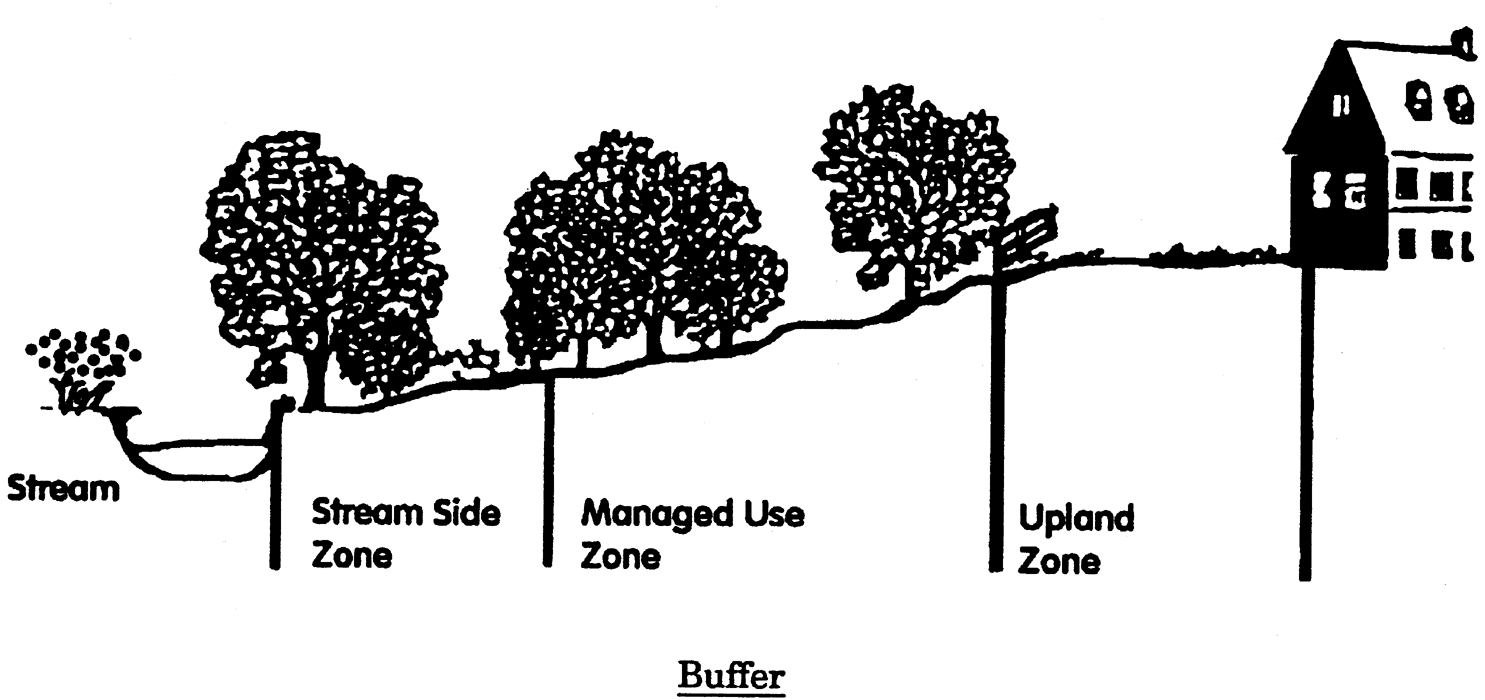
4.
Buffer widths: Viewed aerially, the stream buffer width is measured horizontally on a line perpendicular to the surface water, landward from the top of the bank on each side of the stream.
5.
Drainage basin: The area of land which drains to a given point on a body of water.
6.
Floodplain land use map (FLUM): A locally developed floodplain map which is used for regulation of new development.
7.
FLUM floodway: The channel of a stream or other watercourse draining equal to or greater than six hundred forty (640) acres (Federal Emergency Management Agency (FEMA) regulated) and the adjacent land areas that must be reserved in order to discharge the base flood without cumulatively increasing the water surface elevation more than 0.1 feet, based on July, 1999, land use conditions.
8.
FLUM floodway encroachment lines: The lateral limits of a floodway district, based on July, 1999, land use conditions, as shown on the Floodplain Land Use Map (FLUM), along streams or other bodies of water, within which, in the direction of the stream or other body of water, no structure or fill may be added, unless specifically permitted herein. Their purpose is to preserve the flood-carrying capacity of the floodway. Their location is such that the floodway between them including the channel will handle the base flood flow.
9.
FEMA fringe: The land area of a stream draining equal to or greater than six hundred forty (640) acres located between the limits of the FLUM floodway encroachment lines and the maximum elevation subject to inundation by the base (one percent chance) flood based on July, 1999, land use conditions.
10.
Floodplain: The low, periodically flooded lands adjacent to streams. For land use planning purposes, the regulatory floodplain is usually viewed as all lands that would be inundated by the regulatory flood.
11.
Mitigation: Actions taken either on-site or off-site as allowed by this Part to offset the effects of temporary or permanent loss of the buffer.
12.
Stream: A channel on the land surface for conveying water. As used in this part, the main channel of the Catawba River, Lake Norman, Mountain Island Lake and Lake Wylie, is not a stream and this part does not apply.
13.
Top of bank: The landward edge of the stream channel during high water or bankfull conditions at the point where the water begins to overflow onto the floodplain.
(Ord. No. 1400, § 1, 11-15-1999)
Section 12.803. - Applicability.
1.
All properties shall be subject to the buffer requirements of this PART 8 except those properties which, as of the effective date of November 15, 1999, fit into one of the following categories:
(a)
Have been issued a certificate of building code compliance.
(b)
Have a valid building permit.
(c)
Have been subdivided by a recorded subdivision plat, which had been approved by the Charlotte-Mecklenburg Planning Department.
(d)
Have been described by metes and bounds in a recorded deed or shown on a recorded plat, which:
If to be used for residential purposes:
Are one acre or less in size.
If to be used for nonresidential purposes:
Are four (4) acres or less in size if located on a non-FEMA regulated floodway, or
Are seven (7) acres or less in size if located on a FEMA regulated floodway.
(e)
Are included on a valid preliminary subdivision plan.
(f)
Have otherwise secured a vested property right under state law or local ordinance.
2.
Redevelopment or expansions to uses included in the above categories are not subject to the buffer requirements of this part unless it would result in an increase in the total impervious area within the buffer.
3.
In the event that stream buffers are required by another section of this ordinance, the more stringent stream buffer requirements apply.
(Ord. No. 1400, § 1, 11-15-1999; Ord. No. 2440, § 1, 11-17-2003; Ord. No. 4877, § 1, 5-14-2012)
Section 12.804. - Buffer standards.
Required stream buffer widths vary based on the size of the upstream drainage basin. Mecklenburg County's Geographic Information System (GIS) will serve as a tool to delineate the size of drainage basins and specify the corresponding buffer widths. S.W.I.M. stream buffer requirements specified in this part 8 begin at the point where the stream drains one hundred (100) acres or greater. Refer to the Charlotte-Mecklenburg Storm Water Design Manual for optional buffers on streams, which drain less than one hundred (100) acres.
(1)
Buffer widths for streams draining equal to and greater than one hundred (100) acres. Buffers are required for streams draining areas equal to or greater than one hundred (100) acres as specified below. Buffer widths for these streams are measured horizontally on a line perpendicular to the surface water, landward from the top of the bank on each side of the stream.
FOOTNOTES:
(1) Buffer widths for drainage areas of > six hundred forty (640) acres:
1.
The FEMA fringe and FLUM floodway encroachment lines will be used for floodplain and buffer calculations.
2.
If the floodplain is less than one hundred (100) feet side, the total width of the buffer on that side of the stream will be one hundred (100) feet except as provided in [footnote] 4. below.
3.
The landowner/developer has discretion to designate the buffer zone beyond the 100-foot minimum. The additional buffer area beyond one hundred (100) feet must be contiguous with at least a portion of the required 100-foot buffer and be configured in such a manner as to benefit water quality.
4.
So long as the total buffer width is maintained, the buffer may vary in width on either side of the stream based on individual stream side topography provided that the owner(s) control both sides of the stream and the stream side zone is maintained on both sides of the stream.
5.
Buffer requirements do not apply to the main channel of the Catawba River including Lake Norman, Mountain Island Lake and Lake Wylie.
(2)
Buffer description. Buffer function, vegetation and use vary according to the different buffer zones as described in the following table:
FOOTNOTES:
(1) Re-vegetation of disturbed buffers is required as specified in the Charlotte Land Development Standards Manual when such disturbances result in the failure of the buffer system to comply with the vegetative targets specified above. The manual also contains recommended tree densities for each zone for voluntary reforestation efforts.
(2) Fill material can not be brought into the buffer. Grading is allowed only in the Upland Zone. Commercial buildings or occupied structures are not allowed in the buffer. Permitted uses within the buffer zones should be coordinated to ensure minimal disturbance of the buffer system. For example, if it is necessary to install utilities within the buffer, every attempt should be made to build greenway trails so they follow the cleared areas instead of additional clearing.
(3)
Diffuse flow requirement. Diffuse flow of runoff shall be maintained in the buffer by dispersing concentrated flow and reestablishing vegetation. Techniques for providing diffuse flow are specified in the Charlotte Land Development Standards Manual.
(a)
Concentrated runoff from ditches or other manmade conveyances shall be converted to diffuse flow before the runoff enters the buffer.
(b)
Periodic corrective action to restore diffuse flow shall be taken by the property owner as necessary to prevent the formation of erosion gullies.
(4)
Ponds. Ponds, which intersect the stream channel, shall have the same buffers as the original stream measured from the top of the bank of the pond. Buffer requirements shall not apply to wet ponds used as structural BMPs.
(5)
Buffer delineation. The following buffer delineations are required:
(a)
Streams and buffer boundaries including all buffer zones must be clearly delineated on all construction plans, including grading and clearing plans, erosion, drainage and sediment control plans and site plans.
(b)
Outside buffer boundaries must be clearly marked on-site prior to any land disturbing activities.
(c)
The outside boundary of the buffer must be permanently marked at highway stream crossings.
(d)
Streams and buffer boundaries including the delineation of each buffer zone must be specified on all surveys and record plats.
(e)
Buffer requirements must be referenced in homeowners' association documents.
(Ord. No. 1400, § 1, 11-15-1999; Ord. No. 4646-Z, § 1, 4-25-2011)
Section 12.805. - Incentives.
1.
Purpose. The purpose of this section is to set forth incentives to offset restrictions that buffer requirements place on development. These incentives promote open space development that incorporates smaller lot sizes to minimize total impervious area within the development, reduce total construction costs, conserve natural areas, provide community recreational space, and promote protection of streams.
2.
Reduction in lot size. Allow a one-for-one credit in lot size reduction in addition to what is allowed in section 9.205(4)(a), provided this is not below the minimum requirement for the next lower zoning classification.
3.
Relax lot setback requirements. For all lots within a development requiring a S.W.I.M. buffer, setback requirements as specified in section 9.205(4) are reduced as follows:
(a)
Front setbacks can be reduced to a minimum of fifteen (15) feet as measured from the right-of-way line for all lots along local and collector streets. However, front loaded garages must maintain a minimum setback of twenty (20) feet measured from the back of sidewalk or back of right-of-way, whichever is greater (subsection 12.206(3)).
(b)
Rear yards can be located one hundred (100) percent within a SWIM buffer. Rear yards can be reduced to thirty (30) feet on all internal lots. Rear yards forming the outer boundary of a project must conform to the minimum of subsection 9.205(1)(g) for the zoning district in which the development is located.
4.
Open space. S.W.I.M. buffer areas can be used toward satisfying the required open space minimums for the development if dedicated.
5.
Density bonus. In addition to the provisions 1. through 4. above:
(a)
Single-family development projects may be granted a density bonus, provided the entire required S.W.I.M. buffer area or the entire S.W.I.M. buffer area plus any additional buffer area is dedicated as common open space. Such dedication must be to a homeowners' association or a public or private agency that agrees to accept ownership and maintenance responsibilities for the space. The density bonus is calculated as follows:
The entire dedicated buffer area in acres multiplied by the maximum residential density number of the underlying zoning district.
(b)
Lots within single-family projects that meet the above density bonus need not meet the minimum lot width requirements set out in subsection 9.205(1) provided that each lot meets the minimum lot width requirements set forth in Table 9.205(5).
(Ord. No. 1400, § 1, 11-15-1999; Ord. No. 4606, § 1, 12-20-2010; Ord. No. 4765, § 1, 10-17-2011; Ord. No. 5495, § 1, 10-20-2014)
Section 12.806. - Mitigation.
(1)
Purpose. The purpose of this section is to set forth the basis on which mitigation is required for unavoidable or approved buffer impacts within any of the buffer zones. This mitigation basis shall allow the property owner or other entity the opportunity to disturb a buffer, provided that steps are taken to offset the buffer loss. Prior to any buffer impact, any person or entity seeking approval of a buffer impact shall submit the requisite site and mitigation information for approval to Charlotte-Mecklenburg Storm Water Services as specified below, to the extent approval is required by this part.
(2)
Buffer impacts not requiring mitigation. The following buffer impacts do not require mitigation or specific plan approval but are required to comply with the specifications provided in the Charlotte Land Development Standards Manual for stabilization of disturbed areas to minimize negative water quality impacts.
(a)
Road crossings for connectivity or transportation links where the Charlotte-Mecklenburg Planning Department has granted site plan approval.
(b)
Utility crossings.
(c)
Parallel water and sewer utility installation as approved by Charlotte-Mecklenburg Utilities.
(d)
Public paths and trails parallel to the stream outside the stream side zone and stream crossings. Pathways must use existing and proposed utility alignments or previously cleared areas and minimize tree cutting to the maximum extent practicable. To the extent possible, pathways shall preserve existing drainage patterns and avoid drainage structures that concentrate storm water.
(e)
Incidental drainage improvements/repairs for maintenance.
(f)
Individual pedestrian paths connecting homeowners to the stream in the form of narrow, pervious footpaths with minimal tree disturbance.
(g)
New domesticated animal trails (farming) where existing trails are lost as a result of action beyond the farmer's control. Stream crossings should be constructed and maintained to minimize impacts to the stream side zone with fencing perpendicular and through the buffer to direct animal movement.
(h)
Mitigation approved by a state or federal agency acting pursuant to Sections 401 or 404 of the Federal Clean Water Act.
(3)
Buffer impacts requiring mitigation. Impacts to stream buffers not specified in section 12.806.2, proposed to allow development or other land use in a buffer, shall be required to mitigate or offset the proposed impact in accordance with this section. Buffer impacts requiring mitigation and plan approval include:
• Filling or piping of streams.
• Removal of vegetation from the stream side or managed use zones other than as specified by section 12.804.2, "Vegetative targets."
• Paths proposed within the stream side zone.
• Stream relocations.
• Fences and walls requiring tree removal in the stream side or managed use zones.
• Other buffer impacts not permitted under section 12.804.2.
The landowner or other entity proposing any of the impacts specified above shall prepare and submit for approval a site specific plan to Charlotte-Mecklenburg Storm Water Services. This site plan shall show the extent of the proposed impact and clearly specify the proposed mitigation technique.
(4)
Pre-approved mitigation techniques. The following techniques are available to landowners for mitigation of buffer impacts upon review and approval of a specific site mitigation plan by Charlotte-Mecklenburg Storm Water Services. Specifications for these pre-approved mitigation techniques are provided in the Charlotte Land Development Standards Manual.
(a)
Installation of structural BMPs. The installation of an on-site structural BMP designed to achieve specified pollutant removal targets will allow for stream buffer impacts on the specific site. The BMP should remain outside the stream side zone if practical. A detailed BMP design plan must be submitted to Charlotte-Mecklenburg Storm Water Services for approval based on specifications and pollutant removal targets contained in the Charlotte Land Development Standards Manual. This plan must also include a long term maintenance strategy for the BMP complete with the establishment of adequate financing to support the proposed maintenance practices.
(b)
Stream restoration. The owner may restore and preserve the buffer area on any stream of equivalent or greater drainage area, the condition of which is determined to be qualified for restoration by Charlotte-Mecklenburg Storm Water Services on a 1:1 basis in linear feet of stream. This restoration shall include stream bank improvements and stream side and managed use zone re-vegetation, in accordance with the Charlotte Land Development Standards Manual.
(c)
Stream preservation. The owner may purchase, fee simple, other stream segments at equivalent or greater drainage area on a 1:1 linear foot basis and convey fee simple and absolute title to the land to the city/county or other conservation organization.
(d)
Wetlands restoration. On a 2:1 acreage basis for disturbed stream and buffer area (two (2) acres of wetland for each acre of disturbed area), the owner may provide a combination of the preservation and/or restoration of wetlands with protective easements, and the implementation of structural or non-structural BMPs to achieve specific pollutant removal targets within the impacted area as specified in the Charlotte Land Development Standards Manual.
(e)
Bottom land hardwood preservation. On a 2:1 acreage basis for impacted stream and buffer area (two (2) acres of bottomland hardwood for each acre of disturbed area), the owner may provide a combination of the preservation of existing bottom land hardwood forest or other specifically approved natural heritage area by conservation easement or other legal instrument, and the implementation of structural or non-structural BMPs to achieve specific pollutant removal targets within the impacted area as specified in the Charlotte Land Development Standards Manual.
(f)
Controlled impervious cover. The owner may commit to, and provide, a specific site development plan that limits overall site impervious cover equal to or less than twenty-four (24) percent. Development on this basis shall allow for stream buffer impacts on the specific site. Preservation of the stream side zone is encouraged.
(g)
Open space development. The submission of a specific site development plan which preserves fifty (50) percent of the total land area as undisturbed open space shall allow for stream buffer impacts on the specific site.
(h)
Mitigation credits. The purchase of mitigation credits on a 1:1 basis utilizing linear feet of stream impacted and the prevailing rate of purchase as established by Charlotte-Mecklenburg Storm Water Services shall allow for stream buffer impacts on the specific site. Mitigation credits purchased under any other program (i.e., U.S. Army Corp of Engineers) shall not cover this requirement unless the issuing agency agrees to relinquish the funds to the appropriate city/county agency.
(5)
Other mitigation techniques. No provision of this part shall prevent the creative development of alternative mitigation plans. The owner shall submit such plan with proposed buffer impacts and detailed mitigation information to Charlotte-Mecklenburg Storm Water Services for approval. The criteria used to judge the acceptability of any alternative plan shall be the degree to which the plan addresses the preservation of the four (4) primary natural functions of stream buffers. Such plans may be submitted in conjunction with a mitigation plan submission to the U.S. Army Corp of Engineers and N.C. Department of Environment and Natural Resources for proposed stream or wetland impacts. Charlotte-Mecklenburg Storm Water Services, when considering proposed mitigation alternatives, shall give equal weight to proposals which utilize the preservation of unique or endangered habitat or natural areas against proposed buffer impacts.
(6)
Posting of financial security required for structural BMPs. When structural BMPs (wet detention ponds and other BMPs) are approved for mitigation of a buffer disturbance, the approval shall be subject to the owner filing a surety bond or letter of credit or making other financial arrangements which are acceptable to Charlotte-Mecklenburg Storm Water Services, in a form which is satisfactory to the city attorney, guaranteeing the installation and maintenance of the required structural BMPs until the issuance of certificates of occupancy for seventy-five (75) percent of all construction which might reasonably be anticipated to be built within the area which drains into the BMPs, allowing credit for improvements completed prior to the submission of the final plat. At such time that this level of occupancy is achieved, written notice thereof must be given by the owner to Charlotte-Mecklenburg Storm Water Services. The owner must also verify the adequacy of the maintenance plan for the BMPs including the necessary financing to support the proposed maintenance practices. Charlotte-Mecklenburg Storm Water Services will inspect the structural BMPs and verify the effectiveness of the maintenance plan and if found satisfactory, will within thirty (30) days of the date of the notice notify the owner in writing.
(7)
Maintenance responsibilities for structural BMPs—Civil penalties. Maintenance of all structural BMPs shall be the responsibility of the property owner or his designee. Any person who fails to maintain the required BMPs in accordance with the approved maintenance plan shall be subject to a civil penalty of not more than five hundred dollars ($500.00). Each day that the violation continues shall constitute a separate violation. No penalties shall be assessed until the person alleged to be in violation has been notified in writing of the violation by registered or certified mail, return receipt requested, or by other means which are reasonably calculated to give actual notice. The notice shall describe the nature of the violation with reasonable particularity, specify a reasonable time period within which the violation must be corrected, and warn that failure to correct the violation within the time period shall result in assessment of a civil penalty or other enforcement action.
(Ord. No. 1400, § 1, 11-15-1999; Ord. No. 4646-Z, § 1, 4-25-2011; Ord. No. 4877, § 1, 5-14-2012)
Section 12.807. - Appeals and variances.
Appeals and variances from this part shall be subject to Chapter 5 of these regulations.
(Ord. No. 1400, § 1, 11-15-1999)
Section 12.901. - Other applicable city code land development provisions.
The following land-use development provisions in the City Code are applicable to zoning approval for the promotion of the health, safety and general welfare of the city, and are incorporated herein by reference as follows:
(1)
Chapter 8: Fire prevention and protection, section 8-2 pertaining to the applicability of the North Carolina State Building Code, Volume V, Fire Prevention Code, 1988 Edition, as amended from time to time.
(2)
Chapter 8: Fire prevention and protection, section 8-8 pertaining to the applicability of the City of Charlotte Fire Department Rules and Regulations Governing Fire Flow, Water Demand, Fire Hydrants, Fire Connections and Unattended Service Stations dated December 20, 1993, as amended from time to time.
(3)
Chapter 19: Streets and sidewalks, article II [III], sections 19-51 [19-66] through and including section 19-61 [19-71], pertaining to the applicability of the City of Charlotte's Driveway Regulations, dated July 1979 as amended from time to time, and article VI, sections 19-141 [19-171] through and including section 19-151 [19-179], pertaining to the applicability of the Charlotte Land Development Standards Manual, as amended from time to time.
(4)
Chapter 21: Trees, in its entirety.
(Ord. No. 1427, § 1, 12-20-1999; Ord. No. 4646-Z, § 1, 4-25-2011)

