
Charlotte City Zoning Code
CHAPTER 9
- GENERAL DISTRICTS
Section 9.101. - Table of uses.
The range of uses permitted as of right and under prescribed conditions in each district established in this chapter is summarized in Table 9.101. In the event of a conflict between Table 9.101 and the text of these regulations, the text shall control. Uses allowed in the overlay districts are set forth in Chapter 10, and uses allowed in the conditional zoning districts are set forth in Chapter 11.
(Ord. No. 1587, § 1(10)(i), 7-24-2000; Ord. No. 2439, § 1, 11-17-2003)
Section 9.102. - Hierarchy of districts.
The districts established in this chapter and in Chapter 11 are classified from "highest" to "lowest" in the following order:
For any district where a conditional zoning district is permitted, the conditional zoning district shall have the same order as the general district for the purposes of determining its hierarchy under the table.
(Ord. No. 3523, § 1(16), 3-15-1993; Ord. No. 1587, § 1(10)(ii), 7-24-2000; Ord. No. 2412, § 5(1)A., 10-20-2003; Ord. No. 2439, § 1, 11-17-2003)
TABLE 9.101, PERMITTED USES, BY DISTRICT
GENERAL ZONING DISTRICTS
INSTITUTIONAL DISTRICT
RESEARCH DISTRICTS
*Note: The RE-3 zoning district is a Conditional District. All uses must be approved.
(Ord. No. 3314, § 1, 4-20-1992; Ord. No. 3523, § 1(15), (16), 3-15-1993; Ord. No. 305, § 1.2(A), 6-19-1995; Ord. No. 331, § 1.2, 7-17-1995; Ord. No. 380, § 2, 9-18-1995; Ord. No. 383, §§ 3, 4, 9-18-1995; Ord. No. 389, § 2(A), 10-16-1995; Ord. No. 612, § 2, 7-15-1996; Ord. No. 713, § 1(B), 12-16-1996; Ord. No. 772, § 1(3)(A), 3-17-1997; Ord. No. 836, § 1(1), 5-19-1997; Ord. No. 867, § 1(A), 7-21-1997; Ord. No. 999, § 2, 2-16-1998; Ord. No. 1013, § 1(1), 3-16-1998; Ord. No. 1260, § 2, 4-19-1999; Ord. No. 1274, § 2(A), 5-17-1999; Ord. No. 1275, § 1(D), 5-17-1999; Ord. No. 1436, § 9, 1-18-2000; Ord. No. 1959, § 1, 11-19-2001; Ord. No. 1997, § 1, 1-22-2002; Ord. No. 2069, § 1A, 5-20-2002; Ord. No. 2224, § 2(2), 1-21-2003; Ord. No. 2239, § 1(2.A), 2-17-2003; Ord. No. 2242, § 1(2.A), 2-17-2003; Ord. No. 2439, § 1A., 11-17-2003; Ord. No. 2674, § 1, 9-20-2004; Ord. No. 2773, § 1, 10-18-2004; Ord. No. 2880, § 1A, 2-21-2005; Ord. No. 2915, § 1A, 3-21-2005; Ord. No. 3007, § 2A, 6-20-2005; Ord. No. 3010, § 1A1, 6-20-2005; Ord. No. 3689, § 1A, 9-17-2007; Ord. No. 3889, § 1, 4-21-2008; Ord. No. 4015, § 1, 9-15-2008; Ord. No. 4065, § 1, 11-24-2008; Ord. No. 4209, § 1, 6-15-2009; Ord. No. 4222, § 1, 7-20-2009; Ord. No. 4520, § 1, 9-20-2010; Ord. No. 4658-Z, § 1, 5-23-2011; Ord. No. 4697, § 1, 7-18-2011; Ord. No. 4705, § 1, 7-18-2011; Ord. No. 4846, § 1, 3-19-2012; Ord. No. 4873, § 1, 5-14-2012; Ord. No. 4902, § 1, 6-18-2012; Ord. No. 4908, § 1, 6-18-2012; Ord. No. 4929, § 1, 7-16-2012; Ord. No. 4931, § 1, 7-16-2012; Ord. No. 5033, § 1, 1-22-2013; Ord. No. 5057, § 1, 3-25-2013; Ord. No. 5138, § 1, 6-17-2013; Ord. No. 5282, § 1, 1-21-2014; Ord. No. 5353, § 1, 5-19-2014; Ord. No. 5423, § 1, 7-21-2014; Ord. No. 5489, § 1, 10-20-2014; Ord. No. 5522, § 1, 11-17-2014; Ord. No. 5962, § 1, 6-15-2015)
Section 9.103. - Classification of zoning districts.
The following zoning districts established in this chapter and in chapter 11 are classified according to whether they are residential or non-residential.
(1)
Residential zoning districts include R-3, R-4, R-5, R-6, R-8, R-8MF, R-12MF, R-17MF, R-22MF, R-43MF, UR-1, UR-2, UR-3, TOD-R, R-MH, MX-1, MX-2, MX-3, and any zoning district listed above, with (CD) after the designation.
(2)
Non-residential zoning districts include B-1, B-2, CC, B-D, BP, O-1, O-2, O-3, I-1, I-2, RE-1, RE-2, RE-3, Institutional, UMUD, MUDD, UR-C, U-I, CC, NS, TOD-E, and TOD-M, and any zoning district listed above, with (CD) after the designation.
(Ord. No. 3294, § 1, 5-15-2006)
Section 9.201. - Single-family districts established; purposes.
The R-3, R-4, R-5, R-6 and R-8 districts are hereby established to protect and promote the development of single family housing and a limited number of public and institutional uses. The standards for these districts are designed to maintain a suitable environment for family living at various densities to accommodate preferences for different housing types. The R-3 and R-4 districts are directed toward suburban single family living. The R-5, R-6 and R-8 districts address urban single family living. Densities of development are controlled by maximum number of units per acre requirements, which are different for each district and indicated by the numerical identification attached to each district. Any division of property into two (2) or more lots must meet the density requirements of the underlying zoning district.
(Ord. No. 3177, § 1, 1-17-2006)
Section 9.202. - Uses permitted by right.
The following uses are permitted by right in the R-3, R-4, R-5, R-6 and R-8 districts, provided that they meet all requirements of this part and all other requirements established in these regulations:
(1)
Dwellings, attached (duplex, triplex or quadraplex only (R-8 only)).
(2)
Dwellings, detached.
(3)
(R-8 only) Dwellings, duplex, triplex or quadraplex.
(4)
Farms, including retail sale of produce grown on the premises.
(5)
Highway and railroad rights-of-way.
(6)
Parks, greenways and arboretums.
(Ord. No. 389, § 2(B), 10-16-1995; Ord. No. 1260, § 3(A), 4-19-1999)
Section 9.203. - Uses permitted under prescribed conditions.
The following uses shall be permitted in the R-3, R-4, R-5, R-6 and R-8 districts if they meet the standards established in this section and all other requirements of these regulations:
(0.5)
Accessory shelter, subject to the regulations of section 12.537.
(1)
Adult care homes, subject to the regulations of section 12.502.
(2)
Bus stop shelters, subject to the regulations of section 12.513.
(3)
Cemeteries, subject to the regulations of section 12.508.
(4)
Child care centers in a residence, subject to the regulations of section 12.502.
(5)
Reserved.
(5.1)
Dwellings, attached (duplex only) (R-3, R-4, R-5 and R-6 only), provided that:
(a)
The dwelling will be located on a corner lot;
(b)
If more than one entrance, the entrances to each unit in the structure will face different streets; and
(c)
The minimum setback requirements must be applied to each of the two (2) different streets.
(5.2)
Dwellings, attached (duplex, triplex, and quadraplex only) (R-3, R-4, R-5, and R-6 only) within a mixed income housing development subject to the regulations of subsection 9.205(9).
(6)
Dwellings, duplex (R-3, R-4, R-5, and R-6 only), provided that:
(a)
The dwelling will be located on a corner lot;
(b)
If more than one entrance, the entrances to each unit in the structure will face different streets; and
(c)
The minimum setback requirement must be applied to each of the two (2) different streets.
(6.1)
Dwellings, duplex, triplex, and quadraplex (R-3, R-4, R-5, and R-6 only) within a mixed income housing development subject to the regulations of subsection 9.205(9).
(7)
Elementary and secondary schools, provided that:
(a)
All buildings, outdoor recreational facilities, and off-street parking and service areas will be separated by a Class C buffer for elementary and junior high schools and Class B buffer for senior high schools from any abutting property located in a residential district, used for residential purposes, or low-intensity institutional use (See section 12.302), except that buffers shall not be required to separate adjacent public elementary schools; junior high or middle schools; senior high schools; or public parks and greenways; or colleges;
(b)
The use will be on a lot which fronts a collector, minor thoroughfare or major thoroughfare for elementary schools and junior high schools, and on a minor thoroughfare or major thoroughfare for senior high schools; and
(c)
Primary vehicular access to the use will not be provided by way of a residential local (Class VI) street.
(d)
Subsections (7)(b) and (7)(c) of this section shall not apply to the addition of mobile classrooms to any school that is nonconforming with respect to these provisions which was constructed, or where a building permit for the school was issued, prior to January 1, 1992. However, for such a nonconforming school the number of additional mobile classrooms may not constitute more than fifty (50) percent of the school's total existing classrooms.
(e)
Reserved.
(f)
Except as modified by the requirements of subsection (7)(d) of this section, subsections (7)(b) and (7)(c) of this section shall not apply to additions, modifications, or improvements to any school that is nonconforming with respect to these provisions which was constructed, or where a building permit for the school was issued, prior to January 1, 1992. Notwithstanding the foregoing, subsections (7)(b) and (7)(c) shall not apply to any elementary school site which was operating as a school as of January 1, 1992, that has less than one hundred (100) feet of frontage on a collector, minor thoroughfare, or major thoroughfare.
(8)
Equestrian oriented subdivisions, subject to regulations of section 12.514.
[(8.1)]
Family child care homes, subject to the regulations of section 12.502.
(9)
Government buildings, up to twelve thousand five hundred (12,500) square feet, provided that:
(a)
All buildings and off-street parking and service areas will be separated by a Class C buffer from abutting property located in the residential district, used for residential purposes, or low-intensity institutional use (See section 12.302);
(b)
The use will be located on a lot that fronts a collector, minor thoroughfare or major thoroughfare; and
(c)
Primary vehicular access to the use will not be provided by way of a residential local (Class VI) street.
(10)
Group homes for up to six (6) clients subject to the regulations in section 12.517.
(11)
Nonconforming structures and uses, subject to the regulation of Chapter 7.
(12)
Open space recreational uses, subject to the regulations of section 12.516.
(12.1)
Outdoor fresh produce stands, and mobile produce market, subject to the regulations of section 12.538.
(13)
Outdoor recreation, subject to the provisions of section 12.540 parking requirements of this ordinance.
(14)
Public utility structures, subject to regulations of section 12.504.
(14.5)
Bicycle-sharing station, subject to the regulations of section 12.543.
(15)
Public utility transmission and distribution lines, subject to the regulations of section 12.509.
(16)
Recreation centers, provided that:
(a)
All buildings and off-street parking and service areas shall be separated by a Class C buffer from any abutting property used and/or zoned residential, as per the requirements of section 12.302;
(b)
The use will be located on a lot that fronts a collector, minor thoroughfare or major thoroughfare; and
(c)
Primary vehicular access to the use will not be provided by way of a residential local (Class VI) street.
(d)
The use contains not more than thirty thousand (30,000) square feet.
(17)
Radio, telephone, cellular telephone and television masts, towers, antennae and similar structures, subject to the regulations of subsection 12.108(7) or subsection 12.108(8).
(18)
Religious institutions, up to seven hundred fifty (750) seats, subject to regulations of section 12.506.
(19)
Reserved.
(20)
Subdivision sales offices, provided that:
(a)
The use serves the subdivision in which it is located and abutting subdivision or subdivisions by the same developer or affiliate; and
(b)
The use shall be terminated upon completion of the sale of ninety-five (95) percent of the total number of homes and/or lots; provided however, that a model or demonstration home may be used for sales purposes until the last home or lot is sold.
(21)
Temporary buildings and storage of materials, provided that: The use is in conjunction with the construction of a building on the same lot where construction is taking place or on an adjacent lot. Such temporary uses shall be terminated upon completion of construction.
(22)
Universities, colleges and junior colleges, provided that:
(a)
All buildings, outdoor recreational facilities and off-street parking and service areas will be separated by a Class B buffer from any abutting property located in a residential district or used for residential purposes (See section 12.302);
(b)
The use will be on a lot which fronts on a minor or major thoroughfare; and
(c)
Primary vehicular access to the use will not be provided by way of a residential local (Class VI) street.
(23)
Outdoor seasonal sales, subject to the regulations of section 12.519.
(24)
Bed and breakfasts (B & B's), subject to regulations of section 12.521.
(25)
Boardinghouses, subject to regulations of section 12.520.
(26)
Beneficial fill sites, subject to the regulations of section 12.523.
(27)
Land clearing and inert debris landfills (LCID): off-site, subject to the regulations of section 12.503.
(Ord. No. 3314, § 2, 4-20-1992; Ord. No. 3358, § 1(A), 7-20-1992; Ord. No. 3432, § 1(1), 10-19-1992; Ord. No. 3523, § 1(17), 3-15-1993; Ord. No. 3597, § 1, 7-19-1993; Ord. No. 3892, § 1(A), 7-17-1994; Ord. No. 305, § 1.2(B), 6-19-1995; Ord. No. 389, § 2(C), 10-16-1995; Ord. No. 529, § 1(1), 4-15-1996; Ord. No. 772, § 1(3)(B), (D)(1), (2), 3-17-1997; Ord. No. 1012, § 1, 3-16-1998; Ord. No. 1205, § 1(1), 2-15-1999; Ord. No. 1260, § 3(B), 4-19-1999; Ord. No. 1450, § 1, 2-21-2000; Ord. No. 1732, § 1, 1-16-2001; Ord. No. 1996, § 1, 1-22-2002; Ord. No. 2239, § 1(2.B), 2-17-2003; Ord. No. 2941, § 2A, 4-18-2005; Ord. No. 3007, § 2B, 6-20-2005; Ord. No. 3518-Z, § B1, 2-19-2007; Ord. No. 4873, § 1, 5-14-2012; Ord. No. 4908, § 1, 6-18-2012; Ord. No. 5033, § 1, 1-22-2013; Ord. No. 5962, § 1, 6-15-2015)
Section 9.204. - Permitted accessory uses and structures.
The following uses shall be permitted in the R-3, R-4, R-5, R-6 and R-8 districts as accessory uses and structures, subject to the applicable criteria in this Part and in Chapter 12 of these regulations:
(1)
Accessory uses and structures, clearly incidental and related to the permitted principal use or structure on the lot.
(2)
Bookstores, offices, printing and distribution and similar uses as accessories to religious institutions located on the same lot and subject to the regulations of section 12.506.
(2.5)
Crematory facilities, within a cemetery, subject to the regulations of section 12.542.
(3)
Customary home occupations, subject to the regulations of section 12.408.
(4)
Dormitories, as an accessory use to a university, college or junior college located on the same lot.
(5)
Dumpsters, trash handling areas and service entrances, subject to the regulations of section 12.403.
(6)
Dwelling, accessory units as an accessory to a single-family detached dwelling, subject to the regulations of section 12.407.
(7)
Fences and walls, subject to the regulations of section 12.406.
(8)
Reserved.
(9)
Marinas, subject to the regulations of section 12.409.
(10)
Reserved.
(11)
Outdoor lighting, subject to the regulations of section 12.402.
(12)
Petroleum storage, accessory to a permitted principal use or building, subject to the Fire Prevention Code of the National Board of Fire Underwriters.
(13)
Private kennels, subject to the regulations of section 12.410.
(14)
Private stables, subject to the regulations of section 12.411.
(15)
Vending machines for cigarettes, candy, soft drinks and similar items and coin-operated laundries located within an enclosed building as an accessory to the uses in the principal building or buildings.
(16)
The following provisions shall apply to location of unlicensed motor vehicles and the display for sale or trade of licensed and unlicensed motor vehicles in residentially zoned districts.
(a)
Unlicensed.
1.
No more than two (2) motor vehicles that do not have a current, valid license plate and are not fully enclosed in a permanent structure shall be permitted outside on any premises, provided such vehicles are registered to the occupant of the premises or immediate family member of the occupant as the record title owner of the vehicle.
2.
No unlicensed motor vehicle if not registered to the occupant of the premises or immediate family member of the occupant as the record title owner of the vehicle shall be permitted outside of any premises.
3.
Vehicles described in paragraphs (1) and (2) are not permitted to be located within any required setback or yards contained in these regulations or any street right-of-way except as provided in paragraph (b)(4) below.
(b)
Licensed or unlicensed.
1.
No more than two (2) motor vehicles, whether licensed or unlicensed, may be displayed for sale or trade in the premises at any time and such display of a given vehicle for sale or trade shall not be for a period as to that vehicle exceeding sixty (60) days.
2.
During a twelve-month period commencing January 1 and ending December 31 of each year, no more than three (3) such licensed or unlicensed motor vehicles shall be displayed for sale or trade on the premises. Further, no more than three (3) sales or trades of such licensed or unlicensed motor vehicles displayed for sale on the premises shall occur within the same twelve-month period.
3.
No motor vehicle, whether licensed or unlicensed, if not registered to the occupant of the premises or immediate family member of the occupant as the record title owner of the vehicle, may be displayed upon the premises for sale or trade.
4.
A motor vehicle licensed or unlicensed displayed for sale or trade on the premises or provided herein may be located in the setback but not within the street right-of-way.
(c)
If there are any premises with more than the number of vehicles provided for in subsections (a) and (b) above in violation of this section, then the owner and occupant, if different, shall have ninety (90) days from the date of the adoption of this ordinance to come into compliance with the ordinance or shall be in violation of this section.
(d)
All vehicles must comply with City Code, Chapter 10, Article III, "Removal and Disposition of Abandoned Vehicles, Hazardous Vehicles and Junked Motor Vehicles."
(17)
Land clearing and inert debris landfill (LCID): on-site, subject to the regulations of section 12.405.
(17.1)
Outdoor fresh produce stands and mobile produce market, subject to the regulations of section 12.538.
(18)
Recreation centers as an accessory use to a school, provided that:
(a)
All buildings and off-street parking and service areas shall be separated by a Class C buffer from any abutting property used and/or zoned residential, as per the requirements of section 12.302;
(b)
The use will be located on a lot that fronts a collector, minor thoroughfare or major thoroughfare; and
(c)
Primary vehicular access to the use will not be provided by way of a residential local (Class VI) street.
(d)
The use contains not more than thirty thousand (30,000) square feet.
(Ord. No. 3309, § 1(1), 4-20-1992; Ord. No. 772, § 1(3)(E), 3-17-1997; Ord. No. 3007, § 2B, 6-20-2005; Ord. No. 4846, § 1, 3-19-2012; Ord. No. 4931, § 1, 7-16-2012; Ord. No. 5962, § 1, 6-15-2015)
Editor's note— Ord. No. 3007, § 2B, adopted June 20, 2005, enacted provisions intended for use as subsection (16). Inasmuch as there are already provisions so designated, and at the discretion of the editor, said provisions have been redesignated as subsection (18).
Section 9.205. - Development standards for single-family districts.
All uses and structures permitted in the R-3, R-4, R-5, R-6 and R-8 districts shall meet the applicable development standards established in this section and all other requirements of these regulations:
(1)
Density, area, yard and bulk regulations shall be as follows:
(i)
Density is the first standard. Density controls the total number of dwelling units allowed. Once density is determined, lots must meet the requirements of subsection (1)(b) through (1)(i), except as provided in subsection (iii), below.
(ii)
Density is calculated by multiplying the gross land area, minus any existing dedicated rights-of-way or established public street(s), incorporated within the property, times the maximum density number established for the zoning district. For lots located on an existing publicly maintained street that does not have any record of right-of-way dedication, the density is calculated by multiplying the gross land area, minus the area within the maintained street (typically ditch to ditch) incorporated within the property, times the maximum density number for the zoning district.
(iii)
Existing lots of record as of the effective date of these regulations do not have to meet the density requirements if they are 1) a corner lot in the R-3, R-4, R-5, or R-6 zoning districts and are to be used for a duplex dwelling; or 2) an existing lot in the R-8 zoning district to be used for duplex, triplex, or quadraplex dwellings.
(iv)
Legal, previously recorded single family lot(s) may be reestablished or reconfigured if the total number of lots or units is not increased and if the lots can meet all the development standards of the district in which they are located, with the exception of density. If the lots were legally combined, they may not be subdivided unless the density requirements are met.
Table 9.205(1)(i)(A)
Maximum Building Envelope Examples for Table 9.205(1)(i)(A) — Residential Uses
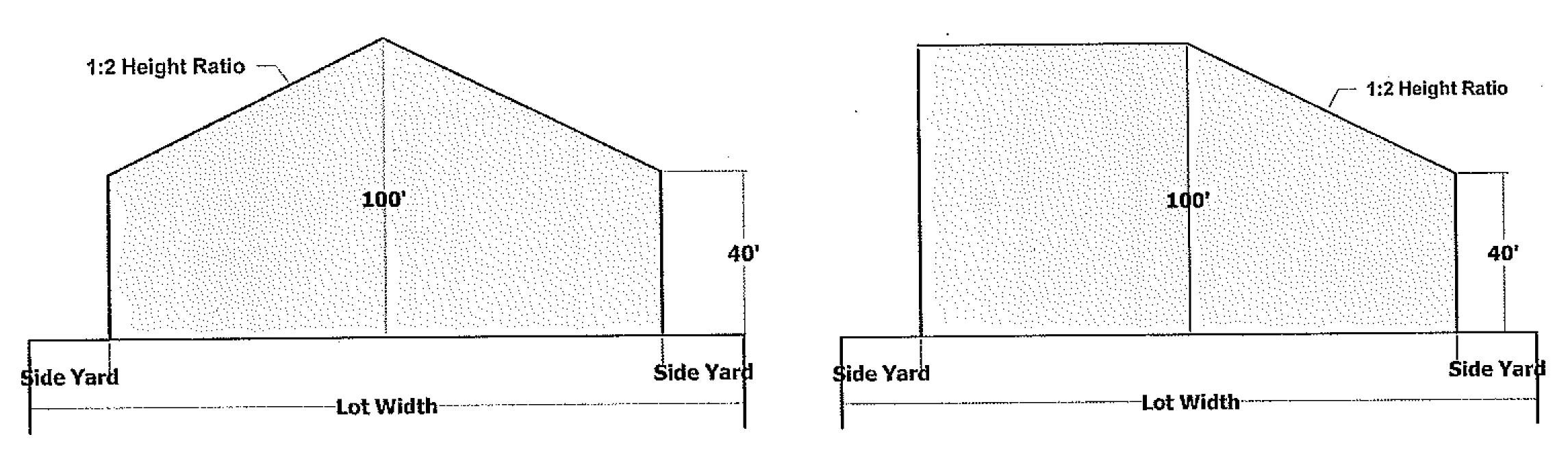
Table 9.205(1)(i)(B)
*Exemption for street rights-of-way that exceed one hundred (100) feet in width.
Maximum Building Envelope Examples for Table 9.205(1)(i)(B) — Nonresidential Buildings
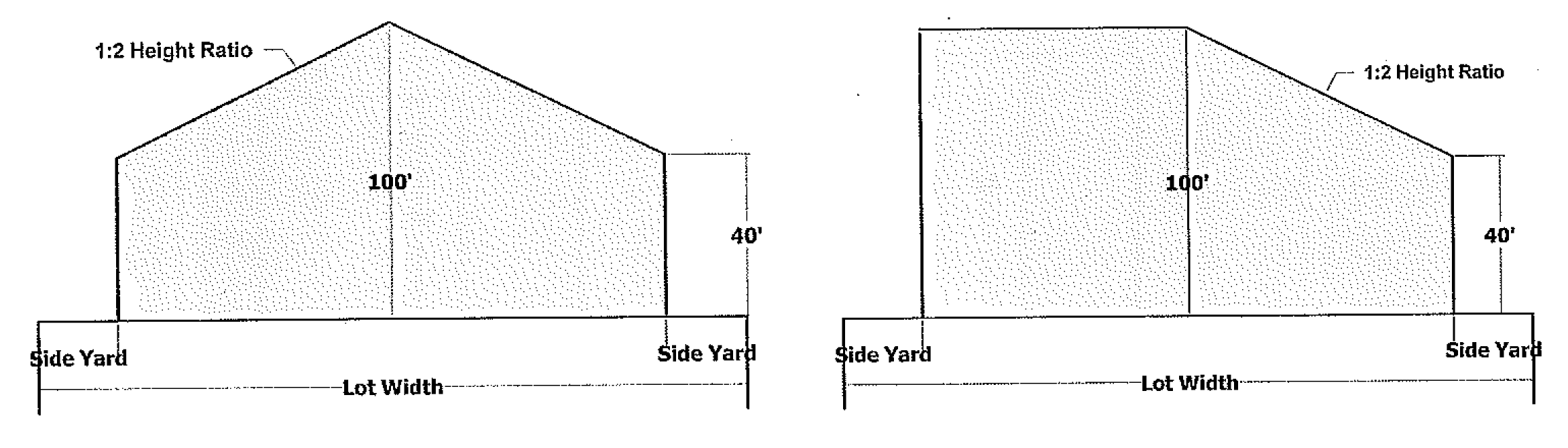
FOOTNOTES TO CHART 9.205(1):
CROSS-REFERENCES: Applicable buffer requirements may require a larger side or rear yard than the minimum in some districts. See Chapter 12, Part 3. Also, setbacks and yards which are larger than the minimum may be required along certain streets subject to the regulations in section 12.103.
(2)
Small subdivisions. Subdivisions of 5 acres or less shall adhere to the following minimum lot area requirements in the R-3 and R-4 districts only:
(3)
Buffers and screening. Nonresidential development in the single-family residential districts shall comply with applicable buffer and screening requirements in Chapter 12, Part 3.
(4)
Special subdivision lot and yard requirements. The following provisions apply to any residential subdivision of 10 or more lots approved on or after the effective date of these regulations:
(a)
The minimum lot size of any lots within a subdivision may be reduced by 10%, provided that the average size of all lots is at least equal to the minimum lot size for the zoning district, and the total number of lots does not exceed the number that would be allowed if all lots were the minimum size for the zoning district. Other lot size reductions may be applicable, subject to section 12.105 and subsection (5) of this section;
(b)
Development on each lot need not meet the minimum setback requirement for the district in which such lot is located, if the average setback of all lots along a street within a subdivision meet the minimum setback required for the district. In no event, shall a structure be located any closer than twenty (20) feet to the right-of-way along a designated thoroughfare or thirty-two (32) feet from the existing or future back of curb along local and collector streets. The setback for each lot shall be shown on the final plat;
(c)
The minimum side yard may be reduced for a principal building or structure to 5 feet, provided a minimum building separation is maintained between the principal buildings or structures on adjoining lots that is equal to at least two times the minimum side yard required for the district;
(d)
A zero lot line, z-lots, and angled z-lots may be permitted where the building line is on one side of the lot line in a residential district used for single-family detached dwellings, provided that:
(i)
Any wall constructed on the side lot line must be a solid windowless wall. If there is an offset of the wall from the lot line of more than 6 inches, the offset must be at least 6 feet;
(ii)
The minimum building separation between the sides of adjacent dwellings shall be at least two times the minimum side yard required for the district;
(iii)
A 5-foot maintenance easement and a maximum eave encroachment of 2 feet within the maintenance easement must be established in the deed restrictions and covenants of the adjoining lot. This will provide ready access to the lot line wall at reasonable periods of the day for normal maintenance;
(iv)
Preliminary subdivision plans submitted to the planning department must indicate the proposed location and configuration of dwellings, driveways and parking arrangements for each lot. A draft of the proposed encroachment and maintenance easements must be submitted for review;
(v)
Zero side yards established under these standards must be continuous along the length of the building. There must be either the lot line wall or a solid wall or fence at least 6 feet high along the lot line adjacent to the building between the established setback and the established rear yard. The wall or fence is used in those cases where the building may be offset as allowed under these standards; and
(e)
Notwithstanding Subdivisions (a), (b), (c), or (d) above, any development on a lot that abuts a street defining the outer boundary of the subdivision, or that abuts a lot which is not within the subdivision, shall meet the minimum yard requirements of the zoning district in relation to that street or abutting lot.
(5)
Cluster development. Cluster development, as defined in [section] 2.201(C8), is permitted in all single-family residential districts, except the R-8, in accordance with the following regulations:
(a)
A cluster development need not meet the minimum lot area and lot width requirements set out in subsection 9.205(1), provided that the development does not exceed the maximum residential density for the district, and provided that each lot meets the minimum lot area and lot width requirements set forth in Table 9.205(5):
Table 9.205(5)
*Minimum rear yards forming the outer boundary of a cluster must conform to the minimums of subsection 9.205(1)(g) for the district in which the development is located.
(b)
Development qualifying under this subsection need not meet the minimum yard requirements of subsection 9.205(1) if it complies with the requirements of subsection (4) above.
(c)
Cluster development shall have common open space set aside in accordance with the following requirements:
(i)
At least 10 percent of the total area of the development shall be set aside as common open space;
(ii)
All common open space shall be set aside and improved no later than the date on which certificates of occupancy are issued for the first 75 percent of the total number of dwelling units to be constructed within the project area;
(iii)
No more than 50 percent of the required common open space shall be covered by water;
(iv)
Any structures located in any common open space shall be accessory to the recreational use of the space;
(v)
The required common open space shall be planned and improved so that it is accessible and usable by persons living in the project area. However, common open space containing natural features worthy of preservation may be left unimproved;
(vi)
All of the common open space required under this section shall be either conveyed to the City of Charlotte, if the city agrees to accept ownership of and to maintain the space, or conveyed to one or more homeowner associations created for the development, or with respect to outdoor recreation facilities to the owner or operator, thereof; and
(vii)
Any conveyance to a homeowners association shall be subject to restrictive covenants and easements reviewed by the Planning Director and recorded and filed at the time the subdivision plat for the project area is recorded. The covenants and easements shall provide for the establishment of a homeowner's association before any homes are sold,[.] [W]here membership is mandatory for each home buyer and any successive buyer, the association is responsible for liability insurance and local taxes on common open space and recreational facilities owned by it, and any fees levied by the association that remain unpaid will become a lien on the individual property in accordance with procedures established under the dedication or organization document. The covenants and easements shall also prohibit future development of any common open space, for other than open space or recreational purposes, and shall provide for continued maintenance of any common open space and recreational facilities.
(6)
Signs. Signs are permitted in all single-family residential districts in accordance with chapter 13.
(7)
Parking and loading. Development of any use in a single-family residential district must conform to the parking and loading standards in chapter 12, part 2.
(8)
Reserved.
(9)
Mixed income housing development. Mixed income housing developments, as defined in section 2.202, are allowed in all single-family residential districts, except the R-8, in accordance with the following regulations:
(a)
Density bonus. A density bonus of up to three (3) units per acre above the base density will be permitted for mixed income housing developments.
(b)
Locational criteria. The development shall be located within census block groups in Charlotte's sphere of influence that are at or above the median home value for all census block groups in Charlotte's sphere of influence. The median home value will be based on the US Census Bureau, American Community Survey five-year average estimates and will be reassessed every five (5) years by planning staff.
(c)
Affordability set-aside.
(i)
A minimum of fifty (50) percent of the additional units allowed by the density bonus must target income levels at or below eighty (80) percent of area median income (AMI). AMI is updated annually by the US Department of Housing and Urban Development.
(ii)
The number of units targeted to income levels at or below eighty (80) percent of AMI shall not exceed twenty-five (25) percent of the total number of dwelling units in the development.
(iii)
Period of affordability shall be fifteen (15) years for rental properties and the city or a nonprofit shall have first right of refusal for for-sale properties.
(d)
Development standards.
(i)
Development size must be a minimum of one (1) acre.
(ii)
The minimum lot size and lot width for single-family detached dwellings shall comply with one of the following scenarios:
a.
Cluster provisions listed in Table 9.205(5) of the zoning category.
b.
Cluster provisions of the zoning category two (2) districts lower listed in Table 9.205(5) if a minimum of ten (10) percent of the development is designated tree save and located within common open space. Perimeter lots that abut or are across a local residential street from other single-family zoned properties shall meet the underlying zoning cluster provisions. A minimum 20-foot wide tree save area within common open space may be utilized to eliminate this requirement for perimeter lots that abut other single-family zoned properties.
(iii)
The minimum setbacks are as follows:
a.
The setback shall be twenty (20) feet for front loaded garages and fifteen (15) feet for all other portions of the structure from the right-of-way (subsection 12.206(3)).
(iv)
The minimum rear yard for internal lots shall be thirty (30) feet. The rear yard along the outer boundary of a development must comply with the minimum zoning district requirement.
(v)
Duplex, triplex, and quadraplex buildings are allowed to be integrated within a mixed income housing development in accordance with the following standards:
a.
Up to fifty (50) percent of the additional dwelling units allowed by the density bonus may be duplex, triplex, and quadraplex units.
b.
These unit types must be located internal to the development. If common open space is used to qualify a lot as an internal lot, the minimum dimension of that area must be seventy-five (75) feet between the external property boundary of the development and the internal lot.
c.
The development of duplex, triplex, and quadraplex units on abutting individual lots shall not be considered "planned multi-family" and no buffers will be required.
d.
Minimum lot size and lot widths for duplex, triplex, and quadraplex dwelling shall comply with the requirement set forth in Table 9.205(9).
TABLE 9.205(9)
* If land is sold with an attached unit, the minimum sub-lot size must be sufficient to accommodate the dwelling unit and four hundred (400) square feet of private open space.
e.
Duplex, triplex, and quadraplex dwellings shall comply with the maximum building coverage requirements set forth in Table 9.205(9a).
TABLE 9.205(9a)
(e)
Design guidelines.
(i)
All dwelling units within the development must externally blend in architecturally with other units to include materials and style (i.e. roof pitches, foundations, window types, and building materials).
(ii)
The units targeted to income levels at or below eighty (80) percent of AMI shall be dispersed within the development.
(Ord. No. 3523, § 1(18), 3-15-1993; Ord. No. 380, § 4, 9-18-1995; Ord. No. 1260, § 3(c), 4-19-1999; Ord. No. 1377, § 1, 10-18-1999; Ord. No. 1960, § 1, 11-19-2001; Ord. No. 3177, § 1, 1-17-2006; Ord. No. 4453-X, § 1, 6-21-2010; Ord. No. 4606, § 1, 12-20-2010; Ord. No. 4698, § 1, 7-18-2011; Ord. No. 4765, § 1, 10-17-2011; Ord. No. 4877, § 1, 5-14-2012; Ord. No. 5033, § 1, 1-22-2013; Ord. No. 5495, § 1, 10-20-2014; Ord. No. 5963, § 1, 6-15-2015)
Section 9.301. - Multifamily districts established; purposes.
The R-8MF, R-12MF, R-17MF, R-22MF and R-43MF districts are hereby established to protect and promote the development of a variety of housing types, including apartments, condominiums, and other forms of attached housing. These districts allow for housing to be developed at a full range of densities, from high densities accommodating smaller residential units appropriate to individuals and couples without children to the lower densities allowed in single-family residential districts. It is intended that these districts, and especially the R-43MF district, be located near employment centers, shopping facilities, and roads capable of handling the traffic generated by higher-density development. These districts may also accommodate limited institutional, public, and commercial uses appropriate within a residential environment. Densities of development are controlled by maximum number of dwelling units per acre requirements which are different for each district and indicated by the numerical identification attached to each district.
Section 9.302. - Uses permitted by right.
The following uses are permitted by right in the R-8MF, R-12MF, R-17MF, R-22MF and R-43MF districts, provided that they meet all requirements of this part, and all other requirements established in these regulations:
(1)
Reserved.
(2)
Dwellings, detached.
(3)
Dwellings, duplex.
(4)
Dwellings, triplex.
(5)
Dwellings, quadraplex.
(6)
Dwellings, attached and multifamily up to twelve (12) units in a building.
(7)
Farms, including retail sale of produce grown on the premises.
(8)
Group homes for up to ten (10) residents.
(9)
Highway and railroad rights-of-way.
(10)
Parks, greenways and arboretums.
(Ord. No. 383, § 5, 9-18-1995; Ord. No. 389, § 2(D), 10-16-1995)
Section 9.303. - Uses permitted under prescribed conditions.
The following uses shall be permitted in the R-8MF, R-12MF, R-17MF, R-22MF and R-43MF districts if they meet the standards established in this section and all other requirements of these regulations:
(0.4)
Accessory shelter, subject to the regulations of section 12.537.
(0.5)
Active adult retirement communities, subject to the requirements of Section 12.404. If a portion of the development contains attached or multifamily dwelling units, then the attached/multifamily development shall have no more than twelve (12) units in a building. If more than twelve (12) units are proposed in a building, then the multifamily portion of the development is subject to the requirements of Section 9.303(19).
(1)
Adult care centers, subject to the regulations of section 12.502.
(2)
Adult care homes, subject to the regulations of section 12.502.
(3)
Bus stop shelters, subject to the regulations of section 12.513.
(4)
Cemeteries, subject to the regulations of section 12.508.
(5)
Child care centers, subject to the regulations of section 12.502.
(6)
Child care centers in a residence, subject to the regulations of section 12.502.
(7)
Civic, social service and fraternal facilities, provided that:
(a)
All buildings, off-street parking and service areas will be separated by a Class C buffer from any abutting property located in a residential district or abutting residential use (See section 12.302);
(b)
The use will be located on a lot that fronts a collector, minor thoroughfare or major thoroughfare; and
(c)
Primary vehicular access to the use will not be provided by way of a residential local (Class VI) street.
(8)
Reserved.
(9)
Dormitories, provided that:
(a)
The dormitory will be located within one-half mile of the institutional use it is designed to serve;
(b)
Building walls over two hundred (200) square feet and facing a public right-of-way shall require a minimum of one large maturing tree per thirty (30) linear feet of wall or one small maturing tree per twenty (20) linear feet of wall no closer than fifteen (15) feet to the wall; and
(c)
If there are more than twelve (12) living units in a single dormitory or more than one dormitory on the same lot, it shall be reviewed and approved in accordance with the regulations for planned multifamily or attached development in subsection (19) of this section.
(10)
Elementary and secondary schools, provided that:
(a)
All buildings, outdoor recreational facilities and off-street parking and service areas will be separated by a Class C buffer for elementary schools and junior high schools and Class B buffer for senior high schools from any abutting residential use or residential zoning classification or low intensity institutional use (See section 12.302), except that buffers shall not be required to separate adjacent public elementary schools; junior high or middle schools; senior high schools; or public parks and greenways; or colleges;
(b)
The use will be on a lot which fronts a collector, minor thoroughfare or major thoroughfare for elementary schools and junior high schools and, for senior high schools, a lot shall front on a minor thoroughfare or major thoroughfare; and
(c)
Primary vehicular access to the use will not be provided by way of a residential local (Class VI) street.
(d)
Subsections (10)(b) and (10)(c) of this section shall not apply to the addition of mobile classrooms to any school that is nonconforming with respect to these provisions which was constructed, or where a building permit for the school was issued, prior to January 1, 1992. However, for such a nonconforming school the number of additional mobile classrooms may not constitute more than fifty percent of the school's total existing classrooms.
(e)
The requirements of section [chapter] 12, part 3: Buffers and Screening will not apply to the placement of mobile classrooms at any school for a period of one year from the date of the issuance of a certificate of occupancy for the mobile classrooms. However, after one year all applicable buffer and screening requirements must be fully complied with in all areas occupied by mobile classrooms installed on or after January 1, 1992 unless the subject mobile classrooms have been removed. A letter of compliance as required by section 12.306 must be provided at the time of the issuance of the certificate of occupancy for the mobile classroom acknowledging this provision. Mobile classrooms may not be placed within any area which would be used to meet the buffer requirement.
(f)
Except as modified by the requirements of subsection (7)(d) of this section, subsections (7)(b) and (7)(c) of this section shall not apply to additions, modifications, or improvements to any school that is nonconforming with respect to these provisions which was constructed, or where a building permit for the school was issued, prior to January 1, 1992. Notwithstanding the foregoing, subsections (10)(b) and (10)(c) shall not apply to any elementary school site which was operating as a school as of January 1, 1992, that has less than one hundred (100) feet of frontage on a collector, minor thoroughfare, or major thoroughfare.
(11)
Equestrian oriented subdivisions, subject to regulations of section 12.514.
[(11.1)]
Family child care hones; subject to the regulations of section 12.502.
(12)
Government buildings, up to 12,500 square feet, provided that:
(a)
All buildings, off-street parking and service areas will be separated by a Class C buffer from any abutting property located in a residential district or abutting residential use (See section 12.302);
(b)
The use will be located on a lot that fronts a collector, minor thoroughfare or major thoroughfare; and
(c)
Primary vehicular access to the use will not be provided by way of a residential local (Class VI) street.
(13)
Reserved.
(14)
Nonconforming structures and uses, subject to the regulations of chapter 7.
(15)
Nursing homes, rest homes, homes for the aged and elderly and disabled housing, provided that:
(a)
The maximum number of units or beds permitted is as established in the chart below:
(b)
If any nursing home, rest home or home for the aged has more than twelve (12) living units in a single building or if there is more than one building on the lot, it shall be reviewed and approved in accordance with the regulations for planned multifamily or attached development in subsection (19) of this section.
(16)
Open space recreational uses, subject to regulations of section 12.516.
(17)
Orphanages, children's homes and similar nonprofit institutions providing domiciliary care for children, provided that:
(a)
Building walls over two hundred (200) square feet and facing a public right-of-way shall require a minimum of one large maturing tree per thirty (30) linear feet of wall or one small maturing tree per twenty (20) linear feet of wall no closer than fifteen (15) feet to the wall; and
(b)
If an orphanage, children's home or similar institution has more than twelve (12) living units or if there is more than one building on the same lot, it must be reviewed and approved in accordance with the regulations for planned multifamily or attached development in subsection (19) of this section.
(17.1)
Outdoor fresh produce stands, subject to the regulations of section 12.538.
(18)
Outdoor recreation, subject to the provisions of section 12.540.
(19)
Planned multifamily and attached developments, a single multifamily or attached building on a lot with more than 12 units in a building, provided that:
(a)
The site plan must be designed giving adequate consideration to the following factors:
(i)
The size and shape of the tract.
(ii)
The topography and necessary grading.
(iii)
The reasonable preservation of the natural features of the land and vegetation.
(iv)
The size and relationship of buildings.
(v)
The character of/or relationship to adjoining properties.
Building arrangement should discourage the creation of long alleyways between the rears of buildings and should discourage the orientation of the front entrance of a residential building toward the rear entrance of another residential building. Consideration should be given to the location and arrangement of recreation and parking areas, the nature and extent of screening, and the design and utilization of streets and open spaces.
(b)
Every residential building on the site will be separated on every side from any other building by at least sixteen (16) feet;
(c)
All portions of every residential building will be located within four hundred (400) feet of a public street or private street which furnishes direct access to a residential building. Determination of whether interior roads will be public streets or private streets, or a combination of public streets and private streets will be made by the Planning Director in consultation with the Charlotte Department of Transportation and Engineering Department. In reaching that decision, consideration should be given to the following:
(i)
Adopted thoroughfare plan;
(ii)
Existing and proposed neighborhood streets and circulation needs;
(iii)
The relationship of the site to adjoining lands;
(iv)
The size and shape of the tract to be developed;
(v)
The number of dwelling units to ultimately be constructed on the tract and on adjoining lands; and
(vi)
Anticipated traffic volumes.
The determination of whether interior roads will be public or private will consider only the minimum needs of the public for public streets and will recognize the privacy, security and safety advantages of private streets;
(d)
Private streets are interior circulation roads designed and constructed to carry vehicular traffic from public streets within or adjoining the site to parking and service areas. The design and arrangement of private streets will be subject to review and approval by the Planning Director in consultation with the Charlotte Department of Transportation and Engineering Department.
(i)
Construction standards for private streets regarding paving, cross sections, curb and gutter and storm drainage will be as specified in the Charlotte-Mecklenburg Land Development Standards Manual. No specific minimum standards related to radii, vertical curves and longitudinal grades will be stated except that such designs will insure safe, convenient access and circulation for emergency and service vehicles. It will be an objective in the design and review of private streets and parking areas to provide for a residential environment where access and circulation ways are configured for slow speeds and to do minimum disturbance to topography and tree cover.
(ii)
Angled parking areas directly adjoining private streets will be permitted on one side of the street. Such parking areas may be alternated from one side of the street to the other. The combined length of such parking areas may not exceed fifty (50) percent of the length of the adjoining roadway. All other angled parking areas must be clearly separated from the private street by at least a barrier island.
(iii)
Permanent street names approved by the planning director will be assigned to each private street. Street name signs approved by the Charlotte Department of Transportation must be posted. The assignment of building identification numbers will utilize the approved private street names;
(e)
Private streets and surface parking areas on the site will be no closer than fifteen (15) feet to any side of a residential building used for entry into the building and will be no closer than five (5) feet to any other face of a building. Parking pads and driveways shall have a minimum length of twenty (20) feet, measured from the back of the sidewalk, or edge of pavement, whichever is greater.
Architectural features such as stoops, stairs, chimneys, bay windows, and roof overhangs may extend into this 15-foot area, but in no case may they be closer than five (5) feet to the private street and surface parking area.
(f)
The following standards shall apply when a public street, other than a thoroughfare abuts the site, or when both sides of a public street, other than a thoroughfare, are located within or runs through the boundaries of a project subject to this Section:
(i)
All buildings may have a minimum 15-foot separation from the existing or future right-of-way provided the conditions listed below are met.
(ii)
Architectural features such as cornices, eaves, steps, gutter, and fire escapes may project up to three (3) feet into this 15-foot separation area.
(iii)
All garages must have a minimum separation of twenty (20) feet from the existing or future right-of-way while the remainder of the structure may be located at the minimum 15-foot separation from the existing or future right-of-way (subsection 12.206(3)).
(iv)
All dwelling units with the 15-foot minimum street separation must have the building elevation facing the street as a front architectural facade with an entrance doorway. Rear and back facades are not permitted to face the street.
(v)
No parking or maneuvering space is permitted in the 15-foot separation area, except that common driveways providing access to parking areas may be installed across it. However, parking behind garages is allowed so long as the parking is out of the required planting strip and sidewalk area or the right-of-way, whichever is greater.
(g)
All structures and off-street parking and service areas will be separated by a Class C buffer along the side or rear yard from any abutting lot located in a single-family residential district or abutting single-family use (See section 12.302);
(h)
Building wall areas over two hundred (200) square feet and facing the public right-of-way shall require a minimum of one large maturing tree per thirty (30) feet of linear wall or one small maturing tree per twenty (20) feet of linear wall no closer than fifteen (15) feet to the wall; and
(i)
All locations for recycling containers, solid waste handling areas, dumpsters and/or compactors and their serviced entrances as required under Section 12.403 shall be shown on site plans for their review and approval.
(j)
No building permit for construction of a planned multifamily or attached development will be issued until a preliminary plan has been approved by the planning director in accordance with the requirements of these regulations. After the planning director has approved the preliminary plan, the planned multifamily or attached development must proceed through the normal approval process to obtain a building permit.
(19.1)
Bicycle-sharing station, subject to the regulations of section 12.543.
(20)
Public utility structures, subject to the regulations of section 12.504.
(21)
Public utility transmission and distribution lines, subject to the regulations of section 12.509.
(22)
Recreation centers, provided that:
(a)
All buildings and off-street parking and service areas shall be separated by a Class C buffer from any abutting property used and/or zoned residential, as per the requirements of section 12.302;
(b)
The use will be located on a lot that fronts a collector, minor thoroughfare or major thoroughfare; and
(c)
Primary vehicular access to the use will not be provided by way of a residential local (Class VI) street.
(d)
It contains not more than thirty thousand (30,000) square feet.
(23)
Radio, telephone, cellular telephone and television masts, towers, antennae and similar structures, subject to the regulations of subsection 12.108(7) or subsection 12.108(8).
(24)
Religious institutions, up to one thousand two hundred (1,200) seats, subject to the regulations of section 12.506.
(25)
Retail and office establishments, eating, drinking and entertainment establishments (Type 1), and indoor recreation, provided that:
(a)
The establishment will be located within a building that contains at least fifty (50) dwelling units;
(b)
The establishment will occupy no more than twenty-five (25) square feet per dwelling unit in the building up to a maximum of ten thousand (10,000) square feet;
(c)
The establishment will have no direct public entrance from the outside of the building; and
(d)
No merchandise or display of merchandise will be visible from outside the building.
(26)
Reserved.
(27)
Subdivision sales office, provided that:
(a)
The use serves the subdivision in which it is located and adjoining subdivision or subdivisions by the same developer or affiliate; and
(b)
The use shall be terminated upon the completion of the sale of ninety-five (95) percent of the total number of homes and/or lots; provided, however, that a model or demonstration home may be used for sales purposes until the last home or lot is sold.
(28)
Temporary buildings and storage of materials, provided that: The use is in conjunction with the construction of a building on the same lot where construction is taking place or on an adjacent lot. Such temporary uses shall be terminated upon completion of construction.
(29)
Universities, colleges and junior colleges, provided that:
(a)
All buildings, outdoor recreation facilities and off-street parking and service areas will be separated by a Class B buffer from any abutting residential use or residential district (See section 12.302);
(b)
The use will be on a lot which fronts a minor or major thoroughfare; and
(c)
Primary vehicular access will not be provided by way of a residential local (Class VI) street.
(30)
Outdoor seasonal sales, subject to the regulations of section 12.519.
(31)
Bed and breakfasts (B & B's), subject to regulations of section 12.521.
(32)
Boardinghouses, subject to regulations of section 12.520.
(33)
Beneficial fill sites, subject to the regulations of section 12.523.
(34)
Land clearing and inert debris landfills (LCID): off-site, subject to the regulations of section 12.503.
(Ord. No. 3314, § 1(3), 4-20-1992; Ord. No. 3358, § 1(1(A)), 7-20-1992; Ord. No. 3432, § 1(2), 10-19-1992; Ord. No. 3523, § 1(19), 3-15-1993; Ord. No. 3597, § 1, 7-19-1993; Ord. No. 3892, § 1(B), 7-17-1994; Ord. No. 305, § 1.2(C), 6-19-1995; Ord. No. 383, § 6, 9-18-1995; Ord. No. 389, § 2(E), 10-16-1995; Ord. No. 529, § 1(2), 4-15-1996; Ord. No. 772, § 1(3)(B), (D)(1), (2), 3-17-1997; Ord. No. 1012, § 1, 3-16-1998; Ord. No. 1205, § 1(1), 2-15-1999; Ord. No. 1732, § 2, 1-16-2001; Ord. No. 1961, § 1, 11-19-2001; Ord. No. 1996, § 1, 1-22-2002; Ord. No. 2056, § 2, 4-15-2002; Ord. No. 2224, § 3, 1-21-2003; Ord. No. 2239, § 1(2.C), 2-17-2003; Ord. No. 2941, § 2B, 4-18-2005; Ord. No. 3007, § 2B, 6-20-2005; Ord. No. 3224, § 1, 3-20-2006; Ord. No. 3518-Z, § B2, 2-19-2007; Ord. No. 4606, § 1, 12-20-2010; Ord. No. 4873, § 1, 5-14-2012; Ord. No. 4908, § 1, 6-18-2012; Ord. No. 5423, § 1, 7-21-2014; Ord. No. 5495, § 1, 10-20-2014)
Section 9.304. - Permitted accessory uses and structures.
The following uses shall be permitted in the R-8MF, R-12MF, R-17MF, R-22MF and R-43MF districts as accessory uses and structures, subject to the applicable criteria in this part and in chapter 12 of these regulations:
(1)
Accessory uses and structures, clearly incidental and related to the permitted principal use or structure on the lot.
(2)
Bookstores, offices, printing and distribution and similar uses as accessories to religious institutions located on the same lot and subject to the regulations of section 12.506.
(2.5)
Crematory facilities, within a cemetery, subject to the regulations of section 12.542.
(3)
Customary home occupations, subject to the regulations of section 12.408.
(4)
Dumpsters, trash handling areas and service entrances, subject to the regulations of section 12.403.
(5)
Dwelling, accessory units as an accessory to a single-family detached dwelling, subject to the regulations of section 12.407.
(6)
Fences and walls, subject to the regulations of section 12.406.
(7)
Reserved.
(8)
Marinas, subject to the regulations of section 12.409.
(9)
Reserved.
(9.5)
Outdoor dining associated with an eating, drinking and entertainment establishment (Type 1 only).
(10)
Outdoor lighting, subject to the regulations of section 12.402.
(11)
Petroleum storage, accessory to a permitted principal use or building, subject to the Fire Prevention Code of the National Board of Fire Underwriters.
(12)
Private kennels, subject to the regulations of section 12.410.
(13)
Private stables, subject to the regulations of section 12.411.
(14)
Vending machines for cigarettes, candy, soft drinks and similar items and coin-operated laundries located within an enclosed building as an accessory to the uses in the principal building or buildings.
(15)
The following provisions shall apply to location of unlicensed motor vehicles and the display for sale or trade of licensed and unlicensed motor vehicles in residentially zoned districts.
(a)
Unlicensed.
1.
No more than two (2) motor vehicles that do not have a current, valid license plate and are not fully enclosed in a permanent structure shall be permitted outside on any premises, provided such vehicles are registered to the occupant of the premises or immediate family member of the occupant as the record title owner of the vehicle.
2.
No unlicensed motor vehicle if not registered to the occupant of the premises or immediate family member of the occupant as the record title owner of the vehicle shall be permitted outside of any premises.
3.
Vehicles described in paragraphs (1) and (2) are not permitted to be located within any required setback or yards contained in these regulations or any street right-of-way except as provided in paragraph (b)(4) below.
(b)
Licensed or unlicensed.
1.
No more than two (2) motor vehicles, whether licensed or unlicensed, may be displayed for sale or trade in the premises at any time and such display of a given vehicle for sale or trade shall not be for a period as to that vehicle exceeding sixty (60) days.
2.
During a 12-month period commencing January 1 and ending December 31 of each year, no more than three (3) such licensed or unlicensed motor vehicles shall be displayed for sale or trade on the premises. Further, no more than three (3) sales or trades of such licensed or unlicensed motor vehicles displayed for sale on the premises shall occur within the same 12-month period.
3.
No motor vehicle, whether licensed or unlicensed, if not registered to the occupant of the premises or immediate family member of the occupant as the record title owner of the vehicle, may be displayed upon the premises for sale or trade.
4.
A motor vehicle licensed or unlicensed displayed for sale or trade on the premises or provided herein may be located in the setback but not within the street right-of-way.
(c)
If there are any premises with more than the number of vehicles provided for in sections (a) and (b) above in violation of this section, then the owner and occupant, if different, shall have ninety (90) days from the date of the adoption of this ordinance to come into compliance with the ordinance or shall be in violation of this section.
(d)
All vehicles must comply with City code, chapter 10, Article III, "Removal and disposition of abandoned vehicles, hazardous vehicles and junked motor vehicles.
(16)
Land clearing and inert debris landfill (LCID): on-site, subject to the regulations of section 12.405.
(17)
Recreation centers, as an accessory use to a school, provided that:
(a)
All buildings and off-street parking and service areas shall be separated by a Class C buffer from any abutting property used and/or zoned residential, as per the requirements of section 12.302;
(b)
The use will be located on a lot that fronts a collector, minor thoroughfare or major thoroughfare; and
(c)
Primary vehicular access to the use will not be provided by way of a residential local (Class VI) street.
(d)
It contains not more than thirty thousand (30,000) square feet.
(Ord. No. 3309, § 1(1), 4-20-1992; Ord. No. 772, § 1(3)(E), 3-17-1997; Ord. No. 3007, § 2B, 6-20-2005; Ord. No. 4846, § 1, 3-19-2012; Ord. No. 4931, § 1, 7-16-2012; Ord. No. 5522, § 1, 11-17-2014)
Editor's note— Ord. No. 3007, § 2B, adopted June 20, 2005, enacted provisions intended for use as subsection (15). Inasmuch as there are already provisions so designated, and at the discretion of the editor, said provisions have been redesignated as subsection (17).
Section 9.305. - Development standards for multifamily districts.
All uses and structures permitted in the R-8MF, R-12MF, R-17MF, R-22MF, and R-43MF districts shall meet the applicable development standards established in this section and all other requirements of these regulations:
(1)
Area, yard and bulk regulations shall be as follows:
Table 9.305(1)(i)(A)
Maximum Building Envelope Example for Table 9.305(1)(i)(A)—Residential Buildings in R-8MF and R-12MF
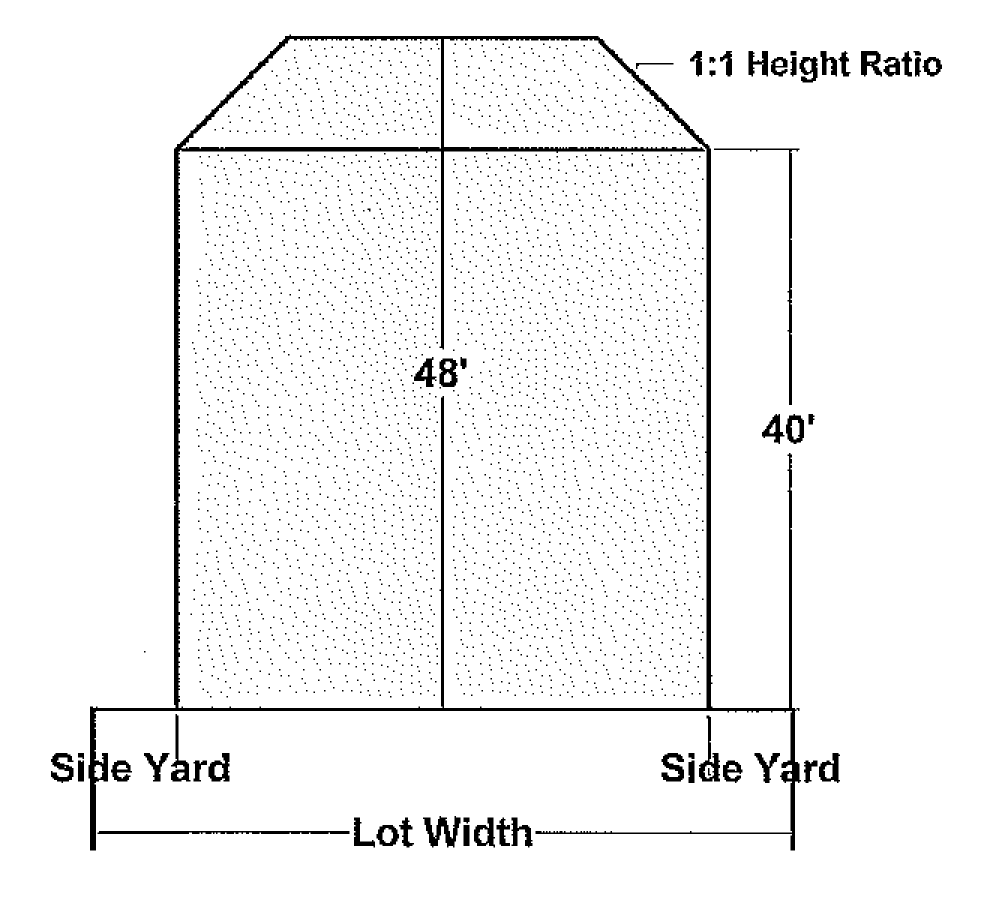
Table 9.305(1)(i)(B)
*Exemption for street rights-of-way that exceed one hundred (100) feet in width.
Maximum Building Envelope Examples for Table 9.305(1)(i)(B)—Residential Buildings in R-17MF, R-22MF and R-43MF
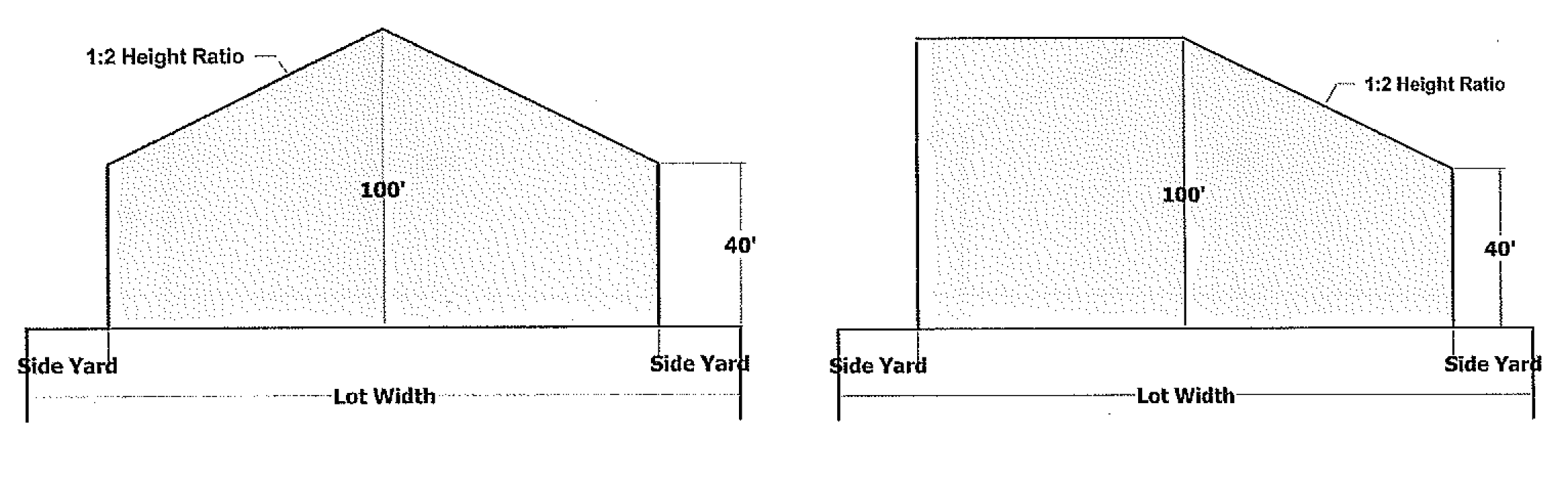
Table 9.305(1)(i)(C)
*Exemption for street rights-of-way that exceed one hundred (100) feet in width.
Maximum Building Envelope Examples for Table 9.305(1)(i)(C)—Nonresidential Buildings
in Multi-Family Districts
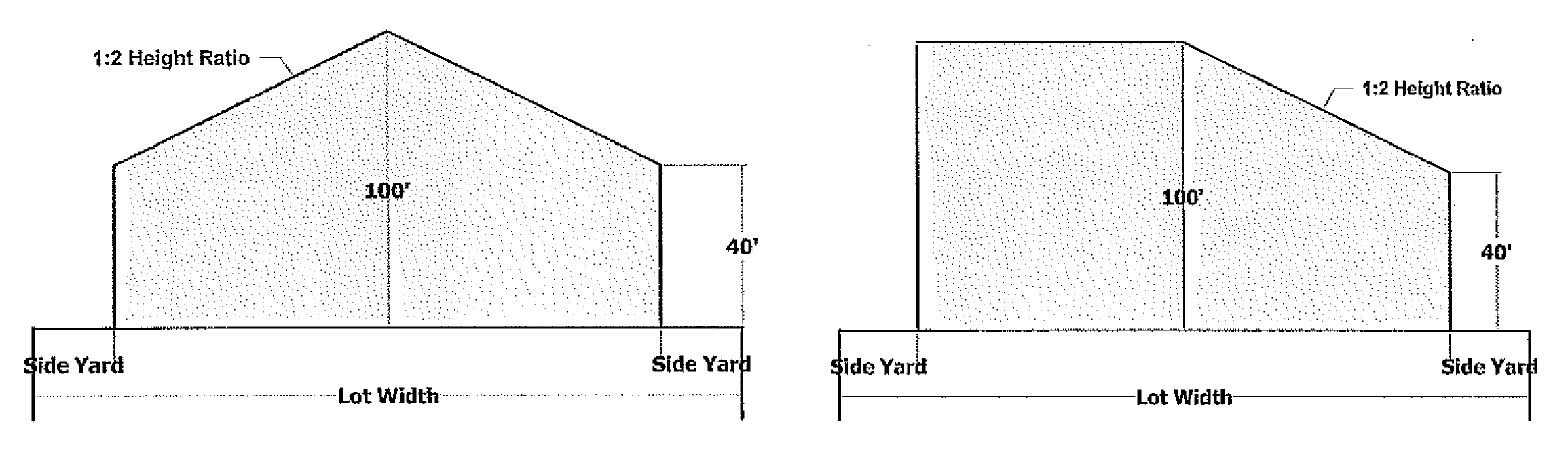
FOOTNOTES TO CHART 9.305:
CROSS-REFERENCES: Applicable buffer requirements may require a larger side or rear yard than the minimum in some districts. See Chapter 12, Part 3. Also, larger setback and yard requirements may be required along certain streets subject to the regulations of section 12.103.
(2)
Buffers and screening. Development of any use in a multifamily residential district must conform to applicable buffer and screening requirements in Chapter 12, Part 3.
(3)
Signs. Signs are permitted in all multifamily residential districts in accordance with Chapter 13.
(4)
Parking and loading. Development of any use in a multifamily residential district must conform to the parking and loading standards in Chapter 12, Part 2.
(5)
Special subdivision lot and yard requirements. Special lot and yard requirements apply to residential subdivisions of 10 lots or more in accordance with subsection 9.205(4).
(6)
Mixed income housing development density bonus. A density bonus shall be permitted for a planned multi-family development that is developed as a mixed income housing development, as defined in section 2.202, in the R-8MF and R-12MF zoning districts in accordance with the following regulations:
(a)
Locational criteria. The development shall be located within census block groups in Charlotte's sphere of influence that are at or above the median home value for all census block groups in Charlotte's sphere of influence. The median home value will be based on the US Census Bureau, American Community Survey five-year average estimates and will be reassessed every five (5) years by planning staff.
(b)
Incentives/offsets.
(i)
Allow up to two (2) units per acre above the base density within the R-8MF district (up to ten (10) dwelling units per acre).
(ii)
Allow up to three (3) units per acre above the base density within the R-12MF district (up to fifteen (15) dwelling units per acre).
(iii)
Allow an additional two (2) units per acre above the base density if located within one-fourth (¼) mile of transit (rapid transit, local bus service, or an express bus service park and ride lot).
(c)
Affordability set-aside.
(i)
A minimum of fifty (50) percent of the additional units allowed by the density bonus must target income levels at or below eighty (80) percent of area median income (AMI). AMI is updated annually by the US Department of Housing and Urban Development.
(ii)
A minimum of fifty (50) percent of those units indicated above in subsection 9.305(6)(c)(i) must target income levels at or below sixty (60) percent of area median income (AMI).
(iii)
The number of units targeted to income levels at or below eighty (80) percent of AMI shall not exceed twenty (20) percent of the total number of dwelling units in the development.
(iv)
Period of affordability shall be fifteen (15) years for rental properties and the city or a nonprofit shall have first right of refusal for for-sale properties.
(d)
Development standards.
(i)
Development size must be a minimum of three (3) acres.
(e)
Design guidelines.
(i)
All building units within the development must externally blend in architecturally with other units to include materials and style (i.e. roof pitches, foundations, window types, and building materials).
(ii)
The units targeted to income levels at or below eighty (80) percent of AMI shall be dispersed within the development.
(iii)
If there are more than twenty-five (25) units targeted to income levels at or below eighty (80) percent of AMI, then those units may be contained in a single structure.
(Ord. No. 3523, § 1(20), 3-15-1993; Ord. No. 380, §§ 5, 6, 9-18-1995; Ord. No. 1960, § 1, 11-19-2001; Ord. No. 1961, § 1, 11-19-2001; Ord. No. 3224, § 1, 3-20-2006; Ord. No. 4453-X, § 1, 6-21-2010; Ord. No. 4606, § 1, 12-20-2010; Ord. No. 4698, § 1, 7-18-2011; Ord. No. 5039, § 1, 2-18-13; Ord. No. 5495, § 1, 10-20-2014; Ord. No. 5963, § 1, 6-15-2015)
Section 9.401. - Urban Residential districts; location; purposes.
(1)
Urban areas are recognized as unique areas with many assets and opportunities. In order to foster the urban characteristics of these areas, development here should promote an environment of diverse uses at higher than normal density which encourages pedestrian activities, needs and movement, while at the same time recognizing the limited supply of urban land. As such this requires special zoning classifications in order to implement the goals and objectives of these vital areas of the community. Further it is necessary and desirable to promote the residential nature of these areas through zoning classifications which are intended to realize the growing opportunities for new infill development and redevelopment. Such residential development, properly located and developed, can enhance and support the overall mix of uses characteristic of urban areas. Therefore, the purpose of this section is to establish the urban residential districts.
(2)
Urban residential districts are intended for use in special areas of the community and thus may be considered for limited application. Generally, special plans or policy guides will be used to determine applicability. The official Zoning Map of the City of Charlotte will designate urban residential district boundaries.
(3)
These districts are designed to provide standards and incentives which will promote the development or redevelopment of urban areas that contain a mix of land uses with a predominantly residential character. Emphasis is given to provisions which will provide opportunities for imaginative new urban development compatible with the development objectives of these areas. Accordingly, the development objectives are:
(a)
To maximize residential development potentials in urban areas;
(b)
To establish a predominantly residential character with residential neighborhoods;
(c)
To provide for sufficient local retail and office uses to support residential areas;
(d)
To protect all residential areas from inappropriate and intrusive uses;
(e)
To maximize open space and other amenities within residential areas;
(f)
To protect and enhance existing single-family residential areas from uses which by their scale and characteristics may be inappropriate;
(g)
To provide for the efficient utilization of scarce urban land; and
(h)
To reward development projects through a density bonus system for including specific development features which significantly further the overall goals for these areas and which enhance the urban residential environment.
Section 9.402. - Urban Residential Districts; established.
In order to provide densities and other development standards which are compatible with urban characteristics, the following zoning classifications are established:
(1)
Urban Residential-1 district (UR-1): The intent of this district is to protect and enhance designated single-family areas and to encourage appropriate infill development within these areas.
(2)
Urban Residential-2 district (UR-2): The intent of this district is to promote maximum opportunities for moderate density residential development. This district functions as both a transition between lower and higher density and as the predominant residential district throughout much of the fringe of the uptown area.
(3)
Urban Residential-3 district (UR-3): The intent of this district is to provide for high density residential development. This district is located nearer the employment core and in areas identified for their special adaptability and appropriateness for this type of housing.
(4)
Urban Residential-Commercial district (UR-C): The intent of the UR-C district is to promote a diversity of residential, retail, office, recreational and cultural uses in a mixed use, higher density pattern. This district is restricted in location to the periphery of an employment core or to areas designated as community or neighborhood centers where a high level of commercial or other services are desired.
Section 9.403. - Urban Residential Districts; uses permitted by right.
(1)
UR-1: Uses permitted by right within the UR-1 district are detached, duplex and attached dwellings and group homes for up to 6 residents.
(2)
UR-2: Uses permitted by right within the UR-2 district are detached duplex, triplex, quadraplex, attached, and multifamily dwellings. Business or office uses are allowed but limited to those permitted in the B-1 Neighborhood Business District, except that no drive-in windows or automotive sales, service or repair are permitted. The maximum gross floor area of these business uses is fifty (50) percent of the ground floor area of the building in which they are located and any single tenant or use shall be limited to a maximum of three thousand (3,000) square feet.
(3)
UR-3: Uses permitted by right within the UR-3 district are detached duplex, triplex, quadraplex, attached, multifamily dwellings and group homes for up to ten (10) residents. Business or office uses limited to those permitted in B-1 neighborhood business districts are also allowed, except that no drive-in windows or automotive sales, service or repair is permitted. Any such commercial uses will be limited in floor area to two (2) times the size of the building footprint, but there are no requirements as to where within the structure the uses may be located. Business or office uses are not permitted as freestanding uses but may be combined with residential uses in the same structure.
(4)
UR-C: Uses permitted by right within the UR-C district are detached duplex, triplex, attached, multifamily dwellings, freestanding nonresidential structures and group homes for up to ten (10) residents. Freestanding nonresidential structures and multifamily structures may contain commercial and office uses that are permitted in B-1 neighborhood business districts, except that no drive-in windows or automotive sales, service, or repair will be permitted.
(Ord. No. 383, § 11, 9-18-1995; Ord. No. 867, § 1(B), 7-21-1997; Ord. No. 2058, § 1A, 4-15-2002)
Section 9.404. - Urban Residential Districts; uses permitted under prescribed conditions.
(0.4)
Accessory shelter, subject to the regulations of section 12.537.
(0.5)
Active adult retirement communities, subject to the requirements of section 12.404. If a portion of the development contains attached or multifamily dwelling units, then the attached/multifamily development is subject to the requirements of Section 9.303(19) except dimensions requirements of that section shall not apply.
(1)
Buildings for dramatic, musical, or cultural activities with less than one thousand (1,000) seats and stadiums and coliseums with less than five thousand (5,000) seats, provided that:
(a)
The perimeter of the parking areas, exclusive of access driveways, will have a planting strip of at least five (5) feet in width, and at least one tree two (2) inches in caliper for each twenty-five (25) linear feet of parking area perimeter shall be planted;
(b)
Parking areas will have interior planting areas amounting to at least 10 percent of the paved area in excess of one acre;
(c)
Access for the development site will be provided from nonresidential streets and shall not require the use of any residential collector (Class V) or residential local (Class VI) streets;
(d)
The private living areas and associated open spaces of all abutting residential properties are effectively screened from parking and service areas, as well as from any other portion of the development site which is actively used;
(e)
No direct beams or rays of light from exterior lighting fixtures, signs or vehicles maneuvering on the development site will shine into the private living areas and associated open spaces of adjacent residential properties;
(f)
The use will not generate light of such an intensity or brilliance as to cause glare or to impair the vision of drivers;
(g)
The use will be designated to allow direct access for transit service;
(h)
The use will not cause or intensify off-site drainage problems; and
(i)
The use will not be contradictory to the objectives of any approved plans for the area.
[(1.1)]
Child care centers (UR-2, UR-3, and UR-C only), subject to the regulations of section 12.502.
[(1.2)]
Child care centers in a residence, subject to the regulations of section 12.502.
(2)
Customary home occupations. Home occupations are allowed in all urban residential districts in accordance with the requirements of section 12.408.
[(2.1)]
Family child care homes, subject to the regulations of section 12.502.
(3)
Off-street parking as a separate use (UR-C only). This parking must be provided with a five-foot wide landscaped area along all property lines. The landscaped areas may include materials such as grass, planted ground cover, shrubs, vines, hedges, trees or similar materials.
(3.1)
Outdoors-fresh produce stands, and mobile produce market, subject to the regulations of section 12.538.
(4)
Planned multifamily and attached dwellings. Residential uses, subject to the provisions of subsection 9.303(19), Planned Multifamily and Attached dwellings in residential districts shall be reviewed and approved in accordance with the provision of that section, except dimensional requirements of that section do not apply.
(4.5)
Bicycle-sharing station, subject to the regulations of section 12.543.
(5)
Religious institutions. Religious institutions are permitted subject to the regulations of section 12.506.
(5.1)
Single room occupancy (SRO) residences (UR-2, UR-3 and UR-C only), subject to the regulations of section 12.527.
(6)
Uses normally permitted in residential districts. Institutional, nonresidential, accessory or complimentary uses normally permitted in other residential districts are permitted.
(7)
Yard reduction. Reduction of any required yard by up to twenty-five (25) percent, provided that the reduction will result in more efficient use of the site, preserve natural features or will not unduly diminish the provision of light, air and privacy to abutting properties.
(8)
Bed and breakfasts (B & B's) (UR-1 only,) subject to regulations of section 12.521.
(9)
Boardinghouses (UR-1 only), subject to regulations of section 12.520.
(10)
Beneficial fill sites, subject to the regulations of section 12.523.
(Ord. No. 305, § 1.2(D), 6-19-1995; Ord. No. 389, § 2(F), 10-16-1995; Ord. No. 772, § 1(3)(B), (D)(2), 3-17-1997; Ord. No. 2224, § 4, 1-21-2003; Ord. No. 2239, § 1(2.D), 2-17-2003; Ord. No. 2941, § 2C, 4-18-2005; Ord. No. 3010, § 1A2, 6-20-2005; Ord. No. 4697, § 1, 7-18-2011; Ord. No. 4873, § 1, 5-14-2012; Ord. No. 4908, § 1, 6-18-2012; Ord. No. 5962, § 1, 6-15-2015)
Section 9.405. - Urban Residential Districts; accessory uses and structures.
Accessory structures are allowed in all urban residential districts in accordance with section 12.106. However, accessory structures are exempted from section 12.106 with respect to shared property lines when a joint application is made by adjoining property owners.
Outdoor dining associated with an eating, drinking and entertainment establishment (Type 1 or Type 2). Outdoor dining associated with a Type 2 eating, drinking and entertainment establishment is subject to the regulations of section 12.546.
Land clearing and inert landfills (LCID): On-site, are permitted subject to the regulations of section 12.405.
(Ord. No. 5522, § 1, 11-17-2014)
Section 9.406. - Urban Residential Districts; area, yard and height regulations.
(1)
UR-1: Dimensional requirements for the UR-1 district are listed below:
Minimum lot area (square feet)**** .....3,000
Minimum side yard (feet) .....5
Minimum setback (feet)*** .....14
Minimum rear yard (feet) .....10
Maximum floor area ratio* .....0.25
Maximum height (feet)** .....See Table Below
Minimum lot width (feet) .....20
Table 9.406(1)(A)
Maximum Building Envelope Example for Table 9.406(1)(A)—Residential Buildings in UR-1
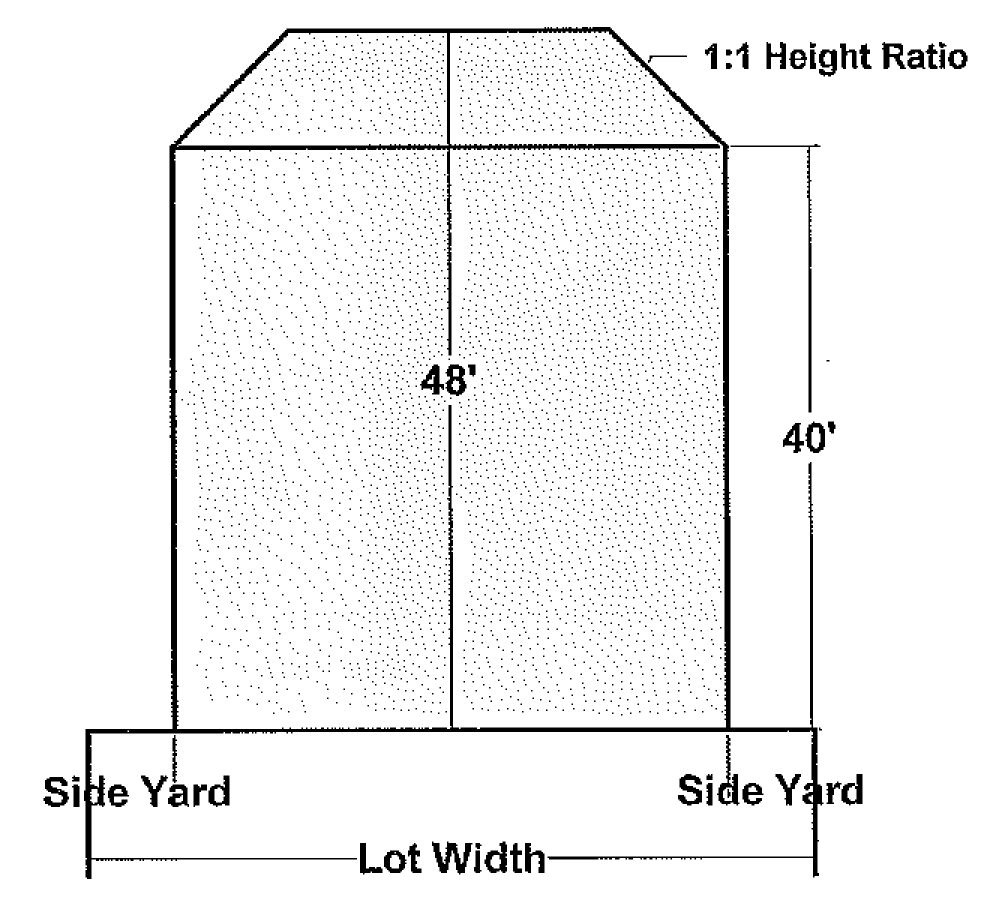
Table 9.406(1)(B)
*Exemption for street rights-of-way that exceed one hundred (100) feet in width.
Maximum Building Envelope Examples for Table 9.406(1)(B)—Nonresidential Buildings in UR-1
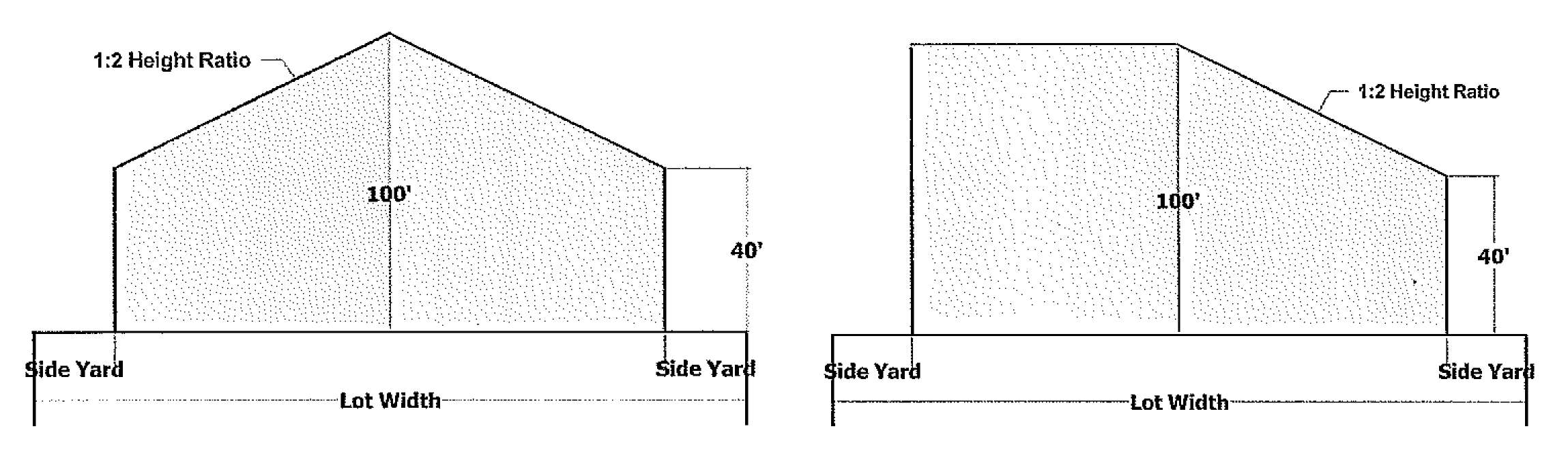
(2)
UR-2: Dimensional requirements for the UR-2 district are listed below:
Minimum lot area (square feet)** .....3,000
Minimum side yard (feet) .....5
Minimum setback (feet) .....14***
Minimum rear yard (feet) .....10
Maximum floor area ratio .....1.0
Maximum height (feet)* .....See Table Below
Minimum lot width (feet) .....20
Table 9.406(2)(A)
*Exemption for street rights-of-way that exceed one hundred (100) feet in width.
Maximum Building Envelope Examples for Table 9.406(2)(A)—Buildings in UR-2
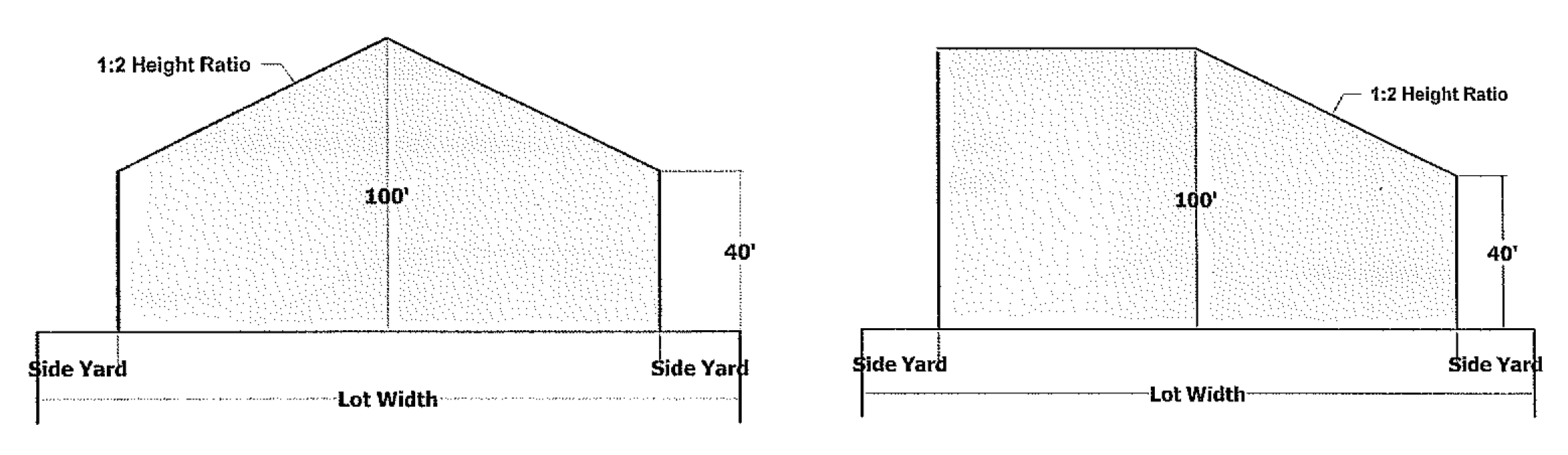
(3)
UR-3: Dimensional requirements for the UR-3 district are listed below:
Minimum lot area (square feet)** .....3,000
Minimum side yard (feet) .....5
Minimum setback (feet) .....14***
Minimum rear yard (feet) .....20
Maximum floor area ratio .....2.0
Maximum height (feet)* .....See Table Below
Minimum lot width (feet) .....20
Table 9.406(3)(A)
*Exemption for street rights-of-way that exceed 100 feet in width.
Maximum Building Envelope Examples for Table 406(3)(A)—Buildings in UR-3
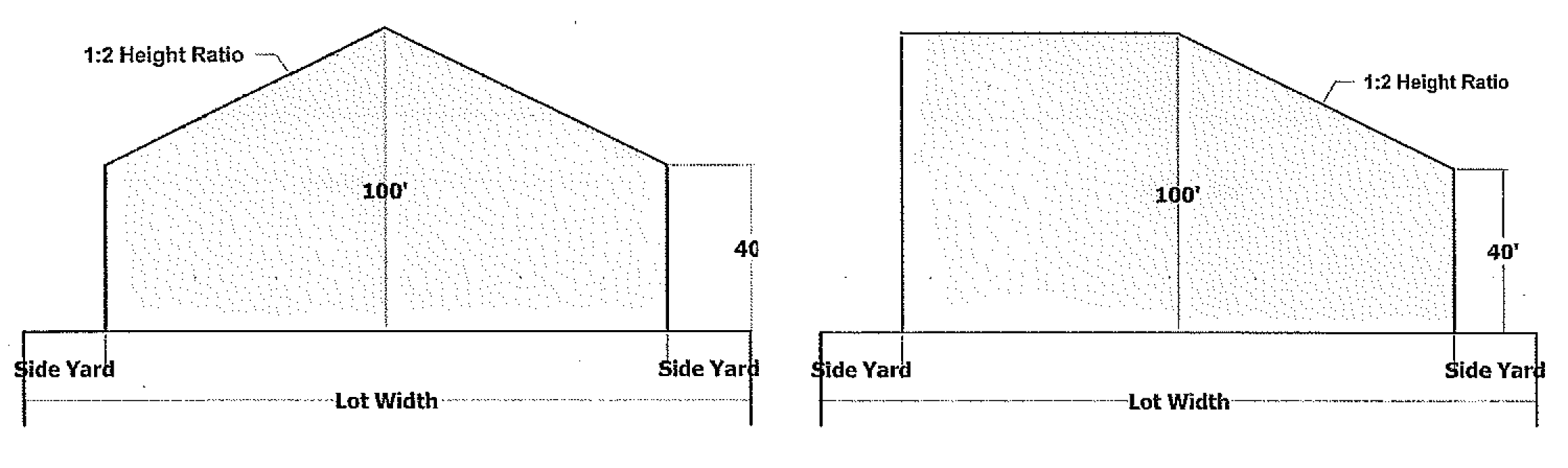
(4)
UR-C: Dimensional requirements for the UR-C district are as follows:
(5)
Building separation. The minimum building separation between buildings on a multiple building site in any UR district is 10 feet.
(6)
Transportation corridor rights-of-way. The requirements for transportation corridor rights-of-way in an urban area may vary due to patterns of existing rights-of-way, existing development, traffic movements and intersection design. In order to assure that adequate land is available to accommodate future public transportation corridor improvements, right-of-way must be protected. All development and uses in the district, except renovated and/or rehabilitated buildings, must reserve and keep free of development the necessary rights-of-way, which abut the property. The necessary rights-of-way will be determined on a case-by-case basis by the Charlotte Department of Transportation and the Charlotte-Mecklenburg Planning Department staff. In making their determination these agencies will be guided by the adopted Central Area Plan and by the approved streetscape plan for the street if such a plan has been adopted. However, the absence of an adopted streetscape plan does not relieve the requirement for the necessary right-of-way to be reserved.
(7)
Extensions into building setback. In addition to being permitted in urban open space areas, canopies, awnings, cornices and similar architectural accents are permitted on exterior building walls. Such features may be constructed of rigid or flexible material designed to complement the streetscape of the area. Any such facility may extend from the building up to one half (½) of the width of the sidewalk area in front of the building or nine (9) feet, whichever is less. If this extension would reach into the public right-of-way, an encroachment agreement from the city or state is required. In no case may any such facility extend beyond the curb line of any public street, nor should it interfere with the growth or maintenance of street trees. A minimum overhead clearance of eight (8) feet from the sidewalk must be maintained.
(8)
Special yard, lot and street standards for residential development in the UR-1 and UR-2 districts. The following provisions may be applied to any residential development of ten (10) acres of less. A residential development is a development that may contain one or more of the following types of residential dwellings; detached and attached dwellings, duplex, triplex and quadraplex dwellings (attached dwellings may not contain more than four (4) units per building). The following provisions may be used independently or in any combination.
(a)
The minimum lot size for detached dwellings including the required sublot for attached dwellings may be reduced by ten (10) percent provided that the average size of all lots or sublots is at least equal to the minimum lot size and sublot size specified in the UR-1 and UR-2 districts.
(b)
Reduction of any required yard by up to twenty-five (25) percent is permitted, provided that the reduction will result in more efficient use of the site, preserve natural features or will not unduly diminish the provision of light, air and privacy to abutting properties.
(c)
A zero lot line, Z-lots, and angled Z-lots may be permitted where the building line is on one side of the lot within the interior* of a residential development, provided that:
(i)
Any wall constructed on the side lot line must be a solid windowless wall. If there is an offset of the wall from the lot line of more than six (6) inches, the offset must be at least six (6) feet.
(ii)
The minimum building separation between the sides of adjacent dwellings shall be at least six (6) feet;
(iii)
A five-foot maintenance easement and a maximum eave encroachment of two (2) feet within the maintenance easement must be established in the deed restrictions and covenants of the adjoining lot. This will provide ready access to the lot line wall at reasonable periods of the day for normal maintenance;
(iv)
Preliminary subdivision plans submitted to the planning department must indicate the proposed location and configuration of dwellings, driveways and parking arrangements for each lot. A draft of the proposed encroachment and maintenance easements must be submitted for review;
(v)
Zero side yards established under these standards must be continuous along the length of the building. There must be either the lot line wall or a solid wall or fence at least six (6) feet high along the lot line adjacent to the building between the established setback and the established rear yard. The wall or fence is used in those cases where the building may be offset as allowed under these standards;
* For the purpose of this subsection lots within the interior of the development are lots that share all their property lines with lots and streets within the development.
(d)
The proposed residential uses and development in accordance with the standards set out in this section may be established on public, private streets or a combination of public and private streets, provided that if private streets are to be used in conjunction with detached dwellings under this section then:
(i)
The use of private streets must be established on an approved conditional plan (including any amendments to approved conditional plans to permit such private streets and the rights established in this section);
(ii)
Private streets shall not be used in conjunction with this section to allow detached dwellings to meet any applicable requirements for external vehicular connectivity contained in the subdivision regulations, to eliminate external connectivity set forth in a previously approved UR-1 or UR-2 conditional plan or eliminate external vehicular connectivity that the planning director deems appropriate for the development seeking to use private streets in conjunction with this section; provided however the provisions of this section shall not prevent private streets from providing primary access to the site;
(iii)
The provisions of this section shall not be used in connection with developments containing more than thirty-five (35) detached dwellings to permit gated private streets that restrict vehicular access to the development;
(iv)
If the provisions of this section are used to permit development containing gated* private streets that restrict vehicular access to the development, sidewalk connections from the private streets within the development to the public streets shall be constructed and open to pedestrian access; and
(v)
If the provisions of this section are used to permit development containing gated private streets that restrict vehicular access to the development, the proposed units located within the portion of the development that fronts on a local public street shall have features that provide an orientation to such local street such as sidewalk connections from such units to such streets (including as needed gates and/or trellis features that connect such units to such streets), architectural treatments such as doors, porches, defined rooflines, and/or other similar features that provide an orientation to such public streets.
(e)
Notwithstanding subsections (a), (b), (c), or (d) above, any development on a lot that abuts a street defining the outer boundary of the development, or that abuts a lot which is not within the development shall meet the minimum yard requirements of the UR-1 or UR-2 district in relation to that street or abutting lot.
(f)
The provisions of this section may be used on previously approved UR-1 and UR-2 conditional plans (including any amendments thereto) or in connection with the abandonment of existing public streets (as per G.S. 160A-299) to allow such streets to become private. If a previously approved UR-1 or UR-2 conditional plan is revised to utilize this section, a revised site plan shall be submitted to the planning department for review and approval to ensure that the proposed site plan is in compliance with this section. Once the planning department has determined that the proposed site plan is in compliance with this section, the planning department will place the proposed site plan on the agenda of the zoning committee of the planning commission for its approval to ensure that the proposed site plan is in compliance with this section.
* Prior to the installation of a gate, on a private street as allowed by this section, CDOT must review and approve the location of the gate to assure it will operate safely.
(Ord. No. 380, § 7, 9-18-1995; Ord. No. 867, § 1(C), 7-21-1997; Ord. No. 1609, § 1, 9-18-2000; Ord. No. 1840, § 1, 6-18-2001; Ord. No. 2214-Z, § 1, 12-16-2002; Ord. No. 4698, § 1, 7-18-2011; Ord. No. 4764, § 1, 10-17-2011; Ord. No. 4877, § 1, 5-14-2012; Ord. No. 5531, § 1, 11-17-2014)
Section 9.407. - Urban Residential Districts; development standards for various uses.
(1)
Density bonus provisions.
(a)
Objectives. Density bonus provisions are designed to achieve the following specific objectives:
(i)
To enhance and extend public amenities such as parks and public pedestrian ways.
(ii)
To create additional open space for public or semipublic use.
(iii)
To improve the overall quality of life within the larger residential area.
(iv)
To further the land use policies of the city including more effective utilization of urban land, increased uptown residential population, and encouragement of evening activities in the uptown area.
(b)
Bonus limits. Because the sensitivity to increased densities of UR districts will vary with the base floor area ratio, the following upper limits on bonus accumulation are established:
(i)
For UR-1 and UR-2 districts a maximum bonus accumulation of 10 percent of the base floor area ratio.
(ii)
For UR-3 and UR-C districts, a maximum bonus accumulation of 50 percent of the base floor area ratio.
(iii)
For nonresidential uses in the UR-C districts, a maximum bonus accumulation of 25 percent of the base floor area ratio.
(iv)
For development projects located in more than one UR district, the total percent of increase in the base floor area ratio permitted will be the sum of the maximum allowed increase in each zoning district, but there is no prohibition as to where on the parcel the increase may be located.
Any bonus which may be granted applies to the base floor area ratio for each urban residential district.
(c)
Bonus permitted. The following density bonuses are established for the provision of the following features:
(i)
For projects adjacent to a public park or cemetery a density bonus of ten (10) percent of the base floor area ratio shall apply, but not less than eight (8) dwelling units, will be granted.
(ii)
For the creation of permanent public open space devoted to passive or active recreational use a density bonus equal to the area of the site devoted to such use is granted, but not less than 4 dwelling units. Open space required in the base zoning regulations is not to be included as public open space. Public open space means open space at grade which is accessible to and serves a public purpose for a group of persons beyond the residents of the building with which it is associated. Such space may be designed for active or passive use. It may not include any motorized vehicular circulation or parking facilities but may include structures related to the purpose of the open space as long as the dominant character of the area is open.
(iii)
For the creation of areas and paths (other than those already required) devoted to pedestrians and bicyclists which functionally extend adjacent areawide pedestrian ways or which create convenient access to public open space for residents or visitors, density bonus of 10 percent of the base floor area ratio, but not less than 8 dwelling units, is granted.
(iv)
For the use of fountains, reflecting pools and similar features in design a density bonus of 5 percent of the base floor area ratio, but not less than 4 dwelling units, is granted.
(v)
For the preservation of a structure and/or land which has been designated as a historic property pursuant to G.S. 160A-399 and for which a certificate of appropriateness has been secured, or for the preservation of a property listed in the National Register of Historic Places preserved in accordance with the Secretary of the Interior's standards for historic preservation projects, a floor area bonus of 5 percent of the base floor area ratio, but not less than 4 dwelling units shall be granted. For the preservation of only a building facade or a group or series of facades of a structure or structures which have been designated as a historic property as listed above, a floor area bonus of 2 percent of the base floor area ratio but not less than 2 dwelling units, is granted.
(vi)
For the provision of permitted retail uses in the UR-C districts, a density bonus equal to the amount of square footage devoted to such uses up to a maximum of a 15 percent increase in residential density, but not less than 12 dwelling units, is granted.
(vii)
For the provision of roof areas designed as open and/or recreation space, a density bonus equal to the amount of square footage devoted to such open and/or recreation space is granted.
(viii)
For the development of residential or mixed use structures which contain more than 5 stories, a density bonus of 10 percent of the base floor area ratio, but not less than 4 dwelling units, is granted.
(ix)
For projects which combine 3 or more parcels into a single lot for development, a density bonus of 5 percent of the base floor area ratio, but not less than 4 dwelling units, is granted.
(x)
For the construction of a parking deck, the allowable floor area ratio may be increased by 50 percent. The area of the parking deck is included as part of the allowable floor area ratio for the site.
(2)
Bonus parking. Any density bonus that may be granted for a particular development project does not require any increase to the minimum parking requirements as set forth in section 9.408. Additional parking may be provided.
(3)
Screening. Screening shall be provided in accordance with the requirements of section 12.303, of these regulations.
(4)
Streetscape improvements.
(a)
A continuous perimeter planting strip shall be required whenever property abuts a curb. The width of the planting strip shall be determined by a city council adopted streetscape plan for streets that the project abuts. If there is no adopted streetscape plan, the planting strip width shall determined by the Charlotte Tree Ordinance. Trees shall be planted in the continuous perimeter planting strip, as per the standards found in the Charlotte Tree Ordinance and in the Charlotte-Mecklenburg Land Development Standards Manual.
(b)
Sidewalks are required whenever property abuts a curb. The width of the sidewalk shall be determined by a city council adopted streetscape plan. If there is no adopted streetscape plan, the sidewalk width must be a minimum of six (6) feet wide.
(c)
Sidewalk and planting strip widths may be amended by the planning director, city engineer or their designees to address unusual physical constraints or to allow context sensitive design options.
(5)
Signs. Signs within urban residential districts are permitted in accordance with Chapter 13 as modified by the following provisions:
(a)
Signs on the premises of single-family, detached or attached dwellings.
(b)
Signs on the premises of multifamily dwellings or planned multifamily developments.
(c)
Signs on the premises of a freestanding nonresidential use.
(d)
Signs on the premises of a group of 3 or more nonresidential uses within a dwelling structure.
(e)
Signs or bulletin boards providing historical information, information of noncommercial activities, or space for free use by the general public.
(6)
Valet parking service standards for new construction and site reconfigurations permitted only in the UR-C zoning district. If provided, a valet parking service (including drop-off areas, servicing areas, and parking areas) shall meet the following requirements:
(a)
The valet parking service can be located in the following areas:
1.
For valet parking services that utilize the public right-of-way, the service may be located at the face of the existing curb of a street or thoroughfare as long as the existing curb line is not modified to provide an inset for the valet parking service or to reduce the width of the required sidewalk or planting strip.
2.
On private property the valet parking service area shall be located to the side or rear of the structure or building, but shall not be located between the building and the street.
(b)
The parking area for the valet parking service shall be incorporated into the parking lot or parking structure design, if provided.
(c)
The valet parking service and associated structures shall not disrupt the flow of pedestrian and vehicular traffic.
(d)
For valet parking services that are located on a public street or thoroughfare, or where the right-of-way is utilized by the service, a valet parking permit shall be obtained from the Charlotte Department of Transportation (CDOT). See sections 19-321 through 19-325 for permit information and criteria.
(Ord. No. 1840, § 1, 6-18-2001; Ord. No. 2058, § 1B, 4-15-2002; Ord. No. 3822, § 1, 2-18-2008; Ord. No. 4765, § 1, 10-17-2011)
Section 9.408. - Urban Residential Districts; off-street parking and loading standards.
Requirements for off-street parking and loading are listed below:
(1)
Number of off-street parking spaces per dwelling unit or gross square feet.
(a)
For residential uses outside of the Route 4 thoroughfare, the maximum number of parking spaces is three (3) spaces/dwelling unit.
(b)
On-street parking or recessed parking entirely within the public right-of-way is permitted and encouraged in locations approved by the Charlotte Department of Transportation (CDOT). Such parking may be counted toward meeting the minimum number of parking spaces as required by this ordinance if they are located on the same side(s) of the street as the use and meet the minimum dimensional requirements as prescribed by the Charlotte-Mecklenburg Land Development Standards Manual.
In the event that the city or state removes any such on-street parking that was allowed to count toward the minimum required, the existing use will not be required to make up the difference and the use will not be made non-conforming.
(2)
Size of parking spaces. Parking spaces intended for use by small or compact vehicles may comprise 25 percent of the total parking spaces required. Such parking spaces must not be less than 7½ feet in width and 14 feet in length.
(3)
Off-street service/delivery spaces. Buildings and structures within UR-C districts must provide the minimum number of off-street service/delivery parking spaces specified below:
(4)
Grade level parking and driveways. Grade level parking is subject to the requirements of Section 12.206(3) excluding the requirement that off-street parking and driveways must be five (5) feet from any exterior lot line.
(5)
Underground parking structures. Underground parking structures are permitted in accordance with section 12.213. Any pedestrian decks which are constructed in conjunction with underground parking structures may be classified as open space.
(6)
Bicycle parking. The bicycle parking standards of section 12.202 and section 12.202A are applicable in this district.
(Ord. No. 305, § 1.2(D), 6-19-1995; Ord. No. 389, § 2(F), 10-16-1995; Ord. No. 2058, § 1C, 4-15-2002; Ord. No. 2223, § 2(1), 1-21-2003; Ord. No. 2916, § 1(4), 3-21-2005; Ord. No. 3224, § 1, 3-20-2006; Ord. No. 4606, § 1, 12-20-2010)
Editor's note— Subsection 12.206(3) states the following: "No off-street parking or driveways are permitted in the
required setback or within any required side yard which abuts a street in any district
nor within 5 feet of any exterior lot line. The space within the required setback,
side, or rear yard abutting a street may not be used for maneuvering space for parking
or unparking of vehicles, except that driveways providing access to the parking area
may be installed across these setback and yard areas. It is the intent that these
driveways be as nearly perpendicular to the street right-of-way as possible. The above
restrictions in this subsection (3) shall not apply to single-family detached or duplex
units. These parking location restrictions also do not apply to other residential
dwellings consisting of 3 or more dwelling units, each with individual attached garages
accessed by individual or shared driveways, when located on a Class V, VI, or VI-L
street. The garages must be a minimum of 22 feet from the public right-of-way. Individual
dwelling unit driveways or shared driveways shall have a maximum width at any one
point of 20 feet."
(Ord. No. 2058, § 1C, 4-15-2002)
Section 9.501. - Institutional district established; purpose.
The INST district is intended to recognize and permit the creation of defined areas for the unified and orderly development of major cultural, educational, medical, governmental, religious, athletic and other institutions in order to support and enhance their benefit to the community in a manner which protects adjacent residential uses.
Section 9.502. - Uses permitted by right.
The following uses shall be permitted by right in the INST district provided that they meet all requirements of this Part and all other requirements established in these regulations:
(1)
Clinics and offices, medical, dental, and optical.
(2)
Clinics, veterinary.
(3)
Civic, social service, and fraternal facilities.
(3.1)
Conference centers, including facilities for corporate meetings, training, retreats, or other meetings.
(4)
Cultural facilities.
(5)
Elementary and secondary schools.
(6)
Farms, including retail sale of produce grown on the premises.
(7)
Government buildings and recreation centers.
(8)
Group homes for up to ten (10) residents.
(9)
Indoor recreation.
(10)
Highway and railroad rights-of-way.
(11)
Parks, greenways and arboretums.
(12)
Religious institutions, any size.
(12.5)
Telecommunications and data storage facility.
(13)
Universities, colleges, and junior colleges.
(14)
Vocational schools, with an enclosed building.
(15)
Outdoor seasonal sales.
(Ord. No. 3432, § 1(3), 10-19-1992; Ord. No. 3523, § 1(21), 3-15-1993; Ord. No. 3892, § 1(C), 7-17-1994; Ord. No. 383, § 12, 9-18-1995; Ord. No. 1611, § 1, 9-18-2000; Ord. No. 3007, § 2C, 6-20-2005; Ord. No. 4705, § 1, 7-18-2011)
Section 9.503. - Uses permitted under prescribed conditions.
The following uses shall be permitted in the INST district if they meet the standards established in this section and all other requirements of these regulations:
(0.4)
Accessory shelter, subject to the regulations of section 12.537.
(0.5)
Active adult retirement communities, subject to the requirements of section 12.404. If a portion of the development contains attached or multifamily dwelling units, with more than twelve (12) units per single building, or if there is more than one principal building on a lot, then the multifamily development is subject to the requirements of section 9.303(19) for that portion of the development.
(1)
Adult care centers, subject to the regulations of section 12.502.
(2)
Bus stop shelters, subject to the regulations of section 12.513.
(3)
Cemeteries, subject to the regulations of section 12.508.
(4)
Child care centers, subject to regulations of section 12.502.
(5)
Reserved.
(6)
Dormitories, provided that:
(a)
The dormitory will be located within one-half mile of the institutional use it is designed to serve;
(b)
Building walls over two hundred (200) square feet and facing a public right-of-way shall require a minimum of one large maturing tree per thirty (30) linear feet of wall or one small maturing tree per twenty (20) linear feet of wall no closer than fifteen (15) feet to the wall; and
(c)
If there are more than twelve (12) living units in a single dormitory or more than one dormitory on the same lot, the development shall be reviewed and approved in accordance with the planned multifamily or attached development standards for the R-22MF district in subsection 9.303(19).
(6.5)
Emergency shelter, subject to the regulations of section 12.536.
(7)
Funeral homes, subject to the regulations of section 12.533.
(8)
Health institutions, provided that:
(a)
The maximum floor area ratio is 3.0;
(b)
Primary vehicular access to the use will not be by way of a residential local (Class VI) street; and
(c)
The use will be separated by a Class B buffer from any abutting property located in a residential district, abutting residential use or low-intensity institutional use (See section 12.302).
(8.5)
Homeless shelter, subject to the regulations of section 12.532.
(9)
Jails and prison uses, provided that:
(a)
The minimum lot size shall be as follows:
i.
Jails within completely enclosed structures—Two (2) acres;
ii.
Jails with open exercise yards or other unenclosed facilities—Five (5) acres;
iii.
Prisons—Fifty (50) acres.
(b)
The use and structures shall be separated from the nearest residentially zoned or residentially used property by the following minimum distances:
i.
Any portion of the principal structure—One hundred (100) feet;
ii.
Any security fence attendant to the principal use—Fifty (50) feet;
iii.
Any accessory use associated with the principal use—Fifty (50) feet.
(c)
No portion of the principal use or any accessory use may exceed forty (40) feet in height if located within one hundred (100) feet of any residentially zoned or residentially used property;
(d)
Fencing materials such as barbed wire, razor wire, or electrical fences may not be used when adjacent to residentially zoned or residentially used properties. This standard applies to those fences which are located along or parallel to the property boundary which is nearest to the residential areas. This standard does not apply to fences which are located more than sixty (60) feet from the property line; and
(e)
All lighting for the facility must be oriented so that direct beams of light shine away from all adjoining properties and into the property so used.
(10)
Large child care centers, subject to the regulations of section 12.502.
(11)
Nonconforming structures and uses, subject to the regulations of Chapter 7.
(12)
Nursing homes, rest homes, homes for the aged, elderly and disabled housing, provided that:
(a)
Maximum number of independent units is forty-three (43) units per acre and maximum number of dependent living units is one hundred (100) beds per acre; and
(b)
If any nursing home, rest home or home for the aged has more than twelve (12) living units in a single building or there is more than one principle [principal] building on a lot, it shall be received and approved in accordance with the regulations for planned multifamily and attached development in subsection 9.303(19).
(13)
Reserved.
(13.1)
Outdoor fresh produce stands and mobile produce market, subject to the regulations of section 12.538.
(14)
Open space recreational uses, subject to the regulations of section 12.516.
(14.1)
Bicycle-sharing station, subject to the regulations of section 12.543.
(15)
Outdoor recreation, subject to the provisions of section 12.540.
(16)
Public utility structures, subject to regulations of section 12.504.
(17)
Public utility transmission and distribution lines, subject to the regulations of section 12.509.
(18)
Reserved.
(19)
Radio, telephone, cellular telephone and television masts, towers, antennae and similar structures, subject to the regulations of subsection 12.108(7) or subsection 12.108(8).
(20)
Retail establishments, offices, and eating, drinking and entertainment establishments (Type 1) provided that:
(a)
The principal use of the lot is institutional;
(b)
The principal use of the lot occupies at least thirty thousand (30,000) square feet of floor area;
(c)
Retail establishments, and eating, drinking and entertainment establishments, will occupy no more than ten (10) percent of the gross floor area of all buildings on the lot, and under no circumstances will such uses exceed twenty-five (25) percent of the ground floor area;
(d)
The proposed use must be located within the same building as the principal use, and there will be no direct public entrance to the proposed use from outside the building, except for an eating, drinking and entertainment establishment;
(e)
No merchandise or display of merchandise will be visible from outside the building housing the proposed use; and
(f)
One wall sign is permitted to identify all internal uses provided that it is no larger than sixteen (16) square feet.
(21)
Reserved.
(22)
Stadiums and arenas, provided that:
(a)
Primary vehicular access to the use will not be provided by way of a residential local (Class VI) street;
(b)
No direct beams of light from outdoor lighting fixtures, signs, or vehicles maneuvering on the site will shine into any abutting property located in a residential district or abutting residential use;
(c)
All buildings and structures and off-street parking and service areas will be separated by a Class B buffer from any abutting property in a residential district, abutting residential use or low-intensity institutional use (see section 12.302);
(d)
Off-street parking areas and accessways will be designed to allow direct public transit service to the use; and
(e)
Stadiums and arenas shall be located a minimum of one hundred (100) feet from all exterior property lines.
(23)
Subdivision sales office, provided that:
(a)
The use serves the subdivision in which it is located and adjoining subdivision or subdivisions by the same developer or affiliate; and
(b)
The use shall be terminated upon the completion of the sale of ninety-five (95) percent of the total number of homes and/or lots; provided, however, that a model or demonstration unit may be used for sales purposes until the last unit or lot is sold.
(24)
Temporary buildings and storage of materials, provided that: The use is in conjunction with the construction of a building on the same lot where construction is taking place or on an adjacent lot. Such temporary uses shall be terminated upon completion of construction.
(25)
Beneficial fill sites, subject to the regulations of section 12.523.
(26)
Land clearing and inert debris landfills (LCID): off-site, subject to the regulations of section 12.503.
(Ord. No. 3314, § 1(4), 4-20-1992; Ord. No. 3432, § 1(4), 10-19-1992; Ord. No. 383, § 14, 9-18-1995; Ord. No. 772, § 1(3)(B), (D)(1), (2), 3-17-1997; Ord. No. 1274, § 2(B), 5-17-1999; Ord. No. 1996, § 1, 1-22-2002; Ord. No. 2224, § 5, 1-21-2003; Ord. No. 2239, § 1(2.E), 2-17-2003; Ord. No. 2880, § 1A, 2-21-2005; Ord. No. 2941, § 2D, 4-18-2005; Ord. No. 3518-Z, § B3, 2-19-2007; Ord. No. 4697, § 1, 7-18-2011; Ord. No. 4873, § 1, 5-14-2012; Ord. No. 4908, § 1, 6-18-2012; Ord. No. 5423, § 1, 7-21-2014; Ord. No. 5962, § 1, 6-15-2015)
Section 9.504. - Permitted accessory uses and structures.
The following uses shall be permitted in the INST district as accessory uses and structures, subject to the applicable criteria in this Part and Chapter 12 of these regulations:
(1)
Accessory uses and structures, clearly incidental and related to the permitted principal use or structure on the lot.
(1.5)
Crematory facilities, within a cemetery, subject to the regulations of section 12.542.
(2)
Drive-in service windows as an accessory to the principal use, subject to the regulations of section 12.414.
(3)
Dumpsters, trash handling areas and service entrances, subject to the regulations of section 12.403.
(4)
Fences and walls.
(4.1)
Guest accommodations, provided by a conference center for persons who are attending functions or activities taking place within its facilities may also be made available to guests who are not participating in the principal activities of the conference center so long as the number of rooms so utilized does not exceed twenty (20) rooms; and, on an annual average, no more than thirty (30) percent of the rooms per night are occupied by such guests. Any conference center which elects to offer accommodations to unrelated guests must maintain accurate records sufficient to demonstrate compliance with this standard and must produce copies of these records for neighborhood development within three (3) business days following a request by neighborhood development.
(5)
Helistops, limited, subject to the regulations of section 12.415.
(6)
Reserved.
(6.5)
Outdoor dining associated with an eating, drinking and entertainment establishment (Type 1 only).
(7)
Outdoor lighting, subject to the regulations of section 12.402.
(8)
Petroleum storage, accessory to a permitted principal use or building, subject to the Fire Protection Code of the National Board of Fire Underwriters.
(8.5)
Satellite dish farm, used in conjunction with a telecommunications and data storage facility, subject to the regulations of section 12.416.
(9)
Vending machines for cigarettes, candy, soft drinks and similar items and coin-operated laundries within an enclosed building as an accessory to the uses in the principal building or buildings.
(10)
Land clearing and inert debris landfill (LCID): on-site, subject to the regulations of section 12.405.
(Ord. No. 772, § 1(3)(E), 3-17-1997; Ord. No. 1611, § 1, 9-18-2000; Ord. No. 3017, § 1G1, 6-20-2005; Ord. No. 4705, § 1, 7-18-2011; Ord. No. 4846, § 1, 3-19-2012; Ord. No. 5522, § 1, 11-17-2014)
Section 9.505. - Development standards for the institutional district.
All uses and structures permitted in the INST district shall meet the applicable development standards established in this section and other requirements of these regulations:
(1)
Area, yard and bulk regulations shall be as follows:
INST
(a)
Maximum floor area ratio1 ......50
(b)
Minimum lot area (square feet) .....15,000
(c)
Minimum lot width (feet) .....80
(d)
Minimum setback (feet) .....40
(e)
Minimum side yard (feet) .....20
(f)
Minimum rear yard (feet) .....20
(g)
Maximum height (feet)2 .....40
FOOTNOTES TO CHART 9.505(1):
CROSS-REFERENCES: Applicable buffer requirements may require a larger side or rear yard than the minimum. See Chapter 12, Part 3. Also, larger setback and yard regulations may be required along certain streets subject to the regulations of section 12.103. Larger than minimum setback may be required where a nonresidential use abuts a lot in a residential district. See subsection 12.102(1).
(2)
Buffers and screening. Development of any use in the INST district must conform to the buffer and screening requirements in Chapter 12, Part 3.
(3)
Signs. Signs are permitted in the INST district in accordance with Chapter 13.
(4)
Parking and loading. Development of any use in the INST district must conform to the parking and loading standards in Chapter 12, Part 2.
Section 9.601. - Research districts established; purposes.
The RE-1 and RE-2 Districts are designed to provide areas in which research and related operations may be established. The standards established for these districts are designed to promote sound, permanent research installations and also to protect nearby residential areas from undesirable aspects of research operations. Research districts are oriented toward research, development and high technology manufacturing operations and similar uses that are characterized by a high degree of scientific and technical input, and the employment of professional, technical or kindred workers. While permitted uses are the same in both districts, RE-1 is designed to attract supporting uses and facilities through less stringent lot dimensions.
The RE-3 research zoning district is a conditional district. The provisions of RE-3 are set forth in chapter 11, part 7 of this appendix.
(Ord. No. 4658-Z, § 1, 5-23-2011)
Section 9.602. - Uses permitted by right.
The following uses shall be permitted by right in the RE-1 and RE-2 districts provided that they meet all requirements of this part and all other requirements established in these regulations:
(1)
Auction sale of real property and such personal property as is normally located thereon for the purpose of liquidating assets.
(2)
Civic, social service and fraternal facilities.
(3)
Clinics, medical, dental, and optical.
(4)
Clinics, veterinary.
(5)
Cultural facilities.
(6)
Elementary and secondary schools.
(7)
Farms, including retail sale of produce grown on the premise.
(8)
Graphics research and production facilities.
(9)
Financial institutions.
(10)
Highway and railroad rights-of-way.
(11)
Indoor recreation.
(12)
Laboratories, applied and basic research.
(13)
Laboratories, optical, medical, and dental.
(14)
Laboratories for testing products and materials.
(15)
Manufacture of electronic, computing and communications equipment and related devices.
(16)
Parks, greenways and arboretums.
(17)
Pharmaceutical preparations and production facilities.
(18)
Printing and publishing establishments.
(19)
Prototype production facilities and pilot plants.
(20)
Radio and television stations and/or offices.
(21)
Research uses.
(22)
Telecommunications and data storage facility.
(23)
Transit stations and associated parking facilities.
(Ord. No. 4658-Z, § 1, 5-23-2011; Ord. No. 4705, § 1, 7-18-2011)
Section 9.603. - Uses permitted under prescribed conditions.
The following uses shall be permitted in the RE-1 and RE-2 districts if they meet the standards established in this section and all other requirements of these regulations:
(1)
Adult care center, subject to the regulations of section 12.502.
(2)
Bus stop shelters, subject to the regulations of section 12.513.
(3)
Childcare centers, subject to the regulations of section 12.502.
(4)
Day labor service agency, subject to regulations of section 12.530.
(5)
Reserved.
(6)
Distribution businesses, including warehousing and repair of items stored in a building, up to five thousand (5,000) square feet.
(7)
Donation drop-off facility, subject to the regulations of section 12.532.
(8)
Government buildings.
(9)
Large childcare centers, subject to the regulations of section 12.502.
(10)
Merchandise showrooms, up to five thousand (5,000) square feet.
(11)
Offices, up to three hundred thousand (300,000) square feet.
(12)
Offices and government buildings, over three hundred thousand (300,000) square feet, provided that:
(a)
Primary vehicular access to the use will not be by way of a residential local (Class VI) street;
(b)
The use will be separated by a buffer from any abutting property located in a residential district, or from any abutting residential use or low-intensity institutional use outside the research districts (see subsection 9.605(5)); and
(c)
Submission of traffic impact analysis in accordance with the provisions of subdivision 9.703(17)(c) to identify any needed on-site transportation improvements.
(13)
Open space recreational uses, subject to the regulations of section 12.516.
(14)
Outdoor fresh produce stands and mobile produce market, subject to the regulations of section 12.538.
(15)
Outdoor recreation, subject to the provisions of section 12.504.
(16)
Outdoor seasonal sales, subject to the provisions of section 12.519.
(16.1)
Bicycle-sharing station, subject to the regulations of section 12.543.
(17)
Public utility structures, subject to the regulations of section 12.504.
(18)
Public utility transmission and distribution lines, subject to the regulations of section 12.509.
(19)
Radio, telephone, cellular telephone and television masts, towers, antennae and similar structures, subject to the regulations of subsection 12.108(7) or subsection 12.108(8).
(20)
Recreation centers up to thirty thousand (30,000) square feet.
(21)
Repair or servicing of any article, the sale of which is permitted in the district, within an enclosed building up to five thousand (5,000) square feet.
(22)
Retail establishments and eating, drinking and entertainment establishments (Type 1) that:
(a)
The principal use of the lot is for offices, distributive businesses, research laboratories, pilot plants, prototype production plants, or other production facilities;
(b)
The principal use of the lot occupies at least thirty thousand (30,000) square feet of floor area;
(c)
Retail establishments and eating, drinking and entertainment establishments will occupy no more than ten (10) percent of the gross floor area of all buildings on the lot and under no circumstances exceed twenty-five (25) percent of the ground floor area, except an eating, drinking and entertainment establishment may occupy up to fifty (50) percent of the ground floor;
(d)
If the proposed use is to be located within the same building as the principal use, then there will be no direct public entrance to the proposed use from outside the building except for an eating, drinking and entertainment establishment;
(e)
If the proposed use is to be located in a building separate from the principal use, then the proposed use will be designed and intended primarily for the use of persons who are employed by the principal use;
(f)
No display of merchandise shall be permitted outside the building; and
(g)
One wall sign is permitted to identify all internal commercial uses, provided that it is no larger than sixteen (16) square feet.
(23)
Shelters.
(a)
Accessory shelter, subject to the regulations of section 12.536.
(b)
Emergency shelter, subject to the regulations of section 12.537.
(24)
Stadiums and arenas of no more than five thousand (5,000) seats, provided that:
(a)
All parking areas will meet the landscaping standards set out in chapter 12, part 2;
(b)
Primary vehicular access to the use will not be provided by way of a residential local (Class VI) street;
(c)
No direct beams of light from outdoor lighting fixtures, signs, or vehicles maneuvering on the site will shine into any abutting property located in a residential district, an abutting residential use or low intensity institutional use;
(d)
Off-street parking areas and access ways will be designed to allow direct public transit service to the use;
(e)
All building and off-street parking areas and service areas will be separated by a buffer from any abutting property in a residential district, or an abutting residential use or institutional use outside the research district (See subsection 9.605(3)); and
(f)
Stadiums and arenas shall be located a minimum of one hundred (100) feet from any exterior property lines.
(25)
Temporary buildings and storage of materials, provided that:
(a)
The use is in conjunction with construction of a building on the same lot where construction is taking place or on adjacent lots. Such temporary uses are to be terminated upon completion of construction.
(26)
Utility and related facilities such as distribution lines, telephone repeater stations, and water storage tanks, subject to the regulations of section 12.108.
(27)
Vehicle leasing offices and associated automobile parking provided that:
(a)
Vehicle leasing offices will occupy no more than fifty (50) percent of the gross floor area of the building in which such use is located;
(b)
Only typical office functions permitted as a principal use within research districts shall occur within buildings located on the premises. No direct in-person customer transactions related to vehicle rentals shall be permitted and customers will not take possession of vehicles directly from the vehicle leasing office.
(c)
No vehicle maintenance, repair, preparation or cleaning (other than minor exterior washing) shall be permitted;
(d)
The accessory automobile parking areas shall be limited to passenger vehicles, trucks and vans. No construction-related equipment, no vehicles with over two (2) axles, no vehicles greater than twenty-four (24) feet in length, and no inoperable or wrecked vehicles of any type are permitted in the accessory parking areas. Trucks and vans may only be parked in an accessory parking area located within two hundred (200) feet of a manufacturing, distribution or production use taking place on the site, and such manufacturing, distribution or production use must exist at the time of issuance of the permit associated with the parking of trucks and/or vans vehicles;
(e)
Accessory automobile parking shall take place in designated, paved parking areas that shall not exceed a total combined area of one acre in size. Such parking area(s) shall be designed and maintained in accordance with chapter 12, part 2. Individual parking spaces located in the designated accessory automobile parking areas shall not be readily visible from public streets and shall not be counted toward meeting the minimum number of off-street parking spaces required in section 12.202 for the vehicle leasing office.
(f)
The vehicles parked in the accessory automobile parking areas shall be parked in the permitted parking areas on a short term basis, provided, however, that parking of replacement vehicles may continue in the permitted parking areas on a continuous basis subject to the restrictions set forth in this section; and
(g)
The accessory automobile parking associated with vehicle leasing offices uses set forth in this section shall be permitted on lots having a minimum size of twenty (20) acres.
(Ord. No. 4658-Z, § 1, 5-23-2011; Ord. No. 4873, § 1, 5-14-2012; Ord. No. 4908, § 1, 6-18-2012; Ord. No. 5423, § 1, 7-21-2014; Ord. No. 5962, § 1, 6-15-2015)
Section 9.604. - Permitted accessory uses and structures.
The following uses shall be permitted in the RE-1 and RE-2 districts as accessory uses and structures, subject to the applicable criteria in this part and chapter 12 of these regulations:
(1)
Accessory uses and structures clearly incidental and related to the permitted principal use or structure on the lot, except that outdoor storage shall not be allowed.
(2)
Beneficial fill sites, subject to the regulations of section 12.523.
(3)
Drive-in windows, subject to the regulations of section 12.413. Service lanes shall not be permitted between the front facade of the principal structure and the public or private street to which it is oriented.
(4)
Dumpsters, trash handling areas and service entrances, subject to the regulations of section 12.403.
(5)
Fences and walls.
(6)
Helistops, limited, subject to regulations of section 12.415.
(7)
Land clearing and inert debris landfill (LCID): on-site, subject to the regulations of section 12.405.
(8)
Manager's residence quarters, one dwelling unit/development or project, limited to one thousand two hundred (1,200) heated square feet.
(9)
Mobile food vending, subject to section 12.510.
(9.5)
Outdoor dining associated with an eating, drinking and entertainment establishment (Type 1 only).
(10)
Outdoor lighting, subject to the regulations of section 12.402.
(11)
Petroleum storage, accessory to a permitted principal use or building, subject to the Fire Prevention Code of the National Board of Fire Underwriters.
(12)
Satellite dishes and towers, subject to height regulations of section 12.108, provided that:
(a)
Such dishes and towers may not be located within the setback area of any lot or within the established street side yard of a corner lot; and
(b)
Screening shall be installed on the exterior sides of such dishes and towers in accordance with section 12.303. If walls are chosen for this screening, materials must be compatible with the exterior of other buildings on the site.
(12.5)
Satellite dish farm, used in conjunction with a telecommunications and data storage facility, radio station, or television station, subject to the regulations of section 12.416.
(13)
Security gate or station.
(14)
Structured parking decks, subject to the regulations of subsection 11.706(10).
(15)
Vending machines for cigarettes, candy, soft drinks and similar items, and coin-operated laundries located within an enclosed building.
(Ord. No. 4658-Z, § 1, 5-23-2011; Ord. No. 4705, § 1, 7-18-2011; Ord. No. 5522, § 1, 11-17-2014)
Section 9.605. - Development standards for research districts.
All uses and structures permitted in the RE-1 and RE-2 districts shall meet the applicable development standards established in this section and other requirements of these regulations:
(1)
Area, yard and bulk regulations shall be as follows:
* Lots having any part of their frontage on the circular portion of a cul-de-sac right-of-way may use one hundred (100) feet in RE-1 and two hundred (200) feet in RE-2 as the minimum lot width.
** Minimum setback shall be one hundred (100) feet on thoroughfares and collectors.
*** Minimum side yard shall be thirty-five (35) feet when abutting a residential district.
N.A. Not Applicable
FOOTNOTES TO CHART 9.605(1):
1 If a parking deck is constructed as part of a building, the allowable FAR may be increased by fifty (50) percent.
2 A building in a designated district may be erected to a height in excess of forty (40) feet, provided the minimum side yard is increased one foot for every two (2) feet in building height in excess of forty (40) feet. If a building abuts a residential zoning district, it may not be constructed above the forty (40) feet unless the side and/or rear yard which adjoins the residential zoning district is increased one foot for each foot in building height in excess of forty (40) feet. Height requirements for other permitted structures are set forth in section 12.108.
(2)
Parking and loading. Development of any use in the research districts must conform to the parking and loading standards in chapter 12, part 2 except that:
(a)
No surface parking or maneuvering space shall be permitted within any required setback, except that driveways providing access to the parking area may be installed across these areas.
(b)
On-street parking spaces located along the portion of a public street(s) abutting the use where parking is currently permitted may be counted toward the minimum number of parking spaces as required by this appendix. Those on-street parking spaces must be located on the same side of the street as the use, and be located in areas approved by the Charlotte Department of Transportation (CDOT).
In the event that the city or state removes any on-street parking that was allowed to count toward the minimum requirement, the existing use shall not be required to make up the difference and shall not be made non-conforming, with respect to parking.
(3)
Buffers and screening. Buffers and screening are required for all uses in accordance with the following:
(a)
The buffer requirements of section 12.302 shall be met.
(b)
The screening requirements of section 12.303 shall be met.
(4)
Open space.
(a)
Open space shall be required for all new development in excess of four (4) acres. Such open space shall equal, at a minimum, twenty (20) percent of the gross lot area.
(b)
A minimum of twenty (20) percent of the required open space shall be improved with seating, plantings, or other amenities and accessible to the public or the users of the principal buildings on site.
(c)
The required open space may include buffers, dedicated greenways, stormwater detention and retention facilities, water bodies, and natural areas.
(Ord. No. 4658-Z, § 1, 5-23-2011)
Section 9.606. - Design standards.
(1)
Signs. Signs are permitted in the RE-1 and RE-2 district in accordance with chapter 13 except that no sign shall exceed seven (7) feet in height.
(2)
Connectivity and circulation standards. Internal sidewalk connections are required between buildings and from buildings to all publicly accessible on-site facilities (parking areas, bicycle facilities, open space, etc.). All internal sidewalks shall be hard surfaced and at least six (6) feet in width.
(3)
Outdoor lighting. Outdoor lighting, if provided, shall meet the standards of section 12.402, and:
(a)
The maximum height of a light source (light bulb) detached from a building shall be twenty (20) feet.
(b)
All outdoor lighting shall be screened in such a way that the light source cannot be seen from any abutting residentially zoned or used property.
(4)
Building entrances and orientation.
(a)
At least one or more operable pedestrian entrances per building shall be provided in each of the following circumstances:
1.
When a lot abuts a public street right-of-way, at least one entrance(s) shall be provided along all building facade(s) fronting all public rights-of-way.
2.
When a lot abuts an existing or proposed public open space system, multi-use trail, or greenway, entrance(s) shall be provided on the building facade closest to public open space, multi-use trail, or greenway.
(b)
On corner lots, buildings may provide one main entrance oriented to the corner or facing either of the streets.
(c)
Building entrances. Doorways must be recessed into the face of the building to provide a sense of entry and to add variety to the streetscape. For structures less than one hundred thousand (100,000) square feet in gross floor area, the entry way must be one square foot for each one thousand (1,000) square feet of gross floor area with a fifteen (15) square-foot minimum. For buildings over one hundred thousand (100,000) square feet, the entry way must be at least one hundred (100) square feet.
(5)
Street walls.
(a)
All buildings fronting directly on a street and located within one hundred (100) feet of the street right-of-way shall be designed so that the first-floor street facade of the building(s) includes clear glass windows and doors to increase pedestrian interest. These openings shall be arranged so that the uses are visible from and to the street on at least fifty (50) percent of the length of the first-floor street-level frontage.
(b)
No reflective surfaces shall be permitted on street-level exterior facades.
(c)
Band windows are prohibited. Recessed windows that are distinguished from the shaft of the building through the use of arches, pediments, mullions, and other treatments are permitted.
(6)
Streetscape. Streetscape comprised of a planting strip with street trees and a sidewalk shall be provided along all street frontages in accordance with the following standards:
(a)
A continuous perimeter planting strip shall be required along all street frontages (excluding driveways). The width of the planting strip shall be in accordance with the city council adopted streetscape plan. When there is no applicable streetscape plan, an eight-foot-wide planting strip measured from the curb line shall be constructed. If there is no streetscape plan or the plan does not adequately define the curb line, then the curb line shall be determined jointly by Charlotte Department of Transportation (CDOT) director, or his/her designee, and the planning director, or his/her designee.
(b)
The perimeter planting strip shall be located adjacent to the curb, unless specified otherwise in the approved streetscape plan. If the right-of-way width varies along the street frontage, the planting strip shall be aligned along the widest section of the street (where there is the widest dimension between the backs of curbs).
(c)
Trees shall be planted in the continuous perimeter planting strip, per the standards in the city tree ordinance and in the Charlotte Land Development Standards Manual. Tree pits with irrigation and sub-drainage may be installed in lieu of a planting strip, per the requirements of subsection 21-13(C)(2)(a)(2) [21-96(e)(3)b.2.] of the city tree ordinance.
(d)
City tree ordinance regulations for tree protection and replacement shall be applicable within this zoning district.
(e)
Sidewalks shall be located and constructed as specified in the approved streetscape plan. Typically, sidewalks along public street rights-of-way should abut the perimeter planting strip, and be located on the side closest to the building. The sidewalk width and locations shall be determined by the streetscape plan. When there is no applicable streetscape plan, then the sidewalk shall be six (6) feet in width. Sidewalks shall meet the standards for concrete sidewalks in accordance with the Charlotte Land Development Standards Manual. A sidewalk easement shall be required if the sidewalk is not located within the public right-of-way.
(f)
The planning director, with the affirmative recommendation of the city arborist/senior urban forester, shall have the authority to modify the requirements of subsection 9.606(6), including the modification of the planting strip, sidewalk location, and width in order to preserve existing trees and to provide flexibility for a hard surface next to the curb, where appropriate for on-street parking (e.g. handicap parking areas, loading zones).
(Ord. No. 4658-Z, § 1, 5-23-2011)
Section 9.607. - Administrative approval.
To offer some degree of flexibility the planning director has the authority to administratively alter any of the development and design standards by five (5) percent in this district. If administrative approval is for parking, the planning director will only grant this approval after consulting with the CDOT. On matters that do not involve quantitative measurements, the planning director may also make minor alterations if he/she determines that such changes would be an innovative design approach to development and/or would be in keeping with the general intent of the RE-1 and RE-2.
Any approval must meet the following criteria:
(1)
Incorporates existing buildings, trees, topographic features, or other existing elements consistent with the RE-1 and RE-2 intent, and
(2)
Provides open space, seating, fountains, accent landscaping, or other similar urban pedestrian amenities consistent with the intent of the RE-1 and RE-2.
(Ord. No. 4658-Z, § 1, 5-23-2011)
Section 9.701. - Office districts established; purposes.
The O-1, O-2 and O-3 districts are hereby established to provide areas which are conducive to the establishment and operation of offices, institutions, and commercial activities not involving the sale of merchandise. Standards are designed so that these districts, in some instances, may serve as transitional uses between residential districts and other commercial districts.
Section 9.702. - Uses permitted by right.
The following uses are permitted by right in the O-1, O-2 and O-3 districts, provided they meet all requirements of this Part and all other requirements established in these regulations:
(1)
Animal crematoriums.
(2)
Armories for meetings and training of military organizations.
(3)
Barber and beauty shops.
(4)
Civic, social service and fraternal facilities.
(5)
Clinics, medical, dental and optical.
(6)
Clinics, veterinary.
(7)
Cultural facilities.
(8)
Dwellings, detached, duplex, triplex or quadraplex.
(9)
Dwellings, attached and multifamily up to twelve (12) units in a building.
(10)
Elementary and secondary schools.
(11)
Farms, including retail sale of produce grown on premises.
(12)
Financial institutions, up to three hundred thousand (300,000) square feet.
(13)
Funeral homes and embalming.
(14)
Government buildings, up to three hundred thousand (300,000) square feet and recreation centers up to thirty thousand (30,000) square feet.
(15)
Group homes for up to ten (10) residents.
(16)
Health institutions (O-1 and O-3 only).
(17)
Highway and railroad rights-of-way.
(18)
Indoor recreation.
(19)
Laboratories, within an enclosed building for basic and applied research.
(20)
Laboratories, medical, dental and optical.
(21)
Offices, up to three hundred thousand (300,000) square feet.
(22)
Outdoor seasonal sales.
(23)
Parks, greenways and arboretums.
(24)
Post offices.
(25)
Radio and television stations and/or offices.
(26)
Religious institutions.
(27)
Studios for artists, designers, photographers, musicians, sculptors, gymnasts, potters, wood and leather craftsmen, glass blowers, weavers, silversmiths, and designers of ornamental and precious jewelry.
(28)
Subdivision sales offices.
(29)
Telephone booths.
(29.5)
Telecommunications and data storage facility.
(30)
Universities, colleges and junior colleges.
(31)
Vocational schools, within enclosed buildings.
(Ord. No. 3432, § 1(5), 10-19-1992; Ord. No. 3523, § 1(23), 3-15-1993; Ord. No. 3892, § 1(E), 7-17-1994; Ord. No. 383, § 7, 9-18-1995; Ord. No. 389, § 2(G), 10-16-1995; Ord. No. 3007, § 2E, 6-20-2005; Ord. No. 4015, § 1, 9-15-2008; Ord. No. 4705, § 1, 7-18-2011; Ord. No. 4846, § 1, 3-19-2012)
Section 9.703. - Uses permitted under prescribed conditions.
The following uses shall be permitted in the O-1, O-2 and O-3 districts if they meet the standards established in this section and all other requirements of these regulations:
(0.4)
Accessory shelter, subject to the regulations of section 12.537.
(0.5)
Active adult retirement communities, subject to the requirements of Section 12.404. If a portion of the development contains attached or multifamily dwelling units, then the attached/multifamily development is subject to the requirements of Section 9.703(22).
(1)
Adult care centers, subject to the regulations of section 12.502.
(2)
Adult care homes, subject to the regulations of section 12.502.
(3)
Bus stop shelters, subject to the regulations of section 12.513.
(4)
Cemeteries, subject to the regulations of section 12.508.
(5)
Child care centers, subject to the regulations of section 12.502.
(6)
Child care centers in a residence, subject to the regulations of section 12.502.
(7)
Reserved.
(8)
Dormitories, provided that:
(a)
Dormitory will be located within one-half mile of the institutional use it is designed to serve;
(b)
Building wall areas over two hundred (200) square feet and facing the public right-of-way shall require a minimum of one large maturing tree for each thirty (30) feet of linear wall or one small maturing tree for each twenty (20) feet of linear wall no closer than fifteen (15) feet to the wall; and
(c)
If there are more than twelve (12) living units in a single dormitory or more than one dormitory on the same lot, the development must be reviewed and approved in accordance with the regulations for planned multifamily and attached development in subsection 9.303(19).
(9)
Dwelling, mixed use, provided that:
(a)
The dwelling units will be located in the same building as an office use permitted in the district;
(b)
The dwelling units will occupy no more than seventy-five (75) percent of the total floor area of buildings on the lot;
(c)
The minimum lot and yard requirements for a building with dwelling units shall be the same as required for the office use; and
(d)
Development density shall be controlled by the floor area ratio in the district.
(9.5)
Emergency shelter, subject to the regulations of section 12.536.
(10)
Equestrian oriented subdivisions, subject to the regulations of section 12.514.
[(10.1)]
Family child care homes, subject to the regulations of section 12.502.
(11)
Health institutions (O-2 only), provided that:
(a)
The maximum floor area ratio is 3.0;
(b)
Primary vehicular access to the use will not be by way of a residential local (Class IV) street; and
(c)
The use will be separated by a Class B buffer from any abutting property located in a residential district, abutting residential use or low-intensity institutional use.
(12)
Hotels and motels, subject to the following prescribed conditions provided that:
(a)
All buildings, off-street parking and service areas will be separated by a Class B buffer from any abutting property located in a residential district, abutting residential use or low intensity institutional use (see section 12.302).
(b)
Retail, and eating, drinking and entertainment establishments (Type 1 and Type 2) as accessory uses may be located in a hotel or motel having a minimum of seventy-five (75) rental units.
(c)
Gross floor area for retail, eating, drinking and entertainment establishments (Type 1 and Type 2), and other entertainment activities will be limited to seventy-five (75) square feet per rental unit. Ballrooms, conference rooms, meeting rooms and similar assembly facilities will not be included in determining gross floor area used for commercial purposes.
(d)
No merchandise or merchandise display window may be visible from outside the building.
(e)
No outside storage or display of merchandise will be permitted.
(f)
One wall sign is permitted to identify all internal commercial uses, provided that the sign is no larger than sixteen (16) square feet.
(g)
Eating, drinking and entertainment establishments (Type 2) are subject to the regulations of section 12.546.
(h)
Retail establishments and eating, drinking and entertainment establishments (Type 1 and Type 2) in hotel or motel buildings located in a pedestrian overlay district (PED), subject to the following prescribed conditions:
i.
Occupy no more than twenty (20) percent of the gross floor area of the hotel or motel buildings located within the development and shall only be located on the ground floor, or a mezzanine located within the ground floor tenant space, or on the top floor of any component of the structure so long as no more than thirty (30) percent of the floor area provided is located on the roof.
ii.
May only be located in a hotel or motel having a minimum of seventy-five (75) rental units.
iii.
Ground floor establishments may have entrances external to the building.
iv.
Ground floor establishments may display merchandise.
v.
Eating, drinking and entertainment establishments (Type 2) are subject to the regulations of section 12.546.
vi.
No outdoor seating/activity area for an eating, drinking, and entertainment establishment (Type 1 or Type 2) that is proposed to be located on the roof of a hotel or motel shall be located within two hundred fifty (250) feet to the nearest property line of a vacant lot or a residential use (single family, duplex, triplex or quadraplex only) when located in a single family zoning district.
(13)
Jails and prisons, provided that:
(a)
The minimum lot size shall be as follows:
i.
Jails within completely enclosed structures—Two (2) acres;
ii.
Jails with open exercise yards or other unenclosed facilities—Five (5) acres;
iii.
Prisons—Fifty (50) acres.
(b)
The use and structures shall be separated from the nearest residentially zoned or residentially used property by the following minimum distances:
i.
Any portion of the principal structure—One hundred (100) feet;
ii.
Any security fence attendant to the principal use—Fifty (50) feet;
iii.
Any accessory use associated with the principal use—Fifty (50) feet.
(c)
No portion of the principal use or any accessory use may exceed forty (40) feet in height if located within one hundred (100) feet of any residentially zoned or residentially used property;
(d)
Fencing materials such as barbed wire, razor wire, or electrical fences may not be used when adjacent to residentially zoned or residentially used properties. This standard applies to those fences which are located along or parallel to the property boundary which is nearest to the residential areas. This standard does not apply to fences which are located more than sixty (60) feet from the property line; and
(e)
All lighting for the facility must be oriented so that direct beams of light shine away from all adjoining properties and into the property so used.
(14)
Large child care centers, subject to the regulations of section 12.502.
(15)
Nonconforming structures and uses, subject to the regulations of Chapter 7.
(16)
Nursing homes, rest homes, homes for the aged, elderly and disabled housing, provided that:
(a)
The maximum number of units or beds permitted is as established in the table below:
(b)
If any nursing home, rest home or home for the aged has more than twelve (12) living units in a single building or there is more than one principal building on the same lot, it shall be reviewed in accordance with the regulations for planned multifamily and attached development in subsection 9.303(19).
(17)
Offices, financial institutions and government buildings, over three hundred thousand (300,000) square feet, provided that:
(a)
Primary vehicular access to the use will not be by way of a residential local (Class VI) street;
(b)
The use will be separated by a Class B buffer from any abutting property located in a residential district, abutting residential use or low-intensity institutional use (see section 12.302); and
(c)
Submission of traffic impact analysis in accordance with the following provisions to identify any needed on-site transportation improvements.
(i)
Area of analysis for the study shall be limited to the immediate site and adjacent street network;
(ii)
The traffic impact study will be prepared by a qualified transportation or traffic engineer or planner;
(iii)
Before beginning the traffic impact study, the engineer or planner shall meet with the appropriate staff of the Charlotte Department of Transportation to determine the acceptable area boundaries, forecast (horizon) year, background traffic percentages, approved developments in the vicinity, imminent transportation projects, data collection needs, and the format of the study report;
(iv)
The traffic impact study shall include, but not be limited to, the following information:
(1)
Existing traffic conditions within the study boundary;
(2)
Traffic volumes generated by the existing and proposed developments on the parcel, including the morning peak, afternoon or evening peak and average annual daily traffic;
(3)
The distribution of existing and proposed trips through the street network;
(4)
Capacity analysis of intersections located adjacent to the site;
(5)
Recommendations for improvements designed to mitigate on-site traffic impacts and to enhance pedestrian access to the development from the public right-of-way; and
(v)
The director of engineering and property management, or his or her designee(s) in consultation with the Charlotte Department of Transportation has authority to waive the submission requirement of a traffic impact study or reduce the scope of the study if the scale of proposal or other revision makes submission of the information unnecessary or impractical.
(18)
Off-street parking for offices, business and industrial uses, subject to the regulations of Chapter 12, Part 2.
(19)
Open space recreational uses, subject to the regulations of section 12.516.
(20)
Orphanages, children's homes and similar nonprofit institutions providing domiciliary care for children, provided that:
(a)
Building walls over two hundred (200) square feet and facing a public right-of-way shall require a minimum of one large maturing tree per thirty (30) linear feet of wall or one small maturing tree per twenty (20) linear feet of wall no closer than fifteen (15) feet to the wall; and
(b)
If an orphanage, children's home or similar institution has more than twelve (12) living units or if there is more than one building on the same lot, it must be reviewed and approved in accordance with the regulations for planned multifamily and attached development in subsection 9.303(19).
(20.1)
Orthotics-prosthetics facilities, provided that:
(a)
Not more than fifty (50) percent of space be allotted to the fabrication of orthotics and prosthetics.
(b)
The overall purpose of the facility be patient oriented. No less than fifty (50) percent of the facility be dedicated to patient services.
(c)
The fabrication of orthotics and prosthetics in no more than fifty (50) percent of the floor area of any medical office is restricted to a maximum of four thousand (4,000) square feet.
(20.2)
Outdoor fresh produce stands and mobile produce market, subject to the regulations of section 12.538.
(21)
Outdoor recreation, subject to the provisions of section 12.540.
(22)
Planned multifamily and attached developments, subject to subsection 9.303(19) and the regulations of this Part.
(22.5)
Bicycle-sharing station, subject to the regulations of section 12.543.
(23)
Public utility structures, subject to the regulations of section 12.504.
(24)
Public utility transmission and distribution lines, subject to the regulations of section 12.509.
(25)
Reserved.
(26)
Radio, telephone, cellular telephone and television masts, towers, antennae and similar structures, subject to the regulations of subsection 12.108(7) or subsection 12.108(8).
(27)
Retail and office establishments and eating, drinking and entertainment establishments and indoor recreation in multi-family buildings.
(a)
Retail and office establishments and eating, drinking and entertainment establishments (Type 1 only) and indoor recreation in multi-family buildings, subject to the regulations of subsection 9.303(25).
(b)
Retail and office establishments and eating, drinking and entertainment establishments (Type 1 and Type 2) and indoor recreation in multi-family buildings located in a pedestrian overlay district (PED), subject to the following prescribed conditions:
i.
Occupy no more than twenty (20) percent of the gross floor area of the multi-family buildings located within the development and shall only be located on the ground floor, or a mezzanine located within the ground floor tenant space.
ii.
May only be located within multi-family buildings that contain at least fifty (50) residential units.
iii.
Ground floor establishments may have entrances external to the building.
iv.
Ground floor establishments may display merchandise.
v.
Eating, drinking and entertainment establishments (Type 2) are subject to the regulations of section 12.546.
(28)
Retail establishments and eating, drinking and entertainment establishments (Type 1 and Type 2) in office buildings, provided that:
(a)
Retail establishments and eating, drinking and entertainment establishments (Type 1 and Type 2) in office buildings, subject to the following prescribed conditions:
i.
The principal use of the lot is for offices.
ii.
The principal use of the lot occupies at least thirty thousand (30,000) square feet of floor area.
iii.
Retail establishments and eating, drinking and entertainment establishments, will occupy no more than ten (10) percent of the gross floor area of all buildings on the lot and under no circumstances shall exceed twenty-five (25) percent of the ground floor area except an eating, drinking and entertainment establishments may occupy up to fifty (50) percent of the ground floor area.
iv.
The proposed use must be located within the same building as the principal use, and there will be no direct public entrance to the proposed use from outside the building, except for an eating, drinking and entertainment establishment.
v.
No merchandise or display of merchandise will be visible from outside the building housing the proposed use.
vi.
One wall sign is permitted to identify internal commercial uses, provided that the sign is no larger than sixteen (16) square feet.
vii.
Type 2 eating, drinking and entertainment establishments are subject to the regulations of section 12.546.
(b)
Retail establishments and eating, drinking and entertainment establishments (Type 1 and Type 2) in office buildings located in a pedestrian overlay district (PED), subject to the following prescribed conditions:
i.
Occupy no more than twenty (20) percent of the gross floor area of the office buildings located within the development and shall only be located on the ground floor, or a mezzanine located within the ground floor tenant space.
ii.
May only be located within office buildings that are part of a development with at least thirty thousand (30,000) square feet of office floor area.
iii.
Ground floor establishments may have entrances external to the building.
iv.
Ground floor establishments may display merchandise.
v.
Eating, drinking and entertainment establishments (Type 2) are subject to the regulations of section 12.546.
(29)
Reserved.
(29.6)
Single room occupancy (SRO) residences, subject to the regulations of section 12.527.
(30)
Temporary buildings and storage of materials, provided that: The use is in conjunction with the construction of a building on the same lot where construction is taking place or on an adjacent lot. Such temporary uses shall be terminated upon completion of construction.
(31)
Reserved.
(32)
Bed and breakfasts (B & B's), subject to regulations of section 12.521.
(33)
Boardinghouses, subject to regulations of section 15.520.
(34)
Beneficial fill sites, subject to the regulations of section 12.523.
(35)
Land clearing and inert debris landfills (LCID): off-site, subject to the regulations of section 12.503.
(Ord. No. 3314, § 1(6), 4-20-1992; Ord. No. 3432, § 1(6), 10-19-1992; Ord. No. 3523, § 1(24), 3-15-1993; Ord. No. 305, § 1.2(E), 6-19-1995; Ord. No. 383, § 8, 9-18-1995; Ord. No. 389, § 2(H), 10-16-1995; Ord. No. 529, § 1(3), 4-15-1996; Ord. No. 771, § 1(3)(B), (D)(1), (2), 3-17-1997; Ord. No. 1013, § 1(2), 3-16-1998; Ord. No. 1996, § 1, 1-22-2002; Ord. No. 2224, § 6, 1-21-2003; Ord. No. 2239, § 1(2.G), 2-17-2003; Ord. No. 2439, § 1D., 11-17-2003; Ord. No. 2941, § 2F, 4-18-2005; Ord. No. 3071, § G2, 6-20-2005; Ord. No. 3518-Z, § B5, 2-19-2007; Ord. No. 4697, § 1, 7-18-2011; Ord. No. 4873, § 1, 5-14-2012; Ord. No. 4908, § 1, 6-18-2012; Ord. No. 5423, § 1, 7-21-2014; Ord. No. 5962, § 1, 6-15-2015; Ord. No. 7043, § 1, 2-15-2016)
Section 9.704. - Permitted accessory uses and structures.
The following uses shall be permitted in the O-1, O-2 and O-3 districts as accessory uses and structures, subject to applicable criteria in Chapter 12 of these regulations:
(1)
Accessory uses and structures clearly incidental and related to the permitted principal use or structure on the lot.
(1.5)
Crematory facility, within a cemetery, subject to the regulations of section 12.542.
(1.6)
Crematory facility, accessory to a funeral home, subject to the regulations of section 12.542.
(2)
Customary home occupations, subject to the regulations of section 12.408.
(3)
Drive-in windows as an accessory to the principal use, subject to the regulations of section 12.413.
(4)
Dumpsters, trash handling areas and service entrances, subject to the regulations of section 12.403.
(5)
Dwelling, accessory units as an accessory to a single-family dwelling unit, subject to the regulations of section 12.407.
(6)
Fences and walls.
(7)
Reserved.
(8)
Heliports and helistops, limited, subject to the regulations of section 12.415.
(9)
Marinas, subject to the regulations of section 12.409.
(10)
Outdoor dining associated with an eating, drinking and entertainment establishment (Type 1 or Type 2). Outdoor dining associated with a Type 2 eating, drinking and entertainment establishment is subject to the regulations of section 12.546.
(11)
Outdoor lighting, subject to the regulations of section 12.402.
(12)
Petroleum storage, accessory to a permitted principal use or structure, subject to the Fire Prevention Code of the National Board of Fire Underwriters.
(13)
Private kennels, subject to the regulations of section 12.410.
(14)
Private stables, subject to the regulations of section 12.411.
(14.5)
Satellite dish farm, used in conjunction with a telecommunications and data storage facility, radio station or television station, subject to the regulations of section 12.416.
(15)
Vending machines for cigarettes, candy, soft drinks and coin-operated laundries located within an enclosed building as an accessory to the uses in the principal building or buildings.
(16)
Land clearing and inert debris landfill (LCID): on-site, subject to the regulations of section 12.405.
(Ord. No. 772, § 1(3)(E), 3-17-1997; Ord. No. 4705, § 1, 7-18-2011; Ord. No. 4846, § 1, 3-19-2012; Ord. No. 4931, § 1, 7-16-2012; Ord. No. 5522, § 1, 11-17-2014)
Section 9.705. - Development standards for office districts.
All uses and structures permitted in the O-1, O-2 and O-3 districts shall meet the applicable development standards established in this section and all other requirements of these regulations:
(1)
Areas, yard and bulk regulations shall be as follows:
FOOTNOTES TO CHART 9.705(1):
CROSS-REFERENCES: Applicable buffer requirement may require a larger side and rear yard than the minimum. See Chapter 12, Part 3. Also, larger setback and yard requirements may be required along certain streets, subject to the regulations of section 12.103. Larger than minimum setback standard may be required where a nonresidential use abuts a lot in a residential district. See subsection 12.102(1).
(2)
Buffer and screening. Development of any use in the O-1, O-2 and O-3 districts must comply with the applicable buffer and screening requirements in Chapter 12, Part 3.
(3)
Signs. Signs are permitted in the O-1, O-2 and O-3 districts in accordance with Chapter 13.
(4)
Parking and loading. Development of any use in the O-1, O-2 and O-3 districts must conform to the parking and loading standards in Chapter 12, Part 2.
(5)
Outdoor storage. Outdoor storage is not permitted in the office districts.
(Ord. No. 3523, § 1(25), 3-15-1993; Ord. No. 380, § 6, 9-18-1995; Ord. No. 1960, § 1, 11-19-2001; Ord. No. 3224, § 1, 3-20-2006)
Section 9.801. - Business districts established; purposes.
(1)
The purpose of the B-1 (Neighborhood Business) district is to create and protect business centers for the retailing of merchandise such as groceries, drugs and household items and the provision of professional services for the convenience of dwellers of nearby residential areas. Standards are designed so that uses within this district may be soundly and permanently developed and maintained in such a way as to be compatible with adjacent residential properties.
(2)
The purpose of the B-2 (General Business) district is to create and protect business areas for the retailing of merchandise, the provision of professional and business services and, in some cases, wholesaling services to serve a large population. This district will generally be located adjacent to major thoroughfares, because establishments within this district are more likely to serve a larger trade area than establishments within the B-1 district.
(3)
The purpose of the B-D (Distributive Business) district is to provide areas in which distributive uses, such as warehousing, office and wholesaling concerns, plus other complementary uses may be established and given assurance of wholesome surroundings in the future. The development standards for this district are designed also to aid in preventing the creation of traffic congestion and traffic hazards on streets and to aid in protecting nearby residential areas from the detrimental aspects of uses permitted within the district.
(4)
The purpose of the BP (Business Park) district is to provide for a mixture of employment uses of varying types in a single coordinated development. The district might include mixtures of office, retail, distribution, warehouse, manufacturing, and related service uses. It is not intended that this district be used to accommodate single use developments which can be located in other zoning classifications. Development within the district is expected to be of high quality design for buildings, site arrangement, and site amenities. Development will be expected to conform to higher levels of performance standards which are designed to protect adjacent areas, especially residential areas, as well as enhance development within the district. Further, this district provides for substantial flexibility in the internal arrangement of uses on the site while assuring a satisfactory integration of the district into the surrounding area. Emphasis will be placed on the project's relationship to existing and future public facilities such as roads and greenways. In order to assure that any proposal for a BP district can fulfill the objectives of this ordinance and to encourage well planned, mixed use developments, the minimum area necessary to be considered for the BP district is 20 acres.
The BP district is intended for application in select locations throughout the urban and urbanizing area. Its principal use will be for new development on previously undeveloped land, but it may also be applied to areas which are appropriate for redevelopment or conversion and in which all of the regulation standards may be fulfilled.
In order to assure that areas to be considered for a BP district can accommodate the increased activity which can be expected, the following general criteria will be used to establish the district:
(a)
Direct access to at least one major thoroughfare (Class III or above). Access to a second major thoroughfare is highly desirable. Direct access includes connections directly to the thoroughfare along the boundary of the project, and location along limited access thoroughfares with access provided by intersecting thoroughfares; and
(b)
Availability of adequate water and sewer service, or executed contracts to provide such services to the site. The provision of water and sewer may be by any means which are permitted or accepted by the Charlotte-Mecklenburg Utility Department.
(Ord. No. 3523, § 1(26), 3-15-1993)
Section 9.802. - Uses permitted by right.
The following uses shall be permitted by right in the B-1, B-2, B-D and BP districts, provided that they meet the requirements below in addition to all other provisions established in these regulations:
(1)
Amusement, commercial, outdoor (B-2 only).
(2)
Animal crematoriums (B-1 and B-2 only).
(3)
Armories for meetings and training of military organizations (B-2 only).
(4)
Auction sales (B-2 only).
(5)
Automobiles, truck and utility trailer rental (B-2 only).
(6)
Automotive repair garages including engine overhaul, body and paint shops and similar operations (B-2 only).
(7)
Automotive sales and repair including tractor-trucks, but not accompanying trailer units (B-2 only).
(8)
Automotive service stations including minor adjustments, repairs and lubrication (B-1, B-2 and BP only).
(9)
Bakeries, retail, including manufacturing of goods for sale on premises (B-1, B-2 and BP only).
(10)
Bakeries, wholesale, including manufacturing on the premises, up to five thousand (5,000) square feet (B-2 and BP only).
(11)
Bakeries, wholesale (B-D and BP only).
(12)
Barber and beauty shops (B-1, B-2 and BP only).
(13)
Boat and ship sales and repair (B-2 only).
(14)
Building maintenance services (B-2 only).
(15)
Bus and train terminals (B-1 and B-2 only).
(16)
Car washes (B-2 only).
(17)
Catalog and mail order houses (B-2 only).
(18)
Civic, social service and fraternal facilities (B-1 and B-2 only).
(19)
Clinics, medical, dental and optical (B-1, B-2 and BP only).
(20)
Clinics, veterinary (B-1 and B-2 only).
(21)
Contractor offices and accessory storage, excluding the storage of general construction equipment and vehicles (B-2, B-D and B-P).
(22)
Cultural facilities (B-1, B-2 and BP only).
(23)
Distributive businesses, including warehousing in a single building (B-D and BP only).
(24)
Dry cleaning and laundry establishments, up to four thousand five hundred (4,500) square feet on a lot (B-1, B-2 and BP only).
(25)
Dry cleaning and laundry establishments, up to ten thousand (10,000) square feet (B-2 only).
(26)
Dwellings, detached, duplex, triplex or quadraplex (B-1 and B-2 only).
(27)
Dwellings, multifamily and attached, up to twelve (12) units in a building (B-1 and B-2 only).
(28)
Elementary and secondary schools (B-1 and B-2 only).
(29)
Engraving (B-2 only).
(30)
Equipment rental and leasing (B-2 only).
(31)
Equipment rental and leasing, within an enclosed building (B-1 and B-2 only).
(32)
Fabric sample assembly (B-2 only).
(33)
Farms, including retail sale of products grown on premises.
(34)
Fences and fence material, retail sales (B-2 only).
(35)
Fences and fence material, retail sales within an enclosed building (B-1 and B-2 only).
(36)
Financial institutions, up to seventy thousand (70,000) square feet (B-1 only).
(37)
Financial institutions, up to three hundred thousand (300,000) square feet on a lot (B-2, B-D and BP only).
(38)
Florist, retail (B-1, B-2 and BP only).
(39)
Florist, wholesale (B-2, B-D and BP only).
(40)
Funeral homes and embalming (B-1 and B-2 only).
(41)
Government buildings, up to one hundred thousand (100,000) square feet and recreation centers up to thirty thousand (30,000) square feet.
(42)
Government buildings, up to three hundred thousand (300,000) square feet on a lot (B-2 and B-D and BP only).
(43)
Graphic research and production facilities (BP only).
(44)
Group homes for up to ten (10) residents.
(45)
Health institutions (B-1 and B-2 only).
(46)
Highway and railroad rights-of-way.
(47)
Hotels and motels (B-2, B-D and BP only).
(48)
Indoor recreation (B-1, B-2 and BP only).
(49)
Jewelers, retail (B-1, B-2 and BP only).
(50)
Jewelers, wholesale (B-2, B-D and BP only).
(51)
Laboratories, dental, medical and optical.
(52)
Laboratories within an enclosed building for applied and basic research (B-2, B-D and BP only).
(53)
Locksmiths and gunsmiths (B-1, B-2 and BP only).
(54)
Manufacture of: (B-D only)
Bakery products
Beverages, excluding alcoholic beverages
Candy and confectionery products
Dairy products
Grain Mill products
Meat products, excluding poultry and animal slaughtering and dressing
Preserved fruits and vegetables products
(55)
Manufacture or assembly of: (BP only).
Communications equipment
Component parts of aircraft
Computer and office equipment
Electrical lighting and wiring equipment
Electrical components and accessories
Electronic equipment
Furniture and fixtures
Household audio and visual equipment
Household appliances
Industrial machinery
Measuring and controlling devices
Medical instruments
Musical instruments
Ophthalmic goods
Pens, pencils, office and art supplies
Pharmaceuticals
Pumps
Search and navigational equipment
Toys and sport goods
Watches, clocks, watch cases and parts
Wire products
Other similar uses
(56)
Manufactured housing sales and repairs (B-2 only).
(57)
Manufacturer's representatives, including offices and repair and service facilities (BP only).
(58)
Merchandise showrooms, including warehousing in a single building (BP only).
(59)
Manufactured housing sales and repair (B-2 only).
(60)
Neighborhood food service and beverage service.
(61)
Nurseries and greenhouses, retail and wholesale (B-1 and B-2 only).
(62)
Offices, up to one hundred thousand (100,000) square feet.
(63)
Offices, up to three hundred thousand (300,000) square feet (B-2, B-D and BP only).
(64)
Outdoor seasonal sales.
(65)
Parks, greenways and arboretums.
(66)
Pest control and disinfecting services (B-2 only).
(66.1)
Pet services indoor.
(67)
Post offices.
(68)
Printing and publishing, up to five thousand (5,000) square feet.
(69)
Printing and publishing, up to one hundred thousand (100,000) square feet (B-2 and B-D only).
(70)
Printing and publishing, more than one hundred thousand (100,000) square feet (BP only).
(71)
Radio and television stations and/or offices.
(72)
Recycling centers, drop-off.
(73)
Religious institutions (B-1 and B-2 only).
(74)
Repair or servicing of any article, within an enclosed building, the sale of which is permitted in the district.
(75)
Repair or servicing of any article, the sale of which is permitted in the district (B-2 only).
(76)
Research uses within an enclosed building (BP only).
(77)
Eating, drinking and entertainment establishments (Type 1).
(78)
Eating, drinking and entertainment establishments (Type 1) drive-in service (B-2 only).
(79)
Retail establishments and business, personal and recreation services, up to ten thousand (10,000) square feet (B-1, B-2 and BP only).
(80)
Retail establishments, shopping centers and business, personal and recreation services, except for uses permitted only in the B-2 district, up to one hundred thousand (100,000) square feet (B-1 and B-2 only).
(81)
Retail establishments, shopping centers and business, personal and recreation services, up to one hundred thousand (100,000) square feet on a lot (B-2 only).
(82)
Showrooms, up to twenty-five thousand (25,000) square feet (B-D and BP only).
(83)
Showrooms, up to seventy thousand (70,000) square feet (B-2 only).
(84)
Sign painting, exclusive of manufacture (B-2 only).
(85)
Studios for artists, designers, photographers, musicians, sculptors, gymnasts, potters, wood and leather craftsmen, glass blowers, weavers, silversmiths, and designers of ornamental and precious jewelry (B-1 and B-2 only).
(86)
Subdivision sales offices.
(86.3)
Tattoo establishment.
(86.5)
Telecommunications and data storage facility.
(87)
Telephone booths.
(88)
Theaters, motion picture (B-2 only).
(89)
Tire recapping and retreading (B-2 only).
(90)
Universities, colleges and junior colleges (B-1 and B-2 only).
(91)
Vocational schools, within an enclosed building (B-1, B-2 and BP only).
(92)
Warehousing, within the enclosed building (B-D only).
(93)
Warehousing, excluding "mini warehousing" (BP only).
(94)
Wholesale sales with related storage and warehousing entirely within an enclosed building, excluding truck terminals (B-2, B-D and BP only).
(Ord. No. 3432, § 1(7), 10-19-1992; Ord. No. 3523, § 1(27), 3-15-1993; Ord. No. 3892, § 1(F), 7-17-1994; Ord. No. 380, § 8, 9-18-1995; Ord. No. 383, § 9, 9-18-1995; Ord. No. 389, § 2(I), 10-16-1995; Ord. No. 612, § 2, 7-15-1996; Ord. No. 713, § 1(A), 12-16-1996; Ord. No. 1452, § 1(2), 2-21-2000; Ord. No. 2224, § 7, 1-21-2003; Ord. No. 2242, § 1(2.B), 2-17-2003; Ord. No. 2439, § 1B., 11-17-2003; Ord. No. 3007, § 2F, 6-20-2005; Ord. No. 4015, § 1, 9-15-2008; Ord. No. 4520, § 1, 9-20-2010; Ord. No. 4705, § 1, 7-18-2011; Ord. No. 4846, § 1, 3-19-2012; Ord. No. 4902, § 1, 6-18-2012; Ord. No. 5423, § 1, 7-21-2014)
Section 9.803. - Uses permitted under prescribed conditions.
The following uses shall be permitted in the B-1, B-2, B-D and BP districts if they meet the standards established in this section and all other requirements of these regulations:
(0.4)
Accessory shelter, subject to the regulations of section 12.537.
(0.5)
Active adult retirement communities (B-1, B-2 and BP only), subject to the requirements of section 12.404 If a portion of the development is subject to the requirements of section[s] 9.303(19) and 9.805.
(1)
Adult care centers, subject to the regulations of section 12.502.
(2)
Adult care homes (B-1 and B-2 only), subject to the regulations of section 12.502.
(3)
Boarding stables (B-2 only), subject to the regulations of section 12.512.
(4)
Building material sales, (B-2 only), provided that:
(a)
No outside storage shall be located within the required setback or within any required side yard.
(b)
Any outside storage shall be screened from abutting properties and from public view along a public street in accordance with the standards of section 12.303.
(c)
Within any outside storage area material shall be stacked no higher than the height of the screening.
(5)
Building material sales, wholesale (B-D only), provided that: All portions of the building including storage of all materials must be housed within a completely enclosed building.
(6)
Bus stop shelters, subject to the regulations of section 12.513.
(7)
Car washes (B-1 only), provided that:
(a)
All washing facilities must be within an enclosed building. Vacuuming facilities may be outside of the building, but may not be located within a required yard or buffer;
(b)
A high-volume facility utilizing a conveyer or chain drag system for moving automobiles through the washing area is permitted in the B-2 only; and
(c)
At least one attendant must be present whenever the business is open but no more than three (3) attendants may be on duty at the same time, however, these restrictions do not apply where the car wash is an integral and accessory part of a service station operation and attendants serve both facilities.
(8)
Cemeteries (B-1, B-2 and B-D only), subject to the regulations of section 12.508.
(9)
Child care centers (B-1, B-2 and BP only), subject to the regulations of section 12.502.
(10)
Child care centers in a residence (B-1 and B-2 only), subject to the regulations of section 12.502.
(11)
Commercial roominghouses (B-1, B-2, BP only), subject to the regulations of section 12.531.
(11.3)
Conference centers, convention centers and halls, exhibit halls, merchandise marts, and similar uses (B-2 only).
(a)
Minimum lot size shall be twenty-five (25) acres;
(b)
Primary vehicle access to the use shall not be provided by way of a residential local (Class VI) street or residential collector (Class V) street;
(c)
The use shall front onto a minor (Class IV) or major (Class III) thoroughfare, limited access arterial (Class II) or a freeway or expressway (Class I);
(d)
No outdoor activities, storage or uses (excluding accessory parking) shall be permitted. All uses shall be located within an enclosed building(s); and
(e)
The use shall satisfy the minimum parking requirements for "other business uses" as provided in Table 12.202.
(11.5)
Crematory facilities, (only in B-2) subject to the regulations of section 12.542.
(12)
Dormitories (B-1 and B-2 only), provided that:
(a)
Dormitory will be located within one-half mile of the institutional use it is designed to serve;
(b)
Building wall areas over two hundred (200) square feet and facing a public right-of-way shall require a minimum of one large maturing tree for each thirty (30) feet of linear wall or one small maturing tree for each twenty (20) feet of linear wall no more than fifteen (15) feet from the wall; and
(c)
If there are more than twelve (12) living units in a single dormitory or there is more than one dormitory on the same lot, the development shall be reviewed and approved in accordance with the regulations for planned multifamily and attached developments in subsection 9.303(19).
(12.3)
Eating, drinking and entertainment establishments (Type 2) provided that:
(a)
Eating, drinking and entertainment establishments with drive-in service are allowed in B-2 only.
(b)
Eating, drinking and entertainment establishments are subject to the regulations of section 12.546.
(12.5)
Emergency shelter, subject to the regulations of section 12.536.
(13)
Equestrian oriented subdivisions, subject to the regulations of section 12.514.
(14)
Dwellings, mixed use (B-1 and B-2 only), provided that:
(a)
The dwelling units will be located in the same building as a commercial use permitted in the district;
(b)
Dwellings will occupy no more than seventy-five (75) percent of the total floor area of buildings on the lot;
(c)
Minimum lot and yard requirements for a building with dwelling units shall be the same as required for the business use; and
(d)
Development density shall be governed by the floor area ratio in the district.
[(14.1)]
Family child care homes, (B-1 and B-2 only) subject to the regulations of section 12.502.
(14.2)
Homeless shelter (B-2, B-D, and BP only) subject to the regulations of section 12.532.
(14.5)
Indoor training and shooting facilities (B-2 only), subject to the regulations of section 12.511.
(15)
Jails and prisons, provided that:
(a)
The minimum lot size shall be as follows:
i.
Jails within completely enclosed structures—Two (2) acres;
ii.
Jails with open exercise yards or other unenclosed facilities—Five (5) acres;
iii.
Prisons—Fifty (50) acres.
(b)
The use and structures shall be separated from the nearest residentially zoned or residentially used property by the following minimum distances:
i.
Any portion of the principal structure—One hundred (100) feet;
ii.
Any security fence attendant to the principal use—Fifty (50) feet;
iii.
Any accessory use associated with the principal use—Fifty (50) feet.
(c)
No portion of the principal use or any accessory use may exceed forty (40) feet in height if located within one hundred (100) feet of any residentially zoned or residentially used property;
(d)
Fencing materials such as barbed wire, razor wire, or electrical fences may not be used when adjacent to residentially zoned or residentially used properties. This standard applies to those fences which are located along or parallel to the property boundary which is nearest to the residential areas. This standard does not apply to fences which are located more than sixty (60) feet from the property line; and
(e)
All lighting for the facility must be oriented so that direct beams of light shine away from all abutting properties and into the property so used.
(16)
Reserved.
[(16.1)]
Large child care centers, (B-1, B-2 and BD only) subject to the regulations of section 12.502.
(17)
Marinas, commercial (B-1 and B-2 only), provided that: All buildings and off-street parking and service areas will be separated by a Class B buffer from abutting property in a residential district, used for residential or low intensity institutional use (See section 12.302).
(18)
Reserved.
(19)
Reserved.
(20)
Nonconforming structures and uses, subject to the regulations of Chapter 7.
(21)
Nursing homes, rest homes and homes for the aged (B-1 and B-2 only), provided that:
(a)
The maximum number of units or beds permitted is as established in the table below.
(b)
If any nursing home, rest home or home for the aged has more than twelve (12) living units in a single building or there is more than one principal building on the same lot, the development shall be reviewed and approved in accordance with the regulations for planned multifamily and attached developments, in subsection 9.303(19).
(22)
Offices, financial institutions and government buildings over three hundred thousand (300,000) square feet (B-2, B-D and BP only), provided that:
(a)
Primary vehicular access to the use will not be by way of a residential local (Class VI) street;
(b)
The use will be separated by a Class B buffer from any abutting property located in a residential district, abutting residential use or low-intensity institutional use (See section 12.302); and
(c)
Submission of traffic impact analysis in accordance with provisions of subdivision 9.703.(17)(c) to identify any needed on-site transportation improvements.
(23)
Off-street parking (B-1 and B-2 only), subject to the regulations of Chapter 12.
(23.1)
Off-street parking (BP only), provided that: On a separate parcel when ancillary to an approved principal use located within the specific BP development.
(24)
Open space recreational uses, subject to the regulations of section 12.516.
(25)
Orphanages, children's homes and similar nonprofit institutions providing domiciliary care for children, provided that:
(a)
Building walls over two hundred (200) square feet and facing a public right-of-way shall require a minimum of one large maturing tree per thirty (30) linear feet of wall or one small maturing tree per twenty (20) linear feet of wall no closer than fifteen (15) feet to the wall; and
(b)
If an orphanage, children's home or similar institution has more than twelve (12) living units or if there is more than one building on the same lot, the development must be reviewed and approved in accordance with the regulations for planned multifamily or attached development in subsection 9.303(19).
(25.1)
Orthotics-prosthetics facilities, provided that:
(a)
Not more than fifty (50) percent of space be allotted to the fabrication of orthotics and prosthetics.
(b)
The overall purpose of the facility be patient oriented. No less than fifty (50) percent of the facility be dedicated to patient services.
(c)
The fabrication of orthotics and prosthetics in no more than fifty (50) percent of the floor area of any medical office is restricted to a maximum of four thousand (4,000) square feet.
(25.5)
Outdoor fresh produce stands and mobile produce market, subject to the regulations of section 12.538.
(26)
Outdoor recreation, provided that:
(a)
Off-street parking and service areas and outdoor recreational facilities will be separated by a Class C buffer from any abutting property located in a residential district or abutting single-family residential use (See section 12.302). However, outdoor recreational facilities and associated parking located on a lot within a planned development shall provide a Class C buffer only along the portion of the lot which forms part of the external boundary of the planned development;
(b)
No outdoor recreational facilities, such as swimming pools, tennis courts, picnic shelters, etc., shall be located within one hundred (100) feet of any lot located in a residential district or abutting single-family residential use. However, outdoor recreational facilities located on a lot within the interior portion of a planned development may be located a minimum of twenty (20) feet from an adjacent lot within the planned development, but must maintain a 100-foot separation from the external project boundaries of the planned development when abutting a residential zoning district or residential use.
(c)
Designated on-street parking spaces located along the portion of a public street(s), other than a thoroughfare(s), abutting outdoor recreation facilities and accessory uses may be counted toward the minimum number of parking spaces as required by this ordinance when both sides of the street are within or runs through the boundaries of a planned development. Those on-street parking spaces must be located within four hundred (400) feet of the outdoor recreation facility, have a dimension of at least twenty-two (22) feet in length, and be in locations approved by the Charlotte Department of Transportation (CDOT). If the site requires fifteen (15) or fewer spaces, they may all be on-street. If the site requires sixteen (16) or more spaces, up to fifty (50) percent of them, not to exceed fifteen (15), may be on-street. In the event that the city or state removes any on-street parking that was allowed to count toward the minimum requirement, the existing use will not be required to make up the difference and will not be made nonconforming. These on-street parking spaces may not be used to satisfy any other parking requirements of this section.
(26.1)
Reserved.
(26.2)
Pet services indoor/outdoor (B-1 and B-2 only), subject to the regulations of section 12.541.
(27)
Planned multifamily and attached development (B-1 and B-2 only), subject to subsection 9.303(19) and the regulations of section 9.805.
(27.1)
Bicycle-sharing station, subject to the regulations of section 12.543.
(28)
Public utility structures, subject to the regulations of section 12.504.
(29)
Public utility transmission and distribution lines, subject to the regulations of section 12.509.
(30)
Reserved.
(31)
Radio, telephone, cellular telephone and television masts, towers, antennae and similar structures, subject to the regulations of subsection 12.108(7) or subsection 12.108(8).
(32)
Riding academies (B-2 only), subject to the regulations of section 12.512.
(33)
Single room occupancy (SRO) residences (B-1 and B-2 only), subject to the regulations of section 12.527.
(34)
Stadiums and arenas of no more than five thousand (5,000) seats (B-2 only), provided that:
(a)
All parking areas will meet the landscaping standards set out in Chapter 12, Part 2;
(b)
Primary vehicular access to the use will not be provided by way of a residential local (Class VI) street;
(c)
No direct beams of light from outdoor lighting fixtures, signs, or vehicles maneuvering on the site will shine into any abutting property located in a residential district, an abutting residential use or low intensity institutional use;
(d)
Off-street parking areas and accessways will be designed to allow direct public transit service to the use;
(e)
All buildings and off-street parking areas and service areas will be separated by a Class B buffer from any abutting property in a residential district, an abutting residential use or low intensity institutional use (See section 12.302); and
(f)
Stadiums and arena buildings shall be located a minimum of one hundred (100) feet from any exterior property lines.
(35)
Temporary buildings and storage of materials, provided that: The use is in conjunction with the construction of a building on the same lot where construction is taking place or on an adjacent lot. Such temporary uses shall be terminated upon completion of construction.
(36)
Small scale bakeries, retail, including the manufacture of goods, and wholesale, including manufacture of goods (B-1 only), provided that:
(a)
It is clear that large scale bakeries have industrial and general business characteristics, while smaller bakeries can appropriately carry out retail as well as some wholesale business activities and still maintain a small scale, neighborhood oriented atmosphere. Such small, typically specialty bakery shops are a recent trend and successfully combine retail and wholesale activities. This type of business creates a unique interest when located in a neighborhood shopping center or area and serves as a popular shopping amenity, both directly to the consumer on a retail basis or to other nearby businesses and institutions on a wholesale basis. Such uses, when specially regulated by the requirements listed below, can successfully operate in the B-1 neighborhood district. Therefore, the requirements of this section are designed to permit small scale bakeries in the B-1 neighborhood business district.
(b)
The total size of the bakery shall be limited to two thousand five hundred (2,500) square feet, including sales, preparation and manufacture areas.
(c)
The majority of the bakery size square footage shall be devoted to the sales area of the facility.
(d)
The majority of the total sales of the bakery facility shall be in association with the retail activities of the bakery. The bakery operator shall maintain sales information for review and inspection upon request to ensure that the wholesale activities are secondary to the retail.
(e)
Delivery of goods in association with the wholesale activities of the bakery shall be conducted by employees of the facility; no pickup of wholesale goods by the intended recipient shall be allowed.
(37)
Reserved.
(38)
Adult establishments (B-2 only), subject to the regulations of section 12.518.
(39)
Bed and breakfasts (B & B's) (B-1 and B-2 only), subject to regulations of section 12.521.
(40)
Boardinghouses (B-1 and B-2 only), subject to regulations of section 12.520.
(41)
Beneficial fill sites, subject to the regulations of section 12.523.
(42)
Land clearing and inert debris landfills (LCID): off-site, subject to the regulations of section 12.503.
(Ord. No. 3249, § 1, 11-18-1991; Ord. No. 3314, § 1(7), 4-20-1992; Ord. No. 3432, § 1(8), 10-19-1992; Ord. No. 3523, § 1(28), 3-15-1993; Ord. No. 3782, § 2(A), 1-18-1994; Ord. No. 305, § 1.2(F), 6-19-1995; Ord. No. 380, § 9, 9-18-1995; Ord. No. 383, § 10, 9-18-1995; Ord. No. 389, § 2(J), 10-16-1995; Ord. No. 529, § 1(4), 4-15-1996; Ord. No. 772, § 1(3)(B), (D)(1), (2), 3-17-1997; Ord. No. 1013, § 2, 3-16-1998; Ord. No. 1274, § 2(B), 5-17-1999; Ord. No. 1436, § 1(10), 1-18-2000; Ord. No. 1478, § 1, 3-20-2000; Ord. No. 1996, § 1, 1-22-2002; Ord. No. 1997, § 1, 1-22-2002; Ord. No. 2239, § 1(2.H), 2-17-2003; Ord. No. 2941, § 2G, 4-18-2005; Ord. No. 3010, § 1A3, 6-20-2005; Ord. No. 4520, § 1, 9-20-2010; Ord. No. 4697, § 1, 7-18-2011; Ord. No. 4846, § 1, 3-19-2012; Ord. No. 4873, § 1, 5-14-2012; Ord. No. 4908, § 1, 6-18-2012; Ord. No. 4929, § 1, 7-16-2012; Ord. No. 5282, § 1, 1-21-2014; Ord. No. 5423, § 1, 7-21-2014; Ord. No. 5962, § 1, 6-15-2015)
Editor's note— Subsection (38) was added by Ord. No. 3782 as subsection (37), but was renumbered by the editor to avoid duplication of subsection numbers.
Section 9.804. - Permitted accessory uses and structures.
The following uses shall be permitted in the B-1, B-2, B-D and BP districts as accessory uses and structures, subject to applicable criteria in Chapter 12 of these regulations:
(1)
Accessory uses and structures clearly incidental and related to the permitted principal use or structure on the lot.
(1.5)
Crematory facilities, within a cemetery (only in B-1, B-2, and BD), subject to the regulations of section 12.542.
(1.6)
Crematory facility accessory to a funeral home (only in B-1 and B-2), subject to the regulations of section 12.542.
(2)
Customary home occupations, subject to the regulations of section 12.408 (B-1 and B-2 only).
(3)
Drive-in windows as an accessory to the principal use, subject to the regulations of section 12.413 (B-1, B-2 and BP only).
(4)
Dumpsters, trash handling areas and service entrances, subject to the regulations of section 12.403.
(5)
Dwelling, accessory units as an accessory to a single-family dwelling unit, subject to the regulations of section 12.407 (B-1 and B-2 only).
(6)
Fences and walls.
(7)
Reserved.
(8)
Helistops, limited, subject to the regulations of section 12.415.
(9)
Marinas as an accessory to a residential use, subject to the regulations of section 12.409.
(10)
Manager's residence quarters, one dwelling unit/development or project, limited to one thousand two hundred (1,200) heated square feet, (B-D and BP only).
(10.5)
Outdoor dining associated with an eating, drinking and entertainment establishment (Type 1 or Type 2). Outdoor dining associated with a Type 2 eating, drinking and entertainment establishment is subject to the regulations of section 12.546.
(11)
Outdoor lighting, subject to the regulations of section 12.402.
(12)
Outdoor storage of any materials, stocks or equipment subject to the regulations of section 12.303.
(13)
Petroleum storage, accessory to a permitted use or structure, subject to the Fire Prevention Code of the National Board of Underwriters.
(14)
Petroleum storage, underground, accessory to permitted automotive service stations, subject to the Fire Prevention Code of the National Board of Underwriters (B-1 and B-2 only).
(14.5)
Satellite dish farm, used in conjunction with a telecommunications and data storage facility, radio station, or television station, subject to the regulations of section 12.416.
(15)
Private kennels, subject to the regulations of section 12.410.
(16)
Private stables, subject to the regulations of section 12.411.
(17)
Vending machines for cigarettes, candy, soft drinks and coin-operated laundries located within an enclosed building as an accessory to the uses in the principal building.
(18)
Vending machines, out-of-doors, subject to yard and setback requirements of the respective district (B-2 only).
(19)
Land clearing and inert debris landfill (LCID): on-site, subject to the regulations of section 12.405.
(Ord. No. 3523, § 1(29), 3-15-1993; Ord. No. 772, § 1(3)(E), 3-17-1997; Ord. No. 1275, § 1(B), 5-17-1999; Ord. No. 4705, § 1, 7-18-2011; Ord. No. 4846, § 1, 3-19-2012; Ord. No. 4931, § 1, 7-16-2012; Ord. No. 5522, § 1, 11-17-2014)
Section 9.805. - Development standards for business districts.
All uses and structures permitted in the B-1, B-2, B-D, and BP districts shall meet the applicable development standards established in this section and all other requirements of these regulations.
(1)
Areas, yard and bulk regulations shall be as follows:
FOOTNOTES TO CHART 9.805(1):
CROSS-REFERENCES: Applicable buffer requirements may require a larger side or rear yard than the minimum. Also, larger setback and yard requirements may be required along certain streets subject to the regulations of section 12.103. Larger than minimum setbacks may be required where a nonresidential use abuts a lot in a residential district. See subsection 12.102(1).
(2)
Maximum floor area. In the B-1 district, no retail establishment or shopping center may exceed 70,000 square feet in floor area and no office establishment may exceed 100,000 square feet in floor area on a lot. In the B-2 and B-D districts, no retail establishment or shopping center may exceed 100,000 square feet in floor area, except as in a Commercial Center District as provided for in Chapter 11, Part 4. In the BP district, no retail establishment or shopping center may exceed 10,000 square feet on a lot.
(3)
Buffer and screening. Development of any use in the B-1, B-2, B-D and BP districts must comply with the applicable buffer and screening requirements in Chapter 12, Part 3.
(4)
Signs. Signs are permitted in the B-1, B-2, B-D and BP districts in accordance with Chapter 13.
(5)
Parking and loading. Development of any use in the B-1, B-2 and B-D and BP districts must conform to the parking and loading standards in Chapter 12, Part 2.
(6)
Outside storage. Outdoor storage of any material, stocks or equipment, accessory to a principal use on any lot in a business district must be screened from the public right-of-way and adjoining property in accordance with section 12.303. The street right-of-way screening requirement does not apply to the storage of new and used vehicles which are offered or intended for sale.
(7)
Special development requirements for the BP district. Additional development requirements for the BP district are specified below:
(a)
Minimum required open space. At least 20 percent of every project in the business park district must be devoted to permanent open space. This area must be used for landscaping, lawns, screening, or buffer areas. It may not contain any parking or loading areas, outdoor storage, trash handling, or utility or service areas. The area devoted to the minimum project edge requirement may be counted toward this requirement.
(b)
Utility lines underground. All utility lines such as electric, telephone, CATV, or other similar lines must be installed underground. This requirement applies to lines serving individual sites as well as to security and street lighting within the project. However, distribution lines which serve the entire site may be located above ground. All utility boxes, transformers, meters, and similar structures must be screened from public view.
(c)
Outdoor storage is permitted. Outdoor storage is permitted as an accessory use on any individual lot. Any such storage must be completely screened from adjoining development within and without the site as well as from the general public. The screening must be effective at the time that it is installed, even if plant materials are used for all or part of the screening. Access through the screening for vehicles is permitted, but is limited to one 30-foot wide location per street frontage. All setbacks and yards must be observed for outside storage areas. In no case may the amount of land area devoted to outside storage exceed 20 percent of the lot area.
(d)
Covenants required. The developer of any business park project must establish restrictive covenants for the entire project area. The restrictive covenants must be submitted to show compliance, but will not be reviewed as to form, legality, or methods of enforcement. Those covenants must, at a minimum, accomplish the following objectives:
i.
Create a property owners association.
ii.
Provide for maintenance of individual sites, common areas, open spaces, and private streets.
iii.
Provide for minimum development and operational standards for each site which require adherence to local ordinances and establish uniform landscaping, signage, site design, parking, and loading standards. The covenants may include additional restrictions or requirements at the discretion of the developer. However, the minimum standards of this ordinance must always be met.
(e)
Project edge. The protection of the project edge is essential to the proper integration of a business park development into the community, especially when adjoining residential areas. The objective of the standards for the project edge is to provide the appropriate separation, screening, landscaping and transition between the development and the adjoining properties.
The minimum project edge required around the perimeter of the site is 100 feet. However, if the abutting land is zoned and used for business, business park, research or industrial purposes, or if the project adjoins the right-of-way of a railroad, Class I, or Class II thoroughfare, the minimum edge for that part of the project boundary may be reduced to 50 feet. The minimum project edge must remain undisturbed except that utility lines[,] streets and driveways may be installed in this area pursuant to specific site plan approval. If the project edge does not contain sufficient vegetation to adequately screen and buffer, it must be revegetated or screened according to a Class B buffer as per Table 12.302(b). Project identification signs may be permitted in the project edge pursuant to specific site plan approval.
(f)
Street trees. Street trees must be planted along all public and private streets within and abutting any business park development in accordance with the standards and specifications of the Charlotte Street Tree Planting program and the Charlotte Tree Ordinance (City Code Chapter 21), which are adopted herein by reference.
(g)
Project entrance. The entrance or entrances to the project should receive special emphasis in design and construction. It should set the tone for the development within and should create an identity for the project at the public street frontage. Special attention should be paid to signage, landscaping, street configuration, future transit potential, and traffic circulation. At a minimum, a divided street entrance must be used at the principal entrance to the site. Where internal streets are provided within a BP district, individual development sites shall be accessed only from internal streets.
(h)
Parking and loading standards. Development of any use in the business park district must conform to the parking and loading standards of Chapter 12, Part 2 and with the following additional requirements:
(i)
Parking in the setback is permitted if located at least 20 feet from the curbline and is visually separated from the street with landscaping and tree plantings.
(ii)
An area equal to at least 10 percent of the paved surface of any parking area containing more than 20 spaces must be landscaped with plantings and trees. This requirement is in addition to any perimeter and/or screening requirements for the parking areas and must be placed in the interior of the lot.
(iii)
The minimum width of landscaped islands or planting strips where provided is 8 feet. If a sidewalk is included in the planting strip, the landscaped area may be reduced to 6 feet. Landscaped islands or planting strips may be used to fulfill the 10 percent landscaping requirement in (ii). above. Tree planting and necessary plant areas must be in accordance with the standards and specifications of the Charlotte Tree Planting Program and the Charlotte Tree Ordinance (City Code Chapter 21), which are adopted herein by reference.
(iv)
All sidewalks, where provided, must be at least 4 feet wide. Where head-in parking abuts a sidewalk, either bumper curbs placed at least 2 feet from the nearest edge of the sidewalk, or an extra 2 feet of sidewalk width must be provided so that automobile overhang will not intrude on the pedestrian space.
(8)
Reserved.
(Ord. No. 3523, § 1(30), 3-15-1993; Ord. No. 380, § 6, 9-18-1995; Ord. No. 1958, § 1, 11-19-2001; Ord. No. 1960, § 1, 11-19-2001; Ord. No. 3224, § 1, 3-20-2006; Ord. No. 4835, § 1, 2-20-2012; Ord. No. 5531, § 1, 11-17-2014)
Section 9.8501. - Mixed Use Development District established; purpose; options.
(1)
Purpose. The adopted Center City Charlotte Urban Design Plan calls for a development district outside the central employment core in which coordinated mixed use development will be permitted in order to encourage alternative development possibilities. The Mixed Use Development District (MUDD) encourages mixed use development and its accompanying support[,] commercial and office uses while maintaining a strong emphasis on pedestrian scale, urban development, and amenities.
(2)
Options. Urban development cannot always be evaluated based upon predetermined, specific standards stated in the ordinance. Therefore, an applicant might elect to seek a conditional zoning district approval in two (2) circumstances. One circumstance is when the applicant can meet the standards for MUDD, but the applicant wants to voluntarily have conditions imposed upon the rezoning approval that will benefit abutting properties. That would be for a MUDD (CD). The second circumstance is when the applicant might wish to file an innovative urban rezoning petition which addresses new development concepts, innovative design, special problems, public/private ventures and other unique proposals or circumstances which cannot be accommodated by the standards of MUDD. Any of the standards in MUDD may be modified in the approval of the MUDD-O application.
(Ord. No. 1038, § 1, 5-18-1998; Ord. No. 1587, § 1(11), 7-24-2000)
Section 9.8502. - Mixed Use Development District; uses permitted right.
The following uses are permitted by right in the Mixed Use Development District (MUDD):
Active adult retirement communities.
Auction sales or auction houses not to exceed ten thousand (10,000) square feet, excluding any associated outdoor storage and the sales of automobiles, trucks, trailers and construction equipment.
Automotive service stations, including minor adjustments, repairs, lubrication and accessory car washes.
Barber and beauty shops.
Buildings for dramatic, musical, or cultural activities.
Bus passenger stations.
Colleges, universities, commercial schools, schools providing adult training in any of the arts, sciences, trades and professions, and dormitories; for the students of colleges, commercial schools, schools providing adult training and for the staff of hospitals.
Conference centers, exhibit halls, merchandise marts, and other similar uses.
Dormitories for the students of colleges, commercial school, schools providing adult training and for the staff of hospitals.
Dwellings, detached, duplex, triplex, quadraplex, attached, multifamily and planned multifamily developments, and mixed use buildings.
Eating, drinking and entertainment establishments (Type 1).
Equipment rental and leasing within an enclosed building.
Group homes for up to ten (10) residents.
Health institutions, including hospitals, clinics and similar uses.
Hotels and motels.
Indoor commercial amusement, such as bowling alleys, arcades, indoor playgrounds.
Indoor recreation.
Institutional uses such as churches, synagogues, parish houses, Sunday school buildings, convents, community recreation centers, country and swim clubs, athletic and sports facilities, libraries, museums, theaters, art galleries, orphanages, children's homes and similar nonprofit institutions providing domiciliary care for children, police and fire stations, public and private elementary, junior and senior high schools, and pumping stations.
Laboratories, dental, medical and optical.
Laboratories within an enclosed building for applied and basic research.
Noncommercial public recreation parks and playgrounds and recreation centers up to thirty thousand (30,000) square feet.
Outdoor recreation.
Outdoor seasonal sales.
Outside, open market on private or public property, for the selling of fresh food, and plants, but shall be subject to all applicable state laws and regulations. Such an open air, fresh food market need not comply with the development standards of section 9.906 nor the parking standards of section 9.907.
Parks, greenways and arboretums.
Pet services indoor.
Post offices.
Professional business and general offices such as banks, clinics, medical, dental and doctors offices, veterinary clinics, government, post offices, opticians' offices, and similar uses.
Repair or servicing of any article, the sale of which is permitted in the district, within an enclosed building up to five thousand (5,000) square feet.
Retail sales limited to uses permitted in B-1 district.
Services such as beauty shops and barbershops, funeral homes, laundries and dry cleaning establishments up to four thousand five hundred (4,500) square feet, and locksmiths.
Shopping centers.
Showrooms, up to seventy thousand (70,000) square feet.
Structured parking decks as a principal or accessory use.
Studios for artists, designers, photographers, musicians, sculptors, gymnasts, potters, wood and leather craftsmen, glass blowers, weavers, silversmiths, and designers of ornamental and precious jewelry.
Subdivision sales offices.
Telecommunications and data storage facility.
Telephone booths.
Temporary buildings and storage of materials provided that:
The use is only allowed in conjunction with construction of the same building on; 1) a lot where construction is taking place, 2) an adjacent lot, or 3) an approved lot under common ownership or lease agreement subject to administrative approval by the City of Charlotte, Department of Transportation (CDOT) and engineering and property management staff to determine compliance with the following criteria:
(a)
That the storage site is located a distance of at least two hundred (200) feet from any residential land use or property with a residential zoning classification;
(b)
Location of an approved temporary access to the alternative storage site;
(c)
Installation of temporary opaque screening to mitigate impacts to surrounding less intense land uses;
(d)
Fencing and required signage;
(e)
Leasing of necessary right-of-way or easements to facilitate safe movement of materials between the two (2) sites during construction;
(f)
A traffic control and associated operational plan for use of the site during the course of construction;
(g)
Timetable for use of the site and the preparation of an approved site restoration plan to be implemented prior to the issuance of a certificate of occupancy for the principal use;
(h)
Posting of any additional surety to guarantee the repair of any public improvements that may be impacted during the construction process.
Such temporary uses shall be terminated upon the completion of construction.
Theaters, motion pictures.
Transit stations (bus or rail) and associated parking facilities, including "Park and Ride" and "Kiss and Ride" facilities.
Utility and related facilities such as distribution lines, railroad rights-of-way, telephone repeater stations, and water storage tanks.
YMCA's, buildings for social, fraternal, social services, union and civic organizations, and comparable organizations.
(Ord. No. 1038, § 1, 5-18-1998; Ord. No. 1506, § 1(2), 4-17-2000; Ord.No. 2224, § 8, 1-21-2003; Ord. No. 2242, § 1(2.B), 2-17-2003; Ord. No. 2846, § 1A, 12-20-2004; Ord. No. 3007, § 2G, 6-20-2005; Ord. No. 4520, § 1, 9-20-2010; Ord. No. 4705, § 1, 7-18-2011; Ord. No. 5423, § 1, 7-21-2014)
Section 9.8503. - Mixed Use Development District; uses permitted under prescribed conditions.
The following uses are permitted subject to the specific conditions governing each use as set out below:
Accessory shelter, subject to the regulations of section 12.537.
Adult establishments, subject to the regulations of section 12.518.
Bed and breakfasts (B & B's), maximum of eight (8) guest rooms, subject to other regulations of section 12.521.
Bicycle-sharing station, subject to the regulations of section 12.543.
Boardinghouses, maximum of eight (8) boarders in no more than four (4) bedrooms, subject to other regulations of section 15.520.
Breweries, subject to the regulations of section 12.544.
Building materials sales, retail, provided that:
(a)
All portions of the business including the storage of all materials must be housed within a completely enclosed building; and
(b)
Only retail sales of building materials will be permitted. For the purpose of this section this means the sales to the ultimate consumer with sales to a contractor or other intermediate user being prohibited.
Bus stop shelters, subject to the requirements set out in section 12.513.
Child care centers, subject to the regulations of section 12.502.
Child care centers in a residence, subject to the regulations of section 12.502.
Commercial roominghouses, subject to the regulations of section 12.531.
Eating, drinking and entertainment establishments (Type 2), subject to the regulations of section 12.546.
Electric and gas substations, subject to the requirements set out in section 12.504.
Emergency shelter, subject to the regulations of section 12.536.
Family child care homes, subject to the regulations of section 12.502.
Homeless shelter, subject to the regulations of section 12.532.
Large child care centers, subject to the regulations of section 12.502.
Nursing homes, rest homes and homes for the aged in accordance with the standards of Mecklenburg County and the State of North Carolina for the licensing and operation of such facilities.
Outdoor fresh produce stands and mobile fresh produce market, subject to the regulations of section 12.538.
Pet services indoor/outdoor, subject to the regulations of section 12.541.
Radio, telephone, cellular telephone and television masts, towers, antennae and similar structures, subject to the regulations of subsection 12.108(7) or subsection 12.108(8).
Stadiums, coliseums and arenas, provided that primary access for the development site shall be provided from non-residential streets.
Warehousing within an enclosed building for a self-storage facility only, provided that:
(a)
All storage shall be located within the building, and outside storage of any type, including the outside storage of moving vans, trailers, vehicles and boats, shall not be permitted.
(b)
Any ground floor building facade that fronts a public street shall be wrapped with one or more of the uses set out below, however, no more than fifty (50) percent of the ground floor building facade fronting a public street may be wrapped with the rental and management office associated with the self-storage facility:
(i)
Professional business and general offices as allowed in the MUDD zoning district, which shall include the rental and management office associated with the self-storage facility;
(ii)
Retail sales as allowed in the MUDD zoning district with the exception that convenience stores and check cashing establishments shall not be a permitted use;
(iii)
Eating, drinking and entertainment establishments (Type 1), and eating, drinking and entertainment establishments (Type 2), subject to the regulations of section 12.546; and
(iv)
Breweries, subject to section 12.544.
(c)
Direct access to the individual self-storage units located in the building shall not be provided from the exterior of the building. Access to the individual self-storage storage units shall be provided by internal hallways.
(d)
The maximum height of a building containing a self-storage facility shall be ninety (90) feet.
(e)
In addition to the urban design standards of the MUDD zoning district, a building containing a self-storage facility must meet the following design requirements:
(i)
The facade of each floor of the building above the ground floor that fronts a public street (but not an alley) must have windows or glass that cover at least twenty-five (25) percent of the length of such street facing facade. The windows and glass may be spandrel glass provided that the reflectivity value does not exceed thirty-six (36) percent as measured under the applicable provisions of Federal Specifications DD-G-451d 1977. In no event may spandrel glass be utilized on the ground floor of the building.
(ii)
Where expanses of solid wall are necessary on the facade of any floor of the building located above the ground floor (including a facade that does not front a public street), they may not exceed twenty (20) feet in length. A blank wall is a facade that does not contain windows, glass or sufficient ornamentation, decoration or articulation. Design elements that may be utilized to break up expanses of solid wall include, without limitation, ornamentation, molding, string courses, belt courses and changes in material or color.
(iii)
If the building is located on a lot that abuts a public or private street, at least one entrance shall be provided on each building facade fronting a street. If the building is located on a corner lot, the building may provide one main entrance oriented to the corner or facing either of the streets.
(iv)
In order to promote visual compatibility with commercial and multi-family development allowed in commercial zones, the building shall incorporate contextual architectural and design features common to commercial and multi-family development in the surrounding area. Examples of such architectural and design features that may be utilized include: massing, proportion, facade modulation, exterior building materials and detailing, varied roof-line, pedestrian scale and fenestration.
(f)
Signs may not be installed or maintained above the third floor of a building containing a self-storage facility.
(Ord. No. 1038, § 1, 5-18-1998; Ord. No. 1997, § 1, 1-22-2002; Ord. No. 2239, § 1(2.I), 2-17-2003; Ord. No. 2846, § 1, 12-20-2004; Ord. No. 2941, § 2H, 4-18-2005; Ord. No. 4520, § 1, 9-20-2010; Ord. No. 4873, § 1, 5-14-2012; Ord. No. 4908, § 1, 6-18-2012; Ord. No. 5138, § 1, 6-17-2013; Ord. No. 5423, § 1, 7-21-2014; Ord. No. 5353, § 1, 5-19-2014; Ord. No. 5962, § 1, 6-15-2015; Ord. No. 6088, § 1, 11-16-2015)
Section 9.8504. - Mixed Use Development District; accessory uses.
The following are permitted as accessory uses in the Mixed Use Development District:
Accessory uses and structures, clearly incidental and related to the permitted principal use or structure.
Drive-in windows as an accessory to the principal use subject to the regulations of section 12.413 (MUDD-Optional only).
Dumpsters, trash handling areas and service entrances, subject to the regulations of [section] 12.403.
Outdoor dining associated with an eating, drinking and entertainment establishment (Type 1 or Type 2). Outdoor dining associated with a Type 2 eating, drinking and entertainment establishment is subject to the regulations of section 12.546.
Outdoor lighting, subject to regulations of section 12.402.
Petroleum storage, accessory to a permitted principal use or building subject to the Fire Prevention Code of the National Board of Fire Underwriters.
Petroleum storage, underground, accessory to permitted automobile service stations, subject to the Fire Prevention Code of the National Board of Fire Underwriters.
Satellite dish farm, used in conjunction with a telecommunications and data storage facility, subject to the regulations of section 12.416.
Signs, bulletin boards, kiosks and similar structures that provide historical information, information for noncommercial activities or space for free use by the general public.
Vending machines.
(Ord. No. 1038, § 1, 5-18-1998; Ord. No. 2968, § 1, 5-16-2005; Ord. No. 2811, § 1, 11-15-2004; Ord. No. 4684-Z, § 1, 6-20-2011; Ord. No. 4705, § 1, 7-18-2011; Ord. No. 5522, § 1, 11-17-2014)
Section 9.8505. - Mixed Use Development District.
The following requirements apply to all new buildings or uses in the MUDD:
(1)
Minimum lot area: None required.
(2)
Minimum setback: Fourteen (14) feet minimum from back of existing or proposed curb, whichever is greater, or as specified in a city council adopted streetscape plan for the streets that the project abuts. If the existing right-of-way is greater than the minimum setback from the back of existing or future curbs, the right-of-way line will become the minimum setback. If the existing curbline varies, the setback shall be measured from the widest section. Curblines are to be determined by the Charlotte Department of Transportation in conjunction with the planning commission staff. However, if new construction incorporates an existing structure located within the required setback, the setback for the addition may be reduced to the established setback but in no event be less than ten (10) feet from the back of the existing curb.
For the purposes of this section, the setback applies to all street frontages, not just to the street toward which the structure is oriented. All new transformer vaults, utility structures, air vents, backflow preventers, or any other similar devices, including such facilities when located below grade, must be behind the setback. No new doors shall be allowed to swing into the setback except emergency exit doors.
(3)
Minimum side yards: None, but 10-foot building separation required adjacent to a residential use.
(4)
Minimum rear yard: None, but 10-foot building separation required adjacent to a residential use.
(5)
Maximum height: One hundred twenty (120) feet.
Height requirements for other permitted structures are set forth in section 12.108.
(Ord. No. 1038, § 1, 5-18-1998; Ord. No. 1840, § 1, 6-18-2001; Ord. No. 5531, § 1, 11-17-2014)
Section 9.8506. - Mixed Use Development District; urban design and development standards.
(1)
[Purpose.] The harmonious relationship between land uses and their environment requires that certain areas be addressed during project planning. These relationships deal with the streetscape, historic buildings and places, and open spaces. Development subject to these provisions may be built either in accordance with the minimum urban design standards specified in this section or in accordance with the requirements of section 9.8508 for the optional Mixed Use Development District. The purpose of this section is to define the minimum urban design standards for development subject to these provisions.
(2)
Streetscape design standards. The relationship between a building and areas for pedestrian or vehicular circulation must be carefully planned in order to avoid negative impacts of one upon the other. All buildings and uses developed in this district, except renovated and rehabilitated buildings, must meet the following minimum standards. For the purpose of these provisions[,] "approved streetscape plan" [is a] document approved by the city council which may include maps, illustrations, and written descriptions which define the relationships between the component elements that make up the street environment including the space between buildings and streets, paving, signage, trees and street furniture. This includes the adopted "Center City Charlotte Urban Design Plan" and any more specific or detailed plans which may be adopted in the future.
(a)
Street walls. The first floors of all buildings, including structured parking, must be designed to encourage and compliment pedestrian-scale activity. It is intended that this be accomplished principally by the use of windows and doors arranged so that the uses are visible from and/or accessible to the street on at least fifty (50) percent of the length of the first floor street frontage. Works of art, fountains and pools, street furniture, landscaping and garden areas, architecturally articulated facades, and display areas may also be considered in meeting this requirement. Where windows are used they must be transparent. Where expanses of solid wall are necessary, they may not exceed twenty (20) feet in length. The first floor and street level must be designed with attention to adjacent public or private open spaces and existing streetscape improvements. The provisions of multiple entrances from the public sidewalk or open spaces is encouraged. Structured parking facilities must be designed so that the only openings at the street level are those to accommodate vehicle entrances and pedestrian access to the structure. In the event that any openings for ventilation, service, or emergency access are located at the first floor level in the building facade[,] then they must be decorative and must be an integral part of the overall building design. These openings as well as pedestrian and vehicular entrances must be designed so that cars parked inside are not visible from the street. The remainder of the street level frontage must be either occupied retail space or an architecturally articulated facade designed to screen the parking areas of the structure, to encourage pedestrian scale activities, and to provide for urban open space.
Cars on all levels of a structured parking facility must be screened from view from the street utilizing decorative elements such as grill work or louvers. In no instance will cabling alone be sufficient to meet this screening requirement.
The design requirements of this section apply to all building facades which are visible from any public right-of-way.
(b)
Screening. Screening is required per section 12.303.
Any expansion or change of use to a property will require that all screening requirements be met. If an existing building or parking area is located in the planting strip, a masonry wall shall be constructed outside of any public right-of-way to meet the screening requirement.
(c)
Signs, banners, flags and pennants.
1.
Where signs, banners, flags and pennants for identification or decoration are provided, they must conform to the requirements of chapter 13, except for the following:
a.
Specifications for permanent signs shall be according to section 13.108, with the following exceptions:
(i)
Signs located on any building wall of a structure shall have a maximum sign surface of all signs on one (1) wall not to exceed five (5) percent of building wall area to which the sign is attached up to a maximum of one hundred (100) square feet.
(ii)
Ground mounted or monument signs shall be permitted in MUDD as follows:
(1)
Signs shall not exceed five (5) feet in height and twenty (20) square feet in area. A bonus of four (4) square feet in size (twenty (20) percent) shall be permitted if the sign is lit one hundred (100) percent by neon light.
(2)
Signs shall be located a minimum of five (5) feet behind the proposed right-of-way and out of any sight distance triangle prescribed by the Charlotte Department of Transportation (CDOT).
(3)
Signs shall be located behind the minimum setback.
(iii)
Marquee signs shall be permitted, and shall meet the following requirements:
(1)
The maximum allowable area for marquee, canopy, awning or wall signs, or a combination thereof, shall not exceed that maximum permitted in subsection 13.108(1). Marquee signs would be included in the total square footage of a building wall.
(2)
Marquee signs may project up to nine (9) feet into the required setback, or one-half (½) the width of the required setback, whichever is less, but shall be no closer than two (2) feet to the back of curb and shall meet the following additional requirements:
a.
The marquee sign structure shall not encroach into any required planting area; and
b.
The marquee sign structure shall not include useable building square footage for the portion that projects into the setback.
c.
If the marquee sign structure encroaches into the public right-of-way, then an encroachment agreement is required from the Charlotte Department of Transportation (CDOT).
(3)
A minimum overhead clearance of nine (9) feet measured from the sidewalk to the bottom of the marquee structure is required.
(4)
Marquee signs shall be located outside of any sight distance triangle prescribed by the Charlotte Department of Transportation (CDOT).
(5)
Marquee signs shall not extend above the roofline of the building.
(6)
Marquee signs may contain changeable copy. The message shall not change more than once in a 24-hour time period.
(7)
Marquee signs shall not exceed a maximum illumination of seven thousand five hundred (7,500) nits (candelas per square meter) during daylight hours and a maximum illumination of five hundred (500) nits between dusk to dawn as measured from the sign's face at maximum brightness.
2.
Information and advertising pillar signs must conform to the requirements of section 13.108b.
(d)
Conformance with approved streetscape plans. Walking surfaces, street furniture, trees, landscaping, lighting fixtures, information signs, and kiosks constructed in the public right-of-way or required setback must be consistent with the standards specified in the applicable approved streetscape plans, or the standards of these provision where no approved streetscape plan exists. Exterior lighting used or private plazas and walkways must be complementary in design motif to that specified in any applicable approved streetscape plan. Renovated and rehabilitated structures that are already in place do not have to comply with the setback requirements or urban open space requirements, but must not modify or add to the existing structure in any fashion that would result in a reduction in the distance from the back of the curb to the existing building front.
Street trees and sidewalks are required in accordance with a city council adopted streetscape plan for the area.
If no streetscape plan exists, a six-foot sidewalk is required along all streets separated by a planting strip in accordance with the Charlotte Tree Ordinance [Chapter 21 of the City Code].
Sidewalks will be installed in accordance with the approved streetscape plan. If no streetscape plan exists, as a minimum there shall be a six-foot sidewalk separated by a six-foot planting strip from the curb.
Any expansion or change of use will also require streetscaping and sidewalk improvements to be installed unless an existing building interferes. In that event, the streetscape plantings and sidewalk shall be installed where space allows. However, any elements of the existing building which comply with the urban design requirements cannot be eliminated.
(e)
Street trees. Aboveground planters may not be used to fulfill the street tree requirement and quality of trees must be in accordance with the "American Standard for Nursery Stock" published by the American Association of Nurserymen. Any such trees proposed to be located on public property must conform to the permit requirements in the Charlotte Tree Ordinance [Chapter 21 of the City Code]. Any such trees proposed to be located on private property must relate to the street frontage for which they are required.
(f)
Reflective surfaces. No development subject to these provisions may have exterior walls with a reflectivity value in excess of thirty-six (36) percent, as measured under the applicable provisions of Federal Specifications DD-G-451d 1977.
(g)
Transportation corridor rights-of-way. The requirements for transportation corridor rights-of-way in an urban area vary due to patterns of existing rights-of-way, existing development, traffic movements and intersection design. In order to assure that adequate land is available to accommodate future public transportation corridor improvements, right-of-way must be protected. All development and uses in the district, except renovated and/or rehabilitated buildings, must reserve and keep free of development or encroachment the necessary rights-of-way which abut the property. The necessary rights-of-way will be determined on a case-by-case basis by the Charlotte Department of Transportation and the Charlotte-Mecklenburg Planning Commission staff. In making their determination these agencies will be guided by the adopted Central Area Plan and by the approved streetscape plan for the street if such a plan has been adopted. However, the absence of an adopted streetscape plan does not relieve the requirement for the necessary right-of-way to be reserved.
(h)
Building entrances. Doorways must be recessed into the face of the building to provide a sense of entry and to add variety to the streetscape. For structures less than one hundred thousand (100,000) square feet the entry way must be one square foot for each one thousand (1,000) square feet of floor area with a fifteen-square-foot minimum. For buildings over one hundred thousand (100,000) square feet, the entry way must be at least one hundred (100) square feet.
(i)
Base of High Rise Building. (Those exceeding five (5) stories.) The base of high rise buildings (equivalent to the first three (3) floors above street grade) must be distinguished from the remainder of the building with an emphasis on providing design elements that will enhance the pedestrian environment. Such elements as cornices, belt courses, corbelling, molding, stringcourses, ornamentation, changes in material or color, and other sculpturing of the base as are appropriate must be provided to add special interest to the base. In addition, special attention must be given to the design of windows in the base. Band windows are discouraged. Recessed windows that are distinguished from the shaft of the building through the use of arches, pediments, mullions, and other treatments are encouraged.
(j)
Balconies. Balconies may project up to two (2) feet into the minimum setback, subject to an approved sidewalk encroachment agreement with CDOT. Balconies shall have a minimum clearance of ten (10) feet from grade.
(3)
Existing buildings and places. Preservation and rehabilitation of existing buildings and structures are encouraged in order to create diversity of development, accent pedestrian-scale activity, and preserve the heritage of the City of Charlotte. Existing nonconforming buildings may remain. However, any expansion must conform to the requirements of this district.
(4)
Urban open spaces. Open space is required for new buildings with a gross floor area greater than fifty thousand (50,000) square feet.
Open space sizes. Such buildings must be provided with open space behind the required setback and on private property proportionate to their bulk according to the following schedule:
A maximum of thirty (30) percent of this required open space may be provided on an enclosed ground floor level. This required open space may also be located on the roofs of buildings. The required open space must be accessible to the users of the building and be improved with seating and plantings.
(5)
Preliminary review. Applicants planning any development or redevelopment are required to meet with the Charlotte-Mecklenburg Planning staff at two (2) points in the design process: (1) during the conceptual design process in order that the staff may offer input into urban design objectives and to interpret the approved streetscape plan for that area, and (2) during the design development stage to insure that the plans meet the desired objectives and the minimum standards for the district. Building permits will not be issued until the planning staff approves the proposal as in conformance with this ordinance.
(6)
Canopies and other building entrances. Canopies, awnings, and similar architectural accents are encouraged at entrances to buildings and in open space areas. Such features may be constructed of rigid or flexible material designed to complement the streetscape of the area. Any such facility may extend from the building up to one-half (½) of the width of the setback area in front of the building, or nine (9) feet, whichever is less, and may not be closer than two (2) feet to the back of the curb. Ground supports for these features are not permitted in the minimum setback, sidewalk or in the public right-of-way. In no instance shall such features extend over or interfere with the growth or maintenance of any required tree plantings. Minimum overhead clearance shall be eight (8) feet. If a canopy, awning, cornice, or other appurtenance extends into the public right-of-way, an encroachment agreement from CDOT or the state shall be required.
(7)
Valet parking service standards for new construction and site reconfigurations. If provided, a valet parking service (including drop-off areas, servicing areas, and the parking areas) shall meet the following requirements:
(a)
The valet parking service can be located in the following areas:
1.
For valet parking services that utilize the public right-of-way, the service may be located at the face of the existing curb of a street or thoroughfare as long as the existing curb line is not modified to provide an inset for the valet parking service or to reduce the width of the required sidewalk or planting strip.
2.
On private property the valet parking service area shall be located to the side or rear of the structure or building, but shall not be located between the building and the street.
(b)
The parking area for the valet parking service shall be incorporated into the parking lot or parking structure design, if provided.
(c)
The valet parking service and associated structures shall not disrupt the flow of pedestrian and vehicular traffic.
(d)
For valet parking services that are located on a public street or thoroughfare, or where the right-of-way is utilized by the service, a valet parking permit shall be obtained from the Charlotte Department of Transportation (CDOT). See sections 19-321—19-325 for permit information and criteria.
(Ord. No. 1038, § 1, 5-18-1998; Ord. No. 1436, § 11(1)—(3), 1-18-2000; Ord. No. 1840, § 1, 6-18-2001; Ord. No. 1981, § 1, 12-17-2001; Ord. No. 2846, § 1A, 12-20-2004; Ord. No. 3187, § 1, 1-17-2006; Ord. No. 3822, § 1, 2-18-2008; Ord. No. 4684-Z, § 1, 6-20-2011; Ord. No. 4836, § 1, 2-20-2012; Ord. No. 5110, § 1, 4-15-2013)
Section 9.8507. - Mixed Use Development District; parking and loading standards.
The requirements of Chapter 12, Part 2 shall apply except the following standards will take precedence:
Parking Standards
(1)
The minimum parking requirements for the Mixed Use Development District are as follows:
(2)
No surface parking or maneuvering space is permitted within any required setback, nor between the permitted use and the required setback, except that driveways providing access to the parking area may be installed across these areas. It is the intent that these driveways be a nearly perpendicular to the street right-of-way as possible.
(3)
Shared parking is encouraged pursuant to the regulations [of] section 12.203.
(4)
Existing nonconforming parking shall be removed if the property undergoes a change of use or expansion. However, no additional parking is required for the reuse of an existing building, or due to the removal of nonconforming parking.
(5)
On-street parking or recessed parking entirely within the public right-of-way is permitted and encouraged in locations approved by the Charlotte Department of Transportation (CDOT). Such parking may be counted toward meeting the minimum number of parking spaces as required by this ordinance if they are located on the same side(s) of the street as the use and meet the minimum dimensional requirements as prescribed by the Charlotte-Mecklenburg Land Development Standards Manual.
In the event that the city or state removes any such on-street parking that was allowed to count toward the minimum required, the existing use will not be required to make up the difference and the use will not be made non-conforming.
(6)
The parking requirements (for new spaces) of the district may be met on-site or off-site at a distance of up to one thousand six hundred (1,600) feet from the permitted use. Off-site parking to meet the requirements of this section may be provided through a lease having a term of not less than five (5) years excluding renewals and need not be located within this district. If at any time the parking arrangements of this section are not met, neighborhood development will initiate enforcement of this provision and instruct the director of land use and environmental services agency, or his or her designee, to revoke the occupancy permit for the permitted use and will not issue a building or occupancy permit with respect to the permitted use until such requirements are met. If through no fault of the building owner or management the required parking that is provided through a lease arrangement is lost through condemnation procedures, the building owner or management will not be required to find replacement parking to meet the requirements of these provisions. Spaces in parking structures and lots which are owned by a developer and which exist on the date these provisions become effective, and which are in excess of the requirements for the building(s) with which they are associated, may be used to satisfy the requirements for new or expanded buildings.
(7)
Bicycle parking. The bicycle parking standards of section 12.202 and section 12.202A are applicable in this district.
Loading standards. Buildings and structures, excluding parking structures, subject to the provisions of this section, must provide a minimum number of off-street service/delivery parking spaces. These spaces must be designed and constructed so that all parking maneuvers can take place entirely within the property lines of the premises. These parking spaces must not interfere with the normal movement of vehicles and pedestrians on the public rights-of-way, except as permitted by section 20-29(14-25) of the City Code. These parking spaces must be provided in accordance with the following list:
(1)
Multi-family dwellings (1—24 units): None required.
(2)
Multi-family dwellings (25+ units): One space.
(3)
Non-residential uses with gross floor area:
Less than 50,000 square feet: None required.
50,000—150,000 square feet: One space.
Each additional 100,000 square feet: One space.
(4)
If a non-residential use has five (5) or more off-street service/delivery parking spaces, forty (40) percent of the spaces must be large enough to accommodate vehicles greater than thirty (30) feet long.
(Ord. No. 1038, § 1, 5-18-1998; Ord. No. 1436, § 11(4), 1-18-2000; Ord. No. 2916, § 1(5), 3-21-2005; Ord. No. 3017, § 1G3, 6-20-2005; Ord. No. 3224, § 1, 3-20-2006; Ord. No. 4606, § 1, 12-20-2010; Ord. No. 6088, § 1, 11-16-2015)
Section 9.8508. - Mixed Use Development District (Optional); purpose.
The Mixed Use Development District (MUDD) establishes minimum standards for design and development in the uptown area. Those standards, however, might not at all times be appropriate to the particular development. Also, there might be unforeseen circumstances that the MUDD regulations do not address which impede appropriate site development.
MUDD-Optional is an alternative process that addresses new development concepts, innovative design, special problems, public/private ventures, and other unique circumstances that MUDD cannot accommodate. The MUDD standards, however, shall be guidelines for the development of MUDD-O rezoning petitions. The board of adjustment shall not have jurisdiction to grant variances from the MUDD design standards.
(Ord. No. 1038, § 1, 5-18-1998; Ord. No. 1587, § 1(12), 7-24-2000)
Section 9.8509. - Mixed Use Development District (Optional); application.
Petitions for a zoning map amendment to establish a MUDD-O should be submitted to the Charlotte-Mecklenburg Planning Commission. A MUDD-O classification will be considered only by application of the owner of the subject property or his duly authorized agent. Applications must be accompanied by a schematic plan and by any supporting text which becomes a part of the amending ordinance. The application must include at least the following information:
(1)
Access to site for adjacent rights-of-way, streets and arterials.
(2)
Parking and vehicular circulation areas.
(3)
Location and size of buildings.
(4)
Entrances and exits, in relation to vehicular and pedestrian circulation.
(5)
Enclosed, sheltered and unenclosed urban open spaces and plazas.
(6)
Pedestrian circulation.
(7)
Service area for uses such as mail delivery, trash disposal, aboveground utilities, loading and delivery.
(8)
Urban open space, trees, street trees and other plantings, including types, placement and maintenance system.
(9)
Paving systems used on private plazas and walkways.
(10)
Areas to be landscaped or screened.
(11)
Exterior lighting.
(12)
Any information regarding proposed sublots or subdivisions.
(13)
Signs, banners, flags and pennants to be used.
(14)
Seating plans.
(15)
Other site elements, spaces and information which the applicant feels will assist in the evaluation of site development.
(Ord. No. 1038, § 1, 5-18-1998)
Section 9.8510. - Mixed Use Development District (Optional); review and approval.
(1)
In considering a rezoning petition for the establishment of a MUDD-O, the city council will consider MUDD standards as guidelines for the development of MUDD-O rezoning petitions. The city council shall evaluate and act upon MUDD-Optional rezoning petitions taking into consideration the Central City Charlotte Urban Design Plan, the purposes of MUDD stated in section 9.8501, the appropriateness of the rezoning petition for the area, the harmonious relationship of the rezoning petition to surrounding properties, and any other identified pertinent land use plans. Council shall also consider the potential adverse impacts on the surrounding area, especially in regard to traffic, storm drainages, land values, and compatibility of land use activities.
(2)
In approving an application for the establishment of a MUDD-O, the city council will consider, evaluate and may attach reasonable and appropriate conditions to the following: the location, nature and extent of the proposed use and its relation to surrounding property; proposed support facilities such as parking areas and driveways; pedestrian and vehicular circulation systems; screening and buffer areas; the timing of development; and such other matters as the city council may find appropriate or the petitioner may propose. The petitioner will have a reasonable opportunity to consider and respond to any additional requirements prior to final action by the city council.
(Ord. No. 1038, § 1, 5-18-1998; Ord. No. 1587, § 1(13), 7-24-2000)
Section 9.8511. - Mixed Use Development District (Optional); effect of approval; alterations.
(1)
If an application is approved, the MUDD-O and all conditions which may have been attached are binding on the property. All subsequent development and use of the property must be in accordance with the approved plan and conditions. The intent of this type of zoning is to provide a voluntary alternative procedure for specific development proposals and as such it is intended that all property zoned be in accordance with firm plans to develop. Therefore, three (3) years from the date of approval, the planning commission will examine progress made to develop in accordance with approved plans to determine if active development efforts are proceeding. If it is determined by the planning commission that active efforts are not proceeding, a report will be forwarded to the city council which may recommend that action be initiated to remove the MUDD-O designation in accordance with procedures outlined in Chapter 6 of these regulations.
(2)
Changes to approved plans and conditions of development will be processed in accordance with section 6.207, "Alterations to Approval."
(Ord. No. 1038, § 1, 5-18-1998; Ord. No. 1587, § 1(14), 7-24-2000)
Section 9.8512. - Mixed Use Development District (Optional); relationship to other ordinances.
This section governs the urban design plan provisions for the MUDD-O and does not prevent any other appropriate or necessary reviews by other city departments from occurring concurrently.
(Ord. No. 1038, § 1, 5-18-1998)
Section 9.901. - Uptown Mixed Use District established; purpose; periodic review.
(1)
Purpose. The adopted Center City Charlotte Urban Design Plan calls for a mixed use development district to strengthen the high density core of the central area and its environs. The uptown mixed use district (UMUD) permits and encourages the coordinated development of retail and wholesale trade; business, professional and financial services, offices, hotels, convention and conference centers, merchandise markets, high density residential developments, and parking as a separate business. While UMUD is approved based upon predetermined standards in the ordinance, UMUD-Optional can be approved for innovative rezoning petitions that take into consideration the UMUD standards but seeks sensitivity to the pedestrian environment, urban design, open spaces, signs and street furniture. The innovative urban rezoning petition will address new development concepts, innovative design, special problems, public/private ventures and other unique proposals or circumstances which cannot be accommodated by the standards of UMUD. Any of the standards in UMUD may be modified in the approval of the UMUD-O application.
(2)
Periodic review. In order to assure that the regulations contained in this section are functioning in an efficient fashion to accomplish the purpose of the district, the Charlotte Uptown Development Corporation and other interested parties may furnish suggestions and comments to the Charlotte-Mecklenburg Planning Commission. These suggestions may be submitted periodically. The planning commission will evaluate any comments or suggestions that it receives and will consider whether amendments are appropriate. If the planning commission concludes that amendment of the ordinance is necessary or desirable, an amendment will be initiated by the planning commission. If the planning commission concludes that amendment is not necessary or desirable, a report to that affect [effect] will be transmitted to the city council. Nothing in this section prevents the city council or the planning commission from initiating an amendment to this ordinance at any time, nor does it prevent any party from filing a petition for an amendment to this ordinance at any time.
(Ord. No. 331, § 1.1, 7-17-1995; Ord. No. 1587, § 1(15), 7-24-2000)
Section 9.902. - Uptown Mixed Use District; uses permitted by right.
The following uses are permitted by right in the uptown mixed use district:
(1)
Colleges, universities, commercial schools, schools providing adult training in any of the arts, sciences, trades and professions, and dormitories for the students of colleges, commercial schools, schools providing adult training and for the staff of hospitals.
(2)
Dwellings, detached, duplex, triplex, quadraplex, attached, multifamily and planned multifamily developments.
(3)
Noncommercial public recreation parks and playgrounds.
(4)
YMCA's, buildings for social, fraternal, social service, union and civic organizations, and comparable organizations.
(5)
Institutional uses such as churches, synagogues, parish houses, Sunday School buildings, convents, community recreation centers, country and swim clubs, athletic and sports facilities, libraries, museums, theatres, art galleries, orphanages, children's homes and similar nonprofit institutions providing domiciliary care for children, police and fire stations, public and private elementary, junior and senior high schools, and pumping stations.
(6)
Retail sales and retail sales for auctions; apparel, department, furniture stores and stores for home furnishings and office supplies, automobiles (new and used), bakeries; food stores; boats, feed, fences and fence material, packaged fertilizer; motorcycles; pawnshops and secondhand goods, and trucks.
(7)
Repair services and associated storage facilities for automobiles, boats, motorcycles, any article that is permitted to be sold in this district, buses, and public utility vehicles.
(8)
Wholesale sales and rentals for automobiles and trucks, florists, jewelers, and utility trailers.
(9)
Professional business and general offices such as banks, radio and television stations and offices, clinics, medical, dental and doctors' offices, government and public utility office buildings, post offices, opticians' offices, and similar uses.
(10)
Hotels; motels and motor courts.
(11)
Services such as beauty shops and barbershops, exterminators, funeral homes and embalming, laundries and dry cleaning establishments, and locksmiths and gunsmiths.
(12)
Eating, drinking and entertainment establishments (Type 1).
(13)
Production, manufacturing, storage, warehousing and display uses such as manufacture of bakery goods, blueprinting and photostating, buildings for the display of sample merchandise, engraving, fabric samples assembling, frozen food lockers, dental, medical and optical laboratories, mail order houses, nurseries and greenhouses, printing and photoprocessing, sign painting and manufacturing, storage and warehousing related to wholesale sales, entirely within enclosed buildings, excluding truck terminals, crating services, and warehousing.
(13.1)
Pet services indoor.
(14)
Studios for artists, designers, photographers, musicians, sculptors, gymnasts, potters, wood and leather craftsmen, glass blowers, weavers, silversmiths, and designers of ornamental and precious jewelry.
(15)
Bus passenger stations.
(16)
Reserved.
(17)
Utility and related facilities such as distribution lines, railroad rights-of-way, telephone repeater stations, and water storage tanks.
(17.5)
Telecommunications and data storage facility.
(18)
Temporary buildings and storage of materials in conjunction with construction of a building is allowed on, 1) a lot where construction is taking place, 2) an adjacent lot, or 3) an approved lot under common ownership or lease agreement, subject to administrative approval by the City of Charlotte, Department of Transportation (CDOT) and Engineering and Property Management staff to determine compliance with the following criteria:
(a)
That the storage site is located a distance of at least two hundred (200) feet from any residential land use or property with a residential zoning classification.
(b)
Location of approved temporary access to the alternative storage site;
(c)
Installation of temporary opaque screening to mitigate impacts to surrounding less intense land uses;
(d)
Fencing and required signage;
(e)
Leasing of necessary right-of-way or easements to facilitate safe movement of materials between the two (2) sites during construction;
(f)
A traffic control and associated operational plan for use of the site during the course of construction;
(g)
Timetable for use of the site and the preparation of an approved site restoration plan to be implemented prior to the issuance of a certificate of occupancy for the principal use;
(h)
Posting of any additional surety to guarantee the repair of any public improvements that may be impacted during the construction process.
Such temporary uses shall be terminated upon the completion of construction.
(19)
Outside, open market on private or public property, not including the streets and sidewalks, for the selling of fresh food, not to be consumed on the premises, and plants, but shall be subject to all applicable State laws and regulations. Such an open air, fresh food market need not comply with the development standards of section 9.906 nor the parking standards of section 9.907.
(20)
Reserved.
(21)
Health institutions, including hospitals, clinics and similar uses.
(22)
Convention centers and halls, conference centers, exhibition halls, merchandise marts, and other similar uses.
(23)
Outdoor seasonal sales.
(24)
Shopping centers.
(25)
Group homes for up to ten (10) residents.
(26)
Showrooms, up to 70,000 square feet.
(27)
Animal crematoriums.
(Ord. No. 3892, § 1(G), 7-17-1994; Ord. No. 331, §§ 1.2, 1.3, 7-17-1995; Ord. No. 383, § 14, 9-18-1995; Ord. No. 389, § 2(K), 10-16-1995; Ord. No. 1506, § 1(1), 4-17-2000; Ord. No. 1690, § 1(1), 12-18-2000; Ord. No. 2242, § 1(2.B), 2-17-2003; Ord. No. 4015, § 1, 9-15-2008; Ord. No. 4520, § 1, 9-20-2010; Ord. No. 4705, § 1, 7-18-2011; Ord. No. 4846, § 1, 3-19-2012; Ord. No. 5423, § 1, 7-21-2014)
Section 9.903. - Uptown Mixed Use District; uses permitted under prescribed conditions.
The following uses are permitted subject to the specific conditions governing each use as set out below:
(1)
Eating, drinking and entertainment establishments (Type 2), subject to the regulations of section 12.546.
(2)
Nursing homes, rest homes and homes for the aged in accordance with the standards of Mecklenburg County and the State of North Carolina for the licensing and operation of such facilities.
(3)
Car washes, provided that: All washing facilities must be within an enclosed building. Vacuuming facilities may be outside of the building, but may not be located within an required yard or buffer.
(3.1)
Commercial roominghouses, subject to the regulations of section 12.531.
(4)
Drive-in windows as an accessory part of a principal structure or operation subject to the requirements set out in section 12.514.
(5)
Bus stop shelters, subject to the requirements set out in section 12.513.
(5.5)
Breweries, subject to the regulations of section 12.544.
(6)
Electric and gas substations, subject to the requirements set out in section 12.504.
(7)
Radio, telephone, cellular telephone and television masts, towers, antennae and similar structures, subject to the regulations of subsection 12.108(7) or subsection 12.108(8).
(8)
Buildings for dramatic, musical, or cultural activities and stadiums and coliseums provided that:
(a)
The perimeter of the parking areas, exclusive of access driveways, will have a planting strip of at least five (5) feet in width, and that at least one tree two (2) inches in caliper for each twenty-five (25) feet shall be planted;
(b)
Parking areas will have interior planting areas amounting to at least ten (10) percent of the paved area in excess of one acre;
(c)
Access for the development site will be provided from nonresidential streets and shall not require the use of any residential collector (Class V) or residential local streets (Class VI);
(d)
The private living areas and associated open spaces of all adjacent residential properties are effectively screened from parking and service areas, as well as from any other portion of the development site which is actively used;
(e)
The proposed use will not generate light of such an intensity or brilliance as to cause glare or to impair the vision of drivers;
(f)
The proposed use will be designed to allow direct access for transit service; and
(g)
The proposed use will not cause or intensify off-site drainage problems. That the proposed use will not be contradictory to the objectives of any approved plan for the area.
(9)
Jails within a completely enclosed building.
(10)
Adult establishments, subject to the regulations of section 12.518.
(11)
Bed and breakfasts (B & B's), subject to regulations of section 12.521.
(12)
Boardinghouses, subject to regulations of section 12.520.
(13)
Beneficial fill sites, subject to the regulations of section 12.523.
(13.1)
Off-street parking, subject to the following conditions:
(a)
As an accessory use to an on-site principal use.
(b)
Structured parking decks as a principal use or accessory use.
(c)
All of the above parking facilities must conform to the requirements of section 9.906(2), Streetscape Standards.
(14)
Single room occupancy (SRO) residences, subject to the regulations of section 12.527.
(14.4)
Special event (such as major facility openings and civic, sporting and religious events) off-street parking or non-construction staging as a principal use, subject to the following conditions:
(a)
The parcel(s) or lot(s) on which the use is established shall accommodate no more than one (1) special event of seven (7) days or less in duration per calendar year.
(b)
The use shall not be for commercial parking.
(c)
The use shall be exempt from any requirements related to installation of sidewalks, and buffering or screening of parking.
(d)
The use shall be located a distance of at least 200 feet from any residential land use or residential zoning district.
(14.44)
Outdoor fresh produce stands and mobile produce market, subject to the regulations of section 12.538.
(14.45)
Bicycle-sharing station, subject to the regulations of section 12.543.
(14.5)
Pet services indoor/outdoor, subject to the regulations of section 12.541.
(15)
Child care centers, subject to the regulations of section 12.502.
(16)
Child care centers in a residence, subject to the regulations of section 12.502.
(17)
Family child care homes, subject to the regulations of section 12.502.
(17.5)
Tattoo establishment, subject to the regulations of section 12.545.
(18)
Large child care centers, subject to the regulations of section 12.502.
(19)
Accessory shelter, subject to the regulations of section 12.537.
(20)
Emergency shelter, subject to the regulations of section 12.536.
(21)
Homeless shelter, subject to the regulations of section 12.532.
(Ord. No. 3782, § 2(B), 1-18-1994; Ord. No. 305, § 1.2(G), 6-19-1995; Ord. No. 389, § 2(K), 10-16-1995; Ord. No. 772, § 1(3)(B), (D)(2), 3-17-1997; Ord. No. 1274, § 2(B), 5-17-1999; Ord. No. 1690, § 1(2), 12-18-2000; Ord. No. 1997, § 1, 1-22-2002; Ord. No. 2239, § 1(2.J), 2-17-2003; Ord. No. 2941, § 2I, 4-18-2005; Ord. No. 4412, § 1, 4-19-2010; Ord. No. 4520, § 1, 9-20-2010; Ord. No. 4873, § 1, 5-14-2012; Ord. No. 4902, § 1, 6-18-2012; Ord. No. 4908, § 1, 6-18-2012; Ord. No. 5138, § 1, 6-17-2013; Ord. No. 5423, § 1, 7-21-2014; Ord. No. 5962, § 1, 6-15-2015)
Section 9.904. - Uptown Mixed Use District; accessory uses.
The following are permitted as accessory uses in the uptown mixed use district:
(1)
Accessory residential uses and structures, clearly incidental and related to the permitted principal use or structure.
(1.7)
Crematory facility accessory to a funeral home, subject to the regulations of section 12.542.
(1.8)
Outdoor dining associated with an eating, drinking and entertainment establishment (Type 1 or Type 2). Outdoor dining associated with a Type 2 eating, drinking and entertainment establishment is subject to the regulations of section 12.546.
(2)
Outdoor sales accessory, subject to the regulations of section 12.417.
(3)
Petroleum storage, accessory to a permitted principal use or building subject to the Fire Prevention Code of the National Board of Fire Underwriters.
(4)
Petroleum storage, underground, accessory to permitted automobile service stations, subject to the Fire Prevention Code of the National Board of Fire Underwriters.
(4.5)
Satellite dish farm, used in conjunction with a telecommunications and data storage facility, radio station, or television station, subject to the regulations of section 12.416.
(5)
Vending machines located within an enclosed building for the convenience of the occupants of the building.
(6)
Signs, bulletin boards, kiosks and similar structures that provide historical information, information for noncommercial activities or space for free use by the general public.
(Ord. No. 2811, § 1, 11-15-2004; Ord. No. 4684-Z, § 1, 6-20-2011; Ord. No. 4705, § 1, 7-18-2011; Ord. No. 4846, § 1, 3-19-2012; Ord. No. 5522, § 1, 11-17-2014)
Section 9.905. - Uptown Mixed Use District; area, yard and height regulations.
The following requirements apply to all new buildings or uses in the UMUD:
(1)
Minimum lot area: None required.
(2)
Minimum setback: With the exception of the Brevard Street area (see subsection 9.906(2)(d)(2)(d)), all new buildings or uses shall be twelve (12) feet from the back of existing or proposed curb, or greater if required by a city council adopted streetscape plan or the city tree ordinance. As a minimum, a six-foot wide sidewalk along with a six-foot planting strip is required along all streets unless otherwise specified by a city council approved streetscape plan.
However, if new construction incorporates an existing structure and such incorporation of the existing structure necessitates a reduction of the minimum setback requirement, then the setback may be reduced as necessitated because of the incorporation of the existing structure into the new structure but under no circumstances shall the setback of any portion of the new structure be less than eight (8) feet from the back of the curb.
In addition all transformer vaults, utility structures, air vents, backflow preventers, fences, or any other similar devices, which may obstruct the sidewalk, must be behind the setback in order to leave the sidewalk clear for pedestrian circulation, with one exception for temporary fences. Temporary fencing shall be permitted in the setback around outdoor seating areas used for consumption of food and beverages, as long as adequate pedestrian circulation is maintained.
No doors shall be allowed to swing into the setback except emergency exit doors.
For the purposes of this section, the setback applies to all street frontages, not just to the street toward which the structure is oriented. The intent of this requirement is to assure the provision of adequate sidewalk and planting strips in all cases.
(3)
Minimum side and rear yards: None required. However, if the adjoining lot is residentially zoned or contains an existing residential structure, a building separation of at least eight (8) feet must be maintained to assure the adequate provision of light and air to the residential uses. Otherwise, if lot spaces remain in a side or rear yard that are less than eight (8) feet, those spaces must be closed off from any public street by a wing wall or other architectural extensions of the building facade.
If a space of greater than eight (8) feet is left in a side or rear yard, then it may either be closed off by a wing wall or other architectural extension or must be maintained and well lighted.
(4)
Maximum height: With the exception of the Brevard Street area (see subsection 9.906(2)(d)(2)(c)) and other permitted structures identified in section 12.108, there is no maximum height, however, no structure, fixture or other objects over sixty (60) feet in height on a lot abutting residentially zoned land which has residential structure of forty (40) feet or less in height may be situated so that it casts a shadow at a distance greater than twenty (20) feet across any property line on either time of solstice between the hours of 9:00 a.m. and 3:00 p.m. Eastern Standard Time.
Height requirements for other permitted structures are set forth in section 12.108.
(Ord. No. 331, § 1.4, 7-17-1995; Ord. No. 1181, § 1(1)(A), 1-20-1999; Ord. No. 1840, § 1, 6-18-2001; Ord. No. 3822, § 1, 2-18-2008; Ord. No. 4337, § 1, 1-19-2010; Ord. No. 5531, § 1, 11-17-2014)
Section 9.906. - Uptown Mixed Use District; urban design and development standards.
(1)
The harmonious relationship between land uses and their environment requires that certain areas be addressed during project planning. These relationships deal with the streetscape, historic buildings and places, and open spaces. Development subject to these provisions may be built either in accordance with the minimum urban design standards specified in this section or in accordance with the requirements of section 9.909 for the optional Uptown Mixed Use district. The purpose of this section is to define the minimum urban design standards for development subject to these provisions.
(2)
Streetscape design standards. The relationship between a building and areas for pedestrian or vehicular circulation must be carefully planned in order to avoid negative impacts of one upon the other. All buildings and uses developed in this district, except renovated and rehabilitated buildings, must meet the following minimum standards. For the purpose of these provisions "the streetscape plan" document adopted by the city council April 22, 1988 which may include maps, illustrations, and written descriptions which define the relationships between the component elements that make up the street environment including the space between buildings and streets, paving, signage, trees and street furniture. This includes the adopted Center City Charlotte Urban Design Plan, Core Uptown Streetscape Plan, Center City 2010 Vision Plan, Center City Transportation Plan, Brevard Street Land Use and Urban Design Plan, and any more specific or detailed plans, which may be adopted in the future.
(a)
Paving. Paving systems in the public right-of-way must conform to the standards of the applicable approved streetscape plan. The paving systems used on private plazas and walkways that are not in the public right-of-way may be different in color, material and texture from those specified in any applicable approved streetscape plan. These paving systems must be of a compatible pattern and scale to provide a transition into the paving system specified on any applicable approved streetscape plan.
(b)
Street walls. The first floors of all buildings, including structured parking, must be designed to encourage and complement pedestrian-scale interest and activity.
It is intended that this be accomplished principally by the use of transparent windows and doors arranged so that the uses are visible from and/or accessible to the street on at least fifty (50) percent of the length of the first floor street frontage, except for the Brevard Street area (see subsections 9.906(2)(d)(2)(a), (b), (e) and (f)).
In addition a combination of design elements must be used on the building facade and/or in relationship to the building at street level to animate and enliven the streetscape. These design elements may include but not be limited to the following: ornamentation; molding; string courses; belt courses; changes in material or color; architectural lighting; works of art; fountains and pools; street furniture; landscaping and garden areas; and display areas. In the event that ventilation grates or emergency exit doors are located at the first floor level in the building facade then they must be decorative.
Any design elements which extend into the public right-of-way on city or state maintained streets require an encroachment agreement with the City of Charlotte Department of Transportation (CDOT) or North Carolina Department of Transportation (NCDOT) respectively.
Where expanses of blank wall are necessary, they may not exceed twenty (20) feet in length. A blank wall is a facade, which does not add to the character of the streetscape and does not contain transparent windows or doors or sufficient ornamentation, decoration or articulation as listed in the above paragraph.
The first floor and street level must be designed with attention to adjacent public or private open spaces and existing streetscape improvements. The provision of multiple entrances from the public sidewalk or open spaces is encouraged.
Structured parking facilities.
In addition to the above listed requirements, structured parking facilities must be designed so that the only openings at the street level are those to accommodate vehicle entrances and pedestrian access to the structure, with the exception of the Tryon Street Mall (see subsection 9.906(2)(d)(1)) and the Brevard Street area (see subsection 9.906(2)(d)(2)(f)).
In the event that any openings for ventilation, service, or emergency access are located at the first floor level in the building facade then they must be decorative and must be an integral part of the overall building design. These openings as well as pedestrian and vehicular entrances must be designed so that cars parked inside are not visible from the street. The remainder of the street level frontage must be either occupied retail space or an architecturally articulated facade designed to screen the parking areas of the structure, to encourage pedestrian scale activity, and to provide for urban open space.
Cars on all levels of a structured parking facility must be screened from view from the street utilizing decorative elements such as grillwork or louvers. In no instance will cabling alone be sufficient to meet this screening requirement.
The design requirements of this section apply to all building facades, which are visible from any public right-of-way.
(c)
Screening. All structures and facilities for trash, storage, loading, and outdoor equipment must be screened so as not to be visible from the street and pedestrian circulation areas. Solid walls shall be faced with brick or other decorative finish with the decorative side adjacent to the public right-of-way. Fences shall be opaque and either painted or stained with the decorative side to the public right-of-way. In no instance will a chain link or barbed wire fence be acceptable.
Grade level parking lots, as principal uses, must be screened on all sides by a fence not less than 5 feet or no higher than 6 feet in height. The fence must be constructed of wrought iron, tubular aluminum, PVC plastic, or other approved fencing material. The fence must be constructed to allow for 75% surveillance from passing vehicles and/or pedestrian traffic. Spaces between, bars, or slats shall be no greater than 6 inches apart. In no instance will a chain link or barbed wire fence be acceptable. Fencing will not be required on the non-street side of a parking lot if the abutting parcel also has a fence or other barrier that prohibits entry onto the lot. In no instance will shrubbery be used to substitute for fencing. Shrubbery is required in addition to fencing. All shrubs must be no higher than 24 inches at the time of planting and be maintained at that level. Such planting shall consist of an area with a minimum width of 3 feet and a maximum spacing of 5 feet between shrubs.
Grade level parking lots, as accessory uses, must be screened from the street and pedestrian areas either by the above screening requirement for grade level parking lots as principal uses, or evergreen shrubs or by solid walls or fences. The evergreen shrubs shall not exceed 3 feet in height, but be a minimum of 2 feet in height at time of planting and have a maximum spacing of 5 feet between plants. Such shrubbery shall be planted in an area with a minimum width of 5 feet. The solid walls or fences shall not exceed 3 feet in height. Solid walls shall be faced with brick or other decorative finish with the decorative side adjacent to the public right-of-way. Fences shall be opaque and either painted or stained with the decorative side adjacent to the public right-of-way. In no instance will a chain link or barbed wire fence be acceptable.
Any lot, which becomes vacant through the removal of a structure for any reason, must be screened from all abutting public street rights-of-way in accordance with the provisions of this section or cleared of rubbish and debris and seeded with grass.
The above regulations of this subsection (c) Screening, will be applicable to existing surface parking lots, as principal uses, as follows:
(1)
A conforming lot with fence and no shrubs:
(a)
Must conform within 3 years of the effective date of this amendment or when fence requires major maintenance or replacement.
(b)
No shrubbery required.
(2)
A conforming lot with shrubbery meeting ordinance spacing standards:
(a)
Must have fence as required under this section within 3 years of the effective date of this amendment.
(b)
Shrubbery must be trimmed to 24 inches high within 6 months of the effective date of this amendment.
(3)
A nonconforming lot, but in existence prior to the effective date of the Uptown Mixed Use District (UMUD) (effective date November 11, 1983):
(a)
Fencing required within 3 years of the effective date of this amendment and located at current parking lot edge, but not in existing public street right-of-way.
(b)
No shrubbery required.
(4)
A lot in violation must comply with the requirements of this section within 6 months of the effective date of this amendment. If compliance is not achieved within that time frame, the lot will be considered an illegal use and must be terminated.
(d)
Special regulations for Tryon Street Mall and Brevard Street Area. The following regulations are in addition to the UMUD development and urban design regulations found in sections 9.905 and 9.906, and section 9.907. In the event there are conflicting regulations, the more strict regulations shall apply.
(1)
Tryon Street Mall. The Tryon Street Mall is defined as the area contained within the John Belk Freeway Bridge and the Brookshire Freeway Bridge along Tryon Street including the 100 blocks of West and East Trade Street. Access for emergency service vehicles will be allowed at all times from the Tryon Street Mall. The service and utility areas of buildings, which have access only from the Tryon Street Mall, will be allowed access from the Tryon Street Mall anytime between 6:00 p.m. and 7:30 a.m. on Mondays through Saturdays and anytime during Sundays and holidays. No vehicular access from surface or structured parking will be allowed to or from the Tryon Street Mall along Tryon Street. Vehicular access from surface or structured parking will be allowed for "right in" and "right out" access along the Trade Street portion of the Tryon Street Mall.
(2)
Brevard Street Area. The Brevard Street Area is defined as the area bounded by the LYNX Blue Line, East Trade Street, South Caldwell Street, and Interstate 277, but including the property immediately fronting both sides of these streets, as shown on the map below.
The Brevard Street Land Use and Urban Design Plan was adopted by city council in March 2008. The following development and urban design standards are designed to implement the vision of the plan, and shall be applicable only in the Brevard Street area illustrated above. All other UMUD standards and requirements found in chapter 10, part 9 still apply, however, where there may be conflicts, the development and urban design standards of this subsection shall have precedence.
(a)
First floor retail. All new buildings in the Brevard Street area shall be designed so that a minimum of fifty (50) percent of the net first floor area shall accommodate retail activities. See also subsection 9.906(6).
(b)
Street level facades. The street facade of all new buildings along Brevard Street shall be designed to accommodate retail activities along a minimum of eighty (80) percent of the first floor facade, excluding entrances and exits, to create the appearance of an unbroken storefront. Along all other streets in the Brevard Street area, a minimum of seventy-five (75) percent of the first floor facade shall be designed for retail activities, excluding entrances and exits. All retail first floor street facades shall include the use of clear vision glass windows and doors so that retail activities are visible from and/or accessible to the street. No reflective or spandrel glass shall be permitted. See also subsections 9.906(2)(j) and (k), and subsections 9.906(6) and 9.906(7).
(c)
Building height. Building heights shall be a maximum of sixty (60) feet along Brevard Street and Caldwell Street. Building heights can exceed sixty (60) feet if the upper portion of the building is stepped back twenty (20) feet from the minimum setback, as illustrated below. See also subsection 9.905(4).
Height requirements for other permitted structures are set forth in section 12.108.
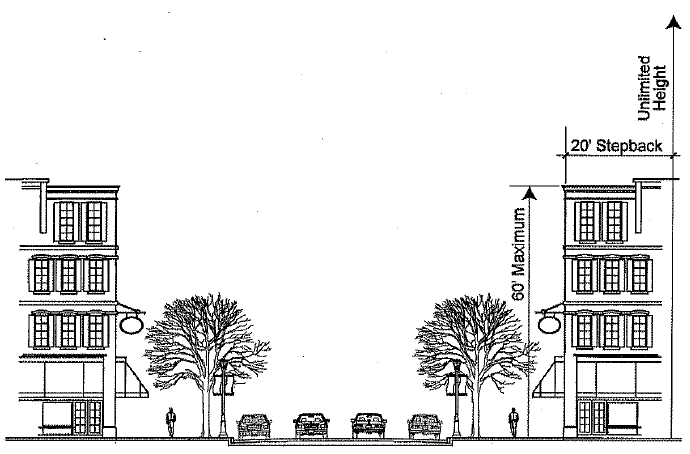
(d)
Minimum setback. All new buildings along Brevard Street shall have a minimum setback of twenty-two (22) feet. The setback along Brevard Street shall be measured from a point 8.5 feet (consisting of a two-foot valley curb and a six and one-half foot on-street parking lane) from the edge of the ultimate travel lane closest to the site. The edge of the ultimate travel lane shall be jointly determined by the Charlotte Department of Transportation (CDOT) director and the city engineer, or their designee(s).
All new buildings along Caldwell Street shall have a minimum setback of sixteen (16) feet. All new buildings on other streets shall have a minimum setback as specified in the Center City Transportation Plan. Setbacks shall be measured from the back of all existing or future curbs, whichever is greater. If the existing right-of-way is greater than the minimum setback from the back of existing or future curbs, the right-of-way line shall become the minimum setback. If the existing curb line varies, the setback shall be measured from the widest sections. Curb lines are to be determined jointly by the Charlotte Department of Transportation (CDOT) Director and the planning director, or their designee(s). See also subsection 9.905(2).
(e)
Variation in building facade. Variation in the building street facade shall occur at least every sixty (60) feet. This can be accomplished either by architectural elements, color variation, change in the facade setback, or other means to achieve a varied but consistent streetscape. See also subsection 9.906(2)(b), (j) and (k).
(f)
Structured parking facilities. No new structured parking facilities shall be allowed to have direct vehicular access on Brevard Street. Along all other streets, structured parking facilities may have vehicular access, but shall provide a street level transition area for vehicular stacking between the entrance and/or exit gates or pay station and the back of the sidewalk. All gates and transition areas require CDOT approval. Sloped express exit ramps are prohibited on any facade. See also subsections 9.906(2)(b), and 9.907(1)(h) and (j).
(g)
Parking. Parking for retail uses with less than two thousand five hundred (2,500) square feet of gross floor area is not required if the principal use is located within one thousand six hundred (1,600) feet of a parking facility available to the general public. See also section 9.907.
(e)
Signs, banners, flags and pennants.
1.
Where signs, banners, flags and pennants for identification or decoration are provided, they must conform to the requirements of chapter 13, with the following exceptions:
a.
Off-premise major event banners. The purpose this type of banner is to inform the public of major events, open to the public, with community-wide interest or regional significance. Major events may include, but are not limited to, religious, educational, charitable, civic, fraternal, sporting, or similar events including, but not limited to, golf tournaments, festivals, and major or seasonal sporting events. The banner is off-premise from the location of the major event.
An off-premise major event banner differs from a "temporary banner" (see subsection 13.106(13)) in that no advertising copy is permitted on the major event banner other than that allowed in subsection 9.906(e)1.(ii) below.
Major event banners may be located in the UMUD zoning district provided they meet the following requirements:
(i)
The total area of temporary event banners combined shall not exceed one thousand (1,000) square feet or ten (10) percent of the wall area, whichever is smaller, per building wall.
(ii)
Banners shall not contain any advertising, however, up to ten (10) percent of the banner area may include the name of the major event sponsors or supporters, a description of the products, services or activities provided or engaged in by the sponsors or supporters, and recognized trademarks, logotypes or symbols customarily associated with the sponsors or supporters. See subsection 13.106(12) for regulations regarding on-site temporary banners that allow advertising.
(iii)
Banners shall be erected no sooner than seven (7) days before the major event and removed within two (2) days after the event.
(iv)
Banners shall be attached in total to a building wall or permanent canopy extending from a building. Banners shall be adequately secured.
(v)
Banners shall be made of durable material. Paper banners are not permitted.
(vi)
No inflatables, tethered balloons, streamers, pennants, flags, ribbons, spinners, or other prohibited devices shall be included or incorporated with the display of a banner under this section.
(vii)
A written notice of the proposed banner location, number, sizes and duration shall be filed with Charlotte Center City Partners prior to issuance of a banner permit.
(viii)
A banner permit from neighborhood development is required for each major event, or seasonal event. If sports related, each game or competition shall be considered a separate event. Seasonal events such as regional team sporting events (i.e. Bobcats, Panthers, Checkers, etc.) may be issued one permit for the season.
(ix)
The permit number and duration shall be visible on the banner.
(x)
Due to the short-term nature of banners, any violation of the provisions of these regulations shall be cited by neighborhood development. A one-day warning notice of violation requesting immediate compliance will be issued first. Citations can then be issued for any violation that has not been corrected.
This subsection does not preempt the regulations of section 206 of chapter 19, article 7 of the City Code for decorative banners and signs.
2.
Information and advertising pillar signs must conform to the requirements of section 13.108b.
3.
Marquee signs shall be permitted and shall meet the requirements of subsection 13.108(a)(2).
(f)
Conformance with approved streetscape plans. Walking surfaces, street furniture, trees, landscaping, lighting fixtures, information signs, and kiosks constructed in the public right-of-way or required setback must be consistent with the standards specified in the approved Tryon Street Mall streetscape plan, the Trade Street streetscape plans, the Brevard Street Land Use and Urban Design Plan, Center City Transportation Plan, tree ordinance, and other applicable approved streetscape plans, or the standards of these provisions where no approved streetscape plan exists. Exterior lighting used on private plazas and walkways must be complementary in design motif to that specified in any applicable approved streetscape plan.
Renovated and rehabilitated structures that are already in place do not have to comply with the setback requirements or urban open space requirements, but must not modify or add to the existing structure in any fashion that would result in a reduction in the distance from the back of the curb to the existing building front.
(g)
Street trees. For the purposes of this subsection all specifications for measurement and quality of trees must be in accordance with the "American Standard for Nursery Stock" published by the American Association of Nurserymen. All trees planted to meet this requirement must be well-matched specimens and must be limbed up six (6) feet. The developer must provide written certification that the plant material meets this standard.
Trees used to fulfill this requirement may be located on public or private property. Any such trees proposed to be located on public property must conform to the permit requirements in the Charlotte Tree Ordinance [Chapter 21 of the City Code]. Any such trees proposed to be located on private property must relate to the street frontage for which they are required. Above ground planters may not be used to fulfill the street tree requirement.
All trees planted to comply with this requirement must be approved as to compliance with the Street Tree Planting program or any adopted streetscape plan for the area and must be irrigated, except when an eight-foot or larger planting strip is provided. Trees planted under this subsection may not be used to satisfy the tree planting requirements for screening or urban open space.
Maintenance of trees required under these provisions must conform to the requirements of section 12.305.
The owner will be responsible for all maintenance related to required streetscape improvements along their property frontage. The exception to this will be that the city will be responsible for pruning to maintain a uniform canopy and sight clearance.
(h)
Reflective surfaces. No development subject to these provisions may have exterior walls with a reflectivity value in excess of thirty-six (36) percent, as measured under the applicable provisions of ASTM C-1036. No reflective surfaces may be used on street level exterior facades.
(i)
Street right-of-way. The requirements for street right-of-way in the uptown area vary from street to street due to patterns of existing rights-of-way, existing development, traffic movements and intersection design. In order to assure that adequate land is available to accommodate future public street improvements, right-of-way must be protected. All development and uses in the district, except renovated and/or rehabilitated buildings, must reserve and keep free of development or encroachment the necessary right-of-way for the street or streets which abut the property. The necessary rights-of-way will be determined on a case-by-case basis by the Charlotte Department of Transportation and the Charlotte-Mecklenburg Planning Commission staff. In making their determination these agencies will be guided by the adopted Center City Charlotte Urban Design Plan and by the approved streetscape plan for the street if such a plan has been adopted. However, the absence of an adopted streetscape plan does not relieve the requirement for the necessary right-of-way to be reserved.
Sidewalk easements for public ingress and egress will be required if not within the public right-of-way.
(j)
Building entrances. Doorways must be recessed into the face of the building to provide a sense of entry and to add variety to the streetscape. For structures less than 100,000 square feet the entryway must be 1 square foot for each 1,000 square feet of floor area with a 15 square foot minimum. For buildings over 100,000 square feet, the entryway must be at least 100 square feet.
(k)
Base of high rise building. (Those exceeding 5 stories.) The base of high rise buildings (equivalent to the first 3 floors above street grade) must be distinguished from the remainder of the building with an emphasis on providing design elements that will enhance the pedestrian environment. Such elements as cornices, belt courses, corbelling, molding, stringcourses, ornamentation, changes in material or color, recessing, architectural lighting and other sculpturing of the base as are appropriate must be provided to add special interest to the base. In the design of the building facade attention must be paid to the appearance both during the day and at night. Material and color changes alone do not meet the requirements of this section and design elements which are used to meet the requirements of these [this] section must be visually continuous around the building. In the event that a building facade is not visible from a public street or right-of-way then the Planning Director has the option of waiving this requirement.
In addition, special attention must be given to the design of windows in the base. Band windows are discouraged. Recessed windows that are distinguished from the shaft of the building through the use of arches, pediments, mullions, and other treatments are encouraged.
(l)
Overstreet connections. Any proposed overstreet connections shall be shown on schematic site plans. The purpose in showing the proposed overstreet connections is to be able to properly apply the urban design standards. The overstreet connections shall not be approved by the Planning Commission staff until after the City Council shall have independently and separately approved the overstreet connection according to the City's overstreet connections' policy and the City's granting of air rights and approval of appropriate easement agreements.
(m)
Balconies. Balconies may project up to two (2) feet into the minimum setback, subject to an approved sidewalk encroachment agreement with CDOT. Balconies shall have a minimum clearance of ten (10) feet from grade.
(3)
Existing buildings and places. Preservation and rehabilitation of existing buildings and structures are encouraged in order to create diversity of development, accent pedestrian-scale activity, and preserve the heritage of the City of Charlotte.
(4)
Urban open spaces. Open spaces for public congregation and recreational opportunities are required and must be equipped or designed to allow pedestrian seating and to be easily observed from the street or pedestrian circulation areas. These provisions apply only to new office uses with a gross floor area greater than 20,000 square feet. All urban open spaces must comply with the minimum required design standards of this ordinance. If urban open space is provided but not required it must also meet the minimum urban open space design standards.
(a)
Urban open space sizes. Buildings must be provided with public open space behind the required setback and on private property proportionate to their bulk according to the following schedule:
A maximum of 30 percent of this required urban open space may be provided on an enclosed ground floor level provided the enclosed space meets all other requirements of these provisions. If a property line of the site is within 200 feet of the property line of a publicly owned and useable open space, then up to 50% of the required urban open space may be provided on an enclosed ground floor level provided the enclosed space meets all the requirements. The 200 feet shall be measured along the public right-of-way line. If any existing buildings are reused as part of a larger development, all the required urban open space may be provided on an enclosed ground floor level.
(b)
Accessibility to the street. Eighty-five percent (85%) of the total urban open space must be accessible to and visible from the street, but in no instance more than 3 feet above or below the level of an adjoining right-of-way. Walls higher than 3 feet are not allowed along that portion of the frontage that is needed for access to a required urban open space. Required entryways and steps must be at least 15 feet wide. Steps must have a maximum riser height of 6 inches and a minimum tread of 12 inches.
(c)
Provision for the disabled. All urban open spaces must conform with the North Carolina State Building Code, the disabled section and American Disabilities Act (ADA).
(d)
Seating. There must be at least 1 linear foot of seating for each 30 square feet of open space. In the event that the open space exceeds 20,000 square feet then 1 linear foot of seating shall be provided for each 100 square feet of open space above 20,000 square feet. Required seating must be an integral part of the overall open space design. Twenty-five percent of the required seating must be permanent. Seating must be 16 to 24 inches high. In the case of a ledge which rises because of a grade change, the portion of the ledge between 16 inches and 36 inches high can count as seating. Seating must have a minimum depth of 15 inches. Ledges and benches which are sittable on both sides and are 30 inches deep will count double. The rims of planters which are flat and sittable can count as seating if they have a minimum depth of 8 inches, a maximum height of 36 inches, and are not blocked by protruding shrubbery. Movable chairs will count as 30 inches of linear seating per chair. They can be stacked and stored between 7:00 p.m. and 8:00 a.m. The seating requirement may be reduced by 25% if expanses of lawn with an area of greater then 5,000 square feet are provided. Lawn areas shall be provided with automatic irrigation.
(e)
Trees. Within the open space area(s), 1 tree must be planted for each 500 square feet or portion thereof up to 2,000 square feet. One additional tree is required for each additional 1,000 square feet of urban open space. In the event the required or provided open space exceeds 20,000 square feet then one tree shall be provided for each additional 2,000 square feet over 20,000 square feet. Trees must have a minimum caliper of 3—3½ inches measured 6 inches above ground at time of planting. The planting of and specifications for all trees must be approved by the designated representative of the City of Charlotte Engineering and Property Management Department prior to planting. Maintenance of trees required under these provisions must conform to the requirements of section 12.305. All specifications for measurement and quality of trees must be in accordance with the "American Standard for Nursery Stock" published by the American Association of Nurserymen. Tree requirements may be reduced by 25% if expanses of lawn with an area of greater than 2,000 square feet are provided. Lawn areas shall be provided with automatic irrigation.
(f)
Food. The provision of food facilities is encouraged. Food kiosks can count as open space provided they do not exceed one hundred fifty (150) square feet in area. No more than one-half (½) of the open space may be used for an open-air eating, drinking and entertainment establishment. Litter receptacles must be provided at a minimum of four (4) cubic feet of receptacle capacity for each eight hundred (800) square feet of open space.
(g)
Amenities. The following amenities are permitted within an urban open space area: ornamental fountains, stairways, waterfalls, sculptures, arbors, trellises, planted beds, drinking fountains, clock pedestals, public telephones, awnings, canopies, and similar structures.
(h)
Maintenance. The building owner, lessee, management entity or authorized agent are jointly and severally responsible for the maintenance of the urban open space area including litter control and care and replacement of trees and shrubs.
(i)
Existing plazas and spaces. Buildings and plazas constructed prior to the adoption of this section may be changed to include any of the amenities and features required or encouraged by these standards such as the provision of food facilities, movable chairs, and alteration of ledges to make them sittable.
(5)
Reserved.
(6)
Preliminary review. Applicants planning any development or redevelopment are required to meet with the Charlotte-Mecklenburg Planning staff at two points in the design process: (1) during the conceptual design process in order that the staff may offer input into urban design objectives and to interpret the approved streetscape plan for that area, and (2) during the design development stage to insure that the plans meet the desired objectives and the minimum standards for the district. Prior to final UMUD approval all applicants are also required to meet with the City of Charlotte Department of Transportation and City of Charlotte Engineering and Property Management Department. Building permits will not be issued until the planning staff approves the proposal as in conformance with this ordinance.
(7)
Reserved.
(8)
First floor retail required. In order to stimulate pedestrian activity at the street level, the first floor (street level) of any new building over one hundred thousand (100,000) square feet must devote a minimum of fifty (50) percent of the net first floor area to retail activities, which promote a visual relationship to the street and encourage movement and activity at street level with the exception of the Brevard Street area (see subsections 9.906(2)(d)(2)(a) and (b)). Retail activity refers to any use, which encourages street level activity in the building beyond the normal business day and is in addition to the daily work activities of the building tenants.
Any expansion of an existing building which results in more than one hundred thousand (100,000) square feet of new floor area must also comply with this requirement unless the new floor area is all in a vertical expansion which results in no new street level floor area. The minimum fifty (50) percent area will be computed on the new street level floor area only.
The term retail includes not only sales of merchandise at retail but will also be construed to mean personal and business services, eating, drinking and entertainment establishments, galleries, and similar uses but not financial institutions except twenty-five (25) percent of the total square footage of required retail space may be utilized by retail banking, stock brokerage offices and other financial services.
Fifty (50) percent of the square footage of a hotel lobby may be counted towards the required retail space.
For the purpose of this subsection, net floor area does not include stairways, elevator shafts, elevator lobbies, rest rooms, mechanical areas, security areas, or service areas. It is strongly encouraged but not mandated that all street level retail tenants which have sidewalk frontage be furnished with direct access to the sidewalk in addition to any other access that may be provided. If individual entrances are provided to street level retail tenants, which have sidewalk frontage, the required retail floor area may be reduced by five (5) percent of the net floor area for each separate entrance up to a maximum of five (5) entrances This standard applies to all new development, which occurs in the area bounded by or along either side of College Street, 8th Street, Church Street, and Stonewall Street. This standard does not apply to any building with a street frontage of less than twenty-four (24) feet. This first floor retail standard is also not applicable to convention centers and halls, conference centers, exhibition halls, merchandise marts, and similar uses.
(9)
Canopies and other building entrances. In addition to being permitted in urban open space areas, canopies, awning and similar appurtenances are permitted at the entrances to buildings. Such a feature may be constructed of rigid or flexible material designed to complement the streetscape of the area. Any such facility may extend from the building up to one half of the width of the sidewalk area in front of the building or nine (9) feet, whichever is less. If this extension would reach into the public right-of-way, an encroachment agreement from the city or state is required. In no case may any such facility extend beyond the curbline of any public street, nor should it interfere with the growth or maintenance of street trees. A minimum overhead clearance of eight (8) feet from the sidewalk must be maintained.
(10)
Utility lines. All utility lines along all project street frontages must be placed underground in projects over one hundred thousand (100,000) square feet as a part of the streetscape improvements.
(11)
Rail transit corridors. Rail transit corridors will play an increasingly critical role in strengthening the high-density core of the central area and its environs. The purpose of this subsection is to protect the South End-Uptown Rail Corridor and to preserve it for use by multimodal transportation facilities such as rail-trolley, bus, and pedestrian ways while preserving the opportunity to add other transit related facilities in the future.
The following regulations and standards shall apply to all property zoned UMUD along the rail right-of-way extending from I-277 (John Belk Freeway) to Twelfth Street lying between Brevard and College Streets:
(a)
Minimum rail transit setback. The city council has approved the South End-Uptown Rail Corridor Plan. The city engineering and property management department shall establish the centerline for the rail transit corridor. The setback from the centerline shall be a minimum of thirty-five (35) feet or the width of the right-of-way, whichever is greater.
(b)
Setback uses. The 35-foot rail corridor setback shall permit only transit related facilities necessary to support a transit system, including, but not limited to, terminals, shelters, schedule and information bulletin boards, kiosks, utility or similar structures and related amenities such as walkways, plazas, benches, fountains and other landscaping features. Trash receptacles are permitted, but dumpsters are prohibited. No other structures or buildings, privately owned mechanical or utility accessory uses such as transformers and backflow preventers, vehicle parking, driveways or loading areas with related maneuvering shall be permitted in this rail transit corridor setback.
(12)
Valet parking service standards for new construction and site reconfigurations. If provided, a valet parking service (including drop-off areas, servicing areas, and the parking areas) shall meet the following requirements:
(a)
The valet parking service can be located in the following areas:
1.
For valet parking services that utilize the public right-of-way, the service may be located at the face of the existing curb of a street or thoroughfare as long as the existing curb line is not modified to provide an inset for the valet parking service or to reduce the width of the required sidewalk or planting strip.
2.
On private property the valet parking service area shall be located to the side or rear of the structure or building, but shall not be located between the building and the street.
(b)
The parking area for the valet parking service shall be incorporated into the parking lot or parking structure design, if provided.
(c)
The valet parking service and associated structures shall not disrupt the flow of pedestrian and vehicular traffic.
(d)
For valet parking services that are located on a public street or thoroughfare, or where the right-of-way is utilized by the service, a valet parking permit shall be obtained from the Charlotte Department of Transportation (CDOT). See sections 19-321 through 19-325 for permit information and criteria.
(Ord. No. 3589, § 1, 7-19-1993; Ord. No. 331, § 1.5, 7-17-1995; Ord. No. 1181, § 1(1)(B), 1-20-1999; Ord. No. 1399, § 1, 11-15-1999; Ord. No. 1840, § 1, 6-18-2001; Ord. No. 1981, § 1, 12-17-2001; Ord. No. 2599, § 1, 5-17-2004; Ord. No. 2918, § 2(1), 3-21-2005; Ord. No. 3017, § 1G4, 6-20-2005; Ord. No. 3209, § 1, 2-20-2006; Ord. No. 3822, § 1, 2-18-2008; Ord. No. 4337, § 1, 1-19-2010; Ord. No. 4684-Z, § 1, 6-20-2011; Ord. No. 4836, § 1, 2-20-2012; Ord. No. 5110, § 1, 4-15-2013; Ord. No. 5423, § 1, 7-21-2014; Ord. No. 5531, § 1, 11-17-2014)
Editor's note— Ord. No. 1399, § 1, adopted Nov. 15, 1999, amended the Zoning Ordinance by adding
provisions designated as § 9.906(9). Since § 9.906 already contained subsections (9) and (10), the editor has added these new provisions
as subsection (11).
Ord. No. 3822, § 1, adopted February 18, 2008, enacted provisions intended for us
as subsection (10). Inasmuch as there are already provisions so designated, and at
the discretion of the editor, said provisions have been redesignated as subsection
(12).
Section 9.907. - Uptown Mixed Use District; parking and loading standards.
(1)
Parking standards. Permitted uses within this district are required to provide new off-street parking according to the following minimum standards. Uses not specifically listed do not have any minimum parking requirements.
(a)
New office and commercial uses which contain more than twenty thousand (20,000) square feet of gross floor area and are located on lots with a street frontage greater than forty (40) feet on any single street must provide parking at the rates specified below:
(b)
Hotels and motels: 0.5 spaces/room.
(c)
Dwellings, all types: One space/unit.
Bed and breakfasts (B & B's): Two (2) spaces.
Boardinghouses: Two (2) spaces.
(d)
Existing floor area in renovated and rehabilitated buildings is exempt from these requirements. However, new rentable gross floor area added to or created by the renovation or rehabilitation of existing buildings is subject to these provisions.
(e)
The parking requirements (for new spaces) of the district may be met on-site or off-site at a distance of up to one thousand six hundred (1,600) feet from the permitted use. Off-site parking to meet the requirements of this section may be provided through a lease having a term of not less than five (5) years excluding renewals and need not be located within this district. If at any time the parking arrangements of this section are not met, neighborhood development will initiate enforcement of this provision and instruct the director of land use and environmental services agency, or his or her designee, to revoke the occupancy permit for the permitted use and will not issue a building or occupancy permit with respect to the permitted use until such requirements are met. If through no fault of the building owner or management the required parking that is provided through a lease arrangement is lost through condemnation procedures, the building owner or management will not be required to find replacement parking to meet the requirements of these provisions. Spaces in parking structures and lots which are owned by a developer and which exist on the date these provisions become effective, and which are in excess of the requirements for the building(s) with which they are associated, may be used to satisfy the requirements for new or expanded buildings.
(f)
The minimum dimensions for parking spaces within this district are seven and one-half (7.5) feet (width) and fifteen (15) feet (length) for compact vehicles and eight and one-half (8.5) feet (width) and seventeen (17) feet (length) for full-size vehicles.
(g)
The required number of parking spaces for any building within the district, including mixed use buildings, is the sum total of the requirements for each individual use in the building calculated separately.
(h)
No new grade-level or structural parking lots will be allowed to have vehicular access directly from or to Brevard Street between I-277 and E. Trade Street, or the Tryon Street Mall, with one exception: Along the Trade Street portion of the Tryon Street Mall only "right in" and "right out" access on Trade Street shall be permitted.
(i)
Parking, whether required by this section or not, may be located between the permitted use and the required setback. However, no parking is permitted in the required setback.
(j)
Reserved.
(k)
On-street parking or recessed parking entirely within the public right-of-way is permitted and encouraged in locations approved by the Charlotte Department of Transportation (CDOT). Such parking may be counted toward meeting the minimum number of parking spaces as required by this ordinance if they are located on the same side(s) of the street as the use and meet the minimum dimensional requirements as prescribed by the Charlotte-Mecklenburg Land Development Standards Manual.
In the event that the city or state removes any such on-street parking that was allowed to count toward the minimum required, the existing use will not be required to make up the difference and the use will not be made non-conforming.
(l)
The reconfiguration of an existing parking lot by expanding the parking area onto abutting UMUD zoned land and eliminating an equal area of existing parking shall be allowed if the following standards are met:
(a)
Any parking lot reconfiguration shall not increase the square footage of the parking lot and shall not increase the number of parking spaces.
(b)
All parking spaces shall be located outside of the required setbacks; and
(c)
The existing and reconfigured portions of the parking lot shall meet the screening standards of subsection 9.906(2)(c) for grade level parking lots as a principal use.
(2)
Loading standards. Buildings and structures, excluding parking structures, subject to the provisions of this section must provide a minimum number of off-street service/delivery parking spaces. These spaces must be designed and constructed so that all parking maneuvers can take place entirely within the property lines of the premises. These parking spaces must not interfere with the normal movement of vehicles and pedestrians on the public rights-of-way, except as permitted by section 20-29[14-25] of the City Code. These parking spaces must be provided in accordance with the following list:
(a)
Multi-family dwellings (1—24 units): None required.
(b)
Multi-family dwellings (25+ units): One space.
(c)
Nonresidential uses with gross floor area:
Less than 50,000 sq. ft.: None required.
50,000—150,000 sq. ft.: One space.
Each additional 100,000 sq. ft.: One space.
(d)
If a nonresidential use has five (5) or more off-street service/delivery parking spaces, forty (40) percent of the spaces must be large enough to accommodate vehicles greater than thirty (30) feet long.
(3)
Bicycle parking. The bicycle parking standards of section 12.202 and section 12.202A are applicable in this district.
(Ord. No. 305, § 1.2(G), 6-19-1995; Ord. No. 331, § 1.6, 7-17-1995; Ord. No. 389, § 2(K), 10-16-1995; Ord. No. 2916, § 1(6), 3-21-2005; Ord. No. 3017, § 1G4, 6-20-2005; Ord. No. 3224, § 1, 3-20-2006; Ord. No. 4337, § 1, 1-19-2010; Ord. No. 4606, § 1, 12-20-2010; Ord. No. 5532, § 1, 11-17-2014)
Section 9.908. - Uptown Mixed Use District (Optional); purpose.
The Uptown Mixed Use District (UMUD) establishes minimum standards for design and development in the uptown area. However, circumstances may arise which those regulations do not address or did not foresee. The Uptown Mixed Use District (Optional), or UMUD-O, is established to provide a mechanism to review and address new development concepts, innovative design, special problems, public/private ventures, and other unique proposals or circumstances which cannot be accommodated by the standards of the UMUD. The UMUD standards shall be guidelines in the development of UMUD-O rezoning petitions. The board of adjustment shall not have jurisdiction to grant variances from the UMUD design standards.
(Ord. No. 331, § 1.7, 7-17-1995; Ord. No. 1587, § 1(16), 7-24-2000)
Section 9.909. - Uptown Mixed Use District (Optional); application.
Petitions for a zoning map amendment to establish a UMUD-O should be submitted to the Charlotte-Mecklenburg Planning Commission. A UMUD-O classification will be considered only by application of the owner of the subject property or his duly authorized agent. Applications must be accompanied by a schematic plan and by supporting text which becomes a part of the amending ordinance. The application must include at least the following information:
(1)
Access to site for adjacent rights-of-way, streets and arterials.
(2)
Parking and vehicular circulation areas.
(3)
Location and size of buildings and signs.
(4)
Entrances and exits, in relation to vehicular and pedestrian circulation.
(5)
Enclosed, sheltered and unenclosed urban open spaces and plazas.
(6)
Pedestrian circulation.
(7)
Service area for uses such as mail delivery, trash disposal, aboveground utilities, loading and delivery.
(8)
Urban open space, trees, street trees and other plantings, including types, placement and maintenance system.
(9)
Paving systems used on private plazas and walkways.
(10)
Areas to be landscaped or screened.
(11)
Exterior lighting.
(12)
Any information regarding proposed sublots or subdivisions.
(13)
Signs, banners, flags and pennants to be used.
(14)
Seating plans.
(15)
Sun studies and reflectivity studies.
(16)
Other site elements, spaces and information which the applicant feels will assist in the evaluation of site development.
Section 9.910. - Uptown Mixed Use District (Optional); review and approval.
(1)
In considering a rezoning petition for UMUD-O, the city council will consider UMUD standards as guidelines for the approval or denial of the rezoning petition. The city council shall evaluate and approve the UMUD-O rezoning petition taking into consideration the Central Urban Design Plan, the purposes of section 9.901, the appropriateness of the rezoning petition for the uptown area, the harmonious relationship of the rezoning petition to surrounding properties and any other identified, pertinent land use plans.
(2)
In approving an application for the establishment of a UMUD-O, the city council will consider, evaluate and may attach reasonable and appropriate conditions to the following: the location, nature and extent of the proposed use and its relation to surrounding property; proposed support facilities such as parking areas and driveways; pedestrian and vehicular circulation systems; screening and buffer areas; the timing of development; and such other matters as the city council may find appropriate or the petitioner may propose, but not including architectural review or controls. The petitioner will have a reasonable opportunity to consider and respond to any additional requirements prior to final action by the city council.
(Ord. No. 1587, § 1(17), 7-24-2000)
Section 9.911. - Uptown Mixed Use District (Optional); effect of approval; alterations.
(1)
If an application is approved, the UMUD-O and all conditions which may have been attached are binding on the property. All subsequent development and use of the property must be in accordance with the approved plan and conditions. The intent of this type of zoning is to provide a voluntary alternative procedure for specific development proposals and as such it is intended that all property zoned be in accordance with firm plans to develop. Therefore, three (3) years from the date of approval, the planning commission will examine progress made to develop in accordance with approved plans to determine if active development efforts are proceeding. If it is determined by the planning commission that active efforts are not proceeding, a report will be forwarded to the city council which may recommend that action be initiated to remove the UMUD-O designation in accordance with procedures outlined in Chapter 6 of these regulations.
(2)
Changes to approved plans and conditions of development will be treated the same as changes to the zoning map and will be processed in accordance with the procedures of Chapter 6, except that section 6.114 shall not apply. However, changes of detail which will not alter the basic relationship of the proposed development to adjacent property, which will not alter the uses permitted or increase the density or intensity of development, which will not decrease the off-street parking ratio or reduce the yards provided at the boundary of the site may be authorized by the Charlotte-Mecklenburg Planning staff. Any applicant may appeal the decision of the Charlotte-Mecklenburg Planning Commission staff to the Planning Commission for review and decision as to whether an amendment to the UMUD-O will be required.
Section 9.912. - Uptown Mixed Use District (Optional); relationship to other ordinances.
This section governs the urban design plan provisions for the UMUD-O and does not prevent any other appropriate or necessary reviews by other city departments from occurring concurrently.
Section 9.913. - Previously approved UMUD-O zoning.
Any UMUD-O zoning approved as of March 3, 1988, the date of the adoption of amended UMUD standards shall be entitled to continue the project in accordance with the UMUD-O approved schematic plans or, in the alternative, shall be entitled to comply with the amended UMUD standards. Anyone with an approved UMUD-O zoning, as of this date, who seeks to utilize UMUD-O zoned property in accordance with any of these amended UMUD standards must receive Charlotte-Mecklenburg Planning Commission staff approval as provided for in subsection 9.906(6) "Preliminary Review."
Section 9.1001. - Urban Industrial District established; location; purposes.
(1)
The central area of Charlotte contains a substantial number and wide variety of industrial land uses. These uses provide a substantial nonoffice employment base as well as meeting certain needs in the community for industrial type goods and services. There are however, some industrial facilities which have either lost their utility or impact negatively on nearby residential areas which must be addressed. Therefore, in accordance with the adopted Central Area Plan, this district is intended to encourage and permit the continuation of a significant nonoffice employment base, to enable the development of new industrial uses compatible with the objectives of the Central Area Plan, and to restrict those industrial uses which do or would not foster those objectives.
(2)
The UI district is intended for use in special areas of the community. It may be considered for limited application in the uptown area defined in the adopted Central Area Plan. The official Zoning Map of the City of Charlotte will designate specific boundaries for the urban industrial districts.
Section 9.1002. - Urban Industrial District; uses permitted by right.
A building or land may be used only for the following purposes by right:
(1)
Light manufacturing or assembly uses which do not create any more danger to health and safety in surrounding areas and which do not create any more offensive noise, vibration, smoke, dust, lint, odor, heat or glare, than that which is generally associated with light industries of the types specifically permitted below:
Component parts of aircraft
Medical and dental equipment
Drafting, optical, and musical instruments
Watches
Clocks
Toys
Mechanical devices
Machines and parts
Meters
Wire products
Pumps
Vending machines and office machines
Electric devices
Appliances
Electronic equipment, but not including heavy equipment such as is used on electrical power generation
Firearms
Photographic and metering equipment
Tools, dies, machinery, and hardware products
Bakery products
Candy manufacture
Dairy products
Fruit and vegetable processing and canning
Meat and poultry products, but not slaughtering of poultry or animals
Printing and finishing of textiles and fibers into fabric goods
Furniture, cabinets, baskets, and other light wood products
Cosmetics, drugs, and pharmaceutical products
(2)
Business and professional offices, laboratories, photoprocessing, blueprinting or printing establishments.
(2.3)
Cultural facilities.
(2.5)
Eating, drinking and entertainment establishments (Type 1) operated by an employer on the site for the convenience and use of employees only.
(3)
Personal services, banks, or day care centers operated by an employer on the site for the convenience and use of employees only.
(4)
Wholesale and retail sales, but not including warehousing or freight forwarding.
(5)
Facilities and structures necessary for rendering utility service, including poles, wires, transformers, telephone booths and the like for normal electrical power distribution or communication service, and pipelines or conduits for electrical, gas, sewer or water service.
(6)
Automobile and truck service and repair.
(7)
Off-street parking as a separate use or in conjunction with permitted uses in order to meet parking needs.
(8)
Outdoor seasonal sales.
(8.5)
Telecommunications and data storage facility.
[(9)]
Showrooms, up to 25,000 square feet.
(10)
Reserved.
(11)
Tattoo establishment.
(Ord. No. 3892, § 1(H), 7-17-1994; Ord. No. 2242, § 1(2.B), 2-17-2003; Ord. No. 4705, § 1, 7-18-2011; Ord. No. 4902, § 1, 6-18-2012; Ord. No. 5423, § 1, 7-21-2014; Ord. No. 5489, § 1, 10-20-2014)
Section 9.1003. - Urban Industrial District; uses permitted under prescribed conditions.
(1)
Heliports and helistops, limited, subject to applicable FAA regulations.
(2)
Buildings with height in excess of forty (40) feet, only if located at least one hundred (100) feet from any residential district.
(2.5)
Breweries shall meet the following prescribed conditions:
(a)
Maximum size: Sixty thousand (60,000) square feet.
(b)
Primary vehicular access to the use shall be provided by a Class II (limited access arterial), Class III (major arterial), Class III-C (commercial arterial), Class IV (minor arterial), Class V-C (commercial street), or by a commercial cul-de-sac.
(c)
Outdoor production, processing, or repair of equipment shall be located no closer than three hundred (300) feet from any abutting residentially used or zoned property. Distances shall be measured from the closest edge of the outdoor production, processing, or repair area to the property line of the residential use or zoning district.
(3)
Building for dramatic, musical, or cultural activities with more than one thousand (1,000) seats and stadiums and coliseums with more than five thousand (5,000) seats in accordance with the requirements of subsection 9.903(9).
(4)
Beneficial fill sites, subject to the regulations of section 12.523.
[(4.1)]
Child care centers, subject to the regulations of section 12.502.
(5)
Reserved.
(6)
Commercial roominghouses, subject to the regulations of section 12.531.
(6.01)
Outdoor fresh produce stands and mobile produce market, subject to the regulations of section 12.538.
(6.02)
Bicycle-sharing station, subject to the regulations of section 12.543.
(7)
Accessory shelter, subject to the regulations of section 12.537.
(8)
Emergency shelter, subject to the regulations of section 12.536.
(9)
Homeless shelter, subject to the regulations of section 12.532.
(Ord. No. 772, § 1(3)(B), (D)(2), 3-17-1997; Ord. No. 1274, § 2(B), 5-17-1999; Ord. No. 1997, § 1, 1-22-2002; Ord. No. 2239, § 1(2.K), 2-17-2003; Ord. No. 2941, § 2J, 4-18-2005; Ord. No. 4697, § 1, 7-18-2011; Ord. No. 4873, § 1, 5-14-2012; Ord. No. 4908, § 1, 6-18-2012; Ord. No. 5057, § 1, 3-25-2013; Ord. No. 5962, § 1, 6-15-2015)
Section 9.1004. - Urban Industrial District; permitted accessory uses.
(1)
Adult care centers and homes, subject to the regulations of section 12.502(5).
(2)
Land clearing and inert landfills (LCID): on-site, are permitted subject to the regulations of section 12.405.
(2.5)
Outdoor dining associated with an eating, drinking and entertainment establishments (Type 1 only) operated by an employer on the site for the convenience and use of employees only.
(3)
Satellite dish farm, used in conjunction with a telecommunications and data storage facility, subject to the regulations of section 12.416.
(4)
Storage of goods used in or produced by permitted industrial uses or related activities, subject to applicable district regulations.
(Ord. No. 4705, § 1, 7-18-2011; Ord. No. 5522, § 1, 11-17-2014)
Section 9.1005. - Urban Industrial District; area, yard and height requirements.
* Subject to all applicable building and fire codes for separation.
1 A building that is not adjacent to and located greater than one hundred (100) feet from a residential district, may be erected to a height in excess of forty (40) feet, provided the minimum side yard is increased one (1) foot for every two (2) feet of building height in excess of the forty (40) feet.
2 A building which abuts a residential zoning district that is greater than one hundred (100) feet from such building or abuts a residential use shall not be erected to a height in excess of forty (40) feet, unless the side and/or rear yard abutting the residential use or zoning district is increased one (1) foot for every foot of building height in excess of forty (40) feet.
3 Height requirements for other permitted structures are set forth in section 12.108.
(Ord. No. 4837, § 1, 2-20-2012; Ord. No. 5531, § 1, 11-17-2014)
Section 9.1006. - Urban Industrial District; development standards.
The uses permitted in this district are subject to the following special conditions:
(1)
All uses must be conducted within a completely enclosed building with no open storage of raw, in process, or waste material. Finished products manufactured on the premises may be stored in the open if screened from the street and adjoining properties by landscaping, fences or walls.
(2)
Service drives or other areas must be provided for off-street loading in such a way that in the process of loading or unloading no truck will block the passage of other vehicles on the service drive or extend into any other public right-of-way used for traffic circulation.
(3)
No parking or storage of material or products will be permitted in the required setback.
(4)
Screening shall be provided in accordance with the requirements of section 12.303, of these regulations.
(5)
All development in the UI districts must conform to any adopted streetscape plan for the streets which the project abuts. Improvements relating to sidewalk, tree planting and landscaping as specified by the streetscape plan must be installed during the development process. Setbacks prescribed in the streetscape plan supersede those listed as minimums for the district when the plan specifies a greater setback than the minimum for the district. Developers are strongly encouraged to work with the appropriate utility companies to relocate overhead utilities underground during the development of the site. If the utilities are not relocated at the time the site is developed, the design of the site must provide for the eventual placement of utilities underground, and appropriate easements must be set aside accordingly.
Section 9.1007. - Urban Industrial District; off-street parking.
(1)
Off-street parking for any use permitted in this district must be provided in accordance with the following standard: One (1) space for each two (2) expected employees on the shift of greatest employment.
(2)
Parking spaces intended for use by small or compact vehicles may comprise twenty-five (25) percent of the total parking spaces required. Such parking spaces may not be less than seven and one-half (7½) feet in width and fourteen (14) feet in length.
(3)
Bicycle parking. The bicycle parking standards of section 12.202 and section 12.202A are applicable in this district.
(4)
On-street parking or recessed parking entirely within the public right-of-way is permitted and encouraged in locations approved by the Charlotte Department of Transportation (CDOT). Such parking may be counted toward meeting the minimum number of parking spaces as required by this ordinance if they are located on the same side(s) of the street as the use and meet the minimum dimensional requirements as prescribed by the Charlotte-Mecklenburg Land Development Standards Manual.
In the event that the city or state removes any such on-street parking that was allowed to count toward the minimum required, the existing use will not be required to make up the difference and the use will not be made non-conforming.
(Ord. No. 2916, § 1(7), 3-21-2005; Ord. No. 4606, § 1, 12-20-2010)
Section 9.1008. - Urban Industrial District; signs.
Signs are permitted in the Urban District in accordance with the provisions of Chapter 13.
Section 9.1101. - Industrial districts established; purposes.
(1)
The primary purpose of the I-1 (Light Industrial) district is to create and protect industrial areas for light manufacturing and the distribution of products at wholesale. The standards established for this district are designed to promote sound and permanent light industrial development and also to protect nearby residential areas from undesirable aspects of industrial development. Whenever possible, this district should be separated from residential districts by natural or structural boundaries such as drainage channels, sharp breaks in topography, strips of vegetation, traffic arteries, and similar features.
(2)
The purpose of the I-2 (General Industrial) district is to create and protect wholesaling and industrial areas for manufacturing, processing and assembling of parts and products, distribution of products at wholesale, transportation terminals, and a broad variety of specialized industrial operations. Whenever possible, areas of this district should be separated from residential districts by natural or structural boundaries such as drainage channels, sharp breaks in topography, strips of vegetation, traffic arteries and similar features.
Section 9.1102. - Uses permitted by right.
The following uses shall be permitted by right in the I-1 and I-2 districts, provided that they meet all the requirements of this Part and all other provisions established in these regulations:
(1)
Agricultural industries (I-2 only).
(2)
Airports (I-2 only).
(3)
Amusement, commercial outdoors.
(4)
Animal crematoriums.
(5)
Armories for meetings and training of military organizations.
(6)
Assembly or fabrication of previously manufactured parts, including but not limited to the following:
Apparel and other textile products
Electronic and other electric equipment, except electrical generator and distribution equipment
Fabric samples
Furniture and fixtures
Industrial machinery and equipment
Instruments and related products
Leather and leather products, excluding tanning or curing of hides
Lumber and wood products
Paper and allied products
Plastic and rubber products
Metal products
Transportation equipment
Other similar uses
(7)
Auction sales.
(8)
Automobiles, truck and utility trailer rental.
(9)
Automotive repair garages.
(10)
Automotive sales and repair including tractor-trucks and accompanying trailer units (I-1 only).
(11)
Automotive service stations.
(12)
Bakeries, retail and wholesale.
(13)
Barber and beauty shops.
(14)
Boat and ship sales and repair (I-1 only).
(15)
Building maintenance service.
(16)
Bus and train terminals.
(17)
Car washes.
(18)
Catalog and mail-order houses.
(19)
Civic, social service and fraternal facilities.
(20)
Clinics, medical, dental and optical.
(21)
Clinics, veterinary.
(22)
Contractor offices and accessory storage, excluding the storage of construction equipment.
(22.5)
Cultural facilities.
(23)
Distributive businesses.
(24)
Dry cleaning and laundry establishments.
(25)
Engraving.
(26)
Fabric sample sales.
(27)
Farms, including retail sales of products grown on premises.
(28)
Financial institutions, up to twenty-five thousand (25,000) square feet.
(29)
Financial institutions, up to seventy thousand (70,000) square feet (I-1 only).
(20)
Florist, retail and wholesale.
(31)
Government buildings, up to one hundred thousand (100,000) square feet and recreation centers up to thirty thousand (30,000) square feet (I-2 only).
(32)
Government buildings, up to three hundred thousand (300,000) square feet and recreation centers up to thirty thousand (30,000) square feet (I-1 only).
(33)
Graphics research and production.
(34)
Heliports and helistops, limited.
(35)
Heliports and helistops, unlimited (I-2 only).
(36)
Highway and railroad rights-of-way.
(37)
Hotels and motels (I-1 only).
(38)
Indoor recreation.
(39)
Laboratories, medical, dental and optical.
(40)
Laboratories, for applied and basic research and testing of products, manufacture, processes or fabrication.
(41)
Locksmiths and gunsmiths.
(42)
Manufactured housing repair.
(43)
Manufactured housing sales (I-1 only).
(44)
Manufacturer's representatives, including offices, and repair and service facilities.
(45)
Merchandise showrooms, including warehousing in a single building.
(46)
Offices, up to one hundred thousand (100,000) square feet (I-2 only).
(47)
Offices, up to three hundred thousand (300,000) square feet (I-1 only).
(48)
Orthotics-prosthetics facilities.
(49)
Outdoor seasonal sales.
(50)
Parks, greenways and arboretums.
(51)
Pest control and disinfecting services.
(51.1)
Pet services indoor.
(52)
Post offices.
(53)
Power generation plants (I-2 only).
(54)
Printing and publishing.
(55)
Prototype production facilities and pilot plants.
(56)
Radio and television stations and/or offices.
(57)
Railroad freight yards, repair shops and marshalling yards (I-2 only).
(58)
Recycling centers, including drop-off centers.
(59)
Religious institutions.
(60)
Repair of any goods, equipment and vehicles, the manufacture, assembly or sales of which are permitted in that district.
(61)
Research uses.
(62)
Eating, drinking and entertainment establishments (Type 1).
(63)
Eating, drinking and entertainment establishments (Type 1), drive-in services.
(64)
Retail establishments, shopping centers and business, personal and recreational services up to twenty-five thousand (25,000) square feet.
(65)
Retail establishments, shopping centers and business, personal and recreational services up to seventy thousand (70,000) square feet (I-1 only).
(66)
Showrooms, up to seventy thousand (70,000) square feet in I-1.
(67)
Sign painting, exclusive of manufacture.
(68)
Studios for artists, designers, photographers, musicians, sculptors, gymnasts, potters, wood and leather craftsmen, glass blowers, weavers, silversmiths, and designers of ornamental and precious jewelry.
(68.3)
Tattoo establishment.
(68.5)
Telecommunications and data storage facility.
(69)
Subdivision sales offices.
(70)
Telephone booths.
(71)
Theatres, motion picture (I-1 only).
(72)
Theatres, drive in motion picture (I-2 only).
(73)
Truck stops (I-2 only).
(74)
Truck terminals (I-2 only).
(75)
Vocational schools.
(76)
Utility operations centers (I-2 only).
(77)
Warehousing (I-2 only).
(78)
Warehousing, within an enclosed building (I-1 only).
(79)
Wholesale establishments.
(Ord. No. 3523, § 1(31), 3-15-1993; Ord. No. 3892, § 1(I), 7-17-1994; Ord. No. 1013, § 3, 3-16-1998; Ord. No. 2242, § 1(2.B), 2-17-2003; Ord. No. 2439, § 1C., 11-17-2003; Ord. No. 3007, § 2H, 6-20-2005; Ord. No. 3709, § 1, 10-17-2007; Ord. No. 4015, § 1, 9-15-2008; Ord. No. 4520, § 1, 9-20-2010; Ord. No. 4705, § 1, 7-18-2011; Ord. No. 4902, § 1, 6-18-2012; Ord. No. 5423, § 1, 7-21-2014; Ord. No. 5489, § 1, 10-20-2014)
Section 9.1103. - Uses permitted under prescribed conditions.
The following uses shall be permitted in the I-1 and I-2 districts if they meet the standards established in this section and all other requirements of these regulations:
(1)
Abattoirs.
(a)
All structures and buildings shall be located a minimum of three hundred (300) feet from any abutting residentially used or zoned property. Distances shall be measured from the closest edge of the structure to the property line of the residential use or zoning district.
(b)
Primary vehicular access to the use shall be provided by a Class II (limited access arterial), Class III (major arterial), Class III-C (commercial arterial), Class IV (minor arterial), Class V-C (commercial street), or by a commercial cul-de-sac.
(2)
Accessory shelter, subject to the regulations of section 12.537.
(3)
Adult care centers, subject to the regulations of section 12.502.
(4)
Adult establishments, subject to the regulations of section 12.518.
(5)
Agricultural industries (I-2 only).
(a)
All structures and buildings shall be located a minimum of three hundred (300) feet from any abutting residentially used or zoned property. Distances shall be measured from the closest edge of the structure to the property line of the residential use or zoning district.
(b)
Primary vehicular access to the use shall be provided by a Class II (limited access arterial), Class III (major arterial), Class III-C (commercial arterial), Class IV (minor arterial), Class V-C (commercial street), or by a commercial cul-de-sac.
(6)
Any establishment containing more than seventy thousand (70,000) square feet of enclosed space engaged in the operation of a flea market (I-1 only), provided that:
(a)
The use may not be open to the public on any days of the week other than Friday, Saturday and Sunday;
(b)
The minimum lot size shall be ten (10) acres;
(c)
The use's operations, including the storage of inventory, must be housed entirely within an enclosed structure;
(d)
The structure within which the use is operated must be a warehouse facility which is designed primarily for the bulk storage of products, materials or commodities and contain a minimum of one hundred thousand (100,000) square feet of enclosed space;
(e)
The structure must provide for clear storage to a height of at least twenty-six (26) feet in all storage areas and may not contain more than five thousand (5,000) square feet of office space;
(f)
Vehicle access to the use may not be provided by way of a residential local (Class VI) street or residential collector (Class V) street;
(g)
The use must satisfy the minimum requirements for off-street parking for retail establishments as provided under Table 12.202; and
(h)
The operation of the establishment and the structure within which such use is enclosed shall meet all standards and requirements of the North Carolina Building Code and the City Fire Department that may be applicable thereto.
(6.5)
Breweries.
(1)
In I-1, breweries shall meet the following prescribed conditions:
(a)
Maximum size: Sixty thousand (60,000) square feet.
(b)
Primary vehicular access to the use shall be provided by a Class II (limited access arterial), Class III (major arterial), Class III-C (commercial arterial), Class IV (minor arterial), Class V-C (commercial street), or by a commercial cul-de-sac.
(c)
Outdoor production, processing, or repair of equipment shall be located no closer than three hundred (300) feet from any abutting residentially used or zoned property. Distances shall be measured from the closest edge of the outdoor production, processing, or repair area to the property line of the residential use or zoning district.
(2)
In I-2, breweries shall meet the following prescribed conditions:
(a)
Breweries with a maximum size of sixty thousand (60,000) square feet shall meet the following prescribed conditions:
1.
Maximum FAR of .80.
2.
Outdoor storage of goods and materials used in assembly, fabrication or processing is permitted, but shall not exceed twenty-five (25) percent of the floor area of all buildings on a lot.
(b)
Breweries greater than sixty thousand (60,000) square feet in size shall meet the following prescribed conditions:
1.
Maximum FAR of 1.0.
2.
All structures and buildings shall be located a minimum of three hundred (300) feet from any abutting residentially used or zoned property. Distances shall be measured from the closest edge of the structure to the property line of the residential use or zoning district.
(c)
Primary vehicular access to the use shall be provided by a Class II (limited access arterial), Class III (major arterial), Class III-C (commercial arterial), Class IV (minor arterial), Class V-C (commercial street), or by a commercial cul-de-sac.
(d)
Outdoor production, processing, or repair of equipment shall be located no closer than three hundred (300) feet from any abutting residentially used or zoned property. Distances shall be measured from the closest edge of the outdoor production, processing, or repair area to the property line of the residential use or zoning district.
(7)
Beneficial fill sites, subject to the regulations of section 12.523.
(8)
Building material sales, retail, and wholesale. Primary vehicular access to the use shall be provided by a Class II (limited access arterial), Class III (major arterial), Class III-C (commercial arterial), Class IV (minor arterial), Class V-C (commercial street), or by a commercial cul-de-sac.
(9)
Bus stop shelters, subject to the regulations of section 12.513.
(10)
Cemeteries, subject to the regulations of section 12.508.
(11)
Child care centers (I-1 only), subject to the regulations of section 12.502.
(12)
Commercial roominghouses, (I-1 only), subject to the regulations of section 12.531.
(12.5)
Conference centers, convention centers and halls, exhibit halls, merchandise marts and similar uses (I-1 only).
(a)
Minimum lot size shall be twenty-five (25) acres;
(b)
Primary vehicle access to the use shall not be provided by way of a residential local (Class VI) street or residential collector (Class V) street;
(c)
The use shall front onto a minor (Class IV) or major (Class III) thoroughfare, limited access arterial (Class II) or a freeway or expressway (Class I);
(d)
Outdoor activities and uses (excluding accessory parking) shall be located at least one hundred (100) feet from a residential use or zoning district. Distances shall be measured from the closest point of the property to the nearest residential property line(s) or zoning district boundary.
(e)
The use shall satisfy the minimum parking requirements for "other business uses" as provided in Table 12.202.
(13)
Construction and demolition (C & D) landfills, subject to the regulations of section 12.524.
(14)
Contractor offices and accessory storage (I-2 only). Primary vehicular access to the use shall be provided by a Class II (limited access arterial), Class III (major arterial), Class III-C (commercial arterial), Class IV (minor arterial), Class V-C (commercial street), or by a commercial cul-de-sac.
(14.5)
Crematory facilities, subject to the regulations of section 12.542.
(14.7)
Eating, drinking and entertainment establishments (Type 2), subject to the regulations of section 12.546.
(14.8)
Eating, drinking and entertainment establishments (Type 2), drive-in services, subject to the regulations of section 12.546.
(15)
Emergency shelter, subject to the regulations of section 12.536.
(16)
Equipment rental and leasing. Primary vehicular access to the use shall be provided by a Class II (limited access arterial), Class III (major arterial), Class III-C (commercial arterial), Class IV (minor arterial), Class V-C (commercial street), or by a commercial cul-de-sac.
(17)
Fence and fence materials, retail and wholesale. Primary vehicular access to the use shall be provided by a Class II (limited access arterial), Class III (major arterial), Class III-C (commercial arterial), Class IV (minor arterial), Class V-C (commercial street), or by a commercial cul-de-sac.
(18)
Foundries (I-2 only)
(a)
Primary vehicular access to the use shall be provided by a Class II (limited access arterial), Class III (major arterial), Class III-C (commercial arterial), Class IV (minor arterial), Class V-C (commercial street), or by a commercial cul-de-sac.
(b)
Outdoor production, processing, or repair of equipment shall be located no closer than three hundred (300) feet from any abutting residentially used or zoned property. Distances shall be measured from the closest edge of the outdoor production, processing, or repair area to the property line of the residential use or zoning district.
(19)
Homeless shelter (I-1 only), subject to the regulations of section 12.532.
(20)
Hotels and motels, expansion of existing nonconforming uses (I-2 only), provided that:
(a)
Building permits for the use were issued before January 1, 1992, therefore being rendered a legally nonconforming use after the effective date of this zoning ordinance.
(b)
Expansion of the nonconforming use takes place within the confines of the property as comprised before January 1, 1992.
(c)
Any expansion shall be subject to the applicable development standards of the I-2 district.
(20.5)
Indoor training and shooting facilities subject to the regulations of section 12.511.
(21)
Jails and prisons, provided that:
(a)
The minimum lot size shall be as follows:
i.
Jails within completely enclosed structures—Two (2) acres;
ii.
Jails with open exercise yards or other unenclosed facilities—Five (5) acres;
iii.
Prisons—Fifty (50) acres.
(b)
The use and structures shall be separated from the nearest residentially zoned or residentially used property by the following minimum distances:
i.
Any portion of the principal structure—One hundred (100) feet;
ii.
Any security fence attendant to the principal use—Fifty (50) feet;
iii.
Any accessory use associated with the principal use—Fifty (50) feet.
(c)
No portion of the principal use or any accessory use may exceed forty (40) feet in height if located within one hundred (100) feet of any residentially zoned or residentially used property;
(d)
Fencing materials such as barbed wire, razor wire, or electrical fences may not be used when adjacent to residentially zoned or residentially used properties. This standard applies to those fences which are located along or parallel to the property boundary which is nearest to the residential areas. This standard does not apply to fences which are located more than sixty (60) feet from the property line; and
(e)
All lighting for the facility must be oriented so that direct beams of light shine away from all adjoining properties and into the property so used.
(22)
Junkyards.
(a)
The use must be enclosed by a fence which is not easily climbable from six (6) to seven (7) feet in height, and located at least twenty (20) feet from the public street right-of-way.
(b)
The use shall be located a minimum of three hundred (300) feet from any abutting residentially used or zoned property. Distances shall be measured from the closest edge of the property line to any residential use or zoning district.
(c)
The use shall provide a Class C buffer along all public streets, in accordance with the standards in Section 12.303.
(d)
Primary vehicular access to the use shall be provided by a Class II (limited access arterial), Class III (major arterial), Class III-C (commercial arterial), Class IV (minor arterial), Class V-C (commercial street), or by a commercial cul-de-sac.
(23)
Reserved.
(24)
Land clearing and inert debris landfills (LCID): off-site, subject to the regulations of section 12.503.
(25)
Large child care centers (I-1 only), subject to the regulations of section 12.502.
(26)
Lumber mills and storage yards (I-2 only). Primary vehicular access to the use shall be provided by a Class II (limited access arterial), Class III (major arterial), Class III-C (commercial arterial), Class IV (minor arterial), Class V-C (commercial street), or by a commercial cul-de-sac.
(27)
Manufacturing (light) uses.
(a)
Primary vehicular access to the use shall be provided by a Class II (limited access arterial), Class III (major arterial), Class III-C (commercial arterial), Class IV (minor arterial), Class V-C (commercial street), or by a commercial cul-de-sac.
(b)
Outdoor production, processing, or repair of equipment shall be located no closer than three hundred (300) feet from any abutting residentially used or zoned property. Distances shall be measured from the closest edge of the outdoor production, processing, or repair area to the property line of the residential use or zoning district.
(28)
Manufacturing (heavy) uses (I-2 only).
(a)
Primary vehicular access to the use shall be provided by a Class II (limited access arterial), Class III (major arterial), Class III-C (commercial arterial), Class IV (minor arterial), Class V-C (commercial street), or by a commercial cul-de-sac.
(b)
All structures and buildings shall be located a minimum of three hundred (300) feet from any abutting residentially used or zoned property. Distances shall be measured from the closest edge of the structure to the property line of the residential use or zoning district.
(c)
Outdoor production, processing, or repair of equipment shall be located no closer than three hundred (300) feet from any abutting residentially used or zoned property. Distances shall be measured from the closest edge of the outdoor production, processing, or repair area to the property line of the residential use or zoning district.
(29)
Medical waste disposal facilities, as a principal use (I-2 only), subject to section 12.525.
(30)
Reserved.
(31)
Nonconforming structures and uses, subject to the regulations of Chapter 7.
(32)
Nursery/greenhouses, retail and wholesale.
(a)
Primary vehicular access to the use shall be provided by a Class II (limited access arterial), Class III (major arterial), Class III-C (commercial arterial), Class IV (minor arterial), Class V-C (commercial street), or by a commercial cul-de-sac.
(b)
Products sold outdoors shall be screened from residentially zoned property and from public streets by a minimum five-foot buffer, including a wall, fence, or landscaping that meets the requirements of Section 12.303.
(33)
Off-street parking, subject to regulations of Chapter 12, Part 2.
(34)
Offices, and government buildings, over four hundred thousand (400,000) square feet (I-1 only), provided that:
(a)
Primary vehicular access to the use will not be by way of a residential local (Class VI) street;
(b)
The use will be separated by a Class B buffer from any abutting property located in a residential zoning district (see section 12.302); and
(c)
Submission of traffic impact analysis in accordance with provisions of subsection 9.703(12)(c) to identify any needed on-site transportation improvements.
(35)
Open space recreational uses, subject to the regulations of section 12.516.
(35.1)
Outdoor fresh produce stands, and mobile produce market, subject to the regulations of section 12.538.
(36)
Outdoor recreation, subject to the provisions of section 12.540.
(36.1)
Pet services indoor/outdoor, subject to the regulations of section 12.541.
(37)
Petroleum storage facilities with a storage capacity no more than two hundred thousand (200,000) gallons, provided that:
(a)
The use meets the requirements established by the fire prevention code of the National Board of Fire Underwriters and the latest edition of the "Flammable and Combustible Liquids Code, NEPA 30" of the National Fire Protection Association;
(b)
All storage tanks and loading facilities will be located at least one hundred (100) feet from any exterior property line;
(c)
Vehicle access to the use will not be provided by way of a residential local (Class VI) street or residential collector (Class V) street; and
(d)
All buildings and structures and off-street parking and service areas will be separated by a Class A buffer from any abutting property in residential, institutional, office or business district or uses in those districts (see section 12.302).
(38)
Petroleum storage facilities with a storage capacity of more than two hundred thousand (200,000) gallons (I-2 only), provided that:
(a)
The use meets the requirements established by the fire prevention code of the National Board of Fire Underwriters and the latest edition of the "Flammable and Combustible Liquids Code, NEPA 30" of the National Fire Prevention Association;
(b)
All storage tanks and loading facilities will be located at least one hundred (100) feet from any exterior property line;
(c)
Vehicular access to the use will not be provided by way of a residential local (Class VI) street or residential collector (Class V) street; and
(d)
All buildings and structures and off-street parking and service areas will be separated by a Class A buffer from any abutting property in a residential, institutional, office or business district or uses in those districts (see section 12.302).
(38.5)
Bicycle-sharing station, subject to the regulations of section 12.543.
(39)
Public utility structures, subject to the regulations section 12.504.
(40)
Public utility transmission and distribution lines, subject to the regulations of section 12.509.
(41)
Raceways and dragstrips, provided that:
(a)
The use will be located on a lot of at least fifty (50) acres;
(b)
Vehicular access to the use will be provided only by way of a Class II, Class III or Class IV street;
(c)
No direct beams of light from outdoor lighting fixtures, signs, or vehicles maneuvering on the site will shine into any abutting property located in a residential district or abutting residential use;
(d)
Off-street parking areas and accessways will be designed to allow direct public transit service to the use; and
(e)
Hours of operation will be no earlier than 6:00 a.m. and no later than 11:00 p.m. Eastern Standard Time.
(42)
Radio, telephone, cellular telephone and television masts, towers, antennae and similar structures, subject to the regulations of subsection 12.108(7) or subsection 12.108(8).
(43)
Reserved.
(44)
Solid waste transfer stations (I-2) only, subject to section 15.526.
(44.4)
Satellite dish farms, (I-2 only) subject to the regulations of section 12.416.
(45)
Stadiums and arenas of no more than five thousand (5,000) seats, provided that:
(a)
All parking areas will meet the landscaping standards set out in section 12.303;
(b)
Primary vehicular access to the use will not be provided by way of a residential local (Class VI) street;
(c)
No direct beams of light from outdoor lighting fixtures, signs, or vehicles maneuvering on the site will shine into any abutting property located in a residential district or abutting residential use or low intensity institutional use;
(d)
Off-street parking areas and accessways will be designed to allow direct public transit service to the use;
(e)
All building and off-street parking areas and service areas will be separated by a Class B buffer from any abutting property in a residential district, an abutting residential use or low intensity institutional use (See section 12.302); and
(f)
Stadiums and arena buildings shall be located a minimum of one hundred (100) feet from any exterior property line.
(46)
Temporary buildings and storage of materials provided that: The use is in conjunction with the construction of a building on the same lot where construction is taking place or on an adjacent lot. Such temporary uses shall be terminated upon completion of construction.
(47)
Tire recapping and retreading.
(a)
Primary vehicular access to the use shall be provided by a Class II (limited access arterial), Class III (major arterial), Class III-C (commercial arterial), Class IV (minor arterial), Class V-C (commercial street), or by a commercial cul-de-sac.
(b)
Outdoor production, processing, or repair of equipment shall be located no closer than three hundred (300) feet from any abutting residentially used or zoned property. Distances shall be measured from the closest edge of the outdoor production, processing, or repair area to the property line of the residential use or zoning district.
(48)
Universities, colleges, and junior colleges, provided that: There will be no on-site dormitories, resident halls or similar student housing associated with this use.
(49)
Waste incinerators, excluding medical waste incinerators (I-2 only). Primary vehicular access to the use shall be provided by a Class II (limited access arterial), Class III (major arterial), Class III-C (commercial arterial), Class IV (minor arterial), Class V-C (commercial street), or by a commercial cul-de-sac.
(Ord. No. 3314, § 1(8), 4-20-1992; Ord. No. 3523, § 1(32), 3-15-1993; Ord. No. 3782, § 2(C), 1-18-1994; Ord. No. 448, § 1, 1-22-1996; Ord. No. 772, § 1(3)(B)—(D), 3-17-1997; Ord. No. 836, § 1(2), 5-19-1997; Ord. No. 999, § 3, 2-16-1998; Ord. No. 1274, § 2(B), 5-17-1999; Ord. No. 1996, § 1, 1-22-2002; Ord. No. 1997, § 1, 1-22-2002; Ord. No. 2069, § 1B, 5-20-2002; Ord. No. 2239, § 1(2.L), 2-17-2003; Ord. No. 2941, § 2K, 4-18-2005; Ord. No. 3518-Z, § B6, 2-19-2007; Ord. No. 3709, § 1, 10-17-2007; Ord. No. 4520, § 1, 9-20-2010; Ord. No. 4697, § 1, 7-18-2011; Ord. No. 4705, § 1, 7-18-2011; Ord. No. 4846, § 1, 3-19-2012; Ord. No. 4873, § 1, 5-14-2012; Ord. No. 4908, § 1, 6-18-2012; Ord. No. 4929, § 1, 7-16-2012; Ord. No. 5057, § 1, 3-25-2013; Ord. No. 5282, § 1, 1-21-2014; Ord. No. 5423, § 1, 7-21-2014; Ord. No. 5962, § 1, 6-15-2015)
Section 9.1104. - Permitted accessory uses and structures.
The following uses shall be permitted in the I-1 and I-2 districts as accessory uses and structures, subject to the applicable criteria in Chapter 12 of these regulations:
(1)
Accessory uses and structures clearly incidental and related to the permitted principal use or structure on a lot.
[(1.1)]
Child care centers, as an accessory use or structure in I-2.
(1.5)
Crematory facilities, within a cemetery, subject to the regulations of section 12.542.
(2)
Drive-in windows as an accessory to the principal structure subject to the regulations of section 12.413.
(2.5)
Outdoor dining associated with an eating, drinking and entertainment establishment (Type 1 or Type 2). Outdoor dining associated with a Type 2 eating, drinking and entertainment establishment is subject to the regulations of section 12.546.
(3)
Dumpsters, trash handling areas and service entrances, subject to the regulations of section 12.403.
(4)
Fences and walls.
[(4.1)]
Large child care centers, as an accessory use or structure in I-2.
(5)
Manager's residence quarters, one dwelling unit/development or project, limited to one thousand two hundred (1,200) heated square feet.
(6)
Outdoor lighting, subject to the regulations of section 12.402.
(6.1)
Overnight camping area, (I-1 only) provided such use is: 1) accessory to a raceway use, and 2) located on at least fifty (50) acres or located within a unified planned development of at least fifty (50) acres. It the overnight camping area abuts a residential use or zoning district, then a minimum 100-foot landscaped buffer shall be provided.
(7)
Petroleum storage, accessory to a permitted use or structure, subject to the Fire Prevention Code of the National Board of Underwriters.
(8)
Petroleum storage, underground, accessory to permitted automotive stations, subject to the Fire Prevention Code of the National Board of Underwriters.
(9)
Private kennels, subject to the regulations of section 12.410.
(10)
Private stables, subject to the regulations of section 12.411.
(10.5)
Satellite dish farm, used in conjunction with a telecommunications and data storage facility, radio or television stations, subject to the regulations of section 12.416.
(11)
Vending machines for cigarettes, candy, soft drinks and coin-operated laundries located within an enclosed building as an accessory to the uses in the principal building.
(12)
Vending machines, out-of-doors, subject to yard and setback requirements of respective districts.
(13)
Land clearing and inert debris landfill (LCID): on-site, subject to the regulations of section 12.405.
(Ord. No. 772, § 1(3)(E), 3-17-1997; Ord. No. 1275, § 1(C), 5-17-1999; Ord. No. 4209, § 1, 6-15-2009; Ord. No. 4705, § 1, 7-18-2011; Ord. No. 4846, § 1, 3-19-2012; Ord. No. 5522, § 1, 11-17-2014)
Section 9.1105. - Development standards for industrial districts.
All uses and structures permitted in the I-1 and I-2 districts shall meet the applicable development standards established in this Section and all other requirements of these regulations:
(1)
Area, yard and bulk regulations. Area, yard and bulk regulations shall be as follows:
NOTES TO CHART:
1 If a parking deck is constructed as part of a building, the allowable floor area ratio may be increased by fifty (50) percent.
2 A building in a district may be erected to a height in excess of forty (40) feet, provided the minimum side yard is increased one (1) foot for every two (2) feet in building height in excess of forty (40) feet. If a building abuts a residential zoning district, it may not be constructed above the 40-foot limit unless the side and/or rear yard which abuts the residential zoning district is increased one (1) foot for each foot in building height in excess of forty (40) feet. Height requirements for other permitted structures are set forth in Section 12.108.
3 The maximum FAR for "Warehousing, within an enclosed building" may be increased to 2.0 if the building is multi-story.
(2)
Maximum floor area. In the I-1 district, no retail establishment or shopping center may exceed seventy thousand (70,000) square feet. In the I-2 district, no retail establishment or shopping center may exceed twenty-five thousand (25,000) square feet and no office establishment may exceed one hundred thousand (100,000) square feet.
(3)
Buffers and screening. Development of any use in the I-1 and I-2 districts shall comply with applicable buffer and screening requirements in Chapter 12, Part 3. Applicable buffer requirements may require a larger side or rear yard than the minimum required. In addition, the use shall comply with the following requirements:
Development of any industrial use in the I-1 or I-2 zoning districts that is directly across the public right-of-way from a residentially zoned or used property, shall provide a buffer along the frontage that is directly across the public right-of-way from the residential property (i.e. a full buffer along the entire street frontage is not necessarily required). This buffer shall be one-half the width of a Class A buffer, based on the size of the industrial lot. The required buffer shall not be reduced with the use of a fence or wall; however berms may be used as per Section 12.302(8A). Required landscaping for street trees can be counted toward meeting the landscaping requirements of Section 12.302. The buffer may be located in the required front setback, but not in the public right-of-way.
(4)
Signs. Signs are permitted in the I-1 and I-2 districts in accordance with Chapter 13.
(5)
Parking and loading. Development of any use in the I-1 and I-2 districts must conform to the parking and loading standards in Chapter 12, Part 2.
(6)
Outdoor storage. Development of any use in the I-1 and I-2 districts shall conform to the following requirements:
(a)
Outdoor storage of goods and materials used in assembly, fabrication or processing is permitted in the I-1 and I-2 districts, but shall not exceed twenty-five (25) percent of the floor area of all buildings on a lot in the I-1 district.
(b)
Outdoor storage shall be screened from the public right-of-way and from property used or zoned for residential purposes in accordance with Section 12.303.
(7)
Setbacks and yards. Development of any industrial use in the I-1 or I-2 zoning districts may require larger setback and yard requirements in the following situations:
1.
Along certain streets subject to the regulations of Section 12.103.
2.
When a nonresidential use abuts a residential zoning district. See subsection 12.102(1).
3.
For properties bordering Lake Norman, Lake Wylie, Mountain Island Lake and the Catawba River, see Section 12.515 for piers and other water-related facilities development are applicable.
(8)
Dumpsters, solid waste containers, and recycling containers. Development of any industrial use in the I-1 or I-2 zoning districts shall conform to the screening requirements of Section 12.303, with the following additional requirement:
Uses allowed under prescribed conditions in the I-2 zoning district shall locate dumpsters; solid waste containers, or recycling containers a minimum of sixty (60) feet from residentially used or zoned property. Distances shall be measured from the closest edge of the dumpster or container to the property line of the residentially used or zoned property.
(9)
Outdoor lighting. Development of any use in the industrial district shall meet the requirements of Section 12.402.
(10)
Security fencing. If security fencing is desired along property boundaries abutting residentially used or zoned property, such fencing shall meet one of the following requirements:
a.
Non-decorative security fencing (such as chain link with or without vinyl or wood slats) shall not be located in any required buffer area.
b.
Vinyl coated security fencing (without any concertina or barbed wire) may be located in the required buffer area, but shall be located no closer than the midpoint of the buffer width.
c.
Decorative security fencing (such as wrought iron) may be located in the required buffer area but will not reduce the size of the buffer itself.
(Ord. No. 3523, § 1(33), 3-15-1993; Ord. No. 1436, § 1(7), 1-18-2000; Ord. No. 3709, § 1, 10-17-2007; Ord. No. 5559, § 1, 1-20-2015)
Section 9.1201. - Purpose.
The purpose of the Transit Oriented Development (TOD) zoning districts is to create a compact, and high intensity mix of residential, office, retail, institutional, and civic uses to promote the creation and retention of uses in areas with high potential for enhanced transit and pedestrian activity. Pedestrian circulation and transit access are especially important and have an increased emphasis in the TOD zoning districts. The development standards are designed to require compact urban growth, opportunities for increased choice of transportation modes, and a safe and pleasant pedestrian environment by ensuring an attractive streetscape, a functional mix of complementary uses, and the provision of facilities that support transit use, bicycling, and walking.
These zoning districts are meant to create high density transit supportive development around transit stations, typically the area within one-half (1 / 2) mile walking distance from the transit station, which represents a ten-minute walk.
(Ord. No. 2412, § 2, 10-20-2003)
Section 9.1202. - Establishment of Transit Oriented Development Districts.
There are six (6) Transit Oriented Development zoning districts:
(1)
Residentially Oriented (TOD-R). This transit oriented residential district is established to support high-density residential communities that also accommodate a limited amount of retail, institutional, civic, eating, drinking and entertainment establishments, service, and small employment uses within a pedestrian friendly area.
Residential developments and residential components of multi-use developments shall have a minimum density of twenty (20) dwelling units per acre within 1 / 4 mile walking distance from a transit station or a minimum density of fifteen (15) dwelling units per acre between 1 / 4 mile and 1 / 2 mile walking distance from a transit station. The density shall be based on the residential portion of the site. The approved station area plan classifies parcels according to whether they are within the 1 / 4 mile, walking distance or between the 1 / 4 mile to 1 / 2 mile walking distance.
Retail, institutional, civic, and office uses are permitted. Only up to 20% of the total development gross square footage that is composed of these uses may be credited toward meeting the minimum residential densities at a ratio of one (1) dwelling unit to two thousand (2,000) square feet of development.
(2)
Employment Oriented (TOD-E). This transit oriented employment district is established to accommodate high intensity office uses, office support services, or residential uses in a pedestrian oriented setting. High intensity office uses and office support services shall have a minimum FAR of .75 within 1 / 4 mile walking distance from a transit station, or a minimum FAR of 5 between 1 / 4 mile to 1 / 2 mile walking distance from a transit station. The approved station area plan classifies parcels according to whether they are within the 1 / 4 mile walking distance or between the 1 / 4 mile to 1 / 2 mile walking distance.
Office uses shall comprise a minimum of sixty (60) percent of the new development project gross square footage.
Retail, institutional, and/or civic uses are permitted. Only up to twenty (20) percent of the total development gross square footage that is composed of these uses may be credited toward meeting the minimum FAR standards.
Only up to twenty (20) percent of the total development gross square footage may be composed of residential uses that meet one of the following standards:
(a)
The density shall be based on the residential portion of the site. The residential component shall have a minimum density of twenty (20) dwelling units per acre within 1 / 4 mile walking distance from a transit station. Between 1 / 4 mile to 1 / 2 mile walking distance from a transit station a minimum density of fifteen (15) dwelling units per acre, shall be required, OR
(b)
The residential component shall meet the minimum FAR standards. The minimum floor area shall not be less than .75 square feet of floor area to one square foot of the development site (.75 FAR) within 1 / 4 mile walking distance from a transit station or not less than .50 square feet of floor area to one square foot of the development site (.50 FAR) between 1 / 4 mile to 1 / 2 mile walking distance from a transit station.
(3)
Mixed-Use Oriented (Including Multi-use Developments) (TOD-M). This transit oriented mixed-use district is established to support a blend of high density residential, high intensity employment/office, civic, entertainment, and institutional uses, as well as a limited amount of retail uses in a pedestrian friendly area.
High intensity office uses, office support services, civic, entertainment, and institutional uses shall have a minimum FAR of .75 within 1 / 4 mile walking distance from a transit station, or a minimum FAR of .5 between 1 / 4 mile to 1 / 2 mile walking distance from a transit station. The approved station area plan classifies parcels according to whether they are within the 1 / 4 mile walking distance or between the 1 / 4 mile to 1 / 2 mile walking distance.
Retail uses are permitted. Only up to twenty (20) percent of the total development gross square footage that is composed of retail uses may be credited toward meeting the minimum FAR standards.
Residential uses (as a single use or as a development component) are permitted and shall meet one of the following standards:
(a)
The density shall be based on the residential portion of the site. The residential component shall have a minimum density of twenty (20) dwelling units per acre within 1 / 4 mile walking distance from a transit station. Between 1 / 4 mile to 1 / 2 mile walking distance from a transit station a minimum density of fifteen (15) dwelling units per acre, shall be required, OR
(b)
The residential component shall meet the minimum FAR standards. The minimum floor area ratio shall not be less than .75 square feet of floor area to one square foot of the development site (.75 FAR) within 1 / 4 mile walking distance from a transit station or not less than .50 square feet of floor area to one square foot of the development site (.50 FAR) between 1 / 4 mile to 1 / 2 mile walking distance from a transit station.
(4)
TOD—Optional Districts (TOD-RO, TOD-EO, TOD-MO). The TOD—Optional zoning district may be applied to any of the above three (3) zoning districts:
TOD-Residentially Oriented—Optional (TOD-RO)
TOD Employment Oriented—Optional (TOD-EO)
TOD-Mixed-Use Oriented—Optional (TOD-MO)
For more information on TOD-Optional districts, see Section 12.1012.
(Ord. No. 2412, § 2, 10-20-2003; Ord. No. 4129, § 1, 3-19-2009; Ord. No. 5423, § 1, 7-21-2014)
Section 9.1203. - Rezoning to a TOD Zoning District.
As per section 6.103(1), any amendment for the reclassification of property to a TOD zoning district may be initiated by the city council, the planning commission on its own motion, by any owner with a legal interest in the property, by anyone authorized in writing to act on the owner's behalf, or by any non-owner in accordance with the procedures set forth in chapter 6. However, the property must be located within one-half-mile of a rapid transit station that is included in a project for which the Federal Transit Administration (FTA) has issued a record of decision or be located within the boundaries of a council-adopted transit station area plan.
(Ord. No. 2412, § 2, 10-20-2003; Ord. No. 2772, § 1, 10-18-2004; Ord. No. 4129, § 1, 3-19-2009)
Section 9.1204. - Applicability and Exceptions.
The Transit Oriented Development District regulations applies to all property where TOD-R, TOD-E, TOD-M, TOD-RO, TOD-EO, or TOD-MO is indicated on the official Charlotte Zoning Map.
New development within all TOD zoning districts shall be subject to the development and urban design standards of Chapter 9, Part 12, with the following exceptions.
(1)
Change of Use, Non-Residential to Non-Residential With No Expansion.
(a)
If the change of use in an existing building does not require more than five (5) additional parking spaces based on the minimum/maximum number of parking spaces required in Section 12.1008(6)(a), then the requirement to provide the additional parking spaces is waived. Parking in excess of the maximum may remain.
(b)
If additional parking spaces are added, the new parking area shall meet the parking standards, internal planting requirements, and parking lot screening of Section 12.1008(6)(b) through (l).
(c)
If sidewalks and a perimeter planting strip with trees are non-existent along street frontages, the streetscape requirements of Section 12.1009(8) shall be required.
(d)
The sign, banner, flags, and pennant requirements of Section 12.1009(7) shall apply.
(e)
The connectivity and circulation requirements of Section 12.1008(11) shall apply.
(2)
Change from a Residential Use to a Non-Residential Use With No Expansion.
(a)
All the requirements of Chapter 9, Part 12 shall apply with the exception of the urban design standards of Section 12.1009(1) through (4).
(b)
Any non-conforming parking located in the required setback shall be eliminated and replaced with landscaping, patios, and/or related amenities.
(3)
Expansions of less than five (5) percent of the building area or one thousand (1,000) square feet, whichever is less, for both conforming and non-conforming uses).
(a)
The building expansion shall meet the minimum setback, yard and height requirements of Section 12.1008(1), (2), and (3).
(b)
The minimum/maximum parking standards of Section 12.1008(6)(a) shall be met. If there are parking spaces in excess of the maximum permitted, they may remain.
(c)
No exterior improvements shall make the building non-conforming in any way, or add to its non-conformity.
(4)
Creation or expansion of outdoor seating.
(a)
Additional parking spaces shall not be required unless such outdoor seating requires more than five (5) additional spaces based on the TOD minimum/maximum parking standards of Section 12.1008(6)(a).
(b)
If additional parking area is provided, the new parking area shall meet the parking standards, internal planting requirements, and parking lot screening of Section 12.1008(6)(b) through (l).
(c)
If outdoor seating is located within an existing right-of-way or public sidewalk, an encroachment agreement shall be approved by CDOT.
(5)
Major facade improvements to existing buildings including buildings with non-conforming uses. New exterior improvements (beyond paint and general maintenance such as roof or window repair or replacement) whose value exceeds twenty-five (25) percent of the current listed tax value of the entire property shall be subject to the following:
(a)
The setback, yard and height requirements of Section 12.1008(1), (2) and (3) shall be met.
(b)
The urban design standards of Section 12.1009(1) through (4) shall apply to the new facade improvements.
(c)
The streetscape requirements of Section 12.1009(8) shall be required if sidewalks and a perimeter planting strip with trees are non-existent along street frontages.
(d)
No exterior improvements shall make the building nonconforming, or more non-conforming in any manner.
(e)
Any existing, non-conforming parking shall be eliminated from the required setback. Such elimination shall not require any additional parking even if the site is rendered non-conforming.
(f)
The connectivity and circulation requirements of Section 12.1008(11) shall apply.
(6)
Additional parking for existing development.
(a)
The additional parking spaces shall not exceed the maximum number of spaces permitted under Section 12.1008(6)(a).
(b)
The additional parking area shall meet the parking standards of Section 12.1008(6)(b) through (l).
(c)
The additional parking area shall meet the outdoor lighting standards of Section 12.1008(10).
(d)
If there is any non-conforming parking coated in the required setback, it shall be eliminated and replaced with landscaping, patios, and/or related amenities. Any such elimination shall not require additional parking even if the site is rendered non-conforming with regard to parking.
(e)
If an existing buffer or screening area is removed for more than five (5) additional parking spaces, then a perimeter planting strip, landscaping and sidewalk shall be provided, as per Section 12.1009(8), if they are non-existent.
(7)
[Development exceptions for properties zoned TOD before March 2011.] All properties zoned TOD-E, TOD-M and TOD-R on March 1, 2009 will not be subject to Ordinance # ____________ if site plans have been submitted for formal review by March 1, 2011.
(Ord. No. 2412, § 2, 10-20-2003; Ord. No. 4129, § 1, 3-19-2009)
Section 9.1205. - Uses permitted by right.
The following uses are permitted by right in all Transit Oriented Development zoning districts:
(1)
Automobile, motorcycle and moped sales, including offices and repair facilities, with no outdoor sales, display, or storage.
(2)
Bed and breakfasts (B & B's).
(3)
Buildings for dramatic, musical, or cultural activities, stadiums, and coliseums.
(4)
Buildings for social, fraternal, social service, union and civic organizations, and comparable organizations.
(5)
Transit stations (bus or rail) and parking facilities, including Park-and-Ride and Kiss-and-Ride facilities.
(6)
Colleges, universities, commercial schools, schools providing adult training in any of the arts, sciences, trades and professions, and dormitories for the students of colleges, commercial schools, schools providing adult training and for the staff of hospitals.
(7)
Convention centers and halls, conference centers, exhibition halls, merchandise marts, and other similar uses.
(8)
Dwellings; detached, duplex, triplex, quadraplex, attached, multi-family and planned multi-family developments.
(9)
Group homes, up to ten (10) residents.
(10)
Health institutions, including hospitals, clinics, and similar uses.
(11)
Hotels and motels.
(12)
Institutional uses such as religious institutions, churches, synagogues, parish houses, Sunday school buildings, convents, monasteries, community recreation centers, country and swim clubs, athletic and sports facilities, libraries, museums, theaters, art galleries, police and fire stations, and public and private elementary, junior and senior high schools.
(13)
Mixed-use developments or multi-use developments with a maximum of thirty thousand (30,000) square feet of gross floor area per floor, per single tenant.
(14)
Public and private recreational parks and playgrounds (non-commercial).
(15)
Open air, fresh food market on private or public property, not including the streets and sidewalks, for the selling of fresh food, (not consumed on the premises), and plants, but shall be subject to all applicable State laws and regulations. Such an open air, fresh food market need not comply with the development standards of Section 12.1008.
(16)
Outdoor seasonal sales subject to the requirements of Section 12.519.
(17)
Parking decks.
(18)
Parking lots (temporary surface lots), over one (1) acre, subject to the following:
(a)
Any operator of a temporary parking lot shall apply for a permit from engineering and property management. The engineering and property management staff shall not issue the permit until the planning director, or his or her designee has granted approval. The permit shall authorize a temporary parking lot for a period of five (5) years from the date the permit is issued.
(b)
Temporary, surface parking lots shall not be permitted when the lot adjoins a residentially used parcel of land, not zoned TOD-R, TOD-E, TOD-M, TOD-RO, TOD-EO, or TOD-MO, unless the parking lot will be located on a major thoroughfare.
(c)
The use shall not require the construction of a permanent building.
(d)
Any signage, which identifies the use, shall be in accordance with Section 12.1009(7).
(e)
Parking and maneuvering shall observe the minimum setbacks determined in each approved transit station area plan for particular streets, and be located outside the site distance triangle. When a station area plan does not specify a setback the minimum setback shall be sixteen (16) feet.
(f)
The operator is responsible for the removal of any vestiges upon cessation of the temporary parking lot, including signage.
(18.1)
Pet services indoor.
(19)
Professional business and general offices such as banks, offices, clinics, medical, dental and doctor's offices, government and public utility office buildings, post offices, opticians' offices, and similar uses. No more than four (4) drive-through service lanes shall be permitted per individual use.
(20)
Eating, drinking and entertainment establishments (Type 1). No drive-through service windows permitted.
(21)
Retail sales, showrooms, and service establishments, multi-tenant shopping centers, and personal service establishments with less than thirty thousand (30,000) square feet of gross floor area per floor, per single tenant. No drive-through windows or outdoor storage is permitted.
(22)
Services such as beauty shops, barbershops, and dry cleaning establishments. No drive-through service windows permitted.
(22.5)
Tattoo establishment.
(23)
Temporary buildings and storage of materials in conjunction with construction of a building is permitted on, 1) a lot where construction is taking place, 2) an adjacent lot, or 3) an approved lot under common ownership or lease agreement, subject to administrative approval by the City of Charlotte, Department of Transportation (CDOT) and Engineering and Property Management staff to determine compliance with the following criteria:
(a)
The storage site is located a distance of at least two hundred (200) feet from any residential land use or property with a residential zoning classification.
(b)
Location of approved temporary access to the alternative storage site,
(c)
Installation of temporary opaque screening to mitigate impacts to surrounding less intense land uses,
(d)
Fencing and required signage,
(e)
Leasing of necessary right-of-way or easements to facilitate safe movement of materials between the two (2) sites during construction,
(f)
A traffic control and associated operational plan for use of the site during the course of construction,
(g)
Timetable for use of the site and the preparation of an approved site restoration plan to be implemented prior to the issuance of a certificate of occupancy for the principal use.
(h)
Posting of any additional surety to guarantee the repair of any public improvements that may be impacted during the construction process,
(i)
Such temporary uses shall be terminated upon the completion of construction.
(24)
Utility and related facilities such as distribution lines and railroad rights-of-way.
(Ord. No. 2412, § 2, 10-20-2003; Ord. No. 2881, § 5A, 2-21-2005; Ord. No. 3017, § 1G5, 6-20-2005; Ord. No. 4129, § 1, 3-19-2009; Ord. No. 4520, § 1, 9-20-2010; Ord. No. 4902, § 1, 6-18-2012; Ord. No. 5423, § 1, 7-21-2014)
Section 9.1206. - Uses permitted under prescribed conditions.
The following uses are permitted subject to the specific conditions governing each use as set out below:
(1)
Beneficial fill sites, subject to the regulations of section 12.523.
(2)
Boarding houses, subject to regulations of section 12.520.
(2.5)
Breweries, subject to the regulations of section 12.544 (TOD-E and TOD-M only).
(3)
Bus stop shelters, subject to the requirements of section 12.513.
(4)
Commercial Rooming Houses, subject to the regulations of section 12.531.
(5)
Child care centers, nursing homes, rest homes, and homes for the aged, in accordance with the standards of Mecklenburg County and the State of North Carolina for the licensing and operation of such facilities.
(5.5)
Emergency shelter, subject to the regulations of section 12.536.
(6)
Eating, drinking and entertainment establishments (Type 2) provided that:
(a)
No drive-through service windows are permitted,
(b)
Eating, drinking and entertainment establishments are subject to the regulations of section 12.546.
(7)
Electric and gas substations, subject to the requirements of section 12.504.
(7.05)
Outdoor fresh produce stands and mobile produce market, subject to the regulations of section 12.538.
(7.1)
Pet services indoor/outdoor, subject to the regulations of section 12.541.
(8)
Privately owned parking lots (off-street, principal use) under one acre. The combined ownership, interest, or options on adjacent or contiguous property (including parcels across public or railroad right-of-way) shall be included in determining the total acreage of any off-street parking lot. Interest in adjoining property is defined as the same person, immediate family, entity, corporation, or any type of ownership pattern or option where at least one person in common has a financial interest or option on adjoining parcels of land.
(8.5)
Bicycle-sharing station, subject to the regulations of section 12.543.
(9)
Retail sales, showrooms, and service establishment and personal service establishments with more than thirty thousand (30,000) square feet of gross floor area per floor, per single tenant shall meet the following:
(a)
Transparent, clear glass windows and doors shall be visible from and to the street on at least seventy-five (75) percent of the first floor street facade of the building, and there shall be at least one entrance per street frontage; or
(b)
The building is designed to accommodate other single tenant uses along the linear street frontages to create pedestrian interest and activity.
(10)
Single room occupancy (SRO) residences, subject to the regulations of section 12.527.
(Ord. No. 2412, § 2, 10-20-2003; Ord. No. 2941, § 2L, 4-18-2005; Ord. No. 4129, § 1, 3-19-2009; Ord. No. 4520, § 1, 9-20-2010; Ord. No. 4873, § 1, 5-14-2012; Ord. No. 4908, § 1, 6-18-2012; Ord. No. 5138, § 1, 6-17-2013; Ord. No. 5423, § 1, 7-21-2014; Ord. No. 5962, § 1, 6-15-2015)
Section 9.1207. - Accessory uses.
The following are permitted as accessory uses and structures in the TOD zoning districts:
(1)
Accessory residential uses and structures, clearly incidental and related to the permitted principal use or structure.
(2)
Vending machines located within an enclosed building for the convenience of the occupants of the building.
(3)
Signs, bulletin boards, kiosks and similar structures that provide historical information, information for non-commercial activities or space for free use by the general public.
(4)
Land clearing and inert landfills (LCID): on-site, subject to the regulations of section 12.405.
(4.5)
Outdoor dining associated with an eating, drinking and entertainment establishment (Type 1 or Type 2). Outdoor dining associated with a Type 2 eating, drinking and entertainment establishment is subject to the regulations of section 12.546.
(5)
Wireless communications facilities are only permitted atop a building or structure (other than a single-family structure or other residential structure of less than two (2) stories in height). Such facility shall not exceed twenty (20) feet in height measured from the top of the highest point of the existing structure. Any such facility and any associated antennae located within four hundred (400) feet of a residential district shall be indiscernible from the rest of the building or structure.
(6)
Drive-through service lanes are only permitted when associated with professional business and general offices, and only when located between one-fourth (¼) to one-half-mile walking distance from a transit station, as designated on the approved station area plan. Drive-through windows shall only be located on the same site as the principal use, shall be located to the rear or side of the principal use, to minimize visibility along public right-of-way. No more than four (4) drive through service lanes shall be permitted per individual use. Freestanding drive-through lanes are prohibited.
(Ord. No. 2412, § 2, 10-20-2003; Ord. No. 2811, § 1, 11-15-2004; Ord. No. 4684-Z, § 1, 6-20-2011; Ord. No. 5522, § 1, 11-17-2014)
Section 9.1208. - Development standards.
The following requirements apply to all buildings or uses in TOD unless specified otherwise in section 12.1004:
(1)
Minimum setback.
(a)
The minimum building setbacks along public and private streets shall be determined as follows:
1.
New development across a local (public or private) street from, or abutting on the same side of a local street as, existing single family zoning (R-3, R-4, R-5, R-6, and R-8), shall have a minimum setback of thirty (30) feet. This minimum setback shall apply only if the single family parcels front onto the same local street as the development parcel. This setback shall supersede the adopted streetscape plan.
2.
Minimum setbacks for all other parcels shall be determined by a city council adopted streetscape plan. If there is not an adopted streetscape plan, or when a streetscape plan does not specify a setback, the minimum setback for all uses shall be twenty-four (24) feet on major thoroughfares and sixteen (16) feet on all other streets. If on-street parking is provided, the minimum setback from back of curb may be reduced by the width of the on-street parking.
(b)
The minimum setback shall be measured from the back of all existing or future curbs whichever is greater. If the existing right-of-way is greater than the minimum setback from the back of existing or future curbs, the right-of-way line shall become the minimum setback. If the existing curb line varies, the setback shall be measured from the widest section. Curb lines are to be determined jointly by the Charlotte Department of Transportation (CDOT) director, or his designee, and the planning director or his designee.
(c)
If new construction incorporates an existing structure located within the minimum setback, the CDOT director, or his designee, and the planning director or his designee may allow the setback for the addition to be reduced to the established setback.
(d)
For the purposes of this section, the minimum setback applies to all street frontages, not just to the street frontage toward which the structure is oriented.
(e)
All above ground, at ground, and below ground utility structures associated with underground electric, natural gas, telecommunications or cable television distribution lines, pipes, or conduits shall be located behind the minimum setback, except as allowed by any city right-of-way ordinances. This includes air vents, vaults, and backflow preventers.
(f)
No new doors shall be permitted to swing into the minimum setback, except for emergency exit doors.
(g)
One story screened or open air porches and stoops may encroach into the setback up to eight (8) feet, but shall be behind the required sidewalk. Architectural features such as eaves, steps and cornices may encroach up to an additional three (3) feet into the setback. Fences and walls may also be located in the setback, behind the required sidewalk, but shall not exceed thirty-six (36) inches in height above grade. All fences and walls shall be constructed in a durable fashion of brick, stone, other finished masonry materials, wood posts and planks or metal or other materials specifically designed as fencing materials or any combination thereof.
(h)
No canopies or signs are permitted in the minimum setback, except as provided for in section 12.1009(6) and section 12.1009(7).
(i)
Driveways may cross the setback, but shall be as near as possible to perpendicular to the street, so as to minimize intrusion into any landscaped area, and for pedestrian safety.
(j)
Balconies may project up to two (2) feet into the minimum setback, subject to an approved sidewalk encroachment agreement with CDOT. Balconies shall have a minimum clearance of ten (10) feet from grade.
(k)
Sidewalk arcades may be located within the sidewalk portion of the minimum setback, at sidewalk level, subject to an approved sidewalk encroachment agreement with CDOT. Sidewalk arcades shall maintain a minimum ten (10) feet clear, unobstructed space between arcade supports, and a minimum overhead clearance of ten (10) feet. No arcade support shall be located closer than fourteen (14) feet from the back of the existing or future curb, whichever is greater.
(l)
The transitional setback requirements of section 12.103 shall not apply in the TOD-R, TOD-E, TOD-M, TOD-RO, TOD-EO, or the TOD-MO zoning districts.
(2)
Minimum side and rear yards. None required, except if a side and/or rear yard is provided, the minimum width shall be five (5) feet, with the following exceptions:
(a)
When a lot abuts an existing residential structure or a residential zoning district not located within the TOD zoning district, then a minimum side yard of five (5) feet and/or a minimum rear yard of twenty (20) feet shall be required.
(b)
When a lot abuts a rapid transit corridor or a rapid transit corridor that is located within or adjacent to a freight rail corridor, a minimum rear yard setback shall be required, as specified in the approved station area plan. If a station area plan has not been approved or does not specify a rear yard setback, then the minimum rear yard setback from the centerline of the rapid transit corridor shall be a minimum of thirty-five (35) feet, or the width of the right-of-way, including the freight rail corridor, whichever is greater.
(3)
Maximum height.
(a)
The maximum building height shall be determined as follows:
1.
The base height for all TOD districts shall be forty (40) feet.
2.
For new development across a local (public or private) street from existing single family zoning (R-3, R-4, R-5, R-6, and R-8), the 40-foot base height shall be measured at the minimum setback line. The height may increase one (1) foot in height, over forty (40) feet, for every ten (10) feet in distance the portion of the building is from the required setback along that street.
3.
For new development abutting on the same side of a local (public or private) street as existing single family zoning (R-3, R-4, R-5, R-6, and R-8), the 40-foot base height shall be measured at the required yard. The height may increase one (1) foot in height, over forty (40) feet, for every ten (10) feet in distance the portion of the building is from the required yard.
4.
For all other parcels, the permitted maximum height shall be determined by the distance from the structure to the boundary line of the nearest single-family residential district (R-3, R-4, R-5, R-6, and R-8). This distance shall be the shortest measurable distance between the building footprint edges and nearby single-family residential district boundaries. Height increases for portions of the building that are a further distance from single-family residential zoning districts, are allowed at a rate of one (1) additional foot of height for every ten (10) feet of additional distance the portion of the building is from the edges of nearby single-family zoning districts.
5.
The maximum height for all TOD districts shall be one hundred twenty (120) feet.
(b)
Height requirements for other permitted structures are set forth in subsections 12.108(4), (5), and (6).
(4)
Minimum residential density.
(a)
Residential developments and the residential component of multi-use developments shall have a minimum density of twenty (20) dwelling units per acre within the 1 / 4 mile walking distance from a transit station. Between the 1 / 4 and 1 / 2 mile walking distance, the minimum density shall be fifteen (15) dwelling units per acre. Densities shall be based on the residential portion of the site.
For large or phased projects, the residential density for each phase shall meet or exceed the minimum density requirements. If phases cannot meet this requirement, but the overall master plan meets or exceeds the minimum density requirements, then approval may be granted by the planning director for phases that meet at least eighty (80) percent of the minimum density requirement, or the applicant may choose to rezone to the TOD optional zoning district, which allows variations in the TOD standards. (See section 12.1012).
(b)
The residential component of mixed-use developments shall meet the floor area Ratio (FAR) requirements of section 12.1008(5).
(5)
Floor area ratio (FAR).
(a)
The total minimum floor area ratio of buildings on a development site shall not be less than .75 square feet of floor area to one (1) square foot of the development site (.75 FAR) within 1 / 4 mile walking distance from a transit station or not less than .50 square feet of floor area to one (1) square foot of the development site (.50 FAR) between one-quarter (¼) mile to one-half (½) mile walking distance from a transit station, or as indicated on an approved station area plan. The FAR shall apply to the following uses:
1.
All non-residential uses (except those excluded in section 12.1008(5)(e)).
2.
Non-residential uses of multi-use developments.
3.
Residential uses of mixed-use developments.
(b)
For large or phased projects the FAR for each phase shall meet or exceed the minimum FAR requirements. If phases cannot meet this requirement, but the overall master plan meets or exceeds the minimum far requirements, approval may be granted by the planning director for phases that meet at least eighty (80) percent of the minimum FAR requirements, or the applicant may choose to rezone to the optional TOD zoning district, which allows variations in the TOD standards. (See section 12.1012).
(c)
Plazas, arcades, courtyards, open air eating, drinking and entertainment establishments, rooftop gardens, and widened public sidewalks that enhance pedestrian spaces and amenities can be credited toward meeting the minimum required FAR. If the pedestrian spaces/amenities are available to the public then the square footage shall be credited at one hundred (100) percent, if private, then the square footage shall be credited at fifty (50) percent. In no instance shall more than twenty (20) percent of the pedestrian area be credited toward the required FAR.
(d)
An FAR credit shall be given for structured parking facilities that devote at least seventy-five (75) percent of the linear street level frontage of the building to retail, office, civic, or institutional uses. Similarly, an FAR credit shall also permitted for structured parking facilities that provide such uses above the street level, and/or on any other side of the building. See section 12.1008(6)(1) for credit amounts.
(e)
Certain principal uses are exempt from meeting the minimum FAR requirements:
1.
Transit stations (bus or rail), parking facilities, and bus shelters.
2.
Private parking decks (principal use only) and surface parking facilities.
3.
Existing development and expansions of existing development.
4.
Freestanding group homes for up to ten (10) residents.
5.
Public and private recreational parks and playgrounds.
6.
Utility and related facilities.
7.
Electric and gas substations.
(6)
Parking standards.
(a)
New permitted uses within this zoning district shall be required to meet the minimum/maximum number of off-street parking spaces as follows. All square footage is measured as "gross footage."
1.
The required/permitted number of parking spaces for any building within the district, including mixed-use buildings, shall be the sum total of the requirements for each use in the building calculated separately.
2.
Parking maximums may be exceeded by up to a total of thirty (30) percent of the maximum, under the following circumstances if one (1) or more of the following is provided:
a.
If structured or underground parking is provided on site, parking maximums may be exceeded by twenty-five (25) percent.
b.
If a shared parking agreement is executed, the parking maximum may be exceeded by twenty (20) percent.
c.
If all parking spaces are located behind the building and are not visible from the public right-of-way, parking maximums may be exceeded by ten (10) percent.
d.
If driveways and access points are shared by at least two (2) adjacent properties, parking maximums may be exceeded by ten (10) percent.
e.
If a provision is made for combining or interconnecting adjacent parking lots and pedestrian access points, parking maximums may be exceeded by ten (10) percent.
3.
A twenty-five (25) percent parking reduction in the minimum number of parking spaces required is allowed if the principal use is located within eight hundred (800) feet of a parking facility with parking spaces available to the general public, or within eight hundred (800) feet of public transit park-and-ride facilities with an approved joint use agreement. This section in combination with section 12.202(2) allows for no more than a total of twenty-five (25) percent parking reduction of the minimum requirements.
(b)
The provisions for parking standards shall conform to the general requirements of chapter 12, part 2, off street parking and loading, except as provided for in this section.
(c)
No surface parking or maneuvering space shall be permitted within any required or established setback, and no surface parking or maneuvering space is allowed between the permitted use and the required setback, except that:
1.
Driveways providing access to the parking area may be installed. It is the intent that these driveways be as nearly perpendicular to the street right-of-way as possible to minimize intrusion into the landscaped area, and for pedestrian safety.
2.
Driveways providing access to structured parking facilities are permitted between the rail corridor setback and the building. However, the length of the driveway shall not exceed fifty (50) percent of the length of the property line along the rail corridor.
(d)
On-street parking spaces located along the portion of a public street(s) abutting the use where parking is currently permitted may be counted toward the minimum number of parking spaces as required by this ordinance. Those on-street parking spaces must be located on the same side of the street as the use, have a dimension of at least twenty-two (22) feet in length, and be located in areas approved by the Charlotte Department of Transportation (CDOT). However, on street parking directly across the street from the use may be counted if that parking abuts property that is undevelopable because of physical constraints.
In the event that the city or state removes any on-street parking that was allowed to count toward the minimum requirement, the existing use shall not be required to make up the difference and shall not be made non-conforming, with respect to parking.
On-street parking shall be provided for properties on blocks with single family zoning except where prohibited by CDOT or NCDOT. On-street parking may be used to meet minimum residential parking requirements but shall not be counted in calculating maximum parking spaces.
(e)
All recessed, on-street parking shall comply with Charlotte's urban street design guidelines.
(f)
The vehicular parking requirements may be met on-site or off-site at a distance of up to eight hundred (800) feet from the permitted use. Off-site parking to meet the requirements of this section may be provided through a lease, subject to the review and approval of engineering and property management (for commercial and planned multi-family projects, change of use permits), or neighborhood development (for all other residential projects, change of use permits).
(g)
Parking that is located to the rear of the primary structure may extend the entire width of the lot, with the exception of any required screening or landscaped areas. Parking that is located to the side of the primary structure shall not cover more than thirty-five (35) percent of the total lot width.
(h)
Shared parking shall be permitted and encouraged pursuant to the regulations of section 12.203.
(i)
Bicycle parking facilities shall be required as per chapter 12, part 2.
(j)
All surface parking shall conform to the internal planting requirements for parking areas in the city tree ordinance.
(k)
All parking areas for more than ten (10) motorized vehicles (except for parking areas for detached duplex, triplex or quadraplex dwellings on a single lot) shall provide screening which consists of either a five-foot wide planting strip consisting of evergreen shrubbery to sufficient to visually separate land uses, or a finished masonry wall that is a minimum of two and one-half (2½) feet in height, up to a maximum height of three (3) feet, and that shall be forty (40) percent to fifty (50) percent open for safety and security purposes, or an alternative as approved by the planning director. Evergreen shrubbery shall meet the requirements of subsection 12.303(g). However, a wall cannot be substituted for the planting strip along any public street or transit-way unless supplemented by landscaping in a minimum three-foot wide planting strip.
If a wall is provided, then the area devoted to the wall shall be wide enough to allow for its maintenance.
The five-foot planting strip or the wall may be eliminated if abutting parking lots are combined or interconnected with motor vehicular and pedestrian access.
Shrubs and walls may be reduced in height to thirty (30) inches when located within sight triangles as required by the Charlotte Department of Transportation (CDOT). In no instance shall a chain link fence or a barbed wire fence be permitted.
(l)
Structured parking facilities shall meet the following additional requirements:
1.
At least fifty (50) percent of the linear street level frontage of the facility shall be devoted to retail, office, civic, institutional, or residential uses. If seventy-five (75) percent or more of the linear street frontage is devoted to such uses, then the total square footage of the uses shall be credited at two hundred percent (200) percent toward the required FAR minimums.
2.
If retail, office, civic, institutional, or residential uses are constructed on the side or rear of the facility, or above the ground floor on the street frontage of the facility, then the total square footage of these uses shall be credited at two hundred (200) percent toward the required FAR minimums.
3.
Underground parking structures are permitted. Subsurface parking located in the minimum setback shall be permitted, with an eight-foot clearance from the top of the subsurface structure to the sidewalk, subject to an approved encroachment agreement with CDOT. No ventilation shall be permitted in the setback.
4.
A minimum nine-foot clearance shall be maintained on the first level and any additional level that provides disabled parking spaces. A minimum seven-foot clearance shall be maintained throughout the remainder of the parking deck to ensure the safe movement of vans and emergency vehicles.
(m)
Front-loaded garages, parking pads and driveways for individual residential units shall not be permitted along public or private streets, except for corner lots and lots at least fifty (50) feet in width. Driveways located along public or private streets shall not be allowed to cross the front setback to access individual residential garages. Corner lots may have driveway access to a public street from the side yard. Shared driveways and alleys accessing multiple (two (2) or more) individual garages are permitted if the garages are to the rear of the structure.
Front-loaded garages may be approved by the planning director if site shape, environmental and/or topographic challenges exist that present significant site constraints.
(7)
Loading standards.
(a)
Non-residential buildings and structures, excluding parking structures, subject to the provisions of this Part shall provide a minimum number of off-street service/delivery loading spaces. These spaces shall be designed and constructed so that all parking maneuvers can take place entirely within the property lines of the premises. These loading spaces shall not interfere with the normal movement of vehicles and pedestrians on the public rights-of-way, except as permitted by section 20-29[14-25] of the City Code. These loading spaces shall be a minimum of ten (10) feet by twenty-five (25) feet and be provided in accordance with the following:
Non-residential uses with gross floor area:
Existing buildings are exempt from these loading standards.
(b)
No loading spaces shall be permitted within any required or established setback, or between the permitted use and the required setback except that driveways providing access to the loading area may be installed across these areas.
(c)
Loading and service areas shall not be located across from single family or abutting single family on the same side of the street.
(8)
Screening standards.
(a)
All service entrances, utility structures associated with a building, and loading docks and/or spaces shall be screened from the abutting property and from view from a public or private street or from a transit-way. Such screening shall consist of a five-foot wide planting strip, consisting of evergreen shrubbery sufficient to visually screen these uses, or an alternative as approved by the planning director an optional wall or fence may be used in lieu of the five-foot planting strip. Walls may be reduced in height to thirty (30) inches within sight triangles as required by the Charlotte Department of Transportation (CDOT).
(1)
Any fences or walls used for screening shall be constructed in a durable fashion of brick, stone, other finished masonry materials, wood posts and planks or metal or other materials specifically designed as fencing materials or any combination thereof as may be approved by the zoning administrator. The finished side of the fence shall face the abutting property. In no instance shall a fence or wall used for screening be located within a setback, nor shall a chain link or barbed wire fence be permitted.
(2)
The composition of the screening material and its placement on the lot shall be left up to the discretion of the property owner, as long as the intent of this section is met. However, a wall cannot be substituted for the planting strip along any public street or transit-way unless supplemented by landscaping in a minimum three-foot wide planting strip.
(3)
Shrubs used for screening shall be evergreen and at least two (2) to two and one-half (2½) feet tall with a minimum spread of two (2) feet when planted and no further apart than five (5) feet. Shrubs shall be adequately maintained so that an average height of five (5) to six (6) feet can be expected as normal growth within four (4) years of planting. The average expected height may be reduced to four (4) feet for screening along public streets. Shrubs and trees shall be on the approved plant list in the "Approved Plant Species" matrix in the Charlotte Land Development Standards Manual. Walls shall be reduced in height to thirty (30) inches within sight triangles as required by the Charlotte Department of Transportation (CDOT).
(4)
The minimum height for walls and fences abutting a residential district shall be six (6) feet, or whatever is sufficient to visually screen the use. The minimum height for screening shall be whatever is sufficient to visually screen the uses, but not less than four (4) feet.
(b)
Dumpsters, recycling containers, compactors, large above-ground utility structures and solid waste handling areas are not permitted in any setback or yard and shall be screened from adjacent property and from public view with a minimum six-foot high solid and finished masonry wall, with closeable gate that shall be forty (40) percent to fifty (50) percent open for safety and security purposes. In no instance shall a chain link fence or a barbed wire fence be permitted. Dumpsters are not permitted in any required setback or yard space.
(c)
Surface parking lots shall be screened in accordance with section 9.1208(6)(k).
(9)
Buffer standards.
(a)
All uses, other than single-family detached units, shall provide landscaping along all property lines abutting residentially zoned property (single-family, multi-family and urban residential zoning districts) located adjacent to the transit oriented zoning district. This requirement also applies in situations where an alley with a right-of-way width of twenty-five (25) feet or less separates uses in a TOD zoning district from non-TOD zoned residential property. Landscaping shall be provided along all property lines abutting the alley. However, multi-family developments zoned TOD are exempt from this landscaping requirement when they abut other multi-family uses or undeveloped multi-family zoning districts.
(b)
Such landscaping shall consist of a ten-foot-wide planting strip. The planting strip shall consist of a combination of evergreen trees and evergreen shrubs. Plant materials shall be provided at a minimum of six (6) trees and twenty (20) shrubs per one hundred (100) linear feet in accordance with section 12.302(9)(b), (c), (d) and (e). The ten-foot planting strip may be reduced to eight (8) feet and the shrubs need not be planted if a masonry wall with a height of between six (6) feet to eight (8) feet in a side yard, or between eight (8) feet to ten (10) feet in a rear yard is installed. No more than twenty-five (25) percent of the wall surface shall be left open. Shrubs and walls may be reduced in height to thirty (30) inches within sight triangles as required by the Charlotte Department of Transportation (CDOT). This landscaping area may be interrupted with a gate/pedestrian access way to an adjacent site, or a driveway to an adjacent alley.
In no instance shall a chain link or barbed wire fence be permitted.
(10)
Outdoor lighting standards.
(a)
All outdoor lighting fixtures for parking lots, and pedestrian activity areas shall be classified as full cut-off, cutoff or semi-cutoff. In addition, any building light fixtures used to illuminate parking and pedestrian areas, and service areas shall be classified as full cutoff, cutoff or semi-cutoff.
(b)
No outdoor lighting fixture or building light fixtures shall cause glare on public travel lanes or on adjacent residentially used or zoned property. All fixtures shall be screened in such a way that the light source shall not cast light directly on public travel lanes or on adjacent residentially used or zoned property.
(c)
The lighting of signs shall be in accordance with standards of chapter 13.
(11)
Connectivity and circulation standards. Transit oriented development uses shall be integrated with the surrounding community, easily accessible, and have a good internal circulation system for a variety of travel modes.
(a)
A pedestrian sidewalk system shall meet the following standards:
(1)
Internal sidewalk connections are required between buildings and from buildings to all on site facilities (parking areas, bicycle facilities, urban open space, etc.) in addition to the sidewalk requirements of section 12.1009(8)(e). All internal sidewalks shall be hard surfaced and at least six (6) feet in width.
(2)
External sidewalk connections are required to provide direct connections from all buildings on site to the existing and/or required sidewalk system, and to adjacent multi-use trails, parks and greenways. The connection shall be no longer than one hundred and twenty (120) percent of the straight-line distance from all buildings to the existing or proposed sidewalk, or no more than twenty (20) feet longer than the straight-line distance, whichever is less. Sidewalks shall be hard-surfaced and at least six (6) feet in width. The sidewalk width can be reduced to four (4) feet in width, if the internal sidewalk serves less than four (4) dwelling units.
(3)
The on-site pedestrian circulation system shall be lighted to a level where employees, residents, and customers can safely use the system at night. All lighting shall be shielded with full cut off fixtures.
(b)
Bicycle parking and storage facilities shall be provided in accordance with chapter 12, part 2 of this appendix A.
(12)
Urban open spaces.
(a)
All new development on lots of greater than twenty thousand (20,000) square feet must provide urban open space. Such open space shall be either private open space and/or public open space.
(b)
Private open space is defined as an area that is:
1.
Accessible and visible to residents, tenants, and/or users of the development.
2.
Improved with seating, plantings, and/or other amenities.
3.
Located on the ground floor or first level of the development, or on a roof or terrace level, or in an interior courtyard area of the development, or a combination of these locations.
4.
Out of doors, or in the open air (may be under a roof or canopy).
(c)
Public urban open space is defined as an area that is:
1.
Accessible and open to the public.
2.
Improved with seating, plantings, and/or other amenities.
3.
Visible and accessible from the street or public pedestrian areas.
4.
Located on the ground floor or no more than five (5) feet above or five (5) feet below ground level.
5.
Out of doors, or in the open air (may be under a roof or canopy).
(d)
All required open space shall be located behind the sidewalk and on private property.
(e)
Open space requirements are based on the type of use, the lot size, and the gross square footage of building floor area, in accordance with the following schedule:
(f)
For developments on lots in excess of ten (10) acres (four hundred thirty-five thousand (435,600) square feet), at least fifty (50) percent of the required open space must be centrally located on the site in a common area.
(g)
Floor area ratio credits are allowed for all new developments as per section 9.1208(5)(c) when the pedestrian space is available for use by the public, including widened sidewalk areas.
(Ord. No. 2412, § 2, 10-20-2003; Ord. No. 2772, § 1, 10-18-2004; Ord. No. 2881, §§ 5B—5D, 2-21-2005; Ord. No. 3017, § 1G5, 6-20-2005; Ord. No. 4129, § 1, 3-19-2009; Ord. No. 4341, § 1, 1-19-2010; Ord. No. 5423, § 1, 7-21-2014; Ord. No. 5531, § 1, 11-17-2014)
Section 9.1209. - Urban design standards.
All buildings and uses developed in this zoning district must meet the following minimum standards:
(1)
Street walls.
(a)
All retail and office buildings fronting directly on a public or private street or fronting on a public multi-use path along a transit line and identified in an area plan shall be designed so that the first floor facade of the building(s) along all streets and pathways includes clear glass windows and doors to increase pedestrian interest. These openings shall be arranged so that the uses are visible from and to the street and/or pathway on at least fifty (50) percent of the length of the first floor street level frontage.
(b)
For all other uses, buildings shall be designed so that the first floor street facade along all streets includes the use of clear glass windows and doors arranged so that the uses are visible from and/or accessible to the street on at least twenty-five (25) percent of the length of the first floor street frontage. When this approach is not feasible, a combination of design elements shall be used on the building facade, or included into the site design, to animate and enliven the streetscape. These design elements may include but are not limited to the following: ornamentation; molding; strong courses; changes in material or color; architectural lighting; works of art; fountains and pools; street furniture; stoops, landscaping and garden areas; and display areas.
(c)
The first floor facade of all buildings, including structured parking facilities, shall be designed to encourage and complement pedestrian-scale, interest, and activity.
(d)
Expanses of blank wall shall not exceed twenty (20) continuous feet in length. A blank wall is a facade that does not add to the character of the streetscape and does not contain clear glass windows or doors or sufficient ornamentation, decoration or articulation.
(e)
No reflective surfaces shall be permitted on street level exterior facades.
(f)
Ventilation grates on the building, or emergency exit doors located on the first floor street facade(s) shall be decorative and part of the overall building design.
(g)
For buildings across from single family zoning or abutting single family zoning on the same side of the street, roof line variation every thirty (30) feet is required. This can be accomplished by using vertical offsets in ridge lines, gables, exaggerated cornices, dormers, roof top patios, material changes, and/or other architectural features such as trellises, portals or porches.
(h)
For buildings across from single family zoning or abutting single family zoning on the same side of the street porches, if provided, shall be at least six (6) feet in depth. A porch is defined as a covered platform, usually having a separate roof, at an entrance to a building.
(i)
For buildings across from single family zoning or abutting single family zoning on the same side of the street, entrances that face the street for ground floor units shall be provided. No more than four (4) ground floor units shall be allowed to utilize the same entrance.
(j)
For buildings across from single family zoning or abutting single family zoning on the same side of the street, facade variations shall be provided that visually separate individual units. This can be accomplished through measures such as window arrangement and size variation, unit entrance design, roof variation, material changes, and/or offset wall planes.
(k)
The ground floor of parking structures that are across the street from single family zoning or that abut single family zoning on the same side of the street, shall be wrapped with active uses such as residential, office and retail uses.
(l)
The first floor of any new building on a street identified as a retail street or site identified for ground floor retail by a council-adopted plan must have at least fifty (50) percent of the linear street frontage developed to accommodate non-residential uses but may be occupied with residential uses.
(2)
Base of high rise building (buildings exceeding five (5) stories in height).
(a)
The first three (3) floors above street grade shall be distinguished from the remainder of the building with an emphasis on providing design elements that will enhance the pedestrian environment. Such elements as cornices, corbeling, molding, stringcourses, ornamentation, changes in material or color, recessing, architectural lighting and other sculpturing of the base as are appropriate shall be provided to add special interest to the base.
(b)
In the design of the building facade, attention shall be paid to the appearance both during the day and at night. Material and color changes alone do not meet the requirements of this section and design elements, which are used to meet the requirements of this section, shall be visually continuous around the building. In the event that a building facade is not visible from a public street or right-of-way then the planning director has the option of waiving this requirement.
(c)
Special attention shall be given to the design of windows in the base. Band windows are prohibited. Recessed windows that are distinguished from the shaft of the building through the use of arches, pediments, mullions, and other treatments are permitted.
(3)
Top of buildings.
(a)
All rooftop mechanical equipment on buildings over sixty (60) feet in height shall be screened from public view from below by integrating the equipment into the building and roof design to the maximum extent feasible, by the use of parapet walls or similar architectural treatments. Buildings under sixty (60) feet in height shall screen all rooftop mechanical equipment from public view from above or below (based on the type of mechanical equipment utilized) by integrating it into the building and roof design to the maximum extent feasible.
(4)
Building entrances and orientation.
(a)
At least one (1) or more operable pedestrian entrances shall be provided in each of the following circumstances:
1.
When a lot abuts a public or private street, at least one (1) entrance shall be provided on each building facade fronting a street. Single-family and townhouse units are only required to have an entrance on one (1) building facade fronting a street.
2.
When a lot abuts an existing or proposed public open space system, multi-use trail, or greenway, entrance(s) shall be provided on the building facade closest to public open space, multi-use trail, or greenway.
3.
When an approved station area plan depicts a required sidewalk not specified in the subsections above, an entrance(s) shall be provided on the building facade closest to the required sidewalk. Distances shall be measured in a straight line from the closest point of the property line to the closest point of the right-of-way, public open space, transit station, or light rail transit station platform.
If all three (3) of these circumstances exist, only two (2) entrances shall be required, with the third being optional.
Distances shall be measured in a straight line from the closest point of the property line to the closest point of the right-of-way, public open space, transit station, or light rail transit station platform.
(b)
Such entrances shall be distinguishable from the rest of the building to provide a sense of entry and to add variety to the streetscape. No doors shall be permitted to swing into the minimum setback, except for emergency exit doors.
(c)
On corner lots, buildings may provide one (1) main entrance oriented to the corner or facing either of the streets.
(d)
To provide a level of comfort and security for residents on the first floor of resident buildings on major thoroughfares, the first floor should be visually and physically separated from the sidewalk. Examples include increasing the setback, installing additional landscaping, raising or lowering the first floor or other methods.
(5)
Structured parking facilities. Structured parking facilities shall be designed to encourage and complement pedestrian-scale interest and activity, and shall be designed so that motorized vehicles parked on all levels of the facility inside are screened from the street, the transitway, and/or from adjacent residentially zoned and/or used property. Decorative elements such as grillwork or louvers may be utilized to accomplish this objective.
Openings at the street level are limited to vehicular entrances, pedestrian access to the structure, and ventilation openings. All such openings shall be decorative and be an integral part of the overall building design.
(6)
Canopies. Canopies, awnings, cornices and similar architectural accents are permitted on exterior building walls. Such features shall be constructed of rigid or flexible material designed to complement the streetscape of the area. Any such feature may extend from the building up to one-half (½) of the width of the setback area in front of the building or nine (9) feet, whichever is less, and may not be closer than two (2) feet to the back of the curb. In no instance shall such features extend over, or interfere with the growth or maintenance of any required tree plantings. Minimum overhead clearance shall be eight (8) feet. Ground supports for these features are not permitted in the minimum setback, sidewalk or in the public right-of-way. If a canopy, awning, cornice, or other appurtenance extends into the public right-of-way, an encroachment agreement from CDOT or the state shall be required.
(7)
Signs, banners, flags and pennants.
1.
Where signs, banners, flags and pennants for identification or decoration are provided, they shall conform to the requirements of chapter 13, except for the following:
(a)
Wall signs shall meet the specifications of section 13.108a, with the exception that signs located on any building wall shall have a maximum sign surface area not to exceed five (5) percent of building wall area to which the sign(s) is attached, up to a maximum of one hundred (100) total square feet. In lieu of a ground mounted or monument sign, the area of wall signs may be increased to a maximum of one hundred twenty (120) total square feet.
(b)
Signs are permitted to project up to six (6) feet into the minimum setback as measured from the building. Under no circumstance shall a sign project more than four (4) feet from the back of curb. A minimum overhead clearance of eight (8) feet from the sidewalk shall be maintained.
(c)
Marquee signs are permitted and shall meet the requirements of subsection 13.108(a)(2).
(d)
Ground mounted or monument signs are allowed as follows:
(1)
Signs shall not exceed five (5) feet in height and twenty (20) square feet in area.
(2)
Signs shall be located behind the right-of-way and out of any sight distance triangle prescribed by the Charlotte Department of Transportation (CDOT).
(3)
Signs shall be located behind the minimum setback.
(e)
No freestanding pole signs shall be permitted.
(f)
No outdoor advertising signs shall be permitted.
2.
Information and advertising pillar signs must conform to the requirements of section 13.108b.
(8)
Streetscape standards.
(a)
A continuous perimeter-planting strip or amenity zone (excluding driveways) shall be required whenever property abuts a curb. The width of the planting strip or amenity zone shall be determined by the approved station area plan. Because stations will have different characters and unique conditions, planting strips and amenity zones within each station area may vary. When a station area plan does not specify a planting strip width or amenity zone an eight-foot-wide planting strip shall be constructed.
If the station area plan does not adequately define the curb line, then the curb line shall be determined jointly by Charlotte Department of Transportation (CDOT) director, or his designee, and the planning director, or his designee.
(b)
Curbs shall be located adjacent to the perimeter planting strip, unless specified otherwise in the approved station area plan. If the right-of-way width varies along the street frontage, the planting strip shall be aligned along the widest right-of-way section.
(c)
Trees shall be planted in the continuous perimeter planting strip as per the standards found in the city tree ordinance and in the Charlotte-Mecklenburg Land Development Standards Manual. Tree pits with irrigation and sub-drainage are optional, in lieu of a planting strip, as per the requirements of section 21-13(C)(2)(a)(2) of the city tree ordinance.
(d)
City tree ordinance regulations for tree protection and replacement shall be applicable within this zoning district.
(e)
Sidewalks shall be located and constructed as specified in the approved station area plan. This may include sidewalks along transit corridor rights-of-way. Typically, sidewalks along public street rights-of-way should abut the perimeter planting strip, and be located on the side closest to the building to encourage pedestrian activity. The sidewalk width and locations shall be determined by the approved station area plan. If not specified, then the sidewalk shall be eight (8) feet in width. Sidewalks shall meet the standards for concrete sidewalks in accordance with the Charlotte-Mecklenburg Land Development Standards Manual.
Sidewalk easements shall be required if the sidewalk is not located within the public right-of-way.
(f)
The planning director with the affirmative recommendation of the city arborist Senior urban forester shall have the authority to modify the requirements of section 12.1009(8), including the modification of the planting strip, sidewalk location, and width in order to preserve existing trees and to provide flexibility for a hard surface next to the curb, where appropriate for on-street parking (e.g. handicap parking areas, loading zones).
(g)
An amenity zone is required in lieu of a planting strip along ground-floor, non-residential uses, unless on-street parking is not permitted by CDOT or NCDOT.
(9)
Valet parking service standards for new construction and site reconfigurations. If provided, a valet parking service (including drop-off areas, servicing areas, and the parking areas) shall meet the following requirements:
(a)
The valet parking service can be located in the following areas:
1.
For valet parking services that utilize the public right-of-way, the service may be located at the face of the existing curb of a street or thoroughfare as long as the existing curb line is not modified to provide an inset for the valet parking service or to reduce the width of the required sidewalk or planting strip.
2.
On private property the valet parking service area shall be located to the side or rear of the structure or building, but shall not be located between the building and the street.
(b)
The parking area for the valet parking service shall be incorporated into the parking lot or parking structure design, if provided.
(c)
The valet parking service and associated structures shall not disrupt the flow of pedestrian and vehicular traffic.
(d)
For valet parking services that are located on a public street or thoroughfare, or where the right-of-way is utilized by the service, a valet parking permit shall be obtained from the Charlotte Department of Transportation (CDOT). See sections 19-321 through 19-325 for permit information and criteria.
(Ord. No. 2412, § 2, 10-20-2003; Ord. No. 2772, § 1, 10-18-2004; Ord. No. 3822, § 1, 2-18-2008; Ord. No. 4129, § 1, 3-19-2009; Ord. No. 4684-Z, § 1, 6-20-2011; Ord. No. 4836, § 1, 2-20-2012; Ord. No. 5137, § 1, 6-17-2013)
Section 9.1210. - Administrative approval.
To offer some degree of flexibility, the Planning Director has the authority to administratively alter any of the development and urban design standards by five (5) percent in this zoning district. If administrative approval is required for parking, or an item normally subject to approval by CDOT, the Planning Director shall only grant this approval after a determination by CDOT in conjunction with the Planning Director. On matters that do not involve quantitative measurements, the Planning Director may also make minor alterations if he/she determines that such changes would be an innovative design approach to development and/or would be in keeping with the general intent of the TOD.
Any approval shall meet the following criteria:
(1)
Incorporates existing buildings, trees, topographic features, or other existing elements consistent with the TOD intent; and
(2)
Provides urban open space, seating, fountains, accent landscaping, or other similar urban pedestrian amenities consistent with the intent of the TOD.
(Ord. No. 2412, § 2, 10-20-2003)
Section 9.1211. - Board of adjustment.
The Board of Adjustment shall have no jurisdiction to grant variances from the development and urban design standards of Section 12.1008 and Section 12.1009. A deviation from a development or urban design standard, however, can be obtained as a result of administrative approval pursuant to Section 12.1010. The Board shall have no jurisdiction with respect to an interpretation of, or decision about the development standards found in Section 12.1008 or the urban design standards found in Section 12.1009 except as a result of notice of zoning violation for which an appeal can be filed to the Board.
(Ord. No. 2412, § 2, 10-20-2003)
Section 9.1212. - Transit oriented development zoning districts (optional).
(1)
Purpose. The transit oriented development (TOD) zoning districts establish minimum standards for development. However, circumstances may arise which those regulations do not address or did not foresee, or due to the specific requirements of the regulations and their application to a specific proposal create an undesirable or unintended outcome. Therefore, this section establishes an alternative process by which the city council may evaluate and approve development, which does not meet the minimum standards of TOD.
The Transit Oriented Development (Optional), or TOD-O, is established to provide a mechanism to review and address new development concepts, innovative designs, special problems, public/private ventures, and other unique proposals or circumstances, which cannot be accommodated by the standards of TOD. It also serves as a mechanism for altering or modifying the minimum standards as they relate to a specific development.
The TOD standards are the guidelines that shall be used to evaluate a TOD-O proposal, but any of the standards of TOD may be modified in the approval of the TOD-O application, with the exception that use variances shall not be allowed.
(2)
Application. Petitions for a zoning map amendment to establish a TOD-O shall be submitted to the Charlotte-Mecklenburg Planning Commission. In order to expedite the rezoning process, TOD-O applications shall not count toward the maximum number of cases that the City hears each month.
A TOD-O classification shall be considered only upon application of the owner of the subject property or his duly authorized agent. Applications shall be accompanied by a schematic plan, which includes pedestrian and bicycle circulation, elements, and by any supporting text, that becomes a part of the amending ordinance.
(3)
Approval. The establishment of the TOD-Optional zoning district shall be in accordance with the procedures of Chapter 6, Part 2: Conditional Zoning Districts. The City Council shall also consider the extent to which the basic standards of TOD are proposed to be modified, the impacts of those modifications on existing and future development: in the area, and the public purpose to be served by permitting the requested modifications. In no instance shall parking be permitted in the front setback.
(4)
Alterations. Changes to approved plans and conditions of development shall be treated the same as changes to the Zoning Map and shall be processed in accordance with the procedures of Section 12.1010 or Section 12.1012.
(Ord. No. 2412, § 2, 10-20-2003; Ord. No. 4129, § 1, 3-19-2009)
Section 9.1213. - Preliminary review.
Applicants planning any development or redevelopment in a TOD area are required to meet with the staffs of the Charlotte-Mecklenburg Planning Commission, Engineering and Property Management Department, and Charlotte Department of Transportation at two points in the design process:
(1)
During the conceptual design process in order that the staff may offer input into urban design objectives, and
(2)
During the design development stage to ensure that the plans meet the desired objectives and the minimum standards for the district.
Building permits shall not be issued until the Planning Commission staff approves the proposal as in conformance with this ordinance.
(Ord. No. 2412, § 2, 10-20-2003)

