
Charlotte County Unincorporated
City Zoning Code
City Zoning Code
ARTICLE II
DISTRICT REGULATIONS
Sec. 3-9-26.- Districts.
Districts defined in this chapter and delineated on the official zoning atlas are.
(Minutes of 12-8-81, § 7; Res. No. 85-313, 11-19-85; Ord. No. 89-34, § 1, 5-31-89; Ord. No. 94-54, § 1, 11-3-94; Ord. No. 2003-067, § 1, 10-14-03)
Editor's note— The following ordinances created overlay districts:
Sec. 3-9-26.1. - Prohibited uses.
(Ord. No. 2017-047, § 1(Exh. A), 10-24-17)
Editor's note— Ord. No. 2017-047, § 1(Exh. A), adopted Oct. 24, 2017, redesignated the former §§ 3-9-26.1—3-9-26.4 as new §§ 3-9-26.2—3-9-36.5 to read as herein set out.
Sec. 3-9-26.2. - Use table—Environmental and agricultural districts.
(Ord. No. 2014-046, § 1(Exh. A), 11-25-14; Ord. No. 2017-047, § 1(Exh. A), 10-24-17)
Note— See editor's note regarding redesignation at § 3-9-26.1.
Sec. 3-9-26.3. - Use table—Residential districts.
(Ord. No. 2014-051, § 1(Exh. A), 11-25-14; Ord. No. 2017-047, § 1(Exh. A), 10-24-17; Ord. No. 2020-041, § 1(Exh. A), 10-27-20)
Note— See editor's note regarding redesignation at § 3-9-26.1.
Sec. 3-9-26.4. - Use table—Commercial districts.
(Ord. No. 2014-059, § 1(Exh. A), 11-25-14; Ord. No. 2017-047, § 1(Exh. A), 10-24-17)
Note— See editor's note regarding redesignation at § 3-9-26.1.
Sec. 3-9-26.5. - Use table—Industrial districts.
(Ord. No. 2014-064, § 1(Exh. A), 11-25-14; Ord. No. 2017-047, § 1(Exh. A), 10-24-17)
Note— See editor's note regarding redesignation at § 3-9-26.1.
Sec. 3-9-27. - Application of district regulations.
(a)
Use or occupancy. No building, structure, land, water or part thereof shall be used, occupied, erected, constructed, reconstructed, located, moved or structurally altered except in conformity with the regulations for the district in which it is located or as otherwise specified in this chapter.
(b)
Multiple use of required open space prohibited. No part of a required yard, off-street parking or off-street loading space or other open space provided in connection with a building, structure or use shall be included as meeting the requirements for any other building, structure or use except where specific provision therefor is made in this chapter.
(c)
Lot area.
(1)
No lot or yard existing on the effective date of the ordinance from which this section derives shall be reduced in size, dimension or area below the minimum requirements of the district in which it is located unless such reduction results from an acquisition for public use or is permitted by an approved development plan. Lots or yards created after such effective date shall meet at least the minimum requirements established herein. Notwithstanding the forgoing, nonconforming lots may be reconfigured to an equal or lesser number of lots to enhance buildability.
(2)
No permit shall be issued for any lot less than five thousand (5,000) square feet in area or less than fifty (50) feet in width, unless otherwise provided for in this chapter or approved by the board of zoning appeals (BZA).
(3)
Where any street, highway, alley or right-of-way is officially vacated or abandoned subsequent to the enactment of the ordinance from which this chapter derives, the regulations applicable to each parcel of abutting property shall apply to that portion of such street or alley added thereto by virtue of such vacation or abandonment.
(4)
Where a district boundary divides a lot (as defined in section 3-9-2), the location of such boundary shall be determined by use of the scale appearing on the official zoning atlas, unless the same is indicated by dimensions on the official zoning atlas. The zoning official shall have final authority to make such determination.
(5)
Where a district boundary line divides a lot (as defined in section 3-9-2) on the effective date of the ordinance from which this chapter derives, the BZA may, in its discretion, permit a use authorized in either portion of such lot to extend to the entire lot, upon good cause shown.
(Minutes of 12-8-81, § 5; Ord. No. 2014-067, § 1(Exh. A), 11-25-14)
Editor's note— The zoning regulations became effective on December 8, 1981.
Sec. 3-9-28. - Environmentally sensitive (ES).
(a)
Intent. The purpose and intent of this district is to preserve and protect land and water areas which have ecological, hydrological, or physiographic importance to the public at large. It is intended to preserve and protect open spaces, park lands, wilderness areas, marshlands, watersheds and water recharge areas, scenic areas, beaches, and native flora and fauna. It is intended to allow limited public or private recreational and educational uses and their incidental accessory uses and structures.
(b)
Permitted uses and structures (P):
(1)
Fish and wildlife management area, nature preserve.
(2)
Gamelands, public and private.
(3)
Manufactured home (DCA), minimum requirement is one hundred fifty (150) miles per hour exposure C.
(4)
Outdoor educational facility.
(5)
Park, public or not-for-profit.
(6)
Single-family detached. Detached single-family homes may or may not have a guest suite that is structurally attached with or without cooking facilities.
(7)
Water conservation areas, reservoirs and control structures, drainage systems and water wells.
(c)
Permitted accessory uses and structures: Uses and structures which are customarily accessory and clearly incidental to permitted and conditional uses and structures are permitted in this district, including, but not limited to:
(1)
Boat lifts and boat ramps.
(2)
Carports, garages, and storage structures.
a.
Detached accessory structures greater than two hundred fifty (250) square feet in area shall be compatible in appearance with the primary residence, at a minimum, materials and color shall be compatible with the primary residence.
b.
The total footprint of all detached accessory structures shall not exceed ten (10) percent of the parcel size or one thousand (1,000) square feet, whichever is greater.
c.
Construction trailers and cargo containers are prohibited.
(3)
Fences or walls which may be permitted prior to the principal uses and structures.
(4)
Guest suite, detached, consisting of living and sanitary facilities only. Cooking facilities shall not be permitted in a guest suite. It must meet all applicable development standards set forth in the zoning district
(5)
Keeping of pets excluding animal breeding, boarding and training.
(6)
Noncommercial boat docks may be permitted prior to the principal uses and structures.
(7)
Swimming pools, tennis court or other similar noncommercial recreational uses and structures.
(d)
Conditional uses and structures (C): (For rules and regulations for any use designated as a conditional use or structure, see section 3-9-69, conditional uses and structures).
(1)
Bed and breakfast, 1 or 2 bedrooms.
(2)
Manufactured home (HUD), minimum requirement is Wind Zone 3.
(e)
Prohibited uses and structures: Any use or structures not expressly or by reasonable implication permitted herein or permitted by special exception shall be unlawful in this district.
(f)
Special exceptions (S): (For procedure see section 3-9-6.2, special exceptions.)
(1)
All conditional uses and structures that cannot meet all conditions set forth in this Code.
(2)
Bed and breakfast, three (3) or more bedrooms.
(3)
Campground.
(4)
Emergency services.
(5)
Essential services. (See section 3-9-71, essential services.)
(6)
Government uses and facilities.
(7)
Such other uses as determined by the zoning official or his/her designee to be:
a.
Appropriate by reasonable implication and intent of the district.
b.
Similar to another use either explicitly permitted in that district or allowed by special exception.
c.
Not specifically prohibited in that district.
The board of zoning appeals shall review a favorable determination of the zoning official under this provision at the time the special exception application is presented to it. An unfavorable determination of the zoning official or his/her designee shall be appealable pursuant to section 3-9-6, board of zoning appeals.
(g)
Development standards:
Where properties lie anywhere on a barrier island or within one thousand two hundred (1,200) feet of the water of Charlotte Harbor, the Gulf of Mexico, Lemon Bay, Gasparilla Sound, Placida Harbor, Red Fish Cove, the Myakka River, the Peace River, or Coral Creek, structures must also be constructed in accordance with section 3-9-88, waterfront property.
(h)
Off-street parking. Off-street parking shall be in accordance with section 3-9-79.
(i)
Signs. Signs should be in accordance with section 3-9-85.
(Minutes of 12-8-81, § 7; Ord. No. 89-34, § 2, 5-31-89; Ord. No. 94-55, §§ 1—3, 11-3-94; Ord. No. 2002-008, § 1, 1-28-02; Ord. No. 2014-047, § 1(Exh. A), 11-25-14)
Sec. 3-9-29. - Parks and recreation (PKR).
(a)
Intent: The purpose and intent of this district is to provide land for recreational opportunities, as well as to protect and preserve submerged lands in the county extending seaward from the mean high-water line or bulkhead line. Canals, manmade lakes, ponds, and water impoundment areas are specifically excluded from the operation of this section.
(b)
Permitted uses and structures (P):
(1)
The following uses and structures shall only apply to uplands:
a.
Boat ramps.
b.
Cemetery, mausoleum.
c.
Community garden.
d.
Golf course.
e.
Government uses and facilities.
f.
Outdoor educational facility.
g.
Park, public or not-for-profit.
h.
Recreation, indoor.
i.
Recreation, outdoor.
j.
Telecommunications facility, fifty (50) feet or less in height. (see section 3-9-68, communication towers)
(2)
The following uses and structures shall only apply to submerged lands:
a.
Boat docks, boat lifts, ramps and piers.
b.
Navigational markers and signal devices.
c.
Seawalls, bulkheads, riprap, and similar structures.
d.
Uses such as boating, swimming, fishing, diving, water skiing, surfboarding, wading, and similar activities.
(c)
Permitted accessory uses and structures shall only apply to uplands: Uses and structures which are customarily accessory and clearly incidental to permitted and conditional uses and structures are permitted in this district, including but not limited to:
(1)
Fences or walls may be permitted prior to the principal uses and structures.
(d)
Conditional uses and structures (C) shall only apply to uplands: (For rules and regulations for any use designated as a conditional use or structure, see section 3-9-69, conditional uses and structures.)
(1)
Livestock breeding, boarding, training, and grazing.
(e)
Prohibited uses and structures: Any use or structure not expressly or by reasonable implication permitted herein or permitted by special exception shall be unlawful in this district.
(f)
Special exceptions (S): (For procedure see section 3-9-6.2, special exceptions.)
(1)
The following uses shall only apply to uplands:
a.
Amphitheater.
b.
Animal sanctuary, zoo.
c.
Auditorium, convention center, performing arts center.
d.
Campground.
e.
Clubhouse, community center.
f.
Leisure vehicle rental.
g.
Marina.
h.
Motor sports track, venue.
i.
Outdoor market or exhibition space.
j.
Place of worship. (See section 3-9-82, places of worship).
k.
Telecommunications facility, greater than fifty (50) feet in height. (See section 3-9-68, communication towers.)
(2)
The following uses shall only apply to submerged lands:
a.
Boat houses.
b.
Houseboats and boats used for living purposes. (See section 3-9-65.1, boats used for living purposes; houseboats.)
c.
Mooring fields.
(3)
Principal structures and uses which relate directly and immediately to permitted uses in upland zoning classifications abutting a PKR district.
Such other uses in uplands and submerged lands as determined by the zoning official or his/her designee to be:
a.
Appropriate by reasonable implication and intent of the district.
b.
Similar to another use either explicitly permitted in that district or allowed by special exception.
c.
Not specifically prohibited in that district.
All conditional uses and structures that cannot meet all conditions set forth in this Code.
The board of zoning appeals shall review a favorable determination of the zoning official under this provision at the time the special exception application is presented to it. An unfavorable determination of the zoning official or his/her designee shall be appealable pursuant to section 3-9-6, board of zoning appeals.
All uses within this district are subject to all regulations and permitting procedures of all agencies having jurisdiction over county waters.
(g)
Development standards:
See section 3-9-65.1, "boats used for living purposes; houseboats."
Where properties lie anywhere on a barrier island or within one thousand two hundred (1,200) feet of the water of Charlotte Harbor, the Gulf of Mexico, Lemon Bay, Gasparilla Sound, Placida Harbor, Red Fish Cove, the Myakka River, the Peace River, or Coral Creek, structures must also be constructed in accordance with section 3-9-88, waterfront property.
(h)
Signs. Signs for uplands should be in accordance with section 3-9-85. All signs are prohibited except signs for navigations, warning, trespassing and caution.
(i)
Off-street parking. Off-street parking shall be in accordance with section 3-9-79.
(Ord. No. 2014-048, § 1(Exh. A), 11-25-14)
Editor's note— Ord. No. 2014-048, § 1(Exh. A), adopted Nov. 25, 2014, repealed the former § 3-9-29, and enacted a new section as set out herein. The former § 3-9-29 pertained to marine park (MP) and derived from minutes of Dec. 8, 1981, § 7; Ord. No. 89-34, § 3, adopted May 31, 1989; Ord. No. 94-55, § 4, adopted Nov. 3, 1994; Ord. No. 2002-008, § 1, adopted Jan. 28, 2002.
Sec. 3-9-30. - Agriculture (AG).
(a)
Intent. The purpose and intent of this district is to allow agriculture, very-low-density residential, rural recreation, and other rural uses. Agriculture and agricultural activities are frequently associated with noise, odors, dust, aerial chemical spraying, and other activities generally incompatible with urban-style living. However, agriculture forms a vital segment of the economy of the state, and provides diversity of economic opportunity and lifestyles for the county. Therefore, it is the purpose of this district to provide areas for the establishment and/or continuation of agricultural operations with residential uses being permitted only at very low densities and to accommodate those individuals who understand and desire to live in an agricultural environment.
(b)
Permitted uses and structures (P):
(1)
4H, FFA and similar uses and activities.
(2)
Assisted living facility or day care center, adult, six (6) or less. (See section 3-9-62, assisted living facility.)
(3)
Biofuel production, less than five thousand (5,000) gallons per day.
(4)
Cemetery, mausoleum.
(5)
Community garden.
(6)
Dairy, grain, fruit, field crop and vegetable production, cultivation, packing, and storage.
(7)
Domestic animal breeding, boarding, and training.
(8)
Emergency services.
(9)
Fish and wildlife management area, nature preserve.
(10)
Fish hatchery.
(11)
Gamelands, public or private.
(12)
Harvesting, cultivation, processing, and sale of crops grown on premises, including silviculture, aquaculture, and commercial citriculture.
(13)
Horse stable, barn, workshop, and other structures and uses incidental to agricultural uses.
(14)
Livestock breeding, boarding, training, and grazing.
(15)
Manufactured home (DCA), minimum requirement is one hundred fifty (150) miles per hour exposure C.
(16)
Minor home occupation. (See section 3-9-74, home occupations.)
(17)
Model home. (See section 3-9-78, model homes.)
(18)
Outdoor educational facility.
(19)
Park, public or not-for-profit.
(20)
Plant nursery.
(21)
Raising of poultry.
(22)
Single-family detached, which may have a guest suite that is structurally attached, with or without cooking facilities.
(23)
Telecommunications facility, fifty (50) feet or less in height. (See section 3-9-68, communication towers.)
(24)
Telecommunications facility, greater than fifty (50) feet in height. (See section 3-9-68, communication towers.)
(c)
Permitted accessory uses and structures: Uses and structures which are customarily accessory and clearly incidental to permitted and conditional uses and structures are permitted in this district, including, but not limited to:
(1)
Agricultural accessory uses and structures may be permitted prior to the principal uses and structures.
(2)
Carports, garages, and storage structures associated with agricultural uses may be permitted prior to the principal uses and structures.
(3)
Fences or walls which may be permitted prior to the principal uses and structures.
(4)
Guest suite, detached, consisting of living and sanitary facilities only. Cooking facilities shall not be permitted in a detached guest suite. It must meet all applicable development standards set forth in the zoning district.
(5)
Keeping of pets, excluding animal breeding, boarding, and training.
(6)
Swimming pools, tennis courts, or other similar noncommercial recreational uses and structures.
(d)
Conditional uses and structures (C): (For rules and regulations for any use designated as a conditional use or structure, see section 3-9-69, conditional uses and structures.)
(1)
Bed and breakfast, one (1) or two (2) bedrooms.
(2)
Conservation subdivision.
(3)
Farm labor housing.
(4)
Guest home.
(5)
Manufactured home (HUD), minimum requirement is Wind Zone 3.
(6)
Minor yard trash processing facility. (See section 3-9-70, debris and waste facilities.)
(e)
Prohibited uses and structures: Any use or structure not expressly or by reasonable implication permitted herein or permitted by special exception shall be unlawful in this district.
(1)
Park models and recreational vehicles for living purposes.
(f)
Special exceptions (S): (For procedure see section 3-9-6.2, special exceptions.)
(1)
Agricultural industrial activities, leather tanning, wool processing, meat curing.
(2)
Airport.
(3)
All conditional uses and structures that cannot meet all conditions set forth in this Code.
(4)
Amphitheater.
(5)
Animal hospital with indoor or outdoor facilities.
(6)
Animal and poultry slaughter, stockyards, rendering.
(7)
Animal sanctuary, zoo.
(8)
Assisted living facility or day care center, adult, seven (7) or more. (See section 3-9-62, assisted living facility.)
(9)
Bed and breakfast, three (3) or more bedrooms.
(10)
Biofuel production, five thousand (5,000) to fifteen thousand (15,000) gallons per day.
(11)
Biofuel production, greater than fifteen thousand (15,000) gallons per day.
(12)
Campground.
(13)
Clubhouse, community center.
(14)
Cluster housing. (See section 3-9-67, cluster housing.)
(15)
Composting facility. (See section 3-9-70, debris and waste facilities.)
(16)
Concentrated animal feeding operation.
(17)
Correctional facility.
(18)
Dairy, grain, fruit, field crop, and vegetable processing.
(19)
Elementary, middle or high school.
(20)
Essential services. (See section 3-9-71, essential services.)
(21)
Exotic animal breeding, boarding, and training.
(22)
Farm equipment sales and service.
(23)
Fertilizer manufacturing.
(24)
Gas station.
(25)
Government uses and facilities.
(26)
Heliport, helistop.
(27)
Livestock auction.
(28)
Lumberyard.
(29)
Major home occupation. (See section 3-9-74, home occupations.)
(30)
Motor sports track, venue.
(31)
Outdoor market space or exhibition space.
(32)
Pistol, rifle, skeet, trap shooting and archery ranges.
(33)
Place of worship. (See section 3-9-82, places of worship.)
(34)
Power plant.
(35)
Private clubs.
(36)
Private landing field.
(37)
Recreation, outdoor.
(38)
Sawmill, machine shop.
(39)
Single-family residences used as a foster care facilities.
(40)
Transfer station. (See section 3-9-70, debris and waste facilities.)
(41)
University or college.
(42)
Such other uses as determined by the zoning official or his/her designee to be:
a.
Appropriate by reasonable implication and intent of the district.
b.
Similar to another use either explicitly permitted in that district or allowed by special exception.
c.
Not specifically prohibited in that district.
The board of zoning appeals shall review a favorable determination of the zoning official under this provision at the time the special exception application is presented to it. An unfavorable determination of the zoning official or his/her designee shall be appealable pursuant to section 3-9-6, board of zoning appeals.
(g)
Development standards:
Where properties lie anywhere on a barrier island or within one thousand two hundred (1,200) feet of the water of Charlotte Harbor, the Gulf of Mexico, Lemon Bay, Gasparilla Sound, Placida Harbor, Red Fish Cove, the Myakka River, the Peace River, or Coral Creek, structures must also be constructed in accordance with section 3-9-88, waterfront property.
(h)
Off-street parking. Off-street parking shall be in accordance with section 3-9-79.
(i)
Signs. Signs shall be in accordance with section 3-9-85.
(Ord. No. 2014-049, § 1(Exh. A), 11-25-14)
Editor's note— Ord. No. 2014-049, § 1(Exh. A), adopted Nov. 25, 2014, repealed the former § 3-9-30, and enacted a new section as set out herein. The former § 3-9-30 pertained to Agriculture (AG and AE) and derived from Minutes of Dec. 8, 1981, § 7; Res. No. 85-286, § 1, adopted Oct. 15, 1985; Res. No. 87-78, §§ 5, 6, adopted May 19, 1987; Ord. No. 87-17, § 1, adopted May 19, 1987; Res. No. 87-254, § 15, adopted Oct. 20, 1987; Ord. No. 89-34, § 4, adopted May 31, 1989; Ord. No. 91-04, §§ 1—6, adopted Feb. 26, 1991; Ord. No. 92-39, § 1, adopted June 2, 1992; Ord. No. 93-17 § 1, adopted April 20, 1993; Ord. No. 94-55, §§ 7, 8, adopted Nov. 3, 1994; Ord. No. 2002-008, § 2, adopted Jan. 28, 2002; and Ord. No. 2003-061, §§ 3—5, adopted Aug. 25, 2003.
Sec. 3-9-31. - Excavation and mining (EM).
(a)
Intent. The purpose and intent of this district is to allow agriculture, very-low density residential, rural recreation, other rural uses, and commercial excavation activities and associated uses.
(b)
Permitted uses and structures (P):
(1)
4H, FFA and similar uses and activities.
(2)
Assisted living facility or day care center, adult, six (6) or less. (See section 3-9-62, assisted living facility.)
(3)
Biofuel production, less than five thousand (5,000) gallons per day.
(4)
Cemetery, mausoleum.
(5)
Commercial excavation.
(6)
Community garden.
(7)
Dairy, grain, fruit, field crop, and vegetable production, cultivation, packing, and storage.
(8)
Domestic animal breeding, boarding and training.
(9)
Emergency services.
(10)
Fish and wildlife management area, nature preserve.
(11)
Fish hatchery.
(12)
Gamelands, public or private.
(13)
Harvesting, cultivation, processing, and sale of crops grown on premises, including silviculture, aquaculture, and commercial citriculture.
(14)
Horse stable, barn, workshop, and other structures and uses incidental to agricultural uses.
(15)
Livestock breeding, boarding, training, and grazing.
(16)
Manufactured home (DCA), minimum requirement is one hundred fifty (150) miles per hour exposure C.
(17)
Minor home occupation. (See section 3-9-74, home occupations.)
(18)
Model home. (See section 3-9-78, model homes.)
(19)
Outdoor educational facility.
(20)
Park, public or not-for-profit.
(21)
Plant nursery.
(22)
Raising of poultry.
(23)
Single-family detached, which may have a guest suite that is structurally attached, with or without cooking facilities.
(24)
Stockpiling of fill.
(25)
Telecommunications facility, fifty (50) feet or less in height. (See section 3-9-68, communication towers.)
(26)
Telecommunications facility, greater than fifty (50) feet in height. (See section 3-9-68, communication towers.)
(c)
Permitted accessory uses and structures: Uses and structures which are customarily accessory and clearly incidental and subordinate to permitted and conditional uses and structures are permitted in this district, including, but not limited to:
(1)
Agricultural accessory uses and structures may be permitted prior to the principal uses and structures.
(2)
Asphalt plant or concrete batch plant, associated with a commercial excavation.
(3)
Carports, garages, and storage structures associated with agricultural uses may be permitted prior to the principal uses and structures.
(4)
Fences or walls which may be permitted prior to the principal uses and structures.
(5)
Guest suite, detached, consisting of living and sanitary facilities only. Cooking facilities shall not be permitted in a detached guest suite. It must meet all applicable development standards set forth in the zoning district.
(6)
Keeping of pets, excluding animal breeding, boarding, and training.
(7)
Swimming pools, tennis courts, or other similar noncommercial recreational uses and structures.
(d)
Conditional uses and structures (C): (For rules and regulations for any use designated as a conditional use or structure, see section 3-9-69, conditional uses and structures.)
(1)
Bed and breakfast, one (1) or two (2) bedrooms.
(2)
Conservation subdivision.
(3)
Farm labor housing.
(4)
Guest home.
(5)
Manufactured home (HUD), minimum requirement is Wind Zone 3.
(6)
Minor yard trash processing facility. (See section 3-9-70, debris and waste facilities.)
(e)
Prohibited uses and structures: Any use or structure not specifically, or by reasonable implication, permitted herein shall be unlawful in this district.
(1)
Park models and recreational vehicles for living purposes.
(f)
Special exceptions (S): (For procedure see section 3-9-6.2, special exceptions.)
(1)
Agricultural industrial activities, leather tanning, wool processing, meat curing.
(2)
Airport.
(3)
All conditional uses and structures that cannot meet all conditions set forth in this Code.
(4)
Amphitheater.
(5)
Animal hospital and boarding facility with indoor or outdoor facilities.
(6)
Animal and poultry slaughter, stockyards, rendering.
(7)
Animal sanctuary, zoo.
(8)
Assisted living facility or day care center, adult, seven (7) or more. (See section 3-9-62, assisted living facility.)
(9)
Bed and breakfast, three (3) or more bedrooms.
(10)
Biofuel production, five thousand (5,000) to fifteen (15,000) gallons per day.
(11)
Biofuel production, greater than fifteen thousand (15,000) gallons per day.
(12)
Campground.
(13)
Clubhouse, community center.
(14)
Cluster housing. (See section 3-9-67, cluster housing.)
(15)
Composting facility. (See section 3-9-70, debris and waste facilities.)
(16)
Concentrated animal feeding operation.
(17)
Correctional facility.
(18)
Dairy, grain, fruit, field crop, and vegetable processing.
(19)
Elementary, middle, or high school.
(20)
Essential services. (See section 3-9-71, essential services.)
(21)
Exotic animal breeding, boarding, and training.
(22)
Farm equipment sales and service.
(23)
Fertilizer manufacturing.
(24)
Gas station.
(25)
Government uses and facilities.
(26)
Heliport, helistop.
(27)
Livestock auction.
(28)
Lumberyard.
(29)
Major home occupation. (See section 3-9-74, home occupations.)
(30)
Motor sports track, venue.
(31)
Outdoor market space or exhibition space.
(32)
Pistol, rifle, skeet, trap shooting and archery ranges.
(33)
Place of worship. (See section 3-9-82, places of worship.)
(34)
Power plant.
(35)
Private clubs.
(36)
Private landing field.
(37)
Recreation, outdoor.
(38)
Sawmill, machine shop.
(39)
Single-family residences used as a foster care facilities.
(40)
Solid waste combustor. (See section 3-9-70, debris and waste facilities.)
(41)
Solid waste disposal facility. (See section 3-9-70, debris and waste facilities.)
(42)
Transfer station. (See section 3-9-71, debris and waste facilities.)
(43)
University or college.
(44)
Such other uses as determined by the zoning official or his/her designee to be:
a.
Appropriate by reasonable implication and intent of the district.
b.
Similar to another use either explicitly permitted in that district or allowed by special exception.
c.
Not specifically prohibited in that district.
The board of zoning appeals shall review a favorable determination of the zoning official under this provision at the time the special exception application is presented to it. An unfavorable determination of the zoning official or his/her designee shall be appealable pursuant to section 3-9-6, board of zoning appeals.
(g)
Development standards:
The excavation and mining (EM) zoning district may not be established anywhere on barrier islands, or within one (1) statute mile of the waters of the Gulf of Mexico, any intercoastal waterways, or the waters of Charlotte Harbor and the Peace River located west of the I-75 Interstate Highway bridge over the Peace River. The EM zoning district is intended to be applied only to those properties accommodating excavations that meet group III criteria contained in the Charlotte County Excavation and Earthmoving Code.
(h)
Signs. Signage shall be in accordance with section 3-9-85, as well as chapter 3-5, article XXIII.
(i)
Off-street parking. Off-street parking shall be in accordance with section 3-9-79.
(Ord. No. 2014-050, § 1(Exh. A), 11-25-14)
Sec. 3-9-32. - Residential estate (RE).
(a)
Intent. The purpose and intent of this district is to allow low-density, large-lot residential and related uses.
(b)
Permitted uses and structures (P): The following uses and structures are permitted in this district:
(1)
Assisted living facility or day care center, adult, six (6) or less. (See section 3-9-62, assisted living facility.)
(2)
Community garden.
(3)
Emergency services.
(4)
Manufactured home (DCA), minimum requirement is one hundred fifty (150) miles per hour exposure C.
(5)
Minor home occupation. (See section 3-9-74, home occupations)
(6)
Model home. (See section 3-9-78, model homes.)
(7)
Noncommercial boat docks.
(8)
Park, public or not-for-profit.
(9)
Single-family detached, which may have a guest suite that is structurally attached, with or without cooking facilities.
(10)
Telecommunications facility, fifty (50) feet or less in height. (See section 3-9-68, communication towers.)
(c)
Permitted accessory uses and structures: Uses and structures which are customarily accessory and clearly incidental to permitted uses and structures, including approved conditional or special exception uses, are permitted in this district, including, but not limited to:
(1)
Accessory structures, including, but not limited to, garages, carports and sheds.
a.
Detached accessory structures greater than two hundred fifty (250) square feet but no greater than four hundred (400) square feet in area, must be DBPR approved or otherwise meet the Florida Building Code. All roofs must be pitched and include overhangs and eaves which meet current building codes. Rounded corners are prohibited. These structures are allowed with metal siding in the same color as the primary structure. If an exact color match is not possible a complimentary and not contrasting color may be allowed.
b.
Detached accessory structures, greater than four hundred (400) square feet but no greater than one thousand five hundred (1,500) square feet in area allowed with wall or leg heights no more than twelve (12) feet tall as measured from the point of installation (grade level). Any increase in wall or leg height greater than twelve (12) feet may be allowed with an increase of required setbacks (all sides) of five (5) feet for every one (1) foot of height increase. All roofs must be pitched and include overhangs and eaves which meet current building codes. Rounded corners are prohibited. These structures are allowed with metal siding in the same color as the primary structure. If an exact color match is not possible a complimentary and not contrasting color may be allowed.
c.
Detached accessory structures, greater than one thousand five hundred (1,500) square feet must be site built. Any increase in wall or leg height greater than twelve (12) feet may be allowed with an increase of required setbacks (all sides) of five (5) feet for every one (1) foot of height increase. All roofs must be pitched and include overhangs and eaves which meet current building codes. Rounded corners are prohibited. If an exact color match is not possible a complimentary and not contrasting color may be allowed.
d.
The total area of all detached accessory structures shall not exceed ten (10) percent of the parcel size or one thousand (1,000) square feet, whichever is greater, for a property less than one-half acre in size. If the property is one-half acre or more in size the total area of all detached accessory structures shall not exceed three thousand (3,000) square feet. The property owner may apply for a special exception to exceed the total maximum accessory structures size limitations contained in this section.
e.
If the structure is accessory to a multi-story primary structure, the sidewall heights shall be allowed to be the same as those of the primary structure with no requirements to increase the setbacks.
f.
Detached accessory structures in RE-1 shall be located behind the leading edge of the living area of the residence, except garages and carports, which must still maintain required setbacks.
g.
Construction trailers and cargo containers are prohibited.
(2)
Non-commercial boat docks, boat lifts, and boat ramps.
(3)
Fences or walls, which may be permitted prior to the principal uses and structures.
(4)
Greenhouses and other horticultural uses provided no retail sales are made on the premises.
(5)
Guest suite, detached, consisting of living and sanitary facilities only. Cooking facilities shall not be permittee in a guest suite. It must meet all applicable development standards set forth in the zoning district.
(6)
Keeping of pets, excluding animal breeding, boarding, and training.
(7)
Swimming pools, tennis court or other similar non-commercial recreational uses and structures.
(d)
Conditional uses and structures (C): (For rules and regulations for any use designated as a conditional use or structure, see section 3-9-69, conditional uses and structures.)
(1)
4H, FFA, and similar uses and activities.
(2)
Bed and breakfast, one (1) or two (2) bedrooms.
(3)
Clubhouse.
(4)
Cluster housing. (See section 3-9-67, cluster housing.)
(5)
Domestic animal breeding, boarding, and training.
(6)
Guest home.
(7)
Horse stable.
(e)
Prohibited uses and structures: Any use or structure not expressly or by reasonable implication permitted herein or permitted as a conditional use or by special exception shall be unlawful in this district, including manufactured homes.
(f)
Special exceptions (S): (For procedure see section 3-9-6.2, special exceptions.)
(1)
All conditional uses and structures that cannot meet all conditions set forth in this Code.
(2)
Animal sanctuary, zoo.
(3)
Assisted living facility or day care center, adult, seven (7) or more. (See section 3-9-62, assisted living facility.)
(4)
Bed and breakfast, three (3) or more bedrooms.
(5)
Cemetery, mausoleum.
(6)
Day care center, child.
(7)
Elementary, middle, or high school.
(8)
Essential services. (See section 3-9-71, essential services.)
(9)
Fish and wildlife management area, nature preserve.
(10)
Government uses and facilities.
(11)
Livestock breeding, boarding, training, and grazing.
(12)
Major home occupation. (See section 3-9-74, home occupations.)
(13)
Place of worship. (See section 3-9-82, places of worship.)
(14)
Plant nursery.
(15)
Private clubs.
(16)
Private landing field.
(17)
Telecommunications facility, greater than fifty (50) feet in height. (See section 3-9-68, communication towers.)
(18)
University or college.
(19)
Yacht clubs, country clubs, and other recreational amenities, including but not limited to tennis courts, basketball courts, and golf courses located on a separate parcel.
(20)
Such other uses as determined by the zoning official or his/her designee to be:
a.
Appropriate by reasonable implication and intent of the district.
b.
Similar to another use either explicitly permitted in that district or allowed by special exception.
c.
Not specifically prohibited in that district.
The board of zoning appeals shall review a favorable determination of the zoning official under this provision at the time the special exception application is presented to it. An unfavorable determination of the zoning official or his/her designee shall be appealable pursuant to section 3-9-6, board of zoning appeals.
(g)
Development standards:
Where properties lie anywhere on a barrier island or within one thousand two hundred (1,200) feet of the water of Charlotte Harbor, the Gulf of Mexico, Lemon Bay, Gasparilla Sound, Placida Harbor, Red Fish Cove, the Myakka River, the Peace River, or Coral Creek, structures must also be constructed in accordance with section 3-9-88, waterfront property.
(h)
Signs. Signs shall be in accordance with section 3-9-85.
(i)
Off-street parking. Off-street parking shall be in accordance with section 3-9-79.
(Ord. No. 2014-052, § 1(Exh. A), 11-25-14; Ord. No. 2018-027, § 1(Exh. A), 9-11-18)
Sec. 3-9-33. - Residential single-family (RSF).
(a)
Intent. The purpose and intent of these districts is to provide for single-family residential dwellings and other uses normally associated therewith. Among RSF-2, RSF-3.5 and RSF-5 districts, there are variations in requirements for lot area, width, and certain yards.
(b)
Permitted uses and structures (P):
(1)
Assisted living facility or day care center, adult, six (6) or less. (See section 3-9-62, assisted living facility.)
(2)
Emergency services.
(3)
Manufactured home (DCA), minimum requirement is one hundred fifty (150) miles per hour exposure C.
(4)
Minor home occupation. (See section 3-9-75, home occupations.)
(5)
Model home. (See section 3-9-79, model homes.)
(6)
Noncommercial boat docks.
(7)
Park, public or not-for-profit.
(8)
Single-family detached, which may have a guest suite that is structurally attached, with or without cooking facilities.
(9)
Telecommunications facility, fifty (50) feet or less in height. (See section 3-9-69, communication towers.)
(c)
Permitted accessory uses and structures: Uses and structures which are customarily accessory and clearly incidental to permitted uses and structures, including approved conditional or special exception uses, are permitted in this district, including, but not limited to:
(1)
Accessory structures, including, but not limited to, garages, carports and sheds.
a.
Detached accessory structures greater than two hundred fifty (250) square feet but no greater than four hundred (400) square feet in area, must be DBPR approved oi otherwise meet the Florida Building Code. All roofs must be pitched and include overhangs and eaves which meet current building codes. Rounded corners are prohibited. These structures are allowed with metal siding in the same color as the primary structure. If an exact color match is not possible a complimentary and not contrasting color may be allowed.
b.
Detached accessory structures, greater than four hundred (400) square feet but no greater than one thousand five hundred (1,500) square feet in area allowed with wall or leg heights no more than twelve (12) feet tall as measured from the point of installation (grade level). Any increase in wall or leg height greater than twelve (12) feet may be allowed with an increase of required setbacks (all sides) of five (5) feet for every one (1) foot of height increase. All roofs must be pitched and include overhangs and eaves which meet current building codes. Rounded corners are prohibited. These structures are allowed with metal siding in the same color as the primary structure, if an exact color match is not possible a complimentary and not contrasting color may be allowed.
c.
Detached accessory structures, greater than one thousand five hundred (1,500) square feet must be site built and constructed of the same materials as the primary structure. Any increase in wall or leg height greater than twelve (12) feet may be allowed with an increase of required setbacks (all sides) of five (5) feet for every one (1) foot of height increase All roofs must be pitched and include overhangs and eaves which meet current building codes. Rounded corners are prohibited. Colors must match those of the primary structure.
d.
The total area of all detached accessory structures shall not exceed ten (10) percent of the parcel size or one thousand (1,000) square feet, whichever is greater, for a property less than one-half acre in size. If the property is one-half (½) acre or more in size, the total area of all detached accessory structures shall not exceed three thousand (3,000) square feet. The property owner may apply for a special exception to exceed the total maximum accessory structures size limitations contained in this section.
e.
If the structure is accessory to a multi-story primary structure, the sidewall heights shall be allowed to be the same as those of the primary structure with no requirements to increase the setbacks.
f.
Detached accessory structures shall be located behind the leading edge of the living area of the residence except garages and carports, which must still maintain required setbacks.
g.
Construction trailers and cargo containers are prohibited.
(2)
Non-commercial boat docks, boat lifts, and boat ramps.
(3)
Fences or walls, which may be permitted prior to the principal uses and structures.
(4)
Greenhouses and other horticultural uses, provided no retail sales are made on the premises.
(5)
Guest suite, detached, consisting of living and sanitary facilities only. Cooking facilities shall not be permittee in a detached guest suite. It must meet all applicable development standards set forth in the zoning district.
(6)
Keeping of pets, excluding animal breeding, boarding, and training.
(7)
Swimming pools, tennis court or other similar non-commercial recreational uses and structures.
(d)
Conditional uses and structures (C): (For rules and regulations for any use designated as conditional use or structure, see section 3-9-69, conditional uses and structures.)
(1)
Bed and breakfast, one (1) or two (2) bedrooms.
(2)
Clubhouse.
(3)
Cluster housing. (See section 3-9-67, cluster housing.)
(4)
Guest home.
(5)
Subdivided lots with fifty-foot wide frontage and five thousand (5,000) square feet.
(6)
4H, FFA and similar uses and activities.
(7)
Accessory chicken keeping.
(e)
Prohibited uses and structures: Any use or structure not expressly or by reasonable implication permitted herein or permitted as a conditional use or by special exception, including but not limited to mobile homes, commercial parking lots and private clubs not otherwise permitted, or permitted by special exception, shall be unlawful in this district.
(f)
Special exceptions (S): (For procedure see section 3-9-6.2, special exceptions)
(1)
All conditional uses and structures that cannot meet all conditions set forth in this Code.
(2)
Assisted living facility or day care center, adult, seven (7) or more. (See section 3-9-62, assisted living facility.)
(3)
Bed and breakfast, three (3) or more bedrooms.
(4)
Cemetery, mausoleum.
(5)
Community garden.
(6)
Day care center, child.
(7)
Elementary, middle, or high school.
(8)
Essential services. (See section 3-9-71, essential services.)
(9)
Government uses and facilities.
(10)
Major home occupation. (See section 3-9-74, home occupations.)
(11)
Place of worship. (See section 3-9-82, places of worship.)
(12)
Private clubs.
(13)
Telecommunications facility, greater than fifty (50) feet in height. (See section 3-9-68, communication towers.)
(14)
University or college.
(15)
Yacht clubs, country clubs, and other recreational amenities, including but not limited to tennis courts, basketball courts, and golf courses located on a separate parcel.
(16)
Such other uses as determined by the zoning official or his/her designee to be:
a.
Appropriate by reasonable implication and intent of the district.
b.
Similar to another use either explicitly permitted in that district or allowed by special exception.
c.
Not specifically prohibited in that district.
The BZA shall review a favorable determination of the zoning official under this provision at the time the special exception application is presented to it. An unfavorable determination of the zoning official or his/her designee shall be appealable pursuant to section 3-9-6, board of zoning appeals.
(g)
Development standards:
Where properties lie anywhere on a barrier island or within one thousand two hundred (1,200) feet of the water of Charlotte Harbor, the Gulf of Mexico, Lemon Bay, Gasparilla Sound, Placida Harbor, Red Fish Cove, the Myakka River, the Peace River, or Coral Creek, structures must also be constructed in accordance with section 3-9-88, waterfront property.
Landscape buffers and screening shall be required in this district in accordance with the provisions of article XXII, chapter 3-5, of the Code, as the same shall be amended.
(h)
Signs. Signs shall be in accordance with section 3-9-85.
(i)
Off-street parking. Off-street parking shall be in accordance with section 3-9-79.
(Ord. No. 2014-053, § 1(Exh. A), 11-25-14; Ord. No. 2015-054, § 1, 12-8-15; Ord. No. 2018-027, § 1(Exh. A), 9-11-18; Ord. No. 2020-041, § 1(Exh. B), 10-27-20)
Sec. 3-9-34. - Residential multifamily (RMF).
(a)
Intent. The purpose and intent of this district is to offer low- or high-density residential with emphasis on multifamily use.
(b)
Permitted uses and structures (P):
(1)
Assisted living facility or day care center, adult, six (6) or less. (See section 3-9-62, assisted living facility.)
(2)
Duplex or triplex.
(3)
Emergency services.
(4)
Cluster housing. (See section 3-9-67, cluster housing.)
(5)
Manufactured home (DCA), minimum requirement is one hundred fifty (150) miles per hour exposure C.
(6)
Minor home occupation. (See section 3-9-74, home occupations.)
(7)
Model home. (See section 3-9-78, model homes.)
(8)
Multifamily.
(9)
Noncommercial boat docks.
(10)
Park, public or not-for-profit.
(11)
Single-family detached or attached, which may have a guest suite that is structurally attached, with or without cooking facilities.
(12)
Telecommunications facility, fifty (50) feet or less in height. (See section 3-9-68, communication towers.)
(c)
Permitted accessory uses and structures: Uses and structures which are customarily accessory and clearly incidental to permitted uses and structures, including approved conditional or special exception uses, are permitted in this district, including, but not limited to:
(1)
Accessory structures, including, but not limited to, garages, carports and sheds.
a.
Detached accessory structures greater than two hundred fifty (250) square feet but no greater than four hundred (400) square feet in area, must be DBPR approved or otherwise meet the Florida Building Code. All roofs must be pitched and include overhangs and eaves which meet current building codes. Rounded corners are prohibited. These structures are allowed with metal siding in the same color as the primary structure. If an exact color match is not possible a complimentary and not contrasting color may be allowed.
b.
Detached accessory structures, greater than four hundred (400) square feet but no greater than one thousand five hundred (1,500) square feet in area allowed with wall or leg heights no more than twelve (12) feet tall as measured from the point of installation (grade level). Any increase in wall or leg height greater than twelve (12) feet may be allowed with an increase of required setbacks (all sides) of five (5) feet for every one (1) foot of height increase. All roofs must be pitched and include overhangs and eaves which meet current building codes. Rounded corners are prohibited. These structures are allowed with metal siding in the same color as the primary structure. If an exact color match is not possible a complimentary and not contrasting color may be allowed.
c.
Detached accessory structures, greater than one thousand five hundred (1,500) square feet must be site built and constructed of the same materials as the primary structure. Any increase in wall or leg height greater than twelve (12) feet may be allowed with an increase of required setbacks (all sides) of five (5) feet for every one (1) foot of height increase. All roofs must be pitched and include overhangs and eaves which meet current building codes. Rounded corners are prohibited. Colors must match those of the primary structure.
d.
The total area of all detached accessory structures shall not exceed ten (10) percent of the parcel size or one thousand (1,000) square feet, whichever is greater for a property less than one-half (½) acre in size. If the property is one-half (½) acre or more in size, the total area of all detached accessory structures shall not exceed three thousand (3,000) square feet. The property owner may apply for a special exception to exceed the total maximum accessory structures size limitations contained in this section.
e.
If the structure is accessory to a multi-story primary structure, the sidewall heights shall be allowed to be the same as those of the primary structure with no requirements to increase the setbacks.
f.
Detached accessory structures shall be located behind the leading edge of the living area of the residence except garages and carports, which must still maintain required setbacks.
g.
Construction trailers and cargo containers are prohibited.
(2)
Non-commercial boat docks, boat lifts, and boat ramps
(3)
Clubhouse, community center on the same parcel as the residential development or within the same residential development.
(4)
Fences or walls, which may be permitted prior to the principal uses and structures.
(5)
Guest suite, detached, consisting of living and sanitary facilities only. Cooking facilities shall not be permitted in a detached guest suite. It must meet all applicable development standards set forth in the zoning district.
(6)
Keeping of pets, excluding animal breeding, boarding, and training.
(7}
Swimming pools, tennis court or other similar non-commercial recreational uses and structures.
(d)
Conditional uses and structures (C): (For rules and regulations for any use designated as a conditional use, see section 3-9-69, conditional uses and structures.)
(1)
Assisted living facility or day care center, adult, seven (7) or more. (See section 3-9-62, assisted living facility.)
(2)
Bed and breakfast, one (1) or two (2) bedrooms.
(3)
Boarding, rooming house.
(4)
Clubhouse.
(5)
Nursing home.
(6)
Transitional/halfway housing.
(7)
4H, FFA and similar uses and activities.
(e)
Prohibited uses and structures: Any use or structure not expressly or by reasonable implication permitted herein or permitted as a conditional use or by special exception shall be unlawful in this district, including mobile homes and private clubs not otherwise permitted, or permitted by special exception.
(f)
Special exceptions (S): (For procedure see section 3-9-6.2, special exceptions.)
(1)
All conditional uses and structures that cannot meet all conditions set forth in this Code.
(2)
Bed and breakfast, three (3) or more bedrooms.
(3)
Elementary, middle, or high school.
(4)
Essential services. (See section 3-9-71, essential services.)
(5)
Government uses and facilities.
(6)
Major home occupation. (See section 3-9-74, home occupations.)
(7)
Place of worship. (See section 3-7-82, places of worship.)
(8)
Private clubs.
(9)
Telecommunications facility, greater than fifty (50) feet in height. (See section 3-9-68, communication towers.)
(10)
University or college.
(11)
Yacht clubs, country clubs, and other recreational amenities.
(12)
Such other uses as determined by the zoning official or his/her designee to be:
a.
Appropriate by reasonable implication and intent of the district.
b.
Similar to another use either explicitly permitted in that district or allowed by special exception.
c.
Not specifically prohibited in that district.
The board of zoning appeals shall review a favorable determination of the zoning official under this provision at the time the special exception application is presented to it. An unfavorable determination of the zoning official or his/her designee shall be appealable pursuant to section 3-9-6, board of zoning appeals.
(g)
Development standards:
* Half the building height but not less than fifteen (15) feet.
Landscape buffers and screening shall be required in this district in accordance with the provisions of article XXII, chapter 3-5, of the Code, as the same shall be amended.
If the RMF district abuts a single-family district, no structure other than screening required pursuant to article XXII, chapter 3-5, of the Code, as the same may be amended, shall be erected closer to the abutting single-family zoned property than twenty-five (25) feet or the building height, whichever is greater.
Where properties lie anywhere on a barrier island or within one thousand two hundred (1,200) feet of the water of Charlotte Harbor, the Gulf of Mexico, Lemon Bay, Gasparilla Sound, Placida Harbor, Red Fish Cove, the Myakka River, the Peace River, or Coral Creek, structures must also be constructed in accordance with section 3-9-88, waterfront property.
(h)
Signs. Signs shall be in accordance with section 3-9-85.
(i)
Off-street parking. Off-street parking shall be in accordance with section 3-9-79.
(Ord. No. 2014-054, § 1(Exh. A), 11-25-14; Ord. No. 2015-054, § 1, 12-8-15; Ord. No. 2018-027, § 1(Exh. A), 9-11-18)
Sec. 3-9-35. - Residential multifamily tourist (RMF-T).
(a)
Intent. The purpose and intent of this district is to permit multifamily dwellings and tourist-related commercial facilities.
(b)
Permitted uses (P) and structures:
(1)
Assisted living facility or day care center, adult, six (6) or less. (See section 3-9-62, assisted living facility.)
(2)
Bed and breakfast, one (1) or two (2) bedrooms.
(3)
Bed and breakfast, three (3) or more bedrooms.
(4)
Duplex or triplex.
(5)
Emergency services.
(6)
Hotel, motel, inn.
(7)
Manufactured home (DCA), minimum requirement is one hundred fifty (150) miles per hour exposure C.
(8)
Minor home occupation. (See section 3-9-74, home occupations.)
(9)
Multifamily.
(10)
Park, public or not-for-profit.
(11)
Personal services.
(12)
Single-family attached or detached, which may have a guest suite that is structurally attached, with or without cooking facilities.
(13)
Specialty shops.
(14)
Telecommunications facility, fifty (50) feet or less in height. (See section 3-9-68, communication towers.)
(c)
Permitted accessory uses and structures: Uses and structures which are customarily accessory and clearly incidental to permitted uses and structures, including approved conditional or special exception uses, are permitted in this district, including, but not limited to:
(1)
Accessory structures, including, but not limited to, garages, carports and sheds.
a.
Detached accessory structures greater than two hundred fifty (250) square feet but no greater than four hundred (400) square feet in area, must be DBPR approved or otherwise meet the Florida Building Code. All roofs must be pitched and include overhangs and eaves which meet current building codes. Rounded corners are prohibited. These structures are allowed with metal siding in the same color as the primary structure. If an exact color match is not possible a complimentary and not contrasting color may be allowed.
b.
Detached accessory structures, greater than four hundred (400) square feet but no greater than one thousand five hundred (1,500) square feet in area allowed with wall or leg heights no more than twelve (12) feet tall as measured from the point of installation (grade level). Any increase in wall or leg height greater than twelve (12) feet may be allowed with an increase of required setbacks (all sides) of five (5) feet for every one (1) foot of height increase. All roofs must be pitched and include overhangs and eaves which meet current building codes. Rounded corners are prohibited. These structures are allowed with metal siding in the same color as the primary structure. If an exact color match is not possible a complimentary and not contrasting color may be allowed.
c.
Detached accessory structures, greater than one thousand five hundred (1,500) square feet must be site built and constructed of the same materials as the primary structure. Any increase in wall or leg height greater than twelve (12) feet may be allowed with an increase of required setbacks (all sides) of five (5) feet for every one (1) foot of height increase. All roofs must be pitched and include overhangs and eaves which meet current building codes. Rounded corners are prohibited. Colors must match those of the primary structure.
d.
The total area of all detached accessory structures shall not exceed ten (10) percent of the parcel size or one thousand (1,000) square feet, whichever is greater for a property less than one-half (½) acre in size. If the property is one-half (½) acre or more in size, the total area of all detached accessory structures shall not exceed three thousand (3,000) square feet. The property owner may apply for a special exception to exceed the total maximum accessory structures size limitations contained in this section.
e.
If the structure is accessory to a multi-story primary structure, the sidewall heights shall be allowed to be the same as those of the primary structure with no requirements to increase the setbacks.
f.
Detached accessory structures shall be located behind the leading edge of the living area of the residence except garages and carports, which must still maintain required setbacks.
g.
Construction trailers and cargo containers are prohibited.
(2)
Non-commercial boat docks, boat lifts, and boat ramps.
(3)
Fences or walls which may be permitted prior to the principal uses and structures.
(4)
Guest suite, detached, consisting of living and sanitary facilities only. Cooking facilities shall not be permitted in a detached guest suite. It must meet all applicable development standards set forth in the zoning district.
(5)
Keeping of pets, excluding animal breeding, boarding, and training.
(6)
Swimming pools, tennis court or other similar non-commercial recreational uses and structures.
(d)
Conditional use and structures (C): (For rules and regulations for any use designated as a conditional use, see section 3-9-69, conditional uses and structures.)
(1)
Assisted living facility or day care center, adult, seven (7) or more. (See section 3-9-62, assisted living facility.)
(2)
Boarding, rooming house.
(3)
Clubhouse.
(4)
Marina.
(5)
Nursing home.
(6)
4H, FFA and similar uses and activities.
(e)
Prohibited uses and structures. Any use or structure not expressly or by reasonable implication permitted herein or permitted as a conditional use or by special exception shall be unlawful in this district.
(f)
Special exceptions (S): (For procedure, see section 3-9-6.2, special exceptions.)
(1)
All conditional uses and structures that cannot meet all conditions set forth in this Code.
(2)
Bar, cocktail lounge, nightclub, tavern.
(3)
Campground.
(4)
Clubhouse.
(5)
Essential services. (See section 3-9-71, essential services.)
(6)
General retail sales and services.
(7)
Government uses and facilities.
(8)
Leisure vehicle rental.
(9)
Liquor, package store.
(10)
Major home occupation. (See section 3-9-74, home occupations.)
(11)
Paid or public parking lot, garage, structure.
(12)
Place of worship. (See section 3-9-82, places of worship.)
(13)
Private clubs.
(14)
Recreation, indoor.
(15)
Recreational vehicle use.
(16)
Restaurant.
(17)
Yacht clubs, country clubs, and other recreational amenities.
(18)
Such other uses as determined by the zoning official or his/her designee to be:
a.
Appropriate by reasonable implication and intent of the district.
b.
Similar to another use either explicitly permitted in that district or allowed by special exception.
c.
Not specifically prohibited in that district.
The board of zoning appeals shall review a favorable determination of the zoning official under this provision at the time the special exception application is presented to it. An unfavorable determination of the zoning official or his/her designee shall be appealable pursuant to section 3-9-6, board of zoning appeals.
(g)
Development standards:
Landscape buffers and screening shall be required in this district in accordance with the provisions of article XXII, chapter 3-5, of the Code, as the same shall be amended.
If the RMF-T district abuts a single-family district, no structure other than screening required pursuant to article XXII, chapter 3-5, of the Code, shall be erected closer to the abutting single-family zoned property than twenty-five (25) feet or the building height, whichever is greater.
Where properties lie anywhere on a barrier island or within one thousand two hundred (1,200) feet of the water of Charlotte Harbor, the Gulf of Mexico, Lemon Bay, Gasparilla Sound, Placida Harbor, Red Fish Cove, the Myakka River, the Peace River, or Coral Creek, structures must also be constructed in accordance with section 3-9-88, waterfront property.
(h)
Signs. Signs shall be in accordance with section 3-9-85.
(i)
Off-street parking. Off-street parking shall be in accordance with section 3-9-79.
(Ord. No. 2014-055, § 1(Exh. A), 11-25-14; Ord. No. 2015-054, § 1, 12-8-15; Ord. No. 2018-027, § 1(Exh. A), 9-11-18)
Sec. 3-9-36. - Manufactured home park (MHP).
(a)
Intent. The purpose and intent of this district is to allow parks consisting of manufactured homes occupied as single-family detached dwelling units. The park may be platted or nonplatted. Site plan approval is required for all new mobile home parks and the expansion or modification of existing parks.
(b)
Permitted uses and structures (P):
(1)
Manufactured home (HUD), minimum requirement is Wind Zone 3.
(2)
Minor home occupation. (See section 3-9-74, home occupations.)
(3)
Park offices and maintenance facilities.
(4)
Park, public or not-for-profit.
(5)
Park recreational facilities.
(6)
Telecommunications facility, fifty (50) feet or less in height. (See section 3-9-68, communication towers.)
(c)
Permitted accessory uses and structures: Uses and structures which are customarily accessory and clearly incidental to permitted and conditional uses and structures; are located on the same lot or parcel as the mobile home park; are not likely to attract visitors in large numbers; and involve operations or structures consistent with the character of a mobile home park, including but not limited to the following:
(1)
Accessory structures designed to meet Florida Building Code may be placed adjacent (not attached) to primary structures. These accessory structures shall be structurally independent, self-supporting and free standing. These structures must also meet the fire code. Construction trailers and cargo containers are prohibited.
(2)
Additions to manufactured homes (HUD), adjacent to and attached to manufactured homes.
(3)
Enclosed storage structures and garage facilities with use limited to park management and its residents.
(4)
Keeping of pets, excluding animal breeding, boarding and training.
(5)
Laundry facilities and sales of groceries and sundries, subject to the following:
a.
Such establishments and parking areas related primarily to their operations shall not occupy more than two (2) percent of the area of the park.
b.
Such establishments shall be used primarily by occupants of the park.
c.
The commercial nature of such establishments shall not be visible from any street outside the park so as to attract customers other than occupants of the park.
d.
Such establishments shall not be located closer than one hundred (100) feet from any public street and shall be accessible only from a street within the park.
(6)
Open storage areas. This area may be used for open storage of items including but not limited to mobile homes, recreational vehicles, boats, and recreational equipment, the use of which is limited to park residents. No such areas shall exceed five (5) percent of the total park area.
(d)
Conditional uses and structures (C): (For rules and regulations for any use designated as a conditional uses or structure, see section 3-9-69, conditional uses and structures.)
(1)
Clubhouse.
(2)
Recreational vehicle use.
(e)
Prohibited uses and structures: Any use or structure not expressly or by reasonable implication permitted herein or permitted by special exception shall be unlawful in this district.
(f)
Special exceptions (S): (For procedure, see section 3-9-6.2, special exceptions.)
(1)
All conditional uses and structures that cannot meet all conditions set forth in this Code.
(2)
Assisted living facility or day care center, adult, six (6) or less. (See section 3-9-62, assisted living facility.)
(3)
Assisted living facility or day care center, adult, seven (7) or more. (See section 3-9-62, assisted living facility.)
(4)
Community garden.
(5)
Emergency services.
(6)
Essential services. (See section 3-9-71, essential services.)
(7)
Major home occupation. (See section 3-9-74, home occupations.)
(8)
Manufactured home (DCA), minimum requirement is one hundred fifty (150) miles per hour exposure C.
(9)
Place of worship. (See section 3-7-82, places of worship.)
(10)
Private clubs.
(11)
Such other uses as determined by the zoning official or his/her designee to be:
a.
Appropriate by reasonable implication and intent of the district.
b.
Similar to another use either explicitly permitted in that district or allowed by special exception.
c.
Not specifically prohibited in that district.
The board of zoning appeals shall review a favorable determination of the zoning official under this provision at the time the special exception application is presented to it. An unfavorable determination of the zoning official or his designee shall be appealable pursuant to section 3-9-6, board of zoning appeals.
(g)
Development standards:
(1)
Street improvements. Streets within the proposed manufactured home park may be public if platted and accepted by the county. Any necessary developer-funded improvements to the existing right-of-way will not receive any impact fee credits.
(2)
Recreational areas. A minimum of five (5) percent of the gross land area within park boundaries shall be used as a park and/or recreation area. No more than ten (10) percent of the stormwater lake may be used for the required recreation area otherwise determined by state or federal agencies.
(3)
Water and sewer. Each lot shall be serviced by a central water and sewer system. The location of any water or sewer plants within the boundaries of the mobile home park shall be designed, located, landscaped and buffered so as not to be visible from adjacent properties.
(4)
Emergency shelters. Emergency shelters shall be required to be built to meet the standards set forth in the Florida Building Code.
(5)
Fire protection. All parks shall have an appropriate fire protection plan and appropriate base facilities for fighting fire as approved by Charlotte County Fire/EMS.
Where properties lie anywhere on a barrier island or within one thousand two hundred (1,200) feet of the water of Charlotte Harbor, the Gulf of Mexico, Lemon Bay, Gasparilla Sound, Placida Harbor, Red Fish Cove, the Myakka River, the Peace River, or Coral Creek, structures must also be constructed in accordance with section 3-9-88, waterfront property.
(h)
Signs. Signs shall be in accordance with section 3-9-85, sign code.
(i)
Off-street parking. Off-street parking shall be in accordance with section 3-9-79.
(j)
Landscaping and buffering. Landscaping and buffering shall be in accordance with chapter 3-5, article XVIII, landscaping and buffers.
(k)
Tree removal and preservation. Tree removal/preservation shall be in accordance with chapter 3-2, article IX, tree requirements.
(Ord. No. 2014-056, § 1(Exh. A), 11-25-14)
Sec. 3-9-37. - Manufactured home conventional (MHC).
(a)
Intent. The purpose and intent of this district is to allow manufactured homes and single-family detached dwelling units and related uses on individual platted lots.
(b)
Permitted uses and structures (P):
(1)
Assisted living facility or day care center, adult, six (6) or less. (See section 3-9-62, assisted living facility.)
(2)
Emergency services.
(3)
Manufactured home (HUD), minimum requirement is Wind Zone 3.
(4)
Manufactured home (DCA), minimum requirement is one hundred fifty (150) miles per hour exposure C.
(5)
Minor home occupation. (See section 3-9-74, home occupations.)
(6)
Model home. (See section 3-9-78, model homes.)
(7)
Noncommercial boat docks.
(8)
Park, public or not-for-profit.
(9)
Single-family detached, which may have a guest suite that is structurally attached, with or without cooking facilities.
(10)
Telecommunications facility, fifty (50) feet or less in height. (See section 3-9-68, communication towers.)
(c)
Permitted accessory uses and structures: Uses and structures which are customarily accessory and clearly incidental to permitted uses and structures, including approved conditional or special exception uses, are permitted in this district, including, but not limited to:
(1)
Accessory structures, including, but not limited to, garages, carports and sheds.
a.
Detached accessory structures greater than two hundred fifty (250) square feet but no greater than four hundred (400) square feet in area, must be DBPR approved or otherwise meet the Florida Building Code. All roofs must be pitched and include overhangs and eaves which meet current building codes. Rounded corners are prohibited. These structures are allowed with metal siding in the same color as the primary structure. If an exact color match is not possible a complimentary and not contrasting color may be allowed.
b.
Detached accessory structures, greater than four hundred (400) square feet but no greater than one thousand five hundred (1,500) square feet in area allowed with wall or leg heights no more than twelve (12) feet tall as measured from the point of installation (grade level). Any increase in wall or leg height greater than twelve (12) feet may be allowed with an increase of required setbacks (all sides) of five (5) feet for every one (1) foot of height increase. All roofs must be pitched and include overhangs and eaves which meet current building codes. Rounded corners are prohibited. These structures are allowed with metal siding in the same color as the primary structure. If an exact color match is not possible a complimentary and not contrasting color may be allowed.
c.
Detached accessory structures, greater than one thousand five hundred (1,500) square feet must be site built and constructed of the same materials as the primary structure. Any increase in wall or leg height greater than twelve (12) feet may be allowed with an increase of required setbacks (all sides) of five (5) feet for every one (1) foot of height increase. All roofs must be pitched and include overhangs and eaves which meet current building codes. Rounded corners are prohibited. Colors must match those of the primary structure.
d.
The total area of all detached accessory structures shall not exceed ten (10) percent of the parcel size or one thousand (1,000) square feet, whichever is greater for a property less than one-half (½) acre in size. If the property is one-half (½) acre or more in size, the total area of all detached accessory structures shall not exceed three thousand (3,000) square feet. The property owner(s) may apply for a special exception to exceed the total maximum accessory structures size limitations contained in this section.
e.
If the structure is accessory to a multi-story primary structure, the sidewall heights shall be allowed to be the same as those of the primary structure with no requirements to increase the setbacks.
f.
Detached accessory structures shall be located behind the leading edge of the living area of the residence except garages and carports, but which must still maintain required setbacks.
g.
Construction trailers and cargo containers are prohibited.
(2)
Non-commercial boat docks, boat lifts, and boat ramps.
(3)
Fences or walls which may be permitted prior to the principal uses and structures.
(4)
Greenhouses and other horticultural uses, provided no retail sales are made on the premises.
(5)
Guest suite, detached, consisting of living and sanitary facilities only. Cooking facilities shall not be permitted in a detached guest suite. It must meet all applicable development standards set forth in the zoning district.
(6)
Keeping of pets, excluding animal breeding, boarding, and training.
(7)
Swimming pools, tennis courts, or other similar noncommercial recreational uses and structures.
(d)
Conditional uses and structures (C): (For rules and regulations for any use designated as a conditional use or structure, see section 3-9-69, conditional uses and structures.)
(1)
Bed and breakfast, one (1) or two (2) bedrooms.
(2)
Clubhouse.
(3)
Guest home.
(4)
Subdivided lots with fifty-foot wide frontage and five thousand (5,000) square foot lot.
(5)
4H, FFA and similar uses and activities.
(e)
Prohibited uses and structures: Any use or structure not expressly or by reasonable implication permitted herein or permitted as a conditional use or by special exception shall be unlawful in this district, including but not limited to:
(1)
ANSI park models and park models.
(2)
Travel trailers and motor homes used for residential purposes.
(f)
Special exceptions (S): (For procedure see section 3-9-6.2, special exceptions.)
(1)
All conditional uses and structures that cannot meet all conditions set forth in this Code.
(2)
Assisted living facility or day care center, adult, seven (7) or more. (See section 3-9-62, assisted living facility.)
(3)
Bed and breakfast, three (3) or more bedrooms.
(5)
Community garden.
(6)
Day care center, child.
(7)
Elementary, middle, or high school.
(8)
Essential services. (See section 3-9-71, essential services.)
(9)
Government uses and facilities.
(10)
Major home occupation. (See section 3-9-74, home occupations.)
(11)
Place of worship. (See section 3-9-82, places of worship.)
(12)
Private clubs.
(13)
Such other uses as determined by the zoning official or his/her designee to be:
a.
Appropriate by reasonable implication and intent of the district.
b.
Similar to another use either explicitly permitted in that district or allowed by special exception.
c.
Not specifically prohibited in that district.
The board of zoning appeals shall review a favorable determination of the zoning official under this provision at the time the special exception application is presented to it. An unfavorable determination of the zoning official or his/her designee shall be appealable pursuant to section 3-9-6, board of zoning appeals.
(g)
Development standards:
Landscape buffers and screening shall be required in this district in accordance with the provisions of article XXII, chapter 3-5, of the Code, as the same may be amended.
Where properties lie anywhere on a barrier island or within one thousand two hundred (1,200) feet of the water of Charlotte Harbor, the Gulf of Mexico, Lemon Bay, Gasparilla Sound, Placida Harbor, Red Fish Cove, the Myakka River, the Peace River, or Coral Creek, structures must also be constructed in accordance with section 3-9-88, waterfront property.
(h)
Signs. Signs shall be in accordance with section 3-9-85.
(i)
Off-street parking. Off-street parking shall be in accordance with section 3-9-79.
(Ord. No. 2014-057, § 1(Exh. A), 11-25-14; Ord. No. 2015-054, § 1, 12-8-15; Ord. No. 2018-027, § 1(Exh. A), 9-11-18)
Editor's note— Ord. No. 2014-057, § 1(Exh. A), adopted Nov. 25, 2014, repealed the former § 3-9-37 and enacted a new section as set out herein. The former § 3-9-37 pertained to mobile home conventional (MHC) and derived from minutes of Dec. 8, 1981, § 7; Res. No. 87-78, §§ 17, 18, adopted May 19, 1987; Ord. No. 89-34, § 11, adopted May 31, 1989; Ord. No. 94-57, §§ 1—3, adopted Nov. 3, 1994; Ord. No. 2001-031, § 1(g), adopted June 12, 2001; and Ord. No. 2002-008, § 1, adopted Jan. 28, 2002.
Sec. 3-9-38. - Recreational vehicle park (RVP).
(a)
Intent. The purpose and intent of this district is to allow transient living in recreational vehicles and campgrounds. It is the further intent of this Code that the individual living sites may be subdivided for individual ownership and the park must be retained in a form of common or single ownership.
(b)
Permitted uses (P) and structures:
(1)
Management offices and maintenance facilities.
(2)
Manager's residence (a manufactured home may be allowed for manager's residence only).
(3)
Park recreational facilities.
(4)
Recreational vehicles, travel trailers, motor homes, camping tents and trailers occupied as temporary dwelling units.
(5)
Telecommunications facility, fifty (50) feet or less in height. (See section 3-9-68, communication towers.)
(c)
Permitted accessory uses and structures. Accessory uses and structures permitted if they:
(1)
Are customarily accessory to permitted uses and structures.
(2)
Involve operations of a recreational vehicle park, including the following:
a.
Laundry facilities, sale of groceries and sundries, sale of LP (liquefied petroleum) gas, all of which are subject to the following:
1.
Such establishments and the associated parking areas related primarily to their operations shall not occupy more than two (2) percent of the area of the park.
2.
The commercial nature of such establishment shall not be visible from any street outside the park so as to attract customers other than the occupants of the park.
3.
Such establishment shall not be located closer than one hundred (100) feet to any public street and shall be accessible only from a street within the park.
b.
Enclosed storage structures and garage facilities located on a designated common area with the use to be limited to the park management and the residents.
c.
Detached and freestanding screen rooms and casitas provided that such structures are totally independent from the recreational vehicle and shall be constructed and located in such a manner as not to impede the immediate removal of any recreational vehicle from its designated site.
d.
Storage structures not exceeding fifty (50) square feet may be allowed provided that they are detached and located as an improvement on all recreational vehicle lots. The location and size of the storage structures shall be uniform and the same on all lots.
e.
Concrete slabs, decks, and patios provided such structures are detached and structurally independent from the accompanying recreational vehicles and in no way impede the immediate removal of recreational vehicles from the site.
f.
Open storage areas for recreational equipment and vehicles, the use of which is limited to the park residents, provided that the area is designated on the approved development plan for the recreational vehicle park and that no such area shall exceed five (5) percent of the total park area.
(3)
Keeping of pets, excluding animal breeding, boarding, and training.
(d)
Prohibited uses and structures: Any use or structure not expressly or by reasonable implication permitted herein or permitted by special exception, including but not limited to:
(1)
Any recreational vehicle and park model in excess of four hundred (400) square feet in area.
(2)
Screen rooms and/or cabanas attached to recreational vehicles, including any form of rigid awnings which are not designed for transportation down the highway.
(3)
Year-round occupation of a recreational vehicle.
(e)
Special exceptions: (For procedure see section 3-9-6.2, special exceptions.)
(1)
All conditional uses and structures that cannot meet all conditions set forth in this Code.
(2)
Emergency services.
(3)
Essential services. (See section 3-9-71, essential services.)
(4)
Such other uses as determined by the zoning official or his/her designee to be:
a.
Appropriate by reasonable implication and intent of the district.
b.
Similar to another use either explicitly permitted in that district or allowed by special exception.
c.
Not specifically prohibited in that district.
The board of zoning appeals shall review a favorable determination of the zoning official under this provision at the time the special exception application is presented to it. An unfavorable determination of the zoning official or his/her designee shall be appealable pursuant to section 3-9-6, board of zoning appeals.
(f)
Development standards:
a. No structure other than screening required pursuant to article XXII, chapter 3-5, of the Code, shall be located closer than 35 feet to any park boundary abutting a public road nor closer than twenty-five (25) feet to an exterior park boundary.
b. No structure or recreational vehicle shall be located closer than five (5) feet to the side and rear property line and ten (10) feet to the pavement line of any internal street excluding driveways and patio slabs which are not in excess of six (6) inches above the existing finished grade of the recreational vehicle site.
(1)
Occupancy time limit: The occupancy of any individual living site by any individual or group of individuals shall be strictly limited to one hundred eighty (180) days and no individual or group of individuals may reestablish occupancy of any individual living site until at least thirty (30) days following their departure. The county reserves the right to inspect occupancy records of the park to ensure enforcement of this condition.
(2)
Site access: Parks shall not have access through local, residential roadways unless a traffic study submitted to and approved by the county determines that the use of the roads by the proposed park does not create a traffic safety hazard. Any necessary developer-funded improvements to the existing rights-of-way will not receive any impact fee credits.
(3)
Street improvements: Streets within the recreational vehicle park may be public if platted and accepted by the county. Any necessary developer-funded improvements to the existing right-of-way will not receive any impact fee credit.
(4)
Recreational areas and open space areas: A minimum of fifteen (15) percent of the land area within park boundaries shall be developed as recreation and open space areas, which may include but not be limited to passive recreational trails, central community clubhouse facilities, pools, and tennis courts. If any portion of a lake or waterway contained within the boundaries of a recreational vehicle park is proposed to be used for a portion of the recreational area, only that portion which supports active recreation shall be counted. No more than ten (10) percent of the stormwater lake may be used for the required recreation area otherwise determined by state or federal agencies.
(5)
Water and sewer. Each site shall be serviced by a central water and sewer system. The location of any water or sewer plants within the boundaries of the recreational vehicle park shall be designed, located, landscaped and buffered so as not to be visible from adjacent properties. If recreational vehicle sites are to be provided to recreational vehicles that have no bath or toilet facilities, then those sites shall be located not more than two hundred (200) feet from approved shower and toilet facilities.
(6)
Fire protection: All recreational vehicle parks shall have an appropriate fire protection plan and appropriate base facilities for fighting fire as approved by Charlotte County Fire/EMS.
Where properties lie anywhere on a barrier island or within one thousand two hundred (1,200) feet of the water of Charlotte Harbor, the Gulf of Mexico, Lemon Bay, Gasparilla Sound, Placida Harbor, Red Fish Cove, the Myakka River, the Peace River, or Coral Creek, structures must also be constructed in accordance with section 3-9-88, waterfront property.
(g)
Signs. Signs shall be in accordance with section 3-9-85.
(h)
Off-street parking. Off-street parking shall be in accordance with section 3-9-79.
(Res. No. 85-313, § 1, 11-19-85; Ord. No. 89-34, § 12, 5-31-89; Ord. No. 94-55, §§ 20—22, 11-3-94; Ord. No. 2001-031, § 1(h), (i), 6-12-01; Ord. No. 2002-008, § 1, 1-28-02; Ord. No. 2014-058, § 1(Exh. A), 11-25-14)
Editor's note— These provisions were formerly found in § 3-9-46. The provisions of former § 3-9-38 are now found in § 3-9-42.
Sec. 3-9-39. - Office medical institutional (OMI).
(a)
Intent. The purpose and intent of this district is to allow professional and business offices, as well as institutional and cultural activities. Although this district may allow both residential and nonresidential uses, it is not a mixed-use district, and it is the further intent of this district that individual lots be developed with a single use.
(b)
Permitted uses (P) and structures:
(1)
Art, dance, music, photo studio or gallery.
(2)
Assisted living facility or day care center, adult, six (6) or less. (See section 3-9-62, assisted living facility.)
(3)
Bank, financial services.
(4)
Business services.
(5)
Day care center, child.
(6)
Drug store, pharmacy.
(7)
Elementary, middle, or high school.
(8)
Emergency services.
(9)
General offices.
(10)
Government uses and facilities.
(11)
Homeless shelter.
(12)
Hospital.
(13)
Medical or dental office, clinic.
(14)
Minor home occupation. (See section 3-9-74, home occupations.)
(15)
Model home. (See section 3-9-78, model homes.)
(16)
Nursing home.
(17)
Pain management clinic. (See section 3-9-80, pain management clinics.)
(18)
Park, public or not-for-profit.
(19)
Personal services.
(20)
Place of worship. (See section 3-9-82, places of worship.)
(21)
Professional services.
(22)
Sanitariums.
(23)
Telecommunications facility, fifty (50) feet or less in height. (See section 3-9-68, communication towers.)
(24)
Telecommunications facility, greater than fifty (50) feet in height. (See section 3-9-68, communication towers.)
(25)
University or college.
(26)
Vocational, trade, or business school.
(c)
Permitted accessory uses and structures: Uses and structures which are customarily accessory and clearly incidental to permitted uses and structures, including approved conditional or special exception uses, are permitted in this district, including, but not limited to:
(1)
Non-commercial Boat docks, boat lifts, and boat ramps.
(2)
Fences or walls may be permitted prior to the principal uses and structures.
(3)
Keeping of pets, excluding animal breeding, boarding, and training.
(4)
For single-family residential uses located in the OMI zoning district the permitted accessory uses and structures shall be the same as those in the RSF zoning district.
(5)
For multifamily residential uses located in the OMI zoning district the permitted accessory uses and structures shall be the same as those in the RMF zoning district.
(6)
Swimming pools, tennis courts, or other similar noncommercial recreational uses and structures.
(d)
Conditional use (C): (For rules and regulations for any use designated as a conditional use or structure, see section 3-9-69, conditional uses and structures.)
(1)
Animal hospital, boarding facility.
(2)
Assisted living facility or day care center, adult, seven (7) or more. (See section 3-9-62, assisted living facility.)
(3)
Detox center and substance abuse center.
(4)
Duplex or triplex.
(5)
Laboratories, class 1, 2, 3.
(6)
Manufactured home (DCA), minimum requirement is one hundred fifty (150) miles per hour exposure C.
(7)
Multifamily.
(8)
Private off-site parking.
(9)
Single-family attached or detached, which may have a guest suite that is structurally attached, with or without cooking facilities.
(10)
Transitional/halfway housing.
(e)
Prohibited uses and structures: Any use or structure not expressly or by reasonable implication permitted herein or permitted as a conditional use or by special exception shall be unlawful in this district.
(f)
Special exceptions (S): (For procedure, see section 3-9-6.2, special exceptions.)
(1)
All conditional uses and structures that cannot meet all conditions set forth in this Code.
(2)
Essential services. (See section 3-9-71, essential services.)
(3)
Heliport, helistop.
(4)
Major home occupation. (See section 3-9-74, home occupation.)
(5)
Paid or public parking lot, garage, structure.
(6)
Such other uses as determined by the zoning official or his/her designee to be:
a.
Appropriate by reasonable implication and intent of the district.
b.
Similar to another use either explicitly permitted in that district or allowed by special exception.
c.
Not specifically prohibited in that district.
The board of zoning appeals (BZA) shall review a favorable determination of the zoning official under this provision at the time the special exception application is presented to it. An unfavorable determination of the zoning official or his/her designee shall be appealable pursuant to section 3-9-6, board of zoning appeals. It is expressly intended by these regulations that any use permitted as a principal use or by special exception in another zoning district or districts which is not specially listed in this section is excluded by its omission and cannot be a special exception considered or approved by the BZA as one (1) permitted by reasonable implication and intent of the district.
(g)
Development standards:
If an OMI district abuts a residential district, no structure other than screening required pursuant to article XXII, chapter 3-5, of the Code, shall be erected closer to the abutting residentially zoned property than twenty-five (25) feet or the building height, whichever is greater.
Landscape buffers and screening shall be required in this district in accordance with the provisions of article XXII, chapter 3-5, of the Code, as the same may be amended.
Where properties lie anywhere on a barrier island or within one thousand two hundred (1,200) feet of the water of Charlotte Harbor, the Gulf of Mexico, Lemon Bay, Gasparilla Sound, Placida Harbor, Red Fish Cove, the Myakka River, the Peace River, or Coral Creek, structures must also be constructed in accordance with section 3-9-88, waterfront property.
(h)
Signs. Signs shall be in accordance with section 3-9-85.
(i)
Off-street parking. Off-street parking shall be in accordance with section 3-9-79.
(Ord. No. 2014-060, § 1(Exh. A), 11-25-14; Ord. No. 2018-027, § 1(Exh. A), 9-11-18)
Editor's note— Ord. No. 2014-060, § 1(Exh. A), adopted Nov. 25, 2014, repealed § 3-9-39, which pertained to office, medical and institutional (OMI) and derived from minutes of Dec. 8, 1981, § 7; Res. No. 87-78, § 19, adopted May 19, 1987; Res. No. 87-254, § 21, adopted Oct. 28, 1987; Ord. No. 89-34, § 13, adopted May 31, 1989; Ord. No. 91-08, §§ 1—3, adopted Feb. 26, 1991; Ord. No. 91-51, § 1, adopted Oct. 1, 1991; Ord. No. 94-55, §§ 23—25, adopted Nov. 3, 1994; Ord. No. 2001-031, § 1(j), adopted June 12, 2001; Ord. No. 2002-008, § 1, adopted Jan. 28, 2002; and Ord. No. 2011-030, § 2, adopted July 26, 2011.
Sec. 3-9-40. - Commercial neighborhood (CN).
(a)
Intent. The purpose and intent of this district is to allow small-scale commercial uses within or adjacent to residential neighborhoods in order to encourage pedestrian activity and reduce the number and length of automobile trips, as well as provide increased convenience to all users.
(b)
Permitted uses (P) and structures:
(1)
Art, dance, music, photo studio or gallery.
(2)
Assisted living facility or day care center, adult, six (6) or less. (See section 3-9-62, assisted living facility.)
(3)
Bank, financial services.
(4)
Business services.
(5)
Day care center, child.
(6)
Drug store, pharmacy.
(7)
Dry cleaner.
(8)
Emergency services.
(9)
General offices.
(10)
General retail sales and services. (See section 3-9-61, accessory outdoor retail sales, display, and storage.)
(11)
Laundromat.
(12)
Liquor, package store.
(13)
Medical or dental office, clinic.
(14)
Park, public or not-for-profit.
(15)
Personal services.
(16)
Place of worship. (See section 3-9-82, places of worship.)
(17)
Post office.
(18)
Professional services.
(19)
Restaurant.
(20)
Telecommunications facility, fifty (50) feet or less in height. (See section 3-9-68, communication towers.)
(c)
Permitted accessory uses and structures. Uses and structures which are customarily accessory and clearly incidental to permitted and conditional uses and structures are also permitted in this district, including but not limited to:
(1)
Fences or walls which may be permitted prior to prior to the principal uses and structures.
(d)
Conditional use (C) and structures: (For rules and regulations for any use designated as a conditional use, see section 3-9-69, conditional uses and structures.)
(1)
Assisted living facility or day care center, adult, seven (7) or more. (See section 3-9-62, assisted living facility.)
(2)
Animal hospital and boarding facility.
(e)
Prohibited uses and structures. Any use or structure not expressly or by reasonable implication permitted herein or by special exception, including the outside storage or display of merchandise, shall be unlawful in this district.
(f)
Special exceptions (S): (For procedure, see section 3-9-6.2, special exceptions.)
(1)
All conditional uses and structures that cannot meet all conditions set forth in this Code.
(2)
Bar, cocktail lounge, nightclub, tavern.
(3)
Essential services. (See section 3-9-71, essential services.)
(4)
Gas station.
(5)
Government uses and facilities.
(6)
Outdoor market or exhibition space.
(7)
Telecommunications facility, greater than fifty (50) feet in height. (See section 3-9-68, communication towers.)
(8)
Such other uses as determined by the zoning official or his/her designee to be:
a.
Appropriate by reasonable implication and intent of the district.
b.
Similar to another use either explicitly permitted in that district or allowed by special exception.
c.
Not specifically prohibited in that district.
The board of zoning appeals shall review a favorable determination of the zoning official under this provision at the time the special exception application is presented to it. An unfavorable determination of the zoning official or his/her designee shall be appealable pursuant to section 3-9-6, board of zoning appeals.
(g)
Development standards:
Site plan approval pursuant to section 3-9-7 is required prior to all development in this district. Landscape buffers and screening shall be required in this district in accordance with the provisions of article XXII, chapter 3-5, of the Code, as the same may be amended. If the CN district abuts a residential district, no structure other than screening required pursuant to article XXII, chapter 3-5, of the Code, shall be erected closer to the abutting residentially zoned property than twenty-five (25) feet or the building height, whichever is greater.
Where properties lie anywhere on a barrier island or within one thousand two hundred (1,200) feet of the water of Charlotte Harbor, the Gulf of Mexico, Lemon Bay, Gasparilla Sound, Placida Harbor, Red Fish Cove, the Myakka River, the Peace River, or Coral Creek, structures must also be constructed in accordance with section 3-9-88, waterfront property.
(h)
Off-street parking. Off-street parking shall be in accordance with section 3-9-79.
(i)
Lighting. Maximum height of lighting fixtures shall be fifteen (15) feet, arranged so that no direct source of light is visible from any residentially zoned property.
(j)
Utility areas. Utility areas, including trash receptacles, shall be completely screened from the view of customers and adjacent property owners and shall be located in the rear yard in case of interior lots and in the side yard in case of corner lots.
(k)
Signs. Signs shall be in accordance with section 3-9-85.
(Ord. No. 2014-061, § 1(Exh. A), 11-25-14)
Sec. 3-9-41. - Commercial tourist (CT).
(a)
Intent. The purpose and intent of this district is to allow tourist-related facilities near or adjacent to tourist attractions such as Gulf beach frontage, theme parks, major public or private parks, and other recreational or scenic resources.
(b)
Permitted uses (P) and structures:
(1)
Animal hospital, boarding facility.
(2)
Art, dance, music, photo studio or gallery.
(3)
Assisted living facility or day care center, adult, six (6) or less. (See section 3-9-62, assisted living facility.)
(4)
Auditorium, convention center, performing arts center.
(5)
Bank, financial services.
(6)
Bar, cocktail lounge, nightclub, tavern.
(7)
Bed and breakfast, one (1) or two (2) bedrooms.
(8)
Bed and breakfast, three (3) or more bedrooms.
(9)
Business services.
(10)
Clubhouse, community center.
(11)
Drug store, pharmacy.
(12)
Emergency services.
(13)
Essential services. (See section 3-9-71, essential services.)
(14)
Gas station.
(15)
General offices.
(16)
General retail sales and services. (See section 3-9-61, accessory outdoor retail sales, display, and storage.)
(17)
Golf course.
(18)
Government uses and facilities.
(19)
Hotel, motel, inn.
(20)
Laundromat.
(21)
Liquor, package store.
(22)
Marina.
(23)
Minor home occupation. (See section 3-9-74, home occupations.)
(24)
Paid or public parking lot, garage, structure.
(25)
Park, public or not-for-profit.
(26)
Personal services.
(27)
Place of worship. (See section 3-9-82, places of worship.)
(28)
Private clubs.
(29)
Professional services.
(30)
Recreation, indoor.
(31)
Restaurant.
(32)
Telecommunications facility, fifty (50) feet or less in height. (See section 3-9-68, communication towers.)
(c)
Permitted accessory uses and structures: Uses and structures which are customarily accessory and clearly incidental to permitted uses and structures, including approved conditional or special exception uses, are permitted in this district, including a residential dwelling unit within the same structure as the principal use for occupancy by owners or employees of permitted uses, and also including, but not limited to:
(1)
Boat docks, boat lifts, and boat ramps.
(2)
Clubhouse, community center on the same parcel as the residential development or within the same residential development.
(3)
Fences or walls may be permitted prior to the principal uses and structures.
(4)
Swimming pools, tennis courts, or other similar recreational uses and structures.
(5)
For single-family residential uses located in the CT zoning district the permitted accessory uses and structures shall be the same as those in the RSF zoning district.
(6)
For multifamily residential uses located in the CT zoning district the permitted accessory uses and structures shall be the same as those in the RMF zoning district.
(d)
Conditional use (C): (For rules and regulations for any use designated as a conditional use, see section 3-9-69, conditional uses and structures.)
(1)
Assisted living facility or day care center, adult, seven (7) or more. (See section 3-9-62, assisted living facility.)
(2)
Duplex or triplex.
(3)
Multifamily.
(4)
Private off-site parking.
(5)
Single-family attached or detached, which may have a guest suite that is structurally attached, with or without cooking facilities.
(e)
Prohibited uses and structures: Any use or structure not expressly or by reasonable implication permitted herein or permitted as a conditional use or by special exception shall be unlawful in this district.
(f)
Special exceptions (S): (For procedure see section 3-9-6.2, special exceptions.)
(1)
All conditional uses and structures that cannot meet all conditions set forth in this Code.
(2)
Amphitheater.
(3)
Leisure vehicle rental.
(4)
Major home occupation. (See section 3-9-74, home occupations.)
(5)
Model home. (See section 3-9-78, model homes.)
(6)
Noncommercial vehicle rental.
(7)
Recreation, outdoor.
(8)
Telecommunications facility, greater than fifty (50) feet in height. (See section 3-9-68, communication towers.)
(9)
Such other uses as determined by the zoning official or his/her designee to be:
a.
Appropriate by reasonable implication and intent of the district.
b.
Similar to another use either explicitly permitted in that district or allowed by special exception.
c.
Not specifically prohibited in that district.
The board of zoning appeals shall review a favorable determination of the zoning official under this provision at the time the special exception application is presented to it. An unfavorable determination of the zoning official or his/her designee shall be appealable pursuant to section 3-9-6, board of zoning appeals.
(g)
Development standards: For multifamily principal uses, development standards are the same as in RMF-15 districts, except on bridgeless barrier islands, which must be in accordance with section 3-9-66, bridgeless barrier islands.
Accessory buildings, same as principal building.
Landscape buffers and screening shall be required in this district in accordance with the provisions of article XXII, chapter 3-5, of the Code, as the same may be amended.
If the CT district abuts a residential district, no structure other than screening required pursuant to article XXII, chapter 3-5, of the Code, shall be erected closer to the abutting residentially zoned property than twenty-five (25) feet or the building height, whichever is greater.
Where properties lie anywhere on a barrier island or within one thousand two hundred (1,200) feet of the water of Charlotte Harbor, the Gulf of Mexico, Lemon Bay, Gasparilla Sound, Placida Harbor, Red Fish Cove, the Myakka River, the Peace River, or Coral Creek, structures must also be constructed in accordance with section 3-9-88, waterfront property.
(h)
Signs. Signs shall be in accordance with section 3-9-85.
(i)
Off-street parking. Off-street parking shall be in accordance with section 3-9-79.
(Ord. No. 2014-062, § 1(Exh. A), 11-25-14; Ord. No. 2018-027, § 1(Exh. A), 9-11-18)
Sec. 3-9-42. - Commercial general (CG).
(a)
Intent. The purpose and intent of this district is to allow general commercial activity.
(b)
Permitted uses (P) and structures:
(1)
Animal hospital, boarding facility.
(2)
Art, dance, music, photo studio or gallery.
(3)
Assisted living facility or day care center, adult, six (6) or less. (See section 3-9-62, assisted living facility.)
(4)
Auditorium, convention center, performing arts center.
(5)
Bank, financial services.
(6)
Bar, cocktail lounge, nightclub, tavern.
(7)
Business services.
(8)
Clubhouse, community center.
(9)
Day care center, child.
(10)
Drug store, pharmacy.
(11)
Dry cleaner.
(12)
Elementary, middle, or high school.
(13)
Emergency services.
(14)
Essential services. (See section 3-9-71, essential services.)
(15)
Funeral homes, crematoria.
(16)
Gas station.
(17)
General offices.
(18)
General retail sales and services. (See section 3-9-61, accessory outdoor retail sales, display, and storage.
(19)
Government uses and facilities.
(20)
Homeless shelter.
(21)
Hospital.
(22)
Hotel, motel, inn.
(23)
Laundromat.
(24)
Liquor, package store.
(25)
Mass transit station.
(26)
Medical or dental office, clinic.
(27)
Mini-warehouses or storage facilities, but not bulk storage of flammable liquids.
(28)
Model home. (See section 3-9-78, model homes.)
(29)
Motor vehicle wash.
(30)
Nursing home.
(31)
Paid or public parking lot, garage, structure.
(32)
Park, public or not-for-profit.
(33)
Personal services.
(34)
Place of worship. (See section 3-9-82, places of worship.)
(35)
Post office.
(36)
Printing facilities.
(37)
Private club.
(38)
Professional services.
(39)
Recreation, indoor.
(40)
Recreation, outdoor.
(41)
Restaurant.
(42)
Sexually oriented business. (See section 3-9-84, sexually oriented businesses.)
(43)
Telecommunications facility, fifty (50) feet or less in height. (See section 3-9-68, communication towers.)
(44)
University or college.
(45)
Vocational, trade, or business school.
(46)
Wholesale sales.
(c)
Permitted accessory uses and structures: Uses and structures which are customarily accessory and clearly incidental to permitted and conditional uses and structures are also permitted in this district, including a residential dwelling unit within the same structure as the principal use for occupancy by owners or employees of permitted uses, and also including, but not limited to:
(1)
Fences or walls which may be permitted prior to the principal uses and structures.
(d)
Conditional uses (C): (For rules and regulations for any use designated as a conditional use, see section 3-9-69, conditional uses and structures.)
(1)
Assisted living facility or day care center, adult, seven (7) or more. (See section 3-9-62, assisted living facility.)
(2)
Boat, travel trailer and motor vehicle sales, including recreational vehicles and campers.
(3)
Boat, travel trailer and motor vehicle repair, services, including recreational vehicles and campers.
(4)
Building trades contractor's office.
(3)
Farm equipment sales and service.
(4)
Laboratories, class 1, 2, 3.
(5)
Marina.
(6)
Noncommercial vehicle rental.
(7)
Private off-site parking.
(e)
Prohibited uses and structures: Any use or structure not expressly, or by reasonable implication permitted herein or permitted by special exception shall be unlawful in this district.
(f)
Special exceptions (S): (For procedure, see section 3-9-6.2, special exceptions)
(1)
All conditional uses and structures that cannot meet all conditions set forth in this Code.
(2)
Amphitheater.
(3)
Animal sanctuary, zoo.
(4)
Biofuel production, less than five thousand (5,000) gallons per day.
(5)
Building trades contractor's office with storage yard on-premises, or with more than ten (10) service vehicles and with heavy equipment.
(6)
Commercial laundry.
(7)
Commercial vehicle rental.
(8)
Heavy machinery, equipment rental, sales, service.
(9)
Heliport, helistop.
(10)
Industrial marina.
(11)
Leisure vehicle rental.
(12)
Light manufacturing and assembly in a completely enclosed building.
(13)
Lumberyard.
(14)
Outdoor market or exhibition space.
(15)
Railroad sidings.
(16)
Storage of boat, travel trailer and motor vehicle, including recreational vehicles and campers.
(17)
Telecommunications facility, greater than fifty (50) feet in height. (See section 3-9-68, communication towers.)
(18)
Truck stop.
(19)
Such other uses as determined by the zoning official or his/her designee to be:
a.
Appropriate by reasonable implication and intent of the district.
b.
Similar to another use either explicitly permitted in that district or allowed by special exception.
c.
Not specifically prohibited in that district.
The board of zoning appeals shall review a favorable determination of the zoning official under this provision at the time the special exception application is presented to it. An unfavorable determination of the zoning official or his/her designee shall be appealable pursuant to section 3-9-6, board of zoning appeals.
(g)
Development standards:
Landscape buffers and screening shall be required in this district in accordance with the provisions of article XXII, chapter 3-5, of the Code, as the same may be amended.
Where properties lie anywhere on a barrier island or within one thousand two hundred (1,200) feet of the water of Charlotte Harbor, the Gulf of Mexico, Lemon Bay, Gasparilla Sound, Placida Harbor, Red Fish Cove, the Myakka River, the Peace River, or Coral Creek, structures must also be constructed in accordance with section 3-9-88, waterfront property.
(h)
Signs. Signs shall be in accordance with section 3-9-85.
(i)
Off-street parking. Off-street parking shall be in accordance with section 3-9-79.
(Ord. No. 2014-063, § 1(Exh. A), 11-25-14)
Editor's note— Ord. No. 2014-063, § 1(Exh. A), adopted Nov. 25, 2014, repealed the former § 3-9-42, and enacted a new section as set out herein. The former § 3-9-42 pertained to Commercial, general (CG) and derived from Minutes of Dec. 8, 1981, § 7; Res. No. 83-11, § 1, adopted Feb. 15, 1983; Res. No. 83-18, § 1, adopted March 22, 1983; Res. No. 85-105, § 1, adopted June 11, 1985; Res. No. 87-254, § 22, adopted Oct. 20, 1987; Res. No. 87-255, § 6, adopted Oct. 20, 1987; Res. No. 87-258, §§ 1, 2, adopted Oct. 20, 1987; Ord. No. 89-34, § 16, adopted May 31, 1989; Ord. No. 92-44, §§ 1—3, adopted June 2, 1992; Ord. No. 94-55, §§ 28, 29, adopted Nov. 3, 1994; Ord. No. 2001-031, § 1(m), adopted June 12, 2001; Ord. No. 2002-008, § 1, adopted Jan. 28, 2002; and Ord. No. 2003-061, § 8, adopted Aug. 26, 2003.
Sec. 3-9-43. - Industrial general (IG).
(a)
Intent. The purpose and intent of this district is to allow various light industrial and higher-intensity commercial uses. All industrial processes shall take place within completely enclosed buildings unless approved by a special exception. Storage of materials and finished products may be permitted within an enclosed yard with appropriate screens and buffering.
(b)
Permitted uses (P) and structures:
(1)
Biofuel production, less than five thousand (5,000) gallons per day.
(2)
Biofuel production, five thousand (5,000) to fifteen thousand (15,000) gallons per day.
(3)
Boat, travel trailer, and motor vehicle sales, including recreational vehicles and campers.
(4)
Boat, travel trailer and motor vehicle repair, services, and storage, including recreational vehicles and campers.
(5)
Building trades contractor's office with storage yard on-premises and heavy equipment.
(6)
Commercial laundry.
(7)
Commercial vehicle rental.
(8)
Dairy, grain, fruit, field crop, and vegetable processing.
(9)
Distribution center, wholesaling, warehousing.
(10)
Dry cleaner.
(11)
Emergency services.
(12)
Essential services. (See section 3-9-71, essential services.)
(13)
Farm equipment sales and service.
(14)
Gas station.
(15)
Government uses and facilities.
(16)
Heavy machinery, equipment rental, sales, service.
(17)
Heliport, helistop.
(18)
Industrial marina.
(19)
Light manufacturing and assembly in a completely enclosed building.
(20)
Lumberyard.
(21)
Mass transit station.
(22)
Motor vehicle wash.
(23)
Nonretail food production.
(24)
Paid or public parking lot, garage, structure.
(25)
Printing, lithographing, publishing, and similar establishments.
(26)
Research, testing facility.
(27)
Sales and storage of mobile homes.
(28)
Sawmill, machine shop.
(29)
Sexually oriented business. (See section 3-9-84, sexually oriented businesses.)
(30)
Telecommunications facility, fifty (50) feet or less in height. (See section 3-9-68, communication towers.)
(31)
Telecommunications facility, greater than fifty (50) feet in height. (See section 3-9-68, communication towers.)
(32)
Truck stop.
(33)
Vocational, trade, or business school.
(c)
Permitted accessory uses and structures: Uses, including retail sales, and structures which are customarily accessory and clearly incidental and subordinate to permitted and conditional uses and structures are also permitted in this district; however, no residential facilities shall be permitted in the district except for watchmen or caretakers whose work requires residence on the premises.
(d)
Conditional use (C) and structures: (For rules and regulations for any use designated as a conditional use, see section 3-9-69, conditional uses and structures.)
(1)
Laboratories, class 1, 2, 3.
(2)
Mini transfer station. (See section 3-9-70, debris and waste facilities.)
(3)
Minor yard trash processing facility. (See section 3-9-70, debris and waste facilities.)
(4)
Outdoor storage yard.
(5)
Private off-site parking.
(6)
Recovered materials processing facility. (See section 3-9-70, debris and waste facilities.)
(7)
Residential household hazardous waste collection center. (See section 3-9-70, debris and waste facilities.)
(8)
Waste tire collection center. (See section 3-9-70, debris and waste facilities.)
(e)
Prohibited uses and structures: Any use or structure not specifically or by reasonable implication permitted herein, or permitted by special exception, shall be unlawful in this district, including the following:
(1)
Animal slaughterhouses.
(2)
Any use not conforming to industrial performance standards.
(3)
Chemical and fertilizer manufacturing.
(4)
Explosives manufacturing.
(5)
Hospitals and clinics, except clinics in connection with industrial activity.
(6)
Paper and pulp manufacturing.
(7)
Petroleum refining.
(8)
Place of worship. (See section 3-7-82, places of worship.)
(9)
Residential dwellings, except as permitted under accessory uses.
(10)
Stockyards and feeding pens.
(11)
Tanneries with curing or storage of raw hides.
(12)
Wrecking yards, including automotive vehicle wrecking yards and junkyards.
(f)
Special exceptions (S): (For procedure, see section 3-9-6.2, special exceptions.)
(1)
Airport.
(2)
All conditional uses and structures that cannot meet all conditions set forth in this Code.
(3)
Biofuel production, greater than fifteen thousand (15,000) gallons per day.
(4)
Composting facility. (See section 3-9-70, debris and waste facilities.)
(5)
Flammable liquid storage.
(6)
Light manufacturing and assembly not in a completely enclosed building.
(7)
Materials recovery facility. (See section 3-9-70, debris and waste facilities.)
(8)
Transfer station. (See section 3-9-70, debris and waste facilities.)
(9)
Such other uses as determined by the zoning official or his/her designee to be:
a.
Appropriate by reasonable implication and intent of the district.
b.
Similar to another use either explicitly permitted in that district or allowed by special exception.
c.
Not specifically prohibited in that district.
The board of zoning appeals shall review a favorable determination of the zoning official under this provision at the time the special exception application is presented to it. An unfavorable determination of the zoning official or his/her designee shall be appealable pursuant to section 3-9-6, board of zoning appeals.
(g)
Development standards:
All uses shall conform to the industrial performance standards as set forth in section 3-9-75.
Landscape buffers and screening shall be required in this district in accordance with the provisions of article XXII, chapter 3-5, of the Code, as the same may be amended.
If the IG district abuts a residential district, no structure other than screening required pursuant to article XXII, chapter 3-5, of the Code, shall be erected closer to the abutting residentially zoned property than twenty-five (25) feet or the building height, whichever is greater.
Where properties lie anywhere on a barrier island or within one thousand two hundred (1,200) feet of the water of Charlotte Harbor, the Gulf of Mexico, Lemon Bay, Gasparilla Sound, Placida Harbor, Red Fish Cove, the Myakka River, the Peace River, or Coral Creek, structures must also be constructed in accordance with section 3-9-88, waterfront property.
(h)
Signs. Signs shall be in accordance with section 3-9-85.
(i)
Off-street parking. Off-street parking shall be in accordance with section 3-9-79.
(Ord. No. 2014-065, § 1(Exh. A), 11-25-14)
Sec. 3-9-44. - Industrial intensive (II).
(a)
Intent. The purpose and intent of this district is to allow various heavy industrial uses including those that produce noise, odors, noxious or toxic by-products, increased hazards of fire or explosion, or are generally incompatible with lower intensity land uses. Industrial processes are not required to take place within enclosed buildings. Work areas, and the storage of materials and finished products may be permitted within an enclosed yard with appropriate screens and buffering.
(b)
Permitted uses (P) and structures:
(1)
All other manufacturing uses not listed below.
(2)
Asphalt plant, concrete batch plant.
(3)
Biofuel production, less than five thousand (5,000) gallons per day.
(4)
Biofuel production, five thousand (5,000) to fifteen thousand (15,000) gallons per day.
(5)
Biofuel production, greater than fifteen thousand (15,000) gallons per day.
(6)
Boat, travel trailer, and motor vehicle sales, including recreational vehicles and campers.
(7)
Boat, travel trailer and motor vehicle repair, services, and storage, including recreational vehicles and campers.
(8)
Building trades contractor's office with storage yard on-premises and heavy equipment.
(9)
Commercial laundry.
(10)
Commercial vehicle rental.
(11)
Dairy, grain, fruit, field crop, and vegetable processing.
(12)
Distribution center, wholesaling, warehousing.
(13)
Dry cleaner.
(14)
Emergency services.
(15)
Essential services. (See section 3-9-71, essential services.)
(16)
Farm equipment sales and service.
(17)
Flammable liquid storage.
(18)
Gas station.
(19)
Government uses and facilities.
(20)
Heavy machinery, equipment rental, sales, service.
(21)
Heliport, helistop.
(22)
Industrial marina.
(23)
Light manufacturing and assembly not in a completely enclosed building.
(24)
Lumberyard.
(25)
Mass transit station.
(26)
Motor vehicle wash.
(27)
Nonretail food production.
(28)
Paid or public parking lot, garage, structure.
(29)
Printing, lithographing, publishing and similar establishments.
(30)
Research, testing facility.
(31)
Sales and storage of mobile homes.
(32)
Sawmill, machine shop.
(33)
Sexually oriented business. (See section 3-9-84, sexually oriented businesses.)
(34)
Telecommunications facility, fifty (50) feet or less in height. (See section 3-9-68, communication towers.)
(35)
Telecommunications facility, greater than fifty (50) feet in height. (See section 3-9-68, communication towers.)
(36)
Truck stop.
(37)
Vocational, trade, or business school.
(c)
Permitted accessory uses and structures: Uses and structures which are customarily accessory and clearly incidental to permitted and conditional uses and structures are also permitted in this district; however, no residential facility shall be permitted in the district except for watchmen or caretakers whose work requires residence on the premises.
(d)
Conditional use (C): (For rules and regulations for any use designated as a conditional use, see section 3-9-69, conditional uses and structures.)
(1)
Automobile wrecking and salvage yard. (See section 3-9-76, junklike conditions prohibited.)
(2)
Laboratories, class 1, 2, 3.
(3)
Mini transfer station. (See section 3-9-70, debris and waste facilities.)
(4)
Minor yard trash processing facility. (See section 3-9-70, debris and waste facilities.)
(5)
Outdoor storage yard.
(6)
Private off-site parking.
(7)
Recovered materials processing facility. (See section 3-9-70, debris and waste facilities.)
(8)
Residential household hazardous waste collection center. (See section 3-9-70, debris and waste facilities.)
(8)
Waste tire collection center. (See section 3-9-70, debris and waste facilities.)
(e)
Prohibited uses and structures: Any uses or structures not specifically or by reasonable implication permitted herein or permitted by special exception are prohibited in this district:
(1)
Any use not conforming to industrial performance standards.
(2)
Hospitals or clinics, except clinics in connection with industrial activity.
(3)
Place of worship. (See section 3-9-82, places of worship.)
(4)
Residential dwelling units, except as provided under accessory uses.
(f)
Special exceptions: (For procedure, see section 3-9-6.2, special exceptions.)
(1)
Agricultural industrial activities, leather tanning, wool processing, meat curing.
(2)
Airport.
(3)
All conditional uses and structures that cannot meet all conditions set forth in this Code.
(4)
Animal and poultry slaughter, stockyards, rendering.
(5)
Composting facility. (See section 3-9-70, debris and waste facilities.)
(6)
Explosives manufacturing.
(7)
Explosives storage.
(8)
Fertilizer manufacturing.
(9)
Materials recovery facility. (See section 3-9-70, debris and waste facilities.)
(10)
Paper and pulp manufacturing.
(11)
Petroleum refining.
(12)
Soil treatment facility. (See section 3-9-70, debris and waste facilities.)
(13)
Solid waste combustor. (See section 3-9-70, debris and waste facilities.)
(14)
Solid waste disposal facility. (See section 3-9-70, debris and waste facilities.)
(15)
Transfer station. (See section 3-9-70, debris and waste facilities.)
(16)
Used oil processing facility. (See section 3-9-70, debris and waste facilities.)
(17)
Waste tire processing facility. (See section 3-9-70, debris and waste facilities.)
(18)
Waste tire site. (See section 3-9-70, debris and waste facilities.)
(19)
Such other uses as determined by the zoning official or his/her designee to be:
a.
Appropriate by reasonable implication and intent of the district.
b.
Similar to another use either explicitly permitted in that district or allowed by special exception.
c.
Not specifically prohibited in that district.
The board of zoning appeals (BZA) shall review a favorable determination of the zoning official under this provision at the time the special exception application is presented to it. An unfavorable determination of the zoning official or his/her designee shall be appealable pursuant to section 3-9-6. board of zoning appeals. It is expressly intended by these regulations that any use permitted as a principal use or by special exception in another zoning district or districts which is not specifically listed in this section is excluded by its omission and cannot be a special exception considered or approved by the BZA as one (1) permitted by reasonable implication and intent of the district.
(g)
Development standards:
All uses shall conform to the industrial performance standards as set forth in section 3-9-75.
Landscape buffers and screening shall be required in this district in accordance with the provisions of article XXII, chapter 3-5, of the Code as the same may be amended.
If the II district abuts a residential district, no structure other than screening required pursuant to article XXII, chapter 3-5, of the Code, shall be erected closer to the abutting residentially zoned property than twenty-five (25) feet or the building height, whichever is greater.
Where properties lie anywhere on a barrier island or within one thousand two hundred (1,200) feet of the water of Charlotte Harbor, the Gulf of Mexico, Lemon Bay, Gasparilla Sound, Placida Harbor, Red Fish Cove, the Myakka River, the Peace River, or Coral Creek, structures must also be constructed in accordance with section 3-9-88, waterfront property.
(h)
Signs. Signs shall be in accordance with section 3-9-85.
(i)
Off-street parking. Off-street parking shall be in accordance with section 3-9-79.
(Ord. No. 2014-066, § 1(Exh. A), 11-25-14)
Sec. 3-9-45. - Planned development (PD).
(a)
Intent. The purpose and intent of this district is to provide flexibility and to encourage concentrated, energy-efficient land development, and to provide opportunities to impose conditions to ensure that the proposed development is consistent and compatible with the surrounding neighborhood. Conventional zoning requirements are replaced by flexible performance criteria intended to accomplish one (1) or more of the following goals:
(1)
Provide for the planning, review and approval of one (1) or a combination of residential, office, commercial, and industrial land uses and structures which result in an organized, compatible development within and with surrounding land uses in regard to density and intensity of use.
(2)
Allow a diversification of uses, structures and spaces compatible with existing or proposed uses and structures on surrounding properties, while promoting convenience in the location of related uses and amenities and to reduce vehicle miles traveled.
(3)
Minimize infrastructure costs through a more efficient arrangement of structures, utilities, on-site circulation, and ingress and egress than is permitted under conventional zoning and subdivision regulations and promote open space.
(4)
Encourage preservation of environmental assets and natural amenities as scenic and functional open-space areas.
(5)
Encourage an increase in the amount and usability of open space by permitting a more concentrated building area than is allowed under conventional zoning and subdivision regulations.
(6)
Encourage imaginative and innovative site planning and land development concepts in order to create an aesthetically pleasing and walkable project.
(7)
Promote development that is adapted to natural features, including wetlands, trees and other vegetation and habitat, and which avoids the disruption of natural drainage patterns.
(8)
Encourage a mix of housing types.
(9)
Implement the intent of the goals, objectives, and policies of the comprehensive plan and the requirements set forth in the county's land development regulations, including, but not limited to, the TDU Ordinance.
(b)
Uses permitted. Any residential, office, commercial, industrial, or public uses are permitted in this district, provided the proposed development is shown to be consistent with the goals, objectives and policies of the comprehensive plan, and the standards and criteria contained in this section.
(c)
Design criteria and development standards. The following design criteria and development standards shall apply:
(1)
Design criteria.
a.
Generally. All non-residential development and multi-family projects with two (2) or more buildings shall have a cohesive design, including, but not limited to, heights, colors, materials, signs, and landscaping. Colors and materials shall comply with section 3-5-508, Building Materials and Colors, as may be amended. For all proposed developments, the location and arrangement of buildings and other facilities shall be compatible with existing uses in the general vicinity. Compatibility shall be ensured between the proposed, approved and existing uses in the vicinity of the PD and among different uses that may be proposed within the PD.
b.
Natural features. The natural topography, soils and vegetation should be considered and utilized where economically and physically feasible through the careful location and design of structures, parking areas, recreation areas, open spaces, utilities, drainage and other facilities.
c.
A PD shall generally comply with applicable design criteria and development standards set forth in chapter 3-9, Zoning, unless otherwise approved in the PD.
(2)
Development standards.
a.
Maximum density. The maximum density permitted within a PD shall be limited to the density indicated on the adopted future land use map for the underlying land use.
b.
Grant of incentive density within urban service area (USA) and outside of coastal high hazard area. Incentive density may be granted if one (1) or more of the following are provided as part of the development:
Incentive density may be granted as long as the county has adequate supply of incentive density units. Incentive density allocation to a specific project is valid for three (3) years and can be extended one (1) time by the board on the consent for additional two (2) years.
A development agreement or other instrument(s) may be required as a condition of approval for the PD to ensure that improvements proposed as the basis for incentive density will be developed. Incentive density will be reserved for a subject property(ies) at the time of a PD rezoning approval and will be allocated at the PD final detail site plan approval only when all adopted PD conditions related to incentive density are met.
c.
Cumulative incentive density. Except for item 6 above, in no event shall the cumulative density granted exceed thirty (30) percent of the density for the proposed residential development and shall be within the density permitted under the underlying land use in the Comprehensive Plan.
d.
Minimum lot and yard requirements. Internal lot and yard requirements shall be established through the PD rezoning process. Unless otherwise approved by the BCC or provided in section 3-9-45.1, no structure shall be located closer to the peripheral property line of the PD than twenty-five (25) feet or as required by section 3-9-88, "Waterfront property," as the same may be amended, whichever is greater.
e.
Maximum height of structures. The maximum height for structures shall be established through the PD rezoning process.
f.
Open space. Unless otherwise approved by the BCC or as provided in section 3-9-45.1, a minimum of twenty (20) percent of the entire PD parcel or phase shall be retained as open space.
g.
Internal circulation. All streets shall be designed to provide safe, efficient and convenient access to land uses within the development and to roadways adjacent to the development. In addition to vehicular thoroughfares, functional pedestrian and bicycle-path systems are required in accordance with the county's land development regulations.
h.
Utilities. PDs shall be served by public water and sanitary sewers, storm and surface drainage systems, and other applicable utilities systems. The preceding sentence shall not apply if the developer:
1.
Provides private facilities, utilities or services approved by appropriate public agencies as substantially similar to public services which would otherwise be provided to the development under conventional zoning; and
2.
Makes provision for their continued operation thereafter, or until public facilities, utilities and services are available for use.
i.
Modification of development standards.
1.
In PD concept plan review pursuant to section 3-9-45(d)(3)c.3., the board of county commissioners (BCC) may allow a modification of the standards of section 3-9-45 upon an applicant showing that the modification is necessary and will achieve creative, compatible and site-sensitive design. The applicant must demonstrate that measures for mitigating potential adverse impacts have been taken and the proposed alternative standard is at least equivalent to that required by the existing conventional zoning.
2.
In its PD concept plan review pursuant to section 3-9-45(d)(4)b.3., the BCC may allow modification of the height limitations of 3-9-88 regarding waterfront property, based on the applicant showings described in i.1, above, as follows: height may be modified up to a maximum of sixty-five (65) feet, provided that a corresponding amount of additional outdoor open space, beyond that required by existing law, is created at the ground level to offset by a one-to-one ratio the additional cumulative square footage of all floors over thirty-five (35) feet high. For example, if twenty thousand (20,000) square feet of space above thirty-five (35) feet is allowed, an additional twenty thousand (20,000) square feet of open space shall be provided on the ground.
(i)
The PD application shall identify all requests for additional height above thirty-five (35) feet, the square footage of each floor which will exceed thirty-five (35) feet, and identify and tabulate additional open space provided in return for any such increase in height. Pavers and green roofs shall not count towards open space.
(ii)
In order to allow public input early in the concept review process, prior to the scheduling of the concept plan review before the site plan review(SPR), the applicant for any proposed PD seeking to modify height above the thirty-five-foot limit will hold a neighborhood public meeting with notice given to any property owner within one thousand (1,000) feet of the proposed PD as to the height to be added and the open space to be provided in mitigation thereof. The applicant shall provide a summary of the neighborhood meeting, including, but not limited to, date, time and place of meeting; number of attendees; and copies of any documents provided to the public.
3.
All modifications pursuant to this section must be clearly described within the applicant's petition narrative and the staff report and clearly articulated as part of the presentation to the BCC. The BCC will consider each modification request and approve, deny or approve with conditions, or continue the application in order to receive additional information and review from staff and/or the applicant.
4.
No modification pursuant to this section shall be made to or for any development on property located on a key, a barrier island or within the Manasota Key overlay district.
5.
Request for modifications from previously approved plans shall be initiated by submitting an application for modification. Minor modifications may be approved by the zoning official. Any modification of mitigation measures provided pursuant to subsection j.1 or j.2 above shall always be considered a major modification.
6.
Requests to allow modifications to permitted uses under section 3-9-47, Charlotte Harbor Community Development Regulations, as may be amended, is prohibited.
(d)
Procedures for rezoning to PD.
(1)
Approval process for planned developments. The approval process for a PD shall be divided into two phases: PD rezoning (a. or b. below) and final detail site plan approval (c. and d. below).
a.
PD Rezoning with a general PD concept plan. A general PD concept plan shall contain development standards including, but not limited to, the proposed uses, density and intensity, setbacks and building heights requirements, proposed access point(s), and major internal traffic circulation.
1.
Preapplication conference with appropriate county staff.
2.
Site plan review (SPR).
3.
Planning and zoning board (P&Z board), public hearing.
4.
BCC, public hearing.
b.
PD rezoning with a detail PD concept plan. A detail PD concept plan shall include the development standards requirements for a general PD concept plan and meet design criteria set forth in (c)(1) above and development standards set forth in (c)(2) above, and in addition a landscaping plan, signage plan if the applicant proposes to deviate from section 3-9-85, Signs, and for non-residential developments and multi-family development with two (2) or more buildings, elevations and building details, such as materials and colors, are required. These design elements will be approved in concept by the BCC and final approval will occur during a final site plan review by staff.
1.
Preapplication conference with appropriate county staff.
2.
SPR.
3.
P&Z board, public hearing.
4.
BCC, public hearing.
c.
Final detail site plan approval after PD rezoning with a general PD concept plan approval.
1.
SPR.
2.
BCC, consent agenda.
d.
Final detail site plan approval after PD rezoning with a detail PD concept plan approval.
1.
SPR.
(2)
Preapplication conference.
a.
Purpose. The purpose of this meeting is to discuss with county staff early and informally the purpose and intent of the proposed planned development project, and the criteria and standards which may apply. It will also familiarize the applicant with the objectives and policies of applicable elements of the comprehensive plan.
b.
Procedure. Unless waived by the zoning official, the applicant shall meet with the appropriate county staff prior to formally submitting a request for a PD. The zoning official shall schedule the meeting to be held within fifteen (15) working days of the applicant's request for such meeting.
c.
Requirements. The applicant shall prepare for the preapplication conference a generalized sketch plan for the proposed development which shall include preliminary data regarding proposed land use, intensity of use, residential density, lot coverage, project amenities, natural resources, stormwater retention and disposal, sewage treatment, and potable water supply.
(3)
PD rezoning.
a.
The purpose of PD rezoning is to approve the density and intensity of land use and to establish appropriate conditions, including deviation of land development regulations, prior to final detail site plan review.
PD rezoning approval is an agreement in principle between the developer and the BCC indicating general acceptance of the proposed uses, size, type, intensity and conditions of the PD. Approval of the PD rezoning shall constitute an amendment to the official zoning atlas, and the subject parcel shall be labeled with the description "PD" and PD number.
b.
PD concept plan (general PD concept plan or detail PD concept plan) application, PD rezoning application, and the associated fees are required at the time of submission of an application.
c.
Review procedure.
1.
Site plan review (SPR). The proposed PD concept plan application shall be filed with an appropriate department, where it will be reviewed for sufficiency. Such department shall maintain a site plan review checklist listing the required components for a completed application. Within thirty (30) days after receiving such application, the appropriate department will review the application for completeness and notify the applicant, in writing, indicating that all required information is submitted or specifying with particularity any areas that are deficient. If such application is deficient, the applicant has thirty (30) days to address the deficiencies by submitting the required additional information. If the application is found sufficient, the zoning official will schedule a site plan review (SPR). The SPR will review the PD concept plan application for technical compliance to county codes and may attach appropriate conditions and safeguards it deems necessary. The SPR recommendation will be forwarded in writing as part of the PD rezoning to the P&Z board for their consideration and review. In order to have sufficient time for preparation of packet materials, the minimum amount of time between the SPR and the P&Z board meeting shall be four (4) weeks.
2.
PD rezoning. The PD rezoning application shall be filed with the department, where it will be reviewed for sufficiency. Within thirty (30) days after receiving such application, an appropriate department will review the application for completeness and notify the applicant, in writing, indicating that all required information is submitted or specifying with particularity any areas that are deficient. If such application is deficient, the applicant has thirty (30) days to address the deficiencies by submitting the required additional information. If the application is found sufficient, the zoning official will schedule public hearing dates before the P&Z board and the BCC. Upon completion of its review, a staff report and recommendation will be issued, which will be forwarded to the P&Z board members and the applicant along with the recommendation of the PD concept plan from SPR no later than one (1) week prior to the public hearing. The P&Z board will review the application, recommendation of the SPR, staff report, and evidence presented at the public hearing.
3.
BCC review. Upon receipt of the P&Z board's recommendation, the BCC shall conduct a public hearing with due public notice. The BCC shall then grant approval or disapproval based upon the criteria listed within this code. If denied, the BCC shall state the reasons for denial. In approving the PD rezoning, the BCC may establish reasonable conditions and may require modifications deemed necessary to protect the public health, safety or general welfare. These conditions shall be binding upon the applicant or any successors in interest.
d.
Time limitation. The PD concept plan approval shall be valid until a final detail site plan is approved, or the property is rezoned from PD to another zoning district.
A PD rezoning which was approved prior to the effective date of these regulations (October 26, 2021), may have the PD concept plan, whether expired or not, extended or approved as follows:
1.
The applicant/property owner may petition the BCC to extend the expiration date of the PD concept plan. Such request shall be accompanied by a fee as established by the BCC. The extension shall contain a provision requiring the PD concept plan to conform to the code in effect at the time of the granting of the extension and other reasonable conditions as the BCC may impose.
2.
The applicant/property owner may submit a final detail site plan application which may be granted as long as the final detail site plan is generally consistent with the approved PD ordinance's conditions, its PD concept plan, and the Charlotte County Code of Laws and Ordinances in force on the date of final detail site plan approval. Such application shall be accompanied by a fee as established by the BCC.
Alternatively, an applicant/property owner may petition the BCC to rezone the property from PD to another zoning district following the procedures described in this code. Such petitions shall be accompanied by a fee as established by the BCC.
(4)
Final detail site plan approval.
a.
Final detail site plan approval authorizes permitting of the project. The applicant may apply for and be granted final approval for the entire PD or any phase of the project.
b.
PD final detail site plan application and its associated fee are required at the time of submission of an application.
c.
Review procedure.
1.
Site plan review (SPR). Application for final detail site approval shall include an application, supportive materials, and plans as listed on the site plan review checklist maintained by the department. The county department will conduct a sufficiency review of the application; and if found sufficient, the zoning official or his/her designee will coordinate various departments for review. Within thirty (30) days after receiving such application, the department will review the application for completeness and issue a letter indicating that all required information is submitted or specifying with particularity any areas that are deficient. If such application is deficient, the applicant has thirty (30) days to address the deficiencies by submitting the required additional information.
(i)
Based on the proposed final detail site plan, comments and recommendations, the BCC shall determine whether the final detail site plan complies with the county's comprehensive plan and land development regulations, federal, state and local laws, rules, regulations and permit requirements, and the conditions of the PD rezoning with general PD concept plan. The applicant shall be notified by a letter from an appropriate county department of the BCC's decision.
(ii)
Final detail site plan approval for projects which contained a detail PD concept plan which was approved by the BCC and did not require final approval by the BCC, shall be reviewed and approved by staff.
d.
Time limitation. The department shall, in writing, notify the applicant approval of or denial of the final detail site plan. The final detail site plan shall be valid for a period of three (3) years from the date of approval. One (1) two-year extension may be granted by the zoning official. No additional extensions will be granted thereafter. If a portion of the approved final detail site plan has been constructed and received a certificate of occupancy, the remainder of the approved plan shall remain valid unless a major modification is requested. If the final detail site plan has expired, the applicant may apply for a reactivation of the final detail site plan. If deemed that a minor modification is required, the final detail site plan can be reactivated at the SPR level; and if deemed that a major modification is required, the applicant shall follow the same procedure as a new PD application.
e.
Building permits. No building permit or certificate of occupancy or certificate of zoning compliance shall be issued for a PD except in conformity with all provisions of the approved final detail site plan.
All buildings and improvements in a particular phase need not be complete before the issuance of a certificate of occupancy for a completed building in that phase unless otherwise required by the final detail site plan.
(5)
Modification of PD concept plan, PD conditions, or final detail site plan.
a.
If a modification to the approved PD concept plan, conditions of approval or the approved final detail site plan are proposed, a written request for a determination whether the proposed changes are major or minor shall be submitted to the zoning official. The zoning official shall render a decision within fifteen (15) working days after submission of a complete request. Such request shall include an updated, revised PD concept plan, conditions, or final detail site plan, if applicable, indicating the effect of the proposed change and the reasons why such a change is necessary. Once a determination has been made that a proposed modification constitutes a major modification, the applicant shall follow the same procedure as a new PD application.
b.
Minor modification. Any modification to an approved PD which does not constitute a major modification shall be considered a minor modification. Generally, minor variations, alterations or modifications of proposed uses, locations of signs, buildings/structures or other improvements which are consistent with the purpose and intent of the approved PD plan are considered minor modifications.
c.
Major modification. Generally, additions, deletions, changes in the use, density, or other specifications of an approved PD concept plan or final detail site plan are considered a major modification. In reaching a decision as to whether or not the change(s) are substantial enough to be considered a major modification, and subject to reapplication as a new development plan, the zoning official shall, after reviewing the following criteria, determine whether the changes are substantial enough to be considered a major modification:
1.
An increase of development rights shall generally be considered a major modification. In no case shall the intensity or density be increased over the maximum permitted by future land use map designation of the subject property.
2.
Any change in parking areas resulting in an increase or reduction of ten (10) percent or more in the number of spaces approved.
3.
Structural alterations significantly affecting the basic size and form of the building(s) as shown on the approved plan. Changes in form will only be considered substantial if they occur within two hundred (200) feet of the boundary of the PD district.
4.
Substantial changes in location or type of pedestrian or vehicular accesses or circulation, as determined by the county engineer.
d.
Appeal. A decision rendered by the zoning official as to whether a modification is major or minor may be appealed by the aggrieved applicant and shall be filed within thirty (30) days of such written determination. The appeal shall be forwarded to the board of zoning appeals in accordance with section 3-9-6.
e.
Property owner authorization. If there are multiple property owners within a PD, and a property owner(s) files an application to amend the existing PD, it is not required to provide an authorization by the property owners who are not the applicants if the proposal will not increase or decrease density, intensity or development rights on their properties; however, notification of public hearings for such PD application shall be mailed to all other property owners within the PD.
(e)
PD rezoning flow chart.
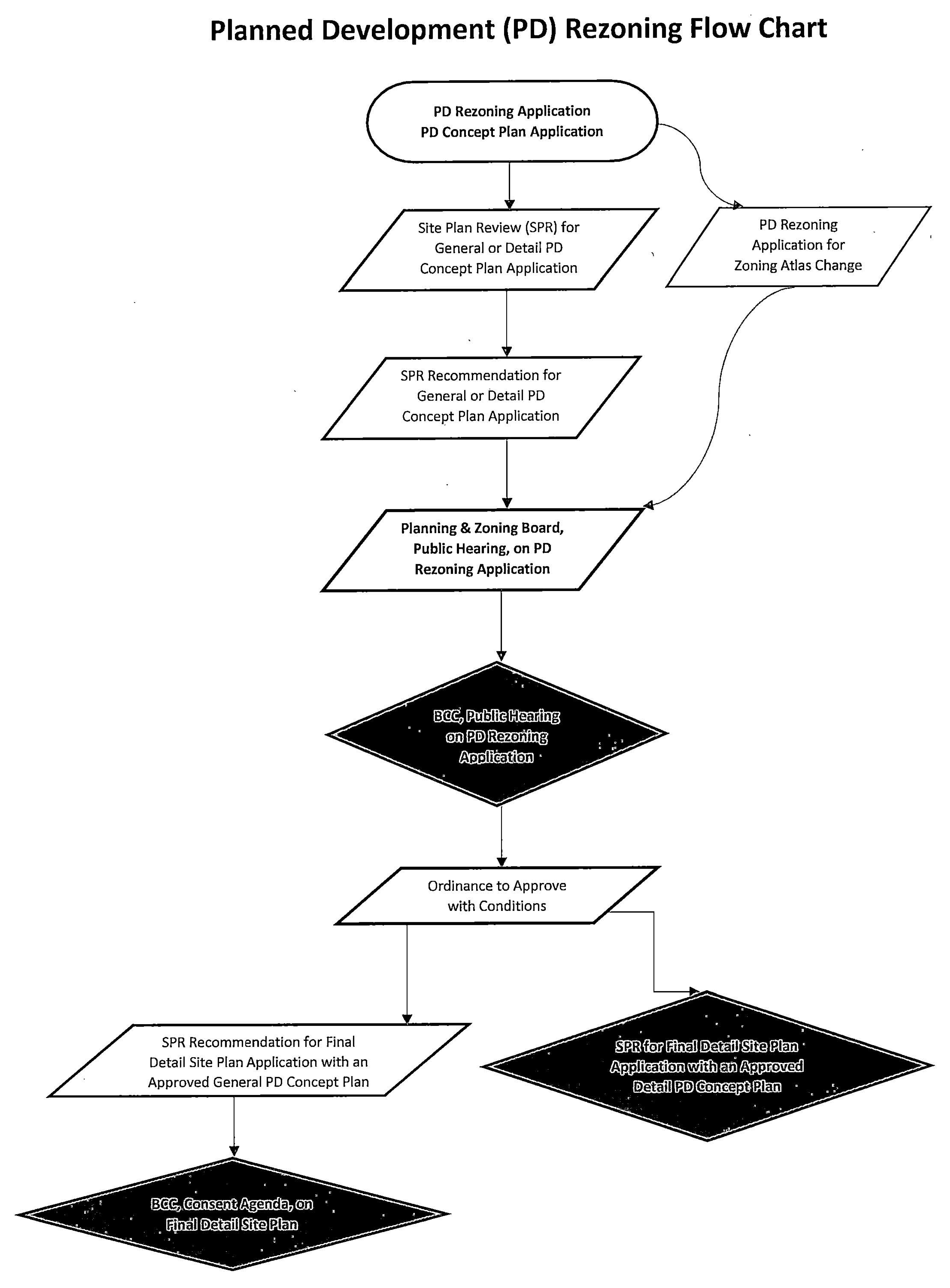
(Minutes of 12-8-81, § 7; Ord. No. 89-46, § 1, 6-22-89; Ord. No. 2002-008, §§ 4, 5, 1-28-02; Ord. No. 2008-053, § 1, 7-8-08; Ord. No. 2014-041, § 1(Exh. A), 11-25-14; Ord. No. 2021-044, § 1(Exh. B), 10-26-21)
Sec. 3-9-45.1 - Planned Development (PD) open space and setback special requirements.
(a)
Intent. The purpose and intent of this section is to provide alternative design criteria for open space and setback within different types of development.
(b)
Development within the US 41 Overlay District (41OD). In order to promote compact and intense development within this overlay, the setback and open space requirements are reduced as follows:
(1)
Setback. The twenty-five-foot PD setback is not required.
(2)
Open space. A minimum of five (5) percent and a maximum often percent of the entire site shall be allocated towards open space or recreational uses. Outdoor public gathering places may be considered as open space, such as open-air plazas.
(c)
Development within the Burnt Store Limited Development (BSLD) and Burnt Store Village Residential (BSVR) Future Land Use Map (FLUM) designations.
(1)
Open space. Open space shall include recreational facilities, parks, sidewalks and trails, natural preserve areas, or other commonly owned or maintained areas of pervious surface. However, commonly-maintained man-made water-bodies may count as up to ten (10) percent of the total open space requirement.
Development which includes recreational vehicle uses must contain at least three (3) acres of active recreational amenities. Such amenities may be counted towards the required twenty (20) percent minimum open space.
(d)
Development within the Compact Growth Mixed Use (CGMU) FLUM designation. In order to promote compact and intense mixed-use development, the open space requirements are reduced as follows:
(1)
Open space. A minimum of five (5) percent and a maximum of ten (10) percent of the entire site shall be allocated towards open space or recreational uses. Outdoor public gathering places may be considered as open space, such as open-air plazas.
(e)
Development within the Rural Community Mixed Use (RCMU) FLUM designation or Conservation Subdivision. In order to protect and preserve the rural atmosphere, the setback and open space requirements are increased as follows:
(1)
Setback: The minimum PD setback shall be fifty (50) feet unless otherwise approved by BCC.
(2)
Open space.
a.
For development within the Rural Community Mixed Use FLUM designation. A minimum of fifty (50) percent of the total site shall be set aside as rural residential open space. A minimum of forty (40) percent of the total site shall be set aside as rural residential open space if the proposal meets the requirements of alternative development set forth in the county's comprehensive plan.
b.
For development within conservation subdivision. A minimum of seventy (70) percent of the total site shall be set aside as rural residential open space.
At least fifty (50) percent of such open space shall remain undeveloped. The remaining fifty (50) percent may contain:
1.
Bike paths,
2.
Hiking trails,
3.
Equestrian trails,
4.
Canoeing and kayaking facilities,
5.
Fishing facilities such as docks and limited storage for non-motorized boats,
6.
Agricultural uses including accessory uses,
7.
Stormwater management systems serving the community provided the stormwater systems are unfenced and are surrounded by, or adjoin, areas that are improved for use by wildlife and accessible to the residents of the development, and
8.
Any required buffers.
Existing agricultural areas may be maintained in agriculture, natural lands reserved as open space shall not be converted to agricultural uses.
Golf courses shall not qualify as rural residential open space.
Editor's note— (Ord. No. 2021-044, § 1(Exh. C), 10-26-21)
Sec. 3-9-46. - Mixed-use (MU).
(a)
Intent. The intent of the mixed-use (MU) district is to accommodate the development of vibrant, pedestrian-oriented places featuring a mixture of complimentary land uses including residential, commercial, office, and light industrial. Mixed-use developments should be designed to integrate multiple uses in individual buildings as well as throughout the site. In order to facilitate compact, walkable developments, the MU district allows for higher density and intensity and provides more flexible design standards and guidelines than found in traditional zoning. The MU district promotes the adaptive reuse of existing, outdated sites, and encourages the consolidation of small parcels into larger, viable, mixed-use developments. Mixed-use developments should feature networks of sidewalks to provide safe, comfortable, and attractive access to pedestrians, and be designed at a human scale to promote a distinct sense of place.
(b)
Applicability.
(1)
The standards set forth in this section shall apply to all new development within a MU district.
(2)
For existing commercial sites that have been rezoned to MU, the standards set forth in this section shall apply to the redevelopment of existing buildings which increases gross floor area or assessed valuation by more than fifty (50) percent, and the redevelopment of commercial structures in which more than fifty (50) percent of the assessed valuation of the structure has been destroyed.
(3)
This section is not intended to prevent the use of alternative design solutions that meet the intent and purpose of this section, as determined by the zoning official or their designee.
(c)
Mixed-use district categories.
(1)
Neighborhood mixed use (MU-N).
a.
Scale. Neighborhood mixed-use developments are intended to be smaller, lower impact, and integrate well into the surrounding residential community. MU-N developments are intended to be pedestrian- and bicycle-oriented, contribute to the efficient functioning and attractiveness of the surrounding neighborhood, and have a maximum size of ten (10) acres. The mix of uses may include retail, restaurants, dwelling units above the first floor, multifamily and single-family attached dwellings, general offices, medical offices, and civic uses.
b.
Location. The location of a proposed MU-N development shall be designed to take advantage of daily activity patterns, such as at the corner of a residential collector street, at the entrance to a neighborhood, or in conjunction with a park, school, civic use, or public space. To serve its purposes, a MU-N development should be sited at the edges of a residential neighborhood, at a collector and arterial street intersection or a collector and local street intersection.
(2)
Activity center mixed use (MU-AC).
a.
Scale. Activity centers, depending on their size and service area, may serve several neighborhoods within a surrounding residential area with a mix of retail, office, service, civic, and attached residential uses, may accommodate large retail establishments, and may serve multiple residential areas and neighborhoods over a significant portion of the county.
b.
Small activity centers range between ten (10) and twenty-five (25) acres in size. They are typically anchored by a grocery store, with supporting establishments. Secondary uses include other supporting neighborhood-oriented uses and residential uses, including upper floor units and townhouses to assure extended hours of activity within the district and support a mix of uses. The district should balance automobile access from arterial streets with transit orientation, pedestrian and bicycle access and circulation, and provides good transitions and connectivity with the surrounding neighborhoods.
c.
Large activity centers are typically greater than twenty-five (25) acres in size and include a mix of commercial with supporting office, service, medical, residential and civic uses. Higher density residential is a critical component to assure extended hours of activity within the district and provide support for a mix of uses. Activities and uses should be concentrated and mixed in order to create more diversity and synergy between uses, combine destinations, support effective future transit service, and provide viable pedestrian and bicycle access and circulation. Mobility choices should be integrated by providing transit, pedestrian and bicycle connectivity within the center as well as to adjoining areas. Aging single or limited use local commercial centers and corridors should be redeveloped under this zone.
d.
Location. Small MU-AC zone districts serve multiple neighborhoods and should balance automobile access from arterial and collector streets with transit orientation, pedestrian access and circulation, and have good connections with the surrounding neighborhoods. Large MU-AC districts serve significant subareas of the county and shall be designed to allow vehicle and pedestrian connectivity to surrounding residential areas.
(3)
Regional mixed use (MU-R).
a.
Scale. Regional center mixed-use developments are greater than fifty (50) acres in size and are the most intensive category of mixed-use developments, combining the uses of higher-density residential, commercial centers, and employment centers, and serve the county and region as a whole. The MU-R category should include a mix of commercial and employment uses integrated into a single, mutually supportive regional destination. These uses may range from regional mail anchor stores, government offices, and corporate headquarters to specialized retail and higher density housing. Because of their size, both sets of activities function as regional centers in terms of market for retail and employment opportunities. Higher density residential use is a critical component of a MU-R center in order to assure extended hours of activity within the district and provide support for a mix of uses.
b.
Activities and uses should be concentrated and mixed to create more diversity and synergy among uses, combine destinations, support effective future transit service, and provide viable pedestrian and bicycle access and circulation. Mobility choices should be integrated by providing transit, pedestrian, and bicycle connectivity within the center as well as to the adjoining areas.
c.
Location. A MU-R zone district should typically be located at the intersection of two (2) major arterial roadways, along major arterial roads, along the county's planned transit system, near other major regional transit terminals, or close to limited access freeways and interstate highways. Sites with direct access to existing or planned major transportation facilities and compatibility with adjacent land uses are appropriate for the MU-R zone district.
(d)
Uses and structures permitted.
(1)
Use Table
P = Permitted Use; C = Conditional Use; S = Special Exception Use; —- = Prohibited Use
a.
Permitted accessory uses and structures. Uses and structures which are customarily accessory and clearly incidental to permitted and conditional uses and structures are also permitted in this district, including a residential dwelling unit within the same structure as the principal use for occupancy by owners or employees of permitted uses, and also including, but not limited to:
1.
Fences or walls.
2.
Clubhouse, community center on the same lot as the residential development or within the same residential development.
3.
Swimming pools, tennis courts, or other similar recreational uses and structures on the same lot as the residential development or within the same residential development.
4.
Boat docks, boat lifts, and boat ramps.
5.
Other accessory uses or structures as determined by the zoning official or their designee.
b.
Conditional uses and structures. For rules and regulations for any use designated as a conditional use, see section 3-9-69, as may be amended.
c.
Special exception uses and structures. For procedure, see section 3-9-6.2, as may be amended.
1.
All conditional uses and structures that cannot meet all conditions set forth in this Code.
2.
Such other uses as determined by the zoning official or their designee to be:
(i)
Appropriate by reasonable implication and intent of the district.
(ii)
Similar to another use either explicitly permitted in this district or allowed by special exception.
(iii)
Not specifically prohibited in this district.
The board of zoning appeals shall review a favorable determination of the zoning official under this provision at the time the special exception application is presented to it. An unfavorable determination of the zoning official or their designee shall be appealable pursuant to section 3-9-6.
d.
Prohibited uses and structures. Any use or structure not expressly or by reasonable implication permitted herein or permitted by special exception shall be unlawful in this district, including:
1.
Single-family detached homes.
2.
Outdoor storage.
3.
Indoor storage as a principal use.
4.
Drive-through restaurants.
5.
Stand-alone surface parking lots.
(2)
Required mix of uses. To ensure a balance between housing, retail, office, and other commercial and light industrial development within the MU zone categories, the following standards shall apply:
Exhibit 1: Required Mix of Uses
a.
Neighborhood mixed-use developments under five (5) acres in size are exempt from the open space requirement
(3)
Mix of uses required in phased developments. If the development is phased, the first phase shall be sufficient to stand on its own as a mixed-use development. At a minimum, non-residential development shall be in the ratio of fifty (50) square feet per dwelling unit.
(e)
Development standards.
(1)
Density.
a.
All density increases shall require a transfer of density units consistent with the county's TDU program. If the subject property contains less than the minimum range of allowed density for the MU category requested, the applicant, at the time of rezone approval, shall transfer density units equal to the minimum density range of the requested MU category in accordance with the county's TDU program. Mixed-use categories shall have a required minimum and total maximum density according to the following table:
Exhibit 2: Range of Allowed Density
b.
Density increase. In addition to the base density, additional density units may be granted through the county's incentive density program upon preliminary site plan review approval on the basis of the following:
Exhibit 3: Density Increase Calculations
a.
Final approval of incentive density units will be granted when concept plans and supplemental documents assure actions proposed at the time of preliminary site plan review approval.
b.
Cumulative density. In no event shall the cumulative density granted exceed the maximum density permitted under the underlying land use in the comprehensive plan.
c.
Incentive density may be granted as long as the county has adequate supply of incentive density units. Incentive density allocation to a specific project is valid for three (3) years and can be extended one (1) time by the board on the consent for additional two (2) years.
(2)
Location.
a.
No MU district shall be located on a bridgeless barrier island.
b.
MU districts may be permitted within the coastal high hazard area, but are not eligible for density increases.
(3)
Minimum lot and yard requirements.
a.
The minimum lot size for a mixed-use district is two (2) acres.
b.
There are no minimum yard requirements for this district, provided when subject property directly abuts a residentially-zoned property rather than being separated by a public right-of-way such as a street, no structure shall be located closer to the peripheral property line of the mixed-use district than twenty-five (25) feet or as required by section 3-9-88, as may be amended, whichever is greater. If the mixed-use district abuts water, the minimum setback shall be twenty (20) feet. However, minimum lot and yard requirements other than those contained in this section and section 3-9-88 may also be established through the final site plan review approval process.
c.
There is no maximum lot coverage.
d.
To encourage pedestrian-friendly streets by bringing buildings close to pedestrian sidewalks and walkways, the county encourages principal, non-residential, multi-family, and mixed-use buildings to be built to the back edge of the public sidewalk (zero-foot build-to line) except as necessary to allow room for outdoor seating and service areas, outdoor sales and displays, landscaping, entryways, and similar pedestrian and customer amenities. The build-to area between the front property line and the front building wall of residential structures may be used to provide space for privacy, landscaping, private courtyards/open areas/entryways, and similar amenities.
(4)
Setbacks.
a.
Setbacks are established based upon the street frontage of the lot, according to the street types established as follows:
1.
Perimeter streets. Existing streets bounding the perimeter of the site.
2.
Primary streets. Streets that provide connections from secondary streets to the perimeter streets.
3.
Secondary streets. Streets that provide connections internal to the mixed-use development. These streets are intended to maintain low vehicle speeds and facilitate pedestrian and bicycle movements.
(i)
Angled roadways and offset intersections are acceptable on secondary streets.
(ii)
Secondary streets should be laid out in a connected network. The use of cul-de-sacs is prohibited.
(iii)
Driveway access is not limited, but alley access and shared driveways are encouraged.
4.
Alleys. Alleys provide rear access to sites for parking access, refuse collection, utilities, and other services.
(i)
The use of alleys is encouraged.
(ii)
Alley access points are permitted only onto secondary streets.
(iii)
Fire access shall not be required for alley design where adequate emergency service access exists along another frontage street.
Exhibit 4: Model Street Network Diagram
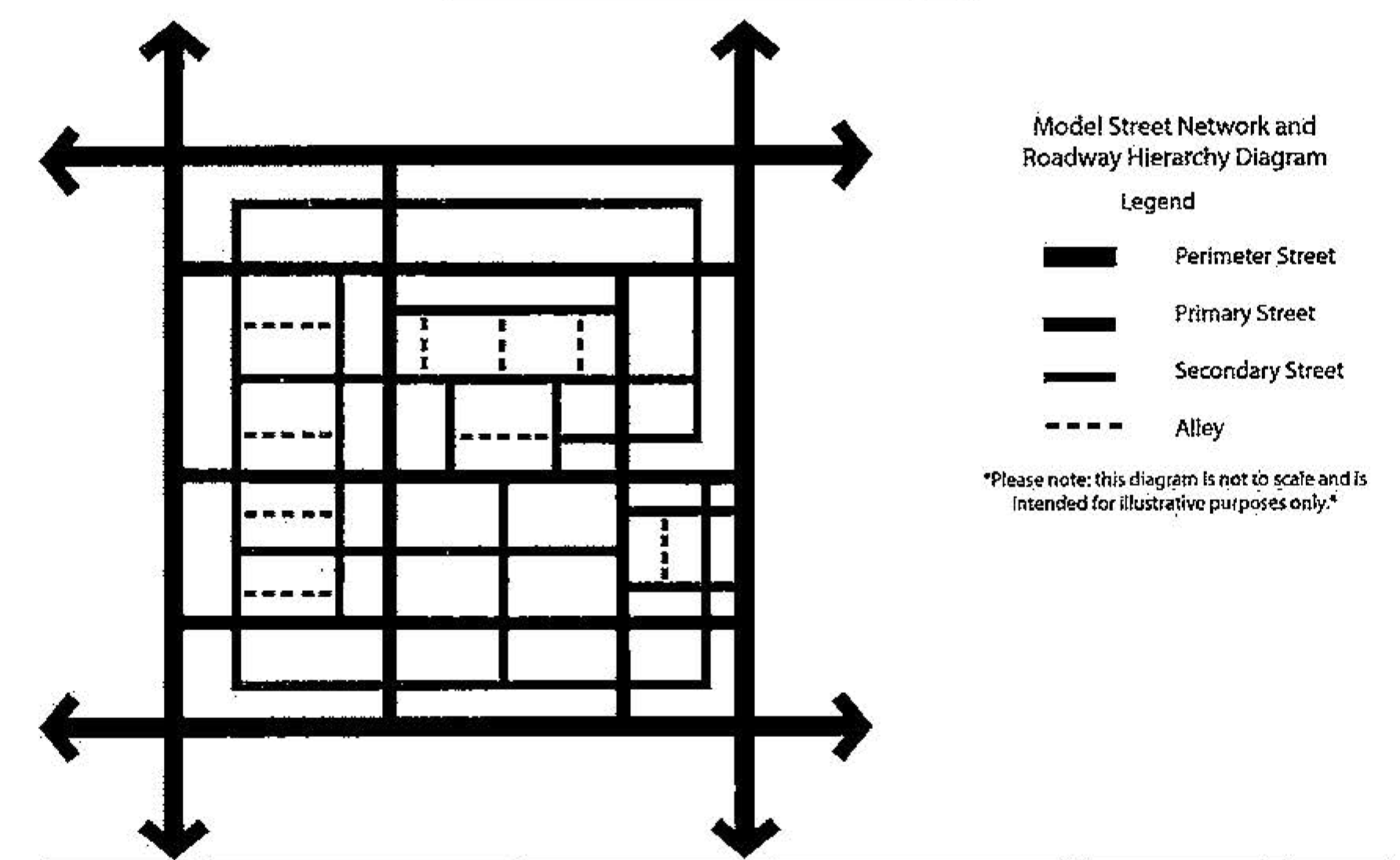
Exhibit 5: Maximum Setbacks
(5)
Height allowances.
Exhibit 6: Building Height Allowances
a.
Cumulative bonus. In no event shall the cumulative height bonuses exceed the maximum height established for the proposed development's applicable mixed-use category.
(6)
Transitional zone tools. To mitigate potential conflicts between land uses of varying intensities and character, the following considerations shall be made during the site plan review process with particular focus to proposed structures and uses located at the perimeter of the proposed MU development:
a.
Site and building design. Building setbacks, building placement and orientation, building heights.
b.
Green and open space. Use and location of parks, plazas, squares, promenades, courts, etc., and use of natural features such as topography, waterways, existing trees and vegetation.
c.
Siting of less-intensive uses around perimeter of MU development, particularly when a MU development directly abuts a residential area (i.e. offices instead of bars/restaurants).
d.
Operational standards for commercial uses sited at the perimeter of the development, including hours of operation, delivery hours and loading zones, location and intensity of lighting, etc.
e.
Use of parkways and streetscape enhancements.
f.
Enhanced landscaping and buffers between mixed-use developments and existing single-family residential areas.
(7)
Site and building design.
a.
In order to allow for creative site and building design within mixed-use districts, these regulations do not establish a required architectural style. In order to create a sense of place, site design should produce an overall unified theme and be designed to maximize pedestrian comfort and accessibility.
b.
In the event any portion of this article conflicts with any other county code provision or provision of applicable law, the provision that establishes specific architectural themes shall prevail. In the event that neither conflicting provision establishes a specific architectural theme, the more restrictive provision shall apply.
c.
Block standards.
1.
Block standards shall apply to all development larger than five (5) acres.
2.
In order to prevent traditional linear or "strip" style commercial development, depth-to-width ratios shall not exceed 1-to-4. All block dimensions shall be measured from back of curb to back of curb. Right-of-way widths shall not be included in the measurement of block widths.
3.
All development shall be arranged in a pattern of interconnecting streets and blocks to form a grid-like system. This system may be made up of publicly-dedicated rights-of-way, private streets, or a combination of both.
4.
The minimum building separation on alleys shall be thirty (30) feet from building face to building face.
5.
The minimum block face shall be two hundred (200) feet.
6.
The maximum block face shall be eight hundred (800) feet.
7.
For block faces that exceed five hundred (500) feet in length, a mid-block pedestrian pass-through shall be provided connecting opposite sides of block faces.
8.
An applicant may submit alternative block standards, provided they meet the intent of this section, at the time of preliminary site plan review.
d.
Building orientation.
1.
A continuous pedestrian walkway extending the full length of the perimeter of the site shall be provided. Perimeter walkways shall be at least eight (8) feet wide.
2.
All buildings shall have at least one (1) building entrance oriented toward an abutting internal or perimeter street with on-street parking, or toward an on-site pedestrian walkway connected to a public sidewalk.
3.
A minimum of fifty (50) percent of the front facade of a building shall be placed along the front setback line. When a lot is located at a corner, both sides of the corner shall be considered the front and shall meet front setback and street frontage requirements.
(i)
For developments with multiple buildings on a single lot, at least one building shall be placed along the front setback line.
(ii)
For larger MU developments consisting of multiple lots, each lot shall be subject to this requirement.
4.
For developments with multiple buildings, all buildings shall be arranged and grouped so that their primary orientation complements adjacent, existing development, as applicable, and is consistent with one (1) of the following site layouts:
(i)
Buildings orient toward, frame, and enclose a main pedestrian and/or vehicle access corridor within the development site, including an entry/spine street; or
(ii)
Buildings orient toward, frame, and enclose, on at least three (3) sides, parking areas, public spaces, or other on-site amenities; or
(iii)
Buildings orient toward and frame the corner of a perimeter or internal street intersection; or
(iv)
Buildings orient toward adjoining development, respecting adjoining exterior street alignment(s) that frame and enclose on at least three (3) sides parking areas, public spaces, or other on-site amenities.
5.
Corner lots shall place as much building mass near the intersection as possible to help anchor the lot and take advantage of high visibility.
6.
Buildings may front along a pedestrian plaza in place of fronting along a street. Any building located at the corner of a street and a pedestrian plaza shall include a public entrance along the street facade, even if the main entrance faces the pedestrian plaza.
7.
Building entrance design: the primary public entry to the building shall be clearly defined and building entrances shall incorporate elements that provide shade from the sun and weather protection for pedestrians.
e.
Appearance, building mass, and design treatments. The following standards are the minimum design standards. In order to qualify for the enhanced design criteria and receive bonus height allowances, the applicant is required to submit a pattern book in accordance with subsection (14), below, for review which exceeds these minimum design standards. Pattern books shall be approved as part of the site plan review process.
The intent of this section is to encourage development that improves the view from the street and requires buildings to be designed with architectural features and patterns that provide visual interest and enhance the community's identity and character. These standards are intended to reduce the mass, scale, and monolithic appearance of large, unadorned walls, particularly those visible from the street.
The regulations set forth in article XXIV, as may be amended, shall apply to MU districts except as specifically addressed in the following subsections.
1.
Facades.
(i)
All exterior building facades which face a public right-of-way, even if they are separated by a median or interior travel way, face a plaza or other public space, or have a primary customer entrance are defined as primary facades and shall meet the primary facade standards outlined herein.
(ii)
Buildings which directly abut a plaza or other public gathering space shall feature a primary customer entrance on the side of the building abutting the plaza or other public gathering space.
(iii)
Primary facades shall be consistent in terms of design, materials, details, and treatments.
(iv)
Window coverage on ground floors shall be a minimum of forty (40) percent. Window coverage for upper floors shall be a minimum of twenty (20) percent. Reflective glass may not be used on the ground floor of any building to prevent glare from vehicular traffic.
(v)
All primary building entrances shall be accentuated. Permitted entrance architectural accents may include, but are not limited to: recessed, protruding, canopy, portico, or overhang.
(vi)
Buildings located on corner lots at an intersection of two (2) or more perimeter streets shall be designed to emphasize their location as transition points within their community or commercial block. Buildings or structures on corner lots shall include embellishments such as corner towers, clock towers or other design features as may be approved by the zoning official or their designee to emphasize their position.
(vii)
Loading doors, service doors, and loading docks shall not be located on any primary facade facing a street.
(viii)
New buildings that are to be located within two hundred (200) feet of any existing commercial or residential building on an abutting lot, and that are to be more than twice the height of any existing building located within two hundred (200) feet of the new building, shall incorporate elements to transition the height of the new building to the height of the existing building(s). The transitional height element must be incorporated on the new building(s) at the average height of existing building(s) located within two hundred (200) feet of the new building.
Transitional height elements may include:
A.
Cornices or other decorative elements which run the length and width of the building and project a minimum of three (3) feet from the wall.
B.
Offset floors.
C.
Any other element that as determined by the zoning official or their designee, meets the intent and purpose of this section.
(ix)
Murals are permitted on building facades except where facing a perimeter street.
2.
Building massing.
(i)
Buildings shall be designed to avoid the appearance of a large, monotonous building mass by dividing large facades into the appearance of several sections or smaller buildings.
(ii)
Buildings must have at least a three-foot break in depth in all front facades for every one hundred (100) feet of continuous facade. Such breaks may be met through the use of bay windows, porches, porticos, building extensions or recesses, balconies, towers, and other architectural treatments.
f.
All new utilities shall be located underground unless prohibited by the respective utility provider.
g.
Dumpsters shall comply with section 3-5-513, as may be amended.
h.
Loading and service areas shall comply with section 3-9-79(i) and section 3-5-513, as may be amended.
i.
Fences and walls shall comply with section 3-9-72, as may be amended.
j.
All exterior mechanical and electrical equipment shall be fully screened from view from public rights-of-way and public plazas.
(8)
Parking.
a.
Off-street parking shall be in accordance with section 3-9-79, as may be amended.
b.
Areas of off-street surface parking shall be located at the side or the rear of the primary structure it is intended to serve. Areas of off-street surface parking shall not directly abut any perimeter streets. For structures without frontage on a perimeter street, parking areas may be permitted at the front of the structure.
c.
The required number of off-street parking spaces may be reduced as approved by the county engineer or their designee. Any applicant seeking a parking reduction shall submit a parking study prepared by a licensed professional engineer that provides justification for the requested reduction. At a minimum, the parking study shall address, where applicable:
1.
The types of uses.
2.
Total square footage by uses.
3.
Estimated time and number of spaces required at peak parking demand.
4.
ADA-accessibility requirements.
5.
Employment characteristics including, but not limited to, total number of employees and number of employees per shift.
6.
A description of any factors that may reduce or increase the parking demand.
The applicant may choose to further support the proposed number of parking spaces by providing documentation on the experience of similar uses located in the same or other jurisdictions.
d.
Traffic impact statements are required during preliminary site plan Review.
e.
Areas of off-street surface parking shall be landscaped in accordance with subsection (10), below.
f.
All parking spaces shall incorporate curbing, wheel stops, bollards, or other similar element as approved during the site plan review process.
g.
Parking structures.
1.
Stand-alone parking structures shall comply with the design requirements of this section.
2.
Stand-alone parking structures are encouraged to accommodate retail or commercial wrapped around the ground floor.
3.
Parking structure facades shall be designed to screen views of automobiles by the general public through the use of features such as grills, lattices, mock windows, louvers, or false facades. Such screening shall be in keeping with the rest of the building's architectural style and materials.
4.
Parking structures without ground floor retail uses along the front facade shall have a minimum ten-foot wide building perimeter planting area.
5.
All structures with uncovered parking on the top level shall have rooftop planters around the perimeter that are a minimum of five (5) feet wide located around a minimum of eighty (80) percent of the perimeter of the parking integral to the structure, or suitable architectural features to soften the building edge.
6.
Lighting fixtures located on the top level of uncovered parking structures shall be a maximum of twenty (20) feet in height. Lighting shall incorporate full shield cut-offs to contain light to the surface of the deck only.
h.
Bicycle parking.
1.
A minimum number of bicycle parking spaces shall be provided, equal to ten (10) percent of the total number of vehicle parking spaces provided by the development, but not less than one (1) space.
2.
Bicycle parking facilities shall be located no further than one hundred (100) feet away from a building entrance, shall be visible from the uses and structures they serve, and shall not be located in remote vehicle parking areas. Bicycle parking facilities shall not be located in places that impede pedestrian or automobile traffic flow or that would cause damage to landscaping.
3.
Spaces for short-term bicycle parking shall provide a means for the bicycle frame and one (1) wheel to be attached to a permanent fixture, designed for securing bicycles, by means of a lock.
(9)
Pedestrian circulation.
a.
All pedestrian pathways shall be constructed with a minimum width of eight (8) feet and meet or exceed all regulations established in the Americans with Disabilities Act.
b.
All new development and redevelopment shall provide and contribute to an on-site system of pedestrian pathways that provide continuous access to all land uses within a development site and to all land uses on adjacent properties. All new sidewalks and multi-modal paths shall connect with adjacent existing sidewalks and multi-modal paths.
c.
Freestanding planters and protective devices, such as bollards, may be installed between sidewalks and adjacent vehicular traffic to help shape the pedestrian environment.
d.
Intersections. At all on-site intersections and pedestrian crossings, brick pavers, stamped concrete or other similar material shall be installed to provide clear visual delineation for pedestrian and vehicular traffic.
1.
Crosswalks shall be a minimum of six (6) feet and a maximum of twelve (12) feet in width.
2.
All crosswalks for perimeter and primary streets shall include illuminated or flashing crosswalk signage.
e.
Internal pedestrian circulation and connections. The on-site system of sidewalks or multi-modal pathways shall provide the most efficient access route between the intended points on travel. Specifically, on-site pedestrian connections shall be provided to and between the following points:
1.
The primary entrance(s) to each building containing a principal use.
2.
Greenways, bikeways, and trail systems.
3.
Existing and/or planned transit stops, stations, and park and ride locations.
4.
On-site amenities, as provided in subsection (11), below.
5.
Parking areas.
f.
Pedestrian malls or promenades.
1.
Pedestrian mails or promenades shall be developed within the equivalent of a street right-of-way, with a minimum fifty-foot right-of-way width. Buildings shall be set back from the right-of-way area the same distance as from a street. The pedestrian mall or promenade shall intersect a public street in the same manner that a street would.
2.
Except for landscaping, pedestrian paving shall cover the entire right-of-way. Pedestrian paving shall be enhanced through decorative pavers or other similar materials; asphalt and plain concrete paving shall not be permitted.
3.
With the exception of emergency and delivery vehicles, automobiles shall be prohibited in pedestrian mail or promenade areas. Paving sections shall be designed to accommodate emergency and delivery vehicles. Necessary clear zones shall be kept so that vehicles may access the buildings. Deliveries shall be restricted to hours when the pedestrian mall is not open to the public.
4.
Loading dock entries shall not face onto pedestrian mails or promenades.
5.
Seating areas, which may include benches or seats grouped around or attached to a table, shall be provided along each block face at a rate of five (5) linear feet of seating per three hundred (300) linear feet of pedestrian mall or promenade.
6.
Landscaping shall be provided throughout pedestrian malls or promenades and shall comprise at least twenty-five (25) percent of the pedestrian area. Up to fifty (50) percent of the landscaped area may be planted with shrubs or flowers in planters or pots. Additionally, at least one (1) tree shall be planted for every five hundred (500) square feet of required planting area. Planting areas should utilize native, Florida-friendly groundcover other than sod.
7.
Between two (2) and four (4) paired trash and recycling receptacles shall be placed along each block face with more than forty thousand (40,000) square feet of building area.
g.
Traffic calming. Developments shall incorporate one (1) or more of the following traffic calming devices to slow traffic and improve pedestrian mobility and safety. The location, type, and number of traffic calming devices on-site shall be determined during final site plan review by the county engineer or their designee. Options for traffic calming devices include, but are not limited to:
1.
Curb extensions/bulb-outs.
2.
Raised median islands.
3.
Traffic circles/roundabouts.
4.
Chicanes.
5.
Speed tables.
6.
Raised crosswalks/intersections.
7.
On-street parking.
(10)
Landscaping. The following standards are the minimum design standards. In order to qualify for the enhanced design criteria and receive bonus height, the applicant is required to submit a pattern book for review which exceeds these minimum design standards.
a.
The regulations set forth in section 3-9-100, as may be amended, shall apply to MU districts except as specifically addressed in the following subsections.
b.
MU districts are not eligible to pay into the native tree replacement fund established in section 3-9-100(i) in lieu of planting the required number of trees.
c.
Florida-friendly landscaping principles shall be employed in all landscaped areas in MU developments. A minimum of seventy-five (75) percent of required tree points shall be obtained from native species.
d.
The use of Florida-friendly groundcover, such as native grasses, is encouraged as an alternative to sod throughout the development.
e.
Root barriers shall be installed where canopy trees with large root systems are proposed in required parking lot islands or where proposed within ten (10) feet of curbing, driveways, sidewalks, and buildings in order to prevent roots from damaging infrastructure.
f.
Building perimeter plantings. All new development and redevelopment in MU districts shall provide, at a minimum, building perimeter plantings equal to ten (10) percent of the proposed building ground level gross floor area. These plantings shall be located abutting at least three (3) sides of the building with emphasis on the sides most visible to the public, not including any loading area(s).
1.
The building perimeter planting areas shall consist of raised planters, planter boxes, or in-ground landscaping areas. Building perimeter plantings shall include shrubs and ground cover plants with a minimum fifty (50) percent coverage of the landscaped area at time of planting. Trees are also permitted to be planted in the building perimeter planting areas.
2.
The use of sod or other non-ornamental grasses is not permitted in building perimeter planting areas.
3.
Stormwater management areas may not be located in building perimeter planting areas.
4.
Pedestrian pathways may cross through and loading areas may be placed in the building perimeter planting areas, but these shall not be counted towards the minimum planting area or open space requirements.
5.
Decorative paving areas incorporating courtyards, walkways, water features, plazas, covered seating and outdoor dining spaces may be used to meet up to twenty (20) percent of the required building perimeter planting area.
6.
Vine planted arbors, wall planters, and trellis structures may be used to meet up to fifteen (15) percent of the required building perimeter planting area.
g.
Perimeter landscape strips.
1.
Perimeter landscape strips are required wherever a lot abuts a public right-of-way. Required plantings may be located in public rights-of-way with written consent from the county engineer and authorized occupation of easement agreement(s), as applicable.
2.
Perimeter landscape strips shall be a minimum of five (5) feet in width.
3.
Perimeter landscape strips shall be planted with a minimum of one (1) tree per thirty-five (35) linear feet, and one (1) shrub, at least eighteen (18) inches in height at the time of planting, per eight (8) linear feet. Trees within a section of perimeter landscape strip may be grouped, but the distance between trees in a section shall not exceed fifty (50) feet.
h.
Parking lot landscaping.
1.
Where surface parking abuts a street, pedestrian pathway, or residential use, a continuous hedge of at least three (3) feet in height shall be planted, in addition to one (1) tree per thirty-five (35) linear feet, or fraction thereof.
2.
Parking lot island landscaping shall comply with section 3-9-100.2.
3.
Parking lot medians shall contain one (1) tree per thirty-five (35) linear feet, or fraction thereof, and shall be planted at regular intervals.
4.
Landscaping treatments such as shrubs, groundcover, and/or flower beds shall be planted in parking lot medians.
5.
Sod is not permitted in parking lot islands or medians.
i.
Buffers. Where a MU district abuts residential-zoned property and is not separated from the adjacent property by a public right-of-way, a minimum twenty-five-foot wide Type C buffer is required, as described in section 3-9-100.1, as may be amended. There is no zoning buffer required for MU districts abutting existing commercial- or industrial-zoned properties.
(11)
On-site community amenities.
a.
Plazas and public gathering spaces.
1.
Required open space areas shall be designed as focal points within the development and shall be easily accessible and open to the public.
2.
MU developments with more than one hundred thousand (100,000) square feet of gross floor area shall provide a minimum of one (1) square foot of plaza area for every fifty (50) square feet of gross building floor area.
3.
Individual plazas shall be a minimum of two thousand (2,000) square feet and a maximum of fifty thousand (50,000) square feet.
4.
Plazas shall be surrounded on all sides by streets, pedestrian walkways, or by primary facades of buildings.
5.
Areas of surface parking shall not be located adjacent to any plazas or public gathering spaces.
6.
At least twenty-five (25) percent, but no more than eighty (80) percent, of a plaza shall be landscaped with trees, shrubs, and groundcover.
(i)
A minimum of seventy-five (75) percent of all plantings shall be native species.
(ii)
Trees shall be planted near seating areas to provide shade.
7.
Plazas shall be centrally located within MU developments and provide easy and convenient access from all residential and non-residential buildings.
8.
Plazas shall include a defining central element, such as a large fountain, sculpture, gazebo, pavilion, pagoda, clock tower, pond, or similar feature. Plazas shall also be improved with a variety of other amenities, such as small fountains, public art, shade trees, trash receptacles, benches, play equipment, decorative pedestrian lighting, trellises, and other similar features.
9.
All hardscape elements, including, but not limited to, street furniture, planters, lighting fixtures, trash receptacles, and drinking fountains, shall have a cohesive theme for the development.
10.
Each plaza shall contain at least one (1) wayfinding sign or informational kiosk.
11.
Stormwater management areas may be permitted in plaza and open space areas in the form of bioswales.
b.
Outdoor seating.
1.
Outdoor seating areas shall be incorporated within the site to create assembly areas for pedestrians whenever possible. When all setbacks, sight lines, and safety regulations are followed, the use of a widened sidewalk may be used to accommodate a seating area. Seating areas shall incorporate umbrellas, attached structural awnings, canopy trees, and/or other pedestrian amenities.
2.
A minimum of five (5) linear feet of seating, such as a bench or cluster of chairs, shall be provided for every one thousand (1,000) square feet of plaza area. Areas seating at least four (4) people at a time shall be provided at the rate of one (1) per block face, outside of plaza areas.
3.
Outdoor dining areas shall not encroach into pedestrian pathways. Areas of outdoor dining shall be separated from pedestrian pathways and other public rights-of-way by utilizing decorative fencing or bollards with linked chains measuring four (4) feet in height.
4.
For areas of outdoor dining, advertising or promotional features shall be limited to umbrellas, a menu board, and canopies.
c.
Inclusive play. All designated play areas and play equipment on site shall follow the principals of Universal Design (North Carolina State University, 1997) to ensure accessibility for people of all ages and abilities.
d.
Street furniture and streetscaping.
1.
Street furniture shall be maintained by the property owner and shall be constructed of durable materials such as cast iron, stainless steel, aluminum, or similar materials.
2.
Between two (2) and four (4) paired trash and recycling receptacles shall be placed along each block face with more than forty thousand (40,000) square feet of commercial uses, one (1) pair at each end of the block and additional receptables spaced evenly between. A minimum of one (1) additional paired trash and recycling receptacle shall be provided for each five thousand (5,000) square feet of plaza/open space.
3.
One (1) drinking fountain shall be provided for each ten thousand (10,000) square feet of plaza/open space.
4.
The use of "hostile architecture" or "defensive architecture," in street furniture, including "anti-homeless spikes," is prohibited.
(12)
Lighting. The intent of this section is to prevent the intrusion of light from mixed-use developments onto adjacent properties and to create a compatible and consistent design of lighting for the project. This section further intends to prevent the interference of lighting with automotive and pedestrian traffic, which can create potentially hazardous conditions. The regulations set forth in section 3-5-512, shall apply except as addressed in the following subsections.
a.
A development-wide lighting plan shall be submitted for review at the time of final site plan review submittal. This plan shall address at a minimum the general location and general types of lighting to include the following: street lighting, pedestrian walkway lighting, crosswalk lighting, signage lighting, and lighting for service and delivery areas.
b.
The design of the actual lighting fixtures shall complement the design of the project in style, color, materials, and location. Lighting shall have a unified theme for the entire site, including outparcels. Lighting fixtures shall be ornamental and decorative, but all lighting fixtures located along the perimeter of the site or illuminating a public street or right-of-way shall meet or exceed standards established by the Charlotte County Public Works Department or FDOT.
c.
The use of decorative lighting fixtures on building facades is encouraged.
(13)
Signage. The intent of this section is to ensure consistency in the design of signage associated within a development, whether developed as a single phase or in multiple phases, and to ensure consistency in design between signage constructed on outparcels and the buildings constructed in the principal area of a project site that may have more than one (1) delineated, buildable lot, and which may or may not be developed at the same time or by the same builder.
a.
In addition to advertising goods and services available at a location, signs are intended to compliment, rather than detract from, the visual impact of a commercial development on the community by using design elements consistent with those employed for the building(s), and by minimizing conflicts with on-site landscaping and vehicular use areas.
b.
All signs shall comply with the requirements of section 3-9-95, except that all primary freestanding signs shall be monument signs. The use of pole signs, pylon signs, and flutter flags are prohibited.
c.
Where multiple on-premises signs are proposed for a single site or project (including outparcels), or in the case of a shopping center or multi-tenant/use building, a unified signage plan shall be employed. Signage plans shall be submitted during the final site plan review process and shall be accompanied by a written narrative and graphic depiction of the signage that will be developed on-site which illustrates consistency of design. The unified sign plan may, upon application to and approval of the zoning official or their designee, be amended to reflect style changes or tenant needs. Design elements, which shall be addressed in both graphic and narrative form, include:
1.
Adherence with the provisions of section 3-9-95;
2.
Colors;
3.
Construction materials;
4.
Architectural design;
5.
Landscape design, as applicable;
6.
Illumination method;
7.
Copy style; and
8.
Sign type(s) and locations.
d.
Illuminated crosswalk signs shall be installed at all internal crosswalks and where crosswalks connect to public sidewalks and other rights-of-way.
e.
Wayfinding signage.
1.
Wayfinding signage is intended to provide directions and identify points of interest, not for advertisement of any particular business. Wayfinding signage is exempt from the size and quantity provisions of section 3-9-95.
2.
Wayfinding signage shall measure a minimum of two (2) feet by two (2) feet.
3.
Colors, fonts, and overall design shall feature a unified theme for the entire development.
4.
Wayfinding signs shall be illuminated and comply with all ADA regulations.
f.
Primary freestanding signs shall feature a decorative base and shall include landscaping around the base of the sign to soften their appearance. The planting area around the base of the sign shall be equal to a minimum of forty (40) percent of the total area of the sign and shall include shrubs and groundcover. Landscaping shall maintain clear sight triangles in accordance with section 3-9-89.
(14)
Pattern book requirements.
a.
Pattern books may be used to establish design standards which exceed those set forth in this section. If an applicant has elected to use a pattern book, the pattern book must demonstrate how the site will exceed the established site, building, and/or landscaping design standards through a detailed narrative, written guidelines, and illustrated renderings. If approved, the applicant may be eligible for the bonus development allowances as stated in this section.
b.
Pattern books shall be submitted as part of the preliminary site plan review process.
c.
Pattern books may be submitted to define development parameters and design standards applicable within a defined site, area or subdistrict to establish some or all of the governing design parameters and standards, which may constitute waivers of submittal requirements and deviations, including, but not limited to: setbacks, building heights, building orientation, parking, loading, landscaping, lighting, signage, density, intensity, lot sizes, coverages, and standards for roadway design and rights-of-way.
d.
Approval of pattern books shall be issued by the zoning official or their designee upon finding that standards, waivers, and deviations are consistent with and not detrimental to the public health, safety and welfare. An amendment to an approved pattern book may be requested at any time, to be approved by the zoning official. Approval of pattern books and pattern book amendments shall not be unreasonably withheld, and if approval is not granted by the zoning official within thirty (30) days of submittal, the pattern book shall be subject to review and approval by the board of county commissioners. Where standards defined in an approved pattern book conflict with provisions of this section, the pattern book shall apply. Development in areas that are not subject to a pattern book shall be governed by the standards and provisions set forth in this section. Approved pattern books shall be available for inspection upon request at the community development department.
(15)
Sustainable design bonuses.
a.
In order to qualify for additional height bonuses provided in exhibit 6, a minimum of three (3) of the following options shall be incorporated into the site and building designs. Approval shall be determined during the preliminary site plan review process.
1.
Bioswales.
2.
Use of native groundcover and plants in replacement of sod throughout entire development—pollinator gardens, native grasses, wildflowers, etc.
3.
Reuse of water—reclaimed water for irrigation, etc.
4.
Electric car charging stations.
5.
Rain garden.
6.
Green roof covering at least fifty (50) percent of roof; rooftop gardens; vertical wall plantings.
7.
Use of permeable/pervious pavers.
8.
Recycling of non-hazardous construction and demolition debris.
9.
Utilization of a minimum of fifty (50) percent recycled building materials.
10.
Solar powered lights (non-safety lights).
11.
Other sustainable design elements as determined by the zoning official or their designee.
(Ord. No. 2020-050, § 1(Exh. B), 12-8-20)
Sec. 3-9-47. - Charlotte Harbor Community Development Code.[4]
(a)
Intent, applicability, and boundaries.
(1)
Intent. The intent and purpose of the Charlotte Harbor Community Development Code is to meet the intent of the Charlotte Harbor Community Redevelopment Plan, providing a comprehensive approach to planning future development, improvements to transportation, utilities, and other public infrastructure in the Charlotte Harbor Community.
(2)
Applicability. In addition to any requirements contained elsewhere in the Code, the requirements of this Charlotte Harbor Community Development Code shall apply to any subdivision, special exception, variance, site plan approval, planned development rezoning approval, building permit or sign permit, or any other official action of the county having the effect of permitting development and shall be in addition to each and every other requirement of the Code. In the event of any conflict between applicable provisions of the Code and this section regarding a specific application or development, the more restrictive shall apply.
(3)
Boundaries. The boundaries of the Charlotte Harbor Community shall be the area as depicted as the Charlotte Harbor Community Redevelopment Area on Charlotte 2050 FLUM Series Map #26: Community Redevelopment Areas.
(b)
Definitions. Terms used in this Charlotte Harbor Community Development Code shall take their commonly accepted meaning unless otherwise defined in this Section or in the Code. When there are terms defined both in this Section and elsewhere in the Code, the definitions for such terms contained in this Section shall control.
Access (vehicular): The principal means of vehicular ingress and egress to abutting property from a street, right-of-way or easement.
Alter or alteration: Any change in size, shape, character or use of a structure, including, but not limited to a change, rearrangement or reconstruction of the structural parts and the moving from one location or position to another. Normal maintenance, painting and repairs to existing signs shall not be deemed alterations within the meaning of this section.
Application: An application for any subdivision, special exception, variance, site plan approval, planned development rezoning, building permit, sign permit, or any other official action of the county having the effect of permitting development of property. A rezoning (except a planned development) or a future land use map amendment shall not be considered an application herein.
Awning: A covering either permanently attached to the building or which can be raised or retracted to position against the building when not in use.
Awning canopy: Awning with the long axis projecting perpendicular to the building rather than parallel and requiring posts or poles to support the end of the canopy furthest away from the building.
BCC: The Board of County Commissioners of Charlotte County, Florida.
Building frontage: The length of the building which directly faces a street or, for a shopping center which exceeds 100,000 square feet, an off-street parking area located on the development site. Where a business may not face a street or off-street parking area, the building frontage shall be the main face or front of the business.
Canopy roof: A freestanding structure attached to or covering a building designed to provide pedestrian and vehicular protection, including, but not limited to, canopies over gas pumps and drive-up windows.
Charlotte Harbor CRA: Community Redevelopment Area in Charlotte Harbor approved and adopted by the board by Resolution 92-251 on November 3, 1992, and amended by Resolution 2008-72 on July 8, 2008 in accordance with Part III, Chapter 163, Florida Statutes.
Code: The Code of Laws and Ordinances of Charlotte County, Florida, as the same may be amended from time to time by the board.
Director: Director of the community development department of the county or designee.
Erect or develop: Either term may be used to mean the following: To build, construct, install, reconstruct, move on, or conduct any physical development of a premises required for a building or other structure, or to excavate, fill, drain, cut or remove trees, brush or other vegetation in preparation for erection or development.
Historic building: A building that has been designated by the Charlotte County Historic Preservation Board and the BCC as a historic structure.
Historic district: A geographically definable area designated and possessing a significant concentration, linkage or continuity of sites, buildings, structures or objects united by past events or aesthetically by plan or physical development. A district may also be comprised of individual elements separated geographically but linked by association or history.
Live-work unit: A single dwelling unit that accommodates limited commercial uses within the dwelling but to a greater extent than a home occupation.
Microbrewery: An establishment that produces malt beverages for sale on premises and in packages for later consumption off premises via retail carry-outs or through distribution.
Microdistillery: An establishment that produces distilled spirits for sale in packages for later consumption off premises via retail carry-outs or through distribution. Sales for on-premises consumption are prohibited.
Microwinery: An establishment that produces wine, as defined by Florida Statute, including alcoholic cider and mead, for sale on premises and in packages for later consumption off premises via retail carry-outs or through distribution.
(c)
Zoning districts.
(1)
Zoning districts allowed. The following zoning districts are the only zoning districts permitted within the Charlotte Harbor Community:
a.
Environmentally Sensitive (ES), see section 3-9-28 for allowable uses.
b.
Residential Single-family (RSF), see section 3-9-33 for allowable uses.
c.
Residential multi-family (RMF), see section 3-9-34 for allowable uses.
d.
Commercial general (CG), see section 3-9-42 for allowable uses.
e.
Industrial general (IG), see section 3-9-43 for allowable uses.
f.
Planned development (PD), see section 3-9-45 for allowable uses and required development standards.
g.
Charlotte Harbor Coastal Residential (CHCR).
1.
Intent. The purpose and intent of this district is to allow single-family residential dwellings and other compatible uses within the Charlotte Harbor Community. It is only permitted within the Charlotte Harbor Community.
2.
Permitted uses and structures (P).
(i)
Assisted living facility or day care center, adult, six or less (See section 3-9-62, Adult congregate living facilities).
(ii)
Emergency services.
(iii)
Noncommercial boat docks.
(iv)
Park.
(v)
Single-family detached.
3.
Permitted accessory uses and structures. Uses and structures which are customarily accessory and clearly incidental to permitted uses and structures are also permitted in this district.
(i)
Boat lifts, boat ramps, and noncommercial boat docks.
(ii)
Carports, garages, and storage structures.
A.
Detached accessory structures greater than two hundred fifty (250) square feet in footprint shall be compatible in appearance with the primary residence. At a minimum, materials and colors shall be compatible with the primary residence.
B.
The total footprint of all detached accessory structures shall not exceed ten (10) percent of the parcel size or one thousand (1,000) square feet, whichever is greater for a property less than one-half (0.5) acre. If the property is 0.5 acre or more in size the total footprint of all detached accessory structures shall not exceed three thousand (3,000) square feet. The property owner(s) may apply for a special exception to exceed the total maximum accessory structures size limitations contained in this section.
C.
Detached accessory structures except carports and garages shall be located behind the leading edge of the living area of the residence, but must maintain required setbacks.
D.
Construction trailers and cargo containers are prohibited.
(iii)
Fences and walls which may be permitted prior to the principal uses and structures.
(iv)
Greenhouses and other horticultural uses, provided no retail sales are made on the premises.
(v)
Guest suite, detached, consisting of living and sanitary facilities only. Cooking facilities shall not be permitted in a detached guest suite. It must meet all applicable development standards set forth in the zoning district.
(vi)
Keeping of pets, excluding animal breeding, boarding, and training.
(vii)
Swimming pools, tennis courts, or other similar noncommercial recreational uses and structures.
4.
Conditional uses and structures (C). (For rules and regulations for any use designated as a conditional use or structure, see section 3-9-69, Conditional uses and structures)
(i)
Bed and breakfast, one (1) or two (2) bedrooms.
(ii)
Cluster housing (See section 3-9-67, Cluster housing).
(iii)
Minor home occupation (See section 3-9-74, Home occupations).
(iv)
Model home (See section 3-9-78, Model homes).
(v)
Telecommunications facility, fifty (50) feet or less in height (See section 3-9-68, Communication towers).
5.
Prohibited uses and structures. Any use or structure not expressly or by reasonable implication permitted herein or permitted by Special Exception, including but not limited to mobile homes, commercial parking lots, and private clubs not otherwise permitted, or permitted by special exception, shall be unlawful in this district.
6.
Special exceptions (S). (See section 3-9-6.2, special exceptions)
(i)
Assisted living facility or day care center, adult, seven (7) or more (See section 3-9-62, Adult congregate living facilities).
(ii)
Bed and breakfast, three (3) or more bedrooms.
(iii)
Day care center, child.
(iv)
Essential services.
(v)
Place of worship.
(vi)
Private off-site parking.
(vii)
Such other uses as determined by the zoning officer or his/her designee to be:
A.
Appropriate by reasonable implication and intent of the district.
B.
Similar to another use either explicitly permitted in that district or allowed by special exception.
C.
Not specifically prohibited in that district.
The BZA shall review a favorable determination of the zoning official under this provision at the time the special exception application is presented to it. An unfavorable determination of the zoning official shall be appealable pursuant to section 3-9-6, board of zoning appeals.
7.
Development standards.
(i)
Setbacks for accessory structures shall be ten feet along the rear lot line and 20 feet abutting water.
(ii)
Class I and Class II projects, as established by the architectural design standards included within this section, shall not be placed closer to the sidewalk, street, or visible alley than the average distance established by existing structures.
h.
Charlotte Harbor Neighborhood Business Residential (CHNBR).
1.
Intent. The purpose and intent of this district is to provide daily convenience goods, professional, personal, and business services, and multifamily residential needs of the residents located within the Charlotte Harbor Community and to act as a buffer between and transition between residential and commercial areas. It is only permitted within the Charlotte Harbor Community.
2.
Permitted uses and structures (P).
(i)
Art, dance, music, photo studio or gallery.
(ii)
Assisted living facility or day care center, adult, six (6) or less (See section 3-9-62, Adult congregate living facilities).
(iii)
Assisted living facility or day care center, adult, seven (7) or more (See section 3-9-62, Adult congregate living facilities).
(iv)
Bank, financial services.
(v)
Clubhouse, community center.
(vi)
Day care center, child.
(vii)
Duplex or triplex.
(viii)
General offices.
(ix)
General retail sales and services.
(x)
Medical or dental office, clinic.
(xi)
Park.
(xii)
Personal services.
(xiii)
Place of worship (See section 3-9-82. Places of worship).
(xiv)
Professional services.
(xv)
Public building.
(xvi)
Restaurant.
3.
Permitted accessory uses and structures. Uses and structures which are customarily accessory and clearly incidental to permitted uses and structures are also permitted in this district.
4.
Conditional uses and structures (C). (For rules and regulations for any use designated as a conditional use or structure, see section 3-9-69, Conditional uses and structures).
(i)
Bed and breakfast, one (1) or two (2) bedrooms.
(ii)
Bed and breakfast, three (3) or more bedrooms.
(iii)
Multi-family, provided it is not located south of Bayshore Drive along the Charlotte Harbor shoreline.
(iv)
Single-family attached, provided it does not front along U.S. 41.
(v)
Single-family detached, provided it does not front along U.S. 41.
(vi)
Telecommunications facility, fifty (50) feet or less in height (See section 3-9-68, Communication towers).
5.
Prohibited uses and structures. Any use or structure not expressly or by reasonable implication permitted herein or permitted by Special Exception, including but not limited to mobile homes, commercial parking lots, and private clubs not otherwise permitted, or permitted by Special Exception, shall be unlawful in this district.
6.
Special exceptions (S). (See section 3-9-6.2, Special exceptions).
(i)
Day care center, adult or child.
(ii)
Essential services.
(iii)
Live-work unit, provided the following conditions are met:
A.
Commercial activities shall be conducted only by a resident of the dwelling unit.
B.
No more than fifty (50) percent of the gross floor area of the dwelling unit may be devoted to commercial use.
C.
No more than one (1) non-illuminated sign, not exceeding four (4) square feet in area, may be attached to the building. The sign must be on or next to the entrance.
D.
There shall be no outdoor storage of materials used in connection with the commercial use.
E.
Parking must be provided in accordance with the parking provisions of this Code.
F.
Up to five (5) persons who do not reside in the dwelling unit may be employed by the commercial use, subject to the provision of appropriate parking spaces.
G.
No portion of a live-work unit may be separately rented or sold as a commercial space for any person or persons not residing within the residential space, or as a residential unit for any person or persons not working within the commercial space.
H.
Hours of operation shall generally be between the hours of 8:00 a.m. and 11:00 p.m. Deliveries and pick-up shall generally be between the hours of 8:00 a.m. and 5:00 p.m.
I.
Any operator of the business in a live-work unit must obtain, and keep current for as long as the commercial use is in operation, a business tax receipt from the Charlotte County Tax Collector, also known as the "Local Business Tax Receipt."
J.
The following uses shall be prohibited from being operated in a live-work unit:
a.
Animal boarding facility.
b.
Bar, cocktail lounge, nightclub, tavern.
c.
Drugstore, pharmacy.
d.
Dry cleaner.
e.
Equipment rental.
f.
Laundromat.
g.
Liquor, package store.
h.
Passenger vehicle rental.
i.
Printing.
(v)
Private off-site parking.
(vi)
Such other uses as determined by the zoning officer or his/her designee to be:
A.
Appropriate by reasonable implication and intent of the district.
B.
Similar to another use either explicitly permitted in that district or allowed by special exception.
C.
Not specifically prohibited in that district.
The BZA shall review a favorable determination of the zoning official under this provision at the time the special exception application is presented to it. an unfavorable determination of the zoning official shall be appealable pursuant to section 3-9-6, board of zoning appeals.
7.
Development standards.
(i)
Setbacks for accessory structures shall be ten (10) feet along the rear lot line and twenty (20) feet abutting water.
(ii)
Class I and Class II projects, as established by the architectural design standards included within this section, shall not be placed closer to the sidewalk, street, or visible alley than the average distance established by existing structures.
8.
Special regulations.
(i)
Single-family residential development. Any single-family dwelling in existence along U.S. 41 at the time of the adoption of this section shall not be considered a nonconforming use. If a single-family dwelling along U.S. 41 is declared uninhabitable by the building official and application to make appropriate repairs is not made within one hundred twenty (120) days of that declaration the structure shall be considered nonconforming.
(ii)
Commercial development.
A.
Commercial only buildings are limited to three thousand (3,000) square feet of gross leasable area. Larger developments may only be approved through special exception and must contain a mix of both residential and non-residential uses.
B.
Drive-through facilities are permitted provided both the building and the drive-through window are accessible from an arterial road.
C.
Off-street parking requirements shall be one-half (½) those required by section 3-9-79, Off-street parking and loading facilities.
(iii)
Setbacks to adjoining residential zoning. Any development that abuts a residential zoning district of lower density shall have a setback of at least fifteen (15) feet adjacent to the residential zoning district within which no structure other than any required landscaping and screening may be constructed.
i.
Charlotte harbor mixed use (CHMU).
1.
Intent. The purpose and intent of this district is to allow a combination of multi-family residential, commercial, and professional office development. It is only permitted within the Charlotte Harbor Community.
2.
Permitted uses and structures (P).
(i)
Animal hospital, boarding facility.
(ii)
Art, dance, music, photo studio or gallery.
(iii)
Assisted living facility or day care center, adult, six (6) or less (See section 3-9-62, Adult congregate living facilities).
(iv)
Assisted living facility or day care center, adult, seven (7) or more (See section 3-9-62, Adult congregate living facilities).
(v)
Auditorium, convention center, performing arts center.
(vi)
Bank, financial services.
(vii)
Business services.
(viii)
Clubhouse, community center.
(ix)
Day care center, child.
(x)
Drug store, pharmacy.
(xi)
Dry cleaner.
(xii)
Duplex or triplex.
(xiii)
Emergency services.
(xiv)
General offices.
(xv)
General retail sales and services.
(xvi)
Hotel, motel, inn.
(xvii)
Laundromat.
(xviii)
Medical or dental office, clinic.
(xix)
Multi-family.
(xx)
Nursing home.
(xxi)
Paid or public parking lot, garage, structure.
(xxii)
Park.
(xxiii)
Passenger vehicle rental.
(xxiv)
Personal services.
(xxv)
Place of worship (See section 3-9-82, Places of worship).
(xxvi)
Professional services.
(xxvii)
Public building.
(xxviii)
Recreation, indoor.
(xxix)
Recreation, outdoor.
(xxx)
Restaurant.
3.
Permitted accessory uses and structures. Uses and structures which are customarily accessory and clearly incidental to permitted uses and structures are also permitted in this district.
4.
Conditional uses and structures (C). (For rules and regulations for any use designated as a conditional use or structure, see section 3-9-69, Conditional uses and structures).
(i)
Bed and breakfast, one (1) or two (2) bedrooms.
(ii)
Equipment rental, provided that storage of all equipment and all business transactions shall be conducted within a fully enclosed building.
(iii)
Microbrewery, microdistillery, or microwinery, provided the following conditions are met:
A.
All brewing, distilling, or winemaking equipment visible from the street (excluding alleys), adjacent residential uses, or adjacent residential zoning shall be screened using architectural features consistent with the principal structure or shall be displayed in a manner that showcases the equipment and function.
B.
For loading, storage, and equipment areas facing U.S. 41, Kings Highway, Harborview Road and Edgewater Drive, a perimeter landscape strip with parking lot screening, as established in section 3-9-100.2, shall be installed and maintained to screen those areas. In instances where redevelopment of a site may not require site plan review, a landscape plan showing the required buffer, signed and sealed by a Florida Registered Landscape Architect, shall be submitted for approval.
C.
No outdoor storage shall be allowed, including the use of portable storage units, cargo containers, and tractor trailers. Spent or used grain or fruit may be approved to be stored outdoors for a period not to exceed twenty-four (24) hours if such storage complies with the following standards:
a.
It shall be designated on the approved site plan.
b.
It shall be prohibited within any required area (parking, open space, landscape buffers, etc.) or any setback adjacent to residential uses or residential zoning.
c.
It shall be fully enclosed within a sealed container, secured and screened behind a solid, opaque fence or wall at least six (6) feet in height.
D.
The requirements and standards of the appropriate state and federal department shall be met and evidence of current appropriate state and federal licenses must be shown.
(iv)
Private off-site parking.
(v)
Single-family attached, provided it does not front along U.S. 41.
(vi)
Single-family detached, provided it does not front along U.S. 41.
(vii)
Telecommunications facility, fifty (50) feet or less in height (See section 3-9-68, Communication towers).
(viii)
Transitional/halfway housing.
5.
Prohibited uses and structures. Any use or structure not expressly or by reasonable implication permitted herein or permitted by special exception, including but not limited to mobile homes, commercial parking lots, and private clubs not otherwise permitted, or permitted by special exception, shall be unlawful in this district.
6.
Special exceptions (S). (See section 3-9-6.2, Special exceptions)
(i)
Ampitheater.
(ii)
Bar, cocktail lounge, nightclub, tavern.
(iii)
Bed and breakfast, three or more bedrooms.
(iv)
Carpentry, cabinetmaking.
(v)
Day care center, adult or child.
(vi)
Elementary, middle, or high school.
(vii)
Essential services.
(viii)
Heliport, helistop.
(ix)
Homeless shelter.
(x)
Leisure vehicle rental.
(xi)
Liquor, package store.
(xii)
Motor vehicle wash.
(xiii)
Non-retail food production.
(xiv)
Outdoor market or exhibition space.
(xv)
Printing.
(xvi)
University or college.
(xvii)
Vocational, trade, or business school.
(xviii)
Such other uses as determined by the zoning officer or his/her designee to be:
A.
Appropriate by reasonable implication and intent of the district.
B.
Similar to another use either explicitly permitted in that district or allowed by special exception.
C.
Not specifically prohibited in that district.
The BZA shall review a favorable determination of the zoning official under this provision at the time the special exception application is presented to it. An unfavorable determination of the Zoning official shall be appealable pursuant to section 3-9-6, board of zoning appeals.
7.
Development standards.
(i)
Setbacks for accessory structures shall be ten (10) feet along the rear lot line and twenty (20) feet abutting water.
(ii)
Class I and Class II projects, as established by the architectural design standards included within this section, shall not be placed closer to the sidewalk, street, or visible alley than the average distance established by existing structures.
8.
Special regulations.
(i)
Setbacks to adjoining residential zoning. Any development that abuts a residential zoning district of lower density shall have a setback of at least fifteen (15) feet adjacent to the residential zoning district within which no structure other than any required landscaping and screening may be constructed.
(ii)
Height.
A.
Height may be increased to ninety (90) feet according to the development standards provisions of this section.
B.
Property subject to the waterfront property provisions of this Code may achieve a height of sixty (60) feet through an approved special exception.
j.
Charlotte Harbor Riverwalk (CHRW).
1.
Intent. The purpose and intent of this district is intended to allow a mix of commercial, multi-family residential, and tourist-related uses in a pedestrian-oriented manner while providing public access to Charlotte Harbor and connecting to downtown Punta Gorda. It is only permitted within the Charlotte Harbor Community.
2.
Permitted Uses and Structures (P).
(i)
Art, dance, music, photo studio or gallery.
(ii)
Assisted living facility or day care center, adult, six or less (See section 3-9-62. Adult congregate living facilities).
(iii)
Bank, financial services.
(iv)
Duplex or triplex.
(v)
Emergency services.
(vi)
General offices.
(vii)
General retail sales and services.
(viii)
Hotel, motel, inn.
(ix)
Marina.
(x)
Medical or dental office, clinic.
(xi)
Multi-family.
(xii)
Paid or public parking lot, garage, structure.
(xiii)
Park.
(xiv)
Personal services.
(xv)
Public building.
(xvi)
Restaurant.
3.
Permitted accessory uses and structures. Uses and structures which are customarily accessory and clearly incidental to permitted uses and structures are also permitted in this district.
4.
Conditional uses and structures (C). (For rules and regulations for any use designated as a Conditional Use or Structure, see section 3-9-69, Conditional uses and structures).
(i)
Assisted living facility or day care center, adult, seven or more (See section 3-9-62, Adult congregate living facilities).
(ii)
Bed and breakfast, one (1) or two (2) bedrooms.
(iii)
Boarding, rooming house.
(iv)
Microbrewery, microdistillery, or microwinery, provided the following conditions are met:
A.
All brewing, distilling, or winemaking equipment visible from the street (excluding alleys), adjacent residential uses, or adjacent residential zoning shall be screened using architectural features consistent with the principal structure or shall be displayed in a manner that showcases the equipment and function.
B.
For loading, storage, and equipment areas facing U.S. 41, Kings Highway, Harborview Road and Edgewater Drive, a perimeter landscape strip with parking lot screening, as established in section 3-9-100.2, shall be installed and maintained to screen those areas. In instances where redevelopment of a site may not require site plan review, a landscape plan showing the required buffer, signed and sealed by a Florida Registered Landscape Architect, shall be submitted for approval.
C.
No outdoor storage shall be allowed, including the use of portable storage units, cargo containers, and tractor trailers. Spent or used grain or fruit may be approved to be stored outdoors for a period not to exceed twenty-four (24) hours if such storage complies with the following standards:
a.
It shall be designated on the approved site plan.
b.
It shall be prohibited within any required area (parking, open space, landscape buffers, etc.) or any setback adjacent to residential uses or residential zoning.
c.
It shall be fully enclosed within a sealed container, secured and screened behind a solid, opaque fence or wall at least six (6) feet in height.
D.
The requirements and standards of the appropriate state and federal department shall be met and evidence of current appropriate state and federal licenses must be shown.
(v)
Telecommunications facility, fifty (50) feet or less in height (See section 3-9-68, Communication towers).
5.
Prohibited uses and structures. Any use or structure not expressly or by reasonable implication permitted herein or permitted by special exception, including but not limited to mobile homes, commercial parking lots, and private clubs not otherwise permitted, or permitted by special exception, shall be unlawful in this district.
6.
Special exceptions (S). (See section 3-9-6.2, Special exceptions).
(i)
Ampitheater.
(ii)
Auditorium, convention center, performing arts center.
(iii)
Bar, cocktail lounge, nightclub, tavern.
(iv)
Bed and breakfast, three (3) or more bedrooms.
(v)
Community residential home, six (6) or fewer clients.
(vi)
Community residential home, seven (7) or more clients.
(vii)
Day care center, adult or child.
(viii)
Leisure vehicle rental.
(ix)
Liquor, package store.
(x)
Outdoor market or exhibition space.
(xi)
Passenger vehicle rental.
(xii)
Private off-site parking.
(xiii)
Recreation indoor.
(xiv)
Recreation, outdoor.
(xv)
Such other uses as determined by the zoning officer or his/her designee to be:
A.
Appropriate by reasonable implication and intent of the district.
B.
Similar to another use either explicitly permitted in that district or allowed by special exception.
C.
Not specifically prohibited in that district.
The BZA shall review a favorable determination of the zoning official under this provision at the time the special exception application is presented to it. An unfavorable determination of the zoning official shall be appealable pursuant to section 3-9-6, Board of zoning appeals.
7.
Development standards.
(i)
Setbacks for accessory structures shall be ten (10) feet along the rear lot line and twenty (20) feet abutting water.
(ii)
Class I and Class II projects, as established by the architectural design standards included within this section, shall not be placed closer to the sidewalk, street, or visible alley than the average distance established by existing structures.
8.
Special regulations.
(i)
Setbacks to adjoining residential zoning. Any development that abuts a residential zoning district of lower density shall have a setback of at least fifteen (15) feet adjacent to the residential zoning district within which no structure other than any required landscaping and screening may be constructed.
(ii)
Height. Height may be increased to ninety (90) feet according to the development standards provisions of this section.
(iii)
Structure dimensions. Structures may abutting the shoreline may exceed two hundred (200) feet in width or length, provided that the structure is designed and positioned on the site in a way that maintains public pedestrian access to the Riverwalk trail and that views of the water are maintained.
(2)
Use Table.
(d)
Development standards.
(1)
Established nonconformities. Established uses or structures, not including signs, within the Charlotte Harbor Community shall not be rendered nonconforming by the provisions of this section. Such structures and uses within the Charlotte Harbor Community shall be treated as if they were conforming for the duration of the structure or use. If an existing use ceases for more than one hundred twenty (120) consecutive days, such use shall not be reestablished if such use would not be in compliance with the provisions of this section, except when such cessation of use is caused by a catastrophic event beyond the property owner's control. Notwithstanding the foregoing, in the event an application to change the use of a property from a use not permitted under this section to that of a conforming use is approved, the property and all development thereon must comply with all the provisions of this section upon approval of such application, and any established uses or structures thereon shall be considered nonconforming thereafter.
(2)
Disaster recovery. Following a natural disaster, as determined by the BCC, a structure that was legally conforming or legally nonconforming immediately prior to said disaster may be replaced or restored on the original footprint, with no increase in square footage, and in compliance with height requirements in effect at the time of original construction and applicable state and federal standards. If the structure cannot be rebuilt using the same footprint and within the allowed height, approval shall only be granted following the procedures outlined by the variances provisions of this Code. Reconstruction must begin within five (5) years of the declaration of natural disaster, otherwise new construction must be in compliance with this Code.
(3)
Front setbacks. In general, front setbacks in the Charlotte Harbor Community are intended to be reduced in order to create a pedestrian-friendly environment by reducing the scale of large surface parking areas along the corridors. All zoning districts unique to the Charlotte Harbor Community shall have their front setbacks established according to this section. All other zoning districts shall have the following front setbacks:
Class I and Class II projects, as established by the architectural design standards included within this section shall not be placed closer to the sidewalk, street, or visible alley than the average distance established by existing structures.
(4)
Buffers. If a site is subject to buffer requirements, as established by this Code, greater in depth than the maximum front setback, the development may propose an alternative design that reallocates required buffer material to allow structures to comply with the front setback standard. The reallocated material shall equal that which would have otherwise been required for the linear frontage. That requirement shall be based on the minimum buffer for the applicable type, with the facade to be considered as the required wall/fence. In addition, up to an additional ten percent of the property's linear frontage buffer material may also be relocated onsite. To receive approval, the community development director's designee must review and approve the proposed design. That review will determine the design's ability to comply with the purposes and intent of the Code.
(5)
Street frontage. In general, development other than single-family detached dwellings should be located closer to the street in order to create a pedestrian-friendly environment.
a.
In certain zoning districts, a minimum percentage of the front facade of a building shall be placed along the front setback line according to the following table:
b.
In the creation of a campus-style development with multiple buildings at least one building must be placed along the front setback line. Not all buildings in the campus must be placed along the front setback line.
c.
When a parcel fronts along U.S. 41. Edgewater Drive, Harborview Road, or Kings Highway, that frontage shall be considered the front of the parcel, and street frontage requirements shall apply to that roadway. When a parcel fronts along more than one of these roadways, the following hierarchy shall be used to determine the front:
1.
U.S. 41.
2.
Kings Highway.
3.
Harborview Road.
4.
Edgewater Drive.
d.
When a parcel is located at a corner, both sides of the corner shall be considered the front and shall meet front setback and street frontage requirements.
(6)
Height increases.
a.
Properties within the Riverwalk sub-district that are adjacent to the shore.
1.
Projects may seek to increase structure height to ninety (90) feet.
2.
In order to increase height above thirty-five (35) feet, a project is obligated to contribute to the revitalization of the Charlotte Harbor Community. Two opportunities to contribute are included below, with each allowing an increase in height as indicated. The first is required for any increase in height up to sixty (60) feet. The second may be used to gain the full ninety (90) feet of height.
(i)
Waterfront projects that dedicate a non-exclusive twelve-foot wide easement for public access to the waterfront shall receive an increase to the allowable maximum height of twenty-five (25) feet. Said easement shall lie immediately adjacent to the shoreline. Future development of the easement shall not hinder the property owner's access to and from the water. The easement shall be for access of the general public and shall have as a goal the completion of a complete walkway system, called the Riverwalk, which links all waterfront projects in the Charlotte Harbor Riverwalk sub-district.
(ii)
Waterfront projects that agree to construct the Riverwalk within the dedicated twelve-foot wide easement required above shall receive an increase to the allowable maximum height of thirty (30) feet. Private construction of the Riverwalk must meet county-approved design standards.
b.
Properties within the Riverwalk sub-district that are not adjacent to the shore.
1.
Projects may seek to increase structure height to ninety (90) feet.
2.
In order to increase height above thirty-five (35) feet, a project is obligated to contribute to the revitalization of the Charlotte Harbor Community. Opportunities to contribute are included below, with each allowing an increase in height as indicated. The first is required for any increase in height up to sixty (60) feet. The others may be used to gain the full ninety (90) feet of height.
(i)
A project that agrees to contribute a calculated amount to the Harborwalk Enhancement Fund shall receive an increase to the allowable maximum height of twenty-five (25) feet. The amount of the contribution shall be set by resolution by the BCC.
(ii)
A project that dedicates an area equal to at least fifty (50) percent of the square footage of the largest floor of the project to uses other than residential or hotel, such as retail or restaurants, shall receive an increase to the allowable maximum height of ten (10) feet. All non-residential and non-hotel uses shall be accessible to the general public in perpetuity and shall be located on the lowest habitable floor of the building.
(iii)
A project that provides public parking shall receive an increase to the allowable maximum height of ten (10) feet. Public parking shall meet all of the following standards:
A.
Public parking shall be provided on at least half of the non-residential parking spaces between 6:00 p.m. and 12:00 a.m. Monday through Thursday and between 6:00 p.m. and 2:00 a.m. Friday through Monday.
B.
Parking must be inter-connected with adjacent parking lots. If the project is adjacent to a vacant parcel, adequate provisions for future connectivity shall be made as part of the project's site plan.
C.
The number of driveways connecting the parking lot to public rights-of-way shall be minimized.
(iv)
A project that provides additional green space shall receive an increase to the allowable maximum height of ten (10) feet.
c.
Properties within the U.S. 41 Gateway sub-district.
1.
Projects may seek to increase structure height to ninety (90) feet.
(i)
A project that dedicates an area equal to at least fifty (50) percent of the square footage of the largest floor of the project to uses other than residential or hotel, such as retail or restaurants, shall receive an increase to the allowable maximum height of ten (10) feet. All non-residential and non-hotel uses shall be accessible to the general public in perpetuity and shall be located on the lowest habitable floor of the building.
(ii)
A project that provides public parking shall receive an increase to the allowable maximum height of ten (10) feet. Public parking shall meet all of the following standards:
A.
Public parking shall be provided on at least half (½) of the non-residential parking spaces between 6:00 p.m. and 12:00 a.m. Monday through Thursday and between 6:00 p.m. and 2:00 a.m. Friday through Monday.
B.
Parking must be inter-connected with adjacent parking lots. If the project is adjacent to a vacant parcel, adequate provisions for future connectivity shall be made as part of the project's site plan.
C.
The number of driveways connecting the parking lot to public rights-of-way shall be minimized.
(iii)
A project that provides additional green space shall receive an increase to the allowable maximum height of ten (10) feet.
(7)
Reduction of off-street parking requirements. In order to reduce the amount of surface parking and present a more pedestrian-friendly development form, projects may reduce the number of off-street-parking spaces provided. This may be done through one or more of the following methods:
a.
Shared parking. Shared parking facilities for developments or uses with different operating hours or different peak periods may be permitted if the shared parking complies with all of the following standards:
1.
Shared parking spaces must be located within six hundred (600) feet of the primary entrance of all uses served.
2.
Shared parking may be approved following a parking analysis that clearly demonstrates the feasibility of shared parking and addresses, at a minimum, the size and type of the proposed development, the composition of tenants, the anticipated rate of parking turnover, and the anticipated peak parking and traffic loads for all uses that will be sharing parking spaces.
3.
Shared parking shall require an agreement between all property owners and the county, acceptable to the county attorney's office, that will run with the land until such time as the need is extinguished. An executed agreement shall be recorded with the clerk of the circuit court by the applicant and a certified copy provided to the zoning official. Recordation of the agreement must take place prior to issuance of development approval. A shared parking agreement may be dissolved only if all required parking spaces will be provided, in accordance with the provisions of this Code.
4.
Where the uses subject to a shared parking agreement change, the zoning official shall have the authority to require a revised shared parking study and a new shared parking agreement when the revised shared parking study indicates additional parking is required.
b.
Public parking. Public parking within one-quarter (¼) mile of a building entrance may be counted toward meeting an equivalent amount of required off-street parking.
c.
On-street parking. Designated on-street parking spaces located within five hundred (500) feet of the entrance of a building may be counted toward meeting up to twenty-five (25) percent of the required minimum off-street parking.
d.
Private off-site parking. Required parking may be located on a separate, non-adjacent lot from the lot on which the principal use is located if the off-site parking complies with all of the following standards:
1.
No private, off-site parking may be located more than six hundred (600) feet from the entrance of the building with which it is associated. Off-site parking may not be separated from the use served by an arterial road unless a grade-separated pedestrian walkway is provided or other traffic control or remote parking shuttle bus service is provided.
2.
In the event that an off-site parking area is not under the same ownership as the principal use served, the county shall require an agreement between all property owners and the county, acceptable to the county attorney's office, that will run with the land until such time as the need is extinguished. An executed agreement shall be recorded with the clerk of the circuit court by the applicant and a certified copy provided to the zoning official. Recordation of the agreement must take place prior to issuance of development approval. An off-site parking agreement may be dissolved only if all required parking spaces will be provided, in accordance with the provisions of this Code.
3.
Off-site parking may not be used for the storage of commercial vehicles or equipment.
4.
Off-site parking must be developed according to all applicable development standards of this Code.
(8)
Signs.
a.
Applicability. All signs within the Charlotte Harbor Community shall be installed according to the general sign provisions of this Code, except where detailed below, which shall supersede the general provisions.
b.
Maximum sign allocation. The signage allocation for any unit shall not exceed three hundred fifty (350) square feet if a pole or pylon sign is used, including no more than thirty-two (32) square feet used for additional signage, or three hundred eighty (380) square feet if a monument sign is used, including no more than thirty-two (32) square feet for additional signage.
c.
Maximum sign area.
1.
Signs in the Charlotte Harbor Community shall have the following maximum areas:
2.
The area of a sign shall be considered to include all lettering, wording, and accompanying designs and symbols, together with the background, whether open or enclosed, on which they are displayed including the frame around the sign, but not any supporting structure or brace. For designs consisting of individual letters or symbols attached to or painted on a surface, building wall, or window, or signs in which the letters or symbols extend beyond the frame, the area shall be considered to be that of the smallest geometric shape which encompasses all of the letters and symbols.
d.
Height. Primary freestanding signs shall have the following height limits:
e.
Window signs. No more than twenty-five (25) percent of a unit's total window area may be used to display additional signage.
f.
Portable signs. Portable signs are allowed without a sign permit, provided they meet the following criteria. The area of a portable sign shall not be deducted from a unit's sign allocation.
1.
Only one (1) portable sign shall be permitted per unit.
2.
Portable signs shall only be displayed during the hours of operation of the business they advertise.
3.
Portable signs shall be placed so that they do not interfere with pedestrian or vehicle circulation, nor with sight triangle visibility.
4.
Portable signs shall be placed within twenty (20) feet of the business they advertise and on the same lot on which the business is located.
5.
Portable signs are limited to twenty-four (24) inches wide by forty-eight (48) inches high.
g.
Landscaping. Primary freestanding signs shall have their bases landscaped in order to soften their appearance. Such landscaping shall meet the following criteria:
1.
Landscaping shall consist of groundcover or shrubs, as defined in the buffers, landscaping, and tree requirements provisions of this Code.
2.
The planting area around the base of the sign shall be equal to forty (40) percent of the total area of the sign.
3.
All landscaping must be installed and maintained in accordance with the buffers, landscaping, and tree requirements provisions of this Code.
4.
Landscaping must maintain clear sight triangles in accordance with the Visibility at road intersections provisions of this Code.
(e)
Charlotte Harbor Community architectural design standards.
(1)
Purpose. The purpose of the architectural design standards is to regulate the design of new construction and the repair, rehabilitation or remodeling of existing structures throughout the Charlotte Harbor Community.
(2)
Intent. The intent of the architectural design standards is to enhance and maintain the character of the Charlotte Harbor Community by establishing design requirements that serve two primary functions. The first is to enhance the integrity of existing structures. The second is to create a community whose character is consistent with the "old Florida" vernacular style of architecture. The latter development is anticipated over time, particularly as the standards are applied to new construction.
(3)
Old Florida vernacular. The "old Florida" vernacular style is adopted as the architectural pattern for the Charlotte Harbor Community.
(4)
Classes of design requirements. The architectural design standards consist of general requirements and specifications, period requirements, and design requirements.
(5)
Classes of construction. There are four (4) classes of construction projects in the Charlotte Harbor Community. Each class of construction must comply with all of the general requirements and specifications and the design requirements that are applicable to that class of construction. Only Class I and Class II projects must comply with the period requirements. The four classes of construction are:
a.
Class I projects. Class I projects consist of the building of a new structure, or modification or addition to an existing structure such that the existing structure must be elevated to meet base flood elevation requirements pursuant to the floodplain management provisions of this Code. Class I projects are intended over time to create a community whose character is consistent with the period style of architecture.
b.
Class II projects. Class II projects are rehabilitation of commercial structures. Class II projects consist of any repair, rehabilitation or remodeling of an existing commercial structure valued at fifty (50) percent or more of the value of the existing structure over a five-year period regardless of whether such repair, rehabilitation or remodeling requires elevation of the existing structure to regulatory base flood levels pursuant to the floodplain management provisions of this Code.
c.
Class III projects. Class III projects are residential rehabilitation not requiring the elevation of existing structures to regulatory base flood levels. Class III projects also include commercial rehabilitation, reconstruction, remodeling, or additions valued at forty-nine (49) percent or less of the value of the existing structure over a five-year period.
d.
Class IV Projects. Class IV projects consist of decks, patios; permanent swimming pools; fences, walls, gazebos, sheds and other outbuildings, vending booths, carts, and other miscellaneous displays.
(6)
Materials. Wherever the general requirements and specifications, period requirements, or design requirements reference the use of period materials, nothing shall preclude the use of modern materials that are the visual equivalent of period materials and which are equal or superior to period materials in regard to strength and durability.
(7)
General requirements and specifications.
a.
Applicability. The general requirements and specifications apply to all development in the Charlotte Harbor Community.
b.
Generally. Due to the broadness of the general requirements and specifications, each general requirement and specification will not pertain to every type of development activity in the Charlotte Harbor Community. If a development includes renovations to or new construction for any of the architectural elements listed in this section, the development activity will need to comply with the general requirement and specification pertaining to that element. The zoning official will make the final determination of which architectural element requirements apply to the development.
c.
Building orientation. Building entrance shall be oriented to the primary street with the main entrance visible from the primary street. Buildings located on corner parcels are encouraged to frame the building to relate to the street and provide the best use of the location.
d.
Exteriors. Wood is the most commonly used material for architectural features such as clapboards, cornices, brackets, entablatures, shutters, columns and balustrades. These wooden features are important in defining the character of a structure. The retention, protection and repair of all wood features shall be required in all rehabilitation projects.
1.
Exterior siding options.
(i)
Weatherboard, clapboard, or lapped siding.
(ii)
Wood, vertical board-and-batten siding with one-inch—by-two-inch or one-inch—by-three-inch battens.
(iii)
Wood, horizontal novelty or drop siding.
2.
A combination of exterior siding materials is prohibited unless period evidence indicates otherwise or additions were clad differently than the original structure.
3.
The introduction of a new wood feature that is incompatible in size, scale, material, or color is prohibited.
4.
Exterior siding shall be painted.
e.
Balustrades. Wooden balustrades are significant in defining the period character of frame structures.
1.
Wooden balustrades shall be retained and preserved.
2.
When replacement is necessary, balustrades shall be replaced with materials that are compatible with the structure.
3.
New balusters shall match the original balusters in size and height above the porch floor.
f.
Masonry. Masonry features (such as brick cornices and door pediments, stone window architraves, terra cotta brackets and railings) as well as masonry surfaces (molding, bonding patterns, joint size and color) are important in defining the period character of a building. It should be noted that while masonry is among the most durable of building materials, it is also the most susceptible to damage by improper maintenance or repair techniques and by harsh and abrasive cleaning methods.
1.
Masonry features that are important in defining the overall period character of the building such as walls, brackets, railings, cornices, window architraves, door pediments, steps, and columns shall be identified, retained, and preserved.
2.
Masonry features shall be repaired using recognized preservation methods. Where masonry features are too deteriorated to repair, they shall be replaced in kind using physical evidence to guide the work.
g.
Roofing (materials).
1.
The replacement or substitution of period roofing materials on period structures with roof treatments that are inconsistent with the period (e.g. Spanish tile) is prohibited.
2.
Masonry joints must be repainted and deteriorated mortar must be removed by hand.
h.
Roofs (shape). The roof with its shape, features such as dormers, widow's walks, and chimneys, and the size, color, and patterns of the roofing material are extremely important in defining the building's overall character.
1.
A roof's shape and features such as dormers, widow's walks, chimneys, scuttles, or roof porches shall be retained and preserved. The form and configuration of a roof must not be altered in pitch, design or shape unless such change will enhance the character and period design of a structure.
2.
Changing the configuration of a roof such that the period character is diminished is prohibited.
i.
Gutters. Gutter style is reflective of the property's history in terms of appearance and technology.
1.
Only the half-rounded style of gutter shall be installed on structures erected prior to 1900.
2.
Only half-round or "ogee" style shall be installed on structures erected after 1900.
j.
Dormers.
1.
A dormer addition shall be in scale and harmony with the existing building, shall have a roof consistent with that of the existing structure, and shall have windows of the same design as the existing structure.
2.
The juncture of the dormer roof with the main roof shall be below the ridgeline of the main roof.
k.
Widow's walks.
1.
A widow's walk addition shall be in scale and harmony with the existing structure.
2.
Period evidence of the prior existence of a widow's walk shall be the best justification for such an addition.
l.
Secondary roof structures, skylights and scuttles.
1.
Whenever possible, original skylights and wood roof scuttles shall be retained and preserved.
2.
Flat, scuttles and skylights shall be located on the side that is least visible from a public street.
m.
Entrances, porches, and doors.
1.
Entrances and their functional and decorative elements that are important in defining the period character of a building, such as doors and door openings, fanlights, sidelights, pediments, hardware, pilasters, columns, balustrades, and stairs shall be identified retained and preserved.
2.
Whenever possible, four- or six-paneled wood doors or horizontal panel doors as featured on late nineteenth and early twentieth century buildings shall be utilized. Larger buildings may have paired entry doors. Sliding glass doors may be appropriate for side or back entry but not front. French doors may be appropriate throughout the structure.
3.
The additions of sidelights and entryway surrounds that are not original to the entrance are prohibited.
4.
A porch on an existing structure, which contributes to the period character of the structure, shall not be removed. If a porch is to be enclosed, it shall be done in a manner consistent with the style and materials of the existing structure in a manner that preserves the character of the building.
5.
Whenever possible, entrances and porches shall be repaired by reinforcing existing materials. When repair is not possible, limited replacement in kind or with compatible substitute materials shall be allowed.
6.
An entire entrance or porch that is too deteriorated to repair shall be replaced in kind. If the form and detailing are still evident, the physical evidence shall be used to guide the new work. If using the same kind of materials is not technically or economically feasible, then a compatible substitute material shall be used.
7.
In constructing a new entrance or porch, the design shall be compatible in size, scale, material, and color with the character of the building.
n.
Columns, posts, and pillars.
1.
Existing posts or columns that contribute to defining the character of the building shall be retained and preserved.
2.
When columns must be replaced, they shall be replaced with columns compatible in size, scale and material.
3.
Columns that have historically defined a building shall not be replaced with posts or pillars that are uncharacteristic of a building's style. For example, simple four-inch × four-inch wood square posts, not rounded, decorative columns, shall be utilized for a shotgun style house.
o.
Exterior stairs.
1.
Exterior staircases shall be retained, preserved and, when necessary, replaced with materials that are compatible with both the individual structure and the Charlotte Harbor Community architectural pattern. Replacement of wood stairs with concrete stairs is prohibited.
2.
The balusters, newel posts, and rails of an exterior staircase shall be replaced with the same material, and shall be proportional to the main structure.
3.
Period stairways shall be upgraded to meet health and safety codes in a manner that assures their preservation.
p.
Ramps.
1.
Ramps, where required, shall be concealed with landscaping as much as possible, and shall blend with the scale and architectural features of the building.
2.
Ramps shall be constructed on less visible elevation using wrap-around design to achieve the needed grade change.
q.
Windows.
1.
Windows and their functional features that contribute to defining the period character of the building shall be identified, retained and preserved. Such features include frames, sash, muntins, glazing, sills, paneled or decorated jambs and moldings, and interior and exterior shutters and blinds.
2.
When the replacement of windows in a structure is unavoidable, the replacement windows shall maintain the character of the structure.
3.
Changing of the number, locations, size, or glazing pattern of windows by cutting new openings, blocking in windows, and installing a replacement sash that does not fit a window opening is prohibited, except in the case of life/safety requirements.
4.
Period windows shall only be replaced with period windows. Repair and restoration of period windows shall maintain the period character of the windows.
5.
Window glazing shall be clear, transparent, untainted and nonreflective. Stained glass may not be used on primary facades, except as an accent to the primary door or window covering no more than ten percent of the total area. Original transoms or sidelights may not be removed or changed.
r.
Shutters.
1.
Existing shutters and their functional and decorative elements shall be retained, repaired and preserved.
2.
If the overall form and detailing are still evident, a set of shutters that is too deteriorated to repair shall be replaced in kind using the physical evidence to guide the work. If using the same kind of material is not technically or economically feasible, a compatible substitute material shall be utilized.
3.
Hurricane shutters or panels shall be architecturally compatible with the building. When traditional shutters are not feasible or are inappropriate, removable storm panels shall be utilized (panels are stored except during a storm). Tracks for removable panels shall be painted to match the wall. Roll-down shutters shall be utilized on commercial buildings so as to allow concealment of the overhead casing. Accordion shutters shall be utilized on existing commercial buildings only if the stacked shutter is not conspicuous within the opening.
s.
Awnings. Historically, the canvas or metal awning was an important design element in the traditional storefront, providing cover and added color. Awnings served as a transition between the storefront and the upper facade.
1.
Standard street level awnings shall be mounted so that the valance is at least eight (8) feet above the sidewalk elevation.
2.
Awnings shall be attached above the display window and below the cornice. An awning shall reinforce the frame of the storefront and shall not cover the space between the second story windowsills and the storefront cornice.
3.
The size, scale, and shape of awnings shall be appropriate to the specific building.
4.
If a flat canopy exists, it shall be dressed up with a 12- to 24-inch awning valance. Round or dome-shaped awnings must be compatible with the structures on which they are to be placed, and shall be in proportion to the entryway.
5.
Signage on an awning valance shall be approved on a case-by-case basis, taking into consideration the total number of signs per building or business establishment as provided by this Code. Lettering shall be one-half the height of the valance.
6.
Freestanding fabric covered structures are allowed if they meet building code.
t.
Exterior paint.
1.
Neon and fluorescent colors shall not be used on any structure.
2.
The use of black paint shall be limited to trim.
u.
Building environment.
1.
Features such as gardens, walkways, streets, alleys, plants, trees, fencing, and building setbacks which have traditionally linked buildings to their environment and which reflect the property's development shall be utilized and, in the case of existing structures, retained.
2.
For walkways in residential areas, brick or paver type treatment shall be used whenever possible.
3.
Traditional lawn and garden arrangements, with emphasis given to regional flora, shall be utilized whenever possible.
4.
Concrete or gravel lawns, and permanent aboveground or in-ground swimming pools or hot tubs are prohibited in front yards. At least twenty-five (25) percent of a front yard shall be landscaped, and shall not be covered by brick, concrete, or gravel.
5.
Widening of existing streets, changing the paving materials, and introducing new streets and new parking lots shall be done in a manner which is compatible with the character of the neighborhood and maintains the relationship of the buildings to the environment.
v.
Gazebos, sheds, and other outbuildings.
1.
The design of any gazebo, shed, or other outbuilding greater than one hundred (100) square feet in area shall be complementary in terms of design, scale, proportion, color, finish, and details to the main building.
2.
Sheds of less than one hundreed (100) square feet in area shall be limited to two on any one (1) residential parcel.
3.
Siting on the lot shall determine the allowable location and dimensions.
4.
Temporary outside storage units shall be allowed to remain on a property for no longer than thirty (30) days in a calendar year unless the zoning official authorizes a greater period of time.
w.
Lattice infill.
1.
The space between the floor of the structure and the ground may be screened with lattice between supports of the house.
2.
Only one type of infill shall be used for each structure. Lattice infill may be wood or recycled plastic. If wood, the lattice shall be a minimum of 0.25 inches and pressure-treated. Posts on which the lattice is to be mounted shall be set on four-foot centers.
x.
Storefronts. Because storefronts play a critical role in a store's advertising strategy to draw customers, they are often altered to meet the needs of a new business. Care shall be taken when working on storefronts so that the building's character is preserved in the process of rehabilitation.
1.
Storefronts and their functional and decorative elements that are important in defining the character of the building, such as display windows, doors, transoms, corner posts, entablatures, cornices, signs, and bulkheads shall be retained and preserved.
2.
Fluorescent lighting shall be baffled so that lamps are not visible from the public right-of-way. Where neon tubing is visible from the street and used to outline building facades or window/door openings, it shall be limited to signage and not extended to bands.
3.
The remodeling of storefronts shall be done in period style and materials. Repairs to storefronts and their features shall maintain the existing character of the structure.
4.
Only appropriately scaled signs and logos that do not obscure, damage, or destroy a building's existing features shall be used.
5.
The use of chaser lights is prohibited.
y.
Air conditioning units.
1.
Air conditioning units shall be installed in such a manner that period material and features of a building are not damaged or obscured.
2.
Through-the-wall air conditioning units or window units shall not be installed in the front facade of a building.
3.
Air conditioning units shall be placed in new openings that align with the existing window frame. Molding shall be utilized as a trim element.
4.
Air conditioning units shall be concealed by landscaping or otherwise screened from view and shall not be placed in the front of a lot.
z.
Garbage and trash.
1.
When not at curbside for pick up, garbage and trash units shall be placed out of the public view.
2.
A picket fence or other approved enclosure shall be utilized to screen areas where garbage and trash are stored prior to pick up or disposal.
aa.
Archeological resources.
1.
Significant archaeological resources affected by a project shall be protected and preserved. If such resources must be disturbed, mitigation measures shall be undertaken according to state and federal regulations.
2.
Discovered artifacts shall be promptly reported to the Charlotte County historic preservation board and the appropriate state and federal authorities.
3.
Excavation of utility trenches, cisterns, and foundations require notification in advance so that activities may be monitored.
bb.
Metal carports. Metal carports shall be utilized only on 1950/60's Mackle/GDC or other structures that were originally constructed with the structure.
(8)
Period requirements.
a.
Only Class I projects and Class II projects shall be required to comply with the period requirements.
b.
Class I projects and Class II projects are required to use a minimum of four (4) of the features listed below when designing and constructing the building.
1.
A veranda which runs the entire length of a structure's primary facade, minus any portion of the primary facade necessary for vehicular access (e.g. garages). Additional veranda length located along one of the sides abutting the primary facade as a continuous "wrap-around" veranda must be provided, equal to the length of the primary facade left open for vehicle access.
2.
A metal roof of design and materials consistent with the period.
3.
A widow's walk.
4.
A cupola.
5.
Windows, either as six/six (6/6) or two/two (2/2) windows.
6.
Awnings or canopies. Placement, size, and shape must be compatible with the character of the building. They should be wide enough to cover the window or door opening and may be made of canvas or metal. Vinyl or plastic is prohibited. Fixed or retractable awnings are acceptable. They may be used on the street or upper stories as long as they are appropriate to and maintain the architectural style of the facade. Awnings on commercial structures should be open sided and valances are permitted. Awnings should not cover architectural features of the building.
7.
Exterior shutters that are fixed, louvered, or panel and which are sized appropriate to the window frame. Color should complement the color of the main facade. Bahama shutters are not permitted on the front, street level windows on commercial buildings. Bahama shutters can be used on the upper story.
8.
Decorative treatments. The use of decorative lattice or "gingerbread" treatments at gable peaks, building corners and other appropriate areas of the structure as illustrated in the pictures adopted as references to these standards.
9.
At least two (2) of the following ground-level details:
(i)
Low level decorative lighting.
(ii)
Hanging flower baskets; planter boxes.
(iii)
Decorative pavers leading to front door.
(iv)
Pedestrian seating.
c.
Exceptions to the four requirements are:
1.
A project that utilizes a metal roof or veranda consistent with the period shall only be required to use to of the features above in addition to the period roof or veranda.
2.
A project that utilizes both a period roof and a veranda will not be required to use any further features from the above list.
(9)
Design requirements for Class I projects.
a.
Site design and site preparation. Improvements to property shall be undertaken with careful consideration to natural features, including, but not limited to, topography, drainage, and vegetation. To the greatest extent possible, natural features shall be incorporated into site design. For example, on-site stormwater ponds shall be located in those portions of the site which naturally occur at lower elevations in order to minimize the amount of fill material necessary to elevate the property in order to achieve drainage. This example also illustrates how proper site design will compliment other goals of the Charlotte Harbor Community including the preservation of canopy trees.
b.
Compatibility. Class I projects shall be compatible with the character of the Charlotte Harbor Community in terms of size, scale, design, materials, color and texture.
c.
Contemporary designs. Contemporary designs shall complement and shall not conflict with the general requirements and specifications, period requirements, and design requirements. The distinction between contemporary and existing designs shall be and remain evident. Factors that shall be considered in blending contemporary with existing structures include, without limitation, size, pedestrian scale, relationship of building mass to adjacent structures, relationship to existing architectural details, elements, materials, color, texture and styles in the Charlotte Harbor Community, and similarity of window and door proportions.
d.
Materials, textures, and colors. Exterior finishes in the Charlotte Harbor Community are wood or block/stucco with various types and colors of roofing materials. Roofing materials shall be consistent in appearance with the period. Class I projects shall establish a relationship with existing structures by utilizing the finishes and roofing materials required by this Code.
e.
Height. There shall be a complementary relationship of height between Class I projects and existing adjacent structures. An attached exterior addition shall be located at the rear or on an inconspicuous side of a structure, limiting its size and scale in relationship to the building.
f.
Additions. New additions shall not destroy features that characterize the property and shall be undertaken in such a manner that if removed in the future, the essential form and integrity of the property and its environment would be unimpaired.
g.
Lighting. All street lighting, yard lighting, and, for commercial development, parking and vehicular circulation area lighting shall match the lighting standards used at the Bayshore Park and as shown on the adopted photos. Lighting shall be further designed, shielded, installed, or otherwise accomplished so as to contain all illumination within the development site. Exterior pole lighting shall not exceed fifteen (15) feet.
(10)
Design requirements for Class II projects.
a.
Site design and site preparation. Improvements shall be undertaken with careful consideration to natural features, including, but not limited to, topography, drainage, and vegetation. To the greatest extent possible, natural features shall be incorporated into site design. For example, on-site stormwater ponds shall be located in those portions of the site which naturally occur at lower elevations in order to minimize the amount of fill material necessary to elevate the property in order to achieve drainage. This example also illustrates how proper site design will compliment other goals of the Charlotte Harbor Community including the preservation of canopy trees.
b.
Landscaping. Parking lots and vehicular circulation areas associated with commercial redevelopment shall be treated as new development and must be landscaped in accordance with the site design standards and requirements of this Code. This design requirement shall control and supersede any exemption afforded to existing paved parking areas from compliance with landscaping standards that are applied to new paved parking areas pursuant to the Off-street parking and loading facilities requirements of this Code.
c.
Compatibility. Class II projects shall be compatible with the character of the Charlotte Harbor Community in terms of size, scale, design, materials, color and texture.
d.
Contemporary designs. Contemporary designs shall complement and shall not conflict with the general requirements and specifications, period requirements, and design requirements. The distinction between contemporary and existing designs shall be and remain evident. Factors that shall be considered in blending contemporary with existing structures include, without limitation, size, pedestrian scale, relationship of building mass to adjacent structures, relationship to existing architectural details, elements, materials, color, texture and styles in the Charlotte Harbor Community, and similarity of window and door proportions.
e.
Siting. Additions other than additional floors shall be located at the rear or on an inconspicuous side of a structure, limiting its size and scale in relationship to the building.
f.
Height. There shall be a complementary relationship of height between additions that increase the height of the structures to which they are added and existing, adjacent structures.
g.
Additions. New additions shall not destroy existing period features that characterize the property and shall be undertaken in such a manner that if removed in the future, the essential form and integrity of the property and its environment would be unimpaired.
h.
Lighting. All exterior lighting shall be done in period style, and shall be further designed, shielded, installed, or otherwise accomplished so as to contain all illumination within the development site. Exterior pole lighting shall not exceed fifteen (15) feet.
(11)
Design requirements for Class III projects.
a.
General. Each property shall be recognized as a physical record of its time, place, and use. While most properties change over time, it is the intention of this section that the character of properties undergoing reconstruction, rehabilitation, or to which additions are added be maintained through preservation of distinctive features, finishes, construction techniques, or examples of craftsmanship.
b.
Scale. No existing structure shall be enlarged so that its proportions, particularly height, are out of scale with its surroundings. On any given block or area where a variety of sizes and styles exist, no structure shall surpass the majority of the structures in that area. Alterations shall be made in a manner that does not alter the scale of the streetscape.
c.
Alterations.
1.
The alteration of existing period features is prohibited unless the alteration is necessary to salvage the structure. Whenever possible, deteriorated period features that characterize a property shall be repaired rather than replaced. Where the severity of deterioration requires replacement of a period feature, the new period feature shall match the old period feature in design, color, texture, and other visual qualities and, where possible, materials. Documentary, physical, or pictorial evidence shall justify and substantiate the replacement of missing period features.
2.
Exterior alterations and related new construction shall not destroy period features that characterize the property and shall be undertaken in such a manner that if removed in the future, the essential form and integrity of the property and its environment would be unimpaired. New features shall be compatible with the massing, size, scale, and architectural features of existing features in order to protect the integrity of the structure, the property and the environment.
3.
The removal or alteration of exterior spaces (such as porches, courtyards, etc.) that characterize a property is prohibited unless the removal or alteration is necessary to salvage the property or doing so enables the incorporation of period design elements.
4.
The removal of period materials is prohibited unless the period materials are too deteriorated to repair. New period materials shall be utilized to replace deteriorated period materials. If new period materials are unavailable, modern building materials and techniques that are visually equivalent to the period materials shall be utilized.
(12)
Design requirements for Class IV projects.
a.
Fences and walls. Fences and walls are important elements of the design and character of a structure and district.
1.
The scale and character of a fence and its posts and gates shall be compatible with the house and neighboring structures.
2.
The height of fences and walls shall be governed by the fences and walls provisions of this Code.
3.
The beginning point for six-foot fences shall be rearward from the point where the facade of the house joins the front porch, or a minimum of ten feet from the front property line. This shall not be construed to exempt applicants from having to obtain a variance as may be required by this Code regarding setback requirements from fences and walls.
4.
All concrete walls shall be stuccoed and capped.
5.
Unless approved by the BZA for another location by way of a special exception, chain-link fencing shall not be installed forward of the back walls of any structure.
6.
Reed fencing is prohibited.
7.
Fence structures erected within the required setback area (i.e. between the property line and the setback line) are subject to the same height restrictions as fences erected on the property line.
b.
Vending booths, carts, and other merchandise displays. The use or storage of vending booths, carts, and other merchandise displays is prohibited in the front yard or side yard of any structure adjoining a public street (i.e. between the front or side facade and the public right-of-way or sidewalk), and are prohibited in public rights-of-way. Vending carts or booths shall be located only in or on the periphery of parking lots, where vending will not displace required parking, or otherwise vacant properties. Merchandise shall not be mounted or displayed on the exterior surface of the front facade. All vending machines shall be placed in kiosks or enclosures constructed in period style and materials.
(13)
Pictures. The board has adopted a series of pictures that depict structures that reflect the period vernacular. By this reference, the pictures are made a part hereof. The pictures are available for public inspection through the county web site. The county reserves the right to add and remove photographs from the pictures, as the case may be, provided that a complete set of the pictures shall be made available for public inspection at the location provided above. The purpose of the pictures is to present visual examples of combinations of design features that result in structures that display the period vernacular.
(14)
Definitions.
Arch: A structural member shaped in the arc of a curve.
Architrave: The lower part of a classical entablature, which rests on a column.
Baluster: A post or upright supporting a handrail, often vase-shaped, a series of which makes up a balustrade.
Balustrade: A banister, railing, handrail or barrier.
Bargeboard: The decorative board attached to the projecting portion of a gable.
Bracket: A support element under eaves, shelves, or other overhangs.
Chamfer: The surface formed by cutting off a corner of a board or post; a bevel.
Column: A vertical support generally consisting of a base, circular shaft and capital.
Cornice: The horizontal molded projection at the top of a building or wall.
Cresting: A light repeated ornament, incised or perforated, carried along the top of a wall or roof.
Cupola: A spherical roof or dome-roofed structure built on top of a roof.
Dormer: A vertical window set in a sloping roof or a roofed structure containing such a window.
Eaves: The projecting overhang at the lower edge of a roof.
Entablature: A horizontal part in a classical post and beam system composed of the cornice, frieze and architrave.
Facade: The front or principal face of a building.
Finial: An ornament at the top of a spire, gable or pinnacle.
Frieze: The part of the entablature between the architrave and cornice; any sculptured or ornamented band in a building.
Gable: The triangular portion of a wall between the enclosing lines of a sloping roof.
Hip roof: A roof with four uniformly pitched sides.
Lattice: A structure consisting of strips of metal or wood, crossed or interlaced to form regularly spaced openings.
Lintel: A beam of any material used to span an opening (also known as an architrave).
Louvre: A series of inclined slats in a vertical frame allowing ventilation without admitting rain.
Moulding: A continuous decorative band that is either carved into or applied to the surface.
Mullion: A vertical member that divides a window or separates one (1) window or door from another.
Muntin: The wood or metal strips that divide a multipane window.
Parapet: A low solid protective wall or railing along the edge of a roof or balcony.
Period: The time periods that are distinguishable by the use of architectural patterns, features and designs that are consistent with the "old Florida" vernacular.
Pediment: A wide, low-pitched gable above a portico or door.
Porch: A covered structure or recessed space at the entrance of a building.
Portico: A major porch, with a pedimented roof supported by columns.
Rafter: Part of a wooden roof frame sloping down from the ridge to the eaves and establishing the pitch.
Ridge: The highest point of the roof, running from end to end.
Sash: A frame or window in which glass is set.
Shutter tiebacks: Hardware used to secure open shutters.
Specifications: The architectural patterns, features and designs that are consistent with the "old Florida" vernacular
Stucco: A type of plasterwork, either coarse or fine, used for surfacing interior or exterior walls.
Transom: A small window over a door or large window.
Turret: A small slender tower usually set at the corner of a building, often containing a circular shaft.
(Ord. No. 2016-042, § 1(Exh. A), 11-22-16; Ord. No. 2017-026, § 1, 6-13-17; Ord. No. 2018-047, § 1(Exh. A), 11-13-18; Ord. No. 2022-005, § 1, 1-25-22)
Editor's note— Ord. No. 2016-042, § 1(Exh. A), adopted Nov. 22, 2016, repealed former §§ 3-9-47—3-9-47.15, and enacted new provisions as herein set out. Former §§ 3-9-47—3-9-47.15 pertained to the Charlotte Harbor Community Development Code and Charlotte Harbor Community Redevelopment Area tax increment financing. See the Code Comparative Table at the end of Volume II for a listing of ordinances which amended these former sections.
Sec. 3-9-47.1. - Charlotte Harbor Community Redevelopment Area tax increment financing.
(a)
Definitions. Unless specifically defined below or elsewhere in this Section, words and phrases used in this this section shall be ascribed a meaning which they have in common usage and which gives this Code its most reasonable application.
Fund shall mean the Charlotte Harbor Community Redevelopment Area Trust Fund.
Increment(s) shall mean amounts taxing authorities are required to appropriate to the fund on an annual basis as determined by a formula set forth hereafter.
Taxing authority(ies) shall mean the State of Florida, Charlotte County and any authority, special district (as defined in F.S. § 165.031(5) or other public body of the state, except a school district, library district, neighborhood improvement district created pursuant to the Safe Neighborhoods Act, metropolitan transportation authority, water management district created under F.S. § 373.069, a special district that levies ad valorem taxes on taxable real property in more than one (1) county or a special district the sole source or revenue of which is ad valorem taxes on the effective date of this Code [December 15, 2003].
(b)
Funding of community redevelopment trust fund. In accordance with F.S. § 163.387, the board hereby provides for the funding of the fund. Monies allocated to and deposited into the fund and monies earned by the fund are hereby appropriated to the agency for the purposes set forth in the plan and all other activities authorized by law.
(c)
Annual appropriation of tax increment.
(1)
The fund shall be funded in an annual amount that is not less than the increment of each taxing authority.
(2)
The increment shall be determined and appropriated annually. The increment shall be an amount equal to 95 percent of the difference between:
a.
The amount of ad valorem taxes levied each year by each taxing authority, exclusive of any amount from any debt service millage, on taxable real property within Charlotte Harbor; and
b.
The amount of ad valorem taxes which would have been produced by the rate upon which the tax is levied each year by or for each taxing authority, exclusive of any amount from any debt service millage, upon the total of the assessed value of the taxable real property in Charlotte Harbor, as shown on the most recent assessment roll used in connection with the taxation of real property in Charlotte Harbor by each taxing authority prior to the effective date of this Code [December 15, 2003].
(d)
Obligation of taxing authorities to appropriate funds annually.
(1)
Commencing on the effective date of this Code [December 15, 2003], each taxing authority shall appropriate a sum that is no less than the increment specified in this section to the fund by January 1 of each year. Except as provided below, the taxing authorities' obligation to annually appropriate the increments shall continue for so long as any indebtedness pledging increment revenues for the payment thereof is outstanding, but shall not exceed thirty (30) years. If the plan is amended, each taxing authority shall make the annual appropriation for a period not to exceed thirty (30) years from the date that the plan is amended.
(2)
Any taxing authority that does not pay an annual increment to the fund by January 1 shall pay the fund a penalty of five percent of the outstanding increment together with one (1) percent interest thereon for each month that the increment is outstanding.
(3)
Notwithstanding the other provisions of this section, Charlotte County's obligation to annually appropriate the increment shall continue until all loans, advances, and indebtedness, if any, and interest thereon, undertaken or incurred by the agency as a result of redevelopment in Charlotte Harbor have been paid.
(e)
Fund implementation.
(1)
Prior to the expenditure of any increment revenue, the recipient or the user of the revenue, the amount of the revenue to be expended, and the deadline for expenditure shall be specified. Each appropriation shall be reviewed every five (5) years. An appropriation shall be discontinued in the event that it is not renewed or approved for another five (5) years.
(2)
Monies in the fund may be expended from time to time for the following purposes, when directly related to financing or refinancing of redevelopment in Charlotte Harbor pursuant to the plan:
a.
Administrative and overhead expenses necessary or incidental to plan implementation.
b.
Expenses of redevelopment, planning, surveys and financial analysis, including the reimbursement of Charlotte County or the agency for such expenses incurred before the plan was approved or adopted.
c.
The acquisition of real property in Charlotte Harbor.
d.
Capital projects approved by the board.
e.
The clearance and preparation of any redevelopment area for redevelopment and relocation of site occupants as provided in F.S. § 163.370 of the Act.
f.
The repayment of principal and interest or any redemption premium for loans, advances, bonds, bond anticipation notes and any other form of indebtedness.
g.
All expenses incidental to or connected with the issuance, sale, redemption, retirement or purchase of agency bonds, bond anticipation notes or other forms of indebtedness including funding of any reserve, redemption or other fund or account provided for in the ordinance or resolution authorizing such bonds, notes or form of indebtedness.
(3)
The agency shall establish and set up the fund and develop and promulgate rules, regulations, and criteria whereby the fund may be promptly and effectively administered.
(4)
The agency shall establish and maintain books and records and adopt procedures to enable the agency to utilize monies in the fund for their stated purposes without undue delay.
(5)
On the last day of the agency's fiscal year, any money remaining in the fund after payment of expenses shall be:
a.
Returned to each taxing authority which paid the increment in the proportion that the amount of the payment of such taxing authority bears to the total amount paid into the fund by all taxing authorities within Charlotte Harbor for that year;
b.
Used to reduce the amount of any indebtedness to which increment revenues are pledged; or
c.
Deposited into an escrow account for the purpose of later reducing any indebtedness to which increment revenues are pledged.
(f)
Fund management; independent audit.
(1)
The agency shall be responsible for the receipt, custody, disbursement, accountability, management and proper application of all monies paid into the fund, subject to the relevant provisions of Florida law, the plan and this Code.
(2)
The agency shall provide for an independent financial audit of the fund each fiscal year and a report of the audit. The report shall describe the amount and source of deposits into, and the amount and purpose of withdrawals from the fund during the fiscal year and the amount of principal and interest paid during the year on any indebtedness to which is pledged increment revenues and the remaining amount of the indebtedness. The agency shall provide a copy of the report to each taxing authority.
(Ord. No. 2016-042, § 1(Exh. A), 11-22-16; Ord. No. 2018-001, § 1(Exh. A), 1-23-18)
Sec. 3-9-48. - Enterprise Charlotte Airport Park (ECAP).
(a)
Intent. The intent of the ECAP district is to create a mixed industrial and business oriented zoning district including the Punta Gorda Airport and surrounding lands. The provisions of this district are intended to enhance and promote economic development within its boundaries as well as within the county, and to provide for quality and consistency in design and development while still maintaining flexibility for market responsiveness. The ECAP district is also subject to applicable standards of the airport protection and land use compatibility overlay code of section 3-9-63.
(b)
Definitions. In the absence of a definition in this section, words, terms, and phrases shall have the meaning ascribed to them in section 3-9-2. In the event of conflict between these meanings and meanings provided elsewhere in the Code, the meanings provided in this section shall prevail.
Building trades contractors: Destination-oriented service and subcontractors or construction-type companies, such as plumbing, electrical, roofing, pool construction, etc., for which space requirements are for the most part office and storage, with potentially some showroom area for the display of merchandise.
Developments of countywide economic impact: Any development with greater than two hundred fifty thousand (250,000) square feet of industrial or distribution center floor area.
ECAP industrial or green industry: An establishment engaged in manufacturing, assembly, fabrication, packaging or other industrial processing of products using moderate amounts of partially processed and raw materials to produce items. These activities do not include storage of large volumes of highly flammable, toxic matter or explosive materials as a primary use. Green industry may be either a light or heavy industrial use. This term includes uses that: 1) research and develop new energy technologies, including hydrogen energy, biofuel energy, fuel cells and coal gasification power generation; 2) manufacture renewable energy equipment including solar panels, wind turbines, etc.; 3) generate energy from renewable sources, including solar energy, wind energy, biofuel energy, hydro energy, marine energy, geothermal energy; 4) produce a product that is widely accepted as "green" if the manufacture, assembly, and fabrication processes reduce production waste, reduce hazardous waste, provide for on-site material reuse, provide for improved work practices, and provide for efficient utilization of resources. This term includes industries that are recognized as green technology industries by Charlotte County's Locally Designated Targeted Industries list (Resolution 2010-119, as amended). All green industries should embrace the concepts of the EPA Pollution Prevention program. ECAP or green industrial activities are subject to industrial performance standards of section 3-9-75.
Wholesale business: The sale of goods by an individual or firm, usually in large quantities and at lower prices, to another individual or firm for the purpose of resale. A business that sells goods in large quantities and at lower prices to an individual or firm for personal consumption, or even which sells such goods for both personal consumption as well as for resale will be considered a retail business.
(c)
Permitted uses and structures (P).
(1)
Commercial/retail (CR), subject to use standards listed in subsection 3-9-48(d):
a.
Commercial parking.
b.
Restaurants.
c.
Business services.
d.
Professional services.
e.
Laundromats.
f.
Assisted living facility or day care center, adult, six (6) or less (subject to airport compatibility standards of section 3-9-63).
g.
Day care center, child.
h.
Personal services.
i.
Motor vehicle wash.
j.
General retail sales and services (see section 3-9-61. for rules governing accessory outdoor retail sales, display, and storage).
k.
Hotel, motel, inn.
l.
Apparel and appliance sale and repair stores.
m.
Boat, travel trailer and motor vehicle sales or rental, including recreational vehicles and campers.
n.
Gas stations.
o.
Class 3 laboratories.
p.
Any other use which by reasonable implication would be similar to one (1) of the other uses listed in this category.
(2)
Industrial (I):
a.
Aircraft servicing and repairing, aircraft storage, air freight handling, airline catering services, aircraft hangars.
b.
Heliports and helistops.
c.
Building trades contractors.
d.
Class 1 and 2 laboratories.
e.
Heavy machinery and equipment sales, service, and rental.
f.
Lumber.
g.
Farm equipment sales and service.
h.
Light manufacturing and assembly.
i.
Dairy, grain, fruit, field crop, and vegetable processing.
j.
Sawmill, machine shop.
k.
Printing, lithographing, publishing, and similar establishments.
l.
Service establishments catering to industry, telephone exchanges, business machine services.
m.
ECAP industrial.
n.
Green industry.
o.
Research, testing facility.
p.
Distribution center, wholesaling, warehousing.
q.
Wholesale business.
r.
Bulk storage of other than flammable liquids or explosive materials.
s.
Any other use which by reasonable implication would be similar to one (1) of the other uses listed in this category.
(3)
Office/governmental (O):
a.
Terminal services, customs clearance, or flying charter services, sightseeing airplane services and flight instruction schools.
b.
Professional services.
c.
Business services.
d.
Banks, financial services.
e.
Essential services. (see section 3-9-71, essential services)
f.
Vocational, trade, and business schools.
g.
Mass transit station.
h.
Medical and dental office, clinics.
i.
Governmental uses and facilities.
j.
Any other use which by reasonable implication would be similar to one (1) of the other uses listed in this category.
(4)
Airport property (A):
a.
Uses permitted on airport property are all uses per the Federal Aviation Administration (FAA) approved Airport Master Plan. This includes:
1.
Those uses customarily associated with the operation of an airport.
2.
Non-aviation uses are also permitted on airport property outside the airport operations area.
3.
Development within the airport operations area and all airside development is exempt from landscaping and building design standards. Development of non-aviation uses and all development otherwise outside the airport operations area on airport property is subject to the applicable commercial, industrial, office, or governmental standards for development, landscaping and building design.
(5)
Agriculture (AG): The use of property for bona fide agricultural purposes is allowed and eligible for agricultural exemption as determined by the Charlotte County Property Appraiser, provided no swine shall be kept within one thousand (1,000) feet of a nonagricultural use. Allowable activities also include: silviculture, aquaculture and commercial citriculture, harvesting of timber, hatcheries, and any other use which by reasonable implication would be similar to one (1) of the other uses listed in this category.
(6)
Conservation and natural resources (CN): public and private game preserves, fish and wildlife management areas, refuges, parks and open spaces, water conservation areas, reservoirs and control structures, drainage systems and water wells, limited educational facilities such as canoeing, hiking and nature study, and outdoor education, boating, swimming, fishing, diving, water skiing, surfboarding, wading and similar activities, boat docks and boat lifts, and any other use which by reasonable implication would be similar to one (1) of the other uses listed in this category.
(d)
Use standards.
(1)
Mix of uses. The following land use types and corresponding allowable amounts of acreage are independent guidelines to ensure a mix of industrial and business development in ECAP surrounding the Punta Gorda Airport property. These percentages and acreages apply to the corresponding land use type in the entire ECAP land area outside of Airport property. Applications for development approval shall identify and describe the land use type and corresponding amount of acreage for county staff to maintain the inventory of land uses and areas as they are approved. Uses on airport property, agricultural uses, and conservation and natural resource uses are allowed without regard to the mix of use guidelines.
(2)
Commercial/retail use location criteria. To maintain the industrial, business and economic development intent of the ECAP district and to control the proliferation of other uses, the following location criteria are required for commercial/retail uses:
a.
Commercial/retail uses are permitted on parcels that abut arterial or collector roadways and on parcels within one-quarter (¼) mile of intersections of arterial and collector roadways (measured from the arterial or collector road right-of-way line). If a qualifying parcel is subdivided, the created lots still qualify for commercial/retail use.
b.
For properties that do not meet criterion (a) above, commercial/retail uses are allowed as follow:
1.
Up to ten (10) percent of the land area of any subdivision may be designated for commercial/retail uses.
2.
Up to ten (10) percent of any office or industrial building area may be designated for commercial/retail uses.
c.
Alternative locations may be approved by special exception per section 3-9-6.2. Applicants must demonstrate that transportation facilities and access are adequate through traffic impact analysis and that proposed uses are viable according to a professional market demand study.
(e)
Existing uses. The ECAP zoning district classification shall not render an existing use on that property as nonconforming, even if such existing use is not a principal permitted use or a permitted accessory use in the ECAP. Any such existing use shall be considered nonconforming, however, if any of the following occur:
(1)
An existing nonresidential use shall be considered nonconforming if a valid local business tax receipt related to the use expires and is not renewed. The county shall allow a grace period not to exceed sixty (60) days between the expiration and renewal of an local business tax receipt for such use. If an local business tax receipt expires during a period of inactivity caused by a natural disaster or act of God, such as a fire, hurricane, or other natural disaster, the county shall not count the time which passes during which repairs are being made against the sixty-day grace period. If applications for the permits necessary to effect repairs are not received by the county within one hundred twenty (120) days of the cessation of the use, the use will be considered nonconforming.
(2)
An existing residential use shall be considered nonconforming if, for any reason other than a natural disaster or act of God, such as a fire, hurricane or other natural disaster, the structure containing such residential use is declared substantially damaged by the building official. In cases where a residential use ceases due to the damage or destruction of a residential structure arising from a natural disaster or act of God, such as a fire, hurricane, or other natural disaster, the county shall allow the owner to apply for permits to effect repairs to the structure, during which time the existing residential use shall not be considered nonconforming. If applications for the permits necessary to effect repairs are not received by the county within one hundred twenty (120) days of the damage or destruction of the residential structure, the use will be considered nonconforming.
(f)
Permitted accessory uses and structures. Uses and structures which are customarily accessory and clearly incidental to permitted uses are also permitted in this district, including but not limited to the following:
(1)
An accessory use or structure which by reasonable implication would be related to and supportive of airport operations shall be considered a permitted accessory use.
(2)
Crew quarters consisting of sleeping, kitchen, bath, and sanitary facilities for the accommodation of on-call personnel associated with uses that provide public or private emergency services (including but not limited to fire stations, emergency medical transportation, and similar uses) shall be considered permitted accessory uses. During times of emergency, the quartering of emergency personnel shall be considered a permitted accessory use.
(3)
Outdoor storage of materials or vehicles or outdoor assembly that is subordinate to a principal use. The following criteria apply to outdoor storage and fleet parking, but do not apply to car rental fleets and aircraft parking or storage:
a.
Outdoor storage or fleet parking or outdoor assembly must be setback a minimum of twenty (20) feet from any property line, and additionally must not extend forward of the primary building façade, which is where a customer entrance fronts a right-of-way.
b.
The outdoor storage or fleet parking or outdoor assembly shall be screened from view from the right-of-way with a minimum fifteen-foot wide buffer planted with four (4) canopy trees per one hundred (100) linear feet and a double staggered hedge row at least twenty-four (24) inches in height at time of planting and maintained at a minimum of thirty-six (36) inches in height within one (1) year of planting. For any property line abutting a residentially zoned or used property, a minimum six-foot wall is also required.
c.
Where items are stored in stacks or piles, the height over eight (8) feet shall be stored at least fifty (50) feet from any residential zoned or used properties.
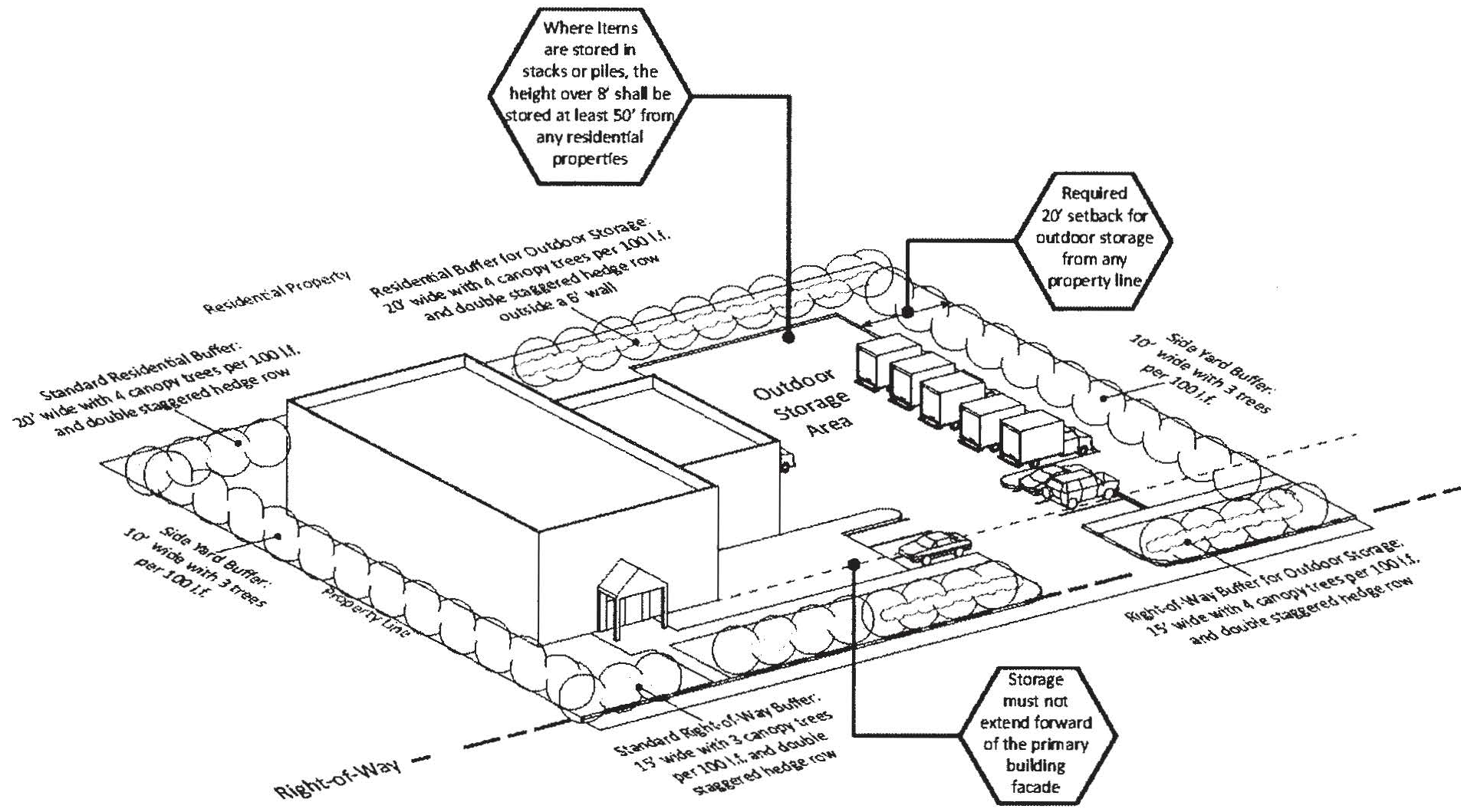
d.
A deviation from these criteria may be granted upon a finding that alternative design, buffering or screening meets or exceed the intent of these criteria to obscure the outdoor storage or assembly from view of the right-of-way.
(g)
Conditional uses and structures (C): For rules and regulations for any use designated as a conditional use or structure, see section 3-9-69 conditional uses and structures.
(1)
Outdoor repair or construction as a principal use, subject to the following criteria:
a.
No outdoor repair or construction is permitted within the required front setback.
b.
The perimeter of the outdoor area shall be buffered with a minimum 15' wide buffer planted with four (4) trees per one hundred (100) linear feet and a double staggered hedge row at least twenty-four (24) inches in height at time of planting and maintained at a minimum of thirty-six (36) inches in height within one (1) year of planting. For any property line abutting a residentially zoned or used property, a minimum six-foot wall is also required.
c.
For outdoor repair or construction that involves equipment or products that exceed eight (8) feet in height, the outdoor activity must be conducted at least fifty (50) feet from any residential zoned properties.
(2)
Truck stops, subject to the following criteria:
a.
The truck stop must be located at an intersection of two (2) streets; have frontage on Piper Road; and be located no greater than one-half (½) mile from Interstate 75 exits.
b.
Truck fueling, scales, or other service amenities must be placed behind the leading edge of primary structure.
c.
All truck parking must be located to the rear of the primary structure.
d.
Only one (1) truck stop may be located at the corner of any intersection.
e.
All street frontages of the primary structure must have primary customer entrances.
f.
All façades facing these streets shall be primary façades, and such façades shall incorporate a minimum of four (4) of the design treatments established in section 3-5-506, Appearance, building mass and design treatments, as may be amended.
g.
All truck parking, fueling, and service amenities facing such street frontage or adjacent to residentially zoned or used properties must be screened by a minimum of twenty-foot wide buffer with a six-foot tall decorated wall planted with five (5) canopy trees per one hundred (100) linear feet and a double staggered hedge row at least twenty-four (24) inches in height at time of planting and maintained at a minimum of thirty-six (36) inches in height within one (1) year of planting. One hundred (100) percent of the required plant material shall face streets, the property zoned or used for residential uses.
(h)
Prohibited uses and structures. Any use or structure not expressly or by reasonable implication permitted herein or permitted by conditional use or special exception shall be unlawful in this district. Refer to the comprehensive plan for specific list of prohibited uses in ECAP, and refer to section 3-9-63 for prohibited uses associated with airport protection and land use compatibility.
(i)
Special exceptions (S): (For procedure see section 3-9-6.2, special exceptions)
(1)
Structures with heights in excess of ninety (90) feet, subject to the following standards for approval:
a.
Airport compatibility. The applicant must demonstrate that there will be no adverse impact or effect as a result of such use to the Charlotte County Airport Authority property or to the operations of the Charlotte County Airport. The applicant must also demonstrate that a copy of the petition and notice of the hearing on the petition was provided to the Charlotte County Airport Authority and the Federal Aviation Administration at its Airports District Office in Orlando, Florida.
b.
Light attenuation. The applicant must demonstrate that all outside lighting shall be designed to prevent direct glare, light spillage, or hazardous interference with aircraft operation and flight patterns.
(2)
Commercial/retail uses that do not meet the location criteria of section 3-9-48(d)(2) may be approved by special exception per section 3-9-6.2. Applicants must demonstrate that transportation facilities and access are adequate through a traffic impact analysis and that proposed uses are viable according to a professional market demand study.
(3)
Such other uses as determined by the zoning official or his/her designee to be:
a.
Appropriate by reasonable implication and intent of the district.
b.
Similar to another use either explicitly permitted in that district or allowed by special exception.
c.
Not specifically prohibited in that district.
The BZA shall review a favorable determination of the zoning official under this provision at the time the special exception application is presented to it. An unfavorable determination of the zoning official or his/her designee shall be appealable pursuant to section 3-9-6, board of zoning appeals.
(j)
Development standards. The following development standards apply to all development in ECAP.
(k)
Landscaping standards. The following landscaping standards apply to all development in ECAP, except that development within the airport operations area and all airside development is exempt from these landscaping standards. Development of non-aviation uses and all development otherwise outside the airport operations area on airport property is subject to the applicable standards, and subject to provisions of subsection (2) below.
(1)
Buffer requirements. Minimum buffer requirements are identified in the table below. Within ECAP, buffer trees must be canopy trees that are not bird attracting species for compatibility with the airport. Hedge rows must be planted at twenty-four (24) inches in height and maintained at a minimum of thirty-six (36) inches in height within one (1) year of planting, with shrub species that are not bird attractants for compatibility with the airport.
| Type | Min. Width | Min. Trees per 100 Linear Feet | Min. Shrubs |
|---|---|---|---|
| Typical side and rear yards | 10' |
3
canopy trees | 0 |
 | |||
| Along right-of-way | 15' |
3
canopy trees | Double staggered hedge row |
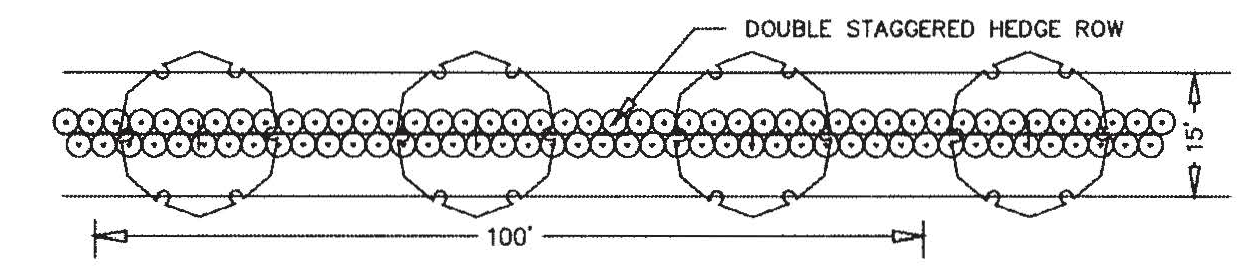 | |||
| Screening along right-of-way for subordinate outdoor storage or assembly areas | 15' |
4
canopy trees | Double staggered hedge row |
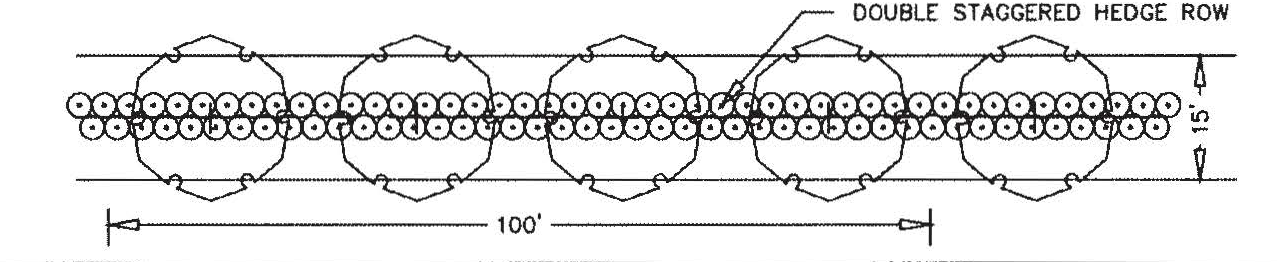 | |||
| Note: Where property lines of outdoor storage or assembly areas abut residential use or residentially zoned property, the min. buffer width increases to 20' and a min. 6' wall is also required with plantings placed along outside of wall. | |||
| Perimeter buffer for master planned subdivisions | 20' |
4
canopy trees | Double staggered hedge row |
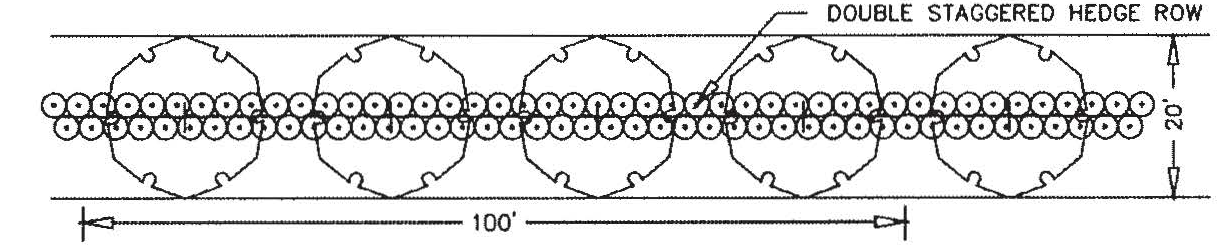 | |||
| Any property line abutting residential use or residentially zoned property | 20' |
4
canopy trees | Double staggered hedge row |
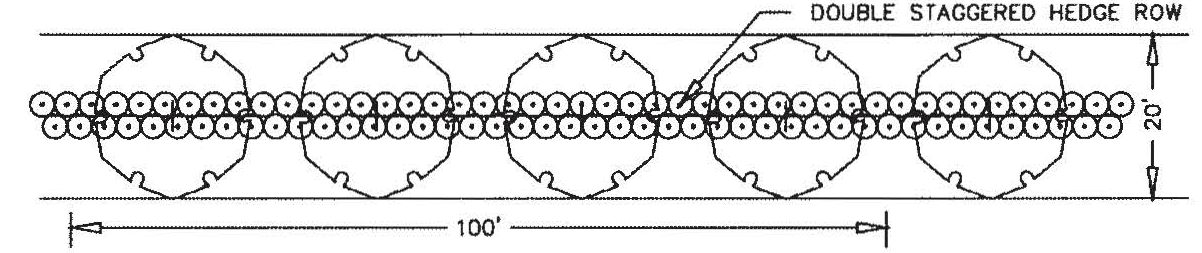 | |||
| Note: Where property lines of outdoor storage or assembly areas abut residential use or residentially zoned property, a min. 6' wall is also required with plantings placed along outside of wall. | |||
(2)
All landscaping for parking areas shall comply with the provisions of section 3-9-100 including non-aviation development on airport property (development within the airport operations area and all airside development is exempt). To minimize wildlife attractants, Charlotte County Airport Authority is allowed to locate the landscaping required for landside parking areas elsewhere on airport property or within public right-of-way within the ECAP district in lieu of the parking area landscaping requirements, subject to site plan review and approval.
(3)
Building perimeter plantings shall be located adjacent to the primary building facade to the maximum extent possible, including building entrance areas, plazas, and courtyards. These areas shall be landscaped with any combination of trees, palms, shrubs and ground covers. The building perimeter shall be planted in the amount of one hundred (100) square feet of planting area per one thousand five hundred (1,500) square feet of building ground floor area. Planting areas shall be raised or ground level and be a minimum of eight (8) feet wide. Seating courtyards, eating areas and plazas may be incorporated within the planting areas. The portion of the building(s) consisting of distribution, loading and industrial facilities and buildings in the airport operations area and airside buildings on airport property are excluded from this standard.
(l)
Signs. Signs shall be in accordance with section 3-9-85.
(m)
Design standards.
(1)
Commercial, retail, and office uses are subject to commercial design standards under section 3-5-501 of this code. Development within the airport operations area and all airside development is exempt from these design standards. Development of non-aviation uses and all development otherwise outside the airport operations area on airport property is subject to the applicable building design standards.
(2)
Government and industrial uses are subject to the design standards listed below to support quality of appearance within the ECAP district. Development within the airport operations area and all airside development is exempt from these design standards. Development of non-aviation uses and all development otherwise outside the airport operations area on airport property is subject to the applicable building design standards.
a.
Building orientation must provide for the main entrances facing the abutting street, or at least one (1) of the abutting streets in the case of corner lots.
b.
The building's primary facade must provide for a point of entry that is articulated with an awning or other functional design element that is architecturally compatible and provides shade and protection from climate.
c.
Corner lots at the intersection of road rights-of-way shall incorporate corner gateway treatments while maintaining safe visibility triangles for ingress and egress. Inclusion of any one (1) of the following criteria shall fulfill this requirement:
1.
Developments or buildings may utilize a corner tower element.
2.
A landscape mass [minimum four (4) trees of overall height at planting of eighteen (18) feet and one hundred (100) square feet of landscaping at base of landscape mass] may be planted at the corner to create a landscaped tower.
3.
Landscape markers [minimum of four (4) and not less than six (6) feet in height] may be utilized.
4.
A hardscape structure like a trellis or a monument sign with dimensional qualities that are greater than three (3) inches for a minimum of fifteen (15) percent of the road faced signage (meeting county standards) located in the corner to create a threshold element, may be incorporated at the corner creating a landmark.
5.
Exceptions. Development of individual lots within a platted subdivision will not be required to meet the gateway feature requirements, provided the platted subdivision contains a perimeter screen around the entire perimeter of the subdivision (excluding access rights-of-way to the subdivision) that meets the requirements contained in section 3-9-48(k); and provided further, that each entryway into the platted subdivision provides a gateway feature that meets these design intent/objective and criteria.
d.
Service, loading, refuse and equipment areas shall be located at the rear or sides of buildings and obscured from the view of rights-of-way. These areas shall be designed to accommodate all backing and maneuvering on-site without encroachment into a road travel lane. Refuse storage and collection areas shall be fully enclosed. Enclosures shall be constructed of concrete block and finished to match the primary building's design, or be finished with stucco, and painted the same base color as the main building. Enclosures shall be provided with opaque, painted steel, aluminum or wood gates and designed to be subject to abuse without short-term deterioration.
e.
Exterior mechanical equipment shall be screened from ground view on all sides by a screening device, such as a screen wall or parapet wall for roof mounted equipment or landscaping or structural screening that is aesthetically compatible with the design of the building or the landscape for ground mounted equipment. Equipment screening shall be at least the height of the exterior components to be screened. Equipment screening should occur as monolithic unit(s) versus several small individual screens. These mechanical equipment screening requirements do not apply to small fans, vent stacks, or other small equipment of similar size.
f.
Overhead doors shall not be located on the primary facade facing or visible from rights-of-way. If there is a demonstrated need which dictates the placement of an overhead door on the primary facade, the appearance must be minimized by clustering trees within the right-of-way buffer to obscure direct view of the door and by blending it into the primary facade of the structure. Blending shall be accomplished by painting the overhead door the same color as the primary facade and by either recessing that portion of the primary facade containing the overhead door by three (3) feet or by a combination of recessing the primary facade and eave overhang.
g.
Building materials are restricted as follows:
1.
Metal panels, plastic siding and/or tiles shall not be used to cover more than fifty (50) percent of any primary facade except that siding may be used to cover more than fifty (50) percent of a primary facade when it is necessary to achieve a recognizable architectural theme approved by the zoning official.
2.
Smooth faced concrete on a primary facade shall have a cementitious exterior coating (the visual equivalent of stucco or some other decorative finish such as split faced block). Untreated concrete block is not an acceptable finished material for primary facades.
h.
Pedestrian access and walkways shall provide for internal connections on the site and for connection to any existing public sidewalks abutting the site.
i.
Minimum off-street parking and loading spaces requirements are outlined in section 3-9-79.
(n)
Deviations. Proposed deviations from or alternatives to design standards within the ECAP district must be submitted for review by the zoning official. The zoning official may approve the deviation or alternative design per the following criteria:
(1)
Minor deviations from the dimensional standards which amount to no more than ten (10) percent of the requirements or one (1) foot, whichever is greater may be granted an administrative variance pursuant to the process laid out in section 3-9-6.3(I) of the Charlotte County Code.
(2)
For architectural deviations or other similar deviations, the zoning official may approve alternative designs on such sites which do not meet the letter of this article, but nonetheless result in efficient, aesthetically pleasing development in harmony with structures already existing on the site and which do not detract from the appearance of the community.
(Ord. No. 2003-067, § 2, 10-14-03; Ord. No. 2004-050, § 1, 7-13-04; Ord. No. 2008-055, § 1, 7-15-08; Ord. No. 2011-015, § 1, 5-17-11; Ord. No. 2011-042, § 1, 12-13-11; Ord. No. 2014-041, § 1(Exh. A), 11-25-14; Ord. No. 2018-002, § 1(Exh. A), 1-23-18; Ord. No. 2021-034, § 1, 10-12-21)
Sec. 3-9-49. - U.S. 41 zoning district overlay.
(a)
Short title. The short title of this section 3-9-49 shall be the U.S. 41 Zoning District Overlay Code (the "overlay code").
(b)
Boundary. The area affected by this overlay code shall be the U.S. 41 commercial corridor which is generally located west of U.S. 41 from the Sarasota County line to Gardner Drive and on the east side of U.S. 41 from the Sarasota County line to Hancock Avenue, excluding the Murdock Village Redevelopment Area and Murdock Development of Regional Impact (the "corridor"). The location of the boundary of the corridor is delineated in exhibit "A" attached to Ordinance No. 2008-082 which by this reference is adopted into and declared to be a part of this section 3-9-49.
(c)
Applicability. The overlay code shall apply to development and/or redevelopment of commercial, office, and residential uses within the corridor and all other matters referenced in the overlay code. The terms development and/or redevelopment shall be construed liberally and shall include any plat, special exception, variance, development review committee approval, site plan approval, building or sign permit, or any other official action of Charlotte County that has the effect of permitting development and/or redevelopment or any application for any of the preceding. The overlay code apply shall apply to the preceding matters notwithstanding the application of another provision(s) of the County Code to said matter(s). In the event of a conflict between another provision of the County Code and the overlay code, the terms of the overlay code shall supersede and control.
(d)
Intent. The overlay code is designed to enhance the corridor and is critical to the promotion of an appealing and attractive image of the county for the benefit of its residents and visitors. Towards this end, the intent of the overlay code is to:
(1)
Promote the development and redevelopment of commercial and office uses in order to ensure a lasting and favorable visual impression along and within the corridor, enhance the corridor's overall appearance and improve its functional operation.
(2)
Reinforce Charlotte County's Comprehensive Plan by modifying specific permitted and prohibited uses of underlying zoning districts and establishing new standards for development.
(3)
Protect the properties that adjoin the corridor from adverse impacts of intensive activity within and along the corridor.
(4)
Invigorate the economic and social vitality of the corridor.
(5)
Protect the unique character of the existing single-family residential communities located behind the corridor.
(6)
Provide for a compatible mixture of residential, neighborhood business, and commercial and office uses to serve Charlotte County's residents and visitors.
(7)
Improve the character of and prevent the permanent decline of property within the corridor by controlling nuisances and ensuring that land uses which may contribute to the degradation of the community and possible criminal activity will not be located near residential areas.
(8)
Design and place different land uses, buildings, streets, and other amenities (such as sidewalks and street lights) within the corridor to ensure that the public's health, welfare, and safety are protected.
(e)
Permitted and prohibited uses. Permitted and prohibited uses are based upon existing land use classifications in the Charlotte County, Florida Comprehensive Plan ("comprehensive plan") and existing zoning districts within the County Code.
(1)
The following permitted and prohibited uses apply to the U.S. 41 overlay mixed use, commercial corridor, commercial center, low intensity industrial and public lands and facilities future land use map (FLUM) designations in the comprehensive plan:
a.
The following permitted and prohibited uses and structures shall apply to lots that are fronting U.S. 41 and to those that are not fronting U.S. 41 but were zoned for commercial or industrial use as of the date of the adoption of the overlay code on November 9, 2004:
1.
Commercial general. The overlay code shall not affect permitted principal uses and structures, permitted accessory uses and structures, conditional uses, prohibited uses and structures, and special exceptions within subsections 3-9-42(b) through (f) of the commercial general (CG) zoning district.
2.
Planned development. The overlay code shall not affect permitted principal uses and structures, permitted accessory uses and structures, prohibited uses and structures within an approved plan adopted pursuant to section 3-9-45 of the planned development (PD) zoning district.
3.
Office, medical, and institutional. The overlay code shall not affect permitted principal uses and structures, permitted accessory uses and structures, conditional uses, prohibited uses and structures and special exceptions within section 3-9-39 of the office, medical, and institutional (OMI) zoning district.
4.
Industrial general. The overlay code shall not affect permitted principal uses and structures, permitted accessory uses and structures, conditional uses, and prohibited uses and structures in the existing industrial general (IG), section 3-9-43, zoning district. However, no special exception uses in the industrial general (IG) zoning district shall be permitted on properties located within the U.S. 41 Zoning District Overlay.
b.
Businesses that face and are adjacent to U.S. 41 will be allowed to expand onto an adjoining rear lot(s) only if the rear lot(s) is designated with a commercial corridor or U.S. 41 overlay mixed use FLUM. The preferred zoning districts are CG, OMI and PD. Subsequent to such expansion, residential roads located adjacent to the expanded business shall not be utilized for ingress to or egress from said business unless an overriding need can be demonstrated. A minimum type D buffer (section 3-9-100) with a wall shall be required alongside any rear or side property line that borders residential zoning or uses. The following standards shall apply to development of a rear lot.
1.
Uses and structures in the commercial general zoning district, subsection 3-9-42 (b) (c), (d) and (f) are allowed as permitted principal uses, or conditional uses or special exception uses according to the commercial general zoning district regulations in section 3-9-42.
2.
Uses and structures in the office medical institutional zoning district, subsection 3-9-39(b) (c), (d) and (f) are allowed as permitted principal uses, or conditional uses or special exception uses according to the office medical institutional zoning district regulations in section 3-9-39.
3.
A mix of commercial and residential uses or multi-family residential is allowed only in a PD zoning district, according to section 3-9-45. Residential uses are only allowed through approval of transfer of density units (Article XX sections 3-5-431 to 3-5-435 Charlotte County Code).
c.
Commercial and multi-family residential uses not associated with an existing business can develop on a rear lot(s) but only if the rear lot(s) is located within a commercial corridor or U.S. 41 overlay mixed use FLUM. The preferred zoning districts are CG, OMI and PD.
1.
Uses and structures in the commercial general zoning district, subsection 3-9-42(b) (c), (d) and (f) are allowed as permitted principal uses, or conditional uses or special exception uses according to the commercial general zoning district regulations in section 3-9-42.
2.
Uses and structures in the office medical institutional zoning district, subsection 3-9-39(b) (c), (d) and (f) are allowed as permitted principal uses, or conditional uses or special exception uses according to the office medical institutional zoning district regulations in section 3-9-39.
3.
A mix of commercial and residential uses or multi-family residential is allowed only in a PD zoning district, according to section 3-9-45. Residential uses are only allowed through approval of transfer of density units (Article XX sections 3-5-431 to 3-5-435 Charlotte County Code).
4.
Signs: Signs shall be in accordance with section 3-9-85, Charlotte County Code, and this code. Provisions of this article shall take precedence. Signs must contribute to the sense of design and place of the development through the use of graphics, color, material and placement.
(i)
Only monument signs and wall signs shall be allowed. There shall be a maximum of one (1) monument sign per right-of-way frontage and it shall be located at the project entrance(s).
(ii)
The maximum size of the monument sign shall not exceed fifty (50) square feet. The maximum wall signs shall not exceed four (4) square feet.
(iii)
Signs shall not be internally lighted. Ground lights shall be screened from view with shrubs.
(iv)
The monument sign structure shall be constructed of the same material as the predominant material of the principal building.
(v)
The monument sign and wall sign shall be constructed of the same color as the predominant color of the principal building.
(vi)
Wall signs shall not cover architectural features or details and not extend beyond the roof line or outer edges of the building.
(vii)
Windows shall not be used for advertising purposes. Windows may permanently display the proprietor's' name, business name, and property address for identification purposes only. Signs placed inside of a window with the intent of being seen from the outside are prohibited.
5.
Parking: Businesses are required to provide employee and customer parking according to section 3-9-79 of the County Code. Parking within rights-of-way is prohibited. Buffering along front lot lines of a parking area will be a minimum type B buffer (section 3-9-100) with a wall, except for site triangles at ingress and egress entrances.
6.
A building that locates on the rear lot(s) must be designed so as to emulate a residential structure.
7.
A minimum type B buffer (section 3-9-100) with a wall shall be required along any side property line that borders residential zoning or uses.
(2)
Development within the low or medium density residential FLUM designations shall comply with sections 3-9-33 (RSF-3.5) or 3-9-34 (RMF-10) of the County Code, as applicable.
(3)
The following standards shall apply to the U.S. 41 overlay mixed use FLUM designation in the comprehensive plan:
a.
Commercial development shall comply with subsection 3-9-49.
b.
Residential development.
1.
Only multi-family residential uses are allowed.
2.
Minimum multi-family density is five (5) units per acre, maximum multi-family density is fifteen (15) units per acre.
3.
The development standards shall comply with this section.
4.
Residential development must meet the requirements of Article XX, sections 3-5-431 to 3-5-435 regarding transfers of density units.
5.
A minimum type B buffer (section 3-9-100) with a wall shall be required alongside any side property line that borders single-family residential zoning or uses.
c.
A mix of commercial and residential uses or multi-family residential is allowed only in a PD zoning district, section 3-9-45. Residential uses are only allowed through approval of transfer of density units (Article XX sections 3-5-431 to 3-5-435 Charlotte County Code).
(4)
Rezoning to commercial neighborhood, commercial tourist, industrial general, and industrial intensive are prohibited.
(5)
The twenty-five-foot PD setback requirement will be waived for development in the overlay. The minimum setback shall follow the development standards of this code; however, greater setbacks may be required when the site plan is reviewed.
(6)
The existing single-family residences shall be considered legally conforming uses as the date of the adoption of the overlay code.
(f)
Development standards.
(1)
Properties immediately adjacent to U.S. 41, not served by an access road and that are located within commercial general (CG) or office, medical and institutional (OMI) zoning districts shall comply with the development standards that apply to the zoning district within which the properties are located.
(2)
Properties within planned development (PD), and industrial general (IG) zoning districts shall comply with the development standards that apply to the zoning district within which the properties are located irrespective of whether the property is served by an access road.
(3)
All properties within the overlay shall comply with the following development standards:
a.
Front lots facing U.S. 41 with no expansion to rear lots.
b.
Front lot(s) facing U.S. 41 with expansion to rear lot (such exceptions shall be considered a unified development).
1.
Front and rear lot unified standards:
(i)
Maximum lot coverage for commercial and residential uses in total, sixty (60) percent.
(ii)
Development on the front lots(s) may expand to cover one hundred (100) percent of that lot(s) but total coverage for the unified development cannot exceed sixty (60) percent.
(iii)
Floor area ratio for commercial and residential uses in total shall not exceed 1.2.
2.
Front Lot(s) standards:
3.
Rear lot(s) standards:
c.
Rear lot(s) development, with no expansion from the front:
(g)
Parking. If the county has provided or will provide public parking, businesses which develop or redevelop on a lot facing U.S. 41 or which are expanding to a rear lot are not required to provide customer parking; however, the business shall provide employee parking on-site which must be placed on the rear of the lot(s). Otherwise, businesses shall be required to provide employee and customer parking according to section 3-9-79 of the County Code, as the same may be amended from time to time.
(1)
Within the U.S. 41 overlay mixed use FLUM, off-street parking of the residential development shall be in accordance with section 3-9-79.
(h)
Commercial design standards. All commercial and office development and redevelopment shall be in accordance with the commercial design standards set forth in sections 3-5-501 through 3-5-516 of the County Code, as the same may be amended, except that metal paneled buildings are not permitted. Metal buildings constructed prior to the effective date of the overlay code shall be allowed to remain as a non-conforming use as provided in section 3-9-9 of the County Code. Commercial buildings that are developed on rear lots and which are not part of a unified expansion from a front lot must emulate a residential structure.
(i)
Solid Waste. Dumpsters, compactors and recycling dumpsters shall be in accordance with article VI, sections 1-12-113 through 1-12-119, of the County Code, as the same may be amended. Refuse collection and equipment or refuse storage areas shall be located at the rear of the property. These areas shall maintain a minimum setback of ten (10) feet from any lot line.
(j)
Landscaping. Landscape buffers and screening shall be required within the Corridor in accordance with this section or the provisions of sections 3-9-100.1 through 3-9-100.3 of the County Code, whichever is more restrictive.
(k)
Signs. Signs in the corridor shall be governed by this section or section 3-9-85 of the County Code, whichever is more restrictive.
(l)
Outdoor Lighting. Outdoor lighting in rear lot(s) must be shielded or directed in such a way that the light does not shine beyond the boundaries of the subject property. Pole or standing lights will be no higher than ten (10) feet.
(Ord. No. 2004-065, § 1, 11-9-04; Ord. No. 2005-040, § 1, 5-17-05; Ord. No. 2006-085, § 1, 10-17-06; Ord. No. 2008-082, § 1, 9-16-08; Ord. No. 2014-041, § 1(Exh. A), 11-25-14; Ord. No. 2017-028, § 1(Exh. A), 6-13-17)
Sec. 3-9-50. - Manasota and Sandpiper Key zoning district overlay.
(a)
Definitions. When terms are defined both in this section 3-9-50 and elsewhere in the Code of Laws and Ordinances of Charlotte County, Florida ("Code"), definitions for such terms in this subsection shall control. The following terms shall have the meanings set forth in this subsection:
Design requirements shall mean the architectural design requirements provided for by the overlay code that shall regulate the design of new construction and the repair, rehabilitation or remodeling of existing structures on Manasota and Sandpiper Keys.
Driveway shall mean a permeable surface designed for use by vehicles that connect a road to a structure.
Driveway crossover shall mean that portion of a driveway located on a setback.
Design flood elevation means the elevation of the design flood, including wave height, relative to the datum specified on the community's legally designated flood hazard map.
Freeboard means an additional amount of height above the base flood elevation to elevate a structure used as a factor of safety so that above the base flood in determining the level at which above a structure's lowest floor the minimum must be elevated or floodproofed to be in accordance with state or community floodplain management regulations.
Height, building or structure in this Code shall mean the vertical distance measured from the lowest minimum habitable floor elevation for which a building permit may be issued to the highest point of a fiat roof and mansard roof, or to the mid-point height between the eaves or the top of the external wall, whichever is higher, and the ridge of gable, hip, shed, and gambrel roofs.
High-rise building means a building of five or more habitable floors.
Manasota and Sandpiper Key Overlay Code shall mean the Manasota and Sandpiper Key zoning district overlay code established by section 3-9-50 and as amended into the Code.
Manasota commercial general or MCG shall mean the commercial general zoning district established by the overlay code.
Manasota commercial tourist or MCT shall mean the commercial tourist zoning district established by the overlay code.
Manasota environmentally sensitive or MES shall mean the environmentally sensitive zoning district established by the overlay code.
Manasota Key shall mean the land located south of the Sarasota-Charlotte County line, west of Sandpiper Key, north of Stump Pass Beach State Park and east of the Gulf of Mexico.
Manasota multifamily or MMF shall mean the multifamily zoning districts established by the overlay code.
Manasota planned development or MPD shall mean the planned development zoning district established by the overlay code.
Manasota single-family or MSF shall mean the single-family zoning district established by the overlay code.
Overlay code shall mean the Manasota and Sandpiper Key zoning district overlay code established by this section 3-9-50.
Peripheral landscape strip shall mean the required green open area of at least five feet in width located immediately adjacent and parallel to all sides of the lot boundary that is free of encroachments. The five-foot wide green open area is a vegetated landscape strip. Vegetated landscaping means grass, ground cover, mulch, shrubs, vines, hedges, synthetic pervious turf, and/or trees. Synthetic pervious turf shall consist of pervious material on a manufacturer approved pervious base made of impervious material. Bases such as concrete or asphalt are not permitted. Synthetic pervious turf must be installed according to relevant manufacturer specifications. Sand infill is required. The synthetic pervious turf shall mimic the color of natural grass; other colors are prohibited.
Pervious pavers shall mean pervious, porous, or permeable pavers with pavers systems that meets or exceeds a product infiltration rate of three (3) inches per hour and absorbed onsite.
Plan shall mean the Manasota Community Plan as accepted by the board on September 21, 2004, and as it may be amended from time to time.
Sandpiper Key shall mean the land area located south and west of the Intracoastal Waterway, east of the Lemon Bay Channel and north of Manasota Key.
Sidewalk shall mean a linear surface within and adjacent to or outside and alongside the boundary of a public or private thoroughfare that is designed for use by pedestrians.
Structure shall mean any construction or any production or piece of work artificially built up or composed of parts joined together in some definite manner. "Structure" includes "building," as well as other things constructed or erected on the ground, attached to something having location on the ground or requiring construction or erection on the ground.
Walkway shall mean a linear surface utilized by pedestrians for passage over dunes and other beach areas.
(b)
Establishment; short title. The Manasota and Sandpiper Key zoning district overlay code is hereby established. The short title of this section shall be "Manasota and Sandpiper Key Overlay Code."
(c)
Intent. The intent of the Manasota and Sandpiper Key Overlay Code is to implement the goals, objectives, and policies of the Manasota Key Community Plan to preserve and protect the existing low-density development and to blend future development with it in an appropriate manner.
(d)
Boundary. The area affected by the Manasota and Sandpiper Key Overlay Code shall be the area depicted as Manasota and Sandpiper Key on Smart Charlotte 2050 FLUM Series Map #9: Barrier Island Overlay District.
(e)
Applicability; conflict with other ordinances. The overlay code shall apply to development and redevelopment on the islands together with all other matters referenced in the overlay code. The terms "development" and "redevelopment" shall be construed liberally and shall include any plat, special exception, variance, waiver, site plan approval, building or sign permit, or any other official action of Charlotte County that has the effect of permitting development and/or redevelopment or any application for any of the preceding matters. The overlay code shall apply to the preceding matters notwithstanding the application of any other provision(s) of the Code to said matters. Except where expressly provided herein, the terms of the overlay code shall supersede and control in the event and to the extent of a conflict between the overlay code and another provision of the Code.
Zoning Districts
The following zoning districts are the only zoning districts permitted within the Manasota and Sandpiper Key overlay district and shall only be permitted in the Manasota and Sandpiper Key overlay district.
(1)
Open space and rural districts.
Manasota environmentally sensitive (MES).
(2)
Residential districts.
Manasota single-family 1 (MSF-1).
Manasota single-family 3.5 (MSF-3.5).
Manasota single-family 5 (MSF-5).
Manasota multifamily 7.5 (MMF-7.5).
Manasota multifamily 10 (MMF-10).
Manasota multifamily 12 (MMF-12).
(3)
Commercial districts.
Manasota commercial general (MCG).
Manasota commercial tourist (MCT).
(4)
Special districts.
Manasota planned development (MPD).
(f)
Intent of Manasota and Sandpiper Key overlay districts.
(1)
The intent of the MES district is to preserve and protect certain land and water areas which have overriding ecological, hydrological, or physiographic importance to the public at large. It is intended to preserve and protect open spaces, park lands, wilderness areas, marshlands, watersheds and water recharge areas, scenic areas, beaches and native flora and fauna. It is intended to allow limited public/private recreational/educational uses and their incidental accessory uses and structures.
(2)
The intent of the MSF district is to provide single-family residential dwellings and for other uses normally associated with single-family residential dwellings. Nothing herein is intended to prevent the grouping of lots or parcels for residential single-family uses.
(3)
The intent of the MMF district is to provide low or medium-density residential districts with emphasis on multifamily use. There are variations among the MMF districts in requirements which include differing lot areas, width, yards and uses.
(4)
The intent of MCG district is to provide areas in which the customary and traditional conduct of trade, retail sales and commerce may be carried on without disruption by the encroachment and intrusion of incompatible residential uses and protected from the adverse effects of undesirable industrial uses.
(5)
The intent of the MCT district is to permit the designation of suitable locations for and to facilitate the proper development and use of land for the commercial provision of accommodations and services for tourists and other visitors and short-term or seasonal residents. The term "accommodations" is intended to include housing and various amenities, including recreational facilities and local retail trade in goods and service both general and specific to the locality/tourist attraction or principal activities. Areas designated MCT are expected to be located near or adjacent to a tourist attraction such as Gulf of Mexico beach frontage, major public or private parks, and other recreational or scenic resources.
(6)
The intent of the MPD district is to provide a viable option for redevelopment of the keys.
(g)
District development standards.
(1)
Open space and rural district standard. The following numerical requirements apply subject to the provisions below.
a.
Only one (1) driveway crossover is permitted within the front yard setback.
b.
The property shall be maintained in natural vegetation rather than landscaped.
c.
Temporary portable structures and mobile homes shall be prohibited in this district.
(2)
Residential district standards.
a.
Single-family. The following numerical requirements apply subject to the provisions below.
1.
For legally non-conforming lots, the side yard setback shall be 10% of the lot width or five feet, whichever is greater.
2.
Side and rear yards that abut any water but the Gulf of Mexico shall be at least twenty (20) feet, and those that abut the Gulf of Mexico (GM) shall be at least fifty (50) feet, except for side yards abutting any water for legally non-conforming lots, the side yard setback shall be 10% of the lot width or five feet, whichever is greater.
3.
All properties shall have front, side and rear peripheral landscape strips of no less than five feet. Peripheral landscape strip and parking standards are contained under the development standards of this overlay code. Parking and driveway requirements are specified under the architectural standards of this overlay code.
4.
All new development and any improvement to an existing development that totals over one thousand (1,000) square feet of pervious pavers shall be required to submit a drainage plan that shows how the pervious system meets or exceeds a product infiltration rate of three (3) inches per hour and absorbed onsite; and minimal subgrade slope not to exceed one (1) percent for parking, vehicular traffic areas and patios.
5.
Accessory structures are also subject to other applicable provisions in this overlay code including: (h) permitted uses, (i)(11) development standards, and (k)(6) architectural design standards.
b.
Multifamily. The following numerical requirements apply subject to the provisions below.
1.
For legally non-conforming lots, the side yard setback shall be 10% of the lot width or five feet, whichever is greater.
2.
Side and rear yards that abut any water but the Gulf of Mexico shall be at least thirty-five (35) feet, and those that abut the Gulf of Mexico (GM) shall be at least fifty (50) feet, except for side yards abutting any water for legally non-conforming lots, the side yard setback shall be 10% of the lot width or five feet, whichever is greater.
3.
No stormwater management systems shall be located, within the peripheral landscape strip. No side yard setback areas shall contain conventional stormwater detention ponds.
4.
All properties shall have front, side, and rear peripheral landscape strips of no less than five feet. Peripheral landscape strip and parking standards are contained under the development standards of this overlay code. Parking and driveway requirements are specified under architectural standards of this overlay code.
c.
Commercial district standards.
Note 1. MCT commercial lots eighty-five (85) feet or less in depth shall utilize the eighteen-foot front yard standard of the MCG zoning district. All others shall meet the twenty-five-foot front yard standards of the MCT commercial zone.
Note 2. For legally non-conforming lots. the side yard setback shall be 10% of the lot width or five feet, whichever is greater.
1.
Manasota commercial general (MCG).
i.
Side and rear yards that abut any water but the Gulf of Mexico shall be at least twenty (20) feet, and those that abut the Gulf of Mexico shall be at least fifty (50) feet, except for legally non-conforming lots, the side yard setback shall be 10% of the lot width or five feet, whichever is greater.
ii.
Setbacks abutting property zoned residential shall be equal to twenty-five (25) feet.
iii.
All properties shall have front, side, and rear peripheral landscape strips of no less than five feet. Peripheral landscape strip and parking standards are contained under the development standards of this overlay code.
2.
Manasota commercial tourist (MCT).
i.
This district is a mixed-use district. Commercial and residential uses are permitted and the site may be entirely commercial, entirely residential, or mixed use, using the appropriate development standards.
ii.
Setbacks.
a)
Side and rear yards that abut any water but the Gulf of Mexico shall be at least thirty-five (35) feet, and those that abut the Gulf of Mexico shall be at least fifty (50) feet, except for side yards abutting any water for legally non-conforming lots. The side yard setback shall be 10% of the lot width or five feet, whichever is greater.
iii.
Setbacks for MCT-commercial and MCT-mixed use abutting property zoned residential shall be twenty-five (25) feet.
iv.
All properties shall have front, side, and rear peripheral landscape strips of no less than five feet. Peripheral landscape strip and parking standards are contained under the development standards of this overlay code. Parking requirements are specified under architectural standards of this overlay code.
v.
All non-conforming MCT-residential lots shall be required to conform to the non-conforming standards as set forth in this overlay code as they apply to MMF-12 development standards.
Special Purpose District
(3)
Manasota planned development zoning and land uses (MPD). The development standards shall be established via the rezoning process. The minimum open space shall be 10% or as determined by the Board of County Commissioners. The minimum size shall be 150,000 square feet. Uses and structures shall be established via the rezoning process and shall be consistent with the Comprehensive Plan.
(h)
Permitted uses and use table.
(1)
The permitted uses in the Manasota and Sandpiper Key overlay districts are identified in the use table.
(2)
It is the intent of this section to restrict the allowable uses with the overlay code districts to avoid trip-generating traffic not related to residential and beach-related tourist uses on this small barrier strip.
(3)
Unless specifically defined in the above table and this subsection, additional uses and structures are prohibited.
(4)
Public parks and recreational facilities shall only be allowed in the MES district and only by special exception and only if restricted to meet the intent of the MES district.
(5)
Paid parking shall be prohibited on any parcel within the overlay district, except on public recreation lands. Leasing or rental of upland properties on the islands for short-term parking or long-term storage of vehicles or trailers shall be prohibited in all districts. Multi-story parking garage structures shall be prohibited in all districts.
(6)
Lodges or private clubs shall be prohibited in all districts and beach clubs shall be allowed only without food or sundry sales.
(7)
Hotel/motel/inn uses may have commissary, coffee bar, continental breakfast and other services for their guests.
(8)
Sport marinas and resort marinas shall be prohibited. However, leasing of dock space in the MCT district only on lots adjacent to coastal waters not on the Gulf of Mexico is permitted as a special exception with the following restrictions: no live-aboard dockage; no sale of fuel and lubricants; no provisions, bait and tackle; no service buildings with laundry facilities, showers, toilets; no rental of motorized watercraft; and no launching of boats from the site. A condition of the permit is adequate parking for leased dock spaces. Private noncommercial boat docks are permissible in MES, MSF, MMF, and MCT-residential districts for the exclusive use of the property owner or someone with a legal interest greater than a lease hold interest and are prohibited from being rented.
(9)
The rental, sale, or repair of motorized vehicles, including but not limited to boats, jet skis, scooters, and segways, is prohibited. Non-motorized recreational rentals, including but not limited to kayaks, canoes, and bicycles, is allowed in the MCG district and, as a special exception in MCT district.
(10)
Home occupations are allowed by special exception in MSF and MMF zones. In addition to meeting the requirements of the Code, the applicant must provide documentation that the proposed home occupation does not involve employees or clients who visit the premises and will not generate parking space demands (e.g., telemarketing verses music teacher); or if lot is twice the minimum lot size, demonstrate that there is adequate parking for the number of clients expected to be serviced.
(11)
One (1) guest house or one (1) servant's quarters for each single-family dwelling are allowed by special exception, provided the lot area shall be not less than twice the minimum lot area required for a single-family dwelling; and the guest house or servant's quarters is intended for use on a temporary basis. The guest house and principal dwelling shall not be rented separately.
(12)
Restaurant outdoor seating is an allowable use for restaurants and bars, and, whether covered or uncovered, shall be required to be reviewed for compliance with the setback, paving and other requirements of this overlay code. Outdoor and under-structure exterior bar areas are allowed, but shall be required to meet the setback, paving, height, and other requirements of this overlay code.
(13)
Specialty shops include small jewelry, gift, clothing, accessories, coffee, bakery, ice cream, and the like, beach tourist-related shops. Such other beach tourist-related shops, as determined by the zoning official, may be permitted by special exception.
(14)
Accessory structures and accessory uses. Accessory structures shall be required to meet the standards set forth under (i) and (k) of this overlay code.
a.
Uses and structures that are customarily accessory and clearly incidental to the MSF principal uses and structures are also permitted within the MSF districts and include: private garages and storage structures, greenhouses; swimming pools and hot tubs; and tennis courts, subject to standards under (i) and (k) of this overlay code.
b.
Uses and structures that are customarily accessory and clearly incidental to the MMF principal uses and structures are also permitted within the MMF districts and include private garages and storage structures, swimming pools and hot tubs, and tennis courts, subject to standards under (i) and (k) of this overlay code.
c.
Uses and structures that are customarily accessory and clearly incidental to the MCT principal uses and structures are also permitted within this district including a residential dwelling unit within the same structure as the principal use for occupancy by owner or employee of permitted uses, parking lots, and outdoor dining areas.
d.
Uses and structures that are customarily accessory and clearly incidental to the MCG principal uses and structures are also permitted in this district, including a residential dwelling unit within the same structure as the principal use for occupancy by owner or employee of permitted uses, parking lots, and outdoor dining areas.
e.
Uses and structures that are customarily accessory and clearly incidental to the MES principal uses and structures are permissible in this district including private noncommercial boat dock but not piers, docks and wharves.
f.
Accessory structures are required to be setback within the yards including, but not limited to, detached garages and carports, storage structures, swimming pools and hot tubs, with or without screen enclosures; green houses, and tennis courts.
g.
Only the following accessory uses are permitted within the required yards on Manasota and Sandpiper Key: 1) stairways may project up to four (4) feet in a required front or rear yard, but not into the required side yards. Guttered roof overhangs may project up to two (2) feet into a required front or rear yard on all lots; and may project up to two (2) feet into the side yard and peripheral landscape strip on lots fifty (50) feet wide or less.
(i)
Development standards. These development standards shall apply to all zoning districts within the overlay code.
(1)
Uniform line of construction. In order to maintain the uniform line of construction of major structures within the overlay district, no portion of a residential structure shall be located seaward of this line, or of a line traced between the corners of the two (2) nearest buildings along the Gulf of Mexico, except as permitted by DEP.
(2)
No-fill area. The entire overlay district is designated as a no-fill area, within which only pilings and stemwalls may be used for all construction, except the minimum amount of fill necessary within the building footprint and for drainfields associated with on-site waste treatment and disposal systems.
(3)
Pervious material. With the exception of fences and walls, all ground-level amenities such as walkways, patios, new private roads, residential driveways, and all parking spaces outside of the building footprint shall be constructed of pervious materials to improve drainage and runoff. Pavers for parking lots, driveways, patios and pools shall be installed to meet or exceed product filtration rate of three (3) inches per hour; and minimal subgrade slope not to exceed one (1) percent for parking, vehicular traffic areas and patios. The only exceptions to the use of pervious pavers shall be a three-foot perimeter around a pool and handicapped accessible routes when required by ADA.
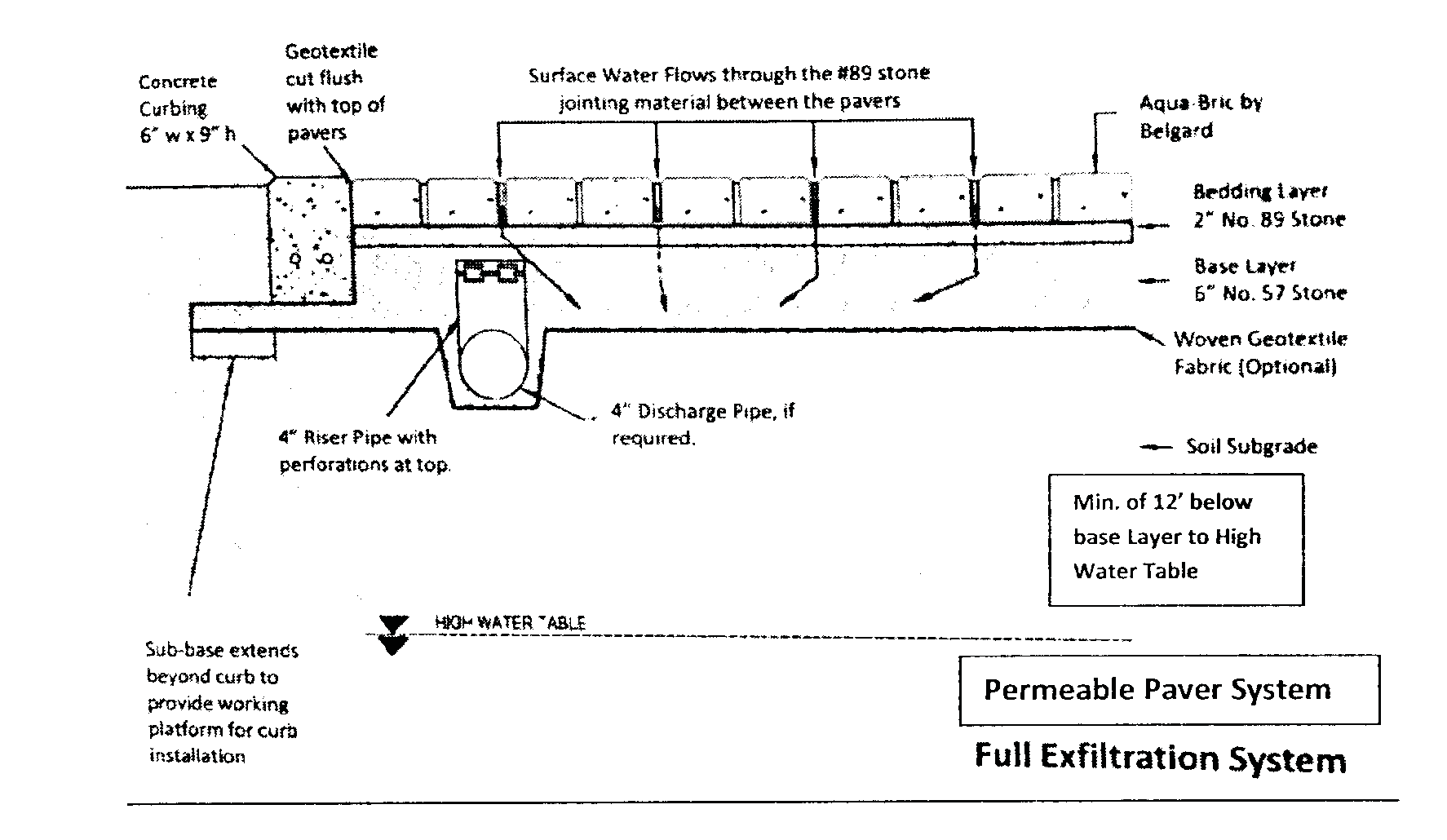
Diagram 1: Permeable Paving System
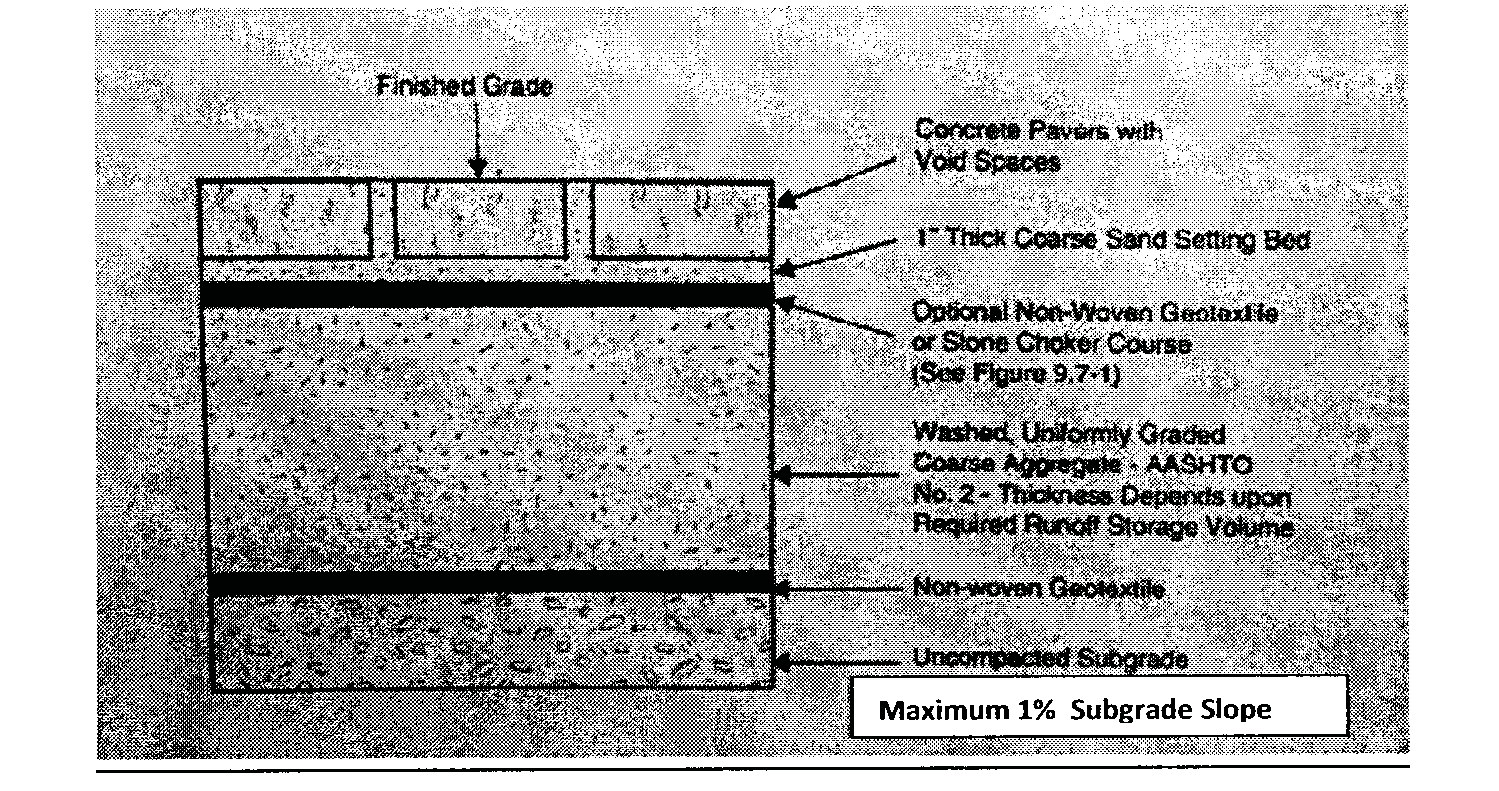
Diagram 2: Permeable Pavers with Storage Base
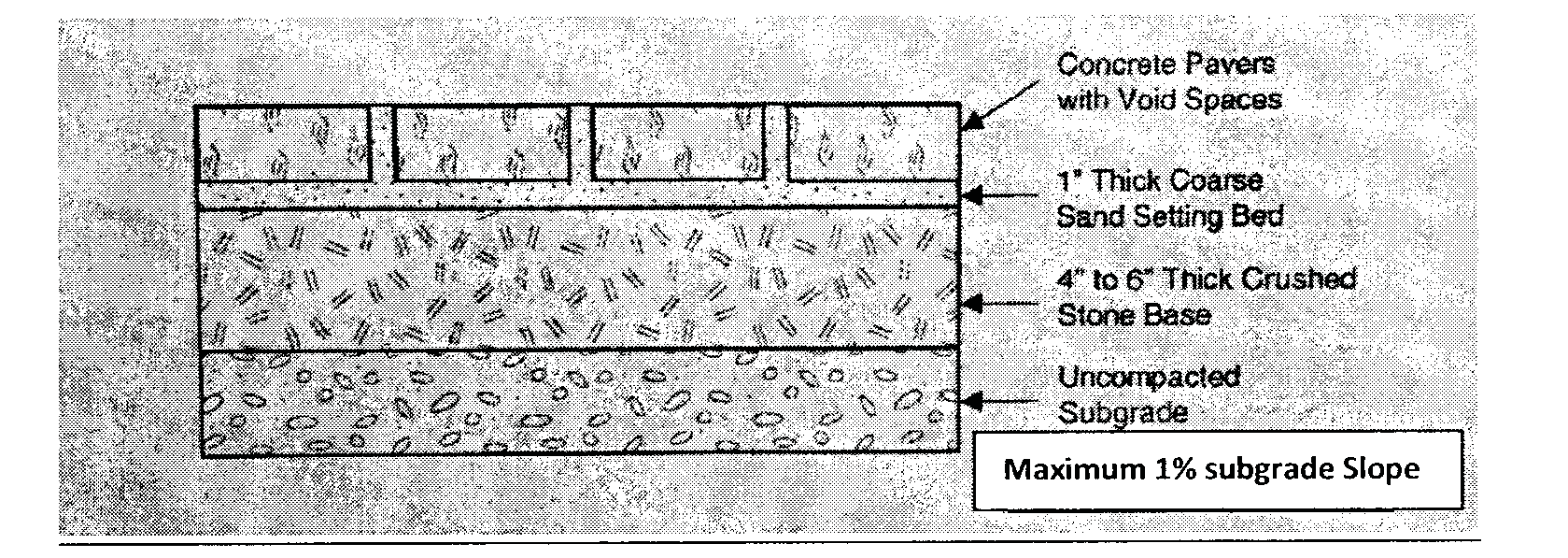
Diagram 3: Pervious Pavers without Storage Base
(4)
Bulk limitations. No building shall be over two hundred (200) feet wide or long in any zoning district.
(5)
Open space/reservation area. All development within the overlay district subject to site plan review shall include an open space/habitat reservation area equal to five (5) percent of the total area of the development. No financial contribution in lieu of reservation shall be permitted. Peripheral landscape strips and setbacks may be counted as part of the open space habitat area unless the lot is greater than one-quarter (¼) acre.
(6)
Pilings for structures.
a.
Pilings shall conform to construction techniques authorized under the Florida Building Code.
b.
Pilings for structures throughout Manasota and Sandpiper Key shall be augered into the ground, or otherwise introduced through contemporary technologies that are shown to reduce the noise and vibration in sufficient amount to meet the intent of this section.
c.
If driving pilings into or onto the ground is proposed,
1.
The developer must conduct a detailed geotechnical analysis of the property with a certification from a geotechnical engineer that the proposed development activity will have no adverse impacts to adjacent properties; and
2.
Show proof of minimum insurance policy coverage of one million five hundred thousand dollars ($1,500,000.00) per occurrence and five million dollars ($5,000,000.00) aggregate.
3.
If pile driving is deemed appropriate, the contractor shall be required to notify by mail the owner of properties within three hundred (300) feet of the outer limits if the subject property and document existing conditions of structures, prior to the planned development.
4.
The contractor must offer all properties within three hundred (300) feet an opportunity to have their properties inspected by an engineer/inspector prior to pile driving at the builder's expense. The intent of this inspection is to create a record of conditions prior to work occurring.
5.
The contractor must also offer all properties within three hundred (300) feet an opportunity to have, at builder's expense, one (1) on-site seismic reading during the pile driving. A permit to drive piles (pile driving) will not be issued until the contractor of record provides to the county by affidavit a list of property owners within three hundred (300) feet of the project and addresses along with a receipt or other proof of mailing and completion of required inspections.
6.
The contractor of record or the owner-builder shall be the party responsible to ensure that the notification and offers have been made and that reasonable effort to comply with these requirements has occurred. Records of these offers shall be maintained by the contractor or owner-builder and be made available to the building and zoning division.
7.
In addition, the contractor shall be required to provide the county with an insurance certificate showing that the contractor carries comprehensive general liability in the amount of one million five hundred thousand dollars ($1,500,000.00) for each occurrence, and aggregate and property damage in the amount of five million dollars ($5,000,000.00) for each occurrence and the five million dollars ($5,000,000.00) aggregate. For the purposes of this section, "pile driven" constitutes a work effort for driving, impact driving or hammer driving of a pile or similar object into the ground used to support or reinforce any structure or building including but not limited to treated timber piling, prestressed concrete piling, steel piling, driven test piling, concrete sheet piling, steel sheet piling, batter piles, anchor piles, dolphin piles, fender piles and guide piles.
8.
The contractor of record must complete an application for pile driving on the form prescribed by the county. The application shall contain notice provisions, geotechnical data, and insurance requirements as enumerated above.
9.
Notwithstanding the contents of this subsection, this restriction shall not be applicable to pilings which are installed onto submerged lands as part of dockage or other marine structures.
(7)
Maximum building height and maximum stories.
a.
The maximum number of stories shall be no greater than three (3) stories over parking in MMF, MCT-residential and MCT-mixed use zones; and no greater than two (2) stories over parking in MSF, MCG, and MCT-commercial zones. High-rise buildings are prohibited within all zones on Manasota and Sandpiper Key.
b.
Vertical buildable area is the area above the footprint of the structure measured from the design flood elevation plus resilient freeboard, if any, to the maximum building and structure height of 38 feet under MES, MSF-1, MSF-3.5, and MSF-5 zones, and 45 feet under MMF- 7.5, MMF-10, MMF-12, MCG, and MCT zones.
c.
Calculation of the maximum vertical buildable area: For AE and X Zone, the maximum vertical buildable area is measured from the finished floor to which is added no more than five feet of resilient freeboard plus the building and structure height. For VE, Coastal A Zones and seaward of the coastal construction control line, the maximum vertical buildable area is measured from the lowest horizontal structural member to which is added no more than seven feet of resilient freeboard.
d.
Calculation of the maximum building height: the maximum building height is the minimum elevation requirements of the Florida Building Code plus the maximum vertical buildable area.
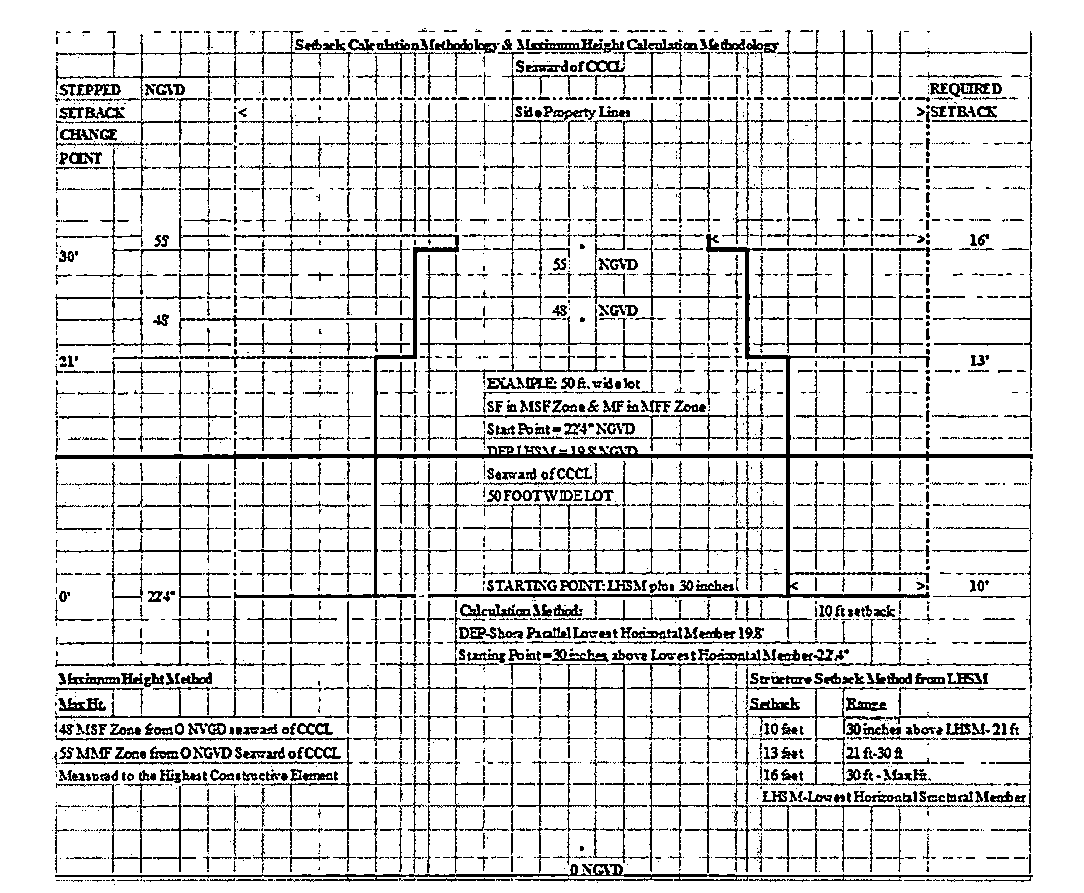
(8)
Peripheral landscape strip. Peripheral landscape strips are required on all lots within the Manasota and Sandpiper Key overlay district. All properties, conforming and nonconforming, shall have front, side interior and rear interior peripheral landscape strips of no less than five feet from the property line. Peripheral landscape strips shall be located immediately adjacent and parallel to all sides of a lot boundary. All peripheral landscape strips shall be either synthetic pervious turf or green open areas. A five-foot wide synthetic pervious turf, or green open area with a vegetated landscape strip along the entire five-foot perimeter is required and intended to screen and separate new development or improvements to existing development from adjacent existing development and from the public right-of-way. Vegetated landscaping means grass, ground cover, mulch, shrubs, vines, hedges, synthetic pervious turf, or trees. Pavement, sand, shell, rock, and aggregate shall not be considered approved landscape material for the five-foot peripheral landscape strip, except that clean shell and native beach shell may be used in lieu of mulch around shrubs. No encroachments shall be allowed within the five-foot peripheral landscape strip including, but not limited to, structures, accessory structures, AC units, driveways, parking areas, pools and pool accessories, electrical equipment, signage, stormwater management systems, and holding tanks. Neither a structure nor any portion thereof shall be erected or shall encroach or overhang upon the required peripheral landscape strip. The only exceptions shall be:
a.
Dune walkovers, sidewalks and driveway crossovers, where permissible.
b.
Fences.
c.
Guttered roof overhangs that may extend two (2) feet into the peripheral landscape strip, only on lots fifty (50) feet wide or less.
d.
Sunshades that may extend two (2) feet into the peripheral landscape strip only on lots fifty (50) feet wide or less.
(9)
Yard setbacks. Yard setbacks, greater than five-foot peripheral landscape strip, shall be required for structures based on zoning district minimum yard requirements, abutting properties, abutting water, and building height requirement of the overlay code. No primary structures shall be allowed to encroach within the greater yard building setback area, however appurtenances and mechanical equipment for the primary structure, which are typically allowed within required yards may be located within the greater yard setback. Accessory structures, parking, and driveways may be located within the greater yard building setback area as long as county codes and the overlay code district standards and architectural standards are met.
(10)
Accessory structures. No accessory structures or uses, other than fences shall be allowed within the five-foot peripheral landscape strip. All accessory structures must conform to the side and rear setback requirements of the appropriate zoning district. Detached permanent garages must conform to the front setback requirements of the appropriate zoning district. All other accessory structures must be located behind the leading edge of the living area of the principal structure. The only exception is on lots three hundred (300) feet or greater in depth which may have screened accessory structures located in front of the building facade provided they are located at least one hundred fifty (150) feet from the county right-of-way. Other accessory structure requirements are contained under the architectural design standards below. Multifamily developments when permitted in any zoning district are permitted to contain a clubhouse, recreation room or similar community room to serve the residents of the development.
(11)
Nonconforming lots. It is the intent of this section to specify provisions of the overlay code that supersede the county nonconforming provisions and exceptions to yards provisions and which sections of the Code remain in place. It is also the intent to include provisions unique to nonconforming lots in the overlay boundary. It is the intent that all lots contain a five-foot peripheral landscape strip. Within the Manasota and Sandpiper Key overlay district. the provisions of the county code requiring a variance to build on a lot less than five thousand (5,000) square feet or less than fifty (50) feet in width shall not apply as long as the building conforms to the requirements for the zoning district in which the lot is located.
(12)
Parking standards. For any residential development within the overlay district, each residential dwelling unit shall provide a minimum of two (2) spaces per unit. Multifamily developments shall provide additional parking spaces for services and guests. Service parking requirements shall be the lowest whole number that is greater than or equal to ten (10) percent of the number of units contained within the multifamily project. Guest parking requirements shall be the lowest whole number that is greater than or equal to twenty (20) percent of the number of units contained within the multifamily project. At least one (1) of the guest parking spaces as required by this section shall be handicapped accessible. Beach access points on the islands shall not be obstructed by parked cars or any other barriers. Parking of unlicensed or unregistered automobiles, recreational vehicles, boats and/or trailers shall be prohibited. Parking standards for commercial structures shall meet the Code requirements.
(13)
Disaster recovery. Following a natural disaster, as determined by the board, properties which have been deemed by the appropriate county department to be destroyed or substantially damaged and require removal or reconstruction shall be reconstructed in conformance with the regulations contained herein with the following exceptions: a structure and/or use that was legally nonconforming at the time of the disaster may be replaced or restored on the original footprint, which shall mean the maximum dimensional limits of the original structure at ground level, including pool decks, attached, permitted carports and garages, but not including detached structures. For all non-conforming uses, there shall be no increase in square footage or residential density greater than the permitted, pre-disaster footprint. All construction shall comply with applicable county, state and federal laws and ordinances. All structures rebuilt under this provision must meet or exceed all design flood elevations as applicable pursuant to the Florida Building Code.
(14)
Underground utilities. Electrical wires that connect poles with structures shall be placed underground.
(15)
Spot ground elevations. The spot ground elevations for new development and for reconstruction that exceeds fifty (50) percent of the replacement value of an existing structure shall be established prior to any clearing of the site by a signed and sealed survey prepared by a surveyor licensed in Florida. There shall be a minimum of one (1) spot elevation per site, with additional spot ground elevations provided at every one (1) foot of elevation change within the site.
(16)
Density on barrier islands. There shall be no transfer of density units into Manasota and Sandpiper Key from other areas of the county. Transferring density between Manasota Key and Sandpiper Key is prohibited. In addition to the requirements set forth in the county's transfer of density units code, the transfer of density units within Manasota Key or Sandpiper Key shall not be used contrary to the intent of the Manasota community plan and shall comply with the following criteria:
a.
Density units from category I hurricane storm surge zone cannot be transferred into a tropical storm surge zone; and
b.
Density units from an AE flood zone cannot be transferred into a VE flood zone; and
c.
No transfers of density from a less to a more restrictive flood zone; and
d.
All development standards set forth in this section shall apply.
(17)
Non-conforming structure(s) and legally non-conforming uses below the required designated flood elevation may be elevated pursuant to the Florida Building Code, applicable county, state and federal laws and ordinances within the original footprint. Non-conforming structure(s) and legally conforming uses below the required designated flood elevation may be elevated pursuant to the Florida Building Code, applicable county, state and federal laws and ordinances.
(j)
Architectural design standards.
Applicability. These architectural design standards shall apply to all new development within the overlay district, including but not be limited to new development, new structures and to any alterations or additions to existing structures. These standards shall regulate the appearance and constructive elements of structures and be used in addition to those expressed elsewhere in this overlay code.
(1)
Driveways and parking areas and walkways/sidewalks.
a.
No driveway shall exceed twenty-four (24) feet in width where it connects with the roadway.
b.
In MES and MSF districts, only one (1) driveway crossing is permitted within the front yard setback. In MMF districts, one (1) driveway crossing allowed every three hundred (300) feet within the front yard setback.
c.
New private roads and parking and driveways, and those where fifty (50) percent of their original area is repaired or replaced shall be paved with crushed shell, stone, brick, or other pervious materials, to improve drainage and runoff in a manner that will permit maximum water absorption. Pervious surfacing must be on a bed of sand designed and installed in a manner that will permit water absorption through the joints and the sand bed. New asphalt and concrete (porous or nonporous) shall be prohibited. Concrete walkways are permitted only when ADA compliance is required. When pavers are installed, the contractor must provide a letter certifying that the pavers are pervious and that the pavers will be installed to maximize on-site water absorption. Developments built before 2008 that have asphalt driveways, are exempt from the pervious surface requirements of the section when repairing or replacing their asphalt driveways, though encouraged to address runoff issues associated with driveways.
d.
Walkways are permitted within the peripheral landscape strip only when they are necessary to comply with the Americans with Disabilities Act. Asphalt paving is prohibited. This requirement shall not apply to areas under the footprints of approved structures.
e.
Stepping stones are permitted.
f.
Driveways shall not encroach upon the side peripheral landscape strip. Corner lots may have one (1) driveway crossing off either street but not both.
g.
Entry walkways shall be clearly defined and shall not encroach upon the five-foot side peripheral landscape strip.
h.
A single dune walkover per lot, where applicable, is permitted.
(2)
Building and facade materials and design.
a.
All facades, excluding doors, windows, and trim, shall be improved and constructed with one (1) or a combination of the following materials: i. Masonry, although unfinished and exposed concrete block is prohibited; ii. Wood; iii. Stucco; iv. Vinyl. All additions shall be required to resemble material uses on the existing structure on the same property.
b.
No reflective materials are permitted on building facades.
c.
All wall openings on traditional buildings, including but not limited to windows, doors, balconies, and alcoves are required to have trim installed according to the following standards: a. Trim shall resemble wood, masonry stone, stucco, or tile; b. Reflective finishes are prohibited.
d.
Garage doors shall be flush or recessed with the front facade or recessed so as not to dominate the architectural design and appearance. Garage door height is limited to ten (10) feet.
e.
Roofs shall be constructed, maintained, and repaired according to the following standards:
1.
Roofs shall be made of non-reflective materials. Skylights or other glass roof surfaces shall be limited to five (5) percent of the roof and not located on the front of the building.
2.
Roof materials shall resemble non-reflective metal, wooden shingles, "dimensional" asphalt shingles, barrel tile, concrete tile, or slate, and roof additions shall be required to resemble or material uses on the existing structure on the same property.
3.
Flat roofs shall be exempt from all preceding roof material standards provided a parapet or mansard wall is used to screen the roof and rooftop equipment.
(3)
Architectural accents.
a.
Awnings shall be permanently affixed and shall have a minimum clearance of eight (8) feet above any sidewalk and eighteen (18) feet above any driveway on commercial properties.
b.
Gutters shall resemble or match the building trim or primary facade color. Gutters shall not cause water to accumulate on neighboring properties or directly upon driveways, sidewalks, or walkways.
c.
If lattice or breakaway walls are used between the first floor and the ground, they shall be the same pattern such as material and color as the outside of the structure, and shall be permanently affixed to the principal structure and be constructed of vinyl or painted wood.
d.
Sunshades shall be permanently affixed and shall be retractable for use as hurricane shutters providing they meet county and state code.
(4)
Lighting fixtures, structures, and elements.
a.
All outside lighting fixtures shall be installed consistent with the sea turtle lighting standards.
b.
Fixtures for lighting areas shall follow a consistent theme.
c.
Light posts shall be installed consistent with the following standards:
1.
Light posts shall be constructed and installed to resemble wood, polished concrete, or painted metal.
2.
Unfinished or unpainted metal and concrete surfaces and untreated wooden posts are prohibited.
3.
Light posts on private property shall not exceed sixteen (16) feet in height.
d.
Outside lighting fixtures shall be installed to orient light downward and to provide glare reduction optics and shielding features. No fixture shall direct light upward or onto adjacent property. (Exemptions shall include small accent lights that are directed upward to softly illuminate landscaping.)
e.
Light globes shall not protrude below shades.
(5)
Fencing and walls.
a.
Chain link fencing is prohibited. Coated chain link fencing may be used to enclose tennis courts and swimming pools. In such cases, the fence shall be replaced at the first signs of wear or rust. A coated chain link fence may also include tennis fence netting. Temporary security fences for construction sites installed for six (6) months or less shall not be required to be coated chain link fencing.
b.
Concrete block walls must be split-faced or finished, and capped. Unfinished concrete block is prohibited.
c.
Wood fences must be constructed of pressure-treated lumber to prevent deterioration and rot.
d.
Solid walls and fences on or near the periphery of a lot must contain openings that may be used by wildlife. These openings must be at least nine (9) inches wide and six (6) inches high and must be located every twenty-five (25) feet along the bottom of the fence or wall.
e.
Fences and walls that abut a body of water shall not exceed four (4) feet in height for portions that extend beyond the building facade that faces the body of water.
f.
Fences and walls shall not exceed six (6) feet of height, measured from the finished grade of the parcel.
g.
Fences and wall[s] forward of the front building facade shall not exceed four (4) feet in height.
(6)
Accessory structures. In addition to the accessory requirements contained under the development standards above, accessory structures must meet the following architectural design standards:
a.
The total area of accessory structures shall not exceed one-half (½) the footprint of the principal structure or one thousand (1,000) square feet, whichever is greater, and shall not exceed the maximum lot coverage allowed by zoning district when combined with area of the principal structure. Owners of lots greater than one (1) acre in area may apply for a special exception to exceed the maximum lot coverage standard.
b.
Metal buildings or temporary structures such as awnings or carports are not permitted. Accessory structures must be built with materials designed to withstand salt and high winds.
c.
Garage or storage structures over two hundred fifty (250) square feet in area must be compatible in appearance and materials with the principal structure.
d.
Sheds, gazebos, cabanas, and decks must be located behind the front building facade, and may not be located within the peripheral landscape strips. The only exception is on lots three hundred (300) feet or greater in depth which may have screened accessory structures located in front of the building facade provided they are located at least one hundred fifty (150) feet from the county right-of-way.
e.
Roofing materials must resemble or be complimentary to the materials used on the principal structure.
f.
Gazebos, detached garages, and detached screened pool enclosures may not exceed fifteen (15) feet in height from finished grade. All other accessory structures may not exceed ten (10) feet in height.
g.
Swimming pools, hot tubs, spas, and other water features and their decks shall be installed and constructed consistent with the following standards:
1.
Swimming pools are limited to one (1) vertical accessory including but not limited to slides and diving boards. Vertical accessories shall not exceed eight (8) feet in height. Swimming pools and pool equipment shall not be located within the peripheral landscape strips.
2.
Above-ground exterior swimming pools, hot tubs, and spas are prohibited. Exterior swimming pools, hot tubs, and spas must be permanently installed in the ground or within a masonry foundation.
3.
Portable spas must be modified to conform to these standards.
h.
Air conditioning and heating units must be installed consistent with the following standards:
1.
Units must be screened from off-site view.
2.
Consideration must be given to avoid impacts to adjacent properties.
3.
Mechanical equipment shall be expressly prohibited from being considered for a variance or special exception.
i.
Pool equipment and propane tanks of two hundred fifty (250) cubic feet or greater shall be screened from off-site view.
j.
Miscellaneous accessory structures must be constructed consistent with the following standards:
1.
Ramps, where required, must be concealed with landscaping to the greatest extent possible, and must blend with the scale and architectural features of the structure.
2.
No accessory structures shall be permitted within the five-foot peripheral landscape strip.
3.
Above roof appurtenances on commercial buildings shall be screened from view.
4.
New dumpsters shall be stored and screened within an enclosed area, not in front of the leading edge of the building facade. Waste receptacles, garbage and trash containers shall be screened from off-site view and meet all other County Code requirements. All existing dumpsters that cannot be moved to meet the new requirements shall be required to be screened with an enclosure that exceeds the height of the dumpster.
(7)
Commercial and multifamily buildings. In addition to the above architectural design standards, all commercial and multifamily buildings must also conform to the following standards:
a.
Primary building entrances must be oriented towards adjacent roadways.
b.
Loading docks and delivery vehicle parking areas should be located to the rear and side of the building. To the greatest extent possible, these elements should not be placed between the front building facade and the roadway.
c.
Drive-through facilities are prohibited.
(k)
Landscaping. Landscaping on Manasota and Sandpiper Keys shall be subject to the provisions and standards of the overlay code. In addition to such standards, all landscaping on the Manasota and Sandpiper Key shall be installed, repaired and maintained consistent with the guidelines in this section.
(1)
A landscaping plan is required for all new development and modifications to existing structures that exceed fifty (50) percent of the total structure's assessed value.
(2)
The landscape plan must be drawn to scale with dimensions, distances and scale, and shall identify the type and location of existing and proposed vegetation and other landscape features including the proposed green vegetation in the peripheral landscape strip, the landscape plan for the yards, as well as all easements, building structures, accessory structures, stormwater retention, and similar features.
(3)
The proposed plantings in the peripheral landscape strip shall meet the objectives to screen and separate new development or improvements to existing development from adjacent existing development and from the public right-of-way. Vegetated landscaping means grass, ground cover, mulch, shrubs, vines, hedges, synthetic pervious turf, or trees. Pavement, sand, shell rock, and aggregate shall not be considered approved landscape material for the five-foot peripheral landscape strip, except that clean shell and native beach shell may be used in lieu of mulch around shrubs.
(4)
Developers shall meet the one (1) tree point per two thousand (2,000) square feet of development site. A "buy-out" option from this requirement shall be prohibited. On nonconforming lots less than five thousand (5,000) square feet, a minimum of two (2) tree points shall be required.
(5)
Foundation plantings shall be installed around buildings to soften their appearance from offsite view.
(6)
Peripheral landscape strips and yard areas shall be treated with Florida friendly landscape material.
(7)
Commercial buildings and multi-family residence requirements, in addition to the requirements above:
a.
A landscaping plan, signed and sealed by a landscape design professional, shall be submitted with all new construction and/or modifications to existing structures that exceed fifty (50) percent of the total structure's assessed value.
b.
Parking lot areas shall be screened with low fencing and/or landscaping whenever such areas abut public rights-of-way, existing residential uses, or property zoned for residential use. One (1) tree is required for every thirty-five (35) feet of perimeter landscape strip abutting a public right-of-way.
(l)
Signs standards.
(1)
Applicability. These regulations are intended to complement the county sign code and address the limited amount of area available to promote the business on the key. Any sign on Manasota and Sandpiper Key that is erected, constructed, installed, altered or moved shall conform to the provisions of the overlay code. Any inconsistencies between the overlay code and any other building, electric codes adopted by the county, the most restrictive shall apply.
(2)
General provisions for signs on Manasota and Sandpiper Key.
a.
Private and temporary signs shall not be placed in the roundabout nor shall they be placed on any public right-of-way, including along Beach Road, Gulf Boulevard, or North Beach Road, and shall not exceed four (4) square feet.
b.
Single-faced signs shall be painted black on the back side.
c.
All new free-standing signs shall be monument signs. Maximum height of monument signs shall be four (4) feet above the crown of the road. Eight-inch street names and number may be placed on top of these monument signs.
d.
Traffic or other directional sign, symbols or devices relating to traffic, parking, public services, facilities or warnings shall be painted black on the rear when visible to the general public and be mounted on decorative poles. Whenever a traffic or way finding directional sign is erected on public right-of-way for the benefit of or upon request by a private development or individual, the sign shall be paid by the project requesting or benefiting from the sign and be on decorative poles paid by them.
e.
No sign including an exempt sign shall be constructed, erected or interferes with any utility, communication, cable or stormwater infrastructure.
f.
Flags shall not be placed in the public right-of-way.
g.
Nonadvertising directional signs, symbols or devices related to traffic, parking or warnings on private property: entrances, exits, slow, no trespassing or no parking shall not exceed three (3) square feet.
h.
Murals and wall art shall not be calculated as sign area if they do not contain text or logos.
i.
Two-sided signs with the same face on each side shall be calculated on only one side. With respect to a double-faced (back-to-back) sign, there can be no separation between the backs of each face of the sign other than the structural support to which each sign is attached.
j.
Normal maintenance to existing conforming signs shall not be deemed alterations within this overlay code.
k.
Dedicatory tablets or memorial plaques setting forth the name or erection date of a building, commemorating a person or persons and like uses shall be cast in metal or engraved in stone or concrete or otherwise inscribed in or on a monumental material, not to exceed four (4) square feet.
l.
No signs shall be exempt from obtaining a permit on Manasota and Sandpiper Key.
m.
Sign area shall be calculated as the area within the smallest regular geometric shape or combination of shapes which encompasses all the display elements (letters, numbers, figures, characters, corporate logos, etc.) of the sign, including blank areas between display elements. The area of the sign shall include all changing copy features such as letter boards or light boards. Only the eight-inch street names and numbers placed on top of non-residential signs shall not be calculated as part of the total allowed square footage.
(3)
Residential signage.
a.
Single-family units and multifamily complex—one freestanding temporary yard sign that does not exceed twelve (12) by eighteen (18) inches. For example, for garage or property sale, lease or rent. An additional sign of twelve (12) by eighteen (18) inches which is located in their yard on a navigable body of water shall be allowed facing the water.
b.
One (1) sign denoting the architect, engineer or contractor for work under construction, not exceeding four (4) square feet.
c.
Multifamily units shall be treated as a single unit with the exception of:
1.
Multifamily developments may have one (1) community sign per three hundred-foot of road right-of-way and street name. Eight-inch street names and numbers may be placed on top of these signs.
2.
Community signs shall be monument signs, limited to four-foot in height and sixteen (16) square feet in area. Community signs shall include eight-inch street numbers.
3.
Community signs may be two-sided providing each side is exactly the same and will count as only one (1) side for sign allocation, and shall not contain any form of advertising.
4.
Community signs shall not be located in the side peripheral landscape strip area.
5.
Residential signs may not be internally lit. Community signs may have low level ground-up lighting providing the light does not illuminate above or beyond the sign. All lit signs must comply with the county sea turtle lighting code and must provide two (2) copies of the lighting plan to the county.
6.
Multifamily communities may have one (1) building wall or fence sign instead of a monument sign. Wall and fence signs shall be limited to sixteen (16) square feet and shall include the eight-inch street numbers. Wall signs shall not be located above the peak of the roof or highest constructive element. Wall signs shall not project horizontally beyond the building wall.
7.
Vacant property may have one (1) sign of sixteen (16) square feet.
(4)
Nonresidential signage.
a.
Each unit is allowed a sign allocation of sixty (60) square feet. Freestanding signs must be monument signs. Sign allocation may be flexible where monument signs are inappropriate due to parking viability requirements.
b.
Each unit is allowed one (1) monument primary sign not to exceed twenty-five (25) square feet. Non-residential primary signs shall include street name and numbers of eight (8) inches in height and may contain movable lettering. Eight-inch street names and numbers may be placed on top of these signs. These street names and number shall not be calculated as part of the total allowed square footage.
c.
Monument primary signs may be two-sided providing each side is exactly the same and will count as only one (1) side for sign allocation. No portion of any monument sign shall be allowed to encroach onto a private walkway or driveway or within the public right-of-way.
d.
Each unit may have one (1) building sign that does not rise above the peak of the roof or highest constructive element and does not project horizontally beyond the end of the building wall. Building signs are limited to thirty-two (32) square feet per sign. The sign allocation for each property combined between wall and freestanding sign shall be sixty (60) square feet. No portion of any wall sign shall be allowed to encroach onto a private walkway or driveway.
e.
Monument signs shall not be located in the peripheral landscape strip.
f.
Wall signs shall not be located on the side or rear of a building which abuts to a residentially-zoned property.
g.
Changeable copy signs are limited to a maximum of eight (8) square feet per sign face with a maximum letter height of eight (8) inches and shall be included in the sign allocation. Sign face may be illuminated with low level internal lighting that does not create a problem for our turtle friendly neighborhood.
h.
Only in MCG and MCT commercial zoning districts may existing pole or pylon signs installed before February, 2005, be replaced, and only when parking will obscure sign face of a monument signs.
i.
Banners, pendants, feather flags and sail flags are permitted in MCG and MCT commercial zoning districts, so long as they are sited on private property and do not fly over the public right-of-way, sidewalks or streets, and no more than one (1) of these per fifty (50) feet of frontage. No more than one (1) of these allowed per fifty (50) feet of frontage with a maximum of two (2) per business property, and each banner, pendant, feather, flag and sail signs shall be no greater than twenty-four (24) square feet, provided they may be flown no more than two (2) times per calendar year and for no more than thirty (30) days per permit. National and state flags are excluded from this requirement.
j.
Vacant property may have one (1) sign of sixteen (16) square feet.
(5)
Prohibited signs.
a.
Neon, chasing, animated or flashing signs.
b.
Signs that emit an audible sound or visible matter such as smoke or steam.
c.
Billboards.
d.
Portable illuminated signs, whirling signs, animated signs, or wind signs.
e.
Temporary signs placed on sidewalks or bike paths.
f.
Signs above the roof or mansard of the building.
g.
New pole or pylon signs, except as provided in (4)h. above.
h.
Any sign prohibited by state or federal law.
i.
Any sign creating a traffic hazard by obstructing vision in any sight triangle.
j.
Any sign from preventing free ingress or egress from any door, window, fire escape or other entrance or exit to any building, or any sign attached to a standpipe or fire escape.
k.
Any sign that is obscene, such as a sign depicting nudity or sexual conduct.
l.
Any sign that constitutes a public nuisance, such as signs that produce hazardous amounts of glare, advertise an illegal activity, convey false information, or lead the public into errors of conduct, thought or judgment, especially by intentionally deceiving.
m.
Any sign that emits a sound, smell or smoke.
n.
Any sign that has been abandoned, including primary signs, unless the signs panel within the abandoned sign structure has been removed and replaced with a sign panel or neutral color containing no message.
o.
Any sign designed with mechanized or electric changeable copy to display more than one (1) image on an ongoing basis where any information flashes, fades, dissolves, or scrolls or signs that move or create the illusion of movement, or signs that are or appear to be animated or projected.
p.
Any sign affixed to a tree or utility pole.
q.
Portable signs which are manifestly designed to be transported as a trailer, on its own wheels even where the wheels may be removed and the remaining chassis may be permanently attached to the ground.
r.
Primary signs with a noncommercial message.
s.
Any off-premise sign.
t.
Any vehicular sign located on a truck, bus, trailer, taxi or other vehicle used for the purpose of advertisement on private property or on the public right-of-way. The only exception is a vehicle used as transportation for the owner or employee of the business that is moved daily on and off the property.
(6)
Street signage. Traffic or other directional, way finding or traffic control signs or devices erected by any federal, state or local government shall be mounted on decorative poles and the back of the sign shall be painted black. Whenever such signs are for the benefit of or upon request by private development the sign and pole shall be paid by the project requesting or benefiting from the sign. Chanel poles are not permitted.
(Ord. No. 2015-016, § 1, 4-28-15; Ord. No. 2018-051, § 1(Exh. A), 12-11-18; Ord. No. 2020-042, § 1(Exh. A), 10-27-20; Ord. No. 2024-038, § 1, 11-26-24)
Editor's note— Ord. No. 2015-016, § 1, adopted April 28, 2015, amended § 3-9-50 in its entirety to read as herein set out. Former § 3-9-50, pertained to Manasota Key zoning district overlay, and derived from Ord. No. 2005-010, § 1, adopted Feb. 15, 2005; Ord. No. 2005-067, § 1, adopted Aug. 16, 2005; Ord. No. 2006-006, § 1, adopted Jan. 17, 2006; Ord. No. 2006-007, § 1, adopted Jan. 17, 2006; Ord. No. 2006-069, §§ 1—4, adopted Aug. 15, 2006; Ord. No. 2007-015, §§ 1—7, adopted April 17, 2007; Ord. No. 2007-093, § 1, adopted Dec. 18, 2007; Ord. No. 2013-028, § 1, adopted Sept. 24, 2013; and Ord. No. 2014-041, § 1(Exh. A), adopted Nov. 25, 2014.
Sec. 3-9-51. - Babcock overlay zoning district.
(a)
General.
(1)
Establishment; short title. The Babcock overlay zoning district is hereby established. The short title of this section shall be the "Babcock Zoning Code."
(2)
District boundary. The area affected by this Babcock overlay zoning district shall be the area as shown in the zoning atlas.
(3)
Intent. The intent of the Babcock overlay zoning district ("district") is to establish the regulations for design and development that address the qualities of nature and community that are envisioned for the Babcock community. The district is intended to accommodate compact development patterns, interconnected open space, native habitat, and recreation. The intended activities within the district include a mix of residential, retail and office commercial, light industrial, civic and educational facilities, open space, parks and recreational and institutional uses.
(4)
Applicability; conflict with other ordinances; exemptions. The maximum development within this zoning overlay classification is controlled by the development of regional impact master development order, incremental development orders and the comprehensive plan. All new development and future redevelopment within the district shall be subject to these regulations. The terms development and redevelopment shall be construed liberally and shall include any plat, special exception, variance, site plan approval, building or sign permit, or any other official action of Charlotte County that has the effect of permitting development and/or redevelopment or any application for any of the preceding matters. Except where expressly provided herein, the terms of the Babcock Zoning Code shall supersede and control in the event and to the extent of a conflict between the Babcock Zoning Code and another provision of the County Code. Due to the unique circumstances of the property, the following specific exemptions are granted:
a.
Landscape and tree requirements. Approximately 7,725 acres within the district are to be developed, the majority of which were agricultural lands at the time of adoption of this Babcock Zoning Code, and over 5,700 acres within the district are to be preserved, the majority of which are wooded. This results in 5,975,492 removal tree points and 32,002,479 preservation tree points (not including Palmettos and Wax Myrtles). Due to the unique circumstances of the property and the excess of preservation tree points, all development within the district is exempt from the county tree removal permit process and article XVIII of chapter 3-5, landscaping and buffers requirements of the County Code and article IX of chapter 3-2, tree requirements, of the County Code. The landscape requirements of the Babcock Zoning Code provided herein are applicable.
(5)
Use of pattern books for development. Pattern books may be submitted to define development parameters and design standards applicable within a defined site, area or subdistrict to establish some or all of the governing design parameters and standards, which may constitute waivers of submittal requirements and deviations, including but not limited to: setbacks, building heights, building orientation, parking, loading, landscaping, lighting, signage, density, intensity, lot sizes, coverages, and standards for roadway design and rights-of-way. Approval of pattern books shall be issued by the zoning official or designee (zoning official) upon finding that standards, waivers, and deviations are consistent with public health, safety and welfare. An amendment to an approved pattern book may be requested at any time, to be approved by the zoning official. Approval of pattern books and pattern book amendments shall not be unreasonably withheld, and if approval is not granted by the zoning official within 30 days of submittal, the pattern book shall be subject to review and approval by the board of county commissioners. Where standards defined in an approved pattern book conflict with provisions of the Babcock Zoning Code or the County Code, the pattern book shall apply. Development in areas that are not subject to a pattern book shall be governed by the standards and provisions set forth in this Babcock Zoning Code.
(6)
Existing uses. The Babcock Zoning Code shall not render an existing use, including, but not limited to mining, silviculture, agriculture and sod farming, on a parcel as nonconforming, even if such existing use is not a principal use or a permitted accessory use in the applicable subdistrict. Any such existing use shall not be considered nonconforming, and may be continued and expanded with appropriate permitting as required.
(7)
Establishment of subdistricts. The following subdistricts are established to allow for different forms of development within the district, as depicted on the Babcock Overlay Zoning District - Subdistrict Map:
•
Mixed use residential commercial (MURC).
•
North Babcock.
•
Greenways.
(b)
Definitions.
Terms used in this section shall have their commonly accepted meaning unless they are defined in (b). When terms are defined both in this section and elsewhere in the County Code, definitions for such terms in this subsection shall control. The following terms shall have the meanings set forth in this subsection:
Agriculture uses: Agriculture uses within the district includes such uses as agricultural production (crops, citrus, landscape nursery, ranching, livestock raising and animal specialties, pasture, sod and grazing); silviculture, agricultural services, cultural, educational and/or eco-tourism uses and support facilities and their related modes of transporting participants, viewers, or patrons; tour operations, such as, but not limited to airboats, swamp buggies, horse and similar modes of transportation; agricultural labor housing; excavation and earthmoving incidental to agricultural operations; farm products warehousing and storage; single-family detached dwelling unit; forestry; hunting; riding stables; research facilities; noncommercial kennels; telecommunication towers; outdoor shooting ranges; and aquaculture.
Alley: A right-of-way providing a secondary means of access and service to abutting property. For purposes of determining setbacks or required yards, the lot line along an alley is never a front lot line.
Building height: The vertical distance measured from the greater of: (1) the FEMA first habitable floor elevation requirement, (2) eighteen (18) inches above the elevation of the average crown of the adjacent roads; or (3) the average natural grade (the natural contours of a land area generally unaltered by human intervention) to the highest point of a flat roof, the deck line of a mansard roof, or the mean height between the eaves and ridge of a gable, hip or gambrel roof.
Civic, government, and institutional uses: Structures developed for and/or used by established organizations or foundations dedicated to public service or cultural activities including, but not limited to, the arts, education, government and religion.
District: shall mean the Babcock overlay zoning district.
Eco-tourism: The practice of touring natural habitats and support facilities thereof in a manner meant to minimize ecological impact. Eco-tourism is considered a commercial enterprise located in an agricultural or preservation area intended to attract tourists and provide supplemental income for the property owner. Eco-tourism uses include, but are not limited to: transient guest lodging, hunting, nature trails, canoeing, fishing, wildlife observation, and birding.
Encroachments: Physical structures that reach into or above a required yard or a right-of-way or roadway easement. Encroachments are not allowed unless identified as permissible.
Guest unit, accessory: An accessory dwelling which is attached to or detached from a principal dwelling located on the same residential parcel and which serves as an ancillary use providing living quarters and which may contain kitchen facilities. Accessory guest units are not considered dwelling units for purposes of density.
Parking lot: An outdoor area or space, paved or unpaved, designed and constructed for the purpose of motor vehicle parking or storage. A driveway that does not contain or provide access to delineated parking spaces is not a parking lot.
Pathway: A defined corridor within the district's overall transportation network designed to accommodate pedestrians and other alternative modes of transportation.
Pattern book: A set of development parameters and design standards applicable within a defined site, area or subdistrict to establish some or all of the governing design parameters and standards, which may constitute waivers of submittal requirements and deviations, including but not limited to: setbacks, building heights, building orientation, parking, loading, landscaping, lighting, signage, density, intensity, lot sizes, coverages, and standards for roadway design and rights-of-way.
Setback: The minimum distance between a right-of-way line, property line, bulkhead line, shoreline, seawall, ordinary high water line (OHWL), access easement line or other defined location whichever is the most restrictive, and the beginning point of the buildable area. Setbacks may be measured from the legal boundary of a lot and are inclusive of easements with the exception of easements that comprise a road right-of-way. For purposes of determining setbacks, the lot line along an alley is never a front lot line.
Transient guest lodging: A building or group of buildings operated for commercial purposes, and therefore not considered residential units for purposes of density, in which sleeping accommodations and sanitary facilities are offered to guests and intended for use on a daily or weekly basis, irrespective of the form of ownership, and which may include kitchens in each unit.
(c)
Subdistricts within the Babcock overlay zoning district.
(1)
Mixed use residential commercial (MURC). The MURC subdistrict shall be the most diverse subdistrict, with a full range of uses to support a live, work, shop, play environment. The MURC subdistrict may include residential, commercial, recreational, civic, industrial, and mixed uses. The MURC is to be developed according to a town center, village and hamlet framework that is further defined by pattern book. Buildings may be single or multiuse. Parking shall be provided on-street, off-street, and within parking structures.
a.
Permitted principal uses and structures. Permitted principal uses within the MURC subdistrict include any and all uses not listed as prohibited uses in (d)(3), including, but not limited to: commercial businesses and services, retail, office, civic, education (elementary, middle, high schools, colleges and universities), institutional, light industrial and manufacturing, mining, earthmoving, nurseries, essential services, single family and multifamily residential, assisted living facilities, continuing care retirement communities, transient guest lodging including hotel, motel and bed and breakfast, home occupations per (d)(11), parks, recreation, manufacturing, distribution, wholesale, warehouse, processing and packaging, laboratories and clinics, research, design and product development. Mixed use buildings and single use buildings are permitted. Any use not listed may be deemed permitted by the zoning official by a finding that the use is reasonable according to the intent of the subdistrict; similar to another permitted use in the subdistrict; and not specifically prohibited in the subdistrict.
b.
Permitted accessory uses and structures. Permitted accessory uses and structures include all uses that support or relate to principal uses, including accessory guest units that are attached or detached in conjunction with single family residential dwellings, except as otherwise prohibited herein.
c.
MURC development standards.
Table 1. MURC Development Standards
Notes:
(1) Unless otherwise noted, setbacks apply to principal and accessory structures. Structures will comply with sight distance requirements. Building separation shall be at least ten (10) feet, subject to access requirements for emergency services and fire code.
(2) May be reduced as long as sum of side setbacks is ten (10) feet minimum.
(3) Setback applies to interior lots. If not connected to an adjoining structure, side setback is five feet which may be reduced as long as sum of side setbacks is ten (10) feet minimum.
(4) Schools are exempt from this setback table, school development is according Charlotte County School District policy.
(5) Encroachments into front yards are allowed for porches, stoops, awnings, colonnades, or other elements that serve as transition from the public to the private realm.
(6) It must be demonstrated that driveways can accommodate space for parking for at least two (2) vehicles on the driveway without overhanging onto the adjoining sidewalk, or onto vehicle travelway where no sidewalk exists. If on-street parking spaces are available in the right-of-way within three hundred (300) feet, on-street parking may substitute for driveway parking.
(7) Building entrances are required on the primary street.
(8) Maximum area per use is three thousand (3,000) square feet. Total neighborhood goods and services permitted in one (1) location is fifteen thousand (15,000) square feet.
(9) Multi-family buildings with two (2) or less bedrooms per unit shall require one (1) space per unit. Multifamily buildings with three (3) or more bedrooms per unit shall require one and one-half (1.5) spaces per unit.
(10) The amount of required parking may be determined through a parking analysis submitted with a site plan application.
(11) At the town center entries, the shopping and entertainment areas shall be set back a minimum of one hundred (100) feet from the ultimate road right-of-way of SR 31. For the remainder of the town center, the shopping and entertainment areas shall be set back a minimum of two hundred fifty (250) feet from the ultimate road right-of-way of SR 31. The shopping and entertainment areas of the villages and hamlets shall be located in the interior portion of those areas. (Ref. Sierra Club Settlement Agreement Section B.8.)
(12) Encroachments are allowed for structures such as boardwalks, docks, and accessory structures providing views and access to water, subject to approval from agencies with jurisdiction.
1.
Encroachments: The following standards pertain to yard and right-of-way encroachments:
i.
Yard encroachments. Every part of every required yard shall be open and unobstructed by the principal structure from thirty (30) inches above the ground, as measured from the average elevation of the crown of road along the property frontage. Permissible encroachments into required yards are limited to the following: pool equipment, generators, air conditioning equipment, cornices, overhangs, decorative awnings, gutters, eaves, chimneys, bay windows, balconies, means of egress, and any other structure deemed similar in nature by the zoning official. Accessory structures including, but not limited to, refuse containers, loading docks, flagpoles, play equipment, fences, walls, wires, lights, mailboxes, open air arbors, open air trellises, open air pergolas, open air chickees and outdoor furniture are not considered encroachments and are therefore allowed. Structures less than thirty (30) inches in height, including but not limited to pools, bermed earth, plant materials, driveways and pathways, are not considered encroachments in required yards and are therefore allowed.
ii.
Right-of-way or roadway easement encroachments. Allowable encroachments into rights-of-way or roadway easements are limited to the following: awnings, arcades, colonnades, pedestrian bridges, balconies, planters, outdoor dining, and any other structure deemed similar in nature by the zoning official. A minimum six-foot clear pedestrian way shall be maintained and not obstructed by any encroachment. Encroachments shall maintain a clear distance of nine (9) feet above the sidewalk and fifteen (15) feet above the street measured from the elevation of the crown of the street if the encroachment passes over vehicle travel lanes.
2.
Density: Maximum net density for residential is twenty-four (24) units per acre in town center and sixteen (16) units per acre in villages and hamlets. Accessory guest units, attached or detached, in conjunction with single family residential dwellings are not considered toward density calculations.
3.
Parking: A parking needs analysis may be approved by the zoning official to determine the appropriate number and location of parking spaces for any use based on characteristics of the use, hours of operation, sound planning principles, shared parking agreements or trip management techniques to be implemented. In the absence of a parking needs analysis, the following number of parking spaces shall be provided on-site, unless otherwise provided:
i.
Single family detached, zero lot line, two-family and single-family attached: Minimum of one (1) on-site parking space inclusive of driveways and garage space. One (1) additional parking space is required for an accessory guest unit, which may be on-site or dedicated on-street parking within three hundred (300) feet of the unit it serves.
ii.
Multifamily: A minimum of one (1) on-site parking space is required for units with two (2) or fewer bedrooms. A minimum of one and one-half (1.5) on-site parking spaces is required for units with three (3) or more bedrooms. Additional parking may be provided on-site or as dedicated on-street parking within three hundred (300) feet of the unit it serves.
iii.
Nonresidential: Nonresidential uses shall provide a minimum of one (1) on-site parking space per three hundred (300) square feet of gross floor area.
iv.
Mixed use: Mixed use buildings shall provide the total number of parking spaces required for the residential and nonresidential occupancies.
4.
Minimum landscape requirements:
i.
General tree planting requirements shall be:
(A)
For every lot, a minimum of one (1) tree shall be planted in the front yard or in the right-of-way in front of the lot; or
(B)
Street trees planted in or adjacent to the right-of-way with a minimum spacing of one (1) tree every sixty (60) feet on average.
ii.
The following perimeter landscaping requirements apply to development requiring site plan review:
(A)
A minimum of one (1) shrub per ten (10) linear feet of front property line shall be planted in a hedge row or otherwise clustered within the front yard.
(B)
For landscape buffer areas that serve as transition between intense uses and residential uses per (c)(1)c.5.ii., a minimum of one (1) shrub per ten (10) linear feet of property line shall be planted in a hedge row or otherwise clustered in the transitional landscape buffer area.
(C)
Substitution of trees for shrubs is permitted at a rate of one (1) tree per three (3) shrubs.
(D)
The location of required plantings may be any of the following: in-ground planting areas, raised planters, or planter boxes.
(E)
In addition to the preceding provisions (a) through (d), wherever a parking lot abuts public rights-of-way along a front property line, a hedge, or durable nonvegetative barrier, or combination thereof, at least three (3) feet in height, shall be placed along the entire length of the front property line, except within sight triangles. Wherever nonvegetative barriers are employed, one (1) shrub or vine shall be planted for every eight (8) linear feet, distributed evenly or in clusters.
iii.
Parking area requirements: For parking constructed of impervious material, planter islands shall be constructed to interrupt rows of parking. The maximum number of parking spaces between planter islands is fifteen (15) spaces. Minimum dimension for a planter island is nine (9) feet. Each planter island must contain at least one (1) tree maintained with a minimum six (6) feet of clear trunk measured from the ground up. Planter islands are not required for parking constructed of pervious material.
5.
Standards specific to mixed use and nonresidential uses:
i.
Loading docks and refuse containers and facilities shall generally be placed to the rear or side yard of the building. Refuse containers shall be hidden by an opaque wall or fencing of sufficient height to screen the bin and any appurtenances, but not less than five (5) feet in height. Walls shall be constructed of a material compatible with the principal structure it is serving. Trash containers serving nonresidential uses shall be screened from view from abutting residential property, but refuse area enclosures are not required to be gated or otherwise closed off.
ii.
Transition of intensity. Transition between intense uses (including industrial, manufacturing, distribution, repair shops, car washes, wholesale, warehouse, processing and packaging, mining, laboratories and clinics, research, design and product development, and gas stations) and residential uses should be addressed through building orientation, site design, landscape buffering or the placement of less intense uses to provide transition, such as commercial, office, civic, institutional, governmental or recreation.
(2)
North Babcock subdistrict. The North Babcock subdistrict is envisioned to be an educational and recreational center with uses that represent a long-term preservation and development plan. The subdistrict is intended to provide opportunities for the public to explore and enjoy ecosystems and natural resources.
a.
Permitted principal uses and structures. Permitted uses within the North Babcock subdistrict include: Caretakers and operating staff quarters; eco-tourism lodge; sports lodge; hunting club; transient guest lodging; environmental education and research center (excluding bio-genetic research on animals and/or plants); riding stables; equestrian facility and accessory uses; recreational vehicle (RV) park; youth camp; open storage for vehicles, recreational vehicles (RVs), boats, trailers, recreational equipment, and similar items; civic; institutional; schools; churches; agricultural; conservation areas and associated boardwalks, observation decks, restroom facilities, and paved or unpaved trails including trails to accommodate multimodal transit, such as golf carts or other electric vehicles; land management activities including but not limited to, hunting, ecological burning, ecosystem restoration, hydrologic restoration, transportation and utility crossings, stormwater management, habitat restoration, earthmoving and other similar uses; alternative energy use: alternative energy and ancillary facilities including, but not limited to support offices; maintenance facilities to support the uses found in this section; community infrastructure uses and facilities, including utilities and fill storage, stock piling, and clearing; parks; cell towers; temporary uses customarily associated with development such as sales centers and modular buildings; commercial uses which are customarily associated with the uses permitted within the subdistrict. Any use not listed that is deemed by the zoning official to be reasonable according to the intent of the subdistrict; similar to another permitted use in the subdistrict; and not specifically prohibited in the subdistrict per (d)(3).
b.
Permitted accessory uses and structures. Permitted accessory uses and structures include all uses customarily incidental to principal uses and structures.
c.
North Babcock development standards.
Table 2. North Babcock Development Standards
1.
Yard encroachments: Every part of every required yard shall be open and unobstructed by the principal structure from thirty (30) inches above the ground, as measured from the average elevation of the crown of road along the property frontage, except for the following encroachments permitted to extend into the required setback a maximum distance of fifty (50) percent of the required setback: pool equipment, generators, air conditioning equipment, cornices, overhangs, decorative awnings, gutters, eaves, chimneys, bay windows, balconies, means of egress, and any other structure deemed similar in nature by the zoning official. Accessory structures including, but not limited to, loading docks, refuse containers, flagpoles, play equipment, fences, walls, wires, lights, mailboxes, open air arbors, open air trellises, open air pergolas, open air chickees and outdoor furniture are not considered encroachments and are therefore allowed. Structures less than thirty (30) inches in height, including but not limited to pools, bermed earth, plant materials, driveways and pathways, are not considered encroachments in required yards and are therefore allowed.
2.
Parking and loading: The following parking and loading standards apply in the North Babcock subdistrict:
i.
Number of off-street parking. A parking needs analysis may be approved by the zoning official to determine the appropriate number of parking spaces for any use based on characteristics of the use, hours of operation, sound planning principles, or trip management techniques to be implemented. In the absence of a parking needs analysis, a minimum of one (1) off-street parking space inclusive of garage space shall be provided per:
(A)
Lodge unit.
(B)
Caretaker quarters unit.
(C)
Riding stable.
(D)
Every ten (10) recreational vehicle (RV) spaces.
(E)
Every six campsites.
(F)
Four hundred (400) square feet of assembly use.
(G)
One thousand (1,000) square feet of equestrian facility.
ii.
Parking surface material. Gravel, shell, and other permeable surface materials are encouraged for the North Babcock Area. Paving is permitted in areas that otherwise, without paving, would create a detrimental health, safety, or welfare impact.
iii.
Loading docks and refuse containers. Loading docks and refuse containers and facilities shall generally be placed to the rear or side yard of the building. Refuse containers shall be hidden by an opaque wall or fencing of sufficient height to screen the bin and any appurtenances, but not less than five (5) feet in height. Walls shall be constructed of a material compatible with the principal structure it is serving, but refuse area enclosures are not required to be gated or otherwise closed off.
3.
Landscaping: For parking lots constructed of impervious material, planter islands shall be constructed to interrupt rows of parking. The maximum number of parking spaces between planter islands is fifteen (15) spaces. Minimum dimension for a planter island is nine (9) feet. Each planter island must contain at least one (1) tree maintained with a minimum six (6) feet of clear trunk measured from the ground up. Planter islands are not required for parking constructed of pervious material. No other landscaping or tree points are required for development within the North Babcock subdistrict, as the area is surrounded by greenways which contain preserved natural areas.
(3)
Greenway subdistrict. The greenway subdistrict consists of all lands within the overall boundary of this district that are not otherwise within the limits of any other subdistrict identified herein. Greenways may be environmentally sensitive lands, natural resource areas, or trails. The Babcock Overlay Zoning District - Subdistrict Map conceptually depicts four (4) greenway categories (active, passive, observation and corridor) based on functional level of public use and natural resource protection.
a.
Permitted principal uses and structures. Permitted uses within all greenways include essential services, hunting, passive recreation, ecological burning, ecosystem restoration and hydrologic restoration. Permitted activities in each greenway category are described further below:
1.
Active greenways provide passive and active recreational opportunities. Permitted uses include neighborhood parks, picnic areas and playgrounds, camping, equestrian use, boardwalks and observation decks, paved trails to accommodate multimodal transit, such as golf carts or other electric vehicles, active parks with ball fields (including restrooms and concession facilities), golf courses, education facilities and similar uses. Other permitted activities include nurseries, transportation and utility crossings, stormwater management, habitat restoration, earthmoving, renewable energy systems and facilities, such as, but not limited to, a solar photovoltaic (PV) electrical generation facility or wind generation turbines, and other similar uses. All uses shall be designed to minimize impacts to native vegetation, flowways and wetlands as permitted by the appropriate state or federal review agency having jurisdiction, if any.
2.
Passive greenways provide passive recreational opportunities. Permitted uses include neighborhood parks, picnic areas and playgrounds, primitive camping, equestrian use, hiking trails, boardwalks and observation decks, paved trails and similar uses. Other allowable uses may include transportation and utility crossings, stormwater management, habitat restoration, earthmoving and other similar uses. All uses shall be designed to minimize impacts to native vegetation, flowways and wetlands as permitted by the appropriate state or federal review agency having jurisdiction, if any.
3.
Corridor greenway. The corridor greenway is a wildlife corridor between Telegraph Swamp and the Curry Lake area intended to promote the movement of wildlife, and to be protected in perpetuity by an appropriate conservation easement. Permitted uses are limited to passive recreation, hiking trails, boardwalks, observation decks, land management, habitat restoration, earthmoving and similar uses.
4.
Observation greenway. Observation greenways consist primarily of native vegetative communities and are largely unimpacted by agricultural activities. Permitted uses are limited to conservation, hiking trails, boardwalks and observation decks, and pathways. Other allowable uses may include transportation and utility crossings, earthmoving and habitat restoration. All uses shall be designed to minimize impacts to native vegetation, flowways and wetlands as permitted by the appropriate state or federal review agency having jurisdiction, if any.
b.
Minimum landscape requirements: No landscaping or tree points are required for projects within the Greenways, as overall the Greenways contain thousands of acres of preserved trees and natural plants.
(d)
Provisions and uses common to the district.
(1)
Intent. The provisions of this subsection shall apply to the Babcock overlay zoning district. Uses and standards included in this subsection apply throughout all areas of the district.
(2)
Principal uses and structures: Certain uses and structures are permitted by right throughout the district.
a.
Maintenance facilities, community services, including required infrastructure and public facilities, nurseries, co-op farmland, civic uses, education, research and eco-tourism facilities, agriculture, mining, earthmoving, parks, cell towers, ropes courses, tree houses, utilities, and temporary uses customarily associated with development such as sales centers, models, temporary housing for construction workers are permitted throughout the district.
b.
Babcock Ranch Community Master Development of Regional Impact Development Order is approved for land encompassing the district. State and federal permits are issued for a series of lakes to be constructed within the district. Charlotte County shall issue permits and/or permit extensions for those lakes permitted by the state or federal agencies without regard to the limitations contained within the Charlotte County Earthmoving Code, provided that the fill from those lakes currently permitted under EarthSource Mine Permit #07-EX-16, or an extension or modification thereof, may be removed from the district, but those lakes not yet under a county earthmoving permit shall retain the fill material within the district.
(3)
Prohibited uses: Explosives manufacturing, animal slaughterhouses, and sexually oriented businesses.
(4)
Fill storage, stockpiling, and clearing.
a.
Fill storage: Fill storage is generally permitted as a principal use throughout the district. Fill material may be transported to and stockpiled upon areas that have been disturbed or farmed or are shown as development areas on an approved site plan or final plat. Following approval of a site plan, or final plat, development areas including building pads, shall be allowed to be cleared prior to the issuance of the building permits. A revegetation bond shall not be required for clearing of development areas included in an approved site plan or final plat.
b.
Stockpile: Stockpile areas shall be designated as one (1) of the following:
1.
Long-term stockpile area defined as a stockpile area to be left in place for a period greater than six (6) months. Such long-term stockpile areas shall be sodded or hydroseeded and erosion control devices installed when such stockpile is not actively in use.
2.
Temporary stockpile area defined as a stockpile area to be left in place for a period of six (6) months or less. Contractor shall employ methods in accordance with section 3-5-95 of the County Code or best management practices to prevent erosion of stockpiles.
3.
Fencing (plastic barricading, silt fence or other similar visible barriers) shall be provided in accordance with applicable state and federal permitting.
(5)
Setbacks to water. For any manmade or natural lake, pond, and stormwater facility within the district, standard setbacks are zero (0) feet; buildings and structures may extend over water.
(6)
Bulkhead/retaining walls. Bulkhead/retaining walls are allowed as permitted in the environmental resources permit (ERP) process.
(7)
Fences and walls. Fences and walls shall be permitted throughout the district. All fences and walls, including refuse or trash container enclosures, are not considered accessory structures and shall be permitted throughout the district. Fences and walls shall be located and constructed in accordance with section 3-9-72 of the County Code except as may be otherwise provided in this Babcock Zoning Code or as approved through a pattern book. Fences and walls shall not exceed twelve (12) feet in height, measured relative to the greater of the crown of the adjacent roadway or the adjacent minimum finished floor, as applicable. Fencing and wall materials may be made of wood, vinyl, iron, or masonry products.
(8)
Landscaping. Due to the unique circumstances of the property and the excess of preservation tree points, all development within the district is exempt from the county tree removal permit process and is subject only to the landscape requirements of the Babcock Zoning Code provided herein.
(9)
Roadway sections, access standards and block length.
a.
Design of roadways, paths, rights-of-way, or roadway easements shall be according to Florida Greenbook Standards, with deviations and modifications permitted by approval by the county engineer or approval of a pattern book.
b.
The minimum number of access points for vehicular ingress and egress serving a subdivision is one (1).
c.
Sidewalks are required on at least one (1) side of roadways within the town center.
d.
There are no minimum or maximum block lengths.
(10)
Signs. All signs shall conform to the following general sign provisions applicable throughout the district:
a.
For signs proposed within a county or state dedicated right-of-way, a right-of-way permit is required.
b.
Signs are not subject to setbacks, as long as the signs are located so as not to cause sight line obstructions.
c.
Sign area shall be calculated as the area within the smallest regular geometric shape or combination of shapes that incorporates the advertised use. Only one (1) side of a multisided sign shall be calculated as "sign area."
d.
Sign illumination shall not exceed ten (10) candlepower per square foot, as measured ten (10) feet from the sign. Lights must be shielded from direct view.
e.
Primary nonresidential sign standards. Primary signs include any permanent freestanding or building sign. Primary signs shall not exceed twenty (20) feet in height above the crown of the adjoining roadway. Primary signs may have either digital or mechanical changeable copy, provided the message is not animated and that the message remains static for at least fifteen (15) seconds between cycles. The following primary signs are permitted to be arranged within a cumulative maximum sign area allowance per unit equal to three (3) times the unit's linear feet of right-of-way or building frontage, whichever is greater, not to exceed seven hundred fifty (750) square feet of signage:
1.
Nonresidential freestanding signs: Each commercial unit is allowed one (1) sign per roadway frontage, with a sign area not to exceed one hundred fifty (150) square feet. For multitenant commercial properties, each individual storefront unit qualifies as a commercial unit, provided that a multitenant parcel shall not be entitled to more than one (1) freestanding primary sign per right-of-way. For properties with multiple right-of-way frontages, signs must be located to provide a minimum separation of one hundred (100) feet.
2.
Nonresidential building signs: Each commercial unit is allowed unlimited building signage so long as the cumulative maximum sign area allowance is not exceeded, with no individual building sign area to exceed three hundred (300) square feet.
f.
Secondary nonresidential sign standards. In addition to primary signs, the following secondary signs are allowed for each commercial unit:
1.
Wall placard: A placard sign affixed directly to an exterior wall or fence with maximum sign area of twenty-four (24) square feet.
2.
Projecting: A sign which projects from and is supported by a wall of a building with the display of the sign perpendicular to the building wall, with a maximum sign area of twenty (20) square feet.
3.
Hanging: A sign attached to and located below any eave, canopy or awning, with a maximum sign area of twelve (12) square feet.
4.
Awning: A sign or graphic attached to or printed on an awning or umbrella, with a maximum sign area of twenty (20) pages of the awning or umbrella area.
5.
Directional, wayfinding or educational signage: A sign that is secured to a base which is built directly upon the ground or mounted on railings or observation decks, with a maximum sign area of twenty (20) square feet, exclusive of the base.
6.
Sandwich boards: A portable sign comprised of two (2) sign panels hinged together at the top, with maximum sign area of twelve (12) square feet (two (2) faces at twelve (12) square feet each).
g.
Primary residential sign standards.
1.
Boundary marker: One (1) boundary marker or monument may be located at each corner of neighborhoods or subdivisions to include the name of the neighborhood or subdivision, and the insignia or logo, provided that the sign area, comprising name, insignia and logo, may not exceed one hundred twenty (120) square feet and may not exceed the height or length of the monument or structure upon which it is located.
2.
Entrance signs: A maximum of three (3) ground or wall-mounted entrance signs may be located at a neighborhood or subdivision entrance. Such signs may be used to identify the location of neighborhoods, districts, recreation areas, etc. Sign area shall not exceed two hundred (200) square feet, and the sign shall not exceed the height or length of the wall or monument upon which it is located.
h.
Other signs. In addition to the signs listed above, the following other signs are allowed throughout the district:
1.
Temporary signs: Temporary signs are permitted, including project identification, boundary marker, real estate, sales center identification, and directional signs. Each sign may not exceed one hundred sixty (160) square feet in area, and may not exceed twenty (20) feet in height. Temporary signs may remain in place simultaneously with primary signage until the Babcock Charlotte community reaches ninety-nine (99) percent build-out.
2.
Special event signs: Special event signs, with sign area not to exceed thirty-two (32) square feet, may be displayed to announce or advertise such activities as open houses, grand openings, community fairs or programs or charitable, or educational events.
3.
Construction entrance signs: Two (2) construction entrance signs may be located at appropriate distances ahead of each construction entrance. Each sign area shall not exceed twenty (20) square feet.
4.
Traffic signs: Traffic signs such as street signs, stop signs, and speed limit signs may be designed to reflect a common architectural theme. Traffic signs shall meet all FDOT safety standards.
5.
Community gateways shall be considered where the district interfaces with the external community along State Road 31. Community gateway signage shall be approved as part of a pattern book.
(11)
Home occupations. Home occupations shall be allowed in conjunction with any residential use subject to the standards provided herein.
a.
Home occupations shall be subordinate and incidental to the primary residential use.
b.
Home occupations shall be conducted by the residents of the principal dwelling unit and not more than one (1) nonresident employee.
c.
Home occupations shall be conducted entirely within a dwelling unit or accessory structure.
d.
No home occupation shall utilize any process or equipment with a potential for creating a life/safety hazard, as may be determined by the zoning official or fire marshall.
e.
The floor area of the home occupation within the principal building shall be limited to twenty-five (25) percent of the total residential floor area.
f.
No merchandise shall be stored on the premises, except such merchandise that can be produced on the premises. Other merchandise may be kept on the premises temporarily prior to distribution to the consumer. No merchandise, goods, supplies, equipment, or materials shall be displayed or stored outdoors.
g.
No alterations to the exterior or interior of structures, temporary or permanent, that change the essential residential character of the land or structures on a lot shall be permitted, except that one (1) nonilluminated nameplate or wall placard, not to exceed two (2) square feet in area, may be attached to the building on or next to the entrance.
h.
The creation of noise, vibration, glare, fumes, odors, or electrical interference that has an adverse impact on nearby properties is not permitted.
i.
The creation of visual or audible interference with any radio, television, phone, or internet connection off the premises, or the creation of fluctuations in line voltage off the premises, is not permitted.
j.
The following are not permitted as home occupations: detailing, servicing or repairing of motor vehicles; grooming, treating, boarding or propagating animals, poultry or livestock; production of pornographic material; or the medical care or treatment of persons such as medical practices or nursing facilities (however, home child daycare services, certified massage therapists and licensed psychologists and psychiatrists are allowed).
(e)
Special provisions for development approval within the district.
(1)
An interdepartmental review team may be established to ensure orderly consideration of all applications subject to review and to streamline the review process for projects within the district.
(2)
Any application for county development permit within the district must be accompanied by documentation of approval by the master developer, or its successor or assign, in order for the application to be accepted by the county.
(3)
Subdivision/construction plans. Subdivision — construction plans and plats shall follow the procedures and authorization provisions of chapter 3-7 of the County Code, subject to exceptions enumerated herein and modifications and waivers granted through approval of a pattern book.
a.
Submission, review, and approval of subdivision plats for the project may be accomplished in phases to correspond with the planned development of the property.
b.
Construction plans may be submitted, reviewed, and approved concurrently with plat applications.
c.
Preliminary and final plat applications may be concurrently reviewed and processed for approval.
d.
Determination of the adequacy of public facilities may be stipulated at time of construction plan approval and plat approval on the condition that connection to water and sewer service facilities is demonstrated at time of certificate of occupancy.
(4)
Assurance of completion of improvements. Subdivision plats may be accepted if all infrastructure is not constructed, provided that security in the form of a surety or cash performance bond is posted with the board of county commissioners and made payable to the county in an amount equal to one hundred ten (110) percent of the full cost of installing the remaining required improvements approved by the county for each phase of development. In the event that the improvements are not completed per the applicable development agreement, it is understood that: (1) the county may request and/or utilize the full amount of the bond at its sole and absolute discretion, (2) because there are no third parties to this agreement, no third parties can or should rely on this agreement and/or bond, including but not limited to future lot owners, successor and assigns, and (3) nothing shall be construed as the county voluntarily assuming the obligation to perform any act of construction or maintenance under this agreement and/or the bond. Upon county acceptance of any portion of the infrastructure, the surety or cash performance bond may be adjusted and renewed at any time at one hundred ten (110) percent of the cost of completing remaining required improvements until completion. The board may also accept letters of credit or escrow account agreements or other forms of security provided the county attorney approves the document.
(5)
Construction trailers, sales centers and model homes. Model homes, sales centers, sales offices, construction offices, and other uses and structures related to the promotion and sale of real estate shall be permitted as either "wet" or "dry" facilities. A "dry" facility allows for the issuance of a building permit for a structure to be used temporarily under a conditional certificate of occupancy for sales, display and promotion before connections to a central water and wastewater utility are available. "Dry" facilities are not to be occupied by sales staff. Connections to a central water and wastewater utility are required for a "dry" facility to be converted for permanent certificate of occupancy as a dwelling unit. A "wet" facility is equipped with water and wastewater and can be occupied by sales staff and used for sales, display and promotion under a conditional certificate of occupancy. "Wet" facilities may use septic tanks or holding tanks for waste disposal subject to the Florida Administrative Code, and may use potable or irrigation wells. Connections to a central water and wastewater utility are required for a "wet" model home to be converted for permanent certificate of occupancy as a dwelling unit.
a.
For each subdivision, the maximum allowable number of model homes is ten (10) or ten (10) percent of proposed dwelling units within the subdivision, whichever is greater.
b.
Both "wet" and "dry" facilities may be constructed upon building permit approval following the first round of county review for plat approval, prior to final plat.
c.
A "wet" facility may be served by a temporary utility system with ultimate connection to the central system. Interior fire protection facilities in accordance with NFPA requirements are required unless a permanent water system is available.
d.
A water management plan shall be provided which accommodates water run-off from the facility, parking areas, access road/driveway and other impervious surfaces.
e.
Site plan approval is required for sales centers and for "wet" models to function as sales offices. Site plan approval is not required for single family "dry" models or construction trailers.
(6)
Site plan approval. The site plan approval process shall follow the procedures and authorization provisions of section 3-9-7 of the County Code, subject to exceptions herein and modifications and waivers granted through approval of a pattern book.
(7)
Special exceptions. Special exceptions shall be subject to the procedures set forth in section 3-9-6.2 of the County Code.
(8)
Waivers and deviations.
a.
Waivers for relief from submittal requirements may be granted by the zoning official through approval of a pattern book or upon request at time of plan or plat application submittal to reduce the submittal requirements of chapter 3-7 and section 3-9-7 of the County Code. Once official copies of federal, state or regional permits and development approval records in effect for the district are established on file with the department of community development, requirements to submit copies of those permits or development approvals with plat, construction plan or site plan applications shall be waived to reduce the waste associated with duplication of multiple copies of documents as long as they are unchanged, because of the unique nature of the district, which will develop in a succession of phases, subject to multiple and extensive agency permitting documents.
b.
Waivers and deviations may be granted through approval of pattern books as authorized in subsection (a)(5), which may define development and design standards applicable within a defined site, area, or subdistrict for matters including but not limited to setbacks, building heights, building orientation, parking, loading, landscaping, lighting, signage, density, intensity, lot sizes, coverages, standards for roadway design and rights-of-way, waiver of submittal requirements, and deviations. Approval of pattern books shall be issued by the zoning official upon finding that standards, waivers, and deviations are consistent with public health, safety and welfare. An amendment to an approved pattern book may be requested at any time by the developer or applicant authorized by the developer, to be approved by the zoning official. Approval of pattern books and pattern book amendments shall not be unreasonably withheld, and if approval is not granted by the zoning official within thirty (30) days of submittal, the pattern book shall be subject to review and approval by the board of county commissioners. If standards defined in an approved pattern book conflict with provisions of this Babcock Zoning Code or the County Code, the pattern book shall apply.
(9)
Summary phasing plan. A phasing plan is established to set forth the minimum nonresidential square footage required for the number of dwelling units at the time of issuance of certificate of occupancy of the last dwelling unit of any particular threshold. The phasing plan is subject to adjustment through the DRI, state, federal, or local permitting process. DRI incremental development orders shall establish the detailed phasing of development within the increment. The DRI incremental development orders shall determine the amount of residential and nonresidential development allocated within the town center, each village, and each hamlet, respectively, to ensure that development is orderly, maximize efficiency of infrastructure, and provide for specific infrastructure improvements needed to meet prescribed levels of service. The intent is that nonresidential uses will be provided to serve the occupancy of dwelling units.
Table 3. Summary Phasing Plan
*1 — All nonresidential square footage is cumulative by certificate of occupancy threshold.
*2 — Nonresidential square footage threshold is minimum.
(Ord. No. 2014-077, 1(Exh. A), 11-25-14)
Sec. 3-9-51.1 - Babcock community pattern book.
(a)
Pattern books may be submitted to define development parameters and design standards applicable within a defined site, area or subdistrict to establish some or all of the governing design parameters and standards, which may constitute waivers of submittal requirements and deviations, including but not limited to: setbacks, building heights, building orientation, parking, loading, landscaping, lighting, signage, density, intensity, lot sizes, coverages, and standards for roadway design and rights-of-way. Approval of pattern books shall be issued by the zoning official or designee (zoning official) upon finding that standards, waivers, and deviations are consistent with public health, safety and welfare. An amendment to an approved pattern book may be requested at any time, to be approved by the zoning official. Approval of pattern books and pattern book amendments shall not be unreasonably withheld, and if approval is not granted by the zoning official within thirty (30) days of submittal, the pattern book shall be subject to review and approval by the board of county commissioners. Where standards defined in an approved pattern book conflict with provisions of the Babcock Zoning Code or the County Code, the pattern book shall apply. Development in areas that are not subject to a pattern book shall be governed by the standards and provisions set forth in this Babcock Zoning Code. Approved pattern books shall be available for inspection at the community development department.
(b)
The initial pattern book, submitted to Charlotte County in July 2014, is hereby approved by the board of county commissioners on November 25, 2014.
(Ord. No. 2014-077, 1(Exh. A), 11-25-14)
Sec. 3-9-52. - Bridgeless Barrier Island (BBI).
(a)
Intent. The Bridgeless Barrier Island zoning district is intended to be used for residential dwellings and uses normally associated with residential dwellings. Some small commercial uses in support of the residential uses may also be allowed by special exception. The BBI zoning district is only allowed on those bridgeless barrier islands identified in the Smart Charlotte 2050 Barrier Island Overlay District, which are Little Gasparilla Island, Don Pedro Island, Knight Island and Thornton Key.
(b)
Permitted principal uses and structures. The following uses and structures are permitted in this district:
(1)
Single-family dwellings excluding mobile homes.
(2)
Nonprofit parks and playgrounds.
(3)
Occupied single-family residences used as family day care homes.
(c)
Permitted accessory uses and structures. Uses and structures which are customarily accessory and clearly incidental to permitted principal uses and structures are also permitted in this district. All permitted accessory structures are subject to the yard setback requirements of this section. Permitted accessory structures include:
(1)
Private garage and storage structures subject to the following standards:
a.
Metal buildings are limited to six hundred (600) square feet.
b.
Accessory buildings over two hundred fifty (250) square feet must be compatible in appearance to the residence.
c.
The total maximum coverage area of all accessory structures shall not exceed the greater of one thousand (1,000) square feet or one-half (½) the footprint of the principal structure. Nothing herein shall be construed to permit lot coverage in excess of the twenty (20) percent or thirty-five (35) percent maximum lot coverage established in subsection (g) of this section.
(2)
Greenhouses, growing of plants and horticultural specialties, provided no retail sales are made on the premises.
(3)
Swimming pools.
(4)
Tennis courts.
(5)
Noncommercial boat docks.
(d)
Prohibited uses and structure. Any use or structure not expressly or by reasonable implication permitted herein or permitted by special exception, including but not limited to mobile homes, parking lots and private clubs, shall be unlawful in this district.
(e)
Special exceptions. (For procedure see section 3-9-7, "Special exceptions.")
(1)
The following are special exceptions in this district:
a.
Cluster houses and patio houses, provided a site plan is approved.
b.
Houses of worship, in accordance with section 3-9-80.1, and community meeting halls.
c.
Home occupations in accordance with section 3-9-79.
d.
Child and adult day care facilities.
e.
Essential services and emergency services.
f.
The following special exception uses are permitted only within, and shall follow the development standards of, the LGI zoning district overlay:
1.
Golf cart rental, sales, and service.
2.
Barge and ferry landing sites.
3.
Library.
4.
Structures for the enclosed storage of trucks and other equipment used to service the electric, telephone, or water utilities.
5.
Water utility treatment and distribution facilities.
(f)
Such other uses as determined by the zoning official or his/her designee to be:
(1)
Appropriate by reasonable implication and intent of the district.
(2)
Similar to another use either explicitly permitted in that district or allowed by special exception.
(3)
Not specifically prohibited in that district.
The board of zoning appeals shall review a favorable determination of the zoning official under this provision at the time the special exception application is presented to it. An unfavorable determination of the zoning official or his/her designee shall be appealable pursuant to section 3-9-6 of these regulations.
(g)
Development standards:
(Ord. No. 2013-022, § 1, 7-23-13; Ord. No. 2014-041, § 1(Exh. A), 11-25-14)
Sec. 3-9-53. - Little Gasparilla Island zoning district overlay.
(a)
Intent and purpose. The intent and purpose of the Little Gasparilla Island zoning district overlay (LGI overlay code) is to provide development standards for commercial uses not typically allowed within a residential zoning district in order to maintain the unique community on Little Gasparilla Island.
(b)
Boundary. The LGI overlay code shall only apply to Little Gasparilla Island.
(c)
General island-wide development standards.
(1)
Metal buildings and metal paneling are prohibited. This does not apply to roofing material.
(2)
Accessory buildings over one hundred twenty five (125) square feet shall be compatible in appearance with the primary structure.
(d)
Specific special exception development standards.
(1)
Home occupations shall be subject to the following condition:
a.
Customers shall only visit between the hours of 9:00 a.m. and 5:00 p.m.
(2)
Golf cart rental, sales, and service shall be subject to the following conditions:
a.
The total maximum size for a principal structure shall be one thousand (1,000) square feet.
b.
The maximum lot coverage for the entire operation, including but not limited to, any structures, paved areas, and outside storage and display areas, shall be sixty (60) percent of the lot.
(3)
Barge and ferry landing sites shall be subject to the following conditions:
a.
Minimum water frontage shall be at least fifty (50) feet.
b.
Docks and landing ramps shall be set back at least fifteen (15) feet from side lot lines.
c.
Hours of operation shall be limited to between 7:00 a.m. and 7:00 p.m.
d.
The parking and the storage of vehicles, equipment, or material on the site for longer than twenty-four (24) hours is prohibited.
(e)
General special exception development standards.
(1)
Principal structures shall imitate residential dwellings. This shall not apply to buildings used for essential and emergency services.
(2)
Accessory structures shall not exceed twenty (20) feet in height.
(3)
No less than three off-street golf cart parking spaces shall be provided per use. A golf cart parking space is defined as an area ten (10) feet long by six (6) feet wide. The total number of parking spaces shall be appropriate for the approved use.
(4)
A walking path at least four (4) feet wide shall be provided from the parking area to the main entrance of the use.
(5)
A landscaped buffer at least five (5) feet in width or a one-hundred-percent opaque fence at least six (6) feet high shall be required along rear and side yard property boundaries; chain link fencing with some type of screening material shall not be used to satisfy this requirement. If using landscaping:
a.
A continuous hedge shall be planted within the buffer to provide screening between the use and adjacent properties.
b.
The hedge species shall be a minimum of twenty-four (24) inches upon planting and be spaced and maintained in order to form a continuous, solid visual screen within one (1) year from planting.
c.
The hedge shall be a type that reaches at least sixty (60) inches upon maturity.
(6)
No outdoor light pole or standard shall be higher than ten (10) feet.
(7)
All lights shall be shielded to prevent glare onto neighboring properties, and shall be in accordance with chapter 3-5, article XII, Sea Turtle Protection.
(8)
Signs shall conform to the signs provisions of this Code except as specified below:
a.
The only additional signage allowed is window signs. Window signs shall display only the proprietor's name, business name, and property address. All letters and numbers shall be no more than two (2) inches in height.
b.
Signs shall not be lighted.
c.
No more than one building sign is permitted and they shall be constructed of the same material as the predominant material of the principal building.
d.
Building sign colors shall reflect the predominant colors of the principal structure.
e.
Building signs shall not exceed three (3) square feet in area.
f.
No directional signs are permitted.
(Ord. No. 2013-025, § 1, 7-23-13; Ord. No. 2014-041, § 1(Exh. A), 11-25-14; Ord. No. 2018-052, § 1(Exh. A), 12-11-18)
Sec. 3-9-54. - Reserved.
Editor's note— Ord. No. 2014-077, § 1(Exh. A), adopted Nov. 25, 2014, repealed § 3-9-54, which pertained to Babcock Ranch Overlay Zoning District and derived from Ord. No. 2006-058, § 1, adopted June 20, 2006.
Sec. 3-9-55. - Reserved.
Editor's note— Ord. No. 2014-050, § 1(Exh. A), adopted Nov. 25, 2014, repealed § 3-9-55, which pertained to excavation and mining (EM) and derived from Ord. No. 2007-090, § 1, adopted Dec. 11, 2007.
Secs. 3-9-56, 3-9-57. - Reserved.
Editor's note— Ord. No. 2014-041, § 1(Exh. A), adopted Nov. 25, 2014, redesignated the provisions of §§ 3-9-56 and 3-9-57 as new §§ 3-9-52 and 3-9-53.

