
Charlotte County Unincorporated
City Zoning Code
City Zoning Code
ARTICLE III
SPECIAL REGULATIONS
Sec. 3-9-60.- Purpose.
The purpose of this article is to provide rules and regulations which supplement, modify or further explain rules and regulations found elsewhere in this chapter and, unless specifically noticed to the contrary, apply to all zoning districts.
Regulations over and above those imposed by other sections of this article are necessary for certain uses which, because of their uniqueness of potential for substantial impact on surrounding land uses, warrant minimum standards which cannot properly be addressed in the development regulations set forth in specific districts. The purpose of this section is to set forth the detailed regulations, including but not limited to the bulk, layout, yard size, and lot area that apply to these uses.
(Ord. No. 89-47, § 1, 6-22-89)
Sec. 3-9-61. - Accessory outdoor retail sales, display, and storage.
(a)
Purpose. The purpose of this section is to provide reasonable limits on the outside storage and display of equipment and merchandise. These standards ensure that such display and storage contribute to the normal activities of a use while not creating a public health or safety hazard or a nuisance.
(b)
Applicability. All outdoor uses regulated by this section shall require a special exception except when the total area used for outdoor retail sales and storage is ten (10) percent of the total leasable square footage of the primary building or three hundred (300) square feet, whichever is less.
(c)
Accessory outdoor retail sales, display, and storage.
(1)
Accessory outdoor retail sales, display. Outdoor retail sales and display that is accessory to a principal use must meet the following minimum standards:
a.
All vending machines shall be located within a roofed shelter and architecturally consistent with the principal structure.
b.
Sales areas may not occupy any required parking spaces, including any handicapped spaces.
c.
Sales areas shall be arranged to allow at least four (4) feet of clear passage along the sidewalk or pedestrian way.
d.
Galvanized or slatted chain link fencing may not be used to enclose sales areas.
(2)
Accessory outdoor storage. Outdoor storage that is accessory to a principal use, excluding parking for fleet vehicles, must meet the following minimum standards:
a.
Storage areas are not permitted in front of the wall of the principal structure that is parallel to the front lot line.
b.
Where items are stored in stacks or piles, the height shall not exceed eight (8) feet.
c.
Storage areas shall be screened with a minimum of eight-foot tall opaque wall or fence.
d.
Storage areas may not occupy any required parking spaces, including any handicapped spaces.
(3)
Outdoor market and exhibition space. Outdoor markets and exhibition spaces must meet the following minimum standards:
a.
Prior to establishment of the use, site plan approval must be obtained.
b.
All electrical systems shall require an electrical permit and inspection.
c.
All lighting shall be directed away from adjacent properties.
d.
Any amplified sound shall be directed away from adjacent residential properties.
e.
Adequate sanitary facilities must be provided.
(Ord. No. 2014-068, § 1(Exh. A), 11-25-14)
Sec. 3-9-62. - Assisted living facility.
This section provides minimum regulations and standards for an assisted living facility (ALF).
(a)
Location.
(1)
An ALF shall be a permitted or conditional use within the RMF, RMF-T, OMI, CG, CN, and CT zoning districts.
(2)
An ALF providing services for six (6) or less clients is a permitted use within the AG, RE, RSF, RMF, and MHC zoning districts.
(3)
An ALF providing services to seven (7) or more clients is permitted only by special exception within the AG, RE, RSF, and MHC zoning districts.
(4)
Within the MHP district, an ALF may be permitted only by special exception.
(5)
No ALF in a single-family residential zoning district, or generally located off major roadways within the established single-family neighborhood, shall be located less than one thousand (1,000) feet from an existing ALF in a single-family residential zone or established single-family neighborhood, as documented by the appropriate county department. The distance shall be measured from the nearest point of the existing ALF to the nearest point of the proposed ALF. An ALF which is in existence on the effective date of this section in a single-family residential zone, or generally located off major roadways within the established single-family neighborhood, which has been licensed by the state and which is presently located within one thousand (1,000) feet of another ALF, shall not be considered nonconforming.
(b)
Development standards.
(1)
An ALF shall meet the development standards applicable to the zoning district in which they are located, and it shall meet all applicable "special regulations" set forth in article III of this chapter.
(2)
For an ALF in a residential zoning district, no external evidence of such use, distinguishing the ALF from a regular dwelling, shall be visible from adjacent properties, public or private, except a sign with a maximum area of four (4) square feet within a single-family zoning district, or a maximum area of twelve (12) square feet within a multi-family zoning district.
(3)
The requirements and standards of the appropriate state department shall be met and evidence of current appropriate state licenses must be shown.
(4)
Compliance with the terms of this section and documentation issued hereunder with regard to zoning compliance are not a substitute for or exemption from the requirements of county occupational licenses.
(Ord. No. 2014-041, § 1(Exh. A), 11-25-14; Ord. No. 2015-004, § 1(Exh. A), 2-24-15; Ord. No. 2015-056, § 1(Exh. A), 12-8-15)
Cross reference— Definition of assisted living facility, § 3-9-2.
Sec. 3-9-63. - Airport protection and land use compatibility overlay code.
(a)
Establishment and title. The Airport Protection and Land Use Compatibility Overlay Code for Charlotte County is hereby established. The short title of this section shall be the "airport overlay code".
(b)
Purpose. The purpose of this section is to establish reasonable airport zoning regulations to implement the provisions of state and federal law relating to land uses and height of structures near airports; to provide for airspace protection and land use compatibility with airport operations; to protect the public health, safety and welfare in the vicinity of an airport by minimizing the exposure to hazards and noise levels generated by aircraft operations; to facilitate proper land use planning and to prohibit the location of incompatible land uses and structures in areas surrounding existing or future airports; to provide a process to issue or deny permits and enforcement thereof for airport obstructions or hazards; to provide for coordination and notification of airport protection permitting between municipalities and the county; and to provide for coordination of permit applications between the county and state.
(c)
Applicability. The airport overlay code shall apply to development and redevelopment of all land uses within ten (10) nautical miles from the airport reference point and all other matters referenced in this airport overlay code. The terms development and redevelopment shall be construed liberally and shall include any plat, special exception, variance, development review committee approval, site plan approval, building or sign permit, or any other official action of Charlotte County that has the effect of permitting development and redevelopment or any application for any of the preceding. The airport overlay code shall apply to the preceding matters notwithstanding the application of another provision(s) of the County Code to said matter(s). In the event of a conflict between another provision of County Code and the airport overlay code, the terms of the more restrictive regulations shall govern and prevail.
(d)
Definitions. The following definitions shall apply in this section.
Aeronautical Study: A Federal Aviation Administration study, conducted in accordance with the standards of Title 14 Code of Federal Regulations part 77 and Federal Aviation Administration policy and guidance, on the effect of proposed construction or alteration upon the operation of air navigation facilities and the safe and efficient use of navigable airspace.
Airport: Any area of land or water designed and set aside for the takeoff and landing of aircraft and used or to be used in the interest of the public for such purpose.
Airport elevation: The highest point of an airport's usable landing area measured in feet above mean sea level. The airport elevation at the Punta Gorda Airport is twenty-six (26) feet.
Airport hazard area: Any area of land or water upon which an airport hazard might be established.
Airport hazard: Any structure, object of natural growth, or use of land which would exceed the federal obstruction height standards as contained in Title 14 of the Code of Federal Regulations (C.F.R.) Chapter One, Subchapter E, Part 77 and which obstructs the airspace required for flight of aircraft in takeoff, maneuvering, or landing at an airport or is otherwise hazardous to such taking off, maneuvering, or landing of aircraft.
Airport layout plan: A set of scaled drawings that provide a graphic representation of the existing and future development plan for the airport and demonstrate the preservation and continuity of safety, utility, and efficiency of the airport.
Airport notification area for the Federal Aviation Administration (FAA): All lands within six (6) statute miles of the airport reference point for public-use airports.
Airport notification area for the Florida Department of Transportation (FDOT): All lands within ten (10) nautical miles of the airport reference point for public-use airport.
Airport notification area for the heliports: All lands within one (1) statute miles of the airport reference point for heliports.
Airport operational area: The area that includes all areas designated and used for landing, taking off, or surface maneuvering of aircraft. The area includes ramps, aprons, runways and taxiways.
Avigation easement: The assignment of a right to an airport proprietor to a portion of the total benefits of the ownership of real property. The selected rights may be granted to the airport proprietor or may be purchased by him.
Day-Night Sound Levels (DNL): A day-night twenty-four-hour average sound level measurement, expressed in decibels, obtained after addition of ten (10) decibels to sound levels during the nighttime period from 10:00 p.m. to 7:00 a.m.
Heliport: A landing facility to be used by helicopters only
Nautical mile: A nautical mile is equal to six thousand seventy-six (6,076) feet.
Noise reduction (NR): Reduction in decibels of sound pressure levels between two (2) designated locations or rooms for a stated frequency or band.
Nonconforming use: For purposes of airport protection and land use compatibility regulations in this section, any preexisting structure, object of natural growth, or use of lands, which is inconsistent with these provisions.
Non-precision instrument runway: A runway having a non-precision instrument approach procedure utilizing air navigation facilities with only horizontal guidance, or area type navigation equipment, for which a straight-in non-precision instrument approach procedure has been approved or planned, and for which no precision approach facilities are planned or indicated on an FAA planning document or military services' military airport planning document.
Precision instrument runway: A runway having an instrument approach procedure utilizing an instrument landing system (ILS) or a precision approach radar (PAR). It also means a runway for which a precision approach system is planned and is so indicated on an FAA-approved airport layout plan; a military services' approved military airport layout plan; any other FAA planning document, or military services' military airport planning document.
Private-use airport: A privately-owned airport not open to the public or operated for public benefit.
Public-use airport: An airport, licensed by the state, which is open to public use without prior permission. It may or may not be publicly owned. The Punta Gorda Airport, also referred to as "PGD", operated by the Charlotte County Airport Authority is a public-use airport.
Qualified acoustical consultant: A person who, because of his training and experience in the science and technology of acoustics and his knowledge of construction methods and materials, is considered qualified to pass judgment on acoustical designs, materials and methods of construction for the attenuation of noise.
Runway: A defined rectangular area on an airport prepared or suitable for the landing or takeoff of aircraft.
Runway protection zone: An area at ground level beyond the runway end to enhance the safety and protection of people and property on the ground.
Sound level reduction (SLR): Different in decibels between the sound level outside a building and the sound level inside a designated room of the building which is caused by exterior noise.
Site-specific analysis (SSA): The process by which a proposed land use in a designated aircraft noise-impacted area is examined for compliance with the county land use plan, and the noise zone map or land use guidance chart contained herein. Site-specific analysis enables the permit or plot applicant to be advised of the type of construction needed to meet the sound level reduction requirements.
Statute mile: A statute mile is equal to five thousand two hundred eighty (5,280) feet.
Structure: Any object, constructed or installed by man, including but not limited to: buildings, towers, smoke stacks, utility poles and overhead transmission lines.
Utility runway: A runway that is constructed for and intended to be used by propeller driven aircraft of twelve thousand five hundred (12,500) pounds maximum gross weight and less.
Visual runway: A runway intended solely for the operation of aircraft using visual approach procedures and without an existing straight-in instrument approach.
(e)
Permitting, administration and enforcement.
(1)
Administration and enforcement. It shall be the duty of the zoning official to administer and enforce the requirements prescribed herein within the territorial limits over which Charlotte County has jurisdiction through the permitting process.
(2)
Permit required. Any person proposing to construct, alter, or allow an obstruction in an airport hazard area, as determined by the FAA, must apply for a building or development permit, as applicable. Such permit may not be issued if it would allow the establishment or creation of an airport hazard or if it would permit a nonconforming obstruction to become a greater hazard to air navigation than it was when the applicable airport protection zoning regulation was adopted which allowed the establishment or creation of the obstruction, or than it is when the application for a permit is made.
(3)
Permit application. In addition to the standard submittal documents associated with a building or development permit application, permit applications under this section shall include documentation showing compliance with the federal requirement for notification of proposed construction or alteration of structures and a valid aeronautical study. All such applications shall be accompanied by the appropriate review fee established by resolution.
(4)
Review criteria. The following criteria shall be considered when determining whether to issue or deny a permit:
a.
The safety of persons on the ground and in the air.
b.
The safe and efficient use of navigable airspace.
c.
The nature of the terrain and height of existing structures.
d.
The effect of the construction or alteration on the state licensing standards for a public-use airport contained in F.S. ch. 330, and rules adopted thereunder.
e.
The character of existing and planned flight operations and developments at public-use airports.
f.
Federal airways, visual flight rules, flyways and corridors, and instrument approaches as designed by the Federal Aviation Administration.
g.
The effect of the construction or alteration of an obstruction on the minimum descent altitude or the decision height at the affected airport.
h.
The cumulative effects on navigable airspace of all existing structures and all other known proposed structures in the area.
i.
Additional requirements adopted by Charlotte County or the Charlotte County Airport Authority pertinent to evaluation and protection of airspace and airport operations.
j.
Comments provided by other affected municipal jurisdictions, if any.
(5)
Florida Department of Transportation (FDOT) Review. Upon receipt of a complete permit application, a copy of the application shall be provided to the Florida Department of Transportation Aviation Office by certified mail, return receipt requested, or by a delivery service that provides a receipt evidencing delivery. Pursuant to F.S. § 333.025(5), the Department of Transportation shall have thirty (30) days to review the application and provide comments, if any, to the county, said time running concurrently with the review of the application by the county.
(6)
Nonconforming uses. This section may not require the removal, lowering, or other change or alteration of any obstruction not conforming to the regulation when adopted or amended, or otherwise interfere with the continuance of any nonconforming use, except as provided in subsection (e)(1) above.
a.
Application to existing buildings.
1.
General buildings or structures to which additions, alterations, or repairs are made shall comply with all the requirements of this part except as specifically provided in this subsection.
2.
When additions, alterations or repairs within any three-year period exceed fifty (50) percent of the value of an existing building or structure, such buildings or structures shall be made to conform to the requirements of this part.
3.
Alterations or repairs, not exceeding fifty (50) percent of the value of an existing building or structure may be made with the same materials of which the building or structure is constructed.
4.
Not more than fifty (50) percent of the roof covering of any building shall be replaced in any three-year period unless the next roof covering is made to reduce noise from aircraft overflights to less than sixty-five (65) decibels measured inside the building.
5.
Buildings in existence at the time of the passage of these regulations may have their existing use or occupancy continued if such use or occupancy was legal at the time of passage of these regulations, provided such continued use is not dangerous to life.
b.
Application to moved buildings. Buildings or structures moved into an identified noise zone shall comply with applicable provisions of this section.
(7)
Hazard marking and lighting. Notwithstanding other provisions on lighting in this section, the owner of any structure over two hundred (200) feet above ground level or an airport hazard shall install, operate, and maintain, at his or her own expense, marking and lighting on such structure in accordance with Federal Aviation Administration Advisory Circular 70/7460-1K and subsequent amendments.
(8)
Abandonment. A nonconforming obstruction that has been abandoned or is more than fifty (50) percent torn down, destroyed, deteriorated, or decayed shall not be granted a permit if it would allow the obstruction to exceed the applicable height limit or otherwise deviate from the airport protection zoning regulations. Whether or not an application is made for a permit under this subsection, the owner of the nonconforming obstruction may be required, at his own expense, to lower, remove, reconstruct, alter, or equip such obstruction as may be necessary to conform to the current airport protection zoning regulations. If the owner of the nonconforming obstruction neglects or refuses to comply with such requirement for thirty (30) days after notice, the county may proceed to have the obstruction lowered, removed, reconstructed, altered, or equipped, and assess the cost and expense thereof upon the owner of the obstruction or the land whereon it is, or was, located.
(9)
Appeals. Any person desiring to appeal a decision or determination made by the zoning official in accordance with this section may apply to the board of zoning appeals for an appeal of the decision or determination according to the provisions of section 3-9-6.
(10)
Variances. Any person desiring to erect or increase the height of any structures, or use his property not in accordance with this chapter, may apply to the board of zoning appeals for a variance from the requirements of this section according to the provisions of section 3-9-6. No application for a variance to the requirements of this section may be considered by the board of zoning appeals unless a copy of the application, along with a site-specific analysis, has been furnished to the appropriate airport manager at least thirty (30) days prior to the date of the board of zoning appeals meeting date. In granting any variance, the board of zoning appeals may prescribe appropriate conditions, requirements and safeguards in conformity with these regulations and the intent hereof including avigation easements or sound level reduction techniques, if deemed necessary.
(11)
Exemptions. Notwithstanding any other provisions herein, the following activities and structures shall be exempt from the permitting requirements of this section.
a.
Existing structures that received construction permits from the Federal Communications Commission (FCC) that exceed federal obstruction standards before May 20, 1975. A permit is not required for any necessary replacement or repairs to such existing structures if the height and location are unchanged.
b.
Non-substantial improvements of existing residential structures and parcels, and non-residential structures or parcels provided the principal use of the property has not been discontinued for a period of no less than one (1) year.
c.
Cranes, construction equipment, and other temporary structures in use or in place for a period not to exceed eighteen (18) consecutive months are exempt from review by the Florida Department of Transportation, unless request by FDOT.
(12)
Transmittal. Political subdivisions shall provide a copy of all airport protection zoning regulations and airport land use compatibility zoning regulations, and any related amendments, to the FDOT's aviation office within thirty (30) days after adoption.
(f)
Airport Protection Overlay Zones. To carry out the provisions of this section, there are hereby created and established certain "protected zones" that include lands, in the unincorporated portions of Charlotte County and portions of the City of Punta Gorda, lying beneath the primary, approach, transitional, horizontal, and conical zones or imaginary surfaces as they apply to a public-use airport. The boundaries of the airport protection overlay zones shall apply to all zoning classifications established in chapter 3-9. An area located in more than one (1) of the airport protection overlay zones is considered to be in the zone with the more restrictive height limitation. The airport protection overlay zones are hereby established and defined as follows:
(1)
Primary zone: A rectangular area longitudinally centered on a runway, extending two hundred (200) feet beyond each end of that runway with the width as specified below for each runway for the most precise approach existing or planned for either end of the runway. No structure or obstruction shall be permitted within the primary zone that is not part of the landing and take-off area, and is of a greater height than the nearest point on the runway centerline. The width of the primary zone of a runway is as follows:
a.
For precision instrument runways .....1,000 feet.
b.
For non-precision instrument runways .....500 feet.
c.
For public utility, visual runways .....250 feet.
d.
For private utility, visual runways .....100 feet.
(2)
Runway protection zone: A trapezoidal area at ground level beginning at the end of the primary zone, two hundred (200) feet beyond the end of a runway, and centered about the extended runway centerline, with the shortest side of the trapezoid matching the width of the primary zone. The runway protection zone dimension for a particular runway end is a function of the type of aircraft associated with that runway end. Its width corresponds to that approach zone. Its length varies as follows:
a.
For precision instrument runways .....2,500 feet.
b.
For non-precision instrument runways .....1,500 feet.
c.
For public utility, visual runways .....1,000 feet.
(3)
Horizontal zone: The area around a runway with an outer boundary, the perimeter of which is constructed by swinging arcs of specified radii from the center of each end of the primary zone of each runway and connecting the adjacent arcs by lines tangent to those arcs. The radius of each arc for the horizontal surface is five thousand (5,000) feet for visual approach runways, and ten thousand (10,000) feet for all other approach types. The horizontal zone extends outward from the transitional zone to the edge of the conical zone. No structure or obstruction can extend one hundred fifty (150) feet above the established airport elevation.
(4)
Conical zone: The area extending outward from the periphery of the horizontal zone for a distance of four thousand (4,000) feet. Height limitations for structures in the conical zone are one hundred fifty (150) feet above airport height at the inner boundary with permitted height increasing one (1) foot vertically for every twenty (20) feet of horizontal distance measured outward from the inner boundary to a height of three hundred fifty (350) feet above airport height at the outer boundary.
(5)
Approach zone: An area longitudinally centered on the extended runway centerline and extending outward and upward from each end of a runway's primary zone. An approach zone is determined for each runway based upon the type of approach available or planned for that runway end. Permitted height limitations within the approach zones is the same as the runway end height at the inner edge and increases with horizontal distance outward from the inner edge as follows:
a.
Precision instrument runway: Permitted height increases one (1) foot vertically for every fifty (50) feet horizontal distance for the first ten thousand (10,000) feet (two hundred (200) feet vertically) and then increases one (1) foot vertically for every forty (40) feet horizontal distance for an additional forty thousand (40,000) feet (one thousand (1,000) feet vertically). The maximum outer width is sixteen thousand (16,000) feet.
b.
Non-precision instrument runways: Permitted height increases one (1) foot vertically for every thirty-four (34) feet horizontal distance for a total distance of ten thousand (10,000) feet. The maximum outer width is three thousand five hundred (3,500) feet.
c.
Visual runways: Permitted height increases one (1) foot vertically for every twenty (20) feet horizontal distance for a total distance of five thousand (5,000) feet (two hundred fifty (250) feet vertically). The maximum outer width is one thousand two hundred fifty (1,250) feet.
(6)
Transitional zone: The area extending outward and upward at a 7:1 slope from the sides of the primary zones and approach zones connecting them to the horizontal zone. Height limits within the transitional zone are the same as the primary zones or approach zones at the boundary line where it adjoins and increases at a rate of one (1) foot vertically for every seven (7) feet horizontally, with the horizontal distance measured at right angles to the runway centerline and extended centerline, until the height matches the height of the horizontal zone or conical zone or for a horizontal distance of five thousand (5,000) feet from the side of the part of the precision approach zone that extends beyond the conical zone.
(g)
Airport land use restrictions. Notwithstanding any other provision of this chapter, no use may be made of land or water within any zones established by this section in such a manner as to interfere with the operation of an airborne aircraft. The following special requirements shall apply to any proposed use:
(1)
Prohibited uses in runway protection zone. Notwithstanding the uses permitted in the underlying zoning classifications as provided in chapter 3-9, the following uses are prohibited within any runway protection zone.
a.
Assisted living facilities.
b.
Group homes.
c.
Hospitals.
d.
Multifamily standard or manufactured modular dwellings.
e.
Schools, public, parochial or private.
f.
Storage of explosive material.
g.
Uses that assemble large groups of people or any other use that could produce a major catastrophe as a result of an aircraft crash.
(2)
Restricted areas for residential development and educational facilities. New residential development and educational facilities, as defined in F.S. § 333.01, as amended, shall be prohibited within an area contiguous to an airport runway measuring one-half (½) the length of the longest runway on either side of and at the end of each runway centerline.
(3)
Additional restricted areas for educational facilities. New educational facilities, as defined in F.S. § 333.01, as amended, shall be prohibited within a rectangular area having a width of one-half (½) of the runway length and a length of five (5) statute miles. Said rectangular area shall be centered on the runway centerline as extended and begin at the physical end of the runway pavement.
(4)
Lighting. All lights or illumination used in conjunction with streets, parking, signs or uses of land or structures shall be arranged and operated in such a manner that they are not misleading or dangerous to aircraft operating from a public airport or in the vicinity thereof, by shielding, directing downwards, or other means as necessary.
(5)
Visibility and glare. No operations from any type of land use shall produce smoke, glare or other visual hazards that endanger or interfere with the landing, takeoff, or maneuvering of aircraft intending to use the airport.
(6)
Electrical interference. No operations of any type shall produce electronic interference with navigation signals or radio communication between the airport and aircraft.
(7)
Wildlife hazard attractants. Landfills, waste disposal facilities, and other facilities that store, handle, or process organic or any other material that foster or harbor the growth of insects, rodents, amphibians, or other organisms that result in significant bird population increases above the normal background level, as well as storm-water management facilities, wetlands, and other areas containing aquatic life and vegetation also attract birds and other wildlife that may increase the potential for aircraft bird strikes, resulting in damage to aircraft and injury to occupants shall be subject to the following regulations.
a.
New landfills shall not be located:
1.
Within ten thousand (10,000) feet of the nearest point of any runway used or planned to be used by turbine aircraft; or
2.
Within five thousand (5,000) feet of the nearest point of any runway used or planned to be used by only non-turbine aircraft.
3.
Outside the perimeters described in subsections 1 and 2 above, but within the lateral limits of the civil airport imaginary surfaces as defined by federal regulations, as amended from time to time, for approaching, departing, and circling aircraft.
b.
All proposed and existing landfills shall be reviewed to determine whether they attract or sustain hazardous bird movements from feeding, water, or roosting areas into or across the runways or approach and departure patterns of aircraft. The existence of such hazards shall be considered in deciding whether to permit a proposed landfill, and whether to require an existing or proposed landfill to use bird management techniques or other practices to minimize bird hazards to airborne aircraft.
c.
Above-ground storm-water management facilities, including open water features, canals, marsh areas, dry detention, and littoral zone areas should not be placed within airport operations areas due to their aquatic and vegetative environments and potential to attract wildlife. Where such facilities are unavoidable, best management practices shall be used to decrease the potential to attract wildlife, such as steep slopes, rip-rap lined detention areas, vegetation management, and use of dry detention areas.
(Ord. No. 2017-030, § 1(Exh. A), 6-13-17)
Editor's note— Ord. No. 2017-030, § 1(Exh. A), adopted June 13, 2017, amended § 3-9-63 in its entirety to read as herein set out. Former § 3-9-63 pertained to airport zones, airspace height limitations and noise zones and derived from minutes of Dec. 2, 1981, § 8; Res. No. 85-312, § 1, adopted Nov. 19, 1985; Res. No. 89-27, § 1, adopted May 8, 1989; and Ord. No. 2014-041, § 1(Exh. A), adopted Nov. 25, 2014.
Sec. 3-9-64. - Alcoholic beverages.
No bar, cocktail lounge, nightclub or tavern shall be located less than one thousand (1,000) feet from an established school, which distance shall be measured on a straight line connecting the closest point of the structure of such bar, nightclub, cocktail lounge or tavern to the closest point of the structure of such school unless a special exception is approved by the board of zoning appeals. If a school shall be located within one thousand (1,000) feet of any established bar, cocktail lounge, nightclub or tavern, such established use or structure (bar, cocktail lounge, nightclub or tavern) shall not be deemed a nonconforming use or structure. For the purpose of this section, "school" shall mean a public or private facility devoted to primary, secondary or advanced education. The sale of alcoholic beverages for on-premises consumption in conjunction with a private club shall be considered to be an accessory use provided that such sale and consumption be restricted from public access or use.
(Minutes of 12-8-81, § 8; Res. No. 87-258, § 4, 10-20-87; Ord. No. 89-47, § 4, 6-22-89; Ord. No. 92-38, § 1, 6-2-92; Ord. No. 2014-041, § 1(Exh. A), 11-25-14; Ord. No. 2015-005, § 1(Exh. A), 2-24-15)
Cross reference— Alcoholic beverages, Ch. 1-3.
Sec. 3-9-65. - Boating structures.
(a)
General.
(1)
For the purposes of this section, boating structures shall include all boat docks, boat ramps, boat lifts, marine elevators, pilings, boat shelters or other structures as determined by the zoning official or his/her designee. Where non-commercial boat docks are constructed as the principal use on a vacant property, fences, walls and boat lifts shall be permitted as accessory uses and structures.
(2)
No boating structures shall be constructed without the issuance of a building permit.
(3)
No boating structures shall be permitted in the waters of the Gulf of Mexico.
(4)
Boating structures are required to meet the minimum side yard requirement set forth in the zoning district in which the property is located except as otherwise permitted in this section.
(5)
At the end of canals boating structures must remain within an area determined by extending a line from each corner of the canal on a forty-five-degree angle to the mid point of the canal. Where two (2) properties share a property line at the end of a canal the property line will extend in to the canal to establish division between the properties.
(a)
Boating structures at the end of canals with less than seventy-five (75) feet of water frontage must maintain a ten-percent side setback as determined by the portion of the property that abuts the water.
(6)
Unwalled roofed areas are permitted on boating structures provided the overhang extends no more than two (2) feet seaward of the permitted dock or boat lift.
(7)
All mooring pilings, docks, lifts and exposed boat lift cradles located in a canal more than fifteen (15) feet seaward of the seawall or mean high waterline shall be marked with white or yellow reflectors, and the top three (3) feet shall be painted white. Docks extending more than fifteen (15) feet seaward of the seawall or mean high water line shall be required to mark only the two (2) outermost pilings with reflectors.
(8)
No boating structures shall fall within a state sovereign submerged land easement granted to the county unless approved by the county.
(9)
No boating structures shall impede safe navigation nor shall any such structures extend into the navigable channel.
(10)
This section, except that portion requiring a building permit, shall not apply to structures within a three-sided basin, provided, however, that all three (3) sides of the basin and the underlying basin bottom land are under unitary ownership and control.
(11)
If the requirements of this section cannot be met, an application for a special exception may be filed in accordance with the procedures of section 3-9-6.2, special exceptions.
(b)
Boating structures on waterbodies.
(1)
In natural bodies of water, including those which have been altered or dredged, on boating structures shall be erected nearer to the centerline of an open water span or edge of marked channel than fifteen (15) feet, nor shall any structures extend from the mean high waterline more than twenty-five (25) percent of the open water span at the point of installation, or less than fifteen (15) feet from the centerline of the open water span or edge of marked channel, whichever is less. The edge of the marked channel shall be considered the straight line drawn between successive channel markers.
(2)
On manmade bodies of water, such structures shall not extend further seaward than twenty-five (25) percent of the open water span or twenty-five (25) feet from the mean high waterline or seawall at the point of installation, whichever is less.
(3)
Signs prohibiting mooring shall be posted on the seaward end of any boat structure that extends the maximum length into a waterbody as permitted in this section.
(4)
The open water span shall be measured from seawall to seawall or mean high waterline to mean high waterline at point of installation. County staff will verify the open water span of a water body at the applicant's request with a review fee.
(5)
Boating structures shall be designed to prevent or minimize impacts to grass beds and other biologically productive bottom habitats. Where a boating structure is in conflict with subsections (b)(1) or (2) of this article, an extended length may be permitted where necessary to prevent impacts to grass beds and other biologically sensitive bottom habitats. A benthic survey prepared by an environmental professional may be required by the zoning official or his/her designee.
(6)
The length of boating structures shall be sufficient to provide for a minimum water depth of minus four (4) feet mean low water. Where a boating structure is in conflict with subsections (b)(1) or (2) of this article, an extended length may be permitted where necessary to obtain minus four (4) feet mean low water. A bathymetric survey verifying sufficient depth shall be required from a licensed professional.
(7)
A water depth of less than minus four (4) feet mean low water may be permitted if it can be demonstrated that the lesser depth will not result in boat impacts to sensitive bottom communities.
(c)
Boat ramps.
(1)
In the event separate access is created for a boat ramp from a public right-of-way, a permitted driveway apron must be built in accordance with the requirements of the Charlotte County Code of Ordinances.
(2)
Seawall removal in conjunction with boat ramp construction must be done in accordance with the requirements of the Charlotte County Code of Ordinances.
(3)
Boat ramps are required to meet a minimum side yard setback of six (6) feet in all zoning districts.
(4)
Boat ramps in residential zoning districts shall not be used for commercial purposes.
(Ord. No. 2014-041, § 1(Exh. A), 11-25-14; Ord. No. 2015-026, § 1(Exh. A), 5-26-15)
Cross reference— Boats, docks and waterways, Ch. 3-1; Ch. 3-1, Art. XV, surface water and wetland protection; § 3-5-348, standards.
Sec. 3-9-65.1. - Boats used for living purposes; houseboats.
(a)
Generally. Living aboard boats and houseboats is prohibited in any district except within a marina as an accessory use approved by site plan review process in accordance with this section.
(b)
Procedure. All applications for approval of such accessory use must meet the following standards:
(1)
Water supply. An adequate, safe and potable supply of water shall be provided in compliance with all applicable governmental regulations. Whenever a municipal or public water supply is available to the marina, such water supply shall be used. At least one (1) service connection shall be provided for each boat slip consisting of at least a water hydrant and the necessary appurtenances to protect it against backflow and siphonage.
(2)
Toilet facilities. In addition to those required for employees, not less than the following toilet and bathing facilities contained in central units for men and women shall be provided: For women: one (1) toilet for each fifteen (15) boat slips or fraction thereof, one (1) lavatory for each twenty (20) boat slips or fraction thereof and one (1) shower bath for each twenty (20) boat slips or fraction thereof. For men: one (1) toilet for each twenty (20) boat slips or fraction thereof, one (1) urinal for each twenty-five (25) boat slips or fraction thereof, one (1) lavatory for each twenty (20) boat slips or fraction thereof and one (1) shower bath for each twenty (20) boat slips or fraction thereof.
(3)
Sewage disposal. An adequate and safe method of sewage collection, treatment and disposal shall be provided in compliance with all applicable governmental regulations. Whenever a municipal or public sewer system is available to the marina, such system shall be used. Equipment shall be provided for the pumping of sewage holding tanks and for the disposal of the effluent therefrom. No sewage shall be discharged at any time into the water.
(4)
Garbage and refuse disposal. Storage, collection and disposal of garbage and refuse shall be so managed as to prevent the creation of nuisances, odors, rodent or insect breeding areas, accident hazards or air pollution. All garbage shall be stored in tightly covered impervious containers provided in sufficient number to prevent garbage from overflowing. Refuse shall be stored, transported and disposed of in accordance with the provisions of all applicable governmental regulations.
(5)
Office and manager. Live-aboard marinas shall be supervised by a manager. Each marina shall provide office space for the use of the manager.
(6)
Registration of patrons. All persons living aboard boats shall register immediately upon docking. Registration records shall contain the name, mailing address and street address of the boat owner or operator, and the name, if any, and registration number of the boat. Such records shall be preserved and available on request of the zoning official, property appraiser, law enforcement officers or other public officers.
(7)
Rules and regulations to be posted and enforced. Each marina owner or operator shall enforce and post rules providing at least the following:
a.
Occupant responsibility. Each occupant of the marina shall be required to use the sanitary facilities or sewer disposal facilities furnished by the marina.
b.
Condition of boats. All live-aboard boats except those docked for emergency repairs must be capable of getting under way under their own power within twenty-four (24) hours.
(c)
Conflict. If these standards conflict with any state or federal regulation, the more restrictive shall apply.
(Minutes of 12-8-81, § 8; Res. No. 84-180, § 1, 9-18-84; Res. No. 86-86, § 1, 4-22-86; Ord. No. 2014-041, § 1(Exh. A), 11-25-14; Ord. No. 2015-027, § 1(Exh. A), 5-26-15)
Cross reference— Boats, docks and waterways, Ch. 3-1.
Sec. 3-9-66. - Bridgeless barrier islands.
This section provides for a maximum residential density on those barrier islands having no access by road from the mainland.
(a)
All parcels one (1) acre or greater in size (as of October 22, 1990) shall be limited to a density of one (1) unit per gross acre, except where vested rights relating to allowable densities are determined to exist under the vested rights provisions of chapter 3-10 of this Code. It is not the intent of this provision to exempt these areas from any applicable concurrency requirements.
(b)
All legally created parcels (as of October 22, 1990) less than one (1) acre in size shall have an allowable density of one (1) unit per parcel, except where vested rights relating to allowable densities are determined to exist under the vested rights provisions of chapter 3-10 of this Code. It is not the intent of this provision to exempt these areas from any applicable concurrency requirements.
(Ord. No. 91-05, § 3, 2-26-91; Ord. No. 2014-041, § 1(Exh. A), 11-25-14; Ord. No. 2015-006, § 1(Exh. A), 2-24-15)
Sec. 3-9-67. - Cluster housing.
(a)
Generally. In certain districts, cluster housing is permitted. In such developments, a lot size smaller than normally required is permitted so long as density does not exceed the maximum density permitted in such district.
(b)
Procedure for development. Land to be used for cluster housing shall be developed in accordance with an approved development plan.
(c)
Ownership and encumbrance. A certificate of apparent ownership and encumbrance or other evidence acceptable to the zoning official, which evidence shows that the developer has unified control of the development, shall be submitted prior to development plan approval.
(d)
Development standards. The development standards of the applicable district shall apply except that there shall be no interior yard setback or minimum lot area or width requirements.
(Minutes of 12-8-81, § 8; Ord. No. 2014-041, § 1(Exh. A), 11-25-14)
Sec. 3-9-68. - Communication towers.
(a)
Exempt telecommunication facilities.
(1)
The following telecommunication facilities are exempt from the provisions of this section, provided they do not exceed fifty (50) feet in height or the maximum height allowed by the zoning district, whichever is greater.
(2)
Noncommercial freestanding or structure-mounted "receive only" antennas three (3) meters or less in diameter that receive direct broadcast services.
(3)
Amateur radio antennas and towers.
(4)
An antenna or tower used as an accessory use to emergency services.
(5)
Temporary towers associated with a special event may be permitted for a limited period of time by the county as part of the event.
(6)
Temporary towers necessary to aid in post-disaster relief efforts.
(b)
Co-location requirements.
(1)
All proposed telecommunication facilities shall co-locate with existing facilities wherever possible or the applicant must demonstrate that no existing telecommunication facility or alternate support structure within the applicant's geographic search area is reasonably available to support the applicant's facility. The applicant must demonstrate that the existing facilities or alternate support structures located within the geographic area meet one (1) of the following criteria:
a.
They are not of sufficient height to meet the applicant's engineering requirements.
b.
They do not have sufficient structural strength to support the applicant's proposed antenna and related equipment.
c.
They do not have sufficient space to allow the applicant's antenna and related equipment to function effectively and reasonably in parity with other similar equipment.
d.
They are unavailable for lease under a reasonable leasing agreement.
e.
They would result in electromagnetic interference with or by the antenna.
f.
They have other limiting factors, including adverse economic reasons, that render an existing facility or alternate support structure unsuitable. Costs over the life of the applicable lease in excess of the cost of permitting and constructing a new facility shall be presumed to create an adverse economic reason.
(2)
Co-locating on an existing tower or alternate support structure which must be modified or reconstructed to accommodate the co-location shall be considered a permitted use and may be modified or rebuilt to a taller height, not to exceed forty (40) feet over the tower's existing height provided it does not exceed the federal obstruction standards set forth in 14 CFR part 77.
(3)
Alternate support structures to which an antenna may be attached include, but are not limited to, commercial, office, and industrial buildings, multifamily residential buildings, mixed use buildings, water tanks, utility and light poles, poles at publicly-owned facilities, athletic facilities, or other structures not originally designed as antenna mounts.
(c)
Additional application requirements. In addition to the standard application requirements, the following information shall be submitted upon application for any telecommunication facility:
(1)
Special exception application including all specified supporting documentation.
(2)
Copies of letters to and all responses from other entities owning or using nonexempt communication towers, inquiring whether said entities have a need to co-locate antennas or have tower space available for co-location of antennas. All letters shall be sent certified mail, return receipt requested. The county shall maintain a list of telecommunication service providers which shall be considered the minimum contact list.
(3)
A statement from the Florida Fish and Wildlife Conservation Commission (FWC) stating that the proposed tower meets all required setbacks from any nesting locations for birds listed as protected species in the FWC's Official Lists of Endangered and Potentially Endangered Fauna and Flora in Florida or its successor.
(4)
For proposed facilities taller than two hundred (200) feet, a statement from the FAA stating that the proposed tower is determined not to be a hazard to air navigation.
(5)
The applicant's geographic search area as set forth by engineering report and the existing towers or suitable alternate support structures within such geographic search area. If the applicant is not a service provider, the applicant must submit a letter from a service provider indicating their intent to use the tower. The geographic search area and other relevant data will be based, at minimum, on the service provider's need.
(6)
The type of tower or supporting structure.
(7)
The height of the tower including antennas above ground and above MSL.
(d)
Conditions of approval.
(1)
General requirements.
a.
Telecommunication facilities shall not have any form of advertisement attached or otherwise affixed.
b.
Telecommunication facilities shall not be illuminated except as required by federal, state, or local laws or regulations or as a condition attached to a special exception.
c.
Development of a telecommunication facility site shall be subject to the habitat preservation provisions of this Code.
d.
No telecommunication facility shall be constructed on any property containing a rare vegetation community including, but not limited to, forested wetlands, tropical hardwood hammock, sandhill, or xeric oak scrub if the construction or maintenance of the proposed facility would cause the destruction of any portion of the rare vegetation community.
e.
The owner of any telecommunication facility must provide the county with the name, address, and telephone number of a contact person or persons to address or repair any problems with the tower. This information must be posted prominently at the facility and updated within thirty (30) days in the event of any changes. Failure to comply with the requirement to provide and post the contact person information shall be a violation of this section.
f.
If high voltage is necessary for the operation of the facility, signs displaying in large bold letters "HIGH VOLTAGE — DANGER" shall be located every twenty (20) feet and attached to the fence or wall. In the case of structure-mounted antennas, signs shall be placed within ten (10) feet of the antenna.
g.
A fence or wall at least eight (8) feet in height shall be provided around each facility located on the ground. Access to the facility shall be through a locked gate. Structure-mounted facilities shall be located and designed to be accessible to authorized personnel only.
h.
Except where prohibited by a zoning overlay district or other provisions of this Code, structure-mounted antennas are permitted up to a height of twenty (20) feet above the existing height of the structure. The antenna shall be an unobtrusive color and where feasible the design elements of the building such as parapet walls, screen enclosures, or mechanical equipment shall screen it.
i.
Any tower located in a residential zoning district shall be required to be a monopole.
(2)
Setback requirements.
a.
All telecommunications facilities shall meet the following setbacks:
1.
Any new tower, equipment enclosures and ancillary structures shall be set back from all interior and rear lot lines a minimum of ten (10) feet and shall meet the minimum setback requirements for the zoning district where it is located for the front lot line, except that where the minimum setback distance for the tower from any residentially zoned property line, public right-of-way, emergency evacuation route, existing school, or existing residential dwelling unit, is less than the height of the proposed tower, the minimum setback distance shall be increased to the height of the proposed tower, unless the tower will be constructed using "breakpoint" design technology, in which case the minimum setback distance shall be equal to one hundred ten (110) percent of the distance from the top of the tower to the "breakpoint" level of the tower. For example, on a one hundred-foot tall monopole tower with a breakpoint at eighty (80) feet, the minimum setback distance would be twenty-two (22) feet (one hundred ten (110) percent of twenty (20) feet, the distance from the top of the tower to the "breakpoint).
2.
Certification by a professional engineer licensed by the State of Florida of the "breakpoint" design and the design's fall radius must be provided together with the other information required herein by the applicant.
b.
All towers shall comply with regulations for height restrictions in airport zones of the Federal Aviation Administration, Federal Communication Commission and the Florida Department of Transportation, Division of Aeronautics, or a municipal or other airport authority qualified by law to establish airport hazard zoning regulations.
c.
All towers shall be engineered so that in case of collapse, all parts of the structure will fall within the site.
d.
Multiple towers on a site must be located at least as far from each other as the height of the taller tower.
(e)
Replacement.
(1)
Any replacement telecommunications tower seeking to increase the height of the existing tower shall be required to modify the existing special exception.
(2)
Any replacement telecommunications tower without increase in height shall follow the existing special exception.
(3)
Any replacement of the existing tower which did not receive a special exception approval shall be required to obtain a special exception.
(4)
The replacement telecommunications tower shall be located on the same parcel or lot as the original tower.
(5)
If the existing telecommunications facility is nonconforming, the applicant demonstrates that the proposed replacement tower will mitigate the nonconformity. This demonstration might be in the form of a change in design (for example from a lattice-style to a monopole style tower or a reduction in height) or in providing additional setbacks or buffers than those that apply to the existing tower.
(6)
The existing telecommunications facility being replaced is removed within one hundred twenty (120) days after completion of construction of the replacement telecommunications facility.
(7)
Upon administrative approval, the replacement telecommunications facility will be deemed a legally conforming use.
(f)
Abandonment. If a telecommunication facility ceases to receive and transmit signals for a period of one (1) year, then the facility will be deemed to be abandoned. The owner/operator of the abandoned facility shall be given one hundred eighty (180) days after being provided with written notice of the determination of abandonment, to either reactivate or dismantle and remove the facility. If the facility is not removed or reactivated, the county may obtain authorization from a court of competent jurisdiction to remove the facility and necessary support equipment and, after removal, shall place a lien on the subject property for all direct and indirect costs incurred in the removal and disposal of the facility and support equipment plus court costs and attorney fees. Where the county determines that physical factors or the nonuse constitutes an unsafe condition under the building code, such building code provisions and process shall supersede any time elements set forth.
(Ord. No. 2014-069, § 1(Exh. A), 11-25-14)
Sec. 3-9-69. - Conditional uses and structures.
(a)
Purpose and intent. The purpose of this section is to provide rules and regulations for any uses and structures designated as a "conditional use and structure (C)" on the use table and listed in all zoning districts found in chapter 3-9. These conditions supplement, modify, or further explain rules and regulations found elsewhere in this chapter, and unless specifically stated to the contrary, apply to all zoning districts.
Regulations over and above those imposed by other articles/sections of this chapter are necessary for certain uses which, because of their uniqueness or potential for substantial impact on surrounding land uses, warrant minimum standards that cannot be properly addressed in the development regulations set forth in specific districts. The purpose of this section is to set forth the detailed regulations, including but not limited to the bulk, layout, yard size, and lot area that apply to these uses.
(b)
Agricultural uses.
(1)
4H, FFA and similar uses and activities (RE).
a.
Official documentation showing proof of participation in 4H, FFA or similar programs must be submitted to the county.
b.
The uses and activities must cease at the completion of the 4H, FFA or similar programs.
(2)
Domestic animal breeding, boarding, and training (RE).
a.
The property must be located in the rural service area.
b.
Chickens shall be provided with a covered nesting box within an enclosed yard. Enclosures shall only be permitted in side and rear yards and shall be sufficiently screened from the street and neighboring properties.
c.
All enclosures shall be kept sanitary and free from accumulations of animal excrement and objectionable odor, and constructed and maintained so as to prevent rodents or other pests from being harbored underneath, within, or within the walls of the enclosure and to protect from predators.
(3)
Farm labor housing (AG, EM).
a.
May consist of single-family detached, manufactured homes, or multifamily dwelling units, but shall not be platted or sold.
b.
Must receive approval through site plan review.
c.
The number of units shall not exceed the base density available on the agricultural operation the housing is intended to serve. The full extent of the agricultural operation shall be shown on the site plan review application.
d.
Shall not occupy more than ten (10) acres.
e.
All setbacks requirements must be double the minimum setback requirements.
f.
A copy of an approved permit for migrant labor camp from Environmental Health Office at Charlotte County Health Department shall be provided as applicable. In addition, all rules and requirements set forth in F.S. §§ 381.008—381.00897, and Rule 64E-14 F.A.C., as may be amended, shall apply.
(4)
Guest home (see section 3-9-69.g.7.(b)).
(5)
Horse stable (RE).
a.
All shelter structures shall be set back double the minimum setback requirements within that district.
b.
Any manure stock piles shall be set back at least one hundred (100) feet from all lot lines.
c.
The minimize size of the property shall be one (1) acre per horse.
d.
The property must be located in the rural service area.
(6)
Livestock breeding, training, boarding, and grazing (PKR).
a.
The property must be located in the rural service area.
(7)
Manufactured home (HUD), minimum requirement is Wind Zone 3. (AG, EM, ES).
a.
The property must be located outside of the coastal high hazard areas.
(c)
Commercial uses.
(1)
Assisted living facilities (ALFs) (see section 3-9-69.g.1.).
(2)
Animal hospital and boarding facility (OMI, CN).
a.
Outdoor runs are prohibited.
(3)
Building trades contractor's office (CG).
a.
No more than ten (10) service vehicles shall be allowed to be parked on the subject site.
b.
No heavy equipment shall be allowed on the site.
c.
Storage yard shall not be allowed on the site.
(4)
Farm equipment, supply (CG).
a.
Any equipment over eight (8) feet in height must be either stored in a completely enclosed building or at least fifty (50) feet from any residential zoning.
b.
Where items are stored outside in stacks or piles, the height shall not exceed fifteen (15) feet.
(5)
Laboratories, class 1, 2, 3 (CG, IG, II).
a.
Provided central sewer is available.
(6)
Marina (RMF-T, CG).
a.
The property must have direct access to water.
(7)
Private off-site parking (OMI, CG, CT, IG, II).
a.
Required parking may be located on a separate, nonadjacent lot from the lot on which the principle use is located if the off-site parking complies with the following standards:
1.
Shall not be located more than six hundred (600) feet from the entrance of the building with which it is associated.
2.
Shall not be separated from the use served by an arterial road unless a grade-separated pedestrian walkway or crosswalk is provided or other traffic control or remote parking shuttle bus service is provided.
3.
An unobstructed route along sidewalks or pedestrian walkways shall be provided between the parking area and the associated site.
4.
In the event that an off-site parking area is not under the same ownership as the principal use served, the county shall require an agreement between all property owners, acceptable to the county attorney's office. An executed agreement shall be recorded with the clerk of the circuit court by the applicant and recordation of the agreement must take place prior to issuance of development approval.
5.
Shall not be used for the storage of commercial vehicles or equipment.
(8)
Vehicle sales, service and rental (CG).
a.
Boat, travel trailer and motor vehicle sales and rentals, including recreational vehicles and campers.
1.
Outdoor parking of vehicles shall be screened by an opaque barrier when adjacent to residentially zoned property.
2.
No maintenance, cleaning, or detailing of vehicles may be performed within thirty (30) feet of a residentially zoned property.
3.
No outdoor amplified sound systems if the property is immediately adjacent to residential uses or zoning.
4.
Major repair such as engine work, body repair or major overhaul of vehicles shall be in a completely enclosed building. Such repair shall be incidental to the sales and rentals.
b.
Boat, travel trailer and motor vehicle repair and services, including recreational vehicles and campers.
1.
Outdoor parking of vehicles shall be screened by an opaque barrier when adjacent to residentially zoned property.
2.
No maintenance, cleaning, or detailing of vehicles may be performed within thirty (30) feet of a residentially zoned property.
3.
No outdoor amplified sound systems if the property is immediately adjacent to residential uses or zoning.
4.
Major repair such as engine work, body repair or major overhaul of vehicles shall be in a completely enclosed building.
c.
Noncommercial vehicle rental.
1.
Outdoor parking of vehicles shall be screened by an opaque barrier when adjacent to residentially zoned property.
2.
No maintenance, cleaning, or detailing of vehicles may be performed within thirty (30) feet of a residentially zoned property.
3.
No outdoor amplified sound systems if the property is immediately adjacent to residential uses or zoning.
4.
Major repair such as engine work, body repair or major overhaul of vehicles shall be in a completely enclosed building. Such repair shall be incidental to the noncommercial vehicle rental.
(d)
Debris and waste facilities.
(1)
Mini transfer station (IG, II).
a.
A twenty-five-foot setback is required from all lot lines.
b.
A Type C buffer defined in chapter 3-5, article XVIII, landscaping and buffers, is required along all lot lines, and an opaque wall or fence is required when the site is adjacent to any nonindustrial or nonagricultural zoning district.
c.
The facility may be no larger than ten (10) acres.
d.
Piles of material, either prior to or following processing, may not exceed fifteen (15) feet in height.
e.
Volume reduction operation machinery may not be located within one hundred fifty (150) feet of any of the following:
1.
Residential use.
2.
Residential zoning district.
3.
School.
4.
Park.
5.
Hospital or other health care facility.
f.
Any volume reduction operation machinery within three hundred (300) feet of any of the following shall be enclosed in a structure with at least three (3) sides and a roof, and with the open end facing away from the listed use:
1.
Right-of-way.
2.
Residential use.
3.
Residential zoning district.
4.
School.
5.
Park.
6.
Hospital or other health care facility.
(2)
Recovered materials processing facility (IG, II).
a.
A twenty-five-foot setback is required from all lot lines.
b.
A Type C buffer defined in chapter 3-5, article XVIII, landscaping and buffers, is required along all lot lines and an opaque wall or fence is required when the site is adjacent to any nonindustrial or nonagricultural zoning district.
c.
Piles of material, either prior to or following processing, may not exceed 15 feet in height.
d.
Volume reduction operation machinery may not be located within one hundred fifty (150) feet of any of the following:
1.
Residential use.
2.
Residential zoning district.
3.
School.
4.
Park.
5.
Hospital or other health care facility.
e.
Any volume reduction operation machinery within three hundred (300) feet of any of the following shall be enclosed in a structure with at least three (3) sides and a roof, and with the open end facing away from the listed use:
1.
Right-of-way.
2.
Residential use.
3.
Residential zoning district.
4.
School.
5.
Park.
6.
Hospital or other health care facility.
(3)
Residential household hazardous waste collection center (IG, II).
a.
A twenty-five-foot setback is required from all lot lines.
b.
A Type C buffer defined in chapter 3-5, article XVIII, landscaping and buffers, is required when the site is adjacent to any nonindustrial or nonagricultural zoning district.
c.
The facility may be no larger than twenty (20) acres.
d.
Volume reduction operation machinery may not be located within one hundred fifty (150) feet of any of the following:
1.
Residential use.
2.
Residential zoning district.
3.
School.
4.
Park.
5.
Hospital or other health care facility.
e.
Any volume reduction operation machinery within three hundred (300) feet of any of the following shall be enclosed in a structure with at least three (3) sides and a roof, and with the open end facing away from the listed use:
1.
Right-of-way.
2.
Residential use.
3.
Residential zoning district.
4.
School.
5.
Park.
6.
Hospital or other health care facility.
(4)
Waste tire collection center (IG, II).
a.
A thirty-foot setback is required from all lot lines.
b.
A Type D buffer as described in chapter 3-5, article XVIII, landscaping and buffers, with an opaque wall or fence is required along all lot lines.
c.
Poles of material may not exceed fifteen (15) feet in height.
(e)
Industrial uses.
(1)
Automobile wrecking and salvage yard (II).
a.
No storage of items is permitted within required front setback.
b.
The perimeter shall be buffered with:
1.
A Type D buffer as defined in chapter 3-5, article XVIII, landscaping and buffers, on interior lot lines abutting residential zoning districts regardless of the width of any adjacent road or easement.
2.
A Type C buffer as defined in chapter 3-5, article XVIII, landscaping and buffers, on interior lot lines abutting commercial zoning districts regardless of the width of any adjacent road or easement.
3.
A Type B buffer defined in chapter 3-5, article XVIII, landscaping and buffers, on interior lot lines abutting IG or II zoning districts.
c.
Where items are stored in stacks or piles, the height shall not exceed fifteen (15) feet.
d.
Where items are stored in stacks or piles, the height over eight (8) feet shall be stored at least fifty (50) feet from any residential zoned properties.
(2)
Building trades contractor's office with storage yards on-premises (IG).
a.
No storage of items is permitted within the required front setback.
b.
Storage yards shall be buffered with:
1.
A Type D buffer as defined in chapter 3-5, article XVIII, landscaping and buffers, on interior lot lines abutting residential zoning districts regardless of the width of any adjacent road or easement.
2.
A Type C buffer as defined in chapter 3-5, article XVIII, landscaping and buffers, on interior lot lines abutting commercial zoning districts regardless of the width of any adjacent road or easement.
3.
Where items are stored in stacks or piles, the height shall not exceed fifteen (15) feet.
4.
Where items are stored in stacks or piles, the height over eight (8) feet shall be stored at least fifty (50) feet from any residential zoned properties.
(3)
Outdoor storage (IG, II).
a.
No storage of items is permitted within required front setback.
b.
The perimeter shall be buffered with:
1.
A Type D buffer as defined in chapter 3-5, article XVIII, landscaping and buffers, on interior lot lines abutting residential zoning districts regardless of the width of any adjacent road or easement.
2.
A Type C buffer as defined in chapter 3-5, article XVIII, landscaping and buffers, on interior lot lines abutting commercial zoning districts regardless of the width of any adjacent road or easement.
3.
A Type B buffer defined in chapter 3-5, article XVIII, landscaping and buffers, on interior lot lines abutting IG or II zoning districts.
c.
Where items are stored in stacks or piles, the height shall not exceed fifteen (15) feet.
d.
Where items are stored in stacks or piles, the height over eight (8) feet shall be stored at least fifty (50) feet from any residential zoned properties.
(f)
Public and civic uses.
(1)
Detox center and substance abuse center (OMI).
a.
Must be one thousand (1,000) feet from another detox center and substance abuse center.
b.
In a residential neighborhood, no external evidence of such use, distinguishing the living facility from a regular dwelling, shall be visible from adjacent properties, public or private, except a small sign with a maximum area of four (4) square feet.
(2)
Transitional/halfway housing (RMF, OMI).
a.
Must be one thousand (1,000) feet from another transitional/halfway housing facility.
b.
In a residential neighborhood, no external evidence of such use, distinguishing the living facility from a regular dwelling, shall be visible from adjacent properties, public or private, except a small sign with a maximum area of four (4) square feet.
(g)
Residential uses.
(1)
4H, FFA and similar uses and activities (RSF, RMF, RMF-T, MHP, MHC).
a.
Official documentation showing proof of participation in 4H, FFA or similar programs must be submitted to the county.
b.
The uses and activities must cease at the completion of the 4H, FFA or similar programs.
c.
Three (3) chickens (no roosters) shall be allowed. The pen shall not be located within ten (10) feet from the side and rear property lines and behind the leading edge of the living area of the residential structure.
(2)
Assisted living facilities (ALFs) (RMF, RMF-T, OMI, CG, CN, CT).
a.
See section 3-9-62, adult living facilities.
b.
All applicable requirements set forth in Florida Statutes shall apply.
c.
Within the coastal high hazard areas, such use shall have a direct access to a major thoroughfare, such as Placida Road, Gasparilla Road, S.R. 776, or U.S. 41. Additionally, the following requirements shall apply:
1.
The proposed building will be constructed to provide for either shuttering or shatterproof glass in all windows.
2.
The facility will include an independent emergency power supply.
3.
The facility will provide a written emergency management plan under State of Florida rules with the plan being submitted to and approved by the Charlotte County Emergency Management Director.
(3)
Bed and breakfast (AG, ES, EM, RE, RSF, MHC, RMF, RMF-T).
a.
Property owner shall reside on site.
b.
No more than two (2) guest rooms shall be allowed.
c.
Must have room for two (2) off-street parking spaces for the operator and one (1) space per guest room.
d.
No more than one (1) nonilluminated sign, not exceeding four (4) square feet in area, may be attached to the building on or next to the entrance.
e.
No external evidence of such use distinguishing the living facility from a regular dwelling shall be visible from adjacent properties, public or private, except the aforementioned sign.
f.
Shall register with the county as a minor home occupation.
g.
Must obtain and keep an active business license from Charlotte County, also known as a "local business tax receipt".
(4)
Boarding, rooming house (RMF, RMF-T).
a.
Must be owner-occupied.
(5)
Clubhouse (RE, RSF, RMF, RMF-T, MHP, MHC).
a.
Must be under unified residential development.
b.
Restaurants or banquet facility for residents of the development and their guests are permitted. Public restaurants or banquet facility shall be permitted only by a special exceptional approval.
(6)
Cluster housing (RE, RSF).
a.
Must be approved under the site plan review process.
b.
Must meet the base density of the property.
c.
The subdivision may contain a golf course and/or clubhouse.
d.
See section 3-9-67, cluster housing.
(7)
Conservation subdivision (AG, EM).
a.
Follow PD process.
(8)
Guest home.
a.
The property is located in the RSF, MHC districts.
1.
Provided the lot area shall be not less than twice the minimum lot area required for a single-family dwelling.
2.
Must be under one (1) ownership.
3.
Must comply with all development standards within the appropriate zoning district.
4.
Must be built of the same materials and in the same color scheme as the principal dwelling.
5.
Impact fee shall be assessed as a dwelling unit.
b.
The property is located in the AG, EM, RE districts.
1.
Only one (1) accessory dwelling unit shall be permitted for each single-family dwelling. If necessary, one (1) density unit shall be transferred onto the site, in accordance with the transfer of density units provisions of this Code.
2.
Must be under one (1) ownership.
3.
Must comply with all development standards within the appropriate zoning district.
4.
Must be built of the same materials and in the same color scheme as the principal dwelling.
5.
Impact fee shall be assessed as a dwelling unit.
(9)
Horse stable (RE) (see section 3-9-69.b.(5)).
(10)
Nursing home (RMF, RMF-T).
a.
No external evidence of such use, distinguishing the living facility from a regular dwelling, shall be visible from adjacent properties, public or private.
b.
All applicable requirements set forth in Florida Statutes shall apply.
(11)
Recreational vehicle use (MHP).
a.
No more than one-third (⅓) of the sites may be occupied by recreational vehicles.
b.
The occupancy of recreational vehicles on any individual living site by any individual or group of individuals shall be strictly limited to one hundred eighty (180) days and no individual or group of individual may reestablish occupancy of any individual living site until at least thirty (30) days following their departure. The county reserves the right to inspect occupancy records of the park to ensure enforcement of this condition.
(12)
Single-family and multifamily residential (CT, OMI, RMF-T).
a.
Any property that was zoned CT or prior to October 7, 1997, shall have a residential density of fifteen (15) units per acre. Any property that was zoned OMI prior to October 7, 1997, shall have a residential density of ten (10) units per acre. Any property that was zoned RMF-T prior to October 7, 1997, shall have a residential density of six (6) units per acre.
(13)
Subdivided lots with fifty-foot wide frontage and five thousand (5,000) square foot lot (RSF, MHC).
a.
The property must be located inside the urban service area.
b.
Must meet the base density of the property.
(14)
Accessory chicken keeping (RSF).
a.
This use must be accessory to a properly permitted residential use and structure.
b.
No more than four (4) hens (Gallus Domesticus) on a lot no smaller than ten thousand (10,000) square feet (or any lot legally created prior to October 22, 1992), or six (6) hens on lots twenty thousand (20,000) square feet or greater, may be kept in the rear yard.
c.
Roosters are prohibited.
d.
The killing and dressing of chickens is prohibited.
e.
The hens shall be provided with a covered enclosure (i.e. "hen house/coop") and must always be kept in the covered enclosure or within a fenced enclosure if outside for exercise. If the enclosure is not readily movable for a storm event, it must be properly permitted and secured. Hens must be secured within the henhouse/coop during non-daylight hours. All areas where the chickens are located, including the coop, must be shielded on all sides by a fully opaque, six-foot-high, fence or wall. The fully-opaque, six-foot high fence or wall may enclose all or a portion of the yard so long as the coop and any outdoor area is fully enclosed.
f.
The space per hen in the henhouse/coop shall not be less than four (4) square feet per hen.
g.
No covered enclosure or fenced enclosure shall be located in the front yard, nor shall the henhouse/coop be closer than the required accessory structure yard setbacks to any property line of an adjacent property. Odors from hens, hen manure, or other hen related substances shall not be detectable at the property boundaries.
h.
All enclosures for the keeping of hens shall be so constructed and maintained as to prevent rodents or other pests from being harbored underneath, within, or within the walls of, the enclosure. The henhouse/coop must contain a barrier or barriers to prevent entry of rodents, wild birds, and predators, including coyotes, bobcats, dogs and cats. Enclosures shall be kept in neat condition, including provision of clean, dry bedding materials and regular removal of waste materials. All manure not used for composting or fertilizing shall be removed promptly.
i.
All feed and other items associated with the keeping of hens that are likely to attract, or to become infested with, or infected by rodents or other pests shall be kept in a secure location, container, or otherwise protected to prevent rodents and other pests from gaining access to or coming into contact with them.
j.
The sale of eggs or any other hen products generated in a residential single-family district must be sold in a zoning district which permits the retail sale of such items.
k.
No animal that kills a hen will, for that reason alone, be considered a dangerous or aggressive animal.
l.
Chickens that are no longer wanted by their owners shall not be taken to animal control, nor shall they be released.
m.
The owners of the chicken(s) must register their location with the department responsible with enforcement of the land development regulations.
n.
The owners of the chicken(s) and any person living in the household who will be responsible for caring for the chicken(s) must take the "Chickens In Your Backyard" course provided by the UF IFAS Extension Office.
o.
County staff shall have the right to conduct an inspection to ensure compliance with these regulations.
(h)
Mixed-use districts.
(1)
Automotive, boat, and travel trailer sales, service, repair.
a.
Shall only be permitted in completely enclosed buildings.
(2)
Building trades contractor's office.
a.
No heavy machinery.
b.
Outdoor storage prohibited.
(3)
Commercial or leisure vehicle rental.
a.
Shall only be permitted in completely enclosed buildings.
b.
Includes scooters, e-scooters, bicycles, motorized bicycles, etc.
(4)
Drug store, pharmacy, dispensary.
a.
Drive-through windows may only be permitted through the special exception process.
(5)
Live-work units. Live-work units may be allowed as a special exception use, provided it complies with all of the general conditions established as follows, as well as any conditions that may be added by the BZA. The following conditions must be met and complied with by all operators of any live-work unit.
a.
Commercial activities shall be conducted only by a resident of the dwelling unit.
b.
No more than fifty (50) percent of the gross floor area of the dwelling unit may be devoted to commercial use.
c.
No more than one (1) non-illuminated sign, not exceeding four (4) square feet in area, may be attached to the building. The sign must be on or next to the entrance.
d.
There shall be no outdoor storage of materials used in connection with the commercial use.
e.
Parking must be provided in accordance with the parking provisions of this Code.
f.
Up to five (5) persons who do not reside in the dwelling unit may be employed by the commercial use, subject to the provision of appropriate parking spaces.
g.
No portion of a live-work unit may be separately rented or sold as a commercial space for any person or persons not residing within the residential space, or as a residential unit for any person or persons not working within the commercial space.
h.
Hours of operation shall generally be between the hours of 8:00 a.m. and 11:00 p.m. Deliveries and pick-up shall generally be between the hours of 8:00 a.m. and 5:00 p.m.
i.
Any operator of the business in a live-work unit must obtain and keep current for as long as the commercial use is in operation, a business tax receipt from the Charlotte County Tax Collector, also known as the "Local Business Tax Receipt."
j.
The following uses shall be prohibited from being operated in a live-work unit:
1.
Animal boarding facility.
2.
Bar, cocktail lounge, nightclub, tavern.
3.
Drugstore, pharmacy.
4.
Dry cleaner.
5.
Equipment rental.
6.
Laundromat.
7.
Liquor, package store.
8.
Passenger vehicle rental.
9.
Printing.
(6)
Microbrewery, micro-distillery, micro-winery.
a.
All brewing, distilling, or winemaking equipment visible from the street (excluding alleys), adjacent residential uses, or adjacent residential zoning shall be screened using architectural features consistent with the principal structure or shall be displayed in a manner that showcases the equipment and function.
b.
For loading, storage, and equipment areas facing a perimeter street, a perimeter landscape strip with parking lot screening, as established in section 3-9-100.2, as may be amended, shall be installed and maintained to screen those areas. In instances where redevelopment of a site may not require site plan review, a landscape plan showing the required buffer, signed and sealed by a Florida registered landscape architect, shall be submitted for approval.
c.
No outdoor storage shall be allowed, including the use of portable storage units, cargo containers, and tractor trailers. Spent or used grain or fruit may be approved to be stored outdoors for a period not to exceed twenty-four (24) hours if such storage complies with the following standards:
1.
It shall be designated on the approved site plan.
2.
It shall be prohibited within any required area (parking, open space, landscape buffers, etc.) or any setback adjacent to residential uses or residential zoning.
3.
It shall be fully enclosed within a sealed container, secured and screened behind a solid, opaque fence or wall at least six (6) feet in height.
d.
The requirements and standards of the appropriate state and federal department shall be met and evidence of current appropriate state and federal licenses must be shown.
(Ord. No. 2014-070, § 1(Exh. A), 11-25-14; Ord. No. 2015-019, § 1(Exh. A), 4-28-15; Ord. No. 2015-057, § 1(Exh. A), 12-8-15; Ord. No. 2020-041, § 1(Exh. C), 10-27-20; Ord. No. 2020-050, § 1(Exh. C), 12-8-20)
Sec. 3-9-70. - Debris and waste facilities.
(a)
Types of debris and waste facilities. Debris and waste facilities shall be divided into low impact and high impact waste facilities. Low impact waste facilities shall be considered conditional uses, and subject to the conditions established in the appropriate conditional use provisions of this Code. High impact waste facilities are considered to have significant impacts upon the health, safety, and welfare of the public and shall be considered special exception uses.
(1)
Exemptions. The following are exempt from the requirements of this section:
a.
Backyard composting.
b.
Composting or anaerobic digestion of wastes generated on a farm, as part of agronomic, horticultural or silvicultural operations, for use on the farm as part of these operations.
c.
Open burning of land clearing debris as permitted by the State of Florida, provided all the material to be burned originates on-site and burning is on a temporary basis.
d.
The use of nonputrescible solid waste material for grade improvement done in conjunction with a building permit.
e.
The storage of nonputrescible fill material for future use.
f.
The disposal of clean debris in an excavation.
g.
The processing, management and disposal of solid wastes generated as a result of a major storm, tornado or other natural or manmade disaster when undertaken by, under the supervision of, or at the direction of a local, state or federal agency.
h.
Facilities that have been identified in an overlay district that implements the U.S. 17 Corridor Planning Area, if such district contains siting and development standards for such facilities.
(2)
Low impact waste facilities.
a.
Mini transfer station.
b.
Minor yard trash processing facility.
c.
Recovered materials processing facility.
d.
Waste tire collection center.
e.
Minor compost facility — Lot clearing debris only.
(3)
High impact waste facilities.
a.
Auto salvage yard.
b.
Composting facility.
c.
Materials recovery facility.
d.
Soil treatment facility.
e.
Solid waste combustor.
f.
Solid waste disposal facility.
g.
Transfer station.
h.
Used oil processing facility.
i.
Waste tire processing facility.
j.
Waste tire site.
(b)
Additional application requirements.
(1)
General. In addition to the standard application requirements, the following information shall be submitted upon application for any debris and waste facility (copies of information submitted to other regulatory agencies will satisfy the following requirements where applicable):
a.
Type of facility proposed.
b.
An operation plan appropriate for the type of facility proposed, including the following information in narrative form:
1.
Anticipated type and source of material, as well as limitations on types and source of material.
2.
Volume of material to be received, expressed in cubic yards per day or tons per day.
3.
Time limitations related to storage of material.
4.
Method of operation of the facility.
5.
Planned active life of the facility, the final design height of the facility, and the maximum height of the facility during its operation.
6.
Source and type of cover material.
7.
Methods of controlling odor, dust, litter, and vectors.
8.
Method of management of byproducts from waste processing.
9.
Emissions controls, including gas, leachate, and surface run-off.
10.
Hours of operation.
11.
Operating parameters and test results of identical or, if not available, comparable equipment.
c.
A site plan illustrating all structures, disposal areas, staging areas, special waste areas, internal drive aisles, parking areas, and other items required for operation of the proposed facility. Square footage and total floor area ratio of each building shall be labeled and total impervious surface area of the site shall be indicated on the plan.
d.
A vicinity map or aerial photograph, taken no more than one (1) year prior to the application, showing the facility site and relevant surface features located within one thousand (1,000) feet of the proposed facility.
e.
A regional map showing the project location in relation to major roadways and population centers and how the location meets the setback requirements of this section. Multiple maps may be submitted.
f.
A regional map showing the haul routes to be utilized to haul material to the facility.
g.
A closure plan.
h.
A contingency plan appropriate for the type of facility to cover operational interruptions and emergencies such as fires, explosions, or natural disasters.
i.
An emergency plan appropriate for the type of facility to respond to emergencies such as fires, explosions, or natural disasters.
j.
A statement of how the applicant will demonstrate financial responsibility for the closing and long-term care of the facility.
k.
An engineer's certification that the facility and all equipment thereof will meet or exceed the design requirements set forth by the state for this type of facility and all county requirements including the industrial performance standards provisions of this Code.
l.
Current and projected population and area to be served by the proposed site.
(2)
High impact waste facilities.
a.
In addition to the standard application requirements and the additional general waste and debris facility application requirements, the following information shall be submitted upon application for any high impact waste facility:
1.
A needs analysis including market surveys, letters of commitment and contracts, and any other information required by the county.
i.
For a solid waste disposal facility, the analysis needs to determine that the added disposal capacity is required in order to service permanent county residents.
ii.
For all other facilities, the analysis must show how the facility will benefit permanent county residents.
2.
A traffic impact analysis evaluating the trip generation of the proposed facility including:
i.
Ingress, egress, and access control to the site.
ii.
The impact(s) of the proposed facility on the transportation system which will support the proposed facility, including anticipated increases in road maintenance requirements.
iii.
The estimated public cost of maintaining the area's transportation system.
iv.
Any other information required by the county engineer.
3.
A public facilities impact analysis evaluating the impacts of the proposed facility on schools, parks, hospitals, and potable water supplies within two (2) miles of the proposed facility.
4.
An environmental impact analysis evaluating the impacts of the proposed facility on:
i.
Conservation areas, aquatic preserves, and other natural water bodies within two (2) miles of the proposed facility.
ii.
Endangered or threatened species which occur on or utilize the property on which the proposed facility is to be developed or occur on or utilize adjacent property (as known).
iii.
Air quality within one and one-half (1½) mile from the site, noting direction of the prevailing wind.
iv.
Wildlife habitat and native vegetative communities on the site.
v.
Surface and groundwater quality within one-half (½) mile from the site (the analysis must include a map showing all Class I surface waters, as defined by the FDEP, within three (3,000) feet of the boundary of the subject property).
vi.
Impacts on any Class I waterways within the watershed where the site is located.
vii.
Any areas of the subject property that lie within the one hundred-year flood zone.
5.
For facilities that receive and process, store, or dispose of putrescible waste outdoors, a map showing any licensed airport runways within six (6) miles of the facility or a statement that none exist. If a runway is within six (6) miles, evidence shall be supplied that the facility notified the affected airport and received acknowledgement of that notification.
6.
The following additional information shall be provided by an applicant for a solid waste disposal facility:
i.
A plan of the site showing dimensions, locations of proposed and existing water quality monitoring wells or points, locations of soil borings, proposed plan of trenching or disposal areas, original elevations, proposed final contours, any previously filled waste disposal areas, and fencing. Cross sections shall be included showing both the original and proposed fill elevations. The scale of the plot plan shall not be greater than two hundred (200) feet to the inch.
ii.
Topographic maps at a scale of not greater than two hundred (200) feet to the inch with five-foot contour intervals. These maps shall show the proposed fill area, any borrow area, access roads, grades required for proper drainage and cross sections of lifts, special drainage devices if necessary, fencing, and equipment facilities.
b.
Due to the complexity of the information required for these facilities, the review timeframe for applications in association with these facilities shall be extended by at least two (2) months. The item shall not be placed on a board of zoning appeals agenda until review is complete.
c.
All applications shall require review by the Charlotte County Solid Waste Division. This division may suggest further siting, development and operational conditions based on the specific facility and the proposed plans. These conditions may be applied as conditions of approval.
d.
All applications shall require review by the fire marshall.
(c)
High impact waste facilities approval standards. A high impact waste facility use shall only be approved if positive findings of fact can be made for all of the following:
(1)
The proposed facility is appropriately sited as determined through review of the standards, requirements, analysis and facility operations plan.
(2)
Approval of the facility will not adversely affect the public interest.
(3)
The use and operation of the proposed facility will not endanger the public health or safety.
(4)
There is a need for the proposed facility or there is a benefit gained to the county by development of the facility.
(5)
The proposed facility is consistent with the adopted Charlotte County comprehensive plan.
(6)
Safe and adequate access to the facility exists or will be provided for general and emergency services.
(d)
High impact waste facilities development standards.
(1)
Siting criteria.
Unless the table of above indicates permitted, the facility is not permitted.
(2)
Location setbacks.
Other location standards:
a.
No facility that requires air quality permits from the U.S. Environmental Protection Agency or Florida Department of Environmental Protection may be placed within one-half (½) mile of any land designated with a future land use map designation that is primarily for residential use.
(3)
Other development standards.
(e)
High impact waste facility financial requirements.
(1)
Following approval of a special exception for a high impact waste facility but prior to any other development approvals, either the owner or the operator shall be bonded or insured, in an amount and form acceptable to the county attorney, to guarantee the financial responsibility of both the owner and operator for any liability that may be incurred in the operation of the facility and to provide that, upon closure, abandonment, or interruption of operation of the facility for any reason, all appropriate measures are taken to prevent damage to human health, safety, and welfare; the environment; and private and public property. If these financial responsibilities are addressed through the state and federal permitting requirements, that may satisfy the financial requirements. However, in granting approval to a facility pursuant to this section, the county may require additional, reasonable bonding or insurance as deemed necessary to protect the public health, safety, and welfare.
(2)
Any bond or insurance obtained to satisfy this requirement shall be maintained in the amount established by the county and shall be maintained until the county determines that the owner and operator have satisfactorily closed the facility and until the county authorizes cancellation, modification, or liquidation of the bond or insurance.
(f)
High impact waste facility inspections and enforcement.
(1)
Representatives from the county shall, no less than twice a year, inspect all facilities subject to this section for compliance with the provisions contained herein. Such inspections will, at a minimum, verify that landscape buffers are being maintained in good order and that all materials found at the subject facility are allowed under the conditions of the permits and approvals issued for the facility.
(2)
Any county official having official business pertaining to the enforcement of this section shall, upon identification, be admitted to the premises during regular business hours to conduct inspections and shall be given full and immediate access to the premises and all records required by this section. Failure to admit a county official onto a facility shall constitute a violation of these regulations and a stop work order shall be issued. Upon issuance of a stop work order, the facility will immediately cease operations.
(3)
If, at any time during the operational life of the facility, it is determined that the facility is being operated in violation of the conditions of the permits, licenses or approvals which pose an immediate threat to the health, safety or welfare of the general public or surrounding properties, a stop work order shall be issued which shall remain in force and effect until the facility is brought into compliance with such conditions and damage to surrounding properties, if any, is remedied. For purposes of enforcement, each violation shall be considered a separate offense.
(Ord. No. 2014-071, § 1(Exh. A), 11-25-14)
Sec. 3-9-71. - Essential services.
Essential services shall be permitted in CG, CT, IG and II zoning districts and permitted by special exception in AG, EM, ES, RMF-T, OMI, RE, RSF, RMF, MHP, MHC, RVP and CN zoning districts. The term "essential services" shall include utility facilities, including sewage treatment plants and lift stations, water wells, storage tanks, pumping stations, and water treatment plants; electric generating plants, distribution, equipment storage and transformer stations; gas pumping, metering, processing, distribution and storage; and telephone and cable television facilities. The term shall not include water wells, treatment plants, and septic tanks which are not associated with a utility facility, nor shall it include transmission and distribution lines. Essential services shall be required to comply with all other requirements as set forth within the land development regulations. The following standards shall also apply:
(1)
New sewage treatment plants shall be no closer than five hundred (500) feet to any residential structure. Expansion to existing sewage treatment plants shall be exempt from this setback requirement. Additionally, sewage treatment plants, when a part of a manufactured home park or a recreational vehicle park, shall be exempt from the above setback requirement.
(2)
New water treatment plants shall be located no closer than two hundred (200) feet to any residential structure. Expansion to existing water treatment plants shall be exempt from this setback requirement.
(3)
Holding ponds required for the operation of sewage treatment facilities shall be required to be set back a minimum one hundred (100) feet from any residential structure, or fifty (50) feet from the residential property line, whichever is greater. Measurement shall be from the residential structure or property line to the edge of the water.
(4)
No variance to the above minimum setback requirements shall be allowed.
(Minutes of 12-8-81, § 8; Ord. No. 89-47, § 7, 6-22-89; Ord. No. 91-06, § 2, 2-26-91; Ord. No. 2014-041, § 1(Exh. A), 11-25-14; Ord. No. 2015-007, § 1(Exh. A), 2-24-15)
Sec. 3-9-72. - Fences; walls.
(a)
In all residential districts except residential estate (RE), side and rear setback requirements shall not apply to fences and walls six (6) feet high or less behind the minimum front setback line, but must meet the requirements set forth in section 3-9-89, visibility at road intersections. Front setback requirements shall not apply to opaque fences or walls three (3) feet high or less or nonopaque fences or walls four (4) feet high or less. Fences and walls exceeding six (6) feet in height shall maintain the minimum setback requirements set forth in each zoning district.
(b)
In all nonresidential districts and the RE district, fences and walls located on lot lines shall not exceed eight (8) feet in height, but must meet requirements set forth in section 3-9-89, visibility at road intersections. Front setback requirements shall apply to opaque fences or walls four (4) feet or higher. Fences and walls exceeding eight (8) feet in height shall maintain the minimum setback requirements set forth in each zoning district. All commercial fencing or walls must be consistent with the provisions set forth in the Landscaping Regulations of this code.
(c)
Any fence properly permitted along a roadway property line may be required to be relocated should that roadway be widened in the future to maintain the requirements set forth in section 3-9-89, visibility at road intersections, as well as property visibility to adjoining lots for safety purposes.
(d)
Fences charged with electricity are permitted only in agriculture (AG), and excavation and mining (EM) districts as well as in RE district with an approved special exception for agricultural uses.
(e)
Barbed wire fencing shall be permitted only:
(1)
In AG and EM districts;
(2)
In commercial and industrial districts on top of fences or walls; and
(3)
Around institutional uses and utility installations in any district.
(4)
In RE district with an approved special exception for agricultural uses.
(f)
Fences and walls exceeding six (6) feet in height shall be permitted and must maintain the minimum setback requirements set forth in each zoning district where the fence or wall is located.
(g)
For the purpose of this section, the height of the fence or wall shall be measured from the finished grade of the site where the measurement is taken, excluding berms.
(h)
All fences and walls shall be installed with the finished side facing the adjacent property or the public right-of-way. All fence posts must be located on the inside of the fence facing the property on which the fence is located unless the fence is designed and constructed to look the same on both sides. No element of fences and walls shall encroach on an adjacent lot or right-of-way.
(i)
Gates, columns, posts, and finials may exceed the maximum height of the fence by no more than one (1) foot. Pergolas or arches associated with a gate or entrance may be permitted up to ten (10) feet in height.
(j)
If the property abuts a waterbody, no fence or wall greater than four (4) feet in height shall be permitted closer than ten (10) feet to the mean high water line, seawall, or the property line, whichever is more restrictive.
(k)
Subdivision or resort perimeter walls may be approved through the site plan review process without maintaining the minimum setback requirements set forth in each zoning district.
(Ord. No. 2015-008, § 1(Exh. A), 2-24-15; Ord. No. 2018-026, § 1(Exh. A), 6-12-18)
Sec. 3-9-73. - Fertilizer regulations.
(a)
Purpose and intent. The purpose and intent of this section is to provide for the regulation of fertilizers containing nitrogen and/or phosphorus and to provide specific management guidelines for its application in order to minimize the negative environmental effects said fertilizers have in and on Charlotte County's canals, estuaries, interior wetlands, the near-shore waters of the Gulf of Mexico. Collectively these water bodies are a natural asset, which are critical to the environmental, recreational, cultural and economic well-being of the county and the surrounding areas and contribute to the general health and welfare of the public. Recent red tide blooms, accumulation of red drift algae on local beaches have heightened community concerns about water quality and eutrophication of estuary, bay, river and coastal waters. Regulation of nutrients, including both phosphorus and nitrogen contained in fertilizer entering the water bodies in and around Charlotte County is a crucial step towards improving and maintaining water and habitat quality.
(b)
Definitions. For this section, the following terms shall have the meanings set forth in this section unless context clearly indicates otherwise:
Applicator: Any person who applies, in any manner, fertilizer to turf and/or landscape plants in Charlotte County.
Best management practices: Turf and landscape practices which minimize the negative environmental impacts of installation and maintenance of landscapes, that includes training programs, approved by Charlotte County, that includes, at a minimum, the most current version of the "Florida Green Industries Best Management Practices for Protection of Water Resources in Florida, June 2002," as revised and the more stringent requirements set forth in this section.
Code enforcement official: Any designated employee or agent of Charlotte County whose duty is to enforce the Code of Laws and Ordinances of Charlotte County, Florida.
Commercial fertilizer applicator: Any applicator who applies fertilizer in exchange for money, goods, services or other valuable consideration.
Fertilizer: Any substance or mixture of substances, including pesticide/fertilizer mixtures such as "weed and feed" products, that contains one (1) or more recognized plant nutrients and promotes plant growth, or controls soil acidity or alkalinity, or provides other soil enrichment, or provides other corrective measures to the soil.
Guaranteed analysis: The percentage of plant nutrients or measures of neutralizing capability claimed to be present in a fertilizer.
Landscape plant: Any native or exotic tree, shrub, or groundcover (excluding turf).
Low maintenance zone: An area a minimum of six (6) feet wide adjacent to water courses which is planted and managed in order to minimize the need for fertilization, watering, and mowing.
Pasture: Land used for livestock grazing that is managed to provide feed value.
Person: Any natural person, business, corporation, limited liability company, partnership, association, club, organization, and/or any group of people acting as an organized entity.
Slow release nitrogen: Nitrogen in a form which delays its availability for plant uptake and use after application, or which extends its availability to the plant longer than a reference rapid or quick release product.
Turf: A piece of grass-covered soil held together by the roots of the grass, sod, or lawn.
(c)
Applicability. This section shall be applicable to and shall regulate any and all applicators of fertilizer and areas of application of fertilizers within the unincorporated area of Charlotte County, unless such applicator is specifically exempted by the terms of this section.
(d)
Fertilizer content and application rate, impervious surfaces, and buffer and low maintenance zones.
(1)
Fertilizer content and application rate. Fertilizer containing phosphorus shall not be applied to turf and/or landscape plants within Charlotte County at application rates which exceed 0.25 pounds P 2 O 5 /1,000 square feet per application nor exceed 0.50 pounds P 2 O 5 /1,000 square feet per year.
a.
Fertilizers applied to turf and/or landscape plants within Charlotte County shall contain no less than fifty (50) percent slow release nitrogen per guaranteed analysis label.
b.
Fertilizers should be applied to turf and/or landscape plants at the lowest rate necessary.
c.
Nitrogen content. Applicators shall follow and not exceed Florida Department of Agriculture and Consumer Services, Urban Turf Fertilizer Rule 5E-1.003 Labels or Tags' Fertilization Guidelines for Established Turf-grass Lawns South Region Nitrogen Recommendations for nitrogen pounds per one thousand (1,000) square feet total per year:
(i)
Bahia-grass: Two (2) to four (4) pounds.
(ii)
Bermuda-grass: Five (5) to four (4) pounds.
(iii)
Centipede-grass: Two (2) to three (3) pounds.
(iv)
St. Augustine-grass: Four (4) pounds.
(2)
Impervious surface. Fertilizer shall not be applied, spilled, or otherwise deposited on any impervious surfaces. Any fertilizer applied, spilled, or deposited, either intentionally or accidentally, on any impervious surface shall be immediately and completely removed to the greatest extent practicable. Fertilizer released on an impervious surface must be immediately contained and either legally applied to turf, landscape plants and/or any other Legal site, or returned to the original or other appropriate container. In no case shall fertilizer be washed, swept, or blown off impervious surfaces into stormwater rains, ditches, conveyances, or water bodies.
(3)
Buffers and low maintenance zones. Fertilizer shall not be applied within ten (10) feet, or three (3) feet if a deflector shield is used, of any pond, stream, water course, lake, canal or wetland as defined by the Florida Department of Environmental Protection (Chapter 62-340, Florida Administrative Code) or from the top of a seawall.
a.
A voluntary six-foot low maintenance zone is strongly recommended, but not mandatory, from any pond, stream, water course, lake, or canal or any designated wetland or from the top of a seawall. Additionally, care should be taken to prevent the over spray of aquatic weed products in this zone.
b.
In no case shall grass clippings, vegetative material, and/or vegetative debris either intentionally or accidentally, be deposited or discharged into stormwater drains, ditches, conveyances, water bodies or roadways.
(e)
Mode of application. Spreader deflector shields are required when applying fertilizer via broadcast spreaders. Deflectors must be positioned such that fertilizer granules are deflected away from all impervious surfaces, buffer zones and water bodies, including wetlands.
(f)
Restricted season. No applicator shall apply fertilizers containing nitrogen or phosphorous to turf or landscape plants between June 1st through September 30th.
(g)
Exemptions. The provision of this section shall not apply to:
(1)
Golf courses. For all golf courses, the provisions of the Florida Department of Environmental Protection [FDEP] document, "BMPs for the Enhancement of Environmental Quality on Florida Golf Courses, January 2007," as updated, shall be followed when applying fertilizer to golf courses.
(2)
Athletic fields. For athletic fields applicators are encouraged to apply the concepts and principles embodied in the "Florida Green Industries Best Management Practices for Protection of Water Resources in Florida, June 2002," while maintaining the health and function of their turf and landscape plants.
(3)
Agricultural operations. Bona fide farm operations as defined in the Florida Right to Farm Act, F.S. section 823.14. Additionally, this section shall not apply to other properties not subject to or covered under the Florida Right to Farm Act that have pastures used for grazing livestock.
(4)
Turf and/or landscape plants. shall be exempt from the requirements of this section during the first sixty (60) days after installation or planting, provided documentation for newly established turf and/or landscape plants is maintained to support this exemption. Pursuant to this exemption, newly planted turf and/or landscape plants may be fertilized in the buffer zone identified in subsection (c)(3) during the sixty-day establishment period.
(h)
Training and enforcement. All commercial applicators of fertilizer within the unincorporated area of Charlotte County shall abide by and successfully complete a Charlotte County approved best management practices training program. Persons working as employees and under the direct and physical supervision of commercial applicators who hold a current certificate of completion shall be exempt from the requirement to complete a Charlotte County training program.
(1)
The training program shall include the most current version of the "Florida Green Industries Best Management Practices for Protection of Water Resources in Florida, June 2002," as revised, and shall include the requirement set forth in sections: timing of application, fertilizer content, application rates, impervious surfaces, buffers and low maintenance zones, and mode of application.
(2)
A list of approved training programs shall be maintained by Charlotte County and the Charlotte County Web site, and the County Extension Services UF/IFAS offices.
(3)
Upon successful completion and compliance with the requirements in this section and payment of any application fee established by Charlotte County, a certificate of completion and a vehicle decal will be provided by the county's environmental and extension services department.
(4)
The vehicle decal shall be affixed and maintained on the exterior of all vehicles [lower right corner of back glass and trailers [right side of trailer tongue]] used in connection with the application of Fertilizers within the area regulated by this section.
(5)
Other applicators, such as private homeowners, are encouraged to utilize the recommendations of the University of Florida IFAS Florida Yards and Neighborhoods programs.
(6)
It is the intent hereof that the administrative, civil, and criminal penalties imposed herein be of such amount as to ensure immediate and continued compliance with this section.
(7)
Any and all enforcement inspections or observations pursuant to this section shall be made only from areas accessible to the general public, unless specific permission is granted by a property owner to come on their property, or a search warrant is obtained from a court of competent jurisdiction.
(8)
Accordingly, any code enforcement official may enforce the provisions of this section provided that the violation is personally observed by the official in regards to an applicator in relation to a particular parcel or property. Upon finding a violation, the code enforcement official may issue a verbal warning and may require the applicator to undergo other corrective actions necessary to remedy the violation. However, nothing contained herein shall prevent Charlotte County from taking such other lawful action in any court of competent jurisdiction as is necessary to prevent or remedy any refusal to comply with, or violation of, this section. Such other lawful action shall include, but shall not be limited to, an equitable action for injunctive relief or an action at law for damages. Further, nothing contained herein shall prevent the county from instituting and pursuing code enforcement proceedings.
(9)
Additionally, any applicator that violates the provisions of this section shall be responsible for Charlotte County's costs of prosecution of any violation, including any costs to remedy or clean up any environmental condition caused by an act which constitutes a violation of this section.
(i)
Administrative relief. Any applicator of fertilizer regulated by the provisions of this section may apply for an administrative variance from the zoning official, or designee, upon a written request, factually supported, showing that:
(1)
As a result of soil content at the point of the proposed application or for other geographical, environmental or geological reasons or other circumstances, such person should not be required to adhere to the strict provisions of this section; and/or
(2)
Such person is able and willing to use a less strict application method or alternative materials or methods as required by the zoning official or designee;
Such administrative relief deemed appropriate shall be granted in writing specifically setting forth the party entitled to the administrative relief, the location or locations to which the relief applies, the length of time granted for such relief and any specific conditions applicable to such relief.
(Ord. No. 2008-028, § 2, 3-18-0; Ord. No. 2011-017, § 2, 6-14-11; Ord. No. 2014-041, § 1(Exh. A), 11-25-14)
Sec. 3-9-74. - Home occupations.
(a)
Purpose and intent. Some types of work can be conducted at home with little or no effect on the surrounding neighborhood. It is the intent of this section to allow the operation of home occupations as an accessory to the primary use in any residential dwelling unit and to regulate them so that a neighbor, under normal circumstances, will not be disturbed or inconvenienced. The following regulations are intended to allow residents to engage in a minor or major home occupation while ensuring that it does not become a detriment to the character and livability of the surrounding area.
(b)
General conditions for home occupations. The following conditions must be met and complied with by all operators of any home occupation.
(1)
Home occupations shall be subordinate to the allowed principal residential use.
(2)
Home occupations shall be conducted only by a resident of the principal dwelling unit.
(3)
No more than twenty (20) percent of the gross floor area of a dwelling unit may be devoted to a home occupation.
(4)
The principal use of the dwelling unit shall at all times during the conduct of the home occupation remain residential.
(5)
Retail sales shall not be conducted on the premises, except via the internet, phone and mail.
(6)
No more than one (1) nonilluminated wall sign, not exceeding two (2) square feet in area, may be attached to the building. This sign must be on or next to the entrance.
(7)
There shall be no exterior indication that the dwelling is being used for any purpose other than a residence, other than an allowed sign. Examples of prohibited alterations include, but are not limited to, construction of parking lots, paving of required yards, or adding commercial-like lighting.
(8)
There shall be no outside storage of materials used in connection with the home occupation.
(9)
No equipment shall be used in connection with a home occupation which creates noise, vibration, glare, fumes, odors, electrical interference, or requires the storage of hazardous substances which are not typically incidental to a residential use.
(10)
Deliveries or pick-ups of items associated with home occupations shall generally be between the hours of 8:00 a.m. to 8:00 p.m.
(11)
Any operator of a home occupation must obtain, and keep current for as long as the home occupation is in operation, a business tax receipt from the Charlotte County Tax Collector, also known as the "local business tax receipt".
(12)
The following uses shall be prohibited from being operated as a home occupation.
a.
Any type of repair, assembly, or storage of vehicles or equipment (such as automobiles, motorcycles, marine engines, golf carts, lawn equipment or chain saws), or of large appliances, such as washing machines, dryers, and refrigerators, or any other work related to motor vehicles.
b.
Any business where employees come to the site to be dispatched to other locations.
(c)
Minor home occupations.
(1)
Minor home occupations include, but are not limited to, internet sales, professional or paraprofessional services, consulting, home-made crafting, artist studios, and home offices.
(2)
A minor home occupation is allowed without the need for a special exception provided it complies with all of the general conditions established above as well as all of the following conditions.
a.
The minor home occupation shall register with the county.
b.
No customers or clients may come to the home at any one (1) time.
c.
Employees from outside the home are prohibited.
(d)
Major home occupations.
(1)
Major home occupations include, but are not limited to, beauty or barber shops, professional or paraprofessional services, consulting, animal grooming, and home offices.
(2)
A major home occupation may be allowed as a special exception use provided it complies with all of the general conditions established above as well as all of the following conditions and any conditions that may be added by the BZA.
a.
No more than two (2) customers or clients may visit the home at any one (1) time.
b.
Customers or clients may visit the home for purposes related to the home occupation between the hours of 8:00 a.m. and 8:00 p.m., unless different hours of operation are set by the special exception.
c.
In addition to residents of the home employed in the home occupation, the board of zoning appeals may approve additional employees from outside of the home.
d.
Additional off-street parking spaces may be required by the BZA.
e.
The granting of a special exception to conduct a major home occupation shall be automatically conditioned upon continued compliance with all the requirements of this section. Failure of the operator to meet these requirements shall empower the BZA to revoke the special exception after notice and a public hearing.
f.
The approval of a special exception for a major home occupation shall expire upon termination of the home occupation or a change in residency, whichever occurs first.
(3)
Riding lessons in RE zoning district.
a.
The property must be located in the rural service area.
b.
No more than five (5) students at a time are receiving riding instructions.
c.
Shall also conform subsections (d)(2)b.—f.
d.
An accessory tack shop may be permitted.
(Ord. No. 2014-072, § 1(Exh. A), 11-25-14)
Sec. 3-9-75. - Industrial performance standards.
(a)
Generally. In addition to standards imposed by other governmental authorities, including the state department of environmental regulation, the standards in this section shall apply to the permitting of industrial uses.
(b)
Radioactive emission. There shall be no radiation emitted from materials or byproducts that creates a dangerous level of radioactivity at any point. Radiation emission shall not exceed those levels established as safe by the United States Bureau of Standards. Radioactive material storage or disposal of radioactive waste is prohibited.
(c)
Electromagnetic interference. Electromagnetic interference shall be defined as disturbances of an electromagnetic nature which are generated by the use of electrical equipment, other than sources of electromagnetic energy, which disturbances interfere with the operation of electromagnetic receptors. It shall be unlawful for any person to operate or cause to be operated any source of electromagnetic radiation for any purpose unless such source shall comply with then applicable regulations of the Federal Communications Commission. Further, operations in compliance with Federal Communications Commission regulations shall be unlawful if such radiation causes an abnormal degradation in the performance of other electromagnetic receptors or electromagnetic radiators because of proximity, primary field, blanketing spurious reradiation, conducted energy and power or telephone systems or harmonic content. The determination of "abnormal degradation in performance" shall be made in accordance with good engineering practices as defined in the principles and standards of the American Institute of Electrical Engineers, the Institute of Radio Engineers and the Radio Manufacturers' Association. In case of any conflict between the standards and principles of the above named groups, the following priority of interpretation shall apply:
(1)
American Institute of Electrical Engineers;
(2)
Institute of Radio Engineers; and
(3)
Radio Manufacturers' Association.
It shall be unlawful for any person to operate or maintain without a permit any source of electromagnetic energy, the radiated power from which exceeds one thousand (1,000) watts.
(d)
Smoke; dust; dirt. Emission of visible smoke, dust, dirt, fly ash or any particulate matter from any pipes, air vents or other openings or from any other source into the air shall meet state department of environmental regulation standards. Fuels shall be smokeless or shall prevent emission of fly ash or cinders into the air.
(e)
Fumes; vapors; gases. It shall be unlawful for any person to emit fumes, vapors or gases of a noxious, toxic or corrosive nature which cause danger to humans, animals, vegetation or any form of property.
(f)
Sewage; industrial waste. It shall be unlawful for any person to discharge liquid or solid waste into any public sewage disposal system which shall overload such system or create detrimental effects in the flow and treatment of public sewage. It shall be unlawful for any person to discharge any industrial waste into any private sewage disposal system, stream or the ground of any kind or nature which would contaminate any water supply or otherwise cause the emission of dangerous or objectionable elements or conditions. It shall be unlawful for any person to accumulate solid waste conducive to the breeding of rodents or insects. It shall be unlawful for any person to store or dispose of industrial waste, solids or liquids within the unincorporated area of the county.
(g)
Measurement of emissions. Measurement of an emission at the property line on which the principal use is located for all districts except IG and measurement of the emission at the district boundaries for all properties zoned IG shall be determined as follows:
(1)
Vibration. There shall be no perceptible earth vibration. All stamping machines, punch presses, press brakes, hot forges, steam board hammers or similar devices shall be placed on shock-absorbing mountings and on suitable reinforced concrete footings. No machine shall be loaded beyond the capacity prescribed by the manufacturer.
(2)
Heat, cold, dampness or movement of air. Activities which produce any adverse effect on the temperature, motion or humidity of the atmosphere shall not be permitted.
(3)
Noise. The permitted level of noise or sound emission shall not exceed the values in any octave band of frequency in the following table. Sound pressure levels shall be measured with a sound level meter and an octave band analyzer that conform to the specifications published by the American Standards Association.
a.
For industrially zoned property:
Maximum Sound Pressure Level in Decibels
(Decibel = 0.0002 dynes per square centimeter)
b.
For all other property: It shall be unlawful for any person to permit the level of noise or sound emission to exceed at any time the average noise level prevailing for the same hour, as generated by street and traffic activity. The determination of noise level shall be measured with a sound level meter conforming to the specifications published by the American Standards Association.
(4)
Odor. It shall be unlawful for any person to cause or permit the emission of odorous gases or other odorous matter in such quantities as to be offensive at the points of measurement. Any process which may involve the creation or emission of any such odor shall be provided with both a primary and secondary safeguard system so that control may be maintained in the event of failure of the primary safeguard system. Chapter 5, Air Pollution Abatement Manual, copyright 1951, published by Manufacturing Chemists, Inc., Washington, D.C., is hereby incorporated in this section as a guide in determining quantities of offensive odors.
(5)
Glare. It shall be unlawful for any person to cause or permit any direct or sky-reflected glare, whether from floodlights, high temperature processing, combustion, welding or other source of high intensity lighting, so as to be visible at the points of measurement.
(h)
Administration of performance standards in industrial districts. Prior to the establishment of industrial uses in industrial districts, every person shall apply for such uses under the following procedures:
(1)
Application—Generally. Application for a building permit or a certificate of occupancy for any industrial use shall be submitted to the zoning official. The applicant shall also submit, in duplicate, a plan for the proposed construction or development, including a description of the proposed machinery operations, products and specifications for the mechanisms and techniques used in restricting the emission of dangerous or objectionable elements previously referred to in this section. The applicant shall also acknowledge, in writing, his understanding of the applicable performance standards and shall submit an agreement to conform with such performance standards at all times. Notwithstanding, no applicant shall be required to reveal any secret process or patented process and any information submitted will be treated as confidential, if so requested.
(2)
Same—Review. If, after review of the application by the zoning official, there is found to be a reasonable doubt as to the likelihood of conformance with industrial performance standards, the zoning official shall refer the application to the board of zoning appeals. The board of zoning appeals may determine whether or not the building permit or certificate of occupancy should be issued. In the event the board of zoning appeals is unable to determine whether or not the applicant will conform to the performance standards set forth in this section, the board of zoning appeals may, on its own motion, request advice and recommendation from experts or consultants in such technical fields as may be deemed necessary. The costs of such experts or consultants shall be borne by the applicant.
(i)
Enforcement. The zoning official shall cause any alleged violations of the industrial performance standards to be investigated. If there is found to be reasonable evidence that a violation exists, such violation shall be treated as a misdemeanor as provided in Chapter 63-1209, Laws of Florida.
(Minutes of 12-8-81, § 8; Ord. No. 2014-041, § 1(Exh. A), 11-25-2014)
Sec. 3-9-76. - Junklike conditions prohibited.
(a)
The dumping or storage of junk, including abandoned vehicles, trailers and watercraft, is prohibited on any lot or within the public right-of-way unless such junk is stored in a completely enclosed building in such a manner and under such conditions that the storage of such junk shall not constitute a menace to the public health, safety, and generally welfare and thereby become a public nuisance, or unless within a lot on which such use is permitted.
(b)
A single unlicensed motor vehicle, which by outward appearance appears operable, is permitted to be parked in the driveway of a developed lot.
(c)
Upon the expiration of time for compliance as ordered by the code enforcement board or other approved methods, the county may cause the junk to be removed from the premises.
(d)
The reasonable cost of such removal, and all incidental costs, shall be in addition to, and included in, the fine imposed by the code enforcement board and shall constitute a lien against the land on which the violation exists and upon any other real or personal property owned by the violator, pursuant to F.S. § 162.09.
(Ord. No. 2014-073, § 1(Exh. A), 11-25-14)
Sec. 3-9-76.1. - Watercraft abandoned, derelict or hazard to navigation.
(a)
All watercraft, of any type or configuration, which have been disposed of on public property including public waters in a wrecked, inoperative or partially dismantled condition, or which are inoperative or unregistered or which appear to be in a state of decay or abandonment, including any craft, regardless of condition, which are an interference to navigation or a danger or threat of danger to the environment or the safety, health and welfare of the public, shall be prohibited on any waterway, shore or public property including submerged lands unless contained in an enclosed building or unless such watercraft are under repair and located in a district which permits the repair of watercraft.
(b)
Upon discovery of abandoned watercraft in violation of this section, the County Administrator or its designee, or any law enforcement agency of the County, shall follow the procedures set forth in Florida statutes and agency rules, as amended from time to time.
(c)
Whoever opposes, obstructs, or resists any person authorized by subsection (b) upon conviction is guilty of a misdemeanor of the second degree, punishable as provided in F.S. section 775.082 or section 775.083.
(d)
Any person authorized by subsection (b) is immune from prosecution, civil or criminal, for reasonable, good faith entering upon real property while in the discharge of duties imposed by this section.
(e)
Notwithstanding any provision of this section to the contrary, Charlotte County code compliance officers may:
(1)
administer the provisions of this Code pursuant to F.S. section 705.1015, if such provisions pertain to lost or abandoned property; and
(2)
issue citations or enforce any violations of Florida law related to abandoned or derelict watercraft located in Charlotte County, including on public property as defined in F.S. section 705.101; and
(3)
bring citations or violations of Florida law before the code enforcement special magistrate pursuant to the procedures codified in section 1-1-15 of this Code.
(Ord. No. 2017-006, § 1, 1-24-17; Ord. No. 2019-028, § 1, 12-10-19)
Sec. 3-9-77. - Manufactured homes and recreational vehicles.
Manufactured homes in MHP and MHC districts shall be limited to one (1) habitable story with customary additions, including lanais, carports and storage units which are manufactured for combination. Recreational vehicles used for temporary living purposes shall be allowed only in recreational vehicle parks. Commercial storage of unoccupied recreational vehicles shall be conducted only in CG, RVP and industrial districts. Commercial storage of unoccupied manufactured homes shall be conducted only in CG, MHP and industrial districts.
(Ord. No. 2014-041, § 1(Exh. A), 11-25-14; Ord. No. 2015-020, § 1(Exh. A), 4-28-15)
Sec. 3-9-78. - Model homes.
(a)
Generally. Model homes may be permitted in areas zoned for such residential units after a building permit has been obtained. A model home may be constructed in a commercial zoning district only if constructed in compliance with the commercial building code and shall not be occupied for living purposes. The model home shall not be required to comply with the commercial building code if, at the time of application, an affidavit is submitted stating that the model home will be removed when it ceases to be used as a model or that the structure will be brought into compliance if the use of the structure is altered. Sales from temporary branch offices within models located in residential districts shall be permitted only for the sale of units offered by the owners or developers provided that a model home shall not be used as a contractor's office, general real estate office, or a resale listing office unless such offices are located in zones permitting such occupations. The use of a model home as a sales or rental office in a nonresidential zoning district shall be conditioned on subsection (b).
(b)
Parking. Each model home shall provide a minimum of four (4) parking spaces which shall be accessible to the public. Parking shall conform to the following development standards:
(1)
All required parking shall be graded and improved with asphalt, concrete, paver block, turf block, brick, marl or shell.
(2)
Each space shall be a minimum of nine (9) feet wide by eighteen (18) feet long; except that driveways shall be a minimum of sixteen (16) feet wide to allow for the parking of four (4) vehicles (stacking of two (2) deep is allowed).
(3)
Each space shall be clearly delineated.
(4)
No parking shall be located within a road right-of-way.
(5)
Required parking may be allowed on an abutting lot only when under the same ownership as the model home. Proof of ownership shall be provided at the time of building permit application.
(6)
All driveways must be graded and paved in accordance with the requirements set forth by the county engineering department.
(c)
Model homes constructed in a commercial zoning district shall not be used as a dwelling unit unless the property is zoned OMI, CT and RMF-T prior to October 7, 1997.
(d)
The following requirements shall apply to model homes constructed in a residential zoning district:
(1)
The model home may be open between the hours of 8:00 a.m. and 8:00 p.m.
(2)
Model home sites are permitted a single primary sign no greater than thirty-two (32) square feet in area, which must be set back at least twenty (20) feet from any adjacent lot.
(Ord. No. 2014-074, § 1(Exh. A), 11-25-14)
Sec. 3-9-79. - Off-street parking and loading facilities.
(a)
Intent. The intent and purpose of this section is to ensure that all development provides for adequate storage and safe movement of vehicles in a manner consistent with the best practices of engineering and site design. This section is intended to require all uses to provide off-street parking on the premises it is intended to serve.
(b)
Applicability.
(1)
New development. All uses shall be required to provide off-street parking in accordance with the provisions of this section.
(2)
Expansion of existing uses. Existing buildings or uses which are enlarged in terms of floor area or seating capacity shall, if necessary, provide additional parking spaces for the additional floor area or seating capacity in accordance with this section. Existing buildings and uses which have existing off-street parking spaces may be modernized, altered, or repaired without providing additional parking spaces, provided there is no increase in total floor area or capacity. This subsection does not apply to increased seating capacity in a shopping center.
(3)
Change of use. Any change in use of an existing building or unit thereof shall require additional off-street parking and off-street loading facilities for the new use in accordance with the requirements of this section unless:
a.
The building, unit thereof, or use is located in a shopping center or an area with non-assigned common parking by deed or common public parking on a county right-of-way.
b.
The building, unit thereof, or use is less than two thousand (2,000) square feet in floor area.
c.
The new use has the same parking requirement or a less requirement than the previously existing use.
(4)
Non-conforming parking. Existing parking which does not conform to the standards of this section may not be reduced except through the use of an alternative parking plan as provided in this section.
(5)
Non-parking uses of parking spaces. Except for special events that receive a permit in accordance with the special event permit requirements of this section, required on-site parking spaces shall only be used for parking.
(c)
Definitions. Unless otherwise specifically stated in this section, or unless otherwise clearly indicated by the context, the following terms when used in this section shall have the meanings indicated as follows:
(1)
Park: There are two (2) types of parks, which are active parks and passive parks. Active parks are all recreational parks with the exception of those primarily used as nature trails, mitigation banks, or for environmental study and interpretation. Passive parks are any park facility not defined as an active use park herein.
(2)
Take-out restaurant: Any restaurant that is engaged in preparing and selling food primarily for off-site consumption by patrons. Take-out restaurants may offer limited seating for patrons, but do not typically provide waiter or waitress service. Such establishments may include bagel, coffee, and donut shops; pizzerias and sandwich shops; take-out restaurants; or any similar establishment as determined by the zoning official or his/her designee.
(d)
Calculation.
(1)
Number of spaces. When the determination of the number of off-street parking spaces required by this regulation results in a fractional space, the fraction shall be counted as one (1) parking space.
(2)
Floor area. Floor area shall be calculated as the sum of the gross floor area of all floors of a building as measured from the exterior faces of the exterior walls. Alternatively, the applicant may measure from the interior face of the exterior walls to arrive at a calculation of floor area provided that the applicant submits an affidavit, certified by a registered architect or licensed professional engineer, as to its accuracy.
(3)
Multiple and accessory uses. If a site contains multiple uses that could each be considered principal uses, parking shall be provided for each use listed in the table.
(e)
General requirements. Off-street parking shall be provided for all uses in accordance with the table below unless an adjustment to the parking requirement as permitted by this section is approved by the zoning official or his/her designee. Where a use not specifically listed in this section, the zoning official shall determine the applicable parking requirements and, in doing so, shall take into consideration development type(s) most similar to the proposed development and any parking study prepared in accordance with the requirements of this section.
Adjustments to parking requirements:
(1)
The required number of off-street parking spaces may be reduced by not more than ten (10) percent of the total required number of off-street parking spaces where necessary to preserve existing trees in accordance with the standards of section 3-9-100.3, tree requirements. This reduction in parking may be authorized by the zoning official or his/her designee. Any applicant seeking a reduction shall submit a site plan illustrating the improvements, parking area, and locations, sizes, and types of trees to be preserved. A narrative describing in significant detail the measures to be taken to ensure the survivability of the trees shall accompany the site plan. The zoning official or his/her designee shall review the submission and render a determination on the requested reduction. An appeal of this determination shall be heard by the board of zoning appeals pursuant to section 3-9-6.1, administrative appeals.
(2)
The required number of off-street parking spaces may be reduced as approved by the county engineer or his/her designee. Any applicant seeking a parking reduction shall submit a parking study prepared by a licensed professional engineer that provides justification for the requested reduction. At a minimum, the parking study shall address, where applicable:
a.
The type of use(s).
b.
Total square footage by use(s).
c.
Estimated time of and number of spaces required at peak parking demand.
d.
ADA-accessibility requirements.
e.
Employment characteristics including, but not limited to, total number of employees and the number of employees per shift.
f.
A description of any factors that may reduce or increase the parking demand
The applicant may choose to further support the proposed number of parking spaces by providing documentation on the experience of similar uses located in the same or other jurisdictions.
(1) Parking for employees shall be determined based on the number of employees on the largest shift during the site plan review process.
(2) In accordance with section 3-9-78: Model Homes.
(3) Motels/hotels with a restaurant or lounge require one (1) additional space/two hundred (200) square feet of restaurant or lounge area. Motels/hotels located within one thousand five hundred (1,500) feet of an interchange along I-75 shall provide five (5) percent additional spaces with a minimum size of ten (10) feet by forty (40) feet for accommodation of trucks, motor homes, etc.
(4) Up to seventy (70) percent of the required parking spaces may be surfaced with a durable grass cover. Driveways, handicapped spaces and access aisles shall be paved.
(5) In the absence of a specified sealing arrangement, the parking ratio shall be computed as every fifteen (15) square feet equals one (1) seat.
(6) Swimming pools shall be counted as floor area.
(7) One hundred (100) percent of the overflow parking may be allowed non-paved surface.
(3)
In community redevelopment areas, the off-street parking can be accommodated via public and/or private parking garages. The availability of parking spaces within these garages shall be determined by the zoning official or his/her designee. The need of the parking spaces within these garages can be determined by a parking study prepared by a licensed professional engineer.
(f)
Drive-up facilities. Any use providing drive-up facilities shall provide for the stacking of vehicles in accordance with the table below. Stacking spaces may not impede on-site or off-site traffic movements or movements into or out of off-street parking spaces. Any overflow from stacking lanes shall be contained on the subject site, and shall not overflow onto adjacent properties under different ownership, the public right-of-way, or internal traffic aisles.
(1) Stacking spaces shall be measured from the point of transaction (teller window order box, or equivalent)
(2) Stacking spaces shall be a minimum of eight (8) feet by twenty (20) feet.
(g)
Development standards.
(1)
Required off-street parking spaces shall not encroach upon a public right-of-way, nor shall any required parking spaces be located in a dedicated parkway.
(2)
Off-street parking spaces shall be designed such that backing movements are accomplished within the limits of the property.
(3)
A full-size (standard) parking space shall be a minimum of nine (9) feet wide by eighteen (18) feet long. Parallel spaces shall be a minimum of ten (10) feet wide by twenty-four (24) feet long.
(4)
ADA-accessible parking spaces shall be provided in accordance with Florida Statute and the Florida Accessibility Code within the Florida Building Code.
(5)
For non ADA-accessible parking spaces, driveways and aisles, the required parking shall be graded and paved with a hard surface of asphalt, concrete, brick with the following exceptions:
a.
Development on bridgeless barrier islands.
b.
Bona fide agricultural uses.
c.
Required parking associated with on-site, temporary construction offices.
d.
Any parking that exceeds the required amount of parking defined by this section.
e.
As otherwise permitted by the zoning official or his/her designee.
(6)
Each paved parking space shall be delineated by all-weather lines.
(7)
Any parking area required to accommodate the sale, rental, or repair of vehicles shall be provided in addition to the required number of off-street parking spaces for any such use and shall be dimensioned, graded and paved in accordance with the standards of this section or as determined by the zoning official or his/her designee.
(8)
All individual parking spaces shall be accessible at all times from a driving aisle intended to provide access to the space. Minimum aisle widths shall be as follows:
In unique circumstances, thirty-degree or seventy-five-degree parking may be allowed at the discretion of the zoning official or his/her designee.
(9)
Stacked parking of vehicles shall not be permitted except for stacking lanes required by this section and single-family residential and duplex uses wherein one car may be parking behind another one. For multi-family residential, stacked parking of vehicles may be approved through the site plan review process.
(h)
Other.
(1)
Except for special events such as seasonal promotions, sidewalk parking lot sales, fairs, carnivals, and tent sales, required off-street parking spaces shall not be used for sales, dead storage, repair, dismantling, or services of any type or kind, nor shall areas devoted to such activities count as meeting off-street parking requirements.
(2)
Required off-street parking facilities shall be located on the same lot or parcel of land they are intended to serve. Shared parking facilities for developments or uses with different operating hours or different peak periods may be permitted between properties if the shared parking complies with all of the following standards:
a.
Shared parking spaces shall be located within a quarter-mile of the primary entrance of all uses served by such an arrangement. A distance greater than a quarter-mile may be permitted subject to the approval of the zoning official or his/her designee.
b.
All shared parking proposals shall be accompanied by a shared parking analysis that demonstrates the feasibility of the shared parking proposal and addresses, at a minimum, the size and type of the proposed development, the composition of tenants, the anticipated rate of parking turnover, and the anticipated peaking parking and traffic loads for all uses that will be sharing parking spaces. The shared parking analysis shall be prepared by a licensed professional engineer or other individual as determined by the zoning official or his/her designee.
c.
All shared parking proposals shall require an agreement between all property owners, acceptable to the county attorney's office, that will run with the land until such time as the need is extinguished. An executed agreement shall be recorded with the clerk of the circuit court by the applicant and a certified copy shall be provided to the zoning official prior to the issuance of development approval. A shared parking agreement may be dissolved only if all required parking spaces will be provided in accordance with the provisions of this section.
d.
Where the uses subject to a shared parking agreement change, the zoning official or his/her designee shall have the authority to require a revised shared parking analysis and a new shared parking agreement when the revised shared parking analysis indicates additional parking is required.
(3)
Required parking may be located on a separate, non-adjacent lot from the lot on which the principal use is located if the off-site parking complies with all of the following standards:
a.
No private off-site parking shall be located more than a quarter-mile from the primary entrance of the building. Off-site parking may not be separated from the use served by an arterial road unless a grade separated pedestrian walkway is provided or other traffic control or remote parking shuttle bus service is provided.
b.
Total parking spaces when combined or used together shall not be less than the sum of the requirements computed separately.
c.
Any arrangement for combined off-street parking shall be subject to the recording of a legal instrument with the clerk of the court (reviewed by the county attorney), ensuring that such off-street parking will be maintained as long as the use or uses requiring such parking continue. The agreement shall contain a legal description of subject property, measures to ensure maintenance of said facility and shall be approved by the zoning official or his/her designee.
d.
In the event that an off-site parking area is not under the same ownership as the principal use served, the county shall require an agreement between all property owners and the county, acceptable to the county attorney's office, that will run with the land until such time as the need is extinguished. An executed agreement shall be recorded with the clerk of the circuit court by the applicant and a certified copy shall be provided to the zoning official prior to the issuance of development approval. An off-site parking agreement may be dissolved only if all required parking spaces will be provided in accordance with the provisions of this section.
e.
Where the uses relying on an off-site parking area change, the zoning official or his/her designee shall have the authority to require a revised parking analysis and a new off-site parking agreement when the revised parking analysis indicates additional parking is required.
f.
Off-site parking may not be used for the storage of commercial vehicles or equipment.
g.
Off-site parking areas must be developed in accordance with all applicable provisions of the County Code of Ordinances.
(i)
Off-street loading.
(1)
Commercial and industrial operations with a floor area of more than six thousand (6,000) square feet shall provide space for loading and unloading operations in a manner that does not impede the free movement of vehicles and pedestrians over sidewalks, streets and alleys. Any deviation from this requirement may be approved by the zoning official or his/her designee.
(2)
Every off-street loading and unloading space shall have direct access to a public street or alley and shall have the following minimum dimensions:
Length: Thirty (30) feet
Width: Twelve (12) feet
Height: Fourteen (14) feet
(3)
The required loading area shall be provided on the same lot or parcel it serves and shall be separate and distinct from off-street parking arrangements.
(Minutes of 12-8-81, § 8; Ord. No. 89-29, § 1, 5-8-89; Ord. No. 91-09, § 2, 2-26-91; Ord. No. 92-67, § 1, 8-18-92; Ord. No. 2003-061, § 11, 8-26-03; Ord. No. 2011-030, § 3, 7-26-11; Ord. No. 2014-041, § 1(Exh. A), 11-25-14; Ord. No. 2015-028, § 1(Exh. A), 5-26-15)
Cross reference— Tree requirements, § 3-2-186 et seq.; landscaped buffers, § 3-9-83.
Sec. 3-9-79.1. - Parking of boats, recreational vehicles, trucks, and trailers.
(a)
The intent of this section is to regulate the parking of boats, recreational vehicles (RVs), trucks, and trailers in a manner that promotes public safety, limits the parking of boats, RVs, trucks and trailers in residential districts or residential developments, and enhances the appearance of the residential neighborhoods.
(b)
The parking of trucks and trailers which, pursuant to manufacturer design or aftermarket alterations, have or are capable of having tandem axles or two (2) rear wheels per side shall be prohibited on private property in residential districts or in residential developments. This prohibition shall not apply to:
(1)
Tow trucks owned and operated by a company or individual on a rotational list maintained by the Florida Highway Patrol or a Florida local law enforcement agency for response to emergency requests for service but only when the operator is present on the premises.
(2)
Pickup trucks with no more than two (2) rear wheels per side. For the purposes of this section, a pickup truck (as shown below) is defined as a light truck having an enclosed cab and original equipment manufacturer installed, integrated cargo bed enclosed with low sides and a tailgate at the rear.

(3)
Service and delivery vehicles while engaged in loading, unloading or servicing on the premises.
(c)
The following shall not be parked on any property less than twenty thousand (20,000) square feet or any undeveloped property in residential districts or residential developments unless such vacant property is located immediately adjacent to and abutting a developed property and owned by the same property owner:
(1)
Cargo trailers with more than four (4) wheels or a cargo containment area greater than twenty (20) feet in length.
(2)
Boat trailers with more than six (6) wheels or tri-axles.
(3)
Boats or RVs shall not be stored or parked on stands, jack stands, blocks, or other similar apparatus in residential districts not including integrated leveling stands.
(d)
Boats, RVs, or trailers parked on private developed property in residential districts or residential developments:
(1)
Shall be the personal property of the owner, tenant or guest thereof residing on the property.
(2)
Shall be operable and in good repair.
(3)
Shall be licensed and registered as required by state law, where applicable.
(4)
Shall be parked behind the leading edge of the principal building or within a paved driveway.
(5)
Shall not encroach upon any property line.
(6)
Shall not be used for living, sleeping, housekeeping or business purposes.
(e)
The storage of boats, recreational vehicles, or trailers on any public right-of-way or vacant property, or any portion thereof shall be prohibited. For the purposes of this section, storage shall mean any boat, trailer, or recreational vehicle that is unhitched from a motorized vehicle.
(f)
Motor vehicles which are generally not permitted on roadways by the State of Florida or Charlotte County shall be stored within a fully enclosed building in all residential zoning districts except AG, EM or RE zoning districts. In certain areas where special provisions allow golf carts on roads, such golf carts may be parked or stored on a paved driveway.
(Ord. No. 2015-038, § 1(Exh. A), 7-28-15)
Editor's note— Ord. No. 2015-038, § 1(Exh. A), adopted July 28, 2015, amended § 3-9-79.1 in its entirety to read as herein set out. Former § 3-9-79.1, pertained to parking of trucks, trailers, travel trailers, and derived from Minutes of Dec. 8, 1981, § 8; Ord. No. 89-47, § 17, adopted June 22, 1989; Ord. No. 97-112, § 4, adopted Nov. 18, 1997; Ord. No. 2002-010, § 3, adopted March 26, 2002; Ord. No. 2012-001, § 1, adopted Jan. 24, 2012; and Ord. No. 2014-041, § 1(Exh. A), adopted Nov. 25, 2014.
Cross reference— Motor vehicles and traffic, Ch. 2-4.
Sec. 3-9-80. - Pain management clinics.
(a)
Intent. The intent of this section is to provide development, location, and operation criteria for pain management clinics in order to protect the health, safety, and welfare of the general public.
(b)
Applicability. This section is applicable to all pain management clinics within unincorporated Charlotte County.
(c)
Separation requirements. Pain management clinics and pharmacies shall not be colocated on the same property. Further, pain management clinics shall not operate within one thousand (1,000) feet of any pharmacy, school, day care center, or house of worship. Pain management clinics also shall not operate within two (2) miles of Interstate 75. Pain management clinics shall not operate within five (5) miles of another pain management clinic. Distances shall be measured by a straight line without regard to intervening buildings from the centerpoint of the building within which the proposed pain management clinic is to be located to the centerpoint of the building in which the pharmacy, school, day care facility, or place of worship is located, or centerpoint of the right-of-way for Interstate 75. The use of aerial maps and a geographic information system shall be a sufficient method to measure any separation distance.
(d)
Operating hours. Pain management clinics shall only be allowed to operate between 7:00 a.m. and 7:00 p.m., Monday through Friday, and between 7:00 a.m. and 12:00 p.m. on Saturdays. Pain management clinics shall not operate on Sundays.
(Ord. No. 2011-030, § 4, 7-26-11; Ord. No. 2014-041, § 1(Exh. A), 11-25-14)
Sec. 3-9-81. - Patio houses.
(a)
In certain districts, as a permitted use or a conditional use, the owner of a lot or contiguous lots exceeding thirty thousand (30,000) square feet in area may construct patio houses. Patio houses are single-family detached dwelling structures, each on individually platted lots and designed to provide maximum usage of outdoor living space while ensuring privacy from adjacent housing by providing a side yard on one (1) side of the structure and no side yard or a reduced yard on the other side.
(b)
All requirements of the subdivision regulations and the zoning district in which the patio houses are located shall be complied with, except that no side yard shall be required on one (1) side of each parcel but the combined side yard requirement of the applicable zoning district shall be required on the opposite side of each parcel. It shall be unlawful for any person to locate a patio house closer than the combined side yard distance from any other patio house nor shall any person locate a patio house closer than the minimum setback of the applicable zoning district from the property line of any other dwelling unit not a patio house. As a condition of final approval, covenants running with the land shall be submitted, providing for the aforementioned side yard setbacks and maintenance easements, if applicable, for each lot within the subject property.
(Minutes of 12-8-81, § 8; Ord. No. 2014-041, § 1(Exh. A), 11-25-14; Ord. No. 2015-021, § 1(Exh. A), 4-28-15)
Cross reference— Subdivision regulations, Ch. 3-7.
Sec. 3-9-82. - Places of worship.
The purpose of this section is to provide regulations for the establishment of places of worship within certain zoning districts. Unless specifically stated in other sections of this Code, the following regulations shall apply:
(1)
Any places of worship, regardless of size, shall be subject to site plan approval through the site plan review committee. Those places of worship located in an existing building having parking in accordance with section 3-9-79 are exempt from this requirement.
(2)
The minimum property size for places of worship is located in RSF and RMF zoning districts shall be two (2) acres. No variance from this requirement shall be allowed.
(4)
Parking shall be in accordance with section 3-9-79.
(5)
Places of worship shall be allowed as principal permitted uses in accordance with all development standards in the OMI, CG, CN, and CT zoning districts.
(6)
Places of worship shall be allowed by special exception in the following zoning districts: AG, RE, RSF, RMF, MHC, MHP and MHS.
(7)
Places of worship shall be prohibited in the ES, RMF-T, IG and I zoning districts.
(Ord. No. 2014-075, § 1(Exh. A), 11-25-14)
Sec. 3-9-83. - Service stations, automotive.
(a)
Generally. Service stations, truck stops and gasoline pumping stations shall comply with this section.
(b)
Lot and building requirements. The following lot and building requirements shall apply:
Minimum lot width, feet .....150
Minimum lot depth, feet .....100
Minimum setback from public right-of-way lines:
To curb from principal building, feet .....50
To curb from pump island, feet:
For one-pump island .....25
For two-pump islands one in front of the other .....15
To edge of canopy, feet .....15
Minimum setback of all buildings, structures and storage tanks from all property lines not abutting a public road, feet .....20
When a service station is to be located on a corner lot which also abuts a street to the rear of said lot, the setback for the service station building shall be fifty (50) feet from the front and side streets and shall be twenty (20) feet from the rear street.
(c)
Storage tanks. All storage tanks shall be underground.
(d)
Storage, sale and rental of vehicles and trailers. The storage of vehicles and trailers shall be permitted only as incidental to the customary servicing of vehicles and trailers, except that one (1) vehicle or trailer may be stored for each two hundred (200) square feet of land over fifteen thousand (15,000) square feet of lot area. The sale of vehicles and trailers shall be prohibited. The rental of vehicles or trailers shall be permitted provided that an additional two hundred (200) square feet of land over fifteen thousand (15,000) square feet of lot area is provided for each rental vehicle and/or trailer.
(e)
Pavement. All lot surface areas upon which vehicles will move or be stored shall be paved with asphalt or cement/concrete, or an equivalent hard-surfaced, dustless material.
(f)
Truck stops. Truck stops shall be permitted in CH districts, provided the lot has minimum frontage and depth of at least three hundred (300) feet and minimum setback of all buildings and structures including delivery pumps of fifty (50) feet from perimeter property lines. Landscaped buffers shall be provided as required in section 3-9-83.
(g)
Gasoline and fuel pumps as accessory uses. Gasoline and fuel pumps may be installed as accessory uses to a principal use not classified as automotive service station in zones permitting service stations, provided fuel pumps and islands meet minimum setback requirements of this section. Upon the conversion of any discontinued service station or pumping station to any other use, fuel storage tanks shall be removed.
(Minutes of 12-8-81, § 8; Ord. No. 2014-041, § 1(Exh. A), 11-25-14)
Sec. 3-9-84. - Sexually oriented businesses.
(a)
The purpose of this section is to provide reasonable regulations to alleviate the adverse secondary effects of certain detrimental uses of land which tend to create a skid-row atmosphere where concentrated and which tend to degrade residential areas and public facilities when located in close proximity thereto.
(b)
All sexually oriented businesses shall comply with requirements set forth in chapter I, article V, sexually oriented businesses.
(c)
No sexually oriented business shall be located closer than two thousand (2,000) feet to another sexually oriented business, measured on a straight line connecting the closest points of the buildings.
(d)
No sexually oriented business shall be located closer than one thousand (1,000) feet on a straight line from any residential or manufactured home district or use, any property zoned commercial tourist, any area within a planned development developed or intended to be developed for residential use.
(e)
No sexually oriented business shall be located closer than one thousand (1,000) feet measured on a straight line from any school, park, church, public recreation facility, or child care facility.
(f)
At the time of application for an occupational license to operate any establishment subject to this section, the applicant shall provide a street address and legal description of the property containing the existing or proposed sexually oriented business, accompanied by a survey signed and sealed by a professional surveyor registered in the State of Florida which depicts the locations and distances to any residentially zoned property, any property zoned commercial tourist, or any school, park, church, public recreation facility, or child care facility measured on a straight line connecting the closest point of the buildings. If the building within which a proposed sexually oriented business would operate does not yet exist, the applicant must provide a site plan of the proposed establishment prepared by a professional architect or engineer registered in the State of Florida which, in conjunction with the survey, shall verify that the distance requirements set forth in this section shall be maintained.
(g)
All doors, windows and other building openings of a structure housing a sexually oriented business shall be so located, covered or screened as to effectively prevent visual access into the interior of the building from any public area.
(h)
The premises at which a sexually oriented business is located shall be buffered in such a way that no part of the sexually oriented business, which in any way conveys a message as to the goods or services offered therein, is visible from any residentially zoned property, any property zoned commercial tourist, or any school, park, church, public recreation facility, or child care facility.
(i)
The premises at which a sexually oriented business is located shall have exterior lighting such as to eliminate any darkened areas within, for example, parking areas, around dumpsters, and building recesses. Such lighting shall be directional, recessed, or otherwise controlled so as to not illuminate or become a nuisance to surrounding residential properties.
(j)
Signage associated with any use subject to this section, whether on or off the site, shall not include any display or depiction, including silhouettes, of specified anatomical areas or involving specified sexual activities.
(k)
Applicability of this section:
(1)
Any establishment which was considered a detrimental use under prior law because of a use which would be classified as a sexually oriented business under this chapter and which was granted a special exception for such use before the effective date of this section and which meets the definition of a sexually oriented business in this chapter shall be considered a sexually oriented business and may continue to operate the existing business at that location, subject to the requirements of section 1-10-125(c) of this Code, until the occurrence of any of the following:
a.
The use is expanded, altered, modified, enlarged or intensified; or
b.
The use violates any of the terms and conditions of the special exception; or
c.
The special exception expires pursuant to section 3-9-6.2 of this Code.
Provided, however, that upon the transfer of ownership of a business granted such a special exception, subsequent owners may continue to operate the existing business at that location, but shall be required to conform to all other requirements of chapter 1-10, article V, of this Code.
(2)
Any establishment which was considered a detrimental use under prior law because of a use which would be classified as a sexually oriented business under this chapter but which was not required to obtain a special exception and which meets the definition of a sexually oriented business in this chapter shall be considered a sexually oriented business and may continue to operate the existing business at that location, subject to the requirements of section 1-10-125(c) of this Code, until the occurrence of any of the following:
a.
The use is expanded, altered, modified, enlarged or intensified; or
b.
The business fails to renew its occupational license by December 31 of any year; or
c.
The use ceases for a period of ninety (90) consecutive days or more for any reason; or
d.
The transfer of ownership of the business.
(3)
Any establishment which was not considered a detrimental use under prior law but which meets the definition of a sexually oriented business in this chapter shall be considered a sexually oriented business and may continue to operate the existing business at that location, subject to the requirements of section 1-10-125(c) of this Code, until the occurrence of any of the following:
a.
The use is enlarged or intensified; or
b.
The business fails to renew its occupational license by December 31 of any year; or
c.
The use ceases for a period of ninety (90) consecutive days or more for any reason; or
d.
The transfer of ownership of the business.
(4)
Upon the occurrence of any of the events set forth above in the absence of a valid sexually oriented business license for the premises, said sexually oriented business shall cease operation.
(Ord. No. 2015-009, § 1(Exh. A), 2-24-15)
Sec. 3-9-85. - Signs.
1.1.1.
Purpose.
The purpose of this article is to regulate private signage on private property so that such signs will not, by their reason, size, location, construction or manner of display, endanger the public safety by distracting, confusing, misleading or obstructing the vision necessary for pedestrian or vehicular traffic safety, or detract from the community appearance as part of the county's concerted effort to enhance the aesthetic qualities of the county.
1.1.2.
Definitions.
A.
Additional signs or signage (as defined herein) means signs that are not permanently attached to the ground, a building or other structure. Such signs are temporary in nature and may be removed easily in the event of an approaching tropical storm or hurricane. Generally, these signs include, but are not limited to, banners, pennants, streamers, wind powered signs, window signs, wind socks, flags and yard signs.
B.
Building frontage means the length of the building that directly faces a right-of-way, as measured by the distance between the outermost points of the building parallel to the right-of-way.
C.
Nonconforming sign (as defined herein) means any sign lawfully in existence on the effective date of the ordinance from which the particular provisions of this article rendering that sign no longer in conformity with this article is derived.
D.
Primary sign (as defined herein) means any permanent freestanding or building signage, which, due to its nature or design, requires a building permit in order to ensure conformity with applicable building codes. Examples include signs that require the laying of a foundation, signs which are electrified, and signs which must meet applicable wind-load requirements.
E.
Right-of-way means any Legal public vehicular throughway, such as a street or internal road intended to be used by the traveling public twenty-four (24) hours a day. For purposes of this article, the definition does not include alleys, limited access easements, loading zones, or unimproved rights-of-way.
F.
Sign means any outdoor display comprehensible from a right-of-way using letters, words, figures, symbols, pictures, designs or a combination thereof to advertise, attract attention, indicate direction, announce the purpose of, or identify the purpose of a person or entity, or to communicate information of any kind to the public.
G.
Sign allocation means the total amount of square footage available for any unit of land, encompassing both the primary and additional signage permissible for nonresidential properties.
H.
Sight triangle is the triangular area at the intersection of two (2) vehicular travel ways where a driver's vision of oncoming traffic must remain unobstructed. Such sight triangles shall consist of two (2) thirty-foot segments running at the edge of the right-of-way which meet at the intersection, and the third side is the line connecting the ends of the thirty-foot segments farthest from the intersection. For driveways, sight triangles shall consist of two (2) twenty-foot segments running at the property line, and the third side is the line connecting the ends of the twenty-foot segments farthest from the intersection. There shall be a clear space with no obstruction to vision between a height of two (2) feet and six (6) feet above grade. The county engineer may approve alternative sight triangles under circumstances where the requirements of this section cannot be met.
I.
Street frontage means the length of the unit that directly faces a right-of-way.
J.
Unit means any subdivided or otherwise legally created and definable tract of land, including individual storefront units in nonresidential multitenant structures, which is able to be legally developed in conformity with the provisions of this Code.
K.
Vehicle signs (as defined herein) means any sign that is attached, painted, or placed onto or inside a parked vehicle.
L.
Window sign (as defined herein) means any sign attached to or visible through any window.
M.
Yard sign (as defined herein) means any freestanding sign placed along a property frontage.
1.1.3.
Signs on public property.
A.
Signs on public property.
1.
No private sign shall be erected, altered or maintained over or upon any publicly owned property or right-of-way.
2.
Violators of paragraph 1. of this subsection shall be guilty of a misdemeanor of the second degree punishable by a fine not to exceed five hundred dollars ($500.00) per violation or term of sixty (60) days imprisonment per violation, or both. A second conviction may result in penalties of one thousand dollars ($1,000.00) per violation or up to one (1) year imprisonment, or both.
3.
Existence of unauthorized signage on public property shall not alone be sufficient evidence of a violation of paragraph 1. for the criminal penalties of paragraph 3. to attach without an eyewitness to the placement of the unauthorized signage.
4.
The county may remove any such sign, which shall then be held for a minimum period of five (5) days. At any time during the five-day holding period the owner of the sign may reclaim the sign after having paid a removal and storage fee of twenty dollars ($20.00). Signs not reclaimed by the owner during this period shall be discarded.
5.
Individual handheld signs are permitted on designated pedestrian sidewalks and pathways.
1.1.4.
General provisions.
The following regulations apply to all signs authorized under this article:
A.
Florida Building Code. The Florida Building Code shall control the construction, inspection, maintenance, and removal of signs. Prior to the erection of any sign the building department of the county should be consulted to determine if a building permit shall be required.
B.
Sign permit required.
1.
A sign permit is required prior to erection, construction, installation or alteration of any primary sign.
2.
A permit shall be required for all additional signs.
a.
Time. After March 31, 2018, no more than two (2) display periods in a calendar year shall be permitted. Each display period shall not exceed a maximum of forty-five (45) days.
b.
Size. The maximum size of the total display shall be thirty-two (32) square feet.
c.
Window signs shall require an annual permit.
3.
Normal maintenance, as defined by the Florida Building Code, of existing permitted signs such as painting, or repairs to existing signs which do not alter the size or height of the sign shall not require a permit or inspection. Removal and reinstallation of a sign face shall not be considered normal maintenance, and a sign permit shall be required.
C.
Other provisions.
1.
All sides of a sign shall be finished.
2.
Other than primary building signs, no sign shall have a total height at any point greater than twenty (20) feet above the crown of the adjoining right-of-way on which the parcel fronts. Where the parcel abuts more than one (1) right-of-way, the highest shall control.
3.
All nonprimary signs must be removed or otherwise prevented from becoming a potential projectile in the event that a tropical storm or hurricane warning has been issued in the county.
4.
All signs must be maintained in good repair, acceptable appearance and substantially similar to their original condition.
D.
Sign area calculation.
1.
The sign area shall be calculated as the area within the smallest regular geometric shape or combination of shapes which encompasses all the display elements (letters, numbers, figures, characters, corporate logos, etc.) of the sign, including blank areas between display elements. The area of the sign shall include all changing copy features such as letterboards or light boards.
2.
Murals and other artwork will not be calculated towards allowable sign area to the extent it does not contain text, registered corporate logos, or other symbols that advertise the particular use, business, product or service rendered on the premises.
3.
For irregularly shaped signs, the sign area shall be calculated as eighty (80) percent of the area within the smallest regular geometric shape or combination of shapes which encompasses all the display elements (letters, numbers, figures, characters, corporate logos, etc.) of the sign, including blank areas between display elements, but not including structural elements.
4.
In the case of two-sided or multisided signs with the same face on each side, only one (1) face shall count toward the total aggregate area so long as:
a.
With respect to multisided signs the angle of separation from the connection point cannot exceed ninety (90) degrees.
b.
With respect to a double-faced (back-to-back) sign, there can be no separation between the backs of each face of the sign other than the structural supports to which each sign face is attached.
1.1.5.
Signage in non-residential districts.
A.
General provisions.
1.
Any unit in a non-residential district is entitled to a sign allocation as provided in this article. Such allocation may be divided by the unit's owner in any manner they see fit. However, in no case shall the signage of a unit exceed its allocation.
2.
In the event that one (1) or more contiguous units are engaged in a single commercial enterprise, the individual units will be treated as a single unified unit under the terms of this article. For the purposes of this article, separate commercial enterprises are those which maintain separate financial records, capital, property, and personnel.
3.
No illuminated sign may exceed ten (10) candlepower per square foot, as measured ten (10) feet from the sign, and must shield lights from direct view.
4.
Each unit is permitted one (1) freestanding primary sign per right-of-way frontage not to exceed one hundred fifty (150) square feet. Where the size and shape of the unit would permit additional freestanding primary signs along other right-of-way frontages, such signs may not be located within one hundred (100) feet of another on the same unit.
5.
Lots containing a "drive-through" window will be allowed one (1) additional free-standing sign. Such sign may be no more than four (4) square feet in size, no higher than forty-eight (48) inches, and at least six (6) feet from a curb cut. Additional primary signs, utilized for directional and wayfinding purposes only, such as "drive-thru" signs, are permissible, provided they do not exceed four (4) square feet.
6.
All freestanding primary signs, greater than four (4) square feet, are required to display the street number of the unit, with the numbers being not less than eight (8) inches in height.
7.
There are no setback requirements for signs, provided no portion of any sign shall extend beyond a private property line or into a sight triangle.
8.
Each unit is permitted an unlimited number of primary building signs within the unit's sign allocation, provided that no individual building sign may exceed three hundred (300) square feet.
9.
Primary building signs shall not be located above the upper line of the parapet or the peak of the pitched roof. For purposes of this article, height shall be measured on a vertical line from the sign to the parapet or peak from each point along the top of the sign. Roof ornaments (such as domes, cupolas, steeples, and roof decks and rails) shall not be used in the calculation of sign heights.
10.
No portion of any sign over a walkway or driveway, including frames or supporting structures, shall be less than eight (8) feet above the surface of such walkway or driveway.
11.
Signs may have either digital or mechanical changeable copy, provided the message is not animated and that the message remains static for a minimum of fifteen (15) seconds between cycles.
12.
Vacant units are limited to three (3) additional signs, provided their aggregate square footage does not exceed thirty-two (32) square feet.
13.
In multitenant commercial properties each individual storefront unit shall be treated similar to any unit as defined herein, provided that multitenant parcels shall not be entitled to more than one (1) freestanding primary sign per right-of-way.
B.
Calculation of sign allocation.
1.
Each unit is entitled to an allocation of signage based on the greater of the unit's right-of-way or building frontage, calculated at a rate of three (3) square feet per linear foot of frontage.
2.
Each unit shall be entitled to a minimum of two hundred (200) square feet of signage and no unit may exceed seven hundred fifty (750) square feet of signage.
3.
For multitenant structures, each individual unit as defined herein is entitled to its own allocation separate and apart from any allocation for commonly owned property.
C.
Noncommercial messages permitted in substitution.
1.
No sign shall be subject to any limitation based upon the content of the message contained on such sign or displayed on such sign structure.
2.
Whenever this article permits the erection of signs for commercial purposes or for the identification of the property on which the sign is located, the sign owner may substitute a noncommercial message in lieu of the message otherwise permitted.
3.
The right to substitute the noncommercial message does not waive any other requirement imposed by the county as to number, size, construction, location, lighting, obscenity, safety or any other regulated attribute.
4.
The right created by this subsection is one (1) of substitution and not one (1) of addition and may be performed as frequently as desired by the owner of the sign provided all other requirements of this article are met.
D.
Sign classes.
|
Primary—Freestanding
Signs that are not attached to another building or structure. Generally, these signs include pole signs, pylon signs, or monument signs. |  |
 | |
|
Primary—Building
Signs that are attached to another building or structure. Generally, these signs include wall signs, canopy signs, awning signs, marquee signs, projecting signs, and other types of signs which are not freestanding. |  |
|
Additional signage.
Signs that are temporary in nature, do not require a building permit, nonelectrified, and can be removed in the event of a hurricane. Generally, these signs include window signs, flags, banners, streamers, and yard signs. |  |
1.1.6.
Signage in residential and agricultural districts.
1.1.6.1. Residential districts.
A.
Every single-family residential parcel is permitted two (2) freestanding yard signs, provided they are located on private property and do not exceed four (4) square feet in area individually or one (1) sign up to six (6) square feet. Such yard signs must be temporary in nature and shall be removed fifteen (15) days after their purpose has been fulfilled.
B.
Every residential parcel is entitled to three (3) freestanding flags, not to exceed twenty-four (24) square feet individually.
C.
Multifamily residential parcels shall be treated as a single unit under this article.
D.
Signs at the entrance to a community, subdivision, or multifamily complex, are permitted provided they do not exceed forty (40) square feet and are monument signs.
E.
No signage in a residential district is permitted to be internally illuminated or backlit.
1.1.6.2. Agricultural districts.
A.
Every agriculturally zoned parcel is permitted ten (10) square feet of signage for every ten (10) acres of land. Vested lots of record under ten acres shall be entitled to a minimum of ten (10) square feet, regardless of acreage and must be located on private property.
1.1.7.
Overlay districts.
The following overlay districts include their own specific sign provisions:
Charlotte Harbor CRA.
U.S. 41 Overlay District.
Manasota Key Overlay District.
Babcock Ranch Overlay District.
1.1.8.
Variances.
Variances may be granted by the board of zoning appeals to exceed the size and height limitations or to exceed the number of signs permitted within this article, provided that all of the following conditions are found to exist:
A.
That the characteristics unique to the parcel of land on which the sign(s) are to be located would render the visibility of the sign on that parcel significantly less than that enjoyed by similarly situated parcels.
B.
That the request would not create a visibility hazard to adjoining parcels or the traveling public.
C.
The height of the sign(s) would not exceed forty (40) feet.
1.1.9.
Nonconforming signs.
A.
Nonconforming signs shall be required to comply with the provisions of this article upon the occurrence of any of the following.
1.
The sign is removed, dismantled, or relocated.
2.
The sign permit has expired.
3.
The sign has deteriorated or been damaged to an extent which reduces its value to less than fifty (50) percent of its structural replacement value.
4.
The site is redeveloped more than fifty (50) percent of the value of the existing structures.
B.
For nonconforming signs in non-residential districts, the sign area of any existing nonconforming sign shall reduce the unit's sign allocation by a factor of one and one-half (1½) square feet per square foot of the nonconforming sign.
C.
Except for prohibited signs, any sign which existed and was maintained on February 22, 2005, may remain, although such sign does not conform to all of the provisions of this article.
1.1.10.
Prohibited signs.
It shall be unlawful for any person to construct, maintain or permit the following signs:
A.
Any sign prohibited by state or federal law.
B.
Any sign creating a traffic hazard by obstructing vision in any sight triangle.
C.
Any sign preventing free ingress or egress from any door, window, fire escape or other entrance or exit to any building, or any sign attached to a standpipe or fire escape.
D.
Any sign that is obscene, such as a sign depicting nudity or sexual conduct.
E.
Any sign that emits a sound, smell, smoke, or contains flashing lights.
F.
Any sign where any information flashes, fades, dissolves, or scrolls or signs that move or create the illusion of movement, or signs that are or appear to be animated or projected.
G.
Any sign affixed to a tree or utility pole.
H.
Portable signs which are manifestly designed to be transported as a trailer is transported, on its own wheels even where the wheels may be removed and the remaining chassis may be permanently attached to the ground.
1.1.11.
Signs exempt from permits.
The following signs shall be exempt from the permit requirements and also from any permit or inspection fees. All other provisions of this article shall apply.
A.
Signs required by law (legal notices, traffic control signage, warning signs, etc.).
B.
Holiday decorations on residential properties.
C.
Signage authorized under a temporary event permit, provided that such signage does not exceed forty (40) square feet. Any signage over forty (40) square feet must be available under the unit's sign allocation.
D.
Additional temporary signs during elections. One (1) additional sign six (6) square feet or less in area, or two (2) signs not exceeding four (4) square feet each, located on private property during the period from forty-five (45) days prior to, and fifteen (15) days after, any public election in Florida.
1.
Pursuant to F.S. § 106.1435(3), no such sign shall be erected, posted, painted, tacked, nailed or otherwise displayed, placed or located within, on or above any state or county right-of-way. Upon a determination by the county that a violation of this restriction exists at one (1) or more locations, the signs may be immediately removed or be caused to be removed by the county.
2.
Upon a determination by the county of any violation of this exemption, other than addressed above in 3., the affected candidate or sign owner, if determinable, will be contacted and advised of the violation. The candidate or sign owner will have no more than twenty-four (24) hours to remove the sign or cause the sign to comply with the requirements of this article.
3.
The affected candidate or sign owner, if determinable, will then be notified of said removal. Any election signs removed by the county shall be stored for five (5) business days and will be returned upon payment of a removal and storage fee of twenty dollars ($20.00) per sign. Election signs not picked up within this period shall be discarded.
E.
Vehicle signs located on a truck, bus, trailer, taxi or other vehicle which is being operated or parked on-site while in the course of business, provided:
1.
That the primary use of the vehicle is not for the purpose of advertisement, such as a delivery vehicle.
2.
The vehicles must have a current license plate and be in operable condition, and shall only be parked in designated parking areas as defined by this code.
3.
The vehicle's signs must be painted on, attached by magnet, graphic wrap, window tinting, or by some other means incorporated into the vehicle in an aesthetic and safe manner.
4.
Hanging banners, placing placards or signs inside the windows of vehicles, painting the windows of, or otherwise attaching signs to a vehicle in a manner which would endanger the driver's safety is prohibited, except where the vehicle itself is advertised for sale and the vehicle is not being driven regularly as a result.
5.
In no case shall such vehicles be parked in rights-of-way or on publicly owned land unless in the course of business and only for the duration of the actual business transaction which necessitated the temporary placement of the vehicle at that location.
F.
Replacement of vinyl sign covering or vinyl lettering with no structural alteration to such sign.
(Ord. No. 2011-033, § 1, 8-16-11; Ord. No. 2014-041, § 1(Exh. A), 11-25-14; Ord. No. 2016-013, § 1, 2-23-16; Ord. No. 2018-003, § 1(Exh. A), 1-23-18)
Cross reference— Buildings and building regulations, Ch. 3-2.
Sec. 3-9-85.1. - Billboards.
(a)
The intent of this section is to regulate the billboards in a manner that improves their appearance.
(b)
A billboard is defined as a sign over one hundred fifty (150) square feet in size, or a sign for which a special exception was approved for a class B sign before August 16, 2011, or a sign for which a state permit or license has been issued as an outdoor advertising device pursuant to F.S. ch. 479.
(c)
All billboards existing as of January 1, 2016, are considered legal non-conforming signs. Said signs can be repaired, refurbished and replaced with a sign of the same dimension in the same location on the same parcel; such signs may be relocated to a different location on the same parcel with the zoning official's approval, and the review criteria for approval shall include, but not be limited to, public safety, visual impacts causing safety issues, environmental and regulatory location constraints, and constraints created by development or redevelopment of the parcel. In no case shall a relocated billboard be closer than two thousand (2,000) feet to an existing billboard.
(d)
Billboards located along the interstate highway system shall meet the requirements of the Florida Department of Transportation with regard to height. In all other areas, the maximum billboard height shall be thirty (30) feet.
(Ord. No. 2016-017, § 1(Exh. A), 3-22-16)
Sec. 3-9-86. - Swimming pools.
(a)
Location. Swimming pools shall be located behind the leading edge of the living area of the residence within all zoning districts which allow residential uses except AG and EM zoning districts. The minimum setback from a waterway for a pool or screen enclosure shall be fifteen (15) feet.
(b)
Screen enclosures. Screen enclosures may be attached to the principal building but shall not be considered a part of the principal building.
(Minutes of 12-8-81, § 8; Ord. No. 2014-041, § 1(Exh. A), 11-25-14; Ord. No. 2015-022, § 1(Exh. A), 4-28-15)
Sec. 3-9-87. - Temporary uses.
(a)
General. Certain uses are temporary in character. They vary in type and degree, as well as the length of time involved. The purpose of this section is to specify regulations applicable to certain temporary uses which, because of their impact on public infrastructure, services, and surrounding land uses, require a temporary use permit. Unless otherwise specified in these zoning regulations, the following regulations shall govern temporary uses. No temporary use identified herein shall be exempt from the permit requirement except in accordance with this section.
(1)
Unless approved by the zoning official, a temporary use cannot occupy on-site parking required by these land development regulations to accommodate the ordinary parking requirements of the existing structures and uses on the property.
(2)
For the purposes of this section the following terms shall have the associated meanings:
Footprint shall mean the area impacted by the temporary use as measured from the outside line of all the area devoted to the use, or the drip line of a tent or cover under which the use is conducted, whichever is greater.
Sale(s) shall be considered to include any form of commercial transaction, including fund raising activities by charitable and nonprofit organizations or school groups.
(3)
Temporary use permits shall only be issued within the zoning districts for which the use is allowed by right or for those uses which have been permitted by special exception. For example, temporary use permits for commercial, sales, or services uses shall not be issued in residential districts.
(4)
Temporary use permits are restricted to those activities and locations listed on the application and all temporary uses shall be confined to the dates and times specified in the permit. A separate temporary use permit is required for each temporary use. Hours of operation of temporary uses subject to this section shall be limited to 8:00 a.m. to 9:00 p.m., Sunday through Thursday, and 8:00 a.m. to 11:00 p.m. on Friday and Saturday.
(5)
No permanent or temporary lighting may be installed without an electrical permit and inspection. Temporary lighting used to illuminate the outdoor event after dusk shall be designed and arranged to reflect away from adjacent properties.
(6)
Any temporary structures or exhibits to be constructed must be permitted in conjunction with the temporary use permit and subject to all other permit and inspection requirements of applicable county codes and state law.
(7)
No activity, temporary tent, mechanical device, temporary sanitary facility, or animal associated with any outdoor temporary use shall be closer than one hundred (100) feet from any residentially zoned property.
(8)
One (1) temporary sign advertising the event may be erected on the property in compliance with section 3-9-85 of the Code.
(9)
Traffic control may be required by the county or county sheriff's department and must be arranged and paid for by the applicant.
(10)
The applicant may be required to obtain approval from the county's fire rescue and emergency medical services (Fire/EMS) department and employ, at the applicant's cost, any mitigation measures required.
(11)
Before any temporary use permit is issued for motor vehicle or recreational vehicle sales, the applicant must furnish the county with a copy of a current motor vehicle dealer or recreational dealer's license as required by F.S. ch. 320.
(12)
Any Type 1 or Type 2 temporary use that will, in the determination of the zoning official, require more parking spaces than allotted on the subject property, will be required to obtain a special exception.
(13)
The site of the temporary use must be cleared of all debris at the end of the use, and all temporary structures must be removed no later than forty-eight (48) hours after the termination of the use. A signed contract with the county's garbage collection franchisee, or a notarized letter that the property owner/applicant is responsible for the clean-up of the site, may be required as part of the application for the temporary use permit.
(b)
Applicability. Any person or entity that desires to conduct any temporary use described in this section or determined by the zoning official to be similar in nature to those described herein, unless specifically exempted herein, shall be required to submit an application for a permit, and obtain the permit before conducting the use. A permit issued to a corporation, organization, or entity shall suffice for the persons engaging in the use on the site on behalf of the corporation, organization, or entity. The owner(s) of the property upon which the temporary use is to be conducted shall be bound by the terms of the permit, and shall signify consent to the permit by signing the permit application before it is issued.
(1)
Examples of temporary uses regulated by this section may include, but are not limited to, the following:
a.
Outdoor sales, parking lot sales or tent sales of merchandise, products, services or other commercial activities.
b.
Event uses, such as fairs, carnivals, circuses, and expositions or fair associations chartered in accordance with F.S. ch. 616.
c.
Fund raising events conducted offsite by charitable organizations, nonprofit corporations, or school groups, as well as promotions, sales and other activities by charitable organizations, nonprofit corporations, or school groups.
d.
Seasonal and holiday related promotions and sales, including Christmas tree sales, pumpkin sales, fireworks sales, and the like.
e.
Temporary religious or revival activities.
f.
Neighborhood and community-wide yard sales and garage sales.
g.
Mobile food vending at temporary location.
h.
Any other temporary use similar in nature to the ones listed above, as determined by the zoning official.
(2)
Exemptions: The permit requirement of this section shall not apply to the following types of uses, provided that such uses shall be required to meet all other requirements of law, including but not limited to obtaining building or sign permits for temporary structures or signage:
a.
Yard or garage sales conducted on residential parcels; provided that the use does not exceed any of the requirements of a Type 1 permit nor exceed two (2) calendar days in length.
b.
Grand opening sales by resident merchants connected with the grand opening of a permanent use at the premises, including outside food and beverage vending; provided such use does not exceed three (3) consecutive calendar days.
c.
Temporary outdoor storage in residential districts, incidental to and exclusively in association with the construction of a principal structure and only while a valid building permit is in effect.
d.
Such temporary uses which are extensions of a principal permitted use on-site and which are to be conducted on the premises but outside the principal structure in which those uses are permitted to occur; provided such use does not exceed five (5) consecutive calendar days. Examples of which include, but are not limited to:
1.
Religious or revival activities conducted on-site but outside the structures of the place of worship.
2.
Sidewalk sales, clearance, or tent sales conducted on-site by a resident merchant but outside the principle permitted structures for such use.
3.
School events conducted on-site but outside the principle permitted structures for such use.
(c)
Type 1 permit.
(1)
A Type 1 permit shall be required for any temporary use occupying a footprint up to one thousand five hundred (1,500) square feet.
(2)
No property shall have, or be a site of, more than six (6) Type 1 temporary uses in a calendar year. No Type 1 temporary use shall continue for more than five (5) consecutive calendar days; however, such uses may run concurrently (i.e. up to thirty (30) days) without incurring additional permit fees.
(d)
Type 2 permits.
(1)
A Type 2 permit shall be required for any temporary use occupying a footprint greater than one thousand five hundred (1,500) square feet.
(2)
No property shall have, or be a site of, more than three (3) Type 2 temporary uses in a calendar year.
(3)
No Type 2 temporary use shall continue for more than ten (10) consecutive calendar days; however, such uses may run concurrently (i.e. up to twenty (20) days) without incurring additional permit fees.
(4)
The final ten (10) day permits shall not run concurrently and must be spaced at least five (5) months apart.
(e)
[Security required.] In addition to applicable permit fees, any Type 2 temporary use permit shall require the applicant to provide security in the amount of fifty thousand dollars ($50,000.00), in the form of a surety bond, issued by a surety authorized to do business in the State of Florida, or an irrevocable letter of credit issued by a Florida financial institution, or in the form of a cash security. The security shall be in favor of the county, and benefit any person who shall suffer any loss that is provided for and recoverable under this subsection. The security shall be released ninety (90) calendar days following the conclusion of the temporary use upon the submittal of an affidavit from the applicant to the county, and the acceptance of said affidavit by the county, that all conditions of the security have been met. The conditions of such security shall be that:
(1)
The applicant shall comply fully with all provisions of the Charlotte County Code and all other applicable county, state, or federal laws regarding the temporary use sought; and
(2)
The applicant has, to the county's satisfaction, mitigated any damages or impacts caused or created by the temporary use.
(f)
Application procedure and review. All applications for a temporary use permit shall be submitted to the zoning official a minimum of fifteen (15) working days prior to the proposed use. The zoning official shall grant or deny a temporary use permit or may grant a temporary use permit subject to suitable conditions, safeguards, and stipulations within seven (7) working days. If denied, the zoning official shall state the reasons in writing to the applicant.
(g)
Application process and fees.
(1)
Application. The applicant shall ensure that the application is accurate and complete. Any intentional misrepresentations on the application by the applicant shall be grounds for denying the permit. The application shall be made on a form acceptable to the zoning official and shall include the following:
a.
The name, address and telephone number of the applicant; and
b.
The address and legal description of the property where the temporary use will be held. If the property is not owned by the applicant, the name, address and telephone number of the owner(s) of the property and notarized authorization of all property owner(s) of record or their authorized agents, for use of the property; and
c.
The date(s) of the event and hours of operation; and
d.
The nature of the existing uses on the property along with the proposed temporary use; and
e.
Required parking for existing use as well as anticipated parking needs, including overflow; and
f.
The business tax receipt (BTR) of the applicant, if applicable; and
g.
A site plan, drawn to scale, indicating the following:
1.
Vehicular access onto the property; and
2.
Location and use of any existing structures on the property; and
3.
Location of any sanitary facilities; and
4.
Location and amount of current and anticipated parking areas, including overflow.
h.
For all Type 2 permits, the following additional application requirements shall be provided:
1.
A letter from the Charlotte County Sheriff setting forth the Sheriff's determination whether any additional security or police service is necessary and the arrangement that has been made to accommodate that need; and
2.
A letter from the Charlotte County Fire/EMS setting forth a determination on whether any additional fire or rescue service is necessary and whether an arrangement has been made to accommodate that need; and
3.
A letter from the Charlotte County Public Works Department setting forth a determination on whether any additional roadway plans are necessary and whether an arrangement has been made to accommodate that need;
a.
If a road closure is less than 24-hour period, the roadway level-of-service impact on the roadway cannot be quantified due to these special events. However, the event coordinator should submit the proposed maintenance of traffic plan at least thirty (30) days prior to the event so that public works staff can visit the subject location and make suggestions before issuing the public works department approval. Once public works department issues the approval, it is responsibility of the event coordinator to work with the fire/EMS and sheriff's office on the needed support from those departments to safely execute the special event.
b.
If the special event needs a road closure for more than 24-hours (other than for an emergency event), applicant needs to attach a maintenance of traffic (MOT) plan (must be signed by a licensed engineer in the State of Florida) with the permit application for the review by the public works department at least forty-five (45) days prior to the event. This will allow the public works department to properly review the application, work closely with the appropriate agencies and issue a public service announcement (PSA) about the road closure.
(2)
Payment of a nonrefundable application fee shall be as follows:
a.
Type 1 Permit: .....$150.00.
b.
Type 2 Permit: .....$300.00.
(3)
In reviewing an application the zoning official shall take the following factors into account:
a.
Ensure that the proposed temporary use complies with all the requirements of this section; and
b.
Review the compatibility of any proposed use with surrounding uses, ensuring that any anticipated nuisances or incompatible features involved are suitably separated from adjacent uses; and
c.
Ensure that the proposed temporary use will not create any vehicular parking or circulation problems, or will result in excessive vehicular traffic being generated or diverted onto residential streets.
(Ord. No. 2014-076, § 1(Exh. A), 11-25-14; Ord. No. 2018-031, § 1(Exh. A), 7-24-18)
Sec. 3-9-88. - Waterfront property.
(a)
Marine businesses and waterfront industrial uses are permitted to build up to the seawall, bulkhead or bulkhead line of any creek, canal, river, lake or other body of water, natural or artificial, in the county.
(b)
Where the provisions of this section are deemed inconsistent with Section 3-9-50 the Manasota Key Zoning District Overlay, the provision of the latter shall apply.
(c)
The following requirements shall apply, in addition to all other zoning requirements, to any lot, or portion of lot, located anywhere on a barrier island or within 1,200 feet of the water of Charlotte Harbor, the Gulf of Mexico, Lemon Bay, Gasparilla Sound, Placida Harbor, Red Fish Cove, the Myakka River, the Peace River, or Coral Creek. These requirements shall not apply to properties subject to section 3-9-47, the Charlotte Harbor Community Development Code.
(1)
No residential or commercial building shall exceed thirty-five (35) feet in height from the lowest habitable floor for which a building permit can be issued to the highest point of a flat roof and mansard roof, or to the mid-point height between the eaves and ridge of gable, hip and gambrel roofs. In no event shall any area above thirty-five (35) feet be used or made available for storage or human occupancy. No boat storage facility shall exceed 48 feet in height from average natural surrounding grade.
(2)
Buildings shall be set back from property lines abutting streets not less than the greater of the distance required by the applicable zoning district or a distance equal to the height of any setback calculation point, as such term is defined below.
(3)
Buildings shall be set back from side property lines not abutting streets not less than the greater of the distance required by the zoning classification or a distance equal to one-half the height of any setback calculation point. No building shall be constructed or located within twenty (20) feet or a distance equal to the height of any setback calculation point, whichever is greater, of the mean high waterline of Charlotte Harbor, Lemon Bay, Gasparilla Sound, Placida Harbor, Red Fish Cove, the Myakka River, the Peace River, or Coral Creek.
(4)
No building except single-story accessory structures shall be constructed a lesser distance from another building on the same lot than a distance equal to the height of the higher building.
(5)
No building shall be constructed or located within fifty (50) feet or a distance equal to the height of any setback calculation point, whichever is greater, of the mean high water line of the Gulf of Mexico. No building may be constructed seaward of the coastal construction control line unless a permit has been issued by the state.
(6)
No building shall exceed two hundred (200) feet in width or length on properties abutting the shorelines of the Gulf of Mexico, Lemon Bay, Placida Harbor, Gasparilla Sound, Charlotte Harbor, the Myakka River, the Peace River, Red Fish Cove, or Coral Creek.
(7)
For purposes of this subsection, a setback calculation point shall be defined as any given point on the outside of a building located between the lowest minimum habitable floor elevation for which a building permit may be issued and the highest point of the roof structure. For purposes of this subsection, a height of a setback calculation point shall be calculated by measuring the vertical distance from the lowest minimum habitable floor elevation to the chosen setback calculation point. For purposes of this subsection, a setback distance based on the height of a setback calculation point (or fraction thereof) shall be calculated by measuring the horizontal distance from the chosen setback calculation point to the applicable property line. Diagram "A", attached to Ordinance No. 2002-008 and incorporated herein, shall be used for purposes of illustration, and not of limitation, of the calculation of setbacks for side property lines pursuant hereto. For purposes of determining whether setback requirements have been met under this subsection, any setback for a building must meet the applicable requirement regardless of which setback calculation point or points are used in the calculation of the setback.
Editor's note— Diagram "A" referenced above is not set out at length in the Code, but is on file and available for inspection in the office of the county clerk.
(d)
Any existing beachfront or waterfront lot of record as of January 1, 1998, not less than fifty (50) feet wide and not less than fifteen thousand (15,000) square feet in area in any district permitting multiple-family, two-family or single-family residential uses may be divided into two (2) lots, each of which shall have not less than the minimum lot area required for the district in which the lot is located. There shall be permitted one (1) driveway easement not less than ten (10) feet in width along either side lot line of the total parcel, which driveway shall connect to a public road. Side yards not less than five (5) feet from the driveway easement shall be required for all buildings. Rear yards and front yards may be perpendicular to the driveway easement as required for the district in which the property is located.
(e)
The provisions of this section shall apply only in the unincorporated areas of Charlotte County.
(Minutes of 12-8-81, § 8; Res. No. 82-135, § 1, 9-21-82; Ord. No. 94-72, § 1, 12-13-94; Ord. No. 98-044, § 1, 6-23-98; Ord. No. 2002-008, § 7, 1-28-02; Ord. No. 2005-085, § 1, 10-25-05; Ord. No. 2008-027, § 1, 3-18-08; Ord. No. 2014-041, § 1(Exh. A), 11-25-14; Ord. No. 2016-044, § 1(Exh. A), 1-22-16; Ord. No. 2017-057, § 1(Exh. A), 12-12-17)
Cross reference— Boats, docks and waterways, Ch. 3-1; coastal construction code, § 3-2-156 et seq.; sea turtle protection, § 3-5-296 et seq.
Sec. 3-9-89. - Visibility at road intersections.
(a)
Clear sight triangles shall be required at the intersection of all vehicular travel ways to maintain adequate visibility, safe sight distance, and safe movement of traffic. A sight triangle shall be considered the triangular area at the intersection of two (2) vehicular travel ways where a driver's vision of oncoming traffic must remain unobstructed. Such sight triangles shall consist of two (2) thirty-foot segments (Figure 1) running at the edge of the right-of-way, which meet at the intersection and the third side is the line connecting the ends of the thirty-foot segments farthest from the intersection. For driveways, sight triangles shall consist of two (2) twenty-foot segments (Figure 2) running at the property line, and the third side is the line connecting the ends of the twenty-foot segments farthest from the intersection. There shall be a clear space with no obstruction to vision between a height of two (2) feet and six (6) feet above grade. The county engineer may approve alternative sight triangles under circumstances where the requirements of this section cannot be met. The requirements of this section shall not be deemed to prohibit any necessary retaining wall.
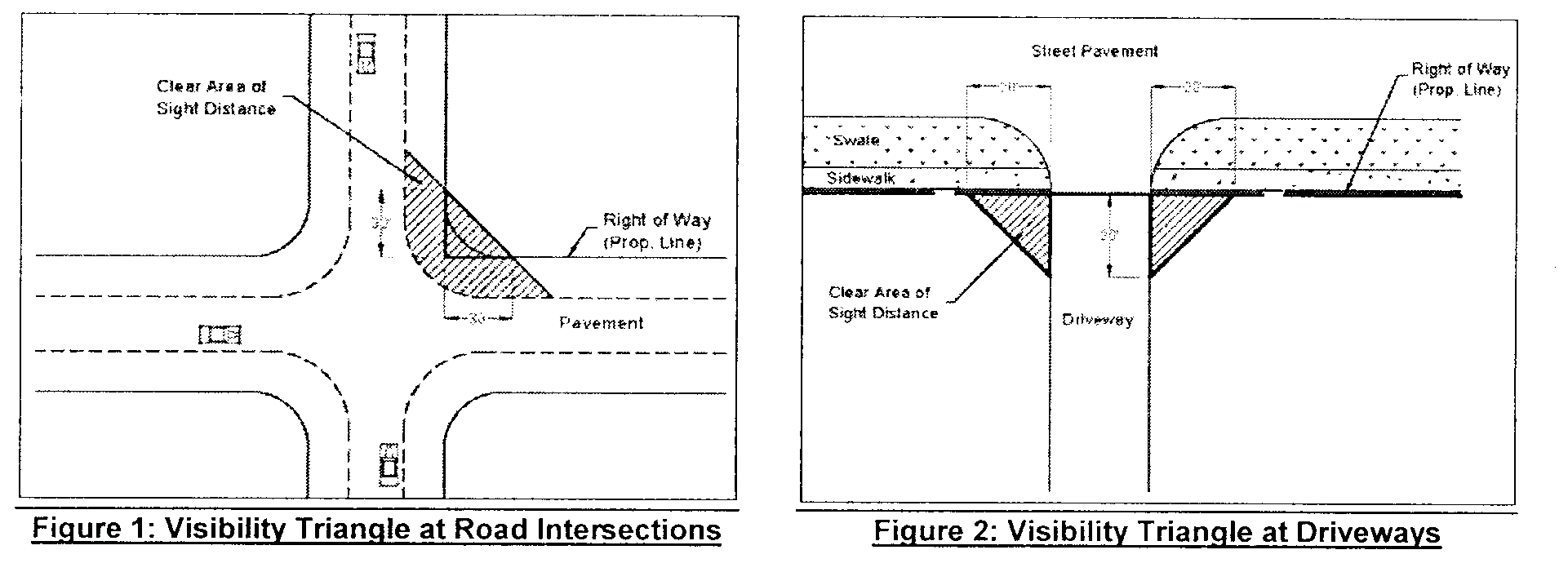
(b)
Trees shall be permitted in the clear space if foliage is cut away within the prescribed heights. Lamp posts and sign posts shall be permitted if illuminating fixtures and sign faces are not within the prescribed clear space.
(Minutes of 12-8-81, § 8; Ord. No. 2014-041, § 1(Exh. A), 11-25-14; Ord. No. 2015-023, § 1(Exh. A), 4-28-15)
Cross reference— Roads and bridges, Ch. 3-6.
Sec. 3-9-90. - Wellhead protection area.
(a)
Purpose and intent. The purpose of the groundwater protection standards is to safeguard the health, safety and welfare of the citizens of the county. Therefore, standards are described in this section with the intent of protecting the groundwater supply. It is further the intent of this section to control development in and adjacent to designated wellheads to protect water supplies from potential contamination.
(b)
Definitions.
(1)
Cone of influence: Area within a four-hundred-foot radius of any wellhead supplying a public water system of a public or private utility company.
(2)
Wellhead protection area: The surface and subsurface area within a one thousand five hundred (1,500) foot radius surrounding a water well supplying a public water system of a public or private utility company through which contaminants are reasonably likely to move towards and reach such well.
(c)
Evaluation process. Prior to the issuance of any permit, an applicant for all commercial and industrial uses within one thousand five hundred (1,500) feet of a wellhead supplying a water system of a public or private utility company shall comply with the following:
(1)
The applicant shall, as a prerequisite, submit an application to the utility authority operating the well or wellfield. The applicant shall describe the means to be used to prevent contamination of the well or wellfield.
(2)
If, after meeting, the applicant and the utility authority are able to arrive at an agreement, the agreement shall be signed by both parties and a copy thereof shall be submitted to the community development department as part of the application for approval. If the application is approved by the community development department, the agreement as submitted by the applicant and the utility authority shall become a part of the approval along with any stipulations placed by the community development department. Any deviations from the terms of approval shall be considered a violation of this Code.
(3)
If the applicant and utility authority are unable to reach an agreement or if any of the parties disagree with any stipulations placed by the community development department, the applicant or utility may appeal to the board of county commissioners. The board of county commissioners shall conduct a public hearing with regard to the appeal, giving notice to both the applicant and the utility authority. In such cases, the applicant shall provide such technical information as may be requested by the board of county commissioners.
(4)
If, through the appeals process, the application is approved by the board of county commissioners, the judgment on appeal shall become a part of the approval along with any stipulations so adopted by the board. Any deviation from the terms of approval shall be considered a violation of this Code.
(d)
Special restrictions on development allowed within the cone of influence as defined in this section.
(1)
Stormwater management practices shall not include drainage wells and sinkholes for stormwater disposal where recharge is into potable water aquifers.
(2)
Where restricted development occurs in areas where existing, but abandoned wells, these wells shall be sealed and plugged in accordance to Rule 17.28, Florida Administrative Code.
(e)
Prohibited uses.
(1)
The following land uses are prohibited within the cone of influence as defined in this section:
a.
Facilities for bulk storage, handling, or processing of materials on the Florida Substance List (F.S. § 442.103) as maintained by the Florida Department of Labor and Employment Security.
b.
Activities that require the storage, use, handling, production or transportation of restricted substances: agricultural chemicals, petroleum products (other than to fuel pumps), hazardous/toxic wastes, industrial chemicals or medical wastes.
c.
Mines.
d.
Excavation of waterways or drainage facilities which intersect the water table.
(2)
The following land uses are prohibited within a one thousand five hundred-foot radius of any wellhead supplying a public water system of a public or private utility company;
a.
Landfills;
b.
Feedlots or other concentrated animal facilities;
c.
Wastewater treatment plants, percolation ponds or similar facilities.
(Ord. No. 98-051, § 1, 7-7-98; Ord. No. 2014-041, § 1(Exh. A), 11-25-14)
Sec. 3-9-91. - Accessory use—Farmers' market.
(a)
The intent and purpose of this section is to provide a venue for local farmers and residents to primarily sell agricultural and organic products; also allowing limited arts and crafts, or other similar goods. However, no services can be sold or provided. This section provides regulations for the establishment of accessory use of farmers' market within certain zoning districts. Unless specifically stated in other sections' of this Code, the following regulations shall apply:
(1)
Farmers' market may be an accessory use to the following primary use, which may be located in PKR RSF, RMF, or PD zoning district:
a.
Clubhouse.
b.
Community garden.
c.
Park, not-for-profit.
d.
Place of worship.
e.
Recreation, indoor.
f.
Recreation, outdoor.
(2)
A special event permit—farmers' market shall only be issued if the following requirements are met and may be renewed every six (6) months:
a.
A layout of this accessory use must be provided, including but not limit to, placement of booths, parking area, location of restroom facilities, location of waste collection, and traffic circulation. ·
b.
Hours of operation of this accessory use shall be limited to 7:00 a.m. to 10:00 p.m., one (1) day per business week, Saturday, and Sunday.
c.
One (1) temporary sign advertising the accessory use may be erected on the property in compliance with section 3-9-85 of the Code.
d.
Traffic control may be required by the county or county sheriff's department and must be arranged and paid for by the applicant.
e.
The applicant may be required to obtain approval from the county's fire rescue and emergency medical services (fire/EMS) department and employ, at the applicant's cost, any mitigation measures required.
f.
The applicant shall be required to obtain an approval from the county's community service department if such accessory use occurs on the county-owned parks or recreational facilities.
g.
The site must be cleared of all debris at the end of this accessory use, and all temporary structures must be removed no later than forty-eight (48) hours after the termination of such accessory use. A signed contract with the county's garbage collection franchisee, or a notarized letter that the property owner/applicant is responsible for the clean-up of the site, may be required as part of the application for the accessory use permit.
h.
A copy of vendor's license is required.
(Ord. No. 2023-016, § 1(Exh. A), 3-28-23)
Sec. 3-9-92. - Reserved.
Editor's note— Ord. No. 2014-041, § 1(Exh. A), adopted Nov. 25, 2014, redesignated the provisions of former § 3-9-92 as a new § 3-9-81.
Sec. 3-9-93. - Reserved.
Editor's note— Ord. No. 2014-042, § 1(Exh. A), adopted Nov. 25, 2014, repealed the former § 3-9-93, which pertained to property frontage and derived from minutes of Dec. 8, 1981; § 8.
Sec. 3-9-94. - Reserved.
Editor's note— Ord. No. 2014-041, § 1(Exh. A), adopted Nov. 25, 2014, redesignated the provisions of former § 3-9-94 as a new § 3-9-83.
Sec. 3-9-95. - Reserved.
Editor's note— Ord. No. 2014-041, § 1(Exh. A), adopted Nov. 25, 2014, redesignated the provisions of former § 3-9-95 as a new § 3-9-85.
Sec. 3-9-96. - Reserved.
Editor's note— Ord. No. 2014-041, § 1(Exh. A), adopted Nov. 25, 2014, redesignated the provisions of former § 3-9-96 as a new § 3-9-86.
Sec. 3-9-97. - Reserved.
Editor's note— Ord. No. 2014-041, § 1(Exh. A), adopted Nov. 25, 2014, redesignated the provisions of former § 3-9-97 as a new § 3-9-89.
Sec. 3-9-98. - Reserved.
Editor's note— Ord. No. 2014-041, § 1(Exh. A), adopted Nov. 25, 2014, redesignated the provisions of former § 3-9-98 as a new § 3-9-88.
Sec. 3-9-99. - Reserved.
Editor's note— Ord. No. 2014-041, § 1(Exh. A), adopted Nov. 25, 2014, redesignated the provisions of former § 3-9-99 as a new § 3-9-90.

