
Charlotte County Unincorporated
City Zoning Code
City Zoning Code
ARTICLE IV
SITE DESIGN STANDARDS AND REQUIREMENTS
Sec. 3-9-100.- Buffers, landscaping, and tree requirements.
(a)
Purpose.
(1)
Buffers. The purpose of the buffering provisions is to establish standards for transitional landscape buffers and screening. Certain uses of property when abutting each other may be incompatible and create conflicts that may be reduced or eliminated by transitional buffers. These standards are intended to provide a comprehensive and consistent, yet flexible framework for providing adequate transitional buffer areas and screening between abutting incompatible uses. These standards are intended to improve the appearance of the county by eliminating or minimizing potential nuisances such as noise, lighting, unsightly buildings and structures, the visibility of outdoor aspects of intensive land uses, and off-street parking and loading areas, as well as assist in soil conservation and the natural control of air and water pollution and ensure the compatibility of different land uses over time.
(2)
Landscaping. The purpose of the landscaping provisions is to establish standards for landscaping areas associated with parking, traffic circulation, and other vehicular use. These standards are intended to provide a comprehensive and consistent, yet flexible, framework for landscaping intended to improve the appearance of the county by creating green space where development occurs, enhance soil conservation and the natural control of air, thermal, and water pollution, and ensure the compatibility of different land uses over time.
(3)
Tree requirements. The purpose of the tree requirements provisions is to establish standards for the planting, preservation, and removal of trees. These standards are intended to provide a comprehensive and consistent, yet flexible framework for tree requirements intended to improve the appearance of the county by encouraging the proliferation of native trees and native vegetative cover, as well as relocation or replacement where necessary, and to control and eliminate invasive non-native species. Protection of trees and native vegetation is intended to promote carbon dioxide absorption, oxygen production, dust filtration; reduction of noise, wind, and glare; soil stabilization and enrichment; erosion prevention, surface drainage improvement and aquifer recharge; water pollution reduction, wildlife habitat, energy conservation, temperature moderation, the economic enhancement of improved and vacant lands; scenic beauty, quality of life, and the health, safety, welfare, and well-being of the county.
(b)
Definitions. Unless otherwise specifically stated in this section, or unless otherwise clearly indicated by the context, the following terms when used in this section shall have the meanings indicated as follows:
Abutting: see "Adjacent".
Access aisle: the principal means of vehicular ingress and egress to abutting property from a street, right-of-way, or easement.
Active use park: all recreational parks with the exception of those used primarily as nature trails, mitigation banks, or for environmental study and interpretation.
Adjacent: contiguous, next to. When determining whether one (1) land use or zoning district is adjacent to another, the existence of an intervening natural or manmade waterway (measured between mean high water lines or apparent high water lines), drainage facility, greenbelt, alley, or right-of-way which, alone or in combination are less than two hundred (200) feet in width, shall not be considered and the properties shall be treated as adjacent.
Alley: any public or private right-of-way intended to be used as a secondary means of access or service to abutting properties and not intended for general traffic circulation.
Barrier. a durable opaque structure or hedge at least three (3) feet high used within the parking lot screening or decorative perimeter landscaping.
Buffer: the area required to be constructed and maintained as provided in section 3-9-100.1.
Caliper: the diameter of a tree trunk, in inches, measured at twelve (12) inches above the existing grade.
Damaged tree: a tree that has been wounded (bark scraped or removed, canopy topped, limbs removed or shattered, roots cut or crushed) to an extent that survival is unlikely.
Decorative perimeter landscaping: the planted space between the right-of-way and that part of the perimeter of the property not used as parking area.
Department: the Charlotte County Community Development Department.
Development or development activity: any non-agricultural activity that may include the following:
a.
Clearing, scraping, mulching, grinding, or removing tree(s) or vegetation from a site.
b.
Adding, removing, exposing, excavating, leveling, grading, digging, burrowing, dumping, piling, dredging, grubbing, or otherwise significantly disturbing the soils of a site.
c.
The construction, reconstruction, conversion, structural alteration, relocation, or enlargement of any structure; and mining, excavation, landfill, or land disturbance, and any use or extension of use of the land.
Development site: that portion of a lot or parcel upon which development occurs.
Diameter at breast height (DBH): the diameter of the tree trunk measured at fifty-four (54) inches from the existing grade. Multi-trunk trees are also measured at fifty-four (54) inches and the diameters of each trunk are cumulative.
Drip line: the outermost perimeter of the crown of a tree as projected vertically to the ground.
Establishment period: the time between planting and new root growth. During the establishment period, regular supplemental watering to the root zone is required.
Florida-friendly landscaping: use of low-maintenance native plants and environmentally-sustainable landscaping practices that help to preserve Florida's natural resources and protect the environment.
Groundcover: low growing plants, other than turf grass, normally reaching an average maximum height of not more than twenty-four (24) inches at maturity, planted in such a manner as to form a continuous cover over the ground.
Hedge: a row of closely planted shrubs intended and designed to form an interlocking, continuous boundary or screen.
Heritage tree: a tree and its root system within the Cypress (Taxodium spp.), Oak (Quesrcus spp.), and Pine (Pinus spp.) species which has a minimum thirty-inch trunk diameter at DBH. In the case of multi-stemmed trees where there is a union of wood above grade, the DBH shall be measured at each stem and added together to reach a minimum of a forty-five-inch diameter.
Landscaping: grass, ground cover, mulch, shrubs, vines, hedges, trees, berms, and complementary structural landscape features such as rock, foundations, sculpture, decorative walls and tree wells.
Mulching: the cutting, grinding, bush-hogging, chipping and/or mowing of underbrush and understory vegetation, exotic vegetation, and any trees under four (4) inches DBH. Clearing, filling, soil excavation and/or removal of trees over four (4) inches DBH is not considered mulching.
Native tree: any individual tree listed as a native species listed in Exhibit 8: List of Approved Tree Species. Damaged trees do not qualify as native trees for the purposes of planting or preservation.
Native tree replacement fund: a fund established to provide money for the purpose of planting trees on government-owned properties.
Native vegetation: any plant species with a geographic distribution indigenous to the southwest region of Florida.
Natural ground level: the elevation and grade of the parcel that existed prior to development activity.
No tree affidavit: a signed, notarized statement by the landowner or their agent stating that no trees exist upon the site.
Outdoor storage yard: any use of property where items such as boats, vehicles, recreational vehicles, contractor supplies, construction materials and other similar items are stored in other than a completely enclosed building.
Parking area: the total area designated on the landscape plan for the off-street parking of vehicles, including vehicles held for sale, and includes driveways, ingress and egress lanes, specialized vehicular use areas, walkways, and aisles.
Parking lot screening: the planted space between the right-of-way and the parking area.
Perimeter landscape strip: the planted space between a right-of-way and subject property. The term includes parking lot screening and decorative perimeter landscaping.
Planted tree: a tree which has been nursery grown for resale or otherwise transplanted.
Preserved tree: a tree preserved on-site which has been barricaded or is located one hundred (100) feet or more from the farthest point of development and will count towards a development's minimum tree requirement.
Prohibited tree: a tree of undesirable or exotic species which disrupts natural habitats or are otherwise destructive. Trees listed as Category I Invasive Species on the most recent edition of the Florida Exotic Pest Plant Council's Invasive Plant List shall be prohibited. Trees listed as Category II Invasive Species are highly discouraged and cannot be counted towards a development's minimum tree requirements. Trees listed as Category I Invasive Species shall be removed during site preparation.
Screening: fences, walls, berms, trees, shrubs, vegetation or a combination of any of these items used as visual buffering devices.
Shrub: a woody plant of relatively low height distinguished from a tree by having several stems rather than a single trunk; any self-supporting, woody, evergreen and flowering perennial plant (excluding prohibited plants) characterized by multiple stems growing continuously from the base.
Sight triangle: the triangular area at the intersection of two (2) vehicular travel ways where a driver's vision of oncoming traffic must remain unobstructed. Such sight triangles shall consist of two (2) thirty-foot segments running at the edge of the right-of-way which meet at the intersection, and the third side is the line connecting the ends of the thirty-foot segments farthest from the intersection. For driveways, sight triangles shall consist of two (2) twenty-foot segments running at the property line, and the third side is the line connecting the ends of the twenty-foot segments farthest from the intersection. There shall be a clear space with no obstruction to vision between a height of two (2) feet and six (6) feet above grade. The county engineer may approve alternative sight triangles under circumstances where the requirements of this section cannot be met.
Site improvement: the structure(s), infrastructure, and utilities located on a site.
Site plan review (SPR): Staff review of development applications, formerly known as development review committee (DRC).
Specialized vehicular use areas: areas used for new or used motor vehicles, equipment, boats, local and inter-urban passenger bus terminals and service facilities, and motor freight terminals and loading docks. The term does not include areas set aside for access, employee parking, or areas open to public parking.
Spiking or spurring: the use of any metal gaff device to aid in tree climbing in order to remove branches, limbs, or leaves from a tree.
Topping: also known as "stubbing," "heading," "heading-back," "stubbing off," "tipping," "hatracking," "topping-off," "dehorning," "lopping," "roundover," "cut-over", "lollipopping;" trimming of limbs to stubs larger than three (3) inches in diameter within the tree's crown to such a degree as to remove the normal canopy and disfigure the tree. This practice is strictly prohibited.
Tree: a self-supporting woody plant, or palm with six (6) feet of clear trunk, of a species normally growing to a mature height of at least fifteen (15) feet.
Tree, canopy: trees listed in Exhibit 8, which typically grow to a minimum of thirty (30) feet in height at maturity.
Tree, understory/accent: trees listed in Exhibit 8, which typically do not exceed twenty (20) to thirty (30) feet in height at maturity.
Tree points: a number calculated according to Exhibit 5: Tree Points, located in section 3-9-100.3, tree requirements.
Vegetation: the plant life in a particular area or region.
Vines: any of a group of woody or herbaceous plants which may climb by twining, by means of aerial rootlets, or by means of tendrils, or which may simply sprawl over the ground or other plants.
(c)
Applicability.
(1)
The provisions of this section shall apply only in the unincorporated areas of Charlotte County. For the purposes of buffering, landscaping, and tree requirements, all residential properties consisting of three (3) or more units shall be considered multi-family properties, regardless of ownership, and are subject to the provisions of this section.
(2)
The provisions of this section shall not be construed as prohibiting additional trees, plant material, screening, or buffering beyond that which is required by this section or to prohibit the improvement of landscape buffers existing on the effective date of this section.
(3)
Properties that require buffers and landscaping may not "buy out" the tree points.
(4)
Whenever both perimeter landscaping and a buffer are required on the same location on a parcel, the more intensive requirements apply.
(d)
Landscape plan.
(1)
Florida-friendly landscaping design principles shall be employed in all landscape plans.
(2)
All applicants subject to the provisions of this section shall submit a landscape plan as required by the department. The number of copies to be submitted shall be determined by the department.
(3)
The landscape plan must be approved prior to the issuance of the associated building permit.
(4)
For development requiring site plan approval, the landscape plan shall be submitted with or prior to the application for preliminary approval and must be approved prior to final site plan approval.
(5)
Landscape plans shall:
a.
Be signed and sealed by a registered landscape architect as defined by F.S. ch. 481.
b.
Be drawn to scale, including all dimensions, distances, and acreage;
c.
Show the square footage and location of the existing and proposed parking spaces, specialized vehicular use areas, access aisles, and driveways;
d.
Indicate all utility and drainage easements, existing and proposed underground and overhead utility lines, buildings, structures, stormwater retention and detention areas, and similar features;
e.
Indicate all abutting public rights-of-way;
f.
Identify the zoning of the subject property and all adjacent parcels;
g.
Indicate the type, location and features of the irrigation system for the required landscaping, including times, sensors, zones, and water source as applicable;
h.
Provide an irrigation narrative on the landscape plan stating the features used to provide for the efficient use of water including: sensors which prevent watering during rain or when the ground is saturated, timers to water during optimal watering hours, and placement of vegetation in zones based on watering needs as applicable;
i.
Identify and describe the location and characteristics of all landscape materials to be installed including the square footage and dimensions of all planters and landscape islands;
j.
Show all landscape features, including areas of vegetation required to be preserved, in context with the location of existing and proposed buildings and other improvements on the site;
k.
Indicate in table format the number, species, and caliper of trees to be planted, preserved, and/or removed, the gross acreage of the development site, and the square footage of paved areas;
l.
Show all measures taken to protect landscape elements from damage caused by vehicles, including curbing, edging, wheel stops, raised planting surfaces, and other protective measures;
m.
Indicate proposed grades if existing vegetation is to be retained within the buffer;
n.
Show all measures to be taken to alter any greenbelts, easements, native shoreline or riparian vegetation which is being used to satisfy the requirements of this section;
o.
Graphically show sight triangles, per section 3-9-89, visibility at road intersections.
(6)
Due to unique circumstances, the above requirements may be modified during a landscape plan review meeting with the zoning official or his/her designee.
(e)
Installation standards.
(1)
All landscaping shall be installed in conformance with the landscape plan approved by the department or site plan review final approval.
(2)
All landscaping required by this section (except sod) shall be installed by persons or entities properly licensed or qualified pursuant to article I, chapter 3-2, buildings and building regulations, of the County Code of Ordinances.
(3)
All landscaped areas and buffers shall be protected from vehicles by curbing or wheel stops (minimum five (5) inches in height) when adjacent to pavement. In addition, the department may approve the limited use of durable barriers, such as bollards and boulders.
(4)
Tree pruning shall be conducted according to the most recent edition of the National Arborist Association standards.
(5)
It is unlawful to top any tree regardless of development approval date.
(6)
Landscaping shall not interfere with or obstruct existing or proposed overhead or underground utilities.
(7)
The property owner may choose to postpone installation of the required landscaping and/or buffering to the rainy season (June through October). In order to request this one-time option, the owner may submit a notarized affidavit to the zoning official stating that they choose to postpone the installation and understand that the landscaping and/or buffering must be installed as specified in the approved landscape plan by a specific date approved by the zoning official. No extensions shall be granted. The owner shall be responsible to ensure stabilization of the site until such time as the landscaping is installed. Site stabilization may be accomplished by utilizing seed and mulch or other alternative methods, as may be approved by the zoning official.
(f)
Planting standards.
(1)
All plants, except transplanted plants, shall meet or exceed the quality standards for Florida No. 1, as provided by Grades and Standards for Nursery Plants, Parts I and II, most recent edition, State of Florida, Department of Agriculture, Tallahassee.
(2)
Trees used for points must have a minimum diameter (as measured by caliper or forestry diameter tape) of two (2) inches measured at twelve (12) inches above the existing grade, have a minimum height of eight (8) feet at installation, and be listed on Exhibit 8: List of Approved Tree Species. Trees not on the approved tree list may be counted for points at the discretion of the zoning official or his/her designee.
(3)
Palms used for points must have a minimum of six (6) feet of clear trunk and be listed on Exhibit 8: List of Approved Tree Species.
(4)
Required trees not needed for tree points must:
a.
Have a minimum diameter, measured by caliper or forestry diameter tape, of one (1) inch measured twelve (12) inches above the soil line;
b.
Have a minimum height of six (6) feet at installation; and
c.
Be listed on Exhibit 8: List of Approved Tree Species, or be approved by the zoning official or his/her designee.
(5)
When more than ten (10) trees are required, a mix of species shall be planted as provided in the table below. No individual species shall comprise more than sixty (60) percent of the tree species mix. This subsection does not apply to areas of vegetation which have been preserved in the natural state.
Exhibit 1: Tree Species Mix
(6)
Shrubs and hedges for decorative perimeter and interior landscaping must be a minimum twelve (12) inches in height upon planting, be spaced eighteen (18) to thirty-six (36) inches on center determined by the type of plant used, and be of the type that reach at least twenty-four (24) inches on maturity.
(7)
Hedges for parking lot screening and buffers must be a minimum eighteen (18) inches in height upon planting, be spaced and maintained in order to form a continuous, solid visual screen within one (1) year of planting, and be of the type that reach at least forty-eight (48) inches on maturity.
(8)
Hedges used to replace an existing buffer wall must be at least four (4) feet tall (ten-gallon plant) at installation.
(9)
Vines shall be a minimum of twenty-four (24) inches in height at time of planting.
(10)
Groundcover shall be planted in such a manner as to present a finished appearance, provide soil stabilization and shall be used with mulch if the ground is not completely covered by the groundcover at the time of planting. The height and size (gallon) of groundcover do not have to be designated on the landscape plan.
(11)
Grass.
a.
Areas to be planted with grass may be sodded, plugged, sprigged or seeded using strains that are drought-resistant or require minimal watering.
b.
Solid sod must be used in swales and other areas subject to erosion, including retention and detention ponds. Detention pond floors may be seeded.
c.
Seeded areas must be sufficiently seeded to produce a ground cover within thirty (30) days.
(12)
All clearing, grading, installation and site preparation shall be done in accordance with this Code.
(13)
Existing vegetation used to meet the requirements of this section shall be protected by the measures provided in section 3-9-100.3, tree requirements.
(14)
Where overhead power lines exist or are planned, the required canopy trees shall be replaced with trees approved for planting under power lines, as shown on Exhibit 7: Recommended Trees for Planting Under Power Lines.
(15)
Alterations to landscaping and buffers require the prior written permission of the department.
(16)
It is unlawful to plant any of the prohibited species identified as Category I in the most recent edition of the Florida Exotic Pest Plant Council's List of Invasive Plant Species. In addition, all prohibited species must be removed during site preparation.
(17)
For landscaping purposes, trees found in the most recent edition of the "Florida-Friendly Landscaping Guide to Plant Selection and Landscape Design," produced by the University of Florida/IFAS but not listed in Exhibit 8: List of Approved Tree Species may be permitted at the discretion of the zoning official or his/her designee. The applicant must demonstrate that the trees are appropriate for the location. These trees may be considered for tree points.
(g)
Maintenance.
(1)
Plantings, fences, walls, berms and irrigation systems required by this section must be maintained in good repair. Landscaped and buffer areas must be kept free of weeds, litter and debris.
(2)
Damage to any of the landscaping or structures required by this section shall be replanted or replaced, as applicable, within ninety (90) days or one (1) growing season, whichever is sooner. Damage to a required fence or wall by a natural disaster shall be repaired within one hundred eighty (180) days.
(3)
It is unlawful to violate any of the provisions of this section.
(4)
The department may enforce compliance with this section as provided by law and may perform reasonable inspections to insure continued compliance.
(5)
All required landscaping and buffers may be served by an automatic irrigation system designed to eliminate the application of water to impervious areas and reduce impacts to existing native vegetation. All required landscaping and buffers shall be irrigated during the establishment period. The applicant may use a temporary irrigation system or hand watering if the applicant can demonstrate that such an approach will provide adequate water for plant survival. All alternative plans of irrigation must be approved by the zoning official or his/her designee.
(6)
Tree pruning shall be conducted according to the most recent edition of the National Arborist Association Standards.
(h)
Florida-friendly landscaping.
(1)
Florida-friendly landscaping is based on xeriscaping principles and has as its purpose reducing water consumption while enhancing both the beauty and hardiness of Florida landscaping. By proper design choices, a Florida-friendly landscape requires less irrigation and makes better use of the water it does receive. While there is no single fixed Florida-friendly landscape, all Florida-friendly landscapes share a set of design principles. Proposed landscape plans shall be considered based on the following "Florida-friendly" principles.
(2)
Design principles.
a.
Design with awareness of site conditions. Plants should be chosen that are suited to existing site conditions ("the right plant in the right place"). Soil amendments or terrain features can be added to create favorable conditions for plants that would not ordinarily thrive on the site. Native plants have a proven track record of thriving under native conditions with little or no supplemental water. The selection of drought tolerant plants will ensure a drought tolerant landscape even if severe water restrictions are imposed.
b.
Group plants according to their water requirements. Physically concentrating high water usage plants, medium water usage plants, and low water usage plants in separate areas will allow the design of high, medium, and low water usage zones that provide the plants with the necessary amount of water, while minimizing waste.
c.
Take steps to retain moisture in the soil. Use of organic mulches, such as pine straw, instead of inorganic materials, such as crushed rock, will promote the absorption of water by the soil as well as enhance water retention. Shade provided by established canopy trees reduces evaporation and allows a moist local environment. Avoid watering in the heat of the day to minimize evaporation. Amend fast draining sand soils with organics such as peat to enhance water retention. Careful application of irrigation with properly sized, adjusted, and timed irrigation heads will minimize water loss through evaporation, run-off, and excessive saturation.
d.
Minimize the high maintenance costs of the landscape. Devoting less area to turf grass, using it as an accent rather than the main emphasis of the landscape, will reduce water use, maintenance costs, pesticide costs and fertilizer costs. Low maintenance trees and shrubs cost less in long term maintenance and resources as well as offering possibilities of more attractive designs.
e.
Florida-friendly design principles shall be employed in all landscape plans.
(i)
Completion bond.
(1)
A certificate of occupancy (C.O.), or release from the completion of the fulfillment of the requirements of this section, may be obtained prior to the completion of the required perimeter landscaping or landscape buffer upon the posting of a cash bond in favor of the county.
(2)
The bond shall be equal to one hundred ten (110) percent of the value of the required landscaping and buffer which remains to be completed.
(3)
The bond will be forfeited to the county if the remaining required landscaping is not completed within ninety (90) days of the issuance of the C.O. or release.
(4)
The department director may, upon consideration of site-specific or other extraordinary circumstances, extend the period of time for completion of the landscaping for not more than an additional one hundred eighty (180) days.
(5)
Those property owners who have chosen to postpone the installation of their required landscaping and/or buffering to the rainy season in accordance with section 3-9-100(e)(7) shall be exempt from this section of the Code.
(Ord. No. 2015-018, § 1(Exh. A), 4-28-15; Ord. No. 2015-055, § 1(Exh. A), 12-8-15)
Sec. 3-9-100.1. - Buffers.
(a)
Applicability.
(1)
The requirements of this section shall apply to all new development.
(2)
Whenever additions to existing buildings, structures, or parking are constructed, the requirements of this section apply if:
a.
The square footage of the addition(s) exceeds fifty (50) percent of the square footage of the existing improvement(s), or
b.
The estimated cost of the addition(s) or improvement(s) exceeds fifty (50) percent of the appraised value of the existing improvement(s).
c.
Whenever the application of the strict requirements of this section to the renovation, restoration, reuse, or rehabilitation of property developed prior to June 20, 2001, will result in the loss of other site improvements required by this Code, the zoning official or his/her designee may approve a site-specific buffer plan which best meets the purpose and intent of these buffer requirements.
(b)
Exemptions.
(1)
Private recreational facilities constructed for use by the residents of a development when the facility is located in the interior of the development.
(2)
Buildings and structures for emergency and essential services, as determined by the board of county commissioners (BCC) its discretion.
(3)
Property which is separated from the adjacent property by more than two hundred (200) feet of waterway, right-of-way, greenbelt, drainage facility, or combination thereof, is exempt from the required zoning buffer, but not from perimeter landscape strips, as applicable.
(c)
Types of buffering.
(1)
The minimum buffer requirements pursuant to this section shall be as provided in Exhibit 3: Buffer Type Illustrations, unless otherwise specifically provided in this section.
(2)
Greenbelts, easements, native shoreline and riparian vegetation may be used to satisfy the requirements of this section if:
a.
The plant materials and density comply or can be altered to comply with the requirements of this section;
b.
The greenbelt, easement, native shoreline or riparian vegetation can be maintained in accordance with the provisions of this section; and
c.
The applicant provides written authorization from all persons or entities having an ownership interest in the greenbelt, easement, native shoreline or riparian vegetation for the use and maintenance of the area as a buffer.
(3)
On-site plantings outside the required buffer area may be used to satisfy the requirements of this section to the extent that the plantings are located within the distance of three (3) times the width of the required buffer measured from the closest edge of a required buffer location.
(4)
Mangroves growing below the mean high water line, or waterward of a seawall or bulkhead, may be used to satisfy the requirements of this section, provided:
a.
Such mangroves are under the ownership and control of the owner of the site being developed, or
b.
The applicant has provided to the department the written consent of the owner of the site on which the mangroves are located, or authorized representative thereof, to the use of the mangroves as an off-site buffer.
c.
The canopies of the mangrove trees extend to no less than six (6) feet above the final graded elevation of the portion of the property on which the buffer is established.
(d)
Special provisions.
(1)
The perimeter of all outdoor storage yards shall be buffered with a Type D buffer regardless of the width of any adjacent road or easement. No buffer is required on interior lot lines abutting IG or II zoning districts.
(2)
The buffering required by this section shall be included in all planned developments (PD), as determined as part of the PD rezoning process.
(3)
The requirements of this section shall apply to property being used under the authority of a special exception. The type of buffering required will be established as a part of the special exception process.
(4)
Land uses for which a buffer type is not specifically provided for in this section shall be buffered at the level most likely to achieve the stated purpose of this division at the discretion of the zoning official or his/her designee.
(e)
Installation standards.
(1)
Buffers areas shall be placed adjacent to the lot lines except:
a.
Where necessary to avoid obstructions within the sight triangle;
b.
At approved ingress and egress lanes;
c.
Where easements or covenants regarding the use of the land prohibit such placement; or
d.
Where natural features of the land prevent such placement.
(2)
Buffer areas may not be located on any portion of an existing or dedicated right-of-way or roadway easement.
(3)
No development or impervious surface is permitted within the required buffer.
(4)
No grading, development, or land-disturbing activities are permitted within the buffer unless approved by the department.
(5)
Stormwater detention or treatment areas may not occupy more than fifty (50) percent of the width of the buffer; provided however that this restriction does not apply to parcels less than or equal to ten thousand (10,000) square feet.
(6)
Buffer areas may be used for passive recreation, sitting areas, and pedestrian and bicycle paths, provided, in the case of paths, that the width of the buffer is increased by the width of the path wherever the path is located and all other requirements of this section are met.
(7)
Buffer areas may be used for utility placement but only if:
a.
No canopy tree will be displaced or damaged by the installation or maintenance of the utility; and
b.
The applicant has produced written evidence that the utility has granted authority for such use;
(8)
Buffers must be maintained in compliance with this section.
(9)
Plants and trees shall be installed in a uniform manner as depicted on the approved landscape plan.
(10)
Retaining existing native trees and vegetation within a buffer is encouraged unless a grade change exceeding six (6) inches is required.
(11)
All prohibited plant species identified as category I invasive species in the most recent edition of the Florida Exotic Pest Plant Council's List of Invasive Plant Species must be removed from the developed site during development or phase thereof.
(12)
Existing native trees listed in Exhibit 8: List of Approved Tree Species, may be used to meet the buffer plant material requirements if properly preserved as provided in section 3-9-100.3, tree requirements.
(13)
Berms must be graded to appear smooth, rounded and natural; slopes must not exceed a slope ratio of 3:1.
(14)
Whenever a berm wall is required, the wall shall be located between the berm and the higher intensity use. Berm walls required by this section are exempt from zoning setbacks requirements.
(15)
The finished side of the fence or wall required by this section, and at least seventy-five (75) percent of the required plant material, shall face the property zoned or used for less intensive uses.
(16)
Fences and walls used to meet buffering requirements shall be:
a.
A minimum of six (6) feet in height from finished grade;
b.
Opaque;
c.
Decorative; and
d.
Be made of one (1) of the following: concrete aggregate, stucco finish (either painted or colored), brick, stone, wood, vinyl, or plastic.
(17)
For the purpose of use within required buffers, chain link fences and walls constructed of bare concrete block, even if painted, are prohibited.
(18)
Gates are allowed in fences and walls, provided such gates are opaque and remain closed when not in use.
(19)
Walls and fences may be constructed in separate segments provided all other provisions of this section are met.
(20)
In order to reduce a "walled in" effect, a hedge planted and maintained at a minimum of four (4) feet in height may be substituted for a required fence or wall when the required buffer faces a road.
Exhibit 2: Table of Minimum Buffer Requirements
Exhibit 3: Buffer Type Illustrations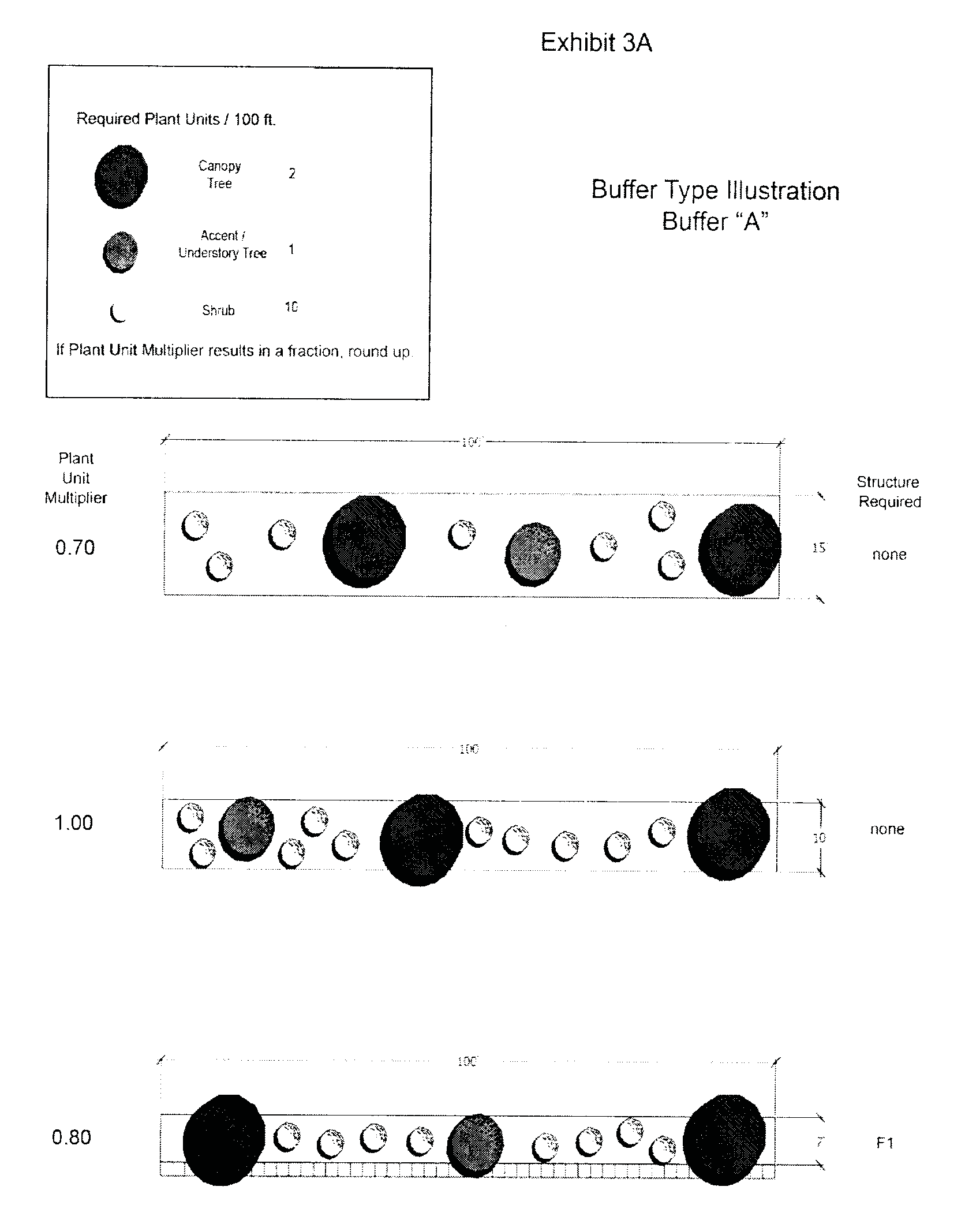
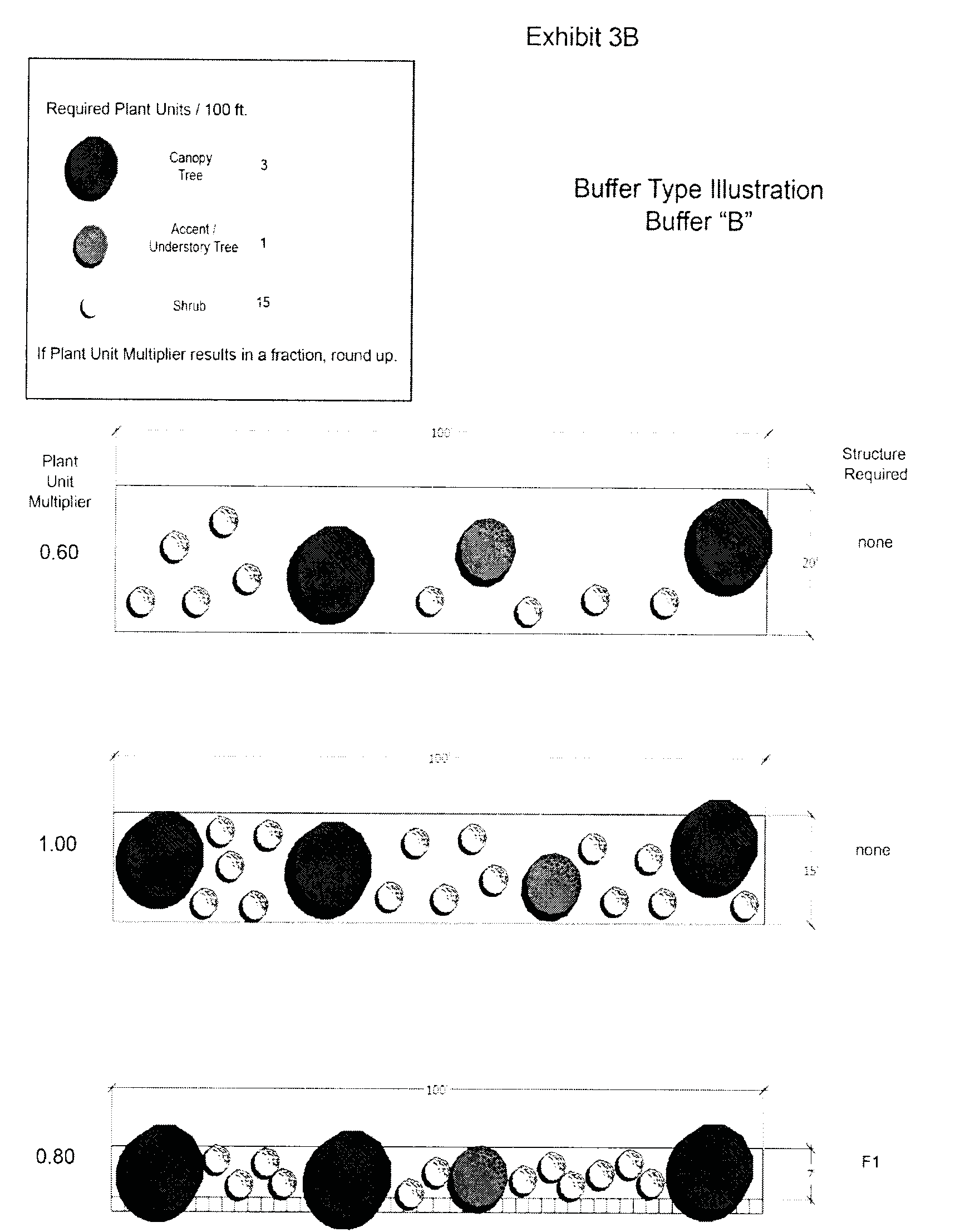
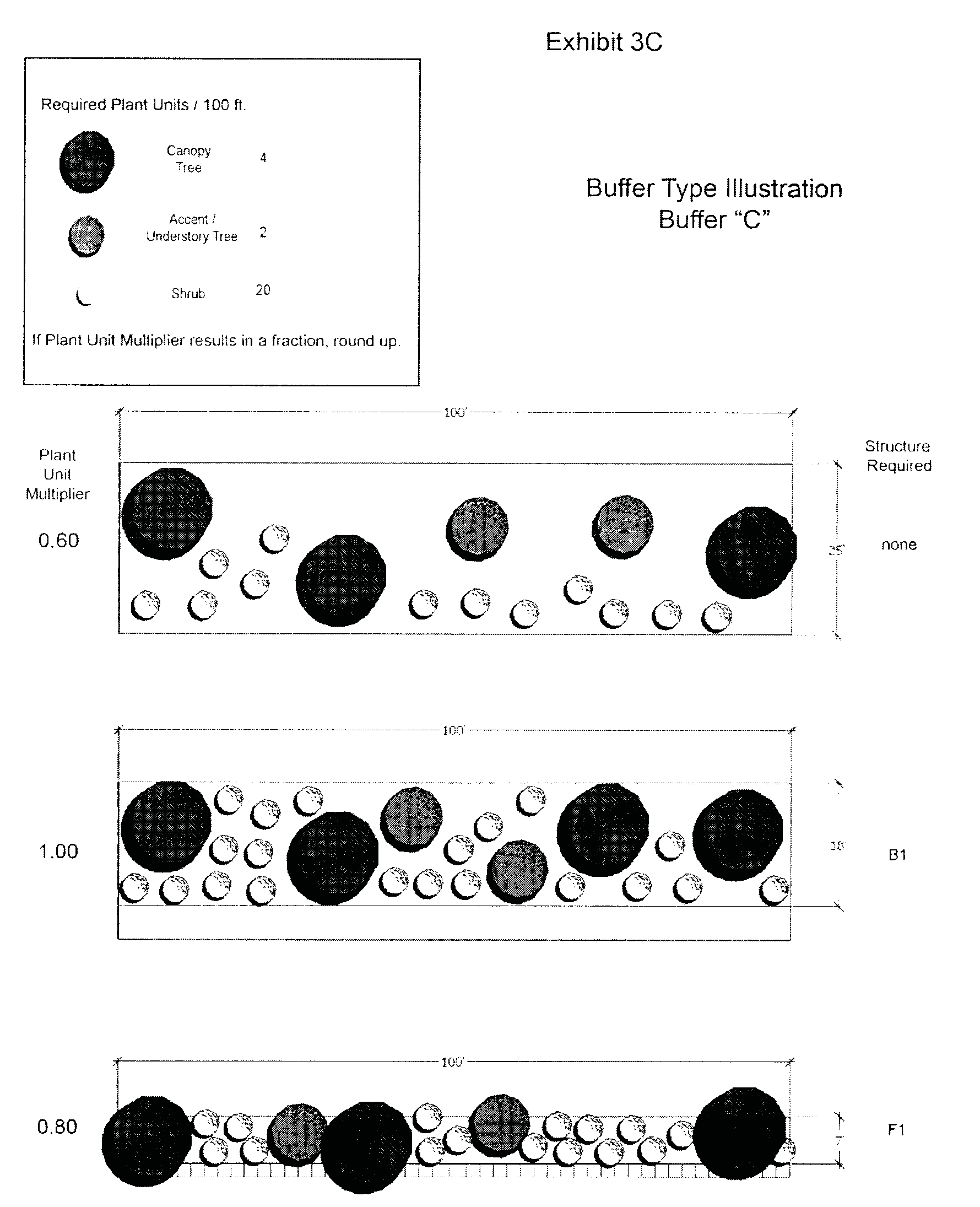
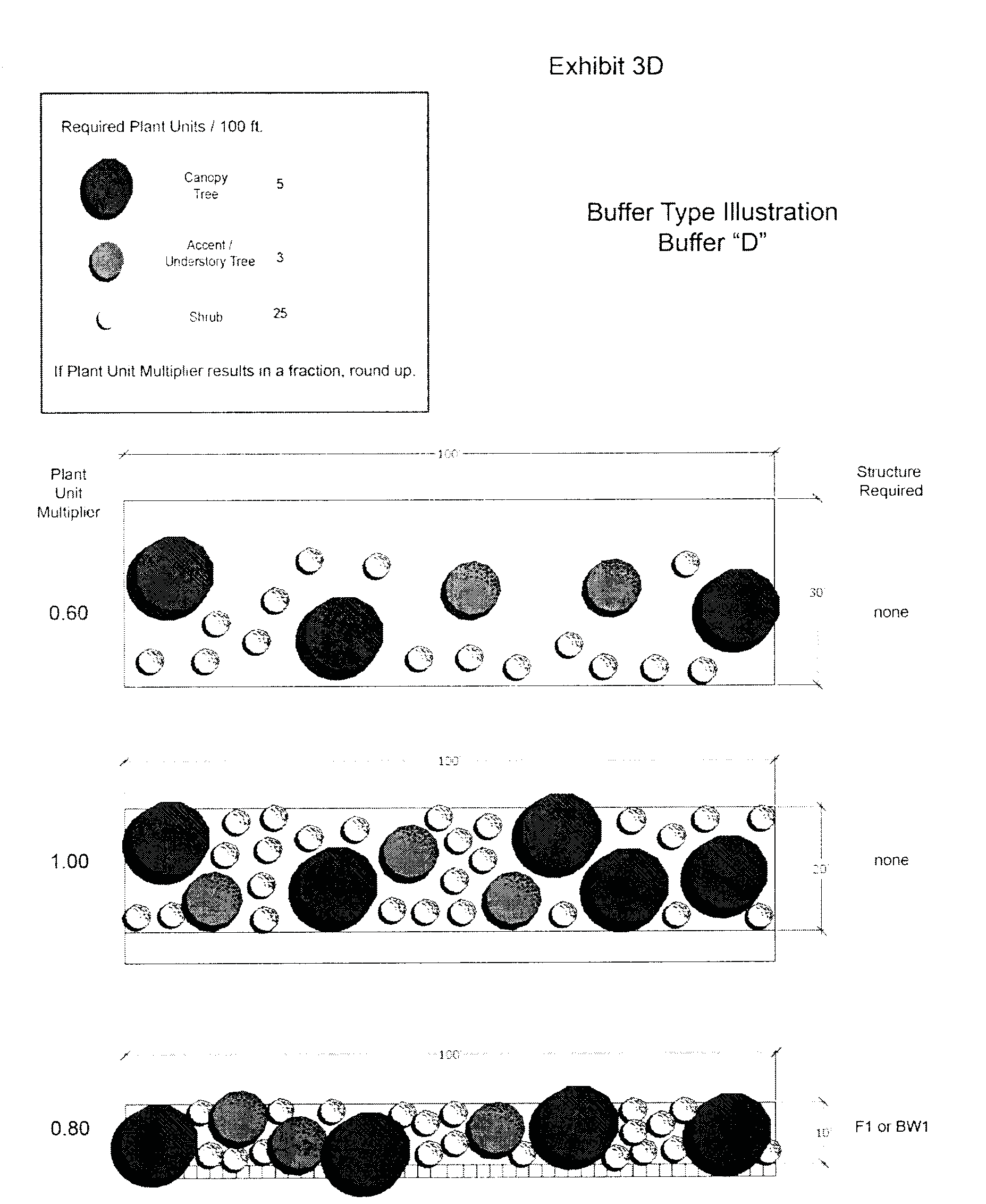
Exhibit 4: Berms, Berm Walls, and Fences Illustrations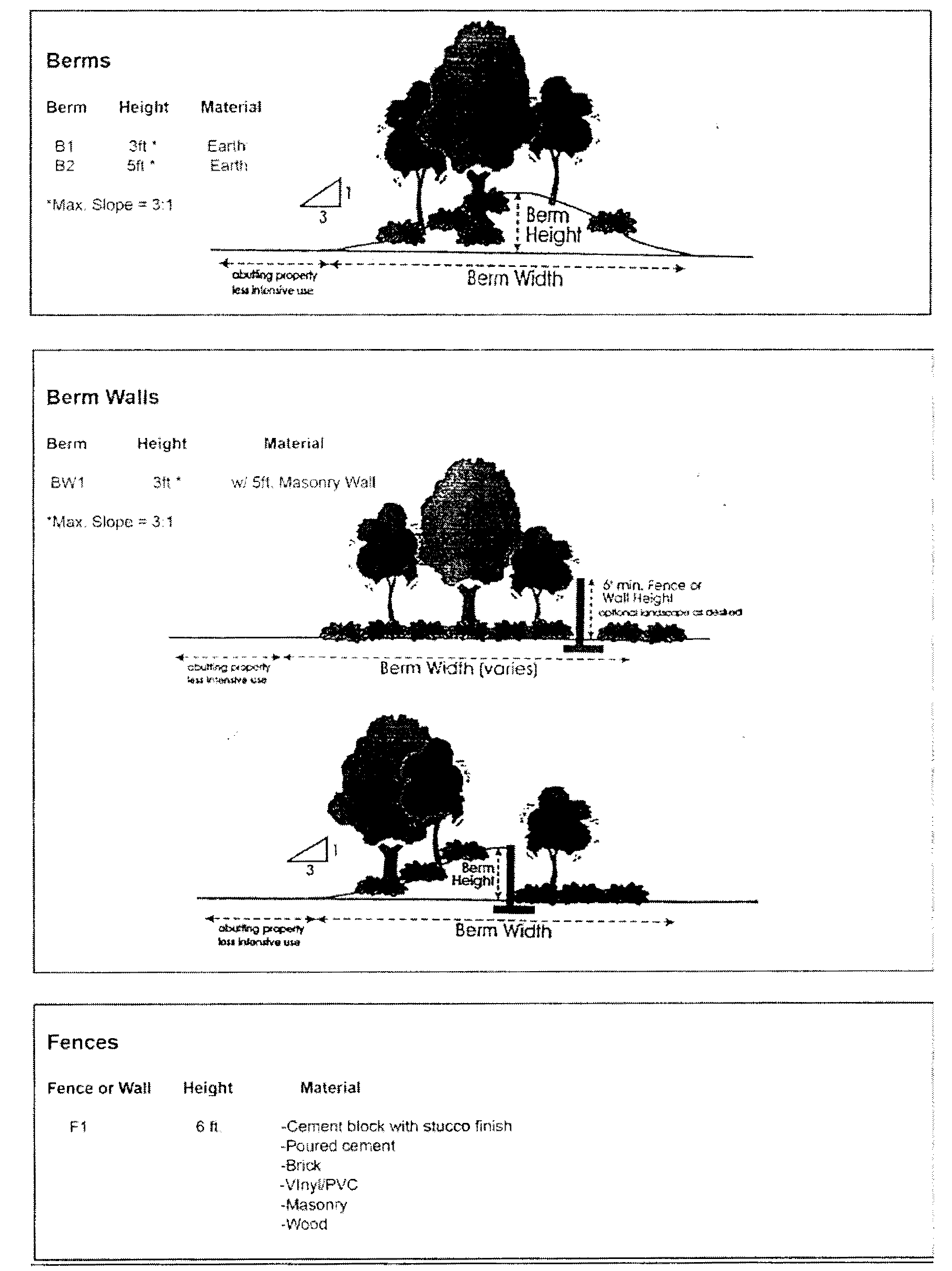
(Ord. No. 2015-018, § 1(Exh. A), 4-28-15; Ord. No. 2015-055, § 1(Exh. A), 12-8-15; Ord. No. 2024-008, § 1(Exh. A), 3-26-24)
Sec. 3-9-100.2. - Landscaping.
(a)
Applicability.
(1)
The requirements of this section shall apply whenever parking area is constructed.
(2)
The provisions of this section do not apply to:
a.
Paved areas used for parking and other vehicular uses that serve single-family residences or two-family residences, or
b.
Paved areas associated with permitted principal uses within the agricultural and excavation and mining zoning districts (AG and EM).
(3)
The following improvements do not cause the property to be subject to the requirements of this section:
a.
Overflow grass parking.
b.
Existing parking areas that are re-striped.
c.
Buildings and structures for emergency and essential services as determined by the BCC at its discretion.
(4)
Parking lot screening shall be required whenever there is construction of paved parking areas abutting a public right-of-way.
a.
Paved parking areas are those areas used for parking, storage or display of vehicles, boats, construction equipment, or similar manufactured items, including those accessory areas, adjacent to parking, used for ingress, egress or traverse.
b.
A parking area is considered paved if it has been improved from the natural state by any hard surface including asphalt, concrete, gravel, marl, or shell.
c.
Existing parking areas that are scarified must comply with the provisions of this section.
(5)
Decorative perimeter landscaping shall be required wherever property improved by other than a paved parking areas abuts the public right-of-way.
(6)
Perimeter landscape strips and interior landscape areas required by this section shall be landscaped with grass, ground cover, or other approved permeable landscaping treatment in accordance with Florida-friendly design principles, provided:
a.
Pavement and sand are not considered approved landscape material.
b.
The use of sand, rock, and aggregate are appropriate only as part of a decorative design and is subject to approval by the department.
c.
The use of non-decorative rock and aggregate for drainage purposes is permitted, but does not count toward meeting the requirements of this section.
(b)
Perimeter landscaping.
(1)
In general.
a.
Areas abutting public rights-of-way shall be screened from public rights-of-way by a perimeter landscape strip at least eight (8) feet in width.
b.
For parcels smaller than twenty thousand (20,000) square feet, the perimeter landscape strip width may be reduced to five (5) feet provided there is a minimum of three (3) feet of pervious surface adjacent to the perimeter landscape strip.
c.
For the purposes of this section, ingress and egress lanes act to separate perimeter landscape strips, and the width of ingress and egress lanes is excluded when determining the length of perimeter landscape strips.
d.
One (1) tree is required for every thirty-five (35) feet, or fraction thereof, of perimeter landscape strip. Trees within a section of perimeter landscape strip may be grouped, but the distance between trees in a section shall not exceed fifty (50) feet.
(2)
Parking lot screening.
a.
In addition to the requirements of section 3-9-100.2(a), wherever parking areas abut public rights-of-way, a hedge or durable non-vegetative barrier, or combination thereof, at least three (3) feet in height shall be placed along the entire length of the perimeter landscape strip, except within sight triangles.
b.
Earthen berms may be used as non-vegetative barriers but shall not exceed a slope ratio of 3:1 (horizontal to vertical) and shall be stabilized with sold, landscaping, or other aesthetic treatment.
c.
Whenever non-vegetative barriers are employed, a minimum of one (1) shrub or vine shall be planted for every eight (8) linear feet, or fraction thereof. Plantings may be distributed evenly or in clusters.
d.
Shrubs must be a minimum of eighteen (18) inches in height.
e.
Vines shall be planted along the right-of-way side of the non-vegetative barrier unless of sufficient height at the time of planting to be visible from the right-of-way over the top of the non-vegetative barrier.
(3)
Decorative perimeter landscaping. In addition to the requirements of subsection (1) of this section, wherever improvements other than paved parking areas abut the public right-of-way, one (1) shrub or vine at least twelve (12) inches in height shall be planted in the perimeter landscape strip for every eight (8) linear feet, or fraction thereof.
(c)
Interior parking lot landscaping.
(1)
The purpose of interior landscaping is to lessen the undesired effects of large areas of impervious surface and pavement.
(2)
All off-street parking lots in excess of one thousand five hundred (1,500) square feet or five (5) spaces, whichever is less, shall comply with the following:
a.
All rows of parking shall have a terminal island placed at each end with a minimum of one (1) tree and shall be fully planted with shrubs, and groundcover. Each island shall be at least eight (8) feet wide as measured from back of curb to back of curb. Larger islands are recommended, especially where canopy trees are provided.
b.
The length of each planter island shall be the length of a parking space for single-row parking, or the length of two (2) car spaces for double-row parking. In the case of parallel parking, the length of a planter island shall be a minimum of ten (10) feet.
c.
No row of parking spaces shall contain more than ten (10) spaces uninterrupted by a required landscape island. No row of parallel parking shall contain more than five (5) spaces uninterrupted by a required landscape island.
d.
Each double-row terminal island shall include at least two (2) trees in addition to being fully planted with shrubs and groundcover.
e.
Planter islands shall be landscaped so as not to obstruct traffic sight lines. Shrubs shall be maintained at a height of twenty-four (24) inches; trees shall have a minimum of six (6) feet of clear trunk, as measured from the ground up.
f.
Configurations of planter islands not in strict conformity with this section may be approved if such configuration is necessary to preserve existing trees as determined by the zoning official or his/her designee.
g.
Sod is not permitted within any required landscape islands.
(3)
Specialized vehicular use areas, as defined in this section, are exempt from required parking islands.
(Ord. No. 2015-018, § 1(Exh. A), 4-28-15; Ord. No. 2015-055, § 1(Exh. A), 12-8-15)
Sec. 3-9-100.3. - Tree requirements.
(a)
Applicability. The terms of this section shall apply to any native or non-native tree, as listed in Exhibit 8: List of Approved Tree Species. This section shall also apply to the tree removal, protection, and tree planting requirements of a development.
(1)
On-site inspection for conformance with the requirements of this section shall be conducted by the Charlotte County Code Compliance Division (or its equivalent successor) in order to receive a certificate of occupancy (C.O.).
a.
The BCC shall establish, by resolution, appropriate fees to defray the cost of enforcing the provisions of this section.
b.
All trees preserved or planted per this section must remain preserved in perpetuity.
c.
If the requirements of this section are not met at the time of final inspection, a reinspection fee, in an amount established by resolution, will be assessed for any additional inspections.
d.
Any tree regulated by this section that dies, sustains major damage, or contracts a disease, such that its restoration to a sound condition is impractical, must be replaced by a tree of comparable size and type or a combination of trees having an equal number of tree points. Compliance may be determined by a follow-up inspection that may occur at the discretion of the county.
e.
Any tree which is required as a replacement to the original C.O. tree is also subject to a follow-up inspection, following its installation.
(b)
This section shall not apply to the following:
(1)
Properties which meet all of the following criteria:
a.
The primary principal use is bona fide agriculture;
b.
The property is zoned for agriculture;
c.
The future land use map (FLUM) designation is agriculture; and
d.
The property is not within a development of regional impact (DRI).
(2)
Developments which received final site plan approval or building permits prior to September 15, 1992, excluding the provisions of section 3-9-100.3(e), heritage trees.
(3)
Developments, alterations, or additions of one thousand (1,000) square feet or less.
(4)
Interior remodeling or modifications.
(5)
Commercial plant and tree nurseries, where plants and trees are grown and/or sold for horticultural purposes.
(6)
Removal of trees as part of an approved management activity within a preserve or resource conservation area.
(7)
Cemeteries.
(c)
Minimum tree requirements.
(1)
For all development regulated by this section, tree points must be preserved or planted according to Exhibit 6: Tree Points for Development Types. A list of trees acceptable for the purpose of this section is provided in Exhibit 8: List of Approved Tree Species.
(2)
For all landscaping purposes, trees found in the most recent edition of the "Florida-Friendly Landscaping Guide to Plant Selection and Landscape Design," produced by the University of Florida/IFAS, but not listed in Exhibit 8: List of Approved Tree Species may be permitted at the discretion of the zoning official or his/her designee. The applicant must demonstrate that the tree is appropriate for the location. These trees may be considered for tree points.
Exhibit 5: Tree Points
* From Exhibit 8: List of Approved Tree Species.
** Add 0.5 points for every inch thereafter (except in the case of Palms, Wax Myrtles, and Palmetto).
Exhibit 6: Tree Points for Development Types
* Palms shall not be considered canopy trees for the purpose of satisfying the tree requirements for manufactured home parks within a manufactured home park (MHP) zoning district.
* Manufactured home parks in MHP zoning district may not "buy out" tree points.
(3)
In order to count toward the minimum tree point requirement, a preserved or planted tree must have a minimum height of eight (8) feet measured from the existing grade to the highest point of the foliage and a minimum caliper of two (2) inches measured twelve (12) inches above the existing grade.
a.
Trees preserved within the minimum required rear and side yard setbacks of the development site may be counted toward the tree point requirement. Trees may be planted anywhere within the development site, including the minimum required rear and side yard setbacks, except where otherwise prohibited by the provisions of this section. A single phase of phased development shall be considered a development site and all the points shall be calculated within that phase.
b.
Trees preserved or planted within easements may be counted toward the tree point requirement.
1.
If a preserved tree located within an easement is removed during the lawful development activity within the easement for which the easement was intended, this loss shall not be held against the landowner or against the conditions of this section, and no action shall be taken against the rightful user of the easement for which it was intended.
2.
A list of acceptable trees for tree planting in utility easements near power lines is set forth below in Exhibit 7: Recommended Trees for Planting under Power Lines.
Exhibit 7: Recommended Trees for Planting Under Power Lines
3.
Trees planted or preserved within easements shall not interfere, at or before maturity, with power, cable television, or telephone lines, sewer or water pipes, or any other existing or proposed overhead or underground utility service. Location of underground utility lines shall be determined prior to easement planting.
4.
In the event that a tree is planted within an easement and is removed during lawful development activity within the easement for which the easement was intended, this loss shall be the responsibility of the property owner, the tree shall be replaced, and no action shall be taken against the rightful user of the easement for which it was intended.
c.
Trees planted to meet the minimum tree point requirements of this section may not be planted within county rights-of-way.
(4)
While all preserved native palms may be counted toward a development's tree point requirement, no more than twenty-five (25) percent of the required tree points may be obtained from planted native or non-native palms.
(5)
No more than fifty (50) percent of the required tree points may be obtained from approved non-native trees except that non-native palms shall not count for more than twenty-five (25) percent of total required points per section 3-9-100.3(c)(4).
(6)
No more than twenty-five (25) percent of the required tree points may be obtained from approved Wax Myrtle which has been planted or preserved.
(7)
No more than twenty-five (25) percent of the required tree points may be obtained from the approved square footage of preserved Palmetto.
(8)
Replacement trees must carry plastic tags identifying their species. These tags must be retained until the C.O. is granted.
(d)
Tree removal.
(1)
Prior to the removal of any tree with a caliper four (4) inches or greater, or palm with a clear trunk six (6) feet or greater, the landowner or his/her agent must receive a tree removal authorization signed by an authorized county official.
(2)
All applicants proposing development must submit the following to the Department at the time of application for building permits and prior to any development activity:
a.
A tree survey consisting of a scaled drawing indicating:
1.
Development site boundaries.
2.
Location of all individual trees, other than prohibited species, which have a caliper four (4) inches or greater; the trees' common names; and their approximate calipers measured with a caliper or forestry diameter tape twelve (12) inches from existing grade.
3.
A scaled drawing superimposed on the tree inventory illustrating all proposed and existing improvements; which trees are to be removed; and which trees are to be preserved.
b.
In cases where a tree survey is submitted for a single-family property and is found to be incomplete or incorrect, the county reserves the right to require a signed and sealed tree survey.
c.
For development requiring site plan review committee approval, tree surveys must be completed by a certified arborist or signed and sealed by registered landscape architect, professional engineer, surveyor, or similar professional.
d.
Proof that removal of trees is consistent with tree removal criteria in section 3-9-100.3(g) or tree removal authorization exemptions in section 3-9-100.3(h). If it is determined that the trees to be removed are exempt from removal fees, a memorandum of fee exemption will be issued as proof of compliance. Environmental review fees apply if a site inspection is conducted by county staff, if applicable.
e.
A fee shall be charged for each caliper inch of tree which has been granted tree removal authorization. These fees shall be placed into the native tree replacement fund pursuant to section 3-9-100.3(j).
(3)
In the event that no trees exist on the development site, the applicant shall not be required to provide the tree inventory. In lieu of this requirement the applicant shall submit a notarized "no tree affidavit."
(4)
Absolutely no speculative clearing is allowed. Applicant must have either a building permit or final site plan approval prior to county staff authorizing any clearing or tree removal activities.
(5)
For development requiring site plan review committee approval, all documentation listed above and a landscape plan illustrating the incorporation of both preserved and planted trees, as applicable, into the proposed development must be submitted at the time of preliminary plan submittal.
(6)
Tree sampling.
a.
For all properties greater than one hundred (100) acres in gross size, an applicant may use a tree sampling option. The sampling survey and report shall be performed by a certified arborist, a registered landscape architect, surveyor, or similar professional.
i.
The sampling areas combined shall be a minimum of ten (10) percent of the entirety of the development site.
ii.
Each sampling site shall be no less than one (1) acre in size.
iii.
A minimum of three (3) sampling areas are required. Sites with varying degrees of tree coverage may require additional sampling areas.
A.
Sampling areas will be determined by the planning and zoning official. Sampling areas shall be representative of tree coverage categories on the site (e.g., low, medium, high density tree coverage). The site will then be delineated to show the total acreages of each category of tree coverage.
B.
Tree sampling surveys and reports must be submitted and approved as part of the preliminary site plan review process.
C.
For planned developments (PDs), tree sampling surveys and reports must be submitted and approved as part of the PD final detail site plan review process.
iv.
All trees with a caliper inch measurement of four (4) inches or greater and all palms with a clear trunk of six (6) feet or greater shall be included in the sampling for each sampling site.
v.
The sampling survey shall be accompanied by a report. At a minimum, the report shall include:
A.
A description of the site characteristics.
B.
A description of the method and procedure(s) employed to sample the site.
C.
A description of tree species found on site. This section of the report shall include a discussion of any invasive/exotic species and heritage trees on site, as applicable.
D.
A table for each sampling site providing the species and caliper inch measurement of all trees found within the sampling site.
E.
A table providing the caliper inch calculations for each tree coverage category. This table shall include the total acreage of each category, the caliper inches per acre, and total caliper inch calculations.
F.
A table providing the number and types of trees, and the trees' common names per acre, for each tree coverage category (e.g., pines per acre, oaks per acre).
G.
A table providing the number and types of trees for each tree coverage category with total calculations for the entire site.
vi.
Sites utilizing tree sampling shall not be exempt from any tree removal fees, including heritage tree removal fees.
vii.
If trees are to be preserved on site and counted for required tree points, these areas shall be identified on the sampling survey as such, and separate calculations provided.
viii.
Tree sampling does not authorize removal of any trees on a site. Tree removal shall only be authorized after approval of the tree removal permit. Tree removal permits may only be issued after receiving final site plan review approval or as part of a building permit.
ix.
Nothing contained above shall relieve the county of the ability to ask for further information relating to tree sizes and numbers, or further sampling in coordination with the applicant. In cases where a tree sampling survey is found to be incomplete or incorrect, the county reserves the right to require a full tree survey of the property.
(e)
Heritage trees. No person shall cut down, remove, relocate, or in any way damage a heritage tree. These trees shall be protected without regard to their location or the date of final development approval.
(1)
The zoning official or his/her designee shall exempt a heritage tree from the terms and provisions of this section if:
a.
The tree is in advanced stages of decline. Staff reserves the right to request a determination from a certified arborist;
b.
The tree is located where a structure or improvement allowed as a permitted principal use under zoning regulations is to be located and the applicant has made every effort to accommodate the heritage tree within the design of the structure or improvement. It is the intent of this provision that a permit shall be granted for the removal of a heritage tree only after the applicant has demonstrated an effort to design and locate the proposed structure or improvements to prevent the removal a heritage trees consistent with the permitted use of the property;
c.
The tree is causing substantial structural or infrastructural damage, to be determined by a qualified engineer of record. The applicant must demonstrate that alternative remedies such as root barriers or trimming are not feasible.
(2)
All heritage trees shall be replaced on a DBH inch for DBH inch basis. When the zoning official or his/her designee determines that site-specific conditions limit or prevent the replacement of trees on site, the applicant shall pay one hundred fifty dollars ($150.00) per DBH inch not replanted to the native tree replacement fund.
(3)
Encroachment under a heritage tree will be allowed only to the extent provided by this section.
(4)
Heritage trees on existing developed properties may be exempt from the DBH inch replacement and one hundred fifty dollars ($150.00) per DBH inch fee requirements if the tree is in advanced stages of decline as determined by a certified arborist, or is causing significant structural damage as determined by a professional engineer, or as approved for removal under subsection b above.
(f)
Tree preservation and protection.
(1)
Where healthy trees of appropriate location, species, and quality exist on-site prior to development, efforts shall be made to preserve such trees permanently at natural grade in accordance with the following:
a.
Prior to the site clearing phase of development, the trees to be preserved shall be protected by the construction of barriers.
b.
The barriers shall be constructed of wooden (or equivalent) posts at least two (2) inches by two (2) inches, and shall be implanted in the ground deep enough to be stable. The barriers shall be visible, with at least three (3) feet showing above the ground. The protective posts shall be placed not more than six (6) feet apart and shall be linked together using lumber; erosion fabric; net or plastic fence material, or snow fencing. Stakes strung with line or flagging shall not be considered a protective barrier.
c.
Barriers shall be placed at least six (6) feet from the trunk of any protected palm.
d.
For tree species other than palms, barriers will be placed at the drip line, except as allowed in an area of encroachment as defined in section 3-9-100.3(f).
e.
In situations where Palmetto (Serenoa repens) occurs as a dense understory to existing oaks, pines, or palms, the existing Palmetto may be used as a living barricade for tree preservation, provided such Palmettos are retained to the dripline of the proposed preserved tree throughout construction. If the minimum square footage (25 sq. ft.) of Palmetto is then retained after construction, such Palmetto may qualify for additional tree points in accordance with section 3-9-100.3(c).
f.
Where clusters of trees or large areas are to be protected, the area may be designated by barriers placed at the drip line from the outermost trees of the cluster or within the allowable area of encroachment. If the outermost trees are palms, the barrier shall be placed at least six (6) feet from the trunks of the outermost palm.
g.
Barriers will remain in place until all construction activity, except landscaping, within the protected areas is complete.
h.
Trees not protected in the manner defined by this section throughout the construction period will not be considered preserved for purposes of this section, except for trees so located that they are one hundred (100) feet or more from the farthest point of development activity.
i.
No equipment, vehicles, construction materials, temporary structures or buildings, machinery, fill soil, sod, debris, fuel, paint, solvent, oil, thinner, asphalt, cement, grout, or construction chemical of any kind will be placed, allowed to enter, or be stored within the protective barriers established around protected trees or protected areas.
j.
All anchor straps and wood shall be removed after a minimum of six (6) months and a maximum of one (1) year period as long as the tree has been properly established.
k.
Temporary sanitation facilities shall not be located within the tree protection areas.
l.
No damaging attachment, wires (other than support wires for a tree), signs or permits shall be fastened to any tree protected by this section.
(2)
In the event that the preservation techniques referenced in this section are deemed impracticable, trees and tree roots may be encroached upon provided that such encroachment complies with the following conditions:
a.
No more than one-half (½) of the radius of the tree canopy is impacted. This encroachment shall occur on no more than one (1) side of the tree.
b.
No more than one-third (⅓) of all tree roots found at the outermost limits of the tree's drip line are encroached upon.
c.
The remaining area of the tree's roots shall be protected by barriers at the drip line throughout construction and shall remain in preconstruction condition during and after construction.
d.
Paved areas of allowable encroachment shall use techniques that provide for aeration and irrigation of the root system. These techniques include:
1.
Substituting gravel or pebbles for typical fill soils; and
2.
Using pervious or porous paving materials in the areas of encroachment.
e.
Supplemental irrigation shall be provided throughout construction in order to mitigate tree stress induced by this encroachment.
(3)
If the development utilizes construction techniques such as pilings or piers, which will not impact tree root systems, the area of allowable encroachment may be exceeded.
(4)
In no event shall a damaged tree, a dead tree, a tree not protected in accordance with the provisions of this section, or a tree not included in Exhibit 8: List of Approved Tree Species, be counted as a preserved or planted tree for purposes of this section.
(5)
On-site inspection for conformance with the provisions of this section shall be conducted by the code compliance division inspectors or authorized county official at any time during a site's development.
(g)
Criteria for issuance of tree removal authorization.
(1)
Tree removal authorization shall be granted only when an authorized county official has determined that the removal is consistent with one (1) or more of the following criteria:
a.
Trees pose a safety hazard to pedestrian or vehicular traffic or cause disruption to public utility services.
b.
Trees pose a safety hazard to buildings or structures which cannot be remedied by trimming.
c.
Trees completely prevent access or cross access to a lot or parcel.
d.
Trees prevent development or physical use. It is the intent of this provision that a permit shall be granted for the removal of any tree when the applicant has demonstrated an effort to design or locate a proposed site improvements so as to minimize the removal of trees.
e.
Diseased trees or trees so weakened by age, storm, fire or other injury so as to pose a danger to persons, property, improvements, or other trees.
f.
In RE or AG zoned districts when required tree points are maintained. If tree points are maintained, excess trees may be removed without the caliper inch fee, but will still require tree removal authorization. Heritage trees shall not be removed unless they meet the criteria for removal in this chapter.
(2)
Authorization to remove a tree(s), when granted, shall be confined to the tree(s) specifically identified for removal as permitted. Removal of a tree(s) must be performed within six (6) months from the date of issuance of the tree removal authorization or during the development activity for which final SPR approval was granted. Speculative clearing is not permitted.
(3)
Nothing in this section shall be construed to require the removal of any trees by the applicant.
(h)
Tree removal authorization; exemptions.
(1)
The following categories shall be considered exempt from tree removal authorization requirements and per caliper inch fees as provided in this section:
a.
Removal of any tree(s) with less than a four-inch caliper and any palm with less than six (6) feet of clear trunk.
b.
Dead trees.
c.
Trees listed as Category I or II on the most recent edition of the Florida Exotic Pest Plant Council's Invasive Plant List.
d.
The removal of trees located within the footprint and within six (6) feet of the footprint of any building construction at the time of construction.
e.
Lawful development activities within existing (existing prior to effective date) utility, drainage, and road rights-of-way or easements, for the purposes for which they were reserved, and the expansions of existing (existing prior to effective date) road easements, including associated retention ponds.
f.
The trimming, cutting, or other alteration to any existing tree, provided such activities are consistent with sound horticultural practices.
g.
In the event of an emergency such as the approach and imminent landing of a hurricane, windstorms, flood, freezes, fire, or other disasters, the county administrator or his/her designee retains the authority to temporarily waive the requirements of this section.
(i)
Tree replacement. Qualifying, existing trees shall be preserved whenever feasible in order to meet the tree point requirements of this section. Whenever the removal of trees on a development site would result in failure to meet the minimum tree point standards, approved replacement trees shall be planted in sufficient number and size to meet these standards, and the following conditions shall apply:
(1)
All trees selected to meet the requirements of this section shall be chosen from Exhibit 8: List of Approved Tree Species. Other tree species, except prohibited species, may be included on the development site, but shall not be counted toward meeting the requirements of this section. Trees planted in compliance with section 3-9-100.1, buffers, or section 3-9-100.2, landscaping, may be used to help satisfy the requirements of this section, provided they meet the criteria set forth in this section.
(2)
All trees used in conformance of this section shall meet or exceed the standards for Florida No. 1 as provided by Grades and Standards for Nursery Plants, Part II, Palms and Trees; most recent edition; State of Florida, Department of Agriculture, Tallahassee.
(3)
The property owner(s) shall be responsible for installing all trees in a sound, professional manner and in accordance with accepted good horticultural techniques, including, but not limited to the following:
a.
Grow bags and containers shall be completely removed from the root ball prior to planting.
b.
Burlap shall be sliced in both directions on the sides of the root ball and removed from the top one-third (⅓) of the root ball.
c.
All twine or wire shall be cut off from around the trunk at the top of the root ball.
d.
Trees shall be mulched to a minimum depth of two (2) inches and a maximum depth of four (4) inches with organic mulch at least to the perimeter of the root ball.
e.
The owner(s) or their agent(s) shall provide sufficient soil and water to sustain healthy growth of all trees.
(4)
Trees with a caliper of four (4) inches or more shall be anchored for a period of at least one (1) year. Single staking of trees shall be prohibited.
(5)
In the event the property owner is not residing in Charlotte County at the time of C.O. issuance, and (i) chooses to install his/her own trees; or (ii) is not available to care for the newly planted trees, the property owner may, upon written request, post a security deposit either as cash or certified check that is equivalent to the established dollar amount for the development's required number of tree points (i.e., the "buy-out" fee). This cash security deposit is valid for ninety (90) days from the issuance of the C.O.
a.
Upon inspection and written approval from the code compliance inspector that all tree installation has been met within the allotted ninety-day period, the posted security deposit will be refunded within five (5) working days.
b.
Should the property owner fail to properly install the required number of tree points in the allotted time, the money will be placed into the native tree replacement fund without further refund.
(j)
Native tree replacement fund.
(1)
The public works department is hereby authorized and directed to administer a native tree replacement fund which consists of monies collected as payment for tree removal authorization and in lieu of planting or preserving trees on developed properties. The community development department is hereby authorized and directed to collect the monies for payment of the native tree replacement fund. Thus, an applicant shall pay to the department a sum determined by multiplying the number of required tree points which they wish to be excused from preserving or planting on a development site times the native tree replacement fee, said fee to be established by resolution of the BCC.
a.
The department shall keep records of the monies received pursuant to this section.
b.
The board shall establish, by resolution, a program administered by the public works department which shall apply monies received to the planting of native trees, native shrubs, mulch, installation, design, and irrigation on lands or easements of the county or other government-owned lands. Non-substantive amendments may be made from time to time without action by the BCC as deemed necessary for the administration of the program.
(k)
Slope variance. Notwithstanding other county requirements, and in order to facilitate the policy that preservation is more desirable than replacement, if preservation cannot be accomplished in conjunction with a 6:1 slope but can be accomplished by using a 4:1 slope, then such is authorized. The construction of tree wells and the use of stemwall construction may be used and is encouraged whenever possible to prevent changes in the grade within the drip line of protected trees.
(l)
Water retention/recharge areas. As an additional alternative to present slope requirements, when the use of water retention/recharge areas can be accomplished on-site and is beneficial to trees to be preserved, such retention/recharge areas may be used.
(m)
Prohibited trees. The planting of any prohibited species of tree, as identified in the most recent edition of the Florida Exotic Pest Plant Council's Invasive Plant List as a Category I Invasive Species, shall be strictly prohibited. The planting of trees identified as a Category II Invasive Species is strongly discouraged.
(n)
Banyan trees (ficus benghalensis). The planting of banyan trees within fifty (50) feet of any structure or right-of-way is prohibited.
(o)
Prohibited practices. The following practices or procedures shall be considered unlawful in the county, except where exempted:
(1)
It shall be unlawful practice for any person, firm or agency to "top" or allow to be "topped", or severely prune, so as to appear stunted, any tree.
a.
All tree pruning shall be conducted according to the most recent edition of the National Arborist Association standards, which are hereby incorporated by this reference.
b.
Trees severely damaged by storms or other causes, or certain trees under utility lines or other obstructions where other pruning practices are impractical may be exempted from this section.
(2)
It shall be unlawful for any person, firm, or agency to climb any living tree, using the practice known as "spiking" or "spurring". The practice of "spurring" or "spiking" shall be allowed only to achieve the total removal of a tree for reasons authorized by this section.
(p)
Voluntary planting. The provisions of this section shall not be interpreted to restrict, regulate, or limit the voluntary planting of any tree, other than prohibited trees, in the county. The provisions of this section govern only the planting of trees which are required to be planted or retained as required by this section.
(q)
Variance, appeal and penalty.
(1)
The board of zoning appeals (BZA) may, upon appropriate application in writing, vary or waive the terms and provisions of this section due to unreasonable hardship in specific cases. The criteria for a variance are as follows:
a.
Unique or peculiar conditions or circumstances apply to the property.
b.
The strict literal enforcement of the terms of this regulation would result in demonstrable and undue hardship or deprive the property owners of rights commonly enjoyed by other property owners.
c.
The requested variance is the minimum modification of these regulations.
d.
The requested variance is compatible with all other county regulations.
(2)
The preservation of any approved tree over eighteen (18) inches DBH may be considered by the appropriate county official as the basis for the granting of a variance from the literal application of the provisions of this section and other county regulations.
(3)
Any party aggrieved by the administrative interpretation or enforcement of this section may appeal to the BZA pursuant to section 3-9-6 of the Charlotte County Code.
(4)
Penalties for violation.
a.
Each preserved tree destroyed or suffering detrimental alteration during construction must be replaced by either a tree of comparable size and type, or by tree replacement conditions as provided by this section, before issuance of a C.O.
b.
No C.O. or power release shall be issued for any development until all applicable approval or restoration plan conditions have been accomplished.
c.
Failure to comply with any provisions of this section shall be referred to the code enforcement board, which has the power to levy a fine not to exceed two hundred fifty dollars ($250.00) per day for each day the violation occurs.
d.
If an individual fails to obtain the appropriate authorization for any tree removal prior to development, the department may require a fine, which will vary depending on the number of offenses within the calendar year.
1.
For a first offense, the fee is four (4) times the original tree removal fee. In the case of tree removal fee exemptions, the fee is four (4) times the standard processing fee.
2.
For a second offense in one (1) calendar year, the fee is four (4) times the original tree removal fee plus one hundred fifty dollars ($150.00). In the case of tree removal fee exemptions, the fee is four (4) times the standard processing fee plus five hundred dollars ($500.00).
3.
For multiple offenses within one (1) calendar year, the fee is four (4) times the original tree removal fee plus one thousand dollars ($1,000.00) for each occurrence. In the case of tree removal fee exemptions, the fee is four (4) times the standard processing fee plus one thousand dollars ($1,000.00).
(5)
If an individual falsifies information on any tree form, or does not post the tree permits on the subject property, the department may require a fine, which will vary depending on the number of offenses within a calendar year.
a.
For a first offense, a written warning.
b.
For a second offense in one (1) calendar year, the fine is fifty dollars ($50.00).
c.
For multiple offenses within one (1) calendar year, the fine is one hundred fifty dollars ($150.00) for each occurrence.
(6)
For violations to any prohibited practice or planting a prohibited tree, the department may require a fine, which will vary depending on the number of offenses within a calendar year.
a.
For a first offense, a written warning requiring the removal of the prohibited tree.
b.
For a second offense in one (1) calendar year, the fine is one hundred dollars ($100.00) and the violation will be forwarded to the code enforcement division to open a code case requiring the removal of the prohibited tree).
c.
For multiple offenses within one (1) calendar year, the fine is two hundred dollars ($200.00) for each occurrence, and the violation will be forwarded to the code enforcement division to open a code case requiring the removal of the prohibited tree.
Exhibit 8: List of Approved Tree Species
Approved (For Tree Points) Canopy Tree Species—Native
American Hophornbeam (Ostrya viginniana)
American Elm (Ulmus americana)
Bald Cypress (Taxodium distichum)
Cherry Laurel (Prunus caroliniana)
Coconut Palm (Cocos nucifera)
Florida Elm (Ulmus Americana var. floridana)
Florida Royal Palm (Roystonea elata)
Florida Scrub Hickory (Carya floridana)
Green Ash (Fraxinus pennsylvanica)
Gumbo-Limbo (Bursera simaruba)
Jamaican Dogwood (Piscidia piscipula)
Laurel Oak (Quercus laurifolia)
Live Oak (Quercus virginiana)
Loblobby Bay (Gordonia lasianthus)
Loblolly Pine (Pinus taeda)
Longleaf Pine (Pinus palustris)
Mahogany (Swietenia mahagoni)
Mastic (Sideroxylon foetidissimum)
Persimmon (Diospyros virginiana)
Pigeon Plum (Coccoloba diversifolia)
Pignut Hickory (Carya glabra)
Pond Cypress (Taxodium ascendens)
Red Cedar (Juniperus virginiana)
Red Maple (Acer rubrum)
Sabal or Cabbage Palm (Sabal palmetto)
Sand Pine (Pinus clausa)
Sassafras (Sassafras albidum)
Shumard Oak (Quercus shumardii)
South Florida Slash Pine (Pinus elliottii var. densa)
Southern Magnolia (Magnolia grandiflora)
Southern Red Maple (Acer rubrum)
Southern Red Oak (Quercus falcata)
Strangler Fig (Ficus aurea)
Swamp Chestnut Oak (Quercus michauxii)
Swamp Tupeolo or Black Gum (Nyssa sylvatica)
Sweetbay Magnolia (Magnolia virginiana)
Sweetgum (Liquidambar styraciflua)
Sugarberry or Hackberry (Celtis laevigata)
Sycamore (Platanus occidentalis)
Tulip Tree (Liriodenodron tulipfera)
Turkey Oak (Quercus laevis)
Water Oak (Quercus nigra)
Water Hickory (Carya aquatica)
Water Tupelo (Nyssa aquatica)
Wild Tamarind (Lysiloma latisiliquum)
Winged Elm (Ulmus alata)
Approved (For Tree Points) Canopy Tree Species—Non-Native
Black Olive (Bucida buceras)
Golden Rain Tree (Koelreuteria formosana)
Jacaranda (Jacaranda acutifolia)
Royal Poinciana (Delonix regia)
Other Canopy Trees Which May Be Used, But Not for Tree Points
Queen Palm (Syagrus romanzoffiana)
Washington or Petticoat Palm (Washingtonia robusta or Washingtonia filifera)
Approved (For Tree Points) Understory Tree Species—Native
American Holly (Ilex opaca)
Baycedar (Suriana maritima)
Black Ironwood (Krugiodenderon ferreum)
Black Mangrove (Avicennia germinans)
Blolly (Guapira discolor)
Bustic Willow (Sideroxylon salicfolium)
Button Bush (Cephalanthus occidentalis)
Buttonwood (Conocarpus erectus)
Catclaw Blackbeard (Pithecellobium unguis-cati)
Chapman Oak (Quercus chapmanii)
Chinquapin (Castanea pumila)
Cherry Laurel (Prunus caroliniana)
Coastal Plain Willow (Salix caroliniana)
Cocoplum (Chrysobalanus icaco)
Common Pawpaw (Asimina triloba)
Dahoon Holly (Ilex cassine)
East Palatka Holly (Ilex opaca "East Palatka")
Florida Fiddlewood (Citharexylum fruticosum)
Florida Thatch Palm (Thrinax radiate)
Florida Willow (Salix floridana)
Flowering Dogwood (Cornus florida)
Fringetree (Chionanthus virginicus)
Geiger Tree (Cordia sebestena)
Heart Leaved Willow (Salix eriocephala)
Hercules-Club or Toothache-Tree (Zanthoxylum clava-herculis)
Hornbeam or Musclewood (Carpinus caroliniana)
Lime Prickly-Ash (Zanthoxylum fagara)
Myrtle Oak (Quercus myrtifolia)
Pond Apple (Annona glabra)
Pop Ash (Fraxinus caroliniana)
Red Bay (Persea borbonia)
Red Buckeye (Aesculus pavia)
Redbud (Cercis canadensis)
Red Mangrove (Rhizophora mangle)
Red Mulberry (Morus rubra)
Rusty Lyonia (Lyonia ferruginea)
Sand Live Oak (Quercus geminata)
Satinleaf (Chrysophyllun oliviforme)
Scrub Oak (Quercus inopina)
Sea Grape (Coccoloba uvifera)
Southern Crabapple (Malus angustifolia)
Southern Red Cedar (Juniperus virginiana)
Spicewood (Calyptranthes pallens)
Stoppers (Eugenia spp.)
Summer Haw (Crataegus flava)
Sweet Acacia (Acacia famesiana)
Swamp Dogwood (Cornus foemina)
Titi (Cyrilla recemiflora)
Walter Viburnum (Viburnum obovatum)
Wax Myrtle (Myrica cerifera)
White Geiger (Cordia globosa)
White Mangrove (Languncularia racemosa)
Winged Sumac (Rhus copallinum)
Witch Hazel (Hamamelis virginiana)
Yaupon Holly (Ilex vomitoria)
Approved (for tree points) Understory Tree Species—Non-Native
Shady Lady Black Olive (Bucida buceras 'Shady Lady')
Bottlebrush (Callistemon spp.)
Chinese Elm (Ulmus parvifolia)
Crape Myrtle (Lagerstroemia indica)
Jerusalem Thorn (Parkinsonia aculeata)
Loquat (Eriobotrya japonica)
Silver Dollar Eucalyptus (Eucalyptus cinerea)
Silver Palm (Coccothrinax argentata)
Tree of Gold (Tabebuia argentea)
Trumpet Tree (Tabebuia spp.)
Yellow Poinciana (Peltophorum pterocarpum)
Other Understory Trees Which May Be Used, But Not for Tree Points
Ligustrum (Ligustrum spp.)—Only species not found on the Florida Exotic Pest Plant Council's List of Invasive Species
(Ord. No. 2015-018, § 1(Exh. A), 4-28-15; Ord. No. 2015-055, § 1(Exh. A), 12-8-15; Ord. No. 2018-020, § 1(Exh. A), 5-22-18; Ord. No. 2022-060, § 1(Exh. A), 11-22-22)

